Deuteronomy 8:16-20 sits inside this longer paragraph.
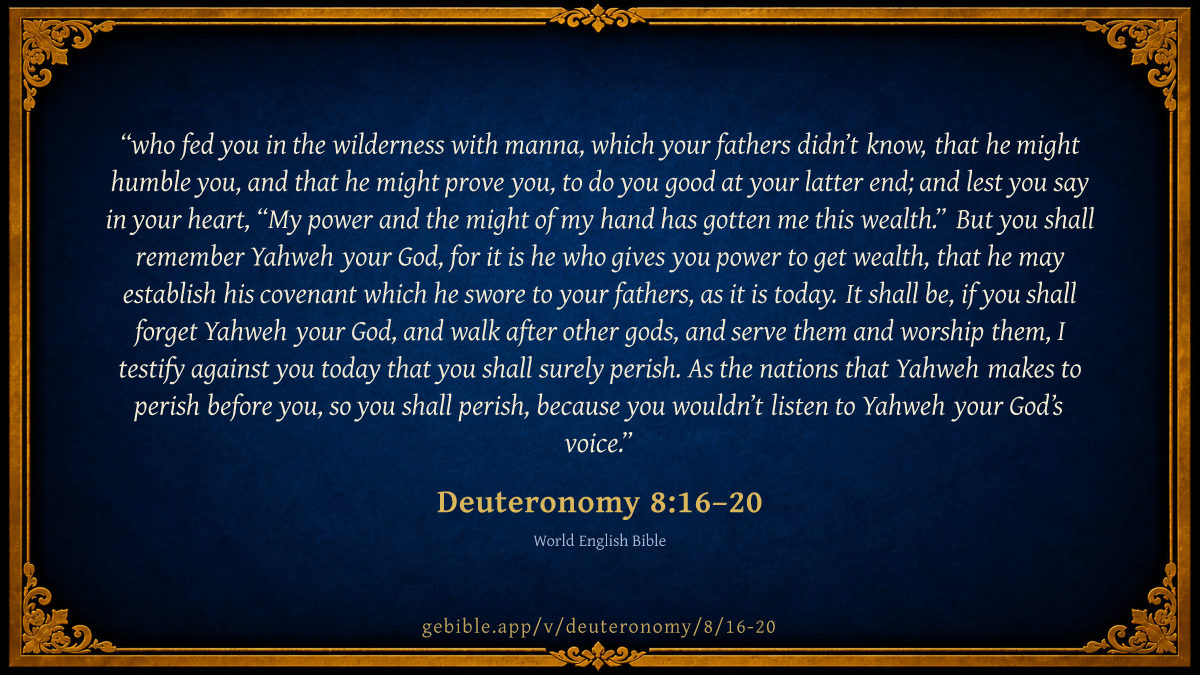
11Beware lest you forget Yahweh your God, in not keeping his commandments, his ordinances, and his statutes, which I command you today; 12lest, when you have eaten and are full, and have built fine houses and lived in them; 13and when your herds and your flocks multiply, and your silver and your gold is multiplied, and all that you have is multiplied; 14then your heart might be lifted up, and you forget Yahweh your God, who brought you out of the land of Egypt, out of the house of bondage; 15who led you through the great and terrible wilderness, with venomous snakes and scorpions, and thirsty ground where there was no water; who poured water for you out of the rock of flint; 16who fed you in the wilderness with manna, which your fathers didn’t know, that he might humble you, and that he might prove you, to do you good at your latter end; 17and lest you say in your heart, “My power and the might of my hand has gotten me this wealth.” 18But you shall remember Yahweh your God, for it is he who gives you power to get wealth, that he may establish his covenant which he swore to your fathers, as it is today.
19It shall be, if you shall forget Yahweh your God, and walk after other gods, and serve them and worship them, I testify against you today that you shall surely perish. 20As the nations that Yahweh makes to perish before you, so you shall perish, because you wouldn’t listen to Yahweh your God’s voice.

Geneva Bible translators 1599 · Public Domain On vv18–19 If things concerning this life, proceed only of God’s…
If things concerning this life, proceed only of God’s mercy: much more spiritual gifts and life everlasting.
Geneva Bible (1599) marginal notes — public domain.
John Trapp 1656 · Public Domain On vv16, 17, 19 Deu 8:16 Who fed thee in the wilderness with…
Deu 8:16 Who fed thee in the wilderness with manna, which thy fathers knew not, that he might humble thee, and that he might prove thee, to do thee good at thy latter end;
Ver. 16. Who fed thee.] God will give his people Pluviam escatilem, et petram aquatilem. {a} He will set the flint abroach, and rain corn from heaven, rather than they shall pine and perish. {Psa 78:20; Psa 78:24}
Read full note →
{a} Tertul., De Patient.
John Trapp, A Commentary or Exposition upon All the Books of the Old and New Testament (1647–1656) — public domain. Text from a community e-Sword module.
Matthew Poole 1685 · Public Domain On vv16, 18 That he night humble thee, by keeping thee in…
That he night humble thee, by keeping thee in a constant dependence upon him for every day’s food, and convincing thee what an impotent, helpless, and beggarly creature thou art in thyself, having nothing whereon to subsist, but from hand to mouth, and being supported wholly by the alms of Divine goodness given to thee from day to day. The mercies of God, if duly considered, are as powerful an argument or mean to humble us as the greatest afflictions, because they increase our debts to God, and manifest our dependence upon him, and insufficiency without him; and by making God great, they make us little in our own eyes; though this clause, as well as that which follows, may have respect to their afflictions, mentioned Deu 8:15.
At thy latter end, i.e. that after he hath purged and prepared thee by afflictions, he may give thee, and thou mayst receive and enjoy, his blessings with less disadvantage, whilst by the remembrance of former afflictions thou art made thankful for them, and more cautious not to abuse and forfeit them again.
Matthew Poole's English Annotations on the Holy Bible (1683–1685) — public domain. Text from a community e-Sword/MySword module.
John Gill 1763 · Public Domain On vv16–19 And thou say in thine heart,.... These words are…
And thou say in thine heart,.... These words are in connection with the former part of the Deu 8:14,
and thou forget the Lord thy God; the author and giver of all the good things enjoyed, and think within themselves, though they might not express it in words at length:
Read full note →
my power and the might of mine hand hath gotten me this wealth; so ascribing that to themselves, their labour, and diligence, which ought to be ascribed to the bounty and blessing of God; see Hos 12:8.
John Gill's Exposition of the Whole Bible (1746–1763) — public domain (CC PDM 1.0). Text via the HelloAO Bible API.
John Wesley 1765 · Public Domain On v16 That he might humble thee - By keeping thee…
That he might humble thee - By keeping thee in a constant dependence upon him for every day's food, and convincing thee what an impotent, helpless creature thou art, having nothing whereon to subsist, and being supported wholly by the alms of divine goodness from day to day. The mercies of God, if duly considered, are as powerful a mean to humble us as the greatest afflictions, because they increase our debts to God, and manifest our dependance upon him, and by making God great, they make us little in our own eyes. To do thee good - That is, that after he hath purged and prepared thee by afflictions, thou mayest receive and enjoy his blessings with less disadvantage, whilst by the remembrance of former afflictions. thou art made thankful for them, and more cautious not to abuse them.
John Wesley, Explanatory Notes Upon the Whole Bible (1754–1765) — public domain. Text via the GEBible commentary corpus.
Adam Clarke 1810 · Public Domain On vv16, 18 Verse 16. Who fed thee - with manna] See…
Verse 16. Who fed thee - with manna] See this miracle described See Clarke on Ex 16:13, &c.
Adam Clarke's Commentary on the Bible (1810–1826) — public domain. Text from a community e-Sword/MySword module.
Joseph Benson 1811 · Public Domain On vv16, 20 Deu 8:16. That he might humble thee — By…
Deu 8:16. That he might humble thee — By keeping thee in constant dependance upon himself for every day’s food, and convincing thee what an impotent, helpless creature thou art, having nothing whereon to subsist, and being supported wholly by the alms of divine goodness from day to day. The mercies of God, if duly considered, are as powerful a means to humble us as the greatest afflictions, because they increase our debts to God, and manifest our dependance upon him, and by making God great, they make us little in our own eyes. To do thee good — That is, that after he hath purged and prepared thee by afflictions, thou mayest receive and enjoy his blessings with less disadvantage, while by the remembrance of former afflictions thou art made thankful for those blessings, and more cautious not to abuse them.
Joseph Benson's Commentary on the Old and New Testaments (1811–1818) — public domain. Text from a community e-Sword module.
Albert Barnes 1834 · Public Domain On v16 To do thee good at thy latter end -…
To do thee good at thy latter end - This is presented as the result of God’s dealings.
Albert Barnes' Notes on the Bible (1834–1885) — public domain. Text from a community e-Sword/MySword module.
Haydock's Catholic Bible Commentary 1859 · Public Domain On vv17, 19, 20 For me. Hebrew, "hath procured me this wealth," or…
For me. Hebrew, "hath procured me this wealth," or strength, ver. 18.
George Leo Haydock (1774–1849), Haydock's Catholic Family Bible and Commentary, 1859 edition — public domain. Excludes Psalms (Douay-Rheims chapter numbering differs from Protestant) and Deuterocanonical books (Catholic canon only).
Daniel D. Whedon 1874 · Public Domain On vv16, 19 16. At thy latter end — The Hebrew word…
16. At thy latter end — The Hebrew word which our translators have rendered latter end is the same that is used in Gen_49:1, and Isa_2:2. In both cases it is rendered last days. “In this instance Moses refers to the period of their life in Canaan, in contrast with which the period of their sojourn in Egypt and their wandering in the desert is regarded as the beginning; consequently the expression does not relate to death as the end of life, as in Num_33:10.” — Keil.
Daniel D. Whedon (gen. ed.), Commentary on the Old and New Testaments (1874–1909) — public domain. Text from a community e-Sword module.
The Cambridge Bible for Schools and Colleges 1878 · Public Domain On vv16–20 16. See on Deu_8:2-3 and Deu_4:34.
16. See on Deu_8:2-3 and Deu_4:34.
to do thee good] Deu_28:63, Pl., Deu_30:5, Sg.
Read full note →
thy latter end] Misleading translation. Lit. thine afterness, thy later years. There is nothing eschatological in the phrase. Steuernagel marks Deu_8:14 b, Deu_8:15 and Deu_8:16 as an intrusion on the grounds that they but repeat Deu_8:2 b, Deu_8:3, and spoil the connection between Deu_8:14 a and Deu_8:17. But the deuteronomic style is given to repetition, and here the writer not only repeats but carries his argument to a climax in the phrase to do thee good in thy later days.
The Cambridge Bible for Schools and Colleges (gen. ed. J. J. S. Perowne; Cambridge University Press, 1878–1918) — public domain. Text from a community e-Sword module.
Ellicott's Commentary for English Readers 1878 · Public Domain On v20 (20) Because ye would not be obedient.—In return for…
(20) Because ye would not be obedient.—In return for your disobedience. The same word is employed in Deu_7:12. The use of the word in these two places might fairly be taken to mark off the intervening portion as a complete section of the discourse.
A Bible Commentary for English Readers, edited by Charles John Ellicott (1878–1897) — public domain. Text from a community e-Sword module.
The Pulpit Commentary 1880 · Public Domain On vv16, 17, 19 The grand end of all God"s dealings with the…
The grand end of all God"s dealings with the Israelites in the desert, both the trials to which they were subjected and the benefits they received, was that he might do them good ultimately. Thy latter end; not the end of life, as in Num_23:10, but the state ensuing on the termination of their period of discipline and probation in the desert. (cf. Job_8:7 Job_42:12; 2Pe_2:20) God thus dealt with the Israelites as he still deals with his people; he afflicts them not for his pleasure but for their profit; (Heb_11:12) he subjects them to trial and varied discipline that he may fit them for the rest and joy that in the end are to be theirs.
See Homiletics: (Deu_8:1-6)
Read full note →
Good at the latter end.
I GOD"S DISCIPLINE OF US IS NOT WITHOUT ITS END. No man even, whose action has any meaning in it, but has an end in what he does. It may be alleged that God"s action has regard to men only in the mass; that in that view of it his action has an end; but that a special purpose is not traceable in his dealings with individuals. The truer philosophy sees purpose everywhere. The individual soul is of interest to God. He deems it worthy of being an end in itself. Though subordinately to the general good, he shapes his providence with a view to its individual well-being. (Mat_10:29-31) For
II GOD"S DISCIPLINE OF US IS MEANT TO TURN TO OUR ULTIMATE ADVANTAGE. "To do thee good at thy latter end." The immediate object of God"s discipline is to form character; to create and develop love, trust, and obedience; to uproot evil dispositions; to break down self-will and self-dependence. The ultimate end of it is the service and blessedness of heaven. There may be some service which God is preparing us for on earth, some possession he wishes to give us, some trust he is about to repose in us. But heaven is the goal of all. (1Pe_1:7; Rev_3:10-13 Rev_7:13-17)
III THE END OF GOD"S DISCIPLINE OF US WILL NOT RE FULLY SEEN TILL THE GOAL IS REACHED. Till then our duty is to do present work, and improve by present training. J.O.
The Pulpit Commentary (1880–1919), ed. H.D.M. Spence-Jones & Joseph S. Exell — public domain. Text from a community e-Sword module.
The Biblical Illustrator 1887 · Public Domain On vv18–19 Remember the Lord thy God, for it is He…
Deu_8:18
Remember the Lord thy God, for it is He that giveth thee power to get wealth.
Read full note →
To remember God is the way to get wealth
1. The duty enjoined. Thou shalt remember the Lord, etc.
1. In point of contemplation to remember Him, that is, to think of Him, and to have Him often in our minds. Theres no man that forgets his treasure; wherever that is, there will be also his heart, as our Saviour tells us. We need not call upon worldly men to remember their gold and silver and riches, they will think upon these of their own accord, and all because such things as these are dear with them. In like manner will it be with us to God; if He be our treasure, we shall remember and daily think of Him, as it is fitting for us to do.
2. As in point of contemplation, so also in point of affection. We are said to remember anyone, not when barely we think upon him, but when we think upon him with respect, when he is not only in our thoughts but in our hearts. And thus likewise are we said to remember God.
3. In point of obedience to remember God is to be subject to Him, and to do that which He requires. Those that Walk in ways of opposition and contrariety to God, they are said to forget Him. Consider this ye that forget God (Psa_50:22).
4. In point of address and seeking to Him, and reliance and dependence upon Him. When anything is to be done by us, or for us, that we be sure to call upon God Himself for the prospering of it to us (Pro_3:5-6).
5. In point of thankfulness and acknowledgment we are then said to remember God, when we own Him in all the mercies which we enjoy from Him. This is the proper drift of this present Scripture, as we may see by the context, in Deu_8:10-11, etc., of this chapter. When thou hast eaten and art full, thou shalt bless the Lord thy God for the good land which He hath given thee. Beware that thou forget not the Lord thy God, in not keeping His commandments and His judgments, etc. Because, indeed, it is that which we are naturally and commonly too prone and subject unto.
(1) From His sovereignty, that He is the Lord, we should remember Him for that, and accordingly yield all respect and acknowledgment to Him.
(2) From the word of propriety, and that interest which He has in us and we in Him: Thy God.
II. The reason annexed. For it is He that giveth thee power to get wealth, which passage may be considered two ways. First, in its absolute consideration; and, secondly, in its connexion. We will look upon it first of all in the former consideration, as it is absolute, and by way of proposition.
1. Emphatically. When it is said here He gives power, this power, it may be said, laid forth according to sundry explications.
(1) He gives the skill and faculty which does tend and conduce hereunto. All your arts and trades of your several societies in the city, and ability for the managing of them, God is the author and giver of them. And being the giver of them, He is also consequently the giver of that wealth that comes by them. He gives thee power to get wealth, while He gives thee skill and understanding. And this again not only in the general habit, but also as to the particular act and improvement and the exercise of that habit which is in Him.
(2) He gives thee power to get wealth, that is, He gives thee occasion and opportunity to do so. Thus in a way of husbandry, there is the seasonableness of the weather. Thus in a way of merchandise, there is the favourableness of the seas and waters and winds, which are at Gods command and disposing.
(3) The power of success: it is He that gives this likewise, when all things are prepared in the means as much as can be, yet there is a further blessing which is required for the perfecting of them. And this is also from God Himself. It is the blessing of the Lord that makes rich, and adds no sorrow with it, as Solomon tells us (Pro_10:22).
(4) It is God that gives thee power to get wealth; that is, that gives thee grace, and makes thy gettings to he lawful to thee. To get wealth in Gods way and according to His approbation; this is power to get wealth indeed. And this also, together with all the former, is the gift of God.
2. Exclusively. When it is said here that He gives this power, this is to be taken not only emphatically, but exclusively; and so there are these intimations in it.
(1) That wealth and riches and great estates they are not matters of mere accident, and casualty, and chance; but that there is a special hand of Providence in them.
(2) It is not from ourselves neither, that we do any time come to be rich and to Increase in wealth. It is the gilt of God.
(3) It is not from other men neither, it is exclusive of them. Parents and friends and progenitors, and such as these. Indeed, Solomon tells us in one place that houses and riches are the inheritance of fathers (Pro_19:14). But this must be understood so far as they are able to make them, which is not absolutely, but with its restriction. How many have there been in the world who, though they have had great estates left them by others, yet notwithstanding have been poor themselves; and have not known either how to increase or how to keep that which has been left them. We have seen how He does it emphatically; He is not wanting in doing it; we have seen also how He does it exclusively. There is none to purpose that does it but He. First, He gives thee power to keep it; and, secondly, He gives thee power to use it. (T. Horton, D. D.)
The theology of money
What a blow this text strikes at one of the most popular and mischievous fallacies in common life, namely, that man is the maker of his own money! Men who can see God in the creation of worlds cannot see Him suggesting an idea in business, smiling on the plough, guiding the merchants pen, and bringing summer into a brain long winter-bound and barren. Lebanon and Bashan are not more certainly Divine creations than are the wool and flax which cover the nakedness of man. To the religious contemplation, the sanctified and adoring mind, the whole world is one sky-domed church, and there is nothing common or unclean. God wishes this fact to be kept in mind by His people. In this instance, as in many others, God makes His appeal to recollection: Thou shalt remember. The fact is to be ever present to the memory; it is to be as a star by which our course upon troubled waters is to be regulated; it is to be a mystic cloud in the daytime, a guiding fire in the night season. The rich memory should create a rich life. An empty memory is a continual temptation. Mark the happy consequences of this grateful recollection. First of all, God and wealth are ever to be thought of together. The silver and the gold are Mine. There is but one absolute proprietor. We hold our treasures on loan; we occupy a stewardship. Consequent upon this is a natural and most beautiful humility. What hast thou that thou hast not received? When the trader sits down in the evening to count his days gains, he is to remember that the Lord his God gave him power to get wealth. When the workman throws down the instrument of his labour that he may receive the reward of his toil, he is to remember that the Lord his God gave him power to get wealth. When the young man receives the first payment of his industry, he is to remember that the Lord his God gave him power to get wealth. Thus the getting of money becomes a sacred act. This, then, is the fundamental principle upon which Christians are to proceed, namely, that God giveth man power to get wealth, and consequently that God sustains an immediate relation to the property of the world. Take the case of a young man just entering business. If his heart is uneducated and unwatched, he will regard business as a species of gambling; if his heart be set upon right principles, lie will esteem business as a moral service, as the practical side of his prayers, a public representation of his best desires and convictions. In course of time the young man realises money on his own account. Looking at his gold and silver, he says, I made that. There is a glow of honest pride on his cheek. He looks upon the reward of his industry, and his eyes kindle with joy. Whilst he looks upon his first-earned gold, the Bible says to him gently and persuasively, Thou shalt remember the Lord thy God; for it is He that giveth thee power to get wealth. Instantly his view of property is elevated, enlarged, sanctified. He was just about to say that his own arm had gotten him the victory, and to forget that, through the image, is Caesars yet the gold is Gods. What, then, is the natural line of thought through which the successful man would run under such circumstances? It would lie in some such direction as this: What can be the meaning of this word remember? Does it not call me to gratitude? Is it not intended to turn my heart and my eye heavenward? As God has given me power to get wealth, am I not bound to return some recognition of His goodness and mercy? Honour the Lord with thy substance, and with the first fruits, of all thine increase. Supposing this to be done, what is the result which is promised to accrue? That result is stated in terms that are severely logical: So shall thy barns be filled with plenty, and thy presses shall burst out with new wine. The text has called us to an act of remembrance, and in doing so has suggested the inquiry whether there is any such act of remembrance on the part of God Himself? The Scripture is abundant in its replies to this inquiry: For God is not unrighteous to forget your work and labour of love, which ye have showed towards His name, in that ye have ministered to the saints, and do minister. Jesus Christ Himself has laid down the same encouragement with even minuter allusion: Whosoever shall give to drink unto one of these little ones a cup of cold water only in the name of a disciple, verily I say unto you, he shall in no wise lose his reward. (J. Parker, D. D.)
The philosophy of worldly success
1. How worldly success is to be obtained. By strict obedience to Gods laws; by this only. Work is what He demands, and work is the only condition under which the prize may be won.
2. The nature of the profit we are to look for. Not merely worldly profit. No life so dreary, so deadly as that of the mere millionaire. The joys of the true mans life he cannot taste; the holy fellowships of spiritual being he cannot enter,: God stamps him reprobate. There is a vast wealth of faculty in him, fusting from want of use. And power unused soon gets acrid, and mordant, and gnaws and wears within.
3. Why we should remember the Lord God. Because--
(1) It will bring us out at once into the glad sunlight, and will make even our toil lightsome.
(2) It will spare us all wearing and crushing anxieties.
(3) It will save us the shame and anguish of finding ourselves bankrupt at last and forever. (J. B. Brown, B. A.)
God acknowledged
When Speaker Crooke was presented to Queen Elizabeth in the House of Lords on the occasion of his election, he said that England had been defended against the Spaniards and their Armada by Her Majestys mighty arm. The Queen interrupted him and from her throne, said: No; but by the mighty hand of God, Mr. Speaker.
God the original source of wealth
He that would thus critically examine his estate upon interrogatories, put every part of it upon the rack and torture to confess without any disguise from whence it came, whether down the ladder from heaven, or up out of the deep--for there it seems by the poets Plutus or riches hath a residence also--by what means it was conveyed, by whose directions it travelled into that coast, and what the end of its coming is, and so learn the genealogy as it were of all his wealth, would certainly acknowledge that he were fallen upon a most profitable inquiry. For beside that he would find out all the ill-gotten treasure, that gold of Toulouse that is so sure to help melt all the rest, that which is gotten by sacrilege, by oppression, by extortion, and so take timely advice to purge his lawful inheritance from such noisome unwholesome acquisitions, and thrive the better forever after the taking so necessary a purgation--he will, I say, over and above see the original of all his wealth, all that is worthy to be called such, either immediately or mediately from God, immediately without any cooperation of ours, as that which is left to us by inheritance from honest parents--our fortunes and our Christianity together, mediately as that which our lawful labour, our planting and watering hath brought down upon us, wholly from Gods prospering or giving of increase.
The Biblical Illustrator, edited by Joseph S. Exell (c. 1880s–1900s) — public domain. Text from a community e-Sword module.
unfoldingWord translationNotes 2017 · CC BY-SA 4.0 On v18 General Information:
General Information:
Moses continues to speak to the Israelites as if they are one person. (See: Forms of You)
Read full note →
But you will call to mind
This idiom is a command. AT: "But remember" (See: Idiom)
that he may establish
Possible meanings are 1) "in this way he establishes" or 2) "in this way he is faithful to establish."
that he may
"so he can"
establish
cause to stand or to remain
as it is today
"as he is doing now" or "as he is establishing his covenant now"
walk after other gods
Walking is a metaphor for obeying. AT: "serve other gods" (See: Metaphor)
against you ... you will ... before you ... you perish ... you would not ... your God
All these instances of "you" are plural. (See: Forms of You)
I testify against you
"I warn you" or "I tell you in front of witnesses"
you will surely perish
"you will certainly die"
before you
"in front of you"
would not listen to the voice of Yahweh
Here "the voice of Yahweh" means what Yahweh tells his people to do. AT: "would not obey Yahweh's commandments" (See: Metonymy)
translationWords
mind
power
covenant
oath
ancestor
walk
false god
worship
testimony
perish
nation
voice
unfoldingWord translationNotes — © Distant Shores Media and the Door43 World Missions Community, licensed CC BY-SA 4.0. Source: git.door43.org/Door43/en_tn.
Tyndale Open Study Notes 2022 · CC BY-SA 4.0 On v18 8:18 This was not the covenant that God made…
8:18 This was not the covenant that God made with the previous generation of Israelites at Sinai but the one he first made with Abraham (Gen 15:1-21; 17:1-21), then Isaac (Gen 26:1-5) and Jacob (Gen 28:1-4, 13-15; 46:1-4). • In order to be legal and proper, a covenant had to be sworn to with an oath that all parties to the agreement uttered. Although by his very nature God could never rescind a promise, he honored the protocol (see Deut 7:12).
Tyndale Open Study Notes — © Tyndale Open Resources, licensed CC BY-SA 4.0. Text via the HelloAO Bible API.