
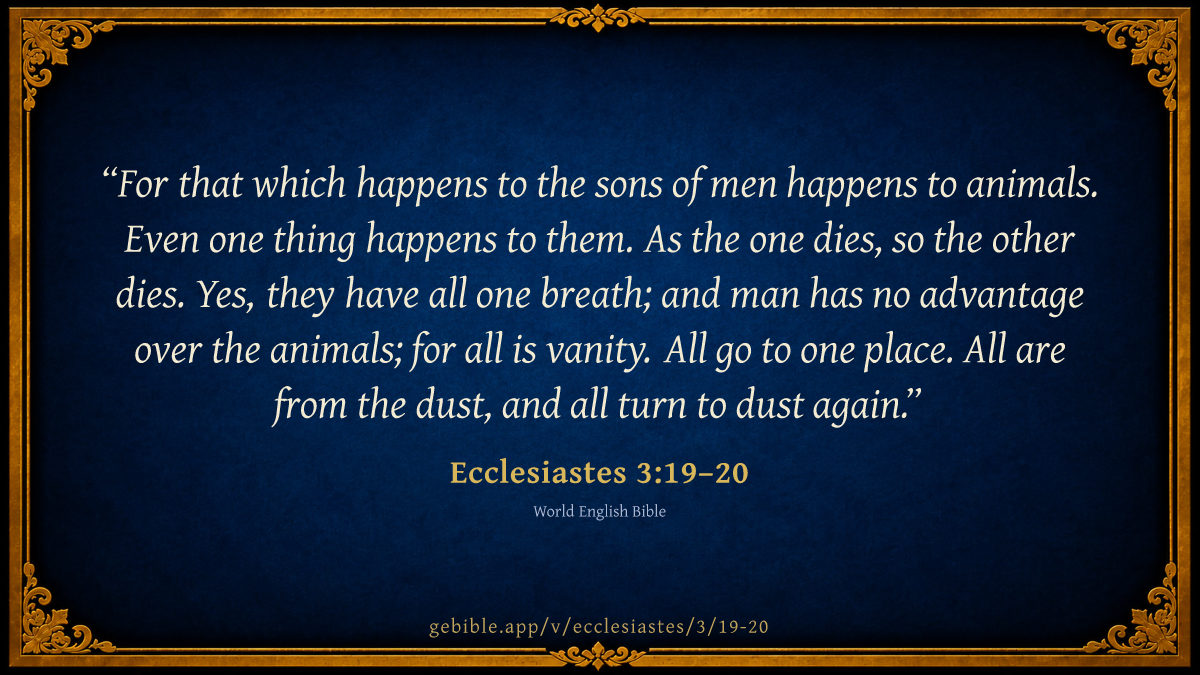
For that which happens to the sons of men happens to animals. Even one thing happens to them. As the one dies, so the other dies. Yes, they have all one breath; and man has no advantage over the animals; for all is vanity. All go to one place. All are from the dust, and all turn to dust again.
Show the surrounding paragraph
Ecclesiastes 3:19-20 sits inside this longer paragraph.
Moreover I saw under the sun, in the place of justice, that wickedness was there; and in the place of righteousness, that wickedness was there. I said in my heart, “God will judge the righteous and the wicked; for there is a time there for every purpose and for every work.” I said in my heart, “As for the sons of men, God tests them, so that they may see that they themselves are like animals. For that which happens to the sons of men happens to animals. Even one thing happens to them. As the one dies, so the other dies. Yes, they have all one breath; and man has no advantage over the animals; for all is vanity. All go to one place. All are from the dust, and all turn to dust again. Who knows the spirit of man, whether it goes upward, and the spirit of the animal, whether it goes downward to the earth?”
Parallel Translations
-
For that which happens to the sons of men happens to animals. Even one thing happens to them. As the one dies, so the other dies. Yes, they have all one breath; and man has no advantage over the animals; for all is vanity.
All go to one place. All are from the dust, and all turn to dust again.
-
For that which befalleth the sons of men befalleth beasts; even one thing befalleth them: as the one dieth, so dieth the other; yea, they have all one breath; so that a man hath no preeminence above a beast: for all is vanity.
All go unto one place; all are of the dust, and all turn to dust again.
Show all 3 translations
-
For that which befalleth the sons of men befalleth beasts; even one thing befalleth them; as the one dieth, so dieth the other; yea, they have all one breath; so that man hath no pre-eminence above a beast; for all is vanity.
All go unto one place; all are of the dust, and all return to dust.
Examined in Scripture Analysis
Contradictions (3)
Questions where the Bible appears to say two different things, with the passages on each side set together.
Cross-references (27)
- Genesis 3:19 (v20) You will eat bread by the sweat of your face until you return to the ground, for you were taken out of it. For you are dust, and you shall…
- Psalms 49:12 (v19) But man, despite his riches, doesn’t endure. He is like the animals that perish.
- Job 34:15 (v20) all flesh would perish together, and man would turn again to dust.
- Psalms 49:20 (v19) A man who has riches without understanding, is like the animals that perish.
- Job 14:10-12 (v19) But man dies, and is laid low. Yes, man gives up the spirit, and where is he? As the waters fail from the sea, and the river wastes and…
Show all 26 cross-references
- Ecclesiastes 12:7 (v20) and the dust returns to the earth as it was, and the spirit returns to God who gave it.
- Psalms 104:29 (vv19–20) You hide your face; they are troubled. You take away their breath; they die and return to the dust.
- Numbers 27:13 (v20) When you have seen it, you also shall be gathered to your people, as Aaron your brother was gathered;
- Job 7:9 (v20) As the cloud is consumed and vanishes away, so he who goes down to Sheol will come up no more.
- Job 10:9-10 (v20) Remember, I beg you, that you have fashioned me as clay. Will you bring me into dust again? Haven’t you poured me out like milk, and…
- Psalms 39:5-6 (v19) Behold, you have made my days hand widths. My lifetime is as nothing before you. Surely every man stands as a breath.” “Surely every man…
- Psalms 89:47-48 (v19) Remember how short my time is, for what vanity you have created all the children of men! What man is he who shall live and not see death,…
- Ecclesiastes 2:14 (v19) The wise man’s eyes are in his head, and the fool walks in darkness—and yet I perceived that one event happens to them all.
- Ecclesiastes 2:20-23 (v19) Therefore I began to cause my heart to despair concerning all the labor in which I had labored under the sun. For there is a man whose…
- Ecclesiastes 3:21 (v20) Who knows the spirit of man, whether it goes upward, and the spirit of the animal, whether it goes downward to the earth?”
- Ecclesiastes 6:6 (v20) Yes, though he live a thousand years twice told, and yet fails to enjoy good, don’t all go to one place?
- Ecclesiastes 9:10 (v20) Whatever your hand finds to do, do it with your might; for there is no work, nor plan, nor knowledge, nor wisdom, in Sheol, where you are…
- Genesis 25:8 (v20) Abraham gave up his spirit, and died at a good old age, an old man, and full of years, and was gathered to his people.
- Genesis 25:17 (v20) These are the years of the life of Ishmael: one hundred thirty-seven years. He gave up his spirit and died, and was gathered to his people.
- 2 Samuel 14:14 (v19) For we must die, and are like water spilled on the ground, which can’t be gathered up again; neither does God take away life, but devises…
- Job 17:13 (v20) If I look for Sheol as my house, if I have spread my couch in the darkness,
- Psalms 49:14 (v20) They are appointed as a flock for Sheol. Death shall be their shepherd. The upright shall have dominion over them in the morning. Their…
- Psalms 92:6-7 (v19) A senseless man doesn’t know, neither does a fool understand this: though the wicked spring up as the grass, and all the evildoers…
- Ecclesiastes 2:16 (v19) For of the wise man, even as of the fool, there is no memory forever, since in the days to come all will have been long forgotten. Indeed,…
- Daniel 12:2 (v20) Many of those who sleep in the dust of the earth will awake, some to everlasting life, and some to shame and everlasting contempt.
- Job 30:24 (v20) “However doesn’t one stretch out a hand in his fall? Or in his calamity therefore cry for help?
26 distinct cross-references across this passage (27 total citations).
Cross-references from openbible.info (CC BY 4.0)
Explain this passage (17 sources)
Historical commentary, presented as a primary source — not an endorsement.
Private notes
Saved on this device only — never synced or sent anywhere.
Geneva Bible translators 1599 · Public Domain On v19 Man is not able by his reason and judgment…
Man is not able by his reason and judgment to put difference between man and beast, as touching those things whereunto both are subject: for the eye cannot judge any otherwise of a man being dead, than of a beast, which is dead: yet by the word of God and faith we easily know the diversity, as verse 21.
Geneva Bible (1599) marginal notes — public domain.
John Trapp 1656 · Public Domain On vv19–20 Ecc 3:19 For that which befalleth the sons of…
Ecc 3:19 For that which befalleth the sons of men befalleth beasts; even one thing befalleth them: as the one dieth, so dieth the other; yea, they have all one breath; so that a man hath no preeminence above a beast: for all [is] vanity.
Ver. 19. For that which befalleth the sons of men.] As hunger, thirst, heat, cold, diseases, aches, and other ill accidents.
Read full note →
As the one dieth.] They are sure to die, both of them.
Yea, they have all one breath.] They breathe in the same air, and expire alike, in respect of the body. {a}
So that a man hath no pre-eminence.] Unless it be in reason and speech, which he frequently abuseth to his own utter destruction. But otherwise -
“ Nos aper auditu praecellit, aranea tactu,
Vultur odoratu, lynx visu, simia gustu. ”
{a} Nec te tua plurima Pentheu,
Labentem texit pietas.
John Trapp, A Commentary or Exposition upon All the Books of the Old and New Testament (1647–1656) — public domain. Text from a community e-Sword module.
Matthew Poole 1685 · Public Domain On vv19–20 Befalleth beasts; they are subject to the same diseases,…
Befalleth beasts; they are subject to the same diseases, pains, and casualties.
So dieth the other; as certainly, and no less painfully.
Read full note →
One breath; one breath of life, which is in their nostrils; one and the same living soul, by which the beasts perform the same vital and animal operations. For he speaks not here of man’s rational and immortal spirit, nor of the future life.
A man hath no pre-eminence above a beast, in respect of the present life and sensible things. Nay, the beasts have quicker senses than men, and therefore enjoy more pleasure in those things, and that with less dangers and mischief, than men do.
Matthew Poole's English Annotations on the Holy Bible (1683–1685) — public domain. Text from a community e-Sword/MySword module.
John Gill 1763 · Public Domain On vv19–20 For that which befalleth the sons of men befalleth…
For that which befalleth the sons of men befalleth beasts,.... Aben Ezra says this verse is according to the thoughts of the children of men that are not wise; but rather the wise man says what he does according to his own thoughts, and proceeds to prove the likeness and equality of men and beasts;
even one thing befalleth them; the same events belong to one as to another; the same diseases and disasters, calamities and distresses: Noah's flood carried away one as well as another; they both perished in it; several of the plagues of Egypt were inflicted on both; and both are beholden to God for their health, preservation, and safety; see Gen 7:21;
Read full note →
as the one dieth, so dieth the other; the Targum compares a wicked man and an unclean beast together, in the former clause; and paraphrases this after this manner,
"as an unclean beast dies, so dies he who is not turned to repentance before his death:''
he dies unclean in his sins, stupid, senseless; no more thoughtful of his future state, and of what will become of his precious and immortal soul, than a beast that has none; see Psa 49:14; perhaps unjust judges, persecuting tyrants, may particularly be regarded: who, though princes, shall not only die like men, but even like beasts, Psa 82:7;
yea, they have all one breath; the same vital breath, or breath of life, which is in the nostrils of the one as of the other; they breathe and draw in the same air, and have the same animal and vegetative life, and equally liable to lose it, Gen 2:7;
so that a man hath no preeminence above a beast: he has reason and speech, which a beast has not; which gives him a preference to them, did he make a right use of them; but, as an animal, he has no preeminence, being liable to the same accidents, and to death itself: the Targum excepts the house of the grave, man being usually buried when he dies, but a beast is not: yea, in some things a beast has the preeminence of a man; at least some have, in strength, agility, quickness of the senses, &c.
for all is vanity; all the gratifications of the senses; all riches, honours, pleasures, power, and authority, especially when abused.
John Gill's Exposition of the Whole Bible (1746–1763) — public domain (CC PDM 1.0). Text via the HelloAO Bible API.
John Wesley 1765 · Public Domain On vv19–20 For - They are subject to the same diseases,…
For - They are subject to the same diseases, pains, and calamities. So dieth - As certainly, and no less, painfully. One breath - One breath of life, which is in their nostrils by which the beasts perform the same animal operations. No preeminence - In respect of the present life.
John Wesley, Explanatory Notes Upon the Whole Bible (1754–1765) — public domain. Text via the GEBible commentary corpus.
Adam Clarke 1810 · Public Domain On vv19–20 Verse 19. For that which befalleth the sons of…
Verse 19. For that which befalleth the sons of men befalleth beasts] From the present comparison of great men to beasts, the author takes occasion to enforce the subject by mentioning the state of mankind in general, with respect to the mortality of their bodies; and then, by an easy transition, touches in the next verse on the point which is of such infinite consequence to religion.
As the one dieth, so dieth the other] Animal life is the same both in the man and in the beast.
Read full note →
They have all one breath] They respire in the same way; and when they cease to respire, animal life becomes extinct.
Befalleth beasts - This is wanting in six of Kennicott's and De Rossi's MSS.
Adam Clarke's Commentary on the Bible (1810–1826) — public domain. Text from a community e-Sword/MySword module.
Joseph Benson 1811 · Public Domain On vv19–20 Ecc 3:19. For that which befalleth, &c. — They…
Ecc 3:19. For that which befalleth, &c. — They are subject to the same diseases, pains, and casualties. So dieth the other — As certainly, and no less painfully. They have all one breath — One breath of life, which is in their nostrils; by which the beasts perform the same animal functions. For he speaks not here of man’s rational and immortal spirit, nor of the future life. So that a man hath no pre-eminence, &c. — In respect of the present life.
Joseph Benson's Commentary on the Old and New Testaments (1811–1818) — public domain. Text from a community e-Sword module.
Haydock's Catholic Bible Commentary 1859 · Public Domain On v19 Man hath nothing more, &c., viz., as to the…
Man hath nothing more, &c., viz., as to the life of the body. (Challoner)
George Leo Haydock (1774–1849), Haydock's Catholic Family Bible and Commentary, 1859 edition — public domain. Excludes Psalms (Douay-Rheims chapter numbering differs from Protestant) and Deuterocanonical books (Catholic canon only).
Robert Jamieson, A. R. Fausset & David Brown 1871 · Public Domain On v19 Literally, "For the sons of men (Adam) are a…
Literally, "For the sons of men (Adam) are a mere chance, as also the beast is a mere chance." These words can only be the sentiments of the skeptical oppressors. God's delay in judgment gives scope for the "manifestation" of their infidelity (Ecc 8:11; Psa 55:19; Pe2 3:3,4). They are "brute beasts," morally (Ecc 3:18; Jde 1:10); and they end by maintaining that man, physically, has no pre-eminence over the beast, both alike being "fortuities." Probably this was the language of Solomon himself in his apostasy. He answers it in Ecc 3:21. If Ecc 3:19-20 be his words, they express only that as regards liability to death, excluding the future judgment, as the skeptic oppressors do, man is on a level with the beast. Life is "vanity," if regarded independently of religion. But Ecc 3:21 points out the vast difference between them in respect to the future destiny; also (Ecc 3:17) beasts have no "judgment" to come.
breath--vitality.
Jamieson, Fausset & Brown — Commentary Critical and Explanatory on the Whole Bible (1871) — public domain (CC PDM 1.0). Text via the HelloAO Bible API.
Daniel D. Whedon 1874 · Public Domain On vv19–20 19. That which befalleth… men befalleth beasts — Hebrew,…
19. That which befalleth… men befalleth beasts — Hebrew, very forcibly, Man is a chance, and a beast is a chance, and the same chance is upon them both. Both have a perishable body and a flickering breath. The identity of man and beast in their slender hold upon life, and the irreparable nature of their death, is here very strongly put.
Daniel D. Whedon (gen. ed.), Commentary on the Old and New Testaments (1874–1909) — public domain. Text from a community e-Sword module.
The Cambridge Bible for Schools and Colleges 1878 · Public Domain On vv19–20 19. that which befalleth the sons of men] More…
19. that which befalleth the sons of men] More accurately, chance are the sons of men; chance is the beast; one chance is to both of them. The thought is emphasized by the threefold iteration of the depressing word. As so often throughout the book, we have an echo, almost a verbal translation, of a Greek saying. So Solon had said to Crœsus in a discourse which breathes the very spirit of Ecclesiastes (Herod. i. 32), πᾶν ἐστι ἄνθρωπος συμφορή (“man is altogether a chance”).
as the one dieth, so dieth the other] The words are not without a partial parallel in the more devotional literature of Israel. The writer of Psalms 49 had given utterance to the thought “man that is in honour … is like the beasts that perish.” With him, however, this was affirmed only of those that “trust in their wealth,” the triumphant, self-indulgent evildoers, and it was balanced by the belief that “God would redeem” his soul “from the power of the grave.” Here the same thought is generalised in the tones of a half cynical despair, all the more striking if we assume that the belief in immortality, as afterwards developed in the creed of Pharisaism, was at the time gaining a more definite form among the writer’s countrymen. It may be traceable either to the reaction against the germs of Pharisaism which was afterwards represented by the Sadducees, or, as seems more probable from the general tone and character of the book, to the influence of the Greek thought, such as was embodied in the teaching of Epicurus and Pyrrho, with which the writer had come in contact.
Read full note →
yea, they have all one breath] The word is the same as the “spirit” of verse Ecc_3:19, and seems deliberately chosen with reference to the record of Gen_2:7. The writer asks, What after all was that “breath of life?” Was there not a like “breath of life” in every beast of the field? It is significant that this is the only passage in the Old Testament in which the word is used definitely for the living principle of brutes, though we find it in Gen_6:17; Gen_7:15; Gen_7:22; Psa_104:30 for the life which is common both to them and man. Commonly, as in Job_12:10; Job_32:8, it is contrasted with the “soul” which represents their lower life.
a man hath no preeminence above a beast] This then was the conclusion to which the thinker was led by the materialism which he had imbibed from his Greek or Sadducean teachers. Put aside the belief in the prolongation of existence after death, that what has been begun here may be completed, and what has gone wrong here may be set right, and man is but a more highly organised animal, the “cunningest of Nature’s clocks” (to use Huxley’s phrase), and the high words which men speak as to his greatness are found hollow. They too are “vanity.” He differs from the brutes around him only, or chiefly, in having, what they have not, the burden of unsatisfied desires, the longing after an eternity which after all is denied him.
The Cambridge Bible for Schools and Colleges (gen. ed. J. J. S. Perowne; Cambridge University Press, 1878–1918) — public domain. Text from a community e-Sword module.
Ellicott's Commentary for English Readers 1878 · Public Domain On v19 (19) That which befalleth.—The word translated “event” in Ecc_2:13…
(19) That which befalleth.—The word translated “event” in Ecc_2:13 (where see Note).
Breath.—The same word as “spirit” (Ecc_3:21; Gen_7:15; Psa_104:30).
A Bible Commentary for English Readers, edited by Charles John Ellicott (1878–1897) — public domain. Text from a community e-Sword module.
The Pulpit Commentary 1880 · Public Domain On vv19–20 Vers. 19-21 are best regarded as a parenthesis explanatory…
Vers. 19-21 are best regarded as a parenthesis explanatory of vers. 16-18, elucidating man"s impotence in the presence of the anomalies of life. The conclusion in ver. 22 is connected with vers. 16-18. We must acknowledge that there are disorders in the world which we cannot remedy, and which God allows in order to demonstrate our powerlessness; therefore the wisest course is to make the best of present cir-circumstances.
For that which befalleth the sons of men befalleth beasts; literally, chance are the sons of men, and chance are beasts; (see on Ecc_2:14) Septuagint, Yea, and to them cometh the event (sunanthhma) of the sons of men, and the event of the beast." Koheleth explains in what respect man is on a level with the brute creation. Neither are able to rise superior to the law that controls their natural life. So Solon says to Croesus (Herod., 1:32), Pan ejsti anqrwpov sumforh, "Man is naught but chance;" and Artabanns reminds Xerxes that chances rule men, not men chances (ibid., 7:49). Even one thing befalleth them. A third time is the ominous word repeated, "One chance is to both of them." Freethinkers perverted this dictum into the materialistic language quoted in the Book of Wisdom (2. 2): "We are born at haphazard, by chance (aujtoscediwv); etc. But Koheleth"s contention is, not that there is no law or order in what happens to man, but that neither man nor beast can dispose events at their own will and pleasure; they are conditioned by a force superior to them, which dominates their actions, sufferings, and circumstances of life. As the one dieth, so dieth the other. In the matter of succumbing to the law of death man has no superiority over other creatures. This is an inference drawn from common observation of exterior facts, and touches not any higher question (comp. Ecc_2:14, 15 9:2, 3) Something similar is found in Psa_49:20, Man that is in honor, and understandeth not, is like the beasts that perish." Yea, they have all one breath (ruach ) This is the word used in ver. 23 for the vital principle, "the breath of life," as it is called in Gen_6:17, where the same word is found. In the earlier record (Gen_2:7) the term is nishma. Life in all animals is regarded as the gift of God. Says the psalmist, "Thou sendest forth thy spirit (ruach), they are created". (Psa_104:30) This lower principle presents the same phenomena in men and in brutes. Man hath no pre-eminence above a beast; i.e. in regard to suffering and death. This is not bare materialism, or a gloomy deduction from Greek teaching, but must be explained from the writer"s standpoint, which is to emphasize the impotence of man to effect his own happiness. Taking only a limited and phenomenal view of man"s circumstances and destiny, he speaks a general truth which all must acknowledge. Septuagint, "And what hath the man more than the beast? Nothing." For all is vanity. The distinction between man and beast is annulled by death; the former"s boasted superiority, his power of conceiving and planning, his greatness, skill, strength. cunning, all come under the category of vanity, as they cannot ward off the inevitable blow.
Read full note →
Vers. 19-22.
Are men no better than beasts?
I BOTH ALIKE EMANATE FROM THE SOIL. "All are of the dust" (ver. 20). This the first argument in support of the monstrous proposition that man hath no pre-eminence above a beast.
1. The measure of truth it contains. In so far as it asserts that man, considered as to his material part, possesses a common origin with the beasts that perish, that both were at first formed from the ground, and are so allied to the soil that, besides emerging from it, they are every day supported by it and will eventually return to it, being both resolved into indistinguishable dust, it accords exactly with the teaching of Scripture, (Gen_1:24 Gen_2:7) science, and experience. Compare the language of Arnobius, "Wherein do we differ from them? Our bones are of the same materials; our origin is not more noble than theirs" ("Ad Genies," 2:16).
2. The amount of error it conceals. It overlooks the facts that, again according to Scripture, (Gen_1:27 Gen_2:7 Gen_9:6) man was created in the Divine image, which is never said of the lower creatures; was endowed with intelligence far surpassing that of the creatures; (Job_32:8) and sofar from being placed on a level with the lower animals, was expressly constituted their lord. (Gen_1:28) Read in this connection Shakespeare"s "What a piece of work is maul" etc. ("Hamlet," act 2. sc. 2). Moreover, it ignores what is patent on every page of Scripture as well as testified by every chapter in human experience, viz. that God deals with man as he does not deal with the beasts, subjecting him as not them to moral discipline, and accepting of him what is never asked of them, the tribute of freely rendered service, inviting him as they are never invited to enter into conscious fellowship with himself, punishing him as never them for disobedience, and making of him an object of love and grace to the extent of devising and completing on his behalf a scheme of salvation, as is never done or proposed to be done for them. Unless, therefore, Scripture be set aside as worthless, it will be impossible to hold that in respect of origin and nature man hath no pre-eminence over the beasts.
II BOTH ALIKE ARE THE SPORT OF CHANCE. "That which befalleth the sons of men befalleth beasts; even one thing befalleth them;" or, Chance are the sons of men, chance is the beast, and one chance is to them both" (ver. 19).
1. The assertion under limitations may be admitted as correct. Certainly no ground exists for the allegation that the course of providence, whether as it relates to man or as it bears upon the lower animals, is a chance, a peradventure, a haphazard. Yet events, which in the program of the Supreme have their fixed places and appointed times, may seem to man to be fortuitous, as lying altogether beyond his calculation and not within his expectation; and what the present argument amounts to is that man is as helpless before these events as the unthinking creatures of the field are that they deal with him precisely as with the boasts, sweeping down upon him with resistless force, falling upon him at unexpected moments, and tossing him about with as much indifference as they do them.
2. The assertion, however, must be qualified. It follows not from the above concessions that man is as helpless before unforeseen occurrences as the beasts are. Not only can he to some extent by foresight anticipate their coming, which the lower creatures cannot do, but, unlike them also, he can protect himself against them when they have come. To man belongs a power not (consciously at least) possessed by the animals, of not merely accommodating himself to circumstances a capability they to some extent share with him but of rising above circumstances and compelling them to bend to him. If to this be added that if time and chance happen to man as to the beasts he knows it, which they do not, and can extract good from it, which they cannot, it will once more appear that ground exists for disputing the degrading proposition that man hath no pre-eminence over the beasts.
III BOTH ALIKE ARE THE PREY OF DEATH. "As the one dieth, so dieth the other; yea, they have all one breath" (ver. 19).
1. Seeming correspondences between the two in the matter of dying.
(1) In both death means the extinction of physical life and the dissolution of the material frame.
(2) In both the mode of dying is frequently the same,
(3) The same grave receives both when the vital spark has departed.
(4) The only difference between the two is that man commonly gets a coffin and a funeral, a mausoleum and a monument, whereas the beast gets none of these luxuries.
2. Obvious discrepancies between the two in respect of dying.
(1) Man living knows that he must die, (Ecc_9:5) which the beast does not.
(2) Man has the choice and power, if he accepts the provisions of grace, of meeting death without a fear.
(3) Even if he does not, there is something nobler in the spectacle of a man going forth with eyes open to the dread conflict with the king of terrors, than in that of a brute expiring in unconscious stupidity.
(4) If one thinks of him dying, as he often does die, like a Christian, it will be seen more absurd than ever to assert that a man hath no pre-eminence over a "beast.
IV BOTH, DYING, PASS BEYOND THE SPHERE OF HUMAN KNOWLEDGE, "Who knoweth the spirit of man, whether it goeth upward? and the spirit of the beast, whether it goeth downward to the earth?" (ver. 21).
1. Admitted so far as scientific knowledge is concerned. The agnostics of the Preacher"s day, like those of modern times, could not say what became of a man"s spirit, if he had one (of which they were not sure), after it had escaped from his body, any more than they could tell where a beast"s and the beast was as likely to have a spirit as the man went to after its carcass sank into the soil. Whether it was the man"s that went upward and the beast"s downward, or vice versa, lay outside their ken. Their scientific apparatus did not enable them to report, as the scientific apparatus of the nineteenth century does not enable it to report, upon the post-mundane career of either beast or man; and so they assumed the position from which the agnostics of to-day have not departed, that it is all one with the man and the beast when the grave hides them, and that a man hath no preeminence over a beast.
2. Denied so far as religious knowledge is concerned. Refusing to hold that the anatomist"s scalpel, or chemist"s retort, or astronomer"s telescope, or analyst"s microscope are the ultimate tests of truth, and that nothing is to be credited which cannot be detected by one or other of these instruments, we are not so hopelessly in the dark about man"s spirit when it leaves its earthly tabernacle as are agnostics whether ancient or modern. On the high testimony of this Preacher, (Ecc_12:7) on the higher witness of Paul (2Co_5:1; Php_1:23) and on the highest evidence attainable on the subject, (2Ti_1:10) we know that when the spirit of a child of God forsakes the body it does not disperse into thin air, but passes up into the Father"s hand, (Luk_23:46) and that when a good man disappears from earth he forthwith appears in heaven (Luk_23:43; Php_1:23) amid the spirits of the just made perfect; (Heb_12:23) so that another time we decline to endorse the sentiment that man hath no pre-eminence over a beast.
V BOTH ALIKE, PASSING FROM THE EARTH, NEVER MORE RETURN. "Who shall bring him back to see that which shall be after him?" (ver. 29). Accepting this as the correct rendering of the words (for other interpretations consult the Exposition):
1. It may be granted that no human power can recall man from the grave any more than it can reanimate the beast; that the realm beyond the tomb, so far as the senses are con-corned, is "an undiscovered country, from whose borne no traveler returns.
2. It is contended that nevertheless there is a power which can and ultimately will despoil the grave of its human victims, and that man will eventually come back to dwell, if not upon the old soil and beneath the old sky, at least beneath a new heavens and upon a new earth, wherein dwelleth righteousness.
LESSONS.
1. The dignity of man.
2. The solemnity of life.
3. The certainty of death.
The Pulpit Commentary (1880–1919), ed. H.D.M. Spence-Jones & Joseph S. Exell — public domain. Text from a community e-Sword module.
The Biblical Illustrator 1887 · Public Domain On v19 For that which befalleth the sons of men befalleth…
Ecc_3:19-21
For that which befalleth the sons of men befalleth beasts.
Read full note →
Man and beast
It is difficult to determine the exact object of Ecclesiastes in instituting this comparison: partly because the Hebrew is capable, in one or two places, of different translations; and partly because it is possible to take very different views of the connection between the two things which Ecclesiastes had said in his heart. One view which may be taken of this connection is that Ecclesiastes, having recorded his conviction that the righteous God will yet judge between the righteous and the wicked, goes on to record how he had speculated as to the reason why God does not always execute this judgment here and now. It had occurred to him that the reason of this might be to prove or test men, and to show them that, in and of themselves, they were liable to degenerate into a mere animal life. There is for man both probation and self-revelation in the fact that God does not visit all wickedness with immediate and manifest punishment. If a man thrusts his hand into the fire it is at once burnt: the suffering follows immediately on the action, and the man is not likely to do the same thing again. Now, if all violations of the moral law were followed likewise by such immediate and manifest consequences, there might be a test of human prudence, but there would scarcely be any test of human virtue. If, for example, every man who should commit an act of dishonesty were--at once and without fail--to be stricken with paralysis, there would be no more virtue in honesty than there is now in keeping ones hand out of the fire. But the fact that God often postpones the manifest punishment of iniquity, and allows wicked men sometimes even to trample upon the righteous with apparent impunity, affords a test of moral character, and leaves room for the exercise of virtues which are the result, not of mere prudence, but of an actual allegiance to God and righteousness. And this kind of probation, to which men are subjected, becomes an instrument of self-revelation. Men see how much of the animal there is in their nature. The spirit of man, indeed, goeth upward at death; and the spirit of the beast goeth downward to the earth: but who knoweth the exact difference between the two? The difference of destination does not make itself manifest to the senses. To all outward appearance the dissolution of the man and of the beast is exactly the same kind of thing; the human being does not appear to have any pre-eminence in this respect over the mere animal. Now, all these circumstances and appearances put men to the proof; they test men as to whether they will allow themselves to sink down into a mare animal, selfish life, or whether they will follow those Divine inspirations which link them to God, beckon them to righteousness, and point them to immortality. But there is another and very different view which may be taken of the passage. According to this view, Ecclesiastes is here recording a mood of materialistic scepticism through which he had passed. The two things which he had said in his heart were like the two voices of Tennysons poem--voices conflicting with one another for the mastery, and plunging the soul for a time into doubt and perplexity (verse 21, R.V.). Supposing this, then, to be the real drift of the passage before us, we surely need not be surprised that Ecclesiastes, in presence of the problems of life, should have passed through some such mood of materialistic scepticism. But it would seem that Ecclesiastes did not remain permanently in this sceptical attitude. We may regard him as here telling his readers what he had said in his heart about man and beast: he is not necessarily endorsing it at the time when he writes this book. On the contrary, it would appear from other passages that he was now clinging to the assurance that God would yet judge between righteous and wicked men, and that the spirit of man does not perish at death. Now, if Ecclesiastes could thus, with the light he had, arrive at the final conviction that the human spirit survives the dissolution of the body, surely we, in the fuller light of the Christian revelation, may well overcome the chilling doubts which may sometimes creep in upon our souls. Events, indeed, sometimes occur in the providence of God, which utterly baffle our understanding, and which seem almost to deal with men as if they were mere animals. Catastrophes happen, in which men seem to be taken as if they were fishes of the sea. The most brilliant thinker suddenly meets with a blow on the head which robs him, for a time, of all power of thought. Such things as these may stagger us. But we recover faith when we look to Jesus Christ as the Light of the World, and the Revealer of the Father. He who gave His Son to die for us, and who has led us to trust in His own fatherly love will not let us go down into nothingness. He who died for us and rose again has shown Himself to be the conqueror of death; and, because He lives, we shall live also. Glorying in His character and cross, and receiving into our hearts somewhat of His own spirit, we become conscious of thoughts, motives, and aspirations which raise us above our mere animal nature and contain within themselves the earnest of immortality. (T. C. Finlayson.)
The Biblical Illustrator, edited by Joseph S. Exell (c. 1880s–1900s) — public domain. Text from a community e-Sword module.
The Preacher's Complete Homiletical Commentary 1892 · Public Domain On v19 Ecc_3:22. For who shall bring him to see what…
CRITICAL NOTES.—
Ecc_3:22. For who shall bring him to see what shall be after him?] Man cannot tell what God will do in the future with all his earthly circumstances—how far, in the great future, they will be modified or destroyed. Hence riches, &c., must have many elements of uncertainty. Therefore enjoy the present.
Read full note →
MAIN HOMILETICS OF THE PARAGRAPH.—Ecc_3:19-22
THE DOUBT OF IMMORTALITY
There are times when the most assured truths are questioned. The Royal Preacher assumes the sceptic, and allows the appearances of things to cast on him the dismal shadow of doubt.
I. This doubt may arise from the identity of the outward conditions both of man and the lower animals. In the features of their physical existence, they are so much alike that one may be tempted to predict for them a common fate—total extinction at death.
1. They appear to be both alike under the dominion of chance. (Ecc_3:19.) “Befalleth”—i.e., they are mere chance, in the sense of being subject to it. They have not the free determination of their own lot. We apply the term chance to describe those occurrences whose causes are obscure. Those things upon which life mostly depends are wholly out of the power alike of men and beasts. They both appear to be the sport of innumerable chances.
2. Both are informed by the same principle of life. (Ecc_3:19.) “One breath.” In the essential qualities of physical life, our nature can boast no pre-eminence. The beasts, like ourselves, are supported by the products of the earth, and draw the vital air. They follow the same analogy of physical construction. They are liable to disease, danger, and accident.
3. They have both the same origin and destiny. As far as outward appearance is concerned, no difference can be detected in the two extremes of their existence. They all come from the dust, and return to the dust again.
II. This doubt is strengthened by our complete ignorance of a future life. (Ecc_3:21.) We may, indeed, speak of the spirit of man going “upward,” and the spirit of the beast going “downward,” yet the difference is too subtle to be easily discerned. “Who knoweth?” In the absence of any certain information, who can make a positive assertion?
1. We have no experience of a superior life for man. Knowledge does increase through ages, but humanity has gathered no experience of any life beyond this world. No one has returned from the other shores of life to tell the mysterious secret. The eternal silence of the grave strengthens doubt.
2. Human reason is powerless to give us any assurance of such a life. Reason may give us probable grounds for believing that there may be such a destiny for man, but it cannot give us a certainty. We may reason ourselves, almost with equal facility, into a belief for or against immortality. And in the similarity of the fates both of men and beasts, it is hard to discover the difference. There are times when the sense of immortality is not strong.
3. Some have accepted materialism as a doctrine. The blank ignorance of man upon the subject, together with appearances, have led them to adopt the dismal creed of hopeless extinction in the grave. Consider the wail of despair which marks some of the ancient poetry. St. Paul tells us the heathen had “no hope.” The very existence of doubt implies that there is some evidence on the other side of the question.
III. This doubt ought not to interfere with the enjoyment of the present. In the darkest seasons of doubt, there are some manifest duties. Whatever be our fate when life is ended, some clear path lies before us now. Man can enjoy his portion.
1. The present life affords scope for such enjoyment. No one thought, however tremendous or awful it may be, can ever be present to the mind. The short tenure of existence here, the dread certainty of death, does not prevent mankind from enjoying the present world.
2. No other arrangement will be made for man in this life. (Ecc_3:22.) “That is his portion;” when he has once departed from life, he cannot enjoy it again. Each life is a measured portion once for all.
3. We are unable either to command or to look into the future. A man cannot tell what shall be after him, even in his own immediate circle. He cannot shape the future according to his own views or wishes. It is vain for a man to trouble himself much regarding that over which he can have no command, and which is hopelessly concealed from him.
SUGGESTIVE COMMENTS ON THE VERSES
Ecc_3:19. If one questioned the eyes and judgment without listening to the Word of God, human life would appear to be governed by mere chance to such an extent that men would seem to be, as it were, like a great ant-hill, and like ants to be crushed. But the revelation of the Divine Word must be placed in contrast with this appearance [Melanchthon].
In building up the science of material things we learn to correct appearances—the reports of sense—by the convictions of reason. So the dark and melancholy appearances of life around us must be corrected by the light of faith.
On this, the human side of life, all is seeming confusion, as if chance and accident held dominion. He who looks no further has sufficient occasion for doubt and denial. We cannot see life clearly unless we see it in God’s light.
The anatomist can only examine the structure of the organs of physical life. The immortal creature cannot be investigated by the scalpel.
The sense discovers, both in man and beast, the same wave of life beating to and fro. He who only regards the physical part of our nature may believe, without difficulty, that the same dark fate is reserved for both.
Ecc_3:20. The lowly origin and destiny of the material part of our nature should be—a motive for humility—a rebuke to arrogance—a reason for seeking the imperishable.
It is but one place, there be no upper and lower places in death; but how different soever the places of men may be while they lived, when they die, they are all in the same place; yea, beasts are in the same place with the wisest, the richest, and the greatest men. And there indeed is their journey’s end [Jermin].
All that live are borne onwards by an irresistible decree, from dust to dust.
The degradation to which our physical nature must come when life is ended is a sore trial to faith. It seems as if we lose existence then. Faith, in seeking to grasp eternal life, has, after all, to leap a precipice.
Ecc_3:21. Man’s superior destiny in the great future, is a truth not unattainable, yet still difficult to be known. It has been hid from many, and by others has been obscured by sensuality, and devotion to this present world.
The common eye cannot trace human existence beyond the last scene of all. The image of God’s immortality stamped upon man cannot be discerned on this side of life, yet faith gets a glimpse thereof as reflected in the mirror of God’s word.
The philosophers were much turmoiled and very busy in seeking after the nature of the soul. Tertullian describes them as in a wood, wherein if they saw any light of truth, it is only glimpses of it through the thick trees of ignorance and errors; and wherein if any shall seek for the truth, he shall seek it in a wood. Surely there is no better manifester of the soul than He who is the Maker of it, and that is God Himself [Jermin].
Can anything be more marvellous or startling, unless we were used to it, than that we should have a race of beings about us whom we do but see, and as little know their state, or can describe their interests or their destiny, as we can tell the inhabitants of the sun and moon? We have more real knowledge about the angels than about the brutes. They have apparently passions, habits, and a certain accountableness, but all is mystery about them. We do not know whether they can sin or not, whether they are under punishment, whether they are to live after this life … Is it not plain to our senses that there is a world inferior to us in the scale of beings, with which we are connected without understanding what it is? [J. H. Newman.]
Ecc_3:22. Only the moment that we live in life is our possession. Every hour lived sinks irrevocably into the sea of the past; the future is uncertain. Therefore is he a fool who lets the present slip by unused, wastes it in vain amusement, or grieves with useless lamentations [Wohlfarth].
It is our duty to do the best with that which lies to hand, and not consume ourselves with vain longings after an ideal state. We must accept the conditions of our earthly existence as a fact, and we ought to lighten their burden by the spirit of joy.
With a firm conviction of the duty which the present demands, the tasks of life, though in themselves grievous, may be set to the music of the soul.
No second lease of life will be granted us. We should therefore act well in the present, so that we might await with confidence the mysterious crown of eternity.
The future is all uncertain. We cannot forecast history; or, to come closer home, that smaller portion of it interwoven with our own life and labours. Yet we may be assured that if we are good and true, the future hides nothing in it that can vanquish or distress us.
Within the vague and solemn mystery which rounds our little life here, there is yet some room for cheerfulness, contentment, and hope.
The Preacher's Complete Homiletical Commentary (gen. ed. Joseph S. Exell; Funk & Wagnalls, c. 1892) — public domain (pre-1929). A full-Bible homiletical/sermon-outline anthology covering 65 of 66 books (2 John is absent from the source module). Text from a community e-Sword module.
unfoldingWord translationNotes 2017 · CC BY-SA 4.0 On v19 is the same fate for them
is the same fate for them
"is the same for both of them" or "is the same"
Read full note →
The breath is the same for all of them
"All of them breathe same"
There is no advantage for mankind over the animals
"Mankind is no better off than the animals"
is not everything just a breath?
Here the author speaks of everything being as temporary as if it were a breath of air. The author uses this rhetorical question to emphasize that everything is temporary. This question can be written as a statement. AT: "Everything is just a breath." or "Everything is as temporary as a breath." (See: Metaphor and Rhetorical Question)
Everything is going to the same place
This means that all people and all animals die and decay and become part of the soil. AT: "Everything dies and goes to the same place" (See: Assumed Knowledge and Implicit Information)
dust
soil
unfoldingWord translationNotes — © Distant Shores Media and the Door43 World Missions Community, licensed CC BY-SA 4.0. Source: git.door43.org/Door43/en_tn.
Tyndale Open Study Notes 2022 · CC BY-SA 4.0 On vv19–20 3:19 With respect to breathing and dying, people have…
3:19 With respect to breathing and dying, people have no real advantage over the animals, but we have other advantages (e.g., see Gen 1:26-28).
Tyndale Open Study Notes — © Tyndale Open Resources, licensed CC BY-SA 4.0. Text via the HelloAO Bible API.