
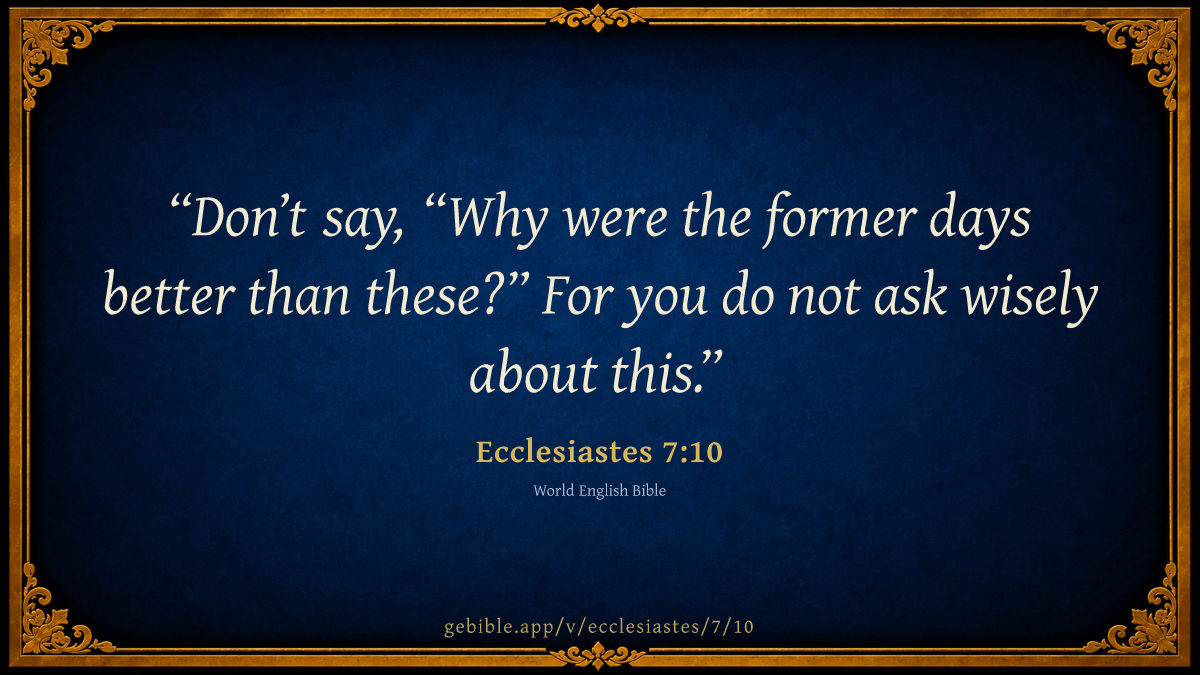
Don’t say, “Why were the former days better than these?” For you do not ask wisely about this.
Parallel Translations
-
Don’t say, “Why were the former days better than these?” For you do not ask wisely about this.
-
Say not thou, What is the cause that the former days were better than these? for thou dost not enquire wisely concerning this.
-
Say not thou: 'How was it that the former days were better than these?' for it is not out of wisdom that thou inquirest concerning this.
Cross-references (7)
Passages linked to Ecclesiastes 7:10 in the Treasury of Scripture Knowledge, ordered by reader-vote popularity; verse text shown in World English Bible.
- Psalms 14:2-3 Yahweh looked down from heaven on the children of men, to see if there were any who understood, who sought after God. They have all gone aside. They have together become corrupt. There is no one who does good, no, not one.
- Genesis 6:11-12 The earth was corrupt before God, and the earth was filled with violence. God saw the earth, and saw that it was corrupt, for all flesh had corrupted their way on the earth.
- Judges 6:13 Gideon said to him, “Oh, my lord, if Yahweh is with us, why then has all this happened to us? Where are all his wondrous works which our fathers told us of, saying, ‘Didn’t Yahweh bring us up from Egypt?’ But now Yahweh has cast us off, and delivered us into the hand of Midian.”
- Isaiah 50:1 Yahweh says, “Where is the bill of your mother’s divorce, with which I have put her away? Or to which of my creditors have I sold you? Behold, you were sold for your iniquities, and your mother was put away for your transgressions.
- Romans 1:22-32 Professing themselves to be wise, they became fools, and traded the glory of the incorruptible God for the likeness of an image of corruptible man, and of birds, four-footed animals, and creeping things. Therefore God also gave them up in the lusts of their hearts to uncleanness, that their bodies should be dishonored among themselves; who exchanged the truth of God for a lie, and worshiped and served the creature rather than the Creator, who is blessed forever. Amen. For this reason, God gave them up to vile passions. For their women changed the natural function into that which is against nature. Likewise also the men, leaving the natural function of the woman, burned in their lust toward one another, men doing what is inappropriate with men, and receiving in themselves the due penalty of their error. Even as they refused to have God in their knowledge, God gave them up to a reprobate mind, to do those things which are not fitting; being filled with all unrighteousness, sexual immorality, wickedness, covetousness, malice; full of envy, murder, strife, deceit, evil habits, secret slanderers, backbiters, hateful to God, insolent, arrogant, boastful, inventors of evil things, disobedient to parents, without understanding, covenant breakers, without natural affection, unforgiving, unmerciful; who, knowing the ordinance of God, that those who practice such things are worthy of death, not only do the same, but also approve of those who practice them.
- Jeremiah 44:17-19 But we will certainly perform every word that has gone out of our mouth, to burn incense to the queen of the sky, and to pour out drink offerings to her, as we have done, we and our fathers, our kings and our princes, in the cities of Judah, and in the streets of Jerusalem; for then had we plenty of food, and were well, and saw no evil. But since we stopped burning incense to the queen of the sky, and pouring out drink offerings to her, we have lacked all things, and have been consumed by the sword and by the famine. “When we burned incense to the queen of the sky, and poured out drink offerings to her, did we make her cakes to worship her, and pour out drink offerings to her, without our husbands?”
- Romans 3:9-19 What then? Are we better than they? No, in no way. For we previously warned both Jews and Greeks that they are all under sin. As it is written, “There is no one righteous; no, not one. There is no one who understands. There is no one who seeks after God. They have all turned away. They have together become unprofitable. There is no one who does good, no, not so much as one.” “Their throat is an open tomb. With their tongues they have used deceit.” “The poison of vipers is under their lips.” “Their mouth is full of cursing and bitterness.” “Their feet are swift to shed blood. Destruction and misery are in their ways. The way of peace, they haven’t known.” “There is no fear of God before their eyes.” Now we know that whatever things the law says, it speaks to those who are under the law, that every mouth may be closed, and all the world may be brought under the judgment of God.
Cross-references from openbible.info (CC BY 4.0)
Explain this verse (15 sources)
Historical commentary, presented as a primary source — not an endorsement.
Private notes
Saved on this device only — never synced or sent anywhere.
Geneva Bible translators 1599 · Public Domain He noteth their lightness which enterprise a thing and…
He noteth their lightness which enterprise a thing and suddenly leave it off again.
Geneva Bible (1599) marginal notes — public domain.
John Trapp 1656 · Public Domain Ecc 7:10 Say not thou, What is [the cause]…
Ecc 7:10 Say not thou, What is [the cause] that the former days were better than these? for thou dost not enquire wisely concerning this.
Ver. 10. Say not thou, What is the cause? &c.] This, saith an interpreter, {a} is the continual complaint of the wicked moody and the wicked needy. The moody Papists would murder all the godly, for they be Canaanites and Hagarens. The needy profane would murder all the rich, for they are lions in the grate. Thus he. It is the manner and humour of too many, saith another, {b} who would be thought wise to condemn the times in an impatient discontentment against them, especially if themselves do not thrive, or be not favoured in the times as they desire and as they think they should be. And these malcontents are commonly great questionists. What is the cause? say they, &c. It might be answered, In promptu causa est, - Themselves are the cause, for the times are therefore the worse, because they are no better. Hard hearts make hard times. But the Preacher answers better: "Thou dost not wisely inquire concerning this"; q.d., The objection is idle, and once to have recited it, is enough to have confuted it. Oh "if we had been in the days of our forefathers," said those hypocrites in Mat 23:30, great business would have been done. Ay, no doubt of it, saith our Saviour, whereas you "fill up the measure of your fathers’ sins," and are every whit as good at "resisting of the Holy Ghost" as they were. {Act 7:51} Or if there were any good heretofore more than is now, it may be said of these wise fools, as it was anciently of Demosthenes, that he was excellent at praising the worthy acts of ancestors - not so at imitating of them. {c} In all ages of the world there were complaints of the times, and not altogether without cause. Enoch, the seventh from Adam, complained; so did Noah, Lot, Moses, and the prophets; Christ, the archprophet, and all his apostles; the primitive fathers and professors of the truth. The common cry ever was, O terapora! O mores! Num Ecclesias suas dereliquit Dominus? said Basil, - Hath the Lord utterly left his Church? Is it now the last hour? Father Latimer saw so much wickedness in his days, that he thought it could not be but that Christ must come to judgment immediately, like as Elmerius, a monk of Malmesbury, from the same ground gathered the certainty of Antichrist’s present reign. What pitiful complaints made Bernard, Bradwardine, Everard, Archbishop of Canterbury (who wrote a volume called Obiurgatorium temporis, the rebuke of the time), Petrarch, Mantuan, Savanarola, &c.! In the time of Pope Clement V, Frederick king of Sicily was so far offended at the ill government of the church, that he called into question the truth of the Christian religion, till he was better resolved and settled in the point by Arnoldus de Villanova, who showed him that it was long since foretold of these last and loosest times, that iniquity should abound - that men should be proud, lewd, heady, highminded, &c. {d} {1Ti 4:1 2Ti 3:1-4} Lay aside, therefore, these frivolous inquiries and discontented cryings out against the times, which, in some sense reflect upon God, the Author of times - for "can there be evil in an age, and he hath not done it?" - and blessing God for our gospel privileges, which indeed should drown all our discontents, let every one mend one, and then let the world run its circuits - take its course. Vadat mundus quo vult: nam vult vadere quo vult, saith Luther bluntly, - Let the world go which way it will: for it will go which way it will. "The thing that hath been, is that which shall be," &c. {Ecc 1:9-10} Tu sic debes vivere, ut semper praesentes dies meliores tibi sint quam praeteriti, saith a father, {e} - Thou shouldst so live that thy last days may be thy best days, and the time present better to thee than the past was to those that then lived.
Read full note →
{a} Granger.
{b} Dr Jermin.
{c} επαινεσαι μεν ικανωτατος ην μιμησασθαι δε ου. - Plutarch.
{d} Rev., De Vit. Pont.
{e} Jerome.
John Trapp, A Commentary or Exposition upon All the Books of the Old and New Testament (1647–1656) — public domain. Text from a community e-Sword module.
Matthew Poole 1685 · Public Domain Say not thou, to wit, by way of impatient…
Say not thou, to wit, by way of impatient expostulation and complaint against God, either for permitting such disorders in the world, or for bringing thee into the world in such an evil time and state of things. Otherwise a man may say this by way of prudent and pious inquiry, that by searching out the cause he may, as far as it is in his power, apply remedies to make them better.
Better; either,
Read full note →
1. Less sinful. Or rather,
2. More quiet and comfortable. For this, and not the former, is the cause of most men’s murmurings against God’s providence. And this is an argument of a mind discontented and unthankful for the many mercies which men commonly enjoy even in evil times, and impatient under God’s hand.
Thou dost not inquire wisely concerning this; this question showeth thy great folly in contending with thy Creator, and the sovereign Lord and Governor of all things, in opposing thy shallow wit to his unsearchable wisdom, and thy will to his will.
Matthew Poole's English Annotations on the Holy Bible (1683–1685) — public domain. Text from a community e-Sword/MySword module.
John Gill 1763 · Public Domain Say not thou, what is the cause that the…
Say not thou, what is the cause that the former days were better than these?.... This is a common opinion, that in all ages prevails among men, that former times were better than present ones; that trade flourished more, and men got more wealth and riches, and lived in greater ease and plenty; and complain that their lot is cast in such hard times, and are ready to lay the blame upon the providence of God, and murmur at it, which they should not do;
for thou dost not inquire wisely concerning this: this is owing to ignorance of former times; which, if rightly inquired into, or the true knowledge of them could be come at, it would appear that they were no better than the present; and that there were always bad men, and bad things done; frauds, oppressions, and violence, and everything that can be complained of now: or if things are worse than they were, this should be imputed to the badness of men; and the inquirer should look to himself, and his own ways, and see if there is not a cause there, and study to redeem the time, because the days are evil; and not arraign the providence of God, and murmur at that, and quarrel with it; as if the distributions of it were unequal, and justice not done in one age as in another
John Gill's Exposition of the Whole Bible (1746–1763) — public domain (CC PDM 1.0). Text via the HelloAO Bible API.
John Wesley 1765 · Public Domain Better - More quiet and comfortable. For this is…
Better - More quiet and comfortable. For this is an argument of a mind unthankful for the many mercies, which men enjoy even in evil times. For - This question shews thy folly in contending with thy Lord and governor, in opposing thy shallow wit to his unsearchable wisdom.
John Wesley, Explanatory Notes Upon the Whole Bible (1754–1765) — public domain. Text via the GEBible commentary corpus.
Adam Clarke 1810 · Public Domain Verse 10. The former days were better than these?]…
Verse 10. The former days were better than these?] This is a common saying; and it is as foolish as it is common. There is no weight nor truth in it; but men use it to excuse their crimes, and the folly of their conduct. "In former times, say they, men might be more religious, use more self-denial, be more exemplary." This is all false. In former days men were wicked as they are now, and religion was unfashionable: God also is the same now as he was then; as just, as merciful, as ready to help: and there is no depravity in the age that will excuse your crimes, your follies, and your carelessness.
Among the oriental proverbs I find the following:
Read full note →
"Many say, This is a corrupt age. This mode of speaking is not just; it is not the age that is corrupt, but the men of the age."
Adam Clarke's Commentary on the Bible (1810–1826) — public domain. Text from a community e-Sword/MySword module.
Joseph Benson 1811 · Public Domain Ecc 7:10. Say not thou — Namely, by way…
Ecc 7:10. Say not thou — Namely, by way of impatient expostulation and complaint against God, either for permitting such disorders in the world, or for bringing thee into the world in such an evil time and state of things: otherwise a man may say this by way of prudent and pious inquiry, that by searching out the cause, he may, as far as it is in his power, apply remedies to make the times better; What is the cause that the former days were better? — More quiet and comfortable. For this is an argument of a mind unthankful for the many mercies which men enjoy even in evil times. And thou dost not inquire wisely concerning this — This question shows thy folly in contending with thy Lord and Governor, and opposing thy shallow wit to his unsearchable wisdom.
Joseph Benson's Commentary on the Old and New Testaments (1811–1818) — public domain. Text from a community e-Sword module.
Haydock's Catholic Bible Commentary 1859 · Public Domain Bosom, as in its proper place. The wise may…
Bosom, as in its proper place. The wise may feel its impressions, but he immediately makes resistance.
George Leo Haydock (1774–1849), Haydock's Catholic Family Bible and Commentary, 1859 edition — public domain. Excludes Psalms (Douay-Rheims chapter numbering differs from Protestant) and Deuterocanonical books (Catholic canon only).
Robert Jamieson, A. R. Fausset & David Brown 1871 · Public Domain Do not call in question God's ways in making…
Do not call in question God's ways in making thy former days better than thy present, as Job did (Job 29:2-5). The very putting of the question argues that heavenly "wisdom" (Margin) is not as much as it ought made the chief good with thee.
Jamieson, Fausset & Brown — Commentary Critical and Explanatory on the Whole Bible (1871) — public domain (CC PDM 1.0). Text via the HelloAO Bible API.
Daniel D. Whedon 1874 · Public Domain 10. Former days were better — Common sense teaches…
10. Former days were better — Common sense teaches us to make the most of the present, and act in the living now. This is one of the weaknesses of aged men, that they depreciate the present time. They forget how much the flavour of life depends on him who drinks it; and in their flush and hopeful youth they relished it better. It is also a happiness of nature, that our glad things live in brass, our sad things we write in water, and looking back we see far more joys than sorrows. Our present troubles we feel keenly, and thus are led to unwisely repine.
Daniel D. Whedon (gen. ed.), Commentary on the Old and New Testaments (1874–1909) — public domain. Text from a community e-Sword module.
The Cambridge Bible for Schools and Colleges 1878 · Public Domain 10. What is the cause that the former days…
10. What is the cause that the former days were better than these] It would be a mistake to treat this as describing merely the temper of one who is a “laudator temporis acti, se puero.” That is, as the poet noted (Hor. Epist. ad Pis. 173), but the infirmity of age. What is condemned as unwise, as we should call it in modern phrase, unphilosophical, is the temper so common in the decay and decadence of national life (and pointing therefore to the age in which the Debater lived) which looks back upon the past as an age of heroes or an age of faith, idealizing the distant time with a barren admiration, apathetic and discontented with the present, desponding as to the future. Such complaints are in fact (and this is the link which connects this maxim with the preceding) but another form of the spirit which is hasty to be angry, as with individual men that thwart its wishes, so with the drift and tendency of the times in which it lives. The wise man will rather accept that tendency and make the best of it. Below the surface there lies perhaps the suggestion of a previous question, Were the times really better? Had not each age had its own special evils, its own special gains? Illustrations crowd upon one’s memory. Greeks looking back to the age of those who fought at Marathon; Romans under the Empire recalling the vanished greatness of the Republic; Frenchmen mourning over the ancien régime, or Englishmen over the good old days of the Tudors, are all examples of the same unwisdom.
The Cambridge Bible for Schools and Colleges (gen. ed. J. J. S. Perowne; Cambridge University Press, 1878–1918) — public domain. Text from a community e-Sword module.
Ellicott's Commentary for English Readers 1878 · Public Domain (10) Concerning.—This preposition is used after “enquire” only in…
(10) Concerning.—This preposition is used after “enquire” only in later Hebrew (Neh_1:2).
A Bible Commentary for English Readers, edited by Charles John Ellicott (1878–1897) — public domain. Text from a community e-Sword module.
The Pulpit Commentary 1880 · Public Domain The same impatience leads a man to disparage the…
The same impatience leads a man to disparage the present in comparison with a past age. What is the cause that the former days were better than these? He does not know from any adequate information that preceding times were in any respect superior to present, but in his moody discontent he looks on what is around him with a jaundiced eye, and sees the past through a rose-tinted atmosphere, as an age of heroism, faith, and righteousness. Horace finds such a character in the morose old man, whom he describes in "De Arte Poet.," 173
Difficilis, querulus, laudater temporis acti
Read full note →
Se puero, castigator censorque minornm.
Morose and querulous, praising former days
When he was boy, now ever blaming youth.
And "Epist.," 2:1.22
... et nisi quae terris semota suisque Temporibus defuncta videt, fastidit et odit.
All that is not most distant and removed From his own time and place, he loathes and scorns.
For thou dost not inquire wisely concerning this. In asking such a question you show that you have not reflected wisely on the matter. Every age has its light and dark side; the past was not wholly light, the present is not wholly dark. And it may well be questioned whether much of the glamour shed over antiquity is not false and unreal. The days of "Good Queen Bess" were anything but halcyon; the "merrie England" of old time was full of disorder, distress, discomfort. In yearning again for the fleshpots of Egypt, the Israelites forgot the bondage and misery which were the accompaniments of those sensual pleasures.
The good old times a popular delusion.
I THE DELUSION STATED. "That the former days were better than these." The proposition may be understood as applying:
1. To individual experience, in which case it will signify that the former days of the speaker"s life were better than those in which he then was. Or:
2. To mundane history, in which case the sense will be that the earlier periods of the world"s history were better than the later, or that the times which preceded the speaker"s day were better than those in which he was living.
II THE DELUSION EXEMPLIFIED.
1. From sacred history.
(1) As to individual experience. Job was neither the first nor the last who cried, "Oh that I were as in months past!". (Job_29:2) Probably Jacob was in a similar mood of mind when he heard of Simeon"s detention in Egypt, and of Judah"s proposal to take Benjamin. (Gen_42:36 Gen_43:14) The old men who wept at the foundation of the second temple certainly believed that the days when as yet the first temple stood were incomparably more resplendent than those in which they then lived. (Ezr_3:12)
(2) As to world-epochs. To many of the Sethites, no doubt, in the antediluvian era," the days of old," when man lived in innocence in Eden, were regarded as better than those in which their lot had fallen when all flesh had corrupted its way. (Gen_6:12) To not a few in the days of the judges and of the kings it seemed as if" the years of ancient times," and "of the right hand of the Most High," when he brought forth the bondmen of Pharaoh from Egypt, were the glorious days of Israel as a nation. (Psa_77:5, Psa_77:10) To the exiles who had returned from Babylon, the golden age of their country was behind them in the days of David and Solomon, not before them in the era of Persian domination.
2. From profane history. "Illustrations crowd upon one"s memory. Greeks looking back to the age of those who fought at Marathon; Romans under the empire recalling the vanished greatness of the republic; Frenchmen mourning over the ancient regime; or Englishmen over the good old days of the Tudors, are all examples of this unwisdom" (Plumptre). Old men regretting the vanished days of their boyhood, or once rich but now poor men lamenting the disappearance of wealth which was theirs, or fallen great men sighing for the times when they were called "My lord!" are individual instances of this same delusion.
III THE DELUSION EXPLAINED. Two things account for this widespread delusion as to the relative values of the past and present.
1. An instinctive idealization of the past.
(1) The good things of the past, which one has either never known at all or counted only moderately good when he did know them, he now esteems as supremely excellent, on the principle that "distance lends enchantment to the view.
(2) The bad things of the past, which he complained of when he endured them, he has now through lapse of time largely forgotten; while if the bad things of the past were such as he never himself experienced but has only heard or read of, these are not likely to press him down so heavily as the lesser present evils under which he groans.
2. An equally instinctive depreciation of the present.
(1) Its good things are never so sweet as some other good things which we have not, or which other people had. As the possession of pleasure is seldom so intoxicating as its pursuit, so is that which one has never so valuable as that which one once had or may yet have.
(2) Its evil things being present always appear worse, i.e. heavier, than they really are. They are felt more acutely and oppress more severely than either the ills of other people one has never felt, or one"s own ills in the past which have been forgotten.
IV THE DELUSION DISPROVED. The false judgment rests upon two foundations.
1. A mistaken standard. If "better" only means in the case of the individual "more free from anxiety, pain, or difficulty," or in the case of communities or nations "more free from wars, troubles, revolutions, or social disturbances, the proposition complained of may be easily established; but if "better" signify more advantageous m the highest sense, i.e. more helpful to and beneficial for moral and spiritual good it will frequently be found that the proposition is false, and that for individuals, for instance, times of present trouble and seasons of present affliction may be better than past times of quiet and seasons of prosperity, and for communities and nations periods of social upheaval and foreign war better than antecedent days of stagnation and civil death.
2. An incomplete comparison. It is commonly forgotten that each age has a dark as well as bright side, and that in estimating the worth of two different periods in the experience of an individual or the history of a nation, it will not do to contrast the dark side of the present with the bright side of the past, but the dark and bright sides of both must be brought into view.
LESSONS.
1. The duty of man in evil times, submission rather than complaining.
2. The wisdom of trying to make the best of the present instead of dreaming about the past.
3. The certainty that the most careful calculations concerning the relative values of past and present are tainted with error.
Laudator temporis acti.
It appears from this passage that a tendency of mind with which we are familiar a tendency to paint the past in glowing colors is of ancient date, and indeed it is probably a consequence of human nature itself.
I THE QUESTIONABLE ASSERTION. We often heat" it affirmed, as the author of this book had heard it affirmed, that the former days were better than these. There are politicians in whose opinion the country was formerly more happy and prosperous than now; farmers who fancy that crops were larger, and merchants who believe that trade was more profitable, in former days; students who prefer ancient literature to modern; Christian men who place the age of faith and piety in some bygone period of history. It has ever been so, and is likely to be so in the future. Others who will come after us will regard our age as we regard the ages that have passed away.
II THE GROUND UPON WHICH THE QUESTIONABLE ASSERTION IS MADE.
1. Dissatisfaction with the present. It is in times of pain, loss, adversity, disappointment, that men are most given to extol the past, and to forget its disadvantages as well as the privileges and immunities of the present.
2. The illusiveness of the imagination. The aged are not only conscious of their feebleness and their pains; they recall the days of their youth, and paint the scenes and experiences of bygone times in colors supplied by a fond, deceptive fancy. The imaginative represent to themselves a state of the world, a condition of society, a phase of the Church, which never had real existence. By feigning all prosperity and happiness to have belonged to a past age, they remove their fancies from the range of contradiction. All things to their vision become lustrous and fair with "the light that never was on land or sea.
III THE UNWISDOM OF INQUIRING FOE AN EXPLANATION OF A BELIEF WHICH IS PROBABLY UNFOUNDED. Experience teaches us that, before asking for the cause, it is well to assure ourselves of the fact. Why a thing is presumes that the thing is. Now, in the case before us, the fact is so questionable, and certainty with regard to it is so difficult, if not unattainable, that it would be a waste of time to enter upon the inquiry here supposed.
APPLICATION. Vain regrets as to the past are as unprofitable as are complaints as to the present. What concerns us is the right use of circumstances appointed for us by a wise Providence. Whether or not the former times were better than these, the times upon which we have fallen are good enough for us to use to our own moral and spiritual improvement, and at the same time they are bad enough to call for all our consecrated powers to do what in us lies little as that may be to mend them. T.
Foolish comparison and complaint.
This querulous comparison, preferring former days to present ones, is unwise, inasmuch as it is
I BASED UPON IGNORANCE. We know but little of the actual conditions of things in past times. Chroniclers usually tell little more than what was upon the surface. We probably exaggerate and overlook to a very large extent. The good that is gone from us was probably attended with evils of which we have no idea; while the evils that remain we magnify because we experience them in our own person and suffer from them.
II MARKED BY FORGETFULNESS. Often, though not always so. Often the change for the worse is not in a man"s surroundings, but in himself. Leaving his youth and his prime behind him, he has left his vigor, his buoyancy, his power of mastery and of enjoyment. The "times" are well enough, but he himself is failing, and he sees everything through eyes that are dim with years.
III INDICATIVE OF A SPIRIT OF DISCONTENT. It is the querulous spirit that thinks ill of his companions and his circumstances. He would come to the same conclusion if these were much better than they are. A sense of our own unworthiness and a consciousness of God"s patience with us and goodness toward us, filling our souls with humility and gratitude, would dissipate these clouds and put another song into our mouth.
IV WANTING IN MANLY RESOLUTENESS. If we are possessed of a right spirit, instead of sitting down and lamenting the inferiority of present things we shall gird ourselves to do what has to be done, to improve that which is capable of reform, to abolish that which should disappear, to plant that which should be thriving.
V LACKING IN TRUSTFULNESS AND HOPEFULNESS. What if things are not all they should be with us; what if we ourselves are going down the hill and shall soon be at the bottom; is there not a God above us? and is there not a future before us? Let us look up and let us look on. Above us is a Power that can regenerate and transform; before us is a period, an age, nay, an eternity, wherein all lost joys and honors will be "swallowed up of life. C.
The Pulpit Commentary (1880–1919), ed. H.D.M. Spence-Jones & Joseph S. Exell — public domain. Text from a community e-Sword module.
The Biblical Illustrator 1887 · Public Domain Say not thou, What is the cause that the…
Ecc_7:10
Say not thou, What is the cause that the former days were better than these?
Read full note →
Mistaken signs
On the whole we may confidently affirm that the world improves, and yet in certain moods we are apt to regard its conditions as increasingly desperate. Thus is it sometimes with our religious life--we mistake the signs of progress for those of retrogression, and through this mistake de injustice to ourselves.
1. I am not so happy as I once was, is a lament from Christian lips with which we are almost distressingly familiar. We look back to our conversion, to the glittering joy which welled up in our soul in those days, and the memory moves us to tears. Then all things were apparelled in celestial light, the glory and the freshness of a dream. Then we turn to consider tile present phases of our experience, and conclude sadly that we are not so happy now as then--all the gold has changed to grey. Now, is this really so? We fully allow that it may be so. Through unfaithfulness we may have lost the joy and power of the days when first we knew the Lord. But may not the mournful inference be mistaken, and what we regard as a diminished happiness be really a profounder blessedness? The essence of religion is submission to the will of God, and that grave tranquillity of mind which follows upon deeper self-renunciation, the chastened cheerfulness which survives the strain and strife of years, is a real, although not perhaps seeming, gain upon the first sparkling experiences of our devout life.
2. I am not so holy as I once was, is another note of self-depreciation with which we are unhappily familiar, and with which, perhaps, we are sometimes disposed to sympathize. When we first realized forgiveness, we felt that there was no condemnation if the Spirit of God seemed to hallow our whole nature; our heart was cleansed, and strangely glowed. But it is not so now. We have not done all we meant to do, not been all we meant to be, and have a consciousness of imperfection more vivid than ever. With the lapse of years we have grown more dissatisfied with ourselves; and this more acute sense of worldliness leads us to the conclusion that we have lest the rarer purity of other days. Once more we admit that this may be the case. There may be a very real depreciation in our life; we may have allowed our raiment to be soiled by the world and the flesh. But may not this growing sense of imperfection be a sign of the perfecting of our spirit? It may be that we are not less pure than formerly, only the Spirit of God has been opening our eyes, heightening our sensibility, and faults once latent are now discovered; the clearer vision detects deformities, the finer ear discords, the pure taste admixtures which were once unsuspected. It is possible to be growing in moral strength and grace, in everything that constitutes perfection of character and life, when appearances are decidedly to the contrary. Watch the sculptor and note how many of his strokes seem to mar the image on which he works, rendering the marble more unshapely than it seemed the moment before, and yet in the end a glorious statue rises under his hand; so the blows of God, bringing us into glorious grace, often seem as if they were marring what little symmetry belonged to us, often as if knocking us out of shape altogether.
3. I do not love God as I once did, is another sorrowful confession of the soul. How glowing was that first level Your whole soul went out after the Beloved! But it is not so now. The temperature of your soul seems to have fallen, your love to your God and Saviour does not glow as in those memorable hours when first it was kindled by the spirit of burning. Once again, it may be so. The Church at Ephesus had left its first love, and we may not cherish the same fervid affection for God which once filled and purified our heart. But may we not misconceive the love we bear to God? Our more dispassionate affection may be equally genuine and positively stronger. Our love to God may not be so gushing, so florid in expression as it once was, but in this it only bears the sober hue of all ripened things.
(1) The test of love is sacrifice. We love those for whose sake we are prepared to suffer. Will our love to God to-day bear this test? Would we for His sake endure hardship, death? Many sorrowing souls know they are ready to die for Him whom they cannot love as they feel He ought to be loved.
(2) The test of love is obedience. We love those to whom we pay ungrudging service. If ye keep My commandments, ye shall abide in My love; even as I have kept My Fathers commandments, and abide in His love Ye are My friends, if ye do whatsoever I command you. Here, once more, are we sure of ourselves? We have not wickedly departed from our God. Is it not the supreme purpose of our heart to bring life into entire harmony with the will of God?
(3) The test of love is confidence. We love those whom we trust. Do we not feel, then, that God has our confidence so thoroughly that even if He slay us, yet will we trust in Him? Red-hot religion has its place and value, but white-hot religion, the silent, intense force which acts without sparks, smoke or noise, is a diviner thing. Is it thus with our love to God? Has that passion simply changed from red to white? Has the sentiment become a principle, the ecstasy a habit, the passion a law? If so, the former days were not better than these.
4. I do not make the rapid progress I once did, is another familiar regret. Once we had the pleasing sense of swift and perpetual progress. Each day we went from strength to strength, each night knew our moving tent a days march nearer home. But we have not that sense of progress now, and this fact is to us, perhaps, a great grief. Our grief may be well founded; for those who did run well are sometimes hindered and fall into slowest pace. Yet impatience with our rate of progress is capable of another construction. Our first experiences of the Christian life are in such direct and striking contradistinction to the earthly life that our sense of progress is most vivid and delightful; but as we climb heaven, get nearer God, traverse the infinite depths of love and righteousness sown with all the stars of light, the sense of progress may well be less definite than when we had just left the world behind. And in considering our rate of progress, we must not forget that the sense of progress is regulated by the desire for progress. (W. L. Watkinson.)
Vain thoughts concerning the past
What a softening power there is in distance; how often an object, on which you gazed with great delight while beheld afar off, will lose its attractiveness when it is brought near. Every admirer of the natural landscape is thoroughly conscious of this. Now, we are inclined to suppose that there is much the same power in distance, with regard to what we may call the moral landscape, which is so universally acknowledged with regard to the natural. We believe that what is rough becomes so softened, and what is hard so mellowed through being viewed in the retrospect, that we are hardly fair judges of much on which we bestow unqualified admiration. If, however, it were only the softening power of distance which had to be taken into the account, it might be necessary to caution men against judging without making allowance for this power, but we should scarcely have to charge it upon them as a fault, that they looked so complacently on what was far back. But from one cause or another men become disgusted with the days in which their lot is cast, and are therefore disposed to the concluding that past days were better. Whence does it arise that old people are so fond of talking of the degeneracy of the times, and referring to the days when they were young, as days when all things were in a healthier and more pleasing condition? If you were to put implicit faith in the representations you would conclude that there was nothing which had not changed for the worse, and that it was indeed a great misfortune that you had not been born half a century sooner. And here comes into play the precept of our text--Say not thou, What is the cause that the former days were better than these? for thou dost not inquire wisely concerning this. To quote the words of a brilliant modern historian: The more carefully we examine the history of the past, the more reason shall we find to dissent from those who imagine that our ago has been fruitful of new social evils. The truth is, that the evils are, with scarcely an exception, old. That which is new is the intelligence which discerns them, and the humanity which relieves them. But we shall speak only of the religious advantages of different times, in endeavouring to prove that the former days were not better than these.
1. And first, it ought to be carefully observed in regard of human nature that it did not grow corrupt by degrees, but became all at once as bad as it was ever to be. The being who had been formed in the very image of his Maker became instantly capable of the most heinous of crimes; and so far was human nature from requiring long familiarity with wickedness, in order to the learning to commit it in its most atrocious shapes, that well nigh its first essay after apostatizing from God was one which still fills us with horror, notwithstanding our daily acquaintance with a thousand foul deeds. Sin was never an infant; it was a giant in the very birth; and forasmuch as we should have had precisely the same evil nature whensoever we had lived, it would be very hard to show that any former period would have been better for us than the present. You may fix on a time when there was apparently less of open wickedness, but this would not necessarily have been a better time for individual piety. The religion of the heart, perhaps, flourishes most when there is most to move to zeal for the insulted law of God. Or you may fix upon a time when there was apparently less of misery; but we need not say that this would not necessarily have been a better time for growth in Christian holiness, seeing that confessedly it is amidst the deepest sorrows that the strongest virtues are produced. So that if a man regard himself as a candidate for immortality, we can defy him to put his finger on an age of the past, in which, as compared with the present, it would necessarily have been more advantageous for him to live.
2. Now, we are quite aware that this general statement does not exactly meet the several points which will suggest themselves to an inquiring mind; but we propose to examine next certain of the reasons which might be likely to lead men to a different conclusion from that which seems stated in our text. And here again we must narrow the field of inquiry, and confine ourselves to points in which, as Christians, we have an especial interest. Would any former days have been better days for us, estimating the superiority by the superior facilities for believing the Christian religion, and acquiring the Christian character? In answering such a question, we must take separately the evidences and the truths of our holy religion. And first, as to the evidences. There is a very common and a very natural feeling with regard to the evidences of Christianity, that they must have been much stronger and much clearer, as presented to those who lived in the times of our Lord and of His apostles, than as handed down to ourselves through a long succession of witnesses. Many are disposed to imagine that if with their own eyes they could see miracles wrought, they should have a proof on the side of Christianity far more convincing than any which they actually have, and that there would be no room whatever for a lingering doubt if they stood by a professed teacher from God, whilst he stilled the tempest, or raised the dead. Why should such superior power be supposed to reside in the seeing a miracle? The only thing to be sure about is, that the miracle has been wrought. There are two ways of gaining this assurance: the one is by the testimony of the senses, the other is by the testimony of competent witnesses. The first, the testimony of the senses, is granted to the spectator of a miracle; only the second, the testimony of witnesses, to those who are not present at the performance. But shall it be said that the latter must necessarily be less satisfactory than the former? Shall it be said that those who have not visited Constantinople cannot be as certain that there is such a city as others who have? The testimony of witnesses may be every jot as conclusive as the testimony of your own senses. Though, even if we were forced to concede that the spectator of a miracle has necessarily a superiority over those to whom the miracle travels down in the annals of well-attested history, we should be far enough from allowing that there is less evidence now on the side of Christianity than was granted to the men of some preceding age. Let it be, that the evidence of miracle is not so clear and powerful as it was; what is to be said of the evidence of prophecy? Who will venture to deny, that as century has rolled away after century, fresh witness has been given to the Bible by the accomplishment of the predictions recorded in its pages? The stream of evidence has been like that beheld in mystic vision by Ezekiel, when waters issued out from the eastern gate of the temple. Yes, the Christian religion now appeals to mightier proofs than when it first engaged in combat with the superstitions of the world. Its own protracted existence, its own majestic triumphs, witness for it with a voice far more commanding than that which was heard when its first preachers called to the dead, and were answered by their starting into life. Away, then, with the thought that it would have been better for those who are dissatisfied with the evidences of Christianity, had they lived when Christianity was first promulgated on earth. (H. Melvill, B. D.)
Discontent with the present unreasonable
The matter in controversy is, the pre-eminence of the former times above the present; when we must observe, that though the words run in the form of a question, yet they include a positive assertion, and a downright censure.
1. That it is ridiculous to ask why former times are better than the present, if really they are not better, and so the very supposition itself proves false; this is too apparently manifest to be matter of dispute: and that it is false we shall endeavour to prove.
(1) By reason: because there were the same objects to work upon men, and the same dispositions and inclinations in men to be wrought upon, before, that there are now. All the affairs of the world are the births and issue of mens actions; and all actions come from the meeting and collision of faculties with suitable objects. There were then the same incentives of desire on the one side, the same attractiveness in riches, the same relish in sovereignty, the same temptation in beauty, the same delicacy in meats and taste in wines; and, on the other side, there were the same appetites of covetousness and ambition, the same fuel of lust and intemperance.
(2) The same may be proved by history, and the records of antiquity; and he who would give it the utmost proof that it is capable of from this topic must speak volumes, and preach libraries, bring a century within a line, and an age into every period. Is the wickedness of the old world forgot, that we do so aggravate the tempest of this? In those clays there were giants in sin, at well as sinners of the first magnitude, and of the largest size and proportion. And to take the world in a lower epochs, what after-age could exceed the lust of the Sodomites, the idolatry and tyranny of the Egyptians, the fickle levity of the Grecians? and that monstrous mixture of all baseness in the Roman Nerds, Caligulas, and Domitians, emperors of the world, and slaves to their vice? I conceive the state of the Christian Church also may come within the compass of our present discourse. Take it in its infancy, and with the properties of infancy, it was weak and naked, vexed with poverty, torn with persecution, and infested with heresy. It began the breach with Simon Magus, continued it with Arius, Nestorius, Eutyches, Aerius, some rending her doctrine, some her discipline; and what are the heresies that now trouble it, but new editions of the old with further gloss and enlargement?
2. I shall now take it in a lower respect; as a case disputable, whether the preceding or succeeding generations are to be preferred; and here I shall dispute the matter on both sides.
(1) And first for antiquity, and the former ages, we may plead thus. Certainly everything is purest in the fountain and most untainted in the original. The dregs are still the most likely to settle in the bottom, and to sink into the last ages. The world cannot but be the worse for wearing; and it must needs have contracted much dross, when at the last it cannot be purged but by a universal fire.
(2) But secondly, for the pre-eminence of the succeeding ages above the former, it may be disputed thus: If the honour be due to antiquity, then certainly the present age must claim it, for the world is now oldest, and therefore upon the very right of seniority may challenge the precedency; for certainly, the longer the world lasts, the older it grows. And if wisdom ought to be respected, we know that it is the offspring of experience, and experience the child of age and continuance. In every thing and action it is not the beginning, but the end that is regarded: it is still the issue that crowns the work, and the Amen that seals the petition: the plaudite is given to the last act: and Christ reserved the best wine to conclude the feast; nay, a fair beginner would be but the aggravation of a bad end. And if we plead original, we know that sin is strongest in its original; and we are taught whence to date that. The lightest things float at the top of time, but if there be such a thing as a golden age, its mass and weight must needs sink it to the bottom and concluding ages of the world. In sum, it was the fulness of time which brought Christ into the world; Christianity was a reserve for the last: and it was the beginning of time which was infamous for mans fall and ruin; so, in Scripture, they are called the last days and the ends of the world, which are ennobled with his redemption. But lastly, if the following ages were not the best, whence is it that the older men grow the more still they desire to live? Now such things as these may be disputed in favour of the latter times beyond the former.
3. That admitting this supposition as true, that the former ages are really the best, and to be preferred: yet still this querulous reflection upon the evil of the present times, stands obnoxious to the same charge of folly: and, if it be condemned also upon this supposition, I see not where it can take sanctuary. Now that it ought to be so, I demonstrate by these reasons.
(1) Because such complaints have no efficacy to alter or remove the cause of them: thoughts and words alter not the state of things. The rage and expostulations of discontent are like a thunder without a thunderbolt, they vanish and expire into noise and nothing; and, like a woman, are only loud and weak.
(2) Such complaints of the evil of the times are irrational, because they only quicken the smart, and add to the pressure. Such querulous invectives against a standing government are like a stone flung at a marble pillar, which not only makes no impression upon that, but rebounds and hits the flinger in the face.
(3) These censorious complaints of the evil of the times are irrational, because the just cause of them is resolvable into ourselves. It is not the times that debauch men, but men that derive and rob a contagion upon the time: and it is still the liquor that first taints and infects the vessel. (R. South, D. D.)
Former things not better
As we grow older we are more prone to look back into the past. Our best days and brightest hours are those which have long since passed away. Most of the old poets have written and sung of a golden age. But it was away in the distant past. They have pictured it near the worlds beginning, in the days when the human race was yet in its youth. And so every nation has had its fancied golden age. Dreamers have dreamed of its charms. A time of peace, and love, and joy, when the earth yielded all manner of fruits and flowers, and all nations lived together in harmony and peace. And the Bible, too, tells of a golden age in the far distant past. As our thoughts go back to that blessed time, we can scarcely refrain from asking bitterly, What is the cause that the former days were better than these? But in our text the wise man cautions us that we do not inquire wisely concerning this. The tree is beautiful when it is covered with blossoms. But is it not a richer, though a different kind of beauty, when in autumn it is loaded with delicious fruit? The morning is beautiful when the rising sun bathes stream and flood, hill and dale with his glorious beams. But is it not another and a higher kind of beauty when, at the close of day, the sun is slowly sinking in the west, like a king dying on a couch of gold, and the fading hues of even light up the whole heavens with a glory that seems to have come down from the New Jerusalem! The field is beautiful when the fresh green blades appear, like a new creation, life out of death. But it is another and a higher order of beauty when, instead of the fresh young blade, you have the rich golden harvest. The spring is beautiful with all its stores of bloom and fragrance and song. But is it not a higher beauty, a more advanced perfection when the bloom of spring has given place to the golden sheaves and plentiful stores of autumn? Lifes opening years may be beautiful, but its close may be glorious. You may have seen the raw recruit, fresh from his country home, setting out to join the war in a distant land. His laurels are yet unsullied. The keen edge of his sword has never yet been blunted. See him years afterward, when he comes home, after a long service in some foreign land. His clothes are tattered and torn; his colours are in rags; his steps are feeble and tottering; his brow is seamed and scarred; his sword is broken. He seems but the wreck, the mere shadow of his former self. But in all that is true, and noble, and unselfish, he is a braver and a better man. His courage has been tried. The tinsel has been lost, but the fine gold all remains. And so is it with the youthful Christian. In the first days of his profession, when he has given his heart to Jesus for the first time, all his graces seem so fresh and lovely All his being is filled with joy unspeakable. Years pass on. The young professor grows into the aged Christian. His graces do not now seem so fresh and beautiful as they did forty or fifty years ago. His feelings do not flow out so steadily toward the Saviour whom he loves, nor do the tears come as freely now as they did long ago when he sits down at the table of the Lord. You would say that in his ease the former days were better than these. But you do not inquire wisely concerning this. His last days are his best days. The blossoms may have perished, but you have in their stead the mellow, luscious fruit. The golden age of a nation is not always behind, lost in the myths of its earliest existence. Years of conflict, ages of revolution, centuries of daring and doing nobly, freedoms battle bequeathed by bleeding sire to son, through long decades of stern resistance to all oppression and tyranny. It is through such a fiery discipline as this that a nation becomes truly great in all those qualities that ennoble them in the sight of God. When they stand up as the champions of right, the defenders of the oppressed, then are they entering on their true golden age, the perfection of their national existence. Nor is it true in regard to the world that its former days were better than these. Its golden age has not all passed away. A still more glorious golden age awaits it in the ages that are to come. The curse of sin is to be fully and for ever removed. The old earth is to pass away. The destroying fire will burn out the footprints of evil And God will make all things new. A new heaven and a new earth. (J. Carmichael, D. D.)
The Biblical Illustrator, edited by Joseph S. Exell (c. 1880s–1900s) — public domain. Text from a community e-Sword module.
unfoldingWord translationNotes 2017 · CC BY-SA 4.0 Why were the days of old better than these?
Why were the days of old better than these?
The person asks this rhetorical question in order to complain about the present time. This question can be written as a statement. AT: "Things were better in the past than they are now." (See: Rhetorical Question)
Read full note →
it is not because of wisdom that you ask this question
Here the author uses irony to rebuke the person's question. AT: "if you were wise you would not ask this question" (See: Irony)
translationWords
wise
unfoldingWord translationNotes — © Distant Shores Media and the Door43 World Missions Community, licensed CC BY-SA 4.0. Source: git.door43.org/Door43/en_tn.