
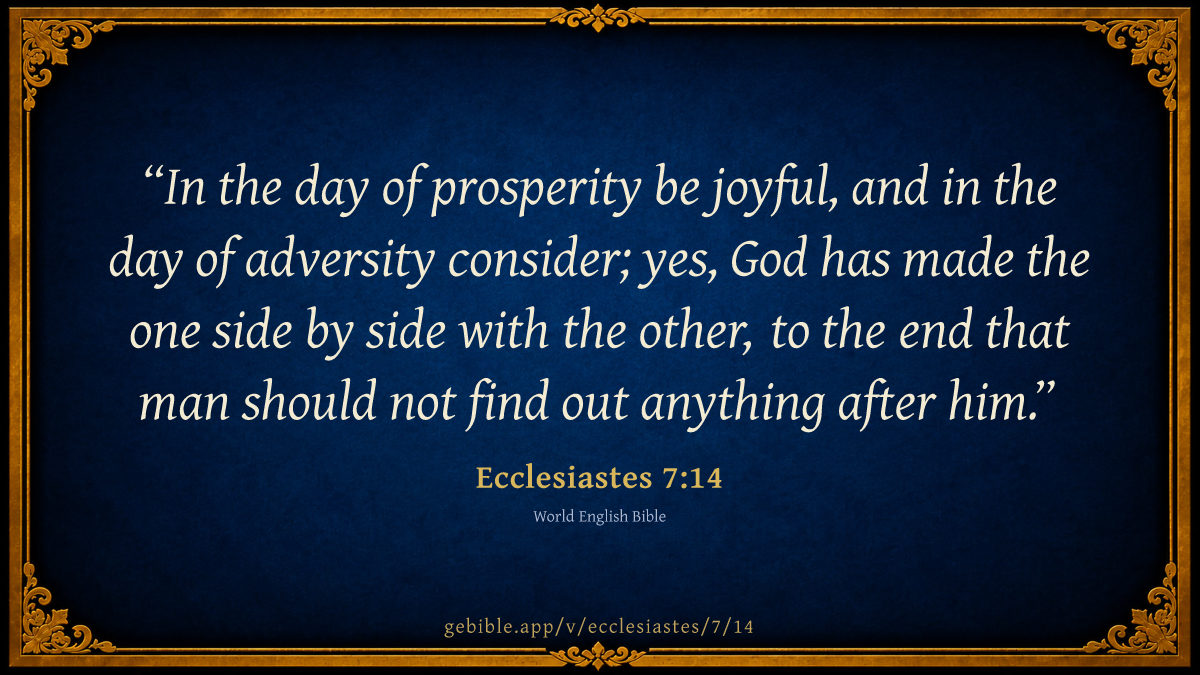
In the day of prosperity be joyful, and in the day of adversity consider; yes, God has made the one side by side with the other, to the end that man should not find out anything after him.
Parallel Translations
-
In the day of prosperity be joyful, and in the day of adversity consider; yes, God has made the one side by side with the other, to the end that man should not find out anything after him.
-
In the day of prosperity be joyful, but in the day of adversity consider: God also hath set the one over against the other, to the end that man should find nothing after him.
-
In the day of prosperity be joyful, and in the day of adversity consider; God hath made even the one as well as the other, to the end that man should find nothing after him.
Cross-references (26)
Passages linked to Ecclesiastes 7:14 in the Treasury of Scripture Knowledge, ordered by reader-vote popularity; verse text shown in World English Bible.
- Ecclesiastes 3:4 a time to weep, and a time to laugh; a time to mourn, and a time to dance;
- Ecclesiastes 3:22 Therefore I saw that there is nothing better than that a man should rejoice in his works; for that is his portion: for who can bring him to see what will be after him?
- Deuteronomy 8:3 He humbled you, allowed you to be hungry, and fed you with manna, which you didn’t know, neither did your fathers know, that he might teach you that man does not live by bread only, but man lives by every word that proceeds out of Yahweh’s mouth.
- Ecclesiastes 12:13 This is the end of the matter. All has been heard. Fear God and keep his commandments; for this is the whole duty of man.
- James 5:13 Is any among you suffering? Let him pray. Is any cheerful? Let him sing praises.
- Deuteronomy 28:47 Because you didn’t serve Yahweh your God with joyfulness and with gladness of heart, by reason of the abundance of all things;
- Isaiah 26:11 Yahweh, your hand is lifted up, yet they don’t see; but they will see your zeal for the people, and be disappointed. Yes, fire will consume your adversaries.
- 1 Kings 17:17-18 After these things, the son of the woman, the mistress of the house, became sick; and his sickness was so severe that there was no breath left in him. She said to Elijah, “What have I to do with you, you man of God? You have come to me to bring my sin to memory, and to kill my son!”
- 2 Chronicles 33:12-13 When he was in distress, he begged Yahweh his God, and humbled himself greatly before the God of his fathers. He prayed to him; and he was entreated by him, and heard his supplication, and brought him again to Jerusalem into his kingdom. Then Manasseh knew that Yahweh was God.
- Job 10:1-2 “My soul is weary of my life. I will give free course to my complaint. I will speak in the bitterness of my soul. I will tell God, ‘Do not condemn me. Show me why you contend with me.
- Psalms 30:11-12 You have turned my mourning into dancing for me. You have removed my sackcloth, and clothed me with gladness, to the end that my heart may sing praise to you, and not be silent. Yahweh my God, I will give thanks to you forever!
- Psalms 40:3 He has put a new song in my mouth, even praise to our God. Many shall see it, and fear, and shall trust in Yahweh.
- Psalms 94:12-13 Blessed is the man whom you discipline, Yah, and teach out of your law, that you may give him rest from the days of adversity, until the pit is dug for the wicked.
- Psalms 119:71 It is good for me that I have been afflicted, that I may learn your statutes.
- Jeremiah 23:20 Yahweh’s anger will not return until he has executed, and until he has performed the intents of his heart. In the latter days, you will understand it perfectly.
- Micah 6:9 Yahweh’s voice calls to the city, and wisdom sees your name: “Listen to the rod, and he who appointed it.
- Matthew 9:13 But you go and learn what this means: ‘I desire mercy, and not sacrifice,’ for I came not to call the righteous, but sinners to repentance.”
- John 16:22-23 Therefore you now have sorrow, but I will see you again, and your heart will rejoice, and no one will take your joy away from you. “In that day you will ask me no questions. Most certainly I tell you, whatever you may ask of the Father in my name, he will give it to you.
- Luke 15:17-18 But when he came to himself he said, ‘How many hired servants of my father’s have bread enough to spare, and I’m dying with hunger! I will get up and go to my father, and will tell him, “Father, I have sinned against heaven, and in your sight.
- Acts 14:22 strengthening the souls of the disciples, exhorting them to continue in the faith, and that through many afflictions we must enter into God’s Kingdom.
- 1 Kings 8:47 yet if they repent in the land where they are carried captive, and turn again, and make supplication to you in the land of those who carried them captive, saying, ‘We have sinned, and have done perversely; we have dealt wickedly;’
- Ecclesiastes 12:8 “Vanity of vanities,” says the Preacher. “All is vanity!”
- Isaiah 22:12-14 In that day, the Lord, Yahweh of Armies, called to weeping, to mourning, to baldness, and to dressing in sackcloth; and behold, joy and gladness, killing cattle and killing sheep, eating meat and drinking wine: “Let’s eat and drink, for tomorrow we will die.” Yahweh of Armies revealed himself in my ears, “Surely this iniquity will not be forgiven you until you die,” says the Lord, Yahweh of Armies.
- Isaiah 42:25 Therefore he poured the fierceness of his anger on him, and the strength of battle. It set him on fire all around, but he didn’t know. It burned him, but he didn’t take it to heart.”
- Hosea 2:6-7 Therefore behold, I will hedge up your way with thorns, and I will build a wall against her, that she can’t find her way. She will follow after her lovers, but she won’t overtake them; and she will seek them, but won’t find them. Then she will say, ‘I will go and return to my first husband; for then was it better with me than now.’
- Haggai 1:5-7 Now therefore this is what Yahweh of Armies says: Consider your ways. You have sown much, and bring in little. You eat, but you don’t have enough. You drink, but you aren’t filled with drink. You clothe yourselves, but no one is warm, and he who earns wages earns wages to put them into a bag with holes in it.” This is what Yahweh of Armies says: “Consider your ways.
Cross-references from openbible.info (CC BY 4.0)
Explain this verse (16 sources)
Historical commentary, presented as a primary source — not an endorsement.
Private notes
Saved on this device only — never synced or sent anywhere.
John Trapp 1656 · Public Domain Ecc 7:14 In the day of prosperity be joyful,…
Ecc 7:14 In the day of prosperity be joyful, but in the day of adversity consider: God also hath set the one over against the other, to the end that man should find nothing after him.
Ver. 14. In the day of prosperity be joyful.] Here we have some fair days, some foul - crosses like foul weather, come before they are sent for; for as fair weather, the more is the pity, may do hurt, so may prosperity, as it did to David, {Psa 30:6} who therefore had his interchanges of a worse condition, as it was but needful; his prosperity, like checker work, was intermingled with adversity. See the circle God goes in with his people; {a} in that thirtieth Psalm David was afflicted; {Psa 30:5} he was delivered and grew wanton; then troubled again; {Psa 30:7} cries again; {Psa 30:8-9} God turns his mourning into joy again. Thus God sets the one against the other, as it were, in equilibrio, in even balance, for our greatest good. Sometimes he weighs us in the balance and finds us too light, then he thinks best to make us "heavy through manifold temptations." {1Pe 1:6} Sometimes he finds our water somewhat too high, and then as a physician, no less cunning than loving, he fits us with that which will reduce all to the healthsome temper of a broken spirit. But if we be but prosperity proof, there is no such danger of adversity. Some of those in Queen Mary’s days who kept their garments close about them, wore them afterwards more loosely. Prosperity makes the saints rust sometimes; therefore God sets his scullions to scour them and make them bright, though they make themselves black. This scouring if they will scape, let Solomon’s counsel be taken, "In the day of prosperity be joyful," - i.e., serve God with cheerfulness in the abundance of all things, and reckon upon it, the more wages the more work. Is it not good reason? Solomon’s altar was four times as large as that of Moses; and Ezekiel’s temple ten times larger than Solomon’s; to teach that where God gives much, he expects much. Otherwise God will "curse our blessings," {Mal 2:2} make us "ashamed of our revenues through his fierce anger," {Jer 12:13} and "destroy us after he hath done us good." {Jos 24:20}
Read full note →
In the day of adversity consider.] Sit alone, and be in meditation of the matter. {Lam 3:28} "Commune with your own consciences and be still," {Psa 4:4} or make a pause. See who it is that smites thee, and for what. {Lam 3:40} Take God’s part against thyself, as a physician observes which way nature works, and helps it. Consider that God "afflicts not willingly," or "from his heart"; it goes as much against the heart with him as against the hair with us. {Lam 3:33} He is forced of "very faithfulness" {Psa 119:75} to afflict us, because he will be true to our souls and save them; he is forced to diet us, who have surfeited of prosperity, and keep us short. He is forced to purge us, as wise physicians do some patients, till he bring us almost to skin and bone; and to let us bleed even ad deliquium animae, till we swoon again, that there may be a spring of better blood and spirits. Consider all those precious passages, {Heb 12:3-12} and then lift up the languishing hands and feeble knees. For your further help herein, read my treatise called "God’s Love Tokens," and "The Afflicted Man’s Lessons," passim.
{a} Circulus quidem est in rebus humanis. Deus nos per contraria eridit. - Naz., Orat. 7.
John Trapp, A Commentary or Exposition upon All the Books of the Old and New Testament (1647–1656) — public domain. Text from a community e-Sword module.
Matthew Poole 1685 · Public Domain Be joyful; enjoy God’s favours with cheerfulness and thankfulness.
Be joyful; enjoy God’s favours with cheerfulness and thankfulness.
Consider, to wit, God’s work, which is easily understood out of the foregoing verse. Consider that it is God’s hand, and therefore submit to it; humble thyself under his hand, be sensible of it, and duly affected with it; consider also why God sends it, for what sins, and with what design. This is a proper season for serious consideration, whereas prosperity relaxeth the mind, and calls it forth to outward things. But this clause may be, and is by some, rendered thus, and look for a day of adversity. In prosperity rejoice with trembling, and so as to expect a change.
Read full note →
God also hath set the one over against the other; God hath wisely ordained these vicissitudes that prosperity and adversity should succeed one another in the course of men’s lives. After him; either,
1. After man himself, or, as it may be rendered, after it, i.e. after his present condition, whether it be prosperous or afflictive. So the sense is, that no man might be able to foresee or find out what shall certainly befall him afterwards, and therefore might live in a constant dependence upon God, and might nether despair in trouble, nor be secure or presumptuous in prosperity, because of the frequent and sudden changes from one to the other. Or,
2. After God, that no man might come after God, and review his works, and find any fault in them, or pretend that he could have managed things better, because this mixture of prosperity and adversity is most convenient both for the glory of God’s wisdom, and justice, and goodness and for the benefit of mankind, who have all absolute need of this vicissitude, lest they should be either corrupted and ruined by perpetual prosperity, as many have been, or overwhelmed with uninterrupted adversity.
Matthew Poole's English Annotations on the Holy Bible (1683–1685) — public domain. Text from a community e-Sword/MySword module.
John Gill 1763 · Public Domain In the day of prosperity be joyful,.... Or, "in…
In the day of prosperity be joyful,.... Or, "in a good day" (q). When things go well in the commonwealth, in a man's family, and with himself, health, peace, and plenty, are enjoyed, a man's circumstances are thriving and flourishing; it becomes him to be thankful to God, freely and cheerfully to enjoy what is bestowed on him, and do good with it: or, "be in good" (r); in good heart, in good spirits, cheerful and lively; or, "enjoy good", as the Vulgate Latin version; for what God gives to men is given them richly to enjoy, to make use of themselves, and be beneficial unto others; so the Targum,
"in the day the Lord does well to thee be thou also in goodness, and do good to all the world;''
Read full note →
see Gal 6:10; Jarchi's paraphrase is,
"when it is in thine hand to do good, be among those that do good;''
but in the day of adversity consider; or, "in the day of evil" (s); consider from whence affliction comes; not out of the dust, nor by chance, but from God, and by his wise appointment; and for what it comes, that sin is the cause of it, and what that is; and also for what ends it is sent, to bring to a sense of sin, and confession of it, and humiliation for it; to take it away, and make good men more partakers of holiness: or, "look for the day of adversity" (t); even in the day of prosperity it should be expected; for there is no firmness and stability in any state; there are continual vicissitudes and changes. The Targum is,
"that the evil day may not come upon thee, see and behold;''
be careful and circumspect, and behave in a wise manner, that so it may be prevented. Jarchi's note is,
"when evil comes upon the wicked, be among those that see, and not among those that are seen;''
and compares it with Isa 66:24; It may be observed, that there is a set time for each of these, prosperity and adversity; and that the time is short, and therefore called a day; and the one is good, and the other is evil; which characters they have according to the outward appearance, and according to the judgment and esteem of men; otherwise, prosperity is oftentimes hurtful, and destroys fools, and adversity is useful to the souls of good men;
God also hath set the one over against the other; they are both by his appointment, and are set in their proper place, and come in their proper time; succeed each other, and answer to one another, as day and night, summer and winter, and work, together for the good of men;
to the end that man should find nothing after him; should not be able to know what will be hereafter; what his case and circumstances will be, whether prosperous or adverse; since things are so uncertain, and so subject to change, and nothing permanent; and therefore can find nothing to trust in and depend upon, nothing that he can be sure of: and things are so wisely managed and disposed, that a man can find no fault with them, nor just reason to complain of them; so the Vulgate Latin version, "not find just complaints against him"; and to the same purpose the Syriac version, "that he may complain of him"; the Targum is,
"not find any evil in this world.''
(q) "in die bono", Pagninus, Montanus, Mercerus, Gejerus. (r) "esto in bono", Pagninus, Montanus, Mercerus, Cocceius, Gejerus, Rambachius. (s) "in die mala", Pagninus, Montanus, Mercerus. (t) "praecave", V. L. "praevide, aut provide ac prospice", Drusius; so Gussetius, p. 766.
John Gill's Exposition of the Whole Bible (1746–1763) — public domain (CC PDM 1.0). Text via the HelloAO Bible API.
John Wesley 1765 · Public Domain Be joyful - Enjoy God's favours with thankfulness. Consider…
Be joyful - Enjoy God's favours with thankfulness. Consider - Consider that it is God's hand, and therefore submit to it: consider also why God sends it, for what sins, and with what design. God also - Hath wisely ordained, that prosperity and adversity should succeed one another. That - No man might be able to foresee, what shall befall him afterwards; and therefore might live in a constant dependance upon God, and neither despair in trouble, nor be secure or presumptuous in prosperity.
John Wesley, Explanatory Notes Upon the Whole Bible (1754–1765) — public domain. Text via the GEBible commentary corpus.
Adam Clarke 1810 · Public Domain Verse 14. In the day of prosperity be joyful]…
Verse 14. In the day of prosperity be joyful] When ye receive these temporal gifts from God, enjoy them, and be thankful to the Giver: but remember, this sunshine will not always last. God has balanced prosperity and adversity against each other; and were it not so, how many would put the former in the place of God himself!
Adam Clarke's Commentary on the Bible (1810–1826) — public domain. Text from a community e-Sword/MySword module.
Joseph Benson 1811 · Public Domain Ecc 7:14. In the day of prosperity be joyful…
Ecc 7:14. In the day of prosperity be joyful — Enjoy God’s favours with thankfulness. In the day of adversity consider — Namely, God’s work, that it is his hand, and therefore submit to it: consider also why he sends it: for what sins, and with what design? God also hath set the one against the other — Hath wisely ordained, that prosperity and adversity should succeed one another; that man should find nothing after him — Or, rather, after it, as it may be rendered; that is, after his present condition, whether it be prosperous or afflictive: that no man might be able to foresee what shall befall him afterward; and therefore might live in a constant dependance upon God, and neither despair in trouble, nor be secure or presumptuous in prosperity.
Joseph Benson's Commentary on the Old and New Testaments (1811–1818) — public domain. Text from a community e-Sword module.
Albert Barnes 1834 · Public Domain Good and prosperous days are in God’s design special…
Good and prosperous days are in God’s design special times of comfort and rejoicing: the days of affliction and trouble, are in God’s design the proper seasons of recollection and serious consideration. The Providence of God hath so contrived it, that our good and evil days should be intermingled each with the other. This mixture of good and evil days is by the Divine Providence so proportioned, that it sufficiently justifies the dealings of God toward the sons of men, and obviates all their discontent and complaints against Him.
Set the one over against the other - Rather, made this as well as that, i. e., the day of adversity, as well as the day of prosperity. The seeming imitation of this passage in Ecclesiasticus (Ecclesiasticus 36:13-15) affords a strong presumption that this book was written before the days of the son of Sirach.
Read full note →
To the end ... - God hath constituted the vicissitude of prosperity and adversity in such a way that no man can forecast the events that shall follow when he is removed from his present state. Compare the Ecc 6:12 note.
Albert Barnes' Notes on the Bible (1834–1885) — public domain. Text from a community e-Sword/MySword module.
Haydock's Catholic Bible Commentary 1859 · Public Domain Despised. God never neglects first. (Council of Trent, Session…
Despised. God never neglects first. (Council of Trent, Session vi. 11.) --- He detests sin, and at last abandons the obstinate, though he never fails to offer sufficient graces. A person who is of an unhealthy constitution, or involved in sin, cannot be cured by man alone. Yet we must not cease to preach, &c., while we expect all from God, who gives the increase, 1 Corinthians iii. 7.
George Leo Haydock (1774–1849), Haydock's Catholic Family Bible and Commentary, 1859 edition — public domain. Excludes Psalms (Douay-Rheims chapter numbering differs from Protestant) and Deuterocanonical books (Catholic canon only).
Robert Jamieson, A. R. Fausset & David Brown 1871 · Public Domain consider--resumed from Ecc 7:13. "Consider," that is, regard it…
consider--resumed from Ecc 7:13. "Consider," that is, regard it as "the work of God"; for "God has made (Hebrew, for 'set') this (adversity) also as well as the other (prosperity)." "Adversity" is one of the things which "God has made crooked," and which man cannot "make straight." He ought therefore to be "patient" (Ecc 7:8).
after him--equivalent to "that man may not find anything (to blame) after God" (that is, after "considering God's work," Ecc 7:13). Vulgate and Syriac, "against Him" (compare Ecc 7:10; Rom 3:4).
Jamieson, Fausset & Brown — Commentary Critical and Explanatory on the Whole Bible (1871) — public domain (CC PDM 1.0). Text via the HelloAO Bible API.
Daniel D. Whedon 1874 · Public Domain 14. Be joyful… consider — Common sense rebukes grumbling…
14. Be joyful… consider — Common sense rebukes grumbling over the present and foreboding over the hereafter. There should be no pause after “consider,” as the remainder of the verse tells us what to consider. That is, make the most of the present prosperity and manage wisely the present adversity, remembering that God has in his wisdom so diversified human affairs that none can tell what the next coming phase may be. Many a sage and poet has warned us not to be anxious respecting the unseen future; and the Great Teacher said, “Take no thought for the morrow.”
Daniel D. Whedon (gen. ed.), Commentary on the Old and New Testaments (1874–1909) — public domain. Text from a community e-Sword module.
The Cambridge Bible for Schools and Colleges 1878 · Public Domain 14. In the day of prosperity be joyful] Literally,…
14. In the day of prosperity be joyful] Literally, In the day of good, be in good, i.e. use it as it should be used. True wisdom, the teacher urges, is found in a man’s enjoying whatever good actually comes to him. The warning is against the temper which “taking thought for the morrow,” is
“over exquisite
Read full note →
To cast the fashion of uncertain evils.”
And on the other hand he adds In the day of evil, look well, i.e. consider why it comes, and what may be gained from it.
God also hath set the one over against the other] The words assert what we should call the doctrine of averages in the distribution of outward good and evil. God has made one like (or parallel with) the other, balances this against that and this in order that man may find nothing at all after him. The last words may mean either (1) that man may have nothing more to learn or discover in his own hereafter; or (2) that man may fail to forecast what shall come to pass on earth after he has left it, as in ch. Ecc_6:12, and may look to the future calmly, free from the idle dreams of pessimism or optimism. The last meaning seems most in harmony with the dominant tone of the book, and has parallels in the teaching of moralists who have given counsel based on like data.
In the noble hymn of Cleanthes to Zeus (18) we have the Stoic view in language presenting a striking parallel to that of Ecc_7:13-14.
ἀλλὰ σὺ καὶ τὰ περισσὰ ἐπίστασαι ἄρτια θεῖναι,
καὶ κοσμεῖν τὰ ἄκοσμα, καὶ οὐ φίλα, σοὶ φίλα ἐστιν•
ὧδε γὰρ εἰς ἒν ἅπαντα συνήρμοσας ἐσθλὰ κακοῖσιν,
ὥσθʼ ἕνα γίγνεσθαι πάντων λόγον αἰὲν ἐόντα.
“Thou alone knowest how to change the odd
To even, and to make the crooked straight,
And things discordant find accord in Thee.
Thus in one whole Thou blendest ill with good,
So that one law works on for evermore.”
The Epicurean poet writes:
“Prudens futuri temporis exitum
Caliginosa nocte premit Deus,
Ridetque, si mortalis ultra
Fas trepidat. Quod adest, memento
Componere aequus; cetera fluminis
Ritu feruntur, nunc medio alveo
Cum pace delabentis Etruscum
In mare, nunc lapides adesos,
Stirpesque raptas et pecus et domos
Volventis unâ.”
“God in His wisdom hides from sight,
Veiled in impenetrable night,
The future chance and change,
And smiles when mortals’ anxious fears,
Forecasting ills of coming years,
Beyond their limit range.
“Use then the present well, and deem
All else drifts onward, like a stream
Whose waters seaward flow,
Now gliding in its tranquil course,
Now rushing on with headlong force
O’er rocks that lie below.”
Od. iii. 29. 29–38.
The Cambridge Bible for Schools and Colleges (gen. ed. J. J. S. Perowne; Cambridge University Press, 1878–1918) — public domain. Text from a community e-Sword module.
Ellicott's Commentary for English Readers 1878 · Public Domain (14) Ecclus. 14:14, 33. The first clause may be…
(14) Ecclus. 14:14, 33. The first clause may be more closely rendered, “In the good day be of good cheer.” As a consolation in time of adversity the thought Job_2:10 is offered. The last clause connects itself with the first, the idea being that of Ecc_3:22; “take the present enjoyment which God gives, seeing that man cannot tell what shall be after him.”
A Bible Commentary for English Readers, edited by Charles John Ellicott (1878–1897) — public domain. Text from a community e-Sword module.
The Pulpit Commentary 1880 · Public Domain In the day of prosperity be joyful; literally, in…
In the day of prosperity be joyful; literally, in the day of good be in good i.e. when things go well with you, be cheerful (Ecc_9:7; Est_8:17) accept the situation and enjoy it. The advice is the same as that which runs through the book, viz. to make the best of the present. So Ben-Sire says, "Defraud not thyself of the good day, and let not a share in a good desire pass thee by" (Ecc 14:14). Septuagint jEn hJmera ajgaqwsunhv zhqi ejn agaqw, "In a day of good live in (an atmosphere of) good;" Vulgate, in die bona fruere bonis, "In a good day enjoy your good things." But in the day of adversity consider; in the evil day look well. The writer could not conclude this clause so as to make it parallel with the other, or he would have had to say, "In the ill day take it ill," which would be far from his meaning; so he introduces a thought which may help to make one resigned to adversity. The reflection follows. Septuagint, Kaira kakiav ide k.t.l..; Vulgate, Et malam diem praecave, "Beware of the evil day." But, doubtless, the object of the verb is the following clause. God also hath set the one over against the other ; or, God hath made the one corresponding to the other; i.e. he hath made the day of evil as well as the day of good. The light andshade in man"s life are equally under God"s ordering and permission. "What?" cries Job, (Job_2:10) "shall we receive good at the hand of God, and shall we not receive evil?" Corn. Lapide quotes a saying of Plutarch to this effect: the harp gives forth sounds acute and grave, and both combine to form the melody; so in man"s life the mingling of prosperity and adversity yields a well-adjusted harmony. God strikes all the strings of our life"s harp, and we ought, not only patiently, but cheerfully, to listen to the chords produced by this Divine Performer. To the end that man should find nothing after him. This clause gives Koheleth"s view of God"s object in the admixture of good and evil; but the reason has been variously interpreted, the explanation depending on the sense assigned to the term "after him" (wyrta). The Septuagint gives ojpisw aujtou, which is vague; the Vulgate, contra eum, meaning that man may have no occasion to complain against God. Cheyne ("Job and Solomon") considers that Koheleth here implies that death closes the scene, and that there is then nothing more to fear, rendering the clause, "On the ground that man is to experience nothing at all hereafter." They who believe that the writer held the doctrine of a future life cannot acquiesce in this view. The interpretation of Delitzsch is this God lets man pass through the whole discipline of good and evil, that when lie dies there may be nothing which he has not experienced. Hitzig and Nowack explain the text to mean that, as God designs that man after his death shall have done with all things, he sends upon him evil as well as good, that he may not have to punish him hereafter a doctrine opposed to the teaching of a future judgment. Wright deems the idea to be that man may be kept in ignorance of what shall happen to him beyond the grave, that the present life may afford no clue to the future. One does not see why this should be a comfort, nor how it is compatible with God"s known counsel of making the condition of the future life dependent upon the conduct of this. Other explanations being more or less unsatisfactory, many modem commentators see in the passage an assertion that God intermingle8 good and evil in men"s lives according to laws with which they are unacquainted, in order that they may not disquiet themselves by forecasting the future, whether in this life or after their death, but may be wholly dependent upon God, casting all their care upon him, knowing that he careth for them. (1Pe_5:7) We may safely adopt this explanation. (comp. Ecc_3:22 Ecc_6:12) The paragraph then con-rains the same teaching as Horace"s oft-quoted ode
Prudens futuri temporis exitum," etc. ("Carm.," 3:29. 29.)
Read full note →
Theognis", 1075
Prhgmatov ajprhktou calepwtaton ejsti telenthllei touto Qeosai Orfnh gatatai pro dellontov esesqai Ouj xunetarat ajmhcanihv,
The issue of an action incomplete, "Tis hard to forecast how God may dispose it; For it is veiled in darkest night, and man In present hour can never comprehend His helpless efforts.
Plumptre quotes the lines in Cleanthes"s hymn to Zeus, vers. 18-21 ("Poet. Gnom.," p. 24)
jAlla su kai ta k.t.l...
Thou alone knowest how to change the odd To even, and to make the crooked straight; And things discordant find accent in thee. Thus in one whole thou blendest ill with good, So that one law works on for evermore.
Ben-Sirs has evidently borrowed the idea in Ecc 33: (36.) 13-15 from our passage; after speaking of man being like clay under the potter"s hand, he proceeds, "Good is set over against evil, and life over against death; so is the godly against the sinner, and the sinner against the godly. So look upon all the works of the Mast High: there are two and two, one against the ether."
The Pulpit Commentary (1880–1919), ed. H.D.M. Spence-Jones & Joseph S. Exell — public domain. Text from a community e-Sword module.
The Biblical Illustrator 1887 · Public Domain Ecc_7:18; Ecc_7:14
Ecc_7:18; Ecc_7:14
Consider the work of God: for who can make that straight which He hath made crooked?
Read full note →
The power of God, and the duty of man
I. What we are to understand by the work of God. This is an expression often used in the Scriptures, and has different significations. In one place it refers to the two tables of stone, containing the Ten Commandments, written by the finger of God and given to Moses. In another to the reception of the Lord Jesus Christ by faith (Joh_6:29-30). In a third to the progress of the Gospel, and to the influence of the Holy Spirit in the heart, by which a radical change is effected, and holy tempers produced (Rom_14:20). In the text it is evidently used to point out to us the infinitely wise arrangement of all the situations and circumstances of the sons of men: that the bounds of their habitation are marked out by Him to whom all things in earth and heaven owe their existence.
II. The impossibility of altering or defeating the purposes of god. To prove this, might I not refer to the experience and observation of all people? Our fields may be cultivated with all imaginable care--we may sow the best corn that can be procured--but if the will of the Lord be so, we can reap nothing but disappointment. If He designs to chastise a guilty people by sending a famine upon them, lie can make a worm, or a dew, hail, storm, or lightning, to blast mans hope in a moment, and to teach him that except the Lord build the house, they labour in vain that build it; and that except the Lord keep the city, the watchman waketh but in vain (Psa_127:1). If it be His will to fill a sinner with remorse of conscience, He can make him cry out with Cain, My punishment is greater than I can bear--or with Josephs brethren, when they imagined that vengeance was about to overtake them, We are verily guilty concerning our brother--or with Judas, I have sinned, in that I have betrayed the innocent blood. All hearts are in His hand; His power rules over all; none can stay that hand or resist successfully that power.
III. The duty incumbent on man to be satisfied with his lot. A sinner by nature and practice, man deserves no blessing from his Maker--he can lay no claim to a continuance of present mercies, nor has he in himself any ground to hope for fresh ones--of course everything he enjoys is unmerited. Is it for such a being as this to be dissatisfied with what he possesses, because others possess more? Is it for him to think that he is hardly dealt with, while oppressed by pain, sickness; hunger or thirst--when a moments reflection ought to convince him that anything short of hell is a blessing? The heart must be changed by the grace of God before it can rejoice in tribulation--and testify that tribulation worketh patience; and patience, experience; and experience, hope: and it is through the belief of the Gospel that this change is effected.
IV. Consideration is an important and plainly enjoined duty--and when we take into account the character of man, and the distractions produced in his mind by visible things, its necessity is quite apparent. Let us then consider that we are not called upon to account for the Lords dealings, or to make the vain attempt of reconciling the seeming contrarieties in the Divine administration. If clouds and darkness are round about Him, we may yet be sure that righteousness and judgment are the habitation of His throne. His servants will one day understand, as far as is necessary, everything which now appears dark and perplexing, and in the mean season they are called to live by faith--to take no thought for the morrow--to commit their ways unto Him, and to be satisfied with the assurance that the Judge of all the earth does right. (P. Roe, M. A.)
The crook in the lot
A just view of afflicting incidents is altogether necessary to a Christian deportment under them: and that view is to be obtained only by faith, not by sense. For it is the light of the Word alone that represents them justly, discovering in them the work of God, and consequently designs becoming the Divine perfections. These perceived by the eye of faith, and duly considered, one has a just view of afflicting incidents, fitted to quell the turbulent motions of corrupt affections under dismal outward appearances.
I. Whatsoever crook is in ones lot, it is of Gods making.
1. As to the crook itself, the crook in the lot, for the better understanding thereof these few things following are premised.
(1) There is a certain train or course of events, by the providence of God, falling to every one of us during our life in this world: and that is our lot, as being allotted to us by the sovereign God, our Creator and Governor, in whose hand our breath is, and whose are all our ways.
(2) In that train or course of events, some fall out cross to us, and against the grain; and these make the crook in our lot.
(3) Everybodys lot in this world hath some crook in it. Complainers are apt to make odious comparisons: they look about, and taking a distant view of the condition of others, can discern nothing in it but what is straight, and just to ones wish; so they pronounce their neighbours lot wholly straight. But that is a false verdict: there is no perfection here, no lot out of heaven without a crook.
(4) The crook in the lot came into the world by sin: it is owing to the fall (Rom_5:12).
2. Having seen the crook itself, we are, in the next place, to consider of Gods making it.
(1) That the crook in the lot, whatever it is, is of Gods making, appears from these three considerations. It cannot be questioned, but the crook in the lot, considered as the crook, is a penal evil, whatever it is for the matter thereof: that is, whether the thing in itself, its immediate cause and occasion be sinful or not, it is certainly a punishment or affliction. Now, as it may be, as such holily and justly brought on us, by our sovereign Lord and Judge, so He expressly claims the doing or making of it (Amo_3:6). It is evident from the Scripture-doctrine of Divine providence that God brings about every mans lot and all the parts thereof.
(2) That we may see how the crook in the lot is of Gods making, we must distinguish between pure sinless crooks and impure sinful ones. There are pure and sinless crooks: the which are mere afflictions, cleanly crosses; grievous indeed, but not defiling. Such were Lazarus poverty, Rachels barrenness, Leahs tender eyes, the blindness of the man who had been so from his birth (Joh_9:1). Such crooks in the lot are of Gods making, in the most ample sense, and in their full comprehension, being the direct effects of His agency, as well as the heavens and the earth are. There are impure sinful crooks, which, in their own nature, are sins as well as afflictions, defiling as well as grievous. Such was the crook made in Davids lot, through his family disorders, the defiling of Tamar, the murder of Amnon, the rebellion of Absalom, all of them unnatural. Now, the crooks of this kind are not of Gods making, in the same latitude as those of the former; for He neither puts evil in the hearts of any, nor stirreth up to it (Jam_1:13). But they are of His making, by His holy permission of them, powerful bounding of them, and wise over-ruling of them to some good end.
(3) It remains to inquire why God makes a crook in ones lot. And this is to be cleared by discovering the design of that dispensation: a matter which it concerns every one to know, and carefully to notice, in order to a Christian improvement of the crook in their lot. The design thereof seems to be, chiefly, seven-fold. The trial of ones state--whether one is in the state of grace, or not? Whether a sincere Christian, or a hypocrite? Excitation to duty, weaning one from this world, and prompting him to look after the happiness of the other world. Conviction of sin. As when one, walking heedlessly, is suddenly taken ill of a lameness; his going halting the rest of his way convinceth him of having made a wrong step; and every new painful steep brings it afresh to his mind: So God makes a crook in ones lot, to convince him of some false step he hath made, or course he hath taken. Correction or punishment for sin. In nothing more than in the crook of the lot is that word verified (Jer_2:19). Preventing of sin (Hos_2:6). Many are obliged to the crook in their lot, that they go not to these excesses, which their vain minds and corrupt affections would with full sail carry them to: and they would from their hearts bless God for making it, if they did but calmly consider what would most likely be the issue of the removal thereof. Discovery of latent corruption, whether in saints or sinners. The exercise of grace in the children of God. The crook in the lot gives rise unto many acts of faith, hope, love, self-denial, resignation, and other graces; to many heavenly breathings, pantings, longings, and groanings, which otherwise would not be brought forth.
II. What crook God makes in our lot, we will not be able to even.
1. Show Gods marring and making a crook in ones lot, as He sees meet.
(1) God keeps the choice of every ones crook to Himself: and therein he exerts His sovereignty (Mat_20:15).
(2) He sees and observes the bias of every ones will and inclination how it lies, and wherein it specially bends away from Himself, and consequently wherein it needs the special bow.
(3) By the conduct of His providence, or a touch of His hand, He gives that part of ones lot a bow the contrary way; so that henceforth it lies quite contrary to that bias of the partys will (Eze_24:25).
(4) He wills that crook in the lot to remain while He sees meet, for longer or shorter time, just according to His own holy ends He designs it for (2Sa_12:10; Hos_5:15).
2. Consider mans attempting to mend or even that crook in their lot. This, in a word, lies in their making efforts to bring their lot in that point to their own will, that they may both go one way; so it imports three things.
(1) A certain uneasiness under the crook in the lot; it is a yoke which is hard for the party to bear, till his spirit be tamed and subdued (Jer_31:18).
(2) A strong desire to have the cross removed, and to have matters in that part going according to our inclinations.
(3) An earnest use of means for that end. This natively follows on that desire. And if the means used be lawful, and not relied upon, but followed with an eye to God in them, the attempt is not sinful either, whether he succeed in the use of them or not.
3. In what sense it is to be understood, that we will not be able to mend or even the crook in our lot?
(1) It is not to be understood as if the case were absolutely hopeless, and that there is no remedy for the crock in the lot. For there is no case so desperate but God may right it (Gen_18:14).
(2) We will never be able to mend it by ourselves; ii the Lord Himself take it not in hand to remove it, it will stand before us immovable, like the mountain of brass, though, perhaps, it may be in itself a thing that might easily be removed. We take it up in these three things. It will never do by the mere force of our hand (1Sa_2:9). The use of all allowable means, for it will be suecessless unless the Lord bless them for that end (Lain. 3:37). It will never do in our time, but in Gods time, which seldom is so early as ours (Joh_7:6).
4. Reasons of the point.
(1) Because of the absolute dependence we have upon God (Act_17:28).
(2) Because His will is irresistible (Isa_46:10).
Inference
1. There is a necessity of yielding and submitting under the crook in our lot; for we may as well think to remove the rocks and mountains, which God has settled, as to make that part of cur lot straight which He hath crooked.
2. The evening of the crook in our lot, by main force of our own, is but a cheat we put on ourselves, and will not last, but, like a stick by main force made straight, it will quickly return to the bow again.
3. The only effectual way of getting the crook evened is to apply to God for it.
Exhortation
1. Let us then apply to God for removing any crook in our lot, that in the settled order of things may be removed.
2. What crook there is, that, in the settled order of things, cannot be got removed or evened in this world, let us apply to God for suitable relief under it.
3. Let us then set ourselves rightly to bear and carry under the crock in our lot, while God sees meet to continue it. What we cannot mend, let us bear Christianity, and not fight against God. So let us bear it--
(1) Patiently, without firing and fretting, or murmuring (Jam_5:7; Psa_37:7).
(2) With Christian fortitude, without sinking under discouragements--nor faint when thou art rebuked of Him (Heb_12:5).
(3) Profitably, so as we may gain some advantage thereby (Psa_119:71).
Motives to press this exhortation.
1. There will be no evening of it while God sees meet to continue it.
2. An awkward carriage under it notably increases the pain of it.
3. The crook in thy lot is the special trial God has chosen for thee to take thy measure by (1Pe_1:6-7). Think, then, with thyself under it. Now, here the trial of my state turns; I must, by this be proven either sincere or a hypocrite. For--
(1) Can any be a cordial subject of Christ without being able to submit his lot to Him? Do not all who sincerely come to Christ put a blank in His hand? (Act_9:6; Psa_47:4). And does He not tell us that without that disposition we are not His disciples? (Luk_14:26).
(2) Where is the Christian self-denial and taking up of the cross without submitting to the crook? This is the first lesson Christ puts in, the hands of His disciples (Mat_16:24).
(3) Where is our conformity to Christ, while we cannot submit to the crook?
(4) How will we prove ourselves the genuine kindly children of God, if still warring with the crook?
4. The trial by the crook here will not last long (1Co_7:31).
5. If ye would, in a Christian manner, set yourselves to bear the crook, ye would find it easier than ye imagine (Mat_11:29-30).
6. If ye carry Christianly under your crook here, ye will not lose your labour, but get a full reward of grace in the other world, through Christ (2Ti_2:12; 1Co_15:58).
7. If ye do not carry Christianly under it, ye will lose your souls in the other world (Jud_1:15-16).
III. Considering the crook in the lot as the work of God is a proper means to bring one to carry rightly under it.
1. What it is to consider the crook as the work of God.
(1) An inquiry into the spring whence it riseth (Gen_25:22).
(2) A perceiving of the hand of God in it.
(3) A representing it to ourselves as the work of God, which He hath wrought against us for holy and wise ends, becoming the Divine perfections. This is to take it by the right handle, to represent it to ourselves under a right notion, from whence a right management under it may spring.
(4) A continuing of the thought of it as such. It is not a simple glance of the eye, but a contemplating and leisurely viewing of it as His work that is the proper mean.
(5) A considering it for the end for which it is proposed to us, viz. to bring to a dutiful carriage under it.
2. How is it to be understood to be a proper means to bring one to carry rightly under the crook?
(1) Negatively; not as if it were sufficient of itself, and as it stands alone, to produce that effect. But
(2) Positively; as it is used in faith, in the faith of the Gospel: that is to say, a sinners bare considering the crook in his lot as the work of God, without any saving relation to him, will never be a way to carry rightly under it: but having believed in Jesus Christ, and so taking God for his God, the considering of the crook as the work of God, his God, is the proper means to bring him to that desirable temper and behaviour.
3. I shall confirm that it is a proper mean to bring one to carry rightly under it.
(1) It is of great use to divert from the considering and dwelling on these things about the crook, which serve to irritate our corruption.
(2) It has a moral aptitude for producing the good effect. Though our cure is not compassed by the mere force of reason; yet it is carried on, not by a brutal movement, but in a rational way (Eph_5:14). This consideration has a moral efficacy on our reason, is fit to awe us into submission, and ministers much argument for it, moving to carry Christianly under our crook.
(3) It hath a Divine appointment for that end, which is to be believed (Pro_3:6).
(4) The Spirit may be expected to work by it, and does work by it in them that believe, and look to Him for it, forasmuch as it is a mean of His own appointment. (T. Boston, D. D.)
Crooked things
(with Isa_40:4):--These two passages contain a question and the answer to it. We are taught therefrom that God, and God alone, can make that straight which He has permitted to be made crooked--that He alone can make that plain which He has allowed to become rough.
I. The inequalities, or crookedness, of temporal things.
1. We must first of all grant that crooked things are not necessarily evil things. Many of them are very beautiful--many very useful. If all the limbs of a tree were straight, how curious would be our surroundings! If all the fields were flat, how monotonous the landscape, and how unhealthy the situation! It is when crookedness takes the place of that which ought to be straight that the crookedness becomes an evil.
2. We must, secondly, bear in mind that these crooked things are made so by God--that which God hath made crooked. There are many reasons why He has done so, but He has not revealed all those reasons to us. Some, however, are so evident that we cannot but see them.
(1) He would not make this world too comfortable for us, or else we should never desire a better one.
(2) He could not leave us without temptations, or else we should never be proved.
(3) He could not obliterate the consequences of sin until sin is done away. Man brought these consequences on himself at the fall, and they must remain as long as sin remains.
3. Let us now glance at some of these crooked things.
(1) See them in nature. There are extremes of heat and cold. No part of the world is without its drawbacks. In no country are all advantages combined. A warm land has venomous serpents, and insect-plagues infest the inhabitants. In northern countries the cold absorbs half the pleasure of human life. Tornadoes, tempests, storms destroy the verdure of spring, and spread terror and dismay. Mountains and oceans and language separate nations. The very change of seasons introduces an element of uncertainty and crookedness.
(2) See it in life. Pain racks the limbs, fear, anxiety, dread, sorrow, bereavement, trial, the bitter struggle of existence, the cry of cruel want, poverty, and improvidence; the strange distribution of wealth and power, the inequalities of ability. All these things stand out prominently and in lurid brightness, among the crooked things.
(3) See it in social relationships. We meet with crooked characters, and crooked dispositions in others, and are not without crooked tempers in our own breasts. There are contrary people around us, conceited people, thoughtless people, with whom we come in contact. There are changeable people, irritating people, cross-grained people, vexatious acts and foolish repartees, until, disheartened and crushed, we feel as if it were a very crooked world indeed.
(4) See it in spiritual things. No sooner do we begin to try to serve and love God than these roughnesses crop up. Watch the door of your lips and see how much irreverence, how many vain and foolish words come forth. Watch your tempers, and something surely comes to put them out of gear.
II. No human power can put these things straight. How could we expect anything different? How can man contravene the purposes of an almighty God? No more can we expect to rectify things in this world than we could expect to create the world itself.
III. The grand consummation referred to in our second text--The crooked shall be made straight. Yes; but this is by God Himself, and not by man. God shall put things straight by going down to the cause of their disorder. He will not attack the details like man would when he finds a medicine to cure a pain; but He will set the springs right, and then all the wheels will run with smoothness and regularity. (Homilist.)
The crooked in life
I. What is here implied. It is something crooked. What is this? It is not the same in all, but it may easily be found.
1. It is sometimes found in the mind. One complains of the slowness of his apprehension; another of a narrow capacity; another of a treacherous memory.
2. It is sometimes found in the body. Some are defective in their limbs. Some are the subjects of indisposition and infirmity.
3. It is sometimes found in our connections. Perhaps it is a bad wife. Perhaps it is a brother. Perhaps it is a servant. Perhaps it is a treacherous or a frail friend.
4. It is sometimes found in our calling or business. Bad times. Untoward events. Dear purchases and cheap sales. Bad debts.
5. Sometimes it is found in our condition considered at large. Is the man wealthy? In the midst of his sufficiency he is afraid of poverty. Has he been crowned with success? There is some circumstance that tarnishes the lustre, or mars the joy. Has he honour? This bringeth along with it defamation. Has be exquisite pleasure? It soon cloys, and the repetition of the scene becomes insipid.
II. What is expressed--namely, that God is the author of this. There is no such thing as chance in our world. Nothing can befall us without the permission and appointment of the all-disposing providence of our Heavenly Father. Now, how rational this is. Why, surely it is not beneath God to govern what it was not beneath Him to create!
III. What is enjoined. It is to consider.
1. So consider the work of God as to be led to acknowledge that resistance to it is useless.
2. See and acknowledge the propriety of acquiescence.
(1) Remember, in order to produce this acquiescence, that your case is not peculiar.
(2) remember that all is not crookedness.
(3) There is wisdom in the appropriating of your crook.
(4) There is goodness in your crook.
3. So consider the work of God as to improve it and turn it to advantage.
(1) Let it embitter sin.
(2) You are to improve it by turning from the creature to the Creator.
(3) You are to improve it, by its leading you from earth to heaven. (W. Jay.)
Ecc_7:14
In the day of prosperity be joyful, but in the day of adversity consider.
Prosperity and adversity
The life of man is made up of prosperity and adversity, of pleasure and pain, which succeed one another here below in an eternal rotation, like day and night, summer and winter. Prosperity and adversity usually walk hand in hand. The Divine providence hath joined them, and I shall not put them asunder, but offer some remarks upon them both.
I. I begin with the latter part of the sentence; in the day of adversity consider. In the day of adversity we should consider whether we can free ourselves from it. For it happens sometimes that whilst we complain, we have the remedy in our own hands, if we had heart and the sense to make use of it; and then we cannot expect that men or that God should assist us, if we are wanting to ourselves. But most commonly adversity is of that nature, that it is not in our power to remove it; and then we should consider how to lessen it, or how to bear it in the best manner we can. We should consider that adversity, as well as prosperity, is permitted or appointed by Divine providence. God hath so ordered the course of things that there should be a mixture and a rotation of both in this world, and, therefore, we ought to acquiesce in it, and to be contented that Gods will be done. Submission, patience and resignation are of a calm and quiet nature, and afford some relief, composure and peace of mind; but repining and reluctance only irritate the pain, and add one evil to another. To tell an afflicted person that it must be so, may be thought a rough and an overbearing argument, rather fit to silence than to satisfy a man. Therefore we should add this consideration, not only that adversity is proper because God permits it, but that God permits it because it is proper. Perhaps we have brought the adversity upon ourselves, by our own imprudence and misconduct. If so, it is just that God should suffer things to take their course, and not interpose to relieve us, and we ought to submit to it, as to a state which we deserve. Nature, indeed, will dispose us in such a case to discontent and to remorse; but religion will teach us to make a good use of the calamity. God may suffer us to fall into adversity by way of correction for our sins. If so, sorrowful we should be for the cause, and sorrowful we may be for the effect; but we have many motives to patience, resignation and gratitude. It is much better that we should receive our punishment here than hereafter; and if it produce any amendment in us, it serves to the best of purposes, and ends in peace and joy and happiness. God may visit us with adversity, by way of trial, and for our greater improvement, that we may correct some frailties and faults into which prosperity hath led us, or of which it could never cure us, that we may look upon the transitory vanities of the present world with more coldness and indifference, and set our affections on things above, that we may be humble and modest, and know ourselves, that we may learn affability, humanity and compassion for those who suffer, and likewise that we may have a truer taste for prosperity when it comes, and enjoy it with wisdom and moderation. Upon all these accounts adversity is suitable to us, and tends to our profit.
II. One of the ends of adversity is to make us better disposed and qualified to receive the favours of God, when they come, with prudence and gratitude, and, as Solomon directs us in the other part of the text, to rejoice in the days of prosperity.
1. We ought to be in such a temper as to be easily contented, and to account our state prosperous whenever it is tolerable.
2. We ought to remember that prosperity is a dangerous thing, that it is a state which often perverts the judgment, and spoils the understanding, and corrupts the heart, that it is never sincere and unmixed, that it is also of a precarious nature, and may leave us in an instant. By being sober and sedate, it will be more easily preserved, and the less liable to pass away, and to be turned into sadness. The truest joy is an even cheerfulness, pleased with the present, and not solicitous about the future.
3. We ought to consider what Solomon, who exhorts us to rejoice in prosperity, hath represented as the most important point: Let us hear, says he, the conclusion of the whole matter; Fear God, and keep His commandments; for this concerns us all. This is what every man may do, and this is what every man must do, and whosoever neglects it cannot be happy.
4. If we would rejoice in prosperity, we must acquire and preserve, cherish and improve a love towards our neighbour, an universally benevolent and charitable disposition, by which we shall be enabled to take delight not only in our own prosperity, but in that of others; and this will give us several occasions of satisfaction, which selfish persons never regard or entertain.
III. This subject which we have been discussing is considered in a very different manner in the old testament and in the new. Solomon, as a wise man, recommends it to his nation to be cheerful in prosperity and considerate in adversity. Further than this the wisdom and religion of his times could not conduct a man. But St. Paul, when he treats the subject, exhorts Christians to rejoice evermore, and consequently in adversity as well as in prosperity; our Saviour commands His disciples to rejoice and to be exceeding glad when they should be ill used for His sake; and it is said of the first believers, that they were sorrowful, yet always rejoicing, and that they had in all circumstances an inward serenity, of which nothing could deprive them.
1. Christianity represents God as a God of love and goodness, and removes all gloomy and superstitious apprehensions of Him.
2. It represents Him, indeed, as a God of perfect purity, holiness and justice, which must raise in mortal minds a dread proportionable to their imperfections and offences, that is, to those imperfections which are indulged, and to those offences which are wilful; but by the gracious doctrine of forgiveness to the penitent it allays all tormenting terrors and excludes despondence and despair.
3. It gives us rules of behaviour, which, ii carefully observed, have a natural and necessary tendency to secure us from many sorrows, and enliven our minds, and to set before us happy prospects and pleasing expectations.
4. It promises a Divine assistance under pressures and dangers, and losses and afflictions, which shall raise the mind above itself and above all outward and earthly things.
5. It promises an eternal recompense of well-doing, which whosoever believes and expects must be happy, or at least contented in all times and states: and without question, to a want of a lively faith, and of a reasonable hope in this great point, and to a certain degree, more or less, of doubt and diffidence, is to be principally ascribed the want of resignation and of composure.
6. When to these Christian considerations are also added reflections on the days of our abode here below, which are few, and on the world which passeth away, a sedateness and evenness of temper will ensue, which as it is patient and resigned under changes for the worse, so it is pleased with prosperity, accepts it as a Divine blessing, and uses it soberly and discreetly. (J. Jortin, D. D.)
Considerations
in adversity:--
I. The design of the visitation. It includes--
1. Correction.
2. Prevention.
3. Trial or testing of character.
4. Instruction in righteousness.
5. Increased usefulness.
II. The relief which God is ready to bestow.
1. Your afflictions are not peculiar. It is not a strange thing that has happened unto you.
2. They happen not by chance. Gods wisdom plans, and His love executes, them all.
3. They are not unmixed evil. It is good for me that I have been afflicted.
4. They are not to endure always. Only for a moment, and then heaven!
5. We are not asked to bear these afflictions alone. (Homiletic Review.)
Compensations for a poor harvest
More than one person has said to me, in relation to the services we hold to-day, There is no harvest worth being thankful for this year. We are like children, ready enough to find fault with their parents arrangements, but not so ready to be thankful for the daily care and love around them in the home. These they take for granted. There is, if we have only eyes to discern it, a wonderful law of compensation running through all things. It may be discerned even in the recent harvest, failure though it seems to be. We may see this if we remember that what is usually called the harvest is, after all, only a part of the harvest of the year. The autumn is not the only harvest time, though that may be specially the time of ingathering. All the year is, in greater or less degree, productive. And this year, though a poor one in respect of the harvest of hay and corn, is, if I mistake not, an exceptionally good one in respect of grass and roots on which the cattle so largely depend for sustenance. There is another aspect of the present years weather which should not be overlooked. We have grumbled at the continuous downpour of rain; but let us not forget that the rain which frustrated so many plans and caused so much anxiety, has replenished the springs which, through the drought of last year, had become so low that more than one English city came very near to a famine of water. And this leads me to say that very often weather which is good for one part of tile country, and for one kind of crop, is anything but good for another part and for another kind of crop. And sometimes we must be content to suffer that others may prosper, whilst when we prosper others must be content to suffer. We cant have it always our own way. Unbroken prosperity is not good for us men who are so disposed to settle on our lees, and to cry, I shall never be moved. For let us not forget that the Divine arrangements in the lower and material world have reference to mans higher nature. They are intended to be a means of moral and spiritual discipline. And if it be so, and that it is, few who have carefully observed life, will deny; then harvest disappointment will be often counterbalanced by a more enduring spiritual gain. Ii earthly loss force us to lift our eyes to the hills from whence cometh our help, then the gain is greater than the loss. But this principle of compensation--that one thing is set over against another--has wider applications. It seems to run through all the Divine arrangements. It applies to the different positions and callings among men--e.g. the rich seem to be the people to be envied; their lot seems to have no drawbacks; they seem to have everything that heart can wish. But riches do not ensure happiness; indeed, they too often lead men and women to so purposeless a life, to such a neglect of work, that life becomes a burden, and time hangs heavy on their hands. The poor mans condition, on the other hand, seems to be without any compensations--one utterly to be pitied. But, as a matter of fact, except in extreme cases, the very necessity for labour brings with it no small measure of happiness, for work has more of pleasure in it than idleness. The happiest people are those who work, whether such work be compulsory or voluntary. Nor is it otherwise with the different callings of life. Those in which men have to work with the brain seem the easiest and pleasantest, and those in which men have to work with their hands the least to be desired. But work with the brain has its drawbacks. It develops the nerves at the expense of the muscles. It brings a weariness of its own. Whilst, on the other hand, work with the hand develops the muscles at the expense of the nerves, and has its own kind of weariness. Then, too, the same remark applies to the various ages. Youth longs for manhood, that it may escape restraint; but when the restraint goes, responsibility begins. Manhood longs for rest from toil; but when the time for rest comes, the vigour of life usually wanes. In each season one thing must be set over against another--the youths freedom from responsibility against the restraint under which he lives; the vigour of manhood over against its toil; the rest of old age over against its feebleness. There are very few conditions of life which have not their compensations; and no estimate can be fair which does not take them into account. Plato, in his Gorgias, says to Callieles, I exhort you also to take part in the grave combat, which is the combat of life, and greater than every other earthly conflict. And if it is to be that, it would not do for life to be without drawbacks, disappointments, trials, changes. A life sheltered from all these would be a poor affair. But though these abound, yet there are always, or nearly always, compensations, which show a gracious design even in the midst of the discipline;that it is the order of One who doth not afflict willingly, or grieve the children of men. The laws under which we live look stern and hard; but in the heart of them is a loving purpose. (W. G. Herder.)
Hard times
Hard times! That is the cry we hear, all the week long, wherever we go. And this, strange to say, in face of crops of unparalleled abundance!
1. We ask ourselves, what is the cause of these hard times? Over-production, say some; others, under-consumption. One party blames a high tariff: the other, free trade. I will not attempt to discues here the purely political or economical aspects of the case. But there is a moral cause at work, which it is the province of the pulpit to point out. At this moment, while commerce and manufactures are nearly stagnant, the money market is glutted with funds that cannot be used! Why? One answer is, for want of confidence. Monstrous frauds, disgraceful failures, outright robberies, and numberless rascalities, small and great, have paralyzed credit, and made sensitive capital shrink into itself. We want more plodding and patient industry, more incorruptible honesty. No man can revolutionize a community. But every good man has a certain power, more, perhaps, than he thinks. It is the honest men who keep society from going to pieces altogether.
2. Under cover of the proverb, Desperate diseases require desperate remedies, certain wild proposals are put forward by professed friends of the working man, who are really his worst enemies, whether they mean it or not. Take, for example, the Socialist idea of abolishing private property in land or anything else, making the State the universal proprietor and the universal employer, and all mens conditions equal. It is only under the maddening pressure of hunger that just and reasonable men can entertain such schemes. In dragging down bloated monopolists, we bury the day-labourer in the common ruin. It is like setting fire to the house to get rid of the rats!
3. What a light is east by our present condition on the Bible sayings, We are members one of another: No man liveth unto himself! We live in a vast system of cooperation and interdependence. And this, whether we wish it or not. The ends of the earth are ransacked to furnish food and clothing. Sailors cross the seas, miners delve in the earth, woodmen hew down the forests, farmers sow and reap, mechanics ply their tools, merchants buy and sell, physicians study diseases and remedies, teachers instruct, authors write, musicians sing, legislators make, judges administer and governors execute laws--all for your benefit and mine. God has bound us up together, so many wheels in a vast machine, different members of one body. You cannot break away from it. It is as foolish as it is wicked to try to live apart, for ourselves alone, to take and not to give, to expect good only, and to complain of suffering through those around us.
4. That is a good time to consider what use we have made of past times of prosperity in preparing for days of adversity. We must learn the old-fashioned virtues of saving and going without. And these hard times are sent, among other things, to drive that lesson home. Those who came from the old and crowded lands of Europe are showing us examples in this that we should be wise to follow.
5. We do well to ask ourselves at this time how far the words of God by Malachi apply to our case: Ye are cursed with a curse; for ye have robbed Me.. . . Wherein? In tithes and offerings.
6. Not all of us feel the full pressure of hard times. If you are not thrown out of employment, if your pay is not reduced, if your investments yield as much income, if your business is nearly or quite as profitable, what special duties devolve upon you? First, great thankfulness to God. By the sharp sorrows of your less fortunate neighbours learn how good He has been to you. Do not think that if is because of your superior worth. One duly is to see that His cause of the Gospel does not suffer--to give double because others can only give one-half. Another is, to relieve the wants of deserving sufferers.
7. May I say a brotherly word to those who do feel the pressure of the times? If is a hard discipline you are passing through, very hard. But your Father knoweth. Money and goods are not everything. A mans life consisteth not in the abundance of the things which he poseesseth. Your character, your soul, is more to you than your earthly condition. That is what God is training, and the wide sweep of this providential dispensation, affecting whole nations, also includes your individual case. Receive the chastening. Submit without murmuring. Exercise your heart in the strong virtues of patience and fortitude. Hope thou in God. Walk by faith, not by sight. (F. H. Marling.)
Sunshine and shadow
I. First, concerning this twofold word of exhortation. In the day of prosperity be joyful. Prosperity then is not in itself an evil thing. Undue prosperity is not to be coveted. Give me neither poverty nor riches; feed me with food convenient for me. But prosperity which is obtained in honest fashion, accepted with a thankful heart, and employed for the glory of God, is surely one of the best boons that Heaven itself can send. Further, gladsomeness is by no means to be prohibited. Alas! for those who would stop our laughter. God Himself is glad, His Gospel is glad; it is the Gospel of the glory of the happy God. Christ Himself is joyous. Let your hearts have their sacred outpourings; let your souls rejoice before the Lord in the land of the living. Be joyful in the Lord. Spiritual prosperity is best of all. Be thankful and bless His name. But the other part of the exhortation is not less necessary, and is, perhaps, more appropriate to the most of my hearers. In the day of adversity consider. What are we to consider? Not the adversity only. Consider the work of God. So this adversity is the work of God. He may have employed agencies, but He is at the back of them. Even the devil works in chains, and can do nought apart from permission from the throne. Consider the work of God. Look away to first causes, trace the stream to its source. When you think of this adversity as being the work of God you come to the conclusion that it is all right, that it is the best thing that could happen. It is better than prosperity if it is the work of God.
II. Now we turn to the second point, As observation. God hath even made the one side by side with the other. Oh, what mercy there is here. If you had prosperity all the days of your life it would be the ruin of you. He has woven our web of time with mercy and with judgment. He has paved our path of life with mingled colours, so that it is a mosaic, curiously wrought; sunshine and shadow have been our lot almost from babyhood till now, and April weather has greeted us from the cradle, and will be with us till the tomb. If this is true in daily life, it is true also of religious experience. You must not be surprised that your way is up and down. So far as we are responsible for it it should not be so. Spiritual experience is of the switchback order after all, up towards heaven and down into the deep, but it matters little if we are going onward all the time, and upward to the glorious end. The Lord sets the one beside the other.
III. This word of explanation as we end. Why has God allowed it thus to be? Why does He give us joy to-day and grief to-morrow? It is that we may realize that His way is not of a set pattern; that He works according to a programme of His own choosing; that though He is a God of order, that order may be very different from our order; that we may come to no conclusion as to the probabilities of our experiences to-morrow, that we may make no plans too far ahead; that we may not peer behind the curtain of obscurity and futurity. (Thomas Spurgeon.)
The Biblical Illustrator, edited by Joseph S. Exell (c. 1880s–1900s) — public domain. Text from a community e-Sword module.
unfoldingWord translationNotes 2017 · CC BY-SA 4.0 When times are good ... when times are bad
When times are good ... when times are bad
The word "times" is an idiom for "things happening." AT: "When good things happen ... when bad things happen" (See: Idiom)
Read full note →
live happily in that good
"be happy about those good things"
both to exist side by side
The phrase "side by side" is an idiom that means "this one" and "this one." AT: "both to exist" or "there to be both good and bad" (See: Idiom)
anything that is coming after him
Possible meanings are 1) "anything that happens in the future" or 2) "anything that happens to him after he dies."
unfoldingWord translationNotes — © Distant Shores Media and the Door43 World Missions Community, licensed CC BY-SA 4.0. Source: git.door43.org/Door43/en_tn.
Tyndale Open Study Notes 2022 · CC BY-SA 4.0 7:14 Enjoying prosperity is beneficial, but such gifts are…
7:14 Enjoying prosperity is beneficial, but such gifts are fleeting. The wise person accepts God’s sovereign hand in everything (cp. Phil 4:11-13).
Tyndale Open Study Notes — © Tyndale Open Resources, licensed CC BY-SA 4.0. Text via the HelloAO Bible API.