
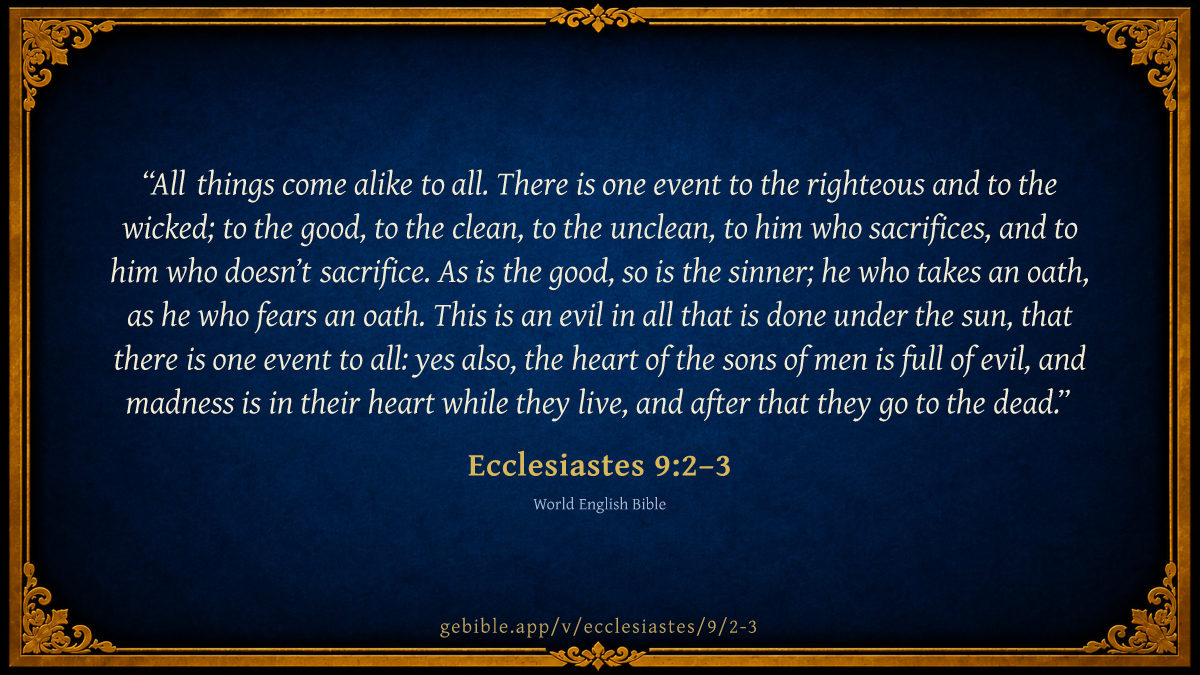
All things come alike to all. There is one event to the righteous and to the wicked; to the good, to the clean, to the unclean, to him who sacrifices, and to him who doesn’t sacrifice. As is the good, so is the sinner; he who takes an oath, as he who fears an oath. This is an evil in all that is done under the sun, that there is one event to all: yes also, the heart of the sons of men is full of evil, and madness is in their heart while they live, and after that they go to the dead.
Show the surrounding paragraph
Ecclesiastes 9:2-3 sits inside this longer paragraph.
For all this I laid to my heart, even to explore all this: that the righteous, and the wise, and their works, are in the hand of God; whether it is love or hatred, man doesn’t know it; all is before them. All things come alike to all. There is one event to the righteous and to the wicked; to the good, to the clean, to the unclean, to him who sacrifices, and to him who doesn’t sacrifice. As is the good, so is the sinner; he who takes an oath, as he who fears an oath. This is an evil in all that is done under the sun, that there is one event to all: yes also, the heart of the sons of men is full of evil, and madness is in their heart while they live, and after that they go to the dead. For to him who is joined with all the living there is hope; for a living dog is better than a dead lion. For the living know that they will die, but the dead don’t know anything, neither do they have any more a reward; for their memory is forgotten. Also their love, their hatred, and their envy has perished long ago; neither do they any longer have a portion forever in anything that is done under the sun.
Parallel Translations
-
All things come alike to all. There is one event to the righteous and to the wicked; to the good, to the clean, to the unclean, to him who sacrifices, and to him who doesn’t sacrifice. As is the good, so is the sinner; he who takes an oath, as he who fears an oath.
This is an evil in all that is done under the sun, that there is one event to all: yes also, the heart of the sons of men is full of evil, and madness is in their heart while they live, and after that they go to the dead.
-
All things come alike to all: there is one event to the righteous, and to the wicked; to the good and to the clean, and to the unclean; to him that sacrificeth, and to him that sacrificeth not: as is the good, so is the sinner; and he that sweareth, as he that feareth an oath.
This is an evil among all things that are done under the sun, that there is one event unto all: yea, also the heart of the sons of men is full of evil, and madness is in their heart while they live, and after that they go to the dead.
Show all 3 translations
-
All things come alike to all; there is one event to the righteous and to the wicked; to the good and to the clean and to the unclean; to him that sacrificeth and to him that sacrificeth not; as is the good, so is the sinner, and he that sweareth, as he that feareth an oath.
This is an evil in all that is done under the sun, that there is one event unto all; yea also, the heart of the sons of men is full of evil, and madness is in their heart while they live, and after that they go to the dead.
Examined in Scripture Analysis
Contradictions (2)
Questions where the Bible appears to say two different things, with the passages on each side set together.
Cross-references (39)
- Malachi 3:18 (v2) Then you shall return and discern between the righteous and the wicked, between him who serves God and him who doesn’t serve him.
- Jeremiah 17:9 (v3) The heart is deceitful above all things and it is exceedingly corrupt. Who can know it?
- Ecclesiastes 2:14-16 (v2) The wise man’s eyes are in his head, and the fool walks in darkness—and yet I perceived that one event happens to them all. Then I said in…
- Job 9:22 (v2) “It is all the same. Therefore I say he destroys the blameless and the wicked.
- Psalms 73:3 (v2) For I was envious of the arrogant, when I saw the prosperity of the wicked.
Show all 39 cross-references
- Ecclesiastes 8:11 (v3) Because sentence against an evil work is not executed speedily, therefore the heart of the sons of men is fully set in them to do evil.
- Malachi 3:5 (v2) I will come near to you to judgment; and I will be a swift witness against the sorcerers, and against the adulterers, and against the…
- Ecclesiastes 1:17 (v3) I applied my heart to know wisdom, and to know madness and folly. I perceived that this also was a chasing after wind.
- Malachi 3:15 (v2) Now we call the proud happy; yes, those who work wickedness are built up; yes, they tempt God, and escape.’
- Genesis 24:3 (v2) I will make you swear by Yahweh, the God of heaven and the God of the earth, that you shall not take a wife for my son of the daughters of…
- Genesis 24:8-9 (v2) If the woman isn’t willing to follow you, then you shall be clear from this oath to me. Only you shall not bring my son there again.” The…
- Joshua 2:17-20 (v2) The men said to her, “We will be guiltless of this your oath which you’ve made us to swear. Behold, when we come into the land, tie this…
- Job 15:16 (v3) how much less one who is abominable and corrupt, a man who drinks iniquity like water!
- Job 21:7-34 (v2) “Why do the wicked live, become old, yes, and grow mighty in power? Their child is established with them in their sight, their offspring…
- Psalms 51:5 (v3) Behold, I was born in iniquity. My mother conceived me in sin.
- Ecclesiastes 2:26 (v2) For to the man who pleases him, God gives wisdom, knowledge, and joy; but to the sinner he gives travail, to gather and to heap up, that he…
- Ecclesiastes 6:6 (v2) Yes, though he live a thousand years twice told, and yet fails to enjoy good, don’t all go to one place?
- Ecclesiastes 7:2 (v2) It is better to go to the house of mourning than to go to the house of feasting; for that is the end of all men, and the living should take…
- Ecclesiastes 7:18 (v2) It is good that you should take hold of this. Yes, also don’t withdraw your hand from that; for he who fears God will come out of them all.
- Ecclesiastes 8:12-14 (v2) Though a sinner commits crimes a hundred times, and lives long, yet surely I know that it will be better with those who fear God, who are…
- Ezekiel 17:18-19 (v2) For he has despised the oath by breaking the covenant; and behold, he had given his hand, and yet has done all these things. He won’t…
- Zechariah 5:3-4 (v2) Then he said to me, “This is the curse that goes out over the surface of the whole land; for everyone who steals shall be cut off according…
- Romans 1:29-31 (v3) being filled with all unrighteousness, sexual immorality, wickedness, covetousness, malice; full of envy, murder, strife, deceit, evil…
- Titus 3:3 (v3) For we were also once foolish, disobedient, deceived, serving various lusts and pleasures, living in malice and envy, hateful, and hating…
- Genesis 8:21 (v3) Yahweh smelled the pleasant aroma. Yahweh said in his heart, “I will not again curse the ground any more for man’s sake because the…
- 1 Samuel 14:26 (v2) When the people had come to the forest, behold, honey was dripping, but no one put his hand to his mouth; for the people feared the oath.
- Proverbs 14:32 (v3) The wicked is brought down in his calamity, but in death, the righteous has a refuge.
- Ecclesiastes 7:25 (v3) I turned around, and my heart sought to know and to search out, and to seek wisdom and the scheme of things, and to know that wickedness is…
- Ecclesiastes 9:2 (v3) All things come alike to all. There is one event to the righteous and to the wicked; to the good, to the clean, to the unclean, to him who…
- Ecclesiastes 12:7 (v3) and the dust returns to the earth as it was, and the spirit returns to God who gave it.
- Mark 7:21-23 (v3) For from within, out of the hearts of men, proceed evil thoughts, adulteries, sexual sins, murders, thefts, covetings, wickedness, deceit,…
- Luke 6:11 (v3) But they were filled with rage, and talked with one another about what they might do to Jesus.
- Luke 15:17 (v3) But when he came to himself he said, ‘How many hired servants of my father’s have bread enough to spare, and I’m dying with hunger!
- Acts 12:23 (v3) Immediately an angel of the Lord struck him, because he didn’t give God the glory. Then he was eaten by worms and died.
- Acts 26:24 (v3) As he thus made his defense, Festus said with a loud voice, “Paul, you are crazy! Your great learning is driving you insane!”
- 2 Peter 2:16 (v3) but he was rebuked for his own disobedience. A mute donkey spoke with a man’s voice and stopped the madness of the prophet.
- Genesis 6:5 (v3) Yahweh saw that the wickedness of man was great in the earth, and that every imagination of the thoughts of man’s heart was continually…
- Matthew 15:19-20 (v3) For out of the heart come evil thoughts, murders, adulteries, sexual sins, thefts, false testimony, and blasphemies. These are the things…
- Acts 26:11 (v3) Punishing them often in all the synagogues, I tried to make them blaspheme. Being exceedingly enraged against them, I persecuted them even…
Cross-references from openbible.info (CC BY 4.0)
Explain this passage (17 sources)
Historical commentary, presented as a primary source — not an endorsement.
Private notes
Saved on this device only — never synced or sent anywhere.
Geneva Bible translators 1599 · Public Domain On v3 In outward things, as riches and poverty, sickness and…
In outward things, as riches and poverty, sickness and health, there is no difference between the godly and the wicked: but the difference is that the godly are assured by faith of God’s favor and assistance.
Geneva Bible (1599) marginal notes — public domain.
John Trapp 1656 · Public Domain On vv2–3 Ecc 9:2 All [things come] alike to all: [there…
Ecc 9:2 All [things come] alike to all: [there is] one event to the righteous, and to the wicked; to the good and to the clean, and to the unclean; to him that sacrificeth, and to him that sacrificeth not: as [is] the good, so [is] the sinner; [and] he that sweareth, as [he] that feareth an oath.
Ver. 2. All things come alike to all.] {See Trapp on "Ecc 9:1"} Health, wealth, honours, &c., are cast upon good men and bad men promiscuously. God makes a scatter of them, as it were; good men gather them, bad men scramble for them. The whole Turkish empire, saith Luther, is nothing else but a crust {a} cast by heaven’s great housekeeper to his dogs.
Read full note →
And he that sweareth, as he that feareth an oath.] No surer sign of a profane person, than common and customary swearing. Neither any so good an evidence of a gracious heart, as not only to forbear it, for so one may do by education, and civil conversation, but to "fear an oath" out of an awful regard to the Divine Majesty. Plato and other heathens shall rise up and condemn our common swearers; for they, when they would swear, said no more but Ex animi sententia, {b} or if they would swear by their Jupiter, out of the mere dread and reverence of his name, they forbare to mention him. Clinias the Pythagorean, out of this regard, would rather undergo a mulct of three talents, than swear. The Merindolians, those ancient French Protestants, were known by this through all the country of Provence, that they would not swear, nor easily be brought to take an oath, except it were in judgment, or making some solemn covenant. {c}
{a} Nihil est nisi mica panis.
{b} Suidas.
{c} Acts and Mon., 865.
John Trapp, A Commentary or Exposition upon All the Books of the Old and New Testament (1647–1656) — public domain. Text from a community e-Sword module.
Matthew Poole 1685 · Public Domain On vv2–3 All things come alike to all; the good and…
All things come alike to all; the good and evil things of this world do equally happen to good and bad men.
The clean; either,
Read full note →
1. Morally clean or holy men. Or,
2. Legally, who made conscience of keeping himself pure from all legal defilements, according to the law then in force, and consequently from all other sins upon the same ground.
That sacrificeth; that worshippeth God sincerely, though it be to his cost. As is the good, so is the sinner, as to all outward things.
That sweareth, to wit, customarily, unnecessarily, rashly, without due consideration and reverence, or falsely and wickedly. For otherwise that some swearing was then allowed, and in some cases required, none do or can deny.
That feareth an oath; who is afraid of offending God, or abusing his name, by vain, or rash, or false oaths.
Matthew Poole's English Annotations on the Holy Bible (1683–1685) — public domain. Text from a community e-Sword/MySword module.
John Gill 1763 · Public Domain On vv2–3 All things come alike to all,.... That is, all…
All things come alike to all,.... That is, all outward things in this life, good and bad men share in alike; which proves that neither love nor hatred can be known by them: so the emperor Mark Antonine, in speaking of life and death, of honour and dishonour, of pain and pleasure, riches and poverty, says (s), all these things happen alike to good men and bad men;
there is one event to the righteous and to the wicked; the same prosperous ones happen to one as to another, as riches, honour, health, wisdom and learning, fame and reputation: if Abraham was rich in cattle, gold, and silver, so was Nabal, and the rich fool in the Gospel; if Joseph was advanced to great dignity in Pharaoh's court, so was Haman in the court of Ahasuerus; if Caleb was as hearty and strong at fourscore and five as ever, it is true of many wicked men, that there are no bands in their death, and their strength is firm to the last; if Moses, Solomon, and Daniel, were wise men, and of great learning, so were the idolatrous Egyptians, and so are many God is not pleased to call by his grace; if Demetrius had a good report of all men, so had the false prophets of old: and the same adverse things happen to one as to another as the instances of Job, Lazarus, and the good figs, the Jews carried into captivity, show; of whom the Midrash, and Jarchi from that, interpret this and the following clauses: "to the righteous and to the wicked": to Noah the righteous, and to Pharaoh, not Necho, as Jarchi, but he whose daughter Solomon married, who, the Jews say, were both lame;
Read full note →
to the good, and to the clean, and to the unclean; who are "good", not naturally, and in and of themselves, but by the grace of God; and who are "clean", not by nature, nor by their own power, but through the clean water of divine grace being sprinkled on them, and through the blood and righteousness of Christ applied to them; and who are "unclean", through the corruption of nature, and the pollution of actual sins, they live in. Some understand this of a ceremonial cleanness and uncleanness. The above Jews apply these characters to Moses, who was good; to Aaron, who was clean; and to the spies, who were unclean; and the same thing happened to them all, exclusion from the land of Canaan;
to him that sacrificeth, and to him that sacrificeth not: that serves and worships the Lord, and who does not, one branch of service and worship being put for all; and whether they offer themselves, their contrite hearts and spiritual sacrifices, or not. The Jews exemplify this Josiah, who sacrificed to the Lord; and in Ahab, who made sacrifice to cease; and both were slain with arrows;
as is the good, so is the sinner; alike in their outward condition and circumstances, whether as to prosperity or adversity;
and he that sweareth, as he that feareth an oath; the common swearer, or he that is perjured, and has no reverence of God, nor regard to truth, nor any concern to make good his oath; and he that is cautious about taking one does it with awe and reverence of the divine Being, and is careful of keeping, it, even to his own hurt. The Jews stance in Zedekiah and Samson; the former broke his oath with the king of Babylon, and the latter was a religious observer of an oath; and yet both had their eyes put out; but it does not appear that Samson ever took an oath: the opposition in the text seems to be between one that is ready to take an oath on every occasion, without considering the solemnity of one, and without due care of what he swore to; and one that is cautious about taking an oath, and chooses to be excused from taking one, on any account, could he be excused; preferring such advice as is given, Mat 5:34, "swear not at all"; the counsel about swearing, which Isocrates (t) gives, seems worthy of notice;
"take an oath required on two accounts; either to purge thyself from a foul crime charged with, or to save friends in danger, and deliver them out of it; but on account of money (or goods) swear not by any deity, no, not even if thou canst take an oath safely; for by some thou wilt be thought to be perjured, and by others to be covetous.''
The word in Hebrew for swearing is always passive, because a man should not swear, unless obliged; and the same form of language is used by Latin writers (u); and the Hebrew word for it comes from a root which signifies "seven", in allusion, as some think, to seven witnesses required to an oath; the Arabians, when they swore, anointed "seven" stones with blood; and, while anointing them, called on their deities (w); see Gen 21:30. It may be observed, that all men are here divided into good and bad; this has been the distinction from the beginning, and continues, and ever will.
(s) De scipso, l. 2. c. 11. (t) Paraenes Demonic. p. 10. (u) "Juratus sum", Plauti Corculio, Act. 3. v. 88. "Fui juratus", ib. Act 4. Sc. 4. v. 10. "Non tu juratus mihi es? juratus sum", ib. Rudens, Act. 5. Sc. 3. v. 16, 17. (w) Herodot. Thalia, sive l. 3. c. 8.
John Gill's Exposition of the Whole Bible (1746–1763) — public domain (CC PDM 1.0). Text via the HelloAO Bible API.
John Wesley 1765 · Public Domain On vv2–3 All things - The good and evil things of…
All things - The good and evil things of the world equally happen to good and bad men.
John Wesley, Explanatory Notes Upon the Whole Bible (1754–1765) — public domain. Text via the GEBible commentary corpus.
Adam Clarke 1810 · Public Domain On vv2–3 Verse 2. All things come alike to all] This…
Verse 2. All things come alike to all] This is very generally true; but God often makes a difference; and his faithful followers witness many interventions of Divine Providence in their behalf. But there are general blessings, and general natural evils, that equally affect the just and the unjust. But in this all is right; the evils that are in nature are the effects of the FALL of man; and God will not suspend general laws, or alter them, to favour individual cases. Nor does he design that his approbation or disapprobation shall be shown by any of these occurrences. Every holy man has a testimony of God's approbation in his own heart; and this makes him truly happy, let outward things be as they may. And, in general, what the wicked suffer is the fruit of their own doings. But the general state of nature as to what are called natural evils, is just as it ought to be. There is evil enough to show that man has fallen from God, and good enough to show that God deals with him in mercy. I cannot see that there is any rational cause for me to stumble at the dispensations of Divine Providence on these accounts.
Adam Clarke's Commentary on the Bible (1810–1826) — public domain. Text from a community e-Sword/MySword module.
Joseph Benson 1811 · Public Domain On v2 Ecc 9:2-3. All things come alike to all —…
Ecc 9:2-3. All things come alike to all — The good and evil things of this world equally happen to good and bad men; as is the good, so is the sinner — As to all outward things. This is an evil, &c. — A great trouble and temptation to a considerate and good man; yea, also the heart of the sons of men — Of wicked men, such as the generality of mankind are; is full of evil — Of wickedness; and madness is in their heart — Upon this account they go on madly and desperately in evil courses, without any fear of an after reckoning; and after that they go to the dead — And after all they appear to die in the same manner as the best men do. So hitherto there is no difference. For Solomon here forbears to take into consideration the future life: he intimates, however, that as the madness, so the happiness of the wicked, is ended by death: which is more fully expressed in the following words.
Joseph Benson's Commentary on the Old and New Testaments (1811–1818) — public domain. Text from a community e-Sword module.
Albert Barnes 1834 · Public Domain On vv2–3 Event - See Ecc 2:14 note.
Event - See Ecc 2:14 note.
Sweareth - i. e., Swears lightly or profanely.
Albert Barnes' Notes on the Bible (1834–1885) — public domain. Text from a community e-Sword/MySword module.
Haydock's Catholic Bible Commentary 1859 · Public Domain On vv2–3 But. Hebrew joins this with the preceding not, "by…
But. Hebrew joins this with the preceding not, "by all that is before them. All things come alike to all, there is one event to," &c. (Protestants) (Haydock) --- The pagans distinguished real goods and evils from those which were only apparent, like prosperity and adversity, which are determined only by the good or bad use. (St. Jerome) --- Thus religion looks upon virtue and vice in the former light; and riches, poverty, &c., in the latter. It may be difficult to decide, whether, under adversity, the just have supported themselves better by virtue, or the wicked by vanity. God will manifest the truth. (Calmet) --- Perjured. Hebrew and Septuagint, "swearer, so he that fears an oath." (Haydock)
George Leo Haydock (1774–1849), Haydock's Catholic Family Bible and Commentary, 1859 edition — public domain. Excludes Psalms (Douay-Rheims chapter numbering differs from Protestant) and Deuterocanonical books (Catholic canon only).
Robert Jamieson, A. R. Fausset & David Brown 1871 · Public Domain On vv2–3 All things . . . alike--not universally; but as…
All things . . . alike--not universally; but as to death. Ecc 9:2-10 are made by HOLDEN the objection of a skeptical sensualist. However, they may be explained as Solomon's language. He repeats the sentiment already implied in Ecc 2:14; Ecc 3:20; Ecc 8:14.
one event--not eternally; but death is common to all.
Read full note →
good--morally.
clean--ceremonially.
sacrificeth--alike to Josiah who sacrificed to God, and to Ahab who made sacrifice to Him cease.
sweareth--rashly and falsely.
Jamieson, Fausset & Brown — Commentary Critical and Explanatory on the Whole Bible (1871) — public domain (CC PDM 1.0). Text via the HelloAO Bible API.
Daniel D. Whedon 1874 · Public Domain On vv2–3 2. All things come alike to all — Hebrew,…
2. All things come alike to all — Hebrew, Both come just so to all; to the good and to all others; that is, come from no possible foresight of any.
One event — Meaning, the solemn, universal “event” of death; the more solemn because universal and impartial. This absolute impartiality causes the groanful utterance of the following verse; the climax of complaint reaches at last its height.
Daniel D. Whedon (gen. ed.), Commentary on the Old and New Testaments (1874–1909) — public domain. Text from a community e-Sword module.
The Cambridge Bible for Schools and Colleges 1878 · Public Domain On vv2–3 2. All things come alike to all] As before,…
2. All things come alike to all] As before, the seeker sees no order or purpose in the chances and changes of life. Earthquakes, pestilences, tempests make no discrimination between good and evil. As with the melancholy emphasis of iteration, the various forms of contrasted characters are grouped together. “The righteous and the wicked” point to men’s conduct relative to their neighbours, the “good and pure” (the first word is probably added to shew that a moral and not merely a ceremonial purity is meant) to what we call “self-regarding” actions, the self-reverence of purity in act and thought. “Sacrifice” is the outward expression of man’s relation to God. “The good” and “the sinner” are wider in their range and express the totality of character. The last group is not without difficulty. As commonly interpreted, “he that sweareth” is the man who swears falsely or rashly, as in Zec_5:3, he “that feareth an oath” is either the man who looks on its obligation with a solemn awe, or one whose communication is Yea, yea, Nay, nay, and who shrinks in reverential awe from any formal use of the Divine Name. On this view, the words probably point to the tendency of thought which was developed in the teaching of the Essenes, who placed every oath on the same level as perjury (Jos. Wars, ii. 8, § 6), and was in part sanctioned in the Sermon on the Mount (Mat_5:33-37). It may be noted, however, that in all the other groups, the good side is placed first, and I do not feel quite sure that it is not so in this case also. The man “that sweareth” may be he who does what most religious Jews held to be their duty, truthfully and well (comp Deu_6:13; Isa_65:16; Psa_63:11), he who “fears the oath,” may be the man whose “coward conscience” makes him shrink from the oath either of compurgation on the part of an accused person (comp. Aristot. Rhet. i. 27), or of testimony. The former was in frequent use in Jewish as in Greek trials. Comp. Exo_22:10-11; 1Ki_8:31; 2Ch_6:22; Num_5:19-22. It may be added that this view agrees better with the language about “the oath of God” in ch. Ecc_5:2.
The Cambridge Bible for Schools and Colleges (gen. ed. J. J. S. Perowne; Cambridge University Press, 1878–1918) — public domain. Text from a community e-Sword module.
Ellicott's Commentary for English Readers 1878 · Public Domain On vv2–3 (2) He that sweareth.—Zec_5:3.
(2) He that sweareth.—Zec_5:3.
A Bible Commentary for English Readers, edited by Charles John Ellicott (1878–1897) — public domain. Text from a community e-Sword module.
The Pulpit Commentary 1880 · Public Domain On vv2–3 All things come alike to all; literally, all things…
All things come alike to all; literally, all things are like that which happens to all persons. There is no difference in the treatment of persons; all people of every kind meet with circumstances of every kind. Speaking generally, there is no discrimination, apparently, in the distribution of good and evil. Sun and shade, calm and storm. fruitful and unfruitful seasons, joy and sorrow, are dispensed by inscrutable laws. The Septuagint, reading differently, has, "Vanity is in all;" the Syriac unites two readings, "All before him is vanity, all as to all" (Ginsburg). There is one event to the righteous, and to the wicked. All men have the same lot, whether it be death or any other contingency, without regard to their naomi condition. The classes into which men are divided must be noted. "Righteous" and "wicked refer to men in their conduct to others. The good. The Septuagint, Vulgate, and Syriac add, "to the evil," which is said again almost immediately. To the clean, and to the unclean. "The good" and "clean" are those who are not only ceremonially pure, but, as the epithet "good" shows, are morally undefiled. To him that sacrificeth; i.e. the man who attends to the externals of religion, offers the obligatory sacrifices, and brings his free-will offerings. The good the sinner; in the widest senses. He that sweareth, as he that feareth an oath. He who takes an oath lightly, carelessly, or falsely, (comp. Zec_5:3) is contrasted with him who regards it as a holy thing, or shrinks in awe from invoking God"s Name in such a case This last idea is regarded as a late Essenic development (see Josephus, "Bell. Jud:," 2:8:6); though something like it is found in the sermon on the mount, "I say unto you, Swear not at all," etc.. (Mat_5:34-37) Dean Plumptre, however, throws doubt on the above interpretation, owing to the fact that in all the other groups the good side is placed first; and he suggests that "he who sweareth" may be one who does his duty in this particular religiously and well (comp. Deu_6:13; Isa_65:16) and "he who fears the oath" is a man whose conscience makes him shrink from the oath of compurgation (Exo_22:10, Exo_22:11; Num_5:19-22) or who is too cowardly to give his testimony in due form. The Vulgate has, Ut perjurus, its et ille qui verum dejerat; and it seems unnecessary to present an entirely new view of the passage in slavish expectation of a concinnity which the author cannot be proved to have ever aimed at. The five contrasted pairs are the righteous and the wicked, the clean and the unclean, the sacrificer and the non-sacrificer, the good and the sinner, the profane swearer and the man who reverences an oath. The last clause is rendered by the Septuagint, "So is he who sweareth (oJ ojmnuwn) even as he who fears the oath," which is as ambiguous as the original. A cautious Greek gnome says
Orkon dewv ojmnuhv
Read full note →
Avoid an oath, though justly you might swear.
The Pulpit Commentary (1880–1919), ed. H.D.M. Spence-Jones & Joseph S. Exell — public domain. Text from a community e-Sword module.
The Biblical Illustrator 1887 · Public Domain On vv2–3 All things come alike to all
Ecc_9:2
All things come alike to all
Read full note →
The impartiality of Providence
Of what service is a religious life to man since Providence treats all alike?
This statement is--
I. Phenomenally true. To all outward appearance the good and the bad are treated alike. All are subject to the same diseases, bereavements, disappointments, all go down to the grave alike.
1. This a perplexing fact. Antecedently one might have supposed that the God of holiness and rectitude would, in His providence, have treated men according to their moral character, that happiness and misery would be measured out according to the merits and demerits of mankind.
2. This fact is significant. It shows--
(1) The unalterableness of Gods laws. They pay no deference to moral character.
(2) The high probability of a future state.
II. Spiritually false. All things do not come alike to all.
1. They do not come in the same character.
(1) To the wicked the trials of earth are either blind casualties or penal inflictions. But to the godly they are chastisements of fatherly love.
(2) To the wicked the prosperity and enjoyment appear as the results of their own skill, industry, and merit. To the godly they appear as the unmerited favours of a merciful God.
2. They do not come with the same influence. Trials irritate the spirit of the wicked; they purify the godly. Prosperity feeds the vanity and ambition of the wicked; but inspires the godly with devout humility and holy gratitude. The same soils, dews, and sunbeams that fill the hemlock with poison, fill the wheat with food for nations. And the same events which transform some men into devils, transform others into seraphs. (Homilies.)
Providence
I. For the same things uncertainly and indifferently to befall the righteous and the wicked in this life is unavoidably necessary.
1. Because men have the dominion over their own actions, and do that which themselves choose to do.
2. Because a great deal of prosperity and affliction befalls men, not as the reward or the effect of anything done by themselves, but by descent from their parents, whose virtues and vices have great influence upon the persons and fortunes of their children by the providence of God, and by the laws of men, and by the course of nature.
3. Because they are so mixed together in their persons, interests, employments, and places of abode, that they cannot be distinguished in the events that befall them.
4. For the more evident and certain distinguishing of them one from another.
II. They who make this objection against providence are no competent judges in the case, and suppose in their objection that which is false. It is supposed in this objection that the righteous endure so much grief, and the wicked enjoy so much pleasure, as cannot consist with Gods love to the righteous and anger at the wicked, if He take notice and be concerned in that which happens. The better to judge of this supposition, let two things be considered.
1. That by the outward estate of men we know very little of their present grief or pleasure.
2. If we did know their present grief or pleasure, we cannot infer from thence which is the good, and which is the bad condition.
III. However, the day of judgment is a sufficient answer to the objection. St. Paul, when he felt the smart of his present afflictions, called them light afflictions, for a moment, not worthy to be compared with the glory to be revealed. (Z. Cradock, D. D.)
The sufferings of good men
1. God permits the sufferings of good men for the advancement of the honour and interest of religion. A passive state is the proper sphere of action for the noblest virtues of Christianity; and for this reason the Son of God, when He took our nature upon Him, chose to appear in such a state that His example might be of more powerful and general influence to mankind. And indeed, next to the miracles, whereby the truth of the Christian religion was established, nothing contributed more to the propagation of it than the invincible patience and constancy of its possessors.
2. God has this further wise and religious end in the sufferings of good men: that we may learn by them to moderate our affections to this deceitful world; and to cast our views forward upon a more durable state of happiness, and better suited to the noble faculties and inclinations of human nature.
3. The sufferings of good men are designed to remind us both of our duty and our danger; when it is observed that the righteous fall and no man layeth it to heart, it is implied that this is a proper season of inquiring into the occasions of Gods public judgments, and reforming those sins which provoked them; and this is the more incumbent upon us in proportion to the dignity of the person and the character he sustains.
4. There is no man so good but he is conscious to himself he deserves what he suffers. The world perhaps cannot charge him with any visible or notorious escapes; yet he need only put the question to his own heart concerning the reasons of his sufferings, and it will acquit the justice of heaven in them. (R. Fiddes.)
The Biblical Illustrator, edited by Joseph S. Exell (c. 1880s–1900s) — public domain. Text from a community e-Sword module.
unfoldingWord translationNotes 2017 · CC BY-SA 4.0 On vv2–3 righteous people and wicked
righteous people and wicked
This refers to all people, emphasizing the two opposites of righteous and wicked people. (See: Merism)
Read full note →
wicked ... the good ... the clean and the unclean
All of these phrases refer to people. AT: "wicked people ... good people ... clean people and unclean people" (See: Nominal Adjectives)
the clean and the unclean
This refers to all people, emphasizing the two opposites of clean and unclean people. (See: Merism)
the clean
A person who is acceptable for God's purposes is spoken of as if the person were physically clean. (See: Metaphor)
the unclean
A person who is not acceptable for God's purposes is spoken of as if the person were physically unclean. (See: Metaphor)
the one who sacrifices and the one who does not sacrifice
This refers to all people, emphasizing the two opposites of those who sacrifice and those who do not. (See: Merism)
As good people ... so also will the sinner
This refers to all people, emphasizing the two opposites of good people and sinners. (See: Merism)
will the sinner ... will the man who fears to make an oath
It is understood that this refers to people dying. AT: "the sinner will die ... the man who fears to make an oath will die" (See: Ellipsis)
the one who swears ... so also will the man who fears to make an oath
This refers to all people, emphasizing the two opposites of those who swear oaths and those who do not.(See: Merism)
translationWords
evil
good
clean
clean
sacrifice
die
sin
fear
oath
unfoldingWord translationNotes — © Distant Shores Media and the Door43 World Missions Community, licensed CC BY-SA 4.0. Source: git.door43.org/Door43/en_tn.
Tyndale Open Study Notes 2022 · CC BY-SA 4.0 On vv2–3 9:2 The destiny all people share is death.
9:2 The destiny all people share is death.
Tyndale Open Study Notes — © Tyndale Open Resources, licensed CC BY-SA 4.0. Text via the HelloAO Bible API.