
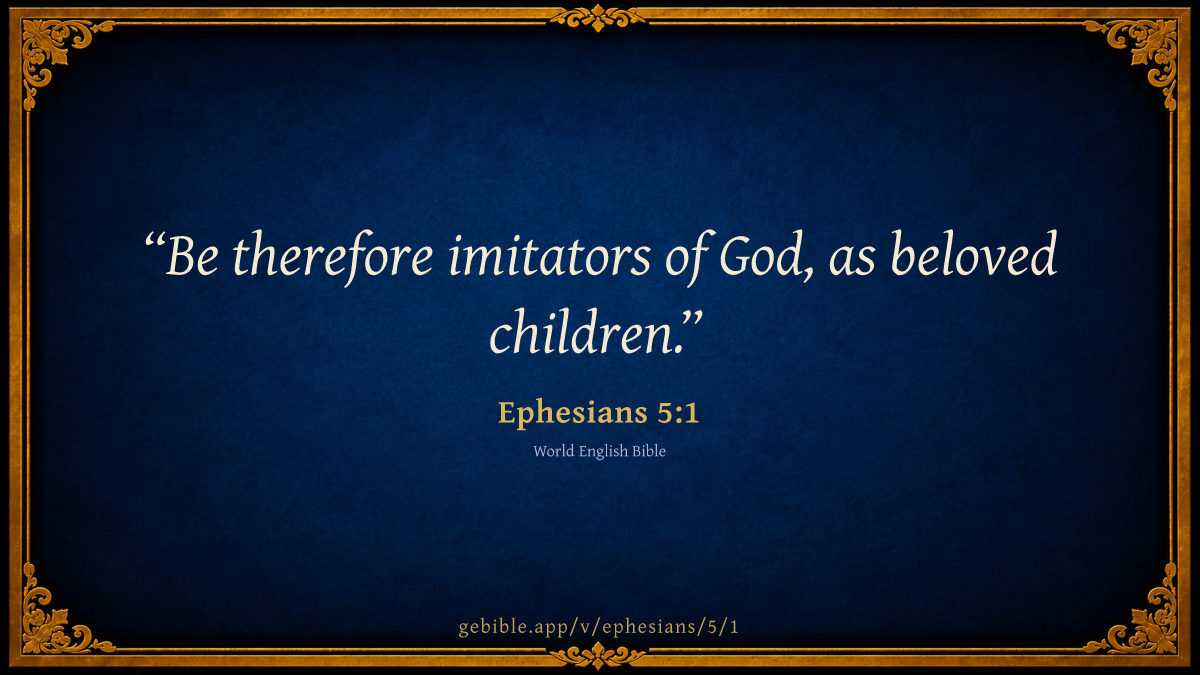
Be therefore imitators of God, as beloved children.
Parallel Translations
-
Be therefore imitators of God, as beloved children.
-
Be ye folowers of god as dere children
-
Bee yee therefore followers of God, as deare children,
Cross-references (12)
Passages linked to Ephesians 5:1 in the Treasury of Scripture Knowledge, ordered by reader-vote popularity; verse text shown in World English Bible.
- 1 John 4:11 Beloved, if God loved us in this way, we also ought to love one another.
- 1 Peter 1:15-16 but just as he who called you is holy, you yourselves also be holy in all of your behavior; because it is written, “You shall be holy; for I am holy.”
- Ephesians 4:32 And be kind to one another, tender hearted, forgiving each other, just as God also in Christ forgave you.
- Matthew 5:48 Therefore you shall be perfect, just as your Father in heaven is perfect.
- Luke 6:35-36 But love your enemies, and do good, and lend, expecting nothing back; and your reward will be great, and you will be children of the Most High; for he is kind toward the unthankful and evil. “Therefore be merciful, even as your Father is also merciful.
- Colossians 3:12 Put on therefore, as God’s chosen ones, holy and beloved, a heart of compassion, kindness, lowliness, humility, and perseverance;
- Leviticus 11:45 For I am Yahweh who brought you up out of the land of Egypt, to be your God. You shall therefore be holy, for I am holy.
- 1 John 3:1-2 See how great a love the Father has given to us, that we should be called children of God! For this cause the world doesn’t know us, because it didn’t know him. Beloved, now we are children of God. It is not yet revealed what we will be; but we know that when he is revealed, we will be like him; for we will see him just as he is.
- John 1:12 But as many as received him, to them he gave the right to become God’s children, to those who believe in his name:
- Matthew 5:45 that you may be children of your Father who is in heaven. For he makes his sun to rise on the evil and the good, and sends rain on the just and the unjust.
- Jeremiah 31:20 Is Ephraim my dear son? Is he a darling child? For as often as I speak against him, I still earnestly remember him. therefore my heart yearns for him. I will surely have mercy on him,” says Yahweh.
- Hosea 1:10 Yet the number of the children of Israel will be as the sand of the sea, which can’t be measured or counted; and it will come to pass that, in the place where it was said to them, ‘You are not my people,’ they will be called ‘sons of the living God.’
Cross-references from openbible.info (CC BY 4.0)
Explain this verse (25 sources)
Historical commentary, presented as a primary source — not an endorsement.
Private notes
Saved on this device only — never synced or sent anywhere.
John Calvin 1540 · Public Domain 1. Be ye therefore followers. The same principle is…
1. Be ye therefore followers. The same principle is followed out and enforced by the consideration that children ought to be like their father. He reminds us that we are the children of God, and that therefore we ought, as far as possible, to resemble Him in acts of kindness. It is impossible not to perceive, that the division of chapters, in the present instance, is particularly unhappy, as it has made a separation between parts of the subject which are very closely related. If, then, we are the children of God, we ought to be followers of God. Christ also declares, that, unless we shew kindness to the unworthy, we cannot be the children of our heavenly Father.
“Love your enemies, bless them that curse you, do good to them that hate you, and pray for them who despitefully use you and persecute you; that ye may be the children of your Father which is in heaven; for he maketh his sun to rise on the evil and on the good, and sendeth rain on the just and on the unjust.” (Matthew 5:44,45.)
John Calvin's Commentaries (1540-1563) — public domain. Text from the Calvin Translation Society English edition (1840s-50s) via the Christian Classics Ethereal Library (ccel.org). Calvin's coverage is partial (roughly two-thirds of the Bible); uncommented books and verses are honest gaps, never fabricated. The 19th-century editor's footnotes and remarks are omitted so the notes are faithfully Calvin's own voice.
John Trapp 1656 · Public Domain 1 Be ye therefore followers of God, as dear…
1 Be ye therefore followers of God, as dear children;
Ver. 1. Be ye therefore followers] In forgiving one another.
Read full note →
As dear children] God hath but a few such children. {See Trapp on "Mat 5:45"} {See Trapp on "Mat 5:48"}
John Trapp, A Commentary or Exposition upon All the Books of the Old and New Testament (1647–1656) — public domain. Text from a community e-Sword module.
Matthew Poole 1685 · Public Domain Be ye therefore followers of God; particularly in being…
Be ye therefore followers of God; particularly in being kind, and forgiving injuries, Mat 5:45,48; so that this relates to the last verse of the former chapter.
As dear children; viz. of God. Children should imitate their fathers, especially when beloved of them.
Matthew Poole's English Annotations on the Holy Bible (1683–1685) — public domain. Text from a community e-Sword/MySword module.
William Burkitt 1703 · Public Domain Our apostle having, in the conclusion of the foregoing…
Our apostle having, in the conclusion of the foregoing chapter, exhorted the Ephesians to mutual offices of love and kindness towards each other, in the beginning of this chapter he makes use of several very cogent arguments to excite and quicken them thereunto.
The first of which is drawn from the example of God: as he had been kind to us, and for Christ’s sake forgiven us, let us therefore be followers of him, not as our God only, but as our Father: Be ye followers of God, as dear children.
Read full note →
Where note, 1. The duty exhorted to: Be ye followers of God; that is, in all the excellences of his communicable attributes, and particularly in the exercise of universal goodness and kindness, mercy and forgiveness.
The argument exciting to this duty; as dear children; you are children, and who should children imitate but their father? And you are dear children, will you not imitate such a Father?
Learn from both, That such as lay claim to a relation to God, without imitation to him, are not children, but bastards: they may be of his family, but not of his household; of his family by instruction, but not by descent. There is no implantation into Christ without an imitation, both of the Creator and Redeemer, Christ as a Son over his own house: whose house are we, if we hold fast, & c. Heb 3:6
William Burkitt's Expository Notes on the New Testament (1700–1703) — public domain. Text from a community e-Sword module.
Matthew Henry 1710 · Public Domain Here we have the exhortation to mutual love, or…
Here we have the exhortation to mutual love, or to Christian charity. The apostle had been insisting on this in the former chapter, and particularly in the last verses of it, to which the particle therefore refers, and connects what he had said there with what is contained in these verses, thus: "Because God, for Christ's sake, has forgiven you, therefore be you followers of God, or imitators of him;" for so the word signifies. Pious persons should imitate the God whom they worship, as far as he has revealed himself as imitable by them. They must conform themselves to his example, and have his image renewed upon them. This puts a great honour upon practical religion, that it is the imitating of God. We must be holy as God is holy, merciful as he is merciful, perfect as he is perfect. But there is no one attribute of God more recommended to our imitation than that of his goodness. Be you imitators of God, or resemble him, in every grace, and especially in his love, and in his pardoning goodness. God is love; and those that dwell in love dwell in God and God in them. Thus he has proclaimed his name, Gracious and merciful, and abundant in goodness. As dear children, as children (who are wont to be greatly beloved by their parents) usually resemble them in the lineaments and features of their faces, and in the dispositions and qualities of their minds; or as becomes the children of God, who are beloved and cherished by their heavenly Father. Children are obliged to imitate their parents in what is good, especially when dearly beloved by them. The character that we bear of God's children obliges us to resemble him, especially in his love and goodness, in his mercy and readiness to forgive. And those only are God's dear children who imitate him in these. It follows, And walk in love, Eph 5:2. This godlike grace should conduct and influence our whole conversation, which is meant by walking in it. It should be the principle from which we act; it should direct the ends at which we aim. We should be more careful to give proof of the sincerity of our love one to another. As Christ also hath loved us. Here the apostle directs us to the example of Christ, whom Christians are obliged to imitate, and in whom we have an instance of the most free and generous love that ever was, that great love wherewith he hath loved us. We are all joint sharers in that love, and partakers of the comfort of it, and therefore should love one another, Christ having loved us all and given such proof of his love to us; for he hath given himself for us. The apostle designedly enlarges on the subject; for what can yield us more delightful matter for contemplation than this? Christ gave himself to die for us; and the death of Christ was the great sacrifice of atonement: An offering and a sacrifice to God; or an offering, even a sacrifice - a propitiatory sacrifice, to expiate our guilt, which had been prefigured in the legal oblations and sacrifices; and this for a sweet-smelling savour. Some observe that the sin-offerings were never said to be of a sweet-smelling savour; but this is said of the Lamb of God, which taketh away the sin of the world. As he offered himself with a design to be accepted of God, so God did accept, was pleased with, and appeased by, that sacrifice. Note, As the sacrifice of Christ was efficacious with God, so his example should be prevailing with us, and we should carefully copy after it.
Matthew Henry's Commentary on the Whole Bible (1708–1710) — public domain (CC PDM 1.0). Text via the HelloAO Bible API.
John Gill 1763 · Public Domain Be ye therefore followers of God,.... Not in his…
Be ye therefore followers of God,.... Not in his works of infinite wisdom and almighty power, which is impossible; but in acts of righteousness and holiness, and particularly in acts of mercy, goodness, and beneficence; as in forgiving injuries and offences, and in freely distributing to the necessities of the saints; as the connection of the words with the preceding chapter, and the instance and example in the following verse show: and this should be done by the saints,
as dear children; and because they are such by adopting grace; being predestinated unto the adoption of children, in the eternal purpose of God, and taken into that relation in the covenant of grace; and which is declared and made manifest in regeneration, and by faith in Christ Jesus: and they are dear, or beloved children, being loved with an everlasting and unchangeable love, and which is the spring and source of their adoption; and their being dear to him is seen by what he is unto them, their covenant God and Father; and by what he has done for them, in giving his Son to them, and for them; as well as in choosing, calling, and quickening them by his grace, and by the account he makes of them, as his jewels, his peculiar treasure, and the apple of his eye; and by the pity and compassion he has for them, and the care he takes of them; and therefore it becomes them to imitate him; for who should they imitate and follow after, but their Father, and especially when they are so dear unto him?
John Gill's Exposition of the Whole Bible (1746–1763) — public domain (CC PDM 1.0). Text via the HelloAO Bible API.
John Wesley 1765 · Public Domain Be ye therefore followers - Imitators. Of God -…
Be ye therefore followers - Imitators. Of God - In forgiving and loving. O how much more honourable and more happy, to be an imitator of God, than of Homer, Virgil, or Alexander the Great!
John Wesley, Explanatory Notes Upon the Whole Bible (1754–1765) — public domain. Text via the GEBible commentary corpus.
Adam Clarke 1810 · Public Domain Christians should imitate their heavenly Father, and walk in
CHAPTER V.
Christians should imitate their heavenly Father, and walk in
Read full note →
love, after the example of Christ, 1, 2.
They should avoid all uncleanness, impurity, covetousness, and
foolish jesting, and idolatry, because these things exclude
from the kingdom of God, 3-7.
The Ephesians were once in darkness, but being now light in the
Lord, they are exhorted to walk in that light, and bring forth
the fruits of the Spirit; and to have no fellowship with the
workers of iniquity, whose evil deeds are manifested by the
light, 8-13.
All are exhorted to awake; to walk circumspectly; to redeem the
time; and to learn what the will of the Lord is, 14-17.
The apostle gives particular directions relative to avoiding
excess of wine, 18.
To singing and giving thanks, 19, 20.
Submission to each other, 21.
To husbands that they should love their wives, as Christ loved
the Church; for by the marriage union, the union between Christ
and the Church is pointed out; and wives are exhorted to
reverence their husbands, 22-33.
NOTES ON CHAP. V.
Verse 1. Be ye therefore followers of God] The beginning of this chapter is properly a continuation of the preceding, which should have ended with the second verse of this. The word μιμηται, which we translate followers, signifies such as personate others, assuming their gait, mode of speech, accent, carriage, c. and it is from this Greek word that we have the word mimic. Though this term is often used in a ludicrous sense, yet here it is to be understood in a very solemn and proper sense. Let your whole conduct be like that of your Lord; imitate him in all your actions, words, spirit, and inclinations; imitate him as children do their beloved parents, and remember that you stand in the relation of beloved children to him. It is natural for children to imitate their parents; it is their constant aim to learn of them, and to copy them in all things; whatever they see the parent do, whatever they hear him speak, that they endeavour to copy and imitate; yea, they go farther, they insensibly copy the very tempers of their parents. If ye therefore be children of God, show this love to your heavenly Father, and imitate all his moral perfections, and acquire the mind that was in Jesus.
Adam Clarke's Commentary on the Bible (1810–1826) — public domain. Text from a community e-Sword/MySword module.
Joseph Benson 1811 · Public Domain Eph 5:1-2. Therefore — Because you are forgiven by…
Eph 5:1-2. Therefore — Because you are forgiven by God, and have been so much loved; (Eph 4:32;) be ye followers — Μιμηται, imitators, of God — In loving and forgiving; as dear — Αγαπητα, beloved, children — Whom he hath not only forgiven after many and great offences, but hath taken into his peculiar favour, adopted into his family, constituted his heirs, and joint heirs with his beloved Son, and inspired with blessed and lively hopes of unspeakable glory and felicity for ever. O! how much more honourable and more happy it is to be an imitator of God, than of Homer, Virgil, Alexander the Great, or any other human being, however renowned for learning, prowess, or achievements! And walk in love — Toward one another and toward all men, as well as toward God. Let your whole conduct toward others proceed from love as its principle, be governed by love as its rule, and be directed to, and terminate in love, as its end. As Christ also hath loved us — In such an astonishing manner, and to such an inconceivable degree, and hath so demonstrated his love, as to give himself for us an offering and a sacrifice to God — To atone for our transgressions, and render our salvation consistent with the divine perfections. Some divines have thought that in these expressions both the peace-offerings and the sin-offerings enjoined in the law of Moses are alluded to, the truths shadowed forth by both being attained by true believers through the sacrifice of Christ, which both expiated sin, or removed condemnation and wrath, and obtained for them the divine favour, with all the blessings consequent thereon. But it does not seem that any great stress can be laid on this distinction, as the word προσφεροω, translated to offer, with the noun derived from it, rendered offering, is used in a multitude of places in the LXX., for presenting any victim before God; as it is likewise in the New Testament, (Mat 5:23-24,) for bringing a gift and offering it on the altar. Of a sweet-smelling savour — Or fragrant odour; an epithet given to the sin-offering, (Lev 4:31,) and to the burnt-offering, (Gen 8:21,) to denote the acceptableness of such oblations to God, when offered by upright worshippers in the way he had appointed. For in the warm eastern climes nothing is more refreshing to mankind than fragrant odours. The sacrifice of Christ, however, as is here implied, was far more acceptable and pleasing to God than any of the victims or perfumes which had been offered of old, whether on the brazen or golden altar of the Jewish tabernacle or temple. Indeed, their sacrifices and perfumes were only acceptable as being emblematical of the offering of his body once for all, and of his continual intercessions for us before the throne of the Majesty on high. And it is a pleasing and encouraging consideration, that through these all our sincere prayers and praises, and our acts of pious and charitable liberality, beneficence, and goodness, come up before God as a grateful memorial, and draw down upon us a most valuable blessing. With regard to the exhortation to mutual love here given, it is justly observed by Macknight, that “Christ’s love in dying for us, is” [as on many other accounts, so on this] “a strong reason for our loving one another; because, if we do not love one another, we are destitute of that disposition which rendered Christ so acceptable to his Father; and have no right to be called his disciples, or to share in the inheritance of his children.
Joseph Benson's Commentary on the Old and New Testaments (1811–1818) — public domain. Text from a community e-Sword module.
Albert Barnes 1834 · Public Domain Be ye therefore followers of God - Greek, “Be…
Be ye therefore followers of God - Greek, “Be imitators - μιμηταὶ mimētai - of God.” The idea is not that they were to be the friends of God, or numbered among his followers, but that they were to imitate him in the particular thing under consideration. The word “therefore” - οὖν oun - connects this with the previous chapter, where he had been exhorting them to kindness, and to a spirit of forgiveness, and he here entreats them to imitate God, who was always kind and ready to forgive; compare Mat 5:44-47; As he forgives us Eph 4:32, we should be ready to forgive others; as he has borne with our faults, we should bear with theirs; as he is ever ready to hear our cry when we ask for mercy, we should be ready to hear others when they desire to be forgiven; and as he is never weary with doing us good, we should never be weary in benefiting them.
As dear children - The meaning is, “as those children which are beloved follow the example of a father, so we, who are beloved of God, should follow his example.” What a simple rule this is! And how much contention and strife would be avoided if it were followed! If every Christian who is angry, unforgiving, and unkind, would just ask himself the question, “How does God treat me?” it would save all the trouble and heart-burning which ever exists in the church.
Albert Barnes' Notes on the Bible (1834–1885) — public domain. Text from a community e-Sword/MySword module.
John Nelson Darby 1862 · Public Domain Ephesians Chapter 5
Ephesians Chapter 5
Moreover, let us remark here, and it is an important feature in this picture of the fruits of grace and of the new man, that when the grace and love, which come down from God, act in man, they always go up again to God in devotedness. Walk, he says, in love, even as Christ loved us and gave Himself up for us, an offering and a sacrifice to God for a sweet-smelling savour. We see it in Christ. He is this love which comes down in grace, but this grace, acting in man, makes Him devote Himself to God, although it is on behalf of others. So it is in us; it is the touchstone of the Christian heart’s activity.
Read full note →
The apostle then speaks plainly as to sin, in order that no one may deceive himself; nor be occupied with deep truths, using them intellectually, to the neglect of ordinary morality-one of the signs of heresy, properly so called. He has connected the profoundest doctrines in his teaching with daily practice. If Christ be glorified, the Head of the assembly, He is the model of the new man, the last Adam; the assembly being one with Him on high, and the habitation of God on earth by the Spirit, with whom every Christian is sealed. Every Christian, if indeed he has learned the truth as it is in Jesus, has learned that it consists in having put off the old man, and having put on the new man, created after God in righteousness and holiness (of which Christ is the model, according to the counsels of God in glory); and he is to grow up unto the measure of the stature of Christ, who is the Head, and not grieve the Holy Spirit wherewith he is sealed. The fullest revelation of grace does not weaken the immutable truth that God had a character proper to Himself; it unfolds that character to us by means of the most precious revelations of the gospel, and of the closest relationships with God, which were formed by these revelations: but this character could not alter, nor could the kingdom of God allow of, any characters contrary to it. The wrath of God therefore against evil, and against those who commit it, is plainly set forth.
Now we were that which is contrary to His character, we were darkness; not only in the dark, but darkness in our nature, the opposite of God who is light. Not one ray of that which He is was found in our will, our desires, our understanding. We were morally destitute of it. There was the corruptness of the first Adam, but no share in any feature of the divine character. We are now partakers of the divine nature, we have the same desires, we know what it is that He loves, and we love what He loves, we enjoy that which He enjoys, we are light (poor and weak indeed, yet such by nature) in the Lord-looked at as in Christ. They are the fruits of light [24] that are developed in the Christian; he is to avoid all association with the unfruitful works of darkness.
But, in speaking of motives, the apostle returns to the great subjects that pre-occupied him, and he returns to them, not only that we should put on the character set forth by that of which he speaks, but that we should realise all its extent, that we should experience all its force. He had told us that the truth in Christ was the having put on the new man, in contrast with the old man, and that we are not to grieve the Holy Spirit. Now he exhorts those that sleep to awake, and Christ should be their light. Light makes all things manifest; but he who sleeps, although not dead, does not profit by it. For hearing, seeing, and all mental reception and communication, he is in the state of a dead man. Alas, how apt this sleep is to overtake us! But in awaking, it was not that they should see the light dimly, but Christ Himself should be the light of the soul; they should have all the full revelation of that which is well-pleasing to God, that which He loves; they should have divine wisdom in Christ; they should be able to profit by opportunities, should find them, being thus enlightened, in the difficulties of a world governed by the enemy, and should act according to spiritual understanding in every case that presented itself. Further, if they were not to lose their senses through means of excitement used in the world, they were to be filled with the Spirit, that is, that He should take such possession of our affections, our thoughts, our understanding, that He should be their only source according to His proper and mighty energy to the exclusion of all else. Thus, full of joy, we should praise, we should sing for joy; and we should give thanks for all that might happen, because a God of love is the true source of all. We should be full of joy in the spiritual realisation of the objects of faith, and the heart continuing to be filled with the Spirit and sustained by this grace, the experience of the hand of God in everything here below will give rise only to thanksgiving. It comes from His hand whom we trust and whose love we know. But giving thanks in all things is a test of the state of the soul; because the consciousness that all things are from God’s hand, full trust in His love, and deadness as to any will of our own, must exist in order to give thanks in everything-a single eye which delights in His will.
In entering into the details of relationships and particular duties, the apostle cannot give up the subject that is so dear to him. The command which he addresses to wives, that they are to submit themselves to their husbands, immediately suggests the relationship between Christ and the assembly, not now as a subject for knowledge, but to unfold His affection and tender care. We have seen that the apostle, having established the great principles displayed in the revelation of our relationship with God-our vocation-then deduces their practical consequences with regard to the life and conduct of Christians: they were to walk as having put on the new man, to have Christ for their light, not to grieve the Spirit, to be filled with the Spirit. Now all this, while the fruit of grace, was either knowledge or practical responsibility.
But here the subject is viewed in another aspect. It is the grace that acts in Christ Himself, His affections, His guardian care, His devotedness to the assembly. Nothing can be more precious, more tender, more intimate. He loved the assembly-that is the source of all. And there are three steps in the work of this love. He gave Himself for it, He washes it, He presents it all glorious to Himself. This is not precisely the sovereign election of the individual by God; but the affection that displays itself in the relationship which Christ maintains with the assembly.[25] See also the extent of the gift, and how marvellous the ground of confidence that it contains. He gives Himself; it is not only His life, true as that is, but Himself.[26]
All that Christ was has been given, and given by Himself; it is the entire devotedness and giving of Himself. And now all that is in Him-His grace, His righteousness, His acceptance with the Father, the excellent glory of His Person, His wisdom, the energy of divine love that can give itself-all is consecrated to the welfare of the assembly. There are no qualities, no excellencies in Christ, which are not ours in their exercise consequent on the gift of Himself. He has already given them, and consecrated them to the blessing of the assembly which He has given Himself to have. Not only are they given, but He has given them; His love has accomplished it . We know well that it is on the cross that this giving of Himself was accomplished, it is there that the consecration of Himself to the good of the assembly was complete. But here that glorious work is not exactly viewed on the side of its atoning and redeeming efficacy, but on that of the devotedness and love to the assembly which Christ manifested in it. Now we can always reckon upon this love which was perfectly displayed in it. It is not altered. Jesus-blessed and praised be His name for it!-is for me according to the energy of His love in all that He is, in all circumstances and for ever, and in the activity of that love according to which He gave Himself. He loved the assembly and gave Himself for it. This is the source of all our blessings, as members of the assembly.
But this love of Christ is inexhaustible and unchangeable. It effects the blessing of its cherished object, by preparing it for a happiness of which His heart is alike the measure and the source, [27] to happiness of perfect purity, the excellence of which He knows in heaven-purity suited to the presence of God, and to her who should be in that presence for ever, the bride of the Lamb-purity which renders it capable of enjoying perfect love and glory; even as that love tends to purify the soul by making itself known to it, and attracting it, divesting it of self, and filling it with God as the centre of blessing and joy.
It is important to remark that Christ does not here sanctify the assembly to make it His own, but makes it His own to sanctify it. It is first His, then He suits it to Himself. Christ, who loves the church as being His own, and who has already made it His own by giving Himself for it, and who chooses to have it such as His heart desires, occupies Himself with it, when He has won it, to render it such. He gave Himself for it, that He might sanctify it by the washing of water by the word. Here we find that moral effect produced by the care of Christ, the object which He proposes to Himself in His work accomplished in time, and the means He uses to attain it. He appropriates the assembly morally, sets it morally apart for Himself, when He has made it His; for He can only desire holy things-holy according to the knowledge He has of purity-by virtue of His eternal and natural abode in heaven. He then puts the assembly in connection with heaven, from whence He is, and into which He will introduce it. He gave Himself in order to sanctify it. For this purpose He uses the word, which is the divine expression of the mind of God, of heavenly order and holiness, of truth itself (that is to say, of the true relation of all things with God; and that according to His love in Christ), and which consequently judges all that deviates from it as to purity or love.
He forms the assembly for His bride, a help-meet for Him, in which all is according to the glory and the love of God, by the revelation (through the word, which comes from thence) of these things as they exist in heaven. Now Christ Himself is the full expression of these things, the image of the invisible God. Thus, in communicating them to the assembly, He prepares it for Himself. When speaking therefore in this sense of His own testimony, He says, “We speak that we do know, and testify that we have seen.”
But it is this which the word is, as we have received it from Jesus; and more especially as speaking from heaven, with the character of the new commandment, the darkness passing away, and the true light now shining; and consequently, the thing being true, not only in Him, but in us. The ministry of chapter 1 is occupied with this, forming the hearts of the saints on earth in fellowship with the Head from which the grace and the light descended. In this manner then Christ sanctifies the assembly for which He gave Himself. He has formed it for heavenly things by the communication of heavenly things, of which He is Himself the fulness and the glory. But this word finds the assembly mixed up with things that are contrary to this heavenly purity and love. Alas! its affections-as to the old man at least-mixed up with these earthly things, which are contrary to the will of God and to His nature. Thus in sanctifying the assembly He must needs cleanse it. This is therefore the work of the love of Christ during the present time, but for the eternal and essential happiness of the assembly.
He sanctifies the assembly, but He does it by the word, communicating heavenly things-all that belongs to the nature, to the majesty, and to the glory of God-in love, but at the same time applying them to judge everything in her present affections, which is at variance with that which He communicates. Precious work of love, which not only loves us but labours to make us fit to enjoy that love; fit to be with Christ Himself in the Father’s house!
How deeply is He interested in us! He not only accomplished the glorious work of our redemption by giving Himself for us, but He acts continually with perfect love and patience to make us such as He would have us to be in His own presence-fit for the heavenly places and heavenly things.
What a character this shews to belong also to the word, and what grace in His use of it! It is the communication of divine things according to their own perfection, and now as God Himself is in the light. It is the revelation of God Himself, as we know Him in a glorified Christ, in a perfect love to form us also according to that perfection for the enjoyment of Him; and yet it is addressed to us, yea is suited in its very nature to us down here (compare Joh 1:4) to impart these things to us by bringing in light amid the darkness, thus necessarily judging all that is in the darkness, but in order to purify us in love.
Observe, also, the order in which this work of Christ is presented to us, beginning with love. He loved the assembly; this, as we have already said, is the source of all. All that follows is the result of that love and cannot gainsay it. The perfect proof of it is then stated: He gave Himself for the assembly. He could not give more. It was to the glory of the Father, no doubt, but it was for the assembly. Had he reserved anything, the love in giving Himself would not have been perfect, not absolute; it would not have been a devotedness that left nothing for the awakened heart to desire. It would not have been Christ, for He could not but be perfect. We know love and perfection in knowing Him. But He has won the heart of the assembly by giving Himself for it. He has won her thus. She is His according to that love. Yea; it is there that we have learnt what love is. Hereby know we love in that He gave Himself for us. All was for the glory of the Father: without that it wouldnot have been perfection; and the revelation of the heavenly things would not have taken place, for that depended on the Father’s being perfectly glorified. In this the things to be revealed were manifested and verified, so to speak, in spite of evil; but all is entirely for us.
If we have learnt to know love, we have learnt to know Jesus, such as He is for us; and He is wholly for us.
Thus the entire work of cleansing and of sanctification is the result of perfect love. It is not the means of obtaining the love, or of being its object. It is indeed the means of enabling us to enjoy it; but it is the love itself which, in its exercise, works this sanctification. Christ wins the assembly first. He then in His perfect love makes it such as He would have it to be-a truth that is precious to us in every way, and first, in order to free the soul from all servile fear, to give sanctification its true character of grace and its true extent here. It is joy of heart to know that Christ Himself will make us all He desires us to be.
We have considered two effects of the love of Christ for the assembly. The first was the gift of Himself, which in a certain sense comprises the whole; it is love perfect in itself. He gave Himself. The second is the moral formation of the object of His love, that it may be with Him; according, we may add, to the perfections of God Himself, for that indeed is what the word is-the expression of the nature, the ways, and the thoughts of God.
There is yet a third effect of this love of Christ’s which completes it. He presents it to Himself a glorious assembly without spot or wrinkle. If He gave Himself for the assembly, it was in order to have it with Him; but if He would have it with Him, He must render it fit to be in His glorious presence; and He has sanctified it by cleansing it according to the revelation of God Himself, and the heavenly things of which He is in Himself the centre in glory. The Holy Ghost has taken the things of Christ, and has revealed them to the assembly; and all that the Father has is Christ’s. Thus perfected according to the perfection of heaven, He presents it to Himself a glorious assembly. Morally, the work was done; the elements of heavenly glory had been communicated to her who was to stand in that glory, had entered into her moral being, and thus formed her to participate in it. The power of the Lord is needed to make her participate in it in fact, to make her glorious, to destroy every trace of her earthly abode, save the excellent fruit that results from it. He presents her glorious to Himself-this is the result of all. He took her for Himself, He presents her to Himself, the fruit and the proof of His perfect love; and for her it is the perfect enjoyment of that same love. But there is yet more. That sentence discloses to us all the import of this admirable display of grace. The Spirit carries us back to the case of Adam and Eve, in which God, having formed Eve, presents her to Adam all complete according to His own divine thoughts and at the same time suited to be the delight of Adam, as a help-meet adapted to his nature and condition. Now Christ is God. He has formed the assembly, but with this additional right over her heart that He has given Himself for her; but He is also the last Adam in glory; and He presents her glorified to Himself, such as He had formed her for himself. What a sphere for the development of spiritual affections is this revelation! What infinite grace is that which has given place for such an exercise of these affections!
We cannot fail to notice the connection between the cleansing and the glory, that is, that the cleansing is according to the glory and by it; and that the glory is the completeness of, and completely answers to, the cleansing. For the cleansing is by the word, which reveals the whole glory and mind of God. Presented in glory she has neither spot not wrinkle; she is holy and unblamable. This is a most important truth, and recurs elsewhere. Compare 2Co 3:18, and Php 3:11 to the end. So in 1Th 3:13. What is complete in glory there, is wrought into the soul now by the Spirit operating with the word.
This then is the purpose, the mind of the Lord, with regard to the assembly, and this the sanctifying work which prepares her for Himself and for heaven. But these are not all the effects of His love. He watches tenderly over her during all the time of her sojourn here below.
The apostle, who did not lose sight of the thesis which gave rise to this digression that is so instructive to us, says that the husband ought to love his wife as his own body-that it was loving himself. He was naturally led to this by the allusion to Genesis; but he immediately returns to the subject that occupies him. No one, he says, ever hated his own flesh; he nourishes and cherishes it, even as the Lord the assembly. This is the precious aspect, during time, of Christ’s love, which the apostle here presents. Not only has Christ a heavenly aim, but His love performs the work which, so to speak, is natural to it. He tenderly cares for the assembly here below; He nourishes it, He cherishes it. The wants, the weaknesses, the difficulties, the anxieties of the assembly are only opportunities to Christ for the exercise of His love. The assembly needs to be nourished, as do our bodies; and He nourishes her. She is the object of His tender affections; He cherishes her. If the end is heaven, the assembly is not left desolate here. She learns His love where her heart needs it. She will enjoy it fully when need has passed away for ever. Moreover it is precious to know that Christ cares for the assembly, as a man cares for his own flesh. For we are members of His own body. We are of His flesh, and of His bones. Eve is here alluded to. We are, as it were, a part of Himself, having our existence and our being from Him, as Eve from Adam. He can say, “I am Jesus whom thou persecutest.” Our position is, on the one hand, to be members of His body; on the other hand, we have our existence as Christians from Him. Therefore it is that a man is to leave his natural relations, in order to be united to his wife. It is a great mystery. Now it was just this that Christ did as man, in a certain sense, divinely. Nevertheless every one ought thus to love his own wife, and the wife to reverence her husband.
There remain yet certain relationships in life, with which the doctrine of the Spirit of God is connected: those of children and parents, of fathers and children, and of servants and master. It is interesting to see the children of believers introduced as objects of the Holy Spirit’s care, and even slaves (for servants were such), raised by Christianity to a position which the circumstances of their social degradation could not affect.
All the children of Christians are viewed as subjects of the exhortations in the Lord, which belong to those who are within, who are no longer in this world, of which Satan is the prince. Sweet and precious comfort to the parent, that he may look upon them as having a right to this position, and a part in those tender cares which the Holy Ghost lavishes on all who are in the house of God! The apostle marks the importance which God attached, under the law, to this duty. It is the first command with which He linked a promise. Eph 5:3 is only the quotation of that which he alludes to in Eph 5:2.
The exhortation to fathers is also remarkable-that they should not provoke their children; that their hearts should be turned towards them; that they should not repel them, nor destroy that influence which is the strongest guard against the evil of the world. God forms the heart of children around this happy centre: the father should watch over this. But there is more. The Christian father (for it is always those within to whom he speaks) ought to recognise the position in which, as we have seen, the children are placed, and to bring them up under the yoke of Christ in the discipline and admonition of the Lord. Christian position is to be the measure and the form of the influences which the father exercises, and of the education which he gives his children. He treats them as brought up for the Lord, and as the Lord would bring them up.
It will be remarked, that in the two relationships we are considering, as well as in that of wives with their husbands, it is on the side from which submission is due that the exhortations begin. This is the genius of Christianity in our evil world, in which man’s will is the source of all the evil, expressing his departure from God to whom all submission is due. The principle of submission and of obedience is the healing principle of humanity: only God must be brought into it, in order that the will of man be not the guide after all. But the principle that governs the heart of man in good, is always and everywhere obedience. I may have to say that God must be obeyed rather than man; but to depart from obedience is to enter into sin. A man may have, as a father, to command and direct; but he does it ill if he do it not in obedience to God and to His word. This was the essence of the life of Christ: “I come to do thy will, O my God.” Accordingly the apostle begins his exhortations with regard to relationships by giving the general precept: “Submit yourselves one to another.” This renders order easy, even when the order of institutions and of authority may fail. Submission, moral obedience, can never in principle be wanting to the true Christian. It is the starting-point of his whole life. He is sanctified unto the obedience of Christ (1Pe 1:2).
In the case which has led to these remarks, it is striking to see how this principle elevates the slave in his condition: he obeys by an inward divine principle, as though it were Christ Himself whom he obeyed. However wicked his master may be, he obeys as if he obeyed Christ Himself. Three times the apostle repeats this principle of obedience to Christ or the service of Christ, adding, “doing the will of God from the heart.” What a difference this made in the poor slave’s condition! Moreover, whether bond or free, each should receive his reward from the Lord. The master himself had the same Master in heaven, with whom there is no respect of persons. Still it is to masters that he says this, not to the slave; for Christianity is delicate in its propriety, and never falsifies its principles. The master was also to treat the slave with perfect equity-even as he expected it from the slave-and was not to threaten.
It is beautiful to see the way in which divine doctrine enters into the details of life, and throws the fragrance of its perfection into every duty and every relationship; how it acknowledges existing things, as far as they can be owned and directed by its principles, but exalts and enhances the value of everything according to the perfection of those principles; by touching not the relationships but the man’s heart who walks in them; taking the moral side, and that of submission, in love and in the exercise of authority which the divine doctrine can regulate, bringing in the grace which governs the use of the authority of God.
Footnotes for Ephesians Chapter 5
24: We should read “fruit of the light,” not “fruit of the Spirit.”
25: It is well to notice here this character of love-love in an established relationship. The word of God is more exact than is generally thought in its expressions; because the expression has its origin in the thing itself. It is not said that Christ loved the world-He has no relationship with the world as it is. It is said that God so loved the world; this is what He is towards it in His own goodness. It is not said that God loved the assembly. The proper relationship of the assembly as such is with Christ, her heavenly Bridegroom. The Father loves us, we are His dear children. God, in this character, loves us. Thus Jehovah loves Israel. On the other hand, all the tenderness and faithfulness that belong to the relationship in which Christ stands are our portion in Him, as well as all that the name of Father means on its side also.
26: It is specially the devotedness of His love; He gives and gives Himself.
27: When I say (here and above) that the love of Christ is its source, it is not as if the love of the Father and the counsels of God had not their place in it. I speak of the blessing applied and carried out in the relationship presented in this passage; and this relationship exists with Christ. Nevertheless it is the same divine love.
John Nelson Darby — Synopsis of the Books of the Bible: the New Testament (c. 1857–1862) — public domain. Text from a community e-Sword module.
Lange's Commentary on the Holy Scriptures 1864 · Public Domain c. Three points of view for the new walk
c. Three points of view for the new walk
(Eph_5:1-14.)
Read full note →
1) Look above thyself to follow God!
(Eph_5:1-2.)
1Be ye [Become] therefore followers [or imitators] of God, as dear [beloved] children; 2And walk in love, as Christ also hath loved us [also loved you],1 and hath given himself [gave himself up] for us2 an offering and a sacrifice to God for a sweet-smelling savour [savour of sweet smell].
EXEGETICAL AND CRITICAL
Eph_5:1-2 a. The exhortation. Become therefore, γίνεσθε οὖν.—This connects with what precedes (Eph_4:32): γίνεσθε δέ, marking an inference, and at the same time an advance and a distinction, so that it is=διό (Eph_4:25; Eph_2:11; Eph_3:3), and like διὰ τοῦτο (Eph_1:15), τούτου χάριν (Eph_3:1; Eph_3:14), indicating a new section, as it does in Eph_4:1; Eph_4:17; Eph_5:15. Hence these verses are not to be joined to chap. 4 (Schenkel [Hodge]3 and others).—Followers [or imitators] of God, μιμηταὶ τοῦ θεοῦ.—Like 1Co_4:16; 1Co_11:1; 1Th_1:6; 1Th_2:14; Heb_6:12; 1Pe_3:13. An injunction on the part of the Apostle to the churches, believers, to imitate what is good; we always find γίνεσθαι, never εἶναι, in this connection; thus the becoming so is marked. Luther, [E. V.], (be), Vulgate (estote) render incorrectly. In what sense this enormous requirement is intended is clearly indicated by the context: condonando et amando; nam sequitur amati (Bengel). [Hence the word “imitators,” though a literal rendering, suggests too much, and “followers” is sufficiently correct.—R.]
As beloved children [ὡς τέκνα ἀγαπητά].—̔Ως, “as,” denotes the reality, τέκνα ἀγαπητά, “beloved children,” the relation in which they are the objects of the love of God4 and through Christ His children. Theodoret: υἱοθεσίας ἠξῖώθητε, πατέρα τὸν θεὸν ὀνομάζετε, ζηλώσατε τοιγαροῦν τὴν συγγένειαν. Comp. 1Jn_4:12; 1Jn_4:7-11; Mat_5:48; Luk_6:36. Liberorum est, patrem moribus referre (Grotius).
Eph_5:2. And walk in love.—Καί, “and,” is epexegetical, in order to define the point of the imitation: περιπατεῖτε ἐν ἀγάπη, “walk in love,” “even as God forgave you” (Eph_4:32). ̓Εν ἀγάπῃ is God’s characteristic (Eph_1:4-5), our aim (Eph_3:17-19); the former makes the latter possible. On περιπατεῖν, see Eph_2:2.
Eph_5:2 b. Closer designation. As Christ also loved you [καθὼς καὶ ὁ Χριστὸς ἠγάπησεν ὑμᾶς. See Textual Notes.]—“In Christ” (Eph_4:32) is now explained. “As Christ also” binds the Christian walk to Christ and His work. Christ has loved you, in that He became man and dwelt among men, served them, being mighty in word and deed. [While “the Apostle makes no distinction between our being the objects of God’s love, and our being the objects of the love of Christ” (Hodge), it is quite as true that καί, also, marks an advance “from the love of the Father who gave His Son, to that of the Son, the Personal manifestation of that love in our humanity” (Alford). The force of the aorists should be preserved.—R.] The ὑμᾶς marks the exhortation more strongly than if the reading were ἡμᾶς, permitting the general predicate (ἠγάπησεν) to become prominent in its independent validity, over against what follows:
And gave himself up for us.—Καί παρέδωκεν ἑαυ τόν, over against ἔδωκεν (Joh_3:16) denotes two things: the voluntary giving and the giving Himself up to suffering, that is, to suffering in the general sense, including the special form, death: so has He loved. To this ὑπερ ἡμῶν, “for us,” also points. [The phrase in itself may or may not imply substitution; Ellicott and most think the context points indisputably in this case to the sense: in our stead.—Comp. Romans (Eph_5:6), p. 164; also Galatians (Eph_2:20, and Doctr. Notes on Eph_3:6-14).—R.] The figure is taken from a conflict, in which, against the enemies thronging over a fallen one, a hero, full of noble courage and of love, protectingly contends; similar to this is the use of περί, which gives prominence to the being encircled by foes. This reference is found also in the closer definition which follows.
An offering and a sacrifice, ποοσφορὰν καὶ θυσίαν—According to Kliefoth [Liturg. Abhandlungen, 4 p. 27 ff.) קרְבַך (corban) is the common name for all sacrifices and offerings, bloody and unbloody, while מִנְחָה (mincha) is principally used of the unbloody (προσφορά), זֶבַח (zebach) for the bloody offerings (θυσία). Comp. Heb_9:9; Heb_10:5; Heb_10:8, where both words occur, and Heb_10:10; Heb_10:14; Heb_10:18 with Heb_10:12; Heb_10:26, where they are used promiscuously. Still even there τοῦ αώματος is added to προσφορά, so that in accordance with the context and usus loquendi this distinction is to be maintained, and in the given order also, because He gave Himself here as a προσφορά, and became in death a θυσία, the former being the soul of the θυσία ζῶσα (Stier).—[Alford, Eadie, Ellicott, all find in the former term a more general reference to the vicarious work of Christ, and in the latter a more special reference to His death. “The great prominent idea here is the one sacrifice, which the Son of God made of Himself in His Redeeming love, in our nature—bringing it, in Himself, near to God—offering Himself as our representative Head: whether in perfect righteousness of life, or in sacrifice, properly so called, at His death” (Alford).—R.] Accordingly it is not necessary to supply είς θανατον in thought (Harless [Hodge], Schenkel and others); the context includes more.
To God for a savour of sweet smell [τῷ θεῷ5 εἰς ὀσμὴν εὐωδίας].—This is=רֵיחַ נִיחוֹחַ לַיהוָֹה (Exo_29:18, LXX.: τῷ κυρίῳ εἰς ὀσμὴν εὐωδίας; comp. Lev_1:9; Lev_3:16), where κυρίῳ in correspondence with the original text is placed last. Hence “to God,” which is inserted for the sake of clearness, is not to be joined to the verb (Meyer). The two substantives (both derived from ὄζω, ὀσμὴ denoting the smell in so far as it is inhaled, and εὐωδία its quality, Winer, p. 562, or its effect, pleasure) give prominence to the fact that God the Father is well-pleased in the self-sacrificing love of the Crucified One, in order to strengthen, through the reference to this, the exhortation, that we too can become well-pleasing to the Father only in self-devoting love. Php_4:18; Rom_12:1-2; 2Co_2:15.
DOCTRINAL AND ETHICAL
1. The principle and impulse of the Christian walk is love—love as it actually exists in God, who is Love in His character (1Jn_4:8), and as it has been felt and enjoyed by us who are beloved (ἀγαπητοί), so that we can give more and more what we have received and ever receive again. Now in Christ this love has become our portion, hence it is forgiving, reconciling, peace-making; to show this in their walk is here required of Christians.
2. God is the original, Christ the express image of the Father, and the ensample of His people, the Christian the likeness and copy. As the imitation of God cannot be absolute, but is to be limited to loving, to forgiving love, so the imitation of Christ cannot be directed toward expiatory sufferings, but only to self-sacrificing love for our fellows, well-pleasing to God.
3. As we are able to walk in love only as beloved of God and as vouchsafed sonship with Him, so we can only, when reconciled to God through Christ, follow Him in filial and hence in fraternal devotion; in His grace we first can walk as well-pleasing to Him. The error of the Socinians and the Rationalists who see in Christ and His self-sacrifice a mere example and nothing more, is great and pernicious. See Exeg. and Doctr. Notes on Eph_2:16. As the Bible highly estimates the icarious sufferings of Christ, which are taught, not in the ὑπὲρ ἡμῶν, but in the θυσία6 and the whole Scripture (Mat_20:28; 1Ti_2:6), so it occurs in the entire life of human society: the child lives by the mother’s sacrifice, and he for whom no one suffers is miserable. So we too should live for others and suffer in their stead; though we cannot make atonement, we can still live and love self-sacrificingly in the strength imparted to us.
HOMILETICAL AND PRACTICAL
Comp. the foregoing Doctr. Notes and Hom. Notes at the close of Eph_5:6-14.
Starke:—Wilt thou become like God hereafter, and see Him as He is, then must thou in this life be holy, even as He is holy.—No one can rightly boast himself of sonship with God, who does not imitate Him.—Christ’s example is the proper mirror in which to see the true and natural form of love.
Rieger:—The moral instruction of the Apostles is everywhere deduced from the marrow of the gospel, nor can it be put in practice by any one who does not stand in this gospel of peace. It is the character of love, to imitate as it may the Beloved.
Heubner:—This is a powerful precept: who can satisfy its demands? We cannot become like Him, but we can strive to follow Him in holiness and love. Imitating Christ and God is the same thing.—Christ is and remains the original, but we should be copies, the more faithful, the better.
Stier:—The Father gives His children but one command: Love!
Gerlach:—The thank-offering Christ brought for us, that we too might now offer ourselves to God; the sin-offering, that we need not suffer the same punishment.
Footnotes:
[1]Eph_5:2—[The better attested reading is ὑμᾶς (א.1 A. B., cursives, versions and fathers). The Rec. has ἡμᾶς (א.3 D. E. F. K. L., most cursives and versions); so Lachmann, Ellicott. See text note.—R.]
[2] Eph_5:2—[B., with some minor authorities, reads ὑμῶν instead of ἡμῶν, which is well supported. The connection with the last clause complicates the critical question however. Tischendorf, Alford and others accept: ὑμᾶς—ὑμῶν; Lachmann, Ellicott and most (Rec.): ἡμᾶς—ἡμῶν. If a uniformity in the person of the pronoun is indispensable, then the latter is preferable but Braune, with Meyer and others, still more correctly accepts the variation (“loved you and gave himself for us), which is lectio difficilior, accounts best for the various readings, and in detail is better supported by diplomatic authority.—R.]
[3][Both Eadie and Ellicott seem disposed to regard the verses in this light, but Alford takes them as transitional, accepting the view of οὖν suggested by Stier and here upheld by Braune.—R.]
[4][The point suggested by the adjective is obscured in the E. V.: “dear;” “as children beloved,” they should imitate God in love, see Eph_5:2.—R.]
[5][Alford, Ellicott and others prefer to connect τῷ θεῷ as dat. commodi. This alters the sense very little, and is favored by the position of the words, though the Old Testament allusion strongly sustains the view of Braune, which is accepted by many commentators. The connection with the verb is out of the question.—R.]
[6][Eadie remarks: “To warrant the application of the term ‘sacrifice’ to the death of Christ, it must have been something more than the natural, fitting, and graceful conclusion of a self-denied life—it must have been a violent and vicarious decease and a voluntary presentation.” See his full doctrinal note in loco. At the same time Alford is perhaps justified in terming the question, as usually discussed, an “irrelevant one here.” “It is not the death of Christ which is treated of, but the whole process of His redeeming love. His death lies in the background as one, and the chief, of the acknowledged facts of that process: but it does not give the character to what is predicated of Him.” This exegetical view does not however favor any theory of the death of Christ which denies its vicarious, propitiatory character as an atoning sacrifice.—R.]
Lange's Commentary on the Holy Scriptures (Critical, Doctrinal, and Homiletical), ed. John Peter Lange, English translation edited by Philip Schaff (1864–1880) — public domain. Text from a community e-Sword module.
Daniel D. Whedon 1874 · Public Domain 1. Be ye—Become ye, parallel with become ye (be…
1. Be ye—Become ye, parallel with become ye (be ye) in Eph_4:32, where see note.
Therefore—In view of the fact that God… hath forgiven you, become followers (literally, imitators) of God by casting off all bitterness, Eph_4:31, with the guilelessness of dear children, who imitate their placable father in freely forgiving.
Daniel D. Whedon (gen. ed.), Commentary on the Old and New Testaments (1874–1909) — public domain. Text from a community e-Sword module.
The Cambridge Bible for Schools and Colleges 1878 · Public Domain Ch. Eph_5:1-14. The subject pursued: Christ’s Sacrifice the supreme…
Ch. Eph_5:1-14. The subject pursued: Christ’s Sacrifice the supreme example of self-sacrifice: Purity: Reproof of darkness by light
1. therefore] The argument passes unbroken from the previous words.
Read full note →
followers] Lit. “imitators.” The A. V. consistently uses “follow,” “follower,” to render the original verb and noun; 1Co_4:16; 1Co_11:1; 1Th_1:6; 1Th_2:14; 2Th_3:7; 2Th_3:9; Heb_6:12; Heb_13:7; 1Pe_3:13; 3Jn_1:11. For the thought here cp. Mat_5:45; Mat_5:48; Luk_6:36; 1Pe_1:15-16; 1Pe_2:21; 1Pe_3:13. (In this last passage the true reading gives probably “emulators,” not “imitators”; but this obviously is the same thought intensified in expression.) The “Imitation of God” is the true sequel and index of Peace with God and Life in God. It is, from another aspect, the Manifestation of God in His people.
of God] Who, in that supreme instance, set the example of forgiveness.
dear children] Better, beloved children. As children (see Mat_5:45; 1Pe_1:17, where read, “If ye invoke Him as Father, &c.”) they were to shew the family likeness. And as children who had become such by a sacred act of pardoning love, they were to shew it above all things in self-forgetting kindness.—Cp. on the whole subject 1 John; esp. Eph_3:10.—The word rendered “children” is the word specially appropriate to ideas not of adoption but of birth.
The Cambridge Bible for Schools and Colleges (gen. ed. J. J. S. Perowne; Cambridge University Press, 1878–1918) — public domain. Text from a community e-Sword module.
Ellicott's Commentary for English Readers 1878 · Public Domain (1) Followers of God.—The phrase is unique and very…
(1) Followers of God.—The phrase is unique and very striking; literally, imitators of God: and the word “therefore” implies that this imitation of God must be chiefly in His essential attribute of love. It is instructive to observe that our Lord’s startling command, “Be ye therefore perfect, as your Father in heaven is perfect” (Mat_5:48), is explained both by the context and the parallel passage in St. Luke (Luk_6:36) to mean, “Be ye therefore merciful, as your Father in heaven is merciful.” See in Hooker’s Ecc. Pol., i. 5, a striking passage on the imitation of God as the law of all moral progress in man. In this idea, indeed, lies the essential and distinctive principle of a religious morality as such.
As dear children.—Literally, as children beloved of Him. The knowledge of the love of God to us is the first source, as of our love to Him (1Jn_4:19), so also of our love to men as brethren under His fatherhood (1Jn_4:11). As being His “children,” and therefore partakers of the divine nature (2Pe_1:4), we can imitate Him; as His “beloved children” we imitate Him most naturally in love, and especially in that form of love which we call “mercy,” and which, as being ourselves sinners, we especially crave and receive from Him.
Read full note →
V.
(1, 2) These verses are an expansion and enforcement of the last verse of Ephesians 4. There the forgiveness of “God in Christ” is set forth in one pregnant phrase. Here the two parts of this idea are divided; and there is put before us, first, the free universal love of God as our Father, and next, the self-sacrificing love of Christ, as the Son of God and man.
A Bible Commentary for English Readers, edited by Charles John Ellicott (1878–1897) — public domain. Text from a community e-Sword module.
The Pulpit Commentary 1880 · Public Domain Be ye therefore imitators of God, as children beloved.…
Be ye therefore imitators of God, as children beloved. These words are closely connected with the preceding. In Eph_4:32 he had urged the example of God in one very momentous matter; he now urges it in a more general sense and on another ground. We ought to forgive men because God has forgiven us all admit that; but moreover, we ought to imitate our Father in his forgiveness and in his loving spirit, be-because beloved children should always imitate, and will always strive to imitate, what is good in a beloved father. Forgiving love is one of the great glories of our Father; it has been made peculiarly attractive in our eyes, because it has been exercised by him towards us; every consideration, therefore, ought to induce us to show the same spirit.
Vers. 1-14.
Read full note →
The walk suitable to the children of light: no fellowship with sins of the flesh.
The fearful prevalence of sensual vice at Ephesus naturally led the apostle to dwell on it emphatically as one of the worst rags of the old man, a rag to be wholly and forever cast away. But, indeed, there are few heathen communities where sensual vice does not flourish when men have it in their power to indulge in it. It is singular how universal sin is in connection with the irregular and disorderly indulgence of the bodily appetites. It would seem as if God made this a special matter of probation, for when these appetites get the upper hand, they lead into terrible excesses, and, by bringing disease on both mind and body, avenge the sin to which they have impelled. First, they tempt men to sin, and then, as if in heartless mockery, they scourge them for having sinned. We find here
I SINS OF THE FLESH DENOUNCED, with a corresponding sin of the spirit covetousness (vers. 3, 4).
II REASONS WHY SUCH SINS SHOULD BE RENOUNCED BY CHRISTIANS.
1. NO such person has any inheritance in the kingdom of God (ver. 5).
2. The wrath of God cometh is present and visible for such things on very evil men (Sodom and Gomorrah, Canaanites, etc.) (ver. 6).
3. They belong to the world of darkness, and Christians are children of light (ver. 8).
4. Christians, as living in the Spirit, should bring forth the fruit of the Spirit (ver. 9).
5. They should ascertain and follow only what is pleasing to Christ (ver. 10).
III REASONS WHY SUCH SINS SHOULD BE REPROVED BY CHRISTIANS.
1. They are so evil that it is a sin even to speak of them (ver. 12).
2. The true character of such sins is seen by light let in on them (ver. 13).
3. The light has a tendency to transform (ver. 13), and by letting in the light that shows the odiousness of the sin you may be the means of changing the sinner; while you reprove you may also improve him.
4. It is for this purpose the Church has got the light when the light is brought to her, her Lord calls on her to awake and shine (ver. 15). Such precepts and considerations have a wider bearing than Ephesus and its groves. Sins of the flesh flourish even in Christian lands. Young men! lay these things to heart; fear God and keep his commandments, and be not misled by any of the sophistry to which you listen; for they that are Christ"s have crucified the flesh, with the affections and lusts.
HOMILIES BY T. CROSKERY. Ver. 1.
Followers of God.
This is the high destiny of God"s children.
I THE DUTY HERE COMMANDED. "Be ye imitators of me." It is to do
(1) what God does;
(2) because he does it;
(3) as he does it.
The special point of imitation here is the duty of showing a forgiving spirit to one another.
II WHY WE SHOULD IMITATE GOD.
1. Because we are his dear children." Whom should children imitate but their father? Believers have had experience of their Father"s wisdom, love, and power, and it is only an instinct of filial love to imitate such a Father.
2. Because we were originally made in his image, (Gen_1:26) and though that image has been marred by sin, it is to be renewed in the process of a Christian experience. (Eph_4:23)
3. Holiness consists in the imitation of God. "Because it is written, Be ye holy, for I am holy". (1Pe_1:16)
4. The prospect of perfect likeness to God in the day of our Lords appearing. (1Jn_3:2)
III MEANS TOWARDS THE FULFILMENT OF THIS DUTY.
1. Pray without ceasing, especially for fuller measures of his grace, for larger disclosures of his love, for a deeper insight into his truth.
2. Live continually as being under his eye. (Psa_139:6, Psa_139:7)
3. Consider how others have followed him. (1Co_11:1) T.C.
HOMILIES BY R.M. EDGAR Vers. 1-16.
The love and the wrath of God enforcing morality.
Paul is still working for the unity of the Church and calling for that watchful and pure walk on the part of the Ephesians which can alone promote it. He consequently brings to bear upon them the allied motives of the love and the wrath of God. And here we may remark, in passing, that the moralities which have tried to work themselves without the aid of Divine sanctions have proved practically powerless. No "independent morality" has as yet rendered any appreciable service to the world. We still need to be overshadowed by the Divine. Paul, moreover, begins with love, and then passes on to the fact of the Divine wrath. And
I THE LOVE OF GOD PATERNAL AND FRATERNAL SHOULD MOVE US TO MUTUAL LOVE.
(Vers. 1, 2.) The Ephesians are exhorted to follow their Divine Father as dear children. The constant love of the heavenly Father lights all the children on their way and rebukes their want of love. The first motive in this section is, therefore, paternal love a call to children of God to be loving like their Father in heaven. But the second motive is from the fraternal love of Christ, which led him out of consideration for us to "give himself up for us, an offering and a sacrifice to God for an odor of a sweet smell" (Revised Version). The self-sacrifice of Christ, we are here taught, was a very precious offering in the Father"s sight. In the cross the Father for the first time saw perfect obedience carried up to the point and in the article of death. While in one aspect Jesus realized the Father"s wrath on the cross, because the Substitute for sinners, in another aspect he was contemplated by the Father with the utmost complacency. Self-sacrifice is fully appreciated by our Father in heaven. Now, if God regarded with infinite delight the self-sacrifice of the only begotten Son for the sake of his brethren, there is no way in which we can delight our Father so much as by following in the Elder Brother"s footsteps and being ready to sacrifice ourselves out of love to the brethren. What a spirit this would infuse into our Church life! Harless notices that in this passage Christ is really represented as both Priest and Victim. In the same way we may delight the mind of God in being victims and priests in our loving relations to the brethren.
II THE WRATH OF GOD IS A REALITY TOWARDS THE COVETOUS AND UNCLEAN.
(Vers. 3-7.) The idea that God will not be angry with wicked men must be dismissed from all minds, Righteous indignation against certain forms of evil is an experience of a most imperative and holy character. We should lose our reverence for a God who did not become angry with sinners. It was the more needful to affirm this truth at Ephesus, since the deities of heathenism were supposed to be addicted to such crimes as uncleanness and covetousness. Olympus was filled, by the impure imaginations of men, with a set of men and women who were for the most part fit for penitentiaries and state prisons. Morality received no backing from the mythology. But the thought that a God so loving as our heavenly Father is wrathful with the covetous and the unclean, and allows his wrath to burn against them, is surely calculated to wean men from such sins. There seems to have been insinuations in Paul"s time that the Divine wrath against impurity and covetousness was mythical, just as such insinuation prevails at present. But surely the frightful punishment which these sins entail in the order of nature speak to the spirit of man about the reality of the Divine wrath. Not all the ameliorations of science can bring it about that men can so sin with impunity; the unclean are cursed in the very nature of things with a grievous curse, and the covetous suffer of necessity in their pinched and miserly souls. God is an angry God against those who love sin, and our only course is to forsake it. Hapless and Olshausen believe the word here rendered "covetousness" to mean in this connection "intemperance," the desire, not for gold, but for fleshly gratification the making a god of the belly, and so an idolatry. Of course, if this sense be taken of pleonexia, it agrees better with the context and makes more emphatic Paul"s appeal for purity. Do we make as much in these days of the Divine wrath as we should? As the love-pain of God, as one writer has called it, it is surely well fitted to enforce morality.
III PAUL FURTHER SHOWS THAT THE DEEDS OF DARKNESS ARE UNFRUITFUL. (Vers. 8-11.) He tells the Ephesians they were once in darkness, and did these deeds of darkness. But they have come into the light which is shed upon our path by our radiant Lord. They must walk, consequently as children of the light, remembering that the fruit of the light (so Revised Version) is in all goodness and righteousness and truth. Thus they would prove what is well-pleasing unto the Lord. In so doing they would have no fellowship with the unfruitful works of darkness, but would rather reprove them. Now, in arguing that the works of darkness are "unfruitful," Paul is advocating morality on the ground of expediency. He has already applied the Divine sanctions, but he does not hesitate to back these up by showing that what God wills is good. Natural law endorses the Divine precepts. But this is quite distinct from the position that the natural law can secure obedience when it stands alone. All experience disproves this. Utilitarianism is not a sufficiently broad basis for a sound morality. But the expediency of moral rectitude is an important argument in its favor.
Sooner or later a man who commits deeds of darkness finds he has made a mistake.
IV BUT IT IS A PURE LIFE WHICH WILL REALLY REPROVE THEM.
(Vers. 12-14.) It is thought sometimes by superficial people that accurate descriptions of the deeds of darkness will do something to disgust people with them. But this is Satan advising man again to become wiser by eating forbidden fruit. Paul"s opinion is that it is a shame to speak and therefore to think of what is done by the sinful in secret. All the prurient curiosity which feasts itself like flies on foul corruption is of the devil The true plan, therefore, is not to mention such matters. Let them be buried in oblivion, but let Christians awake from all lethargic slumber, and arise from the corruption of spiritual death, and in the light of Christ live purely. Thus shall the deeds of darkness be reproved. All that we have to do then is to carry in the light, and the darkness and its deeds will stand convicted before us. The Ephesians are to indulge in no scandalous conversation under the pretence of defeating the doers of the dark deeds; but they are to walk in the light of Christ and be pure, and lo! the sinners shall hide themselves before them.
V TIME MAY BE REDEEMED BY HOLY LIVING.
(Vers. 15, 16.) There has been some discussion as to the exact meaning of "time" in this passage. Hapless is clearly of opinion in which, as in most matters, he is followed by his French disciple, M. Monod that "opportunity" ( der rechte Zeitpunkt) best expresses ton. Paul is consequently anxious that in evil days, such as those upon which the Ephesians have fallen, they should be watchful and wise enough to "buy up eagerly their opportunity," and do the best they can for their age. This is by holy living. There is no other way of understanding the times and fulfilling our course in them. It will thus be seen that Paul appeals to the Ephesians, by both the love and wrath of God, by the expediency and power of a pure life, to walk worthy of their high calling. In this way he expects to enlist them in the great army of united and brotherly souls who are gathering round Jesus our King and Head. May we all respond to his appeal! R.M.E.
HOMILIES BY R. FINLAYSON Vers. 1-14.
What to imitate and to avoid.
I THE IMITATION OF GOD AND CHRIST.
1. The imitation of God. "Be ye therefore imitators of God, as beloved children." The force of example is abundantly acknowledged. How much do most of us suffer from the low standard of opinion and practice with which we are surrounded? On the other hand, we have all felt what it is to come into Contact with one who is raised above the common standard. By his strength of principle and generous sentiments and noble endeavors be kindles our aspiration. We should like to be what he is. The wonderful thing here is that God places us (which is of far greater consequence) under the influence of his own example. This is the only place in which we are distinctly called to imitate God. But the same truth is given expression to by Christ when he says, That ye may be the sons of your Father which is in heaven, for he maketh his sun to rise on the evil and the good, and sendeth rain on the just and the unjust. Ye therefore shall be perfect, as your heavenly Father is perfect." Paul has just exhorted us to imitate God in his forgivingness. This imitation of God proceeds on what was referred to before our being made after the Divine image. It proceeds on what is referred to here God being our Father, and as such communicating a kindred nature to us. But for this kindred nature with God we should have no more conception of him than the brutes have. "The idea of God, sublime and awful as it is, is the idea of our own spiritual nature purified and enlarged to infinity. The infinite Light would be forever hidden from us, did not kindred rays dawn and brighten within us." It belongs to the dignity of our nature (our being partakers of the Divine nature) that there can be proposed to us as our end likeness to God. It is designed that there should be a perpetual unfolding and enlarging of our spiritual powers and excellences. All our desires, hopes, efforts, are to be toward this. We are to be filled with the Divine thoughts, replenished with the Divine energy, wanned with the Divine love. As a child catches the very tone of his father, so are we to catch the tone of our heavenly Father. There is a reason given for our being eager to imitate God. We are his beloved children. Oh, the love bestowed on us! Sonship forfeited and then restored. What a contradiction, to be children peculiarly loved and not to seek likeness to God! But this leads on to the other thought.
2. The imitation of God is also the imitation of Christ. "And walk in love, even as Christ also loved you, and gave himself up for us, an offering and a sacrifice to God for an odor of a sweet smell." Christ is presented for imitation in his love. We are not to understand that love was an attribute more distinctive of Christ than of God. For love is the greatest attribute of God. But we are to understand that Christ was especially the manifestation of the love of God. In Christ"s love we see what God"s love is. And to imitate Christ in his love is the best way to imitate God. And how does love manifest itself? Selfishness manifests itself in isolation. Love, on the other hand, manifests itself in approachableness. And this was the form which Christ"s love took. He loved us so much as to come within human conditions to become one of ourselves. And that (wonderful as it is) was not the extent of his approach to us. For, coming into our nature, he next threw himself into our position, he became our Representative. And he presented before God for us the offering of a perfect life. He especially, in his death, presented the sacrifice which had full atoning virtue for our sin. And this presentation of himself as an offering and a sacrifice to God (with the love that prompted it) was for an odor of a sweet smell. More grateful than to the sense of smell was the incense that the High Priest took with him into the holy of holies was to the heart of God the incense from his life and sacrifice which Christ took with him into heaven. It is an incense which continually rises before God with acceptance. The love which prompted to this and carried it out to completion is here proposed for our imitation. But how need we think of copying such a pattern? As well set down a child to copy a masterpiece of a Raphael or an Angelo? But let us take these things into consideration.
(1) He has made provision for our imitating him. We are to be thankful to God, that, amid many bad examples and imperfect examples of good men, he has given us one perfectly good example. He has shown us that a life of the highest unselfishness is not impracticable in our humanity. If that had been all, the effect would only have been to fill us with despair. But the apostle does not encourage us to imitate Christ without pointing to his sacrifice of atonement. His atonement having been accepted for us, his perfect life has been accepted too, as that which with assisting grace we may now hopefully strive after.
(2) Compared with the example of God, the example of Christ is more circumstantial. We know that God is love, but in Christ we see, under many conditions, how love operates. There is much detail upon which we can dwell and from which we can obtain help as to the details of our life.
(3) It is an example easily followed from its familiarity. It was a perfect example; but not in the way of being apart from us, but rather in the way of being so close to us as to be easily understood. It was the time
When truth, embodied in a tale, Did enter in at lowly doors.
(4) It was an example accompanied with the strongest incentive to imitation. It was not merely that he taught us the reasonableness of a good ire, and exemplified it; but he placed us under infinite obligation in dying for us, and then, having obtained this immense advantage, he comes forward and asks us to imitate him.
(5) We are to imitate him in his love by walking in love as he did. This does not imply any unnatural straining; but, in the ordinary walks of life, we may find sufficient sphere for the exercise and growth of love. We are specially to imitate Christ in the missionary character of his love. We are to feel for sinners as in need of salvation. And we are to sacrifice much in order that those ends for which he died, and on which his heart is set, may be furthered. Let us, then, choose Christ as our Pattern with the whole energy of our wills. And let us follow him, not as perhaps we may have done, with a faint and yielding purpose, but in the full conviction that in following him we shall best imitate God.
II THINGS TO BE CONDEMNED.
1. The things that are not to be named. But fornication, and all uncleanness, or covetousness, let it not even be named among you, as becometh saints." The apostle points here to a fact which is sometimes forgotten, that there is a sphere of that which is not to be named. There are, for instance, books written, in which blasphemous things are said against the Savior. There is this reason for not reading these books or not repeating blasphemous expressions contained in them, that they stick to and pollute the imagination. So the apostle teaches that saints are to be so cultivated in their sensibilities, to have such a delicacy of feeling, that they will not talk about or hint at things connected with fornication and uncleanness. To take to them in conversation indicates a coarseness of mind, a polluted state of the imagination. That is the proper circle, whether family, or Church, or neighborhood, from which the very name of such things is banished. We are surprised that covetousness is classed as it is here among the things which are not to be named. It is a sin about which strange things are said in the New Testament. It is said that the love of money is a root of all kinds of evil. The apostle teaches here that saints are to have such sensitiveness as to be repelled from the very mention of covetousness, as that which would pollute their lips. Think of a community educated up to that state of refinement.
1. The things which are not befitting. "Nor filthiness nor foolish talking, or jesting, which are not befitting: but rather giving of thanks." There are things, the apostle teaches, which are to be condemned on the lower ground of their being improper, or conducing to no good end. By the first mentioned we are to understand, especially, that which is foul in speech. If we distinguish foolish talking from other faults of speech which are mentioned in this Epistle, we must limit it to what is senseless in speech. Fools have a way of talking in wanton disregard of what is rational, as though their rational powers were given them to be played with. The word translated "jesting" is sometimes used in a good sense. And Barrow has shown that there is a wit which is not to be condemned, but which is fitted to minister harmless delight to conversation, to expose things base and vile to due contempt, to reprove some vices and reclaim some persons, to confute errors that do not deserve solid confutation, to repel unjust reproach and obloquy, and to counterbalance the improper use of it. "It is bad objects or bad adjuncts, which do spoil its indifference and innocence: it is the abuse thereof to which (as all pleasant things are dangerous, and apt to degenerate into baits of intemperance and excess) it is very liable, that corrupteth it, and seemeth to be the ground why in so general terms it is prohibited by the apostle." All profane jesting, all speaking loosely and wantonly about holy things, making such things the matter of sport and mockery, playing and trifling with them, is certainly prohibited as an intolerably vain and wicked practice." "All injurious, abusive, scurrilous jesting, which causeth or needlessly tendeth to the disgrace, damage, vexation, or prejudice in any kind of our neighbor, is also prohibited." "There are some times and circumstances of things wherein it concerneth and becometh men to be serious in mind, grave in demeanor, and plain in discourse." To what the apostle condemns as not befitting he opposes giving of thanks. There is a fitness in thanksgiving at all times ("giving thanks always," as it is said in the twentieth verse); but we are to understand that there is a singular fitness in the present connection. Thanks- giving is speech put to the best use (implying both seriousness and joyfulness). Let there be that, the apostle would say, and it will rectify and hallow all speech.
2. The things which are not safe. "For this ye know of a surety, that no fornicator, nor unclean person, nor covetous man, which is an idolater, hath any inheritance in the kingdom of Christ and God." The apostle is confident, as declaring what was attested by their own consciousness or practical acquaintance with the kingdom. It is the kingdom, not only of God, but of Christ and God, that is to say, a kingdom peculiarly associated with the cross of Christ, in which God shows his deep detestation of sin by punishing it in his Son. A kingdom that is ruled over by One who shed his blood that sin might be done away, cannot receive into it those who sin and do not mean to give up their sins. By their very antagonism to the whole spirit, law, ends, of the kingdom, they shut the door against themselves. We are surprised again that the covetous man appears in such company, and further here that he is singled out for special remark. "Nor covetous man, which is an idolater." There is idolatry in the other sins, that is, sensual pleasure is put in the place of God. And that may be the light in which the apostle views the devotees of pleasure as shut out from inheritance in the kingdom. But the covetous man is put forward as being an idolater by pre-eminence. Christ had already said, "Ye cannot serve God and mammon." The covetous man is not he who values money and seeks to serve God therewith. But, according to the thought here, he is one who idolizes money, values it in itself and not for God"s ends, sets his affections on it, trusts in it; and, such being his relation to it, then it is easier for a camel to go through the eye of a needle than for him to enter into the kingdom of God. It is true of the covetous man, as it is not true of the others, that he can go on in his sin without incurring the opprobrium of men, and (partly from the difficulty of drawing the exact line between the right and the wrong love of gain) without suspecting himself that it is getting a hold upon him, and thus (without such checks as the others have) getting hardened in his sin, we can understand how he should be called by pre-eminence the idolater. Warning. Let no man deceive you with empty words: for because of these things cometh the wrath of God upon the sons of disobedience. Be not ye therefore partakers with them." It would seem that there were apologists for vice, who, by their representations, tried to entice the Ephesian Christians back to Gentile ways. One of their representations was that, besides being pleasant, it was safe to do these things. So apologists for vice are ready to say this and many other things still. But "let no man deceive you with empty words." Such words have not as their contents eternal truth. For because of these things cometh the wrath of God upon the sons of disobedience." The sons of disobedience are those who (in their love for sin) disobey the gospel of Christ, by which alone there is deliverance from wrath. Refusing God"s mercy, how can they escape God"s wrath? They are not only lying under ordinary judgments or condemnation now, but they have yet to be dealt with for these very sins. "After their hardness and impenitent hearts they are treasuring up for themselves wrath in the day of wrath and revelation of the righteous judgment of God." It is for those, then, who regard their safety (to bring in no higher consideration), whatever apologists may say, to refuse to be partakers with the disobedient.
3. The things that are dark.
(1) They are in their walk to be separate from their former state. "Ye were once darkness, but are now light in the Lord: walk as children of light." They had been brought up in heathen darkness. It was that in which they lived and moved and had their being. And so, by appropriation, it was more or less embedded in their nature. But now, living and moving and having their being in the Lord, that is, in light (as contrasted with heathen darkness), and being enlightened by him through his gospel and Spirit, they were light. And such being their state, there was a call to walk as children of light. We are to walk under the incitement of the glorious fruit of Christian illumination. For the fruit of the light is in all goodness and righteousness and truth." The philosophic triad is the true, the good, and the beautiful. The Christian triad as given here, and with which we ought to be familiar, is the good, the right , and the true. The good, or excellence of the heart, comes first; for that is first in God. Then follows the right, or regard to conscience, to eternal principle. And, lastly, there is the true, or regard to reality, not only in fact, but in thought (including the perfect in form). We are good in cherishing a spirit of love; we are righteous in doing our duty; we are true in conforming to Divine forms of thought, Having these three in us, then it may be said that the beauty of the Lord our God is upon us. We are to walk in the way of proving what is well-pleasing to Christ. "Proving what is well-pleasing unto the Lord." It is not what the apologists for vice say; it is what Christ says. It is that which is to be tested. It is implied that we have the means of testing all things in this light. There are many things which, put to the test by us, we must reject. They are revealed in our Christian consciousness as wrong. There are other things which we see to be good, not merely in the convincing light of truth, but in our own blessed experience in the doing of them we feel that we have the approval of the Master, we can even now hear his words, "Well done, good and faithful servant." Our position, then, must be separation from darkness. "And have no fellowship with the unfruitful works of darkness." The fruit of light is one, a glorious indivisible cluster. The works of darkness are many. The fruit of light is fitted to incite us. The works of darkness should deter us. They are unfruitful. They yield nothing that is worthy of the name of fruit, but only shame and death.
(2) They are to take an aggressive position toward darkness. "But rather even reprove them." They were not to pass them over in silence or find excuses for them, but to hold them up to reprobation to the doers of them. As darkness was aggressive toward them, so were they as light (even for their own safety) to be aggressive toward the darkness. They were to lift up the Gentiles to their own position. It is added, as showing the clamant need for reproof, "For the things which are done by them in secret it is a shame even to speak of." It is added further, as showing the use or end of reproof, But all things when they are reproved are made manifest by the light." "All those secret sins are laid hare in their real moral character, unveiled and brought into distinctness before the moral consciousness, by the light of Christian truth, which is at work in your reproof; by the light, I say, it is made manifest for, it is added, "everything that is made manifest is light," has ceased thereby to have the nature of darkness, and is now of the essence of light." And thus, whether there was amendment or not, they would be making an inroad on the territory of darkness, making dark deeds stand out in the light.
(3) They are to take this aggressive position in consistency with the awakening call of God. "Wherefore he saith, Awake, thou that sleepest, and arise from the dead, and Christ shall shine upon thee." The words are Isa_60:1, Isa_60:2, and receive from the apostle a Christian adaptation.
(a) It is a call to the child of darkness. He is described as sleeping and dead, that is, in sin. He is insensible to the infinite importance of spiritual and eternal things.
(b) It is a call to awake and arise. "Awake, thou that sleepest, and arise from the dead." He does not let the child of the night alone. He comes to the sleeper and bids him awake, to the dead and bids him arise. And in his very summons there is an awakening, quickening power.
(c) It is a call to which a promise is attached. "And Christ shall shine upon thee." As if it were said, "The sun is already up, and will pour his enlightening rays upon thee." So while we are sleeping and dead in our sin, it is true that the Sun of righteousness is up shining upon this world of ours, and we must up and catch his rays. Other men are up and doing their work under the light of this Sun; why should we be asleep and dead in sin? R.F.
HOMILIES BY W.F. ADENEY Ver. 1.
Imitators of God.
I HOW IT IS POSSIBLE FOR US TO BE IMITATORS OF GOD. It is vain to try to imitate God if all resemblance to God is beyond our reach. But this is not the case. While speculative theology is fatally successful in magnifying the distance between man and God, practical revelation is ever bringing us nearer to God.
1. We are like God by nature. God is spirit, and we are spiritual beings. As Channing taught, all spirits are of one family. God made us in his own image. It is our work to revive that image where it has been obscured and to carry it up to higher resemblances.
2. We can imitate God in very small ways. Because he is infinite and we are finite we are not to infer that all common likeness is impossible. The smallest pool may bear a perfect image of the sun.
3. We are susceptible of indefinite growth and improvement. Because we are sadly unlike God now it does not follow that we may never resemble him. "It is not yet made manifest what we shall be. We know that, if he shall be manifested, we shall be like him". (1Jn_3:2) God has revealed himself to us. We cannot imitate what we do not know. Mysteries of the Divine nature must ever lie beyond our sight. Nevertheless, something real about God we do know. For we have seen Christ, and he who sees Christ sees God. (Joh_14:9)
II IN WHAT RESPECTS WE ARE TO BECOME IMITATORS OF GOD. We cannot attain to his almighty energy nor to his unfathomable wisdom. Yet we may imitate the method of these Divine attributes in the exercise of corresponding human qualities. But the resemblance to God that is both most important and most attainable is moral and spiritual likeness in character and conduct. Consider especially in what points we most need to be like God.
1. Purity.
2. Truth.
3. Generous giving. There are men who are always grasping for themselves, and others who distribute abroad. The latter are like God, who is ever raying out blessings.
4. Forbearance. In nothing do we more need to imitate God than in his gentleness with sinners, his long-suffering patience, and his forgiving mercy.
5. Love. This is nearest to the heart and very being of God, for God is love. He who loves his kind most widely and warmly is likest God (see ver. 2).
III WHY WE SHOULD BE IMITATORS OF GOD.
1. It is our natural duty. Nothing short of this will satisfy the claims of right. It is not enough that we follow the best men and conform with the utmost propriety to the pious fashions of the times, nor even that we obey our own consciences. We have to make our conduct agree with God"s conscience. Duty is infinite a ceaseless climbing to higher and yet higher regions of holiness. We cannot reach the pinnacle of perfection at once, and we are not guilty for not doing what lies beyond our present powers. But we are blameworthy if we aim at less than perfection and if we ever rest contented with any lower stage of progress. "Ye therefore shall be perfect, as your heavenly Father is perfect". (Mat_5:48)
2. We are under obligations of gratitude to become imitators of God. The word" therefore" calls our attention to these obligations. It points back to the previous words, wherein we are exhorted to forgive one another, even as God also in Christ forgave us.
3. Our highest blessedness will be found in our resemblance to God. He is ever blessed. Everything ungodlike must be ultimately a source of pain and death. Though the imitation of God begins in toil and sacrifice, it grows into the deepest peace and the richest gladness.
IV BY WHAT MEANS WE MAY BECOME IMITATORS OF GOD.
1. Worship. Heathen gods are objective representations, and even monstrous exaggerations, of the natures of their devotees. Such gods can have no good moral influence. But God, as he is revealed in Christ, is infinitely above us, and full of wonderful beauty and attraction. As we gaze upon his glory in rapt devotion we are changed into his likeness. We all imitate, consciously or unconsciously, what we admire. When we see a great picture we wish to paint; when we enjoy good music we desire to produce it; when we see noble deeds we are fired to emulate them.
2. Meditation. As St. Francis is said to have received the wounds of Christ on his own person by intense meditation on them, we may receive the spiritual likeness of our Lord a more profitable resemblance by contemplating and dwelling in the spirit of his life. Then also we shall have the likeness of God. He who is nearest to God in prayer and communion grows likest God.
3. Obedient action. We must do Divine deeds of holiness and charity if we would have the character that a habit of such deeds begets. All this God will supplement and vivify by the inspiration of his Holy Spirit breathing his own life and likeness into us.
V IN WHAT SPIRIT WE ARE TO BECOME IMITATORS OF GOD. "As beloved children." Thus loved children venerate and imitate their parents. Here is no room for spiritual pride. For when we lose the childlike spirit we fall away from the imitation of God. They who imitate God most truly are most simple and childlike, and that spirit of trust in a loving parent which is the highest educational influence in the child, must be in us if we would be good imitators of God. W.F.A.
The Pulpit Commentary (1880–1919), ed. H.D.M. Spence-Jones & Joseph S. Exell — public domain. Text from a community e-Sword module.
The Biblical Illustrator 1887 · Public Domain Be ye therefore followers of God, as dear children.
Eph_5:1
Be ye therefore followers of God, as dear children.
Read full note →
Imitators of God
The apostle urges us to give and forgive. If ye be imitators of God, give, for He is always giving.
I. Consider the precept here laid down--Be ye imitators of God, as clear children.
1. I note upon this precept, first, that it calls us to practical duty. In this instance there can be no cavil at the too spiritual, sentimental, or speculative character of the text; there can be no question as to the eminently practical character of the exhortation--Be ye imitators of God, as dear children, for it points to action. Be ye imitators--that is, do not only meditate upon God, and think that you have done enough, but go on to copy what you study.
2. Next, this precept treats us as children, treats us as what we are; and if we are lowly in heart we shall be thankful that it is worded as it is. If you are not His children you cannot imitate Him, and you will not even desire to do so.
3. Observe next, that while it thus humbles us, this precept ennobles us; for what a grand thing it is to be imitators of God! It is an honour to be the lowliest follower of such a Leader. Time has been when men gloried in studying Homer, and their lives were trained to heroism by his martial verse. Alexander carried the Iliad about with him in a casket studded with jewels, and his military life greatly sprung out of his imitation of the warriors of Greece and Troy. Ours is a nobler ambition by far than that which delights in battles; we desire to imitate the God of peace, whose name is love. In after ages, when men began to be a less savage race, and contests of thought were carried on by the more educated class of minds, thousands of men gloried in being disciples of the mighty Stagyrite, the renowned Aristotle. He reigned supreme over the thought of men for centuries, and students slavishly followed him till a greater arose, and set free the human mind by a more true philosophy. To this day, however, our cultured men remain copyists, and you can see a fashion in philosophy as well as in clothes. Some of these imitations are so childish as to be deplorable. It is no honour to imitate a poor example. But, oh, beloved, he who seeks to imitate his God has a noble enterprize before him: he shall rise as on eagles wings. O angels, what happier task could be laid before you?
4. While it ennobles us, this precept tests us.
(1) It tests our knowledge. He who does not know God, cannot possibly imitate Him.
(2) It tests our love. If we love God, love will constrain us to imitate Him. We readily grow somewhat like that which we love.
(3) It tests our sincerity. If a man is not really a Christian he will take no care about his life; but in the matter of close copying a man must be careful; a watchful care is implied in the idea of imitation.
(4) It tests us as to our spirit, whether it be of the law or of the gospel. Be ye imitators of God, as dear children: not as slaves might imitate their master, unwillingly, dreading the crack of his whip; but loving, willing imitators, such as children are. You do not urge your children to imitate you; they do this even in their games. See how the boy rides his wooden horse, and the girl imitates her nurse. You see the ministers little boy trying to preach like his father; and you all remember the picture of the tiny girl with a Bible in front of her and an ancient pair of spectacles upon her nose, saying, Now Im grandmamma. They copy us by force of nature: they cannot help it. Such will be the holiness of the genuine Christian. Holiness must be spontaneous, or it is spurious.
5. While it tests us, this precept greatly aids us. It is a fine thing for a man to know what he has to do, for then he is led in a plain path because of his enemies. What a help it is to have a clear chart, and a true compass! Creatures cannot imitate their Creator in His Divine attributes, but children may copy their Father in His moral attributes. By the aid of His Divine Spirit we can copy our God in His justice, righteousness, holiness, purity, truth, and faithfulness.
6. Another blessing is that it backs us up in our position; for if we do a thing because we are imitating God, if any raise an objection it does not trouble us, much less are we confounded. He who follows God minds not what the godless think of his way of life.
7. This precept is greatly for our usefulness. I do not know of anything which would make us so useful to our fellow men as this would do. I have heard of an atheist who said he could get over every argument except the example of his godly mother: he could never answer that. A genuinely holy Christian is a beam of Gods glory, and a testimony to the being and the goodness of God.
8. A close imitation of God would make our religion honourable. The ungodly might still hate it, but they could not sneer at it.
II. Secondly, I invite you, dear friends, as we are helped of Gods Spirit, to weigh the argument. The argument is this, Be ye imitators of God, as dear children. First, as children. It is the natural tendency of children to imitate their parents: yet there are exceptions, for some children are the opposite of their fathers, perhaps displaying the vices of a remoter ancestor. Absalom did not imitate David, nor was Rehoboam a repetition of Solomon. In the case of Gods children it is a necessity that they should be like their Father; for it is a rule in spirituals that like begets its like. I say to any man here who bears the name of Christian and professes to be a child of God, either be like your Father or give up your name. You remember the old classic story of a soldier in Alexanders army whose name was Alexander, but when the battle was raging he trembled. Then Alexander said to him, How canst thou bear the name of Alexander? Drop thy cowardice or drop thy name. Be like Christ, or be not called a Christian. The argument, then, is that if we are children we should imitate our Father; but it is also said as dear children. Read it as children beloved. Is not this a tender but mighty argument? How greatly has God loved us in that He permits us to be His children at all.
III. Next, I desire to suggest encouragements.
1. God has already made you His children. The greater work He has Himself done for you; that which remains is but your reasonable service.
2. God has given you His nature already. It only remains for you to let the new nature act after its own manner.
3. The Lord has given you His blessed Spirit to help you.
4. The Lord allows you to commune with Himself. If we had to imitate a man, and yet could not see him, we should find it hard work; but in this case we can draw nigh unto God. You know the Persian story of the scented clay. One said to it, Clay, whence hast thou thy delicious perfume? It answered: I was aforetime nothing but a piece of common clay, but I lay long in the sweet society of a rose till I drank in its fragrance and became perfumed myself.
IV. Certain inferences.
1. God is ready to forgive those who have offended Him.
2. God is an example to us, therefore He will surely keep His word. He must be faithful and true, for you are bidden to copy Him.
3. Another inference--only a hint at it--is, if you are told to be imitators of God, as dear children, then you may depend upon it the Lord is a dear Father.
4. Lastly, when the text says, Be ye imitators of God, it bids us keep on imitating Him as long as we live: therefore I conclude that God will always be to us what He is. (C. H. Spurgeon.)
The deity of believers to imitate God
I. We are required to imitate God.
1. We were originally created in the Divine image and likeness; and it is Gods design to restore us to it.
2. Several things must precede this.
(1) We must be convinced of sin.
(2) We must be pardoned and purified.
(3) We must have the spirit of adoption bestowed upon us.
3. There are some great and important points in which we never shall resemble God--in which it would be impiety even to attempt it.
(1) We shall never resemble Him in form.
(2) Nor in His independence.
(3) Nor in His majesty and greatness.
4. Still there are several points in which we may, and must, resemble God.
(1) In knowledge. The Lord is a God of knowledge; and His people are to be a wise and understanding people. It is the will and pleasure of God that we should examine, investigate, and explore; and the more we know of truth and wisdom the nearer do we approximate to His own infinite intellect and understanding.
(2) In purity of heart.
(3) In love of truth.
(4) In justice and rectitude of mind.
(5) In mercy, beneficence, long suffering.
(6) In tranquillity.
(7) In love.
(8) In holiness.
II. The manner in which this is to be accomplished.
1. There is Gods part in this matter. He must give us grace; and He has promised to do so.
2. Our part.
(1) We must contend with the evil passions and principles of our corrupt nature.
(2) We must aim at this imitation.
(3) We must look at our Model--the Lord Jesus Christ.
(4) We must use the appointed means of grace. (James Stratten.)
Followers of God
First, if we are followers of God, we have perfect trust in Him, we know in whom we have believed. Next, if we are His followers, we must expect to be led sometimes into a path of sorrow and trial. Then again, if we are followers of God, we must expect to pass through the wilderness of temptation and self-denial. Again, we are bidden to be followers of God, as dear children. What does that imply? Surely it means obedience, simplicity, purity. Then, following God, as dear children, means purity. The child who goes out with his father feels it a privilege and an honour, and so he is washed and clean, and wears his best clothes. My brethren, if we are followers of God, we shall strive to keep ourselves pure. (H. J. Wilmot-Buxton, M. A.)
Following God
I. The duty enjoined--Be ye followers of God. The word follower does not merely mean one in the retinue--an attendant. It means more--an imitator. It is applied to those who personate others, and appropriate their looks, manners, and gait. From the original word we have our English translation, mimic, which, although often used in a ludicrous sense, here is to be understood in a very solemn and important signification. Wherein then can we imitate God?
1. In character. So far as revealed to us, we may imitate the character of God.
2. In desire. We may be actuated by the same desires as actuate the Almighty.
3. In feeling. God hates sin. To follow is more than to profess. It is carrying into action the principles of Christian life. It must be--
(1) invariable;
(2) persevering;
(3) faithful;
(4) sincere.
II. The plea by which it is urged--as dear children.
1. Children will follow their parents from love and respect.
2. Children will follow their parents from a desire to gain their approval.
3. Children follow their parents in order that they may fit and prepare themselves, when grown up, for the same sphere and position of life. So with the Christian. He is looking forward to the period of his maturity when he shall be like his. Father in heaven. (Preachers Analyst.)
The duty of imitating God
Let us illustrate the spirit in which the exhortation before us ought to be obeyed.
1. The spirit, therefore, in which such men ought to comply with the exhortation is, in the first place, the spirit of reverence and humble subjection to the Divine law.
2. But, I observe, that the spirit expressed in the text--the spirit in which we should comply with the exhortation, is the spirit of grateful, cheerful compliance with the will of God, as dear and beloved children. The love of children to an earthly father is always conjoined with admiration of the virtues of the father, and a desire to imitate him.
3. In the last place, the spirit in which the exhortation ought to be obeyed is the spirit of humble dependence for grace from God to help us. The spirit or disposition of children is the spirit of conscious weakness and dependence. (P. McFarlan, D. D.)
Christians must resemble God
I. Wherein we are to resemble Genesis The context mentions one thing in particular, viz., pardoning and forgiving the wrongs done us by others. We need not confine our thoughts, however, to that only. In Scripture we are pressed to follow God in two things--in holiness and mercy. Well, then, let us now state the matter.
1. Negatively. This following and resembling of God standeth not in His natural, but moral perfections. God doth not say, Be ye strong, as I am strong, or, Be ye happy, as I am happy; but, Be ye holy, as I am holy; merciful, as I am merciful. Our loss by sin is more in point of goodness than of power and knowledge.
2. Positively. The chiefest excellencies are--
(1) His holiness.
(2) His goodness. God is love.
2. He hath given us the example of Christ, or God in our nature, who came for this end and purpose, that we, who cannot fathom the unsearchable depth of the Godhead, might see the Divine perfections shining forth in the human nature of Christ, who was the character and express image of His Divine glory (Heb_1:3): Christ was holy, harmless, undefiled, separate from sinners (Heb_7:26). They that cannot directly look on the sun may see the motion of it in a basin of water. To express an image, there must be similitude or likeness, and a means of deduction or conveying the likeness.
II. What provision God hath made that we may be followers of Him.
1. He hath given us His Word to stamp His image upon our souls.
2. He hath given us the example of Christ, or God in our nature.
3. He hath given us His spirit to change us into the likeness of Christ (2Co_3:18). None else is able to renew us to the image of God, there being such an averseness in mans heart, which cannot be cured by our bare thoughts.
III. I prove the point by these reasons.
1. This image of God was our primitive glory and excellency. Let us make man in Our image, after Our likeness. (Gen_1:26).
2. This is the effect, of our new creation and regeneration; for it is said (2Pe_1:4), that to us are given exceeding great and precious promises, that by these you might be partakers of the Divine nature, Nothing so like Him as the new creature.
3. This is that which we hope shall be completed in heaven, and therefore it must be endeavoured here. We shall be like Him, for we shall see Him as He is (1Jn_3:2; Psa_17:15). The heaven that we look fro is such a vision as maketh way for assimilation, and such an assimilation to God as maketh way for complete satisfaction and blessedness in Him.
4. We must not omit the argument of the text--as dear children; wherein two things are considerable.
(1) The relation;
(2) The love that accompanieth it.
1. The relation. Ye are children. Children usually resemble their parents, either by nature, in the lineaments of their face, or by institution and education, in the quality of their minds. It may fail there, but it always holdeth good here; for none are Gods children but those that are like Him.
2. The love that accompanieth and goeth along with this relation--as dear children.
(1) There was a great deal of love showed in giving us our new nature in regeneration, and taking us into so near a relation to Himself as that of children (1Jn_3:1).
(2) There is a great love and tenderness exercised towards those that are in this relation. They are His dear children, and they shall know it by His fatherly dealing with them.
(3) The more like to God we are, the more dear we are to Him, and the more amiable in His sight; so that you are not only loved, but lovely.
(4) Our chief worship of God consists in imitation; not in contemplation or admiration only, or in bare praise and adoration, but in imitation, when we study to be like Him. Now to this end--
1. Get a due conception of God.
2. Esteem these things as amiable. We can neither praise, nor love, nor imitate, what we do net esteem. Is holiness the glory of God? and will you either scorn it in others, or neglect to get it yourselves?
3. Desire God to change your natures, that you may bear the image of the heavenly One (1Co_15:49).
4. Bewail your imperfections, and come nearer to your Pattern every day. (T. Manton, D. D.)
Imitators of God in wisdom and power
I. The imitation of Gods wisdom. It is written--I take one example--it is written, No man knoweth the Son but the Father; they, therefore, who are studying the Son under the Fathers teaching, are in the most direct way imitating God Himself in the matter of knowledge. Again, we may imitate God in the knowledge of human nature.
II. The imitation of God in power. This would seem, like the other, to be almost an unintelligible precept till we begin to ponder it more thoughtfully. Then we must be struck with several passages of Scripture which represent power as one of the characteristic Christian endowments, as when St. Paul says, Ye received not a spirit of fear, but ye received, when ye became Christians, a spirit of power; or our Lord, that ye receive power, in that the Holy Ghost is come upon you; or St. Paul again, I can do all things, or, more literally, I have strength for all things, through Christ which enableth me; or St. John in the opening verses of the Apocalypse, He hath made us kings; I appoint unto you a kingdom as My Father hath appointed unto Me. We must dismiss altogether the first idea of power as a selfish or personal ascendency over a multitude of subjects or inferiors. If we examine it we shall find that the power in which we are to be imitators of God consists in two things--the one a power over ourselves, and the other an influence over others, both alike due to the same cause--the ever-present help and strength of the Holy Spirit. We are forever misreading and miscalling power. We look for it, we seem to see it, in some form or other of the self-strength. We call a man powerful who by the force of intellect, or of eloquence, or of station, can overbear his opponents, enthral his hearers, or make a nation bow down to him. In all these workings of power it would be ridiculous, it would be irreverent, to see any approach, however infinitely distant, to the imitation of God. But it is otherwise when we come into successful conflict, however insignificant may seem to be the form of it, with Gods one foe, which is the power of evil. And yet once more, and finally, the imitation of Gods power in conquering a sin passes on into the imitation of Gods power in the exercise of influence. That marvellous word influence, which is the flowing in into one soul of a mysterious something out of another soul; is it not the very highest of Gods operations and power? Is it not that which quickens dead men out of the sleep of death? Is it not that which changed Saul of Tarsus into the blessed apostle and evangelist St. Paul? Is it not that which even in these late days of the earth is every day bringing some new wicked rebel into the gracious obedience of Jesus Christ? Is it not just that flowing in of the Holy Spirit into the spirit that is in man? And is there any exercise of Gods power quite so wonderful as that? (Dean Vaughan.)
Following as children
This figure of following may be drawn from any of several sources. A soldier follows his leader; and sometimes in Holy Scripture following is set forth by that figure. Scholars, also, according to the Oriental method of instruction, where the teacher walks in some shaded garden, follow their instructor. The Rabbi, in Palestine, with a band of disciples, moved from village to village, teaching the people; and so this, too, is a Scriptural figure. But the image we have here is that of little children following after their parents; and no picture could be more charming than that which rises to the imagination of everyone who has been blest in his childhoods home--the figure of little children watching their mother, running after her if she leaves the room, crying for her, clinging to her, asking to be lifted by her, dependent, seeking their own little liberty always within the scope of her eye. Now, we are to follow God as dear children; and He, therefore, is to be to us of necessity a Father, or we cannot follow Him as children. If, to our conception, therefore, He is a God of fate, whose decrees are fitful coercions: if our conception of God is that of one in whom is all power, and all will, and a rightful wilfulness, it is impossible for us to follow such an ideal of God as dear children. Or, if He be to our imagination intellectualized into an abstract God of perfect purity, with such a revulsion from evil, and discord, and sin that he cannot for a moment tolerate it in the universe, but sits conscious of His own everlasting purity, demanding purity in everyone inexorably, you cannot follow such an aspect of God as dear children. A child can follow a smiling mother or a benignant father; but you cannot persuade a child to follow a stern-browed stranger, nor anyone that stands in the attitude of a judge, whose face is clothed with frowns. Children flee from such a face. It is not in nature that they should be attracted to it. We may follow God by veneration, by a worshipful emulation; but it must be in such a way as dear children can follow. For there are, or have been, I doubt not, to every one of us, moments in which the goodness of our mother and the superiority of our father have acted back upon us, and we have been made to feel how inferior we are to them; and we look up to them, and we rejoice in that greatness which maker us feel how inferior we are. And so, a loving child of God may rejoice in his own sense of abasement and inferiority, because he loves God; and out of love there may come veneration, humiliation, and prostration of soul. The whole system by which men are meant, through a sense of their own sinfulness, to be humble and prostrate before God, is not only derogatory to the supreme idea of manhood, but is degrading to the sense of man; and men who are all the time looking at their own imperfections and sins, and studying them, and, as it were, stewing them in their own consciousness, and living upon a perpetual sense of their inferiority--such men are not wholesome-minded. That is not the way that dear children live at home. You would not let them. As little as you have of the Divine nature in you, you are conscious that that could not be the proper aspect of the experience of children at home; and that, if they love you and feel the warmth of your love, they cannot forever be abiding in a morbid consciousness of their own weakness, imperfections, and misdoings. There must be the upspring of hope, and faith, and trust, and love, or the child cannot be a dear child at home. And still less is fear compatible with following God as dear children. There is a filial fear. There is nothing more solicitous than love. The child, anxious to please, looks with waiting expectancy to see if its task has pleased father or mother. The child that is learning to write, or that is studying art, and, making sketches, brings them to the teacher or to the parent, comes with a kind of trembling apprehension lest they should not be approved. That is honourable. That has the approval of affection itself, and it is ennobling. But the fear of anger, the fear of penalty, the fear of our own suffering and loss, is admirable only in very remote degrees, and occasionally, when other motives fail. And yet, there is a filial fear, a love fear, which not only is permissible, but is honouring and uplifting. (H. W. Beecher.)
Two methods of imitating God
There are two ways of imitating a person; the one making that person our model, the other our example. The first does the exact deeds, lives in the same way, dresses in the same colours, without regard to the differing circumstances; and this always leads to error. The other way is to imbibe the same spirit, to have the same character, and thus do what our example would have done in our circumstances. Almost nothing is said of what things Christ did as a boy, or how He lived, lest we make Him only a model. But we are shown His spirit of obedience, and goodness, and growth, that we may take Him for our example. (S. T. S. Nonich.)
Imitators of God
Literally: Become ye therefore imitators of God, as beloved children. These words may be regarded as indicating the great subjective object of our lives. Gods purpose concerning us is to conform us to the image of His own blessed Son. Our purpose concerning ourselves in our own life and conversation should be to become imitators of God as dear children. Man was originally created in the image of God; but observe, in His image potentially rather than actually--just as the child is the image of the man, or, as we may say, the acorn contains potentially the image of the oak, inasmuch as it contains within itself that which will develop into the oak. Man was made innocent and pure, and so far in the image of God. But the positive attributes and qualities which are Gods highest glory, and by which His glory is to shine forth through humanity, could not be exhibited till man had been submitted to a probation. Jesus Christ not only died, but lived--lived a life of perfect and complete obedience--in order that by that life He might bring within our view the image of God displayed in a truly perfect man. Thus the Divine image lost in the Fall has been restored to humanity in all the completeness of its moral beauty in the Incarnation, and as we contemplate it we learn to admire it, and become enamoured of it. In that revelation we have an opportunity of seeing both what God is and what man is designed by Him to become. As we have endeavoured to show, then, we need to have an opportunity of becoming acquainted with the object to be imitated, in order to imitate it; and then, when this is granted, we need carefully to study it. You cannot imitate the productions of a great painter unless you give your whole attention to that painters style. It is not sufficient for you to have a general idea of the characteristics of his genius; you have to study the details of the works of art proceeding from his pencil; and only when you have made yourself acquainted with the various peculiarities of his style and the features of his work, are you in a position to become an imitator of that painter. And as with painting, so with every other art: we all know this. My friends, it is even so with our spiritual life. If we are to become imitators of God, as dear children, we first need to have a model set before us in such a form as that we can comprehend it, and next we need to study the model so set before us. And we have reason to thank God that the Divine model is brought down within reach of our finite powers of contemplation. If God had never been incarnate, and if Jesus had not come down to show Him to us, we might have been left to barren speculations about the Divine character and attributes, as were the ancient heathen philosophers. Believest thou not that I am in the Father, and the Father in Me? The words that I speak unto you I speak not of Myself; but the Father that dwelleth in Me, He doeth the works. And this is surely the true answer to that dreary doctrine of the incomprehensibility of the Absolute--preached some time ago by an eminent thinker amongst ourselves, a Christian philosopher of no small repute--a doctrine which, if carried to its ultimate and practical issue, must be destructive alike of all true religion and morality. It was advanced by this author that because God is absolute, He is unknowable by the finite, and because He is unknowable, therefore His moral qualities may be totally different in kind from all that we understand by terms employed to indicate them; that the justice of God, for example, may be a totally different thing from what we understand as justice, and His goodness a totally distinct thing from what we understand as goodness, and so on with each moral attribute in particular. This position, as I have said, seems to me subversive of all true morality, while it strikes at the root of all reasonable religion. For if Gods qualities are different in kind from what I understand by the terms employed, why may not the greatest criminals be nearer the standard of Divine perfection than the worthiest of mankind? And how is it possible for me to admire, love, and, above all, trust a Being, of the nature of whose moral attributes I know practically nothing? Atheism itself were a relief as against the possibility of having to deal with such an unknown God. But the answer to such an appalling deduction of a pitiless logic is to be found in the fact that the perfections of the Absolute are presented to us in a concrete form in the Person of Jesus Christ. As we gaze upon Him we see what God is, and what He desires us to think and know of Himself. And we find here that Gods moral perfections are identical in kind with those qualities which we recognize as such, and after which we aspire; that the justice of God is the same as that which we understand by the word justice; that the love, the purity, the truth, the faithfulness, which we regard as attributes of Deity, are the same in kind, though fuller in degree, as those virtues which bear these names amongst ourselves. For we observe that never were these so perfectly exhibited as in the life, character, and teaching of Him who completely revealed to us the image of God. Let me say, therefore, do not trouble yourselves because God seems so vast that you cannot comprehend Him, or because His attributes are so infinite that your imagination cannot grapple with them. Do not allow yourself to lose hold of the Divine Personality in the attempt to recognize His infinity. But to become closely acquainted with this model, and to be able to imitate it, we need not only to have it, but to study it. And hence the necessity of the careful, painstaking contemplation of the Christ of the Gospels. But to have the Model and to study it is not all that is required to render our imitation of God in Christ all that it should be. We must be careful not only to imitate the one true Model, but to imitate it in the proper way. And the true evangelical method of imitation is indicated to us in these suggestive words, Be ye imitators of God, as dear children. It is in the nature of things that the child should imitate its parent. As a matter of fact, children for the most part do imitate their parents. The child of a carpenter will probably never be happier than when he can get a hammer and a few nails and make as much noise with them as possible, while he is endeavouring to imitate the skill of his parent, although with very poor success. The child of the soldier will naturally select the toy sword or gun or a noisy drum for its plaything. The child of the clergyman will delight in addressing an imaginary congregation, or perhaps a congregation of chairs and stools, with much vehemence, if with no great amount of intelligence. But why multiply illustrations? It is a fact we are all familiar with, that the child imitates the parent, not because it is constrained to do so, but because it finds a pleasure in doing so, and that just because it is, as we say, its fathers own child. We may learn a great deal from this. The child receives a certain disposition by his hereditary relationship with his parent, and this disposition has a tendency to exhibit itself in his future conduct. How important it is, then, that in our own personal experience we should watch over all within us that seems to come from God--watch over it with such care as the horticulturist would expend on some lovely flower--some rare and beautiful exotic in his greenhouse. These holy aspirations and purer instincts of which we are conscious have been introduced to our nature by Divine grace; they come not of earth, they have their home in the very heart of God Himself; and hence as tender exotics they need to be guarded and protected against the cold breath of the blighting frosts of this wintry world of ours, which would kill and destroy if possible every flower of Paradise. Give place at once to all that you have reason to believe comes from God, and respond at once to those inward impulses and instincts which are of a Divine origin. These are the motives of sonship, and by surrendering ourselves to these we shall fulfil the direction of our text, Be ye imitators of God, as dear children. But there is something more than this suggested to us by the words. It is not merely that there are certain hereditary instincts which descend from the father to the child, but it is also the tendency of the close relationship which exists between the son and the father to strengthen these instincts, and to develop them into habits of life. In the first place this relationship usually evokes on the part of the child a feeling of admiration for the father. A little boy naturally thinks his father the greatest man in the world. If the Queen of England were introduced into his home, he would regard her as altogether a less important person than his parents. There is nobody so great in the eyes of a little child as his father or mother; and it is well that this should be so. And if we are the children of the Most High God, is it not more natural still that our whole being should be under the influence of a feeling of admiration for the great Father of spirits, from whom we derived our existence originally, and from whom we have received that new spiritual life--that life by virtue of which we live indeed? This feeling of admiration yields an additional stimulus to those instincts of imitation to which I have already referred. With what interest does the little child look on while his father engages in his ordinary employment. What a wonder of skill it all seems to him! And this admiration prompts those unskilful little hands to attempt an imitation, however feeble. I cannot help thinking that it is possible for us to exhibit in our spiritual experience something like a servile imitation of God, when we only endeavour to imitate Him because we think it is our duty to do so, and we may bring punishment upon ourselves if we do not endeavour to fulfil this our appointed task. This servile imitation must lead us into the region of mere legality, and when this is the case our imitation will be a travesty rather than a copy; for when this is our motive one essential characteristic of a true imitation will necessarily be absent--the element of joyous spontaneousness which makes the imitation so specially well-pleasing in the great Fathers eyes. If therefore we desire the true imitation of God let us see to it that we imitate Him as children, and as dear children. But, as I have said, imitation requires to be carried out in detail, and we have to study the work imitated in all its various parts if we would produce anything really resembling it. In the present passage, however, St. Paul calls attention to some of the more prominent features of the Divine character, in respect of which we are to be imitators of God; and we will confine ourselves to a very brief consideration of these. First he speaks of that kindness and tenderness which were so characteristic of Jesus Christ: Be ye kind, he says, one to another, tender hearted. It is not enough that we should abstain from being unkind. There is scarcely anything in the life of Jesus that impresses us more than this. As He goes through the world, amidst all its sickening sights and sounds, He never seems to lose His quick sensibility. The next feature of the character of God mentioned here is His Divine readiness to forgive--Forgiving one another, as God for Christs sake has forgiven you. This leads us to the third point in which St. Paul teaches us here to imitate God as revealed to us in Jesus; and it is the grandest feature of all in the Divine character that is brought before us here. Nay, rather it is the common element in which all other perfections meet; for God is love. Walk in love, exclaims the apostle, as Christ also hath loved us, and hath given Himself for us an offering and a sacrifice to God for a sweet-smelling savour. Kindness lies on the surface of our lives, and has to do mainly with our outward manner and conduct; but love is of the heart, its domain is within, where it lifts us from our native selfishness, and developes the Divine. It is the genial warmth of that life blood that floweth forth from the heart of God into ours, and makes us live indeed! Of love we can say no less than St. John has said of it: He that dwelleth in love dwelleth in God, and God in him; for God is love. It is the very essence of Deity, and he who has most of it imitates God the best. Walk in love. Well, how shall we do it? How shall we become imitators of God in this respect? We cannot create love by a mere effort of our will; but we may expose ourselves to influences favourable to its development; we may foster and cherish it, or we may check and hinder it--a thing which I fear too many Christians do. The instincts of love naturally exist within those who are born of God, because we inherit the Fathers characteristics; and the disposition to feel a new love for all with whom we have to do is an instance of that hereditary imitation to which I have already referred. But love grows, and is developed by exercise. If instead of checking these early impulses we encourage them, and go on to love, not in word or tongue, but in deed and in truth, our disposition to love will be strengthened by loving deeds and words performed or spoken in obedience to the instincts of love. We may foster love negatively also by watching against the narrowing instincts of selfishness, or against anything that tends to render us self-absorbed, for charity seeketh not her own; and to seek our own is to strangle the life of love at its very birth. It is well, too, ever to endeavour to look at the lovelier side of human character, for most men have a lovelier side, and in Christian men this is the Divine element. The mention of Christs gift of Himself brings us to the last point referred to here in which it is possible for us to imitate God. Let us become imitators of God in self-sacrifice. For self-sacrifice, wonderful to say, would seem to be the law of the Divine benevolence. Be imitators of God in this. Selfishness is no attribute of Deity, though for Him all exist. He fulfils His will in His creatures by making them partakers of His own blessedness, and nothing less than this will satisfy Him. Men seek for greatness in self-assertion, in pushing their own fortunes, and advancing their social status. But the Divine secret of true greatness lies in self-denial and self-forgetfulness, in the willing and cheerful surrender of our own rights and comforts and pleasures for the good of others. (W. H. Aitken, M. A.)
The Biblical Illustrator, edited by Joseph S. Exell (c. 1880s–1900s) — public domain. Text from a community e-Sword module.
B. W. Johnson 1891 · Public Domain 1, 2. Be ye therefore. “Therefore” refers to God's…
1, 2. Be ye therefore. “Therefore” refers to God's kindness, spoken of in 4:32. Followers of God. Literally, imitators, “forgiving one another as God … hath forgiven you” (4:32). As dear children. As beloved children seek to do like their father.
B. W. Johnson's The People's New Testament with Notes (1889–1891) — public domain. Electronic text from the Christian Classics Ethereal Library (CCEL) ThML edition.
The Preacher's Complete Homiletical Commentary 1892 · Public Domain Eph_5:1. Followers of God.—R.V. imitators. St. Paul gathers up…
CRITICAL AND EXPLANATORY NOTES
Eph_5:1. Followers of God.—R.V. imitators. St. Paul gathers up all duties into one expression, “imitation of God,” and urges them on his readers by a reminder of their high birth laying them under obligation, and rendering their copying easier.
Read full note →
Eph_5:2. Walk in love.—“Love must fulfil all righteousness; it must suffer law to mark out its path of obedience, or it remains an effusive, ineffectual sentiment, helpless to bless and save.”
MAIN HOMILETICS OF THE PARAGRAPH.—Eph_5:1-2
The Life of Love—
I. Is an imitating of the divine life.—“Be followers of God: … walk in love” (Eph_5:1-2). Though God is infinitely beyond us, and lifted above all heights, we are to aspire towards Him. When we contemplate His glorious perfections we are more deeply conscious of our limitations and sins, bend before Him in lowly awe, and seem to despair of ever being able to approach to anything within ourselves that can be like Him. Nevertheless God is the pattern of all excellence, and we can attain excellence ourselves only by imitating Him. The ideal character is ever above and beyond the seeker, growing more beautiful, but seeming as distant as ever. The life of God is the life of love—love is the essence of His nature and the crowning glory of all His perfections. The chief way in which He is imitable by us is in that direction: to love God is to be like Him. Our life, in all its impulses, outgoings, and accomplishments, must be suffused and penetrated with love. As the soul opens to the inflow of God’s love and is filled with it, it becomes like God. Loving God is allowing God to love us. The love of God is the most transcendent revelation of the gospel. In Paris a little girl seven years old was observed to read the New Testament continually. Being asked what pleasure she found in doing so, she said, “It makes me wise, and teaches how to love God.” She had been reading the history of Martha and Mary. “What is the one thing needful?” asked her friend. “It is the love of God,” she earnestly replied.
II. Is befitting the relation in which the believer is divinely regarded.—“Followers of God, as dear children” (Eph_5:1). God is our Father, and He loves us. That is enough; but how much is implied in that, who can tell? To realise the divine Fatherhood is to become acquainted with the love of God. When we discover we are dear to Him our hearts melt, our rebellion is conquered, we seek His forgiveness, we revel in His favour, we exult in His service. When we discover He has always loved us we are overwhelmed. A mother, whose daughter had behaved badly and at length ran away from home, thought of a singular plan to find the wanderer and bring her back. She had her own portrait fixed on a large handbill and posted on the walls of the town where she supposed her daughter was concealed. The portrait, without name, had these words printed underneath: “I love thee always.” Crowds stopped before the strange handbill, trying to guess its meaning. Days elapsed, when a young girl at last passed by, and lifted her eyes to the singular placard. She understood: this was a message for her. Her mother loved her—pardoned her. Those words transformed her. Never had she felt her sin and ingratitude so deeply. She was unworthy of such love. She set out for home, and crossing the threshold was soon in her mother’s arms. “My child!” cried the mother, as she pressed her repentant daughter to her heart, “I have never ceased to love thee!”
III. Is a love of Christ-like sacrifice.—“As Christ also hath loved us, and hath given Himself for us” (Eph_5:2). The offering of Christ as a sacrifice for the sins of men was acceptable to God, and came up before Him as a sweet-smelling savour, because it was the offering and sacrifice of love. The life of love is the life of obedience; it is eager to serve, and it shrinks not from suffering. Nothing can be love to God which does not shape itself into obedience. We remember the anecdote of the Roman commander who forbade an engagement with the enemy, and the first transgressor against whose prohibition was his own son. He accepted the challenge of the leader of the other host, met, slew, spoiled him, and then with triumphant feeling carried the spoils to his father’s tent. But the Roman father refused to recognise the instinct which prompted this as deserving of the name of love. Disobedience contradicted it and deserved death. Weak sentiment—what was it worth? It was the dictate of ambition and self-will overriding obedience and discipline; it was not love. A self-sacrificing life is prompted, sustained, and ennobled by love. The trials which love cheerfully undergoes in its ministry of love to others and in obedience to the will of God are often transformed into blessings. There is a legend that Nimrod took Abraham and cast him into a furnace of fire because he would not worship idols; but God changed the coals into a bed of roses. So it will ever be. The obedience that leads to the furnace of fire will find in the end that it is a bed of roses. The life of loving sacrifice will issue in eternal blessedness.
Lessons.—The life of love is—
1. The highest life.
2. The happiest life.
3. The life most fruitful in usefulness to others.
GERM NOTES ON THE VERSES
Eph_5:1-2. St. Paul’s Doctrine of Christian Ethics.
I. The fundamental truth of the Fatherhood of God.—Man’s life has its law, for it has its source in the nature of the Eternal. Behind our race instincts and the laws imposed on us in the long struggle for existence, behind those imperatives of practical reason involved in the structure of our intelligence, is the presence and active will of Almighty God our heavenly Father. Intuitional morals bear witness to the God of creation, experimental morals to the God of providence and history. The divine Fatherhood is the keystone of the arch in which they meet. The command to be imitators of God makes personality the sovereign element in life. If consciousness is a finite and passing phenomenon, if God be but a name for the sum of the impersonal laws that regulate the universe, for the “stream of tendency” in the worlds, Father and love are meaningless terms applied to the Supreme, and religion dissolves into an impalpable mist. Love, thought, will in us raise our being above the realm of the impersonal; and these faculties point us upward to Him from whom they came, the Father of the spirits of all flesh. It is not the loss of strength for human service nor the dying out of joy which unbelief entails that is its chief calamity. The sun in the soul’s heaven is put out. The personal relationship to the Supreme which gave dignity and worth to our individual being, which imparted sacredness and enduring power to all other ties, is destroyed. The heart is orphaned, the temple of the Spirit desolate. The mainspring of life is broken.
II. The solidarity of mankind in Christ furnishes the apostle with a powerful lever for raising the ethical standard of his readers. The thought that we are “members one of another” forbids deceit. Self is so merged in the community that in dealing censure or forgiveness to an offending brother the Christian man feels as though he were dealing with himself—as though it were the hand that forgave the foot for tripping, or the ear that pardoned some blunder of the eye. The Christ loved and gave; for love that does not give, that prompts to no effort and puts itself to no sacrifice, is but a luxury of the heart—useless and even selfish. The Church is the centre of humanity. The love born and nourished in the household of faith goes out into the world with a universal mission. The solidarity of moral interests that is realised there embraces all the kindreds of the earth. The incarnation of Christ knits all flesh into one redeemed family. The continents and races of mankind are members one of another, with Jesus Christ for Head.
III. Another ruling idea lying at the basis of Christian ethics is St. Paul’s conception of man’s future destiny.—There is disclosed a world beyond the world, a life growing out of life, an eternal and invisible kingdom of whose possession the Spirit that lives in Christian men is the earnest and first-fruits. Human reason had guessed and hope had dreamed of the soul’s immortality. Christianity gives this hope certainty, and adds to it the assurance of the resurrection of the body. Man’s entire nature is thus redeemed. Our bodily dress is one with the spirit that it unfolds. We shall lay it aside only to resume it—transfigured, but with a form and impress continuous with its present being.
IV. The atonement of the cross stamps its own character and spirit on the entire ethics of Christianity.—The Fatherhood of God, the unity and solidarity of mankind, the issues of eternal life or death awaiting us in the unseen world—all the great factors and fundamentals of revealed religion gather about the cross of Christ; they lend to it their august significance, and gain from it new import and impressiveness. The fact that Christ “gave Himself for us an offering and a sacrifice to God” throws an awful light upon the nature of human transgression. All that inspired men had taught, that good men had believed and felt, and penitent men confessed in regard to the evil of human sin, is more than verified by the sacrifice which the Holy One of God has undergone in order to put it away. What tears of contrition, what cleansing fires of hate against our own sins, what scorn of their baseness, what stern resolves against them, are awakened by the sight of the cross of our Lord Jesus Christ! The sacrifice of Christ demands from us devotion to Christ Himself. Our first duty as Christians is to love Christ, to serve and follow Christ. There is no conflict between the claims of Christ and those of philanthropy, between the needs of His worship and the needs of the destitute and suffering in our streets. Every new subject won to the kingdom of Christ is another helper won for His poor. Every act of love rendered to Him deepens the channel of sympathy by which relief and blessing come to sorrowful humanity.—Findlay.
Christ’s Sacrifice of Himself explained, and Man’s Duty to offer Spiritual Sacrifice inferred and recommended.
I. Our Lord’s unexampled sacrifice.—
1. The priest. As a prophet or an apostle properly is an ambassador from God to treat with men, so a priest is an agent or solicitor in behalf of men to treat with God.
2. The sacrifice.—Our Lord was both offering and sacrifice. Every sacrifice is an offering to God, but every offering to God is not a sacrifice. Perfect innocence and consummate virtue, both in doing and suffering, were not only the flower and perfection but the very form and essence of our Lord’s sacrifice. These were the sacrifice of sweet odour, acceptable to Him who alone could judge perfectly of the infinite worth and merit of it.
3. The altar.—From the third century to this time the cross whereon our Lord suffered has been called the altar. There is another altar, a spiritual altar—the eternal Spirit, the divine nature of our Lord. The sacrifice of our Lord is an undoubted Scripture truth; but as to a proper altar for that sacrifice, it is a more disputable point, about which wise and good men may be allowed to judge as they see cause.
4. The divine Lawgiver.—To whom the sacrifice was made, and by whom it was graciously accepted. God the Father is Lawgiver-in-chief, and to Him our Lord paid the price of our redemption. Thus the glory of God and the felicity of man are both served in this dispensation.
II. Our own sacrifice of ourselves.—As Christ gave Himself for us, so we ought to give up ourselves to God in all holy obedience, and particularly in the offices of love towards our brethren, as these are the most acceptable sacrifices we can offer to God. We cannot do greater honour to our Lord’s sacrifice than by thus copying it in the best manner we are able—a sacrifice of love to God and love to our neighbours.—Waterland.
The Imitation of God.—No argument is so frequently urged as the example of Christ to persuade us to mutual love, because none is so well adapted to influence the mind of a Christian. God’s approbation of Christian charity is expressed in the same terms as His acceptance of the sacrifice of Christ; for charity to our fellow-Christians, flowing from a sense of Christ’s dying love, is a virtue of distinguished excellence. As the death of Christ is called “a sacrifice for a sweet-smelling savour,” so Christian charity is called “an odour of a sweet smell, a sacrifice acceptable, well-pleasing to God.” Let it be our care to follow Christ in His goodness and love, and to learn of Him humility, condescension, mercy, and forgiveness. Religion is an imitation of the moral character of God, brought down to human view and familiarised to human apprehension in the life of Christ. The sacrifice of Christ is of great use, not only as an atonement for guilt, but also as an example of love.—Lathrop.
Eph_5:1. The Duty and Object of a Christian’s Imitation.
I. The duty enjoined.—
1. Remove the hindrances to imitation.
(1) Spiritual pride and self-conceit.
(2) This self-conceit works in us a prejudiced opinion, and makes us undervalue and detract from the worth of our brother.
(3) Spiritual drowsiness.
2. Observe the rules of imitation.
(1) We must not take our pattern upon trust; no, not St. Paul himself. He brings it in indeed as a duty—“Be ye followers of me”; but he adds this direction, “as I am of Christ” (1Co_11:1). “For in imitation, besides the persons, there is also to be considered,” saith Quintilian, “what it is we must imitate in the persons. We must no further follow them than they follow the rules of art.” “Some there were,” said Seneca, “who imitated nothing but that which was bad in the best.” It is so in our Christian profession: we must view, and try, and understand what we are to imitate. We must not make use of all eyes, but of those only which look upon the Lord.
(2) That we strive to imitate the best. Saith Pliny: “It is great folly not to propose always the best pattern”; and saith Seneca, “Choose a Cato,” a prime, eminent man, by whose authority thy secret thoughts may be more holy, the very memory of whom may compose thy manners; whom not only to see, but to think of, will be a help to the reformation of thy life. Dost thou live with any in whom the good gifts and graces of God are shining and resplendent, who are strict and exact, and so retain the precepts of God in memory that they forget them not in their works? Give me the instructive examples of these good men; let them always be before my eyes; let them be a second rule by which I may correct my life and manners; let me not lose this help, which God hath granted me, of imitation.
II. The object of imitation.—We must make God the rule of goodness in all our actions: we must be just, to observe the law; valiant, to keep down our passions; temperate, to conform our wills to the rule of reason; and wise, to our salvation. But there is no virtue which makes us more resemble God than this which the apostle here exhorts the Ephesians to; and that is mercy. For although all virtues are in the highest degree, nay, above all degrees, most perfect in Him; yet, in respect of His creatures, none is so resplendent as mercy. Mercy is the queen and empress of God’s virtues; it is the bond and knot which unites heaven and earth, that by which we hold all our titles—our title to be men, our title to the name of Christian, our title to the profession of Christianity, our title to earth, our title to heaven.
1. As God forgiveth us, so we must forgive our enemies.
2. As we must forgive, so God’s mercy must be the motive: we must do it “out of a desire to imitate God.”
3. We must conform our imitation to the Pattern. He with one act of mercy wipes out all scores; so must we. When He forgives our sins, He is said to cast them behind Him, never to think of them, so to forget them as if they never had been; so must we. He doth it too without respect of persons; and so we ought to do. We must forgive all, for ever; and so far must we be from respect of persons that we must acknowledge no title but that of Christian.—Farindon.
Likeness to God.
I. Likeness to God belongs to man’s higher or spiritual nature.—It has its foundation in the original and essential capacities of the mind. In proportion as these are unfolded by right and vigorous exertion, it is extended and brightened. In proportion as these lie dormant it is obscured. Likeness to God is the supreme gift. He can communicate nothing so precious, glorious, blessed as Himself. To hold intellectual and moral affinity with the supreme Being, to partake His Spirit, to be His children by derivations of kindred excellence, to bear a growing conformity to the perfection which we adore—this is a felicity which obscures and annihilates all other good. It is only in proportion to this likeness that we can enjoy either God or the universe. To understand a great and good being we must have the seeds of the same excellence.
II. That man has a kindred nature with God, and may bear most important and ennobling relations to Him, seems to me to be established by a striking proof. Whence do we derive our knowledge of the attributes and perfections which constitute the supreme Being? I answer, We derive them from our own souls. The divine attributes are first developed in ourselves, and thence transferred to our Creator. The idea of God, sublime and awful as it is, is the idea of our own spiritual nature, purified and enlarged to infinity. It is the resemblance of a parent to a child, the likeness of a kindred nature.
III. God is made known to us as a Father.—And what is it to be a father? It is to communicate one’s own nature, to give life to kindred beings; and the highest function of a father is to educate the mind of the child, and to impart to it what is noblest and happiest in his own mind. God is our Father, not merely because He created us, or because He gives us enjoyment; for He created the flower and the insect, yet we call Him not their Father. This bond is a spiritual one. This name belongs to God, because He frames spirits like Himself, and delights to give them what is most glorious and blessed in His own nature. Accordingly Christianity is said with special propriety to reveal God as the Father, because it reveals Him as sending His Son to cleanse the mind from every stain, and to replenish it for ever with the spirit and moral attributes of its Author.
IV. The promise of the Holy Spirit is among the most precious aids of influences which God imparts. It is a divine assistance adapted to our moral freedom, an aid which silently mingles and conspires with all other helps and means of goodness, and by which we are strengthened to understand and apply the resources derived from our munificent Creator. This aid we cannot prize too much, or pray for too earnestly.—Channing.
Eph_5:2. “And walk in love.” The Nature, Properties, and Acts of Charity.
I. The nature of charity.—
1. Loving our neighbour implies we value and esteem him.
2. Implies a sincere and earnest desire for his welfare and good of all kinds in due proportion.
3. A complacence or delightful satisfaction in the good of our neighbour.
4. Condolence and commiseration in the evils befalling him.
II. Properties of charity.—
1. Love appropriates its object in apprehension and affection, embracing it, possessing and enjoying it as its own.
2. It desires reciprocal affection.
3. Disposes to please our neighbour, not only by inoffensive but by an obliging demeanour.
4. Makes a man deny himself—despising all selfish regards—for the benefit of his neighbour.
5. To be condescending and willing to perform the meanest offices needful or useful to his friend.
III. Acts of charity.—
1. To forbear anger on provocation.
2. To remit offences, suppressing revenge.
3. To maintain concord and peace.
4. To be candid in opinion and mild in censure.
5. Abstain from doing anything which may occasion our neighbour to commit sin, or disaffect him towards religion, or discourage him in the practice of duty.—Barrow.
The Sacrifice of Christ.
I. A divine person was absolutely necessary.—
1. He who atones must be in possession of infinite worth. Nothing less than the glory of infinity and eternity can atone for transgression. The individual must also be possessed of humanity for this obvious reason: that man hath transgressed, and man must atone. In the person of the Messiah we behold everything God could possibly desire. A divine person, comprising Deity and humanity in himself, atones for sin.
2. It was absolutely necessary that the individual who atoned should be wholly at his own disposal.—Now, no finite being is at his own disposal; no finite being can say, I will do as I please; but Messiah speaks of Himself in language that finite being could not adopt without insulting God. The doctrine of the Trinity is opposed; but when we peruse Scripture we shall find the absolute necessity of a plurality of persons. A divine person to present a sacrifice; and if so, a divine person to receive that sacrifice.
II. Christ’s love in giving Himself.—And here we behold the love of God in all its glory. Christ hath saved us, and given Himself for us. Here we behold the love of Christ; the love of a divine person embracing God, embracing the law of God, and embracing the sinner in all his shame. Two of the attributes of this love never unfolded their glories before. The intenseness and the holiness of it were never before manifested. Behold God as well as man, a divine person suffering for us. Here for once, and once only, behold the sovereignty of God in all its glory, in all its lowliness, connected with the justice of God in all its terrors. Messiah is punished, that the transgressor may live for ever.
III. God’s pleasure in the sacrifice of His Son.—
1. God is infinitely delighted with His Son, as He is one in essence with Him. The pious Baptist gives his disciples a volume of divinity in a few words. He traces everything to its source. “The Father loveth the Son.” Surely, then, we must anticipate God’s pleasure in everything the Saviour does.
2. The resurrection and ascension of Christ prove God’s acceptance of the sacrifice.
3. The success of the gospel another proof.
Lessons.—
1. See the evil and danger of unbelief.
2. All spiritual good comes from God; all spiritual evil flows from the creature.
3. Learn the work of faith—to accept Christ.—Howels.
The Preacher's Complete Homiletical Commentary (gen. ed. Joseph S. Exell; Funk & Wagnalls, c. 1892) — public domain (pre-1929). A full-Bible homiletical/sermon-outline anthology covering 65 of 66 books (2 John is absent from the source module). Text from a community e-Sword module.
The Sermon Bible 1900 · Public Domain Christ’s Acts of Love the Christian’s Model.
Eph 5:1
Christ’s Acts of Love the Christian’s Model.
Read full note →
I. Christ took our flesh that in it He might go up and down among us; that in it He might be seen by us; that in it He might speak to us, and leave deeds and words which might, in characters of love, be traced in our souls, and there live on for ever. He came among us in order to set before us, in His own Divine person, the loveliness, and beauty, and majesty of Divine love and Divine holiness. The life of Christ is the whole sum of the Christian’s life. Whatever holiness the Holy Spirit has wrought in any of the saints is wrought after that pattern. By meditating on that life, we live with Him, converse with Him, enter into His holy and hallowing society. Through studying Him we know how to follow Him; through following Him we understand what we study. And so, by a continual round, the contemplation of Him kindles our souls to long to be like Him and to copy Him; to copy Him enlightens our eyes, and clears away the film which dims their sight; and that sight, through His Spirit, transforms our spirits into the likeness of Him whom we behold.
II. And now what should we so behold, so adore, so copy, as the love of Jesus in act, in word, in thought? Our love must be (1) supernatural, (2) self-sacrificing; (3) it must embrace all whom Christ loves; (4) it must not be deterred by that which is repugnant to nature.
E. B. Pusey, Parochial and Cathedral Sermons, p. 197.
References: Eph 5:1.—Spurgeon, Sermons, vol. xxix., No. 1725; J. H. Thorn, Laws of Life after the Mind of Christ, 2nd series, p. 61; Homilist, vol. i., p. 241; Preacher’s Monthly, vol. x., p. 239. Eph 5:1, Eph 5:2.—H. J. Wilmot-Buxton, The Life of Duty, p. 158; H. W. Beecher, Christian World Pulpit, vol. vii., p. 347; Preacher’s Monthly, vol. vii., p. 156.
Eph 5:2, Eph 5:8
I. "Walk in love." Here we have a command founded upon a reason: "Walk in love, as Christ hath loved us." Yes, of all forces love is the most powerful as a force to act upon others. Pure, disinterested love is all but irresistible, all but, not quite; for if it were quite irresistible, then the world had been converted long ago. I think St. Augustine was right when he said that the most wonderful thing he knew was that God could love man so much, and man could love God so little. It looks sometimes as if God had never loved the world, as if Jesus had never died for the world, as if there were no such thing as love at all.
II. But then we come to the other command: "Walk as children of light." Now light, of course, is put for knowledge, as darkness is put for ignorance. Well, the light shows us what otherwise could not be seen; it reveals to us what otherwise were unknown. Now the one who walks as a child of light sees the things that it is needful for him to behold, if he too would avoid the perils, would escape the evils, of the journey, and direct his way aright towards the everlasting home. But then, again, remember that the light shines. It falls on others. The child of light not only walks wisely and safely, but he shines; he is a reflected light, not like the sun, which shines with its own inherent intrinsic light, but like the planets, which shine with borrowed light. It is Christ shining on them and in them which makes Christian people to walk as children of light.
Bishop Walsham How, Christian World Pulpit, vol. xxxiii., p. 161.
Reference: Eph 5:4.—A. Ainger, Sermons in the Temple Church, p. 296.
Eph 5:6
Light-hearted Wickedness.
I. Trifling with sin is open disobedience to God. No one can say that the directions of our heavenly Father are not very plain on this subject. There is no disguise in His word; there is nothing that can be misunderstood. All through the Bible, like a low, rolling thunder, as it were, afar off, is heard this utterance from heaven: "Because of these things cometh the wrath of God." Neither is there any disguise in the acts of His providence. Here, if anywhere, we see His visible hand. In the decrepitude of tainted lives, in the disappearance of polluted races, is written with large letters in His own hand that "because of these things cometh the wrath of God."
II. The certainty of God’s wrath on sin. The deception of vain words with regard to it takes, I suppose, this form: Is God’s wrath so certain? Are we sure we see it? Are there not so many instances of evil lives unpunished as greatly to qualify that certainty? I would ask you, first of all, to notice that St. Paul by no means says, "The wrath of God is come." He says, "It will come," or more exactly, "It is coming," and while we do say that God’s displeasure is already very visible and not to be mistaken, we say also that there is no reason to think that even where it has been most visible it is spent or exhausted.
III. St. Paul speaks of disobedience, and he speaks of punishment, as for outsiders, not for those to whom he directly writes. To them he uses different arguments: sin and trifling with sin in word or jest for them are not convenient, i.e., not appropriate. What is appropriate for them is that which becometh saints. They have no consciousness henceforth of guilty secrets, nor even of doubtful acts and words. This is the actual service of God; this is a happy service: killing with a good will evil inclinations which we have determined and vowed to kill, carefully preserving, carefully gaining, all old, all new, ideas and habits which we have proved tend to holiness, or which we have reason to believe will help us still onward.
Archbishop Benson, Boy Life, p. 126.
Reference: Eph 5:6.—F. Exton, Church of England Pulpit, vol. xiv., p. 64.
Eph 5:8
Light in the Lord.
I. "Ye were darkness." Assuredly these words ought not to apply to us at all in the same sense in which they applied to the Ephesians, brought into fellowship as we are at our baptisms with Him who is the Light no less than the Life of men and who illuminated them. They ought not to apply to us, and yet must not each of us set our seal to these words as in their measure only too true of him during all the time that he failed to realise to the full his baptismal privileges and the things which were freely given him of God? And if we are now light, is it any other than light in the Lord? We have tried, some of us, what it is to walk by some other light than His, in sparks of our own kindling, or following those foolish fires which, born of earth, can never guide to heaven, and on earth itself can only mislead and betray. We too have discovered that there is only one light for man, and that light is in Him who is Himself the true Light, which lighteth every man that cometh into the world.
II. If it be asked, What are the sins which the children of light are, so to speak, by their very name pledged to renounce, and what the graces which, by their very name, they are pledged to follow after? I should not hesitate to say that this name does, in the first place, exclude, or ought to exclude, on the part of them that bear it, all fraud, falsehood, trickery, untruthfulness in word or deed; does demand on their parts uprightness, sincerity, straightforwardness, and manly truthfulness of dealing as between man and his brother. You are children of light, and the vocation of the children of light is to remove the darkness, not to share it. This you must do, or if you fail to do it, be sure that a day is coming when the light into which you were called, but in which you refused to walk, shall reprove you and make manifest your deeds, that they were not wrought in God.
R. C. Trench, Sermons in Ireland, p. 133.
References: Eph 5:8.—J. Armstrong, Parochial Sermons, p. 10; J. Fraser, Church of England Pulpit, vol. i., p. 189; Clergyman’s Magazine, vol. vi., p. 142; Obbard, Plain Sermons, p. 134. Eph 5:8-10.—E. Garbett, Experiences of the Inner Life, p. 127. Eph 5:8-32.—Clergyman’s Magazine, vol. iv., pp. 86, 88, 89.
Eph 5:9
The Fruit of Light.
We ought to read, "The Fruit of Light." It is all about light and darkness, as we see here. "Spirit" has been introduced instead of the word "light." The text should read, "The fruit of the light is in all goodness and righteousness and truth."
I. Christ is the revealed God. Me came into the world to brighten it. The true Light now shines; it has continued and spread; it is going all round the world. There is light in the book; there is no such book of light anywhere as the Bible. But God has not put the light in His book merely, but in His people, that are called lights in the world.
II. How does the light tell? Why, by its simple presence. It reproves and exposes the darkness just by its presence. It has no need to make an assault on the darkness and say, "I am opposed to you and going to put you out"; it just puts it out by existing. The light from above shines into the hearts of believers, and that light is to be exhibited to men in their characters, and dispositions, and lives. Three words are here used to describe the fruit of the light, that is to say, three aspects of the Christian character: the good; the right; the true. (1) Goodness. Of course it is a comprehensive term opposed to all evil, but especially to all malice. St. Paul obviously means here kindness in feeling and act: kindness in feeling, which we call benevolence; kindness in act or deed, which we call beneficence. We want this living inherent goodness in ourselves, and then ours will be good deeds, goodness which finds its loving outlet without difficulty in words or works or patient and unselfish kindness. (2) What is the second point? Righteousness. That is opposed to all crookedness and dishonesty, and it is inseparable from the highest types of goodness. This is the very strength of our religion: that it maintains the eternal rule of right and twines its tenderness and its hopefulness round about the immutable pillars of justice. (3) Truth. Of course this is opposed to lying, which is one of the works of darkness, and must be put away. God desires truth in the inward parts, and He knows that naturally we have not got it. He puts truth into our heart by putting Christ into it.
D. Fraser, Christian World Pulpit, vol. xvi., p. 344.
Reference: Eph 5:11.—Homiletic Quarterly, vol. iii., p. 137.
Eph 5:13
The Light of God.
I. Light comes from God. God is light, and in Him is no darkness at all; and therefore He wishes to give light to His children. He willeth not that the least of them should be kept in darkness about any matter. Darkness is of the devil; and he who keeps any human soul in darkness, let his pretences be as reverent and as religious as they may, is doing the devil’s work. True, there are errors of which we will not speak to the young, but they are not made by God; they are the works of darkness. Our duty is to teach the young what God has made, what He has done, what He has ordained, to make them freely partakers of whatsoever light God has given to us. Then, by means of that light, they will be able to reprove the works of darkness.
II. Under the influence of true science, God will no longer be looked upon, as He was in those superstitions which we call dark, as a proud, angry, capricious Being, as a stern Taskmaster, as One far removed from the sympathy of men, but as One of whom we may cheerfully say, Thy name be hallowed, for Thy name is Father; Thy kingdom come, for it is a Father’s kingdom; Thy will be done, for it is a Father’s will, and in doing Thy will alone men claim their true dignity of being the sons of God.
III. Our progress, alas! is not yet perfect. We still see through a glass darkly, and we are still too apt to impute to God Himself the darkness of these very hearts of ours in which He is so dimly mirrored. Let the dead bury their dead, and let us follow Christ. Believe indeed that He is the likeness of God’s glory and the express image of God’s person, and you will be safe from the dark dreams with which men ensnare diseased and superstitious consciences. Let them be. Light is stronger than darkness, love stronger than cruelty, perfect God stronger than fallen man, and the day shall come when all shall be light in the Lord.
C. Kingsley, Sermons for the Times, p. 160.
References: Eph 5:13, Eph 5:14.—C. Kingsley, National Sermons, p. 190. Eph 5:14.—Spurgeon, Sermons, vol. xii., No. 716; R. W. Church, Church of England Pulpit, vol. vii., p. 233; H. W. Beecher, Christian World Pulpit, vol. xix., p. 213; Preacher’s Monthly, vol. vi., p. 376; vol. viii., p. 227; C. J. Vaughan, Words of Hope, p. 137.
Eph 5:15
Christian Prudence.
I. We Christians were never meant to be remiss and insensible; Christ came to redeem and renew us in every legitimate faculty and every salutary use of it. It was never intended that the world should go onward in improvement and the Church should stand still. The redemption of Jesus Christ was wrought to comprehend man’s whole nature and man’s whole history; there is no lawful advance of mankind, no wholesome invention, which the Church may not include in its instruments for God’s glory, and by neglecting which it does not lose space and power for its work, no symptom of the state of men’s minds and of society which it ought not to turn to account for its high purposes.
II. We need to walk circumspectly both in belief and in practice. We have nothing to lose, but everything to gain, by more search, more light, more intelligence, surer ground. Every new discovery, every new good argument, will serve, not damage, Christ and His work. Here, then, let us walk circumspectly, not as fools, but as wise. Lament not, stand not aloof from, the questioning, searching spirit of the age; but take it and use it for good. In practice also we need many a circumspect walking as to both the good and the bad habits and influences around us. There are better things in life than being rich, than being powerful, than being notable. Measure thyself, not by thy wishes, but by thy graces; not by thine ambition, but by thy capacities. Strive to do what thou canst do well, and to serve when thou canst serve with a pure conscience; but aim not at duties which thou canst/never thoroughly perform, and at offices which thou canst not satisfactorily fill. If we are walking circumspectly, can we avoid hearing such voices as these sounding about us? If we are not fools, but wise, shall we not admit them to a place in our counsels and in the formation of our plans in life?
H. Alford, Quebec Chapel Sermons, vol. v., p. 136.
References: Eph 5:15.—H. J. Wilmot-Buxton, The Life of Duty, vol. ii., p. 172; Church of England Pulpit, vol. xxi., p. 25; F. W. Farrar, In the Days of thy Youth, p. 110; J. Vaughan, Fifty Sermons, 2nd series, p. 203. Eph 5:15, Eph 5:16.—J. H. Evans, Thursday Penny Pulpit, vol. x., p. 353.
Eph 5:16-17
Redeeming the Time.
I. The words of the text in the English version have become proverbial, "Redeeming the time"; but the words of the original, although they would hardly bear to be differently translated, are even more expressive: buying up the opportunity; not missing anything of what the passing moment has to give. And if the call is significant, so also is the reason of the call: "because the days are evil." To some men the feeling that they have fallen on evil days has an enervating and paralysing effect. They spend their time in inquiring why the former days were better than these, or torment themselves and others with timorous apprehensions concerning the future. Not so reasoned, not so acted, the leaders of the early Christian congregation. Although "the days darkened round them, and the years;" although they thought that the world in which they lived was doomed to destruction, coming suddenly in an instant; yet this made to them only more imperative the duty of proclaiming the good news of the kingdom of heaven, of using this world as not abusing it, of living to the glory of God. And if the same spirit is amongst us still, making those who partake of it in any measure to be as He was in the world, it will be like a sharp goad within them, ever driving them onward to "redeem the time." It is true that as individuals severally we can do very little; but that is the reason why we should all together resolve to be up and doing, to awake and live.
II. The Apostle warns us that in order to redeem the time, to buy up the opportunity, we must seek to understand the problem of our age; in other words, we must ask what our Lord would have us do as Christians. We cannot err in thinking that God is calling us in this present age to diffuse as widely as possible every element of good; to draw class and class together, or rather to draw together man and man; to diffuse the treasure that was saved to us in the ark of the early Church; to bring all the rays of goodness and truth that shine upon us from the past or from distant lands into one focus, to harmonise them through a liberal application of the Spirit of Christ. Let us then make full use of the opportunity, and eagerly buy up the golden hours while they last, in the deeply grounded hope and faith that even this age may be made a means of blessing to the coming ages. The Christian aim and motive are not bounded by the horizon of time, and we believe that every true endeavour on the side of good, every right word and noble act, though it may fail of earthly continuance, though it may find no acceptance amongst men, has yet a place among the eternal things, and is of enduring value in the sight of God.
L. Campbell, The Christian Ideal, p. 223.
References: Eph 5:15-17.—Clergyman’s Magazine, vol. v., p. 31. Eph 5:15-21.—Ibid., vol. ii., p. 302.
Eph 5:16
I. "The days are evil." They are felt to be so (1) on this account, for one thing: that they are subject to so many things which are out of men’s power, independent of their will and control. They are liable to have so many untoward things happening to them, which no one can prevent or even foresee. (2) Another point of experience to the same effect is that the days are darkened by spectacles of evil, especially to persons of much moral and religious sensibility. (3) Men as individuals are forced to feel that their days are affected by the general evils of the times; and there is to each one more or less the share of the evils of mortal life: the bodily disorders and pains; the cares; the disappointments; the afflictive deprivations. (4) The uncertainty of our days may be regarded as in some respects an evil circumstance. (5) All the days partake of death.
II. "Redeeming the time." The evils incident to the days render it a very difficult thing effectually to redeem the time; they form a grand conspiracy to waste and devastate it, to seize and plunder it from us. But this all enforces so much the more the benefit, the obligation, the necessity, to redeem it. (1) To this end, it is of the highest importance that time should be a reality in our perception and estimate; that we should verify it as an actual something, like a substance to which we can attach a positive value, and see it as wasting or as improved as palpably as the contents of a granary or as one of the precious metals. (2) Another main thing towards redeeming the time is this: to keep in mind certain important purposes or objects that absolutely must be attained. Nothing short of the redemption of the soul is the true and effectual redemption of time, and this object gives the supreme rule for the redeeming of time. Let us apply this rule, and implore the Divine Spirit to make its authority irresistible upon us.
J. Foster, Lectures, vol. ii., p. 93.
References: Eph 5:16—W. Baird, The Hallowing of our Common Life, p. 6; H. J. Wilmot-Buxton, The Life of Duty, p. 45; Homilist, vol. vi., p. 55; Clergyman’s Magazine, vol. ix., p. 153; Homiletic Quarterly, vol. ii., p. 126; M. Nicholson, Redeeming the Time, p. 1.
Eph 5:17
Christian Discernment of God’s Will.
I. The great thing after which an intelligent Christian should strive as his daily guide in life is, not a diplomatic reference to the literal text of Scripture, still less to this or that tenet or watchword of a party or system, but a large measure of the spirit which was in Christ—the spirit of love, and of power, and of a sound mind, that he should walk and live not a fettered man, subject to a few forms of words never perhaps examined as to their true sense, but a free man, consulting and judging and determining for himself by the help of God’s word, ready, in case of emergency or difficulty, to act on his own behalf, for the good of others, and for God’s glory in all, without that hesitation which sacrifices opportunity, without that scrupulousness which is the death of energy and the worst omen for success; that he should be able to fulfil, at all the turns and occasions of life, that Scripture command, the very secret of all real action and abiding good, "Whatsoever thine hand findeth to do, do it with thy might."
II. Let us not be unwise, but understanding what the will of the Lord is, as regards our fellow-countrymen. They want the means of grace; let us be wise in time, and supply them. It is our duty to cast aside all punctilious adherence to conventionalities which will repulse them and to try every expedient which God has placed in our power to bring the Gospel of Christ under their notice. We know it to be the only remedy for their social and moral ends; let us be eager and in earnest in applying that remedy.
H. Alford, Quebec Chapel Sermons, p. 80.
References: Eph 5:17.—T. Arnold, Sermons, vol. ii.,p. 190. Eph 5:17, Eph 5:18.—W. B. Pope, Sermons, p. 231.
Eph 5:18
Christianity and Temperance.
St. Paul here contrasts two kinds of excitement. God does not love the sort of languid and lazy being which nothing stirs, and nothing stimulates. Excitement has its place in the Christian system. That flow and rush of the natural spirits which is so dear to youth and health, finding expression alike in the games of the boy and in the recreations of the man, is not in itself a wrong thing. The Gospel of our Lord Jesus Christ makes room for it.
I. St. Paul introduces the particular precept of the text in subordination to two others. One is the precept of charity, and the other is the precept of purity. St. Paul knew how to keep the proportion of Christian morals as well as of Christian doctrines, and never misplaced and never exaggerated in the enumeration or in the enforcement of particular vices and virtues. At last he reaches the text, which comes in as an example of that circumspect and accurate walking, "not as fools, but as wise," which suits those who live, as we all live, in evil days, that is, days of great peril, arising out of strong temptation: "And be not drunk with wine, wherein is excess."
II. In fighting against drunkenness, we fight against vice of every kind and of all kinds. The war which lames one antagonist is virtually the war against a legion. We must be filled with the Spirit. Of all the treasures of the Church in this age surely this is the greatest and the most prevailing; and surely of all the crimes of this age the greatest is not the disregard of Christ the Propitiator, but the neglect of the Holy Ghost the Comforter. How faint and intermittent are our prayers for the Spirit; how feeble and how vacillating is our hold upon His presence. We would force ourselves back into the days of Christ’s flesh, or at the best we would sit for ever at the foot of the cross or at the mouth of the rich man’s tomb, closed, sealed, and watched. We will not live in the light of the great Easter, and we will not bask in the sunshine of the great Pentecost, and therefore it is that we live this half-life, downcast, disconsolate, and sin-bound, and never listen to the experience which tells of the Spirit of life in Christ Jesus setting us free from the law of sin and death.
C. J. Vaughan, Christian World Pulpit, vol. xx., p. 308.
References: Eph 5:18.—J. H. Evans, Thursday Penny Pulpit, vol. x., p. 589; Homilist, 3rd series, vol. viii., p. 163. Eph 5:19.—F. W. Farrar, Christian World Pulpit, vol. xx., p. 305; Ibid., Church of England Pulpit, vol. xiv., p. 121; H. W. Beecher, Christian World Pulpit, vol. ii., p. 56.
Eph 5:20
I. The duty of giving thanks is that duty which of all others may be declared natural to man, and which can be declined by none but those whose dispositions almost prove themselves not human. Men are capable of gratitude and well accustomed to give it expression, but, through some mysterious blindness or perverseness, they overlook or deny the prime Benefactor, and, recognising not His hand, they give Him no praise. There are two reasons to be given for this phenomenon. (1) The first is the practical atheism which loses sight of a First Cause, and idolises second causes; the second is the repugnance there is in our nature to own itself dependent.
II. The duty of thanksgiving becomes still more evident when we consider the subject matter of gratitude. Look (1) at the small or everyday mercies. There is no stronger evidence of human littleness than the disposition to overlook this or that thing as little. God cannot give what is small; He can give nothing which required not Christ’s blood as its purchase money. And shall a favour which was worth the Crucifixion, a favour which Deity could not have granted unless Deity had taken flesh—shall this be defined as small by our narrow arithmetic? (2) We also owe God thanks for what men count evils. The advantages of affliction are so many and great, affliction serving as medicine to the soul, and medicine being so needful to souls diseased with sin, that we have reason, not only to be content, but to rejoice in all the crosses and vexations with which we meet. Let a man be renewed by the Holy Ghost, and he will not fail, if visited by troubles, to believe and feel that "all things work together for good," and therefore to class afflictions amongst benefits.
H. Melvill, Penny Pulpit, No. 2204.
The Duty of Thankfulness in all Things.
I. Each person has some one particular trial under which he is not disposed to be thankful, but secretly to complain. He is inclined to think that this trouble or trial is of all others that which is the most difficult for him to bear, that any other than that which oppresses him he could bear with patience. It is very likely the case that the trial which he labours under is indeed of all others the severest to him.. The most obvious reason why our heavenly Father sends any trial or affliction upon us is, doubtless, often this: to draw our hearts off from the world and to fix them more upon Himself. The point, therefore, in which He is most likely to disappoint, and therefore to distress, each one of us is that on which our worldly hearts are most set, for there our particular danger most lies. Many are the cases of this kind in which we may see that the trial which is put upon us may indeed be the very hardest for us to bear with thankfulness. We must make such trials a subject of prayer, and if we continue to do this, praying that God’s will may be done in us, and not our own, they will at length become subjects of praise also. If we had nothing to lament, we should have nothing to desire.
II. As far as this world is in our hearts, we may well go mourning and disquieted all our days, and see in all things great and small and in all persons matter of complaint; and if we live in this temper, doubtless we shall die in it, and if we die in it, we shall be no company for happy angels, but rather for unhappy and lost spirits, for of him who loves the world we know that the love of the Father is not in him. It may be said that a thankful spirit is a happy spirit; but this temper is required of us, both because this thankfulness is in itself a great duty to our heavenly Father, and because we shall never be able to fulfil our great and important duties to God and our neighbour without it.
Plain Sermons by Contributors to "Tracts for the Times," vol. vii., p. 217.
I. That many things are occasions of thankfulness to God all will naturally allow, but that in Jesus Christ we are to give thanks for all things and at all times sounds almost strange in our ears, and we too little consider how very certain and how very important this duty is. If we will only remember what it is that all true religion consists in, as set before us in the Bible, we shall perceive how very necessary a part of it is thankfulness, not as an occasional feeling, or to be called forth by particular circumstances only, but for all things and at all times. Every Christian is required to love God with all his heart, and soul, and strength, and he who does this, or sincerely endeavours to do so, will be thankful, not merely for one thing only that God sends, and murmur at another, but will be thankful for all things that his heavenly Father is pleased to give him. For this is the very nature of love; he who loves another will receive anything from him, not weighing the value of the gift, but receiving it with welcome because it comes from him he loves. And the love of God implies the fullest confidence and rest in His infinite goodness and a full assurance that He ever gives that which is best for us.
II. If we consider all religion to consist in faith, we must still come to the same conclusion. And if there is any misgiving, any difficulty, any impossibility, of being cured and benefited by Him, it is on account of our want of faith. So far, therefore, as we have this faith, it is very evident that we shall give thanks for all things at all times. No Christian can have life without this love of God and this faith in Him, and no one can have this love and faith without being always thankful; and, therefore, every Christian must be always thankful. No one can be truly thankful but he who is humble; and we cannot be humble unless we mourn constantly for our sins. Let us give thanks to God always for all things, not only for the daily comforts which He showers down upon us, but, above all, giving Him thanks for His fatherly chastisements.
Plain Sermons by Contributors to "Tracts for the Times," vol. vii., p. 211.
References: Eph 5:20.—Spurgeon, Sermons, vol. xix., No. 1094; W. V. Robinson, Christian World Pulpit, vol. xxix., p. 13; J. Edmunds, Sixty Sermons, p. 406. Eph 5:22-24.—J. H. Evans, Thursday Penny Pulpit, vol. xi., p. 17.
Eph 5:22-31
On Marriage.
I. Consider how the earthly and the heavenly views of Christian marriage which the Apostle presents to us are thoroughly one, and cannot be separated. It was an old delusion that the Christian who wished to give himself up to the influences of the Spirit, to obtain the salvation of his soul, and to win even in this life something higher than its transitory things, could do no better than to withdraw himself as far as possible from this world and to flee at once from its pleasures and its business, its sufferings and its cares. From this delusion arose a long-continued and mistaken idea of looking on the holy state of matrimony. How very far is this delusion from being sanctioned by the Apostle’s words. For when he points to the connection between Christ and the Church, is that union in any sense identified with a morbid contemplative life? Must it not have cost the Lord toil to take captive all these thousands? It is only in common, social life that men’s happiness and well-being have room to grow, and only by a judicious division of work that each becomes distinctly conscious of his own powers; and so also it is only through this Divine arrangement that we find out what special gifts the Spirit of God has created in each family, and both husband and wife, earnestly working together at their everyday duty, at once find out what is their own work and enjoy their work in the vineyard of the Lord.
II. While there is in these two sides of marriage a great apparent dissimilarity, it is needful that we be convinced that even this dissimilarity resolves itself into the most perfect likeness. Look, first, at the dissimilarity. When the Apostle says husbands are to love their wives as Christ loved the Church, we know that this is a love which not only permits, but requires, love in return, seeing how constantly we are exhorted to love Him who has so greatly loved us; but we know also that it is, from another point of view, a love that is raised far above all reciprocal love, seeing that the Church cannot in any way repay Christ, her Redeemer, and can do nothing for Him, but only go on receiving from Him a more and more complete redemption. Now if, in the same way, the wife can do nothing for her husband, but be always receiving from him, then the wife is in a bad case as regards the husband, and the woman is always at a disadvantage. But let us remember that it is impossible for a comparison between Christ and men to apply at every point; and of course the relation of wife to her husband cannot in every particular present a parallel to that of the Church to Christ. Christ loved the Church, and gave Himself for her, that He might sanctify her; the husband is to take this self-sacrificing love as his example, gladly returning from his wider circle in the busy world to the quiet of his fireside, there to share with the wife of his heart all that is purifying or elevating in what he has met or done or felt. And thus in their life together will be more and more fully realised that which is only promised to the Church in her relation to Christ in the distant future, that we shall be like Him, because we shall see Him as He is, as the wife, without leaving her quiet, modest sphere, becomes ever more like her husband, because she both understands and influences him in all his ways and actions.
F. Schleiermacher, Selected Sermons, p. 130.
References: Eph 5:22-31.—W. E. Colles, Christian World Pulpit, vol. ix., p. 99. Eph 5:23.—J. Irons, Thursday Penny Pulpit, vol. vii., p. 265. Eph 5:25.—G. E. L. Cotton, Sermons to English Congregations in India, p. 44; H. P. Hughes, Christian World Pulpit, vol. xxxv., p. 266.
Eph 5:25-27
I. The love of Christ. None of us, it is truly said, is a stranger to this master emotion of the human soul. Flowing through the earth like streams amid desert sands, shining in life’s darkest nights like stars in a wintry sky, throwing its bright bow over every cloud of fortune, this world owes to love more than to anything else what blessedness it enjoys. Life without it would not be worth the having; and without it, though we had a house, and that house a palace, we could not have a home. In human love we see much to admire, but in that of God there is a something that eludes our grasp when we endeavour to fathom it, and which baffles our conception as we try to find it out. God only knows the love of God.
II. The practicalness of Christ’s love. He not only loved the Church, but He gave Himself for her. It is an easy thing to make great profession of affection; it is quite another thing to carry out and prove our profession. Christ was not only a Preacher, but a Sacrifice.
III. The sublime design of His love: "That He might sanctify and cleanse His Church with the washing of water by the word, and that He might present it to Himself a glorious Church." Christ loved the world before ever there was a Church in it, and determined, out of the very ruins of the Fall, to build up for Himself a temple worthy of being inhabited by Himself. He saw the resplendent future to which she was heir by His grace, and so He loved the Church. (1) The Divine Spirit is the efficient cause of this cleansing, but the word or the Gospel is the instrumental cause; the Spirit accomplishes His work of cleansing by means of the truth. (2) That He might present her to Himself a glorious Church—glorious in her position, immunities, and honour, not having a spot, for the redeemed shall be without fault before the throne. No wrinkle of decay shall mar her countenance, or blemish of sin.
J. W. Atkinson, Penny Pulpit, New Series, No. 976.
References: Eph 5:25-27.—Spurgeon, Sermons, vol. xi., No. 628; Ibid., Evening by Evening, p. 80; W. Landels, Christian World Pulpit, vol. vii., p. 376; G. Brooks, Five Hundred Outlines, p. 13; Sermons on the Catechism, pp. 184, 197; J. H. Evans, Thursday Penny Pulpit, vol. xi., p. 101. Eph 5:27.—Parker, Cavendish Pulpit, p. 95. Eph 5:30.—Spurgeon, Sermons, vol. xx., No. 1153; G. Brooks, Five Hundred Outlines, p. 101. Eph 5:31.—W. Braden, Christian World Pulpit, vol. vi., p. 353.
Eph 5:32
Sacramental Mysteries.
I. The question of baptismal grace—when it is conferred, or the conditions upon which it is conferred at all; the manner in which the body and blood of Christ are really and indeed taken and received by the faithful in the Lord’s Supper; the nature of that union which consequently takes place between Christ and the soul—all this is veiled and shrouded. We have no reason to believe that God intended these things to be exactly defined; we have no warrant, even if we had ideas, to deal with things so exquisitely pure and intensely spiritual. Why wish to take them out of the regions of pure faith? And yet man and man’s tribunals are called upon to reduce these matters to the exactness of a science, and clothe them in terms which shall carry along with them a legal criticism.
II. Mark one or two aspects in which marriage shadows out Christ and the Church. The bride surrenders all her property to the man, and hence calls nothing her own; the bride submits her dependence to the man, calling him lord and master. Her very life from that moment runs in his; and, according to the strictness of law, she can have no private right, she can hold no separate existence, she loses herself, and lives only in her husband: while, on the other hand, he undertakes for her in all things. She bears his name; she claims his love; she shares his property: he represents her before the world; he is responsible to pay all her debts; he provides her all she wants. So Christians have no independence, but find it far happier to lean only upon Christ; they cannot order their own steps, but it is far belter that Christ should order them for them. He steps forward as their Representative; their place is at His side; their home is in His happiness. Far from heaven they can never be, for they can never be divided from Him; and His word has gone forth in covenant love that where He is they shall be for ever and for ever.
J. Vaughan, Fifty Sermons, 1874, p. 41.
References: Eph 5:32.—A. G. Maitland, Christian World Pulpit, vol. ix., p. 398; H. Melvill, Penny Pulpit, No. 2624. Eph 6:1.—J. H. Evans, Thursday Penny Pulpit, vol. xi., p. 149. Eph 6:1, Eph 6:2.—W. Braden, Christian World Pulpit, vol. vi., p. 408.
The Sermon Bible, ed. William Robertson Nicoll (1888–1900) — public domain. Text from a community e-Sword module.
Alexander MacLaren 1905 · Public Domain
EPHESIANS
GOD’S IMITATORS
Read full note →
Eph 5:1
The Revised Version gives a more literal and more energetic rendering of this verse by reading, ‘Be ye, therefore, imitators of God, as beloved children.’ It is the only place in the Bible where that bold word ‘imitate’ is applied to the Christian relation to God. But, though the expression is unique, the idea underlies the whole teaching of the New Testament on the subject of Christian character and conduct. To be like God, and to set ourselves to resemble Him, is the sum of all duty; and in the measure in which we approximate thereto, we come to perfection. So, then, there are here just two points that I would briefly touch upon now-the one is the sublime precept of the text, and the other the all-sufficient motive enforcing it. ‘Be ye imitators of God as’-because you are, and know yourselves to be-’beloved children,’ and it therefore behoves you to be like your Father.
I. First, then, this sublime precept.
Now notice that, broad as this precept is, and all-inclusive of every kind of excellence and duty as it may be, the Apostle has a very definite and specific meaning in it. There is one feature, and only one, in which, accurately speaking, a man may be like God. Our limited knowledge can never be like the ungrowing perfect wisdom of God. Our holiness cannot be like His, for there are many points in our nature and character which have no relation or correspondence to anything in the divine nature. But what is left? Love is left. Our other graces are not like the God to whom they cleave. My faith is not like His faithfulness. My obedience is not like His authority. My submission is not like His autocratic power. My emptiness is not like His fulness. My aspirations are not like His gratifying of them. They correspond to God, but correspondence is not similarity; rather it presupposes unlikeness. Just as a concavity will fit into a convexity, for the very reason that it is concave and not convex, so the human unlikenesses, which are correspondent to God, are the characteristics by which it becomes possible that we should cleave to Him and inhere in Him. But whilst there is much in which He stands alone and incomparable, and whilst we have all to say, ‘Who is like unto Thee, O Lord?’ or what likeness shall we compare unto Him? we yet can obey in reference to one thing,-and to one thing only, as it seems to me-the commandment of my text, ‘Be ye imitators of God.’ We can be like Him in nothing else, but our love not only corresponds to His, but is of the same quality and nature as His, howsoever different it may be in sweep and in fervour and in degree. The tiniest drop that hangs upon the tip of a thorn will be as perfect a sphere as the sun, and it will have its little rainbow on its round, with all the prismatic colours, the same in tint and order and loveliness, as when the bow spans the heavens. The dew-drop may imitate the sun, and we are to be imitators of God; knit to Him by the one thing in us which is kindred to Him in the deepest sense-the love that is the life of God and the perfecting of man.
Well, then, notice how the Apostle in the context fastens upon a certain characteristic of that divine love which we are to imitate in our lives; and thereby makes the precept a very practical and a very difficult one. Godlike love will be love that gives as liberally as His does. What is the very essence of all love? Longing to be like. And the purest and deepest love is love which desires to impart itself, and that is God’s love. The Bible seems to teach us that in a very mysterious sense, about which the less we say the less likely we are to err, there is a quality of giving up, as well as of giving, in God’s love; for we read of the Father that ‘spared not His Son,’ by which is meant, not that He did not shrink from inflicting something upon the Son, but that He did not grudgingly keep that Son for Himself. ‘He spared not His own Son, but delivered Him up to the death for us all.’ And if we can say but little about that surrender on the part of the infinite Fountain of all love, we can say that Jesus Christ, who is the activity of the Father’s love, spared not Himself, but, as the context puts it, ‘gave Himself up for us.’
And that is the pattern for us. That thought is not a subject to be decorated with tawdry finery of eloquence, or to be dealt with as if it were a sentimental prettiness very fit to be spoken of, but impossible to be practised. It is the duty of every Christian man and woman, and they have not done their duty unless they have learned that the bond which unites them to men is, in its nature, the very same as the bond which unites men to God; and that they will not have lived righteously unless they learn to be ‘imitators of God,’ in the surrender of themselves for their brother’s good.
Ah, friend, that grips us very tight-and if there were a little more reality and prose brought into our sentimental talk about Christian love, and that love were more often shown in action, in all the self-suppression and taking a lift of a world’s burdens, which its great Pattern demands, the world would be less likely to curl a scornful lip at the Church’s talk about brotherly love.
You say that you are a Christian-that is to say a child of God. Do you know anything, and would anybody looking at you see that you knew anything, about the love which counts no cost and no sacrifice too great to be lavished on the unworthy and the sinful?
But that brings me to another point. The Apostle here, in the context, not for the sake of saying pretty things, but for the sake of putting sharp points on Christian duty, emphasises another thought, that Godlike love will be a forgiving love. Why should we be always waiting for the other man to determine our relations to him, and consider that if he does not like us we are absolved from the duty of loving him? Why should we leave him to settle the terms upon which we are to stand? God has love, as the Sermon on the Mount puts it, ‘to the unthankful and the evil,’ and we shall not be imitating His example unless we carry the same temper into all our relationships with our fellows.
People sit complacently and hear all that I am now trying to enforce, and think it is the right thing for me to say, but do you think it is the right thing for you to do? When a man obviously does not like you, or perhaps tries to harm you, what then? How do you meet him? ‘He maketh His sun to shine, and sendeth His rain, on the unthankful and the evil.’ ‘Be ye imitators of God, as beloved children.’
Now note the all-sufficient motive for this great precept.
The sense of being loved will make loving, and nothing else will. The only power that will eradicate, or break without eradicating, our natural tendency to make ourselves our centres, is the recognition that there, at the heart, and on the central throne of the universe, and the divinest thing in it, there sits perfect and self-sacrificing Love, whose beams warm even us. The only flame that kindles love in a man’s heart, whether it be to God or to man, is the recognition that he himself stands in the full sunshine of that blaze from above, and that God has loved him. Our hearts are like reverberating furnaces, and when the fire of the consciousness of the divine love is lit in them, then from sides and roof the genial heat is reflected back again to intensify the central flame. Love begets love, and according to Paul, and according to John, and according to the Master of both of them, if a man loves God, then that glowing beam will glow whether it is turned to earth or turned to heaven.
The Bible does not cut love into two, and keep love to God in one division of the heart and love to man in another, but regards them as one and the same; the same sentiment, the same temper, the same attitude of heart and mind, only that in the one case the love soars, and in the other it lives along the level. The two are indissolubly tied together.
It is because a man knows himself to be beloved that therefore he is stimulated and encouraged to be an ‘imitator of God’ and, on the other hand, the sense of being God’s child underlies all real imitation of Him. Imitation is natural to the child. It is a miserable home where a boy does not imitate his father, and it is the father’s fault in nine cases out of ten if he does not. Whoever feels himself to be a beloved child is thereby necessarily drawn to model himself on the Father that he loves, because he knows that the Father loves him.
So I come to the blessed truth that Christian morality does not say to us, ‘Now begin, and work, and tinker away at yourselves, and try to get up some kind of excellence of character, and then come to God, and pray Him to accept you.’ That is putting the cart before the horse. The order is reversed. We are to begin with taking our personal salvation and God’s love to us for granted, and to work from that. Realise that you are beloved children, and then set to work to live accordingly. If we are ever to do what is our bounden duty to do, in all the various relations of life, we must begin with recognising, with faithful and grateful hearts, the love wherewith God has loved us. We are to think much and confidently of ourselves as beloved of God, and that, and only that, will make us loving to men.
The Nile floods the fields of Egypt and brings greenness and abundance wherever its waters are carried, because thousands of miles away, close up to the Equator, the snows have melted and filled the watercourses in the far-off wilderness. And so, if we are to go out into life, living illustrations and messengers of a love that has redeemed even us, we must, in many a solitary moment, and in the depths of our quiet hearts, realise and keep fast the conviction that God hath loved us, and Christ hath died for us.
But a solemn consideration has to be pressed on all our consciences, and that is that there is something wrong with a man’s Christian confidence whose assurance that he himself possesses a share in the love of God in Christ, is not ever moving him to imitation of the love in which he trusts. It is a shame that any one without Christian faith and love should be as charitable, as open to pity and to help, as earnest in any sort of philanthropic work, as Christian men and women are. But godless and perfectly secular philanthropy treads hard on the heels of Christian charity to-day. The more shame to us if we have been eating our morsels alone, and hugging ourselves in the possession of the love which has redeemed us; and if it has not quickened us to the necessity of copying it in our relations to our fellows. There is something dreadfully wrong about such a Christian character. ‘He that loveth not his brother whom he hath seen, how shall he love God whom he hath not seen?’
Take these plain principles, and honestly fit them to your characters and lives, and you will revolutionise both.
Alexander MacLaren, Expositions of Holy Scripture (1904–1910) — public domain. Text from a community e-Sword module.
J. R. Dummelow 1909 · Public Domain The old Darkness and new Light. Rules for the…
The old Darkness and new Light. Rules for the Married
1, 2. In close connexion with what precedes. 'It is the mark of beloved children to become imitators of a loving Father; practise the self-sacrifice of Christ, which shows how He loved us and the Father.'
Read full note →
3-14. Special exhortation against covetousness and impurity.
3. But] The five sins mentioned in Eph_4:25-32 are to be put away; these two are not even to be mentioned: 'saints' are set apart from such subjects, being consecrated to God.
4. 'Do not get near these topics for the sake of being amusing.' 'Thanksgiving' is not an obvious contrast to 'jesting,' but in Gk. there is an alliteration; not thoughtlessness, but thanksgiving. Convenient] RV' befitting.'
5.'Those who do these things can have no inheritance in Christ's kingdom.'
6. 'Sophists tell you that these things are “natural,” “venial,” “peccadillos.” It is just these sins which incur God's wrath.'
7, 8. 'Do not return to your old darkness (Eph_4:18): ye are now light to illuminate others.'
9. Fruit of the Spirit] This comes from Gal_5:22; 'fruit of the light' is right here (RV).
10. 'Those who walk as children of light find out by experience what God's will is: light is always a test.'
11. Light has 'fruit' (Eph_5:9), but darkness has only 'fruitless works': cp. Gal_5:19, Gal_5:22. Rather reprove them] 'rather even expose them,' as light is sure to do. 'Reprove them' is hardly consistent with the context. In Joh_3:20; 'reproved' should be 'exposed': cp. 1Co_14:24. Things so shameful ought not to be passed over.
13. 'But all things when they are exposed by the light are made manifest; for whatsoever is made manifest is light.' Light turns darkness into light: this had happened to his readers (Eph_5:8).
14. He saith] rather,' it saith' = 'it is said.' The quotation is probably from a Christian hymn, based on Isa_60:1 : cp. 1Ti_3:16.
15-21. 'Be most careful then in conduct. Beware of folly; in particular of drunkenness. Prefer spiritual exaltation and an orderly life, each in his own place.'
15. Then or 'therefore' marks the return to exhortation, and walk refers back to Eph_5:2, Eph_5:8. RV is everywhere better: 'Look therefore carefully how ye walk, not as unwise, but as wise.'
16. Redeeming] 'buying up for yourselves the opportunity.'
17. 'Wherefore do not show yourselves fools, but understand.'
18. Excess] RV 'riot'(as Tit_1:6; 1Pe_4:4), and 'riotous living' (Luk_15:13). With the Spirit] RM 'in spirit'; 'not your bodies, but your souls should be full.'
19. The primitive Church was emphatically a Church of enthusiasm and spiritual emotion (Act_2:43-47; Act_8:8; Act_16:25 : cp. Col_3:16).
21. But everything is to 'be done decently and in order': enthusiasm is not to lead to anarchy. St. Paul ceaselessly preaches 'submission' or 'subjection' to authority (Rom_13:1-7; 1Co_14:32, 1Co_14:34; 1Co_16:16; Tit_3:1).
22-33. First illustration of orderly subordination; the relation between wives and husbands.
22. As unto the Lord] with 'the fear of Christ' (Eph_5:21) as their motive.
23. Once more (Eph_3:15) a mystical connexion between heavenly and earthly relationships is traced. The forethought of the head preserves the body: control implies obligation to protect.
24. Accepting protection implies submission.
25-33. The love of husbands to their wives corresponds to Christ's love to His Church, for which He sacrificed Himself, to hallow it, to present it to Himself, and to keep it holy. Christ and the Church are one in body; husband and wife are one in body; hence Christ's love for His Church is that of husband for bride. Of marriage it is wonderfully said that two become one. This is true of Christ and the Church. And as the Church responds to Christ's love with reverential fear, so let the wife have reverential fear of her husband.
25. Government must be unselfish-for the good of the governed: cp. Eph_5:2.
26. Washing of water] Christian baptism, with perhaps a reference to the bride's bath before marriage.
By the word] RV 'with the word,' to be taken with 'the washing of water' and meaning the baptismal formula.
27. 'That He might Himself to Himself present the Church all-glorious': cp. 2Co_11:2, of St. Paul's presenting the Corinthian Church to Christ.
28. RV 'Even so ought husbands also to love their own wives as [being] their own bodies.' Not 'as much as,' or 'as if they were': their wives are their own bodies.
29. The change from 'body' to 'flesh' prepares for what is coming.
30. 'Christ cherishes the Church, because its members are His.' The words 'of His flesh and of His bones' are an interpolation from Gen_2:23.
32. This is a great mystery] RV 'This mystery is great.' 'It has a deep, wide-reaching meaning; but I am employing it of Christ and the Church.'
33. Reverence] RV 'fear.' He returns to the motive stated at the outset, 'the fear of Christ' (Eph_5:21). Reverential fear, as that of the Church to her Lord, is meant. Subjection without reverence would be servile.
J. R. Dummelow, A Commentary on the Holy Bible (Macmillan, 1909) — public domain. Text from a community e-Sword module.
Paul E. Kretzmann 1924 · Public Domain A Warning, Principally against the Sins of Uncleanness.
A Warning, Principally against the Sins of Uncleanness.
The imitation of God excludes uncleanness:
Read full note →
v. 1. Be ye, therefore, followers of God, as dear children;
v. 2. and walk in love, as Christ also hath loved us, and hath given Himself for us an offering and a sacrifice to God for a sweet- smelling savor.
v. 3. But fornication and all uncleanness, or covetousness, let it not be once named among you, as becometh saints;
v. 4. neither filthiness, nor foolish talking, nor jesting, which are not convenient, but rather giving of thanks.
v. 5. For this ye know, that no whoremonger, nor unclean person, nor covetous man, who is an idolater, hath any in heritance in the kingdom of Christ and of God.
The first verses of this chapter really conclude the thought at the close of the previous chapter. Paul had there admonished the Christians to be forgiving, in remembrance of the mercy which had been shown them in Christ Jesus. He here adds: Become, therefore, imitators of God, as beloved children, and walk in love, just as Christ also loved you and gave Himself up for us as an offering and sacrifice to God for a savor of sweet smell. The Christians are children of God through Christ and as such the objects of the love of God. Where the proper relation obtains, however, between a father and his children, there the children will, both unconsciously and consciously, imitate their father; they will pattern their lives after his. And so the Christians have their heavenly Father as their type and example of love. God’s love toward us unworthy creatures puts us under the obligation of showing a similar love in our lives. As Luther has it: "The entire outward life of the Christians should be nothing but love. " But as God is an example of unselfish love, so also is Christ; He is, with the Father, the great motive and pattern of our love. So great was His love for us that He delivered Himself for us, in our stead, for our benefit; He became an offering, a sacrifice, for us. By offering up His own life and body on the altar of the cross He has succeeded in turning the good-pleasure of God to our account. For His sacrifice was fully acceptable to God, it rose to the nostrils of God as a sweet smell, or odor in remembrance of this love the apostle wants the Christians to exercise love toward one another; the love of Christ is to be both pattern and spur to every disciple.
With the love that is shown in the lives of the Christians should he combined holiness and purity: Fornication, however, and uncleanness, every form of it, and greediness, let it not even be mentioned among you, as it is fitting for saints, neither filthiness, nor foolish talking, nor jesting, which are not proper, but rather giving of thanks. The sins which the apostle here enumerates are such as were prevalent among the Gentiles and would therefore tend to dull the edge of sensitive consciences by the very fact of their being so common. There was fornication, the indulging in forbidden sexual intercourse, uncleanness, obscenity, nastiness of every description, all the forms of immorality indulged in by the heathen with such an air of self-evident custom. There was the sin of greed, of avarice, of covetousness, in which ail the thoughts of a man’s heart are directed upon the acquisition of vain possessions, of filthy lucre. So utterly incompatible are these vices with the character of the followers of God and imitators of Christ that no Christian should in any way be associated with them, not one of them should be charged to him with even the remotest show of justice. So earnestly should believers guard their honor, their reputation in this respect that all evil talk will die for want of fuel. So pure should Christian congregations be in this regard that not even rumor will dare to lift its head; that is fitting for saints, for such as are consecrated to the Lord in their entire lives. But even the sins of impurity in their finer forms, where the fault is not so open and glaring, are not proper for a Christian congregation and should never be found in the midst of the assembly of believers. There is filthiness, indecent, shameful behavior in general; there is insipid, silly talk, loose discourse, which moves just on the boundary of the outright indecent and lewd; there is jesting, frivolity, scurrility, wittiness which is characterized by broad suggestiveness rather than by aptness. Instead of these things there should be found among the Christians giving of thanks. As beloved children of the heavenly Father they should be kept so busy in praising the goodness and mercy of God that they have absolutely no time left for such impure forms of pastime.
But lest the Christians underestimate the seriousness of the situation, the apostle adds: For this you are sure of, being aware that every adulterer and unclean person and covetous man, who is an idolater, has no inheritance in the kingdom of Christ and God. This knowledge belongs to the fundamentals of Christian teaching, that sinners of this kind, flagrant violators of the Sixth and Seventh Commandments, are excluded from the riches of God’s grace by their own fault. And the miser, the covetous person, who makes money his god, is incidentally an idolater, violating also the First Commandment. They have no part, no inheritance, in the kingdom of God’s grace, which is at the same time that of Christ: for God has chosen His own, His children, that they should be holy and unblamable before Him in love. Thus we have here a direct reference to the final certain damnation of all adulterers, all unclean persons, all avaricious men, if they continue in these sins to their end. Note that also in this passage Christ is placed on an absolute level with God the Father; the true, eternal Godhead belongs to Him.
Paul E. Kretzmann, Popular Commentary of the Bible (1921–1924) — public domain. Text from a community e-Sword module.
unfoldingWord translationNotes 2017 · CC BY-SA 4.0 Connecting Statement:
Connecting Statement:
Paul continues to tell the believers how they should and should not live as God's children.
Read full note →
Therefore be imitators of God
"Therefore you should do what God does." Therefore refers back to Ephesians 4:32 which tells why believers should imitate God, because Christ forgave believers.
as dearly loved children
God desires us to imitate or follow him since we are his children. AT: "as dearly loved children imitate their fathers" or "because you are his children and he loves you dearly" (See: Simile)
walk in love
Walking is a common way to express the idea of living one's life. AT: "live a life of love" or "always love each other"
a fragrant offering and sacrifice to God
"like a sweet-smelling offering and sacrifice to God"
translationWords
God
beloved
love
sacrifice
unfoldingWord translationNotes — © Distant Shores Media and the Door43 World Missions Community, licensed CC BY-SA 4.0. Source: git.door43.org/Door43/en_tn.
Tyndale Open Study Notes 2022 · CC BY-SA 4.0 5:1 Imitate God . . . in everything you…
5:1 Imitate God . . . in everything you do: Primarily by expressing love (5:2; cp. Matt 5:44-45, 48). • because you are his dear children: Just as children follow their parents’ example, believers should follow God’s example (1 Cor 4:14-17).
Tyndale Open Study Notes — © Tyndale Open Resources, licensed CC BY-SA 4.0. Text via the HelloAO Bible API.