
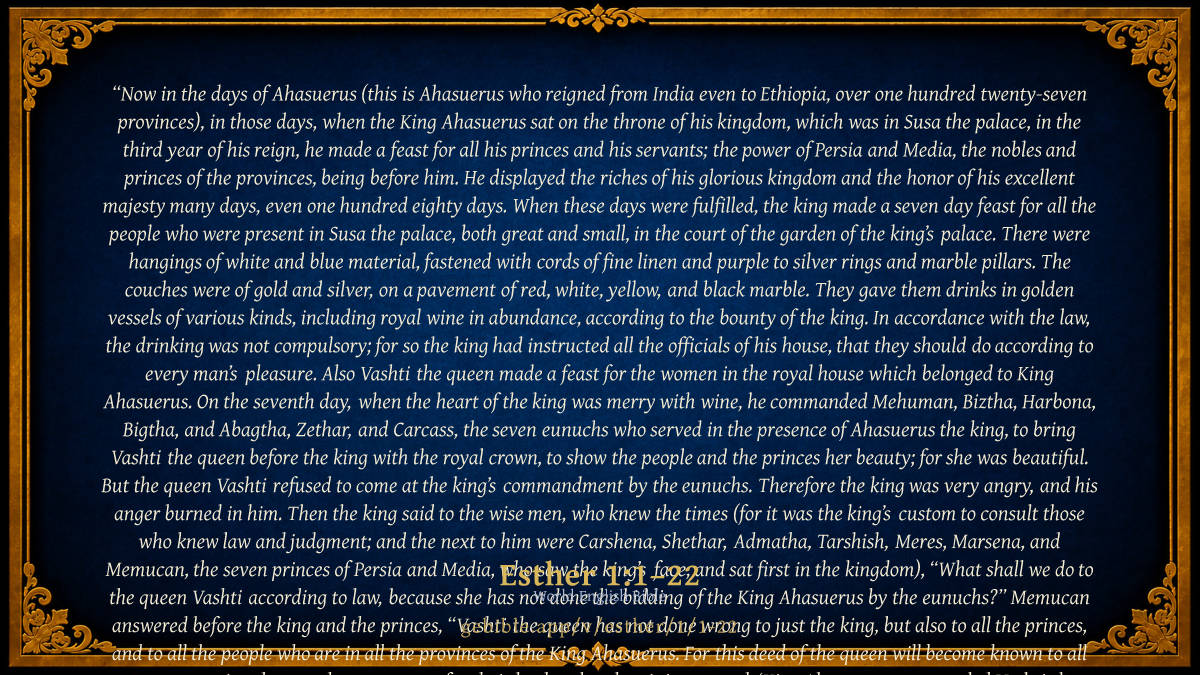
Now in the days of Ahasuerus (this is Ahasuerus who reigned from India even to Ethiopia, over one hundred twenty-seven provinces), in those days, when the King Ahasuerus sat on the throne of his kingdom, which was in Susa the palace, in the third year of his reign, he made a feast for all his princes and his servants; the power of Persia and Media, the nobles and princes of the provinces, being before him. He displayed the riches of his glorious kingdom and the honor of his excellent majesty many days, even one hundred eighty days. When these days were fulfilled, the king made a seven day feast for all the people who were present in Susa the palace, both great and small, in the court of the garden of the king’s palace. There were hangings of white and blue material, fastened with cords of fine linen and purple to silver rings and marble pillars. The couches were of gold and silver, on a pavement of red, white, yellow, and black marble. They gave them drinks in golden vessels of various kinds, including royal wine in abundance, according to the bounty of the king. In accordance with the law, the drinking was not compulsory; for so the king had instructed all the officials of his house, that they should do according to every man’s pleasure.
Also Vashti the queen made a feast for the women in the royal house which belonged to King Ahasuerus.
On the seventh day, when the heart of the king was merry with wine, he commanded Mehuman, Biztha, Harbona, Bigtha, and Abagtha, Zethar, and Carcass, the seven eunuchs who served in the presence of Ahasuerus the king, to bring Vashti the queen before the king with the royal crown, to show the people and the princes her beauty; for she was beautiful. But the queen Vashti refused to come at the king’s commandment by the eunuchs. Therefore the king was very angry, and his anger burned in him.
Then the king said to the wise men, who knew the times (for it was the king’s custom to consult those who knew law and judgment; and the next to him were Carshena, Shethar, Admatha, Tarshish, Meres, Marsena, and Memucan, the seven princes of Persia and Media, who saw the king’s face, and sat first in the kingdom), “What shall we do to the queen Vashti according to law, because she has not done the bidding of the King Ahasuerus by the eunuchs?”
Memucan answered before the king and the princes, “Vashti the queen has not done wrong to just the king, but also to all the princes, and to all the people who are in all the provinces of the King Ahasuerus. For this deed of the queen will become known to all women, causing them to show contempt for their husbands, when it is reported, ‘King Ahasuerus commanded Vashti the queen to be brought in before him, but she didn’t come.’ Today, the princesses of Persia and Media who have heard of the queen’s deed will tell all the king’s princes. This will cause much contempt and wrath.
“If it pleases the king, let a royal commandment go from him, and let it be written among the laws of the Persians and the Medes, so that it cannot be altered, that Vashti may never again come before King Ahasuerus; and let the king give her royal estate to another who is better than she. When the king’s decree which he shall make is published throughout all his kingdom (for it is great), all the wives will give their husbands honor, both great and small.”
This advice pleased the king and the princes, and the king did according to the word of Memucan: for he sent letters into all the king’s provinces, into every province according to its writing, and to every people in their language, that every man should rule his own house, speaking in the language of his own people.
Geneva Bible translators 1599 · Public Domain On vv1, 2, 6, 7, 8, 10, 12, 13, 14, 16, 17, 18, 19, 20, 22 Called also Darius, who was now the sovereign Monarch…
Called also Darius, who was now the sovereign Monarch and had the government of the Medes, Persians, and Chaldeans, some think he was Darius Hystaspis’ son called also Artaxerxes.
Dan. 6:1, maketh mention but of sixscore, leaving out the number that is unprecise as the Scripture in divers places useth.
Geneva Bible (1599) marginal notes — public domain.
John Trapp 1656 · Public Domain On vv1–22 Est 1:1 Now it came to pass in the…
Est 1:1 Now it came to pass in the days of Ahasuerus, (this [is] Ahasuerus which reigned, from India even unto Ethiopia, [over] an hundred and seven and twenty provinces:)
Ver. 1. Now it came to pass in the days of Ahasuerus] This book is in the Hebrew called Esther, because she is a chief party therein mentioned and memorized. The Rabbis call it Megillath Esther, that is, the volume of Esther; and further tell us that there be five such volumes of Scripture books; viz. Solomon’s Song, Ruth, Lamentations, Ecclesiastes, and this of Esther: which they use to read all over in their synagogues, five times a year. 1. Solomon’s Song at the Passover; in remembrance of their one time deliverance out of Egypt, and their future salvation by the Messiah. 2. Ruth at Pentecost; because therein is set down the genealogy of David their first king. 3. The Lamentations of Jeremiah on the ninth day of the fifth month (that is, of August); in regard to the Babylonian captivity, and ruin of the Temple. 4. Ecclesiastes, at the feast of Tabernacles; in a thankful remembrance of the Divine providence asserted in that book; and exercised over them in a special manner, when they wandered in the wilderness. 5. Lastly, this of Esther, on the fourteenth and fifteenth days of the month Adar, or February; and as often as they hear mention of Haman, they do, even to this day, with their fists and hammers beat upon the benches and boards, as if they did beat upon Haman’s head (R. Abraham, Hispanus cognom, σοφος). They tell us that this book was written by Mordecai himself, an eyewitness and a main party, according to Est 9:20, and have ever reckoned it among the Chetubin or Hagiographa, that is, the books of Holy Scripture. Indeed, because they find not the name of God or Lord in this whole book, they have a custom to cast it to the ground before they read it. But they need not; for as the ancient heathens used to write upon their books, Yεος, Yεος, God, God, so might the Jews upon this; there being nowhere in Scripture found more remarkable passages and acts of God’s immediate providence for his calamitous people than in this. Surely (saith a great divine) like as a man by a chain made up of several links, some of gold, others of silver, some of brass, iron, or tin, may be drawn out of a pit; so (it may here be seen that) the Lord, by the concurrence of several subordinate things which have no manner of dependence or natural coincidence among themselves, hath wonderfully wrought the deliverance of his Church; that it might appear to be the work of his own hand.
Read full note →
In the days of Ahasuerus] That is, of Xerxes, the terror of Greece, called Ahasuerosh, that is, a hereditary, begotten by king Darius, and born of a king’s daughter, viz. Atossa, daughter to Cyrus, and heir of the kingdom by lineal descent. Such a hereditary prince was our Henry VIII. Greek authors also call Xerxes, Oxyastris, and his wife Amestris, which seemeth to be the same as Esther, who is called Amestris by a like composition, saith an interpreter, as Haman’s father was called Ham-Adata, an honourable addition to a name among the Persians.
This is Ahasuerus which reigned from India even unto Ethiopia] viz. Inclusive, ut loquuntur. This must needs be Xerxes; for he subdued Ethiopia, and thereupon made this great feast. He was lord, we see, of a very great part of the habitable world; as is now the Great Turk, not inferior in greatness and strength, to the mightiest monarchs that ever yet were upon the face of the earth. No part of the world is left untouched by him but America only; not more fortunate, saith one, with her rich mines, than in that she is so far from so great and dangerous an enemy. Nevertheless of all this greatness (belluine rather than genuine), what saith Luther? Turcicum imperium quantum quantum est, &c. The Turkish empire in its utmost extent is but a crust cast to his dogs, by the great housekeeper of the world. The inheritance he reserves for his children; who though held here to strait allowance, yet are far dearer to him than the world’s greatest darlings; as the poor captive Jews were, than this great emperor. Those that seek a mystery in this history tell us, that Ahasuerus typically representeth God the Father ruling over all kingdoms and creatures on earth; choosing some to be heirs of heaven, and purifying them for that purpose. Mordecai (signifying bitter and contrite) setteth forth Christ, say they, broken for our sins, and suffering the bitter wrath of God. Esther (being the same with Alma, Isa 7:14, a pure virgin, secreted and secured from defilement) is a lively image of the Church, unspotted by the world, and provided for by her Mordecai. The disdainful Vashti (taking her name from Shatha, to drink) is a fit effigy of the world, proud and luxurious, and therefore excluded heaven. Haman (signifying a tumultuous and obstreperous person) represents the devil, restless and rageful, but to his own utter ruin, &c. These are pretty things, but not so proper. The Popish commentators are full of them.
Over an hundred and seven and twenty provinces] Seven more than were in Darius the Mede’s time, Dan 6:1. Monarchs will be still adding; and although a man were monarch of the whole world, yea, had the command of moon and stars, yet would he still be peeping beyond them for more, more. Herodotus reckons up sundry satrapies under the king of Persia, out of which he received, yearly, fourteen thousand five hundred and threescore Euboian talents: so that this monarchy is fitly compared (in Daniel) to the silver breast and arms in Nebuchadnezzar’s image.
John Trapp, A Commentary or Exposition upon All the Books of the Old and New Testament (1647–1656) — public domain. Text from a community e-Sword module.
Matthew Poole 1685 · Public Domain On vv1, 2, 3, 4, 5, 6, 8, 9, 10, 12, 13, 14, 16, 18, 19, 21, 22 Quest. Who was this king?
Quest. Who was this king?
Answ. It is confessed and manifest that this was one of the kings of Persia; but which of them it was is not yet agreed, nor is it of any necessity for us now to know. But it is sufficiently evident that this was either,
Read full note →
1. Darius Hystaspes, as divers both Jewish and Christian writers affirm; for his kingdom was thus vast, and he subdued India, as Herodotus reports; and one of his wives was called Atossa, which differs little from Hadassah, which is Esther's other name, Est 2:7. Or,
2. Xerxes, whose wife, as Herodotus notes, was called Amestris, which is not much differing from Esther; by whom all these things were transacted whilst he was potent and prosperous, before his unhappy expedition against the Grecians. Or,
3. Artaxerxes Longimanus, to whom the characters of Ahasuerus represented in this book do not disagree. And whereas it is objected, that by this account Mordecai must be a man of about a hundred and forty years, and consequently Esther, who is called his uncle's daughter, Est 2:7, must be too old to make a wife for the king; as for Mordecai, it may be granted, there being divers instances of persons of greater age than that in sacred and profane historians; and for Esther, it may be said that she was his uncle's granddaughter, nothing being more frequent than for the names of sons or daughters to be given to more remote posterity.
An hundred and seven and twenty provinces; so seven new provinces were added to those hundred and twenty mentioned Dan 6:1.
Matthew Poole's English Annotations on the Holy Bible (1683–1685) — public domain. Text from a community e-Sword/MySword module.
Matthew Henry 1710 · Public Domain On vv1, 10 Which of the kings of Persia this Ahasuerus was…
Which of the kings of Persia this Ahasuerus was the learned are not agreed. Mordecai is said to have been one of those that were carried captive from Jerusalem (Est 2:5, Est 2:6), whence it should seem that this Ahasuerus was one of the first kings of that empire. Dr. Lightfoot thinks that he was that Artaxerxes who hindered the building of the temple, who is called also Ahasuerus (Ezr 4:6, Ezr 4:7), after his great-grandfather of the Medes, Dan 9:1. We have here an account,
I. Of the vast extent of his dominion. In the time of Darius and Cyrus there were but 120 princes (Dan 6:1); now there were 127, from India to Ethiopia, Est 1:1. It had become an over-grown kingdom, which in time would sink with its own weight, and, as usual, would lose its provinces as fast as it got them. If such vast power be put into a bad hand, it is able to do so much the more mischief; but, if into a good hand, it is able to do so much the more good. Christ's kingdom is, or shall be, far larger than this, when the kingdoms of the world shall all become his; and it shall be everlasting.
Read full note →
II. Of the great pomp and magnificence of his court. When he found himself fixed in his throne, the pride of his heart rising with the grandeur of his kingdom, he made a most extravagant feast, wherein he put himself to vast expense and trouble only to show the riches of his glorious kingdom and the honour of his excellent majesty, Est 1:4. This was vain glory, an affection of pomp to no purpose at all; for none questioned the riches of his kingdom, nor offered to vie with him for honour. If he had shown the riches of his kingdom and the honour of his majesty, as some of his successors did, in contributing largely towards the building of the temple and the maintaining of the temple service (Ezr 6:8, Ezr 7:22), it would have turned to a much better account. Two feasts Ahasuerus made: - 1. One for his nobles and princes, which lasted a hundred and eighty days, Est 1:3, Est 1:4. Not that he feasted the same persons every day for all that time, but perhaps the nobles and princes of one province one day, of another province another day, while thus he and his constant attendants fared sumptuously every day. The Chaldee paraphrast (who is very bold in his additions to the story of this book) says that there had been a rebellion among his subjects and that this feast was kept for joy of the quashing of it. 2. Another was made for all the people, both great and small, which lasted seven days, some one day and some another; and, because no house would hold them, they were entertained in the court of the garden, Est 1:5. The hangings with which the several apartments were divided or the tents which were there pitched for the company, were very fine and rich; so were the beds or benches on which they sat, and the pavement under their feet, Est 1:6. Better is a dinner of herbs with quietness, and the enjoyment of one's self and a friend, than this banquet of wine with all the noise and tumult that must needs attend it.
III. Of the good order which in some respects was kept there notwithstanding. We do not find this like Belshazzar's feast, in which dunghill-gods were praised and the vessels of the sanctuary profaned, Dan 5:3, Dan 5:4. Yet the Chaldee paraphrase says that the vessels of the sanctuary were used in this feast, to the great grief of the pious Jews. It was not like Herod's feast, which reserved a prophet's head for the last dish. Two things which are laudable we may gather from the account here given of this feast: - 1. That there was no forcing of healths, nor urging of them: The drinking was according to the law, probably some law lately made; none did compel, no, not by continual proposing of it (as Josephus explains it); they did not send the glass about, but every man drank as he pleased (Est 1:8), so that if there were any that drank to excess it was their own fault, a fault which few would commit when the king's order put an honour upon sobriety. This caution of a heathen prince, even when he would show his generosity, may shame many who are called Christians, who think they do not sufficiently show their good housekeeping, nor bid their friends welcome, unless they make them drunk, and, under pretence of sending the health round, send the sin round, and death with it. There is a woe to those that do so; let them read it and tremble, Hab 2:15, Hab 2:16. It is robbing men of their reason, their richest jewel, and making them fools, the greatest wrong that can be. 2. That there was no mixed dancing; for the gentlemen and ladies were entertained asunder, not as in the feast of Belshazzar, whose wives and concubines drank with him (Dan 5:2), or that of Herod, whose daughter danced before him. Vashti feasted the women in her own apartment; not openly in the court of the garden, but in the royal house, Est 1:9. Thus, while the king showed the honour of his majesty, she and her ladies showed the honour of their modesty, which is truly the majesty of the fair sex.
Matthew Henry's Commentary on the Whole Bible (1708–1710) — public domain (CC PDM 1.0). Text via the HelloAO Bible API.
John Gill 1763 · Public Domain On vv1–22 Now it came to pass in the days of…
Now it came to pass in the days of Ahasuerus,.... Who he was is not easy to say; almost all the kings of Persia are so named by one or another writer. He cannot be the Ahasuerus in Dan 9:1, he was Astyages, the father of Cyaxares or Darius the Mede; but this must be one who had his royal palace in Shushan, which was never the royal city of the Medes, but of the Persians only; nor does he seem to be the Ahasuerus in Ezr 4:6, who is thought to be Cambyses, the son and successor of Cyrus; since, according to the canon of Ptolemy, he reigned but eight years, whereas this Ahasuerus at least reigned twelve, Est 3:7, though indeed some account for it by his reigning in his father's lifetime; besides, Cambyses was always an enemy to the Jews, as this was not; and yet this way go many of the Jewish writers (n) and so a very learned man, Nicolaus Abram (o); according to Bishop Usher (p), this was Darius Hystaspis, who certainly was a friend to the Jewish nation; but he is rather the Artaxerxes of Ezra and Nehemiah; and so says the Midrash (q). Dr. Prideaux (r) thinks Ahasuerus was Artaxerxes Longimanus, which is the sense of Josephus (s), and who is thought by many to be the Artaxerxes in the foresaid books. Capellus (t) is of opinion, that Darius Ochus is meant, to which Bishop Patrick inclines; but I rather think, with Vitringa (u) and others (w), that Xerxes is the Ahasuerus that was the husband of Esther here spoken of; so the Arabic writers (x); and as he was the son and successor of Darius Hystaspis, if he is meant by Artaxerxes in the preceding books, the history of which is carried to the thirty second year of his reign, Neh 13:6 and who reigned but four years more; this book of Esther stands in right order of time to carry on the history of the Jewish affairs in the Persian monarchy; and Mr. Broughton (y) owns, that the name of Xerxes, in Greek, agrees with Achasuerus in Hebrew; and in Est 10:1 his name is Achashresh, which, with the Greeks, is Axeres or Xerxes (z):
this is Ahasuerus, which reigned from India even unto Ethiopia; properly so called; the Ethiopians had been subdued by Cambyses the son and successor of Cyrus (a), and the Indians by Darius Hystaspis the father of Xerxes (b); and both, with other great nations, were retained in subjection to him (c); and many of both, as well as of other nations, were with him in his expedition into Greece (d):
Read full note →
over an hundred and twenty and seven provinces; there were now seven provinces more under his jurisdiction than were in the times of Darius the Mede, Dan 6:1.
(n) Targum & Jarchi in loc. Seder Olam Rabba, c. 29. Zuta, p. 108. (o) Pharus Vet. Test. l. 11. c. 12. p. 305. (p) Annal. Vet. Test. p. 160. so Broughton, Works, p. 38, 259, 581. (q) Midrash Esther, fol. 86. 2. (r) Connection, &c. par. 1. B. 4. p. 252, &c. (s) Antiqu. l. 11. c. 6. sect. 1. and so Suidas in voce (t) Chronolog. Sacr. p. 294. (u) Hypotypos. Hist. Sacr. p. 110. (w) Schichart. de Festo Purim. Rainold. Praelect. 144. p. 231. Alsted. Chronolog. p. 126, 181. (x) In Abulpharag. Hist. Dynast. p. 87. (y) Ut supra. (Broughton, Works, p. 38, 259, 581.) (z) Vid. Hiller. Arcan. Keri & Ketib, p. 87. & Onomastic. Sacr. p. 639. (a) Herodot. Thalia, sive, l. 3. c. 97. (b) lb. Melpomene, sive, l. 4. c. 44. (c) lb. Polymnia, sive, l. 7. c. 9. (d) lb. c. 65, 69, 70.
John Gill's Exposition of the Whole Bible (1746–1763) — public domain (CC PDM 1.0). Text via the HelloAO Bible API.
John Wesley 1765 · Public Domain On vv1, 2, 4, 6, 8, 9, 12, 13, 14, 18 Ahasuerus feasts his great men, ver. 1-9. Sends for…
Ahasuerus feasts his great men, ver. 1-9. Sends for his queen, who refuses to come, ver. 10, 11. He divorces her, ver. 12-22.
Ahasuerus - Many suppose this to be Darius Hystapas, for his kingdom was thus vast, and he subdued India, as Herodotus reports: and one of his wives was called Atossa, differing little from Hadassah, which is Esther's other name, Esth ii, 7. Provinces - So seven new provinces were added to those hundred and twenty mentioned, Dan. vi, 1.
John Wesley, Explanatory Notes Upon the Whole Bible (1754–1765) — public domain. Text via the GEBible commentary corpus.
Adam Clarke 1810 · Public Domain On vv1, 2, 4, 5, 6, 7, 8, 9, 10, 11, 12, 13, 14, 16, 18, 19, 22 Chronological Notes relative to this Book
THE BOOK OF ESTHER
Chronological Notes relative to this Book
Read full note →
-Year from the Creation, according to Archbishop Usher, 3540.
-Year before the birth of Christ, 460.
-Year before the vulgar era of Christ's nativity, 464.
-Year of the Julian Period, 4250.
-Year since the flood of Noah, 1904.
-Year of the Cali Yuga, or Indian era of the Deluge, 2638.
-Year from the vocation of Abram, 1458.
-Year from the destruction of Troy, 721.
-Year from the foundation of Solomon's temple. 547.
-Year since the division of Solomon's monarchy into the kingdoms of Israel and Judah, 511.
-Year of the era of Iphitus, 421.
-Year since Coroebus won the prize at the Olympic games, 313.
-First year of the seventy-ninth Olympiad.
-Year of the Varronian era of the building of Rome, 290.
-Year from the building of Rome, according to Cato and the Fasti Consulares, 289.
-Year from the building of Rome according to Polybius the historian, 288.
-Year from the building of Rome, according to Fabius Pictor, 284.
-Year of the era of Nabonassar, 284.
-Year since the commencement of the first Messenian war, 280.
-Year since the destruction of the kingdom of Israel by Shalmaneser, the king of Assyria, 258.
-Year since the commencement of the second Messenian war, 222.
-Year from the destruction of Solomon's temple by Nebuchadnezzar, king of Babylon, 125.
-Year since the publication of the famous edict of Cyrus, king of Persia, empowering the Jews to rebuild their temple, 72.
-Year since the conquest of Egypt by Cambyses, 62.
-Year since the abolition of the tyranny of the Pisistratidae at Athens, 43.
-Year since the expulsion of the Tarquins from Rome, which put an end to the regal government of the Romans, 44.
-Year since the famous battle of Marathon, 26.
-Year after the commencement of the third Messenian war, 2.
-Year before the commencement of the first sacred war concerning the temple at Delphi, 17.
-Year before the commencement of the celebrated Peloponnesian war, 34.
-Year before the celebrated retreat of the ten thousand Greeks, and the expulsion of the thirty tyrants from Athens by Thrasybulus, 65.
-Year before the commencement of the era of the Seleucidae, 152.
-Year before the formation of the famous Achaean league, 183.
-Year before the commencement of the first Punic war, 200.
-Year before the fall of the Macedonian empire, 296.
-Year before the destruction of Carthage by Scipio, and of Corinth by Mummius, 317.
-Year before the commencement of the Jugurthine war, which continued five years, 354.
-Year before the commencement of the Social war, which continued for five years, and was finished by Sylla, 374.
-Year before the commencement of the Mithridatic war, which continued for twenty-six years, 376.
-Year before the commencement of the Servile war, under Spartacus, 392.
-Year before the extinction of the reign of the Seleucidae in Syria, on the conquest of that country by Pompey, 399.
-Year before the era of the Roman emperors, 433.
-Year of Archidamus, king of Lacedaemon, and of the family of the Proclidae, or Eurypontidae, 6.
-Year of Plistoanax, king of Lacedaemon, and of the family of the Eurysthenidae, or Agidae, 3.
-Year of Alexander, the tenth king of Macedon, 34.
-Year of Artaxerxes Longimanus, king of Persia, 1.
-Roman Consuls, Aulus Postumius, and Sp. Furius.
CHAPTER I
Ahasuerus makes royal feasts for his nobles and people, 1-9.
Vashti is sent for by the king, but refuses to come, 10-12.
Vashti is disgraced; and a law made for the subjection of
women, 13-22.
The whole history of this book in its connected order, with the occurrences in the Persian empire at that time, will be found in the introduction: to which the reader is referred.
Concerning the author of this book there are several opinions: some attribute the work to Ezra; some to one Joachim, a high priest; others, to the men of the Great Synagogue; and others to Mordecai. This latter is the most likely opinion: nor is that to be disregarded which gives to Mordecai for co-partner Ezra himself; though it is likely that the conclusion, from Es 9:23 to the end of the book, was inserted by another hand, and at a later time. Though some Christians have hesitated to receive the book of Esther into the sacred canon; yet it has always been received by the Jews, not only as perfectly authentic, but also as one of the most excellent of their sacred books. They call it megillah, THE VOLUME, by way of eminence; and hold it in the highest estimation. That it records the history of a real fact, the observation of the feast of Purim, to the present day, is a sufficient evidence. Indeed, this is one of the strongest evidences that any fact can have, viz., that, to commemorate it, a certain rite, procession, feast, or the like, should have been instituted at the time, which, without intermission, has been continued annually through every generation of that people, and in whatsoever place they or parties of them may have sojourned, to the present day. This is the fact concerning the feast of Purim here mentioned; which the Jews, in all places of their dispersion, have uninterruptedly celebrated, and do still continue to celebrate, from the time of their deliverance from the massacre intended by Haman to the present time. Copies of this book, widely differing from each other, exist in Hebrew, Chaldee, Syriac, Greek, and Latin. All these differ much from the Hebrew text, particularly the Greek and the Chaldee: the former has many additional paragraphs; and the latter, as it exists in the London Polyglot, contains five times more than the Hebrew text. To notice all the various readings, additions, and paraphrases, in the above copies, would require a volume of no inconsiderable magnitude. The reader who is curious may consult the above Polyglot. This book does not appear to be extant in Arabic, or in any other of the Oriental languages, besides the Hebrew and Syriac.
The question may naturally arise, What was the original of this book? or, In what language was it written? Though learned men in general decide in favour of a Hebrew original, yet there are many reasons which might be urged in favour of the Persian. Several of the proper names are evidently of a Persian origin; and no doubt all the others are so; but they are so transformed by passing through the Hebrew, that they are no longer discernible. The Hebrew has even retained some of the Persian words, having done little else than alter the character, e.g., Esther, Mehuman, Mishak, Melzar, Vashti, Shushan, Pur, Darius, Paradise, c., several of which will be noted in their proper places. The Targum in the London Polyglot is widely different from that in the Complutum, Antwerp, and Paris editions. The principal additions in the Greek are carefully marked in the London Polyglot, but are too long and too numerous to be inserted here. It is a singular circumstance that the name of God does not once occur in the whole of this book as it stands in Hebrew.
NOTES ON CHAP. I
Verse 1. Now it came to pass] The Ahasuerus of the Romans, the Artaxerxes of the Greeks and Ardsheer of the Persians, are the same. Some think that this Ahasuerus was Darius, the son of Hystaspes but Prideaux and others maintain that he was Artaxerxes Longimanus.
Reigned from India even unto Ethiopia] This is nearly the same account that is given by Xenophon. How great and glorious the kingdom of Cyrus was beyond all the kingdoms of Asia, was evident from this: Ὡρισθῃ μεν πρως ἑῳ τῃ Ερυθρᾳ θαλαττῃ· προς αρκτον δε τῳ Ευξεινῳ ποντῳ· προς ἑσπεραν δε Κυπρῳ και Αιγυπτῳ· προς μεσημβριαν δε Αιθιοπιᾳ. "It was bounded on the east by the Red Sea; on the north by the Euxine Sea; on the west by Cyprus and Egypt; and on the south by Ethiopia." - CYROP. lib. viii., p. 241, edit. Steph. 1581.
Adam Clarke's Commentary on the Bible (1810–1826) — public domain. Text from a community e-Sword/MySword module.
Joseph Benson 1811 · Public Domain On vv1, 2, 3, 4, 5, 6, 8, 9, 12, 13, 14, 16, 18, 19, 20, 22 Est 1:1. In the days of Ahasuerus — Many…
Est 1:1. In the days of Ahasuerus — Many suppose this king to have been Darius Hystaspes, for his kingdom was thus vast, and he subdued India, as Herodotus reports: and one of his wives was called Atossa, differing little from Hadassah, which is Esther’s other name, Est 2:7. But the most likely opinion, and that which is approved by Josephus, the Septuagint, and the apocryphal additions to the book of Esther, is, that this Ahasuerus of the Scripture was Artaxerxes Longimanus, as he is called by the heathen writers. One thing is certain, that he was one of the Persian kings, and a successor of Cyrus the Great, for there was no such large empire in those parts, under one king, before Cyrus’s time.
Joseph Benson's Commentary on the Old and New Testaments (1811–1818) — public domain. Text from a community e-Sword module.
Albert Barnes 1834 · Public Domain On vv1, 3, 5, 6, 8, 9, 11, 13, 14, 18, 19, 22 Ahasuerus - . Xerxes, the son of Darius Hystaspis.…
Ahasuerus - . Xerxes, the son of Darius Hystaspis. His empire is rightly described as from India even unto Ethiopia. The satrapies of Darius Hystaspis reached 29 in number, and the nations under Xerxes were about 60. The 127 “provinces” include probably sub-satrapies and other smaller divisions of the great governments.
Albert Barnes' Notes on the Bible (1834–1885) — public domain. Text from a community e-Sword/MySword module.
Haydock's Catholic Bible Commentary 1859 · Public Domain On vv1, 2, 3, 4, 5, 6, 7, 8, 9, 10, 11, 12, 13, 16, 18, 19, 21 In. Hebrew, "and in." In this manner the books…
In. Hebrew, "and in." In this manner the books of Scripture are usually connected. Septuagint place first the dream of Mardochai, chap. xi. 2. (Calmet) --- Assuerus. Septuagint Artaxerxes; as [in] chap xvi. 1. The former is the title of Median, the latter of the Persian, monarchs. This king reigned over both nations, and was most probably Darius Hystaspes, the third king of the Persians, (Tirinus) who subdued India, &c. (Herodotus) (Calmet) (Tirinus) --- Some understand Cambyses, (1 Esdras iv.; Genebrard) or Xerxes (Scaliger) or Artaxerxes Longimanus, (Bellarmine; Salien) or Memnon, (Eusebius) or Ochus. (Serarius) --- But (Calmet) the author of 3 Esdras iii. 1., and iv. 43., seems clearly declared for Hystaspes. (Tirinus) --- Though that work be not canonical, (Du Hamel) it may claim some authority, as an ancient history. (Haydock) --- This king gave orders for the building of the temple, 1 Esdras vi. 1, 14. --- India. Part had been (Calmet) subject to Xerxes. (Herodotus iv. 44.) --- Ethiopia, beyond Egypt, paid an acknowledgment. Cambyses had taken possession of this country. (Calmet) --- Some understand a part of Arabia to be meant. (Du Hamel) --- Seven: 120 had been regulated by Darius, the Mede, Daniel vi. 1. (Haydock) --- The number might vary as the monarch chose. (Du Hamel) --- Herodotus (iii. 89.) only specifies "twenty." But he speaks of large departments, to which he intimates that several others were subordinate. (Calmet) --- Provinces. Hebrew medina, "seat of judges." (Haydock) --- Prefecture. (Menochius)
George Leo Haydock (1774–1849), Haydock's Catholic Family Bible and Commentary, 1859 edition — public domain. Excludes Psalms (Douay-Rheims chapter numbering differs from Protestant) and Deuterocanonical books (Catholic canon only).
Lange's Commentary on the Holy Scriptures 1864 · Public Domain On v1 Esther 1-5
PART FIRST
ORIGIN AND INCREASE OF DANGER TO THE JEWS
Read full note →
Esther 1-5
INTRODUCTION
The Occasion of the History. The Feast of Ahasuerus and Vashti’s Rejection
Est_1:1-22
I. Ahasuerus assembles the princes of his empire around him, and prepares a great feast, in which he endeavours to show his power and glory. Est_1:1-8
1Now [And] it came to pass [was] in the days of Ahasuerus [Achashverosh], (this is Ahasuerus which reigned [the one being king] from India [Hodu] even unto [and till] Ethiopia [Cush], over a hundred and seven and twenty provinces,) 2That in those days when [as] the king Ahasuerus sat on the throne of his kingdom, which was in Shushan the palace,1 3In the third year of his reign, he made a feast2 unto all his princes and his servants; the power3 of Persia [Paras] and Media [Madai], the 4nobles4 and [the] princes of the provinces, being before him. When he showed the riches of his glorious [the glory of his] kingdom, and the honour of his excellent [the excellence of his] majesty, many days, even a hundred and fourscore days. 5And when these days were [had] expired, the king made a feast2 unto all the people that were present [found] in Shushan the palace,1 both unto great and [to great and 6even to] small, seven days, in the court of the garden of the king’s palace; Where were white [linen], green [cotton], and blue [violet] hangings, fastened with cords of fine linen and purple to [on] silver rings and pillars of marble: the beds were of [there were beds of] gold and silver, upon a pavement of red [white] and blue [marble], and white [pearl], and black marble [colored stone]. 7And they gave them [there was a giving of] drink in vessels of gold, (the vessels being [and the vessels were] diverse one from another,) and royal wine in abundance, according to the state [hand] of the king. 8And the drinking was according to the law; none did compel: for so the king had appointed [ordained] to [upon] all the officers [every great one] of his house, that they should do [to do] according to every man’s pleasure.
II. Queen Vashti refuses to appear before the king, and he is very much incensed thereat. Verses 9–12
9Also Vashti the queen made a feast2 for [of] the women in the royal house which belonged to king Ahasuerus. 10On the seventh day, when [as] the heart of the king was merry [good] with [the] wine, he commanded [said to] Mehuman, Biztha, Harbona, Bigtha, and Abagtha, Zethar, and Carcas, the seven chamberlains [eunuchs] that served in the presence of Ahasuerus the king, 11To bring Vashti the queen before the king, with the crown royal [of royalty], to show the people [peoples] and 12the princes her beauty: for she was fair to look on [good of appearance]. But [And] the queen Vashti refused to come at the king’s commandment [word] [which was] by [the hand of] his [the] chamberlains [eunuchs] : therefore [and] was the king very wroth, and his anger burned [heat devoured] in him.
III. In accordance with the counsel of his wise men the queen is rejected by a public decree of the king. Verses 13–22
13Then [And] the king said to the wise men, which knew [knowers of ] the times, (for so was the king’s manner [word] toward [before] all that knew [knowers of] law and judgment: 14And the next unto him was Carshena, Shethar, Admatha, Tarshish, Meres, Marsena, and Memucan, the seven princes of Persia [Paras] and Media [Madai], which saw [seers of] the king’s face, and which sat [the sitters] the first in the kingdom); 15What shall we do [is there to do] unto [in the case of] the queen Vashti according to law, because [upon the fact that] she hath not performed [done] the commandment of the king Ahasuerus by [the hand of] the chamberlains [eunuchs]? 16And Memucan answered [said] before the king and the princes, Vashti the queen hath not done wrong to [upon] the king only, but [for] also to [upon] all the princes, and to [upon] all the people [peoples] that are in all the 17provinces of the king Ahasuerus. For this deed [word] of the queen shall come abroad [go forth] unto [upon] all [the] women, so that they shall [to cause them to] despise their husbands in their eyes, when it shall be reported [in their saying], The king Ahasuerus commanded [said] Vashti the queen to be brought [to bring] in 18before him, but [and] she came not. Likewise shall the ladies [princesses] of Persia [Paras] and Media [Madai] say this day unto all the king’s princes, which [who] have heard5 of the deed [word] of the queen. Thus [And] shall there arise 19too much [according to plenty] contempt and wrath. If it please [be good upon] the king, let there go [forth] a royal commandment [word] from [before] him, and let it be written among the laws of the Persians [Paras] and the Medes [Madai], that [and let] it be not altered [not pass], That Vashti come no more [not] before king Ahasuerus; and let the king give her royal estate [royalty] unto another [her neighbor] that is better than she. 20And when the king’s decree which he shall make shall be published [heard] throughout [in] all his empire [kingdom], (for it is great.) [and] all the wives [women] shall give to their husbands honour, both to great and small. 21And the saying [word] pleased [was good in the eyes of] the king and the princes; and the king did according to the word of Memucan : 22For [And] he sent letters into [unto] all the king’s provinces, into [unto] every province according to the writing6 thereof, and to [unto] every people after their language, that every man should bear rule [for every man to be prince] in his own house, and that it should be published [spoken] according to the language of every [his] people.
TEXTUAL AND GRAMMATICAL
1 [Est_1:2. בִּירָה, whence βάρις, denotes properly a fortress, hence the capital.—Tr.]
2 [Est_1:3. מִשְׁתֶּה, a drinking, i.e., a banquet, in which the wine was the principal feature, as represented freely on the Assyrian monuments.—Tr.]
3 [Est_1:3. חַיִל, military force.—Tr.]
4 [Est_1:3. פַרְתְּמִים, a Persian word Hebraized. As it is here in the “absolute form,” it does not qualify “provinces” following, but stands as an official designation, probably of civil rank at court.—Tr.]
5 [Est_1:18. The English Version has unwarrantably transposed this clause (“which have heard,” etc.), which belongs to “ladies,” etc., above.—Tr.]
6 [Est_1:22. כְּתָב here evidently signifies the style of writing peculiar to each province. Thus the cuneiform differs according to the several districts of the Persian empire.—Tr.]
EXEGETICAL AND CRITICAL
Est_1:1-8. The King’s Banquet.—The point of departure in this history is formed by a feast at which Ahasuerus was unexpectedly humbled and provoked to wrath, while purposing to show his great majesty.
Est_1:1. Now it came to pass,etc. The sentence begun here, in its chief fact really follows Est_1:3. There it is stated that Ahasuerus made a feast in the third year of his reign. The ו at the beginning has not the conjunctive sense that it has in Ezr_1:1, but stands more indefinite. A Hebrew would understand this as a matter of which much had already been related, and of which the following is only a continuation. Thus he would proceed often with a ו without attaching any definite meaning to it. וַיְהִי has come to be a conventional formula for a beginning, comp. Jon_1:4; Eze_1:1; Isa_53:2, et al.Ahasuerus (Achashverosh) written in cuneiform letters (comp. Lassen, Zeitschr. zur Kunde des M. L. VI., p. 123 sqq.; Benfey, Die pers. Keilin-schrift, p. 63 sqq) Khsy-arsha, whence Cyax-ares (comp. Dan_9:1), or Khsay-arsha, whence Xerxes (comp. Ezr_4:6), early interpreted by Herodotus (6:98, etc), as meaning ἀρήϊοςaccording to Spiegel (Eranische Altherthumskunde, II. p. 377), a mighty man, here does not mean, as in Dan_9:1, Cyaxares I, the father of Astyages, as Ferrand holds (Réflexions sur la religion Chrétienne, I., p. 159), and Des Vignoles (Chronol. II., p. 274), and Nickes (De Estheræ libro, I., p. 43–69) would have it, since they especially insist that, according to Est_2:5 sq., Mordecai belonged to the first period of the exile, and that our book nowhere indicates that a new people had again arisen in Jerusalem. Nor is the monarch referred to the same as Astyages, as is asserted in the works referred to in § 5; and still less Artaxerxes, as Josephus assumes out of regard to the Septuagint version; but he is certainly Xerxes, as has been well proved by Scaliger (De emend, temp., ed Genev., p. 591 sqq.); also by Justi (in Eichhorn’s Repert. XV., p. 338), and still more emphatically by Baumgarten (De fide I. Esth., pp. 122–151, and in his treatises respecting Cyrus the Great, in the Stud. u. Krit., 1853, p. 624 sqq.). On the different views in reference to Ahasuerus, see especially Feuardent on our book, and Pfeiffer, Dubia vex, p. 481 sqq. Against the identification with either Cyaxares or Astyages, are the following facts: (1) Shushan was already the capital of the empire, which it became through Cyrus (comp. Strabo, XV.); (2) the Persians are now the chief people (comp. the frequent collection of פָּרַם וּמָדַיe. g., in Est_1:3); (3) the number seven indicates that of princes at the court of the king (comp. Est_1:14); (4) many other specifically Persian peculiarities. Further, the empire at the time in question extended from India to Æhiopia, and stretched also to the coasts and isles of the Mediterranean sea (comp. Est_1:1; Est_10:1), as was the case since the time of Darius Hystaspis. The Jews, moreover, are here represented as scattered over all parts of the empire (comp. Est_3:7-8) and particularly numerous in the city of Shushan (comp. Est_9:12, etc.). On the contrary Artaxerxes is called in the Bible (in Ezra and Neh.) Artachsharshta or Artachshasta. For Xerxes, on the other hand, we may claim the identity of names (comp. Ezr_9:6). In his favor is also the whimsical and tyrannical character manifested by the Ahasuerus of Esther (chap. 1 and elsewhere). Besides, there is the remarkable circumstance that Vashti was rejected in the third year of Ahasuerus, although Esther was not made queen till the seventh year of his reign, which in the case of Xerxes may be explained on the basis that between his third and seventh year he made war on Greece.7 The clause beginning with הוּא (comp. Gen_2:11) and referring us back—this is Ahasuerus which reigned from India even unto Ethiopia,etc.—is no doubt intended to designate Ahasuerus more distinctly,8 but at the same time to make known his greatness of dominion and power. Thus the danger that threatened the Jews, as well as the elevation of Esther and Mordecai, and of the Jews through these, is more powerfully brought out. הֹדּוּ stands for the original הֹנְדּוּ, as Hidku in the cuneiform inscriptions of the Persians stands for Hindhu (in Zend and Syrian Hendu), and is therefore India, in the Sanscrit Sindhu which is really the river Indus, then the inhabitants along the Indus, and at last the land of the Indus (comp. Lassen, Judische Altherthumskunde, I., p, 2); so also in the Vedas Sapta Sindhavas, or “the seven streams,” really stand for India (comp. Rödiger in Gesen. Thesaurus, Append. p. 83). The o sound in הֹדּוּ, and the tone falling on the first syllable are quite remarkable, but perhaps only a provincialism. Herodotus testifies to the great extension of the Persian empire under Xerxes, and in 12:9 he rays that Mardonius reported to Xerxes that the Saccœ and Assyrians, as well as the Indians and Æthiopians, had been conquered. See also 7:97, 98, and 8:65, 69, where the Æthiopians and Indians are enumerated as being under tribute. According to Arrian, Cyrus extended his conquests up to India, and the people of the Açvaka were by him made to pay tribute. Darius added still greater parts of northwestern India to the Persian empire (comp. Duncker, Gesch. d. Altherthums, 3d ed., II., page 468). The auxiliary sentence: A hundred and seven and twenty provinces, is merely to be regarded as an additional sentence in loose apposition, to indicate what provinces were included in the region just mentioned. If this sentence depended upon הַמֹּלֵךְ, it should have עַל [or בְּ] before it. According to Herod. III. 89 sqq., Darius Hyst. on account of the raising of taxes divided the empire into twenty ἀρχαί which were termed σατραπΐηαι. A further division into lesser portions was not thereby excluded; with so many petty tribes and peoples this came as a matter of course. So there were contained in the fifth satrapy (comp. Herod. III. 91) a small Jewish people, a separate מְדִינָה which really means a judicial or official circuit (comp. Ezr_2:1). Our 127 provinces remind us of the 120 Satraps whom Darius the Mede placed over his empire (Dan_6:2).
Est_1:2. In those days, when the king Ahasuerus sat,etc.—Sitting is a posture common to judges and kings, but more particularly characteristic of the kings of Persia. The Persian kings are always painted as sitting on a throne under a lofty canopy. This is true of them even in the time of war, and in their journeys. Xerxes, indeed, was present in the battles sitting; thus it was at Thermopylœ according to Herodotus (VII. 102), and at Salamis according to Plutarch (Themistocl. 13). See also Baumgarten, l. c., p. 85 sqq. Which was in Shushan the palace.—He had a royal establishment in several cities; but at the time here referred to it was in Shushan, which was his favorite winter and spring residence (comp. Neh_1:1). Æschylus calls it the palace ornate with gold of the Cissians, and Strabo asserts that every Persian king built his own palace there. מַלְכוּת was in use in later language, and מַמְלָכָה in earlier times.
Est_1:3. In the third year of his reign he made a feast,etc.—All his princes and servants, for whom this feast was made, are specified as follows : The power of Persia and Media, the nobles and princes of the provinces (being) before him.—These words form an explanatory sentence, and assert distinctly that all the princes and servants were really gathered around Xerxes. We are to understand by the “power,” the representatives of the same, who probably consisted of the body-guard of the king, which formed the flower of the entire army-power. According to Herod. VII. 40 sqq., this was in itself sufficiently large, and consisted of two thousand picked horsemen, two thousand lancers, and ten thousand common foot-soldiers. The פַּרְתְּמִים who are mentioned also in chap.Est_6:9, and Dan_1:3, were the principes, chief men (in Sanscrit we find it parthama = “first;” in the Behistun Inscription fratama, in Pehlevi pardom), i.e., the magnates. [“It is a superlative from a root fra, equivalent to the Greek πρό, “before.”—Rawlinson]. The princes of the provinces are the Pashas or governors of those one hundred and twenty-seven provinces. That פָּרַם is more correct than פָּרָם has been mentioned in the note on Ezr_1:1.
Est_1:4. When he shewed the riches of his glorious kingdom,etc.—Keil connects these words with the inserted explanatory sentence, “the power—before him,” and thus he gets the sense, not that the feast itself, at which Xerxes showed his riches, lasted one hundred and eighty days, but that he prepared a feast for the army lasting seven days, after they had viewed his riches for one hundred and eighty days (Est_1:5). But the connection of our verse with the main assertion in Est_1:3 : “He made a feast” is much closer; as may be seen in the fact that nearly all exegetes have declared themselves for this rendering. Something again different seems to be meant in the seven days’ feast of Est_1:5, which Xerxes had caused to be made, not for the army, but for all the people in Shushan the palace. The feast during a hundred and eighty days may have been only for the purpose of consultation, and the real feast may have followed in the seven days succeeding. Keil’s objection, that then the mention of the preceding feast of a hundred and eighty days was purposeless, does not hold, since the fact that Xerxes could entertain his princes and servants so long, is a proof also to the reader of his great riches. That such magnificent, long and great feasts were very popular at the Persian court, is elsewhere stated (comp. Duncker, as above, p. 609 sqq.). Herod. vii. 8 informs us that after the re-subjection of Egypt, Xerxes called the magnates of his empire to Shushan, in order to consult with them in reference to the campaign against Greece; and in Est_7:2, he further states that the preparations for this undertaking lasted four years. Hence the assumption is not unfounded that in these long assemblages it was specially designed in the third year to counsel together regarding the war with Greece. This is the more evident since in the inserted clause of Est_1:3 the power of the Medes and Persians is prominently stated. If Xerxes ascended the throne in the year B. C. 486 then there were still three or four years until this happened. There were three years until the battle of Salamis (480) beginning with his first year of empire. Clericus asserts that these princes of the provinces could not possibly have remained away so long a time as a hundred and eighty days from their provinces and governmental activity. Hence he would have them entertained one after the other; a view which is without foundation. They doubtless had subordinate officers, who ranked high enough to take their places for one half year.9
Est_1:5. And when these days were expired, the king made a feast to all the people.—This does not, as Keil would have it, take up the third verse again, but forms the transition from the counseling to the purely festive entertainment to which the king invited (in addition to those already assembled to the army and great rulers, comp. Est_1:11) all the people at Shushan the palace. מְלוֹאת is not an abstract form with an infinitive signification, which would properly have to be punctuated thus מְלוֹאֶת, as are יְבשֶׁת ,שְׁכֹבֶת (comp. Ewald, § 239 a), but the ו stands in the wrong place in the originally defectively written מְלֹאת (comp. Lev_12:6), in order that it might be known as having been added later (comp. Joh_20:22).—To all these people who were invited, belonged also the lower classes of servants, and probably the common inhabitants likewise, as is evinced by the phrase both unto great and small—from the highest to the lowest. But these were only the male population, as is shown in Est_1:9. In reference to הַנִּמְצְאִים comp. the note on Ezr_8:25. לְמִגָּדוֹל, with לְ, as in 2Ch_15:13; without it 1Sa_30:19.—In the court of the garden of the king’s palace.—בִּיתָו for בַּיתִoccurs often in our book, but is found connected with גִּנַּת as also in Est_7:7. The kingly palace or series of houses was situated, in Oriental manner, as is customary also to-day, in a large park (Xenoph. Cyrop. I. 3, 12, 14).
Est_1:6. The language describing the court of the garden where this entertainment took place, i.e., the tent-like, enclosed, and covered space of the park, specially prepared for this festive occasion, and likewise the entertainment itself in Est_1:7-8, must be understood as explained by the exclamations of wonder, white, green, and blue (hangings),etc., these latter being employed as coverings. חוּר designates the white cloths as to color, not as to a certain quality of cloth; from חָיַר, to be white.כַּרְשפָּם, occurring in the Sanscrit, Pers., Armen., and Arab., corresponds to the Greek κάρπασος; designating cotton cloth; and, because of the two preceding and corresponding words, a splendid parti-colored fabric. תְּכֵלֶת is the glistening blue-black hyacinth color, and here means any kind of cloth which had this particular hue. White and blue were, according to Curtius VI. 6, 4, the regal colors of Persia (comp. also Duncker, as above, pp. 891 and 951). These cloths were held fast (אָחוּז) with cords to rings, and by these to the pillars.10 The last words: The beds (divans) were of gold and silver (lying) upon a pavement of red and blue, and white and black marble,etc., describe the seats for the guests. Gold and silver here mean the cloths, which were woven with gold and silver threads. Hence they were brocades with which these divans were covered. But they lay upon רִצְפָּח, Sept. ἐπὶ λιθοστρώτου, a tessellated (mosaic) flooring, which was formed of various kinds of stones. בַּהַט, in Arab., a false stone, accords to the Sept., σμαραγδίτης, a stone of a green color, similar to the emerald (smaragth), is perhaps malachite or serpentine. שֵׁשׁ is white marble; דַּר, in Arab. darun and darratun, pearl, is, according to the Sept., πίννινος λίθος, a stone similar to pearl, perhaps mother of pearl. סֹחֶרֶת (from שָׁחַר=סָחַר, dark), is very likely black marble, with scutiform pots.11
Est_1:7. And they gave (them) drink in vessels of gold.—This actually occurred, or was seen transpiring. הַשְׁקוֹת, Infin. Hiph., is a substantive here. The vessels being diverse one from another, i.e., very different drinking-vessels were in service. According to Xenoph. Cyrop. VIII. 8, 18, these constituted an essential part of Persian luxury. And royal wine, i.e., such as was drunk from the royal vaults, as especially costly, perhaps coming from Chalybon, which it was usual for Persian kings to drink (comp. Eze_27:18). In abundance, according to the state of the king.—כְּיַד, according to the hand=power of the king, means that the great quantity did honor to the power of the king, or that it corresponded to the ability and riches of the king (comp. Est_2:18; 1Ki_10:13; also Neh_2:8).
Est_1:8. And the drinking was—i.e., went on—according to the law (custom); none did compel, etc.כַּדָּת hardly means a law enacted for this special occasion; for this purpose the expression would be too general;—but as custom, especially Persian royal etiquette required. This means, not moderately (as Clericus,—moralizing was not here intended), but on the contrary that the guests in a courageous and vigorous carousing should show their appreciation of the liberal hospitality of the king, and at the same time evince their ability to do something in their drinking worthy of the royal table. The Greeks knew how to do justice to hospitality (see Baumgarten, p. 12 sq.). While דָּת was held to be a special law made for this occasion, it was thought that its substance was contained in אָנַם ,אֵין אֹנֵם being taken in the sense of urging. The meaning is that the drinking was not to occur, as was usually the case, in compliance with the wishes or encouragements of the court officers. In contrast with the customary excessive drinking, because of too frequent urging, this should remain free to all to remain sober. While the Septuagint, in a free rendering, has joined אֵין אֹנֵם with כַּדָּת (οὐ κατὰ προκείμενον νόμον), the Vulgate has it thus: “Nec erat, qui nolentes cogere ad bibendum.” But the true interpretation of the phrase evidently is as already indicated; every one having entire liberty to drink of the wine, without urging. The whole tone of the passage expresses abundance and luxuriance: yet we need not make “urging” out of אָנַם, but rather “creating a real necessity, preparing difficulty, standing in the way in a preventive manner.” In Dan_4:6, at least, it has this signification. It may possibly be an additional form for אָנַשׁ (Hitzig on Eze_24:17). At any rate it frequently stands in the Targums for the Heb. עָשַׁק ,גָּזַל, and רָצַץ. That no one should hinder another in drinking must have been self-evident and understood at a decently-conducted feast. But here it is stated : For so the king had appointed to all the officers of his house; here not our own, but Persian customs, give the key. Besides there is a negative hindrance in drinking, which obtains even among us, and which would seem to have been necessary in a company where high and low mingled together, namely that of not so frequently filling the cups. יִסַּד means, as it does in 1Ch_9:22, arranging (ordering). With עַל it is, first of all, giving orders in reference to or for some one. רַב־הַבַּיִת = the chief of the house, i.e., court-officer.
Est_1:9-12. The Queen’s Banquet, and her Refusal to appear in the Royal Presence.—The festival of the king went hand in hand with that of the queen, which doubtless was intended to bring into view at the same time the royal majesty and magnificence. Usually the queen ate with her husband (see Herod. IX. 110), and even in greater feasts she was not under all circumstances excluded, as is proved by the reference to Lucian by Brissonius, De regio Pers. princ. I., c. 103. At this time she was compelled to remain away, since she also gave entertainment to the ladies. To permit the participation of women in all the feasts of the men would certainly not have been very desirable, since it was a mixed company.
Est_1:9. The name Vashti, וַשְׁתִּי, has probably a connection with the Old-Persian vahista (“the best”), or with the related behisht (“paradisiacus”); comp. Pott, Ueber alt-pers. Eigennamen, in the Zeitschrift, d. D. M. G., 1859, p. 388. In modern Persian Vashti signifies a beautiful woman. Vashti gave the feast to the ladies in the king’s palace, i.e., either in her own apartments, which also were in the royal residence, or in some other dwellings there which were placed at her disposal for this festive occasion.12
Est_1:10. On the seventh day, as the last of the feast, in which perhaps there was the greatest joviality. When the heart of the king was merry with wine,i.e., well disposed, happy (כְּטוֹב, as in 2Sa_13:18; Jdg_16:25; טוֹב is the infin. constr. Kal, with an intransitive signification), would grant a still greater favor to his guests, and one too which he would not have been willing to grant in a more sober mood. He turned to the seven eunuchs that served before him, אֶת־פְּנֵי, together with שֵּׁרֵת, as in 1Sa_2:18. Their names signify nothing for the present purpose; and there are no certain data for their interpretation.13 But our author names them because they were transmitted to him, and in order that the historical character of his narrative may be strengthened thereby. Certain it is, they were the medium between the king and the ladies. They were to transmit the commands of the former to the latter. Their number, seven, has close connection with that of the Amshaspands. This number was peculiarly sacred to the Persians, see Est_1:14.
Est_1:11. They were to bring the queen in the regal crown, כֶּתֵר, κἰδαρις or κίταρις, i.e., in a high, pointed turban, and consequently bring her in her entire royal apparel, in order to show her beauty to the prince, as well as to the entire people, of whom at least there were representatives present. Xerxes was desirous of glory, not only because of his riches, but also because of his beautiful wife.14
Est_1:12. But the queen Vashti refused to come.—בִּדְבַר הַמֶּלֶךְ here has reference to the word of the king, as in Est_3:15; Est_8:14; 1Ki_13:1; 1Ki_13:8. By (his) chamberlains,i.e., which was brought to her in a formal manner, and which therefore ought to have been obeyed all the more (comp. Est_1:15). Persian etiquette gave to ladies, and especially to the queen, a certain reserve, and this under all circumstances. It was regarded as something unheard of if the queen appeared in public unveiled. But here, where there was no doubt of the fact that she should become the gazing-stock of a drunken company, that, so to speak, she should make a show of herself to the lascivious eyes of so many—according to the extremely literal view of the Targums, she was to appear naked—she had a right, indeed she was compelled to guard and keep in mind her dignity. There is no doubt that as the queen she was safe from such shameless proceedings as Herodotus (Est_1:18) relates of Persian foreign ministers. But instead of being rejoiced at the modesty of his queen the king felt deeply humbled in the eyes of those to whom he would have shown himself in his highest glory. It is possible, and even probable, that a well-known self-assertion of Vashti had something to do in the matter. But this we need not necessarily assume in connection with his peculiar character in order to explain his wrath. Pride and self-exaltation perhaps so blinded him that he did not dream of such a rebuff. Perhaps, too, she might have found some way, had she been wise, in which without compromising herself she might have rendered obedience. But however bad the fact, the unfavorable light does not fall on her, but upon the king. He appears so thoughtless that one is quite prepared to expect still other rash and inconsiderate acts from him.
Est_1:13-15. The King’s Inquiry.—When the king said to the wise men, which knew the times.—To know the times means to judge the times as did the astrologers and magicians, according to the heavenly phenomena, and to give counsel corresponding thereto, (comp. Dan_2:27; Dan_5:15; Isa_44:25; Isa_47:13; Jer_50:35). But it also means in a general sense to be learned; for according to the expressions following, these wise men were likewise those skilled in the law. For so, adds the author, (was) the king’s manner toward all that knew law and judgment.—דְּבַד הַמֶּלֶךְ does not here mean the word of the king, for then we might expect, instead of לִפְנֵי, a preposition expressive of direction; but it is a matter of the king, i.e., all that relates to the king, or what he undertakes.
Est_1:14. And the next to him or standing nearest to him,—thus the explanation becomes clear, were Carshena, Shethar,etc.—There is no doubt that all seven should be named as standing before the king, and not the first only.15 The sing. הַקָּרֹכ אֵלָיו has application to the second and third no less than to the first, and is, therefore, equal to a neuter plural. The sense, however, is clear. By these words, the wise were meant, the chief persons, who during and after consultation were to have a word before the king in this matter. The clause which saw the king’s face, expresses their intimate relation to the king, and their great and high preference in an especially significant manner, since the approach to the king was very difficult. The seven princes that had conspired against the Pseudo-Smerdis had a perfect understanding that it should be permitted them to enter at any time into the presence of the king, who had been elected from their midst, and that, too, without previous announcement (see Herod, iii. 84). But that these princes themselves formed the court either before or after the event spoken of here, although mentioned “as the seven princes of the Medes and Persians,” is not to be assumed. Those seven before mentioned did not, as did these, belong to the learned class, to the selected counsellors of the king, although they had intercourse with the king. These were the seven supreme counsellors (comp. Ezr_7:14), who formed a complement to the seven Amshaspands.16 The number seven, which is retained by the Persians in Est_1:5, and again in Est_2:9, was originally instituted because of the seven planets, or the weekly cycle, or finally with regard to the seven Amshaspands. Perhaps its being composed of the numbers three and four gave it significance. הַיּשְׁכִים רִאשֹׁנָה, first =presiding, is, first of all, to preside, constituting the highest authority. The feminine רִאשֹׁנָה is a substitute for the adverb (comp. Gen_33:2; Num_2:9).
Est_1:15. First, here, the discourse of the king follows. They are asked: What shall we do unto the queen Vashti according to law?כְּדָת is expressly prefixed here, and that without the article; hence, legally.Because she hath not performed the commandment of the king Ahasuerus.—Thus the king expresses himself, instead of simply saying: my word; since this was just the matter that came into consideration, that it was the king’s word. For the rest comp. Est_1:12 and notes.
Est_1:16-20. The Courtier’s Reply.—Memucan, although last mentioned among the seven, is spokesman, doubtless after the wise men had had a consultation. For מומכן is here the same as ממוכן in Est_1:14, as is shown by the Keri. The assumption is natural that the Scriptio defectiva was really employed, and that the ו was added later by the Masoretes. This is evident, further, in Est_1:5, where the full form is distinguished as having been added by them at the wrong place. Feuardent thinks that, according to a more general custom, the last of the seven responded first “lest he might seem to say aught in view of the favor and protection of the chiefs and elders, but on the contrary out of mere liberty, and the full determination of his own will and judgment.” But Memucan seems to have spoken first not only here, but also above; hence he seems to have been chairman (spokesman). He judges the offense of the queen very strictly in order to justify a severe verdict. But he also correctly premises that the offenses of persons high in office, on account of the influence which their examples will have, are punishable in a very high degree. Vashti the queen hath not done wrong to the king only,etc. —עָותַ with עַל occurs only here.17
Est_1:17. For (this) deed of the queen shall come abroad to all women.—יָצָא with עַל,usually with אֶל־. They shall despise, properly, make them to despise, their husbands in their eyes.—Those that despise are of course the wives, as is clear from the connection with בְּאָמְרָם. The masc. form of the suffix is substituted for the fem. form.
Est_1:18. (Likewise) shall the ladies of Persia and Media say this day unto all the king’s princes.הַיּוֹם הַזֶה is used in its direct meaning. What the speaker means to say is, as regards the rest of the lower women, who were referred to in Est_1:17. It may take a long time before the new law of the court shall have come to the knowledge of all, because some will hear of it later. But the princesses who live at the court and who have immediate news of Vashti’s conduct, will relate what has been indicated in Est_1:17. After תֹּאמַרְנָה the same sentence is to be understood as follows: כְּאָמְרָם in Est_1:17; for the last words of the verse : Thus (shall there arise) too much contempt and wrath, cannot be construed into the definition of an object in view, as Bertheau would have it, as if the Heb. stood before כְּדַי only as an attachment to the long phrase, but these form a separate sentence. The predicate; thus there shall arise, must be supplied. כְּדַי, really for a sufficiency, is by litotes, e.g., “more than enough.”
Est_1:19. This contains the verdict.—If it please the king, let there go a royal commandment from him.— טוֹב על occurs often in our book as also in Neh_2:5. דְּבַר מַלְכוּת, a word of the kingdom or a king’s word (comp. Est_1:8), hence first of all a royal order.And let it be written among the laws of the Persians and the Medes, that it be not altered,i.e., let it have express legal authority, so that it must remain unaltered (comp. Dan_6:9).18That Vashti come no more before king Ahasuerus; and let the king give her royal estate unto another that is better than she.—מַמְלָכָה = מַלְכוּת(comp. Est_1:2), royal state, royal government, here means royal highness, dignity, רְעוּתָהּ = her female companions.טוֹב, as to its connections, is especially referable to obedience. It may be that Vashti was hated as being a proud, assuming person. But the severity of the sentence against her is explainable also in this, that there remained no alternative to the judges either to declare her innocent, which, as respects Ahasuerus, they could not do, or to make her for ever harmless. Even if she had again obtained an influence with the king, they would have had to expect her wrath.
Est_1:20. We here notice the consequence of the decree of the king.—And when the king’s decree, which he shall make, shall be published —all the wives shall give to their husbands honour,etc. The predicate נִשְׁמַע is chosen, since it makes a presupposition for the יִתְּנו which is expressed. It is first of all neuter: when it shall be published (heard). פִּתְגָּם, as in Ezr_4:17. אֲשֶׁר יַעֲשֶׁה may mean: which he shall execute, inasmuch as this decree would be sanctioned by the example of the king himself; otherwise: which he shall decree. Memucan reminds him of the greatness of the empire, since the success of the punishment and its importance is connected with it. לְמִגָּדוֹל, as in Est_1:5.
Est_1:21-22. The Decree Issued. The king accepts the proffered counsel and rejects Vashti; indeed he does even more. In order that her punishment may become as well-known as her offense, he sends letters into all the provinces;19 and in order that these may be intelligible, he writes according to the language of every province, and to every people in their own language.20That every man should bear rule in his own house, and that it should be published according to the language of every people.—לִהְיוֹת does not really indicate the substance of what was written —this consists of the rejection of Vashti and the reasons therefor —but only its aim. Yet this object, strange as it may have sounded, has nevertheless received sufficient prominence. Feuardent thinks that the edict may be explained on the ground that there was too much petticoat government in Persia. But there exists no proof of such an assertion. It is true, in Est_5:10, that Haman drew his wife into the council of consultation, but his friends first. It may be asked, what is the sense and connection of the phrase, and (it) should be published according to the language of every people. Older commentators and also Keil find therein only a command, that a man in his own house should speak his own native language. Hence if he was possessed of one or more foreign wives, who spoke a different language, they should be compelled to learn his language and speak only in it. Thereby the man was to show his authority as master of his own house.21 But if we apprehend this decree in such a general manner, it would not only have been a very peculiar, but also a separate edict, and it would apply in fact to the rejection of queen Vashti, neither in its object, nor yet in its communication. It might much better have read thus, “that the wives speak the language of their husbands’ people.” Hence Bertheau, according to Hitzig’s advice, changed כִּלְשׁוֹן עַמּוֹ to כָּל־שֹׁוֶה עִמּוֹ: (and every one) shall speak what to him is appropriate; but this would introduce a thought foreign to the subject, and besides שוה according to Est_3:8, should have לְ before it. Perhaps the meaning is this: that he speak, etc., in short, that he have the right to use his people’s language in his own house, even though he have a foreign wife; moreover that it is obligatory upon his wife to so far learn the language of her husband that she may understand the orders he may give in it. This phrase receives further light from the consequence which would follow upon the usurpation of the wife, since she would then compel her husband to learn her own language.
DOCTRINAL AND ETHICAL
On Est_1:1-12. 1. Ever and anon the question arises, whether there is not upon earth somewhere, a condition of true satisfaction and unclouded happiness. One very much desires such a state of things, and one is tempted to believe it, especially when regard is had to the most beautiful dreams of the past, which had the appearance of bright promises. But this is not all. In spite of all assurances and experiences to the contrary, one is ever inclined to think that the world, and especially its lords, could give an affirmative answer to our question.
At the very beginning of our book there is unfolded to our eyes a picture full of riches and affluence, full of splendor and glory. Whatever is beautiful to look upon, whatever is enjoyable to the taste, whatever could rejoice the heart and elevate the soul, is here combined. A ruler, whose height of power leaves hardly anything to be desired, who has united under his sceptre the most powerful, the richest, and most celebrated nations, from India to Æthiopia, has called together the chief men of the various countries, and they are gathered around him in the beautifully situated and magnificently built city of the lilies, the most beautiful of all Persian residences (comp. Neh_1:1), there to revel in luxury and enjoyment. He, it seems, is happy to be their ruler, and they are happy as his subjects. At the same time the women are also called to this festive enjoyment. The higher in station mingle on equal terms with those lower, and all celebrate and enjoy the occasion together. It seems as if every one must feel happy in his place. Yet the old adage asserts itself that the world, the rich, the high, the proud world possesses least of that which we here seek. It may be said, indeed, of this world alone, that it passes away with all its pleasures, and that its apparent wealth at last becomes sheer poverty. Ahasuerus, who is admired because of his greatness and lauded as happy by so many, is deeply humiliated; a woman dares to defy his command, and his joy is changed to anger and chagrin. Again, all the efforts that he makes to remove the object of his disappointment serve but to complete his misfortune. However widely and effectually his power may be felt, he is still only a man, and as such he has human needs. The empire cannot displace his house. All the wealth of earth cannot give him the joy that one person does, who submits herself entirely to him. Her he cannot gain by his measures, but rather she becomes for ever lost to him by those very measures. Vashti, however, this second person at the highest point of worldly glory, now sees the crown of her exalted station and her happiness torn to pieces. For her the day of highest joy becomes the day of her misfortune. The subjects; who had to bear the cost of these feastings, must have groaned and sighed the most in advance, instead of rejoicing. Feuardent: “David once called water blood, because it had been drawn at the manifest risk of life on the part of his chieftains, and he therefore held it wrong to drink of it. But. … from another’s hide, as the proverb goes, since shoe-strings are cut by chiefs.”
1. There is but One, who—Himself ever blessed—can make all kings and nations truly happy with the great wealth of His treasury. He also will bring to pass that if those whose beauty ought to be His honor and joy—mankind, whose love would have given Him more pleasure than a man would find in the love of his wife— if these will not come to Him, will not honor nor rejoice Him, indeed if all but one family desire each to go their own way; yet has this its ground in His highest, in His most liberal greatness, by which He has found means from the very beginning to unfold more and more the wealth of His glorious kingdom, in contrast with such stubbornness, and especially to reveal to us the riches of His grace.
2. Ahasuerus, or Xerxes, who had received this great and powerful kingdom from Darius his father, and who now governed it in its fullest extent, possessed the greatest glory among the people of his own time and those succeeding, as being the greatest and most powerful king. And in the feast, which in our chapter he instituted, he made it his special business to maintain this distinction to its fullest extent. But it is this very feast that while it reveals his greatness, also reminds us of his weakness. Perhaps even then many of his friends felt that he did not quite de-serve all the distinction that he claimed for himself. By reason of his thoughtlessness and folly— and this may not have been the first time when these were manifested, though he now revealed them in a more public manner before the eyes of his princes—he demanded of the queen what was against all custom and good breeding. This lapse in moral strength of which he was guilty—in that he lived more for sensual gratification than for the duties of his government—especially reveals the fact that, though never so mighty a king and ruler, yet in fact in himself he was nothing more than a poor slave.
3. While Ahasuerus was intent to show how far the limits of his empire extended, by calling to his court the governors of the most distant provinces, he found in close proximity, yea, in his very house, insubordination to his will. Though he knew how to punish it, yet he could not conquer it, nor turn it into obedience to his wishes.
There is, therefore, a power higher than that of man, were he even the mightiest ruler of earth. Though the latter may prescribe laws and issue commands, the former has long ago set in order His ordinances, indeed stamped them on the very face of nature so deeply, so ineffaceably and unchangeably, that in contrast with human commands, they appear holy and irrefragable, and in case of a conflict bear away the palm of victory. To obey human laws may be a sacred duty; but to follow dutifully the eternally divine ordinances, is a holy and most glorious privilege, which no one must permit to be abrogated. To disobey human commands may be dangerous, may bring temporal disadvantage, but to despise God’s laws is degrading, and will bring eternal ruin. If an earthly ruler with his laws come into conflict with divine ordinances, he will begin a war in which he will finally be destroyed. Feuardent: “Not even the heathens were unaware, under the instruction of Plutarch, that a man ought to govern his wife as the soul does the body, not as a master does a beast.”
Starke: “Great pleasure is often followed by equally great displeasure. Occasions of joyous feasting commonly end in sorrow (1Ma_9:41). Wine disperses sorrow and rejoices the heart of man (Sir. 31:32 sq.). In a drinking-company all kinds of useless counsels are generally brought forth (Wis_2:10). Men with men, women with women, thus it was among the heathen, and so should it also be among us Christians. How much that is unchaste would thereby be avoided, which is usually found in such gatherings (Sir_19:2). Although beauty is a gift of God, still one should not make a boast of it nor yet be proud (Pro_31:30). Pride occasions much sorrow, and often plunges others into destruction (Sir_3:30; Pro_29:23; 1Pe_5:5).”
On Est_1:13-22. 1. The wise men, on whom Ahasuerus depends to give a decision as to how Vashti should be treated, are both judges and masters of ceremonies. They are to execute law and justice, but they are also to see to it that court-etiquette be maintained. Instead of at once following out the suggestions of his wrath, and doing what he thinks best to be done, Ahasuerus subjects himself to an objective willpower, namely that of law and custom. This in itself is great and beautiful. This is the victory of culture over crudeness and passion. But in the manner in which this is done here, it amounts to nothing after all. We seem to feel in advance that nothing good will come of it. It sounds to us as if the advice of Memucan came from a court of judgment: where what was held to be light is changed into darkness, and what was deemed to be sweet is changed into bitterness. The queen’s act, which was at the most but a trivial mistake, is now stamped as a dark crime, and this sentence is supported by them with learned reasons and wise references. There is guardianship of justice and of morals which is nothing more than hypocrisy, by means of which injustice and violence are made a cloak for the performance of abominable deeds. Hence we must seek to know, not what pleases man, but what pleases God. What is good and beautiful in itself is to be sought after. Feuardent: “All might have been explained in a milder sense, and a reasonable excuse might have been offered. She was forbidden to enter that promiscuous assembly by the very modesty which is a woman’s chief ornament.”
2. However wisely the counsellors of Ahasuerus counsel together, yet all their wisdom in truth is nothing but folly; to such a degree as to cause us to smile, but yet pity. They would forestall the assumptions of the women, and would protect the respect due to men. They suppose that they firmly ground the honor of man, if they suppress the rights of woman. They do not perceive that if they compel woman to be subject to them, even to the sacrifice of her modesty, they will divest her of all humanity, and thereby make her truly and offensively bold and arrogant. Ahasuerus appears equally foolish. By not rendering a decision himself, but deferring to his court for judgment, he would protect himself from the reproach of cruelty and blind passion. But the real responsibility nevertheless falls upon him. Nor does he by any means guard himself against the great loss of a wife, of whom he has been so proud, and whose merits he will so soon be compelled to recognise. Now the question remains, Were other heathen princes or judges really any wiser? We know that it has ever pleased God to bring to shame the wisdom of the world; and we would not hazard much, were we to say that the folly of Ahasuerus and his counsellors would be found repeated more or less in all human measures and arrangements which have not proceeded from a fear of God, but have reference solely to human desire, inclination, and advantage. The divine law only is truly wise, and those who are led thereby are surely protected from loss. Though that law pronounces sentence of banishment against those who are rebellious, still it is just; and even those so banished, if they but come to themselves and look within, must recognise its justice. It only rejects these, to make room for all those who do turn within and strive to give place to grace.
Starke: “Est_1:13-15. ‘For the wrath of man worketh not the righteousness of God’ (Jam_1:20). Est_1:16-18. Thus it is ever in the world: as long as one is able to stand, others run to aid, knowing that their help is not needed. When, however, signs of falling are seen, all help to push him down. Est_1:19. True counsellors must set aside all respect for private interests, they must keep their eyes fixed upon public dangers. They must exert themselves to avert general misfortune, though thereby they even endanger their own welfare. Oh that all great lords would have respect to the laws of the great God, as they desire to have their laws respected! God’s law is truly of such a nature and obligatory character upon us that it neither can nor should be changed. Est_1:20-21. This is the manner of all great lords; when their honor is insulted, they are very severe, and promptly bring their laws into execution. But when God’s honor is insulted, then they are easily quieted, and can readily and quickly change their purposes.”
Footnotes:
[1][Est_1:2. בִּירָה, whence βάρις, denotes properly a fortress, hence the capital.—Tr.]
[2][Est_1:3. מִשְׁתֶּה, a drinking, i.e., a banquet, in which the wine was the principal feature, as represented freely on the Assyrian monuments.—Tr.]
[3][Est_1:3. חַיִל, military force.—Tr.]
[4][Est_1:3. פַרְתְּמִים, a Persian word Hebraized. As it is here in the “absolute form,” it does not qualify “provinces” following, but stands as an official designation, probably of civil rank at court.—Tr.]
[5][Est_1:18. The English Version has unwarrantably transposed this clause (“which have heard,” etc.), which belongs to “ladies,” etc., above.—Tr.]
[6][Est_1:22. כְּתָב here evidently signifies the style of writing peculiar to each province. Thus the cuneiform differs according to the several districts of the Persian empire.—Tr.]
[7][We condense the following summary of the argument on the identity of the Ahasuerus of the book of Esther, from McClintock & Strong’s Cyclop. s. v. Ahasuerus. “From the extent assigned to the Persian empire (Est_1:1), ‘from India even unto Ethiopia,’ it is proved that Darius Hystaspis is the earliest possible king to whom this history can apply, and it is hardly worth while to consider the claims of any after Artaxerxes Longimanus. But Ahasuerus cannot be identical with Darius, whose wives were the daughters of Cyrus and Otanes, and who in name and character equally differs from that foolish tyrant. Josephus (Ant. XI. 6,1)makes him to be Artaxerxes Longimanus; but as his twelfth year (Est_3:7) would fall in B. C. 454, or 144 years after the deportation by Nebuchadnezzar, in B. C. 598 (Jer_52:28), Mordecai, who was among those captives (Est_2:6), could not possibly have survived to this time. Besides, in Ezr_7:1-7; Ezr_7:11-26, Artaxerxes, in the seventh year of his reign, issues a decree very favorable to the Jews, and it is unlikely, therefore, that in the twelfth (Est_3:7) Haman could speak to him of them as if he knew nothing about them, and persuade him to sentence them to an indiscriminate massacre. Nor is the disposition of Artaxerxes Longimanus, as given by Plutarch and Diodorus (XI. 71), at all like that of this weak Ahasuerus. It therefore seems necessary to identify him with Xerxes, whose regal state and affairs tally with all that is here said of Ahasuerus (the names being, as we have seen, identical); and this conclusion is fortified by the resemblance of character, and by certain chronological indications (see Rawlinson’s Hist. Evidences, p. 150 sq.). As Xerxes scourged the sea, and put to death the engineers of his bridge because their work was injured by a storm, so Ahasuerus repudiated his queen, Vashti, because she would not violate the decorum of her sex, and ordered the massacre of the whole Jewish people to gratify the malice of Haman. In the third year of the reign of Xerxes was held an assembly to arrange the Grecian war (Herod. VII. 7 sq.); in the third year of Ahasuerus was held a great feast and assembly in Shushan the palace (Est_1:3). In the seventh year of his reign Xerxes returned defeated from Greece, and consoled himself by the pleasures of the harem (Herod. IX. 108); in the seventh year of his reign ‘fair young virgins were sought’ for Ahasuerus, and he replaced Vashti by marrying Esther. The tribute he ‘laid upon the land and upon the isles of the sea’ (Est_10:1) may well have been the result of the expenditure and ruin of the Grecian expedition.”—Tr.]
[8][The principal purpose of this clause is to distinguish the Achashverosh in question from all other Persian monarchs bearing that general or regal title, by adding the extent of his dominion. It thus becomes, as was evidently intended, an important chronological datum.—Tr.]
[9][“We are not obliged to suppose that all or any of the governors were present during the whole period of festivity. Rather we may conclude that the time was extended in order to allow of the different persons making their appearance at the court successively.” Rawlinson.—Tr.]
[10][“Nothing could be more appropriate than this method at Susa and Persepolis, the spring residences of the Persian monarchs.… A massive roof, covering the whole expanse of columns, would be too cold and dismal; whereas curtains around the central group would serve to admit both light and warmth.” Loftus. —TR]
[11][Herodotus mentions (IX. 80–82) the immense quantities of gold and silver vessels of various kinds—which we know from the monuments were of the most elegant style and costly ornamentation—together with couches and tables of the precious metals, besides various colored awnings (παραπετάματα), which Xerxes carried with him on his expedition to Greece.—Tr.]
[12][“If the Ahasuerus of Esther is rightly identified with Xerxes, Vashti should be Amestris, whom the Greeks regard as the only legitimate wife of that monarch, and who was certainly married to him before he ascended the throne. In that case the name may be explained either by corruption of Amestris, or as a title; and it may be supposed that the disgrace recorded was only temporary; Amestris in the latter part of Xerxes’ reign recovering her former dignity.” Rawlinson.—Tr.]
[13][“ These names, being those of eunuchs, are not unlikely to be of foreign origin. They have generally but little resemblance to known Persian names.” Rawlinson.—Tr.]
[14]“It has been said that this is invariable, and indicates an ignorance of Persian customs on the part of the author. But even De Wette allows that such an act is not out of harmony with the character of Xerxes (Einleitung, § 198, a, note 6); and it is evidently related as something strange and unusual. Otherwise the queen would not have refused to come.” Rawlinson.—Tr.]
[15][“These names have a general Persian cast, though they are difficult of identification. They have probably suffered to some extent for corruption (i.e., transcription into Hebrew); and perhaps they were not even at first very close to the Persian originals. In Marsena we may perhaps recognize the famous Mardonius, and in Admatha Xerxes’ uncle, Artabanus.” Rawlinson.—Tr.]
[16][“According to Herodotus (ΙΙΙ. 84), there were seven families of the first rank in Persia, from which alone the king would take his wives. Their chiefs were entitled to have free access to the king’s person. The Be-histun Inscription, which gives Darius six coadjutors in his conspiracy, confirms the Greek writer.” Rawlinson —Tr.]
[17][“It is not surprising that the judgment delivered by Memucan was one of condemnation, for it was rarely indeed that any Persian subject ventured to offer opposition to the mildest caprice or to the most extravagant whim of the monarch. (See Herodotus ΙΙΙ. 31, 35).” Rawlinson.—Tr.]
[18][“The theoretical inviolability of the laws of the Persians is often touched on by the Greek writers. Practically the monarch, if he chose, could always dispense with the law. It was therefore quite within his power to restore Vashti to her queenly dignity, notwithstanding the present decree, if he so pleased.” Rawlinson—Tr.]
[19][“The Persian system of posts is described with some minuteness both by Herodot. (VIII. 98) and Xenophon (Cyrop. VIII. 6). The incidental notices in this Book (see chaps. Est_3:12-15; Est_8:9-14) are in entire harmony with the accounts of the classical writers. Herodotus describes the system as in full operation under Xerxes.” Rawlinson.—Tr.]
[20][The practice of the Persians, to address proclamations to the subject-nations in their own speech, and not merely in the language of the conqueror, is illustrated by the bilingual and trilingual inscriptions of the Achæmonian monarchs, from Cyrus to Artaxerxes Ochus, each inscription being of the nature of a proclamation.” Rawlinson—Tr.]
[21][“This decree has been called ‘absurd’ and ‘quite unnecessary in Persia’ (Davidson). If the criticism were allowed, it would be sufficient to observe that many absurd things were done by Xerxes (see Herod. VII. 35; IX. 108–111). But it may be questioned whether the decree was unnecessary. The undue influence of women in domestic, and even in public affairs, is a feature of the ancient Persian monarchy. Herodotus tells us that Alesia ‘completely ruled’ Darius (VII., 3). Xerxes himself was. in his later years, shamefully subject to Amestris (ib. IX., 111). The example of the court would naturally infect the people. The decree, therefore, would seem to have been not so much an idle and superfluous act as an ineffectual protest against a real and growing evil.” Rawlinson.—Tr.]
Lange's Commentary on the Holy Scriptures (Critical, Doctrinal, and Homiletical), ed. John Peter Lange, English translation edited by Philip Schaff (1864–1880) — public domain. Text from a community e-Sword module.
Robert Jamieson, A. R. Fausset & David Brown 1871 · Public Domain On vv3, 6, 7, 9, 10, 13 made a feast unto all his princes and his…
made a feast unto all his princes and his servants--Banquets on so grand a scale, and extending over so great a period, have been frequently provided by the luxurious monarchs of Eastern countries, both in ancient and modern times. The early portion of this festive season, however, seems to have been dedicated to amusement, particularly an exhibition of the magnificence and treasures of the court, and it was closed by a special feast of seven days' continuance, given within the gardens of the royal palace. The ancient palace of Susa has been recently disinterred from an incumbent mass of earth and ruins; and in that palace, which is, beyond all doubt, the actual edifice referred to in this passage, there is a great hall of marble pillars. "The position of the great colonnade corresponds with the account here given. It stands on an elevation in the center of the mound, the remainder of which we may well imagine to have been occupied, after the Persian fashion, with a garden and fountains. Thus the colonnade would represent the 'court of the garden of the king's palace' with its 'pillars of marble.' I am even inclined to believe the expression, 'Shushan the palace,' applies especially to this portion of the existing ruins, in contradistinction to the citadel and the city of Shushan" [LOFTUS, Chaldaea and Susiana].
Jamieson, Fausset & Brown — Commentary Critical and Explanatory on the Whole Bible (1871) — public domain (CC PDM 1.0). Text via the HelloAO Bible API.
Daniel D. Whedon 1874 · Public Domain On vv1, 2, 3, 4, 5, 6, 7, 8, 9, 10, 11, 12, 13, 14, 15, 16, 18, 19, 20, 22 THE ROYAL FEAST AT SHUSHAN, Est_1:1-9.
THE ROYAL FEAST AT SHUSHAN, Est_1:1-9.
1. This is Ahasuerus — Our author is careful to distinguish this Ahasuerus from other monarchs of the same name who are mentioned in the Hebrew books. We read of a Median Ahasuerus in Dan_9:1, and in Ezr_4:6 Cambyses, son of Cyrus, bears the same name. Neither of these, however, reigned from India even unto Ethiopia, that is, from the Indus to the Upper Nile. But as three different Persian kings reigned over this extent of country, we conclude that the name Ahasuerus was not, as some have imagined, a title common to all the kings of Persia. Only one of these three wide-ruling sovereigns was known as Ahasuerus, and him we identify with Xerxes, the son and successor of Darius Hystaspis. For the argument by which this opinion is supported, see Introduction. The word India (הדו, Hoddu) occurs in the Bible only here and in Est_8:9, and designates the country bordering on the river Indus, but not including, as now, the whole peninsula of Hindostan.
Read full note →
Ethiopia — Hebrew, Gush; the name of an indefinite extent of country bordering on the south of Egypt, and watered by the branches of the Upper Nile. Herodotus mentions (vii, 9) both Indians and Ethiopians as subjects of Xerxes.
A hundred and seven and twenty provinces — These provinces were subdivisions of the Persian empire, according to races or tribes inhabiting different localities. They are not to be confounded with satrapies, for one satrapy might include many provinces. Darius Hystaspis divided the empire into twenty satrapies, (Herod., 3:89,) each of which comprised a number of nations or tribes. The Jewish community at Jerusalem formed a province, (Ezr_2:1; Neh_1:3,) but it was under a governor of the region west of the Euphrates. See note on Ezr_5:3. Darius the Mede set over his Babylonian kingdom one hundred and twenty “princes,” (Dan_6:2,) but these were not the same as the Persian satraps, who resembled rather the “three presidents of whom Daniel was first,” while the “princes” were probably more like the rulers of provinces in the later Persian empire.
Daniel D. Whedon (gen. ed.), Commentary on the Old and New Testaments (1874–1909) — public domain. Text from a community e-Sword module.
The Cambridge Bible for Schools and Colleges 1878 · Public Domain On vv1, 2, 3, 4, 5, 6, 7, 8, 9, 10, 11, 12, 13, 14, 15, 16, 17, 18, 19, 20, 22 Chap. Est_1:1-9. The great feast given by Ahasuerus at…
Chap. Est_1:1-9. The great feast given by Ahasuerus at Susa
1. Now it came to pass] Heb. And it came to pass. ‘And’ is a strange word with which to begin a book. In the case of similar openings to other historical Books (Joshua, Judges, etc.) it implies the continuation of a former narrative. Here, on the other hand, as probably at the commencement of Ezekiel and Jonah, it only denotes a connexion in the writer’s own mind with preceding history in general or with the period of Ahasuerus in particular. It may even have become established as an opening formula, irrespective of its strict applicability.
Read full note →
Ahasuerus] The Heb. Aḥashvçrôsh represents the Persian Khshayarsha (mighty eye, or, mighty man), whence was derived the Greek Xerxes, who is no doubt the monarch intended. The Ahasuerus of this Book has indeed been identified with (a) Cambyses (b.c. 529), father of Darius Hystaspes, on the strength of Dan_9:1, a passage, however, which in reality lends no aid to this hypothesis (see Driver in Camb. Bible, ad loc.), or (b) Artaxerxes Longimanus, the son and successor of Xerxes (b.c. 465–425), with whom the LXX., followed by Josephus, identifies him, or (c) Cyaxares, a Median ruler, or (d) ‘Darius the Mede’ of Dan_5:31 (where see note in Camb. Bible).
The last two identifications may be at once dismissed. Ahasuerus was evidently a king of Persia, as is shewn by the extent of his dominions as well as from other considerations, such as the whole atmosphere of the Book. Moreover (b) is precluded by the Hebrew, which uses the form Artaḥshashta for Artaxerxes (Ezr_4:7). Accordingly there can be little or no doubt that Xerxes (b.c. 485–465), conspicuous in history for the defeat of his gigantic armaments at Salamis (b.c. 480) and Plataea (479), is the king of whom we here read. Further, (i) the capricious and sensual character of Ahasuerus corresponds with the notices of Xerxes in Herodotus (ix. 108 ff.), (ii) the extent of his empire agrees with the account here, (iii) the gathering at Susa in the third year of his reign (Est_1:3) harmonises with the statement of Herodotus (vii. 8) that after Xerxes’ subjugation of Egypt there was a great assembly of satraps at Susa to make arrangements for the attack on Greece about two years later, while the interval of four years between Vashti’s disgrace and Esther’s promotion (Est_2:16) leaves time for the king’s return from that ill-fated expedition to comfort himself for its ignominious ending with sensual gratifications.
from India even unto Ethiopia] The word in the original for India (Hôddu) appears to represent the Persian Hidush. Both have lost the n which has been retained by the Greek (LXX. τῆς Ἰνδικῆς), and so (through the Latin) by ourselves. The name was originally confined to the land watered by the seven streams of the Indus, and was later extended eastward and southward. Ethiopia, here and elsewhere, is the Heb. Cush.
an hundred and seven and twenty provinces] The satrapies into which the Persian Empire was divided were, according to Herodotus (iii. 89), at first but twenty. The Heb. word here, however, (mìdînâh) denotes a subdivision of the satrapy, so that the large number given in the text may be quite accurate. The later Aramaic paraphrase (Targum Shçnî, or second Targum; see Introd. p. xxxiii) fancifully connects the number of the provinces over which Ahasuerus was permitted by God to rule with the fact that he was destined to take for his queen a descendant of Sarah who lived a hundred and twenty-seven years (see Gen_23:1).
The Cambridge Bible for Schools and Colleges (gen. ed. J. J. S. Perowne; Cambridge University Press, 1878–1918) — public domain. Text from a community e-Sword module.
Ellicott's Commentary for English Readers 1878 · Public Domain On vv1, 2, 3, 4, 5, 6, 7, 8, 9, 10, 11, 13, 14, 16, 18, 19, 22 (1) Ahasuerus.—Three persons are called by this name in…
(1) Ahasuerus.—Three persons are called by this name in the Old Testament—(1) the Ahasuerus of Dan_9:1, the father of “Darius the Mede;” if, as is probable, this latter is the same with Astyages, Ahasuerus must be identified with Cyaxares: (2) the Ahasuerus of Ezr_4:6, who is doubtless the same with Cambyses, the son of Cyrus; and (3) the one now before us, whom we have shown in the Introduction to be almost certainly Xerxes. For the history and character of this sovereign reference must be especially made to the contemporaneous writers, Herodotus (vii., viii. 1-90), and Æschylus in his play of The Persians. The spirited lines of Juvenal should also be read (Sat. x. 173-187). We find that Xerxes succeeded his father, Darius Hystaspes, in the year 485 B.C. , five years after the momentous battle of Marathon. Undeterred by his father’s failure, he resolves upon a fresh attack on Greece, and sets out in 481 B.C. from Susa for the West. He winters at Sardis, leaving it in the spring of the following year. The summer sees the fight of the pass of Thermopylæ, which has covered the name of Leonidas and his three hundred, though vanquished and slain, with undying glory; in the autumn Themistocles, by his victory over the Persians at Salamis, changes the history of the world, and the beginning thus made is carried on by the victories at Platæa and Mycale in 479 B.C. From the rout at Salamis, Xerxes had fled to Sardis, which he did not leave till the spring of 478 B.C. All that we know of the further course of the reign of Xerxes is but one unbroken tale of debauchery and bloodshed, which came to an end in 464 B.C, when he was murdered by two of his officers, Mithridates and Artabanus, and Artaxerxes Longimanus, his son (see Ezra 7; Nehemiah 2), reigned in his stead.
This is Ahasuerus.—This is added to make clear which particular sovereign we are here dealing with. We have seen that three of the name are mentioned in the Old Testament.
Read full note →
Ethiopia.—Herodotus tells us that Ethiopia paid tribute to Xerxes (iii. 97).
An hundred and seven and twenty.—In Dan_6:1. we find that Darius the Mede appointed a hundred and twenty satraps, but probably the similarity in numbers is quite accidental. There seem to have been a gradually increasing number of satrapies in the kingdom of Darius—20, 21, 23, 29 (Herod, iii. 89-94), and the nations in the empire of Xerxes are said to be sixty (ib. vii. 61-95). Thus the provinces here mentioned must include subdivisions of these.
A Bible Commentary for English Readers, edited by Charles John Ellicott (1878–1897) — public domain. Text from a community e-Sword module.
The Pulpit Commentary 1880 · Public Domain On vv1–22 THE GREAT FEAST OF KING AHASUERUS AT SUSA, AND…
THE GREAT FEAST OF KING AHASUERUS AT SUSA, AND THE DISGRACE OF VASHTI THE GREAT FEAST. (Est_1:1-9) King Ahasuerus (Xerxes) in the third year of his reign, which was B.C. 484-483, entertained at a great feast in the royal palace of Susa all his princes and his servants, "the power of Persia and Media," together with all the nobles and princes of the provinces (vers. 2, 3). The hospitality was extended over a space of 180 days (ver. 4). At the end of this time there was a further entertainment for seven days, on even a more profuse scale, all the male inhabitants of Susa being feasted in the palace gardens (vers. 5-8), while the queen received the women and made them a feast in her own private apartments. The special occasion of the entertainment seems to have been the summons to Susa of all the chief men of the kingdom, and particularly of the satraps, or "princes of provinces," to advise upon the projected expedition against Greece, which Herodotus mentions in his seventh book (ch. 8.). Banquets on an enormous scale were not uncommon in Persia; and the profuseness and vainglory of Xerxes would naturally lead him to go to an extreme in this, as in other matters.
In the days of Ahasuerus. Ahasuerus, in the original Akhashverosh, corresponds to Khshayarsha (the Persian name from which the Greeks formed their Xerxes) almost as closely as possible. The prosthelic a was a necessity of Hebrew articulation. The only unnecessary change was the substitution of v for y (vau for yod) in the penultimate syllable. But this interchange is very common in Hebrew. This is Ahasuerus which reigned, etc. The writer is evidently acquainted with more than a single Ahasuerus. Ezra had mentioned one, (Ezr_4:6) and Daniel another. (Dan_9:1) If he knew their works, he would necessarily know of these two. Or he may have known of them independently. The Ahasuerus of his narrative being different from either, he proceeds to distinguish him
Read full note →
(1) from the Ahasuerus of Daniel, as a "king," and
(2) from the Ahasuerus of Ezra by the extent of his dominion.
Cambyses (see comment on Ezr_4:6) had not ruled over India. India is expressed by Hoddu, which seems formed from the Persian Hidush ("Nakhsh-i-Rus-tam Inser.," par. 3, 1. 25), by the omission of the nominatival ending, and a slight modification of the vocalisation. The Sanscrit and the Zend, like the Greek, retained the n, which is really an essential part of the native word. Ethiopia is expressed, as usual, by Cush. The two countries are well chosen as the extreme terminal of the Persian empire. A hundred and twenty-seven provinces. The Hebrew medinah, "province," does not correspond to the Persian satrapy, but is applied to every tract which had its own governor. There were originally no more than twenty satrapies (Herod., 3:89-94), but there was certainly a very much larger number of governments. Judaea was a medinah (Ezr_2:1; Neh_11:3) though only a small part of the satrapy of Syria.
HOMILETICS.
Chapter 1
The Book of Esther.
There is a striking contrast between the Books of RUTH and ESTHER. The earlier book is an idyll; the later a chronicle. The earlier relates to lowly persons and to rural life; the later to kings and queens, and to a great Oriental metropolis. The earlier is the story of a family, and its interest is domestic; the later is a chapter from the history of a people, and deals with the intrigues of a court and the policy of a state. The religious character and aim of this book may be presented in four observations.
I GOD"S NAME IS ABSENT FROM THE WHOLE BOOK, BUT GOD HIMSELF IS IN EVERY CHAPTER. There is no other book except Canticles in the sacred volume in which the Divine Being is neither mentioned nor obviously referred to. Yet no disbeliever in God could have written it; and no believer in God can read it without finding his faith strengthened thereby. Refer especially to Est_4:14.
II A NATIONAL FESTIVAL IS HISTORICALLY ACCOUNTED FOR. The feast of Purim was held in high honour, and observed with great regularity and solemnity and rejoicing, among the Jews. "The temple may fail, but the Purim never," was one of their proverbs. This Book of Esther was written to explain the origin of this national festival.
III A VALUABLE MORAL LESSON PERVADES THE WHOLE NARRATIVE. Not only is the great general truth, that earthly greatness and prosperity are mutable and transitory, brought effectively before us, but we learn that God humbles the proud, and exalts the lowly who trust in him. (vide 1Sa_2:1-10)
IV THE PROVIDENCE OF GOD IS STRIKINGLY AND MEMORABLY DISPLAYED. We are brought into contact with the righteousness and the rule of the Most High. A great deliverance is wrought; and whilst the means are human, the deliverance itself is Divine. God appears as "mighty to save." The book is, accordingly, one peculiarly suitable to those in distress, perplexity, and trouble.
Vers. 1, 2.
The responsibility of rule.
The Ahasuerus of this book was probably the Xerxes so well known to students of ancient history. The name, the period, the extent of dominion, the character, all correspond with this hypothesis. Observe
I THE EXTENT OF THE KING"S SWAY. The Persian was one of the great empires of the world. The monarch ruled from India to Ethiopia. The provinces of his dominion were in number 127. Two or three centuries ago, commentators compared this Persian empire with the dominion of "the Great Turk." It may now be best compared with the imperial dominion of the Queen of Great Britain. It is a vast responsibility to reign over such an empire.
II THE ABSOLUTE, DESPOTIC NATURE OF THE KING"S POWER. The narrative exhibits an Oriental despot exercising unlimited, unchecked authority. "Whom he would he slew, and whom he would he kept alive." Individuals, cities, peoples lay at the mercy of his caprice. His power for good or for evil was immense. Happily there is no parallel to this absolute sway amongst ourselves, although there are even now potentates whose empire is described as "absolute monarchy limited by fear of assassination." History proves that human nature is such that it is unwise and unsafe to intrust it with absolute power.
III THE KING"S UNREASONABLE, CAPRICIOUS, AND CRUEL CHARACTER. What we read in this book concerning Ahasuerus agrees with what we know of Xerxes. The man who led two millions of soldiers against the Greeks, who scourged the seas and put to death the engineers of his bridge because their work was injured by a storm, was the same man who insulted his queen for her modesty, and who was ready to massacre a people in order to gratify a favourite.
IV EVEN SUCH POWER WAS CONTROLLED AND OVERRULED BY THE WISE PROVIDENCE OF GOD. The Lord reigneth, and the hearts of kings are in his hand. The Persian monarch was not altogether the tool of the wicked, for God turned the counsels of his enemies to nought.
V ALL POWER IS DERIVED FROM GOD, AND ALL WHO ARE INTRUSTED WITH IT ARE ACCOUNTABLE TO GOD. Civil authority has its origin in Divine appointment: "the powers that be are ordained of God." Nevertheless, power is not given to be used as it was used by Ahasuerus, for the gratification of sinful passions. It is given to be employed for the public good. It is well that even rulers should be accountable to their fellow-men; it cannot be otherwise than that they should be accountable to God. "Be wise, therefore, ye kings! Be instructed, ye rulers of the earth!
HOMILIES BY W. DINWIDDLE Vers. 1-4.
A great feast.
One peculiarity of this Book of Esther is that the name of God nowhere occurs in it; yet the reader discerns the finger of God throughout. Its story is an illustration of the Divine providence. A complicated chain of events and actions is so governed as to work out the deliverance of the exiled Jews from a plot which aimed at their destruction; and this without any miracle or mention of Divine interposition.
1. A fact disclosed. That the Jews while in exile, under judgment, andwithout vision, were remembered and cared for by God. Outcast, they were not cast off, they were still the children of promise; God was still faithful to them.
2. From this fact an inference may be drawn. There is a Divine providencein the world; no supernatural exercises of power are needed to enable God to effect his will; all laws and things are his creatures, and therefore under his control; human dramas and tragedies take place every day in which acutest plans are foiled, and, by seemingly natural processes, truth and right vindicated. Our introduction to this king is in connection with a great FEAST. Its barbaric magnificence prodigality and waste. All the princes and governors were invited not together, but in companies, so that the revelry continued for the long period of six months (a hundred and fourscore days). What its motive? If we take the king to have been Xerxes, it may have preceded his expedition into Greece, as a boastful anticipation of triumph, or as a means of uniting in the monarch"s resolve all the governing forces of the empire. But our story says nothing of any special purpose; that was beside the object for which it was written. The feast itself was described only because, in connection with it, a thing occurred which had a direct influence on the subsequent rescue of the Jews from a conspiracy against their life. The lines are in God"s hands. He sees the end from the beginning. Every point in the narrative is necessary to the great issue, and to the general and abiding lesson. Yet enough is said to indicate that, so far as the king was concerned, the chief motive was vanity a childish love of display, a vainglorious desire to witness the effect of the splendours of his person and palace on the magnates of his empire. During all the days of the feast "he showed the riches of his glorious kingdom, and the honour of his excellent majesty." His mind was puffed up by the conceit of his high-mightiness; he thirsted for the admiring homage of the world not a homage attracted by mental greatness or moral worth, by elevation of character or heroism of conduct, but that low and degrading homage which fawns and flatters in presence of the vulgar ostentations of material pomp and power. This king of Persia was no Solomon, who could draw to his capital princes from all quarters by a wisdom and worth which were not overshadowed even by an unrivalled material splendour. Let us learn
I THAT PERSONAL VANITY IS NOT ONLY FOOLISH AND CONTEMPTIBLE IN ITSELF, BUT AN INLET ALSO OF MUCH HUMILIATION AND SIN . (see Pro_29:23 Mat_23:12; Jam_4:6)
II THAT HOMAGE TO RICHES AND THE LUXURIES THEY PURCHASE IS UNWORTHY OF A HUMAN SOUL. Not confined to any condition, place, or age. As readily exacted and given now as at any time. Wealth too often goes before worth. The material receives more respect than the moral or spiritual. The unspoken language is common-better be rich than good; better be surrounded with the showy emblems of worldly prosperity than have our character and homes adorned with the Christian virtues of truth, uprightness, and charity. The power to form right estimates as between the seen and the unseen, the material and the spiritual, much needed. How acquire such a power? Only by looking and listening to Jesus Christ, by having conscience, mind, and heart enlightened at the feet of him who said, "Learn of me, for I am meek and lowly in heart." Best gifts and possessions, and truest springs of honour and happiness, in Jesus. Study his truth, his spirit, his life, and our idolatries of earthly good will shame us, and make us wonder how men with a Christ before them can sacrifice the benefits of a higher and nobler life for the material and perishing things of the present world. Our Lord himself presents the true test in Mat_16:26.
III THAT MEN ARE RESPONSIBLE FOR THE USE THEY MAKE OF THEIR WEALTH. Hospitality is a Christian virtue; but it is often sadly abused a feeder of vanity and an incentive to sin. While showing a liberal and kindly spirit, it should avoid all extravagance. How much of the money that is spent on rich, showy, and self-glorifying banquets might be put to better use! A deep spirit underlies the words of our Lord in Luk_14:12-14.
IV THAT MUCH POWER IN ONE HAND IS A DANGEROUS THING. Nothing tries a man more than a flood of prosperity. Ahasuerus was to be pitied, and the empire which he governed still more. Few heads or hearts can stand strong and erect under the burden of anything approaching an absolute authority. How terribly is this taught by history! It is well for the happiness of nations that improved ideas of government are now the rule. But the individual man, whatever be his rank, is to be put on his guard against the intoxications of what may seem to him good fortune, and against the temptation to abuse whatever power he possesses. Many who have acted worthily in adversity have been carried off their feet by a tide of prosperity.
V THAT GOVERNMENTS OR EMPIRES ARE STABLE OR THE REVERSE ACCORDING TO THE PRINCIPLES AND LAWS THAT GOVERN THEM. It is hardly credible that the miserable nation whose Shah we have seen could ever have occupied a position like that described in our narrative. How great the contrast between then and now! Not alone, however; other and greater empires have gone the same way. In all edifices the foundation is the main thing. No empire, however strong, can last unless founded on Divine truth and righteousness. "Blessed is the nation whose God is the Lord." As with nations, so with men. A living trust in God, a true fellowship with God"s Son, is the only safeguard that will give victory to a human life over all the evils that assail it, and enable it to enter at last into full possession of the life everlasting. D.
HOMILIES BY W. CLARKSON Vers. 1-9.
The royal feast.
We have in the opening chapter of this Book of Esther the description of a royal feast; it may remind us of two other feasts to which we of this land and age, and they of every clime and century, are invited guests.
I THE FEAST OF THE KING OF PERSIA. "It came to pass in the days of Ahasuerus" (ver. 1), "in the third year of his reign, he made a feast unto all his princes and his servants" (ver. 3). A "great monarch" was this king, ruling "from India to Ethiopia, over a hundred and seven and twenty provinces" (ver. 1). His palace at Susa (Shushan, ver. 2), surrounded with beautiful gardens, was a place where labour and art had furnished everything that could minister to bodily gratification. Here he entertained "the power of Persia and Media (ver. 3) for 180 days (ver. 4), the guests probably coming and going, for all the satraps could hardly have been absent from their provinces at the same time. Then, after these days were expired (ver. 5), the king gave a banquet of a more indiscriminate kind feast unto all the people that were present in Shushan the palace, both unto great and small" (ver. 5). Every possible preparation was made for the guests, a beautiful "awning of fine white cotton and violet" (ver. 6; "Speaker"s Com.") being spread, the couches being of gold and silver, and placed on pavement of variously-coloured stones (ver. 6); wine from the king"s own cellar being served in golden goblets, with liberty for the guests to drink as they pleased (vers. 7, 8). It was a feast
1. In which regal bounty was lavishly poured forth; no pains or expenseswere spared, as these particulars show, to make the guests joyous.
2. In which there was more of selfish ostentation than genuine kindness.The spirit of it is seen in the fact that by so doing "he showed the riches of his glorious kingdom, and the honour of his excellent majesty" (ver. 4).
3. In which there was more of short-lived gratification than lasting joy.There was, no doubt, much exhilaration expressing itself in revelry; and revelry soon ended, as it always must, in satiety and suffering. We are reminded, partly by contrast, of
II THE FEAST OF THE LORD OF NATURE. God, our King, who is in deed and truth the "King of kings," and not in name only, like these Persian monarchs, spreads a regal feast for his subjects. It is one that
(1) lasts all the year through: not for even "a hundred and eighty days," but "daily he loadeth us with benefits"; (Psa_68:19)
(2) extends to all his creatures: there is "food for man and beast." In this Divine provision is
(3) every needful thing for the senses: "food for all flesh", (Psa_136:25) beauty for the eye, odours for the smell, delicacies for the palate, melodies for the ear;
(4) truth and fact for the mind: "Wisdom hath builded her house," etc.; (Pr 9)
(5) love for the heart of man: the love of kindred and of friends, the feast of pure affection. Of this feast of the Lord of nature we may say that, like that in the text, it is one of regal bounty; it is the constant and lavish kindness of a King; that, unlike that in the text, there is more of kindness than ostentation in it a "hiding of power" (Hab_3:4) rather than a display; and that it is one in which those who wisely accept the King"s invitation may find a continual and life-long enjoyment. They who eat and drink at his table, as he invites them to do, go not through an exciting intoxication followed by a remorseful misery and ennui? but find in the gifts of his hand a perennial spring of pure and lasting pleasure.
III THE FEAST OF THE PRINCE OF PEACE. Jesus Christ, the" King"s Son," has made for us a spiritual feast: (Mat_22:1-14) "royal wine in abundance" (ver. 7); "bread enough and to spare" at his princely table for all thirsting and hungering souls (Isa_55:1; Joh_6:35) In this gospel feast there is
(1) no ostentation, but marvellous love; the marked absence of all stately pomp and material splendour, (Isa 53) but the presence of all generosity and self-sacrificing goodness.
(2) Provision, without distinction of rank (contrast vers. 3, 4, 5) or sex (contrast ver. 9), for all subjects, in whatever part of his kingdom they dwell (contrast ver. 5); and
(3) provision which lasts not for a number of days (contrast vers. 4, 5), but so long as the heart hungers for the bread of life, as the soul thirsts for the waters of salvation. C.
The Pulpit Commentary (1880–1919), ed. H.D.M. Spence-Jones & Joseph S. Exell — public domain. Text from a community e-Sword module.
The Biblical Illustrator 1887 · Public Domain On vv1, 8, 10, 11, 15, 16, 20 Now it came to pass in the days of…
Est_1:1-4
Now it came to pass in the days of Ahasuerus (this is Ahasuerus which reigned, from India even unto Ethiopia).
Read full note →
Artaxerxes
By almost universal acknowledgment now, the sovereign here referred to is Artaxerxes, surnamed Longimanus, or the long.handed; the term Ahasuerus being, like that of Pharaoh, expressive of the kingly dignity, and not the name of an individual. In his time the Persian empire was of vast extent, comprehending all the countries from the river Indus on the east to the Mediterranean on the west, and from the Black Sea and the Caspian in the north to the extreme south of Arabia, then called Ethiopia. (A. B. Davidson, D. D.)
God liberal to sinners
What rich gifts hath God often bestowed on men who know Him not! Think not, however, that God is more liberal to His enemies than to His friends. Some of the vilest of men possessed all the great and large dominions of the Persian empire. But if God has bestowed on you the least measure of true faith, of unfeigned love, of unaffected humility, He hath bestowed on you treasures of inestimably greater value than all the possessions of Artaxerxes Longimanus or of Nero. (G. Lawson, D. D.)
Prosperity cursed
A curse is mingled with all the prosperity of sinners, because they know not how to use or to enjoy, but are disposed, by their corrupt tempers, to abuse everything which they possess. (G. Lawson, D. D.)
A great want in the soul of man
There is a want in the soul of man which all the wealth of one hundred and twenty-seven provinces cannot supply. There is a want which the best social arrangements cannot supply. There is a craving in the heart of man beyond all creature power to satisfy. Guilty man needs to be placed in a right relation toward God. Money cannot purchase for him peace and pardon. Artaxerxes was as poor as the humblest serf in his dominions in this respect, and far poorer than the poorest of the children of Judah, dispersed through his empire as exiles, but knowing Jehovah. (A. B. Davidson, D. D.)
Character of Ahasuerus
First to come before us in the story is the king, Ahssuerus, more familiar to us as Xerxes. Cruel, passionate, capricious, his character as set forth in contemporary history is wholly in keeping with all that we see of him here. This is the man who was hospitably entertained by Pythias of Lydia when on his way to Greece, and helped by an enormous contribution; but when the old man, who had given all his other sons to the service of the king, pleaded that the eldest might stay with him, Herodotus tells us that Xerxes in a fury commanded that the son should be slain, and he made his whole army pass between the severed body. Of him it is told how that when a storm destroyed the bridge by which he would cross into Greece, he commanded the engineers to be slain, and then had the sea beaten with chains to subdue it into better manners. He comes near to us by his association with the famous Greek heroes. Marching in his pride with a host of five millions, with which he would subdue the world, he is stayed by three hundred Spartans, whilst his vast fleet is destroyed by the skill and courage of the Greeks at Salamis, a victory that secured the deliverance of Europe from Oriental despotism, and preserved for us the literature and art which have uplifted and beautified our civilisation. (Mark Guy Pearse.)
Which was in Shushan the palace.
The palace at Shushan
is presented before us. Shushan was the metropolis of Persia, a magnificent city of about fifteen miles circumference, and the residence of the kings. In winter the climate was very mild, but in summer the heat was so excessive that an old writer says the very lizards and serpents were consumed by it on the streets. It was probably on this account that the seat of government was at Ecbatana in summer, and only in winter at Shushan. (T. McEwan.)
The Biblical Illustrator, edited by Joseph S. Exell (c. 1880s–1900s) — public domain. Text from a community e-Sword module.
The Expositor's Bible 1887 · Public Domain On v1 Esther 1
AHASUERUS AND VASHTI
Esther 1
Read full note →
THE character of Ahasuerus illustrates the Nemesis of absolutism, by showing how unlimited power is crushed and dissolved beneath the weight of its own immensity. The very vastness of his domains overwhelms the despot. While he thinks himself free to disport according to his will, he is in reality the slave of his own machinery of government. He is so entirely dependent for information on subordinates, who can deceive him to suit their own private ends, that he often becomes a mere puppet of the political wire-pullers. In the fury of his passion he issues his terrible mandates, with the confidence of a master whose slightest whim is a law to the nations, and yet that very passion has been cleverly worked up by some of his servants, who are laughing in their sleeves at the simplicity of their dupe, even while they are fawning on him with obsequious flattery. In the story of Esther Ahasuerus is turned about hither and thither by his courtiers, according as one or another is clever enough to obtain a temporary hearing. In the opening scene he is the victim of a harem plot which deprives him of his favourite consort. Subsequently Haman poisons his mind with calumnies about a loyal, industrious section of his subjects. He is only undeceived by another movement in the harem. Even the jealously guarded women of the royal household know more of the actual state of affairs in the outside world than the bewildered monarch. The king is so high above his realm that he cannot see what is going on in it, and all that he can learn about it passes through such a variety of intermediary agents that it is coloured and distorted in the process.
But this is not all. The man who is exalted to the pedestal of a god is made dizzy by his own altitude. Absolutism drove the Roman Emperor Caligula mad, it punished the Xerxes of Herodotus with childishness. The silly monarch who would decorate a tree with the jewellery of a prince in reward for its fruitfulness, and flog and chain the Hellespont as a punishment for its tempestuousness, is not fit to be let out of the nursery. Such conduct as his discovers an ineptitude that is next door to idiocy. When the same man appears on the pages of Scripture under the name of Ahasuerus, his weakness is despicable. The most keen-sighted ruler of millions is liable to be misinformed, the strongest administrator of a gigantic empire is compelled to move with difficulty in the midst of the elaborate organisation of his government. But Ahasuerus is neither keen-sighted nor strong. He is a victim of the last court intrigue, a believer in the idlest gossip, and he is worse, for even on the suppositions presented to him he behaves with folly and senseless fury. His conduct to Vashti is first insulting and then ungrateful, for fidelity to her worthless husband would prompt her to decline to risk herself among a crew of drunken revellers. His consent to the diabolical proposal of his grand vizier for a massacre, without an atom of proof that the victims are guilty, exhibits a hopeless state of mental feebleness, His equal readiness to transfer the mandate of wholesale murder to persons described indefinitely as the "enemies" of these people shows how completely he is twisted about by the latest breeze. As the palace plots develop we see this great king in all his pride and majesty tossed to and fro like a shuttle-cock. And yet he can sting. It is a dangerous game for the players, and the object of it is to get the deadly venom of the royal rage to light on the head of the opposite party. We could not have a more certain proof of the vanity of "ambition that oerleaps itself" than this conversion of immeasurable power into helpless weakness on the part of the Persian sovereign. We naturally start with this glaring exhibition of the irony of fate in our study of Ahasuerus, because it is the most pronounced factor in his character and career. There are other elements of the picture, however, which are not, like this, confined to the abnormal experience of solitary rulers. Next to the revenge of absolutism on its possessor, the more vulgar effects of extravagant luxury and self-indulgence are to be seen in the degraded Persian court life. Very likely the writer of our Book of Esther introduces these matters with the primary object of enhancing the significance of his main theme by making us feel how great a danger the Jews were in, and how magnificent a triumph was won for them by the heroic Jewess of the harem. But the scene that he thus brings before us throws light on the situation all round. Xerxes idea of unbridled power is that it admits of unlimited pleasure. Our authors picture of the splendid palace, with its richly coloured awnings stretched across from marble pillars to silver rods over the tesselated pavement, where the most exalted guests recline in the shade on gold and silver seats, while they feast hugely and drink heavily day after day, . shows us how the provinces were being drained to enrich the court, and how the royal treasury was being lavished on idle festivity. That was bad enough, but its effects were worse. The law was license. "The drinking was according to the law," and this law was that there should be no limit to it, everybody taking just as much wine as he pleased. Naturally such a rule ostentatiously paraded before a dissolute company led to a scene of downright bestial debauchery. According to Herodotus, the Persians were addicted to drunkenness, and the incident described in the first chapter of Esther is quite in accordance with the Greek historians account of the followers of Xerxes.
The worst effect of this vice of drunkenness is its degrading influence on the conduct and character of men. It robs its victims of self-respect and manliness, and sends them to wallow in the mire with swinish obscenity. What they would not dream of stooping to in their sober moments, they revel in with shameless ostentation when their brains are clouded with intoxicating drink. Husbands, who are gentle and considerate at other times, are then transformed into brutes, who can take pleasure in trampling on their wives. It is no excuse to plead that the drunkard is a madman unaccountable for his actions; he is accountable for having put himself in his degraded condition. If he is temporarily insane, he has poisoned his own intellect by swallowing a noxious drug with his eyes open. He is responsible for that action, and therefore he must be held to be responsible for its consequences. If he had given due consideration to his conduct, he might have foreseen whither it was tending. The man who has been foolish enough to launch his boat on the rapids cannot divert its course when he is startled by the thunder of the falls he is approaching, but he should have thought of that before leaving the safety of the shore.
The immediate consequence of the disgusting degradation of drunkenness, in the case of Ahasnerus, is that the monarch grossly insults his queen. A moments consideration would have suggested the danger as well as the scandal of his behaviour. But in his heedless folly the debauchee hurls himself over the precipice, from the height of his royal dignity down to the very pit of ignominy, and then he is only enraged that Vashti refuses to be dragged down with him. It is a revolting scene, and one to show how the awful vice of drunkenness levels all distinctions; here it outrages the most sacred rules of Oriental etiquette. The seclusion of the harem is to be violated for the amusement of the dissolute kings boon companions.
In the story of Esther poor Vashtis fall is only introduced in order to make way for her Hebrew rival. But after-ages have naturally sided with the wronged queen. Was it true modesty that prompted her daring refusal, or the lawful pride of womanhood? If so, all women should honour Vashti as the vindicator of their dues. Whatever "womans rights" may be maintained in the field of politics, the very existence of the home, the basis of society itself, depends on those more profound and inalienable rights that touch the character of pure womanliness. The first of a womans rights is the right to her own person. But this right is ignored in Oriental civilisation. The sweet English word "home" is unknown in the court of such a king as Ahasuerus. To think of it in this connection is as incongruous as to imagine a daisy springing up through the boards of a dancing saloon. The unhappy Vashti had never known this choicest of words, but she may have had a due conception of a womans true dignity, as far as the perverted ideas of the East permitted. And yet even here a painful suspicion obtrudes itself on our notice. Vashti had been feasting with the women of the harem when she received the brutal mandate from her lord. Had she too lost her balance of judgment under the bewitching influence of the wine-cup? Was she rendered reckless by the excitement of her festivities? Was her refusal the result of the factitious courage that Springs from an unwholesome excitement or an equally effective mental stupor? Since one of the commonest results of intoxication is a quarrelsomeness of temper, it must be admitted that Vashtis flat refusal to obey may have some connection with her previous festivities. In that case, of course, something must be detracted from her glory as the martyr of womanliness. A horrible picture is this-a drunken king quarrelling with his drunken queen, these two people, set in the highest places in their vast realm, descending. from the very pinnacle of greatness to grovel in debased intemperance! It would not be fair to the poor, wronged queen to assert so much without any clear evidence in support of the darker view of her conduct. Still it must be admitted that it is difficult for any of the members of a dissolute society to keep their garments clean, Unhappily it is only too frequently the case that, even in a Christian land, womanhood is degraded by becoming the victim of intemperance. No sight on earth is more sickening. A woman may be loaded with insults, and yet she may keep her soul white as the soul of St. Agnes. It is not an outrage on her dignity, offered by the drunken king to his queen that really marks her degradation. To all fair judgments, that only degrades the brute who offers it, but the white lily is bruised and trampled in the dust when she who wears it herself consents to fling it away.
The action of Ahasuerus on receipt of his queens refusal reveals another trait in his weak character. Jealous eyes always watching the favourite of the harem discover an opportunity for a gleeful triumph. The advisers of the king are cunning enough to set the action of Vashti in the light of a public example. If a woman in so exalted a position is permitted to disobey her husband with impunity, other wives will appeal to her case and break out of bounds. It is a mean plea, the plea of weakness on the part of the speaker, Memucan, the last of the seven princes. Is this man only finding an excuse for the king? or may it be supposed that his thoughts are travelling away to a shrew in his own home? The strange thing is that the king is not content with wreaking his vengeance on the proud Vashti. He is persuaded to utilise the occasion of her act of insubordination in order to issue a decree commanding the subjection of all wives to their husbands. The queens conduct is treated as an instance of a growing spirit of independence on the part of the women of Persia, which must be crushed forthwith. One would think that the women were slaves, and that the princes were acting like the Romans when they issued repressive measures from dread of a "Servile War."
If such a law as this had ever been passed, we might well understand the complaint of those who say it is unjust that the function of legislation should be monopolised by one sex. Even in the West, where women are comparatively free and are supposed to be treated on an equality with men, wrong is often done because the laws which concern them more especially are all made by men. In the East, where they are regarded as property, like their husbands camels and oxen cruel injustice is inevitable. But this injustice cannot go unpunished. It must react on its perpetrators, blunting their finer feelings, lowering their better nature, robbing them of those sacred confidences of husband and wife which never spring up on the territory of the slave-driver.
But we have only to consider the domestic edict of Ahasuerus to see its frothy vanity. When it was issued it must have struck everybody who had the faintest sense of humour as simply ridiculous. It is not by the rough instrumentality of the law that difficult questions of the relations between the sexes can be adjusted. The law can see that a formal contract is not violated with impunity. The law can protect the individual parties to the contract from the most brutal forms of cruelty-though even this is very difficult between husband and wife. But the law cannot secure real justice in the home. This must be left to the working of principles of righteousness and to the mutual considerateness of those who are concerned. Where these elements are wanting, no legislation on matrimony can restore the peace of a shattered home.
The order of Ahasuerus, however, was too indefinite to have very serious results. The tyrannical husband would not have waited for any such excuse as it might afford him for exacting obedience from his oppressed household drudge. The strong-minded woman would mock at the kings order, and have her own way as before. Who could hinder her? Certainly not her husband. The yoke of years of meek submission was not to be broken in a day by a royal proclamation. But wherever the true idea of marriage was realised-and we must have sufficient faith in human nature to be assured that this was sometimes the case even in the realm of Xerxes-the husband and wife who knew themselves to be one, united by the closest ties of love and sympathy and mutual confidence, would laugh in their happiness and perhaps spare a thought of pity for the poor, silly king who was advertising his domestic troubles to the world, and thereby exhibiting his shallow notions of wedded life-blind, absolutely blind, to the sweet secret that was heaven to them.
We may be sure that the singular edict remained a dead letter. But the king would be master in his own palace. So Vashti fell. We hear no more of her, but we can guess too well what her most probable fate must have been. The gates of death are never difficult to find in an Oriental palace; there are always jealous rivals eager to triumph over the fall of a royal favourite. Still Ahasuerus had been really fond of the queen who paid so dearly for her one act of independence. Repenting of his drunken rage, the king let his thoughts revert to his former favourite, a most dangerous thing for those who had hastened her removal. The easiest escape for them was to play on his coarse nature by introducing to his notice a bevy of girls from whom he might select a new favourite. This was by no means a dignified proceeding for Esther, the maiden to whom the first prize in the exhibition of beauty was awarded by the royal fancier. But it gave her the place of power from which to help her people in their hour of desperate need. And here we come to some redeeming features in the character of the king. He is not lacking in generosity, and he owns to a certain sense of justice. In the crowd of royal cares and pleasures, he has forgotten how an obscure Jew saved his life by revealing one of the many plots that make the pleasures of a despot as hollow a mockery as the feast of Damocles. On the chance discovery of his negligence, Ahasuerus hastens to atone for it with ostentatious generosity. Again, no sooner does he find that he has been duped by Haman into an act of cruel injustice than he tries to counteract the mischief by an equally savage measure of retaliation. A strange way of administering justice! Yet it must be admitted that in this the capricious, blundering king means honestly. The bitter irony of it all is that so awful a power of life and death should be lodged in the hands of one who is so totally incapacitated for a wise use of it.
William Robertson Nicoll, ed., The Expositor's Bible (London: Hodder & Stoughton, 1887–1910) — public domain. 65 of 66 books (1 Corinthians is not separately keyed, as that volume carries no machine-parseable verse references); section-level commentary keyed to the opening verse. Introductory and overview sections not keyed to a specific passage are excluded.
The Preacher's Complete Homiletical Commentary 1892 · Public Domain On vv1, 3, 7, 9, 10, 15, 16, 21 Est_1:1. Ahasuerus] Heb. Ahashverosh. Prince, chief. A name given…
PERSIAN SPLENDOUR
CRITICAL NOTES.]
Read full note →
Est_1:1. Ahasuerus] Heb. Ahashverosh. Prince, chief. A name given in Scripture to Cambyses, the son of Cyrus, and to Astyages, king of the Medes (Ezr_4:6; Dan_9:1). India to Ethiopia] describes the king’s dominion, but does not definitely fix the date of his reign. The hundred and twenty-seven provinces indicate the σατραπηιαι.
Est_1:2. Shushan the palace] The king’s favourite winter residence. Shushan the lily, the rose, the joy.
MAIN HOMILETICS OF THE PARAGRAPH. Est_1:1-2
TIME’S DOINGS WITH HUMAN GREATNESS
Ahasuerus is gone, his royal city has perished, and even his stately palace has left behind only a few insignificant traces. But the simple story of Esther survives. Palaces of marble, as well as mansions made of the less enduring brick, strangely vanish. Strong fortifications disappear. Wonderful it is that material structures seem less enduring than insubstantial thought structures. Suggestive it is that the man Ahasuerus moves a formless shadow across the stage, while his doings and external greatness are vividly represented.
I. This monarch’s unknown individuality. The proceedings of Ahasuerus are only such as might be expected from any Persian monarch of that period, possessing irresponsible power, invested with all the signs of extended dominion, surrounded by courtiers who rendered indiscriminate flattery, steeped in luxury and in frivolity, and like one of the governors in India, who told the native princes that they were but dust beneath his feet. The record of the doings of Ahasuerus, therefore, cannot give positive information as to his personality. His position in the Persian dynasty cannot be undoubtedly ascertained; but his place in the Divine economy is certain. The very weakness of his character was a buttress for the Jewish nation. His love of luxury turned out to the “enlargement” of the Jewish people. His immortality is that of those who are saved from oblivion by the greatness of others. Time sooner or later obscures the epitaph. The name written may be Ahasuerus, and future generations will fail to discover the person indicated. The advancing time will weave its mists about the name, and the individual will be lost in darkness. But a Divine book of remembrance is kept, and there the names of the righteous are written in characters of ever-enduring light. Their names shall shine in the all-revealing splendours. Let men strive to work in harmony with, and in furtherance of, all Divine purposes.
II. This monarch’s individuality is only declared by the extent of his material kingdom. “This is Ahasuerus which reigned,” &c. His kingdom may be measured by the land surveyor and described by the historian. It extended from India to Ethiopia. He embraced in his rule the borders of India on the one side, and Egypt on the other—an extent of country about two thousand five hundred miles in length. He possessed some of earth’s loveliest lands. The fertilizing waters of the Nile left rich deposits on one portion of his territory, and another almost reached the sources of the sacred Ganges, while the Euphrates washed the walls of Babylon, and was fed by streams that flowed near the royal city of Susa. The Black Sea, famous in the history of modern conflicts, and the Caspian, were partly included in the territories over which he reigned. Lands and cities of historic fame were compelled to pay him tribute, and some of the noblest races on earth obeyed his commands. But the moral king is nobler, and has a more extensive and a more permanent kingdom. Even the material universe is the believer’s possession, intended for his spiritual development. Death strips the earthly king of his royal robes, and leaves him unthroned; but death lets the moral king into a larger sphere, and the results of his earthly conquests he will enjoy in heaven. The kingliest men have owned only a few feet of land, and sometimes not enough land for a tomb, according to short-sighted views of ownership.
III. This monarch’s greatness consisted in external display. The throne on which the king sat was a chair made of gold, adorned with a costly carpet, upon which none might sit, on pain of death. There was also a footstool of gold. The king held a golden sceptre in his right hand. Close behind stood an eunuch bearing a fan, and with his mouth covered, for fear his breath should be offensive to the mighty monarch. Such are the pomp and circumstance with which Oriental monarchs endeavoured to separate themselves from, and raise themselves above, their fellow-creatures. This is greatness in the estimation of the children of this world. But true greatness is superior to mere gorgeous externals. The one disappears when the showy livery is removed, but the other abides through all changes. Lazarus was great in his rags; Dives was mean in his purple and fine linen. A great soul ennobles the meanest surroundings.
IV. This monarch’s proud position is not to be envied. There are many who would regard Ahasuerus with envy, as, amid a group of attendants, he paced those terraced heights on which the palace of Shushan was erected, as he watched the gentle gliding of the sweet waters of the Eulœus, as he listened to the music of pipers and harpists, as he pleased himself with the natural and artistic beauties of the scene, and as he gazed upon the flat and fertile plains that stretched at the base of the royal palace. The riches both of art and of nature seemed to combine in order to make existence pleasant. But no human lot is without its admixture of pain. From the high places of the earth we catch the echo of those wailing cries that mingle with the mocking sounds of revelry. Kings are but men, and their hearts too are touched by the painful hand of sorrow. The inscription over an imaginative palace is, “Here is the abode of everlasting pleasures and content.” But no such inscription can be truthfully placed over the gates of any earthly palace, and certainly it will not describe Shushan the palace. Happy he who wisely keeps the palace of his soul, and finds there the elements of true gladness.
SUGGESTIVE COMMENTS ON Est_1:1-2
Est_1:1. Ahasuerus. The difficulty of stating positively who was the Ahasuerus spoken of in this passage is almost insuperable. The nearest approach to a settlement of the question is the statement that Ahasuerus was one of the Persian monarchs who lived about the time of Darius, Xerxes, and Artaxerxes, and must have been one of those monarchs; for only those three are described by Herodotus as possessing the extent of territory attributed to them in the Book of Esther. Most of our modern critics decide that Ahasuerus is Xerxes, and this conclusion is said to be fortified by a resemblance of character. As Xerxes scourged the sea, and put to death the engineers of his bridge because their work was injured by a storm, so Ahasuerus repudiated his queen Vashti because she would not violate the decorum of her sex, and ordered the massacre of the whole Jewish people to gratify the malice of Haman. Now Herodotus is evidently the father of fables as well as the father of history. In the book Polyhymnia, from which the above instance of foolish conduct is quoted, Herodotus tells us of some prodigies which fairly lead us to doubt his trustworthiness. And we may well agree with Mitford when he affirms that some of the anecdotes related by Herodotus “are utterly inconsistent with the characters to whom they refer. Among the latter I should reckon the ridiculous punishment of the Hellespont by stripes and chains, together with executions equally impolitic as inhuman, and repugnant to what we learn on best authority of the manners of the Persians.” The assembly spoken of by Herodotus as called by Xerxes in order to deliberate concerning the Grecian war does not resemble that great feast and assembly which was held by Ahasuerus in Shushan the palace, and which lasted an hundred and fourscore days. Those frightful dreams which Xerxes is said to have had at this period do not speak to us at least of the merriment of Ahasuerus in Shushan. This luxury and splendour only seem to point to the Persian greatness which culminated about this period. The two narrations—the one given by Herodotus as to Xerxes, and the other in the Book of Esther as to Ahasuerus—may appear to agree in point of time, but do not necessarily as to the nature of the events recorded. There is surely an a priori argument in favour of those historians who lived near the time when the events took place which they record, and who had better means of knowing the characters and events whom and which they describe than later authors. It is a fact to be considered that throughout the Book of Esther in the LXX. Artaxerxes is written for Ahasuerus, and that the apocryphal additions of the Book of Esther give this name. Josephus, also, being such a painstaking historian, did not write Artaxerxes for Ahasuerus without good reason. The name Ahasuerus sets forth the dignity of the man rather than distinguishes him from others. It is a general title of the Persian kings, as Pharaoh, Ptolemy, and Cæsar were general names for rulers of other countries. Why should we institute a painful comparison between the believer who is said not to own a foot of land, and the licentious monarch who reigns over one hundred and seven and twenty provinces? For, it is truly observed, some of the vilest men possessed all the great and large dominions of the Persian empire. But if God has bestowed true faith, unfeigned love, and unaffected humility, he has bestowed treasures of inestimably greater value than-all the possessions of Xerxes or of Nero. A man may rule over an extensive kingdom, and yet be a slave; for lusts are tyrannical masters. A man may be a slave in outward condition, and yet be the noblest freeman, the grandest king of all. He is royal who is a member of that kingdom which is to extend from sea to sea, and from the river to the ends of the earth, which in fact is to include all nations. Other kingdoms shall fail, but Christ’s kingdom of love shall ever endure.
Monarchs will be still adding, and although a man were monarch of the whole world, yea, and had command of the moon and the stars, yet would he still be peeping beyond them for more, more.—Trapp.
An overgrown kingdom which in time would sink with its own weight, and, as usual, would lose its provinces as fast as it gained them. If such a vast power be put into bad hands it is able to do so much the more mischief.—M. Henry.
Est_1:2. Sitting is a posture common to judges and kings, but more particularly characteristic of the kings of Persia. The Persian kings are always painted as sitting on a throne under a lofty canopy. This is true of them even in the time of war, and in their journeys. Xerxes, indeed, was present in the battles sitting; thus it was at Thermopylæ, according to Herodotus, and at Salamis, according to Plutarch.—Lange.
This monarch’s palatial residence. Shushan is mentioned in three of the sacred books—Nehemiah, Esther, and Daniel—as well as by profane writers. Originally it was the capital of the province called in Scripture Elam, and by the classical writers sometimes Cissian, and sometimes Susis, or Susiana; and was situated on the banks of the river Eulai, or Eulœus. Daniel refers to it in the account of his vision as forming part of the Babylonish empire. Its foundations are said to have been laid even before the time of Chedorlaomer. The remains found on the supposed site point to a very remote past. It was comprehended in the Persian empire in the time of Cyrus or Darius, and to the latter is generally given the credit of being the founder or builder of the great palace described in the Book of Esther. It was chosen by the Persian monarch as the capital of his empire on account of its vicinity to Persia, its climatic advantages, and the great excellence of its water. The circumference of Shushan, exclusive of some outlying mounds, was about three miles; but little more than the name of the city remains. The bases of a few columns, having upon them inscriptions which are deciphered with difficulty, are all that is now left of this proud city. Shushan means the lily, the rose, the joy—a name given on account of the fertility of the country, and the abundance of lilies that flourished in the district. This lily no longer flourishes, this Narcissus no more emits its fragrance; the joy and pride of the nations has fallen from its eminence. Thus the flowers of earth perish, but the celestial flowers bloom for evermore. Our Beloved is as the lily of the valley and the rose of Sharon, and he shall evermore unfold his loveliness and emit his Divine fragrance.
The palace of Shushan was one of the architectural wonders of its day, and its size and its magnificence would have attracted considerable attention in modern times. In visiting the ruins of our ancient abbeys we are astonished at the evidences of minuteness and of massiveness which still survive in those gigantic and yet graceful structures. But more profound emotions of sublimity are produced by visiting the ruins of Persepolis, which corresponded to the palace of Shushan in great measure, and from which at least we must gather our conception of what the Shushan palace was like, for nearly all the ruins of the latter have disappeared. In speaking of Persepolis, Porter observes, “Nothing can be more striking than the view of its ruins; so vast and so magnificent, so fallen, mutilated, and silent; the court of Cyrus, and the scene of his bounties; the pavilion of Alexander’s triumph, and the awful memorial of the witness of his power.” The first object which presented itself was a columned hall of the largest size, which has not been rivalled in space or in beauty by any building either ancient or modern, not even by Egyptian Carnac or Cologne Cathedral. On three sides of the hall were vast porches, supported by twelve columns, while the great central hall had thirty-six, which were a little over sixty feet high. These columns were all fluted, and surmounted by capitals formed into the shape of the heads of bulls, or horses, or wild asses. Heeren supposes these pillars to have supported a roof of cedar, but some authorities doubt whether this large hall could have had a roof. In the grounds we see on one side what is called the queen’s house, and on the other the king’s house. In looking at the whole group we may see terrace rising above terrace, and building above building, to the height of two hundred feet above the level of the plain. Fabulous creatures in stone frowning like mighty sentinels; the terraces graced with trees, shrubs, and flowers of rich luxuriance, indicating the fertility of the country as well as the skill of the cultivators. Evidences there were on all sides that the wealth, genius, and productive power of that vast empire had been collected and concentrated to the erection and adornment of the stately pile of buildings.
Shushan the palace. The king had a royal establishment in several cities, but at the time here referred to it was in Shushan, which was a favourite spring residence.—Lange.
In this city was the famous palace of Cyrus, which was adorned with marble walls, golden pillars, and great store of precious stones, shining as so many stars from the roof and sides of it, to the dazzling of the eyes of the beholders.—Trapp.
Time sadly overcometh all things, and is now dominant, and sitteth upon a sphinx, and looketh unto Memphis and old Thebes; while his sister Oblivion reclineth semi-somnous on a pyramid, gloriously triumphing, making puzzles of Titanian inscriptions, and turning old glories into dreams. History sinketh beneath her cloud. The traveller, as he paceth amazedly through those deserts, asketh of her who builded them, and she mumbleth something, but what it is he heareth not.—Anonymous.
MAIN HOMILETICS OF THE WHOLE CHAPTER
This book presents us with impressive views of man with and without grace; of the great instability of human affairs; of the sovereign power, justice, and faithfulness of the Supreme Being. We now call your attention to the first chapter.
I. The king of Persia at this time was Ahasuerus. Commentators differ about him. He was a heathen—a stranger to God—possessing extensive dominions. His was the second of the four great empires. These empires have come to nought; but, brethren, there is a kingdom which passeth not away. Its King will remain in heaven for ever. Let us be numbered among its subjects.
II. This mighty potentate, Ahasuerus, wished to make a display of his greatness: made a feast—the power of Media and Persia present—he exhibited his riches, and honour, and glory. Notice his pride. Beware of pride. Pray that you may habitually remember what you are—poor, fallen sinners.
III. At this feast, though a heathen one, moderation was observed. “And the drinking was according to law: none did compel.” Intemperance is an abomination and a degradation; hence we should flee from it.
IV. But though the feast of Ahasuerus was free from the disgrace of compelling the guests to proceed to drunkenness, yet did very evil consequences result from it. It is but seldom that such meetings are free from such consequences. We read of Belshazzar’s feast; we read of Herod’s feast. In such entertainments God is liable to be forgotten. Solomon, who with extraordinary diligence, and unparalleled success, had examined and tried the sources of all earthly gratification, tells us, in language which ought never to be out of remembrance, that “it is better to go to the house of mourning than the house of feasting.”
V. Let us consider the evil which was occasioned by the feast.—The king ordered the queen to be brought. She refused to come. The wrath of the king was kindled. The result was a council, then the divorcement of the queen. Quarrels, animosities, and heart-burnings are so contrary to that religion of love which a received gospel generates, that we ought to strive to the utmost for the preservation of the opposite virtues. Christ is the Prince of Peace; let us not only trust in his death for salvation, but imitate his meekness and lowliness of heart.
Two short remarks shall close this discourse:—
1. It behoveth us to lead excellent lives, and the higher we are placed in the community the more ought this to be the object of our ambition. Let our lives be continual sermons to those among whom we live.
2. It behoveth us to regard the duties which appertain to the relations of life in which we are placed. “Brethren, let every man wherein he is called, therein abide with God.”—Hughes.
I. The vast extent of the Persian empire. It comprehended all the countries from the river Indus on the east to the Mediterranean on the west; and from the Black Sea and Caspian in the north to the extreme south of Arabia, then called Ethiopia. This gigantic dominion was divided into 127 provinces or governments, each of which was placed under a satrap, or, in modern language, a pasha, who managed its affairs, and annually transmitted a certain sum as revenue to the king. The seat of government was variable, according to the season of the year, the summer months being spent by the court at Ecbatana, and the winter months at Susa, or, as it is called in this chapter, Shushan, the palace. The form of government in the East has from the earliest times been despotic, one man swaying the destinies of millions, and having under him a crowd of smaller despots, each in his more limited sphere oppressing the people subjected to his rule.
1. Despotism has its occasional fits of generosity and kindness. It is as kind-hearted that Ahasuerus is brought before you in the early part of this chapter. He was spending the winter months at Susa. The retinue of the monarch was vast, and the fountains and gardens were on a scale of grandeur which we cannot well conceive. There, then, the king, but little concerned about the welfare of his subjects, was spending his time, chiefly in selfish ease and unbounded revelry. To him it was of no moment how his people were oppressed by those whom he set over them; his sole concern was to enjoy his pleasures.
2. With all the luxury and temptation to self-indulgence, there was no compulsion employed to draw any one beyond the bounds of temperance. The law was good, but the king himself had too largely used the liberty, and hence his loss of self-control and all sense of propriety. When heated with wine he sent for Vashti, &c. Lessons suggested are—
(1) Extravagancies and follies into which men are betrayed by intemperance.
(2) That which dethrones reason and destroys intellect should surely be avoided.
(3) All the consequences which affect the man individually, and others also, rest upon the head of the transgressor.
(4) Intemperance (a) blots out distinction between right and wrong; (b) foments all the evil passions of the natural heart; (c) destroys the proper exercise of the power of the will; (d) and often inflicts grievous wounds upon the innocent, as the case of Vashti here already demonstrates.
(5) The necessity of guarding against these evils.
II. The evils which arose from the peculiar family arrangements of those countries. We take occasion here to observe two great evils:—
1. The condition of the female sex was that of degradation. The married woman was not really what the Divine institution intended her to be, the true companion and friend of her husband. She was kept in a state of seclusion, real freedom she knew not; she was, in truth, only a slave, having power to command some other slaves. She was without education, and generally unintelligent, frivolous, and heartless. She was guarded with zealous care, as if she had been very precious, but at the same time she was wholly dependent upon the caprices of her lord.
2. Yet, strangely enough, in the second place, it is to be noticed that, as if to afford evidence that the law of nature cannot be trampled upon with impunity, it very frequently happened that the female influence was felt by the despotic husband, so as to make him in reality the slave. Not conscious of it, but imagining that he held the place of absolute authority, he was himself governed; yet not through the power of real affection, but through the imbecile doting which constituted all that he knew of real affection. Common history abounds with illustrations of this fact, and in the sacred history we have examples of the same kind; David, Solomon, and Ahab are instances. There is never a violation of God’s righteous appointments, but it is followed by some penalty. From this Book of Esther, it appears very obviously that Ahasuerus, with all his caprices and his stern, imperious self-will, was at first completely under the influence of Vashti, as he afterwards came to be under that of Esther. The whole domestic system being unnaturally constructed, there was, of necessity, derangements in the conducting of it. The despot might be one day all tenderness and submission, and the next day he might, to gratify his humour, exact from his slaves what, a short time afterwards, he would have counted it absolutely wrong in himself to command, and punishable in them to do.
III. The degradation of Vashti. We have to look at the circumstances which are brought before us in the narrative. At a season when sound counsel could scarcely have been expected, and when he who sought it was not in a fit condition to profit by it, the serious question was proposed by the king, “What shall be done to Vashti?” &c. To defer the consideration of so grave a subject to a more fitting season would have been so clearly the path which a wise counsellor would have recommended, that we feel astonished that it was not at once suggested. But the wrath of the king was so strongly exhibited that his compliant advisers did not venture to contradict him. “Memucan answered,” &c. Now, with respect to this opinion of the chief counsellor, it may be observed that it was based upon a principle which in itself is unquestionably right, although there was a wrong application made of it. Rank and station, while they command a certain measure of respect, involve very deep responsibility. Fashions and maxims usually go downward from one class of society to another. Customs, adopted by the higher orders as their rule, gradually make their way until at length they pervade all ranks. Thus far Memucan spoke wisely, when he pointed to the example of the queen as that which would certainly have an influence, wherever it came to be known, throughout the empire. But the principle, in the present instance, was wrongly applied when it was made the ground of condemning the conduct of Vashti. The design was to make her appear guilty of an act of insubordination, which it was necessary for the king to punish, if he would promote the good of his subjects, whereas, in reality, she had upon her side all the authority of law and custom, and was to be made the victim both of the ungovernable wrath of the king, who was beside himself with wine, and also of flatterers who, to gratify him, would do wrong to the innocent. See here the danger of flattery.
Let us extract some practical lessons from our subject.
1. The inadequacy of all earthly good to make man truly happy. Surveying the whole scene portrayed in the early verses of this chapter, we might imagine that the sovereign who ruled over this empire, upon whose nod the interests of so many millions depended, and for whose pleasure the product of so many various climes could be gathered together, had surely all the elements of enjoyment at his command.… And yet we must say that the mightiest sovereign of his time, with 127 provinces subject to him, with princes serving him, and slaves kissing the dust at his feet, was not half so happy as the humblest individual here, who knows what is meant by the comforts of home, where he is in the midst of those who love him.
2. A few remarks may be offered upon the domestic question here settled by the king and his counsellors, as to the supremacy of man in his own house. How could they pronounce a sound judgment upon a question which their customs prevented them from rightly knowing?
3. We have in the text a law spoken of which changeth not. And, my friends, there is such a law, but it is not the law of the Medes and Persians, it is the law of the Eternal. Jehovah’s law changeth not. And what does it say? “This do and live.” “Cursed is every one that continueth not in all things written in the book of the law to do them.” That seals us all up under wrath. But we turn the page, and we read and see that “Christ is the end of the law for righteousness.” And is not this our conclusion, then—“I will flee from the curse of the immutable law, and shelter myself under the righteousness of Christ, which is also perfect and immutable, that through him and from him I may have mercy and eternal life”?—Dr. Davidson.
ILLUSTRATIONS TO CHAPTER 1
Power. Pompey boasted, that, with one stamp of his foot, he could rouse all Italy to arms; with one scratch of his pen, Ahasuerus could call to his assistance the forces of 127 provinces; but God, by one word of his mouth, one movement of his will, can summon the inhabitants of heaven, earth, and the undiscovered worlds to his aid, or bring new creatures into being to do his will.
Dignity. A French doctor once taunted Flechier, Bishop of Nismes, who had been a tallow-chandler in his youth, with the meanness of his origin; to which he replied, “If you had been born in the same condition that I was, you would still have been but a maker of candles.”
Great men. Columbus was the son of a weaver, and a weaver himself. Cervantes was a common soldier. Homer was the son of a small farmer. Demosthenes was the son of a cutler. Terence was a slave. Oliver Cromwell was the son of a London brewer. Howard was an apprentice to a grocer. Franklin was a journeyman printer, and son of a tallow-chandler and soap-boiler. Dr. Thomas, Bishop of Worcester, was the son of a linen-draper. Daniel Defoe was a hostler, and son of a butcher. Whitfield was the son of an innkeeper at Gloucester. Virgil was the son of a porter. Horace was the son of a shopkeeper. Shakespeare was the son of a woolstapler. Milton was the son of a money scrivener. Robert Burns was a ploughman in Ayrshire. Yet all these rose to eminence.
How to make a feast. “Lord Chief Justice Hall frequently invited his poor neighbours to dinner, and made them sit at table with himself. If any of them were sick, so that they could not come, he would send provisions to them warm from his table.”
Favour of God. It was the saying of a wise Roman, “I had rather have the esteem of the Emperor Augustus than his gifts;” for he was an honourable, understanding prince, and his favour very honourable. When Cyrus gave one of his friends a kiss, and another a wedge of gold, he that had the gold envied him that had the kiss as a greater expression of his favour. So the true Christian prefers the privilege of acceptance with God to the possession of any earthly comfort, for in the light of his countenance is life, and his favour is as the cloud of the latter rain.—Butler.
Pride of wealth. Alcibiades was one day boasting of his wealth and great estate, when Socrates placed a map before him, and asked him to find Attica. It was insignificant on the map; but he found it. “Now,” said the philosopher, “point out your own estate.” “It is too small to be distinguished in so little a space,” was the answer. “See, then!” said Socrates, “how much you are affected about an imperceptible point of land.”
Your bags of gold should be ballast in your vessel to keep her always steady, instead of being topsails to your masts to make your vessel giddy. Give me that distinguished person, who is rather pressed down under the weight of all his honours, than puffed up with the blast thereof. It has been observed by those who are experienced in the sport of angling, that the smallest fishes bite the fastest. Oh, how few great men do we find so much as nibbling at the gospel book.—Seeker.
Abuse of wealth. I am no advocate for meanness of private habitation. I would fain introduce into it all magnificence, care, and beauty, when they are possible; but I would not have that useless expense in unnoticed fineries or formalities—cornicing of ceilings, and graining of doors, and fringing of curtains, and thousands of such things—which have become foolishly and apathetically habitual.… I speak from experience: I know what it is to live in a cottage with a deal floor and roof, and a hearth of mica slate; I know it to be in many respects healthier and happier than living between a Turkey carpet and a gilded ceiling, beside a steel grate and polished fender. I do not say that such things have not their place and propriety; but I say this emphatically, that a tenth part of the expense which is sacrificed in domestic vanities, if not absolutely and meaninglessly lost in domestic comforts and encumbrances, would, if collectively afforded and wisely employed, build a marble church for every town in England.—Ruskin.
Danger. “A boy climbing among the Alps saw some flowers on the verge of a precipice, and sprang forward to get them. The guide shouted his warnings; but the heedless boy grasped the flowers, and fell a thousand feet upon the rocks below with them in his hand. It was a dear price for such frail things, but he is not the only victim of such folly.”
Danger of prosperity. When Crates threw his gold into the sea, he cried out, Ego perdam te, ne tu perdas me, that is, “I will destroy you, lest you should destroy me.” Thus, if the world be not put to death here, it will put us to death hereafter. Then we shall say, as Cardinal Wolsey, when discarded by his prince and abandoned to the fury of his enemies: “If I had served my God as faithfully as my king, he would not have thus forsaken me.” Poor man! all the perfumes on earth are unable to prevail over the stench of hell.—Secker.
In a long sunshine of outward prosperity, the dust of our inward corruptions is apt to fly about and lift itself up. Sanctified affliction, like seasonable rain, lays the dust, and softens the soul.—Salter.
When fire is put to green wood there comes out abundance of watery stuff that before appeared not; when the pond is empty, the mud, the filth, and toads come to light. The snow covers many a dunghill, so doth prosperity many a rotten heart. It is easy to wade in a warm bath, and every bird can sing in a sunshiny day. Hard weather tries what health we have; afflictions try what sap we have, what grace we have. Withered leaves soon fall off in windy weather, rotten boughs quickly break with heavy weights, &c.—Brooks.
Some of you glory in your shame, that you have drunk down your companions, and carried it away—the honour of a sponge or a tub, which can drink up or hold liquor as well as you.—Baxter.
We commend wine for the excellency of it; but if it could speak, as it can take away speech, it would complain that, by our abuse, both the excellencies are lost; for the excellent man doth so spoil the excellent wine, until the excellent wine hath spoiled the excellent man. Oh, that a man should take pleasure in that which makes him no man; that he should let a thief in at his mouth to steal away his wit; that for a little throat indulgence he should kill in himself both the first Adam—his reason, and even the second Adam—his regeneration, and so commit two murders at once.—Adams.
An earnest young minister was in the house of a rich friend. He was pressed to take wine, but refused. It was again pressed upon him. At length he yielded to their importunities, and drank a little. Gradually he formed a liking for wine, and at length began taking far too much. By degrees, and almost before he was aware of it, he became a drunkard. He was degraded from his office of the ministry, and sank lower and lower. Years after he had been pressed to drink by his rich friend, he came again to his door; this time to beg for a little food, and was ordered away as a drunken vagabond.
Joseph Ralston, of Philipsburg, Penn., met with a horrible death by freezing. He had been drinking freely, and had, while drunk, to wade the Moshandoo Creek; but, ere he proceeded two-thirds of the way, his limbs refused to perform their office. He grasped a bough of an overhanging tree, unable to advance farther; and soon the fast-congealing water cemented close about him—a tomb of ice which stretched from shore to shore. Two days after he was found there rigid as an icicle, his knees embedded in a sheet of the frozen element seven inches thick, his body inclined a little forwards, his hands clutching the boughs, eyes astare, and despair pictured on his features.—Pittsburgh Despatch.
God trieth men’s love to him by their keeping his commandments. It was the aggravation of the first sin that they would not deny so small a thing as the forbidden fruit, in obedience to God! And so it is of thine, that will not leave a forbidden cup for him. O miserable wretch! dost thou not know thou canst not be Christ’s disciple if thou forsake not all for him, and hate not even thy life in comparison of him, and wouldst die rather than forsake him? And thou like to lay down thy life for him, who wilt not leave a cup of drink for him? Canst thou burn at a stake for him, that canst not leave an alehouse, or vain company, or excess, for him? What a sentence of condemnation dost thou pass upon thyself!—Baxter.
Not in the day of thy drunkenness only dost thou undergo the harm of drunkenness, but also after that day. And as when a fever is passed by, the mischievous consequences of the fever remain, so also when drunkenness is passed, the disturbance of intoxication is whirling round both body and soul. And while the wretched body lies paralyzed, like the hull of a vessel after a shipwreck, the soul, yet more miserable than it, even when this is ended, stirs up the storm and kindles desire; and when one seems to be sober, then most of all is he mad, imagining to himself wine and casks, cups and goblets.—Chrysostom.
“If you have glutted yourselves with worldly pleasures, it is no wonder that you should find an unsavoury taste in spiritual delights. Doves that are already filled find cherries bitter.”—J. Lyth, D.D.
Bountiful King. The Lord, like a most bountiful king, will be angry if any man will ask a small thing at his hands; because he had rather give things of great worth than of small value. His goodness is infinite.—Powell.
Fulness of Christ. I have found it an interesting thing to stand at the edge of a noble rolling river, and to think, that although it has been flowing on for 6000 years, watering the fields, and slaking the thirst of a hundred generations, it shows no sign of waste or want. And when I have watched the rise of the sun as he shot above the crest of the mountain, or, in a sky draped with golden curtains, sprang up from his ocean bed, I have wondered to think that he has melted the snows of so many winters, and renewed the verdure of so many springs, and planted the flowers of so many summers, and ripened the golden harvest of so many autumns, and yet shines as brilliantly as ever; his eye not dim, nor his natural strength abated, nor his floods of lightness fail, for centuries of boundless profusion. Yet what are these but images of the fulness that is in Christ! Let that feed your hopes, and cheer your hearts, and brighten your faith, and send you away this day happy and rejoicing! For when judgment flames have licked up that flowing stream, and the light of that glorious sun shall be quenched in darkness, or veiled in the smoke of a burning world, the fulness of Christ shall flow on through eternity in the bliss of the redeemed. Blessed Saviour! Image of God! Divine Redeemer! In thy presence is fulness of joy; at thy right hand there are pleasures for evermore. What thou hast gone to heaven to prepare, may we be called up at death to enjoy!—Dr. Guthrie.
Wife. “And now let us see whether the word ‘wife’ has not a lesson. It literally means a weaver. The wife is the person who weaves. Before our great cotton and cloth factories arose, one of the principal employments in every house was the fabrication of clothing: every family made its own. The wool was spun into threads by the girls, who were therefore called spinsters; the thread was woven into cloth by their mother, who, accordingly, was called the weaver, or the wife; and another remnant of this old truth we discover in the word ‘heirloom,’ applied to any old piece of furniture which has come down to us from our ancestors, and which, though it may be a chair or bed, shows that a loom was an important article in every house. Thus the word ‘wife’ means weaver; and, as Trench well remarks, ‘in the word itself is wrapped up a hint of earnest, indoor, stay-at-home occupation, as being fitted for her who bears the name.’ ”
Pleasures. The pleasures of the world surfeit with satisfying, while heavenly pleasures satisfy without surfeiting. The surfeited nature of the sensualist requires a constantly increasing stimulus to rouse his used-up powers, but with each advance in Christian enjoyment there is an increased power to appreciate heavenly joys. The pleasures of the world are like the kiss of Judas, given but to betray; the pleasures of heaven make the soul bright and beautiful, as when the face of Moses was transformed by the vision of God.—J. G. Pilkington.
Pleasures. Pleasures, like the rose, are sweet, but prickly; the honey doth not countervail the sting; all the world’s delights are vanity, and end in vexation; like Judas, while they kiss, they betray. I would neither be a stone nor an epicure; allow of no pleasure, nor give way to all; they are good sauce, but naught to make a meal of. I may use them sometimes for digestion, never for food.—Henshaw.
Price of pleasure. Goethe, in his “Faust,” introduces for his hero a student longing for the pleasures of knowledge. The devil appears, to seduce him from his pursuit; Faust is to have all possible sensual enjoyment in life, but is to pay for it by yielding his soul to the devil at last. At the end, Mephistopheles, jealous of his claim, appears and carries off his victim, the student’s lost soul.
Anger. I am naturally as irritable as any; but when I find anger, or passion, or any other evil temper, arise in my mind, immediately I go to my Redeemer, and, confessing my sins, I give myself up to be managed by him.—Clarke.
Anger subdued. Two good men on some occasion had a warm dispute; and remembering the exhortation of the Apostle, “Let not the sun go down upon your wrath,” just before sunset one of them went to the other, and knocking at the door, his offended friend came and opened it, and seeing who it was, started back in astonishment and surprise; the other, at the same time, cried out, “The sun is almost down.” This unexpected salutation softened the heart of his friend into affection, and he returned for answer, “Come in, brother, come in.” What a happy method of conciliating matters, of redressing grievances, and of reconciling brethren!—Arvine.
Hypocrisy. A very capital painter in London exhibited a piece representing a friar habited in his canonicals. View the painting at a distance, and you would think the friar to be in a praying attitude: his hands are clasped together and held horizontally to his breast, his eyes meekly demissed like those of the publican in the gospel: and the good man appears to be quite absorbed in humble adoration and devout recollection. But take a nearer survey, and the deception vanishes; the book which seemed to be before him is discovered to be a punch-bowl, into which the wretch is all the while in reality only squeezing a lemon. How lively a representation of a hypocrite!—Salter.
Idols. A man’s idol is not necessarily an image of gold; it may be a child of clay, the fruit of his own loins, or the wife of his bosom; it may be wealth, fame, position, success, or business—anything which absorbs unduly the affections and attention. Against all such the Almighty pronounces the decree: “Thou shalt have no other gods before me,” and hurls his resistless missiles of destruction. Either ourselves or our idols must be destroyed.
Idolatry! You cannot find any more gross, any more cruel, on the broad earth, than within the area of a mile around this pulpit. Dark minds, from which God is obscured; deluded souls, whose fetish is the dice-box or the bottle; apathetic spirits, steeped in sensual abomination, unmoved by a moral ripple, soaking in the swamp of animal vitality; false gods, more hideous, more awful than Moloch or Baal, worshipped with shrieks, worshipped with curses, with the hearthstone for the bloody altar, and the drunken husband for the immolating priest, and women and children for the victims.—Dr. Chapin.
Loss of time. We are doomed to suffer a bitter pang as often as the irrevocable flight of our time is brought home with keenness to our hearts. The spectacle of the lady floating over the sea in a boat, and waking suddenly from sleep to find her magnificent ropes of pearl necklace by some accident detached from its fastening at one end, the loose string hanging down into the water, and pearl after pearl slipping off for ever into the abyss, brings before us the sadness of the case. That particular pearl which at the very moment is rolling off into the unsearchable deep, carries its own separate reproach to the lady’s heart, but is more deeply reproachful as the representative of so many other uncounted pearls that have already been swallowed up irrecoverably while yet she was sleeping, of many, besides, that must follow before any remedy can be applied to what we may call this jewelly hemorrhage.
The intrepid judge. One of the favourites of Henry V., when Prince of Wales, having been indicted for some misdemeanour, was condemned, notwithstanding all the interest he could make in his favour, and the prince was so incensed at the issue of the trial that he struck the judge on the bench. The magistrate, whose name was Sir William Gascoigne, acted with a spirit becoming his character. He instantly ordered the prince to be committed to prison, and young Henry, sensible by this time of the insult he had offered to the laws of his country, suffered himself to be quietly conducted to jail by the officers of justice. The king, Henry IV., who was an excellent judge of mankind, was no sooner informed of this transaction, than he cried out in a transport of joy, “Happy is the king who has a magistrate possessed of courage to execute the laws, and still more happy in having a son who will submit to such chastisement.”—Arvine.
Flattery. The coin most current among mankind is flattery: the only benefit of which is, that, by hearing what we are not, we may learn what we ought to be.
Whitfield, when flattered, said, “Take care of fire: I carry powder about me.”
A flattering priest told Constantine the Great that his virtues deserved the empire of the world here, and to reign with the Son of God hereafter. The emperor cried, “Fie, fie, for shame; let me hear no more such unseemly speeches; but, rather, suppliantly pray to my Almighty Maker, that, in this life and the life to come, I may be reckoned worthy to be his servant.”
Excuses. He that does amiss never lacks excuse. Any excuse will serve when one has not a mind to do a thing. The archer that shoots ill has a lie ready. He that excuses himself accuses himself. A bad workman always complains of his tools.
Wicked counsel. A young man devoted himself to a religious life. His ungodly parents sent him many letters to dissuade him. Being fully decided to go on in his chosen course, when any letters came addressed to him he threw them into the fire at once, without opening them. When friends and kindred stand between us and Christ, they must be disregarded.
Sin. Sin is like the little serpent aspis, which stings men, whereby they fall into a pleasant sleep, and in that sleep die.—Swinnock.
Envy. We shall find it in Cain, the proto-murderer, who slew his brother at the instigation of envy. We shall find in the dark, and gloomy, and revengeful spirit of Saul, who, under the influence of envy, plotted for years the slaughter of David. We shall find it in the king of Israel, when he pined for the vineyard of Naboth, and shed his blood to gain it. Yes; it was envy that perpetrated that most atrocious crime ever planned in hell or executed on earth, on which the sun refused to look, and at which nature gave signs of abhorrence by the rending of the rocks—I mean the crucifixion of Christ, for the evangelist tells us that for envy the Jews delivered our Lord.—J. A. James.
The poets imagined that envy dwelt in a dark cave; being pale and lean-looking as guilt, abounding with gall, her teeth black, never rejoicing but in the misfortunes of others; ever unquiet and careful, and continually tormenting herself.—Wit.
Friendship. True friendship can only be made between true men. Hearts are the soul of honour. There can be no lasting friendship between bad men. Bad men may pretend to love each other; but their friendship is a rope of sand, which shall be broken at any convenient season. But if a man have a sincere heart within him, and be true and noble, then we may confide in him.—Spurgeon.
Ingratitude. A petted soldier of the Macedonian army was shipwrecked, and east upon the shore apparently lifeless. A hospitable Macedonian discovered him, revived him, took him to his home, and treated him in a princely manner, and, when he departed, gave him money for his journey. The rescued soldier expressed warm thanks, and promised royal bounty to his benefactor. Instead, when he came before Philip, he related his own misfortunes, and asked to be rewarded by the lands and house of his rescuer. His request was granted, and he returned, and drove out his former host. The latter hastened to lay the true state before the king; when he restored the land, and caused the soldier to be branded in the forehead, “The Ungrateful Guest,” as the reward of his baseness.
Conscience wakeful. Though in many men conscience sleeps in regard to motion, yet it never sleeps in regard to observation and notice. It may be hard and seared, it can never be blind. Like letters written with the juice of lemon, that which is written upon it, though seemingly invisible and illegible, when brought before the fire of God’s judgment, shall come forth clear and expressive.—M‘Cosh.
Guilty conscience. It gives a terrible form and a horrible voice to everything beautiful and musical without. Let Byron describe its anguish, for who felt it more than he?—
“The mind that broods o’er guilty woes
Is like the scorpion girt by fire;
In circle narrowing as it glows,
The flames around their captive close,
Till inly searched by thousand throes,
And maddening in her ire,
One sad and sole relief she knows—
The sting she nourished for her foes;
Whose venom never yet was vain,
Gives but one pang, and cures all pain,
And darts into her desperate brain;
So do the dark in soul expire,
Or live like scorpion girt with fire.
So writhes the mind remorse has riven,
Unfit for earth, undoomed for heaven,
Darkness above, despair beneath,
Around it flame, within it death.”
Forgiveness. As the prince or ruler only has power to forgive treason in his subjects, so God only has power to forgive sin. As no man can forgive a debt only the creditor to whom the debt is due, so God only can forgive us our debts, whose debtors we are to an incalculable amount. But we know that he is always ready to forgive. “He keeps mercy for thousands, and pardons iniquity, transgression, and sin.”
Forgiveness. In a school in Ireland, one boy struck another, and when he was about to be punished, the injured boy begged for his pardon. The master asked. “Why do you wish to keep him from being flogged?” The boy replied, “I have read in the New Testament that our Lord Jesus Christ said that we should forgive our enemies; and, therefore, I forgive him, and beg he may not be punished for my sake.”
At the present day the green turben which marks descent from Mahomet is often worn in the East by the very poor, and even by beggars. In our own history the glory of the once illustrious Plantagenets so completely waned, that the direct representative of Margaret Plantagenet, daughter and heiress of George, Duke of Clarence, followed the trade of a cobbler in Newport, Shropshire, in 1637. Among the lineal descendants of Edmund of Woodstock, sixth son of Edward I., and entitled to quarter the royal arms, were a village butcher and a keeper of a turnpike gate; and among the descendants of Thomas Plantagenet, Duke of Gloucester, fifth son of Edward III., was included the late sexton of a London church.—Geikie.
The Preacher's Complete Homiletical Commentary (gen. ed. Joseph S. Exell; Funk & Wagnalls, c. 1892) — public domain (pre-1929). A full-Bible homiletical/sermon-outline anthology covering 65 of 66 books (2 John is absent from the source module). Text from a community e-Sword module.
The Sermon Bible 1900 · Public Domain On v1 Est 1:1-3; Est 8:4-6
Est 1:1-3; Est 8:4-6
I. Let us observe the outward stage of these events. In the books of Ezra and Nehemiah, the Persian court forms, as it were, the background of all the transactions of the history. Cyrus, Darius, Artaxerxes, figure as the deliverers and protectors of the returning Israelites. The scene of the book of Esther is laid in Shushan, or Susa, the capital of Persia. There we see Ahasuerus, "the great king," as he was called by the Greeks, the same, it is believed, as Xerxes. These Gentile monarchs, this Asiatic kingdom, are made to occupy this prominent place in the Bible in order to remind us that beyond the limits of the chosen people, beyond the limits of Jewry or of Christendom, there are kingdoms and races of men who claim, as well as we, a share in the compassion and justice of the all-merciful, all-holy God.
Read full note →
II. That which gives to the book of Esther an enduring spiritual value is the noble, patriotic spirit of the Jewish race in the presence of the Gentiles amongst whom they sojourned, that passionate love of country and home, that generous pride in the independence of their race and creed, which kindled the song of Deborah, which continued to burn in the hearts of her countrymen and country women after the lapse of a thousand years, and broke forth in the pathetic wail, in the courageous defiance, of the Jewish maiden, who, unseduced by the splendours, undaunted by the terror, of the Persian court, exclaimed, with the heroic determination, if need be, to sacrifice her life for her country, "If I perish, I perish! How can I endure to see the evil that shall come unto my people?"
A. P. Stanley, Catholic Sermons, vol. i., p. 75.
Est 1:1-9
(with Php 4:5)
I. The book of Esther is to be held in everlasting remembrance, if only as showing to all ages and to all peoples how much the heavenly love and care concern themselves with those who themselves have no care to keep God’s commandments, and no thought of the care and love that are concerned about them. The shepherd watches and seeks the sheep, and throws around them, unseen, protections all through the wilderness where they wander.
II. The feast of Ahasuerus was a wonderful scene. There is nothing morally great about it. There never can be about mere feasting, and splendour, and eating and drinking, and outward show. Neither, so far as we can see, is there anything morally wrong in this, at least when kept in due moderation. It was kept in moderation in this instance. There is the most prodigal abundance, and yet there is a royal wisdom in the dispensation of it. For we read that "the drinking was according to the law," and that law means "no compulsion." If we embody, the principle of moderation in our life, and walk by faith, and not by sight, then, and only then, we surmount the poor pageant in which outwardly we are moving figures; then, and only then, we cast anchor within the veil, and lay up treasure where it can never be lost.
A. Raleigh, Penny Pulpit, No. 614.
References: Est 1:1-10.—A. Raleigh, Book of Esther, p. 1. Est 1:1-12.—A. D. Davidson, Lectures on Esther, p. 9. Est 1:10.—A. Raleigh, Book of Esther, p. 24. Est 1:13-22.—A. D. Davidson, Lectures on Esther, p. 29. Est 2:1-4.—Ibid., p. 49. Est 2:1-20.—A. Raleigh, Book of Esther, p. 48. Est 2:5-20.—A. D. Davidson, Lectures on Esther, p. 67. Est 2:21-23 -iii. 1-5.—Ibid., p. 89. Est 3:6-11.—Ibid., p. 108. Est 3:12-15 -iv. 1-9.—Ibid., p. 128. 3—A. Raleigh, Book of Esther, p. 69. Est 4:10-17.—A. D. Davidson, Lectures on Esther, p. 149. Est 4:13-14—Spurgeon, Sermons, vol. xxx, No. 1777. Est 4:14.—Bishop Woodford, Occasional Sermons, vol. ii., p. 55; G. Brooks, Outlines of Sermons, p. 285; E. Monro, Practical Sermons, vol. iii., p. 245. 4—A. Raleigh, Book of Esther, p. 88. Est 5:1-8.—A. D. Davidson, Lectures on Esther, p. 171. Est 5:6.—J. Jackson Wray, Light from the Old Lamp, p. 160. Est 5:9-14.—A. D. Davidson, Lectures on Esther, p. 192. Est 5:13.—Preacher’s Monthly, vol. v., p. 369; M. Nicholson, Communion with Heaven, p. 242. 5—A. Raleigh, Booh of Esther, p. 106.
The Sermon Bible, ed. William Robertson Nicoll (1888–1900) — public domain. Text from a community e-Sword module.
J. R. Dummelow 1909 · Public Domain On v1 The Disobedience and Disgrace of Queen Vashti
The Disobedience and Disgrace of Queen Vashti
1. Ahasuerus] LXX has 'Artaxerxes,' but probably 'Xerxes,' the son of Darius Hystaspis, is meant, who succeeded his father in 485 b.c.
Read full note →
India.. Ethiopia] India here means not the peninsula of Hindostan, but the region near the Indus: Ethiopia is the modern Nubia.
2. Shushan] i.e. Susa in Elam, the country lying to the E. of the Persian Gulf. The palace] lit. 'the fortress,' as in Neh_1:1.;
3. In the third year] i.e. 483 b.c. Thy power] better, 'the forces': and so in Neh_8:11.
6. White, green, and blue] Some take the second term to designate the 'material,' and render 'of white cotton and blue,' white and blue (or violet) being the Persian royal colours (Est_8:15). The beds] RV 'the couches,' upon which the feasters reclined.
7. Royal wine] LXX has 'wine which the king himself used to drink.' The state] RV 'the bounty.'
8. According to the law] i.e. according to the king's express command on this occasion; for it is implied that in general the drinking was regulated by the court officials, and the guests had to drink just as much or as little as they were bidden, not as they pleased.
9. Vashti] According to Herodotus, Xerxes' queen was called Amestris.
13. The wise men, which knew the times] probably experienced counsellors (cp. 1Ch_12:32); but according to others, astrologers and diviners: cp. Isa_44:25; Dan_5:15. For so was the king's manner toward all] better, 'for so was the king's business brought before all,' etc. The king was expected to consult 'those who knew law and judgment' in all matters before coming to a decision.
14. The next unto him] i.e. nearest to the king in rank and importance.
18. Likewise shall the ladies, etc.] RV 'And this day shall the princesses of Persia and Media which have heard of the deed of the queen say the like unto all the king's princes.'
19. That it be not altered] cp. Dan_6:8. Any command written in the king's name and sealed with his ring was similarly irrevocable.
20. For it is great] i.e. the decree is weighty and important.
22. According to the writing thereof] i.e. the letters sent to the several provinces were written in the characters and language that prevailed in each. Many of the extant inscriptions of the Persian kings are tri-lingual.
And that it should be published, etc.] better (by a slight correction), 'and that he should speak all that seemed good to him,' i.e. should speak his mind freely, without regard to the feelings of his women-folk.
J. R. Dummelow, A Commentary on the Holy Bible (Macmillan, 1909) — public domain. Text from a community e-Sword module.
C. I. Scofield 1917 · Public Domain On v10 Or, enunchs.
chamberlains
Or, enunchs.
The Scofield Reference Bible (1917 edition), notes by C. I. Scofield — public domain. Text from a community e-Sword module.
Arno C. Gaebelein 1922 · Public Domain On v1 Analysis and Annotations
Analysis and Annotations
THE BANQUETS AND QUEEN VASHTI DISOWNED
Read full note →
CHAPTER 1
1. The first feast of the king (Est 1:1-4)
2. The king’s feast unto all the people (Est 1:5-8)
3. The queen’s feast for the women (Est 1:9)
4. The queen’s refusal to appear at the king’s feast (Est 1:10-12)
5. The queen put away (Est 1:13-22)
Est 1:1-4. King Ahasuerus, one of the leading characters of this book, is known in history as Xerxes I. The name Ahasuerus is an appellative, which means the chief king, or the king of all kings. Xerxes, the son of Darius Hystaspes, bore this title, king of kings. This title is also given to him in the cuneiform inscriptions. One of these reads as follows: “I, the mighty king, king of kings, king of populous countries, king of this great and mighty earth, far and near.” His dominion extended from East to West, even from India unto Ethiopia. He had a universal kingdom. The capital of his empire was Shushan, which had a beautiful situation surrounded by high mountains, traversed by streams and abounding in a luxurious vegetation. Since the time of King Darius it became the residence of the Persian kings. The word “palace” is better translated by fortress or castle. And in the third year of his reign he made the great feast unto all his princes, and his servants, and all the nobles of Persia and Media were before him. He then showed the riches of his glorious kingdom and entertained the nobles and princes for six months.
Est 1:5-8. This sumptuous feast was followed by a second banquet to which all the inhabitants of the capital were invited. It was held in the garden of the palace and lasted for seven days. The decorations were in white, green, blue, fastened with cords of fine linen and purple to rings of silver and pillars of marble. Upon a pavement of red, white, blue, and black marble (a mosaic floor) stood the couches of gold and silver. The royal wine was served out of vessels of gold not two of which were alike. The king displayed his enormous wealth and his abundant possessions. “And the wine of the kingdom was in abundance, according to the bounty of the king.” And there was perfect freedom; each could drink to his heart’s content. The king had instructed the officers “that they should do according to every man’s pleasure.”
Est 1:9. Queen Vashti (Vashti means “beautiful woman”) is now introduced. She made a separate feast for the women in the royal house which belonged to her husband, the king. Such feasts were frequently given by royal women of the East. Nothing is said how long her feast lasted.
Est 1:10-12. The king’s heart being merry with wine, he commanded his seven chamberlains to bring Vashti in her royal apparel to the feast, so that the peoples and the princes could admire her great beauty. The seven chamberlains were eunuchs who held important offices. Mehuman was the chief officer; Biztha, according to the meaning of his name, the treasurer; Harbona, the chief of the bodyguard; Bigath, who had charge over the female apartments; Abagtha, the chief baker; Zethar, the chief butler, and Carcas, the chief commander of the castle. These dignitaries were sent to accompany the queen to the feast of Ahasuerus. She refused to obey the king’s command. Her refusal has been differently interpreted. According to Persian custom the Persian king held all for slaves except the legitimate wife. Was it in defiance of the king’s order or out of self respect? She may have refused to show that she could not be dictated to by a drunken husband and that she was unwilling to show herself in the midst of revelry. Perhaps she did not care to come because she had a feast of her own. Then the king became extremely angry.
Est 1:13-22. At once the wise men were called, the astrologers, the magi and sorcerers (Dan 2:2). His privy council consisted of seven princes, the princes of Persia and Media, who were next to the king, sat with him and the wise men to take up this serious matter. The question is, “What shall we do unto the Queen Vashti according to law, because she had not done the bidding of the king Ahasuerus by the chamberlains?” The case is thus turned over by the king into the hands of the wise men and the seven princes. These decide that Vashti has wronged the king and furthermore by her refusal had set a dangerous example to all the subjects of the king. Much contempt and wrath would follow throughout the empire. They advise that Vashti is to lose her royal estate, that she be put away. The king sanctions it and issued at the same time a decree to be published throughout his great kingdom that all wives should honor their husbands. The Persian kings were great autocrats and ruled with an iron hand. Their laws were irrevocable. “It is certainly no fable which is told of Xerxes, viz., that when the inundation of the Hellespont had destroyed all bridges, he gave order that it should be beaten with rods for disobedience (Herodotus 7:35). But it was more easy for him to beat the sea than to obtain that which his edict demanded.”
The letters were dispatched by the excellent postal service, which according to the historian Herodotus, Persia possessed. Memucan had brought about the downfall of the queen; she disappears completely. Jewish tradition gives several reasons why Memucan was so hostile to Vashti. One is that his own wife had not been invited to Vashti’s feast and another, because he wanted his own daughter promoted and become the queen.
Typical Application
The Persian king claimed the title King of Kings, which belongs only to the Lord Himself. The great feast which he made reminds us of another feast which the Lord has spread. Ahasuerus’ feast was on the third year of his reign and appointed to show the riches of his kingdom and the honor of his excellent majesty. The gospel feast to which God invites, is prepared in His Son, who died and was raised on the third day, and this feast shows forth exceeding riches of His grace in kindness towards us. And those who accept become partakers of the heavenly calling, nobles and princes, who shall reign with Him in His coming kingdom. The invitation is, “Come for all things are now ready.” There is enough for all; enough to fill to overflowing. The wine is the symbol of joy; it cheereth God and man (Jdg 9:13). As the king had his joy with his subjects in this earthly feast, so God rejoices in those who come to the table of His love, and those who accept His invitation rejoice in Him. The couches of gold and silver at the King’s feast were for rest. Gold and silver are symbolical of righteousness and redemption, and these are the couches, the resting places for the believer. And as Ahasuerus invited all to come to his feast, with no other conditions, but to come, so God wants all men to be saved and offers the riches of His grace without money and without price. While the Persian king displayed the glories of his great kingdom, God displays the glory of His grace.
In Vashti we see a type of the refusal of the invitation. She had been invited to come and grace the feast with her presence; she would not come. It reminds us of the parable of our Lord, in which He speaks of the great supper, a symbol of the gospel, and the bidden guests who made excuses for not coming. She had her own feast, which she probably would not leave. How many there are who refuse the gospel invitation because they love their own things best. And Vashti is banished. She is put away. And this is the sinner’s fate who refuses to obey the gospel of Jesus Christ.
Vashti too may be taken as a type of professing Christendom, those who have the form of godliness and deny the power thereof, whose god is their belly and who are the enemies of the cross, disobedient to God. Some day Christendom will be disowned by the Lord; He will spew Laodicea out of His mouth. Then the King of Kings will call another to take the place of apostate Christendom.
Arno C. Gaebelein, The Annotated Bible (1913–1922) — public domain. Text from a community e-Sword module.
Paul E. Kretzmann 1924 · Public Domain On vv1, 9 The King’s Banquet
The King’s Banquet
v. 1. Now it came to pass in the days of Ahasuerus, the great Persian king known in secular history as Xerxes, (this is Ahasuerus which reigned from India even unto Ethiopia, over a large part of Asia and the northeastern part of Africa, over an hundred and seven and twenty provinces, the larger divisions of the empire, known as satrapics, being, in turn, divided into smaller sections,)
Read full note →
v. 2. that in those days, when the King Ahasuerus sat on the throne of his kingdom, the Persian monarchs always being pictured as sitting on a throne under a lofty canopy, which was in Shushan, the palace, his favorite winter and spring residence, in the eastern part of the Assyrian Plain,
v. 3. in the third year of his reign, he made a feast unto all his princes and his servants, a banquet on a magnificent scale and extending over a number of days, the power of Persia and Media, his most important military officers, especially those of his body-guard, the nobles and princes of the provinces, at least those of the twenty satrapies, and probably those of all the provinces included in his domain, being before him;
v. 4. when he showed the riches of his glorious kingdom, displayed all the resources of his might, and the honor of his excellent majesty, the extent of his influence and power, many days, even an hundred and fourscore days. During this time of prolonged entertainment the king took the opportunity to bind his subordinates to him in closer allegiance and to consult with them concerning measures he hoped to carry into effect.
v. 5. And when these days were expired, all the princes and rulers having been gained for his plans, the king made a feast unto all the people that were present in Shushan, the palace, the inhabitants in general, both unto great and small, seven days, in the court of the garden of the king’s palace, in the great park surrounding the royal palace, the remains of which have been excavated;
v. 6. where were white, green, and blue hangings, exquisite and costly tapestries of the finest linen and glistening, hyacinth-colored fabric, white and blue being the royal Persian colors, fastened with cords of fine linen and purple to silver rings and pillars of marble, these curtains thus admitting both light and warmth and being altogether in keeping with the climate of Shushan; the beds, that is, the sofas on which the guests reclined, were of gold and silver, upon a pavement of red, and blue, and white, and black marble, altogether a magnificent setting.
v. 7. And they gave them drink in vessels of gold (the vessels being diverse one from another, a fact which increased their costliness) and royal wine in abundance, gotten from the royal vineyards and vaults, according to the state of the king, the great quantity dispensed doing honor to the wealth and bounty of the king.
v. 8. And the drinking was according to the law, as the etiquette of the Persian court demanded; none did compel, there was no need of urging, all being ready to show their appreciation of the king’s bounty; for so the king had appointed to all the officers of his house that they should do according to every man’s pleasure, all the guests being put at their ease and enjoying the hospitality of the king. The contrast between all this pomp and glory and the present desolation of that country shows the vanity of all earthly riches and power.
Paul E. Kretzmann, Popular Commentary of the Bible (1921–1924) — public domain. Text from a community e-Sword module.
unfoldingWord translationNotes 2017 · CC BY-SA 4.0 On vv1, 3, 5, 7, 9, 12, 13, 16, 19, 21 In the days of Ahasuerus
In the days of Ahasuerus
"In the time of Ahasuerus" or "When Ahasuerus was ruling as king"
Read full note →
this is Ahasuerus who reigned from India as far as Cush, over 127 provinces
This is background information to help the reader identify Ahasuerus. (See: Background Information)
provinces
A province is a large area into which some countries are divided for the purposes of government.
sat on his royal throne
Here "royal throne" may refer to his rule over the kingdom. AT: "ruled the empire" (See: Metonymy)
fortress
This refers to a castle, stronghold or fortified city.
Susa
This was a royal city of Persian kings. (See: How to Translate Names)
translationWords
Ahasuerus
Ethiopia
king
royal
throne
stronghold
unfoldingWord translationNotes — © Distant Shores Media and the Door43 World Missions Community, licensed CC BY-SA 4.0. Source: git.door43.org/Door43/en_tn.
Tyndale Open Study Notes 2022 · CC BY-SA 4.0 On vv1, 2, 4, 5, 6, 8, 9, 10, 11, 12, 13, 15, 16, 17, 19, 22 1:1 The name Xerxes comes from the Greek transliteration…
1:1 The name Xerxes comes from the Greek transliteration of the Persian Xshayarshan, which the Hebrew text renders ’akhashwerosh (Ahasuerus). His father, Darius I (521–486 BC), was king when Haggai and Zechariah encouraged the people of Judah to finish building the Temple in Jerusalem (see Ezra 4:24–6:22; Hag 1:1; Zech 1:1). • 127 provinces: Xerxes reigned over a vast empire stretching from India to Ethiopia.
Tyndale Open Study Notes — © Tyndale Open Resources, licensed CC BY-SA 4.0. Text via the HelloAO Bible API.