
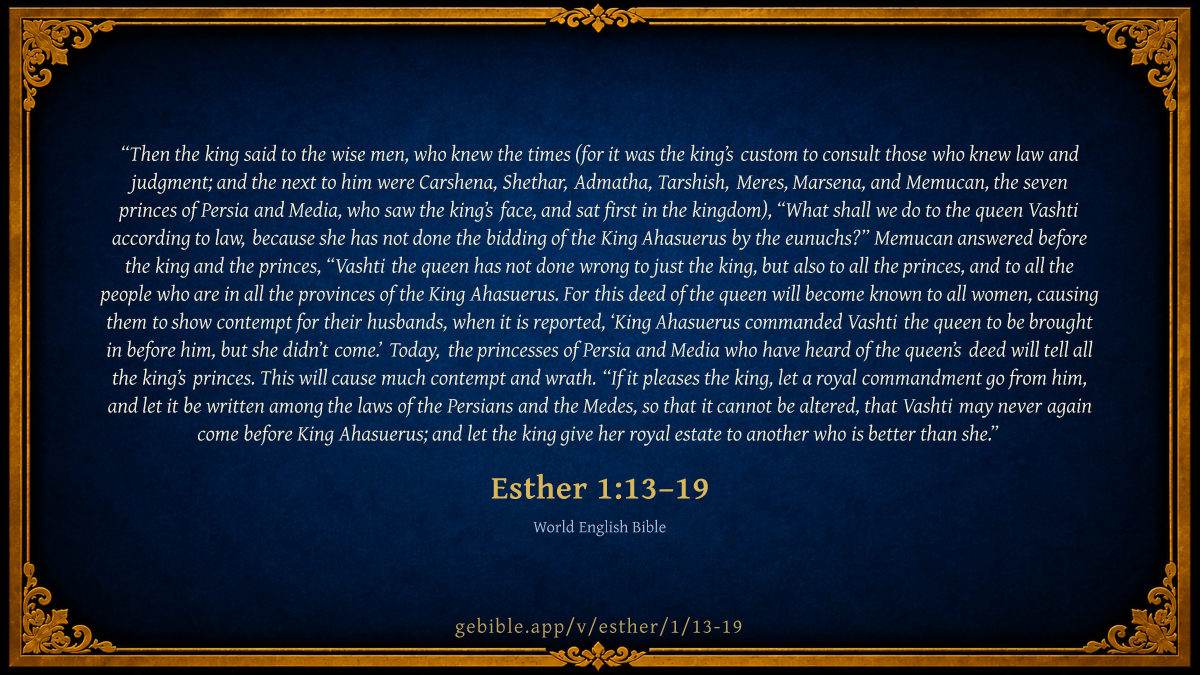
Then the king said to the wise men, who knew the times (for it was the king’s custom to consult those who knew law and judgment; and the next to him were Carshena, Shethar, Admatha, Tarshish, Meres, Marsena, and Memucan, the seven princes of Persia and Media, who saw the king’s face, and sat first in the kingdom), “What shall we do to the queen Vashti according to law, because she has not done the bidding of the King Ahasuerus by the eunuchs?”
Memucan answered before the king and the princes, “Vashti the queen has not done wrong to just the king, but also to all the princes, and to all the people who are in all the provinces of the King Ahasuerus. For this deed of the queen will become known to all women, causing them to show contempt for their husbands, when it is reported, ‘King Ahasuerus commanded Vashti the queen to be brought in before him, but she didn’t come.’ Today, the princesses of Persia and Media who have heard of the queen’s deed will tell all the king’s princes. This will cause much contempt and wrath.
“If it pleases the king, let a royal commandment go from him, and let it be written among the laws of the Persians and the Medes, so that it cannot be altered, that Vashti may never again come before King Ahasuerus; and let the king give her royal estate to another who is better than she.
Geneva Bible translators 1599 · Public Domain On vv13, 14, 16, 17, 18, 19 That had experience of things as they had learned…
That had experience of things as they had learned by diligent marking in continuance of time.
Geneva Bible (1599) marginal notes — public domain.
John Trapp 1656 · Public Domain On vv13–19 Est 1:13 Then the king said to the wise…
Est 1:13 Then the king said to the wise men, which knew the times, (for so [was] the king’s manner toward all that knew law and judgment:
Ver. 13. Then the king said to the wise men] What a sudden change is here! Ex conviviis fiunt comitia, imo et convitia, saith an interpreter. The enraged king forgets all his old love to Vashti, and breathes nothing else but reparation of his own lost honour, and revenge upon his peerless paragon. Howbeit herein he is to be commended, that he sent not for her forthwith by force, that he might dispatch her with his own hands; as Alexander did his friend Clitus and others in his cups and choler; neither ran he raging into her chamber, and kicked her out of the world, as Nero did his wife Octavia, for a less matter (Sueton. Ner.). He knew that anger is an evil counsellor.
Read full note →
- qui non moderabitur irae,
Infectum velit esse dolor quod suaserit et mens (Horat.).
He that reineth not in his anger, shall do that in his haste whereof it shall repent him by leisure, and could eat his nails to have it undone again. Ahasuerus therefore calleth for his judges and counsellors, skilful in state matters.
Which knew the times] And what was best to be done in them. This skill they had gotten by much reading of politics and histories, and long observation. The men of Issachar were such, 1Ch 12:32. Such a one was Croesus to Cyrus, Polybius to Scipio, Agrippa to Augustus, Anaxagoras to Themistocles, &c. Xerxes here had seven such to advise with as his privy councillors; Iudices Regios, the king’s judges, Herodotus calleth them, and further saith, that they held their places for their lives, unless they very much misbehaved themselves.
For so was the king’s manner] sc. To advise with them in matters of moment, but not always to take their advice. The manner was, and the fundamental laws of the land took order, for prevention of tyranny, that the kings of Persia should be ruled by this grave senate of the kingdom, and not bring in an arbitrary government. But Xerxes (who is this Ahasuerus) once at least (if not oftener), viz. in his expedition against Greece, which was not long after this great feast, called his seven princes together, and spake to them after this manner; lest, said he, I should seem to follow mine own counsel, I have assembled you, and now do you remember, that it becomes you rather to obey than advise (Val. Max. lib. 9, cap. 5).
Toward all that knew law and judgment] Of these Persian privy councillors it is said, 1. That they were wise men. Now those only are wise quibus res sapiunt prout sunt. 2. They were skilful in the times, that is, well versed in histories, and well furnished with experiences. 3. That they knew the laws, which they had ready, and at their fingers’ ends, as we say. They knew also judgment, that is, equity and moderation, without which utmost right might be utmost wrong: as indeed it proved in the case in hand. Memucan not only accuseth the queen, but aggravateth her offence, and instead of healing the wound, maketh it far wider. This might become a mercenary orator, but not a grave counsellor. The business was this; the king was angry, and he meant to set him going: the queen was an eyesore, and she must be removed. Such slaves are ambitious statists to their own and their princes’ lusts, but especially when their own plough is driven forward with.
John Trapp, A Commentary or Exposition upon All the Books of the Old and New Testament (1647–1656) — public domain. Text from a community e-Sword module.
Matthew Poole 1685 · Public Domain On vv13, 14, 16, 18, 19 Which knew the times; either,
Which knew the times; either,
1. The histories of former times, what princes have done in such cases as this was. Or,
Read full note →
2. Things done or to be done in time; what was just and fit to be done, or what was the law and judgment in these cases, as the following words explain it, and how and when things were to be done. See Poole "1Ch 12:32". Times are oft put in Scripture and other authors for the things done in them, by a common figure called a metonymy of the adjunct.
So was the king’s manner, to wit, to consult with them in all matters of moment.
Matthew Poole's English Annotations on the Holy Bible (1683–1685) — public domain. Text from a community e-Sword/MySword module.
John Gill 1763 · Public Domain On vv13–19 Then the king said to the wise men that…
Then the king said to the wise men that knew the times,.... Astrologers, as Aben Ezra, that knew the fit time for doing anything; or that had knowledge of ancient times, historians, well read in history, and knew things that had happened similar to this:
for so was the king's manner towards all that knew law and judgment; it was customary with him in any case of difficulty to have the opinion and advice of those that were expert in the law, and well understood right and wrong. These are called by Herodotus (t) the king's judges.
Read full note →
(t) Thalia, sive, l. 3. c. 14, 31. so in Aelian. Var. Hist. l. 1. c. 34.
John Gill's Exposition of the Whole Bible (1746–1763) — public domain (CC PDM 1.0). Text via the HelloAO Bible API.
John Wesley 1765 · Public Domain On vv13, 14, 18 The times - The histories of former times, what…
The times - The histories of former times, what princes have done in such cases as this was.
John Wesley, Explanatory Notes Upon the Whole Bible (1754–1765) — public domain. Text via the GEBible commentary corpus.
Adam Clarke 1810 · Public Domain On vv13, 14, 16, 18, 19 Verse 13. To the wise men] Probably the lawyers.
Verse 13. To the wise men] Probably the lawyers.
Adam Clarke's Commentary on the Bible (1810–1826) — public domain. Text from a community e-Sword/MySword module.
Joseph Benson 1811 · Public Domain On vv13, 14, 16, 18, 19 Est 1:13. Which knew the times — The histories…
Est 1:13. Which knew the times — The histories of former times, what princes had done in such cases as this was, and were well skilled in the laws and customs of their country, and were therefore able to give the king counsel in all extraordinary and perplexed cases. Inasmuch, however, as the Persian kings did nothing without their magi, or wise men, who were great pretenders to astrology, some have supposed that men of this sort were now called in, to know whether it was a proper time to do what the king had in his mind.
Joseph Benson's Commentary on the Old and New Testaments (1811–1818) — public domain. Text from a community e-Sword module.
Albert Barnes 1834 · Public Domain On vv13, 14, 18, 19 Wise men ... - Not “astrologers,” who were unknown…
Wise men ... - Not “astrologers,” who were unknown in Persia; but rather men of practical wisdom, who knew the facts and customs of former times.
For so was the king’s manner - Some render it: “for so was the king’s business laid before all that knew law ...”
Albert Barnes' Notes on the Bible (1834–1885) — public domain. Text from a community e-Sword/MySword module.
Haydock's Catholic Bible Commentary 1859 · Public Domain On vv13, 16, 18, 19 According. Hebrew, "knew the times, (for so was the…
According. Hebrew, "knew the times, (for so was the king’s custom with those who knew law and judgment.) And the next," &c. (Haydock) --- These were the magi, more particularly versed in the constitutions of the country. The Persians commonly held their consultations over wine. (Herodotus i. 133.) --- Septuagint, "and the king said to his friends, Thus has Astin spoken; do therefore, in this affair, law and judgment. Then came forth to him Arkesaios and Saresthaios, and Malesear, the princes of the Persians and Medes, men near the king, and who sat first after the king. (Haydock) --- The old Vulgate places Mardochæus first. These seven counsellors were perhaps styled the king’s relations," (Brisson i. p. 171.) and administered justice; as even the kings referred their causes to them. (Plut. Artax., &c.)
George Leo Haydock (1774–1849), Haydock's Catholic Family Bible and Commentary, 1859 edition — public domain. Excludes Psalms (Douay-Rheims chapter numbering differs from Protestant) and Deuterocanonical books (Catholic canon only).
Robert Jamieson, A. R. Fausset & David Brown 1871 · Public Domain On v13 Then the king said to the wise men--These were…
Then the king said to the wise men--These were probably the magi, without whose advice as to the proper time of doing a thing the Persian kings never did take any step whatever; and the persons named in Est 1:14 were the "seven counsellors" (compare Ezr 7:14) who formed the state ministry. The combined wisdom of all, it seems, was enlisted to consult with the king what course should be taken after so unprecedented an occurrence as Vashti's disobedience of the royal summons. It is scarcely possible for us to imagine the astonishment produced by such a refusal in a country and a court where the will of the sovereign was absolute. The assembled grandees were petrified with horror at the daring affront. Alarm for the consequences that might ensue to each of them in his own household next seized on their minds; and the sounds of bacchanalian revelry were hushed into deep and anxious consultation what punishment to inflict on the refractory queen. But a purpose was to be served by the flattery of the king and the enslavement of all women. The counsellors were too intoxicated or obsequious to oppose the courtly advice of Memucan was unanimously resolved, with a wise regard to the public interests of the nation, that the punishment of Vashti could be nothing short of degradation from her royal dignity. The doom was accordingly pronounced and made known in all parts of the empire.
Next: Esther Chapter 2
Jamieson, Fausset & Brown — Commentary Critical and Explanatory on the Whole Bible (1871) — public domain (CC PDM 1.0). Text via the HelloAO Bible API.
Daniel D. Whedon 1874 · Public Domain On vv13, 14, 15, 16, 18, 19 13. The wise men, which knew the times —…
13. The wise men, which knew the times — Men versed in the laws and customs of their age and of former times, and, therefore, capable of giving proper counsel on any matters of law or precedent.
So was the king’s manner — The regard of the Persians and Medes for their laws is proverbial, and the kings were always careful to consult the wise men, who knew law and judgment, before they proceeded to enact or execute any great or unusual measure.
Daniel D. Whedon (gen. ed.), Commentary on the Old and New Testaments (1874–1909) — public domain. Text from a community e-Sword module.
The Cambridge Bible for Schools and Colleges 1878 · Public Domain On vv13–19 13. the wise men, which knew the times] The…
13. the wise men, which knew the times] The expression includes two classes of functionaries, (a) the astronomers and astrologers, who based their advice upon observation of the heavens, and (b) students of the laws and customs which had come into existence in the past, and so formed a guide for the direction of present conduct.
for so was the king’s manner etc.] This does not indicate a custom of Ahasuerus in particular, but is a general remark to the effect that the kings of Persia were in the habit of taking counsel in this way before coming to any important resolution, and nothing that in any way concerned the king’s dignity could be considered insignificant. By conforming to this national use Ahasuerus shewed that even on such an occasion, and while moved by passionate indignation, he was able to put some restraint upon himself. Another example of this usage in the Persian monarchy is that given by Herodotus (iii. 31), where Cambyses asks the opinion of the learned men who were about him before taking his sister in marriage.
The Cambridge Bible for Schools and Colleges (gen. ed. J. J. S. Perowne; Cambridge University Press, 1878–1918) — public domain. Text from a community e-Sword module.
Ellicott's Commentary for English Readers 1878 · Public Domain On vv13, 14, 16, 18, 19 (13) Which knew the times.—That is, who were skilled…
(13) Which knew the times.—That is, who were skilled in precedents, and could advise accordingly.
For so. . . .—Translate, for so was the king’s business laid, before . . .
A Bible Commentary for English Readers, edited by Charles John Ellicott (1878–1897) — public domain. Text from a community e-Sword module.
The Pulpit Commentary 1880 · Public Domain On vv13–19 Then the king said to the wise men. Angry…
Then the king said to the wise men. Angry as he was, Ahasuerus had still some power of self-restraint. He was in the presence of his whole court, and of a great assembly of the people. It would not be seemly that he should vent his passion in violent words, imprecations, or threats. His dignity required that he should at any rate seem calm, and, instead of issuing any hasty order, should proceed deliberately to consider what were the next steps to be taken. Xerxes appears to have been rather fond of asking advice (Herod., 7:8, 48, 234; 8:101); and he now, in a sufficiently dignified way, required the opinion of his "wise men" on the practical question, What was to be done to Vashti? (see ver. 15). Which knew the times. i.e. persons who were well acquainted with past times, and knew what it was customary to do on each occasion. For so was the king"s manner toward all that mew law and judgment. Rather, "For so was the business of the king brought before such as knew law and judgment." Each matter which concerned the king was submitted to learned persons for their opinion before any actual step was taken (compare Herod., 3:31, where Cambyses asks the opinion of the royal judges with respect to his proposed marriage with his sister). It is not a special practice of Ahasuerus, but a general usage of the Persian monarchy, which m noticed.
Wise men.
Read full note →
Wisdom is the skill which some men possess of devising means to secure any end that is aimed at. It is what Aristotle termed an intellectual virtue. There is no position in life where wisdom is not useful. And in the highest positions, in Church and in State, it is a quality which is justly held in very high esteem. Counsellors of kings and ministers of state need a large measure of practical wisdom. The same may be said of pastors of Christian Churches, and of officers of Christian societies and organisations of all kinds.
I THE FOUNDATION OF WISDOM IS NATURAL SAGACITY. It is sometimes said of men that they are "born fools," and it is certain that some are by nature more endowed than others with insight into character, and with fertility of devices and resources. A cunning man is seldom wise, for he usually overreaches himself, and awakens distrust in the minds of his acquaintances.
II WISDOM IS NURTURED BY THE HABIT OF DELIBERATION. It is proverbial that hasty men are unwise; they will not allow themselves time to see more than one side of a subject. To weigh with calmness and impartiality the possible plans of action is conducive to a wise decision.
III WISDOM IS STRENGTHENED BY KNOWLEDGE AND STUDY. Not every well-informed and learned man is wise; but few men are wise whose knowledge is scanty, and whose experience is contracted. Two kinds of knowledge are referred to in this passage.
1. Historical knowledge, or knowledge of the times. To study the historyof nations and of the affairs of state is a good preparation for the life of a politician, a statesman (vide some excellent remarks in Bossuet"s "Lectures on Universal History," addressed to the Dauphin of France).
2. Legal knowledge. The counsellors of the king of Persia are said to have known law and judgment, obviously very essential to men in their position.
IV THE POSSESSION OF WISDOM IS A MOST RESPONSIBLE TRUST. Like other good things, it may be used, and it may be abused. There is a great danger lest the counsellors of kings should give advice fitted to please rather than to profit. It is well, therefore, that all such should remember that they are themselves accountable to the Lord and Judge of all. If wisdom be employed to secure merely selfish ends, or to flatter the ambitious and the vain, it will prove in every way a curse.
Lessons:
1. Let the truly wise, who use their wisdom to good purpose, be regardedwith general honor and esteem.
2. Let those who are consulted by others because of their repute forwisdom seek grace to give good counsel, as in the sight of the Lord.
3. Let the young seek to acquire practical wisdom, and let them rememberthat "the fear of the Lord is the beginning of wisdom, and to depart from evil is understanding.
Vers. 13-20.
Counsel.
The king of Persia had two bad counsellors, wine and anger. It showed some degree of common-sense on his part that, instead of acting upon impulse, he waited to ask the advice of his ministers, those privileged and trusted men who were nearest to the throne. If they had advised him well he might have avoided making an exhibition of his own folly to his people. But their plan was to fall in with the inclinations of their sovereign. This, whilst we must blame it, we cannot wonder at; for few dared to oppose the vain and imperious monarchs of Persia.
I GOOD COUNSEL SHOULD BE SINCERE AND HONEST IN ITSELF. It sometimes happens that a person called upon for advice sees what it would be right to advise, but gives advice contrary to that which his judgment would approve. It is better to decline advising than to do this.
II GOOD COUNSEL SHOULD BE DISINTERESTED AS REGARDS THE GIVER. If one advises so as to secure his own interest at the expense of the friend who trusts and consults him, he acts with baseness, and deserves contempt.
III GOOD COUNSEL SHOULD BE FAITHFUL AS REGARDS THE RECEIVER. In advising the great, counsellors are too often guided by a desire to fall in with their inclinations, to flatter their pride and vanity, to minister to their lusts. Flatterers are bad counsellors, though by their flattery they may advance themselves. Their motto is, Mihi placer quicquid regi placer (that pleases me which pleases my lord, the king).
IV GOOD COUNSEL SHOULD BE APPROPRIATE AND TIMELY. Advice which is not to the point, or which is given when it is too late for it to be of use, is vain. How many a misguided youth has had reason to exclaim, Why was I not warned or directed while warning and direction might have been of use?
Motives of self-restraint.
If the anger which burned in the king had issued in a determination to put the disobedient Vashti to death, his will would have been obeyed, and his example would not have been singular. History affords many instances of the sacrifice of wives by despotic kings under the influence of violent passion. What withheld Ahasuerus from this last stretch of authority? Several causes are suggested.
I AFFECTION. Vashti had both beauty of face and form, and nobility of character. That the king was fully sensible of the attractiveness of her presence is shown by his request that she should appear before his guests at the banquet. In spite of her disobedience and the anger it excited in his mind, it is very probable that a lingering affection curbed any desire he may have had to inflict on her an immediate and summary punishment. There are few greater treasures than the power to win such an esteem and love from relatives and friends as will not only be a fruitful pleasure in times of peace, but exercise a restraining influence on tempers that have become turbulent and unruly. Many qualities are needed to give a man or woman possession of it. Yet all, by a godly self-discipline, may acquire it in measure.
II FEAR. It can hardly be doubted that Vashti"s nature was a more powerful one than that of the king. The closing incident of the feast implies that the king was proud of his wife, and that the queen had some consciousness of power over her husband. From the little that is written little, but telling we gather that Vashti had been accustomed to a strong personal ascendancy in her intercourse with the king. And now, when anger burned in his heart against Vashti, the weak and self-indulgent king hesitated, and wavered, and sought the advice of others. He was still under the influence of a nature superior to his own. It is well to consider that there are forces in the world higher and mightier than the material. The grace and strength of character possessed by a single woman may be stronger than the wrathful will of a monarch who commands legions, and whose nod millions are ready to obey.
III LAW. The unalterable character given to the laws of the Medes and Persians displayed, though in an unwise and awkward way, a more than usual respect for the claims of public law. King Ahasuerus inherited a sort of reverence for the fixed code of the empire, and it was "his manner," or habit, to consult legal experts in all matters of difficulty. This habitual regard for law asserted itself in his treatment of Vashti"s rebellion, and assisted in preventing his wrath from wreaking itself at once in violent action. The king"s recognition of the claims of law is commendable. Notice
1. That law is the authoritative teaching of experience. It is theaccumulated and embodied wisdom of a nation. As civilisation advances in communities, their laws become at the same time more just and more humane, and they acquire inherent force in proportion as they reflect the principles of truth and right. Bad laws imply a low moral and social condition, and can only secure obedience through the fear excited by cruel penalties. Good laws carry with them an authority of their own which has greater power for good than the heaviest penal sanctions.
2. That law is a guide and teacher of the ignorant. There are multitudes inevery country to whom it becomes the chief practical educator as to what is right between man and man. The more deeply grounded it is in truth, the higher it will be in influence. The restraints which it imposes, the awards which it metes out, lead men to reflect on the principles and ends which underlie it. If it be based on Christian ideas of justice, those ideas will emerge in the thoughts and mould the character of the people who are governed by it. Law is a great educator.
3. That law is a restraint on the evil-disposed. Even criminals who set lawat defiance have their power much crippled by its just punishments. But very many who in heart rebel against it are only kept orderly and reputable in their outward conduct by fear of its rightful authority. Thus society is guarded by it against an anarchy and confusion of wickedness which would make life unsafe and intolerable. On the ground of social order we should cherish and encourage respect for law.
4. That law is a protection to the innocent, the weak, and the right-minded.It throws a benign shield over the young and tender, and it affords an open and safe field for upright living, and for the efforts of holy Christian beneficence. Without law there could be no freedom for the righteous and law-loving. A lawless liberty is the direst of oppressions. As the voice of government, law, in the words of Peter (1Pe_2:14) is "for the praise of them that do well.
From these reflections on law we learn
1. The duty of all citizens.
(1) To obey honestly and heartily the law under which they live. A solemn responsibility rests on them to give all honour to constituted authority.
(2) To use through legitimate means what power they possess to bring the law of their country into harmony with perfect justice and freedom. Christians are not released by their religion from civil obligations. On the contrary, the faith and life of Christ only sanctifies, and makes more binding on the conscience, the claims of natural, social, and political ties. We learn
2. The immense value of the Christian revelation of righteous law. That lawaffects all the affairs and interests the least as well as the greatest of human life. Nothing lies beyond its sovereign reach. It affects
(1) Nations. The more fully and regally it is admitted into the governments, and laws, and customs of corporate societies, the higher is the level which such societies attain with respect to all the elements that constitute true prosperity and happiness.
(2) Persons. Whatever be the outward conditions under which men live, their personal submission to the Christian law of life is an inestimable blessing both to themselves and to others. The Divine law which they recognise in faith and conduct makes them superior to all that is false and injurious in existing human laws; and their example of purity, humility, integrity, charity, and godly fear tells on many hearts that may be watching it in silence. We should be unfeignedly and deeply thankful for Christ"s law; for his revelation of the mind of God in perfect holiness and perfect love; and we should strive earnestly to commend it to others, and to infuse it into the law and life of the nation to which we belong. "Oh, how love I thy law!" should be the life-note of individual men and women. "Great peace have they which love thy law," should express their inward comfort, and the incentive of their active labour for God and good. D.
Vers. 13, 14.
Counsellors.
I RESPECT FOR COUNSEL AND COUNSELLORS. This implies
1. A proper humility. Some men are too proud to seek advice from others; they resent it as an impertinence when it is offered. Others place so much confidence in their own judgment that they fail to see the need of extraneous help. But the facts of life, as well as the verdicts of conscience and religion, condemn both pride and self-confidence as foolish and hurtful. How often are they brought low in presence of their own acts i
2. A proper sense of responsibility. We cannot estimate what may be theeffect of any particular act. The well-being of others as well as ourselves may be deeply concerned in conduct which we treat lightly, and therefore heedlessly pursue. A thoughtful consideration of our responsibility to God and our neighbour for our actions and their results would make us welcome the light of a kindly counsel, by whomsoever given. Especially should those who occupy positions of great influence seek and value the aid of good counsellors.
II QUALIFICATIONS OF COUNSELLORS. Few possess the peculiar gifts and acquirements needed to give them the character of good and trustworthy advisers. Such a character demands a combination of high qualities. This is true in connection not only with matters of grave importance, but with the affairs of ordinary life. In our passage we have certain qualifications indicated
1. Wisdom, or knowledge. The men whom the king consulted on the caseof Vashti are called "wise men who knew the times." They were learned in the wisdom of their day, and had studied the laws of the empire and the principles on which they were grounded. A special knowledge is required to grapple with, and throw light on, matters that are involved, perplexing, and attended by heavy risks. In presence of such matters ignorance is helpless or presuming, while imperfect knowledge is sure to mislead. Only a wisdom which is familiar with facts and principles can be trusted in cases where the counsellor is required.
2. Experience. A theoretical knowledge may be good and necessary, but itis not sufficient to guide in practical matters. Men may learn much from books and abstract meditation, but unless they are accustomed to apply what they have learned, or to study its applications, in the events of every day life, their counsel in cases of difficulty will be of little value. The men whom it was "the king"s manner" to consult were skilled both in "law" and in "judgment." Their knowledge was not only ideal or speculative, but practical and experimental. They had trained themselves to apply law in giving judgment. They had learned to discriminate, to weigh evidence, and to pronounce verdicts in the light of existing laws. Experience is the greatest of teachers, and those who have benefited most by its lessons are most capable of discharging the duty of counsellors. As in law, so also in all other human interests. In commerce, the best adviser will be the man who has passed through, in an honourable and successful way, all the vicissitudes of a commercial life. The same is true with respect to religious needs and anxieties. The true counsellor to the distressed soul will be the Christian who has himself experienced the struggles with sin, the renewing grace of God, and the redeeming love of Jesus Christ.
3. Reputation and standing. It is said that the king"s advisers were "next"to himself; that they "saw the king"s face," and that they "sat the first in the kingdom." Their wisdom had made them eminent, and the effect of their counsel would be in proportion to their eminence. They had much to gain or lose by the answer they might give to the king"s proposition. Their reputation and standing were at stake. It is easy for men of small character and influence to offer flippant or heedless advice. But those whose acknowledged wisdom has raised them to a position which gives power to their judgments are usually careful as to the opinions they express. At any rate they stand out before others as possessing a special claim on the confidence of those who require the guidance of enlightened counsel. From this consideration let us learn
(1) The value of a good social reputation. It should be cherished as a treasure beyond price.
(2) The influence of a good social reputation. It is incalculable. It tells on many. It works unseen. It goes far beyond the visible sphere of its action.
(3) The burden of a good social reputation. It is weighty. A great responsibility attaches to it.
III A DIVINE COUNSELLOR IS MADE KNOWN. Christ never fails those who trust and follow him. Among his recorded names are "the Wisdom," "the Word," and "the Counsellor." He is interested in all that interests man for time and eternity. His voice may be heard in connection with all duties, all positions, all events a voice of truth, righteousness, and love. If we listen to him we shall neither live nor die in vain. D.
The Pulpit Commentary (1880–1919), ed. H.D.M. Spence-Jones & Joseph S. Exell — public domain. Text from a community e-Sword module.
The Biblical Illustrator 1887 · Public Domain On vv15–16 What shall we do unto the queen Vashti according…
Est_1:15
What shall we do unto the queen Vashti according to law.
Read full note →
The great advantage of laws
Here let us remark the great advantage of laws. Law is mind without passion; and it is better to have a code of laws, however bad, than to have none but the will of a man. Had the king on this occasion acted according to his passion, it is more than probable that the scene might have terminated more tragically; but he acted according to law. Secondly, we see the great advantage of counsel. In the multitude of counsellors there is safety, says the wise man. This is more especially the case with those who have the lives, the property, and even the religion of others, to consider and determine upon. What an advantage is it to have for counsellors good men, who hate covetousness, who have the welfare of their country at heart, and especially those who act under the fear of God! (T. McCrie.)
The Biblical Illustrator, edited by Joseph S. Exell (c. 1880s–1900s) — public domain. Text from a community e-Sword module.
The Preacher's Complete Homiletical Commentary 1892 · Public Domain On vv15–16 MAIN HOMILETICS OF THE PARAGRAPH. Est_1:15
MAIN HOMILETICS OF THE PARAGRAPH. Est_1:15
A KING IN CONSULTATION
Read full note →
Most men have not the opportunity of being present when a king holds a consultation. Such an opportunity is now presented. Enter the banqueting-hall. Let silence be kept, for the king is about to speak. But we shall find here only that which is to be avoided, and nothing to imitate.
I. The king ignores the folly of his own conduct. There is not here the slightest hint that his request was unreasonable. The demand made that Vashti should be brought into the court of revellers unveiled is spoken of in solemn phrase as a commandment, as a proceeding the carrying out of which was needful to the welfare of the state. Men by a change of words, by cunning phrases, try to change the nature of their crimes. It is hard to bring ourselves faithfully to task. We readily ignore the folly of our own conduct when we are bitterly smarting under its results.
II. The king tries to shift the blame on to others. In this the king shows himself the son of that first parent who blamed his wife and tried to exculpate himself. Adam blames Eve. Ahasuerus is wroth with Vashti. Ahab calls Elijah Israel’s troubler. Herod beheads John the Baptist. A man blames his fellows; a man finds fault with his circumstances; a man quarrels with his organization. But the last person a man blames is himself. When he has come to do this thoroughly, his reformation is more than half completed.
III. The king tries to get away from the whispers of conscience. If guilty men were fully satisfied with their reasonings about the force of circumstances and their defective organizations, they would not show themselves so uneasy. The reasoning, if conclusive, would be condoning and pacifying. Vashti’s crime was only small, if crime it was; why, then, should the king make so great a commotion over so small a matter? Why, because the voice of conscience was not altogether stifled, and it spoke so as to fill him with trouble. The king’s dignity might be touched by the unhappy queen’s refusal; but his conscience was touched much more. Men are always most angry with, and most severe upon, others when their own consciences are troubled. And when a guilty conscience sits upon the seat of judgment, the poor prisoner may not expect mercy; for then the severest decrees will be pronounced. A guilty conscience is a great legalist. It says what shall be done “according to laws;” it searches out for precedents and examples; it is very strict in its requirements; it does not temper justice with mercy; it keeps all mercy for itself, and justice, which thus becomes injustice, for those brought to its bar. This king had no right to sit in judgment, for he himself was the originator of the supposed misdemeanour.
IV. This king makes others partners of his guilt. Humanity hedges about a king, whether divinity does so or not. Men flock around a royal standard. That which is a crime in a subject becomes only a folly in a king. And so Ahasuerus had no difficulty in gathering around him the wise men to consult about the crime of a poor woman, and condemn her to banishment. It would have required the spirit of a martyr to utter any remonstrances in the presence of this mighty despot, and a martyr spirit is not often found in king’s palaces. It requires ruder fare for its development than the sumptuous feasts of royal tables; it needs coarser clothing than purple and fine linen. The world’s great prophets are not clothed in soft raiment. They move in the wilderness. And so it is all the more praiseworthy when those wearing soft clothing have spirits strong and bold. Courtly martyrs are few, but when found are most noble.
SUGGESTIVE COMMENTS ON Est_1:15
Instead of at once following out what his anger suggests, Ahasuerus submits his case to the law and custom. This in itself is great and beautiful; this is the victory of culture over crudeness and passion. But in the manner in which this is done here it amounts to nothing after all. We seem to feel in advance that nothing good will come of it.—Lange.
Because she hath not performed the commandment, &c. This was a fault, no doubt, but not so heinous as was made of it. The faults of his wife a man must either tollere or tolerare, cover or cure, and go about to kill a fly upon her forehead with a bottle, as they say. But God hath a providential hand in it for the good of his Church.—Trapp.
The combined wisdom of all, it seems, was enlisted to consult with the king what course should be taken after so unprecedented an occurrence as Vashti’s disobedience of the royal summons. It is scarcely possible for us to imagine the astonishment produced by such a refusal in a country and court where the will of the sovereign was absolute. The assembled grandees were petrified with horror at the daring affront. Alarm for the consequences that might ensue to each of them in his own household next seized on their minds, and the sounds of bacchanalian revelry were hushed into deep and anxious consultation—what punishment to inflict on the refractory queen.—Port. Commentary.
MAIN HOMILETICS OF THE WHOLE CHAPTER
This book presents us with impressive views of man with and without grace; of the great instability of human affairs; of the sovereign power, justice, and faithfulness of the Supreme Being. We now call your attention to the first chapter.
I. The king of Persia at this time was Ahasuerus. Commentators differ about him. He was a heathen—a stranger to God—possessing extensive dominions. His was the second of the four great empires. These empires have come to nought; but, brethren, there is a kingdom which passeth not away. Its King will remain in heaven for ever. Let us be numbered among its subjects.
II. This mighty potentate, Ahasuerus, wished to make a display of his greatness: made a feast—the power of Media and Persia present—he exhibited his riches, and honour, and glory. Notice his pride. Beware of pride. Pray that you may habitually remember what you are—poor, fallen sinners.
III. At this feast, though a heathen one, moderation was observed. “And the drinking was according to law: none did compel.” Intemperance is an abomination and a degradation; hence we should flee from it.
IV. But though the feast of Ahasuerus was free from the disgrace of compelling the guests to proceed to drunkenness, yet did very evil consequences result from it. It is but seldom that such meetings are free from such consequences. We read of Belshazzar’s feast; we read of Herod’s feast. In such entertainments God is liable to be forgotten. Solomon, who with extraordinary diligence, and unparalleled success, had examined and tried the sources of all earthly gratification, tells us, in language which ought never to be out of remembrance, that “it is better to go to the house of mourning than the house of feasting.”
V. Let us consider the evil which was occasioned by the feast.—The king ordered the queen to be brought. She refused to come. The wrath of the king was kindled. The result was a council, then the divorcement of the queen. Quarrels, animosities, and heart-burnings are so contrary to that religion of love which a received gospel generates, that we ought to strive to the utmost for the preservation of the opposite virtues. Christ is the Prince of Peace; let us not only trust in his death for salvation, but imitate his meekness and lowliness of heart.
Two short remarks shall close this discourse:—
1. It behoveth us to lead excellent lives, and the higher we are placed in the community the more ought this to be the object of our ambition. Let our lives be continual sermons to those among whom we live.
2. It behoveth us to regard the duties which appertain to the relations of life in which we are placed. “Brethren, let every man wherein he is called, therein abide with God.”—Hughes.
I. The vast extent of the Persian empire. It comprehended all the countries from the river Indus on the east to the Mediterranean on the west; and from the Black Sea and Caspian in the north to the extreme south of Arabia, then called Ethiopia. This gigantic dominion was divided into 127 provinces or governments, each of which was placed under a satrap, or, in modern language, a pasha, who managed its affairs, and annually transmitted a certain sum as revenue to the king. The seat of government was variable, according to the season of the year, the summer months being spent by the court at Ecbatana, and the winter months at Susa, or, as it is called in this chapter, Shushan, the palace. The form of government in the East has from the earliest times been despotic, one man swaying the destinies of millions, and having under him a crowd of smaller despots, each in his more limited sphere oppressing the people subjected to his rule.
1. Despotism has its occasional fits of generosity and kindness. It is as kind-hearted that Ahasuerus is brought before you in the early part of this chapter. He was spending the winter months at Susa. The retinue of the monarch was vast, and the fountains and gardens were on a scale of grandeur which we cannot well conceive. There, then, the king, but little concerned about the welfare of his subjects, was spending his time, chiefly in selfish ease and unbounded revelry. To him it was of no moment how his people were oppressed by those whom he set over them; his sole concern was to enjoy his pleasures.
2. With all the luxury and temptation to self-indulgence, there was no compulsion employed to draw any one beyond the bounds of temperance. The law was good, but the king himself had too largely used the liberty, and hence his loss of self-control and all sense of propriety. When heated with wine he sent for Vashti, &c. Lessons suggested are—
(1) Extravagancies and follies into which men are betrayed by intemperance.
(2) That which dethrones reason and destroys intellect should surely be avoided.
(3) All the consequences which affect the man individually, and others also, rest upon the head of the transgressor.
(4) Intemperance (a) blots out distinction between right and wrong; (b) foments all the evil passions of the natural heart; (c) destroys the proper exercise of the power of the will; (d) and often inflicts grievous wounds upon the innocent, as the case of Vashti here already demonstrates.
(5) The necessity of guarding against these evils.
II. The evils which arose from the peculiar family arrangements of those countries. We take occasion here to observe two great evils:—
1. The condition of the female sex was that of degradation. The married woman was not really what the Divine institution intended her to be, the true companion and friend of her husband. She was kept in a state of seclusion, real freedom she knew not; she was, in truth, only a slave, having power to command some other slaves. She was without education, and generally unintelligent, frivolous, and heartless. She was guarded with zealous care, as if she had been very precious, but at the same time she was wholly dependent upon the caprices of her lord.
2. Yet, strangely enough, in the second place, it is to be noticed that, as if to afford evidence that the law of nature cannot be trampled upon with impunity, it very frequently happened that the female influence was felt by the despotic husband, so as to make him in reality the slave. Not conscious of it, but imagining that he held the place of absolute authority, he was himself governed; yet not through the power of real affection, but through the imbecile doting which constituted all that he knew of real affection. Common history abounds with illustrations of this fact, and in the sacred history we have examples of the same kind; David, Solomon, and Ahab are instances. There is never a violation of God’s righteous appointments, but it is followed by some penalty. From this Book of Esther, it appears very obviously that Ahasuerus, with all his caprices and his stern, imperious self-will, was at first completely under the influence of Vashti, as he afterwards came to be under that of Esther. The whole domestic system being unnaturally constructed, there was, of necessity, derangements in the conducting of it. The despot might be one day all tenderness and submission, and the next day he might, to gratify his humour, exact from his slaves what, a short time afterwards, he would have counted it absolutely wrong in himself to command, and punishable in them to do.
III. The degradation of Vashti. We have to look at the circumstances which are brought before us in the narrative. At a season when sound counsel could scarcely have been expected, and when he who sought it was not in a fit condition to profit by it, the serious question was proposed by the king, “What shall be done to Vashti?” &c. To defer the consideration of so grave a subject to a more fitting season would have been so clearly the path which a wise counsellor would have recommended, that we feel astonished that it was not at once suggested. But the wrath of the king was so strongly exhibited that his compliant advisers did not venture to contradict him. “Memucan answered,” &c. Now, with respect to this opinion of the chief counsellor, it may be observed that it was based upon a principle which in itself is unquestionably right, although there was a wrong application made of it. Rank and station, while they command a certain measure of respect, involve very deep responsibility. Fashions and maxims usually go downward from one class of society to another. Customs, adopted by the higher orders as their rule, gradually make their way until at length they pervade all ranks. Thus far Memucan spoke wisely, when he pointed to the example of the queen as that which would certainly have an influence, wherever it came to be known, throughout the empire. But the principle, in the present instance, was wrongly applied when it was made the ground of condemning the conduct of Vashti. The design was to make her appear guilty of an act of insubordination, which it was necessary for the king to punish, if he would promote the good of his subjects, whereas, in reality, she had upon her side all the authority of law and custom, and was to be made the victim both of the ungovernable wrath of the king, who was beside himself with wine, and also of flatterers who, to gratify him, would do wrong to the innocent. See here the danger of flattery.
Let us extract some practical lessons from our subject.
1. The inadequacy of all earthly good to make man truly happy. Surveying the whole scene portrayed in the early verses of this chapter, we might imagine that the sovereign who ruled over this empire, upon whose nod the interests of so many millions depended, and for whose pleasure the product of so many various climes could be gathered together, had surely all the elements of enjoyment at his command.… And yet we must say that the mightiest sovereign of his time, with 127 provinces subject to him, with princes serving him, and slaves kissing the dust at his feet, was not half so happy as the humblest individual here, who knows what is meant by the comforts of home, where he is in the midst of those who love him.
2. A few remarks may be offered upon the domestic question here settled by the king and his counsellors, as to the supremacy of man in his own house. How could they pronounce a sound judgment upon a question which their customs prevented them from rightly knowing?
3. We have in the text a law spoken of which changeth not. And, my friends, there is such a law, but it is not the law of the Medes and Persians, it is the law of the Eternal. Jehovah’s law changeth not. And what does it say? “This do and live.” “Cursed is every one that continueth not in all things written in the book of the law to do them.” That seals us all up under wrath. But we turn the page, and we read and see that “Christ is the end of the law for righteousness.” And is not this our conclusion, then—“I will flee from the curse of the immutable law, and shelter myself under the righteousness of Christ, which is also perfect and immutable, that through him and from him I may have mercy and eternal life”?—Dr. Davidson.
ILLUSTRATIONS TO CHAPTER 1
Power. Pompey boasted, that, with one stamp of his foot, he could rouse all Italy to arms; with one scratch of his pen, Ahasuerus could call to his assistance the forces of 127 provinces; but God, by one word of his mouth, one movement of his will, can summon the inhabitants of heaven, earth, and the undiscovered worlds to his aid, or bring new creatures into being to do his will.
Dignity. A French doctor once taunted Flechier, Bishop of Nismes, who had been a tallow-chandler in his youth, with the meanness of his origin; to which he replied, “If you had been born in the same condition that I was, you would still have been but a maker of candles.”
Great men. Columbus was the son of a weaver, and a weaver himself. Cervantes was a common soldier. Homer was the son of a small farmer. Demosthenes was the son of a cutler. Terence was a slave. Oliver Cromwell was the son of a London brewer. Howard was an apprentice to a grocer. Franklin was a journeyman printer, and son of a tallow-chandler and soap-boiler. Dr. Thomas, Bishop of Worcester, was the son of a linen-draper. Daniel Defoe was a hostler, and son of a butcher. Whitfield was the son of an innkeeper at Gloucester. Virgil was the son of a porter. Horace was the son of a shopkeeper. Shakespeare was the son of a woolstapler. Milton was the son of a money scrivener. Robert Burns was a ploughman in Ayrshire. Yet all these rose to eminence.
How to make a feast. “Lord Chief Justice Hall frequently invited his poor neighbours to dinner, and made them sit at table with himself. If any of them were sick, so that they could not come, he would send provisions to them warm from his table.”
Favour of God. It was the saying of a wise Roman, “I had rather have the esteem of the Emperor Augustus than his gifts;” for he was an honourable, understanding prince, and his favour very honourable. When Cyrus gave one of his friends a kiss, and another a wedge of gold, he that had the gold envied him that had the kiss as a greater expression of his favour. So the true Christian prefers the privilege of acceptance with God to the possession of any earthly comfort, for in the light of his countenance is life, and his favour is as the cloud of the latter rain.—Butler.
Pride of wealth. Alcibiades was one day boasting of his wealth and great estate, when Socrates placed a map before him, and asked him to find Attica. It was insignificant on the map; but he found it. “Now,” said the philosopher, “point out your own estate.” “It is too small to be distinguished in so little a space,” was the answer. “See, then!” said Socrates, “how much you are affected about an imperceptible point of land.”
Your bags of gold should be ballast in your vessel to keep her always steady, instead of being topsails to your masts to make your vessel giddy. Give me that distinguished person, who is rather pressed down under the weight of all his honours, than puffed up with the blast thereof. It has been observed by those who are experienced in the sport of angling, that the smallest fishes bite the fastest. Oh, how few great men do we find so much as nibbling at the gospel book.—Seeker.
Abuse of wealth. I am no advocate for meanness of private habitation. I would fain introduce into it all magnificence, care, and beauty, when they are possible; but I would not have that useless expense in unnoticed fineries or formalities—cornicing of ceilings, and graining of doors, and fringing of curtains, and thousands of such things—which have become foolishly and apathetically habitual.… I speak from experience: I know what it is to live in a cottage with a deal floor and roof, and a hearth of mica slate; I know it to be in many respects healthier and happier than living between a Turkey carpet and a gilded ceiling, beside a steel grate and polished fender. I do not say that such things have not their place and propriety; but I say this emphatically, that a tenth part of the expense which is sacrificed in domestic vanities, if not absolutely and meaninglessly lost in domestic comforts and encumbrances, would, if collectively afforded and wisely employed, build a marble church for every town in England.—Ruskin.
Danger. “A boy climbing among the Alps saw some flowers on the verge of a precipice, and sprang forward to get them. The guide shouted his warnings; but the heedless boy grasped the flowers, and fell a thousand feet upon the rocks below with them in his hand. It was a dear price for such frail things, but he is not the only victim of such folly.”
Danger of prosperity. When Crates threw his gold into the sea, he cried out, Ego perdam te, ne tu perdas me, that is, “I will destroy you, lest you should destroy me.” Thus, if the world be not put to death here, it will put us to death hereafter. Then we shall say, as Cardinal Wolsey, when discarded by his prince and abandoned to the fury of his enemies: “If I had served my God as faithfully as my king, he would not have thus forsaken me.” Poor man! all the perfumes on earth are unable to prevail over the stench of hell.—Secker.
In a long sunshine of outward prosperity, the dust of our inward corruptions is apt to fly about and lift itself up. Sanctified affliction, like seasonable rain, lays the dust, and softens the soul.—Salter.
When fire is put to green wood there comes out abundance of watery stuff that before appeared not; when the pond is empty, the mud, the filth, and toads come to light. The snow covers many a dunghill, so doth prosperity many a rotten heart. It is easy to wade in a warm bath, and every bird can sing in a sunshiny day. Hard weather tries what health we have; afflictions try what sap we have, what grace we have. Withered leaves soon fall off in windy weather, rotten boughs quickly break with heavy weights, &c.—Brooks.
Some of you glory in your shame, that you have drunk down your companions, and carried it away—the honour of a sponge or a tub, which can drink up or hold liquor as well as you.—Baxter.
We commend wine for the excellency of it; but if it could speak, as it can take away speech, it would complain that, by our abuse, both the excellencies are lost; for the excellent man doth so spoil the excellent wine, until the excellent wine hath spoiled the excellent man. Oh, that a man should take pleasure in that which makes him no man; that he should let a thief in at his mouth to steal away his wit; that for a little throat indulgence he should kill in himself both the first Adam—his reason, and even the second Adam—his regeneration, and so commit two murders at once.—Adams.
An earnest young minister was in the house of a rich friend. He was pressed to take wine, but refused. It was again pressed upon him. At length he yielded to their importunities, and drank a little. Gradually he formed a liking for wine, and at length began taking far too much. By degrees, and almost before he was aware of it, he became a drunkard. He was degraded from his office of the ministry, and sank lower and lower. Years after he had been pressed to drink by his rich friend, he came again to his door; this time to beg for a little food, and was ordered away as a drunken vagabond.
Joseph Ralston, of Philipsburg, Penn., met with a horrible death by freezing. He had been drinking freely, and had, while drunk, to wade the Moshandoo Creek; but, ere he proceeded two-thirds of the way, his limbs refused to perform their office. He grasped a bough of an overhanging tree, unable to advance farther; and soon the fast-congealing water cemented close about him—a tomb of ice which stretched from shore to shore. Two days after he was found there rigid as an icicle, his knees embedded in a sheet of the frozen element seven inches thick, his body inclined a little forwards, his hands clutching the boughs, eyes astare, and despair pictured on his features.—Pittsburgh Despatch.
God trieth men’s love to him by their keeping his commandments. It was the aggravation of the first sin that they would not deny so small a thing as the forbidden fruit, in obedience to God! And so it is of thine, that will not leave a forbidden cup for him. O miserable wretch! dost thou not know thou canst not be Christ’s disciple if thou forsake not all for him, and hate not even thy life in comparison of him, and wouldst die rather than forsake him? And thou like to lay down thy life for him, who wilt not leave a cup of drink for him? Canst thou burn at a stake for him, that canst not leave an alehouse, or vain company, or excess, for him? What a sentence of condemnation dost thou pass upon thyself!—Baxter.
Not in the day of thy drunkenness only dost thou undergo the harm of drunkenness, but also after that day. And as when a fever is passed by, the mischievous consequences of the fever remain, so also when drunkenness is passed, the disturbance of intoxication is whirling round both body and soul. And while the wretched body lies paralyzed, like the hull of a vessel after a shipwreck, the soul, yet more miserable than it, even when this is ended, stirs up the storm and kindles desire; and when one seems to be sober, then most of all is he mad, imagining to himself wine and casks, cups and goblets.—Chrysostom.
“If you have glutted yourselves with worldly pleasures, it is no wonder that you should find an unsavoury taste in spiritual delights. Doves that are already filled find cherries bitter.”—J. Lyth, D.D.
Bountiful King. The Lord, like a most bountiful king, will be angry if any man will ask a small thing at his hands; because he had rather give things of great worth than of small value. His goodness is infinite.—Powell.
Fulness of Christ. I have found it an interesting thing to stand at the edge of a noble rolling river, and to think, that although it has been flowing on for 6000 years, watering the fields, and slaking the thirst of a hundred generations, it shows no sign of waste or want. And when I have watched the rise of the sun as he shot above the crest of the mountain, or, in a sky draped with golden curtains, sprang up from his ocean bed, I have wondered to think that he has melted the snows of so many winters, and renewed the verdure of so many springs, and planted the flowers of so many summers, and ripened the golden harvest of so many autumns, and yet shines as brilliantly as ever; his eye not dim, nor his natural strength abated, nor his floods of lightness fail, for centuries of boundless profusion. Yet what are these but images of the fulness that is in Christ! Let that feed your hopes, and cheer your hearts, and brighten your faith, and send you away this day happy and rejoicing! For when judgment flames have licked up that flowing stream, and the light of that glorious sun shall be quenched in darkness, or veiled in the smoke of a burning world, the fulness of Christ shall flow on through eternity in the bliss of the redeemed. Blessed Saviour! Image of God! Divine Redeemer! In thy presence is fulness of joy; at thy right hand there are pleasures for evermore. What thou hast gone to heaven to prepare, may we be called up at death to enjoy!—Dr. Guthrie.
Wife. “And now let us see whether the word ‘wife’ has not a lesson. It literally means a weaver. The wife is the person who weaves. Before our great cotton and cloth factories arose, one of the principal employments in every house was the fabrication of clothing: every family made its own. The wool was spun into threads by the girls, who were therefore called spinsters; the thread was woven into cloth by their mother, who, accordingly, was called the weaver, or the wife; and another remnant of this old truth we discover in the word ‘heirloom,’ applied to any old piece of furniture which has come down to us from our ancestors, and which, though it may be a chair or bed, shows that a loom was an important article in every house. Thus the word ‘wife’ means weaver; and, as Trench well remarks, ‘in the word itself is wrapped up a hint of earnest, indoor, stay-at-home occupation, as being fitted for her who bears the name.’ ”
Pleasures. The pleasures of the world surfeit with satisfying, while heavenly pleasures satisfy without surfeiting. The surfeited nature of the sensualist requires a constantly increasing stimulus to rouse his used-up powers, but with each advance in Christian enjoyment there is an increased power to appreciate heavenly joys. The pleasures of the world are like the kiss of Judas, given but to betray; the pleasures of heaven make the soul bright and beautiful, as when the face of Moses was transformed by the vision of God.—J. G. Pilkington.
Pleasures. Pleasures, like the rose, are sweet, but prickly; the honey doth not countervail the sting; all the world’s delights are vanity, and end in vexation; like Judas, while they kiss, they betray. I would neither be a stone nor an epicure; allow of no pleasure, nor give way to all; they are good sauce, but naught to make a meal of. I may use them sometimes for digestion, never for food.—Henshaw.
Price of pleasure. Goethe, in his “Faust,” introduces for his hero a student longing for the pleasures of knowledge. The devil appears, to seduce him from his pursuit; Faust is to have all possible sensual enjoyment in life, but is to pay for it by yielding his soul to the devil at last. At the end, Mephistopheles, jealous of his claim, appears and carries off his victim, the student’s lost soul.
Anger. I am naturally as irritable as any; but when I find anger, or passion, or any other evil temper, arise in my mind, immediately I go to my Redeemer, and, confessing my sins, I give myself up to be managed by him.—Clarke.
Anger subdued. Two good men on some occasion had a warm dispute; and remembering the exhortation of the Apostle, “Let not the sun go down upon your wrath,” just before sunset one of them went to the other, and knocking at the door, his offended friend came and opened it, and seeing who it was, started back in astonishment and surprise; the other, at the same time, cried out, “The sun is almost down.” This unexpected salutation softened the heart of his friend into affection, and he returned for answer, “Come in, brother, come in.” What a happy method of conciliating matters, of redressing grievances, and of reconciling brethren!—Arvine.
Hypocrisy. A very capital painter in London exhibited a piece representing a friar habited in his canonicals. View the painting at a distance, and you would think the friar to be in a praying attitude: his hands are clasped together and held horizontally to his breast, his eyes meekly demissed like those of the publican in the gospel: and the good man appears to be quite absorbed in humble adoration and devout recollection. But take a nearer survey, and the deception vanishes; the book which seemed to be before him is discovered to be a punch-bowl, into which the wretch is all the while in reality only squeezing a lemon. How lively a representation of a hypocrite!—Salter.
Idols. A man’s idol is not necessarily an image of gold; it may be a child of clay, the fruit of his own loins, or the wife of his bosom; it may be wealth, fame, position, success, or business—anything which absorbs unduly the affections and attention. Against all such the Almighty pronounces the decree: “Thou shalt have no other gods before me,” and hurls his resistless missiles of destruction. Either ourselves or our idols must be destroyed.
Idolatry! You cannot find any more gross, any more cruel, on the broad earth, than within the area of a mile around this pulpit. Dark minds, from which God is obscured; deluded souls, whose fetish is the dice-box or the bottle; apathetic spirits, steeped in sensual abomination, unmoved by a moral ripple, soaking in the swamp of animal vitality; false gods, more hideous, more awful than Moloch or Baal, worshipped with shrieks, worshipped with curses, with the hearthstone for the bloody altar, and the drunken husband for the immolating priest, and women and children for the victims.—Dr. Chapin.
Loss of time. We are doomed to suffer a bitter pang as often as the irrevocable flight of our time is brought home with keenness to our hearts. The spectacle of the lady floating over the sea in a boat, and waking suddenly from sleep to find her magnificent ropes of pearl necklace by some accident detached from its fastening at one end, the loose string hanging down into the water, and pearl after pearl slipping off for ever into the abyss, brings before us the sadness of the case. That particular pearl which at the very moment is rolling off into the unsearchable deep, carries its own separate reproach to the lady’s heart, but is more deeply reproachful as the representative of so many other uncounted pearls that have already been swallowed up irrecoverably while yet she was sleeping, of many, besides, that must follow before any remedy can be applied to what we may call this jewelly hemorrhage.
The intrepid judge. One of the favourites of Henry V., when Prince of Wales, having been indicted for some misdemeanour, was condemned, notwithstanding all the interest he could make in his favour, and the prince was so incensed at the issue of the trial that he struck the judge on the bench. The magistrate, whose name was Sir William Gascoigne, acted with a spirit becoming his character. He instantly ordered the prince to be committed to prison, and young Henry, sensible by this time of the insult he had offered to the laws of his country, suffered himself to be quietly conducted to jail by the officers of justice. The king, Henry IV., who was an excellent judge of mankind, was no sooner informed of this transaction, than he cried out in a transport of joy, “Happy is the king who has a magistrate possessed of courage to execute the laws, and still more happy in having a son who will submit to such chastisement.”—Arvine.
Flattery. The coin most current among mankind is flattery: the only benefit of which is, that, by hearing what we are not, we may learn what we ought to be.
Whitfield, when flattered, said, “Take care of fire: I carry powder about me.”
A flattering priest told Constantine the Great that his virtues deserved the empire of the world here, and to reign with the Son of God hereafter. The emperor cried, “Fie, fie, for shame; let me hear no more such unseemly speeches; but, rather, suppliantly pray to my Almighty Maker, that, in this life and the life to come, I may be reckoned worthy to be his servant.”
Excuses. He that does amiss never lacks excuse. Any excuse will serve when one has not a mind to do a thing. The archer that shoots ill has a lie ready. He that excuses himself accuses himself. A bad workman always complains of his tools.
Wicked counsel. A young man devoted himself to a religious life. His ungodly parents sent him many letters to dissuade him. Being fully decided to go on in his chosen course, when any letters came addressed to him he threw them into the fire at once, without opening them. When friends and kindred stand between us and Christ, they must be disregarded.
Sin. Sin is like the little serpent aspis, which stings men, whereby they fall into a pleasant sleep, and in that sleep die.—Swinnock.
Envy. We shall find it in Cain, the proto-murderer, who slew his brother at the instigation of envy. We shall find in the dark, and gloomy, and revengeful spirit of Saul, who, under the influence of envy, plotted for years the slaughter of David. We shall find it in the king of Israel, when he pined for the vineyard of Naboth, and shed his blood to gain it. Yes; it was envy that perpetrated that most atrocious crime ever planned in hell or executed on earth, on which the sun refused to look, and at which nature gave signs of abhorrence by the rending of the rocks—I mean the crucifixion of Christ, for the evangelist tells us that for envy the Jews delivered our Lord.—J. A. James.
The poets imagined that envy dwelt in a dark cave; being pale and lean-looking as guilt, abounding with gall, her teeth black, never rejoicing but in the misfortunes of others; ever unquiet and careful, and continually tormenting herself.—Wit.
Friendship. True friendship can only be made between true men. Hearts are the soul of honour. There can be no lasting friendship between bad men. Bad men may pretend to love each other; but their friendship is a rope of sand, which shall be broken at any convenient season. But if a man have a sincere heart within him, and be true and noble, then we may confide in him.—Spurgeon.
Ingratitude. A petted soldier of the Macedonian army was shipwrecked, and east upon the shore apparently lifeless. A hospitable Macedonian discovered him, revived him, took him to his home, and treated him in a princely manner, and, when he departed, gave him money for his journey. The rescued soldier expressed warm thanks, and promised royal bounty to his benefactor. Instead, when he came before Philip, he related his own misfortunes, and asked to be rewarded by the lands and house of his rescuer. His request was granted, and he returned, and drove out his former host. The latter hastened to lay the true state before the king; when he restored the land, and caused the soldier to be branded in the forehead, “The Ungrateful Guest,” as the reward of his baseness.
Conscience wakeful. Though in many men conscience sleeps in regard to motion, yet it never sleeps in regard to observation and notice. It may be hard and seared, it can never be blind. Like letters written with the juice of lemon, that which is written upon it, though seemingly invisible and illegible, when brought before the fire of God’s judgment, shall come forth clear and expressive.—M‘Cosh.
Guilty conscience. It gives a terrible form and a horrible voice to everything beautiful and musical without. Let Byron describe its anguish, for who felt it more than he?—
“The mind that broods o’er guilty woes
Is like the scorpion girt by fire;
In circle narrowing as it glows,
The flames around their captive close,
Till inly searched by thousand throes,
And maddening in her ire,
One sad and sole relief she knows—
The sting she nourished for her foes;
Whose venom never yet was vain,
Gives but one pang, and cures all pain,
And darts into her desperate brain;
So do the dark in soul expire,
Or live like scorpion girt with fire.
So writhes the mind remorse has riven,
Unfit for earth, undoomed for heaven,
Darkness above, despair beneath,
Around it flame, within it death.”
Forgiveness. As the prince or ruler only has power to forgive treason in his subjects, so God only has power to forgive sin. As no man can forgive a debt only the creditor to whom the debt is due, so God only can forgive us our debts, whose debtors we are to an incalculable amount. But we know that he is always ready to forgive. “He keeps mercy for thousands, and pardons iniquity, transgression, and sin.”
Forgiveness. In a school in Ireland, one boy struck another, and when he was about to be punished, the injured boy begged for his pardon. The master asked. “Why do you wish to keep him from being flogged?” The boy replied, “I have read in the New Testament that our Lord Jesus Christ said that we should forgive our enemies; and, therefore, I forgive him, and beg he may not be punished for my sake.”
At the present day the green turben which marks descent from Mahomet is often worn in the East by the very poor, and even by beggars. In our own history the glory of the once illustrious Plantagenets so completely waned, that the direct representative of Margaret Plantagenet, daughter and heiress of George, Duke of Clarence, followed the trade of a cobbler in Newport, Shropshire, in 1637. Among the lineal descendants of Edmund of Woodstock, sixth son of Edward I., and entitled to quarter the royal arms, were a village butcher and a keeper of a turnpike gate; and among the descendants of Thomas Plantagenet, Duke of Gloucester, fifth son of Edward III., was included the late sexton of a London church.—Geikie.
The Preacher's Complete Homiletical Commentary (gen. ed. Joseph S. Exell; Funk & Wagnalls, c. 1892) — public domain (pre-1929). A full-Bible homiletical/sermon-outline anthology covering 65 of 66 books (2 John is absent from the source module). Text from a community e-Sword module.
unfoldingWord translationNotes 2017 · CC BY-SA 4.0 On vv13, 16, 19 who understood the times
who understood the times
"who understood the things that happened in their lives"
Read full note →
for this was the king's procedure toward all who were expert in law and judgment
This background information explains why the king called these men. (See: Background Information)
Karshena, Shethar, Admatha, Tarshish, Meres, Marsena, and Memukan
These are the names of men. (See: How to Translate Names)
In compliance with the law ... by the officials?
It may be helpful to state who asked this question. AT: The king said to them, "In compliance with the law ... by the officials?" (See: Assumed Knowledge and Implicit Information)
In compliance with the law
"In observance of the law" or "In obedience to the law"
translationWords
wise
law, laws
judge
prince
Persia
Medes
Vashti
obey
unfoldingWord translationNotes — © Distant Shores Media and the Door43 World Missions Community, licensed CC BY-SA 4.0. Source: git.door43.org/Door43/en_tn.
Tyndale Open Study Notes 2022 · CC BY-SA 4.0 On vv13, 15, 16, 17, 19 1:13 The king did not react immediately but consulted…
1:13 The king did not react immediately but consulted with his wise advisers, following his normal custom of checking with Persian legal advisers to see what could be done about his disobedient wife (1:15).
Tyndale Open Study Notes — © Tyndale Open Resources, licensed CC BY-SA 4.0. Text via the HelloAO Bible API.