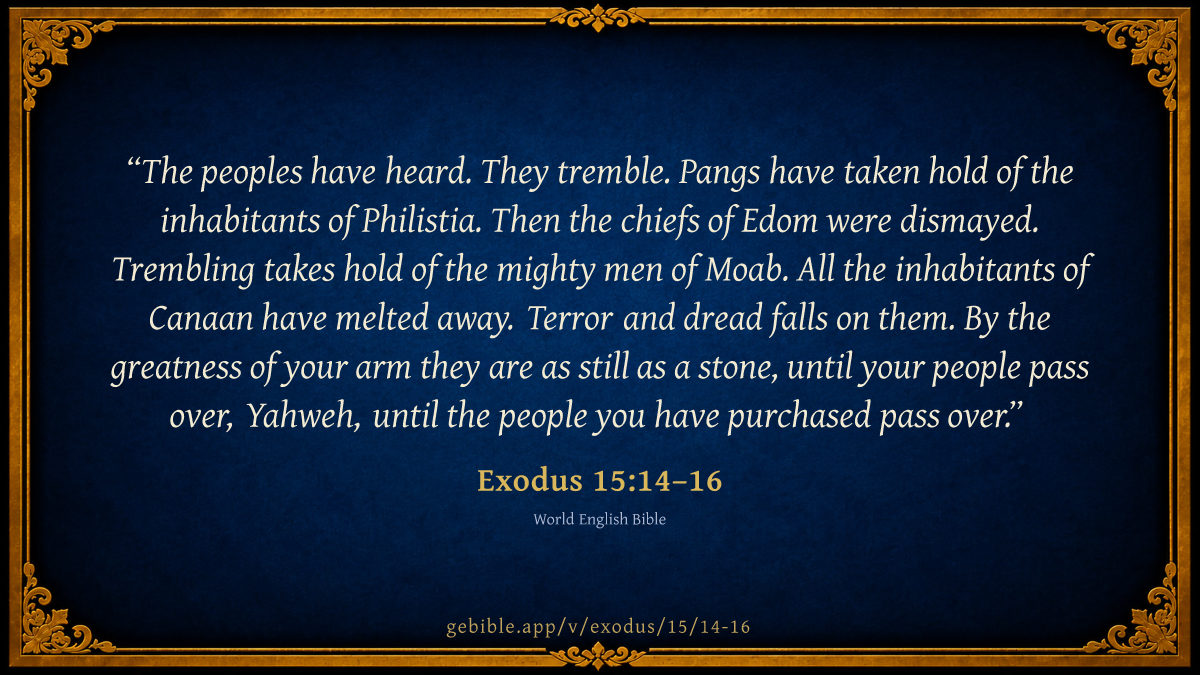
14The peoples have heard. They tremble. Pangs have taken hold of the inhabitants of Philistia.
15Then the chiefs of Edom were dismayed. Trembling takes hold of the mighty men of Moab. All the inhabitants of Canaan have melted away.
16Terror and dread falls on them. By the greatness of your arm they are as still as a stone, until your people pass over, Yahweh, until the people you have purchased pass over.
14 The peoples have heard. They tremble. Pangs have taken hold of the inhabitants of Philistia.
15 Then the chiefs of Edom were dismayed. Trembling takes hold of the mighty men of Moab. All the inhabitants of Canaan have melted away.
16 Terror and dread falls on them. By the greatness of your arm they are as still as a stone, until your people pass over, Yahweh, until the people you have purchased pass over.
KJVKing James Version
14 The people shall hear, and be afraid: sorrow shall take hold on the inhabitants of Palestina.
15 Then the dukes of Edom shall be amazed; the mighty men of Moab, trembling shall take hold upon them; all the inhabitants of Canaan shall melt away.
16 Fear and dread shall fall upon them; by the greatness of thine arm they shall be as still as a stone; till thy people pass over, O LORD, till the people pass over, which thou hast purchased.
Show all 3 translations
JPSJPS Tanakh (1917)
14 The peoples have heard, they tremble; pangs have taken hold on the inhabitants of Philistia.
15 Then were the chiefs of Edom affrighted; the mighty men of Moab, trembling taketh hold upon them; all the inhabitants of Canaan are melted away.
16 Terror and dread falleth upon them; by the greatness of Thine arm they are as still as a stone; till Thy people pass over, O LORD, till the people pass over that Thou hast gotten.
Deuteronomy 2:25(vv14, 16)Today I will begin to put the dread of you and the fear of you on the peoples who are under the whole sky, who shall hear the report of…
Psalms 74:2(v16)Remember your congregation, which you purchased of old, which you have redeemed to be the tribe of your inheritance: Mount Zion, in which…
Joshua 2:9-10(v14)She said to the men, “I know that Yahweh has given you the land, and that the fear of you has fallen upon us, and that all the inhabitants…
Joshua 5:1(v15)When all the kings of the Amorites, who were beyond the Jordan westward, and all the kings of the Canaanites, who were by the sea, heard…
Joshua 2:9(vv15–16)She said to the men, “I know that Yahweh has given you the land, and that the fear of you has fallen upon us, and that all the inhabitants…
Show all 46 cross-references
Joshua 2:11(v15)As soon as we had heard it, our hearts melted, and there wasn’t any more spirit in any man, because of you: for Yahweh your God, he is God…
1 Samuel 25:37(v16)In the morning, when the wine had gone out of Nabal, his wife told him these things, and his heart died within him, and he became as a…
Psalms 48:6(v14)Trembling took hold of them there, pain, as of a woman in travail.
Genesis 36:40(v15)These are the names of the chiefs who came from Esau, according to their families, after their places, and by their names: chief Timna,…
Exodus 11:7(v16)But against any of the children of Israel a dog won’t even bark or move its tongue, against man or animal, that you may know that Yahweh…
Numbers 14:14(v14)They will tell it to the inhabitants of this land. They have heard that you Yahweh are among this people; for you Yahweh are seen face to…
Deuteronomy 2:4(v15)Command the people, saying, ‘You are to pass through the border of your brothers, the children of Esau, who dwell in Seir; and they will be…
Deuteronomy 11:25(v16)No man will be able to stand before you. Yahweh your God will lay the fear of you and the dread of you on all the land that you tread on,…
Joshua 9:24(v14)They answered Joshua, and said, “Because your servants were certainly told how Yahweh your God commanded his servant Moses to give you all…
Psalms 68:2(v15)As smoke is driven away, so drive them away. As wax melts before the fire, so let the wicked perish at the presence of God.
Isaiah 14:31(v14)Howl, gate! Cry, city! You are melted away, Philistia, all of you; for smoke comes out of the north, and there is no straggler in his ranks.
Isaiah 43:1-3(v16)But now Yahweh who created you, Jacob, and he who formed you, Israel, says: “Don’t be afraid, for I have redeemed you. I have called you by…
Isaiah 51:10(v16)Isn’t it you who dried up the sea, the waters of the great deep; who made the depths of the sea a way for the redeemed to pass over?
Jeremiah 31:11(v16)For Yahweh has ransomed Jacob, and redeemed him from the hand of him who was stronger than he.
Titus 2:14(v16)who gave himself for us, that he might redeem us from all iniquity, and purify for himself a people for his own possession, zealous for…
1 Peter 2:9(v16)But you are a chosen race, a royal priesthood, a holy nation, a people for God’s own possession, that you may proclaim the excellence of…
2 Peter 2:1(v16)But false prophets also arose among the people, as false teachers will also be among you, who will secretly bring in destructive heresies,…
Exodus 19:5-6(v16)Now therefore, if you will indeed obey my voice, and keep my covenant, then you shall be my own possession from among all peoples; for all…
Exodus 23:27(v16)I will send my terror before you, and will confuse all the people to whom you come, and I will make all your enemies turn their backs to…
Numbers 20:14-21(v15)Moses sent messengers from Kadesh to the king of Edom, saying: “Your brother Israel says: You know all the travail that has happened to us;…
Numbers 22:3-5(v15)Moab was very afraid of the people, because they were many. Moab was distressed because of the children of Israel. Moab said to the elders…
Numbers 22:5(v14)He sent messengers to Balaam the son of Beor, to Pethor, which is by the River, to the land of the children of his people, to call him,…
Deuteronomy 2:4-5(v14)Command the people, saying, ‘You are to pass through the border of your brothers, the children of Esau, who dwell in Seir; and they will be…
Deuteronomy 20:8(v15)The officers shall speak further to the people, and they shall say, “What man is there who is fearful and faint-hearted? Let him go and…
Deuteronomy 32:6(v16)Is this the way you repay Yahweh, foolish and unwise people? Isn’t he your father who has bought you? He has made you and established you.
Deuteronomy 32:9(v16)For Yahweh’s portion is his people. Jacob is the lot of his inheritance.
Joshua 2:24(v15)They said to Joshua, “Truly Yahweh has delivered all the land into our hands. Moreover, all the inhabitants of the land melt away before…
Joshua 14:8(v15)Nevertheless, my brothers who went up with me made the heart of the people melt; but I wholly followed Yahweh my God.
1 Samuel 2:9(v16)He will keep the feet of his holy ones, but the wicked will be put to silence in darkness; for no man will prevail by strength.
1 Samuel 14:16(v15)The watchmen of Saul in Gibeah of Benjamin looked; and behold, the multitude melted away and scattered.
2 Samuel 7:23(v16)What one nation in the earth is like your people, even like Israel, whom God went to redeem to himself for a people, and to make himself a…
2 Samuel 17:10(v15)Even he who is valiant, whose heart is as the heart of a lion, will utterly melt; for all Israel knows that your father is a mighty man,…
Isaiah 13:7(v15)Therefore all hands will be feeble, and everyone’s heart will melt.
Isaiah 14:29(v14)Don’t rejoice, O Philistia, all of you, because the rod that struck you is broken; for out of the serpent’s root an adder will emerge, and…
Isaiah 19:1(v15)The burden of Egypt. “Behold, Yahweh rides on a swift cloud, and comes to Egypt. The idols of Egypt will tremble at his presence; and the…
Ezekiel 21:7(v15)It shall be, when they ask you, ‘Why do you sigh?’ that you shall say, ‘Because of the news, for it comes! Every heart will melt, all hands…
Nahum 2:10(v15)She is empty, void, and waste. The heart melts, the knees knock together, their bodies and faces have grown pale.
Habakkuk 3:7(v15)I saw the tents of Cushan in affliction. The dwellings of the land of Midian trembled.
Acts 20:28(v16)Take heed, therefore, to yourselves, and to all the flock, in which the Holy Spirit has made you overseers, to shepherd the assembly of the…
Genesis 36:15(v15)These are the chiefs of the sons of Esau: the sons of Eliphaz the firstborn of Esau: chief Teman, chief Omar, chief Zepho, chief Kenaz,
46 distinct cross-references across this passage (48 total citations).
Cross-references from openbible.info (CC BY 4.0)
Explain this passage (13 sources)
Historical commentary, presented as a primary source — not an endorsement.
Geneva Bible translators1599 · Public DomainOn v16Or, for thy great power.
Or, for thy great power.
Geneva Bible (1599) marginal notes — public domain.
John Trapp1656 · Public DomainOn vv14–16Exo 15:14 The people shall hear, [and] be afraid:…
Exo 15:14 The people shall hear, [and] be afraid: sorrow shall take hold on the inhabitants of Palestina.
Ver. 14. So, now shall take hold.] So it did. {1Sa 4:8}
John Trapp, A Commentary or Exposition upon All the Books of the Old and New Testament (1647–1656) — public domain. Text from a community e-Sword module.
Matthew Poole1685 · Public DomainOn v16Be as still, or, be as silent; they shall…
Be as still, or, be as silent; they shall be so struck. with amazement, that they shall be impotent both for speech and motion.
Matthew Poole's English Annotations on the Holy Bible (1683–1685) — public domain. Text from a community e-Sword/MySword module.
John Gill1763 · Public DomainOn vv14–16And the people shall hear, and be afraid,.... What…
And the people shall hear, and be afraid,.... What follows from hence to the end of the song is plainly prophetic, a prediction of future events; and this clause respects the case of all the nations of the earth, who should hear the report of the plagues, brought upon the Egyptians for the sake of Israel, and of their being brought out of Egypt, and of their being led through the Red sea as on dry land, and of the destruction of Pharaoh and his host in it, which report would strike a panic in all that heard it, throughout the whole world; as well as of what the Lord would after this do for them in the wilderness, see Deu 2:25.
sorrow shall take hold of the inhabitants of Palestina; which was adjoining to the land of Canaan, and through which in the common way their road lay to it.
John Gill's Exposition of the Whole Bible (1746–1763) — public domain (CC PDM 1.0). Text via the HelloAO Bible API.
Adam Clarke1810 · Public DomainOn vv15–16Verse 15. The dukes of Edom] Idumea was governed…
Verse 15. The dukes of Edom] Idumea was governed at this time by those called אלפים alluphim, heads, chiefs, or captains. See Clarke on Ge 36:15.
Adam Clarke's Commentary on the Bible (1810–1826) — public domain. Text from a community e-Sword/MySword module.
Haydock's Catholic Bible Commentary1859 · Public DomainOn vv15–16Stiff, with consternation. See Josue ix. 9. The nations…
Stiff, with consternation. See Josue ix. 9. The nations of Chanaan found auxiliaries even among the near relations of the Hebrews, the children of Esau, (who were not governed by princes, Alphim, as Genesis xxxvi.) and of Lot. We easily forget our relations, when our interest is at stake! Hebrew, instead of being stiff, says, they "melted away." Both words insinuate, that their heart was under such a violent struggle, that they could perform no duty.
George Leo Haydock (1774–1849), Haydock's Catholic Family Bible and Commentary, 1859 edition — public domain. Excludes Psalms (Douay-Rheims chapter numbering differs from Protestant) and Deuterocanonical books (Catholic canon only).
Daniel D. Whedon1874 · Public DomainOn v1414-17. Fifth strain. The Egyptians were conquered, but other…
14-17. Fifth strain. The Egyptians were conquered, but other foes yet lay between the Israelites and the promised inheritance. The Canaanites filled the land, and Philistia barred one gate of entrance, while Moab and Edom held the other. It is a noteworthy mark of the genuineness of this prophecy that Canaan and Phllistia, Edom and Moab, are all spoken of in the same terms; yet, while the Canaanites were exterminated, Israel passed by Edom, (Num_20:18, etc.,) while Moab and Philistia were rival nations through all the centuries of the Hebrew commonwealth and monarchy. A poet would naturally have written thus at the time of the exodus, when he had simply the general revelation that Israel would triumph over all these enemies; but after the conquest of Canaan some distinction would naturally have been made between nations which were exterminated and those which never lost their independence.
The theme of this last stanza is introduced with wonderful boldness and vigour, hurling out the words without article or connective.
Read full note →
Palestina — Palestuth, Philistia; the meaning of the word Palestine or Palestina throughout the Bible. This was the dwelling-place of the Philistines, the long, fertile plain, about fifteen miles wide, which skirts the Mediterranean from the coast to the foot-hills of the mountains of Judah, and now, as probably then, an enormous wheat field. The name was afterwards extended to the whole of Canaan. Note Act_8:40.
Edom — Idumea, Mount Seir, and the adjacent desert; the mountainous and desert country east of the Arabah, stretching from the head of the eastern gulf of the Red Sea to the Jordan valley; separated by the brook Zered from Moab, which skirts the eastern shore of the Dead Sea.
Till thy people pass through — Through the desert to the Land of Promise. The strain closes with a beautiful parallelism and climax.
Thou shalt… plant them in the mountain — Israel, like a fruitful tree, is to be planted in God’s mountain-land, God’s dwelling-place, God’s sanctuary, country, home, altar. (Murphy.) How calm the close! How delightful to repose under the vine and fig tree, to rest in the peaceful home, to cling to the sacred altar, after this tempest of emotions! And then from the whole congregation bursts forth the grand chorus,
Jehovah shall reign for ever and ever — And the hearts of the vast host are all lifted heavenward and left before the Throne.
The saints on “the sea of glass” will sing the “song of Moses the servant of God, and the song of the Lamb.” Rev_15:3. The birth-song of ransomed Israel is, in its deeper meanings, the birth-song of the spiritual Israel of all ages — of the great redemption from the darkness and death of sin. The profound and far-reaching spiritual significance of these Old Testament events will be fully felt when “God’s mystery is finished;”
when type and antitype, prophecy and history, law and gospel, will blend in one blaze of light. Christ is in all the Old Covenant as Moses is in all the New; the “Song of Moses” is the “Song of the Lamb.” “The word is nigh” us, though it comes to us across so many centuries, for it is a word from Jehovah, and not to Israel alone, but to mankind — to me and thee.
Daniel D. Whedon (gen. ed.), Commentary on the Old and New Testaments (1874–1909) — public domain. Text from a community e-Sword module.
The Cambridge Bible for Schools and Colleges1878 · Public DomainOn vv14–1614.The peoples heard, they trembled;
14.The peoples heard, they trembled;
Pangs took hold on the inhabitants of Philistia.
Read full note →
Pangs] Properly, as of a woman in travail. Cf. Psa_48:6, Jer_6:24; Jer_50:43.
14–16. The poet pictures the neighbouring nations as seized with alarm, when they hear that Israel is advancing on its way to Canaan. The description is idealized: Edom, for instance, according to Num_20:18-21, was in no fear of Israel whatever.
The Cambridge Bible for Schools and Colleges (gen. ed. J. J. S. Perowne; Cambridge University Press, 1878–1918) — public domain. Text from a community e-Sword module.
Ellicott's Commentary for English Readers1878 · Public DomainOn vv14–16(14) The people.—Heb., The peoples: i.e., all the various…
(14) The people.—Heb., The peoples: i.e., all the various tribes and nations of the desert and of Palestine—the Amalekites, Edomites, Philistines, Moabites, Amorites, &c.
Shall hear, and be afraid.—On the fear which was actually felt, see Num_22:3; Jos_2:11; Jos_5:1; Jos_9:3-15, &c.
Read full note →
The inhabitants of Palestina are the Philistines, from whom the Holy Land derived the name which it still retains in most of the languages of modern Europe. The Hebrew word is Phĕlâsheth, of which the nearest English equivalent would be “Philistia.”
A Bible Commentary for English Readers, edited by Charles John Ellicott (1878–1897) — public domain. Text from a community e-Sword module.
The Pulpit Commentary1880 · Public DomainOn vv14–16The people shall hear. Rather, "the peoplesi.e. , the…
The people shall hear. Rather, "the peoplesi.e. , the tribes, or nations, of these parts Philistines, Amalekites, Edomites, Moabites, etc. will hear of the wonders done in Egypt, especially of the crowning wonder of all Israel"s passage through the Red Sea and Egypt"s destruction in it and will in consequence tremble with fear when the Israelites approach them, and offer them no effectual opposition. Palestine. This is a Greek form. The Hebrew is Phelasheth, which would perhaps be best translated "Philistia." (Compare Psa_60:8 Psa_87:4 Psa_108:9) The Philistine country was a strip of territory extending along the coast of the Mediterranean from a little below Gaze on the south, nearly to Mount Carmel on the north. It is curious that the philistines are not mentioned under that name on any of the early Egyptian monuments. They may perhaps be the Purusaia of the time of Rameses III, whom some however identify with the Pelasgi.
The Pulpit Commentary (1880–1919), ed. H.D.M. Spence-Jones & Joseph S. Exell — public domain. Text from a community e-Sword module.
The Biblical Illustrator1887 · Public DomainOn v14The people shall hear, and be afraid.
Exo_15:14-16
The people shall hear, and be afraid.
Read full note →
The world afraid of Gods people
What shall make these mighty men melt away? Seeing two or three millions of unwarlike folks marching towards them--an unarmed rabble, without military discipline, and without the appliances of war? Is it before such that the mighty men of Moab are to fall back, that the chivalrous sons of Edom are to be put to flight; that all the inhabitants of Palestine are to melt away? Nothing of the kind. Those Israelites were not going to terrify all these nations with any display of their own power or prowess. It was the story of the Exodus, the story of a divided sea, the story of a certain mysterious pillar of fire, the story of the wonderful overthrow of Pharaoh and his hosts in the Red Sea; it was this that was to fill them with despair. Many of us are at the outset terribly afraid of these hostile forces; is it not a comfort to know that on account of redemption they are actually afraid of us? In a very memorable period in our island story, when Admiral Howard and Drake had defeated the Spanish Armada after the first great battle, they continued to pursue them for a fortnight without having a single shot or a single charge of powder left in their ships. They had nothing left but air to fill their guns with. Yet thus without any ammunition our fleet went sailing on and sailing on, while the terrified strangers fled before them, until they were driven right into the Northern Sea. Then the Admiral thought they could not do much harm there, and so he left them and came back to get powder and shot for his own ships. Our fleet, with empty guns, chased their enemies because that enemy was afraid of them. They had had one terrible defeat, and that was enough. And even so may we deal with the forces of this world. Count upon your enemies being afraid of you. If instead of being afraid of them you will only carry the war into the enemys camp, and seek to win them for Christ, instead of allowing them to draw you away from Him, you will find that redemption has already stripped them of their courage and paralyzed their power to do you any injury. (W. Hay Aitken, M. A.)
The Biblical Illustrator, edited by Joseph S. Exell (c. 1880s–1900s) — public domain. Text from a community e-Sword module.
unfoldingWord translationNotes2017 · CC BY-SA 4.0On vv14, 16This means to shake because you are afraid.
tremble
This means to shake because you are afraid.
Read full note →
terror will seize the inhabitants of Philistia
Moses speaks of terror as if it were a person that could forcefully grab hold of someone and make them extremely afraid. AT: "the inhabitants of Philistia will be afraid" (See: Personification)
will melt away
Moses speaks of people becoming weak from their fear as melting away. AT: "will be weak from fear" or "will be afraid and faint" (See: Metaphor)
Tyndale Open Study Notes2022 · CC BY-SA 4.0On v1415:14-15 Philistia, Edom, Moab, and Canaan are the four…
15:14-15 Philistia, Edom, Moab, and Canaan are the four peoples that would most feel the hand of God’s judgment as he dispossessed them to give the land to the people of Israel. What God had done to Egypt would have been common news throughout that part of the world (see Rahab’s report in Josh 2:9-11, where the same imagery as in Exod 15:15, to melt away, is used).

Geneva Bible translators 1599 · Public Domain On v16 Or, for thy great power.
Or, for thy great power.
Geneva Bible (1599) marginal notes — public domain.
John Trapp 1656 · Public Domain On vv14–16 Exo 15:14 The people shall hear, [and] be afraid:…
Exo 15:14 The people shall hear, [and] be afraid: sorrow shall take hold on the inhabitants of Palestina.
Ver. 14. So, now shall take hold.] So it did. {1Sa 4:8}
John Trapp, A Commentary or Exposition upon All the Books of the Old and New Testament (1647–1656) — public domain. Text from a community e-Sword module.
Matthew Poole 1685 · Public Domain On v16 Be as still, or, be as silent; they shall…
Be as still, or, be as silent; they shall be so struck. with amazement, that they shall be impotent both for speech and motion.
Matthew Poole's English Annotations on the Holy Bible (1683–1685) — public domain. Text from a community e-Sword/MySword module.
John Gill 1763 · Public Domain On vv14–16 And the people shall hear, and be afraid,.... What…
And the people shall hear, and be afraid,.... What follows from hence to the end of the song is plainly prophetic, a prediction of future events; and this clause respects the case of all the nations of the earth, who should hear the report of the plagues, brought upon the Egyptians for the sake of Israel, and of their being brought out of Egypt, and of their being led through the Red sea as on dry land, and of the destruction of Pharaoh and his host in it, which report would strike a panic in all that heard it, throughout the whole world; as well as of what the Lord would after this do for them in the wilderness, see Deu 2:25.
sorrow shall take hold of the inhabitants of Palestina; which was adjoining to the land of Canaan, and through which in the common way their road lay to it.
John Gill's Exposition of the Whole Bible (1746–1763) — public domain (CC PDM 1.0). Text via the HelloAO Bible API.
Adam Clarke 1810 · Public Domain On vv15–16 Verse 15. The dukes of Edom] Idumea was governed…
Verse 15. The dukes of Edom] Idumea was governed at this time by those called אלפים alluphim, heads, chiefs, or captains. See Clarke on Ge 36:15.
Adam Clarke's Commentary on the Bible (1810–1826) — public domain. Text from a community e-Sword/MySword module.
Haydock's Catholic Bible Commentary 1859 · Public Domain On vv15–16 Stiff, with consternation. See Josue ix. 9. The nations…
Stiff, with consternation. See Josue ix. 9. The nations of Chanaan found auxiliaries even among the near relations of the Hebrews, the children of Esau, (who were not governed by princes, Alphim, as Genesis xxxvi.) and of Lot. We easily forget our relations, when our interest is at stake! Hebrew, instead of being stiff, says, they "melted away." Both words insinuate, that their heart was under such a violent struggle, that they could perform no duty.
George Leo Haydock (1774–1849), Haydock's Catholic Family Bible and Commentary, 1859 edition — public domain. Excludes Psalms (Douay-Rheims chapter numbering differs from Protestant) and Deuterocanonical books (Catholic canon only).
Daniel D. Whedon 1874 · Public Domain On v14 14-17. Fifth strain. The Egyptians were conquered, but other…
14-17. Fifth strain. The Egyptians were conquered, but other foes yet lay between the Israelites and the promised inheritance. The Canaanites filled the land, and Philistia barred one gate of entrance, while Moab and Edom held the other. It is a noteworthy mark of the genuineness of this prophecy that Canaan and Phllistia, Edom and Moab, are all spoken of in the same terms; yet, while the Canaanites were exterminated, Israel passed by Edom, (Num_20:18, etc.,) while Moab and Philistia were rival nations through all the centuries of the Hebrew commonwealth and monarchy. A poet would naturally have written thus at the time of the exodus, when he had simply the general revelation that Israel would triumph over all these enemies; but after the conquest of Canaan some distinction would naturally have been made between nations which were exterminated and those which never lost their independence.
The theme of this last stanza is introduced with wonderful boldness and vigour, hurling out the words without article or connective.
Read full note →
Palestina — Palestuth, Philistia; the meaning of the word Palestine or Palestina throughout the Bible. This was the dwelling-place of the Philistines, the long, fertile plain, about fifteen miles wide, which skirts the Mediterranean from the coast to the foot-hills of the mountains of Judah, and now, as probably then, an enormous wheat field. The name was afterwards extended to the whole of Canaan. Note Act_8:40.
Edom — Idumea, Mount Seir, and the adjacent desert; the mountainous and desert country east of the Arabah, stretching from the head of the eastern gulf of the Red Sea to the Jordan valley; separated by the brook Zered from Moab, which skirts the eastern shore of the Dead Sea.
Till thy people pass through — Through the desert to the Land of Promise. The strain closes with a beautiful parallelism and climax.
Thou shalt… plant them in the mountain — Israel, like a fruitful tree, is to be planted in God’s mountain-land, God’s dwelling-place, God’s sanctuary, country, home, altar. (Murphy.) How calm the close! How delightful to repose under the vine and fig tree, to rest in the peaceful home, to cling to the sacred altar, after this tempest of emotions! And then from the whole congregation bursts forth the grand chorus,
Jehovah shall reign for ever and ever — And the hearts of the vast host are all lifted heavenward and left before the Throne.
The saints on “the sea of glass” will sing the “song of Moses the servant of God, and the song of the Lamb.” Rev_15:3. The birth-song of ransomed Israel is, in its deeper meanings, the birth-song of the spiritual Israel of all ages — of the great redemption from the darkness and death of sin. The profound and far-reaching spiritual significance of these Old Testament events will be fully felt when “God’s mystery is finished;”
when type and antitype, prophecy and history, law and gospel, will blend in one blaze of light. Christ is in all the Old Covenant as Moses is in all the New; the “Song of Moses” is the “Song of the Lamb.” “The word is nigh” us, though it comes to us across so many centuries, for it is a word from Jehovah, and not to Israel alone, but to mankind — to me and thee.
Daniel D. Whedon (gen. ed.), Commentary on the Old and New Testaments (1874–1909) — public domain. Text from a community e-Sword module.
The Cambridge Bible for Schools and Colleges 1878 · Public Domain On vv14–16 14.The peoples heard, they trembled;
14.The peoples heard, they trembled;
Pangs took hold on the inhabitants of Philistia.
Read full note →
Pangs] Properly, as of a woman in travail. Cf. Psa_48:6, Jer_6:24; Jer_50:43.
14–16. The poet pictures the neighbouring nations as seized with alarm, when they hear that Israel is advancing on its way to Canaan. The description is idealized: Edom, for instance, according to Num_20:18-21, was in no fear of Israel whatever.
The Cambridge Bible for Schools and Colleges (gen. ed. J. J. S. Perowne; Cambridge University Press, 1878–1918) — public domain. Text from a community e-Sword module.
Ellicott's Commentary for English Readers 1878 · Public Domain On vv14–16 (14) The people.—Heb., The peoples: i.e., all the various…
(14) The people.—Heb., The peoples: i.e., all the various tribes and nations of the desert and of Palestine—the Amalekites, Edomites, Philistines, Moabites, Amorites, &c.
Shall hear, and be afraid.—On the fear which was actually felt, see Num_22:3; Jos_2:11; Jos_5:1; Jos_9:3-15, &c.
Read full note →
The inhabitants of Palestina are the Philistines, from whom the Holy Land derived the name which it still retains in most of the languages of modern Europe. The Hebrew word is Phĕlâsheth, of which the nearest English equivalent would be “Philistia.”
A Bible Commentary for English Readers, edited by Charles John Ellicott (1878–1897) — public domain. Text from a community e-Sword module.
The Pulpit Commentary 1880 · Public Domain On vv14–16 The people shall hear. Rather, "the peoplesi.e. , the…
The people shall hear. Rather, "the peoplesi.e. , the tribes, or nations, of these parts Philistines, Amalekites, Edomites, Moabites, etc. will hear of the wonders done in Egypt, especially of the crowning wonder of all Israel"s passage through the Red Sea and Egypt"s destruction in it and will in consequence tremble with fear when the Israelites approach them, and offer them no effectual opposition. Palestine. This is a Greek form. The Hebrew is Phelasheth, which would perhaps be best translated "Philistia." (Compare Psa_60:8 Psa_87:4 Psa_108:9) The Philistine country was a strip of territory extending along the coast of the Mediterranean from a little below Gaze on the south, nearly to Mount Carmel on the north. It is curious that the philistines are not mentioned under that name on any of the early Egyptian monuments. They may perhaps be the Purusaia of the time of Rameses III, whom some however identify with the Pelasgi.
The Pulpit Commentary (1880–1919), ed. H.D.M. Spence-Jones & Joseph S. Exell — public domain. Text from a community e-Sword module.
The Biblical Illustrator 1887 · Public Domain On v14 The people shall hear, and be afraid.
Exo_15:14-16
The people shall hear, and be afraid.
Read full note →
The world afraid of Gods people
What shall make these mighty men melt away? Seeing two or three millions of unwarlike folks marching towards them--an unarmed rabble, without military discipline, and without the appliances of war? Is it before such that the mighty men of Moab are to fall back, that the chivalrous sons of Edom are to be put to flight; that all the inhabitants of Palestine are to melt away? Nothing of the kind. Those Israelites were not going to terrify all these nations with any display of their own power or prowess. It was the story of the Exodus, the story of a divided sea, the story of a certain mysterious pillar of fire, the story of the wonderful overthrow of Pharaoh and his hosts in the Red Sea; it was this that was to fill them with despair. Many of us are at the outset terribly afraid of these hostile forces; is it not a comfort to know that on account of redemption they are actually afraid of us? In a very memorable period in our island story, when Admiral Howard and Drake had defeated the Spanish Armada after the first great battle, they continued to pursue them for a fortnight without having a single shot or a single charge of powder left in their ships. They had nothing left but air to fill their guns with. Yet thus without any ammunition our fleet went sailing on and sailing on, while the terrified strangers fled before them, until they were driven right into the Northern Sea. Then the Admiral thought they could not do much harm there, and so he left them and came back to get powder and shot for his own ships. Our fleet, with empty guns, chased their enemies because that enemy was afraid of them. They had had one terrible defeat, and that was enough. And even so may we deal with the forces of this world. Count upon your enemies being afraid of you. If instead of being afraid of them you will only carry the war into the enemys camp, and seek to win them for Christ, instead of allowing them to draw you away from Him, you will find that redemption has already stripped them of their courage and paralyzed their power to do you any injury. (W. Hay Aitken, M. A.)
The Biblical Illustrator, edited by Joseph S. Exell (c. 1880s–1900s) — public domain. Text from a community e-Sword module.
unfoldingWord translationNotes 2017 · CC BY-SA 4.0 On vv14, 16 This means to shake because you are afraid.
tremble
This means to shake because you are afraid.
Read full note →
terror will seize the inhabitants of Philistia
Moses speaks of terror as if it were a person that could forcefully grab hold of someone and make them extremely afraid. AT: "the inhabitants of Philistia will be afraid" (See: Personification)
will melt away
Moses speaks of people becoming weak from their fear as melting away. AT: "will be weak from fear" or "will be afraid and faint" (See: Metaphor)
translationWords
people group
seize
Philistines
Edom
Moab
Canaan
unfoldingWord translationNotes — © Distant Shores Media and the Door43 World Missions Community, licensed CC BY-SA 4.0. Source: git.door43.org/Door43/en_tn.
Tyndale Open Study Notes 2022 · CC BY-SA 4.0 On v14 15:14-15 Philistia, Edom, Moab, and Canaan are the four…
15:14-15 Philistia, Edom, Moab, and Canaan are the four peoples that would most feel the hand of God’s judgment as he dispossessed them to give the land to the people of Israel. What God had done to Egypt would have been common news throughout that part of the world (see Rahab’s report in Josh 2:9-11, where the same imagery as in Exod 15:15, to melt away, is used).
Tyndale Open Study Notes — © Tyndale Open Resources, licensed CC BY-SA 4.0. Text via the HelloAO Bible API.