
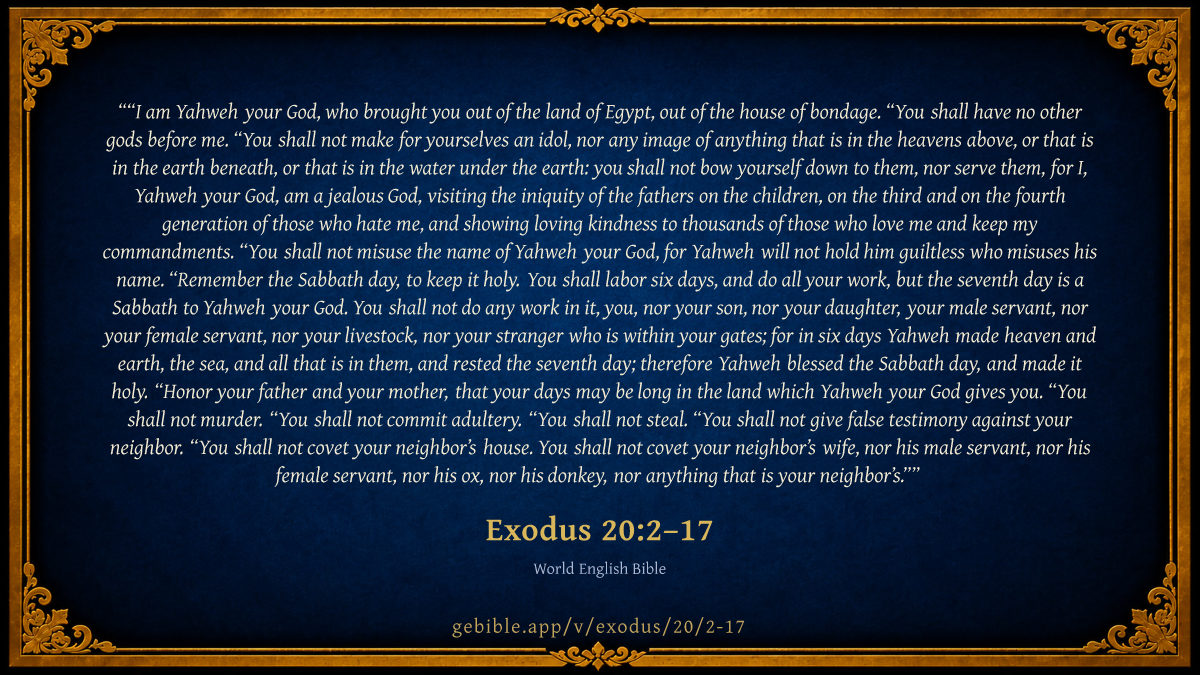
“I am Yahweh your God, who brought you out of the land of Egypt, out of the house of bondage.
“You shall have no other gods before me.
“You shall not make for yourselves an idol, nor any image of anything that is in the heavens above, or that is in the earth beneath, or that is in the water under the earth: you shall not bow yourself down to them, nor serve them, for I, Yahweh your God, am a jealous God, visiting the iniquity of the fathers on the children, on the third and on the fourth generation of those who hate me, and showing loving kindness to thousands of those who love me and keep my commandments.
“You shall not misuse the name of Yahweh your God, for Yahweh will not hold him guiltless who misuses his name.
“Remember the Sabbath day, to keep it holy. You shall labor six days, and do all your work, but the seventh day is a Sabbath to Yahweh your God. You shall not do any work in it, you, nor your son, nor your daughter, your male servant, nor your female servant, nor your livestock, nor your stranger who is within your gates; for in six days Yahweh made heaven and earth, the sea, and all that is in them, and rested the seventh day; therefore Yahweh blessed the Sabbath day, and made it holy.
“Honor your father and your mother, that your days may be long in the land which Yahweh your God gives you.
“You shall not murder.
“You shall not commit adultery.
“You shall not steal.
“You shall not give false testimony against your neighbor.
“You shall not covet your neighbor’s house. You shall not covet your neighbor’s wife, nor his male servant, nor his female servant, nor his ox, nor his donkey, nor anything that is your neighbor’s.”
Geneva Bible translators 1599 · Public Domain On vv2, 3, 5, 6, 7, 8, 10, 12, 13, 14, 15, 16, 17 Or, servants.
Or, servants.
Geneva Bible (1599) marginal notes — public domain.
John Trapp 1656 · Public Domain On vv2–17 Exo 20:2 I [am] the LORD thy God, which…
Exo 20:2 I [am] the LORD thy God, which have brought thee out of the land of Egypt, out of the house of bondage.
Ver. 2. Which have brought thee.] God’s blessings are binders; and every deliverance a tie to obedience. {See Trapp (for summary of Law) on "Exo 20:17"}
John Trapp, A Commentary or Exposition upon All the Books of the Old and New Testament (1647–1656) — public domain. Text from a community e-Sword module.
Matthew Poole 1685 · Public Domain On vv2–17 The only true God, and
The only true God, and
thy God by special title, having entered into covenant with thee, and chosen thee for my peculiar people, to protect, and rule, and bless thee above all others. God’s authority and right over them is fitly put in the front, as the foundation of all God’s commands, and their duties.
Read full note →
Which have brought thee out of the land of Egypt; and so by right of redemption thou art mine. Out of the house, i.e. the place; for so the word house is sometimes used, as Jdg 16:21.
Matthew Poole's English Annotations on the Holy Bible (1683–1685) — public domain. Text from a community e-Sword/MySword module.
Matthew Henry 1710 · Public Domain On v12 We have here the laws of the second table,…
We have here the laws of the second table, as they are commonly called, the last six of the ten commandments, comprehending our duty to ourselves and to one another, and constituting a comment upon the second great commandment, Thou shalt love thy neighbour as thyself. As religion towards God is an essential branch of universal righteousness, so righteousness towards men is an essential branch of true religion. Godliness and honesty must go together.
I. The fifth commandment concerns the duties we owe to our relations; those of children to their parents are alone specified: Honour thy father and thy mother, which includes, 1. A decent respect to their persons, an inward esteem of them outwardly expressed upon all occasions in our conduct towards them. Fear them (Lev 19:3), give them reverence, Heb 12:9. The contrary to this is mocking at them and despising them, Pro 30:17. 2. Obedience to their lawful commands; so it is expounded (Eph 6:1-3): "Children, obey your parents, come when they call you, go where they send you, do what they bid you, refrain from what they forbid you; and this, as children, cheerfully, and from a principle of love." Though you have said, "We will not," yet afterwards repent and obey, Mat 21:29. 3. Submission to their rebukes, instructions, and corrections; not only to the good and gentle, but also to the froward, out of conscience towards God. 4. Disposing of themselves with the advice, direction, and consent, of parents, not alienating their property, but with their approbation. 5. Endeavouring, in every thing, to be the comfort of their parents, and to make their old age easy to them, maintaining them if they stand in need of support, which our Saviour makes to be particularly intended in this commandment, Mat 15:4-6. The reason annexed to this commandment is a promise: That thy days may be long in the land which the Lord thy God giveth thee. Having mentioned, in the preface to the commandments, has bringing them out of Egypt as a reason for their obedience, he here, in the beginning of the second table, mentions his bringing them into Canaan, as another reason; that good land they must have upon their thoughts and in their eye, now that they were in the wilderness. They must also remember, when they came to that land, that they were upon their good behaviour, and that, if they did not conduct themselves well, their days should be shortened in that land, both the days of particular persons who should be cut off from it, and the days of their nation which should be removed out of it. But here a long life in that good land is promised particularly to obedient children. Those that do their duty to their parents are most likely to have the comfort of that which their parents gather for them and leave to them; those that support their parents shall find that God, the common Father, will support them. This promise is expounded (Eph 6:3), That it may be well with thee, and thou mayest live long on the earth. Those who, in conscience towards God, keep this and the rest of God's commandments, may be sure that it shall be well with them, and that they shall live as long on earth as Infinite Wisdom sees good for them, and that what they may seem to be cut short of on earth shall be abundantly made up in eternal life, the heavenly Canaan which God will give them.
Read full note →
II. The sixth commandment concerns our own and our neighbour's life (Exo 20:13): "Thou shalt not kill; thou shalt not do any thing hurtful or injurious to the health, ease, and life, of thy own body, or any other person's unjustly." This is one of the laws of nature, and was strongly enforced by the precepts given to Noah and his sons, Gen 9:5, Gen 9:6. It does not forbid killing in lawful war, or in our own necessary defence, nor the magistrate's putting offenders to death, for those things tend to the preserving of life; but it forbids all malice and hatred to the person of any (for he that hateth his brother is a murderer), and all personal revenge arising therefrom; also all rash anger upon sudden provocations, and hurt said or done, or aimed to be done, in passion: of this our Saviour expounds this commandment, Mat 5:22. And, as that which is worst of all, it forbids persecution, laying wait for the blood of the innocent and excellent ones of the earth.
III. The seventh commandment concerns our own and our neighbour's chastity: Thou shalt not commit adultery, Exo 20:14. This is put before the sixth by our Saviour (Mar 10:19): Do not commit adultery, do not kill; for our chastity should be as dear to us as our lives, and we should be as much afraid of that which defiles the body as of that which destroys it. This commandment forbids all acts of uncleanness, with all those fleshly lusts which produce those acts and war against the soul, and all those practices which cherish and excite those fleshly lusts, as looking, in order to lust, which, Christ tells us, is forbidden in this commandment, Mat 5:28.
IV. The eighth commandment concerns our own and our neighbour's wealth, estate, and goods: Thou shalt not steal, Exo 20:15. Though God had lately allowed and appointed them to spoil the Egyptians in a way of just reprisal, yet he did not intend that it should be drawn into a precedent and that they should be allowed thus to spoil one another. This command forbids us to rob ourselves of what we have by sinful spending, or of the use and comfort of it by sinful sparing, and to rob others by removing the ancient landmarks, invading our neighbour's rights, taking his goods from his person, or house, or field, forcibly or clandestinely, over-reaching in bargains, nor restoring what is borrowed or found, withholding just debts, rents, or wages, and (which is worst of all) to rob the public in the coin or revenue, or that which is dedicated to the service of religion.
V. The ninth commandment concerns our own and our neighbour's good name: Thou shalt not bear false witness, Exo 20:16. This forbids, 1. Speaking falsely in any matter, lying, equivocating, and any way devising and designing to deceive our neighbour. 2. Speaking unjustly against our neighbour, to the prejudice of his reputation; and (which involves the guilty of both), 3. Bearing false witness against him, laying to his charge things that he knows not, either judicially, upon oath (by which the third commandment, and the sixth of eighth, as well as this, are broken), or extrajudicially, in common converse, slandering, backbiting, tale-bearing, aggravating what is done amiss and making it worse than it is, and any way endeavouring to raise our own reputation upon the ruin of our neighbour's.
VI. The tenth commandment strikes at the root: Thou shalt not covet, Exo 20:17. The foregoing commands implicitly forbid all desire of doing that which will be an injury to our neighbour; this forbids all inordinate desire of having that which will be a gratification to ourselves. "O that such a man's house were mine! Such a man's wife mine! Such a man's estate mine!" This is certainly the language of discontent at our own lot, and envy at our neighbour's; and these are the sins principally forbidden here. St. Paul, when the grace of God caused the scales to fall from his eyes, perceived that this law, Thou shalt not covet, forbade all those irregular appetites and desires which are the first-born of the corrupt nature, the first risings of the sin that dwelleth in us, and the beginnings of all the sin that is committed by us: this is that lust which, he says, he had not known the evil of, if this commandment, when it came to his conscience in the power of it, had not shown it to him, Rom 7:7. God give us all to see our face in the glass of this law, and to lay our hearts under the government of it!
Matthew Henry's Commentary on the Whole Bible (1708–1710) — public domain (CC PDM 1.0). Text via the HelloAO Bible API.
John Gill 1763 · Public Domain On vv2–17 I am the Lord thy God,.... This verse does…
I am the Lord thy God,.... This verse does not contain the first of these commands, but is a preface to them, showing that God had a right to enact and enjoin the people of Israel laws; and that they were under obligation to attend unto them with reverence, and cheerfully obey them, since he was the Lord, the eternal and immutable Jehovah, the Being of beings, who gives being to all creatures, and gave them theirs, and therefore had a right to give them what laws he pleased; and he was their God, their covenant God, in a special and peculiar manner, their King and their God, they being a Theocracy, and so more immediately under his government, and therefore had laws given them preferable to what any other people had:
which have brought thee out of the land of Egypt: where they had been afflicted many years, and reduced to great distress, but were brought forth with an high hand, and with great riches, and in a very wonderful and miraculous manner; so that they were under great obligations to yield a ready and cheerful obedience to the will of God:
Read full note →
out of the house of bondage: or "servants" (b); that is, where they had been servants and slaves, but now were made free, and were become a body politic, a kingdom of themselves, under their Lord, King, Lawgiver, and Saviour, Jehovah himself, and therefore to be governed by laws of his enacting; and this shows that this body of laws was delivered out to the people of Israel, and primarily belong to them; for of no other can the above things be said.
(b) "servorum", Pagninus, Montanus, Tigurine version, Junius & Tremellius, Piscator.
John Gill's Exposition of the Whole Bible (1746–1763) — public domain (CC PDM 1.0). Text via the HelloAO Bible API.
John Wesley 1765 · Public Domain On vv2, 3, 7, 8, 12, 13, 14, 15, 16, 17 I am the Lord thy God - Herein, God…
I am the Lord thy God - Herein, God asserts his own authority to enact this law; and proposeth himself as the sole object of that religious worship which is enjoined in the four first commandments. They are here bound to obedience.
1. Because God is the Lord, Jehovah, self-existent, independent, eternal, and the fountain of all being and power; therefore he has an incontestable right to command us.
Read full note →
2. He was their God; a God in covenant with them; their God by their own consent.
3. He had brought them out of the land of Egypt - Therefore they were bound in gratitude to obey him, because he had brought them out of a grievous slavery into a glorious liberty. By redeeming them, he acquired a farther right to rule them; they owed their service to him, to whom they owed their freedom. And thus, Christ, having rescued us out of the bondage of sin, is entitled to the best service we can do him. The four first commandments, concern our duty to God (commonly called the first-table.) It was fit those should be put first, because man had a Maker to love before he had a neighbour to love, and justice and charity are then only acceptable to God when they flow from the principles of piety.
John Wesley, Explanatory Notes Upon the Whole Bible (1754–1765) — public domain. Text via the GEBible commentary corpus.
Adam Clarke 1810 · Public Domain On vv2, 3, 4, 5, 6, 7, 8, 9, 12, 13, 14, 15, 16, 17 Against mental or theoretic idolatry.
THE FIRST COMMANDMENT
Against mental or theoretic idolatry.
Read full note →
Verse 2. I am the LORD thy God] יהוה אלהיך Yehovah eloheycha. On the word JEHOVAH, which we here translate LORD, See Clarke on Ge 2:4, and "Ex 6:3". And on the word Elohim, here translated GOD, See Clarke on Ge 1:1. It is worthy of remark that each individual is addressed here, and not the people collectively, though they are all necessarily included; that each might feel that he was bound for himself to hear and do all these words. Moses laboured to impress this personal interest on the people's minds, when he said, De 5:3-4: "The Lord made this covenant with us, even us, who are all of us here alive this day."
Brought thee out of the land of Egypt, &c.] And by this very thing have proved myself to be superior to all gods, unlimited in power, and most gracious as well as fearful in operation. This is the preface or introduction, but should not be separated from the commandment. Therefore, -
Adam Clarke's Commentary on the Bible (1810–1826) — public domain. Text from a community e-Sword/MySword module.
Joseph Benson 1811 · Public Domain On vv2, 3, 7, 8, 12, 13, 14, 15, 16, 17 Exo 20:2. I am the Lord thy God —…
Exo 20:2. I am the Lord thy God — Herein God asserts his own authority to enact this law; and proposeth himself as the sole object of that religious worship which is enjoined in the four first commandments. They are here bound to obedience. 1st, Because God is the Lord, Jehovah, self-existent, independent, eternal, and the fountain of all being and power; therefore he has an incontestible right to command us. 2d, He was their God; a God in covenant with them; their God by their own consent. 3d, He had brought them out of the land of Egypt — Therefore they were bound in gratitude to obey him, because he had brought them out of a grievous slavery into a glorious liberty. By redeeming them, he acquired a further right to rule them; they owed their service to him to whom they owed their freedom. And thus Christ, having rescued us out of the bondage of sin, is entitled to the best service we can do for him. The first four commandments concern our duty to God, commonly called the first table. It was fit those should be put first, because man had a Maker to love before he had a neighbour to love, and justice and charity are then only acceptable to God when they flow from the principles of piety.
Joseph Benson's Commentary on the Old and New Testaments (1811–1818) — public domain. Text from a community e-Sword module.
Haydock's Catholic Bible Commentary 1859 · Public Domain On vv2, 3, 4, 5, 7, 8, 9, 10, 12, 13, 14, 15, 16, 17 Thy God. By this endearing title, we are all…
Thy God. By this endearing title, we are all required to consecrate our whole hearts and souls to our only Maker and Redeemer; and therefore we must love God sincerely, and comply with all his commandments. This preface to the Decalogue, enforces the acts of faith, hope, charity, religion, &c. (Haydock)
George Leo Haydock (1774–1849), Haydock's Catholic Family Bible and Commentary, 1859 edition — public domain. Excludes Psalms (Douay-Rheims chapter numbering differs from Protestant) and Deuterocanonical books (Catholic canon only).
Robert Jamieson, A. R. Fausset & David Brown 1871 · Public Domain On vv2, 3, 4, 8 I am the Lord thy God--This is a preface…
I am the Lord thy God--This is a preface to the ten commandments--the latter clause being specially applicable to the case of the Israelites, while the former brings it home to all mankind; showing that the reasonableness of the law is founded in their eternal relation as creatures to their Creator, and their mutual relations to each other.
Jamieson, Fausset & Brown — Commentary Critical and Explanatory on the Whole Bible (1871) — public domain (CC PDM 1.0). Text via the HelloAO Bible API.
Daniel D. Whedon 1874 · Public Domain On vv2–17 2. I am the Lord thy God — Many…
2. I am the Lord thy God — Many of the Jews, as we have seen above, regard this verse as the first of the ten words, or commandments, but they are rather of the nature of an introduction, showing emphatically the origin and source of the commandments. As the Eternal God, the I AM of previous revelation, (Exo_3:14-15,) he appropriately announces his NAME, and mentions the redemption from Egypt as a ground of obligation for Israel to hear and keep his commandments. The singular form of the address, thy God, not your God, gives a particular individuality of personal appeal to this announcement. The same is to be noted in each of the commandments which follow. The redemption out of the land of Egypt, out of the house of bondage, was the greatest fact in Israel’s history, and he who wrought that wonderful deliverance is the author of this holy law, and directs its words to every individual of the nation.
Daniel D. Whedon (gen. ed.), Commentary on the Old and New Testaments (1874–1909) — public domain. Text from a community e-Sword module.
The Cambridge Bible for Schools and Colleges 1878 · Public Domain On vv2–17 2. The Testimony (or attestation, averment, viz. of God’s…
2. The Testimony (or attestation, averment, viz. of God’s will; see on Exo_25:16): 36 times in P (cf. ibid.). Elsewhere in this sense only 2Ki_11:12 (but doubtfully: see Skinner in the Century Bible, and Barnes in the Cambr. Bible), and 2Ch_24:6 (as Num_17:7-8 al.).
2. Introduction. The commandments are introduced by the statement who it is that gives them: One, viz., who is Israel’s God and who has also been Israel’s benefactor; and who has thus both the right to impose them, and a claim upon Israel for obedience to them.
Read full note →
Jehovah thy God] so Exo_20:5; Exo_20:7; Exo_20:10; Exo_20:12; Exo_15:26 (see note), Exo_23:19 = Exo_34:26, Exo_34:24, and frequently (more than 200 times) in Dt. Not elsewhere in Ex.—Nu.
which brought thee out, &c.] and consequently has a claim upon thee for gratitude and obedience; cf. Exo_13:3; Exo_13:9; Exo_13:14; Exo_13:16 : he same motive, also, Deu_5:15; Deu_6:12; Deu_8:14; Deu_13:5; Deu_13:10; Amo_2:10; Hos_13:4 (RVm.).
the house of bondage (lit. of slaves)] as Exo_13:3 (see note), 14; and often in Dt. (cf. esp. Deu_6:12, Deu_8:14, Deu_13:10, just quoted).
The Cambridge Bible for Schools and Colleges (gen. ed. J. J. S. Perowne; Cambridge University Press, 1878–1918) — public domain. Text from a community e-Sword module.
Ellicott's Commentary for English Readers 1878 · Public Domain On vv2–17 (2) I am the Lord thy God.—The binding nature…
(2) I am the Lord thy God.—The binding nature of commands upon the conscience depends upon the authority of the person who issues them. That there might be no dispute as to what the authority was in the case of the Decalogue, God prefaced the commands themselves by this distinct statement. By whomsoever they were communicated (see the first Note on Exo_20:1), they were the commands of Jehovah Himself.
Which have brought thee out of the land of Egypt.—Thus exhibiting at once Almighty power and the tenderest compassion and care. God desires the obedience which springs from love, not fear.
A Bible Commentary for English Readers, edited by Charles John Ellicott (1878–1897) — public domain. Text from a community e-Sword module.
The Pulpit Commentary 1880 · Public Domain On vv2–17 I am the Lord thy God. The ten precepts…
I am the Lord thy God. The ten precepts were prefaced by this distinct announcement of who it was that uttered them. God would have the Israelites clearly understand, that he himself gave them the commandments. It is only possible to reconcile the declarations of the New Testament, that the law was given by the ministration of angels (Gal_3:19; Heb_2:2) with this and other plain statements, by regarding God the Son as the actual speaker. As sent by his father, he too was, in a certain sense, an angel (i.e. , a messenger). Which brought thee out of the land of Egypt. God does not appeal to his authority as creator, but to his mercy and kindness as protector and deliverer. He would be obeyed by his people from a sentiment of love, not by fear. Out of the house of bondage. Compare Exo_13:3, Exo_13:14; and for the ground of the expression, see Exo_1:14 Exo_6:9.
The Pulpit Commentary (1880–1919), ed. H.D.M. Spence-Jones & Joseph S. Exell — public domain. Text from a community e-Sword module.
The Biblical Illustrator 1887 · Public Domain On vv3, 4, 7, 8, 12, 13, 14, 15, 16, 17 Thou shalt have no other gods before Me.
Exo_20:3
Thou shalt have no other gods before Me.
Read full note →
The First Commandment
I. This Commandment does not tell the Jews that the gods worshipped by other nations have no existence; it tells him that he must offer them no homage, and that from him they must receive no recognition of their authority and power. The Jew must serve Jehovah, and Jehovah alone. This was the truest method of securing the ultimate triumph of monotheism. A religious dogma, true or false, perishes if it is not rooted in the religious affections and sustained by religious observances. But although the First Commandment does not declare that there is one God, the whole system of Judaism rests on that sublime truth, and what the Jews had witnessed in Egypt and since their escape from slavery must have done more to destroy their reverence for the gods of their old masters than could have been effected by any dogmatic declaration that the gods of the nations were idols.
II. The First Commandment may appear to have no direct practical value for ourselves. It would be a perversion of its obvious intention to denounce covetousness, social ambition, or excessive love of children. These are not the sins which this Commandment was meant to forbid. It must be admitted that there is no reason why God should say to any of us, Thou shalt have no other gods before Me. If He were to speak to many of us, it would be necessary to condemn us for having no god at all. The appalling truth is, that many of us have sunk into atheism. We all shrink from contact with God. And yet He loves us. But even His love would be unavailing if He did not inspire those who are filled with shame and sorrow by the discovery of their estrangement from Him, with a new and supernatural life. (R. W. Dale, D. D.)
The First Commandment
I. All want of a positive allegiance to Jehovah is a positive allegiance to another Elohim or supreme God. A self-reliant man, in the strict sense of the word, never yet existed. Mans nature is such that he looks without him for support, as the ivy feels for the tree or the wall. If he has not the true and living God as his stay, then he is an idolater.
II. All allegiance to God that does not recognize Him as He has revealed Himself is allegiance to a false god. So a view of God as careless of personal holiness in His creatures, or as too exalted to notice all their minute acts and thoughts, or as tyrannical and arbitrary in His dealings with them, or as appeasable by self-denials and penances, is a view of a false god, and not a view of Jehovah, the only living and true God. And the man who, despising or neglecting the Holy Scriptures, and trusting to his reason or his dreams, or to nature, or to nothing, holds such a god before his mind, is an idolater; he has put another Elohim before Jehovah Elohim. Because the thought of the Divine Being which he thus introduces into his heart becomes the substitute for the true motion that should guide his life, he puts the helm into as false hands as if he had delivered it to Mammon. Several subordinate thoughts naturally follow.
1. The help of the true God, Jehovah Jesus, should be sought by us to overthrow our false gods. By that very act we should offer rightful allegiance, and, in so doing, consecrate our life to the rightful service of Him who is our rightful King.
2. How watchful we should be in this earth, where the false gods are not only plenty, but exactly after the fashion of our own depraved hearts! It was said of Athens that at each corner there was a new god, and some have even said that in population Athens had more gods than men. It is so with our unseen gods of the unregenerate heart. They abound with different names and different characters, according to the tastes and characters of different men.
3. The Word of God ought to be in our hands all the while. This is the only offensive weapon against our false gods. (H. Crosby, D. D.)
The First Commandment
This Commandment, as all the rest, hath a positive part requiring something, and a negative part prohibiting something.
I. We shall, in the first place, speak to what is required here, and we take it up in these three things.
1. And first, it requireth the right knowledge of God; for there can be no true worship given to Him, there can be no right thought or conception of Him, or faith in Him, till He be known.
2. It requireth from us a suitable acknowledging of God in all these His properties. As--
(1) That He be highly esteemed above all
(2) Loved.
(3) Feared.
(4) Believed and trusted in.
(5) Hoped in.
(6) Adored.
(7) Honoured.
(8) Served and obeyed. And so--
(9) He must be the supreme end in all our actions that should mainly be aimed at by us.
3. It requireth such duties as result from His excellency, and our acknowledging Him to be such a one. As--
(1) Dependence upon Him.
(2) Submission to Him, and patience under cross dispensations from Him.
(3) Faith resting on Him.
(4) Prayers put up to Him.
(5) Repentance for wronging Him.
(6) Communion, and a constant walking with Him.
(7) Delighting in Him.
(8) Meditating on Him; and such other as necessarily may be inferred as duties incumbent on creatures in such a relation to such a God, whose excellency and worth calleth and inviteth men to all suitable duties.
4. Next, it is necessary that we add some advertisements to these generals.
(1) That the Commandment requireth all these, and in the highest and most perfect degree.
(2) That it not only requireth them in ourselves, but obligeth us to further them in all others, according to our places and callings.
(3) That it requireth the diligent use of all means that may help and further us in these; as reading and meditation, study, etc.
(4) That these things, which in some respect may be given to creatures, as love, fear, etc., yet, when they are required as duties to God, they are required in a far more imminent way.
II. In the next place, we should consider the negative part of this Commandment, for the extent thereof will be best discerned by considering what is forbidden therein, and how it may be broken. This idolatry is either:--
1. Doctrinal, or idolatry in the judgment, when one professedly believeth such a thing besides God to have some divinity in it; as heathens do of their Mars and Jupiter; or--
2. Practical, when men believe no such thing, and will not own any such opinion, yet are guilty of the same thing, as covetous men, etc.
3. It may be distinguished into idolatry that hath something for its object, as the Egyptians worshipped beasts, and the Persians the sun or fire, and that which has nothing but mens imaginations for its object, as these who worship feigned gods; in which respect the apostle saith, an idol is nothing (1Co_8:4).
4. We would distinguish betwixt the objects of idolatry; and they are either such as are in themselves simply sinful, as devils, profane men; or they are such as are good in themselves, but abused and wronged, when they are made objects of idolatry, as angels, saints, sun, moon, etc.
5. Distinguish betwixt idolatry that is more gross and professed, and that which is more latent, subtle, and denied. This distinction is like that before mentioned, in opinion and practice, and much coincideth with it.
6. Distinguish betwixt heart-idolatry (Eze_14:1-23.; Exo_14:11-12; Exo_16:2-3), and external idolatry. The former consisteth in an inward heart-respect to some idol, as this tumultuous people were enslaved to their ease and bellies in the last two fore-cited places; the other in some external idolatrous gesture or action. (James Durham.)
The First Commandment
First, there is the positive declaration of a personal God; and secondly, His claim to be worshipped as the one True and living God. The most obvious errors requiring our attention are four in number--Atheism, Polytheism, Pantheism, and Deism.
1. Except as a cloke for immorality and sinful indulgence, I am inclined to doubt the existence of Atheism, and the study of history confirms me in the doubt.
2. But what of the Polytheist, the worshipper, that is, of many gods; in this respect, at least, the very opposite to the last? It is not difficult to trace his origin. When time was young, men lived together in families, tribes, or small communities; beyond the circle of these they very rarely travelled. Before they were able to realize the idea of the oneness of the human race, each family would not unnaturally aim at being complete in itself; and as tending, especially to this, they would place themselves under the protection of some one particular god, and then gods multiplied, as a necessary consequence, upon the increase of people and subdivision of tribes. This was one cause. We might discover, without difficulty, others of a different nature. To take one instance, in times of ignorance, when the mind was unable to grasp the Infinite, men seized upon what was best in themselves, or what was noblest in nature, and deified this; and so at one time we find Earth, Air, Fire, and Water, receiving the homage of men; and at another we see temples arising to Faith, or Modesty, or Constancy, or Hope. But all this, whatever its origin, was openly denounced by the simple declaration standing at the head of the first table: I am, etc.
3. Of the Pantheist I shall only speak briefly. The meaning of the term is: one who believes that everything is God, and God is everything. He deifies all that is best in nature, especially the intellect or mind, and His Supreme Being is a combination of the united intelligences of the world. But if all that is intelligent, all that is best in created things, is God, then that which is best in myself is God, and demands my worship and adoration. And what is this but to give to the creature what belongs and is due to the Creator alone?
4. The Deist believes in a God, as his name implies, but does not believe that that God has ever revealed Himself to man; and this is to deny the Bible, to deny Christianity, to deny Christ. He holds that when the Supreme Being finished the creation of the world, He assigned to nature Laws that should never be broken, and then withdrew Himself from the government of the universe. Again, besides the fact that the Deist will not allow to God any superintendence or control over the works of His hands, thereby cutting off from man his most consoling faith in an all-wise and merciful Providence, He casts him adrift on the wide ocean of life, with no compass to steer by, and no chart to preserve his vessel from shoals and rocks, and all the countless perils of the deep. If God has not revealed Himself to man, then what can he know of a future life, what of the immortality of his soul? And with this unknown, it matters not what be his life and conduct on earth, for death is the close of all things, and there is nothing but darkness beyond the grave! (H. M. Luckock, D. D.)
On going after other gods
Going after other gods is a snare of the spiritual life into which we are liable to drift before suspecting any danger, for it does not necessarily mean the pursuit of things evil in their nature, but of things, innocent enough perhaps in themselves, which, by impressing us with an exaggerated idea of their importance or blessing, absorb that devotion which we owe to God, and demand from us a service which is due to Him alone.
I. There is the God of public opinion. There is such a thing as healthy public opinion; but there are times when its tone becomes lowered, and a very imperfect standard of conduct is all that is needed to satisfy its requirements. It involves a moral effort to which many are unequal to retain, in its integrity, the sense of sinfulness attached to any course of conduct which God forbids when public opinion gives its sanction.
II. There is the god of pleasure. This is a deity which, when once installed in the heart of a man, is insatiable in its demands. Instead of remaining the handmaid of duty, it becomes its sworn foe; instead of being the solace and refreshment of toil, it harasses and interferes with our work. The man who is a slave to pleasure looks upon all work as a grievance more or less; to be shirked altogether, if possible, or to be got through as quickly as may be. His main interest in life is not centred in duty, but in amusement. But this exacting deity not only grudges every moment of our time which is not given up to its service, it grudges, too, every penny of our money which is not spent for its gratification.
III. There is the god of success. The dangers of the spiritual life attached to the worship of this god are very real. The man who worships success, who in his innermost heart values it more than anything else, and looks upon it as the one object to set before himself, by a natural law of his being, is prepared, if the need arises, to make any sacrifice for it, including even the incurring of Gods displeasure. There is no more dangerous rival deity which we can admit into our hearts than success. It blinds us to all that is by the way. It makes us inconsiderate and unscrupulous in the struggle of life; and as the competition of life increases, and the chances of getting on become fewer, we are tempted to subordinate all higher considerations to the one idea of personal advancement. Another and by no means the least mischievous effect of putting too great store by success in any shape, is that it leads us to look to it for our sole encouragement and reward in the efforts both of spiritual and secular life. As it is not in man to command success, it follows that those who make success their god can have nothing to fall back upon in the hour of failure. (M. Tweddell, M. A.)
The First Commandment
How shall we conceive of God? Who is He? What is His name? The First Commandment answers these questions. The language is local, but the meaning is universal.
I. The meaning of the First Commandment for the ancient Jew.
II. The meaning of the First Commandment for ourselves.
1. The Divine declaration.
(1) The name Jehovah. Jesus of Nazareth is Deity in exposition--the Word of God. See how the I AM of the burning bush reappears in the I am of the Nazarene (Mat_18:20; Mat_28:20; Joh_8:58; Joh_14:3; Joh_17:24; Rev_1:8).
(2) The Divine relation. Who is Jehovahs Israel in our day and land? It is the Church of the Living God (see Rom_2:28-29; 1Co_12:27). If we really belong to Christ, truly loving Him and obeying Him and sharing His character, we are, in spite of all our diversities, one Christian personality; for in Christ Jesus there can be neither Jew nor Gentile, neither Greek nor Scythian, neither male nor female; for all in Christ are one, and Christ is all and in all.
(3) The Divine deliverance. As it is the Church that is the true Israel, so it is Diabolus who is the true Pharaoh, and Sin which is the true Egypt, and Jesus who is the true Deliverer.
2. The Divine prohibition. We ourselves need this prohibition no less than did ancient Israel. For, although Christendom, theoretically speaking, is monotheistic, yet Christendom, practically speaking, is largely polytheistic. Recall, for example, the practical tritheism of many Trinitarians, conceiving the three Persons in the Trinity as three distinct Gods; or the practical dualism of many Christians, conceiving the Father as the God of wrath, and the Son as the God of love: or, again, conceiving the Creator as the God of nature, and the Redeemer as the God of Scripture. Behold in the Pantheon of our Christendom how many niches there are for various gods--the god of the deist, the god of the materialist, the god of the fatalist, the god of the sentimentalist, the god of the churchman, the god of the pantheist. Concluding lessons:
1. Our indebtedness to the Jew for monotheism.
2. Jehovah is to be worshipped.
3. Jehovah alone is to be worshipped. (G. D. Boardman.)
The First Commandment
I. What is it to make God to be a God to us?
1. To acknowledge Him for a God. Deity is a jewel that belongs only to His crown.
2. To choose Him. An act of mature deliberation and self-dedication.
3. To enter into a solemn covenant with Him.
4. To give Him adoration.
(1) Reverence.
(2) Worship.
5. To fear Him. This fearing of God is
(1)--To have God always in our eye, I have set the Lord always before me; mine eyes are ever towards the Lord. He who fears God, imagines that whatever he is doing God looks on, and, as a Judge, weighs all his actions.
(2) To fear God, is when we have such a holy awe of God upon our hearts that we dare not sin; Stand in awe and sin not. It is a saying of Anselm, If hell were on one side and sin on the other, I would rather leap into hell than willingly sin against my God.
6. To love Him. In the godly, fear and love kiss each other.
7. To obey Him.
II. That we must have no other God.
1. There is really no other God.
(1) There is but one First Cause.
(2) There is but one Omnipotent Power.
2. We must have no other God. This forbids--
(1) Serving a false God.
(2) Joining a false God with a true.
III. What is it to have other gods besides the true God
1. To trust in anything more than God.
(1) Riches.
(2) Arm of flesh.
(3) Wisdom.
(4) Civility.
(5) Grace.
2. To love anything more than God.
(1) Our estate.
(2) Our pleasures.
(3) Our belly.
(4) A child.
If we love the jewel more than Him that gave it, God will take away the jewel, that our love may return Him again.
Use 1. It reproves such as have other gods, and so renounce the true God.
(1) Such as set up idols; According to the number of thy cities are thy gods, O Judah; Their altars are as heaps in the furrows of the field.
(2) Such as seek to familiar spirits (see 2Ki_1:6).
Use 2. It sounds a retreat in our ears. Let it call us off from the idolizing any creature; and renouncing other gods, let us cleave to the true God and His service. If we go away from God, we know not where to mend ourselves.
(1) It is honourable serving of the true God; it is more honour to serve God than to have kings serve us.
(2) Serving the true God is delightful, I will make them joyful in My house of prayer.
(3) Serving the true God is beneficial; they have great gain here--the hidden manna, inward peace, and a great reward to come.
(4) You have covenanted to serve the true Jehovah, renouncing all others. You cannot go back from God without the highest perjury.
(5) None had ever cause to repent of cleaving to God and His service. (T. Watson.)
The First Commandment
I. Four things are here required.
1. That we must have a God--against atheism.
2. That we must have the Lord Jehovah for our God--which forbids idolatry.
3. That we must have the only true God the Lord Jehovah alone for our God.
4. It requires that all these services and acts of worship, which we tender unto the true and only God, be performed with sincerity and true devotion. This is implied in that expression before Me, or in My sight. And this forbids both profaneness on the one hand and hypocrisy on the other.
II. It forbids us four things.
1. Atheism, or the belief and acknowledgment of no God.
2. Ignorance of the true God.
3. Profaneness, or the wretched neglect of the worship and service of God.
4. Idolatry, or the setting up and worshipping of false gods. (Bp. E. Hopkins.)
The First Commandment
The object of religious devotion has to be defined, and it has to be set into some ascertained relationship with ourselves.
I. What we have first to look at, therefore, is the self-disclosure of God, upon which He grounds His claim to Israels devotion. God is a Person; a personal Spirit like our own; a self-existent, eternal Spirit, apart from and above His world; a Person capable of entering into converse with men, and acting towards them as Deliverer and Saviour from evil. What follows? This follows--This God shalt thou have for thy God; and thou shalt have no other! A tie on both its sides solitary and unique must bind the human person with the Divine; saved with Saviour; Jehovahs people with Jehovahs self.
II. We are now, you perceive, in a position to examine our fundamental law, or First Commandment, defining the object of worship. It has resolved itself into this--a mutual relationship exists betwixt God and His human people, absolutely unique and exclusive. Besides Jehovah, Israel has no other Saviour; Israel, therefore, ought to know no other God. Jehovah is not simply first; He is first without a second. He is not the highest of a class of beings, but in His class He stands alone. Other Helper have we nowhere; beneath the covert of His everlasting wings must we run to hide. If we are not to people the heavens with shadowy powers, half Divine, or parcel earth among forces of nature, as the provinces of an empire are parcelled among satraps, or elevate human aid into the remotest competition with the Almightys; if to us there is but one seat of power, source of help, well-head of blessing, Author and Finisher of deliverance from every species and form of evil: then, what undivided dependence upon God results! what absoluteness of trust! what singleness of loyalty! what unstinted gratitude! what perfect love! More is shut out than polytheistic rites. Superstition is shut out, which trusts in mechanical aids and not in the free, living, and righteous Will. Magic is shut out, which seeks to extort deliverance by spells from unholy spirits. Luck is shut out, and the vague hope in what will turn up. Spiritual tyranny is shut out, which makes one man the lord of anothers faith and conscience. Policy is shut out, or godless state-craft, with its trust in human foresight, but none in the justice of Providence. Irreligion is shut out, which doubts if prayer avail or God can help, and puts its confidence only in the strongest battalions. Everything, in short, which divides the deep trust and hope of the heart between God and that which is not God, becomes a breach of loyalty to the unique, the solitary Deliverer. (J. O. Dykes, D. D.)
The First Commandment
1. It is quite evident that this Commandment prescribes a general fitness of things, the proper relation of man to God; aims to promote the highest happiness, directing man to seek his good in the highest source--God Himself; and describes the nature of man, setting forth a great principle of his being, that he is capable of giving allegiance to God, has faculties and powers capable of knowing and loving God. Our power of knowing and loving Him in the distinguishing power of man, separating him from the brutes with whom he is in many other respects allied, Not to exercise this power is to cast away the crown of our manhood. Of course, we cannot know God fully. Our weak, limited minds cannot comprehend the Infinite One. If we could comprehend God, we would be greater than He. The unknowable in God leads us to worship the God we know. This command calls us to a constant advance in the knowledge of God, so securing the activity and development of our power of knowing, and making it our duty to carefully attend to the revelation He has made of Himself. This certainly commends the study of nature; not only the poetic listening to its subtle teaching, but the scientific research for its great truths. This certainly commends the study of the Scriptures. Every neglected Bible should thrill the conscience with the charge, You have not yet taken the first step towards obeying this commandment. Gods revelation of Himself in the Bible is progressive. It had reached a certain stage at the time the Law was given at Sinai, sufficiently clear and full to make mans duty plain. But it did not stop there. It unfolded through succeeding ages until it culminated in the Lord Jesus Christ. So this first commandment makes it our duty to believe in the Lord Jesus Christ. To reject Him is not merely to reject an offer of mercy; it is to refuse to receive the complete revelation of God made in His Son.
2. The prohibitory form of the Commandment shows that there are tendencies in our nature to break this law of our being. We are prone to give supreme allegiance to and find our highest good in some person or thing other than God.
3. But even if we had full and accurate knowledge of the one true God, and were free from all debasing superstitions, we would still have tendencies drawing us away from entire consecration to Him. Whatever we value more than God, is our god. Wherever a man makes the gratification of himself his chief aim, he takes the crown belonging to God and crowns himself.
(1) There is a strong tendency to make the gratification of even the lowest portion of our nature our chief aim and greatest delight. He only can have the highest animal enjoyment who remembers that he is more than an animal, and honouring God, seeks to discover and obey His laws of healthful living.
(2) One would think that the exercise of our reasoning powers would lead the soul to God, yet there is a very strong tendency to make this exercise end in itself. Many of the great thinkers of the world have been worshippers of their own powers of thinking, and we who can with difficulty follow their great thoughts are prone to worship our own intellectual culture and acquirements, and to claim a considerable amount of incense from our fellow-men.
(3) How prone we are to make our loved ones idols! Now the idolatry of loved ones does not consist in loving them too much, but in not loving them enough. The father who allows his child to so absorb his love that he has no thought of or love for God, does not love his child as an immortal spiritual being, nor does he regard himself as such.
(4) Above the animal, the intellectual, and the social nature in man, is the spiritual. To ignore this nature, or dwarf it, is to degrade man. To have this nature in healthful control, and giving supreme allegiance to God, is to bring the whole man into obedience to this Commandment; it is to ennoble his social, inspire his intellectual, and elevate his animal natures; it is to reach the noble manhood God designs for us. (F. S. Schenck.)
The First Commandment
I. The question we are now to try and answer is, what is it to have a God? I mean by this a true God, such as the Lord Jesus Christ is to us.
1. To have a God is to have one who can do three things for us.
(1) The first thing we want our God to be able to do is, always to help. The little child always needs the help of its mother. The blind man always needs the help of some one to guide him. The sick man always needs the help of a physician. We need some one who can always help us. Then it must be some one who is present in every place, whose eye never slumbers, and whose arm never grows weary. Is there such a one to be found? Yes, God our Saviour is just such a one.
(2) The second thing we want our God to be able to do is, always to save us. Our bodies are often in danger as well as our souls, and we want a God who can save them both. We cant preserve ourselves; and our best friends cant preserve us. Jesus says, Look unto Me, all ye ends of the earth; for I am God, and there is none else. Besides Me there is no Saviour. We need a God who can always save.
(3) But, then, there is a third thing that we expect God to be able to do for us, and that is, always to make us happy. When we are in health, and have affectionate parents and kind friends, and many comforts and enjoyments around us, we do not feel so much our need of God.
2. But, then, there are three things that He who is our God has a right to expect from us.
(1) He has aright to expect our highest love. He is good; He is holy. God is love. He expects, and He deserves, our highest love. It is right to love Him better than any one else; but it is neither right nor possible to love any one else in this way.
(2) The second thing He has a right to expect from us is, our unquestioning obedience. It may not be always right to obey, without questioning, all that others command us; but it is always right to obey, without questioning, everything that God commands. He never does wrong Himself, and never commands others to do wrong.
(3) Then there is a third thing God expects from us, and that is, sincere worship. Sincere means that which is true or pure. Worship. Let us see what this means. Worship is a word made up of two other words, viz., worth, and ship or shape. It means, then, that we should put ourselves in the position or shape that is worthy of God. Or, it means that we should render to Him the service that is worthy of Him. And what is the proper shape or position for sinners such as we are to put ourselves in before God? David tells us, when he says, O come, let us worship and fall down; and kneel before the Lord our Maker. Yes, a position of humble reverence is what we should put ourselves in when we would worship God. This is the shape or condition worthy of God for sinful creatures to appear in. But the shape of a thing denotes its use or service. If you see iron put in the shape of a bright, sharp blade, you know it is designed to cut. If you see it put into a round shape, like a ball, you know it is designed to roll. If you see a pile of wood broken up into the shape of kindling, you know it is designed to burn. And if you see a man in the form of a servant, with an apron on, and his sleeves rolled up, you know he is designed for work. And so when we appear before God as His worshippers--in the form or shape worthy of Him--we mean to say that we are ready to offer Him our prayers and praises, and that we desire to serve Him. And when we do this honestly and earnestly, with all our hearts, that is sincere worship. This is the service God deserves. He is worthy of it.
II. The reason why we should have no other gods than the Lord. I wish to speak of three reasons.
1. The first reason is, because it is very foolish to do so.
(1) God is too rich for any one to take His place. All the gold and silver, all the gems and jewels and precious things in the world, and in all other worlds, belong to Him. He has need of them to supply the wants of His creatures. It is very foolish to have any one else than the Lord for our God, because no one else is rich enough to be our God.
(2) God is too great for any one to take His place. He is the greatest of all beings. How foolish it would be to blot out the sun from the sky, and then try to light up the world with candles! Yet it would be easier to do this than to put anything in the place of God.
(3) And then God is too wise for any one to take His place. How strange it is that anybody should ever think of putting stupid idols of wood or stone in the place of God!
2. The second reason why we ought to have no other gods than the Lord is, because it is very injurious.
(1) To have any other God than the Lord is injurious in two ways: one way in which it is so is, that it leaves us without help. Wouldnt it be very injurious to a sick man to leave him in a place where he could get no physician, no medicine, and no nurse? Wouldnt it be very injurious to a hungry man to leave him in a position where he could get no food?
(2) The other way is this: it exposes us to many troubles. We are told in the Bible, Their sorrows shall be greatly multiplied who go after other gods. All who are not Christians have some other god but the Lord. And all who do this will be made to feel how very injurious it is. When trouble and sorrow come upon them, they will have none to comfort them. When their sins press upon them as a heavy burden, they will have none who can give them pardon, and so lift off that burden. When they come to die, they will have no one to lean on as they go through the dark valley. At the judgment seat they will have no one to be their friend. In eternity they will have nothing to make them happy.
3. The third and last reason is, that it is very wicked. There are two things about this which show how wicked it is.
(1) There is robbery in it. And it is not robbing our friends, or our relations, or our fellow-creatures, or the angels of heaven. Any of these would be bad enough; but this is worse than all of them put together. It is robbing God!
(2) There is treason in it. (R. Newton, D. D.)
God supplemented
No other gods before Me. That is, No other gods in My presence; in sight of Me. God will not share His sovereignty with any being. And this is the commonest way of breaking this Commandment in our day. There is no danger of breaking it through over-loving a fellow-creature, through loving a child, or a wife, or a parent, or a friend, too dearly. It is a frightful error to suppose that. But it is possible for us to think that Gods power must be supplemented by mans power, by mans influence, by mans wealth, by mans work. A pastor may lean on God:--and a rich member of his congregation; but not without breaking the First Commandment. A politician may think that, besides Gods favour, he must have popular favour, to give him success. A business man may have it in his mind that public sentiment--even against strict right--must be yielded to in his business, although he believes in God as above all. A parent may feel that fashion and wealth have a power that cannot be dispensed with in giving his child a desirable place in life. A professed Christian may feel that Jesus Christ will save him, if only he does enough for his own salvation. All these are ways of breaking the First Commandment; not very uncommon ways, either! (H. C. Trumbull.)
The Biblical Illustrator, edited by Joseph S. Exell (c. 1880s–1900s) — public domain. Text from a community e-Sword module.
The Preacher's Complete Homiletical Commentary 1892 · Public Domain On vv4, 7, 8, 12, 13, 14, 15, 16, 17 MAIN HOMILETICS OF THE PARAGRAPH.—Exo_20:4-6
MAIN HOMILETICS OF THE PARAGRAPH.—Exo_20:4-6
THE SECOND COMMANDMENT
Read full note →
The Being and Spirituality of God seem to be among the most simple ideas of which the human mind is susceptible; and yet they have been perverted or entirely obliterated by the corruption of our nature. The Being of God is almost universally admitted. But the Spirituality of His essence has never entered into the conceptions of mankind under the dominion of sense. The deities of the heathen were all local—often in the form of deified heroes—it was therefore natural that they were made to assume a shape. Even the Israelites were guilty of this unholy worship.
I. Offer some general observations upon idolatry.
1. In the origin of idolatry we may find a lesson for our guidance with regard to the misuse of things in themselves lawful, and the perversion of ideas in themselves unobjectionable. The probable origin of idolatry was the perversion of simple and sublime sentiments. When mankind, in the infancy of their existence, opened their eyes upon creation, they beheld everything wonderful and splendid in the scene. What could be more calculated to awaken inspiring contemplations? The mind would then soon pass from admiration to reverence and worship. Thus homage was paid to the sun, moon, and stars, which was only due to the Creator. The reverence felt for men of genius gave them an ideal grandeur, and exalted them into the rank of deities. Thus the perversion of good ideas occasioned the growth of bad ones.
2. Nothing can be more painful than to record the extensive prevalence of idolatry. It would have been a melancholy fact had history stated its existence in only one town; how sad when all nations are under its influence. This proves the folly and depravity of man. The whole world has wandered from God.
3. The effects of idolatry. While, on the one hand, the depravity of the human heart has produced idolatrous worship, this has reacted upon man himself, to debase his character. The effects of idolatry are cruelty, the rendering sacred the worst vices, the contaminating the temples and homes of the land, and the corrupting of society.
4. The spirit of the command in the text must be considered as including all mental idolatry. There is a distinction to be made between idolatry and image worship. The former, which is the worship of false gods, is forbidden in the First Commandment; the latter, which is the worship more especially of images or representations of the true God, is interdicted in the Second. But as all out-ward figures or images of God are forbidden, so it must be considered that every substitute for God, as an object of adoration and love, is also forbidden, for God requires the supreme homage of the heart. We must not form an image in the mind of anything lovely which turns aside the mind from God. Covetousness is idolatry. What images of folly and abomination lurk in the secret recesses of the mind!
II. Notice the particular reasons here assigned for its interdiction. These reasons comprehend both the jealousy and mercy of Jehovah; both powerful considerations.
1. The Divine jealousy and its terrific manifestations. The term is frequently applied in the Old Testament to God, and is strikingly descriptive of His determination to maintain His high prerogatives. Jealousy is considered as one of the strongest passions of our nature. It is the feeling which an interference on the part of another with the object of tender affection inspires—a feeling of wounded love. We are not to suppose that God is susceptible of any painful emotion of the mind, in the strict sense of the word; but this passion is employed to illustrate the fact of that concern about His people which God is described as entertaining. The heathen gods had no jealousy; they were not capable of love.
2. Another reason for the interdiction of idol worship is taken from the mercy of God; and it is one, in its nature, most conciliative. The Jewish economy, as well as the Christian, was founded in mercy. Their formation into a distinct and chosen people was the outcome of mercy. Their system of worship was ordained by heaven in mercy. They had providential mercies. What motives are there in the mercies of God to urge us to keep the commandments.—(F. A. Cox, LL.D.)
SUGGESTIVE COMMENTS ON THE VERSES
Exo_20:4-6. There are few feelings stronger than those of the parent for his children, and it argues an extraordinary moral derangement where the father is careless and indifferent to the wellbeing of his offspring. The Supreme Legislator has taken advantage (so to speak) of these sentiments, and arranged them on the side of righteousness. He attacks men through the avenue of the domestic charities, and calls upon them to prove themselves not unnatural parents, by striving to lead a life of holiness and piety. If they care not for themselves, will they not for their children! If they are indifferent to the ruin which sin must procure for their own portion, can they consent to the sending down to those they best love an hereafter of woe and of shame? Yet this is precisely what they have a right to expect if they go on in a career of transgression. “I, the Lord thy God am a jealous God, visiting the iniquity of the fathers upon the children unto the third and fourth generations of them that hate Me.”
We shall assume that the announced visitation of the iniquities of the fathers upon the children is unrestricted and general, so that it constitutes a feature in the fixed economy of the Almighty. We must state, however, that when we speak of the fathers and of the children, we are not to confine our ideas to that single relationship which these terms would ordinarily define. It is clear that the alleged principle is, the dealings of God must be supposed to take a wider range. The principle is, that one set of men shall be made to suffer for the sins of another set of men. We should do evident violence to the spirit, and, we may almost say, to the letter of the precept, were we to suppose that the transmission of iniquity was only then to take place when the parties were associated by the close ties of blood.—H. Melvill, B.D.
Of course the case of the father and the child is one of those cases in which the principle is applicable; but whatever the connexion which binds together two sets of men—whether it be that which subsists between rulers and subjects, or that general one between the present generation and the following, or that between the members of a church and their successors—the same principle is brought into play, so that the punishment of sin may descend on those who have had no part whatever in the commission of that sin.—Ibid.
Now we can add other instances which, if less general, are not less decisive. You remember that when David sinned by numbering the people, the monarch himself was not stricken for the offence. A pestilence was sent, so that there died from Dan even to Beersheba seventy thousand men; and so evident was it, that the king cried out in the bitterness of his soul, “I have sinned, but these sheep, what have they done?” A still stronger instance is to be found in the history of the Gibeonites. Joshua had made a league with the Gibeonites, covenanting that they should not be destroyed with the rest of the inhabitants of Canaan. In contravention of this league, Saul sought to extirpate the Gibeonites, and in his zeal put many of them to death. This sin of Saul was not at once noticed by God; but in the days of David there was a famine, and God, on being enquired of, declared that it was a judgment on account of Saul’s sin in slaying the Gibeonites. And what was the vengeance He then took for that sin? Seven of the sons of Saul were delivered to the Gibeonites, and hung up to the Lord in Gibeah of Saul; and then was God entreated for the land. Who will say that in this instance God visited not on the children the iniquity of the father? In like manner David had fallen into the heinous sins of adultery and murder; on confessing his iniquity he was punished! Hear how the prophet Nathan speaks to the king—“Because by this deed thou hast given great occasion to the enemies of the Lord to blaspheme, the child also that is born unto thee shall surely die.” But our instances are not exhausted. We bid you next look at the Jews, strewed over the globe like the fragments of some mighty shipwreck. What have this people done that, through long centuries the weakest are strong enough to trample on them, the humblest lofty enough to despise them? Why should the countrymen of the Maccabees, those prodigies of valour, have been oppressed by every child, as though their arms were incapable of being strung by bravery? You can give no explanation of the history of the Jews since the destruction of Jerusalem, if you keep out of sight that they are under the ban of God’s displeasure for the iniquity of their forefathers. It is, however, worthy of observation that the proceeding after all cannot be repugnant to our notions of justice, since its exact parallel occurs in human legislation. If the statutebook of the country enact the visiting on children the sin of the father, it will be hard to show that the visitation is counter to common sense and equity. In cases of treason, we all know that it is not the traitor alone who is punished. His estates are confiscated, his honours destroyed; so that, in place of transmitting rank and affluence to his son, he transmits him nothing but shame and beggary. We do not say that the thing must be just because enacted by human laws; we only say that there can be no felt and acknowledged contradiction between the proceeding and the principles of equity, since human laws involve the children in the doom of the parent. He, who would have worn a ducal coronet and succeeded to a noble patrimony had his father kept unsullied his loyalty, loses both title and revenue if his father revolt against his king, though all the while he himself had no share in the treason; and the consequences go on from generation to generation; so that the highborn family is for ever degraded, and penury and ignominy make up the heritage which passes down to a remote posterity, who, except for the rebellion of a single ancestor, would have rolled in wealth and ranked with princes. We are clear that the gist of the question lies in this: Do the children when visited for the iniquities of the fathers lose anything to which they have a right, or receive anything which they have not deserved? It is certain, on all the principles of a sound theology, that sin involved the forfeiture of every blessing and exposure to every misery; it is just as certain, therefore, that no blessing can be obtained, and no misery averted, by right; and we think it, consequently, an inference not to be disputed, that whatever are God’s reasons for making adistinction between families, there cannot be injustice in visiting on children the iniquities of parents. The visitation cannot overpass what is due to the children themselves; and who then can pronounce the visitation unjust? Why, then, it is certain that the child is dealt with injuriously, if sentenced for the parents’ iniquity to penury and affliction. Are penury and affliction never overruled for good? It is necessarily an evil to have been born poor in place of rich; to be of weak health instead of strong; to struggle with adversity, in place of being lapped in prosperity. No man who feels himself immortal, who is conscious that this confined theatre of existence is but the school in which he is trained for a wider and nobler still, will contend for the necessary injuriousness of want and calamity; and yet, unless this necessary injuriousness is suffered, it cannot be proved that the children who are visited for the father’s iniquity are on the whole worse off than they would have been had there been no visitation. Thus the argument against as much falls to the ground as that against his justice; for, proceeding on the principle that physical evil is never subservient to moral good, we overthrow our position by assuming what we know to be false.—H. Melvill.
ILLUSTRATIONS
BY
THE REV. WILLIAM ADAMSON
Idol Inventions! Exo_20:4. The god Moloch was a fearful-looking monster, with a huge red mouth and grinning teeth, to show that he was fond of blood. The goddess Kalee, worshipped by many persons in India, is a fierce-looking female figure, with instruments of death in her hands, and a string of human skulls hanging round her neck as an ornament. Ganesa, another of the gods of the Hindus, is represented with the head of an elephant, and having four arms and hands. He always appears riding on the back of a great rat, having the figure of a serpent wreathed round his head. There are hundreds of uglier and more repulsive idols among the poor heathen in Africa and the South Seas; but it is not their hideousness that condemns them as objects of worship. Lovely idols are as loathsome in God’s sight. How lovely are the sun, moon, and stars, and how greatly the Psalmist appreciated their exceeding beauty! Yet men have made these beautiful creations of God loathsome. How! By making idols of them. The Brazen Serpent was no doubt a very bright and beautiful object; but it became repulsive when turned into an object of worship, and had to be destroyed. To admire a beautiful sculpture—whether stone, marble, brass, or silver—is not wrong; but to adore it, raises the Divine jealousy.
“Thou art a God who beareth
No rival near Thy throne;
Yet many a creature shareth
The love that is Thine own.”
The Preacher's Complete Homiletical Commentary (gen. ed. Joseph S. Exell; Funk & Wagnalls, c. 1892) — public domain (pre-1929). A full-Bible homiletical/sermon-outline anthology covering 65 of 66 books (2 John is absent from the source module). Text from a community e-Sword module.
Alexander MacLaren 1905 · Public Domain On v12 Exo 20:12 - - Exo 20:21.
Exodus
THE DECALOGUE: II.-MAN AND MAN
Read full note →
Exo 20:12 - - Exo 20:21.
I. The broad distinction between the two halves of the Decalogue is that the former deals with man’s relations to God, and the latter with His relations to men. This double division is recognised in the New Testament summary of ‘all the law,’ as found in two commandments, and is probably implied in the two tables on which it was inscribed. Commentators have been much exercised, however, about how to divide the commandments between these two parts. The fifth, which is the first in this division, belongs in substance to the second half, but its form connects it with the first table. It is like the preceding ones in having a reason appended, and in naming ‘the Lord thy God’; while the following are all bare, curt prohibitions. The fact seems to be that it is a transition commandment, and meant to cast special sacredness round the parental relationship, by paralleling it, in some sense, with that to God, of which it is a reflection. Other duties to other men stand on a different level from duties to parents. ‘Honour,’ which is to be theirs, is not remote from the reverence due to God. They are, as it were, His shadows to the child. The fatherhood of God is dimly revealed in that parting off the commandment from the second table, and assimilating it in form to the laws of the first.
II. The connection of the two halves of the Decalogue teaches some important truth. Josephus said a wise thing when he remarked that, ‘whereas other legislators had made religion a department of virtue, Moses made virtue a department of religion.’ No theory of morals is built upon the deepest foundation which does not recognise the final ground of the obligation of duty in the voice of God. Duty is debitum-debt. Who is the creditor? Myself? An impersonal law? Society? No, God. The practice of morality depends, like its theory, on religion. In the long-run, and on the wide scale, nations and periods which have lost the latter will not long keep the former in any vigour or purity. He who begins by erasing the first commandment will sooner or later make a clean sweep of all the ten. And, on the other hand, wherever there is true worship of the one God, there all fair charities between man and man will flourish and fruit. The two tables are one law. Duties to God come first, and those to man, who is made in the image of God, flow from these.
III. The order of these human duties is significant. We have, next after the law of parental reverence, three commandments, which, in a descending series of importance, forbid crimes against life, marriage, and property. Then the law passes from deeds to the more subtle, and, as men think, less grave, offences of the tongue. Next it crosses the boundary which divides human from divine law, and crimes from sins, to take cognisance of unspoken and unacted desires. So the order of progress in the first table is exactly the reverse of that in the second. There we begin with inward devotion, and travel outwards by deed and word to the sabbatical institution; here we begin with overt acts, and travel inwards, through words, to the hidden desire. The end touches the beginning. For that which we ‘covet’ is our God; and the first commandment is only obeyed when our hearts hunger after Him, and not after earth. The sequence here corresponds to the order of progress in our knowledge and practice of our human duties. The first thing that the rudest state of society has to do is to establish some kind of security for life and property and woman’s honour. The worst men know that much as their duty, however foul may be their lips, and hot their passions. Then the recognition of the sanctity of the great gift of speech, and the supreme obligations of veracity, grow upon men as they get above the earlier stage. Most children pass through a phase when they tell lies as pastime, and most rude societies and half-moralised men have a similar epoch. Last of all, when actions have been bridled and the tongue taught the law of truth, comes the full recognition that the work is not done till the silent longing of a hungry heart is stilled, and that unselfish love of our neighbour is only perfect when we can rejoice in his good and wish none of it for ourselves. The second table is a chart of moral progress.
IV. The scope of these laws has often been violently stretched so as to include all human duty; but without tugging at them so as to make them cover everything, we may note briefly how far they extend. We are scarcely warranted in taking any of them but the last, as going deeper than overt acts, for, though our Lord has taught in the Sermon on the Mount that hatred is murder, and impure desire adultery, that is His deepening of the commandment. But it is quite fair to bring out the positive precept which, in each case, underlies the stern, short prohibition.
The fifth commandment shares with the fourth the distinction of being a positive command. It enjoins ‘honour,’ not ‘love,’ partly because, in olden times, the father was a prince in his house in a sense that has long since ceased to be true, partly because there was less need to enjoin the affection which is in some degree instinctive, than the submission and respect which the children are tempted to withhold, partly in order to suggest the analogy with reverence to God. A strange change has passed over the relations of parents and children, even within a generation. There is more, perhaps, of frank familiar intercourse, which, no doubt, is an improvement on the old style. But there is a great deal less of what the commandment enjoins. City life, education, the general impairing of the idea of authority, which we see everywhere, have told upon many families; and many a father who, by indulgence or by too much engrossment in business, lets the children twitch the reins out of his hands, might lament, as his grown-up children spurn control, ‘If then I be a father, where is mine honour?’ There is no one of the commandments which it is more needful to preach in England than this.
The promise attached to it has another side of threatening. It is a plain fact that when the paternal relation is corrupted, a powerful solvent has been introduced which rapidly tends to disintegrate society. The most ancient empire in the world today, China, has, amid many vices and follies, been preserved mainly by the profound reverence to ancestors which is largely its real working religion. The most vigorous power in the old world, Rome, owed its iron might not only to its early simplicity of life and its iron tenacity, but to the strength of paternal authority and the willingness of filial obedience. No more serious damage can be inflicted on society or on individuals than the weakening of the honour paid to fathers and mothers.
‘Thou shalt not kill’ forbids not only the act of murder, but all that endangers life. It enjoins all care, diligence, and effort to preserve it. A man who looks on while another drowns, or who sends a ship out half manned and overloaded, breaks it as really as a red-handed murderer. But the commandment was not intended to touch the questions of capital punishment or of war. These were allowed under the Jewish code, and cannot therefore be supposed to be prohibited here. How far either is consistent with the deepest meaning of the law, as expanded and reconsecrated in Christianity, is another question. Their defenders have to execute some startling feats of gymnastics to harmonise either with the New Testament.
‘Curus kind o’ Christian dooty,
This ‘ere cuttin’ folks’s throats.’
The ground of the commandment is not given, seeing that conscience is expected to admit its force as soon as stated. But its place at the head of the second table brings it into connection with the first commandment, and suggests that man’s life is sacred because he is the image of God. As Christians, we are bound to interpret it on the lines which Christ has laid down; according to which, hatred is murder, and love is the fulfilling of this as of all other laws. So Luther’s comprehensive summing up of the duties enjoined may be accepted: ‘Patience, gentleness, kindliness, peaceableness, pity, and, of all things, a sweet, friendly heart, without any hate, anger, bitterness, toward any, even enemies.’
In like manner, the seventh commandment sanctifies wedded life, and is the first step in that true reverence of woman which marked the Jewish people through all their history, and was in such contrast to her position in all other ancient societies. Purity in all the relations of the sexes, the control of passion, the reverence for marriage, are subjects difficult to speak of in public. But modern society sorely needs some plain speaking on these subjects-abundance of bread and idleness, facilities for divorce, the filth which newspapers lay down on every breakfast-table, the insidious sensuality of much fiction and art, the licence of the stage. The opportunities for secret profligacy in great cities conspire to loosen the bonds of morality. I would venture to ask public teachers seriously to consider their duty in this matter, and to seek for opportunities wisely to warn budding youth of the pitfalls in its path.
What is ‘stealing’? As Luther says, ‘It is the smallest part of the thieves that are hung. If we are to hang them all, where shall we get rope enough? We must make all our belts and straps into halters.’
Theft is the taking or keeping what is not ‘mine.’ But what do we mean by ‘mine’? Communists tell us that ‘property is theft.’ But that is the exaggeration of the scriptural teaching that all property is trust property, that possessions are ‘mine’ on conditions and for purposes, that I cannot ‘do what I will with mine own,’ but am a steward, set to dispense it to those who want. The Christian doctrine of stewardship extends this commandment over much ground which we seldom think of as affected by it. All sharp practice in business, the shopkeeper’s false weights and the merchant’s equivalents of these, adulterations, pirating trademarks, imitating a rival’s goods, infringing patents, and the like, however disguised by fine names, are neither more nor less than stealing. Many a prosperous gentleman says solemnly every Sunday of his life, ‘Incline our hearts to keep this law,’ who would have to live in a much more modest fashion if his prayer were, by any unfortunate accident, answered.
False witness is not only given in court. The sins of the tongue against the law of love are more subtle and common than those of act. ‘Come, let us enjoy ourselves, and abuse our neighbours,’ is the real meaning of many an invitation to social intercourse. If some fairy could treat our newspapers as the Russian censors do, and erase all the lies about the opposite side, which they report and coin, how many blank columns there would be! If all the words of ill-natured calumny, of uncharitable construction of their friends which people speak, could be made inaudible, what stretches of silence would open out in much animated talk! ‘A man that beareth false witness against his neighbour is a maul, and a sword, and a sharp arrow.’
But deed and word will not be right unless the heart be right; and the heart will be wrong unless it be purged of the bitter black drop of covetousness. The desire to make my neighbour’s goods mine is the parent of all breaches of neighbourly duty, even as its converse ‘love’ is the fulfilling of it all; for such desire implies that I am ruled by selfishness, and that I would willingly deprive another of goods, for my own gratification. Such a temper, like a wild boar among vineyards, will trample down all the rich clusters in order to slake its own thirst. Find a man who yields to his desires after his neighbour’s goods, and you find a man who will break all commandments like a hornet in a spider’s web. Be he a Napoleon, and glorified as a conqueror and hero, or be he some poor thief in a jail, he has let his covetousness get the upper hand, and so all wrong-doing is possible. Nor is it only the second table which covetousness dashes to fragments. It serves the first in the same fashion; for, as St. Paul puts it, the covetous man ‘is an idolater,’ and is as incapable of loving God as of loving his neighbour. This final commandment, overleaping the boundary between conduct and character, and carrying the light of duty into the dark places of the heart, where deeds are fashioned, sets the whole flock of bats and twilight-loving creatures in agitation. It does what is the main work of the law, in compelling us to search our hearts, and in convincing of sin. It is the converse of the thought that all the law is contained in love; for it closes the list of sins with one which begets them all, and points us away from actions and words which are its children to selfish desire as in itself the transgression of all the law, whether it be that which prescribes our relations to God or that which enjoins our duties to man.
Alexander MacLaren, Expositions of Holy Scripture (1904–1910) — public domain. Text from a community e-Sword module.
C. I. Scofield 1917 · Public Domain On v4 shalt not make
shalt not make
There is a threefold giving of the law. First, orally, in Exo 20:1-17. This was pure law, with no provision of priesthood and sacrifice for failure, and was accompanied by the "judgments"; Exo 21:1 to Exo 23:13; relating to the relations of Hebrew with Hebrew; to which were added Exo 23:14-19 directions for keeping three annual feasts, and Exo 23:20-33 instructions for the conquest of Canaan. These words Moses communicated to the people. Exo 24:3-8. Immediately, in the persons of their elders, they were admitted to the fellowship of God. Exo 24:9-11.
Read full note →
Second, Moses was then called up to receive the tables of stone. Exo 24:12-18. The story then divides. Moses, in the mount, receives the gracious instructions concerning the tabernacle, priesthood, and sacrifice (Exodus 25-31.) Meantime (Exodus 32.), the people, led by Aaron, break the first commandment. Moses, returning, breaks the tables "written with the finger of God."; Exo 31:18; Exo 32:16-19.
Third, the second tables were made by Moses, and the law again written by the hand of Jehovah Exo 34:1; Exo 34:28; Exo 34:29; Deu 10:4.
The Scofield Reference Bible (1917 edition), notes by C. I. Scofield — public domain. Text from a community e-Sword module.
Paul E. Kretzmann 1924 · Public Domain On v12 The Commandments Concerning the Love of One’s Neighbor
The Commandments Concerning the Love of One’s Neighbor
v. 12. Honor thy father and thy mother, they are to be given the reverence due to them as the representatives of God, with heart, mouth, and hand, in thought, word, and deed. In the home, in the family, is the foundation of all social life, all governments really being dependent upon the relation of parents and children, the existence and the welfare of the nations depending upon the moral stability given them by the home in its proper form, as the promise indicates; that thy days may be long upon the land which the Lord, thy God, giveth thee. It is the first commandment with promise, as St. Paul writes Eph 6:2-3, where he changes the text to apply to all men, and not only to the Jewish nation.
Read full note →
v. 13. Thou shalt not kill, the duty of preserving the life which God has given to man being enjoined here in all its branches and manifestations.
v. 14. Thou shalt not commit adultery, the word here used including not only the unfaithfulness of men and women within holy marriage, but every form of impurity directed against the holiness of God’s institution of wedlock. Not only is every thought, word, and deed that is sanctioned and commanded within the confines of marriage forbidden outside of these bounds, but also every form of obscenity and every kind of familiarity which is connected with the sexual development of man.
v. 15. Thou shalt not steal, the Lord here protecting the property of one’s neighbor, as the condition of the dignity and peacefulness of life, not only against robbery and theft, but also against unfaithfulness, neglect, and waste.
v. 16. Thou shalt not bear false witness against thy neighbor, the object being to protect truth, not only in all public, civil relations, but also in the home, the malice of evil tongues being well known.
v. 17. Thou shalt not covet thy neighbor’s house, thou shalt not covet thy neighbor’s wife, nor his manservant, nor his maidservant, nor his ox, nor his ass, nor anything that is thy neighbor’s. Here the thoughts of the entire second table are once more summarized with reference to the source of sin; for it is out of the heart that the evil thoughts proceed which are afterward realized in various actual sins, Mat 15:19. So the admirable and fitting order of the commandments, as Luther cans it, is brought to an end and the circle of injunctions completed; for it is only by the sanctification of the heart according to the Tenth Commandment that the true worship of God according to the First Commandment can be secured. It should be noted here that both the division of the Decalogue as such and the distinction between the Ninth and the Tenth Commandment are matters of no material consequence.
Paul E. Kretzmann, Popular Commentary of the Bible (1921–1924) — public domain. Text from a community e-Sword module.
unfoldingWord translationNotes 2017 · CC BY-SA 4.0 On vv4, 7, 8, 12, 15 nor the likeness
nor the likeness
"and you must not make the likeness"
Read full note →
You must not bow down to them or worship them
The word "them" refers to carved figures or idols.
jealous
God wants his people to worship only him.
punish the ancestors' wickedness by bringing punishment on the descendants
God will punish people for the sin of their parents.
to the third and the fourth generation
"to generations 3 and 4." This refers to the grandchildren and great-grandchildren. AT: "even on the grandchildren and great-grandchildren (See: Ordinal Numbers)
I show covenant faithfulness to thousands of those who love me
The abstract noun "faithfulness" can be stated as "faithfully" or "faithful." AT: "I faithfully love thousands of those who love me" or "I am faithful to the covenant with thousands of those who love me" (See: Abstract Nouns)
to thousands of those who love me
The word "thousands" is a metonym for a number too many to count. AT: "forever to those who love me" (See: Assumed Knowledge and Implicit Information and Metonymy and Numbers)
translationWords
image
like
heaven
earth
water
bow
worship
jealous
punish
evil
descend
generation
covenant faithfulness
love
command
unfoldingWord translationNotes — © Distant Shores Media and the Door43 World Missions Community, licensed CC BY-SA 4.0. Source: git.door43.org/Door43/en_tn.
Tyndale Open Study Notes 2022 · CC BY-SA 4.0 On vv2, 3, 4, 5, 7, 8, 11, 12, 13, 14, 15, 16, 17 20:2 This sentence corresponds to the preamble in the…
20:2 This sentence corresponds to the preamble in the ancient covenant format. It gives the historical setting that makes such an agreement between two parties both possible and reasonable. We are told that the Lord your God was offering the covenant. It was not some unknown deity that offered this special relationship, but the God of Israel’s ancestors who had revealed his power and his care directly to them. Furthermore, that revelation was an act of gracious rescue on their behalf, demonstrating that he is the only God.
Tyndale Open Study Notes — © Tyndale Open Resources, licensed CC BY-SA 4.0. Text via the HelloAO Bible API.