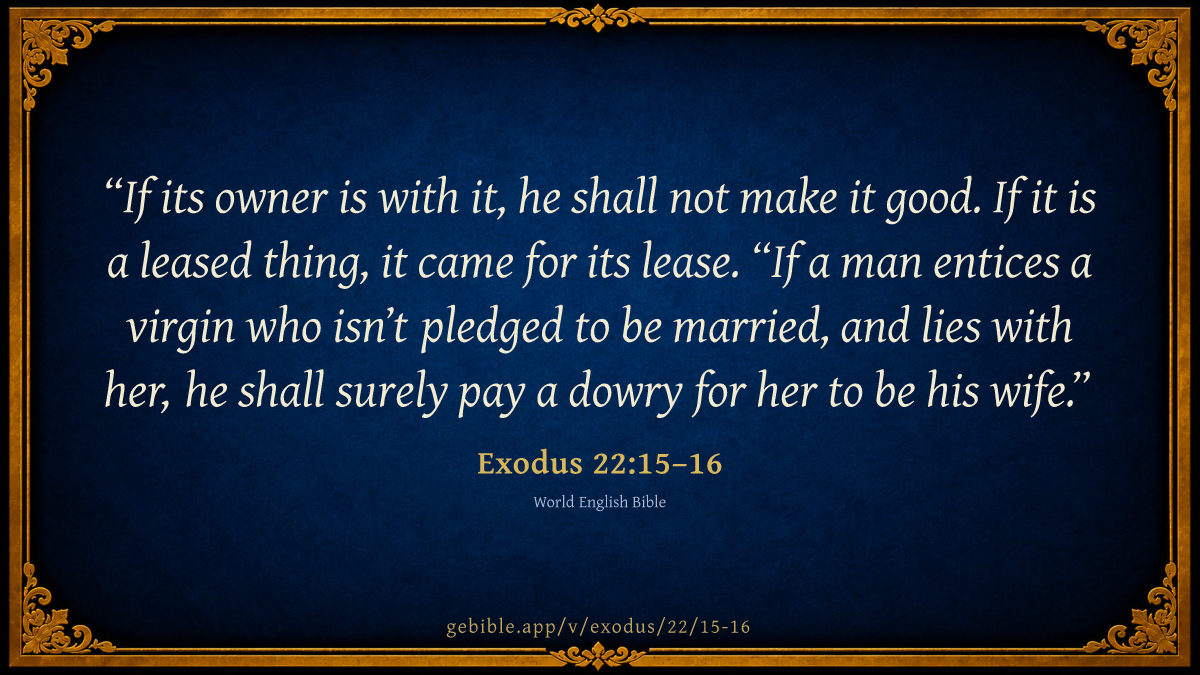
If its owner is with it, he shall not make it good. If it is a leased thing, it came for its lease.
“If a man entices a virgin who isn’t pledged to be married, and lies with her, he shall surely pay a dowry for her to be his wife.
 GEBible — Godless Engineer's Bible App
If its owner is with it, he shall not make it good. If it is a leased thing, it came for its lease.
“If a man entices a virgin who isn’t pledged to be married, and lies with her, he shall surely pay a dowry for her to be his wife.
Exodus 22:15-16 sits inside this longer paragraph.
“If a man borrows anything of his neighbor’s, and it is injured, or dies, its owner not being with it, he shall surely make restitution. If its owner is with it, he shall not make it good. If it is a leased thing, it came for its lease.
“If a man entices a virgin who isn’t pledged to be married, and lies with her, he shall surely pay a dowry for her to be his wife. If her father utterly refuses to give her to him, he shall pay money according to the dowry of virgins.
If its owner is with it, he shall not make it good. If it is a leased thing, it came for its lease.
“If a man entices a virgin who isn’t pledged to be married, and lies with her, he shall surely pay a dowry for her to be his wife.
But if the owner thereof be with it, he shall not make it good: if it be an hired thing, it came for his hire.
And if a man entice a maid that is not betrothed, and lie with her, he shall surely endow her to be his wife.
(22-14) If the owner thereof be with it, he shall not make it good; if it be a hireling, he loseth his hire.
(22-15) And if a man entice a virgin that is not betrothed, and lie with her, he shall surely pay a dowry for her to be his wife.
The laws of the Torah, each cited and shown as a primary source.
Cross-references from openbible.info (CC BY 4.0)
Historical commentary, presented as a primary source — not an endorsement.
Saved on this device only — never synced or sent anywhere.
Geneva Bible translators 1599 · Public Domain On v15 He that hired it shall be free by paying…
He that hired it shall be free by paying the hire.
Geneva Bible (1599) marginal notes — public domain.
John Trapp 1656 · Public Domain On vv15–16 Exo 22:15 [But] if the owner thereof [be] with…
Exo 22:15 [But] if the owner thereof [be] with it, he shall not make [it] good: if it [be] an hired [thing], it came for his hire.
Ver. 15. It came for his hire,] q.d., He shall pay the hire only, and no more, though the owner be not by when it miscarrieth.
John Trapp, A Commentary or Exposition upon All the Books of the Old and New Testament (1647–1656) — public domain. Text from a community e-Sword module.
Matthew Poole 1685 · Public Domain On vv15–16 If the owner thereof be with it: the law…
If the owner thereof be with it: the law reasonably presumes, both that the borrower would not abuse it in the sight of its owner, and that the lender might and would take due care about it.
He shall not make it good, except there be some manifest fault in the borrower, as if he should kill or wound the beast in the lender’s presence; which exception is easily to be understood from divers other laws of God.
Read full note →
It came for his hire, i.e. the benefit was the lender’s, and not the borrower’s, and therefore the former reason ceaseth; and whether the master were present or absent, he that receives the gain or hire shall bear the loss, except when it came through the borrower’s gross and wilful default.
Matthew Poole's English Annotations on the Holy Bible (1683–1685) — public domain. Text from a community e-Sword/MySword module.
Matthew Henry 1710 · Public Domain On v16 Here is, I. A law that he who debauched…
Here is, I. A law that he who debauched a young woman should be obliged to marry her, Exo 22:16, Exo 22:17. If she was betrothed to another, it was death to debauch her (Deu 22:23, Deu 22:24); but the law here mentioned respects her as single. But, if the father refused her to him, he was to give satisfaction in money for the injury and disgrace he had done her. This law puts an honour upon marriage and shows likewise how improper a thing it is that children should marry without their parents' consent: even here, where the divine law appointed the marriage, both as a punishment to him that had done wrong and a recompence to her that had suffered wrong, yet there was an express reservation for the father's power; if he denied his consent, it must be no marriage.
II. A law which makes witchcraft a capital crime, Exo 22:18. Witchcraft not only gives that honour to the devil which is due to God alone, but bids defiance to the divine Providence, wages war with God's government, and puts his work into the devil's hand, expecting him to do good and evil, and so making him indeed the god of this world; justly therefore was it punished with death, especially among a people that were blessed with a divine revelation, and cared for by divine Providence above any people under the sun. By our law, consulting, covenanting with, invocating, or employing, any evil spirit, to any intent whatsoever, and exercising any enchantment, charm, or sorcery, whereby hurt shall be done to any person whatsoever, is made felony, without benefit of clergy; also pretending to tell where goods lost or stolen may be found, or the like, is an iniquity punishable by the judge, and the second offence with death. The justice of our law herein is supported by the law of God recorded here.
Read full note →
III. Unnatural abominations are here made capital; such beasts in the shape of men as are guilty of them are unfit to live (Exo 22:19): Whosoever lies with a beast shall die.
IV. Idolatry is also made capital, Exo 22:20. God having declared himself jealous in this matter, the civil powers must be jealous in it too, and utterly destroy those persons, families, and places of Israel, that worshipped any god, save the Lord: this law might have prevented the woeful apostasies of the Jewish nation in after times, if those that should have executed it had not been ringleaders in the breach of it.
V. A caution against oppression. Because those who were empowered to punish other crimes were themselves most in danger of this, God takes the punishing of it into his own hands.
1. Strangers must not be abused (Exo 22:21), not wronged in judgment by the magistrates, not imposed upon in contracts, nor must any advantage be taken of their ignorance or necessity; no, nor must they be taunted, trampled upon, treated with contempt, or upbraided with being strangers; for all these were vexations, and would discourage strangers from coming to live among them, or would strengthen their prejudices against their religion, to which, by all kind and gentle methods, they should endeavour to proselyte them. The reason given why they should be kind to strangers is, "You were strangers in Egypt, and knew what it was to be vexed and oppressed there," Note, (1.) Humanity is one of the laws of religion, and obliges us particularly to be tender of those that lie most under disadvantages and discouragements, and to extend our compassionate concern to strangers, and those to whom we are not under the obligations of alliance or acquaintance. Those that are strangers to us are known to God, and he preserves them, Psa 146:9. (2.) Those that profess religion should study to oblige strangers, that they may thereby recommend religion to their good opinion, and take heed of doing any thing that may tempt them to think ill of it or its professors, Pe1 2:12. (3.) Those that have themselves been in poverty and distress, if Providence enrich and enlarge them, ought to show a particular tenderness towards those that are now in such circumstances as they were in formerly, doing now by them as they then wished to be done by.
2. Widows and fatherless must not be abused (Exo 22:22): You shall not afflict them, that is, "You shall comfort and assist them, and be ready upon all occasions to show them kindness." In making just demands from them, their condition must be considered, who have lost those that should deal for them, and protect them; they are supposed to be unversed in business, destitute of advice, timorous, and of a tender spirit, and therefore must be treated with kindness and compassion; no advantage must be taken against them, nor any hardship put upon them, from which a husband or a father would have sheltered them. For, (1.) God takes particular cognizance of their case, Exo 22:23. Having no one else to complain and appeal to, they will cry unto God, and he will be sure to hear them; for his law and his providence are guardians to the widows and fatherless, and if men do not pity them, and will not hear them, he will. Note, It is a great comfort to those who are injured and oppressed by men that they have a God to go to who will do more than give them the hearing; and it ought to be a terror to those who are oppressive that they have the cry of the poor against them, which God will hear. Nay, (2.) He will severely reckon with those that do oppress them. Though they escape punishments from men, God's righteous judgments will pursue and overtake them, Exo 22:24. Men that have a sense of justice and honour will espouse the injured cause of the weak and helpless; and shall not the righteous God do it? Observe the equity of the sentence here passed upon those that oppress the widows and fatherless: their wives shall become widows, and their children fatherless; and the Lord is known by these judgments, which he sometimes executes still.
Matthew Henry's Commentary on the Whole Bible (1708–1710) — public domain (CC PDM 1.0). Text via the HelloAO Bible API.
John Gill 1763 · Public Domain On vv15–16 But if the owner thereof be with it,.... When…
But if the owner thereof be with it,.... When it is hurt or dies; for in some cases the owner might go along with his beast, being borrowed or hired to do work with it; or, however, being upon the spot, must be satisfied that it was not ill used; and it may be reasonably presumed he would do all he could to preserve it: and this being the case:
he shall not make it good; that is, the borrower, but the loss would lie upon the lender; seeing this might have been the case if it had been at home, and not borrowed or lent. The Jewish writers understand all this in a different manner, that if the owner is not with it in the time of borrowing, though he is with it in the time of its being hurt, or of its death, the borrower must pay; but if he was with it in the time of borrowing, though not in the time of its receiving damage, or of its death, the borrower was free (c); for, as Jarchi says, whether it be in that work (for which he was borrowed), or in another work (it matters not), if he was with it at the time of borrowing, there was no necessity of his being with it at the time of its hurt or death. The reason of which, I must confess, I do not understand; unless the meaning is, that it was necessary that the owner, and the beast, should be both borrowed or hired together; and which indeed seems to be the sense of the Misnah, or tradition (d), which runs thus,"if a man borrows a cow, and borrows or hires its owner with it; or if he hires or borrows the owner, and after that borrows the cow, and it dies, he is free, as it is said, Exo 22:15 but if he borrows the cow, and afterwards borrows or hires the owner, and it dies, he is bound to pay, as it is said, Exo 22:13 if his owner is not with it, &c.''If it be an hired thing, it came for its hire; that is, if the beast which was come to some damage, or was dead, was hired, and not borrowed, then, whether the owner was with it or not at that time, he could demand no more than hire, and the person that hired it was obliged to pay that and no more; or if the owner himself was hired along with his beast, and so was present when it received its damage, or its death, nothing more could come to him than what he agreed for.
Read full note →
(c) Misn. Bava Metzia, c. 8. sect. 1. Maimon. & Bartenora in ib. (d) Ibid.
John Gill's Exposition of the Whole Bible (1746–1763) — public domain (CC PDM 1.0). Text via the HelloAO Bible API.
Adam Clarke 1810 · Public Domain On v16 Verse 16. If a man entice a maid] This…
Verse 16. If a man entice a maid] This was an exceedingly wise and humane law, and must have operated powerfully against seduction and fornication; because the person who might feel inclined to take the advantage of a young woman knew that he must marry her, and give her a dowry, if her parents consented; and if they did not consent that their daughter should wed her seducer, in this case he was obliged to give her the full dowry which could have been demanded had she been still a virgin. According to the Targumist here, and to De 22:29, the dowry was fifty shekels of silver, which the seducer was to pay to her father, and he was obliged to take her to wife; nor had he authority, according to the Jewish canons, ever to put her away by a bill of divorce. This one consideration was a powerful curb on disorderly passions, and must tend greatly to render marriages respectable, and prevent all crimes of this nature.
Adam Clarke's Commentary on the Bible (1810–1826) — public domain. Text from a community e-Sword/MySword module.
Albert Barnes 1834 · Public Domain On vv15–16 It came for his hire - The sum paid…
It came for his hire - The sum paid for hiring was regarded as covering the risk of accident.
Albert Barnes' Notes on the Bible (1834–1885) — public domain. Text from a community e-Sword/MySword module.
Haydock's Catholic Bible Commentary 1859 · Public Domain On v15 Especially, &c. This is a third case, in which…
Especially, &c. This is a third case, in which the person who lends, suffers all the loss, in consideration of the money which he had received. Others explain, "If he be a hired servant, he shall pay out of his wages," Syriac. (Grotius)
George Leo Haydock (1774–1849), Haydock's Catholic Family Bible and Commentary, 1859 edition — public domain. Excludes Psalms (Douay-Rheims chapter numbering differs from Protestant) and Deuterocanonical books (Catholic canon only).
Daniel D. Whedon 1874 · Public Domain On v15 15. If it be a hired thing — If…
15. If it be a hired thing — If the owner let it out for money in advance or to be paid, that payment was to be taken as the sole compensation in the case.
Daniel D. Whedon (gen. ed.), Commentary on the Old and New Testaments (1874–1909) — public domain. Text from a community e-Sword module.
The Cambridge Bible for Schools and Colleges 1878 · Public Domain On vv15–16 15. it came for its hire] and therefore, it…
15. it came for its hire] and therefore, it is presumed, the owner was prepared to take the risk, so that compensation for injury is unnecessary. The sense expressed by the marg. is hardly likely: for if the cost of compensation in the possible case of injury or death were included in the hire, it would make this unreasonably high. Others understand sâkîr in its usual sense of a ‘hired servant,’ and make an entirely new case of v. 15b, rendering: If it be a hired servant (who, viz., has injured his own master’s animal), it (the damage) cometh into his hire, and is gradually worked off by him (so Kautzsch and Socin, Bä., Ryssel). The connexion with vv. 14, 15a is however in this case in exact; for the ‘it’ is not, as in v. 15a, one who has borrowed the animal from its owner, but one who has been entrusted with it by his master.
The Cambridge Bible for Schools and Colleges (gen. ed. J. J. S. Perowne; Cambridge University Press, 1878–1918) — public domain. Text from a community e-Sword module.
Ellicott's Commentary for English Readers 1878 · Public Domain On vv15–16 (15) If it be a hired thing.—Letting out for…
(15) If it be a hired thing.—Letting out for hire is akin to lending; but still quite a different transaction. Damage to a thing hired was not to be made good by the hirer, since the risk of it might be considered to have formed part of the calculation upon which the amount of the hire was fixed.
A Bible Commentary for English Readers, edited by Charles John Ellicott (1878–1897) — public domain. Text from a community e-Sword module.
The Pulpit Commentary 1880 · Public Domain On vv15–16 If the owner thereof be with it. By "with…
If the owner thereof be with it. By "with it," we must understand, not merely present, but in charge of it, or at any rate so near it that he might have prevented the damage, had prevention been possible. If it be a hired thing. If anything were paid for the use of the thing, then it was not borrowed, but hired; and the owner was considered to have counted in the risk of loss or damage in fixing the amount of the hire. He was entitled therefore to no compensation Our own law does not rule this absolutely, but takes into consideration the proportion of the sum paid for hire to the value of the thing hired, and the general tacit understanding.
The Pulpit Commentary (1880–1919), ed. H.D.M. Spence-Jones & Joseph S. Exell — public domain. Text from a community e-Sword module.
The Biblical Illustrator 1887 · Public Domain On v16 If a man entice a maid.
Exo_22:16-17
If a man entice a maid.
Read full note →
Lessons
1. Providence may suffer men through strength of lust to entice and defile virgins.
2. Such enticing and polluting is grievous sin against God and man abhorred of the Lord.
3. In case of such sin God hath judged recompense to men, as He executeth vengeance for Himself. (G. Hughes, B. D.)
Want of wariness
Flamingoes are very shy and timid birds, and shun all attempts of man to approach them; the vicinity of animals, however, they disregard. Any one who is acquainted with this fact can take advantage of it so as to effect the slaughter of these beautiful animals by dressing himself up in the skin of a horse or an ox. Thus disguised, the sportsman may get close to them and shoot them down at his ease. So long as their enemy is invisible they still remain immovable, the noise of the gun only stupefying them, so that they refuse to leave, although their companions are dropping down dead around them. They are taken in by appearances; and so long as the man is disguised they accept him as the creature which he pretends to be, even though his actions clearly indicate that he is something else. Shy, beautiful, and harmless, the unfortunate bird meets destruction simply for want of wariness. Many a lovely human being with the like qualities has met her doom for want of that same trait. (Scientific Illustrations.)
The Biblical Illustrator, edited by Joseph S. Exell (c. 1880s–1900s) — public domain. Text from a community e-Sword module.
The Expositor's Bible 1887 · Public Domain On v16 THE LESSER LAW (continued).
CHAPTER XXII.
THE LESSER LAW (continued).
Read full note →
PART IV.
Exodus 22:16-Exodus 23:19.
The Fourth section of this law within the law consists of enactments, curiously disconnected, many of them without a penalty, varying greatly in importance, but all of a moral nature, and connected with the well-being of the state. It is hard to conceive how the systematic revision of which we hear so much could have left them in the condition in which they stand.
It is enacted that a seducer must marry the woman he has betrayed, and if her father refuse to give her to him, then he must pay the same dower as a bridegroom would have done (Exo_22:16-17). And presently the sentence of death is launched against a blacker sensual crime (Exo_22:19). But between the two is interposed the celebrated mandate which doomed the sorceress to death, remarkable as the first mention of witchcraft in Scripture, and the only passage in all the Bible where the word is in the feminine form--a witch, or sorceress; remarkable also for a far graver reason, which makes it necessary to linger over the subject at some length.
SORCERY.
"Thou shalt not suffer a sorceress to live."-- Exo_22:18.
The world knows only too well what sad and shameful inferences have been drawn from these words. Unspeakable terrors, estrangement of natural sympathy, tortures and cruel deaths, have been inflicted on many thousands of the most forlorn creatures upon earth (creatures who were sustained in their sufferings by no high ardour of conviction or fanaticism, not being martyrs but simply victims), because it was held that Moses, in declaring that witches should not live, affirmed the reality of witchcraft. No sooner did the argument cease to be dangerous to old women than it became formidable to religion; for now it was urged that, since Moses was in error about the reality of witchcraft, his legislation could not have been inspired.
What are we to say to this?
In the first place it must be observed that the existence of a sorcerer is one thing, and the reality of his powers is quite another. What was most sad and shameful in the medi¾val frenzy was the burning to ashes of multitudes who made no pretensions to traffic with the invisible world, who frequently held fast their innocence while enduring the agonies of torture, who were only aged and ugly and alone. Upon any theory, the prohibition of sorcery by the Pentateuch was no more answerable for these iniquities than its other prohibitions for the lynch law of the backwoods.
On the other hand, there were real professors of the black art: men did pretend to hold intercourse with spirits, and extorted great sums from their dupes in return for bringing them also into communion with superhuman beings. These it is reasonable to call sorcerers, whether we accept their professions or not, just as we speak of thought-readers and of mediums without being understood to commit ourselves to the pretensions of either one or other. In point of fact, the existence, in this nineteenth century after Christ, of sorcerers calling themselves mediums, is much more surprising than the existence of other sorcerers in the time of Moses or of Saul; and it bears startling witness to the depth in human nature of that craving for traffic with invisible powers which the law prohibited so sternly, but the roots of which neither religion nor education nor scepticism has been able wholly to pluck up.
Again, from the point of view which Moses occupied, it is plain that such professors should be punished. They are virtually punished still, whenever they obtain money under pretence of granting interviews with the departed. If we now rely chiefly upon educated public opinion to stamp out such impositions, that is because we have decided that a struggle between truth and falsehood upon equal terms will be advantageous to the former. It is a subdivision of the debate between intolerance and free thought. Our theory works well, but not universally well, even under modern conditions and in Christian lands. And assuredly Moses could not proclaim freedom of opinion, among uneducated slaves, amid the pressure of splendid and of seductive idolatries, and before the Holy Ghost was given. To complain of Moses for proscribing false religions would be to denounce the use of glass for seedlings because the full-grown plant flourishes in the open air.
Now, it would have been preposterous to proscribe false religions and yet to tolerate the sorcerer and the sorceress. For these were the active practitioners of another worship than that of God. They might not profess idolatry; but they offered help and guidance from sources which Jehovah frowned upon, rival sources of defence or knowledge.
The holy people was meant to grow up under the most elevating of all influences, reliance upon a protecting God, Who had bidden His children to subdue the world as well as to replenish it, and of Whom one of their own poets sang that He had put all things under the feet of man. Their true heritage was not bounded by the strip of land which Joshua and his followers slowly conquered; to them belonged all the resources of nature which science, ever since, has wrested from the Philistine hands of barbarism and ignorance. And this nobler conquest depended upon the depth and sincerity of man's feeling that the world is well-ordered and stable and the heritage of man, not a chaos of various and capricious powers, where Pallas inspires Diomed to hunt Venus bleeding off the field, or where the incantations of Canidia may disturb the orderly movements of the skies. Who could hope to discover by inductive science the secrets of such a world as this?
The devices of magic cut the links between cause and effect, between studious labour and the fruits which sorcery bade men to steal rather than to cultivate. What gambling was to commerce, that was witchcraft to philosophy, and the mischief no more depended on the validity of its methods than upon the soundness of the last device for breaking the bank at Monte Carlo.
If one could actually extort their secrets from the dead, or win for luxury and sloth a longer life than is bestowed upon temperance and labour, he would succeed in his revolt against the God of nature. But the revolt was the endeavour; and the sorcerer, however falsely, professed to have succeeded; and preached the same revolt to others. In religion he was therefore an apostate, and in the theocracy a traitor against the King, one whose life was forfeited if it was prudent to exact the penalty.
And when we consider the fascination wielded by such pretensions, even in ages when the stability of nature is an axiom, the dread which false religions all around and their terrible rituals must have inspired, the superstitious tendencies of the people and their readiness to be misled, we shall see ample reasons for treading out the first sparks of so dangerous a fire.
Beyond this it is vain to pretend that the law of Moses goes. It was right in declaring the sorcerer and the sorceress to be real and dangerous phenomena. It never declared their pretensions to be valid though illegitimate. And in one noteworthy passage it proclaims that a real sign or a wonder could only proceed from God, and when it accompanied false teaching was still a sign, though an ominous one, implying that the Lord would prove them (Deu_13:1-3). This does not look very like an admission of the existence of rival powers, inferior though they might be, who could interfere with the order of His world.
Sorcery in all its forms will die when men realise indeed that the world is His, that there is no short or crooked way to the prizes which He offers to wisdom and to labour, that these rewards are infinitely richer and more splendid than the wildest dreams of magic, and that it is literally true that all power, in earth as well as heaven, is committed into the Hands which were pierced for us. In such a conception of the universe, incantations give place to prayers, and prayer does not seek to disturb, but to carry forward and to consummate, the orderly rule of Love.
The denunciation of witchcraft is quite naturally followed, as we now perceive, by the reiteration of the command that no sacrifice may be offered to any god except Jehovah (Exo_22:20). Strange and hateful offerings were an integral part of witchcraft, long before the hags of Macbeth brewed their charm, or the child in Horace famished to yield a spell.
THE STRANGER.
Exo_22:21, Exo_23:9.
Immediately after this, a ray of sunlight falls upon the sombre page.
We read an exhortation rather than a statute, which is repeated almost literally in the next chapter, and in both is supported by a beautiful and touching reason. "A stranger shalt thou not wrong, neither shall ye oppress him: for ye were strangers in the land of Egypt." "A stranger shall ye not oppress, for ye know the heart of a stranger, seeing ye were strangers in the land of Egypt" (Exo_22:21, Exo_23:9).
The "stranger" of these verses is probably the settler among them, as distinguished from the traveller passing through the land. His want of friends and ignorance of their social order would place him at a disadvantage, of which they are forbidden to avail themselves, either by legal process (for the first passage is connected with jurisprudence), or in the affairs of common life. But the spirit of the commandment could not fail to influence their treatment of all foreigners; and simple and commonplace though it appear to us, it would have startled many of the wisest and greatest peoples of antiquity, and would have fallen as strangely upon the ears of the Greeks of Pericles, as of the modern Bedouin, with whom Israel had kinship. A foreigner, as such, was a foe: to wrong him was a paradox, because he had no rights: kinship, or else alliance or treaty was required to entitle the weaker to any better treatment than it suited the stronger to allow.
Yet we find a precept reiterated in this Jewish code which involves, in its inevitable though slow development, the abolition of negro slavery, the respect by powerful and civilised nations of the rights of indigenous tribes, the most boundless advance of philanthropy, through the most generous recognition of the fraternity of man.
However sternly the sword of Joshua might fall, it struck not at the foreigner, as such, but at those tribes, guilty and therefore accursed of God, the cup of whose iniquity was full. And yet there was enough of carnage to prove that so gracious a commandment as this could not have risen spontaneously in the heart of early Judaism. Does it seem to be made more natural, by any proposed shifting of the date?
The reason of the precept is beautifully human. It rests upon no abstract basis of common rights, nor prudential consideration of mutual advantage.
In our time it is sometimes proposed to build all morality upon such foundations; and strange consequences have already been deduced in cases where the proposed sanction has not seemed to apply. But, in fact, no advance in virtue has ever been traced to self-interest, although, after the advance took place, self-interest has always found its account in it. A progressive community is made of good men, and the motive to which Moses appeals is compassion fed by memory: "For ye were strangers in the land of Egypt" (Exo_22:21); "For ye know the heart of a stranger, seeing ye were strangers in the land of Egypt" (Exo_23:9).
The point is not that they may again be carried into captivity: it is that they have felt its bitterness, and ought to recoil from inflicting what they writhed under.
Now, this appeal is a master-stroke of wisdom. Much cruelty, and almost all the cruelty of the young, springs from ignorance, and that slowness of the imagination which cannot realise that the pains of others are like our own. Feeling them to be so, the charities of the poor toward one another frequently rise almost to sublimity. And thus, when suffering does not ulcerate the heart and make it savage, it is the most softening of all influences. In one of the most threadbare lines in the classics, the queen of Carthage boasts that
"I, not ignorant of woe, To pity the distressful know."
And the boldest assertion in Scripture of the natural development of our Saviour's human powers, is that which declares that "In that He Himself hath suffered, being tempted, He is able to succour them that are tempted" (Heb_2:18).
To this principle, then, Moses appeals, and by the appeal he educates the heart. He bids the people reflect on their own cruel hardships, on the hateful character of their tyrants, on their own greater hatefulness if they follow the vile example, after such bitter experience of its character. He does not yet rise to the grand level of the New Testament morality, Do all to thy neighbour which it is not servile and dependent to will that he should do for thee. But he attains to the level of that precept of Confucius and Zoroaster which has been so unworthily compared with it: Do not unto thy neighbour what thou wouldest not that he should do to thee--a precept which mere indifference obeys. Nay, he excels it; for the mental and spiritual attitude of one who respects his helpless neighbour because he so much resembles himself, will surely not be content without relieving the griefs that have so closely touched him. Thus again the legislation of Moses looks beyond itself.
Now, if the Jew should be merciful because he had himself known calamity, what implicit confidence may we repose upon the Man of sorrows and acquainted with grief?
In the same spirit they are warned against afflicting the widow or the orphan. And the threat which is added joins hand with the exhortation which preceded. They should not oppress the stranger, because they had been strangers and oppressed. Now the argument advances. The same God Who then heard their cry will hear the cry of the forlorn, and avenge them, according to the judicial fate which He had just announced, in kind, by bringing their own wives to widowhood and their children to orphanage (Exo_22:22-24).
To their brethren they should not lend money upon usury; but loans are no more recommended than afterwards by Solomon: the words are "if thou lend" (Exo_22:25). And if the raiment of the borrower were taken for a pledge, it must be returned for him to use at night, or else God will hear his cry, because, it is added very significantly and briefly, "I am gracious" (Exo_22:27). It is the most exalting of all motives: Be merciful, for I am merciful: ye shall be the children of your Father.
Again is to be observed the influence reaching beyond the prescription--the motive which cannot be felt without many other and larger consequences than the restoration of pledges at sunset.
How comes this precept to be followed by the words, "Thou shalt not curse God nor blaspheme a ruler" (Exo_22:28)? and is not this again somewhat strangely followed by the order not to delay to offer the firstfruits of the soil, to consecrate the firstborn son, and to devote the firstborn of cattle at the same age when a son ought to be circumcised? (Exo_22:29-30).
If any link can be discovered, it is in the sense of communion with God, suggested by the recent appeal to His character as a motive that should weigh with man. Therefore they must not blaspheme Him, either directly or through His agents, nor tardily yield Him what He claims. Therefore it is added, "Ye shall be holy men unto Me," and from the sense of dignity which religion thus inspires, a homely corollary is deduced--"Ye shall not eat any flesh that is torn of beasts in the field" (Exo_22:31). The bondmen of Egypt must learn a high-minded self-respect.
William Robertson Nicoll, ed., The Expositor's Bible (London: Hodder & Stoughton, 1887–1910) — public domain. 65 of 66 books (1 Corinthians is not separately keyed, as that volume carries no machine-parseable verse references); section-level commentary keyed to the opening verse. Introductory and overview sections not keyed to a specific passage are excluded.
Paul E. Kretzmann 1924 · Public Domain On v16 Regarding Various Social Relations
Regarding Various Social Relations
v. 16. And if a man entice a maid that is not betrothed, and lie with her, thus seducing her and robbing her of her honor and virginity, he shall surely endow her to be his wife. The crime could be expiated at least in a measure by his marrying the girl and by giving dowry money to her father.
Read full note →
v. 17. If her father utterly refuse to give her unto him, he shall pay, weigh out, money according to the dowry of virgins. This procedure, in a way, reinstated the girl as a virgin, and she was afterwards not barred from marrying. The transgressor thus made good his crime as far as possible and showed his repentance. In the case of a betrothed virgin the punishment inflicted upon the seducer was death, Deu 22:23-24.
v. 18. Thou shalt not suffer a witch to live; every one, man or woman, actually guilty of witchcraft, was to be put to death. The sorceress is merely named because women were more addicted to this practice than men.
v. 19. Whosoever lieth with a beast, in sexual intercourse, shall surely be put to death. Cf Lev 18:23; Lev 20:15; Deu 27:21. This vice was placed on the same level with pederasty or sodomy, Lev 20:13.
v. 20. He that sacriftceth unto any god, save unto the Lord only, he shall be utterly destroyed. Since the government of the children of Israel was a theocracy, under the direct rule of Jehovah, the idolater forfeited his life. At the present time it would be wrong for a government to punish sorcery, idolatry, heresy, with death or in any form whatsoever, unless social damage has been done; for the state is concerned with outward matters only. But so far as the Christian congregations are concerned, they cannot tolerate offenders of this kind in their midst, for the trespasses named are deadly sins, which absolutely drive out faith.
v. 21. Thou shalt neither vex a stranger nor oppress him, in no manner make life miserable for him, either by open persecution or by constant nagging; for ye were strangers in the land of Egypt, and the memory of those years of oppression was intended to foster in their hearts true kindness. The word "stranger" apparently applies to non-Canaanitish strangers only; for the Canaanites were to be extirpated.
v. 22. Ye shall not afflict any widow or fatherless child. To humble widows and orphans by acts of unkindness is to challenge the Lord, who is the special Protector of the desolate.
v. 23. If thou afflict them in any wise, and they cry at all unto Me, I will surely hear their cry;
v. 24. and My wrath shall wax hot, and I will kill you with the sword; and your wives shall be widows and your children fatherless. In the wars which the Lord would bring upon them as an act of retaliation and revenge, their own loved ones, by their death, would be left as helpless as those whom the Israelites oppressed and humbled in the first place.
v. 25. If thou lend money to any of My people that is poor by thee, to any members of the Jewish nation that were in such need as to be compelled to borrow for the necessaries of life, thou shalt not be to him as an usurer, neither shalt thou lay upon him usury, take interest in such a case.
v. 26. If thou at all take thy neighbor’s raiment to pledge, take his garment as security, thou shalt deliver it unto him by that the sun goeth down;
v. 27. for that is his covering only, it is his raiment for his skin, it serves to cover and protect his body against the inclemencies of the weather; wherein shall he sleep? The upper garment of the Oriental served him as a cover in which he wrapped himself at night. And it shall come to pass, when he crieth unto Me, that I will hear; for I am gracious, His divine favor rests upon such as are in need. We Christians also know that it pleases the Lord if we have compassion upon the widow and the fatherless, and that any oppression of the poor and needy will bring upon us His punishment.
v. 28. Thou shalt not revile the gods, that is, Elohim, the one true God, they shall not blaspheme, nor curse the ruler of thy people, who is a representative of the Lord on earth.
v. 29. Thou shalt not delay to offer the first of thy ripe fruits and of thy liquors, literally, "of thy fullness or plenty and of thy drop [of oil and wine] thou shalt not delay"; for. the Lord wanted the first-fruits of the field, of the vineyard, and of the olive-orchard. The first-born of thy sons shalt thou give unto Me. Cf Exo 13:2-12.
v. 30. Likewise shalt thou do with thine oxen and with thy sheep: seven days it shall be with his dam; on the eighth day thou shalt give it Me as a sacrifice.
v. 31. And ye shall be holy men unto Me, set apart as a peculiar nation; neither shall ye eat any flesh that is torn of beasts in the field; ye shall cast it to the dogs. As a people that was consecrated to the Lord in the first-born they should abstain from the eating of unclean meat, to which that belonged which had been tom by beasts of prey. Christians will also abstain from all practices which will defile the heart and the mind and be glad to offer to the Lord of their income from all sources.
Paul E. Kretzmann, Popular Commentary of the Bible (1921–1924) — public domain. Text from a community e-Sword module.
unfoldingWord translationNotes 2017 · CC BY-SA 4.0 On v16 a man seduces a virgin who is not engaged
a man seduces a virgin who is not engaged
"a man persuades a virgin who is not engaged that she wants to sleep with him"
Read full note →
not engaged
"not promised to be married"
if he sleeps with her
Sleeping with someone is a euphemism for having sex. AT: "if he has sex with her" (See: Euphemism)
bride wealth
"dowry" or "bride price"
him, he
These pronouns refer back to the man who seduced the virgin.
translationWords
virgin
bride
unfoldingWord translationNotes — © Distant Shores Media and the Door43 World Missions Community, licensed CC BY-SA 4.0. Source: git.door43.org/Door43/en_tn.
Tyndale Open Study Notes 2022 · CC BY-SA 4.0 On v16 22:16-31 These miscellaneous cases involving social responsibility are not…
22:16-31 These miscellaneous cases involving social responsibility are not categorized. All parts of life are an expression of one’s obedience to God (see study note on 21:1–23:19).
Tyndale Open Study Notes — © Tyndale Open Resources, licensed CC BY-SA 4.0. Text via the HelloAO Bible API.