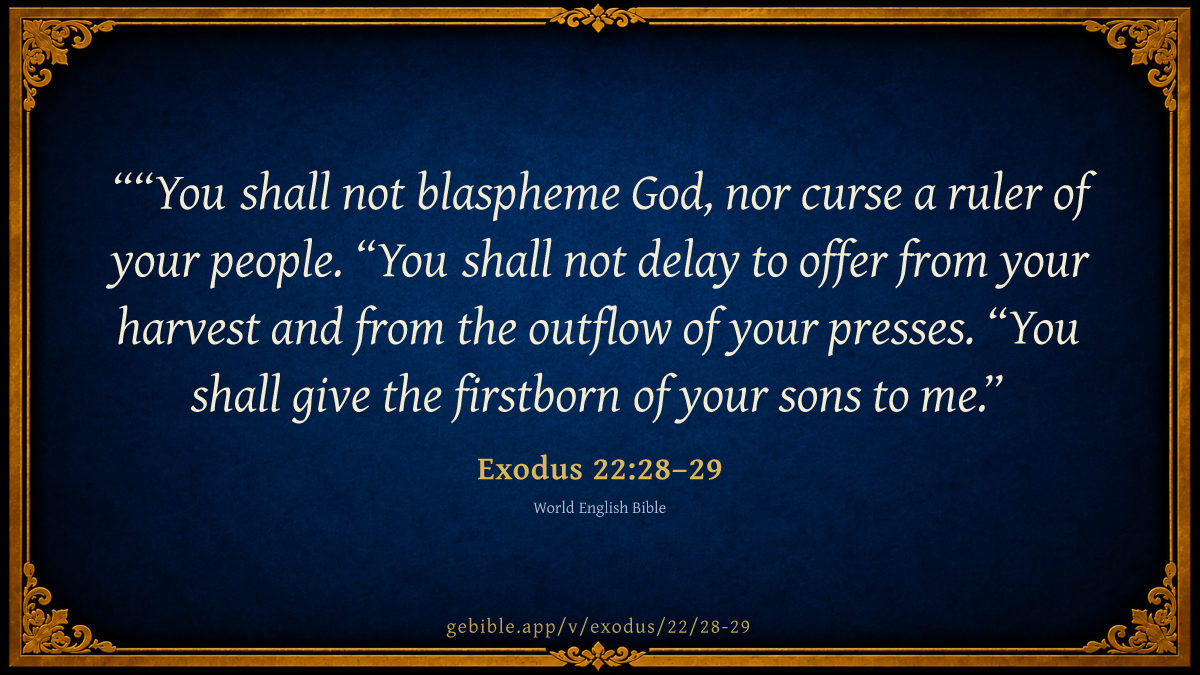
28 “You shall not blaspheme God, nor curse a ruler of your people.
29 “You shall not delay to offer from your harvest and from the outflow of your presses. “You shall give the firstborn of your sons to me.
KJVKing James Version
28 Thou shalt not revile the gods, nor curse the ruler of thy people.
29 Thou shalt not delay to offer the first of thy ripe fruits, and of thy liquors: the firstborn of thy sons shalt thou give unto me.
Show all 3 translations
JPSJPS Tanakh (1917)
28 (22-27) Thou shalt not revile God, nor curse a ruler of thy people.
29 (22-28) Thou shalt not delay to offer of the fulness of thy harvest, and of the outflow of thy presses. The first-born of thy sons shalt thou give unto Me.
Ecclesiastes 10:20(v28)Don’t curse the king, no, not in your thoughts; and don’t curse the rich in your bedroom: for a bird of the sky may carry your voice, and…
Acts 23:5(v28)Paul said, “I didn’t know, brothers, that he was high priest. For it is written, ‘You shall not speak evil of a ruler of your people.’ ”
Jude 1:8(v28)Yet in the same way, these also in their dreaming defile the flesh, despise authority, and slander celestial beings.
Exodus 13:2(v29)“Sanctify to me all the firstborn, whatever opens the womb among the children of Israel, both of man and of animal. It is mine.”
Exodus 21:17(v28)“Anyone who curses his father or his mother shall surely be put to death.
Show all 32 cross-references
Exodus 22:8-9(v28)If the thief isn’t found, then the master of the house shall come near to God, to find out whether or not he has put his hand on his…
Exodus 23:16(v29)And the feast of harvest, the first fruits of your labors, which you sow in the field; and the feast of ingathering, at the end of the…
Exodus 23:19(v29)You shall bring the first of the first fruits of your ground into the house of Yahweh your God. “You shall not boil a young goat in its…
Deuteronomy 26:2-10(v29)that you shall take some of the first of all the fruit of the ground, which you shall bring in from your land that Yahweh your God gives…
1 Samuel 24:6(v28)He said to his men, “Yahweh forbid that I should do this thing to my lord, Yahweh’s anointed, to stretch out my hand against him, since he…
1 Samuel 24:10(v28)Behold, today your eyes have seen how Yahweh had delivered you today into my hand in the cave. Some urged me to kill you; but I spared you;…
1 Samuel 26:9(v28)David said to Abishai, “Don’t destroy him; for who can stretch out his hand against Yahweh’s anointed, and be guiltless?”
Psalms 32:6(v28)For this, let everyone who is godly pray to you in a time when you may be found. Surely when the great waters overflow, they shall not…
Psalms 138:1(v28)I will give you thanks with my whole heart. Before the gods, I will sing praises to you.
Romans 13:2-7(v28)Therefore he who resists the authority withstands the ordinance of God; and those who withstand will receive to themselves judgment. For…
Titus 3:1-2(v28)Remind them to be in subjection to rulers and to authorities, to be obedient, to be ready for every good work, to speak evil of no one, not…
James 1:18(v29)Of his own will he gave birth to us by the word of truth, that we should be a kind of first fruits of his creatures.
2 Peter 2:10(v28)but chiefly those who walk after the flesh in the lust of defilement and despise authority. Daring, self-willed, they are not afraid to…
Psalms 82:1-7(v28)God presides in the great assembly. He judges among the gods. “How long will you judge unjustly, and show partiality to the wicked?”…
Proverbs 3:9-10(v29)Honor Yahweh with your substance, with the first fruits of all your increase: so your barns will be filled with plenty, and your vats will…
John 10:34-35(v28)Jesus answered them, “Isn’t it written in your law, ‘I said, you are gods?’ If he called them gods, to whom the word of God came (and the…
Acts 23:3(v28)Then Paul said to him, “God will strike you, you whitewashed wall! Do you sit to judge me according to the law, and command me to be struck…
Romans 8:23(v29)Not only so, but ourselves also, who have the first fruits of the Spirit, even we ourselves groan within ourselves, waiting for adoption,…
1 Peter 2:17(v28)Honor all men. Love the brotherhood. Fear God. Honor the king.
Exodus 13:12(v29)that you shall set apart to Yahweh all that opens the womb, and every firstborn that comes from an animal which you have. The males shall…
Exodus 34:19(v29)“All that opens the womb is mine; and all your livestock that is male, the firstborn of cow and sheep.
Leviticus 24:16(v28)He who blasphemes Yahweh’s name, he shall surely be put to death. All the congregation shall certainly stone him. The foreigner as well as…
Micah 7:1(v29)Misery is mine! Indeed, I am like one who gathers the summer fruits, as gleanings of the vineyard: There is no cluster of grapes to eat. My…
Matthew 6:33(v29)But seek first God’s Kingdom, and his righteousness; and all these things will be given to you as well.
2 Kings 4:42(v29)A man from Baal Shalishah came, and brought the man of God some bread of the first fruits: twenty loaves of barley and fresh ears of grain…
2 Chronicles 31:5(v29)As soon as the commandment went out, the children of Israel gave in abundance the first fruits of grain, new wine, oil, honey, and of all…
Ezekiel 20:40(v29)For in my holy mountain, in the mountain of the height of Israel,” says the Lord Yahweh, “there all the house of Israel, all of them, shall…
Cross-references from openbible.info (CC BY 4.0)
Explain this passage (16 sources)
Historical commentary, presented as a primary source — not an endorsement.
Geneva Bible translators1599 · Public DomainOn v29Thine abundance of thy corn, oil and wine.
Thine abundance of thy corn, oil and wine.
Geneva Bible (1599) marginal notes — public domain.
John Trapp1656 · Public DomainOn vv28–29Exo 22:28 Thou shalt not revile the gods, nor…
Exo 22:28 Thou shalt not revile the gods, nor curse the ruler of thy people.
Ver. 28. Thou shalt not revile the gods.] Blaspheme dignities. {Jdg 1:8} This is blasphemy is the second table.
John Trapp, A Commentary or Exposition upon All the Books of the Old and New Testament (1647–1656) — public domain. Text from a community e-Sword module.
Matthew Poole1685 · Public DomainOn vv28–29Gods; not gods falsely so called, as some would…
Gods; not gods falsely so called, as some would have it, as appears by 1Ki 18:27; Jer 10:11; but magistrates and governors, whether civil or ecclesiastical, as it is evident both from Act 23:3-5 and from the following words, which explain the former, according to the common use of Scripture, and from the title of gods commonly given to such, as Exo 7:1; Psa 82:6; Joh 10:34,35.
The ruler of thy people. Compare Sir 10:20, Jdg 1:8.
Matthew Poole's English Annotations on the Holy Bible (1683–1685) — public domain. Text from a community e-Sword/MySword module.
John Gill1763 · Public DomainOn vv28–29Likewise shalt thou do with thine oxen, and with…
Likewise shalt thou do with thine oxen, and with thy sheep,.... That is, with the firstborn, which were to be set apart to the Lord; and so the Targum of Jonathan paraphrases it,"the firstborn of thine oxen, and of thy sheep;''for having spoken of the firstborn of men, the Scripture proceeds to speak of the firstborn of cattle, great and small, the separation of which was enjoined in one and the same precept, Exo 13:2,
seven days it shall be with his dam; whether it be a calf or a lamb; before it was seven days old it was not to be taken from it, and given to the Lord:
Read full note →
on the eighth day thou shall give it me; that is, they might do it then, but not before; yet they were not obliged to bring it exactly on that day, but they might do it any time within the month, and at a month's end they were obliged to redeem it, that is, give the priest the sum of five shekels for it, Num 18:16. The Jewish canon runs thus (n);"how long are Israelites bound for the bringing of the firstborn, i.e. before they offer it to the priest? in small cattle thirty days, in large cattle fifty days.''
(n) Misn. Becorot, c. 4. sect. 1.
John Gill's Exposition of the Whole Bible (1746–1763) — public domain (CC PDM 1.0). Text via the HelloAO Bible API.
John Wesley1765 · Public DomainOn vv28–29Thou shalt not revile the gods - That is,…
Thou shalt not revile the gods - That is, the Judges and magistrates. Princes and magistrates are our fathers, whom the fifth commandment obligeth us to honour, and forbids us to revile. St. Paul applies this law to himself, and owns that he ought not to speak evil of the ruler of his people, no, not though he was then his most unrighteous persecutor, Acts xxiii, 5.
John Wesley, Explanatory Notes Upon the Whole Bible (1754–1765) — public domain. Text via the GEBible commentary corpus.
Adam Clarke1810 · Public DomainOn vv28–29Verse 28. Thou shalt not revile the gods] Most…
Verse 28. Thou shalt not revile the gods] Most commentators believe that the word gods here means magistrates. The original is אלהים Elohim, and should be understood of the true God only: Thou shalt not blaspheme or make light of [תקלל tekallel] God, the fountain of justice and power, nor curse the ruler of thy people, who derives his authority from God. We shall ever find that he who despises a good civil government, and is disaffected to that under which he lives, is one who has little fear of God before his eyes. The spirit of disaffection and sedition is ever opposed to the religion of the Bible. When those who have been pious get under the spirit of misrule, they infallibly get shorn of their spiritual strength, and become like salt that has lost its savour. He who can indulge himself in speaking evil of the civil ruler, will soon learn to blaspheme God. The highest authority says, Fear God: honour the king.
Adam Clarke's Commentary on the Bible (1810–1826) — public domain. Text from a community e-Sword/MySword module.
Joseph Benson1811 · Public DomainOn vv28–29Exo 22:28. Thou shalt not revile the gods —…
Exo 22:28. Thou shalt not revile the gods — That is, the judges and magistrates. Princes and magistrates are our fathers, whom the fifth commandment obligeth us to honour, and forbids us to revile. St. Paul applies this law to himself, and owns that he ought not to speak evil of the ruler of his people, no, not though he was then his most unrighteous persecutor, Act 23:5.
Joseph Benson's Commentary on the Old and New Testaments (1811–1818) — public domain. Text from a community e-Sword module.
Albert Barnes1834 · Public DomainOn vv28–29The gods - Heb. אלהים 'ělôhı̂ym. See Exo 21:6…
The gods - Heb. אלהים 'ělôhı̂ym. See Exo 21:6 note. Many take it as the name of God (as in Gen 1:1), and this certainly seems best to represent the Hebrew, and to suit the context.
Curse the ruler ... - See Act 23:5.
Albert Barnes' Notes on the Bible (1834–1885) — public domain. Text from a community e-Sword/MySword module.
Haydock's Catholic Bible Commentary1859 · Public DomainOn vv28–29Gods. Judges, priests, &c. Josephus and Philo say, we…
Gods. Judges, priests, &c. Josephus and Philo say, we must not speak ill of strange gods, lest the Gentiles should take occasion to blaspheme the true God, and that we may be farther removed from the danger of taking the name of God in vain, and losing that respect which we owe to it.
George Leo Haydock (1774–1849), Haydock's Catholic Family Bible and Commentary, 1859 edition — public domain. Excludes Psalms (Douay-Rheims chapter numbering differs from Protestant) and Deuterocanonical books (Catholic canon only).
Robert Jamieson, A. R. Fausset & David Brown1871 · Public DomainOn v28gods--a word which is several times in this chapter…
gods--a word which is several times in this chapter rendered "judges" or magistrates.
the ruler of thy people--and the chief magistrate who was also the high priest, at least in the time of Paul (Act 23:1-5).
Read full note →
Next: Exodus Chapter 23
Jamieson, Fausset & Brown — Commentary Critical and Explanatory on the Whole Bible (1871) — public domain (CC PDM 1.0). Text via the HelloAO Bible API.
Daniel D. Whedon1874 · Public DomainOn vv28–2928. Thou shalt not revile the gods — Rather,…
28. Thou shalt not revile the gods — Rather, God. Our version follows the Sept., Vulg., and other versions, and conveys the idea that even the gods of the heathen are not to be reviled. Others understand the reference to be to judges, but this seems sufficiently comprehended in the words ruler of thy people, which immediately follow. This verse associated God and the civil ruler in a very noticeable way. The latter is, according to Rom_12:4, God’s minister, and a becoming respect and reverence for the civil magistrate is one way of honouring God himself.
Daniel D. Whedon (gen. ed.), Commentary on the Old and New Testaments (1874–1909) — public domain. Text from a community e-Sword module.
The Cambridge Bible for Schools and Colleges1878 · Public DomainOn vv28–2928. Reverence to be shewn to God, and to…
28. Reverence to be shewn to God, and to those in authority.
revile] the word (ḳâlal) usually rendered curse (e.g. Exo_21:17): here represented by revile, because of the syn. (’ârar) in v. 28b.
Read full note →
God] The paraphrase judges (RVm.) is not here admissible; for though ‘to go to God’ might mean to go to the judges, as the representatives or spokesmen of God, this would not justify ‘God’ in any connexion being taken to signify judges. LXX. θεούς, Vulg. diis, AV. the gods; and so Jos. Ant. iv. 8, 10, c. Ap. ii. 33, and Philo, Vit. Mos. iii. p. 166, de Mon. i. p. 219 (cited by Kn.), understanding the passage, in a sense agreeable the circumstances of their own time, of heathen gods: but this, rough quite legitimate grammatically, would make the precept one very alien to the spirit of the OT.
a ruler] lit. one lifted up, i.e. placed above others in a position of authority. A word very common (see on Exo_16:12) in P and Ezek., but rare elsewhere. The command is quoted by St Paul in Act_23:5, almost exactly as it stands in the LXX. Cf. Pro_24:21, Rom_13:1, 1Pe_1:17; 1Pe_2:13.
The Cambridge Bible for Schools and Colleges (gen. ed. J. J. S. Perowne; Cambridge University Press, 1878–1918) — public domain. Text from a community e-Sword module.
Ellicott's Commentary for English Readers1878 · Public DomainOn vv28–29(28) Thou shalt not revile the gods.—The LXX. And…
(28) Thou shalt not revile the gods.—The LXX. And Vulgate give the passage this sense; and so it was understood, or at any rate expounded, by Philo (De Vit. Mos. ii. 26) and Josephus (Ant. Jud. iv. 8, § 10), who boasted that the Jews abstained from reviling the gods of the nations. But the practice of the most pious Israelites in the best times was different (1Ki_18:27; Psa_115:4-8; Psa_135:15-18; Isa_41:29; Isa_44:9-20; Jer_10:11-15, &c.). The gods of the heathen were uniformly, and with the utmost scorn. “reviled.” It has been suggested that the true meaning of elohim in this place is “judges” (Rosenmüller, Zunz, Herxheimer); but to have that sense, the word requires the article. It is best, therefore, to translate by “God,” as is done by De Wette, Knobel, Keil, Kalisch, Canon Cook, &c., and to understand the entire passage as intended to connect the sin of cursing a ruler with that of reviling God, the ruler being regarded as God’s representative.
A Bible Commentary for English Readers, edited by Charles John Ellicott (1878–1897) — public domain. Text from a community e-Sword module.
The Pulpit Commentary1880 · Public DomainOn vv28–29Law against reviling God, or rulers. It has been…
Law against reviling God, or rulers. It has been proposed to render Elohim here either
1. "God;" or
Read full note →
2. "The gods;" or
3. "Judges.
The last of these renderings is impossible, since Elohim in the sense of "judges" always has the article. The second, which is adopted by the Septuagint and the Authorised Version, seems precluded by the constant practice of the most religious Jews, prophets and others, to speak with contempt and contumely of the false gods of the heathen. The passage must therefore be understood as forbidding men to speak evil of God. (Compare Lev_24:15, Lev_24:16) Nor curse the ruler of thy people. Rather, "one exalted among thy people." The term is generally used of the heads of families (Num_3:24, Num_3:30, Num_3:35, etc.) and tribes (Num_7:10, Num_7:18, Num_7:24, etc.) in the Pentateuch. Later, it is applied to kings (1Ki_11:34; Eze_12:10 Eze_45:7, etc.) Our translators generally render it by "prince."
The Pulpit Commentary (1880–1919), ed. H.D.M. Spence-Jones & Joseph S. Exell — public domain. Text from a community e-Sword module.
The Biblical Illustrator1887 · Public DomainOn vv28–29The ruler of thy people.
Exo_22:28
The ruler of thy people.
Read full note →
The Divine right of magistrates to respect
I. That the powers that be are ordained of God (Rom_13:1-5; 1Pe_2:13-15).
II. That magistrates must re treated with respect, both their persons and their decisions (Jos_1:16-18).
1. Because they administer that which, when it is law at all, is based on the will and authority of God (Rom_13:2).
2. Because they administer that which is the bulwark of national stability and personal safety (Rom_13:3).
III. That magistrates must receive respect, irrespective of the effect of their decision (Pro_17:26).
1. Because they are but the servants of the law.
2. Because if through human infirmities, justice should occasionally miscarry, it is better to suffer than to bring the law into disrepute (Pro_24:21-22).
3. But if their decisions violate conscience, then Act_4:19-20; Act_5:29.
IV. That magistrates must be secure against all hostile action (Pro_17:26; Job_34:17-18).
1. Fear will warp the judgment.
2. Fear will divert the course of justice.
V. That magistrates are not only entitled to respect, but to our sympathy and prayers (Psa_22:1-2; Ezr_6:10; 1Ti_2:2).
VI. That disrespect to magistrates is severely condemned (Jud_1:8). Let magistrates, all who are in authority and all who administer law whether civil or domestic, whether in law courts, homes, or houses of business, remember--
1. That they are responsible to God (2Sa_23:3). Let them see
(1) that they accurately know the law, and
(2) that their administration is conscientious and courageous (Psa_72:1-20; Psa_4:12-14).
2. That they are responsible to man. Upon their decisions depend the well-being of the citizen, and the stability of the realm.
3. That their title to sympathy and veneration is recognized by the people at large. (J. W. Burn.)
The Biblical Illustrator, edited by Joseph S. Exell (c. 1880s–1900s) — public domain. Text from a community e-Sword module.
unfoldingWord translationNotes2017 · CC BY-SA 4.0On vv28–29You must not blaspheme me, God
You must not blaspheme me, God
"Do not insult God" or "Do not speak evil about God"
 GEBible — Godless Engineer's Bible App
Geneva Bible translators 1599 · Public Domain On v29 Thine abundance of thy corn, oil and wine.
Thine abundance of thy corn, oil and wine.
Geneva Bible (1599) marginal notes — public domain.
John Trapp 1656 · Public Domain On vv28–29 Exo 22:28 Thou shalt not revile the gods, nor…
Exo 22:28 Thou shalt not revile the gods, nor curse the ruler of thy people.
Ver. 28. Thou shalt not revile the gods.] Blaspheme dignities. {Jdg 1:8} This is blasphemy is the second table.
John Trapp, A Commentary or Exposition upon All the Books of the Old and New Testament (1647–1656) — public domain. Text from a community e-Sword module.
Matthew Poole 1685 · Public Domain On vv28–29 Gods; not gods falsely so called, as some would…
Gods; not gods falsely so called, as some would have it, as appears by 1Ki 18:27; Jer 10:11; but magistrates and governors, whether civil or ecclesiastical, as it is evident both from Act 23:3-5 and from the following words, which explain the former, according to the common use of Scripture, and from the title of gods commonly given to such, as Exo 7:1; Psa 82:6; Joh 10:34,35.
The ruler of thy people. Compare Sir 10:20, Jdg 1:8.
Matthew Poole's English Annotations on the Holy Bible (1683–1685) — public domain. Text from a community e-Sword/MySword module.
John Gill 1763 · Public Domain On vv28–29 Likewise shalt thou do with thine oxen, and with…
Likewise shalt thou do with thine oxen, and with thy sheep,.... That is, with the firstborn, which were to be set apart to the Lord; and so the Targum of Jonathan paraphrases it,"the firstborn of thine oxen, and of thy sheep;''for having spoken of the firstborn of men, the Scripture proceeds to speak of the firstborn of cattle, great and small, the separation of which was enjoined in one and the same precept, Exo 13:2,
seven days it shall be with his dam; whether it be a calf or a lamb; before it was seven days old it was not to be taken from it, and given to the Lord:
Read full note →
on the eighth day thou shall give it me; that is, they might do it then, but not before; yet they were not obliged to bring it exactly on that day, but they might do it any time within the month, and at a month's end they were obliged to redeem it, that is, give the priest the sum of five shekels for it, Num 18:16. The Jewish canon runs thus (n);"how long are Israelites bound for the bringing of the firstborn, i.e. before they offer it to the priest? in small cattle thirty days, in large cattle fifty days.''
(n) Misn. Becorot, c. 4. sect. 1.
John Gill's Exposition of the Whole Bible (1746–1763) — public domain (CC PDM 1.0). Text via the HelloAO Bible API.
John Wesley 1765 · Public Domain On vv28–29 Thou shalt not revile the gods - That is,…
Thou shalt not revile the gods - That is, the Judges and magistrates. Princes and magistrates are our fathers, whom the fifth commandment obligeth us to honour, and forbids us to revile. St. Paul applies this law to himself, and owns that he ought not to speak evil of the ruler of his people, no, not though he was then his most unrighteous persecutor, Acts xxiii, 5.
John Wesley, Explanatory Notes Upon the Whole Bible (1754–1765) — public domain. Text via the GEBible commentary corpus.
Adam Clarke 1810 · Public Domain On vv28–29 Verse 28. Thou shalt not revile the gods] Most…
Verse 28. Thou shalt not revile the gods] Most commentators believe that the word gods here means magistrates. The original is אלהים Elohim, and should be understood of the true God only: Thou shalt not blaspheme or make light of [תקלל tekallel] God, the fountain of justice and power, nor curse the ruler of thy people, who derives his authority from God. We shall ever find that he who despises a good civil government, and is disaffected to that under which he lives, is one who has little fear of God before his eyes. The spirit of disaffection and sedition is ever opposed to the religion of the Bible. When those who have been pious get under the spirit of misrule, they infallibly get shorn of their spiritual strength, and become like salt that has lost its savour. He who can indulge himself in speaking evil of the civil ruler, will soon learn to blaspheme God. The highest authority says, Fear God: honour the king.
Adam Clarke's Commentary on the Bible (1810–1826) — public domain. Text from a community e-Sword/MySword module.
Joseph Benson 1811 · Public Domain On vv28–29 Exo 22:28. Thou shalt not revile the gods —…
Exo 22:28. Thou shalt not revile the gods — That is, the judges and magistrates. Princes and magistrates are our fathers, whom the fifth commandment obligeth us to honour, and forbids us to revile. St. Paul applies this law to himself, and owns that he ought not to speak evil of the ruler of his people, no, not though he was then his most unrighteous persecutor, Act 23:5.
Joseph Benson's Commentary on the Old and New Testaments (1811–1818) — public domain. Text from a community e-Sword module.
Albert Barnes 1834 · Public Domain On vv28–29 The gods - Heb. אלהים 'ělôhı̂ym. See Exo 21:6…
The gods - Heb. אלהים 'ělôhı̂ym. See Exo 21:6 note. Many take it as the name of God (as in Gen 1:1), and this certainly seems best to represent the Hebrew, and to suit the context.
Curse the ruler ... - See Act 23:5.
Albert Barnes' Notes on the Bible (1834–1885) — public domain. Text from a community e-Sword/MySword module.
Haydock's Catholic Bible Commentary 1859 · Public Domain On vv28–29 Gods. Judges, priests, &c. Josephus and Philo say, we…
Gods. Judges, priests, &c. Josephus and Philo say, we must not speak ill of strange gods, lest the Gentiles should take occasion to blaspheme the true God, and that we may be farther removed from the danger of taking the name of God in vain, and losing that respect which we owe to it.
George Leo Haydock (1774–1849), Haydock's Catholic Family Bible and Commentary, 1859 edition — public domain. Excludes Psalms (Douay-Rheims chapter numbering differs from Protestant) and Deuterocanonical books (Catholic canon only).
Robert Jamieson, A. R. Fausset & David Brown 1871 · Public Domain On v28 gods--a word which is several times in this chapter…
gods--a word which is several times in this chapter rendered "judges" or magistrates.
the ruler of thy people--and the chief magistrate who was also the high priest, at least in the time of Paul (Act 23:1-5).
Read full note →
Next: Exodus Chapter 23
Jamieson, Fausset & Brown — Commentary Critical and Explanatory on the Whole Bible (1871) — public domain (CC PDM 1.0). Text via the HelloAO Bible API.
Daniel D. Whedon 1874 · Public Domain On vv28–29 28. Thou shalt not revile the gods — Rather,…
28. Thou shalt not revile the gods — Rather, God. Our version follows the Sept., Vulg., and other versions, and conveys the idea that even the gods of the heathen are not to be reviled. Others understand the reference to be to judges, but this seems sufficiently comprehended in the words ruler of thy people, which immediately follow. This verse associated God and the civil ruler in a very noticeable way. The latter is, according to Rom_12:4, God’s minister, and a becoming respect and reverence for the civil magistrate is one way of honouring God himself.
Daniel D. Whedon (gen. ed.), Commentary on the Old and New Testaments (1874–1909) — public domain. Text from a community e-Sword module.
The Cambridge Bible for Schools and Colleges 1878 · Public Domain On vv28–29 28. Reverence to be shewn to God, and to…
28. Reverence to be shewn to God, and to those in authority.
revile] the word (ḳâlal) usually rendered curse (e.g. Exo_21:17): here represented by revile, because of the syn. (’ârar) in v. 28b.
Read full note →
God] The paraphrase judges (RVm.) is not here admissible; for though ‘to go to God’ might mean to go to the judges, as the representatives or spokesmen of God, this would not justify ‘God’ in any connexion being taken to signify judges. LXX. θεούς, Vulg. diis, AV. the gods; and so Jos. Ant. iv. 8, 10, c. Ap. ii. 33, and Philo, Vit. Mos. iii. p. 166, de Mon. i. p. 219 (cited by Kn.), understanding the passage, in a sense agreeable the circumstances of their own time, of heathen gods: but this, rough quite legitimate grammatically, would make the precept one very alien to the spirit of the OT.
a ruler] lit. one lifted up, i.e. placed above others in a position of authority. A word very common (see on Exo_16:12) in P and Ezek., but rare elsewhere. The command is quoted by St Paul in Act_23:5, almost exactly as it stands in the LXX. Cf. Pro_24:21, Rom_13:1, 1Pe_1:17; 1Pe_2:13.
The Cambridge Bible for Schools and Colleges (gen. ed. J. J. S. Perowne; Cambridge University Press, 1878–1918) — public domain. Text from a community e-Sword module.
Ellicott's Commentary for English Readers 1878 · Public Domain On vv28–29 (28) Thou shalt not revile the gods.—The LXX. And…
(28) Thou shalt not revile the gods.—The LXX. And Vulgate give the passage this sense; and so it was understood, or at any rate expounded, by Philo (De Vit. Mos. ii. 26) and Josephus (Ant. Jud. iv. 8, § 10), who boasted that the Jews abstained from reviling the gods of the nations. But the practice of the most pious Israelites in the best times was different (1Ki_18:27; Psa_115:4-8; Psa_135:15-18; Isa_41:29; Isa_44:9-20; Jer_10:11-15, &c.). The gods of the heathen were uniformly, and with the utmost scorn. “reviled.” It has been suggested that the true meaning of elohim in this place is “judges” (Rosenmüller, Zunz, Herxheimer); but to have that sense, the word requires the article. It is best, therefore, to translate by “God,” as is done by De Wette, Knobel, Keil, Kalisch, Canon Cook, &c., and to understand the entire passage as intended to connect the sin of cursing a ruler with that of reviling God, the ruler being regarded as God’s representative.
A Bible Commentary for English Readers, edited by Charles John Ellicott (1878–1897) — public domain. Text from a community e-Sword module.
The Pulpit Commentary 1880 · Public Domain On vv28–29 Law against reviling God, or rulers. It has been…
Law against reviling God, or rulers. It has been proposed to render Elohim here either
1. "God;" or
Read full note →
2. "The gods;" or
3. "Judges.
The last of these renderings is impossible, since Elohim in the sense of "judges" always has the article. The second, which is adopted by the Septuagint and the Authorised Version, seems precluded by the constant practice of the most religious Jews, prophets and others, to speak with contempt and contumely of the false gods of the heathen. The passage must therefore be understood as forbidding men to speak evil of God. (Compare Lev_24:15, Lev_24:16) Nor curse the ruler of thy people. Rather, "one exalted among thy people." The term is generally used of the heads of families (Num_3:24, Num_3:30, Num_3:35, etc.) and tribes (Num_7:10, Num_7:18, Num_7:24, etc.) in the Pentateuch. Later, it is applied to kings (1Ki_11:34; Eze_12:10 Eze_45:7, etc.) Our translators generally render it by "prince."
The Pulpit Commentary (1880–1919), ed. H.D.M. Spence-Jones & Joseph S. Exell — public domain. Text from a community e-Sword module.
The Biblical Illustrator 1887 · Public Domain On vv28–29 The ruler of thy people.
Exo_22:28
The ruler of thy people.
Read full note →
The Divine right of magistrates to respect
I. That the powers that be are ordained of God (Rom_13:1-5; 1Pe_2:13-15).
II. That magistrates must re treated with respect, both their persons and their decisions (Jos_1:16-18).
1. Because they administer that which, when it is law at all, is based on the will and authority of God (Rom_13:2).
2. Because they administer that which is the bulwark of national stability and personal safety (Rom_13:3).
III. That magistrates must receive respect, irrespective of the effect of their decision (Pro_17:26).
1. Because they are but the servants of the law.
2. Because if through human infirmities, justice should occasionally miscarry, it is better to suffer than to bring the law into disrepute (Pro_24:21-22).
3. But if their decisions violate conscience, then Act_4:19-20; Act_5:29.
IV. That magistrates must be secure against all hostile action (Pro_17:26; Job_34:17-18).
1. Fear will warp the judgment.
2. Fear will divert the course of justice.
V. That magistrates are not only entitled to respect, but to our sympathy and prayers (Psa_22:1-2; Ezr_6:10; 1Ti_2:2).
VI. That disrespect to magistrates is severely condemned (Jud_1:8). Let magistrates, all who are in authority and all who administer law whether civil or domestic, whether in law courts, homes, or houses of business, remember--
1. That they are responsible to God (2Sa_23:3). Let them see
(1) that they accurately know the law, and
(2) that their administration is conscientious and courageous (Psa_72:1-20; Psa_4:12-14).
2. That they are responsible to man. Upon their decisions depend the well-being of the citizen, and the stability of the realm.
3. That their title to sympathy and veneration is recognized by the people at large. (J. W. Burn.)
The Biblical Illustrator, edited by Joseph S. Exell (c. 1880s–1900s) — public domain. Text from a community e-Sword module.
unfoldingWord translationNotes 2017 · CC BY-SA 4.0 On vv28–29 You must not blaspheme me, God
You must not blaspheme me, God
"Do not insult God" or "Do not speak evil about God"
Read full note →
nor curse a ruler
"and do not ask God to do bad things to a ruler"
translationWords
blasphemy
curse
rule
people group
unfoldingWord translationNotes — © Distant Shores Media and the Door43 World Missions Community, licensed CC BY-SA 4.0. Source: git.door43.org/Door43/en_tn.