
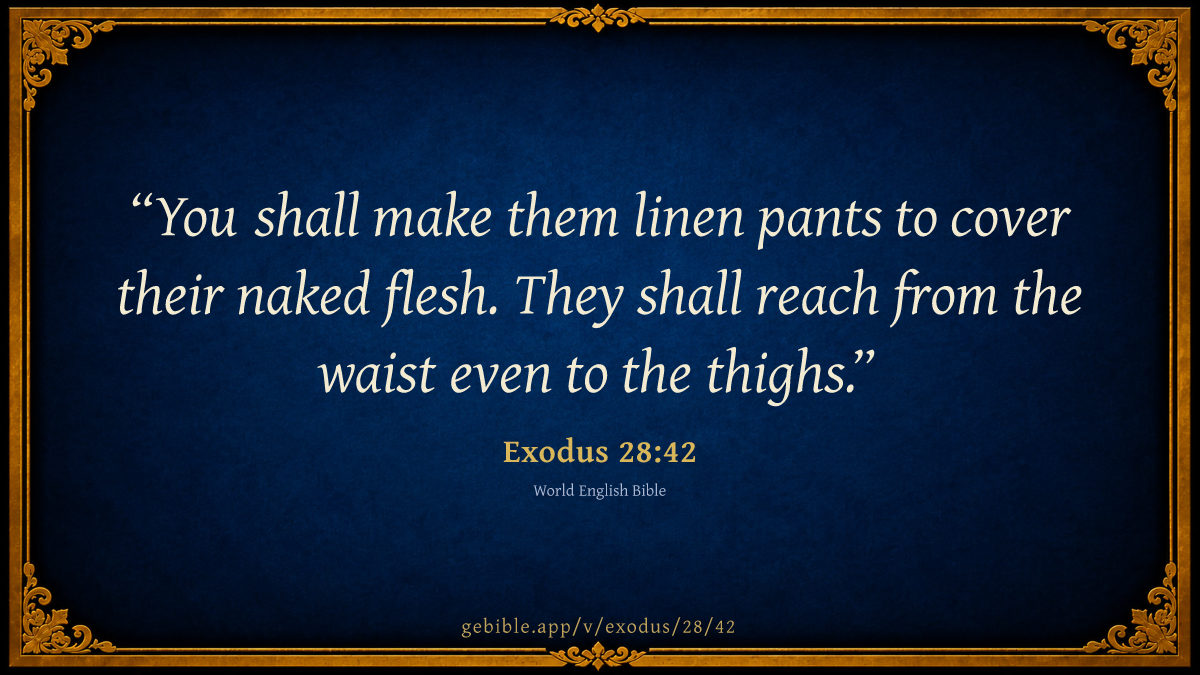
You shall make them linen pants to cover their naked flesh. They shall reach from the waist even to the thighs.
Parallel Translations
-
You shall make them linen pants to cover their naked flesh. They shall reach from the waist even to the thighs.
-
And thou shalt make them linen breeches to cover their nakedness; from the loins even unto the thighs they shall reach:
-
And thou shalt make them linen breeches to cover the flesh of their nakedness; from the loins even unto the thighs they shall reach.
Cross-references (6)
Passages linked to Exodus 28:42 in the Treasury of Scripture Knowledge, ordered by reader-vote popularity; verse text shown in World English Bible.
- Leviticus 6:10 The priest shall put on his linen garment, and he shall put on his linen trousers upon his body; and he shall remove the ashes from where the fire has consumed the burnt offering on the altar, and he shall put them beside the altar.
- Leviticus 16:4 He shall put on the holy linen tunic. He shall have the linen trousers on his body, and shall put on the linen sash, and he shall be clothed with the linen turban. They are the holy garments. He shall bathe his body in water, and put them on.
- Ezekiel 44:18 They shall have linen turbans on their heads, and shall have linen trousers on their waists. They shall not clothe themselves with anything that makes them sweat.
- Exodus 39:28 the turban of fine linen, the linen headbands of fine linen, the linen trousers of fine twined linen,
- Revelation 3:18 I counsel you to buy from me gold refined by fire, that you may become rich; and white garments, that you may clothe yourself, and that the shame of your nakedness may not be revealed; and eye salve to anoint your eyes, that you may see.
- Exodus 20:26 You shall not go up by steps to my altar, that your nakedness may not be exposed to it.’
Cross-references from openbible.info (CC BY 4.0)
Explain this verse (11 sources)
Historical commentary, presented as a primary source — not an endorsement.
Private notes
Saved on this device only — never synced or sent anywhere.
Matthew Poole 1685 · Public Domain Including both. Compare Exo 20:26.
Including both. Compare Exo 20:26.
Matthew Poole's English Annotations on the Holy Bible (1683–1685) — public domain. Text from a community e-Sword/MySword module.
John Gill 1763 · Public Domain And they shall be upon Aaron and upon his…
And they shall be upon Aaron and upon his sons,.... Not the linen breeches only, but all the other garments:
when they come into the tabernacle of the congregation; even into that part of it where the people assembled, the court of the tabernacle, and where stood the altar of burnt offering, on which they offered the sacrifices of the people, but never without the priestly garments on:
Read full note →
or when they came near unto the altar to minister in the holy place; at the altar of incense which stood there; or when they came to trim the lamps of the candlestick, and set the shewbread on the table, and take away the old, which candlestick and shewbread table were both in the holy place:
that they bear not iniquity and die; be guilty of sin in not having their priestly garments on in time of service, and so bear the punishment of it and die for it; the Targum of Jonathan adds, with flaming fire, with fire from heaven, such as Nadab and Abihu were afterwards consumed with; an high priest that had not the eight garments on, or a common priest that had not his four garments, his service was illegal and rejected, and he was guilty of death by the hand of heaven, as Maimonides (s) says; that is, he was deserving of immediate death from the hand of God, and might expect it:
it shall be a statute for ever unto him, and his seed after him; as long as the Aaronic priesthood continued, until Christ should arise, made an high priest, not after the order of Aaron, but after the order of Melchizedek, and should put an end to the priesthood of the former, by answering and fulfilling all the types and shadows of it; this respects all that is said in this chapter concerning the vestments of the priests, one and another.
(s) Cele Hamikdash, c. 10. sect. 4, 5.
Next: Exodus Chapter 29
John Gill's Exposition of the Whole Bible (1746–1763) — public domain (CC PDM 1.0). Text via the HelloAO Bible API.
Adam Clarke 1810 · Public Domain Verse 42. Linen breeches] This command had in view…
Verse 42. Linen breeches] This command had in view the necessity of purity and decency in every part of the Divine worship, in opposition to the shocking indecency of the pagan worship in general, in which the priests often ministered naked, as in the sacrifices to Bacchus, c.
ON the garments of the high priest some general reflections have already been made see Ex 28:2: See Clarke on Ex 28:2. and to what is there said it may be just necessary to add, that there can be no doubt of their being all emblematical of spiritual things; but of which, and in what way, no man can positively say. Many commentators have entered largely into this subject, and have made many edifying and useful remarks; but where no clue is given to guide us through a labyrinth in which the possibility of mistake is every moment occurring, it is much better not to attempt to be wise above what is written; for however edifying the reflections may be which are made on these subjects, yet, as they are not clearly deducible from the text itself, they can give little satisfaction to a sincere inquirer after truth. These garments were all made for glory and for beauty, and this is the general account that it has pleased God to give of their nature and design: in a general sense, they represented,
Read full note →
1. The necessity of purity in every part of the Divine worship;
2. The necessity of an atonement for sin;
3. The purity and justice of the Divine Majesty; and,
4. The absolute necessity of that holiness without which none can see the Lord. And these subjects should be diligently kept in view by all those who wish to profit by the curious and interesting details given in this chapter. In the notes these topics are frequently introduced.
Adam Clarke's Commentary on the Bible (1810–1826) — public domain. Text from a community e-Sword/MySword module.
Haydock's Catholic Bible Commentary 1859 · Public Domain Linen breeches, descending as far as the knees. (St.…
Linen breeches, descending as far as the knees. (St. Jerome) In chap. xxxix. 29, they seem to have been made of byssus, or cotton. But as linen is prescribed in all other places, perhaps a word has crept in there, by mistake of the transcribers. They were intended to remind the priests of superior modesty, as they were not commonly worn. Homer never mentions them. Virgil only specifies the cloak and tunic of Evander. Augustus wore breeches and stockings in winter. (Suetonius) --- But the ancient breeches were not like ours, but resembled rather an apron or girdle, enveloping both thighs, and hanging from the waist. (Calmet)
George Leo Haydock (1774–1849), Haydock's Catholic Family Bible and Commentary, 1859 edition — public domain. Excludes Psalms (Douay-Rheims chapter numbering differs from Protestant) and Deuterocanonical books (Catholic canon only).
Robert Jamieson, A. R. Fausset & David Brown 1871 · Public Domain linen breeches--drawers, which encompassed the loins and reached half…
linen breeches--drawers, which encompassed the loins and reached half way down the thighs. They are seen very frequently represented in Egyptian figures.
Next: Exodus Chapter 29
Jamieson, Fausset & Brown — Commentary Critical and Explanatory on the Whole Bible (1871) — public domain (CC PDM 1.0). Text via the HelloAO Bible API.
Daniel D. Whedon 1874 · Public Domain 42. Linen breeches — The Hebrew is from a…
42. Linen breeches — The Hebrew is from a root which means to conceal. They were a garment for concealing the nakedness, short drawers reaching from the loins even unto the thighs, and were, on peril of death, to be worn by Aaron and his sons whenever they ministered in the holy places. The word בר, here rendered linen, is not the same as that so rendered above, שׁשׁ in Exo_28:39; Exo_28:15; Exo_28:8; Exo_28:6; Exo_28:5. The material intended is not certainly known, but would seem, from Exo_39:28, to be something much resembling the linen, or byssus, if not a peculiar texture of the same material.
Daniel D. Whedon (gen. ed.), Commentary on the Old and New Testaments (1874–1909) — public domain. Text from a community e-Sword module.
The Cambridge Bible for Schools and Colleges 1878 · Public Domain 42, 43. The linen drawers, to be worn by…
42, 43. The linen drawers, to be worn by the priests during their ministrations in the Tent of meeting or at the altar. A dictate of reverence and modesty. The layman was forbidden to go up by steps to the altar, lest he should expose his person upon it (Exo_20:26): for the priests, who did go up upon the altar (see on Exo_27:5), and were otherwise frequently engaged in or near the Tent of meeting, special garments were provided, in order to prevent the same unseemliness. Among the Romans the Flamen Dialis similarly (Gell. x. 15), ‘tunicam intimam nisi in locis tectis non exuit, ne sub caelo tanquam sub oculis Jovis nudus sit’ (cited by Kn.).
breeches] Only in this connexion (Exo_39:28, Lev_6:10; Lev_16:4; and in Ezek.’s regulations for the priesthood, Eze_44:18†): from the description, evidently what we should call either loincloths or drawers. LXX. περισκελῆ; Jos. (Ant. iii. 7. 1) διάζωμα περὶ τὰ αἰδοῖα.
The Cambridge Bible for Schools and Colleges (gen. ed. J. J. S. Perowne; Cambridge University Press, 1878–1918) — public domain. Text from a community e-Sword module.
Ellicott's Commentary for English Readers 1878 · Public Domain (42) Thou shalt make them linen breeches.—Rather, linen drawers.…
(42) Thou shalt make them linen breeches.—Rather, linen drawers. Drawers reaching from the waist to a little above the knee were the sole garment of many in Egypt, a necessary garment of all. Their object was as here stated.
A Bible Commentary for English Readers, edited by Charles John Ellicott (1878–1897) — public domain. Text from a community e-Sword module.
The Pulpit Commentary 1880 · Public Domain Linen breeches. Rather, "linen drawers" (Kalisch), such as we…
Linen breeches. Rather, "linen drawers" (Kalisch), such as we see worn by the Egyptians generally, reaching from the waist to a little above the knee. (See Wilkinson in Rawlinson"s Herodotus, vol. 2. p. 113, 2nd ed.) This also was of linen (Heb 2:83). Unto the thighsi.e. , to the bottom of the thighs where they adjoin on the knee.
The Pulpit Commentary (1880–1919), ed. H.D.M. Spence-Jones & Joseph S. Exell — public domain. Text from a community e-Sword module.
unfoldingWord translationNotes 2017 · CC BY-SA 4.0 General Information:
General Information:
God continues to tell Moses what the people must do.
Read full note →
undergarments
These are underwear, clothing worn under the outer clothes, next to the skin.
tent of meeting
This is another name for the tabernacle. See how you translated this in Exodus 27:21.
a permanent law
"a law the will not end"
translationWords
Aaron
tent of meeting
altar
servant
holy place
iniquity
law
descend
unfoldingWord translationNotes — © Distant Shores Media and the Door43 World Missions Community, licensed CC BY-SA 4.0. Source: git.door43.org/Door43/en_tn.
Tyndale Open Study Notes 2022 · CC BY-SA 4.0 28:42-43 Expressions of sexuality were a frequent part of…
28:42-43 Expressions of sexuality were a frequent part of pagan religion, as worshipers attempted to control the powers of fertility. In some cases, priests served their deities in the nude. Not even a hint of sexual manipulation was acceptable in the worship of the Lord. His blessings could not be achieved through magical manipulation. Thus, even unintentional display of the genitals was guarded against.
Tyndale Open Study Notes — © Tyndale Open Resources, licensed CC BY-SA 4.0. Text via the HelloAO Bible API.