10Moses said to Yahweh, “O Lord, I am not eloquent, neither before now, nor since you have spoken to your servant; for I am slow of speech, and of a slow tongue.”
11Yahweh said to him, “Who made man’s mouth? Or who makes one mute, or deaf, or seeing, or blind? Isn’t it I, Yahweh?12Now therefore go, and I will be with your mouth, and teach you what you shall speak.”
10 Moses said to Yahweh, “O Lord, I am not eloquent, neither before now, nor since you have spoken to your servant; for I am slow of speech, and of a slow tongue.”
11 Yahweh said to him, “Who made man’s mouth? Or who makes one mute, or deaf, or seeing, or blind? Isn’t it I, Yahweh?
12 Now therefore go, and I will be with your mouth, and teach you what you shall speak.”
KJVKing James Version
10 And Moses said unto the LORD, O my Lord, I am not eloquent, neither heretofore, nor since thou hast spoken unto thy servant: but I am slow of speech, and of a slow tongue.
11 And the LORD said unto him, Who hath made man’s mouth? or who maketh the dumb, or deaf, or the seeing, or the blind? have not I the LORD?
12 Now therefore go, and I will be with thy mouth, and teach thee what thou shalt say.
Show all 3 translations
JPSJPS Tanakh (1917)
10 And Moses said unto the LORD: 'Oh Lord, I am not a man of words, neither heretofore, nor since Thou hast spoken unto Thy servant; for I am slow of speech, and of a slow tongue.'
11 And the LORD said unto him: 'Who hath made man's mouth? or who maketh a man dumb, or deaf, or seeing, or blind? is it not I the LORD?
12 Now therefore go, and I will be with thy mouth, and teach thee what thou shalt speak.'
Questions where the Bible appears to say two different things, with the passages on each side set together.
Was Moses a good speaker?Exodus 4:10 has Moses himself telling YHWH he is not eloquent and is "slow of speech, and of a slow tongue" — the whole reason Aaron gets attached to the missi…
Who makes people blind?Exodus 4:11 has Yahweh personally claim authorship over blindness, deafness, and muteness — they are direct acts of God.
Jeremiah 1:9(vv11–12)Then Yahweh stretched out his hand, and touched my mouth. Then Yahweh said to me, “Behold, I have put my words in your mouth.
Luke 12:11-12(v12)When they bring you before the synagogues, the rulers, and the authorities, don’t be anxious how or what you will answer, or what you will…
Psalms 146:8(v11)Yahweh opens the eyes of the blind. Yahweh raises up those who are bowed down. Yahweh loves the righteous.
Ezekiel 3:26-27(v11)I will make your tongue stick to the roof of your mouth, that you will be mute, and will not be able to correct them; for they are a…
Amos 3:6(v11)Does the trumpet alarm sound in a city, without the people being afraid? Does evil happen to a city, and Yahweh hasn’t done it?
Show all 32 cross-references
Psalms 94:9(v11)He who implanted the ear, won’t he hear? He who formed the eye, won’t he see?
Isaiah 6:7(v11)He touched my mouth with it, and said, “Behold, this has touched your lips; and your iniquity is taken away, and your sin forgiven.”
Matthew 10:19-20(v12)But when they deliver you up, don’t be anxious how or what you will say, for it will be given you in that hour what you will say. For it is…
Psalms 51:15(v11)Lord, open my lips. My mouth will declare your praise.
Luke 21:14-15(v12)Settle it therefore in your hearts not to meditate beforehand how to answer, for I will give you a mouth and wisdom which all your…
Jeremiah 1:6(vv10–11)Then I said, “Ah, Lord Yahweh! Behold, I don’t know how to speak; for I am a child.”
Mark 13:11(v12)When they lead you away and deliver you up, don’t be anxious beforehand, or premeditate what you will say, but say whatever will be given…
Genesis 18:14(v11)Is anything too hard for Yahweh? At the set time I will return to you, when the season comes round, and Sarah will have a son.”
Ezekiel 33:22(v11)Now Yahweh’s hand had been on me in the evening, before he who had escaped came; and he had opened my mouth, until he came to me in the…
Isaiah 42:7(v11)to open the blind eyes, to bring the prisoners out of the dungeon, and those who sit in darkness out of the prison.
Isaiah 50:4(v12)The Lord Yahweh has given me the tongue of those who are taught, that I may know how to sustain with words him who is weary. He awakens…
Isaiah 35:5-6(v11)Then the eyes of the blind will be opened, and the ears of the deaf will be unstopped. Then the lame man will leap like a deer, and the…
Matthew 11:5(v11)the blind receive their sight, the lame walk, the lepers are cleansed, the deaf hear, the dead are raised up, and the poor have good news…
Exodus 6:12(v10)Moses spoke before Yahweh, saying, “Behold, the children of Israel haven’t listened to me. How then shall Pharaoh listen to me, when I have…
John 14:26(v12)But the Counselor, the Holy Spirit, whom the Father will send in my name, will teach you all things, and will remind you of all that I said…
Ephesians 6:19(v12)on my behalf, that utterance may be given to me in opening my mouth, to make known with boldness the mystery of the Good News,
Acts 7:22(v10)Moses was instructed in all the wisdom of the Egyptians. He was mighty in his words and works.
Exodus 4:1(v10)Moses answered, “But, behold, they will not believe me, nor listen to my voice; for they will say, ‘Yahweh has not appeared to you.’ ”
Luke 11:1(v12)When he finished praying in a certain place, one of his disciples said to him, “Lord, teach us to pray, just as John also taught his…
2 Corinthians 11:6(v10)But though I am unskilled in speech, yet I am not unskilled in knowledge. No, in every way we have been revealed to you in all things.
Psalms 25:4-5(v12)Show me your ways, Yahweh. Teach me your paths. Guide me in your truth, and teach me, For you are the God of my salvation, I wait for you…
2 Corinthians 10:10(v10)For, “His letters”, they say, “are weighty and strong, but his bodily presence is weak, and his speech is despised.”
Job 12:2(v10)“No doubt, but you are the people, and wisdom will die with you.
Psalms 32:9(v12)Don’t be like the horse, or like the mule, which have no understanding, who are controlled by bit and bridle, or else they will not come…
Psalms 143:10(v12)Teach me to do your will, for you are my God. Your Spirit is good. Lead me in the land of uprightness.
Isaiah 49:2(v12)He has made my mouth like a sharp sword. He has hidden me in the shadow of his hand. He has made me a polished shaft. He has kept me close…
1 Corinthians 2:1-4(v10)When I came to you, brothers, I didn’t come with excellence of speech or of wisdom, proclaiming to you the testimony of God. For I…
32 distinct cross-references across this passage (34 total citations).
Cross-references from openbible.info (CC BY 4.0)
Explain this passage (20 sources)
Historical commentary, presented as a primary source — not an endorsement.
Geneva Bible translators1599 · Public DomainOn v10Hebrew, from yesterday, and ere yesterday.
Hebrew, from yesterday, and ere yesterday.
Hebrew, heavy of mouth.
Geneva Bible (1599) marginal notes — public domain.
John Trapp1656 · Public DomainOn vv10–12Exo 4:10 And Moses said unto the LORD, O…
Exo 4:10 And Moses said unto the LORD, O my Lord, I [am] not eloquent, neither heretofore, nor since thou hast spoken unto thy servant: but I [am] slow of speech, and of a slow tongue.
Ver. 10. I am not eloquent.] Heb., A man of words, a master of speech - ηγουμενος λογου - as Paul was. {Act 14:12} He had not that first, second, and third of an orator, - elocution, or pronunciation. And yet God made choice of him rather than of eloquent Aaron to pray. {Exo 17:12} Not gifts but graces prevail in prayer.
Read full note →
Slow of speech.] Of a letsom delivery; wordbound.
John Trapp, A Commentary or Exposition upon All the Books of the Old and New Testament (1647–1656) — public domain. Text from a community e-Sword module.
Matthew Poole1685 · Public DomainOn vv10, 12I am not eloquent; not able to deliver thy…
I am not eloquent; not able to deliver thy message acceptably and decently, either to Pharaoh or to the Israelites. Since thy appearance to me, thou hast made some change in my hand, but none in my tongue, but still I am, as I was, most unfit for so high an employment. But indeed he was therefore fit for it, as the unlearned apostles were for the preaching of the gospel, that the honour of their glorious works might be entirely given to God, and not to the instruments which he used.
Matthew Poole's English Annotations on the Holy Bible (1683–1685) — public domain. Text from a community e-Sword/MySword module.
Matthew Henry1710 · Public DomainOn v10Moses still continues backward to the service for which…
Moses still continues backward to the service for which God had designed him, even to a fault; for now we can no longer impute it to his humility and modesty, but must own that here was too much of cowardice, slothfulness, and unbelief in it. Observe here,
I. How Moses endeavours to excuse himself from the work.
Read full note →
1. He pleads that he was no good spokesman: O my Lord! I am not eloquent, Exo 4:10. He was a great philosopher, statesman, and divine, and yet no orator; a man of a clear head, great thought, and solid judgment, but had not a voluble tongue, or ready utterance, and therefore he thought himself unfit to speak before great men about great affairs, and in danger of being run down by the Egyptians. Observe, (1.) We must not judge of men by the readiness and fluency of their discourse. Moses was mighty in word (Act 7:22), and yet not eloquent: what he said was strong and nervous, and to the purpose, and distilled as the dew (Deu 32:2), though he did not deliver himself with that readiness, ease, and elegance, that some do, who have not the tenth part of his sense. St. Paul's speech was contemptible, Co2 10:10. A great deal of wisdom and true worth is concealed by a slow tongue. (2.) God is pleased sometimes to make choice of those as his messengers who have fewest of the advantages of art or nature, that his grace in them may appear the more glorious. Christ's disciples were no orators, till the Spirit made them such.
2. When this plea was overruled, and all his excuses were answered, he begged that God would send somebody else on this errand and leave him to keep sheep in Midian (Exo 4:13): "Send by any hand but mine; thou canst certainly find one much more fit." Note, An unwilling mind will take up with a sorry excuse rather than none, and is willing to devolve those services upon others that have any thing of difficulty or danger in them.
II. How God condescends to answer all his excuses. Though the anger of the Lord was kindled against him (Exo 4:14), yet he continued to reason with him, till he had overcome him. Note, Even self-diffidence, when it grows into an extreme - when it either hinders us from duty or clogs us in duty, or when it discourages our dependence upon the grace of God - is very displeasing to him. God justly resents our backwardness to serve him, and has reason to take it ill; for he is such a benefactor as is before-hand with us, and such a rewarder as will not be behind-hand with us. Note further, God is justly displeased with those whom yet he does not reject: he vouchsafes to reason the case even with his froward children, and overcomes them, as he did Moses here, with grace and kindness.
1. To balance the weakness of Moses, he here reminds him of his own power, Exo 4:11. (1.) His power in that concerning which Moses made the objection: Who has made man's mouth? Have not I the Lord? Moses knew that God made man, but he must be reminded now that God made man's mouth. An eye to God as Creator would help us over a great many of the difficulties which lie in the way of our duty, Psa 124:8. God, as the author of nature, has given us the power and faculty of speaking; and from him, as the fountain of gifts and graces, comes the faculty of speaking well, the mouth and wisdom (Luk 21:15), the tongue of the learned (Isa 50:4); he pours grace into the lips, Psa 45:2. (2.) His power in general over the other faculties. Who but God makes the dumb and the deaf, the seeing and the blind? [1.] The perfections of our faculties are his work, he makes the seeing; he formed the eye (Psa 94:9); he opens the understanding, the eye of the mind, Luk 24:45. [2.] Their imperfections are from him too; he make the dumb, and deaf, and blind. Is there any evil of this kind, and the Lord has not done it? No doubt he has, and always in wisdom and righteousness, and for his own glory, Joh 9:3. Pharaoh and the Egyptians were made deaf and blind spiritually, as Isa 6:9, Isa 6:10. But God knew how to manage them, and get himself honour upon them.
2. To encourage him in this great undertaking, he repeats the promise of his presence, not only in general, I will be with thee (Isa 3:12), but in particular, "I will be with thy mouth, so that the imperfection in thy speech shall be no prejudice to thy message." It does not appear that God did immediately remove the infirmity, whatever it was; but he did that which was equivalent, he taught him what to say, and then let the matter recommend itself: if others spoke more gracefully, none spoke more powerfully. Note, Those whom God employs to speak for him ought to depend upon him for instructions, and it shall be given them what they shall speak, Mat 10:19.
3. He joins Aaron in commission with him. He promises that Aaron shall meet him opportunely, and that he will be glad to see him, they having not seen one another (it is likely) for many years, Exo 4:14. He directs him to make use of Aaron as his spokesman, Exo 4:16. God might have laid Moses wholly aside, for his backwardness to be employed; but he considered his frame, and ordered him an assistant. Observe, (1.) Two are better than one, Ecc 4:9. God will have his two witnesses (Rev 11:3), that out of their mouths every word may be established. (2.) Aaron was the brother of Moses, divine wisdom so ordering it, that their natural affection one to another might strengthen their union in the joint execution of their commission. Christ sent his disciples two and two, and some of the couples were brothers. (3.) Aaron was the elder brother, and yet he was willing to be employed under Moses in this affair, because God would have it so. (4.) Aaron could speak well, and yet was far inferior to Moses in wisdom. God dispenses his gifts variously to the children of men, that we may see our need one of another, and each may contribute something to the good of the body, Co1 12:21. The tongue of Aaron, with the head and heart of Moses, would make one completely fit for this embassy. (5.) God promises, I will be with thy mouth, and with his mouth. Even Aaron, that could speak well, yet could not speak to purpose unless God was with his mouth; without the constant aids of divine grace the best gifts will fail.
4. He bids him take the rod with him in his hand (Exo 4:17), to intimate that he must bring about his undertaking rather by acting than by speaking; the signs he should work with this rod might abundantly supply the want of eloquence; one miracle would do him better service than all the rhetoric in the world. Take this rod, the rod he carried as a shepherd, that he might not be ashamed of that mean condition out of which God called him. This rod must be his staff of authority, and must be to him instead both of sword and sceptre.
Matthew Henry's Commentary on the Whole Bible (1708–1710) — public domain (CC PDM 1.0). Text via the HelloAO Bible API.
John Gill1763 · Public DomainOn vv10–12And Moses said unto the Lord,.... Notwithstanding the above…
And Moses said unto the Lord,.... Notwithstanding the above miracles, he seems unwilling to go on the Lord's errand to Pharaoh and to the Israelites, and therefore invents a new objection after all his other objections had been sufficiently answered:
I am not eloquent; or "a man of words" (s), that has words at command, that can speak well readily, and gracefully; such an one, he intimates, was proper to be sent to a king's court, that was an orator, that could make fine speeches, and handsome addresses, for which he was not qualified:
Read full note →
neither heretofore, nor since thou hast spoken to thy servant; neither in his younger years had he ever been an eloquent man, nor was there any alteration in him in that respect, since God had given him this call:
but I am slow of speech, and of a slow tongue; had some impediment in his speech, could not freely and easily bring out his words, or rightly pronounce them; so Lucian (t) the Heathen calls Moses slow tongued, or one slow of speech, and uses the same word the Septuagint does here, which version perhaps he had seen, and from thence took it.
(s) "vir verborum", Paguinus, Montanus, Piscator, Ainsworth. (t) In Philopatride.
John Gill's Exposition of the Whole Bible (1746–1763) — public domain (CC PDM 1.0). Text via the HelloAO Bible API.
John Wesley1765 · Public DomainOn v10O my Lord, I am not eloquent - He…
O my Lord, I am not eloquent - He was a great philosopher, statesman, and divine, and yet no orator; a man of a clear head, great thought and solid judgment, but had not a voluble tongue, nor ready utterance; and therefore he thought himself unfit to speak before great men, and about great affairs. Moses was mighty in word, Acts vii, 22, and yet not eloquent: what he said was strong and nervous, and to the purpose, and distilled as the dew, Deut. xxxii, 2, though he did not deliver himself with that readiness, ease and fineness that some do.
John Wesley, Explanatory Notes Upon the Whole Bible (1754–1765) — public domain. Text via the GEBible commentary corpus.
Adam Clarke1810 · Public DomainOn vv10–12Verse 10. I am not eloquent] לא איש דברים…
Verse 10. I am not eloquent] לא איש דברים lo ish debarim, I am not a man of words; a periphrasis common in the Scriptures. So Job 11:2, איש שפתים ish sephathayim, a man of lips, signifies one that is talkative. Ps 140:11, איש לשון ish lashon, a man of tongue, signifies a prattler. But how could it be said that Moses was not eloquent, when St. Stephen asserts, Ac 7:22, that he was mighty in words as well as in deeds? There are three ways of solving this difficulty:
1. Moses might have had some natural infirmity, of a late standing, which at that time rendered it impossible for him to speak readily, and which he afterwards overcame; so that though he was not then a man of words, yet he might afterwards have been mighty in words as well as deeds.
Read full note →
2. It is possible he was not intimately acquainted with the Hebrew tongue, so as to speak clearly and distinctly in it. The first forty years of his life he had spent in Egypt, chiefly at court; and though it is very probable there was an affinity between the two languages, yet they certainly were not the same. The last forty he had spent in Midian, and it is not likely that the pure Hebrew tongue prevailed there, though it is probable that a dialect of it was there spoken. On these accounts Moses might find it difficult to express himself with that readiness and persuasive flow of language, which he might deem essentially necessary on such a momentous occasion; as he would frequently be obliged to consult his memory for proper expressions, which would necessarily produce frequent hesitation, and general slowness of utterance, which he might think would ill suit an ambassador of God.
3. Though Moses was slow of speech, yet when acting as the messenger of God his word was with power, for at his command the plagues came and the plagues were stayed; thus was he mighty in words as well as in deeds: and this is probably the meaning of St. Stephen.
By the expression, neither heretofore, nor since thou hast spoken unto thy servant, he might possibly mean that the natural inaptitude to speak readily, which he had felt, he continued to feel, even since God had begun to discover himself; for though he had wrought several miracles for him, yet he had not healed this infirmity. See Clarke on Ex 6:12.
Adam Clarke's Commentary on the Bible (1810–1826) — public domain. Text from a community e-Sword/MySword module.
Joseph Benson1811 · Public DomainOn v10Exo 4:10. O my Lord, I am not eloquent…
Exo 4:10. O my Lord, I am not eloquent — He was a great philosopher, statesman, and divine, and yet no orator; a man of a clear head, great thought, and solid judgment, but had not a voluble tongue, nor ready utterance; and therefore he thought himself unfit to speak before great men and about great affairs. Moses was mighty in word, (Act 7:21,) and yet not eloquent; what he said was strong and nervous, and to the purpose, and distilled as the dew, (Deu 32:2,) though he did not deliver himself with that readiness, ease, and fineness that some do.
Joseph Benson's Commentary on the Old and New Testaments (1811–1818) — public domain. Text from a community e-Sword module.
Albert Barnes1834 · Public DomainOn vv10, 12Eloquent - See the margin. The double expression “slow…
Eloquent - See the margin. The double expression “slow of speech (Eze 3:5 margin) and of a slow tongue” seems to imply a difficulty both in finding words and in giving them utterance, a very natural result of so long a period of a shepherd’s life, passed in a foreign land.
Since thou hast spoken - This expression seems to imply that some short time had intervened between this address and the first communication of the divine purpose to Moses.
Albert Barnes' Notes on the Bible (1834–1885) — public domain. Text from a community e-Sword/MySword module.
Haydock's Catholic Bible Commentary1859 · Public DomainOn v10Of tongue, being impressed with awe, at the divine…
Of tongue, being impressed with awe, at the divine presence. He feared, therefore, that he should not be able to deliver himself intelligently at the court of Pharao, and might rather excite the disgust of that haughty tyrant. (Haydock) --- He had been 40 years absent in the land of Madian, and might have forgotten both the Egyptian and Hebrew languages in some degree; in which sense slowness or heaviness of tongue is taken, (Ezechiel iii. 5.) to express an unknown language. (Calmet) --- God was thus pleased to shew, that all the glory arising from this enterprize belonged to himself; and he thus also gave occasion to Moses to humble himself, while he wrought miracles. (Menochius)
George Leo Haydock (1774–1849), Haydock's Catholic Family Bible and Commentary, 1859 edition — public domain. Excludes Psalms (Douay-Rheims chapter numbering differs from Protestant) and Deuterocanonical books (Catholic canon only).
Robert Jamieson, A. R. Fausset & David Brown1871 · Public DomainOn v10I am not eloquent--It is supposed that Moses labored…
I am not eloquent--It is supposed that Moses labored under a natural defect of utterance or had a difficulty in the free and fluent expression of his ideas in the Egyptian language, which he had long disused. This new objection was also overruled, but still Moses, who foresaw the manifold difficulties of the undertaking, was anxious to be freed from the responsibility.
Jamieson, Fausset & Brown — Commentary Critical and Explanatory on the Whole Bible (1871) — public domain (CC PDM 1.0). Text via the HelloAO Bible API.
Daniel D. Whedon1874 · Public DomainOn v10MOSES HESITATES AND IS REBUKED, Exo_4:10-17.
MOSES HESITATES AND IS REBUKED, Exo_4:10-17.
10-12. I am not eloquent — Literally, not a man of words.
Read full note →
Slow of speech — Rather, heavy of mouth and heavy of tongue. Moses declares that he is no orator, has not the gift of persuasion, and therefore he has not confidence that he can convince Israel of his mission. So Paul tells us that his bodily presence was weak, and his speech contemptible; but where are weighty and immortal words to be found if they fell not from Paul and Moses? Moses, like Paul, felt weak when he measured himself with his work. He did not yet realize how God’s strength is made perfect in such weakness. It would also seem that Moses was not fluent, like Aaron his brother; and, perhaps, from his long separation from his brethren, he had to some degree lost command of his native language. This would naturally make him diffident in undertaking a popular appeal. He may have been conscious, too, that in his forty years’ exile from Egyptian civilization his tongue and manners had caught a desert rudeness, which poorly fitted him to appear in the courts of the Pharaohs. Here, for the first time, prophetic inspiration is promised to man. Henceforth in the whole subsequent history of the Church we see this endowment of the Holy Ghost. So the lips of the shrinking Isaiah were touched with a “live coal” from the heavenly altar. Isaiah 6. So Jehovah laid his hand on the mouth of the wavering Jeremiah. Jeremiah 1. So it was given to the uncultured Apostle to speak boldly before rulers and peoples: and so God’s Spirit has ever been a fire in the words of his genuine messengers. Moses was learned enough to know the vanity of learning, and had now become wise enough to see the folly of wisdom, so that he was just the instrument for God’s hand.
Daniel D. Whedon (gen. ed.), Commentary on the Old and New Testaments (1874–1909) — public domain. Text from a community e-Sword module.
The Cambridge Bible for Schools and Colleges1878 · Public DomainOn vv10–1210. Oh] In the Heb. a particle of entreaty,…
10. Oh] In the Heb. a particle of entreaty, craving permission to speak: always followed by either Lord (‘Adonai,’ not ‘Jehovah’), v. 13, Jos_7:8 al., or my lord, Gen_43:20, Num_12:11 al.
eloquent] lit. a man of words, i.e. able to command words, fluent. Cf. Jeremiah’s objection (Exo_1:6).
Read full note →
nor since, &c.] In giving him his commission, God has conferred upon him other powers (vv. 2–9), but not the gift of fluency.
heavy of mouth and heavy of tongue] i.e. slow to move them.
10–17. Moses’ fourth difficulty: he objects that he is not fluent, has no power to state his case, to convince or persuade the Israelites. He is promised, in reply, firstly, that God will be with him to give him words, and afterwards, as he still demurs, that Aaron shall be his spokesman.
The Cambridge Bible for Schools and Colleges (gen. ed. J. J. S. Perowne; Cambridge University Press, 1878–1918) — public domain. Text from a community e-Sword module.
Ellicott's Commentary for English Readers1878 · Public DomainOn vv10–12(10) I am not eloquent.—Heb., No man of words…
(10) I am not eloquent.—Heb., No man of words am I. Moses, still reluctant, raises a new objection. He is not gifted with facility of speech. Words do not. come readily to him; perhaps, when they come, he has a difficulty in uttering them. According to a Jewish tradition, he was unable to pronounce the labials, b, f, m, p, v. According to his own expressions at the end of the verse, he was “heavy” or “slow of speech,” and “heavy” or “slow of tongue.”
Neither heretofore.—Heb., neither yesterday, nor the day before. It is a Hebrew idiom to make these words cover past time generally. (See below, Exo_5:7-8; Exo_5:14; and comp. Gen_31:2; Gen_31:5, and 2Sa_3:17.)
Read full note →
Nor since thou hast spoken.—Converse with God had not cured his defect of utterance, whatever it was. He remained “slow of speech and slow of tongue”—unready, i.e., and hesitating.
A Bible Commentary for English Readers, edited by Charles John Ellicott (1878–1897) — public domain. Text from a community e-Sword module.
The Pulpit Commentary1880 · Public DomainOn vv10–11And Moses said, O my Lord. The phrase used…
And Moses said, O my Lord. The phrase used by Moses is full of force. It is "vox dolentis et supplicantis" (Noldius). Joseph"s brethren use it to the steward of Joseph"s house, when they expect to be fallen upon and taken for bondsmen; (Gen_43:20) Judah used it (Gen_44:18) when pleading with Joseph for Benjamin; Aaron when pleading for Miriam; (Num_13:11) Joshua when expostulating with God about Ai. (Jos_7:8) There is a deprecatory idea in it, as well asa supplicatory one; an idea like that which Abraham expanded into the words, "Oh! let not the Lord be angry, and I will speak yet but this once". (Gen_18:32) Moses feels that he is trying the patience of God to the uttermost; but yet he must make one more effort to escape his mission. I am not eloquent. Literally, as in the margin, "a man of words." "Words do not come readily to my tongue when I attempt to speak; I have never been a fluent speaker, neither yesterday (i.e. recently) nor the day before (i.e. formerly). Nor do I even find that I have become eloquent by divine inspiration since thou spakest with me. Still I remain slow of speech and slow of tongue." A question is raised whether the mere difficulty of finding words and giving them utterance a difficulty felt at first by almost every speaker is here meant, or something further, as "a natural impediment owing to defect in the organs of speech" (Kalisch), or a want of readiness, owing to disuse, in speaking the Hebrew language (Clarke). The latter suggestion is scarcely consistent with the ease and fluency with which Moses had carried on the conversation in Hebrew up to this point. The former is a possible meaning, though not a necessary one. According to a Jewish tradition, Moses had a difficulty in pronouncing the labials b, v, m, ph, p.
Slowness of speech a drawback on ministerial fitness, but not a disqualification.
Read full note →
It is remarkable that both Moses, the great prophet of the First Covenant, and St. Paul, the "chosen vessel" for the publication of the Second Covenant, were ineffective as speakers; not perhaps both "in presence base," but certainly both "in speech contemptible". (2Co_10:1, 2Co_10:10) Speakers and preachers should lay the lesson to heart, and learn not to be overproud of the gift of eloquence. A good gift it is, no doubt when sanctified, a great gift which may redound to God"s honour and glory, and for which they should be duly thankful, but not a necessary gift. The men of action, the men that have done the greatest things, and left their mark most enduringly upon the world, have seldom been "men of words." Luther indeed was mighty in speech, and John Knox, and Whitfield, and (though less so) John Wesley, but not our own Cranmer, nor Melancthon, nor Anselm, nor Bishop Cosin, nor John Keble. In the secular sphere of statesmanship and generalship the same principle holds even more decidedly. Demosthenes has to yield the palm to Alexander, Cicero to Caesar, Pym to Cromwell, the Abbe Sieyes to Napoleon. On the whole it must be said that those who are great in deed are rarely great in speech. And without eloquence a man may do God good service in every walk of life, even as a minister. The written sermon may go as straight to the heart of the audience as the spoken one. Ministerial effort in house-to-house visiting may do as much to convert a parish as any number of extempore sermons. Example of life preaches better than palaver. Let no one who feels within him the ministerial call, who longs to serve God by bringing his fellow-men to Christ, be deterred by the thought that he is "slow of speech and of a slow tongue." God, without making him eloquent, can "be with his mouth," give his words force, make them powerful to the conversion of souls. It has been said that there are many "dumb poets." So are there many "dumb preachers," whoso weak and hesitating words God blesses and renders effectual, so that in the end they have no cause to be ashamed, but may point to those whom they have brought to Christ, and exclaim with St. Paul, "Ye are our work, ye are our epistle, the seal of our apostleship are ye in the Lord". (1Co_9:1, 1Co_9:2; 2Co_3:2)
Vers. 10-17. Slow of speech.
The longer Moses pondered the mission on which he was sent, the more he shrank from it. The difficulty which now oppressed him was his want of eloquence. It seemed to him that in this respect he was the least qualified person God could have chosen. There was needed for such a work a man of persuasive tongue, of fluent, forcible, and impressive speech; and his own utterance was hesitating and heavy. Overwhelmed with the sense of unfitness, he again appeals to God, and asks to be relieved from duty. We have here
I A FELT INFIRMITY. Moses was doubtless right in what he said of his natural difficulty of speech. But his error lay
1. In exaggerating the value of a gift of mere eloquence. He did not possess it though Stephen calls him "mighty in words" (Act_7:22) and he was apt to overrate its influence. He forgot that the man of deepsilent nature has a power of his own, which expresses itself through the very ruggedness and concentration of his speech; and that oratory, while valuable for some purposes, is not the most essential gift in carrying through movements which are to leave a permanent impress on history. What is chiefly wanted is not power of speech, but power of action; and when it is felt that a man can act, a very limited amount of speech will serve his purpose (Cromwell, William the Silent, Bismarck, etc.). The smooth persuasive tongue, though pleasant to listen to, is not the weightiest in counsel.
2. In forgetting that God knew of this infirmity when he called him to thework. God knew all about his slowness of speech, and yet had sent him on this mission. Did not this carry with it the promise that whatever help he needed would be graciously vouchsafed? God has a purpose in sometimes calling to his service men who seem destitute of the gifts the outward gifts needful for his work.
1. The work is more conspicuously his own.
2. His power is glorified in man"s weakness.
3. The infirmity is often of advantage to the servant himself
keeping him humbled giving him to prayer, teaching him to rely onDivine grace, rousing him to effort, etc.. (2Co_12:7-10) Paul was a man "rude in speech", (2Co_11:6) and came not with eloquence of words; (1Co_2:1) but his defects of speech only made the Divine power which resided in his utterances the more conspicuous. (2Co_2:4, 2Co_2:5)
II A GRACIOUS PROMISE. God would be with his mouth, and teach him what to say (ver. 11). The Maker of speech, he might be trusted to aid its powers, when these were needed in his service. So Christ promises his disciples to give them in their hour of need what they shall speak. (Mat_10:19) Lips touched by Divine grace possess a simple, natural eloquence of their own, far excelling the attempts of studied oratory. Then there is the other fact, that gifts of speech are often latent till grace comes to evoke them. Moses" original awkwardness was no index to what, assisted by God"s grace, he might ultimately have become, even as a speaker. His gift would probably have grown with the necessity. The greatest preachers of the Gospel, with Paul at their head, have not been men naturally eloquent. If they became so afterwards, it was grace that made them. Thus, we are told of Luther that at first he dared not enter the pulpit. "Luther, who subsequently preached with so much power, who gave a new direction, and a force and elevation never before attained, to the whole system of German preaching, who is still the unparalleled master of all who hope to effect more by the internal demonstrativeness of a discourse than by its external ornamentation, this Luther was too humble, too modest, to take the place of a preacher. It was only at the solicitatlon of Slauptitz that he finally consented to preach at first in the oratory of the convent, and afterwards in church" (Hagenbach). Knox was equally diffident about the exercise of his gifts, and when an unexpected appeal was made to him, at the age of forty-two said John, abashed, burst forth in most abundant tears, and withdrew himself to his chamber" (Knox"s "History"). All may not be eloquent like these; but anyone possessed of earnest feeling and intense convictions, who is content to deliver a plain message with directness and simplicity, will be surprised at what God can sometimes make oven of rude and unskilled lips.
III A SINFUL SHRINKING FROM DUTY (ver. 13). The continued reluctance of Moses, after so gracious an assurance, was not to be excused. It was a direct act of disobedience, and argued, besides a want of faith, a certain measure of stubbornness. God was angry with him, yet forbore with his infirmity. And.if God forbore with Moses, it is surely not for us to blame him, who are so often in "the same condemnation." Let him who has never shrunk from unwelcome duties, or who has never stumbled in believing that Divine grace will, under trying circumstances, be made sufficient for his needs, cast the first stone. Admire rather in this incident
1. The patience and forbearance of God in stooping to his servant"sweakness, and
2. The "exceeding greatness" of the power which accomplished suchmighty results by so unwilling an instrumentality. Nothing proves more clearly that the work of Israel"s deliverance was not of man, but of God, than this almost stubborn reluctance of Moses to have anything to do with it.
IV A SECOND-BEST ARRANGEMENT (vers. 14-17). The appointment of Aaron as spokesman to his brother, while in one view of it an act of condescension, and a removal of Moses" difficulty, was in another aspect of it a punishment of his disobedience. It took from Moses the privilege of speaking for God in his own person, and committed the delivery of the message to more eloquent, perhaps, but also to less sanctified, lips.
1. The arrangement had its advantages.
1. It supplied one"s defect by another"s gift.
2. It utilised a talent lying unemployed.
3. It gave Aaron a share in the honour of being God"s messenger.
4. It formed a new link of sympathy between the brothers. But
2. It was not the best:
(1) It prevented the development of the gift of speech in Moses himself. Had he relied on God"s promise, he would doubtless have acquired a power of speech to which he was at first a stranger.
(2) The message would lose in force by being delivered through an intermediary. This of necessity. How much of the power of speech lies in its being a direct emanation from the mind and heart of the speaker something instinct with his own personality! As delivered by Aaron, the messages of God would lose much of their impressiveness. Fluency has its disadvantages. A mind burdened with its message, and struggling with words to give it utterance, conveys a greater impression of force than ready delivery charged with a message that is not its own.
(3) Moses would be hampered in his work by the constancy of his dependence on Aaron. It limits a man, when he cannot act without continually calling in another to his assistance.
(4) It divided Moses" authority, and gave Aaron an undue influence with the people. (cf. Ex 32)
(5) It was a temptation to Aaron himself to assume, or at least aspire to, greater authority than of right belonged to him. (cf. Nu 12) Learn
1. That it is not always good for us to have our wishes granted.
2. That God sometimes punishes by granting us our wishes (cf. Hos_13:11)
3. That God"s way is ever the best. J.O.
Vers. 10-12. The fourth difficulty: Moses alleges defect of utterance.
The third time-is often represented in Scripture as the final and decisive. (1Sa_3:8; Mat_26:44, Mat_26:45, Mat_26:75; Joh_21:17; 2Co_12:8) But Moses is not yet either satisfied or even silenced. As fast as one difficulty is swept away, his fearful and fertile mind has another ready to take its place. He began with himself, in stating his objections and difficulties, pleading then his unworthiness in general terms; now in the end he comes back to himself with the mention of a special difficulty. Consider
I THE DIFFICULTY AS STATED BY MOSES. In the course of the conversation, God has laid before him such particulars of the work required as seem to show him, in his hasty view of them, that he will have much speaking to do. But for speaking he alleges himself to be peculiarly unfit. What he meant by this unfitness we have no means of exactly ascertaining. Perhaps he had some actual defect in the vocal organs; or it may have been nothing more than the well-nigh insurmountable difficulty which some men feel when called on to speak in public. In any case he was bringing the difficulty forward under mistaken views as to the importance of mere utterance.
1. He was exaggerating the service of natural faculties. To say that these are nothing at all would be of course the language of mock humility. God has shown often in the history of his work in the world that he welcomes great natural gifts, lovingly devoted to him and thoroughly sanctified. But the great temptation undoubtedly is, to make too much of natural gifts too much of the intellect, the voice, the physical presence altogether, and too little of the purposes for which these instruments are to be used. How a thing is said is of much less moment than the thing itself. Better to stammer out a great truth than to deck lying, deception, and worldly vanities in the best-chosen words. When the Jews conspiring against Paul wanted some one to plead their cause before Felix, they sought, very wisely from their point of view, for the practised professional orator. It mattered nothing that he lacked the love of truth and justice. It was his business to do the best he could for even the worst of causes. God might easily have found elsewhere in Israel a thousand fluent and attractive speakers, more pleasant to the ear than Moses, and yet none of them sufficiently endowed, in other ways, for the great work required.
2. He was underrating the power of God working through those whom hechooses for himself. It is inevitable that if we exaggerate in one direction, we shall underrate in another. If we make too much of the work of man, we shall make too little of the work of God. Moses is not yet duly impressed with the fact that God has unmistakably and finally chosen him. He thinks he ought to be able to see clearly why he is chosen, and this is just what he cannot as yet get even a glimpse of. If only he had been able to feel conscious of some improvement in his natural faculties, it would have been a great encouragement, a great help to submission and prompt advance, at least so he thought. Depend upon it, we can never think of the power of God too highly. Nothing, so long as it is agreeable to his character, is beyond him. If he has chosen us for any work, he will always make his choice quite certain to our hearts; though, at the same time, to humble and try us, he may give much to perplex our intellects. In such moments our true and sufficient refuge is to remember the unfailing power of him who directs us. If Moses had only lived, say in the time of Paul, and been able to look back as Paul looked on all the Divine dealings recorded in the Scriptures, he would have seen at once, and gloried in the fact, that his very lack of fluent speech, so far from being against him, was rather in his favour. (2Co_4:7)
II GOD"S TREATMENT OF THIS PERSEVERING RELUCTANCE. Observe God"s continued patience. So far there has not been a word of rebuke to Moses; no action such as corresponds with the smiting of a stupid or inattentive scholar. But it was really quite time for Moses to begin to reflect a little before he spoke. Moses seemed to hint in this latest appeal that it was desirable at once to confer on him what he judged to be the requisite powers of speech. But God saw that the real want was not speaking, but thinking; quiet, earnest, introspective thinking. There had been quite enough of speaking unadvisedly with the lips, only to be excused by the fact that Moses had become so recently acquainted with Jehovah. Now God gives his servant something to think about. Moses has said in effect, "Here am I, called to a great work, for which, through no fault of my own, I lack the necessary faculties." And God in return is not slow to meet Moses with a plain admission of the Divine responsibility for many things which we count defects in human nature. "Where," says the sceptic, "is the wisdom of that God who allows the world to abound in so many human beings deficient in one or another of their natural faculties?" God meets the charge himself, and meets it boldly. He not only allows man to be so, but he makes him so; in other words, what we call defects are not defects at all. The defect is in us, who are not able to look at them in a right and comprehensive way. There are defects and defects. Man, thinking of the blind, the deaf, the dumb, the lame, begins to wail what an imperfect thing creation is; yet he is only complaining of spots on the surface. Our outward senses, with all the knowledge and pleasure that they bring, are only subsidiary parts of humanity. Let Moses consider, and he will see that, inasmuch as these defects come from no fault of his own, God can easily make them up. The fact that Moses was so slow of heart to believe all that God had spoken was a far greater hindrance than all his slowness of speech. We find serious defects and hindrances where, so to speak, God rather finds helps; while the things that hinder God"s work and stir his indignation it takes a great deal to make us conscious of. The worst obstacles to be encountered by Moses did not come from any of the things he had laid such emphasis on; they lay in his own heart that heart into which the dawning of God"s presence had only just begun to penetrate. Y.
Vers. 10-17. God"s wrath will fall where his service is declined.
I MOSES" OBJECTION AND GOD"S ANSWER (10-12).
1. He deems himself unfit to occupy the place even of spokesman to theLord. The objection was based upon a real infirmity, which so far God had not removed. The same objection urged as a reason to-day for not engaging in Sunday-school work, etc. The want of power may be real, but is it a sufficient reason for refusal?
1. God"s answer.
1. He points to his power. Is that realised?
2. He gives the promise of help.
Our weakness will merely afford a field on which God"s might and faithfulness will be manifested.
II MOSES" REFUSAL AND GOD"S ANGER (13-17).
1. The disinclination to the service which lay behind his objections is at lastmanifested. That very name (Adonai) "my master," by which he addresses God, might have rebuked him. But Moses in this may be the type of ourselves. We acknowledge thai all we have, that we ourselves, are his, and yet is there no service which no amount of reasoning or expostulation can prevail upon us to undertake for God?
2. God"s anger.
(1) A revelation of the judgment which awaits the slothful servant. Its shadows fall now in the withdrawal of his favour and the decay of spiritual life.
(2) It left its mark upon the life of Moses although his refusal was followed by repentance. Aaron was joined with him, and where in the eye of Israel and the world there would have been one figure only, there is henceforth two. The mark of God"s anger is left in a lessened glory.
III THE POWER OF THE PAST FOR CHRISTIAN SERVICE. "Take this rod not another. It reminded him of the time when he contended with God, and ministered humility in the moments of mightiest triumph. The Cross of Jesus the memento of our stubbornness and guilt. U.
The Pulpit Commentary (1880–1919), ed. H.D.M. Spence-Jones & Joseph S. Exell — public domain. Text from a community e-Sword module.
The Biblical Illustrator1887 · Public DomainOn v10O my Lord, I am not eloquent.
Exo_4:10-13
O my Lord, I am not eloquent.
Read full note →
The objections made to religious service
I. These objections were made after God had given him a full insight into the nature of the service required.
1. The insight given into the nature of this service was infallible.
2. It was forceful.
3. It was sympathetic.
II. These objections frequently arise from an undue consciousness of self.
1. From a consciousness of natural infirmity. This ought to inspire within them a more thorough determination to seek Divine help. Silence is often more eloquent and valuable than speech.
2. From a supposition of moral incapacity. The call of God is calculated to educate all the sublime tendencies of the soul, and renders men fit for the toil allotted to them.
3. That, rather than self, God must be the supreme idea of the soul when about to enter upon religious service. Our hearts should be a temple in which every act of service should be rendered to the infinite.
III. These objections do not sufficiently regard the efficacy of the Divine help that is promised in the service. Now therefore go, and I will be with thy mouth, and teach thee what thou shalt say.
1. The Divine help is adapted to our natural infirmity. It is far better to have God joined to our infirmity, than to have the eloquent tongue without Him. Thus there are times when an infirmity may be an inestimable advantage to a Christian worker.
2. The Divine help is adapted to our full requirement. God did not merely promise to aid the speech of Moses, but also to teach him what he should say. So in the Christian service of to-day, good men are not merely aided in the line of their natural infirmity, but also along the entire line of their requirement.
IV. These objections are a reflection on the propriety of the Divine selection for the service. And the Lord said unto him, who hath made mans mouth, etc.
1. This method of conduct is ungrateful.
2. Irreverent.
V. These objections do not sufficiently recognize the dignity and honour the service will command.
1. There was the honour of achieving the freedom of a vast nation.
2. There was the honour of conquering a tyrant king.
3. There was the honour of becoming the lawgiver of the world.
VI. These objections are liable to awaken the divine displeasure. And the anger of the Lord was kindled against Moses.
1. This anger may be manifested in our removal from the service.
2. This anger may be manifested by the positive infliction of penalty.
3. This anger may occasion our eternal moral ruin.
Learn:
1. Good men ought to know better than to object to the service of God.
2. That in the service of God men find the highest reward.
3. That in the service of God men attain the truest immortality. (J. S. Exell, M. A.)
Uselessness of mere words
I am tormented with the desire of writing better than I can. I am tormented, say I, with the desire of preaching better than I can. But I have no wish to make fine, pretty sermons. Prettiness is well enough when prettiness is in place. I like to see a pretty child, a pretty flower; but in sermons, prettiness is out of place. To my ear, it would be anything but commendation, should it be said to me, You have given us a pretty sermon. If I were put upon trial for my life, and my advocate should amuse the jury with tropes and figures, or bury his arguments beneath a profusion of flowers of his rhetoric, I would say to him, Tut, man, you care more for your vanity, than for my hanging. Put yourself in my place--speak in view of the gallows--and you will tell your story plainly and earnestly. I have no objections to a lady winding a sword with ribbons, and studding it with roses as she presents it to her hero-lover; but in the hour of battle he will tear away the ornaments, and use the naked edge on the enemy. (Robert Hall.)
The art of the orator undesirable in a preacher
Hipponicus, intending to dedicate a costly statue, was advised by a friend to employ Policletus, a famous workman, in the making of it; but he, being anxious that his great expense should be the admiration of all men, said that he would not make use of a workman whose art would be more regarded than his own cost. When in preaching the great truths of gospel salvation the enticing words which mans wisdom teacheth are so much sought out that the art of the orator is more regarded by the hearers than the value of the truth spoken, it is no wonder that the Lord refuses to grant His blessing. He will have it seen that the excellency of the power lies not in our speech, but in His gospel. (C. H. Spurgeon.)
Eloquence
I am not eloquent.
I. Then true eloquence may have its use.
1. To explain Divine truth.
2. To inspire men with the thought of freedom.
3. To manifest the perfection of the gift of speech.
II. Then do not condemn men who are.
III. Then do not envy those who are acknowledgod to be so. If we have not eloquence, we have some other equally valuable talent in its place.
IV. Then the Lord can use a feeble instrumentality. This will enhance the Divine glory.
V. Then words are not the chief conditions of service. Ideas, thoughts, emotions, and spiritual influences, occupy a more prominent place.
VI. Then do not grumble, but seek the Divine aid in your infirmity. He will help and bless work done for Him. (J. S. Exell, M. A.)
Slowness of speech
I. An infirmity.
II. A discretion.
III. A discipline. (J. S. Exell, M. A.)
Why was Moses not gifted with eloquence?
It might certainly be asked with propriety, why Moses, who was singled out by Providence as the great medium for bringing the wisdom of heaven down to the earth, for ever substituting Divine truth instead of human error, and who was gifted with such uncommon perfection of the mind and intellect, was denied the power of eloquence, apparently so indispensable for his extraordinary vocation. But it was an act of the sublime wisdom of the Almighty to withhold from Moses just the gift of persuasion, lest it should appear that he owed the triumph over the obstinacy of Pharaoh and the disbelief of the Israelites, not to the miracles of God and the intrinsic worth of the Law, but to the artifices and subtleties of oratory, which too often procure, even to fallacies and sophisms, an ephemeral victory. It was wisely designed that the power of God should the more gloriously shine through a humble and imperfect instrument. This is a remarkable and deeply interesting difference between the legislator of Israel and the founders of almost all other religions, to whom, uniformly, no quality is ascribed in a higher degree than the gift of eloquence. (M. M. Kalisch, Ph. D.)
Self-consciousness
Moses has now descended from the high level of the argument, and narrowed the case into one of mere human personality. He has forgotten the promise, Certainly I will be with thee. The moment we get away from Divine promise and forget great principles, we narrow all controversy and degrade all service. Self-consciousness is the ruin of all vocations. Let a man look into himself, and measure his work by himself, and the movement of his life will be downward and exhaustive. Let him look away from himself to the Inspirer of his life, and the Divine reward of his labours, and he will not so much as see the difficulties which may stand ever so thickly in his way. Think of Moses turning his great mission into a question which involved his own eloquence! All such reasoning admits of being turned round upon the speaker as a charge of foolish, if not of profane, vanity. See how the argument stands: I am not eloquent, and therefore the mission cannot succeed in my hands, is equivalent to saying, I am an eloquent man, and therefore, this undertaking must be crowned with signal success. The work had nothing whatever to do with the eloquence or ineloquence of Moses. It was not to be measured or determined by his personal gifts: the moment, therefore, that he turned to his individual talents, he lost sight of the great end which he was called instrumentally to accomplish. (J. Parker, D. D.)
Fluency in speech
Moses was a thinker rather than a speaker. Fluency was not his forte. He saw too much in a moment to be able to give utterance to it all at once; and so his lack of readiness in the use of language was the result of the richness of his thought, rather than of its poverty. When the bottle is full, its contents flow out less freely by far than when it is two parts empty. So, very often, the fluency of one speaker is due to the fact that he sees only one side of a subject; while the hesitancy of another is the consequence of his taking in at a glance all the bearings of his theme, and of his desire to say nothing on it that will imperil other great principles with which it is really, but not to all minds visibly, connected. (W. M. Taylor, D. D.)
I will be with thy mouth.
Natural infirmities in relation to moral service
I. That God does not always see fit to remove natural infirmities from those who are commissioned to important service.
1. They keep us humble.
2. They remind us of God.
3. They prompt us to prayer.
II. That God renders natural impediments effective to the clear manifestation of His power and glory.
1. Should win our submission.
2. Should gain our confidence.
3. Should inspire our praise.
III. That God so far compassionates our natural infirmities as to relieve them by congenial and efficient help.
1. Fraternal.
2. Adapted to need.
3. Constant. (J. S. Exell, M. A.)
The Divine Creatorship
I. Should silence the voice of complaint under natural infirmities.
II. Should become an argument for the ready performance of any mission on which we may be divinely sent.
III. Should lean us reverently to acknowledge the sovereignty of God in the varied allotments of life. (W. M. Taylor, D. D.)
Lessons
I. The Divine commission.
II. The Divine companionship.
III. The Divine instruction. (W. M. Taylor, D. D.)
Speech, or dumbness, from God
I. Language is of Divine original. You may have been accustomed to consider it just as natural to man to speak as to walk; but this is a mistake. A child left to itself may learn to walk, but a child left to itself would never learn to speak; it would utter sounds, but it would never connect sounds with thoughts--it would never, that is, learn to express certain thoughts by certain sounds. It might invent some jargon of its own, but as to anything which should at all resemble even the elements of a language, and a system of sounds by which everything around us should be classified and defined, you will never think that this could be found in the accidental babblings of infancy; and however you may seek to account upon natural principles for the origin of language, we still venture to say, that unless you receive the Mosaic account of the Creation, there is no phenomenon so hopelessly inexplicable as language. Unless it be supposed that God formed man at first, and gave him the organs of speech, ay, and then taught him their use, and furnished him with words by which ideas should be expressed, language is the most unintelligible of prodigies; and you may search the universe and find nothing which you may not account for without God, if you can shut out His agency from the introduction of speech. And there is scriptural evidence of the fact, that God taught man language, or that the language first spoken was Divine in its origin. You will observe, that so soon as man was created God spake unto him; and thus the first use of words was to communicate the thoughts of God. But the thoughts of God must have been communicated in the words of God, and man could not have understood Gods words, unless he had been first taught them of God; so that when on the very outset of human existence you find conversation held between man and his Maker, you are forced to conclude, that since on no supposition could man in such a brief space have invented a language, the employed language must have been Divine, and Adam must have received from God the earliest intimations of speech.
II. Every case of inability to speak is of Divine appointment. God has meted out to us our every endowment, whether of body or of mind; we are indebted for nothing to chance, for everything to Providence; and though it were beside our purpose to inquire into the reasons which may induce God to deny to one man the sense of sight, and to another the sense of hearing, we are as much bound to recognise His appointment in these bodily defects as in the splendid gifts of a capacious memory, a rich imagination and a sound judgment, which procure for their possessor admiration and influence. And when there shall come the grand clearing up of the mysteries and discrepancies of the present dispensation, we nothing doubt that the Almighty will show that there was a design to be answered by every deformed limb, and every sightless eyeball, and every speechless tongue, and that in regard both to the individual himself and to numbers with whom he stood associated, there has been a distinct reference to the noblest and most glorious of ends, in the closing up of the inlets of the senses, or in the yielding the members to disease or contraction. The deaf and dumb child shall be proved to have acted a part in the furtherance of the purposes of God, which it could never have performed, had it delighted its parents by hearkening to their counsels and pouring forth the music of its speech; the blind man and the cripple shall be shown to have been so placed in their pilgrimage through life, that they should have been decidedly disadvantaged, the one by sight, the other by strength. Who maketh, then, the dumb, or deaf, or the seeing or the blind? have not I the Lord? Thine, O God, is the allowing upon earth the melancholy assemblage of those who seem but fractions of men; but wise and good, though unsearchable and past finding out, are all Thy ways and all Thy permissions.
III. And there are two inferences which you should draw from the facts thus established, and which we would press with all earnestness on your attention.
1. You discern, first of all, the extreme sinfulness of looking slightingly or with contempt on those who are afflicted with any bodily defect or deformity. Ridicule in such case, however disguised and softened down, is ridicule of an appointment of God; and to despise in the least degree a man because he possesses not the full measure of senses and powers, is to revile the Creator, who alone ordered the abstraction.
2. If we are indebted to God for every sense and every faculty, are we not laid under a mighty obligation to present our bodies a living sacrifice to our Maker? (H. Melvill, B. D.)
Gifts other than eloquence an element in leadership
Probably Moses stammered, as he said he was slow of speech; and was not fluent in speaking, notwithstanding all his learning. A man may be a philosopher, a statesman, may have a clear head and a strong will, a solid judgment and a great mind, and yet be destitute of any talent for speaking. It was the same with St. Paul (see 1Co_2:1-4; 2Co_10:10), who was so full of wisdom and zeal and love, but had no eloquence. (Prof. Gaussen.)
Inspiration better than education
Speaking of art-training, Mr. Ruskin says: Until a man has passed through a course of academy studentship, and can draw in an improved manner with French chalk, and knows foreshortening, and perspective, and something of anatomy, we do not think he can possibly be an artist. What is worse, we are very apt to think that we can make him an artist by teaching him anatomy, and how to draw with French chalk: whereas the real gift in him is utterly independent of all such accomplishments. So the highest powers of the teacher or preacher, the power of interpreting the Scriptures with spiritual insight, of moving the hearers to earnest worship and decision, may exist with or without the culture of the schools. Learned Pharisees are impotent failures compared with a rough fisherman Peter anointed with the Holy Ghost. Inspiration is more than education. (H. O. Mackey.)
Strength not always appropriate
Professor Tyndall states as a most remarkable fact, that the waves which have up to this time been most effectual in shaking asunder the atoms of compound molecules are those of least mechanical power. Billows, he instructively adds, are incompetent to produce effects which are easily produced by ripples. It is so with us. Often the greatest of us cannot do things that the smallest and weakest can. God sends power from on high to them, and it should be our prayer that God will endue us with power from on high that we may do His work, even though we be the weakest and humblest of His servants.
God can make use of poor material
The meek Moses lost sight of the fact that God does not of necessity require good material. The paper manufacturer is not nice in the choice of his materials. He does not, writes Arnot, reject a torn or filthy piece as unfit for his purpose. All come alike to him; for he knows what he can make of them. The filthy rags can be made serviceable. So God needed not a man highly endowed with mental gifts and intellectual energies, with commanding presence and persuasive eloquence. His providence and grace could prepare Moses for his mission.
Gods biddings are enablings
The missionary John Williams once said that there were two little words which were able to make the most lofty mountains melt: Try and Trust. Moses had yet to learn the use of these words. God taught him. The sailor has to be taught that he must not look on the dark and troubled waters, but at the clear blue heavens where shines the pole-star. Moses was gazing at the surging sea of Egyptian wrath, and God taught him to direct his gaze heavenward; then to try and trust, for greater is He that is with you than all that be against you. As an early Christian writer enjoins, let us not forget--as Moses did at first--that all Gods biddings are enablings, and that it is for us not to ask the reason but to obey.
The Biblical Illustrator, edited by Joseph S. Exell (c. 1880s–1900s) — public domain. Text from a community e-Sword module.
The Preacher's Complete Homiletical Commentary1892 · Public DomainOn v10MAIN HOMILETICS OF THE PARAGRAPH.—Exo_4:10-14
MAIN HOMILETICS OF THE PARAGRAPH.—Exo_4:10-14
THE OBJECTIONS MADE TO RELIGIOUS SERVICE
Read full note →
I. These objections were made after God had given him a full insight into the nature of the service required.
1. The insight given to Moses was infallible. It had been Divinely imparted. God had appeared to him in the burning bush, had informed him of the bitter servitude of Israel, and of His intention to achieve their freedom through his instrumentality. Moses could not be mistaken in all this. His observation and hearing had not been deceived. He could retrace his own mental and moral experience occasioned by the phenomenon. Nor was the burning bush the only token that he had received, but he had also long communion with God. The Divine name, in all its significance and grandeur was unfolded to the vision of his soul. And the sacred presence before which he stood, had made him feel that his mission to Israel was a solemn reality, requiring all the energy and devotion of his nature. Thus, had an insight into the nature—requirements—success—and method of his work been Divinely and infallibly communicated to him. And good people in these days have an equally infallible insight into the religious service that is required of them. It is found in the Bible. It is given in the life of Christ. It is seen in the moral want of humanity. They learn it not from the burning bramble-bush, not from the audible voice of God, not from the miraculous turning of rods into serpents, but in hours of quiet communion with the Infinite; in times of severe grief the soul is infallibly taught the meaning of these great calls to service.
2. The insight given into the nature of this service was forceful. What could have been more sublime, more instructive, more impressive, and consequently more calculated to command attention and obedience, than a service made known by such a grand display of heavenly glory, of the Divine name, and of the Divine power. This was designed to lend moral force to the duty made known to the desert shepherd. And so in these days our calls to spiritual service come to us full of heavenly meaning and grandeur. They gather emphasis from our lonely and dependent condition, from the fact that they come from God, from the fact that they plead the cross of Christ as a claim upon our obedience, from the fact that all the motives of the Bible are on their side, and from the fact that there is given a Divine inspiration to enable us to perform them. Every enlightened conscience knows the forcefulness of these Divine appeals. Let us not be found disobedient to duty so impressively made known, so solemnly required, and so awful in its possibility of eternal retribution.
3. The insight given into the nature of this service was sympathetic. God did not merely tell Moses of the work he had to perform in relation to the freedom of Israel, and then withdraw Himself from the vision of the bewildered shepherd, but remained for a length of time in conversation with him, answering questions, dispelling doubts, removing difficulties, giving a new revelation of the Supreme life, and finally delegating to him the Divine power. Hence the Divine Being manifested the truest sympathy, the sympathy of friendly intercourse and help, with Moses in his very arduous undertaking. “Certainly I will be with thee,”—nothing could have been more sympathetic than this. And so, to-day, good men have given to them a sympathetic insight into the service that is required of them. God bears with their moral weakness. Answers their objection. Forewarns them of difficulty. Inspires them with bright hopes. Announces Himself as their unerring Friend and Guide.
II. These objections frequently arise from an undue consciousness of self.
1. From a consciousness of natural infirmity. “And Moses said unto the Lord, O my Lord, I am not eloquent,” etc. Moses has now narrowed the mission to himself and his own ability for it, leaving altogether out of calculation his heavenly preparation, and the Divine promise of help. And here is the weakness of an undue consciousness of self, in that it tends to put God out of our service. Unaided human ability cannot achieve the service of God. If Moses had been eloquent he could not have accomplished the freedom of Israel without the Divine aid. In undertaking moral service, men must not think too much about their own physical, mental, or moral capabilities, but mainly of Him who has called them to the work. He can make provision for all their defects. It is quite true that many good people have a natural hindrance to religious work—they are slow of speech—they find it difficult to pray in a prayer meeting—or to undertake any duty requiring publicity—but this does not place them outside the range of service. God sometimes calls such to achieve the freedom of the slave. It ought to inspire within them a more thorough determination to rely on Divine help. Silence is often more eloquent and valuable than speech.
2. From a supposition of moral incapacity. Moses did not think himself capable of securing the freedom of a vast nation like Israel, a nation of such historic grandeur, and of such holy moral relationships and covenant, hence distrustful of self, he cried; “Who am I?” And this feeling of incapacity is frequently shared by good men when they are called to the performance of religious service. And apart from the Divine call, preparation, and help, all men are totally unfit for such work, but the vision of heaven and the revelation of God are calculated to lift them above their natural infirmities, to place them on a level with their duty, and enable them to rise superior to difficulty. The call of God is calculated to educate all the sublime tendencies of the soul, and render men fit for heroic toil.
3. That rather than self, God must be the supreme idea of the soul when about to enter upon religious service. At such times the good man must forget his natural infirmity for service in the all-absorbing thought of the Divine love, companionship, and power. His soul must rest in the arms of the Infinite, and catching the smile of the Divine face, it will ever be cheered, and inspired for duty, and in the happiness of such an experience, all painful thoughts of self will be excluded from the mind. The Christian service of men in these days retains too feebly the thought of God, hence its unrest, its inefficiency. Our hearts should be a temple in which every act of service should be rendered to the Infinite.
III. These objections do not sufficiently regard the efficiency of the Divine help that is promised in the service. “Now therefore go, and I will be with thy mouth, and teach thee what thou shalt say.”
1. The Divine help is adapted to our natural infirmity. God promised to aid the speech of Moses. And so it is now. God always meets men, in the performance of their religious service, at the point of their weakness. The natural powers of men are used in the missions of God. The Divine plan is to strengthen them if weak; to guide them if strong. If our natural infirmity is diffidence, God will give us courage. He sends power and help to men in that department of soul where it is most needed. It is far better to have God joined to our infirmity, than to have the eloquent tongue without Him. Thus there are times when an infirmity may be of inestimable advantage to a Christian worker.
2. The Divine help is adapted to our full requirement. God did not merely promise to aid the speech of Moses, but also to teach him what he should say. So in the Christian service of to-day, good men are not merely aided in the line of their natural infirmity, but also to the extent of their requirement. See the variety of the Divine help given to Moses: the vision of the bush; the revelation of the great Name; an insight into the success of his mission; the miracle. Thus, not merely was he aided in speech, but in all the need of his soul. A grand encouragement for Christian workers to-day. God is with us to the full extent of our want.
IV. These objections are a reflection on the propriety of the Divine selection for the service. “And the Lord said unto him, Who hath made man’s mouth,” etc.
1. This method of conduct is ungrateful. Instead of mentioning this one natural infirmity, Moses ought to have been thankful that he had so many aids to the work required of him. Was the impediment of speech more to him than the vision, revelation, and miracles with which he had been favoured? Certainly not. Hence his ingratitude. Moses has many imitators to-day. Men are called to religious service. But instead of reviewing their favourable circumstances, the holy qualifications that have been imparted to their souls, they fix their attention upon one drawback unto they complain and become discontented. What ingratitude!
2. This method of conduct is irreverent. Moses ought to have remembered that he was in converse with God, that he was commanded by God to this work. This ought to have subdued his mind. It ought to have silenced objection. He is not now paying sufficient deference to the Divine presence. So, good men should ever remember that it is God who calls them to service, and that therefore they must merge all their natural reasonings into a faithful compliance with His will. We must be more reverent in our service-relations with Heaven.
V. These objections do not sufficiently recognise the dignity and honour which the service will command.
1. There was the honour of achieving the freedom of a vast nation.
2. There was the honour of conquering a tyrant king.
3. There was the honour of becoming the Lawgiver of the world. All religious service is honourable, and this is especially shewn in the history of Moses. It elevated him from the sheepfold to the throne. Instead of the crook it gave him the sceptre. And many a man, whose name is known to fame and history, has gained eminence through co-operation with the providence of God, and undertaking a work for the moral good of men. If men did but realise the dignity of religious service, they would never be deterred from it by their own natural infirmities.
VI. These objections are liable to awaken the Divine displeasure. “And the anger of the Lord was kindled against Moses.”
1. This anger may be manifested in our removal from service.
2. This anger may be manifested by the positive infliction of penalty.
3. This anger may occasion our moral ruin. It is dangerous to trifle or contend with the Divine call to religious duty. There is a point beyond which God will not permit a human soul to do so. Our prompt obedience will be the most welcome to heaven, the most effective in service, and the most kindly to others, whom our disobedience might have called into perilous prominence. Aaron. LEARN:—
1. Good men ought to know better than to object to the service of God.
2. That in the service of God, men find the highest reward.
3. That in the service of God, men attaineth divinest immortality.
SUGGESTIVE COMMENTS ON THE VERSES
Exo_4:10.
1. Some suppose that Moses being astonished with God’s glory, since his beginning to talk with Him, which they gather was three days, one after another, was thus disabled in the use of his tongue, and though eloquent before, yet now in this Divine mission he seemed a child unto himself, and unable to speak to men. (Philo, Origin, Gregory). But this supposition is plainly against the meaning of the text, which is as if Moses had said, “I have not only wanted eloquence heretofore, but ever since thou has spoken to me. I have not found this faultamended.” And if he had only at this time been taken with a lack of words. there would have been no need for the oratorical help of Aaron afterwards.
2. Some imagine that Moses had been a shepherd so long that he had, to a large extent, lost the power of words.
3. Some imagine that Moses meant his inability to speak to Pharoah in the Egyptian tongue.
4. Some imagine that Moses had a natural impediment in his speech.
5. Probably Moses found a difficulty in readily e pressing his thoughts. He was slow of speech. And such an instrument did God choose for his own greater glory; and thus doth Moses write of himself, laying open his imperfections, and backwardness in obeying God’s calling in humility; whereby we must also learn to lay open and confess our own faults, that they may be forgiven unto us out of God’s mercy [Mayer].
Moses had not that first, second, or third of an orator, elocution, or pronounciation. And yet God made choice of him rather than eloquent Aaron to pray (Exo_17:12). Not gifts but graces prevail in prayer [Trapp].
Moses still continues backward to the service God had designed him for; we can no longer impute it to humility and modesty, but must own that there was too much of cowardice, slothfulness, and unbelief in it. Moses pleads that he was no orator. He was a man of clear head, great thought, and solid judgment, but had not a voluble tongue, or ready utterance. We must not judge of men by the readiness and fluency of their discourse. What he said distilled as the dew. Christ’s disciples were no orators, till the spirit made them such [Henry and Scott].
God does not always make it appear that he hath furnished men for services till they are actually called to engage in them, but we may depend upon Him to qualify us for whatever He commands us to do. All knowledge, wisdom, and utterance, with every good gift, are derived from Him; but many endowments are supposed needful or useful in the public service of God and His Church, which He pours contempt upon, as mere tinsel, worthless, if not pernicious. Such are all the studied and affected arts of human cratory, which the great apostle would not condescend to employ, “that the faith” of the people “should not stand in the wisdom of man, but in the power of God” [Scott].
Let a man look unto himself, and measure his work by himself, and the movement of his life will be downward and exhaustive. Let him look away from himself to the Inspirer of his life, and the Divine reward of his labours, and he will not so much as see the difficulties which may stand ever so thickly in his way [City Temple].
Infirmity of faith maketh those called by God to object to the service He commands of them.
Miracles sometimes will not silence such objections of doubting souls.
Unwilling souls for God’s work are apt to plead real infirmities for excuse.
Weakness of faith will urge against God’s call, not only self-insufficiency, but also the lack of Divine supply in the direction of infirmity.
Infirmity in speech may be an argument to men against the work of God, but it is not to God Himself.
ELOQUENCE
I. “I am not eloquent.” Then true eloquence may have its use:—
1. To explain Divine Truth.
2. To inspire men with the thought of freedom.
3. To manifest the perfection of the gift of speech.
II. “I am not eloquent.” Then do not condemn men who are. Some people are in the habit of condemning in others what they do not find in themselves. Many public speakers denounce their eloquent compeers for the simple reason that they are not so gifted themselves.
III. “I am not eloquent.” Then do not envy those who are acknowledged to be so. Nature has unequally distributed her gifts. She has given the thinking power to one, the speaking power to another. If we have not eloquence we have some other equally valuable talent in its place. Let us therefore be thankful, not envious.
IV. “I am not eloquent.” Then the Lord can use a feeble instrumentality. We should have antecedently imagined that God would have selected Aaron for the work of Israel’s freedom. But not so. God can send a great message by a man of slow tongue. This will enhance the Divine glory.
V. “I am not eloquent.” Then words are not the chief conditions of service. In the service of the good, ideas—thoughts—emotions—and moral influences occupy a more prominent place than mere words.
VI. “I am not eloquent.” Then do not grumble, but seek the Divine aid in your infirmity. If the time spent in lamenting our natural infirmities was only occupied in prayer to God for help in our work, and for his blessing thereon, the world would soon be emancipated from the bondage of sin.
SLOWNESS OF SPEECH
“But I am slow of speech.”
I. An Infirmity.
II. A Discretion.
III. A Discipline.
Exo_4:11. The Hebrews, in giving a reason why the Lord speaketh of His making dumb, and deaf, and blind, as well as giving a mouth to speak, say, that these things were spoken in allusion to His past operations with Moses; because, when he had slain the Egyptian that wronged the Hebrew, and was by Pharaoh therefore committed to the gaoler, the gaoler was immediately smitten with blindness, and so Moses had opportunity to escape from him, and the King, seeing that he fled, was stricken dumb, so that he could not speak nor make any sign to have him apprehended again. But whether this is true or not, it is certain that God can thus in judgment smite whom it pleaseth Him, as He did the Sodomites with blindness [Mayer].
To balance the weakness of Moses, God here reminds him of his own power. To encourage him in this great undertaking. He repeats the promise of His presence, not only in general, but in particular [Henry and Scott].
By this appeal to Moses respecting the origin of the human faculties, God would have him to infer, that he who bestowed them upon the first man, could, with infinite ease, endow him with those which were lacking, and remedy those which were imperfect [Bush].
How sublime is the rebuke of God! Cannot the Maker of man’s mouth touch with eloquence the lips which He has fashioned? What is human eloquence but the expression of Divine music? Pedantic, rhetoricians may fashion rules of their own for the refinement of human speech; but he who waits diligently upon God, and whose purpose is to know the will of God, that he may speak it to men—will be entrusted with an eloquence rhythmic as the sea and startling as the thunder. Rhetoric is the gift of God. Eloquence is not a merely human attainment. The secret of convincing and persuasive speech is put into the hearts of those who forget themselves in the homage of God and truth [City Temple].
Jehovah indulgeth his weak servants to object, that he may multiply satisfaction to their doubts.
God teacheth and checketh his servants sometimes by questioning with them.
Man’s mouth is from God, and so ought the use of it to be.
Defects of speech and senses are incident to some amongst men.
THE DIVINE CREATORSHIP
I. Should silence the voice of complaint under natural infirmities.
II. Should become an argument for the ready performance of any mission on which we may be divinely sent.
III. Should lead us reverently to acknowledge the Sovereignity of God in the varied allotments of life.
NATURAL INFIRMITIES IN RELATION TO MORAL SERVICE
I. That God does not always see fit to remove natural infirmities from those who are commissioned to important service:—
1. They keep us humble.
2. They remind us of God.
3. They prompt us to prayer.
II. That God renders natural impediments effective to the clear manifestation of His power and glory:—
1. Should win our submission.
2. Should gain our confidence.
3. Should inspire our praise.
III. That God so far compassionates our natural infirmities as to relieve them by congenial and efficient help:—
1. Fraternal.
2. Adapted to need.
3. Constant.
Exo_4:12. There is no mouth into which God cannot put his words. Balaam’s ass was enabled by God to convince his master [Trapp].
God’s injunction of duty justly follows his satisfaction to doubts.
God utters successive injunctions to duty, even though men try to withdraw from them.
God’s promise of presence and influence aids his injunctions, and renders them more welcome to his servants.
A mouth divinely instructed, is mighty in the word of wisdom.
I. The Divine Commission.
II. The Divine Companionship.
III. The Divine Instruction.
Exo_4:13. Does not this hold up to us a faithful mirror, in which we can see our hearts reflected? Truly it does. We are more ready to trust anything than the living God. We move along, with bold decision, when we possess the countenance and support of a poor frail mortal like ourselves; but we falter, hesitate, and demur, when we have the light of the master’s countenance to cheer us, and the strength of His omnipotent arm to support us [C. H. M.]
Send, I pray thee, by the hand of him whom thou wilt send.”
1. Some think that Moses meant his brother Aaron, who was older, and of more eloquent speech; but no mention had yet been made of Aaron, whom Moses knew not to be alive till the Lord told him. (Exo_4:18).
2. Some think that Joshua was meant, whom God revealed to Moses as the Leader of Israel into the Land of Promise. This would make Moses appear somewhat envious of Joshua.
3. The majority of the ancient writers think that Moses here speaks of the Messiah.
4. The meaning of Moses is, that whereas God might find out many more fit than himself, He would send by their hand, whoever they might be.
Unbelief has still something to oppose against God’s call and promise.
A weak faith is ever willing to avoid the difficulty of work.
Infirm believers are willing to put off God’s work to any from themselves.
The weak in faith would yet have them to be of God’s sending that shall be employed for the freedom of the Church.
AN EVASION OF SPIRITUAL WORK
I. He recognised the necessity that the work should be accomplished. Moses did not cast a doubt upon the need, utility of the mission given to him; yea, he virtually acknowledged that it was worthy of more able instrumentality. Like many to-day. They acknowledge that certain work in connection with the Church ought to be done. But that is all.
II. He manifested a disposition to shrink from achieving the work himself. There are hundreds in our churches who acknowledge the need of certain religious enterprise, but they do nothing to it themselves.
III. He expressed a desire that some other person should be called to, and entrusted with, the work. This course is often pursued by people. The very enterprise that they refuse to undertake themselves, they propose should be carried out by another. They hope thus to relieve themselves of its difficulty.
IV. He was in danger of losing the honour of the work to which he was called. God might have refused to send Moses after all this indolence and unbelief. People do not know the moral good and honour they miss by refusing the work of the Church.
ILLUSTRATIONS
BY THE
REV. WM. ADAMSON
Exo_4:10-14.
(1)—Hesitation!—A youth erasing a narrow tree-trunk bridge kept looking at the gorge below, down which foamed and thundered the mountain cataract. His conductor saw that he was turning giddy and faltering: whereupon he counselled him to fasten his eye on the lovely scenery in the front. A boy climbing the ladder of ropes leading to the top mast began to tremble as he looked down at the deck and yawning waters, which, when his father noticed, he endeavoured to prevent by shouting: “Look up!” Moses hesitated; therefore God tells him two things:
1. To look up to Him: and
2. To look at the holy land whither He would bring His people from Egypt—
“With eyes turned upward, whence her help descends,
She waits expecting till the tempest ends.”
—Holmes.
Exo_4:10-14.
(2)—Worthlessness.—The meek Moses lost sight of the fact that God does not of necessity require good material. The paper manufacturer is not nice in the choice of his materials. He does not, writes Arnot, reject a torn or filthy piece as unfit for his purpose. All come alike to him; for he knows what he can make of them. The filthy rags can be made serviceable. So God needed not a man highly endowed with mental gifts and intellectual energies, with commanding presence and persuasive eloquence. His providence and grace could prepare Moses for his mission. Yet
“No mortal eye the manner sees,
The imperceptible degrees,
By which our Lord conducts His plan,
And brings us to a perfect man.”
—Wesley.
Exo_4:10-14.
(3)—Try and Trust!—The missionary John Williams once said that there were two little words which were able to make the most lofty mountains melt: “Try” and “Trust.” Moses had yet to learn the use of these words. God taught him. The sailor has to be taught that he must not look on the dark and troubled waters, but at the clear blue heavens where shines the pole-star. Moses was gazing at the surging sea of Egyptian wrath, and God taught him to direct his gaze heaven-ward. then to try and trust, for greater is He that is with you than all that be against you. As an early Christian writer enjoins, let us not forget—as Moses did at first-that all God’s biddings are enablings, and that it is for us not to ask the reason but to obey. As Luther said, “I would rather obey than work miracles.”
Exo_4:10-14.
(4)—Success!—Moses was looking at himself, not at God, who was issuing the commands, and therefore was responsible for its fulfilment. With the issue Moses, had nothing to do—with the execution very much. Certain officers, says Dr. Scudder. once spoke in the presence of the Duke of Wellington of the missionary enterprise as though there could be no rational prospect of its success. The old iron Duke replied by asking them what they had to do when the commander-in-chief issued marching orders? On receiving their ready response, “To march,” he quickly enquired for a Bible. Opening it, he told them that the marching orders of the chief of the missionary army were: Go ye into all the world and preach. He added, “Your duty is to march and fight. The responsibility of success lies with the commander, not with you. If you do not march I shoot you”—
“Let me to Thy wisdom leave
When and what thou are to give:
All Thy works to Thee are known,
Let Thy blessed will be done.”
Exo_4:10-14.
(5)—Disinclination!—When Palamedes came to Ithaca to invite Ulysses to join in the expedition against Troy, the latter, unwilling to engage in the undertaking, betook himself to ploughing the sand, as an evidence of insanity, and consequent unfitness. Moses pretended unfitness to excuse himself from the duty to which God was calling him, but upon the discharge of which he was very unwilling to enter:—
“Be not too fast, be not too slow;
Be not too early, not too late;
Go, where His orders bid thee go;
Wait, when His orders bid thee wait.’
—Upham.
Exo_4:10-14.
(6)—Gifts and Graces!—The meanest grace is above the highest intellectual gifts, as the smile of a sunbeam is more powerful to chase away the grim and sour darkness of the night than the sparkling of a million diamonds. As Beecher says, mere eloquence is like the light of shavings, which burn with a sudden flash, blazing for an instant, and then going out without leaving either coals or beat behind. It is like the harp which, while the wind touched its chords, discoursed harmonious strains; but music and breeze died away together. Man’s eloquence is mighty, but it is transient.
“Could I command with voice or pen
The tongue of angels and of men,
A tinkling cymbal, sounding brass,
My speech and preaching would surpass;
Vain were such eloquence to me
Without the grace of charity.”
—Montgomery.
Exo_4:10-14.
(7)—Divine Help!—Changes take place above and around the fortress; but its massive buttresses still stand unmoved, and its battlements frown defiance at the strength of the foe. Certainly I will be with thee. The clouds above are fleeting past, it may be in pall-like gloom The leaves are budding or fading according to their seasons upon the earth. There, however, stands the Rock of Ages, upon which is rooted the Fortunes of Truth and Faithfulness:—
“And truth shall live for ever,
And through endless ages give
Her blessings to the sainted,
And fail them never—never.”
Exo_4:10-14.
(8)—Work!—Moses was evidently at ease, and disliked action. Evidently his mind was in a dangerous condition, for, as Cecil says, a man who gets into the habit of enquiring about proprieties and expediencies, and occasions, often spends his life without doing anything to purpose. The state of the world is such, and so much depends upon action, that everything seems to say loudly to every man: Do something—do it. Moses was well nigh forgetting all about Egypt in his quiet and happy home in Midian:—
“Offer thy light on the altar;
In the high purpose be strong:
And if the tired spirit should falter,
Then sweeten thy labour with song.”
—Punshon.
Exo_4:10-14.
(9)—Duty!—Duty is first; pleasure comes second. God first; then self. His glory; then our own ease. The welfare of Israel’s host before the comfort of the shepherd Moses. When Pompeius Magnus prepared and freighted a ship with provisions for beleagured Rome, his friends endeavoured, with persistent importunity, to dissuade him from so doing. With great vehemence he responded: “It is necessary that I should go, not that I should live.” Moses needed not to be concerned about his own safety, so long as the freedom of Israel was accomplished.
“Away, then, causeless doubts and fears,
That weaken and enthral;
Wipe off, my soul, thy faithless tears,
And rise to duty’s call.”
—Lyte.
The Preacher's Complete Homiletical Commentary (gen. ed. Joseph S. Exell; Funk & Wagnalls, c. 1892) — public domain (pre-1929). A full-Bible homiletical/sermon-outline anthology covering 65 of 66 books (2 John is absent from the source module). Text from a community e-Sword module.
Paul E. Kretzmann1924 · Public DomainOn v10The Fears of Moses Reproved
The Fears of Moses Reproved
v. 10. And Moses said unto the Lord, O my Lord, I am not eloquent, neither heretofore nor since Thou hast spoken unto Thy servant; but I am slow of speech and of a slow tongue. The great fear of Moses now made him protest his oratorical inability. which made it impossible for him to do justice to the message of the Lord and therefore threatened failure to the whole plan. He lacked both the natural gift of facile speech and the practice before an audience, and this ability had not been imparted to him in the course of this conversation.
Read full note →
v. 11. And the Lord said unto him, Who hath made man’s mouth? Or who maketh the dumb, or deaf, or the seeing, or the blind? Have not I, the Lord? The excuse of Moses might have weight with men, but not with the Lord, who has absolute power over all the senses, being able to give the full use of them or to withdraw this in whole or in part.
v. 12. Now, therefore, go, and I will be with thy mouth, and teach thee what thou shalt say. It was an easy matter for the Lord to impart divine eloquence to Moses, both as to facility of speech and as to choice of the most fitting words. All reasonable objections of Moses were now removed.
v. 13. And he said, O my Lord, send, I pray Thee, by the hand of him whom Thou wilt send. The misgivings of Moses were still so great that he wanted the mission to be taken care of by anyone else than himself. The weakness of his flesh was so overpowering that his words sound like a flat refusal.
v. 14. And the anger of the Lord was kindled against Moses, and He said, Is not Aaron, the Levite, thy brother? The Lord implied that Aaron surely was more worthy of being called a descendant of Levi than Moses with his hesitation. I know that he can speak well. And also, behold, he cometh forth to meet thee, for the Lord had arranged for this; and when he seeth thee, he will be glad in his heart. Aaron could indeed make fine speeches, and he would be delighted to be connected with this mission as the spokesman.
v. 15. And thou shalt speak unto him, and put words in his mouth; and I will be with thy mouth and with his mouth and will teach you what ye shall do.
v. 16. And he shall be thy spokesman unto the people; and he shall be, even he shall be to thee instead of a mouth, and thou shalt be to him instead of God, to make known to him both the form and the contents of his speeches to the people. As Moses, the prophet, speaks only what God commands him to say, thus Aaron was to defer to Moses in stating only what Moses told him. "He that has the Word of God and is a believer has the Spirit and the power of God, also divine wisdom, truth, heart, mind, and disposition, and everything that pertains to God. " (Luther. )
v. 17. And thou shalt take this rod in thine hand, wherewith thou shalt do signs. The shepherd’s staff was to be a symbol of the divine signs which were to be performed by the hand of Moses. The Lord has patience with our weakness and does not expect too much of us, but strengthens us to remain steadfast in His service and obedience.
Paul E. Kretzmann, Popular Commentary of the Bible (1921–1924) — public domain. Text from a community e-Sword module.
unfoldingWord translationNotes2017 · CC BY-SA 4.0On v10have never been eloquent
have never been eloquent
"have never been an excellent speaker"
Read full note →
I am slow of speech and slow of tongue
The phrases "slow of speech" and "slow of tongue" mean basically the same thing. Moses uses them to emphasize that he is not a good speaker. (See: Doublet)
slow of tongue
Here "tongue" refers to Moses' ability to speak. AT: "unable to speak well" (See: Metonymy)
Who is it who made man's mouth?
Yahweh uses this question to emphasize that he is the Creator who makes if possible for people to speak. AT: "I Yahweh am the one who created the human mouth and the ability to speak!" (See: Rhetorical Question)
Who makes a man mute or deaf or seeing or blind?
Yahweh uses this question to emphasize that he is the one who decides if people can speak and hear, and if they can see. AT: "I Yahweh make people able to speak, or hear, or to see, or to be blind!" (See: Rhetorical Question)
Is it not I, Yahweh?
Yahweh uses this question to emphasize that he alone makes these decisions. AT: "I, Yahweh, am the one who does this!" (See: Rhetorical Question)
I will be with your mouth
Here "mouth" refers to Moses' ability to speak. AT: "I will give you the ability to speak" (See: Metonymy)
Tyndale Open Study Notes2022 · CC BY-SA 4.0On vv10–114:10-17 Moses’ fourth and final protest was that he…
4:10-17 Moses’ fourth and final protest was that he could not speak effectively. Moses was apparently grasping at straws in trying to escape this dangerous and unpleasant assignment, and God was becoming angry at Moses’ refusal to grasp the truth. The outcome did not depend on Moses’ ability, but upon his willingness to let God’s power operate through him.

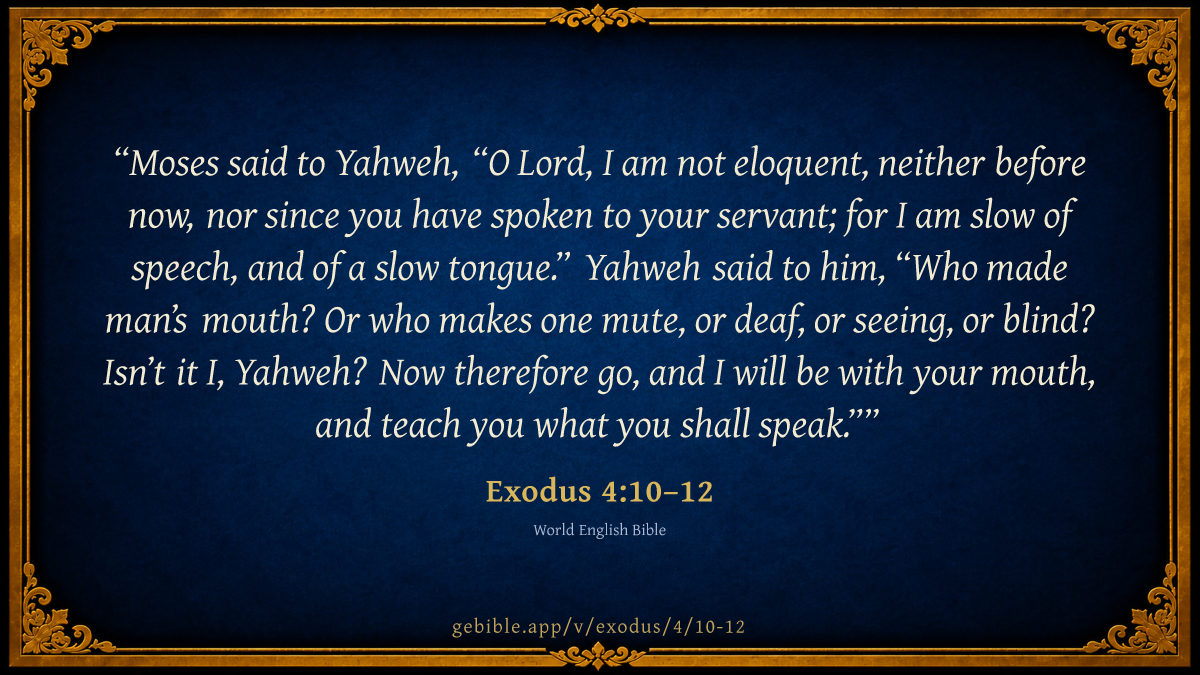
Geneva Bible translators 1599 · Public Domain On v10 Hebrew, from yesterday, and ere yesterday.
Hebrew, from yesterday, and ere yesterday.
Hebrew, heavy of mouth.
Geneva Bible (1599) marginal notes — public domain.
John Trapp 1656 · Public Domain On vv10–12 Exo 4:10 And Moses said unto the LORD, O…
Exo 4:10 And Moses said unto the LORD, O my Lord, I [am] not eloquent, neither heretofore, nor since thou hast spoken unto thy servant: but I [am] slow of speech, and of a slow tongue.
Ver. 10. I am not eloquent.] Heb., A man of words, a master of speech - ηγουμενος λογου - as Paul was. {Act 14:12} He had not that first, second, and third of an orator, - elocution, or pronunciation. And yet God made choice of him rather than of eloquent Aaron to pray. {Exo 17:12} Not gifts but graces prevail in prayer.
Read full note →
Slow of speech.] Of a letsom delivery; wordbound.
John Trapp, A Commentary or Exposition upon All the Books of the Old and New Testament (1647–1656) — public domain. Text from a community e-Sword module.
Matthew Poole 1685 · Public Domain On vv10, 12 I am not eloquent; not able to deliver thy…
I am not eloquent; not able to deliver thy message acceptably and decently, either to Pharaoh or to the Israelites. Since thy appearance to me, thou hast made some change in my hand, but none in my tongue, but still I am, as I was, most unfit for so high an employment. But indeed he was therefore fit for it, as the unlearned apostles were for the preaching of the gospel, that the honour of their glorious works might be entirely given to God, and not to the instruments which he used.
Matthew Poole's English Annotations on the Holy Bible (1683–1685) — public domain. Text from a community e-Sword/MySword module.
Matthew Henry 1710 · Public Domain On v10 Moses still continues backward to the service for which…
Moses still continues backward to the service for which God had designed him, even to a fault; for now we can no longer impute it to his humility and modesty, but must own that here was too much of cowardice, slothfulness, and unbelief in it. Observe here,
I. How Moses endeavours to excuse himself from the work.
Read full note →
1. He pleads that he was no good spokesman: O my Lord! I am not eloquent, Exo 4:10. He was a great philosopher, statesman, and divine, and yet no orator; a man of a clear head, great thought, and solid judgment, but had not a voluble tongue, or ready utterance, and therefore he thought himself unfit to speak before great men about great affairs, and in danger of being run down by the Egyptians. Observe, (1.) We must not judge of men by the readiness and fluency of their discourse. Moses was mighty in word (Act 7:22), and yet not eloquent: what he said was strong and nervous, and to the purpose, and distilled as the dew (Deu 32:2), though he did not deliver himself with that readiness, ease, and elegance, that some do, who have not the tenth part of his sense. St. Paul's speech was contemptible, Co2 10:10. A great deal of wisdom and true worth is concealed by a slow tongue. (2.) God is pleased sometimes to make choice of those as his messengers who have fewest of the advantages of art or nature, that his grace in them may appear the more glorious. Christ's disciples were no orators, till the Spirit made them such.
2. When this plea was overruled, and all his excuses were answered, he begged that God would send somebody else on this errand and leave him to keep sheep in Midian (Exo 4:13): "Send by any hand but mine; thou canst certainly find one much more fit." Note, An unwilling mind will take up with a sorry excuse rather than none, and is willing to devolve those services upon others that have any thing of difficulty or danger in them.
II. How God condescends to answer all his excuses. Though the anger of the Lord was kindled against him (Exo 4:14), yet he continued to reason with him, till he had overcome him. Note, Even self-diffidence, when it grows into an extreme - when it either hinders us from duty or clogs us in duty, or when it discourages our dependence upon the grace of God - is very displeasing to him. God justly resents our backwardness to serve him, and has reason to take it ill; for he is such a benefactor as is before-hand with us, and such a rewarder as will not be behind-hand with us. Note further, God is justly displeased with those whom yet he does not reject: he vouchsafes to reason the case even with his froward children, and overcomes them, as he did Moses here, with grace and kindness.
1. To balance the weakness of Moses, he here reminds him of his own power, Exo 4:11. (1.) His power in that concerning which Moses made the objection: Who has made man's mouth? Have not I the Lord? Moses knew that God made man, but he must be reminded now that God made man's mouth. An eye to God as Creator would help us over a great many of the difficulties which lie in the way of our duty, Psa 124:8. God, as the author of nature, has given us the power and faculty of speaking; and from him, as the fountain of gifts and graces, comes the faculty of speaking well, the mouth and wisdom (Luk 21:15), the tongue of the learned (Isa 50:4); he pours grace into the lips, Psa 45:2. (2.) His power in general over the other faculties. Who but God makes the dumb and the deaf, the seeing and the blind? [1.] The perfections of our faculties are his work, he makes the seeing; he formed the eye (Psa 94:9); he opens the understanding, the eye of the mind, Luk 24:45. [2.] Their imperfections are from him too; he make the dumb, and deaf, and blind. Is there any evil of this kind, and the Lord has not done it? No doubt he has, and always in wisdom and righteousness, and for his own glory, Joh 9:3. Pharaoh and the Egyptians were made deaf and blind spiritually, as Isa 6:9, Isa 6:10. But God knew how to manage them, and get himself honour upon them.
2. To encourage him in this great undertaking, he repeats the promise of his presence, not only in general, I will be with thee (Isa 3:12), but in particular, "I will be with thy mouth, so that the imperfection in thy speech shall be no prejudice to thy message." It does not appear that God did immediately remove the infirmity, whatever it was; but he did that which was equivalent, he taught him what to say, and then let the matter recommend itself: if others spoke more gracefully, none spoke more powerfully. Note, Those whom God employs to speak for him ought to depend upon him for instructions, and it shall be given them what they shall speak, Mat 10:19.
3. He joins Aaron in commission with him. He promises that Aaron shall meet him opportunely, and that he will be glad to see him, they having not seen one another (it is likely) for many years, Exo 4:14. He directs him to make use of Aaron as his spokesman, Exo 4:16. God might have laid Moses wholly aside, for his backwardness to be employed; but he considered his frame, and ordered him an assistant. Observe, (1.) Two are better than one, Ecc 4:9. God will have his two witnesses (Rev 11:3), that out of their mouths every word may be established. (2.) Aaron was the brother of Moses, divine wisdom so ordering it, that their natural affection one to another might strengthen their union in the joint execution of their commission. Christ sent his disciples two and two, and some of the couples were brothers. (3.) Aaron was the elder brother, and yet he was willing to be employed under Moses in this affair, because God would have it so. (4.) Aaron could speak well, and yet was far inferior to Moses in wisdom. God dispenses his gifts variously to the children of men, that we may see our need one of another, and each may contribute something to the good of the body, Co1 12:21. The tongue of Aaron, with the head and heart of Moses, would make one completely fit for this embassy. (5.) God promises, I will be with thy mouth, and with his mouth. Even Aaron, that could speak well, yet could not speak to purpose unless God was with his mouth; without the constant aids of divine grace the best gifts will fail.
4. He bids him take the rod with him in his hand (Exo 4:17), to intimate that he must bring about his undertaking rather by acting than by speaking; the signs he should work with this rod might abundantly supply the want of eloquence; one miracle would do him better service than all the rhetoric in the world. Take this rod, the rod he carried as a shepherd, that he might not be ashamed of that mean condition out of which God called him. This rod must be his staff of authority, and must be to him instead both of sword and sceptre.
Matthew Henry's Commentary on the Whole Bible (1708–1710) — public domain (CC PDM 1.0). Text via the HelloAO Bible API.
John Gill 1763 · Public Domain On vv10–12 And Moses said unto the Lord,.... Notwithstanding the above…
And Moses said unto the Lord,.... Notwithstanding the above miracles, he seems unwilling to go on the Lord's errand to Pharaoh and to the Israelites, and therefore invents a new objection after all his other objections had been sufficiently answered:
I am not eloquent; or "a man of words" (s), that has words at command, that can speak well readily, and gracefully; such an one, he intimates, was proper to be sent to a king's court, that was an orator, that could make fine speeches, and handsome addresses, for which he was not qualified:
Read full note →
neither heretofore, nor since thou hast spoken to thy servant; neither in his younger years had he ever been an eloquent man, nor was there any alteration in him in that respect, since God had given him this call:
but I am slow of speech, and of a slow tongue; had some impediment in his speech, could not freely and easily bring out his words, or rightly pronounce them; so Lucian (t) the Heathen calls Moses slow tongued, or one slow of speech, and uses the same word the Septuagint does here, which version perhaps he had seen, and from thence took it.
(s) "vir verborum", Paguinus, Montanus, Piscator, Ainsworth. (t) In Philopatride.
John Gill's Exposition of the Whole Bible (1746–1763) — public domain (CC PDM 1.0). Text via the HelloAO Bible API.
John Wesley 1765 · Public Domain On v10 O my Lord, I am not eloquent - He…
O my Lord, I am not eloquent - He was a great philosopher, statesman, and divine, and yet no orator; a man of a clear head, great thought and solid judgment, but had not a voluble tongue, nor ready utterance; and therefore he thought himself unfit to speak before great men, and about great affairs. Moses was mighty in word, Acts vii, 22, and yet not eloquent: what he said was strong and nervous, and to the purpose, and distilled as the dew, Deut. xxxii, 2, though he did not deliver himself with that readiness, ease and fineness that some do.
John Wesley, Explanatory Notes Upon the Whole Bible (1754–1765) — public domain. Text via the GEBible commentary corpus.
Adam Clarke 1810 · Public Domain On vv10–12 Verse 10. I am not eloquent] לא איש דברים…
Verse 10. I am not eloquent] לא איש דברים lo ish debarim, I am not a man of words; a periphrasis common in the Scriptures. So Job 11:2, איש שפתים ish sephathayim, a man of lips, signifies one that is talkative. Ps 140:11, איש לשון ish lashon, a man of tongue, signifies a prattler. But how could it be said that Moses was not eloquent, when St. Stephen asserts, Ac 7:22, that he was mighty in words as well as in deeds? There are three ways of solving this difficulty:
1. Moses might have had some natural infirmity, of a late standing, which at that time rendered it impossible for him to speak readily, and which he afterwards overcame; so that though he was not then a man of words, yet he might afterwards have been mighty in words as well as deeds.
Read full note →
2. It is possible he was not intimately acquainted with the Hebrew tongue, so as to speak clearly and distinctly in it. The first forty years of his life he had spent in Egypt, chiefly at court; and though it is very probable there was an affinity between the two languages, yet they certainly were not the same. The last forty he had spent in Midian, and it is not likely that the pure Hebrew tongue prevailed there, though it is probable that a dialect of it was there spoken. On these accounts Moses might find it difficult to express himself with that readiness and persuasive flow of language, which he might deem essentially necessary on such a momentous occasion; as he would frequently be obliged to consult his memory for proper expressions, which would necessarily produce frequent hesitation, and general slowness of utterance, which he might think would ill suit an ambassador of God.
3. Though Moses was slow of speech, yet when acting as the messenger of God his word was with power, for at his command the plagues came and the plagues were stayed; thus was he mighty in words as well as in deeds: and this is probably the meaning of St. Stephen.
By the expression, neither heretofore, nor since thou hast spoken unto thy servant, he might possibly mean that the natural inaptitude to speak readily, which he had felt, he continued to feel, even since God had begun to discover himself; for though he had wrought several miracles for him, yet he had not healed this infirmity. See Clarke on Ex 6:12.
Adam Clarke's Commentary on the Bible (1810–1826) — public domain. Text from a community e-Sword/MySword module.
Joseph Benson 1811 · Public Domain On v10 Exo 4:10. O my Lord, I am not eloquent…
Exo 4:10. O my Lord, I am not eloquent — He was a great philosopher, statesman, and divine, and yet no orator; a man of a clear head, great thought, and solid judgment, but had not a voluble tongue, nor ready utterance; and therefore he thought himself unfit to speak before great men and about great affairs. Moses was mighty in word, (Act 7:21,) and yet not eloquent; what he said was strong and nervous, and to the purpose, and distilled as the dew, (Deu 32:2,) though he did not deliver himself with that readiness, ease, and fineness that some do.
Joseph Benson's Commentary on the Old and New Testaments (1811–1818) — public domain. Text from a community e-Sword module.
Albert Barnes 1834 · Public Domain On vv10, 12 Eloquent - See the margin. The double expression “slow…
Eloquent - See the margin. The double expression “slow of speech (Eze 3:5 margin) and of a slow tongue” seems to imply a difficulty both in finding words and in giving them utterance, a very natural result of so long a period of a shepherd’s life, passed in a foreign land.
Since thou hast spoken - This expression seems to imply that some short time had intervened between this address and the first communication of the divine purpose to Moses.
Albert Barnes' Notes on the Bible (1834–1885) — public domain. Text from a community e-Sword/MySword module.
Haydock's Catholic Bible Commentary 1859 · Public Domain On v10 Of tongue, being impressed with awe, at the divine…
Of tongue, being impressed with awe, at the divine presence. He feared, therefore, that he should not be able to deliver himself intelligently at the court of Pharao, and might rather excite the disgust of that haughty tyrant. (Haydock) --- He had been 40 years absent in the land of Madian, and might have forgotten both the Egyptian and Hebrew languages in some degree; in which sense slowness or heaviness of tongue is taken, (Ezechiel iii. 5.) to express an unknown language. (Calmet) --- God was thus pleased to shew, that all the glory arising from this enterprize belonged to himself; and he thus also gave occasion to Moses to humble himself, while he wrought miracles. (Menochius)
George Leo Haydock (1774–1849), Haydock's Catholic Family Bible and Commentary, 1859 edition — public domain. Excludes Psalms (Douay-Rheims chapter numbering differs from Protestant) and Deuterocanonical books (Catholic canon only).
Robert Jamieson, A. R. Fausset & David Brown 1871 · Public Domain On v10 I am not eloquent--It is supposed that Moses labored…
I am not eloquent--It is supposed that Moses labored under a natural defect of utterance or had a difficulty in the free and fluent expression of his ideas in the Egyptian language, which he had long disused. This new objection was also overruled, but still Moses, who foresaw the manifold difficulties of the undertaking, was anxious to be freed from the responsibility.
Jamieson, Fausset & Brown — Commentary Critical and Explanatory on the Whole Bible (1871) — public domain (CC PDM 1.0). Text via the HelloAO Bible API.
Daniel D. Whedon 1874 · Public Domain On v10 MOSES HESITATES AND IS REBUKED, Exo_4:10-17.
MOSES HESITATES AND IS REBUKED, Exo_4:10-17.
10-12. I am not eloquent — Literally, not a man of words.
Read full note →
Slow of speech — Rather, heavy of mouth and heavy of tongue. Moses declares that he is no orator, has not the gift of persuasion, and therefore he has not confidence that he can convince Israel of his mission. So Paul tells us that his bodily presence was weak, and his speech contemptible; but where are weighty and immortal words to be found if they fell not from Paul and Moses? Moses, like Paul, felt weak when he measured himself with his work. He did not yet realize how God’s strength is made perfect in such weakness. It would also seem that Moses was not fluent, like Aaron his brother; and, perhaps, from his long separation from his brethren, he had to some degree lost command of his native language. This would naturally make him diffident in undertaking a popular appeal. He may have been conscious, too, that in his forty years’ exile from Egyptian civilization his tongue and manners had caught a desert rudeness, which poorly fitted him to appear in the courts of the Pharaohs. Here, for the first time, prophetic inspiration is promised to man. Henceforth in the whole subsequent history of the Church we see this endowment of the Holy Ghost. So the lips of the shrinking Isaiah were touched with a “live coal” from the heavenly altar. Isaiah 6. So Jehovah laid his hand on the mouth of the wavering Jeremiah. Jeremiah 1. So it was given to the uncultured Apostle to speak boldly before rulers and peoples: and so God’s Spirit has ever been a fire in the words of his genuine messengers. Moses was learned enough to know the vanity of learning, and had now become wise enough to see the folly of wisdom, so that he was just the instrument for God’s hand.
Daniel D. Whedon (gen. ed.), Commentary on the Old and New Testaments (1874–1909) — public domain. Text from a community e-Sword module.
The Cambridge Bible for Schools and Colleges 1878 · Public Domain On vv10–12 10. Oh] In the Heb. a particle of entreaty,…
10. Oh] In the Heb. a particle of entreaty, craving permission to speak: always followed by either Lord (‘Adonai,’ not ‘Jehovah’), v. 13, Jos_7:8 al., or my lord, Gen_43:20, Num_12:11 al.
eloquent] lit. a man of words, i.e. able to command words, fluent. Cf. Jeremiah’s objection (Exo_1:6).
Read full note →
nor since, &c.] In giving him his commission, God has conferred upon him other powers (vv. 2–9), but not the gift of fluency.
heavy of mouth and heavy of tongue] i.e. slow to move them.
10–17. Moses’ fourth difficulty: he objects that he is not fluent, has no power to state his case, to convince or persuade the Israelites. He is promised, in reply, firstly, that God will be with him to give him words, and afterwards, as he still demurs, that Aaron shall be his spokesman.
The Cambridge Bible for Schools and Colleges (gen. ed. J. J. S. Perowne; Cambridge University Press, 1878–1918) — public domain. Text from a community e-Sword module.
Ellicott's Commentary for English Readers 1878 · Public Domain On vv10–12 (10) I am not eloquent.—Heb., No man of words…
(10) I am not eloquent.—Heb., No man of words am I. Moses, still reluctant, raises a new objection. He is not gifted with facility of speech. Words do not. come readily to him; perhaps, when they come, he has a difficulty in uttering them. According to a Jewish tradition, he was unable to pronounce the labials, b, f, m, p, v. According to his own expressions at the end of the verse, he was “heavy” or “slow of speech,” and “heavy” or “slow of tongue.”
Neither heretofore.—Heb., neither yesterday, nor the day before. It is a Hebrew idiom to make these words cover past time generally. (See below, Exo_5:7-8; Exo_5:14; and comp. Gen_31:2; Gen_31:5, and 2Sa_3:17.)
Read full note →
Nor since thou hast spoken.—Converse with God had not cured his defect of utterance, whatever it was. He remained “slow of speech and slow of tongue”—unready, i.e., and hesitating.
A Bible Commentary for English Readers, edited by Charles John Ellicott (1878–1897) — public domain. Text from a community e-Sword module.
The Pulpit Commentary 1880 · Public Domain On vv10–11 And Moses said, O my Lord. The phrase used…
And Moses said, O my Lord. The phrase used by Moses is full of force. It is "vox dolentis et supplicantis" (Noldius). Joseph"s brethren use it to the steward of Joseph"s house, when they expect to be fallen upon and taken for bondsmen; (Gen_43:20) Judah used it (Gen_44:18) when pleading with Joseph for Benjamin; Aaron when pleading for Miriam; (Num_13:11) Joshua when expostulating with God about Ai. (Jos_7:8) There is a deprecatory idea in it, as well asa supplicatory one; an idea like that which Abraham expanded into the words, "Oh! let not the Lord be angry, and I will speak yet but this once". (Gen_18:32) Moses feels that he is trying the patience of God to the uttermost; but yet he must make one more effort to escape his mission. I am not eloquent. Literally, as in the margin, "a man of words." "Words do not come readily to my tongue when I attempt to speak; I have never been a fluent speaker, neither yesterday (i.e. recently) nor the day before (i.e. formerly). Nor do I even find that I have become eloquent by divine inspiration since thou spakest with me. Still I remain slow of speech and slow of tongue." A question is raised whether the mere difficulty of finding words and giving them utterance a difficulty felt at first by almost every speaker is here meant, or something further, as "a natural impediment owing to defect in the organs of speech" (Kalisch), or a want of readiness, owing to disuse, in speaking the Hebrew language (Clarke). The latter suggestion is scarcely consistent with the ease and fluency with which Moses had carried on the conversation in Hebrew up to this point. The former is a possible meaning, though not a necessary one. According to a Jewish tradition, Moses had a difficulty in pronouncing the labials b, v, m, ph, p.
Slowness of speech a drawback on ministerial fitness, but not a disqualification.
Read full note →
It is remarkable that both Moses, the great prophet of the First Covenant, and St. Paul, the "chosen vessel" for the publication of the Second Covenant, were ineffective as speakers; not perhaps both "in presence base," but certainly both "in speech contemptible". (2Co_10:1, 2Co_10:10) Speakers and preachers should lay the lesson to heart, and learn not to be overproud of the gift of eloquence. A good gift it is, no doubt when sanctified, a great gift which may redound to God"s honour and glory, and for which they should be duly thankful, but not a necessary gift. The men of action, the men that have done the greatest things, and left their mark most enduringly upon the world, have seldom been "men of words." Luther indeed was mighty in speech, and John Knox, and Whitfield, and (though less so) John Wesley, but not our own Cranmer, nor Melancthon, nor Anselm, nor Bishop Cosin, nor John Keble. In the secular sphere of statesmanship and generalship the same principle holds even more decidedly. Demosthenes has to yield the palm to Alexander, Cicero to Caesar, Pym to Cromwell, the Abbe Sieyes to Napoleon. On the whole it must be said that those who are great in deed are rarely great in speech. And without eloquence a man may do God good service in every walk of life, even as a minister. The written sermon may go as straight to the heart of the audience as the spoken one. Ministerial effort in house-to-house visiting may do as much to convert a parish as any number of extempore sermons. Example of life preaches better than palaver. Let no one who feels within him the ministerial call, who longs to serve God by bringing his fellow-men to Christ, be deterred by the thought that he is "slow of speech and of a slow tongue." God, without making him eloquent, can "be with his mouth," give his words force, make them powerful to the conversion of souls. It has been said that there are many "dumb poets." So are there many "dumb preachers," whoso weak and hesitating words God blesses and renders effectual, so that in the end they have no cause to be ashamed, but may point to those whom they have brought to Christ, and exclaim with St. Paul, "Ye are our work, ye are our epistle, the seal of our apostleship are ye in the Lord". (1Co_9:1, 1Co_9:2; 2Co_3:2)
Vers. 10-17. Slow of speech.
The longer Moses pondered the mission on which he was sent, the more he shrank from it. The difficulty which now oppressed him was his want of eloquence. It seemed to him that in this respect he was the least qualified person God could have chosen. There was needed for such a work a man of persuasive tongue, of fluent, forcible, and impressive speech; and his own utterance was hesitating and heavy. Overwhelmed with the sense of unfitness, he again appeals to God, and asks to be relieved from duty. We have here
I A FELT INFIRMITY. Moses was doubtless right in what he said of his natural difficulty of speech. But his error lay
1. In exaggerating the value of a gift of mere eloquence. He did not possess it though Stephen calls him "mighty in words" (Act_7:22) and he was apt to overrate its influence. He forgot that the man of deepsilent nature has a power of his own, which expresses itself through the very ruggedness and concentration of his speech; and that oratory, while valuable for some purposes, is not the most essential gift in carrying through movements which are to leave a permanent impress on history. What is chiefly wanted is not power of speech, but power of action; and when it is felt that a man can act, a very limited amount of speech will serve his purpose (Cromwell, William the Silent, Bismarck, etc.). The smooth persuasive tongue, though pleasant to listen to, is not the weightiest in counsel.
2. In forgetting that God knew of this infirmity when he called him to thework. God knew all about his slowness of speech, and yet had sent him on this mission. Did not this carry with it the promise that whatever help he needed would be graciously vouchsafed? God has a purpose in sometimes calling to his service men who seem destitute of the gifts the outward gifts needful for his work.
1. The work is more conspicuously his own.
2. His power is glorified in man"s weakness.
3. The infirmity is often of advantage to the servant himself
keeping him humbled giving him to prayer, teaching him to rely onDivine grace, rousing him to effort, etc.. (2Co_12:7-10) Paul was a man "rude in speech", (2Co_11:6) and came not with eloquence of words; (1Co_2:1) but his defects of speech only made the Divine power which resided in his utterances the more conspicuous. (2Co_2:4, 2Co_2:5)
II A GRACIOUS PROMISE. God would be with his mouth, and teach him what to say (ver. 11). The Maker of speech, he might be trusted to aid its powers, when these were needed in his service. So Christ promises his disciples to give them in their hour of need what they shall speak. (Mat_10:19) Lips touched by Divine grace possess a simple, natural eloquence of their own, far excelling the attempts of studied oratory. Then there is the other fact, that gifts of speech are often latent till grace comes to evoke them. Moses" original awkwardness was no index to what, assisted by God"s grace, he might ultimately have become, even as a speaker. His gift would probably have grown with the necessity. The greatest preachers of the Gospel, with Paul at their head, have not been men naturally eloquent. If they became so afterwards, it was grace that made them. Thus, we are told of Luther that at first he dared not enter the pulpit. "Luther, who subsequently preached with so much power, who gave a new direction, and a force and elevation never before attained, to the whole system of German preaching, who is still the unparalleled master of all who hope to effect more by the internal demonstrativeness of a discourse than by its external ornamentation, this Luther was too humble, too modest, to take the place of a preacher. It was only at the solicitatlon of Slauptitz that he finally consented to preach at first in the oratory of the convent, and afterwards in church" (Hagenbach). Knox was equally diffident about the exercise of his gifts, and when an unexpected appeal was made to him, at the age of forty-two said John, abashed, burst forth in most abundant tears, and withdrew himself to his chamber" (Knox"s "History"). All may not be eloquent like these; but anyone possessed of earnest feeling and intense convictions, who is content to deliver a plain message with directness and simplicity, will be surprised at what God can sometimes make oven of rude and unskilled lips.
III A SINFUL SHRINKING FROM DUTY (ver. 13). The continued reluctance of Moses, after so gracious an assurance, was not to be excused. It was a direct act of disobedience, and argued, besides a want of faith, a certain measure of stubbornness. God was angry with him, yet forbore with his infirmity. And.if God forbore with Moses, it is surely not for us to blame him, who are so often in "the same condemnation." Let him who has never shrunk from unwelcome duties, or who has never stumbled in believing that Divine grace will, under trying circumstances, be made sufficient for his needs, cast the first stone. Admire rather in this incident
1. The patience and forbearance of God in stooping to his servant"sweakness, and
2. The "exceeding greatness" of the power which accomplished suchmighty results by so unwilling an instrumentality. Nothing proves more clearly that the work of Israel"s deliverance was not of man, but of God, than this almost stubborn reluctance of Moses to have anything to do with it.
IV A SECOND-BEST ARRANGEMENT (vers. 14-17). The appointment of Aaron as spokesman to his brother, while in one view of it an act of condescension, and a removal of Moses" difficulty, was in another aspect of it a punishment of his disobedience. It took from Moses the privilege of speaking for God in his own person, and committed the delivery of the message to more eloquent, perhaps, but also to less sanctified, lips.
1. The arrangement had its advantages.
1. It supplied one"s defect by another"s gift.
2. It utilised a talent lying unemployed.
3. It gave Aaron a share in the honour of being God"s messenger.
4. It formed a new link of sympathy between the brothers. But
2. It was not the best:
(1) It prevented the development of the gift of speech in Moses himself. Had he relied on God"s promise, he would doubtless have acquired a power of speech to which he was at first a stranger.
(2) The message would lose in force by being delivered through an intermediary. This of necessity. How much of the power of speech lies in its being a direct emanation from the mind and heart of the speaker something instinct with his own personality! As delivered by Aaron, the messages of God would lose much of their impressiveness. Fluency has its disadvantages. A mind burdened with its message, and struggling with words to give it utterance, conveys a greater impression of force than ready delivery charged with a message that is not its own.
(3) Moses would be hampered in his work by the constancy of his dependence on Aaron. It limits a man, when he cannot act without continually calling in another to his assistance.
(4) It divided Moses" authority, and gave Aaron an undue influence with the people. (cf. Ex 32)
(5) It was a temptation to Aaron himself to assume, or at least aspire to, greater authority than of right belonged to him. (cf. Nu 12) Learn
1. That it is not always good for us to have our wishes granted.
2. That God sometimes punishes by granting us our wishes (cf. Hos_13:11)
3. That God"s way is ever the best. J.O.
Vers. 10-12. The fourth difficulty: Moses alleges defect of utterance.
The third time-is often represented in Scripture as the final and decisive. (1Sa_3:8; Mat_26:44, Mat_26:45, Mat_26:75; Joh_21:17; 2Co_12:8) But Moses is not yet either satisfied or even silenced. As fast as one difficulty is swept away, his fearful and fertile mind has another ready to take its place. He began with himself, in stating his objections and difficulties, pleading then his unworthiness in general terms; now in the end he comes back to himself with the mention of a special difficulty. Consider
I THE DIFFICULTY AS STATED BY MOSES. In the course of the conversation, God has laid before him such particulars of the work required as seem to show him, in his hasty view of them, that he will have much speaking to do. But for speaking he alleges himself to be peculiarly unfit. What he meant by this unfitness we have no means of exactly ascertaining. Perhaps he had some actual defect in the vocal organs; or it may have been nothing more than the well-nigh insurmountable difficulty which some men feel when called on to speak in public. In any case he was bringing the difficulty forward under mistaken views as to the importance of mere utterance.
1. He was exaggerating the service of natural faculties. To say that these are nothing at all would be of course the language of mock humility. God has shown often in the history of his work in the world that he welcomes great natural gifts, lovingly devoted to him and thoroughly sanctified. But the great temptation undoubtedly is, to make too much of natural gifts too much of the intellect, the voice, the physical presence altogether, and too little of the purposes for which these instruments are to be used. How a thing is said is of much less moment than the thing itself. Better to stammer out a great truth than to deck lying, deception, and worldly vanities in the best-chosen words. When the Jews conspiring against Paul wanted some one to plead their cause before Felix, they sought, very wisely from their point of view, for the practised professional orator. It mattered nothing that he lacked the love of truth and justice. It was his business to do the best he could for even the worst of causes. God might easily have found elsewhere in Israel a thousand fluent and attractive speakers, more pleasant to the ear than Moses, and yet none of them sufficiently endowed, in other ways, for the great work required.
2. He was underrating the power of God working through those whom hechooses for himself. It is inevitable that if we exaggerate in one direction, we shall underrate in another. If we make too much of the work of man, we shall make too little of the work of God. Moses is not yet duly impressed with the fact that God has unmistakably and finally chosen him. He thinks he ought to be able to see clearly why he is chosen, and this is just what he cannot as yet get even a glimpse of. If only he had been able to feel conscious of some improvement in his natural faculties, it would have been a great encouragement, a great help to submission and prompt advance, at least so he thought. Depend upon it, we can never think of the power of God too highly. Nothing, so long as it is agreeable to his character, is beyond him. If he has chosen us for any work, he will always make his choice quite certain to our hearts; though, at the same time, to humble and try us, he may give much to perplex our intellects. In such moments our true and sufficient refuge is to remember the unfailing power of him who directs us. If Moses had only lived, say in the time of Paul, and been able to look back as Paul looked on all the Divine dealings recorded in the Scriptures, he would have seen at once, and gloried in the fact, that his very lack of fluent speech, so far from being against him, was rather in his favour. (2Co_4:7)
II GOD"S TREATMENT OF THIS PERSEVERING RELUCTANCE. Observe God"s continued patience. So far there has not been a word of rebuke to Moses; no action such as corresponds with the smiting of a stupid or inattentive scholar. But it was really quite time for Moses to begin to reflect a little before he spoke. Moses seemed to hint in this latest appeal that it was desirable at once to confer on him what he judged to be the requisite powers of speech. But God saw that the real want was not speaking, but thinking; quiet, earnest, introspective thinking. There had been quite enough of speaking unadvisedly with the lips, only to be excused by the fact that Moses had become so recently acquainted with Jehovah. Now God gives his servant something to think about. Moses has said in effect, "Here am I, called to a great work, for which, through no fault of my own, I lack the necessary faculties." And God in return is not slow to meet Moses with a plain admission of the Divine responsibility for many things which we count defects in human nature. "Where," says the sceptic, "is the wisdom of that God who allows the world to abound in so many human beings deficient in one or another of their natural faculties?" God meets the charge himself, and meets it boldly. He not only allows man to be so, but he makes him so; in other words, what we call defects are not defects at all. The defect is in us, who are not able to look at them in a right and comprehensive way. There are defects and defects. Man, thinking of the blind, the deaf, the dumb, the lame, begins to wail what an imperfect thing creation is; yet he is only complaining of spots on the surface. Our outward senses, with all the knowledge and pleasure that they bring, are only subsidiary parts of humanity. Let Moses consider, and he will see that, inasmuch as these defects come from no fault of his own, God can easily make them up. The fact that Moses was so slow of heart to believe all that God had spoken was a far greater hindrance than all his slowness of speech. We find serious defects and hindrances where, so to speak, God rather finds helps; while the things that hinder God"s work and stir his indignation it takes a great deal to make us conscious of. The worst obstacles to be encountered by Moses did not come from any of the things he had laid such emphasis on; they lay in his own heart that heart into which the dawning of God"s presence had only just begun to penetrate. Y.
Vers. 10-17. God"s wrath will fall where his service is declined.
I MOSES" OBJECTION AND GOD"S ANSWER (10-12).
1. He deems himself unfit to occupy the place even of spokesman to theLord. The objection was based upon a real infirmity, which so far God had not removed. The same objection urged as a reason to-day for not engaging in Sunday-school work, etc. The want of power may be real, but is it a sufficient reason for refusal?
1. God"s answer.
1. He points to his power. Is that realised?
2. He gives the promise of help.
Our weakness will merely afford a field on which God"s might and faithfulness will be manifested.
II MOSES" REFUSAL AND GOD"S ANGER (13-17).
1. The disinclination to the service which lay behind his objections is at lastmanifested. That very name (Adonai) "my master," by which he addresses God, might have rebuked him. But Moses in this may be the type of ourselves. We acknowledge thai all we have, that we ourselves, are his, and yet is there no service which no amount of reasoning or expostulation can prevail upon us to undertake for God?
2. God"s anger.
(1) A revelation of the judgment which awaits the slothful servant. Its shadows fall now in the withdrawal of his favour and the decay of spiritual life.
(2) It left its mark upon the life of Moses although his refusal was followed by repentance. Aaron was joined with him, and where in the eye of Israel and the world there would have been one figure only, there is henceforth two. The mark of God"s anger is left in a lessened glory.
III THE POWER OF THE PAST FOR CHRISTIAN SERVICE. "Take this rod not another. It reminded him of the time when he contended with God, and ministered humility in the moments of mightiest triumph. The Cross of Jesus the memento of our stubbornness and guilt. U.
The Pulpit Commentary (1880–1919), ed. H.D.M. Spence-Jones & Joseph S. Exell — public domain. Text from a community e-Sword module.
The Biblical Illustrator 1887 · Public Domain On v10 O my Lord, I am not eloquent.
Exo_4:10-13
O my Lord, I am not eloquent.
Read full note →
The objections made to religious service
I. These objections were made after God had given him a full insight into the nature of the service required.
1. The insight given into the nature of this service was infallible.
2. It was forceful.
3. It was sympathetic.
II. These objections frequently arise from an undue consciousness of self.
1. From a consciousness of natural infirmity. This ought to inspire within them a more thorough determination to seek Divine help. Silence is often more eloquent and valuable than speech.
2. From a supposition of moral incapacity. The call of God is calculated to educate all the sublime tendencies of the soul, and renders men fit for the toil allotted to them.
3. That, rather than self, God must be the supreme idea of the soul when about to enter upon religious service. Our hearts should be a temple in which every act of service should be rendered to the infinite.
III. These objections do not sufficiently regard the efficacy of the Divine help that is promised in the service. Now therefore go, and I will be with thy mouth, and teach thee what thou shalt say.
1. The Divine help is adapted to our natural infirmity. It is far better to have God joined to our infirmity, than to have the eloquent tongue without Him. Thus there are times when an infirmity may be an inestimable advantage to a Christian worker.
2. The Divine help is adapted to our full requirement. God did not merely promise to aid the speech of Moses, but also to teach him what he should say. So in the Christian service of to-day, good men are not merely aided in the line of their natural infirmity, but also along the entire line of their requirement.
IV. These objections are a reflection on the propriety of the Divine selection for the service. And the Lord said unto him, who hath made mans mouth, etc.
1. This method of conduct is ungrateful.
2. Irreverent.
V. These objections do not sufficiently recognize the dignity and honour the service will command.
1. There was the honour of achieving the freedom of a vast nation.
2. There was the honour of conquering a tyrant king.
3. There was the honour of becoming the lawgiver of the world.
VI. These objections are liable to awaken the divine displeasure. And the anger of the Lord was kindled against Moses.
1. This anger may be manifested in our removal from the service.
2. This anger may be manifested by the positive infliction of penalty.
3. This anger may occasion our eternal moral ruin.
Learn:
1. Good men ought to know better than to object to the service of God.
2. That in the service of God men find the highest reward.
3. That in the service of God men attain the truest immortality. (J. S. Exell, M. A.)
Uselessness of mere words
I am tormented with the desire of writing better than I can. I am tormented, say I, with the desire of preaching better than I can. But I have no wish to make fine, pretty sermons. Prettiness is well enough when prettiness is in place. I like to see a pretty child, a pretty flower; but in sermons, prettiness is out of place. To my ear, it would be anything but commendation, should it be said to me, You have given us a pretty sermon. If I were put upon trial for my life, and my advocate should amuse the jury with tropes and figures, or bury his arguments beneath a profusion of flowers of his rhetoric, I would say to him, Tut, man, you care more for your vanity, than for my hanging. Put yourself in my place--speak in view of the gallows--and you will tell your story plainly and earnestly. I have no objections to a lady winding a sword with ribbons, and studding it with roses as she presents it to her hero-lover; but in the hour of battle he will tear away the ornaments, and use the naked edge on the enemy. (Robert Hall.)
The art of the orator undesirable in a preacher
Hipponicus, intending to dedicate a costly statue, was advised by a friend to employ Policletus, a famous workman, in the making of it; but he, being anxious that his great expense should be the admiration of all men, said that he would not make use of a workman whose art would be more regarded than his own cost. When in preaching the great truths of gospel salvation the enticing words which mans wisdom teacheth are so much sought out that the art of the orator is more regarded by the hearers than the value of the truth spoken, it is no wonder that the Lord refuses to grant His blessing. He will have it seen that the excellency of the power lies not in our speech, but in His gospel. (C. H. Spurgeon.)
Eloquence
I am not eloquent.
I. Then true eloquence may have its use.
1. To explain Divine truth.
2. To inspire men with the thought of freedom.
3. To manifest the perfection of the gift of speech.
II. Then do not condemn men who are.
III. Then do not envy those who are acknowledgod to be so. If we have not eloquence, we have some other equally valuable talent in its place.
IV. Then the Lord can use a feeble instrumentality. This will enhance the Divine glory.
V. Then words are not the chief conditions of service. Ideas, thoughts, emotions, and spiritual influences, occupy a more prominent place.
VI. Then do not grumble, but seek the Divine aid in your infirmity. He will help and bless work done for Him. (J. S. Exell, M. A.)
Slowness of speech
I. An infirmity.
II. A discretion.
III. A discipline. (J. S. Exell, M. A.)
Why was Moses not gifted with eloquence?
It might certainly be asked with propriety, why Moses, who was singled out by Providence as the great medium for bringing the wisdom of heaven down to the earth, for ever substituting Divine truth instead of human error, and who was gifted with such uncommon perfection of the mind and intellect, was denied the power of eloquence, apparently so indispensable for his extraordinary vocation. But it was an act of the sublime wisdom of the Almighty to withhold from Moses just the gift of persuasion, lest it should appear that he owed the triumph over the obstinacy of Pharaoh and the disbelief of the Israelites, not to the miracles of God and the intrinsic worth of the Law, but to the artifices and subtleties of oratory, which too often procure, even to fallacies and sophisms, an ephemeral victory. It was wisely designed that the power of God should the more gloriously shine through a humble and imperfect instrument. This is a remarkable and deeply interesting difference between the legislator of Israel and the founders of almost all other religions, to whom, uniformly, no quality is ascribed in a higher degree than the gift of eloquence. (M. M. Kalisch, Ph. D.)
Self-consciousness
Moses has now descended from the high level of the argument, and narrowed the case into one of mere human personality. He has forgotten the promise, Certainly I will be with thee. The moment we get away from Divine promise and forget great principles, we narrow all controversy and degrade all service. Self-consciousness is the ruin of all vocations. Let a man look into himself, and measure his work by himself, and the movement of his life will be downward and exhaustive. Let him look away from himself to the Inspirer of his life, and the Divine reward of his labours, and he will not so much as see the difficulties which may stand ever so thickly in his way. Think of Moses turning his great mission into a question which involved his own eloquence! All such reasoning admits of being turned round upon the speaker as a charge of foolish, if not of profane, vanity. See how the argument stands: I am not eloquent, and therefore the mission cannot succeed in my hands, is equivalent to saying, I am an eloquent man, and therefore, this undertaking must be crowned with signal success. The work had nothing whatever to do with the eloquence or ineloquence of Moses. It was not to be measured or determined by his personal gifts: the moment, therefore, that he turned to his individual talents, he lost sight of the great end which he was called instrumentally to accomplish. (J. Parker, D. D.)
Fluency in speech
Moses was a thinker rather than a speaker. Fluency was not his forte. He saw too much in a moment to be able to give utterance to it all at once; and so his lack of readiness in the use of language was the result of the richness of his thought, rather than of its poverty. When the bottle is full, its contents flow out less freely by far than when it is two parts empty. So, very often, the fluency of one speaker is due to the fact that he sees only one side of a subject; while the hesitancy of another is the consequence of his taking in at a glance all the bearings of his theme, and of his desire to say nothing on it that will imperil other great principles with which it is really, but not to all minds visibly, connected. (W. M. Taylor, D. D.)
I will be with thy mouth.
Natural infirmities in relation to moral service
I. That God does not always see fit to remove natural infirmities from those who are commissioned to important service.
1. They keep us humble.
2. They remind us of God.
3. They prompt us to prayer.
II. That God renders natural impediments effective to the clear manifestation of His power and glory.
1. Should win our submission.
2. Should gain our confidence.
3. Should inspire our praise.
III. That God so far compassionates our natural infirmities as to relieve them by congenial and efficient help.
1. Fraternal.
2. Adapted to need.
3. Constant. (J. S. Exell, M. A.)
The Divine Creatorship
I. Should silence the voice of complaint under natural infirmities.
II. Should become an argument for the ready performance of any mission on which we may be divinely sent.
III. Should lean us reverently to acknowledge the sovereignty of God in the varied allotments of life. (W. M. Taylor, D. D.)
Lessons
I. The Divine commission.
II. The Divine companionship.
III. The Divine instruction. (W. M. Taylor, D. D.)
Speech, or dumbness, from God
I. Language is of Divine original. You may have been accustomed to consider it just as natural to man to speak as to walk; but this is a mistake. A child left to itself may learn to walk, but a child left to itself would never learn to speak; it would utter sounds, but it would never connect sounds with thoughts--it would never, that is, learn to express certain thoughts by certain sounds. It might invent some jargon of its own, but as to anything which should at all resemble even the elements of a language, and a system of sounds by which everything around us should be classified and defined, you will never think that this could be found in the accidental babblings of infancy; and however you may seek to account upon natural principles for the origin of language, we still venture to say, that unless you receive the Mosaic account of the Creation, there is no phenomenon so hopelessly inexplicable as language. Unless it be supposed that God formed man at first, and gave him the organs of speech, ay, and then taught him their use, and furnished him with words by which ideas should be expressed, language is the most unintelligible of prodigies; and you may search the universe and find nothing which you may not account for without God, if you can shut out His agency from the introduction of speech. And there is scriptural evidence of the fact, that God taught man language, or that the language first spoken was Divine in its origin. You will observe, that so soon as man was created God spake unto him; and thus the first use of words was to communicate the thoughts of God. But the thoughts of God must have been communicated in the words of God, and man could not have understood Gods words, unless he had been first taught them of God; so that when on the very outset of human existence you find conversation held between man and his Maker, you are forced to conclude, that since on no supposition could man in such a brief space have invented a language, the employed language must have been Divine, and Adam must have received from God the earliest intimations of speech.
II. Every case of inability to speak is of Divine appointment. God has meted out to us our every endowment, whether of body or of mind; we are indebted for nothing to chance, for everything to Providence; and though it were beside our purpose to inquire into the reasons which may induce God to deny to one man the sense of sight, and to another the sense of hearing, we are as much bound to recognise His appointment in these bodily defects as in the splendid gifts of a capacious memory, a rich imagination and a sound judgment, which procure for their possessor admiration and influence. And when there shall come the grand clearing up of the mysteries and discrepancies of the present dispensation, we nothing doubt that the Almighty will show that there was a design to be answered by every deformed limb, and every sightless eyeball, and every speechless tongue, and that in regard both to the individual himself and to numbers with whom he stood associated, there has been a distinct reference to the noblest and most glorious of ends, in the closing up of the inlets of the senses, or in the yielding the members to disease or contraction. The deaf and dumb child shall be proved to have acted a part in the furtherance of the purposes of God, which it could never have performed, had it delighted its parents by hearkening to their counsels and pouring forth the music of its speech; the blind man and the cripple shall be shown to have been so placed in their pilgrimage through life, that they should have been decidedly disadvantaged, the one by sight, the other by strength. Who maketh, then, the dumb, or deaf, or the seeing or the blind? have not I the Lord? Thine, O God, is the allowing upon earth the melancholy assemblage of those who seem but fractions of men; but wise and good, though unsearchable and past finding out, are all Thy ways and all Thy permissions.
III. And there are two inferences which you should draw from the facts thus established, and which we would press with all earnestness on your attention.
1. You discern, first of all, the extreme sinfulness of looking slightingly or with contempt on those who are afflicted with any bodily defect or deformity. Ridicule in such case, however disguised and softened down, is ridicule of an appointment of God; and to despise in the least degree a man because he possesses not the full measure of senses and powers, is to revile the Creator, who alone ordered the abstraction.
2. If we are indebted to God for every sense and every faculty, are we not laid under a mighty obligation to present our bodies a living sacrifice to our Maker? (H. Melvill, B. D.)
Gifts other than eloquence an element in leadership
Probably Moses stammered, as he said he was slow of speech; and was not fluent in speaking, notwithstanding all his learning. A man may be a philosopher, a statesman, may have a clear head and a strong will, a solid judgment and a great mind, and yet be destitute of any talent for speaking. It was the same with St. Paul (see 1Co_2:1-4; 2Co_10:10), who was so full of wisdom and zeal and love, but had no eloquence. (Prof. Gaussen.)
Inspiration better than education
Speaking of art-training, Mr. Ruskin says: Until a man has passed through a course of academy studentship, and can draw in an improved manner with French chalk, and knows foreshortening, and perspective, and something of anatomy, we do not think he can possibly be an artist. What is worse, we are very apt to think that we can make him an artist by teaching him anatomy, and how to draw with French chalk: whereas the real gift in him is utterly independent of all such accomplishments. So the highest powers of the teacher or preacher, the power of interpreting the Scriptures with spiritual insight, of moving the hearers to earnest worship and decision, may exist with or without the culture of the schools. Learned Pharisees are impotent failures compared with a rough fisherman Peter anointed with the Holy Ghost. Inspiration is more than education. (H. O. Mackey.)
Strength not always appropriate
Professor Tyndall states as a most remarkable fact, that the waves which have up to this time been most effectual in shaking asunder the atoms of compound molecules are those of least mechanical power. Billows, he instructively adds, are incompetent to produce effects which are easily produced by ripples. It is so with us. Often the greatest of us cannot do things that the smallest and weakest can. God sends power from on high to them, and it should be our prayer that God will endue us with power from on high that we may do His work, even though we be the weakest and humblest of His servants.
God can make use of poor material
The meek Moses lost sight of the fact that God does not of necessity require good material. The paper manufacturer is not nice in the choice of his materials. He does not, writes Arnot, reject a torn or filthy piece as unfit for his purpose. All come alike to him; for he knows what he can make of them. The filthy rags can be made serviceable. So God needed not a man highly endowed with mental gifts and intellectual energies, with commanding presence and persuasive eloquence. His providence and grace could prepare Moses for his mission.
Gods biddings are enablings
The missionary John Williams once said that there were two little words which were able to make the most lofty mountains melt: Try and Trust. Moses had yet to learn the use of these words. God taught him. The sailor has to be taught that he must not look on the dark and troubled waters, but at the clear blue heavens where shines the pole-star. Moses was gazing at the surging sea of Egyptian wrath, and God taught him to direct his gaze heavenward; then to try and trust, for greater is He that is with you than all that be against you. As an early Christian writer enjoins, let us not forget--as Moses did at first--that all Gods biddings are enablings, and that it is for us not to ask the reason but to obey.
The Biblical Illustrator, edited by Joseph S. Exell (c. 1880s–1900s) — public domain. Text from a community e-Sword module.
The Preacher's Complete Homiletical Commentary 1892 · Public Domain On v10 MAIN HOMILETICS OF THE PARAGRAPH.—Exo_4:10-14
MAIN HOMILETICS OF THE PARAGRAPH.—Exo_4:10-14
THE OBJECTIONS MADE TO RELIGIOUS SERVICE
Read full note →
I. These objections were made after God had given him a full insight into the nature of the service required.
1. The insight given to Moses was infallible. It had been Divinely imparted. God had appeared to him in the burning bush, had informed him of the bitter servitude of Israel, and of His intention to achieve their freedom through his instrumentality. Moses could not be mistaken in all this. His observation and hearing had not been deceived. He could retrace his own mental and moral experience occasioned by the phenomenon. Nor was the burning bush the only token that he had received, but he had also long communion with God. The Divine name, in all its significance and grandeur was unfolded to the vision of his soul. And the sacred presence before which he stood, had made him feel that his mission to Israel was a solemn reality, requiring all the energy and devotion of his nature. Thus, had an insight into the nature—requirements—success—and method of his work been Divinely and infallibly communicated to him. And good people in these days have an equally infallible insight into the religious service that is required of them. It is found in the Bible. It is given in the life of Christ. It is seen in the moral want of humanity. They learn it not from the burning bramble-bush, not from the audible voice of God, not from the miraculous turning of rods into serpents, but in hours of quiet communion with the Infinite; in times of severe grief the soul is infallibly taught the meaning of these great calls to service.
2. The insight given into the nature of this service was forceful. What could have been more sublime, more instructive, more impressive, and consequently more calculated to command attention and obedience, than a service made known by such a grand display of heavenly glory, of the Divine name, and of the Divine power. This was designed to lend moral force to the duty made known to the desert shepherd. And so in these days our calls to spiritual service come to us full of heavenly meaning and grandeur. They gather emphasis from our lonely and dependent condition, from the fact that they come from God, from the fact that they plead the cross of Christ as a claim upon our obedience, from the fact that all the motives of the Bible are on their side, and from the fact that there is given a Divine inspiration to enable us to perform them. Every enlightened conscience knows the forcefulness of these Divine appeals. Let us not be found disobedient to duty so impressively made known, so solemnly required, and so awful in its possibility of eternal retribution.
3. The insight given into the nature of this service was sympathetic. God did not merely tell Moses of the work he had to perform in relation to the freedom of Israel, and then withdraw Himself from the vision of the bewildered shepherd, but remained for a length of time in conversation with him, answering questions, dispelling doubts, removing difficulties, giving a new revelation of the Supreme life, and finally delegating to him the Divine power. Hence the Divine Being manifested the truest sympathy, the sympathy of friendly intercourse and help, with Moses in his very arduous undertaking. “Certainly I will be with thee,”—nothing could have been more sympathetic than this. And so, to-day, good men have given to them a sympathetic insight into the service that is required of them. God bears with their moral weakness. Answers their objection. Forewarns them of difficulty. Inspires them with bright hopes. Announces Himself as their unerring Friend and Guide.
II. These objections frequently arise from an undue consciousness of self.
1. From a consciousness of natural infirmity. “And Moses said unto the Lord, O my Lord, I am not eloquent,” etc. Moses has now narrowed the mission to himself and his own ability for it, leaving altogether out of calculation his heavenly preparation, and the Divine promise of help. And here is the weakness of an undue consciousness of self, in that it tends to put God out of our service. Unaided human ability cannot achieve the service of God. If Moses had been eloquent he could not have accomplished the freedom of Israel without the Divine aid. In undertaking moral service, men must not think too much about their own physical, mental, or moral capabilities, but mainly of Him who has called them to the work. He can make provision for all their defects. It is quite true that many good people have a natural hindrance to religious work—they are slow of speech—they find it difficult to pray in a prayer meeting—or to undertake any duty requiring publicity—but this does not place them outside the range of service. God sometimes calls such to achieve the freedom of the slave. It ought to inspire within them a more thorough determination to rely on Divine help. Silence is often more eloquent and valuable than speech.
2. From a supposition of moral incapacity. Moses did not think himself capable of securing the freedom of a vast nation like Israel, a nation of such historic grandeur, and of such holy moral relationships and covenant, hence distrustful of self, he cried; “Who am I?” And this feeling of incapacity is frequently shared by good men when they are called to the performance of religious service. And apart from the Divine call, preparation, and help, all men are totally unfit for such work, but the vision of heaven and the revelation of God are calculated to lift them above their natural infirmities, to place them on a level with their duty, and enable them to rise superior to difficulty. The call of God is calculated to educate all the sublime tendencies of the soul, and render men fit for heroic toil.
3. That rather than self, God must be the supreme idea of the soul when about to enter upon religious service. At such times the good man must forget his natural infirmity for service in the all-absorbing thought of the Divine love, companionship, and power. His soul must rest in the arms of the Infinite, and catching the smile of the Divine face, it will ever be cheered, and inspired for duty, and in the happiness of such an experience, all painful thoughts of self will be excluded from the mind. The Christian service of men in these days retains too feebly the thought of God, hence its unrest, its inefficiency. Our hearts should be a temple in which every act of service should be rendered to the Infinite.
III. These objections do not sufficiently regard the efficiency of the Divine help that is promised in the service. “Now therefore go, and I will be with thy mouth, and teach thee what thou shalt say.”
1. The Divine help is adapted to our natural infirmity. God promised to aid the speech of Moses. And so it is now. God always meets men, in the performance of their religious service, at the point of their weakness. The natural powers of men are used in the missions of God. The Divine plan is to strengthen them if weak; to guide them if strong. If our natural infirmity is diffidence, God will give us courage. He sends power and help to men in that department of soul where it is most needed. It is far better to have God joined to our infirmity, than to have the eloquent tongue without Him. Thus there are times when an infirmity may be of inestimable advantage to a Christian worker.
2. The Divine help is adapted to our full requirement. God did not merely promise to aid the speech of Moses, but also to teach him what he should say. So in the Christian service of to-day, good men are not merely aided in the line of their natural infirmity, but also to the extent of their requirement. See the variety of the Divine help given to Moses: the vision of the bush; the revelation of the great Name; an insight into the success of his mission; the miracle. Thus, not merely was he aided in speech, but in all the need of his soul. A grand encouragement for Christian workers to-day. God is with us to the full extent of our want.
IV. These objections are a reflection on the propriety of the Divine selection for the service. “And the Lord said unto him, Who hath made man’s mouth,” etc.
1. This method of conduct is ungrateful. Instead of mentioning this one natural infirmity, Moses ought to have been thankful that he had so many aids to the work required of him. Was the impediment of speech more to him than the vision, revelation, and miracles with which he had been favoured? Certainly not. Hence his ingratitude. Moses has many imitators to-day. Men are called to religious service. But instead of reviewing their favourable circumstances, the holy qualifications that have been imparted to their souls, they fix their attention upon one drawback unto they complain and become discontented. What ingratitude!
2. This method of conduct is irreverent. Moses ought to have remembered that he was in converse with God, that he was commanded by God to this work. This ought to have subdued his mind. It ought to have silenced objection. He is not now paying sufficient deference to the Divine presence. So, good men should ever remember that it is God who calls them to service, and that therefore they must merge all their natural reasonings into a faithful compliance with His will. We must be more reverent in our service-relations with Heaven.
V. These objections do not sufficiently recognise the dignity and honour which the service will command.
1. There was the honour of achieving the freedom of a vast nation.
2. There was the honour of conquering a tyrant king.
3. There was the honour of becoming the Lawgiver of the world. All religious service is honourable, and this is especially shewn in the history of Moses. It elevated him from the sheepfold to the throne. Instead of the crook it gave him the sceptre. And many a man, whose name is known to fame and history, has gained eminence through co-operation with the providence of God, and undertaking a work for the moral good of men. If men did but realise the dignity of religious service, they would never be deterred from it by their own natural infirmities.
VI. These objections are liable to awaken the Divine displeasure. “And the anger of the Lord was kindled against Moses.”
1. This anger may be manifested in our removal from service.
2. This anger may be manifested by the positive infliction of penalty.
3. This anger may occasion our moral ruin. It is dangerous to trifle or contend with the Divine call to religious duty. There is a point beyond which God will not permit a human soul to do so. Our prompt obedience will be the most welcome to heaven, the most effective in service, and the most kindly to others, whom our disobedience might have called into perilous prominence. Aaron. LEARN:—
1. Good men ought to know better than to object to the service of God.
2. That in the service of God, men find the highest reward.
3. That in the service of God, men attaineth divinest immortality.
SUGGESTIVE COMMENTS ON THE VERSES
Exo_4:10.
1. Some suppose that Moses being astonished with God’s glory, since his beginning to talk with Him, which they gather was three days, one after another, was thus disabled in the use of his tongue, and though eloquent before, yet now in this Divine mission he seemed a child unto himself, and unable to speak to men. (Philo, Origin, Gregory). But this supposition is plainly against the meaning of the text, which is as if Moses had said, “I have not only wanted eloquence heretofore, but ever since thou has spoken to me. I have not found this faultamended.” And if he had only at this time been taken with a lack of words. there would have been no need for the oratorical help of Aaron afterwards.
2. Some imagine that Moses had been a shepherd so long that he had, to a large extent, lost the power of words.
3. Some imagine that Moses meant his inability to speak to Pharoah in the Egyptian tongue.
4. Some imagine that Moses had a natural impediment in his speech.
5. Probably Moses found a difficulty in readily e pressing his thoughts. He was slow of speech. And such an instrument did God choose for his own greater glory; and thus doth Moses write of himself, laying open his imperfections, and backwardness in obeying God’s calling in humility; whereby we must also learn to lay open and confess our own faults, that they may be forgiven unto us out of God’s mercy [Mayer].
Moses had not that first, second, or third of an orator, elocution, or pronounciation. And yet God made choice of him rather than eloquent Aaron to pray (Exo_17:12). Not gifts but graces prevail in prayer [Trapp].
Moses still continues backward to the service God had designed him for; we can no longer impute it to humility and modesty, but must own that there was too much of cowardice, slothfulness, and unbelief in it. Moses pleads that he was no orator. He was a man of clear head, great thought, and solid judgment, but had not a voluble tongue, or ready utterance. We must not judge of men by the readiness and fluency of their discourse. What he said distilled as the dew. Christ’s disciples were no orators, till the spirit made them such [Henry and Scott].
God does not always make it appear that he hath furnished men for services till they are actually called to engage in them, but we may depend upon Him to qualify us for whatever He commands us to do. All knowledge, wisdom, and utterance, with every good gift, are derived from Him; but many endowments are supposed needful or useful in the public service of God and His Church, which He pours contempt upon, as mere tinsel, worthless, if not pernicious. Such are all the studied and affected arts of human cratory, which the great apostle would not condescend to employ, “that the faith” of the people “should not stand in the wisdom of man, but in the power of God” [Scott].
Let a man look unto himself, and measure his work by himself, and the movement of his life will be downward and exhaustive. Let him look away from himself to the Inspirer of his life, and the Divine reward of his labours, and he will not so much as see the difficulties which may stand ever so thickly in his way [City Temple].
Infirmity of faith maketh those called by God to object to the service He commands of them.
Miracles sometimes will not silence such objections of doubting souls.
Unwilling souls for God’s work are apt to plead real infirmities for excuse.
Weakness of faith will urge against God’s call, not only self-insufficiency, but also the lack of Divine supply in the direction of infirmity.
Infirmity in speech may be an argument to men against the work of God, but it is not to God Himself.
ELOQUENCE
I. “I am not eloquent.” Then true eloquence may have its use:—
1. To explain Divine Truth.
2. To inspire men with the thought of freedom.
3. To manifest the perfection of the gift of speech.
II. “I am not eloquent.” Then do not condemn men who are. Some people are in the habit of condemning in others what they do not find in themselves. Many public speakers denounce their eloquent compeers for the simple reason that they are not so gifted themselves.
III. “I am not eloquent.” Then do not envy those who are acknowledged to be so. Nature has unequally distributed her gifts. She has given the thinking power to one, the speaking power to another. If we have not eloquence we have some other equally valuable talent in its place. Let us therefore be thankful, not envious.
IV. “I am not eloquent.” Then the Lord can use a feeble instrumentality. We should have antecedently imagined that God would have selected Aaron for the work of Israel’s freedom. But not so. God can send a great message by a man of slow tongue. This will enhance the Divine glory.
V. “I am not eloquent.” Then words are not the chief conditions of service. In the service of the good, ideas—thoughts—emotions—and moral influences occupy a more prominent place than mere words.
VI. “I am not eloquent.” Then do not grumble, but seek the Divine aid in your infirmity. If the time spent in lamenting our natural infirmities was only occupied in prayer to God for help in our work, and for his blessing thereon, the world would soon be emancipated from the bondage of sin.
SLOWNESS OF SPEECH
“But I am slow of speech.”
I. An Infirmity.
II. A Discretion.
III. A Discipline.
Exo_4:11. The Hebrews, in giving a reason why the Lord speaketh of His making dumb, and deaf, and blind, as well as giving a mouth to speak, say, that these things were spoken in allusion to His past operations with Moses; because, when he had slain the Egyptian that wronged the Hebrew, and was by Pharaoh therefore committed to the gaoler, the gaoler was immediately smitten with blindness, and so Moses had opportunity to escape from him, and the King, seeing that he fled, was stricken dumb, so that he could not speak nor make any sign to have him apprehended again. But whether this is true or not, it is certain that God can thus in judgment smite whom it pleaseth Him, as He did the Sodomites with blindness [Mayer].
To balance the weakness of Moses, God here reminds him of his own power. To encourage him in this great undertaking. He repeats the promise of His presence, not only in general, but in particular [Henry and Scott].
By this appeal to Moses respecting the origin of the human faculties, God would have him to infer, that he who bestowed them upon the first man, could, with infinite ease, endow him with those which were lacking, and remedy those which were imperfect [Bush].
How sublime is the rebuke of God! Cannot the Maker of man’s mouth touch with eloquence the lips which He has fashioned? What is human eloquence but the expression of Divine music? Pedantic, rhetoricians may fashion rules of their own for the refinement of human speech; but he who waits diligently upon God, and whose purpose is to know the will of God, that he may speak it to men—will be entrusted with an eloquence rhythmic as the sea and startling as the thunder. Rhetoric is the gift of God. Eloquence is not a merely human attainment. The secret of convincing and persuasive speech is put into the hearts of those who forget themselves in the homage of God and truth [City Temple].
Jehovah indulgeth his weak servants to object, that he may multiply satisfaction to their doubts.
God teacheth and checketh his servants sometimes by questioning with them.
Man’s mouth is from God, and so ought the use of it to be.
Defects of speech and senses are incident to some amongst men.
THE DIVINE CREATORSHIP
I. Should silence the voice of complaint under natural infirmities.
II. Should become an argument for the ready performance of any mission on which we may be divinely sent.
III. Should lead us reverently to acknowledge the Sovereignity of God in the varied allotments of life.
NATURAL INFIRMITIES IN RELATION TO MORAL SERVICE
I. That God does not always see fit to remove natural infirmities from those who are commissioned to important service:—
1. They keep us humble.
2. They remind us of God.
3. They prompt us to prayer.
II. That God renders natural impediments effective to the clear manifestation of His power and glory:—
1. Should win our submission.
2. Should gain our confidence.
3. Should inspire our praise.
III. That God so far compassionates our natural infirmities as to relieve them by congenial and efficient help:—
1. Fraternal.
2. Adapted to need.
3. Constant.
Exo_4:12. There is no mouth into which God cannot put his words. Balaam’s ass was enabled by God to convince his master [Trapp].
God’s injunction of duty justly follows his satisfaction to doubts.
God utters successive injunctions to duty, even though men try to withdraw from them.
God’s promise of presence and influence aids his injunctions, and renders them more welcome to his servants.
A mouth divinely instructed, is mighty in the word of wisdom.
I. The Divine Commission.
II. The Divine Companionship.
III. The Divine Instruction.
Exo_4:13. Does not this hold up to us a faithful mirror, in which we can see our hearts reflected? Truly it does. We are more ready to trust anything than the living God. We move along, with bold decision, when we possess the countenance and support of a poor frail mortal like ourselves; but we falter, hesitate, and demur, when we have the light of the master’s countenance to cheer us, and the strength of His omnipotent arm to support us [C. H. M.]
Send, I pray thee, by the hand of him whom thou wilt send.”
1. Some think that Moses meant his brother Aaron, who was older, and of more eloquent speech; but no mention had yet been made of Aaron, whom Moses knew not to be alive till the Lord told him. (Exo_4:18).
2. Some think that Joshua was meant, whom God revealed to Moses as the Leader of Israel into the Land of Promise. This would make Moses appear somewhat envious of Joshua.
3. The majority of the ancient writers think that Moses here speaks of the Messiah.
4. The meaning of Moses is, that whereas God might find out many more fit than himself, He would send by their hand, whoever they might be.
Unbelief has still something to oppose against God’s call and promise.
A weak faith is ever willing to avoid the difficulty of work.
Infirm believers are willing to put off God’s work to any from themselves.
The weak in faith would yet have them to be of God’s sending that shall be employed for the freedom of the Church.
AN EVASION OF SPIRITUAL WORK
I. He recognised the necessity that the work should be accomplished. Moses did not cast a doubt upon the need, utility of the mission given to him; yea, he virtually acknowledged that it was worthy of more able instrumentality. Like many to-day. They acknowledge that certain work in connection with the Church ought to be done. But that is all.
II. He manifested a disposition to shrink from achieving the work himself. There are hundreds in our churches who acknowledge the need of certain religious enterprise, but they do nothing to it themselves.
III. He expressed a desire that some other person should be called to, and entrusted with, the work. This course is often pursued by people. The very enterprise that they refuse to undertake themselves, they propose should be carried out by another. They hope thus to relieve themselves of its difficulty.
IV. He was in danger of losing the honour of the work to which he was called. God might have refused to send Moses after all this indolence and unbelief. People do not know the moral good and honour they miss by refusing the work of the Church.
ILLUSTRATIONS
BY THE
REV. WM. ADAMSON
Exo_4:10-14.
(1)—Hesitation!—A youth erasing a narrow tree-trunk bridge kept looking at the gorge below, down which foamed and thundered the mountain cataract. His conductor saw that he was turning giddy and faltering: whereupon he counselled him to fasten his eye on the lovely scenery in the front. A boy climbing the ladder of ropes leading to the top mast began to tremble as he looked down at the deck and yawning waters, which, when his father noticed, he endeavoured to prevent by shouting: “Look up!” Moses hesitated; therefore God tells him two things:
1. To look up to Him: and
2. To look at the holy land whither He would bring His people from Egypt—
“With eyes turned upward, whence her help descends,
She waits expecting till the tempest ends.”
—Holmes.
Exo_4:10-14.
(2)—Worthlessness.—The meek Moses lost sight of the fact that God does not of necessity require good material. The paper manufacturer is not nice in the choice of his materials. He does not, writes Arnot, reject a torn or filthy piece as unfit for his purpose. All come alike to him; for he knows what he can make of them. The filthy rags can be made serviceable. So God needed not a man highly endowed with mental gifts and intellectual energies, with commanding presence and persuasive eloquence. His providence and grace could prepare Moses for his mission. Yet
“No mortal eye the manner sees,
The imperceptible degrees,
By which our Lord conducts His plan,
And brings us to a perfect man.”
—Wesley.
Exo_4:10-14.
(3)—Try and Trust!—The missionary John Williams once said that there were two little words which were able to make the most lofty mountains melt: “Try” and “Trust.” Moses had yet to learn the use of these words. God taught him. The sailor has to be taught that he must not look on the dark and troubled waters, but at the clear blue heavens where shines the pole-star. Moses was gazing at the surging sea of Egyptian wrath, and God taught him to direct his gaze heaven-ward. then to try and trust, for greater is He that is with you than all that be against you. As an early Christian writer enjoins, let us not forget—as Moses did at first-that all God’s biddings are enablings, and that it is for us not to ask the reason but to obey. As Luther said, “I would rather obey than work miracles.”
Exo_4:10-14.
(4)—Success!—Moses was looking at himself, not at God, who was issuing the commands, and therefore was responsible for its fulfilment. With the issue Moses, had nothing to do—with the execution very much. Certain officers, says Dr. Scudder. once spoke in the presence of the Duke of Wellington of the missionary enterprise as though there could be no rational prospect of its success. The old iron Duke replied by asking them what they had to do when the commander-in-chief issued marching orders? On receiving their ready response, “To march,” he quickly enquired for a Bible. Opening it, he told them that the marching orders of the chief of the missionary army were: Go ye into all the world and preach. He added, “Your duty is to march and fight. The responsibility of success lies with the commander, not with you. If you do not march I shoot you”—
“Let me to Thy wisdom leave
When and what thou are to give:
All Thy works to Thee are known,
Let Thy blessed will be done.”
Exo_4:10-14.
(5)—Disinclination!—When Palamedes came to Ithaca to invite Ulysses to join in the expedition against Troy, the latter, unwilling to engage in the undertaking, betook himself to ploughing the sand, as an evidence of insanity, and consequent unfitness. Moses pretended unfitness to excuse himself from the duty to which God was calling him, but upon the discharge of which he was very unwilling to enter:—
“Be not too fast, be not too slow;
Be not too early, not too late;
Go, where His orders bid thee go;
Wait, when His orders bid thee wait.’
—Upham.
Exo_4:10-14.
(6)—Gifts and Graces!—The meanest grace is above the highest intellectual gifts, as the smile of a sunbeam is more powerful to chase away the grim and sour darkness of the night than the sparkling of a million diamonds. As Beecher says, mere eloquence is like the light of shavings, which burn with a sudden flash, blazing for an instant, and then going out without leaving either coals or beat behind. It is like the harp which, while the wind touched its chords, discoursed harmonious strains; but music and breeze died away together. Man’s eloquence is mighty, but it is transient.
“Could I command with voice or pen
The tongue of angels and of men,
A tinkling cymbal, sounding brass,
My speech and preaching would surpass;
Vain were such eloquence to me
Without the grace of charity.”
—Montgomery.
Exo_4:10-14.
(7)—Divine Help!—Changes take place above and around the fortress; but its massive buttresses still stand unmoved, and its battlements frown defiance at the strength of the foe. Certainly I will be with thee. The clouds above are fleeting past, it may be in pall-like gloom The leaves are budding or fading according to their seasons upon the earth. There, however, stands the Rock of Ages, upon which is rooted the Fortunes of Truth and Faithfulness:—
“And truth shall live for ever,
And through endless ages give
Her blessings to the sainted,
And fail them never—never.”
Exo_4:10-14.
(8)—Work!—Moses was evidently at ease, and disliked action. Evidently his mind was in a dangerous condition, for, as Cecil says, a man who gets into the habit of enquiring about proprieties and expediencies, and occasions, often spends his life without doing anything to purpose. The state of the world is such, and so much depends upon action, that everything seems to say loudly to every man: Do something—do it. Moses was well nigh forgetting all about Egypt in his quiet and happy home in Midian:—
“Offer thy light on the altar;
In the high purpose be strong:
And if the tired spirit should falter,
Then sweeten thy labour with song.”
—Punshon.
Exo_4:10-14.
(9)—Duty!—Duty is first; pleasure comes second. God first; then self. His glory; then our own ease. The welfare of Israel’s host before the comfort of the shepherd Moses. When Pompeius Magnus prepared and freighted a ship with provisions for beleagured Rome, his friends endeavoured, with persistent importunity, to dissuade him from so doing. With great vehemence he responded: “It is necessary that I should go, not that I should live.” Moses needed not to be concerned about his own safety, so long as the freedom of Israel was accomplished.
“Away, then, causeless doubts and fears,
That weaken and enthral;
Wipe off, my soul, thy faithless tears,
And rise to duty’s call.”
—Lyte.
The Preacher's Complete Homiletical Commentary (gen. ed. Joseph S. Exell; Funk & Wagnalls, c. 1892) — public domain (pre-1929). A full-Bible homiletical/sermon-outline anthology covering 65 of 66 books (2 John is absent from the source module). Text from a community e-Sword module.
Paul E. Kretzmann 1924 · Public Domain On v10 The Fears of Moses Reproved
The Fears of Moses Reproved
v. 10. And Moses said unto the Lord, O my Lord, I am not eloquent, neither heretofore nor since Thou hast spoken unto Thy servant; but I am slow of speech and of a slow tongue. The great fear of Moses now made him protest his oratorical inability. which made it impossible for him to do justice to the message of the Lord and therefore threatened failure to the whole plan. He lacked both the natural gift of facile speech and the practice before an audience, and this ability had not been imparted to him in the course of this conversation.
Read full note →
v. 11. And the Lord said unto him, Who hath made man’s mouth? Or who maketh the dumb, or deaf, or the seeing, or the blind? Have not I, the Lord? The excuse of Moses might have weight with men, but not with the Lord, who has absolute power over all the senses, being able to give the full use of them or to withdraw this in whole or in part.
v. 12. Now, therefore, go, and I will be with thy mouth, and teach thee what thou shalt say. It was an easy matter for the Lord to impart divine eloquence to Moses, both as to facility of speech and as to choice of the most fitting words. All reasonable objections of Moses were now removed.
v. 13. And he said, O my Lord, send, I pray Thee, by the hand of him whom Thou wilt send. The misgivings of Moses were still so great that he wanted the mission to be taken care of by anyone else than himself. The weakness of his flesh was so overpowering that his words sound like a flat refusal.
v. 14. And the anger of the Lord was kindled against Moses, and He said, Is not Aaron, the Levite, thy brother? The Lord implied that Aaron surely was more worthy of being called a descendant of Levi than Moses with his hesitation. I know that he can speak well. And also, behold, he cometh forth to meet thee, for the Lord had arranged for this; and when he seeth thee, he will be glad in his heart. Aaron could indeed make fine speeches, and he would be delighted to be connected with this mission as the spokesman.
v. 15. And thou shalt speak unto him, and put words in his mouth; and I will be with thy mouth and with his mouth and will teach you what ye shall do.
v. 16. And he shall be thy spokesman unto the people; and he shall be, even he shall be to thee instead of a mouth, and thou shalt be to him instead of God, to make known to him both the form and the contents of his speeches to the people. As Moses, the prophet, speaks only what God commands him to say, thus Aaron was to defer to Moses in stating only what Moses told him. "He that has the Word of God and is a believer has the Spirit and the power of God, also divine wisdom, truth, heart, mind, and disposition, and everything that pertains to God. " (Luther. )
v. 17. And thou shalt take this rod in thine hand, wherewith thou shalt do signs. The shepherd’s staff was to be a symbol of the divine signs which were to be performed by the hand of Moses. The Lord has patience with our weakness and does not expect too much of us, but strengthens us to remain steadfast in His service and obedience.
Paul E. Kretzmann, Popular Commentary of the Bible (1921–1924) — public domain. Text from a community e-Sword module.
unfoldingWord translationNotes 2017 · CC BY-SA 4.0 On v10 have never been eloquent
have never been eloquent
"have never been an excellent speaker"
Read full note →
I am slow of speech and slow of tongue
The phrases "slow of speech" and "slow of tongue" mean basically the same thing. Moses uses them to emphasize that he is not a good speaker. (See: Doublet)
slow of tongue
Here "tongue" refers to Moses' ability to speak. AT: "unable to speak well" (See: Metonymy)
Who is it who made man's mouth?
Yahweh uses this question to emphasize that he is the Creator who makes if possible for people to speak. AT: "I Yahweh am the one who created the human mouth and the ability to speak!" (See: Rhetorical Question)
Who makes a man mute or deaf or seeing or blind?
Yahweh uses this question to emphasize that he is the one who decides if people can speak and hear, and if they can see. AT: "I Yahweh make people able to speak, or hear, or to see, or to be blind!" (See: Rhetorical Question)
Is it not I, Yahweh?
Yahweh uses this question to emphasize that he alone makes these decisions. AT: "I, Yahweh, am the one who does this!" (See: Rhetorical Question)
I will be with your mouth
Here "mouth" refers to Moses' ability to speak. AT: "I will give you the ability to speak" (See: Metonymy)
translationWords
Moses
Yahweh
lord
servant
unfoldingWord translationNotes — © Distant Shores Media and the Door43 World Missions Community, licensed CC BY-SA 4.0. Source: git.door43.org/Door43/en_tn.
Tyndale Open Study Notes 2022 · CC BY-SA 4.0 On vv10–11 4:10-17 Moses’ fourth and final protest was that he…
4:10-17 Moses’ fourth and final protest was that he could not speak effectively. Moses was apparently grasping at straws in trying to escape this dangerous and unpleasant assignment, and God was becoming angry at Moses’ refusal to grasp the truth. The outcome did not depend on Moses’ ability, but upon his willingness to let God’s power operate through him.
Tyndale Open Study Notes — © Tyndale Open Resources, licensed CC BY-SA 4.0. Text via the HelloAO Bible API.