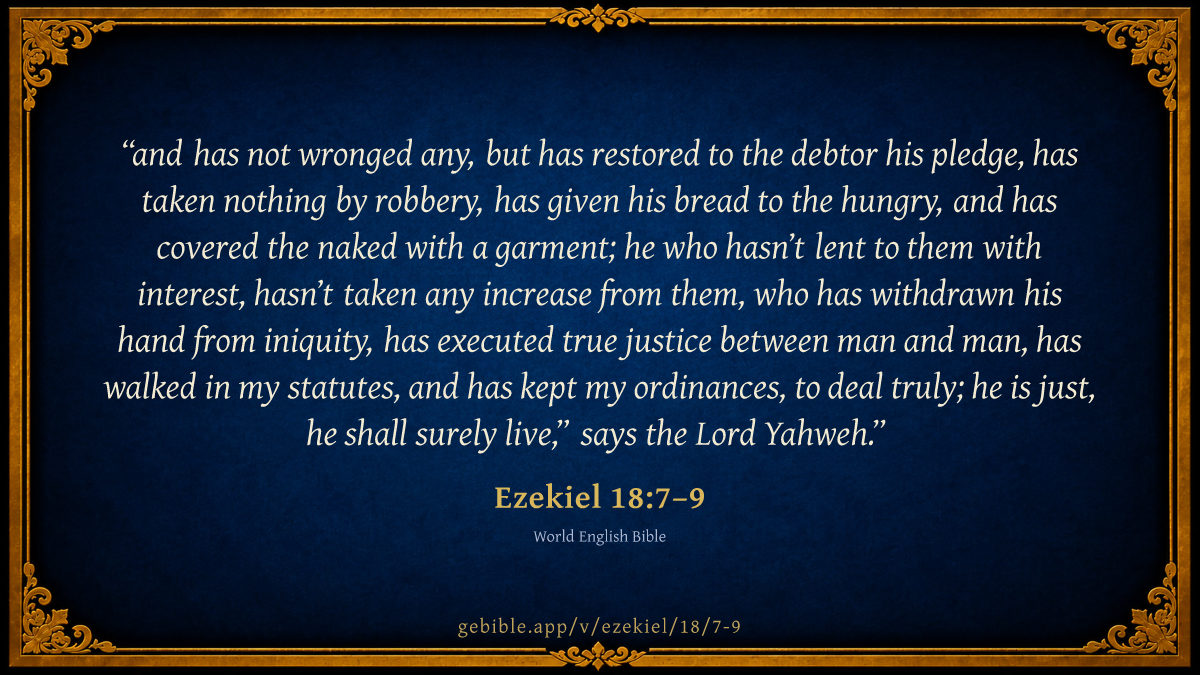
7and has not wronged any, but has restored to the debtor his pledge, has taken nothing by robbery, has given his bread to the hungry, and has covered the naked with a garment;
8he who hasn’t lent to them with interest, hasn’t taken any increase from them, who has withdrawn his hand from iniquity, has executed true justice between man and man,
9has walked in my statutes, and has kept my ordinances, to deal truly; he is just, he shall surely live,” says the Lord Yahweh.
7 and has not wronged any, but has restored to the debtor his pledge, has taken nothing by robbery, has given his bread to the hungry, and has covered the naked with a garment;
8 he who hasn’t lent to them with interest, hasn’t taken any increase from them, who has withdrawn his hand from iniquity, has executed true justice between man and man,
9 has walked in my statutes, and has kept my ordinances, to deal truly; he is just, he shall surely live,” says the Lord Yahweh.
KJVKing James Version
7 And hath not oppressed any, but hath restored to the debtor his pledge, hath spoiled none by violence, hath given his bread to the hungry, and hath covered the naked with a garment;
8 He that hath not given forth upon usury, neither hath taken any increase, that hath withdrawn his hand from iniquity, hath executed true judgment between man and man,
9 Hath walked in my statutes, and hath kept my judgments, to deal truly; he is just, he shall surely live, saith the Lord GOD.
Show all 3 translations
JPSJPS Tanakh (1917)
7 and hath not wronged any, but hath restored his pledge for a debt, hath taken nought by robbery, hath given his bread to the hungry, and hath covered the naked with a garment;
8 he that hath not given forth upon interest, neither hath taken any increase, that hath withdrawn his hand from iniquity, hath executed true justice between man and man,
9 hath walked in My statutes, and hath kept Mine ordinances, to deal truly; he is just, he shall surely live, saith the Lord GOD.
Ezekiel 18:16(v7)hasn’t wronged any, hasn’t taken anything to pledge, hasn’t taken by robbery, but has given his bread to the hungry, and has covered the…
Exodus 22:25(v8)“If you lend money to any of my people with you who is poor, you shall not be to him as a creditor. You shall not charge him interest.
Exodus 22:26(v7)If you take your neighbor’s garment as collateral, you shall restore it to him before the sun goes down,
Ezekiel 18:12(v7)has wronged the poor and needy, has taken by robbery, has not restored the pledge, and has lifted up his eyes to the idols, has committed…
Ezekiel 20:11(v9)I gave them my statutes, and showed them my ordinances, which if a man does, he will live in them.
Show all 100 cross-references
Habakkuk 2:4(v9)Behold, his soul is puffed up. It is not upright in him, but the righteous will live by his faith.
Deuteronomy 24:12-13(v7)If he is a poor man, you shall not sleep with his pledge. You shall surely restore to him the pledge when the sun goes down, that he may…
Amos 5:4(v9)For Yahweh says to the house of Israel: “Seek me, and you will live;
Zechariah 8:16(v8)These are the things that you shall do: speak every man the truth with his neighbor. Execute the judgment of truth and peace in your gates,
Ezekiel 33:15(vv7, 9)if the wicked restore the pledge, give again that which he had taken by robbery, walk in the statutes of life, committing no iniquity; he…
Leviticus 25:35-37(v8)“ ‘If your brother has become poor, and his hand can’t support himself among you, then you shall uphold him. He shall live with you like an…
Deuteronomy 10:12-13(v9)Now, Israel, what does Yahweh your God require of you, but to fear Yahweh your God, to walk in all his ways, to love him, and to serve…
Deuteronomy 23:19-20(v8)You shall not lend on interest to your brother: interest of money, interest of food, interest of anything that is lent on interest. You may…
Romans 1:17(v9)For in it is revealed God’s righteousness from faith to faith. As it is written, “But the righteous shall live by faith.”
1 John 2:29(v9)If you know that he is righteous, you know that everyone who practices righteousness has been born of him.
Ezekiel 18:17(vv8–9)who has withdrawn his hand from the poor, who hasn’t received interest or increase, has executed my ordinances, has walked in my statutes;…
Exodus 22:21-24(v7)“You shall not wrong an alien or oppress him, for you were aliens in the land of Egypt. “You shall not take advantage of any widow or…
Deuteronomy 1:16-17(v8)I commanded your judges at that time, saying, “Hear cases between your brothers and judge righteously between a man and his brother, and…
Deuteronomy 16:18-20(v8)You shall make judges and officers in all your gates, which Yahweh your God gives you, according to your tribes; and they shall judge the…
Psalms 15:5(v8)he who doesn’t lend out his money for usury, nor take a bribe against the innocent. He who does these things shall never be shaken.
Ezekiel 18:13(v8)has lent with interest, and has taken increase from the poor; shall he then live? He shall not live. He has done all these abominations. He…
Ezekiel 18:18(v7)As for his father, because he cruelly oppressed, robbed his brother, and did that which is not good among his people, behold, he will die…
Ezekiel 22:12(v8)In you have they taken bribes to shed blood. You have taken interest and increase, and you have greedily gained of your neighbors by…
Amos 2:8(v7)and they lay themselves down beside every altar on clothes taken in pledge; and in the house of their God they drink the wine of those who…
Amos 3:10(v7)“Indeed they don’t know to do right,” says Yahweh, “Who hoard plunder and loot in their palaces.”
Luke 3:11(v7)He answered them, “He who has two coats, let him give to him who has none. He who has food, let him do likewise.”
1 John 3:7(v9)Little children, let no one lead you astray. He who does righteousness is righteous, even as he is righteous.
Leviticus 19:15(vv7–8)“ ‘You shall do no injustice in judgment. You shall not be partial to the poor, nor show favoritism to the great; but you shall judge your…
Proverbs 28:8(vv7–8)He who increases his wealth by excessive interest gathers it for one who has pity on the poor.
Isaiah 1:17(vv7–8)Learn to do well. Seek justice. Relieve the oppressed. Defend the fatherless. Plead for the widow.”
Isaiah 33:15(vv7–8)He who walks righteously and speaks blamelessly, he who despises the gain of oppressions, who gestures with his hands, refusing to take a…
Genesis 6:11-12(v7)The earth was corrupt before God, and the earth was filled with violence. God saw the earth, and saw that it was corrupt, for all flesh had…
Exodus 23:9(v7)“You shall not oppress an alien, for you know the heart of an alien, since you were aliens in the land of Egypt.
Leviticus 18:5(v9)You shall therefore keep my statutes and my ordinances, which if a man does, he shall live in them. I am Yahweh.
Leviticus 19:35(v8)“ ‘You shall do no unrighteousness in judgment, in measures of length, of weight, or of quantity.
Deuteronomy 4:1(v9)Now, Israel, listen to the statutes and to the ordinances which I teach you, to do them; that you may live, and go in and possess the land…
Deuteronomy 5:1(v9)Moses called to all Israel, and said to them, “Hear, Israel, the statutes and the ordinances which I speak in your ears today, that you may…
Deuteronomy 6:1-2(v9)Now these are the commandments, the statutes, and the ordinances, which Yahweh your God commanded to teach you, that you might do them in…
Deuteronomy 11:1(v9)Therefore you shall love Yahweh your God, and keep his instructions, his statutes, his ordinances, and his commandments, always.
Deuteronomy 15:7-11(v7)If a poor man, one of your brothers, is with you within any of your gates in your land which Yahweh your God gives you, you shall not…
Deuteronomy 24:17(v7)You shall not deprive the foreigner or the fatherless of justice, nor take a widow’s clothing in pledge;
1 Samuel 12:3-4(v7)Here I am. Witness against me before Yahweh, and before his anointed. Whose ox have I taken? Whose donkey have I taken? Whom have I…
2 Samuel 22:24(v8)I was also perfect toward him. I kept myself from my iniquity.
Nehemiah 5:1-11(v8)Then there arose a great cry of the people and of their wives against their brothers the Jews. For there were some who said, “We, our sons…
Nehemiah 5:15(v8)But the former governors who were before me were supported by the people, and took bread and wine from them, plus forty shekels of silver;…
Nehemiah 9:13-14(v9)“You also came down on Mount Sinai, and spoke with them from heaven, and gave them right ordinances and true laws, good statutes and…
Job 22:6(v7)For you have taken pledges from your brother for nothing, and stripped the naked of their clothing.
Job 24:3(v7)They drive away the donkey of the fatherless, and they take the widow’s ox for a pledge.
Job 24:9(v7)There are those who pluck the fatherless from the breast, and take a pledge of the poor,
Job 29:7-17(v8)when I went out to the city gate, when I prepared my seat in the street. The young men saw me and hid themselves. The aged rose up and…
Job 31:13-22(v7)“If I have despised the cause of my male servant or of my female servant, when they contended with me, what then will I do when God rises…
Psalms 19:7-11(v9)Yahweh’s law is perfect, restoring the soul. Yahweh’s covenant is sure, making wise the simple. Yahweh’s precepts are right, rejoicing the…
Psalms 24:4-6(v9)He who has clean hands and a pure heart; who has not lifted up his soul to falsehood, and has not sworn deceitfully. He shall receive a…
Psalms 41:1(v7)Blessed is he who considers the poor. Yahweh will deliver him in the day of evil.
Psalms 105:44-45(v9)He gave them the lands of the nations. They took the labor of the peoples in possession, that they might keep his statutes, and observe his…
Psalms 112:4(v7)Light dawns in the darkness for the upright, gracious, merciful, and righteous.
Psalms 112:9(v7)He has dispersed, he has given to the poor. His righteousness endures forever. His horn will be exalted with honor.
Psalms 119:1-6(v9)Blessed are those whose ways are blameless, who walk according to Yahweh’s law. Blessed are those who keep his statutes, who seek him with…
Proverbs 3:31(v7)Don’t envy the man of violence. Choose none of his ways.
Proverbs 11:24-25(v7)There is one who scatters, and increases yet more. There is one who withholds more than is appropriate, but gains poverty. The liberal soul…
Proverbs 14:31(v7)He who oppresses the poor shows contempt for his Maker, but he who is kind to the needy honors him.
Proverbs 22:22-23(v7)Don’t exploit the poor, because he is poor; and don’t crush the needy in court; for Yahweh will plead their case, and plunder the life of…
Proverbs 28:27(v7)One who gives to the poor has no lack; but one who closes his eyes will have many curses.
Proverbs 31:8-9(v8)Open your mouth for the mute, in the cause of all who are left desolate. Open your mouth, judge righteously, and serve justice to the poor…
Isaiah 5:7(v7)For the vineyard of Yahweh of Armies is the house of Israel, and the men of Judah his pleasant plant: and he looked for justice, but,…
Isaiah 58:6-11(v7)“Isn’t this the fast that I have chosen: to release the bonds of wickedness, to undo the straps of the yoke, to let the oppressed go free,…
Isaiah 59:6-7(v7)Their webs won’t become garments. They won’t cover themselves with their works. Their works are works of iniquity, and acts of violence are…
Jeremiah 7:6-7(v7)if you don’t oppress the foreigner, the fatherless, and the widow, and don’t shed innocent blood in this place, and don’t walk after other…
Jeremiah 15:10(v8)Woe is me, my mother, that you have borne me, a man of strife, and a man of contention to the whole earth! I have not lent, neither have…
Jeremiah 22:3(v7)Yahweh says: “Execute justice and righteousness, and deliver him who is robbed out of the hand of the oppressor. Do no wrong. Do no…
Jeremiah 22:15-16(v8)“Should you reign, because you strive to excel in cedar? Didn’t your father eat and drink, and do justice and righteousness? Then it was…
Jeremiah 22:16-17(v7)He judged the cause of the poor and needy; so it was well, then. Wasn’t this to know me?” says Yahweh. But your eyes and your heart are…
Ezekiel 7:23(v7)“ ‘Make chains; for the land is full of bloody crimes, and the city is full of violence.
Ezekiel 20:13(v9)“ ‘ “But the house of Israel rebelled against me in the wilderness. They didn’t walk in my statutes, and they rejected my ordinances, which…
Ezekiel 22:12-13(v7)In you have they taken bribes to shed blood. You have taken interest and increase, and you have greedily gained of your neighbors by…
Ezekiel 22:27-29(v7)Her princes within it are like wolves ravening the prey, to shed blood, and to destroy souls, that they may get dishonest gain. Her…
Ezekiel 36:27(v9)I will put my Spirit within you, and cause you to walk in my statutes. You will keep my ordinances and do them.
Ezekiel 37:24(v9)“ ‘ “My servant David will be king over them. They all will have one shepherd. They will also walk in my ordinances, and observe my…
Amos 5:11-12(v7)Therefore, because you trample on the poor, and take taxes from him of wheat: You have built houses of cut stone, but you will not dwell in…
Amos 5:14(v9)Seek good, and not evil, that you may live; and so Yahweh, the God of Armies, will be with you, as you say.
Amos 5:24(v9)But let justice roll on like rivers, and righteousness like a mighty stream.
Amos 6:3(v7)Those who put far away the evil day, and cause the seat of violence to come near;
Amos 8:4-6(v7)Hear this, you who desire to swallow up the needy, and cause the poor of the land to fail, Saying, ‘When will the new moon be gone, that we…
Micah 2:1(v7)Woe to those who devise iniquity and work evil on their beds! When the morning is light, they practice it, because it is in the power of…
Micah 3:2(v7)You who hate the good, and love the evil; who tear off their skin, and their flesh from off their bones;
Zephaniah 1:9(v7)In that day, I will punish all those who leap over the threshold, who fill their master’s house with violence and deceit.
Zechariah 7:9-10(v8)“Thus has Yahweh of Armies spoken, saying, ‘Execute true judgment, and show kindness and compassion every man to his brother. Don’t oppress…
Zechariah 7:9-11(v7)“Thus has Yahweh of Armies spoken, saying, ‘Execute true judgment, and show kindness and compassion every man to his brother. Don’t oppress…
Malachi 3:5(v7)I will come near to you to judgment; and I will be a swift witness against the sorcerers, and against the adulterers, and against the…
Matthew 25:34-46(v7)Then the King will tell those on his right hand, ‘Come, blessed of my Father, inherit the Kingdom prepared for you from the foundation of…
Luke 1:6(v9)They were both righteous before God, walking blamelessly in all the commandments and ordinances of the Lord.
Luke 10:27-29(v9)He answered, “You shall love the Lord your God with all your heart, with all your soul, with all your strength, and with all your mind; and…
John 14:21(v9)One who has my commandments and keeps them, that person is one who loves me. One who loves me will be loved by my Father, and I will love…
Acts 24:16(v9)In this I also practice always having a conscience void of offense toward God and men.
2 Corinthians 8:7-9(v7)But as you abound in everything, in faith, utterance, knowledge, all earnestness, and in your love to us, see that you also abound in this…
2 Corinthians 9:6-14(v7)Remember this: he who sows sparingly will also reap sparingly. He who sows bountifully will also reap bountifully. Let each man give…
James 1:22-25(v9)But be doers of the word, and not only hearers, deluding your own selves. For if anyone is a hearer of the word and not a doer, he is like…
James 2:13-17(v7)For judgment is without mercy to him who has shown no mercy. Mercy triumphs over judgment. What good is it, my brothers, if a man says he…
James 2:18-26(v9)Yes, a man will say, “You have faith, and I have works.” Show me your faith without works, and I will show you my faith by my works. You…
James 5:1-6(v7)Come now, you rich, weep and howl for your miseries that are coming on you. Your riches are corrupted and your garments are moth-eaten.…
100 distinct cross-references across this passage (109 total citations).
Cross-references from openbible.info (CC BY 4.0)
Explain this passage (15 sources)
Historical commentary, presented as a primary source — not an endorsement.
John Calvin1540 · Public DomainOn v9We yesterday explained why the Prophet says that no…
We yesterday explained why the Prophet says that no one is just unless he withdraw his hands from iniquity, because many occasions tempt us to injure others: unless we restrain ourselves in a middle course we often hurt our neighbors. Now among the virtues of a just man he puts, to judge according to truth: to act truthfully, says he, between man and man. This seems indeed to be the proper duty of judges who discharge a public office, but yet it is suitable to private persons; for although no one argues his own cause except before some one endued with power to decide it, yet we see that the inclinations of men often pervert equity and rectitude in judgments. Again, many are chosen arbitrators who do not hold any public office. The meaning is, that what Ezekiel previously sought concerning equity is extended to the causes of others, that no one should turn aside from right and equity through private friendship. Afterwards it follows, if he has walked in my statutes and kept my judgments, in acting with truthfulness. Again, the Prophet returns to general remarks: for he has recorded certain kinds of justice, as we said yesterday, whence its nature may be more clearly perceived. Besides, because God’s law contains within it more than the prophet has thus far mentioned; hence it was necessary to add this clause, who has walked in my decrees, says he. It is too cold to restrict this to ceremonies, as is sometimes done; hence I interpret it of edicts or decrees. The metaphor of walking does not require a long explanation, as it is very common in Scripture. Hence, to walk in God’s precepts is nothing else than to form his life and morals according to the rule which has been prescribed by God; or, what is the same thing, so to conduct oneself, that in desiring to be deemed just a man should attempt nothing but what is agreeable to God’s precepts. But since the observance of the law is difficult, first, because we are not only of a frail disposition, but prone to sin; hence the word “serving” is added, by which the Prophet commends diligence. Whoever wishes to direct his life according to God’s precepts should attentively keep them, since nothing is more natural than to transgress and fall. He now adds, for acting truthfully. Integrity is here denoted by the word truthfulness. We gather, then, from this word the fruitful teaching, that the object of God’s whole law is to conduct ourselves without deceit or fraud, and study to assist one another in simplicity, and to conduct ourselves with sincerity in every duty. If any one, then, asks the object of the law, the Prophet here describes it to us — the performance of truth; and this is said rightly of the second table. But this may be adapted to the former table, since the Scripture teaches us that no dissembling can be pleasing to God. And we see also what Paul says when he briefly defines the end of the law to be charity out of any pure heart, and faith unfeigned. (1 Timothy 1:5.) But the word truth in this passage is, in my judgment, referred to that sincerity which we must cultivate, so that no one should deceive another, nor act fraudulently or knowingly, but be really simple and sincere. He adds, he is just, and in living he shall live, says the Lord Jehovah. At length he pronounces, as we said, that he is just who has faithfully observed God’s law; then that a recompense is prepared for all the just who thus sincerely worship God. Now let us come to the second example.
John Calvin's Commentaries (1540-1563) — public domain. Text from the Calvin Translation Society English edition (1840s-50s) via the Christian Classics Ethereal Library (ccel.org). Calvin's coverage is partial (roughly two-thirds of the Bible); uncommented books and verses are honest gaps, never fabricated. The 19th-century editor's footnotes and remarks are omitted so the notes are faithfully Calvin's own voice.
John Trapp1656 · Public DomainOn vv7–9Eze 18:7 And hath not oppressed any, [but] hath…
Eze 18:7 And hath not oppressed any, [but] hath restored to the debtor his pledge, hath spoiled none by violence, hath given his bread to the hungry, and hath covered the naked with a garment;
Ver. 7. And hath not oppressed any.] Either by force or fraud.
Read full note →
Hath given his bread to the hungry.] Negative goodness alone is little worth. Men must not only rob the hospital, as we say, spoil the poor by violence, but "draw forth their souls," and their sheaves both, "to the hungry," and clothe the naked with a garment, or they cannot have the comfort and credit of just men.
John Trapp, A Commentary or Exposition upon All the Books of the Old and New Testament (1647–1656) — public domain. Text from a community e-Sword module.
Matthew Poole1685 · Public DomainOn vv7–9Hath not oppressed; by rigorous dealing grieve, injure, or…
Hath not oppressed; by rigorous dealing grieve, injure, or damnify, and cause them to cry out, Eze 22:9; Zec 7:10, which is done many ways; and how slyly soever it is done, yet it is a crying sin, Exo 22:21-24. Much of oppression is in detaining what was laid in pawn, which was always of greater value than the thing that was taken upon it; and the poor often pawned their most necessary utensils, and oftentimes needed them ere they could redeem them; in such cases God will not that the pledge be detained; as Exo 22:26; Deu 24:6,10-13,17; but here mercy ought to be preferred above profit; nor might the pledge be any way lessened by embezzling it.
Hath spoiled none by violence; nor by force robbed any one, and taken out of the hand of the owner, as the thief doth; whoso hath forborne these courses of inhumanity and injustice.
Read full note →
Hath given his bread; with compassion hath given to the necessitous, communicating to them as their case required, and our ability will reach.
Bread here is largely to be taken, Isa 58:7.
To the hungry; such as truly want, are not able to help themselves, and, we may with reason think, have none to help them if we do not. Hath covered the naked; clothed the naked, who else are like to perish for want of clothing, as Job 31:19. Who are such, and live so just, so holy, so inoffensive, so beneficent a life among men, shall not suffer for the sins others commit.
Matthew Poole's English Annotations on the Holy Bible (1683–1685) — public domain. Text from a community e-Sword/MySword module.
John Gill1763 · Public DomainOn vv7–9Hath walked in my statutes,.... Respecting the worship of…
Hath walked in my statutes,.... Respecting the worship of God and true religion; being observant of all laws and ordinances relating thereunto:
and hath kept my judgments to deal truly; in things moral and civil among men; regarding all such laws of God as oblige to such things:
Read full note →
he is just; such a man is a just man, at least externally; and if he does all these things from a right principle, without trusting to them for justification before God, and acceptance with him, but looking to the righteousness of Christ for these things, he is truly, and in the sight of God, a just man:
he shall surely live, saith the Lord God; spiritually and comfortably here, and an eternal life hereafter; or rather he shall not be distressed with famine, sword, or plague, or go into captivity; but shall live in his own land, and eat the good things of it; and this shall be his case, let his father have been what he will, ever so great a sinner.
John Gill's Exposition of the Whole Bible (1746–1763) — public domain (CC PDM 1.0). Text via the HelloAO Bible API.
John Wesley1765 · Public DomainOn vv8–9Increase - Illegal interest. Iniquity - Injustice of every…
Increase - Illegal interest. Iniquity - Injustice of every kind.
John Wesley, Explanatory Notes Upon the Whole Bible (1754–1765) — public domain. Text via the GEBible commentary corpus.
Adam Clarke1810 · Public DomainOn vv7–9Verse 7. 5. Hath not oppressed any] Has not…
Verse 7. 5. Hath not oppressed any] Has not used his power or influence to oppress, pain, or injure another.
6. Hath restored to the debtor his pledge] Has carefully surrendered the pawn or pledge when its owner came to redeem it. As the pledge is generally of more worth than that for which it is pledged, an unprincipled man will make some pretence to keep it; which is highly abominable in the sight of God.
Read full note →
7. Hath spoiled none by violence] Either by robbery or personal insult. For a man may be spoiled both ways.
8. Hath given his bread to the hungry] Has been kind-hearted and charitable; especially to them that are in the deepest want.
9. Hath covered the naked with a garment] Has divided both his bread and his clothing with the necessitous. These are two branches of the same root.
Adam Clarke's Commentary on the Bible (1810–1826) — public domain. Text from a community e-Sword/MySword module.
Albert Barnes1834 · Public DomainOn vv8–9Usury - is the profit exacted for the loan…
Usury - is the profit exacted for the loan of money, “increase” that which is taken for goods; both are forbidden Lev 25:36; Deu 23:19. The placing out of capital at interest for commercial purposes is not taken into consideration. The case is that of money lent to a brother in distress.
Albert Barnes' Notes on the Bible (1834–1885) — public domain. Text from a community e-Sword/MySword module.
George Leo Haydock (1774–1849), Haydock's Catholic Family Bible and Commentary, 1859 edition — public domain. Excludes Psalms (Douay-Rheims chapter numbering differs from Protestant) and Deuterocanonical books (Catholic canon only).
Robert Jamieson, A. R. Fausset & David Brown1871 · Public DomainOn vv7–9restored . . . pledge--that which the poor debtor…
restored . . . pledge--that which the poor debtor absolutely needed; as his raiment, which the creditor was bound to restore before sunset (Exo 22:26-27), and his millstone, which was needed for preparing his food (Deu 24:6, Deu 24:10-13).
bread to . . . hungry . . . covered . . . naked-- (Isa 58:7; Mat 25:35-36). After duties of justice come those of benevolence. It is not enough to refrain from doing a wrong to our neighbor, we must also do him good. The bread owned by a man, though "his," is given to him, not to keep to himself, but to impart to the needy.
Jamieson, Fausset & Brown — Commentary Critical and Explanatory on the Whole Bible (1871) — public domain (CC PDM 1.0). Text via the HelloAO Bible API.
Daniel D. Whedon1874 · Public DomainOn vv7–97. Violence — Rather, robbery. (Also Eze_18:12; Eze_18:16; Eze_18:18.)…
7. Violence — Rather, robbery. (Also Eze_18:12; Eze_18:16; Eze_18:18.) It vividly shows the poverty of the “common people,” that they had to get back their cloak in order to have something with which to cover themselves at night. Of course they were expected to return the pledge the next morning; but no doubt often this was not done. The temptation, therefore, on the part of the creditor to break the law was very strong. The references here are to Exo_22:21; Exo_22:26; Lev_6:1-5; Lev_19:15; Lev_25:14; Deu_24:12-13; see also Amo_2:6-7; Job_30:13.
Daniel D. Whedon (gen. ed.), Commentary on the Old and New Testaments (1874–1909) — public domain. Text from a community e-Sword module.
The Cambridge Bible for Schools and Colleges1878 · Public DomainOn vv7–97. hath not oppressed] In Eze_18:12 the opposite course…
7. hath not oppressed] In Eze_18:12 the opposite course reads: hath oppressed the poor and needy. Occasion of oppression would arise when the poor was in debt (Amo_2:6-7); or being unprotected he might be defrauded of his hire, Mal_3:5 (Jas_5:4). Cf. the claim made by Job_31:13.
to the debtor his pledge] This refers to the duty of returning to the debtor any pledge which was an article necessary to his existence or comfort, as a garment which was his cover by night. Exo_22:26; Deu_24:6; cf. Job_22:6; Amo_2:8. On the positive duties of feeding the hungry and clothing the naked cf. again the claims of Job_31:17-20.
Read full note →
7, 8. Duties to one’s neighbour.
The Cambridge Bible for Schools and Colleges (gen. ed. J. J. S. Perowne; Cambridge University Press, 1878–1918) — public domain. Text from a community e-Sword module.
Ellicott's Commentary for English Readers1878 · Public DomainOn vv7–8(7) To the debtor his pledge.—In the simple state…
(7) To the debtor his pledge.—In the simple state of early Hebrew society borrowing was resorted to only by the very poor, and the law abounds in precepts against any oppression or taking advantage in such cases (Exo_22:25-27; Lev_25:14; Lev_25:17, &c). Especial provision was made for restoring in a considerate way a pledge for borrowed money (Exo_22:26; Deu_24:6; Deu_24:10, &c).
Given his bread.—In addition to the negative duties mentioned, were also the positive ones of feeding the hungry and clothing the naked; and it is to be remembered that these duties, and general helpfulness to those who need our help, are not left optional in Scripture, but are positively required, both in the Old and the New Testament, and their neglect is sin. (See Deu_22:1-4; Job_31:16-22; Isa_58:5; Isa_58:7; Mat_25:34-46; Jas_1:27; Jas_2:15-16).
A Bible Commentary for English Readers, edited by Charles John Ellicott (1878–1897) — public domain. Text from a community e-Sword module.
The Pulpit Commentary1880 · Public DomainOn vv7–8Hath restored to the debtor his pledge. The law,…
Hath restored to the debtor his pledge. The law, found in Exo_22:25 and Deu_24:6, Deu_24:13, was a striking instance of the considerateness of the Mosaic Law. The garment which the debtor had pledged as a security was to be restored to him at night. Such a law implied, of course, the return of the pledge in the morning. It was probably often used by the debtor for his own fraudulent advantage, and it was a natural consequence that the creditor should be tempted to evade compliance with it. The excellence of the man whom Ezekiel describes was that he resisted the temptation. Hath spoiled none by violence. Comp. Lev_6:1-5, which Ezekiel probably had specially in view. The sin, common enough at all times, (1Sa_12:3) would seem to have been specially characteristic of the time in which Ezekiel lived, from the king downwards. (Jer_22:13) As contrasted with the sin, there was the virtue of generous almsgiving. (Isa_58:5-7)
The Pulpit Commentary (1880–1919), ed. H.D.M. Spence-Jones & Joseph S. Exell — public domain. Text from a community e-Sword module.
unfoldingWord translationNotes2017 · CC BY-SA 4.0On vv7–8gives back to the debtor what was put up…
gives back to the debtor what was put up as security for a loan
"returns to the debtor the item that the debtor gave him as security for the loan"
Tyndale Open Study Notes2022 · CC BY-SA 4.0On vv7–818:7 Borrowers might be required to give objects as…
18:7 Borrowers might be required to give objects as security to ensure that the loan would be repaid. However, if the object was an outer garment (which might be a poor man’s only valuable possession), it had to be returned before nightfall so that he could remain warm at night (see Exod 22:26-27).

John Calvin 1540 · Public Domain On v9 We yesterday explained why the Prophet says that no…
We yesterday explained why the Prophet says that no one is just unless he withdraw his hands from iniquity, because many occasions tempt us to injure others: unless we restrain ourselves in a middle course we often hurt our neighbors. Now among the virtues of a just man he puts, to judge according to truth: to act truthfully, says he, between man and man. This seems indeed to be the proper duty of judges who discharge a public office, but yet it is suitable to private persons; for although no one argues his own cause except before some one endued with power to decide it, yet we see that the inclinations of men often pervert equity and rectitude in judgments. Again, many are chosen arbitrators who do not hold any public office. The meaning is, that what Ezekiel previously sought concerning equity is extended to the causes of others, that no one should turn aside from right and equity through private friendship. Afterwards it follows, if he has walked in my statutes and kept my judgments, in acting with truthfulness. Again, the Prophet returns to general remarks: for he has recorded certain kinds of justice, as we said yesterday, whence its nature may be more clearly perceived. Besides, because God’s law contains within it more than the prophet has thus far mentioned; hence it was necessary to add this clause, who has walked in my decrees, says he. It is too cold to restrict this to ceremonies, as is sometimes done; hence I interpret it of edicts or decrees. The metaphor of walking does not require a long explanation, as it is very common in Scripture. Hence, to walk in God’s precepts is nothing else than to form his life and morals according to the rule which has been prescribed by God; or, what is the same thing, so to conduct oneself, that in desiring to be deemed just a man should attempt nothing but what is agreeable to God’s precepts. But since the observance of the law is difficult, first, because we are not only of a frail disposition, but prone to sin; hence the word “serving” is added, by which the Prophet commends diligence. Whoever wishes to direct his life according to God’s precepts should attentively keep them, since nothing is more natural than to transgress and fall. He now adds, for acting truthfully. Integrity is here denoted by the word truthfulness. We gather, then, from this word the fruitful teaching, that the object of God’s whole law is to conduct ourselves without deceit or fraud, and study to assist one another in simplicity, and to conduct ourselves with sincerity in every duty. If any one, then, asks the object of the law, the Prophet here describes it to us — the performance of truth; and this is said rightly of the second table. But this may be adapted to the former table, since the Scripture teaches us that no dissembling can be pleasing to God. And we see also what Paul says when he briefly defines the end of the law to be charity out of any pure heart, and faith unfeigned. (1 Timothy 1:5.) But the word truth in this passage is, in my judgment, referred to that sincerity which we must cultivate, so that no one should deceive another, nor act fraudulently or knowingly, but be really simple and sincere. He adds, he is just, and in living he shall live, says the Lord Jehovah. At length he pronounces, as we said, that he is just who has faithfully observed God’s law; then that a recompense is prepared for all the just who thus sincerely worship God. Now let us come to the second example.
John Calvin's Commentaries (1540-1563) — public domain. Text from the Calvin Translation Society English edition (1840s-50s) via the Christian Classics Ethereal Library (ccel.org). Calvin's coverage is partial (roughly two-thirds of the Bible); uncommented books and verses are honest gaps, never fabricated. The 19th-century editor's footnotes and remarks are omitted so the notes are faithfully Calvin's own voice.
John Trapp 1656 · Public Domain On vv7–9 Eze 18:7 And hath not oppressed any, [but] hath…
Eze 18:7 And hath not oppressed any, [but] hath restored to the debtor his pledge, hath spoiled none by violence, hath given his bread to the hungry, and hath covered the naked with a garment;
Ver. 7. And hath not oppressed any.] Either by force or fraud.
Read full note →
Hath given his bread to the hungry.] Negative goodness alone is little worth. Men must not only rob the hospital, as we say, spoil the poor by violence, but "draw forth their souls," and their sheaves both, "to the hungry," and clothe the naked with a garment, or they cannot have the comfort and credit of just men.
John Trapp, A Commentary or Exposition upon All the Books of the Old and New Testament (1647–1656) — public domain. Text from a community e-Sword module.
Matthew Poole 1685 · Public Domain On vv7–9 Hath not oppressed; by rigorous dealing grieve, injure, or…
Hath not oppressed; by rigorous dealing grieve, injure, or damnify, and cause them to cry out, Eze 22:9; Zec 7:10, which is done many ways; and how slyly soever it is done, yet it is a crying sin, Exo 22:21-24. Much of oppression is in detaining what was laid in pawn, which was always of greater value than the thing that was taken upon it; and the poor often pawned their most necessary utensils, and oftentimes needed them ere they could redeem them; in such cases God will not that the pledge be detained; as Exo 22:26; Deu 24:6,10-13,17; but here mercy ought to be preferred above profit; nor might the pledge be any way lessened by embezzling it.
Hath spoiled none by violence; nor by force robbed any one, and taken out of the hand of the owner, as the thief doth; whoso hath forborne these courses of inhumanity and injustice.
Read full note →
Hath given his bread; with compassion hath given to the necessitous, communicating to them as their case required, and our ability will reach.
Bread here is largely to be taken, Isa 58:7.
To the hungry; such as truly want, are not able to help themselves, and, we may with reason think, have none to help them if we do not. Hath covered the naked; clothed the naked, who else are like to perish for want of clothing, as Job 31:19. Who are such, and live so just, so holy, so inoffensive, so beneficent a life among men, shall not suffer for the sins others commit.
Matthew Poole's English Annotations on the Holy Bible (1683–1685) — public domain. Text from a community e-Sword/MySword module.
John Gill 1763 · Public Domain On vv7–9 Hath walked in my statutes,.... Respecting the worship of…
Hath walked in my statutes,.... Respecting the worship of God and true religion; being observant of all laws and ordinances relating thereunto:
and hath kept my judgments to deal truly; in things moral and civil among men; regarding all such laws of God as oblige to such things:
Read full note →
he is just; such a man is a just man, at least externally; and if he does all these things from a right principle, without trusting to them for justification before God, and acceptance with him, but looking to the righteousness of Christ for these things, he is truly, and in the sight of God, a just man:
he shall surely live, saith the Lord God; spiritually and comfortably here, and an eternal life hereafter; or rather he shall not be distressed with famine, sword, or plague, or go into captivity; but shall live in his own land, and eat the good things of it; and this shall be his case, let his father have been what he will, ever so great a sinner.
John Gill's Exposition of the Whole Bible (1746–1763) — public domain (CC PDM 1.0). Text via the HelloAO Bible API.
John Wesley 1765 · Public Domain On vv8–9 Increase - Illegal interest. Iniquity - Injustice of every…
Increase - Illegal interest. Iniquity - Injustice of every kind.
John Wesley, Explanatory Notes Upon the Whole Bible (1754–1765) — public domain. Text via the GEBible commentary corpus.
Adam Clarke 1810 · Public Domain On vv7–9 Verse 7. 5. Hath not oppressed any] Has not…
Verse 7. 5. Hath not oppressed any] Has not used his power or influence to oppress, pain, or injure another.
6. Hath restored to the debtor his pledge] Has carefully surrendered the pawn or pledge when its owner came to redeem it. As the pledge is generally of more worth than that for which it is pledged, an unprincipled man will make some pretence to keep it; which is highly abominable in the sight of God.
Read full note →
7. Hath spoiled none by violence] Either by robbery or personal insult. For a man may be spoiled both ways.
8. Hath given his bread to the hungry] Has been kind-hearted and charitable; especially to them that are in the deepest want.
9. Hath covered the naked with a garment] Has divided both his bread and his clothing with the necessitous. These are two branches of the same root.
Adam Clarke's Commentary on the Bible (1810–1826) — public domain. Text from a community e-Sword/MySword module.
Albert Barnes 1834 · Public Domain On vv8–9 Usury - is the profit exacted for the loan…
Usury - is the profit exacted for the loan of money, “increase” that which is taken for goods; both are forbidden Lev 25:36; Deu 23:19. The placing out of capital at interest for commercial purposes is not taken into consideration. The case is that of money lent to a brother in distress.
Albert Barnes' Notes on the Bible (1834–1885) — public domain. Text from a community e-Sword/MySword module.
Haydock's Catholic Bible Commentary 1859 · Public Domain On vv7–8 Wronged. Literally, "constristated." (Haydock) --- Hebrew, "oppressed," maliciously.
Wronged. Literally, "constristated." (Haydock) --- Hebrew, "oppressed," maliciously.
George Leo Haydock (1774–1849), Haydock's Catholic Family Bible and Commentary, 1859 edition — public domain. Excludes Psalms (Douay-Rheims chapter numbering differs from Protestant) and Deuterocanonical books (Catholic canon only).
Robert Jamieson, A. R. Fausset & David Brown 1871 · Public Domain On vv7–9 restored . . . pledge--that which the poor debtor…
restored . . . pledge--that which the poor debtor absolutely needed; as his raiment, which the creditor was bound to restore before sunset (Exo 22:26-27), and his millstone, which was needed for preparing his food (Deu 24:6, Deu 24:10-13).
bread to . . . hungry . . . covered . . . naked-- (Isa 58:7; Mat 25:35-36). After duties of justice come those of benevolence. It is not enough to refrain from doing a wrong to our neighbor, we must also do him good. The bread owned by a man, though "his," is given to him, not to keep to himself, but to impart to the needy.
Jamieson, Fausset & Brown — Commentary Critical and Explanatory on the Whole Bible (1871) — public domain (CC PDM 1.0). Text via the HelloAO Bible API.
Daniel D. Whedon 1874 · Public Domain On vv7–9 7. Violence — Rather, robbery. (Also Eze_18:12; Eze_18:16; Eze_18:18.)…
7. Violence — Rather, robbery. (Also Eze_18:12; Eze_18:16; Eze_18:18.) It vividly shows the poverty of the “common people,” that they had to get back their cloak in order to have something with which to cover themselves at night. Of course they were expected to return the pledge the next morning; but no doubt often this was not done. The temptation, therefore, on the part of the creditor to break the law was very strong. The references here are to Exo_22:21; Exo_22:26; Lev_6:1-5; Lev_19:15; Lev_25:14; Deu_24:12-13; see also Amo_2:6-7; Job_30:13.
Daniel D. Whedon (gen. ed.), Commentary on the Old and New Testaments (1874–1909) — public domain. Text from a community e-Sword module.
The Cambridge Bible for Schools and Colleges 1878 · Public Domain On vv7–9 7. hath not oppressed] In Eze_18:12 the opposite course…
7. hath not oppressed] In Eze_18:12 the opposite course reads: hath oppressed the poor and needy. Occasion of oppression would arise when the poor was in debt (Amo_2:6-7); or being unprotected he might be defrauded of his hire, Mal_3:5 (Jas_5:4). Cf. the claim made by Job_31:13.
to the debtor his pledge] This refers to the duty of returning to the debtor any pledge which was an article necessary to his existence or comfort, as a garment which was his cover by night. Exo_22:26; Deu_24:6; cf. Job_22:6; Amo_2:8. On the positive duties of feeding the hungry and clothing the naked cf. again the claims of Job_31:17-20.
Read full note →
7, 8. Duties to one’s neighbour.
The Cambridge Bible for Schools and Colleges (gen. ed. J. J. S. Perowne; Cambridge University Press, 1878–1918) — public domain. Text from a community e-Sword module.
Ellicott's Commentary for English Readers 1878 · Public Domain On vv7–8 (7) To the debtor his pledge.—In the simple state…
(7) To the debtor his pledge.—In the simple state of early Hebrew society borrowing was resorted to only by the very poor, and the law abounds in precepts against any oppression or taking advantage in such cases (Exo_22:25-27; Lev_25:14; Lev_25:17, &c). Especial provision was made for restoring in a considerate way a pledge for borrowed money (Exo_22:26; Deu_24:6; Deu_24:10, &c).
Given his bread.—In addition to the negative duties mentioned, were also the positive ones of feeding the hungry and clothing the naked; and it is to be remembered that these duties, and general helpfulness to those who need our help, are not left optional in Scripture, but are positively required, both in the Old and the New Testament, and their neglect is sin. (See Deu_22:1-4; Job_31:16-22; Isa_58:5; Isa_58:7; Mat_25:34-46; Jas_1:27; Jas_2:15-16).
A Bible Commentary for English Readers, edited by Charles John Ellicott (1878–1897) — public domain. Text from a community e-Sword module.
The Pulpit Commentary 1880 · Public Domain On vv7–8 Hath restored to the debtor his pledge. The law,…
Hath restored to the debtor his pledge. The law, found in Exo_22:25 and Deu_24:6, Deu_24:13, was a striking instance of the considerateness of the Mosaic Law. The garment which the debtor had pledged as a security was to be restored to him at night. Such a law implied, of course, the return of the pledge in the morning. It was probably often used by the debtor for his own fraudulent advantage, and it was a natural consequence that the creditor should be tempted to evade compliance with it. The excellence of the man whom Ezekiel describes was that he resisted the temptation. Hath spoiled none by violence. Comp. Lev_6:1-5, which Ezekiel probably had specially in view. The sin, common enough at all times, (1Sa_12:3) would seem to have been specially characteristic of the time in which Ezekiel lived, from the king downwards. (Jer_22:13) As contrasted with the sin, there was the virtue of generous almsgiving. (Isa_58:5-7)
The Pulpit Commentary (1880–1919), ed. H.D.M. Spence-Jones & Joseph S. Exell — public domain. Text from a community e-Sword module.
unfoldingWord translationNotes 2017 · CC BY-SA 4.0 On vv7–8 gives back to the debtor what was put up…
gives back to the debtor what was put up as security for a loan
"returns to the debtor the item that the debtor gave him as security for the loan"
Read full note →
translationWords
oppress
pledge
unfoldingWord translationNotes — © Distant Shores Media and the Door43 World Missions Community, licensed CC BY-SA 4.0. Source: git.door43.org/Door43/en_tn.
Tyndale Open Study Notes 2022 · CC BY-SA 4.0 On vv7–8 18:7 Borrowers might be required to give objects as…
18:7 Borrowers might be required to give objects as security to ensure that the loan would be repaid. However, if the object was an outer garment (which might be a poor man’s only valuable possession), it had to be returned before nightfall so that he could remain warm at night (see Exod 22:26-27).
Tyndale Open Study Notes — © Tyndale Open Resources, licensed CC BY-SA 4.0. Text via the HelloAO Bible API.