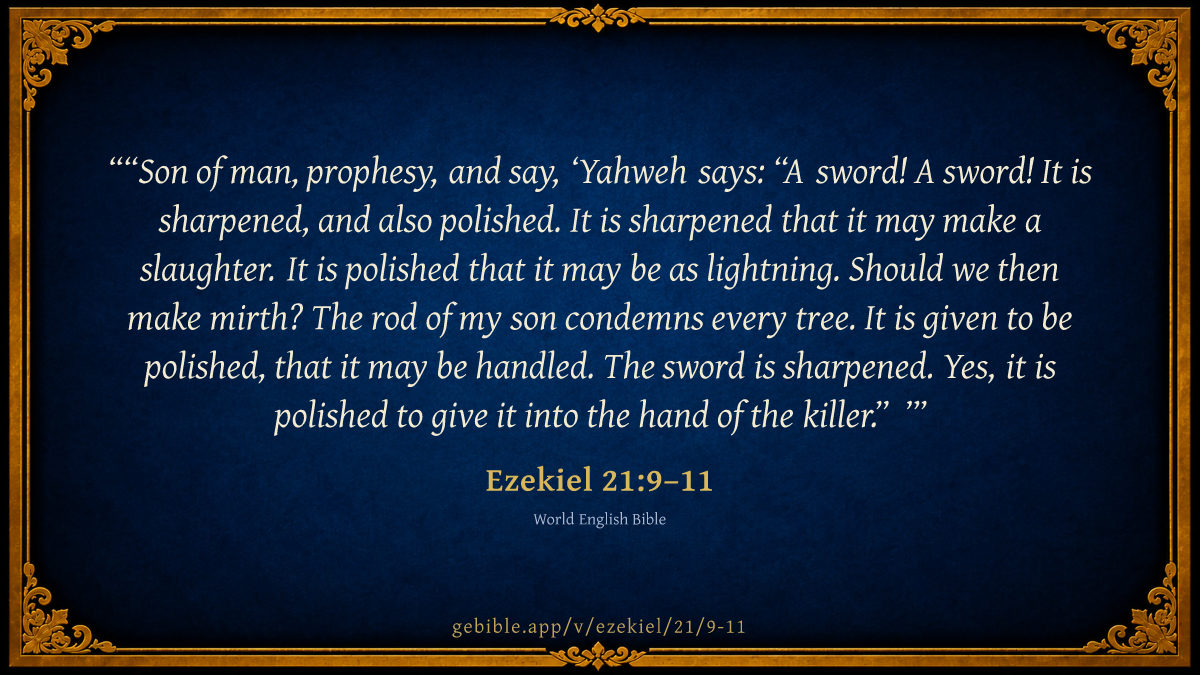
9“Son of man, prophesy, and say, ‘Yahweh says: “A sword! A sword! It is sharpened, and also polished.
10It is sharpened that it may make a slaughter. It is polished that it may be as lightning. Should we then make mirth? The rod of my son condemns every tree.
11It is given to be polished, that it may be handled. The sword is sharpened. Yes, it is polished to give it into the hand of the killer.” ’
9 “Son of man, prophesy, and say, ‘Yahweh says: “A sword! A sword! It is sharpened, and also polished.
10 It is sharpened that it may make a slaughter. It is polished that it may be as lightning. Should we then make mirth? The rod of my son condemns every tree.
11 It is given to be polished, that it may be handled. The sword is sharpened. Yes, it is polished to give it into the hand of the killer.” ’
KJVKing James Version
9 Son of man, prophesy, and say, Thus saith the LORD; Say, A sword, a sword is sharpened, and also furbished:
10 It is sharpened to make a sore slaughter; it is furbished that it may glitter: should we then make mirth? it contemneth the rod of my son, as every tree.
11 And he hath given it to be furbished, that it may be handled: this sword is sharpened, and it is furbished, to give it into the hand of the slayer.
Show all 3 translations
JPSJPS Tanakh (1917)
9 (21-14) 'Son of man, prophesy, and say: Thus saith the LORD: Say: A sword, a sword, it is sharpened, and also furbished:
10 (21-15) It is sharpened that it may make a sore slaughter, it is furbished that it may glitter — or shall we make mirth? — against the rod of My son, contemning every tree.
11 (21-16) And it is given to be furbished, that it may be handled; the sword, it is sharpened, yea, it is furbished, to give it into the hand of the slayer.
Psalms 110:5-6(v10)The Lord is at your right hand. He will crush kings in the day of his wrath. He will judge among the nations. He will heap up dead bodies.…
Isaiah 34:5-6(vv9–10)For my sword has drunk its fill in the sky. Behold, it will come down on Edom, and on the people of my curse, for judgment. Yahweh’s sword…
Ezekiel 20:47(v10)Tell the forest of the South, ‘Hear Yahweh’s word: The Lord Yahweh says, “Behold, I will kindle a fire in you, and it will devour every…
Ezekiel 21:3(v9)Tell the land of Israel, ‘Yahweh says: “Behold, I am against you, and will draw my sword out of its sheath, and will cut off from you the…
Ezekiel 21:19(v11)“Also, you son of man, appoint two ways, that the sword of the king of Babylon may come. They both will come out of one land, and mark out…
Show all 35 cross-references
Ezekiel 21:28(v9)“You, son of man, prophesy, and say, ‘The Lord Yahweh says this concerning the children of Ammon, and concerning their reproach: “A sword!…
Deuteronomy 32:41-42(v9)if I sharpen my glittering sword, my hand grasps it in judgment; I will take vengeance on my adversaries, and will repay those who hate me.…
2 Samuel 7:14(v10)I will be his father, and he will be my son. If he commits iniquity, I will chasten him with the rod of men, and with the stripes of the…
Esther 3:15(v10)The couriers went out in haste by the king’s commandment, and the decree was given out in the citadel of Susa. The king and Haman sat down…
Job 20:25(v9)He draws it out, and it comes out of his body. Yes, the glittering point comes out of his liver. Terrors are on him.
Psalms 2:7-9(v10)I will tell of the decree: Yahweh said to me, “You are my son. Today I have become your father. Ask of me, and I will give the nations for…
Psalms 7:11-13(v9)God is a righteous judge, yes, a God who has indignation every day. If a man doesn’t repent, he will sharpen his sword; he has bent and…
Psalms 89:26-32(v10)He will call to me, ‘You are my Father, my God, and the rock of my salvation!’ I will also appoint him my firstborn, the highest of the…
Psalms 89:38-45(v10)But you have rejected and spurned. You have been angry with your anointed. You have renounced the covenant of your servant. You have…
Ecclesiastes 3:4(v10)a time to weep, and a time to laugh; a time to mourn, and a time to dance;
Isaiah 5:12-14(v10)The harp, lyre, tambourine, and flute, with wine, are at their feasts; but they don’t respect the work of Yahweh, neither have they…
Isaiah 22:12-14(v10)In that day, the Lord, Yahweh of Armies, called to weeping, to mourning, to baldness, and to dressing in sackcloth; and behold, joy and…
Isaiah 27:1(v9)In that day, Yahweh with his hard and great and strong sword will punish leviathan, the fleeing serpent, and leviathan the twisted serpent;…
Isaiah 66:16(v9)For Yahweh will execute judgment by fire and by his sword on all flesh; and those slain by Yahweh will be many.
Jeremiah 12:12(v9)Destroyers have come on all the bare heights in the wilderness; for the sword of Yahweh devours from the one end of the land even to the…
Jeremiah 15:2(v9)It will happen, when they ask you, ‘Where shall we go out?’ then you shall tell them, ‘Yahweh says: “Such as are for death, to death; such…
Jeremiah 25:9(v11)behold, I will send and take all the families of the north,” says Yahweh, “and I will send to Nebuchadnezzar the king of Babylon, my…
Jeremiah 25:33(v11)The slain of Yahweh will be at that day from one end of the earth even to the other end of the earth. They won’t be lamented. They won’t be…
Jeremiah 46:4(v10)Harness the horses, and get up, you horsemen, and stand up with your helmets. Polish the spears, put on the coats of mail.
Jeremiah 51:20-23(v11)“You are my battle ax and weapons of war. With you I will break the nations into pieces. With you I will destroy kingdoms. With you I will…
Ezekiel 19:11-14(v10)It had strong branches for the scepters of those who ruled. Their stature was exalted among the thick boughs. They were seen in their…
Ezekiel 21:15(v9)I have set the threatening sword against all their gates, that their heart may melt, and their stumblings be multiplied. Ah! It is made as…
Ezekiel 21:25-27(v10)“ ‘You, deadly wounded wicked one, the prince of Israel, whose day has come, in the time of the iniquity of the end, the Lord Yahweh says:…
Amos 6:3-7(v10)Those who put far away the evil day, and cause the seat of violence to come near; Who lie on beds of ivory, and stretch themselves on their…
Amos 9:4(v9)Though they go into captivity before their enemies, there I will command the sword, and it will kill them. I will set my eyes on them for…
Nahum 1:10(v10)For entangled like thorns, and drunken as with their drink, they are consumed utterly like dry stubble.
Nahum 3:3(v10)the horseman mounting, and the flashing sword, the glittering spear, and a multitude of slain, and a great heap of corpses, and there is no…
Habakkuk 3:11(v10)The sun and moon stood still in the sky, at the light of your arrows as they went, at the shining of your glittering spear.
Luke 21:34-35(v10)“So be careful, or your hearts will be loaded down with carousing, drunkenness, and cares of this life, and that day will come on you…
Revelation 2:27(v10)He will rule them with a rod of iron, shattering them like clay pots; as I also have received of my Father:
35 distinct cross-references across this passage (36 total citations).
Cross-references from openbible.info (CC BY 4.0)
Explain this passage (15 sources)
Historical commentary, presented as a primary source — not an endorsement.
Geneva Bible translators1599 · Public DomainOn vv10–11That is, the rest of the people.
That is, the rest of the people.
And so cause a fear.
Read full note →
Meaning, the scepter: showing that it will not spare the King, who should be as the son of God, and in his place.
Geneva Bible (1599) marginal notes — public domain.
John Trapp1656 · Public DomainOn vv9–11Eze 21:9 Son of man, prophesy, and say, Thus…
Eze 21:9 Son of man, prophesy, and say, Thus saith the LORD; Say, A sword, a sword is sharpened, and also furbished:
Ver. 9 A sword, a sword is sharpened.] {a} Not only drawn, but sharpened, that it may wound swiftly and deadly; furbished also, that it may the more affray and make the quicker despatch. And that no doubt may be made of it, the ward sword is doubled.
Read full note →
{a} Exacutus et extersus, sharp and clean.
John Trapp, A Commentary or Exposition upon All the Books of the Old and New Testament (1647–1656) — public domain. Text from a community e-Sword module.
Matthew Poole1685 · Public DomainOn vv9–11As if he pointed to it, crying out as…
As if he pointed to it, crying out as one that suddenly seeth some dreadful sight. A mighty sword, or many; so the ingemination may imply the forces of Nebuchadnezzar and his confederates.
Sharpened; prepared to wound, slay, and that with greater speed and sureness.
Read full note →
Furbished; to terrify the weaker courage, to dazzle the eyes of such as encounter it: in a word, the danger is as near as if an army come up in array, and their swords in their bends ready to go on and fight.
Matthew Poole's English Annotations on the Holy Bible (1683–1685) — public domain. Text from a community e-Sword/MySword module.
John Gill1763 · Public DomainOn vv9–11And he hath given it to be furbished, that…
And he hath given it to be furbished, that it might be handled,.... Either Nebuchadnezzar, or rather God, or the Son of God, prepared and brightened the sword, that it might be handled and made use of, either by the Chaldeans or Romans, to the destruction of the Jews. The Targum is,
"he gave their vengeance to be delivered into the hand of the king of Babylon.''
Read full note →
The sword is sharpened and furbished, to give it into the hand of the slayer; either the king of Babylon, Nebuchadnezzar; or the Roman emperor, Titus Vespasian.
John Gill's Exposition of the Whole Bible (1746–1763) — public domain (CC PDM 1.0). Text via the HelloAO Bible API.
John Wesley1765 · Public DomainOn vv9–10Furbished - Made clean and bright.
Furbished - Made clean and bright.
John Wesley, Explanatory Notes Upon the Whole Bible (1754–1765) — public domain. Text via the GEBible commentary corpus.
Adam Clarke1810 · Public DomainOn vv10–11Verse 10. It contemneth the rod of my son]…
Verse 10. It contemneth the rod of my son] "It," the sword of Nebuchadnezzar, "contemneth the rod," despises the power and influence of my son-Israel, the Jewish people: "Out of Egypt have I called MY SON."
As every tree.] As all the stocks, kindreds, and nations, over which I have already given him commission. Can the rod of Israel be spared, when the trees of Assyria, Egypt, &c., have been cut down?
Adam Clarke's Commentary on the Bible (1810–1826) — public domain. Text from a community e-Sword/MySword module.
Joseph Benson1811 · Public DomainOn v9Eze 21:9-10. Say, A sword, a sword is sharpened…
Eze 21:9-10. Say, A sword, a sword is sharpened — The sword was unsheathed in the foregoing verses; here it is fitted to do execution, which the prophet is commanded to lament. 1. It is sharpened, that it may cut, and wound, and make sore slaughter. The wrath of God will put an edge upon it; and whatever instruments he shall be pleased to use in executing his judgments, he will fill them with strength, courage, and fury, according to the service they are employed in. 2. It is furbished, that it may glitter, to the terror of those against whom it is drawn. It shall be a kind of flaming sword. Though the glory of God’s justice may seem to have been eclipsed for a while, (like a sword rusting in the scabbard,) during the day of his patience, and the delay of his judgments; yet it will shine out again, and be made to glitter. 3. It is a victorious sword, nothing shall stand before it. It contemneth the rod of my son, as every tree — It makes no distinction between the sceptre and common wood; between the branches of the royal family, descended from David and Solomon, (who were honoured with the title of God’s sons,) and the meanest of the people. This seems to be the meaning of the clause, provided our translation be just; but it is rendered very differently in some other versions. The Vulgate reads, Qui moves sceptrum filii mei, succidisti omne lignum, Thou who removest the sceptre of my son, hast cut down every tree; which Capellus understands of Nebuchadnezzar, who took away the sceptre, and overturned the kingdom. The marginal reading, It is the rod of my son, it despiseth every tree, may be understood in two senses. It may either mean, It is the rod whereby I chastise my son, namely, my people Israel. These, collectively considered, are termed God’s son, Exo 4:22-23; Hos 11:1; as being selected and chosen from all others, to stand to him in the relation of sons and daughters. Or, it may signify, It is the rod of my son, the Messiah, appointed by me to be the judge of the world, and invested with authority to execute judgment. This rod despiseth every tree; for it is the rod of iron, whereby the Son of God breaks the power of his enemies, Psa 2:9, and dashes them in pieces like a potter’s vessel, without respect of persons.
Joseph Benson's Commentary on the Old and New Testaments (1811–1818) — public domain. Text from a community e-Sword module.
Haydock's Catholic Bible Commentary1859 · Public DomainOn vv10–11My son. He speaks, according to St. Jerome, to…
My son. He speaks, according to St. Jerome, to the sword of Nabuchodonosor; which was about to remove the sceptre of Israel, whom God here calls his son. (Challoner) --- This title belonged to all Israel, Exodus iv. 22. (Worthington) --- The Hebrew seems to be corrupt, and we may adhere to the Vulgate or to the Septuagint, (Calmet) which has, (9.) "Sword be sharp, and raging to slay victims; be sharp to shine, ready for destruction; cut, reduce to nothing, remove all wood." (Haydock) --- Syriac, "be ready to scatter the race of my son," &c. Hebrew, "Where shall we rejoice, sceptre of my son, thou sword which despisest every tree?" (Calmet) --- Protestants, "It contemneth the rod of my son as every tree?" (Haydock)
George Leo Haydock (1774–1849), Haydock's Catholic Family Bible and Commentary, 1859 edition — public domain. Excludes Psalms (Douay-Rheims chapter numbering differs from Protestant) and Deuterocanonical books (Catholic canon only).
Robert Jamieson, A. R. Fausset & David Brown1871 · Public DomainOn vv9–11sword--namely, of God (Deu 32:41). The Chaldeans are His…
sword--namely, of God (Deu 32:41). The Chaldeans are His instrument.
Jamieson, Fausset & Brown — Commentary Critical and Explanatory on the Whole Bible (1871) — public domain (CC PDM 1.0). Text via the HelloAO Bible API.
Daniel D. Whedon1874 · Public DomainOn v1010. Should we then make mirth? it contemneth the…
10. Should we then make mirth? it contemneth the rod of my son, as every tree — Literally, shall we make mirth, saying, The scepter of my son contemneth all wood? Dr. Kautzsch and Professor Toy give up the text as hopelessly corrupt and without sensible meaning. The last clause may mean possibly either that the scepter of my son (Israel) defies every other scepter, or that his rod (punishment) exceeds all ordinary punishment. Smend emends the text so as to read, “Woe to the prince! thou hast despised the rod, hast contemned all wood.”
Daniel D. Whedon (gen. ed.), Commentary on the Old and New Testaments (1874–1909) — public domain. Text from a community e-Sword module.
The Cambridge Bible for Schools and Colleges1878 · Public DomainOn v1010. should we then make mirth] lit., or shall…
10. should we then make mirth] lit., or shall we make mirth? These words with the rest to the end of the verse appear to have little meaning in the connexion. R V. renders the whole: “shall we then make mirth? the rod of my son, it contemneth every tree.” This is a literal rendering, the last words meaning probably that the rod (the sword of Babylon) with which Jehovah now chastises his son (the prince, or, people) contemneth (exceeds in severity) every tree, or, all wood, i.e. all rods of chastisement which are mere wood, for it is glittering steel. Some ingenuity is needed to extract the meaning, which, however, when extracted is difficult to harmonise with Eze_21:13. The words “shall we then make mirth?” still appear meaningless. For “or” or “then” Frd. Del. would find some cohortative particle after the Assyr.,—ha! let us make mirth! the words being those of God (cf. Eze_21:17), and the following words “contemneth every tree” meaning that in comparison with the rod he now uses all other rods of chastisement are only despicable, and useless for their purpose (Zeit. f. Keilschritftforschung, ii. 4 p. 385). The text appears to be in disorder, and though many emendations have been proposed none of them is satisfactory. Ges., … “glitter, against the prince of the tribe of my son (Judah), which despiseth all wood”—prince for “should we rejoice” (nasi’ for nasis), and the idea being expressed that as Judah has hitherto despised all ordinary chastisements with the rod of wood the sword shall now be drawn against the prince. Ew., “no weak rod of my son, the softest of all wood”—the words “rod of my son” being a phrase from the mouth of fathers and meaning a gentle rod. Apart from the unnatural constructions and the strong Aramaisms assumed, the sense is feeble and improbable. Smend, “woe O prince! thou hast despised the rod, contemned every tree (all wood)”—rod and wood being used of chastening as before. LXX. reads: “ready (= furbished) for paralysing (enfeebling); slay, despise, set at nought every tree”! The imperatives are addressed to the sword. The words “for paralysing” may be a rendering of present Heb. read with Aramean sense; but “for” is read for “or.” It is by no means certain that LXX. found imperatives, because it renders Eze_21:9 also in the imperative. Partly following Sep. Corn., “for men who slay and plunder (lit. men of slaughter and plundering) who despise every stronghold”—viz. the Chaldeans, into whose hand the sword of the Lord is to be given. (Cf. Isa_33:8; Hab_1:10.) This really gives a meaning, though it is gained at considerable cost, for some of the words assumed do not occur, the constructions are far from probable, and the changes of the text are serious. Further, in all the passage it is the sword itself that is dwelt upon and those whom it shall slay; those who are to wield it are only alluded to.
Scholars almost unanimously assume that there is ref. in the clause to former chastisement, hence “rod” and “all wood” are read in that sense. But such an idea seems little in place in the connexion; and the word rendered “rod” may mean sceptre or almost ruler (Eze_19:11; Eze_19:14), and “every tree” may be taken of other sceptres. The assumption that “contemneth every tree” (all wood) means: exceeds in severity of punishment every rod, or looks down on every other chastening rod, feeling its own superiority as an instrument of punishment, is a very far-fetched one. It is certainly possible that the word “prince” (princes) lurks in the strange “shall we then rejoice?” (Ges. Sm.). The prince and royal house are alluded to repeatedly in the chapter, e.g. Eze_21:14; Eze_21:25-27; Eze_21:29. The rendering: “against the prince (princes), the sceptre of my son (that) despiseth all wood” (i.e. other sceptres, or royal powers, Eze_19:11; Eze_19:14), is not very natural. The expression “my son,” whether applied to the king or the people, has something unexpected about it in Ezek., though “my people” is used in the passage also (Eze_21:12), and an undertone of pity, or at least a deep feeling of the terribleness of the coming calamity, runs through the passage. The words “shall we then make mirth?” can hardly stand in any case, even in this form: “or shall we make mirth (saying), The sceptre of my son contemneth all wood!” i.e. defies every other sceptre or royal power (La Bible Annotéc). Any reference in the passage to Gen_49:9 or 2Sa_7:14 is without probability.
The Cambridge Bible for Schools and Colleges (gen. ed. J. J. S. Perowne; Cambridge University Press, 1878–1918) — public domain. Text from a community e-Sword module.
Ellicott's Commentary for English Readers1878 · Public DomainOn vv10–11(10) Make mirth.—The answer to this question has already…
(10) Make mirth.—The answer to this question has already been given in Eze_21:6, and is repeated in Eze_21:12.
Contemneth the rod of my son.—This refers to Gen_49:9-10, in which Jacob addresses Judah as “my son,” and foretells that “the sceptre shall not depart from” him until Shiloh come. There is another allusion to the same passage in Eze_21:27. Comp, also Eze_17:22-23. There is, however, serious difficulty as to the construction and meaning of the clause. The ancient versions and many commentators have more or less changed the text without improvement. The original is obscure in its extreme brevity, and allows “the rod of my son” to be either the object (as it is taken in the text) or the subject (as in the margin). The true sense is probably that which makes the clause into an objection offered by the Jew to the prophet’s denunciation: “But ‘the rod of my son’ despiseth every tree;” i.e., the Divine promise of old to Judah is sure, and his sceptre must remain whatever power arises against it. The objection was in a certain sense true, but the objectors had little idea of the means by which its truth should be established, and vainly imagined that it gave a temporal security to the kingdom of Judah, whatever might be its sins. The prophet does not notice the objection further than to go on with his prediction of the approaching desolation.
A Bible Commentary for English Readers, edited by Charles John Ellicott (1878–1897) — public domain. Text from a community e-Sword module.
The Pulpit Commentary1880 · Public DomainOn vv9–10The sword of war.
The sword of war.
I THE SWORD OF WAR BRINGS FEARFUL TROUBLE. When the hoarded judgment bursts over the head of the guilty nation of Israel, it falls in the form of war. Those people who speak lightly of war as being "good for trade," as "opening careers for men," and as "developing manly virtues," etc., would do well to consider that the fearful monster is regarded in the Bible as the worst of plagues. David was a man of war and he knew what its horrors meant. It was with no nervous fear like that of King James who shuddered at the sight of a sword, with no sentimental tremors of an effeminate nature, that the old warrior David chose the horrors of a pestilence in preference to those of war. Note some of its evils.
Read full note →
1. Destructiveness. It must be a fallacy to regard it as "good for trade." Whatever temporary and artificial fillip commerce may receive during the actual campaign is paid for ten times over by the subsequent collapse. England was thrown back for generations by the Napoleonic wars. The soldiers are withdrawn from productive work; ordinary commerce is stopped; and a vast amount of property is directly destroyed.
2. Suffering. Every one who has witnessed the scenes of a battlefield turns from the recollection of them with loathing and horror. War is not a pageant of drums and trumpets and flying banners; it is a huge Inferno of groans and agonizing deaths. Thousands lie wounded on the field, some trampled on by charging steeds, some anguished for want of the drop of water which cannot be reached, sick with the blazing heat of the sun or chilled to the marrow in snow and frost. Thousands are cut off in the flower of their youth, sent prematurely to the grave before their real life work is begun. And every death means a household of bitter mourning in the old home.
3. Wickedness. War lets loose the lowest passions. Hatred and bloodthirsty vengeance are engendered, and men are brought down to the level of wild brutes. Too often savage lust follows, and the vilest outrages are committed.
II THE SWORD OF WAR MAY BE USED AS A DIVINE CHASTISEMENT.
1. Sharpened by sin. National misconduct lays a people open to the ravages of war. The curse may be earned immediately by insolent and unrighteous dealings with other nations; or it may be brought less directly and not as we could anticipate. Yet the awful fact remains National sin necessitates national judgment, and the most awful and yet the most common national judgment is war.
2. Directed by God. This was the case with the wars of judgment that visited Israel. Israel"s sin sharpened the sword, but God"s hand guided it. For the providence of God cannot be excluded, even from so lawless and monstrous a thing as war.
(1) This adds to its terror. It is fearful to know that God wills us to suffer from so dire a calamity. Then there can be no escaping it.
(2) This suggests hope of final rescue. Wherever God is, love is. The God of battles is the God of Bethlehem. He who sends the war to scourge also sends the gospel to save.
The Pulpit Commentary (1880–1919), ed. H.D.M. Spence-Jones & Joseph S. Exell — public domain. Text from a community e-Sword module.
The Biblical Illustrator1887 · Public DomainOn v9Should we then make mirth?
Eze_21:9-11
Should we then make mirth?
Read full note →
Mirth unreasonable in the unconverted
I. Because they are under condemnation. The sword is sharpened to make a sore slaughter; it is furbished that it may glitter. Should we then make mirth? It is unreasonable in a condemned malefactor to make mirth. Would it not greatly shock every feeling mind to see a company of men condemned to die, meeting and making merry, talking lightly and jestingly, as if the sword was not over them?
II. Because Gods instruments of destruction are all ready. Not only are Christless persons condemned already, but the instruments of their destruction are prepared and quite ready, The sword of vengeance is sharpened and also furbished. The, disease by which every unconverted man is to die is quite ready--it is perhaps in his veins at this very moment. The accident by which he is to drop into eternity is quite ready--all the parts and means of it are arranged. The arrow that is to strike him is on the string--perhaps it has left the string, and is even now flying towards him.
III. Because the sword may come down at any one moment. Not only are Christless persons condemned already, and not only is the sword of vengeance quite ready, but the sword may come down at any one moment. It is not so with malefactors: their day is fixed and told them, so that they can count their time. If they have many days, they make merry today at least, and begin to be serious tomorrow. But not so Christless persons: their day is fixed, but it is not told them. It may be this very moment. Ah! should they then make mirth?
IV. Because God has made no promise to Christless souls to stay His hand one moment. God has laid Himself under no manner of obligation to you. He has nowhere promised that you shall see tomorrow, or that you shall hear another sermon. There is a day near at hand when you shall not see tomorrow.
V. It is a sore slaughter.
1. Sore, because it will be on all who are Christless.
2. Sore slaughter, because the sword is the sword of God. (R. MCheyne.)
Untimely mirth
Lightfoot says: I have heard it more than once and again, from the sheriffs who took all the gunpowder plotters and brought them up to London, that every night when they came to their lodging by the way, they had their music and dancing a good part of the night. One would think it strange that men in their case should be so merry. More marvellous still is it that those between whom and death there is but a step should sport away their time as if they should live on for ages. Though the place of torment is within a short march of all unregenerate men, yet see how they make mirth, grinning and jesting between the jaws of hell! (C. H. Spurgeon.)
The Biblical Illustrator, edited by Joseph S. Exell (c. 1880s–1900s) — public domain. Text from a community e-Sword module.
unfoldingWord translationNotes2017 · CC BY-SA 4.0On v10Connecting Statement:
Connecting Statement:
Yahweh continues to describe the sword of Yahweh which is a metaphor for the enemy army that Yahweh will use to attack Jerusalem. (See: Metaphor)
Read full note →
It will be sharpened ... It will be polished in order to
These can be stated in active form. AT: "I will sharpen it ... I will polish it so that it will" (See: Active or Passive)
in order to be like lightning
This means that the sword will be so shiny that light reflects off of it easily and brightly. AT: "so that it flashes like lightning" or "so that light reflects off of it as brightly as lightning" (See: Simile)
Should we rejoice in my son's scepter?
This rhetorical question emphasizes that the people of Israel will not celebrate their king's power, because it cannot resist the "sword." AT: "The people of Judah will not celebrate about their king's scepter." or "we should not celebrate the power of our king's scepter." (See: Rhetorical Question)
Should we
The word "we" refers to Ezekiel and the people of Israel. (See: Inclusive "We")
in my son's scepter
Here Yahweh refers to the king of Judah as his son. The king's scepter represents his rule as king. It is important to maintain the image of the king's scepter here, as the words "every such rod" refer to the scepter. AT: "in the king's scepter" or "in the power that the king's scepter represents" (See: Metonymy)
The coming sword hates every such rod
Here the "sword" is personified as coming to attack the people. This speaks of the king not being able to resist the "sword", as if the "sword" were hating the king's scepter. AT: "the sword will overpower his scepter like that of any other ruler" or "for the king will not be able to resist when the sword is brought against him" (See: Personification)
such rod
This phrase is used to mock the king's scepter by calling it a "rod." AT: "such scepter" (See: Irony)
the sword will be given to be polished
This can be stated in active form. AT: "I will polish the sword" (See: Active or Passive)
then to be grasped by the hand
This can be stated in active form. AT: "then the right person will hold it in his hand" (See: Active or Passive)
it is to be given into the hand of the one who kills
This can be stated in active form. AT: "it is ready for the killer to use" (See: Active or Passive)

Geneva Bible translators 1599 · Public Domain On vv10–11 That is, the rest of the people.
That is, the rest of the people.
And so cause a fear.
Read full note →
Meaning, the scepter: showing that it will not spare the King, who should be as the son of God, and in his place.
Geneva Bible (1599) marginal notes — public domain.
John Trapp 1656 · Public Domain On vv9–11 Eze 21:9 Son of man, prophesy, and say, Thus…
Eze 21:9 Son of man, prophesy, and say, Thus saith the LORD; Say, A sword, a sword is sharpened, and also furbished:
Ver. 9 A sword, a sword is sharpened.] {a} Not only drawn, but sharpened, that it may wound swiftly and deadly; furbished also, that it may the more affray and make the quicker despatch. And that no doubt may be made of it, the ward sword is doubled.
Read full note →
{a} Exacutus et extersus, sharp and clean.
John Trapp, A Commentary or Exposition upon All the Books of the Old and New Testament (1647–1656) — public domain. Text from a community e-Sword module.
Matthew Poole 1685 · Public Domain On vv9–11 As if he pointed to it, crying out as…
As if he pointed to it, crying out as one that suddenly seeth some dreadful sight. A mighty sword, or many; so the ingemination may imply the forces of Nebuchadnezzar and his confederates.
Sharpened; prepared to wound, slay, and that with greater speed and sureness.
Read full note →
Furbished; to terrify the weaker courage, to dazzle the eyes of such as encounter it: in a word, the danger is as near as if an army come up in array, and their swords in their bends ready to go on and fight.
Matthew Poole's English Annotations on the Holy Bible (1683–1685) — public domain. Text from a community e-Sword/MySword module.
John Gill 1763 · Public Domain On vv9–11 And he hath given it to be furbished, that…
And he hath given it to be furbished, that it might be handled,.... Either Nebuchadnezzar, or rather God, or the Son of God, prepared and brightened the sword, that it might be handled and made use of, either by the Chaldeans or Romans, to the destruction of the Jews. The Targum is,
"he gave their vengeance to be delivered into the hand of the king of Babylon.''
Read full note →
The sword is sharpened and furbished, to give it into the hand of the slayer; either the king of Babylon, Nebuchadnezzar; or the Roman emperor, Titus Vespasian.
John Gill's Exposition of the Whole Bible (1746–1763) — public domain (CC PDM 1.0). Text via the HelloAO Bible API.
John Wesley 1765 · Public Domain On vv9–10 Furbished - Made clean and bright.
Furbished - Made clean and bright.
John Wesley, Explanatory Notes Upon the Whole Bible (1754–1765) — public domain. Text via the GEBible commentary corpus.
Adam Clarke 1810 · Public Domain On vv10–11 Verse 10. It contemneth the rod of my son]…
Verse 10. It contemneth the rod of my son] "It," the sword of Nebuchadnezzar, "contemneth the rod," despises the power and influence of my son-Israel, the Jewish people: "Out of Egypt have I called MY SON."
As every tree.] As all the stocks, kindreds, and nations, over which I have already given him commission. Can the rod of Israel be spared, when the trees of Assyria, Egypt, &c., have been cut down?
Adam Clarke's Commentary on the Bible (1810–1826) — public domain. Text from a community e-Sword/MySword module.
Joseph Benson 1811 · Public Domain On v9 Eze 21:9-10. Say, A sword, a sword is sharpened…
Eze 21:9-10. Say, A sword, a sword is sharpened — The sword was unsheathed in the foregoing verses; here it is fitted to do execution, which the prophet is commanded to lament. 1. It is sharpened, that it may cut, and wound, and make sore slaughter. The wrath of God will put an edge upon it; and whatever instruments he shall be pleased to use in executing his judgments, he will fill them with strength, courage, and fury, according to the service they are employed in. 2. It is furbished, that it may glitter, to the terror of those against whom it is drawn. It shall be a kind of flaming sword. Though the glory of God’s justice may seem to have been eclipsed for a while, (like a sword rusting in the scabbard,) during the day of his patience, and the delay of his judgments; yet it will shine out again, and be made to glitter. 3. It is a victorious sword, nothing shall stand before it. It contemneth the rod of my son, as every tree — It makes no distinction between the sceptre and common wood; between the branches of the royal family, descended from David and Solomon, (who were honoured with the title of God’s sons,) and the meanest of the people. This seems to be the meaning of the clause, provided our translation be just; but it is rendered very differently in some other versions. The Vulgate reads, Qui moves sceptrum filii mei, succidisti omne lignum, Thou who removest the sceptre of my son, hast cut down every tree; which Capellus understands of Nebuchadnezzar, who took away the sceptre, and overturned the kingdom. The marginal reading, It is the rod of my son, it despiseth every tree, may be understood in two senses. It may either mean, It is the rod whereby I chastise my son, namely, my people Israel. These, collectively considered, are termed God’s son, Exo 4:22-23; Hos 11:1; as being selected and chosen from all others, to stand to him in the relation of sons and daughters. Or, it may signify, It is the rod of my son, the Messiah, appointed by me to be the judge of the world, and invested with authority to execute judgment. This rod despiseth every tree; for it is the rod of iron, whereby the Son of God breaks the power of his enemies, Psa 2:9, and dashes them in pieces like a potter’s vessel, without respect of persons.
Joseph Benson's Commentary on the Old and New Testaments (1811–1818) — public domain. Text from a community e-Sword module.
Haydock's Catholic Bible Commentary 1859 · Public Domain On vv10–11 My son. He speaks, according to St. Jerome, to…
My son. He speaks, according to St. Jerome, to the sword of Nabuchodonosor; which was about to remove the sceptre of Israel, whom God here calls his son. (Challoner) --- This title belonged to all Israel, Exodus iv. 22. (Worthington) --- The Hebrew seems to be corrupt, and we may adhere to the Vulgate or to the Septuagint, (Calmet) which has, (9.) "Sword be sharp, and raging to slay victims; be sharp to shine, ready for destruction; cut, reduce to nothing, remove all wood." (Haydock) --- Syriac, "be ready to scatter the race of my son," &c. Hebrew, "Where shall we rejoice, sceptre of my son, thou sword which despisest every tree?" (Calmet) --- Protestants, "It contemneth the rod of my son as every tree?" (Haydock)
George Leo Haydock (1774–1849), Haydock's Catholic Family Bible and Commentary, 1859 edition — public domain. Excludes Psalms (Douay-Rheims chapter numbering differs from Protestant) and Deuterocanonical books (Catholic canon only).
Robert Jamieson, A. R. Fausset & David Brown 1871 · Public Domain On vv9–11 sword--namely, of God (Deu 32:41). The Chaldeans are His…
sword--namely, of God (Deu 32:41). The Chaldeans are His instrument.
Jamieson, Fausset & Brown — Commentary Critical and Explanatory on the Whole Bible (1871) — public domain (CC PDM 1.0). Text via the HelloAO Bible API.
Daniel D. Whedon 1874 · Public Domain On v10 10. Should we then make mirth? it contemneth the…
10. Should we then make mirth? it contemneth the rod of my son, as every tree — Literally, shall we make mirth, saying, The scepter of my son contemneth all wood? Dr. Kautzsch and Professor Toy give up the text as hopelessly corrupt and without sensible meaning. The last clause may mean possibly either that the scepter of my son (Israel) defies every other scepter, or that his rod (punishment) exceeds all ordinary punishment. Smend emends the text so as to read, “Woe to the prince! thou hast despised the rod, hast contemned all wood.”
Daniel D. Whedon (gen. ed.), Commentary on the Old and New Testaments (1874–1909) — public domain. Text from a community e-Sword module.
The Cambridge Bible for Schools and Colleges 1878 · Public Domain On v10 10. should we then make mirth] lit., or shall…
10. should we then make mirth] lit., or shall we make mirth? These words with the rest to the end of the verse appear to have little meaning in the connexion. R V. renders the whole: “shall we then make mirth? the rod of my son, it contemneth every tree.” This is a literal rendering, the last words meaning probably that the rod (the sword of Babylon) with which Jehovah now chastises his son (the prince, or, people) contemneth (exceeds in severity) every tree, or, all wood, i.e. all rods of chastisement which are mere wood, for it is glittering steel. Some ingenuity is needed to extract the meaning, which, however, when extracted is difficult to harmonise with Eze_21:13. The words “shall we then make mirth?” still appear meaningless. For “or” or “then” Frd. Del. would find some cohortative particle after the Assyr.,—ha! let us make mirth! the words being those of God (cf. Eze_21:17), and the following words “contemneth every tree” meaning that in comparison with the rod he now uses all other rods of chastisement are only despicable, and useless for their purpose (Zeit. f. Keilschritftforschung, ii. 4 p. 385). The text appears to be in disorder, and though many emendations have been proposed none of them is satisfactory. Ges., … “glitter, against the prince of the tribe of my son (Judah), which despiseth all wood”—prince for “should we rejoice” (nasi’ for nasis), and the idea being expressed that as Judah has hitherto despised all ordinary chastisements with the rod of wood the sword shall now be drawn against the prince. Ew., “no weak rod of my son, the softest of all wood”—the words “rod of my son” being a phrase from the mouth of fathers and meaning a gentle rod. Apart from the unnatural constructions and the strong Aramaisms assumed, the sense is feeble and improbable. Smend, “woe O prince! thou hast despised the rod, contemned every tree (all wood)”—rod and wood being used of chastening as before. LXX. reads: “ready (= furbished) for paralysing (enfeebling); slay, despise, set at nought every tree”! The imperatives are addressed to the sword. The words “for paralysing” may be a rendering of present Heb. read with Aramean sense; but “for” is read for “or.” It is by no means certain that LXX. found imperatives, because it renders Eze_21:9 also in the imperative. Partly following Sep. Corn., “for men who slay and plunder (lit. men of slaughter and plundering) who despise every stronghold”—viz. the Chaldeans, into whose hand the sword of the Lord is to be given. (Cf. Isa_33:8; Hab_1:10.) This really gives a meaning, though it is gained at considerable cost, for some of the words assumed do not occur, the constructions are far from probable, and the changes of the text are serious. Further, in all the passage it is the sword itself that is dwelt upon and those whom it shall slay; those who are to wield it are only alluded to.
Scholars almost unanimously assume that there is ref. in the clause to former chastisement, hence “rod” and “all wood” are read in that sense. But such an idea seems little in place in the connexion; and the word rendered “rod” may mean sceptre or almost ruler (Eze_19:11; Eze_19:14), and “every tree” may be taken of other sceptres. The assumption that “contemneth every tree” (all wood) means: exceeds in severity of punishment every rod, or looks down on every other chastening rod, feeling its own superiority as an instrument of punishment, is a very far-fetched one. It is certainly possible that the word “prince” (princes) lurks in the strange “shall we then rejoice?” (Ges. Sm.). The prince and royal house are alluded to repeatedly in the chapter, e.g. Eze_21:14; Eze_21:25-27; Eze_21:29. The rendering: “against the prince (princes), the sceptre of my son (that) despiseth all wood” (i.e. other sceptres, or royal powers, Eze_19:11; Eze_19:14), is not very natural. The expression “my son,” whether applied to the king or the people, has something unexpected about it in Ezek., though “my people” is used in the passage also (Eze_21:12), and an undertone of pity, or at least a deep feeling of the terribleness of the coming calamity, runs through the passage. The words “shall we then make mirth?” can hardly stand in any case, even in this form: “or shall we make mirth (saying), The sceptre of my son contemneth all wood!” i.e. defies every other sceptre or royal power (La Bible Annotéc). Any reference in the passage to Gen_49:9 or 2Sa_7:14 is without probability.
The Cambridge Bible for Schools and Colleges (gen. ed. J. J. S. Perowne; Cambridge University Press, 1878–1918) — public domain. Text from a community e-Sword module.
Ellicott's Commentary for English Readers 1878 · Public Domain On vv10–11 (10) Make mirth.—The answer to this question has already…
(10) Make mirth.—The answer to this question has already been given in Eze_21:6, and is repeated in Eze_21:12.
Contemneth the rod of my son.—This refers to Gen_49:9-10, in which Jacob addresses Judah as “my son,” and foretells that “the sceptre shall not depart from” him until Shiloh come. There is another allusion to the same passage in Eze_21:27. Comp, also Eze_17:22-23. There is, however, serious difficulty as to the construction and meaning of the clause. The ancient versions and many commentators have more or less changed the text without improvement. The original is obscure in its extreme brevity, and allows “the rod of my son” to be either the object (as it is taken in the text) or the subject (as in the margin). The true sense is probably that which makes the clause into an objection offered by the Jew to the prophet’s denunciation: “But ‘the rod of my son’ despiseth every tree;” i.e., the Divine promise of old to Judah is sure, and his sceptre must remain whatever power arises against it. The objection was in a certain sense true, but the objectors had little idea of the means by which its truth should be established, and vainly imagined that it gave a temporal security to the kingdom of Judah, whatever might be its sins. The prophet does not notice the objection further than to go on with his prediction of the approaching desolation.
A Bible Commentary for English Readers, edited by Charles John Ellicott (1878–1897) — public domain. Text from a community e-Sword module.
The Pulpit Commentary 1880 · Public Domain On vv9–10 The sword of war.
The sword of war.
I THE SWORD OF WAR BRINGS FEARFUL TROUBLE. When the hoarded judgment bursts over the head of the guilty nation of Israel, it falls in the form of war. Those people who speak lightly of war as being "good for trade," as "opening careers for men," and as "developing manly virtues," etc., would do well to consider that the fearful monster is regarded in the Bible as the worst of plagues. David was a man of war and he knew what its horrors meant. It was with no nervous fear like that of King James who shuddered at the sight of a sword, with no sentimental tremors of an effeminate nature, that the old warrior David chose the horrors of a pestilence in preference to those of war. Note some of its evils.
Read full note →
1. Destructiveness. It must be a fallacy to regard it as "good for trade." Whatever temporary and artificial fillip commerce may receive during the actual campaign is paid for ten times over by the subsequent collapse. England was thrown back for generations by the Napoleonic wars. The soldiers are withdrawn from productive work; ordinary commerce is stopped; and a vast amount of property is directly destroyed.
2. Suffering. Every one who has witnessed the scenes of a battlefield turns from the recollection of them with loathing and horror. War is not a pageant of drums and trumpets and flying banners; it is a huge Inferno of groans and agonizing deaths. Thousands lie wounded on the field, some trampled on by charging steeds, some anguished for want of the drop of water which cannot be reached, sick with the blazing heat of the sun or chilled to the marrow in snow and frost. Thousands are cut off in the flower of their youth, sent prematurely to the grave before their real life work is begun. And every death means a household of bitter mourning in the old home.
3. Wickedness. War lets loose the lowest passions. Hatred and bloodthirsty vengeance are engendered, and men are brought down to the level of wild brutes. Too often savage lust follows, and the vilest outrages are committed.
II THE SWORD OF WAR MAY BE USED AS A DIVINE CHASTISEMENT.
1. Sharpened by sin. National misconduct lays a people open to the ravages of war. The curse may be earned immediately by insolent and unrighteous dealings with other nations; or it may be brought less directly and not as we could anticipate. Yet the awful fact remains National sin necessitates national judgment, and the most awful and yet the most common national judgment is war.
2. Directed by God. This was the case with the wars of judgment that visited Israel. Israel"s sin sharpened the sword, but God"s hand guided it. For the providence of God cannot be excluded, even from so lawless and monstrous a thing as war.
(1) This adds to its terror. It is fearful to know that God wills us to suffer from so dire a calamity. Then there can be no escaping it.
(2) This suggests hope of final rescue. Wherever God is, love is. The God of battles is the God of Bethlehem. He who sends the war to scourge also sends the gospel to save.
The Pulpit Commentary (1880–1919), ed. H.D.M. Spence-Jones & Joseph S. Exell — public domain. Text from a community e-Sword module.
The Biblical Illustrator 1887 · Public Domain On v9 Should we then make mirth?
Eze_21:9-11
Should we then make mirth?
Read full note →
Mirth unreasonable in the unconverted
I. Because they are under condemnation. The sword is sharpened to make a sore slaughter; it is furbished that it may glitter. Should we then make mirth? It is unreasonable in a condemned malefactor to make mirth. Would it not greatly shock every feeling mind to see a company of men condemned to die, meeting and making merry, talking lightly and jestingly, as if the sword was not over them?
II. Because Gods instruments of destruction are all ready. Not only are Christless persons condemned already, but the instruments of their destruction are prepared and quite ready, The sword of vengeance is sharpened and also furbished. The, disease by which every unconverted man is to die is quite ready--it is perhaps in his veins at this very moment. The accident by which he is to drop into eternity is quite ready--all the parts and means of it are arranged. The arrow that is to strike him is on the string--perhaps it has left the string, and is even now flying towards him.
III. Because the sword may come down at any one moment. Not only are Christless persons condemned already, and not only is the sword of vengeance quite ready, but the sword may come down at any one moment. It is not so with malefactors: their day is fixed and told them, so that they can count their time. If they have many days, they make merry today at least, and begin to be serious tomorrow. But not so Christless persons: their day is fixed, but it is not told them. It may be this very moment. Ah! should they then make mirth?
IV. Because God has made no promise to Christless souls to stay His hand one moment. God has laid Himself under no manner of obligation to you. He has nowhere promised that you shall see tomorrow, or that you shall hear another sermon. There is a day near at hand when you shall not see tomorrow.
V. It is a sore slaughter.
1. Sore, because it will be on all who are Christless.
2. Sore slaughter, because the sword is the sword of God. (R. MCheyne.)
Untimely mirth
Lightfoot says: I have heard it more than once and again, from the sheriffs who took all the gunpowder plotters and brought them up to London, that every night when they came to their lodging by the way, they had their music and dancing a good part of the night. One would think it strange that men in their case should be so merry. More marvellous still is it that those between whom and death there is but a step should sport away their time as if they should live on for ages. Though the place of torment is within a short march of all unregenerate men, yet see how they make mirth, grinning and jesting between the jaws of hell! (C. H. Spurgeon.)
The Biblical Illustrator, edited by Joseph S. Exell (c. 1880s–1900s) — public domain. Text from a community e-Sword module.
unfoldingWord translationNotes 2017 · CC BY-SA 4.0 On v10 Connecting Statement:
Connecting Statement:
Yahweh continues to describe the sword of Yahweh which is a metaphor for the enemy army that Yahweh will use to attack Jerusalem. (See: Metaphor)
Read full note →
It will be sharpened ... It will be polished in order to
These can be stated in active form. AT: "I will sharpen it ... I will polish it so that it will" (See: Active or Passive)
in order to be like lightning
This means that the sword will be so shiny that light reflects off of it easily and brightly. AT: "so that it flashes like lightning" or "so that light reflects off of it as brightly as lightning" (See: Simile)
Should we rejoice in my son's scepter?
This rhetorical question emphasizes that the people of Israel will not celebrate their king's power, because it cannot resist the "sword." AT: "The people of Judah will not celebrate about their king's scepter." or "we should not celebrate the power of our king's scepter." (See: Rhetorical Question)
Should we
The word "we" refers to Ezekiel and the people of Israel. (See: Inclusive "We")
in my son's scepter
Here Yahweh refers to the king of Judah as his son. The king's scepter represents his rule as king. It is important to maintain the image of the king's scepter here, as the words "every such rod" refer to the scepter. AT: "in the king's scepter" or "in the power that the king's scepter represents" (See: Metonymy)
The coming sword hates every such rod
Here the "sword" is personified as coming to attack the people. This speaks of the king not being able to resist the "sword", as if the "sword" were hating the king's scepter. AT: "the sword will overpower his scepter like that of any other ruler" or "for the king will not be able to resist when the sword is brought against him" (See: Personification)
such rod
This phrase is used to mock the king's scepter by calling it a "rod." AT: "such scepter" (See: Irony)
the sword will be given to be polished
This can be stated in active form. AT: "I will polish the sword" (See: Active or Passive)
then to be grasped by the hand
This can be stated in active form. AT: "then the right person will hold it in his hand" (See: Active or Passive)
it is to be given into the hand of the one who kills
This can be stated in active form. AT: "it is ready for the killer to use" (See: Active or Passive)
translationWords
slaughter
joy
scepter
sword
rod
unfoldingWord translationNotes — © Distant Shores Media and the Door43 World Missions Community, licensed CC BY-SA 4.0. Source: git.door43.org/Door43/en_tn.