Ezekiel 22:27-30 sits inside this longer paragraph.
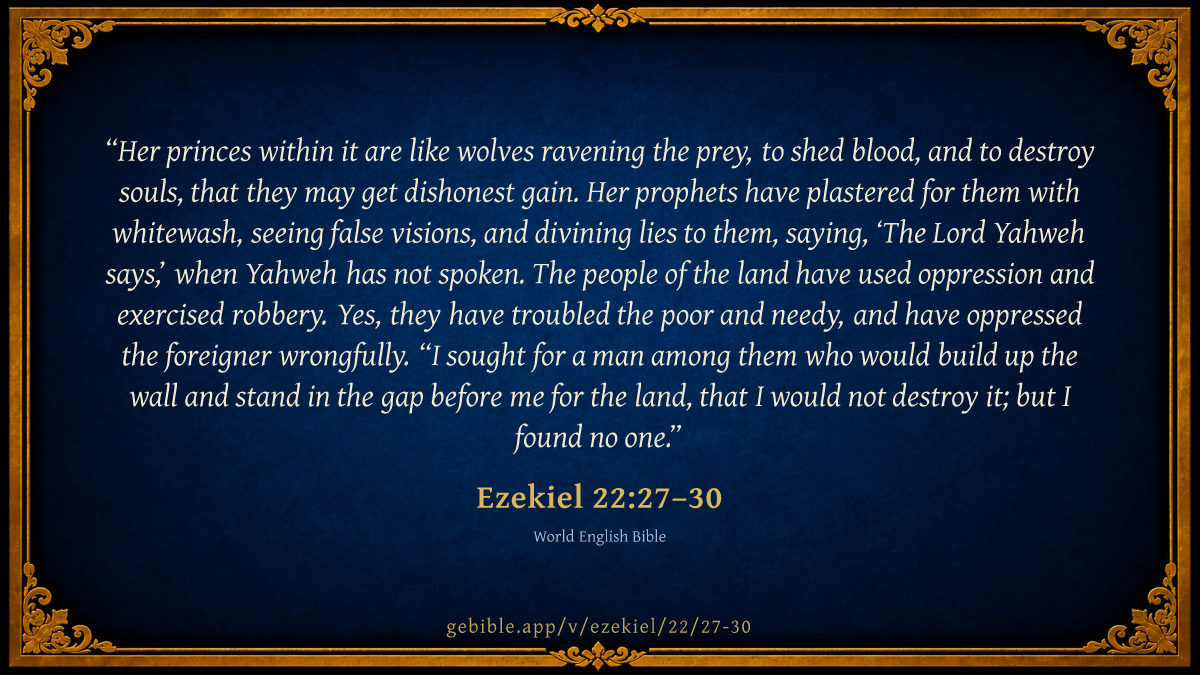
23Yahweh’s word came to me, saying, 24“Son of man, tell her, ‘You are a land that is not cleansed, nor rained on in the day of indignation.’ 25There is a conspiracy of her prophets within it, like a roaring lion ravening the prey. They have devoured souls. They take treasure and precious things. They have made many widows within it. 26Her priests have done violence to my law, and have profaned my holy things. They have made no distinction between the holy and the common, neither have they caused men to discern between the unclean and the clean, and have hidden their eyes from my Sabbaths. So I am profaned among them. 27Her princes within it are like wolves ravening the prey, to shed blood, and to destroy souls, that they may get dishonest gain. 28Her prophets have plastered for them with whitewash, seeing false visions, and divining lies to them, saying, ‘The Lord Yahweh says,’ when Yahweh has not spoken. 29The people of the land have used oppression and exercised robbery. Yes, they have troubled the poor and needy, and have oppressed the foreigner wrongfully.
30“I sought for a man among them who would build up the wall and stand in the gap before me for the land, that I would not destroy it; but I found no one. 31Therefore I have poured out my indignation on them. I have consumed them with the fire of my wrath. I have brought their own way on their heads,” says the Lord Yahweh.

Geneva Bible translators 1599 · Public Domain On vv28, 30 They which should have reproved them, flattered them in…
They which should have reproved them, flattered them in their vices, and covered their doings with lies, Ezek. 13:10.
Geneva Bible (1599) marginal notes — public domain.
John Trapp 1656 · Public Domain On vv27–30 Eze 22:27 Her princes in the midst thereof [are]…
Eze 22:27 Her princes in the midst thereof [are] like wolves ravening the prey, to shed blood, [and] to destroy souls, to get dishonest gain.
Ver. 27. Her princes in the midst thereof.] Lupis ferociores et voraciores erant. There was in this state, as physicians say there is in some diseases, corruptio totius substantiae, a general defection: and here they are particularly told of it; so, as Isocrates saith in his oration to Philip King of Macedonia, That which is spoken to all is spoken to none. See Mic 3:11 Zep 3:3.
John Trapp, A Commentary or Exposition upon All the Books of the Old and New Testament (1647–1656) — public domain. Text from a community e-Sword module.
Matthew Poole 1685 · Public Domain On vv27–30 Her princes, as before, Eze 22:25,26. Princes; rulers of…
Her princes, as before, Eze 22:25,26. Princes; rulers of all sorts, who should have crushed oppressors and defended the oppressed. Wolves; creatures greedy, bloody, and crafty, resembling dogs that men make use of to defend their folds; so the authority which God had given to defend is by these hypocrites perverted to satisfy the bloody and greedy appetite of tyrannical governors among the Jews: possibly the prophet may tax the degeneracy and baseness of these rulers hereby. Shed blood; innocent blood; a crying sin in princes, who have God’s power committed to them to preserve the innocent.
Destroy souls; undo and ruin families, cutting off the fathers, and impoverishing the widow and fatherless.
Read full note →
Get dishonest gain; confiscating estates not forfeited.
Matthew Poole's English Annotations on the Holy Bible (1683–1685) — public domain. Text from a community e-Sword/MySword module.
John Gill 1763 · Public Domain On vv27–30 Her princes in the midst thereof are like wolves…
Her princes in the midst thereof are like wolves ravening the prey,.... The king and his nobles, those of the first rank and quality, who ought to have protected the persons and property of the meaner sort; these were like "wolves" themselves, subtle, voracious, and cruel, preying upon harmless persons, as those creatures do upon the sheep and lambs:
to shed blood; innocent blood, as the Targum:
Read full note →
and to destroy souls; take away lives, under a pretence of treasonable practices, and all with a view to get dishonest gain; that their estates may be forfeited, their goods confiscated, and got into their hands.
John Gill's Exposition of the Whole Bible (1746–1763) — public domain (CC PDM 1.0). Text via the HelloAO Bible API.
John Wesley 1765 · Public Domain On vv27, 28, 30 Destroy souls - Ruin families; cutting off the fathers,…
Destroy souls - Ruin families; cutting off the fathers, and impoverishing the widow, and fatherless.
John Wesley, Explanatory Notes Upon the Whole Bible (1754–1765) — public domain. Text via the GEBible commentary corpus.
Adam Clarke 1810 · Public Domain On vv27–30 Verse 27. Her princes] Are as bad as her…
Verse 27. Her princes] Are as bad as her priests; they are rapacious, and grievously oppress the people by unjust impositions in order to increase their revenues.
Adam Clarke's Commentary on the Bible (1810–1826) — public domain. Text from a community e-Sword/MySword module.
Joseph Benson 1811 · Public Domain On vv27, 29 Eze 22:27-28. Her princes are like wolves — The…
Eze 22:27-28. Her princes are like wolves — The chief officers of state stick at no method of injustice and oppression whereby they may increase their substance, though it be by taking away the lives and estates of the innocent: see the margin. And her prophets have daubed them, &c. — Have daubed over the evil practices of the great men, by palliating devices: or, have flattered them in their ways of sin and violence, and encouraged them to proceed therein with promises, which, like ill-tempered mortar, will deceive them, though all seems at present smooth and safe.
Joseph Benson's Commentary on the Old and New Testaments (1811–1818) — public domain. Text from a community e-Sword module.
Haydock's Catholic Bible Commentary 1859 · Public Domain On vv28, 30 Without. Septuagint, "they shall fall, seeing," &c.
Without. Septuagint, "they shall fall, seeing," &c.
George Leo Haydock (1774–1849), Haydock's Catholic Family Bible and Commentary, 1859 edition — public domain. Excludes Psalms (Douay-Rheims chapter numbering differs from Protestant) and Deuterocanonical books (Catholic canon only).
Robert Jamieson, A. R. Fausset & David Brown 1871 · Public Domain On vv27–30 princes--who should have employed the influence of their position…
princes--who should have employed the influence of their position for the people's welfare, made "gain" their sole aim.
wolves--notorious for fierce and ravening cruelty (Mic 3:2-3, Mic 3:9-11; Joh 10:12).
Jamieson, Fausset & Brown — Commentary Critical and Explanatory on the Whole Bible (1871) — public domain (CC PDM 1.0). Text via the HelloAO Bible API.
Daniel D. Whedon 1874 · Public Domain On vv27–30 27. Princes — Rather, captains (Jer_26:10). The subordinate officers…
27. Princes — Rather, captains (Jer_26:10). The subordinate officers are in full sympathy with the iniquitous practices of the court and temple. They are after the spoils at any price. (Compare Jer_6:13.)
Daniel D. Whedon (gen. ed.), Commentary on the Old and New Testaments (1874–1909) — public domain. Text from a community e-Sword module.
The Cambridge Bible for Schools and Colleges 1878 · Public Domain On vv27–30 27. Her princes] The “princes” here are the chiefs…
27. Her princes] The “princes” here are the chiefs or leaders of the people, cf. Jer_26:10; Jer_36:12.
get dishonest gain] Cf. Jer_6:13; Jer_8:10. The term is used pretty generally, of selfish advantage.
The Cambridge Bible for Schools and Colleges (gen. ed. J. J. S. Perowne; Cambridge University Press, 1878–1918) — public domain. Text from a community e-Sword module.
Ellicott's Commentary for English Readers 1878 · Public Domain On vv27–30 (27) Her princes.—These are not only the kings, but…
(27) Her princes.—These are not only the kings, but also the nobles and those in authority at court—in other words, the ruling class. Their injustice and violence is a constant theme for prophetic rebuke.
A Bible Commentary for English Readers, edited by Charles John Ellicott (1878–1897) — public domain. Text from a community e-Sword module.
The Pulpit Commentary 1880 · Public Domain On vv27–30 Wolves. (comp. Hab_1:8; Zep_3:3; Mat_7:15; Act_20:29)
Wolves. (comp. Hab_1:8; Zep_3:3; Mat_7:15; Act_20:29)
The Pulpit Commentary (1880–1919), ed. H.D.M. Spence-Jones & Joseph S. Exell — public domain. Text from a community e-Sword module.
unfoldingWord translationNotes 2017 · CC BY-SA 4.0 On vv29–30 have oppressed ... and plundered
have oppressed ... and plundered
The understood words may be supplied. AT: "have oppressed people ... and plundered others" (See: Ellipsis)
Read full note →
extortion
This refers to when someone threatens or hurts another person in order to make them give him money.
the poor and needy
This refers to poor and needy people. AT: "those who are poor and needy" (See: Nominal Adjectives)
translationWords
people group
oppress
just
unfoldingWord translationNotes — © Distant Shores Media and the Door43 World Missions Community, licensed CC BY-SA 4.0. Source: git.door43.org/Door43/en_tn.
Tyndale Open Study Notes 2022 · CC BY-SA 4.0 On v30 22:30-31 In response to the sins of these former…
22:30-31 In response to the sins of these former community leaders, the Lord sought someone who would rebuild the wall and stand in the gap as a true prophet (see 13:5), someone who would intercede for the people, as Moses did after the people sinned with the gold calf (Exod 32). The Lord found no one to deflect his wrath, so his fury would now be poured out upon them in full measure (cp. Ezek 11:21).
Tyndale Open Study Notes — © Tyndale Open Resources, licensed CC BY-SA 4.0. Text via the HelloAO Bible API.