
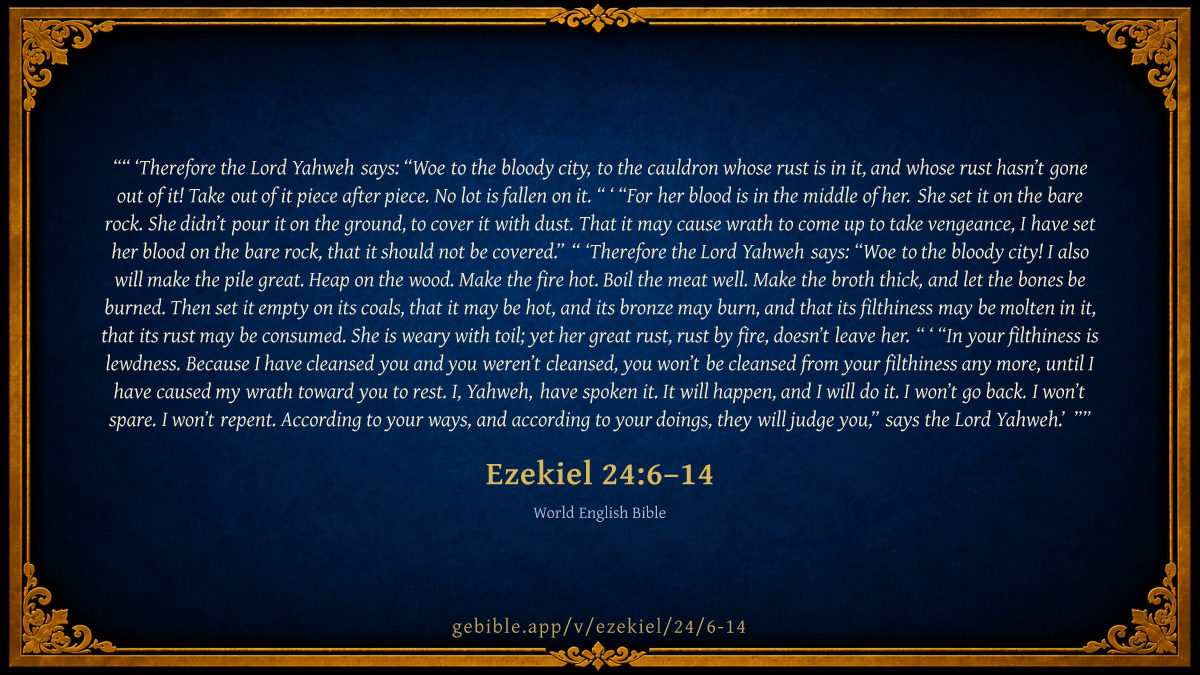
“ ‘Therefore the Lord Yahweh says: “Woe to the bloody city, to the cauldron whose rust is in it, and whose rust hasn’t gone out of it! Take out of it piece after piece. No lot is fallen on it.
“ ‘ “For her blood is in the middle of her. She set it on the bare rock. She didn’t pour it on the ground, to cover it with dust.
That it may cause wrath to come up to take vengeance, I have set her blood on the bare rock, that it should not be covered.”
“ ‘Therefore the Lord Yahweh says: “Woe to the bloody city! I also will make the pile great.
Heap on the wood. Make the fire hot. Boil the meat well. Make the broth thick, and let the bones be burned.
Then set it empty on its coals, that it may be hot, and its bronze may burn, and that its filthiness may be molten in it, that its rust may be consumed.
She is weary with toil; yet her great rust, rust by fire, doesn’t leave her.
“ ‘ “In your filthiness is lewdness. Because I have cleansed you and you weren’t cleansed, you won’t be cleansed from your filthiness any more, until I have caused my wrath toward you to rest.
I, Yahweh, have spoken it. It will happen, and I will do it. I won’t go back. I won’t spare. I won’t repent. According to your ways, and according to your doings, they will judge you,” says the Lord Yahweh.’ ”
Geneva Bible translators 1599 · Public Domain On vv6, 7, 9, 10, 11, 12, 13, 14 Signifying that they should not be destroyed all at…
Signifying that they should not be destroyed all at once, but by little and little.
Whose iniquities and wicked citizens there yet remain.
Read full note →
Spare none estate or condition.
Geneva Bible (1599) marginal notes — public domain.
John Trapp 1656 · Public Domain On vv6–14 Eze 24:6 Wherefore thus saith the Lord GOD; Woe…
Eze 24:6 Wherefore thus saith the Lord GOD; Woe to the bloody city, to the pot whose scum [is] therein, and whose scum is not gone out of it! bring it out piece by piece; let no lot fall upon it.
Ver. 6. Woe to the bloody city,] i.e., Blood guilty, and full of crimes capital that call for blood.
Read full note →
To the pot whose scum is in it.] Who are hardened in their wickedness, which is evident to all men, and are not amended by punishments.
Let no lot fall upon it,] i.e., Let none escape unpunished. In wars often they cast lots to save some and slay some.
John Trapp, A Commentary or Exposition upon All the Books of the Old and New Testament (1647–1656) — public domain. Text from a community e-Sword module.
Matthew Poole 1685 · Public Domain On vv6–14 All this allegory contains woeful and heavy tidings, misery…
All this allegory contains woeful and heavy tidings, misery and desolation to them that are represented by it.
The bloody city; see Eze 22:2,3; Jerusalem, which is this pot.
Read full note →
Whose scum is therein; filthiness, her abominations, all her lewdness, are still within. her; they have not been punished, restrained, or cast out by the execution of just and good laws; but the citizens have with obstinacy, impenitence, and with impudence continued in them.
Whose scum is not gone out of it; the same thing repeated for confirming what was said.
Bring it out piece by piece; let them know it shall be a lingering destruction to them, yet a total, one piece after another, till all be consumed.
Let no lot fall upon it; lots are for saving some, and determining who they shall be; but here shall no such discrimination be made, no sparing any and slaying others by lot, who do not die shall go into captivity.
Matthew Poole's English Annotations on the Holy Bible (1683–1685) — public domain. Text from a community e-Sword/MySword module.
John Gill 1763 · Public Domain On vv6–14 Wherefore thus saith the Lord God, woe to the…
Wherefore thus saith the Lord God, woe to the bloody city,.... Here the parable begins to be explained; and shows that by the pot is meant the city of Jerusalem, called the bloody city, because of the blood of the prophets, and of righteous persons, and of innocent babes, that was shed in it; and which was the cause of the judgments of God coming upon her, which would issue in her destruction, and therefore "woe unto her"; see Mat 23:37,
to the pot whose scum is therein, and whose scum is not gone out of it; when a pot boils, a scum arises, and appears upon the top of the water, which the cook usually takes off: this denotes the filthiness and wickedness of the people of the Jews, which would work up and be seen by the judgments of God upon them; yet should not be removed, but continue on them, unrepented of, and unpardoned. It signifies that they would remain hardened in their sins; and that the judgments of God would have no effect upon them to bring them to repentance; and that God would have no mercy on them, or pardon their sins:
Read full note →
bring it out piece by piece: the people that were in Jerusalem, of every class and rank, of every age and sex; suggesting that they should not be all destroyed at once, but some at one time, and some at another; some in one way, and some in another; some by famine, others by the pestilence, and others by the sword; some by sallying out upon the enemy; others by endeavouring to make their escape privately, and fall into their hands:
let no lot fall upon it; to save some, and destroy others, as is often done in war; signifying that all were destined to destruction, some way or another; and none should be spared; they that escaped the pestilence should die by famine; and they that escaped them both should die by the sword; and they that escaped all three should be carried into captivity. The Targum is,
"captivity upon captivity shall go out with her, because repentance was not in her.''
John Gill's Exposition of the Whole Bible (1746–1763) — public domain (CC PDM 1.0). Text via the HelloAO Bible API.
John Wesley 1765 · Public Domain On vv6, 7, 8, 10, 11, 12, 13 The bloody city - Jerusalem. Whose scum - Her…
The bloody city - Jerusalem. Whose scum - Her wickedness is still within her. Piece by piece - One piece after another 'till all be consumed. No lot - Lots are for saving some, but here shall be no sparing any.
John Wesley, Explanatory Notes Upon the Whole Bible (1754–1765) — public domain. Text via the GEBible commentary corpus.
Adam Clarke 1810 · Public Domain On vv6, 7, 8, 10, 13 Verse 6. Let no lot fall upon it.] Pull…
Verse 6. Let no lot fall upon it.] Pull out the flesh indiscriminately; let no piece be chosen for king or priest; thus showing that all should be involved in one indiscriminate ruin.
Adam Clarke's Commentary on the Bible (1810–1826) — public domain. Text from a community e-Sword/MySword module.
Joseph Benson 1811 · Public Domain On vv6, 9, 12 Eze 24:6-8. Wherefore thus saith the Lord — Here…
Eze 24:6-8. Wherefore thus saith the Lord — Here begins an explication of the preceding symbolical representation; Wo to the bloody city — Jerusalem, which is this pot; whose scum is therein — Whose filthiness, or wickedness, is not purged out of it. Bring it out piece by piece — One piece after another till all be taken. Let nothing be left in it; let it be emptied of every thing. This signified the entire ruin and spoil of the city and the inhabitants of it, all without distinction being either killed or carried into captivity. Let no lot fall upon it — There shall be no lot cast to determine who shall be spared and who consumed, or who shall be left and who carried into captivity; for they shall be all either destroyed or carried away. For her blood is in the midst of her — The innocent blood which she hath shed. She set it upon the top of a rock — Openly and publicly, without fear, or shame, or reluctance; she set it where it might be seen by all, and seen long; she shed blood in a presumptuous manner, and with a high hand; she was impudent and barefaced in her cruelties; she did not seek to cover or excuse them. She poured it not upon the ground, to cover it with dust — As being ashamed of shedding it. “These words allude to the command of the law: Lev 17:13, that they should cover the blood of any beast, or other living creature which was slain, with dust; which precept was not only intended to prevent their eating of blood, but also to give men a sort of horror or aversion to bloodshed.” — Lowth. That it might cause fury to come up to take vengeance — For such impudent murders as these, which even dared the divine indignation. I have set her blood upon the top of a rock — Her punishment shall be as notorious in the sight of the world as her sin was. I will punish it so openly, and in such a manner, as shall not be soon forgotten.
Joseph Benson's Commentary on the Old and New Testaments (1811–1818) — public domain. Text from a community e-Sword module.
Albert Barnes 1834 · Public Domain On vv6, 7, 10 Scum - Better, rust (and in Eze 24:11-12).
Scum - Better, rust (and in Eze 24:11-12).
Bring it out piece by piece - It, the city; bring out the inhabitants, one by one, clear the city of them, whether by death, exile, or captivity.
Read full note →
Let no lot fall upon it - In the captivity of Jehoiakim and in that of Jehoiachin, some were taken, others left. Now all shall be removed.
Albert Barnes' Notes on the Bible (1834–1885) — public domain. Text from a community e-Sword/MySword module.
Haydock's Catholic Bible Commentary 1859 · Public Domain On vv6, 7, 10, 13 Rust: the inveterate malice of the city, ver. 12.…
Rust: the inveterate malice of the city, ver. 12. --- Upon it. Hurl the pieces of meat out of the pot, without any choice. (Calmet) --- All the people shall feel my indignation, the rich as well as the poor, ver. 13. (Haydock)
George Leo Haydock (1774–1849), Haydock's Catholic Family Bible and Commentary, 1859 edition — public domain. Excludes Psalms (Douay-Rheims chapter numbering differs from Protestant) and Deuterocanonical books (Catholic canon only).
Robert Jamieson, A. R. Fausset & David Brown 1871 · Public Domain On vv6–14 scum--not ordinary, but poisonous scum, that is, the people's…
scum--not ordinary, but poisonous scum, that is, the people's all-pervading wickedness.
bring it out piece by piece--"it," the contents of the pot; its flesh, that is, "I will destroy the people of the city, not all at the same time, but by a series of successive attacks." Not as FAIRBAIRN, "on its every piece let it (the poisonous scum) go forth."
Read full note →
let no lot fall upon it--that is, no lot, such as is sometimes cast, to decide who are to be destroyed and who saved (Sa2 8:2; Joe 3:3; Oba 1:11; Nah 3:10). In former carryings away of captives, lots were cast to settle who were to go, and who to stay, but now all alike are to be cast out without distinction of rank, age, or sex.
Jamieson, Fausset & Brown — Commentary Critical and Explanatory on the Whole Bible (1871) — public domain (CC PDM 1.0). Text via the HelloAO Bible API.
Daniel D. Whedon 1874 · Public Domain On vv6, 7, 9, 10, 12, 13, 14 6. Scum — Rather, rust (as also Eze_24:11-12).
6. Scum — Rather, rust (as also Eze_24:11-12).
Therein — Rather, thereon. Usually the rust is removed from a pot before using it, but here it is to remain as the symbol of Jerusalem’s iniquity (Qimchi).
Read full note →
Let no lot fall upon it — Qimchi explains that the pieces are so small that not a single limb can be recognized, nor lots cast upon them to assign them any special destination; or that the pot itself is corrupted and eaten with verdigris, and therefore the meat is unclean and no part of it fit to be eaten; or that the inhabitants are to be snatched out of the city indiscriminately; or no lot is to be taken (2Sa_8:2), for all alike must perish. Modern expositors select from these explanations according to taste.
Daniel D. Whedon (gen. ed.), Commentary on the Old and New Testaments (1874–1909) — public domain. Text from a community e-Sword module.
The Cambridge Bible for Schools and Colleges 1878 · Public Domain On vv6–14 6. Explanation: the caldron is Jerusalem, the bloody city.
6. Explanation: the caldron is Jerusalem, the bloody city.
whose scum] rust.
Read full note →
bring it out] i.e. the caldron as having contents.
let no lot fall] The contents (the inhabitants) shall be pulled out indiscriminately. The dispersion is alluded to.
The Cambridge Bible for Schools and Colleges (gen. ed. J. J. S. Perowne; Cambridge University Press, 1878–1918) — public domain. Text from a community e-Sword module.
Ellicott's Commentary for English Readers 1878 · Public Domain On vv6, 7, 8, 10, 11 (6) Scum.—This word, which occurs five times in these…
(6) Scum.—This word, which occurs five times in these verses (Eze_24:6; Eze_24:11-12), is found nowhere else. Interpreters are agreed in the correctness of the old Greek version of it, rust. The thought is, that not only the inhabitants of the city are wicked, but that this wickedness is so great that the city itself (represented by the cauldron) is, as it were, corroded with rust. It is therefore to be utterly destroyed, “brought out piece by piece” (see 2Ki_25:10); no lot is to fall upon it to make a discrimination, since nothing is to be spared. All previous judgments had been partial; this is to be complete.
(6-14) These verses contain the application of the parable in two distinct parts (Eze_24:6-14), but in such wise that the literal and the figurative continually run together. A new feature, that of the rust on the cauldron, is also introduced. A somewhat similar figure may be found in Isa_4:4, but with the difference that Ezekiel, as usual, goes much more into minute details.
A Bible Commentary for English Readers, edited by Charles John Ellicott (1878–1897) — public domain. Text from a community e-Sword module.
The Pulpit Commentary 1880 · Public Domain On vv6, 7, 9, 10, 11, 12, 13, 14 Scum. The word is not found elsewhere. The Authorized…
Scum. The word is not found elsewhere. The Authorized Version follows the Vulgate. Keil and the Revised Version give "rust." As the cauldron was of brass (Ver. 11), this must have been the verdigris which was eating into the metal, and which even the blazing fire could not get rid of. The pieces that are to be brought out are the inhabitants of Jerusalem, who are to be carried into exile. There was to be "no lot cast," as was often done with prisoners of war, taking every tenth man (decimating) of the captives for death or exile. (comp. 2Sa_8:2) All alike were doomed. (Joe_3:3)
The Pulpit Commentary (1880–1919), ed. H.D.M. Spence-Jones & Joseph S. Exell — public domain. Text from a community e-Sword module.
The Biblical Illustrator 1887 · Public Domain On v13 Thou shalt not be purged from thy filthiness.
Eze_24:13
Thou shalt not be purged from thy filthiness.
Read full note →
Obstinacy in sin
1. Obstinacy in sin provokes God to the destruction of sinners. Her scum shall be in the fire. Jerusalem shall be burnt, and why? In thy filthiness is lewdness; thou art obstinate, hardened in thy wickedness. All sin offends, some sins provoke to judgments, obstinacy provokes to destruction (Jer_44:15).
2. In Scripture language, that is said to be done which God or men endeavour to do, though it be not done. I have purged thee. God using means, and endeavouring, by His prophets, mercies, threats, and judgments, to purge Jerusalem from her sin, is called purging, though Jerusalem were not purged.
3. A people may have the means, and not improve the same for their good.
4. People may so slip the time of repenting, and turning to God, as that it may be too late for them to go about the same; they may sin away the time of mercy. Time present is the acceptable time (2Co_6:2).
5. Those who have had means, and not profited thereby, God will deal most severely with--there is no mercy, but altogether judgment for them. The fig tree in the vineyard had stood there three years, and was not better at last than at first; the influences of heaven, and fatness of the earth, had done it no good; and behold the severity of the owner: Cut it down; why cumbereth it the ground? (Luk_13:7). (W. Greenhill, M. A.)
The Biblical Illustrator, edited by Joseph S. Exell (c. 1880s–1900s) — public domain. Text from a community e-Sword module.
C. I. Scofield 1917 · Public Domain On v14 (See Scofield "Zec 8:14").
repent
(See Scofield "Zec 8:14").
The Scofield Reference Bible (1917 edition), notes by C. I. Scofield — public domain. Text from a community e-Sword module.
unfoldingWord translationNotes 2017 · CC BY-SA 4.0 On vv6, 7, 9, 11, 13, 14 General Information:
General Information:
Yahweh continues telling a parable to Ezekiel about a cooking pot that represents Jerusalem. This parable continues through Ezekiel 24:14. (See: Parables)
Read full note →
the city of blood
Here "blood" is a reference to "murder." AT: "the city of murderers" (See: Metonymy)
a cooking pot
Yahweh continues to compare Jerusalem to a cooking pot. AT: "it is like a cooking pot" (See: Metaphor)
rust
the red material that forms on metal. Rust eats away at metal and eventually destroys it
Take piece after piece
Yahweh does not give this command to a specific person. This is a general command given to an unspecified person within this metaphor.
but do not cast lots for it
Casting lots was a way of choosing which pieces of meat to take out, but because Yahweh wants to take out all of the pieces of meat, there is no need to cast lots.
translationWords
woe
blood
lots
unfoldingWord translationNotes — © Distant Shores Media and the Door43 World Missions Community, licensed CC BY-SA 4.0. Source: git.door43.org/Door43/en_tn.
Tyndale Open Study Notes 2022 · CC BY-SA 4.0 On vv6, 9, 13 24:6-8 The cooking pot was beyond cleansing. Jerusalem was…
24:6-8 The cooking pot was beyond cleansing. Jerusalem was full of blood that she had shed and left exposed. The Old Testament required that the blood of animals shed for meat be covered with earth (Lev 17:13). By leaving the blood of her innocent victims exposed, Jerusalem was doubly guilty. Her own blood would justly be splashed on the rocks (cp. Ps 137:8-9).
Tyndale Open Study Notes — © Tyndale Open Resources, licensed CC BY-SA 4.0. Text via the HelloAO Bible API.