
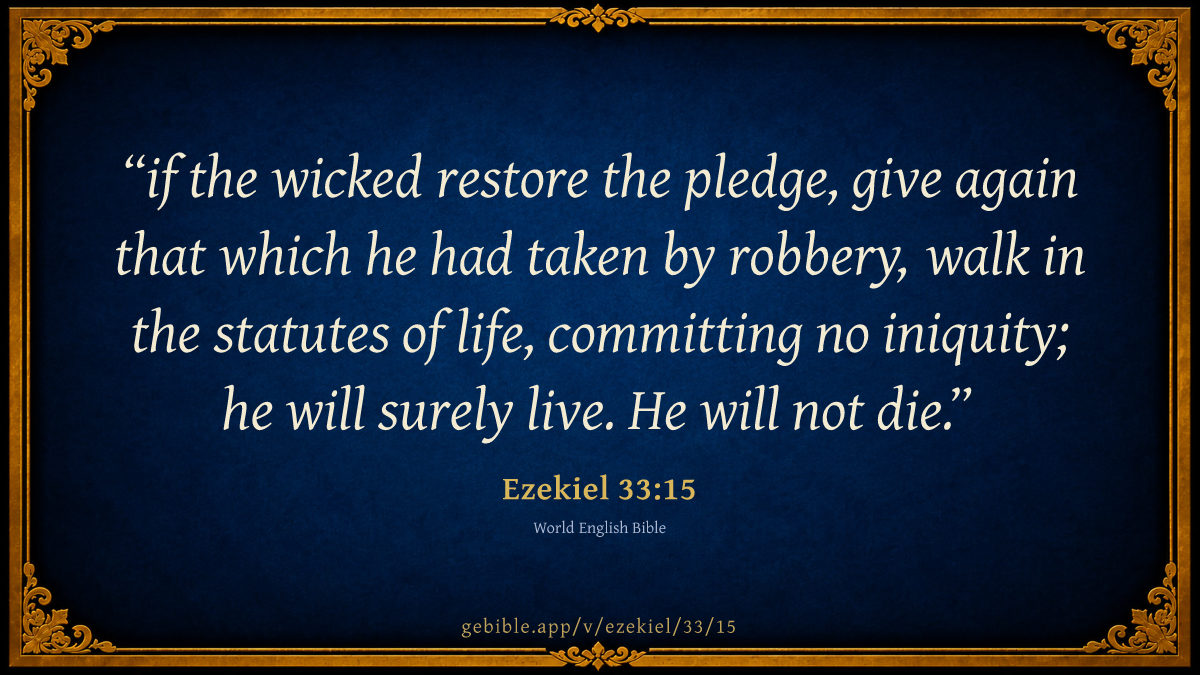
if the wicked restore the pledge, give again that which he had taken by robbery, walk in the statutes of life, committing no iniquity; he will surely live. He will not die.
Parallel Translations
-
if the wicked restore the pledge, give again that which he had taken by robbery, walk in the statutes of life, committing no iniquity; he will surely live. He will not die.
-
If the wicked restore the pledge, give again that he had robbed, walk in the statutes of life, without committing iniquity; he shall surely live, he shall not die.
-
if the wicked restore the pledge, give back that which he had taken by robbery, walk in the statutes of life, committing no iniquity; he shall surely live, he shall not die.
Cross-references (23)
Passages linked to Ezekiel 33:15 in the Treasury of Scripture Knowledge, ordered by reader-vote popularity; verse text shown in World English Bible.
- Ezekiel 20:11 I gave them my statutes, and showed them my ordinances, which if a man does, he will live in them.
- Luke 19:8 Zacchaeus stood and said to the Lord, “Behold, Lord, half of my goods I give to the poor. If I have wrongfully exacted anything of anyone, I restore four times as much.”
- Exodus 22:1-4 “If a man steals an ox or a sheep, and kills it or sells it, he shall pay five oxen for an ox, and four sheep for a sheep. If the thief is found breaking in, and is struck so that he dies, there shall be no guilt of bloodshed for him. If the sun has risen on him, he is guilty of bloodshed. He shall make restitution. If he has nothing, then he shall be sold for his theft. If the stolen property is found in his hand alive, whether it is ox, donkey, or sheep, he shall pay double.
- Leviticus 6:2-5 “If anyone sins, and commits a trespass against Yahweh, and deals falsely with his neighbor in a matter of deposit, or of bargain, or of robbery, or has oppressed his neighbor, or has found that which was lost, and lied about it, and swearing to a lie—in any of these things that a man sins in his actions— then it shall be, if he has sinned, and is guilty, he shall restore that which he took by robbery, or the thing which he has gotten by oppression, or the deposit which was committed to him, or the lost thing which he found, or any thing about which he has sworn falsely: he shall restore it in full, and shall add a fifth part more to it. He shall return it to him to whom it belongs in the day of his being found guilty.
- Leviticus 18:5 You shall therefore keep my statutes and my ordinances, which if a man does, he shall live in them. I am Yahweh.
- Psalms 119:93 I will never forget your precepts, for with them, you have revived me.
- Ezekiel 18:7 and has not wronged any, but has restored to the debtor his pledge, has taken nothing by robbery, has given his bread to the hungry, and has covered the naked with a garment;
- Exodus 22:26-27 If you take your neighbor’s garment as collateral, you shall restore it to him before the sun goes down, for that is his only covering, it is his garment for his skin. What would he sleep in? It will happen, when he cries to me, that I will hear, for I am gracious.
- Numbers 5:6-8 “Speak to the children of Israel: ‘When a man or woman commits any sin that men commit, so as to trespass against Yahweh, and that soul is guilty, then he shall confess his sin which he has done; and he shall make restitution for his guilt in full, add to it the fifth part of it, and give it to him in respect of whom he has been guilty. But if the man has no kinsman to whom restitution may be made for the guilt, the restitution for guilt which is made to Yahweh shall be the priest’s, in addition to the ram of the atonement, by which atonement shall be made for him.
- Deuteronomy 24:6 No man shall take the mill or the upper millstone as a pledge, for he takes a life in pledge.
- Deuteronomy 24:10-13 When you lend your neighbor any kind of loan, you shall not go into his house to get his pledge. You shall stand outside, and the man to whom you lend shall bring the pledge outside to you. If he is a poor man, you shall not sleep with his pledge. You shall surely restore to him the pledge when the sun goes down, that he may sleep in his garment and bless you. It shall be righteousness to you before Yahweh your God.
- Deuteronomy 24:17 You shall not deprive the foreigner or the fatherless of justice, nor take a widow’s clothing in pledge;
- Job 22:6 For you have taken pledges from your brother for nothing, and stripped the naked of their clothing.
- Job 24:3 They drive away the donkey of the fatherless, and they take the widow’s ox for a pledge.
- Job 24:9 There are those who pluck the fatherless from the breast, and take a pledge of the poor,
- Ezekiel 18:12 has wronged the poor and needy, has taken by robbery, has not restored the pledge, and has lifted up his eyes to the idols, has committed abomination,
- Ezekiel 18:16 hasn’t wronged any, hasn’t taken anything to pledge, hasn’t taken by robbery, but has given his bread to the hungry, and has covered the naked with a garment;
- Ezekiel 18:27-28 Again, when the wicked man turns away from his wickedness that he has committed, and does that which is lawful and right, he will save his soul alive. Because he considers, and turns away from all his transgressions that he has committed, he shall surely live. He shall not die.
- Ezekiel 20:13 “ ‘ “But the house of Israel rebelled against me in the wilderness. They didn’t walk in my statutes, and they rejected my ordinances, which if a man keeps, he shall live in them. They greatly profaned my Sabbaths. Then I said I would pour out my wrath on them in the wilderness, to consume them.
- Ezekiel 20:21 “ ‘ “But the children rebelled against me. They didn’t walk in my statutes, and didn’t keep my ordinances to do them, which if a man does, he shall live in them. They profaned my Sabbaths. Then I said I would pour out my wrath on them, to accomplish my anger against them in the wilderness.
- Amos 2:8 and they lay themselves down beside every altar on clothes taken in pledge; and in the house of their God they drink the wine of those who have been fined.
- Revelation 22:12-14 “Behold, I come quickly. My reward is with me, to repay to each man according to his work. I am the Alpha and the Omega, the First and the Last, the Beginning and the End. Blessed are those who do his commandments, that they may have the right to the tree of life, and may enter in by the gates into the city.
- Luke 1:6 They were both righteous before God, walking blamelessly in all the commandments and ordinances of the Lord.
Cross-references from openbible.info (CC BY 4.0)
Explain this verse (7 sources)
Historical commentary, presented as a primary source — not an endorsement.
Private notes
Saved on this device only — never synced or sent anywhere.
John Trapp 1656 · Public Domain Eze 33:15 [If] the wicked restore the pledge, give…
Eze 33:15 [If] the wicked restore the pledge, give again that he had robbed, walk in the statutes of life, without committing iniquity; he shall surely live, he shall not die.
Ver. 15. Give again that he had robbed.] Quod rapuit reddideret. The law for restitution, see Num 5:6-7.
John Trapp, A Commentary or Exposition upon All the Books of the Old and New Testament (1647–1656) — public domain. Text from a community e-Sword module.
Matthew Poole 1685 · Public Domain See Eze 18:7,9.
See Eze 18:7,9.
Without committing iniquity: it is not a sinless life here required or supposed, but a life in which a man doth not habitually and wilfully work iniquity.
Matthew Poole's English Annotations on the Holy Bible (1683–1685) — public domain. Text from a community e-Sword/MySword module.
John Gill 1763 · Public Domain None of his sins that he hath committed shall…
None of his sins that he hath committed shall be mentioned unto him,.... Imputed to him; placed to his account; charged upon him, or ever be spoke of to him, either now, or at the day of judgment, by way of accusation and complaint, or to his condemnation:
he hath done that which is lawful and right; has repented of his sin; looked to Christ by faith for the pardon of it; and laid hold on his righteousness for his justification; and being influenced and assisted by the grace of God, has done that which is right and good in the sight of God and man:
Read full note →
he shall surely live; he now lives a life of faith and holiness; he shall continue to live, and persevere to the end, and inherit eternal life; see Eze 18:21.
John Gill's Exposition of the Whole Bible (1746–1763) — public domain (CC PDM 1.0). Text via the HelloAO Bible API.
Joseph Benson 1811 · Public Domain Eze 33:15. If the wicked restore the pledge, give…
Eze 33:15. If the wicked restore the pledge, give again that he had robbed — It is a necessary condition of obtaining pardon, that men make restitution of what they have unjustly gotten from others. The law is express to this purpose, Lev 6:5, where the offender is required to add a fifth part to the principal, and give it to him to whom it appertaineth; see the note there. To the same purpose is that received rule among the Christian casuists, taken from St. Augustin, Epistle 54., Non dimittitur peccatum, nisi restituatur ablatum. The sin is not forgiven, unless what is taken away be restored. Lord Clarendon’s observations on this subject are peculiarly excellent: “Robbery and violence would be too gainful a trade, if a man might quit all scores by repentance, and detain all he hath gotten; or if the father’s repentance might serve the turn, and the benefit of the transgression be transmitted as an inheritance to the son. If the pledge remained it must be restored; the retaining it is committing a new iniquity, and forfeits any benefit of the promise. If he hath it not, nor is able to procure it, his hearty repentance is enough without reparation: but to enjoy the spoil, and yet to profess repentance, is an affront to God Almighty, and a greater sin than the first act of violence, when he did not pretend to think of God, and so did not think of displeasing him. Whereas now he pretends to reconcile himself to God, and mocks him with repentance, while he retains the fruit of his wickedness. He who is truly penitent restores what he hath left to the person who was deprived of it, and pays the rest in devout sorrow for his trespass.”
Joseph Benson's Commentary on the Old and New Testaments (1811–1818) — public domain. Text from a community e-Sword module.
Robert Jamieson, A. R. Fausset & David Brown 1871 · Public Domain give again that he had robbed-- (Luk 19:8).
give again that he had robbed-- (Luk 19:8).
statutes of life--in the obeying of which life is promised (Lev 18:5). If the law has failed to give life to man, it has not been the fault of the law, but of man's sinful inability to keep it (Rom 7:10, Rom 7:12; Gal 3:21). It becomes life-giving through Christ's righteous obedience to it (Co2 3:6).
Jamieson, Fausset & Brown — Commentary Critical and Explanatory on the Whole Bible (1871) — public domain (CC PDM 1.0). Text via the HelloAO Bible API.
The Cambridge Bible for Schools and Colleges 1878 · Public Domain 15. Instances of a return to righteousness on the…
15. Instances of a return to righteousness on the part of the wicked, cf. Eze_18:7; Exo_22:1; Exo_22:4; Num_5:6-7.
the statutes of life] By walking in which a man shall live, ch. Eze_13:21, Eze_20:11; Lev_18:5. As elsewhere “life” is used in the pregnant sense of enjoyment of the favour of God and the external prosperity which is the reflection and seal of it.
The Cambridge Bible for Schools and Colleges (gen. ed. J. J. S. Perowne; Cambridge University Press, 1878–1918) — public domain. Text from a community e-Sword module.
The Pulpit Commentary 1880 · Public Domain If the wicked restore the pledge. In Eze_18:7, Eze_18:12,…
If the wicked restore the pledge. In Eze_18:7, Eze_18:12, Eze_18:16, this and its opposite had been grouped with other forms of good and evil. Here it stands out in solitary preeminence. The reason may possibly be found in the fact that a time of exile and suffering was likely to make the sin, which the penitent thus showed that he had renounced, a specially common one. The starving man pledged his garment or his tools for the loan of money or of food at a price far below its value. There was a real self-sacrifice, a proof of the power of the faith that worketh by love, when the creditor restored it. The primary duty, when a man turned from evil, was, as far as in him lay, to overcome his besetting sin and make restitution for the past. Compare the words of the Baptist, (Luk_3:12-14) and those of Zacchaeus. (Luk_19:8) The statutes of life. The words are used as in Eze_20:11 and Lev_18:5, on the assumption that, if a man kept the statutes, he should (in the highest sense of the word) live in them. It was reserved for the fuller illumination of St. Paul, taught by a representative experience to proclaim the higher truth that the Law, ordained for life, was yet the minister of condemnation and death unless there was something higher than itself to complete the work which it could only begin. (Rom_7:10 Rom_8:3; comp. also Heb_7:19)
The Pulpit Commentary (1880–1919), ed. H.D.M. Spence-Jones & Joseph S. Exell — public domain. Text from a community e-Sword module.