
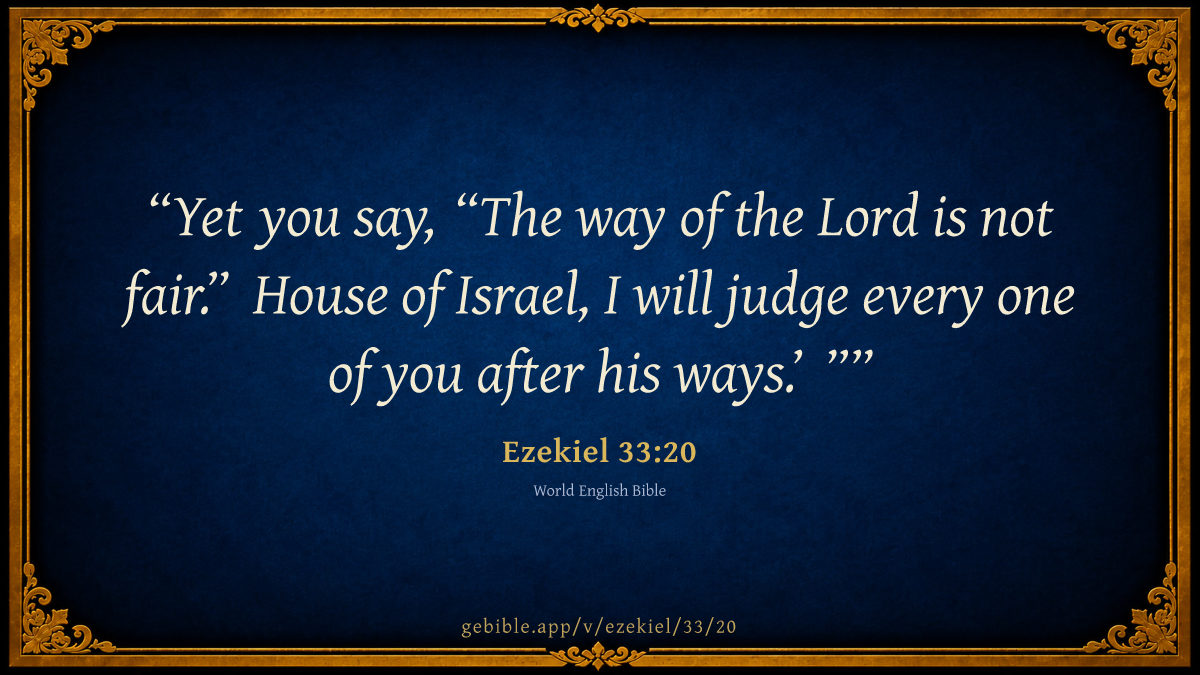
Yet you say, “The way of the Lord is not fair.” House of Israel, I will judge every one of you after his ways.’ ”
Parallel Translations
-
Yet you say, “The way of the Lord is not fair.” House of Israel, I will judge every one of you after his ways.’ ”
-
Yet ye say, The way of the Lord is not equal. O ye house of Israel, I will judge you every one after his ways.
-
Yet ye say: The way of the Lord is not equal. O house of Israel, I will judge you every one after his ways.'
Cross-references (11)
Passages linked to Ezekiel 33:20 in the Treasury of Scripture Knowledge, ordered by reader-vote popularity; verse text shown in World English Bible.
- Matthew 16:27 For the Son of Man will come in the glory of his Father with his angels, and then he will render to everyone according to his deeds.
- Ezekiel 18:25 “Yet you say, ‘The way of the Lord is not equal.’ Hear now, house of Israel: Is my way not equal? Aren’t your ways unequal?
- Psalms 62:12 Also to you, Lord, belongs loving kindness, for you reward every man according to his work.
- Proverbs 19:3 The foolishness of man subverts his way; his heart rages against Yahweh.
- Ecclesiastes 12:14 For God will bring every work into judgment, with every hidden thing, whether it is good, or whether it is evil.
- Ezekiel 18:29-30 Yet the house of Israel says, ‘The way of the Lord is not fair.’ House of Israel, aren’t my ways fair? Aren’t your ways unfair? “Therefore I will judge you, house of Israel, everyone according to his ways,” says the Lord Yahweh. “Return, and turn yourselves from all your transgressions; so iniquity will not be your ruin.
- Ezekiel 33:17 “ ‘Yet the children of your people say, “The way of the Lord is not fair;” but as for them, their way is not fair.
- John 5:29 and will come out; those who have done good, to the resurrection of life; and those who have done evil, to the resurrection of judgment.
- 2 Corinthians 5:10 For we must all be revealed before the judgment seat of Christ that each one may receive the things in the body according to what he has done, whether good or bad.
- Revelation 20:12-15 I saw the dead, the great and the small, standing before the throne, and they opened books. Another book was opened, which is the book of life. The dead were judged out of the things which were written in the books, according to their works. The sea gave up the dead who were in it. Death and Hades gave up the dead who were in them. They were judged, each one according to his works. Death and Hades were thrown into the lake of fire. This is the second death, the lake of fire. If anyone was not found written in the book of life, he was cast into the lake of fire.
- Revelation 22:12 “Behold, I come quickly. My reward is with me, to repay to each man according to his work.
Cross-references from openbible.info (CC BY 4.0)
Explain this verse (4 sources)
Historical commentary, presented as a primary source — not an endorsement.
Private notes
Saved on this device only — never synced or sent anywhere.
John Trapp 1656 · Public Domain Eze 33:20 Yet ye say, The way of the…
Eze 33:20 Yet ye say, The way of the Lord is not equal. O ye house of Israel, I will judge you every one after his ways.
Ver. 20. Yet ye say.] But therein ye lie, which is not the guise of God’s children. {Isa 63:8}
Read full note →
I will judge you every one after his ways.] And so wring a testimony, if not from your mouths, yet from your consciences, of mine impartial justice; such as is that in Deu 32:4, "A God of truth, and without iniquity, just and right is he."
John Trapp, A Commentary or Exposition upon All the Books of the Old and New Testament (1647–1656) — public domain. Text from a community e-Sword module.
Matthew Poole 1685 · Public Domain Still blinded prejudice quarrels.
Still blinded prejudice quarrels.
Judge; call you to account, plead with you, and pass sentence.
Read full note →
Every one: this is added to rouse every one up to repent of all sins, and of this particularly.
After his ways; a terrible threat, and I know not how a greater could be denounced against sinners than this. God, infinitely holy and perfectly just, will judge them according to their unequal, unrighteous, sinful ways, and according to his inflexible justice. And if God enter thus into judgment, who can stand in his sight?
Matthew Poole's English Annotations on the Holy Bible (1683–1685) — public domain. Text from a community e-Sword/MySword module.
John Gill 1763 · Public Domain Now the hand of the Lord was upon me…
Now the hand of the Lord was upon me in the evening, afore he that was escaped came,.... The prophet felt a divine impulse on his mind; he was under the influence of a spirit of prophecy, and knew before the messenger came to him what his message was, and was prepared to receive it, and to prophesy upon it; for this is to be understood of prophecy, as the Targum,
"prophecy from before the Lord was with me in the evening (k);''
Read full note →
see Isa 8:11,
and had opened my mouth, until he came to me in the morning; the hand of the Lord, or the power of the Lord, had done it, as he promised he would, Eze 3:27 so that he spoke freely and boldly, and continued to do so from the evening, to the time the messenger came to him in the morning, to all those that were with him:
and my mouth was opened, and I was no more dumb: as he had been for three years past; for though he had been prophesying against several nations, yet these prophecies were not delivered, it is very likely, by word of mouth, but by writing, and sent into those countries by proper messengers; but now the prophet's mouth is opened by the Spirit of God, as it was said it should, when this messenger should come to him, Eze 24:27 and from this time he was not silent, but prophesied to his people, the Jews, verbally, as he was bid to do by the Lord.
(k) So R. Sol. Urbin. Ohel Moed, fol. 54. 2.
John Gill's Exposition of the Whole Bible (1746–1763) — public domain (CC PDM 1.0). Text via the HelloAO Bible API.
The Pulpit Commentary 1880 · Public Domain Divine equity.
Divine equity.
Ezekiel was well aware that his message would not meet with universal acceptance. But he was also aware that it would meet, not only with indifference and unbelief, but also with hostility and rejection. The very principles of the Divine government would be questioned. Forewarned is forearmed. And the prophet was himself convinced of the Divine justice. For were he not so convinced, the heart would have been taken out of his work, and his personal and ministerial life would have been blighted and weakened.
Read full note →
I THE DIVINE EQUITY CHALLENGED. There were those who, when they listened to the intentions of the Supreme Ruler, as declared by his minister, criticized the principles of God"s administration, affirming, "The way of the Lord is not equal.
1. There is a presumption against this criticism, arising from human ignorance and the limitation of human faculties.
2. And there is a presumption against it, arising from all that we certainly know of the character of the supreme Eternal Judge.
3. Another objection in many cases arises from the character of those who censure the ways of God: they have much to fear from judgment by a righteous and impartial tribunal.
II THE DIVINE EQUITY VINDICATED. It is very remarkable that the method of vindication is not by a labored argument, but by a direct statement of fact and a direct appeal to men"s reason and conscience. "O house of Israel, I will judge every one of you after his ways." That is to say:
1. God"s judgment and the consequent retribution are facts which no objection or skepticism can destroy.
2. The principles of God"s judicial action are such as it is hard for any reasonable man to blame or dispute. Every man is to be judged individually, and every man is to be judged upon his own conduct and his own character. These considerations have only to be amplified and to be pondered, and they afford a convincing and satisfactory reply to the objections of the captions and critical. T.
The Pulpit Commentary (1880–1919), ed. H.D.M. Spence-Jones & Joseph S. Exell — public domain. Text from a community e-Sword module.