Ezekiel 33:6-8 sits inside this longer paragraph.
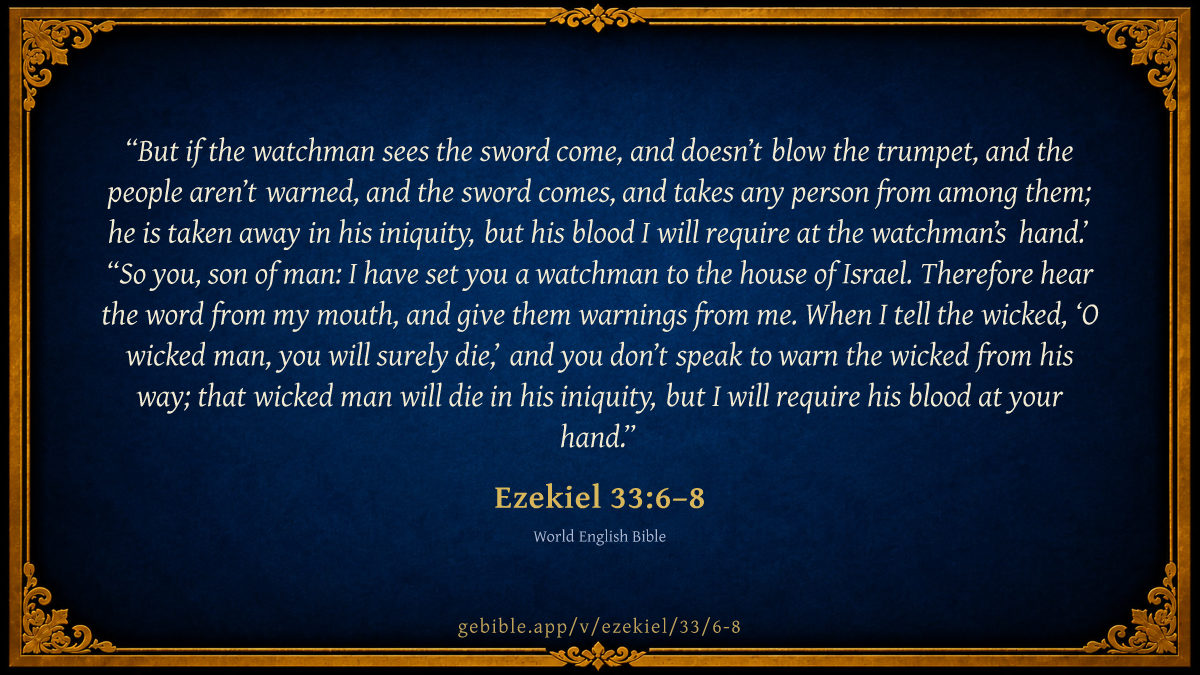
1Yahweh’s word came to me, saying, 2“Son of man, speak to the children of your people, and tell them, ‘When I bring the sword on a land, and the people of the land take a man from among them, and set him for their watchman; 3if, when he sees the sword come on the land, he blows the trumpet, and warns the people; 4then whoever hears the sound of the trumpet, and doesn’t heed the warning, if the sword comes, and takes him away, his blood will be on his own head. 5He heard the sound of the trumpet, and didn’t take warning. His blood will be on him; whereas if he had heeded the warning, he would have delivered his soul. 6But if the watchman sees the sword come, and doesn’t blow the trumpet, and the people aren’t warned, and the sword comes, and takes any person from among them; he is taken away in his iniquity, but his blood I will require at the watchman’s hand.’
7“So you, son of man: I have set you a watchman to the house of Israel. Therefore hear the word from my mouth, and give them warnings from me. 8When I tell the wicked, ‘O wicked man, you will surely die,’ and you don’t speak to warn the wicked from his way; that wicked man will die in his iniquity, but I will require his blood at your hand. 9Nevertheless, if you warn the wicked of his way to turn from it, and he doesn’t turn from his way; he will die in his iniquity, but you have delivered your soul.

Geneva Bible translators 1599 · Public Domain On vv6–8 Signifying, that the wicked shall not escape punishment though…
Signifying, that the wicked shall not escape punishment though the watchman be negligent: but if the watchman blow the trumpet, and then he will not obey, he shall deserve double punishment.
Geneva Bible (1599) marginal notes — public domain.
John Trapp 1656 · Public Domain On vv6–8 Eze 33:6 But if the watchman see the sword…
Eze 33:6 But if the watchman see the sword come, and blow not the trumpet, and the people be not warned; if the sword come, and take [any] person from among them, he is taken away in his iniquity; but his blood will I require at the watchman’s hand.
Ver. 6. He is taken away in his iniquity.] This is a dismal kind of death, far worse than that of dying in prison, or of dying in a ditch.
Read full note →
As the watchman’s hand.] By whose treachery, or indiligence at least, he miscarried.
John Trapp, A Commentary or Exposition upon All the Books of the Old and New Testament (1647–1656) — public domain. Text from a community e-Sword module.
Matthew Poole 1685 · Public Domain On v6 Blow not the trumpet; neglect his charge, which is…
Blow not the trumpet; neglect his charge, which is to give the alarm.
Be not warned; but, unwarned, are surprised by the enemy.
Read full note →
Taken away in his iniquity; punished by the Lord for his sins and trespasses formerly done, and he is destroyed under the present fault of not watching, which is a fault in every one that is so secure in time of war.
His blood; the guilt of that blood.
Require at the watchman’s hand; charge upon and for it punish the watchman, who sinned in not giving warning.
Matthew Poole's English Annotations on the Holy Bible (1683–1685) — public domain. Text from a community e-Sword/MySword module.
John Gill 1763 · Public Domain On vv6–8 But if the watchman see the sword come,.... Or…
But if the watchman see the sword come,.... Or those that kill with the sword, as the Targum is; so far doing the duty of his office as to be in the watchtower, and not asleep:
and yet blow not the trumpet: to give the people notice of the enemy, and of their danger:
Read full note →
and the people be not warned; but in the utmost security, not apprehending themselves to be in any danger at all:
if the sword come and take any person from among them; even though but a single person:
he is taken away in his iniquity: having had no time to have it set before him, and to be convinced, and to repent of it, and seek for pardoning mercy for it; it is a dreadful thing thus to be taken out of the world, and snatched into hell at once:
but his blood will I require at the watchman's hands; he shall be punished for not doing his duty, for not giving the due warning of danger, on which account the man was surprised with the enemy, and taken away unawares; and therefore his death shall be laid to the watchman, and he must be answerable for it.
John Gill's Exposition of the Whole Bible (1746–1763) — public domain (CC PDM 1.0). Text via the HelloAO Bible API.
John Wesley 1765 · Public Domain On v6 Is taken away - Punished by the Lord for…
Is taken away - Punished by the Lord for his sin.
John Wesley, Explanatory Notes Upon the Whole Bible (1754–1765) — public domain. Text via the GEBible commentary corpus.
Joseph Benson 1811 · Public Domain On v7 Eze 33:7-9. So thou, O son of man —…
Eze 33:7-9. So thou, O son of man — The Lord here applies the preceding account of the watchman’s office to the prophet, and shows that his duty is illustrated thereby. As if he had said, If a watchman, appointed by his fellow-citizens, is so highly guilty, if he do not give warning to the city, and shall receive such punishment from my hands; what must not thou expect, who art appointed by me to give warning to thy countrymen of the terrible evils which their sins will bring upon them, if thou neglect to do it? God has never left his people without sufficient means of instruction, but has vouch-safed it to them more or less in every age, from the beginning of the world to this day. He has, from time to time, and at all times, set watchmen over them, raised up good and holy men to instruct, admonish, warn, and reprove. “I have even sent unto you all my servants the prophets daily, rising up early and sending them, but you have not hearkened unto me, nor inclined your ear,” Jer 7:25. When I say unto the wicked, &c. — See notes on Eze 3:18-19.
Joseph Benson's Commentary on the Old and New Testaments (1811–1818) — public domain. Text from a community e-Sword module.
Haydock's Catholic Bible Commentary 1859 · Public Domain On vv6, 8 Iniquity, not regarding the admonitions of his pastor; (chap.…
Iniquity, not regarding the admonitions of his pastor; (chap. iii. 18.; Calmet) or rather of conscience, when the guide proves faithless and silent, as in this instance. (Haydock) --- The people were persuaded that none suffered except for some fault, ver. 10.; Jeremias xxxi. 30., Daniel xiii. 52., and Genesis xliv. 16. The author of the Book of Job takes great pains to remove this mistake. God sometimes sends crosses for a trial, (Calmet) and to increase the merit of his servants; though it be very true, (Haydock) "no one is miserable except he deserve it." (St. Augustine)
George Leo Haydock (1774–1849), Haydock's Catholic Family Bible and Commentary, 1859 edition — public domain. Excludes Psalms (Douay-Rheims chapter numbering differs from Protestant) and Deuterocanonical books (Catholic canon only).
Robert Jamieson, A. R. Fausset & David Brown 1871 · Public Domain On vv6–8 his iniquity--his negligence in not maintaining constant watchfulness, as…
his iniquity--his negligence in not maintaining constant watchfulness, as they who are in warfare ought to do. The thing signified here appears from under the image.
Jamieson, Fausset & Brown — Commentary Critical and Explanatory on the Whole Bible (1871) — public domain (CC PDM 1.0). Text via the HelloAO Bible API.
The Cambridge Bible for Schools and Colleges 1878 · Public Domain On vv6–7 6. Although in Eze_33:2 Jehovah is said to bring…
6. Although in Eze_33:2 Jehovah is said to bring the sword upon the people (Eze_14:17), and presumably for their sin, the language of the present verse leads over from the illustration to the thing meant to be illustrated.
The Cambridge Bible for Schools and Colleges (gen. ed. J. J. S. Perowne; Cambridge University Press, 1878–1918) — public domain. Text from a community e-Sword module.
The Pulpit Commentary 1880 · Public Domain On vv6–8 Vers. 6-9. But if the watchman: etc. The words…
Vers. 6-9. But if the watchman: etc. The words imply what we might almost call the agony of self-accusation. The prophet asks himself whether he has acted on the warning which was borne in on his mind at the very beginning of his mission. Has he sounded the trumpet? Has he warned the people of the destruction that is coming on them? The outward imagery vanishes in Ver. 7. It is of no Chaldean invader that the prophet had to give personal and direct warning, but of each man"s own special sin which was Bringing ruin on himself and on his country.
The Pulpit Commentary (1880–1919), ed. H.D.M. Spence-Jones & Joseph S. Exell — public domain. Text from a community e-Sword module.
The Biblical Illustrator 1887 · Public Domain On v7 I have set thee a watchman.
Eze_33:7-9
I have set thee a watchman.
Read full note →
The true watchman
I. The true watchmans vision of his own work. He sees--
1. It entails great responsibility on himself. Failure of duty here is nothing less than blood guiltiness.
2. It involves the greatest results to his hearers.
3. It utters the emotions of God.
4. It proclaims both the hope and the method of mens improvement. The hope is in God; the method is from God. The hope is in His call and promise of love; the method is in penitence, pine for sins; return; pardon, none of his sins shall be mentioned; rectitude, doing righteousness.
II. The true watchmans vision of the conduct of others. He is emphatically the seer. For he not only has to gaze steadily, reverently, intelligently at the truth of God he has to reveal to men, he has to look bravely, fixedly, tenderly at the condition and character of men. The old English watchman, to whom the care of our streets by night was formerly entrusted, often uttered in his hourly cry of All right what was indeed a sorrowful satire. For under the pall of night what concealed felons, what secret assassins, were plotting their cruelty and wrong! No such misleading watchman must be ours. In his vision of the conduct of others the true watchman sees--
1. The gross sins of many of them.
2. The hypocrisy of many more. The cloak of the hypocrites profession, the words of flattery that trifle with himself, fail to mislead the true preacher. (Urijah R. Thomas.)
Sermon to ministers
We are called to be messengers, watchmen, stewards of the Lord.
I. The Divine appointment. A faithful minister is a watchman appointed of God Himself. The vows of the Lord are upon us. How have we fulfilled them? What efforts have we made, with a single eye, to serve God for the promoting of His glory and the edifying of His people?
II. The solemn duties.
1. The first part of a watchmans duty is to watch for himself and over himself. The sentinel at his post is ever exposed to the watchful eye of the enemy; and so the Lords watchman is, more than others, always exposed to the ever-watchful eye of Satan. He stands forth as a mark against which the fiery darts of the wicked one are ever being hurled.
2. The watchman has to watch over and for the souls committed to his charge. We are assailed with the changeable winds of doctrine in all their force; we have the same blight of formality resting on the outward church; the same seeds of error and discord sown now as in the days of old. Against all these we must watch as we love the souls of our flock; yea, we must lift up our voice, and spare not, warning them against all the evils of sin, Satan, and the world.
I shall conclude with a word of exhortation and a word of warning.
1. As to the warning; that we be not unfaithful.
2. But if the warning voice of Scripture speaks loudly to the unfaithful watchman, not less loudly and powerfully do the promises of the Scriptures speak, to exhort and encourage the faithful. True, our responsibility is very deep, our difficulties very great; but let us remember, we stand not alone; if truly called of God and man, we may take to ourselves the promise, Lo, I am with you. (Evangelical Preacher.)
Gods ministers the watchmen of Israel
I. The reason and propriety of this representation. The Christian Church may be considered as a large and extensive country, bordering upon the world, a country yet more large and extensive. The spiritual watchman is to view what passes in both, and to give his own countrymen, the true Israelites, information and warning (Isa_21:5-8; Hab_2:1). Or, the Church of Christ is a city (Psa_87:1; Isa_60:1-22; Isa_62:1-12; Heb_12:22; Php_3:20 --Gr.) under one Chief Magistrate, Christ; who has appointed the laws, customs, and language thereof. This city should be at unity with itself within, and surrounded, as by walls and bulwarks, with salvation by the Lord, and by the faith, prayers, and watchfulness of the citizens. And on these walls, elevated by their knowledge, God having shined into their hearts (2Co_4:6), and by their Divine appointment, and secured by the Divine protection (Rev_2:1), the ministers of the Gospel are placed as watchmen. This country of Christianity is liable to be invaded from without, and this city of the Church of God to be attacked by the world and its prince. It may be invaded and attacked in its doctrines, by error; in its duties, by sin; in its privileges, by unbelief, despondency, formality, lukewarmness, and sloth. The watchman gives notice and warning. This country or city is liable also to commotions and disorders from within. As to individuals, from the flesh and its lusts. They may become luxurious, wanton, covetous, ambitious, proud, self-willed, discontented, impatient, etc. Or, as to the whole community, by surmises, jealousies, envyings, enmities, evil-speakings, which things would destroy the peace and unity of its members, and produce strife, contention, parties, divisions. The watchman must warn and reprove the citizens, and lay their conduct before their Prince.
II. What is especially the office and duty of ministers under this character. They must regard no toil, labour, or suffering. They must be faithful to the Lord and the people (Luk_12:42). They must distrust themselves, and apply to and depend on the Lord for supernatural aid. The Chief Shepherd only can keep, feed, and rule the flock, and, in another view, that unless the Lord keep the city, the watchman waketh but in vain (Isa_62:6-7). But, more particularly, their duty is set forth (Hab_2:1-2). We are not at liberty to imagine or conjecture or suppose this or that as necessary or expedient to the people over whom we watch, or retail our own opinions or fancies to them, but must come to our hearers with Thus saith the Lord, and that, with respect to doctrines to be believed, privileges to be enjoyed, precepts to be obeyed, promises to be expected, and threatenings to be revered. We must observe, all mankind are naturally wicked, all need repentance, all have encouragement to repent (Eze_33:11; Eze_33:14); that repentance implies not merely confession of sin, and a partial reformation, but a turning of the heart from sin to righteousness, followed by its proper fruits, and that without this there is no salvation (Luk_13:1). Nor is repentance sufficient without faith (Joh_3:18; Mar_16:16). Nor is faith sufficient without love; an ardent, admiring, grateful, complacent love to God, especially in consideration of His goodness to us, and an affectionate, disinterested, active love to all men, in imitation of Gods love to them (Heb_12:14). And we must persevere (Eze_33:12-13; Eze_33:18; Joh_15:4; Joh_15:6; Rom_11:17-22; Heb_10:38).
III. The consequence of neglecting, or fulfilling, their duty.
1. If thou do not warn the wicked--sincerely, earnestly, frequently, with repeated admonitions, as the word signifies, giving them light by thy instructions, and making the matter clear and evident to them. Thus the apostle warned all (Act_20:31)--He shall die in his iniquity. But is not this a hard case? No. For, though not particularly warned by any messenger of God, he had the Word of God in his hands, or, at least, he had the fight of nature, and knew more or less of what was required of him.
2. If the watchman fulfil his duty, he at least derivers his own soul (Eze_33:9). The faithful watchman glorifies God. For it is much for the glory of all his attributes that sinners should be warned, whether they take the warning or not; e.g., His holiness, justice, mercy, love. He receives a reward in proportion to his labours (Isa_49:4-5; 1Co_3:8). The Lord always gives him some success (Mat_7:16-20; Joh_10:2-5; 1Ti_4:15-16). (J. Benson.)
Faithful dealing with mens souls
The following incident occurred on his first visit to Waterbeach when Charles Spurgeon was a lad of seventeen. He was put up for the night at the house of Mr. Smith, and shared a bed with Mr. Smiths son, then a young boy. Charles Spurgeon, before retiring, went upon his knees, but his companion tumbled into bed without prayer, and lay down. No sooner had young Spurgeon finished his devotions than he inquired of his bedfellow if he were not afraid to go to bed without asking God for protection during the night: What a fearful thing would it be, he said, if you went to your last sleep without a prayer and a Saviour. For an hour or more the young preacher talked to the boy, and his earnestness was so evident that the boy was moved. Charles Spurgeon had him out of bed, and prayed with him, and that night the lad was converted. He is now an honoured deacon at Waterbeach. (Christian Age.)
Warning the impenitent
If at an assize town at the time of any celebrated trial, and the prisoner had been found guilty, and sentenced to death, Whitefield would, at the close of his sermon, his eyes full of tears, pause for a moment, and then, after a tenable denunciation upon those who neglect so great salvation, exclaim, I am now going to put on my condemning cap; sinner, I must do it. I must pronounce sentence against you. And then he would repeat the awful words of our Lord: Depart, ye cursed, into everlasting fire, prepared for the devil and his angels. (R. Winter.)
Pastoral vigilance
Latimer told the clergy in his time that, if they would not learn diligence and vigilance of the prophets and apostles, they should learn it of the devil, who goes up and down his diocese, and acts by an untired power, seeking whom he may destroy. When the wolves are abroad, the shepherd should not sleep, but watch, remembering that he were better have all the blood of all the men in the world upon him, than the blood of one soul upon him, by his negligence or otherwise. (T. Brooks.)
O wicked man, thou shalt surely die.
Office and responsibility of ministers
I. What God saith to the wicked.
1. The people addressed are all who do not unfeignedly turn from sin to God.
2. Death is here denounced as the judgment to be inflicted on all who turn not to their God; and to the same effect the inspired writers uniformly speak (Isa_3:11; Rom_6:23; Jam_1:14-15).
3. There is an implied assurance that the wicked, if they will repent, shall not die. And this is expressly stated in the following context: verse 14-16, so that, awful as this passage is, it is no less encouraging than it is awful; because it assures the contrite and believing sinner that he shall never perish.
II. The necessity imposed on ministers to proclaim it. The consequences of neglect in any minister are declared in two respects:
1. The person whom he neglects to warn will perish. If, through the sloth or treachery of the sentinels, a, camp be surprised at midnight, nothing but confusion and ruin can ensue. Thus if a person appointed to warn the wicked neglect to do so, the wicked will continue regardless of their impending doom, till it is too late to avert it. And it will be to no purpose to say, I was not aware of my danger; my minister has betrayed me. No; the wicked have means of information within their oval reach, independent of their ministers; and they have secret intimations in their own consciences that they ought to repent: and therefore they must take the consequences of their own wickedness: they must die in their iniquity.
2. He himself also will be dealt with as the author of that sinners destruction. As a sentinel who, by neglecting to give notice of the enemys approach, occasioned the overthrow of the army to which he belonged, would be chargeable with all the consequences of his neglect, so will the blood of all that perish through the ministers neglect be required at his hand. (Skeletons of Sermons.)
The important message
I. The end in which the evil ways of the children of men terminate is an awful end. It is a way that terminates in death, and that not temporal death alone, but eternal death. Many are the terrific views which are given of the world of woe; but what view can be more terrific than that of dying forever, and yet to be never dead after all? It will be awful in its nature, and still more so in its duration. The misery will be inconceivable, and the misery will be interminable. Banishment from all blessedness forever! Blackness and darkness, weeping and wailing, forever!
II. The realisation of this awful end is an object which the blessed God, far from desiring, deprecates and deplores. It is not your death that He desires, but your life.
1. By way of confirming this encouraging truth, we would remind you, in the first place, of what God is in Himself. His nature is love--that is the endearing name by which He is revealed; and as His name is, so is He. Benevolence of the highest, noblest, purest kind constitutes the very essence of His all-perfect character.
2. In connection with what God is in His nature, we would advert to what He has done for our salvation. He has so loved the world that He gave, etc.
3. His dealings with the children of men in all ages. How has He borne with them in the face of their innumerable provocations?
III. It is the consequent duty of sinners to forsake their evil ways, the termination of which, if persisted in, will be so disastrous, and to turn at once to him who waiteth to be gracious. Turn ye, turn ye, from your evil ways; for why will ye die, O house of Israel? Many strange things have been done or endured before now, which appeared unaccountable; and yet there have been substantial reasons to justify them. To see an individual in an unresisting posture, patient and resigned, while persons with their saws and knives were severing one of his limbs from his body, seems a strange sight; and yet there may be no difficulty in proving that such an operation was necessary and desirable, since the sacrifice of a mans limb has often been the means of saving a mans life. For multitudes to give their bodies to be burnt; to welcome cruel mockings and scourgings; to abandon their homes, and wander in deserts and mountains, in dens and caves of the earth: all this appears to be unaccountable. But there may be the strongest reasons adduced in justification of such severe sacrifices. Hence it is declared of the ancient: worthies, that they were tortured, not accepting deliverance; and why? That they might obtain a better resurrection. But for your course, poor sinner, no reason can be given. (Anon.)
The certainty of death to the wicked
I. Who are the wicked? Profane and gross sinners, who indulge themselves in notorious immoralities (1Co_6:9-10; Gal_5:19-21; Col_3:5-6; Rev_21:8). In this black list you not only find such gross vices as are scandalous in the common estimate of mankind, but also such as are secret, seated in the heart, and generally esteemed but lesser evils.
2. All who knowingly and wilfully indulge themselves habitually in any one sin, whether it be the omission of a commanded duty or the practice of something forbidden (1Jn_2:4; 1Jn_3:8; 1Jn_3:10; Joh_14:23-24). I grant that good men sin, and that they are far from perfection of holiness in this life. I grant also that some of them have fallen, perhaps once in their life, into some gross sin. But after all, I must insist that they do not indulge themselves in the wilful habitual practice of any known sin, or the wilful habitual neglect of any known duty. St. John expressly tells us (1Jn_3:9), he cannot sin habitually; again, he cannot sin wilfully--that is, with full bent of soul.
3. All who are destitute of those graces and virtues which constitute the character of positive goodness. Wickedness is a moral privation, or the want of real goodness. The want of faith, the want of love, repentance, benevolence, and charity does as really constitute a wicked man, as drunkenness, blasphemy, or any notorious immorality.
4. All who still continue in their natural state; who have never been regenerated, or experienced a thorough change of their views and dispositions, towards God and divine things (Joh_3:6; Rom_8:8; Eph_2:3).
II. What kind of death shall the wicked man die? It is true, natural death is the universal doom of all the sons of men (Ecc_2:16). The highest attainments in piety cannot secure an earthly immortality. But though there be no difference in this respect, there is a wide difference in another, and that is, the death of the wicked is quite another thing, or comes under quite a different notion, from the death of the righteous. The death of the wicked, like an officer from their offended sovereign, strikes off the fetters of flesh, that they may be carried away to a place of execution. Then, farewell, a long, and everlasting farewell, to the comforts of this life, and all its agreeable prospects: farewell to friends; farewell to hope and peace; farewell to all the means of grace; farewell, God, and Christ, and angels, and all the blessedness of heaven. Now nothing awaits them but wrath and fiery indignation. But even this, dreadful as it is, is not all--there is besides this, that dreadful something called the second death (Rev_21:8; Rev_2:11; Rev_20:6; Rev_02:14)--which thou, O wicked man, must die. The soul will be forever dead to God and holiness--dead to all the means of grace, and all the enjoyments of this life; dead to all happiness and all hope; dead to all the comfortable purposes of existence; dead to everything that deserves the name of life--in short, dead to everything but the torturing sensations of pain; to these the soul will be tremblingly alive all over, to eternity; but, alas! to be alive, in this sense, alive only to suffer pain, is worse than death, worse than annihilation.
III. What you must do to be saved.
1. Betake yourselves immediately to serious thoughtfulness.
2. Break off from those things that hinder your conversion.
3. Diligently use all means that may instruct you in the nature of true religion.
4. Earnestly pray to God.
5. Endeavour to receive and submit to the Lord Jesus as your only Saviour.
6. Do not delay to follow these directions. (President Davies.)
The Biblical Illustrator, edited by Joseph S. Exell (c. 1880s–1900s) — public domain. Text from a community e-Sword module.
C. I. Scofield 1917 · Public Domain On v7 So thou
So thou
The nation having failed in corporate responsibility, the appeal is now to individual loyalty. Cf. 2Ti 2:1-26.
The Scofield Reference Bible (1917 edition), notes by C. I. Scofield — public domain. Text from a community e-Sword module.
unfoldingWord translationNotes 2017 · CC BY-SA 4.0 On v7 General Information:
General Information:
Yahweh continues speaking to Ezekiel.
Read full note →
the house of Israel
Here "house" represents people. AT: "the people of Israel" (See: Metonymy)
you will hear the words from my mouth and warn them on my behalf
Here "mouth" represents what Yahweh says. AT: "you will hear the message that I speak and you will warn them on my behalf" (See: Metonymy)
warn them on my behalf
"warn them as my representative" or "give them the warning from me"
do not announce this
"do not say this"
about his way
"the way he acts" or "the things he does." See how you translated "your ways" in Ezekiel 7:3.
I will require his blood from your hand
Here "blood" represents a person's death. The phrase "require ... from your hand" is an idiom that means to consider someone responsible. AT: "I will consider you responsible for his death" (See: Metonymy and Idiom)
he might turn back from it, and if he does not turn back from his way
A person no longer behaving in a certain way is spoken of as if he physically turns and goes back on a path. AT: "he might stop doing bad things, and if he does not stop doing bad things" (See: Metaphor)
will have saved your own life
"will have kept yourself alive"
translationWords
house
Israel
word
evil
sin
blood
hand
unfoldingWord translationNotes — © Distant Shores Media and the Door43 World Missions Community, licensed CC BY-SA 4.0. Source: git.door43.org/Door43/en_tn.