
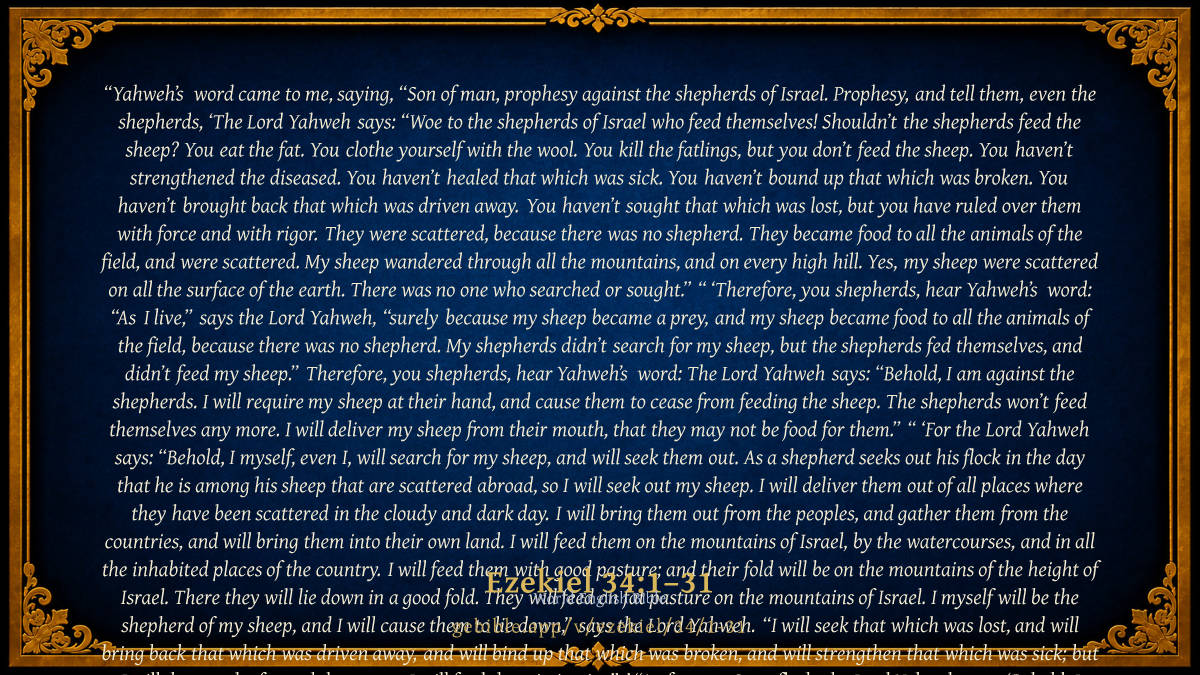
Yahweh’s word came to me, saying, “Son of man, prophesy against the shepherds of Israel. Prophesy, and tell them, even the shepherds, ‘The Lord Yahweh says: “Woe to the shepherds of Israel who feed themselves! Shouldn’t the shepherds feed the sheep? You eat the fat. You clothe yourself with the wool. You kill the fatlings, but you don’t feed the sheep. You haven’t strengthened the diseased. You haven’t healed that which was sick. You haven’t bound up that which was broken. You haven’t brought back that which was driven away. You haven’t sought that which was lost, but you have ruled over them with force and with rigor. They were scattered, because there was no shepherd. They became food to all the animals of the field, and were scattered. My sheep wandered through all the mountains, and on every high hill. Yes, my sheep were scattered on all the surface of the earth. There was no one who searched or sought.”
“ ‘Therefore, you shepherds, hear Yahweh’s word: “As I live,” says the Lord Yahweh, “surely because my sheep became a prey, and my sheep became food to all the animals of the field, because there was no shepherd. My shepherds didn’t search for my sheep, but the shepherds fed themselves, and didn’t feed my sheep.” Therefore, you shepherds, hear Yahweh’s word: The Lord Yahweh says: “Behold, I am against the shepherds. I will require my sheep at their hand, and cause them to cease from feeding the sheep. The shepherds won’t feed themselves any more. I will deliver my sheep from their mouth, that they may not be food for them.”
“ ‘For the Lord Yahweh says: “Behold, I myself, even I, will search for my sheep, and will seek them out. As a shepherd seeks out his flock in the day that he is among his sheep that are scattered abroad, so I will seek out my sheep. I will deliver them out of all places where they have been scattered in the cloudy and dark day. I will bring them out from the peoples, and gather them from the countries, and will bring them into their own land. I will feed them on the mountains of Israel, by the watercourses, and in all the inhabited places of the country. I will feed them with good pasture; and their fold will be on the mountains of the height of Israel. There they will lie down in a good fold. They will feed on fat pasture on the mountains of Israel. I myself will be the shepherd of my sheep, and I will cause them to lie down,” says the Lord Yahweh. “I will seek that which was lost, and will bring back that which was driven away, and will bind up that which was broken, and will strengthen that which was sick; but I will destroy the fat and the strong. I will feed them in justice.” ’
“As for you, O my flock, the Lord Yahweh says: ‘Behold, I judge between sheep and sheep, the rams and the male goats. Does it seem a small thing to you to have fed on the good pasture, but you must tread down with your feet the residue of your pasture? And to have drunk of the clear waters, but must you foul the residue with your feet? As for my sheep, they eat that which you have trodden with your feet, and they drink that which you have fouled with your feet.’
“Therefore the Lord Yahweh says to them: ‘Behold, I, even I, will judge between the fat sheep and the lean sheep. Because you thrust with side and with shoulder, and push all the diseased with your horns, until you have scattered them abroad; therefore I will save my flock, and they will no more be a prey. I will judge between sheep and sheep. I will set up one shepherd over them, and he will feed them, even my servant David. He will feed them, and he will be their shepherd. I, Yahweh, will be their God, and my servant David prince among them. I, Yahweh, have spoken it.
“ ‘I will make with them a covenant of peace, and will cause evil animals to cease out of the land. They will dwell securely in the wilderness, and sleep in the woods. I will make them and the places around my hill a blessing. I will cause the shower to come down in its season. There will be showers of blessing. The tree of the field will yield its fruit, and the earth will yield its increase, and they will be secure in their land. Then they will know that I am Yahweh, when I have broken the bars of their yoke, and have delivered them out of the hand of those who made slaves of them. They will no more be a prey to the nations, neither will the animals of the earth devour them; but they will dwell securely, and no one will make them afraid. I will raise up to them a plantation for renown, and they will no more be consumed with famine in the land, and not bear the shame of the nations any more. They will know that I, Yahweh, their God am with them, and that they, the house of Israel, are my people, says the Lord Yahweh. You my sheep, the sheep of my pasture, are men, and I am your God,’ says the Lord Yahweh.”
Geneva Bible translators 1599 · Public Domain On vv2, 3, 4, 5, 10, 12, 16, 18, 23, 25, 27, 29 By the shepherds he meaneth the king, the Magistrates,…
By the shepherds he meaneth the king, the Magistrates, Priests, and Prophets.
Geneva Bible (1599) marginal notes — public domain.
John Trapp 1656 · Public Domain On vv1–31 Eze 34:1 And the word of the LORD came…
Eze 34:1 And the word of the LORD came unto me, saying,
Ver. 1. And the word.] See Eze 18:1.
John Trapp, A Commentary or Exposition upon All the Books of the Old and New Testament (1647–1656) — public domain. Text from a community e-Sword module.
Matthew Poole 1685 · Public Domain On vv2, 3, 4, 5, 6, 7, 8, 10, 11, 12, 13, 14, 16, 17, 18, 20, 22, 23, 24, 25, 26, 27, 28, 29, 30, 31 The shepherds; the rulers of the people, both political,…
The shepherds; the rulers of the people, both political, as kings, magicians, and princes, and also ecclesiastical, priests and prophets.
Israel; the two tribes, and the few that out of the ten did adhere to the house of David.
Read full note →
Prophesy; the command is repeated to encourage and engage the prophet to his work.
Thus saith the Lord God: Ezekiel speaks, but these rulers must know it is God that speaks by him.
Woe be to the shepherds! they have been principal causes of many sins, and exemplary actors in other sins, for which many woes were threatened; many already are come, and the rest will come, in which woes these rulers shall have more than ordinary share.
Feed themselves; contrive their own ease, advantage, honour, and ambitious projects. Let the consciences of these rulers, ecclesiastical and political, speak, ought they not, as shepherds, to take care of the sheep committed to their care?
The flocks; the sheep, both whole flocks and the single sheep, whole societies and particular members of them.
Matthew Poole's English Annotations on the Holy Bible (1683–1685) — public domain. Text from a community e-Sword/MySword module.
Matthew Henry 1710 · Public Domain On vv1, 7, 17 The prophecy of this chapter is not dated, nor…
The prophecy of this chapter is not dated, nor any of those that follow it, till ch. 40. It is most probable that it was delivered after the completing of Jerusalem's destruction, when it would be very seasonable to enquire into the causes of it.
I. The prophet is ordered to prophesy against the shepherds of Israel - the princes and magistrates, the priests and Levites, the great Sanhedrim or council of state, or whoever they were that had the direction of public affairs in a higher or lower sphere, the kings especially, for there were two of them now captives in Babylon, who, as well as the people, must have their transgressions shown them, that they might repent, as Manasseh in his captivity. God has something to say to the shepherds, for they are but under-shepherds, accountable to him who is the great Shepherd of Israel, Psa 80:1. And that which he says is, Woe to the shepherds of Israel! Though they are shepherds, and shepherds of Israel, yet he must not spare them, must not flatter them. Note, If men's dignity and power do not, as they ought, keep them from sin, they will not serve to exempt them from reproof, to excuse their repentance, or to secure them from the judgments of God if they do not repent. We had a woe to the pastors, Jer 23:1. God will in a particular manner reckon with them if they be false to their trust.
Read full note →
II. He is here directed what to charge the shepherds with, in God's name, as the ground of God's controversy with them; for it is not a causeless quarrel. Two things they are charged with: - 1. That all their care was to advance and enrich themselves and to make themselves great. Their business was to take care of those that were committed to their charge: Should not the shepherds feed the flocks? No doubt they should; they betray their trust if they do not. Not that they are to put the meat into their mouths, but to provide it for them and bring them to it. But these shepherds made this the least of their care; they fed themselves, contrived every thing to gratify and indulge their own appetite, and to make themselves rich and great, fat and easy. They made sure of the profits of their places; they did eat the fat, the cream (so some), for he that feeds a flock eats of the milk of it (Co1 9:7), and they made sure of the best of the milk. They made sure of the fleece, and clothed themselves with the wool, getting into their hands as much as they could of the estates of their subjects, yea, and killed those that were well fed, that what they had might be fed upon, as Naboth was put to death for his vineyard. Note, There is a woe to those who are in public trusts, but consult only their own private interest, and are more inquisitive about the benefice than about the office, what money is to be got than what good to be done. It is an old complaint, All seek their own, and too many more than their own. 2. That they took no care for the benefit and welfare of those that were committed to their charge: You feed not the flock. They neither knew how to do it, so ignorant were they, nor would they take any pains to do it, so lazy and slothful were they; nay, they never desired nor designed it, so treacherous and unfaithful were they. (1.) They did not do their duty to those of the flock that were distempered, did not strengthen them, nor heal them, nor bind them up, Eze 34:4. When any of the flock were sick or hurt, worried or wounded, it was all one to them whether they lived or died; they never looked after them. The princes and judges took no care to right those that suffered wrong or to shelter injured innocency. They took no care of the poor to see them provided for; they might starve, for them. The priests took no care to instruct the ignorant, to rectify the mistakes of those that were in error, to warn the unruly, or to comfort the feeble-minded. The ministers of state took no care to check the growing distempers of the kingdom, which threatened the vitals of it. Things were amiss, and out of course, every where, and nothing was done to rectify them. (2.) They did not do their duty to those of the flock that were dispersed, that were driven away by the enemies that invaded the country, and were forced to seek for shelter where they could find a place, or that wandered of choice upon the mountains and hills (Eze 34:6), where they were exposed to the beasts of prey and became meat to them, Eze 34:5. Every one is ready to seize a waif and stray. Some went abroad and begged, some went abroad and traded, and thus the country became thin of inhabitants, and was weakened and impoverished, and wanted hands both in the fields of corn and in the fields of battle, both in harvest and in war: My flock was scattered upon all the face of the earth, Eze 34:6. And they were never enquired after, were never encouraged to return to their own country: None did search or seek after them. Nay, with force and cruelty they ruled them, which drove more away, and discouraged those that were driven away from all thoughts of returning. Their case is bad who have reason to expect better treatment among strangers than in their own country. It may be meant of those of the flock that went astray from God and their duty; and the priests, that should have taught the good knowledge of the Lord, used no means to convince and reclaim them, so that they became an easy prey to seducers. Thus were they scattered because there was no shepherd, Eze 34:5. There were those that called themselves shepherds, but really they were not. Note, Those that do not do the work of shepherds are unworthy of the name. And if those that undertake to be shepherds are foolish shepherds (Zac 11:15), if they are proud and above their business, idle and do not love their business, or faithless and unconcerned about it, the case of the flock is as bad as if it were without a shepherd. Better no shepherd than such shepherds. Christ complains that his flock were as sheep having no shepherd, when yet the scribes and Pharisees sat in Moses' seat, Mat 9:36. It is ill with the patient when his physician is his worst disease, ill with the flock when the shepherds drive them away and disperse them, by ruling them with force.
Matthew Henry's Commentary on the Whole Bible (1708–1710) — public domain (CC PDM 1.0). Text via the HelloAO Bible API.
John Gill 1763 · Public Domain On vv1–30 The word of the Lord came unto me,.... The…
The word of the Lord came unto me,.... The date of this prophecy is not given; however, it seems to have been delivered after the destruction of Jerusalem; the causes of which are mentioned, the sins of the people and their governors, which the prophet is directed to expose:
saying: as follows:
John Gill's Exposition of the Whole Bible (1746–1763) — public domain (CC PDM 1.0). Text via the HelloAO Bible API.
John Wesley 1765 · Public Domain On vv1, 2, 3, 4, 5, 12, 16, 17, 18, 20, 23, 24, 25, 26, 29, 30 A charge against the shepherds of Israel, ver. 1-6.…
A charge against the shepherds of Israel, ver. 1-6. Their dismission from their trust, ver. 7-10. A promise, that God would take care of his flock, ver. 11-16. Another charge against the strong of the flock, for their injuring the weak, ver. 17-22. A promise of the Messiah, the great and good shepherd, ver. 23-31.
John Wesley, Explanatory Notes Upon the Whole Bible (1754–1765) — public domain. Text via the GEBible commentary corpus.
Adam Clarke 1810 · Public Domain On vv1, 2, 3, 4, 5, 6, 7, 10, 12, 13, 16, 17, 18, 20, 23, 24, 25, 26, 29, 31 The prophet is commanded to declare the dreadful judgments…
CHAPTER XXXIV
The prophet is commanded to declare the dreadful judgments of
Read full note →
God against the covetous shepherds of Israel, who feed
themselves, and not their flocks; by which emblem the priests
and Levites are intended, who in Ezekiel's time were very
corrupt, and the chief cause of Israel's apostasy and ruin,
1-10.
From this gloomy subject the prophet passes to the blessedness
of the true Israel of God under the reign of DAVID, the Great
Shepherd of the sheep, our Lord Jesus Christ being named after
this prince by a figure exceedingly frequent in the sacred
oracles, of putting the type for the antitype, 11-31.
NOTES ON CHAP. XXXIV
Adam Clarke's Commentary on the Bible (1810–1826) — public domain. Text from a community e-Sword/MySword module.
Joseph Benson 1811 · Public Domain On vv1, 2, 3, 5, 10, 11, 17, 21, 23, 26, 29, 31 Eze 34:1. The word of the Lord came unto…
Eze 34:1. The word of the Lord came unto me, saying — It is probable that this prophecy immediately followed the preceding; and that at, or immediately after, the arrival of the news that Jerusalem was conquered, the prophet was commissioned to speak of the tyranny and carelessness of the governors and teachers, and to point out their negligence as a principal cause of the incredulity and wickedness of the people. Thus the transition appears to be natural, and the connection close, between this prophecy and the foregoing one, as also between the beginning of this prophecy and its conclusion. For considering that, in parts at least, the people suffered for the faults of the shepherds, mercy now urged the prophet to declare, from God, that he would judge between them, save the flock, and set up one shepherd over them, who should feed them, even his servant David.
Joseph Benson's Commentary on the Old and New Testaments (1811–1818) — public domain. Text from a community e-Sword module.
Albert Barnes 1834 · Public Domain On vv1, 2, 11, 12, 16, 20 The prophet has yet to pronounce a judgment upon…
The prophet has yet to pronounce a judgment upon unfaithful rulers, whose punishment will further the good of those whom they have misguided. He shows what the rulers should have been, what they have been, and what in the coming times they shall be when the True King shall reign in the true kingdom. Hence, follows a description of Messiah’s reign.
Albert Barnes' Notes on the Bible (1834–1885) — public domain. Text from a community e-Sword/MySword module.
Haydock's Catholic Bible Commentary 1859 · Public Domain On vv2, 3, 4, 5, 8, 10, 12, 13, 16, 17, 23, 25, 26, 29, 31 Shepherds. That is, princes, magistrates, chief priests, and scribes.…
Shepherds. That is, princes, magistrates, chief priests, and scribes. (Challoner) --- Shepherds may lawfully take milk, (1 Corinthians ix. 7.) but the sheep and its wool belong to the master. (Worthington) --- Excellent instructions are here given for all in authority. (Calmet)
George Leo Haydock (1774–1849), Haydock's Catholic Family Bible and Commentary, 1859 edition — public domain. Excludes Psalms (Douay-Rheims chapter numbering differs from Protestant) and Deuterocanonical books (Catholic canon only).
Lange's Commentary on the Holy Scriptures 1864 · Public Domain On v1 1. Against the Shepherds of Israel, of the Shepherd…
II. THE DIVINE PROMISES
1. Against the Shepherds of Israel, of the Shepherd Kindness of Jehovah toward His Flock, and of His Servant David (Ch. 34)
Read full note →
1And the word of Jehovah came to me, saying: 2Son of man, prophesy upon the shepherds of Israel, prophesy, and say to them, to the shepherds, Thus saith the Lord Jehovah: Woe to the shepherds of Israel, that were 3feeding themselves! Should not the shepherds feed the flock? Ye ate the fat, and clothed yourselves with the wool; ye killed what was fed; ye fed not 4the flock. Those which became weak ye have not strengthened, and the sick ye have not healed, and the wounded [broken] have ye not bound up, and the driven away have ye not brought back, nor looked after that which was lost [perishing], and with rigour have ye ruled them, and with oppression. 5And they were scattered, because [there was] no shepherd, and were for food to all living creatures 6[for meat to all beasts] of the field, and they were scattered. They wander, My flock, upon all mountains, and upon every high hill; and upon the whole face of the earth have they been scattered, My flock, and there is none that 7seeks after, and none that looks after. Therefore, shepherds, hear the word of Jehovah. 8As I live—sentence of the Lord Jehovah—Because My flock has become for a prey [for booty], and they have become, My flock, for food to all living creatures of the field, because [there was] not a shepherd, and My shepherds have not sought after My flock, and the shepherds fed themselves, 9and fed not My flock: Therefore, ye shepherds, hear the word of Jehovah; 10Thus saith the Lord Jehovah: Behold, I [am] against the shepherds, and demand My flock from their hand, and cause them to cease from feeding the flock; and the shepherds shall no more feed themselves; and I deliver [snatch] My flock out of their mouth, and they shall not henceforth be for food to them. 11For thus saith the Lord Jehovah: Behold, I, I [am there], and seek for My flock, and inspect [scrutinize] them. 12As a shepherd inspects his flock, in the day that he is amongst his flock, the scattered [sheep], so will I inspect My flock, and deliver [rescue] them out of all the places whither they were scattered 13in the day of cloud and darkness. And I lead them forth from among the peoples, and gather them from the lands, and bring them to their ground, and feed them upon the mountains of Israel, in the valleys, and in all 14the dwellings of the land [the earth]. On good pasture will I feed them, and in [on] the high mountains of Israel shall their walk be: there shall they lie down in a good walk, and on a fat pasture shall they feed upon the mountains of Israel. 15I will feed My flock, and I will make them lie down: sentence 16of the Lord Jehovah. I will look after the perishing, and the driven away will I bring back, and the broken will I bind up, and will strengthen the sick, and the fat and the strong I will destroy; I will feed it with judgment. 17And ye, My flock, thus saith the Lord Jehovah, Behold, I Judges 18 between sheep and sheep, the rams and the he-goats. Is it too little for you that ye feed on the good [best] pasture, and ye tread down the rest of your pasture with your feet, and drink the sunk water, and with your feet trouble 19the residue? And My flock, must they feed on what your feet have trodden, 20and of what your feet have troubled must they drink? Therefore, thus saith the Lord Jehovah to them: Behold, I, I [am there] and judge between 21fat sheep and lean [impoverished] sheep. Because ye push with side and with shoulder, and thrust with your horns all those which have become weak, till 22ye have scattered them abroad: Therefore I help My flock, and they shall no longer be for a prey, 23and I will judge between sheep and sheep. And I appoint [raise up] over them one shepherd, and he feeds them, My servant David; he 24will feed them, and he will be to them a shepherd. And I, Jehovah, will be to them a God, and My servant David prince in their midst. I, Jehovah, have 25spoken. And I conclude for them a covenant of peace, and cause the evil beasts to cease out of the land, and they dwell securely in the wilderness, 26and sleep in the woods. And I give them and the environs of My hill [for a] blessing, and cause the rain to come down in its season—showers of blessing there shall be. 27And the tree of the field gives its fruit, and the land shall give its increase; and they are safe upon their ground, and they know that I am Jehovah, when I break the bars of their yoke, and I deliver [rescue] them from the hand of those whom they served [who wrought through them]. 28And they shall no more be a prey to the heathen, and the beasts of the field shall not devour them, and they dwell secure, and there is none to make them afraid 29And I raise up for them a plantation for a name, and they shall no more be swept away from hunger in the land, and no more bear the reproach of the 30heathen. And they know that I, Jehovah, their God, [am] with them, and they [are] My people, the house of Israel: sentence of the Lord Jehovah 31And ye My flock, flock of My pasture, men [are] ye; I [am] your God: sentence of the Lord Jehovah.
Eze_34:2. Sept.: ... Ω ποιμενες ... μη οἱ ποινενες βοσκουσιν ἑαυτους;—
Eze_34:3. ʼΙδου το γαλα κατεσθιετε—
Eze_34:4. ... και το ἰσχυρου κατειργασθε μοχθω. (Anoth. read.: האבדות.)
Eze_34:5. ... του ἀγρου κ. τοις πετεινοις του ον̓ρανου.
Eze_34:6. Και διεπαζμσαν τα προβατα μον … (παντι) προσωπω (πασης) κ. γμς … οὐδε ὁ ἀποστζεφων (Anoth. read.: ועל פני כל.) Vulg.: et non erat qui requireret, non erat, inquam, qui requireret.
Eze_34:8. Sept.: ... εἰ μην ἀντι του γενεσθκι … εἰς κρονομην κ. γενεσθαι τ. πζοβατα μου—
Eze_34:10. ... του μη κοιμαινειν τ. προβατα μου … ἐ τ. ποιμενες αν̓τα—
Eze_34:12. ... ἐν ἡμερα γνοφου κ. νεφελης ἐν μεσω–
Eze_34:14. Sept.: ... ἐν τ. ὀζει τω ὑψηλω, ἐν τ. ὀρει ʼΙσραηλ. Και ἐσονται αἱ μανδραι αὐτων ἐκει κ. κοιμηθηονται, κ. ἐκει αναπασονται ἐν τρυφη—
Eze_34:15. ... .και ἐπιγνωσονται, δοι τι εἰμι κυριοκ. Ταδε λεγε–
Eze_34:16. ... ἰσχνρον φνλαξω. κ … αἰτα μετα κριματος.. For אשמיד all read אשמיר) except Chald.
Eze_34:21. Sept.: ... τ. κερασιν ὑμων ἐκερατιζετε, κ. παν το ἐκλειπον ἐξεθλ βετε.
Eze_34:22. Κ. σωτω … κριον προς κριον.
Eze_34:25. ... τω Δαυιδ διαθηκμν … κ. κατοικησουσιν ἐν τη ἐρημω—
Eze_34:26. ... αν̓τους κυκλω τ.ὀρους μου, κ … τ. ὑετον, ὑετον εὐλογιας αὐτοις.
Eze_34:27. ... ἑν ἐλπιδι εἰρηνης … τ. ζυγον τον κλοιου αὐτων—
Eze_34:28. Sept.: ... ἐν ἐλπιδι—
Eze_34:29. ... φυτον εἰρηνης
Eze_34:30. Sept. Syr. Arab. add הנותם, and omit אתם.
Eze_34:31. Κ. ὑμεις προβατα μου κ. προβατα τ. ποιμνιου μου ἐστε, κ. ἰγω–
EXEGETICAL REMARKS
Eze_34:1-10. The Shepherds of Israel
Eze_34:1. Hengstenberg regards the prophet with this word of Jehovah as meeting the trouble which arises from the loss of civil government: the seeming loss, he contends, is real gain, since the existing government was so bad. Keil excellently designates the turning against the bad shepherds as a foil for the ensuing promise. What the relation to the first part of the book, the natural sequel to the same already suggests, namely, a vivid representation of the past,—this will now show itself to be the more appropriate, since in the second part of the book the promise of God is what gives the prevailing tone. The future salvation cannot be better set off and characterized than upon the past distress; just as upon the dark background of our misery, redemption generally appears the brighter, and also so much the more a necessity; and Joh_8:10 (“Woman, where are those thine accusers?”) conveys an import of a similar kind with reference to a still more distant time than what is here referred to.
Eze_34:2.עַל (comp. אֶל, Eze_13:2), agreeably to the tenor of what follows, as much as: against; but as the controversy has respect to positions of eminence, it carries a certain reference to that. Kliefoth undoubtedly views the shepherds rightly, when he understands thereby generally the entire body of officials who had committed to them the leadership of the people. At least the following description, bearing as it does the shepherd form, is capable of comprehending all, and admits of application to all. Hence some have taken it with reference to the kings, and also to the priests; others have thought merely of the kings, or of the collective order then holding the reins of government (as Hengst.); others, again, have found here the false prophets and teachers of the people. The reference to Jeremiah 23., which has been leant upon, decides nothing; it only shows how, in the second part also of his book of prophecy, Ezekiel kept himself in unison of sentiment with his predecessor and companion. Nothing can be proved here by the “biblical idea of the shepherd” (Keil), since it is just the image of a shepherd which is set before us; and the fact that in Eze_34:23 sq. David forms the antithesis, and that in the character of prince, finds its explanation in the Messianic idea, thereby symbolized and historically exhibited, which, as in our prophet, is viewed pre-eminently in its kingly aspect (pp. 23, 24). So, on the other hand, by means of the contrast with the anointed, it leaves, under the image of the shepherd, the complex of official life to be understood. All the offices—hence He is called Christ—and princes also (comp. on Eze_12:10) must, the more they had been guilty, culminate in him.1 In order to retain the king and the great (שָׂרים, the magnates, Hitzig), Hengst. notices the circumstance that Jehoiachin and Zedekiah, and likewise many of the chiefs, were still in life; that the announcement therefore might extend into the future. But he holds that what the prophet here announces as having as to its main part already taken place, must be simply an explanation of the judgment in the form of an announcement of it!—לָרֹעִים, the address repeated, pleonasmus emphaticus, whereby the shepherd-idea at the same time is prominently brought out, while, on the other hand, the threatening attached and description of the reality comes thus into more marked contrast.—That were feeding themselves; this already indicates all (אוֹתָם, reflexive, Ewald, Gr. p. 788), the selfishness that merely seeks its own, instead of what belongs to the flock. (צֹאן, small cattle; especially sheep, but also goats.) Comp. Php_2:21; 2Co_12:14; Judges 5-12; Act_20:28; 1Pe_5:2.
Eze_34:3. Here a detailed description is given of the “not feeding,” to which the “feeding,” the obligation involved in the relation of shepherd to flock (“should not the shepherd,” etc., Eze_34:2), stands opposed; and the picture is drawn so as to make enjoyment merely take the primary place on the side of the shepherds. Such was their habitual acting. Instead of fat, Hitzig reads with the Sept. חָלָב, milk, as also Rosenmüller, so as thereby to avoid the anticipating and repeating as regards the killing in the third clause. Certainly the milk Would suit well with the “wool,” and the “eating” (1Co_9:7) should occasion no difficulty. There must not, however, be supposed the lawful use of the flock, but from the first the greed which appropriates to itself the best of the animal; at length the best animal itself is what appears in the representation—from which, however, nothing arises for determining more closely what office is meant, since it is applicable to each office [“but manifestly most strictly applicable to the kingly or ruling office,” P. F.].—To the greedy misappropriation for one’s own use, there is a companion picture in Eze_34:4; the words: “ye fed not the flock,” farther declaring, on the one hand, the want of care for the flock, the contemptuous neglect of them, nay, on the other hand, the merciless energy with which what should have been protection had turned into simple domination. נַחְלוֹת, partic. Niphal from חָלָה, are those which had become weak, wretched, whether it may have been through sickness or overdriving. חוֹלָה is the sick itself. The Niph. pass. of שָׁבַר denotes what is wounded, what has been somewhat broken—corresponding to which is: “to bind up,” to wrap up firmly. Comp. Mat_12:20.—נִדַּחָה is the driven away, the exiled, in consequence of harsh treatment (comp. 1Pe_2:25). אָבַד, to lose one’s self, to be lost, to perish (comp. Mat_10:6; Mat_15:24; Mat_18:11; Luk_15:4; Luk_15:6; Luk_19:10). The two last expressions prepare the way for the רָדַה (to domineer, to trample on) with חָזְקָה, and with פֶּרֶך (tyranny). Comp. Exo_1:13-14; Lev_25:43; Lev_25:46; Lev_25:53; Jdg_4:3 : 1Sa_2:16; 1Pe_5:3.
Eze_34:5. There is here, finally, given the closing feature, as it is likewise involved in the verb דָעָה, the keeping together; while they did not discharge the shepherd-obligation, did not feed the flock, they also failed to keep them together, which is expressed by the Niphal of פּוּץ in respect to the sheep, which also had already been prepared for by הַכִּדַּחַת and הָאֹבֶדֶת (Eze_34:4). The description now applies to the flock, not to single sheep merely. The first תְּפוּצֶינָה Hengst. understands of the internal dissolution of the people, in consequence of which the power of resisting was lost in regard to those without; the second he understands of the exile. Both expressions, however, are fundamentally the same. When Israel was not held together in the name of Jehovah through the theocratic offices, the scattering, the self-abandonment, and surrender to the worldly powers was the natural, necessary consequence.—מִבְּלִי רֹצֶה, from the want, the non-existence of a shepherd; because no shepherd who had discharged his duty according to his office was there; comp. Jer_10:21; Zec_10:2; Mat_9:36. In consequence of the scattering of the flock—this first of all—they became food to the nations round about; the other—and on this account is וַתְּפוּצֶינָה repeated—overtook them to the full in their state of exile—as previously in the ten tribes, so now also in Judah, as set forth in Eze_34:6. (Num_27:17; 1Ki_22:17; Joh_10:12.) The representation in the image should plainly be understood as a pictorial delineation; so that: upon the whole face of the earth, by which the preceding: upon all mountains, and: upon every high hill, may be regarded as thrown together, must be taken to mean not their own land, as some have thought (Theodoret), viewing it in connection with the heathen worship practised there, but also the earth, without reference to heathen lands. The יִשׁגוּ, however, should be distinguished from נָפֹצוּ [that is, the “wandering” from the “scattering”], and possibly, therefore, the heathenizing tendency and the punishment borne among the heathen may be indicated. The repeated and emphasized My flock prepares for the resolutions of Jehovah that follow. There being none to search is explained by the preceding: “because there was no shepherd.” Upon דָּרַש and בָּקַשׁ, see at Eze_3:18. According to Häv., דָּרַשׁ signifies to inquire farther, to search for, to concern one’s self about, while בָּקַשׁ signifies the seeking for the lost.
Eze_34:7. There is now, on the ground of such unfaithfulness to duty, pronounced the “woe” of Eze_34:2, under the form of hearing the word of Jehovah.
Eze_34:8. The manner of proceeding, however, as commonly with Ezekiel, is first of all again to rehearse the guilt of the shepherds, and so to resume the charge that the flock, which Jehovah had committed to these shepherds as His own, had been taken away by the stranger, given up to the stranger, turned into a “booty,”—a contrast of such a kind that all, in a manner, was said by it. A prey is more exactly defined by: for food, agreeably to Eze_34:5; and the expression: because there was no shepherd, after Eze_34:6, is explained by: have not sought after My flock.
Eze_34:9. This verse, with the therefore, renews the demand on the shepherds (Eze_34:7).
Eze_34:10. Instead of חַת־אָנִי׳ we have here בֹה־אָמ־ר׳, and הִנְנִי instead of אִם לֹאּ—Eze_13:20; Eze_13:8.—וְדָרַשְׁתִי, antithesis to ,וְלֹא־ מִפּיהֶם. Comp. Eze_33:8; Zec_9:16.—The flock must be demanded of the officials, and these made to cease—which was fulfilled up to the time of Christ. With reference to the flock, such a seeking is a deliverance (הִצִיל), considering the character of the shepherds; and because the circumstance of their feeding themselves goes immediately before, which points back to Eze_34:3, מִפִּיהֶס is put instead of מִיָּדָם, and לֹ־תִהיֶין forms the parallel to ולֹא־יִרְעוּ עוֹד, previously used (Eze_13:21).
Eze_34:11-22. Jehovah in His Shepherd Tenderness toward His Flock
Eze_34:11. This verse grounds (For) the ceasing of the past relation of shepherd and flock through the all-expressive personal addition: הִנְנִי־אָנִי, which the Targum Jona. renders by: “Behold, I will manifest Myself.” As it is said in Joh_1:10 sq.: “He was in the world,” and: “He came unto His own.”—I seek for My flock, a contrast to: “there is none that seeketh for,” in Eze_34:6, and to: “they have not sought for,” in Eze_34:8. Instead of בָּקַשׁ, however, there stands the more inward בָּקַר, inspect, consider, by means of which the following expansion is introduced, which has respect exclusively to the flock,—“the community, on whose preservation everything depends” (Ewald).
Eze_34:12. There must be the inspection (Gesen.: properly, Aram. inf. Poël) of a shepherd; Jehovah will therefore discover Himself not only as proprietor, whose proprietorship is of another kind, but specially as shepherd, which He really is, in contrast to the merely titular officials, nay, as if He alone were shepherd (Psalms 23.). Hence also עֵדֶר, where formerly there was צֹאן; comp. Jer_13:17 (Isa_40:11; Jer_31:10; Luk_15:4).—In the day that he is amongst his flock describes more fully what is implied in the brief though energetic and significant: “Behold, I, I,” of Eze_34:11. The epithet נִפְרָשׁוֹת to צֹאנוֹ indicates the assumed condition, however much, as a characteristic apposition, it is at variance with the meaning and nature of a flock. One has to think of the day that succeeds a nocturnal storm and tempest, and all the dangers arising from wild beasts, etc., when, after that the selfish shepherds had in a body proved faithless to their calling, now at length the true shepherd of the flock presents himself. So that: “in the day that he is amongst his flock,” evidently forms a contrast to: the day of cloud and darkness, at the close of the verse; which words are, therefore, improperly connected by Hitzig (Klief.), with an ahusion to Eze_30:3; Eze_29:21, and especially to Joe_2:2, with: and deliver them (וְהִצַּלְתִי). For the day “of cloud and darkness” (עֲרָפֶל, combination of “cloud” and darkness, yet not by a throwing together of עָרִיף and אֹפֶל, but an extended form, like כַּרְמֶל, from כֶּרֶם), as also the derivation of the formula from the lawgiving on Sinai (Deu_4:11; Heb_12:18) might indicate, is not the day of God’s judgment upon all the heathen—also, not “the dark showers of the birth of a better time,” as Ewald puts it, connecting the expression with Eze_34:13, but the day of the dispersion of His people,—the punishment which, according to the law of God from Sinai, befell them by the instrumentality of the heathen. Accordingly, בְּיוֹם עָנָן׳ belongs to the immediately preceding relative clause אֲשֶׁר־נָפֹצוּ׳, a connection which is usual.—The rescuing, delivering out of, whereby the inspection of the flock accomplishes the kind of salvation indicated, presupposes in the general: a dangerous position,—in particular: imprisonment, servitude, oppression, tyranny, etc. That it was to be out of all the places, etc., besides being in accordance with the preceding figure (Eze_34:6), arises from the form of the salvation, which is represented as primarily a gathering (Eze_28:25), especially a bringing back out of exile to the land of their home, as is shown in Eze_34:13 (Exo_6:6; Exo_7:4-5; Act_2:9-11). Comp. also Eze_11:17; Joh_11:52. But at the same time, as Hengst. has said, “other glorious gifts and benefits, which, however, all pointed forward to the true fulfilment, and called forth desire for it,” are indicated by: and feed them (וּדְעִיתִים)—Eze_6:2-3.—And in all the dwellings of the land are, primarily, all the parts adapted for occupation, for inhabiting; might not הָאָרֶץ, however, have a farther reference?
Eze_34:14. An explanation is here given of the “feeding” by Jehovah with regard to the fodder (מִרְעֶה), to which also נִוֵהֶם corresponds, but, at the same time, with reference to lairs, reposing, resting, dwelling. It lies, besides, in the thing itself that the pasture-ground was, at the same time, a lair and resting-place, fold, Psalms 23; Son_1:7.—וּנְהָרֵי מְרוֹם׳, Philippson: “upon the mountains of the height of Israel;” comp. at Eze_17:23; Eze_20:40.
Eze_34:15. A bringing together of what has been said in both respects; comp. on דָבַץ, Eze_29:3; Psalms 23.
Eze_34:16. An explanation is here given, and in contrast to the denounced faithlessness (Eze_34:4) of those who had hitherto held the shepherd-office, of the “feeding” as that is understood by Jehovah, of a much more internal nature, and indeed with an eye to right and righteousness. As the contrast in strong and strengthen (comp. for that Luk_22:32) may of itself indicate, but as the words: I will feed it with judgment, put beyond doubt, and the sequel shows, the feeding by Jehovah is also a judging, which does not mean simply a right dealing, or treatment according to right and equity, but involves, as we shall see, a separation. With judgment is sufficiently explained by the: I will destroy (אַשְׁמִיד)—Psa_37:38; comp. also Eze_14:9; Luk_1:51-52. The ironical turn given to the אֶרְעֶנָּה (the suffix does not relate to the flock) may easily be understood from the visible antithesis to the: “and with rigor have ye ruled them, and with oppression,” in Eze_34:4; comp. also the distinction between חַשְּׁמֵנָה and הַחֲזָקָה in the comparison with הַבְּרִיאָה in Eze_34:3. The Chaldee paraphrase interprets: “godless and sinners,” while the Vulg. translates: custodiam, as does Luther also, as if it had stood שָׁמַר. Comp. also Rev_2:27; Psa_2:9.
Eze_34:17. As a confirmation of the sense put upon the last part of Eze_34:16, this verse introduces by way of contrast the (remaining) flock: And ye, My flock. The officials are with Eze_34:10 discharged and gone; the persons concerned can therefore only come into consideration according to their personal qualities, not according to their official rank; consequently, as one sheep merely with another, in other words, as “fat” and “strong,” or such like (Deu_32:15). Hence the: Behold, I judge between sheep and sheep, explains the: “in judgment,” of Eze_34:16 as a judgment between one kind of sheep and another, individual members of the flock; therefore, that לָשֶׂה expresses the judicial separation in regard to those previously named fat and strong, and וְלָעַתּוּרִים (עָתַד, to urge, push; the he-goat עַתּוּד, properly: “pusher”) לָאֵילִים an enlarging apposition. Hitzig: “against the rams and the he-goats.” Beside the pushing and pressing (Eze_34:21) there sounds distinctly forth the leading and guiding of the flock; so that the older expositors were right in thinking of the shepherds in Eze_34:2, yet not in that character, but simply as individuals. (As, in another respect certainly, the Servant of Jehovah, the Deliverer, is represented as a sheep, as a lamb (Isa_53:7), so in Ezekiel are the destroyers.) The fat and the strong among the sheep are therefore regarded as like the rams and he-goats, and placed on the one side—the situation, therefore, not at all so dissimilar to that in Mat_25:32, as Keil repeats after Hitzig, who merely gives this explanation: “The separation of the sheep from the goats in Mat_25:32 has nothing to do here.” As belonging to the sheep-flock, he-goats and rams are also, in the general sense, sheep (small cattle), and they are expressly so called in the words: “between sheep and sheep” but undoubtedly sheep and sheep (Eze_34:20) forms a distinction, namely, that those which Jehovah designates His are not like the he-goats and rams, from which He sets them apart. They are certainly not, as excellently remarked by Kliefoth, “represented as the righteous and innocent, but they are called the strayed, the driven away, the wounded, the weak: but they are the penitent, who hear the voice of God; therefore will He first seek them, and bring them back, and heal and strengthen them, but afterwards also will redeem them from the oppressions which the others, the he-goats, have exercised upon them.” According to Hitzig, these latter are with the fat and the strong “the rich and noble, who in manifold ways wrest from the humble by force and rigour their worldly goods.” But Kliefoth quite rightly: “a poor man can just as well be a he-goat as a rich man a sheep.” Only with the poor man the sphere is very limited; while for the rich and noble, power and the right to exercise it sit upon the very rim of their cradle. The “robber-knights,” as Hengst. calls them, are born in castles. The haughtiness, however, engendered by fatness and the misuse of their resources is to be taken into account. “David, even upon the throne, designates himself poor and needy” (Hengst.). The thing referred to, therefore, in the case of the rams and he-goats, is the wickedness which exhibits itself as violent procedure in superior positions of life. “God procures for the suffering sheep justice against the malicious” (Hengst.).
Eze_34:18. The unjust behaviour of the one portion toward the other is here exposed. Hengst.: “The address extends to the tyrants of the future”—that is, to the Scribes and Pharisees of our Lord’s time, whom it exactly suits.—Comp. on הַמְעַט מִבֶּם, Eze_16:20. Are ye not content with your own enjoyment, but must ye also disturb that of others? Thus fatness and strength might have enjoyed themselves at smaller cost. (Rev_3:17?) But now, as they left over to no one what they would not or could not use as pasture, but wantonly trampled it under foot, so did they also with respect to drink. מִשְׁקָע, from שָׁקַע, Eze_32:14, “sinking of water,” is commonly interpreted as: “water clarified through sinking,” so that the clarifying is rather the main thing, the impurities have gone to the bottom. Hengst.: water of sinking, settled water; interpreted by Hitzig as: water on the ground, to be found at the bottom—that is, the coolest water. But as רָפַשׂ (promiscuously רָפַס Eze_32:2)—by treading with the feet to make confused and troubled—shows, what perhaps most readily suggests itself is, that the water which was sunk, which had become little, and so threatened want, they in their wickedness had made undrinkable. (Luk_11:52?)
Eze_34:19. וְצאֹנִי, with Athnach! Is this right?
Eze_34:18.
Eze_34:20. To them according to Eze_34:17, to the last mentioned, the flock of Jehovah, and not to the evil and good together,—to the one for terror, and to the other for comfort (Rosenm.).
Eze_34:11.—בִרְיָה only here, with the view probably of distinguishing from Eze_34:3 (comp. at Eze_34:16). Usually בְרִיָּה is read for it, also רָזָה —בְרִיאָה., to be thin, impoverished (comp. Mar_2:17; Mar_14:38; 1Co_9:22).
Eze_34:21. Here follows an address to the others, as Eze_34:18 does on Eze_34:17. The point of view is not, with Hitzig, to be confined to the pressing of a flock to the fountain. Comp. at Eze_34:4-5 (Jer_23:1-2).
Eze_34:22. וְהוֹשַׁתְעִי, more general and comprehensive than וְהִצַּלְתִּי, Eze_34:10; Eze_34:12.
Eze_34:8; Eze_34:17; Eze_34:20.
Eze_34:23-31. The Servant David
The and here gives the immediate sequence, without indicating anything remarkable in what was coming, as this indeed formed the abiding anticipation of the religious thought of Israel; so that since here the removal of the offices and the judgment upon the persons has been effected, he who was now to be looked for must at length come,—the course of events has plainly reached him as the last member in the series, according to which the: “I raise up” (הֲקִימֹתִי), will have to be understood. No special forthcoming effected by God for the good of Israel, as in Deu_18:15 יָקִים לְךָ, in the more peculiar might and grace of the Spirit, but simply the official (mediately divine) appointment of the shepherd in question is announced, although with a reference to 2 Samuel 7. But what is said there at Eze_34:12, וַהֲקִימֹתִי׳ (“I will set up thy seed”), was in Eze_34:11 illustrated beforehand by the: “I commanded to be over My people” (צִוִּיתִי), said with respect to the judges. These, therefore, appear as only provisional arrangements, as temporary, through God’s command interjected into the disorder for putting an arrest on the same, while for the seed, of which Eze_34:12 speaks, a permanent introduction and settlement was to be made. In spite of this diversity in the use of צִוִּיתִי, however, there lies nothing in וַהֲקִימֹתִי to suggest the fable of the Gilgul, as was done already by particular Rabbins, and recently has been resumed by Strauss, Hitzig, and others. At all events, Ezekiel would have expressed himself otherwise, if we were here scientifically to find the exegetical idiosyncrasy of a corporeal return of the historical David, by a resurrection from the dead. It is a desperate consolation, such as could have been imagined by no good exegetical conscience, to feel obliged to refer for such like fancies to Rosenmüller—even to the Zoroastrian doctrine of the return of the Paschutan.—On רֹעֶה, see the Doctrinal Reflections to our chapter.—אֶחָד signifies here certainly not “one,” one generally; also it can scarcely mean “only,” and has nothing immediately to do with the union of the two kingdoms under his sceptre, because there was nothing said of this previously; but the contrast is with the former shepherds and the sheep of the flock scattered through their guilt—this manifoldness on the one side, on the other has set over against it the oneness of this shepherd, who is the complex embodiment of shepherd watchfulness, as of all the duties of the shepherd office,—the divine realization of the idea of all that is involved generally in the nature of the office, as service toward the community for the sake of God, as sacred service in behalf of God’s people. [Kliefoth: “This shoot of David comprehends in his one person the whole shepherd-offices of Israel, and fulfils them; they are to be done away with him, but no other king over the people of God shall relieve him.”]—On account of the com. gen. of the “flock,” the fem. alternates with the masc. in the suffix.—He comes to his destination as a shepherd through the: and he feeds; the name is realized in his doing, with a reference to David’s former life and procedure; see Psa_78:70-71.—My servant David, who, on account of his attitude of obedience as Jehovah’s servant, showed himself to be one peculiarly fitted for serving the community, over which he was placed officially for the performance of such service, namely, as His servant not only chosen by Jehovah (objectively), but also called, but also anointed, but also in every way confirmed. As David “after the flesh,” so My servant “after the Spirit” points back genealogically in connection with the dynasty. There will be a Davidic person, and he will be in accord with the kingly pattern of David, so that Jehovah’s servant David will revive in him to the consciousness of every one. Therefore, in fact, a return of David, and indeed in the seed of David (Jer_23:5); therefore also different from the return of Elias in John the Baptist. Application is to be made to Christ, but to derive the exposition of the words from this presently fails, as when Kliefoth interprets “My servant” thus: “because, he, as God’s instrument, will accomplish what is written in Eze_34:11-22.” One must be at home in the style of representation which is given throughout Scripture of David, but more especially in the prophetic style of representation concerning him, in accord also with the pregnant prophetic self-consciousness which discovers itself in his own psalms, in order rightly to understand these and similar descriptions of the Messiah. See the Doctrinal Reflections on the chapter, and comp. Hos_3:5; Jer_30:9; Jer_23:5; Luk_1:32-33. Besides, the respect had to the fundamental passage 2 Samuel 7. itself leaves no doubt as to the proper understanding.—How much the comprehensive ideal, just because figurative, notion of the shepherd preponderates, is clear from the expressly and intentionally repeated: He will feed, etc. (Rev_7:17).
Eze_34:24. When it is said in 2Sa_7:14, in reference to the immediate posterity of David: “I will be a father to him,” there is here what corresponds to it in the words: And I, Jehovah, will be to them a God. Comp. Eze_11:20. “Father” to him, “God” to them, as the Father of our Lord Jesus Christ is our God. In like manner: and My servant David points back to 2Sa_7:8, where this appears in the form of an address, along with the promise there given; נָגִיד is there, while here נָשִׂיא is used. That through the government of David Jehovah was going to be in truth the God of His people Israel, etc. (Keil), is not expressly said, but the grand ideal, the eternity of the Davidic elevation and loftiness, is certainly set forth (2Sa_7:13; 2Sa_7:16; comp. Eph_1:22). But that Jehovah is He who thus speaks must dispose of all opposition from the present aspect of things.
As the whole service of David the prince in their midst is appointed for the salvation of the people, there is expressed in Eze_34:25 the establishing for them the covenant—that which always, when so peculiarly said in the technical phraseology, proceeds from the Highest in relation to the lower, that is, from Jehovah (Jer_31:31 sq.). The reason is, that the in itself ambiguous notion, yet corresponding to the covenant-relation originally in like manner established by God, manifests itself for the people as a revelation of such relationship, namely, as an attestation of offered grace, presenting itself, and giving assurance of God’s readiness to enter into fellowship with men. Comp. at Isa_55:3 (Heb_8:10; Act_3:25).—Covenant of peace (Isa_54:10), since in consequence of the covenant relationship of God there is guaranteed to the people this security, happy condition, salvation (Rom_14:17), of which the “ceasing of evil beasts” symbolizes the negative, and “the dwelling securely” the positive side. Comp. Lev_26:6 (Hos_2:20 [18]). According to Häv. and Hengst., the evil beasts are the hostile human potencies (Eze_34:5), and the driving of the heathen world from its hitherto domineering position must be meant. According to Hitzig, the public security in the land is pledged. But security (לָבֶטַח, Eze_28:26) the wilderness itself must have offered to those dwelling in it, which is sufficiently explained by the parallel בַּיְּעוֹרִים (Qeri: בַּיְּעָרִים), surrendering themselves carelessly to sleep in the thicket of the woods. [Häv. finds an allusion to Solomon’s time of peace and blessing; but Kliefoth a literal return of the paradisiacal state after a materialistic manner.]
Eze_34:26. To the personelle (them) are annexed, in a local form of expression, the environs, by which, therefore, could not be meant men, with reference to the image of sheep, or the adjacent places for the persons inhabiting them. But the prominence given to My hill, that is, the temple-mount, or, with reference thereto, Jerusalem (Isa_31:4; Isa_10:32), carries over the representation of the people’s associates to the land. Comp. also Eze_34:14 : “And on the mountains of the height of Israel.” The words: And I give … for a blessing, chiming in with Gen_12:2, could not possibly (as Cocc. and Hengst. suppose) allow of our interpreting “the environs” as meaning the heathen joining themselves in the time of salvation to the old covenant-people (Eze_17:23; Eze_16:61; Eze_47:8), which is quite remote from the connection here. “And thou shalt be a blessing,” in Gen_12:2, is certainly explained thus in Eze_34:3; but here the expression: to “give for a blessing,” as the immediately following explanation of “rain in its season” shows us (Deu_11:14; Joe_2:23), adhering to the preceding reference to the land, will mean probably more than to bless. Yet still nothing essentially different, though giving utterance to it in a very marked manner.—The people shall be bodily a blessing through their land, to which Jehovah’s hand of blessing will mightily testify; hence showers of blessing (which mediate the blessing, in distinction from Eze_13:13; Pro_28:3; comp. also Deu_32:2; Isa_55:10-11; Rom_15:29; Eph_1:3)—shall be so primarily on no other account, but simply for their own experience and their own personal enjoyment. But comp. Eze_34:29. [Rosenm. brings to remembrance how far superior Palestine was to Egypt in regard to such blessings of the material heavens.] Accordingly, Eze_34:27 continues and portrays (comp. Lev_26:4) the fruitfulness thence arising in the field and land, in order presently to come back to the inhabitants settled again upon their home-soil—on which comp. Eze_34:25, Eze_28:25-26.—עֹל (from עָלַל, to join, make fast, bind) is generally the yoke of draught-cattle, in order to fasten them together or to the plough. מֹטּוֹת are the two ends of the cross-piece of wood which forms the chief strength of the yoke; hence in Eze_30:18 = yoke. The cross-piece of wood laid upon the neck of the animal was fastened by a cord or thong to the pole of the plough, and passing under the neck of the animal (see Delitzsch on Isaiah 58). As the allusion to Lev_26:13 and what follows here will show, it is to be understood figuratively—not in general of the endurance of sufferings, but specially of slavery, as in Egypt formerly, which should be broken. For parallel with בְּשִׁבְרִי stands וְהִצַּלְתִים׳ and הָעֹבְדִים בָּהֶם (Exo_1:14), of the laying on of slave labour. עָבַד with בְּ is to work with or through any one, so that the working stands out in him, he appears purely as an instrument (Mat_11:28; Mat_23:4; Joh_8:36; Act_15:10; Rom_8:2; 2Co_11:20; Gal_2:4).
Eze_34:28. Comp. Eze_34:22; Eze_34:8.
Eze_34:25; Eze_34:8 (Eze_29:5).—Lev_26:6; also Mic_4:4. Those whom they are said, in the preceding verse, to have served, are therefore the heathen, and the two other promises resume again the same two sides as Eze_34:25, while the words: and there is none to make them afraid, portray still farther the secure peaceful rest, almost reminding us of the opposite picture at the close of Eze_34:6.
Eze_34:29. And I raise up for them is parallel to Eze_34:23; the promise there begun in these terms reaches here its conclusion, for the whole of what has gone before relates to one and the same Messianic character.—According to Hitzig, מַטָּע can only mean a plant-place or ground; the plant-land should become to them for renown; what they planted should grow and prosper so as to be a glory for them. According to the older style of exposition it is the “plant,” Isa_11:1 : the Sept. and others read with it שָׁלוֹם. Simpler, certainly, is the rendering plantation (agreeably to Eze_34:26 sq., and as at Eze_17:7), and it is also explained by the: “no more sweeping away by hunger,” etc., by reason of the fruitfulness of the country, and in contrast to the state of destitution mentioned elsewhere (Eze_5:12; Eze_5:16; Eze_6:11-12). So, too, לשם (for a name) has its explanation in their having no more “to bear reproach from the heathen.” [The exposition which, by a reference to Gen_2:8-9, would understand it of “a renewal of the paradisiacal plantation” (Hengst.), is far-fetched, there being nothing in the connection for it; nor can it be understood how such a renewal, under comparison of Eze_36:29 sq., would consist “in the rich distribution of harvest blessings.” According to Kliefoth, the plantation, like that of the first paradise, must be the suitable thing for holy men.] Instead of the contempt with which the heathen scoffed at the fallen, prostrate, ruined condition of the people, those same heathen should now be convinced, from the blessing upon Israel, that the children of Israel, those who really were such, were also in reality the blessed of the Lord. Hitzig merely: it should no longer be said among the heathen, “The Israelites are hunger-bitten, they have nothing to bite and chew.” Comp. on the other hand, Mat_5:6; Joh_6:27; Joh_6:35; Rev_7:16-17; Mat_13:43.
Eze_34:30. Jehovah will be their God, and as such will be with them, will show Himself to be such toward them (Rev_21:3). To this corresponds the other side of such a relationship, indicated by: My people, as also by: the house of Israel (2Co_6:16).
Eze_34:31. This verse does not, of course, mean that what was said of the flock has its application to men; but rather is it God’s design to testify that His promise in respect to both sides, as well what He is to them to whom He gives it—therefore against doubt and feeble faith—as what they are taken for by Him, and so equally against all undue self-exaltation, keeps in view Adam, the man, or: men, which also fits in exactly with the immediately preceding designation of the people as: “the house of Israel.”—וְאַתֵּן, comp. Eze_34:17.—Flock of My pasture (Jer_23:1; Psa_74:1); not: “which I tend” (Ges.), but because Jehovah had given Israel the fruitful land of promise for a pasture-ground. The exposition of My people by men, and still more the repetition, notwithstanding that, of: I am your God, entirely corresponds to the character of the second main division of our book, to the prophecies respecting God’s compassions toward His people in the world (Psa_36:8 [7]), and the rather so, if, with Hävernick, the fundamental prophecy in relation to what follows is to be seen here.—That the Sept. should have omitted אָדָם is not to be commended, although the Targum and the Arab. translation have done the same. The Syriac, however, has retained it, and it is scarcely to be explained how it should have been brought in, where (after Eze_34:30) the solemn remark, that not real sheep and goats were meant, would have to be called more than superfluous and flat. Hengst. translates: “And ye are My flock, My pasture-sheep are ye men,” etc.; Keil: “And ye are My flock, etc., ye are men” Häv. explains: “Indeed ye, who are called to what is so great, are weak creatures; but where the Lord acknowledges to men that He is their God, He is strong in their weakness; no glory is too great that it might not come to be manifested in them.” Kliefoth, who finds the translation of Hengst. against grammar, and calls Hävernick’s exposition a superimposed one, carries forward his misunderstanding of the paradisiacal reference: those belonging to the people of God would, through the Branch of the house of David, be as Adam was when he received from God this name after creation. J. F. Starck, with an emphasis on the general grace: “And ye, etc., ye men, I am your God.” [“And ye, My flock, My pasture-flock, men are ye, I am your God.” There is evidently an emphasis on men: “men are ye, remember your place, you are merely human; but remember, at the same time, that I am your God; so that without Me nothing, but with Me all.”—P. F.]
DOCTRINAL REFLECTIONS
1. We should admit, on the one side, that the term “shepherd,” as is also so natural from the fulness of the references which the image includes, has application to the guiding of the people in general, consequently to every, office of that nature; yet we should not deny, on the other side, that “shepherds” especially and primarily signified “kings.” Only the rendering of the word by “overseer,” and in particular when the overseers or elders of the exile come into consideration, is very wide of the mark. However, the notion also of civil magistracy, which Hengstenberg attributes to the shepherds as kings, is an abstraction which is not appropriate to the image. In relation to the theocratic people primarily, in which relation we must seek for the more immediate reference of the biblical expression “shepherd,” the feature of leading will naturally assume the more prominent place, as it does in Joh_10:3 sq., which gives us an interpretation from the fulfilment of what is contained in this chapter. That the shepherd is the leader finds, then, its culmination in the protection, which the giving of his life for the flock provides for it, Joh_10:11. The other features in the image do not therefore fail; they only fall behind the one more peculiarly brought out, such as discipline, tender care, which belong to the spiritual import of the image (comp. Joh_10:9-10). The prophetic or teaching office is therein expressed, as in the self-surrender of the shepherd for the flock the priestly office is indicated. The notion of the “shepherd,” accordingly, comprises generally the official form and representation of the Old Testament theocratic life, and likewise pre-eminently the kingly office, giving prominence to the kingly government (pp. 23, 24), as is the case with the Messianic idea under the Old Covenant, with that of “Christ” under the New Testament, so that “shepherd” and the “anointed” come near and mutually supplement each other. In the Messianic character of the shepherd, there comes out, along with the relation to the theocratic people, the other relation, that, namely, to Jehovah, the Lord of the theocracy, according to which the shepherd appears as the representative of Jehovah among His people. If in this respect Messiah is the term for the relation in question as regards equipment, or internal power of the Spirit, so in that of “shepherd” there is given, we might say, the fulfilment, the realization of the same relation by means of a corresponding government. On account of what they had not done, the shepherds of Israel are manifestly the unrighteous, the wicked ones. On account of that which He does who makes Himself known in John 10, He proves Himself to be the Good Shepherd. But as there the Jews (Joh_10:20) supposed Him to be actuated not by the Spirit of the God-anointed, the Messiah, but to have in him an evil spirit (δαιμόνιον ἔχει), so they misunderstood also His unbosoming of Himself on that occasion as the Shepherd, and turned away from Him.
2. “In this chapter” (says Cocceius) “the office of shepherd is taken from the shepherds of Israel, and promise is made of the kingdom of Christ, the Chief Shepherd. The shepherds of Israel are of a threefold order, Zec_11:3; Zec_11:8. The three shepherds there are vigil, et respondens, et offerens munus (Mal_2:12); that is, elder, prophet or doctor, and priest. They are called ‘gods,’ but in Psa_82:6 sq. their abolition is pronounced. Therefore the apostle, 1Co_2:6, says of the princes of this world, that they are come to nought.”
3. “The prophecy in Ezekiel 34 is kept very general, and does not connect itself closely with specific occasions and circumstances, hence admits (apart from its typical bearing on the experiences of Israel, outward and spiritual) of manifold applications to all states, churches, families; and with justice, for it is really designed for all that could be named figuratively shepherd and flock, like a mathematical formula which expresses a law that may be applied to innumerable cases” (Schmieder).
4. From the second verse of this chapter the Lord Jesus appears to have quoted the repeated “woe” against the Scribes and Pharisees (Matthew 23). The application to these throws light specially on the days of Christ, but generally on the period subsequent to the exile. The hierarchy, as it appears in its antagonism to Christ, is the final degradation of the theocratic officialism of Israel. Prophecy ceased with Haggai, Zechariah, and Malachi. In its place, as the characteristic appearance of Ezra shows, and as fabled also by the Jewish traditions of the “Great Sanhedrim” and the “Great Synagogue,” came the learning of the Scribes. As it was already with the three last prophets in relation to the earlier prophetic office, so also did the princely dignity of Zerubbabel stand related to the Davidic kingdom of former times. Zerubbabel was leader to the returning captives, and was appointed royal governor over the new colony, in which his character as a born prince of Judah was lost sight of. Although he stood as governor directly under the Persian kings, still the Persian governors in Samaria were instructed to keep their eye upon his administration. What, however, in his appointment by Cyrus, carried, according to the Jewish mode of contemplation, a specially royal, that is, Davidic aspect, presently again fell into abeyance with the person of Zerubbabel. On this account alone the application by some of Eze_34:23 to Zerubbabel is shown to be untenable. None of Zerubbabel’s sons succeeded him as governor. If from the time of Nehemiah’s death the post of provincial governor gradually disappeared, as is with much probability supposed, then, for the purpose of taking the oversight of civic affairs (and of any other kind of oversight we know nothing), only the office of the high-priesthood remained, the history of which henceforth became a very worldly one, full of ambition and crime. The Maccabees united with it the dignity of military general; afterwards, as conferred upon them by the people, a hereditary princedom, over against which the Sanhedrim, which had meanwhile been constituted, and was under pharisaical-priestly influence, strove to maintain its position; and then at last the title of king. That the dignity of high priest as combined with princely rank, especially when the prince was a Sadducee, formed a kind of caricature of Psa_110:4, does not hinder on the other side the noting of an important feature therein with regard to Christ; just as in the resolutions of the people and their counsellors there is apprehended, with a clear consciousness, the future appearance of a faithful prophet (1Ma_14:41). The dissolution-process now indicated of the theocratic offices in Israel after the exile suffices for the chapter of Ezekiel before us.
5. Israel, as remarked by Beck, “should, amid the tumult of desolation and the luxurious forms of development of the God-forgetting worldly nationalities, have stood forth as a strictly separate sanctuary of God, to which not the present, indeed, but so much the more certainly the future belonged; and even the falling away from this simple isolation of the whole state-economy justified its real wisdom by means of the desolating results that ensued.” “A many-membered organism of law, like a comprehensive ring, encompassed the whole individual and commercial life, woven into the elements of the world’s fellowship, while the more determinative arrangements of the outward natural life, of the reckoning of time, of the physical and social human life, were consecrated as serviceable organs for the establishment of a pious fellowship with God, of a righteous ordering and wholesome direction of the life.” It was “an externality,” but “no hollow-surface existence ending in itself; rather a vessel and framework of a spiritual inwardness of being, destined to future development, and bearing this in itself in a manner pregnant with promise.” The proof of this is specially furnished by prophecy, whose foundation was already laid among the fathers of the Israelitish people, which came forth into peculiar external activity under the constitution of the Mosaic economy, and at last assumed formally the place of an order in the State. Hence its cessation was pre-eminently a mark of the time, as being that of the approaching advent of Him whose Spirit was in the prophets ! Were but the whole people of Jehovah prophets! was the wish of Moses (Num_11:29); expressing as regards Israel the design of prophecy, and at the same time with an eye toward the Pentecostal future. Still more, however, was this import involved in the priesthood, which was no caste foreign to the people, but rooted in a brotherly stem of the same, giving promise of a priestly position to the whole of Israel, with corresponding fulness of obligation to duties of service. So close and inward, because a service rendered to the whole, and springing out of its innermost idea, was the relation of these offices in Israel to Israel itself, that their unfolding and Israel’s unfolding overlap each other, are congenial. The destination of Israel to the kingdom lies enfolded in Exo_19:6 (Rev_1:6), although in what is merely the outward governing power of one, the civic subordination of the others may come more prominently out. The full prospect for the future looks toward those who are without, to the heathen nations, the world.
6. What “the servant” Moses (Heb_3:5) represented individually for the whole theocracy, this found its representation as regards Jehovah’s supreme authority in the entire community in David, who, as “servant of Jehovah,” takes up into himself “the servant Moses,” as prince in Israel represents the divine supremacy.
7. So much has the being “without a shepherd,” Eze_34:5, become the case with Israel, that by the extirpation of the Good Shepherd through the bad shepherds of Israel, the scattering of the people has become complete; and certainly also the gathering of the true Israel has been fulfilled. Comp. on this Zec_13:7; Isa_53:6; 1Pe_2:25.
8. Maintaining their position over against the world was “the one thing needful” for Israel as the people of God; so that the gathering through Christ, as on the one side it was restitution in conformity to the ideal of Israel, so on the other generally it was for them the condition of life, life’s deliverance. Thus Israel lives on still, not merely as to its character as a people, while the other peoples of antiquity have historically vanished, but the idea of Israel as a people is in Christ the idea of humanity.
9. “God’s will has from the first been directed to the object of gathering a new humanity out of the world, of a people of God out of all peoples; and the choosing of Israel as the people of God was only a first provisional step toward the accomplishment of this will: God gathers Israel to Himself as His people only for the purpose of gathering through their instrumentality a people from among all nations. But now it seemed, in the days of Ezekiel, as if through the scattering of Israel, as those in whom for the time being the people of God appeared, the collecting of a people of God had been abandoned and become impossible. To that, however, it could not be allowed to come; and in the text, which is quite general in its terms, there is embraced alike the bringing back of Israel from exile, the gathering of the Church of Christ by means of His word, and the final gathering of the children of God out of the world generally, as certainly as the matter itself belongs to the formation of a new humanity” (Kliefoth). The fourteenth verse is by the same expositor similarly explained in a quite general way, though he has a spiritual and external addition of this sort, that “the future return of the converted Jews to their land” should be taken into account.
10. The ceasing of the offices in Israel is not simply, therefore, a historical fact, a ceasing of life-forms that once existed, but it is the emptying of those forms in the spirit, and consequently in respect to truth. Office-bearing of the kind that belonged to Israel can no more be found in Christ; so that all churchism which would turn back to lay hold of that, or even look aslant toward it, merely (as statecraft also with respect to the kingdom) surrenders its Christianity, or places it in question. What the official constitution of things in Israel signified, has its correspondence in the anointing with the Spirit for all Christians, 1Jn_2:20; 1Jn_2:27; Rev_1:6. What is called “office” in Christianity can only be ordinances as to service, or χαρίσματα, Rom_12:6, or the powers that be, which are ordained by God (Romans 13).
11. (Religion falls radically into the three distinctive actings of the three offices, beginning with a prophetic function as the knowledge of God and manifestation of God, maintaining always a high-priestly relation toward God in the spirit of consecration and surrender to Him, and perpetually unfolding its kingly character by the renewal and enlargement of soul in God, and a walk in God’s freedom and power. After P. Lange.)
12. Upon the judging between sheep and sheep Hengstenberg remarks that “the main fulfilment here also is to be sought in Christ, whose government and secret yet powerful guidance permits no tyranny and injustice to endure.” “A principal phase was the decision between the synagogue and the Christian church.” “But that this judging goes through the whole history, that we have to do in it with a true prophecy and not with a patriotic phantasy, appears from a comparison of the existing Christian world with that of the heathen and Mahometan, and also with the Old Testament judicial relationships. Since the appearance of Christ, there has been at work a reforming agency among the people of God.”
13. “A rich man in Scripture is not one who has many goods, but whose heart clings to what he possesses, so that it ceases to be for him something accidental; while a poor man is he only who knows and feels himself to be poor, who is so not merely in an outward respect, but in spirit also—in his consciousness” (Hengst.).
14. The introduction of David, as already remarked in the exposition, without anything farther or particular, confirms what is stated by Hengst., that “the Messiah, the glorious offspring of David, had in the time of the prophet been for long a lesson of the Catechism.” David, however, according to his personality in sacred history, not only appears as the readiest thought when a shepherd is the subject of discourse—though certainly the shepherd-state with him is so entirely his style and manner, that from being the shepherd of a flock he became the shepherd of Israel (Psa_78:70; 2Sa_7:8)—but also, in an especial manner for the promised gathering of the flock, he suggests more than any one else who might be brought into consideration, since through him the tribal supremacy of Judah, toward which even in Egypt the hope of Israel was directed (Genesis 49), effected that the tribes of Israel, which had been in a state of division, should unite, and remain together for the glorious kingdom of Solomon under its ascendency. Much more, however, does the personality of David bring into view and represent in relation to the Messianic idea—viz. that he, the anointed of Jehovah, and the king who had been raised up from a low estate, was after God’s own heart, himself possessed of the prophetic Spirit (Act_2:30; Mat_22:43),—one who manifested earnest desire and love for the worship of Jehovah, by invigorating and supporting both it and the priesthood, as well as in his psalms, and by the building of the temple, which originated with him. There was then provided, as Beck says, “the substratum for a new aspect of salvation, and there was opened up by the promise a new mental horizon in the seed of David, who was chosen for an abiding reign of peace, and for the building of God’s house, and upheld with perpetual experiences of Fatherly grace, and that even amid chastisements for sin, and in the everlasting continuance of David’s house, kingdom, and throne (2Sa_7:8 sq., Eze_23:1 sq.; Psa_89:30; Psa_89:37 sq., 72).” To the idea of a ruling power, which was contemplated by Moses, there was added the dynastic in the case of David, who became the founder not only of a kingly dynasty, but of one through which the kingdom of Israel was to reach its highest culmination. The entire image of the people’s shepherd, which expresses the divine title of this dynasty, stretches so manifestly beyond all the individual rulers belonging to the Davidic line, that “for the receiver of the promise, David, said promise does not at all stand or fall with Solomon, the first member in the chosen line, whose conditional rejection rather appears not to be excluded by the divine favour promised inalienably to the seed, 1Ch_28:9” (Beck). The individual members of the Davidic dynasty served in their working and suffering as offerings and harvests to future times; “their blossom-seasons were far from reaching the height of the ideal of their house—formed merely the foil for the more definite limning of the glory which glimmered through it (Psalms 72); but, on the other hand, their periods of depression did not bring that ideal to destruction, only imprinted it more deeply in the heart, taking the divine grace and truth as a pledge for its realization (Psalms 89), and so left it over to the Son of David, in whom the image of the divine government and kingdom was concentrated, Luk_1:32 sq.” (Beck).
15. In the Messiah the whole existence of Israel as a people is comprised, its organization as plastically working itself out through the theocratic offices; while, on the other side, salvation and blessing, which these offices, had instrumentally to administer to the people, attained to perfection in His consecrated personality with an elevation, which is also indicated in the expression of Eze_34:24 : “a prince among them.” The parallel expressions in this verse: “Jehovah a God to them,” and: “David a prince in their midst,” serve for the form of the salvation and the blessing to be made good, if the one statement is taken as the theme, and the other as its exposition. A moral signification like Keil’s: “pasturing in full unison with Jehovah, carrying out the will of Jehovah only,” imports too little into this text, and the filling of it up by pointing to “unity of being with God,” again, imports too much. To the theological judgment the relation will, perhaps, represent itself much as Psalms 2 does in respect to the sonship in its connection with the kingdom. In the psalm the theocratic temporal sonship is indicated, according to which mention is made in Rom_1:4 of his being “determined to be the Son of God;” and in like manner, here in Ezekiel, it is only the realization of the promised salvation and blessing, as it is suggested by the covenant-relation of Jehovah to Israel, which can immediately come into consideration. The verses that follow bring into notice the grace of the covenant; the covenant graciousness manifests itself, according to Eze_34:24, in the David-Messiah, as the one who generally was to prove the covenant of Jehovah to be an abiding one with His people, and in particular the eternity of the kingdom of David. If the: “I have begotten thee,” in Psa_2:7, seems to import more than: “I appoint (or raise up),” here, the expression in Psa_2:6 : “I have anointed” (נָםַכְתִּי), does not indicate more (comp. at Eze_22:30); and both expressions in the psalm, like the one here (הֲקִימֹתִי), refer to 2 Samuel 7, where the decree (חֹק) in Psa_2:7 is obvious: “I will be to him a father, and he will be to me a son” (Eze_34:14). While He is so called there on account of the unceasing filial relation to the divine favour, of course in connection with the promise of an eternal sovereignty, with Ezekiel, Eze_34:23-24, it is the latter only which has a place, an everlasting princedom of David, the divine ideal of His sole governmental personality. In another light, however, will the parallel-membered passage of Eze_34:24 appear to us, if we add in thought the: “Behold I” (הִנְנִי־אָנִי), which is so expressively repeated (Eze_34:11; Eze_34:20). In that case Jehovah Himself will have to be thought of as present in this David. If in the term “shepherd” a reference is made to the circumstance that David was literally such before he became king, so by the designation “servant” David, which likewise is twice used with emphasis, a relation is expressed, which Nitzsch characterizes as an Old Testament mode of describing “the religion of human life” (System, p. 187); since “the servant of God generally is the subject of the honour that comes from God, and as such is the chosen one, the one who is specially privileged, set up for the maintenance of the true religion in behalf of others, and actively engaged in doing so—nor merely a true and proved, but also an atoning, and finally a glorified human personality.” Farther, there is now on both occasions used the epithet “My” servant, with all the more emphasis in Eze_34:24 as it is preceded by the expression: “I Jehovah” and there is to be compared the: “My shepherd,” in Zec_13:7, coupled with the words of explanation: “against the man that is My fellow.” Indeed, as the whole passage from Eze_34:9 onwards is the self-manifestation of Jehovah, a divine background must form the gold-ground of the Messianic picture.
16. There is no need for placing any constraint on the אֶחָד of ver 23; so much it quite naturally implies, that although the basis of the “one” shepherd is the house of David destined to an everlasting continuance, and one can, with Hengstenberg, “understand by David the stem of David culminating in Christ, so that the fulfilment in Christ is not the sole, but only the highest, the true one,” still a definite, and indeed a unique personality, an individual, is contemplated here—one who has not his like. Comp. Jer_23:5.
17. “The typical element in Israel’s condition, or the prefigurative representation of the future spiritual life, of which Israel itself was more or less unconscious,—a representation which was called forth and animated by the essential principles of that life,—was, like the typical character of the Israelitish religion generally, the basis of prophecy” (P. Lange, Philos. Dogm.).
18. Christ, “as the Anointed of God in the theocratic sense, the Messiah promised by the prophets,” is “the true Servant of God in the law of the Spirit, whom the Old Testament Israel prefigured in the law of the letter, the richly Anointed of God, whose precursors were all officially anointed typical sons of Jehovah under the Old Covenant.” “Jesus is the Christ, since His whole life was the discharge of a holy office.” “Jesus has not merely in some sense the office of a Christ, of a God-anointed person devoted to the wellbeing of the world; He is the Christ Himself. Hence His office is designated as the absolute office, as the sum of all the offices inseparably connected with salvation; and it is at the same time declared, that His office first represented in full reality and completeness what the separate callings in respect to salvation in the world could represent only figuratively, partly in a typical, partly in a symbolical manner.” “As guiding organs of the Old Testament life, the theocratic offices were such also for the future divine-human life.” “With the organic separation of these offices was connected the feature of their transitory character, their incompleteness. Hence the fulfilment of the religion in the person of Jesus was at the same time the fulfilment and completion of these offices. His life is, as the individualizing of the completed religion—absolute life from God, for God, and in and with God. Hence, also, must Christ comprise in His personality the three offices as a unity in their completed essence-form, and in the fundamental characteristics of His life they must shine forth in their rounded completeness” (P. Lange, Pos. Dogm.).
19. “The dark caricature and counterpart of the prophetic activity of Christ or of the revelation in Him is the Jewish Talmud; the reverse image of His high-priestly function is the penal wandering of Israel throughout the world; and over against His royal administration and kingdom stands the demoniacal worldly-mindedness of the Jews, with its important results” (P. Lange).
20. Upon the prophecy as a whole with respect to its fulfilment it may be said, that in its trichotomy the servant David, as the third piece, is the simultaneous discharge of the two parts that had preceded. Through Him has it come to an end with the offices of Israel (Eze_34:1-10); with Him comes the manifestation of Jehovah Himself as the shepherd (Eze_34:11-22). Now, if He who perfects Himself after this manner is the Messiah, then also everything that is essentially connected therewith must plainly be found in Jesus Christ. The appearance of the Son of God in the flesh, especially in the insight afforded into His mighty working by His resurrection from the dead, is so much the more the fulfilment of our prophecy, as this has in manifold ways been testified by Himself and His apostles. As in the exile and during the time that followed, till Christ, the dissolution of the theocratic offices in Israel as such (comp. Eze_34:4) took effect, so did the gathering of the people, in contrast to the scattering (Eze_34:5), by means of the return from Babylon, become a reality (Eze_34:13, and comp. Isa_44:28, where Cyrus is called “My shepherd” ). But the so strongly marked scattering of Eze_34:5 is only one thing; another is the wandering upon the mountains and hills (Eze_34:6), to which not the gathering effected by the return to their home corresponds, but feeding upon the mountains, etc. (Eze_34:13 sq., comp. also Isa_53:6), which had locally its fulfilment in Christ (Mat_9:36; Luke 15), especially the distinctive characteristics described in Eze_34:16. In like manner, also, the judgment of separation exercised through the person of Christ within Israel (Luk_2:34; Mat_21:44) stands connected with what is written in Eze_34:17 sq.; and immediately thereafter the Messiah-David (Eze_34:23 sq.) is made distinctly to shine forth out of the prophetic representation. What is said, e.g., by Keil of “the twofold judgment of scattering along with the twofold gathering of Israel,” as being in this prophecy “not distinguished, but thrown complexly together,” has been imported into it from another quarter. “That only a small part of Israel,” as he says, “received the Messiah when appearing in Jesus as their shepherd,” gave occasion not so properly for a new judgment of dispersion among all nations, as rather, we may say, that the Babylonish judgment was in consequence thereof confirmed for unbelieving Israel as such, and also completed. For Israel was still, at the time of Christ’s appearing, in a state of dispersion among all nations, because scattered throughout the Roman world, so that even the gathering from Babylon must be referred to the advent of Jesus Christ, since thereby His birth in the City of David, as well as His resurrection in the place where He was crucified, after being loosed from the pains of death, and hence the turning of the promised land into a blessing after the manner indicated in Eze_34:26, were rendered possible. One must not say that the fulfilment of this prophecy had begun “with the redemption of Israel from the Babylonish exile,” and still less that it began with the appearing of Jesus Christ as the Good Shepherd of the seed of David; but this latter appearing is the fulfilment, so that we have no other to expect, and the bringing back from Babylon to Canaan was merely its preparation; and the true understanding of this preparatory gathering as a gathering is to be sought in the Church of Jesus Christ, in the gathering of the Israel after the Spirit out of the whole world (Joh_10:16). If it “admits of no doubt” (Kliefoth), that what is said of the establishing of a new covenant in Eze_34:25 “has been already fulfilled by the appearance of the Lord in the flesh, and by His work,” it should have given this intelligent expositor no further concern, as if the fulfilment of our prophecy could have “belonged entirely to what still is future.” This prophecy, also, has not been fulfilled by successive stages, but the fulfilment through Christ only presents itself separately in Christ, while the Church of Christ lives the Messianic life of the Son of God in the world as His body. The “judging between sheep and sheep, the separating of the he-goats, the purifying of the people of God into a sinless community,” wherein Kliefoth finds essential parts of the prophecy, which “belong even to the very close of time,”—all this comes into realization through the efficacious working of the Holy Spirit sent by Christ (comp. Joh_16:8; Rom_8:9)—does so onwards till the day of Christ, since as the Lord is the Spirit, so the Son of man has been appointed the Judge of the world. The delineation of blessing in Eze_34:25 sq. is in form taken from the land and the people, but so as to be emblematical of the kingdom of the Anointed. Yes, even “the formation of a new paradise, and the restoration of humanity to its condition of original innocence,” does not lie in the text of Ezekiel, but in the exegesis of Kliefoth, who, with such a view of the meaning, cannot get the better of that Chiliasm which he opposes.
21. The characteristic manifestation of the Good Shepherd takes place when He calls His own sheep each by its name, while the sheep on their part hear His voice (John 10). Thus are they led out of the fold, the economy of the Old Covenant, after their state of wandering upon all mountains and on every high hill; and if Jehovah (Isa_53:6) lays upon Him the iniquity of all, so He who in Joh_10:10 testifies that He came in order that they might have life, and have it more abundantly, says also in Eze_34:11; Eze_34:16 there, that He was going to give His life for the sheep.
22. “Christ had to come to them, first, as the teaching Shepherd; secondly, as the Shepherd that should give His life for the sheep, in order that He might set them free from the bondage of the law, and at the same time from their rulers; thirdly, He should Himself become manifest among them as Prince. Thus should the promise to Abraham, that God would be a God to his seed, become yea and amen.—The Sadducees and Pharisees troubled and corrupted to the sheep of the flock, who were obliged to hear them, the pure doctrine; whereupon Christ appeared, and healed the sicknesses of Israel, and gave Himself up to death for His sheep. This is the one period in the prophecy; the other period is, when Christ is given as a prince, quickened from the dead, raised to heaven, and before all Jerusalem anointed through the outpouring of the Holy Spirit on the apostles, when, by the preaching of the apostles, sheep was distinguished from sheep” (Cocceius).
23. After the import of the similitude upon Israel has been given in Eze_34:30, a still deeper thought is subjoined to this import, namely, the bearing of Israel on mankind generally. What of Israel attains to salvation does so not under the national title (“house of Israel”), which has been rendered obsolete through the new covenant, but simply as connected with “Adam,” whose antitype Christ is (Romans 5). Consequently, we have here the exposition of the people of the old covenant in relation to humanity at large.
HOMILETIC HINTS
Eze_34:1-2. Corruption in the upper, the governing classes, those who give the tone and measure to society, carries along with it corruption among the whole people, and that not merely for a time, but for ever.—“It is a very honourable title to be called a shepherd, but to be so is a heavy burden, with much trouble, care, and labour” (Stck.).—“An entire tribe also of Israel, that guides the other tribes, and stands at their head, feeds the tribes of Israel, like a shepherd, 2Sa_7:7. And there are many degrees of upper and lower shepherds, down even to single householders. So also in Christendom are all authorities, whether in the State, the Church, or the family, to be regarded as shepherds of their respective flocks, smaller or greater. Every pastor is really a shepherd in the biblical sense. The same person can, however, be at once shepherd and sheep, according as he has to discharge the office of ruling, or the duty of letting himself be ruled. It is also a matter of indifference through what instrument the shepherd governs his flock, whether by means of the staff or the dog, whether by the rod, or the sword, or the word. The schoolmaster, too, in so far as he commands, and exercises discipline, and governs the school, is a shepherd” (Schmieder).—“Whoever would be a proper teacher must possess and manifest the true shepherd-faithfulness, must seek simply and alone what is Christ’s, Php_2:21” (Starke).—“They are hirelings who seek after spiritual work, that they may thereby enrich themselves, or gain their bread, Act_20:18 sq.; Rom_16:18” (Tüb. Bible).—“I ask you on your conscience, Are ye not obliged to feed the souls of your hearers with the living word of God, if ye would be shepherds?” (Berl. Bib.)—“As shepherds, rulers also must not suck the blood of their subjects” (Starke).—Justice and injustice, blessing and cursing of feeding one’s self. The shepherd must also go upon the right pasture for his own poor soul.—The shepherd-office as at the same time duty to one’s self.
Eze_34:3. “The shepherd receives from the flock his necessary support, his recompense from the Lord” (Augustine).
Eze_34:4. “Pastors should confirm those who are not strong in the faith, cherish the weak and such as cannot go forward, that they may be strengthened, and step firmly on the way of God; should bind up those who have a wounded conscience, so that they may not be consumed by mourning; should bring back those who have been misled and seduced by other teachers; but should seek out such as are perishing for want of guidance and have lost the right way, guiding them to wholesome pasture,” etc. (Cocc.).—“Preachers should especially commend themselves to the corporeally and spiritually sick among their hearers” (Starke).—The shepherd office is sheer service (and those whose it is to serve have προβατων ἠθος); it is not lordship, nor must be, either over the goods or the consciences of men.—The obligations of the shepherd-office a mirror of human wretchedness.—The fivefold nature of a shepherd’s work. “Paul became all things to all men, that he might save some.”
Eze_34:5. “Scattering, isolation, so that people know not rightly to whom they belong and what they should do, is the consequence of an inactive, tyrannical, luxurious government” (Schmieder.).—What is the consequence of bad shepherds, that is also unmistakably the curse for great communities.—The shepherd on an earthly domain knows well how many the sheep of his flock number; but how many spiritual shepherds, if they know it externally, and have the number of their church members in their head, bear them upon their hearts according to their internal states?—“Not merely in the bodily, but pre-eminently in the spiritual enemies of the people of God, inheres the wolf-spirit, the devil” (Schmieder).—The many shepherds (the hierarchy) may possibly disguise the one Good Shepherd to the sheep, as though He were not there.
Eze_34:6. Scattering can become evil, wandering may be still worse; as in life, so in doctrine.—In front of the spiritual heights, as well as before flatness in spiritual things, a shepherd has to keep his flock together.
Eze_34:7-14. To have not done according to the word of the Lord must lead to great trouble from the Lord’s word, namely, to hear its judgments.—God’s judgment on bad shepherds, a righteous and severe one.—The frightful judgment, which is contained even in the beautiful name of the shepherd.—“Corruption in the shepherds, princes, priests, is mentioned among the signs of the Lord’s advent” (Berl. Bib.).
Eze_34:10. “In this, that those shepherds should no more be, it is not indicated that the shepherds then existing should perish, and others come into their place, who should bear the same office and have the same power, for this would not have been a full deliverance. Nor is this declared by the prophet, that, after the abolition of the shepherds of that time, no wolves should arise and false prophets, who would not care for the flock of God—comp. Act_20:29; Zec_11:16. But this is what is meant, that even if such should arise, they were by no means to be accounted shepherds, but their commands and instructions might safely be repudiated, etc.; whereas under the Old Covenant the people were so placed under their shepherds as to be constrained to adhere to them, since the temple must be frequented by those who drew near to God” (Cocceius).—“The right shepherd is also the judge of the false shepherds” (Berl. Bib.).—A reward will be given to shepherds in righteousness, but also with a gracious recompense.
Eze_34:11. “Christ the Chief Shepherd of our souls. Oh, with what love does He seek them! How does He bring them into the right condition, convert them through His Spirit, and guide them to the right pasture!” (Tüb. Bib.)
Eze_34:12. Redemption out of all places the great prospect of faith, the blessed hope also of the resurrection.—“There comes a day of the Lord; a morning-star must appear after a dreary night” (A. Krummacher).
Eze_34:13. “So again at last, when God poured out His Spirit upon the apostles, there was a gathering together from all places of the flock of God, Act_2:9 sq.” (Cocc.).—“The genuine land of Israel is the new earth with the new heavens” (Schmieder).—Godliness has the promise not only of the life that now is, but also of that which is to come, 1 Timothy 4.—The divine refreshments of the Lord, images of the spiritual here, of the eternal hereafter.—Death a shepherd, Psa_49:15 [14]. But while he does his work, there is also for believers the shepherd-staff of the Good Shepherd.—“This world is only an inn; not our home, rather a prison, since we have been made and redeemed for heaven” (Stck.).—“Hence we should not despair when we see that in troublous times only a few are left. The flock may continue small, but it can never happen that there shall be no flock. If the woman has fled with her children into the wilderness, Revelation 12, she must again return to be among men” (Heim-Hoff.).—Union of the faithful the work of the Lord; and the more that the churches, through the general falling away of the members, come to be composed of believers, will the union of the churches also come to be regarded as a matter of the Lord, and no merely political maxim.
Eze_34:14. “The secret of the pasture of Christ” (Schmieder).—“How few consider the blessedness of the righteous, and how well it goes with them!” (Stck.).—Good pasture and bad pasture.—The high mountains of Israel, his promises in respect to their fulfilment, his worship in spirit and truth.
Eze_34:15. Food and rest, the two great necessities of human life.—“Their rest will nourish them, and their nourishment will bring them new rest” (Berl. Bib.).—“Nothing can be more frequently repeated to believing souls, nothing more deeply impressed upon them, than what has been promised to them in Christ Jesus their Lord” (Stck.).—Rest, true, eternal repose, is only to be had under the shepherd-staff of Christ.—What can the whole world offer instead with all its enjoyments?—The everlasting promises of God in Christ, and the delusive shows of the devil in the lust of this passing world.
Eze_34:16 sq. The Lord’s inspection of the flock at the same time a call to self-examination. (Preparation-sermon before the holy communion.)—“The lost, those who are cut off from grace, excommunicated, these, in our Lord’s time, were the publicans and sinners; now, those who are excluded and condemned by the alone blessed-making Church (or confession). The wandering are those who no longer hold to the Church,—the sects, separatists. The wounded are such as have taken some offence, like a sheep that has been bitten by a dog. The sick are those who, through false teaching and bad example, have become weak in the faith. The case of all these the Good Shepherd promises to take in hand” (Schmieder).—“But the Lord feeds with judgment, that is, with befitting difference, since He dispenses to each what is proper to him,—to one this, to another something else. He performs to the weak no more than is good for them. The children He feeds with milk, and defends them. He acts mildly or severely, consoles, frightens, blames, caresses, as at any time is good for us; for the fearful He relaxes the reins, and those who place their confidence in Him He draws to Himself. If some are fat, and corrupt the weak, He takes from them their strength. Some are proud of the gifts lent to them, and despise the simplicity of others; for these it is good when they are humbled, and are deprived of their gifts, so that they may obtain the salvation of Christ. Thus He accomplishes the judgment, and the separation between sheep and sheep; and so each one should be concerned about himself, and not trouble himself respecting others. The separation is already going on here in secret, but at last it will become manifest, and be seen to issue in a wide gulf” (Heim-Hoff.).—“The kingdom of God belongs to those who are weary and heavy laden (Mat_11:28); by and by their turn shall be to rejoice in the Lord’s goodness, Luk_16:25” (Hitzig).—“Why should the he-goats be in the flock of God? on the same pastures, beside the same brooks as the sheep? They are at present tolerated, afterwards separated from it” (Augustine).—“Astern judge is the Good Shepherd; not merely the unscrupulous leaders of the flock, but even the sheep themselves, will be brought to account by Him” (Umbreit).—“Believers are thereby admonished to consider on what side they should place themselves, so that they may escape the future day of slaughter; and at the same time are comforted, so as to be able to hold out with patience during this life. Religious strifes and controversies also will be brought to an end by the judgment of the Lord” (Luther).
Eze_34:18. Compare what is set forth here with what the King says in Mat_25:34 sq. Would our so-called “men of culture” also but consider it, who only tread under foot the pure doctrine, or trouble it by their goat-like gambols!—“And keep thee from the judgments of men, whereby the noble treasure is corrupted: this I leave thee at the close” (Luther).
Eze_34:19. “This, alas! represents so many church services in which unbelieving men preach, just as Eze_34:21 points reprovingly to the empty churches” (Richt.).
Eze_34:21 sq. The mischievous polemic in the Church.—A theology that is quarrelsome and combative scatters the churches in the world.—Spiritual dogmatism.—A more correct estimate of separation from the Bible point of view, than from that of a corrupt church with its anathemas.—“The righteous may certainly be oppressed, yet not wholly suppressed” (Stck.).—Redemption a judgment, and the judgment of the Lord a redemption.—The help of the flock is its Shepherd alone; therefore must we withdraw our confidence from all creatures, and expect nothing from new laws and constitutions.—“This is the manner of the divine compassion, that it takes our misery as an invitation” (Heim-Hoff.).
Eze_34:23 sq. “Christ has not come without a call, but with the good-will and mission of His heavenly Father, Joh_5:43” (Cr.).—One, because all pointed to Him, in word and in deed, and because no one, except in Him, is anything.—“God names Him His servant, since Christ, made under the law, has fulfilled it, that He might extirpate sin, and bring in righteousness, and so might be complete goel and propitiation, Psa_40:9-10 [8, 9]” (Cocc.).—“David: 1, as to the name, His beloved, Mat_3:17; Matthew 2, as to His birth, in Bethlehem; 3, as to His humble state and littleness, Isa_53:3; Isaiah 4, as to His shepherd-service; 5, as to His anointing; 6, as to His devotedness, David for the law, Christ for the flock; 7, as to His victories” (Stck.).—“He will not only feed them, but also discharge in their behalf all shepherd-duty besides needful for their preservation and support, their refreshment and invigoration, and will remain their Shepherd for ever. Thus will He teach and heal, and take away sicknesses—not do and act merely, but suffer also, purchase the sheep with His precious blood, whereby He will prove Himself to be the True Shepherd,” etc. (Cocc).—“He is the Prince among believers, because He is the Mediator between God and men; because as Head He communicates grace to the members and the living Spirit; and because, moreover, we see in His countenance the fatherly heart of God. Through Him is the Lord our God, that is, He is reconciled to us, and unites Himself to us” (Heim-Hoff.).—Where Christ reigns, there God is with us, Mat_28:20.
Eze_34:23-24. The One Shepherd according to the promise in its fulfilment: 1, His official position through all times; 2, His shepherd-service in the flesh and in the spirit; 3, His personality in respect to God and as regards the flock.
Eze_34:25. “1. Justified by faith, we have peace with God through Christ. God is for us, who can be against us? 2. He blesses us with all spiritual blessings. The apostles teach and sow, but the Lord gives the showers of blessing, that the seed of the word may spring forth, and the trees yield their fruit; that is, that the great and the small may believe in Christ Jesus, and confess Him with the mouth. 3. He breaks the yoke of slavery to sin, and gives freedom from all enemies. Whence, naturally, there arises a strong confidence, Rom_8:35-39” (Heim-Hoff.).—The covenant of peace in Christ—its divine ground, its invincible strength, its blessed peace. The secure land even now in the midst of the world.—The evil beasts in the land,—spiritual false guides, worldly persecutors, plausible hypocrites.—“False teachers and tyrants God causes either to die or to change their mind; but the Son of God has conquered the roaring lion, who is the devil” (Luther).—In the world ye may be of good cheer, is the saying of the Good Shepherd to His own (Joh_16:33), as it certainly was their experience (Joh_14:27).—Security and security, carnal and spiritual, how different!—He gives sleep to His own, even in the wilderness (Psa_127:3 [2]).
Eze_34:26. Salvation is of the Jews, John 4.—What the father of the faithful was to be to the world (Genesis 12), namely, a blessing, that should believers be in this world.—Zion, as after the flesh in Christ, so after the Spirit in the spiritual Zion, in its destination to bless, its task of blessing, and its duty of service for the earth.—There the Church is a blessing where there is the rain of the Holy Spirit. Without this rain nothing grows in the kingdom of God; one cannot even say, Jesus is Lord (1Co_12:3).
Eze_34:27. The blessed earth, and the land of Israel, when smitten with the curse.—“Where faith is, there is a good tree, and there also is produced good fruit” (Stck.).—Not only shall the axe be laid to the root of the trees, but for the trees also there is a promise of fruit.—Fruit and increase in spiritual things: the former, glory to the man himself, example and enjoyment for others; the latter, the thankfulness we owe to God.—The knowledge derived as well from the misery of servitude as from redemption out of all sin and misery.—The sinner a tool of the devil; the redeemed a servant of God.—The rest in Christ from the bondage in sin.
Eze_34:28. Blessedness, to be no longer compelled to belong to the world; to be chosen out of it, although one must still be in it!—Spiritual boldness, over against the powers of the world, over against the wickedness of sin, over against the transitoriness and uncertainty of our earthly life, over against the solicitude of our own heart.
Eze_34:29. The planting of the Heavenly Father, Mat_15:13.—The kingdom of the Anointed a planting, inasmuch as the members of the kingdom are—1, sown by the word; 2, reared, fostered by the Holy Spirit; 3, grown in time for eternity, to the honour of God the Father.—The kingdom of God is righteousness, and peace, and joy in the Holy Ghost; how, then, can there ever be want? (Luk_22:35)—The good, the glorious name, which the people of God should have in the world.—We should, however, not merely have the name to live (Rev_3:1), and still be dead.—Hungering after righteousness as the means and preservative against the eternal hunger and distress on account of sin; hunger against hunger. Hunger in order not to hunger, as the way to everlasting satisfaction.—Eternal glory and temporal reproach in the world and from the world.—The rod of wickedness shall not rest for ever on the lot of the righteous (Psa_125:3).
Eze_34:30. “God at times conceals from His own His countenance, that He may thereafter embrace them with everlasting favour” (Stck.).—The last knowledge is the experience that God is our God, and we are His people.—The survey from the end back upon the beginning of the way leads us to recognise the eternal election of God above all else.—Only by the way do the pilgrims of God doubt; not at the beginning, and at the end not at all. At first they proceed in faith, at last they shall see face to face.
Eze_34:31. “Under the more immediate interpretation of the similitude, that men are meant, there is at the same time indicated the universality of grace,—that not Israel alone, but Adam, humanity, are named as the flock; and the greatness also of the grace is perceptible in this, that Israel is not designated by its honourable name, that which expresses its election of grace (yet Eze_34:30?), but ‘man,’ which calls to remembrance dust of the ground, sin, and death. Such significant addresses, containing much in little, in simple language both fulness and greatness of thought, we fitly call profound (rich in spirit, geistreick). And God, the Spirit of all spirits, should not His speech be with spiritual richness?” (Schmieder.)—The kindness and love of God toward man in Christ Jesus our Lord, Tit_3:4.—Israel in his significance for humanity.—That the true Israel is the Son of man, itself shows the wide horizon of the grace of God in Christ.—The Christian application of “My fatherland must be greater.”—Neither the shepherds nor the sheep of the flock are saints, but simply men.—God manifests in flesh a divine nil humani a me alienum.—The tabernacle of God with men, Revelation 21, the end and aim of Jehovah’s action as shepherd.
Footnotes:
[1]style of interpretation here does not seem quite satisfactory. It is true, the representation is given under the image of a shepherd, and under that image all official administrations might be in a sense included. But the question is, what in Old Testament scripture, especially prophetical scripture, is actually included in it? In Jer_2:8 the shepherds are expressly distinguished from both prophets and priests; they are named as a distinct class, and can only be understood of kings and rulers. These also are what are most naturally understood by shepherds in Jer_23:1-4. It was, In fact, the case of David which gave rise to this metaphorical language, who was taken from the humble office of feeding his father’s sheep “to feed God’s people Israel, and to be a captain over Israel” (2Sa_5:2; Psa_78:70-71); and this gave the tone to future use. The actions here also ascribed to the false shepherds favour the same view: they are such as belong not to faithless and corrupt teachers, but to bad rulers—violence, selfish disregard of the weak and oppressed, wrongful dealings with their goods, etc. This also is the view taken by Henderson: “not ecclesiastical rulers or teachers, but the civil governor.”—P. F.]
Lange's Commentary on the Holy Scriptures (Critical, Doctrinal, and Homiletical), ed. John Peter Lange, English translation edited by Philip Schaff (1864–1880) — public domain. Text from a community e-Sword module.
Robert Jamieson, A. R. Fausset & David Brown 1871 · Public Domain On vv3, 4, 5, 6, 10, 11, 12, 13, 14, 16, 17, 18, 19, 20, 21, 22, 23, 24, 25, 26, 27, 28, 29, 31 fat--or, by differently pointing the Hebrew, "milk" [Septuagint]. Thus…
fat--or, by differently pointing the Hebrew, "milk" [Septuagint]. Thus the repetition "fat" and "fed" is avoided: also the eating of "fat" would not probably be put before the "killing" of the sheep. The eating of sheep's or goats' milk as food (Deu 32:14; Pro 27:27) was unobjectionable, had not these shepherds milked them too often, and that without duly "feeding" them [BOCHART], (Isa 56:11). The rulers levied exorbitant tributes.
kill . . . fed--kill the rich by false accusation so as to get possession of their property.
Read full note →
feed not . . . flock--take no care of the people (Joh 10:12).
Jamieson, Fausset & Brown — Commentary Critical and Explanatory on the Whole Bible (1871) — public domain (CC PDM 1.0). Text via the HelloAO Bible API.
Daniel D. Whedon 1874 · Public Domain On vv1, 11, 17, 23 1-10. The shepherds of the people, instead of feeding…
1-10. The shepherds of the people, instead of feeding the flock, were feeding upon the flock, eating the fat (LXX., milk), and living in ease and luxury, while “my sheep” (Eze_34:5, LXX.) were scattered and becoming a prey to wild beasts (surrounding nations). The shepherds of Israel — like the contemporary heathen kings who loved to call themselves “shepherds” in their inscriptions — have not cared for the sick or lame, but “with rigor have ye ruled over them” (Eze_34:4, R.V.). The term shepherd is used often elsewhere in the Old Testament, generally with reference to civil rulers (1Ki_22:17; Isa_13:20; Isa_56:11; Psa_78:71; Jer_23:1-6). Particularly compare Jer_23:1-4, and Teaching of the Apostles, ix, p. 4.
Daniel D. Whedon (gen. ed.), Commentary on the Old and New Testaments (1874–1909) — public domain. Text from a community e-Sword module.
The Cambridge Bible for Schools and Colleges 1878 · Public Domain On vv2, 3, 4, 5, 11, 13, 14, 16, 17, 18, 23, 24, 25, 26, 27, 29, 30, 31 2. the shepherds] i.e. the rulers. The term is…
2. the shepherds] i.e. the rulers. The term is chiefly used in later writings (Jer_2:8; Jer_3:15); it occurs, however, in Zechariah 9-11, the date of which is disputed. On Zedekiah cf. ch. 17, and on his immediate predecessors, Jer_22:10-30. In general, Jeremiah 23, Jer_25:32 seq.
unto the shepherds] Possibly this is a marginal heading which has crept into the text, cf. Jer_23:9, and the reading may be, thus saith the Lord God, Woe be to … For flocks, flock.
The Cambridge Bible for Schools and Colleges (gen. ed. J. J. S. Perowne; Cambridge University Press, 1878–1918) — public domain. Text from a community e-Sword module.
Ellicott's Commentary for English Readers 1878 · Public Domain On vv2, 5, 6, 11, 13, 16, 17, 18, 23, 26, 29, 31 (2) Shepherds of Israel.—This is a common Scriptural expression…
(2) Shepherds of Israel.—This is a common Scriptural expression for rulers, and the whole context shows that these are the persons here intended. In the passage in Jeremiah 23 they are treated under this name separately from the prophets and priests, and also in Jer_2:8 they are distinguished from prophets and priests. The name itself is a peculiarly appropriate one, and seems to have been in use throughout the East, but especially in Israel, from the time when David was taken from the care of the flocks to feed the Lord’s people. (Comp. 2Sa_5:2; Psa_78:70-71.)
That do feed themselves.—This selfishness is characteristic of the unfaithful shepherd (comp. Joh_10:1-17), and is enlarged upon in Eze_34:3-4. The history shows that for a long time it had been eminently true of the rulers, and especially of the kings of Israel.
A Bible Commentary for English Readers, edited by Charles John Ellicott (1878–1897) — public domain. Text from a community e-Sword module.
The Pulpit Commentary 1880 · Public Domain On vv1, 2, 3, 4, 5, 7, 11, 13, 14, 16, 17, 23, 25, 26, 27, 29, 30, 31 And the word of the Lord, etc. As no…
And the word of the Lord, etc. As no date is given, we may infer that what follows came as an almost immediate sequel to that which precedes it. The kernel of the chapter is found in the Messianic prophecies of vers. 23, 24, as the first stage in the restoration of Israel which is beginning to open to the prophet"s gaze. We can hardly avoid seeing in it the deliberate expression of words that had been spoken by Ezekiel"s master, (Jer_23:1-4) and which in his case also were followed by a directly Messianic announcement. in Mat_9:36, still more in Joh_10:1-16, we can scarcely avoid recognizing the distinct appropriation of the words to himself by him of whom they both had spoken. So far as we may venture to speculate on the influence, so to speak, of the words of the prophets of the Old Testament on our Lord"s human soul, we may think of these as having marked out for him the work which he was to do, just as we may think of Psalm 22. and Isaiah 53. as having pointed out to him the path of suffering which he was to tread.
Vers. 1-10. Shepherds denounced.
Read full note →
I THEIR RESPONSIBILITY. Ezekiel now turns from the people to their leaders. Theirs is the greatest guilt. They were placed in positions which led to much being expected of them. Their failure means a corresponding guilt. The princes and priests, the political leaders and the religious teachers, would be included under the designation "shepherds." The same two classes and other varieties may be seen today; i.e. political rulers, Christian ministers, leaders of public movements, public writers; all who influence others in thought and life are like Israel"s shepherds. Note the grounds of the great responsibility of such people.
1. Privilege. The shepherds have the honor of being set over the flock. Position is a privilege; it brings a responsibility.
2. Power.
(1) There is the natural power of superior gifts. The shepherd is higher in mental power than his sheep. Great intellectual gifts bring with them a sort of pastoral responsibility in regard to weaker minds.
(2) There is the superadded power of office. The shepherd is appointed over the sheep. All who are placed in positions of influence are made especially responsible.
II THEIR WICKEDNESS.
1. Positive wrong-doing.
(1) Self-seeking. The shepherds feed themselves instead of feeding the flock. They are mere hirelings, not true shepherds. (Joh_10:13) All who undertake public office for the sake of private gain belong to this disgraceful category. It would be hypocritical to suppose that the shepherd should not consider his wages. But his fault is when he puts his profit above his duty.
(2). Cruelty. The shepherds "kill them that are fed." They are worse than hirelings; they behave like robbers and wolves. So was it in the Middle Ages, when bishops preyed on their flocks. The same is true of all tyrannous governments under which rulers oppress the people for their own advantage. It applies to the use of power and influence for selfish advantage to the injury of others, as in making a living out of pernicious literature, etc.
2. Negative negligence. Looking after themselves, the wicked shepherds neglect their flock.
(1) The flock is not fed. It is the duty of the preacher to feed Christ"s sheep. (Joh_21:16) If he is making his own profit to the neglect of this duty the people may starve for lack of the bread of life.
(2) The sick are not tended. Care for the sick sheep is an especial duty of the true shepherd. Sick souls need sympathy and help. The poor, the unfortunate, the sorrowful, the fallen, are all neglected by self-seeking leaders.
(3) The sheep are scattered. There is no bond of union. The sheep do not listen to the voice of the bad shepherd. He forgets to call them, or does so in a listless, unattractive manner, or makes himself uninteresting to them, so that they will not respond. Bad leaders scatter the Church.
(4) Wild beasts ravage the flock. David delivered his flock from a lion and a bear. "The good shepherd giveth his life for the sheep". But (Joh_10:11) the hireling fleeth at the sight of the wolf. (Joh_10:13) With badleaders men are a prey to evil and error.
III THEIR DOOM.
1. Gods opposition. "Behold, I am against the shepherds." They may be stronger than the sheep, but God is stronger than they are. Faithlessness in office provokes God"s great wrath.
2. Hopeless requirements. "I will require my flock at their hand." But it is lost!
3. Loss of office. The bad shepherds are dismissed. The unfaithful servant is deprived of his talent. (Mat_25:28) Disgrace, dismissal, ruin, are the punishments of unfaithful service.
HOMILIES BY J.R. THOMSON Vers. 1-10. The human shepherds of the flock.
It is a comparison as old, yes, older than literature, this of the people to a flock of sheep, and of their rulers, leaders, and spiritual instructors to the shepherds whose vocation it is to protect, care for, and feed them. Both in the Old and New Testament Scriptures we meet with passages in which unfaithful, careless, selfish, and grasping religious teachers and leaders are denounced as hirelings who have nothing of the true shepherd"s heart no watchfulness, commiseration, and self-sacrifice. In the time of Ezekiel there were throe who, called to be pastors and reputed to be pastors, were nevertheless destitute of the pastoral character and habits.
I THEIR CONDUCT. This is very graphically and (after Ezekiel"s manner) with outspoken plainness described in these verses.
1. The shepherds" neglect of the flock. They neither feed them upon suitable pastures, nor strengthen the weak, nor heal the sickly, nor recover the lost, nor deliver the defenseless sheep from the wild beasts of the field. On the contrary, they treat them with violence and with rigor.
2. The shepherds" care for themselves. They use the flock merely for their own pleasure and advantage, eating of the flesh of the sheep, and clothing themselves with their wool.
3. The consequent condition of the flock. Neglected by their custodians, they are scattered, they wander upon every high hill, they fall a prey to the beasts of the field. In all these respects there is a parallel between the conduct of careless, hireling shepherds and the conduct of those in Israel who claimed to be the spiritual pastors of the people. These, whether priests or prophets by profession, simply used their position as a means towards their personal wealth, ease, pleasure, and aggrandizement. And no wonder that the sons of Israel, so neglected by those who should have made their highest welfare their care, were abandoned to every enemy, and sank into a state of degeneration, debasement, and hopelessness.
II THEIR CONDEMNATION. That such flagrant neglect, of duty could not pass unnoticed and unpunished may be presumed by the least thoughtful. Under the rule of a Governor of infinite justice, those placed in a position of eminence and of influence, if they neglect to fulfill the duties of their position, must surely be called to an exact account of their trust. The prophet tells us concerning the unfaithful shepherds that:
1. God is against them. He, whose help and countenance would have been vouchsafed had they honestly and earnestly set themselves to do the work which they professed to undertake, now sets himself against the unfaithful.
2. They are held responsible for the flock. "I will require," says God, "my sheep at their hand.
3. The custody of the flock is taken away from them. And at the same time, they are prevented from any more feeding themselves. It cannot be that the flock should be punished for wandering, and that the careless shepherds, through whose neglect they wandered, should be suffered to go free. T.
HOMILIES BY J.D. DAVIES Vers. 1-16. God"s verdict upon self-serving rulers.
The disasters that overtook the land and the people of Israel were largely due to the misdeeds of their rulers. The people in olden time were more easily led by their sovereign than they are now. The ability to read, combined with the free use of printed literature, has stimulated the power to think, and this has led to self-reliance, independence, and freedom. But in Ezekiel"s day a dearth of literature made the people largely dependent on priests and rulers. The self-will of Rehoboam was the initial downward step to civic strife and national ruin. Rehoboam and his successors never learned the lesson that a ruler is a shepherd, that he is entrusted with the welfare of a nation, that he is appointed to live for the people, and not to expect that the people shall live for him. This is a wholesome lesson for all kings and magistrates. They are expected to care for every interest in the commonwealth.
I GOD"S ESTIMATE OF A RULER"S DUTY. A ruler, whether supreme or subordinate, is required by God to act as a shepherd. He is ordained to this office (at least theoretically) on the ground of superior knowledge, skill, and fitness to govern. God"s intention is that the personal endowments of one shall be employed for the welfare of the many. The design in erecting the kingly office is not that everything in the state shall contribute to the pomp and magnificence of the king, but contrariwise, that the king shall devote his talents and energies to the well-being of his weakest subjects. The public health must be his care. Measures for alleviating and uprooting disease must originate at the palace. The education of the young, the development of mental. resources, the dissemination of all useful knowledge, form part of the monarch"s duty. The sanitation of the people"s dwellings is a more royal service than leading battalions on the battle-field. Whatever increases mutual concord, industry, virtue, wealth, morality, and religion demands the king"s attention. And what is true respecting a king is true (in its measure) respecting every meaner magistrate and officer of state. Every man who fills an office of rule is a shepherd, under obligation to safeguard the interests of the people. Such is the doctrine taught by God.
II GOD"S RECOGNITION OF A RULER"S SELFAGGRANDIZEMENT. Every occupant of a throne acts in the stead of God. He is a delegate of the Most High. Therefore it is his duty to imitate the rule of God to act as God acts. Inasmuch as God cares equally for all the members in his family, for the obscure and the weak, as well as for the rich and the strong, it becomes earthly monarchs to do likewise. Every neglect of the well-being of subjects is noted down by God. The cry of the oppressed toilers enters the ears of the Lord of hosts. In God"s esteem kingly condescension is a nobler quality than animal courage. It is better every way to enlarge a people"s virtue than to enlarge the boundaries of empire. God notes down carefully each royal delinquency.
III GOD"S MODES OF CHASTISING A RULER"S CONTUMACY.
1. Removal from office. "I will cause them to cease from feeding the fleck." Defeat upon the battle-field, dethronement, loss of regal power, early death, these are among the modes of chastisement God employs. So many are the plans for vindicating himself which are available to him, that he seldom employs the same mode of chastisement in two separate instances. What are often deemed common disasters are forthputtings of the chastising rod.
2. Arraignment at the bar of God. "I will require my flock at their hand." Kings, as well as private persons, must give a faithful account of life. Kings are usually here the objects of envy; but when we include in our survey the eternal future, envy may well cease. Every place of honor is a place of responsibility. Kings may recognize on earth no superior authority, yet they too are under law, and must in due time "give an account of their stewardship." The day of audit draws on apace.
IV GOD"S INTERPOSITION FOR THE NEGLECTED FLOCK. "I, even I, will both search my sheep, and seek them out." The political and imperial events of Asia in Ezekiel"s day were dominated by the superior will of Jehovah, and the political events of every empire are under the same jurisdiction. All valuable reward comes from the favor of God; all real punishment is from his hand.
1. Return from exile is promised. They shall dwell in their own land. Every man has naturally an attachment to the land of his fathers, and removal means weakness and loss to the social fabric. Under God"s rule this banishment shall be reversed.
2. Prosperity is pledged. "I will feed them in a good pasture." Agriculture shall again prosper under the aegis of righteous government. Security of person and property is the vital breath of industry. Fields and gardens shall smile with beauty under the sunshine of Divine favor.
3. Perfect protection is assured. "I will cause them to lie down." No harsh noise of invasion shall disturb them. They shall be far removed from all disquietude beneath Jehovah"s wing. Their munitions of granite are the words of the Omnipotent. The power that supports the heavens is their defense.
4. Gracious care of the suffering is announced. This was a new thing in Ezekiel"s day. In such stormy times the weak and diseased were counted a burden. This conduct is emphatically God-like. For God takes a special pleasure in conveying sympathy and succor to his suffering ones. "In all their affliction he is afflicted.
5. Here is intimation also of moral recovery for the lost and the guilty. "I will seek that which was lost." He who cares for men"s temporal interests cares infinitely more for their soul"s health and joy. The gladness that rolls through heaven when a sinner turns is gladness that originates with God. He delights to reclaim a wayward lamb. His patience and tenderness are most of all conspicuous in dealing with rebels. His greatness hath made many great. D.
HOMILIES BY W. CLARKSON Vers. 1-10. The use and the abuse of office.
It is generally agreed that by the shepherd of the text we are to understand primarily the king and princes of Israel, who should have guarded and nourished the people of Israel with the devotedness with which David (see ver. 23) once tended his people; but the interpretation need not exclude the "ecclesiastical" officers of the land, those whose practice was to teach and warn the people priest and Levite and prophet. These strong words of correction will apply to all those, of every time and country, who hold office and undertake public trust. We gather
I THAT WE SHOULD ACCEPT OFFICE WITH A DEEP SENSE OF RESPONSIBILITY. The Hebrew king held office under God; so also did priest and prophet. And so do we.
1. It is in the providence of God that we are led to take our position, whatever it may be.
2. It is God who has given us the capacity and the advantages which have fitted us for the post we occupy.
3. We are sacredly bound to do everything in every sphere "unto him" and for the glory of his Name. So that the deepest desire as well as the uppermost purpose of our mind should be to do all things which devolve upon us as in his eye, to his approval, in accordance with his expressed will, after the manner and in the spirit of Christ.
II THAT WE SHOULD HOLD OFFICE WITH A DISTINCT VIEW TO FAITHFUL SERVICE. Not How shall we please? or, How shall we rise? but, How can we serve? or, How useful can we prove to be?
should be the question on our lips because in our minds. The special opportunities presented to us must necessarily depend on the particular post we hold. But, whether it partake of a more secular or of a more sacred character, it is not unlikely that it will embrace the opportunity of:
1. Strengthening those that are weak (ver. 4); offering a helping hand or cheering voice to those that are less skilful or less experienced than ourselves.
2. Restoring those that have failed or fallen (ver. 4); going to those that have made a mistake, or that may have committed that which is worse than a mistake, and enabling them to regain the confidence and the hope which they have lost.
3. Enlightening those who have not been taught or trained; "feeding" them (ver. 2).
4. Sustaining in comfort, in wisdom, in hope, in gladness of heart, in usefulness, those who are walking in their integrity. These services especially apply to the Christian minister; it is his sacred function, his welcome opportunity, in a peculiar sense, to do all this in the spirit of holy, happy service; thus following in the footsteps of the good Shepherd himself.
III THAT SELFISH NEGLIGENCE IN OFFICE WILL DRAW DOWN THE DIVINE DISPLEASURE. God"s high displeasure is revealed against the kings and princes of Israel, who only sought their own honor and enrichment (see vers. 2, 7-10). And those who profess to teach and to guide in the name of his Son, the chief Shepherd of the Church, and who use their office not to feed, or guard, or save the flock, but to care for their own comfort and seek their own pleasure, how shall they escape the judgment of God? (see Eze_33:1-8) On the other hand, we may confidently reckon
IV THAT THE DEVOTEDNESS OF LOVE WILL MEET WITH A LARGE REWARD. They who seek the wandering, who strengthen the weak, who sustain the whole and healthful in their integrity; they who pray earnestly, and watch vigilantly, and work diligently, and, when the hour comes, strike manfully, shall in no wise lose their reward. C.
The Pulpit Commentary (1880–1919), ed. H.D.M. Spence-Jones & Joseph S. Exell — public domain. Text from a community e-Sword module.
The Biblical Illustrator 1887 · Public Domain On vv1, 11, 16, 17, 23, 25, 27, 29, 30, 31 Woe be to the shepherds of Israel that do…
Eze_34:1-10
Woe be to the shepherds of Israel that do feed themselves! should not the shepherds feed the flocks?
Read full note →
The unfaithful shepherds
I. Human rulers stand in the same relation to the people whom they rule as shepherds to their flocks. Therefore the qualifications required are similar.
1. A special knowledge (Gen_46:34). So to rule men successfully requires a knowledge of men. Christ is the preeminent Ruler of men, because He knows them--because He needs not that any should testify of any man whom He is shepherding for eternity (Joh_2:25).
2. A willingness to endure hardship for those whom they shepherd (Gen_31:40). Shepherds of men must likewise be willing to deny themselves for their flock, even as Christ was willing to spend His nights upon the mountains (Luk_6:12) and to be consumed with labour during the day, in order to be the Good Shepherd.
3. Affection for the flock (1Sa_17:34). It cannot be dispensed with in ruling men. To love men is to understand them. To love them is to be willing to suffer for them, and must beget a correspondent feeling. The Great Shepherd had as much love for His flock as He had knowledge of them (Joh_10:11).
II. The rulers of Israel had lacked these qualifications.
1. Their self-indulgence had led them to neglect to feed the flock.
2. They had gone from neglect to positive acts of crime. They had taken the lives of their subjects in order to enjoy their possessions. Sins of omission lead to sins of commission.
III. The effect of the negative and positive transgressions of Israels rulers. My sheep were scattered. They were so widely sundered as to be beyond the recall of any but the Omniscient One, who alone knew the mountains upon which they were wandering.
IV. God Himself would raise up a Shepherd who would combine all the qualities needed to gather in the scattered flock.
1. The name given to this divinely appointed shepherd--David. The Messiah is called by this name in Isa_55:3-4; Jer_30:9; Hos_3:5.
2. His two-fold office. His Fathers servant and His peoples king (verse 24).
V. That which is intended to be a great blessing to ourselves and others, namely, power, may become the greatest curse to both. (A London Minister.)
Gospel ministers shepherds
I. Christian ministers as shepherds have devolving upon them the care of Christs flock. Believers are exposed to many evils, surrounded by numerous enemies, liable to many wants and diseases. To promote their comfort and safety, God sends His servants to take the oversight, and care for them as shepherd for flock.
II. Christian ministers as shepherds must feed their flocks.
1. They must do this by leading them into green pastures, etc.
(1) The pastures of the Divine word. Where there is an exhaustless fulness and variety of refreshing promises.
(2) The pastures of Divine ordinances.
2. The shepherd is to render the word instructive and consolatory, and the ordinances refreshing and edifying.
III. Christian ministers as shepherds are to watch over their flocks. To warn them against danger,--to admonish, to counsel, and to direct them into safe and plain paths. Their dangers are numerous. From the world, from Satan, from false professors, from their own weakness, etc. How necessary, then, is a spirit of holy energy, vigilance, etc.
IV. Christian ministers as shepherds are to regard especially the weak and afflicted of the flock. Who can understand his errors? How often is spiritual disease evident in the mind, in the heart, in the spirit, in the conversation, in the walk and conduct! Now it is for the shepherd to labour for the healing of these maladies.
V. Christian ministers as shepherds must give an account of their flocks. They are responsible to God. Application--
1. How truly solemn is the office of the Christian shepherd--the charge of souls.
2. How necessary for its right discharge are Divine qualifications and help.
3. Faithful shepherds should have the kind sympathy and aid of all the members of the Church.
4. How glorious the meeting when all the flock of God, with each shepherd, shall appear before Christ to receive His blessing, even life for evermore. (J. Burns.)
Neither have ye healed that which was sick.
Hospital Sunday
The obligation of rulers and Christians generally to care for the sick poor. The government of a great empire embraces many responsibilities--the protection of property and of life, the encouragement of art and science and every form of learning and of commerce, the maintenance of justice, the punishment of crime. We are concerned now with only one aspect of the obligation of rulers--the obligation to consider and to care for the diseased and the bruised poor. Most of the poverty and distress, most of the diseased and broken frames which are to be found amongst us are the results of vice and sin. Intemperance and immorality are fertile soils, producing plentiful harvests of mangled and agonised and loathsome bodies. Hence the necessity for adopting a policy of prevention--for establishing such legislative measures as shall check and, if possible, effectually prevent, the ravages of intemperance and vice. Prevention is better than regulation when a nations strength and a nations morals and a nations life are at stake. Much may be done, and much must be done, in this direction; but meanwhile, our rulers have to regard and to deal with existing miseries which have resulted, for the most part, from transgressions and sins. At this present moment there are in the great metropolis thousands upon thousands of wretched creatures, their bodies consumed by disease, or mangled and broken through accident or self-inflicted suffering. And they are poor and helpless! Unless someone aid them they must wrestle with their agony alone, they must languish and die. But the obligation to care for the sick lies not with the rulers alone. In a special manner does it rest upon the Christian Church generally. Ministers of religion should be the first to welcome a Hospital Sunday. Ah! giving for the sick, caring for the diseased and the bruised, brings its own sweet reward. To spare one pang, to bring one ray of light into a heart environed with darkness--this is worth living for. And now what we have to do is to enlarge our sympathies. Think of the multitudes of agonised mortals in the London hospitals today. Without money, those necessary institutions cannot be supported. Without money, the poor must pine away and perish. In our relation to the afflicted poor we must think of the example and precepts of our Lord. Jesus was not a philosophical theologian. He was a practical Saviour. The blind came to Him, and He gave them sight. The sick were brought to Him, and He healed them. We cannot heal the sick with a word as Christ did. But we can follow Christ in doing good ill the way open to us. What we want is the spirit of Christ--the thoughts of Christ--the purpose of Christ. In this lies the glory of Christianity. (A. G. Maitland.)
The Biblical Illustrator, edited by Joseph S. Exell (c. 1880s–1900s) — public domain. Text from a community e-Sword module.
The Expositor's Bible 1887 · Public Domain On v1 Ezekiel 34
THE MESSIANIC KINGDOM
Ezekiel 34
Read full note →
The term "Messianic" as commonly applied to Old Testament prophecy bears two different senses, a wider and a narrower. In its wider use it is almost equivalent to the modern word "eschatological." It denotes that unquenchable hope of a glorious future for Israel and the world which is an all but omnipresent feature of the prophetic writings, and includes all predictions of the kingdom of God in its final and perfect manifestation. In its stricter sense it is applied only to the promise of the ideal king of the house of David, which, although a very conspicuous element of prophecy, is by no means universal, and perhaps does not bulk quite so largely in the Old Testament as is generally supposed. The later Jews were guided by a true instinct when they seized on this figure of the ideal ruler as the centre of the nations hope; and to them we owe this special application of the name "Messiah," the "Anointed," which is never used of the Son of David in the Old Testament itself. To a certain extent we follow in their steps when we enlarge the meaning of the word "Messianic" so as to embrace the whole prophetic delineation of the future glories of the kingdom of God.
This distinction may be illustrated from the prophecies of Ezekiel. If we take the word in its more general sense we may say that all the chapters from the thirty-fourth to the end of the book are Messianic in character. That is to say, they describe under various aspects the final condition of things which is introduced by the restoration of Israel to its own land. Let us glance for a moment at the elements which enter into this general conception of the last things as they are set forth in the section of the book with which we are now dealing. We exclude from view for the present the last nine chapters, because there the prophets point of view is somewhat different, and it is better to reserve them for separate treatment.
The chapters from the thirty-fourth to the thirty-seventh are the necessary complement of the call to repentance in the first part of chapter 33. Ezekiel has enunciated the conditions of entrance to the new kingdom of God, and has urged his hearers to prepare for its appearing. He now proceeds to unfold the nature of that kingdom, and the process by which Jehovah is to bring it to pass. As has been said, the central fact is the restoration of Israel to the land of Canaan. Here the prophet found a point of contact with the natural aspirations of his fellow exiles. There was no prospect to which they had clung with more eager longing than that of a return to national independence in their own land; and the feeling that this was no longer possible was the source of the abject despair from which the prophet sought to rouse them. How was this to be done? Not simply by asserting in the face of all human probability that the restoration would take place, but by presenting it to their minds in its religious aspects as an object worthy of the exercise of almighty power, and an object in which Jehovah was interested for the glory of His great name. Only by being brought round to Ezekiels faith in God could the exiles recover their lost hope in the future of the nation. Thus the return to which Ezekiel looks forward has a Messianic significance; it is the establishment of the kingdom of God, a symbol of the final and perfect union between Jehovah and Israel.
Now in the chapters before us this general conception is exhibited in three separate pictures of the Restoration, the leading ideas being the Monarchy (chapter 34), the Land (chapter 35, 36), and the Nation (chapter 37). The order in which they are arranged is not that which might seem most natural. We should have expected the prophet to deal first with the revival of the nation, then with its settlement on the soil of Palestine, and last of all with its political organisation under a Davidic king. Ezekiel follows the reverse order. He begins with the kingdom, as the most complete embodiment of the Messianic salvation, and then falls back on its two presuppositions-the recovery and purification of the land on the one hand, and the restitution of the nation on the other. It is doubtful, indeed, whether any logical connection between the three pictures is intended. It is perhaps better to regard them as expressing three distinct and collateral aspects of the idea of redemption, to each of which a certain permanent religious significance is attached. They are at all events the outstanding elements of Ezekiels eschatology so far as it is expounded in this section of his prophecies.
We thus see that the promise of the perfect king-the Messianic idea in its more restricted signification-holds a distinct but not a supreme place in Ezekiels vision of the future. It appears for the first time in chapter 17 at the end of an oracle denouncing the perfidy of Zedekiah and foretelling the overthrow of his kingdom; and again, in a similar connection, in an obscure verse of chapter 21. {Eze_17:22-24; Eze_21:26; Eze_21:27} Both these prophecies belong to the time before the fall of the state, when the prophets thoughts were not continuously occupied with the hope of the future. The former is remarkable, nevertheless, for the glowing terms in which the greatness of the future kingdom is depicted. From the top of the lofty cedar which the great eagle had carried away to Babylon Jehovah will take a tender shoot and plant it in the mountain height of Israel. There it will strike root and grow up into a lordly cedar, under whose branches all the birds of the air find refuge. The terms of the allegory have been explained in the proper place. {See Eze_20:24-25 ff.} The great cedar is the house of David; the topmost bough which was taken to Babylon is the family of Jehoiachin, the direct heirs to the throne. The planting of the tender shoot in the land of Israel represents the founding of the Messiahs kingdom, which is thus proclaimed to be of transcendent earthly magnificence, overshadowing all the other kingdoms of the world, and convincing the nations that its foundation is the work of Jehovah Himself. In this short passage we have the Messianic idea in its simplest and most characteristic expression. The hope of the future is bound up with the destiny of the house of David; and the re-establishment of the kingdom in more than its ancient splendour is the great divine act to which all the blessings of the final dispensation are attached.
But it is in the thirty-fourth chapter that we find the most comprehensive exposition of Ezekiels teaching on the subject of the monarchy and the Messianic kingdom. It is perhaps the most political of all his prophecies. It is pervaded by a spirit of genuine sympathy with the sufferings of the common people, and indignation against the tyranny practised and tolerated by the ruling classes. The disasters that have befallen the nation down to its final dispersion among the heathen are all traced to the misgovernment and anarchy for which the monarchy was primarily responsible. In like manner the blessings of the coming age are summed up in the promise of a perfect king, ruling in the name of Jehovah and maintaining order and righteousness throughout his realm. Nowhere else does Ezekiel approach so nearly to the political ideal foreshadowed by the statesman-prophet Isaiah of a "king reigning in righteousness and princes ruling in judgment" {Isa_32:1} securing the enjoyment of universal prosperity and peace to the redeemed people of God. It must be remembered of course that this is only a partial expression of Ezekiels conception both of the past condition of the nation and of its future salvation. We have had abundant Evidence(cf. especially chapter 22) to show that he considered all classes of the community to be corrupt, and the people as a whole implicated in the guilt of rebellion against Jehovah. The statement that the kings have brought about the dispersion of the nation must not therefore be pressed to the conclusion that civic injustice was the sole cause of Israels calamities. Similarly we shall find that the redemption of the people depends on other and more fundamental conditions than the establishment of good government under a righteous king. But that is no reason for minimising the significance of the passage before us as an utterance of Ezekiels profound interest in social order and the welfare of the poor. It shows moreover that the prophet at this time attached real importance to the promise of the Messiah as the organ of Jehovahs rule over His people. If civil wrongs and legalised tyranny were not the only sins which had brought about the destruction of the state, they were at least serious evils, which could not be tolerated in the new Israel; and the chief safeguard against their recurrence is found in the character of the ideal ruler whom Jehovah will raise up from the seed of David. How far this high conception of the functions of the monarchy was modified in Ezekiels subsequent teaching we shall see when we come to consider the position assigned to the prince in the great vision at the end of the book.
In the meantime let us examine somewhat more closely the contents of chapter 34. Its leading ideas seem to have been suggested by a Messianic prophecy of Jeremiahs with which Ezekiel was no doubt acquainted: "Woe to the shepherds that destroy and scatter the flock of My pasture! saith Jehovah. Therefore thus saith Jehovah, the God of Israel, against the shepherds that tend My people, Ye have scattered My flock, and dispersed them, and have not visited them: behold, I will visit upon you the evil of your doings, saith Jehovah. And I will gather the remnant of My flock from all the lands whither I have dispersed them, and will restore them to their folds; and they shall be fruitful and multiply. And I will set shepherds over them who shall feed them: and they shall not fear any more, nor be frightened, nor be lacking, saith Jehovah". {Jer_23:1-4} Here we have the simple image of the flock and its shepherds, which Ezekiel, as his manner is, expands into an allegory of the past history and future prospects of the nation. How closely he follows the guidance of his predecessor will be seen from the analysis of the chapter. It may be divided into four parts.
1. The first ten verses are a strongly worded denunciation of the misgovernment to which the people of Jehovah had been subjected in the past. The prophet goes straight to the root of the evil when he indignantly asks, "Should not the shepherds feed the flock?" (Eze_34:2). The first principle of all true government is that it must be in the interest of the governed. But the universal vice of Oriental despotism, as we see in the case of the Turkish empire at the present day, or Egypt before the English occupation, is that the rulers rule for their own advantage, and treat the people as their lawful spoil. So it had been in Israel: the shepherds had fed themselves, and not the flock. Instead of carefully tending the sick and the maimed, and searching out the strayed and the lost, they had been concerned only to eat the milk and clothe themselves with the wool and slaughter the fat; they had ruled with "violence and rigour." That is to say, instead of healing the sores of the body politic, they had sought to enrich themselves at the expense of the people. Such misconduct in the name of government always brings its own penalty; it kills the goose that lays the golden eggs. The flock which is spoiled by its own shepherds is scattered on the mountain and becomes the prey of wild beasts; and so the nation that is weakened by internal misrule loses its powers of defence and succumbs to the attacks of some foreign invader. But the shepherds of Israel have to reckon with Him who is the owner of the flock, whose affection still watches over them, and whose compassion is stirred by the hapless condition of His people. "Therefore, O ye shepherds, hear the word of Jehovah; Behold, I am against the shepherds; and I will require My flock at their hand; and I will make them to cease from feeding [My] flock, that they who feed themselves may no longer shepherd them; and I will deliver My flock from their mouth that they be not food for them" (Eze_34:9-10).
2. But Jehovah not only removes the unworthy shepherds; He Himself takes on Him the office of shepherd to the flock that has been so mishandled (Eze_34:11-16). As the shepherd goes out after the thunderstorm to call in his frightened sheep, so will Jehovah after the storm of judgment is over go forth to "gather together the outcasts of Israel". {Psa_147:2} He will seek them out and deliver them from all places whither they were scattered in the day of clouds and darkness; then He will lead them back to the mountain height of Israel, where they shall enjoy abundant prosperity and security under His just and beneficent rule. By what agencies this deliverance is to be accomplished is nowhere indicated. It is the unanimous teaching of the prophets that the final salvation of Israel will be effected in a "day of Jehovah"-i.e., a day in which Jehovahs own power will be specially manifested. Hence there is no need to describe the process by which the Almighty works out His purpose of salvation; it is indescribable: the results are certain, but the intermediate agencies are supernatural, and the precise method of Jehovahs intervention is, as a rule, left indefinite. It is particularly to be noted that the Messiah plays no part in the actual work of deliverance. He is not the hero of a national struggle for independence, but comes on the scene and assumes the reins of government after Jehovah has gotten the victory and restored peace to Israel.
3. The next six verses (Eze_34:17-22) add a feature to the allegory which is not found in the corresponding passage in Jeremiah. Jehovah will judge between one sheep and another, especially between the rams and he-goats on the one hand and the weaker animals on the other. The strong cattle had monopolised the fat meadows and clear settled waters, and as if this were not enough, they had trampled down the residue of the pastures and fouled the waters with their feet. Those addressed are the wealthy and powerful upper class, whose luxury and wanton extravagance had consumed the resources of the country, and left no sustenance for the poorer members of the community. Allusions to this kind of selfish tyranny are frequent in the older prophets. Amos speaks of the nobles as panting after the dust on the head of the poor, and of the luxurious dames of Samaria as oppressing the poor and crushing the needy, and saying to their lords, "Bring us to drink." {Amo_2:7; Amo_4:1} Micah says of the same class in the southern kingdom that they cast out the women of Jehovahs people from their pleasant houses, and robbed their children of His glory for ever. {Mic_2:9} And Isaiah, to take one other example, denounces those who "take away the right from the poor of My people, that widows may be their prey, and that they may rob the orphans". {Isa_10:2} Under the corrupt administration of justice which the kings had tolerated for their own convenience litigation had been a farce; the rich man had always the ear of the judge, and the poor found no redress. But in Israel the true fountain of justice could not be polluted; it was only its channels that were obstructed. For Jehovah Himself was the supreme judge of His people; and in the restored commonwealth to which Ezekiel looks forward all civil relations will be regulated by a regard to His righteous will. He will "save His flock that they be no more a prey, and will judge between cattle and cattle."
4. Then follows in the last section (Eze_34:23-31) the promise of the Messianic king, and a description of the blessings that accompany his reign: "I will set up one shepherd over them, and he shall feed them-My servant David: he shall feed them, and he shall be their shepherd. And I Jehovah will be their God, and My servant David shall be a prince in their midst: I Jehovah have spoken it." There are one or two difficulties connected with the interpretation of this passage, the consideration of which may be postponed till we have finished our analysis of the chapter. It is sufficient in the meantime to notice that a Davidic kingdom in some sense is to be the foundation of social order in the new Israel. A prince will arise, endowed with the spirit of his exalted office, to discharge perfectly the royal functions in which the former kings had so lamentably failed. Through him the divine government of Israel will become a reality in the national life. The Godhead of Jehovah and the kingship of the Messiah will be inseparably associated in the faith of the people: "Jehovah their God, and David their king" {Hos_3:5} is the expression of the ground of Israels confidence in the latter days. And this kingdom is the pledge of the fulness of divine blessing descending on the land and the people. The people shall dwell in safety, none making them afraid, because of the covenant of peace which Jehovah will make for them, securing them against the assaults of other nations. The heavens shall pour forth fertilising "showers of blessing"; and the land shall be clothed with a luxuriant vegetation which shall be the admiration of the whole earth. Thus happily situated Israel shall shake off the reproach of the heathen, which they had formerly to endure because of the poverty of their land and their unfortunate history. In the plenitude of material prosperity they shall recognise that Jehovah their God is with them, and they shall know what it is to be His people and the flock of His pasture.
We have now before us the salient features of the Messianic hope, as it is presented in the pages of Ezekiel. We see that the idea is developed in contrast with the abuses that had characterised the historic monarchy in Israel. It represents the ideal of the kingdom as it exists in the mind of Jehovah, an ideal which no actual king had fully realised, and which most of them had shamefully violated. The Messiah is the vice-regent of Jehovah on earth, and the representative of His kingly authority and righteous government over Israel. We see further that the promise is based on the "sure mercies of David," the covenant which secured the throne to Davids descendants for ever. Messianic prophecy is legitimist, the ideal king being regarded as standing in the direct line of succession to the crown. And to these features we may add another which is explicitly developed in Eze_37:22-26, although it is implied in the expression "one shepherd" in the passage with which we have been dealing. The Messianic kingdom represents the unity of all Israel, and particularly the reunion of the two kingdoms under one sceptre. The prophets attach great importance to this idea. (Cf. Amo_9:11 f.; Hos_2:2; Hos_3:5 Isa_11:13 Mic_2:12 f., Mic_5:3) The existence of two rival monarchies, divided in interest and often at war with each other, although it had never effaced the consciousness of the original unity of the nation, was felt by the prophets to be an anomalous state of things, and seriously detrimental to the national religion. The ideal relation of Jehovah to Israel was as incompatible with two kingdoms as the ideal of marriage is incompatible with two wives to one husband. Hence in the glorious future of the Messianic age the schism must be healed, and the Davidic dynasty restored to its original position at the head of an undivided empire. The prominence given to this thought in the teaching of Hosea shows that even in the northern kingdom devout Israelites cherished the hope of reunion with their brethren under the house of David as the only form in which the redemption of the nation could be achieved. And although, long before Ezekiels day, the kingdom of Samaria had disappeared from history, he too looks forward to a restoration of the ten tribes as an essential element of the Messianic salvation.
In these respects the teaching of Ezekiel reflects the general tenor of the Messianic prophecy of the Old Testament. There are just two questions on which some obscurity and uncertainty must be felt to rest. In the first place, what is the precise meaning of the expression "My servant David"? It will not be supposed that the prophet expected David, the founder of the Hebrew monarchy, to reappear in person and inaugurate the new dispensation. Such an interpretation would be utterly false to Eastern modes of thought and expression, besides being opposed to every indication we have of the prophetic conception of the Messiah. Even in popular language the name of David was current, after he had been long dead, as the name of the dynasty which he had founded. When the ten tribes revolted from Rehoboam they said, exactly as they had said in Davids lifetime, "What portion have we in David? neither have we inheritance in the son of Jesse: to your tents, O Israel; now see to thine own house, David." If the name of David could thus be invoked in popular speech at a time of great political excitement, we need not be surprised to find it used in a similar sense in the figurative style of the prophets. All that the word means is that the Messiah will be one who comes in the spirit and power of David, a representative of the ancient family who carries to completion the work so nobly begun by his great ancestor.
The real difficulty is whether the title "David" denotes a unique individual or a line of Davidic kings. To that question it is hardly possible to return a decided answer. That the idea of a succession of sovereigns is a possible form of the Messianic hope is shown by a passage in the thirty-third chapter of Jeremiah. There the promise of the righteous sprout of the house of David is supplemented by the assurance that David shall never want a man to sit on the throne of Israel: {Jer_33:15-17} the allusion therefore appears to be to the dynasty, and not to a single person. And this view finds some support in the case of Ezekiel from the fact that in the later vision of chapters 40-48, the prophet undoubtedly anticipates a perpetuation of the dynasty through successive generations. {Cf Eze_43:7; Eze_45:8; Eze_46:16 ff.} On the other hand it is difficult to reconcile this view with the expressions used in this. and the thirty-seventh chapters. When we read that "My servant David shall be their prince for ever," {Eze_37:25} we can scarcely escape the impression that the prophet is thinking of a personal Messiah reigning eternally. If it were necessary to decide between these two alternatives, it might be safest to adhere to the idea of a personal Messiah, as conveying the fullest rendering of the prophets thought. There is reason to think that in the interval between this prophecy and his final vision Ezekiels conception of the Messiah underwent a certain modification, and therefore the teaching of the later passage cannot be used to control the explanation of this. But the obscurity is of such a nature that we cannot hope to remove it. In the prophets delineations of the future there are many points on which the light of revelation had not been fully cast; for they, like the Christian apostle, "knew in part and prophesied in part." And the question of the way in which the Messiahs office is to be prolonged is precisely one of those which did not greatly occupy the mind of the prophets. There is no perspective in Messianic prophecy: the future kingdom of God is seen, as it were, in one plane, and how it is to be transmitted from one age to another is never thought of. Thus it may become difficult to say whether a particular prophet, in speaking of the Messiah, has a single individual in view or whether he is thinking of a dynasty or a succession. To Ezekiel the Messiah was a divinely revealed ideal, which was to be fulfilled in a person; whether the prophet himself distinctly understood this is a matter of inferior importance.
The second question is one that perhaps would not readily occur to a plain man. It relates to the meaning of the word "prince" as applied to the Messiah. It has been thought by some critics that Ezekiel had a special reason for avoiding the title "king"; and from this supposed reason a somewhat sweeping conclusion has been deduced. We are asked to believe that Ezekiel had in principle abandoned the Messianic hope of his earlier prophecies-i.e., the hope of a restoration of the Davidic kingdom in its ancient splendour. What he really contemplates is the abolition of the Hebrew monarchy, and the institution of a new political system entirely different from anything that had existed in the past. Although the Davidic prince will hold the first place in the restored community, his dignity will be less than royal; he will only be a titular monarch, his power being overshadowed by the presence of Jehovah, the true king of Israel. Now so far as this view is suggested by the use of the word "prince" (literally "leader" or "president") in preference to "king," it is sufficiently answered by pointing to the Messianic passage in chapter 37, where the name "king" is used three times and in a peculiarly emphatic manner of the Messianic prince. {Eze_37:22-24} There is no reason to suppose that Ezekiel drew a distinction between "princely" and "kingly" rank, and deliberately withheld the higher dignity from the Messiah. Whatever may be the exact relation of the Messiah to Jehovah, there is no doubt that he is conceived as a king in the full sense of the term, possessed of all regal qualities, and shepherding his people with the authority which belonged to a true son of David.
But there is another consideration which weighs more seriously with the writers referred to. There is reason to believe that Ezekiels conception of the final kingdom of God underwent a change which might not unfairly be described as an abandonment of the Messianic expectation in its more restricted sense. In his latest vision the functions of the prince are defined in such a way that his position is shorn of the ideal significance which properly invests the office of the Messiah. The change does not indeed affect his merely political status. He is still the son of David and the king of Israel, and all that is here said about his duty towards his subjects is there presupposed. But his character seems to be no longer regarded as thoroughly reliable, or equal to all the temptations that arise wherever absolute power is lodged in human hands. The possibility that the king may abuse his authority for his private advantage is distinctly contemplated, and provision is made against it in the statutory constitution to which the king himself is subject. Such precautions are obviously inconsistent with the ideal of the Messianic kingdom which we find, for example, in the prophecy of Isaiah. The important question therefore comes to be, whether this lower view of the monarchy is anticipated in the thirty-fourth and thirty-seventh chapters. This does not appear to be the case. The prophet still occupies the same standpoint as in chapter 17, regarding the Davidic monarchy as the central religious institution of the restored state. The Messiah of these chapters is a perfect king, endowed with the spirit of God for the discharge of his great office, one whose personal character affords an absolute security for the maintenance of public righteousness, and who is the medium of communication between God and the nation. In other words, what we have to do with is a Messianic prediction in the fullest sense of the term.
In concluding our study of Ezekiels Messianic teaching, we may make one remark bearing on its typological interpretation. The attempt is sometimes made to trace a gradual development and enrichment of the Messianic idea in the hands of successive prophets. From that point of view Ezekiels contribution to the doctrine of the Messiah must be felt to be disappointing. No one can imagine that his portrait of the coming king possesses anything like the suggestiveness and religious meaning conveyed by the ideal which stands out so clearly from the pages of Isaiah. And, indeed, no subsequent prophet excels or even equals Isaiah in the clearness and profundity of his directly Messianic conceptions. This fact shows us that the endeavour to find in the Old Testament a regular progress along one particular line proceeds on too narrow a view of the scope of prophecy. The truth is that the figure of the king is only one of many types of the Christian dispensation which the religious institutions of Israel supplied to the prophets. It is the most perfect of all types, partly because it is personal, and partly because the idea of kingship is the most comprehensive of the offices which Christ executes as our Redeemer. But, after all, it expresses only one aspect of the glorious future of the kingdom of God towards which prophecy steadily points. We must remember also that the order in which these types emerge is determined not altogether by their intrinsic importance, but partly by their adaptation to the needs of the age in which the prophet lived. The main function of prophecy was to furnish present and practical direction to the people of God; and the form under which the ideal was presented to any particular generation was always that best fitted to help it onwards, one stage nearer to the great consummation. Thus while Isaiah idealises the figure of the king, Jeremiah grasps the conception of a new religion under the form of a covenant, the second Isaiah unfolds the idea of the prophetic servant of Jehovah, Zechariah and the writer of the 110th Psalm idealise the priesthood. All these are Messianic prophecies, if we take the word in its widest acceptations; but they are not all cast in one mould, and the attempt to arrange them in a single series is obviously misleading. So with regard to Ezekiel we may say that his chief Messianic ideal (still using the expression in a general sense) is the sanctuary, the symbol of Jehovahs presence in the midst of His people. At the end of chapter 37, the kingdom and the sanctuary are mentioned together as pledges of the glory of the latter days. But while the idea of the Messianic monarchy was a legacy inherited from his prophetic precursors, the Temple was an institution whose typical significance Ezekiel was the first to unfold. It was moreover the one that met the religious requirements of the age in which Ezekiel lived. Ultimately the hope of the personal Messiah loses the importance which it still has in the present section of the book; and the prophets vision of the future concentrates itself on the sanctuary as the centre of the restored theocracy, and the source from which the regenerating influences of the divine grace flow forth to Israel and the world.
William Robertson Nicoll, ed., The Expositor's Bible (London: Hodder & Stoughton, 1887–1910) — public domain. 65 of 66 books (1 Corinthians is not separately keyed, as that volume carries no machine-parseable verse references); section-level commentary keyed to the opening verse. Introductory and overview sections not keyed to a specific passage are excluded.
The Preacher's Complete Homiletical Commentary 1892 · Public Domain On v1 THE REPROOF OF THE FALSE SHEPHERDS AND A PROMISE…
THE REPROOF OF THE FALSE SHEPHERDS AND A PROMISE OF THE GOOD AND TRUE SHEPHERD (Chap. 34)
EXPLANATORY NOTES.—Eze_34:1. “Prophesy against the shepherds.” “The trouble which the prophet here encounters arises from the loss of civil government. The seeming loss, he contends, is a real gain, as the present government was so bad.”—Hengstenberg. Keil designates the turning against the bad shepherds as a foil for the ensuing promise.
Read full note →
Eze_34:2. “Woe to the shepherds.” The rulers who sought in their government their own selfish ends, not the good of the people ruled. Kliefoth understands the entire body of officials who had committed to them the leadership of the people. The office, like that of a shepherd for his flock, is to guard and provide for his people.
Eze_34:3. “Ye eat the fat, and clothe you with the wool.” Refers to the draining of the subjects. The rulers levied exorbitant tributes. “Ye kill them that are fed”—the culminating act denoting the murder of the subjects in order to seize on their goods.
Eze_34:4. “That which was driven away.” “When Israel was not held together in the name of Jehovah through the theocratic offices, the scattering, the self-abandonment and surrender to the worldly powers was the natural necessary consequence.”—Lange. “With force and cruelty have ye ruled them.” As the Egyptians once did to the Israelites (Exo_1:13-14)—the native shepherds are no better than the heathen despots were in the olden time (comp. Lev_25:43).
Eze_34:5. “Because there was no shepherd”—none worthy of the name, though there were some called shepherds (1Ki_22:17; Mat_9:36). “Became meat to the beasts of the field”—the heathen nations, the wild stock. They became a prey to the Syrians, Ammon, Moab, and Assyria.
Eze_34:6. “My sheep—My flock.” The repeated and emphasized “My flock” prepares for the resolutions of Jehovah that follow. “None did search or seek after them”—rather seek or search. “The former is the part of the superior rulers to enquire after; to search out is the duty of the subordinate rulers.”—Junius.
Eze_34:10. “I am against the shepherds, and require My flock at their hand.” God had already begun to do so, having punished Zedekiah with the deprivation of eyesight, after having first caused his sons to be killed and then the other princes to be slain (Jer_52:10).”—Fausset.
Eze_34:11. “Behold I, even
I.” This found its most glorious fulfilment in the appearance of Christ, as Eze_34:23-24 expressly announce that God will execute His pastoral office specially by the Messiah. Yet, even before the appearance of Christ the pastoral care of God was active in the restoration from the exile and the other gracious gifts and benefits, which, however, all point forward to the true fulfilment and call forth the desire for it.”—Hengstenberg.
Eze_34:12. “The cloudy and dark day”—the dark, afflictive time of the people of God, when dispersed by the heathen.
Eze_34:14. “I will feed them—upon the high mountains of Israel”—in chaps Eze_17:23, Eze_20:40, the phrase is, “the mountain of the height of Israel,” in the singular number. “The reason of the differences is, there Ezekiel spoke of the central seat of the kingdom, where the people met for the worship of Jehovah, Mount Zion; here he speaks of the kingdom of Israel at large, all the parts of which are regarded as possessing a moral elevation.”—Fausset.
Eze_34:16. “I will feed them with judgment”—justice and equity, in contrast with the cruel rigour of the unfaithful rulers.
Eze_34:17. “I judge between cattle and cattle.” “The officials are with Eze_34:10 discharged and gone: the persons concerned can only come into consideration according to their personal qualities, not according to their official rank. I judge between one class of citizens and another, so as to award what is right to each.”—Lange, &c.
Eze_34:18. “Ye must foul the residue with your feet.” Not content with appropriating to their own use the good of others, they, from mere wantonness, spoiled what they did not use, so as to be of no use to the owners. Grotius explains the image as referring to the usuries with which the rich ground the poor (chap. Eze_22:12; Isa_24:2).
Eze_34:22. “Therefore will I save My flock, and they shall be no more a prey.” “After the restoration from Babylon the Jews were delivered in some degree from the oppression, not only of foreigners, but also of their own great people, who had oppressed with bondage arising out of debts and mortgages (Neh_5:1-19). The full and final fulfilment of this prophecy is future.”—Fausset.
Eze_34:23. “I will set up one Shepherd”—“the complex embodiment of shepherd watchfulness, as of all the duties of the shepherd office—the Divine realisation of the idea of all that is involved generally in the nature of the office, as service towards the community for the sake of God, as sacred service in behalf of God’s people.”—Lange. “With the unity is connected the glory of the king and his kingdom, as the decline was connected with the multiplicity of the shepherds. With the coming of that great Shepherd ceases not only the division of Israel, but also the separation between Israel and the heathen.”—Hengstenberg.
Eze_34:24. “My servant David a prince”—“the true David, the Messiah, in whom the stem of David is to culminate. Not a resurrection of David, but a sending of a David who has not yet been present.”—Hengstenberg. The fittest person to wield the world-sceptre abused by all the world-kings (Dan_2:34-35; Dan_2:44-45).
Eze_34:25. “I will make a covenant of peace”—“a security against hostile powers, of which the ‘ceasing of evil beasts’ symbolises the negative and the ‘dwelling safely’ the positive side. Through Christ the people of God are predominant. The heathen world is forced from the dominant place which it had hitherto taken and sinks to the servile.”—Hengstenberg, &c.
Eze_34:26. “Showers of blessing.” “The Holy Spirit’s reviving influences are often compared to a refreshing shower (Isa_44:3). The literal fulfilment is, however, the primary one, though the spiritual also is designed. In correspondence with the settled reign of righteousness internally, all is to be prosperity externally, fertilising showers (according to the promise of the ancient covenant, Lev_26:4; Psa_68:9; Mal_3:10) and productive trees and lands.”—Fausset.
Eze_34:29. “I will raise up for them a plant of renown.” According to the old style of exposition—Messiah, the Rod, Branch, the Righteous Branch (Isa_11:1; Jer_33:5), who shall obtain for them renown. Hengstenberg, Fairbairn, and Geikie translate—“a plantation for a name;” the soil which is planted will be famous for its yield, through the showers of blessing (Eze_34:26). By reason of this fertility Israel shall be renowned among the heathen as the people blessed of the Lord.
Eze_34:31. “And ye My flock are men.” “What grace when the God of heaven condescends to men who are taken from the earth and return to it! Psalms 8; Psa_36:8).”—Hengstenberg. “There is evidently an emphasis on men. Men are ye; remember your place, you are merely human; but remember at the same time that I am your God: so that without Me nothing, but with Me all.”—Lange.
HOMILETICS
A GRAVE IMPEACHMENT OF UNFAITHFUL RULERS
(Eze_34:1-10.)
I. They abused their authority in ministering to their own selfish indulgence and personal aggrandisement. “The shepherds feed themselves. Ye eat the fat and clothe you with the wool” (Eze_34:2-3). The ruler is raised to a lofty dignity and endowed with special resources in order to watch over and protect the interests of his people. The wants and even the luxuries of life are secured to him that he may be free to devote his powers to the general good. He is keenly alive to any act of treachery on the part of his people; but he is none the less treacherous when he abuses his high trust in seeking only his own advantage. He has basely abdicated the highest functions of his kinghood:—
“He’s a king,
A true, right king, that dare do aught save wrong;
Fears nothing mortal but to be unjust:
Who is not blown up with the flattering puffs
Of spongy sycophants; who stands unmoved,
Despite the jostling of opinion.”—Marston.
II. They neglected the plainest duties of their office.
1. They made no provision for the immediate wants of the people. “Ye feed not the flock” (Eze_34:3). The first demand of nature is food: where this is denied to a people the result is riot or starvation. The ruler who is ignorant how to procure food for his people is incompetent; if he makes no effort to do so he is indolent; if he is indifferent about it he is cruel. The king should be a father to his people, providing for, watching over, and protecting them.
2. They had no sympathy with the afflicted and unfortunate. “The diseased have ye not strengthened, neither have ye healed that which was sick, neither have ye bound up that which was broken” (Eze_34:4). It is a severe strain on the loyalty of a people when their sufferings win no pity from their selfish ruler. It is a blot on the brilliant reign of Queen Elizabeth that the brave seamen who defeated the Spanish Armada were left to rot in their ships or die in the streets of the naval ports because there were no hospitals to receive the wounded. “It would grieve any man’s heart,” wrote Lord Howard, the High Admiral of that day, “to see men that have served so valiantly die so miserably.” Modern hospitals and infirmaries are the practical outcome of an enlightened Christian philanthropy.
3. They made no effort to restore the disaffected and the wandering. “Neither have ye brought again that which was driven away, neither have ye sought that which was lost” (Eze_34:4). The monarch who is indifferent to the emigration and social discontent of his people helps to weaken the stability of his kingdom. Wealth is unsafe in the midst of rebellious poverty:—
“Ill fares the land, to hastening ills a prey,
Where wealth accumulates and men decay.”
The formal declaration of William II., Kaiser of Germany, in favour of the International Regulation of Labour, is one of the most remarkable events, proceeding direct from imperial authority, of modern times. The oppressed of one country have enriched other countries to which they fled in their despair.
4. They retained the name of an office which their conduct had robbed of all practical meaning. “Because there is no shepherd” (Eze_34:5; Eze_34:8). They professed to be shepherds—vigilant, faithful, kind; but they were unworthy of the name. They were frauds. The flock was worse off than if it had no shepherd. Better no shepherd than such shepherds. An honourable man would relinquish an office the duties of which he was incompetent or unwilling to fulfil.
III. Their rule was one of tyranny and violence. “With force and cruelty have ye ruled them, and they were scattered” (Eze_34:4-5). It was a cruel irony of the shepherd-character to deal in blows instead of food, and instead of tending with care to scatter with terror: the shepherd-garb disguised the fangs and savagery of the wolf. “It is ill with the patient when his physician is his worst disease.” It is the highest injustice when the ruler uses his great power to oppress and destroy his people.
IV. They shall be divested of the office they had degraded and called to account for their misdeeds. “I am against the shepherds, and will require My flock at their hand, and cause them to cease from feeding the flock; neither shall the shepherds feed themselves any more” (Eze_34:10). Tyranny and wrong cannot last for ever: the reckoning-day comes on apace. In all wickedness there is weakness that will soon or later be fatal to its reign. It is related of Lord Ampthill, British Ambassador to the Court of Berlin, that during his mission in Rome he possessed a huge boa-constrictor, and interested himself in watching its habits. One day the monster escaped from the box where he supposed it was asleep, quietly wound itself around his body, and began gradually to tighten its folds. His position became extremely perilous; but the consummate coolness and self-possession which had enabled him to win many a diplomatic triumph befriended him in this dangerous emergency. He remembered there was a bone in the throat of the serpent which, if he could find and break, he would save himself. He was aware that either he or the snake must perish. Not a moment must be lost in hesitation. He deliberately seized the head of the serpent, thrust his hand down its throat and snapped the vital bone. The coils were relaxed, the victim fell at his feet, and he was free. So one day the weak place in wrong-doing is sure to be smitten and it must succumb. Over the head of every tyrant there hangs the sword of retributive justice.
LESSONS.—
1. Treachery in government means suffering among the people.
2. A just ruler is above the vice of corruption.
3. The highest office cannot protect the wrong-doer from ultimate exposure and disgrace.
GERM NOTES ON THE VERSES
Eze_34:1-2. “Corruption in the upper, the governing classes, those who give the tone and measure to society, carries along with it corruption among the whole people, and that not merely for a time, but for ever.—It is a very honourable title to be called a shepherd, but to be so is a heavy burden, with much trouble, care, and labour.”—Lange.
Eze_34:2-23. “The removal of false rulers who have ruled for their own selfish aggrandisement, not for the glory of God or the real good of their subjects, is to precede the setting-up of the coming King, who is to rule in love and righteousness, Messiah the Good Shepherd. The Lord Jesus Christ provides for the eternal well-being of His own flock, both the elect remnant of the literal Israel and also the spiritual Israel, the Church, infinitely better than the best of earthly shepherds ever cared for his sheep. But the false shepherds of Israel in Ezekiel’s days cared only for themselves and for their own grovelling aims, selfish gain, and worldly preeminence, like Diotrephes in ages long subsequent (3Jn_1:9).”—Fausset.
Eze_34:2-10. A Bad Shepherd—
1. Is selfish (Eze_34:2).
2. A varicious (Eze_34:3).
3. Heartless (Eze_34:4).
4. Cruel (Eze_34:4). A terror to the flock (Eze_34:5-6). Shall not escape punishment (Eze_34:7-10).
Eze_34:2. “Good shepherds they should have been, but they were naught (Jeremiah 23), and naught would come of them for their maladministration. The sheep will follow the shepherd. The common people are like a flock of cranes—as the first fly, all follow.”—Trapp.
—“There is a woe to those who are in public trusts, but consult only their own private interests, and are more inquisitive about the benefice than about the office; what money is to be got than what good is to be done. It is an old complaint, all seek their own, and too many more than their own.”—M. Henry.
Eze_34:3. “Ye eat the fat.” “This ye might do, if in measure, for the workman is worthy of his wages (1Co_9:7), but ye gorge yourselves with the best of the best. If the belly may be filled, the back fitted, that is all you take care for.”—Trapp.
—“Ye kill them.” “Contrive methods for a seeming legal course to forfeit first the life, and next the estate of the well-fed, rich, and wealthy, and then make merry and feast as voluptuous, unfaithful shepherds feast on the fattest of the sheep in their masters’ fold.”—Pool.
—“The priests ate the tithes, the first-fruits and the offerings of the people; the princes received the tributes and imposts; and instead of instructing and protecting them, the latter took away their lives by the cruelties they practised against them; the former destroyed their souls by the poison of their doctrine and by their bad example. The fat sheep point out the rich, to whom these pastors often disguised the truth by a cruel condescension and complaisance.”—Calmet.
Eze_34:4-6. The Disastrous Effects of Sin.
1. Disease and suffering (Eze_34:4).
2. Enslavement and oppression (Eze_34:4).
3. Estrangement and dispersion (Eze_34:5-6).
4. Abandonment to ruin (Eze_34:5).
Eze_34:4. “A timely spiritual reformation of the state by its rulers would have averted the judgments of God altogether, and even in Ezekiel’s time, when wrath from God had already descended, faithful conduct on their part would have been followed by a mitigation of this punishment and a restoration of the scattered exiles.”—Fausset.
—The obligations of the shepherd-office a mirror of human wretchedness.
—“No person is fit for the office of a shepherd who does not well understand the diseases to which sheep are incident and the mode of cure. And is any man fit for the pastoral office, to be a shepherd of souls, who is not well acquainted with the disease of sin in all its varieties, and the remedy for this disease and the proper mode of administering it in those various cases? He who does not know Jesus Christ as his own Saviour never can recommend Him to others. He who is not saved will not save.”—A. Clarke.
Eze_34:5. “Not merely in the bodily but pre-eminently in the spiritual enemies of the people of God inheres the wolf-spirit, the devil.”—Schmieder
Eze_34:6. The Qualifications of the True Shepherd. “
1. He knows the disease of sin and its consequences, for the Eternal Spirit, by whom he is called, has convinced him of sin, of righteousness, and of judgment.
2. He knows well the great remedy for this disease, the passion and sacrificial death of the Lord Jesus Christ.
3. He is skilful and knows how to apply this remedy.
(1.) The healthy and sound he knows how to keep in health, and cause them to grow in grace and in the knowledge of Jesus Christ.
(2.) Those in a state of convalescence he knows how to cherish, feed, and care for, that they may be brought into a state of spiritual soundness.
(3.) Those still under the whole power of the general disease, how to reprove, instruct, and awaken.
(4.) Those dying in a state of spiritual weakness, how to find out and remove the cause.
(5.) Those fallen into sin and sorely bruised and broken in their souls by that fall, how to restore.
(6.) Those driven away by temptation and cruel usage, how to find out and turn aside the temptation and cruel usage.
(7.) Those who have wandered from the flock, got into strange pastures, and are perverted by erroneous doctrines, how to seek and bring them back to the fold.
(8.) Those among whom the wolf has got and scattered the flock, how to oppose, confound, and expel the wolf. He knows how to preach, explain, and defend the truth. He is well acquainted with the weapons he has to use, and the spirit in which he has to employ them. In a word, the true shepherd gives up his life to the sheep, in their defence, and in labouring for their welfare. And while he is thus employed, it is the duty of the flock to feed and clothe him, and see that neither he nor his family lack the necessaries and conveniences of life.”—A. Clarke.
Eze_34:7-10. The Divine Judgment on Unfaithful Ministers—
1. Is preceded by a clearly detailed indictment of offences (Eze_34:8).
2. Is the expression of the righteous indignation of God against wrong-doing. “I am against the shepherds” (Eze_34:10.)
3. Demands a strict account of the trust so grossly violated. “I will require My flock at their hand” (Eze_34:10).
4. Deprives the offenders of all their power and emoluments. “I will cause them to cease from feeding the flock, neither shall the shepherds feed themselves any more” (Eze_34:10).
5. Is mingled with tender sympathy for those who have suffered from neglect and oppression “I will deliver My flock from their mouth, that they may not be meat for them” (Eze_34:10).
—“The frightful judgment which is contained even in the beautiful name of the Shepherd.”—Lange.
Eze_34:8. “God here seemeth to be in a great heat, in a perturbation of spirit, causing a kind of impediment in His speech—‘As I live: surely because’—so thoroughly was He moved against these lewd shepherds, whose faults He rippeth up again to make better way to their sentence.”—Trapp.
HOMILETICS
GOD’S CARE OVER HIS PEOPLE
(Eze_34:11-31.)
The unfaithful shepherds, who have occupied so prominent a place in the prophet’s vision, now sink into the background. They have been arraigned, and judgment passed upon them. They are disposed of. And now, by one of those skilful dramatic changes so characteristic of the genius of Ezekiel, the space out of which the delinquents have vanished is filled with the presence of Jehovah, and, while we gaze, shade after shade of the Divine character is artistically developed with inimitable delicacy of touch, until we are enraptured with a picture of the unutterable tenderness and majesty of the God of Israel. The prophecy is full of consolation to the stricken nation, and is intended to inspire hope in the breasts of the disconsolate exiles. It is a sublime and graphic description of God’s care over His people, as we shall see in the following analysis.
I. He will gather together the dispersed.
1. He will seek for them with tender solicitude (Eze_34:11-13). In contrast with the heartless rapacity of the rulers, who robbed and scattered His people, Jehovah will show that His concern for their welfare springs from unselfish though unrequited love. He seeks not His own advantage, but theirs. As the anxious shepherd plods over fell and moorland, through stony valleys and thorny brakes, in search of his wandering sheep, so the Lord will penetrate into all places where His affrighted people have sought temporary shelter “in the cloudy and dark day.” The loving heart is reckless of toil and undismayed by the most formidable difficulties.
2. He will make ample provision for their needs (Eze_34:14-16). He finds them famished, dispirited, wounded; but He “will feed them in a good pasture, will bind up that which is broken, and strengthen that which is sick.” Though His providence has been abused and His counsel disregarded, their sufferings move His pity and their wants evoke His benevolence. Even our sins cannot stem the perennial outflow of the Divine goodness. But how inveterate and aggravated is sin committed in the presence of such unceasing kindness!
3. He will provide for them a place of safety. “There shall they lie in a good fold” (Eze_34:14). Defended from the harassing exactions of false shepherds, and from the ravages of wolfish enemies, they shall forget the weariness and fear of their long, tedious wanderings in the restfulness and security with which they are now enfolded. It is not enough for God to seek and find the lost; His purpose is not accomplished until they are safely sheltered within the arms of His omnipotent love.
II. He will deal with them according to individual merit (Eze_34:17-22). Even Divine love is strictly discriminative. Its affluence embraces all, but its personal realisation is regulated by the moral condition of the recipient. Love that is not governed by wisdom and justice loses strength and sanctity. “I judge between cattle and cattle”—between men and men. God has an infallible insight into character, and marks shades of distinction imperceptible to us. He sees elements of good where our purblind sense sees nothing but evil, and detects the presence of sin underneath the fairest show of virtue. He knows how to encourage the weak and timid, and how to restrain the strong and forward. He knows how to succour the oppressed, and to mete out justice to the oppressor. It is better to fall into the hands of God than be at the mercy of the most impartial earthly judge.
III. He will provide for them THE Good Shepherd.
1. A Ruler of singular and peerless worth. The One Shepherd, the Shepherd-King, as was David, His antitype (Eze_34:23). Their many shepherds had been unfaithful, avaricious, heartless, cruel. They had oppressed and scattered the flock. The One Good Shepherd would be beyond the reach of corruption or intimidation. He will rule in equity. He will gently lead and bravely defend His people. He will sacrifice His life for the sheep. Others had destroyed: He will save.
2. The rule of the Good Shepherd will bring them into closer personal relationship to God. “I the Lord will be their God” (Eze_34:24). The tyranny of the false shepherds had driven the people from God, and fostered in their distracted minds doubts as to His righteousness and goodness. But under the gracious regimen of the Good Shepherd all this will be changed. They shall learn that the covenant promise is unrevoked—Jehovah is still their God. The government of the Divine Prince is not merely legal and social, but intensely and supremely spiritual. It is the rule of God, for God, and leading to God. Such rule may be slow and gradual in its development, but it is ever bringing us nearer to God, and revealing His purposes and character.
“God’s plans, like lilies pure and white, unfold;
We must not tear the close, short leaves apart.
Time will reveal the calyxes of gold.”
IV. He will endow them with unprecedented blessings.
1. Peace (Eze_34:25).
2. Prosperity (Eze_34:26-27).
3. Safety (Eze_34:25; Eze_34:28).
4. Imperishable renown (Eze_34:29).
5. Union with the Divine (Eze_34:30-31).
LESSONS.—The Divine care.
1. A source of comfort to the afflicted.
2.Of hope to the penitent.
3. Of strength and hope to the diligent.
GERM NOTES ON THE VERSES
Eze_34:11-31. “The description throughout is of an ideal kind. The prophet foretells simply the nature of the coming future under the form of the old landmarks and well-known relations. The best of the past shall revive again; more than revive, it shall appear free from the defects that formerly intermingled with it, clothed with a perfection and completeness hitherto unknown. But while the substance should thus coincide in the new and the old, it is not obscurely intimated that the shell would materially differ; for certainly the literal David should not be the Prince in whom the promise was to stand, but One unspeakably greater than he. When the promised Shepherd was found to be the glorious and mighty Lord, to whom, as David in the spirit foresaw, the heritage, not of Canaan, but of all lands and all nations belonged, it behoved the Jews to conclude that all the rest must receive a corresponding enlargement; the region, the people, the inheritance of blessing, must severally be what the old but represented and typified. What Canaan would have been with its David restored again, and all its covenant blessings enjoyed in richest profusion, such, in the new and higher sphere of the Messiah’s Kingdom, shall the whole domain be over which He is the Lord, when this promise of good things to come attains to its full and final accomplishment. We see the word beginning to take effect, even before Messiah came, in the partial re-establishment of the Divine Kingdom within the ancient bounds, and, as far as was needed, for the higher purposes of the Kingdom. We see it advancing afterwards towards its riper fulfilment, when the great object of the prediction came and did the part of the Good Shepherd by avenging for ever the cause of His elect and laying the sure foundation of His everlasting inheritance. And we see it travelling on to its full and destined realisation in every conquest made by the truth of God over the darkness and corruption of the world.”—Fairbairn.
Eze_34:11-16. The Divine solicitude. Seen—
1. In active endeavours to restore the wandering (Eze_34:11-13; Eze_34:16).
2. In bountifully supplying the wants of the people (Eze_34:13-15).
3. In affording security and rest (Eze_34:14-15).
4. In the sympathetic treatment of the terrified and afflicted (Eze_34:16).
Eze_34:11. “Rather than the work shall be undone, I will do it myself, and then it is sure to be well done. Aristotle tells of a certain Persian who, being asked, ‘What did most of all feed the horse?’ answered, ‘The master’s eye;’ and of a certain African who, when it was demanded, ‘What was the best manure or soil for a field?’ answered ‘The owner’s footsteps’—that is, his presence and perambulation. Shepherds should reside with their flocks; the Arch-shepherd will not fail to do so.”—Trapp.
—“Though magistrates and ministers fail in doing their part for the good of the Church, God will not fail in doing His. He will take the flock into His own hand rather than the Church shall come short of any kindness He has designed for it. The under-shepherd may prove careless, but the Chief Shepherd neither slumbers nor sleeps. They may be false, but God abides faithful.”—M. Henry.
Eze_34:12. “When things are at the worst God himself will set in: He reserveth His holy hand for a dead lift.”—Trapp.
Eze_34:13. “This prophecy primarily respected their restoration from captivity in Babylon, and was in part at least fulfilled when so many thousands of them returned to their own land under the conduct of Zerrubabel, Ezra, and others. It seems, however, to look still further, even to the general restoration of the whole Jewish nation from their present wide dispersion over the whole world, which restoration most of the prophets foretell shall be effected in the latter days. But there is no need to confine this promise wholly to the Jews. When those in any age or nation that have gone astray from God are brought back by repentance; when those that erred come to the acknowledgment of the truth; when God’s outcasts are gathered and restored, and religious assemblies that were dispersed are again collected and united upon the ceasing of persecution; and when the Churches have rest and liberty, then this prediction has a true accomplishment.”—Benson.
Eze_34:13. “The Divine refreshments, images of the spiritual here, of the eternal hereafter.”—Lange.
Eze_34:15. “Food and rest, the two great necessities of human life. Their rest will nourish them, and their nourishment will bring them new rest. Rest—true, eternal repose, is only to be had under the shepherd-staff of Christ.”—Lange.
Eze_34:16-22. The Divine justice.
1. Will punish the wanton abuse of prosperity (Eze_34:16).
2. Will discriminate between the rich and poor, the strong and weak, the oppressor and oppressed (Eze_34:17-22).
3. Will deliver the abused captives (Eze_34:21-22).
Eze_34:16. The Lord’s inspection of the flock at the same time a call to self-examination.
—“The Lord feeds with judgment, that is, with befitting difference, since He dispenses to each what is proper to him. He performs to the weak no more than is good for them. The children he feeds with milk, and defends them. He acts mildly or severely, consoles, frightens, blames, caresses, as at any time is good for us. For the fearful He relaxes the reins, and those who place their confidence in Him He draws to Himself. If some are fat and corrupt the weak, He takes from their strength. Some are proud of the gifts lent to them, and despise the simplicity of others; for these it is good when they are humbled and are deprived of their gifts, so that they may obtain the salvation of Christ. Thus He accomplishes the judgment and the separation between sheep and sheep; and so each one should be concerned about himself, and not trouble himself respecting others. The separation is already going on here in secret, but at last it will become manifest and be seen to issue in a wide gulf. A stern judge is the Good Shepherd. Not merely the unscrupulous leaders of the flock, but even the sheep themselves, will be brought to account by Him.”—Lange.
Eze_34:17. “ ‘I judge between cattle and cattle.’ Between false and true professors, between them that have only the form and them that have the power of godliness, between the backslider in heart and the upright man.”—A. Clarke.
Eze_34:18. “Ye abuse God’s mercies, you consume much upon yourselves, and ye spoil more on which the poor would have been glad to feed. There are some who would rather give food to their sporting dogs than to the poor around them who are ready to starve, and would be glad of the crumbs that fall from the table of those masters.”—A. Clarke.
—“Would our so-called men of culture also but consider it, who only tread under foot the pure doctrine, or trouble it by their goat-like gambols.”—Lange.
Eze_34:21. “The mischievous polemic in the Church. A theology that is quarrelsome and combative scatters the Churches in the world.”—Lange.
Eze_34:23-31. The Good Shepherd.
1. The Divine Prince (Eze_34:23).
2. Shall ensure peace, safety, prosperity, and victory (Eze_34:25-28). Shall become pre-eminent in dignity and greatness by what He does for His people (Eze_34:29-30).
4. Shall exalt His people into a Divinely-ennobled manhood (Eze_34:31).
Eze_34:23-24. “The One Shepherd, according to the promise in its fulfilment:
1. His official position through all times.
2. His shepherd-service in the flesh and in the spirit.
3. His personality in respect to God and as regards the flock.”—Lange.
Eze_34:23. “Who indeed is the only Shepherd. Magistrates and ministers are shepherds; but Christ is the Good Shepherd (Jno. Eze_10:11); the Great Shepherd and Bishop of Souls (1Pe_2:25; Heb_13:20); the True Shepherd above all for skill, love, and power, above Jacob, above David, of whom He is descended, and by whose name He is here called (Jer_30:9; Hos_3:5; Eze_37:24).”—Trapp.
—“Messiah, the True Shepherd, who hath given Himself this name both in the Prophets and in the Gospel, and who hath perfectly fulfilled all the duties, the characters whereof have been before described. He is called David because He sprung from David according to the flesh, because He possessed eminently and really all those qualities which the Scriptures give to David as the type of the Messiah, and because He was the person in whom all the promises made to David were fulfilled. Though this prophecy was in a great measure completed when Christ by the preaching of the Gospel gathered into one the children of God, among whom were many of the lost sheep of Israel, yet it will receive a further completion at the general conversion of the Jews.”—Calmet.
—“David.
1. As to the name, His beloved (Mat_3:17).
2. As to His birth in Bethlehem.
3. As to His humble state and littleness (Isa_53:3).
4. As to His shepherd-service.
5. As to His anointing.
6. As to His devotedness: David for the law, Christ for the flock.
7. As to His victories.”—Starke.
—“David, king of Israel, had been dead upwards of 400 years, and from that time till now there never was a ruler of any kind, either in the Jewish Church or state, of the name of David. This then must be some typical person, and from the texts marked in the margin we understand that Jesus Christ alone is meant, as both Old and New Testaments agree in this. And from this one Shepherd all Christian ministers must derive their authority to teach and their grace to teach effectually.”—A. Clarke. The ancient Jews allowed that the Messiah was meant in this place.
Eze_34:24. “This is that beehive of heavenly honey we so oft meet with in the Old Testament, which therefore the sectaries have so little reason to reject.”—Trapp.
Eze_34:25. “ ‘I will make with them a covenant of peace’—I will cut with them the peace covenant; a covenant sacrifice, procuring and establishing peace between God and man; and between man and his fellows. The cutting refers to the ancient mode of making covenants. The blood was poured out, the animal was divided from mouth to tail, exactly in two, the divisions placed opposite to each other, the contracting parties entered into the space, going in at each end, and met in the middle, and there took the covenant oath. He is the Prince of Peace, and through Him come glory to God in the highest, and peace and good-will to men upon earth.”—A. Clarke.
—“The evil beasts in the land—spiritual false guides, worldly persecutors, plausible hypocrites.”—Lange.
Eze_34:26. The Church a source of blessing.
1. As it is the dwelling-place of God. “My hill.”
2. As it is enriched with a plenitude of Divine grace. “I will cause the shower to come down in his season: there shall be showers of blessing.”
3. As it is faithful and active in diffusing its God-given benefits. “I will make them and the places round about a blessing.”
—There the Church is a blessing where there is the rain of the Holy Spirit. Without this rain nothing grows in the Kingdom of God: one cannot even say Jesus is Lord (1Co_12:3).
Eze_34:28. Spiritual boldness. “
1. Over against the powers of the world.
2. Over against the wickedness of sin.
3. Over against the transitoriness and uncertainty of our earthly life.
4. Over against the solicitude of our own heart.”—Lange.
Eze_34:29.“ ‘I will raise up a plant of renown’—a plantation to the name: to the name of Christ. The words might be applied to the Christian Church; but that Christ may be called a plant or plantation here—as He is elsewhere called a branch and a rod (Isa_4:2; Isa_11:1; Jer_23:5; Jer_35:15)—is most probable. He is the person of name—Jesus; who has a name above every name, at whose name every knee shall bow; through whose name, by faith in His name, the diseased are healed; and in whose name all our prayers and supplications must be presented to God. This is the person of Name!”—Clarke.
—“Christ, the true tree of life. Or the Church, planted and rooted in Christ, and much renowned all the world over. Christ mystical is a vine covering the whole earth.”—Trapp.
—“The Kingdom of the Anointed a planting, inasmuch as the members of the Kingdom are—
1. Sown by the Word.
2. Reared, fostered by the Holy Spirit.
3. Grown in time for eternity, to the honour of God the Father.”—Lange.
—“Hungering after righteousness as the means and preservative against the eternal hunger and distress on account of sin; hunger against hunger, as the way to everlasting satisfaction.”—Lange.
Eze_34:30-31.“All these promises belong long also to us, if we be true believers in Christ. Then we can say, ‘The Lord is my Shepherd, I shall not want.’ When we were wandering on the mountains of error, Jesus sought us and brought us safely into the fold. He feeds us in the green pastures of His ordinances now. He leads us in paths of righteousness, and makes us to lie down at rest, reposing on His love; and will at last bring us to the heavenly land of promise, where we shall hunger no more and thirst no more, and our shame shall be turned into everlasting glory.”—Fausset.
Eze_34:30. “Only by the way do the pilgrims of God doubt; not at the beginning, and at the end not at all. At first they proceed in faith, at last they shall see face to face.”—Lange.
Eze_34:31.“Under the more immediate interpretation of the similitude that men are meant, there is at the same time indicated the universality of grace; that not Israel alone but Adam, humanity, are named as the flock; and the greatness also of the grace is perceptible in this, that Israel is not designated by its honourable name, that which expresses its election of grace, but man, which calls to remembrance dust of the ground, sin, and death.”—Schmieder.
—“This is a chapter which both magistrates and rulers of the Church ought to meditate upon very seriously. The complaints that God here makes of false shepherds, and the curses He denounces against them, show that it is the duty of pastors, with their utmost diligence, to watch over the sheep with which they are entrusted, and to provide with care and readiness for all their wants, and that if they fail herein they must give a severe account to God for it. This too lays an obligation upon princes and magistrates to govern faithfully and justly the people committed to their trust. What befell the Jews, who for the unfaithfulness of their prophets and magistrates were utterly destroyed, shows that it is the greatest misfortune to a nation to have wicked rulers, and that all who were concerned for the glory of God and the happiness and edification of the Church have great reason to pray to God that He would always raise up to His people faithful and good pastors.”—Ostervald.
The Preacher's Complete Homiletical Commentary (gen. ed. Joseph S. Exell; Funk & Wagnalls, c. 1892) — public domain (pre-1929). A full-Bible homiletical/sermon-outline anthology covering 65 of 66 books (2 John is absent from the source module). Text from a community e-Sword module.
The Sermon Bible 1900 · Public Domain On v1 I. It is renowned for its beauty.
Eze 34:29
I. It is renowned for its beauty.
Read full note →
II. It is renowned for its fruitfulness.
III. It is renowned for its virtues.
IV. It is renowned for its fragrance.
V. It is renowned for its shade.
VI. It is renowned for its permanence.
G. Brooks, Outlines of Sermons, p. 160.
References: Eze 34:30, Eze 34:31.—Spurgeon, Sermons, vol. xxx., No. 1807. Eze 34:31.—J. Vaughan, Sermons, 15th series, p. 205; J. Irons, Thursday Penny Pulpit, vol. xv., p. 345. Eze 35:10.—Spurgeon, Sermons, vol. ix., No. 536; Ibid., Evening by Evening, p. 48. Eze 36:11.—Ibid., My Sermon Notes Ecclesiastes to Malachi, p. 288.
The Sermon Bible, ed. William Robertson Nicoll (1888–1900) — public domain. Text from a community e-Sword module.
J. R. Dummelow 1909 · Public Domain On v1 The Good Shepherd of Israel
The Good Shepherd of Israel
In this chapter Israel is described as God's flock. Its former kings were evil shepherds who sought their own selfish ends and were careless what became of the sheep. The flock had become the prey of wild beasts (the heathen nations). God would judge the evil shepherds and deliver the sheep from them. He would Himself be the Shepherd of His people, gathering the scattered and lost, caring for the sick and wounded, feeding the flock in security (Eze_34:1-16). The flock, too, had been divided against itself. The fat and strong cattle (the upper classes) had tyrannised over the lean and weak (the common people). God would judge the overbearing cattle also. He would unite His flock under David as their shepherd (an ideal king of David's line), who would feed them in a peaceful and fertile land, untroubled by beasts of prey (Eze_34:17-31). This chapter is the basis of our Lord's parables of the Lost Sheep (Mat_18:12-13; Luk_15:3-6) and the Good Shepherd (Joh_10:1-16).
Read full note →
3. Fat] rather, 'milk.' Them that are fed] RV 'the fatlings.' Flock] RV 'sheep': so in Eze_34:6, Eze_34:8, Eze_34:10, Eze_34:15, Eze_34:19, Eze_34:31.
5 There is] RV 'there was.'
12. In the day.. scattered] better, 'in the day when all his sheep are scattered.'
13. People] RV 'peoples.'
16. With judgment] RV 'in judgment.'
17. Between cattle and cattle, etc.] rather, 'between sheep and sheep, even the rams and the he-goats.' The rams and he-goats are the second class of sheep, the weaker members of the flock being the first class.
18. Deep] RV 'clear.'
23. My servant David] David, the shepherd king, is introduced as a type of the ideal ruler of the future kingdom of God: see Eze_37:24; Jer_30:9; Hos_3:5.
24. Prince] instead of king, is Ezekiel's usual designation of the ruler of the future: see Ezekiel 45, 46.
25. A covenant of peace] see Eze_37:26. Wilderness] means not 'desert,' but 'pasture-land': see Psa_65:12.
26. Read with LXX 'I will set them round about my hill, and I will send you the rain (in its season), a rain of blessing.' There is a hint here of the place which the Temple is to have in the life of the new Israel: see Ezekiel 40.
27. Those that served themselves of them] the evil shepherds.
28. Land] RV 'earth.' The wild beasts denote the heathen.
29. Plant of renown] RV 'plantation for renown.' The reference is not to the Messiah, who is already represented in the allegory by David, but to the fertility of the land. Other readings are, 'a plantation of peace,' or 'a fat plantation.'
30. The result of the restoration will be that Israel will recognise not only the character of their God, but the fact that they are His people.
31. Omit are men, and read, 'and ye are my flock,' etc.
J. R. Dummelow, A Commentary on the Holy Bible (Macmillan, 1909) — public domain. Text from a community e-Sword module.
C. I. Scofield 1917 · Public Domain On v28 prey to the heathen
prey to the heathen
The whole passage (Eze 34:23-30) speaks of a restoration yet future, for the remnant which returned after the 70 years, and their posterity, were continually under the Gentile yoke, until, in A.D. 70, they were finally driven from the land into a dispersion which still continues.
The Scofield Reference Bible (1917 edition), notes by C. I. Scofield — public domain. Text from a community e-Sword module.
Arno C. Gaebelein 1922 · Public Domain On v1 Eze 34:1-19. The shepherds of Israel were the kings…
Eze 34:1-19. The shepherds of Israel were the kings and princes and all who had authority over them. The prophet Jeremiah had received a similar message Jer 23:1-22. These shepherds of Israel were responsible for the deplorable condition of the flock. Utterly selfish, they cared not for the sheep of His pasture; they feared not God nor did they have a heart for God’s people. The flock was scattered and spoiled.
Such was the sad condition of the people Israel. And when the Lord Jesus appeared in their midst to seek the lost sheep of the house of Israel, He found them as sheep without a shepherd, and He had compassion upon them Mar 6:34. But they rejected Him and the Shepherd was smitten. Zechariah’s prophecy was fulfilled: “Awake, O sword, against My Shepherd, and against the man that is My fellow, saith the LORD of hosts. Smite the shepherd and the sheep shall be scattered, and I will turn Mine hand upon the little ones” Zec 13:7. The false shepherds, the Pharisees and the Sadducees, were a curse to the people, and the leaders were against the Shepherd. They delivered Him into the hands of the Gentiles. And now for nearly 2,000 years the sheep have been scattered and peeled, wandering among the nations of the earth Luk 21:24. What is their hope and coming blessing we learn from this great prophecy.
Read full note →
(What is said in this chapter of the false shepherds who ill-treated the flock of God, His ancient people, may also be applied to the false shepherds, the hirelings in the professing church. See Act 20:28-35 and 1Pe 5:2-3.)
In Eze 34:7-10, judgment is pronounced upon these false shepherds, and after that the Lord announces the deliverance of His flock (Eze 34:11-19).
“Behold, I myself, even I, will search for My sheep and will seek them out.” Jehovah arises in behalf of His scattered sheep. He will Himself exercise the office of a true shepherd, seeking out His flock. The cloudy and dark day (the times of the Gentiles) is gone and another morning breaks, the morning for which His people have waited so long. What He will do at this time for His scattered sheep is now fully proclaimed. “I will bring them out from the people, and gather them from the countries, and will bring them to their own land and feed them upon the mountains of Israel by the rivers, and in all the inhabited places of the country. I will feed them in a good pasture, and upon the high mountains of Israel shall their fold be; there shall they lie down in a good fold, and in a fat pasture shall they feed upon the mountains of Israel. I will feed My flock, and I will cause them to lie down, saith the Lord.” And all this has not yet come to pass. Some apply these words to the restoration of a remnant from the Babylonian captivity and see no future fulfillment of these promises. It is evident that the returning remnant did not possess these blessings. Others make a spiritual application and claim that it means the Church and the blessing which Gentiles will receive as the sheep of Christ. This is the common path which most commentators follow. It needs no lengthy refutation, for neither Ezekiel, nor the other prophets know anything of the Church and the “other sheep,” Gentiles saved by grace and with believing Jews constituting the one flock Joh 10:16; Eph 3:1-21). This is unrevealed in the Old Testament. These gracious words of promise have not yet been fulfilled, nor will they be fulfilled as long as the Church, the body of Christ, is being gathered out from all nations. All must wait till God’s purpose in this age is accomplished. When the Church is complete as to its elect number, when the Lord has come for His saints and the true Church has passed from earth into glory, then will the Lord turn in mercy to His people Israel and these promises given by Ezekiel will be fulfilled.
Eze 34:20-26. Some have applied this to Zerubbabel, the head of Judah at the return from, the Babylonish captivity; this is done by those who deny a future restoration of Israel. Others take these words in a strictly literal sense and teach that David the King will become the head of the nation once more, and raised, from the dead, will be the one shepherd over His people. It is not David, but He who is according to the flesh the Son of David and David’s Lord as well. The one Shepherd can only be the Messiah. Numerous passages show that David’s name is used in a typical sense. Jeremiah announced, “They shall serve the Lord their God, and David their King, whom I will raise up unto them” Jer 30:9. Here David stands typically for Christ, the Messiah of Israel, for He is raised up unto them when Jacob’s trouble is ended (Eze 34:1-7). Of Him Jeremiah speaks more fully in Eze 23:5-6: “Behold, the days come, saith the LORD, that I will raise unto David a righteous Branch, and a King shall reign and prosper, and shall execute judgment and justice in the earth. In His days Judah shall be saved, and Israel shall dwell safely; and this is the name whereby He shall be called, THE LORD OUR RIGHTEOUSNESS.” The two, Judah and Israel, will be reunited by the one Shepherd. The Messiah of Israel is also mentioned by Hosea as David: “Afterward shall the children of Israel return, and seek the LORD their God and David their King, and shall fear the LORD and His goodness in the latter days” Hos 3:5. Isaiah speaks of the sure mercies of David, and adds, “Behold I have given Him for a witness to the people, a leader (prince) and commander to the people.” It is therefore not David, raised from the dead, but the Prince of Peace, who was here once to seek the lost sheep of the house of Israel and who comes again to save the remnant of His people Israel and to receive the Throne of David Isa 9:6-21.
When the Lord is doing all that is promised here and the remnant has accepted the long rejected Messiah-King, a covenant of peace and blessing will follow. “And I will make with them a covenant of peace, and will cause the evil beasts to cease out of the land, and they shall dwell safely in the wilderness and sleep in the woods. Peace will come to the land and to the whole earth with His coming. The evil beasts, the Gentile world powers Dan 7:1-28 will no longer devastate the land. All will be peace and safety, so that they can sleep peacefully in the woods. “There shall be showers of blessing” (Eze 34:26). How often a hymn is sung based upon this promise:
There shall be showers of blessing, This is the promise of love.
But how few who sing it know that the promise belongs first of all to Israel. When the Lord comes, the showers of blessing will be poured forth upon His people and upon all nations. It will be “the times of refreshing” Act 3:19.
Eze 34:27 and Eze 34:28 give a brief description of the millennial kingdom. Groaning creation will then be delivered and the wild beasts will have their natures changed (compare Eze 34:28 with Isa 11:6-9 and Rom 8:19-22. There is no need to speculate on the meaning of “the plant of renown,” which will be raised up. It is none other than He, who, as to His humiliation, is described as “a tender plant” and “as a root out of a dry ground” Isa 53:2. But now He appears in all His glory, and becomes the plant of renown. Their shame and suffering will then be over. He will be their God and they will be His people.
Arno C. Gaebelein, The Annotated Bible (1913–1922) — public domain. Text from a community e-Sword module.
Paul E. Kretzmann 1924 · Public Domain On vv1, 11, 23 Woe upon the Shepherds of Israel
Woe upon the Shepherds of Israel
v. 1. And the word of the Lord came unto me, saying,
Read full note →
v. 2. Son of man, prophesy against the shepherds of Israel, the spiritual leaders of the people, but especially their civil governors, the men responsible for their welfare, set to guard the interests and provide for the good of their subjects, prophesy and say unto them, in rebuking them for the selfishness with which they sought their own ends in all their dealings, Thus saith the Lord God unto the shepherds, Woe be to the shepherds of Israel that do feed themselves! looking out for their own interests only. Should not the shepherds feed the flocks? This emphasizes the reprehensible character of the shepherds’ behavior, the fact that they do just the opposite of what is rightly expected of good magistrates.
v. 3. Ye eat the fat, taking the best part for themselves, and ye clothe you with the wool, in the sense in which the term "fleecing the flock" is used even in our days, ye kill them that are fed, the most excellent of the flock; but ye feed not the flock. The action of the rulers was thus to be condemned as in every way opposed to the attitude which might justly be expected of men of their position.
v. 4. The diseased have ye not strengthened, though they were weak with the effects of illness, neither have ye healed that which was sick, neither have ye bound up that which was broken, such as were crippled by the fracture of some member, neither have ye brought again that which was driven away, namely, by the harsh treatment accorded them, neither have ye sought that which was lost; but with force and with cruelty have ye ruled them, with acts of oppression like those suffered by their ancestors during the Egyptian bondage. Cf Lev 25:43. The picture is that of a people living under the harsh treatment of severe task-masters and driven away from their country by punishments inflicted upon rulers an people alike.
v. 5. And they were scattered because there is no shepherd, none who really performed the true ruler’s function in keeping his subjects together in peace and safety; and they became meat to all the beasts of the field, when they were scattered, the children of Israel being harassed and robbed by all the surrounding nations, even before they were taken away into exile.
v. 6. My sheep, as the Lord still desired to regard and treat them, wandered through all the mountains and upon every high hill, as their captors scattered them throughout the nations of the world; yea, My flock was scattered upon all the face of the earth, and none did search or seek after them, no one being concerned about their welfare nor making any effort to find out about their condition. The rulers were, in short, altogether deficient in the sense of duty which should have characterized them in their relation to their people.
v. 7. Therefore, ye shepherds, hear the word of the Lord, in His rebuke upon the unfaithfulness of these rulers,
v. 8. As I live, saith the Lord God, the sovereign Ruler of the world, surely because My flock became a prey, and My flock became meat to every beast of the field, as a result of the shepherds’ neglect, because there was no shepherd, none who really performed the work of a true shepherd, neither did My shepherds, men who purported to hold this position, search for My flock, but the shepherds fed themselves, concerned about their own welfare only, and fed not My flock,
v. 9. therefore, O ye shepherds, hear the word of the Lord, the sentence pronounced upon them by the supreme Ruler:
v. 10. Thus saith the Lord God, Behold, I am against the shepherds, sternly opposed to them, and I will require My flock at their hand, demanding an accounting from them, and cause them to cease from feeding the flock, take away their position of rulers by which they had enriched themselves; neither shall the shepherds feed themselves any more, their source of unjust revenue being taken from them; for I will deliver My flock from their mouth that they may not be meat for them. We have here a picture of the manner in which the Lord often delivers such as are His children from the injustice and robbery of men who exploit them in their own interest.
Paul E. Kretzmann, Popular Commentary of the Bible (1921–1924) — public domain. Text from a community e-Sword module.
unfoldingWord translationNotes 2017 · CC BY-SA 4.0 On vv1, 4, 7, 9, 11, 14, 17, 20, 22, 25, 28, 30 General Information:
General Information:
In chapter 34, Yahweh speaks of the people of Israel as if they were a flock of sheep and the leaders of Israel were the shepherds that were supposed to care for the flock but have not. (See: Metaphor)
Read full note →
the word of Yahweh came
This is an idiom that is used to introduce something that God told his prophets or his people. See how you translated this in Ezekiel 3:16. AT: "Yahweh spoke this message" or "Yahweh spoke these words" (See: Idiom)
Son of man
"Son of a human being" or "Son of humanity." God calls Ezekiel this to emphasize that Ezekiel is only a human being. God is eternal and powerful, but humans are not. See how you translated this in Ezekiel 2:1. AT: "Mortal person" or "Human"
the shepherds of Israel
The leaders of Israel are spoken as if they were shepherds. They were supposed to take care of their people like shepherds take care of their flock. AT: "the leaders of Israel who are like shepherds" (See: Metaphor)
are shepherding themselves
The leaders taking care of themselves instead of the people are spoken of as if they were shepherding themselves. AT "are feeding and taking care of themselves" (See: Metaphor)
Should not shepherds guard the flock?
Yahweh uses this question to scold the leaders for not taking care of the people. AT: "Shepherds should feed the flock and take care of it." (See: Rhetorical Question)
You eat the fatty portions ... dress in wool
This continues speaking of the leaders of Israel as if they were bad shepherds that kill the best animals in their flock for food and clothing. AT: "You are like shepherds who eat the fatty portions ... dress in wool" (See: Metaphor)
You eat the fatty portions
The fatty portions come from the sheep and the goats. AT: "You eat the fatty parts of the sheep and goats" or "You eat the best parts of the sheep and goats" (See: Assumed Knowledge and Implicit Information)
dress in wool
"wear the wool from the sheep"
the fatlings
"the youngest and fattest sheep and goats"
do not shepherd at all
"do not feed and take care of the flock"
translationWords
word of God
Son of Man
prophet
shepherd
Israel
Lord Yahweh
woe
flocks
slaughter
unfoldingWord translationNotes — © Distant Shores Media and the Door43 World Missions Community, licensed CC BY-SA 4.0. Source: git.door43.org/Door43/en_tn.
Tyndale Open Study Notes 2022 · CC BY-SA 4.0 On vv1, 2, 7, 12, 17, 20, 23, 25, 27 34:1–37:28 These chapters show us the blessings that would…
34:1–37:28 These chapters show us the blessings that would flow from the Lord’s return to his people. He would be their shepherd and provide them with better leadership (ch 34); he would restore the fruitfulness of the land and thus vindicate his own honor (chs 35–36); he would restore his people to life and unity (ch 37).
34:1-24 This chapter contains declarations of judgment and salvation. There would be judgment on the shepherds (the former kings of Judah) because they failed to care for their flocks (the people of Judah). The Lord would also judge the fat sheep, but he would intervene as a good shepherd to feed the remainder of the flock. The image of the shepherd perfectly conveys the toughness and tenderness of God’s dealings with his people. The shepherd was also a common metaphor for a king in the ancient Near East. The earthly king was understood to represent the divine shepherd who had set him over his people. Shepherds had to protect their flocks against beasts, including lions and bears, while also knowing their sheep by name and tenderly leading them to good pasture and quiet waters. They had to endure cold, heat, wind, rain, and snow out on the hills with their charges. Good kings who led their people strongly and wisely resembled shepherds. The same image is used in the New Testament to describe pastors and elders, who are to oversee the flock assigned to their care without lording it over them (1 Pet 5:2-4). Jesus perfectly combines toughness and tenderness as the “great Shepherd of the sheep” (Heb 13:20).
Tyndale Open Study Notes — © Tyndale Open Resources, licensed CC BY-SA 4.0. Text via the HelloAO Bible API.