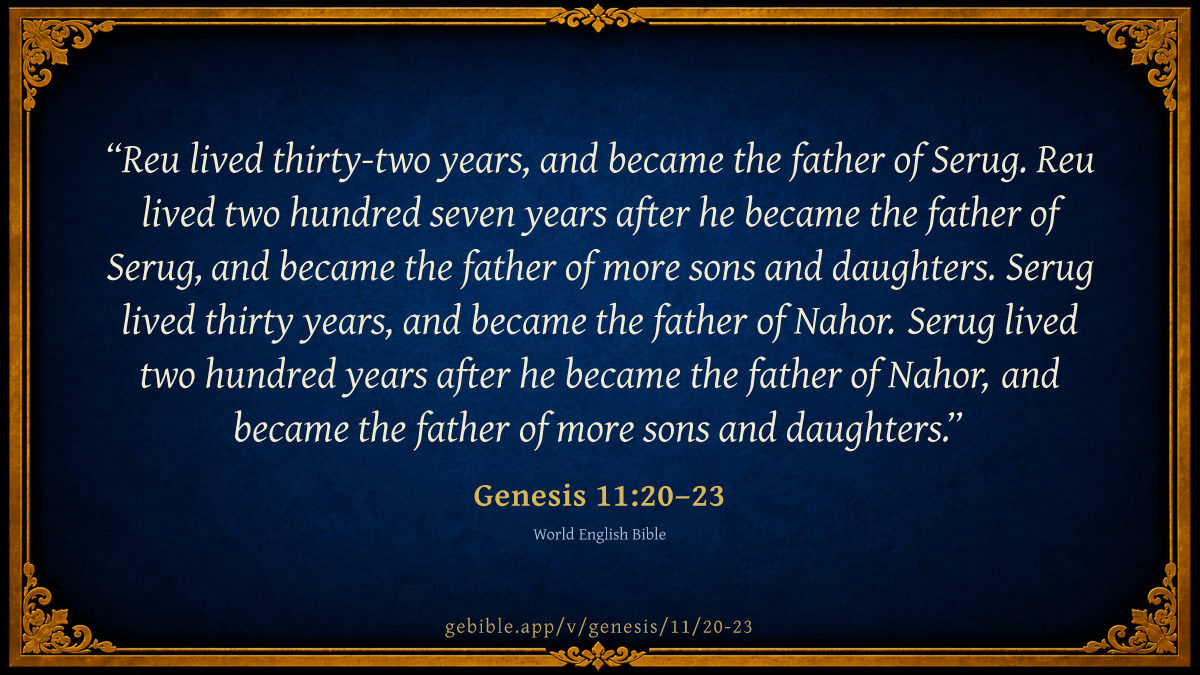
20Reu lived thirty-two years, and became the father of Serug.21Reu lived two hundred seven years after he became the father of Serug, and became the father of more sons and daughters.
22Serug lived thirty years, and became the father of Nahor.23Serug lived two hundred years after he became the father of Nahor, and became the father of more sons and daughters.
Luke 3:35(v20)the son of Serug, the son of Reu, the son of Peleg, the son of Eber, the son of Shelah,
Joshua 24:2(v22)Joshua said to all the people, “Yahweh, the God of Israel, says, ‘Your fathers lived of old time beyond the River, even Terah, the father…
Cross-references from openbible.info (CC BY 4.0)
Explain this passage (6 sources)
Historical commentary, presented as a primary source — not an endorsement.
John Trapp1656 · Public DomainOn v22Gen 11:22 And Serug lived thirty years, and begat…
Gen 11:22 And Serug lived thirty years, and begat Nahor:
Ver. 22. And begat Nahor.] Who, first of the patriarchs, fell to idolatry: for Laban sware by Nahor’s gods.
John Trapp, A Commentary or Exposition upon All the Books of the Old and New Testament (1647–1656) — public domain. Text from a community e-Sword module.
John Gill1763 · Public DomainOn vv20–23And Nahor lived twenty nine years, and begat Terah.…
And Nahor lived twenty nine years, and begat Terah. The father of Abraham, and the first of the patriarchs of this line of Shem that fell off from the true religion to idolatry.
And Nahor lived twenty nine years, and begat Terah. The father of Abraham, and the first of the patriarchs of this line of Shem that fell off from the true religion to idolatry.
Read full note →
Genesis 11:25
gen 11:25
gen 11:25
gen 11:25And Nahor lived, after he begat Terah, one hundred and ninteen years,.... In all one hundred and forty eight years; so sensibly did the lives of the patriarchs decrease: in the days of Nahor, the Arabic writers (t) say, was a great earthquake, which had never been observed before; idolaters increasing and offering their children to demons, God raised a tempest like a deluge, which broke their images and destroyed their temples in Arabia, and covered them in heaps of sand, which remained to the days of those writers, as they affirm: in his days it is also said Spain, Portugal, and Arragon were founded (u):
and begat sons and daughters; of whom no other account is given: he died, as a Jewish chronologer says (w), in the one hundred and tenth year of Abraham.
(t) Patricides, p. 15. Elmacinus, p. 30. apud Hottinger. p. 279, 280. (u) Juchasin, fol. 135. 2. (w) R. Gedaliah, ut supra. (fol. 2. 1.)
John Gill's Exposition of the Whole Bible (1746–1763) — public domain (CC PDM 1.0). Text via the HelloAO Bible API.
Haydock's Catholic Bible Commentary1859 · Public DomainOn v20Sarug: in whose days St. Epiphanius places the origin…
Sarug: in whose days St. Epiphanius places the origin of idolatry; but Eusebius (Præp. i. v. & 9.) thinks it began in Egypt, among the posterity of Cham. (Calmet)
George Leo Haydock (1774–1849), Haydock's Catholic Family Bible and Commentary, 1859 edition — public domain. Excludes Psalms (Douay-Rheims chapter numbering differs from Protestant) and Deuterocanonical books (Catholic canon only).
The Cambridge Bible for Schools and Colleges1878 · Public DomainOn vv20, 2220. Serug] The name of a town and region…
20. Serug] The name of a town and region near Haran in Mesopotamia in the land of the upper Euphrates.
The Cambridge Bible for Schools and Colleges (gen. ed. J. J. S. Perowne; Cambridge University Press, 1878–1918) — public domain. Text from a community e-Sword module.
The Pulpit Commentary1880 · Public DomainOn vv20, 22Vers. 20, 21. And Reu lived two and thirty…
Vers. 20, 21. And Reu lived two and thirty years, and begat Serug. Vine-shoot, from sarag, to wind (Gesenius, Lange, Lewis, Murphy); strength, firmness, from the sense of twisting which the root bears (Furst). And Reu lived after he begat Serug two hundred and seven years (in all 239), and begat sons and daughters.
The Pulpit Commentary (1880–1919), ed. H.D.M. Spence-Jones & Joseph S. Exell — public domain. Text from a community e-Sword module.
unfoldingWord translationNotes2017 · CC BY-SA 4.0On vv20, 22General Information:
General Information:
The records in Genesis 11:12-25 have the same format. See how you translated them in Genesis 11:12-13. (See: How to Translate Names and Numbers)

John Trapp 1656 · Public Domain On v22 Gen 11:22 And Serug lived thirty years, and begat…
Gen 11:22 And Serug lived thirty years, and begat Nahor:
Ver. 22. And begat Nahor.] Who, first of the patriarchs, fell to idolatry: for Laban sware by Nahor’s gods.
John Trapp, A Commentary or Exposition upon All the Books of the Old and New Testament (1647–1656) — public domain. Text from a community e-Sword module.
John Gill 1763 · Public Domain On vv20–23 And Nahor lived twenty nine years, and begat Terah.…
And Nahor lived twenty nine years, and begat Terah. The father of Abraham, and the first of the patriarchs of this line of Shem that fell off from the true religion to idolatry.
And Nahor lived twenty nine years, and begat Terah. The father of Abraham, and the first of the patriarchs of this line of Shem that fell off from the true religion to idolatry.
Read full note →
Genesis 11:25
gen 11:25
gen 11:25
gen 11:25And Nahor lived, after he begat Terah, one hundred and ninteen years,.... In all one hundred and forty eight years; so sensibly did the lives of the patriarchs decrease: in the days of Nahor, the Arabic writers (t) say, was a great earthquake, which had never been observed before; idolaters increasing and offering their children to demons, God raised a tempest like a deluge, which broke their images and destroyed their temples in Arabia, and covered them in heaps of sand, which remained to the days of those writers, as they affirm: in his days it is also said Spain, Portugal, and Arragon were founded (u):
and begat sons and daughters; of whom no other account is given: he died, as a Jewish chronologer says (w), in the one hundred and tenth year of Abraham.
(t) Patricides, p. 15. Elmacinus, p. 30. apud Hottinger. p. 279, 280. (u) Juchasin, fol. 135. 2. (w) R. Gedaliah, ut supra. (fol. 2. 1.)
John Gill's Exposition of the Whole Bible (1746–1763) — public domain (CC PDM 1.0). Text via the HelloAO Bible API.
Haydock's Catholic Bible Commentary 1859 · Public Domain On v20 Sarug: in whose days St. Epiphanius places the origin…
Sarug: in whose days St. Epiphanius places the origin of idolatry; but Eusebius (Præp. i. v. & 9.) thinks it began in Egypt, among the posterity of Cham. (Calmet)
George Leo Haydock (1774–1849), Haydock's Catholic Family Bible and Commentary, 1859 edition — public domain. Excludes Psalms (Douay-Rheims chapter numbering differs from Protestant) and Deuterocanonical books (Catholic canon only).
The Cambridge Bible for Schools and Colleges 1878 · Public Domain On vv20, 22 20. Serug] The name of a town and region…
20. Serug] The name of a town and region near Haran in Mesopotamia in the land of the upper Euphrates.
The Cambridge Bible for Schools and Colleges (gen. ed. J. J. S. Perowne; Cambridge University Press, 1878–1918) — public domain. Text from a community e-Sword module.
The Pulpit Commentary 1880 · Public Domain On vv20, 22 Vers. 20, 21. And Reu lived two and thirty…
Vers. 20, 21. And Reu lived two and thirty years, and begat Serug. Vine-shoot, from sarag, to wind (Gesenius, Lange, Lewis, Murphy); strength, firmness, from the sense of twisting which the root bears (Furst). And Reu lived after he begat Serug two hundred and seven years (in all 239), and begat sons and daughters.
The Pulpit Commentary (1880–1919), ed. H.D.M. Spence-Jones & Joseph S. Exell — public domain. Text from a community e-Sword module.
unfoldingWord translationNotes 2017 · CC BY-SA 4.0 On vv20, 22 General Information:
General Information:
The records in Genesis 11:12-25 have the same format. See how you translated them in Genesis 11:12-13. (See: How to Translate Names and Numbers)
unfoldingWord translationNotes — © Distant Shores Media and the Door43 World Missions Community, licensed CC BY-SA 4.0. Source: git.door43.org/Door43/en_tn.