
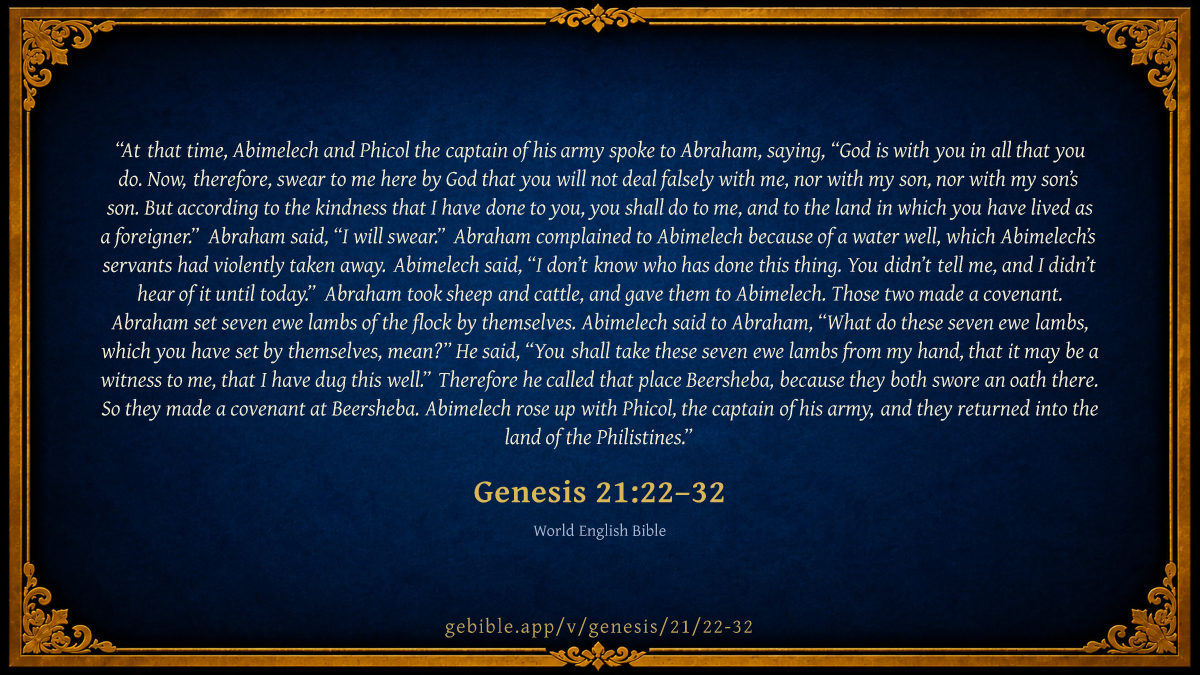
At that time, Abimelech and Phicol the captain of his army spoke to Abraham, saying, “God is with you in all that you do. Now, therefore, swear to me here by God that you will not deal falsely with me, nor with my son, nor with my son’s son. But according to the kindness that I have done to you, you shall do to me, and to the land in which you have lived as a foreigner.”
Abraham said, “I will swear.” Abraham complained to Abimelech because of a water well, which Abimelech’s servants had violently taken away. Abimelech said, “I don’t know who has done this thing. You didn’t tell me, and I didn’t hear of it until today.”
Abraham took sheep and cattle, and gave them to Abimelech. Those two made a covenant. Abraham set seven ewe lambs of the flock by themselves. Abimelech said to Abraham, “What do these seven ewe lambs, which you have set by themselves, mean?”
He said, “You shall take these seven ewe lambs from my hand, that it may be a witness to me, that I have dug this well.” Therefore he called that place Beersheba, because they both swore an oath there. So they made a covenant at Beersheba. Abimelech rose up with Phicol, the captain of his army, and they returned into the land of the Philistines.
John Calvin 1540 · Public Domain On vv22, 23, 24, 25, 27, 28, 31 22. And it came to pass at that time.…
22. And it came to pass at that time. Moses relates, that this covenant was entered into between Abraham and Abimelech, for the purpose of showing, that after various agitations, some repose was, at length, granted to the holy man. He had been constrained, as a wanderer, and without a fixed abode, to move his tent from place to place, during sixty years. But although God would have him to be a sojourner even unto death, yet, under king Abimelech, he granted him a quiet habitation. And it is the design of Moses to show, how it happened, that he occupied one place longer than he was wont. The circumstance of time is to be noted; namely, soon after he had dismissed his son. For it seems that his great trouble was immediately followed by this consolation, not only that he might have some relaxation from continued inconveniences, but that he might be the more cheerful, and might the more quietly occupy himself in the education of his little son Isaac. It is however certain, that the covenant was not, in every respect, an occasion of joy to him; for he perceived that he was tried by indirect methods, and that there were many persons in that region, to whom he was disagreeable and hateful. The king, indeed openly avowed his own suspicions of him: it was, however, the highest honor, that the king of the place should go, of his own accord, to a stranger, to enter into a covenant with him. Yet it may be asked, whether this covenant was made on just and equal conditions, as is the custom among allies? I certainly do not doubt, that Abraham freely paid due honor to the king; nor is it probable that the king intended to detract anything from his own dignity, in order to confer it upon Abraham. What, then, did he do? Truly, while he allowed Abraham a free dwelling-place, he would yet hold him bound to himself by an oath.
God is with thee in all that thou doest. He commences in friendly and bland terms; he does not accuse Abraham nor complain that he had neglected any duty towards himself, but declares that he earnestly desires his friendship; still the conclusion is, that he wishes to be on his guard against him. It may then be asked, Whence had he this suspicion, or fear, first of a stranger, and, secondly, of an honest and moderate man? In the first place, we know that the heathen are often anxious without cause, and are alarmed even in seasons of quiet. Next, Abraham was a man deserving of reverence; the number of servants in his house seemed like a little nation; and there is no doubt, that his virtues would acquire for him great dignity; hence it was, that Abimelech suspected his power. But whereas Abimelech had a private consideration for himself in this matter; the Lord, who best knows how to direct events, provided, in this way, for the repose of his servant. We may, however, learn, from the example of Abraham, if, at any time, the gifts of God excite the enmity of the men of this world against us, to conduct ourselves with such moderation, that they may find nothing amiss in us.
John Calvin's Commentaries (1540-1563) — public domain. Text from the Calvin Translation Society English edition (1840s-50s) via the Christian Classics Ethereal Library (ccel.org). Calvin's coverage is partial (roughly two-thirds of the Bible); uncommented books and verses are honest gaps, never fabricated. The 19th-century editor's footnotes and remarks are omitted so the notes are faithfully Calvin's own voice.
Geneva Bible translators 1599 · Public Domain On vv23, 24, 26, 31, 32 Hebrew, deal falsely with me, or lie.
Hebrew, deal falsely with me, or lie.
Geneva Bible (1599) marginal notes — public domain.
John Trapp 1656 · Public Domain On vv22, 23, 24, 25, 26, 27, 28, 29, 31, 32 Gen 21:22 And it came to pass at that…
Gen 21:22 And it came to pass at that time, that Abimelech and Phichol the chief captain of his host spake unto Abraham, saying, God [is] with thee in all that thou doest:
Ver. 22. God is with thee in all that thou doest.] Natural conscience cannot choose but stoop to the image of God stamped upon the natures and works of the godly. When they see in them that which is above ordinary, they are afraid of the name of God called upon by them. Their hearts even ache and quake within them. {Deu 28:10}
John Trapp, A Commentary or Exposition upon All the Books of the Old and New Testament (1647–1656) — public domain. Text from a community e-Sword module.
Matthew Poole 1685 · Public Domain On vv22, 23, 24, 25, 26, 27, 30, 31, 32 We plainly see that God blesseth and prospereth thee…
We plainly see that God blesseth and prospereth thee in all thy undertakings.
Of Abimelech, see Gen 20:2.
Matthew Poole's English Annotations on the Holy Bible (1683–1685) — public domain. Text from a community e-Sword/MySword module.
Matthew Henry 1710 · Public Domain On v22 We have here an account of the treaty between…
We have here an account of the treaty between Abimelech and Abraham, in which appears the accomplishment of that promise (Gen 12:2) that God would make his name great. His friendship is valued, is courted, though a stranger, though a tenant at will to the Canaanites and Perizzites.
I. The league is proposed by Abimelech, and Phichol his prime-minister of state and general of his army.
Read full note →
1. The inducement to it was God's favour to Abraham (Gen 21:22): "God is with thee in all that thou doest, and we cannot but take notice of it." Note, (1.) God in his providence sometimes shows his people such tokens for good that their neighbours cannot but take notice of it, Psa 86:17. Their affairs do so visibly prosper, and they have such remarkable success in their undertakings, that a confession is extorted from all about them of God's presence with them. (2.) It is good being in favour with those that are in favour with God, and having an interest in those that have an interest in heaven, Zac 8:23. We will go with you, for we have heard that God is with you. We do well for ourselves if we have fellowship with those that have fellowship with God, Jo1 1:3.
2. The tenour of it was, in general, that there should be a firm and constant friendship between the two families, which should not upon any account be violated. This bond of friendship must be strengthened by the bond of an oath, in which the true God was appealed to, both as a witness of their sincerity and an avenger in case either side were treacherous, Gen 21:23. Observe, (1.) He desires the entail of this league upon his posterity and the extension of it to his people. He would have his son, and his son's son, and his land likewise, to have the benefit of it. Good men should secure an alliance and communion with the favourites of Heaven, not for themselves only, but for theirs also. (2.) He reminds Abraham of the fair treatment he had found among them: According to the kindness I have done unto thee. As those that have received kindness must return it, so those that have shown kindness may expect it.
II. It is consented to by Abraham, with a particular clause inserted about a well. In Abraham's part of this transaction observe,
1. He was ready to enter into this league with Abimelech, finding him to be a man of honour and conscience, and that had the fear of God before his eyes: I will swear, Gen 21:24. Note, (1.) Religion does not make men morose and unconversable; I am sure it ought not. We must not, under colour of shunning bad company, be sour to all company, and jealous of every body. (2.) An honest mind does not startle at giving assurances: if Abraham say that he will be true to Abimelech, he is not afraid to swear it; an oath is for confirmation.
2. He prudently settled the matter concerning a well, about which Abimelech's servants had quarrelled with him. Wells of water, it seems, were choice goods in that country: thanks be to God, that they are not so scarce in ours. (1.) Abraham mildly told Abimelech of it, Gen 21:25. Note, If our brother trespass against us, we must, with the meekness of wisdom, tell him his fault, that the matter may be fairly accommodated and an end made of it, Mat 18:15. (2.) He acquiesced in Abimelech's justification of himself in this matter: I wot not who has done this thing, Gen 21:26. Many are suspected of injustice and unkindness that are perfectly innocent, and we ought to be glad when they clear themselves. The faults of servants must not be imputed to their masters, unless they know of them and justify them; and no more can be expected from an honest man than that he be ready to do right as soon as he knows that he has done wrong. (3.) He took care to have his title to the well cleared and confirmed, to prevent any disputes or quarrels for the future, Gen 21:30. It is justice, as well as wisdom, to do thus, in perptuam rei memoriam - that the circumstance may be perpetually remembered.
3. He made a very handsome present to Abimelech, Gen 21:27. It was not any thing curious or fine that he presented to him, but that which was valuable and useful - sheep and oxen, in gratitude for Abimelech's kindness to him, and in token of hearty friendship between them. The interchanging of kind offices is the improving of love: that which is mine is my friend's.
4. He ratified the covenant by an oath, and registered it by giving a new name to the place (Gen 21:31), Beer-sheba, the well of the oath, in remembrance of the covenant they swore to, that they might be ever mindful of it; or the well of seven, in remembrance of the seven lambs given to Abimelech, as a consideration for his confirming Abraham's title to that well. Note, Bargains made must be remembered, that we may make them good, and may not break our word through oversight.
Matthew Henry's Commentary on the Whole Bible (1708–1710) — public domain (CC PDM 1.0). Text via the HelloAO Bible API.
John Gill 1763 · Public Domain On vv22–31 Now therefore swear unto me here by God,.... By…
Now therefore swear unto me here by God,.... By the true and living God, by whom only an oath is to be taken, who was Abraham's God, and whom Abimelech seems to have known and to have been a worshipper of; and therefore moves for an oath to be taken by him, which he knew would be sacred and binding to Abraham, could he prevail upon him to swear:
that thou wilt not deal falsely with me, nor with my son, nor with my son's son; perhaps he had heard that God had promised to give the whole land of Canaan to him and his posterity, and among the rest his kingdom, which was a part of it; and, seeing him grow great and powerful, he could not tell how soon it might be ere he was put in the possession of it, whether in his own time, or his son's, or his grandson's; and therefore desires Abraham that he would swear to do no hurt to them whenever it should be:
Read full note →
but according to the kindness I have done unto thee, thou shalt do unto me, and to the land wherein thou hast sojourned; that, as he had given him full liberty to sojourn in any part of his kingdom where he pleased, so, when the whole country should come into his possession, that he, or his son, or his grandson, in whatsoever time it should be, might quietly enjoy their own land, and all the inhabitants of it; at least that they might not be driven out of it, but sojourn in it as he had done.
John Gill's Exposition of the Whole Bible (1746–1763) — public domain (CC PDM 1.0). Text via the HelloAO Bible API.
John Wesley 1765 · Public Domain On v31 Beer-sheba - That is, the well of the oath,…
Beer-sheba - That is, the well of the oath, in remembrance of the covenant that they swear to, that they might be ever mindful of it.
John Wesley, Explanatory Notes Upon the Whole Bible (1754–1765) — public domain. Text via the GEBible commentary corpus.
Adam Clarke 1810 · Public Domain On vv22, 23, 25, 26, 27, 28, 31 Verse 22. At that time] This may either refer…
Verse 22. At that time] This may either refer to the transactions recorded in the preceding chapter, or to the time of Ishmael's marriage, but most probably to the former.
God is with thee] מימרא דיי melmera daiya, the WORD of Jehovah; see before, Ge 15:1. That the Chaldee paraphrasts use this term, not for a word spoken, but in the same sense in which St. John uses the λογος του Θεου, the WORD of God, Joh 1:1, must be evident to every unprejudiced reader. See Clarke on Ge 15:1.
Adam Clarke's Commentary on the Bible (1810–1826) — public domain. Text from a community e-Sword/MySword module.
Joseph Benson 1811 · Public Domain On v31 Gen 21:31. Beer-sheba — That is, the well of…
Gen 21:31. Beer-sheba — That is, the well of the oath, or the well of the seven, (for the word equally signifies either,) alluding to the seven ewe- lambs which Abraham set by themselves and gave to Abimelech. Probably when a covenant was solemnly made and confirmed by an oath, seven lambs or sheep were wont to be offered.
Joseph Benson's Commentary on the Old and New Testaments (1811–1818) — public domain. Text from a community e-Sword module.
Haydock's Catholic Bible Commentary 1859 · Public Domain On vv22, 23, 24, 27, 31 Abimelech, king of Gerara, who knew that Abraham was…
Abimelech, king of Gerara, who knew that Abraham was a prophet, and a favourite of God, chap. xx. 7. (Haydock)
George Leo Haydock (1774–1849), Haydock's Catholic Family Bible and Commentary, 1859 edition — public domain. Excludes Psalms (Douay-Rheims chapter numbering differs from Protestant) and Deuterocanonical books (Catholic canon only).
Robert Jamieson, A. R. Fausset & David Brown 1871 · Public Domain On vv22, 25 COVENANT. (Gen 21:22-34)
COVENANT. (Gen 21:22-34)
Abimelech and Phichol--Here a proof of the promise (Gen 12:2) being fulfilled, in a native prince wishing to form a solemn league with Abraham. The proposal was reasonable, and agreed to [Gen 21:24].
Jamieson, Fausset & Brown — Commentary Critical and Explanatory on the Whole Bible (1871) — public domain (CC PDM 1.0). Text via the HelloAO Bible API.
Daniel D. Whedon 1874 · Public Domain On vv22, 23, 25, 26, 27, 30, 31, 32 COVENANT BETWEEN ABRAHAM AND ABIMELECH, Gen_21:22-34.
COVENANT BETWEEN ABRAHAM AND ABIMELECH, Gen_21:22-34.
22. At that time — The time of Ishmael’s expulsion. Phichol, which means mouth of all, is supposed to be, like the name Abimelech, an official title. Here, and at Gen_26:26, the name is given to the chief captain of his host, a sort of prime officer and minister to the king.
Read full note →
God is with thee — This fact had been strikingly manifest to Abimelech in the matters related in chap. 20, and probably other incidents of God’s care for Abraham had been made known to him. He, therefore, desired a closer alliance with him.
Daniel D. Whedon (gen. ed.), Commentary on the Old and New Testaments (1874–1909) — public domain. Text from a community e-Sword module.
The Cambridge Bible for Schools and Colleges 1878 · Public Domain On vv22, 23, 25, 27, 28, 30, 31, 32 22–34 (E, J). The Covenant between Abraham and Abimelech…
22–34 (E, J). The Covenant between Abraham and Abimelech at Beer-sheba
22. Abimelech] This passage seems to be a continuation of chap. 20.
Read full note →
Phicol the captain of his host] For this title, cf. 1Sa_14:50; 2Sa_2:8 (where it is applied to Abner); Gen_24:2 (to Joab). It shews that Abimelech was a petty king of some importance.
Here and in Gen_21:32, the LXX inserts another name and title between Abimelech and Phicol, Ὀχοζὰθ ὁ νυμφαγωγὸς αὐτοῦ, “Ahuzzath his friend.” This name occurs with that of Phicol again in Gen_26:26.
God is with thee] Cf. 20, Gen_26:28. Abimelech has had reason to discern the meaning of the description of Abraham, in Gen_20:7, as “a prophet.”
The Cambridge Bible for Schools and Colleges (gen. ed. J. J. S. Perowne; Cambridge University Press, 1878–1918) — public domain. Text from a community e-Sword module.
Ellicott's Commentary for English Readers 1878 · Public Domain On vv22, 23, 26, 28, 31 (22) Abimelech and Phichol.—Abimelech, that is Father-King, was the…
ABIMELECH’S COVENANT WITH ABRAHAM.
(22) Abimelech and Phichol.—Abimelech, that is Father-King, was the title not only of the king of Gerar, but of the kings of the Philistines generally (Gen_26:1; 1Sa_21:10, marg.; Psalms 34, tit.). In like manner Phichol, mouth of all, seems to have been the official designation of the prime minister, and commander-in-chief. This visit of the king and his vizier appears to have taken place some considerable time after the beginning of the sojourn of Abraham at Gerar; for the friendly feelings which then existed had evidently given way to a coolness, occasioned by the quarrels between their herdsmen. In this narrative, Abraham appears as a chieftain powerful enough for a king to wish to make an alliance with him; and thus his abandonment of Sarah, and his receiving of presents in compensation for the wrong done her, seems the more unworthy of him. Abimelech, on the other hand, acts generously as of old, and shows no signs of ill-will at the growing power of one whose expectation was that his race would possess the whole land.
A Bible Commentary for English Readers, edited by Charles John Ellicott (1878–1897) — public domain. Text from a community e-Sword module.
The Pulpit Commentary 1880 · Public Domain On vv22, 23, 24, 25, 26, 27, 28, 31 And it came to pass at that time, possibly…
CHAPTER 21:22-34
And it came to pass at that time, possibly in immediate sequence to the incident of the preceding chapter, but, "according to the common law of Hebrew narrative, probably not long after the birth of Isaac." (Murphy)that Abimelech the king of Gerar (Gen_20:2 Gen_26:1, Gen_26:16) and Phi-chol if the name be Shemitic, "mouth of all," i.e. spokesman of all (Murphy), ruler of all (Gesenius); or the distinguished" (Furst); believed to have been a titular designation of the Philistine monarch"s grand vizier or prime minister (Lange, "Speaker"s Commentary"), who was alsothe chief captain of his host (i.e. the commander-in-chief of his forces) spake unto Abraham (having come from Gerar for the purpose), saying, God is with thee in all that thou doest a conviction derived from his former acquaintance with the patriarch, (Ge 20) his knowledge of Isaac s birth, and his general observation of the patriarch"s prosperity.
Read full note →
Vers. 22-34.
Abimelech and Abraham, or ancient covenanters.
I THE POLITICAL ALLIANCE.
1. The contemplated object. Peace. What modern monarchs mostly desire at the close of exhausting campaigns is here sought before campaigns begin.
2. The covenanting parties. Two powerful princes, in their conduct exemplifying the spirit of unity and peace which should bind together private persons in their daily intercourse, as well as kings and nations in their political alliance.
3. The impelling motives. Worldly policy may have urged Abimelech to cement a league with the powerful chieftain in his neighborhood, but religions affinity would also seem to have exercised an influence in drawing him to seek the friendship of one who appeared to enjoy celestial protection. Good men mostly desire to have the saints as friends, and even the wicked can perceive an advantage in being allied to the righteous. Abraham"s acquiescence in the king"s proposal was no doubt dictated by a peaceable disposition, a sense of equity, a spirit of contentment, and an unwavering confidence in God.
1. The public ceremonial. The alliance was contracted
1. by means of amicable conference, and
2. with the sanctions of religion.
II THE FRIENDLY REMONSTRANCE.
1. The palpable injury. The herdsmen of the king had appropriated Abraham"s well. God s people, though expected meekly to suffer wrong, cannot always help seeing that it is wrong they suffer. Nor are they called upon to bear what by lawful means they are able to redress. A godly man is entitled to be careful of his property, to preserve it from damage, protect it from theft, and recover it when stolen or lost.
2. The mistaken charge. Abraham, thinking the herdsmen had acted on their master"s orders, reproved Abimelech. This, however, was an error, which shows
(1) that a person cannot always be held responsible for what his servants do,
(2) that it is wrong to judge on insufficient evidence with reference to the characters and conduct of others, and
(3) that in making charges or preferring complaints it is well to avoid both heat of temper and severity of language.
1. The satisfactory explanation. Abimelech declared himself perfectly unacquainted with the wrong which had been done to Abraham, and immediately returned the well, which discovers how easily misunderstandings might be removed if, instead of harboring enmity, men would resort to friendly conference. It is as much the duty of him who has a grievance to reveal it, as it is the duty of him who has caused the grievance to remove it.
2. The prudent measure Abraham gave Abimelech seven ewe lambs as a witness that he had digged the well, and consequently had a right to its possession. Seemingly betraying a secret suspicion of the prince"s veracity, the act aimed at preventing any recurrence of the grievance, and in this light it appears to have been regarded by Abimelech. Good men should not only rectify the wrongs they do to one another, but adopt all wise precautions against their repetition.
III THE PLEASING RESULT.
1. Peace established, Abimelech and Phichol, having accomplished their mission, returned to Philistia. "Blessed are the peace-makers," and "beautiful upon the mountains are the feet of him that publisheth peace.
2. Peace commemorated. Abraham instituted two memorials of the important transactions, naming the well Beersheba, and planting a tamarisk beside his tent. It is good to remember God"s mercies, of which national and civil quietude is one of the greatest, and it is becoming to erect memorials of both privileges and obligations.
3. Peace enjoyed. Abraham called on the name of the everlasting God. As a planter of tamarisks, the patriarch has been styled the father of civilization; it is more important to remark that he never neglected to worship God himself and publish his salvation to others. Happy they who can do both in peace!
HOMILIES BY R.A. REDFORD Vers. 22-34.
A covenant between the patriarch and the Philistine king.
Abraham a sojourner in that land, afterwards the troubler of Israel; for his sake as discipline, for their sakes as opportunity.
1. God"s care for those beyond the covenant. A Beersheba in a heathen land.
2. The things of this world made a channel of higher blessings. The covenant arising out of bodily wants a civil agreement. The oath a testimony to God where reverently made.
3. He is not far from every one of us. The neighborhood of Beersheba, the revelation of Jehovah, the little company of believers.
4. The blessing made manifest. The days spent in Philistia left behind them some enlightenment.
5. Adaptation of Divine truth to those to whom it is sent. Abraham"s name of God, Jehovah El Olam; the two revelations, the God of nature and the God of grace. The name of the Lord itself an invitation to believe and live. Paul at Athens adapted himself in preaching to the people"s knowledge while leading them to faith. R.
The Pulpit Commentary (1880–1919), ed. H.D.M. Spence-Jones & Joseph S. Exell — public domain. Text from a community e-Sword module.
The Biblical Illustrator 1887 · Public Domain On vv22–23 God is with thee in all that thou doest
Gen_21:22
God is with thee in all that thou doest
Read full note →
Christian prosperity
I. ALL CHRISTIAN PROSPERITY IS CONSCIOUSLY IDENTIFIED WITH GOD.
II. ALL CHRISTIAN PROSPERITY IS ALSO CONSCIOUSLY IDENTIFIED WITH CHRISTIAN CHARACTER.
III. ALL CHRISTIAN PROSPERITY IS IDENTIFIED WITH CHRISTIAN ENTERPRISE. Between God blessing a mans labour and God doing a mans labour for him there is a wide difference. God wont pasture the sheep, but God will multiply the flock. God wont dig the ground, but Hell water it with rain and dew.
IV. IN ALL CHRISTIAN PROSPERITY THERE IS A CONSCIOUS INFLUENCE AND POWER. (A. W. Potts.)
The son of the bondwoman
Gods care even for Ishmael--for one who would appear to be outside all covenant blessings--is a most encouraging fact!
1. God delivered him in extremity. He heard his cry and distress. He knew his needs; for God always knows our needs and how to supply them. There is a well for bondmen as well as for the free. Gods living well is to be reached in any position of life. The word is nigh thee, in thine heart, etc. Rom_10:8).
2. God was with the son of the bondwoman as he developed. He was with him as he grew up, and gave him favour in the sight of others. God is ever seeking by His Holy Spirit to mould the characters of the worst for good.
3. God had intentions of grace towards the slave-mothers boy. He gave a promise to him as well as to Isaac.
4. God shewed how He was with Ishmael by quickening his faculties. He became an archer. He had to learn to defend himself, and secure for himself by Gods help a position. The fiery defenders of faith and controversial champions of the truth have their sphere as well as the pious, plodding, pastors of Christs flock. We have all to learn to appreciate diversity of talents, and to remember that skill in any work is the outcome of independence, resolution and energy.
4. Gods care was seen in the selection of the place of abode for the son of the bond-woman. He gave to him the desert for his domain, a place in which he might roam and pitch his tent at his own suggestion. The wilderness was the most suitable place for this man of wild nature. Some grow up under the sweet shadow of the home, and ever find there a resting-place. They occupy themselves in some work at hand, pleasant and profitable; but others wander off, perhaps go to sea, emigrate, engage in sheep-farming, cattle-tending in some wide and lonely ranch, or go to gold-digging and diamond-hunting. God works through all these phases of life to discipline the heart. He follows each one, and cares for all.
5. God also was with Ishmael, securing for him acceptance among others. He was to dwell in the presence of his brethren (Gen_16:12). Though cast out by Abraham he was not cast off by God, or cut off from all interchange with others.
6. God was with Ishmael to the end of his life. He had a shorter life than Isaac. Ishmael died at a hundred and thirty years old, Isaac at a hundred and eighty. Evidently the active, restless, wandering, hazardous life was more wearing and consuming than the calm and meditative life of pastoral Isaac. But that his death was recorded shows that it was noticed by God. (F. Hastings.)
The Biblical Illustrator, edited by Joseph S. Exell (c. 1880s–1900s) — public domain. Text from a community e-Sword module.
The Preacher's Complete Homiletical Commentary 1892 · Public Domain On v22 Gen_21:22. Phichol.] Name signifies “mouth of all,” i.e., all-commanding.…
CRITICAL NOTES.—
Gen_21:22. Phichol.] Name signifies “mouth of all,” i.e., all-commanding. Probably an official title.
Read full note →
Gen_21:23. Nor with my son, nor with my son’s son.] The LXX. has “neither my seed, nor my name.” Murphy renders it kin and kith, “to represent the conversational alliterative phrase of the original.”
Gen_21:31. Beersheba.] “The well of the oath,” or, “the well of the seven.” The latter meaning may have some allusion to the seven lambs by which Abraham secured the possession of the well. (Gen_21:29-30.) The Heb. word for taking an oath comes from the same root which signifies seven. The reason is, an oath was confirmed by seven witnesses. Herodotus says that the Arabians chose some seven things for the confirmation of the oath. They sware both of them; Heb., were sworn. In Heb., “swearing” is always represented by the passive form of speech, conveying the idea that one is adjured by another, or has an oath imposed upon him by another.
Gen_21:32. Thus they made a covenant.] “Cut a covenant,” according to the usual Heb. expression. Hence, probably, animals were slain, and the covenant thus ratified by the parties passing between the divided portions.
MAIN HOMILETICS OF THE PARAGRAPH—Gen_21:22-32
ABRAHAM THE FRIEND OF MAN
This treaty between Abimelech and Abraham brings out that kindness and goodwill towards men for which the Patriarch was as remarkable as for his piety towards God. He was to be known afterwards as the “Friend of God,” and no one can be such without being also the friend of man.
I. He yields readily to the request for his friendship. There were lower, as well as higher motives which led Abimelech to seek the friendship of Abraham. He was a heathen king, having little knowledge of the true God, and very imperfect conceptions of human duty. We cannot suppose that he desired the friendship of Abraham purely on the highest grounds. His motives were a mixture of good and evil.
1. Expediency. There is a worldly, calculating prudence which takes that course most profitable for the time, and regards not its entire moral bearings. This is expediency considered in its bad sense. There is little doubt but that there was some trace of this worldly policy in the conduct of Abimelech. Abraham had become a rich and powerful man, and was every day increasing in influence. It would be, therefore, greatly to the advantage of this king to seek an alliance with him. There is something here, no doubt, of that selfishness to which our poor human nature is so prone.
2. The worship of success. It is the way of the world to idolize success. When men have attained to great prosperity they are credited with many and great virtues, which in humbler ways of life would escape recognition. Men may admire virtue, but they adore worldly splendour and magnificence. The king was not unmindful of the fact that Abraham was a good man and deserved success, yet still the adoration of that success, considered by itself, greatly influenced him in seeking the friendship of a man of such good social standing.
3. The admiration of goodness. We must also credit Abimelech with this higher motive. The facts were clearly before him. In the defeat of the four kings, in the twofold deliverance of Sarah, in the miraculous birth of Isaac, in the growing power of the Patriarch, and in the richness of his heritage of promise, Abimelech had full evidence that this man was greatly favoured and blessed of God. There is a certain atmosphere about good and holy men which others immediately detect, and in which they are compelled to feel awe and reverence. Abraham encouraged this request for his friendship, though the motives which prompted it were not altogether pure. He was ready to swear allegiance and constant friendship (Gen_21:24). He knew that it is only from weak beginnings that men can advance to the nobility of goodness. He knew that his special position in the Covenant did not cut him off from the rest of mankind. They, too, stood in certain relations to God, and lay under obligations to God which no facts of depravity and no special favours to individual men could set aside. It was not for himself alone that Abraham was thus favoured and visited. He was destined to become a blessing to all the families of mankind.
II. He undertakes the duties of friendship. He freely accepts all the conditions which Abimelech lays down for him.
1. True and righteous dealing. “Swear that thou wilt not deal falsely with me” (Gen_21:23). Lasting friendship can only be raised upon the foundations of truth and justice.
2. Gratitude for favours shown. “According to the kindness that I have done unto thee, thou shalt do unto me” (Gen_21:23). True friendship is always mindful of favours received. Gratitude towards men is a duty as well as towards God, and must be shown when men (even though imperfectly) reflect the kindness of God.
3. Faithfulness to the faults of a friend. There was a matter of dispute which must be settled before the treaty can be made. Abraham was careful to point out to Abimelech what seemed to be his fault (Gen_21:25). That openness which shrinks not to point out the faults of another is the duty of true friendship. It is that reproof of the righteous which smites with kind intent. The result of this faithfulness must have been grateful to Abraham, for Abimelech was able to clear himself entirely from blame (Gen_21:26). Thus, in the long run, it is best to be perfectly open and sincere. A clear conscience is the best safeguard of any true and lasting brotherhood amongst men.
III. He recognises the sacredness of friendship. He gives it the sanctions of religion by appealing to God as a witness to his sincerity (Gen_21:24). Abraham needed not to be bound in this way by a solemn outward form, but he submitted to it for the good of future generations. He wished these obligations to be strengthened by the external rites of religion. Even though he had seen fit to pledge his bare word, unaccompanied by any outward form, he would still have regarded the Godward aspects of the relationship into which he was about to enter. As one who lived by faith he could not separate any portion of human life or activity from the control and direction of God.
SUGGESTIVE COMMENTS ON THE VERSES
Gen_21:22. He “saw that God was with him.” Such was the motive which induced this friendly request. Probably the news of the extraordinary birth of Isaac, and of the various incidents which had grown out of it, had reached the court of Abimelech, and become a topic of conversation. “This,” he would perhaps say to himself, “is a great man, and a great family, and will become a great nation; the blessing of heaven attends him. It is our wisdom, therefore, to take the earliest opportunity to put ourselves on good terms with him.” In proposing this, he was acting more for his interest than he was aware of; for God in blessing Abraham had promised to “bless them that blessed him, and to curse them that cursed him.” In making a covenant therefore with Abraham, he was virtually making a covenant with the God of Abraham.—(Bush.)
The evident blessing of God upon the righteous raises a feeling of reverence even in the minds of those who are outside the Church.
He who lives a godly and righteous life will have a growing influence, so that, at length, men will regard him with something of awe and veneration. In this way the humblest Christian gains a dignity and power which marks him as one of God’s nobility. This is the crown of glory which the world sets upon the head of the righteous.
The fact that God is with a man cannot long remain unknown to others.
Abimelech believed that God had blessed Abraham, upon stronger grounds than those afforded by the sight of his temporal prosperity. God had appeared to him in a dream to interpose on behalf of the patriarch. Isaac had been born by an evident interference of the Divine power, so that the family of Abraham seemed destined to achieve greatness and distinction amongst mankind.
Gen_21:23-24. “Swear unto me by God.” Such was the solemnity with which he wished the friendship to be confirmed. With this request Abraham complied, though we cannot suppose that he needed to be sworn not to deal falsely; but as posterity was concerned, the more solemn the engagement the better. But why should covenants, promises, oaths be necessary in the commerce of human life? It is, alas, for no other reason than that men are false, treacherous, and perfidious: The manners and customs of past times only serve to convince us that in every age the corruption of man has been so great upon the earth that ordinary obligations will not bind; that without the sanctions of religion neither the sense of honour or justice, or interest, will avail to preserve men in a course of rigid integrity. No other argument is necessary to prove that our nature is depraved than the necessity of solemn appeals to the Deity, making “an oath for confirmation the end of all strife.”—(Bush.)
The necessities of human society require some condescension on the part of believers.
Abraham quickly consents to so reasonable a request from so honourable a person. The wisdom from above is “easy to be entreated” (Jas_3:17). The churl Nabal holds it a goodly thing to hold off. It is but manners to reciprocate: the very publicans can find in their hearts to do good to those that have been good to them” (Mat_5:46-47).—(Trapp.)
Abraham would readily lend himself to any suggestions which would be likely to promote peace with his neighbours. He who was destined by Providence to bear so prominent a part in the revelation of the Gospel, would be likely to share something of its spirit.
Gen_21:25. Abraham takes occasion to remonstrate with Abimelech about a well which his people had seized. Wells were extremely valuable in Palestine on account of the long absence of rain between the latter or vernal rain ending in March, and the early or autumnal rain beginning in November. The digging of a well was therefore a matter of the greatest moment, and often gave a certain title to the adjacent fields. Hence the many disputes about wells, as the neighbouring emirs or chieftains were jealous of rights so acquired, and often sought to enter by the strong hand on the labours of patient industry.—(Murphy.)
Abraham: A peacemaker.
1. He bears an injury long, without seeking to redress it by forcible means. Men who are disposed to quarrel can easily magnify even the slightest neglect or offence into a gross affront.
2. He is desirous of removing every barrier in the way of peace. He refers now to this matter of the well when Abimelech requests his friendship, in order that there might be nothing to mar it.
Gen_21:26. The wrong had not been done by him, nor with his consent; it was the act of his servants—that is, his officers, who, perhaps, had pretended his authority for their unjust spoliation, than which nothing is more common among the minions and creatures of sovereignty. Subjects are wronged, oppressed, despoiled, and yet their grievances never reach the ears of rulers, because the oppressors find it for their own interest to bar access to all voices but their own. Too often are not only the consciences, but the very senses of princes taken into the keeping of corrupt and unprincipled officials.—(Bush).
Suspicion is the bane of friendship, and the sooner it is proved to be groundless the better.
Abimelech was no unworthy example of meekness. He shows no irritation at a reproof which, in point of fact, was unjust. He appreciated the pure motives which prompted it.
Gen_21:27-32. That these animals were intended for sacrifice seems probable from the last clause of the verse, which informs us that they both made, or, as the Hebrew has it, cut a covenant—i.e. made a covenant by cutting the victims in pieces. But why the sheep and oxen are said first to have been presented to Abimelech is not so clear, unless it were that Abraham designed to do him greater honour by giving him the animals to offer before the Lord. As if duly mindful of his rank as a subject, and desirous of showing a proper respect to the king, he seems to have studied to give him the precedency in the whole transaction.—(Bush).
Abraham lays more stress on a public attestation that he has dug, and is therefore the owner of this well, than on all the rest of the treaty. Seven is the number of sanctity, and therefore of obligation. This number is accordingly figured in some part of the form of confederation; in the present case in the seven ewe lambs, which Abraham tenders, and Abimelech, in token of consent, accepts at his hand. The name of the well is remarkable as an instance of the various meanings attached to nearly the same sound. Even in Hebrew it means the well of seven, or the well of the oath, as the roots of seven, and of the verb meaning to swear, have the same radical letters. Bir es Seba means the well of seven or of the lion.—(Murphy).
Thus worthily does the first chapter in the history of treaties open.—(Kitto)
The alliance here ratified may be regarded as a prophecy of the all-embracing mercy of the Gospel, whose provisions are for all men, both Jews and Gentiles.
The Preacher's Complete Homiletical Commentary (gen. ed. Joseph S. Exell; Funk & Wagnalls, c. 1892) — public domain (pre-1929). A full-Bible homiletical/sermon-outline anthology covering 65 of 66 books (2 John is absent from the source module). Text from a community e-Sword module.
Paul E. Kretzmann 1924 · Public Domain On v22 The Covenant Between Abraham and Abimelech
The Covenant Between Abraham and Abimelech
v. 22. And it came to pass at that time that Abimelech and Phichol, the chief captain of his host, spake unto Abraham, saying, God is with thee in all that thou doest;
Read full note →
v. 23. now, therefore, swear unto me here by God that thou wilt not deal falsely with me, nor with my son, nor with my son’s son, but according to the kindness that I have done unto thee thou shalt do unto me and to the land wherein thou hast sojourned. Abraham was still living in the land of the Philistines, and the latter were unable to deny that a special blessing of God rested upon Abraham. This fact finally prompted Abimelech to propose a covenant between himself and Abraham, in order to secure the friendship of this man for himself and his children. The chief condition was that there was to be no false or double dealing, and Abimelech reminds Abraham of the fact that he had shown merciful kindness to him at the time when he lived in Gerar, Gen 20:15. His appeal was to Abraham’s generosity, gratitude, and faithfulness.
v. 24. And Abraham said, I will swear. He was ready to make such a covenant; he had no hopes for the personal possession of Canaan. But before he subscribes to any further promises, he distinguishes between political and private rights.
v. 25. And Abraham reproved Abimelech because of a well of water which Abimelech’s servants had violently taken away. That was a grievance which required adjustment before any pact could be made.
v. 26. And Abimelech said, I wot not who hath done this thing, neither didst thou tell me, neither yet heard I of it but today. This explanation, accompanied, as it was, with the order to return the well to its rightful owner; was satisfactory; it showed the fairness of Abimelech in all his doing.
v. 27. And Abraham took sheep and oxen and gave them unto Abimelech; and both of them made a covenant. The presents were the token of the covenant on the part of Abraham which was now formally entered upon by both.
v. 28. And Abraham set seven ewe lambs of the flock by themselves.
v. 29. And Abimelech said unto Abraham, What mean these seven ewe lambs which thou hast set by themselves?
v. 30. And he said, For these seven ewe lambs shalt thou take of my hand, that they may be a witness unto me that I have digged this well. This was a special transaction with reference to the well which the servants of Abimelech had taken from Abraham. Abimelech’s surprised question as to the meaning of this action received the answer that the king was to take them from the hand of Abraham for a witness to the latter that he had caused this well to be dug. Not to redeem the well, therefore, but to secure his property against any possible claims in the future Abraham set the seven ewe lambs aside.
v. 31. Wherefore she called that place Beersheba, because there they sware both of them. With an oath they confirmed their covenant, and therefore the place of their meeting was ever afterward known as Beersheba, "the well of the oath. " It is about twenty-five miles from Hebron, on the road to Egypt, where there are two wells to this day.
v. 32. Thus they made a covenant at Beersheba. Then Abimelech rose up and Phichol, the chief captain of his host, and they returned in to the land of the Philistines, that is, to Philistia proper, which was along the Mediterranean Sea.
v. 33. And Abraham planted a grove in Beersheba, and called there on the name of the Lord, the everlasting God.
v. 34. And Abraham sojourned in the Philistines’ land many days. As he had done in other places, Gen 12:8; Gen 13:18, so Abraham did here. Having planted a tamarisk, a tree which grew to a remarkable height and furnished a wide shade, he proclaimed there the name of the eternal God, chiefly to his own household, but also to others that might come along this way. This he continued as long as he lived this nomadic life in the territory of the Philistines, for they considered this section a part of the country under their control. That is the chief work of the believers on earth, to praise the name, the mercy, the faithfulness of God and to proclaim His Word. Thus they do what they can to bring all men to the knowledge of the truth.
Paul E. Kretzmann, Popular Commentary of the Bible (1921–1924) — public domain. Text from a community e-Sword module.
unfoldingWord translationNotes 2017 · CC BY-SA 4.0 On vv22, 25, 28, 31 It came about at that time
It came about at that time
This phrase marks the beginning of a new part of the story. If your language has a way for doing this, you could consider using it here. (See: Introduction of a New Event)
Read full note →
Phicol
This is the name of a man. (See: How to Translate Names)
captain of his army
"commander of his army"
his army
The word "his" refers to Abimelech.
God is with you in all that you do
Here the phrase "is with you" is an idiom that means God helps or blesses Abraham. AT: "God blesses everything you do" (See: Idiom)
Now therefore
The word "Now" does not mean "at this moment," but is used to draw attention to the important point that follows. AT: "Therefore" (See: Assumed Knowledge and Implicit Information)
swear to me here by God
This is an idiom meaning to make a solemn oath witnessed by a higher authority, in this instance, God. AT: "promise me with God as your witness" (See: Idiom)
that you will not deal falsely with me
"that you will not lie to me"
will not deal falsely ... with my descendants
This can be stated in positive form. AT: "will deal honestly with me and my descendants" (See: Double Negatives)
Show to me ... covenant faithfulness that I have shown to you
The two men had made a covenant with each other. The abstract noun "faithfulness" can be stated as "faithful" or "loyal." AT: "Be as faithful to me and to the land as I have been to you" (See: Abstract Nouns)
to the land
Here "land" stands for the people. AT: "to the people of the land" (See: Metonymy)
I swear
This can be stated with the understood information. AT: "I swear to be as faithful to you and your people as you have been to me" (See: Ellipsis)
translationWords
Abimelech
Abraham
oath
descend
covenant faithfulness
unfoldingWord translationNotes — © Distant Shores Media and the Door43 World Missions Community, licensed CC BY-SA 4.0. Source: git.door43.org/Door43/en_tn.
Tyndale Open Study Notes 2022 · CC BY-SA 4.0 On vv22, 25, 27, 32 21:22-34 This passage, at its climax, explains the name…
21:22-34 This passage, at its climax, explains the name of Beersheba, Abraham’s home (21:31-34). Beersheba reflected the covenant Abraham made with the residents of the land, which enabled him to dwell there in peace and prosperity. God’s promise was coming to fruition (12:7; 13:14-17; 15:7, 18-21; 17:8).
21:22-23 Abimelech pressed for the treaty so that Abraham would not cheat or deceive him. Abimelech knew that God was blessing Abraham even though Abraham was not entirely trustworthy (20:9-10). This sad contradiction made the treaty necessary. By contrast, God’s faithful people are exhorted to speak the truth (Eph 4:15, 25), and Jesus warned against manipulating truth by the clever use of oaths (Matt 5:37; Jas 5:12).
Tyndale Open Study Notes — © Tyndale Open Resources, licensed CC BY-SA 4.0. Text via the HelloAO Bible API.