
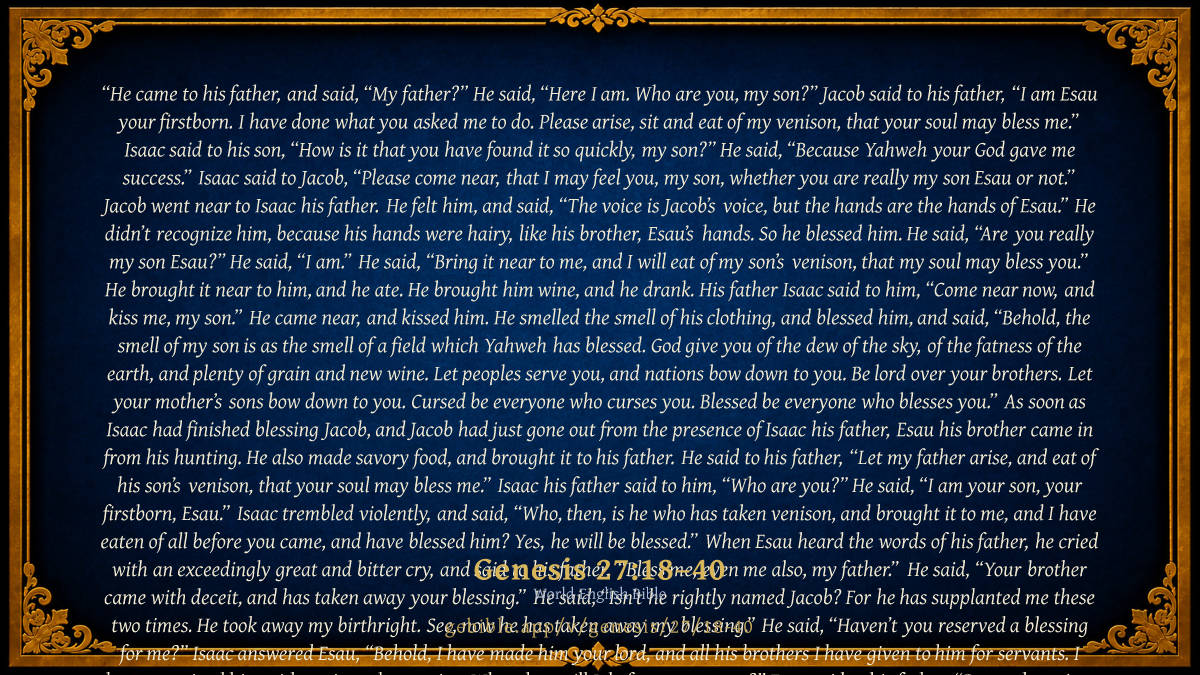
He came to his father, and said, “My father?” He said, “Here I am. Who are you, my son?”
Jacob said to his father, “I am Esau your firstborn. I have done what you asked me to do. Please arise, sit and eat of my venison, that your soul may bless me.”
Isaac said to his son, “How is it that you have found it so quickly, my son?” He said, “Because Yahweh your God gave me success.”
Isaac said to Jacob, “Please come near, that I may feel you, my son, whether you are really my son Esau or not.”
Jacob went near to Isaac his father. He felt him, and said, “The voice is Jacob’s voice, but the hands are the hands of Esau.” He didn’t recognize him, because his hands were hairy, like his brother, Esau’s hands. So he blessed him. He said, “Are you really my son Esau?” He said, “I am.”
He said, “Bring it near to me, and I will eat of my son’s venison, that my soul may bless you.” He brought it near to him, and he ate. He brought him wine, and he drank.
His father Isaac said to him, “Come near now, and kiss me, my son.”
He came near, and kissed him. He smelled the smell of his clothing, and blessed him, and said, “Behold, the smell of my son is as the smell of a field which Yahweh has blessed.
God give you of the dew of the sky, of the fatness of the earth, and plenty of grain and new wine.
Let peoples serve you, and nations bow down to you. Be lord over your brothers. Let your mother’s sons bow down to you. Cursed be everyone who curses you. Blessed be everyone who blesses you.”
As soon as Isaac had finished blessing Jacob, and Jacob had just gone out from the presence of Isaac his father, Esau his brother came in from his hunting. He also made savory food, and brought it to his father. He said to his father, “Let my father arise, and eat of his son’s venison, that your soul may bless me.”
Isaac his father said to him, “Who are you?” He said, “I am your son, your firstborn, Esau.”
Isaac trembled violently, and said, “Who, then, is he who has taken venison, and brought it to me, and I have eaten of all before you came, and have blessed him? Yes, he will be blessed.”
When Esau heard the words of his father, he cried with an exceedingly great and bitter cry, and said to his father, “Bless me, even me also, my father.”
He said, “Your brother came with deceit, and has taken away your blessing.”
He said, “Isn’t he rightly named Jacob? For he has supplanted me these two times. He took away my birthright. See, now he has taken away my blessing.” He said, “Haven’t you reserved a blessing for me?”
Isaac answered Esau, “Behold, I have made him your lord, and all his brothers I have given to him for servants. I have sustained him with grain and new wine. What then will I do for you, my son?”
Esau said to his father, “Do you have just one blessing, my father? Bless me, even me also, my father.” Esau lifted up his voice, and wept.
Isaac his father answered him, “Behold, your dwelling will be of the fatness of the earth, and of the dew of the sky from above.
You will live by your sword, and you will serve your brother. It will happen, when you will break loose, that you will shake his yoke from off your neck.”
John Calvin 1540 · Public Domain On vv19, 21, 26, 27, 29, 30, 33, 34, 36, 37, 38, 39, 40 19. And Jacob said unto his father, I am…
19. And Jacob said unto his father, I am Esau At first Jacob was timid and anxious; now, having dismissed his fear, he confidently and audaciously lies. By which example we are taught, that when any one has transgressed the proper bounds of duty, he soon allows himself unmeasured license. Wherefore there is nothing better than for each to keep himself within the limits divinely prescribed to him, lest by attempting more than is lawful, he should open the door to Satan. I have before shown how far his seeking the blessing by fraud, and insinuating himself into the possession of it by falsehood, was contrary to faith. Yet this particular fault and divergence from the right path, did not prevent the faith which had been produced by the oracle from holding on, in some way, its course. In excusing the quickness of his return by saying that the venison was brought to him by God, he speaks in accordance with the rule of piety: he sins, however, in mixing the sacred name of God with his own falsehoods. Thus, when there is a departure from truth, the reverence which is apparently shown to God is nothing else than a profanation of his glory. It was right that the prosperous issue of his hunting should be ascribed to the providence of God, lest we should imagine that any good thing was the result of chance; but when Jacob pretended that God was the author of a benefit which had not been granted to himself, and that, too, as a cloak for his deception, his fault was not free from perjury.
John Calvin's Commentaries (1540-1563) — public domain. Text from the Calvin Translation Society English edition (1840s-50s) via the Christian Classics Ethereal Library (ccel.org). Calvin's coverage is partial (roughly two-thirds of the Bible); uncommented books and verses are honest gaps, never fabricated. The 19th-century editor's footnotes and remarks are omitted so the notes are faithfully Calvin's own voice.
Geneva Bible translators 1599 · Public Domain On vv19, 22, 24, 33, 36, 37, 38, 40 Although Jacob was assured of this blessing by faith:…
Although Jacob was assured of this blessing by faith: yet he did evil to seek it by lies, and the more because he abuseth God’s name thereunto.
Geneva Bible (1599) marginal notes — public domain.
John Trapp 1656 · Public Domain On vv19–40 Gen 27:19 And Jacob said unto his father, I…
Gen 27:19 And Jacob said unto his father, I [am] Esau thy firstborn; I have done according as thou badest me: arise, I pray thee, sit and eat of my venison, that thy soul may bless me.
Ver. 19. I am Esau thy firstborn, &c.] Here he utters three lies in a breath: besides his ascribing to God that he did, {Gen 27:20} so taking that reverend name in vain. This was his sin, and he smarted for it to his dying day: for he had scarcely a merry hour after this; but God followed him with one sorrow upon another, to teach him and us what an "evil and bitter thing sin is," {Jer 2:19} and how it ensnares and ensnarls us. Aristotle could say, that a lie is in itself evil and wicked. {a} The Hebrews call it Aven, a great iniquity. And the Scripture reckons it among monstrous sins, {Rev 21:8} and condemns it to hell, - whether it be the officious, merry, or pernicious lie. Indeed, every lie is pernicious to ourselves or others, or both; because flatly forbidden of God, and because it is against the order of nature, and for that "no lie is of the truth," as St John hath it, {1Jn 2:21} but of the devil, who began, and still upholds his kingdom by lies. {Joh 8:44} Contrarily, God is truth, and his children are all such as will not lie, {Isa 63:8 Rev 14:5} at least, not get a haunt and a habit of lying, which David calls "a way of lying": "Remove from me the way of lying," saith he, {Psa 119:29} that I make not a trade or common practice of it. We find that {1Sa 21:2} he very roundly telleth two or three lies together, as Jacob here did; and all deliberate. So that tale he told Achish of invading the south of Judah, when he had been upon the Geshurites and Gerarites. {1Sa 27:8-11} I know not how it can be excused. But this was not David’s "way," his common course; pity it should. Honest heathens condemned lying; the Persians punished it severely in their children. {b} Homer censures it in Dolon, Ulysses, and others, {c} Clitarchi historici, saith Quintilian, ingenium probatur, fides infamatur. Nepos reporteth of Epaminondas, {d} that he so loved truth that he would not once lie, no, not in jest. A shame to many Christians, who think the officious and sporting lie to be nothing. Whereas {Gal 1:10} we must not speak the truth to please men, much less lie. And for saving ourselves, we must rather die then lie; else Peter had not sinned in denying his Master. As for profiting others, we may not lie, though it were to save a soul. {Rom 3:7} We may as well commit fornication with the Moabites, to draw them to our religion, or steal from rich men to give to the poor, as lie to do another man a good turn. See Job 13:7-9.
Read full note →
{a} Arist. Ethic., lib. iv. cap. 7.
{b} Xenoph., Cyrop., lib. i.
{c} Iσκε ψευδεα πολλα λεγειν ετυμοισιν ομοια. - Hom.
{d} Cor. Nepos in Vita Epam.
John Trapp, A Commentary or Exposition upon All the Books of the Old and New Testament (1647–1656) — public domain. Text from a community e-Sword module.
Matthew Poole 1685 · Public Domain On vv19, 23, 26, 27, 28, 29, 31, 33, 34, 35, 36, 37, 38, 39, 40 This cannot be excused, for it was a manifest…
This cannot be excused, for it was a manifest untruth, and no less is all this following relation, though it pleased God graciously to pardon it; and notwithstanding these failings, to confer the blessing promised upon Jacob.
Matthew Poole's English Annotations on the Holy Bible (1683–1685) — public domain. Text from a community e-Sword/MySword module.
Matthew Henry 1710 · Public Domain On vv18, 30 Observe here, I. The art and assurance with which…
Observe here, I. The art and assurance with which Jacob managed this intrigue. Who would have thought that this plain man could have played his part so well in a design of this nature? His mother having put him in the way of it, and encouraged him in it, he dexterously applied himself to those methods which he had never accustomed himself to, but had always conceived an abhorrence of. Note, Lying is soon learnt. The psalmist speaks of those who, as soon as they are born, speak lies, Psa 58:3; Jer 9:5. I wonder how honest Jacob could so readily turn his tongue to say (Gen 27:19), I am Esau thy first-born; nor do I see how the endeavour of some to bring him off with that equivocation, I am made thy first-born, namely by purchase, does him any service; for when his father asked him (Gen 27:24), Art thou my very son Esau? he said, I am. How could he say, I have done as thou badest me, when he had received no command from his father, but was doing as his mother bade him? How could he say, Eat of my venison, when he knew it came, not from the field, but from the fold? But especially I wonder how he could have the assurance to father it upon God, and to use his name in the cheat (Gen 27:20): The Lord thy God brought it to me. Is this Jacob? Is this Israel indeed, without guile? It is certainly written, not for our imitation, but for our admonition. Let him that thinks he stands take heed lest he fall. Good men have sometimes failed in the exercise of those graces for which they have been most eminent.
II. The success of this management. Jacob with some difficulty gained his point, and obtained the blessing.
Read full note →
1. Isaac was at first dissatisfied, and would have discovered the fraud if he could have trusted his own ears; for the voice was Jacob's voice, Gen 27:22. Providence has ordered a strange variety of voices as well as faces, which is also of use to prevent our being imposed upon; and the voice is a thing not easily disguised nor counterfeited. This may be alluded to to illustrate the character of a hypocrite. His voice is Jacob's voice, but his hands are Esau's. He speaks the language of a saint, but does the works of a sinner; but the judgement will be, as here, by the hands.
2. At length he yielded to the power of the cheat, because the hands were hairy (Gen 27:23), not considering how easy it was to counterfeit that circumstance; and now Jacob carries it on dexterously, sets his venison before his father, and waits at table very officiously, till dinner is done, and the blessing comes to be pronounced in the close of this solemn feast. That which in some small degree extenuates the crime of Rebekah and Jacob is that the fraud was intended, not so much to hasten the fulfilling, as to prevent the thwarting, of the oracle of God: the blessing was just going to be put upon the wrong head, and they thought it was time to bestir themselves. Now let us see how Isaac gave Jacob his blessing, Gen 27:26-29. (1.) He embraced him, in token of a particular affection to him. Those that are blessed of God are kissed with the kisses of his mouth, and they do, by love and loyalty, kiss the Son, Psa 2:12. (2.) He praised him. He smelt the smell of his raiment, and said, See, the smell of my son is as the smell of a field which the Lord hath blessed, that is, like that of the most fragrant flowers and spices. It appeared that God had blessed him, and therefore Isaac would bless him. (3.) He prayed for him, and therein prophesied concerning him. It is the duty of parents to pray for their children, and to bless them in the name of the Lord. And thus, as well as by their baptism, to do what they can to preserve and perpetuate the entail of the covenant in their families. But this was an extraordinary blessing; and Providence so ordered it that Isaac should bestow it upon Jacob ignorantly and by mistake, that it might appear he was beholden to God for it, and not to Isaac. Three things Jacob is here blessed with: - [1.] Plenty (Gen 27:28), heaven and earth concurring to make him rich. [2.] Power (Gen 27:29), particularly dominion over his brethren, namely, Esau and his posterity. [3.] Prevalency with God, and a great interest in Heaven: "Cursed by every one that curseth thee and blessed be he that blesseth thee. Let God be a friend to all thy friends, and an enemy to all they enemies." More is certainly comprised in this blessing than appears prima facie - at first sight. It must amount to an entail of the promise of the Messiah, and of the church; this was, in the patriarchal dialect, the blessing: something spiritual, doubtless, is included in it. First, That from him should come the Messiah, who should have a sovereign dominion on earth. It was that top-branch of his family which people should serve and nations bow down to. See Num 24:19, Out of Jacob shall come he that shall have dominion, the star and sceptre, Gen 27:17. Jacob's dominion over Esau was to be only typical of this, Gen 49:10. Secondly, That from him should come the church, which should be particularly owned and favoured by Heaven. It was part of the blessing of Abraham, when he was first called to be the father of the faithful (Gen 12:3), I will bless those that bless thee; therefore, when Isaac afterwards confirmed the blessing to Jacob, he called it the blessing of Abraham, Gen 28:4. Balaam explains this too, Num 24:9. Note, It is the best and most desirable blessing to stand in relation to Christ and his church, and to be interested in Christ's power and the church's favours.
Matthew Henry's Commentary on the Whole Bible (1708–1710) — public domain (CC PDM 1.0). Text via the HelloAO Bible API.
John Gill 1763 · Public Domain On vv18–40 And he came unto his father,.... Into the tent…
And he came unto his father,.... Into the tent and apartment where he was:
and said, my father; to try whether he was awake, and to let him know that he was come, since he could not see him:
Read full note →
and he said, here am I; what hast thou to say to me?
who art thou, my son? for, from the voice and the quick dispatch made, he suspected it was not his son Esau.
John Gill's Exposition of the Whole Bible (1746–1763) — public domain (CC PDM 1.0). Text via the HelloAO Bible API.
John Wesley 1765 · Public Domain On vv19, 20, 33, 39 And Jacob said, I am Esau - Who would…
And Jacob said, I am Esau - Who would have thought this plain man could have played such a part? His mother having put him in the way of it, he applies himself to those methods which he had never accustomed himself to, but had always conceived an abhorrence of. But lying is soon learned. I wonder how honest Jacob could so readily turn his tongue to say, I am Esau thy first-born: and when his father asked him, ver. 24. Art thou my very son Esau? to reply I am. How could he say, I have done as thou badst me, when he had received no command from his father, but was doing as his mother bid him? How could he say, Eat of my venison, when he knew it came not from the field, but from the fold? But especially I wonder how he could have the forehead to father it upon God, and to use his name in the cheat.
John Wesley, Explanatory Notes Upon the Whole Bible (1754–1765) — public domain. Text via the GEBible commentary corpus.
Adam Clarke 1810 · Public Domain On vv19, 23, 27, 28, 29, 33, 35, 36, 37, 40 Verse 19. I am Esau thy first-born] Here are…
Verse 19. I am Esau thy first-born] Here are many palpable falsehoods, and such as should neither be imitated nor excused. "Jacob," says Calmet, "imposes on his father in three different ways.
1. By his words: I am thy first-born Esau.
Read full note →
2. By his actions; he gives him kids' flesh for venison, and says he had executed his orders, and got it by hunting.
3. By his clothing; he puts on Esau's garments, and the kids' skins upon his hands and the smooth of his neck.
In short, he made use of every species of deception that could be practised on the occasion, in order to accomplish his ends." To attempt to palliate or find excuses for such conduct, instead of serving, disserves the cause of religion and truth. Men have laboured, not only to excuse all this conduct of Rebekah and Jacob, but even to show that it was consistent, and that the whole was according to the mind and will of God!
Non tali auxilio, non defensoribus istis
The cause of God and truth is under no obligation to such defenders; their hands are more unhallowed than those of Uzzah; and however the bearers may stumble, the ark of God requires not their support. It was the design of God that the elder should serve the younger, and he would have brought it about in the way of his own wise and just providence; but means such as here used he could neither sanction nor recommend.
Adam Clarke's Commentary on the Bible (1810–1826) — public domain. Text from a community e-Sword/MySword module.
Joseph Benson 1811 · Public Domain On vv19, 20, 21, 27, 29, 33, 39 Gen 27:19. And Jacob said, I am Esau —…
Gen 27:19. And Jacob said, I am Esau — Who would have thought this plain man could have played such a part? His mother having put him in the way of it, he applies himself to those methods which he had never accustomed himself to, but had always conceived an abhorrence of. But lying is soon learned. I wonder how honest Jacob could so readily turn his tongue to say, I am Esau, thy firstborn: and when his father asked him, (Gen 27:24,) Art thou my very son Esau? to reply, I am. How could he say, I have done as thou badest me, when he had received no command from his father, but was doing as his mother bid him? How could he say, Eat of my venison, when he knew it came not from the field, but from the fold? But especially I wonder how he could have the forehead to father it upon God, and to use his name in the cheat.
Joseph Benson's Commentary on the Old and New Testaments (1811–1818) — public domain. Text from a community e-Sword module.
Haydock's Catholic Bible Commentary 1859 · Public Domain On vv19, 22, 27, 28, 29, 33, 34, 35, 36, 37, 39, 40 I am Esau, thy first-born. St. Augustine, (L. Contra…
I am Esau, thy first-born. St. Augustine, (L. Contra Mendacium, c. x..) treating at large upon this place, excuseth Jacob from a lie, because this whole passage was mysterious, as relating to the preference which was afterwards to be given to the Gentiles before the carnal Jews, which Jacob by prophetic light might understand. So far is certain, that the first birth-right, both by divine election, and by Esau’s free cession, belonged to Jacob: so that if there were any lie in the case, it could be no more than an officious and venial one. (Challoner) --- Ignorance might also excuse them from any sin; as many good and learned men have thought an officious lie to be lawful. (St. Chrysostom,, hom. 52; Origen; Bonfrere.) And even if we allow that they did wrong; the Scripture relates, but does not sanction what they did, Let him that thinks himself to stand, take heed lest he fall, 1 Corinthians x. 12. (Calmet) --- As our Saviour says of St. John the Baptist, He is Elias, Matthew xi, so, Jacob says, I am Esau, not in person , but in right of the first-born. (Worthington)
George Leo Haydock (1774–1849), Haydock's Catholic Family Bible and Commentary, 1859 edition — public domain. Excludes Psalms (Douay-Rheims chapter numbering differs from Protestant) and Deuterocanonical books (Catholic canon only).
Robert Jamieson, A. R. Fausset & David Brown 1871 · Public Domain On vv18, 27, 28, 29, 30, 39 he came unto his father--The scheme planned by the…
he came unto his father--The scheme planned by the mother was to be executed by the son in the father's bedchamber; and it is painful to think of the deliberate falsehoods, as well as daring profanity, he resorted to. The disguise, though wanting in one thing, which had nearly upset the whole plot, succeeded in misleading Isaac; and while giving his paternal embrace, the old man was roused into a state of high satisfaction and delight.
Jamieson, Fausset & Brown — Commentary Critical and Explanatory on the Whole Bible (1871) — public domain (CC PDM 1.0). Text via the HelloAO Bible API.
Daniel D. Whedon 1874 · Public Domain On vv20, 22, 27, 28, 29, 33, 34, 36, 39, 40 20. The Lord thy God brought it to me…
20. The Lord thy God brought it to me — The bold and daring way in which Jacob utters his falsehoods here, and this use of the name Jehovah, is amazing. Isaac seems to have detected Jacob’s voice, and he became suspicious. But he probably mistrusted his own hearing as he did his eyesight. “The scene of the fraud,” says Kalisch, “is described with a psychological skill which rivets the interest, and excites the admiration of the reader.”
Daniel D. Whedon (gen. ed.), Commentary on the Old and New Testaments (1874–1909) — public domain. Text from a community e-Sword module.
The Cambridge Bible for Schools and Colleges 1878 · Public Domain On vv18, 19, 20, 21, 22, 23, 25, 27, 28, 29, 30, 31, 32, 33, 34, 35, 36, 38, 39, 40 18. who art thou, my son] These words indicate…
18. who art thou, my son] These words indicate the state of blindness of Isaac. The element of doubt arises from an imperfect recognition of the voice.
The Cambridge Bible for Schools and Colleges (gen. ed. J. J. S. Perowne; Cambridge University Press, 1878–1918) — public domain. Text from a community e-Sword module.
Ellicott's Commentary for English Readers 1878 · Public Domain On vv19, 20, 21, 26, 27, 28, 29, 31, 33, 36, 38, 39, 40 (19) Arise . . . sit and eat.—The Hebrews…
(19) Arise . . . sit and eat.—The Hebrews at this time, and for centuries, sat at their meals (1Sa_20:25). It was from the Romans that they learned to recline at table, as we find was their custom in the Gospels. It is a mistake, moreover, to suppose that Isaac was a bedridden old man, for Jacob bids him arise and seat himself. Nor does he help him, though his sight was weak. It is only when commanded to draw near that he lets his father touch him.
A Bible Commentary for English Readers, edited by Charles John Ellicott (1878–1897) — public domain. Text from a community e-Sword module.
The Pulpit Commentary 1880 · Public Domain On vv18, 19, 20, 22, 24, 27, 28, 29, 30, 31, 32, 33, 34, 35, 36, 37, 38, 39, 40 And he came unto his father, by this time…
And he came unto his father, by this time a bed-ridden invalid (vide ver. 19)and said, My father. If he attempted to imitate the voice of Esau, he was manifestly unsuccessful; the dull ear of the aged patient was yet acute enough to detect a strangeness in the speaker"s tone. And he said, Here am I who art thou, my son? "He thought be recognized the voice of Jacob; his suspicions were aroused; he knew the crafty disposition of his younger son too well; and he felt the duty of extreme carefulness" (Kalisch).
The Pulpit Commentary (1880–1919), ed. H.D.M. Spence-Jones & Joseph S. Exell — public domain. Text from a community e-Sword module.
The Biblical Illustrator 1887 · Public Domain On vv25, 33 God give thee of the dew of heaven, and…
Gen_27:25-29
God give thee of the dew of heaven, and the fatness of the earth, and plenty of corn and wine
Read full note →
Isaac blessing Jacob
I.
WITH TEMPORAL BLESSINGS.
1. A fertile soil.
2. Abundance of provision.
3. Political pre-eminence.
II. WITH SPIRITUAL BLESSINGS.
1. The channel of spiritual blessing to mankind.
2. A test of character. (T. H. Leale.)
Isaacs blessing--the parents warning
I. First, we shall consider WHEREIN ISAACS BLESSING CONSISTED.
1. Plenty, heaven and earth combining to enrich the happy possessor.
2. Power, almost unlimited, especially over his own brethren.
3. And last, though not the least, a mighty influence with God and a great interest in the courts of heaven. Cursed be every one that curseth thee, and blessed be he that blesseth thee. Or, in other words, Let God be an enemy to all thy enemies, and a friend to all thy friends.
4. Now these, doubtless, were very desirable mercies, and they belonged, by right, to the first-born; though God was pleased sometimes to revoke that taw, and to transfer these blessings from the elder to the younger, as instanced in the case before us, and also in that of Cain and of Reuben. These, I say, were very desirable mercies, and, when accompanied with the Divine sanction, of untold value. But still, after all, they were but temporary. They lasted only for this life; and Jacob, I doubt not, might have managed very well without any one of them. The blessing of Isaac, therefore, must have comprised something more than what we have here recorded; otherwise we may be well assured that Jacob would never have risked so much to obtain it, nor would his mother ever have placed him in so hazardous and perilous a situation. But the fact is, these temporal blessings were but the shadows of better things to come. They were, to use an apostolic phrase, the substance of things hoped for, the evidence of things not seen. They included all those good things which were more particularly specified to Abraham when God entered into covenant with him. They intimated, for instance, in the first place, that from him should descend the Messiah--He who was to be the Prince of the kings of the earth . . . before whom all nations should come and worship . . . and who was to rule them with a rod of iron, and to break them to shivers as a potters vessel. And, in the second place, that from him also should come the church that was to be specially owned and blessed by God; and consequently we find Isaac, when afterwards confirming the blessing to Jacob, calling it the blessing of Abraham.
II. What were THE MEANS THAT REBEKAH ADOPTED to secure the blessing for her favourite son Jacob. They were little else than a tissue of lies and deceit.
III. Let us now see what LESSONS we may gather up from a contemplation of the whole subject.
1. In the first place, then, it reads a very solemn and affecting warning to parents. It teaches the folly and danger of making invidious distinctions between the different members of your families--of showing an undue partiality for one child more than another. It is a withering curse. It introduces discord and dissension into every family wherever it finds a footing, and it is the fruitful source of all evil, social and moral. Whenever, therefore, you feel its chilling influence beginning to steal over you, oh, remember Rebekah, and in the name and strength of your God shake it from you. Give it no encouragement; or, if you must, keep it to yourself. Let no one else ever see or feel it. In the second place, learn from this subject the way in which our Heavenly Father will have us to seek for His blessing. We must come to Him for it in and through our Elder Brother. We must come clothed in His goodly raiment, even that pure and spotless robe which He wrought for us on Calvary. There is no other way under heaven whereby we can be saved. And if you ask me by what means we are to get this goodly raiment--this pure and spotless righteousness, I answer, simply by asking for it. Ask, says your God and Saviour, and you shall have. And although it cost Him a great price--even His own precious blood--yet He offers it to you without money and without price. Oh, go to Him, then, and ask Him for this precious gift; for the gift of God is eternal life. (E. Harper, B. A.)
Isaac blessing Jacob
1. That parents ought to bless their children; too many do curse, and not bless them.
2. Children ought to fear the causeful curses of their parents. The better son feared the curse of his father (Gen_27:12).
3. Parents ought rather to gather a stock of Divine promises, that they may bless their children more out of faith than out of form, praying for them out of a promise, as Isaac did then for his son Jacob, praying that the blessing of Abraham might come upon him (Gen_28:4).
4. A wishing our childrens weal customarily without a praying for them believingly, is neither enough for parents, nor is it all (or at all) that is warranted by Isaacs blessing Jacob here. There is much difference between a formal wish and a faithful prayer for their good.
5. Spiritual blessings must be sought and sued for in their proper season. Here Esau came too late for the blessing, which was bestowed before he lost the right season (which is a part of time above all other parts, even the shine and lustre of time), so could not obtain it, no, not with tears Heb_12:16-17). (C. Ness.)
The Biblical Illustrator, edited by Joseph S. Exell (c. 1880s–1900s) — public domain. Text from a community e-Sword module.
The Preacher's Complete Homiletical Commentary 1892 · Public Domain On vv25, 30 Gen_27:27. And blessed him.] The blessing (Gen_27:27-29) is in…
CRITICAL NOTES.—
Gen_27:27. And blessed him.] The blessing (Gen_27:27-29) is in the form of poetic parallelism.—
Read full note →
Gen_27:28. The dew of heaven, and the fatness of the earth.] In Palestine these are closely connected. The dews are copious, and make up for the lack of rain during several months of the year. The dew of Hermon, and the dew upon the mountains of Zion are spoken of by the Psalmist as an evidence of the Divine blessing. (Psalms 133; Deu_33:13; Deu_33:28.)—
MAIN HOMILETICS OF THE PARAGRAPH.—Gen_27:25-29
ISAAC BLESSING JACOB
The father is at length satisfied, and expresses his paternal affection by a kiss. He accepts his son’s duty and favour in the providing and preparation of the last solemn meal. He then proceeds to bless his son.
I. With temporal blessings.
1. A fertile soil. To him was promised “the fatness of the earth.” This was fulfilled in the exceeding fertility of the Holy Land. (Deu_8:7-9.) This natural richness of the soil was to be replenished by “the dew of heaven,” one blessing answering to and requiring the other. There is a ministry of service and of mediation throughout all parts of God’s works, each department of nature deriving some aid and influence from every other. Hence it is that when God promises one blessing He intends to impart every other blessing which is necessary to complete it. The fatness of the earth shall be answered by the dew of heaven.
2. Abundance of provision. “Corn and wine.” These imply all the rest. All things are promised which are necessary to the sustenance and enjoyment of life.
3. Political pre-eminence. “Let people serve thee.” Here is a promise of universal dominion—lordship over foreign nations. It is also promised that Jacob shall preserve pre-eminence among his own kindred. “Be lord over thy brethren, and let thy mother’s sons bow down to thee.” This was God’s election, that “the elder should serve the younger.” The greatness and importance of the nation were to be developed throughout the line of Isaac’s family.
II. With spiritual blessings. “Cursed be every one that curseth thee, and blessed be he that blesseth thee.” Though not expressed in such clear and full terms, this is virtually the same promise as that made to Abraham. The blessing conveyed to Jacob was—
1. The channel of spiritual blessing to mankind. The seed of Abraham was to proceed throughout history along this chosen line, and in that seed all the families of the earth were to be blessed. “Salvation is of the Jews,” i.e., it must spring forth from them. Also, this blessing was to be—
2. A test of character. A curse was pronounced upon those who should curse Jacob. All who should reject and despise the salvation provided through the seed of Abraham would bring condemnation upon themselves. The position men take up with regard to the salvation offered through the Messiah is a test of spiritual character. Christ was “set for the fall and for the rising of many in Israel.” And by men’s treatment of Him and His claims “the thoughts of many hearts shall be revealed.” The whole of the blessing here promised to Jacob is only realised fully in Christ. The possession of a fertile land, the expansion of the chosen family into a great nation, and the subjugation of other peoples are the prominent features in the promise made to Abraham, and they prefigured the glory and dominion which belong to Messiah’s kingdom.
“The beam that shines from Zion’s hill
Will lighten every land;
The King who reigns on Zion’s throne
Shall all the world command.”
SUGGESTIVE COMMENTS ON THE VERSES
Gen_27:25-26. The kiss was a sign of affection and reverence (Gen_48:10; Psa_2:12). His thus coming in contact with his father’s person would also afford a proof to the senses, from the peculiar scent of his apparel, in favour of his alleged identity. But it was deceiving, if not betraying, his father with a kiss.—(Bush.)
Gen_27:27. The smell in this case was probably occasioned by the aromatic herbs which had been laid up with the clothes, both to prevent their being fretted by the moths, and to give them an agreeable odour. The Orientals are proverbially fond of perfumes. They sprinkle their clothes with scented oils or waters, or fumigate them with the incense from odoriferous woods, or carry such woods or fragrant herbs in a small bag or sewed up in their clothes.—(Bush.)
It is not common to salute, as in England, they simply smell each other; and it is said that some people know their children by the smell. The crown of the head is the principle place for smelling. Of an amiable man it is said, “How sweet is the smell of that man! the smell of his goodness is universal!”—(Roberts.)
Isaac believes, and blessed the younger son in the garments of the elder. If our heavenly father smell upon our backs the savour of our elder brother’s robes, we cannot depart from him unblessed.—(Bp. Hall.)
Gen_27:28. It is probable that the language of the whole verses has a sense beyond that of the simple letter. “The dew of heaven” and the “fatness of the earth” shadow out to us the doctrines of the Gospel and the graces of the Holy Spirit shed forth upon men; in fine, the whole inventory of spiritual mercies which flow to the holy seed in virtue of the covenant made with Abraham. This is confirmed by the drift of the following among other passages—Deu_32:2; Hos_14:6-7; Isa_25:6; Isa_8:8. Indeed, so clearly analogous is this in point of phraseology to the blessing pronounced upon Esau, that, unless we would make them almost equivalent, it would seem imperative upon us to affix some sense to the words over and above that conveyed by the mere letter.—(Bush.)
For Jacob the blessing is, “God give thee of the dew of heaven and the fatness of the earth.” Here the earth is postponed to heaven; the blessings of this world to those of the world to come; the gifts of nature to the gifts of grace. But for Esau the blessing is, “Behold thy dwelling shall be the fatness of the earth, and the dew of heaven from above.” Here heaven is postponed to earth, the spiritual to the natural, the blessings of salvation to temporal prosperity.
Gen_27:29. This is the only part of the blessing that directly comprises spiritual things, and even this is of a peculiar form. It is to be recollected that it was Isaac’s intention to bless Esau, and he may have felt that Esau, after all, was not to be the progenitor of the holy seed. Hence the form of expression is vague enough to apply to temporal things, and yet sufficiently comprehensive to embrace the infliction of the ban of sin, and the diffusion of the blessing of salvation by means of the holy seed.—(Murphy.)
The Preacher's Complete Homiletical Commentary (gen. ed. Joseph S. Exell; Funk & Wagnalls, c. 1892) — public domain (pre-1929). A full-Bible homiletical/sermon-outline anthology covering 65 of 66 books (2 John is absent from the source module). Text from a community e-Sword module.
C. I. Scofield 1917 · Public Domain On vv29, 38 See, Gen 12:3; Gen 15:18, See note 3,(5), (See…
cursed
See, Gen 12:3; Gen 15:18, See note 3,(5), (See Scofield "Gen 15:18").
The Scofield Reference Bible (1917 edition), notes by C. I. Scofield — public domain. Text from a community e-Sword module.
Paul E. Kretzmann 1924 · Public Domain On vv18, 30 Isaac Blesses Jacob
Isaac Blesses Jacob
v. 18. And he came unto his father, and said, My father; and he said, Here am I; who art thou, my son?
Read full note →
v. 19. And Jacob said unto his father, I am Esau, thy first-born; I have done according as thou badest me; arise, I pray thee, sit and eat of my venison, that thy soul may bless me. Jacob here became guilty of his mother’s deceit in deed as well as in words and intent, for he was not Esau, nor was the meat which he was bringing venison. So far as he was concerned, he was trying to obtain his father’s blessing under false pretenses.
v. 20. And Isaac said unto his son, How is it that thou hast found it so quickly, my son? And he said, Because the Lord, thy God, brought it to me. Upon Isaac’s surprised question: How is this? Thou wast quick to find;—Jacob piously refers the supposed luck of his chase to a special blessing of the Lord.
v. 21. And Isaac said unto Jacob, Come near, I pray thee, that I may feel thee, my son, whether thou be my very son Esau or not. Isaac’s surprise changes into suspicion at the sound of Jacob’s voice and at the indefinite answer which was so unlike Esau’s blunt manner. But it was here that Rebekah’s stratagem proved its worth.
v. 22. And Jacob went near unto Isaac, his father; and he felt him, and said, The voice is Jacob’s voice, but the hands are the hands of Esau. Isaac was much nearer being convinced, but his suspicions were not yet allayed altogether.
v. 23. And he discerned him not, because his hands were hairy, as his brother Esau’s hands; so he blessed him. Isaac did not know and recognize Jacob for the person who he really was, the hairiness of his wrists making him inclined to think him Esau, so he made ready to bless him, the act being anticipated by the author.
v. 24. And he said, Art thou my very son Esau? And he said, I am. This bold answer settled the doubts of Isaac to such an extent that he was ready for the meal.
v. 25. And he said, Bring it near to me, and I will eat of my son’s venison, that my soul may bless thee. And he brought it near to him, and he did eat; and he brought him wine, and he drank. Thus Jacob gained his first step.
v. 26. And his father Isaac said unto him, Come near now, and kiss me, my son. It was the kiss of the father which was to introduce the blessing.
v. 27. And he came near, and kissed him; and he smelled the smell of his raiment which the strategy of Rebekah had placed on him, since their odor was that of the fields and of the chase; and blessed him, and said, See, the smell of my son is as the smell of a field which the Lord hath blessed. Isaac’s blessing consisted of inspired utterances looking into the future and transmitting the special blessing of the Lord to Jacob.
v. 28. Therefore God give thee of the dew of heaven, and the fatness of the earth, and plenty of corn and wine. These were temporal gifts, of great importance in the country which Jacob and his children were to possess. The quantity of the dew, especially during the dry season, determined the fruitfulness of the land. The fat, productive fields of the earth were to be his, the result being a rich yield of grain and new wine.
v. 29. Let people serve thee, and nations bow down to thee; be lord over thy brethren, and let thy mother’s sons bow down to thee; cursed be every one that curseth thee, and blessed be he that blesseth thee. This part of the blessing describes the position of influence and power which the descendants of Jacob were to occupy. Not only over his brethren, over the people of his own race, including the children of his brother, he was to be lord, but also over strange people and nations. The idea of a world dominion is thus brought out, culminating in the promise that men would be judged according to their attitude toward him and his descendants. Thus the blessing looks forward to the Messiah, the touchstone of the ages, for to this day the right answer to the question: What think ye of Christ? decides the fate of every person in the world.
Paul E. Kretzmann, Popular Commentary of the Bible (1921–1924) — public domain. Text from a community e-Sword module.
unfoldingWord translationNotes 2017 · CC BY-SA 4.0 On vv18, 20, 22, 24, 26, 28, 29, 30, 32, 34, 36, 38, 39 He said
He said
"And his father replied" or "Isaac replied"
Read full note →
Here I am
"Yes, I am listening" or "Yes, what is it?" See how you translated this in Genesis 22:1.
I have done as you said to me
"I have done what you told me to do"
some of my game
The word "game" refers to wild animals that someone hunts and kills. See how "game" was translated in Genesis 27:3.
translationWords
Jacob
ancestor
Esau
firstborn
bless
unfoldingWord translationNotes — © Distant Shores Media and the Door43 World Missions Community, licensed CC BY-SA 4.0. Source: git.door43.org/Door43/en_tn.
Tyndale Open Study Notes 2022 · CC BY-SA 4.0 On vv18, 20, 30, 33, 34, 36, 37, 39 27:18-29 In scene three, Jacob deceives his father and…
27:18-29 In scene three, Jacob deceives his father and receives the blessing.
27:18-20 Jacob lied about his identity, and then came close to blasphemy by lying about God.
Tyndale Open Study Notes — © Tyndale Open Resources, licensed CC BY-SA 4.0. Text via the HelloAO Bible API.