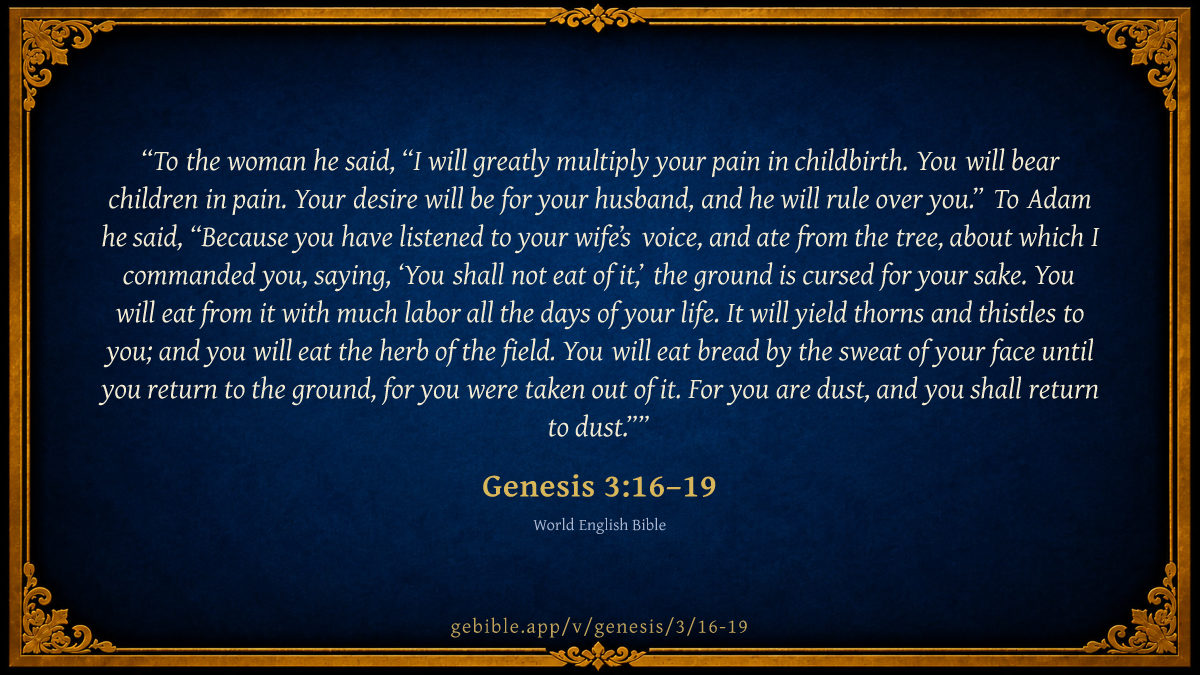
16To the woman he said, “I will greatly multiply your pain in childbirth. You will bear children in pain. Your desire will be for your husband, and he will rule over you.”
17To Adam he said, “Because you have listened to your wife’s voice, and ate from the tree, about which I commanded you, saying, ‘You shall not eat of it,’ the ground is cursed for your sake. You will eat from it with much labor all the days of your life.
18It will yield thorns and thistles to you; and you will eat the herb of the field.
19You will eat bread by the sweat of your face until you return to the ground, for you were taken out of it. For you are dust, and you shall return to dust.”
16 To the woman he said, “I will greatly multiply your pain in childbirth. You will bear children in pain. Your desire will be for your husband, and he will rule over you.”
17 To Adam he said, “Because you have listened to your wife’s voice, and ate from the tree, about which I commanded you, saying, ‘You shall not eat of it,’ the ground is cursed for your sake. You will eat from it with much labor all the days of your life.
18 It will yield thorns and thistles to you; and you will eat the herb of the field.
19 You will eat bread by the sweat of your face until you return to the ground, for you were taken out of it. For you are dust, and you shall return to dust.”
KJVKing James Version
16 Unto the woman he said, I will greatly multiply thy sorrow and thy conception; in sorrow thou shalt bring forth children; and thy desire shall be to thy husband, and he shall rule over thee.
17 And unto Adam he said, Because thou hast hearkened unto the voice of thy wife, and hast eaten of the tree, of which I commanded thee, saying, Thou shalt not eat of it: cursed is the ground for thy sake; in sorrow shalt thou eat of it all the days of thy life;
18 Thorns also and thistles shall it bring forth to thee; and thou shalt eat the herb of the field;
19 In the sweat of thy face shalt thou eat bread, till thou return unto the ground; for out of it wast thou taken: for dust thou art, and unto dust shalt thou return.
Show all 3 translations
JPSJPS Tanakh (1917)
16 Unto the woman He said: 'I will greatly multiply thy pain and thy travail; in pain thou shalt bring forth children; and thy desire shall be to thy husband, and he shall rule over thee.'
17 And unto Adam He said: 'Because thou hast hearkened unto the voice of thy wife, and hast eaten of the tree, of which I commanded thee, saying: Thou shalt not eat of it; cursed is the ground for thy sake; in toil shalt thou eat of it all the days of thy life.
18 Thorns also and thistles shall it bring forth to thee; and thou shalt eat the herb of the field.
19 In the sweat of thy face shalt thou eat bread, till thou return unto the ground; for out of it wast thou taken; for dust thou art, and unto dust shalt thou return.'
Questions where the Bible appears to say two different things, with the passages on each side set together.
Do women have rights?The contradiction sets the silencing-and-subordination passages — Genesis 3:16 (the husband rules over the wife as curse), 1 Timothy 2:12 (woman may not teach…
Titus 2:5(v16)to be sober minded, chaste, workers at home, kind, being in subjection to their own husbands, that God’s word may not be blasphemed.
Ecclesiastes 12:7(v19)and the dust returns to the earth as it was, and the spirit returns to God who gave it.
Colossians 3:18(v16)Wives, be in subjection to your husbands, as is fitting in the Lord.
1 Corinthians 11:3(v16)But I would have you know that the head of every man is Christ, and the head of the woman is man, and the head of Christ is God.
Job 34:15(v19)all flesh would perish together, and man would turn again to dust.
Show all 90 cross-references
Romans 8:20-22(v17)For the creation was subjected to vanity, not of its own will, but because of him who subjected it, in hope that the creation itself also…
Ephesians 5:22-24(v16)Wives, be subject to your own husbands, as to the Lord. For the husband is the head of the wife, as Christ also is the head of the…
1 Timothy 2:15(v16)but she will be saved through her childbearing, if they continue in faith, love, and sanctification with sobriety.
Psalms 104:29(v19)You hide your face; they are troubled. You take away their breath; they die and return to the dust.
1 Corinthians 14:34(v16)Let the wives be quiet in the assemblies, for it has not been permitted for them to be talking except in submission, as the law also says,
Genesis 2:7(v19)Yahweh God formed man from the dust of the ground, and breathed into his nostrils the breath of life; and man became a living soul.
Genesis 5:29(v17)He named him Noah, saying, “This one will comfort us in our work and in the toil of our hands, caused by the ground which Yahweh has…
1 Timothy 2:11-12(v16)Let a woman learn in quietness with full submission. But I don’t permit a woman to teach, nor to exercise authority over a man, but to be…
John 16:21(v16)A woman, when she gives birth, has sorrow because her time has come. But when she has delivered the child, she doesn’t remember the anguish…
1 Corinthians 7:4(v16)The wife doesn’t have authority over her own body, but the husband. Likewise also the husband doesn’t have authority over his own body, but…
Genesis 4:7(v16)If you do well, won’t it be lifted up? If you don’t do well, sin crouches at the door. Its desire is for you, but you are to rule over it.”
Psalms 90:3(vv18–19)You turn man to destruction, saying, “Return, you children of men.”
Ecclesiastes 2:22-23(v17)For what does a man have of all his labor and of the striving of his heart, in which he labors under the sun? For all his days are sorrows,…
Isaiah 24:5-6(v17)The earth also is polluted under its inhabitants, because they have transgressed the laws, violated the statutes, and broken the…
Ephesians 4:28(v19)Let him who stole steal no more; but rather let him labor, producing with his hands something that is good, that he may have something to…
1 Peter 3:1-6(v16)In the same way, wives, be in subjection to your own husbands; so that, even if any don’t obey the Word, they may be won by the behavior of…
Ecclesiastes 3:20(v19)All go to one place. All are from the dust, and all turn to dust again.
John 16:33(v17)I have told you these things, that in me you may have peace. In the world you have trouble; but cheer up! I have overcome the world.”
Jeremiah 6:24(v16)We have heard its report. Our hands become feeble. Anguish has taken hold of us, and pains as of a woman in labor.
Micah 4:9-10(v16)Now why do you cry out aloud? Is there no king in you? Has your counselor perished, that pains have taken hold of you as of a woman in…
1 Corinthians 15:21-22(v19)For since death came by man, the resurrection of the dead also came by man. For as in Adam all die, so also in Christ all will be made…
Genesis 18:27(v19)Abraham answered, “See now, I have taken it on myself to speak to the Lord, although I am dust and ashes.
Numbers 30:13(v16)Every vow, and every binding oath to afflict the soul, her husband may establish it, or her husband may make it void.
Job 14:1(v17)“Man, who is born of a woman, is of few days, and full of trouble.
Genesis 23:4(v19)“I am a stranger and a foreigner living with you. Give me a possession of a burying-place with you, that I may bury my dead out of my…
1 Samuel 4:19-21(v16)His daughter-in-law, Phinehas’ wife, was with child, near to giving birth. When she heard the news that God’s ark was taken and that her…
Job 5:5(v18)whose harvest the hungry eats up, and take it even out of the thorns. The snare gapes for their substance.
Psalms 22:15(v19)My strength is dried up like a potsherd. My tongue sticks to the roof of my mouth. You have brought me into the dust of death.
Psalms 104:14-15(v18)He causes the grass to grow for the livestock, and plants for man to cultivate, that he may produce food out of the earth: wine that makes…
Ecclesiastes 1:3(v19)What does man gain from all his labor in which he labors under the sun?
Isaiah 7:23(v18)It will happen in that day that every place where there were a thousand vines at a thousand silver shekels, shall be for briers and thorns.
Jeremiah 7:23-24(v17)but this thing I commanded them, saying, ‘Listen to my voice, and I will be your God, and you shall be my people. Walk in all the way that…
Daniel 12:2(v19)Many of those who sleep in the dust of the earth will awake, some to everlasting life, and some to shame and everlasting contempt.
Matthew 13:7(v18)Others fell among thorns. The thorns grew up and choked them.
2 Thessalonians 3:10(v19)For even when we were with you, we commanded you this: “If anyone is not willing to work, don’t let him eat.”
Genesis 2:16-17(v17)Yahweh God commanded the man, saying, “You may freely eat of every tree of the garden; but you shall not eat of the tree of the knowledge…
Joshua 23:13(v18)know for a certainty that Yahweh your God will no longer drive these nations from out of your sight; but they shall be a snare and a trap…
Esther 1:20(v16)When the king’s decree which he shall make is published throughout all his kingdom (for it is great), all the wives will give their…
Job 21:26(v19)They lie down alike in the dust. The worm covers them.
Job 31:40(v18)let briers grow instead of wheat, and stinkweed instead of barley.” The words of Job are ended.
Psalms 103:14(v19)For he knows how we are made. He remembers that we are dust.
Psalms 127:2(v17)It is vain for you to rise up early, to stay up late, eating the bread of toil, for he gives sleep to his loved ones.
Proverbs 22:5(v18)Thorns and snares are in the path of the wicked: whoever guards his soul stays from them.
Ecclesiastes 5:17(v17)All his days he also eats in darkness, he is frustrated, and has sickness and wrath.
Isaiah 5:6(v18)I will lay it a wasteland. It won’t be pruned or hoed, but it will grow briers and thorns. I will also command the clouds that they rain no…
Isaiah 13:8(v16)They will be dismayed. Pangs and sorrows will seize them. They will be in pain like a woman in labor. They will look in amazement one at…
Isaiah 32:13(v18)Thorns and briers will come up on my people’s land; yes, on all the houses of joy in the joyous city.
Jeremiah 4:3(v18)For Yahweh says to the men of Judah and to Jerusalem, “Break up your fallow ground, and don’t sow among thorns.
1 Thessalonians 5:3(v16)For when they are saying, “Peace and safety,” then sudden destruction will come on them, like birth pains on a pregnant woman. Then they…
Hebrews 6:8(v18)but if it bears thorns and thistles, it is rejected and near being cursed, whose end is to be burned.
Job 1:21(vv18–19)He said, “Naked I came out of my mother’s womb, and naked will I return there. Yahweh gave, and Yahweh has taken away. Blessed be Yahweh’s…
Genesis 35:16-18(v16)They traveled from Bethel. There was still some distance to come to Ephrath, and Rachel travailed. She had hard labor. When she was in hard…
1 Samuel 15:23-24(v17)For rebellion is as the sin of witchcraft, and stubbornness is as idolatry and teraphim. Because you have rejected Yahweh’s word, he has…
Job 5:6-7(v17)For affliction doesn’t come out of the dust, neither does trouble spring out of the ground; but man is born to trouble, as the sparks fly…
Job 17:13-16(v19)If I look for Sheol as my house, if I have spread my couch in the darkness, if I have said to corruption, ‘You are my father;’ to the worm,…
Job 19:26(v19)After my skin is destroyed, then I will see God in my flesh,
Job 21:17(v17)“How often is it that the lamp of the wicked is put out, that their calamity comes on them, that God distributes sorrows in his anger?
Psalms 22:29(v19)All the rich ones of the earth shall eat and worship. All those who go down to the dust shall bow before him, even he who can’t keep his…
Psalms 104:2(v18)He covers himself with light as with a garment. He stretches out the heavens like a curtain.
Proverbs 21:16(v19)The man who wanders out of the way of understanding shall rest in the assembly of the departed spirits.
Proverbs 24:31(v18)Behold, it was all grown over with thorns. Its surface was covered with nettles, and its stone wall was broken down.
Ecclesiastes 1:13(v19)I applied my heart to seek and to search out by wisdom concerning all that is done under the sky. It is a heavy burden that God has given…
Ecclesiastes 5:15(v19)As he came out of his mother’s womb, naked shall he go again as he came, and shall take nothing for his labor, which he may carry away in…
Isaiah 21:3(v16)Therefore my thighs are filled with anguish. Pains have seized me, like the pains of a woman in labor. I am in so much pain that I can’t…
Isaiah 26:17-18(v16)Just as a woman with child, who draws near the time of her delivery, is in pain and cries out in her pangs, so we have been before you,…
Jeremiah 12:13(v18)They have sown wheat, and have reaped thorns. They have exhausted themselves, and profit nothing. You will be ashamed of your fruits,…
Jeremiah 13:21(v16)What will you say, when he sets over you as head those whom you have yourself taught to be friends to you? Won’t sorrows take hold of you,…
Jeremiah 22:23(v16)Inhabitant of Lebanon, who makes your nest in the cedars, how greatly to be pitied you will be when pangs come on you, the pain as of a…
Matthew 25:26-27(v17)“But his lord answered him, ‘You wicked and slothful servant. You knew that I reap where I didn’t sow, and gather where I didn’t scatter.…
Romans 3:19(v17)Now we know that whatever things the law says, it speaks to those who are under the law, that every mouth may be closed, and all the world…
Romans 5:12-21(v19)Therefore as sin entered into the world through one man, and death through sin; so death passed to all men, because all sinned. For until…
1 Thessalonians 2:9(v19)For you remember, brothers, our labor and travail; for working night and day, that we might not burden any of you, we preached to you the…
Genesis 3:6(v17)When the woman saw that the tree was good for food, and that it was a delight to the eyes, and that the tree was to be desired to make one…
Genesis 3:11(v17)God said, “Who told you that you were naked? Have you eaten from the tree that I commanded you not to eat from?”
Numbers 30:7-8(v16)and her husband hears it, and says nothing to her in the day that he hears it; then her vows shall stand, and her pledges with which she…
Psalms 48:6(v16)Trembling took hold of them there, pain, as of a woman in travail.
Ecclesiastes 1:2-3(v17)“Vanity of vanities,” says the Preacher; “Vanity of vanities, all is vanity.” What does man gain from all his labor in which he labors…
Ecclesiastes 1:13-14(v17)I applied my heart to seek and to search out by wisdom concerning all that is done under the sky. It is a heavy burden that God has given…
Ecclesiastes 2:11(v17)Then I looked at all the works that my hands had worked, and at the labor that I had labored to do; and behold, all was vanity and a…
Ecclesiastes 2:17(v17)So I hated life, because the work that is worked under the sun was grievous to me; for all is vanity and a chasing after wind.
Isaiah 53:11(v16)After the suffering of his soul, he will see the light and be satisfied. My righteous servant will justify many by the knowledge of…
Jeremiah 4:31(v16)For I have heard a voice as of a woman in travail, the anguish as of her who gives birth to her first child, the voice of the daughter of…
Jeremiah 49:24(v16)Damascus has grown feeble, she turns herself to flee, and trembling has seized her. Anguish and sorrows have taken hold of her, as of a…
Matthew 25:45(v17)“Then he will answer them, saying, ‘Most certainly I tell you, because you didn’t do it to one of the least of these, you didn’t do it to…
Luke 19:22(v17)“He said to him, ‘Out of your own mouth I will judge you, you wicked servant! You knew that I am an exacting man, taking up that which I…
90 distinct cross-references across this passage (92 total citations).
Cross-references from openbible.info (CC BY 4.0)
Explain this passage (19 sources)
Historical commentary, presented as a primary source — not an endorsement.
John Calvin1540 · Public DomainOn vv16–1916. Unto the woman he said. In order that…
16. Unto the woman he said. In order that the majesty of the judge may shine the more brightly, God uses no long disputation; whence also we may perceive of what avail are all our tergiversations with him. In bringing the serpent forward, Eve thought she had herself escaped. God, disregarding her cavils, condemns her. Let the sinner, therefore, when he comes to the bar of God, cease to contend, lest he should more severely provoke against himself the anger of him whom he has already too highly offended. We must now consider the kind of punishment imposed upon the woman. When he says, ‘I will multiply thy pains,’ he comprises all the trouble women sustain during pregnancy
It is credible that the woman would have brought forth without pain, or at least without such great suffering, if she had stood in her original condition; but her revolt from God subjected her to inconveniences of this kind. The expression, ‘pains and conception,’ is to be taken by the figure hypallage, for the pains which they endure in consequence of conception. The second punishment which he exacts is subjection. For this form of speech, “Thy desire shall be unto thy husband,” is of the same force as if he had said that she should not be free and at her own command, but subject to the authority of her husband and dependent upon his will; or as if he had said, ‘Thou shalt desire nothing but what thy husband wishes.’ As it is declared afterwards, Unto thee shall be his desire, (Genesis 4:7.) Thus the woman, who had perversely exceeded her proper bounds, is forced back to her own position. She had, indeed, previously been subject to her husband, but that was a liberal and gentle subjection; now, however, she is cast into servitude.
John Calvin's Commentaries (1540-1563) — public domain. Text from the Calvin Translation Society English edition (1840s-50s) via the Christian Classics Ethereal Library (ccel.org). Calvin's coverage is partial (roughly two-thirds of the Bible); uncommented books and verses are honest gaps, never fabricated. The 19th-century editor's footnotes and remarks are omitted so the notes are faithfully Calvin's own voice.
Geneva Bible translators1599 · Public DomainOn vv16–18The Lord comforteth Adam by the promise of the…
The Lord comforteth Adam by the promise of the blessed seed, and also punisheth the body for the sin which the soul should have been punished for; that the spirit having conceived hope of forgiveness, might live by faith.
Geneva Bible (1599) marginal notes — public domain.
John Trapp1656 · Public DomainOn vv16–19Gen 3:16 Unto the woman he said, I will…
Gen 3:16 Unto the woman he said, I will greatly multiply thy sorrow and thy conception; in sorrow thou shalt bring forth children; and thy desire [shall be] to thy husband, and he shall rule over thee.
Ver. 16. I will greatly multiply thy sorrow.] The greatest of sorrows this is, as we are given to understand, both out of divine and human writings. "I had rather die in battle ten times over, than bring forth but once only," said Medea in the tragedy. {a} But we have a better example, in the Ecclesiastical History, {b} of a Roman lady, called Sabina; who, being great with child, was cast in prison for the profession of Christ’s truth. Now when the time came that she should be delivered, and she cried out for extremity of pain, the keeper of the prison asked her why she made such a stir now; and how she would, two or three days hence, endure to die at a stake, or by the sword. She answered, "Now I suffer as a woman, the punishment of my sin; but then I shall not suffer, but Christ shall suffer in me." In peace offerings there might be oil mixed, not so in sin offerings. In our sufferings for Christ there is joy, not so when we suffer for our sins.
Read full note →
In sorrow thou shalt bring forth.] And in sorrow shalt thou bring up, after the birth. {as Gen 50:23} Children are certain cares, but uncertain comforts. {c} Eve had a great catch of it, when she had got a man-child of the Lord, she called him Cain, a possession, as David did Absalom, his father’s peace. But
“ Fallitur augurio spes bona saepe suo .”
Excellently St Gregory, Ante partum liberi sunt onerosi, in partu dolorosi, post partum laboriosi .
And he shall rule over thee בפדך.] Yet not with rigour. She must, though to her grief and regret, be subject to all her husband’s lawful commands and restraints. But he must carry himself as a man of knowledge towards her, and make her yoke as easy as may be. It is remarkable that when the apostle had bid "wives, submit to your own husbands," &c.; {Col 3:19} he doth not say, Husbands, rule over your wives, for that they will do fast enough without bidding; but, "Husbands, love your wives, and be not bitter unto them."
{a} Decies in bello mort mallem quam parere vel semel adhue. - Euripid.
{b} Job. Manlii, loc. com., p. 124.
{c} Liberi sunt dulcis acerbitas, seu - ut Tertul. loquitur - amarissima voluptas
John Trapp, A Commentary or Exposition upon All the Books of the Old and New Testament (1647–1656) — public domain. Text from a community e-Sword module.
Matthew Poole1685 · Public DomainOn vv16–19I will greatly multiply, or certainly, as the repetition…
I will greatly multiply, or certainly, as the repetition of the same word implies.
And thy conception, in diverse pains and infirmities peculiar to thy sex; i.e. Thou shalt have many, and those ofttimes, false and fruitless conceptions, and abortive births; and whereas thou mightest commonly have had many children at one conception, as some few women yet have, now thou shalt ordinarily undergo all the troubles and pains of conception, breeding, and birth, for every child which thou hast. Or,
Read full note →
thy sorrows and thy conception, by a figure called hendiaduo, are put for thy sorrows in conception, or rather in child-bearing, which the Hebrew word here used signifies, Gen 16:4; Jdg 13:3. Aristotle, in his Histor. Animal. 7, 9, observes, that women bring forth young with more pain than any other creatures.
Bring forth children, or bear, for the word notes all the pains and troubles which women have, both in the time of child-bearing, and in the act of bringing forth.
Sons, and daughters too, both being comprehended in the Hebrew word Sons, as Exo 22:24; Psa 128:6.
Thy desire shall be to thy husband; thy desires shall be referred or submitted to thy husband’s will and pleasure to grant or deny them, as he sees fit. Which sense is confirmed from Gen 4:7, where the same phrase is used in the same sense. And this punishment was both very proper for her that committed so great an error, as the eating of the forbidden fruit was, in compliance with her own desire, without asking her husband’s advice or consent, as in all reason she should have done in so weighty and doubtful a matter; and very grievous to her, because women’s affections use to be vehement, and it is irksome to them to have them restrained or denied. Seeing, for want of thy husband’s rule and conduct, thou wast seduced by the serpent, and didst abuse that power I gave thee together with thy husband to draw him to sin, thou shalt now be brought down to a lower degree, for he shall rule thee; not with that sweet and gentle hand which he formerly used, as a guide and counsellor only, but by a higher and harder hand, as a lord and governor, to whom I have now given a greater power and authority over thee than he had before, (which through thy pride and corruption will be far more uneasy unto thee than his former empire was), and who will usurp a further power than I have given him, and will, by my permission, for thy punishment, rule thee many times with rigour, tyranny, and cruelty, which thou wilt groan under, but shalt not be able to deliver thyself from it. See 1Co 14:34; 1Ti 2:11-12; 1Pe 3:6.
Matthew Poole's English Annotations on the Holy Bible (1683–1685) — public domain. Text from a community e-Sword/MySword module.
Matthew Henry1710 · Public DomainOn vv16–17We have here the sentence passed upon the woman…
We have here the sentence passed upon the woman for her sin. Two things she is condemned to: a state of sorrow, and a state of subjection, proper punishments of a sin in which she had gratified her pleasure and her pride.
I. She is here put into a state of sorrow, one particular of which only is specified, that in bringing forth children; but it includes all those impressions of grief and fear which the mind of that tender sex is most apt to receive, and all the common calamities which they are liable to. Note, Sin brought sorrow into the world; it was this that made the world a vale of tears, brought showers of trouble upon our heads, and opened springs of sorrows in our hearts, and so deluged the world: had we known no guilt, we should have known no grief. The pains of child-bearing, which are great to a proverb, a scripture proverb, are the effect of sin; every pang and every groan of the travailing woman speak aloud the fatal consequences of sin: this comes of eating forbidden fruit. Observe, 1. The sorrows are here said to be multiplied, greatly multiplied. All the sorrows of this present time are so; many are the calamities which human life is liable to, of various kinds, and often repeated, the clouds returning after the rain, and no marvel that our sorrows are multiplied when our sins are: both are innumerable evils. The sorrows of child-bearing are multiplied; for they include, not only the travailing throes, but the indispositions before (it is sorrow from the conception), and the nursing toils and vexations after; and after all, if the children prove wicked and foolish, they are, more than ever, the heaviness of her that bore them. Thus are the sorrows multiplied; as one grief is over, another succeeds in this world. 2. It is God that multiplies our sorrows: I will do it. God, as a righteous Judge, does it, which ought to silence us under all our sorrows; as many as they are, we have deserved them all, and more: nay, God, as a tender Father, does it for our necessary correction, that we may be humbled for sin, and weaned from the world by all our sorrows; and the good we get by them, with the comfort we have under them, will abundantly balance our sorrows, how greatly soever they are multiplied.
Read full note →
II. She is here put into a state of subjection. The whole sex, which by creation was equal with man, is, for sin, made inferior, and forbidden to usurp authority, Ti1 2:11, Ti1 2:12. The wife particularly is hereby put under the dominion of her husband, and is not sui juris - at her own disposal, of which see an instance in that law, Num 30:6-8, where the husband is empowered, if he please, to disannul the vows made by the wife. This sentence amounts only to that command, Wives, be in subjection to your own husbands; but the entrance of sin has made that duty a punishment, which otherwise it would not have been. If man had not sinned, he would always have ruled with wisdom and love; and, if the woman had not sinned, she would always have obeyed with humility and meekness; and then the dominion would have been no grievance: but our own sin and folly make our yoke heavy. If Eve had not eaten forbidden fruit herself, and tempted her husband to eat it, she would never have complained of her subjection; therefore it ought never to be complained of, though harsh; but sin must be complained of, that made it so. Those wives who not only despise and disobey their husbands, but domineer over them, do not consider that they not only violate a divine law, but thwart a divine sentence.
III. Observe here how mercy is mixed with wrath in this sentence. The woman shall have sorrow, but it shall be in bringing forth children, and the sorrow shall be forgotten for joy that a child is born, Joh 16:21. She shall be subject, but it shall be to her own husband that loves her, not to a stranger, or an enemy: the sentence was not a curse, to bring her to ruin, but a chastisement, to bring her to repentance. It was well that enmity was not put between the man and the woman, as there was between the serpent and the woman.
Matthew Henry's Commentary on the Whole Bible (1708–1710) — public domain (CC PDM 1.0). Text via the HelloAO Bible API.
John Gill1763 · Public DomainOn vv16–19Unto the woman he said,.... The woman receives her…
Unto the woman he said,.... The woman receives her sentence next to the serpent, and before the man, because she was first and more deeply in the transgression, and was the means of drawing her husband into it.
I will greatly multiply thy sorrow and thy conception, or "thy sorrow of thy conception" (a), or rather "of thy pregnancy" (b); since not pain but pleasure is perceived in conception, and besides is a blessing; but this takes in all griefs and sorrows, disorders and pains, from the time of conception or pregnancy, unto the birth; such as a nausea, a loathing of food, dizziness, pains in the head and teeth, faintings and swoonings, danger of miscarriage, and many distresses in such a case; besides the trouble of bearing such a burden, especially when it grows heavy: and when it is said, "I will greatly multiply", or "multiplying I will multiply" (c), it not only denotes the certainty of it, but the many and great sorrows endured, and the frequent repetitions of them, by often conceiving, bearing, and bringing forth:
Read full note →
in sorrow shall thou bring forth children, sons and daughters, with many severe pangs and sharp pains, which are so very acute, that great tribulations and afflictions are often in Scripture set forth by them: and it is remarked by naturalists (d), that women bring forth their young with more pain than any other creature:
and thy desire shall be to thy husband, which some understand of her desire to the use of the marriage bed, as Jarchi, and even notwithstanding her sorrows and pains in child bearing; but rather this is to be understood of her being solely at the will and pleasure of her husband; that whatever she desired should be referred to him, whether she should have her desire or not, or the thing she desired; it should be liable to be controlled by his will, which must determine it, and to which she must be subject, as follows:
and he shall rule over thee, with less kindness and gentleness, with more rigour and strictness: it looks as if before the transgression there was a greater equality between the man and the woman, or man did not exercise the authority over the woman he afterwards did, or the subjection of her to him was more pleasant and agreeable than now it would be; and this was her chastisement, because she did not ask advice of her husband about eating the fruit, but did it of herself, without his will and consent, and tempted him to do the same.
(a) "tuum dolorem etiam conceptus tui", Junius & Tremellius, Piscator; "tuum dolorem conceptus tui", Drusius, Noldius, p. 315. No. 1978. (b) "Praegnationis sive gestationis", Gataker. (c) "multiplicando multiplicabo", Pagninus, Montanus. (d) Aristotel. Hist. Animal. l. 7. c. 9.
John Gill's Exposition of the Whole Bible (1746–1763) — public domain (CC PDM 1.0). Text via the HelloAO Bible API.
John Wesley1765 · Public DomainOn vv16, 17, 19We have here the sentence past upon the woman;…
We have here the sentence past upon the woman; she is condemned to a state of sorrow and a state of subjection: proper punishments of a sin in which she had gratified her pleasure and her pride. (1.) She is here put into a state of sorrow; one particular of which only is instanced in, that in bringing forth children, but it includes all those impressions of grief and fear which the mind of that tender sex is most apt to receive, and all the common calamities which they are liable to. It is God that multiplies our sorrows, I will do it: God, as a righteous Judge, doth it, which ought to silence us under all our sorrows; as many as they are we have deserved them all, and more: nay, God as a tender Father doth it for our necessary correction, that we may be humbled for sin, and weaned from it. (2.) She is here put into a state of subjection: the whole sex, which by creation was equal with man, is for sin made inferior.
John Wesley, Explanatory Notes Upon the Whole Bible (1754–1765) — public domain. Text via the GEBible commentary corpus.
Adam Clarke1810 · Public DomainOn vv16–19Verse 16. Unto the woman he said] She being…
Verse 16. Unto the woman he said] She being second in the transgression is brought up the second to receive her condemnation, and to hear her punishment: I will greatly multiply, or multiplying I will multiply; i.e., I will multiply thy sorrows, and multiply those sorrows by other sorrows, and this during conception and pregnancy, and particularly so in parturition or child-bearing. And this curse has fallen in a heavier degree on the woman than on any other female. Nothing is better attested than this, and yet there is certainly no natural reason why it should be so; it is a part of her punishment, and a part from which even God's mercy will not exempt her. It is added farther, Thy desire shall be to thy husband -thou shalt not be able to shun the great pain and peril of child-bearing, for thy desire, thy appetite, shall be to thy husband; and he shall rule over thee, though at their creation both were formed with equal rights, and the woman had probably as much right to rule as the man; but subjection to the will of her husband is one part of her curse; and so very capricious is this will often, that a sorer punishment no human being can well have, to be at all in a state of liberty, and under the protection of wise and equal laws.
Adam Clarke's Commentary on the Bible (1810–1826) — public domain. Text from a community e-Sword/MySword module.
Joseph Benson1811 · Public DomainOn vv16, 17, 19Gen 3:16. We have here the sentence passed on…
Gen 3:16. We have here the sentence passed on the woman: she is condemned to a state of sorrow and subjection: proper punishments of a sin in which she had gratified her pleasure and her pride. I will greatly multiply thy sorrow — In divers pains and infirmities peculiar to thy sex; and thy conception — Thou shalt have many, and those oft-times fruitless conceptions and abortive births. In sorrow shalt thou bring forth children — With more pain than any other creatures undergo in bringing forth their young: a lasting and terrible proof this that human nature is in a fallen state! Thy desire shall be to thy husband — That is, as appears from Gen 4:7, where the same phrase is used, Thy desires shall be referred or submitted to thy husband’s will and pleasure, to grant or deny them as he sees fit. She had eaten of the forbidden fruit, and thereby had committed a great sin, in compliance with her own desire, without asking her husband’s advice or consent, as in all reason she ought to have done in so weighty and doubtful a matter, and therefore she is thus punished. He shall rule over thee — Seeing for want of thy husband’s rule and guidance thou wast seduced, and didst abuse the power and influence I gave thee, by drawing thy husband into sin, thou shalt now be brought to a lower degree; and whereas thou wast made thy husband’s equal, thou shalt henceforward be his inferior, and he shall rule over thee — As thy lord and governor.
Joseph Benson's Commentary on the Old and New Testaments (1811–1818) — public domain. Text from a community e-Sword module.
Haydock's Catholic Bible Commentary1859 · Public DomainOn vv16–19And thy conceptions. Septuagint:"thy groaning." The multifarious sorrows of…
And thy conceptions. Septuagint:"thy groaning." The multifarious sorrows of childbearing, must remind all mothers (the blessed Virgin alone excepted) of what they have incurred by original sin. If that had not taken place, they would have conceived with out concupiscence, and brought forth without sorrow. (St. Augustine, City of God xiv. 26.)--- Conceptions are multiplied on account of the many untimely deaths, in our fallen state. Power, which will sometimes be exercised with rigor. (Haydock) --- Moses here shews the original and natural subjection of wives to their husbands, in opposition to the Egyptians, who, to honour Isis, gave women the superiority by the marriage contract. (Diodorus i. 2.) (Calmet)
George Leo Haydock (1774–1849), Haydock's Catholic Family Bible and Commentary, 1859 edition — public domain. Excludes Psalms (Douay-Rheims chapter numbering differs from Protestant) and Deuterocanonical books (Catholic canon only).
Robert Jamieson, A. R. Fausset & David Brown1871 · Public DomainOn vv16, 17, 19unto the woman he said, I will greatly multiply…
unto the woman he said, I will greatly multiply thy sorrow--She was doomed as a wife and mother to suffer pain of body and distress of mind. From being the help meet of man and the partner of his affections [Gen 2:18, Gen 2:23], her condition would henceforth be that of humble subjection.
Jamieson, Fausset & Brown — Commentary Critical and Explanatory on the Whole Bible (1871) — public domain (CC PDM 1.0). Text via the HelloAO Bible API.
Daniel D. Whedon1874 · Public DomainOn vv16–1916. Unto the woman he said — A fourfold…
16. Unto the woman he said — A fourfold sentence: 1) multiplied pains of conception and pregnancy; 2) the pangs of childbirth; 3) the desire of the husband; and 4) the subjection to the authority of the man. Or the sentence may be treated as twofold by connecting the first and second together, the pains of pregnancy and childbirth being naturally associated; and the third and fourth are, in like manner, closely related in thought. The words thy sorrow and thy conception are properly regarded by most commentators as a hendiadys, meaning the sorrow of thy conception. The anxiety and pains of woman in conception, pregnancy, and childbirth are a most impressive commentary on this Scripture. The travail of childbirth is frequently alluded to as the image of deepest distress. Isa_13:8; Jer_30:6; Mic_4:9.
Thy desire shall be to thy husband — Not sensual desire, though that may be remotely implied, but that instinctive inclination and tendency of heart which the female sex has ever shown toward man. The woman seems to have aspired to headship and leadership, but, being first in transgression, is doomed to be the “weaker vessel,” instinctively clinging to the man who has lordship over her.
Daniel D. Whedon (gen. ed.), Commentary on the Old and New Testaments (1874–1909) — public domain. Text from a community e-Sword module.
The Cambridge Bible for Schools and Colleges1878 · Public DomainOn vv16–1916. I will greatly multiply] The sentence upon the…
16. I will greatly multiply] The sentence upon the woman deals with the two aspects of the married woman’s life, as wife and as mother. The story explains the pains of child-bearing as the penalty for the Fall. The possession of children is the Eastern woman’s strongest passion. The sentence upon the woman gratifies her desire, but crosses it with sorrow. The penalty brings also its blessing; and the blessing its discipline.
thy sorrow] Better, a Driver, “thy pain,” as the word, elsewhere used only in vv. 17, 29, is evidently not restricted to mental distress.
Read full note →
thy conception] Lat. conceptus tuos. But LXX τὸν στεναγμόν σου = “thy groaning,” according to a reading which differs by a very slight change in two Hebrew letters. This is preferred by some commentators, who represent that in the Israelite world a numerous family was regarded as a sign of God’s blessing, and not in the light of a penalty. But the change is needless. The sentence both upon the man and upon the woman is not so much punitive as disciplinary. The woman’s vocation to motherhood was her highest privilege and most intense happiness. The pains and disabilities of child-bearing, which darken the mystery of many a woman’s life, are declared to be the reminder that pain is part of God’s ordinance in the world, and that, in the human race, suffering enters largely into the shadow of sin.
in sorrow] viz. “in pain” as above.
thy desire, &c.] LXX ἡ ἀποστροφή σου, i.e. “thy turning or inclination,” with a very slight change of one letter in the Hebrew. But, again, there is no need to alter the reading. The two clauses present the antithesis of woman’s love and man’s lordship. Doubtless, there is a reference to the never ending romance of daily life, presented by the passionate attachment of a wife to her husband, however domineering, unsympathetic, or selfish he may be. But the primary reference will be to the condition of subservience which woman occupied, and still occupies, in the East; and to the position of man, as head of the family, and carrying the responsibility, as well as the authority, of “rule.”
This is emphasized in the Latin sub viri potestate eris.
The Cambridge Bible for Schools and Colleges (gen. ed. J. J. S. Perowne; Cambridge University Press, 1878–1918) — public domain. Text from a community e-Sword module.
Ellicott's Commentary for English Readers1878 · Public DomainOn vv16, 17, 19(16) Unto the woman he said.—The woman is not…
(16) Unto the woman he said.—The woman is not cursed as the serpent was, but punished as next in guilt; and the retribution is twofold. First, God greatly multiplies “her sorrow and her conception,” that is, her sorrow generally, but especially in connection with pregnancy, when with anguish and peril of life she wins the joy of bringing a man into the world. But also “thy desire shall be to thy husband.” In the sin she had been the prime actor, and the man had yielded her too ready an obedience. Henceforward she was to live in subjection to him; yet not unhappy, because her inferiority was to be tempered by a natural longing for the married state and by love towards her master.—Among the heathen the punishment was made very bitter by the degradation to which woman was reduced; among the Jews the wife, though she never sank so low, was nevertheless purchased of her father, was liable to divorce at the husband’s will, and was treated as in all respects his inferior. In Christ the whole penalty, as St. Paul teaches, has been abrogated (Gal_3:28), and the Christian woman is no more inferior to the man than is the Gentile to the Jew, or the bondman to the free.
A Bible Commentary for English Readers, edited by Charles John Ellicott (1878–1897) — public domain. Text from a community e-Sword module.
The Pulpit Commentary1880 · Public DomainOn vv16–19Unto the woman he said. Passing judgment on her…
Unto the woman he said. Passing judgment on her first who had sinned first, but cursing neither her nor her husband, as "being candidates for restoration" (Tertullian). The sentence pronounced on Eve was twofold. I will greatly multiply thy sorrow and thy conception. A hendiadys for "the sorrow of thy conception" (Gesenius, Bush), though this is not necessary. The womanly and wifely sorrow of Eve was to be intensified, and in particular the pains of parturition were to be multiplied. (Jer_31:8) The second idea is more fully explained in the next clause. In sorrow shalt thou bring forth children. Literally, sons, daughters being included. The pains of childbirth are in Scripture emblematic of the severest anguish both of body and mind (cf. Mic_4:9, Mic_4:10; 1Th_5:3; Joh_16:21; Rev_12:2) The gospel gives a special promise to mothers. (1Ti_2:15) "By bringing forth is also meant bringing up after the birth, Gen_50:23" (Ainsworth). And thy desire shall be to thy husband. hqWvT from qWv to run, to have a vehement longing for a thing, may have the same meaning here as in Son_7:10 (Dathe, Rosenm Delitzsch, Keil, Bohlen, Kalisch, Alford); but is better taken as expressive of deferential submissiveness, as in Gen_4:7 (Luther, Calvin, Le Clerc, Lunge, Macdonald, Speaker"s "Commentary".) Following the LXX (ajpostrofh), Murphy explains it as meaning, "The determination of thy will shall be yielded to thy husband." According to the analogy of the two previous clauses, the precise import of this is expressed in the next, though by many it is regarded as a distinct item in the curse (Kalisch, Alford, Clarke, Wordsworth). And he shall rule over thee. Not merely a prophecy of woman"s subjection, but an investiture of man with supremacy over the woman; or rather a confirmation and perpetuation of that authority which had been assigned to the man at the creation. Woman had been given him as a helpmeet, (Gen_2:18) and her relation to the man from the first was constituted one of dependence. It was the reversal of this Divinely-established order that had led to the fall. (Gen_3:17) Henceforth, therefore, woman was to be relegated to, and fixed in, her proper sphere of subordination. On account of her subjection to man"s authority a wife is described as the possessed or subjected one of a lord. (Gen_20:3; Deu_20:2) and a husband as the lord of a woman. (Exo_21:3) Among the Hebrews the condition of the female sex was one of distinct subordination, though not of oppression, and certainly not of slavery, as it too often has been in heathen and Mohammedan countries. Christianity, while placing woman on the same platform with man as regards the blessings of the gospel, (Gal_3:28) explicitly inculcates her subordination to the man in the relationship of marriage (Eph_5:22; Col_3:18; 1Pe_3:1)
The Pulpit Commentary (1880–1919), ed. H.D.M. Spence-Jones & Joseph S. Exell — public domain. Text from a community e-Sword module.
The Biblical Illustrator1887 · Public DomainOn vv16–17In sorrow thou shalt bring forth children
Gen_3:16
In sorrow thou shalt bring forth children
Read full note →
Motherhood a blessing and an education
I.
IN MATERNITY A WOMAN COMPLETES HER NATURE. Every sorrow of body or soul is made into a new thread in the web of affection which she weaves round the life of the child for whom she suffers.
II. SHE HAS ANOTHER BLESSING IN A CERTAIN EASE IN LOSING SELF. Men find it less natural to be unselfish. The mother almost spontaneously drops off the robe of self.
III. HER SORROW OF MATERNITY BRINGS A BLESSING TO THE WORLD. What silent, forceful lessons of the blessed life has motherhood given to the world!
IV. THIS SORROW HAS BEEN AN EDUCATION TO THE WORLD. The great thought of Christianity is that only through sacrifice of self can life be given to others, or life be realized by the giver. Motherhood permits woman to live her life in another life. It is the likest thing to Gods life.
V. THE SORROW OF MATERNITY IS A PROPHECY. Her joy in self-surrender for another life, and her better life so won is the joy in which the whole world shall he when, leaping from the womb of the past, it will break into the perfect life--born again, not of corruptible seed, but of incorruptible, by the word of God which liveth and abideth forever. (Stopford A. Brooke, M. A.)
Observations
I. ALL THE AFFLICTIONS OF CHRISTS MEMBERS ARE DISPENSED UNTO THEM UNDER THE COVENANT OF GRACE.
II. THOUGH GOD HAVE THROUGH CHRIST REMITTED TO HIS CHILDREN THE SENTENCE OF DEATH, YET HE HATH NOT FREED THEM FROM THE AFFLICTIONS OF THIS LIFE.
III. ALL THE AFFLICTIONS THAT GOD LAYS UPON HIS CHILDREN IN THIS LIFE HAVE MIXED WITH THEIR BITTERNESS SOME SWEETNESS OF MERCY. As there is some mixture of mercy with the bitterness of the afflictions of this life, so is there a mixture of bitterness with the blessings of this life. It is the wifes duty to be subject to the will and direction of her husband. The subjection of the wife to the husband must be, not only in outward obedience to his commands, but besides in the inward affection of the heart.
1. It is a duty to be performed to God, who will be served, not only with the outward man, but with the heart (Col_3:22-23).
2. Else the subjection must needs be burdensome, and the services done therein like that of Zipporah in circumcising her child (Exo_4:25). (J. White, M. A.)
The sentence on the woman
His sentence on the woman is, in part, a reversal of the first blessing, Multiply and replenish the earth. Gods blessing alone went out at first with the command to multiply, but now sortie drops of the curse are to be infused into it in remembrance of sin. The race was still to go on increasing; but henceforth it was to be in sorrow. The very perpetuation of the species was to be accompanied with marks of the displeasure of God. The dark cloud of sorrow was to take up its station above each man as he came into the world. And, kindred to these pangs of her corporeal frame, are the other varied sorrows which overshadow her lot--the weakness, the dependence, the fear, the rising and sinking of heart, the bitterness of disappointed hope, the wounds of unrequited affection--all these, as drops of the sad cup now put into her hands, woman has, from the beginning, been made to taste. The sentence falls on her specially as woman, not as one with the man, and part of the human race, but as woman. The things which mark her out as woman are the things which the sentence selects, It is as the mother and as the wife that she is to feel the weight of the sentence now pronounced. A mothers pangs (which otherwise would have been unknown); a wifes dependence (which, in all save Christian countries, is utter degradation); sorrow, not joy, in that appointed process through which the promised seed is to be born into the world; inferiority, instead of equality, in that relationship in reference to which it had been said by her husband, bone of my bone, and flesh of my flesh; not henceforth the husband cleaving to the wife, as at the first (Gen_2:24), but the wife cleaving to the husband, and the husband ruling over the wife. Such are the sad results of sin! (H. Bonar, D. D.)
Womans subjection to man
The subjection of the woman to the man and his rule over her was a just check of that bold taking upon her, both to talk so much with the serpent and also to do as he bade her, without any privity and knowledge of her husband. And it is as much as if God should have said to her: Because thou tookest so much upon thee without advice of thy husband, hereafter thy desire shall be subject unto him, and he shall rule over thee. Yet this authority of the man may not embolden him any way to wrong his wife, but teacheth him rather what manner of man he ought to be--namely, such an one as for gravity, wisdom, advice, and all government is able to direct her in all things to a good course. And her subjection should admonish her of her weakness and need of direction, and so abate all pride and conceit of herself, and work true honour in her heart toward him whom God hath made stronger than herself and given gifts to direct her by. This, I say, this authority in the man and subjection in the woman should effect. But alas, many men are rather to be ruled than to rule, and many women fitter to rule than to be ruled of such unruly husbands. On the other side, many men for ability most fit and able to rule, yet for pride in the heart, where subjection should be, shall have no leave to rule. So fit we sometimes to the order appointed of Almighty God. Amendment is good on both sides, for fear of His rod, whose order we break. (Bishop Babington.)
The Biblical Illustrator, edited by Joseph S. Exell (c. 1880s–1900s) — public domain. Text from a community e-Sword module.
C. I. Scofield1917 · Public DomainOn v19return Death (physical).
return Death (physical).
Gen 5:5; Gen 3:19; Heb 9:27
The Scofield Reference Bible (1917 edition), notes by C. I. Scofield — public domain. Text from a community e-Sword module.
unfoldingWord translationNotes2017 · CC BY-SA 4.0On vv16–17I will greatly multiply your pain
I will greatly multiply your pain
"I will make your pain increase much" or "I will make your pain to be very severe"
Read full note →
in having children
"in giving birth to children" or "when you give birth to children"
Your desire will be for your husband
"You will have a strong desire for your husband." Possible meanings are 1) "You will want very much to be with your husband" or 2) "You will want to control your husband"
Tyndale Open Study Notes2022 · CC BY-SA 4.0On vv16–173:16 Judgment falls on the woman’s unique role of…
3:16 Judgment falls on the woman’s unique role of childbearing and on her relationship with her husband. • And you will desire to control your husband, but he will rule over you: The marriage relationship now included an element of antagonism rather than just security and fulfillment. New life in Christ allows for the restoration of a man and a woman’s marriage relationship (Eph 5:18-32; cp. Matt 20:25-28).

John Calvin 1540 · Public Domain On vv16–19 16. Unto the woman he said. In order that…
16. Unto the woman he said. In order that the majesty of the judge may shine the more brightly, God uses no long disputation; whence also we may perceive of what avail are all our tergiversations with him. In bringing the serpent forward, Eve thought she had herself escaped. God, disregarding her cavils, condemns her. Let the sinner, therefore, when he comes to the bar of God, cease to contend, lest he should more severely provoke against himself the anger of him whom he has already too highly offended. We must now consider the kind of punishment imposed upon the woman. When he says, ‘I will multiply thy pains,’ he comprises all the trouble women sustain during pregnancy
It is credible that the woman would have brought forth without pain, or at least without such great suffering, if she had stood in her original condition; but her revolt from God subjected her to inconveniences of this kind. The expression, ‘pains and conception,’ is to be taken by the figure hypallage, for the pains which they endure in consequence of conception. The second punishment which he exacts is subjection. For this form of speech, “Thy desire shall be unto thy husband,” is of the same force as if he had said that she should not be free and at her own command, but subject to the authority of her husband and dependent upon his will; or as if he had said, ‘Thou shalt desire nothing but what thy husband wishes.’ As it is declared afterwards, Unto thee shall be his desire, (Genesis 4:7.) Thus the woman, who had perversely exceeded her proper bounds, is forced back to her own position. She had, indeed, previously been subject to her husband, but that was a liberal and gentle subjection; now, however, she is cast into servitude.
John Calvin's Commentaries (1540-1563) — public domain. Text from the Calvin Translation Society English edition (1840s-50s) via the Christian Classics Ethereal Library (ccel.org). Calvin's coverage is partial (roughly two-thirds of the Bible); uncommented books and verses are honest gaps, never fabricated. The 19th-century editor's footnotes and remarks are omitted so the notes are faithfully Calvin's own voice.
Geneva Bible translators 1599 · Public Domain On vv16–18 The Lord comforteth Adam by the promise of the…
The Lord comforteth Adam by the promise of the blessed seed, and also punisheth the body for the sin which the soul should have been punished for; that the spirit having conceived hope of forgiveness, might live by faith.
Geneva Bible (1599) marginal notes — public domain.
John Trapp 1656 · Public Domain On vv16–19 Gen 3:16 Unto the woman he said, I will…
Gen 3:16 Unto the woman he said, I will greatly multiply thy sorrow and thy conception; in sorrow thou shalt bring forth children; and thy desire [shall be] to thy husband, and he shall rule over thee.
Ver. 16. I will greatly multiply thy sorrow.] The greatest of sorrows this is, as we are given to understand, both out of divine and human writings. "I had rather die in battle ten times over, than bring forth but once only," said Medea in the tragedy. {a} But we have a better example, in the Ecclesiastical History, {b} of a Roman lady, called Sabina; who, being great with child, was cast in prison for the profession of Christ’s truth. Now when the time came that she should be delivered, and she cried out for extremity of pain, the keeper of the prison asked her why she made such a stir now; and how she would, two or three days hence, endure to die at a stake, or by the sword. She answered, "Now I suffer as a woman, the punishment of my sin; but then I shall not suffer, but Christ shall suffer in me." In peace offerings there might be oil mixed, not so in sin offerings. In our sufferings for Christ there is joy, not so when we suffer for our sins.
Read full note →
In sorrow thou shalt bring forth.] And in sorrow shalt thou bring up, after the birth. {as Gen 50:23} Children are certain cares, but uncertain comforts. {c} Eve had a great catch of it, when she had got a man-child of the Lord, she called him Cain, a possession, as David did Absalom, his father’s peace. But
“ Fallitur augurio spes bona saepe suo .”
Excellently St Gregory, Ante partum liberi sunt onerosi, in partu dolorosi, post partum laboriosi .
And he shall rule over thee בפדך.] Yet not with rigour. She must, though to her grief and regret, be subject to all her husband’s lawful commands and restraints. But he must carry himself as a man of knowledge towards her, and make her yoke as easy as may be. It is remarkable that when the apostle had bid "wives, submit to your own husbands," &c.; {Col 3:19} he doth not say, Husbands, rule over your wives, for that they will do fast enough without bidding; but, "Husbands, love your wives, and be not bitter unto them."
{a} Decies in bello mort mallem quam parere vel semel adhue. - Euripid.
{b} Job. Manlii, loc. com., p. 124.
{c} Liberi sunt dulcis acerbitas, seu - ut Tertul. loquitur - amarissima voluptas
John Trapp, A Commentary or Exposition upon All the Books of the Old and New Testament (1647–1656) — public domain. Text from a community e-Sword module.
Matthew Poole 1685 · Public Domain On vv16–19 I will greatly multiply, or certainly, as the repetition…
I will greatly multiply, or certainly, as the repetition of the same word implies.
And thy conception, in diverse pains and infirmities peculiar to thy sex; i.e. Thou shalt have many, and those ofttimes, false and fruitless conceptions, and abortive births; and whereas thou mightest commonly have had many children at one conception, as some few women yet have, now thou shalt ordinarily undergo all the troubles and pains of conception, breeding, and birth, for every child which thou hast. Or,
Read full note →
thy sorrows and thy conception, by a figure called hendiaduo, are put for thy sorrows in conception, or rather in child-bearing, which the Hebrew word here used signifies, Gen 16:4; Jdg 13:3. Aristotle, in his Histor. Animal. 7, 9, observes, that women bring forth young with more pain than any other creatures.
Bring forth children, or bear, for the word notes all the pains and troubles which women have, both in the time of child-bearing, and in the act of bringing forth.
Sons, and daughters too, both being comprehended in the Hebrew word Sons, as Exo 22:24; Psa 128:6.
Thy desire shall be to thy husband; thy desires shall be referred or submitted to thy husband’s will and pleasure to grant or deny them, as he sees fit. Which sense is confirmed from Gen 4:7, where the same phrase is used in the same sense. And this punishment was both very proper for her that committed so great an error, as the eating of the forbidden fruit was, in compliance with her own desire, without asking her husband’s advice or consent, as in all reason she should have done in so weighty and doubtful a matter; and very grievous to her, because women’s affections use to be vehement, and it is irksome to them to have them restrained or denied. Seeing, for want of thy husband’s rule and conduct, thou wast seduced by the serpent, and didst abuse that power I gave thee together with thy husband to draw him to sin, thou shalt now be brought down to a lower degree, for he shall rule thee; not with that sweet and gentle hand which he formerly used, as a guide and counsellor only, but by a higher and harder hand, as a lord and governor, to whom I have now given a greater power and authority over thee than he had before, (which through thy pride and corruption will be far more uneasy unto thee than his former empire was), and who will usurp a further power than I have given him, and will, by my permission, for thy punishment, rule thee many times with rigour, tyranny, and cruelty, which thou wilt groan under, but shalt not be able to deliver thyself from it. See 1Co 14:34; 1Ti 2:11-12; 1Pe 3:6.
Matthew Poole's English Annotations on the Holy Bible (1683–1685) — public domain. Text from a community e-Sword/MySword module.
Matthew Henry 1710 · Public Domain On vv16–17 We have here the sentence passed upon the woman…
We have here the sentence passed upon the woman for her sin. Two things she is condemned to: a state of sorrow, and a state of subjection, proper punishments of a sin in which she had gratified her pleasure and her pride.
I. She is here put into a state of sorrow, one particular of which only is specified, that in bringing forth children; but it includes all those impressions of grief and fear which the mind of that tender sex is most apt to receive, and all the common calamities which they are liable to. Note, Sin brought sorrow into the world; it was this that made the world a vale of tears, brought showers of trouble upon our heads, and opened springs of sorrows in our hearts, and so deluged the world: had we known no guilt, we should have known no grief. The pains of child-bearing, which are great to a proverb, a scripture proverb, are the effect of sin; every pang and every groan of the travailing woman speak aloud the fatal consequences of sin: this comes of eating forbidden fruit. Observe, 1. The sorrows are here said to be multiplied, greatly multiplied. All the sorrows of this present time are so; many are the calamities which human life is liable to, of various kinds, and often repeated, the clouds returning after the rain, and no marvel that our sorrows are multiplied when our sins are: both are innumerable evils. The sorrows of child-bearing are multiplied; for they include, not only the travailing throes, but the indispositions before (it is sorrow from the conception), and the nursing toils and vexations after; and after all, if the children prove wicked and foolish, they are, more than ever, the heaviness of her that bore them. Thus are the sorrows multiplied; as one grief is over, another succeeds in this world. 2. It is God that multiplies our sorrows: I will do it. God, as a righteous Judge, does it, which ought to silence us under all our sorrows; as many as they are, we have deserved them all, and more: nay, God, as a tender Father, does it for our necessary correction, that we may be humbled for sin, and weaned from the world by all our sorrows; and the good we get by them, with the comfort we have under them, will abundantly balance our sorrows, how greatly soever they are multiplied.
Read full note →
II. She is here put into a state of subjection. The whole sex, which by creation was equal with man, is, for sin, made inferior, and forbidden to usurp authority, Ti1 2:11, Ti1 2:12. The wife particularly is hereby put under the dominion of her husband, and is not sui juris - at her own disposal, of which see an instance in that law, Num 30:6-8, where the husband is empowered, if he please, to disannul the vows made by the wife. This sentence amounts only to that command, Wives, be in subjection to your own husbands; but the entrance of sin has made that duty a punishment, which otherwise it would not have been. If man had not sinned, he would always have ruled with wisdom and love; and, if the woman had not sinned, she would always have obeyed with humility and meekness; and then the dominion would have been no grievance: but our own sin and folly make our yoke heavy. If Eve had not eaten forbidden fruit herself, and tempted her husband to eat it, she would never have complained of her subjection; therefore it ought never to be complained of, though harsh; but sin must be complained of, that made it so. Those wives who not only despise and disobey their husbands, but domineer over them, do not consider that they not only violate a divine law, but thwart a divine sentence.
III. Observe here how mercy is mixed with wrath in this sentence. The woman shall have sorrow, but it shall be in bringing forth children, and the sorrow shall be forgotten for joy that a child is born, Joh 16:21. She shall be subject, but it shall be to her own husband that loves her, not to a stranger, or an enemy: the sentence was not a curse, to bring her to ruin, but a chastisement, to bring her to repentance. It was well that enmity was not put between the man and the woman, as there was between the serpent and the woman.
Matthew Henry's Commentary on the Whole Bible (1708–1710) — public domain (CC PDM 1.0). Text via the HelloAO Bible API.
John Gill 1763 · Public Domain On vv16–19 Unto the woman he said,.... The woman receives her…
Unto the woman he said,.... The woman receives her sentence next to the serpent, and before the man, because she was first and more deeply in the transgression, and was the means of drawing her husband into it.
I will greatly multiply thy sorrow and thy conception, or "thy sorrow of thy conception" (a), or rather "of thy pregnancy" (b); since not pain but pleasure is perceived in conception, and besides is a blessing; but this takes in all griefs and sorrows, disorders and pains, from the time of conception or pregnancy, unto the birth; such as a nausea, a loathing of food, dizziness, pains in the head and teeth, faintings and swoonings, danger of miscarriage, and many distresses in such a case; besides the trouble of bearing such a burden, especially when it grows heavy: and when it is said, "I will greatly multiply", or "multiplying I will multiply" (c), it not only denotes the certainty of it, but the many and great sorrows endured, and the frequent repetitions of them, by often conceiving, bearing, and bringing forth:
Read full note →
in sorrow shall thou bring forth children, sons and daughters, with many severe pangs and sharp pains, which are so very acute, that great tribulations and afflictions are often in Scripture set forth by them: and it is remarked by naturalists (d), that women bring forth their young with more pain than any other creature:
and thy desire shall be to thy husband, which some understand of her desire to the use of the marriage bed, as Jarchi, and even notwithstanding her sorrows and pains in child bearing; but rather this is to be understood of her being solely at the will and pleasure of her husband; that whatever she desired should be referred to him, whether she should have her desire or not, or the thing she desired; it should be liable to be controlled by his will, which must determine it, and to which she must be subject, as follows:
and he shall rule over thee, with less kindness and gentleness, with more rigour and strictness: it looks as if before the transgression there was a greater equality between the man and the woman, or man did not exercise the authority over the woman he afterwards did, or the subjection of her to him was more pleasant and agreeable than now it would be; and this was her chastisement, because she did not ask advice of her husband about eating the fruit, but did it of herself, without his will and consent, and tempted him to do the same.
(a) "tuum dolorem etiam conceptus tui", Junius & Tremellius, Piscator; "tuum dolorem conceptus tui", Drusius, Noldius, p. 315. No. 1978. (b) "Praegnationis sive gestationis", Gataker. (c) "multiplicando multiplicabo", Pagninus, Montanus. (d) Aristotel. Hist. Animal. l. 7. c. 9.
John Gill's Exposition of the Whole Bible (1746–1763) — public domain (CC PDM 1.0). Text via the HelloAO Bible API.
John Wesley 1765 · Public Domain On vv16, 17, 19 We have here the sentence past upon the woman;…
We have here the sentence past upon the woman; she is condemned to a state of sorrow and a state of subjection: proper punishments of a sin in which she had gratified her pleasure and her pride. (1.) She is here put into a state of sorrow; one particular of which only is instanced in, that in bringing forth children, but it includes all those impressions of grief and fear which the mind of that tender sex is most apt to receive, and all the common calamities which they are liable to. It is God that multiplies our sorrows, I will do it: God, as a righteous Judge, doth it, which ought to silence us under all our sorrows; as many as they are we have deserved them all, and more: nay, God as a tender Father doth it for our necessary correction, that we may be humbled for sin, and weaned from it. (2.) She is here put into a state of subjection: the whole sex, which by creation was equal with man, is for sin made inferior.
John Wesley, Explanatory Notes Upon the Whole Bible (1754–1765) — public domain. Text via the GEBible commentary corpus.
Adam Clarke 1810 · Public Domain On vv16–19 Verse 16. Unto the woman he said] She being…
Verse 16. Unto the woman he said] She being second in the transgression is brought up the second to receive her condemnation, and to hear her punishment: I will greatly multiply, or multiplying I will multiply; i.e., I will multiply thy sorrows, and multiply those sorrows by other sorrows, and this during conception and pregnancy, and particularly so in parturition or child-bearing. And this curse has fallen in a heavier degree on the woman than on any other female. Nothing is better attested than this, and yet there is certainly no natural reason why it should be so; it is a part of her punishment, and a part from which even God's mercy will not exempt her. It is added farther, Thy desire shall be to thy husband -thou shalt not be able to shun the great pain and peril of child-bearing, for thy desire, thy appetite, shall be to thy husband; and he shall rule over thee, though at their creation both were formed with equal rights, and the woman had probably as much right to rule as the man; but subjection to the will of her husband is one part of her curse; and so very capricious is this will often, that a sorer punishment no human being can well have, to be at all in a state of liberty, and under the protection of wise and equal laws.
Adam Clarke's Commentary on the Bible (1810–1826) — public domain. Text from a community e-Sword/MySword module.
Joseph Benson 1811 · Public Domain On vv16, 17, 19 Gen 3:16. We have here the sentence passed on…
Gen 3:16. We have here the sentence passed on the woman: she is condemned to a state of sorrow and subjection: proper punishments of a sin in which she had gratified her pleasure and her pride. I will greatly multiply thy sorrow — In divers pains and infirmities peculiar to thy sex; and thy conception — Thou shalt have many, and those oft-times fruitless conceptions and abortive births. In sorrow shalt thou bring forth children — With more pain than any other creatures undergo in bringing forth their young: a lasting and terrible proof this that human nature is in a fallen state! Thy desire shall be to thy husband — That is, as appears from Gen 4:7, where the same phrase is used, Thy desires shall be referred or submitted to thy husband’s will and pleasure, to grant or deny them as he sees fit. She had eaten of the forbidden fruit, and thereby had committed a great sin, in compliance with her own desire, without asking her husband’s advice or consent, as in all reason she ought to have done in so weighty and doubtful a matter, and therefore she is thus punished. He shall rule over thee — Seeing for want of thy husband’s rule and guidance thou wast seduced, and didst abuse the power and influence I gave thee, by drawing thy husband into sin, thou shalt now be brought to a lower degree; and whereas thou wast made thy husband’s equal, thou shalt henceforward be his inferior, and he shall rule over thee — As thy lord and governor.
Joseph Benson's Commentary on the Old and New Testaments (1811–1818) — public domain. Text from a community e-Sword module.
Haydock's Catholic Bible Commentary 1859 · Public Domain On vv16–19 And thy conceptions. Septuagint:"thy groaning." The multifarious sorrows of…
And thy conceptions. Septuagint:"thy groaning." The multifarious sorrows of childbearing, must remind all mothers (the blessed Virgin alone excepted) of what they have incurred by original sin. If that had not taken place, they would have conceived with out concupiscence, and brought forth without sorrow. (St. Augustine, City of God xiv. 26.)--- Conceptions are multiplied on account of the many untimely deaths, in our fallen state. Power, which will sometimes be exercised with rigor. (Haydock) --- Moses here shews the original and natural subjection of wives to their husbands, in opposition to the Egyptians, who, to honour Isis, gave women the superiority by the marriage contract. (Diodorus i. 2.) (Calmet)
George Leo Haydock (1774–1849), Haydock's Catholic Family Bible and Commentary, 1859 edition — public domain. Excludes Psalms (Douay-Rheims chapter numbering differs from Protestant) and Deuterocanonical books (Catholic canon only).
Robert Jamieson, A. R. Fausset & David Brown 1871 · Public Domain On vv16, 17, 19 unto the woman he said, I will greatly multiply…
unto the woman he said, I will greatly multiply thy sorrow--She was doomed as a wife and mother to suffer pain of body and distress of mind. From being the help meet of man and the partner of his affections [Gen 2:18, Gen 2:23], her condition would henceforth be that of humble subjection.
Jamieson, Fausset & Brown — Commentary Critical and Explanatory on the Whole Bible (1871) — public domain (CC PDM 1.0). Text via the HelloAO Bible API.
Daniel D. Whedon 1874 · Public Domain On vv16–19 16. Unto the woman he said — A fourfold…
16. Unto the woman he said — A fourfold sentence: 1) multiplied pains of conception and pregnancy; 2) the pangs of childbirth; 3) the desire of the husband; and 4) the subjection to the authority of the man. Or the sentence may be treated as twofold by connecting the first and second together, the pains of pregnancy and childbirth being naturally associated; and the third and fourth are, in like manner, closely related in thought. The words thy sorrow and thy conception are properly regarded by most commentators as a hendiadys, meaning the sorrow of thy conception. The anxiety and pains of woman in conception, pregnancy, and childbirth are a most impressive commentary on this Scripture. The travail of childbirth is frequently alluded to as the image of deepest distress. Isa_13:8; Jer_30:6; Mic_4:9.
Thy desire shall be to thy husband — Not sensual desire, though that may be remotely implied, but that instinctive inclination and tendency of heart which the female sex has ever shown toward man. The woman seems to have aspired to headship and leadership, but, being first in transgression, is doomed to be the “weaker vessel,” instinctively clinging to the man who has lordship over her.
Daniel D. Whedon (gen. ed.), Commentary on the Old and New Testaments (1874–1909) — public domain. Text from a community e-Sword module.
The Cambridge Bible for Schools and Colleges 1878 · Public Domain On vv16–19 16. I will greatly multiply] The sentence upon the…
16. I will greatly multiply] The sentence upon the woman deals with the two aspects of the married woman’s life, as wife and as mother. The story explains the pains of child-bearing as the penalty for the Fall. The possession of children is the Eastern woman’s strongest passion. The sentence upon the woman gratifies her desire, but crosses it with sorrow. The penalty brings also its blessing; and the blessing its discipline.
thy sorrow] Better, a Driver, “thy pain,” as the word, elsewhere used only in vv. 17, 29, is evidently not restricted to mental distress.
Read full note →
thy conception] Lat. conceptus tuos. But LXX τὸν στεναγμόν σου = “thy groaning,” according to a reading which differs by a very slight change in two Hebrew letters. This is preferred by some commentators, who represent that in the Israelite world a numerous family was regarded as a sign of God’s blessing, and not in the light of a penalty. But the change is needless. The sentence both upon the man and upon the woman is not so much punitive as disciplinary. The woman’s vocation to motherhood was her highest privilege and most intense happiness. The pains and disabilities of child-bearing, which darken the mystery of many a woman’s life, are declared to be the reminder that pain is part of God’s ordinance in the world, and that, in the human race, suffering enters largely into the shadow of sin.
in sorrow] viz. “in pain” as above.
thy desire, &c.] LXX ἡ ἀποστροφή σου, i.e. “thy turning or inclination,” with a very slight change of one letter in the Hebrew. But, again, there is no need to alter the reading. The two clauses present the antithesis of woman’s love and man’s lordship. Doubtless, there is a reference to the never ending romance of daily life, presented by the passionate attachment of a wife to her husband, however domineering, unsympathetic, or selfish he may be. But the primary reference will be to the condition of subservience which woman occupied, and still occupies, in the East; and to the position of man, as head of the family, and carrying the responsibility, as well as the authority, of “rule.”
This is emphasized in the Latin sub viri potestate eris.
The Cambridge Bible for Schools and Colleges (gen. ed. J. J. S. Perowne; Cambridge University Press, 1878–1918) — public domain. Text from a community e-Sword module.
Ellicott's Commentary for English Readers 1878 · Public Domain On vv16, 17, 19 (16) Unto the woman he said.—The woman is not…
(16) Unto the woman he said.—The woman is not cursed as the serpent was, but punished as next in guilt; and the retribution is twofold. First, God greatly multiplies “her sorrow and her conception,” that is, her sorrow generally, but especially in connection with pregnancy, when with anguish and peril of life she wins the joy of bringing a man into the world. But also “thy desire shall be to thy husband.” In the sin she had been the prime actor, and the man had yielded her too ready an obedience. Henceforward she was to live in subjection to him; yet not unhappy, because her inferiority was to be tempered by a natural longing for the married state and by love towards her master.—Among the heathen the punishment was made very bitter by the degradation to which woman was reduced; among the Jews the wife, though she never sank so low, was nevertheless purchased of her father, was liable to divorce at the husband’s will, and was treated as in all respects his inferior. In Christ the whole penalty, as St. Paul teaches, has been abrogated (Gal_3:28), and the Christian woman is no more inferior to the man than is the Gentile to the Jew, or the bondman to the free.
A Bible Commentary for English Readers, edited by Charles John Ellicott (1878–1897) — public domain. Text from a community e-Sword module.
The Pulpit Commentary 1880 · Public Domain On vv16–19 Unto the woman he said. Passing judgment on her…
Unto the woman he said. Passing judgment on her first who had sinned first, but cursing neither her nor her husband, as "being candidates for restoration" (Tertullian). The sentence pronounced on Eve was twofold. I will greatly multiply thy sorrow and thy conception. A hendiadys for "the sorrow of thy conception" (Gesenius, Bush), though this is not necessary. The womanly and wifely sorrow of Eve was to be intensified, and in particular the pains of parturition were to be multiplied. (Jer_31:8) The second idea is more fully explained in the next clause. In sorrow shalt thou bring forth children. Literally, sons, daughters being included. The pains of childbirth are in Scripture emblematic of the severest anguish both of body and mind (cf. Mic_4:9, Mic_4:10; 1Th_5:3; Joh_16:21; Rev_12:2) The gospel gives a special promise to mothers. (1Ti_2:15) "By bringing forth is also meant bringing up after the birth, Gen_50:23" (Ainsworth). And thy desire shall be to thy husband. hqWvT from qWv to run, to have a vehement longing for a thing, may have the same meaning here as in Son_7:10 (Dathe, Rosenm Delitzsch, Keil, Bohlen, Kalisch, Alford); but is better taken as expressive of deferential submissiveness, as in Gen_4:7 (Luther, Calvin, Le Clerc, Lunge, Macdonald, Speaker"s "Commentary".) Following the LXX (ajpostrofh), Murphy explains it as meaning, "The determination of thy will shall be yielded to thy husband." According to the analogy of the two previous clauses, the precise import of this is expressed in the next, though by many it is regarded as a distinct item in the curse (Kalisch, Alford, Clarke, Wordsworth). And he shall rule over thee. Not merely a prophecy of woman"s subjection, but an investiture of man with supremacy over the woman; or rather a confirmation and perpetuation of that authority which had been assigned to the man at the creation. Woman had been given him as a helpmeet, (Gen_2:18) and her relation to the man from the first was constituted one of dependence. It was the reversal of this Divinely-established order that had led to the fall. (Gen_3:17) Henceforth, therefore, woman was to be relegated to, and fixed in, her proper sphere of subordination. On account of her subjection to man"s authority a wife is described as the possessed or subjected one of a lord. (Gen_20:3; Deu_20:2) and a husband as the lord of a woman. (Exo_21:3) Among the Hebrews the condition of the female sex was one of distinct subordination, though not of oppression, and certainly not of slavery, as it too often has been in heathen and Mohammedan countries. Christianity, while placing woman on the same platform with man as regards the blessings of the gospel, (Gal_3:28) explicitly inculcates her subordination to the man in the relationship of marriage (Eph_5:22; Col_3:18; 1Pe_3:1)
The Pulpit Commentary (1880–1919), ed. H.D.M. Spence-Jones & Joseph S. Exell — public domain. Text from a community e-Sword module.
The Biblical Illustrator 1887 · Public Domain On vv16–17 In sorrow thou shalt bring forth children
Gen_3:16
In sorrow thou shalt bring forth children
Read full note →
Motherhood a blessing and an education
I.
IN MATERNITY A WOMAN COMPLETES HER NATURE. Every sorrow of body or soul is made into a new thread in the web of affection which she weaves round the life of the child for whom she suffers.
II. SHE HAS ANOTHER BLESSING IN A CERTAIN EASE IN LOSING SELF. Men find it less natural to be unselfish. The mother almost spontaneously drops off the robe of self.
III. HER SORROW OF MATERNITY BRINGS A BLESSING TO THE WORLD. What silent, forceful lessons of the blessed life has motherhood given to the world!
IV. THIS SORROW HAS BEEN AN EDUCATION TO THE WORLD. The great thought of Christianity is that only through sacrifice of self can life be given to others, or life be realized by the giver. Motherhood permits woman to live her life in another life. It is the likest thing to Gods life.
V. THE SORROW OF MATERNITY IS A PROPHECY. Her joy in self-surrender for another life, and her better life so won is the joy in which the whole world shall he when, leaping from the womb of the past, it will break into the perfect life--born again, not of corruptible seed, but of incorruptible, by the word of God which liveth and abideth forever. (Stopford A. Brooke, M. A.)
Observations
I. ALL THE AFFLICTIONS OF CHRISTS MEMBERS ARE DISPENSED UNTO THEM UNDER THE COVENANT OF GRACE.
II. THOUGH GOD HAVE THROUGH CHRIST REMITTED TO HIS CHILDREN THE SENTENCE OF DEATH, YET HE HATH NOT FREED THEM FROM THE AFFLICTIONS OF THIS LIFE.
III. ALL THE AFFLICTIONS THAT GOD LAYS UPON HIS CHILDREN IN THIS LIFE HAVE MIXED WITH THEIR BITTERNESS SOME SWEETNESS OF MERCY. As there is some mixture of mercy with the bitterness of the afflictions of this life, so is there a mixture of bitterness with the blessings of this life. It is the wifes duty to be subject to the will and direction of her husband. The subjection of the wife to the husband must be, not only in outward obedience to his commands, but besides in the inward affection of the heart.
1. It is a duty to be performed to God, who will be served, not only with the outward man, but with the heart (Col_3:22-23).
2. Else the subjection must needs be burdensome, and the services done therein like that of Zipporah in circumcising her child (Exo_4:25). (J. White, M. A.)
The sentence on the woman
His sentence on the woman is, in part, a reversal of the first blessing, Multiply and replenish the earth. Gods blessing alone went out at first with the command to multiply, but now sortie drops of the curse are to be infused into it in remembrance of sin. The race was still to go on increasing; but henceforth it was to be in sorrow. The very perpetuation of the species was to be accompanied with marks of the displeasure of God. The dark cloud of sorrow was to take up its station above each man as he came into the world. And, kindred to these pangs of her corporeal frame, are the other varied sorrows which overshadow her lot--the weakness, the dependence, the fear, the rising and sinking of heart, the bitterness of disappointed hope, the wounds of unrequited affection--all these, as drops of the sad cup now put into her hands, woman has, from the beginning, been made to taste. The sentence falls on her specially as woman, not as one with the man, and part of the human race, but as woman. The things which mark her out as woman are the things which the sentence selects, It is as the mother and as the wife that she is to feel the weight of the sentence now pronounced. A mothers pangs (which otherwise would have been unknown); a wifes dependence (which, in all save Christian countries, is utter degradation); sorrow, not joy, in that appointed process through which the promised seed is to be born into the world; inferiority, instead of equality, in that relationship in reference to which it had been said by her husband, bone of my bone, and flesh of my flesh; not henceforth the husband cleaving to the wife, as at the first (Gen_2:24), but the wife cleaving to the husband, and the husband ruling over the wife. Such are the sad results of sin! (H. Bonar, D. D.)
Womans subjection to man
The subjection of the woman to the man and his rule over her was a just check of that bold taking upon her, both to talk so much with the serpent and also to do as he bade her, without any privity and knowledge of her husband. And it is as much as if God should have said to her: Because thou tookest so much upon thee without advice of thy husband, hereafter thy desire shall be subject unto him, and he shall rule over thee. Yet this authority of the man may not embolden him any way to wrong his wife, but teacheth him rather what manner of man he ought to be--namely, such an one as for gravity, wisdom, advice, and all government is able to direct her in all things to a good course. And her subjection should admonish her of her weakness and need of direction, and so abate all pride and conceit of herself, and work true honour in her heart toward him whom God hath made stronger than herself and given gifts to direct her by. This, I say, this authority in the man and subjection in the woman should effect. But alas, many men are rather to be ruled than to rule, and many women fitter to rule than to be ruled of such unruly husbands. On the other side, many men for ability most fit and able to rule, yet for pride in the heart, where subjection should be, shall have no leave to rule. So fit we sometimes to the order appointed of Almighty God. Amendment is good on both sides, for fear of His rod, whose order we break. (Bishop Babington.)
The Biblical Illustrator, edited by Joseph S. Exell (c. 1880s–1900s) — public domain. Text from a community e-Sword module.
C. I. Scofield 1917 · Public Domain On v19 return Death (physical).
return Death (physical).
Gen 5:5; Gen 3:19; Heb 9:27
The Scofield Reference Bible (1917 edition), notes by C. I. Scofield — public domain. Text from a community e-Sword module.
unfoldingWord translationNotes 2017 · CC BY-SA 4.0 On vv16–17 I will greatly multiply your pain
I will greatly multiply your pain
"I will make your pain increase much" or "I will make your pain to be very severe"
Read full note →
in having children
"in giving birth to children" or "when you give birth to children"
Your desire will be for your husband
"You will have a strong desire for your husband." Possible meanings are 1) "You will want very much to be with your husband" or 2) "You will want to control your husband"
he will rule over you
"he will be your master" or "he will control you"
unfoldingWord translationNotes — © Distant Shores Media and the Door43 World Missions Community, licensed CC BY-SA 4.0. Source: git.door43.org/Door43/en_tn.
Tyndale Open Study Notes 2022 · CC BY-SA 4.0 On vv16–17 3:16 Judgment falls on the woman’s unique role of…
3:16 Judgment falls on the woman’s unique role of childbearing and on her relationship with her husband. • And you will desire to control your husband, but he will rule over you: The marriage relationship now included an element of antagonism rather than just security and fulfillment. New life in Christ allows for the restoration of a man and a woman’s marriage relationship (Eph 5:18-32; cp. Matt 20:25-28).
Tyndale Open Study Notes — © Tyndale Open Resources, licensed CC BY-SA 4.0. Text via the HelloAO Bible API.