
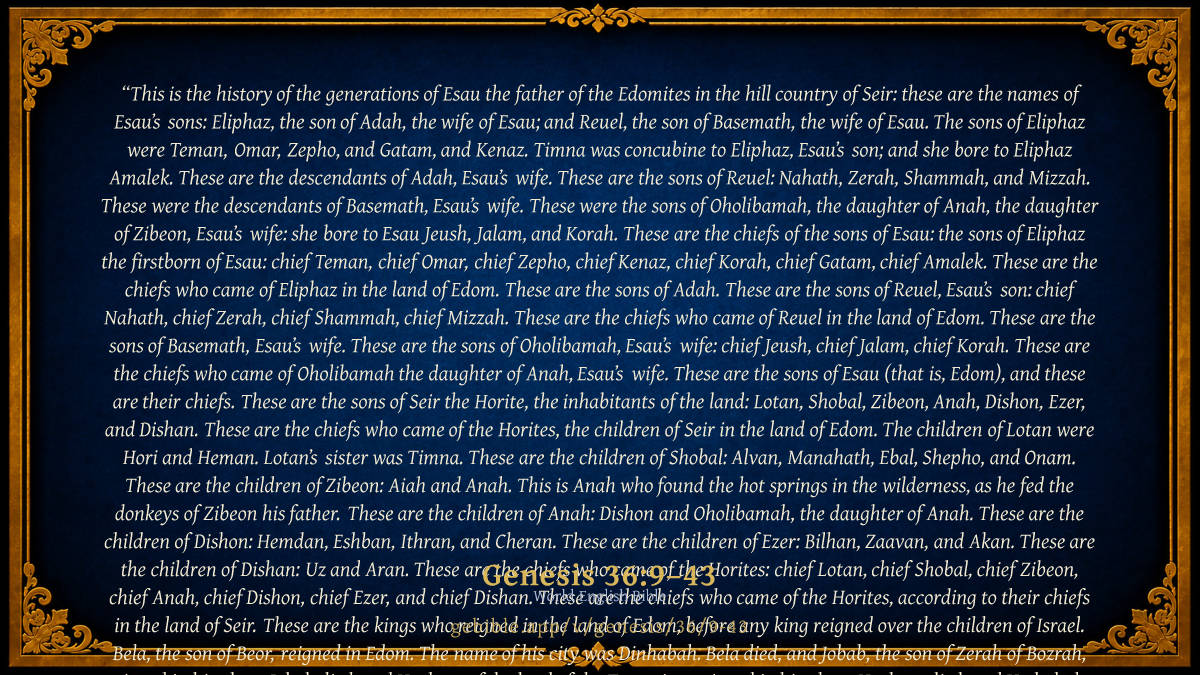
This is the history of the generations of Esau the father of the Edomites in the hill country of Seir: these are the names of Esau’s sons: Eliphaz, the son of Adah, the wife of Esau; and Reuel, the son of Basemath, the wife of Esau. The sons of Eliphaz were Teman, Omar, Zepho, and Gatam, and Kenaz. Timna was concubine to Eliphaz, Esau’s son; and she bore to Eliphaz Amalek. These are the descendants of Adah, Esau’s wife. These are the sons of Reuel: Nahath, Zerah, Shammah, and Mizzah. These were the descendants of Basemath, Esau’s wife. These were the sons of Oholibamah, the daughter of Anah, the daughter of Zibeon, Esau’s wife: she bore to Esau Jeush, Jalam, and Korah.
These are the chiefs of the sons of Esau: the sons of Eliphaz the firstborn of Esau: chief Teman, chief Omar, chief Zepho, chief Kenaz, chief Korah, chief Gatam, chief Amalek. These are the chiefs who came of Eliphaz in the land of Edom. These are the sons of Adah. These are the sons of Reuel, Esau’s son: chief Nahath, chief Zerah, chief Shammah, chief Mizzah. These are the chiefs who came of Reuel in the land of Edom. These are the sons of Basemath, Esau’s wife. These are the sons of Oholibamah, Esau’s wife: chief Jeush, chief Jalam, chief Korah. These are the chiefs who came of Oholibamah the daughter of Anah, Esau’s wife. These are the sons of Esau (that is, Edom), and these are their chiefs.
These are the sons of Seir the Horite, the inhabitants of the land: Lotan, Shobal, Zibeon, Anah, Dishon, Ezer, and Dishan. These are the chiefs who came of the Horites, the children of Seir in the land of Edom. The children of Lotan were Hori and Heman. Lotan’s sister was Timna. These are the children of Shobal: Alvan, Manahath, Ebal, Shepho, and Onam. These are the children of Zibeon: Aiah and Anah. This is Anah who found the hot springs in the wilderness, as he fed the donkeys of Zibeon his father. These are the children of Anah: Dishon and Oholibamah, the daughter of Anah. These are the children of Dishon: Hemdan, Eshban, Ithran, and Cheran. These are the children of Ezer: Bilhan, Zaavan, and Akan. These are the children of Dishan: Uz and Aran. These are the chiefs who came of the Horites: chief Lotan, chief Shobal, chief Zibeon, chief Anah, chief Dishon, chief Ezer, and chief Dishan. These are the chiefs who came of the Horites, according to their chiefs in the land of Seir.
These are the kings who reigned in the land of Edom, before any king reigned over the children of Israel. Bela, the son of Beor, reigned in Edom. The name of his city was Dinhabah. Bela died, and Jobab, the son of Zerah of Bozrah, reigned in his place. Jobab died, and Husham of the land of the Temanites reigned in his place. Husham died, and Hadad, the son of Bedad, who struck Midian in the field of Moab, reigned in his place. The name of his city was Avith. Hadad died, and Samlah of Masrekah reigned in his place. Samlah died, and Shaul of Rehoboth by the river, reigned in his place. Shaul died, and Baal Hanan the son of Achbor reigned in his place. Baal Hanan the son of Achbor died, and Hadar reigned in his place. The name of his city was Pau. His wife’s name was Mehetabel, the daughter of Matred, the daughter of Mezahab.
These are the names of the chiefs who came from Esau, according to their families, after their places, and by their names: chief Timna, chief Alvah, chief Jetheth, chief Oholibamah, chief Elah, chief Pinon, chief Kenaz, chief Teman, chief Mibzar, chief Magdiel, and chief Iram. These are the chiefs of Edom, according to their habitations in the land of their possession. This is Esau, the father of the Edomites.
John Calvin 1540 · Public Domain On vv9, 24, 31 9. And these are the generations of Esau, the…
9. And these are the generations of Esau, the father of the Edomites Though Esau had two names, yet in this place the second name refers to his posterity, who are called Idumeans. For, to make it appear what God had bestowed upon him for the sake of his father Isaac, Moses expressly calls him the father of a celebrated and famous people. And certainly, it served this purpose not a little, to trace the effect and fulfillment of the prophecy in the progeny of Esau. For if the promise of God so mightily flourished towards a stranger, how much more powerfully would it put itself forth towards the children, to whom pertaineth the adoption, and consequently the inheritance of grace? Esau was an obscure man, and a sojourner in that country: whence therefore is it, that suddenly rulers should spring from him, and a great body of people should flourish, unless because the benediction which proceeded from the mouth of Isaac, was confirmed by the result? For Esau did not reign in this desert without opposition; since a people of no ignoble name previously inhabited Mount Seir. On this account Moses relates that the men who had before inhabited that land were mighty: so that it would not have been easy for a stranger to acquire such power as Esau possessed, if he had not been divinely assisted.
John Calvin's Commentaries (1540-1563) — public domain. Text from the Calvin Translation Society English edition (1840s-50s) via the Christian Classics Ethereal Library (ccel.org). Calvin's coverage is partial (roughly two-thirds of the Bible); uncommented books and verses are honest gaps, never fabricated. The 19th-century editor's footnotes and remarks are omitted so the notes are faithfully Calvin's own voice.
Geneva Bible translators 1599 · Public Domain On vv9, 13, 14, 15, 16, 17, 20, 24, 31, 37, 39, 43 Or, the edomites.
Or, the edomites.
Geneva Bible (1599) marginal notes — public domain.
John Trapp 1656 · Public Domain On vv11, 20, 24, 31, 40, 43 Gen 36:11 And the sons of Eliphaz were Teman,…
Gen 36:11 And the sons of Eliphaz were Teman, Omar, Zepho, and Gatam, and Kenaz.
Ver. 11. And the sons of Eliphaz.] See here the fulfilling of God’s predictions and promises, even to an Esau. Will he be wanting to his obedient people?
John Trapp, A Commentary or Exposition upon All the Books of the Old and New Testament (1647–1656) — public domain. Text from a community e-Sword module.
Matthew Poole 1685 · Public Domain On vv15, 16, 20, 24, 25, 30, 31, 32, 34, 37, 39, 40 These were dukes, princes or heads of their several…
1715
These were dukes, princes or heads of their several families and little principalities, according to the manner of those times, who ruled their dominions, either severally, each his own, or jointly, by common advice, or it may be under one chief prince, their superior either in title or in power. And in this division Eliphaz, as he was Esau’s first-born, so he had more than a double portion, his six sons being made dukes, as Esau’s immediate sons were. Compare 1Ch 5:1.
Matthew Poole's English Annotations on the Holy Bible (1683–1685) — public domain. Text from a community e-Sword/MySword module.
Matthew Henry 1710 · Public Domain On vv9, 20, 31 Observe here, 1. That only the names of Esau's…
Observe here, 1. That only the names of Esau's sons and grandsons are recorded, only their names, not their history; for it is the church that Moses preserves the records of, not the record of those that are without. Those elders that lived by faith alone obtained a good report. It is Sion that produces men of renown, not Seir, Psa 87:5. Nor does the genealogy go any further than the third and fourth generation; the very names of all after are buried in oblivion. It is only the pedigree of the Israelites, who were to be the heirs of Canaan, and of whom were to come the promised seed, and the holy seed, that is drawn out to any length, as far as there was occasion for it, even of all the tribes till Canaan was divided among them, and of the royal line till Christ came. 2. That these sons and grandsons of Esau are called dukes, Gen 36:15-19. Probably they were military commanders, dukes, or captains, that had soldiers under them; for Esau and his family lived by the sword, Gen 27:40. Note, Titles of honour have been more ancient out of the church than in it. Esau's sons were dukes when Jacob's sons were but plain shepherds, Gen 47:3. This is not a reason why such titles should not be used among Christians; but it is a reason why men should not overvalue themselves, or others, for the sake of them. There is an honour that comes from God, and a name in his house that is infinitely more valuable. Edomites may be dukes with men, but Israelites indeed are made to our God kings and priests. 3. We may suppose those dukes had numerous families of children and servants that were their dukedoms. God promised to multiply Jacob, and to enrich him; yet Esau increases, and is enriched first. Note, It is no new thing for the men of this world to be full of children, and to have their bellies too filled with hidden treasures, Psa 17:14. God's promise to Jacob began to work late, but the effect of it remained longer, and it had its complete accomplishment in the spiritual Israel.
Matthew Henry's Commentary on the Whole Bible (1708–1710) — public domain (CC PDM 1.0). Text via the HelloAO Bible API.
John Gill 1763 · Public Domain On vv9–38 These are the names of Esau's sons,.... In this…
These are the names of Esau's sons,.... In this and some following verses, an account is given of the sons of Esau, which agrees with what is before observed, and of his sons' sons:
Eliphaz the son of Adah the wife of Esau: who seems to be his first wife, and this his first son:
Read full note →
Reuel the son of Bashemath and wife of Esau; his second son by another wife, a daughter of Ishmael, Gen 36:3.
John Gill's Exposition of the Whole Bible (1746–1763) — public domain (CC PDM 1.0). Text via the HelloAO Bible API.
John Wesley 1765 · Public Domain On vv10, 20, 24, 31, 43 These are the names - Observe here,
These are the names - Observe here,
1. That only the names of Esau's sons and grand-sons are recorded: not their history, for it is the church that Moses preserves the records of, not of those that were without. The elders only that lived by faith obtained a good report. Nor doth the genealogy go any farther than the third and fourth generation, the very names of all after are buried in oblivion; it is only the pedigree of the Israelites who were to be the heirs of Canaan, and of whom were to come the promised seed, and the holy seed, that is drawn out to any length, as far as there was occasion for it, even of all the tribes till Canaan was divided among them, and of the royal line 'till Christ came.
Read full note →
2. That the sons and grand-sons of Esau are called dukes. Probably they were military commanders, dukes or captains that had soldiers under them; for Esau and his family lived by the sword, chap. xxvii, 40.
3. We may suppose those dukes had numerous families of children and servants. God promised to multiply Jacob and to enrich him, yet Esau increases and is enriched first. God's promise to Jacob began to work late, but the effect of it remained longer, and it had its compleat accomplishment in the spiritual Israel.
John Wesley, Explanatory Notes Upon the Whole Bible (1754–1765) — public domain. Text via the GEBible commentary corpus.
Adam Clarke 1810 · Public Domain On vv12, 15, 16, 20, 21, 24, 31, 33, 35, 40, 43 Verse 12. Timna was concubine to Eliphaz] As Timna…
Verse 12. Timna was concubine to Eliphaz] As Timna was sister to Lotan the Horite, Ge 36:22, we see how the family of Esau and the Horites got intermixed. This might give the sons of Esau a pretext to seize the land, and expel the ancient inhabitants, as we find they did, De 2:12.
Amalek] The father of the Amalekites, afterwards bitter enemies to the Jews, and whom God commanded to be entirely exterminated, De 25:17; De 25:19.
Adam Clarke's Commentary on the Bible (1810–1826) — public domain. Text from a community e-Sword/MySword module.
Joseph Benson 1811 · Public Domain On vv10, 20, 24, 31, 43 Gen 36:10. These are the names — Observe here,…
Gen 36:10. These are the names — Observe here, 1st, That only the names of Esau’s sons and grandsons are recorded: not their history, for it is the Church that Moses preserves the records of, not of those that were without. The elders only, that lived by faith, obtained a good report. 2d, That the sons and grandsons of Esau are called dukes. Probably they were military commanders, that had soldiers under them; for Esau and his family lived by the sword, Gen 27:40. 3d, We may suppose those dukes had numerous families of children and servants. God promised to multiply Jacob and to enrich him; yet Esau increases and is enriched first. God’s promise to Jacob began to work late, but the effect of it remained longer, and it had its complete accomplishment in the spiritual Israel.
Joseph Benson's Commentary on the Old and New Testaments (1811–1818) — public domain. Text from a community e-Sword module.
Haydock's Catholic Bible Commentary 1859 · Public Domain On vv9, 15, 16, 24, 29, 30, 31, 33, 37, 39, 40, 43 Of Edom, or of all the nations who inhabited…
Of Edom, or of all the nations who inhabited Idumea, sprung from Esau’s grand-children. (Calmet)
George Leo Haydock (1774–1849), Haydock's Catholic Family Bible and Commentary, 1859 edition — public domain. Excludes Psalms (Douay-Rheims chapter numbering differs from Protestant) and Deuterocanonical books (Catholic canon only).
Robert Jamieson, A. R. Fausset & David Brown 1871 · Public Domain On vv15, 20, 24, 31, 40 dukes--The Edomites, like the Israelites, were divided into tribes,…
dukes--The Edomites, like the Israelites, were divided into tribes, which took their names from his sons. The head of each tribe was called by a term which in our version is rendered "duke"--not of the high rank and wealth of a British peer, but like the sheiks or emirs of the modern East, or the chieftains of highland clans. Fourteen are mentioned who flourished contemporaneously.
Jamieson, Fausset & Brown — Commentary Critical and Explanatory on the Whole Bible (1871) — public domain (CC PDM 1.0). Text via the HelloAO Bible API.
Daniel D. Whedon 1874 · Public Domain On vv15, 20, 31, 37, 40 THE DUKES OF ESAU, Gen_36:15-19.
THE DUKES OF ESAU, Gen_36:15-19.
Here the chief tribe-fathers of the Edomites are named again, under the title of dukes, Hebrews, alluphim, (אלופים,) phylarchs, chiefs, or princes. These were all military chieftains, great patriarchal sheiks, who were celebrated by their descendants not merely as fathers but as heroes. As being merely a presentation of the same persons under a different title, they are omitted from the list in 1 Chronicles which proceeds with the sons of Seir.
Daniel D. Whedon (gen. ed.), Commentary on the Old and New Testaments (1874–1909) — public domain. Text from a community e-Sword module.
The Cambridge Bible for Schools and Colleges 1878 · Public Domain On vv9, 10, 11, 12, 15, 16, 20, 24, 25, 26, 28, 30, 31, 32, 33, 34, 35, 36, 37, 38, 39, 40, 41, 43 9. the Edomites] Heb. Edom, as in Gen_36:43 :…
9. the Edomites] Heb. Edom, as in Gen_36:43 : cf. 1Sa_14:47.
9–14. The “sons” of Esau by Adah, Basemath, and Oholibamah must be regarded as the names of clans, and, like the sons of Ishmael and Israel, are 12 in number (Amalek, the son of Esau’s concubine, Timna, is excluded from this list of twelve).
The Cambridge Bible for Schools and Colleges (gen. ed. J. J. S. Perowne; Cambridge University Press, 1878–1918) — public domain. Text from a community e-Sword module.
Ellicott's Commentary for English Readers 1878 · Public Domain On vv9, 12, 15, 16, 18, 20, 22, 24, 31, 33, 35, 37, 39, 40 (9) The father of the Edomites.—Heb., the father of…
(9) The father of the Edomites.—Heb., the father of Edom. He was himself the man Edom, but the word here means the country of which he was the colonizer.
A Bible Commentary for English Readers, edited by Charles John Ellicott (1878–1897) — public domain. Text from a community e-Sword module.
The Pulpit Commentary 1880 · Public Domain On vv9, 10, 13, 14, 15, 17, 18, 19, 20, 22, 23, 24, 25, 26, 27, 28, 29, 31, 32, 33, 34, 35, 36, 37, 38, 39, 40 And these are the generations of Esau repetition of…
And these are the generations of Esau repetition of this clause shows that it does not necessarily indicate diversity of authorship, or a very distinct piece of composition" (Murphy)the father of the Edomites ( i.e. the founder of the Edomitish nation) in mount Seir.
The Pulpit Commentary (1880–1919), ed. H.D.M. Spence-Jones & Joseph S. Exell — public domain. Text from a community e-Sword module.
C. I. Scofield 1917 · Public Domain On vv12, 20, 31 (See Scofield "Exo 17:8").
Amalek
(See Scofield "Exo 17:8").
The Scofield Reference Bible (1917 edition), notes by C. I. Scofield — public domain. Text from a community e-Sword module.
Paul E. Kretzmann 1924 · Public Domain On vv9, 15, 20, 31 Esau’s Sons and Grandsons
Esau’s Sons and Grandsons
v. 9. And these are the generations of Esau, the father of the Edomites in Mount Seir:
Read full note →
v. 10. These are the names of Esau’s sons: Eliphaz, the son of Adah, the wife of Esau; Reuel, the son of Bashemath, the wife of Esau.
v. 11. And the sons of Eliphaz were Teman, Omar, Zepho (or Zephi, 1Ch 1:36),and Gatam, and Kenaz.
v. 12. And Timna was concubine to Eliphaz, Esau’s son, having probably been adopted for that purpose by Adah;and she bare to Eliphaz Amalek; these were the sons of Adah, Esau’s wife. If this is the Amalek that was the ancestor of the Amalekites who afterward were such bitter enemies of the children of Israel, it was probably due to the fact that Amalek separated himself from his brethren at an early date and grew into an independent people, his descendants occupying the country immediately south of Canaan and spreading from there to the very boundaries of the Promised Land.
v. 13. And these are the sons of Reuel: Nahath, and Zerah, Shammah, and Mizzah; these were the sons of Bashemath, Esau’s wife.
v. 14. And these were the sons of Aholibamah, the daughter of Anah, the daughter of Zibeon, Esau’s wife; and she bare to Esau Jeush, and Jaalam, and Korah. In the case of Aholibamah, therefore, the sons, in the case of the other wives, the grandsons perpetuated the name of Edom and were considered the fathers of the tribes. The sons of Eliphaz continued the Canaanitic line, those of Reuel the Ishmaelitic, and the three sons of Aholibamah the Horite line.
Paul E. Kretzmann, Popular Commentary of the Bible (1921–1924) — public domain. Text from a community e-Sword module.
unfoldingWord translationNotes 2017 · CC BY-SA 4.0 On vv9, 13, 15, 17, 20, 23, 25, 29, 31, 34, 37, 40 These were the descendants of Esau
These were the descendants of Esau
This sentence introduces the account of Esau's descendants in Genesis 36:9-43. AT: "This is an account of the descendants of Esau" (See: Assumed Knowledge and Implicit Information)
Read full note →
in the hill country of Seir
This means that they lived in the hill country of Seir. The full meaning of this may be made explicit. AT: "who lived in the hill country of Seir" (See: Assumed Knowledge and Implicit Information)
Eliphaz ... Reuel
These are names of Esau's sons. See how you translated these names in Genesis 36:4. (See: How to Translate Names)
Adah ... Basemath
These are names of Esau's wives. See how you translated these names in Genesis 36:2-3. (See: How to Translate Names)
Teman, Omar, Zepho, Gatam, and Kenaz ... Amalek
These are names of the sons of Eliphaz. (See: How to Translate Names)
Timna
This is the name of Eliphaz's concubine. (See: How to Translate Names)
translationWords
descend
Esau
Edom
concubine
unfoldingWord translationNotes — © Distant Shores Media and the Door43 World Missions Community, licensed CC BY-SA 4.0. Source: git.door43.org/Door43/en_tn.
Tyndale Open Study Notes 2022 · CC BY-SA 4.0 On vv9, 15, 20, 31, 40 36:9-43 This passage begins a second account of Esau’s…
36:9-43 This passage begins a second account of Esau’s descendants (36:1); it traces the family to subsequent generations and alliances.
36:9-14 The descendants of Esau’s five sons are named.
Tyndale Open Study Notes — © Tyndale Open Resources, licensed CC BY-SA 4.0. Text via the HelloAO Bible API.