
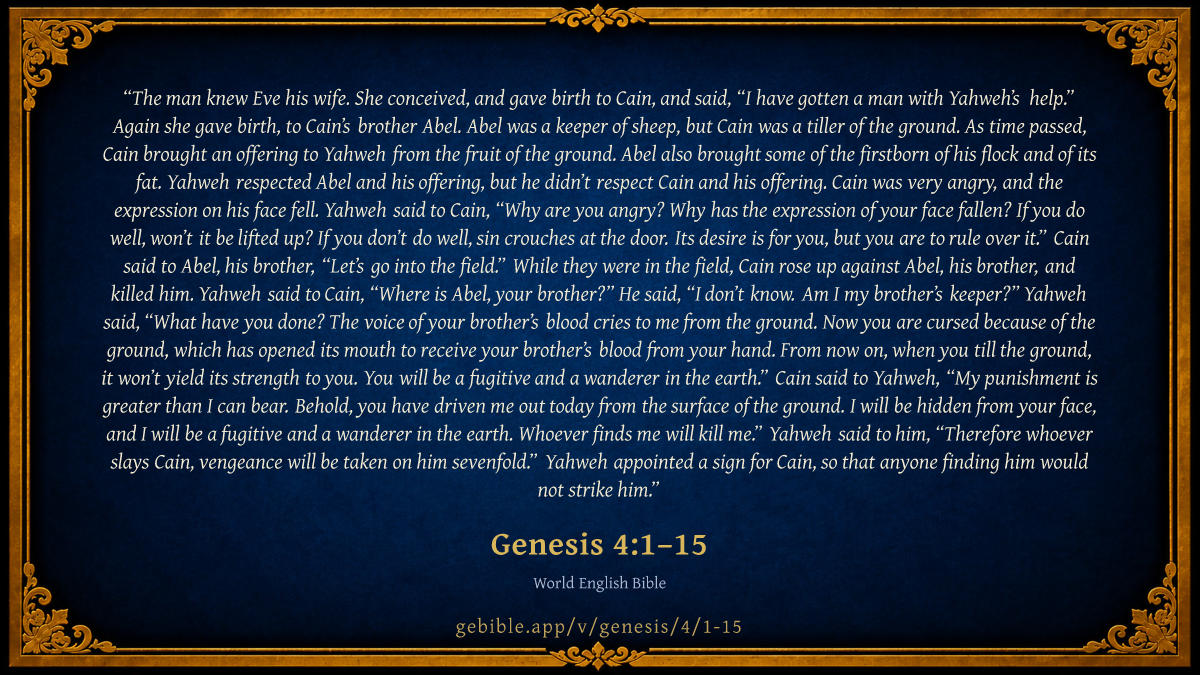
The man knew Eve his wife. She conceived, and gave birth to Cain, and said, “I have gotten a man with Yahweh’s help.” Again she gave birth, to Cain’s brother Abel. Abel was a keeper of sheep, but Cain was a tiller of the ground. As time passed, Cain brought an offering to Yahweh from the fruit of the ground. Abel also brought some of the firstborn of his flock and of its fat. Yahweh respected Abel and his offering, but he didn’t respect Cain and his offering. Cain was very angry, and the expression on his face fell. Yahweh said to Cain, “Why are you angry? Why has the expression of your face fallen? If you do well, won’t it be lifted up? If you don’t do well, sin crouches at the door. Its desire is for you, but you are to rule over it.” Cain said to Abel, his brother, “Let’s go into the field.” While they were in the field, Cain rose up against Abel, his brother, and killed him.
Yahweh said to Cain, “Where is Abel, your brother?” He said, “I don’t know. Am I my brother’s keeper?”
Yahweh said, “What have you done? The voice of your brother’s blood cries to me from the ground. Now you are cursed because of the ground, which has opened its mouth to receive your brother’s blood from your hand. From now on, when you till the ground, it won’t yield its strength to you. You will be a fugitive and a wanderer in the earth.”
Cain said to Yahweh, “My punishment is greater than I can bear. Behold, you have driven me out today from the surface of the ground. I will be hidden from your face, and I will be a fugitive and a wanderer in the earth. Whoever finds me will kill me.”
Yahweh said to him, “Therefore whoever slays Cain, vengeance will be taken on him sevenfold.” Yahweh appointed a sign for Cain, so that anyone finding him would not strike him.
John Calvin 1540 · Public Domain On vv1, 2, 4, 5, 6, 7, 8, 9, 10, 11, 12, 13, 14, 15 1. And Adam knew his wife Eve. Moses now…
1. And Adam knew his wife Eve. Moses now begins to describe the propagation of mankind; in which history it is important to notice that this benediction of God, “Increase and multiply,” was not abolished by sin; and not only so, but that the heart of Adam was divinely confirmed so that he did not shrink with horror from the production of offspring. And as Adam recognised, in the very commencement of having offspring, the truly paternal moderation of God’s anger, so was he afterwards compelled to taste the bitter fruits of his own sin, when Cain slew Abel. But let us follow the narration of Moses. Although Moses does not state that Cain and Abel were twins it yet seems to me probable that they were so; for, after he has said that Eve, by her first conception, brought forth her firstborn, he soon after subjoins that she also bore another; and thus, while commemorating a double birth, he speaks only of one conception. Let those who think differently enjoy their own opinion; to me, however it appears accordant with reason, when the world had to be replenished with inhabitants, that not only Cain and Abel should have been brought forth at one births but many also afterwards, both males and females.
I have gotten a man. The word which Moses uses signifies both to acquire and to possess ; and it is of little consequence to the present context which of the two you adopt. It is more important to inquire why she says that she has received, את יהוה (eth Yehovah.) Some expound it, ‘with the Lord;’ that is, ‘by the kindness, or by the favor, of the Lord;’ as if Eve would refer the accepted blessing of offspring to the Lord, as it is said in Psalm 127:3, “The fruit of the womb is the gift of the Lord.” A second interpretation comes to the same point, ‘I have possessed a man from the Lord;’ and the version of Jerome is of equal force, ‘Through the Lord.’ These three readings, I say, tend to this point, that Eve gives thanks to God for having begun to raise up a posterity through her, though she was deserving of perpetual barrenness, as well as of utter destruction. Others, with greater subtlety, expound the words, ‘I have gotten the man of the Lord;’ as if Eve understood that she already possessed that conqueror of the serpent, who had been divinely promised to her. Hence they celebrate the faith of Eve, because she embraced, by faith, the promise concerning the bruising of the head of the devil through her seed; only they think that she was mistaken in the person or the individual, seeing that she would restrict to Cain what had been promised concerning Christ. To me, however, this seems to be the genuine sense, that while Eve congratulates herself on the birth of a son, she offers him to God, as the first-fruits of his race. Therefore, I think it ought to be translated, ‘I have obtained a man from the Lord’, which approaches more nearly the Hebrew phrase. Moreover, she calls a newborn infant a man, because she saw the human race renewed, which both she and her husband had ruined by their own fault.
John Calvin's Commentaries (1540-1563) — public domain. Text from the Calvin Translation Society English edition (1840s-50s) via the Christian Classics Ethereal Library (ccel.org). Calvin's coverage is partial (roughly two-thirds of the Bible); uncommented books and verses are honest gaps, never fabricated. The 19th-century editor's footnotes and remarks are omitted so the notes are faithfully Calvin's own voice.
Geneva Bible translators 1599 · Public Domain On vv1, 3, 5, 7, 9, 10, 11, 12, 13, 14, 15 Man’s nature, the estate of marriage, and God’s blessing…
Man’s nature, the estate of marriage, and God’s blessing were not utterly abolished through sin, but the quality or condition thereof was changed.
That is, according to the Lord’s promise, as Gen. 3:15, some read, To the Lord, as rejoicing for the son which she had born, whom she would offer to the Lord as the firstfruits of her birth.
Geneva Bible (1599) marginal notes — public domain.
John Trapp 1656 · Public Domain On vv1, 3, 4, 5, 6, 7, 8, 9, 10, 11, 12, 13, 14, 15 Gen 4:1 And Adam knew Eve his wife; and…
Gen 4:1 And Adam knew Eve his wife; and she conceived, and bare Cain, and said, I have gotten a man from the LORD.
Ver. 1. I have gotten a man from the Lord.] Or, that famous man, the Lord; as if she had brought forth the man Christ Jesus. These were words of hope not of substance { verba spei, non rei}; for "Cain was of that wicked one," the devil, {1Jn 3:12} as all reprobates are. {1Jn 3:10} Cain the author of the city of the world, saith Augustine, {a} is born first, and called Cain, that is, a "possession," because he buildeth a city, is given to the cares and pomp of the world, and persecutes his brother that was chosen out of the world. But Abel, the author of the city of God, is born second, called "vanity," because he saw the world’s vanity, and is therefore driven out of the world by an untimely death. So early came martyrdom into the world; the first man that died, died for religion. In a witty sense, saith Hugh Broughton, {b} Cain and Abel contain in their names advertisements for matter of true continuance and corruption. Cain betokeneth possession in this world; and Abel betokeneth one humbled in mind, and holding such possession vain. Such was his offering - sheep kind, the gentlest of all living beasts; and therefore the favour of God followed him. And the offering of Cain was of the fruit of the earth; as he loved the possession of this world, and the service of the body, which yet can have no continuance, and followed after bodily lusts; therefore the blessed God favoured him not. Thus far he cited from the Rabbins. Another English divine {c} hath this note upon these words, I have gotten a man from the Lord, Jehovah. Adam and Eve were all about the composition of Cain. His soul was inspired pure and holy; yet as soon as the vital spirits laid hold of it, it was in the compound, a son of Adam. A skilful artificer makes a clock of all its essential parts most accurately; only he leaves the putting of all parts together to his unskilful apprentice, who so jumbles together the several joints, that all falls to jarring, and can keep no time at all, every wheel running backward-way. So God most artificially still perfects both body and soul; but our accursed parents put all out of frame, and set every part in a contrary course to God’s will. Sin is propagated, and proceeds from the union of body and soul into one man, That phrase, "warmed in sin," {Psa 51:5} is meant of the preparation of the body as an instrument of evil, which is not so actually, till the soul come.
Read full note →
{a} Aug. De Civit. Dei, lib. xv., cap. 1.
{b} H. Broughton of the 10. part. ex Rab. Bochai.
{c} Yates’s Model.
John Trapp, A Commentary or Exposition upon All the Books of the Old and New Testament (1647–1656) — public domain. Text from a community e-Sword module.
Matthew Poole 1685 · Public Domain On vv1–15 This modest expression is used both in Scripture and…
This modest expression is used both in Scripture and other authors, to signify the conjugal act or carnal knowledge. So Gen 19:8; 24:16; Num 31:17; Mat 1:25; Luk 1:34.
Cain, whose name signifies a possession. A man, a male child, as Gen 7:2, which was most welcome.
Read full note →
From the Lord; or, by or with the Lord, i.e. by virtue of his first blessing, Gen 1:28, and special favour. Or, a man the Lord, as the words properly signify: q.d. God-man, or the Messias, hoping that this was the promised Seed.
Matthew Poole's English Annotations on the Holy Bible (1683–1685) — public domain. Text from a community e-Sword/MySword module.
Matthew Henry 1710 · Public Domain On vv1, 3, 6, 8, 9, 13 Adam and Eve had many sons and daughters, Gen…
Adam and Eve had many sons and daughters, Gen 5:4. But Cain and Abel seem to have been the two eldest. Some think they were twins, and, as Esau and Jacob, the elder hated and the younger loved. Though God had cast our first parents out of paradise, he did not write them childless; but, to show that he had other blessings in store for them, he preserved to them the benefit of that first blessing of increase. Though they were sinners, nay, though they felt the humiliation and sorrow of penitents, they did not write themselves comfortless, having the promise of a Saviour to support themselves with. We have here,
I. The names of their two sons. 1. Cain signifies possession; for Eve, when she bore him, said with joy, and thankfulness, and great expectation, I have gotten a man from the Lord. Observe, Children are God's gifts, and he must be acknowledged in the building up of our families. It doubles and sanctifies our comfort in them when we see them coming to us from the hand of God, who will not forsake the works and gifts of his own hand. Though Eve bore him with the sorrows that were the consequence of sin, yet she did not lose the sense of the mercy in her pains. Comforts, though alloyed, are more than we deserve; and therefore our complaints must not drown our thanksgivings. Many suppose that Eve had a conceit that this son was the promised seed, and that therefore she thus triumphed in him, as her words may be read, I have gotten a man, the Lord, God-man. If so, she was wretchedly mistaken, as Samuel, when he said, Surely the Lord's anointed is before me, Sa1 16:6. When children are born, who can foresee what they will prove? He that was thought to be a man, the Lord, or at least a man from the Lord, and for his service as priest of the family, became an enemy to the Lord. The less we expect from creatures, the more tolerable will disappointments be. 2. Abel signifies vanity. When she thought she had obtained the promised seed in Cain, she was so taken up with that possession that another son was as vanity to her. To those who have an interest in Christ, and make him their all, other things are as nothing at all. It intimates likewise that the longer we live in this world the more we may see of the vanity of it. What, at first, we are fond of, as a possession, afterwards we see cause to be dead to, as a trifle. The name given to this son is put upon the whole race, Psa 39:5. Every man is at his best estate Abel - vanity. Let us labour to see both ourselves and others so. Childhood and youth are vanity.
Read full note →
II. The employments of Cain and Abel. Observe, 1. They both had a calling. Though they were heirs apparent to the world, their birth noble and their possessions large, yet they were not brought up in idleness. God gave their father a calling, even in innocency, and he gave them one. Note, It is the will of God that we should every one of us have something to do in this world. Parents ought to bring up their children to business. "Give them a Bible and a calling (said good Mr. Dod), and God be with them." 2. Their employments were different, that they might trade and exchange with one another, as there was occasion. The members of the body politic have need one of another, and mutual love is helped by mutual commerce. 3. Their employments belonged to the husbandman's calling, their father's profession - a needful calling, for the king himself is served of the field, but a laborious calling, which required constant care and attendance. It is now looked upon as a mean calling; the poor of the land serve for vine-dressers and husbandmen, Jer 52:16. But the calling was far from being a dishonour to them; rather, they were an honour to it. 4. It should seem, by the order of the story, that Abel, though the younger brother, yet entered first into his calling, and probably his example drew in Cain. 5. Abel chose that employment which most befriended contemplation and devotion, for to these a pastoral life has been looked upon as being peculiarly favourable. Moses and David kept sheep, and in their solitudes conversed with God. Note, That calling or condition of life is best for us, and to be chosen by us, which is best for our souls, that which least exposes us to sin and gives us most opportunity of serving and enjoying God.
Matthew Henry's Commentary on the Whole Bible (1708–1710) — public domain (CC PDM 1.0). Text via the HelloAO Bible API.
John Gill 1763 · Public Domain On vv1–15 And Adam knew Eve his wife,.... An euphemism, or…
And Adam knew Eve his wife,.... An euphemism, or modest expression of the act of coition. Jarchi interprets it, "had known", even before he sinned, and was drove out of the garden; and so other Jewish writers, who think he otherwise would not have observed the command, "be fruitful and multiply": but if Adam had begotten children in a state of innocence, they would have been free from sin, and not tainted with the corruption of nature after contracted; but others more probably think it was some considerable time after; according to Mer Thudiusi, or Theodosius (t), it was thirty years after he was driven out of paradise:
and she conceived and bare Cain; in the ordinary way and manner, as women ever since have usually done, going the same time with her burden. Whether this name was given to her first born by her, or by her husband, or both, is not said: it seems to have been given by her, from the reason of it after assigned. His name, in Philo Byblius (u), is Genos, which no doubt was Cain, in Sanchoniatho, whom he translated; and his wife, or the twin born with him, is said to be Genea, that is, "Cainah": the Arabs call her Climiah (v) and the Jewish writers Kalmenah (w); who are generally of opinion, that with Cain and Abel were born twin sisters, which became their wives.
Read full note →
And said, that is, Eve said upon the birth of her firstborn:
I have gotten a man from the Lord; as a gift and blessing from him, as children are; or by him, by his favour and good will; and through his blessing upon her, causing her to conceive and bear and bring forth a son: some render it, "I have gotten a man, the Lord" (x); that promised seed that should break the serpents head; by which it would appear, that she took that seed to be a divine person, the true God, even Jehovah, that should become man; though she must have been ignorant of the mystery of his incarnation, or of his taking flesh of a virgin, since she conceived and bare Cain through her husband's knowledge of her: however, having imbibed this notion, it is no wonder she should call him Cain, a possession or inheritance; since had this been the case, she had got a goodly one indeed: but in this she was sadly mistaken, he proved not only to be a mere man, but to be a very bad man: the Targum of Jonathan favours this sense, rendering the words,"I have gotten a man, the angel of the Lord.''
(t) Apud Abulpharag. Hist. Dynast. p. 6. (u) Apud Euseb. Praepar. Evangel. l. 1. c. 10. p. 34. (v) Abulpharag. ib. (w) Shalshaleth Hakabala, fol. 74. 2. (x) "virum Dominum", Fagius, Helvicus, Forster, Schindler, Luther, Pellican, Cocceius; "virum qui Jehovah est", Schmidt.
John Gill's Exposition of the Whole Bible (1746–1763) — public domain (CC PDM 1.0). Text via the HelloAO Bible API.
John Wesley 1765 · Public Domain On vv1, 2, 3, 4, 5, 7, 8, 9, 10, 11, 15 In this chapter we have both the world and…
In this chapter we have both the world and the church in Adam's family, and a specimen of the character and state of both in all ages. As all mankind were represented in Adam, so that great distinction of mankind into the children of God and the children of the wicked one, was here represented in Cain and Abel; and an early instance of the enmity between the seed of the woman and the seed of the serpent. We have here,
I. The birth, names, and callings of Cain and Abel, ver. 1, 2.
Read full note →
II. Their religion, and different success in it, ver. 3, 4, and part of ver. 5.
III. Cain's anger at God, and the reproof of him for that anger, ver. 5, 6, 7.
IV. Cain's murder of his brother, and the process against him for that murder. The murder committed, ver. 8. The proceedings against him. (1.) His arraignment, ver. 9, former part. (2.) His plea, ver. 9. latter part. (3.) His conviction, ver. 10. (4.) The sentence passed upon him, ver. 11, 12. (5.) His complaint against the sentence, ver. 13, 14. (6.) The ratification of the sentence, ver. 15. (7.) The execution of the sentence, ver. 15, 16.
V. The family and posterity of Cain, ver. 17-24.
VI. The birth of another son and grandson of Adam, ver. 25, 26.
Adam and Eve had many sons and daughters, chap. v, 4. But Cain and Abel seem to have been the two eldest. Cain signifies possession; for Eve when she bare him said with joy and thankfulness, and great expectation, I have gotten a man from the Lord.
John Wesley, Explanatory Notes Upon the Whole Bible (1754–1765) — public domain. Text via the GEBible commentary corpus.
Adam Clarke 1810 · Public Domain On vv1, 2, 3, 4, 5, 6, 7, 8, 10, 12, 13, 14, 15 The birth, trade, and religion of Cain and Abel,…
CHAPTER IV
The birth, trade, and religion of Cain and Abel, 1-7.
Read full note →
Cain murders his brother Abel, 8.
God calls him into judgment for it, 9, 10.
He is cursed, 11, 12.
He despairs, 15, 14.
A promise given him of preservation, and a mark set on
him to prevent his being killed, 15.
He departs from God's presence, 16.
Has a son whom he calls Enoch; and builds a city,
which he calls after his name, 17.
Cain has several children, among whom are Lamech, the first
bigamist, 18, 19.
Jobat, who taught the use of tents and feeding cattle, 20.
Jabal, the inventor of musical instruments, 21.
Tubal-cain, the inventor of smith-work, 22.
Strange speech of Lamech to his wives, 23, 24.
Seth born to Adam and Eve in the place of Abel, 25.
Enoch born, and the worship of God restored, 26.
NOTES ON CHAP. IV
Verse 1. I have gotten a man from the Lord.] Cain, קין, signifies acquisition; hence Eve says קנתי kanithi, I have gotten or acquired a man, את יהוה eth Yehovah, the Lord. It is extremely difficult to ascertain the sense in which Eve used these words, which have been as variously translated as understood. Most expositors think that Eve imagined Cain to be the promised seed that should bruise the head of the serpent. This exposition really seems too refined for that period. It is very likely that she meant no more than to acknowledge that it was through God's peculiar blessing that she was enabled to conceive and bring forth a son, and that she had now a well-grounded hope that the race of man should be continued on the earth. Unless she had been under Divine inspiration she could not have called her son (even supposing him to be the promised seed) Jehovah; and that she was not under such an influence her mistake sufficiently proves, for Cain, so far from being the Messiah, was of the wicked one; 1Jo 3:12. We may therefore suppose that את היוה eth Yehovah, THE LORD, is an elliptical form of expression for meeth Yehovah, FROM THE LORD, or through the Divine blessing.
Adam Clarke's Commentary on the Bible (1810–1826) — public domain. Text from a community e-Sword/MySword module.
Joseph Benson 1811 · Public Domain On vv1, 3, 4, 5, 8, 9, 10, 11, 13, 15 Gen 4:1-2. Adam and Eve had many sons and…
Gen 4:1-2. Adam and Eve had many sons and daughters, Gen 5:4 : but Cain and Abel seem to have been the two eldest. Cain signifies possession; for Eve, when she bare him, said, with joy, and thankfulness, and expectation, “I have gotten a man from the Lord.” Abel signifies vanity. The name given to this son is put upon the whole race, Psa 39:5, “Every man is, at his best estate, Abel, vanity.” Abel was a keeper of sheep — He chose that employment which did most befriend contemplation and devotion, for that hath been looked upon as the advantage of a pastoral life. Moses and David kept sheep, and in their solitudes conversed with God.
Joseph Benson's Commentary on the Old and New Testaments (1811–1818) — public domain. Text from a community e-Sword module.
Albert Barnes 1834 · Public Domain On v1 - Section IV - The Family of Adam
- Section IV - The Family of Adam
- Cain and Abel
Read full note →
1. קין qayı̂n, Qain (Cain), “spear-shaft,” and קנה qānah, “set up, establish, gain, buy,” contain the biliteral root קן qan, “set up, erect, gain.” The relations of root words are not confined to the narrow rules of our common etymology, but really extend to such instinctive usages as the unlettered speaker will invent or employ. A full examination of the Hebrew tongue leads to the conclusion that a biliteral root lies at the base of many of those triliterals that consist of two firm consonants and a third weaker one varying in itself and its position. Thus, יטב yāṭab and טיב ṭôb. So קין qayı̂n and קנה qānah grow from one root.
2. הבל hebel, Habel (Abel), “breath, vapor.”
3. מנחה mı̂nchâh, “gift, offering, tribute.” In contrast with זבח zebach, it means a “bloodless offering”.
7. חטאת chaṭā't, “sin, sin-penalty, sin-offering.” רבץ rābats, “lie, couch as an animal.”
16. נוד nôd, Nod, “flight, exile; related: flee.”
This chapter is a continuation of the second document. Yet it is distinguished from the previous part of it by the use of the name Yahweh alone, and, in one instance, אלהים 'ĕlohı̂ym alone, to designate the Supreme Being. This is sufficient to show that distinct pieces of composition are included within these documents. In the creation week and in the judgment, God has proved himself an originator of being and a keeper of his word, and, therefore, the significant personal name Yahweh is ready on the lips of Eve and from the pen of the writer. The history of fallen man now proceeds. The first family comes under our notice.
Gen 4:1
In this verse the first husband and wife become father and mother. This new relation must be deeply interesting to both, but at first especially so to the mother. Now was begun the fulfillment of all the intimations she had received concerning her seed. She was to have conception and sorrow multiplied. But she was to be the mother of all living. And her seed was to bruise the serpent’s head. All these recollections added much to the intrinsic interest of becoming a mother. Her feelings are manifested in the name given to her son and the reason assigned for it. She “bare Cain and said, I have gained a man from Yahweh.” Cain occurs only once as a common noun, and is rendered by the Septuagint δόρυ doru, “spear-shaft.” The primitive meaning of the root is to set up, or to erect, as a cane, a word which comes from the root; then it means to create, make one’s own, and is applied to the Creator Gen 14:19 or the parent Deu 32:6. Hence, the word here seems to denote a thing gained or achieved, a figurative expression for a child born. The gaining or bearing of the child is therefore evidently the prominent thought in Eve’s mind, as she takes the child’s name from this. This serves to explain the sentence assigning the reason for the name. If the meaning had been, “I have gained a man, namely, Yahweh,” then the child would have been called Yahweh. If Jehovah had even been the emphatic word, the name would have been a compound of Yahweh, and either אישׁ 'ı̂ysh, “man,” or קנה qı̂nâh, “qain,” such as Ishiah or Coniah. But the name Cain proves קניתי qānı̂ytı̂y, “I have gained” to be the emphatic word, and therefore the sentence is to be rendered “I have gained (borne) a man (with the assistance) of Yahweh.”
The word “man” probably intimates that Eve fully expected her son to grow to the stature and maturity of her husband. If she had daughters before, and saw them growing up to maturity, this would explain her expectation, and at the same time give a new significance and emphasis to her exclamation, “I have gained a man (heretofore only women) from Yahweh.” It would heighten her ecstasy still more if she expected this to be the very seed that should bruise the serpent’s head.
Eve is under the influence of pious feelings. She has faith in God, and acknowledges him to be the author of the precious gift she has received. Prompted by her grateful emotion, she confesses her faith, She also employs a new and near name to designate her maker. In the dialogue with the tempter she had used the word God אלהים 'ĕlohı̂ym. But now she adopts Yahweh. In this one word she hides a treasure of comfort. “He is true to his promise. He has not forgotten me. He is with me now again. He will never leave me nor forsake me. He will give me the victory.” And who can blame her if she verily expected that this would be the promised deliverer who should bruise the serpent’s head?
Gen 4:2
His brother Habel. - Habel means “breath, vanity.” Does a sense of the vanity of earthly things grow in the minds of our first parents? Has the mother found her sorrow multiplied? Has she had many daughters between these sons? Is there something delicate and fragile in the appearance of Habel? Has Cain disappointed a mother’s hopes? Some of all these thoughts may have prompted the name. There is something remarkable in the phrase “his brother Habel.” It evidently points with touching simplicity to the coming outrage that was to destroy the peace and purity of the first home.
The two primitive employments of men were the agricultural and the pastoral. Here is the second allusion to some use which was made of animals soon after the fall. Coats of skin were provided for the first pair; and now we have Habel keeping sheep. In the garden of Eden, where the tree of life was accessible, an exclusively vegetable diet was designed for man. Whether this continued after the fall, we are not informed. It is certain that man had dominion over the whole animal kingdom. It can scarcely be doubted that the outer coverings of animals were used for clothing. Animals are presently to be employed for sacrifice. It is not beyond the bounds of probability that animal food may have been used before the flood, as a partial compensation for the desire of the tree of life, which may have been suited to supply all the defects of vegetable and even animal fare in sustaining the human frame in its primeval vigor.
Man in his primitive state, then, was not a mere gatherer of acorns, a hunter, or a nomad. He began with horticulture, the highest form of rural life. After the fall he descended to the culture of the field and the tending of cattle; but still he had a home, and a settled mode of living. It is only by a third step that he degenerates to the wandering and barbarous state of existence. And only by the predominance of might over right, the selfish lust of power, and the clever combinations of rampant ambition, comes that form of society in which the highest state of barbaric civilization and the lowest depth of bondage and misery meet.
Gen 4:3
At the end of days. - This may denote the end of the week, of the year, or of some longer period. The season of the year was probably the ingathering, when the fruits of the earth and the firstlings of the flock would come in, and when it was not unnatural for the first family to celebrate with a subdued thankfulness the anniversary of their creation. And the present occasion seems to have been the time when Cain and Habel, have arrived at the years of discretion and self-dependence, solemnly come forward with their first voluntary offerings to the Lord. Hitherto they may have come under their parents, who were then the actual offerers. Now they come on their own account.
Here, accordingly, we ascend from the secular to the eternal. We find a church in the primeval family. If Cain and Habel offer to God, we may imagine it was the habit of their parents, and has descended to them with all the sanction of parental example. But we may not venture to affirm this in all its extent. Parental example they no doubt had, in some respects; but whether Adam and Eve had yet ascended so far from the valley of repentance and humiliation as to make bold to offer anything to the Lord, admits of question. Right feeling in the first offenders would make the confidence of faith very slow of growth. It is even more natural for their children, being one remove from the actual transgressors, to make the first essay to approach God with an offering.
Cain brings of the fruits of the soil. We cannot say this was the mere utterance of nature giving thanks to the Creator for his benefits, and acknowledging that all comes from him, and all is due to him. History, parental instruction, and possibly example, were also here to give significance to the act. The offering is also made to Yahweh, the author of nature, of revelation, and now, in man’s fallen state, of grace. There is no intimation in this verse of the state of Cain’s feelings toward God. And there is only a possible hint, in the “coats of skin,” in regard to the outward form of offering that would be acceptable. We must not anticipate the result.
Gen 4:4-5
And Habel brought. - Habel’s offering differs from that of his brother in outward form. It consists of the firstlings of his flock. These were slain; for their fat is offered. Blood was therefore shed, and life taken away. To us who are accustomed to partake of animal food, there may appear nothing strange here. We may suppose that each brother offered what came to hand out of the produce of his own industry. But let us ascend to that primeval time when the fruit tree and the herb bearing seed were alone assigned to man for food, and we must feel that there is something new here. Still let us wait for the result.
And the Lord had respect unto Habel and his offering, - but not unto Cain. We have now the simple facts before us. Let us hear the inspired comment: “Πίστελ pistei, ‘by faith’ Abel offered unto God πλείονα Θυσίαν pleiona thusian, ‘a more excellent sacrifice’ than Cain” Heb 11:4. There was, then, clearly an internal moral distinction in the intention or disposition of the offerers. Habel had faith - that confiding in God which is not bare and cold, but is accompanied with confession of sin, and a sense of gratitude for his mercy, and followed by obedience to his will. Cain had not this faith. He may have had a faith in the existence, power, and bounty of God; but it wanted that penitent returning to God, that humble acceptance of his mercy, and submission to his will, which constitute true faith. It must be admitted the faith of the offerer is essential to the acceptableness of the offering, even though other things were equal.
However, in this case, there is a difference in the things offered. The one is a vegetable offering, the other an animal; the one a presentation of things without life, the other a sacrifice of life. Hence, the latter is called πλείων θυσία pleiōn thusia; there is “more in it” than in the former. The two offerings are therefore expressive of the different kinds of faith in the offerers. They are the excogitation and exhibition in outward symbol of the faith of each. The fruit of the soil offered to God is an acknowledgment that the means of this earthly life are due to him. This expresses the barren faith of Cain, but not the living faith of Habel. The latter has entered deeply into the thought that life itself is forfeited to God by transgression, and that only by an act of mercy can the Author of life restore it to the penitent, trusting, submissive, loving heart. He has pondered on the intimations of relenting mercy and love that have come from the Lord to the fallen race, and cast himself upon them without reserve. He slays the animal of which he is the lawful owner, as a victim, thereby acknowledging that his life is due for sin; he offers the life of the animal, not as though it were of equal value with his own, but in token that another life, equivalent to his own, is due to justice if he is to go free by the as yet inscrutable mercy of God.
Such a thought as this is fairly deducible from the facts on the surface of our record. It seems necessary in order to account for the first slaying of an animal under an economy where vegetable diet was alone permitted. We may go further. It is hard to suppose the slaying of an animal acceptable, if not previously allowed. The coats of skin seem to involve a practical allowance of the killing of animals for certain purposes. Thus, we arrive at the conclusion that there was more in the animal than in the vegetable offering, and that more essential to the full expression of a right faith in the mercy of God, without borrowing the light of future revelation. Hence, the nature of Habel’s sacrifice was the index of the genuineness of his faith. And the Lord had respect unto him and his offering; thereby intimating that his heart was right, and his offering suitable to the expression of his feelings. This finding is also in keeping with the manner of Scripture, which takes the outward act as the simple and spontaneous exponent of the inward feeling. The mode of testifying his respect to Habel was by consuming his offering with fire, or some other way equally open to observation.
And Cain was very wroth, and his countenance fell. - A feeling of resentment, and a sense of disgrace and condemnation take possession of Cain’s breast. There is no spirit of inquiry, self-examination, prayer to God for light, or pardon. This shows that Cain was far from being in a right frame of mind.
Gen 4:6-7
Why art thou wroth? and why is thy countenance fallen? - The Lord does not yet give up Cain. In great mercy he expostulates with him. He puts a question which implies that there is no just cause for his present feelings. Neither anger at his brother, because his offering has been accepted, nor vexation in himself, because his own has not, is a right feeling in the presence of the just and merciful God, who searches the heart. Submission, self-examination, and amendment of what has been wrong in his approach to God, alone benefit the occaslon. To this, accordingly, the Lord directs his attention in the next sentence.
If thou do well, shalt thou not be accepted? - To do well is to retrace his steps, to consider his ways, and find out wherein he has been wrong, and to amend his offering and his intention accordingly. He has not duly considered the relation in which he stands to God as a guilty sinner, whose life is forfeited, and to whom the hand of mercy is held out; and accordingly he has not felt this in offering, or given expression to it in the nature of his offering. Yet, the Lord does not immediately reject him, but with longsuffering patience directs his attention to this, that it may be amended. And on making such amendment, he holds out to him the clear and certain hope of acceptance still. But he does more than this. As Cain seems to have been of a particularly hard and unheedful disposition, he completes his expostulation, and deepens its awful solemnity, by stating the other alternative, both in its condition and consequence.
And if thou do not well, at the door is sin lying. - Sin past, in its unrequited and unacknowledged guilt; sin present, in its dark and stubborn passion and despair; but, above all, sin future, as the growing habit of a soul that persists in an evil temper, and therefore must add iniquity unto iniquity, is awaiting thee at the door, as a crouching slave the bidding of his master. As one lie borrows an endless train of others to keep up a vain appearance of consistency, so one sin if not repented of and forsaken involves the dire necessity of plunging deeper and deeper into the gulf of depravity and retribution. This dread warning to Cain, expressed in the mildest and plainest terms, is a standing lesson written for the learning of all mankind. Let him who is in the wrong retract at once, and return to God with humble acknowledgment of his own guilt, and unreserved submission to the mercy of his Maker; for to him who perseveres in sin there can be no hope or help. Another sentence is added to give intensity to the warning.
And unto thee shall be his desire, and thou shalt rule over him. - This sentence has all the pithiness and familiarity of a proverb. It has been employed before, to describe part of the tribulation the woman brought upon herself by disobedience, namely, the forced subjection of her will to that of her husband in the fallen state of humanity Gen 3:16. It is accordingly expressive of the condition of a slave under the hard bondage and arbitrary caprice of a master and a tyrant. Cain is evidently the master. The question is, Who is the slave? To whom do the pronouns “his” and “him” refer? Manifestly, either to sin or to Habel. If to sin, then the meaning of the sentence is, the desire, the entire submission and service of sin will be yielded to thee, and thou wilt in fact make thyself master of it. Thy case will be no longer a heedless ignorance, and consequent dereliction of duty, but a willful overmastering of all that comes by sin, and an unavoidable going on from sin to sin, from inward to outward sin, or, in specific terms, from wrath to murder, and from disappointment to defiance, and so from unrighteousness to ungodliness. This is an awful picture of his fatal end, if he do not instantly retreat. But it is necessary to deal plainly with this dogged, vindictive spirit, if by any means he may be brought to a right mind.
If the pronouns are referred to Habel, the meaning will come to much the same thing. The desire, the forced compliance, of thy brother will be yielded unto thee, and thou wilt rule over him with a rigor and a violence that will terminate in his murder. In violating the image of God by shedding the blood of thy brother, thou wilt be defying thy Maker, and fiercely rushing on to thy own perdition. Thus, in either case, the dark doom of sin unforsaken and unremitted looms fearfully in the distance.
The general reference to sin, however, seems to be the milder and more soothing form of expostulation. The special reference to Habel might only exasperate. It appears, moreover, to be far-fetched, as there is no allusion to his brother in the previous part of the address. The boldness of the figure by which Cain is represented as making himself master of sin, when he with reckless hand grasps at all that comes by sin, is not unfamiliar to Scripture. Thus, the doer of wickedness is described as the master of it Ecc 8:8. On these grounds we prefer the reference to sin, and the interpretation founded on it.
There are two other expositions of this difficult sentence which deserve to be noticed. First. “And as to thy brother, unto thee shall be his desire, and thou shalt rule over him with all the right of the first born.” But (1) the reference to his brother is remote; (2) the rights of primogeniture are perhaps not yet established; (3) the words do not express a right, but an exercise of might against right arising in a fallen state Gen 3:16; (4) the Judge of all the earth is not accustomed to guarantee the prerogatives of birth to one who is in positive rebellion against him, but, on the other hand, he withdraws them from the unworthy to confer them on whom he will. For these reasons we conceive this exposition is to be rejected. Second. “And unto thee shall be sin’s desire; but thou shalt overcome it.” But (1) the parallelism between the two members of the sentence is here neglected; (2) a different meaning is assigned to the words here and in Gen 3:16,, (3) the connection between the sentence thus explained and what goes before is not clear; (4) the lesson taught is not obvious; and (5) the assurance given is not fulfilled. On these grounds we cannot adopt this explanation.
The above address of the Lord to Cain, expressed here perhaps only in its substance, is fraught with the most powerful motives that can bear on the mind of man. It holds out acceptance to the wrong-doer, if he will come with a broken heart and a corresponding expression of repentance before God, in the full faith that he can and will secure the ends of justice so that he can have mercy on the penitent. At the same time it points out, with all clearness and faithfulness to a soul yet unpractised in the depths of iniquity, the insidious nature of sin, the proneness of a selfish heart to sin with a high hand, the tendency of one sinful temper, if persisted in, to engender a growing habit of aggravated crime which ends in the everlasting destruction of the soul. Nothing more than this can be done by argument or reason for the warning of a wrong-doer. From the mouth of the Almighty these words must have come with all the evidence and force they were capable of receiving.
Gen 4:8
And Cain talked with Abel his brother. - Cain did not act on the divine counsel. He did not amend his offering to God, either in point of internal feeling or external form. Though one speak to him from heaven he will not hear. He conversed with Habel his brother. The topic is not stated. The Septuagint supplies the words, “Let us go into the field.” If in walking side by side with his brother he touched upon the divine communication, the conference did not lead to any better results. If the divine expostulation failed, much more the human. Perhaps it only increased his irritation. When they were in the field, and therefore out of view, he rose up against his brother and killed him. The deed is done that cannot be recalled. The motives to it were various. Selfishness, wounded pride, jealousy, and a guilty conscience were all at work 1Jo 3:12. Here, then, is sin following upon sin, proving the truth of the warning given in the merciful forbearance of God.
Gen 4:9
Where is Habel thy brother? - The interrogatory here reminds us of the question put to the hiding Adam, “Where art thou?” It is calculated to strike the conscience. The reply is different from that of Adam. The sin has now advanced from hasty, incautious yielding to the tempter, to reiterated and deliberate disobedience. Such a sinner must take different ground. Cain, therefore, attempts to parry the question, apparently on the vain supposition that no eye, not even that of the All-seeing, was present to witness the deed. “I know not.” In the madness of his confusion he goes further. He disputes the right of the Almighty to make the demand. “Am I my brother’s keeper?” There is, as usual, an atom of truth mingled with the amazing falsehood of this surly response. No man is the absolute keeper of his brother, so as to be responsible for his safety when he is not present. This is what Cain means to insinuate. But every man is his brother’s keeper so far that he is not himself to lay the hand of violence on him, nor suffer another to do so if he can hinder it. This sort of keeping the Almighty has a right to demand of every one - the first part of it on the ground of mere justice, the second on that of love. But Cain’s reply betrays a desperate resort to falsehood, a total estrangement of feeling, a quenching of brotherly love, a predominence of that selfishness which freezes affection and kindles hatred. This is the way of Cain Jud 1:11.
Gen 4:10
What hast thou done? - The Lord now charges him with his guilt: “The voice of thy brother’s blood crieth unto me from the soil.” In the providence of God blood has a voice crying to him to which he cannot but give heed. It is vain, then, to attempt concealment.
Gen 4:11-12
The curse (Gen 9:25, note) which now fell on Cain was in some sense retributive, as it sprang from the soil which had received his brother’s blood. The particulars of it are the withdrawal of the full strength or fruitfulness of the soil from him, and the degradation from the state of a settled dweller in the presence of God to that of a vagabond in the earth. He was to be banished to a less productive part of the earth, removed from the presence of God and the society of his father and mother, and abandoned to a life of wandering and uncertainty. The sentence of death had been already pronounced upon man.
Gen 4:13-14
My iniquity is more than I can bear. - To bear iniquity is in Hebrew phrase to undergo the punishment of it. And the prospect of this, as it presents itself to the eyes of Cain, is so appalling that he shrinks from it as intolerable. To be driven from the face of the soil, inhabited by the other surviving members of the human family, to an unknown and therefore terrible region; to be hidden from the face of God, who manifested himself still to the race of Adam in their present abode; to be a vagabond and a fugitive in the earth, far away from the land of his birth; and to be liable to be slain in just revenge by anyone who should find him - such is the hard fate he sees before him. It is dark enough in itself, and no doubt darker still in the exaggeration which an accusing conscience conjures up to his imagination. The phrase, “every one finding me,” implies that the family of Adam had now become numerous. Not only sons and daughters, but their children and grandchildren may have been growing up when Cain was sent into exile. But in his present terror even an excited fancy suggested an enemy at every turn.
Gen 4:15
The reply of the Lord is suited to quell the troubled breast of Cain. “Therefore.” Because thy fears of what thou deservest go beyond what it is my purpose to permit, I give thee assurance of freedom from personal violence. “To be avenged seven-fold” is to be avenged fully. Cain will no doubt receive even-handed justice from the Almighty. The assurance given to Cain is a sign, the nature of which is not further specified.
This passage unfolds to us a mode of dealing with the first murderer which is at first sight somewhat difficult to be understood. But we are to bear in mind that the sentence of death had been already pronounced upon man, and therefore stood over Adam and all his posterity, Cain among the rest. To pronounce the same sentence therefore upon him for a new crime, would have been weak and unmeaning. Besides, the great crime of crimes was disobedience to the divine will; and any particular form of crime added to that was comparatively unimportant. Wrong done to a creature, even of the deepest dye, was not to be compared in point of guilt with wrong done to the Creator. The grave element in the criminality of every social wrong is its practical disregard of the authority of the Most High. Moreover, every other sin to the end of time is but the development of that first act of disobedience to the mandate of heaven by which man fell; and accordingly every penalty is summed up in that death which is the judicial consequence of the first act of rebellion against heaven.
We are also to bear in mind that God still held the sword of justice in his own immediate hands, and had not delegated his authority to any human tribunal. No man was therefore clothed with any right from heaven to call Cain to account for the crime he had committed. To fall upon him with the high hand in a willful act of private revenge, would be taking the law into one’s own hands, and therefore a misdemeanor against the majesty of heaven, which the Judge of all could not allow to pass unpunished. It is plain that no man has an inherent right to inflict the sanction of a broken law on the transgressor. This right originally belongs to the Creator, and derivatively only to those whom he has intrusted with the dispensation of civil government according to established laws.
Cain’s offences were great and aggravated. But let us not exaggerate them. He was first of all defective in the character of his faith and the form of his sacrifice. His carnal mind came out still more in the wrath and vexation he felt when his defective offering was not accepted. Though the Almighty condescends now to plead with him and warn him against persisting in impenitent silence and discontent, lest he should thereby only become more deeply involved in sin, does not retreat, but, on the contrary, proceeds to slay his brother, in a fit of jealousy; and, lastly, he rudely and falsely denies all knowledge of him, and all obligation to be his protector. Notwithstanding all this, it is still to be remembered that the sentence of death from heaven already hung over him. This was in the merciful order of things comparatively slow of execution in its full extent, but at the same time absolutely certain in the end. The aggravation of the first crime of man by the sins of self-will, sullenness, envy, fratricide, and defiant falsehood, was but the natural fruit of that beginning of disobedience. It is accordingly visited by additional tokens of the divine displeasure, which manifest themselves in this life, and are mercifully calculated to warn Cain still further to repent.
Cain’s guilt seems now to have been brought home in some measure to his conscience; and he not only stands aghast at the sentence of banishment from the divine presence, but instinctively trembles, lest, upon the principle of retributive justice, whoever meets him may smite him to the death, as he had done his brother. The longsuffering of God, however, interferes to prevent such a catastrophe, and even takes steps to relieve the trembling culprit from the apprehension of a violent death. This leads us to understand that God, having formed a purpose of mercy toward the human family, was sedulously bent upon exercising it even toward the murderer of a brother. Hence, he does not punish his repeated crimes by “immediate death,” which would have defeated his design of giving him a long day of grace and opportunity to reflect, repent, return to God, and even yet offer in faith a typical atonement by blood for his sin. Thus, the prohibition to slay him is sanctioned by a seven-fold, that is, an ample and complete vengeance, and a sign of protection mercifully vouchsafed to him. The whole dealing of the Almighty was calculated to have a softening, conscience-awakening, and hope-inspiring effect on the murderer’s heart.
Gen 4:16
The presence of the Lord - seems to have been at the entrance of the garden where the cherubim were stationed. There, probably, the children of men still lingered in faith and hope before the Lord, whom they still regarded as their Maker and merciful Saviour. They acknowledged his undeserved goodness in the form of sacrifice. The retreat of Cain from the scene of parental affection, of home associations, and of divine manifestation, must have been accompanied with many a deep, unuttered pang of regret and remorse. But he has deeply and repeatedly transgressed, and he must bear the consequence. Such is sin. Many a similar deed of cruelty and bloodshed might the sacred writer have recorded in the later history of man. But it is the manner of Scripture to note the first example, and then to pass over in silence its subsequent repetitions, unless when a particular transaction has an important bearing on the ways of God with man.
Albert Barnes' Notes on the Bible (1834–1885) — public domain. Text from a community e-Sword/MySword module.
Haydock's Catholic Bible Commentary 1859 · Public Domain On vv1, 4, 7, 8, 13, 14, 15 Through God. Hebrew may signify also: "even God," as…
Through God. Hebrew may signify also: "even God," as if she thought this was the promised seed, who, as Onkelos paraphrases it, would serve the Lord. (Calmet) --- So little could she foresee the future conduct of Cain, whose name may be derived either from kone, possession and acquisition, or from kun, lamentation. The latter interpretation would have been better verified by the event, and the name of Abel, vanity, or sorrow, for which his parents allege no reason, might also have been reversed, on account of his justice, for which he is canonized by Christ himself, and declared the Just. Pious and significant names were imposed by either parent. Cain was the second man. He was not conceived till after the fall, and was therefore the first born in original sin. (Haydock)
George Leo Haydock (1774–1849), Haydock's Catholic Family Bible and Commentary, 1859 edition — public domain. Excludes Psalms (Douay-Rheims chapter numbering differs from Protestant) and Deuterocanonical books (Catholic canon only).
Lange's Commentary on the Holy Scriptures 1864 · Public Domain On v1 Cain and Abel.—The Cainites.—The ungodly Worldliness of the First…
SECOND SECTION
Cain and Abel.—The Cainites.—The ungodly Worldliness of the First Civilization.
Read full note →
Gen_4:1-26
1And Adam knew Eve his wife, and she conceived, and bare1 Cain [the gotten, or possession], and said, I have gotten a man from the Lord [from, or with the God of the future, or 2 Jehovah]. And again2 she bare his brother Abel [Habel, the perishable; הֶבֶל, vanishing breath of life]. And Abel was a keeper of sheep, but Cain was a tiller of the ground. 3And in process of time it came to pass that Cain brought [offered] from the fruit of the ground an offering [מנחה] unto the Lord. 4And Abel, he also brought of the firstlings of his flock, and of the fat thereof. And the Lord had respect3 [looked in mercy] unto Abel and to his offering. 5But unto Cain and to his offering he had not respect. And Cain was very wroth, and his countenance fell. 6And the Lord said unto Cain, Why art thou wroth? and why is thy countenance fallen? 7If thou doest well shalt thou not be accepted?4 [Lange translates more correctly, lifting up of the countenance.] and if thou doest not well, sin lieth at the door [like a ravenous beast for prey]. And unto thee shall be his desire 8[sin’s desire—sin personified], and thou shalt rule [but thou shalt rule] over him. And Cain talked5 with Abel his brother [repeating God’s words hypocritically or mockingly to him. This is adapted to Lange’s translation, Cain told it to his brother. See Exegetical notes]: And it came to pass that when they were in the field, Cain rose up against his brother, and slew him. 9And the Lord said unto Cain, Where is Abel thy brother? And he said, I know not; am I my brother’s keeper? 10And he said, What hast thou done? The voice of thy 11brother’s blood6 [properly, blood-drops, plural] crieth unto me from the ground. And now thou art cursed from the earth [which had before been cursed, Gen_3:17; Bunsen: away from this ground], which hath opened her mouth to receive thy brother’s blood from thy hand. 12When thou tillest the ground it shall not henceforth yield to thee her strength; a fugitive and a vagabond [נע ונד, frightened and driven on, shunned and abhorred] shalt thou be in the earth. 13And Cain said unto the Lord, My punishment [Lange renders it guilt, which is certainly nearer the 14Hebrew עוני] is greater than I can bear. Behold thou hast driven me out this day from the face of the earth [from the open, cleared, inhabited district of the earth]; and from thy face shall I be hid; and I shall be a fugitive and a vagabond in the earth; and it shall come to pass that every one that findeth me shall slay me. 15And the Lord said unto him, Therefore whosoever slayeth Cain, vengeance shall be taken on him seven-fold. And the Lord set a mark upon Cain, lest any finding him should kill him. 16And Cain went out from the presence of the Lord, and dwelt in the land of Nod [exile] on the east of Eden. 17And Cain knew his wife, and she conceived, and bare Enoch [Hanoch, the devoted, initiated], and he builded a city, and called the name of the city after the name of his son Enoch. 18And unto Enoch was born Irad [city, עירד ְעיר, townsman, or, with elision of one ע, prince of a city]: and Irad begat Mehujael [Fürst and Gesenius: מחה, smitten of God; questionable whether it is not rather, purified, formed by God]: and Mahujael [Hebrew, Mahujiel] begat Methusael [man of God, great man of God, ש ,מֵת for אשר, and אל]: and Methusael begat Lamech [strong young man; Gesenius]. 19And Lamech took unto him two wives: the name of the one was Adah [ornament, decoration, elegant], and the name of the other was Zillah [Gesenius: shadow; Fuerst: sounding, song, from צלל; or player]. 20And Adah bare Jabal [Fuerst: rambler, wanderer, nomade, from יבל]: he was the father of such as dwell in tents and of such as have cattle. 21And his brother’s name was Jubal [Fuerst: one triumphing, harper, from יָבֵל]. He was the father of all such as handle the harp and the organ. 22And Zillah, she also bare Tubal-Cain [Gesenius: smith, mason, or lance-maker; literally, brass of kain, that is, brass weapons], an instructor of every artificer7 [Lange more correctly: hammerer or polisher of all cutting instruments] in brass and iron; and the sister of Tubal-Cain was Naamah [loveliness, the lovely]. 23And Lamech said unto his wives:
Adah and Zillah hear my voice,
Ye wives of Lamech hearken unto my speech;
For I have slain a man to my wounding;
And a young man, to my hurt.
24If Cain shall be avenged seven-fold,
Truly Lamech seventy and seven-fold [Bunsen: seven times seventy].
25And Adam knew his wife again, and she bare a son, and called his name Seth [fixed, compensation, settled], for God (Elohim), said she, hath appointed me another seed instead of Abel whom Cain slew. 26And to Seth also was there born a son, and he called his name Enos [man, weak man, son of man]. Then began men to call upon [call out, proclaim] the name of the Lord8 [the name Jehovah, in distinction from Elohim, though not according to the full conception of the name. See Exodus 6.].
EXEGETICAL AND CRITICAL
1. The propagation of the human race through the formation of the family, is, in its beginning, laid outside of Paradise, not because it was in contradiction with the paradisaical destiny, but because it had, from the beginning, an unparadisaical character (that is, not in harmony with the first life as led in Paradise.—T. L.). Immediately, however, even in the first Adamic generation, the human race presents itself in the contrast of a godless and a pious line, in proof that the sinful tendency propagates itself along with the sin, whilst it shows at the same time that not as an absolute corruption, or fatalistic necessity, does it lay its burden upon the race. This contrast, which seems broken up by the fratricide of Cain, is restored again at the close of our chapter, by the birth and destination of Seth. In regard to its chief content, however, the section before us is a characterizing of the line of Cain. It is marked by a very rapid unfolding of primitive culture, but throughout in a direction worldly and ungodly, just as we find it afterwards among the Hamites. The ideality of art, to which the Cainites in their formative tendency have already advanced, appears as a substitute for the reality of a religious-ideal course of life, and becomes ministerial to sin and to a malignant pride. Not without ground are the decorative dress (the name Adah), the musical skill (the name Zillah) and beauty of the daughters of Cain brought into view. For after the contrast presented in chapter 5 between the Sethites, who advance in the pure direction of a godly life, and the Cainites, who are ever sinking lower and lower in an ungodly existence, there is shown, chapter 6, how an intercourse arises between them, and how the Sethites, infatuated by the charms of the Cainitish women, introduce a mingling of both lines, and, thereby, a universal corruption. According to Knobel the chapter must be regarded as the genealogical register of Adam, though this does not agree, he says, with the genealogical register of the Elohist (Genesis 5), which names Seth as the first-born (!) of Adam. The ethnological table (Genesis 10), he tells us, can only embrace the Caucasian race, whilst the Cainites can only be a legendary representation of the East Asian tribes (p. 53), the author of which thereby places himself in opposition to the later account, that represents all the descendants of Cain as perishing in the flood. The traits of the Cainitic race, as presented by Knobel, belong not alone to the East Asiatic people. They are ground-forms of primitive worldliness in the human race. In respect to the genealogical table of Genesis 4, 5, Knobel remarks “that the Cainitic table agrees tolerably well with the Sethic” (p. 54). For the similarities and differences of both tables, comp. Keil, p. 71. These relations will be more distinctly shown in the interpretation of the names. Concerning the Jehovistic peculiarities of language in this section, see Knobel, p. 56.
2. Gen_4:1-2. “Men are yet in Eden, but no longer in the garden of Eden.” Delitzsch. Procreation a knowing. The moral character of sexual intercourse. Love a personal knowing. The love of marriage, in its consummation, a spiritual corporeal knowing. The expression is euphemistic. In the Pentateuch only, in the supplementary corrections of the original writing. The like in other ancient languages. The name Cain is explained directly from קָנִיתִי, the gotten.9 The word קנה may mean, to create, to bring out, also to gain, to attain, which we prefer.—I have gotten a man from the Lord.—The interpretation of Luther and others, including Philippi, namely, “the man, the Lord,” not only anticipates the unfolding of the Messianic idea, but goes beyond it; for the Messiah is not Jehovah absolutely. And yet the explanation: with the help of Jehovah (with his helpful presence, Knobel), is too weak. So too the Vulgate is incorrect: per Deum, or the interpretation of Clericus: מֵאֵת, from Jehovah, that is, in association, in connection with Jehovah, I have gotten a man. In this it remains remarkable, that in the name itself, the more particular denotation is wanting. We may be allowed, therefore, to read: a man with Jehovah, that is, one who stands in connection with Jehovah; yet it may be that the mode of gaining: gotten with Jehovah, characterizes the name itself. The choice of the name Jehovah denotes here the God of the covenant. In the blessed confidence of female hope, she would seem, with evident eagerness, to greet, in the new-born, the promised woman’s seed (Gen_3:15), according to her understanding of the word. Lamech, too, although on better grounds, expected something immensely great from his son Noah. We must observe here that the mother is indicated as the name-giver. In the case of the second name, Abel (Habel), which denotes a swiftly-disappearing breath of life, or vanity, or nothingness, nothing of the kind is said. Yet in place of the great and hasty joy of hope, there seems to have come a fearful motherly presentiment (Delitzsch, p. 199). That they were twins, as Kimchi holds, is a sense the text does not favor. Abel as shepherd, especially of the smaller cattle (צאן), is the type of the Israelitish patriarchs. Cain, as the first-born, takes the agricultural occupation to which his father was first appointed. The oldest ground-forms, therefore, of the human calling, which Adam united in himself, are divided between his two sons in a normal way (Cain was, in a certain sense, the heir by birth, and the ground-proprietor). It must be remarked, too, that agriculture, as the older form, does not appear as the younger in its relation to cattle-breeding. “Both modes of living belong to the earliest times of humanity, and, according to Varro and Dicæarchus in Porphyry, follow directly after the times when men lived upon the self-growing fruits of the earth.” Knobel. “In the choice of different callings by the two brothers, we seek in vain for any indication of a difference in moral disposition.” So Keil maintains, against Hofmann, that agriculture was a consequence of the cursing of the ground. Delitzsch, however, together with Hofmann, is inclined to the opinion that in the brothers’ choice of different callings there was already expressed the different directions of their minds,—that Abel’s calling was directed to the covering of the sinful nakedness by the skins of beasts (Hofmann), and therefore Abel was a shepherd (!). Delitzsch, too, would have it that Abel took the small domestic cattle, only for the sake of their skins, and, to some extent, for their milk, though this was a kind of food which had not been used in Paradise. It would follow, then, that if Abel slew the beasts for the sake of their skins, and, moreover, offered to God in sacrifice only the fat parts of the firstlings, it must have been that he suffered the flesh in general of the slaughtered animals to become offensive and go to corruption. It would follow, too, that the human sacerdotal partaking of the sacrificial offering, which later became the custom in most cases, had not yet taken place; not to say that the supposition of the enjoyment of animal food having been first granted, Gen_9:3, is wholly incorrect.
3. Gen_4:3-8. The first offerings. The difference between the offering pleasing to God, and that to which he has not respect. The envy of a brother, the divine warning, and the brother’s murder. The fratricide in its connection with the offering, a type of all religious wars. The expression מקץ ימים denotes the passing of a definite and considerable time (Knobel: after the beginning of their respective occupations), and indicates also a harvest-season; yet to take it for the end of the year, as is done by De Wette, Van Bohlen, and others, is giving it too definite a sense.—It came to pass that Cain brought of the fruits of the ground, מִנְחָה (from מנח; Arabic: to make a present, “the most general name of the offering, as also קָרְבָּן.” Delitzsch). Fruits belonged to the oldest offerings. Though no altar is mentioned, as also in Gen_8:20, it is nevertheless to be supposed. In the offering of Abel it is prominently stated that he brought of the firstborn of his herds (בְּכוֹרוֹת), but it is not said of Cain that his offerings were first fruits—בִּכּוּרִים. There is added, moreover, in respect to Abel, the word: וּמֵחֶלְבֵּהֶן (and of the fat thereof). Knobel explains this as meaning, from their fat; Keil, on the contrary, understands it of the fat pieces, that is, of the fattest of the firstlings. The ground taken by some, that it was because no sacrificial feasts had been instituted, or because men had not yet eaten of flesh, is pure hypothesis. It shows rather that we must not think here of the animal offerings of Leviticus. Here arise two questions: 1. By what was it made known that God looked to the offering of Abel,—that is, with gracious complacency? Many commentators say that Jehovah set on fire the offering of Abel by fire from heaven, according to Lev_9:24; Jdg_6:21 (Theodotion, Hieronymus, &c.). Delitzsch: the look of Jehovah was a fire-glance that set on fire the offering. Keil, however, reminds us how it is said, that to Abel himself, as well as to his offering, the look of Jehovah was directed. Knobel assumes, with Schumann, that it suits better to think of a personal appearance of Jehovah at the time of the offering, with which, too, corresponds better the dealing with Cain that follows. The safest way is to stand by the fact simply, that God graciously accepted the offering of Abel; but as in later times the acceptance was outwardly actualized by the miraculous sacrificial flame, so here, it suits best to think on some such mode of acceptance, though not on the “fiery glance” alone. 2. Wherein lay the ground of this distinction? Knobel: “The gift of Abel was of more value than the small offering of Cain. In all sacrificial laws the offerings of animals have the chief place.” So also the Emperor Julian, according to Cyril of Alexandria (Delitzsch, p. 200). According to Hofmann (“Scripture Proof,” i. p. 584), Cain, when he brought his offering of the fruits of his agriculture, thanked God only “for the prolongation of this present life, for the support of which he had been so laboriously striving: whereas Abel in offering the best animals of his herd, thanked God for the forgiveness of his sins, of which the continued sign was the clothing that had been given of God.” For this too advanced symbolic of the clothing skins, there is no Scripture ground, and rightly says Delitzsch: the thought of expiation connects itself not with the skins, but with the blood (see also Keil’s Polemic,—against Hofmann, p. 66). Yet Delitzsch contradicts himself when he says, with Gregory the Great: omne quod datur Deo ex dantis mente pensatur, and then adds: “the unbloody offering of Cain, as such, was only the expression of a grateful present, or, taken in its deepest significance, a consecrated offering of self; but man needs, before all things, the expiation of his death-deserving sins, and for this the blood obtained through the slaying of the victims serves as a symbol.” It is, however, just as much anticipating to identify the blood-offering with the specific expiation offering, as it is to give directly to the living faith in God’s pure promise the identical character of faith in the specific mode of atonement. The Epistle to the Hebrews lays the whole weight of the satisfaction expressed in Abel’s offering upon his faith (Gen_11:4). Abel appears here as the proper mediator of the institution of the faith-offering for the world. As the doctrine of creation is introduced to the world through the faith of the primitive humanity, so in a similar manner did Abel bring into the world the belief in the symbolical propitiatory offering in its universal form; as after him Enoch was the occasion of introducing the belief of the immortal life, and so on. Keil, too, contends against the view that through the slaying of an animal Abel already made known the avowal that his sins deserved death. And yet it is a fact that a difference in the state of heart of the two brothers is indicated in the appearance of their offerings. Keil finds, as a sign of this difference, that Abel’s thanks come from the depths of his heart, whilst Cain’s offering is only to make terms with God in the choice of his gifts. Delitzsch regards it as emphatic that Abel offered the firstlings of his herds, and, moreover, the fattest parts of them, whilst Cain’s offering was no offering of first fruits. This difference appears to be indicated, in fact, as a difference in relation to the earliness, the joyfulness, and freshness of the offerings. After the course of some time, it means, Cain offered something from the fruits of the ground. But immediately afterwards it is said expressly: Abel had offered (הֵבֵיא, preterite, גַס־הוּא); and farther it is made prominent that he brought of the firstlings, the fattest and best. These outward differences in regard to the time of the offerings, and the offerings themselves, have indeed no significance in themselves considered, but only as expressing the difference between a free and joyful faith in the offering, and a legal, reluctant state of heart. It has too the look as though Cain had brought his offering in a self-willed way, and for himself alone,—that is, he brought it to his own altar, separated, in an unbrotherly spirit, from that of Abel.—And Cain was very wroth.—Literally, he was greatly incensed (inflamed). (אפּו denotes the distended nostril.—T. L.). The wrath was a fire in his soul (Jer_15:14; Jer_17:4).—And his countenance fell.—“Cain hung down his head, and looked upon the earth. This is the posture of one darkly brooding (Jer_3:12; Job_29:24), and prevails to this day in the East as a sign of evil plottings” (Burkhardt, “Arabian Proverbs,” p. 248).—And the Lord said unto Cain.—This presupposes a certain measure of susceptibility for divine revelation; as does also his previous offering, though done in his own way. Jehovah, in a warning manner, calls his attention to the symptom of his wicked thoughts,—his brooding posture.—If thou doest well, &c.—The explanation of Arnheim and Bunsen: Whether thou bringest fair gifts or not, sin lurks at the door, &c., does not take the word שְׁאֵת in its nearest connection, namely, in contrast with the falling of the countenance, as the lifting it up in freedom and serenity. Should we take שְׁאֵת for the lifting up (the acceptance) of the offering, still would its better and nearer sense lie in the idea that good behavior is the right offering. And yet on account of the contrast, the lifting up of the countenance would seem to be the meaning most obviously suggested. We need not to be reminded that along with good behavior there is also meant an inward state, yet the expression tells us that that inward state will also actualize itself in the right way.
Gen_4:8. And Cain talked with Abel.—Knobel represents these words as a crux interpretum. Rosenmüller and others interpret it: he talked with Abel, that is, he had a paroxysm or fit of goodness and spoke again peaceably with his brother. It is against this that the use of אָמַר for דִּבֵּר cannot be authenticated by sure examples. Therefore Hieronymus, Aben Ezra, and others, interpret it: he told it (namely, what Jehovah had said to him) to his brother. On the contrary, Knobel remarks: it does not seem exactly consistent that the still envious Cain should thus relate his own admonition. Here, however, the question arises whether we are required to take ויאמר in that manner. The sense of this may be that Cain simply preached to his brother in a mocking manner the added apothegm, sin lieth at the door. In a similar manner, to say the least, did Ahab preach to Elias, Caiaphas to our Lord Christ, Cajetan to Luther, &c. The Samaritan text has the addition: נֵלְכָה חַשָּׂדֶה (let us go into the field). It has been acknowledged by the Septuagint, the Vulgate, and certain individual critics. But even ancient testimonies show it to have been an interpolation.10 Knobel, together with Böttcher, has recourse to a conjecture that the reading should be שׁמר (he watched), instead of אמר. Delitzsch, again, supposes that the narration hastens beyond the oratio directa, or the direct address, and gives immediately its carrying out in place of the thing said, that is, he regards the invitation, “let us go into the field,” as implied or understood in the act. In a similar way, Keil. We turn back to the above interpretation with the remark that the narrator had no need to state precisely that Cain preserved the penal words of God as solely for himself, if he meant to tell us that out of this warning admonition Cain had made a hypocritical address to his brother.—Cain rose up against Abel his brother.—The words “his brother,” how many times repeated! The sin of the fall has advanced quickly to that of fratricide. The divinely charged envy in the sin of Eve, wherein there is reflected an analogue of the envy of man against God, is here again advanced from envy of a brother to hatred, then from hatred to a vile obduracy against the warning words of God, and so on, even to fratricide. Therein, too, it is evident that the tempter of man is a murderer of man. Yet still this is not in the sense as though Joh_8:44 had reference only to this fact. In the sense of this latter passage, Satan was the murderer of Cain,—a thing, however, which manifests itself in the murder of Abel. The fact here narrated will form a connected unity with that of Genesis 3. The working of Satan in Genesis 3 comes fully out in the fact narrated in Genesis 4 “Cain is the first man who lets sin rule over him; he is ἐκ τοῦ πονηροῦ (of the evil one), 1Jn_3:12.” Delitzsch.
4. Gen_4:9-16 The Judgment of Cain. Where is Abel thy brother?—The divine arraignment analogous to the arraignment of Adam and Eve. But Cain evades every acknowledgment. He lies, and denies in an impudent manner; then comes boldly out with the scornful expression: Am I my brother’s keeper? “What a fearful advance from the resort and exculpation of our first parents after the fall, so full of shame and anguish, to this shameless lying; this brutality, so void of love and feeling!” Delitzsch. Irreligiousness, together with an inhuman want of feeling, stand out in continually increasing, reciprocal action. Upon this impudent denial follows the accusation and the judgment. The streams of his brother’s blood are represented as his accusers, and the earth itself must bear witness against him.—What hast thou done?—So we read, since we take the sense of that which follows to be: A voice hast thou made, etc. “The deed belongs to those crimes that cry to Heaven (Gen_18:20; Gen_19:13; Exo_3:9). Therefore does Abel’s blood cry up to Heaven that God, the lord and judge, may punish the murderer. All blood shed unrighteously must be avenged (Gen_9:5); according to the ancient view it cries to God continually, until vengeance takes place. Hence the prayer, that the earth may not drink in the blood shed upon it, in order that it may not thereby be made invisible and inaudible (Isa_26:21; Eze_24:7; Job_16:18).” Knobel. Compare Psa_116:15; Heb_11:4; Rev_6:9 Calvin: Ostendit Deus, se de factis hominum cognoscere utcunque nullus queratur vel accuset; deinde sibi magis caram esse hominum vitam, quam ut sanguinem innoxium impune effundi sinat; tertio, curam sibi piorum esse non solum quamdiu vivunt, sed etiam post mortem. The blood as the living flow of the life, and the phenomenal basis of the soul (primarily as basis of the nerve-life) has a voice which is as the living echo of the blood-clad soul itself. It is the symbol of the soul crying for its right (to live), and in this way affects immediately the human feeling.11—And now art thou cursed, etc.—The words following (מן האדמה) are explained in different ways: 1. My curse shall smite thee from this land; that is, here shall be its execution (Aben Ezra, Kimchi, and others; Knobel, Keil, more or less definitely). 2. Cursed away from the district; that is, driven forth by the curse (Rosenmüller, Tuch, Gerlach, Delitzsch). 3. As in the history of the first judgment there appear two cursings, it is proper to look back to them. There is the serpent cursed directly as Cain is here. But the earth, too, is cursed for Adam’s sake. Since now here, in the curse of Cain, the earth is again mentioned, the obvious interpretation becomes: thou thyself shalt be cursed in a much severer degree than the earth. The earth, which through Adam’s natural sin has become to a certain extent partaker of his guilt, shall appear innocent in presence of thine unnatural crime; yea, it becomes thy judge.—Which hath opened her mouth.—This is the moving reason for the form of the preceding penal sentence. So Delitzsch interprets: the ground has drunk innocent blood, and so is made a participant in the sin of murder (Isa_26:21; Num_35:31). Keil disputes this, and on good grounds. “It is because the earth has been compelled to drink the innocent blood which has been shed that, therefore, it opposes itself to the murderer, and refuses to yield its strength (כֹּח its fruits or crops, Job_31:40) to his cultivation; so that it returns him no produce, just as the land of Canaan is said to have spit out the Canaanites, on account of the abominable crimes with which they had utterly defiled it (Lev_18:28).” It is clear that in this case there is transferred to the earth a ministration of punishment against Cain. Since Cain has done violence to nature itself, even to the ground, in that it has been compelled to drink his brother’s blood, therefore must it take vengeance on him in refusing to him its strength. The curse proper, however, of Cain must be, that through the power of his guilt-consciousness he must become a fugitive and a vagabond upon the earth. נע ונד, a paronomasia, as in Gen_1:2. The first word (participle from נוע) denotes the inward quaking, trembling, and unrest, the second (from נוד) the outward fleeing, roving, restlessness. The interpretation, therefore, of Delitzsch is incorrect, “that the earth in denying to Cain the expected fruits of his labor, drives him ever on from one land to another.” The proper middle point of his curse is his inner restlessness. More correctly says Delitzsch: “ban of banning, wandering of exile, is the history of Cain’s curse; how directly opposite to that which is proclaimed by the blood of the other Abel, the Holy and Righteous one (Act_3:14).” Knobel, according to the view above noticed, interprets the words “fugitive and vagabond,” as indicating in the author a knowledge of the roaming races of the East.—My punishment is greater than I can bear [Lange renders it my guilt, עוני].—The question arises whether this expression means my sin, or my punishment. The old interpretations (Septuagint, Vulgate) render it my sin, and accordingly give נשא the sense of forgiveness. My sin is too great to be ever forgiven. This expression of despair into which his earlier confidence sinks down, has been interpreted by some as denoting Cain’s repentance, which, analogous to the repentance of Judas, fails of salvation through self-will and want of faith, or rather, bears him on more fully to destruction. But since עון may denote also the punishment of sin (Gen_19:15; Isa_5:18), and since Cain further on laments the greatness of his punishment, Delitzsch, Keil, and others, with Aben Ezra, Kimchi, Calvin, etc., take the sense to be: my punishment is too great, that is, greater than I can bear. But now the question arises, whether there is not here in view a double sense, as indicated by the very choice of the expression; and this the more, since, in fact, there lies also in Cain’s repentance a similar double sense. The sin is evidently acknowledged, but only in the reflex view of the punishment, and because of the punishment (attritio in contrast with contritio). The self-accusation, therefore, that the sin is held unpardonable, is, at the same time, an accusation of the judge for having laid upon him an unendurable burden. The reservation of the heart still unbroken in its selfishness and pride, makes the self-accusation, in this kind of repentance, an accusation of the doom itself; it is “the sorrow of the world that worketh death.” It is, however, the lies bound up with the pride that gives the impassioned utterance its curiously varied coloring.—Behold thou hast driven me out.—Out of the sentence of his own conscience, through which God lets him become a fugitive and a vagabond, Cain makes a clear, positive, divine decree of banishment. Thereby does it appear to him a heavier doom that he must go forth from the presence of the adamah in Eden, than his departure from the presence of God (though before he had put the latter first); and, finally, they are both to him the harder punishment, since now “every one that finds shall slay him.” It is the full, unbroken, selfish fear of death, that falls upon him like a giant, rather than the wish that he may be slain by the avenger of blood, whoever he may be. But therein does his outer understanding of it give notice of the sentence: thou shalt be a fugitive and a vagabond. It has changed, for him, into the threatening: avengers of blood will everywhere hunt and slay thee (Pro_28:1).—Behold thou drivest me forth this day from the face of the Adamah, that is, out of Eden. “In Eden dwelt Jehovah, whose presence guaranteed protection and security.” Knobel. But would Cain take comfort in the idea of the divine protection? It is suffering and punishment, in itself, that, as he says, he is directly driven forth (גרש) from that home still so rich and charming, where, moreover, through his tilling of the ground he meant to become a permanent possessor.—And from thy face shall I be hid.—Knobel: “Outside of Eden, withdrawn from thy look. In a similar manner Jonah believed that by his withdrawal from Canaan, the land of Jehovah’s habitation, he should escape from his territorial jurisdiction.” On the contrary, Delitzsch and Keil: “from the place where Jehovah revealed his presence.” It must be observed that he mentions this suffering as of second moment. It sounds partly as a complaint, and partly as a threatening; for it is the specific expression of the morose self-consciousness that it flees from the presence of God, whilst it maintains, in order to have some plea of right, that it has been forced to do so. When I lose the face of my home, then also am I compelled to flee from the face of God. Though in every place he would fain hide from the face of God, yet the obvious sense here is neither the unbiblical thought that God dwelt only in Eden (or in Canaan), nor the loss of the beholding of the cherubim. The idea that man can hide himself from God the Scripture everywhere treats as a mere false representation of the evil conscience. It is clearly growling despair that will no more seek the presence of Jehovah through prayer and sacrifice, under the pretence that it is no more allowed to do so. Cain, however, has still religious insight enough to know, that the further from God, the deeper does he fall into the danger of death.—Every one that findeth me.—How could Cain fear lest the blood avenger should slay him, when the earth was uninhabited? Josephus, Kimchi, Michaelis, have referred the declaration to the ravenous beasts. Clericus, Dathe, Delitzsch, Keil, and others, have referred it to the family of Adam. Schumann and Tuch find in it an oversight of the narrator.12 Knobel takes it as embracing the representation of their having been primitive inhabitants of Eastern Asia (Chinese immigrants, perhaps) with whom Cain had fought. Delitzsch says: “It is clear that the blood avengers whom Cain feared, must be those who should exist in the future, when his father’s family had become enlarged and spread abroad; for that the murderer should be punished with death (we might even say that the taking vengeance for blood is the fountain of regulated law and right respecting murder) is a righteous sentence written in any man’s breast; and that Cain already sees the earth full of avengers, is just the way of the murderer who sees himself on all sides surrounded by avenging spirits (̓Εριννύες), and feels himself subjected to their tormentings.” Keil adds: “Though Adam, at that time, had not many grandchildren, great-grandchildren, and great-great-grandchildren, yet, according to Gen_4:17, Gen_5:4, he must, at that time, doubtless, have had already other children, who might multiply, and, earlier or later, avenge Abel’s death.” In aid of this supposition we must take the representation that would give to Cain an immensely long life. Cain’s complaint was an indirect prayer for the mitigation of the punishment. Jehovah consents to the prayer in his sense, that is, he knows that the fear of Cain is, in great part, a reflection from his evil conscience, and, consequently, the destiny which is appointed to him appears to serve more for the silencing (not giving rest to) his frantic excitement, than as designed to protect him outwardly from any danger. For not absolutely shall he know himself protected, but only through the threatening of a seven-fold blood-vengeance against his pursuer, whoever he might be, and through the warning of the same as given by a sign. There appears to Knobel a difficulty in the question, Who then would undertake the blood-vengeance on behalf of Cain, seeing he had no companions? Seven-fold shall he be punished, or shall he (Cain) become avenged.—Set a mark upon Cain.—According to the traditional interpretation, God put a sign on Cain himself, which would make him known; and hence the proverbial expression: the mark of Cain. On the contrary, the literal language has the preposition ל (to or for). Another old interpretation (Aben Ezra, Baumgarten, Delitzsch) will have it that God gave him a token for his security, in order that he might not be slain. The language, however, does not denote a sign of security for Cain that would make him absolutely safe, but only a sign of warning, and threatening, for some possible pursuer, and which might possibly remain unnoticed, though serving to Cain himself as a conscious sign for the quieting of his fears. According to Knobel, the author had in mind, perhaps, some celestial phenomenon, which should every time make its appearance and warn away the assailant. Such a divine intervention, however, would be a placing the murderer in absolute security, and besides a thing simply inconceivable. The warning sign for the pursuer of Lamech, whoever he might be, was the newly invented weapons of his son Tubal-Cain. The warning sign that should serve for the protection of Cain, must disclose to the pursuers the threatening prospect of a seven-fold blood-vengeance. Such a sign, although for Cain, may be, notwithstanding, represented as on Cain in some kind of threatening defence, perhaps, or in the attendance of his wife; it is enough that the history is silent, or simply means to tell us that God already, immediately after the first deed of murder, had established a modification of the natural, impulsive, and impassioned, taking of vengeance for blood;—a warning sign, in fact, that the carrying out of the blood-vengeance would have for its consequence the extirpation of the whole human race. But why this exemption of Cain? To this question every kind of answer has been given (comp. Delitzsch and Keil). The chief thing was, that this banishment had in itself the significance of a social human death. It was a member cut off from the human community, as in the New Testament history of Judas. Besides, the unfolding of the Cainitish existence was to reveal an unfolding of death in a higher degree, and, at the same time, to do service to human culture in the dissemination of the Cainitish talent. Finally, there comes into consideration, in relation to Cain, what is said by Delitzsch: “He was gracious to him in the prolongation of his time of grace, because he recognized the sin as sin.” But at the same time, God himself gives here the first example for the significance of the law of pardon in the later society. To demand the death of Cain was properly the right only of Abel’s parents. But these were also Cain’s parents. The right of pardoning is the right of modifying or mitigating the punishment in view of special mitigating circumstances.—And Cain went out.—“The name נוד denotes a land of escape and banishment, and is therefore the contrast to the happy land of Eden, where Jehovah walks and communes with men.” Keil. The land lay eastward of Eden. In other respects it cannot be definitely determined; for Cain carried everywhere the land of Nod with him in his heart. Knobel thinks here again of China.
5. Gen_4:17-23. Cain and the Cainites.—And Cain knew his wife.—Here comes in the supposition that Adam must have already had daughters too. Cain’s wife could only have been a daughter of Adam, consequently his sister, and Abel’s sister. She still adheres, nevertheless, to the fearful man, and follows him in his misery, which is also a testimony to a humane side in his life. The marriage of sisters was, in the beginning, a condition for the propagation of the human race. At the commencement of the race, the contrasts in the members of the family must have been so strongly regarded, that thereby the conditions for a true marriage could be present in the same family; whilst the most significant motive for the later prohibition of sister marriages, such as the establishment of a new band of love, and the consequent separation of the sisterly and marriage relations, could not yet have become effectual. Keil, moreover, remarks that the sons and daughters of Adam represent not merely the family, but the race; this is indeed the case, even in single families, though on a reduced scale. Some have thought it strange that Cain should have built a city for his son. But in this objection it is overlooked that the main conception of a primitive city is simply that of a walled fortification. The city must have been a very small one. Cain might have built it for an entire patriarchal race. Moreover, it reads, as Keil calls attention to it, יַיְהִי בֹּנֶה, he was building. It was the thought and the work of his life, in proof that immediately after the protection offered to him by God, he longed for something to fortify himself against the fear of his conscience, and had need to fix for himself an outward station, in opposition to his inner unsettled condition. “Even if we do not, with Delitzsch, regard this city as the foundation-stone of the worldly rule in which the spirit of the beast predominates, yet we must not misapprehend therein the effort to remove the curse of banishment, and to create for his race a point of unity as a compensation for the lost unity in society with God; neither must we lose sight of the continual tendency of the Cainitish life to the earthly. The mighty development of the world-feeling, and of ungodliness, among the Cainites, becomes conspicuous with Lamech in the sixth generation.” Keil. This comes to be, indeed, the ground idea of the Cainite development, that in the symbolic ideality of culture, it seeks an offset to the real ideality of the living cultus (or worship), even as this is generally the character of the secularized worldliness; that is, it makes a development of culture, in itself legitimate, to be its one and all. If after this we take into view the names of the Cainitish line, it will serve for a confirmation of what has been said.
1. Henoch, initiation, the initiated and his city.
2. Irad, townsman, citizen, urbanus, civilis.
3. Mahujael, or Mahijael, the purified, or the formed of God (מחה).
4. Methusael, the (strengthened) man of God.
5. Lamech, strong youth. His two wives: Adah, the decorated, Zillah, the musical player (according to Schröder, the dark brunette). [Schröder is all wrong.—T. L.]
6. The sons of Lamech, by Adah: Jabal, the traveller (nomade), and Jubal, the jubilant, the musician. By Zillah: Tubal Cain, worker in brass or iron (according to the Persian, Thubal; Gesenius), the lance-forger (according to the Shemetic, mason)—if not more probably: brass (or iron) of Cain, that is, the forger of the weapons in which the Cainites trusted. His sister Naamah, the lovely.
Cain and Adam included, this is eight generations; whereas the line of Seth that follows (Genesis 5) embraces ten generations. On account of the like names, Henoch and Lamech, Irad and Jared, Kain and Kenan, Mahujael and Mahalael, Methusael and Methuselah, Knobel supposes a mingling of both genealogies, or one common primitive legend in two forms; Keil contends against this by laying emphasis on the difference of the names that appear to be similar, and the different position of those that are alike. For the sake of comparison we let the line of Seth immediately follow: 1. Adam (earth-man). 2. Seth (compensation, or the established). 3. Enoch (weak man). 4. Cainan (profit, a mere like-sounding of Cain). 5. Mahalaleel, praise of God (only an echo of Mahujael). 6. Jared, descending, the descender (only a resemblance in sound to Irad). 7. Enoch or Henoch, the consecrated. Here the devoted, or consecrated, follows the descending; in the Cainitish line he follows Cain. The one was the occupier of a city in the world, the other was translated to God; both consecrations, or devotions, stand, therefore, in full contrast. 8. Methuselah. According to the usual interpretation: man of the arrow, of the weapons of war. As he forms a chronological parallel with the Cainitic Lamech, so may we regard this name as indicating that he introduced these newly invented weapons of the Cainites into the line of Seth, in order to be a defence against the hostile insolence of the Cainites. It consists with this interpretation, that with him there came into the line of Seth a tendency to the worldly, after which it goes down with it, and with the age. Even the imposing upon his son the name Lamech, the strong youth, may be regarded as a warlike demonstration against the Cainitic Lamech. Therefore, 9. Lemech or Lamech. 10. Noah, the rest, the quieter, or peacemaker. With Lamech, who greeted in his son the future pacificator, there appears to be indicated, in the line of Seth, a direction, peaceful, yet troubled with toil and strife. It was just such an age, however, as might have for its consequence the alliances and minglings with the Cainites that are now introduced, and which have so often followed the exigencies of war. This Sethian Lamech, however, forms a significant contrast with the Cainitic. The one consoles himself with the newly invented weapons of his son Tubal Cain, as his security against the fearful blood-vengeance. The other comforts himself with the hope that with his son there shall come a season of holy rest from the labor and pains that are burdened with the curse of God. In regard to both lines in common, the following is to be remarked: 1. The names in the Cainitic line are, for the most part, expressive of pride, those of the Sethic, of humility. 2. The Cainitic line is carried no farther than to the point of its open corruption in polygamy, quarrelsomeness, and consecration of art to the service of sin. The Sethic line forms in its tenth period the full running out of a temporal world-development, in which Enoch, the seventh, properly appears as the highest point. 3. Against the mention of the Cainitic wives, their charms, and their art, appears in the Sethic line only the mention of sons and daughters. It serves for an introduction to the sixth chapter.
Concerning the repeated appearance of like names, compare what is said by Keil, p. 71. Zillah can just as well mean the shadowy as the sounding, yet the latter interpretation is commended by the context. By the invention of Jubal a distinction is made between stringed and wind instruments. In its relation to Tubal Cain the word חֹרֵשׁ must be taken as neuter; since otherwise Tubal Cain would appear as the smith that forged the smiths. The song of Lamech is the first decidedly poetic form in the Scriptures, more distinct than Gen_1:27 and Gen_2:23, as is shown by the marked parallelism of the members. It is the consecration of poetry to the glorification of a Titanic insolence, and, sung as it was in the ears of both his wives, stands as a proof that lust and murder are near akin to each other. Rightly may we suppose (with Hamann and Herder), that the invention of his son Tubal Cain, that is, the invention of weapons, made him so excessively haughty, whilst the invention of his son Jubal put him in a position to sing to his wives his song of hate and vengeance. This indicates, at the same time, an immeasurable pride in his talented sons. He promises himself the taking of a blood-vengeance, vastly enhanced in degree, but shows, at the same time, by the citation of the case of his ancestor Cain, that the dark history of that bad man had become transformed into a proud remembrance for his race. The meaning of the song, however, is not, I have slain a man (Septuagint, Vulgate, &c.). He supposes the case that he were now wounded, or now slain; that is, it looks to the future (Aben Ezra, Calvin, &c). We may take the כִּי with which the song begins as an expression of assurance, and the preterite of the verb as denoting the certainty of the declaration (see Delitzsch, p. 214). We think it better, however, to take it hypothetically, as Nägelsbach and others have done, and this too as corresponding to the sense as well as to the grammatical expression. In respect to the inventions of the Chinese, and the discovery of music as coming out of the shepherd-life, compare Knobel, p. 65. In regard to the conjectures concerning these genealogies, see the Catalogue of Literature, p. 56. Thus, for example, Jubal is connected with Apollo, and Tubal Cain with Vulcan. The similarity of particular forms in popular traditions cannot justify us in confounding them. Knobel refers here, in the view he takes, to the bloodthirsty cruelty of the Mongolian tribes. Ewald finds in the three sons of Lamech (Noah?) the representatives of three principal states according to the Judæan conceptions (see Delitzsch, p. 212; also similar interpretations of Ewald, p. 211).
6. Gen_4:24-26. Seth.—And called his name Seth.—Seth may denote compensation for Abel (Knobel, Keil),—one who comes in the place of Abel who has been slain and taken away; and in this way he is said to be fixed, established. Eve called the giver Elohim, according to Knobel, because the Sethites were elohists; according to Keil it was because the divine power had compensated her for what human wickedness had taken away. The fact that the name Jehovah, as mentioned further on, came to be adopted in connection with Enoch (weak man), may lead to the thought, indeed, of a lowering of hopes, and yet there lies an expression of hope in this, that she regards Seth as a permanent compensation for Abel.—And to Seth,—to him also was born a son.—Enoch,—a designation of weakness, frailty; probably a sorrowful remembrance of Abel (Psa_8:5; Psa_90:3).—Then began men to call.—קָרָא בּ, primarily, to call on the name of Jehovah, and then to proclaim him, to announce. Men had before this prayed and called upon God, but now they begin to reverence God as Jehovah. But why not before, in the time of Seth? God as Jehovah is the covenant God of a pious race, of a future full of promise. First with Enoch does there appear the sure prospect of a new line of promise, after the line of Cain had lost it. With a new divine race, and a new believing generation, there ever presents itself the name Jehovah, and ever with a higher glory. Now it is for the first time after Eve’s first theocratic jubilee-cry of hope. Delitzsch is inclined to think that men now called upon Jehovah in the direction of the East (where the Cainites made their settlement). Moreover, it must be that here is narrated the beginning of a formal divine worship. In respect to this, as also in respect to the two pillars of Seth’s descendants of which Josephus speaks, compare Delitzsch, p. 218. The language undoubtedly refers to a general honoring of the name Jehovah among the pious Sethites. Concerning the name of God, compare the Bibelwerk, Matt., p. 125 (Am. ed.). In relation to Jehovah is the name of special significance, because Jehovah is the God of the covenant, or of the revelation of salvation, and because the name of God, whilst on the one side it denotes his revelation, does, on the other, present the reflex of his revelation in the human religious recognition, that is, in religion itself. In respect to the supposition that the primitive religion was the true religion, as we find it in Rom_1:19-21, Knobel gives an account in its historical relation (p. 67). According to a Hebrew interpretation of the word הוּחַל, as though from the word חלל, to profane, and which Hieronymus mentions, though he rejects it, there must have begun, in the days of Enoch, a species of image-worship, as a profanation of the name of Jehovah (see Rahmer, “The Hebrew Traditions in the Works of Hieronymus,” p. 20). It is a Rabbinical figment, resting upon the misinterpretation of a word, and of the whole text.
DOCTRINAL AND ETHICAL
1. The propagation of the human race is outside of Paradise, not because it is first occasioned by sin, but rather because it supposes a distinct development of mankind, and is tainted with its sin.
2. The human pairing is not an act of natural necessity, but a free ethical love, a knowing, as its fruit is a begetting, a witnessing.
3. The first mother’s-joy after the first mother’s-anguish, is a spirit of high enthusiasm, and, therefore, an expression of believing hope in the coming salvation. It takes the form of womanly precipitancy, and may mean that now she has borne the serpent-crusher (gotten him, or brought him forth). This is the first misreckoning in respect to the times and hours of God, and the person who is to bring salvation, but the believing hope itself is not a vain thing. Upon this high soaring, as it appears in the mother’s naming of Cain (εὕρηκα, see Joh_1:42), there follows, after the human fashion, a great lowering of hope, as shown in the naming of the second son, wherein there appears to be indicated a fearful motherly foreboding, which may have been already occasioned by the conduct of the young Cain.
4. The formation of the family: the fundamental law of human relations (“next to the conjugal the parental, the sisterly and brotherly, the general relation of kindred,” Delitzsch) and of all human ordinances. Church and state, with their binding cement, the school, all in the embryo form. The offering. The sentence upon Cain for his brother’s murder. The first moral lesson, an admonition or warning to Cain.
5. In the bosom of the first family there appears the first contrast between the two ground-forms of the human calling,—between worldly power and a divine endurance, between an ungodly and a godly direction, between one who was godless and one who was pious, between one who was loaded in life with the curse of God and one who was slain for his piety, yet whose death, blood, and right, had still an abiding value in the eyes of God.
6. The religious offering is indicated and introduced as early as humanity in the state of sin, Gen_3:21. It has its origin in thankfulness for God’s gifts, and the acknowledgment that all belongs to him and must be presented or consecrated to him. It is, moreover, an expression of the feeling that the failure to present a real and perfect obedience of the heart and will, and of a perfectly holy life with prayer, is attested by the symbolical offering, which, as such, denotes a longing for, and a craving need of restoration to, that perfect condition wherein life and offering unite in one. Concerning the offering, see Exodus and Leviticus.
7. God’s pleasure in the one offering, his displeasure at the other. See the Exegetical notes.
8. God’s warning to Cain. Sin evidently appears in Cain in an advanced stage of progress, and this indicates hereditary sinfulness. The divine warning, moreover, characterizes this hereditary tendency to sin, in its most peculiar being, not as a fatalistic force, but as a seducing inclination to evil, as a tempting power which already, like a ravenous wild beast, was crouching at his door, and ready to spring upon him. Therefore does God ascribe to him a capacity to rule over sin by the aid of the warning word of God standing as security to him for such assistance. It does not depend upon his choice whether he shall be tempted or not, but it does belong to his choice, whether he will let sin have its will in him, or whether he himself shall rule over it. Sin (though feminine) is presented in the figure of a male beast, or of a masculine nature,—as a lion, dragon, or serpent. On account of a supposed strangeness in the expression: rule over him (or it), Ewald takes it as a question: Wilt thou be able to rule over it? And Delitzsch holds that it does not mean the ruling over the sin that is lurking for him, but only over the inward temptation. But this inward temptation, in so far as it is temptation only, is just the sin that is crouching at the door; for the door denotes the entrance to his inclination, or to his will. Keil corrects Delitzsch by saying: “it is not the holding down of the inner temptibility which is commanded, but the withstanding of that power of evil which invades man from without,”—a view which here gives no proper sense. The personification of sin, and what is said about its desire and its craving after men (as though to devour them), appears not without significance, yet still the remembrance of 1Pe_5:8 should not lead us to find here, as Delitzsch does, a conscious intimation of Satan. More rightly does the Book of Wisdom make a distinction between men’s being raised out of the fall, on the one hand, or their permitting sin to charm them, increase in strength, and so give power to the hereditary sinful tendency, on the other (Wisd. of Solomon, Gen_1:13-16; Gen_2:24; Gen_10:1). What is said Rom_5:12 : “Death has passed upon all men,” bears alike upon all; but what follows: ἐφ’ ᾧπάντες ἥμαρτεν, allows an endless diversity of individual character, and within the ratios of its gradations, forms that contrast between the pious and the godless, between the seed of the woman and the seed of the serpent, which the Scripture everywhere sets forth.
9. The Fratricide. “Thus sin attains to its dominion, and in the outward act reveals its inhuman, beastly, diabolical nature. Devilish hate, brutal savageness; it is in these two together that murder has its origin. At the same time there comes out openly here, for the first time, the conflict of the two seeds in the relations of man to man. It is the serpent-nature of Cain under whose stab in the heel Abel falls—the first example of martyrdom; in appearance a defeat, but in truth a victory. From the innocent murdered man, there goes on, even to the case of Zachariah the son of Jehoiada, one great stream of blood throughout the whole history of the Old Testament (Mat_23:35). At the very head of the New Testament history does the bloody deed of Cain against his brother Abel again repeat itself in its counterpart, the bloody act of the Jewish people as committed against God’s most ‘holy child Jesus,’ their brother in the flesh. Thenceforth flows on the stream of martyr-blood through the whole history of the Church. Death and murder proceeding from him who was ἀνθρωποκτόνος ἀπ’ ἀρχῆς (a murderer from the beginning, Joh_8:44), become indigenous in the history of man, and of the world, and rule in a thousand forms.” Delitzsch.
10. The death of Abel; the second powerful proof of the prophetic significance of his bloody offering. Abel appears as the special prophet and mediator of the peculiar idea of the Old Testament revelation, or as the one who introduces into the world the typical sacrifice—that is, the symbolical representation of a yielding up of the individual will and life to God through death, in order to the taking away the separation between God and man; and which representation (as it unfolds) must over become more and more the type of the real propitiation as set forth in the New Testament. Therefore would Abel be justified by his act of faith, even as Abraham was (Heb_11:4); and to such an extent must the offering of Abel be referred back to a divine occasioning, or some divine institution.
11. The first murder of a brother proceeded from a strife concerning religion. It appears to be presupposed that Cain, in his sacrificial worship, had wilfully separated himself from Abel. This would be the first separation. The second is that his offering, whilst it appeared in a stinted form, remained throughout an unbloody sacrifice. Communion in the offering would have made it of richer value. The mark of servility, legality, joylessness, and an envious jealousy of his brother’s altar, appears quite prominent. Therefore it is, too, that he fails of the blessing, and the seal of the divine acceptance. The effect, however, is not repentance, but envy, fanaticism, hate, obduracy against God’s word, and, finally, the murder of his brother. The first war was a religious war. From thence have all the wars in the world’s history had their motive and their coloring. Even with the most modern wars religion has more to do than is commonly thought. The altar, the centre as it is of all holy sacrificial acts, is the centre also of all that is horrible in the history of the world; since it is the religious idea, in some form, that is the moving power of human history.
12. Already has the first-born lost his birthright, through a proud confidence in its prerogative, out of which is developed envy of his brother’s preference, and from this, again, in the course of its progress, scorn and hate. In this form goes the story through the history of the world, through the history of religion, of the church, and of the state. Thus, many a time does the prerogative of birth, which in itself and normally is a blessing, become transformed into a prerogative of hereditary sin and guilt (Mat_3:9).
13. As chapter 3d presents to us the archetype of the genesis of sin, even to the evil act, so does chapter 4th give us the form of the genesis, and of the unfolding of obduracy. The commencing point is irreligiosity, that is, an offering worthless and hypocritical in its idea (Rom_1:21). The consequences that immediately follow are unfriendliness, envy, brotherly hate, rage, grudging, and moroseness. To this succeeds an impenitent demeanor towards the divine voice of warning, as shown in a wicked silence. Then comes the consummation of his evil behavior towards his brother. The first example of this was probably a mocking perversion of what God had said, into a presumptuous retort upon his brother; then the bold throwing off the mask in the murder itself, as it took place in the field, upon the boundaries of their respective callings. Now again, on God’s arraignment, his impudent, diabolical lying, and Titanic presumption, but which becomes, after the imposition of the penalty, a howling despair. Thus it is that while in his presumption, and in his despondency, he becomes an enemy of God, so is he also a foe of man; seeing that his disordered imagination peoples the world with human beings who stand to him on a footing of deadly hostility. When in this spirit he goes forth as a fugitive and a vagabond from the land of Eden to a land of solitary exile, and there builds a city, the main significance of it lies in its walls. It is a fortress to defend himself against any of Adam’s future children who may not belong to the Cainite race.
14. The judgment on Cain, a parallel to the first judgment, Genesis 3, just as the behavior of Cain is a counterpart, and a parallel, to the behavior of his parents. As a parallel it reminds us of the behavior of the serpent. “Clamitat ad cœlum vox sanguinis, etc.; it is like the old saying of the four heaven-crying sins. When the Epistle to the Hebrews tells us that by means of his faith, Abel, though dead, yet speaketh (λαλεῖ), it must mean that the cry of his blood, regarded as still heard, is a proof that even after death he is still an object of the divine care,13 one still unforgotten, not lost—still living.” Delitzsch. At the same time is the cry of this martyr-blood the first signal of that voice, whether of the blood or of the spirit, which ever calls for God’s judgment, first upon Jerusalem (Mat_23:15; comp. Gen_2:18), and finally upon the whole world (Rev_6:10). Only the call of the blood of Christ it is that transforms this judgment into a judgment of deliverance for all who shall receive salvation (Heb_12:24).
15. The chief points in the sentence against Cain. He is cursed from the ground. The very nature of the ground, so to speak, becomes an angel (or minister) of penal vengeance against the unnatural transgressor. He hath aroused it against him in its innermost nature, in forcing it to drink his brother’s blood. Henceforth will earth deny to him its fruits. Where the murderer perpetrated the murder, the grass grows no more. The fratricide makes the ground the place of judgment. The war desolates the land. The curse proper, however, lies on the conscience itself. His heavy consciousness of guilt, incapable of being healed, and in its deceit, its presumption, and its despondency, driven to despair, must make him a fugitive and a vagabond upon the earth. He is banished beyond any protecting enclosure, from every place of rest; and though he may surround himself with walls as high as heaven, he is still a banished Azazel (Lev_16:22)—the prince of exiles. There lies in the passage before us a germ of the church’s excommunication and of the civic outlawry. The banishment into immeasurable space appears as a warning prelude to the endless exile of damnation. We may ask: Why was not the punishment of death imposed on Cain, as is demanded by the later law, Gen_9:6, instead of exile? It is not a sufficient answer to say, that the parents of Cain could not execute such a sentence; the cherubim might have crushed him. But it becomes evident, already, that the religious social death of absolute banishment from human society, constitutes the peculiar essence of the death penalty (see Lange, Die Gesetzlich-Catholische Kirche als Sinnbild, p. 71).
16. In respect to the repentance of Cain and Judas, see the Exegetical annotations to v. 13.
17. The Cainitic race. Development of the earliest world—culture in its reciprocity with the advancing Cainitic corruption. Delitzsch finds it significant that Cain gave the same name, Henoch, to his son and to the city which he built for him, and that he must have had regard in both to the fundamental beginnings of a peculiar and special historical development. He cites the words of Augustine, De Civitate Dei, Gen_14:28 : “Fecerunt igitur civitates duas amores duo, terrenam scilicet amor sui usque ad contemptum dei, cœlestem vero amor Dei usque ad contemptum sui; illa in se ipsa, hœc in Domino gloriatur.” Yet still even Delitzsch makes prominent the value of each Cainitic advance in culture. In writings which set forth the origin of all things, there could not fail to be something in relation to the origin of trades and arts. At a later time would these inventions come into the possession of God’s people. Still the Cainitic race has the honor of every important advance in worldly culture; because this race of the promise has suffered in the ruin of the world, whilst the race of the curse falls naturally into it, or make it their home. We can only say, however, that the one-sided, worldly tendency, favored a precocious development of every power of culture among the Cainites—or that the children of this world are wiser in their way than the children of light. It is not the inventions themselves, but their morbidly active development, and their abuse, that have on them the mark of the curse. Again, it is in the direction of the dualistic, theosophic assumption of a deeper, or hidden sense, when we read (Delitzsch, p. 213): “Even to this day the arts cannot disown the root of the curse, out of which they spring.” “There is, moreover, remaining in all music, not only an unspiritualized ground of material naturalness merely, but a Cainitic element of impure sensuality” (p. 213). Nevertheless, through the subjectivity of the artist shall “that fundamental being of art which in itself is sinless” attain that to which it is morally destined,” p. 215. Further on Delitzsch well says: “With a deed of murder began, and with a song of murder closes, the history of the Cainites. In the seventh generation all is forgotten—immersed in music, revelry, luxury, decoration and outward show,” etc. Again he says: “This is the genesis of the most spiritual art, such as poetry, music, etc.” (p. 216). More happily, at least in respect to its outer consequences, did there precede all this that pious song of jubilee at the creation of the first man (p. 123). Thus much is true, that as art, and especially poetry, points out the distance between the real and the ideal on the side of culture, so does the sacrificial offering do the same on the side of cultus, or religion.
18. Concerning the worship of Jehovah as beginning among the Sethites, see the Exegetical explanations.
HOMILETICAL AND PRACTICAL
See Doctrinal and Ethical.—Adam’s Family. His guilt, his suffering, his salvation, and his hope.—The first family picture in the Bible.—The tragic sorrow in every family (indicated in the baptism of children).—The family the root of every human ordinance—both of church and state.—The first form of education as it makes its appearance in the first sacrifice, and in the varied callings of Cain and Abel. What education can do, and what it cannot.—Unlike children of like parents.—Pious parents may have wicked children (Cain—Abel).—Eve’s precipitancy even in the utterance of her faith.—Eve’s maternal joy, in its divine trust, and in its human mistakings: 1. The divine truthfulness in her hope of salvation; 2. the mournful disappointment in her expectations of Cain; 3. the happy disappointment in respect to Abel (not a vanishing vapor: Abel “yet speaketh”).—The two ground-forms of the human vocation.—The acceptable and the rejected offering.—The contrast between Cain and his brothers in its significance: 1. Cain lives, Abel dies; 2. Cain’s race perishes, the race of Seth continues (through Noah), even to the end of the world.—Cain the first natural first born (like Ishmael, Esau, Reuben, the brothers of David, etc.), Abel the first spiritual first-born.—Cain and his pride in the carnal birthright and prerogative, a world-historical type: 1. For the religious history, 2. for the political.—Cain and Abel, or the godless and the pious direction inside the common peccability.—Cain and Abel, or the history of the first sacrificial offering, a prefiguration of the most glorious light-side, or of the darkest and most fearful aspect in the world-history.—Cain and Abel: the separated altars, or the first religious war, or the divinely kindled flame of belief and the wrath-enkindled flame of fanaticism.—Cain, or the world-history of envy. Abel, or the world-history of martyrdom.—The brother’s murder.—The brother’s blood.—The first slain.—And death with sin.—The first appearing of death—War.—The obduracy of Cain, or Cain warned by God in vain.—Cain’s freedom and bondage.—Cain’s sentence.—The curse of Cain.—Cain’s repentance (first presumption, then despair).—The evil conscience in the history of Adam and in the history of Cain. Comparison.—The banishment of Cain.—The sign of Cain.—Cain and his race, or worthlessness as regards religion and worldly spiritual power, a reflected image of the satanic kingdom.—The progress of corruption in the Cainitic race.—It was not the worldly cultivation of Cain that was evil, or from the evil one, but its worldliness.—The first city.—Lamech, or the misuse of weapons, or the misuse of art, or of all culture.—Polygamy.—Seth, or the one remaining, established, compensation for Abel.—The Sethites, or the first beginning of a new and better time indicated in this, that men begin to proclaim the name Jehovah, the God of the covenant.—Enosh, denoting frail humanity, a name of humility.—When God becomes great at any time, or in any race, then man becomes small,—Does man first become small, then God becomes to him great. At the birth of Cain, Eve was hasty in her joy; at the birth of Abel, hasty in her despondency; at the birth, of Seth, quiet and confiding.—Seth, or the established people of God; “And the gates of hell shall not prevail against them.”
Starke: Gen_4:3. God himself instituted the offerings, as we see from Heb_11:4, that as the belief of Abel in his offering had for its necessary ground the divine command, promise, and revelation, so the offerings themselves must be types of Christ.
Gen_4:4. We cannot doubt that from the very beginning God reserved to himself the firstlings or first-born. Such a command He repeated, Exo_13:2; Num_3:13. It was for a type of Christ the first-born before all creations.
Gen_4:5. Cain ever oppresses and murders Abel. What else is it than the strife between the flesh and the spirit, the enmity between the seed of the woman, and the seed of the serpent? Arndt’s “Christianity.”—Tüb. Bible: Wouldst thou that thy service be acceptable to God, perform it with unfeigned belief, and a pure heart (Mat_5:23-24; Mat_9:13; 1Ti_1:15).—Cramer: When God builds a church, then does the devil build a chapel close to it (Psa_26:5).—How beautiful and lovely is it when brothers dwell together in harmony (Psa_133:1)? but how rare?—Envy and jealousy have their origin from the devil, and are the root of all evil deeds.—When the godless ought to be allured to reformation by the example of the pious, they often become thereby only the more embittered (Act_7:54).
Gen_4:8. According to the Jews, Cain maintained that there was no judge, no judgment, no reward of the good, no punishment of the wicked, no eternity, all which Abel contradicted; wherefore Cain became so embittered that he slew his brother. There is no ground for the pretence of the Masorites that there are wanting here twenty-eight verses, which contain the speech of Cain with Abel.—Abel prefigures Christ. As Abel was a shepherd, so also was Christ.—Freiberg Bible: Cain is an exact type of Antichrist.—Osiander: The preaching of repentance avails not with all men; especially is this the case with those who are given up to a reprobate mind (Act_7:49, etc.).—Cramer: Sin grows rapidly, and after a small beginning takes wide steps (Wisdom of Sir_28:13-14).—Where there is an evil heart, there is an evil eye, and where both these are, there is also an evil hand.—The Würtemb. Bible: It is a very ancient stab in the heel by the malicious devil, that the false church hates the true, and persecutes it even unto blood.—Hedinger: How early the date of martyrdom in the world! The first man that dies dies for the sake of religion. He whose offering is acceptable to God, becomes now himself the victim.
Gen_4:10. When Cain thought that he had won, that he was now alone the beloved child, that Abel was wholly forgotten, then did the latter still live, stronger and mightier than before. Then does the Majesty on high assume his cause; He cannot bear it, He cannot keep silence when His own are oppressed. And though they are crushed for a little while, they only rise to a more glorious and stronger state; for they still live.—Cramer: There is nothing secret that shall not be made manifest (Mat_10:26; Exo_2:12; Exo_2:14; Jos_7:22; 2Sa_12:9).
Gen_4:13. When man should humble himself, he goes rather into despair, and rejects the means of grace. He falls, therefore, into a bitter enmity towards God, and into an ever-deepening unbelief, since he refuses to acknowledge the grace of God, and the service of Christ, or to let them avail for his salvation.—It is in this way that Satan plays his game; he sets the sins before the conscience in their most frightful form, whilst he takes from the eyes the grace of God.—Mark the steps of sin, how imperceptibly they advance! 1. Cain was arrogant; by reason of his birthright he thought himself better than he was; 2. he thereupon falls from arrogance into mocking hypocrisy, and secret presumption; 3. thinking that there is nothing like him, he becomes envious; 4, from the foregoing sins he falls into murder, even the slaying of a brother; 5. then he falls into lies, wherewith he thinks to palliate or excuse his brother’s murder; 6. finally he falls into utter despair.
Gen_4:14. Surely in the anguish of his conscience must Cain be afraid of everything, of angels, of men, of wild beasts even; yea, even inanimate things cause him distress and terror.
Gen_4:15. Cramer: No sins are too great to be forgiven (Isa_1:18).—No man shall arbitrarily take from Him the infliction of vengeance upon evil doers (Rom_12:19).—Tüb. Bible: All godless men bear in their souls a mark of the curse, which numbers them among the goats. God marks all evil-doers with a brand in the conscience (1Ti_4:2).
Gen_4:16. Würt. Bible: It is the mind of all the children of the world, their trade and business; they ask not after the true church; gladly are they separated from it; they rejoice if it only goes well with the body (Psa_49:10).
Gen_4:24. Confident men willingly delude themselves with the example of others, and thus did Lamech comfort himself with a falsehood.
Gen_4:21. (O ye musicians, bethink yourselves that ye are descended from a godless and murderous race; cease to abuse your art, otherwise will your end be like theirs!) Handicrafts, arts, and inventions are gifts of the Holy Spirit, and come from God, who bestows them upon both the believing and unbelieving; blessed is he who uses everything for the honor of God! (Dan_1:17; Sir_38:6; Exo_35:31-35).
Gen_4:26. Cramer: God can wonderfully console Christian parents in affliction; has he taken from them an Abel, he can give them back a Seth.—We can do no more precious work on earth than to help in propagating and spreading the true and right service of God (Sir_49:4).—Ye teachers in schools and churches, follow the blessed example of these holy forefathers, and let it be your chief business to proclaim and make known the name of the Lord to old and young (Gen_18:19; Deu_6:6, etc.).
Schröder: The first revelation of the divine holiness is renewed in the second; and in the same proportion is the advancing progress of the curse.
Gen_4:1-5. After the character of the parents has become fixed in the probation, then must the mention be of their children; they must be born that others may be born from them. In her song of joy, she forgets what lay right before her eyes; with her glance of hope into the future she calls the infant “a man.” She looks at the child of her womb, and thinks it the seed to whom God has promised the victory. This common reference to the divine promise in Gen_3:15 is ever held as truth in the interpretations of our fathers.—Luther: But the poor woman is deceived; she does not yet see her sorrow aright, nor understand that from flesh can nothing else than flesh be born, and that by flesh and blood sin and death can never be vanquished; she knows not, moreover, the day nor the hour. Eve’s joy and Mary’s song of praise, Luk_1:46, how different! (Yet Mary too knew not yet that at a later time a sword must pierce her own soul). The one birth from Eve is followed by a second,—the first is the Patriarch of the false, the other of the true church. The name of the one forms an exact contrast to the name of the other. In Cain does the mother of the living repose all her longing and her hope; Abel, on the contrary, the second-born, must serve as the foil of her heart’s pain and sorrow. The best description of this name Abel (nothingness or vanity) we read in Ecclesiastes (or the Preaching of Solomon), Gen_1:2. That whole book, indeed, may be regarded as a diffuse commentary on the name Abel. According to the opinion of some of the fathers, Abel was never married.—Luther: Adam and Eve are not simply parents to nourish and instruct their children: they bear towards them also a priestly office (in that they lead the children to the sacrifice). The sacrifice is as old as religion (that is, as the religion of fallen men).—Luther: All the histories of the Old Testament show that God, in his superabundant grace, hath ever given and maintained in close connection with his word an outward and visible sign of grace, that men, as reminded by such sacramental sign, might the more confidently believe. Therefore it is that after the flood the rainbow appears. And so to Abraham was given the sign of circumcision. In respect to the supposed sign of God: let one think on the blessing of God upon Abel’s cattle-keeping in the year that followed, whilst Cain’s agriculture miscarried, or on the symbolic upward-mounting, earthward-steaming, sacrificial smoke. For other biblical analogies, in strictest accordance with this, we may think of a glance of light for Abel, and which would become for his offering a consuming flame of fire (Exo_14:24, &c.). In Mat_23:35, Christ makes Abel the beginning of the church of those that fear God, which will remain to the end of the world, whereas Cain is the beginning of the church of the malignant and the murderous, which will also continue to the end of the world. Abel is not slain on any worldly or domestic account, but only on account of the service of God. The good and the evil conscience are described here as though they were visible to our eyes; the one only lifts its face on high, the other casts itself despairing down.
Gen_4:6-7. [On this field (of the murder), so runs the story, was Damascus afterwards built, whose name hints at the bloody deed].—He who according to his mother’s hope was to have been the slayer of the serpent, becomes the murderer of his brother the son of his own mother.—Herder: What a dramatic spectacle! the first slain upon the earth.—Krummacher: Here is the first brother’s murder on the very threshold of Eden,—the first war.
Gen_4:9-10. Herder: Who shall take vengeance, when God does not take vengeance? The father?—Luther: Cain intends, by this, his exculpation; but when he uses the name of brother, what else is it but an acknowledgment that he ought to be his brother’s keeper. It is not for slaughtered sheep and cattle slain that God asks; it is for a slain man that he inquires. It follows that men have the hope of a resurrection, the hope in a God who out of the bodily death can bear them up to everlasting life, and who asks after their blood as a very dear and precious thing (Psa_116:15). What can be that still small voice which comes from the earth, and which God hears high up in heaven? Abel had, heretofore, whilst yet in life, endured violence with gentleness and silence; how is it that now when he is dead, and rudely buried in the earth, he is impatient at the wrong? How is it that he who before spake not one word against his brother, now cries out so complainingly, and, by his cry, moves God to action? Oppression and silence are no hindrance to God in judging the cause which the world so mistakenly fancies to be buried.
Gen_4:11-12. As Adam’s sin develops itself in Cain’s deed of murder, so does the first curse of God reveal itself in the second. Cursed be thou; that is, thou art not the one from whom the blessed seed is to be hoped. By this word is Cain excommunicated, cut off like a twig from the branch, so that he can have no more hope of the honor which he coveted. That which with Abel had a figurative or præfigurative power, becomes in Jesus the most perfect realization; “and the earth did quake” (Mat_27:52). Adam had already become a stranger in the earth; Cain is now a fugitive.—Calvin: Not to bodily exile alone is Cain condemned, but subjected to a much severer punishment; there is not a spot of earth that he can find where he shall not be confounded and mazed in soul; for as a good conscience is rightly called a wall of iron, so neither a hundred walls, nor as many fortresses, can protect the godless from their unrest.
Gen_4:13-16. In this way, although not excusing his sin, does Cain complain nevertheless of the fearful severity of that judicial sentence which deprives him of every refuge. So too the devil.—He must hide from God (Psa_5:5), and yet he cannot (Psa_139:7). God’s face or countenance means his presence as revealed in guiding care, or in forgiving mercy (Exo_33:15).—And this his misery be imputes, not to his sin, but to the account of God. Cain considers not merely that he is stripped of God’s protection, but also that every creature in the world is now armed with weapons to take vengeance upon him. According to an ancient legend it was the destiny of Cain to be slain from the house in which he dwelt. The Jewish tradition makes him perish with his race in the flood.—In respect to the mark of Cain: some have conjectured that God placed upon his brow one of the letters of the name Jehovah; others say that it was a dog that continually ran before him; others that it was a horn which grew out of his forehead, and others; finally, maintain that it was a particular robe which God commanded him to wear, that every one might know him. Then follow the views respecting this mark that were held by Luther and the author (Calvin), that it was something that lay in his appearance, especially in his look.
Gen_4:17-21. Luther: In this case the affliction of the parents is the greater in that they must have lost three children at once (Abel, Cain, and his wife who went into exile with him).—Even in his city, too, did Cain remain a fugitive and a vagabond.—Zillah, “shadow,” either meaning the dark, the brunette, or the one shaded by a rich head of hair.—Calvin: We have here the origin of polygamy in a perverse and degenerate race, as we also find its first author to be a man ferocious and alien to all human kindliness.—Naama: Jewish tradition ascribes to her the first poetry and gift of song; others make her the inventress of the arts of spinning and weaving.—Baumgarten: True it is that originally all, as created by God, was very good: but since the entrance of sin, the whole outward world of nature is loaded with the curse of death. And yet is this testimony of Holy Scripture against the pomp of the world far removed from the monastic rigor; as is shown by the subsequent course of the Scripture history. It is true that Cain builds the first earthly city, but afterwards comes a city of God. [In support of this, there follows mention of the beauty of the mother of Israel, the rich tents and herds of Abraham, the harp of David, the watchword of Gideon (“the sword of the Lord and of Gideon,” in contrast with that of Tubal Cain),—and then legends concerning Cain’s old age and Lamech’s death, p. 99.] Men are very fond of boasting before their wives. The first poet in the world was an old man rejuvenated, a hero in words, a praiser of himself. His song is without doubt a song of triumph on the invention of the sword. The Arabians have a whole book full of names and praises of the sword.—Ziegler: The sin of Cain becomes fearful in the sword-intoxicated Lamech.
Gen_4:25-26. We see that culture and science are as old as humanity itself. Barbarism and brutality follow after a corrupt civilization. Immediately after the ever-stronger manifestations of a Cainitic world-spirit, we find the strong revelations of the covenant Jehovah.—Luther: There are traditions of Adam’s daughters Salmana and Deborah, but I know not of any ground for believing in them. Eve had slighted Abel, whilst she thought much of Cain as the one who should inherit and possess the promise; now (on the birth of Seth) she holds the contrary, and seems to say: in Abel was all my hope, for he was righteous, but him the godless Cain hath slain; therefore has there been given to me another seed in place of Abel. She does not adhere to him in the motherly way, and after the motherly heart. She does not excuse or palliate the sin of her son. The Sethites: They unite together in a community; but there arise not therefrom cities full of lust and luxury; no, no, but places of holy meditation and devotion. And so there emerge the first delicate outlines of a church and community of life among the pious. Adam and Eve, we may believe, assembled their children and descendants for the maintaining of a solemn divine service. In contrast to the self-congregating of the wicked were the good gathered into a church by God himself.
Gerlach: The gross deeds of individual sin, as well as the original sin of Adam, had their primary seat, not in the temptations of the sense, nor in any momentary outward occasions, but in the disposition of the heart towards God. This is manifest here on the occasion of the first outward divine worship through the sacrificial offering, in which man, separated indeed from God, yet outwardly feeling his need of him, might hope to merit the divine acceptance in such religious service; whereas, with God, such a work has worth and significance only as the outer manifestation of the inner yielding of the heart to him.
Gen_4:3. The use of the earliest domestic animals, and the cultivation of grain, were derived to man out of their primitive condition. The sheep cannot live without the human care and protection; the grain is nowhere found wild upon the earth, and it degenerates without human cultivation.
Gen_4:4. When man joins in covenant with this divine will, nothing. can ever overcome him, for he has omnipotence on his side.
Gen_4:10. Here comes in now the division of works and occupations.
Lisco: The offerings. As offered in faith, which ever rests on the word of God, they are to be regarded as divinely instituted. Abel is God’s friend; his cause is, therefore, God’s cause, and God is his avenger.
Gen_4:13. First presumption, then despair; both are contrary to Holy Scripture. Unbelief in God’s righteousness before the evil deed, tends, after the act, to unbelief in the greatness and power of the divine mercy;—to a repentance that is full of despair.—A tortured conscience fears everything: the murderer fears murder, the treacherous fears perfidy.
Calver Handbook: How many vain offerings and gifts in the heathen world!—Where faith is, there is the willing mind, and there can God make demands of men.—Instead of a crusher of the serpent, Cain is one of the serpent’s seed.—Bunsen: The land of Nod, that is, the land of flight, of wandering, of banishment, the strange land (the interpretation that refers it to Turan in opposition to Iran).
Michow: The first evil fruit of the evil seed. He cites the saying of Schiller:
The evil deed’s avenging curse it is,
That evil evermore it shall beget.
Taube: 1. As thou standest in relation to the God of mercy, so art thou,—either believing or unbelieving. 2. Remainest thou unbelieving, then, in spite of all attempts to obtain deliverance from God, thy course is onward from sin to sin until it lands thee in despair.—W. Hofmann: The seed of the woman: 1. In its first manifestation; 2. in its remote future; 3. in its prefigurative significance.
Delitzsch: Whilst the race of the Cainites developed itself in outward show, and on the ground of a corrupt nature, the community of the Sethites built itself up through the common calling upon the name Jehovah,—that is, of a God revealing himself on the ground of mercy.
Footnotes:
[1][Gen_4:1.—For remarks on קָנָה קַיִן and אֵת, see the Exegetical, and marginal note.—T. L.]
[2][Gen_4:2.—ותסף ללדת can only mean a second bearing, and not the birth of a twin.—T. L.]
[3][Gen_4:4.—וישע would have been better rendered looked at, with אֶל; with מִן or מֵעַל, it has just the contrary sense, looked away from, Job_7:19 et al.—T. L.]
[4][Gen_4:7.—שְׂאֵת; the context and the contrast will hardly allow any other sense to this than that of acceptance, as denoted by the lifting up the countenance; see the Exegetical. Vulgate, recipies. תשיקתו must refer to sin personified as masculine by the participle רובץ. Comp. Gen_3:16, where the same word denotes subordination, that which is ruled over; only there it is applied to persons, whilst here it means the appetite or passion, represented as a wild beast, in subjection to the righteous will.—T. L.]
[5][Gen_4:8.—ויאמר. See the Exegetical. The best interpretation is that of Delitzsch and of some Jewish commentators, which makes the elliptical subject (or thing said) the very action that follows, and which the LXX. and Vulgate have supplied in words. It is not at all probable that they read any different text.—T. L.]
[6][Gen_4:10.—דְּמֵי, plural intensive; comp. Psa_5:7, איש דמים, man of bloods, very bloody man, Psa_26:9; Psa_55:24. צעקים agrees grammatically with דמים, and not with קיל, voice, as would seem from our English Version. The most literal, and, at the same time, the most impressive, rendering, would be obtained by taking קול as the nominative independent, or exclamatory: The voice of thy brother’s bloods! they cry; or, Hark! it is the voice of thy brother’s blood-drops,—they are crying unto me. The separation of the participle from the remoter subject gives it such a force, and makes this, though seemingly free, the most truly literal or emotional sense. Rashi and Aben Ezra say the word is plural because it denotes all Abel’s possible posterity, thus murdered with him. Other Jewish writers have drawn a still more singular inference. Thus it is said in the Talmud, Sanhedrin fol. Genesis 37 : “The plural here is to teach us that every one who destroys a single life from Israel, there is a writing against him as though he had destroyed a world full of lives.” Another Jewish interpretation (see Rashi) says that the plural form represents the many wounds that Cain had given him, because he did not know from what part of the body the soul or life (the blood) would go out; all these bloody mouths crying out to God, “a tongue in every one.” Comp. Shakespeare, Antony’s speech over the dead body of Cæsar. See also the Exegetical, and marginal note.—T. L.]
[7][Gen_4:22.—תֹרֵשׁ means the smith himself; but this cannot make sense unless we adopt a different pointing from the Masoretic, when it may read: a sharpener of everything (כֹל), a smith, or worker of brass, etc.—T. L.]
[8][Gen_4:26.—בשם; see the Exegetical. They first began, or there was then a beginning of the invocation or formula בְּשֵׁס־יְהוָֹה, beshemychowah. Comp. it with the Arabic invocation or formula ָ׃ד ַבבו (bismillah). A corresponding abbreviation in Hebrew would have been בשמאלוה (with א elided בִּשְׁמְלֹהַ), bishmeloah, or with the other divine name, bishmeyahveh. It evidently refers to some solemn form of address, which perhaps came to be denoted by a single abbreviated word, like this and other similar forms in the ancient sister language.—T. L.]
[9][Gen_4:1. קָנִיתִי. The sense of bearing (pariens), pro-creating, begetting, seems to be older in this word than that of getting, or possessing, and if so, it should guide us in interpreting the language of this very ancient document. It is a case in which, if ever, words would be used in their archaic significance. It is, moreover, much more easy to see how the latter senses came from the former than to trace them in the opposite direction. There is the same order in the Latin pario, Greek τίκτω, τέκος, τοκός, birth, offspring, gain (primum parit mater filium—peperit divitias). For decided examples of the elder generative sense in the Hebrew word, see Deu_32:6, הוא אביך קנך, thy father that begat thee, where it is used in parallelism with עשׂך and יכוננך, and in precisely the same connection as ילדך and מחללך in Gen_4:18 of the same chapter. Compare also Gen_14:19; Gen_14:22, where it is used both by Melchizedek and by Abraham, as an antique designation of the Creator, more solemn and impressive than בוֹרא, “El Elion, God most high, קונה שׁמים וארץ, Generator (Creator, ancient founder) of the heavens and the earth.” The LXX. there renders it ἔκτισε, and the Vulgate creavit; so interpreted also by Rashi and Maimonides. In Psa_139:13, קנית כליותי (rendered, thou hast possessed my reins), the context shows that it must have this older and deeper sense; since the reins denote the most interior or fundamental being, and the words following express, as far as language can, the supernatural creative action, exclusively divine, and that supervenes in every human quickening; תְּסֻכֵּנִי, thou didst overshadow me, ἐπεσκίασας μοι; compare Luk_1:35. This is also the best sense Pro_8:22, יחוה קנני, rendered, the Lord possessed me,—rather, begat me, as the πρωτότοκος, Col_1:15. To these passages we are justified in adding the one before us, Gen_4:1. The idea of possession or acquisition, as outward gain or property, does not suit. Eve had her mind upon the seed of the woman, Gen_3:15, and nothing could be more natural than that she should have used this kind of language. She cries out in her joy, קניתי קיך, Kanithi Kain, τέτοκα τόκον, or τέκος, genui genitum, or generationem, I have borne the seed, a man, the Lord. She calls him a man, איש; for the child as a distinctive name was as yet unknown, and she saw only the image of the humanity without regard to size or growth. Nothing could be more subjectively truthful. It was a new man, and she connects with it, as with her own being, a creative or generative process. So Rashi, regarding אֵת as equivalent to עִם, paraphrases the words: “When God created me and my man (אישי) he created us alone, or by himself, לבדו, but in this we are sharers with him; that is, we are pro-creators,” and so she says קניתי. The new offspring carries the מין, the image or species which had been created in the beginning; and so Aben Ezra says that “Adam, when he saw that he must die, felt the need of keeping alive the מין, and therefore Eve uses this language.” Maimonides, without denying this, somewhat modifies it by rendering את, as Onkelos does, by קדם יהוה, “before the Lord: for when we die he shall stand in our place to worship his creator,” בוראו, regarding Cain’s birth as a creation, though, in a qualified sense. If קנה, then, is τέτοκε, genuit, peperit, קין is τόκος, τέκος, genitus, partus. The derivation which Gesenius seems to favor (קַיִן, lancea, 2Sa_21:16), is utterly absurd. What would make Eve think of lances, or weapons of war, before there had been a human birth on earth! besides, as thus used, it is evidently a much later word, from whatever source it may have come. Gesenius himself regards קנה as cognate with הכין ,כין; hence there is no difficulty in connecting it, not only with the Arabic ַה, but also the Greek and Latin γεν, gen. If so, then Kain (Kin, Ken), is equal to γένος etymologically as well as lexically. The particle את is generally taken by the Jewish grammarians as a preposition = with (עִם), or as denoting the closest union between the verb and its object, and in certain cases its subject; though sometimes they say it is equivalent to עֶצֶם, substance. This is the view of Gesenius. It has the force of a reflex pronoun expressing ipseity, or selfhood, as individuality,—את השמים, the very heavens themselves. A close examination always shows some kind of emphasis, or some contrast, stronger or weaker. Or at least it may be said it calls attention to a thing in some way. The cases where it seems to be used as a preposition, or where it is used to make the separate objective pronouns, can be easily explained from this. את יהות—את קין—it is placed here before both in precisely the same way. This makes it harsh and difficult to give it the rendering with in the latter case, and seems to shut us up to the rendering: I have borne a man, the very Jehovah, or, I have borne a man, the very God, the very Jehovah. The supposition would not be extravagant that in this earliest use of the name (earliest as spoken) there is an emphasis in its future form, יהיה or יהוה (yah-yeh or yah-vah), the one who shall be, as in Exo_3:14; except that in the latter passage it is in the first person, אהיה אשר אהיה. The greatness of Eve’s mistake in applying the expression to one who was the type of Antichrist rather than of the Redeemer, should not so shock us as to affect the interpretation of the passage, now that the covenant God is revealed to us as a being so transcendingly different. The limitation of Eve’s knowledge, and perhaps her want of due distinction between the divine and the human, only sets in a stronger light the intensity of her hope, and the subjective truthfulness of her language. Had her reported words, at such a time, contained no reference to the promised seed of the woman, the rationalist would doubtless have used it as a proof that she could have known nothing of any such prediction, and that, therefore, Gen_3:15 and Gen_4:1 must have been written by different authors, ignoring or contradicting each other.—T. L.]
[10][It is not in the Syriac, which closely follows the Hebrew, and there is no reference to it in the Targums. It looks more like something added (supposed to be necessary to explain יאמר) than like something left out. The fact of its being in the Samaritan Pentateuch, therefore, Instead of showing the superior antiquity and correctness of that as compared with the Hebrew letter, only proves its later date as copying the interpolations of the Septuagint. See the conclusive argument of Gesenius as against the claims of this Samaritan Pentateuch.—T. L.]
[11] [“Crying for its right to live.” The feeling here earliest manifested, and the idea of demanded retribution that grows out of it, pervades antiquity; but as exhibited in the Greek tragic poetry it becomes almost terrific. Compare numerous passages in the Eumenides of Æschylus; also the Chœphoræ, Genesis 398:
ἀλλὰ νόμος μὲν φονίας σταγόνας
χυμένας ἐς πέδον ἄλλο προσαιτεῖν
αίμα. ΒΟΑ’ γὰρ λοιγὸν ΕΡΙΝΝΥΣ
παρὰ τῶν πρότερον φθιμένων ἄτην
ἑτέραν ἐπάγουσαν ἐπ’ ἄτῃ.
There is a law that blood once poured on earth
By murderous hands demands that other blood
Be shed in retribution. From the slain
Erynnys calls aloud for vengeance still,
Till death in justice meet be paid for death.
In another passage there is a similar reference to a very ancient law, or mythus, which the poet styles τριγέρων, from its exceeding antiquity. Ib. Genesis 310:
’Αντὶ δὲ πληγῆς φονίας φονίαν
πληγὴν τινέτω· δράσαντι παθεῖν
ΤΡΙΓΕΡΩΝ ΜΥΘΟΣ τάδε φθνεῖ.
For blood must blood be shed. A law by age
Thrice holy on the murderer’s guilty head
This righteous doom demands.
Here again, as has been before remarked, it is not difficult to decide which is the original and which is the copy. Æschylus drew from the primitive feeling and the primitive idea, but how greatly had it become deformed. How pure, how holy, how merciful even, is this scriptural presentation of the first murderer and his doom, as compared with the fierce revenge (as distinguished from vengeance, or pure retribution) together with the fatalism that appears in the Grecian Drama, and in the still harsher pictures of other mythologies.
The allusion to the blood of Abel, Heb_12:24, has been supposed to intimate the blood of Abel’s sacrifice (see Jacobus, p. 138), but the more direct parallelism is with the voice here spoken of as crying from the earth. The words κρείττονα λαλοῦντι (Heb_12:24) are best rendered speaketh stronger, louder, taking κρείττονα adverbially with its primary sense of strength, superiority (from κράτος); and this is confirmed by the Hebraism in παρὰ, for מִן, or מ comparative. The blood of Christ cries louder for mercy than Abel’s did for vengeance.
The Scripture calls the blood the life, and so it comes to he used for נפש or ψυχή. Had it meant (as it is no extravagance to suppose it did mean) that Abel’s soul was crying, this would have been the most ancient mode of saying it; as there is no evidence that in that earliest experience of mankind, death, though an awfully strange and fearful event, was regarded as a cessation or discontinuance of being. They could not have had anything like our modern notion of death either in its hyper-spiritualism or in its materialism. There was still a personality, a self hood, in the body and in the blood. Abel was not wholly gone; he still lived in his blood, lived, at least, unto God, who is not the God of the dead but of the living (Mat_22:32).
The use of the blood for the life or soul (as life) may help us to understand better Rev_6:9, as having some connection with this passage. John saw under the altar (θυσιαστηρίου) the souls (τὰς ψυχὰς) of those that had been slain (ἐσφαγμένων); and they were crying out for retribution: How long, O Lord, holy and true! It is difficult to take ψυχὰς in this vision as denoting spirits redeemed who have entered into rest. If, however, it is something more than a personification, that is, if we are to regard the ψυχαὶ here as real personal beings then it is not irrational to take the same view of the blood, life, ψυχὴ of Abel, as a true personal existence for whom God still cared, and to suppose that such was the view taken by the ancient author. A mere personification is inconsistent with the simplicity of this earliest thinking and feeling, however this kind of language may fall to that in a later time, when poetry (if we will call it poetry) becomes predominantly rhetorical. If such an idea is forbidden in the Apocalyptic picture, much more is it alien to the first; and there can hardly be a doubt that the two passages are connected and mutually suggestive. Was Abel’s soul among those that were under the altar? The idea is seen in the imagery that follows: “there were given unto them white robes.” This white robe is in striking contrast to the red garment of blood, and its being “made white in the blood of the Lamb” (Rev_7:14) adds to the vividness of the idea.—T. L.]
[12] [If there is a difficulty here, it is one that the writers of the account must have seen as clearly as the most acute of modern critics. The narrative excludes the idea of any other historic human race than that derived from Adam. If there had been before this any other creation, or creatures bearing a resemblance to man. either physical or psychological, or if there were any such in other and remote parts of the earth, they had no generic connection with the species homo, or that Adamic family, afterwards represented by the three sons of Noah, and from which has come all whom history has recognized, and now recognizes, as properly man, בני אדם, Sons of Adam, according to the Scriptural designation, or Sons of Man. But what reason have we to suppose that Cain knew all this? The inconsistency of some commentators here is very striking. They hold as absurd that notion of some of the older theologians, according to which Adam was a being of surpassing knowledge, and yet here, in order to make an objection to the Scriptures, they ascribe to Cain a knowledge he could only have had from some transcendent experience or some direct divine revelation. To establish such a contradiction, they suppose him to have known, or that he ought to have known, that there were no other beings like himself anywhere in existence.
Now, as far as the account goes, nothing of this kind had ever been revealed to him, and he had no means of learning it. There is nothing to show that even Adam himself had any such knowledge of his own earthly solitariness. Beyond his own Eden he knew nothing of the earth’s vast extent or of what God may have done in other parts of it. We are carrying into the narrative our own definite knowledge of the figure, geography, and history of our globe, and this some would call interpreting rationally. We may, indeed, have a high view of Adam’s position in its moral aspect and in its spiritual grandeur, but this does not demand for him a past knowledge, which could only have been supernaturally acquired, and of which the account gives not the slightest intimation. Awaking to a human consciousness under the divine inspiration that first made him man, he finds himself the object of a tender care and a guiding law, proceeding from a being higher than himself. His next experience is that of a companion mysteriously introduced to him as one derived from himself. He is conscious of a serene happiness and a blissful home. Then comes his later knowledge. He remembers the beautiful Eden, his sad transgression, his fall from that blessed state, and his banishment into the wide wilderness world. He carries with him the thought of some dark malignant power from whom he had received deadly injury, and is consoled by the promise that one of his descendants shall finally triumph over him; but beyond this, nature and history are all unknown. The vast waste may have other inhabitants. Nothing to the contrary has as yet been revealed to him or to his children. His geography is limited to the lost Eden and the adamah that lies around it; his ethnology takes in only himself, his companion the mother of life, and the children that have been born to him. To Adam himself there may have been the thought that he was alone with God upon the earth, but it would not be experience or revelation,—only an inference from the care and government of which he found himself the object. To the lawless, vindictive Cain, on the other hand, nothing would be more natural than the thought that, somewhere in the unknown waste, there might be beings like himself, and who might be as malignant to himself as he had been to his slain brother. Thus regarded, Cain’s language, instead of involving a contradiction, or an oversight on the part of the narrator, presents one of those inimitable features of truthfulness that characterize the account the moment we get in the right position for viewing it. Had not the author been writing artlessly and truthfully (that is, in his subjective consciousness, whether coming from inspiration or otherwise), he would have provided against the cavil; for he could not have failed to see the difficulty if his stand-point had been the same with that of the modem objector. Had it been a mere fancy, he would have supplied the required Knowledge, as Milton has done by the conversation of the angel.
We may say, too, as Lange intimates, that Cain’s awful guilt gave a preternatural power to his imagination, and peopled the world with avengers. This is perfectly credible and in accordance with human experience. The supposition, too, that by כָּל מוֹצְאִי, whosoever or whatsoever finds me, he may have had in mind imagined demonic beings, is not to be rashly rejected. To say nothing now of any outward demonic realm, such as the Bible elsewhere clearly reveals, a subjective world of devils is created by the guilty human conscience, which must find an avenger, an ἀλάστωρ, somewhere; and we thus regard Cain as the first human medium of this awful revelation, just as other doctrines of a different kind have been brought out, first as emotional consciousness and afterwards as expressed dogma, through the action of the human soul itself in its holy experience. This has been the method of their inspiration, or the germ of their first introduction to the minds of men. Thus the doctrine of a hell originated in the human soul itself, just as the hope of some final rest, in holy souls like Enoch, or of some “city that had foundations,” as in the longings of the pilgrim patriarchs (Heb_11:10), became God’s morning star of revelation to the whole doctrine of a future life, growing brighter and brighter until, in the New Testament, it reaches the “perfect day.”
When, in the Eumenides of Æschylus, Orestes sees the Ἐριννύες everywhere pursuing him, we recognize it as dramatically true to nature. It is indeed a strange aspect of the human soul that the poet presents, but it has its ground in its deeper consciousness, and we cannot help feeling that there must be something objective corresponding to it. If we acknowledge this fitness in the representations of the Greek tragedian, founded, doubtless, on some past tradition, why may we not regard it as a truthful interpretation of the same human conscience in this account of the first murderer?—T. L.]
[13] [Crieth unto me, Gen_4:10, clamat ad me, complains unto me. This is one of the texts which the blind Sadducee had often read, but with the veil upon his heart. He had seen nothing in it. It was no proof to him of anything vital and personal in man after death. But what a flood of light is poured upon this, and similar language in the Old Testament, by the divine interpreter: “He is not the God of the dead, but of the living,” Mat_22:32. It must be life that cries unto God, and that he hears. Abel yet lived; he yet spake; λαλεῖ, in the present, he speaketh still. To Christ, in whom the veil is taken away, it was no figure merely, or rhetorical usus loquendi, as it was to the Sadducee, and as it has become, in a great measure, to the modern interpreter who carries back the deadness and frigidity of worn-out modern speech to chill the warmth and vitality of ancient language. In such primitive forms there is nothing unmeaning, or merely rhetorical. To the spiritual mind of Christ it was all made real by that intimation of a divine interest which guaranties a real personal being in those for whom it is expressed. The soul of Abel, of which the blood was the nearest material garment, was ὑποκάτω τοῦ θυσιαστηρίου, “under the altar” of the Divine Justice, בְּסֵתֶר עֶלְיוֹן, in “the secret place of the Most High;” it was “lodging, tarrying יִתְלוֹנַן Psa_91:1), under the shadow of the Almighty.” It was not for Cain’s sake that this is said, for his reformation, or for his punishment merely, or for any preventive benefit of a police kind in the checking of future murders among a race all of whom, if only the worldly aspect is regarded, were soon to perish in some way and be no more. It was not this, solely or mainly, that made that voice effectual in its call. It was for Abel’s sake, as a pious son of God,—the still living Abel, in whom the image of God had been assailed (see Gen_9:6; Psa_116:15).
And so we may say of other expressions in the Old Testament, now become mere metaphors, or dead forms of speech, but anciently full of life and reality, representing souls, especially the souls of the pious, as yet having some kind of being, known at least to God “to whom they live,” as our Saviour adds, Luk_20:38. They are “gathered to their people;” they have “gone to their fathers;” they “yield up the ghost,” not as a thing that perishes, but as a most precious deposit to be kept (laid up, or treasured in Sheol, Job_14:13), “until the set time when God shall call and they shall answer; for he will have a regard (יִכְסֹף Job_14:15-16, will have a longing desire) to the work of his hands.” They call themselves “pilgrims and sojourners upon earth”—a phrase that has no meaning except as connected with the idea of another state of being, a homeland, a rest. This is the salvation, as one of these pilgrims says at the very close of his earthly life, when all thought of a mere worldly deliverance is necessarily excluded, and there can remain only the hope of something beyond: “I have waited for thy salvation, O Lord.” See how it breaks from the dying Jacob in the very midst of his prophetic contemplation of the future worldly destiny of his sons, Gen_49:18. What could they mean? There are here no imagined bounds of space and time, no localities; it is all pure subjectiveness, it may be said; but such a hope, indefinite as it may seem, has far more of moral power than any Elysian or Hesperidean fancies. It was security, it was blessedness, and with this they were content. It was the idea of protection, a “covering of wings,” being under “the shadow of the Almighty.” It was all that was contained in that most mysterious expression סֵתֶר פָּנִיך, “the secret of thy presence,” Psa_31:20, “the hiding (בְּסֻכָּה) in God’s pavilion,” where they have that unimaginable being which Christ calls “living unto God,” πάντες γὰρ αὐτῷ ζῶσιν, Luk_20:38. Some may see in such expressions merely the hope of temporal deliverance, and yet even the most unspiritual interpreters can hardly avoid the feeling that this lower idea, however it may be partially accommodated to a seeming secular context, does not satisfy the holy earnestness of the language, or fill out that idea of blessedness and protection so far beyond what could be afforded by any earthly tabernacle, or in any temple made by hands: “O how great is Thy goodness which Thou hast laid up (צָפַנֻתָּ comp. Job_14:13) for those that fear thee! Thou wilt hide them in the secret of thy presence, thou wilt treasure them in thy pavilion,” away from all the strife and censure of this present life, Psa_31:20-21. We cannot be wrong when we have our Saviour to guide us in the interpretation of such language, as proving a belief in immortality, or a continuous being, from the expression of the divine care and protection for the pious living and the pious dead. Identity, continuity, personality, are inseparable from the idea of such an interest, and we must suppose that the thought was vividly present to the minds of those in early times who so passionately expressed it. One thing is certain, that Sadduceeism or materialism would never have given rise to such modes of speech, although they may be satisfied with them after they have divested them of all meaning. We may say, too, that after such an exposition as Christ has given us, the denial of there being any idea of a future life in the Old Testament is downright, infidelity, however it may be presented by professed Christian theologians, or even by learned bishops in the Church.—T. L.]
Lange's Commentary on the Holy Scriptures (Critical, Doctrinal, and Homiletical), ed. John Peter Lange, English translation edited by Philip Schaff (1864–1880) — public domain. Text from a community e-Sword module.
Robert Jamieson, A. R. Fausset & David Brown 1871 · Public Domain On vv2, 3, 4, 7, 8, 9, 10, 11, 12, 13, 14, 15 Abel was a keeper of sheep--literally, "a feeder of…
Abel was a keeper of sheep--literally, "a feeder of a flock," which, in Oriental countries, always includes goats as well as sheep. Abel, though the younger, is mentioned first, probably on account of the pre-eminence of his religious character.
Jamieson, Fausset & Brown — Commentary Critical and Explanatory on the Whole Bible (1871) — public domain (CC PDM 1.0). Text via the HelloAO Bible API.
Daniel D. Whedon 1874 · Public Domain On vv1–15 CAIN AND ABEL, Gen_4:1-15.
CAIN AND ABEL, Gen_4:1-15.
“The consequences of the fall now appear in the history of the first family. By careful attention to the record, we may learn the true nature of the primitive religion, its rites, its hopes, and faith. We may also see here most instructive traces of the primeval civilization. While fearful sin stains the firstborn of man, sadly crushing the joyful hopes of the first mother, a pious son also appears, setting forth thus early the contrast and conflict between good and evil, which is to run through human history. The good at first is overcome by the evil; Abel is slain by Cain; but another son (Seth, set or placed) is set in his place at the head of the godly line.” — Newhall.
Read full note →
In the following chapter the careful reader will note, 1) in the two types of men the first outward development of the two seeds — that of the serpent and that of the woman, (Gen_3:15;) 2) agriculture and the keeping of flocks as the earliest employments of men; 3) the doctrine of sacrifices established at the very gate of Paradise: 4) God’s earliest manifestations of favour to the righteous and of displeasure towards the sinner; 5) the beginnings of polygamy; 6) art, culture, and human depravity and sinfulness keeping pace with one another; so that an advanced civilization, in spite of all the refining and ennobling tendencies of art and culture, may, without the divine favour, only serve to intensify the corruption and violence of men; 7) the Cainites, in founding the first city, and by worldly inventions and arts, lead the way in building up the godless kingdom of the beast, the world-power of Antichrist; the godly seed, by faith and piety begin to build the kingdom of heaven.
1. Adam knew Eve — A euphemism, based upon a profound conception of the marital relation. “Generation in man is an act of personal free-will, not a blind impulse of nature. It flows from the divine institution of marriage, and is, therefore, knowing the wife.” — Keil.
Bare Cain — In the Hebrew the word Cain has the emphatic particle אתbefore it, the Cain. In these most ancient narratives names have special significance, and the name Cain is most naturally derived from the Hebrew קון, kun, or קנה, kana, the word immediately used by Eve, and translated in our text, I have gotten. A better translation would be, I have begotten. The name Cain, then, would signify offspring, or one begotten, rather than possession, as held by many writers. See Furst’s Hebrews Lex. and T. Lewis’s note in Lange in loc.
A man from the Lord — Literally, a man, the Jehovah. This exact rendering appears to us better than our common version, which follows the Targum of Onkelos; better than the Sept. and Vulg. by the Lord; better than any attempt to paraphrase the passage, or construe the אתas a preposition. With MacWhorter (see Bib. Sacra for January, 1857, and the volume entitled “Yahveh Christ, or, the Memorial Name”) and Jacobus, we understand Eve’s exclamation as a kind of joyful eureka over the firstborn of the race, as if in this seed of the woman was to be realized the promise of the protevangelium recorded in chap. 3:15. Keil’s objection to this view, on the ground that Eve knew nothing of the divine nature of the promised seed, and could not have uttered the name Jehovah, because it was not revealed until a later period, is unwarrantable assumption. The statement of Exo_6:3, (where see note,) that the name Jehovah was not known to the patriarchs, does not mean that the name was never used before the days of Moses; and if these are not the very words of Eve, or their exact equivalent, why should we believe that she said any thing of the kind? If the name JEHOVAH was used at all by Eve, it is likely that something of its profound significance had been revealed in connexion with the first promise of the coming One. And it would have been very natural for the first mother, in her enthusiasm over the birth of her first child, to imagine him the promised Conqueror. But, as T. Lewis observes, “The greatness of Eve’s mistake in applying the expression to one who was the type of Antichrist rather than of the Redeemer, should not so shock us as to affect the interpretation of the passage, now that the covenant God is revealed to us as a being so transcendently different. The limitation of Eve’s knowledge, and perhaps her want of due distinction between the divine and the human, only sets in a stronger light the intensity of her hope, and the subjective truthfulness of her language. Had her reported words, at such a time, contained no reference to the promised seed of the woman, the Rationalist would doubtless have used it as a proof that she could have known nothing of any such prediction, and that therefore Gen_3:15, and Gen_4:1, must have been written by different authors, ignoring or contradicting each other.” Eve’s hasty and mistaken expectation of the coming Deliverer is a fitting type of the periodic but mistaken pre-millennialism of New Testament times, which has, with almost every generation, disturbed the Church with excitement over the expected immediate coming of Christ.
Daniel D. Whedon (gen. ed.), Commentary on the Old and New Testaments (1874–1909) — public domain. Text from a community e-Sword module.
The Cambridge Bible for Schools and Colleges 1878 · Public Domain On vv1–15 1. Cain … gotten] Heb. ḳanah, to get. The…
1. Cain … gotten] Heb. ḳanah, to get. The word “Cain” does not mean “gotten”; but Eve’s joyful utterance gives a popular etymology, which derived the proper name from the verb whose pronunciation it resembled. The word “Cain” (Ḳayin) means in Hebrew “a lance”; and by some the name is interpreted to mean “a smith.” Its relation to Tubal-Cain “the artificer” is doubtful (see Gen_4:24). That the name is to be identified with that of the nomad tribe of the “Kenites” (cf. Num_24:22, Jdg_4:11) is a view which has been strongly maintained by some scholars. But the evidence seems to be very slight. The Kenites were not traditionally hostile to Israel, and did not play any important part in the history of the people so far as is known. The fact that the name appears in another form, “Kenan,” in the genealogy (chap. Gen_5:9-14) should warn us against hasty identifications. Pronunciation notoriously suffers through transmission, and spelling of proper names is wont to be adapted to the sound of more familiar words.
Eve gives her child its name as in Gen_4:24. It has been pointed out that elsewhere, where the mother is mentioned in J and E, she gives the name, cf. Gen_29:32-35, Gen_30:1-24 (but see Gen_4:26, Gen_5:29, Gen_25:25); whereas, in P, the father gives the name, cf. Gen_21:3. That the mother should name the child, has been considered to be a survival of a primitive “matriarchal” phase of society: see note on Gen_2:24. But the inference is very doubtful.
Read full note →
I have gotten a man with the help of the Lord] Literally, “I acquired (or, have acquired) man, even Jahveh.” Eve’s four words in the Hebrew (ḳânîthi îsh eth-Yahveh) are as obscure as any oracle.
(i) The difficulty was felt at a very early time, and is reflected in the versions LXX διὰ τοῦ θεοῦ, Lat. per Deum, in which, as R.V., the particle êth is rendered as a preposition in the sense of “in conjunction with,” and so “with the help of,” “by the means of.”
König, who holds an eminent position both as a commentator and as a Hebrew grammarian and lexicographer, has recently strongly defended the rendering of êth as a preposition meaning “with,” in the sense here given by the English version “with the help of” (see Z.A.T.W. 1912, Pt i, pp. 22 ff.). The words will then express the thanksgiving of Eve on her safe deliverance of a child. It is a pledge of Divine favour. Child-birth has been “with the help of the Lord.”
(ii) The Targum of Onkelos reads mê-êth = “from” (instead of êth = “with”), and so gets rid of the difficulty: “I have gotten a man from Jehovah,” i.e. as a gift from the Lord. But this is so easy an alteration that it looks like a correction, and can scarcely be regarded as the original text. Praestat lectio difficilior.
(iii) According to the traditional Patristic and mediaeval interpretation, the sentence admitted of a literal rendering in a Messianic sense: “I have gotten a man, even Jehovah,” i.e. “In the birth of a child I have gotten one in whom I foresee the Incarnation of the Lord.” But, apart from the inadmissibility of this N.T. thought, it is surely impossible that the Messianic hope should thus be associated with the name of Cain. The Targum of Palestine, however, has “I have acquired a man, the Angel of the Lord.”
(iv) Another direction of thought is given by the proposed alternative rendering: “I obtained as a husband (i.e. in my husband) Jehovah,” in other words, I discern that in marriage is a Divine Gift. Perhaps the Targum of Palestine meant this, “I obtained as a husband the Angel of the Lord”: my husband is the expression to me of the Divine good-will which I have received. The objection, however, to this interpretation is that it is the reverse of simple and natural. It makes Eve’s words go back to marriage relations, instead of to the birth of her child.
(v) Conjectural emendations have been numerous, and ingenious. Thus, at one time, Gunkel conjectured ethavveh for eth-Yahveh, i.e. “I have gotten a son that I longed for”; the unusual word ethavveh accounted, in his opinion, for the easier reading eth-Yahveh. But in his last edition (1908) the conjecture does not appear.
The Cambridge Bible for Schools and Colleges (gen. ed. J. J. S. Perowne; Cambridge University Press, 1878–1918) — public domain. Text from a community e-Sword module.
Ellicott's Commentary for English Readers 1878 · Public Domain On vv1, 2, 3, 5, 7, 8, 9, 10, 11, 13, 15 (1) She . . . bare Cain, and said…
IV.
THE FOUNDING OF THE FAMILY, AND COMMENCEMENT OF THE NON-PARADISIACAL LIFE.
Read full note →
(1) She . . . bare Cain, and said . . . —In this chapter we have the history of the founding of the family of Cain, a race godless and wanton, but who, nevertheless, far outstripped the descendants of Seth in the arts of civilisation. To tillage and a pastoral life they added metallurgy and music; and the knowledge not only of copper and its uses, but even of iron (Gen_4:22), must have given them a command over the resources of nature so great as to have vastly diminished the curse of labour, and made their lives easy and luxurious.
I have gotten a man from the Lord.—Rather, who is Jehovah. It is inconceivable that eth should have here a different meaning from that which it has in Gen_1:1. It there gives emphasis to the object of the verb: “God created eth the heaven and eth the earth,” that is, even the heaven and even the earth. So also here, “I have gotten a man eth Jehovah.” even Jehovah. The objection that this implies too advanced a knowledge of Messianic ideas is unfounded. It is we who read backward, and put our ideas into the words of the narrative. These words were intended to lead on to those ideas, but they were at present only as the germ, or as the filament in the acorn which contains the oak-tree. If there is one thing certain, it is that religious knowledge was given gradually, and that the significance of the name Jehovah was revealed by slow degrees. (See on Gen_4:26.) Eve attached no notion of divinity to the name; still less did she foresee that by the superstition of the Jews the title Lord would be substituted for it. We distinctly know that Jehovah was not even the patriarchal name of the Deity (Exo_6:3), and still less could it have been God’s title in Paradise. But Eve had received the promise that her seed should crush the head of her enemy, and to this promise her words referred, and the title in her mouth meant probably no more than “the coming One.” Apparently, too, it was out of Eve’s words that this most significant title of the covenant God arose. (See Excursus on names Elohim and Jehovah-Elohim, at end of this book.)
Further, Eve calls Cain “a man,” Heb., ish, a being. (See on Gen_2:23.) As Cain was the first infant, no word as yet existed for child. But in calling him “a being, even the future one,” a lower sense, often attached to these words, is not to be altogether excluded. It has been said that Eve, in the birth of this child, saw the remedy for death. Death might slay the individual, but the existence of the race was secured. Her words therefore might be paraphrased: “I have gained a man, who is the pledge of future existence.” Mankind is thus that which shall exist. Now, it is one of the properties of Holy Scripture that words spoken in a lower and ordinary sense are often prophetic: so that even supposing that Eve meant no more than this, it would not exclude the higher interpretation. It is evident, however, from the fact of these words having been so treasured up, that they were regarded by Adam and his posterity as having no commonplace meaning; and this interpretation has a suspiciously modern look about it. Finally, in Christ alone man does exist and endure. He is the perfect man—man’s highest level; so that even thus there would be a presage of immortality for man in the saying, “I have gained a man, even he that shall become.” Grant that it was then but an indefinite yearning: it was one, nevertheless, which all future inspiration was to make distinct and clear; and now, under the guidance of the Spirit, it has become the especial title of the Second Person in the Holy Trinity.
A Bible Commentary for English Readers, edited by Charles John Ellicott (1878–1897) — public domain. Text from a community e-Sword module.
C. H. Mackintosh 1880 · Public Domain On v1 Genesis 4 - 5
Genesis 4 - 5
As each section of the Book of Genesis opens before us, we are furnished with fresh evidence of the fact that we are travelling over, what a recent writer has well termed, "the seed-plot of the whole Bible;" and not only so, but the seed-plot of man’s entire history.
Read full note →
Thus, in the fourth chapter, we have, in the persons of Cain and Abel, the first examples of a religious man of the world, and of a genuine man of faith. Born, as they were, outside of Eden, and being the sons of fallen Adam, they could have nothing, natural, to distinguish them, one from the other. They were both sinners. Both had a fallen nature. Neither was innocent. It is well to be clear in reference to this, in order that the reality of divine grace, and the integrity of faith, may be fully and distinctly seen. If the distinction between Cain and Abel were founded in nature, then it follows, as an inevitable conclusion, that they were not the partakers of the fallen nature of their father, nor the participators in the circumstances of his fall; and, hence, there could be no room for the display of grace, and the exercise of faith.
Some would teach us that every man is born with qualities and capacities which, if rightly used, will enable him to work his way back to God. This is a plain denial of the fact so clearly set forth in the history now before us. Cain and Abel were born, not inside, but outside of Paradise. They were the sons, not of innocent, but of fallen Adam. They came into the world as the partakers of the nature of their father; and it mattered not in what ways that nature might display itself, it was nature still - fallen, ruined, irremediable nature. "That which is born of the flesh is (not merely fleshly, but) flesh; and that which is born of the Spirit is, (not merely spiritual, but) spirit." (John 3)
If ever there was a fair opportunity for the distinctive qualities, capacities, resources, and tendencies of nature to manifest themselves, the lifetime of Cain and Abel furnished it. If there were ought in nature, whereby it could recover its lost innocence, and establish itself again within the bounds of Eden, this was the moment for its display. But there was nothing of kind. They were both lost. They were "flesh. They were not innocent. Adam lost his innocence and never regained it. He can only be looked at as the head of a fallen race, who, by his "disobedience," were made "sinners." (Rom. 5: 19) He became, so far as he was personally concerned, the corrupt source, from whence have emanated the corrupt streams of ruined and guilty humanity - the dead trunk from which have shot forth the branches of a dead humanity, morally and spiritually dead.
True, as we have already remarked, he himself was made a subject of grace, and the possessor and exhibitor of a lively faith in a promised Saviour; but this was not anything natural, but something entirely divine. And, inasmuch as it was not natural, neither was it within the range of nature’s capacity to communicate it. It was not, by any means, hereditary. Adam could not bequeath nor impart his faith to Cain or Abel. His possession thereof was simply the fruit of love divine. It was implanted in his soul by divine power; and he had not divine power to communicate it to another. Whatever was natural Adam could, in the way of nature, communicate; but nothing more. And seeing that he, as a father, was in a condition of ruin, his son could only be in the same. As is the begetter, so are they also that are begotten of him. They must, of necessity, partake of the nature of him from whom they have sprung. "as is the earthy, such are they also that are earthy." (1 Cor. 15: 48)
Nothing can be more important, in its way, than a correct understanding of the doctrine of federal headship. If my reader will turn, for a moment, to Rom. 5: 12-21, he will find that the inspired apostle looks at the whole human race as comprehended under two heads. I do not attempt to dwell on the passage; but merely refer to it, in connection with the subject in hand. The fifteenth chapter of first Corinthians will also furnish instruction of a similar character. In the first man, we have sin, disobedience, and death. In The Second man, we have righteousness, obedience, and life. As we derive a nature from the former, so do we also from the latter. No doubt, each nature will display, in each specific case, its own peculiar energies; it will manifest in each individual possessor thereof, its own peculiar powers. Still, there is the absolute possession of a real, abstract, positive nature.
Now, as the mode in which we derive a nature from the first man is by birth, so the mode in which we derive a nature from the Second man is by new birth. Being born, we partake of the nature of the former; being "born again," we partake of the nature of the latter. A newly born infant, though entirely incapable of performing the act which reduced Adam to the condition of a fallen being, is, nevertheless, a partaker of his nature; and so, also, a newly born child of God - a newly regenerated soul, though having nothing whatever to do with the working out of the perfect obedience of "the man Christ Jesus," is, nevertheless, a partaker of His nature. True it is that, attached to the former nature, there is sin; and attached to the latter, there is righteousness. man’s sin, in the former case; God’s righteousness in the latter: yet, all the while, there is actual, bona fide participation of a real nature, let the adjuncts be what they may. The child of Adam partakes of the human nature and its adjuncts; the child of God partakes of the divine nature and its adjuncts. The former nature is according to "the will of man," (John 1) the latter is according to "the will of God;" as St. James, by the Holy Ghost, teaches us, "Of his own will begat he us by the word of truth, (James 1: 18)
From all that has been said, it follows, that Abel was not distinguished from his brother Cain by anything natural. The distinction between them was not grounded upon ought in their nature or circumstances, for, as to these, "there was no difference." What, therefore, made the vast difference? The answer is as simple as the gospel of the grace of God can make it. The difference was not in themselves, in their nature, or their circumstances; it lay, entirely, in their sacrifices. This makes the matter most simple, for any truly convicted sinner - for any one who truly feels that he not only partakes of a fallen nature, but is himself, also, a sinner. The history of Abel opens, to such an one, the only true ground of his approach to, his standing before, and his relationship with, God. It teaches him, distinctly, that he cannot come to God on the ground of anything in, of, or pertaining to, nature; and he must seek, outside himself, and in the person and work of another, the true and everlasting basis of his connection with the Holy, the Just, and only True God. The eleventh chapter of Hebrews sets the whole subject before us, in the most distinct and comprehensive way. "By faith Abel offered unto God a more excellent sacrifice (pleiona thusian) than Cain, by which he obtained witness that he was righteous, God bearing witness (parturountos) to his gifts; and by it he being dead yet speaketh." Here we are taught that it was, in no wise, a question as to the men, but only as to their "Sacrifice" - it was not a question as to the offerer, but as to his offering. Here lay the grand distinction between Cain and Abel. My reader cannot be too simple in his apprehension of this point, for therein lies involved the truth as to any sinner’s standing before God.
And, now, let us enquire what the offerings were. "And in process of time it came to pass, that Cain brought of the fruit of the ground an offering unto Jehovah. And Abel, he also brought of the firstlings of his flock, and of the fruit thereof. And the Lord had respect unto Abel, and to his offering; but unto Cain and to his offering, he had not respect." (Gen. 4: 3-5) This sets the difference clearly before us: Cain offered Jehovah the fruit of a cursed earth, and that, moreover, without any blood to remove the curse. He presented "An unbloody sacrifice," simply because he had no faith. Had he possessed that divine principle, it would have taught him, even at this early moment, that "Without shedding of blood, there is no remission." (Heb 9) This is a great cardinal truth. The penalty of sin is death. Cain was a sinner, and, as such, death stood between him and Jehovah. But, in his offering, there was no recognition whatever of this fact. There was no presentation of a sacrificed life, to meet the claims of divine holiness, or to answer to his own true condition as a sinner. He treated Jehovah as though He were, altogether, such an one as himself, who could accept the sin-stained fruit of a cursed earth.
All this, and much more, lay involved in Cain’s "unbloody sacrifice." He displayed entire ignorance, in reference to divine requirements, in reference to his own character and condition, as a lost and guilty sinner, and in reference to the true state of that ground, the fruit of which he presumed to offer. No doubt, reason might say, "what more acceptable offering could a man present, than that which he had produced by the labour of his hands, and the sweat of his brow?" Reason, and even man’s religious mind, may think thus; but God thinks quite differently; and faith is always sure to agree with God’s thoughts. God teaches, so faith believes, that there must be a sacrificed life, else there can be no approach to God.
Thus, when we look at the ministry of the Lord Jesus, we see, at once, that, had He not died upon the cross, all His services would have proved utterly unavailing as regards the establishment of our relationship with God. True, "He went about doing good" all His life; but it was His death that rent the veil. (Matt. 27: 61) Nought but His death could have done so. Had he continued, to the present moment, "going about doing good," the veil would have remained entire, to bar the worshipper’s approach into" the holiest of all." Hence we can see the false ground on which Cain stood as an offerer and a worshipper. An unpardoned sinner coming into the presence of Jehovah, to present "an unbloody sacrifice," could only be regarded as guilty of the highest degree of presumption. True, he had toiled to produce his offering; but what of that? Could a sinner’s toil remove the curse and stain of sin Could it satisfy the claims of an infinitely holy God! Could it furnish a proper ground of acceptance for a sinner? Could it set aside the penalty which was due to sin? Could it rob death of its sting, or the grave of its victory? Could it do any or all of these things? Impossible. "Without shedding of blood is no remission." Cain’s "unbloody sacrifice," like every other unbloody sacrifice, was not only worthless, but actually abominable, in the divine estimation. It not only demonstrated his entire ignorance of his own condition, but also of the divine character. "God is not worshipped with men’s hands as though he needed anything." And yet Cain thought he could be thus approached. And every mere religionist thinks the same. Cain has had many millions of followers, from age to age. Cain-worship has abounded all over the world. It is the worship of every unconverted son, and is maintained by every false system of religion under the sun.
Man would fain make God a receiver instead of a giver; but this cannot be; for, "it is more blessed to give than to receive;" and, assuredly, God must have the more blessed place. "Without all contradiction, the less is blessed of the better." "Who hath first given to him?" God can accept the smallest gift from a heart which has learnt the deep truth contained in those words, "Of thine own have we given thee;" but, the moment a man presumes to take the place of the "first" giver, God’s reply is, "if I were hungry, I would not tell thee;" for "He is not worshipped with men’s hands, as though he needed anything, seeing he giveth to all "life and breath and all things." The great Giver of "all things" cannot possibly "need anything." Praise is all that we can offer to God; but this can only offered in the full and clear intelligence that our sins are all put away; and this again can only be known by faith in the virtue of an accomplished atonement.
My reader may pause, here, and read prayerfully the following scriptures, namely, Psalm 1; Isaiah 1: 11-18; Acts 17: 22-34, in all of which he will find distinctly laid down the truth as to man’s true position before God, as also the proper ground of worship.
Let us now consider Abel’s sacrifice. "And Abel, he also brought of the firstlings of his flock, and of the fat thereof." In other words, he entered, by faith, into the glorious truth, that God could be approached by sacrifice; that there was such a thing as a sinner’s placing the death of another between himself and the consequence of his sin, that the claims of God’s nature and the attributes of His character could be met by the blood of a spotless victim - a victim offered to meet God’s demands, and the sinner’s deep necessities. This is, in short, the doctrine of the cross, in which alone the conscience of a sinner can find repose, because, therein, God is fully glorified.
Every divinely convicted sinner must feel that death and judgement are before him, as "the due reward of his deeds;" nor can he, by ought that he can accomplish, alter that destiny. He may toil and labour; he may, by the sweat of his brow, produce an offering; he may make vows and resolutions; he may alter his way of life; he may reform his outward character; he may be temperate, moral, upright, and, in the human acceptation of the word, religious; he may, though entirely destitute of faith, read, pray, and hear sermons. In short, he may do anything, or everything which lies within the range of human competency; but, notwithstanding all, "death and judgement" are before him. He has not been able to disperse those two heavy clouds which have gathered upon the horizon. There they stand; and, so far from being able to remove them, by all his doings, he can only live in the gloomy anticipation of the moment Then they shall burst upon his guilty head. It is impossible for a sinner, by his own works, to place himself in life and triumph, at the other side of "death and judgement - yea, his very works are only performed for the purpose of preparing him, if possible, for those dreaded realities.
Here, however, is exactly where the cross comes in. In that cross, the convicted sinner can behold a divine provision for all his guilt and all his need. There, too, he can see death and judgement entirely removed from the scene, and life and glory set in their stead. Christ has cleared the prospect of death and judgement, so far as the true believer is concerned, and filled it with life, righteousness, and glory. "He hath abolished death, and brought life and incorruptibility to light, through the gospel." (2 Tim. 1: 10) He has glorified God in the putting away of that which would have separated us for ever, from His holy and blissful presence. "He has put away sin," and, hence it is gone. (Heb. 9: 26) all this is, in type, set forth in Abel’s "more excellent sacrifice." There was no attempt, on Abel’s part, to set aside the truth as to his own condition, and proper place as a guilty sinner - no attempt to turn aside the edge of the flaming sword, and force his way back to the tree of life - no presumptuous offering of an unbloody sacrifice" - no presentation of the fruit of a cursed earth to Jehovah - he took the real ground of a sinner, and, as such, set the death of a victim between him and his sins, and between his sins and the holiness a sin-hating God. This was most simple. Abel deserved death and judgement, but he found a substitute.
This is it with every poor, helpless, self-condemned, conscience-smitten sinner. Christ is his substitute, his ransom, his most excellent sacrifice, his ALL. Such an one will feel, like Abel, that the fruit of the ground could never avail for him; that were he to present to God the fairest fruits of earth, he would still have a sin-stained conscience, inasmuch as "without shedding of blood is no remission." The richest fruits, and the most fragrant flowers, in the greatest profusion, could not remove a single stain from the conscience. Nothing but the perfect sacrifice of the Son of God can give ease to the heart and conscience. All who by faith lay hold of that divine reality, will enjoy a peace which the world can neither give nor take away. It is faith which puts the soul in present possession of this peace. "Being justified by faith, we have peace with God, through our Lord Jesus Christ." (Rom. 5: 1) "By faith Abel offered unto God a more excellent sacrifice than Cain."
It is not a question of feeling, as so many would make it. It is entirely a question of faith in an accomplished fact, faith wrought in the soul of a sinner, by the power of the Holy Ghost. This faith is something quite different from a mere feeling of the heart, or an assent of the intellect. Feeling is not faith. Intellectual assent is not faith. Some would make faith to be the mere assent of the intellect to a certain proposition. This is fearfully false. It makes the question of faith human, whereas it is really divine. It reduces it to the level of man, whereas it really comes from God Faith is not a thing of today or tomorrow. It is an imperishable principle, emanating from an eternal source, even God Himself; it lays hold of God’s truth, and sets the soul in God’s presence.
Mere feeling and sentimentality can never rise above the source from whence they emanate; and that source in self; but faith has to do with God and His eternal word, and is a living link, connecting the heart that possesses it with God mho gives it. Human feelings, however intense; human sentiments, however refined, could not connect the soul with God. They are neither divine nor eternal, but are human and evanescent. They are like Jonah’s gourd, which sprang up in a night, and perished in a night. Not so faith. That precious principle partakes of all the value, all the power, and all the reality of the source from whence it emanates, and the object with which it has to do. It justifies the soul; (Rom. 5: 1) it purifies the heart; (Acts 15: 9) it works by love; (Gal. 5: 6) it overcomes the world. (1 John 5: 4) Feeling and sentiment never could accomplish such results; they belong to nature and to earth, faith belongs to God and to heaven; they are occupied with self, faith is occupied with Christ; they look inward and downward, faith looks outward and upward; they leave the soul in darkness and doubt, faith leads it into light and peace; :they have to do with one’s own fluctuating condition, faith has to do with God’s immutable truth, and Christ’s eternally enduring sacrifice.
No doubt, faith will produce feelings and sentiments spiritual feelings and truthful sentiments - but the fruits of faith must never be confounded with faith "itself. I am not justified by feelings, nor yet by faith feelings, but simply by faith. And why? Because faith believes God when He speaks; it takes Him at His word; it apprehends Him as He has revealed Himself in the Person and work of the Lord Jesus Christ. This is life, righteousness, and peace. To apprehend God as He is, is the sum of all present and eternal blessedness. When the soul finds out God, it has found out all it can possibly need, here or hereafter; but He can only be known by His own revelation, and by the faith which He Himself imparts, and which, moreover, always sees divine revelation as its proper object.
Thus, then, we can, in some measure, enter into the meaning and power of the statement, "By faith Abel offered unto God a more excellent sacrifice than Cain." Cain had no faith, and, therefore, he offered an unbloody sacrifice. Abel had faith, and, therefore, he offered both "blood, and fat," which, in type, set forth the presentation of the life, and also the inherent excellency of the Person of Christ. "The blood," set forth the former; "the fat," shadowed forth the latter. Both blood and fat were forbidden to be eaten, under the Mosaic economy. The blood is the life; and man, under law, had no title to life. But, in the sixth of John, we are taught, that unless we eat blood, we have no life in us. Christ is the life. There is not a spark of life outside of Him. ALL out of Christ is death. "In him was life," and in none else.
Now, He gave up His life on the cross; and, to that life, sin was, by imputation, attached, when the blessed One was nailed to the cursed tree. Hence, in giving up His life, He gave up, also, the sin attached thereto, so that it is, effectually, put away, having been left in His grave from which He rose triumphant, in the power of a new life, to which righteousness as distinctly attaches itself, us did sin to that life which He gave up on the cross. This will help us to an understanding of an expression used by our blessed Lord, after His resurrection, "a spirit hath not flesh and bones, as ye see we have." He did not say, "flesh and blood;" because, in resurrection, He had not assumed, into His sacred person, the blood which He had shed out upon the cross, as an atonement for sin. "The life of the flesh is in the blood, and I have given it to you upon the altar, to make an atonement for your souls: for it is the blood which maketh an atonement for the soul." (Lev. 17: 11) Close attention to this point will have the effect of deepening, in our souls, the sense of the completeness of the putting away of sin, by the death of Christ; and we know that whatever tends to deepen our sense of that glorious reality, must, necessarily, tend to the fuller establishment of our peace, and to the more effectual promotion of the glory of Christ, as connected with our testimony and service.
We have, already, referred to a point of much interest and value, in the history of Cain and Abel, and that is, the entire identification of each with the offering which he presented. My reader cannot possibly bestow too much attention upon this. The question, in each case, was not as to the person of the offerer; but, entirely, as to the character of his offering. Hence, of Abel we read that "God testified of his gifts." He did not bear witness to Abel, but to Abel’s sacrifice; and this fixes, distinctly, the proper ground of a believer’s peace and acceptance before God.
There is a, constant tendency, in the heart, to ground our peace and acceptance upon something in or about ourselves even though we admit that that something is wrought by the Holy Ghost. Hence arises the constant looking in, when the Holy Ghost would ever have us looking out. The question for every believer is not, "what am I" but, "what is Christ?" Having come to God "in the name of Jesus," he is wholly identified with Him, and accepted in His name, and, moreover, can no more be rejected than the One in whose name he has come. Before ever a question can be raised as to the feeblest believer, it must be raised as to Christ Himself. But this latter is clearly impossible, and thus the security of the believer is established upon a foundation which nothing can possibly move. Being in himself a poor worthless sinner, he has come in the name of Christ, he is identified with Christ, accepted in and as Christ, bound up in the same bundle of life with Christ. God testifies, not of him, but of his gift, and his gift is Christ. ALL this is most tranquillising and consolatory. It is our happy privilege to be able, in the confidence of faith, to refer every objection, and every objector, to Christ, and His finished atonement. ALL our springs are in Him. In Him we boast all the day long. Our confidence is not in ourselves, but in Him who hath wrought everything for us. We hang on His name, trust in His work, gaze on His Person, and wait for His coming.
But the carnal mind, at once, displays its enmity against all this truth which so gladdens and satisfies the heart of a believer. Thus it was with Cain. "He was very wroth, and his countenance fell." That which filled Abel with peace, filled Cain with wrath. Cain in unbelief, despised the only way in which a sinner could come to God. He refused to offer blood, without which there can be no remission; and, then, because he was not received, in his sins, and because Abel was accepted, in his gift, "he was wroth, and his countenance fell." And yet, how else could it be? He should either be received with his sins, or without them; but God could not receive him with them, and he would not bring the blood which alone maketh atonement; and, therefore, he was rejected, and, being rejected, he manifests in his ways, the fruits of corrupt religion. He persecutes and murders the true witness - the accepted, justified man - the man of faith; and, in so doing, he stands as the model and forerunner of all false religionists, in every age. At all times, and in all places, men have shown themselves more ready to persecute on religious grounds, than on any other. This is Cain-like. Justification - full, perfect, unqualified justification, by faith only, makes God everything, and man nothing: and man does not like this; it causes his countenance to fall, and draws out his anger. Not that he can give any reason for his anger; for it is not, as we have seen, a question of man at all, but only of the ground on which he appears before God. Had Abel been accepted on the ground of ought in himself, then, indeed, Cain’s wrath, and his fallen countenance, would have had some just foundation; but, inasmuch as he was accepted, exclusively, on the ground of his offering; and, inasmuch as it was not to him, but to his gift, that Jehovah bore testimony, his wrath was entirely without any proper basis. This is brought out in Jehovah’s word to Cain:" If thou doest well, (or, as the LXX reads it, if thou offer correctly, (orthos prosenegkes) shalt thou not be accepted?" The well-doing had reference to the offering. Abel did well by hiding himself behind an acceptable sacrifice. Cain did badly by bringing an offering without blood; and all his after-conduct was but the legitimate result of his false worship.
"And Cain talked with Abel his brother: and it came to pass, when they were in the field, that Cain rose up against Abel his brother, and slew him." Thus has it ever been; the Cains have persecuted and murdered the Abels. At all times, man and his religion are the same; faith and its religion are the same: and wherever they have met, there has been conflict.
However, it is well to see that Cain’s act of murder was the true consequence - the proper fruit - of his false worship. His foundation was bad, and the superstructure erected thereon was also bad. Nor did he stop at the act of murder; but having heard the judgement of God thereon, despairing of forgiveness through ignorance of God, he went forth from His blessed presence, and built a city, and had in his family the cultivators of the useful and ornamental sciences-agriculturists, musicians, and workers in metals. Through ignorance of the divine character, he pronounced his sin too great to be pardoned.* It was not that he really knew his sin, but that he knew not God. He fully exhibited the terrible fruit of the fall in the very thought of God to which he gave utterance. He did not want pardon, because he did not want God. He had no true sense of his own condition; no aspirations after God; no intelligence as to the ground of a sinner’s approach to God. He was radically corrupt - fundamentally wrong; and all he wanted was to get out of the presence of God, and lose himself in the world and its pursuits. Be thought he could live very well without God, and he therefore set about decorating the world as well as be could, for the purpose of making it a respectable place, and himself a respectable man therein, though in God’s view it was under the curse, and he was a fugitive and a vagabond.
{*The word used by Cain occurs in Ps. 32: 1 whose transgression is forgiven. The LXX renders it by aphethenai, to be remitted.}
Such was "the way of Cain in which way millions are, at this moment, rushing on. Such persons are not, by any means, divested of the religious element in their character. They would like to offer something to God; to do something for Him. They deem it right to present to Him the results of their own toil. They are ignorant of themselves, ignorant of God; but with all this there is the diligent effort to improve the world; to make life agreeable in various ways; to deck the scene with the fairest colours. God’s remedy to cleanse is rejected, and man’s effort to improve is put in its place. This is "the way of Cain." (Jude 11)
And, my reader, you have only to look around you to see how this "WAY is prevailing at the present moment. Though the world is stained with the blood of "a greater than" Abel, even with the blood of Christ; yet see what an agreeable place man seeks to make of it As in Cain’s day, the grateful sounds of "the harp and organ," no doubt, completely drowned, to man’s ear, the cry of Abel’s blood; so now, man’s ear is filled with other sounds than those which issue from Calvary; and his eye filled with other objects than a crucified Christ. The resources of his genius, too, are put forth to render this world a hot-house, in which are produced, in their rarest form, all the fruits for which nature so eagerly longs. And not merely are the real wants of man, as a creature, supplied, but the inventive genius of the human mind has been set to work for the purpose of devising things, which, the moment the eye sees, the heart desires, and not only desires, but imagines that life would be intolerable without them. Thus, for instance, some years ago, people were content to devote three or four days to the accomplishing of a journey of one hundred miles; but now they can accomplish it in three or four hours; and not only so, but they will complain sadly if they happen to be five or ten minutes late. In fact, man must be saved the trouble of living. He must travel without fatigue, and he must hear news without having to exercise patience for it. He will lay iron rails across the earth, and electric wires beneath the sea, as if to anticipate, in his own way, that bright and blissful age, when "there shall be no more sea."*
{*True, the Lord is using all those things for the furtherance of His own gracious ends; and the Lord’s servant can freely use them also; but this does not hinder our seeing the spirit which originates and characterises them.}
In addition to all this, there is abundance of religion, so called; but, alas charity itself is compelled to harbour the apprehension, that very much of what passes for religion is but a screw in the vast machine, which has been constructed for man’s convenience, and man’s exaltation. Man would not be without religion. It would not be respectable; and, therefore, he is content to devote one-seventh of his time to religion; or, as he thinks and professes, to his eternal interests; and then be has six-sevenths to devote to his temporal interests; but whether he works for time or eternity, it is for himself, in reality. such is "the way of Cain." Let my reader ponder it well. Let him see where this way begins, whither it tends, and where it terminates.
How different the way of the man of faith! Abel felt and owned the curse; he saw the stain of sin, and, in the holy energy of faith, offered that which met it, and met it thoroughly - met it divinely. He sought and found a refuge in God Himself; and instead of building a city on the earth, he found but a grave in its bosom. The earth, which on its surface displayed the genius and energy of Cain and his family, was stained underneath with the blood of a righteous man. Let the man of the world remember this; let the man of God remember it; let the worldly-minded Christian remember it. The earth which we tread upon is stained by the blood of the Son of God. The very blood which justifies the Church condemns the world. The dark shadow of the cross of Jesus may be seen by the eye of faith, looming over all the glitter and glare of this evanescent world. "The fashion of this world passeth away." It will soon all be over, so far as the present scene is concerned. "The way of Cain" will be followed by "the error of Balaam," in its consummated form; and then will come "the gainsaying of Core;" and what then "The pit" will open its mouth to receive the wicked, and close it again, to shut them up in "blackness of darkness for ever." (Jude 13)
In full confirmation of the foregoing lines, we may run the eye over the contents of Chapter 5 and find therein the illuminating record of man’s weakness, and subjection to the rule of death. He might live for hundreds of years, and "beget sons and daughters;" but, at last, it must be recorded that "he died." "Death reigned from Adam to Moses." "It is appointed unto men once to die." Man cannot get over this. He cannot, by steam, or electricity, or anything else within the range of his genius, disarm death of its terrible sting. He cannot, by his energy, set aside the sentence of death, although he may produce the comforts and luxuries of life.
But whence came this strange and dreaded thing, death? Paul gives us the answer: "By one man sin entered into the world, and death by sin." (Rom. 5: 12) Here we have the origin of death. It came by sin. Sin snapped asunder the link which bound the creature to the living God; and, that being done, he was handed over to the dominion of death, which dominion he had no power whatever to shake off. And this, be it observed, is one of the many proofs of the fact of man’s total inability to meet God. There can be no fellowship between God and man, save in the power of life; but man is under the power of death; hence, on natural grounds, there can be no fellowship. Life, can have no fellowship with death, no more than light with darkness, or holiness with sin. Man must meet God on an entirely new ground, and on a new principle, even faith; and this faith enables him to recognise his own position, as "sold under sin," and, therefore, subject to death; while, at the same time, it enables him to apprehend God’s character, as the dispenser of a new life - life beyond the power of death - a life which can never be touched by the enemy, nor forfeited by us.
This it is which marks the security of the believer’s life - a risen, glorified Christ - a Christ victorious over everything that could be against us. Adams life was founded upon his own obedience; when he disobeyed, life was forfeited. But Christ, having life in Himself, came down into this world and fully met all the circumstances of man’s sin, in ever possible form; and, by submitting to death, destroyed him who had the power thereof, and, in resurrection, becomes the life and righteousness of all who believe in His most excellent name.
Now, it is impossible that Satan can touch this life, either in its source, its channel, its power, heaven its sphere, or its duration. God is its source; a risen Christ, its channel, The Holy Ghost, its power; heaven, its sphere; and eternity its duration. Hence, therefore, as might to one possessing this wondrous life, the whole scene is changed; and while, in one sense, it must be said, "in the midst of life we are in death," yet, in another sense it can be said, "in the midst of death we are in life". There is no death in the sphere into which a risen Christ introduces His people. How could there be? Has not he abolished it? It cannot be an abolished and an existing thing at the same time, and to the same people; but God’s word tells us it is abolished. -Christ emptied the scene of death, and filled it with life and, therefore, it is not death, but glory that lies before the believer, death is behind him for ever. As to the future, it is all glory, cloudless glory. True, it may be his lot to "fall asleep" - to "sleep in Jesus" - but that is not death, but "life in earnest." The mere matter of departing to be with Christ cannot alter the specific hope of the believer, which is to meet Christ in the air, to be with Him, and like Him, for ever.
Of this we have a very beautiful exemplification in Enoch, who forms the only exception to the rule of Gen. 5. The rule is, "he died;" the exception is, "he should not see death." "By faith Enoch was translated that he should not see death; and was not found, because God had translated him; for before his translation be had this testimony, that he pleased God." (Heb. 11: 5.) Enoch was "the seventh from Adam;" and it is deeply interesting to find, that death was not suffered to triumph over "the seventh;" but that, in his case, God interfered, and made him a trophy of His own glorious victory over all the power of death. The heart rejoices, after reading, six times, the sad record, "he died," to find, that the seventh did not die; and when we ask, how was this? the answer is, "by faith." Enoch lived in the faith of his translation, and walked with God three hundred years. This separated him, practically, from all around. To walk with God must, necessarily, put one outside the sphere of this world’s thoughts. Enoch realised this; for, in his day, the spirit of the world was manifested; and then, too, as now, it was opposed to all that was of God. The man of faith felt he had nought to do with the world, save to be a patient witness, therein, of the grace of God, and of coming judgement. The sons of Cain might spend their energies in the vain attempt to improve a cursed world, but Enoch found a better world and lived in the power of it.* His faith was not given him to improve the world, but to walk with God.
{*It is very evident, that Enoch knew nothing whatever about of "making the best of both worlds." To him there was but one world. Thus it should be with us}
And, oh! how much is involved in these three words, "walked with God!" What separation and self-denial! what holiness and moral purity! what grace and gentleness what humility and tenderness! and yet, what zeal energy? What patience and long-suffering! and yet what faithfulness and uncompromising decision! To walk with God comprehends everything within the range of the divine life, whether active or passive. It involves the knowledge of God’s character as He has revealed it. It involves, too, the intelligence of the relationship in which we stand to Him. It is not a mere living by rules and regulations! nor laying down plans of action; nor in resolutions to go hither and thither to do this or that. To walk with God is far more than any or all of these things. Moreover, it will sometimes carry us right athwart the thoughts of men, even of our brethren, if they are not themselves walking with God. It may, sometimes, bring against us the charge of doing too much; at other times, of doing too little; but the faith that enables one to "walk with God," enables him also to attach the proper value thoughts of man.
Thus we have, in Abel and Enoch, most valuable instruction as to the sacrifice on which faith rests; and, as to the prospect which hope now anticipates; while, at the same time," the walk with God" takes in all the details of actual life which lie between those two points. Lord will give grace and glory;" and between the grace that has been, and the glory that is to be, revealed, there is the happy assurance, that "no good thing will he withhold from them that walk uprightly." (Psalm 84: 11)
It, has been remarked, that "the cross and the coming of the Lord form the termini of the Church’s existence on earth," and these termini are prefigured in the sacrifice of Abel, and the translation of Enoch. The Church knows her entire justification through the death and resurrection of Christ, and she waits for the day, when He shall come and receive her to Himself. She, "through the Spirit, waits for the hope of righteousness by faith." (Gal. 5: 5) She does not wait for righteousness, inasmuch as she, by grace, has that already; but she waits for the hope which properly belongs to the condition into which she has been introduced.
My reader should seek to be clear as to this. Some expositors of prophetic truth, from not seeing the Church’s specific place, portion, and hope, have made sad mistakes. They have, in effect, cast so many dark clouds and thick mists around "the bright and morning star," which is the proper hope of the Church, that many saints, at the present moment, seem unable to rise above the hope of the God-fearing remnant of Israel, which is to see "the Sun of Righteousness arise with healing in his wings." (Mal. 4) Nor is this all. Very many have been deprived of the moral power of the hope of Christ’s appearing, by being taught to look for various events and circumstances previous to the moment of His manifestation to the Church. The restoration of the Jews, the development of Nebuchadnezzar’s image, the revelation of the man of sin - all these things, it is maintained. must take place ere Christ comes. That this is not true, might be proved from numerous passages of New Testament scripture, were this the fitting place to adduce them.
The Church, like Enoch, will be taken away from the evil around, and the evil to come. Enoch was not left to see the world’s evil rise to a head, and the judgement of God poured forth upon it. He saw not the fountains of the great deep broken up," nor "the windows of heaven opened." He was taken away before any of these things occurred; and he stands before eye of faith as a beautiful figure of those," who shall not all sleep, but shall all be changed, in a moment in the twinkling of an eye." (1 Cor. 15: 51, 52) Translation, not death, was the hope of Enoch; and, as to the Church’s hope, it is thus briefly expressed by the apostle, "To wait for the Son from heaven." Thess. 1: 10) This, the simplest and most unlettered Christian can understand and enjoy. Its power, too be can, in some measure, experience and manifest. He may not be able to study prophecy very deeply, but he can, blessed be God, taste the blessedness, the reality, the comfort, the power, the elevating and separating virtue of that celestial hope, which properly belongs to him as a member of that heavenly body, the Church; which hope is not merely to see "the Sun of Righteousness" how blessed soever that may be in its place, but to see "the bright and morning star." (Rev. 2: 28.) And as in the natural world, the morning star is seen, by those who watch for it, before the sun rises, so Christ, as the morning star, will be seen by the Church, before the remnant of Israel can behold the beams of the Sun.
C. H. Mackintosh, Notes on the Pentateuch — public domain. Text from a community e-Sword module.
The Pulpit Commentary 1880 · Public Domain On vv1, 2, 3, 4, 5, 6, 8, 9, 10, 11, 13, 15 Exiled from Eden, o"er, canopied by grace, animated by…
Exiled from Eden, o"er, canopied by grace, animated by hope, assured of the Divine forgiveness, and filled with a sweet peace, the first pair enter on their life experience of labor and sorrow, and the human race begins its onward course of development in sight of the mystic cherubim and flaming sword. And Adam knew Eve, his wife. Ie. "recognized her nature and uses". (Alford; cf. Num_31:17) The act here mentioned is recorded not to indicate that paradise was "non nuptiis, sed virginitate destinatum" (Jerome), but to show that while Adam was formed from the soil, and Eve from a rib taken from his side, the other members of the race were to be produced "neque ex terra neque quovis alio mode, sed ex conjunctione maris et foeminse" (Rungius). And she conceived. The Divine blessing, (Gen_1:28) which in its operation had been suspended during the period of innocence, while yet it was undetermined whether the race should develop as a holy or a fallen seed, now begins to take effect (cf. Gen_18:14; Rth_4:13; Heb_11:11) And bare Cain. Acquisition or Possession, from kanah, to acquire (Gesenius). Cf. Eve"s exclamation. Kalisch, connecting it with kun or kin, to strike, sees an allusion to his character and subsequent history as a murderer, and supposes it was not given to him at birth, but at a later period. Tayler Lewis falls back upon the primitive idea of the root, to create, to procreate, generate, of which he cites as examples Gen_14:19, Gen_14:22; Deu_32:6, and takes the derivative to signify the seed, explaining Eve"s exclamation kanithi kain as equivalent to tetoka tokon, genui genitum or generationem. And said, I have gotten a man from the Lord. The popular interpretation, regarding kani-thi as the emphatic word in the sentence, understands Eve to say that her child was a thing achieved, an acquisition gained, either from the Lord (Onkelos, Calvin) or by means of, with the help of, the Lord (LXX, Vulgate, Jerome, Dathe, Keil), or for the Lord (Syriac). If, however, the emphatic term is Jehovah, then eth with Makkeph following will be the sign of the accusative, and the sense will be, "I have gotten a man Jehovah" (Jonathon, Luther, Baumgarten, Lewis); to which, perhaps, the chief objections are
(1) that it appears to anticipate the development of the Messianic idea, and credits Eve with too mature Christological conceptions (Lange), though if Enoch in the seventh generation recognized Jehovah as the coming One, why might not Eve have done so in the first? (Bonar),
Read full note →
(2) that if the thoughts of Eve had been running so closely on the identity of the coming Deliverer with Jehovah, the child would have been called Jehovah, or at least some compound of Jehovah, such as Ishiah vya and hwhy or Coniah yq and hwhy (Murphy);
(3) si scivit Messiam esse debet Jovam, quomodo existimare potuit Cainam ease Messiam, quem sciebat esse ab Adamo genitum? (Dathe); and
(4) that, while it might not be difficult to account for the mistake of a joyful mother in supposing that the fruit of her womb was the promised seed, though, "if she did believe so, it is a caution to interpreters of prophecy" (Inglis), it is not so easy to explain her belief that the promised seed was to be Jehovah, since no such announcement was made in the Prot-evangel. But whichever view be adopted of the construction of the language, it is obvious that Eve"s utterance was the dictate of faith. In Cain"s birth she recognized the earnest and guarantee of the promised seed, and in token of her faith gave her child a name, (cf. Gen_3:20) which may also explain her use of the Divine name Jehovah instead of Elohim, which she employed when conversing with the serpent. That Eve denominates her infant a man has been thought to indicate that she had previously borne daughters who had grown to womanhood, and that she expected her young and tender babe to reach maturity. Murphy thinks this opinion probable; but the impression conveyed, by the narrative is that Cain was the firstborn of the human family.
Vers. 1-15.
The first brothers.
I THE BROTHERS AT HOME.
1. The first home. Of Divine appointment, and among the choicest blessings that have survived the fall, homes are designed for
(1) The increase of the human family. Of all animals, the offspring of man is least fitted to provide for itself in infancy. Without the shelter of a home man would be born only to die.
(2) The happiness of the race. Considering man"s weakness and wants, miseries and dangers, as a fallen being existing in a sin-cursed world, the family constitution, which secures the interdependence of individuals, largely enhances his comfort. Whether the same amount of happiness would have been attainable had the race been created, like the angelic, as a multitude of separate individuals may be difficult to determine.
(3) The training of children. Being God"s gift, they should be highly prized, tenderly cherished, carefully nurtured, intelligently counseled by the father, anxiously cared for by the mother, lovingly, perseveringly, prayerfully reared by both; educated not for themselves, or the world, or even for their parents, but for God; trained to work, as indolence is a sin, and to worship, as piety is a duty.
2. A pious home. Its locality, though outside the garden, was still in Eden, which was a mercy, and probably not far from the cherubim, Adam"s gate of heaven, which was hopeful. When man founds a home it should never be far removed from God, heaven, or the Church. Its structure, mayhap, was humble, another garden likely, but this time man-made, and not so fair as that which God had planted, but its precincts were hallowed by the rites of religion. It is one mark of a pious home when God has an altar in it. (Psa_118:15) Its inmates were fallen creatures, but still pardoned sinners, who, having believed the Divine promise, had become partakers of the Divine mercy. There is no true piety where there is no humble faith in the gospel.
3. A happy home. At least it had all the elements that were needful to surround them with earthly felicity: the only true foundation on Which a happy home can rest religion (Psa_112:1; Pro_15:25 Pro_24:3) the best blessing a home can receive the Divine favor; (Pro_3:33) the best ornaments a home can possess children. (Psa_128:3)
II THE BROTHERS AT WORK. These works were
1. Necessary. God"s commands, man"s powers and needs, the earth"s condition, render toil indispensable. No one is born to sloth. Every one should have a calling. Those whom God"s bounty relieves from the
2. necessity of toiling for daily bread should still labor in some specific occupation for God"s glory and man"s good.
3. Various. The first instance of division of labor. Diversity of employments, rendered necessary by individual capacities and tastes, promotes excellence of workmanship, facility of production, and rapidity of distribution; contributes to the unity and stability of the social fabric by teaching the interdependence of its several parts; multiplies the comforts, stimulates the energies, and generally advances the civilization of mankind.
1. Useful. Most trades and professions are useful; but some more so than others. Parents should, select for their children, and young persons for themselves, occupations that contribute to the good of man rather than those which enhance their own profit. A calling that flourishes on the world"s luxuries is less remunerative, besides being less honorable, than one which supplies men"s necessities.
2. Healthful. These brothers both worked in the open air. Out-of-door employment more conducive to physical vigor and mental activity than toiling in mines, factories, warehouses, and shops. Men should study health in their secular pursuits.
III THE BROTHERS AT WORSHIP. Born in the same homes educated by the same parents, trained to the same duty of devotion, the first brothers became worshippers of the same God, at the same time, and in the same place, at the same altar, and in the same way, viz. by the presentation of oblations, yet their service was essentially diverse.
1. Their offerings. These were not the same
(1) In matter. Cain brought of the fruit of the ground; Abel of the firstlings of his flock, and of the fat thereof. The one was bloodless, the other bloody. Each one"s offering was connected with, perhaps suggested by, his daily calling. So the trades, temperaments, abilities of men determine the kinds of their religious service and devotion. This diversity in men"s oblations is naturals appropriate, beautiful, right. God requires the consecration to himself of the first-fruits of men"s powers and callings. (Pro_3:9)
(2) In measure. Abel offered unto God a more excellent (literally, a greater) sacrifice than Cain. (Heb_11:4) Cain brought of the fruit, not fruits, of the earth offering with a penurious hand, as many of God s worshippers do still. Abel brought of the fattest and the best of his flocks; so should all God"s worshippers reserve for him the first-fruits of their years, powers, labors, increase.
(3) In meaning. The elder brother"s offering was an acknowledgment of dependence upon God, an expression, probably (?), of gratitude to God, possibly also a recognition of God"s claim to be worshipped; the younger son s declared consciousness of sin, faith in atoning blood, hope in Divine mercy.
2. Their worship. The state of the heart is the essential thing in worship. If the offering of the hand he the husk, the devotion of the soul is the kernel of true religion. Not only was Abel s offering better than Cain"s; it was offered in a better way.
(1) In faith, trusting in the promise, having an outlook towards the woman s seed. (Heb_11:4) Without faith in the Lamb of God who died for sin no worship can be accepted.
(2) In obedience. Abel"s worship was offered in the way prescribed. God does not leave men to invent forms of religion. Christianity condemns will-worship. (Col_2:18) The most costly offerings will not suffice for obedience to Divine prescription. (1Sa_15:22)
(3) In sincerity. Cain was a formalist; Abel a worshipper of God in spirit and in truth. Only such can worship God. (Joh_4:24) Hypocrisy and formalism, though accompanied with splendid ritual, God rejects (Pro_21:27; Isa_1:13-15; Mat_6:5)
3. Their receptions. These were
(1) Diametrically opposite. Abel was accepted by God, received into Divine favor, regarded as righteous, considered as a justified person. Cain was not accepted; not because the fruits of the earth were in themselves unworthy of God"s acceptance, but because, in presenting them, he virtually proclaimed his disbelief in God"s promise and repudiation of God"s way of salvation.
(2) Visibly proclaimed. By some outward sign God expressed in the one case his approbation, and in the other his displeasure. By the gospel he now solemnly declares his reception of the true and rejection of the false worshipper. (Joh_3:36) More reliable are the announcements which God now makes through his word than those which he then delivered through the medium of signs.
(3) Distinctly understood. Neither Cain nor Abel was in any dubiety as to his position. The mind of God had been explicitly revealed. The one was assured that he was righteous; the other knew that he was reprobate. So may every one ascertain his standing in God"s sight who listens to the inspired declarations of the Divine word (Joh_3:18; Rom_3:20 Rom_4:5)
IV THE BROTHERS AT VARIANCE. Divided in dally toils, religious worship, Divine acceptance, they were now also divided in fraternal regards. This estrangement was
(1) Unseemly in its character, existing, as it did, between brothers. Where, if not within the hallowed circle of home, should mutual love prevail? Who, if not brothers, should preserve the unity of the Spirit in the bonds of peace?. (Psa_133:1) Brothers were meant for friendship and helpfulness, not for envy and destruction. Let us thank God there is a Friend that sticketh closer than a brother. (Pro_18:24)
(2) Unjustifiable in its cause. It sprang from religion. Alas, that which was heralded as the bringer of peace on earth and good-will among men has often been the cause of strife and contention, separation and estrangement, as Christ foretold. (Mat_10:34, Mat_10:36) What a signal proof of the corruption of the human heart! It was occasioned through envy. Cain was wroth because his brother was accepted. Unbelievers often take offence at believers because of blessings they affect to despise.
(3) Wrathful in its manifestation. Because his brother"s person and service were approved Cain grew enraged; because himself and his offerings were refused he was angry with God. Hypocrites and sinners are always displeased with those who are better than themselves.
(4) Murderous in its termination. Envy, wrath, murder the beginning, middle, end of a wicked man"s life. The last act lies enfolded in the second, and the second in the first, as the fruit in the tree, and the tree in the seed. Hence wrath is murder in the thought; (1Jn_3:15) and "who is able to stand before envy?". (Pro_27:4) Therefore obsta principiis. Cultivate fraternal affection. Let brotherly love continue. Follow younger brothers in their piety rather than hate them for their prayers.
V THE BROTHERS AT THE JUDGMENT BAR.
1. Both went there. The spirit of the first martyr ascended to God, and God came to arraign the red-handed murderer. So must we all appear before the judgment-seat of Christ.
2. Both were judged there. The righteous Abel"s character and conduct were approved; for God espoused his cause, and heard the cry of his innocent blood. The guilty Cain was condemned. So will all before the great white throne be judged according to their works; of every one of which God is now a witness, as he was of the fratricidal act of Cain.
3. Both were sentenced there. Abel was received into glory, and his blood avenged; Cain banished from God"s presence, transformed into a wandering fugitive, in mercy spared from immediate destruction, but in reality, with his scarred brow, doomed to a lifetime of woe fit emblem of the doom of the ungodly; as the award of righteous Abel was of the honor of the righteous. (Mat_25:46)
Lessons:
1. Value the Divine gift of home.
2. Provide things honest in the sight of all men.
3. Serve the Lord with gladness. Present your bodies a living sacrifice. Come into his courts, and bring an offering with you.
4. Follow peace with all men, and holiness, without which no man shall see the Lord.
5. Live in anticipation of, and preparation for, the judgment-day.
6. Learn that nothing will keep a man right in life and safe in death except faith in atoning blood. Cain had pious parents, a good home, an honorable calling, a religious profession, and yet was lost. Abel had a short life and a sad death, but he was safe. Faith in Christ (the woman"s seed) made the difference.
HOMILIES BY R.A. REDFORD Vers. 1-8.
The kingdom of God.
Another "genesis" is now described, that of sinful society, which prepares the way for the description of the rising kingdom of God.
I THE DEVELOPMENT OF MORAL EVIL IS CONTEMPORANEOUS WITH HUMAN SOCIETY.
We must still bear in mind that the aim of the narrative is not scientific, but religious and didactic. The sketch of the first family in vers. 1 and 2 is plainly an outline to be filled in. The keeper of sheep and the tiller of the ground are out in the broad world. We are not told that there were no other human beings when they were grown up. Probably from their employment it is meant to be inferred that the human family had already grown into something like a community, when there could be a division of labor. The production of animal and vegetable food in quantities can only be explained on the presupposition that man had increased on the earth. Then, in ver. 3, we are led on still further by the process of time.
II THE COMMUNITY OF MEN, THUS EARLY, HAS SOME PROVISION FOR RELIGIOUS WORSHIP. The two men, Cain and Abel, "brought" their offerings apparently to one place. The difference was not the mere difference of their occupations. Abel brought not only "the firstlings of the flock," but the fat thereof," an evident allusion to the appointment of some sacrificial rites. The Lord"s respect to Abel"s offering was not merely a recognition of Abel"s state of mind, though that is implied in the reference to the person, as distinct from the offering, but it was approval of Abel"s obedience to the religious prescription which is in the background. The Lord remonstrates with Cain when his countenance fell and he was wroth. If thou doest well, shalt thou not be accepted? and if thou doest not well, sin lieth at the door" (croucheth like a beast of prey ready to be upon thee). This may be taken either
(1) retrospectively or
(2) prospectively
sin as guilt, or sin as temptation; in either case it is at the door not necessarily a welcome guest, but ready to take possession. Sin forgiven, temptation resisted, are placed in apposition to acceptance. "Unto thee shall be his desire,i.e. Abel"s, as the younger, thou shalt rule over him," i.e. the natural order shall be preserved. Notice 50. Divine love providing acceptance in the Divine order, in which religion is preserved, and natural life, with its appointments.
1. Divine mercy rescuing a fallen creature from the results of his own blind disobedience.
2. The righteousness of God maintained in the disorder and passion which spring out of human error and corruption. Sin is at the door; judgment close upon it. Yet God is justified though man is condemned. There is no great sin committed but it has been seen at the door first.
3. Doing not well precedes the direct presumptuous sin. Cleanse thou me from secret faults." Cain was warned by God himself before his fallen countenance darkened his heart with crime and stained his hand with a brother"s blood. What a picture of the gradual degradation of the conscience. Notice
(1) The disobedience of a Divine commandment in some minor point.
(2) Sense of estrangement from God loss of his "respect unto us.
(3) Sullen, brooding enmity against God and man.
(4) All these culminating in the violent outbreak of self-assertion, his own works evil, his brother"s righteous, therefore he bated him. Ver. 8 is again an epitome. The talk of the two men with one another may represent a long period of angry debate. It came to pass," on some occasion, in the field, the angry thoughts found their vent in angry words. "Cain rose up against Abel his brother, and slew him." The first blood shed had a religious occasion for its origin. The proto-martyr was slain as a testimony to the truth. Mark the significant omen for the subsequent human history. Marvel not if the world hate those to whom God shows special respect. The type is here of all religious wars. The Cain spirit is not mere bloody-mindedness, but all defiance of God, and self-assertion, as against his will and word. Infidelity has been as bloody as superstition. Both meet in the same perverted worship of self. R.
The Pulpit Commentary (1880–1919), ed. H.D.M. Spence-Jones & Joseph S. Exell — public domain. Text from a community e-Sword module.
The Biblical Illustrator 1887 · Public Domain On vv1, 4, 8, 9, 10, 11, 13, 15 Abel was a keeper of sheep, but Cain was…
Gen_4:1-16
Abel was a keeper of sheep, but Cain was a tiller of the ground
Read full note →
The story of Cain and Abel
I.
RELIGION ACTUATED MEN IN THE VERY EARLIEST TIMES.
II. THE MERE NATURAL RELIGION IS ESSENTIALLY DEFECTIVE.
1. In its offerings.
2. In the power which it exercises over the passions.
3. In its sympathy (Gen_4:9).
III. SPIRITUAL RELIGION ALONE COMMENDS A MAN TO GOD. This is illustrated in the life of Abel.
1. He possessed faith.
2. He offered an acceptable sacrifice to God.
3. Spiritual religion has a favourable influence on character.
The quality of Abels piety, its depth and spirituality, cost him his life, and made him at the same time the first martyr for true religion. (D. Rhys Jenkins.)
The two sacrifices
I. The first question to be asked is this: WHAT DID CAIN AND ABEL KNOW ABOUT SACRIFICE? Although we should certainly have expected Moses to inform us plainly if there had been a direct ordinance to Adam or his sons concerning the offering of fruits or animals, we have no right to expect that he should say more than he has said to make us understand that they received a much more deep and awful kind of communication. If he has laid it down that man is made in the image of God, if he has illustrated that principle after the Fall by showing how God met Adam in the garden in the cool of the day and awakened him to a sense of his disobedience, we do not want any further assurance that the children he begat would be born and grow up under the same law.
II. It has been asked again, WAS NOT ABEL RIGHT IN PRESENTING THE ANIMAL AND CAIN WRONG IN PRESENTING THE FRUITS OF THE EARTH? I must apply the same rule as before. We are not told this; we may not put a notion of ours into the text. Our Lord revealed Divine analogies in the sower and the seed, as well as in the shepherd and the sheep. It cannot be that he who in dependence and submission offers Him of the fruits of the ground, which it is his calling to rear, is therefore rejected, or will not be taught a deeper love by other means if at present he lacks it.
III. THE SIN OF CAIN--a sin of which we have all been guilty--WAS THAT HE SUPPOSED GOD TO BE AN ARBITRARY BEING, WHOM HE BY HIS SACRIFICE WAS TO CONCILIATE. The worth of Abels offering arose from this: that he was weak, and that he cast himself upon One whom he knew to be strong; that he had the sense of death, and that he turned to One whence life must come; that he had the sense of wrong, and that he fled to One who must be right. His sacrifice was the mute expression of this helplessness, dependence, confidence. From this we see--
1. That sacrifice has its ground in something deeper than legal enactments.
2. That sacrifice infers more than the giving up of a thing.
3. That sacrifice has something to do with sin, something to do with thanksgiving.
4. That sacrifice becomes evil and immoral when the offerer attaches any value to his own act and does not attribute the whole worth of it to God. (F. D. Maurice, M. A.)
Lessons from the history of Cain
From the story of Cain we gather the following thoughts--
I. EVES DISAPPOINTMENT AT THE BIRTH OF CAIN SHOULD BE A WARNING TO ALL MOTHERS. Overestimate of children may be traced sometimes to extreme love for them; it may also arise on the part of parents from an overweening estimate of themselves.
II. We see next in the history of Cain WHAT A FEARFUL SIN THAT OF MURDER IS. The real evil of murder (apart from its theftuous character) lies in the principles and feelings from which it springs, and in its recklessness as to the consequences, especially the future and everlasting consequences, of the act. The red flower of murder is comparatively rare, but its seeds are around us on all sides.
III. NO ARGUMENT CAN BE DEDUCED FROM THE HISTORY OF CAIN IN FAVOUR OF CAPITAL PUNISHMENTS. We object to such punishments--
1. Because they, like murder, are opposed to the spirit of forgiveness manifested in the gospel of Christ.
2. Because, like murder, they ruthlessly disregard consequences. (G. Gilfillan.)
Cain and Abel
I. CAIN AND ABEL AT THE ALTAR.
II. CAIN AND THE LORD AT THE ALTAR.
III. CAIN AND ABEL IN THE FIELD.
IV. CAIN WITH GOD IN THE FIELD. Conclusion:
1. The secret of right living is faith in God. The acceptable sacrifice is the life of faith.
2. That which makes sacrifice acceptable is faith. A formal sacrifice is a vain thing. It is Cains offering.
3. Faith prepares men to die well. Be ready to die in faith, for the faith. How much may hinge upon it. Have you religious convictions for which you are ready to lay down your life? When Martin Luther went to his historic trial in the Hall of the Diet at Worms, the people crowded the windows and housetops of the city to see him pass. They knew his danger. But they knew of a higher danger, theirs and his, of the cause of pure religion on the earth. Their concern for him was: Will he stand firm for us? Will he stand for the faith to the death? In solemn words, says Carlyle, they cried out to him not to recant. Whosoever denieth Me before men, thus they cried to him as in a kind of solemn petition and adjuration. Luther stood for the human race. Would his faith fail? Then the faith of the people would fail. Would his stand? Then theirs would stand, the Reformation would triumph. It was not so important that he should live, as that he should stand in unconquerable faith. How much depended upon one man! How much depended on the faith of Abel! Where should Eve find hope again, with Cain a murderer and Abel dead? Where Seth an example, and Enoch and Noah, and the antediluvian saints? Where Abraham and the patriarchs an inspiration? Abels faith shone out as a beacon light through all those early centuries. The heroes of faith all lived in loyalty. But how did they die? These all died in the faith. Thank God for that sentence! Covet a faith to live by. But be sure of the faith of Abel to die by. (G. R. Leavitt.)
Naming of children
She called her eldest Cain, which signifieth a possession, and her second son when she had also borne him, Abel, which signifieth vain or unprofitable. By which diversity of names evidently appeareth a diversity of affection in the namers, and so teacheth us two things. First, the preposterous love that is in many parents, esteeming most oftentimes of those children that are worst, and least of them that deserve better. Their Cains be accounted jewels and wealth, but their Abels unprofitable, needless, and naught. Secondly, it teacheth the lot of the godly in this world many times, even from their very cradle, to be had in less regard than the wicked are. So was here Abel, so was Jacob of his father, so was David and many more. Such and so crooked are mens judgments often, but the Lords is ever straight, and let that be our comfort: He preferreth Abel before Cain, whatsoever his parents think, He loveth Jacob better than Esau, and He chooseth little David before his tall brethren: He seeth my heart, and goeth thereafter when men regard shows and are deceived. Care away then, if the heart be sound, God esteemeth me, and let man choose. (Bishop Babington.)
Antiquity of husbandry
Their trade of life and bringing up we see, the one a keeper of sheep, the other a tiller of the ground, both holy callings allowed of God. Idleness hated then from the beginning, both of the godly and such as had but civil honesty, or the use of human reason. The antiquity of husbandry herein also appeareth, to the great praise of it, and due encouragement unto it. But alas our days! many things hath time invented since, or rather the devil in time hatched, of far less credit, and yet more use with wicked men, a nimble hand with a pair of cards, or false dice, is a way now to live by, and Jack must be a gentleman, say nay who shall. Tilling of the ground is too base for farmers sons, and we must be finer. But take heed we be not so fine in this world, that God knows us not in the world to come, but say unto us, I made thee a husbandman, who made thee a gentleman? I made thee a tiller of the ground, a trade of life most ancient and honest, who hath caused thee to forsake thy calling wherein I placed thee? Surely thou art not he that I made thee, and therefore I know thee not, depart from Me, thou wicked one, into everlasting fire. (Bishop Babington.)
Two kinds of offerings
They both offer, but the one thinketh anything good enough, and the other in the zeal of his soul and fulness of his Lord thinketh nothing good enough. He bringeth his gilt, and of the fattest, that is, of the best he hath, and wisheth it were ten thousand times better. This heat of affection towards God let us all mark and ever think of: it uncaseth such as in these days think any service enough for God, half, a quarter of an hour in a week, etc. (Bishop Babington.)
The first age of the conflict
In the Eden prophecy (Gen_3:15) there was shadowed forth a great conflict between good and evil that should last through coming ages. Of that long conflict this is the first age. It covers the whole time of antediluvian history. It is important for us to keep in our minds the length of the time, sixteen hundred years and more--over sixteen centuries at the very lowest computation. So, of course, we cannot expect anything in the shape of a continuous history. A few chapters cover the whole ground; and while each chapter is undoubtedly historical, the whole is not, properly speaking, history. It is not continuous, but fragmentary. First we have the story of Cain and Abel. We find here a picture, I may say, exhibiting the nature of the conflict that there is to be between good and evil. We see there the early development of evil in its antagonism with good. First, what is the great lesson of Cains history? Is it not the fearful nature of sin? On the other hand, what is the great lesson of Abels history? He comes before us, apparently, as an innocent man. There is nothing said against him at all events. Yet he is required to bring an offering. He is accepted, apparently, not on the simple ground of his goodness, but in connection with the offering that he brings. It is the offering of the firstlings of his flock. Here we have the first record of sacrifice. Next, what is the difference between Cain and Abel? Some are inclined to think it lay entirely in the offering: not in the men at all; but if you look at the narrative you will find there was a difference in the men. Unto Cain and his offering the Lord had not respect; but the Lord had respect unto Abel and his offering. Abel and his offering, Cain and his offering. But what was the difference in the men? The great difference in the men, as we are taught in the Epistle of the Hebrews, was faith. By faith Abel offered unto God a more acceptable sacrifice than Cain. So whatever difference there may have been in the men in other respects (and there no doubt was very much), the fundamental contrast between them was, that Abel had faith, while Cain had not. (J. M. Gibson.)
Domestic life
I. THAT IT IS DESIGNED FOR THE NUMERICAL INCREASE OF HUMANITY.
1. The position of Adam and Eve prior to the birth of their two sons was unique. Alone in the great world.
2. Their position was interesting. A great crisis in their lives. Fallen, yet encircled by Divine mercy.
II. THAT IT SHOULD BE CAREFUL AS TO THE NOMENCLATURE OF ITS CHILDREN.
1. Child nomenclature should be appropriate. Cain signifies possession. A moral possession. The gift of God.
2. Child nomenclature should be instructive. Abel signifies vanity. Our first parents verdict on life, gathering up the history of their past and the sorrows of their present condition.
3. Child nomenclature should be considerate. In harmony with good taste and refined judgment. Pictures of goodness and patterns of truth.
III. THAT IT SHOULD JUDICIOUSLY BRING UP CHILDREN TO SOME HONEST AND HELPFUL EMPLOYMENTS.
1. These two brothers had a daily calling.
2. A distinctive calling.
3. A healthful calling.
4. A calling favourable to the development of intellectual thought.
IV. THAT IT SHOULD NOT BE UNMINDFUL OF ITS RELIGIOUS OBLIGATIONS (Gen_4:3-4).
1. These offerings are rendered obligatory by the mercies of the past.
2. These offerings should be the natural and unselfish outcome of our commercial prosperity.
3. These offerings ought to embody the true worship of the soul.
LESSONS:
1. That domestic life is sacred as the ordination of God.
2. That children are the gift of God, and are often prophets of the future.
3. That working and giving are the devotion of family life. (J. S.Exell, M. A.)
The true and false worshipper of God
I. THAT BOTH THE TRUE AND THE FALSE AMONGST MEN ARE APPARENTLY WORSHIPPERS OF GOD. The false come to worship God--
1. Because it is the custom of the land so to do.
2. Because men feel that they must pay some regard to social propriety and conscience.
3. Because men feel that their souls are drawn out to God in ardent longings and grateful praises. These are the true worshippers of God. Followers of Abel.
II. THAT BOTH THE TRUE AND THE FALSE AMONGST MEN PRESENT THEIR MATERIAL OFFERINGS TO GOD.
1. The trade of each brother suggested his offering.
(1) Some take their offerings for parade.
(2) They take their offerings to enhance their trade.
(3) They take their offerings to increase their social influence.
(4) They take their offerings with a humble desire to glorify God.
III. THAT BOTH THE TRUE AND THE FALSE AMONGST MEN ABE OBSERVED AND ESTIMATED BY GOD IN THEIR WORSHIP AND OFFERINGS.
1. The worship and offerings of the one are accepted. And the Lord had respect unto Abel and his offering. And why?
(1) Because it was well and carefully selected. Men should select carefully the offerings they give to God.
(2) Because it was the best he could command. He brought the firstlings of his flock and of the fat thereof.
(3) Because it was appropriate. His sacrifice preached the gospel, foreshadowed the Cross.
(4) Because it was offered in a right spirit. This makes the great point of difference between the two offerings. The grandest offering given in a wrong spirit will not be accepted by God, whereas the meanest offering given in lowly spirit will be welcome to Him. Thus the younger brother was the best. He was better than his name.
2. The worship and offering of the other was rejected. But unto Cain and to his offering He had not respect. The men who make their religious offerings a parade, who regard this worship as a form, are not welcomed by God.
IV. THAT THE TRUE, IN THE DIVINE RECEPTION OF THEIR WORSHIP AND OFFERINGS, ARE OFTEN ENVIED BY THE FALSE.
1. This envy is wrathful. Why art thou wroth?
2. This envy is apparent. Why is thy countenance fallen?
3. This envy is unreasonable. If thou doest well, shalt thou not be accepted?
4. This envy is murderous. Cain rose up against Abel his brother, and slew him. (J. S. Exell, M. A.)
Cain and Abel
I. THE PARITY OR EQUALITY OF CAIN AND ABEL IS FOUR FOLD.
1. In their original, as both born of the same parents.
2. In their relation, they were brothers.
3. In their secular condition: both had honest employs, and not only lawful, but laudable particular callings.
4. In their religious concerns: both were worshippers of God, both brought sacrifices to God.
(1) Their particular callings (Gen_4:2).
(a) That parents ought not to bring up their children in idleness, but in some honest calling wherein they may both serve themselves and their generation, according to the will of God (Act_13:36).
(b) That every man must have his trade and calling in the world, as those two sons of Adam had. Though their father was lord of the world, yet he brought up both his sons in laborious callings.
(c) It is a sin for any man to live without a calling. One that lives in idleness (without an honest calling) is but an unprofitable burden of the earth, and seems to be born for no other end save to spend the fruits of the world as a useless spendthrift. Why Moses recordeth this service done to God (by way of sacrifice) in all its circumstances by those two sons of Adam, Cain and Abel?
1. To demonstrate the antiquity of religion. That it is no new devised fable, but is as ancient as the world. Hence may be inferred--
(1) The grossness of atheism.
(2) The absurdity of irreligion.
2. The account why Moses records this history, is to show the mixture of religion, that among men who profess and practise religion there ever hath been a mixture thereof.
3. Moses records this history to declare the disagreements and contentions that do arise about religion in the world.
(1) That quarrels about religion are the greatest quarrels in the world. The dissentions about religion are the most irreconcilable dissentions.
(2) This affordeth us the clear and true character of the true religion from the false. Outrage and cruelty is the black brand wherewith Gods Word stigmatizeth the false and formal religion, and here it begins, showing how Cain did most maliciously oppose Abel, but Abel offered no affront at all to Cain, for the badge and cognizance of true religion is meekness and love. The second inquiry is, concerning the service of those two sons of Adam, what Moses doth record of it. This their service and success thereof, are the two principal parts of this sacred record touching Cain and Abel. Now, concerning the SERVICE two particulars are very remarkable.
1. Of the circumstances of it, which are four.
(1) The persons who they were.
(2) The second circumstance is, the time when they did so. The Scripture telleth us it came to pass in process of time (Gen_4:2).
2. What motive they had at this time to sacrifice to God; tis probable they did so either--
(1) By an express command of God spoken, but not written; otherwise their service had been will worship; so Abels sacrifice had been rejected of God as well as Cains; but more of this after. Or--
(2) They did it by their fathers example, whom God taught so to do, and who might teach his sons to do the like; otherwise, how could they all have coats of skins to clothe them, if they had not the skins of sacrificed beasts for that end? Or--
(3) They might do so by the dictates of their own natural reason. Hence the very instinct of nature might suggest to them, that it was but a rational service to offer up to their Creator something of those creatures that God had graciously given them, as a due acknowledgment of their homage to Him who is Lord of all (Act_10:36).
Hence may be inferred--
1. The mischief on mankind by the Fall, to wit, mans dulness to learn anything that is good.
2. The misery of those persons who want instruction in families and assemblies! How blind and brutish must all such be, and how unskilful at this celestial trade!
3. Oh, what a blessing is the ministry to men, which teacheth them this trading and trafficking with heaven, that cannot be learnt all at once, but by degrees!
The (3) circumstance is the place where, which the Scripture of truth mentions not.
The (4) circumstance is the manner how, which leads me to the second particular, to wit, the substance of their service, wherein this circumstance is spoke to, the SUCCESS OF THEIR SERVICE.
The (5) circumstance is the matter what, to be spoke unto, in the substance. Now, as to the substance of it, look upon it in common, and both brothers concerned together therein. So there is still a parity and congruity as to the substance of it.
For--
1. Their service was equally personal, they both made their personal address to God, and to His altar of oblation; they did not serve God by a proxy. They did not transmit this their duty to their father Adam. Hence, observe, no man stands exempted from his personal attendance on Gods service, but everyone owes a homage which he must pay in his own person. This is proved both by Scripture and reason.
(1) By Scripture, every man under the law (whether Israelite or proselyte) was to appear personally and offer to the Lord for himself at the door of the tabernacle, and whoever did not so, was to be cut off from his people Lev_17:3-4). And in their more public feasts, God expressly enjoined them, that three times in a year all their males shall appear before the Lord in a place which He shall choose, and none shall appear before the Lord empty, every man shall give according to the gift of his hand Deu_16:16-17).
The (1) reason is, everyone is personally Gods creature, so the bond of creation obligeth all to pay their personal respects to their Creator. No man is his own, but Gods; therefore every man must glorify God with their own bodies and spirits (1Co_6:19-20).
The (2) reason is, everyone is a sinner, and sins against God in their own persons; therefore everyone must serve God in their own persons, and sue to Him for pardon and reconciliation. No man can redeem his brother Psa_49:7).
The (3) reason, everyone hath personal dependency on God for a supply both of their temporal and spiritual wants. Now, tis but reasonable service Rom_12:1), that all persons should carry their own pitchers to this fountain of life, and should turn the cock both of grace and mercy for their own supply.
The (4) reason is, every man is already a great debtor to God (his Benefactor); God is behindhand with none, but much beforehand with all, and therefore as we all have received mercy from God in our own proper persons, so we should return duty to God in our own proper persons also.
2. As the service of those two brothers was equally personal, so it was equally warrantable and lawful service. The second inference is, to look for Divine warrant for every part of Divine worship. That primitive simplicity which is in Christ and in His gospel worship, ought not to be corrupted 2Co_11:3). All modes and rites of worship which have not Christs stamp upon them, are no better than will worship. How exact was God in tabernacle worship (Exo_39:43), and will He not be so in gospel worship? The third propriety, in the substance of this service is, it was also costly worship; there was cost in both their sacrifices, they put not God off with empty compliments, and verbal acknowledgments of superficial and perfunctory shows. All men can willingly give God the cap and the knee, yea and the lip too, but when it comes to cost, then they shuffle off His service: men naturally love a cheap religion. The fourth property of their service is, there was unity in their worship. Cain did not build one altar, and Abel another, but one served both; they both offered in one place, and at one time. Hence, observe, it makes much for the honour of religious worship, when it is performed in the spirit of unity. The first inference is--oh, let it not be told in Gath, nor published in Askelon--that there is altar against altar, and prayer against prayer, amongst professors in our day. The apostle presseth to unity with many arguments Eph_4:3-4, etc.). The second inference is, Yet unity without verity is not unity, but conspiracy. There is no true concord but in truth. The third inference is, that narrow principles undo unity. Tile fifth property, twas equally a solemn service by way of sacrifice; both these sons paid their homage to their Maker, the one in a sheaf, and the other in a sheep.
Hence observe, holy sacrifices and services have been tendered and rendered up to the great God in all ages of the world by the Church of God.
1. As the sacrifice was a real acknowledgment of Gods sovereignty over the sacrificer (Isa_16:1).
2. As it was a sad remembrancer of the sacrificers sin, to wit, that he deserved to be burnt (as his burnt offering was) even in everlasting burnings.
3. As it was a solemn protestation of their faith in Christ, whom all their sacrifices did prefigure, as He was the Lamb slain from the beginning of the Rev_13:18).
4. As it was also an offering of thankfulness; those sacrifices were eucharistical as well as propitiatory, thank offerings as well as sin offerings. What shall I render? saith David (Psa_116:12).
(1) The gospel sacrifice of repentance, wherein the penitent soul offers itself up on Gods altar.
The (2) gospel sacrifice is praying for what we want, and praising for what we have.
The (3) gospel sacrifice (in a word) is all the good works both of piety and charity. Now, the success of it shows a foul disparity; the one is accepted, the other is rejected. God had respect to Abel, and to his offering, but, etc. Gen_4:4-5). This disparity is demonstrated by three remarkable passages or particulars.
1. Of the order inverted; until now, it was Cain and Abel, the eldest is named first, the order of nature is observed. Hence observe--
(1) Though amongst many worshippers of God in public worship man can discern no difference, but one is as good as another in both attendance and attention, yet God can, both in intention and retention. All fit as Gods people (Eze_33:31). And no mortal eye can distinguish which is a Cain and which is an Abel, yea, a Cain may be the fore-horse in the team, and be most forward as to personal attendance and attention of body. The fifth inference is, this shows us whom we ought to please in all our works or worship. It must not be man, but God, who knoweth the heart (JohnActs 1:24). The second particular is the ground of that inversion, or the reasons of this disparity; the causes why the one was accepted, and the other rejected. There is a two-fold difference here very remarkable.
1. In regard to their persons; and that is also two fold.
(1) God put or set the difference. And--
(2) He saw the difference betwixt those two persons; unto Abel God had respect, but unto Cain He had not (Gen_4:4-5). It is the free grace of God that is the main fundamental cause of difference, preferring Abel before Cain.
2. As God putteth the difference, so He beholdeth the difference betwixt good and bad, and here between Cain and Abel.
3. It is the piety or impiety of mens persons that do commend or discommend their actions and services to God. It is not the work that so much commends or discommends the man, but the man the work. As is the cause so is the effect, and the better that the cause is, the better must the effect be. These are maxims in philosophy, which hold true in divinity also. A good man worketh good actions, and the better the man is, the better are his actions. As the temple is said to sanctify the gold, and not the gold the temple (Mat_23:17), so the person gives acceptance to, and sanctifies the action, not the action the person. The sacrifice of the wicked is an abomination to the Lord, but the prayer of the upright is His delight Pro_15:8).
Both do offer, the one a sheaf, and the other a sheep; yet the one is accepted, the other rejected from a threefold difference in the action.
I. In regard of the matter of their sacrifice, Abel made choice of the best he had to present unto God. Hence observe, it cannot consist with a gracious heart to shuffle off the great God with slight services. Alas! men do but trifle with God, when they think anything will be sufficient to satisfy Him.
1. Such as spend many hours in vanity, yet cannot spare one hour for God and the good of their souls.
2. Such as are profuse in villainy upon their lusts, yet can find nothing to bestow in pious and charitable uses upon the Lord.
3. Such as swatter away all their youth time (while the bones are full of marrow and veins full of blood, both as ponderous sheaves) in ways of both vanity and villainy, and think to put off God with the poor pined sheaf of their old age, as if the great God would be put off with the devils leavings. The second difference in their action was in respect of their devotion and affections; Abel offered in sincerity, but Cain in hypocrisy. The third and principal difference that distinguished Cain and Abels action was faith, which is indeed the prime cause of all the other differences. Abel offered in faith, but Cain did not so (Heb_11:4). It was faith that dominated Abel a righteous man, and Cain was a wicked man, because he wanted faith.
How comes faith to put this difference? There is a two-fold faith.
1. The faith upon Gods precept. Abel offered sacrifice, not so much because Adam, but because God commanded. This is called the obedience of faith (Rom_16:26).
2. There is the faith upon Gods promise. Thus Abel did not only lay a slain sacrifice upon the altar, but he put faith under it. He considered Christ to be the Lamb slain front the foundation of the world (Rev_13:8). The inference hence flowing is, it is Christ, and Christ alone, that gives to all our services acceptance with God. It is faith in Christ that pleaseth God Heb_11:16).
Now, the third and last particular is the success (which is the second general, as service was the first), or acceptance, which, as to Abel, is evident in three things.
1. The Divine allowance or approbation of Abel. He being a righteous man Mat_23:35). Both his person and oblation (through Divine grace) was--
(1) Approvable; hence the first observation is, it is a special vouchsafement and condescension in God to look on, and allow of the poor services of man.
(2) As God gave allowance and approbation of Abels sacrifice, so He had delight and complacency in it. This also is signified by the word respect. But
2. Unto Cain and his offering God had not respect. To demonstrate the equity of God in His dealing with wicked men. His ways are always equal with us (Eze_18:25; Eze_33:17). As Cain respected not God in his sacrifice, so God respected not him nor his sacrifice.
Inferences hence are--
1. If the sweet success of our services be Gods acceptance, then, oh, what an holy carefulness should we all have about our services and duties.
2. Oh, what holy cheerfulness should we have to work all our works in Joh_3:21), that they may be accepted of Him, and respected by Him.
3. Oh, what an holy inquisitiveness should we all have, whether God accept or reject our duties? Our acceptance may be known by these characters. Hath God inflamed our sacrifice as He did Abels, some warm impressions of Gods Spirit upon our hearts, some Divine touch of a live coal from Gods altar? (Isa_6:6). The second sign or character of acceptance isthe joy of duty; injections of joy, as well as inspirations of heat, are sweet demonstrations of acceptance; blessed are they that hear the joyful sound of God, they shall walk, O Lord, in the light of Thy countenance Psa_89:15). A third sign is, when God gives in any supply of that grace which is sued for, either strengthening it, or weakening sin that wars against it.
II. As there is no life in a wicked mans duty, so there is no warmth in it; he puts off God with cold dishes, such as God loves not. As there is no heart, so there is no heat in any of his services; it is not a sacrifice made by fire unto the Lord, so no sweet savour to Him (Lev_1:13; Lev_1:17; Lev_2:2; Lev_2:9-10, etc.).
III. A wicked man (as Cain here) regardeth iniquity in his heart, therefore God regardeth not his prayer (Psa_66:18). This is the dead fly that spoils never so sweet ointment (Ecc_9:1). (C. Ness.)
Formal worship an immense curse
I. IT INVOLVES OFFENCE TO GOD. He abhors the sacrifice where not the heart is found.
II. IT INVOLVES CRUELTY TO MAN. From real, spiritual worship it would be impossible for a man to pass to persecution and murder, for genuine piety is the root of philanthropy. But the distance between formal worship and murderous passions is not great. Formal worship--
1. Implies bad passions.
2. Strengthens bad passions. Selfishness. Superstition. Pride.
Bigotry. (Homilist.)
Cain and Abel
I. THEIR DIFFERENT WORSHIP.
1. Cains was no more than a mere thank offering, and such, probably, as Adam himself might have offered in a state of innocence: it implied not any confession of guilt, or any application to the Redeemer.
2. Abels offering was a sacrifice presented in faith, not only with respect to the appointment of God, who had ordained sacrifices in representation of that method of redemption by which He would deliver man, but also with dependence on the Lamb slain from the foundation of the world, who in the fulness of time by the sacrifice of Himself should take away the sins of the world. Abels offering, therefore, is to be considered as a type of Christ.
II. THEIR DIFFERENT MORAL CHARACTER.
III. THEIR DIFFERENT END. Lessons:
1. Let us examine what is the worship we are offering to God. It is not enough that we are attentive to religious ordinances; but are we, like Abel, worshipping by faith?
2. Let us inquire, Are none among us discovering the temper of Cain? Are there none who, like him, are persecutors of Gods people?
3. Let us bless God that the blood of Jesus Christ speaketh better things than that of Abel (see Heb_12:24). (Essex Remembrancer.)
The first patriarchal form of the new dispensation--the seat, the time, the manner of worship--the contest begun between grace and nature, between faith and unbelief
I. There can be no doubt that THE STATED PLACE OF WORSHIP under the new order of things was the immediate neighbourhood of the garden, eastward, within sight of the cherubim and the flaming sword (Gen_3:24). And it would seem that this primitive holy place was substantially identical with the sanctuary and shrine of the Levitical ritual, and with the heavenly scene which Ezekiel and John saw. It was within the garden, or at its very entrance, and it was distinguished by a visible display of the glory of God, in a bright shining light, or sword of flame--on the one hand, driving away in just displeasure a guilty and rebellious race; but on the other hand, shining with a benignant smile upon the typical emblems or representations of a people redeemed.
II. The brothers, REPRESENTATIVES OF THE TWO GREAT CLASSES into which, in a religious view, the family of man is divided, manifest their difference in this respect, not in the object, nor in the time, but in the spirit of their worship (verses 3, 4). They worship the same God, and under the same revelation of His power and glory. Their seasons of worship also are the same; for it is agreed on all bands that the expression in process of time, or at the end of days, denotes some stated season--either the weekly Sabbath or some other festival. Again, their manner of service was to a large extent the same. They presented offerings to God; and these offerings, being of two kinds, corresponded very remarkably to the two kinds of offerings ordained under the Levitical dispensation, the burnt offerings, which were expiatory, and the meat offerings, which were mainly expressive of duty, gratitude, and devotion (Lev_1:1-17; Lev_2:1-16).
III. The two brothers, then, worshipped God ACCORDING TO THE SAME RITUAL, BUT NOT WITH THE SAME ACCEPTANCE. How the Lord signified His complacency in the one and His rejection of the other does not appear. It may have been by sending fire from heaven to consume Abels offering; as in this way He acknowledged acceptable offerings on different occasions in after times (Lev_9:24; Jdg_6:21; 1Ki_18:38). Why the Lord put such a distinction between them is a more important point, and more easily ascertained. It is unequivocally explained by the Apostle Heb_11:4). Abels sacrifice was more excellent than Cains, because he offered it by faith. Therefore his person was accepted as righteous, and his gifts as well pleasing to the Lord. (R. S. Candlish, D. D.)
The religion of nature, and the religion of the gospel
Introduction: Cains religion, in common with many false religions, was one--
1. Which had in it some good.
2. Of expediency.
3. Which lacked faith.
4. Abounding in self-righteousness.
5. That persecuted others.
Abels religion--
1. Embodied all the good that was in the other.
2. Surpassed it, even in its own excellencies--more plenteous sacrifice.
3. Recognized the existence of guilt, and its merited doom.
4. Was actuated by faith.
5. Was approved of by God. Consider, then--
I. NATURAL RELIGION. Look at--
1. The principle upon which it is founded--practical goodness. This principle is intrinsically excellent, is one upon which all men should act; is one to which no one can object.
2. The standard by which it is to be tested--the moral law of creation, love to God and man. In order to do well, the act itself must be perfect; the motive must be good; and the rule must be good.
3. Its reward to its faithful adherents--shalt thou not be accepted? Such a religion will command the approval of God; and will secure immortality for all its votaries. Now measure your conduct by this religion; and are you perfect? Think of sin in its nature, its effects, and its ultimate consequences, and see if you have not sinned. And can natural religion justify you? No; something else must be found, and something else is to be found. Look then at--
II. REVEALED RELIGION. Notice--
1. That revealed religion assumes that men are guilty. It also recognizes their liability to punishment.
2. That it has provided a sin offering--a substitution of person, of sufferings.
1. The acceptance of this is accompanied with Divine evidence.
2. It is efficient for all purposes for which it is presented.
3. Having accepted it, the sinner is treated as though he himself had suffered.
4. That the sin offering reposeth at the door.
This implies that Christs atonement is accessible to the sinner; that it rests with man to avail himself of it; that men often neglect it; that God exercises great patience towards the sinner; that the sinner cannot go to hell without first trampling on the Cross; and that he wilt be forever deprived of every excuse for his destruction. (D. Evans.)
Cain and Abel
I. THE ACCEPTANCE OF THE OFFERING DEPENDS ON THE ACCEPTANCE OF THE OFFERER. God had respect to Abel and his offering--the man first and then the offering. God looks through the offering to the state of soul from which it proceeds; or even, as the words would indicate, sees the soul first and judges and treats the offering according to the inward disposition. God does not judge of what you are by what you say to Him or do for Him, but He judges what you say to Him and do for Him by what you are.
II. Again, we here find a very sharp and clear statement of the welcome truth, THAT CONTINUANCE IN SIN IS NEVER A NECESSITY, that God points the way out of sin, and that from the first He has been on mans side and has done all that could be done to keep men from sinning. Observe how He expostulates with Cain. Take note of the plain, explicit fairness of the words in which He expostulates with him--instance, as it is, of bow absolutely in the right God always is, and how abundantly He can justify all His dealings with us. God says as it were to Cain, Come now, and let us reason together. All God wants of any man is to be reasonable; to look at the facts of the case. If thou doest well, shalt thou not (as well as Abel) be accepted? and if thou doest not well, sin lieth at the door, that is, if thou doest not well, the sin is not Abels nor anyones but thine own, and therefore anger at another is not the proper remedy, but anger at yourself, and repentance. Some of us may be this day or this week in as critical a position as Cain, having as truly as he the making or marring of our future in our hands, seeing clearly the right course, and all that is good, humble, penitent, and wise in us urging us to follow that course, but our pride and self-will holding us back. How often do men thus barter a future of blessing for some mean gratification of temper or lust or pride; how often by a reckless, almost listless and indifferent continuance in sin do they let themselves be carried on to a future as woeful as Cains; how often when God expostulates with them do they make no answer and take no action, as if there were nothing to be gained by listening to God--as if it were a matter of no importance what future I go to--as if in the whole eternity that lies in reserve there were nothing worth making a choice about--nothing about which it is worth my while to rouse the whole energy of which I am capable, and to make, by Gods grace, the determination which shall alter my whole future--to choose for myself and assert myself.
III. The writer to the Hebrews makes A VERY STRIKING USE OF THIS EVENT. He borrows from it language in which to magnify the efficacy of Christs sacrifice, and affirms that the blood of Christ speaketh better things, or, as it must rather be rendered, crieth louder than the blood of Abel. Abels blood, we see, cried for vengeance, for evil things for Cain, called God to make inquisition for blood, and so pled as to secure the banishment of the murderer. The Arabs have a belief that over the grave of a murdered man his spirit hovers in the form of a bird that cries Give me drink, give me drink, and only ceases when the blood of the murderer is shed. Cains conscience told him the same thing; there was no criminal law threatening death to the murderer, but he felt that men would kill him if they could. He heard the blood of Abel crying from the earth. The blood of Christ also cries to God, but cries not for vengeance but for pardon. And as surely as the one cry was heard and answered in very substantial results; so surely does the other cry call down from heaven its proper and beneficent effects. (M. Dods, D. D.)
Cain and Abel
I. THE FIRSTBORN OF EARTH, AND THE FIRSTBORN OF HEAVEN. All is expectation of the promised Deliverer that shall destroy the serpent; and Eve says, I have gotten a man. Nor is God slow to give a prototype of that great redemption, and to set forth His gospel in earnest and sign, but in far different manner to the anticipations of man, by Abels death. This is the deliverance! this is the victory! Here is the promise.
II. THEIR OCCUPATIONS. These were both conditions of life equally acceptable with God. But the question will occur to us, why it is that through the Scripture there is something of a sacred character on the shepherd. Perhaps owing in some degree to the fostering care and gentleness required in such occupation, or the character of the animal itself; so as to be meet figures of the Good Shepherd who layeth down His life for the sheep. Such were Abel, Abraham, Jacob, and David. Or it may be from their connection with sacrifice itself. But when sacrifices were about to cease, and the Lamb of God appeared, then from the fishermen were chosen those who should feed the sheep and lambs of Christs flock.
III. THE INSTITUTION OF SACRIFICE. It must have been, in some manner, originally of God. That to obey is better than sacrifice, is a Divine law; so that sacrifice itself would have scarcely been acceptable but as the result of obedience. Add to which, that death itself being then new, presented its awful character more strongly that we can now imagine; it was stamped with all its vivid significancy, and could not have been thus occasioned without a Divine warrant. Nor does the case of Abel stand alone in this respect; for others afterwards in succession accepted of God approached Him with sacrifices, as did Noah, and Abraham, and the patriarchs, without its being mentioned in Holy Writ that it had been so commanded of God. Bat there is what amounts to something like a command in the marked acceptance of God. This knowledge of His will is the mode of access open to the suppliant, which is all that he needs to know. If the Divine appointment is not expressly recorded, yet instances are mentioned where God was pleased with such offerings.
IV. THE ACCEPTED SACRIFICE. What God requires of us is some answer to His own love for us. My son, give Me thine heart. This is the return which God required of Adam in paradise; this He renews again, but it must be now through offering and sacrifice, as expressive of his changed condition. God is no respecter of persons, but He looks to the heart of the worshipper. The gifts are nothing to Him, but He prizes the intent of the giver. The heart is the altar that sanctifies the gift.
V. FAITH IN THE ATONEMENT. It is not given us to infer that Abel had explicitly this knowledge; but the question is how far any sense of this hallowing his heart gave efficacy to that sacrifice. The sacrifice of Christ alone imparted acceptableness to the animal sacrifices of old. And we may inquire how far any instinctive apprehension of this was in that faith of Abel by which he was justified. Our Lord says of Abraham, he rejoiced to see My day; he saw it and was glad. The same was probably true of Abel, the first of martyrs. And why should not the secret of the Lord have been in the heart of Abel as it was in that of St. Peter, when our Lord said unto him, Blessed art thou, for flesh and blood hath not revealed it unto thee, but My Father which is in Heaven? not by express declaration, but by the secret leading of the Spirit. It would be practically difficult to make a distinction between explicit and implicit acts of this nature. But the sanctifying of the heart under its secret influence is the same, and shown in like actions and feelings. Thus the knowledge of God in Christ became the measure of mans acceptance; and faith the seal of forgiveness, although as yet they could not understand that He should die. It may be that a sense of the Incarnation is not in itself alone the proof of saving faith; for God appearing as Man was the fond dream of heathen poets; but that there is no access to God but through His atonement, marks the faith of the redeemed. And what is much to be noticed--as with Abel in this sacrifice, with Noah in the ark, with Abraham in the offering of his son, with the children of Israel looking to the brazen serpent in the wilderness--God made the act of faith to be itself a resemblance of Christ; even it may be beyond all thought of those that took part in them. So is it with our lives; they are made of God to set forth great things, which as yet we know not of. Thou shalt show us wonderful things in Thy righteousness. They have a connection with Christ crucified more than we can now understand. Seeing what was in the heart of Abel, God led him on to set it forth on the altar in the slain animal, which represented the Lamb of God that taketh away the sin of the world; and then prepared him for a yet higher sacrifice, even that of his own life; a martyr to God, being slain because his works were righteous, whereby he being dead yet speaketh. Thus is he lifted up before all the world to the end of time as representing the Great Shepherd of the sheep. (I. Williams, B. D.)
Cain and Abel
I. THE CARNAL AND SPIRITUAL MIND.
II. THE RELIGION OF EACH.
III. THEIR LIVES. (A. Jukes.)
The two offerings
The act mentioned here is evidently not one, but a series of acts, as if it had been said, they were in the habit of bringing. Here let us mark such things as the following:
1. Both worship professedly the same Jehovah.
2. Both worship Him at the same place.
3. Both come at the same appointed times and seasons.
4. Both bring an offering in their hands, thereby acknowledging the allegiance which was due to Jehovah.
Thus far they are alike. But now the difference begins.
1. Abel comes as a sinner, having no claim upon God, and feeling that it is only as a sinner that God can deal with him. Cain approaches as a creature only; not owning sin, though willing to acknowledge the obligations of creaturehood.
2. Abel comes acknowledging death to he his due; for he brings a lamb, and slays it before the Lord, as a substitute for himself. Cain recognizes no sentence of death; he brings only his fruits, as if his grapes or his figs were all that he deemed God entitled to. His offering might cost him more toil than his brothers, but it spoke not of death. It was meant to repudiate the ideas of sin and death, and salvation by a substitute.
3. Abel comes with the blood in his hand, feeling that he dared not appear before God without it; that it would not be safe for him to venture nigh, nor honourable for God to receive him otherwise. Cain brings no blood--doubtless scorning his brothers religion as the religion of the shambles; a religion which increased instead of removing creations pangs.
4. Abel comes resting on the promise--the promise which revealed and pledged the rich grace of God. Cain comes as one that needs no promise and no grace. His is what men call the religion of nature; and in that religion there is no room, no need for these. (H. Bonar, D. D.)
The best offering
A proud king resolved that he would build a cathedral, and, while most anxious that the credit of it might be all his own, he forbade even from contributing to its erection, and on it his name was carved as the builder. But he saw in a dream an angel who came down and erased his name, and a name of a poor widow appeared in its stead. This was three times repeated, when the enraged king summoned the woman before him and demanded, What have you been doing, and why have you broken my commandment? The trembling widow replied, I loved the Lord, and longed to do something for His name, and for the building up of His church. I was forbidden to touch it in any way; so, in my poverty, I brought a wisp of hay for the horses that drew the stones. And the king saw that the same God who accepted the offering of Abel and not of Cain regarded the widow as having done more for the building of the cathedral than he had done with all his wealth. So he commanded that her name should also be inscribed upon the tablet.
The Biblical Illustrator, edited by Joseph S. Exell (c. 1880s–1900s) — public domain. Text from a community e-Sword module.
The Expositor's Bible 1887 · Public Domain On vv1, 12 Genesis 4
CAIN AND ABEL
Genesis 4
Read full note →
IT is not the purpose of this narrator to write the history of the world. It is not his purpose to write even the history of mankind. His object is to write the history of redemption. Starting from the broad fact of mans alienation from God, he means to trace that element in human history which results in the perfect re-union of God and man. The keynote has been struck in the promise already given that the seed of the woman should prevail over the seed of the serpent, that the effects of mans voluntary dissociation from God should be removed. It is the fulfilment of this promise which is traced by this writer. He steadily pursues that one line of history which runs directly towards this fulfilment; turning aside now and again to pursue, to a greater or less distance, diverging lines, but always returning to the grand highway on which the promise travels. His method is first to dispose of collateral matter and then to proceed with his main theme. As here, he first disposes of the line of Cain and then returns to Seth through whom the line of promise is maintained.
The first thing we have to do with outside the garden is death-the curse of sin speedily manifests itself in its most terrible form. But the sinner executes it himself. The first death is a murder. As if to show that all death is a wrong inflicted on us and proceeds not from God but from sin, it is inflicted by sin and by the hand of man. Man becomes his own executioner, and takes part with Satan, the murderer from the beginning. But certainly the first feeling produced by these events must have been one of bitter disappointment, as if the promise were to be lost in the curse.
The story of Cain and Abel was to all appearance told in order to point out that from the very first men have been divided into two great classes, viewed in connection with Gods promise and presence in the world. Always there have been those who believed in Gods love and waited for it, and those who believed more in their own force and energy. Always there have been the humble and self-diffident who hoped in God, and the proud and self-reliant who felt themselves equal to all the occasions of life. And this story of Cain and Abel and the succeeding generations does not conceal the fact, that for the purposes of this world there has been visible an element of weakness in the godly line, and that it is to the self-reliant and God-defying energy of the descendants of Cain that we owe much of the external civilisation of the world. While the descendants of Seth pass away and leave only this record, that they "walked with God," there are found among Cains descendants, builders of cities, inventors of tools and weapons, music and poetry and the beginnings of culture.
These two opposed lines are in the first instance represented by Cain and Abel. With each child that comes into the world some fresh hope is brought; and the name of Cain points to the expectation of his parents that in him a fresh start would be made. Alas! as the boy grew they saw how vain such expectation was and how truly their nature had passed into his, and how no imparted experience of theirs, taught him from without, could countervail the strong propensities to evil which impelled him from within. They experienced that bitterest punishment which parents undergo, when they see their own defects and infirmities and evil passions repeated in their children and leading them astray as they once led themselves; when in those who are to perpetuate their name and remembrance on earth they see evidence that their faults also will be perpetuated; when in those whom they chiefly love they have a mirror ceaselessly held up to them forcing them to remember the follies and sins of their own youth. Certainly in the proud, self-willed, sullen Cain no redemption was to be found.
Both sons own the necessity of labour. Man is no longer in the primitive condition, in which he had only to stretch out his hand when hungry, and satisfy his appetite. There are still some regions of the earth in which the trees shower fruit, nutritious and easily preserved, on men who shun labour. Were this the case throughout the world, the whole of life would be changed. Had we been created self-sufficing or in such conditions as involved no necessity of toil, nothing would be as it now is. It is the need of labour that implies occasional starvation and frequent poverty, and gives occasion to charity. It is the need of labour which involves commerce and thereby sows the seed of greed, worldliness, ambition, drudgery. The ultimate physical wants of men, food and clothes, are the motive of the greater part of all human activity. Trace to their causes the various industries of men, the wars, the great social movements, all that constitutes history, and you find that the bulk of all that is done upon earth is done because men must have food and wish to have it as good and with as little labour as possible. The broad facts of human life are in many respects humiliating.
The disposition of men is consequently shown in the occupations they choose and the idea of. life they carry into them. Some, like Abel, choose peaceful callings that draw out feeling and sympathy; others prefer pursuits which are stirring and active. Cain chose the tillage of the ground, partly no doubt from the necessity of the case, but probably also with the feeling that he could subdue nature to his own purposes notwithstanding the curse that lay upon it. Do we not all sometimes feel a desire to take the world as it is, curse and all, and make the most of it: to face its disease with human skill, its disturbing and destructive elements with human forethought and courage, its sterility and stubbornness with human energy and patience? What is stimulating men still to all discovery and invention, to forewarn seamen of coming storms, to break a precarious passage for commerce through eternal ice or through malarious swamps, to make life at all points easier and more secure? Is it not the energy which opposition excites? We know that it will be hard work: we expect to have thorns and thistles everywhere, but let us see whether this may not after all be a thoroughly happy world, whether we cannot cultivate the curse altogether out of it. This is indeed the very work God has given man to do-to subdue the earth and make the desert blossom as the rose. God is with us in this work, and he who believes in Gods purpose and strives to reclaim nature and compel it to some better products than it naturally yields, is doing Gods work in the world. The misery is that so many do it in the spirit of Cain, in a spirit of self-confident or sullen alienation from God, willing to endure all hardship but unable to lay themselves at Gods feet with every capacity for work and every field He has given them to till for Him and in a spirit of humble love to cooperate with Him. To this spirit of godless energy, of merely selfish or worldly ambition and enterprise, the world owes not only much of its poverty and many of its greatest disasters, but also the greater part of its present advantages in external civilisation. But from this spirit can never arise the meekness, the patience, the tenderness, the charity which sweeten the life of society and are more to be desired than gold: from this spirit and all its achievements the natural outcome is the proud, vindictive, self-glorifying war-song of a Lamech.
The incompatibility of the two lines and the persecuting spirit of the godless are set forth by the after history of Cain and Abel. The one line is represented in Cain, who with all his energy and indomitable courage, is depicted as of a dark, morose, suspicious, jealous, violent temper; a man born under the shadow of the fall. Abel is described in contrast as guileless and sunny, free from harshness and resentment. What was in Cain was shown by what came out of him, murder. The reason of the rejection of his offering was his own evil condition of heart. "If thou doest well, shalt not thou also be accepted"; implying that he was not accepted because he was not doing well. His offering was a mere form; he complied with the fashion of the family; but in spirit he was alienated from God, cherishing thoughts which the rejection of his offering brings to a head. He may have seen that the younger son won more of the parents affection, that his company was more welcome. Jealousy had been produced, that deep jealousy of the humble and godly Which proud men of the world cannot help betraying and which has so very often in the worlds history produced persecution.
This cannot be considered too weak a motive to carry so enormous a crime. Even in a highly civilised age we find an English statesman saying: "Pique is one of the strongest motives in the human mind. Fear is strong, but transient. Interest is more lasting:, perhaps, and steady, but weaker; I will ever back pique against them both. It is the spur the devil rides the noblest tempers with, and will do more work with them in a week, than with other poor jades in a twelvemonth." And the age of Cain and Abel was an age in which impulse and action lay close together, and in which jealousy is notoriously strong. To this motive John ascribes the act: "Wherefore slew he him? Because his own works were evil, and his brothers righteous."
We have now learned better how to disguise our feelings; and we are compelled to control them better; but now and again we meet with a deep-seated hatred of goodness which might give rise to almost any crime. Few of us can say that for our own part we have extinguished within us the spirit that disparages and depreciates and fixes the charge of hypocrisy or refers good actions to interested motives, searches out failings and watches for haltings and is glad when a blot is found. Few are filled with unalloyed grief when the man who has borne an extraordinary reputation turns out to be just like the rest of us. Many of us have a true delight in goodness and humble ourselves before it when we see it, and yet we know also what it is to be exasperated by the presence of superiority. I have seen a schoolboy interrupt his brothers prayers, and gird at him for his piety, and strive to draw him into sin, and do the devils work with zest and diligence. And where goodness is manifestly in the minority how constantly does it excite hatred that pours itself out in sneers and ridicule and ignorant calumny.
But this narrative significantly refers this early quarrel to religion. There is no bitterness to compare with that which worldly men who profess religion feel towards those who cultivate a spiritual religion. They can never really grasp the distinction between external worship and real godliness. They make their offerings, they attend to the rites of the religion to which they belong, and are beside themselves with indignation if any person or event suggests to them that they might have saved themselves all their trouble, because these do not at all constitute religion. They uphold the Church, they admire and praise her beautiful services, they use strong but meaningless language about infidelity, and yet when brought in contact with spirituality and assured that regeneration and penitent humility are required above all else in the kingdom of God, they betray an utter inability to comprehend the very rudiments of the Christian religion. Abel has always to go to the wall because he is always the weaker party, always in the minority. Spiritual religion, from the very nature of the case, must always be in the minority; and must be-prepared to suffer loss, calumny, and violence, at the hands of the worldly religious, who have contrived for themselves a worship that calls for no humiliation before God and no complete surrender of heart and will to Him. Cain is the type of the ignorant religious, of the unregenerate man who thinks he merits Gods favour as much as any one else; and Cains conduct is the type of the treatment which the Christ-like and intelligent godly are always likely to receive at such hands.
We never know where we may be led by jealousy and malice. One of the striking features of this incident is the rapidity with which small sins generate great ones. When Cain went in the joy of harvest and offered his first fruits no thought could be further from his mind than murder. It may have come as suddenly on himself as on the unsuspecting Abel, but the germ was in him. Great sins are not so sudden as they seem. Familiarity with evil thought ripens us for evil action; and a moment of passion, an hours loss of self-control, a tempting occasion, may hurry us into irremediable evil. And even though this does not happen, envious, uncharitable, and malicious thoughts make our offerings as distasteful as Cains. He that loveth not his brother knoweth not God. First be reconciled to thy brother, says our Lord, and then come and offer thy gift.
Other truths are incidentally taught in this narrative.
(1) The acceptance of the offering depends on the acceptance of the offerer. God had respect to Abel and his offering-the man first and then the offering. God looks through the offering to the state of soul from which it proceeds; or even, as the words would indicate, sees the soul first and judges and treats the offering according to the inward disposition. God does not judge of what you are by what you say to Him or do for Him, but He judges what you say to Him and do for Him by what you are. "By faith," says a New Testament writer, "Abel offered a more acceptable sacrifice than Cain." He had the faith which enabled him to believe that God is, and that He is a rewarder of them that diligently seek Him. His attitude towards God was sound; his life was a diligent seeking to please God; and from all such persons God gladly receives acknowledgment. When the offering is the true expression of the souls gratitude, love, devotedness, then it is acceptable. When it is a merely external offering, that rather veils than expresses the real feeling; when it is not vivified and rendered significant by any spiritual act on the part of the worshipper, it is plainly of no effect.
What is true of all sacrifices is true of the sacrifice of Christ. It remains invalid and of none effect to those who do not through it yield themselves to God. Sacrifices were intended to be the embodiment and expression of a state of feeling towards God, of a submission or offering of mens selves to God; of a return to that right relation which ought ever to subsist between creature and Creator. Christs sacrifice is valid for us when it is that outward thing which best expresses our feeling towards God and through which we offer or yield ourselves to God. His sacrifice is the open door through which God freely admits all who aim at a consecration and obedience like to His. It is valid for us when through it we sacrifice ourselves. Whatever His sacrifice expresses we desire to take and use as the only satisfactory expression of our own aims and desires. Did Christ perfectly submit to and fulfil the will of God? So would we. Did He acknowledge the infinite evil of sin and patiently bear its penalties, still loving the Holy and Righteous God? So would we endure all chastening, and still resist unto blood striving against sin.
(2) Again, we here find a very sharp and clear statement of the welcome truth, that continuance in sin is never a necessity, that God points the way out of sin, and that from the first He has been on mans side and has done all that could be done to keep men from sinning. Observe how He expostulates with Cain. Take note of the plain, explicit fairness of the words in which He expostulates with him-instance, as it is, of how absolutely in the right God always is, and how abundantly He can justify all His dealings with us. God says as it were to Cain; Come now: and let us reason together. All God wants of any man is to be reasonable; to look at the facts of the case. "If thou doest well, shalt thou not (as well as Abel) be accepted? and if thou doest not well, sin lieth at the door," that is, if thou doest not well, the sin is not Abels nor any ones but thine own, and therefore anger at another is not the proper remedy, but anger at yourself, and repentance.
No language could more forcibly exhibit the unreasonableness of not meeting God with penitent and humble acknowledgment. God has fully met our case, and has satisfied all its demands, has set Himself to serve us and laid Himself out to save us pain and misery, and has so entirely succeeded in making salvation and blessedness possible to us, that if we continue in sin we must trample not only upon Gods love and our own reason, but on the very means of salvation. State your case at the worst, bring forward every reason why your countenance should be fallen as Cains and why your face should lower with the gloom of eternal despair - say that you have as clear evidence as Cain had that your offerings aredispleasing to God, and that while others are accepted you receive no token from Him, -in answer to all your arguments, these words addressed to Cain rise up. If not accepted already you have the means of being so. If you do well to be hardened in sin it is not because it is necessary, nor because God desires it. If you are to continue in sin you must put aside His hand. It can only be sin which causes you either to despair of salvation or keeps you any way separate from God-there is no other thing worse than sin, and for sin there is an offering provided. You have not fallen into some lower grade of beings than that which is designated sinners, and it is sinners that God in His mercy hems in with this inevitable dilemma He presented to Cain.
If, therefore, you continue at war with God it is not because you must not do otherwise: if you go forward to any new thought, plan, or action unpardoned; if acceptance of Gods forgiveness and entrance into a state of reconciliation with Him be not your first action, then you must thrust aside His counsel, backed though it is with every utterance of your own reason. Some of us may be this day or this week in as critical a position as Cain, having as truly as he the making or marring of our future in our hands, seeing clearly the right course, and all that is good, humble, penitent, and wise in us urging us to follow that course, but our pride and self-will holding us back. How often do men thus barter a future of blessing for some mean gratification of temper or lust or pride; how often by a reckless, almost listless and indifferent continuance in sin do they let themselves be carried on to a future as woful as Cains; how often when God expostulates with them do they make no answer and take no action, as if there were nothing to be gained by listening to God-as if it were a matter of no importance what future I go to-as if in the whole eternity that lies in reserve there were nothing worth making a choice about-nothing about which it is worth my while to rouse the whole energy of which I am capable, and to make, by Gods grace, the determination which shall alter my whole future-to choose for myself and assert myself.
(3) The writer to the Hebrews makes a very striking use of this event. He borrows from it language in which to magnify the efficacy of Christs sacrifice, and affirms that the blood of Christ speaketh better things, or, as it must rather be rendered, crieth louder than the blood of Abel. Abels blood, we see, cried for vengeance, for evil things for Cain, called God to make inquisition for blood, and so pled as to secure the banishment of the murderer. The Arabs have a belief that over the grave of a murdered man his spirit hovers in the form of a bird that cries "Give me drink, give me drink," and only ceases when the blood of the murderer is shed. Cains conscience told him the same thing; there was no criminal law threatening death to the murderer, but he felt that men would kill him if they could. He heard the blood of Abel crying from the earth. The blood of Christ also cries to God, but cries not for vengeance but for pardon. And as surely as the one cry was heard and answered in very substantial results; so surely does the other cry call down from heaven its proper and beneficent effects. It is as if the earth would not receive and cover the blood of Christ, but ever exposes it before God and cries to Him to be faithful and just to forgive us our sins. This blood cries louder than the other. If God could not overlook the blood of one of His servants, but adjudged to it its proper consequences, neither is it possible that He should overlook the blood of His Son and not give to it its proper result.
If then you feel in your conscience that you are as guilty as Cain, and if sins clamour around you which are as dangerous as his, and which cry out for judgment upon you, accept the assurance that the blood of Christ has a yet louder cry for mercy. If you had been Abels murderer, would you have been justly afraid of Gods anger? Be as sure of Gods mercy now. If you had stood over his lifeless body and seen the earth refusing to cover his blood, if you felt the stain of it crimson on your conscience and if by night you started from your sleep striving vainly to wash it from your hands, if by every token you felt yourself exposed to a just punishment, your fear would be just and reasonable were nothing else revealed to you. But there is another blood equally indelible, equally clamorous. In it you have in reality what is elsewhere pretended in fable, that the blood of the murdered man will not wash out, but through every cleansing oozes up again a dark stain on the oaken floor. This blood can really not be washed out, it cannot be covered up and hid from Gods eye, its voice cannot be stifled, and its cry is all for mercy.
With how different a meaning then comes now to us this question of Gods: "Where is thy brother?" Our Brother also is slain. Him Whom God sent among us to reverse the curse, to lighten the burden of this life, to be the loving member of the family on Whom each leans for help and looks to for counsel and comfort-Him Who was by His goodness to be as the dayspring from on high in our darkness, we found too good for our endurance and dealt with as Cain dealt with his more righteous brother. But He Whom we slew God has raised again to give repentance and remission of sins, and assures us that His blood cleanseth from all sin. To every one therefore He repeats this question, "Where is thy brother?" He repeats it to every one who is living with a conscience stained with sin; to every one that knows remorse and walks with the hanging head of shame; to every one whose whole life is saddened by the consciousness that all is not settled between God and himself; to every one who is sinning recklessly as if Christs blood had never been shed for sin; and to every one who, though seeking to be at peace with God, is troubled and downcast-to all God says, "Where is thy brother?" tenderly reminding us of the absolute satisfaction for sin that has been made, and of the hope towards God we have through the blood of His Son.
William Robertson Nicoll, ed., The Expositor's Bible (London: Hodder & Stoughton, 1887–1910) — public domain. 65 of 66 books (1 Corinthians is not separately keyed, as that volume carries no machine-parseable verse references); section-level commentary keyed to the opening verse. Introductory and overview sections not keyed to a specific passage are excluded.
The Preacher's Complete Homiletical Commentary 1892 · Public Domain On vv1, 3, 9 Gen_4:1. Gotten a man from the Lord.] Or, perhaps,…
CRITICAL NOTES.—
Gen_4:1. Gotten a man from the Lord.] Or, perhaps, “Gotten a man, even Jehovah.” The rendering of the A. V. is no doubt the one more generally followed. Leeser and Murphy have, “from the Lord”; Young, “by the Lord”; Gesenius, “by the aid of Jehovah”; Davies, “with the Eternal,” i.e., “with His presence and help”; in like manner the Sept. renders the words, διὰ τοῦ θεοῦ; and the Vulg. per Deum. Lange is dissatisfied with this translation as “too weak,” and proposes to read: “a man, with Jehovah”; “that is,” he says, “one who stands in connection with Jehovah.… In the blessed confidence of female hope, she would seem, with evident eagerness, to greet, in the new-born, the promised woman’s seed (ch. Gen_3:15) according to her understanding of the word.” We are not surprised that Prof. Tayler Lewis (in Lange’s Genesis) should pronounce even “with Jehovah” a harsh and difficult rendering; and that the juxtaposition of “’eth Cain” “ ’eth Jehovah” (“she bare ’eth Cain, and said, I have gotten a man ’eth Jehovah”) seems to shut us up to the rendering: “I have borne a man, the very Jehovah, or, I have borne a man, the very God, the very Jehovah.” There are, in truth, three considerations which must be well weighed in order to appreciate at its just value the evidence in favour of this last rendering.
Read full note →
(1.) The meaning of the name Jehovah (Yahweh); for which we must refer to “Critical Notes” on Ch. 2 and on Exodus
3. From the exposition there given it will be seen that this name of covenant grace was not wholly inapplicable to the woman’s promised seed, and did certainly, in a general way, comprehend the promise of the redemption.
(2.) The common usage of the particle ’eth (“’eth-Yahweh”) in which it is much more frequently “a sign of the definite accusative” than anything else. In other words, “I have gotten a man even Yahweh” is the rendering suggested at first sight of the original.
(3.) The error of Eve on one point does not convict her of error on another. Her exclamation, rendered as now suggested, assumes two things:—(a) That the promised seed would be Yahweh himself; and (b) that this her first-born was the promised seed. Her pardonable error as to (b), in no way brings discredit on her persuasion as to (a). And be it remembered that the naturalness of such an exclamation—not its entire correctness—is sufficient to remove any objection from this source to the translation before us. On the whole, we are constrained to regard this as the better translation.—
MAIN HOMILETICS OF THE PARAGRAPH.—Gen_4:1-2
DOMESTIC LIFE
I. That it is designed for the numerical increase of humanity. The position of Adam and Eve prior to the birth of their two sons was unique. They were alone in the great world. In Eden they would not be so deeply conscious of this solitude, as there their solitude was filled with God and holy thoughts. But, now, in their altered condition of life, they would feel more keenly the need of earthly companionship. Their intercourse with Jehovah is not so easy and natural as it used to be, and, as they cannot live without fellowship, they would hail with joy the birth of a son. It is the tendency of fallen manhood to supply the place of the Divine with the human, to substitute earth for heaven. Parental loneliness is a grief to many. Their home rings not with the happy voice of childhood. But still it is impossible that any parents now can be lonely as the progenitors of our race. The intellectual, and social, and moral companionships of the outside world are too numerous to leave domestic life in solitude.
2. The position of Adam and Eve prior to the birth of their two sons was interesting. They are now in a great crisis of their lives. They have passed through all the bitter experiences of sin. They have become cognizant of Satanic influence. They are fallen creatures. They have been driven from the supreme enjoyments of a holy life and residence into the struggle of a hard life. Yet they are encircled by Divine mercy. How will they act? In what manner and spirit will they conduct their new and arduous life? Will they push further into sin, or will they begin their domestic life in purity and hope? How will their recent sin affect their rising progeny? These and kindred questions invest the position of Adam and Eve at this time with deep and extraordinary interest. Hence the domestic relations of life were intended to people the country, to provide men from the intellectual, commercial and moral pursuits of life.
II. That it should be careful as to the nomenclature of its children. Eve’s first-born was called “Cain,” her next son was designated “Abel.” We observe that:
1. Child nomenclature should be appropriate. The name Cain signifies possession. Eve regarded her first-born son with delight. He was her property. Some parents only regard their children as so much property, as worth so much to them in the labour market. But Cain was to our first parents a moral possession. They regarded him as the gift of God. Children are the most happy, and yet the most solemn and responsible possession of domestic life. They are not to be regarded as “encumbrances,” but as capable of healthy work and sublime moral destiny. They are to be well cultured. They ought to increase the spiritual value of the home to which they belong. They ought to be trained for the God from whence they came. Give them appropriate names, expressive of their early dispositions, their infantile circumstances, or of some holy thought connected with the providence of God in your history.
2. Child nomenclature should be instructive. While the name of Cain signified possession, that of Abel signified vanity. Many conjectures have been offered as to the reason of the name given to Abel. The probability is that our first parents were getting into the painful experiences of life, and embodied their verdict of it in the name of their child. Thus the name of their second son gathers up the history of their past, and the sorrows of their present condition. It would ever be a monitor to both child and parents. When either is tempted to be led away by earthly things, it would serve to remind them of their vanity. It is well to have Scriptural names in a family. They are deeply instructive.
3. Child nomenclature should be considerate. The names that parents sometimes give to children, while they are appropriate, instructive, and prophetic, should always be in harmony with good taste and refined judgment. Some parents give their children several names, as if one or two were not enough to distinguish them, or as if they wished to give them good practice in writing in future days. How many men are ashamed of the uneuphonious and jawbreaking names that have been given to them in childhood. Hence parents should be considerate in the domestic nomenclature of their offspring. Let their names be pictures of goodness, and patterns of truth.
III. That it should judiciously bring up children to some honest and helpful employments.
1. These two brothers had a daily calling. They were not allowed to idle away their time at home, without instruction to prepare them for the active duties of life, or without work to develop their growing and youthful energies. Every young man, irrespective of his social position, or great expectations, ought to be brought up to some useful employment. The world invites his effort. Commerce is calling for it. Art would prize it. Literature would repay it. Heaven will reward it. Indolence is the curse of family life.
2. Each of these brothers had his distinctive calling. Abel was a keeper of sheep. Cain was a tiller of the ground. Thus the two brothers were not engaged in the same pursuit. It is well for a family to cultivate within itself all the employments of civilized life. Then one member of it becomes the happy compliment of another, and all are in a state of comparative independence. Some men look down on the agriculturalist. They have no reason to. It is the most ancient trade. It is most honourable. It is mediatorial in its character, for it takes the gifts from the hand of God to distribute them to supply the wants of humanity. This should evoke gratitude.
3. These brothers had a healthful calling. Both of them worked in the open air. Some parents allow their boys to be confined in sultry offices, or in ill-ventilated workshops, where physical manhood is weakened by daily labour. Men should study health in their secular pursuits. Work ought to strengthen rather than weaken.
4. These brothers had a calling favourable to the development of intellectual thought. Shepherds, and tillers of the ground, ought to be men of great souls, and sublime ideas. They are students of nature. Their daily occupation brings them near to God. Many of the Psalms are the outcome of a shepherd life.
IV. That it should not be unmindful of its religious obligations. “And in process of time it came to pass, that Cain brought of the fruit of the ground an offering unto the Lord. And Abel, he also brought of the firstlings of his flock and of the fat thereof.”
1. These offerings are rendered obligatory by the mercies of the past. This first family had received many blessings at the Divine hand. Their spared lives. Their increasing family. Their fruitful gardens. It was natural that they should be inspired with the idea of religious worship. There is not a family in the world but has reason to worship God.
2. These offerings should be the natural and unselfish outcome of our commercial prosperity. Cain and Abel were prosperous in their avocations, and hence it was only natural and right that they should offer to God the fruit of the earth and the firstlings of the flock. The first fruits of trade should be presented to the Lord. They are His due. It would show our unselfish reception of His gifts. It would enrich His church, and aid His moral enterprise in the world.
3. These offerings ought to embody the true worship of the soul. People say that they can worship God without giving him anything. They sing His praise, they pray to Him, but they never give to Him the firstlings of their flocks. They are wealthy, yet they give the Lord nothing. Their worship is a mockery. If their prayers were true, their gifts would be ready. In such a case the gift is the measure of the prayer. The poor widow will give her mite. The penitent heart will give itself. LESSONS:—
1. That domestic life is sacred as the ordination of God.
2. That children are the gift of God, and are often prophets of the future.
3. That working and giving are the devotion of family life.
SUGGESTIVE COMMENTS ON THE VERSES
Gen_4:1-2. Providence has distinguished men from their first birth into the world.
The propagation of the human race is outside of Paradise, not because it is first occasioned by sin, but rather because it supposes a distinct development of mankind, and is tainted with its sin [Lange].
Adam had, no doubt, already commenced both occupations, and the sons selected each a different department. God himself had pointed out both to Adam—the tilling of the ground by the employment assigned him in Eden, which had to be changed into agriculture after his expulsion; and the keeping of cattle in the clothing which He gave him (Gen_3:21). Moreover, agriculture can never be entirely separated from the rearing of cattle; for a man not only requires food, but clothing, which is procured directly from the hides and wool of tame animals. The different occupations of the brothers, therefore, are not to be regarded as a proof of the difference in their dispositions. This comes out first in the sacrifice, which they offered after a time to God, each one from the produce of his vocation [Keil and Delitzsch.]
The Preacher's Complete Homiletical Commentary (gen. ed. Joseph S. Exell; Funk & Wagnalls, c. 1892) — public domain (pre-1929). A full-Bible homiletical/sermon-outline anthology covering 65 of 66 books (2 John is absent from the source module). Text from a community e-Sword module.
The Sermon Bible 1900 · Public Domain On v1 Gen 4:3-7
Gen 4:3-7
I. The first question to be asked is this: What did Cain and Abel know about sacrifice? Although we should certainly have expected Moses to inform us plainly if there had been a direct ordinance to Adam or his sons concerning the offering of fruits or animals, we have no right to expect that he should say more than he has said to make us understand that they received a much more deep and awful kind of communication. If he has laid it down that man is made in the image of God, if he has illustrated that principle after the fall by showing how God met Adam in the garden in the cool of the day and awakened him to a sense of his disobedience, we do not want any further assurance that the children he begat would be born and grow up under the same law.
Read full note →
II. It has been asked again, Was not Abel right in presenting the animal and Cain wrong in presenting the fruits of the earth? I must apply the same rule as before. We are not told this; we may not put a notion of ours into the text. Our Lord revealed Divine analogies in the sower and the seed, as well as in the shepherd and the sheep. It cannot be that he who in dependence and submission offers Him of the fruits of the ground, which it is his calling to rear, is therefore rejected, or will not be taught a deeper love by other means, if at present he lacks it.
III. The sin of Cain—a sin of which we have all been guilty—was that he supposed God to be an arbitrary Being, whom he by his sacrifice was to conciliate. The worth of Abel’s offering arose from this: that he was weak, and that he cast himself upon One whom he knew to be strong; that he had the sense of death, and that he turned to One whence life must come; that he had the sense of wrong, and that he fled to One who must be right. His sacrifice was the mute expression of this helplessness, dependence, confidence.
From this we see: (a) that sacrifice has its ground in something deeper than legal enactments; (b) that sacrifice infers more than the giving up of a thing; (c) that sacrifice has something to do with sin, something to do with thanksgiving; (d) that sacrifice becomes evil and immoral when the offerer attaches any value to his own act and does not attribute the whole worth of it to God.
F. D. Maurice, The Doctrine of Sacrifice Deduced from the Scriptures, p. 1.
References: Gen 4:4.—G. Brooks, Outlines of Sermons, p. 374; B. Waugh, Sunday Magazine (1887), p. 281.
Gen 4:4-5
There are two things which distinguish the Bible from every other book: the view it gives us of man, and the view it gives us of God. The one is so human, the other so Divine; the one so exactly consistent with what we ourselves see of man, the other so exactly consistent with what we ourselves should expect in God,—in other words, with what our own conscience, which is God’s voice within, recognises as worthy of God, and ratifies where it could not have originated.
I. "The Lord had respect unto Abel and to his offering: but unto Cain and to his offering He had not respect." Whence this distinction? Was there anything in the material of the two offerings which made the one acceptable and the other offensive? Have we any right to say, apart from the express language of Scripture, that by bringing an animal in sacrifice Abel showed a clear perception of the true way of atonement, and that by bringing of the fruits of the earth Cain proved himself a self-justifier, a despiser of propitiation? In the absence of express guidance we dare not assert with confidence that it was in the material of the two offerings that God saw the presence or the absence of an acceptable principle. In proportion as we lay the stress of the difference more upon the spirit and less upon the form of the sacrifice, we shall be more certainly warranted by the inspired word and more immediately within the reach of its application to ourselves.
II. It was by faith that Abel offered a more acceptable sacrifice than Cain. It was because of the presence of faith in Abel that God had respect unto him and to his offering. And so it is now. The worship of one is accepted and the worship of another disregarded, because one has faith and another has no faith. The worship of faith is the concentrated energy of the life of faith. Where God sees this, there He has respect to our offering; where God sees not this, to that person and to his offering He has not respect.
C. J. Vaughan, Lessons of Life and Godliness, p. 34.
References: Gen 4:5-15.—R. S. Candlish, The Book of Genesis, vol. i. p. 97. Gen 4:6-7.—Spurgeon, Sermons, vol. xxxii., No. 1929.
Gen 4:7
The key to the interpretation of these words is to remember that they describe what happens after and because of wrong-doing. They are all suspended on "If thou doest not well." The word translated here "lieth" is employed only to express the crouching of an animal, and frequently of a wild animal: "Unto thee shall be its desire, and thou shalt rule over it" Words like these were spoken to Eve: "Thy desire shall be to thy husband and he shall rule over thee." In horrible parody of the wedded union and love, we have the picture of the sin that was thought of as crouching at the sinner’s door like a wild beast, now, as it were, wedded to him.
I. Think of the wild beast which we tether to our doors by our wrong-doing. Every human deed is immortal; the transitory evil thought or word or act, which seems to fleet by like a cloud, has a permanent being, and hereafter haunts the life of the doer as a real presence. This memory has in it everything you ever did. A landscape may be hidden by mists, but a puff of wind will clear them away, and it will all be there, visible to the farthest horizon.
II. The next thought is put into a strong and, to our modern notions, somewhat violent metaphor—the horrible longing, as it were, of sin toward the sinner: "Unto thee shall be its desire." Our sins act towards us as if they desired to draw our love to themselves. When once a man has done a wrong thing it has an awful power of attracting him and making him hunger to do it again. All sin is linked together in a slimy tangle, like a field of seaweed, so that the man once caught in its oozy fingers is almost sure to be drowned.
III. The command here is also a promise. "Sin lies at thy door—rule thou over it." The text proclaims only duty, but it has hidden in its very hardness a sweet kernel of promise. For what God commands God enables us to do. The words do really point onwards through all the ages to the great fact that Jesus Christ, God’s own Son, came down from heaven, like an athlete descending into the arena, to fight with and to overcome the grim wild beasts, our passions and our sins, and to lead them transformed in the silken leash of His love.
A. Maclaren, Christ in the Heart, p. 171.
References: Gen 4:7.—S. Cox, Expositor’s Notebook, p. 1; J. Van Oosterzee, The Year of Salvation, vol. ii., p. 329; A. W. Momerie, The Origin of Evil, p. 101; B. Waugh, Sunday Magazine (1887), p. 489.
Gen 4:8-13
Sin finds in the very constitution of the human mind the enginery of its own retribution.
I. The very consciousness of sin is destructive of a sinner’s peace.
II. Sin tends to develop sin.
III. The consciousness of guilt is always more or less painfully attended with the apprehension of its discovery.
IV. A foreboding of judicial and eternal retribution is incident to sin.
V. From all this we see the preciousness of the work of Christ. He becomes a reality to us, only because He is a necessity. He gives Himself to blot out the past.
A. Phelps, The Old Testament a Living Book for all Ages, p. 137.
Gen 4:9
The feeling of our sonship to God in Christ is a topic which requires to be constantly dwelt upon, because our conventional acceptance of such a relationship is apt to be compatible with a life which has no real apprehension of it.
I. Of the dangers which are partly rooted in our animal nature and partly fostered and intensified by the drift of our time, the one likely to press most heavily on us is that of exaggerated individualism. Where this is not tempered by an infusion of the religious spirit, we find it working with a disintegrating power, and in various ways vitiating both our personal and social life.
II. Almost every advance of civilisation which distinguishes our century has tended to give this principle some new hold on the common life. There is no corner of society, commercial or social, political or artistic, which it does not invade. The volume of its force is intensified as wealth increases and easy circumstances become more common. Our time is preeminently a time of materialistic egoism.
III. The evolutionist, telling us of the growth of all our sentiments, taking us back to germinal forms and then leading us upward through struggle and survival, makes the ruling motive in every early life essentially egoistic. The question arises, Where and how is this motive to change its character? Is this last utterance to be still but an echo of the primeval question, "Am I my brother’s keeper?" If this be the last word, we must repeat again, however sadly—Αρα Χριστὸς δωρεὰν ἀπέθανε.
IV. But we cannot rest in this conclusion. There is no possibility of rest until we have settled it with ourselves that our higher consciousness gives us touch of the reality of the Divine and everlasting, when it declares that we are the children of God, and if children, then heirs, joint-heirs with Christ. This we believe to be the last word for us on the mystery of our being and destiny.
J. Percival, Oxford Review and Undergraduates’ Journal, Jan. 25th, 1883.
The first time the relationship of brotherhood is brought before us in Scripture does not present it in the most harmonious or endearing aspect, and yet the very rivalry and resentment which were engendered by it give an incidental sign of the closeness of the tie which it involves.
I. The brother tie is one whose visible and apparent closeness of necessity diminishes under the common conditions of life.
II. Although it is a link whose visible association vanishes, it ought never to be an association which fades out of the heart. There is always something wrong when a relationship like this disappears behind maturer attachments.
III. Whether from the hearth of home or from the wider range of brotherhood which the commonwealth supplies, the pattern and inspiration of true brotherhood is found in Christ, the Elder Brother of us all.
A. Mursell, Christian World Pulpit, vol. xxii., p. 251.
"Am I my brother’s keeper?" This is the very gospel of selfishness, and a murderer is its first preacher. The gospel of selfishness is, that a man must take care of his own interests; and out of that universal self-seeking, provided it be wise and restrained, will come the well-being of all.
I. This is an age of rights rather than of duties. It is very notable that there is almost nothing about rights in the teaching of Christ. The Lord seeks to train the spirit of His followers into doing and suffering aright. But by preaching love and duty, the Gospel has been the lawgiver of nations, the friend of man, the champion of his rights. Its teaching has been of God, of duty, and of love; and wherever these ideas have come, freedom and earthly happiness and cultivation have followed silently behind.
II. Our age needs to be reminded that in one sense each of us has the keeping of his brethren confided to him, and that love is the law and the fulfilling of the law. The rights of men to our love, to our consideration, rest upon an act of Divine love. Their chartered right to our reverence is in these terms: That God loved them and sent His Son to be the propitiation for their sins, and the Saviour set to it His seal and signed it with His blood.
Archbishop Thomson, Life in the Light of God’s Word, p. 301.
References: Gen 4:9.—J. Cumming, Church before the Flood, p. 186; H. Alford, Sermons, p. 1; G. Brooks, Outlines of Sermons, p. 277; Homiletic Quarterly, vol. iii., p. 242; A. Hamilton, Sunday Magazine (1877), p. 660; J. D. Kelly, Contemporary Pulpit, vol. iv., p. 243; T. Birkett Dover, A Lent Manual, p. 5; Spurgeon, Sermons, vol. xxiv., No. 1399; Bishop Harvey Goodwin, Parish Sermons, vol. iv., p. 272; J. Sherman, Thursday Penny Pulpit, vol. ii., p. 25, No. 39. Gen 4:9, Gen 4:10.—H. Melvill, Sermons on Less Prominent Facts, p. 286. Gen 4:10.—Spurgeon, Sermons, vol. viii., No. 461, and vol. xii., No. 708. Gen 4:13.—Parker, vol. i., p. 150. Gen 4:15, Gen 4:16.—R. S. Candlish, Book of Genesis, vol. i., pp. 86 and 108. Gen 4:17.—Homiletic Magazine, vol. vi., p. 268 Gen 4:23, Gen 4:24.—S. Cox, Expositor’s Notebook, p. 19; G. Brooks, Outlines of Sermons, p. 380; Homiletic Quarterly, vol. iii., p. 227.
Gen 4:26
Prayer is speaking to God—on any subject, with any object, in any place, and in any way.
I. Prayer so regarded is an instinct. It seems to be natural to man to look upwards and address himself to his God. Even in the depth of lost knowledge and depraved feeling, the instinct of prayer will assert itself. A nation going to war with another nation will call upon its God for success and victory; and an individual man, from the bedside of a dying wife or child, will invoke the aid of one supposed to be mighty, to stay the course of a disease which the earthly physician has pronounced incurable and mortal. Just as the instinct of nature brings the child in distress or hunger to a father’s knee or to a mother’s bosom, even so does created man turn in great misery to a faithful Creator, and throw himself upon His compassion and invoke His aid.
II. But prayer is a mystery too. The mysteriousness of prayer is an argument for its reasonableness. It is not a thing which common men would have thought of or gone after for themselves. The idea of holding a communication with a distant, an unseen, a spiritual being, is an idea too sublime, too ethereal for any but poets or philosophers to have dreamed of, had it not been made instinctive by the original Designer of our spiritual frame.
III. Prayer is also a revelation. Many things waited for the coming of Christ to reveal them, but prayer waited not. Piety without knowledge there might be; piety without prayer could not be. And so Christ had no need to teach as a novelty the duty or the privilege of prayer. He was able to assume that all pious men, however ignorant, prayed; and to say therefore only this,—"When ye pray, say after this manner."
C. J. Vaughan, Voices of the Prophets, p. 139.
References: Gen 4:26.—Expositor, 2nd series, vol. vii., p. 230; J. Van Oosterzee, The Year of Salvation, vol. ii., p. 331; B. Waugh, The Sunday Magazine (1887), p. 491; G. Brooks, Outlines of Sermons, p. 381.
Genesis 4
I.
From the story of Cain we gather the following thoughts:—
I. Eve’s disappointment at the birth of Cain should be a warning to all mothers. Over-estimate of children may be traced sometimes to extreme love for them; it may also arise on the part of parents from an overweening estimate of themselves.
II. We see next in the history of Cain what a fearful sin that of murder is. The real evil of murder (apart from its theftuous character) lies in the principles and feelings from which it springs, and in its recklessness as to the consequences, especially the future and everlasting consequences, of the act. The red flower of murder is comparatively rare, but its seeds are around us on all sides.
III. No argument can be deduced from the history of Cain in favour of capital punishments. We object to such punishments: (1) because they, like murder, are opposed to the spirit of forgiveness manifested in the Gospel of Christ, (2) because, like murder, they ruthlessly disregard consequences.
II.
I. It is singular how mental effort and invention seem chiefly confined to the race of Cain, Feeling themselves estranged from God, they are stung to derive whatever solace they can from natural research, artistic skill, and poetic illusion. It is melancholy to think that so many of the arts appeared in conjunction with some shape or other of evil. The music of Jubal in all probability first sounded in the praise of some idol god, or perhaps mingled with some infernal sacrifice. The art of metallurgy and its cognate branches became instantly the instruments of human ferocity and the desire of shedding blood. Even poetry first appeared on the stage linked with the immoral and degrading practice of polygamy. Gifts without graces are but lamps enabling individuals and nations to see their way down more clearly to the chambers of death.
II. There are certain striking analogies between our own age and the age before the flood. Both are ages of (1) ingenuity; (2) violence; (3) great corruption and sensuality; (4) both ages are distinguished by the striving of the Spirit of God.
G. Gilfillan, Alpha and Omega, vol. i., p. 151.
References: Gen 4.—Parker, vol. i., p. 145; Clergyman’s Magazine, vol. v., p. 336; S. Leathes, Studies in Genesis, p. 45. 4-9:17.—J. Monro Gibson, The Ages before Moses, p. 116.
The Sermon Bible, ed. William Robertson Nicoll (1888–1900) — public domain. Text from a community e-Sword module.
F. W. Grant 1903 · Public Domain On v1 Subdivision 2. (Gen 4:1-26; Gen 5:1-32.) The Seeds.
Subdivision 2. (Gen 4:1-26; Gen 5:1-32.) The Seeds.
(Division of the waters, second day.) The breach shows itself in the contrasted seeds in the world at large, and in the strife of good and evil within the saint, of which this is the type.
Read full note →
The breach now shows itself as division among men. There is at the very beginning of the world what answers to the seed of the serpent among men; and there is (but only through grace) the seed of the woman also. The natural outcome of fallen man we see in Cain, -man, as sin and the devil have made him. Cain is therefore the elder; for "first" we have "that which is natural, and afterward that which is spiritual." But the natural has first possession of the earth, and throughout man’s day keeps it. "Cain" is therefore "acquisition," a name expressive, in the first place, of his mother’s natural joy, but which stamps his and the natural man’s character. Gain is what he seeks, and seeks to hold; and though in the land of vagabondage, builds a city, and adorns and furnishes it. His descendants are for that period the world’s great men. Morally, lust and violence mark them as out of the presence of God, although, after their own sort, religious too. The name of God -El -in the names of his descendants testify for this.
Abel stands out every way in contrast. His name is "exhalation, vapor," as his life is. He is not a success on earth. And of Seth’s seeds who continue the line of the bruised heel, their history in the world is a blank: they but live and die, although God numbers these apparently barren years of theirs; they are something in His account. Out of this line too Enoch goes to heaven without dying, before the flood; and Noah goes through the flood, safe to the world beyond. Thus they fill heaven, and at last earth also.
That this is the picture of "man’s day" upon earth is plain. It is the "world that now is" in contrast with the "world" that is "to come." And a deeper look confirms this fully. Here Cain is the type of the self-righteous Jew, the Pharisee who brings his gift to God, knowing nothing of faith’s way of acceptance, or of a lost condition, and who, after the death of Christ (the Offerer of the only acceptable sacrifice), at the hands of His people, was cast out from the land in which God had made known His presence, into vagabondage (Nod), though marked for preservation nationally. The type is here, one would say, too manifest for doubt.
But within the individual saint there is the same breach realized, and Cain and Abel have here also their representatives. Cain gives us the "flesh" in its spiritual significance, -self-righteous, Christ-rejecting, and away from God, yet marked as not to be slain by human hand. Abel, on the other hand, is that which is of God in us, as new born, but as known in experience simply, -a thing very important here to note. The new nature which we have of God, of course cannot die; but in our experience, ere yet we know God’s way of power for us, it is just the lesson of death that we have to learn, and to cry, "Who shall deliver me from the body of this death?"
The hopelessness of mere effort to produce fruit from the new nature is seen in the death of Abel; the flesh, unchanged in evil to the last (Rom 8:7), is traced in Cain’s descendants, Tubal-cain the last son of this line, being but (according to the name) "Cain’s issue." Then in the third section comes Seth, and Abel is replaced by one who is really fruitful for God.
"Seth" means, according to Eve’s words, "set" (in the place of Abel). He represents to us Christ, and the man in Christ. This realized is that "law of the Spirit," which is the law "of life in Christ Jesus" (Rom 8:2) which "delivers us from the law" -the practical dominion -"of sin and death." The man in Christ is never a matter of experience, but only of faith. Seeing ourselves in Christ, we are lifted out of ourselves. We find a new self in which without pride we can glory, while in ourselves we do not glory, save in our infirmities, that the power of Christ may rest upon us. (2Co 12:2; 2Co 12:5.) Self-occupation is exchanged for occupation with Christ, and "we all, with open face beholding the glory of the Lord, are changed into the same image from glory to glory, as by the Lord the Spirit." (2Co 3:18.) Faith and its blessed effect are here pictured.
Seth’s issue is thus Enosh -"frail man" -the opposite of the Cainite Lamech, the "strong man" and then men begin to call on the name of Jehovah. Here is the full typical expression of the apostle’s words, "We are the circumcision who worship God in the Spirit, and rejoice in Christ Jesus, and have no confidence in the flesh." (Php 3:3.) All self-confidence, though in the saint, is confidence in the flesh.
Thus, in the genealogy following, we have no Cain nor Abel, but Seth and his issue only, and the image of God again appears. The fourth section (Gen 5:1-32) pictures the fruit that follows, though our eyes may be dim to trace it.
{Critical Notes
"A sin-offering coucheth at the door." (Gen 4:7.)
The common translation is "Sin lieth at the door;" but it is allowed on all sides that the word means just as well "sin-offering." The question between these must be decided on other grounds than that of the dictionary.
Now the idea in "sin lieth at the door" is not, as the common one is, that sin lies against the person. Sin must really be represented as a couching animal; for this is how the word "lieth" really reads. The thought is, then, "If thou doest not well, sin couches like a wild beast at the door," -why "at the door"? and would it not be, in the case supposed, that sin had prevailed over, rather than that it was merely watching and ready to attack?
But on the other hand, that "if thou sinnest, a sin-offering lies [or couches] at the door," is clear, beautiful gospel-truth for Cain. And not for Cain only, but for all his age and generation. It is "at the door," not to seek or hunt after, but a victim ready to render its meek life up for the sacrifice. Thus God openly announces the way of approach to Him at the beginning, -His way, in fact, all through.
In connection with the typical meaning also, the sin-offering declares God’s way of sanctification, condemnation passed upon the flesh -our old man crucified with Christ. And thus the cross clears the way for occupation with Christ; not merely our sins taken away, but ourselves also, -nature, as well as the fruit of it, judged in the cross for our deliverance: "I am crucified with Christ; nevertheless I live, -yet not I, but Christ liveth in me."}
F. W. Grant, The Numerical Bible (4th ed., 1903) — public domain. Text from a community e-Sword module.
Alexander MacLaren 1905 · Public Domain On vv3, 7, 8 Gen 4:3 - Gen 4:16.
Genesis
THE GROWTH AND POWER OF SIN
Read full note →
Gen 4:3 - Gen 4:16.
Many lessons crowd on us from this section. Its general purport is to show the growth of sin, and its power to part man from man even as it has parted man from God. We may call the whole ‘The beginning of the fatal operations of sin on human society.’
1. The first recorded act of worship occasions the first murder. Is not that only too correct a forecast of the oceans of blood which have been shed in the name of religion, and a striking proof of the subtle power of sin to corrupt even the best, and out of it to make the worst? What a lesson against the bitter hatred which has too often sprung up on so-called religious grounds! No malice is so venomous, no hate so fierce, no cruelty so fiendish, as those which are fed and fanned by religion. Here is the first triumph of sin, that it poisons the very springs of worship, and makes what should be the great uniter of men in sweet and holy bonds their great separator.
2. Sin here appears as having power to bar men’s way to God. Much ingenuity has been spent on the question why Abel’s offering was accepted and Cain’s rejected. But the narrative itself shows in the words of Jehovah, ‘If thou doest well, is there not acceptance?’ that the reason lay in Cain’s evil deeds. So, in 1Jn 3:12, the fratricide is put down to the fact that ‘his works were evil, and his brother’s righteous’; and Heb 11:4 differs from this view only in making the ground of righteousness prominent, when it ascribes the acceptableness of Abel’s offering to faith. Both these passages are founded on the narrative, and we need not seek farther for the reason of the different reception of the two offerings. Character, then, or, more truly, faith, which is the foundation of a righteous character, determines the acceptableness of worship. Cain’s offering had no sense of dependence, no outgoing of love and trust, no adoration,-though it may have had fear,-and no moral element. So it had no sweet odour for God. Abel’s was sprinkled with some drops of the incense of lowly trust, and came from a heart which fain would be pure; therefore it was a joy to God. So we are taught at the very beginning, that, as is the man, so is his sacrifice; that the prayer of the wicked is an abomination. Plenty of worship nowadays is Cain worship. Many reputable professing Christians bring just such sacrifices. The prayers of such never reach higher than the church ceiling. Of course, the lesson of the story is not that a man must be pure before his sacrifice is accepted. Of course, the faintest cry of trust is heard, and a contrite heart, however sinful, is always welcome. But we are taught that our acts of worship must have our hearts in them, and that it is vain to pray and to love evil. Sin has the awful power of blocking our way to God.
3. Note in one word that we have here at the beginning of human history the solemn distinction which runs through it all. These two, so near in blood, so separate in spirit, head the two classes into which Scripture decisively parts men, especially men who have heard the gospel. It is unfashionable now to draw that broad line between the righteous and the wicked, believers and unbelievers. Sheep and goats are all one. Modern liberal sentiment-so-called-will not consent to such narrowness as the old-fashioned classification. There are none of us black, and none white; we are all different shades of grey. But facts do not quite bear out such amiable views. Perhaps it is not less charitable, and a great deal truer, to draw the line broad and plain, on one side of which is peace and safety, and on the other trouble and death, if only we make it plain that no man need stop one minute on the dark side.
4. The solemn divine voice reads the lesson of the power of sin, when once done, over the sinner. Like a wild beast, it crouches in ambush at his door, ready to spring and devour. The evil deed once committed takes shape, as it were, and waits to seize the doer. Remorse, inward disturbance, and above all, the fatal inclination to repeat sin till it becomes a habit, are set forth with terrible force in these grim figures. What a menagerie of ravenous beasts some of us have at the doors of our hearts! With what murderous longing they glare at us, seeking to fascinate us, and make us their prey! When we sin, we cannot escape the issues; and every wrong thing we do has a kind of horrible life given it, and sits henceforth there, beside us, ready to rend us. The tempting, seducing power of our own evils was never put in more startling and solemnly true words, on which the bitter experience of many a poor victim of his own past is a commentary. The eternal duty of resistance is farther taught by the words. Hope of victory, encouragement to struggle, the assurance that even these savage beasts may be subdued, and the lion and adder {the hidden and the glaring evils-those which wound unseen, and which spring with a roar} may be overcome, led in a silken leash or charmed into harmlessness, are given in the command, which is also a promise, ‘Rule thou over it.’
5. The deadly fruit of hate is taught us in the brief account of the actual murder. Notice the impressive plainness and fewness of the words. ‘Cain rose up against his brother, and slew him.’ A kind of horror-struck awe of the crime is audible. Observe the emphasis with which ‘his brother’ is repeated in the verse and throughout. Observe, also, the vivid light thrown by the story on the rise and progress of the sin. It begins with envy and jealousy. Cain was not wroth because his offering was rejected. What did he care for that? But what angered him was that his brother had what he had not. So selfishness was at the bottom, and that led on to envy, and that to hatred. Then comes a pause, in which God speaks remonstrances,-as God’s voice-conscience-does now to us all,-between the imagination and the act of evil. A real or a feigned reconciliation is effected. The brothers go in apparent harmony to the field. No new provocation appears, but the old feelings, kept down for a time, come in again with a rush, and Cain is swept away by them. Hatred left to work means murder. The heart is the source of all evil. Selfishness is the mother tincture out of which all sorts of sin can be made. Guard the thoughts, and keep down self, and the deeds will take care of themselves.
6. Mark how close on the heels of sin God’s question treads! How God spoke, we know not. Doubtless in some fashion suited to the needs of Cain. But He speaks to us as really as to him, and no sooner is the rush of passion over, and the bad deed done, than a revulsion comes. What we call conscience asks the question in stern tones, which make a man’s flesh creep. Our sin is like touching the electric bells which people sometimes put on their windows to give notice of thieves. As soon as we step beyond the line of duty we set the alarm going, and it wakens the sleeping conscience. Some of us go so far as to have silenced the voice within; but, for the most part, it speaks immediately after we have gratified our inclinations wrongly.
7. Cain’s defiant answer teaches us how a man hardens himself against God’s voice. It also shows us how intensely selfish all sin is, and how weakly foolish its excuses are. It is sin which has rent men apart from men, and made them deny the very idea that they have duties to all men. The first sin was only against God; the second was against God and man. The first sin did not break, though it saddened, human love; the second kindled the flames of infernal hatred, and caused the first drops to flow of the torrents of blood which have soaked the earth. When men break away from God, they will soon murder one another.
Cain was his brother’s keeper. His question answered itself. If Abel was his brother, then he was bound to look after him. His self-condemning excuse is but a specimen of the shallow pleas by which the forgetfulness of duties we owe to all mankind, and all sins, are defended.
8. The stern sentence is next pronounced. First we have the grand figure of the innocent blood having a voice which pierces the heavens. That teaches in the most forcible way the truth that God knows the crimes done by ‘man’s inhumanity to man,’ even when the meek sufferers are silent. According to the fine old legend of the cranes of Ibycus, a bird of the air will carry the matter. It speaks, too, of God’s tender regard for His saints, whose blood is precious in His sight; and it teaches that He will surely requite. We cannot but think of the innocent blood shed on Calvary, of the Brother of us all, whose sacrifice was accepted of God. His blood, too, crieth from the ground, has a voice which speaks in the ear of God, but not to plead for vengeance, but pardon.
‘Jesus’ blood through earth and skies,
Mercy, free, boundless mercy, cries.’
Then follows the sentence which falls into two parts-the curse of bitter, unrequited toil, and the doom of homeless wandering. The blood which has been poured out on the battlefield fertilises the soil; but Abel’s blasted the earth. It was a supernatural infliction, to teach that bloodshed polluted the earth, and so to shed a nameless horror over the deed. We see an analogous feeling in the common belief that places where some foul sin has been committed are cursed. We see a weak natural correspondence in the devastating effect of war, as expressed in the old saying that no grass would grow where the hoof of the Turk’s horse had stamped.
The doom of wandering, which would be compulsory by reason of the earth’s barrenness, is a parable. The murderer is hunted from place to place, as the Greek fable has it, by the furies, who suffer him not to rest. Conscience drives a man ‘through dry places, seeking rest, and finding none.’ All sin makes us homeless wanderers. There is but one home for the heart, one place of repose for a man, namely, in the heart of God, the secret place of the Most High; and he who, for his sin, durst not enter there, is driven forth into ‘a salt land and not inhabited,’ and has to wander wearily there. The legend of the wandering Jew, and that other of the sailor, condemned for ever to fly before the gale through stormy seas, have in them a deep truth. The earthly punishment of departing from God is that we have not where to lay our heads. Every sinner is a fugitive and a vagabond. But if we love God we are still wanderers indeed, but we are ‘pilgrims and sojourners with Thee.’
9. Cain’s remonstrance completes the tragic picture. We see in it despair without penitence. He has no word of confession. If he had accepted his chastisement, and learned by it his sin, all the bitterness would have passed away. But he only writhes in agony, and adds, to the sentence pronounced, terrors of his own devising. God had not forbidden him to come into His presence. But he feels that he dare not venture thither. And he was right; for, whether we suppose that some sensible manifestation of the divine presence is meant by ‘Thy face’ or no, a man who had unrepented sin on his conscience, and murmurings in his heart, could not hold intercourse with God; nor would he wish to do so. Thus we learn again the lesson that sin separates from our Father, and that chastisements, not accepted as signs of His love, build up a black wall between God and us.
Nor had Cain been told that his life was in danger. But his conscience made a coward of him, as of us all, and told him what he deserved. There were, no doubt, many other children of Adam, who would be ready to avenge Abel’s death. The wild justice of revenge is deep in the heart of men; and the natural impulse would be to hunt down the murderer like a wolf. It is a dreadful picture of the defiant and despairing sinner, tortured by well-founded fears, shut out from the presence of God, but not able to shut out thoughts of Him, and seeing an avenger in every man.
We need not ask how God set a mark on Cain. Enough that His doing so was a merciful alleviation of his lot, and teaches us how God’s long-suffering spares life, and tempers judgment, that there may still be space for repentance. If even Cain has gracious protection and mercy blended with his chastisement, who can be beyond the pale of God’s compassion, and with whom will not His loving providence and patient pity labour? No man is so scorched by the fire of retribution, but many a dewy drop from God’s tenderness falls on him. No doubt, the story of the preservation of Cain was meant to restrain the blood-feuds so common and ruinous in early times; and we need the lesson yet, to keep us from vengeance under the mask of justice. But the deepest lesson and truest pathos of it lies in the picture of the watchful kindness of God lingering round the wretched man, like gracious sunshine playing on some scarred and black rock, to win him back by goodness to penitence, and through penitence to peace.
Alexander MacLaren, Expositions of Holy Scripture (1904–1910) — public domain. Text from a community e-Sword module.
J. R. Dummelow 1909 · Public Domain On v1 Cain and Abel. The Descendants of Cain
Cain and Abel. The Descendants of Cain
The narrative, which forms part of the Primitive document, impressively shows how sin, having once appeared, became hereditary in the human race, and speedily developed into its most revolting form. Its details enable us to see how jealousy, when indulged, leads to hatred and murder, and violates not only the ties of humanity but those of family affection; how the sinner casts off all regard for the truth and for his natural obligations; how progress in sin adds to the misery of man's lot; and 'conscience doth make cowards of us all.' The truths taught are, that God looks on the hearts of His worshippers, seeks to restrain the sinner ere he yields to passion, marks the death of the innocent, and graciously mitigates His punishment when His mercy is sought.
Read full note →
The story is but loosely attached to that of Paradise. It assumes that there is already a considerable population in the world, for no explanation is given whence Cain got his wife, or who were the people whose vengeance he feared. It presupposes the institution of sacrifice, of which nothing has been said previously, and of blood revenge. Various solutions of these difficulties have been suggested, but scholars now generally suppose that the story occupied originally a later position among the traditions than that in which we find it.
1. Adam] RV 'the man.' Cain] Heb. Kayin, 'a spear,' in Arabic 'smith' (see Gen_4:22). Here connected with Kanah, 'gotten,' or 'acquired.' The Hebrews attached a great importance to names, which were mostly regarded as descriptive of some characteristic in the thing or person on whom they were bestowed. In the giving of a name, or in explaining one already given, strict regard was not paid to the actual derivation of the word. It was enough if the name resembled in any way a word which might be taken as applicable to the subject: cp. Abel, Noah (Gen_5:29), Babel (Gen_11:9), and the names of Jacob's sons in Genesis 29, 30. From the Lord] RV 'with the help of the Lord.'
2. Abel] perhaps from the Assyrian ahlu, 'a son.' Here it may be connected with Heb. hebel, 'a breath,' a fitting name for one whose life was so brief: see on Gen_4:1.
3. On the nature and origin of sacrifice see Intro. to Leviticus.
4. And the Lord had respect, etc.] The characters of the brothers rather than their offerings are kept chiefly in view. Many, passages show that the decisive reason why a worshipper is accepted or rejected lies in the disposition with which he draws nigh (cp. 1Sa_15:22; Isa_1:11-17; Psa_50:8-15; Heb_11:4). The manner in which God's approval was declared is not mentioned, but see Jdg_6:21; 1Ki_18:38; 2Ch_7:1. Possibly the contrast between his toilsome life in tilling the soil and the easier existence of Abel, makes Cain envious.
7. We may paraphrase thus, 'If thou doest well, is there not lifting up of the countenance, banishment of depression and gloom? And if thou doest not well, Sin is at the door, crouching in readiness to spring on thee and make thee a prey, but thou must resist its promptings' (RM 'Unto thee shall be its desire, but thou shouldest rule over it'). What is suggested is that, if a sullen and jealous disposition is harboured, it will only require opportunity to tempt to malice and cruelty.
8. And Cain told (RV) Abel] Heb. 'said unto' LXX and other versions insert here 'Let us go into the open country,' showing Cain's intention to murder. In his case the harboured jealousy tempted him not merely to take an opportunity of using violence, but to make one.
9. Cain sounds a much lower depth of depravity than his parents. Besides the guilt of murder, there is the impudent denial that he has harmed Abel, and the repudiation of responsibility for his safety.
10. Crieth unto Me] The thought of great evils crying to God is frequently met with in Scripture: cp. Gen_18:20; Gen_19:13. The ground, which has been unwillingly obliged to drink the blood of Abel, is represented as refusing to tolerate his murderer, or to make him an adequate return for his toil: cp. Job_16:18; Job_31:38-40. In Heb_12:24 the blood of Jesus, which appealed for men's pardon, is contrasted with that of Abel, which demanded retribution.
11. The earth] RV 'the ground.' Cain is banished from the ground which he had formerly tilled and had now polluted, to the wide world (Gen_4:12), a sterner punishment than that of Adam and Eve.
14. From Thy face shall I be hid] Cain supposes that God's presence and protection are limited to his old home. Vagabond] RV 'wanderer.' Whosoever findeth me] See prefatory remarks.
15. Sevenfold] Vengeance should be taken upon seven of the murderer's family: cp. 2Sa_21:8. Set a mark upon Cain] RV 'appointed a sign for Cain.' Perhaps it was some token to assure him of safety, like the rainbow at the Flood. Others take it that Cain was marked in some way to show that he was under God's protection.
16. Went out from the presence of the Lord] from the land he had before inhabited. See on Gen_4:14. Nod] The word, which means 'wandering,' is by some regarded as merely a figurative exprèssion for a nomadic life, but Cain appears to have built a city there (Gen_4:17).
17-24. The descendants of Cain. In these vv. is traced the origin of the different forms of civilisation and culture. Their religious value lies in the fact that the inventions are attributed to men, whereas in heathen mythologies they were thought to be due to various deities.
It will be observed that great similarity exists between the names of the descendants of Adam in this chapter and those given in Genesis 5. The two accounts come from different documents, and although the names differ somewhat in form and order, it is now generally supposed that they are merely two versions of the same traditional list of the Patriarchs before the Flood. The most important difference is that, whereas in Genesis 5 Seth and Enos are given as the son and grandson of Adam, and Cainan (whom we may identify with Cain) appears as the great-grandson, in the present chapter Seth and Enos are put in a supplementary list (Gen_4:25-26) and Cain appears as Adam's son. If the list in Genesis 5 is correct and the Cain of this chapter be identified with Cainan there, it is evident that there must have then existed a considerable population of his tribe. And this is indeed presupposed in Gen_4:14 where Cain expresses his dread of Abel's avengers, and in Gen_4:17 where he is said to have built a city.
17. Builded a city] The 'city' of course would be a collection of huts surrounded by a defensive palisade.
19. The first mention of polygamy in the Bible. The custom of having more than one wife does not seem to have been uncommon among the Hebrews, and we find legislation on the subject in Deu_21:15-17 but the divine intention was that a man should have but one wife: cp. Deu_2:24; Mat_19:5.
20. The father] i.e. 'Originator'; the first to lead a pastoral life.
21. Organ] RV 'pipe.'
22. Tubal-cain] i.e. 'Tubal the smith': see on Gen_4:1. An instructer of every artificer in] RV 'the forger of every cutting instrument of.' Brass] rather, 'copper' (RM), or bronze.
23. I have slain, etc.] RM 'I will slay a man for wounding me, and a young man for bruising me' On this rendering it would seem that Lamech, rejoicing, perhaps, in his son's invention of weapons, boasts that he would be able to amply repay any one who injured him. The words of Lamech are metrical and are the first instance of poetry in the Bible. Hebrew poetry does not depend on rhythm as with us, but in parallelism of ideas in each couplet, as may be traced in this instance; see Intro. to Psalms.
24. See Gen_4:15 and note. 25, 26. A supplementary note mentioning the birth of Seth and Enos: see on Gen_4:17. Seth] 'appointed'or 'substituted.' Enos] 'man.'
26. Then began men to call upon the name of the Lord] The Primitive or Jehovistic document uses Jehovah as the name of the God of Israel from the first; but the Priestly document speaks of the name being first revealed to Moses. See Exo_3:14; Exo_6:2. What is here suggested is, either that Enos worshipped God as Jehovah (reading 'he began to call'), or that in his day men began to worship Jehovah by public invocation and sacrifice.
J. R. Dummelow, A Commentary on the Holy Bible (Macmillan, 1909) — public domain. Text from a community e-Sword module.
C. I. Scofield 1917 · Public Domain On vv1, 2, 3, 4, 7, 15 Cain ("acquisition") is a type of the mere man…
Cain
Cain ("acquisition") is a type of the mere man of the earth. His religion was destitute of any adequate sense of sin, or need of atonement. This religious type is described in 2 Peter 2. Seven things are said of him:
Read full note →
(1) he worships in self-will (2) is angry with God (3) refuses to bring a sin offering (4) murders his brother (5) lies to God (6) becomes a vagabond (7) is, nevertheless, the object of the divine solicitude.
The Scofield Reference Bible (1917 edition), notes by C. I. Scofield — public domain. Text from a community e-Sword module.
Arno C. Gaebelein 1922 · Public Domain On v1 After the Fall and the Two Seeds
CHAPTER 4
After the Fall and the Two Seeds
Read full note →
1. Cain and Abel (Gen 4:1-2)
2. Their offerings (Gen 4:3-5)
3. The divine remonstrance (Gen 4:6-7)
4. Abel slain by his brother (Gen 4:8)
5. Cain’s judgment (Gen 4:9-16)
6. Cain and his offspring and the progress of the world (Gen 4:17-24)
7. Seth in place of Abel (Gen 4:25-26)
This chapter is filled with many lessons. Here are types of the Seed of the Woman, Christ. Christ as the Good Shepherd, the death of Christ, the shedding of blood, the atonement, righteousness by faith, the self-righteousness of the sinner and his rejection are here indicated. We find in this chapter types of the Jewish nation and their blood-guiltiness as well as the record of the progressing civilization of that age.
Eve’s first son was Cain (acquired of Jehovah). This tells of her faith; she believed her first born was the promised seed. Cain, however, is the type of the natural man, the flesh, the offspring of the serpent. The second son born was Abel (vapor).
Cain’s offering and worship was that of the natural, self-righteous man, who needs no blood, but trusts in his character and good works. Cain did not believe in what Jehovah Elohim had declared concerning sin, the penalty of sin; and he did not believe in the prediction of Gen 3:15. God had cursed the ground, but Cain brought of the fruit of the ground. Today the masses of professing Christians “go in the way of Cain” (Jud 1:10-11).
Abel’s offering consisted of the firstlings of the flock. He believed himself a sinner who had deserved death. He believed in substitutionary sacrifice (Heb 11:4).
Abel is a type of Christ. Abel was a shepherd. There is no report of evil about him. He was hated by his brother without a cause. Abel died On account of his brother’s sin.
Cain, who hated his brother Abel, foreshadows the Jew, who rejected Christ and delivered Him into the hands of the Gentiles and shed innocent blood. As Cain had blood-guiltiness upon himself, the blood of his brother Abel, so there is blood-guiltiness upon the Jewish race. “His blood be upon us and our children,” was their demand. Cain’s judgment is typical of the punishment which came upon the Jewish people. Like Cain, they were driven from Him; became wanderers over the face of the earth; bearing a mark, everybody is against them. Cain went with his wife (one of his sisters) to the land of Nod. He built a city. His hope was in earthly things. The progress of the Cainites is given. Polygamy began with Lamech. Jubal became inventor of harp and pipe. Tubal-Cain was the worker in brass and iron. Then there is a song of defiance celebrating murder. The age advanced in civilization, inventions, making the earth under the curse attractive; on the other hand, lust, violence, vice, and crime increased. But Cain’s seed was also religious following Cain’s worship. The name of El (God) appears in some of Cain’s offspring.
The third son of Adam was Seth. From him springs the Seed. Seth is the type of Christ risen from the dead. Abel, the first, died; Seth, the second, lives. “Then people began to call at the name of Jehovah.” True worship is only possible in the Second Man, Christ risen from the dead.
Arno C. Gaebelein, The Annotated Bible (1913–1922) — public domain. Text from a community e-Sword module.
Paul E. Kretzmann 1924 · Public Domain On vv1, 6, 9 The Offerings of Cain and Abel
The Offerings of Cain and Abel
v. 1. And Adam knew Eve, his wife; and she conceived, and bare Cain, and said, I have gotten a man from the Lord. In the order of natural procreation, according to the blessing which the Lord had pronounced upon the man and his wife, Eve gave birth to a son, whom she named Cain (possession). The reason for giving her first-born son this name is shown in her joyful exclamation: I have gotten a man, Jehovah (which is the exact translation). The first Messianic prophecy had been given, and faith in this prophecy lived in the heart of Eve. Although she therefore made a mistake in the person when she believed this son of hers to be the promised Messiah, she showed that her desire was directed toward the man, toward the Seed of the woman, who was to crush the head of the serpent. July, Adam and Eve were the first sinners, but also the first believers, the beginning of the Church of God on earth. We walk in the footsteps of Eve’s faith.
Read full note →
v. 2. And she again bare his brother Abel. This was her second child, her second son, whose name Abel (vanity) indicates that she was feeling the vanity of this earthly life and hoped all the more eagerly for salvation. And Abel was a keeper of sheep, but Cain was a tiller of the ground. Thus the two brothers continued in the calling of their father, the younger son devoting himself to the keeping of the smaller domestic animals and the older to the tilling of the soil.
v. 3. And in process of time, at the end of many days, at the expiration of a long period, it came to pass that Cain brought of the fruit of the ground an offering unto the Lord. This shows the manner in which the earliest worship of the Lord took place. Both Cain and Abel, having been instructed by Adam in the knowledge of the Lord, brought offerings, or sacrifices, Cain choosing some of the fruits of the field as his gift.
v. 4. And Abel, he also brought of the firstlings of his flock and of the fat thereof. In the very mention of the gift there is an indication of the difference in the attitude of the hearts; for whereas it is said of Cain only in general that he brought of the fruit of the soil, it is stated concerning Abel that he brought of the first-born of his flock, such as were in the best of condition, rich in fat. The gifts thus expressed the difference between Abel’s free and joyful faith and Cain’s legal, reluctant state of heart, Heb 11:4; 1Jn 3:12. And the Lord had respect unto Abel and to his offering;
v. 5. a. but unto Cain and to his offering he had not respect. The Lord searches the reins and the heart. He noted the humble faith of Abel, whose one thought was to give the Lord a proof of the sincere gratitude for all the goodness and mercy which had been vouchsafed him. But God saw also the hypocrisy of Cain’s heart, the fact that he was not interested in the worship which his hands were performing. He therefore indicated His pleasure in the one case and His displeasure in the other, either by some outward sign visible in the smoke of the offering, or by a subsequent rich blessing in the case of Abel, or through the mouth of Adam, as the priest of the family congregation. It is not the outward size of our gifts and offerings which makes them acceptable in the sight of the Lord, but the attitude of our hearts and minds toward God. He wants pure love flowing out of sound faith.
Paul E. Kretzmann, Popular Commentary of the Bible (1921–1924) — public domain. Text from a community e-Sword module.
unfoldingWord translationNotes 2017 · CC BY-SA 4.0 On vv1, 3, 6, 8, 10, 13 The man
The man
"the human being" or "Adam"
Read full note →
slept with
Your language may have a way of saying this politely. Some older versions say "knew." (See: Euphemism)
I have produced a man
The word for "man" typically describes an adult male, rather than a baby or child. If that would cause confusion, it could be translated as "manchild" or "boy" or "baby boy" or "son."
Cain
Translators may want to include a footnote that says "The name Cain sounds like the Hebrew word that means 'produce.' Eve named him Cain because she produced him." (See: Assumed Knowledge and Implicit Information)
Then she gave birth
We do not know how much time passed between the births of Cain and Abel. They may have been twins, or Abel may have been born after Eve became pregnant again. If possible, use an expression that does not tell how much time passed.
cultivated
This means he did everything he needed to do so that the plants would grow well. See how "cultivate" is translated in Genesis 2:5.
translationWords
Eve
Cain
Yahweh
Abel
shepherd
unfoldingWord translationNotes — © Distant Shores Media and the Door43 World Missions Community, licensed CC BY-SA 4.0. Source: git.door43.org/Door43/en_tn.
Tyndale Open Study Notes 2022 · CC BY-SA 4.0 On vv1, 2, 3, 4, 7, 8, 9, 10, 11, 13, 15 4:1 had sexual relations (literally knew): In certain contexts,…
4:1 had sexual relations (literally knew): In certain contexts, the Hebrew term meaning “to know” is an idiom for sexual knowledge of another person (4:17; 19:33, 35). It is never used of animals, which mate by instinct. • With the Lord’s help:: Eve fulfilled her God-given role of procreation despite the negative effects of the Fall (see 3:16, 20). • I have produced: Cain (Hebrew qayin) sounds like a Hebrew term (qanah) that can mean “produce” or “acquire.”
Tyndale Open Study Notes — © Tyndale Open Resources, licensed CC BY-SA 4.0. Text via the HelloAO Bible API.