
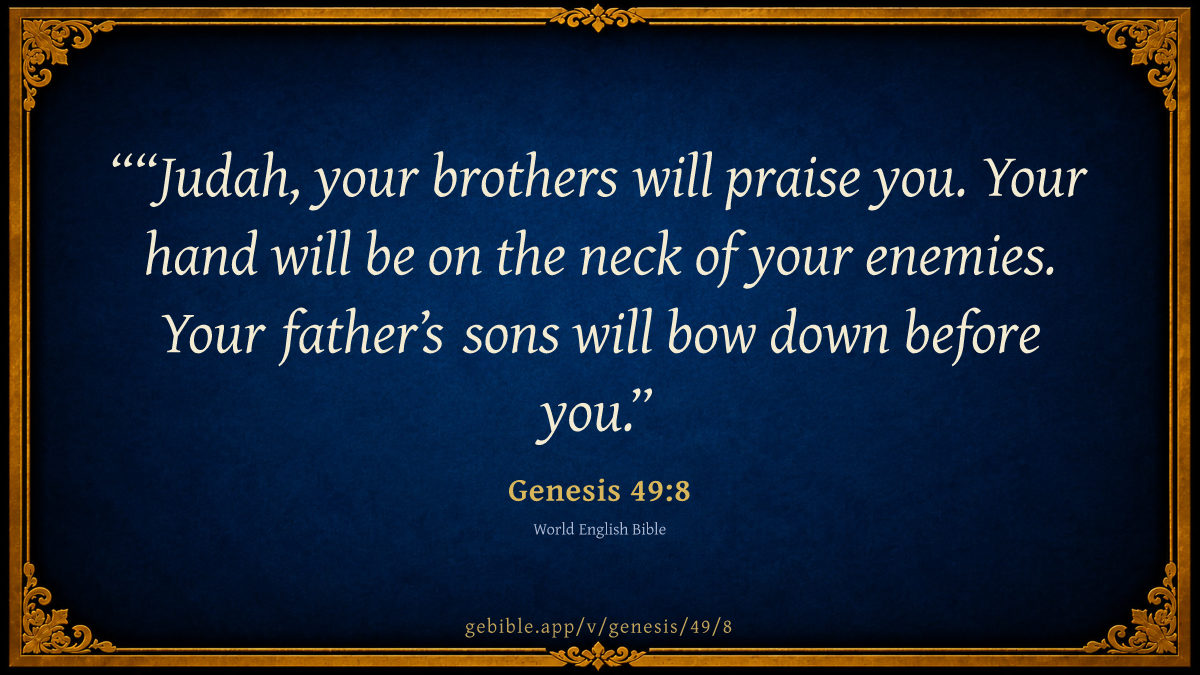
“Judah, your brothers will praise you. Your hand will be on the neck of your enemies. Your father’s sons will bow down before you.
Parallel Translations
-
“Judah, your brothers will praise you. Your hand will be on the neck of your enemies. Your father’s sons will bow down before you.
-
Judah, thou art he whom thy brethren shall praise: thy hand shall be in the neck of thine enemies; thy father’s children shall bow down before thee.
-
Judah, thee shall thy brethren praise; thy hand shall be on the neck of thine enemies; thy father's sons shall bow down before thee.
Cross-references (35)
Passages linked to Genesis 49:8 in the Treasury of Scripture Knowledge, ordered by reader-vote popularity; verse text shown in World English Bible.
- Genesis 27:29 Let peoples serve you, and nations bow down to you. Be lord over your brothers. Let your mother’s sons bow down to you. Cursed be everyone who curses you. Blessed be everyone who blesses you.”
- 1 Chronicles 5:2 For Judah prevailed above his brothers, and from him came the prince; but the birthright was Joseph’s)—
- Hebrews 7:14 For it is evident that our Lord has sprung out of Judah, about which tribe Moses spoke nothing concerning priesthood.
- Deuteronomy 33:7 This is for Judah. He said, “Hear, Yahweh, the voice of Judah. Bring him in to his people. With his hands he contended for himself. You shall be a help against his adversaries.”
- Genesis 29:35 She conceived again, and bore a son. She said, “This time I will praise Yahweh.” Therefore she named him Judah. Then she stopped bearing.
- Joshua 10:24 When they brought those kings out to Joshua, Joshua called for all the men of Israel, and said to the chiefs of the men of war who went with him, “Come near. Put your feet on the necks of these kings.” They came near, and put their feet on their necks.
- Psalms 18:40-43 You have also made my enemies turn their backs to me, that I might cut off those who hate me. They cried, but there was no one to save; even to Yahweh, but he didn’t answer them. Then I beat them small as the dust before the wind. I cast them out as the mire of the streets. You have delivered me from the strivings of the people. You have made me the head of the nations. A people whom I have not known shall serve me.
- Genesis 37:7-10 for behold, we were binding sheaves in the field, and behold, my sheaf arose and also stood upright; and behold, your sheaves came around, and bowed down to my sheaf.” His brothers asked him, “Will you indeed reign over us? Will you indeed have dominion over us?” They hated him all the more for his dreams and for his words. He dreamed yet another dream, and told it to his brothers, and said, “Behold, I have dreamed yet another dream: and behold, the sun and the moon and eleven stars bowed down to me.” He told it to his father and to his brothers. His father rebuked him, and said to him, “What is this dream that you have dreamed? Will I and your mother and your brothers indeed come to bow ourselves down to you to the earth?”
- Genesis 42:6 Joseph was the governor over the land. It was he who sold to all the people of the land. Joseph’s brothers came, and bowed themselves down to him with their faces to the earth.
- Genesis 44:18-34 Then Judah came near to him, and said, “Oh, my lord, please let your servant speak a word in my lord’s ears, and don’t let your anger burn against your servant; for you are even as Pharaoh. My lord asked his servants, saying, ‘Have you a father, or a brother?’ We said to my lord, ‘We have a father, an old man, and a child of his old age, a little one; and his brother is dead, and he alone is left of his mother; and his father loves him.’ You said to your servants, ‘Bring him down to me, that I may set my eyes on him.’ We said to my lord, ‘The boy can’t leave his father, for if he should leave his father, his father would die.’ You said to your servants, ‘Unless your youngest brother comes down with you, you will see my face no more.’ When we came up to your servant my father, we told him the words of my lord. Our father said, ‘Go again and buy us a little food.’ We said, ‘We can’t go down. If our youngest brother is with us, then we will go down: for we may not see the man’s face, unless our youngest brother is with us.’ Your servant, my father, said to us, ‘You know that my wife bore me two sons. One went out from me, and I said, “Surely he is torn in pieces;” and I haven’t seen him since. If you take this one also from me, and harm happens to him, you will bring down my gray hairs with sorrow to Sheol.’ Now therefore when I come to your servant my father, and the boy is not with us; since his life is bound up in the boy’s life; it will happen, when he sees that the boy is no more, that he will die. Your servants will bring down the gray hairs of your servant, our father, with sorrow to Sheol. For your servant became collateral for the boy to my father, saying, ‘If I don’t bring him to you, then I will bear the blame to my father forever.’ Now therefore, please let your servant stay instead of the boy, my lord’s slave; and let the boy go up with his brothers. For how will I go up to my father, if the boy isn’t with me?—lest I see the evil that will come on my father.”
- Genesis 46:12 The sons of Judah: Er, Onan, Shelah, Perez, and Zerah; but Er and Onan died in the land of Canaan. The sons of Perez were Hezron and Hamul.
- Numbers 1:27 those who were counted of them, of the tribe of Judah, were seventy-four thousand six hundred.
- Numbers 10:14 First, the standard of the camp of the children of Judah went forward according to their armies. Nahshon the son of Amminadab was over his army.
- Numbers 26:22 These are the families of Judah according to those who were counted of them, seventy-six thousand five hundred.
- Judges 1:1-2 After the death of Joshua, the children of Israel asked of Yahweh, saying, “Who should go up for us first against the Canaanites, to fight against them?” Yahweh said, “Judah shall go up. Behold, I have delivered the land into his hand.”
- Judges 20:18 The children of Israel arose, went up to Bethel, and asked counsel of God. They asked, “Who shall go up for us first to battle against the children of Benjamin?” Yahweh said, “Judah first.”
- 2 Samuel 5:3 So all the elders of Israel came to the king to Hebron, and king David made a covenant with them in Hebron before Yahweh; and they anointed David king over Israel.
- 2 Samuel 22:41 You have also made my enemies turn their backs to me, that I might cut off those who hate me.
- 2 Samuel 24:9 Joab gave up the sum of the counting of the people to the king: and there were in Israel eight hundred thousand valiant men who drew the sword; and the men of Judah were five hundred thousand men.
- 1 Kings 4:1-34 King Solomon was king over all Israel. These were the princes whom he had: Azariah the son of Zadok, the priest; Elihoreph and Ahijah, the sons of Shisha, scribes; Jehoshaphat the son of Ahilud, the recorder; Benaiah the son of Jehoiada was over the army; Zadok and Abiathar were priests; Azariah the son of Nathan was over the officers; Zabud the son of Nathan was chief minister, the king’s friend; Ahishar was over the household; and Adoniram the son of Abda was over the men subject to forced labor. Solomon had twelve officers over all Israel, who provided food for the king and his household. Each man had to make provision for a month in the year. These are their names: Ben Hur, in the hill country of Ephraim; Ben Deker, in Makaz, in Shaalbim, Beth Shemesh, and Elon Beth Hanan; Ben Hesed, in Arubboth (Socoh and all the land of Hepher belonged to him); Ben Abinadab, in all the height of Dor (he had Taphath, Solomon’s daughter, as wife); Baana the son of Ahilud, in Taanach and Megiddo, and all Beth Shean which is beside Zarethan, beneath Jezreel, from Beth Shean to Abel Meholah, as far as beyond Jokmeam; Ben Geber, in Ramoth Gilead (the towns of Jair the son of Manasseh, which are in Gilead, belonged to him; and the region of Argob, which is in Bashan, sixty great cities with walls and bronze bars, belonged to him); Ahinadab the son of Iddo, in Mahanaim; Ahimaaz, in Naphtali (he also took Basemath the daughter of Solomon as wife); Baana the son of Hushai, in Asher and Bealoth; Jehoshaphat the son of Paruah, in Issachar; Shimei the son of Ela, in Benjamin; Geber the son of Uri, in the land of Gilead, the country of Sihon king of the Amorites and of Og king of Bashan; and he was the only officer who was in the land. Judah and Israel were numerous as the sand which is by the sea in multitude, eating and drinking and making merry. Solomon ruled over all the kingdoms from the River to the land of the Philistines, and to the border of Egypt. They brought tribute and served Solomon all the days of his life. Solomon’s provision for one day was thirty cors of fine flour, sixty measures of meal, ten head of fat cattle, twenty head of cattle out of the pastures, and one hundred sheep, in addition to deer, and gazelles, and roebucks, and fattened fowl. For he had dominion over all on this side the River, from Tiphsah even to Gaza, over all the kings on this side the River: and he had peace on all sides around him. Judah and Israel lived safely, every man under his vine and under his fig tree, from Dan even to Beersheba, all the days of Solomon. Solomon had forty thousand stalls of horses for his chariots, and twelve thousand horsemen. Those officers provided food for king Solomon, and for all who came to king Solomon’s table, every man in his month. They let nothing be lacking. They also brought Barley and straw for the horses and swift steeds to the place where the officers were, each man according to his duty. God gave Solomon abundant wisdom and understanding, and very great understanding, even as the sand that is on the seashore. Solomon’s wisdom excelled the wisdom of all the children of the east and all the wisdom of Egypt. For he was wiser than all men; than Ethan the Ezrahite, Heman, Calcol, and Darda, the sons of Mahol: and his fame was in all the nations all around. He spoke three thousand proverbs; and his songs numbered one thousand five. He spoke of trees, from the cedar that is in Lebanon even to the hyssop that grows out of the wall; he also spoke of animals, of birds, of creeping things, and of fish. People of all nations came to hear the wisdom of Solomon, sent by all kings of the earth, who had heard of his wisdom.
- 1 Chronicles 12:1-40 Now these are those who came to David to Ziklag, while he was a fugitive from Saul the son of Kish. They were among the mighty men, his helpers in war. They were armed with bows, and could use both the right hand and the left in slinging stones and in shooting arrows from the bow. They were of Saul’s relatives of the tribe of Benjamin. The chief was Ahiezer, then Joash, the sons of Shemaah the Gibeathite; Jeziel and Pelet, the sons of Azmaveth; Beracah; Jehu the Anathothite; Ishmaiah the Gibeonite, a mighty man among the thirty and a leader of the thirty; Jeremiah; Jahaziel; Johanan; Jozabad the Gederathite; Eluzai; Jerimoth; Bealiah; Shemariah; Shephatiah the Haruphite; Elkanah, Isshiah Azarel, Joezer, and Jashobeam, the Korahites; and Joelah and Zebadiah, the sons of Jeroham of Gedor. Some Gadites joined David in the stronghold in the wilderness, mighty men of valor, men trained for war, who could handle shield and spear; whose faces were like the faces of lions, and they were as swift as the gazelles on the mountains: Ezer the chief, Obadiah the second, Eliab the third, Mishmannah the fourth, Jeremiah the fifth, Attai the sixth, Eliel the seventh, Johanan the eighth, Elzabad the ninth, Jeremiah the tenth, and Machbannai the eleventh. These of the sons of Gad were captains of the army: he who was least was equal to one hundred, and the greatest to one thousand. These are those who went over the Jordan in the first month, when it had overflowed all its banks; and they put to flight all who lived in the valleys, both toward the east and toward the west. Some of the children of Benjamin and Judah came to the stronghold to David. David went out to meet them, and answered them, “If you have come peaceably to me to help me, my heart will be united with you; but if you have come to betray me to my adversaries, since there is no wrong in my hands, may the God of our fathers see this and rebuke it.” Then the Spirit came on Amasai, who was chief of the thirty, and he said, “We are yours, David, and on your side, you son of Jesse. Peace, peace be to you, and peace be to your helpers; for your God helps you.” Then David received them, and made them captains of the band. Some of Manasseh also joined David, when he came with the Philistines against Saul to battle; but they didn’t help them; for the lords of the Philistines sent him away after consultation, saying, “He will desert to his master Saul to the jeopardy of our heads.” As he went to Ziklag, some from Manasseh joined him: Adnah, Jozabad, Jediael, Michael, Jozabad, Elihu, and Zillethai, captains of thousands who were of Manasseh. They helped David against the band of rovers; for they were all mighty men of valor, and were captains in the army. For from day to day men came to David to help him, until there was a great army, like God’s army. These are the numbers of the heads of those who were armed for war, who came to David to Hebron, to turn the kingdom of Saul to him, according to Yahweh’s word. The children of Judah who bore shield and spear were six thousand eight hundred, armed for war. Of the children of Simeon, mighty men of valor for the war: seven thousand one hundred. Of the children of Levi: four thousand six hundred. Jehoiada was the leader of the household of Aaron; and with him were three thousand seven hundred, and Zadok, a young man mighty of valor, and of his father’s house twenty-two captains. Of the children of Benjamin, Saul’s relatives: three thousand, for until then, the greatest part of them had kept their allegiance to Saul’s house. Of the children of Ephraim: twenty thousand eight hundred, mighty men of valor, famous men in their fathers’ houses. Of the half-tribe of Manasseh: eighteen thousand, who were mentioned by name, to come and make David king. Of the children of Issachar, men who had understanding of the times, to know what Israel ought to do, their heads were two hundred; and all their brothers were at their command. Of Zebulun, such as were able to go out in the army, who could set the battle in array, with all kinds of instruments of war: fifty thousand who could command and were not of double heart. Of Naphtali: one thousand captains, and with them with shield and spear thirty-seven thousand. Of the Danites who could set the battle in array: twenty-eight thousand six hundred. Of Asher, such as were able to go out in the army, who could set the battle in array: forty thousand. On the other side of the Jordan, of the Reubenites, the Gadites, and of the half-tribe of Manasseh, with all kinds of instruments of war for the battle: one hundred twenty thousand. All these were men of war, who could order the battle array, and came with a perfect heart to Hebron, to make David king over all Israel; and all the rest also of Israel were of one heart to make David king. They were there with David three days, eating and drinking; for their brothers had supplied provisions for them. Moreover those who were near to them, as far as Issachar, Zebulun, and Naphtali, brought bread on donkeys, on camels, on mules, and on oxen: supplies of flour, cakes of figs, clusters of raisins, wine, oil, cattle, and sheep in abundance; for there was joy in Israel.
- 2 Chronicles 11:12-17 He put shields and spears in every city, and made them exceedingly strong. Judah and Benjamin belonged to him. The priests and the Levites who were in all Israel stood with him out of all their territory. For the Levites left their pasture lands and their possession, and came to Judah and Jerusalem; for Jeroboam and his sons cast them off, that they should not execute the priest’s office to Yahweh. He himself appointed priests for the high places, for the male goats, and for the calves which he had made. After them, out of all the tribes of Israel, those who set their hearts to seek Yahweh, the God of Israel, came to Jerusalem to sacrifice to Yahweh, the God of their fathers. So they strengthened the kingdom of Judah, and made Rehoboam the son of Solomon strong for three years; for they walked three years in the way of David and Solomon.
- 2 Chronicles 14:8 Asa had an army of three hundred thousand out of Judah who bore bucklers and spears, and two hundred eighty thousand out of Benjamin who bore shields and drew bows. All these were mighty men of valor.
- 2 Chronicles 15:9 He gathered all Judah and Benjamin, and those who lived with them out of Ephraim, Manasseh, and Simeon; for they came to him out of Israel in abundance when they saw that Yahweh his God was with him.
- 2 Chronicles 17:2 He placed forces in all the fortified cities of Judah, and set garrisons in the land of Judah, and in the cities of Ephraim, which Asa his father had taken.
- 2 Chronicles 17:14-16 This was the numbering of them according to their fathers’ houses: From Judah, the captains of thousands: Adnah the captain, and with him three hundred thousand mighty men of valor; and next to him Jehohanan the captain, and with him two hundred eighty thousand; and next to him Amasiah the son of Zichri, who willingly offered himself to Yahweh, and with him two hundred thousand mighty men of valor.
- 2 Chronicles 30:11 Nevertheless some men of Asher, Manasseh, and Zebulun humbled themselves, and came to Jerusalem.
- Psalms 76:1 In Judah, God is known. His name is great in Israel.
- Psalms 78:68-71 But chose the tribe of Judah, Mount Zion which he loved. He built his sanctuary like the heights, like the earth which he has established forever. He also chose David his servant, and took him from the sheepfolds; from following the ewes that have their young, he brought him to be the shepherd of Jacob, his people, and Israel, his inheritance.
- Isaiah 9:7 Of the increase of his government and of peace there shall be no end, on David’s throne, and on his kingdom, to establish it, and to uphold it with justice and with righteousness from that time on, even forever. The zeal of Yahweh of Armies will perform this.
- Ezekiel 21:29 while they see for you false visions, while they divine lies to you, to lay you on the necks of the wicked who are deadly wounded, whose day has come in the time of the iniquity of the end.
- Philippians 2:10-11 that at the name of Jesus every knee should bow, of those in heaven, those on earth, and those under the earth, and that every tongue should confess that Jesus Christ is Lord, to the glory of God the Father.
- Hebrews 10:13 from that time waiting until his enemies are made the footstool of his feet.
- Revelation 5:5 One of the elders said to me, “Don’t weep. Behold, the Lion who is of the tribe of Judah, the Root of David, has overcome: he who opens the book and its seven seals.”
- Revelation 11:15 The seventh angel sounded, and great voices in heaven followed, saying, “The kingdom of the world has become the Kingdom of our Lord, and of his Christ. He will reign forever and ever!”
Cross-references from openbible.info (CC BY 4.0)
Explain this verse (19 sources)
Historical commentary, presented as a primary source — not an endorsement.
Private notes
Saved on this device only — never synced or sent anywhere.
John Calvin 1540 · Public Domain 8. Judah, thou art he whom thy brethren shall…
8. Judah, thou art he whom thy brethren shall praise. In the word praise there is an allusion to the name of Judah; for so he had been called by his mother, because his birth had given occasion for praising God. The father adduces a new etymology, because his name shall be so celebrated and illustrious among his brethren, that he should be honored by them all equally with the first-born. The double portion, indeed, which he recently assigned to his son Joseph, depended on the right of primogeniture: but because the kingdom was transferred to the tribe of Judah, Jacob properly pronounces that his name should be held worthy of praise. For the honor of Joseph was temporary; but here a stable and durable kingdom is treated of, which should be under the authority of the sons of Judah. Hence we gather, that when God would institute a perfect state of government among his people, the monarchical form was chosen by him. And whereas the appointment of a king under the law, was partly to be attributed to the will of man, and partly to the divine decree; this combination of human with divine agency must be referred to the commencement of the monarchy, which was inauspicious, because the people had tumultuously desired a king to be given them, before the proper time had arrived. Hence their unseemly haste was the cause why the kingdom was not immediately set up in the tribe of Judah, but was brought forth, as an abortive offspring, in the person of Saul. Yet at length, by the favor and in the legitimate order of God, the preeminence of the tribe of Judah was established in the person of David.
Thy hand shall be in the neck of thine enemies. In these words he shows that Judah should not be free from enemies; but although many would give him trouble, and would endeavor to deprive him of his right, Jacob promises him victory; not that the sons of David should always prevail against their enemies, (for their ingratitude interfered with the constant and equable course of the grace of God,) but in this respect, at least, Judah had the superiority, that in his tribe stood the royal throne which God approved, and which was founded on his word. For though the kingdom of Israel was more flourishing in wealth and in number of inhabitants, yet because it was spurious, it was not the object of God’s favor: nor indeed was it right, that, by its tinselled splendor, it should eclipse the glory of the Divine election which was engraven upon the tribe of Judah. In David, therefore, the force and effect of this prophecy plainly appeared; then again in Solomon; afterwards, although the kingdom was mutilated, yet was it wonderfully preserved by the hand of God; otherwise, in a short space, it would have perished a hundred times. Thus it came to pass, that the children of Judah imposed their yoke upon their enemies. Whereas defection carried away ten tribes, which would not bow their knees to the sons of David; the legitimate government was in this way disturbed, and lawless confusion introduced; yet nothing could violate the decree of God, by which the right to govern remained with the tribe of Judah.
John Calvin's Commentaries (1540-1563) — public domain. Text from the Calvin Translation Society English edition (1840s-50s) via the Christian Classics Ethereal Library (ccel.org). Calvin's coverage is partial (roughly two-thirds of the Bible); uncommented books and verses are honest gaps, never fabricated. The 19th-century editor's footnotes and remarks are omitted so the notes are faithfully Calvin's own voice.
Geneva Bible translators 1599 · Public Domain As was verified in David and Christ.
As was verified in David and Christ.
Geneva Bible (1599) marginal notes — public domain.
John Trapp 1656 · Public Domain Gen 49:8 Judah, thou [art he] whom thy brethren…
Gen 49:8 Judah, thou [art he] whom thy brethren shall praise: thy hand [shall be] in the neck of thine enemies; thy father’s children shall bow down before thee.
Ver. 8. Judah, thou art he whom thy brethren.] All this is chiefly verified in Christ, and of him to be understood. In him is beauty, bounty, goodness, greatness, and whatsoever else is praiseworthy. He goeth forth riding on his white horse, "conquering and to conquer." {Rev 6:2} St Paul, his chief herald, proclaims his victory with a world of solemnity and triumph, {1Co 15:55-57} and calls upon all his brethren to bow down before him, {Php 2:10} as they do, {Rev 12:10} casting down their crowns at his feet, {Rev 4:10} and setting the crown upon his head, - as the manner was among the Romans, that the saved should crown their saviours, and honour them as their fathers all their lives long, being wholly at their service. {a} It was not without mystery that David did reverence to his son Solomon, when he was newly crowned; what would he have done, think we, to his Lord, as he calls Christ, {Psa 110:1} had he been there in his royalty?
Read full note →
{a} Apud Romam siqui servati essent, solebant Servatorem suum coronare. Sεβεται δε τουτον, και παπα ολον τον βιον ο σωθεις ως πατερα και παντα δει τουτω ποιειν ως τω γονει. - Polyb., lib. vi.
John Trapp, A Commentary or Exposition upon All the Books of the Old and New Testament (1647–1656) — public domain. Text from a community e-Sword module.
Matthew Poole 1685 · Public Domain Or rather,
Or rather,
Thou art
Read full note →
Judah, thy brethren shall praise or celebrate thee. So the expression is like that 1Sa 25:25.
As his name is, so is he; Nabal is his name, and folly is with him, or in him. So here the sense is, As thy name signifies praise, Gen 29:35, so shalt thou have praise or honour from thy brethren. He alludes to his name, and to the occasion of it, but with an elegant variation. Thou art deservedly called Judah, not only because thy mother praised God for thee, but also because thy brethren shall praise and bless thee for the reasons here following. But this, as also the other blessings or predictions, do not so much declare the state of Judah or the rest in their own persons, as in their posterity.
Thy hand shall be in the neck of thine enemies, i.e. thou shalt overthrow and subdue them. This was fulfilled in part, Jdg 1:1,2,4; 3:9,10; but more fully in David, 2Sa 8:1, and Solomon, 1Ch 12:9; and most eminently, though spiritually, in Christ. The phrase is taken either,
1. From the practice of warriors, who use to assault their enemies in that part, that they may throw them down at their feet; of which see Job 15:26; 16:12. Or,
2. from the custom of conquerors, who are said to put the yokes upon the necks of the conquered. See Gen 27:40; Deu 28:48; Isa 10:27; Jer 27:8; 28:14.
Thy father’s children, i.e. all thy brethren, and my posterity; he saith not thy mother’s children, for his sons had divers mothers;
shall bow down before thee, i.e. shall own thee as their superior and lord, upon whom I have devolved this part of the right of the first-born. By this and the following words we plainly see that these blessings and predictions were not distributed according to Jacob’s affections and inclinations, (for then Judah should never have been advanced above his worthily beloved Joseph,) but by the direction of God’s Spirit.
Matthew Poole's English Annotations on the Holy Bible (1683–1685) — public domain. Text from a community e-Sword/MySword module.
Matthew Henry 1710 · Public Domain Glorious things are here said of Judah. The mention…
Glorious things are here said of Judah. The mention of the crimes of the three elder of his sons had not so put the dying patriarch out of humour but that he had a blessing ready for Judah, to whom blessings belonged. Judah's name signifies praise, in allusion to which he says, Thou art he whom thy brethren shall praise, Gen 49:8. God was praised for him (Gen 29:35), praised by him, and praised in him; and therefore his brethren shall praise him. Note, Those that are to God for a praise shall be the praise of their brethren. It is prophesied that, 1. The tribe of Judah should be victorious and successful in war: Thy hand shall be in the neck of thy enemies. This was fulfilled in David, Psa 18:40. 2. It should be superior to the rest of the tribes; not only in itself more numerous and illustrious, but having a dominion over them: Thy father's children shall bow down before thee. Judah was the lawgiver, Psa 60:7. That tribe led the van through the wilderness, and in the conquest of Canaan, Jdg 1:2. The prerogatives of the birthright which Reuben had forfeited, the excellence of dignity and power, were thus conferred upon Judah. Observe, "Thy brethren shall bow down before thee, and yet shall praise thee, reckoning themselves happy in having so wise and bold a commander." Note, Honour and power are then a blessing to those that have them when they are not grudged and envied, but praised and applauded, and cheerfully submitted to. 3. It should be a strong and courageous tribe, and so qualified for command and conquest: Judah is a lion's whelp, Gen 49:9. The lion is the king of beasts, the terror of the forest when he roars; when he seizes his prey, none can resist him; when he goes up from the prey, none dare pursue him to revenge it. By this it is foretold that the tribe of Judah should become very formidable, and should not only obtain great victories, but should peaceably and quietly enjoy what was obtained by those victories - that they should make war, not for the sake of war, but for the sake of peace. Judah is compared, not to a lion rampant, always tearing, always raging, always ranging; but to a lion couchant, enjoying the satisfaction of his power and success, without creating vexation to others: this is to be truly great. 4. It should be the royal tribe, and the tribe from which Messiah the Prince should come: The sceptre shall not depart from Judah, till Shiloh come, Gen 49:10. Jacob here foresees and foretels, (1.) That the sceptre should come into the tribe of Judah, which was fulfilled in David, on whose family the crown was entailed. (2.) That Shiloh should be of this tribe - his seed, that promised seed, in whom the earth should be blessed: that peaceable and prosperous one, or the Saviour, so others translate it, he shall come of Judah. Thus dying Jacob, at a great distance, saw Christ's day, and it was his comfort and support on his death-bed. (3.) That after the coming of the sceptre into the tribe of Judah it should continue in that tribe, at least a government of their own, till the coming of the Messiah, in whom, as the king of the church, and the great high priest, it was fit that both the priesthood and the royalty should determine. Till the captivity, all along from David's time, the sceptre was in Judah, and subsequently the governors of Judea were of that tribe, or of the Levites that adhered to it (which was equivalent), till Judea became a province of the Roman empire, just at the time of our Saviour's birth, and was at that time taxed as one of the provinces, Luk 2:1. And at the time of his death the Jews expressly owned, We have no king but Caesar. Hence it is undeniably inferred against the Jews that our Lord Jesus is he that should come, and that we are to look for no other; for he came exactly at the time appointed. Many excellent pens have been admirable well employed in explaining and illustrating this famous prophecy of Christ. 5. It should be a very fruitful tribe, especially that it should abound with milk for babes, and wine to make glad the heart of strong men (Gen 49:11, Gen 49:12) - vines so common in the hedge-rows and so strong that they should tie their asses to them, and so fruitful that they should load their asses from them - wine as plentiful as water, so that the men of that tribe should be very healthful and lively, their eyes brisk and sparkling, their teeth white. Much of what is here said concerning Judah is to be applied to our Lord Jesus. (1.) He is the ruler of all his father's children, and the conqueror of all his father's enemies; and he it is that is the praise of all the saints. (2.) He is the lion of the tribe of Judah, as he is called with reference to this prophecy (Rev 5:5), who, having spoiled principalities and powers, went up a conqueror, and couched so as none can stir him up, when he sat down on the right hand of the Father. (3.) To him belongs the sceptre; he is the lawgiver, and to him shall the gathering of the people be, as the desire of all nations (Hag 2:7), who, being lifted up from the earth, should draw all men unto him (Joh 12:32), and in whom the children of God that are scattered abroad should meet as the centre of their unity, Joh 11:52. (4.) In him there is plenty of all that which is nourishing and refreshing to the soul, and which maintains and cheers the divine life in it; in him we may have wine and milk, the riches of Judah's tribe, without money and without price, Isa 55:1.
Matthew Henry's Commentary on the Whole Bible (1708–1710) — public domain (CC PDM 1.0). Text via the HelloAO Bible API.
John Gill 1763 · Public Domain Judah, thou art he whom thy brethren shall praise,....…
Judah, thou art he whom thy brethren shall praise,.... His name signifies praise, and was given him by his mother, her heart being filled with praises to God for him, Gen 29:35 and is here confirmed by his father on another account, because his brethren should praise him for many excellent virtues in him; and it appears, by instances already observed, that he had great authority, and was highly esteemed among his brethren, as his posterity would be in future times for their courage, warlike expeditions and success, and being famous for heroes, such as David, and others; and especially his famous seed the Messiah, and of whom he was a type, should be praised by his brethren, who are so through his incarnation, and by divine adoption, and who praise him for the glories and excellencies of his person, and the blessings of his grace:
thine hand shall be in the neck of thine enemies; pressing them down by his superior power, subduing them, and causing them to submit to him, and which was verified in David, who was of this tribe, Psa 18:40 and especially in the Messiah, in a spiritual sense, who has conquered and subdued all his and his people's enemies, sin, Satan, the world and death:
Read full note →
thy father's children shall bow down before thee; before the kings that should spring from this tribe, and should rule over all the rest, as David and Solomon, to whom civil adoration and respect were given by them; and before the King Messiah, his son and antitype, in a way of religious worship, which is given him by the angels, the sons of God, and by all the saints and people of God, who are his father's children by adoption; these bow before him, and give him religious adoration as a divine Person, and submit to his righteousness as Mediator, and bow to the sceptre of his kingdom, and cast their crowns at his feet, and give him the glory of their whole salvation. This in some Jewish writings (n) is applied to the time of the Messiah's coming.
(n) Zohar in Gen. fol. 127. 2.
John Gill's Exposition of the Whole Bible (1746–1763) — public domain (CC PDM 1.0). Text via the HelloAO Bible API.
John Wesley 1765 · Public Domain Judah's name signifies praise, in allusion to which he…
Judah's name signifies praise, in allusion to which he saith, Thou art he whom thy brethren shall praise, God was praised for him, chap. xxix, 35, praised by him, and praised in him; and therefore his brethren shall praise him. Thy hand shall be in the neck of thine enemies - This was fulfilled in David, Psalm xviii, 40. Thy father's children shall bow down before thee - Judah was the law-giver, Psalm lx, 7. That tribe led the van through the wilderness, and in the conquest of Canaan, Jude i, 2. The prerogatives of the birth-right which Reuben had forfeited, the excellency of dignity and power, were thus conferred upon Judah. Thy brethren shall bow down before thee, and yet shall praise thee, reckoning themselves happy in having so wise and bold a commander.
John Wesley, Explanatory Notes Upon the Whole Bible (1754–1765) — public domain. Text via the GEBible commentary corpus.
Adam Clarke 1810 · Public Domain 8. Judah! thou! Thy brethren shall praise thee.
8. Judah! thou! Thy brethren shall praise thee.
Thy hand, in the neck of thine enemies:
Read full note →
The sons of thy father shall bow themselves
to thee.
9. A lion's whelp is Judah:
From the prey, my son, thou hast ascended,
He couched, lying down like a strong lion
And like a lioness; who shall arouse him?
10. From Judah the sceptre shall not depart,
Nor a teacher from his offspring,
Until that SHILOH shall come,
And to him shall be assembled the peoples.
11. Binding his colt to the vine,
And to the choice vine the foals of his ass,
He washed his garments in wine,
His clothes in the blood of the grape.
12. With wine shall his eyes be red,
And his teeth shall be white with milk.
Verse 8. Thy brethren shall praise thee.] As the name Judah signifies praise, Jacob takes occasion from its meaning to show that this tribe should be so eminent and glorious, that the rest of the tribes should praise it; that is, they should acknowledge its superior dignity, as in its privileges it should be distinguished beyond all the others. On the prophecy relative to Judah, Dr. Hales has several judicious remarks, and has left very little to be farther desired on the subject. Every reader will be glad to meet with them here.
"The prophecy begins with his name JUDAH, signifying the praise of the Lord, which was given to him at his birth by his mother Leah, Ge 29:35. It then describes the warlike character of this tribe, to which, by the Divine appointment, was assigned the first lot of the promised land, which was conquered accordingly by the pious and heroic Caleb; the first who laid hands on the necks of his enemies, and routed and subdued them, Jos 14:11; Jos 15:1; Jdg 1:1-2; and led the way for their total subjugation under David; who, in allusion to this prediction, praises God, and says: Thou hast given me the necks of mine enemies, that I might destroy them that hate me, Ps 18:40. In the different stages of its strength, this tribe is compared to a lion's whelp, to a full grown lion, and to a nursing lioness, the fiercest of all. Hence a lion was the standard of Judah; compare Nu 2:3, Eze 1:10. The city of David, where he reposed himself after his conquests, secure in the terror of his name, 1Ch 14:17, was called Ariel, the lion of God, Isa 29:1; and our Lord himself, his most illustrious descendant, the Lion of the tribe of Judah, Re 5:5.
"The duration of the power of this famous tribe is next determined: 'the sceptre of dominion,' as it is understood Est 8:4; Isa 14:5, c., or its civil government, was not to cease or depart from Judah until the birth or coming of SHILOH, signifying the Apostle, as Christ is styled, Heb 3:1 nor was the native lawgiver, or expounder of the law, teacher, or scribe, intimating their ecclesiastical polity, to cease, until Shiloh should have a congregation of peoples, or religious followers, attached to him. And how accurately was this fulfilled in both these respects!
"1. Shortly before the birth of Christ a decree was issued by Augustus Caesar that all the land of Judea and Galilee should be enrolled, or a registry of persons taken, in which Christ was included, Lu 2:1-7; whence Julian the apostate unwittingly objected to his title of CHRIST or KING, that he was born a subject of Caesar!' About eleven years after Judea was made a Roman province, attached to Syria on the deposal and banishment of Archelaus, the son of Herod the Great, for maladministration; and an assessment of properties or taxing was carried into effect by Cyrenius, then governor of Syria, the same who before, as the emperor's procurator, had made the enrolment, Lu 2:2; Ac 5:37; and thenceforth Judea was governed by a Roman deputy, and the judicial power of life and death taken away from the Jews, Joh 18:31.
"2. Their ecclesiastical polity ceased with the destruction of their city and temple by the Romans, A. D. 70; at which time the Gospel had been preached through the known world by the apostles, 'his witnesses in Jerusalem, and in all Judea, and in Samaria, and unto the uttermost parts of the earth;' Ac 2:8; Ro 10:18.
"Our Lord's triumphant entry into Jerusalem, before his crucifixion, 'riding on an ass, even a colt the foal of an ass,' which by his direction his disciples brought to him for this purpose, 'Go into the village over against you, and presently ye shall find an ass tied, and a colt with her; loose them, and bring them to me,' Mt 21:2-5, remarkably fulfilling the prophecy of Zechariah, (Zec 9:9) is no less a fulfillment of this prophecy of Shiloh, 'binding or tying his foal to the vine, even his ass's colt to the choice vine.' In ancient times to ride upon white asses or ass-colts was the privilege of persons of high rank, princes, judges, and prophets, Jdg 5:10; Jdg 10:4; Nu 22:22. And as the children of Israel were symbolized by the vine, Ps 80:8; Ho 10:1, and the men of Judah by 'a (choice) vine of Sorek,' in the original, both here and in the beautiful allegory of Isaiah, Isa 5:1-7, adopted by Jeremiah, Jer 2:21, and by our Lord, Mt 21:33, who styled himself the true vine, Joh 15:1; so the union of both these images signified our Lord's assumption, as the promised Shiloh, of the dignity of the king of the Jews, not in a temporal but in a spiritual sense, as he declared to Pilate, Joh 18:36, as a prelude to his second coming in glory 'to restore again the kingdom to Israel.'
"The vengeance to be then inflicted on all the enemies of his Church, or congregation of faithful Christians, is expressed by the symbolical imagery of 'washing his garments in wine, and his clothes in the blood of grapes;' which to understand literally, would be incongruous and unusual any where, while it aptly represents his garments crimsoned in the blood of his foes, and their immense slaughter; and imagery frequently adopted in the prophetic scriptures.
"The strength and wholesomeness of Shiloh's doctrine are next represented by having 'his eyes red with wine, and his teeth white with milk.' And thus the evangelical prophet, in similar strains, invites the world to embrace the Gospel: -
Ho, every one that thirsteth, come to the waters,
And he that hath no money; come, buy and eat:
Yea, come, buy wine and milk,
Without money and without price. Isa 55:1.
"On the last day of the feast of tabernacles it was customary among the Jews for the people to bring water from the fountain of Siloah or Siloam, which they poured on the altar, singing the words of Isaiah, Isa 12:3: With joy shall ye draw water from the fountain of salvation; which the Targum interprets, 'With joy shall ye receive a new doctrine from the ELECT of the JUST ONE;' and the feast itself was also called Hosannah, Save, we beseech thee. And Isaiah has also described the apostasy of the Jews from their tutelar God IMMANUEL, under the corresponding imagery of their 'rejecting the gently-flowing waters of Siloah,' Isa 8:6-8.
"Hence our Lord, on the last day of the feast, significantly invited the Jews to come unto him as the true and living Fountain of waters, Jer 2:13. 'If any man thirst, let him come to ME and drink;' Joh 7:37. He also compared his doctrine to new wine, which required to be put into new bottles, made of skins strong enough to contain it, Mt 9:17; while the Gospel is repeatedly represented as affording milk for babes, or the first principles of the oracles of God for novices in the faith, as well as strong meat [and strong wine] for masters in Christ or adepts, Mt 13:11; Heb 5:12-14.
"And our Lord's most significant miracle was wrought at this fountain, when he gave sight to a man forty years old, who had been blind from his birth, by sending him, after he had anointed his eyes with moistened clay, to wash in the pool of Siloam, which is the Greek pronunciation of the Hebrew שלה Siloah or Siloh, Isa 8:6, where the Septuagint version reads Σιλωαμ, signifying, according to the evangelist, απεσταλμενος, sent forth, and consequently derived from שלח shalach, to send, Joh 9:7. Our Lord thus assuming to himself his two leading titles of MESSIAH, signifying anointed, and SHILOH, sent forth or delegated from God; as he had done before at the opening of his mission: 'The Spirit of the Lord is upon me, because he hath anointed me to preach the Gospel to the poor; he hath sent me forth (απεσταλκε) to heal the broken-hearted,' c. Lu 4:18.
"And in the course of it he declared, I was not sent forth (απεσταλην) but unto the lost sheep of the house of Israel, Mt 15:24, by a two-fold reference to his character in Jacob's prophecy of SHILOH and SHEPHERD OF ISRAEL, Ge 49:10-24. 'This is life eternal, to know thee the only true God, and Jesus Christ whom thou sentest forth,' (απεστειλας,) to instruct and save mankind, Joh 17:3; and he thus distinguishes his own superior mission from his commission to his apostles: 'As THE FATHER hath sent ME, (απεσταλκεμε,) so I send you,' πεμπωυμας, Joh 20:21. Whence St. Paul expressly styles Jesus Christ 'the Apostle (οαποστολος) and High Priest of our profession,' Heb 3:1; and by an elaborate argument shows the superiority of his mission above that of Moses, and of his priesthood above that of Aaron, in the sequel of the epistle. His priesthood was foretold by David to be a royal priesthood, after the order of Melchizedek, Ps 110:4. But where shall we find his mission or apostleship foretold, except in Jacob's prophecy of Shiloh? which was evidently so understood by Moses when God offered to send him as his ambassador to Pharaoh, and he declined at first the arduous mission: 'O my Lord, send I pray thee by the hand of Him whom thou wilt send,' or by the promised Shiloh, Ex 3:10; Ex 4:13; by whom in his last blessing to the Israelites, parallel to that of Jacob, he prayed that 'God would bring back Judah to his people,' from captivity, De 33:7.
"Here then we find the true meaning and derivation of the much disputed term Shiloh in this prophecy of Jacob, which is fortunately preserved by the Vulgate, rendering qui mittendus est, he that is to be sent, and also by a rabbinical comment on De 22:7: 'If you keep this precept, you hasten the coming of the Messiah, who is called SENT.'
"This important prophecy concerning Judah intimates, 1. The warlike character and conquests of this tribe; 2. The cessation of their civil and religious polity at the first coming of Shiloh; 3. His meek and lowly inauguration at that time, as spiritual King of the Jews, riding on an ass like the ancient judges and prophets; 4. His second coming as a warrior to trample on all his foes; and, 5. To save and instruct his faithful people." - Hales' Anal., vol. ii., p. 167, &c.
Adam Clarke's Commentary on the Bible (1810–1826) — public domain. Text from a community e-Sword/MySword module.
Joseph Benson 1811 · Public Domain Gen 49:8. Judah, thou art he whom thy brethren…
Gen 49:8. Judah, thou art he whom thy brethren shall praise — As thy name signifies praise, and God was praised for thee, (Gen 29:35,) and shall be praised by and in thee, so shalt thou have praise and honour from thy brethren. The tribe of Judah led the van through the wilderness, Num 10:14, and, in the conquest of Canaan, by the appointment of God, went first up against the Canaanites, after the death of Joshua, Jdg 1:1-2. They had the first lot assigned them in the division of the country, and a lot that was very extensive and fertile. Othniel, the first judge, was of this tribe; and Caleb, whose reputation was not much inferior to that of Joshua. And all the kings that ever God granted the Jewish nation in mercy were of them. In short, in every age, this tribe was more honoured than any of the others. Thy hand shall be on the neck of thine enemies — An expression which signified victory over their enemies, and was remarkably fulfilled in David, Psa 18:40. Thy father’s children shall bow down before thee — They shall not only acknowledge thy dignity above that of the other tribes, and pay such honour to thee as is wont to be conferred on the firstborn; but shall submit to the regal authority and power which shall be vested in thee. This was verified in God’s choosing the tribe of Judah, and David out of it, to govern the Hebrew nation, and in settling the kingdom of Israel in his stock for ever; but especially in the Messiah’s being born of this tribe, whose kingdom is everlasting, and to whom every knee shall bow.
Joseph Benson's Commentary on the Old and New Testaments (1811–1818) — public domain. Text from a community e-Sword module.
Haydock's Catholic Bible Commentary 1859 · Public Domain Praise. He alludes to his name, his martial prowess,…
Praise. He alludes to his name, his martial prowess, and dominion over all his brethren; who should be all called Jews, and submit to his sway. Some explain all this of Jesus Christ; others refer the first part of the prophecy to Juda. (Haydock)
George Leo Haydock (1774–1849), Haydock's Catholic Family Bible and Commentary, 1859 edition — public domain. Excludes Psalms (Douay-Rheims chapter numbering differs from Protestant) and Deuterocanonical books (Catholic canon only).
Daniel D. Whedon 1874 · Public Domain 8. Judah, thou — Pleonastic use of the pronoun,…
8. Judah, thou — Pleonastic use of the pronoun, but adding emphasis to the address.
Shall praise thee — A play upon the meaning of the name Judah. See Gen_29:35. “Reuben, Simeon, and Levi had been cursed and scattered, but as the patriarch turns his eye upon Judah, he sees that the energy and courage which have made him a leader among his brethren will re-appear in his children of remote generations, and make them illustrious above all the other tribes of Israel. His name, which signifies ‘praised,’ or ‘celebrated,’ is seen to shoot its lustre through all the future.” — Newhall.
Daniel D. Whedon (gen. ed.), Commentary on the Old and New Testaments (1874–1909) — public domain. Text from a community e-Sword module.
The Cambridge Bible for Schools and Colleges 1878 · Public Domain 8. praise] The word contains a play on the…
8. praise] The word contains a play on the name Judah, which cannot be reproduced in a translation. See note on Gen_29:35.
The transition from the sombre oracles concerning the previous three tribes to the outburst of the eulogy upon Judah is very marked.
Read full note →
Thy hand … neck] i.e. as Judah pursues the fleeing foe, he shall grasp them by the neck (cf. Job_16:12). The point of this clause lies in the geographical position of the tribe of Judah. Their territory was beset on the west and south-west by the Philistines, and on the south and south-east by the Edomites and the Amalekites. The Philistines and the Edomites were the bitterest and most persistent of Israel’s foes. But they were within reach; and in their flight and retreat they are overtaken and smitten down by the victorious tribe.
bow down before thee] A reference to the Davidic monarchy which united the tribes of Israel.
8–12. Judah is the recipient of a special blessing, which is distributed as follows: (1) he is the object of national eulogy, Gen_49:8; (2) he is strong as a lion, and has won success, Gen_49:9; (3) to him belong the monarchy and the ideal king, Gen_49:10; (4) his territory is blessed with fertility, Gen_49:11-12.
The Cambridge Bible for Schools and Colleges (gen. ed. J. J. S. Perowne; Cambridge University Press, 1878–1918) — public domain. Text from a community e-Sword module.
Ellicott's Commentary for English Readers 1878 · Public Domain (8) Judah, thou art he whom thy brethren shall…
(8) Judah, thou art he whom thy brethren shall praise.—Judah had received his name, Praise, because at his birth Leah had praised Jehovah (Gen_29:35). It is now to have another justification in the noble history of his race, which, taking the foremost place by reason of the disqualification of Reuben, Simeon, and Levi, finally was destined to win freedom and empire for Israel. We have seen that “the excellency of power” ought to have belonged to Reuben; it now falls to Judah’s lot, is to be attained by exploits that shall deserve the praise of all the tribes, and is to be exercised over not only the descendants of Leah, but all Jacob’s children.
A Bible Commentary for English Readers, edited by Charles John Ellicott (1878–1897) — public domain. Text from a community e-Sword module.
The Pulpit Commentary 1880 · Public Domain Vers. 8-12. Judah, thou art he whom thy brethren…
Vers. 8-12. Judah, thou art he whom thy brethren shall praise literally, Judah thou, will praise thee thy brethren, the word hd; Why being a palpable play on (cf. Gen_29:35) Leah praised Jehovah for his birth, and his brethren should extol him for his nobility of character, which even in his acts of sin could not be entirely obscured, (Gen_37:26 Gen_38:26) and certainly in his later days (Gen_43:8 Gen_44:18-34) shone out with undiminished luster. Thy hand shall be in the neck of thine enemies (i.e. putting his foes to flight, Judah should grasp them by the neck, a prediction remarkably accomplished in the victories of David and Solomon); thy father"s children shall bow down before thee. Fulfilled in the elevation of the house of Judah to the throne, which owned as its subjects not simply Judah"s mother"s children, i.e. the tribes descended from Leah, but also his father"s, i.e. all the tribes of Israel.
Judah is a lion"s whelp: from the prey, my son, thou art gone up: he stooped down, he couched down as a lion, and as an old lion; who shall rouse him up? By a bold and striking figure Judah is compared to a young lion, ripening into its full strength and ferocity, roaming through the forests in search of prey, repairing to his mountain den (ejk blastou ajnebhv, LXX) when his booty has been devoured, and there in quiet majesty, full of dignified repose, lying down or crouching in his lair, and calmly resisting all attempts to disturb his leonine serenity. The effect of the picture is also heightened by the alternative image of a lioness, which is particularly fierce in defending its cubs, and which no one would venture to assail when so employed. The use of such figures to describe a strong and invincible hero is by no means infrequent in Scripture (vide Psa_7:3; Isa_5:29; Eze_19:2-9) The scepter shall not depart from Judah, literally, a scepter (i.e. an emblem of regal command, hence dominion or sovereignty; arcwn, LXX, Theodotion; ejxousia, Symmachus) shall not depart from Judah nor a lawgiver from between his feet literally, and a legislator (sc. shall not depart) from between his feet; qqejom, the poel part of qqj to cut, to cut into, hence to decree, to ordain, having the sense of one who decrees; hence leader, as in Jud_1:5:4, dux (Vulgate) hjgoumenov (LXX), or lawgiver, as in Deu_33:21 and Isa_33:22. (Calvin, Dathius, Ainsworth, Rosenm Murphy, Wordsworth, "Speaker"s Commentary") In view, however, of what appears the requirement of the parallelism, qqejom is regarded as not the person, but the thing, that determines or rules, and hence as equivalent to the ruler"s staff, or marshal"s baton (Gesenius, Furst, Keil, Lange, Bleek, Tuch, Kalisch, and others), in support of which is claimed the phrase "from between his feet," which is supposed to point to the Oriental custom, as depicted on the monuments, of monarchs, when sitting upon their thrones, resting their staves,between their feet (cf. Agamemnon, "Iliad," 2:46, 101; Layard s "Nineveh and Babylon," p. 195). But the words may likewise signify "from among his descendants," "from among his children"s children" (Onkelos), ejk twn mhrwn aujtou (LXX). Until Shiloh come. This difficult clause has been very variously rendered.
Read full note →
1. Taking Shiloh as the name of a place, viz., Shiloh in Ephraim (Jos_18:1, Jos_18:8, Jos_18:9, 10 19:51; Jud_1:18:31; 1Sa_1:3, 1Sa_1:9, 24 2:14, &c.); the sense has been explained as meaning that the leadership of Judah over the other tribes of Israel should not cease until he came to Shiloh (Rabbi Lipmann, Teller, Eichhorn, Bleek, Furst, Tuch, Delitzsch).
But though hlvi aObY; w, and they came to Shiloh, a similar phrase, is found 1Sa_4:12, yet against this interpretation maybe urged
(1) the improbability of so obscure a locality, whose existence at the time is also problematical, being mentioned by Jacob, Zidon, the only other name occurring in the prophecy, having been, even before the days of Jacob, a city of renown; (Gen_10:19) and
(2) the inaccuracy of the historical statement which would thus be made, since the supremacy of Judah was in no way affected, and certainly not diminished, by the setting up of the tabernacle in Shiloh; to obviate which objection Kalisch proposes to read yKi d as even if," or "even when," and to understand the prediction as intimating that even though a new empire should be established at Shiloh, as was eventually done, Judah should not forfeit her royal name and prerogative only this sense of yKi d is not clearly recognized by the best grammarians (Gesenius, Furst), and is not successfully supported by the passages referred to (Psa_110:1 Psa_112:8) in every one of which the received rendering "until" is distinctly preferable.
1. Regarding Shiloh as an abstract noun, from hl; v; to be safe, like hlGi from hl; G; the import of the prophecy has been expressed as asserting that the scepter should not depart from Judah, either until he (Judah) should attain to rest (Hofmann, Kurtz), or until tranquility should come, i.e. until Judah s enemies should be subdued (Gesenius), an interpretation which Rosenm properly characterises as languidum et paine frigidum ." Hence
2 Believing Shiloh to be the name of a person, the majority of commentators, both Jewish and Christian, and ancient as well as modern, agree that the Messiah is the person referred to, and understand Jacob as fore-announcing that the time of his appearance would not be till the staff of regal power had dropped from the hands of Judah; only, the widest possible diversity exists among those who discover a Messianic reference in the prediction as to the exact significance of the term Shiloh. Some render it his son, or progeny, or (great) descendant, from an imaginary root, lvi, which, after Chaldee and Arabic analogies, is supposed to mean "offspring" (Targum of Jonathan, Kimchi, Calvin, Ainsworth, and others); others, deriving it from jlv to send, compare it with Siloam (Joh_9:7) and Shiloah, (Isa_8:6) and interpret it as qui mittendus eat (Vulgate, Pererius, A Lapide, Grotius); a third class of expositors, connecting it with hlv to be safe or at rest, view it us a nomen appellatum, signifying the Pacificator, the Rest-giver, the Tranquillizer, the Peace (Luther, Venema, Rosenm Hengstenberg, Keil, Gerlach, Murphy, &c.); while a fourth resolve it into wOl rv,a) and conjecture it to signify, he to whom it (sc. the scepter or the kingdom) belongs, or he whose right it is, as inkeitai; Eze_21:27 (LXX, ewv ejamena aujtw; Aquila and Symmachus, w ajpo Onkelos, Syriac, Saadias, Targum of Jerusalem, et alii). It seems indisputable that the preponderance of authority is in favor of the last two interpretations, and if hloyvi be the correct reading, instead of hlovi (hLov, wOl rva) as the majority of MSS. attest, it will be difficult to withhold from the former, "the Tranquillizer," the palm of superiority. The translations of Dathius (quamdiu prolem habebit, ei genres obedient), who professes to follow Guleher, who understands the words as a prophecy of the perpetuity of Judah"s kingdom, fulfilled in David, (2Sa 7) and of Lange ("until he himself comes home as the Shiloh or Rest-bringer"), who also discerns in Judah a typical foreshadowing of the Messiah, may be mentioned as examples of ingenious, but scarcely convincing, exposition. And unto him shall the gathering of the people be. Not "kai aujtoa ejqnwn" (LXX), ipse erit expectatio gentium (Vulgate), with which also agrees the Syriac, or "to him nations will flock" (Samaritan), susthma lawn (Aquila), but to him, i.e. Shiloh, will be not aggregatio populorum (Calvin), but the submission or willing obedience (a word occurring elsewhere only in Pro_30:17) of nations or peoples (Onkelos, Targum of Jonathan, Kimchi, Aben Ezra, Dathius, Rosenmuller, Keil, Kalisch, Gerlach, Murphy, Tayler Lewis, "Speaker"s Commentary"). Binding his foal unto the vine, i.e. not Shiloh, but Judah. The verb yrisao has the archaic y appended, as in Gen_31:39; Zec_11:17and his ass"s colt unto the choice vine. The hq (fem. of qrec) was a nobler kind of vine which grew in Syria, with small berries, roundish and of a dark color, with soft and hardly perceptible stones (Gesenius, p. 796). yniB is an archaic form of the construct stats which occurs only here. He washed his garments in wine, and his clothes in the blood of grapes. The word tWs is an apax legomenon, and is either put by aphaeresis for tWsK which occurs in the Samaritan Version, or is derived from hw; s; an uncertain root, signifying to cover (Gesenius, Kalisch). His eyes shall be red with wine, and his teeth white with milk. Otherwise rendered "redder than wine," and "whiter than milk" (LXX, Vulgate, Targum of Jerusalem, et alii), as a description of Judah"s person, which scarcely seems so appropriate as the received translation (Calvin, Rosenmuller, Keil, Kalisch, Murphy, Lange, and others), which, completes the preceding picture of Judah s prosperity. Not only would Judah s soil be so fertile that its vines should be employed for trying asses and colts to their branches, but the grapes of those vines should be so plentiful and luscious as to make wine run like the water in which he washed his clothes, while the wine and milk should be so exhilarating and invigorating as to imp-art a sparkling brilliance to the eyes and a charming whiteness to the teeth. The aged prophet, it has been appropriately remarked, has here no thought of debauchery, but only paints before the mind"s eye a picture of the richest and most ornate enjoyment (Lange). Minime consentaneum esse videtur profusam intemperiem et projectionem in benedictione censeri (Calvin).
The Pulpit Commentary (1880–1919), ed. H.D.M. Spence-Jones & Joseph S. Exell — public domain. Text from a community e-Sword module.
The Biblical Illustrator 1887 · Public Domain Judah, thou art he whom thy brethren shall praise
Gen_49:8-12
Judah, thou art he whom thy brethren shall praise
Read full note →
The blessing of Judah:
I.
THAT HE SHOULD WIN THE PRAISE OF HIS BRETHREN.
II. THAT HE SHOULD BE THE TYPE OF THE VICTORIOUS HERO.
1. A growing power.
2. A. righteous power.
3. A power to be dreaded.
III. THAT HE SHOULD BE THE TYPE OF THE MESSIAH.
1. In his sovereignty. For--
(1) He had regal power.
(2) He had power combined with gentleness.
(3) He had a power which sweetly wins obedience.
2. In his prosperity. (T. H. Leale.)
Judahs praise:
I. JUDAHS PRAISE.
1. He is first in intercession.
2. He is first in wisdom.
3. He takes precedence in offering (see Num_7:12).
4. He takes precedence in march (see Num_10:14; Jdg_1:2). In all things he has the pre-eminence (Psa_68:67-68).
II. JUDAHS TRIUMPHS ABROAD. Thy hand shall be in the neck of thine enemies. Illustrate by life of David--He passed through severe conflicts 1Sa_17:34-36). He gained great victories (2Ch_13:14). He founded a peaceful empire. He utterly crushed the forces of his foes, and broke the neck of all opposition. So has our Lord done by His life, death, resurrection, reigning power, and second coming.
III. JUDAHS HONOURS AT HOME. Thy fathers children shall bow down before thee.
1. He became the head of the family.
2. He was clothed with lion-like power. He couched as a lion, and as an old lion (see verse 9). The lion of the tribe of Judah hath prevailed Rev_5:5).
3. He is the centre of our assembling. To him shall the gathering of the people be (verse 10).
4. His glory is His meekness. Binding his foal, &c. (verse 11). Thy King cometh, meek and sitting upon a colt the foal of an ass (Mat_21:5).
5. The wine hath at His first and second advent makes Him lovely in our eyes (verses 11, 12); also I have trodden the wine-press alone (Isa_63:1-3).
6. He is king to us for ever. Hallelujah (see Hos_11:12). Ephraim compasseth me about with lies, and the house of Israel with deceit: but Judah yet ruleth with God. Are we among the foes against whom He fights as a lion? Let us beware how we rouse Him up (verse 9). Are we among His friends for whom He fights? Let us praise Him with all our hearts, and now bow down before Him. Are we not His Fathers children? Do we hunger and thirst after heavenly food? See in the 12th verse how abundant are wine and milk with Him. (C. H. Spurgeon.)
The blessing of Judah
The first verse of Jacobs blessing on Judah begins with the final triumph of the tribe and victory over all its foes. It then descends to details as to how this victory will be accomplished. As we look at it let us read in it the history of the Lion of the tribe of Judah. There are consecutive stages in the verses, beginning with the highest in the first line of the first verse of the text: Judah, thou art he whom thy brethren shall praise. The order of these verses is one of constant occurrence in the Bible. The issue, great, grand, and glorious, is first stated, then we descend to the details by which it is brought about. Thou art he whom thy brethren shall praise. Praise is the final note and the never ending one to the Lord Jesus Christ. It begins when the soul is first brought to know experimentally the Lord Jesus Christ, in His Person and in His work, as the Lion of the tribe of Judah. Praise for the pardon of all guilt and the forgiveness of all sin through the precious blood of Jesus. Praise for that wondrous love that has stooped down to our lowest condition and lifted us up out of the pit of corruption to His throne of glory. And whence is the source of all this joy and praise now and hereafter? We have it in the next clause: Thy hand shall be in the neck of Thine enemies. It is that hand of which we read so much in Gods Word. He laid His right hand upon me. And Jesus stretched forth His hand. These and such passages tell us what it means. It is Christ putting forth His power over every foe. He conquered death and hell. He conquers still every foe thou hast. Therefore it is that Thy Fathers children bow down to Thee. For whom have we in heaven or on earth like Him! There is none like Thee! Lord, to whom shall we go?
Let every tongue be vocal with Thy praise, every heart bow down at Thy feet. Let all our powers, all that is nearest and dearest, be laid there. Yes, the fathers children shall bow down before Him. The whole of Israel and Judah shall bow down before Jesus. He is their Messiah and their King. But observe further how this is brought about. Judah is a lions whelp: from the prey, my son, thou art gone up: he stooped down, he couched as a lion and as an old lion: who shall rouse him up? The words point to something far greater and deeper in spiritual import. In this graphic picture we behold the Lion of the tribe of Judah, the Lord Jesus Christ. In the young lion ripening into full strength as a growing lion, and becoming the ancestor of the lion tribe, we see the growth of this Lion from infancy to manhood. He shall grow up before Him as a tender plant and as a root out of a dry ground. But thou, Bethlehem Ephratah, though thou be little among the thousands of Judah, yet out of thee shall He come forth unto Me that is to be ruler in Israel, whose goings forth have been from of old from everlasting. And the remnant of Jacob shall be among the Gentiles in the midst of many people as alien among the beasts of the forest, as a young lion among the flocks of sheep: who, if he go through, both treadeth down and teareth in pieces, and none can deliver (Mic_5:2-8). He couched; he lay down as a lion, and as a great lion; who shall stir him up? Num_24:9). In all these passages we see the Lion of the tribe of Judah going forth at the head, and as the Leader of His people Israel. And what is the meaning of the lion seizing its prey and then ascending to its lair in the mountains? What but that same Lion of the tribe of Judah, the Son of God from heaven, seizing its prey and conquering it, when He laid down His life on the cross. There He met every foe, and gained His great victory over the devil, over sin and death and the grave. There He seized the prey, and from that great fight and victory He went up--up to His Fathers throne as mans great Representative. And so we have Him brought before Rev_5:5-6) in the double character as the Lamb of God, the Sin-bearer of the human race, and in the royal dignity of the Lion of the tribe of Judah. Yes, our Jesus went up from the prey, and as He went up, ten thousand times ten thousands of angels uttered their voices, Lift up your heads, O ye gates; and be ye lift up, ye everlasting doors; and the King of Glory shall come in. Who is this King of Glory? The Lord, strong and mighty; the Lord, mighty in battle. Who is this King of Glory? The Lord of hosts, He is the King of Glory (Psa_24:7-8; Psa_24:10). But there is another figure in the picture drawn by Jacob. The figure of a lion is followed by that of a lioness, peculiarly fierce in defending its young. Have we not here the Lion of the tribe of Judah as the Avenger of His people, coming forth to execute judgment upon the nations? At present we see this Lion stooping down, couching, waiting for that moment when He shall come forth to seize upon the prey. From the prey He has indeed gone up; but He is to return again as the Lion of the tribe of Judah to take vengeance on them that know not God, and that obey not the gospel of our Lord Jesus Christ (2Th_1:7-10; Rom_11:26; Joh_14:2-3; Act_1:11; Rev_19:11-15; Mt Amo_3:11; Rev_1:7; Heb_9:28; Isa_11:10-11; Php_3:20-21; 1Th_4:16-17; Zec_14:4-5). But to pass on to the remaining portion of the text: The sceptre shall not depart from Judah, nor a lawgiver from between his feet, till Shiloh come, and unto Him shall the gathering of the people be. A sceptre is the symbol of regal command, and, in its earliest form, it was a long staff which the king held in his hand when speaking in public assemblies; when he sat upon his throne he rested it between his feet inclining towards himself. The idea is that Judah was to have the rule, the chieftainship, till Shiloh came. We must also bear in mind that the coming of Shiloh was not to terminate the rule of Judah. It would then only attain to full dominion in the Person of the Lion of the tribe of Judah. Judah was to bear the sceptre with victorious lion-courage until, in the future Shiloh, the obedience of the nations came to Him, and through Him eventually widening into the peaceful government of the world. The term Shiloh is strikingly confirmatory of this view in relation to Christ and His work. Critically it means rest, peace, quietness. So Christ is called the Prince of Peace (Isa_9:6). In His time, it is said, there shall be abundance of peace so long as the moon endureth (Psa_72:7). Again, This Man shall be our peace (Mic_5:5). Of Christ, it is said, peace on earth was sung by angels at His birth. His own words were, Peace I leave with you; My peace I give unto you: Come unto Me, all ye that are weary and heavy laden, and I will give you rest: and again, Take My yoke upon you, and learn of Me: and ye shall find rest unto your souls: again, These things have I spoken unto you that in Me ye might have peace. Peace, rest, and quietness, these are the meaning of Shiloh, and they are all fulfilled in the Lord Jesus Christ. But let us mark another expression of Jacobs with reference to this Shiloh: unto Him shall the gathering of the people be. Two meanings are wrapped up in these words. First, Shiloh is the Gatherer; and secondly, He gathers to Himself. Mark how our blessed Lord confirms this Himself: I, if I be lifted up from the earth, will draw all men unto Me. This the Lord Jesus is doing now in grace; but the full accomplishment has not yet taken place. The time is drawing near when all kings shall bow down before Him, all nations shall serve Him. As I live, saith the Lord, to Me every knee shall bow, every tongue shall confess. And the time is at hand. We can even now hear the sound of His chariot wheels in the distance. The Churchs journey is nearly done. All things tell us that the morning is at hand, and with that morning the joyous greeting and the eternal gladness, the sun that shall no more go down, and the hallelujahs of a multitude that no man can number meeting in the house of their Father to go no more out. Blessed morning, long expected! Hasten thy dawning upon our troubled world; Yea, come, Lord Jesus, come quickly! But to revert once more to Jacobs blessing on Judah. Observe the superabundance of Judahs blessings, and their deep spiritual import: binding his foal unto the vine; and his asss colt unto the choice vine; he washed his garments in wine, and his clothes in the blood of grapes. His eyes shall be red with wine, and his teeth white with milk. Judah is here depicted as having attained, even before the coming of Shiloh, to a rest acquired by victory over surrounding foes, and enjoying in peaceful repose the abundance of his inheritance. But such a view is far from exhausting the words here brought before us. Indeed, in no full sense were they ever realized in the tribe of Judah. It is to the many and great spiritual blessings of the Lion of the tribe of Judah these words refer. We read of the love of Christ that passeth knowledge; of joy unspeakable and full of glory; that if all the things about Jesus were to be written the world itself could not contain the books that should be written; that eye hath not seen, nor ear heard, neither have entered into the heart of man to conceive, the things that God hath prepared for them that love Him. And let us notice, every one of these blessings are directly connected with Christ Himself. The word His, which runs through these verses, shows us this. His eyes red; His teeth white; His garments washed in wine; His clothes in the blood of grapes. Such expressions remind us of the Song of Solomon, in which the Beloved is described in similar language. They all show us the preciousness of the Person of the Lord Jesus; just as the beloved apostle loved to dwell upon it in his description in Rev_1:13-16. (F. Whitfield, M. A.)
The Biblical Illustrator, edited by Joseph S. Exell (c. 1880s–1900s) — public domain. Text from a community e-Sword module.
The Preacher's Complete Homiletical Commentary 1892 · Public Domain Gen_49:8. Judah, thou art he whom thy brethren shall…
CRITICAL NOTES.—
Gen_49:8. Judah, thou art he whom thy brethren shall praise.] An allusion to his name which signifies praise (Gen_29:35.)—not merely the praised one, but he for whom Jehovah is praised.—
Read full note →
Gen_49:9. Judah is a lion’s whelp; from the prey, my son, thou art gone up.] “Judah, the kingly tribe, is likened to the lion, the king of beasts, who has taken his prey in the plain and is returning to his mountain habitation (Son_4:8). It is from this prophecy that the remarkable title of the Lion of the tribe of Judah is given to Christ (Rev_5:5).” (Alford.)—10 The sceptre shall not depart.] The tribal sceptre—a symbol of royal power and authority. Nor a lawgiver from between his feet.] Some render it, nor the judicial staff from between his feet” (Keil, Kalisch.) The term means first a commander—lawgiver (Deu_33:21), then a judicial staff or ruler’s sceptre (Num_21:18). “When the ancient kings addressed public assemblies, they held in their hands this sceptre. When they sat in state upon the throne they rested it between their feet, unless personal application was made to them, when they stretched it out. But the sense of lawgiver is best suited to the varied form of the parallelism. And then the figure is of the lion, who has between his feet the lawgiver; that is—has the legislative control. Judah shall be dominant, and shall have the authority and control as a tribe, until Shiloh come.”—Jacobus. Until Shiloh come.] This has been variously rendered. Some give the meaning, until he comes to whom it (the kingdom or control) belongs. Others interpret Shiloh as meaning rest, or place of rest, and accordingly render it, till rest comes, or, he comes to a place of rest. Some, again, understand it as the name of a place, and explain it of the time when the “whole congregation of the children of Israel assembled together at Shiloh” (Jos_18:1). But the most natural rendering is the commonly received one, which regards Shiloh as a personal name. It means the same as Solomon, from a verb signifying to rest. Therefore it is a prophecy of the Messiah, “the Prince of Peace.” Jesus is called our peace. “On the coming of Shiloh the last remnant of that supremacy was removed, only to be replaced by the higher form of pre-eminence which the Prince of Peace inaugurates.” (Murphy.) The gathering.] The word means properly filial obedience—a willing homage. “The obedience describes the willing submission to the new form of sovereignty which is ushered in by the Shiloh.” (Murphy.) The people.] The peoples—the nations of the world.
Gen_49:11. Washed his garments in wine.] “Wine is produced in such abundance that it can be applied to such a purpose; a poetical hyperbole, as in Job_29:6.” (Lange.)—
Gen_49:12. His eyes shall be red with wine, and his teeth white with milk.] Lange translates the word rendered “red,” dark gleaming. He shall be distinguished for dark lustred eyes, and for white teeth. The soil of. Judah near Hebron and Engedi produced the best wine in Canaan.—13 Zebulon.] The name means dwelling. At the haven of the sea.] “This tribe touched upon the coast of the sea of Kinnereth and of the Mediterranean.” (Murphy.)—
MAIN HOMILETICS OF THE PARAGRAPH.—Gen_49:8-12
THE BLESSING OF JUDAH
I. That he should win the praise of his brethren. (Gen_49:8.) Jacob having now a worthier theme, uses the proper style and language of blessing. We might have supposed that the greatness which he predicts for Judah would have made him a mark of envy rather than an object of praise. But Judah was to be gifted with that supremacy of influence which commands praise and admiration—that greatness springing out of goodness which disarms envy. He was gifted with wisdom and understanding. (Exo_31:2-3.) He had all those elements of mental and moral character which gave him a sovereign dominion over other minds. As his name signifies, his brethren were also to praise God for him, on his behalf. His excellency would make an impression upon his brethren, upon those who knew and understood him best; and they shall be constrained to praise God for him. He was a good gift; he would diffuse blessing, and they must say, “the Lord be praised.” See the power of character. Judah would not have to court praise. His brethren would give it to him of their own accord. His conquests, won by the strength of his goodness, would bring him renown and reverence. He had that unobtrusive and unconscious greatness which must prevail in the end. “The meek shall inherit the earth.”
II. That he should be the type of the victorious hero. He is compared to a “lion.” (Gen_49:9). The Hebrews had several distinct words to represent the different ages and degrees of strength and fierceness of the lion, three of which occur in this verse. These indicate different stages in the history of Judah’s supremacy.
1. A growing power. He is compared to “a lion’s whelp,” a young lion, who has more growth to expect, who is only in the beginning of his strength. Judah’s dominion at its commencement was small. He governed the people, at first, by petty rulers such as the judges. Afterwards came the race of kings, national prosperity followed, great institutions flourished, and the people enjoyed the land of their fathers in peace. So the kingdom of the Messiah—who was the “lion of the tribe of Judah.”—started apparently from small beginnings, but in the course of the ages it has grown great. It is the realm that for ever lasts. It will secure for His people quiet habitations, thrones of power, and seats of monarchs whose kingdom passes not away.
2. A righteous power. Judah is also compared to a “lion,” in the full vigour of his strength. The figure implies a lion in the den, satiated with prey, and is, therefore, couchant, not rampant. The strength of Judah was not to be the strength of the oppressor, but rather of him who is strong in his right, in the majesty of defence. Such is the strength of the Messiah. His kingdom is founded upon righteousness.
3. A power to be dreaded. “Who shall rouse him up?” Men are to stand in dread of his power, though it seems to slumber. His was a power to bless; but woe to those who rouse it up and so turn that power against themselves. Christ is at rest as a lion going up from the prey; seated at the right-hand of God as a lion couchant, reposing after His conquest over the powers of darkness, and it is at the peril of the greatest monarchs to rouse Him up. (Psa_2:10-12). “Kiss the Son, lest He be angry, and ye perish from the way, when His wrath is kindled but a little.” It is to be lamented that we do not love Christ more, that we do not trust Him more; but is it not even more dreadful that we have so little fear of Him! Let us beware how we arouse that wrath which is so terrible, even when it is “kindled but a little.”
III. That he should be the type of the Messiah. (Gen_49:10.) We have here one of the first and clearest prophecies of the Redeemer. Judah’s kingdom was to lead up to the higher and more enduring kingdom of Christ. He was a type of the Messiah—
1. In His sovereignty. For
(1.) He had regal power. He was to hold the sceptre, until his sovereignty should receive a higher meaning and be absorbed in that of the Messiah.
(2.) He had power combined with gentleness. He is compared to “a lion,” and yet he is to prepare the way for Shiloh, “the Prince of Peace.” In Rev_5:5, we read, “the Lion of the tribe of Judah hath prevailed to open the book.” The idea of a lion seems to be opposed to that of peace. But the prophet immediately says, “And I beheld, and lo! a lamb as it had been slain.” The two images combine to form one truth. There is a strength of force, and there is another which is gained and established through suffering, spiritual conquests and greatness.
(3.) He had a power which sweetly wins obedience. The “obedience of the peoples” was to be to Shiloh. The cross has the power of attraction by its exhibition of Divine love. Christ, being lifted up, draws all men unto Him. His kingdom is founded not upon force, but upon love.
2. In his prosperity. Temporal prosperity was the lot of Judah. (Gen_49:11-12.) Wine and milk are also the symbols of gospel blessings (Isaiah 55). The Messiah shall prosper, ever winning great and lasting victories. “The pleasure of the Lord shall prosper in His hand” (Isa_53:10).
SUGGESTIVE COMMENTS ON THE VERSES
Gen_49:8. All this is chiefly verified in Christ. In Him is beauty, bounty, goodness, greatness, and whatsoever else is praiseworthy. He goeth forth riding on His white horse, “conquering and to conquer.” (Rev_6:2). St. Paul, His chief herald, proclaims His victory with a world of solemnity and triumph (1Co_15:56), and he calls upon all his brethren to bow down before Him (Php_2:10), as they do (Rev_12:10), casting down their crowns at His feet. (Rev_4:10).—(Trapp).
Gen_49:9. The theme swells under contemplation, and we are insensibly led by the language employed to trace the spiritual career of “David’s greater son,” who, while He warred successfully with the powers of darkness during His ministry on earth, despoiling His most potent adversaries, and dividing the spoil with the mighty, till, rising from the dead He “went up” in a triumphant ascension from the field where His victories had been won, like the lion returning to his lair gorged with prey, and set down at His Father’s right hand, in a rest which no enemy can presume to invade but at his utmost peril.—(Bush).
Gen_49:10. Shiloh, the Pacificator, or Prince of Peace. Much has been written to evade the difficulty which arises from the fact that there was no king in Israel when He came. But surely it is not needed. Ten tribes disappeared. Of the remaining two, both merged themselves in Judah; and the sceptre is only a figurative and poetical name for nationality. Israel’s nationality, merged in Judah lasted until Shiloh came.—(Robertson).
For our sakes Israel and Judah enjoyed the Divine protection till Christ came, that we might be saved by His obedience to the death. The whole train of providential administration in the world, and especially towards the chosen people, was directed towards the redemption and salvation of men as its object. What despisers, then, are we of our own mercies if we refuse to join the concourse that is flocking to the standard of the Shiloh?—(Bush).
This is the central vision, coming from the central feeling, and around it all the rest are gathered. They are to it as the historical frame to the picture. Judah is more closely connected with this central vision than all the rest. We can trace the name Shiloh to no antecedents. It was a wondrous, a mysterious name. It was intended to be mysterious that men might ponder much upon it, and be the better prepared to understand its glorious import, when it should be fully realised upon the earth.—(Lange.)
Gen_49:11-12. His was to be a territory rich in vineyards and pastures. It has been said that prosperity is the blessing of the Old Testament, tribulation the specific promise of the New. But this is scarcely true; in the New, as in the Old, temporal blessings follow certain qualities of heart. The laws of God remain unalterable. The fifth commandment “with promise,” is quoted by Paul as valid in the Christian dispensation still. And in the sermon on the Mount, Christ says: “Blessed are the meek, for they shall inherit the earth.” The fact is not that the consequences of right and wrong are changed, but that the New Testament has brought out, with peculiar prominence, a class of results of right doing which were only dimly visible in the elder dispensation.—(Robertson.)
The Preacher's Complete Homiletical Commentary (gen. ed. Joseph S. Exell; Funk & Wagnalls, c. 1892) — public domain (pre-1929). A full-Bible homiletical/sermon-outline anthology covering 65 of 66 books (2 John is absent from the source module). Text from a community e-Sword module.
Paul E. Kretzmann 1924 · Public Domain The Blessing upon Judah
The Blessing upon Judah
v. 8. Judah, thou art he whom thy brethren shall praise; thy hand shall be in the neck of thine enemies: thy father’s children shall bow down before thee. The prophecy of the patriarch here rises to a joyful exultation, as he makes Judah the prince and ruler among his brethren and explains his name. Judah should occupy a position of power among all the children of Israel, conquer his enemies by taking hold of their necks and subduing them, in consequence of which all the tribes would recognize his sovereignty, as at the time of David.
Read full note →
v. 9. Judah is a lion’s whelp; from the prey, my son, thou art gone up; he stooped down, he couched as a lion and as an old lion; who shall rouse him up? From his youth Judah had shown that he possessed the nature, the character of a lion, as a whelp, as a young lion, as a mature lion. Having caught his prey, the lion returns to his mountain fastnesses, into his den, where a person will attack him only at the risk of his own life. The tribe of Judah, forming the vanguard during the wilderness journey, settled on the highlands and mountains of Judea, grew to be a mighty tribe, gaining strength from the many defeats of its enemies, secure in its dominion.
v. 10. The scepter shall not depart from Judah nor a lawgiver from between his feet until Shiloh come; and unto Him shall the gathering of the people be. This is one of the most remarkable and inspiring Messianic promises in the entire Old Testament. The scepter is the mark of royal power, and the ruler’s staff, or the mace of the chieftain, resting between his feet as he sat upright, likewise belonged to the insignia of authority and power. The government, the princely power, was to remain in the hands of Judah, culminating finally in the reign of Shiloh, the Messiah, the Author and Source of true rest, the Prince of Peace, through whom all mankind should have peace with God by the acceptance of the justification earned by Him, Rom 5:1. To Him the nations, His people, render obedience in faith and thus become partakers of all the blessings of His kingdom, here in time, and hereafter in eternity.
v. 11. Binding his foal unto the vine, and his ass’s colt unto the choice vine, he washed his garments in wine and his clothes in the blood of grapes. This part of the prophecy refers not only to the extraordinary fertility of the country of Judah in the Land of Promise, which promised him a superabundance of the most precious products of the field, garden, and herd, but represents a type of the Messianic kingdom, the kingdom of peace, with its beauty and glory, its mercy and its blessing. In Jesus Christ, the Lion out of the tribe of Judah, all these words have been fulfilled.
v. 12. His eyes shall be red with wine and his teeth white with milk. In Him we have the fullness of those gifts which will bring us true happiness here and eternal salvation beyond the grave.
Paul E. Kretzmann, Popular Commentary of the Bible (1921–1924) — public domain. Text from a community e-Sword module.
unfoldingWord translationNotes 2017 · CC BY-SA 4.0 your brothers will praise you ... Your father's sons…
your brothers will praise you ... Your father's sons will bow down before you
These two statements mean the same thing. (See: Parallelism)
Read full note →
will praise you. Your hand
The second sentence states the reason for the first sentence. This can be made clear with "for" or "because." AT: "will praise you. For your hand" or "will praise you because your hand" (See: Connecting Words)
Your hand will be on the neck of your enemies
This is a way of saying "You will conquer your enemies." (See: Idiom)
bow down
This means to bend over to humbly express respect and honor toward someone. (See: Symbolic Action)
translationWords
Judah
praise
bow
unfoldingWord translationNotes — © Distant Shores Media and the Door43 World Missions Community, licensed CC BY-SA 4.0. Source: git.door43.org/Door43/en_tn.
Tyndale Open Study Notes 2022 · CC BY-SA 4.0 49:8-12 The blessing on Judah commands the most attention.…
49:8-12 The blessing on Judah commands the most attention. In this oracle, Jacob predicted the fierce, lion-like dominance of Judah over his enemies and over his brothers, who would praise him (cp. 29:35; see, e.g., Ruth 4:11-12; 1 Sam 18:6-7; Pss 2, 45, 72; Isa 11:1-13).
Tyndale Open Study Notes — © Tyndale Open Resources, licensed CC BY-SA 4.0. Text via the HelloAO Bible API.