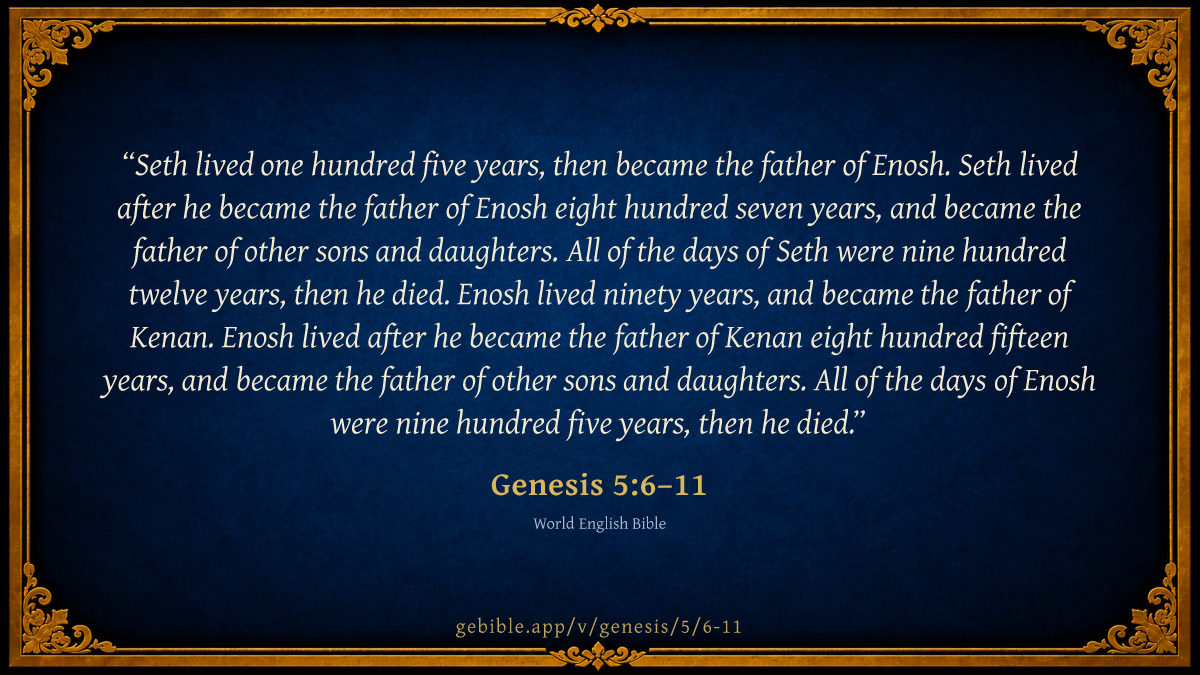
6Seth lived one hundred five years, then became the father of Enosh.7Seth lived after he became the father of Enosh eight hundred seven years, and became the father of other sons and daughters.8All of the days of Seth were nine hundred twelve years, then he died.
9Enosh lived ninety years, and became the father of Kenan.10Enosh lived after he became the father of Kenan eight hundred fifteen years, and became the father of other sons and daughters.11All of the days of Enosh were nine hundred five years, then he died.
Historical commentary, presented as a primary source — not an endorsement.
Geneva Bible translators1599 · Public DomainOn vv6, 8He proveth Adam’s generation by them which came of…
He proveth Adam’s generation by them which came of Seth, to show which is the true Church, and also what care God had over the same from the beginning, in that he continued ever his graces toward it by a continual succession.
Geneva Bible (1599) marginal notes — public domain.
John Trapp1656 · Public DomainOn vv6–11Gen 5:6 And Seth lived an hundred and five…
Gen 5:6 And Seth lived an hundred and five years, and begat Enos:
Ver. 6. And begat Enos,] that is, Sorry-man, which was appellatio a dolore. Nomen cure re convenit. Homo enim est animal aerumnis plenum, imo ipsa aerumna, et calamitas, ut est apud Herodotum {See Trapp on "Gen 5:9"}.
John Trapp, A Commentary or Exposition upon All the Books of the Old and New Testament (1647–1656) — public domain. Text from a community e-Sword module.
Matthew Henry1710 · Public DomainOn v6We have here all that the Holy Ghost thought…
We have here all that the Holy Ghost thought fit to leave upon record concerning five of the patriarchs before the flood, Seth, Enos, Cainan, Mahalaleel, and Jared. There is nothing observable concerning any of these particularly, though we have reason to think they were men of eminence, both for prudence and piety, in their day: but in general,
I. Observe how largely and expressly their generations are recorded. This matter, one would think, might have been delivered in fewer words; but it is certain that there is not one idle word in God's books, whatever there is in men's. It is thus plainly set down, 1. To make it easy and intelligible to the meanest capacity. When we are informed how old they were when they begat such a son, and how many years they lived afterwards, a very little skill in arithmetic will enable a man to tell how long they lived in all; yet the Holy Ghost sets down the sum total, for the sake of those that have not even so much skill as this. 2. To show the pleasure God takes in the names of his people. We found Cain's generation numbered in haste (Gen 4:18), but this account of the holy seed is enlarged upon, and given in words at length, and not in figures; we are told how long those lived that lived in God's fear, and when those died that died in his favour; but as for others it is no matter. The memory of the just is blessed, but the name of the wicked shall rot.
Read full note →
II. Their life is reckoned by days (Gen 5:8): All the days of Seth, and so of the rest, which intimates the shortness of the life of man when it is at the longest, and the quick revolution of our times on earth. If they reckoned by days, surely we must reckon by hours, or rather make that our frequent prayer (Psa 90:12), Teach us to number our days.
III. Concerning each of them, except Enoch, it is said, and he died. It is implied in the numbering of the years of their life that their life, when those years were numbered and finished, came to an end; and yet it is still repeated, and he died, to show that death passed upon all men without exception, and that it is good for us particularly to observe and improve the deaths of others for our own edification. Such a one was a strong healthful man, but he died; such a one was a great and rich man, but he died; such a one was a wise politic man, but he died; such a one was a very good man, perhaps a very useful man, but he died, etc.
IV. That which is especially observable is that they all lived very long; not one of them died till he had seen the revolution of almost eight hundred years, and some of them lived much longer, a great while for an immortal soul to be imprisoned in a house of clay. The present life surely was not to them such a burden as commonly it is now, else they would have been weary of it; nor was the future life so clearly revealed then as it is now under the gospel, else they would have been impatient to remove to it: long life to the pious patriarchs was a blessing and made them blessings. 1. Some natural causes may be assigned for their long life in those first ages of the world. It is very probable that the earth was more fruitful, that the productions of it were more strengthening, that the air was more healthful, and that the influences of the heavenly bodies were more benign, before the flood, than afterwards. Though man was driven out of paradise, yet the earth itself was then paradisiacal - a garden in comparison with its present wilderness-state: and some think that their great knowledge of the creatures, and of their usefulness both for food and medicine, together with their sobriety and temperance, contributed much to it; yet we do not find that those who were intemperate, as many were (Luk 17:27), were as short-lived as intemperate men generally are now. 2. It must chiefly be resolved into the power and providence of God. He prolonged their lives, both for the more speedy replenishing of the earth and for the more effectual preservation of the knowledge of God and religion, then, when there was no written word, but tradition was the channel of its conveyance. All the patriarchs here, except Noah, were born before Adam died; so that from him they might receive a full and satisfactory account of the creation, paradise, the fall, the promise, and those divine precepts which concerned religious worship and a religious life: and, if any mistake arose, they might have recourse to him while he lived, as to an oracle, for the rectifying of it, and after his death to Methuselah, and others, that had conversed with him: so great was the care of Almighty God to preserve in his church the knowledge of his will and the purity of his worship.
Matthew Henry's Commentary on the Whole Bible (1708–1710) — public domain (CC PDM 1.0). Text via the HelloAO Bible API.
John Gill1763 · Public DomainOn vv6–11And Seth lived an hundred and five years, and…
And Seth lived an hundred and five years, and begat Enos. Not that this was his firstborn, no doubt but he had other children before this time; but this is only mentioned, because it carried the lineage and descent directly from Adam to Noah, the father of the new world, and from whom the Messiah was to spring; whose genealogy to give is a principal view of this book, or account of generations from Adam to Noah.
And Seth lived an hundred and five years, and begat Enos. Not that this was his firstborn, no doubt but he had other children before this time; but this is only mentioned, because it carried the lineage and descent directly from Adam to Noah, the father of the new world, and from whom the Messiah was to spring; whose genealogy to give is a principal view of this book, or account of generations from Adam to Noah.
Read full note →
Genesis 5:7
gen 5:7
gen 5:7
gen 5:7And Seth lived, after he begat Enos, eight hundred and seven years,.... The Septuagint version makes the same mistake in the numbers of Seth as of Adam, giving him two hundred and five years before the birth of Enos, and but seven hundred and seven years after:
and begat sons and daughters; very probably both before and after Enos was born; but how many is not said.
John Gill's Exposition of the Whole Bible (1746–1763) — public domain (CC PDM 1.0). Text via the HelloAO Bible API.
Joseph Benson1811 · Public DomainOn v6Gen 5:6-19. We have here all that the Holy…
Gen 5:6-19. We have here all that the Holy Ghost thought fit to leave upon record concerning five of the patriarchs before the flood, Seth, Enos, Cainan, Mahalaleel, and Jared. There is nothing noticed concerning any of those particularly, though we have reason to think they were men of eminence, both for prudence and piety; but, in general, their generations are largely and expressly recorded. We are told how long they lived that lived in God’s fear, and when they died, that died in his favour; but as for others it is no matter: the “memory of the just is blessed, but the name of the wicked shall rot.” That which is especially observable is, that they all lived very long; not one of them died till he had seen the revolution of almost eight hundred years, and some of them much longer; a great while for an immortal soul to be imprisoned in a house of clay. The present life surely was not to them such a burden as commonly it is now, else they would have been weary of it; nor was the future life so clearly revealed then as it is now under the gospel, else they would have been impatient to remove to it. Some natural causes may be assigned for their long life in those first ages. It is very probable that the earth was more fruitful, the products of it more strengthening, and the air more healthful, before the flood, than they were after. Though man was driven out of paradise, yet the earth itself was then paradisiacal; a garden in comparison with its present state. Their living so long, however, must chiefly be resolved into the power and providence of God. All the patriarchs here, except Noah, were born before Adam died, so that from him they might receive a full account of the creation, paradise, the fall, the promise, and those divine precepts which concerned religious worship and a religious life; and if any mistake arose, they might have recourse to him while he lived, as to an oracle, for the rectifying of it, and after his death to Methuselah, and others that had conversed with him; so great was the care of Almighty God to preserve in his church the knowledge of his will, and the purity of his worship.
Joseph Benson's Commentary on the Old and New Testaments (1811–1818) — public domain. Text from a community e-Sword module.
Daniel D. Whedon1874 · Public DomainOn vv6, 86. Enos — This word signifies man, and may…
6. Enos — This word signifies man, and may denote that the race begins anew from Seth. For the meaning of the other names in the list, see above, page 110.
Daniel D. Whedon (gen. ed.), Commentary on the Old and New Testaments (1874–1909) — public domain. Text from a community e-Sword module.
The Cambridge Bible for Schools and Colleges1878 · Public DomainOn vv6, 96. Enosh] See note on Gen_4:26.
6. Enosh] See note on Gen_4:26.
The Cambridge Bible for Schools and Colleges (gen. ed. J. J. S. Perowne; Cambridge University Press, 1878–1918) — public domain. Text from a community e-Sword module.
Ellicott's Commentary for English Readers1878 · Public DomainOn v9(9) Enos lived ninety years.—This proves that the years…
(9) Enos lived ninety years.—This proves that the years could not have been mere revolutions of the moon, as some have supposed. So Cainan was only seventy years of age at the birth of his son, and Mahalaleel sixty-five. In the LXX. no patriarch has a son until he is at least 162 years of age, so that the supposition there would be more tenable.
A Bible Commentary for English Readers, edited by Charles John Ellicott (1878–1897) — public domain. Text from a community e-Sword module.
The Pulpit Commentary1880 · Public DomainOn v6Vers. 6-20 The lives of the succeeding patriarchs are…
Vers. 6-20 The lives of the succeeding patriarchs are framed upon the model of this Adamic biography, and do not call for separate notice. The names of the next six were Seth (ver. 6; vide; Gen_4:25) Enos (ver. 9; vide; Gen_4:26) Cainan, possession (Gesenius); a child, one begotten (Furst); a created thing, a creature, a young man (Ewald); possessor, or spearsman (Murphy; ver. 12); Mahalaleel, praise of God (Gesenius, Furst, Murphy; ver. 15); Jared, descent (Gesenius); low ground, water, or marching down (Furst); going down (Murphy; ver. 18); Enoch, dedicated, initiated. (ver. 19; cf. Gen_4:17)
The Pulpit Commentary (1880–1919), ed. H.D.M. Spence-Jones & Joseph S. Exell — public domain. Text from a community e-Sword module.
Paul E. Kretzmann1924 · Public DomainOn v9From Enos to Jared
From Enos to Jared
v. 9. And Enos lived ninety years and begat Cainan.
Read full note →
v. 10. And Enos lived after he begat Cainan, eight hundred and fifteen years, and begat sons and daughters.
v. 11. And all the days of Enos were nine hundred and five years; and he died. Although there is some distant resemblance between some of the names in this list and those of the Cainites, the meaning which is attached to this fact by enemies of Scriptures as though the two accounts had originally been the same is absolutely without foundation. The children of God and the children of the world at that time were strictly separate.
v. 12. And Cainan lived seventy years, and begat Mahalaleel.
v. 13. And Cainan lived, after he begat Mahalaleel, eight hundred and forty years, and begat sons and daughters.
v. 14. And all the days of Cainan were nine hundred and ten years; and he died.
v. 15. And Mahalaleel lived sixty and five years, and begat Jared.
v. 16. And Mahalaleel lived, after he begat Jared, eight hundred and thirty years, and begat sons and daughters.
v. 17. And all the days of Mahalaleel were eight hundred ninety and five years; and he died.
v. 18. And Jared lived an hundred sixty and two years, and he begat Enoch.
v. 19. And Jared lived, after he begat Enoch, eight hundred years, and begat sons and daughters.
v. 20. And all the days of Jared were nine hundred sixty and two years; and he died. The ever recurring circle of birth and death is here brought out with great impressiveness, bidding us so to number our days that we may apply our hearts unto wisdom.
Paul E. Kretzmann, Popular Commentary of the Bible (1921–1924) — public domain. Text from a community e-Sword module.
unfoldingWord translationNotes2017 · CC BY-SA 4.0On vv6, 9105 years
105 years
"one hundred and five years" (See: Numbers)
Read full note →
he became the father of Enosh
Here "father" means his actual father, not his grandfather. AT: "he had his son Enosh"
Enosh
This is the name of a person. (See: How to Translate Names)
807 years
"eight hundred and seven years" (See: Numbers)
and became the father of more sons and daughters
"and had more sons and daughters"
Seth lived 912 years
"Seth lived nine hundred and twelve years." Seth lived a total of 912 years. (See: Numbers)
then he died
This phrase is repeated throughout the chapter. Use the ordinary word for "died."

Geneva Bible translators 1599 · Public Domain On vv6, 8 He proveth Adam’s generation by them which came of…
He proveth Adam’s generation by them which came of Seth, to show which is the true Church, and also what care God had over the same from the beginning, in that he continued ever his graces toward it by a continual succession.
Geneva Bible (1599) marginal notes — public domain.
John Trapp 1656 · Public Domain On vv6–11 Gen 5:6 And Seth lived an hundred and five…
Gen 5:6 And Seth lived an hundred and five years, and begat Enos:
Ver. 6. And begat Enos,] that is, Sorry-man, which was appellatio a dolore. Nomen cure re convenit. Homo enim est animal aerumnis plenum, imo ipsa aerumna, et calamitas, ut est apud Herodotum {See Trapp on "Gen 5:9"}.
John Trapp, A Commentary or Exposition upon All the Books of the Old and New Testament (1647–1656) — public domain. Text from a community e-Sword module.
Matthew Henry 1710 · Public Domain On v6 We have here all that the Holy Ghost thought…
We have here all that the Holy Ghost thought fit to leave upon record concerning five of the patriarchs before the flood, Seth, Enos, Cainan, Mahalaleel, and Jared. There is nothing observable concerning any of these particularly, though we have reason to think they were men of eminence, both for prudence and piety, in their day: but in general,
I. Observe how largely and expressly their generations are recorded. This matter, one would think, might have been delivered in fewer words; but it is certain that there is not one idle word in God's books, whatever there is in men's. It is thus plainly set down, 1. To make it easy and intelligible to the meanest capacity. When we are informed how old they were when they begat such a son, and how many years they lived afterwards, a very little skill in arithmetic will enable a man to tell how long they lived in all; yet the Holy Ghost sets down the sum total, for the sake of those that have not even so much skill as this. 2. To show the pleasure God takes in the names of his people. We found Cain's generation numbered in haste (Gen 4:18), but this account of the holy seed is enlarged upon, and given in words at length, and not in figures; we are told how long those lived that lived in God's fear, and when those died that died in his favour; but as for others it is no matter. The memory of the just is blessed, but the name of the wicked shall rot.
Read full note →
II. Their life is reckoned by days (Gen 5:8): All the days of Seth, and so of the rest, which intimates the shortness of the life of man when it is at the longest, and the quick revolution of our times on earth. If they reckoned by days, surely we must reckon by hours, or rather make that our frequent prayer (Psa 90:12), Teach us to number our days.
III. Concerning each of them, except Enoch, it is said, and he died. It is implied in the numbering of the years of their life that their life, when those years were numbered and finished, came to an end; and yet it is still repeated, and he died, to show that death passed upon all men without exception, and that it is good for us particularly to observe and improve the deaths of others for our own edification. Such a one was a strong healthful man, but he died; such a one was a great and rich man, but he died; such a one was a wise politic man, but he died; such a one was a very good man, perhaps a very useful man, but he died, etc.
IV. That which is especially observable is that they all lived very long; not one of them died till he had seen the revolution of almost eight hundred years, and some of them lived much longer, a great while for an immortal soul to be imprisoned in a house of clay. The present life surely was not to them such a burden as commonly it is now, else they would have been weary of it; nor was the future life so clearly revealed then as it is now under the gospel, else they would have been impatient to remove to it: long life to the pious patriarchs was a blessing and made them blessings. 1. Some natural causes may be assigned for their long life in those first ages of the world. It is very probable that the earth was more fruitful, that the productions of it were more strengthening, that the air was more healthful, and that the influences of the heavenly bodies were more benign, before the flood, than afterwards. Though man was driven out of paradise, yet the earth itself was then paradisiacal - a garden in comparison with its present wilderness-state: and some think that their great knowledge of the creatures, and of their usefulness both for food and medicine, together with their sobriety and temperance, contributed much to it; yet we do not find that those who were intemperate, as many were (Luk 17:27), were as short-lived as intemperate men generally are now. 2. It must chiefly be resolved into the power and providence of God. He prolonged their lives, both for the more speedy replenishing of the earth and for the more effectual preservation of the knowledge of God and religion, then, when there was no written word, but tradition was the channel of its conveyance. All the patriarchs here, except Noah, were born before Adam died; so that from him they might receive a full and satisfactory account of the creation, paradise, the fall, the promise, and those divine precepts which concerned religious worship and a religious life: and, if any mistake arose, they might have recourse to him while he lived, as to an oracle, for the rectifying of it, and after his death to Methuselah, and others, that had conversed with him: so great was the care of Almighty God to preserve in his church the knowledge of his will and the purity of his worship.
Matthew Henry's Commentary on the Whole Bible (1708–1710) — public domain (CC PDM 1.0). Text via the HelloAO Bible API.
John Gill 1763 · Public Domain On vv6–11 And Seth lived an hundred and five years, and…
And Seth lived an hundred and five years, and begat Enos. Not that this was his firstborn, no doubt but he had other children before this time; but this is only mentioned, because it carried the lineage and descent directly from Adam to Noah, the father of the new world, and from whom the Messiah was to spring; whose genealogy to give is a principal view of this book, or account of generations from Adam to Noah.
And Seth lived an hundred and five years, and begat Enos. Not that this was his firstborn, no doubt but he had other children before this time; but this is only mentioned, because it carried the lineage and descent directly from Adam to Noah, the father of the new world, and from whom the Messiah was to spring; whose genealogy to give is a principal view of this book, or account of generations from Adam to Noah.
Read full note →
Genesis 5:7
gen 5:7
gen 5:7
gen 5:7And Seth lived, after he begat Enos, eight hundred and seven years,.... The Septuagint version makes the same mistake in the numbers of Seth as of Adam, giving him two hundred and five years before the birth of Enos, and but seven hundred and seven years after:
and begat sons and daughters; very probably both before and after Enos was born; but how many is not said.
John Gill's Exposition of the Whole Bible (1746–1763) — public domain (CC PDM 1.0). Text via the HelloAO Bible API.
Joseph Benson 1811 · Public Domain On v6 Gen 5:6-19. We have here all that the Holy…
Gen 5:6-19. We have here all that the Holy Ghost thought fit to leave upon record concerning five of the patriarchs before the flood, Seth, Enos, Cainan, Mahalaleel, and Jared. There is nothing noticed concerning any of those particularly, though we have reason to think they were men of eminence, both for prudence and piety; but, in general, their generations are largely and expressly recorded. We are told how long they lived that lived in God’s fear, and when they died, that died in his favour; but as for others it is no matter: the “memory of the just is blessed, but the name of the wicked shall rot.” That which is especially observable is, that they all lived very long; not one of them died till he had seen the revolution of almost eight hundred years, and some of them much longer; a great while for an immortal soul to be imprisoned in a house of clay. The present life surely was not to them such a burden as commonly it is now, else they would have been weary of it; nor was the future life so clearly revealed then as it is now under the gospel, else they would have been impatient to remove to it. Some natural causes may be assigned for their long life in those first ages. It is very probable that the earth was more fruitful, the products of it more strengthening, and the air more healthful, before the flood, than they were after. Though man was driven out of paradise, yet the earth itself was then paradisiacal; a garden in comparison with its present state. Their living so long, however, must chiefly be resolved into the power and providence of God. All the patriarchs here, except Noah, were born before Adam died, so that from him they might receive a full account of the creation, paradise, the fall, the promise, and those divine precepts which concerned religious worship and a religious life; and if any mistake arose, they might have recourse to him while he lived, as to an oracle, for the rectifying of it, and after his death to Methuselah, and others that had conversed with him; so great was the care of Almighty God to preserve in his church the knowledge of his will, and the purity of his worship.
Joseph Benson's Commentary on the Old and New Testaments (1811–1818) — public domain. Text from a community e-Sword module.
Daniel D. Whedon 1874 · Public Domain On vv6, 8 6. Enos — This word signifies man, and may…
6. Enos — This word signifies man, and may denote that the race begins anew from Seth. For the meaning of the other names in the list, see above, page 110.
Daniel D. Whedon (gen. ed.), Commentary on the Old and New Testaments (1874–1909) — public domain. Text from a community e-Sword module.
The Cambridge Bible for Schools and Colleges 1878 · Public Domain On vv6, 9 6. Enosh] See note on Gen_4:26.
6. Enosh] See note on Gen_4:26.
The Cambridge Bible for Schools and Colleges (gen. ed. J. J. S. Perowne; Cambridge University Press, 1878–1918) — public domain. Text from a community e-Sword module.
Ellicott's Commentary for English Readers 1878 · Public Domain On v9 (9) Enos lived ninety years.—This proves that the years…
(9) Enos lived ninety years.—This proves that the years could not have been mere revolutions of the moon, as some have supposed. So Cainan was only seventy years of age at the birth of his son, and Mahalaleel sixty-five. In the LXX. no patriarch has a son until he is at least 162 years of age, so that the supposition there would be more tenable.
A Bible Commentary for English Readers, edited by Charles John Ellicott (1878–1897) — public domain. Text from a community e-Sword module.
The Pulpit Commentary 1880 · Public Domain On v6 Vers. 6-20 The lives of the succeeding patriarchs are…
Vers. 6-20 The lives of the succeeding patriarchs are framed upon the model of this Adamic biography, and do not call for separate notice. The names of the next six were Seth (ver. 6; vide; Gen_4:25) Enos (ver. 9; vide; Gen_4:26) Cainan, possession (Gesenius); a child, one begotten (Furst); a created thing, a creature, a young man (Ewald); possessor, or spearsman (Murphy; ver. 12); Mahalaleel, praise of God (Gesenius, Furst, Murphy; ver. 15); Jared, descent (Gesenius); low ground, water, or marching down (Furst); going down (Murphy; ver. 18); Enoch, dedicated, initiated. (ver. 19; cf. Gen_4:17)
The Pulpit Commentary (1880–1919), ed. H.D.M. Spence-Jones & Joseph S. Exell — public domain. Text from a community e-Sword module.
Paul E. Kretzmann 1924 · Public Domain On v9 From Enos to Jared
From Enos to Jared
v. 9. And Enos lived ninety years and begat Cainan.
Read full note →
v. 10. And Enos lived after he begat Cainan, eight hundred and fifteen years, and begat sons and daughters.
v. 11. And all the days of Enos were nine hundred and five years; and he died. Although there is some distant resemblance between some of the names in this list and those of the Cainites, the meaning which is attached to this fact by enemies of Scriptures as though the two accounts had originally been the same is absolutely without foundation. The children of God and the children of the world at that time were strictly separate.
v. 12. And Cainan lived seventy years, and begat Mahalaleel.
v. 13. And Cainan lived, after he begat Mahalaleel, eight hundred and forty years, and begat sons and daughters.
v. 14. And all the days of Cainan were nine hundred and ten years; and he died.
v. 15. And Mahalaleel lived sixty and five years, and begat Jared.
v. 16. And Mahalaleel lived, after he begat Jared, eight hundred and thirty years, and begat sons and daughters.
v. 17. And all the days of Mahalaleel were eight hundred ninety and five years; and he died.
v. 18. And Jared lived an hundred sixty and two years, and he begat Enoch.
v. 19. And Jared lived, after he begat Enoch, eight hundred years, and begat sons and daughters.
v. 20. And all the days of Jared were nine hundred sixty and two years; and he died. The ever recurring circle of birth and death is here brought out with great impressiveness, bidding us so to number our days that we may apply our hearts unto wisdom.
Paul E. Kretzmann, Popular Commentary of the Bible (1921–1924) — public domain. Text from a community e-Sword module.
unfoldingWord translationNotes 2017 · CC BY-SA 4.0 On vv6, 9 105 years
105 years
"one hundred and five years" (See: Numbers)
Read full note →
he became the father of Enosh
Here "father" means his actual father, not his grandfather. AT: "he had his son Enosh"
Enosh
This is the name of a person. (See: How to Translate Names)
807 years
"eight hundred and seven years" (See: Numbers)
and became the father of more sons and daughters
"and had more sons and daughters"
Seth lived 912 years
"Seth lived nine hundred and twelve years." Seth lived a total of 912 years. (See: Numbers)
then he died
This phrase is repeated throughout the chapter. Use the ordinary word for "died."
translationWords
ancestor
unfoldingWord translationNotes — © Distant Shores Media and the Door43 World Missions Community, licensed CC BY-SA 4.0. Source: git.door43.org/Door43/en_tn.
Tyndale Open Study Notes 2022 · CC BY-SA 4.0 On v6 5:6 the father of: Or the ancestor of; Hebrew…
5:6 the father of: Or the ancestor of; Hebrew genealogies do not necessarily list every single generation.
Tyndale Open Study Notes — © Tyndale Open Resources, licensed CC BY-SA 4.0. Text via the HelloAO Bible API.