
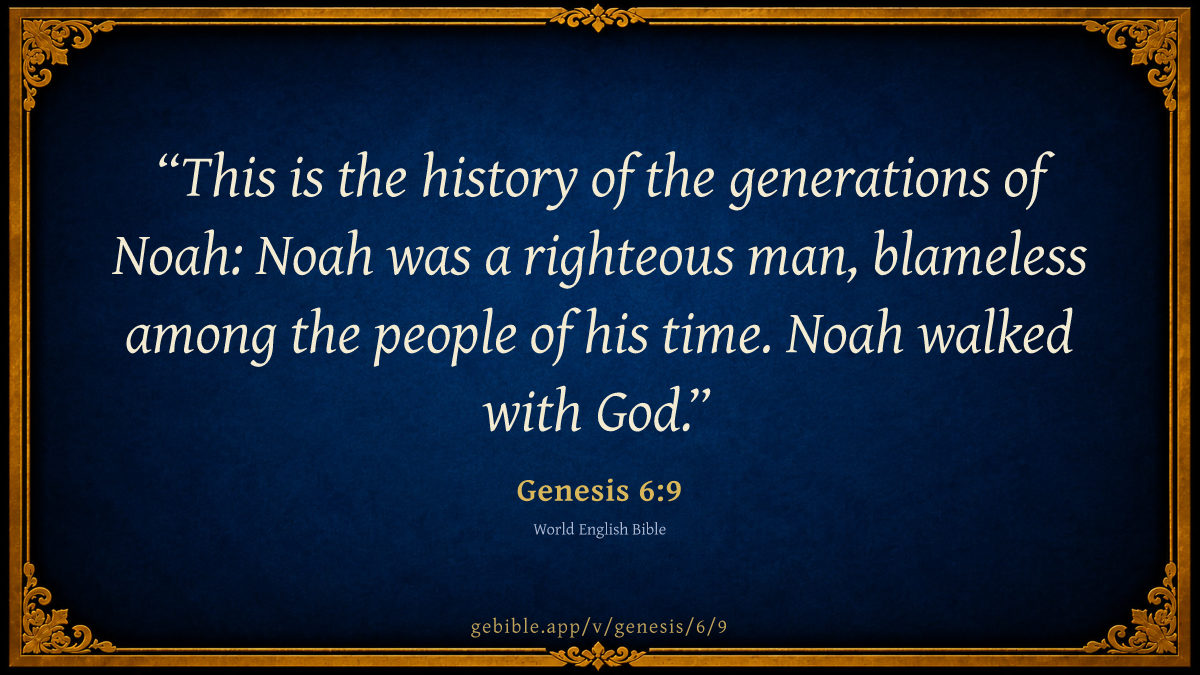
This is the history of the generations of Noah: Noah was a righteous man, blameless among the people of his time. Noah walked with God.
Parallel Translations
-
This is the history of the generations of Noah: Noah was a righteous man, blameless among the people of his time. Noah walked with God.
-
These are the generations of Noah: Noah was a just man and perfect in his generations, and Noah walked with God.
-
These are the generations of Noah. Noah was in his generations a man righteous and whole-hearted; Noah walked with God.
Examined in Scripture Analysis
Contradictions (2)
Questions where the Bible appears to say two different things, with the passages on each side set together.
Cross-references (30)
Passages linked to Genesis 6:9 in the Treasury of Scripture Knowledge, ordered by reader-vote popularity; verse text shown in World English Bible.
- Hebrews 11:7 By faith, Noah, being warned about things not yet seen, moved with godly fear, prepared a ship for the saving of his house, through which he condemned the world, and became heir of the righteousness which is according to faith.
- Luke 1:6 They were both righteous before God, walking blamelessly in all the commandments and ordinances of the Lord.
- Galatians 3:11 Now that no man is justified by the law before God is evident, for, “The righteous will live by faith.”
- Genesis 5:24 Enoch walked with God, and he was not found, for God took him.
- 2 Peter 2:5 and didn’t spare the ancient world, but preserved Noah with seven others, a preacher of righteousness, when he brought a flood on the world of the ungodly;
- Genesis 7:1 Yahweh said to Noah, “Come with all of your household into the ship, for I have seen your righteousness before me in this generation.
- Genesis 5:22 After Methuselah’s birth, Enoch walked with God for three hundred years, and became the father of more sons and daughters.
- Genesis 17:1 When Abram was ninety-nine years old, Yahweh appeared to Abram and said to him, “I am God Almighty. Walk before me and be blameless.
- Job 1:1 There was a man in the land of Uz, whose name was Job. That man was blameless and upright, and one who feared God, and turned away from evil.
- Ezekiel 14:14 though these three men, Noah, Daniel, and Job, were in it, they would deliver only their own souls by their righteousness,” says the Lord Yahweh.
- Genesis 2:4 This is the history of the generations of the heavens and of the earth when they were created, in the day that Yahweh God made the earth and the heavens.
- Ecclesiastes 7:20 Surely there is not a righteous man on earth who does good and doesn’t sin.
- 1 Peter 2:5 You also, as living stones, are built up as a spiritual house, to be a holy priesthood, to offer up spiritual sacrifices, acceptable to God through Jesus Christ.
- Job 1:8 Yahweh said to Satan, “Have you considered my servant, Job? For there is no one like him in the earth, a blameless and an upright man, one who fears God, and turns away from evil.”
- Ezekiel 14:20 though Noah, Daniel, and Job, were in it, as I live,” says the Lord Yahweh, “they would deliver neither son nor daughter; they would deliver only their own souls by their righteousness.”
- Habakkuk 2:4 Behold, his soul is puffed up. It is not upright in him, but the righteous will live by his faith.
- Acts 10:22 They said, “Cornelius, a centurion, a righteous man and one who fears God, and well spoken of by all the nation of the Jews, was directed by a holy angel to invite you to his house, and to listen to what you say.”
- Genesis 48:15 He blessed Joseph, and said, “The God before whom my fathers Abraham and Isaac walked, the God who has fed me all my life long to this day,
- 2 Chronicles 15:17 But the high places were not taken away out of Israel; nevertheless the heart of Asa was perfect all his days.
- Psalms 37:37 Mark the perfect man, and see the upright, for there is a future for the man of peace.
- Proverbs 4:18 But the path of the righteous is like the dawning light that shines more and more until the perfect day.
- Luke 2:25 Behold, there was a man in Jerusalem whose name was Simeon. This man was righteous and devout, looking for the consolation of Israel, and the Holy Spirit was on him.
- Romans 1:17 For in it is revealed God’s righteousness from faith to faith. As it is written, “But the righteous shall live by faith.”
- Philippians 3:9-15 and be found in him, not having a righteousness of my own, that which is of the law, but that which is through faith in Christ, the righteousness which is from God by faith, that I may know him, and the power of his resurrection, and the fellowship of his sufferings, becoming conformed to his death, if by any means I may attain to the resurrection from the dead. Not that I have already obtained, or am already made perfect; but I press on, that I may take hold of that for which also I was taken hold of by Christ Jesus. Brothers, I don’t regard myself as yet having taken hold, but one thing I do: forgetting the things which are behind, and stretching forward to the things which are before, I press on toward the goal for the prize of the high calling of God in Christ Jesus. Let us therefore, as many as are perfect, think this way. If in anything you think otherwise, God will also reveal that to you.
- 1 Kings 3:6 Solomon said, “You have shown to your servant David my father great loving kindness, because he walked before you in truth, in righteousness, and in uprightness of heart with you. You have kept for him this great loving kindness, that you have given him a son to sit on his throne, as it is today.
- Job 12:4 I am like one who is a joke to his neighbor, I, who called on God, and he answered. The just, the blameless man is a joke.
- Luke 23:50 Behold, a man named Joseph, who was a member of the council, a good and righteous man
- 2 Chronicles 25:2 He did that which was right in Yahweh’s eyes, but not with a perfect heart.
- Genesis 5:1 This is the book of the generations of Adam. In the day that God created man, he made him in God’s likeness.
- Genesis 10:1 Now this is the history of the generations of the sons of Noah and of Shem, Ham, and Japheth. Sons were born to them after the flood.
Cross-references from openbible.info (CC BY 4.0)
Explain this verse (20 sources)
Historical commentary, presented as a primary source — not an endorsement.
Private notes
Saved on this device only — never synced or sent anywhere.
John Calvin 1540 · Public Domain 9. These are the generations of Noah. The Hebrew…
9. These are the generations of Noah. The Hebrew word תולדות (toledoth) properly means generation. It has, however, sometimes a more extended sense, and applies to the whole history of life; this indeed seems to be its meaning in the present place. For when Moses had stated that one man was found whom God, — when he had determined to destroy the whole world, — would yet preserve, he briefly describes what kind of person he was. And, in the first place, asserts, that he was just and upright among the men of his age: for here is a different Hebrew noun, דור (dor,) which signifies an age, or the time of a life. The word תמים (tamim) which the ancient interpreter is accustomed to translate perfect, is of the same force as upright or sincere ; and is opposed to what is deceitful, pretended, and vain. And Moses does not rashly connect these two things together; for the world, being always influenced by external splendor, estimates justice, not by the affection of the heart, but by bare works. If, however, we desire to be approved by God, and accounted righteous before him, we must not only regulate our hands, and eyes, and feet, in obedience to his Law; but integrity of heart is above all things required, and holds the chief place in the true definition of righteousness. Let us, however, know that they are called just and upright, not who are in every respect perfect, and in whom there is no defect; but who cultivate righteousness purely, and from their heart. Because we are assured that God does not act towards his own people with the rigour of justice, as requiring of them a life according to the perfect rule of the Law; for, if only no hypocrisy reigns within them, but the pure love of rectitude flourishes, and fills their hearts, he pronounces them, according to his clemency, to be righteous.
The clause, “in his generations,” is emphatical. For he has already often said, and will soon repeat it, that nothing was more corrupt than that age. Therefore, it was a remarkable instance of constancy, that Noah being surrounded on every side with the filth of iniquity, should hence have contracted no contagion. We know how great is the force of custom, so that nothing is more difficult than to live homily among the wicked, and to avoid being led away by their evil examples. Scarcely is there one in a hundred who has not in his mouth that diabolical proverb, ‘We must howl when we are among the wolves;’ and the greater part, — framing a rule for themselves from the common practice, — judge everything to be lawful which is generally received. As, however, the singular virtue of Noah is here commended; so let us remember that we are instructed what we ought to do, though the whole world were rushing to its own destruction. If, at the present time, the morals of men are so vitiated, and the whole mode of life so confused, that probity has become most rare; still more vile and dreadful was the confusion in the time of Noah, when he had not even one associate in the worship of God, and in the pursuit of holiness. If he could bear up against the corruptions of the whole world, and against such constant and vehement assaults of iniquity; no excuse is left for us, unless, with equal fortitude of mind, we prosecute a right course through innumerable obstacles of vice. It is not improbable that Moses uses the word generations in the plural number, the more fully to declare what a strenuous and invincible combatant Noah was, who, through so many ages, had remained unaltered. Besides, the manner of cultivating righteousness, which he had adopted is explained in the context; namely that he had “walked with God,” which excellency he had also commended in the holy father Enoch, in the preceding chapter, where we have stated what the expression means. When the corruption of morals was so great in the earth, if Noah had had respect to man, he would have been cast into a profound labyrinth. He sees, therefore, this to be his only remedy; namely, to disregard men, that he may fix all his thoughts on God, and make Him the sole Arbiter of his life. Whence it appears, how foolishly the Papists clamor that we ought to follow the fathers; when the Spirit expressly recalls us from the imitation of men, except so far as they lead us to God. Moses again mentions his three sons, for the purpose of showing that, in the greatest sorrow by which he was almost consumed, he was yet able to have offspring, in order that God might have a small remnant of seed for himself.
John Calvin's Commentaries (1540-1563) — public domain. Text from the Calvin Translation Society English edition (1840s-50s) via the Christian Classics Ethereal Library (ccel.org). Calvin's coverage is partial (roughly two-thirds of the Bible); uncommented books and verses are honest gaps, never fabricated. The 19th-century editor's footnotes and remarks are omitted so the notes are faithfully Calvin's own voice.
Geneva Bible translators 1599 · Public Domain Or, history.
Or, history.
Geneva Bible (1599) marginal notes — public domain.
John Trapp 1656 · Public Domain Gen 6:9 These [are] the generations of Noah: Noah…
Gen 6:9 These [are] the generations of Noah: Noah was a just man [and] perfect in his generations, [and] Noah walked with God.
Ver. 9. Noah was a just man.] By a twofold justice: 1. imputed; 2. imparted. By the former he was justified; by the latter, sanctified: and note, that he found grace in God’s eyes, before he was either of these; for grace is the foundation of all our felicity, and comprehends all blessings, as manna is said to have done all good tastes,
Read full note →
Perfect in his generation.] At best in those worst times, which is a singular commendation; and perfect, that is upright: aiming at perfection, willing {θελοντες, Heb 13:18} in all things to please God; and yet not more desiring to be perfect, than hating to seem only to be so. Or, Noah was perfect, compared to that sinful generation; which yet gloried in the title of the sons of God, and children of the Church. But was not Judas called "friend," and Dives "son?" {Luk 16:25} Hath not many a ship been known by the name of "safeguard" and "goodspeed," which yet hath dashed upon the rocks, or miscarried by-pirates? External privileges profit not, where the heart is not upright, but increase wrath. It was an aggravation to Solomon’s sin, that God "had appeared unto him twice"; {1Ki 11:9} and that he had been timely forewarned by his mother to beware of wine and women, {Pro 31:3-4} both which he was afterwards, nevertheless, most inordinately addicted to. {Ecc 2:1}
John Trapp, A Commentary or Exposition upon All the Books of the Old and New Testament (1647–1656) — public domain. Text from a community e-Sword module.
Matthew Poole 1685 · Public Domain The generations of Noah; either,
The generations of Noah; either,
1. Properly the posterity of Noah, as the word is commonly used, and as it is explained Gen 6:10. So the rest of this verse comes in by way of parenthesis, which is frequent. Or,
Read full note →
2. The events or occurrences which befell Noah and his family, as the word is taken, Gen 37:2; Pro 27:1.
A just man, and perfect. These words are to be taken either,
1. Jointly, q.d. he was righteous, not only in appearance, or in part, but perfectly, in all respects, towards God and men; or sincerely and truly. Or,
2. Distinctly, q.d. he was for his state and condition just before God, which was by faith, Heb 11:7, by which every just man lives, Rom 1:17, and perfect, i.e. upright and unblamable in the course of his life among the men of his age, as it follows;
in his generations. This is spoken either,
1. Diminutively; he was so comparatively to the men that then lived, who were very bad; though otherwise even Noah had many infirmities, so that he also had not been saved but for God's grace and mercy, Gen 6:8. Or,
2. By way of amplification and commendation; he was good in bad times, in spite of all evil counsels or examples. He saith
generations, in the plural number, to show that as he lived in two generations, one before the flood, and another after it, so he continued uncorrupted in both of them.
Noah walked with God.
See Poole on "Gen 5:22".
Matthew Poole's English Annotations on the Holy Bible (1683–1685) — public domain. Text from a community e-Sword/MySword module.
John Gill 1763 · Public Domain And Noah begat three sons, Shem, Ham, and Japheth.…
And Noah begat three sons, Shem, Ham, and Japheth. When he was five hundred years of age, and before the flood came upon the earth; and when it was so wicked as is next described: of these sons of his, and of the order in which they are placed; see Gill on Gen 5:32.
.
Read full note →
Genesis 6:11
gen 6:11
gen 6:11
gen 6:11The earth also was corrupt before God,.... That is, the inhabitants of the earth were corrupt in their lives and conversations; they were corrupt both in principle and practice, and did abominable things; and those corruptions were, according to Jarchi, uncleanness and idolatry; they were corrupt in the worship of God, worshipping the creature more, or besides the Creator; and they were corrupt in their manners and behaviour to one another, being guilty of fornication and adultery, and other enormous crimes; of some against God, and of others against their neighbours; and these they committed openly and impudently, without any fear of God, or dread of his wrath and displeasure, and in contempt of him, his will and laws:
and the earth was filled with violence; with doing injury to the persons and properties of men; with oppression and cruelty, by tyrannical decrees and unrighteous judgments; or with rapines and robberies, as the Targums and Jarchi; and with rapes, as Aben Ezra adds: the account that Lucian (x) gives from tradition agrees with this; that the present race of men is not the first, they totally perished by a flood; and those men were very insolent and addicted to unjust actions; for they neither kept their oaths, nor were hospitable to strangers, nor gave ear to suppliants, for which reason they were destroyed.
(x) De Dea Syria.
John Gill's Exposition of the Whole Bible (1746–1763) — public domain (CC PDM 1.0). Text via the HelloAO Bible API.
John Wesley 1765 · Public Domain Noah was a just man - Justified before God…
Noah was a just man - Justified before God by faith in the promised seed; for he was an heir of the righteousness which is by faith, Heb. xi, 7. He was sanctified, and had right principles and dispositions implanted in him: and he was righteous in his conversation, one that made conscience of rendering to all their due, to God his due, and to men theirs. And he walked with God as Enoch had done before him: in his generation, even in that corrupt degenerate age. It is easy to be religious when religion is in fashion; but it is an evidence of strong faith to swim against the stream, and to appear for God, when no one else appears for him: so Noah did, and it is upon record to his immortal honour.
John Wesley, Explanatory Notes Upon the Whole Bible (1754–1765) — public domain. Text via the GEBible commentary corpus.
Joseph Benson 1811 · Public Domain Gen 6:9. Noah was a just man — Justified…
Gen 6:9. Noah was a just man — Justified before God by faith in the promised Seed; for he was an heir of the righteousness which is by faith, Heb 11:7. He was sanctified, and had right principles and dispositions implanted in him; and he was righteous in his conversation, one that made conscience of rendering to all their due, to God his due, and to men theirs. And he walked with God, as Enoch had done before him: in his generation — Even in that corrupt, degenerate age. It is easy to be religious when religion is in fashion; but it is an evidence of strong faith to swim against the stream, and to appear for God when no one else appears for him: so Noah did, and it is upon record to his immortal honour.
Joseph Benson's Commentary on the Old and New Testaments (1811–1818) — public domain. Text from a community e-Sword module.
Albert Barnes 1834 · Public Domain - Section VI - The Deluge
- Section VI - The Deluge
- XXIII. The Ark
Read full note →
9. דור dôr “age, time from birth to death,” applied either to an individual or the whole contemporary race, running parallel with some leading individual. Hence, the “race” or “generation” living during that time.
14. תבה tēbâh “chest, ark.” It is used only of this vessel of Noah’s construction, and of the little vessel in which Moses was put Exo 2:3, Exo 2:5. The root, according to Furst, means “to be hollow.” אבה 'ēbeh a cognate word, signifies “a reed;” κιβωτός kibōtos Septuagint. גפר goper α. λ., perhaps “fir, cypress, resinous wood.” קן qēn “nest, room; related: prepare, rear up.”
16. צהר tsohar “shining, light;” not the same as the חלון chalôn Gen 8:6, or the aperture through which Noah let out the raven.
18. ברית berı̂yt “covenant; related: cut, eat, choose, decide.”
The close of the preceding document introduces the opening topic of this one. The same rule applies to all that have gone before. The generations of the skies and the land Gen 2:4 are introduced by the finishing of the skies and the land Gen 2:1; the generations of man in the line of Sheth Gen 5:1, by the birth of Sheth Gen 4:25; and now the generations of Noah, by the notice that Noah found grace in the eyes of the Lord. The narrative here also, as usual, reverts to a point of time before the stage of affairs described in the close of the preceding passage. Yet there is nothing here that seems to indicate a new author. The previous paragraph is historical, and closely connected with the end of the fourth chapter; and it suitably prepares for the proceedings of Noah, under the divine direction, on the eye of the deluge. We have now a recapitulation of the agent and the occasion, and then the divine commission and its execution.
Gen 6:9-12
Here are the man and the occasion.
Gen 6:9-10
The generations of Noah. - In the third document we had the generations of man; now we are limited to Noah, because he is himself at peace with God, and is now the head and representative of those who are in the same blessed relation. The narrative, therefore, for the first time, formally confines itself to the portion of the human family in communion with God, Noah is here characterized by two new and important epithets - “just” and “perfect.” It is to be remembered that he had already found grace in the eyes of the Lord. Adam was created good; but by disobedience he became guilty, and all his race, Noah among the rest, became involved in that guilt. To be just is to be right in point of law, and thereby entitled to all the blessings of the acquitted and justified. When applied to the guilty, this epithet implies pardon of sin among other benefits of grace. It also presupposes that spiritual change by which the soul returns from estrangement to reconciliation with God. Hence, Noah is not only just, but perfect. This attribute of character imports not only the turning from darkness to light, from error to truth, from wrong to right, but the stability of moral determination which arises from the struggle, the trial, the victory of good over evil, therein involved. The just is the right in law; the perfect is the tested in holiness. “In his ages;” among the men of his age. This phrase indicates the contrast between Noah and the men of his day. It is probable, moreover, that he was of pure descent, and in that respect also distinguished from his contemporaries who were the offspring of promiscuous intermarriage between the godly and the ungodly. “Noah walked with God,” like Henok. This is the native consequence of his victory over sin, and his acceptance with God. His sons are mentioned, as they are essentially connected with the following events.
Gen 6:11-12
And the land was corrupt. - In contrast with Noah, the rest of the race were corrupt - entirely depraved by sin. “It was filled with violence” - with the outward exhibition of inward carnality. “And God saw this.” It was patent to the eye of Heaven. This is the ground of the following commission.
Gen 6:13-21
The directions concerning the ark embrace the purpose to destroy the race of man Gen 6:13, the plan and specification of the ark Gen 6:14-16, the announcement of the deluge Gen 6:17, the arrangements for the preservation of Noah and his family, and certain kinds of animals Gen 6:18-21.
Gen 6:13
The end of all flesh. - The end may mean either the point to which it tends, or the extermination of the race. The latter is the simpler. All flesh is to be understood of the whole race, while yet it does not preclude the exception of Noah and his family. This teaches us to beware of applying an inflexible literality to such terms as all, when used in the sense of ordinary conversation. “Is come before me,” is in the contemplation of my mind as an event soon to be realized. “For the land is filled with violence.” The reason. “I will destroy them.” The resolve. There is retribution here, for the words “corrupt” and “destroy” are the same in the original.
Gen 6:14-16
The ark. - Reckoning the cubit at 1.8 feet, we find the length to be about 540, the breadth 90, and the height 54 feet. The construction of such a vessel implies great skill in carpentry. The lighting apparatus is not described so particularly that we can form any conception of it. It was probably in the roof. The roof may have been flat. “And to a cubit shalt thou finish it above.” The cubit is possibly the height of the parapet round the lighting and ventilating aperture. The opening occupied, it may be, a considerable portion of the roof, and was covered during the rain with an awning מכסה mı̂ksēh, Gen 8:13. If, however, it was in the sides of the ark, the cubit was merely its height. It was then finished with a strong railing, which went round the whole ark, and over which the covering, above mentioned, hung down on every side. The door was in the side, and the stories were three. In each were of course many “nests” or chambers, for animals and stores. It may be curious to a mechanical mind to frame the details of this structure from the general hints here given; but it could not serve any practical end. Only the animals necessary to man, or unusual to the region covered by the deluge, required to be included in the ark. It seems likely that wild animals in general were not included. It is obvious, therefore, that we cannot calculate the number of animals preserved in the ark, or compare the space they would require with its recorded dimensions. We may rest assured that there was accommodation for all that needed to be there.
Gen 6:17
The method of destruction is now specified. A water flood shall cover the land, in which all flesh shall perish. I, “behold,” I. This catastrophe is due to the interposition of the Creator. It does not come according to the ordinary laws of physics, but according to the higher law of ethics.
Gen 6:18-21
The covenant with Noah. Here is the first appearance of a covenant between God and man on the face of Scripture. A covenant is a solemn compact, tacit or express, between two parties, in which each is bound to perform his part. Hence, a covenant implies the moral faculty; and wherever the moral faculty exists, there must needs be a covenant. Consequently, between God and man there was of necessity a covenant from the very beginning, though the name do not appear. At first it was a covenant of works, in regard to man; but now that works have failed, it can only be a covenant of grace to the penitent sinner. “My covenant.” The word “my” points to its original establishment with Adam. My primeval covenant, which I am resolved not to abandon. “Will I establish.” Though Adam has failed, yet will I find means of maintaining my covenant of life with the seed of the woman. “With thee.” Though all flesh be to perish through breach of my covenant, yet will I uphold it with thee. “Go into the ark.” This is the means of safety. Some may say in their hearts, this is a clumsy way to save Noah. But if he is to be saved, there must be some way. And it is not a sign of wisdom to prescribe the way to the All-wise. Rather let us reflect that the erection of this ark was a daily warning to a wicked race, a deepening lesson of reliance on God to Noah and his household, and a most salutary occupation for the progenitors of the future race of mankind. “And thy sons, etc.” Noah’s household share in the covenant.
Gen 6:19-20
And of all the living. - For the sake of Noah, the animal species also shall be preserved, “two of each, male and female.” They are to come in pairs for propagation. The fowl, the cattle, the creeping thing or smaller animals, are to come. From this it appears that the wild animals are not included among the inmates of the ark. (See Gen 7:2-3, Gen 7:8.) The word “all” is not to be pressed beyond the specification of the writer. As the deluge was universal only in respect to the human race, it was not necessary to include any animals but those that were near man, and within the range of the overwhelming waters. Fodder and other provisions for a year have to be laid in.
Gen 6:22
The obedience of Noah and the accomplishment of his task are here recorded. The building of so enormous a fabric must have occupied many years.
Albert Barnes' Notes on the Bible (1834–1885) — public domain. Text from a community e-Sword/MySword module.
Lange's Commentary on the Holy Scriptures 1864 · Public Domain THE GENESIS OF THE WORLD’s JUDGMENT AND OF THE…
THIRD PART
THE GENESIS OF THE WORLD’s JUDGMENT AND OF THE WORLD’s RENEWING BY MEANS OF THE FLOOD. THE FLOOD AND THE DROWNED RACE. THE ARK AND THE SAVED HUMANITY. (THE ARK AS A TYPE OF THE PIOUS FAMILY, OF THE PIOUS STATE, AND OF THE CHURCH). (Gen_6:9 to Gen_8:19.)
Read full note →
FIRST SECTION
The Calling of Noah. The Ark
Gen_6:9 to Gen_7:9
9These are the generations [tholedoth] of Noah; Noah was a just8 man and perfect in his generations [in his times], and Noah walked with God. 10And Noah begat three sons, Shem, Ham and Japheth. 11The earth also was corrupt9 before God [in relation to God], and the earth was filled with violence [in relation to men]. 12And God looked10 upon the earth and behold it was corrupt; for all flesh had corrupted3 his way [walk or conduct] upon the earth. 13And God said unto Noah, the end of all flesh11 is come before me; for the earth is filled with violence through4 them [before them]; and behold I will destroy4 them with the earth. 14Make thee an ark of gopher-wood [cypress—a resinous wood12]; rooms shalt thou make in the ark, and shalt pitch it within and without with pitch. 15And this is the fashion which thou shalt make it of; the length of the ark shall be three hundred cubits, 16the breadth of it fifty cubits, and the height of it thirty cubits. A window [a sky-light] shalt thou make to the ark, and in a cubit shalt thou finish it above [downward—not above on the side, but from the top surface downwards through the different stories]; and the door of the ark shalt thou set in the side thereof; with lower, second and third stories shalt thou make it. 17And behold I, even I, do bring a flood13 of waters upon the earth, to destroy all flesh, wherever is the breath of life under heaven; and everything that is in the earth shall die [expire-yield the breath]: 18But with thee will I establish my covenant14; and thou shalt come into the ark, thou and thy sons, and thy wife, and thy sons’ wives with thee. 19And of every living thing of all flesh, two of every sort shalt thou bring into the ark, to keep them alive with thee; they shall be male and female. 20Of fowls after their kind, and of cattle after their kind, of every creeping thing of the earth after his kind, two of every sort shall come unto thee, to keep them alive. 21And take thou unto thee of all food that is eaten, and thou shalt gather it to thee [for a store], and it shall be for food for thee and for them. 22Thus did Noah according to all that God commanded him.
See Gen_7:1 ff for DOCTRINAL AND ETHICAL, HOMILETICAL AND PRACTICAL, and EXEGETICAL AND CRITICAL.
Footnotes:
[8][Gen_6:9.—צַדִּיק, primary sense, fidelity, truthfulness. תָּמִים, primary sense, soundness, integrity. That the terms are comparative is shown by the qualifying word that follows, בְּדוֹרותָיו, in his generations. The language gives no countenance to the opinion of Knobel, that Noah is represented as a man of spotless innocence, and that the author of this account knew nothing of any fall. So the Jewish interpreters take it, some of whom, as Rashi and Maimonides both tell us, go so far as to say that he would not have been so called in comparison with Abraham. אֶת הָאֱלֹהִים הִתְהַלֶּךְ: see remarks on this phrase as used in the account of Enoch.—T. L.]
[9][Gen_6:11.—יַתִּשָּׁחֵת, primary sense, depression, sinking down. Hence, corruption, destruction.—T. L.].
[10][Gen_6:12.—וַיַּרְא. “And God saw the earth”—looked at the earth, and lo. Some would render: “saw that the earth was;” but the other mode is the more literal, as well as the more expressive. It may be called anthropopathic, as expressing something like surprise, but it is all the more striking on that very account. “Had corrupted its way.” הִשְׁחִית אֶת דַּרְכּוֹ. This may be taken physically as well as morally. דַּרְכּוֹ, its way, its mode of life. Men were becoming monsters, sinking down into brutality—becoming dehumanized through lust and cruelty, כָּל בָּשָׂר, all flesh. Dr. Murphy well remarks, that “this, should teach us to beware of applying an inflexible literality to such terms as all when thus used; since the mention of the whole race “does not preclude the exception of Noah and his family.” Commentary on Gen. p. 210.—T. L.]
[11][Gen_6:13.—קֵץ כָּל בָֹּשָׂר. “The end of all flesh is come up, לְפָנַי, before me (to my face).” Or it may be rendered in the present, comes up before me, giving it more the sense of a prediction (or an event seen to be inevitable unless prevented soon) than of a threatened judgment. The language is remarkably graphic; as though the events of time, as it moves on, or the roll unfolds itself, come up before the immovable, unchanging God, and the last periods of a long series were drawing nigh in their development. In this view, כָּל of Gen_6:13 would be taken in its universality. Through human wickedness and corruption there will be an end of man (of the whole human race without exception) unless means are taken for the preservation of a sound humanity, in the destruction of these who are becoming dehumanized. מִפְנֵיהֶם, another most graphic expression—filled with violence before the face of them. Wherever they spread, violence and corruption goes with them, and before them. Compare the description of Leviathan, Job_41:14, לְפָנָיו תָּדוּץ דְּאָבָה, “terror moves swiftly before him.” “Lo, I am destroying them (with) the earth” מַשְׁחִיתָם אֶת־האָרֶץ. Another view takes אֶת־חַאָרֶץ as in apposition with the preceding pronoun, and as explanatory of it. It sounds harsh in rendering, but is somewhat favored grammatically by the fact that אֶת, where it is occasionally to be rendered with, always denotes the closest and most essential union, and, on this ground, it is that it comes to denote the nearest and most direct object of the verb—“will destroy them, the very earth,” as the means of their destruction. Other renderings are, upon the earth (אֶת for עַל), with reference to 1Ki_9:25; Psa_67:2; and from the earth (אֶת for מֵאֵת), 2Ki_23:35; but the examples cited for these fail to bear out the interpretation. See Rosenmüller. It may be offered as a conjecture entitled to some attention, that the Hiphil participle מַשְׁחִית may have the permissive sense which sometimes belongs to it (see Deu_2:28; Gen_24:17; Gen_25:30; Isa_63:15 et al.; Glassii Phil., p. 836), instead of the causative, and then it would be a case of double government: “And lo I am suffering them to corrupt the earth;” in which case את would have its usual sense of the direct object, and there would be no need of the sudden change in משחית from the sense of corrupting to that of destroying, although they are nearly allied; as though it were a reason for the interposition instead of a threatening of it. Lo I am letting them ruin the earth, if they are permitted thus to have their way. The interpretations generally are against this, but it may be grammatically supported, and has some grounds in the context as giving the merciful and remedial aspect of the passage the predominance over the retributive. It may at least be offered as a conjecture. The השחית of Gen_6:12 seems to be against it, but even that may be rendered, “all flesh is letting its way become corrupt upon earth.”—T. L.]
[12][Gen_6:14.—עֲצֵי גֹפֵר, Rendered gopher-wood. The word occurs but once in the Scriptures. It is, however, etymologically the same with the Greek κυπάρισσος (cypress, the same radical consonants, g p r—k p r), and may also be regarded as related to the Latin juniperus (g (n) p r). It may denote any resinous wood which is at the same time light and firm.—T.L.].
[13][Gen_6:17.—חַמַּבּוּל: used only of the Great Deluge, except Psa_29:10, where it comes in as a hyperbole in the description of a great storm and inundation. Lange, Gesenius, and others, derive it from יָבַל, to which they give the sense fluxit, though it occurs only in some noun derivatives, the Hiphil sense being remotely secondary. The sense of flowing, however, in יבל, if it has it at all, is quite different from the conception we have of the deluge. It is the flowing of streams, rivers, rivulets, as seen in the derivative יָבָל, flumen, rivus. Aben Ezra gives us the views of the older Jewish grammarians. One class of these make it from נבל, comparing it with Isa_24:4, אָבְלָח נָבְלָה הָאָרֶץ, “in mourning and desolate is the earth,”—giving to נבל the sense of ruin and wasteness. This accounts for the dagesh in ב. It is dagesh compensative, they say, for the swallowed נ, or מַבּוּל for מַנְבּוּל, just as מַבּועַ (from נבע) for מַנְבּוּע. It is certainly much easier, etymologically, to account for it in this way, than by making it from יבל, which would rather give the form מוֹבָל. Others make it from בלל confundit, and regard it as equal to מַבְלוּל, the dagesh arising from the swallowing, as the Jewish grammarians call it, of the first ל following. They compare it, in its full form, to מַסְלוּל from סלל, Isa_35:8, or שִׁבְלוּל, Psa_58:9. Either of these conceptions of ruin, desolation, and confusion, suits better with the idea of the great catastrophe than simply that of flowing, especially regarded as the flowing of a river. And then, according to these acute authorities, we have a reason for the addition of מַיִם, “the mabbul of waters,” which would be a mere tautology, and, in this case, a feeble tautology, if the word simply meant flowing. It was a wasteness, a ruin, a desolation, a confusion, or mingling together of all things (בלול), by means of waters. Hence the special descriptive term used only of this great event, and intended to show that it was sui generis, so that it comes to be used like a proper name.—T. L.]
[14][Gen_6:18.–בְּרִית. Lange makes it from ברת, a root not found; and the metathesis from בתר is harsh and unexampled. The Jewish grammarians and lexicographers make it from ברא = ברה, primary sense, to cut, referring to the severance of the victim in sacrifice on the making of a covenant. See Psa_1:5, כֹּרְתֵּי בְריתי עֲלֵי זָבַח “who have made (cut) a covenant (with me) by sacrifice.” Further on this word and idea, see Exegetical and Notes.—T. L.]
Lange's Commentary on the Holy Scriptures (Critical, Doctrinal, and Homiletical), ed. John Peter Lange, English translation edited by Philip Schaff (1864–1880) — public domain. Text from a community e-Sword module.
Robert Jamieson, A. R. Fausset & David Brown 1871 · Public Domain Noah . . . just . . . and…
Noah . . . just . . . and perfect--not absolutely; for since the fall of Adam no man has been free from sin except Jesus Christ. But as living by faith he was just (Gal 3:2; Heb 11:7) and perfect--that is, sincere in his desire to do God's will.
Jamieson, Fausset & Brown — Commentary Critical and Explanatory on the Whole Bible (1871) — public domain (CC PDM 1.0). Text via the HelloAO Bible API.
Daniel D. Whedon 1874 · Public Domain 9. These are the generations of Noah — First…
9. These are the generations of Noah — First came the history (generation) of the heavens and earth; then that of man, and now that of the just and perfect man, who was a second father of the race. In a few strong words Noah’s high religious character is sharply contrasted with the surrounding moral corruption which his godly walk and wonderful faith condemned. The ark, during one hundred and twenty years slowly rising under the hands of its builders and steadily prophesying God’s judgment, was a manifestation of faith unique and perhaps unparalleled in sublimity.
Just man — Justified by faith. Heb_11:7.
Read full note →
Perfect — תמים, literally, whole; for holiness is wholeness. So integrity, from integer. He who walks with God in the faith of Noah is whole-minded toward God. Christian perfection is essentially the same as that righteousness, which some of the patriarchs are said to have attained through faith. It is Christian holiness, integrity, entirety.
Walked with God — This touch completes the picture. It is a trait assigned only to Noah and Enoch. Comp. note on Gen_5:22.
HISTORY OF THE DELUGE, Gen_6:9 to Gen_8:22.
The traditions of a deluge which at one time covered the whole inhabited earth and swept away the whole human race except a single family, or very few persons, who were saved in an ark, (ship, boat, or raft,) is almost, if not quite, as widely spread as the human race itself. Some terrible event of this character; some dreadful catastrophe that overwhelmed the race in destruction by water, is deeply impressed on the memory of mankind. Among the nations of Western Asia, the Chaldeans, Phrygians, and Phenicians remarkably reproduce the biblical account. Noah is the Xisuthrus of the Chaldee Berosus, while the Sibylline books mention that the earth was peopled by his three sons, one of whom was named Japetus. The traditions of Eastern Asia, as the Persian, Indian, and Chinese, though more or less mixed up with their peculiar mythologies and cosmogonies, are yet unmistakable. The Noah of the Chinese is Fahhe, who escaped from the deluge with his wife, three sons, and three daughters, and was the second father of the human race. In a Chinese Buddhist temple is a beautiful stucco picture of Noah floating in his ark amid the watery deluge, while a dove flies toward the vessel with an olive branch in her beak. (Journal of the Royal Asiatic Society, 16:79.) The Noah of the East Indians is Manu, to whom Bramah announced the approach of the deluge, and bade him build a ship, store it with all kinds of seeds, and then enter into it with seven holy beings. When the flood covered the earth Bramah, in the form of a horned fish, drew the ship through the waters and landed it finally on the loftiest summit of the
89504e470d0a1a0a0000000d49484452000000f1000000d108030000002ab9a40d00000300504c54450000000101010202020303030404040505050606060707070808080909090a0a0a0b0b0b0c0c0c0d0d0d0e0e0e0f0f0f1010101111111212121313131414141515151616161717171818181919191a1a1a1b1b1b1c1c1c1d1d1d1e1e1e1f1f1f2020202020202222222323232424242424242626262727272828282828282a2a2a2b2b2b2c2c2c2c2c2c2e2e2e2f2f2f3030303030303232323333333434343434343636363737373838383838383a3a3a3b3b3b3c3c3c3c3c3c3e3e3e3f3f3f4040404141414141414343434444444545454646464747474848484949494949494b4b4b4c4c4c4d4d4d4e4e4e4f4f4f5050505151515151515353535454545555555656565757575858585959595959595b5b5b5c5c5c5d5d5d5e5e5e5f5f5f6060606161616161616363636464646565656666666767676868686969696969696b6b6b6c6c6c6d6d6d6e6e6e6f6f6f7070707171717171717373737474747575757676767777777878787979797979797b7b7b7c7c7c7d7d7d7e7e7e7f7f7f8080808181818282828383838383838585858686868787878888888989898a8a8a8b8b8b8c8c8c8d8d8d8e8e8e8f8f8f9090909191919292929393939393939595959696969797979898989999999a9a9a9b9b9b9c9c9c9d9d9d9e9e9e9f9f9fa0a0a0a1a1a1a2a2a2a3a3a3a3a3a3a5a5a5a6a6a6a7a7a7a8a8a8a9a9a9aaaaaaabababacacacadadadaeaeaeafafafb0b0b0b1b1b1b2b2b2b3b3b3b3b3b3b5b5b5b6b6b6b7b7b7b8b8b8b9b9b9babababbbbbbbcbcbcbdbdbdbebebebfbfbfc0c0c0c1c1c1c2c2c2c3c3c3c3c3c3c5c5c5c6c6c6c7c7c7c8c8c8c9c9c9cacacacbcbcbcccccccdcdcdcecececfcfcfd0d0d0d1d1d1d2d2d2d3d3d3d3d3d3d5d5d5d6d6d6d7d7d7d8d8d8d9d9d9dadadadbdbdbdcdcdcdddddddedededfdfdfe0e0e0e1e1e1e2e2e2e3e3e3e3e3e3e5e5e5e6e6e6e7e7e7e8e8e8e9e9e9eaeaeaebebebecececedededeeeeeeefefeff0f0f0f1f1f1f2f2f2f3f3f3f3f3f3f5f5f5f6f6f6f7f7f7f8f8f8f9f9f9fafafafbfbfbfcfcfcfdfdfdfefefeffffff0e79e2e400000001624b47440088051d48000000097048597300000ec400000ec401952b0e1b0000200049444154789ced7d077815d5b6ffda3327bd52935043e8bd17e9a0204ab1201d111514917645101545406c805d8a055010908b2808283d54a5f7223d0192908424907e66f65effdde624dc576e120fbeef7bff379a7072ce9c99bdf66abfb5f6da6b00ff7f3be07f7a007ffbf17f14ffef3ffe8fe2fffdc7ff51fcbffff8ff9862c610a937afccf8e5f84599f865ab1bf037c48ba3cb5e7db86a983f019f9040629831913103d71fe3f7166751310871a6adfef6fe5188c7161f1cf526d1fc829244d4ffe6239e793d0c0c0030811804f82ffe036010c25f867debdc9e49b2c56baff2401d1e8a2953f7f0d6c1243b6d31684b0c9ce2cec703092126b824cd9254f5afa15f8011f5cc2e5b7d59d1cbee019b0bf198a11bd91f5ebb32b51567c5a0d70d136c75f11fbf5e4f2e8993bc54f36bddb8f4ebfb2f8f8bf1334d3e1126e735a9fbcf54c95cb7d78672d751488f6de64dd511e3552c8e7b4bf133acf3fb5bd4ad3cd22405c1b685daee7a2e9a9f65f01f9333bbced42c7e9a85f780c9051423f5aead5097cb9e18c10930a0c2c093b6e77d7ed88258a665c05677c74da3aa1141b529980dcf1c5556c0cb4701c5b6bcbdf7ee21ae74f43141ae51750e52aaedb0106725d5daa809b34c1d9a9126cdaac8f5da105a00e6fd97bd361ccf51a0c7ccabf48acb7d1028ed51e3b31e29d6fe0ad1c33d4eab765de8f9fff03f02b83a0b5530c8f3de1b913ebc86400409c2de2b0a287b05a4800ec997bc937ed9d1604517c5c4cb7bd7ae4f4d12dfa0ce15d427fc774a554eb150ff0ec26b4a19511ffcd5c38b98cb528409b5a4ef73f6707a6bba252db63042eae0af2cdc37b576407850c5d0ba61612e57804f4050589bb117a4366be02126c1de5ac6254d0074b9a326c43b86c68b3cd6dce13f0b7d3983098c4a56b42aa845a548678d691c5dbd799f43fc8d4cc5efdbdf0d6b5029dc0885b0a6e3cea0076b0922676b7c026718f59a15f32ec592cfee20a9beb3e55f92310266f2d7a93f35ad51b1c7bc6cc57771be25f55a38eeb499331e0800d3bfcd12753a275140b6b1cab11975f9d936f386507b51aa6d4500fd0a8430be636b502d3ee2100acf4ef08f895894a5862ca5944abdf760504e50fee82afe1018fd87b890f83a47448935054ce30af28dbc8e1750b017f5385f789f2b01822b2350014b419160ef9f3d83221a1f937cb51dfba34f904a6b6b90cb7f25bc13e31731fe18ea6961ec55001fa1cf952e78072f78355ab4b6f180c84536a28a97f87079f04057d68c6c705ef9e3bbe2232dd9da59a9ffe407f6b5f111a4518e639bd9d70a85fbdc470b2c60c90fef51cc25eeb850ba47b3b47b5598e2bd80a0c77214659c9396a4d923eeca593d30f36bada6fae0a7fcd104eebbe2b869ea2f822d4ef6876f4ef8cbe32c4c312d49886c69f4ccbffb8a004a3f4bd7696b061d0f0c1f277187c25b4c59624f20618b9759fe841c91f71717cb57ee1cd9beea511d6e212a8dfed2472a33b4ce5127fe05752e8816c52f66e514fb0af9a8789a1104fed0dced1152ced06b352b4f11a22a510995b11017644b271f385982e7f8269fa82652dc85223445dbd1f38be5021e46f507c3f6440457e03aae465af2c0aa502421ff2f916d10b8ea7b319e87856ccad896539539121afde131526adc542b22750027e7b28bcb6b807665b4554092f4dc8afd67622aef140e4f7cb6314086d2c609d457fbab144b845fa24b488ed506ce83ce62bed4c8194eaa16bd8d7924903a9ff0d15a72c41a39a20dc63a1fdfdbea4a3b81fcd3b1e152085e33dade9493c5cff591ba6c26fdb5c0b9b01e332c898b17d46509084cce5299b5904ee693b03a79524a255d16661f99336cd0511b1d89b5d0925012d95449c77d5446e8fc751da55f4ad1f9c94bfd83ce0be967d47e9147915cb69bf2692ab922df95d9c312247ec417d244205f35cff13f8c59dd03dfb12d351ffc27f31fe5ea346e560e60aa981366ed5c4c9db08151fe55179030e45f673d4afd047e5405cf9a030cef44f8c7a234913847f9a9f67fc52fdf95f529d961258b712c50d790aab1a374a4b2b29cdcdb6b7b078574fa59307fb809dcccb151e04b7ce6727b26eddb1520518dcbbbe438e2e1743c18d2534938666bc032065ea74ad2f37db82a13d297955c91ffc51f17ff4a8c2de1d34ee648cca858d7b1e6db2ad8b693de230fffbce77cee3e7559809b6c854eec45486da4e86b1ce0b44c2137f997c309c61370fc86fe1117ea090f4aab4a597690f83af9d50b525d92436ada666e3f2154d95df94e9b6e69caeeb37995b983ee367eee2915f43f4520ee7980cae6e847765420b04f5ce17a3510e7e61acf59d81526e723105412ecc9858908b33bd416468f33da2d622930b5c49780d525a758581f6e7a6e09d8dbc69243e38e978e88febe0051e1db829d0183565f4f9fe427bc29906a351193db244c0423f4a83a4b08eebcbafdf0ab8087f81b2ea09e0c8064ab9abdb720709f5b8567e5a493a2ac8489c89253ac60c485486e499aa24e63d0eb75cddf257ba9e388df7309116eb639dd30f840437acb8cd65a305eda6d6b1f841e3c21e2c7f646a2f877c5f89b964a7b28888e6bc0b5c81267522b46c48f15a5992d813e979c625b424581fd9a2be0e26676b2513e45a17d29715464da8f3706a85b2bba4bf2f1e4b44ca59c09e07b46468bb8e718557edaf2e09f8fedf81691045ac0d354fa209bcaec1ffb9918195461755f9127285b4253fb57f498df7c13bf777f4f9093183213e992de012db64a686da9f1ed2d032ebf0feee87c90980842f2e5843c0646c8451df62a7e893c276243e183081c44560002196e8440949a8468920880774be6964b4cb1c4ca23b942bd2a3d9250e1df2376e05a217126dcd6be79eb13a583a1c9ef97b41270479b37836e8175d2697f6a8c0cf99e0a9156a1b0b2d10256bf4148556e9e9215bdb6a67b101812f6339a2b924ae4672c492ee82fd9eab69cc3553c71ccd3b00173b856ff99dbd2e82f4d777e00a9ddf7e801aa3456667796574bb7c05702b5ce951e6efc9d1366d992602add399f829600a99bc195cde5c449713137f7cb6196b21897c4c44276496cd75fa1f8314e700d859cb91a56af2d72786d208ab1ef204002e75906bc3d365d9a251657c937040cdf89f41c80e054feac29b39ebd429de4984e9748b2855b87d598708cc0107d2ba9c0944ee121878c1ed993dcef459292448d25a25899e938e125f2a559a19819d5437cc0720834f9008c91922fbb38c75fdbb165e1871f2f3d7825252bebc8c99c1bcdc1d829f8d9f3e1e6b592f4c5d40ab3637ae51f9517e02f1cb18491fe3ab32909a58d49637dff3a7cbaa317e9958ee2c876f129a6da135902fc9cd2589256508103e23411def490613f45617f7ce43a29674950f35a8ff527c4d8ca4f3ccbad71b54bc23031a6acb6a45965fac49fab2b6307f604c0eaae952e519d4111c2501e2c9556600289982a73e698807b443193092cc43226403f4615b6ecd928fb9381ca25730a8f508d207a43a9b65f27a6656cdb32b65e94a2bc6f3afff2517f1258e566daa145ebc62e4eda7abeedf06911bec1bd275fd7a92f71c5722c69f31d3ea7bfac29b5d656565e4c633e77c4d24ee2092e6246373924bb384c2e36c54eb4bb880fbf95cee2e0a30d900e8674990f39ef822c54acb7a9b3a82454fc3eee727688c93ab05c0440b5e5ca5240b7726de50a6a2084d41ba6b1b470768be6e1a0e3c7a075ef0f23fd665a2af129a631c7e8a347f28198c2c3c88a990f2936c54c599a6caec315f4f8d8d008fe56ae5f3b255a63a1b4f4383ac3e024a52cfc89b378fad041612033da601ac477cc43cd1bc534ea34373e4f657375164c4c97892c3ae12d18ef0a79ca3cce6cea2c5ff5f6dd2b66d6b6319c4b998f4a8a16c36497cc56d33b4242251ce064d56a28d015fee0b39cca75f75a6da8c214d2094951172f6c4c32055b49eb726dfa2ff953a209a9b84a4385575203b7e5fb7d4231d3886dcca786471fcfa04c9449a51d197c549b3891e00c628566f5de50ec16121ac1edc60fe22f7ebf46217839f443ce185017b33c391bf4244799645d43e8b466750e55d6c9c160166a9f248950984a064ed1bd708bf1c7d3d081cf6ea316a3f43a063f312840459198294a48b6b3e22d399684c7140f70c56b4ea539c619c189f47902c1dbf01bc3c9aa53b5fcc0b4c7d10ed74e73964b755ca9c22f745666b45ca86b7013111990fa32bcbd314ad44a44dd670e508941c6e1472d653c99c8bd1876f1c2fa9250cc901b9d40276e0f7e9fff4e0be73ee95b18871a2d2a46159e7b8af9e32b3f94889e7c0ed5a968e72c676159021035252dfc1a3d4ea2dfec37683c777306f464fa8bbdc87685d26e0a9b7719b1388172096c35c59be007c734f7d69753b505cbfcc4a8e4bddd1e075978d584ca50fe4de9dda47fd56180aa09624e86d72325dc1464fa88a49fcf0306bf9f3077fda422f3f3fdfd6c95f40e04f0358a57db50021eb35c6e80a6eb74735685db8e46ee8a04788c8fe2e55286cfb377c4895661693b2e8c5df46b3054e79f117538c20a5093344e056173ae5c3c96c93c6244960aaeafbee1c66bd04b61d21b2201b3aa5860b3f83ca638c780d2162a4f1c53172daa961a10afd6de8b76308c5bb96b5aad273cf51d7a9ede358df2dc08dd5f3e90ab33ce58b97ecbae03171352936fa4c773e47147cd032d5c2d99176c92aebfc0047ecb34cb491a28bb5889dc5612f1009f8e40561c452e098f27029c10d88b33e7976af13a07e7f8d236b24ae7cbdbfba252efae62b81fe0a1cf8dd81b2816208e192a042622b4241c8172b1358de852ad3a4f9d3cf5ab355b77ff70f0f60fe033fb742c0fa0d44544ee530525e2b2f0bc34162c55d45edc5b5bcda8dd1288b6b056e8716963d5faaff0cad17c046d427d09592c6c5b21bccb3eeac655f2fdd23d6e13d7555ca72b15751993845fa6cc5f81acfd706459bcf5d9b7bf5ae8145d50bd9cd332305f4d7147cee38bc589194b80b97e0258ab03fc47dbe52b1514932ffcf4cfae5df7193eb9bb418cfdda5df9fea093a32a8051e68df65c42e862138c13fc4b5c58d333b3936e269edebf67f7a1b8ddbbbe5ff1569fea516540d57489d910d4ef1193491d002d6cdf79782e5faafc0d7e5ebde22872096c35481728589ad42e0395eb449d596c47f6e79ddc8dab05d3c8bebba4adec62031a29b6c6e133fcdf794c3b63c634f4628e75974b6d29594997efa41d8addbd6b643be7de9e69c73a8604b83c9206737871c4bac81453ed32701181852aa56307ed940375a372487cb4c951860f27e39ab9efe426339c0f249e9f5aa33fff30bbec720839f59020f912375cfc9f9e38ae4acd9896e5ea94ebf68f411d7b3d3974d627eb566d399499979e929d879e9a01414da84625ca3058925468a75cdf093ebb4d51e3bb22f0ba183cb6e45a31f30192afc632d8cf990da7f04cf8a0862816a2bef90e7b93f33ce8ebc33d751d7efacaaa989484a339a583f9c9f3b8efae663d080f7fb0e1edb54b566c59fa62936e3d9ab7a86d8686c594e7b640662bb9072e572aa856d36bb48506922cdf13bb61778ef044ae9403af52511dd52248514c7631782ca79926014c54f12a83fdd297727acf7f89ec78d80ffc8e7926f9e8c43be561ce937888f4468c3c513fa46359ee5302c96f5cfc3fe55a59851b9ff922718f1b2b8b897a962b6c8dfd1ea7a416e81292b7fff3b70367cf5cd8fba6510fcf7e26cc22ff7c39ffc95cf3e0bcdb68e78084da68f9886519e1da985d941a87a2f3584f731323c056152a3b83e5b40a39ab0123527d5a7514b77b8dc892f171bd310f7cf23072dc71581321101731bec78e53b0b9012259298689577d0557c0a83b7052c0404782a50ffab24c85c707d56cb446a43cc1371fabc80188320336402cc204ac41aba3a1b0f80ad3175a7c5c909cf11ec5d2d0d8201778858fe0e269a9524c161dc289dcdd590e6b3194e74ee5839ac87c0d6a2d81ade46c593e2e5f089abd301cad3300098cbd218496a345c137037a87f9cfede797aca24661cdea12e26afc16dad3e7892192d376b427dc582d6a5ba10b2cc31c1ebd495117d70aa58500ad9728d60584842377694a3743b6ed20a4e930c2848fde1546977e0648d3e0b5e914df83ab2ccddc1e7c8b43840ca99893f8e73f420cc5b9424973b3eb095901b2deb2f7345b57639daed5138b90d2331fc2d171a2dea203feb8cf01a3e1405c64f104f0cfa60135512ed157122e4c6708bd2cd568b1b3d048fb2233986a10cc0d678517c7cc0c94b3c2f6b904152fffccf0368fa5182ca9bde9119b650b64653c9a8b17c4f8529e13349d3ffad087949d1685c561df635cbb79bd50b9273a0cccfe43b7b4e47e3fcc2d7278ccae8df2336e3cccf3735c6fe14a1884a7ca49b6b254c24562bbf416deb45c3ad2ef01bb5580b79d2c75223f3e053be0f7c69025f379d34516d97fdc2f8c2b723845f2d82a588479ad8361e67913826b023c0846959e3c4220b16c4b34a25f0ce9c151d610cc2905ebd4ccb2dd64a601dd130da0be8b45469462b4033021d4c6f28d582e04536a1cb665002ebc7fa9a266eb8b4eb1f48667c0cc571309b5f57ccadc443ccc73998d05d31b41f52a9711fa1c1269764e2537ce7e0bb302be6581b9f414b769bd61cce219e413e197bfc4ac5055cf3282db359f3975619c8cfb187b17ce43cf0fb8cdc0172290bd0ce9acd72655358291a1ca461941dc4d975603182b109ace3f788f629599f9184acbd778c46f830209c28c5978891cc9be347406e26701a7637f9e33071e5a8b62454d60c4dd2b00b8511b91cdbf99b18d2c799f61c85c91c01e81189813cfa39fa89e87ab49189dadd304a35bd177dd7cc64c7a388c6102998cb15da5045b740217f1f81791050c47f621489562bb9dac6651a057912956999b8eb096cad4cbe040c5dd94510a3c73a9e4a287db60a5d557d8b707bec1fceb7c1cdddab82c74411a178c6f785879c27ceecdaa36aee470d3dfa72ac3aa67cec26f97c4a54e6f0498ead67991ef618db00f6581ad871c212b48a365ea80bf19c467b8a58d625b0d839df2e69922395aba20ecf60ec512fe1e3740c12d3bf04fb1567a280c8215b8ab2ca63b25c86c4527cce7a7c0c88188c34c78a742327746cd885869e25ffb166057a4e003677e554e87b5e405aea51c997015f819563a3887be0930b7e351ec05180f27911e879f589d3f99ac38a32279a2327c722ae478868a9823439714788b62a9bd23b9bac825ee1382f27f0681f9f80d85a9cfc33e3e2202a9172b702167467884f86ba66fdb6fe0103d4a9ee6833dfcf554302342e6085befd3dee849782c905c9346b6ad53ff334e4c13725327c329c69a2420e53882cba63001b9098cc003e355c4c1babca12bd1c56d402ecae3195171f135160572150b65322caf2b7158a7ba940d81f0997774f930a26f133edc9581f94da78a7700ca736861c0e7bb092c53bc784da470cce10294f380be0b8936818fba169ef2199f24ae50af995e73e6a4707d4865b73f347890d61432299a909717a88b83628f39b764f660638b0abb88d84fa1d3a6dea21845455a1563808ae7e0675ce15a27531fb6aa217d02846b0a1f6e48a92f6702071dc498d9fc659faf900e82757fc097b08d2bf64e99878341e04f38c5d83c05df82d7c4f83b94434fb0b80ac8e671c19c08c65ef5a923ca207650e33ad5f96a850396f113b7420d29163cbce1625db43c7d31bc93acfad82751600ac9b4b1f568663b3e9fe16f90c23f3af06c0509497ac350761be013f2615a4deeb45221a63299313d93078b69d2a2c204bf8816c2344ffc02590d1f3ed48304ae3a393d7b8009e53accbdf28481f82398e5acb9d01d074c50891077d59f705f5816ab224e364145d62d39c1469a77a55a907592eba98495f3410850f55a964e65f137b3a1b31842440d19c0bc47a6884c64a94e677e69e4cb8d2b18afc04dcefd9b15d517c807556b01ac6098162a5648b75481c841041ecb53a0758d1f08e786e3b914ccae74bd6c681c4791477d54563ea54924f77bb158fd34ffdb2077a4a0fd283210078bb4bdb6183ce6a13d98d236dae5facbe99e42c653eaac744f21fb193dc58dac88a63ee26172b209b0aac3dccfe108774adc7fbce0544008b7d20b46778648fed270e709df328cbbe3e5679a2f161c3e1a90ee8ebcc563285f3eba15e136eeee07b0176ba04acb9f08b8881703ecb32226fe065e17b3ceb284476e5724d4550ccbc5e19ed94026d66c73934c6bd13dd04a47913637a86ffd5657ec732addc137f8937092980030c2e8f6671f3eeec1dc1b2d1251de2ffc4c37ffa2d92cf0e9c75d201224f1b6d9cb9009780e51bad6e4bf62e6615e942f9f48b172389b431efa4730e96d6fb234be08e6e6db8f9fc6af9540824581882d723fc42cd23ec4e2483525304a0be5391d4e9ceea9901d371ed410db744426d678e20a2e82f85480d7ab9c5b14fdae511586009c8d7bc60fe01725b750b5418ff6c2b9b3d143b8e840db4d5c05d8212e1c953273209fe221b88e6e6889e86a2fe6fa28b7c479f3b5bf7e9eeb892b9353ec46e905c4ea5515882050a462a7a2fb63314e38285e30b7f896ac9bcecf71b24b0c7dcd27e38d7a6096ddc9a7e59c79ea264c84139b46577eed1290a5406e215e041f90d36399707fcf7a32e375dac543de0d318f0e82556cc76ab47f0f9b3f57cc614fc85b6fee442bf834ca209564b36a6a01c7ce89ccb13a1cc26fc52002204e6af7502126178a22d6c589164f1a902cb38f0744b5e8702273cc5b15edfca7dc32bc034f8b946bc5341eaeef4d34aad51a5a233df0291ef3ff40e0a15a224224924b5926b49cdcc60fb6529663d24b70ee7be86cbc89b41ebffa6fbe72398dc293c2c3b60b507991aab0805614c3c8e780645bc19af13c1826d4ca7e47e4fb5778db3b2d91a08e23b95965d1a6e146b5fefd9b4f8a97a510c2912e9dc9e5b0bbcbfc04c8180eb8f66d01d850fde413ef0de531bfac483545f6598ef30f80c153f904880a1962ed9edb7ad24093bcc2705206fff4c5fd92550d81fc80f97050b59bf8888460bf2b48751e4cefadb1e945a3820400b3456abb9e5763277ef96ac4a572a87eebc4ed46c08034679bb8889ded9a148da748e35fc8c476fcc23b76c0cc7279a3529e19414508153865fd957c66f78d1357d8f832796e202898543f75cc999d6f4c190f3c1e5c718b8ffe5ca04ce3b9b963b8699e9421a2c82e90f4ecf64e06029d120a6ea4890cd18fc874be77fdb1c5d5b8a5c23b705ba6e54781f905ea7d68222f109d64c32bae06d760463564e576bf4f60f590b9279b2d622150ff174baf9506ece55ff87235f418287a6264217b6f5bfbb8d806d30c0811b1108a4afa0cb988fc8331b7545b9556b245b66b1b565745aefc9d73e82400643d36c3eb44f45d48f32e024903324c66cd730d5dd3ff361055aa263639206d38f592ebd5a1f5b360704dc49ad75e82673a35cc6b0e47f9a8126d67a3cd0eee9ee9d293d07b5859905b79e21fa99a91f0037c08656d74fdca23e07cb8a1c0d530a88b4e95087b131ad8dd6fc894a295c62abf83a853c8442e0db8e5aa4dbc77b33e4781ec55d575a016283a1b10b61a0b76642d697a09463f5265ac59b70cc3a171a548fb2aebbfcc832406b5f5dc0b4b5b06aeb281f1d0f73562b8603b3745aecf597cd086155007dd440c39db47739065cb5a31b714a12b5c668fbc821ae37d6cd458a1561a3b9274493a40a070255ec45c366e37205d6642f27dc475171aaeaa877410235d3fbde5934c3ad5ac3d9c1097c5f65de0a1d283cf0cbbccb1318c2c6451128024d54b31460c12c6ec3d8b5bbb3af6437113e145571e7264c5d5c590c5e685835dfe229f2b7d4e88defa46f17a87c05297c447dfc215390262560473a2577399ec0ff0cf95774ce0166207774d7d67cffc7cd02baa4a50fe449e87bee151be60f0002a7bae5c16bd33ba9d8dc61a7d0939f859d019f2e11f0345a14e43fe3df8ec6c7ce04a116d616f3f815aa1ad43a8ea4b9032018223dacef03d471bde44bd22c729db5fdf771fb223c66e5d10c9ff6be1ddf8780b8fbfa54e5d03965883a8455e03442e4426252cfcf603f8d6a85c5df8200b07ba487b8056c0ad2dd9ac7d8aa29b1033077a57970ba57ca2fa3d4c9f3957e9cb15dc8c2df013536746a571ec9e7cfdcaeefdabbe9d34799cabfdd41113668fe78876c36f54ed0355d632d618ce07237798a05c6c6ee8dd358919e092be885eacc889ccca73df3af6e382f6c185b2a61c497f18455ca6847e656102ee23a2b49892b585670edf01c833ee1f0366199160609bc91b27678d69d228a8454ce9aa1555e1874ba6e80df055cbc872299940667a57bdecaa1cef001281e9b05d04d539621f27e9efdd5ce607a49262d3113fe6ac5ca32e04d73e84c090503300242121b084c38bcafe9c447347a1b9a7788703eac098174df003235e9628816aa521bafa806f704050606858e3d0d2be91a5a2c2fc21442f9b839933c7c759ffe2774b8c00e324cb17496eb98cec4fe0f1a2d86a4f48eff8d5ff92e2af8c3672598dde30736f2a937517c6b1c4725a5d9354f507b82316d08e8990c3d7cd18b9e3ec4a95b63eab1664f9f98d97bba8e7f20f3af578e9c7037fdec9f7981d5ab08b4f421eb75e8063e3540db96c3ff106b702fc8f2c22f2992c55eebd9f5484cda692c7ce0dfebbbdb83cc2834e0a435f3786c338b5405df806029a4065c3cfafb601b1e2f51564a5f3bbc672ab92aff7bae8f37e73c59170552263e82d24a87b97a93655f2c2b65a66d4656b221d60cf1465bd3242caa80ea15bc470b2c83e91b6cd92b23ffddfd22b78ac434acaa833affff9c1c6711b2a4eb612cdfbcc1d2a815de00da460ff06c1fe3ea17e55037a8a607d8d9de7876b42692638122433026e760dae409568037ca4fcebf8da535bed14763a8e4f8b87e0470738a6ef55856c61725b6322888e0c7883107eb54945a118d542fbbf3f93f68270755a1a8986572e9fbc707a73a10912b09365f0792e4fc243aa7065f913cc876f86a3dbd79d2c4bdd554d03cbbfcd111ab90ca1d5656d9328e5e414e65af982bbd97998919189989ecc8e6d4b4aba71fadcb5a35b7e583eefcd51cf4e9c738e6273571c55f4bfea68f355579ca0f84f593934a328143bc2665347baff8b230f5ce585fcb9319f545296242cab50b254eab5017ee52066f05057164b77c1a4a661943ebee73291d5057879e9eb7d6bd65a2192b7270dff6adc20d736c14a8470d58a2db8521d7f1180ba7226d46d725b17fae8166d62f3c15264e365b20c35d4161bdc380abf2076159d95e7cd298a77a24e38a238f5df7cc505b5d482663e84f84843017f1662b26cea511120d28c7af53dd886ac35c06b06d22583b7fae5e6dd3cb8c0a2f8baf9000020004944415425fdcc498182612bf12d277bec9937ae98d5ab45dcdf6750c77613c7f49e3e71281849cb86bd7093b820bc7c487858c5669d277f77333de5e6628ec7bf213784dadb983dfef8a95bb9e2b66b5ca2528e7d27f578e5bf27584a356a36ffb70bb03623709faa00cf096806d5b258cae94e3b0b28568b42e7020c3f28336b911189eed3e630eec1f15ad05c1519cbfe819ccad91ba793f5e58288641ce45cfbd5b15042bedddce2257fffc5174900ddb250633969bccf1e179bee6f4bbbc5279d007709e5a7b067b9c3e752f31a21c1baceecdf512c4e71df3879eccc0ddd85e7bf3a18984fc9b9e171caf7244a7ae2c2222192f542c50d8878fe1b021c36d582092eb1bf40e645a0fdca81caef8a3f5657d58d0549facd93da506b5b4848c23fe7adbf6d90e7e41e38bdcd97d1c5abb86d08cad706f066eaf9dd63884f3a3612d520e86e262f7dc0abb89a4f7e4f5de84e2e8d9bc7fe8373120cb90e1500226a3c63c00286997e4424d07f312bde92f2432086a58f9768626568640411bb560d9ab8a770768afb717265c3ba4f9281d4be7b8d61ec420b4fb4722600f12d53acd18a0202f1a92cba2067bd99af16a8a60f536122ec1b48a6ff67f69ddd32384aec57e67e026ff033f39e9722c491afd0052ea80bf95ff64f2f03f9aab1bfa9387e2b6fb74ca330bdd7981990f6d9a6a149d255174244f475aea47b1a3aeb5c7ff87093605b2c5b263eac3baa7d59761108290e8f5dcd5496c91df8f20690ad4deed67bfe3ad7ac0dc698b0b000982916d2dd848b658a2b43b83f7b2180409bb4c1debdf043b43fb844650460ee21cf1653e92f0072e7ae6ac7237cd32eecef71eebb6efce93e6d766e700c9d225e27414d318893525b8c3b5e5d6973778168150863d746e7cc8e71894762636f153e438cd76cde881c6f41ea1119aae60a06ec978b7e68f150e013f12ae895a3b03122d2a58a6f6df719395b1af1514e71c6fbab814b7539fb2ed47bec23643f8d95d881d91b09d42cebd7e045fb372e37fc9ce5aa3a887a357b8bfb4d538c8abbe4a97049d7083f5cf0b16a6b6bb6ab679ea81bd10d7a89b9493339d99f133951595c869f14c30d0b9d4d7e119eca57941ae7e51e16c0192f8a4b8b8c0781dccdcb210f0c9fbb11e0e29e483f6bc1d48de8c832a6883df02d922a64a9b7acd52545d9905c8cf8f82b19040ac3710ad8689f9831533ef9f92e9b23fef3a9f16ac485a8e7268044966982c72e694de983157b832b874f832b147c2f55d6dd9820f1d6b6591020b20c79b7bf7a22f0b56c30d2be5fe36369005a702c7b04d9874f16d874555e16adc624cd7e4b5214428a61b96ec8b4a1482ea58860884fb5bb300f149409b8ef6938d7f0db598629c6755418521fe9f3997195e3a869fc028dfb10b8fda64e28903bd9b1538971f226c9edb141f0e92440c2879b088f0c7cf2eeb28dcb8658ecdd77d576e4a44a3211842c9d440a8dc923c430a1dcb4a2b4682b8654dfe601aa965df84a4dc27fa438b4c1cc8e87ebeffd48add8eff5e3efcb355efa9199c7f9c62d1926d673415a6eb4ecc544e066eac917604eb5744869be925c9e65be0424fe838d90ca03e5bcc262cd4e0d405c3456dd340c26aafab2a3649cf061dbf9ec350048ffef22a112509c099250e1f2084167178ba787a2fc880d693f69c0f1b2399f1b8690e47891d22f6d88730dc8622be1554ce01c990f5db31bc86d0204e2138e3c0bb7e11c24955f64666655e1f621f9d96590271cd75d00e7645fc47f7e2a43925b7cb236c93bf62357c57dbee1321d02e0fef7f416ab2a02bb92ca4ced462d03291a64e1ca3dfa852a849f6b767cf17458764b8097f8779202644f18b1aaed03f331cbb725ba8f5f72e354e34a03a26cdfcd6b073a41ee936b202d7894cbe631508891f4f4cf51dcce8148e216d0b0690863eb46cab75e21101a7c4364c945650517e54e86ec3259243a8ab5d206e62d9560fcc0b82dd89a770913021b8bed3fda8231f726f06d1deb9f9fe6f3c696cf18bbc307e41e07297c36e2887f3e1e849ff062ab57ee1c838d1d957322c9d78fd730538f47924408051b33834db8f5ccde109b531c5b9860faeb38a45b9f17d17f22b88ec340b13922c550c5a0a64c1c4560512a418a91afc65b00f3994cabdd82d85038ca25759235c025367371842d3130376fd0fd30a1f9f0b250b45c3383add9464e0a516cee4acf4b27909c7774587882d1a9340799dc2593ec4b571a41463e40bc0bbaf02bb9c195f4c42ab8c529de73d7000e4e67f8c71881a1017e390fc6c4720c17c0ef6260f9229233605b911a8c15438f299a3c80904a6b99d39e217fe03cf04d3f035fcb3d5eda3d250384c59a79b7893fffeb3233afb298349f456296de82396342616ced2ccc6af468986c762a628ac4f86b2d6be6dbbb1fc9ef3f2a4928ee5790dde42392c699165f386277cf7f9f61ec408e289773fc79670fb77a536918b7e75cc00e4bb36f647bb99e8b3b626e0eb31494af055b8ca7d2b79be4c96aa2fe872313d97a9dd19b5ca30ec1ad7c818ab927eb7024ab0f2e9924fa63ac06bfa0895958e17ba4e9331b42791deeff7eea46c33b2ac45769b6b9aec4980570835b2ef75ddee0b3c5c80e885df44db8cdf3e31406de425197c26fd34bed12b2b02855e5c5594dc5bd60fc8e72e257920da0bc8bd8c0f130533bf6f80739e0aabe0d92dde5c82e314957c7c54ec1b3fec2a71d836362f52223e04f7eea0cf2a90fc814c153b149e1492ffc9aab335acc1e0e09753e86ebbe0077b18c4efd19717b5b3e8b898349c552401ee293040be4765e1993981d7413476f512c6d7467e8ae60de1da8fc912058885370600374227791f769b297fc892f8b251b59917256146d70661d20a76440f94b5d0e267f83837a275bb7c357a2ae8ed87163ced5f3e2360c2793848abf19497e6257152d14a9fcf23cd20393b8cd0efbfde8c7d3cee771509a4f32c527a92a3374aa482c2e56252ae205a27d1e1d68ecbb9c945d784675c93e3116ed85fd6c31c0171ce4b2e3709ef2d8817ff9478893f805dfe99d83378c1724cc2470df898be553479c8c7be2d0a63909c3f92c2d8533f08399e552cdd8d05967a2c7e75bb8a613622c40f855950b7ebf8dfcec7b3ef18112947ab72a426c77ba09b0550513c761c4bf468b79e745eadc1f869ea9b01d3f0f1aeeb3e28c006abd115fafc23f9e0927751410332c2b4f884790c873d538111f95b1e48fe37d2efff47e629385a9cbbe368e9bcb21a3a20996ad034849c9116eb9e6f7e0b73cc1bffa34e35e2adb75424e48b0dcb41b824eeb6f6f512c8f012442a5c42c133275b59e3aa89ee10023f27aeb8db80e52c808f1ce21c8c39b01dc75f537d3503513c98cda83b3a031f809b96e76f8d7eed77f3b71acf39f73df3bdfedd48d77bf2067619a2ba11e31feb4f3502d4060b67567dee7885fcb75a0417cbaaa5f433c61d882c7b9ea1115b1770dc73b147320bb898884b88826c69163774b11e78668a81565845ca97198ad31ecd78c1c6e5cf220d1465f2ead83c81d9d44b49699349e0c8d324dcead41a700fc8858ee06b92f976be41e7806aed41136d1c707a0bcbf4b76a4270f59744a6551570ee6bcba2ee88c4d40669e7e12addd08c993eec4ab591f3987402aa9659204a87157ae57e5bd197bc6705d28b7d3da00d72f4157d1f04294849b5936b625aa0a8a1b3177f0aa94b0b03632cff5c0ae57766e7df4d74183c7befad48cb63071d0f8ef0fc22a4818012ecf665dd9ae0e387f67d6e377e22eff5a3a185573e10d39e7f5653e3bc0b19d5ea35865b5adcf80ec44b9d3bb21492b7c075b51831f43d0462316f79039f8285ce0e4c12637ad92cc7020a859136cf81d12d6c000b1a26e8c3b386776f2037bafbeb27447b3939da24f6e6e75e38271085279b87c3b373b2537ff7652ca89d424f7ed38fedd49a5b84e5f06b3791fb3aafd2d1f00171826320b26b92a33abde4420ba778ecd273d41e22b0bcaffcbce0479bbfd507a806f7b960855682a84f3133bbec83dce7a64f34db982a41811b4fc26181d040fe7ac7ae1c1c7ba74eb526b40d3b2c1607231aed8824fc6d7fb17befdf147bbe213afdf8edb7d68efd60d7ffcb0705c0f532cccb987410357151eca759443fa58a1370509bc1a1f6bd3ccaffeb92cb2c18124b670fc8aaa26671f40e483243b0e265f7657e54091ad7e08adfd5519be4b6eeb2a197ea505d5effca881a6de6aaeb2f77a6f79c163729c2de8f25483d43d36f191814b3e9fba349b0d8734541e5f58ead50531abd728d6c70e4282ef48cb9c6612b7432cd5fbdb38b42250f945b815079bfbd997a105c31da220cd2f0e379314b58229a42533605e1cc0c792bec16bf7a724e6a526e465e5a666a4a7debc7321f542e2f9ebbbd72cdab026f6e8b9d4dc945b71192919c9b949d7de6d0c10d2a957bdfa352aef20d1d26e6c101352d5c82c3201c5a638a714c85a4c1441fe46d9a99851954496db1913801cfd94dcba659c9f87eea5dc9a6692144ae1456e707eb0757a8a0bc897b0ffd5e184c3e355695777ed389574f2cf5cad1642506e6f7f4a705f2c6d95efbaf8f4a52c8ba65d5cdc1eccb2cf266b64358187e84245d4725ca5a21350fc5e11172a91305927c8b61a2e29cbbaa3a7b45d3403cc97016e25c3fe2051ebf62de61bbb7938570b7349842378fc7fb7d1b0bc09a3e1e0c2a6819d9e7ef5fbe743a3eeff7ccb5571c6add8d11c7343996a95837d899276f5002cd22759275c284b27d5a4d21e92d8de75fe5e524c3941a7850da279e03355550d2800ef1686384e6cc4697be5144c78660be20a92e70efd9dfe020b4458ab30825a48ee27a2f888f7498b58b523f156d2b1d77c80548c10354055679fcecc13acccbabe6a9856f78a3f66ab6de4d2465521b2659dbbb944f74f15a3217f097a455ce338413e1782c57366a25e8acd4fdbdd0c544a56747e94e6a6e3e48f61f332b8bce9beb37979f9d5c83595759550334f9cf0fcf65bca9269de65276f797ff9e2b85cb5a149db39b94c4b2d4659caf12f86d7ef342d36dbce853952547e920493dc6210506c8ab93be522d72b47a68dbf37a66bb06fc78649b31ad3245c75b530d49361b8ab5c7a746e76d2d2069cc038ddcb440ab77b38c408ddcd4ebb958bbad31eb574975f3bebc0272fbff3f3812415b7885fd9bfd724da989b1d9e2d2f2317db90554f0bef75cf977f826afa82560e911de6447f397fb1c80066b57a8f0e1d3f6cd0d8a75a37eadae3f5b6c367004c328e8f14f6c5f5a0acc452c94f86f998ecc6b8aeeaf974be61239fdf792e5d2653ee9c9bde45b92df1ab46ef4f56af5cbf76645b253706e93377e6aaa53c061599eb7e32e084aca278a512532c78d10fa0acece38a07e021a5c3eceac74f54f4f517c8583b585902a02a1aa2a6ed90de43ed3f73caa228e68ed627f8f83dd1490ebe42edf28a30c54da20cb6f8bb82f815f2f6092103a9505a7a394b0a926b4131e82d617faedb5c5d5f56414d6df25a9347dbf4e9f840cf3a0f756e55a759e30e0f0cea58b77270408bda2dee2bdbd484e0b0816f7cbd6ae78a9dbffe71262d5755d3a27ed04014f8efbc786cdbdc55339fe9081a83a8662fdd3e59b5737ff2952def55359ca575801f997a08014e70c9ddde6cb734e2653523ee15c5f296e738ca3f2fff60ddc8c3febe4699a006959a44868455a91f582ad4684742aab5aa53432c97ca0aa682419b727dcd0cf40f3221b05a4c48f906adebd669d2b3ffd8a7a70f993cf983373e9dbee0eb4f3ff86ce69c15dfcc9ffdd5e6df7efdedfbe58be64c5bf2ddba2d87f65efef3d291b37f9eb8b2d39c2ec5385f266da198cf282c817712375b0c10ee96a6341f464e78b6779fe6d5db776e1a1e145031ac944f48c5e6910f766d797f9706352a57e9d1b77ea366ed9b41ed0a752b5668d02cb2941f17fcd0f07ae08a6ad9b06187c7860ee9d4bd76b7075f7c7bf487a3c6d783ea214d3a771c3ceeb3c9c33bf47fe185e9931fea104cc00c19f874bffe0fb42adba8b67f54bd8fa0be0adfda0334018e6d108bb8f5b88414ab0db3fe264c557520bd7daaf0a90e12ec938f320910aa1c2efb50952905a1659abf346cdcb37d1fae17d3ae7a746893aecf776a5ab643c35651952a448594ab53ae54284477e9daae49dffbdb0c7af2e9b193870c1b3a7ef2b8b726bf306454f70e4f3cd5fb85810f0fe8dde5f9f7863ff7c484b79e1ad0bb45c75191816af1e70fa90341d94e92e45e512c589c8f6c97d88721f491b22a1d860cead3a455d34e0dfa75eff56cfb6ecfde37b0549501c33bb47faeff93ff18fc5aa38efd7b74efdb25ac4d74dbce23c7bcf6c657735e1f3d64788b47ef8f0982c04af7d7aa0e312121a441951a9d1e78b4e7fba3bb7468d0e3f967ff3166ca3f267d3873eab84193c60f7ce6b189635e9c31f583f7a60e1bd1e1e1a74213c438442526b400e350d1f2797f8162553bc8f053202b55d5dc09e39d4bd72ea59f3cf2fb2f23677cbe7afdc7ddde9afbded8e6b5ba0d2e6b4457f603121511e8eb2fdd4d706478d5460f4e6cdbd92c1715a8b4d0948f62d3be48834a20be52ed5d4487502e30e502b91963743337a9cde6954de0ae610a2beef37b4ad43d52dcc31e6bc88d185cc23e27b7a5e359c5c7d6f4063d0f1528e64040fe19616743575922df46e92d783e4df6eac72b82d099a9795bc8ecacdc9bd1b5afe5616e7e9c35b776726ee29d9cf45c9a9f83472eaa406b51e5a098c77fccc8cdbc9d93979367675d6f345f61daf7e4249517afdd456b6f53728a455b1681e6430cd1fe4590ba32349b73fd20c0a6270172319c7c42ff093bd082c78f8d0392a0aa912672337d4b0ac84ed2f68950d18e3b9623f457e167a51dd80052559d3697d2b701e2651341cedf6a037dba3861552a4c57eefc5909ebfa2373a2d47b49b143f8ef7c34fa293073a3f91b8f1a3b99350cf68906e20995c5e341a0f3d9cd0032e0c15c039a91d2c9e29beb8d1769369807440b7e437464d64381b36ae014bf01a35494e8d175051af33f73cc8b0a7867976daa966ecfcbddacbe2519778929e680b12c90a61adffdf359869f8beef3bb6012c5053ea12e51f0298be28d7819dfbd033372be873a597c8e16c2e89b077d40f4b7982ecb3d544b76629e1297e21cfe939054ea5793bf9f648c148deae1773911c782c3d49ca4f8c855884525795ad15fe0315ee256e95339f9368eece43ee81a9d75b1a6f123da161f8d08861bc38cd82f40341810e5961c817f63d46562c3858cf513aee256f1ef5a198789ea95536a3f571a07b18827a13db21ba49f288c2a254b4c7785cabd9a36cb0890a9a0a145caf2788f624e45669041aea9fc177bb1fbb560098645b87bd6841f399d6f9a97b3b60349e467a4fa54120af747a761167e406abf3feddb14c6561b30f74780a52a6e32c4b619c1e37a406ef2abc79231eeb7446313c42696cd680a845f50d8bc85d832424433e9123ca9aec4144b83fd99e0a5de2cf16a99efd7f7e9d8e7960c15de0de3efd873c5d3b9a0919b13bf7c7d3a43bdedf011d8a0d346c66aa4fdc0c8143b2178f4952b5bf724983050dee154b3971a87f7c1930b66893fcff8bb8ea96d5fed4c0177fc513f09fbefa2d879e092f9910ca738d98965ebebb204275ff561aacad6eaf22bf91c518689e17051b654d591e3a53b5a3aa95ead63cc29f8967196cc2ae57526c1f96aaaeb18026b85e6393d1bfe3e8ac5dd29b74d9bf5560b463bb7cc738a7e506fe6d083779a42cab9b8730255c77c552b6da9e6bfb6aa44a54ebed32abca47225141ac9874b2093fdec499055c464ad1729560cfba21490f34ebace6e59610beaa6514efe586e8a929514f25b4eb4a8af20b103735a9b79b23fb6e71eea59d8bf0274521fd9bd55e8bddf79aecadf48b13e9801515754251d1fc0cb4637f5ac486a3bab186e45c055f450232760f50cf56fe6e98b0753a84ca328008b2a53a83791cb6f4d33a18f9abfcc00f5d4efa74b3ee0bf4c317e6440f903e8f0e86078a97f3afb76e4cac5de57e559bb45f9b7c58e3e207edb98de2ee89144f1fe225f5765208fc9a7c3b46ac2d95de355a6a45cb19acf657e278057d4130d4f9555507c60913a7fdc2b8a712d1fc2732a2c97550fa47996a0593d7fea3898fb6d2e9adc091de783aeaeee47e149dd703eb8831bcf80dc1c4ec1a73ec3b05ab253908a16c42536120852b544561de1944c08bc50121bed1c7f5daa196bcce7fd53aad03117c64b010157c427b6b04581bd446347b14d5834859d0b21e203fa83ef9d8ce615f877b3025788022db533de808a9948621075be5f6a6a751e9da83c11ba24968632c74a66b2bc45b1f032bd78c0d78b397bfc196befba3f59a529060465d5838ff9ab7d30d9a7d5053e3592759f430f037ee2545d84756eb97353f4090a2c73392a011e64aade459a863c3f085ba5b424dd5765019b70b754b2477f7a8b6231bc77f868ba52d132427695b756fa45ef14feba2dc71af9011c62dba78dea97fd447703a9e05ff230609d0821878827cbde01f28d48c00645618b2e4dc2d0c9cd2372e9794a3a7e371e904b8f04dae7ab95f9ff418ac561cfe4b16a0bc7ed7092dc0f545d843c7e0c121599957759f81d59846f92270355afef34d16542c0513037f3b323002a8bfa037fa46520dcd6bdf9ed0315897146ed7514fdeae4a34646cbcbff0535f6068fa5a7ed24b201f9a8f9c3797038b8da5808955bee53d770ba97f277a30ff5945db598fd1840ffee637f7c4096308915d8d2fc147fc2b8a6fbab550e7ab806908672730b179196aa7db9ff21a766bce4347b87c7fc582e9e2eb84bf95cf5148f95a166a77cb5a6246104eafd9ad2d0ee18ddbb618f1aa1d56e2a70229fe6dee541aee315ef93df385801823e460d65be3665923e608c3706ea358af1b0709433d0d30b9773fe231fe354a167e31624596d2cb4f7d7eda068459ee88df46b15f01fed880fd6d66502d7b14825e3ffe6f01ac536a696e2a3ea94eee00ff156523508128d0d50b712f5b8151b1d2869a9f3e58391549b682ad666a6e4c9c545febd0d862e93585e4220fd2f87f7788cf47a2de12fcfa8d23969b46d9c1100557fd6cfdbb354b1aa0a346cd97b5ad26831676b3fffcef6d660f8ce4767a1f96263d5ac1c3a287ff5576c963abcc8633ebe40911398cbf44332d546ee590081232e2bfeaa0e6e6ea6760a312d0dfa297cfcc3d4aa9c9de58fca3a2a895a7f08365545d77256b8c1c65f39bcc76319ca8e101ca99da85026a2829a5f8511308764a8508a3971937e22835a1c1712bced0dbf2002036eba5137c0b25754d0ad319a26e910f2afb3d87b1453dd44aa9f6c3c271a0de9a725086b95f7433d00df6e53af8a33b5e67a82427afac7d90f459ae00a1aba5dbea1320257ba1b3e8a5edf953aadf0dfb4b228fae13d1eebedeeec53f19c1e23609e8e77552e838bf2b4f2c1e0ebd7bcdfb2bd69128d8b646ce6c5f5e3dbca6a44df1a8b3215032d75a5fbf44e6580e7642d5e09a3e1ff7878d172a983e1151fb962526321b3d1e9cea29ef974e4bbfa102c175ec2cb8687960a5536d8afc9a08d39dabe6bc796f954155d5362845dfd2b70e33f39bc4e313fe814d9f4c7081a7240fe6d176ccd6639493b5eead5b0715464684cf568bf36d37724704b9daf2aa324e0e02c4e7fd02989307cde2de4cebc73dc031ef323ae67a05ef39f9be9506b154a7168a5570f69533658a64e84a13bf18053a468981dd24520657b91de7b40b108a0448dc89d1ee17e3eb2c4a1f664a61b4c59da2aa9ca11c75ea327ef45714164887c56a6f0c191539d6c25b5bc28d8f740aaa59b12bfd756317dd5369572a36e14e45a8569727b0a1275635891f8fca9bb9fb3aeca499ee8b1ceb4380f17fcb7c7bdd063cbf3544f86c7bbfaf8c9d61850fad513f97a9787c6d3cc79cc229788f5d52a3aca2b2b711b5d576198a57240de70c4faf03ac594e92e4d325321f899bbba555429d5bdcc6cf9f682fdd752f403b09475ce3fb6a4bb61ea0dd8f21156469991494e925e964195e4c1ceffe5712fa4baa0a9b2db097f705965d1ff8410f5ac39576864ad07a6bfd9a85eb8eac965e88220c1e2c0165be437747b12272cf1da712fa4fa3f3d18ae7fda0821ca84abad4e86ae77d215e59cb94685995b28dade25f15f8ebf8d62548d8772f6ad9cfd4acbde675b838f112cdab5b988e9eb1b181254a1dd9b67b5e3721229f7e6f8fb28665a716921ba742b21a5b0f94e961f8b55e550dce36fa358f92c9d10525b893cbb12f5aa937cdbd201d53d3bfe3e1e530fce604e252a2dbc3e28cba89decd03d1cc7dfa9c74aa2f5d33875d6438936a3fa1128f23992784f6dd7df67ab6de6f81bb537443ff4d5d313cc41dc221d7f2fb9fcb7f258273bb4e23affc94fd0d95ce2346cbe6707e8a71553dd36592796913a4bbd7a40f2b03cb65542035b672c9d215b3a65e97956897c30a23c97aa4082de25cde87cacd7d6b1c0503b205cc14b2d0cb663e399271942f5920cd5bd77f5028d675c2a3ea3ba3a47512c3e759edacba8a51e40e7e4a2a8cadad84ea8ae19e024e41c6b64eba8c8d29b992cdd88a9a0d1a7273c621e20251eb1e6fcc5f4766dfda04a8d2f9d1843d621ea2565e5e298ca8f39d9069d1a96218acef9aa59f300366d3c64bf1abd82c03408b69d1ba9a0c6a95ad7545a7a727562d2965797bd4c65be59600c6aeb21a8b898a91ec09ef406eab24255c5627b3e75162b3c594e3ddda8f9a7b8a652becc1927ea06b432e82c1003676eb50d646e475e2dc563c5e40236a02346582029057244b51b65855191a733a043869a2edbd10d4db0c3765d04a01728d4ec5125e18a51da7d31740a25c4c2347534c9669ed554c9ca7c29d6ca89abea3fa93f62a26c9b39e188167c0bc1b634198e7430b5294fee9d67ce8d25218c39a370aa58d4833b6d6719c5724aac0abc0f3aef2bcc411d455035139ed4bc23eb2a35e6a1dbd100e7e9b11ecca6e6c9ad5ee88eefbabd8636321e27c7f4e89d8fc0230a37f3c4beab63d90ce3e372dcc9d998967851cb14bb9dadb726328f427a7ab5aa81d905193c313e99a716654be23c4b31589b249d9874d0a61ebeadfb007bc4862a0ba2c55e99455b93ca9cb9a2b647b33d31b4475c9987686a31e6d83841b13275e31ee9711fc607d6abf91b7dc4e871b9494052d7f28db2d417ab368eda86bf414405b17e2d95e9764ffe6b70f5b6bd6672623387f2773b37dd8227dbf7c5e75f9a34fa63feade18e92b0b79ffd20f3e537111f1eaf0cdf4bf73f3386b1efde5d7e6cf24c3673fade259ca65d07ce5c7eeb3ad2973f3a65b3097d47f1f39259a1197de7c32ddbe2313176c385f378eec4e1bdfcbddb39e201c83b12cfeec8a2ef8d3ba9cc1fbb790871ef1135b37c42b878a75e716382e847b4224512034a08e90f357368ab1305efaa0000084e4944415463fea3d8043f96087b3189b48e6b90a1acf09846d601bff5d4fcb05597502d5aa30cb1a216189b153682e17d55a9e8aa5c9ef50842b6a9fcf5a93539832abde199fe8a3998e8138915ae2a495d635c3a59057f0fbac282be4277ad4fe7d4a26c1ec4adad832cccc6fac8de32f6f0f3ea75456d3bf9b76e568d4d8cc2f38fcc5a5ffde804e8165b9e5fb5c257213cee0ebd36a8e6e64d19e590d58ff9b15dca8af2e1b9eb1a24e7b4bc3fb26f7d9cecd7039f0b78fd50db6f31b9f38d6fbb880180522cb7e19f8b9796c2efec00498e839d98be1c8684e92768571843f3c80308918107efd752581a1ee392652c9f0f6fa2ddc898c14f6c045726f8205ef0bd766028b21350dd91425689ffeb1ffa582fa5e07800f2767283095751f4a38ad83a2d9a2b59adb9e3f3706169a43310b71121d3019551ab89f82fe0c089d2687fb867c3c15bd4673ef37d17fd3a3162d1337e2cb94fbf72d77b200bea91117f9b459368dc8059d332caf0c943e357b40249ea218a41af236b271f6e23074529f1b1a9f522d9866b21e5029cc0ecc373c4c33ba511309b22837614ea4566a2ec728fbbe4735e11de5a3d1fed9d41a2a91e9d04fefb0244e7dd872f71a3d7e0b9f07847ed84ad98bd111aa9d515b6953cf2d816468da9cbe03ab21ac3470b5d3b687cc730064efdd2671a3b2a4a7fb267c256ea2825a3d1c39b5e6618166ee4d81858a14f05c622cd6a9311af43ed4cfa11219c7321a46e0662f7e39507cb9d8555d84944f320e2c7bd023f63e8bbc2a6afc8669fcaceb22ba17bb29ebd55a9e9b6a8a0ecafc8cb590b5e4ded1e9c233d91bdc275edbdd2cc6d3efdabf62e9915d76e274f630a7cc72f7d2eeaca32d20ff3eefb020eb8d03e15424fb6c3abad33034a3916d78f93fd1cfd23445796fe4672f81ca740320b3a6d63d9030ff79dc9bd21c433b62b080f433e6e05ae666d9789b290cdcc9689048c3a92143d177deacedef83ac220212d7eadb1ca5c8c0dc94d78f4f50bd6af3db14cf4febc03d8c6caf6dd2c78e92f04040e503a19bbf3393766e21e5f69ab25f4e00a7e71c2a86f594ad3b2e58fe0e3319d521f6cf7d69d879c74f188465daee178a3456f0d60c636efd5ae4ee7b896959aee44ecdb6af0c0baad935b965bd8ae0ef4c6c61567b689d91d53fb8de68131728d14df2c3f35bb75bdf7b0a332ceac5e80d0f309811d178654c06f4bb5e8eeff3cb2c3e4393e998ff40fabcc588ba0166c4785543370208d9aae80dce690d649119f7d0cf01c7cfaa7d1ea968dc950e19c4fe39ccee4c0908a4f3459f3f639cb55357ddce22b35e7b36953f88d622bf0ef6d8076f86e6d46c3ddf84a2df7944ab2ef00320f7c1623caf6e02ee6603f66a90ca52a1af4a006e6695c28ddb75b3d940f1d17e281e9ca0dab0ca70c1634f055b0456ed814e7e664089f194f3395b3bfb01153ce5b38bfaf6a15c9121033d8ba092b6277e3a5dd070e234d9efd74c6844b34fb9c3bddbd9e6e88c79f3e9ab57445deee653b445f30c4217db807993e7e16be3f311baff06b6c1cb9f90d311ca0bae7bb6cd4ecd64f0b55b4b83d408916ce18cb5511cb718396e30e9d0c07ea87184b87ecc4f8f9e881e17aa19f3ace52835ee5d6a907ab2b3499b15ed72ca2062d2a9f204daa5508b75bcee82ce761a3f22cb571c5569450d5230850a37e8f277710a4a547ecc9a88b662d9e97da9feb7a0e7741906b330fe0b4755ca6fbcbdb3ad5a307a6be62499e2b34a261b7851afcf17fbf9213e4d6d3ec4c931cbed3b5de8135cc235a0591973a410d956a28064e44623b2753cff3c09d455b861e608e1ae5330f342d84b829f5cc062dc0671a21eae0c3f3f809d4e84c4d941329db4ed8c21c10e1e045cfc43bd053573e79a23827e260ce6ca1e58997d4392a7a00ad9f5ecf966a8a0b823c1d476b995340cf0381a926b6c000a87d4d0e915e3c00af3ba19b970f5b07475a693d9181133338c1aede27c0644b7627cc70a208ef132c309713a17bfb50010d9515e4aab398e6a0d322083dab352a7013626c2b2570a35e3dbf073ca6786fa48762c7476a35b80ffb3598fc528d4f7065b3296d5aab0718efa93178ca549bf6ee34a4e3b4ac6afe75d05e5ca1d6a7753b4fb6f73e37e4496497070d1bd1e3b6c7f478fb00f1c0b1e26ced2cea6163d73c63fc0d9cc5519d0fb23b903dab9b0ae26cd86397ff142f06b183dde9a080535c76eb05b2ab3c1eaac7586bce55d79739030658323ebf27527daff445c09ba148df30a63cc66f9257b5ee0227b9507339960ac31da40797e055e54565f5a3fee20b01113cfa8b470cefdf001df3ecfdf527a0cc69deeffdc3afb7854f00cb07d1e1f1dada79caddb10a8b584847fb889f45e7d00d556e5b4fb1e6a590ddc098683636781775fb2d7b8c8ae79817a33940310e28b0a15e3e185d1bc0e3e5262429855ca3cbfd0f2f69acc0d94d78f95a45c42546c6a19af86ec0a19ea1ac7b59f6472e1eaa8a432af39198e78f1d7e695f43db03febc7a1464e8bd5a6c21e770e1aa6df99706f59b39a1d70cfcf1bded5f2f5149c265dfad5cc53f7db2c7b8fecf9cac14daa8d674aef39ddee6e4adedd0a91de217b53beeed3036b137b27b20d377ad4930ef2ee909b8692ba72343128fb3d1a53e8593d9e8eceb522645e7b17592d9cb87876279f90c2fdec06367052d6e0dbb6cbd0bd356b7d4ded77620a5f4ccce464d5bcc8df7c5ba108fa9a7bcca5b07b37526db16b4a9e17b2211aa90b6da7aaaa1b44773b535bd37feb8e0f00cc81b87074030aaf7a06a2a3d9f2a5c6d2b44cd9ce8db9288df7918ec3d50e402a916f9786ffa65b50d803a09028fdca2b3688c3a896cebb80a95f5b40b92b68c79d5b2a8a3308fbd8aeb3cf977a61e2aa79a88e8c4818a8f1c2562fa95851e8db6297318efedc34331f3ba1e172809756c92933171f23efa975eeaf4848ffa9b4e798c778fff07c159906f4d151d140000000049454e44ae426082
Himalaya. Manu was the father of a new race. The Koran relates the story with peculiar amplifications and embellishments, describing, at great length, Noah’s faithful preaching, and picturing its rejection by the scoffing world, stating that one of his sons was among the scoffers, who attempted to escape to a mountain and was drowned before his father’s eyes. In the well-known Greek traditions Noah appears as Ogyges or Deucalion. The story is found in various forms in Pindar and Apollodorus, and is related with graphic power and poetic embellishment by Ovid and Lucian. Lucian describes Deucalion, the single righteous man, putting his family and many kinds of animals into a chest, when a heavy rain fell, and the earth opened, sending forth floods of water by which the greater part of Hellas was submerged, while Deucalion’s chest floated to the top of Parnassus. The traditions of the deluge among the various aboriginal American nations are interesting and remarkable. The Noah of the Aztecs is Coxcox, who saved himself, with his wife, on a raft. Humboldt describes Mexican pictures of this deluge and of the confusion of tongues; the race being represented as dumb after the catastrophe, and a dove being pictured distributing among them tongues from the top of a tree. He also relates that the Noah of another Mexican nation was called Tezpi, who was saved in a spacious bark with his wife, children, some animals and food. “When the Great Spirit ordered the waters to withdraw Tezpi sent out from his bark a vulture. The bird did not return on account of the carcases with which the earth was strewn. Tezpi sent out other birds, one of which, the hummingbird, alone returned, holding in its beak a branch clad with leaves.” In the Chaldee tradition, Xisuthrus sends out the birds three times, the second time they returned with mud on their feet, and the third time they return no more. Many of the American traditions blend the history of Noah with that of Adam, while the Chaldee and Phrygian stories confuse Enoch and Noah. Thus Xisuthrus is taken to heaven after the ark is stranded, while the Phrygian Annakos, or Nannakos, (Enoch,) foretells the flood and weeps and prays for the people. In the reign of Septimus Severus, (A.D. 193-211,) a coin was struck in Apamea of Phrygia, which commemorates this local tradition, though by that time it may have been modified by the Bible history. This city was anciently called Kibotos, or the “Ark,” and the medal represents a square vessel, floating in the water, containing two persons, while on its top is perched a bird, another flying toward it bearing a branch. Before the ark are represented the two inmates stepping on the dry land. Some specimens have the name ΝΩ or ΝΩΕ, on the vessel.
Was the deluge universal? The universality of this tradition certainly points to a deluge that was universal as far as mankind is concerned. The Scripture language demands, Delitzsch remarks, that the flood be considered as universal for the earth as inhabited, but not for the earth as such; Scripture has no interest in the universality of the flood in itself, but only in the universality of the judgment of which it was the execution. Our exposition of the whole narrative is determined in the settlement of the primary question, Was this a miraculous or simply a providential judgment? Did God in this catastrophe destroy the human race through natural or supernatural causes? For if it were a miracle, it is perfectly idle, because utterly unphilosophical, to speculate as to its causes and effects. Miraculous events are entirely beyond the province of reasoning; and if the deluge belongs to this class we can no more tell how the waters were made to cover the earth, and how Noah could gather and preserve the animals in the ark, than we can tell how Christ turned water into wine, or rose from the dead. No Christian doubts that God’s power is adequate to the production of even such a series of stupendous miracles as are involved in the hypothesis of a universal deluge; but the simple question is, Does the text, on fair interpretation, teach that such a vast array of miracles were concentrated in this event, or does it describe the destruction of a wicked race by natural causes? We think that all the circumstances of the event, abounding as they do in allusions to natural causes and effects, show that the sacred historian did not intend to describe a miracle, but a natural catastrophe, by which God destroyed the “world of the ungodly,” and which is, therefore, as to all its phenomena, a legitimate subject for speculation. Commentators are now agreed, that if it were universal it must have been a miracle, yet few realize the stupendousness of the miracle supposed. Unless there were a new creation after the flood, which some gratuitously imagine without the least authority from the sacred narrative, and which, if assumed, renders any preservation of animals in the ark unnecessary, all existing species of land-animals, including mammals, birds, and insects, must have been saved in the ark. In former times, when the extent of the animal kingdom was imperfectly known, commentators (as Clarke) were able to show, with great plausibility, that the ark furnished ample accommodations. But several important items have always been omitted; the insects, of which there are probably half a million of species, and which would have been as surely destroyed by a universal deluge as cattle or fowls; marine animals, which have their habitat on the shores between the tide-marks, and cannot live under fifty fathoms of water; the coral animals, which would all have been destroyed by water standing at the depth supposed; and the fresh water fishes, if the waters of the deluge be supposed to have been salt, or the salt water fishes, if they be supposed to have been fresh. Also, it is not generally considered that, miracle apart, it was necessary to preserve the vegetable as well as the animal kingdom in the ark, since many terrestrial plants and seeds would have been destroyed by such a deluge. But Noah was not commanded to gather marine animals nor seeds. Each continent and zone has now its zoological provinces, determined by climate, elevation, soil, etc. The polar bear cannot live in the torrid zone; the carnivora of the tropics cannot live within the Arctic circle. The animals of America are wholly different from those of the old continent in the corresponding zones. The South American jaguar must have travelled through several zones and the greater part of two continents, to have reached the ark. If, after a cursory study of the zoological provinces of the earth, we endeavour to imagine a procession of animals from the uttermost parts of both continents and from the isles of the sea, towards Western Asia, one thousand six hundred pairs of mammals, six thousand pairs of birds, insects more numerous than all other animals together, gathering about the ark, it is only by supposing a series of miracles that the picture can be made possible to thought. These miracles multiply in number and magnitude as we try to think of this vast menagerie dwelling together in harmony, fed and kept clean for a year by Noah and his sons, and finally departing in safety from Ararat, and thence diffusing themselves through the world. All this, we most freely admit, is possible to God. If it were a miracle, all these questions and objections are idle; but in that case it is also idle to attempt to reason on the matter at all. All miracles are alike easy to God. He could have gathered these animals to Noah and afterwards have dispersed them, as easily as he created them in their various provinces at first, but the text says, that Noah was commanded to bring them into the ark. Gen_6:19. God could have fed them as he fed Israel with manna, as he fed Elijah by ravens, and if the text stated that they were thus miraculously fed we should believe it, but it states (Gen_6:21) that Noah was commanded to gather of all food that is eaten for the sustenance of all the population of the ark. There is no indication of miraculous help in this work; all is described as a natural transaction.
Some (Prichard, Kurtz, Jacobus) suppose that new species were created after the flood, but if this be so there was obviously no need of making any provision for animals in the ark; besides, there is not a word in the text on which to base such a supposition, while the whole narrative clearly implies that the work of creation ceased at the end of the creative week. Others (Wordsworth, Lange) strongly favour the Darwinian theory of the origin of species, and suppose, or hint, that new species were brought into being, naturally or supernaturally, after the deluge. This is not the place to discuss Darwinism, but it is certainly premature for the Scripture commentator to call in its aid before it has been made to appear as even a plausible hypothesis. It would be more consistent for those who regard the transaction as miraculous not to attempt to explain it in any way.
Many eminent biblical scholars (for example, Stillingfleet, Poole, Le Clerc, Dothe, Pye Smith, Murphy, Lewis) interpret the text as teaching that the deluge was, as Delitzsch expressed it, universal for mankind, but not for the earth. This is simply a question of exegesis, and as such should be settled. The first impression naturally received by the English reader from the narrative is certainly that the waters covered the whole geographical earth, rose above the highest mountains, and destroyed every living terrestrial thing except the dwellers in the ark. “Behold, I, even I, do bring a flood of waters upon the earth, to destroy all flesh wherein is the breath of life, from under heaven.” Gen_6:17. “And all flesh died that moved upon the earth.… All in whose nostrils was the breath of life, of all that was in the dry land, died.” Gen_7:21-22, etc. “And all the high hills, that were under the whole heaven, were covered.” Gen_7:19. But the change of a single word in these passages would greatly modify this impression, and yet this is a change which parallel passages fully warrant us in making. The word ארצ, here translated earth, is quite as often rendered land throughout the Old Testament. In the Pentateuch it is applied in a multitude of instances to the land of Egypt and of Canaan. Comp. Exo_1:7; Exo_1:10; Exo_3:8; Exo_3:17, etc. Thus in Gen_43:1 : “And the famine was sore in the land,” that is, of Canaan. Gen_41:56. “And the famine was over all the face of the earth,” (certainly not the geographical earth, but Egypt and the adjacent countries.) Exo_10:15, “Locusts… covered the face of the whole earth,” that is, land of Egypt. The Concordance will show a multitude of such passages. Hence Murphy renders the word land, throughout the description of the deluge. In the mind of the inspired writer this word meant simply that portion of the earth where man dwelt — and which was the inhabited land. Of the vast geographical earth he had no idea, and so to him the word could not have had the meaning that it now conveys. See Introd., pp. 64, 65, and notes on Gen_1:1.
Again, the word כל, rendered all or every in this description, in common with other Hebrew words and phrases of a similar character, often has a partial signification. Until accustomed to this idiom the text sometimes appears even to contradict itself. For example, in Exo_9:25, we read, “And the hail smote throughout all the land of Egypt, all that was in the field, both man and beast; and the hail smote every herb of the field, and brake every tree of the field.” Yet that the word “all,” or “every,” is not to be understood literally, in a universal sense, appears from Exo_10:15, wherein it is said that the locusts “did eat every herb of the land, and all the fruit of the trees which the hail had left.” So also in Exo_9:6, in describing the plague of the murrain, it is said “all the cattle of Egypt died;” yet the next two plagues — that of the boils and that of the hail — are said to have fallen upon the cattle that were in the field. King Nebuchadnezzar (Dan_4:1) and Darius (Dan_6:25) make their proclamations “unto all people, nations, and languages that dwell in all the earth;” language that would seem to be emphatically and laboriously universal; yet in Dan_6:26, we find it explained by “every dominion of my kingdom.” The New Testament Greek shows the same idiom. Thus in Act_2:5, we read, “There were dwelling at Jerusalem Jews, devout men, out of every nation under heaven.” Yet in Gen_6:9-11 we have a list of these nations given, which by no means embraces the whole human race. So Paul speaks of the Gospel which he declares was then “in all the world;” and “preached to every creature which is under heaven.” Col_1:6; Col_1:23. Thus we see that the expression, “all the high hills which were under the whole heaven” may, without the least exegetical strain upon the language, be understood to describe a deluge that, with reference to the earth, geographically considered, was local and partial.
Generations of Noah, Gen_6:9 to Gen_9:29.
Note here, again, how the history doubles back upon itself. Noah has been already introduced, (Gen_5:29; Gen_5:32,) but now the divine record of beginnings and developments takes a new departure. Compare note at beginning of chap. v, and Introd., pp. 49, 50.
Daniel D. Whedon (gen. ed.), Commentary on the Old and New Testaments (1874–1909) — public domain. Text from a community e-Sword module.
The Cambridge Bible for Schools and Colleges 1878 · Public Domain 9. These are the generations, &c.] The heading, or…
9. These are the generations, &c.] The heading, or superscription of a new section in the narrative of P; cf. Gen_2:4, Gen_5:1.
a righteous man] The word “righteous” (ṣaddiq), which occupies such an important place in Biblical Theology, occurs here for the first time. The sense of “rectitude,” or “uprightness,” may be derived from a root-idea of “straightness.” It is used of Noah again in Gen_7:1 : in Eze_14:14; Eze_14:20 Noah is mentioned, with Daniel and Job, as pre-eminent for “righteousness.” Cf. also Sir_44:17, “Noah was found perfect and righteous; in the season of wrath he was taken in exchange for the world,” and 2Pe_2:5, “Noah … a preacher of righteousness.”
Read full note →
perfect] R.V. marg. blameless. Heb. tâmîm. The word “perfect” (LXX τέλειος, Lat. perfectus) means “without flaw.” As a ritual term used of an animal for sacrifice, “perfect” would mean “free from blemish.” Transferred to morals, it denotes “integrity,” as in the account of Job (Job_1:1).
in his generations] viz. amongst the people of his own generation, a different word in the Heb. from the one used in “these are the generations.” It denotes the members of one family, dwelling together, e.g. grandfather, father, son.
walked with God] See note on Gen_5:22-24. The account of Noah as “righteous,” “perfect,” and “walking with God,” embraces three aspects of the good and devout character, justice, purity, holiness.
9–12. The introduction to the Story of the Flood in P. Observe that, whereas J begins with the corruption of the human race, and closes with the mention of Noah, P begins with the mention of Noah and continues with the corruption of the human race.
The Cambridge Bible for Schools and Colleges (gen. ed. J. J. S. Perowne; Cambridge University Press, 1878–1918) — public domain. Text from a community e-Sword module.
Ellicott's Commentary for English Readers 1878 · Public Domain THE GENERATIONS OF NOAH (Gen_6:9; Gen_9:28).
THE GENERATIONS OF NOAH (Gen_6:9; Gen_9:28).
(9) Noah was a just man and perfect in his generations.—“Just” is, literally, righteous, one whose actions were sufficiently upright to exempt him from the punishment inflicted upon the rest of mankind. “Perfect” means sound, healthy, and conveys no idea of sinlessness. It answers to the Latin integer, whence our word integrity, and not to perfectus.
Read full note →
Generations (dôrôth) is not the same word as at the beginning of the verse (tôldôth), but simply means his contemporaries. And this he was because—
Noah walked with God.—See Note on Gen_5:22.
A Bible Commentary for English Readers, edited by Charles John Ellicott (1878–1897) — public domain. Text from a community e-Sword module.
The Pulpit Commentary 1880 · Public Domain These are the generations of Noah. "Novi capitis initium=…
THE GENERATIONS OF NOAH (CH. 6:9-9:29).
CHAPTER 6:9-22
Read full note →
These are the generations of Noah. "Novi capitis initium= "haec est historia Noachi (Rosenm cf. Gen_5:1) Noah (vide (Gen_5:29) was a just man . qyDix: not of spotless innocence (Knobel); but upright, honest, virtuous, pious (vir probus); from qDx; to be straight, hence to be just; Piel to render just or righteous (Eccl. Lat., justificare), to declare any one just or innocent (Gesenius); better "justified" or declared righteous, being derived from the Piel form of the verb (Furst). "Evidently the righteousness here meant is that which represents him as justified in view of the judgment of the Flood, by reason of his faith, (Heb_11:7) (Lange). "To be just is to be right in point of law, and thereby entitled to all the blessings of the acquitted and justified. When applied to the guilty this epithet implies pardon of sin among other benefits of grace" (Murphy). And perfect. : complete, whole (teleiov, integer); i.e. perfect in the sense not of sinlessness, but of moral integrity (Gesenius, Calvin). It describes "completeness of parts rather than of degrees in the renewed character" (Bush). "The just is the right in law, the perfect is the tested in holiness" (Murphy). If, however, the term is equivalent to the teleiwsiv of the Christian system (1Co_2:6; Heb_7:11) it denotes that complete readjustment of the being of a sinful man to the law of God, both legally and morally, which is effected by the whole work of Christ for man and in man; it is "the establishment of complete, unclouded, and enduring communion with God, and the full realization of a state of peace with him which, founded on a true and ever valid remission of sins, has for its consummation eternal glory". (Delitzsch on Heb_7:11) In his generations. wytroDoB, from rWD, to go in a circle; hence a circuit of years; an age or generation (generatio, seeulum) of men. The clause marks not simply the sphere of Noah"s virtue, among his contemporaries, or only the duration of his piety, throughout his lifetime, but likewise the constancy of his religion, which, when surrounded by the filth of iniquity on every side, contracted no contagion (Calvin). "It is probable, moreover, that he was of pure descent, and in that respect also distinguished from his contemporaries, who were the offspring of promiscuous marriages between the godly and the ungodly" (Murphy). And Noah walked with God. The special form in which his just and perfect character revealed itself amongst his sinful contemporaries. For the import of the phrase see on Gen_5:22. Noah was also a preacher of righteousness, (2Pe_2:5) and probably announced to the wicked age in which -he lived the coming of the Flood. (Heb_11:7)
HOMILETICS.
Vers. 9-22.
The building of the ark.
I THE MAN AND HIS CONTEMPORARIES. A common saying, and one possessed of a show of wisdom, that a person seldom rises far above the average goodness, or sinks far below the average wickedness, of the age in which he lives. Yet it is precisely in proportion as individuals either excel or fall beneath their generation that they are able to affect it for good or evil. All epoch-making men are of this stamp. Noah, it is obvious, was not a man whose character was shaped by his contemporaries. In respect of three things, the contrast between him and them was as great and decided as could well be imagined.
1. Legal standing. Noah was a just man, i.e. a sinner justified by his believing acceptance of the gospel promise of the woman"s seed; while they were corrupt, or bad declined into infidelity.
2. Spiritual character. Noah was perfect in the sense that his heart was right with God, and his nature was renewed by Divine grace; they were wanting in all the essential characteristics of true being, "alienated from the life of God through the ignorance that was in them, because of the hardness of their hearts.
3. Outer walk. As a consequence the daily life of Noah was one of eminent piety a walking with God, like that of Enoch; while theirs was one of impious defiance of the laws of God, and ruthless oppression of the rights of men. Learn
(1) that it is quite possible to be pious in the midst of evil times; and
(2) that only a life of close communion with God will prevent one from being overborne by the wickedness of his age.
II THE EVENT AND ITS OCCASION. The event was
1. Appalling in its form. The destruction of a world by a flood of waters. "In the beginning," at God"s command, the goodly fabric had risen from the waters (Gen_1:2; 2Pe_3:5) radiant in beauty, swimming in a sea of light, rejoicing its Creator"s heart; (Gen_1:31) now it was about to return to the dark and formless matrix whence it sprang. If the world"s birth woke music among the morning stars, (Job_38:7) surelyits destruction was enough to make the angels weep!
2. Universal in its sweep. Without engaging at present in any controversy as to the actual extent of the Deluge, we may notice that Elohim represents it as destructive of the entire human race (Noah and his family excepted). Considering the impression made upon our hearts by the report of some sudden accident (the explosion of a mine, the sinking of a ship, the collision of a train), in which a number of lives are lost, it is not wonderful that the echo of this stupendous catastrophe should have vibrated through the world (see "Traditions of the Deluge").
3. Supernatural in its origin. It was not an ordinary occurrence, but a distinctly miraculous phenomenon. "Behold, I, even I, do bring a flood of waters upon the earth.
4. Punitive in its purpose. Its retributive character was distinctly implied in the form of its announcement will destroy." All temporal calamities are not of this description. That all suffering is penal was the mistake of Job"s friends, (Job_4:7, et passim) though not of Job himself, and certainly it is not the teaching of the Bible (cf. Job_33:29; Rom_8:28; 2Co_4:17) But this was
1. Melancholy in its occasion the total, absolute, and radical corruption of the earth"s inhabitants. Through unbelief and disobedience they had ruined the moral nature which God had given them; and now there was no help for it but that they should be swept away.
2. Inevitable in its coming. Implied in one interpretation of the words "the end of all flesh" (vide Expos.). Sin ever carries its own retribution in its bosom; not merely, however, in recoiling upon itself with inward misery, sense of loss, weakness, depravation; but likewise in necessitating the infliction on the part of Elohim of positive retribution.
3. Near in its approach. "Behold, I am bringing I" as if it were already at hand. See here
1. the danger of sin;
2. the certainty of retribution;
3. the righteousness of the wrath of God;
4. the mercy of God in making this known to sinners, as he foretold the Flood to the antediluvians.
III THE COMMISSION AND ITS EXECUTION.
1. It related to the safety of the Church (ver. 18). At that time the antediluvian Church was small, consisting only of Noah and his family, (Gen_7:1) and in all probability uninfluential and despised, by the Gibborim and Nephilim of the day ridiculed and oppressed. Endangered by the immorality and violence of the times, it was likewise imperiled by the impending Deluge. Yet God never leaves his people unprotected or unprovided for. (Deu_33:12; Psa_34:15 Psa_46:5; Zec_2:5; 2Pe_2:9) The Church of God and Christ is imperishable. (Isa_54:17; Mat_16:18 Mat_18:14) That was symbolized to Israel by the burning bush, (Exo_3:2) and to all postdiluvian time by the ark. It was impossible that God could be unconcerned about the safety of the believing remnant in antediluvian times. The commission which came to Noah concerned the rescue of himself and children.
2. It was Divinely given (vers. 13, 14). Salvation is of the Lord. (Jon_2:9) Manifestly only God could have provided for the safetyof Noah and his family. Directions from any other quarter, or even expedients devised by himself, must have proved both futile and presumptuous. So, whatever instructions may be given to man with a view to salvation must come from God, if they are to be successful. Schemes of redemption may be beautiful, ingenious, attractive, hopeful; if they are not God"s schemes they are worthless (Isa_43:11; Hos_13:4)
1. It was minutely detailed (vers. 14-16). The plan which God proposed to Noah for the salvation of himself and house was building of an ark according to Divinely-prepared specifications. In its construction there was no room left for the exercise of inventive genius. Like the tabernacle in the wilderness, it was fashioned according to a God-given pattern. And so, in all that concerns the salvation of sinful men, from first to last the plan is God"s, admitting neither of addition nor subtraction, correction nor improvement, at the hands of the men themselves.
2. It was believingly received. (Heb_11:7) Perhaps the last device that would ever have suggested itself to the mind of Noah, very likely ridiculed by his contemporaries as an act of folly, probably at times regarded with considerable misgivings by the patriarch himself, and certainly an undertaking that would involve immense labor, patient endurance, heroic self-sacrifice, it was yet accepted in a spirit of meek and unquestioning faith. And so should it be with us. When God speaks we should hear. When he directs we should obey.
3. It was obediently carried through (ver. 22). This was the best test of his faith. Where obedience is absent, faith is not present. Faith always discovers its existence by obedience. (Heb_11:8) Learn
1. God"s care of his people.
2. The sufficiency of God"s plan of salvation.
3. The wisdom of implicitly following God"s directions.
HOMILIES BY R.A. REDFORD Vers. 9-22.
Righteousness and peace.
The description of Noah is very similar to that of Enoch, just and perfect in his generation, that is, blameless in his walk before men, which is saying much of one who lived in a time of universal corruption. And he walked with God, i.e. devout and religious, and, from the analogy of the preceding use of the words, we may say, a prophet. He preached righteousness both with lip and life. To this good and great prophet the announcement is made of the coming judgment. "The secret Of the Lord is with them that fear him, and he will show them his covenant." The earth is filled with violence through men, and therefore with man must be destroyed. With the message of judgment there is also the message of mercy, as at the first.
THE ARK, AN EMBLEM OF SALVATION BY GRACE, AS AFTERWARDS. (cf. 1Pe_3:19-22) The offer of salvation was a trial of faith. God did not himself provide the ark; it was made by the hands of men, of earthly materials, with ordinary earthly measurements and appointments, and prepared as for an ordinary occasion. There was nothing in the visible ark to stumble faith; but, as it was connected with a positive commandment and prophecy, it was a demand on the simple faith of the true child of God, which is of the nature of obedience. We cannot doubt that this Divine message to Noah was the Bible of that time. It appealed to faith as the word of God. And, as in all times, with the written or spoken word there was the unwritten law, the lex non scripta; for we are told that "Noah did according to all that God commanded him, so did he." In this primitive dispensation notice these things:
1. The righteousness of God is the foundation.
2. The accordance of the world with God"s heart, as at once commanding righteousness and hating violence, is the condition of its preservation.
3. The mercy of God is connected with his special revelations in and by the men who have found grace in his sight.
4. The provisions of redemption are embodied in an ark, which is the symbol of Divine ordinances and the associated life of believers.
5. The salvation of man is the real end and aim of all judgments.
6. With the redeemed human race there is a redeemed earth creatures kept alive in the ark to commence, with the family of God, a new life.
7. While we must not push the symbology of the Flood too far, still it is impossible to overlook the figure which the Apostle Peter saw in the ark floating on the waters the Church of Christ as washed by the Holy Ghost in those waters, which represent not the putting away of the filth of the flesh, but the answer of a good conscience toward God. R.
The Pulpit Commentary (1880–1919), ed. H.D.M. Spence-Jones & Joseph S. Exell — public domain. Text from a community e-Sword module.
The Preacher's Complete Homiletical Commentary 1892 · Public Domain MAIN HOMILETICS OF THE PARAGRAPH.—Gen_6:9-13
MAIN HOMILETICS OF THE PARAGRAPH.—Gen_6:9-13
NOAH, OR A GOOD MAN LIVING IN DEGENERATE TIMES
Read full note →
I. That good men living in degenerate times are not overlooked by God. The degenerate and wicked condition of primitive society was under the eye of God. He saw the moral apostacy of the age, that it was almost universal. Noah was the only glad exception. He was the only just and morally perfect man to be found. God did not overlook him in the multitude. God saw Noah and his efforts to be good. Good men are not lost in the mass to the eye of heaven. The surrounding darkness renders the solitary light the more apparent. So the prevalency of evil makes the purity of moral goodness more remarkable. The gardener may overlook the one gay flower in the midst of the weeds, and may pluck all up together; but not so with our heavenly husbandman, he infallibly separates the good from the bad, so that the former is never destroyed through the uprooting of the latter. A good man in the world is conspicuous to the vision of God. In the most wicked ages of the world’s history there has generally been one good man left as a representative of the church, and as a rebuke to the follies of the times, and he has generally been divinely shielded from the perils of his situation, and has been rewarded for his heroic testimony to the right. God remembers Lot in the wicked Sodom. A merciful providence is ever over the good.
II. That good men living in degenerate times are often characterized by signal piety. Noah was not merely a good man, just maintaining a reputation for external morality in these barbarous times, but he was a perfect man. The light of his piety was not dim, but bright and constant. It did not flicker before the rude winds of sin around it. The grace of God kept it bright and constant in its flame. This grace was sought by Noah. Without it he could not have retained his moral rectitude in such perilous circumstances. And if we search the annals of history we shall find that the darkest ages have been illumined by the lives of the brightest and best saints, as if the wickedness around them was a new stimulus to devotion, and also to a decided testimony for moral purity. How often has a noted place of business, where the worst characters have wrought their daily toil, been favoured with one lonely pattern of piety. Piety at such times is:—
(1.) A contrast.
(2.) A rebuke.
(3.) A testimony.
(4.) A duty.
III. That good men living in degenerate times are anxious that their family connections may be preserved from moral defilement. Noah begat a family in those degenerate times. The sons here mentioned were not the offspring of a mixed and wicked alliance. It is not unlikely that the purity of the domestic life of Noah may have been to a large extent his safeguard now. A pure home life is a refuge from the sin of the world at large. It is the tower into which a man may run and be safe. And thus by thoughtful and intelligent considerations, by devout prayer, and by parental solicitations, Noah would endeavour to shield his family from the dark sins of the age. This is a parental duty, but it is often utterly neglected, and not unfrequently frustrated by sorry indiscretions. The father who would keep a son from the world’s allurements to vice must be wise in his measures, and kind in the application of them. In this task coercion means failure.
IV. That good men living in degenerate times receive the communications of heaven in reference to the destiny of men. “And God said unto Noah, the end of all flesh is come before Me; for the earth is filled with violence through them; and, behold, I will destroy them with the earth.” There are times when God has need to speak to men. By whom does He speak? Not by the great of the earth, not by the mighty; but by the morally pure. Only a pure heart can vocalise the messages of God to humanity. To such only will the commission be entrusted. God did not give the tidings of threatened destruction to the violent men, to the men of renown, but to Noah, who was just and perfect. To the good are entrusted the purposes of heaven in reference to the future of men. The servants of God know the things which must shortly come to pass.
1. This is a dignity. It is a great honour for any man to be selected as God’s spokesman to the race, especially was it so in the case of Noah. He was probably despised by men, but God made him the teacher of those who ridiculed him. A Divine honour was thus put upon him and upon his name and family for ever.
2. This is a discipline. Honour which comes from God is generally associated with discipline often painful and severe. The visions are generally followed by the thorn in the flesh. Man is in danger of pride, hence exaltation has to be blended with pain. Noah not only was singled out to communicate the message of God to men, but he also had to build an ark for his own safety during the threatened flood. The building of this ark would be a terrible discipline to him. Its successful accomplishment would make him a moral hero. He would have to endure the world’s scorn. He would be nearly alone in his task.
LESSONS:
1. The good man is worth the mention and commendation of God.
2. That true piety can survive the darkest ages and live through the most arduous toils.
3. That good men know most of the mind of God in reference to the world’s future.
4. That good men will not be included in the destructions which overtake the wicked.
SUGGESTIVE COMMENTS ON THE VERSES
Gen_6:9. The piety of Noah:—
1. It was characterized by justice.
2. It was characterized by moral perfection.
3. It was characterized by holy communion with God.
Grace will not suffer the church to cease, but continues its being in the accepted ones of God.
Grace makes a record of the state and propagation of the church for the use of future ages.
In one person or family the church may be visibly preserved, from whence it shall grow anew in after times.
Righteousness by faith must qualify the church of God, from the first to the last in the line of it.
Evangelical perfection turns hearts into the commandments of God, and is proper to the church.
In the worst of times true saints strive to be the most perfect toward God.
The Christian’s walk:—
1. Christ the rule of it.
2. Christ the company of it.
3. Christ the end of it.
Gen_6:10. Fruitfulness in body is an effect of grace, to continue God’s church.
The holiest parent cannot bring forth a holy seed; that is born of grace.
Little and small may be the visible church; father, sons, and wives, but right.
Grace puts the last before the first, and the younger before the elder. Shem is before Japhet.
Gen_6:11. Apostacy from God and pollution of worship, is the corruption of men.
Such corruption in God’s face is high provocation.
Violent injury to man generally accompanies apostacy from God.
Fulness of such iniquity makes the world ripe for judgment.
The earth is corrupt to-day:—
1. In its commerce.
2. In its pleasures.
3. In its literature.
4. In its ambitions.
Gen_6:12. God must see and mark iniquity done before Him.
God layeth open all the corruption of men which He sees.
Man is a self-corrupter; he pollutes his own way.
The habitation of man is an aggravation of his sin:—
1. The earth is beautiful.
2. It is fruitful.
3. It is prophetic.
God’s look toward the world:—
1. Scrutinizing.
2. Penetrating.
3. Terrifying.
4. Astonishing.
5. The prelude of doom.
Man’s way on the earth:—
1. Perverse.
2. Contrary to God’s law.
3. Contrary to human enjoyment.
4. Characterized by impurity.
5. Attracts the wrath of God.
Gen_6:13. God talks with good men.
God reveals His wrath before He executes it.
Thus was Noah put in possession of God’s thoughts about the scene around him. The effect of the word of God was to lay bare the roots of all that which man’s eye might rest upon with complacency and pride. The human heart might swell with pride, and the bosom heave with emotion, as the eye ran down along the brilliant ranks of men of art, men of skill, men of might, and men of renown. The sound of the harp and the organ might send a thrill through the whole soul, while, at the same time, the ground was cultivated, and man’s necessities were provided for in such a way as to contradict any thought in reference to approaching judgment. But, oh, these solemn words, “I will destroy.” What a heavy gloom they would necessarily cast over the glittering scene! Could not man’s genius invent some way of escape? Could not the “mighty man deliver himself by his much strength?” Alas! no: there was one way of escape, but it was revealed to faith, not to sight—not to reason—not to imagination [C.H.M.]
Divine destruction:—
1. Richly deserved.
2. Awfully certain.
3. Penitently averted.
4. Generally neglected.
The Preacher's Complete Homiletical Commentary (gen. ed. Joseph S. Exell; Funk & Wagnalls, c. 1892) — public domain (pre-1929). A full-Bible homiletical/sermon-outline anthology covering 65 of 66 books (2 John is absent from the source module). Text from a community e-Sword module.
Alexander MacLaren 1905 · Public Domain Gen 6:9 - Gen 6:22.
Genesis
THE SAINT AMONG SINNERS
Read full note →
Gen 6:9 - Gen 6:22.
1. Notice here, first, the solitary saint. Noah stands alone ‘in his generations’ like some single tree, green and erect, in a forest of blasted and fallen pines. ‘Among the faithless, faithful only he.’ His character is described, so to speak, from the outside inwards. He is ‘righteous,’ or discharging all the obligations of law and of his various relationships. He is ‘perfect.’ His whole nature is developed, and all in due symmetry and proportion; no beauty wanting, no grace cultivated at the expense of others. He is a full man; not a one-sided and therefore a distorted one. Of course we do not take these words to imply sinlessness. They express a relative, not an absolute, completeness. Hence we may learn both a lesson of stimulus and of hope. We are not to rest satisfied with partial goodness, but to seek to attain an all-round perfectness, even in regard to the graces least natural to our dispositions. And we can rejoice to believe that God is generous in His acceptance and praise. He does not grudge commendation, but takes account of the deepest desires and main tendencies of a life, and sees the germ as a full-blown flower, and the bud as a fruit.
Learn, too, that solitary goodness is possible. Noah stood uninfected by the universal contagion; and, as is always the case, the evil around, which he did not share, drove him to a more rigid abstinence from it. A Christian who is alone ‘in his generations,’ like a lily among nettles, has to be, and usually is, a more earnest Christian than if he were among like-minded men. The saints in ‘Caesar’s household’ needed to be very unmistakable saints, if they were not to be swept away by the torrent of godlessness. It is hard, but it is possible, for a boy at school, or a young man in an office, or a soldier in a barrack, to stand alone, and be Christlike; but only on condition that he yields to no temptation to drop his conduct to the level around him, and is never guilty of compromise. Once yield, and all is over. Flowers grow on a dunghill, and the very reeking rottenness may make the bloom finer.
Learn, too, that the true place for the saint is ‘in his generations.’ If the mass is corrupt, so much the more need to rub the salt well in. Disgust and cowardice, and the love of congenial society, keep Christian people from mixing with the world, which they must do if they are to do Christ’s work in it. There is a great deal too much union with the world, and a great deal too much separation from it, nowadays, and both are of the wrong sort. We cannot keep too far away from it, by abstinence from living by its maxims, and tampering with its pleasures. We cannot mix too much with it if we take our Christianity with us, and remember our vocation to be its light.
Notice, again, the companion of the solitary saint. What beauty there is in that description of the isolated man, passing lonely amid his contemporaries, like a stream of pure water flowing through some foul liquid, and untouched by it, and yet not alone in his loneliness, because ‘he walked with God!’ The less he found congenial companionship on earth, the more he realised God as by his side. The remarkable phrase, used only of Enoch and of Noah, implies a closer relation than the other expression, ‘To walk before God.’ Communion, the habitual occupation of mind and heart with God, the happy sense of His presence making every wilderness and solitary place glad because of Him. the child’s clasping the father’s hand with his tiny fingers, and so being held up and lifted over many a rough place, are all implied. Are we lonely in outward reality? Here is our unfailing companion. Have we to stand single among companions, who laugh at us and our religion? One man, with God to back him, is always in the majority. Though surrounded by friends, have we found that, after all, we live and suffer, and must die alone? Here is the all-sufficient Friend, if we have fellowship with whom our hearts will be lonely no more.
Observe that this communion is the foundation of all righteousness in conduct. Because Noah walked with God, he was ‘just’ and ‘perfect.’ If we live habitually in the holy of holies, our faces will shine when we come forth. If we desire to be good and pure, we must dwell with God, and His Spirit will pass into our hearts, and we shall bear the fragrance of his presence wherever we go. Learn, also, that communion with God is not possible unless we are fighting against our sin, and have some measure of holiness. We begin communion with Him, indeed, not by holiness, but by faith. But it is not kept up without the cultivation of purity. Sin makes fellowship with God impossible. ‘Can two walk together, except they be agreed?’ ‘What communion hath light with darkness?’ The delicate bond which unites us in happy communion with God shrivels up, as if scorched, at the touch of sin. ‘If we say that we have fellowship with Him, and walk in darkness, we lie.’
2. Notice the universal apostasy. Two points are brought out in the sombre description. The first is moral corruption; the second, violence. Bad men are cruel men. When the bonds which knit society to God are relaxed, selfishness soon becomes furious, and forcibly seizes what it lusts after, regardless of others’ rights. Sin saps the very foundations of social life, and makes men into tigers, more destructive to each other than wild beasts. All our grand modern schemes for the reformation of society will fail unless they begin with the reformation of the individual. To walk with God is the true way to make men gentle and pitying.
Learn from this dark outline that God gazes in silence on the evil. That is a grand, solemn expression, ‘Corrupt before God.’ All this mad riot of pollution and violence is holding its carnival of lust and blood under the very eye of God, and He says never a word. So is it ever. Like some band of conspirators in a dark corner, bad men do deeds of darkness, and fancy they are unseen, and that God forgets them, because they forget God; and all the while His eye is fixed on them, and the darkness is light about them. Then comes a further expression of the same thought: ‘God looked upon the earth.’ As a sudden beam of sunshine out of a thunder-cloud, His eye flashes down, not as if He then began to know, but that His knowledge then began, as it were, to act.
3. What does the stern sentence on the rotten world teach us? A very profound truth, not only of the certain divine retribution, but of the indissoluble connection of sin with destruction. The same word is thrice employed in Gen 6:11 - Gen 6:12 to express ‘corruption’ and in Gen 6:13 to express ‘destruction.’ A similar usage is found in 1Co 3:17, where the same Greek word is translated ‘defile’ and ‘destroy.’ This teaches us that, in deepest reality, corruption is destruction, that sin is death, that every sinner is a suicide. God’s act in punishment corresponds to, and is the inevitable outcome of, our act in transgression. So fatal is all evil, that one word serves to describe both the poison-secreting root and the poisoned fruit. Sin is death in the making; death is sin finished.
The promise of deliverance, which comes side by side with the stern sentence, illustrates the blessed truth that God’s darkest threatenings are accompanied with a revelation of the way of escape. The ark is always shown along with the flood. Zoar is pointed out when God foretells Sodom’s ruin. We are no sooner warned of the penalties of sin, than we are bid to hear the message of mercy in Christ. The brazen serpent is ever reared where the venomous snakes bite and burn.
4. We pass by the details of the construction of the ark to draw the final lesson from the exact obedience of Noah. We have the statement twice over, He did ‘according to all that God commanded him.’ It was no easy thing for him to build the ark, amidst the scoffing of his generations. Smart witticisms fell around him like hail. All the ‘practical men’ thought him a dreamy fool, wasting his time, while they prospered and made something of life. The Epistle to the Hebrews tells us the secret of his obedience: ‘By faith, Noah,’ etc. He realised the distant unseen, because he believed Him who warned him of it. The immediate object of his faith was ‘the things not seen as yet’; but the real, deepest object was God, whose word showed him these. So faith is always trust in a divine Person, whether it lays hold of the past sacrifice, the present indwelling Spirit, or the future heaven.
Noah’s example teaches us the practical effects of faith. ‘Moved with godly fear,’ says Hebrews; by which is meant, not a mere dread of personal evil, for Noah was assured of safety-but that godly reverence and happy fear which dwells with faith, and secures precise obedience. Learn that a faith which does not work on the feelings is a very poor thing. Some Christian people have a great horror of emotional religion. Unemotional religion is a great deal worse. The road by which faith gets at the hands is through the heart. And he who believes but feels nothing, will do exactly as much as he feels, and probably does not really believe much more.
So after Noah’s emotion followed his action. He was bid to prepare his ark, we have only to take refuge in the ark which God has prepared in Christ; but the principle of Noah’s obedience applies to us all. He realised so perfectly that future, with its double prospect of destruction and deliverance, that his whole life was moulded by the conduct which should lead to his escape. The far-off flood was more real to him than the shows of life around him. Therefore he could stand all the gibes, and gave himself to a course of life which was sheer folly unless that future was real. Perhaps a hundred and twenty years passed between the warning and the flood; and for all that time he held on his way, nor faltered in his faith. Does our faith realise that which lies before us with anything like similar clearness? Do we see that future shining through all the trivial, fleeting present? Does it possess weight and solidity enough to shape our lives? Noah’s creed was much shorter than ours; but I fear his faith was as much stronger.
5. We may think, finally, of the vindication of his faith. For a hundred and twenty years the wits laughed, and the ‘common-sense’ people wondered, and the patient saint went on hammering and pitching at his ark. But one morning it began to rain; and by degrees, somehow, Noah did not seem quite such a fool. The jests would look rather different when the water was up to the knees of the jesters; and their sarcasms would stick in their throats as they drowned. So is it always. So it will be at the last great day. The men who lived for the future, by faith in Christ, will be found out to have been the wise men when the future has become the present, and the present has become the past, and is gone for ever; while they who had no aims beyond the things of time, which are now sunk beneath the dreary horizon, will awake too late to the conviction that they are outside the ark of safety, and that their truest epitaph is ‘Thou fool!’
Alexander MacLaren, Expositions of Holy Scripture (1904–1910) — public domain. Text from a community e-Sword module.
C. I. Scofield 1917 · Public Domain Noah and Enoch are the two antediluvians of whom…
walked
Noah and Enoch are the two antediluvians of whom it is said that they "walked with God" Gen 5:24; Gen 6:9. Enoch, "translated that he should not see death" Heb 11:5 becomes a type of the saints who will be "caught up" before the great tribulation; 1Th 4:14-17; Rev 3:10; Dan 12:1; Mat 24:21. Noah, preserved through the Flood, is a type of the Israelitish people who will be preserved through the tribulation Jer 30:5-9. See "Tribulation"; Psa 2:5; Rev 7:14.
The Scofield Reference Bible (1917 edition), notes by C. I. Scofield — public domain. Text from a community e-Sword module.
Arno C. Gaebelein 1922 · Public Domain Before the Flood
IV. THE GENERATIONS OF NOAH
CHAPTER 6:9-22
Read full note →
Before the Flood
1. Noah walked with God (Gen 6:9-10)
2. The earth filled with violence (Gen 6:11-13)
3. The building of the ark commanded (Gen 6:14-21)
4. Noah’s obedience (Gen 6:22)
It was grace which constituted Noah just and enabled him to walk with God. Heb 11:7 gives a full definition of Noah’s faith. Seven things are shown concerning Noah:
Warned of God -- The ground of faith Things not seen -- The realm of faith He feared -- The exercise of faith Prepared an ark -- The work of faith Saved His house -- The results of faith Condemned the world -- The testimony of faith Heir of righteousness -- The reward of faith
The ark is a type of Christ. The word “gopher” means atonement, and the word “pitch,” meaning the same, is translated more than seventy times in the Bible by “to make atonement.”
The ark had a window above--looking towards Heaven and not upon the earth and its judgment beneath. It had one door and only one in the side. All blessedly applicable to Christ and salvation. The deluge which came, flood of waters, covering all, so that the end of all flesh came, is a type of the death of Christ. In His death judgment was passed and executed upon all flesh. The waves and billows rolled over His innocent head. He passed through death and judgment for us and has made Himself our perfect ark, our hiding place. In Him we are lifted above the judgment waters.
Arno C. Gaebelein, The Annotated Bible (1913–1922) — public domain. Text from a community e-Sword module.
unfoldingWord translationNotes 2017 · CC BY-SA 4.0 General Information:
General Information:
This begins the story of Noah, which continues into chapter 9.
Read full note →
These were the events concerning Noah
"This is the account of Noah"
walked with God
See how you translated this in Genesis 5:21.
Noah became the father of three sons
"Noah had three sons" or "Noah's wife had three sons"
Shem, Ham, and Japheth
Translators may add the following footnote: "The sons are not listed in the order in which they were born."
translationWords
righteous
blameless
Shem
Ham
Japheth
unfoldingWord translationNotes — © Distant Shores Media and the Door43 World Missions Community, licensed CC BY-SA 4.0. Source: git.door43.org/Door43/en_tn.
Tyndale Open Study Notes 2022 · CC BY-SA 4.0 6:9 the account: See study note on 2:4 •…
6:9 the account: See study note on 2:4 • a righteous man, the only blameless person: The text does not claim that Noah was without sin (see Rom 5:12-14). Noah’s righteousness and blamelessness came about because he walked in close fellowship with God. See also Gen 7:1; 17:1; Heb 11:7.
Tyndale Open Study Notes — © Tyndale Open Resources, licensed CC BY-SA 4.0. Text via the HelloAO Bible API.