
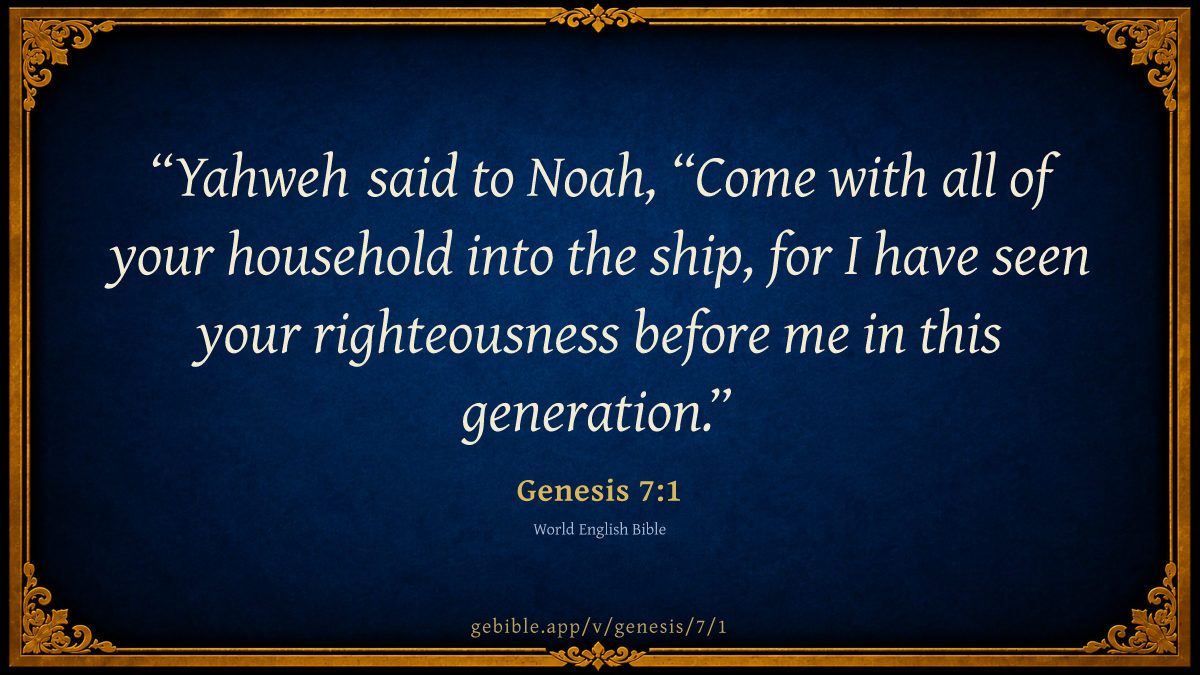
Yahweh said to Noah, “Come with all of your household into the ship, for I have seen your righteousness before me in this generation.
Parallel Translations
-
Yahweh said to Noah, “Come with all of your household into the ship, for I have seen your righteousness before me in this generation.
-
And the LORD said unto Noah, Come thou and all thy house into the ark; for thee have I seen righteous before me in this generation.
-
And the LORD said unto Noah: 'Come thou and all thy house into the ark; for thee have I seen righteous before Me in this generation.
Examined in Scripture Analysis
Contradictions (2)
Questions where the Bible appears to say two different things, with the passages on each side set together.
Cross-references (22)
Passages linked to Genesis 7:1 in the Treasury of Scripture Knowledge, ordered by reader-vote popularity; verse text shown in World English Bible.
- Matthew 24:37-39 “As the days of Noah were, so will the coming of the Son of Man be. For as in those days which were before the flood they were eating and drinking, marrying and giving in marriage, until the day that Noah entered into the ship, and they didn’t know until the flood came, and took them all away, so will the coming of the Son of Man be.
- 2 Peter 2:5-9 and didn’t spare the ancient world, but preserved Noah with seven others, a preacher of righteousness, when he brought a flood on the world of the ungodly; and turning the cities of Sodom and Gomorrah into ashes, condemned them to destruction, having made them an example to those who would live in an ungodly way; and delivered righteous Lot, who was very distressed by the lustful life of the wicked (for that righteous man dwelling among them was tormented in his righteous soul from day to day with seeing and hearing lawless deeds): the Lord knows how to deliver the godly out of temptation and to keep the unrighteous under punishment for the day of judgment,
- Genesis 6:9 This is the history of the generations of Noah: Noah was a righteous man, blameless among the people of his time. Noah walked with God.
- Hebrews 11:7 By faith, Noah, being warned about things not yet seen, moved with godly fear, prepared a ship for the saving of his house, through which he condemned the world, and became heir of the righteousness which is according to faith.
- Genesis 7:13 In the same day Noah, and Shem, Ham, and Japheth—the sons of Noah—and Noah’s wife and the three wives of his sons with them, entered into the ship—
- Isaiah 3:10-11 Tell the righteous “Good!” For they shall eat the fruit of their deeds. Woe to the wicked! Disaster is upon them; for the deeds of his hands will be paid back to him.
- 1 Peter 3:20 who before were disobedient, when God waited patiently in the days of Noah, while the ship was being built. In it, few, that is, eight souls, were saved through water.
- Ezekiel 9:4-6 Yahweh said to him, “Go through the middle of the city, through the middle of Jerusalem, and set a mark on the foreheads of the men that sigh and that cry over all the abominations that are done within it.” To the others he said in my hearing, “Go through the city after him, and strike. Don’t let your eye spare, neither have pity. Kill utterly the old man, the young man, the virgin, little children and women; but don’t come near any man on whom is the mark. Begin at my sanctuary.” Then they began at the old men who were before the house.
- Luke 17:26 As it was in the days of Noah, even so will it be also in the days of the Son of Man.
- Psalms 33:18-19 Behold, Yahweh’s eye is on those who fear him, on those who hope in his loving kindness, to deliver their soul from death, to keep them alive in famine.
- Proverbs 14:26 In the fear of Yahweh is a secure fortress, and he will be a refuge for his children.
- Acts 2:39 For the promise is to you, and to your children, and to all who are far off, even as many as the Lord our God will call to himself.”
- Genesis 7:7 Noah went into the ship with his sons, his wife, and his sons’ wives, because of the floodwaters.
- Psalms 91:1-10 He who dwells in the secret place of the Most High will rest in the shadow of the Almighty. I will say of Yahweh, “He is my refuge and my fortress; my God, in whom I trust.” For he will deliver you from the snare of the fowler, and from the deadly pestilence. He will cover you with his feathers. Under his wings you will take refuge. His faithfulness is your shield and rampart. You shall not be afraid of the terror by night, nor of the arrow that flies by day, nor of the pestilence that walks in darkness, nor of the destruction that wastes at noonday. A thousand may fall at your side, and ten thousand at your right hand; but it will not come near you. You will only look with your eyes, and see the recompense of the wicked. Because you have made Yahweh your refuge, and the Most High your dwelling place, no evil shall happen to you, neither shall any plague come near your dwelling.
- Proverbs 10:6-7 Blessings are on the head of the righteous, but violence covers the mouth of the wicked. The memory of the righteous is blessed, but the name of the wicked will rot.
- Proverbs 10:9 He who walks blamelessly walks surely, but he who perverts his ways will be found out.
- Proverbs 11:4-8 Riches don’t profit in the day of wrath, but righteousness delivers from death. The righteousness of the blameless will direct his way, but the wicked shall fall by his own wickedness. The righteousness of the upright shall deliver them, but the unfaithful will be trapped by evil desires. When a wicked man dies, hope perishes, and expectation of power comes to nothing. A righteous person is delivered out of trouble, and the wicked takes his place.
- Isaiah 26:20-21 Come, my people, enter into your rooms, and shut your doors behind you. Hide yourself for a little moment, until the indignation is past. For, behold, Yahweh comes out of his place to punish the inhabitants of the earth for their iniquity. The earth also will disclose her blood, and will no longer cover her slain.
- Zephaniah 2:3 Seek Yahweh, all you humble of the land, who have kept his ordinances. Seek righteousness. Seek humility. It may be that you will be hidden in the day of Yahweh’s anger.
- Philippians 2:15-16 that you may become blameless and harmless, children of God without defect in the middle of a crooked and perverse generation, among whom you are seen as lights in the world, holding up the word of life, that I may have something to boast in the day of Christ, that I didn’t run in vain nor labor in vain.
- Job 5:19-24 He will deliver you in six troubles; yes, in seven no evil will touch you. In famine he will redeem you from death; in war, from the power of the sword. You will be hidden from the scourge of the tongue, neither will you be afraid of destruction when it comes. You will laugh at destruction and famine, neither will you be afraid of the animals of the earth. For you will be allied with the stones of the field. The animals of the field will be at peace with you. You will know that your tent is in peace. You will visit your fold, and will miss nothing.
- Proverbs 18:10 Yahweh’s name is a strong tower: the righteous run to him, and are safe.
Cross-references from openbible.info (CC BY 4.0)
Explain this verse (23 sources)
Historical commentary, presented as a primary source — not an endorsement.
Private notes
Saved on this device only — never synced or sent anywhere.
John Calvin 1540 · Public Domain 1. And the Lord said unto Noah. I have…
1. And the Lord said unto Noah. I have no doubt that Noah was confirmed, as he certainly needed to be, by oracles frequently repeated. He had already sustained, during one hundred years, the greatest and most furious assaults; and the invincible combatant had achieved memorable victories; but the most severe contest of all was, to bid farewell to the world, to renounce society and to bury himself in the ark. The face of the earth was, at that time, lovely; and Moses intimates that it was the season in which the herbs shoot forth and the trees begin to flourish. Winter, which binds the joy of sky and earth in sharp and rugged frost, has now passed away; and the Lord has chosen the moment for destroying the world, in the very season of spring. For Moses states that the commencement of the deluge was in the second month. I know, however, that different opinions prevail on this subject; for there are three who begin the year from the autumnal equinox; but that mode of reckoning the year is more approved, which makes it commence in the month of March. However this might be, it was no light trial for Noah to leave of his own accord, the life to which he had been accustomed during six hundred years, and to seek a new mode of life in the abyss of death. He is commanded to forsake the world, that he may live in a sepulcher which he had been labouriously digging for himself through more than a hundred years. Why was this? Because, in a little while, the earth was to be submerged in a deluge of waters. Yet nothing of the kind is apparent: all indulge in feasts, celebrate nuptials, build sumptuous houses; in short, everywhere, daintiness and luxury prevail; as Christ himself testifies, that that age was intoxicated with its own pleasures, (Luke 17:26.) Wherefore, it was not without reason, that the Lord encouraged and fortified the mind of his servant afresh, by the renewal of the promise, lest he should faint; as if he would says ‘Hitherto thou hast labored with fortitude amid so many causes of offense; but now the case especially demands that thou shouldst take courage, in order to reap the fruit of thy labor: do not, however, wait till the waters burst forth on every side from the opened veins of the earth, and till the higher waters of heaven, with opposing violence, rush from their opened cataracts; but while everything is yet tranquil, enter into the ark, and there remain till the seventh day, then suddenly shall the deluge arise.’ And although oracles are not now brought down from heaven, let us know that continual meditation on the word is not ineffectual; for as new difficulties perpetually arise before us, so God, by one and another promise, establishes our faith, so that our strength being renewed, we may at length arrive at the goal. Our duty, indeed, is, attentively to hear God speaking to us; and neither through depraved fastidiousness, to reject those exercises, by which He cherishes, or excites, or confirms our faith, according as he knows it to be still tender, or languishing, or weak; nor yet to reject them as superfluous. For thee have I seen righteous. When the Lord assigns as his reason for preserving Noah, that he knew him to be righteous, he seems to attribute the praise of salvation to the merit of works; for if Noah was saved because he was righteous, it follows, that we shall deserve life by good works. But here it behoves us cautiously to weigh the design of God; which was to place one man in contrast with the whole world, in order that, in his person, he might condemn the unrighteousness of all men. For he again testifies, that the punishment which he was about to inflict on the world was just, seeing that only one man was left who then cultivated righteousness, for whose sake he was propitious to his whole family. Should any one object, that from this passage, God is proved to have respect to works in saving men, the solution is ready; that this is not repugnant to gratuitous acceptance, since God accepts those gifts which he himself has conferred upon his servants. We must observe, in the first place, that he loves men freely, inasmuch as he finds nothing in them but what is worthy of hatred, since all men are born the children of wrath, and heirs of eternal malediction. In this respect he adopts them to himself in Christ, and justifies them by his mere mercy. After he has, in this manner, reconciled them unto himself, he also regenerates them, by his Spirit, to new life and righteousness. Hence flow good works, which must of necessity be pleasing to God himself. Thus he not only loves the faithful but also their works. We must again observe, that since some fault always adheres to our works, it is not possible that they can be approved, except as a matter of indulgence. The grace, therefore, of Christ, and not their own dignity or merit, is that which gives worth to our works. Nevertheless, we do not deny that they come into the account before God: as he here acknowledges and accepts the righteousness of Noah which had proceeded from his own grace; and in this manner (as Augustine speaks) he will crown his own gifts. We nay further notice the expression, “I have seen thee righteous before me;” by which words, he not only annihilates all that hypocritical righteousness which is destitute of interior sanctity of heart, but vindicates his own authority; as if he would declare, that he alone is a competent judge to estimate righteousness. The clause, in this generation, is added, as I have said, for the sake of amplification; for so desperate was the depravity of that age, that it was regarded as a prodigy, that Noah should be free from the common infection.
John Calvin's Commentaries (1540-1563) — public domain. Text from the Calvin Translation Society English edition (1840s-50s) via the Christian Classics Ethereal Library (ccel.org). Calvin's coverage is partial (roughly two-thirds of the Bible); uncommented books and verses are honest gaps, never fabricated. The 19th-century editor's footnotes and remarks are omitted so the notes are faithfully Calvin's own voice.
Geneva Bible translators 1599 · Public Domain In respect of the rest of the world, and…
In respect of the rest of the world, and because he had a desire to serve God and live uprightly.
Or, generation.
Geneva Bible (1599) marginal notes — public domain.
John Trapp 1656 · Public Domain Gen 7:1 And the LORD said unto Noah, Come…
Gen 7:1 And the LORD said unto Noah, Come thou and all thy house into the ark; for thee have I seen righteous before me in this generation.
Ver. 1. For thee have I seen righteous before me.] Not only before men, as Pharisees, {Luk 16:15} and civil justiciaries, {Rom 2:29} but before me who see the inside, and love "truth in the hidden man of the heart". {Psa 51:6 1Pe 3:5} And here Noah’s sincerity prevailed with God for his safety, as did likewise Lot’s, whom God hid in Zoar; and Abram’s, to whom God was a shield to save him from the deadly thrusts of destruction, when he pursued the four kings and foiled them, because he "walked before him, and was upright." {Gen 15:1; Gen 14:15} So true is that of Solomon, "He that walketh uprightly, walketh safely," {Pro 10:9} as if he were in a tower of brass, or town of war. And again, "In the fear of the Lord is strong confidence, and his children have a place of refuge". {Pro 14:26} The old Rock is still ready to relieve them. {Isa 26:3}
Read full note →
In this generation.] Called by St Peter, "a world of ungodly ones," {2Pe 2:5} far worse, no doubt, than those in Enoch’s days. The greater praise was it to Noah, that, by a holy antiperistasis, he kindled from their coldness, and became nothing the worse, but much the better (as it is the nature of true goodness) by their oppositions. It was an invincible faith, whereby he both conquered the world and "condemned" it. What else could have carried him over so many difficulties, as he must needs encounter? Well might the apostle say, "By faith he prepared an ark". {Heb 12:7} For if he had been led by sense, he would have fled as far as Jonah did, ere ever he had gone about it.
John Trapp, A Commentary or Exposition upon All the Books of the Old and New Testament (1647–1656) — public domain. Text from a community e-Sword module.
Matthew Poole 1685 · Public Domain When the ark was finished and furnished, and the…
When the ark was finished and furnished, and the time of God's patience expired, Gen 6:3, he
said unto Noah, Come, i.e. prepare to enter,
Read full note →
thou and all thy family; which consisted only of eight persons, 1Pe 3:20, to wit, Noah and his three sons, and their four wives, Gen 6:18. Whereby it appears that each had but one wife, and consequently it is more than probable that polygamy, as it began in the posterity of wicked Cain, Gen 4:19, so it was confined to them, and had not as yet got footing amongst the sons of God. For if ever polygamy had been allowable, it must have been now, for the repeopling of the perishing world.
For thee have I seen righteous, with the righteousness of faith, as it is explained, Heb 11:7, evidenced by all the fruits of righteousness and true holiness, not only before men, and seemingly, but really, and to my all-seeing eye, in this generation; of which expression, see Poole on "Gen 6:9".
Matthew Poole's English Annotations on the Holy Bible (1683–1685) — public domain. Text from a community e-Sword/MySword module.
Matthew Henry 1710 · Public Domain Here is, I. A gracious invitation of Noah and…
Here is, I. A gracious invitation of Noah and his family into a place of safety, now that the flood of waters was coming, Gen 7:1.
1. The call itself is very kind, like that of a tender father to his children, to come in doors, when he sees night or a storm coming: Come thou, and all thy house, that small family that thou hast, into the ark. Observe, (1.) Noah did not go into the ark till God bade him; though he knew it was designed for his place of refuge, yet he waited for a renewed command, and had it. It is very comfortable to follow the calls of Providence, and to see God going before us in every step we take. (2.) God does not bid him go into the ark, but come into it, implying that God would go with him, would lead him into it, accompany him in it, and in due time bring him safely out of it. Note, Wherever we are, it is very desirable to have the presence of God with us, for this is all in all to the comfort of every condition. It was this that made Noah's ark, which was a prison, to be to him not only a refuge, but a palace. (3.) Noah had taken a great deal of pains to build the ark, and now he was himself preserved alive in it. Note, What we do in obedience to the command of God, and in faith, we ourselves shall certainly have the comfort of, first or last. (4.) Not he only, but his house also, his wife and children, are called with him into the ark. Note, It is good to belong to the family of a godly man; it is safe and comfortable to dwell under such a shadow. One of Noah's sons was Ham, who proved afterwards a bad man, yet he was saved in the ark, which intimates, [1.] That wicked children often fare the better for the sake of their godly parents. [2.] That there is a mixture of bad with good in the best societies in earth, and we are not to think it strange. In Noah's family there was a Ham, and in Christ's family there was a Judas. There is no perfect purity on this side heaven. (5.) This call to Noah was a type of the call which the gospel gives to poor sinners. Christ is an ark already prepared, in whom alone we can be safe when death and judgment come. Now the burden of the song is, "Come, come;" the word says, "Come;" ministers say, "Come;" the Spirit says, "Come, come into the ark."
Read full note →
2. The reason for this invitation is a very honourable testimony to Noah's integrity: For thee have I seen righteous before me in this generation. Observe, (1.) Those are righteous indeed that are righteous before God, that have not only the form of godliness by which they appear righteous before men, who may easily be imposed upon, but the power of it by which they approve themselves to God, who searches the heart, and cannot be deceived in men's characters. (2.) God takes notice of and is pleased with those that are righteous before him: Thee have I seen. In a world of wicked people God could see one righteous Noah; that single grain of wheat could not be lost, no, not in so great a heap of chaff. The Lord knows those that are his. (3.) God, that is a witness to, will shortly be a witness for, his people's integrity; he that sees it will proclaim it before angels and men, to their immortal honour. Those that obtain mercy to be righteous shall obtain witness that they are righteous. (4.) God is, in a special manner, pleased with those that are good in bad times and places. Noah was therefore illustriously righteous, because he was so in that wicked and adulterous generation. (5.) Those that keep themselves pure in times of common iniquity God will keep safe in times of common calamity; those that partake not with others in their sins shall not partake with them in their plagues; those that are better than others are, even in this life, safer than others, and it is better with them.
II. Here are necessary orders given concerning the brute-creatures that were to be preserved alive with Noah in the ark, Gen 7:2, Gen 7:3. They were not capable of receiving the warning and directions themselves, as man was, who herein is taught more than the beasts of the earth, and made wiser than the fowls of heaven - that he is endued with the power of foresight; therefore man is charged with the care of them: being under his dominion, they must be under his protection; and, though he could not secure every individual, yet he must carefully preserve every species, that no tribe, no, not the least considerable, might entirely perish out of the creation. Observe in this, 1. God's care for man, for his comfort and benefit. We do not find that Noah was solicitous of himself about this matter; but God consults our happiness more than we do ourselves. Though God saw that the old world was very provoking, and foresaw that the new one would be little better, yet he would preserve the brute creatures for man's use. Doth God take care for oxen? Co1 9:9. Or was it not rather for man's sake that this care was taken? 2. Even the unclean beasts, which were least valuable and profitable, were preserved alive in the ark; for God's tender mercies are over all his works, and not over those only that are of most eminence and use. 3. Yet more of the clean were preserved than of the unclean. (1.) Because the clean were most for the service of man; and therefore, in favour to him, more of them were preserved and are still propagated. Thanks be to God, there are not herds of lions as there are of oxen, nor flocks of tigers as there are of sheep. (2.) Because the clean were for sacrifice to God; and therefore, in honour to him, more of them were preserved, three couple for breed, and the odd seventh for sacrifice, Gen 8:20. God gives us six for one in earthly things, as in the distribution of the days of the week, that in spiritual things we should be all for him. What is devoted to God's honour, and used in his service, is particularly blessed and increased.
III. Here is notice given of the now imminent approach of the flood: Yet seven days, and I will cause it to rain, Gen 8:4. 1. "It shall be seven days yet, before I do it." After the hundred and twenty years had expired, God grants them a reprieve of seven days longer, both to show how slow he is to anger and that punishing work is his strange work, and also to give them some further space for repentance: but all in vain; these seven days were trifled away, after all the rest; they continued secure and sensual until the day that the flood came. 2. "It shall be but seven days." While Noah told them of the judgment at a distance, they were tempted to put off their repentance, because the vision was for a great while to come; but now he is ordered to tell them that it is at the door, that they have but one week more to turn them in, but one sabbath more to improve, to see if that will now, at last, awaken them to consider the things that belong to their peace, which otherwise will soon be hidden from their eyes. But it is common for those that have been careless of their souls during the years of their health, when they have looked upon death at a distance, to be as careless during the days, the seven days, of their sickness, when they see it approaching, their hearts being hardened by the deceitfulness of sin.
Matthew Henry's Commentary on the Whole Bible (1708–1710) — public domain (CC PDM 1.0). Text via the HelloAO Bible API.
John Gill 1763 · Public Domain And the Lord said unto Noah,.... After Noah had…
And the Lord said unto Noah,.... After Noah had built the ark, and got all things ready as were commanded him; and when it was but seven days ere the flood would begin:
Come thou and all thy house into the ark; that is, he and his wife, his three sons and their wives:
Read full note →
for thee have I seen righteous before me in this generation: this was a great character of Noah; that he was a "righteous" person, not by his own righteousness, but by the righteousness of faith he was both heir and preacher of; and this he was "before" God, in his sight, seen, known, and acknowledged by him as righteous; and therefore must be really so: and this shows that he was not so by the works of the law, but by the righteousness of Christ; because by them no flesh living is justified in the sight of God: and Noah was a rare instance of this character; there was none besides him in that wicked generation, so that he was very conspicuous and remarkable; and it was wonderful grace to him, that he should have this blessing to be righteous in an age so sadly corrupt, which was the cause of his being saved; for whoever are justified shall be saved eternally, Rom 8:30 as well as they are often saved from temporal calamities, see Isa 3:10.
John Gill's Exposition of the Whole Bible (1746–1763) — public domain (CC PDM 1.0). Text via the HelloAO Bible API.
John Wesley 1765 · Public Domain We have in this chapter,
We have in this chapter,
I. God's gracious call to Noah to come into the ark, ver. 1. and to bring the creatures that were to be preserved alive, with him, ver. 2, 3. in consideration of the deluge at hand, ver. 4.
Read full note →
II. Noah's obedience, ver. 5. he came with his family into the ark, ver. 6, 7. and brought the creatures with him, ver. 8, 9. An account of which is repeated, ver. 13, 14, 15, 16. to which is added God's tender care to shut him in.
III. The coming of the threatened deluge, ver. 10. the causes of it, ver. 11, 12. the prevalency of it, ver. 17, 18, 19, 20.
IV. The dreadful desolations that were made by it, in the death of every living creature upon earth, except what were in the ark, ver. 21, 22,23.
V. The continuance of it in full sea, before it began to ebb, 150 days, ver. 24.
Here is a gracious invitation of Noah and his family into a place of safety, now the flood of waters was coming. For thee have I seen righteous before me in this generation - Those are righteous indeed that are righteous before God; that have not only the form of godliness by which they appear righteous before men, who may easily be imposed upon; but the power of it, by which they approve themselves to God, who searcheth the heart.
John Wesley, Explanatory Notes Upon the Whole Bible (1754–1765) — public domain. Text via the GEBible commentary corpus.
Adam Clarke 1810 · Public Domain God informs Noah that within seven days he shall…
CHAPTER VII
God informs Noah that within seven days he shall send a rain upon
Read full note →
the earth, that shall continue for forty days and nights; and
therefore commands him to take his family, with the different
clean and unclean animals, and enter the ark, 1-4.
This command punctually obeyed, 5-9.
In the seventeenth day of the second month, in the six hundredth
year of Noah's life, the waters, from the opened windows of heaven,
and the broken up fountains of the great deep, were poured out upon
the earth, 10-12.
The different quadrupeds, fowls, and reptiles come unto Noah, and
the Lord shuts him and them in, 13-16.
The waters increase, and the ark floats, 17.
The whole earth is covered with water fifteen cubits above the
highest mountains, 18-20.
All terrestrial animals die, 21-23.
And the waters prevail one hundred and fifty days, 24.
NOTES ON CHAP. VII
Verse 1. Thee have I seen righteous] See Clarke on Ge 6:8.
Adam Clarke's Commentary on the Bible (1810–1826) — public domain. Text from a community e-Sword/MySword module.
Joseph Benson 1811 · Public Domain Gen 7:1. Come thou, and all thy house, into…
Gen 7:1. Come thou, and all thy house, into the ark — His family consisted only of eight persons, 1Pe 3:20, namely, Noah and his three sons, and their four wives, Gen 6:18. By this it appears that each man had but one wife, and consequently it is probable, that, as polygamy began in the posterity of Cain, so it was confined to them, and had not, as yet, got footing among the sons of God. For if ever polygamy had been allowable, it must have been now for repeopling of the perishing world. For thee have I seen righteous before me — With the righteousness of faith, as it is explained Heb 11:7, evidenced by the fruits of righteousness and true holiness. Those are righteous indeed, that are righteous before God; that have not only the form of godliness, by which they appear righteous before men, who may easily be imposed upon; but the power of it, by which they approve themselves to God, who searcheth the heart.
Joseph Benson's Commentary on the Old and New Testaments (1811–1818) — public domain. Text from a community e-Sword module.
Albert Barnes 1834 · Public Domain - The Ark Was Entered
- The Ark Was Entered
2. טהור ṭâhôr “clean, fit for food or sacrifice.”
Read full note →
4. יקוּם yeqûm “standing thing; what grows up, whether animal or plant.” Compare קמה qāmâh “stalk, or standing corn.”
Gen 7:1-4
Here is found the command to enter the ark. The general direction in the preceding chapter was given many years ago, before the ark was commenced. Now, when it is completed, a more specific command is issued. “For thee have I seen righteous before me.” Noah has accepted the mercy of God, is therefore set right in point of law, and walks aright in point of practice. The Lord recognizes this indication of an adopted and renewed son. “In this age” he and his were the solitary family so characterized.
Gen 7:2-3
Of all clean cattle. - Here the distinction of clean and unclean animals meets us without any previous notice. How it became known to Noah we are not informed. From the former direction it appears that the animals were to enter by pairs. Now it is further arranged that there are to be seven pairs of the clean cattle and fowl, and only one pair of the unclean.
Gen 7:4
Seven days after the issue of the command the rain is to commence, and continue for forty days and nights without ceasing. “Every standing thing” means every plant and animal on the land.
Gen 7:5-9
The execution of the command is recorded and fully particularized with the additional circumstance of the age of Noah. “The son of six hundred years,” in his six hundredth year. “Went they unto Noah.” They seem to have come under the influence of a special instinct, so that Noah did not require to gather them. Seven days were employed in receiving them, and storing provisions for them.
Albert Barnes' Notes on the Bible (1834–1885) — public domain. Text from a community e-Sword/MySword module.
Lange's Commentary on the Holy Scriptures 1864 · Public Domain See Gen_6:8 ff for the passage quote with footnotes.
See Gen_6:8 ff for the passage quote with footnotes.
Gen_7:1 And the Lord said unto Noah, come thou and all thy house into the ark; for thee have I seen righteous before me in this generation. 2Of every clean beast thou shalt take to thee by sevens, the male and his female, and of beasts that are not clean by two, the male and his female. 3Of fowls also of the air by sevens, the male and the female; to keep seed alive upon the earth. 4For yet seven days, and I will cause it to rain upon the earth forty days and forty nights; and every living substance that I have made will I destroy from the face of the earth. 5And Noah did according to all that the Lord commanded him. 6And Noah was six hundred years old when the flood of waters was upon the earth. 7And Noah went in, and his sons, and his wife, and his sons’ wives with him, into the ark, because of the waters of the flood [from before, or from the face of the waters]. 8Of clean beasts, and of beasts that are not clean, and of fowls, and of every thing that creepeth upon the earth, 9There went in two and two [by pairs] unto Noah into the ark, the male and the female, as God [Elohim] had commanded Noah.
Read full note →
THE FLOOD. PRELIMINARY REMARKS
1. The Literature.—See Com. on Matthew, p. 6. The present work, p. 119. Walch.: Bibl. Theol., iii. p. 100. Danz: “Universal Lexicon,” p. 918. Winer, Real Lexicon, article, Noah. Herzog, Real Encyclopedia, article, Noah. Kurtz: “History of the Old Testament,” i. p. 81. Knobel, p. 81.—[Article, Deluge, Kitto: “Bib. Encyc” vol. i. p. 542.—Article, Noah, Smith’s “Bib. Dict.” vol. ii., p. 562.—T. L.]
The Hebrew name of the Great Flood (מַבּוּל) Luther rendered by the word Sin-flut, or Sindflut. The latest edition of the German Bible contains still this designation. Through a misunderstanding of the expression it became afterwards Sündflut. Pischon in the “Theological Studies and Criticisms,” 1834, III. Delitzsch, p. 628. In old German the word sin is found only at the beginning of compounds: it has the meaning ever, everywhere, complete. For example, sin-grün means ever-green.
2. The Stories of the Flood. No fact of Sacred History reflects itself in a more universal and manifold manner throughout the heathen legendary world than the Noachic flood. Compare here the copious account of Lücken: “The Traditions of the Human Race,” p. 170; also Knobel, p. 75; Delitzsch, p. 242. It is especially interesting to study how the different nations have heathenized, mythologized, in other words, nationalized or localized the sacred and universal tradition (since by the very nature of heathenism the patriarch of the flood belongs to particular nations who received the account from him, and who also regarded him as their national middle point), and how they have confounded it with the story of Paradise, or of the creative days. From this comes the varied deification of this flood-patriarch. Delitzsch distinguishes, 1. the West Asiatic stories of the flood. The Babylonian flood of Xisuthrus: “the last of the ten antediluvian chiefs, as given by Berosus and Abydenus, and the Phoenician story of the victory of Pontus over Demarus, the earth sphere, as given by Sanchoniathon.” With the Babylonian story of the flood he compares the narrative of the flood as given in the first of the Sibylline books, which, in its ground features, has some resemblance to the biblical. Next “the Phrygian story of King ’Αννακός or Ναννακός (that is, Enoch) in Iconium, who, when over three hundred years old, announced the flood, and prayed with lamentation for his people; with which are connected coins of Apamea of the times of Septimius Severus, Macrinus, and Philip, representing a floating ark and bearing the partial inscription, ΝΩ.” So also the Armenian, which, as might be expected, agrees in its locality with the biblical (Nicol. Damascen., Strabo). Then a Syrian legend of which Lucian makes mention (De Syra Dea, Genesis 13). 2. East Asiatic stories of the flood. The Persian, the Chinese; the Indian of Menu, to whom Vishnu, taking the form of a fish, announces the flood, and whose ship, drawn by this fish, lands upon Himarat. It presents itself to us in many forms. The oldest, yet the latest known to us, is the story in Çatapatha-Brahmana (Weber, “Indian Studies,” 1850). Next to that is the story in Mahâbhârata (Bopp, “Diluvium,” 1829), and in the Purâna; its latest form is presented in the Bhâgavata-Purana (ed. Bournout, 1827), which, according to Wilson, does not go back of the twelfth century after Christ. (In respect to all these forms of the story, see Felix Nave: La Tradition Indienne du Déluge, Paris, 1851.) 3. Grecian stories of the flood. “In the first place the story of Ogyges (Plato, in the Timœus,)1 and the more enlarged account of Deucalion and Pyrrha (first in Pindar, then by Apollodorus, brought nearer to the biblical account, also given by Plutarch, Lucian, and Ovid,2—both, in their ground features, stories of one and the same flood, but wholly Hellenized.” 4. The stories of the people who were outside the commerce or intercourse of the Old World. The Celtic story of Dwyvan and Dwyvach, who, in the flood that arose from the outbreaking of the sea of Llion, and which swallowed up all men, made their escape in a bare boat (without sails), and again peopled Britain. More remote still, the flood-stories of the Mexicans, of the island inhabitants of Cuba, of the Peruvians, of the races on the upper Orinoco, of the Tahitians, and other insular peoples of the Society Islands Archipelago. To make an arrangement according to the facts narrated, we may distinguish, 1. Stories of the flood which identify it with the creative catastrophes, namely: the Germanic story of the blood of the slain Ymer, which deluged the earth, and destroyed the oldest giant race. The Persian story of the rain of Zistar, which flooded the earth, and caused the death of the beasts of Ahriman. The Chinese story of Riuhoa (Lücken, p. 193; see on the other hand Bunsen, vol. ii. p. 61). 2. Stories of the flood in which the Bible flood is specifically and distinctly reflected, such as the Babylonian, the Phrygian, the Indian, the Chinese story of Jao, the Celtic stories (Lücken, p. 204). 3. Stories of the flood which seem to connect or to confound it with the deluge accounts of later floods. The stories of the Egyptians and the Greeks (Lücken, pp. 209, 196). In the submersion of the island Atlantis, as given in Plato’s Timœus, there seems to be reflected likewise the tradition of the lost Paradise. In respect to the facts that lie at the foundation of the latter stories, compare the pamphlet of Unger, entitled “The Sunken Island of Atlantis.” Vienna, 1860. The fundamental view here indicates revolutions of the earth, upheavings and depressions of its surface, whose effect is also of importance in the history of the Bible deluge. 4. Stories of floods in which the Bible flood forms the central point, towards which all traditions and legends of early terrestrial catastrophes flow together, and in which the original tradition cannot always be separated from later modification through Christian and Mohammedan elements. Interior African and American, or insular flood stories. It is well worthy of remark, that the ethical interpretation of the flood, according to which it comes as a judgment upon a condemned human race, everywhere prominently appears in the stories of the deluge. The purest copy of our Bible history is given in the Chaldaic narrative of Berosus, the ancient priest of Bel, about 260 years before Christ. Xisuthrus, the last of the ten primitive kings, beheld in a dream the appearance of Cronos (in Greek the same as Bel or Baal), who announced to him, that on the 15th day of the month Däsio, men would be destroyed by a flood. It was commanded him to write down all the sciences and inventions of mankind, and to conceal the writings in Syparis, the city of the Sun; thereupon he was to build a ship, and to embark on the same with all his companions, kindred, and nearest friends; he was to put in it provisions and drink, and to take with him the animals, the birds, as well as the quadrupeds. If any one should ask him whereto he was bound, he was to answer: To the gods; to implore good for men. He obeyed, and made an ark five stadia in length, and two in breadth, put together what was commanded, and embarked with wife, children, and kindred. As the flood subsided, Xisuthrus let fly a bird, which, when it neither found nourishment nor place to light, returned back into the ark. After some days he let fly another bird; this came back with slime upon its foot. The third bird sent forth never returned. Then Xisuthrus perceived that land was becoming visible, and after that he had broken an opening in the ship, he sees it driven upon a mountain, whence he descends with wife, daughter, and pilot, and when he had saluted the earth, built an altar, and offered sacrifice to the gods, he disappeared. Those who were left in the ship, when they saw that Xisuthrus did not return, went forth to seek him, and called him by name. Xisuthrus was seen no more, but a voice sounded from the air, bidding them to fear god, and telling them that on account of his piety he had been taken away to dwell with the gods; and that the same honor was given to his wife, daughter, and pilot. (This disappearance has relation to his deification, or probably to his translation among the stars, where the forms of the waterman, the young woman, and the carrier (the wagoner) still present themselves to us). They were commanded to return back to Babylon) where it was appointed to them to take the writings from Syparis, and impart the knowledge they contained to men. The country where they found themselves was Armenia. In respect to the ship, which had landed in Armenia, Berosus adds that there was still a portion of it on the mountains of Kordyäer (or the Kurdistan mountains) in Armenia, from which some persons cut off pieces, took them to their houses, and used them as amulets (according to Lücken). Amid all the similarity which this story presents to the Bible history, there is no mistaking the mythological coloring; for example, in the huge size of the ark. Just as little do we fail to hear the echo of the history of Enoch.
3. The Fact of the Flood.—The narrative of the flood, like the history of Paradise, has in a special measure the character of all the Bible histories—that is, it is at the same time fact and symbol; and it is the symbolical significance of this history that has formed the significant expression of the fact. In regard to the fact itself, the view is rendered in a high degree difficult by reason of the mingling with it of the following representations, resting solely on the literal interpretation: 1. the supposition that the history narrates not merely the extermination of the first human race, and, therefore, the overflowing of the earth according to the geographical extension of that race, but an absolute universal submersion of the whole earth itself; 2. the idea that the terrestrial relations were the same at that time that they are now, that the mountain elevations were completed, and that the mountain Ararat was just as high as at the present time; 3. that the branching of the animal species had become as great at that day as it is now: add to these a 4th, the ignoring of every symbolical imprint in the representation. As to what concerns the first two points, it is argued by Ebrard, for example (“Belief in the Holy Scriptures,” p. 73), that Ararat was 16,000 feet high. The waters stand fifteen cubits above Ararat; consequently must the whole earth have been covered, though it may still remain a question whether single peaks, like the Dhawalagiri, might not have projected above the water-surface (in a literal construction of the text, however, such a doubt cannot remain), since a banking limitation of so high a flood would be inconceivable. This conclusion depends upon a supposition wholly uncertain, namely, that the peak of Ararat was in that day 16,000 feet high. In regard to the first point, the remark of Nägelsbach (Art. “Noah,” Herzog’s Real-Encyclopedie) coincides wholly with the view of Delitzsch, namely, that the theological interest does not demand the universality of the flood in itself, but only the universality of the judgment that was executed by it. In respect to the second point, it is to be remarked, that the mountain formations of the earth had been, indeed, begun in the creative period, but were not yet fully completed. The history of the deluge is, without doubt, the history of a catastrophe in which the terrain of the earth experienced important modifications through the cooperation of fire. The deep sinking of the land in the neighborhood of the Armenian paradisaical region, which is denoted by the Caspian Sea, might alone have brought on a deluge catastrophe analogous to that which must have had a connection with the ruin of the legendary island of Atlantis. In respect to the third representation, the Darwin theory of the progressive origin of races, though in itself untenable, does nevertheless contain an indication of the truth that the countless unfolding of organic memberships in the animal life goes back to great individual anti-types, as science theoretically sets forth. For each species, perhaps, there may have been a ground type in the ark, out of which all varieties of the same have proceeded. In respect to the fourth false representation, which confounds the style of the Holy History with the notarial expression of a worldly pragmatism, we refer to the Introduction.
On the side of the mythologizing of the deluge history there are similar untenable representations that call for remark. 1. The apprehension in respect to the possibility of building the ark. It is historically established that, at all times, a necessity fundamentally perceived, has, under the guidance of God, brought to discovery the helps required for the accomplishment. Necessity learns to pray, learns to build. 2. The difficulty of assembling such a multitude of beasts in the ark. In reply to this, allusion has been made to the instinct of animals, which, in a presentiment of natural catastrophe, seek an asylum, sometimes, almost in violation of their natural habits. Birds, in a storm, fly to the ships; wolves come into the villages, etc. 3. The difficulty of the animal provisioning. Answer: This would be of least weight in respect to animals like those of the marmot and badger species, whose winter torpor in the easiest manner keeps them through the wintry storm-period. But the deluge, in like manner, supposes, in the main, a slumbering, dead-like transition from the old existence into the new. Darkness, the roaring and rocking of the waters in so peculiar a manner, must bring on a benumbing torpor, and, in the case of many animals, a winter sleep, whereby the feeding would be rendered unnecessary. The ground ideas of the deluge history are as high above the popular representations on the right, as they are beyond the scholastic thinking on the left. They may be regarded as something like the following: 1. At the moment when the first human race, through the commingling of an angel like elevation of the Sethic line with the demonic corruption of the Cainitic, is ripe for judgment, there is a corresponding catastrophe, having its ground in the earth’s development, forming an echo to the creation catastrophes, and, at the same time, imposed by God as a judgment doom upon that human corruption. 2. The prophetic spirit of a pious patriarch, in whom there is concentrated the heart of the old world’s piety, takes into its belief not only the revelation of the impending judgment, but also the deliverance which out of that judgment is to go forth for this world itself as represented in his person, and in his family, whilst it denotes thereby the progress of faith in revelation, from the assurance of salvation in the other world (which Enoch already had), to the confidence of salvation in this. 3. The inspiring of necessity teaches him, under the divine guidance, to build an ark, which, in its commencement, is to be a preaching of repentance to the cotemporaries of the builder, but which, in its completion, is distinguished neither by oar nor helm, but only by its great spaciousness and water-tight construction. 4. In this use of the ark, as a common asylum, the instincts of the beasts act in harmony with the prophetic presentiment of chosen men, whilst the rest follows through God’s care and a peculiar success. 5. The history of the flood is an ἅπαξ λεγόμενον in the world’s history, analogous to the creation of Adam, the birth and history of Christ, and the future history of the world’s end. Even Bunsen (ii. p. 63) affirms, in general, the historicalness of the biblical tradition.
Therefore is this unparalleled fact in the highest degree symbolic or ideal, whilst it is, at the same time, a typical prophecy. 1. It is a prophecy of the deliverance of Israel as the people of God in the passage through the Red Sea; 2. a prophecy of the deliverance of the Christian church from the corruption of the world, through the washing of baptism (1Pe_3:21); 3. a prophecy of the deliverance of the congregation of Christ, at the world’s end, out of the fire-flood of the world’s judgment. The ark is especially reflected in the ark of Moses, in the ark of the covenant which was carried through the Jordan, in the household of the church, and in the congregation of faith at the end of the world. Knobel thinks that in the narration before us there is to be recognized an Elohistic foundation which the Jehovist must have elaborated, not without a contradiction of its fundamental ground. Thus the description of the corruption, in Gen_6:11-12, he says, does not agree with the Jehovist, who represents the wickedness in human life as having commenced at a much earlier day. As though the origin of evil and an incurable corruption were not two distinct grades! So, according to the Jehovist, it is (as Knobel would have it) that the human life-period after the flood sinks down to one hundred and twenty years—an idea that rests upon a false interpretation. Moreover, it would seem not to agree with the ground-scripture, that of many kinds of beasts Noah took more than a pair (Gen_7:2-3; Gen_7:8). Knobel supposes, therefore, that the special enlargement was a contradiction to the more general appointment. In regard to the fact itself, says Knobel: Unanswerable are the questions, how Noah came to expect the great flood, and was led to the building of the ark. So also would it be incapable of an answer, how at any time one could attain to a prophetic prevision. The question he regards as still more difficult to answer: “How he was enabled to produce such a structure,”—that is, such a great quadrangular box. Further: “How he got the beasts in his power?” Experience shows, that in extraordinary catastrophes of nature, the wildest animals take refuge with men. Lastly: “How could they all, together with the necessary provisioning for a whole year, find room in the ark?” This point carries us back to a primitive time, when, as yet, the species were comparatively less divided, and to a stormy death of nature, which intensified to its most extreme degree the phenomenon of the winter’s sleep; to say nothing of the point, that to the symbolical expression there is needed only the general fact of the saving of the animal world, along with man, by means of the ark. When Ebrard admits that possibly the highest mountain-peaks may have projected above the surface of the waters of the deluge, it would allow the consequence of an Alpine fauna existing outside of the ark. The point mainly in view is the destruction of the human race, and the saving of the Noachian family, in the deluge. Notwithstanding his objections, Knobel supposes an actual ground of fact in the narration, even as an after-piece to the great earth revolutions of the creative period (p. 78). This last point of view carries us beyond the supposition of mere partial historical inundations. A concussion of the earth permits the conclusion that a displacement occurred in its continental relations, whence there might have arisen a deluge of a very wide character, without our having to assume a corresponding inundation of the whole earth’s surface. Stormy deluges do not obey the law of standing waters. Such a deluge might have passed over the whole inhabited part of the earth, without making a like height of water as standing over the whole sphere.
“The grounds,” remarks Delitzsch, “on which the Thora (the Pentateuch) dwells so emphatically upon the flood, consist in their significancy for the history of God’s kingdom in general, and the history of the Old Testament theocracy in particular. The flood is an act of deepest significance, whether regarded as one of judgment or of salvation. It is a common judgment, making an incision in history so deep and so wide, of such force and universality, that nothing can be compared with it but the final judgment at the extreme limit of this world’s history. But the act of judgment is, at the same time, an act of salvation. The sin-deluge is, at the same time, a grace-deluge,3 and so far a type of holy baptism (1Pe_3:21), and of life rising out of death; therefore it is, that old ecclesiastical art was so fond of distinguishing chapels of burial by a representation of it. The destruction has in view the preservation, the drowning has in view the purification, the death of the human race has in view the new birth; the old corrupted earth is buried in the flood of water, that out of this grave there may emerge a new world. In this way Ararat points to Sinai. The covenant of Elohim, which God then made with the saved holy seed, and with the universal nature, points to the covenant of Jehovah.”
4. The Geological Effects of the Deluge.—In earlier times, the traces of earth revolutions that took place in the creative days (for example, the mountain formations, the shells on the highest hills, and similar phenomena) were brought forth as proofs of the flood. Such a mode of reasoning must now be laid aside by those who would reconcile revelation with science. Neither can the assumption be proved, that it rained for the first time in the flood, and that, with the change in the atmosphere, human life suddenly sunk in its duration, nor the supposition that at that time a sudden transformation took place in the animal world, or that new animals were originated. The following suppositions, however, may be regarded as more or less safely entertained: 1. As the great flood denoted an epoch in the life of humanity, so also must it have done in the life of the earth; and through this epoch the giant-like in the human natural powers seems to have been moderated, whilst, on the contrary, the development in the earth’s life becomes more conformable to law. 2. The historical indications and signs of great changes in the earth’s surface, such as volcanic mountain formations, surface transformations (Caspian Sea, and island Atlantis, for example), may be connected, in some special measure, with the catastrophe of the flood. 3. The flood in itself may, perhaps, have been partial (see F. Pfaff, “The Creative History,” p. 646), but the earth-crisis, on which it was conditioned, must have been universal. With the opening of the fountains of the deep stands the opening of the windows of heaven in polar contrast. An extraordinary rain-storm and fall of water over the Noachian earth-circle, was probably conditioned by an extraordinary evaporation in other regions of the globe. This must have been followed by an extraordinary congelation on the same side. Does the “ice-period,” the period of the wandering boulders, stand in any relation to this? As an earth-crisis, the flood was probably universal.
EXEGETICAL AND CRITICAL
1. Noah and his House, in contrast with the Contemporaries of Noah (Gen_6:9-11). The history that follows is distinguished by the name Tholedoth, or Generations of Noah. For Noah is not only the last of the Sethic patriarchs, as the end of the antediluvian period; he is, moreover, the first of the new, through the patriarchal line that goes on in Shem, and, in this representation, is he also a type of the future Christ, the finisher of the old, the author of the new, world. In a typical sense, Noah is the second ancestor of the human race, as Christ, the Man from Heaven, is such in a real sense (1 Corinthians 15). As a continuer of the old time, Noah is virtually a repetition of Adam; as a beginner of the new time, he is a type of Christ. He was a righteous man. According to Knobel, the author (of this account of the flood) knew nothing of any fall of Adam. One might deduce a like conclusion from Luke in his account of Zacharias and Elisabeth (Gen_1:6). But evidently the righteousness here meant is that which represents him as justified in view of the judgment of the flood, by reason of his faith (Heb_11:7). Therefore was the explanation added: he was תָּמִים, guiltless, perfect, blameless among his cotemporaries who perished in the judgment. The ground of this was: he walked with God as Enoch did. That he begat three eons, Shem, Ham, and Japheth, is here again related, as in Gen_5:32, because in them the continuance of a new race is secured; with Noah, therefore, must his family also be saved. But, moreover, to Noah, and his house, there is formed a contrast in the race of his time, and in the old form of the earth that had been corrupted by it.
Gen_7:5. To represent the wickedness of man, our text goes further, and expresses the incurable perdition of the old earth itself, as having been produced by it. It was utterly corrupt, in that it was filled with wickedness, acts of violence, and pride. But it was corrupt before the eye of God in its most manifest form, so that its judgment was imperatively demanded.—And God looked upon the earth, and lo.—Delitzsch correctly points out the contrast of these words to Gen_1:31. “Everything stood in sharpest contradiction with that good state which God the creator had established.” God’s looking (or seeing) denotes a final sentence. The earth was incurably corrupt because all flesh had corrupted its way, that is, its normal way of life, upon the corrupted earth. Herein lies the indication, that as men grew wild and savage, the animal world also threatened to become wild. If, however, we suppose, with Delitzsch, an universal corruption of the animal world, whence could Noah have taken the good specimens for his ark? Moreover, it cannot be concluded, from Gen_9:4, that men, in their greediness for flesh, cut out pieces from the yet living animal. According to Knobel, the text denotes the beasts, inasmuch as they originally lived upon vegetables, but now had partly degenerated into flesh-eaters. This, however, would be all the same as introducing a representation into the text, just as Delitzsch maintains, that the eating of flesh had not yet been permitted. Keil understands the words in question as referring generally to men only. Thereby, however, there is loosened that organic connection of man, beast, and earth, on which the text lays stress. More correct is the emphasis he lays on the words “all flesh:” humanity had become flesh (Gen_7:3).
2. The Announcement of the Judgment, and the Direction for the Building of the Ark (Gen_7:13-22).—And God said to Noah.—The revelation of the divine displeasure with the human race, which appears first, Gen_7:3, as a conditional and veiled threatening of judgment with the granting of a space for repentance, and which, in its second utterance, has already become a resolution to destroy the human race (Gen_7:7), becomes here an absolute announcement of approaching doom. There had, perhaps, been previous revelations, in the form of a preaching of repentance, made by other patriarchs (such as Methuselah and Lamech), as they, one after the other, left the world. These had been gradually extended in time; but now are they all concentrated in the one revelation made to Noah. With this there was, at the same time, connected the promise that Noah and his family should be saved. As God’s acts of deliverance are connected in time with his acts of judgment (since his judgments are ever separations of the godly from the ungodly, and, in this sense, salvations and deliverances), so also are the revelations of judgment at the same time revelations of deliverance, and the faith of the elect which corresponds to them is, at the same time, both a faith in judgment and a faith in salvation.—The end of all flesh.—An expression which strongly conveys the idea, that the positive judgment of God is indicated through a judgment immanent in the corruption of men. The self-abandonment in this corruption, the clearly visible end of the same, is so fearfully depicted, that the positive end which God is about to impose takes the appearance, not of a judgment merely, but of redress. Still is the first conception the predominant one, as appears from the expression which tells us that God saw the end, the extreme end of the world’s corruption (Keil).—Is filled with violence through them (Lange renders more correctly, from their faces, or, before them. Vulg., a facie eorum). As it is said, in immediate connection, “before the face of God,” we hold it unsatisfactory here to render מפניהם from them, or through them. The flood of wickedness that comes up before God’s face goes out from their face; that is, it is a wickedness openly perpetrated; the moral judgment, the conscience, goes utterly out in the direct beholding and approbation of evil.—I will destroy them with the earth.—Destruction as set against corruption (1Co_5:5). The earth as such can, indeed, suffer no penal destruction. As one with man, the destruction becomes to it a total destruction, which comes upon men along with their earth. And so in the renewal of humanity must the earth also receive a renovation of its form.—Make thee an ark.—An indication of the mode of salvation, in which he himself must co-operate. Baumgarten: “He must be not only the preserved, but also the preserver.” תֵּבָה, according to Delitzsch, probably (if the word is Shemitic), from אוּב = תּוּב, to be hollow.4 Chaldaic, תֵּיבוּתָא, Sept. κιβωτός, Vulg. arca (other meanings see in Delitzsch). Keil and Rödiger conjecture that the word is of Egyptian origin. So Knobel: “In Egyptian, boat is called tept.” It is likewise used of the small ark in which Moses was saved (but which in the Septuagint is rendered θίβις or θίβη.—Of gopher-wood [Lange, resinous wood]. Hieronymus: ligna bituminata. “Probably, cypress-wood.” Keil (גֹּפֶר, cognate to כֹּפֶר and κυπάρισσος).—Rooms shalt thou make [Lange, cells].—Properly in cells, as cells (literally, nests—little cabins), or cell-containing.—With pitch.—Sept. ἀσφαλτός, Vulg. bitumen.—And this is which (what) thou shalt make it.—“The most probable supposition is, that the ark was built, not in the form of a ship, but after the manner of a box, without keel, with a flat deck, more like a four-sided moving house than a ship, since it was destined not for sailing, but only for floating upon the water. Thus regarded, the measures 300 cubits long, 50 cubits broad, and 30 cubits high, give a ground-surface of 15,000 cubits square, and a cubical content of 450,000 cubits solid, taking the usual measure of the cubit (Deu_3:11), as the length from the elbow to the end of the middle finger, or about 18 inches.” Keil. Knobel remarks: “The building surpasses in magnitude the greatest ships-of-the-line. Its arrangement, however, according to experiments made in Holland, would be found in harmony with its design.” In the year 1609, at Hoorn, in Holland, the Netherlandish Mennonite, P. Jansen, produced the model of a vessel after the pattern of the ark, only in smaller proportions, whereby he proved, that although it was not appropriate for a ship-model, it was well adapted for floating, and would carry a cargo greater by one third than any other form of like cubical content.5 See Delitzsch, p. 250.—A window shalt thou make in the ark.—צֹהַר, not in the roof (Rosenmüller and others), but a light-opening (צָהֳרַיִם, dual, a double light); see Gen_8:6. Baumgarten supposes that it must be regarded as a light-opening of a cubit’s breadth, extending above the whole upper length of the ark; Knobel and Keil, on the contrary, suppose that the window was fixed on the side, to the extent of a cubit, under the ridge of the roof. Then, indeed, according to Tuch, would only one cabin have received light, perhaps that of Noah; at all events, only the highest story would have had a dim twilight. We suppose, therefore, with Baumgarten, that it must be regarded as a light-opening in the deck, which was continued through the different stories. Against the rain and the water dashing, must this opening have been closed in some way by means of some transparent substance; for which purpose a trellis, or lattice-work, would not have been sufficient. The expression “to a cubit,” denotes also precaution. In this view of the case, moreover, it is not easy to take צהר collectively, as is done by Gesenius and the Syriac, and to fancy a number of light apertures, although it might be that one light-opening in the deck could be divided into a number of light-openings for the interior.6—The door of the ark.—Here can only be meant an entrance which was afterwards closed, and only opened again at the end of the flood. And since there were three stories of the ark, the word is to be understood, perhaps, of three entrances capable of being closed, and to which there would have been constructed a way of access from the outside on the outside. “Is it held that so colossal a structure as the ark would have been impracticable in this very early time; the objection may be met with the answer, that some of the most gigantic structures belong to an immemorial antiquity.” Baumgarten (compare also Keil, p. 93; Delitzsch, p. 250).—And behold I, even I, am bringing.—Noah must make the ark, for He, Jehovah, is about to bring a flood upon the earth, but at the same time to make a covenant of salvation with Noah. מַבּוּל from יָבַל or בוּל, to undulate, to swell—an antique word, used expressly for the waters of Noah (Isa_54:9), and which, out of Genesis, occurs only in Psa_29:10.” Keil. Therefore Keil and Delitzsch take for its explanation the words that follow: “waters upon the earth,” regarding it as in apposition. Knobel, again, explains it as meaning the flood of water, whilst Michaelis and others have changed מַיִם into מִיָּם (from the sea) without any ground, although in this conformation of all collections of water to make the flood, the co-operation of the sea comes into account. The divine destination of the flood: to destroy every living thing under the heaven. In a more particular sense: whatever is upon the earth. The sea-animals cannot be destroyed by water. In respect to them, moreover, the symbolical relation in which the beasts stand to men, does not come specially into consideration.—But with thee will I establish my covenant.—בְּרִית, Sept. διαθήκη, Vulg. fœdus, in the New Testament, testamentum (Rom_9:4). The religious covenant-idea here presents itself for the first in literal expression; although the establishment of God’s covenant with Noah presupposes a previous covenant relation with Adam (Gen_2:15; Gen_3:15; Sir_17:10). In the repeated establishment of the covenant with Noah (Gen_6:18; Gen_8:21; Gen_9:9; Gen_7:11; Gen_7:16; Sir_44:11), with Abraham, Gen_15:18; Gen_17:9-14; Gen_22:15; Psa_105:8-10; Sir_44:24; Act_3:25; Act_7:8), with Isaac (Gen_24:25), with Jacob (Gen_28:13-14), with Israel (Exo_19:6; Exo_24:7; Exo_34:10; Deu_5:3), there are unfolded the different covenants, or covenant forms, which bring into revelation the ground-idea of the covenant between God and humanity in Adam, whilst they are, at the same time, anticipatory representations of that true covenant-making which is realized in the new covenant of God with believing humanity through Christ (Jer_31:32-33; ZaGen Gen_9:11; Mat_26:28; 2Co_3:6; Heb_6:17-18), and which finds in the perfected kingdom of God its last and conclusive development (Revelation 21). The covenant of God with Noah, and that with Abraham, form a parallel; the first is the covenant of compassion and forbearance made with the new humanity and earth in general; the last is the covenant of grace and salvation made with Abraham and his believing seed, as a more definite covenant-making on the ground of the Noachian- covenant. The patriarchal covenant which, in its specialty, embraced Abraham, Isaac, and Jacob (Exo_3:6) as the covenant of promise, takes the form of a law-covenant for Israel; this latter is the old typical covenant in the form of an anticipatory representation of the new covenant, and which, therefore, as the older and more imperfect, must give place to the new; whereas the covenant with Noah and that with Abraham, as beginnings of the covenant of faith, become one, finally, with the new covenant of Christ, which, in its stricter sense, embraces the children of faith as partakers of salvation, but, in its wider sense, the children of men as called to salvation. But the covenant of Christ carries on the foundation covenant made with Adam to its perfect realization in the eternal covenant-life of the new world (Revelation 21). The revelation and recognition of the divine covenant rests on the revelation and recognition of the fact that God, as the absolute personality, places himself in a personal, ethically free, covenant-relation of love and truth to man as personal, and to the human race. That the covenant of God has its root in the personal relation is evident from the fact that in its different forms such covenant ever goes out from a person, as from Noah, Abraham, etc. Therefore it is, that ever within the universal covenant relations, as they widen from the centre out, there are the making of special covenants, such as that with Moses, with Phineas (Num_25:13), with David. It is a consequence of the ethical significance of God’s covenant as forming the personal foundation of the chosen kingdom, that the assaults of the kingdom of darkness are in like manner comprehended as covenants or conspiracies against God (the troop of Korah, Psalms 2; Psa_83:6; Luk_23:12; Act_4:27). The word בְּרִית from ברת, to cut, divide, is derived from the sacrifices of animals that are cut in twain in the formation of a covenant; and in this is the peculiar explanation of the word, Gen_15:10; Gen_15:17.—And thou shalt come into the ark.—God makes his covenant personally with Noah, but there is included also his house, which he represents as paterfamilias, and with it the new humanity mediately, as also, in a remoter sense, the animal world that is to be preserved. “The narrator supposes that the beasts of themselves (as is held by Jarchi and Aben Ezra), or at the instigation of God (according to Kimchi, Piscat.), would come into the ark.” Knobel. Rather was it through an instinctive presentiment of catastrophe, which was, at the same time, God’s ordering and an impulse of nature. The collection of the provisioning is distinguished from the gathering of the beasts, so that the ark represents a perfect economy of the Noachian household. Noah’s obedience in faith makes the conclusion of the section (see Heb_11:17).
3. The approach of the Flood, and the Divine Direction to Noah for entering into the Ark (Gen_7:1-9). And the Lord said unto Noah.—Here Elohim appears as the covenant-God; therefore is he named Jehovah.—Come thou into the ark.—The signal of the approaching judgment. Enter, my people, into thy chamber (Isa_26:20) for thee have I seen righteous! In the divine forum of the judgment of the deluge, Noah is justified before God by means of the righteousness of faith through the word of the promise; therefore is he saved, together with his whole family, because his faith is imputed for their good.—Before me (Heb. before my face) denotes the divine sentence of justification.—In his generation, denotes the opposite sentence of God against that generation.—Of every clean beast—by sevens.—This appointment is a special carrying out of the more universal one, Gen_6:20; it is, therefore, wholly in correspondence with the advancing prophecy, and not in contradiction of it, as Knobel thinks. Of the unclean beasts it says, “by two, a male and a female;” according to the analogy of this expression, the number seven (as used of the clean beasts) would denote also the number of individuals (Calvin, Delitzsch, Keil, and others), not seven pair (Vulgate, Aben Ezra, Michaelis, De Wette, Knobel). The prescription, therefore, is three pair and one over. This one was probably destined for a thank-offering. “The distinction between clean and unclean beasts is not first made by Moses, but only becomes fixed in the law as corresponding to it, though existing long before. Its beginnings reach back to the primitive time, and ground themselves on an immediate conscious feeling of the human spirit not yet clouded by any unnatural and ungodly culture, under the influence of which feeling it sees in many beasts pictures of sin and corruption which fill it with aversion and abhorrence.” Keil. But such a distinction, so grounded, might make an analogous division a permanent law for Christendom. The contrast of clean and unclean cannot, surely, have here the Levitical significance. More to the purpose would be the contrast of beasts tame and wild,—of beasts that are utterly excluded from the society of men, and roam about independent of them, although this contrast is limited by the physiological conception of cleanness and uncleanness (see Delitzsch, p. 256). The interchange of the divine names Jehovah and Elohim in our section makes trouble, as might well be inferred, for the documentary hypothesis (see Keil, p. 94, and the opposing view of Delitzsch, p. 256).—For yet seven days.—After seven days must the flood break out; there is appointed, therefore, a week for the marching into the ark.—Rain upon the earth forty days and forty nights.—This is more widely expressed, Gen_7:11, where the phenomenon of the deluge is referred back to its original cause, the breaking up of the fountains of the deep.—And Noah was six hundred years old.—According to Gen_5:32, he was five hundred years old at the beginning of his married life. The 120 years, therefore, of Gen_6:3, go back beyond this.—And Noah went into the ark.—That the members of his household went in with him, denotes their connection with him in obedience, and in their fitness to be saved; with which the behavior of Lot’s sons in-law, and of his wife, forms a contrast. That the beasts follow him into the ark, shows a wonderful docility proceeding from their instinctive presentiment of the catastrophe.
[Note on the Bible Idea of Covenant.—It is a most important remark of Dr. Lange (p. 299), that “The revelation and recognition of the Divine Covenant rests on the revelation and recognition of the fact that God, as the absolute personality, places himself in a personal, ethically free, covenant-relation of love and truth to man as personal, and to the human race.” It is strange, indeed, that our philosophy should have so overlooked the glory of this covenant-idea, whilst our more ordinary worldly literature has so often treated it as a narrow dogmatic of an almost obsolete theology. God raised man above the animal by endowing him with moral, rational, and religious faculties. This lifts him above the plane of nature, and prepares him for a still higher relation. His Creator makes a covenant with him as being, though finite, a supernatural personality. He is placed upon higher ground than that of natural law, or natural right, as deduced from man’s relation to the universe, or what might be called the universal nature of things. He is taken out of this, and raised to a higher spiritual glory. No longer an animal, however richly endowed, yet bound in the chain of cause and effect, but under the free law of the promise,—living not by bread alone, but by every word that proceedeth from the Lord. Child of dust as he is physically, God makes a covenant with him, and thus gives him more than a natural right,—a legal or forensic right—making him a son, an heir of glory and immortality. Man has an understanding with his Maker; he is elevated to a platform on which the finite and infinite personality, the finite and infinite intelligence, converse together, and become parties in the same voluntary, spiritual transaction. True it is, that in the Bible even natural law is sometimes called a covenant, as in Jer_33:20; Jer_33:25, but in such cases the language is evidently figurative, and derived, by way of analogy, from the higher idea. With man it is a real covenant, a convening, or coming together, of the Divine and human mind. The transaction belongs to a higher world. It brings in a higher class of ideas. In nature, and natural relations, there are forces, gravities, attractions, affinities, or, as we approach its department of life and sentiency (though still nature), there are appetites, instincts, susceptibilities, having some appearance of freedom, yet still bound fast under the fatality of cause and effect; in the covenant, on the other hand, there are parties, promises, agreements, oaths, conditions, imperatives, fulfilments, forfeitures, penalties, rewards. In the tendency of our modern ethics to become converted into a system of physics—making all duty to consist in the study and observance of natural law—we lose sight of this higher glory of positive law, covenant, or promise; we fail to see how it is the very dignity of the human soul, that, unlike the animal, it can, through faith, be in this forensic or covenant relation to the universal Lawgiver. The opposite of this is the tendency, now so common, to place the relations between God and man on the general basis of “the nature of things,” and to determine the human place therein as made out by science or philosophy, in distinction from, if not in opposition to, that express revelation which is itself a carrying out of the covenant-idea. When carefully examined, the former process will be found to be a tracing of man’s obligation to the universe, rather than to God the free, personal, sovereign lawgiver of the universe.
The word covenant is not in the first three chapters of Genesis, but the spirit of the word is there, and the term itself is expressly predicated of the transactions there recorded when referred to in other parts of the Old Testament; see Hos_6:7. Immediately after the inspiration that made the human creation, we find this language of con-vening, of mutual intelligence, showing that God is now speaking to a supernatural being, and in a style different from that which had been used in the commands to nature. The expression הֲקִמוֹתִי אֶת בְּרִיתִיGen_6:18, “I will establishmycovenant, אתָּךְ withthee” (literally, I will make it stand), evidently implies something preceding that had been impaired—the raising up of something that had fallen down. It was the בְּרִית עוֹלָם of Isa_24:5, or covenant of eternity, originally made with man as an immortal being, and itself an evidence of his designed immortality; or, as it may be rendered, world-covenant, intended to last through the world or æon of humanity; or it may have that still higher sense of the covenant made “before the foundations of the world” with him who was to be the second Adam, and whose delight, during the æons of creation (see Pro_8:31), was “with the sons of men” who were to crown it all. The remarks of that profound critic and philosopher, Maimonides, on this expression, are very noteworthy. He regards בְּרִית, as from its very form, in the construct state (like רֵאשִׁית), and where there is no other expressed, the word with which it is in regimen is עוֹלָם or עֹלָמִים, being thus equivalent to בְּרִית עֹלָמִים, the covenant of eternities, “because, before we were, he commanded that it should stand, שתקום, and be forever with the righteous.”
The word בְּרִית has been derived from the sense of cutting in ברא, as Lange explains it, but there is mother verb of cutting (כרת) usually joined with it, making the common phrase exactly like the Homeric ὅρκια τάμνειν, derived, doubtless, from the same idea of dividing the victim by whose death the covenant was made. It is better, therefore, to derive it, as Maimonides seems to do, from the creative sense of ברא. It is making a new thing in the moral and spiritual world, as the physical creations were in the world of matter; and so, says this Jewish commentator, בריתי כמו בריאתי, “my covenant, as it were, my creating.”
There is no religion without this idea of a personal covenant with a personal God, and, therefore, all such views as those of Comte, Mill, and Spencer are, for all moral or religious purposes, wholly atheistical. They acknowledge no personality in God; they cannot use the personal pronouns in speaking of him or to him. It may, in truth, be said that all religion is covenant, even when religion appears in its most perverted form. It has some appearance of being in the very etymology of the Latin word. Cicero makes it from relego—religiosi ex relegendo—but a better derivation would seem to be from religo, to bind, bind back,—religio is a positive bond (higher than nature) between straying, fallen man, and his Maker. We find traces of this idea of covenant even in the heathen religions, as in בַּעַל בְּרִית Baal berith, mentioned Jdg_8:33, whom the children of Israel, in their apostasy, took instead of their covenant Jehovah. It seems to characterize certain peculiar epithets which the Greeks attached to Ζεύς, their supreme God. It was the mode they took to intimate more of a personal relation between the deity and the worshipper than was afforded by the general or merely natural view. Or it denoted a greater nearness of the divine in certain peculiarly sacred relations which men held to each other, as though imparting to them a more religious sanction. Thus Ζεὺς ξένιος, who calls specially to account for the violation of hospitality. More closely still suggesting the idea of the Hebrew covenant God, or that of the Phœnician Baal berith, is the Greek epithet Ζεὺς ὅρκιος, Zeus, the God of the oath, as the special punisher of perjury, or violation of covenant, whether as against himself, or as a breach of covenants men make with each other, as though there were a special guilt in it, greater than that of any natural injustice, or ordinary impiety. The very essential idea of the oath itself is that of covenant, and it is, therefore, that part of religion to which our politico-naturalists exhibit the most deadly opposition. The same idea may be traced in other epithets, such as Ζεὺς ἐταιρεῖος, the God who avenges treachery to friendship, as though the obligation of fidelity were grounded on a special and mutual relation to something higher and more positive than mere human likings. Similar to this Ζεὺς ἐφέστιος, the protector of the hearth. So also Ζεὺς ἑρκεῖος (Jupiter Hercëus), the God of the family enclosure, or of the sacred domestic relations, as founded on positive institution, transcending any mere natural or individualizing rights that may be claimed against it. These precious ideas are akin to that of covenant as the everlasting ground of the church. The divine covenant, the בְּרִית עוֹלָם, was confirmed with Noah, to be transmitted by him as the root of all that is most sacred in the relations of man to God, or to his fellow-men.—T. L.]
DOCTRINAL AND ETHICAL
1. The flood makes a division between the Adamic antiquity and the primitive time—between the first (throughout symbolical) and the second symbolical-traditional primitive religion, as well as between the anomistic and the nomistic or superstitious forms of heathenism. In like manner is there a division between the old (antediluvian) antiquity and the postdiluvian or the Noachian human race. It is a type of the historical incisions, epochs, and periods that follow.
2. The flood was indeed a sin-flood (Sündflut), or rather, a flood of judgment, and as the first world-historical-judgment, it was a type of all following judgments, especially of the world’s last judgment.
3. The flood is a synthesis of judgment and deliverance, forming a type for every following synthesis of judgment and deliverance, especially for the double effect (of judgment and deliverance) of the exodus of the children of Israel from Egypt—for the middle point of the world’s history, the cross of Christ, and for the final deliverance brought out by the final judgment at the world’s end. To the judgment by water corresponds the judgment by fire as the higher potency of judgment; to the baptism by water corresponds the baptism by fire as the second potency, or the power of baptism for salvation. Thus the judgments are deliverances, inasmuch as they separate the salvable from the lost, or incurable; and so the salvations are judgments, inasmuch as they are ever connected with some separation of this kind.
4. The universal tradition, among men, of the great flood, and its ethical significance, stands in connection with the universal expectation of humanity that at the world’s end there will be a world-judgment.
5. The flood at the same time fact and symbol. See the previous remarks, No. 3.
6. The meaning of the name Noah. See the Exegetical annotations, No. 1.
7. The announcement of the flood, or the wholesome destruction, as a means of salvation from the incurable corruption. “The end of all flesh,” not so much a judgment of condemnation as a remedy against it (see 1Pe_3:19; Gen_4:6). Thereby does the expression: “the end of all flesh,” denote the fact that the immanent judgment of natural corruption has for its consequence the positive judgment. “Wherever the carcass, there are the eagles gathered together.”
8. The right belief in the judgment is, at the same time, a belief in the deliverance. A presentiment of the flood and a preparation of the ark went together.
9. The plan of the ark was imparted to Noah by God. The Spirit of God is the author of all ideal or pattern forms of the kingdom of God. So, for example, the tabernacle, or ark of the testimony.—The building of the ark was not merely a means of salvation for Noah and his race, but also a sermon of repentance for his cotemporaries.
10. The ark was not a ship (in form), but yet it was the primitive ship of humanity; God’s teaching men navigation, his word of blessing upon it, and a symbol of deliverance in all perils of the deep.
11. Noah was not only saved, but also the savior or the mediator of the divine salvation for his house. He was a type of Christ, the absolute mediator.
12. Noah was comprehended with his household in the one baptism of the flood. Already in Noah’s history there conspicuously appears the theocratic significance of the household (Matthew 10).
13. The religion of revelation is alone the religion of covenant. It alone has the idea of the covenant. On this grand and peculiar feature, compare Büchner’s “ Concordance,” art. Bund. But it is a covenant religion because it is the religion of a personal God, and of his relation to personal men (see the Exegetical annotations, No. 2). Here we are reminded of the covenant-theory of Cocceius. The divine covenant is truly a divine instituting, not merely a contract (נָתַן בְּרִית he gave a covenant); but this instituting is also a covenanting. We obliterate the personal ethical relation between the personal God and personal man, when we obliterate the covenant idea. This has special force in respect to the sacraments of the covenant. Through them man receives the promises of God, which he appropriates along with the obligations of the faith. This applies to the tree of life given to Adam, to the rainbow of Noah, to the stars of heaven as shown to Abraham, and to circumcision, to the passover of Moses, as well as to the Christian sacraments. When we leave out of view the obligations of the covenant, as, for example, that of the initiation of children in baptism, we profane the covenant (compare Baumgarten, p. 109).
14. The difference between the clean and the unclean animals (see the Exeget. annot.). The contrast between the cattle and the wild beasts is not the only thing determined, but, at the same time, the contrast between an animally pure, and an animally impure, physiologically-physical, disposition (see Lange’s Leben Jesu, , vol. ii. p. 662). Correctly does Keil remark (p. 252), that the reception by pairs of “all flesh” into the ark, may be reduced to a certain relativity. The measure, however, of this relativity cannot be particularly determined: for the supposition of Ebrard (p. 85), that the beasts of the field that were upon the earth after the flood did not come out of the ark, but were originated anew by God, has no support in our history.
HOMILETICAL AND PRACTICAL
See the Exegetical notes, and the Fundamental Theological Ideas. The great flood as a miraculous sign of God: 1. In nature, as pointing back to the creation, and forward to the end and renovation of the world. 2. In the world of man; pointing backward to the fall, forward to the last apostasy. 3. In the sphere of the divine righteous government; a copying of the first judgment of death, a prefiguration of the end of the world. 4. In the kingdom of grace; pointing backward to the first deliverance in the first judgment, forward to the completed salvation in the complete and final judgment.—The world of that day an object of displeasure in the eyes of God.—Noah’s righteousness of faith.—Noah, standing alone in the generation of his day.—In the time of greatest corruption, there are the chosen of God—Noah comprehended with his house.—A witness for the significance of the family in the kingdom of God and in the Church.—The covenant of God with Noah in its significance, and the unfolding of this covenant.—The covenant of God with Noah a covenant of salvation for himself and his house, and for the preservation of the human race. The direction for building the ark, or the sacred archetypes of the kingdom of God.—The ark in its figurative significance: 1. An image of a house consecrated to God, 2. of the Church of Christ, 3. of the Christian state.—As the ark floats on in the great flood, so does the ship of the Church sail on amid the storm-judgments of the world’s history.—As the ark never goes under, so never sinks the Church.—The ark a sermon: 1. In its own time, 2. for all times, 3. for the last times, and especially, 4. for our times. Ham, too, was in the ark, so also the unclean beasts (in opposition to the Donatist extravagances).—In the one person, Noah, were both his house and his future race delivered; therefore is Noah a type of Christ (s. v. 18): “Go thou into the ark,” thou and thine house, that is, thy sons. Noah as the middle member of the line between Enoch and Abraham (with reference to Hebrews 11).—The distinction between the pure and the impure animals, or, that which is proper for an offering to God is also proper for the enjoyment of men.—How the instinct of safety brings together man and beast into the asylum of deliverance.—Through death to life.—The judgment of God on the first world in its still enduring efficacy: 1. as a sign of light for the understanding of the course of the world; 2. as an everlasting sign of warning; 3. as a sign of salvation full of the blessing of salvation. The humanity baptized to humaneness. The heart in the covenant of Elohim is the covenant of Jehovah. Through faith is humanity saved.
Starke, Gen_6:9 : The ground of Noah’s piety was grace on the side of God, Gen_7:8, but this was obtained, in no way, through his chastity, as the Papists allege, on account of which he remained five hundred years unmarried. Grace went before all his works. On his side, faith in the Messiah was the ground of piety—faith in the God of the promise, and his word of promise. He proved it in four ways: 1. He was possessed by a holy fear, in which he held for true the threatening of God in respect to the flood, although the event was yet far off; 2. he prepared the ark according to the divine command, although he had to contend with the ridicule of the Cainites on account of the judgment being so long delayed; 3. he preached righteousness to others (2Pe_2:5), whilst, 4. he himself walked irreproachably.—Noah walks with God.—What God says to Noah has three parts; the first is the announcement of the flood, the second the command to build the ark, the third a promise relating to the preservation of his life.
Lisco: Noah’s life deliverance includes in it that of the whole human race; to this also does the covenant of God with Noah have relation in its widest sense.—Calwer, Handbuch: Noah, with those that belong to him, is to bring from the old into the new world, not merely naked life, but the pure worship of God, to which the offerings pertained.—Schröder, v. Genesis 13 : God speaks to Noah in his relation to him as creator and preserver. And so his covenant with him has in view the whole human race. The whole of creature-life is embraced in this voyage from the old to the new world.
Calvin, Gen_7:6 : Not without cause is the statement of Noah’s age repeated; for among other faults of old age, it renders men sluggish and obstinate; therefore Noah’s faith comes more clearly into view, in the fact that even at such an age it did not fail him.
Footnotes:
[1] [For a more direct and significant mention by Plato of the flood, see the Dialogue, De Legibus, lib. iii. p. 677, A. B., where he supposes that there may have been many such catastrophes in the immense past time, but speaks specially of one as well known—ταύτην τὴν τῷ ΚΑΤΑΚΑΥΣΜΩ ποτὲ γενομένην. After which he speculates upon the condition of those who may have escaped, and their subsequent culture.—T. L.]
[2] [The description of Ovid (although he takes the Greek names) is nearer to the Scripture account than that of Pindar or Apollodorus, and it may be inferred that he had access to other traditional sources, Hebrew perhaps, or Syrian. The moral ground in him is more prominent; and the “righteous man” who “found grace” is brought out with a clearer emphasis—
Non illo melior quisquam, nec amantior æqui
Vir fuit, aut illa metuentior ulla Deorum.
His manner, too, of describing the subsidence of the waters, and the becoming visible of the mountains, is strikingly like that of the Scriptures, and makes it not extravagant to suppose that he may have had some knowledge of the Hebrew account, and its graphic language, נִרְאוּ רָאשֵׁי הֶהָרִים.
Flumina subsidunt; colles exire videntur;
Surgit humus; crescunt loca decrescentibus undis;
Postque diem longam nudata cacumina montium.
“All the high hills under the whole heaven were covered.” The Latin poet gives the same optical appearance, though in different language:
Jamque mare et tellus nullum discrimen habebant;
Omnia pontus erant; deerant quoque litora ponto.—T. L.]
[3][Lange tells us (see p. 293), that Sündflut did not originally mean in German a sin-deluge, but there is no other rendering that will preserve his intended, contrast.—T. L.]
[4][The etymology of Delitzsch cannot be sustained, as no such formation can be grammatically made from אוב. The reasons Rödiger gives for its Egyptian origin are inconclusive, and if something like it existed in the old Egyptian, that would not prove that it had not come into it from the still older language of Shem and Noah. Fuerst regards it as Shemitic, from תָּבָה, to which he gives the sense excavare, hence hollowness and capacity—cognate to the Latin tuba, taberna. Kimchi makes it from תָּב, but this is not at all easy. The word is doubtless the one used at the time,—a peculiar archaic term for a very unusual thing, like מַבּוּל, the term for the flood itself,—though afterwards transferred to any smaller vessel. It is not likely that it would be ever lost, or another used for it by way of translation, in any subsequent version of the tradition. It might be conjectured to be cognate to the Syriac ܛܘܦ redundavit, supernatavit (Heb. צוף), or the Arabic ״ַ, elatus fuit supra aquam, were it not that the change of ב for פ is so very rare a thing in Hebrew, although they are letters of the same organ. It may be difficult to trace it to any Hebrew root afterwards in common use; but that the word is Shemitic is rendered almost certain from its being so constant in all the branches of that family. Thus the Chaldaic תֵּיבוּתָא (the Targum word for תֵּבָה), the Arabic ַָז ֹ, Æthiopic ታቦት, and even the Maltese tebut. The Syriac Version, instead of the old Shemitic root, uses ܦܐܒܗܰܬܐܳ, or ܦܒܗܰܬܐܳ, which is simply the Greek κιβωτός. Gesenius regards the word as Shemitic, though he expresses some doubt about it.—T. L.]
[5] [The difficulty which some have in respect to the magnitude of the ark, and the greatness of the work, arises from overlooking the extreme simplicity of its structure, the length of time allowed, the physical constitution of the fabricators, and the facilities for obtaining the materials, which, it is easy to suppose, may have existed in abundance in their near vicinity. Four men of primitive gigantic strength, to whom the architects of Stonehenge, the raisers of Cyclopean walls (structures found in Greece and in other parts of Europe, which, to our modem eyes, seem almost superhuman), the lifters and drawers of the immense stones of the pyramids, and the diggers of the deep granite caverns of Upper Egypt, were junior and inferior,—four such men (to say nothing now of any other probable help) with iron tools, simple perhaps, yet well adapted to cutting, splitting, and hewing (see Gen_4:22), and surrounded by forests of the gopher-pine, firm and durable, yet light and easy for working—could certainly have built such an ark in much less time than is allowed for it in the Scripture. It is nothing incredible, nothing even strange, that they should have laid such a flooring, 300 cubits long (450 feet), and 50 wide, and that they should have raised upon it walls and a roof 30 cubits high,—that they should have strengthened the whole with wedges, spikes, and girding timbers (see the construction of Ulysses’ Schedia, Odys. v. 243–261),
γόμφοισιν δ’ ἄρα τήνγε καὶ ἁρμονίῃͅσιν ἄρηρεν—making it like a large dry-dock rather than a ship—and then have rendered it water-tight by a copious use of the rosin and bitumen that abounded in that region. What in there incredible in it, or even strange, we say? Add to this the considerations mentioned by Lange, the feeling of necessity, the conviction of a divine impulse, together with the increased vigor that ever comes from the consciousness of a great work, and the difficulties which at first appear so startling are immediately diminished, if they do not wholly disappear.
There is more force in the objection arising from the stowage of the ark, if we take the common estimate of the animals. But here, again, everything depends upon the theory with which we start. Throughout the account the several alls, as already remarked in the text-notes, become universal or specific, widen or contract, according to our prejudgment of the universality or partiality of the flood itself. See remarks on this in the Excursus, p. 318.
Had the narrator been more guarded and specific in his language, it would have justly impaired his credit. It would have been an affectation of knowledge he could not have possessed. In giving his divine convictions, as derived from visions, or in any other manner, he presents them according to his conceptions as dependent on his knowledge of things around him. Greater care in his language would have looked like distrust in himself—like an anticipation of cavil, and an attempt to get credit for accuracy. And this is the peculiar character of the narrative. Precise is it even to minuteness in things that fall directly within the observations of sense; here the narrator gives us numbers, dates, and even cubits of measurement; whilst he is general, even to the appearance of hyperbole, in what was beyond such range. It is the characteristic of a truthful style,—that is, truthful to the conception and the emotion.—T. L.
[6] [In interpreting the expression, “to a cubit shalt thou finish it above, וְאֶל אַמָּה תְּכַלֶּנָּה מִלְמַעְלָה, much depends on getting the right sense of the preposition, or adverb, מִלְמַעְלָה. The Hebrew language, so tense in other parts of speech, rejoices in double, triple, and even quadruple forms of its particles. Thus, עַל upon, מֵעַל above, מֵעְלָה with local ה, upward, לְמַעְלָה to upward, or to above, מִלְמַעְלָה from above to above. Thus, in Gen_7:20, גברו המים the waters prevailed מלמעלה from higher to higher, from the top of the mountain to the summit of the flood, or in the other direction, as in Jos_3:13; Jos_3:16. There is an exactness here which is not to be disregarded: from the eave of the ark up toward the ridge of its roof, thou shalt finish it to a cubit; that is, leaving a cubit unfinished, open, or unclosed. There is also an emphasis in the Piel verb תְּכַלֵּנָּה, especially if we regard its objective pronoun as referring to the ark itself, or the roof of the ark. Thou shalt make it complete, all except a cubit space which was to be left. It is not easy to understand how this vacant cubit could be in the side, or at the eave. In the other way we get the idea which would seem to be given by Aben Ezra, that “the roof of the ark was triangular, כִּדְמוּת מְשֻׁלָּש, (that is, in its section) with a sharp top, וְרֹאשׁוֹ חַד, and so also its corners or angles, מַקְצוּעוֹתָיו, so that it could not turn upside down (לֹא תִּתְהַפֵּך), whilst its door was on one side.” That is, the roof was not flat, but made by two planes, more or less inclined. “To a cubit shalt thou finish it,” That is, it was to be left open (or unfinished) on the ridge, to the breadth of a cubit extending the whole length. This was the צֹהַר (Zohar), a word whose strong primary sense is light, splendor, the light of heaven, or of the meridian sun; like the similar Arabic words, ײֱַَ, or ײֱַٌ. So it was emphatically to the ark. Their light was from above. This צֹהַר showed the open sky, or heaven, through its whole length, like a meridian line, and this suggests, and is suggested by, that other use of the word in the dual, צָהֳרַיִם, for noon, or the midday light (see Gen_43:16; Gen_43:25; Psa_37:6; Son_1:7, etc.), like another Arabic word, ול, still more closely resembling it. Its dual form in Hebrew denotes exact division, or the noon splendor when it divides the day (meridies, μεσημβρινός), or the time the Greeks called σταθερὸν ἦμαρ, when the day appears stationary, or evenly balanced. It may be also said that the Hebrew dual denotes not only what includes two things, but likewise what is exactly between two things. As for example, אִישׁ הַבֵּנַּיִם 1Sa_17:4; 1Sa_17:23, an epithet applied to Goliath. It is the dual of בַּיִן, as though we should say, a man of betweens. The LXX. have well rendered it ὁ ἀνὴρ ὁ μεσαῖος, and the Vulgate, most absurdly, vir spurius. It denotes one who comes out, as a champion, in the middle space between two armies, like Homer’s ἐπὶ πτολέμοιο γεφύρῃ, the bridge, or ridge, of the battle. The Hebrew and the Syriac ascribe number to these prepositions, and to this mode of conceiving is also due the double use of בין, as in Gen_1:4, “between the light and between the darkness.”
The צֹהַר, thus regarded, was a dividing, meridional line to the ark itself. It very probably served, also, as a means of knowing the astronomical meridian, when the solar light fell perpendicular, showing the noon, or the shadows falling in the line of the ark’s longitude, helped to ascertain the course. The same information might have been obtained from observing the line of stars that appeared through it at night. In this way it may have imperfectly answered some of the purposes of a dial, or chronometer, and of a compass. Such a view will not appear extravagant, when we bear in mind that the observation of the stars for time purposes, annual and diurnal, was peculiar to the earliest periods, and that the very names now given to the constellations are lost in the most remote antiquity. The necessity of some such guide for the year and its seasons, made these early men more familiar with the actual aspect of the heavens than many in modern times who learn astronomy solely from books. The צֹהַר was evidently something different from the חַלּוֹן, also rendered window, Gen_8:6. We need give ourselves no difficulty about the covering of the צֹהַר, when it rained. Noah, doubtless, found some method for that purpose, whenever it was needed. The Vulgate rendering of Gen_6:16, comes the nearest to the views stated, although it does not exactly express them: Fenestram in area facies, et in cubito consummabis summitatem ejus.—T. L.]
Lange's Commentary on the Holy Scriptures (Critical, Doctrinal, and Homiletical), ed. John Peter Lange, English translation edited by Philip Schaff (1864–1880) — public domain. Text from a community e-Sword module.
Daniel D. Whedon 1874 · Public Domain 1. Come thou and all thy house into the…
1. Come thou and all thy house into the ark — “The long period of warning and preparation had now nearly passed. The one hundred and twenty years had rolled on, and were now within a week of their termination. The ark itself was at length completed and ready for occupancy. Against all the reviling of men and the temptations of Satan, Noah’s faith had triumphed. Now it remained to introduce to the majestic structure its tenants, and God’s time has come for them to enter. The command to enter is a gracious command. The plan of God from the beginning has been to dispense his grace by a household covenant. He has been pleased to propagate his Church by means of a pious posterity.
Hence we have the household baptisms in the Christian Church.” — Jacobus.
Daniel D. Whedon (gen. ed.), Commentary on the Old and New Testaments (1874–1909) — public domain. Text from a community e-Sword module.
The Cambridge Bible for Schools and Colleges 1878 · Public Domain 1. And the Lord] The command of Jehovah. See…
1. And the Lord] The command of Jehovah. See Gen_6:13, “And God said unto Noah.”
and all thy house] A more brief description of Noah’s family than in Gen_6:18. We should observe here the first mention of a man’s “house,” in the sense of a household, or family. The identification of a man with his family, whether for punishment or for deliverance, is a feature in the ethics of O.T. religion.
Read full note →
for thee] viz. thee alone.
righteous … generation] See notes on Gen_6:9; Gen_6:11.
Ch. Gen_7:1-5
The account, from J, of the command to enter the ark. The chief difference, between the J and P versions, lies in the number of the animals which Noah is to take into the ark. According to J, Noah is to take seven pairs of every clean animal and two pairs of the unclean; according to P he is to take in with him one pair of every kind of creature living upon earth.
The Cambridge Bible for Schools and Colleges (gen. ed. J. J. S. Perowne; Cambridge University Press, 1878–1918) — public domain. Text from a community e-Sword module.
Ellicott's Commentary for English Readers 1878 · Public Domain (1) Come thou.—The task of building the ark is…
VII.
(1) Come thou.—The task of building the ark is over, and after a week, to be spent in collecting animals and birds, Noah is to take up his abode in it. Many commentators suppose that 120 years were spent in the work; but this view arises from an untenable interpretation of Gen_6:3, which really fixes the future duration of human life.
A Bible Commentary for English Readers, edited by Charles John Ellicott (1878–1897) — public domain. Text from a community e-Sword module.
C. H. Mackintosh 1880 · Public Domain Genesis 7
Genesis 7
Had Noah any anxiety about the billows of divine judgement? None whatever. How could he? He knew that "all" had been poured forth, while he himself was raised, by those very outpoured billows, into a region of cloudless peace. He floated in peace on that very water by which "all flesh" was judged. He was put. beyond the reach of judgement; and put there, too, by God Himself. He might have said, in the triumphant language of Romans 8, "If God be for us, who can be against us?" He had been invited in by Jehovah Himself, as we read in Genesis 7: 1, "Come thou and all thy house into the ark;" and when he had taken his place there, we read, "the Lord shut him in" Here assuredly, was full and perfect security for all within. Jehovah kept the door, and no one could go in or out without him. There was both a window and a door to the ark. The Lord secured, with His own omnipotent hand, the door, and left Noah the window from which he might look upward to the place from whence all the judgement had emanated, and see that no judgement remained for him. The saved family could only look upward, because the window was "above" (Gen. 6: 16) They could not see the waters of judgement, nor the death and desolation which those waters had caused. God’s salvation - the "gopher wood," stood between them and all these things. They had only to gaze upward into a cloudless heaven, the eternal dwelling-place of the One who had condemned the world, and saved them.
Read full note →
Nothing can more fully express the believer’s perfect security in Christ than those words, "the Lord shut him in." Who could open what God had shut? None. The family of Noah were as safe as God could make them. There was no power, angelic, human, or diabolical, which could possibly burst open the door of the ark, and let the waters in. That door was shut by the selfsame hand that had opened the windows of heaven, and broken up the fountains of the great deep. Thus Christ is spoken of as the One" that hath the key of David, he that openeth and no man shutteth, and shutteth and no man openeth." (Rev. 3: 7) He also holds in His hand" the keys of hell and of death." (Rev. 1: 18) None can enter the portals of the grave, nor go forth there from, without him. He has "all power in heaven and on earth." He is head over all things to the Church," and in Him the believer is perfectly secure. (Matt. 28: 18; Eph. 1: 22) Who could touch Noah? What wave could penetrate that ark which was "pitched within and without with pitch?" Just so now, who can touch those who have, by faith, retreated into the shadow of the cross? Every enemy has been met and silenced - yes, silenced for ever. The death of Christ has triumphantly answered every demur; while, at the same time, His resurrection is the satisfactory declaration of God’s infinite complacency in that work which is, at once, the basis of His righteousness in receiving us, and of our confidence in drawing nigh unto Him.
Hence, therefore, the door of our ark being secured, by the hand of God Himself, nothing remains for us but to enjoy the window; or, in other words, to walk in happy and holy communion with Him, who has saved us from coming wrath, and made us heirs and expectants of coming glory. Peter speaks of those, who "are blind, and cannot see afar off and have forgotten that they were purged from their old sins." (2 Peter 1: 9.) This is a lamentable condition for any to be in, and it is the sure result of not cultivating diligent, prayerful communion with Him, who has eternally shut us in in Christ.
Let us, now, ere we proceed further with Noah’s history, glance, for a little, at the condition of those, to whom he had so long preached righteousness. We have been looking at the saved, let us now look at the lost; we have been thinking of those within the ark, let us now think of those without. No doubt, many an anxious look would be cast after the vessel of mercy, as it rose with the water; but, alas! "the door was shut" the day of grace was over - the time of testimony closed, and that for ever, so far as they were concerned. The same hand which had shut Noah in, had shut them out, and it was as impossible for those without to get in, as it was for those within to get out. The former were irrecoverably lost; the latter, effectually saved. The long-suffering of God, and the testimony of His servant had both been slighted. Present things had engrossed them. "They did eat, they drank, they married wives, and were given in marriage, until the day that Nosh entered into the ark, and the flood came and destroyed them all." (Luke 17: 26, 27) There was nothing wrong in any of these things, abstractedly looked at. The wrong was not in the things done, but in the doers of them. Every one of them might be done in the fear of the Lord, and to the glory of His Holy name, were they only done in faith. But, alas! they were not so done. The word of God was rejected. He told of judgement; but they did not believe. He spoke of sin and ruin; but they were not convinced. He spoke of a remedy; but they would not give heed. They went on with their own plans and speculations, and had no room for God. They acted as if the earth belonged to them, by a lease, for ever. They forgot that there was a clause of surrender. They thought not of that solemn "until." God was shut out. "Every imagination of the thoughts of their heart was only evil continually;" and hence, they could do nothing right. They thought, spake, and acted for themselves. They did their own pleasure, and forgot God.
And, my reader, remember the words of the Lord Jesus Christ, how He said, "as it was in the days of Noah, so shall it be in the days of the Son of man." Some would have us to believe, that ere the Son of man appears in the clouds of heaven, this earth shall be covered, from pole to pole, with a fair mantle of righteousness. They would teach us to look for a reign of righteousness and peace, as the result of agencies now in operation; but the brief passage just quoted cuts up by the roots, in a moment, all such vain and delusive expectations. How was it in the days of Noah? Did righteousness cover the earth, as the waters cover the sea? Was God’s truth dominant? Was the earth filled with the knowledge of the Lord? Scripture replies, "the earth was filled with violence." "ALL flesh had corrupted his way on the earth." "The earth also was corrupt before God." Well, then, "so shall it be in the days of the Son of man." This is plain enough." "Righteousness" and "violence" are not very like each other. Neither is there any similarity between universal wickedness and universal peace. It only needs a heart subject to the Word, and freed from the influence of preconceived opinions, in order to understand the true character of the days immediately preceding "the coming of the Son of man." Let not my reader be led astray. Let him reverently bow to Scripture. Let him look at the condition of the world, "in the days before the flood;" and let him bear in mind, that "as" it was then, "so" shall it be at the close of this present period. This is most simple - most conclusive. There was nothing like a state of universal righteousness and peace then, neither shall there be anything like it by and by.
No doubt, man displayed abundant energy in making the world a comfortable and an agreeable place for himself; but that was a very different thing from making it a suitable place for God. So, also, at this present time; man is as busy as he can be, in clearing the stones off the pathway of human life, and making it as smooth as possible; but this is not "making straight in the desert a highway for our God;" nor is it making "the rough places smooth," that all flesh may see the salvation of Jehovah. Civilisation prevails; but civilisation is not righteousness. The sweeping and garnishing are going forward; but it is not in order to fit the house for Christ, but for Antichrist. The wisdom of man is put forth in order to cover, with the folds of his own drapery, the blots and blemishes of humanity; but, though covered, they are not removed! They are and will, ere long, break out in more hideous deformity than ever. The painting of vermilion will soon be obliterated, and the carved cedar wood destroyed. The dams, by which man sedulously seeks to stem the torrent of human wretchedness, must soon give way before the overwhelming force thereof. All the efforts to confine the physical, the mental, and the moral degradation of Adams posterity within those enclosures, which human benevolence, if you please, has devised, must, in the sequel, prove abortive. The testimony has gone forth. "The end of all flesh has come before me." It has not come before man; but it has come before God; and, albeit, the voice of the scoffers may be heard, saying, "Where is the promise of his coming? For, since the fathers fell asleep, all things continue as they were from the beginning of creation;" yet the moment is rapidly hastening on, when those scoffers will get their answer. "The day of the Lord will come as a thief in the night, in the which the heavens shall pass away with a great noise, and the elements shall melt with fervent heat, the earth also, and the works that are therein, shall be burnt up." (2 Peter 3: 4-10) This, my reader, is the answer to the intellectual scoffs of the children of this world, but not to the spiritual affections and expectations of the children of God. These latter, thank God, have a totally different prospect, even to meet the Bridegroom in the air, before evil shall have reached its culminating point, and, therefore, before the divine judgement shall be poured forth thereon. The Church of God looks not for the burning up of the world, but for the arising of "the bright and morning Star."
Now, in whatever way we look at the future, from whatever point of view we contemplate it, whether the object, which presents itself to the soul’s vision be the Church in glory, or the world in flames, the coming of the Bridegroom, or the breaking in of the thief, the morning Star, or the scorching sun, the translation, or the deluge, we must feel the unspeakable importance of attending to God’s present testimony in grace, to lost sinners. "Now is the accepted time; behold, now is the day of salvation." (2 Cor. 6: 2) "God was in Christ, reconciling the world unto himself, not imputing their trespasses unto them." (2 Cor. 5: 19) He is reconciling now, He will be judging by and by; it is all grace now; it will be all wrath then; He is pardoning sin now, through the cross; He will punish it then, in hell, and that for ever. He is sending out a message of purest, richest, freest grace. He is telling sinners of an accomplished redemption through the precious sacrifice of Christ. He is declaring that all is done. He is waiting to be gracious. "The long-suffering of our Lord is salvation." "The Lord is not slack concerning his promise as some men count slackness, but is long-suffering to usward, not willing that any should perish, that all should come to repentance." (2 Peter 3) All this makes the present moment one of peculiar solemnity. Unmingled grace declared! - unmingled wrath impending. How solemn! How deeply solemn!
And, then, with what profound interest should we mark the unfolding of the divine purposes! Scripture sheds its light upon these things; and such a light, too, that we need not, as another has said," vacantly stare on passing events, as those, who know not where they are, and whither they are going." We should accurately know our bearings. We should fully understand the direct tendency of all the principles now at work. We should be well aware of the vortex, toward which all the tributary streams are rapidly flowing on. Men dream of a golden age; they promise themselves a millennium of the arts and science; they feed upon the thought, that "tomorrow shall be as this day, and more abundant." But, oh! how utterly vain are all those thoughts, dreams, and promises. Faith can see the clouds gathering thickly around the world’s horizon. Judgement is coming. The day of wrath is at hand. The door will soon be shut. The "strong delusion" will soon set in, with terrible intensity. How needful, then, it is, to raise a warning voice - to seek, by faithful testimony, to counteract man’s pitiable self-complacency. True, in so doing, we shall be exposed to the charge which Ahab brought against Micaiah, of always prophesying evil: but no matter for that. Let us prophesy what the word of God prophesies, and let us do this simply for the purpose of "persuading men." The Word of God only removes from beneath our feet a hollow foundation, for the purpose of placing instead thereof, a foundation which can never be moved. It only takes away from us a delusive hope, to give us, instead, "a hope which maketh not ashamed." It takes away "a broken reed," to give us "the rock of ages." It sets aside "a broken cistern, which can hold no water," to set in its place "the fountain of living waters." This is true love. It is God’s love. He will not cry "peace, peace, when there is no peace;" nor "daub with untempered mortar." He would have the sinner’s heart resting; sweetly in His own eternal Ark of safety, enjoying a present communion with Himself, and fondly cherishing; the hope, that, when all the ruin, the desolation, and the judgement, have passed away, it shall rest with him in a restored creation.
C. H. Mackintosh, Notes on the Pentateuch — public domain. Text from a community e-Sword module.
The Pulpit Commentary 1880 · Public Domain And the Lord, Jehovah, since Elohim now appears as…
And the Lord, Jehovah, since Elohim now appears as the covenant God, though this change in the Divine name is commonly regarded by modern critics as betraying the hand of a Jehovist supplementer of the fundamental document of the Elohist (Bleek, Vaihinger, Davidson, Kalisch, Colense, Alford); but "that the variations in the name of God furnish no criterion by which to detect different documents is evident enough from the fact that in ver. 5 Noah does as Jehovah commands him, while in ver. 16 Elohim alternates with Jehovah" (Keil). Said unto Noah. At the end of the 120 years, when the building of the ark had been completed, and only seven days before the Flood doubtless by an audible voice still speaking to him from between the cherubim, which we can suppose had not yet vanished from the earth. Come thou and all thy house into the ark. Ie. prepare for entering; the actual entry taking place seven days later. So God ever hides his people before the storm bursts (cf. Isa_26:20) For thee have I seen righteous (vide Gen_6:9) before me. Literally, before my face; not merely notifying the Divine observance of Noah s piety, but announcing the fact of his justification in God"s sight. "To be righteous before God," the usual Scriptural phrase for justification (cf. Psa_143:2) In this generation. (Vide Gen_6:9) Indicating not alone the sphere of Noah"s godly life, but its exceptional character; "involving an opposing sentence of condemnation against his contemporaries" (Lange).
Vers. 1-9.
Read full note →
The ark entered.
I THE INVITATION OF JEHOVAH. "Come thou and all thy house into the ark." This invitation was
1. Timely. It was given on the finishing of the ark, and therefore not too soon; also seven days before the Flood, and therefore not too late. God"s interventions in his people"s behalf are always opportune: witness me exodus from Egypt, the deliverance at the Red Sea, the destruction of Sennacherib"s army; Christ"s walking on the sea, sleeping in the boat, rising from the dead.
2. Special. It was addressed in particular to Noah "Come thou." "The Lord knoweth them that are his." "The Good Shepherd calleth his own sheep by name, and leadeth them out." So is the invitation of the gospel of the same personal and individual description. (Mat_13:9; Rev_3:6) Men are not summoned, to believe in masses, but as individuals.
3. Comprehensive. "And all thy house." Whether Shem, Ham, and Japheth were at this time believers is not known. The noticeable circumstance is that the invitation was not addressed immediately to them, but mediately through their father. If Noah stood alone in his piety, their summons to enter the ark reminds us of the advantage of belonging to a pious family, and being even only externally connected with the Church (cf. Act_16:32)
4. Gracious. Given to Noah certainly, in one sense, because of his piety. (Gen_7:1) But since his godliness was the fruit of faith, and his faith nothing more than a resting on the Divine covenant or promise, it was thus purely of grace So is God"s invitation in the gospel all of grace (Gal_1:6; Eph_3:8)
5. Urgent. Only seven days, and the Flood would begin. There was clearly not much time to lose. Only a seventh of the time given to the men of Nineveh. (Jon_3:4) But not even seven days are promised in the gospel call (Mat_24:36; Rom_13:12; Php_4:5; Jam_5:9)
II THE OBEDIENCE OF NOAH. "And Noah did according unto all that the Lord commanded him." This obedience was
1. Immediate. It does not appear that Noah trifled with the Divine summons, or in any way interposed delay; and neither should sinful men with the invitation of the gospel (2Co_6:2; Heb_3:7)
2. Believing. It had its inspiration in a simple credence of the Divine word that safety could be secured only within the ark; and not until the soul is prepared to accord a hearty trust to the statement that Christ is the heaven-provided ark of salvation for a lost world does it yield to the gospel call, and enter into the safe shelter of his Church by believing on his name. (Eph_1:13)
3. Personal. Noah himself entered in. Had he not done so, not only would his own salvation have been missed, but his efforts to induce others to seek the shelter of the ark would have been fruitless. So the first duty of a herald of the gospel or minister of salvation is to make his own calling and election sure, after which his labors in behalf of others are more likely to be efficacious (1Co_9:27; 1Ti_4:16)
4. Influential. The entire household of the patriarch followed his example. It is doubtful if at this time any of them were possessors of his faith. Yet all of them complied with the heavenly invitation, probably impelled thereto by the example and exhortation of their parent. When the head of a household becomes a Christian he in effect brings salvation to the house. He brings all its inmates into at least a nominal connection with the Church, encircles them with an atmosphere of religion emanating from his own character and conduct, and frequently through Divine grace is honored to be the instrument of their salvation (Luk_19:9; Act_11:14 Act_16:31)
5. Minute. Noah"s entry into the ark in all particulars corresponded with the Divine invitation. The animals went in two and two, as God commanded. Men are not expected or allowed to deviate from the plain prescriptions of the word of God concerning the way of faith and salvation. (Act_10:33)
Learn
1. The unwearied diligence of God in saving men.
2. The personal nature of God"s dealings with men.
3. The extreme solicitude with which he watches over them, who are his.
4. The indispensable necessity of obedience in order to salvation.
HOMILIES BY R.A. REDFORD Vers. 1-6.
God the Savior inviting faith.
thou and all thy house into the ark," &c. Covenant mercy. A type of the Christian Church, with its special privilege and defense, surrounded with the saving strength of God. ;
I DIVINE PREPARATION. Providence. The ark.
1. Human agency under inspired direction. The word of God. The institutions of religion. The fellowship of saints.
2. A preparation made in the face of and in spite of an opposing world The history of the Church from the beginning.
3. The preparation as safety and peace to those who trust in it, notwithstanding the outpoured judgment.
II DIVINE FAITHFULNESS. "Come thou for thee have I seen righteous." fret the merit of man is the ground of confidence, but the Lord"s grace. I have seen thee righteous because I have looked upon thee as an obedient servant, and have counted thy faith for righteousness. Faithfulness in God is an object of man"s trust as connected with his spoken word and the preparation of his mercy.
III DIVINE SUFFICIENCY. The weak creatures in the ark surrounded by the destroying waters. A refuge opened in God. His blessing on the household. His redemption succoring the individual soul, the life and its treasures, family peace and prosperity, &e. The ark a type of the prepared salvation, carrying the believer through the flood of earthly cares and troubles, through the" deep waters of death, to the new world of the purified heaven and earth, wherein dwelleth righteousness. R. ;
The Pulpit Commentary (1880–1919), ed. H.D.M. Spence-Jones & Joseph S. Exell — public domain. Text from a community e-Sword module.
The Biblical Illustrator 1887 · Public Domain And the Lord said unto Noah, Come thou and…
Gen_7:1-3
And the Lord said unto Noah, Come thou and all thy house into the ark
Read full note →
The ark completed; or, the termination of definite moral service
I.
THE TERMINATION OF AS ARDUOUS TASK.
1. This termination would be a relief to his physical energies.
2. This termination would be a relief to his mental anxieties.
3. This termination would inspire a sad but holy pride within his heart. And so Christian service often reviews its work, its calm faith, its patient energy, and its palpable result, with sacred joy, but when it is associated with the judgments of heaven upon the ungodly, the joy merges into grief and prayer. The best moral workman cannot stand unmoved by his ark, when he contemplates the deluge soon to overtake the degenerate crowds around, whom he would fain persuade to participate in the refuge he has built.
II. THE INDICATION OF ABOUNDING MERCY (verse4).
1. This indication of mercy was unique. Its occasion was unique. Neither before or since has the world been threatened with a like calamity. And the compassion itself was alone in its beauty and meaning.
2. This indication of mercy was pathetic.
3. This indication of mercy was rejected. The people regarded not the completion of the ark, they heeded not the mercy which would have saved them at the eleventh hour.
III. THE SIGNAL FOR A WONDROUS PHENOMENON (Gen_7:8-9).
IV. THE PROPHECY OF AN IMPORTANT FUTURE. LESSONS:
1. Let the good anticipate the time when all the fatigue and anxiety of moral service shall be at an end.
2. Let them contemplate the joy of successful service for God.
3. Let them enter into all the meaning and phenomena of Christian service. (J. S.Exell, M. A.)
Gods invitation to the families of the good
I. THAT THE FAMILIES OF THE GOOD ARE EXPOSED TO MORAL DANGER.
1. This danger is imminent.
2. It is alarming.
3. It should be fully recognized.
4. It should be provided against.
II. THAT THE FAMILIES OF THE GOOD ARE INVITED TO MORAL SAFETY.
1. They are invited to this safety after their own effort, in harmony with the Divine purpose concerning them.
2. The purpose concerning them was--
(1) Divine in authority;
(2) merciful in intention;
(3) sufficient to its design.
III. THAT THE FAMILIES OF THE GOOD SHOULD BE IMMEDIATE IN THEIR RESPONSE TO THE DIVINE REGARD FOR THEIR SAFETY. (J. S. Exell, M. A.)
The house in the ark
I. AN EXHIBITION OF DIVINE CARE.
II. A MANIFESTATION OF PARENTAL LOVE.
III. THE IDEAL AND JOY OF DOMESTIC LIFE. (J. S. Exell, M. A.)
The ark; a word to parents
I. THERE IS AN AWFUL PERIL HANGING OVER YOU AND YOUR CHILDREN.
1. Divinely threatened.
2. Generally disbelieved.
3. Absolutely certain.
II. THERE IS SALVATION PROVIDED FOR YOU AND YOUR CHILDREN.
1. Divinely constituted.
2. All-sufficient.
3. Popularly neglected.
III. THERE IS A SOLEMN OBLIGATION RESTING UPON YOU IN RELATION TO YOUR CHILDREN.
1. If you do not care for them, who do you expect will?
2. If you cannot induce them to come, who do you expect can? (Homilist.)
The deluge
I. THE GLORY OF PURITY.
1. Uncontaminated in the midst of impurity.
2. Intrusted with the Divine intentions.
3. Employed in warning others of their danger.
4. Safe in the midst of dangers.
5. The true mark of distinction between man and man.
II. THE POWER OF EVIL.
1. Rapid in its increase.
2. Complete mastery over the heart.
3. Terrific in its results.
III. THE SAVING POWER OF GOD.
1. Employed wherever faith is found.
2. Employed in conjunction with mans efforts.
3. Employed only in the ark. (Homilist.)
A whole family in heaven
I. GOD IN THE SCRIPTURES DEALS WITH FAMILIES BOTH IN SAVING AND DESTROYING.
II. SPECIAL OBLIGATION ON HEADS OF FAMILIES TO BRING THE HOUSEHOLD TO CHRIST.
III. UNSPEAKABLE JOY OF THE FAMILY REUNION AFTER THE STORMS AND SEPARATIONS OF EARTH. What greetings--memories--unalloyed fellowship--blissful employments. (The Homiletic Review.)
A family sermon
I. THE CALL.
1. It was a call from the Lord.
2. A personal call.
3. Effectual.
4. A call to personal action.
Come thou. Noah must come, and he must come to the ark too. For him there was only one way of salvation, any more than for anybody else. It was of no use his coming near it, but he must come into it. Come, make the Lord Jesus your refuge, your deliverance, and your habitation. Now it would have been of no use for Noah to have gone on making preparations for his dwelling in the ark: that he had done long enough. Neither would it have done for Noah to go round the ark to survey it again. No longer look at Christ externally, nor survey Him even with a grateful eye for what He has done for others, but come now and commit yourself to Him. There stands the door, and you have to go through it, and enter into the inner chambers, or you will find no safety. Neither would it have been of any use for Noah to go up to the ark and stand against the door and say, I do not say that I am not going in, and I do not even say that I am not in already; I have got one foot in, but I am a moderate man, and like to be friendly with both sides. I am in and yet not in. If the door was shut I do not know but that it would cut me in halves; but, anyhow, I do not want to be altogether out, and I do not want to be quite in. I should like to stand where I could hurry in as soon as I saw the water coming up; but, still, while there is another opportunity of taking a walk on the dry land I may as well avail myself of it. There is no hurry about it, is there? You see, if a man keeps his finger on the latch of the door he can pop in as soon as ever he sees the first drop of rain descending, or the water coming up anywhere near him; but is there any reason for being so decided all at once? No, that would not do for Noah. God said to him, Come into the ark, and he went in at once. Noah must not hesitate, or linger, or halt, but in he must go: right in. Again, Noah must come into the ark never to go out again. Come thou, saith God, into the ark. He is not to make a visit, but he is to be shut in. As far as that world was concerned, Noah was to be in the ark as long as it lasted. When the new world came, then he walked out in joyful liberty. But you and I are in Christ, not to be there for a time, but to abide in Him forever and ever.
II. THE OBEDIENCE (Gen_7:7).
1. Unquestioning.
2. Immediate.
3. Once for all. (C. H. Spurgeon.)
Safety in the ark
I. THERE IS A DELUGE OF WRATH COMING UPON SINNERS.
II. THERE IS AN ARK PROVIDED FOR PRESERVATION.
III. GOD GRACIOUSLY INVITES SINNERS TO COME INTO IT. (G. Burder.)
Noah and the ark
I. His INGRESS, or entrance into it.
II. His PROGRESS, or safe entertainment in it.
III. His EGRESS, or joyful departure out of it. (C. Ness.)
The eve of the flood
1. God gave special notice to Noah, saying, Come thou and all thy house into the ark; for thee have I seen righteous. He who in well-doing commits himself into the hands of a faithful Creator, needs not fear being overtaken by surprise. What have we to fear, when He whom we serve hath the keys of hell and of death?
2. God gave him all his household with him. We are not informed whether any of Noahs family at present followed his example: it is certain that all did not; yet all entered with him into the ark for his sake. This indeed was but a specimen of the mercy which was to be exercised towards his distant posterity on behalf of him, as we have seen in the former chapter. But it is of importance to observe, that though temporal blessings may be given to the ungodly children of a godly parent, yet without walking in his steps they will not be partakers with him in those which are spiritual and eternal.
3. It is an affecting thought, that there should be no more than Noah and his family to enter into the ark. Peter speaks of them as few; and few they were, considering the vast numbers that were left behind. Noah had long been a preacher of righteousness; and what--is there not one sinner brought to repentance by his preaching? It should seem not one: or if there were any, they were taken away from the evil to come. We are ready to think our ministry has but little success; but his, as far as appears, was without any: yet like Enoch, he pleased God.
4. The righteousness of Noah is repeated, as the reason of the difference put between him and the world. This does not imply that the favour shown to him is to be ascribed to his own merit; for whatever he was, he was by grace, and all his righteousness was rewardable only out of respect to Him in whom he believed; but being accepted for His sake, his works also were accepted and honoured. (A. Fuller.)
The closed ark
We can conceive an angel anxious for the rescue of the world, but unknowing of the exact time for the fulfilment of its doom, looking curiously down each morning of the seven days, and saying, as the open door presented itself first to his eager gaze, Thank God, it is not yet shut; and how, while the evening shadows are closing down around the ark, the door still stands inviting any to enter within who are willing, and is the last object of which he loses sight, he again exclaims, Thank God, it is yet open. But conceive his sorrow when the seventh day arrives, and when, as he looks, lo! the door is shutting! The ark has folded itself up, as it were, for its plunge, and the bystanders and the shore are being left behind; the day of grace is about to close. No! one other offer yet, one other cry, one other half-opening of the half-shut door, but in vain; and then the angel shrieks, and returns to heaven, as he hears the thunder of the closing door, and as, alas! he perceives in the blackening sky, that while the ark shuts, the windows of heaven open. (G. Gilfillan.)
Christ not an insecure refuge
Some parts of the coast abound with caves. In one of these was found the body of a poor Frenchman. He had been a prisoner and had escaped from prison, and for a long time concealed himself there, probably in the hope of escaping by some vessel which might pass. Many a weary day passed, however, and he still remained a prisoner, till at last, not venturing to leave his retreat, he perished from want. So it is with those who seek refuge in insufficient places. They make lies their refuge, and under falsehood hide themselves. Alas! how often they find out their mistake when it is too late. (G. S. Bowes.)
The family in the ark
I should like to see every father in this room safe in the ark; and then I should like to see each one of you fathers bring your children in. There is no safety for them or for you outside. They will not come in unless someone tell them of the danger of remaining outside. Who can tell them so well as you? Who can teach them that sin biteth like a serpent, and that its fangs are deadly, but you? They need your help, your prayers, and your influence. I would say to each father as God said to Noah, Come thou, and all thy house. Come in yourselves, and be sure not to forget to bring your children in with you. (D. L. Moody.)
The whole family in the ark
Come thou and all thy house into the ark. You cant spare any of them. Think of which one you would like to spare. On a western lake in America there was a father journeying with two daughters, and they were very poor. Their appearance told the story without a word of explanation. A very benevolent gentleman in that part came up to the father and said, You seem to be very poor. Oh! said the other, if theres a man in this world poorer than I am, God pity him, and pity me, and help us both.--Well, said the benevolent man, I will take one of those children and bring her up and make her very comfortable. I am a man of fortune, and you may find great relief in this way. What, said the poor man. What!--would it be a relief to have my hand chopped off my arm? Would it be a relief to have my heart torn out from my breast? What do you mean, sir? God pity us. Ah! no, he could not give up either of them, and you cannot give up any of your family. Which one would you give up? The eldest? Or would it be the youngest? Would it be the one that was sick last winter? Would it be the husband? Would it be the wife? No, no. Come thou and all thy house into the ark. Let us join hands anew and come into the ark. Come father, come mother, come sister, come brother, come son, come daughter. It is not the voice of a stormy blast, but the voice of an all-loving God, who says, Come thou and all thy house into the ark. The Lord shut him in. (T. de Witt Talmage.)
Entering into Christ as into an ark
When I was in Manchester, I went into the gallery one Sunday night to have a talk with a few inquirers, and while I was talking a business man came in and took his seat on the outskirts of the audience. I think at first he had come merely to criticise, and that he was a little sceptical. At last I saw he was in tears. I turned to him and said: My friend, what is your difficulty? Well, he said: Mr. Moody, the fact is, I cannot tell. I said: Do you believe you are a sinner? He said: Yes, I know that. I said: Christ is able to save you; and I used one illustration after another, but he did not see it. At last I used the ark, and I said: Was it Noahs feelings that saved him? Was it Noahs righteousness that saved him, or was it the ark? Mr. Moody, said he, I see it. He got up and shook hands with me, and said: Goodnight. I have to go. I have to go away in the train tonight, but I was determined to be saved before I went. I see it now. I confess it seemed almost too sudden for me, and I was almost afraid it could not live. A few days after, he came and touched me on the shoulder, and said: Do you know me? I said: I know your face, but do not remember where I have seen you. He said: Do not you remember the illustration of the ark? I said: Yes. He said: It has been all light ever since. I understand it now. Christ is the ark; He saves me, and I must get inside Him. When I went down to Manchester again, and talked to the young friends there, I found he was the brightest light among them. (D. L. Moody.)
For thee have I seen righteous before Me
True moral rectitude
I. TRUE MORAL RECTITUDE MAINTAINED IN DEGENERATE TIMES. Sinful companions and degenerate times are no excuse for faltering moral goodness. The goodness of Noah was--
1. Real.
2. Unique.
3. Stalwart.
II. TRUE MORAL RECTITUDE OBSERVED BY GOD.
1. It is personally observed by God.
2. It was observed by God in its relation to the age in which the good man lived. In this generation.
III. TRUE MORAL RECTITUDE REWARDED BY GOD.
1. Rewarded by distinct commendation. God calls Noah a righteous man.
2. Rewarded by domestic safety. (J. S. Exell, M. A.)
The illustrious one
I. THE CHARACTER WHICH NOAH SUSTAINED. Righteous.
1. Few of the ancient worthies are more frequently or more honourably mentioned than Noah (Eze_14:14; Luk_17:26; Heb_11:7).
2. The faith of Noah was a lively, active faith; it produced obedience to the Divine command.
3. He was a man of deep piety.
4. He was a genuine philanthropist (2Pe_2:5).
II. THE TIME WHEN HE SUSTAINED THIS CHARACTER. In this generation.
1. This generation was completely given up to infidelity and iniquity.
2. In this generation it is probable that Noah would meet with opposition and insult from all quarters.
III. THE CONSEQUENCE OF HIS SUSTAINING SUCH A CHARACTER. Come thou and all thy house into the ark.
1. While the flood was teeming upon the ungodly with dreadful impetuosity, Noah was safe in the ark, instructing his family, and communing with his God.
2. While the evil-doers were swept from the face of the earth and their names buried in eternal oblivion, Noah came safely out of the ark, became the father of a new race, and finally died in peace.
IV. APPLICATION.
1. Noah heard, believed, and obeyed God. Do we imitate him?
2. Noah was righteous in that generation of universal degeneracy, when he had every difficulty, and no encouragements. Are we as righteous in this generation, when we have but few obstacles and many advantages? (Benson Bailey.)
The Biblical Illustrator, edited by Joseph S. Exell (c. 1880s–1900s) — public domain. Text from a community e-Sword module.
The Preacher's Complete Homiletical Commentary 1892 · Public Domain Gen_7:1. Righteous.] The radical notion of this important word…
CRITICAL NOTES.—
Gen_7:1. Righteous.] The radical notion of this important word in Hebrew is, by Gesenius and Davies, affirmed to be that of “straightness,” the quality of going evenly and directly to the end aimed at; but, by Fürst, is taken to be “firmness, hardness, hence strength, victoriousness.” Either conception is interesting, and well fitted to give food for reflection. It is, perhaps, still more significant that Fürst regards the adjective tzad-diq as derived from the PIEL conjugation of tza-dhaq viz. tzid-dêq, which signifies “to justify, make appear just, declare just;” and, hence, gives to the adjective something of the same forensic force, “justified.” The evangelical importance of this can scarcely be overstated. And there are other critical and general reasons which may be brought forward in support of this account of the formation of the word tzaddiq. 1.) The use of the “verb of becoming” (ha-yah) in ch. Gen_6:9, should be noticed: “Noah had become a righteous and complete man.” He had become so—how? 2) The writer to the Hebrews (ch. Gen_11:7) says that Noah “became heir of the righteousness which is by faith.” Plainly then Noah was justified by faith. From this point of view we can welcome the comment of Murphy: “To be just is to be right in point of law, and thereby entitled to all the blessings of the acquitted and justified. When applied to the guilty, this epithet implies pardon of sin, among other benefits of grace. It also presupposes that spiritual change by which the soul returns from estrangement to reconciliation with God. Hence Noah is not only just but perfect:”—perhaps we might more exactly say, “complete,” “ready.” He was ready for the future, ready for the flood; it was meet that he should escape the flood, and become the progenitor of a new world. From this point of view, we can apprize the dicta of those who presume to attempt to set the Bible against itself by affirming that this story of Noah knows nothing of a fall!—
Read full note →
MAIN HOMILETICS OF THE PARAGRAPH.—Gen_7:1-10
THE ARK COMPLETED; OR, THE TERMINATION OF DEFINITE MORAL SERVICE
The ark was now finished, and Noah was commanded to enter it. Unless the good man had obeyed the Divine call and gone with his family into the ark, all his labour would have been in vain, he would have perished in the deluge. Christian service makes many demands, and to fail in one, is often to fail in all, it needs great fidelity and care from the time the first board of the ark is placed, till the last nail is struck, and the door is shut by heaven. It is not enough for man’s salvation that provision is made for it, he must, by practical and personal effort, avail himself of it, or he will perish within its reach. The completion of the ark was:—
I. The termination of an arduous work. Now for nearly one hundred and twenty years, Noah had been engaged in building this wondrous floating chest in which he and his family were to be sheltered during the impending deluge:—
1. This termination would be a relief to his physical energies. There can be little doubt that the building of this ark was a great tax upon the physical energy of Noah, it would involve the putting forth of every muscular activity within him, and day by day he would go home wearied with his toil. And this had been repeated day by day for over a century of time. Surely then the end of the enterprise would be gladly welcomed by him as a relief from such constant and arduous labour. And frequently the service of God requires great physical energy on the part of those to whom it is entrusted, it often requires a strong body as well as a strong soul to do the work of God efficiently, and hence its triumphant finish is welcome to the tired manhood. For the divinity of the service is no guarantee against the fatigue experienced in the lowest realm of work. The activities of men weary in spiritual service as in the most material duties of life. Moral service has a material side, for though it requires faith in God as a primary condition, it also requires the building of the ark, and it is here that fatigue overtakes the good man. This is a necessary consequence of our mortal circumstances, and in heaven will be superseded by an endurance which shall never tire.
2. This termination would be a relief to his mental anxieties. Truly the building of the ark in such times, under such conditions, and with the thoughts which must have been supremely potent within the mind of Noah, would be a great mental anxiety to him. He would not contemplate the mere building of the ark in itself, but in its relation to the world which was shortly to be destroyed. The moral condition of those around would be a continued pain to him. Then in the building of the ark, he would require all his mental energies, so that he might work out the design given to him by God, that he might make the best use of his materials, and that he might so control those who joined him in his labour that they might continue to do so to the end. It would be no easy matter to get fellow-helpers in so unpopular a task, hence his anxiety to retain those he had. In fact, it is impossible for us in these days to estimate the mental anxiety through which this good man passed during these years of extraordinary service; hence we can imagine the completion of the ark would be a welcome relief. The service of the Christian life does involve much anxiety as to the rectitude of the conscience, and the bearing of its issue upon our eternal destiny, and especially when it is connected with the retributions of God. Its completion in heaven will be a glad relief to the anxious soul.
3. Its termination would inspire a sad but holy pride within his heart. When Noah saw the ark completed before him in its rude strength, we can imagine that a feeling of sacred pride would arise within his heart, but soon would sorrow mingle with it as he thought of the doom so near at hand, which would sweep the unholy multitudes, and, amongst them, some of his own relatives, into a watery grave. And so Christian service often reviews its work, its calm faith, its patient energy, and its palpable result, with sacred joy, but when it is associated with the judgments of heaven upon the ungodly, the joy merges into grief and prayer. The best moral workman cannot stand unmoved by his ark, when he contemplates the deluge soon to overtake the degenerate crowds around, whom he would fain persuade to participate in the refuge he has built. Thus we see that the completion of service is the end of arduous work, and is succeeded by the rest of the ark. But this rest is only comparative and temporary. Providence never allows a great soul to be long idle. There is too much in the world for it to do, and there are but few to do it. There is only one Noah in a crowd.
II. The indication of abounding mercy. “For yet seven days, and I will cause it to rain upon the earth forty days and forty nights, &c., (Gen_5:4). Here we find that God did not send the flood upon the ancient and degenerate world immediately the ark was built, but gave seven days interval between the completion of the ark and the outpouring of the final and terrible doom; in this we see a beautiful and winning pattern of the Divine mercy. The sinners of the age had already had one hundred and twenty years’ warning, and had taken no heed of it, yet God lingers over them with tender compassion, as though He would rather their salvation even yet. Even now they might have entered the ark had any been so disposed. Thus the completion of the ark was made the occasion of a sublime manifestation of the compassion of God toward the sinner. And so the moral service of the good, when retributive in its character, is generally the time when Divine mercy makes its last appeal to those who are on the verge of the second death.
1. This indication of mercy was unique. Its occasion was unique. Neither before or since has the world been threatened with a like calamity. And the compassion itself was alone in its beauty and meaning.
2. This indication of mercy was pathetic.
3. This indication of mercy was rejected. The people regarded not the completion of the ark, they heeded not the mercy which would have saved them at the eleventh hour.
III. The signal for a wondrous phenomenon.—“Of clean beasts, and of beasts that are not clean, and of fowls, and of everything that creepeth upon the earth, there went in two and two unto Noah into the ark.” (Gen_7:8-9). Soon upon the completion of the ark, the animals which are to be preserved from the ravages of the deluge, are guided by an unseen but Divine hand, to the ark. A powerful and similar instinct takes possession of all, and guides them to the scene of their intended safety. Some critics are unable to account for this strange phenomenon, they are at a loss to comprehend how animals of varied dispositions and habits should thus be brought together. This was the design of God, and was no doubt accomplished by His power. And so the completion of christian service is often followed by the most wondrous and inexplicable events, strange to men, understood by the good, arranged by God. Who can predict the mysterious phenomena which shall follow the completion of all the christian service of life; then the elements will melt with fervent heat, and the rocks will cover the world in their ruins!
IV. The Prophecy of an important future.—The completion of the ark, and the entrance of Noah and his family into it, is a prophecy of important things to come, when the ark of the world’s salvation shall be finished, when the last soul shall have entered, and when eternity shall take the place of time. Then Christ shall yield up the tokens of His mediatorial office to the Father of the universe, the good shall enter into their eternal safety, and the threatened retribution shall come upon the wicked. LESSONS:
1. Let the good anticipate the time when all the fatigue and anxiety of moral service shall be at an end.
2. Let them contemplate the joy of successful service for God.
3. Let them enter into all the meaning and phenomena of christian service.
SUGGESTIVE COMMENTS ON THE VERSES
GOD’S INVITATION TO THE FAMILIES OF THE GOOD
Gen_7:1.
I. That the families of the good are exposed to moral danger. They live in a degenerate world which is threatened by the retributions of God; they are surrounded, in all the enterprises and relations of life, by unholy companions; they are charmed by the pleasures of the world; they are tempted by the things they see, and their moral welfare is imperilled by the tumult of unhappy circumstances. Especially are the young members of the families of the good exposed to moral danger, through the vile publications of the press, the corruptions of the age, and through the passionate impulses of their own hearts.
1. This danger is imminent.
2. It is alarming.
3. It should be fully recognised.
4. It should be provided against. God sees the perils to which the families of the good are exposed through the conditions of their earthly life and temporal circumstances.
II. That the families of the good are invited to moral safety.
1. They are invited to this safety after their own effort, in harmony with the Divine purpose concerning them. Noah and his family had built the ark of safety they were invited to enter. They were not indolent in their desire to be saved from the coming storm. And so, there is a part which all pious families must take, a plan with which they must co-operate before they have any right to anticipate the Divine help. The parent who does not, by all the means in his power, seek the moral safety of his children, by judicious oversight, and by prayerful instruction, cannot expect God to open a door into any ark of safety for them. He can only expect that they will be amongst the lost in the coming deluge.
1. The purpose concerning them was Divine in authority.
2. It was merciful in its intention.
3. It was sufficient to its design. This purpose of salvation toward Noah and his family was from heaven; men can only keep their families from the evil of the world as they are Divinely instructed. It was full of mercy to the entire family circle, and exhibited the wonderous providence of God in His care for the families of the good.
III. That the families of the good should be immediate in their response to the Divine regard for their safety. How often do we see amongst the children of the best parents an utter disregard of all religious claims; it may be that the parents have not sought to turn the feet of their children toward the ark.
THE HOUSE IN THE ARK
I. An exhibition of Divine care. It was entirely an exhibition of Divine care that the ark was built and in readiness for this terrible emergency, as Noah would never have built it but for the command of God. So when we see a whole family walking in the paths, and enjoying the moral safety, of religion we cannot but behold and admire the manifold mercy and care of God.
II. A manifestation of parental love. Parents sometimes say that they love their children, and certainly they strive to surround them with all the temporal comforts of life, and yet neglect their eternal welfare. How is such neglect compatible with real love? A parent whose love for his children is true and worthy, will manifest it by a supreme effort to awaken within them desires and thoughts after God and purity.
III. The ideal and joy of domestic life. When the entire family and household is in the ark of moral safety, then domestic life reaches its highest dignity, its truest beauty, and its fullest joy. Is your house in the ark?
TRUE MORAL RECTITUDE
“For thee have I seen righteous before me in this generation.”
I. True moral rectitude maintained in degenerate times. Noah had retained his integrity of soul when the world beside him was impure. A pure soul can maintain its integrity against the multitude who go to do evil. Sinful companions and degenerate times are no excuse for faltering moral goodness. The goodness of Noah was
(1) Real.
(2) Unique.
(3) Stalwart.
II. True moral rectitude observed by God.
1. It is personally observed by God. “For thee have I seen righteous before me.” Though the Divine Being has the vast concerns of the great universe to watch over, yet He has the disposition and the time to observe solitary moral goodness. God’s eye is always upon the good, to mark the bright unfolding of their daily life.
2. It was observed by God in its relation to the age in which the good man lived. “In this generation.” The darkness of the age enhanced the lustre of Noah’s rectitude. Every good man’s life bears a certain relation to the age and community in which its lot has fallen. No man liveth unto himself. We should serve our generation by the will of God.
III. True moral rectitude rewarded by God.
1. Rewarded by distinct commendation. God calls Noah a righteous man. And to be designated such by the infallible Judge were certainly the greatest honour for the human soul.
2. Rewarded by domestic safety. The moral rectitude of the good exerts a saving and protective influence on all their domestic relationships. It environs the home with the love of heaven. Are you a righteous man, not before men, but in the sight of God?
1. God speaks to the good.
2. About their families.
3. About their security.
A righteous man:—
1. A pattern.
2. A possibility.
3. A prophecy.
4. A benediction.
A righteous man:—
1. Heaven’s representative.
2. The world’s hero.
3. The safety of home.
The call itself is very kind, like that of a tender father to his children, to come in-doors when he sees night or a storm coming, come thou, and all thy house, that small family which thou hast, into the ark. Observe Noah did not go into the ark till God bade him; though he knew it was designed for his place of refuge, yet he waited for a renewed command, and had it. It is very comfortable to follow the calls of Providence, and to see God going before us in every step we take.—(Henry and Scott.)
Commands for duty Jehovah giveth, that His servants may see the performance of His promise.
The use of means must be, as well as having means, in order to salvation.
All souls appointed to salvation must enter the ark.
Providence of grace maketh souls righteous by looking on them. It giveth what it seeth.
That is righteousness indeed which standeth before God’s face.
Gen_7:2-3. It is God’s prerogative only to judge creatures clean or unclean.
The distinction of clean and unclean among creatures is from special use, not from nature.
Clean and unclean creatures have their preservation from the word of God.
The certain number of creatures is given by God in the preservation of them.
God’s aim is in seven to two, that he would have cleanness outgrow uncleanness.
Beasts and fowls of heaven are God’s care, to keep them for man.
This is plainly not the first appointment of a difference between clean and unclean beasts. The distinction is spoken of as, before this time familiarly known and recognized. And what was the ground of this distinction? It could not certainly be anything in the nature of the beasts themselves, for we now regard them all indiscriminately as on the same footing, and we have undoubted Divine warrant for doing so. Nor could it be anything in their comparative fitness for being used as food, for animal food was not yet allowed. The distinction could have respect only to the rite of sacrifice. Hence arises another irresistible argument for the Divine origin and the Divine authority of that rite, and a proof also of the substantial identity of the patriarchal and the Mosaic institutions. The same standing ordinance of animal sacrifice—and the same separation of certain classes of animals from others as alone being clean and proper for that purpose—prevailed in both. The religion, in fact, in its faith and in its worship was exactly the same. In the present instance, in the order given to save so many of these clean beasts, there may have been regard had to the liberty which was to be granted to man after the flood to use them for food, as well as to the necessity of their being a supply of sacrifices. And in general, the clean beasts, and especially the fowls, were those which it was most important for the speedy replenishing and quickening of the earth, to keep alive in the greatest numbers.—(Dr. Candlish.)
Natural propagation by sexes is the ordinance of God.
God giveth the quickening power to all creatures on the earth.
God warns in season whom he means to save.
THE DIVINE THREAT OF DESTRUCTION
Gen_7:4.
I. Very soon to be executed. “For yet seven days,” etc. The deluge, which had been predicted for nearly one hundred and twenty years, was near at hand. The immediate preparations were being completed. God’s threats of judgment upon the sin of man are frequent, and repeated at important intervals. In one brief period the world would become silent as the tomb. Yet there was time for safety.
II. Very merciful in its commencement. “I will cause it to rain upon the earth.” Thus the fountains of the great deep were not to be broken up at the onset, there was to be a progress in the impending doom. The judgments of God are gradual in their severity. Even during the continuance of the rain there would be time to repent. How men reject the mercy of God.
III. Very terrible in its destruction. “And every living substance that I have made will I destroy from off the face of the earth.”
1. The destruction was determined.
2. The destruction was universal.
3. The destruction was piteous. If we could have surveyed the universal ruin, how forcibly should we have seen the retributive providence of God and the fearful destiny of sin.
IV. Very significant in its indication. Men appeal to the Fatherhood of God as a reason why the wicked should not meet with continued punishment in the future; what do they say about the punishment which was inflicted upon the world in olden times? Men might have argued that such a destruction would be repugnant to the Divine Fatherhood. Yet it occurred. And what if the continued punishment of the finally impenitent should ultimately prove to be a fact?
THE OBEDIENCE OF NOAH TO THE COMMANDS OF GOD
Gen_7:5.
I. It was obedience rendered under the most trying circumstances. Noah was now on the threshhold of the doom threatened upon the degenerate world. He knew it. God had told him. The good man’s heart was sad. He was full of wonder in reference to what would be his future experiences. He had not succeeded as a preacher. He had no converts to share the safety of his ark. But these sentiments of grief and wonder did not interrupt his loyal obedience to the commands of God. His earnest labours gave him little time to indulge the feelings of his heart. He walked by faith and not by feeling or sight.
II. It was obedience rendered in the most arduous work. It was no easy task in which Noah’s obedience was remarkable. His was not merely the obedience of the ordinary Christian life; but it was the obedience of a saintly hero to a special and Divinely-given duty. He had obeyed God in building the ark; he had now to obey Him in furnishing it for the exigencies of the future. His obedience was co-extensive with his duty.
III. It was obedience rendered in the most heroic manner. Noah was a man capable of long and brave endurance; the energies of his soul were equal to the tasks of heaven. It required a brave man to act in these circumstances.
OLD AGE
Gen_7:6.
I. Sublime in its rectitude. Noah was now advancing into old age. Yet as his physical energy declines, the moral fortitude of his nature is increased. He was righteous before God. He was a pattern to men in wicked times. He was an obedient servant of the Eternal. The purity, strength, and nobleness of his character were brought out by the wondrous circumstances in which he was called to be the chief actor.
II. Active in its faith. Noah believed God. Believed His word concerning the threatened doom. He relied upon the character and perfections of God. Thus faith was the sustaining principle of his energetic soul. And but for it his advancing age would not have been so grand and dignified as it was. Faith in God is the dignity of the aged.
III. Eventful in its history. The entire life, but especially the advancing age of Noah, was eventful. The building of the ark. The occurrences of the flood. Men sometimes become heroes in their old age. The greatest events come to them late in life. So it was with Noah.
IV. Regal in its blessing. Noah was blessed with the favour of Heaven, with the commendation of God, and with safety in wondrous times of peril. Old age, when obedient to the command of God, is sure to be rich in benediction. It shall never lack due reward from approving heaven.
POPULAR REASONS FOR A RELIGIOUS LIFE
Gen_7:7. “Because of the waters of the flood.” There are many motives urging men to seek the safety of their souls.
I. Because religion is commanded. Some men are good, because God requires moral rectitude from all His creatures, they feel it right to be pure. They wish to be happy, and they find that the truest happiness is the outcome of goodness.
II. Because others are Religious. Multitudes are animated by a desire to cultivate a good life because their comrades do. They enter the ark because of the crowds that are seen wending their way to its door.
III. Because religion is a safety. We are told that Noah’s family went into the ark “because of the waters of the flood.” Many only become religious when they see the troubles of life coming upon them; they regard piety as a refuge from peril.
Gen_7:8-10. Times of forbearance and vengeance are surely and distinctly stated by God.
God’s time of patience being expired vengeance will come. “They went in two and two,” of their own accord by divine instinct. Noah was not put to the pains of hunting for them, or driving them in. Only he seems to have been six days in receiving and disposing of them in their several cells, and fetching in food. When God bids us to do this or that, never stand to cast perils; but set upon the work, yield “the obedience of faith,” and fear nothing. The creatures came in to Noah without his care and cost. He had no more to do but to take them in and place them [Trapp].
Divine Threatenings:—
1. That they will surely be executed.
2. At the time announced.
3. In the manner predicted.
4. With the result indicated
ILLUSTRATIONS
BY THE
REV. WM. ADAMSON
Submission! Gen_7:1. Oaks may fall when reeds brave the wind. These giants fought the winds of Divine Judgment and fell; while Noah—like the bending reed so slight and frail—escaped the storm:—
“And every wrong and every woe, when put beneath our feet,
As stepping-stones may help us on to His high mercy-seat.
Earnestness! Gen_7:1. Robert Hall, in his Village Dialogues, refers to a Mr. Merriman, a preacher, who used to be seen at every fair and revel, but was seldom to be found in the pulpit. When he was converted he began to preach with tears running down his cheeks. He could not contemplate unmoved the pitiable condition of many of his hearers—unprepared to die. Fleming mentions one John Welsh, who was often found on the coldest winter nights weeping on the ground, and wrestling with the Lord on account of his people. When his wife pressed him for an explanation of his distress, he said: “I have the souls of three thousand to answer for; while I know not how it is with many of them.” No doubt Noah had his thousands, over whom he wept—with whom he pleaded—for whom he prayed, that they might be persuaded to participate in the Refuge-Ark.
“He spread before them, and with gentlest tone,
Did urge them to the shelter of that ark
Which rides the wrathful deluge.”—Sigourney.
Antediluvians! Gen_7:4. These men were very anxious about the body, but troubled themselves but little about the soul. How foolish for a man, who has received a richly-carved and precious statue from abroad, to be very much concerned about the case in which it was packed, and to leave the statue to roll out into the gutter. Every man has had committed to him a statue moulded by the most ancient of sculptors—God. What folly then for him to be solicitous about the case in which God has packed it—I mean the body, and to leave the soul to roll into the mire of sin and death? Is it wise,
“Or right, or safe, for some chance gains to-day,
To dare the vengeance from to-morrow’s skies?”
Gospel-Light! Gen_7:6. This thrilling event loses well-nigh all its interest for us apart from Christ. He is in this incident as the sunlight in the else-darkened chamber; and this incident is in Him bright as the cold green log, which is cast into the flaming furnace, glows through and through with ruddy and transforming heat:—
“And it will live and shine when all beside
Has perished in the wreck of earthly things.”
Parental Piety! Gen_7:7. Among those who rose for prayers one night at a school-house meeting were three adult children of an aged father. The old man’s heart was deeply moved as he saw them rise. He was now to reap the fruit of all his years of sowing principles of piety in their youthful minds. when he rose to speak, the room was silent, and many cheeks wet with tears. With a full heart and tremulous voice the aged father once more urged his offspring, with a simple earnestness that thrilled every heart, to give their hearts to the Lord. And as they rode home at night along the prairie slopes in the beautiful moonlight, his quivering voice could still be heard proclaiming the blessings of Christ to his children:—The sound was balm,
“A seraph-whisper to their wounded heart,
Lulling the storm of sorrow to a calm.”—Edmeston.
Righteous! Gen_7:1. Francis de Sales remarks that as the mother-o’-pearl fish lives in the sea without receiving a drop of salt water, so the godly live in an ungodly world without becoming ungodly. As towards the Chelidonian Islands springs of fresh water may be found in the midst of the sea—and as the firefly passes through the flame without burning its wing, so a vigourous Christian may live in the world without being affected with any of its humours.
“Some souls are serfs among the free,
While others nobly thrive.”—Procter.
Home Piety! Gen_7:7. At the time of the recent Indian outbreak, the missionary among them was advised of his danger, just as his family were engaging in prayer. They went through their united devotions as usual; and before they were done, the savages were in the house. Taking a few necessaries, they hastened to conceal themselves. Though often in sight of the Indians and of burning buildings, they escaped all injury, and made a long journey in an open country without hurt. Doubtless the God whom they honoured sent an angel-guard to defend them against all their enemies. And such a guard had the devout family of Noah. Many a time did his words fret and irritate the workmen and neighbours, until they were well-nigh ready to stone him; but as God preserved Enoch in one way, and David in another, so did He protect this pious household—shutting the mouths of the lions.
Forbearance! Gen_7:4. As an old thief who has a long time escaped detection and punishment is emboldened to proceed to greater crime, thinking that he shall always escape; so, many impenitent go on in sin, thinking that—because God does not at once punish them—therefore, they shall escape altogether.
“Woe! Woe! to the sinner; his hopes, bright but vain,
Will turn to despair, and his pleasures to pain;
To whom in the day of distress will he fly?—Hunter.
Instruction! Gen_7:5. As to the antediluvian sinners, the 120 years were designed as a breathing time for repentance, so God made it a period of instruction for Noah. During all that time, he was learning—learning more about God, about His holiness and grace—about, it may be, His sublime scheme of redemption in Christ. Noah, like all saints, had to be schooled. He had to get new gleams of practical wisdom throughout those years—gleams which were to lighten the gloom of the weary and monotonous sojourn in the ark. No doubt, like ourselves, he did not relish the schooling. Perhaps he was angry rather than thoughtful when some new thought came to him, or some new truth flashed its bull’s-eye glare upon him; just as when one gets a new piece of furniture, all the other pieces have to be arranged and re-arranged in order to make it straight. Noah had a long education for the ark-life; and no doubt he appreciated its advantages while the huge, rude pile floated amid showers and seas, and chanted the grand anthem:—
“’Tis glorious to suffer,
’Tis majesty to wait.”
Endurance! Gen_7:5. A virtuous and well-disposed person is like a good metal—the more it is fired, the more it is fined. The more Noah was opposed, the more he was approved. Wrongs might well try and touch him, but they could not imprint on him any false stamp.
“Content all honour to forego,
But that which come from God.”—Kelly.
Obedience! Gen_7:5. Is there not one force which goes far to throw down the dark barriers that separate man from man, and man from woman—one mighty emotion, whose breath makes them melt like wax, and souls blend together, and be one in thought and will—in purpose and hope? And when that one uniting force in human society—love built upon confidence—is diverted from the poor finite creatures, and transferred from one another to Him, then the soul cleaves to God as ivy tendrils to the oak, and the soul knows no higher delight—no supremer ecstasy than to do His will. As Bishop Hall says, there is no perfume so sweet as the holy obedience of the faithful. What a quiet safety—what an heavenly peace doth it work in the soul, in the midst of all the inundations of evil.
“I run no risk, for come what will,
Thou always hast Thy way.”
Animal Life! Gen_7:9. In the morning, writes Spurgeon, when the ark-door was opened, there might be seen in the sky a pair of eagles and a pair of sparrows—a pair of vultures a and pair of humming-birds—a pair of all kinds of birds that ever cut the azure, that ever floated on the wing, or that ever whispered their song to the evening gales. Snails came creeping along. Here a pair of snakes—there a pair of mice presented themselves—behind them a pair of lizards or locusts. So there are some who fly so high in knowledge that few are ever able to scan their great and extensive wisdom; while there are others so ignorant that they can hardly read their Bibles. Yet both must come to the ONE Door—Jesus Christ, who says: “I am the Door.”
“Blest Saviour, then, in love,
Fear and distress remove;
O bear me safe above,
A ransomed soul.”—Palmer.
The Preacher's Complete Homiletical Commentary (gen. ed. Joseph S. Exell; Funk & Wagnalls, c. 1892) — public domain (pre-1929). A full-Bible homiletical/sermon-outline anthology covering 65 of 66 books (2 John is absent from the source module). Text from a community e-Sword module.
The Sermon Bible 1900 · Public Domain I. The first fact that strikes us in the…
Gen 7:1
I. The first fact that strikes us in the story of the flood is this: that God, on account of the wickedness to which the world had grown, had made up His mind to sweep it away, once and for all.
Read full note →
II. Out of the seed of Noah God had determined to people the earth once more with a race that would not be so wicked as the one He destroyed.
III. Noah was told to go into the ark because his life was to be saved from the flood. God has provided another ark for us; He tells us to go into it and be saved.
IV. Noah’s family was taken with him into the ark, showing the value God sets on family life.
V. God gave it as a reward to Noah for his righteousness that his children went with him into the ark. A holy and loving example preaches a sermon to those who watch it, and remains in the memory of the godless son and the godless daughter long after the parents have been laid in the grave.
Bishop Thorold, Christian World Pulpit, vol. viii., p. 17.
References: Gen 7:1.—J. Keble, Sermons for the Christian Year, vol. iii., p. 171; G. Brooks, Outlines of Sermons, p. 118; The Weekly Pulpit, vol. i. (1887), p. 84; Christian World Pulpit, vol. vii., p. 17. Gen 7:1-7.—Spurgeon, Sermons, vol. xxiii., No. 1336. Gen 7:1, etc.—J. dimming, Church Before the Flood, pp. 307, 333. Gen 7:8, Gen 7:9.—J. E. Vaux, Sermon Notes, 1st series, p. 26. Gen 7:16.—Spurgeon, Sermons, vol. xxvii., No. 1613; Spurgeon, Morning by Morning, p. 157; B. Isaac, Thursday Penny Pulpit, vol. x., p. 425. Gen 7:19, Gen 7:20.—Clergyman’s Magazine, vol. vii., p. 240.
Gen. 6-7
A long period elapsed between the commencement of the building of the ark and the actual flood. During that period we notice: (1) the strength of Noah’s faith. God has told him of a deluge of which there is no appearance; he has commanded him to build a strange vessel for no apparent purpose; he has told him that one hundred and twenty years of toil must elapse before the vessel can be of any use to him. And yet, in the face of all these difficulties, Noah forms and keeps his resolution to obey God. (2) Notice the reception which Noah’s work and message probably met with. The first feeling excited would be one of derision and mirth, then would come wonder, then pity, then disappointment and disgust, and lastly, perhaps, a silent contempt.
I. The flood shows us: (1) how absolute is God’s control over the natural world; (2) it illustrates the evils of sin and the light in which it appears to the eye of God; (3) it reminds us of another deluge, of which all unreconciled sinners stand in jeopardy. No dove wings its way across that deluge; no mountains lift their tops through its departing billows. From this deluge let us all flee. Christ’s ark still waits for us; His door stands open, and His voice says, "Turn ye to your strongholds, ye prisoners of hope."
II. Consider the various purposes that were served by the deluge: (1) it swept away an effete and evil generation, which had become of no use, except to commit sin and thus deprave and weaken the general stock of humanity; (2) the flood was calculated to overawe mankind, and to suggest the idea that other such interpositions might be expected when they were required; (3) the flood furnished an opportunity to God of coming more nearly and closely to men; (4) the flood brought the human family nearer to the promised land of Canaan.
G. Gilfillan, Alpha and Omega, vol. i., p. 241.
References: Gen 6.—Expositor, 2nd series, vol. i., p. 223. Gen 6 and Gen 7.—S. Leathes, Studies in Genesis, p. 65.
The Sermon Bible, ed. William Robertson Nicoll (1888–1900) — public domain. Text from a community e-Sword module.
J. R. Dummelow 1909 · Public Domain The Flood (continued)
The Flood (continued)
2. By sevens] RV 'seven and seven,' or seven pairs. The clean animals might be used for food, and would also be required for sacrifice. Observe that in Gen_6:19 this distinction between clean and unclean is not noticed, and that there also the animals are chosen in single pairs, 'two of every sort.' Lists of 'clean' and 'unclean' animals are given in Leviticus 11.
Read full note →
11. The second month] The year is here supposed to begin in autumn (cp. Exo_34:22), so that the second month would be Marchesvan (middle of Oct. to middle of Nov.). That was about the beginning of the rainy season in Palestine. The great deep] See on the ancient Semitio conception of the world, Gen_1:6. Evidently some vast inrush of water is intended, beyond heavy rains.
16. Sit-napisti says, 'I entered into the midst of the ship and shut my door.' In our narrative Providence is nearer at hand, The Lord shut him in.
20. Fifteen cubits upward] The waters are supposed to be 15 cubits higher than the loftiest mountains. The ark is conceived as immersed up to 15 cubits; so that whenever the waters decreased, the ark grounded on a mountain-top (Gen_8:4).
J. R. Dummelow, A Commentary on the Holy Bible (Macmillan, 1909) — public domain. Text from a community e-Sword module.
Arno C. Gaebelein 1922 · Public Domain Noah in the Ark and the Judgment by Water
CHAPTER 7
Noah in the Ark and the Judgment by Water
Read full note →
1. Commanded to enter the ark (Gen 7:1-4)
2. Noah’s obedience (Gen 7:5-9)
3. The judgment by water (Gen 7:10-24)
Noah is a type of the Lord Jesus. In the one, Noah, his house was saved. He carried them above and through the judgment waters. Noah is also a type of the Jewish remnant which will pass through the great tribulation and the judgments to come.
The ark of gopher wood, pitched inside and outside with pitch, is a type of the Lord Jesus Christ; Noah preparing the ark, the type of Christ, accomplishing salvation, having finished it.
The deluge is a type of the death of Christ. “All Thy billows and Thy waves have gone over Me” (Psa 42:7). This was done when on the cross. He who knew no sin was made sin for us. As the earth was covered in the deluge, so the judgment passed over Him, in whom the end of all flesh has come.
“And Jehovah said unto Noah, ‘Come thou and all thy house into the ark.’“ After the ark was finished came the invitation to enter in. The invitation “come” still goes forth. “Come unto Me”--will it last forever?
The beasts, clean and unclean, taken into the ark, as well as the fowls of the air, give us the hint that creation will share the blessed effects of salvation. The subsequent prophetic word and Rom 8:19-23, tell us of a coming deliverance of groaning creation.
“And they that went in unto Noah, went in male and female of all flesh, as God (Elohim) had commanded him, and the Lord (Jehovah) shut him in” (Gen 7:16). In this verse we have Elohim and Jehovah used. God, as Creator, had commanded Noah; Jehovah had announced the judgment, and the ark which had been preparing represented the patient and merciful Jehovah. And now as the hour of mercy was past, Jehovah shut the door. He who had given an open door shut it at last.
Noah and his house in the ark were saved and safe. And so are we in Christ Jesus our Lord.
“The rain was forty days and forty nights upon the earth” (Gen 7:12). Here for the first time in the Word do we find the number forty. It is not the last time. Forty means endurance and testing. Moses was forty days on the mountain, his life was divided into three forties. Forty years Israel was in the wilderness. Elijah knew the forty days, and Ezekiel lay forty days on his right side, a typical action (Ezekiel 4). Jonah preached, “yet forty days and Ninevah shall be destroyed”; and Christ was forty days in the wilderness to be tested.
Arno C. Gaebelein, The Annotated Bible (1913–1922) — public domain. Text from a community e-Sword module.
Paul E. Kretzmann 1924 · Public Domain The Order to Embark
The Order to Embark
v. 1. And the Lord said unto Noah, Come thou and all thy house into the ark; for thee have I seen righteous before Me in this generation. Here is the solemn command of Jehovah with which He announced the coming of the cataclysm; it was the signal of the approaching judgment. of all the millions of men then living only Noah had been found righteous in the eyes of God.
Read full note →
v. 2. of every clean beast thou shalt take to thee by sevens, the male and his female; and of beasts that are not clean by two, the male and his female. Here the account is more specific, distinguishing between clean and unclean animals. Cf Leviticus 11; Deuteronomy 14. of clean animals a total of seven of each kind were to be taken into the ark, probably three pairs and a fourth male intended for a sacrificial animal; but with regard to the unclean animals the arrangement by pairs was observed.
v. 3. of fowls also of the air by sevens, the male and the female, to keep seed alive upon the face of all the earth. So these animals and birds were to be the progenitors of the animal world after the Flood, to restock the earth, which would be rendered desolate by the universal destruction.
v. 4. For yet seven days, and I will cause it to rain upon the earth forty days and forty nights; and every living substance that I have made will I destroy from off the face of the earth. First it had been years of respite, but now the time has narrowed down to a few days, thus emphasizing once more the inevitable doom. The destruction was to be brought upon the earth by a flood inaugurated by a steady rain of forty days and forty nights, and it was to include all animate creation, everything that had its own separate existence, all of which was to be blotted out from the face of the earth.
v. 5. And Noah did according unto all that the Lord commanded him. Cf Gen 6:22.
v. 6. And Noah was six hundred years old when the flood of waters was upon the earth. The hundred and twenty years of grace had begun even before his marriage, or at least before the birth of his sons, Gen 5:32, and the latter were now almost one hundred years old. Thus the entire congregation of believers had dwindled down to eight souls, Methuselah having died in the year of the Flood.
Paul E. Kretzmann, Popular Commentary of the Bible (1921–1924) — public domain. Text from a community e-Sword module.
unfoldingWord translationNotes 2017 · CC BY-SA 4.0 General Information:
General Information:
The events in this chapter take place after Noah built the ark, gathered the food, and put it in the ark.
Read full note →
Come ... into the ark ... bring
"Enter ... into the ark ... take." Many translations read "Go ... into the ark ... take." (See: Go and Come)
you
The word "you" refers to Noah and is singular. (See: Forms of You)
your household
"your family"
righteous before me
This means that God saw Noah as righteous.
in this generation
This refers to all the people who were living at that time. AT: "among all the people who are now living"
clean animal
This was an animal that God allowed his people to eat and to sacrifice.
animals that are not clean
These were animals that God did not allow people to eat or to sacrifice.
to preserve their offspring
"so that they will have offspring that will live" or "so that, after the flood, animals will continue to live"
translationWords
Yahweh
household
ark
righteous
generation
clean
clean
unfoldingWord translationNotes — © Distant Shores Media and the Door43 World Missions Community, licensed CC BY-SA 4.0. Source: git.door43.org/Door43/en_tn.