
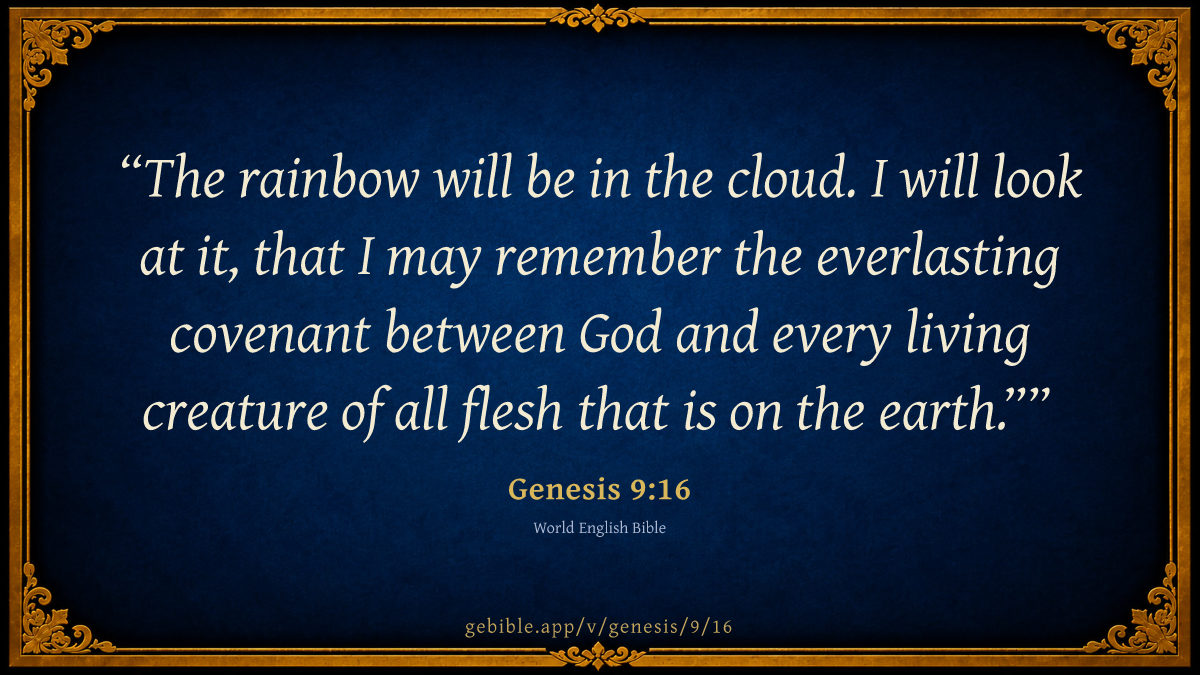
The rainbow will be in the cloud. I will look at it, that I may remember the everlasting covenant between God and every living creature of all flesh that is on the earth.”
Parallel Translations
-
The rainbow will be in the cloud. I will look at it, that I may remember the everlasting covenant between God and every living creature of all flesh that is on the earth.”
-
And the bow shall be in the cloud; and I will look upon it, that I may remember the everlasting covenant between God and every living creature of all flesh that is upon the earth.
-
And the bow shall be in the cloud; and I will look upon it, that I may remember the everlasting covenant between God and every living creature of all flesh that is upon the earth.'
Cross-references (11)
Passages linked to Genesis 9:16 in the Treasury of Scripture Knowledge, ordered by reader-vote popularity; verse text shown in World English Bible.
- Jeremiah 32:40 I will make an everlasting covenant with them, that I will not turn away from following them, to do them good. I will put my fear in their hearts, that they may not depart from me.
- Isaiah 54:8-10 In overflowing wrath I hid my face from you for a moment, but with everlasting loving kindness I will have mercy on you,” says Yahweh your Redeemer. “For this is like the waters of Noah to me; for as I have sworn that the waters of Noah will no more go over the earth, so I have sworn that I will not be angry with you, nor rebuke you. For the mountains may depart, and the hills be removed; but my loving kindness will not depart from you, and my covenant of peace will not be removed,” says Yahweh who has mercy on you.
- Genesis 17:13 He who is born in your house, and he who is bought with your money, must be circumcised. My covenant will be in your flesh for an everlasting covenant.
- Genesis 17:19 God said, “No, but Sarah, your wife, will bear you a son. You shall call his name Isaac. I will establish my covenant with him for an everlasting covenant for his offspring after him.
- 2 Samuel 23:5 Isn’t my house so with God? Yet he has made with me an everlasting covenant, ordered in all things, and sure, for it is all my salvation, and all my desire, although he doesn’t make it grow.
- Hebrews 13:20 Now may the God of peace, who brought again from the dead the great shepherd of the sheep with the blood of an eternal covenant, our Lord Jesus,
- Genesis 8:21-22 Yahweh smelled the pleasant aroma. Yahweh said in his heart, “I will not again curse the ground any more for man’s sake because the imagination of man’s heart is evil from his youth. I will never again strike every living thing, as I have done. While the earth remains, seed time and harvest, and cold and heat, and summer and winter, and day and night will not cease.”
- Genesis 9:9-11 “As for me, behold, I establish my covenant with you, and with your offspring after you, and with every living creature that is with you: the birds, the livestock, and every animal of the earth with you, of all that go out of the ship, even every animal of the earth. I will establish my covenant with you: All flesh will not be cut off any more by the waters of the flood. There will never again be a flood to destroy the earth.”
- Genesis 17:7 I will establish my covenant between me and you and your offspring after you throughout their generations for an everlasting covenant, to be a God to you and to your offspring after you.
- Psalms 89:3-4 “I have made a covenant with my chosen one, I have sworn to David, my servant, ‘I will establish your offspring forever, and build up your throne to all generations.’ ”
- Isaiah 55:3 Turn your ear, and come to me. Hear, and your soul will live. I will make an everlasting covenant with you, even the sure mercies of David.
Cross-references from openbible.info (CC BY 4.0)
Explain this verse (7 sources)
Historical commentary, presented as a primary source — not an endorsement.
Private notes
Saved on this device only — never synced or sent anywhere.
Matthew Poole 1685 · Public Domain i.e. This covenant made with all succeeding generations of…
i.e. This covenant made with all succeeding generations of men and beasts. This and the like speeches are oft ascribed to God after the manner of men, who being forgetful, need helps for their memory.
Matthew Poole's English Annotations on the Holy Bible (1683–1685) — public domain. Text from a community e-Sword/MySword module.
John Gill 1763 · Public Domain And the bow shall be in the cloud,.... Not…
And the bow shall be in the cloud,.... Not whenever there is a cloud, but at some certain times, when that and the sun are in a proper position to form one, and when divine wisdom sees right there should be one; then it appears and continues for a time, and as the cloud becomes thinner and thinner, it disappears:
and I will look upon it, that I may remember the everlasting covenant between God and every living creature of all flesh that is upon the earth; not that forgetfulness, or remembrance, properly speaking, belong to God, but this is said after the manner of men; who by this token may be assured, whenever they see the bow in the cloud, that God is not unmindful of the covenant he has made with all creatures, and which is to continue to the end of the world.
John Gill's Exposition of the Whole Bible (1746–1763) — public domain (CC PDM 1.0). Text via the HelloAO Bible API.
Haydock's Catholic Bible Commentary 1859 · Public Domain Remember; or I shall cause men to reflect, when…
Remember; or I shall cause men to reflect, when they see the rain-bow, of the horrors of the deluge, and of my gracious promises and covenant.
George Leo Haydock (1774–1849), Haydock's Catholic Family Bible and Commentary, 1859 edition — public domain. Excludes Psalms (Douay-Rheims chapter numbering differs from Protestant) and Deuterocanonical books (Catholic canon only).
Daniel D. Whedon 1874 · Public Domain 16. And I will look upon it — A…
16. And I will look upon it — A tender and beautiful anthropomorphism. God remembers us in every earthly storm. The bow is a symbol of his tender look upon frail, sinning man. The fragment of a vast and glorious circle, formed from the sunshine and storm, it typifies eternal mercy blended with justice, as seen from earth; binding earth to heaven, it typifies God’s perpetual covenant. We hear scattered echoes of this promise from the heathen poetry and mythology. Homer calls the rainbow a sign, (τερας.) Iliad, 2:324. The Latin poets make Iris, or the rainbow, the messenger of the gods. Virgil, AEn., 4:694; Ovid, Met., 1,270. The ancient Germans considered the bow as the bridge of the demigods, by which they went to and fro between heaven and earth; and the Indians, according to Kuhn, had a similar tradition. Compare Delitzsch.
Daniel D. Whedon (gen. ed.), Commentary on the Old and New Testaments (1874–1909) — public domain. Text from a community e-Sword module.
The Cambridge Bible for Schools and Colleges 1878 · Public Domain 16. remember] Used of God, cf. Gen_8:1. Here it…
16. remember] Used of God, cf. Gen_8:1. Here it suggests that the primitive tradition implied that God might forget, if it were not for “the bow.” The word “remember” may be anthropomorphic; but in the later stage of the tradition, as in this passage, the rainbow is the “sign” or “reminder” for man, not for God.
the everlasting covenant] See Gen_17:7; Gen_17:13; Gen_17:19; Exo_31:16; Lev_24:8; Num_18:19; Num_25:13, a phrase used by P. Heb. b’rîth ‘ôlâm, LXX διαθήκη αἰώνιος, Lat. foedus sempiternum.
The Cambridge Bible for Schools and Colleges (gen. ed. J. J. S. Perowne; Cambridge University Press, 1878–1918) — public domain. Text from a community e-Sword module.
The Pulpit Commentary 1880 · Public Domain And the bow shall be in the cloud; and…
And the bow shall be in the cloud; and I will look upon it, that I may remember the everlasting covenant. Literally, the covenant of eternity. One of those pregnant Scripture sayings that have in them an almost inexhaustible fullness of meaning, which does not at first sight dis. close itself to the eye of the unreflecting reader. In so far as the Noachic covenant was simply a promise that there should be no recurrence of a flood, the covenant of eternity had a corresponding limit in its duration to the period of this present terrestrial economy. But, rightly viewed, the Noachic covenant was the original Adamic covenant set up again in a different form; and hence, when applied to it, the phrase covenant of eternity is entitled to retain its highest and fullest significance, as a covenant reaching from eternity to eternity. Between God and every living creature of all-flesh that is upon the earth.
Ver. 16.
Read full note →
The covenant renewed.
I THE AUTHOR OF THE COVENANT. God. This is evident from the nature of the case. In ordinary language a covenant signifies "a mutual contract between two (or more) parties" (Hedge, "Syst. Theol.," vol. if. p. 355); cf.; (Gen_21:27) (Abraham and Abimelech) (Jos_24:25) (Joshua and Israel) (1Sa_18:3) (Jonathan and David) (1Ki_20:34) (Ahab and Benhadad);" comprehending a promise made by the one to the other, accompanied with a condition, upon the performance of which the accepter becomes entitled to the fulfillment of the promise" (Dick"s "Theol. Lect.," 45.). Applied, however, to those transactions between God and man which took their rise subsequent to the fall, a covenant is an arrangement or disposition originated by God under which certain free and gracious promises are made over to man, which promises are ratified by sacrifice and impose certain obligations on their recipients, while they are usually connected with institutions illustrative of their nature (cf. "Kelly on the Covenants," lect. 1. p. 12). But, taking either definition of the term, it is obvious that the initial move-merit in any such transaction must belong to God; and with special emphasis does God claim to be the sole Author of the covenant established with Noah and his descendants (vers. 9, 11, 12, 17).
II THE PARTIES TO THE COVENANT, i.e. the persons interested in the covenant; viz., Noah and his posterity. But Noah and his sons at that time were
1. The heads of the race. Hence the covenant may be said to have possessed a worldwide aspect. Because of their connection with Noah the entire family of man had an interest in its provisions.
2. The fathers of the Church. As believers Noah and his family had been saved; and with them, in the character of believers, the covenant was made. Hence it had also a special outlook to the Church, for whom it had a blessing quite distinct from that which it conferred upon the world as such.
III THE SUBSTANCE OF THE COVENANT. Calling it so frequently as he does "my covenant", (Gen_6:18 Gen_7:9, Gen_7:11) the Author of it seems desirous to connect it in our thoughts with that old covenant which, more than sixteen centuries earlier, he had established with mankind immediately after the fall. Now that covenant was in substance an arrangement, disposition, proposal, or promise of mercy and salvation; and that has been the essential element in every covenant that God has made with man. So to speak, God"s covenant is just another name for his formal conveyance to mankind sinners of the free gift of Christ and his salvation.
IV THE FORM OF THE COVENANT. While in every age essentially the same, the form of the covenant has been changing with the changing eras of human history. When we speak of a change of dispensation, the thing meant is a change upon the outward form or mode of representing the covenant a dispensation being a Divine arrangement for communicating blessing. In prediluvian times the form which the covenant assumed was the promise of the woman"s seed. From the Deluge onwards it was a promise of forbearance Neither shall all flesh he cut off any more by the waters of a flood; neither shall there he any more a flood to destroy the earth." In the patriarchal era it became the promise of a son "in whom all the families of the earth should be blessed". (Gen_12:3 Gen_18:18 Gen_22:18) Under the Mosaic dispensation the promise of a prophet like unto Moses; (Deu_18:15) during the monarchy the promise of a king to sit upon David"s throne; (2Sa_7:12) in the time of Isaiah the promise of a suffering servant of the Lord; (Isa 42 Isa 53) in the fullness of the times it assumed its permanent form, viz., that of the incarnation of the Lord Jesus Christ as the woman"s seed, as Abraham"s child, as David"s son, as Jehovah"s servant.
V THE SEAL OF THE COVENANT. Covenant transactions under the old or Levitical dispensation were invariably accompanied with the offering up of sacrificial victims, as a public attestation of the binding character of the arrangement. The covenant which God made with Noah had also its sacrificial seal.
1. The meritorious sacrifice. The propitiatory offering of the Lord Jesus Christ, on the sole ground of which he is well pleased with and mercifully disposed towards the race of sinful man.
2. The typical sacrifice. The offering of Noah upon Ararat after emerging from the ark.
VI THE SIGN OF THE COVENANT. The rainbow, which was
1. A universal sign. The covenant having been made with the entire family of man, it was in a manner requisite that the sign should be one which was patent to the race; not limited and local and national, like circumcision, afterwards given to the Hebrews or Abrahamidae, but universal, ubiquitous, cosmopolitan; and such was the rainbow. This was a first mark of kindness on the part of God towards the family which he had taken into covenant with himself.
1. An attractive sign. Such as could not fail to arrest the g of those whose special interest it was to behold it. Nothing is more remarkable than the
2. quickness with which it attracts the eye, and the pleasurable feelings which its sight enkindles. In its selection, then, to be a sign and symbol of his covenant, instead of something in itself repulsive or even indifferent, we can detect another proof of kindness on the part of God.
3. A seasonable sign. At the very moment, as it were, when nature"s elements are threatening another deluge, the signal of heaven"s clemency is hung out upon the watery sky to rebuke the fears of men. Another token of special kindness on the part of God.
4. A suggestive sign suggestive of the covenant of grace. Possibly this was the chief reason why the rainbow was selected as the sign of the covenant; a further display of kindness on the part of God.
VII THE PERPETUITY OF THE COVENANT.
1. To eternity (ver. 16). In so far as it was a spiritual covenant with the believing Church, it was designed to be unto, as it had actually been from, everlasting.
2. For perpetual generations (ver. 12). In so far as it was a providential covenant with the race, it was designed to continue to the end of time.
Lessons:
1. The exceeding riches of Divine grace in dealing with men by way of a covenant.
2. The exceeding faithfulness of God in adhering to his covenant, notwithstanding man"s sinfulness and provocation.
3. The exceeding hopefulness of man"s position in being placed beneath a covenant of mercy.
The Pulpit Commentary (1880–1919), ed. H.D.M. Spence-Jones & Joseph S. Exell — public domain. Text from a community e-Sword module.
unfoldingWord translationNotes 2017 · CC BY-SA 4.0 General Information:
General Information:
God continues speaking to Noah and his sons.
Read full note →
in order to remember
"so that I will remember" or "so that I will think about"
between God and every living creature
God is speaking here. AT: "between me and every living creature"
every living creature of all flesh
"every kind of living being." See how you translated this in Genesis 9:15.
Then God said to Noah
God was already talking to Noah. This phrase marks the final part of what God was saying. AT: "God finished by saying to Noah" or "So God said to Noah"
translationWords
covenant
flesh
Noah
unfoldingWord translationNotes — © Distant Shores Media and the Door43 World Missions Community, licensed CC BY-SA 4.0. Source: git.door43.org/Door43/en_tn.