
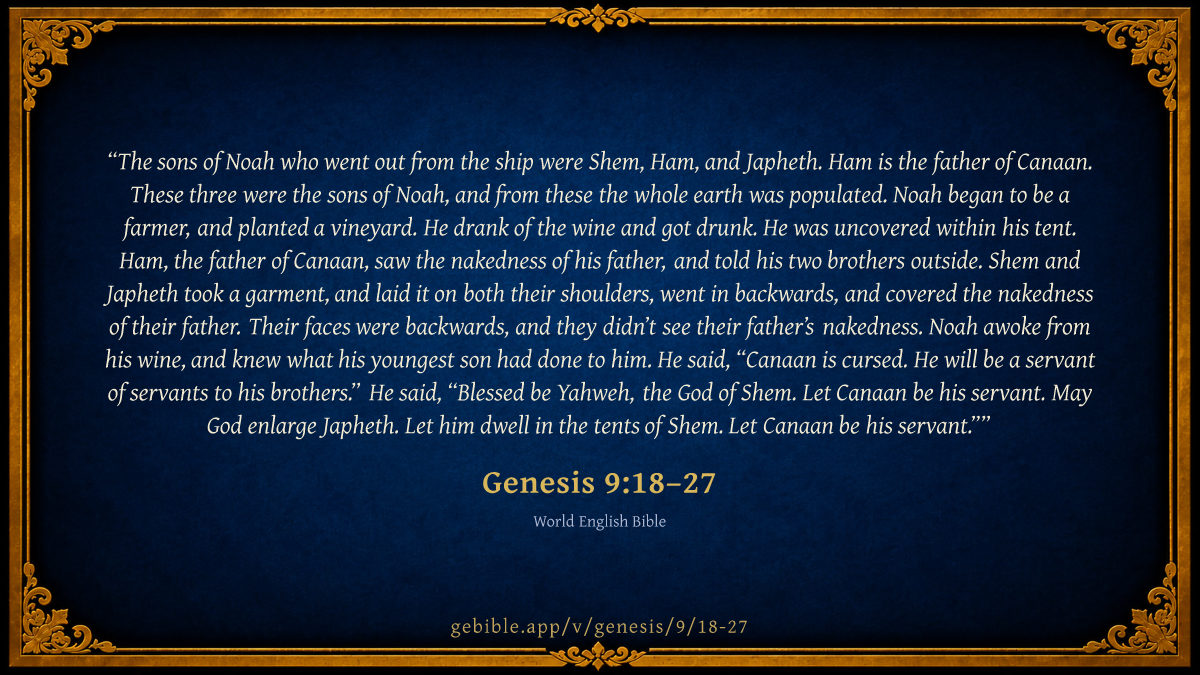
The sons of Noah who went out from the ship were Shem, Ham, and Japheth. Ham is the father of Canaan. These three were the sons of Noah, and from these the whole earth was populated.
Noah began to be a farmer, and planted a vineyard. He drank of the wine and got drunk. He was uncovered within his tent. Ham, the father of Canaan, saw the nakedness of his father, and told his two brothers outside. Shem and Japheth took a garment, and laid it on both their shoulders, went in backwards, and covered the nakedness of their father. Their faces were backwards, and they didn’t see their father’s nakedness. Noah awoke from his wine, and knew what his youngest son had done to him.
He said, “Canaan is cursed. He will be a servant of servants to his brothers.”
He said, “Blessed be Yahweh, the God of Shem. Let Canaan be his servant.
May God enlarge Japheth. Let him dwell in the tents of Shem. Let Canaan be his servant.”
John Calvin 1540 · Public Domain On vv18, 20, 22, 23, 24, 25, 26, 27 18. The sons of Noah. Moss enumerates the sons…
18. The sons of Noah. Moss enumerates the sons of Noah, not only because he is about to pass on to the following history, but for the purpose of more fully illustrating the force of the promise, “Replenish the earth.” For we may hence better conceive how efficacious the blessing of God has been, because an immense multitude of men proceeded in a short time from so small a number; and because one family, and that a little one, grew into so many, and such numerous nations.
John Calvin's Commentaries (1540-1563) — public domain. Text from the Calvin Translation Society English edition (1840s-50s) via the Christian Classics Ethereal Library (ccel.org). Calvin's coverage is partial (roughly two-thirds of the Bible); uncommented books and verses are honest gaps, never fabricated. The 19th-century editor's footnotes and remarks are omitted so the notes are faithfully Calvin's own voice.
Geneva Bible translators 1599 · Public Domain On vv19, 20, 21, 22, 25, 26, 27 This declareth what was the virtue of God’s blessing,…
This declareth what was the virtue of God’s blessing, when he said, increase and bring forth, Gen. 1:28.
Geneva Bible (1599) marginal notes — public domain.
John Trapp 1656 · Public Domain On vv18–27 Gen 9:18 And the sons of Noah, that went…
Gen 9:18 And the sons of Noah, that went forth of the ark, were Shem, and Ham, and Japheth: and Ham [is] the father of Canaan.
Ver. 18. Ham is the father of Canaan.] Who was cursed together with his father (and why, see Gen 9:25), and became the progenitor of those cursed Canaanites, cast out by the Israelites.
John Trapp, A Commentary or Exposition upon All the Books of the Old and New Testament (1647–1656) — public domain. Text from a community e-Sword module.
Matthew Poole 1685 · Public Domain On vv18, 19, 20, 21, 22, 24, 25, 26, 27 Which is here mentioned to make way for the…
Which is here mentioned to make way for the following relation.
Matthew Poole's English Annotations on the Holy Bible (1683–1685) — public domain. Text from a community e-Sword/MySword module.
Matthew Henry 1710 · Public Domain On vv18, 24 Here is, I. Noah's family and employment. The names…
Here is, I. Noah's family and employment. The names of his sons are again mentioned (Gen 9:18, Gen 9:19) as those from whom the whole earth was overspread, by which it appears that Noah, after the flood, had no more children: all the world came from these three. Note, God, when he pleases, can make a little one to become a thousand, and greatly increase the latter end of those whose beginning was small. Such are the power and efficacy of a divine blessing. The business Noah applied himself to was that of a husbandman, Heb. a man of the earth, that is, a man dealing in the earth, that kept ground in his hand, and occupied it. We are all naturally men of the earth, made of it, living on it, and hastening to it: many are sinfully so, addicted to earthly things. Noah was by his calling led to trade in the fruits of the earth. He began to be a husbandman, that is, some time after his departure out of the ark, he returned to his old employment, from which he had been diverted by the building of the ark first, and probably afterwards by the building of a house on dry land for himself and family. For this good while he had been a carpenter, but now he began again to be a husbandman. Observe, Though Noah was a great man and a good man, an old man and a rich man, a man greatly favoured by heaven and honoured on earth, yet he would not live an idle life, nor think the husbandman's calling below him. Note, Though God by his providence may take us off from our callings for a time, yet when the occasion is over we ought with humility and industry to apply ourselves to them again, and, in the calling wherein we are called, faithfully to abide with God, Co1 7:24.
II. Noah's sin and shame: He planted a vineyard; and, when he had gathered his vintage, probably he appointed a day of mirth and feasting in his family, and had his sons and their children with him, to rejoice with him in the increase of his house as well as in the increase of his vineyard; and we may suppose he prefaced his feast with a sacrifice to the honour of God. If this was omitted, it was just with God to leave him to himself, that he who did not begin with God might end with the beasts; but we charitably hope that it was not: and perhaps he appointed this feast with a design, at the close of it, to bless his sons, as Isaac, Gen 27:3, Gen 27:4, That I may eat, and that my soul may bless thee. At this feast he drank of the wine; for who planteth a vineyard and eateth not of the fruit of it? But he drank too liberally, more than his head at this age would bear, for he was drunk. We have reason to think he was never drunk before nor after; observe how he came now to be overtaken in this fault. It was his sin, and a great sin, so much the worse for its being so soon after a great deliverance; but God left him to himself, as he did Hezekiah (Ch2 32:31), and has left this miscarriage of his upon record, to teach us, 1. That the fairest copy that ever mere man wrote since the fall had its blots and false strokes. It was said of Noah that he was perfect in his generations (Gen 6:9), but this shows that it is meant of sincerity, not a sinless perfection. 2. That sometimes those who, with watchfulness and resolution, have, by the grace of God, kept their integrity in the midst of temptation, have, through security, and carelessness, and neglect of the grace of God, been surprised into sin, when the hour of temptation has been over. Noah, who had kept sober in drunken company, is now drunk in sober company. Let him that thinks he stands take heed. 3. That we have need to be very careful, when we use God's good creatures plentifully, lest we use them to excess. Christ's disciples must take heed lest at any time their hearts be overcharged, Luk 21:34. Now the consequence of Noah's sin was shame. He was uncovered within his tent, made naked to his shame, as Adam when he had eaten forbidden fruit. Yet Adam sought concealment; Noah is so destitute of thought and reason that he seeks no covering. This was a fruit of the vine that Noah did not think of. Observe here the great evil of the sin of drunkenness. (1.) It discovers men. What infirmities they have, they betray when they are drunk, and what secrets they are entrusted with are then easily got out of them. Drunken porters keep open gates. (2.) It disgraces men, and exposes them to contempt. As it shows them, so it shames them. Men say and do that when drunk which when they are sober they would blush at the thoughts of, Hab 2:15, Hab 2:16.
Read full note →
III. Ham's impudence and impiety: He saw the nakedness of his father, and told his two brethren, Gen 9:22. To see it accidentally and involuntarily would not have been a crime; but, 1. He pleased himself with the sight, as the Edomites looked upon the day of their brother (Oba 1:12), pleased, and insulting. Perhaps Ham had sometimes been himself drunk, and reproved for it by his good father, whom he was therefore pleased to see thus overcome. Note, It is common for those who walk in false ways themselves to rejoice at the false steps which they sometimes see others make. But charity rejoices not in iniquity, nor can true penitents that are sorry for their own sins rejoice in the sins of others. 2. He told his two brethren without (in the street, as the word is), in a scornful deriding manner, that his father might seem vile unto them. It is very wrong, (1.) To make a jest of sin (Pro 14:9), and to be puffed up with that for which we should rather mourn, Co1 5:2. And, (2.) To publish the faults of any, especially of parents, whom it is our duty to honour. Noah was not only a good man, but had been a good father to him; and this was a most base disingenuous requital to him for his tenderness. Ham is here called the father of Canaan, which intimates that he who was himself a father should have been more respectful to him that was his father.
IV. The pious care of Shem and Japheth to cover their poor father's shame, Gen 9:23. They not only would not see it themselves, but provided that no one else might see it, herein setting us an example of charity with reference to other men's sin and shame; we must not only not say, A confederacy, with those that proclaim it, but we must be careful to conceal it, or at least to make the best of it, be doing as we would be done by. 1. There is a mantle of love to be thrown over the faults of all, Pe1 4:8. 2. Besides this, there is a robe of reverence to be thrown over the faults of parents and other superiors.
Matthew Henry's Commentary on the Whole Bible (1708–1710) — public domain (CC PDM 1.0). Text via the HelloAO Bible API.
John Gill 1763 · Public Domain On vv18–27 And the sons of Noah, that went forth of…
And the sons of Noah, that went forth of the ark, were Shem, and Ham, and Japheth,.... These were born before the flood, and went into the ark with Noah, and came out with him; see Gen 5:32.
and Ham is the father of Canaan; this is observed for the sake of the following history, concerning the behaviour of the one to Noah, and of the curse of the other by him, which would not have been so well understood if this remark had not been made: the father and the son, as they were, related in nature, they were much alike in manners and behaviour. Cush, the firstborn of Ham, is not mentioned, but Canaan, his youngest son, because he was cursed, as Aben Ezra observes; and who remarks that the paragraph is written to show that the Canaanites were accursed, the father of whom this Canaan was; and who is the same Sanchoniatho (y) calls Cna, and says he was the first that was called a Phoenician.
Read full note →
(y) Apud. Euseb. Evangel. Praepar. l. 1. p. 39.
John Gill's Exposition of the Whole Bible (1746–1763) — public domain (CC PDM 1.0). Text via the HelloAO Bible API.
John Wesley 1765 · Public Domain On vv20, 21, 22, 23, 25, 26, 27 And Noah began to be an husbandman - Hebrew.…
And Noah began to be an husbandman - Hebrew. a man of the earth, a man dealing in the earth, that kept ground in his hand and occupied it. Sometime after his departure out of the ark he returned to his old employment, from which he had been diverted by the building of the ark first, and probably after by the building an house for himself and family. And he planted a vineyard - And when he had gathered his vintage, probably he appointed a day of mirth and feasting in his family, and had his sons and their children with him, to rejoice with him in the increase of his house, as well as in the increase of his vineyard; and we may suppose he prefaced his feast with a sacrifice to the honour of God. If that was omitted, 'twas just with God to leave him to himself, to end with the beasts that did not begin with God: but we charitably hope he did. And perhaps he appointed this feast with design in the close of it to bless his sons, as Isaac, chap. xxvii, 3, 4. That I may eat, and that my soul may bless thee.
John Wesley, Explanatory Notes Upon the Whole Bible (1754–1765) — public domain. Text via the GEBible commentary corpus.
Adam Clarke 1810 · Public Domain On vv20–25 Verse 20. Noah began to be a husbandman] איש…
Verse 20. Noah began to be a husbandman] איש האדמה ish haadamah, A man of the ground, a farmer; by his beginning to be a husbandman we are to understand his recommencing his agricultural operations, which undoubtedly he had carried on for six hundred years before, but this had been interrupted by the flood. And the transaction here mentioned might have occurred many years posterior to the deluge, even after Canaan was born and grown up, for the date of it is not fixed in the text.
The word husband first occurs here, and scarcely appears proper, because it is always applied to man in his married state, as wife is to the woman. The etymology of the term will at once show its propriety when applied to the head of a family. Husband, [A.S. husband], is Anglo-Saxon, and simply signifies the bond of the house or family; as by him the family is formed, united, and bound together, which, on his death, is disunited and scattered.
Read full note →
It is on this etymology of the word that we can account for the farmers and petty landholders being called so early as the twelfth century, husbandi, as appears in a statute of David II., king of Scotland: we may therefore safely derive the word from [A.S. hus], a house, and [A.S. bond] from [A.S. binben], to bind or tie; and this etymology appears plainer in the orthography which prevailed in the thirteenth and fourteenth centuries, in which I have often found the word written house-bond; so it is in a MS. Bible before me, written in the fourteenth century. Junius disputes this etymology, but I think on no just ground.
Adam Clarke's Commentary on the Bible (1810–1826) — public domain. Text from a community e-Sword/MySword module.
Joseph Benson 1811 · Public Domain On vv20–27 Gen 9:20. And Noah began to be a husbandman…
Gen 9:20. And Noah began to be a husbandman — (Hebrews a man of the earth,) a man dealing in the earth, that kept ground in his hand and occupied it. Some time after his departure out of the ark he returned to his old employment, from which he had been diverted by the building of the ark first, and probably after by the building a house for himself and family. And he planted a vineyard — And when he had gathered his vintage, probably he appointed a day of mirth and feasting in his family, and had his sons and their children with him, to rejoice with him in the increase of his house, as well as in the increase of his vineyard; and we may suppose he prefaced his feast with a sacrifice to the honour of God. If that were omitted, it was just with God to leave him to himself, to end with the beasts that which did not begin with God: but we charitably hope he did. And perhaps he appointed this feast with design, in the close of it, to bless his sons, as Isaac, Gen 27:3-4, “That I may eat, and that my soul may bless thee.”
Joseph Benson's Commentary on the Old and New Testaments (1811–1818) — public domain. Text from a community e-Sword module.
Albert Barnes 1834 · Public Domain On v18 - XXX. The Prophecy of Noah
- XXX. The Prophecy of Noah
18. כנען kena‛an, “Kena‘an, bowed down.”
Read full note →
19. נפץ nāpats, “break, scatter, spread.” פוּץ pûts, “break, scatter, flow.”
20. כרם kerem, “orchard, vineyard.”
21. יין yayı̂n, “wine; related: ferment.”
After the blessing on the new heads of the human race has been pronounced, and the covenant with them renewed, we are prepared for a new development of human action. This appears, however, in the form of an event which is itself a meet preliminary to the subsequent stage of affairs. The prophecy of Noah, delivered in the shape of a solemn paternal doom, pronounced upon his three sons, sketches in a few striking traits the future history of the separate families of mankind.
Gen 9:18-19
These two verses form a connecting link between the preceding and the following passage. After the recital of the covenant, comes naturally the statement, that by the three sons of Noah, duly enumerated, was the whole land overspread. This forms a fit conclusion to the previous paragraph. But the penman of these sentences had evidently the following paragraph in view. For he mentions that Ham was the father of Kenaan; which is plainly the preface to the following narrative.
Gen 9:20-27
Then comes the prediction Gen 9:20-27, which has a special interest, as the first prophetic utterance of man recorded in the Old Testament. The occasion of it is first stated. Noah becomes “a man of the soil.” If he was before a mechanic, it is evident he must now attend to the cultivation of the soil, that he may draw from it the means of subsistence. “He planted a vineyard.” God was the first planter Gen 2:8; and since that time we hear nothing of the cultivation of trees until Noah becomes a planter. The cultivation of the vine and the manufacture of wine might have been in practice before this time, as the mention of them is merely incidental to the present narrative. But it seems likely from what follows, that, though grapes may have been in use, wine had not been extracted from them. “And was drunken.” We are not in a position to estimate the amount of Noah’s guilt in this case, as we do not know how far he was acquainted with the properties of wine.
But we should take warning by the consequences, and beware of the abuse of any of God’s gifts. “Ham the father of Kenaan.” It is natural to suppose, as some have done, that Kennan had something to do with the guilt of this act. But there is no clear indication of this in the text, and Kenann’s relationship to Ham may be again mentioned simply in anticipation of the subsequent prophecy. Ham is punished in his youngest son, who was perhaps a favorite. The intention of this act is eminently pure and befitting dutiful sons. “The garment.” The loose mantle or shawl which was used for wrapping round the body when going to sleep. The actions of the sons in this unpleasant occurrence, especially that of Ham, give occasion to the following prophetic sentence: “His youngest son.” This seems plainly the meaning of the phrase הקטן בנו benô haqāṭān, “his son, the little.” He must be regarded here as contrasted with the other two, and therefore distinguished as the youngest.
The manner of Scripture here is worthy of particular remark. First, the prediction takes its rise from a characteristic incident. The conduct of the brothers was of comparatively slight importance in itself, but in the disposition which it betrayed it was highly significant. Secondly, the prediction refers in terms to the near future and to the outward condition of the parties concerned. Thirdly, it foreshadows under these familiar phrases the distant future, and the inward, as well as the outward, state of the family of man. Fourthly, it lays out the destiny of the whole race from its very starting-point. These simple laws will be found to characterize the main body of the predictions of Scripture.
Gen 9:25-27
The prophecy consists of two parts - a malediction and a benediction. “Cursed be Kenaan.” A curse Gen 3:14, Gen 3:17; Gen 4:11 is any privation, inferiority, or other ill, expressed in the form of a doom, and bearing, not always upon the object directly expressed, but upon the party who is in the transgression. Thus, the soil is cursed on account of Adam the transgressor Gen 3:17. It is apparent that in the present ease the prime mover was Ham, who is therefore punished in the prospect of a curse resting on his posterity, and especially on a particular line of it. Let us not imagine, however, that the ways of the Lord are not equal in this matter; for Kenaan and his descendants no doubt abundantly deserved this special visitation. And as the other descendants of Ham are not otherwise mentioned in the prophecy, we may presume that they shared in the curse pronounced upon Kenaan. At all events, they are not expressly included in the blessing pronounced on the other two divisions of the human family, It is proper to observe, also, that this prediction does not affirm an absolute perpetuity in the doom of Ham or Kenaan. It only delineates their relative condition until the whole race is again brought within the scope of prophecy.
A servant of servants shall he be unto his brethren. - The curse here consists in servitude, which is in itself an inferiority, and, among the children of self-will, tends more and more to all the horrid ills of slavery. Slavery originated in war and conquest. The mere warrior put the captives to death, the cannibal devoured them, the economist fed them for their labor. Accordingly, slavery soon made its appearance in all countries which were trodden by the conqueror. A system of slavery, imposed without consent and for no crime, is a dire evil. Besides the direct injustice of robbing a fellow-man of his personal liberty, it dissolves wedlock, breaks the family tie, and disregards the conscience. It trades, therefore, in the souls as well as the bodies of mankind. It is a historical fact that the degradation of slavery has fallen especially upon the race of Ham. A portion of the Kenaanites became bondsmen among the Israelites, who were of the race of Shem. The early Babylonians, the Phoenicians, the Carthaginians, and Egyptians, who all belonged to the race of Ham, were subjugated by the Assyrians, who were Shemites, the Persians, the Macedonians, and the Romans, who were all Japhethites. And in modern times it is well known that most of the nations of Europe traded in African slaves. “A servant of servants” means a slave of the most abject kind. “Unto his brethren.” If the doom of slavery be referred to the race of Ham, then his brethren are the descendants of Japheth and Shem, who have held many of the Hamites in bondage. If we limit the sentence to Kenaan, then his brethren may include the other descendants of Ham. It is said that the servile tribe is also the most tyrannical; and it is the fact that the Africans have lent themselves to the forcible seizing and selling into slavery in distant lands of their own kinsmen and fellow-countrymen.
Gen 9:26, Gen 9:27
And he said. - The prediction concerning the other two brothers is a distinct utterance of Noah. “Blessed be Yahweh, the God of Shem.” The characteristic boon of Shem is that Yahweh, the one true, living, known God, is his God. The knowledge and worship of the Creator is preserved in the family of Shem, when it is lost or fatally obscured among the other descendants of Noah. The prophet is so conscious of the unspeakable blessing of knowing and loving the true God, that he breaks out into thanksgiving in the very act of announcing the transcendent privilege of Shem. There is a dark side, however, to this prophetic thought, as it implies that the two other families of mankind, at least for part of the period under the prophet’s view, were estranged from the true and living God. History corroborates both aspects of this prophetic sentence for the space of two thousand four hundred years. During the most part of this long period the Holy Yahweh Omnipotent was unknown to the great mass of the Japhethites, Hamites, and even Shemites. And it was only by the special election and consecration of an individual Shemite to be the head of a special people, and the father of the faithful, that he did not cease to be the God of even a remnant of Shem.
Then follows the refrain, “And Kenaan shall be servant unto them.” The phrase “unto them” proves that Shem here comprehends the race descended from him, and consisting of many individuals. Scripture sees the race in the father, traces up its unity to him, discerns in him the leading traits of character that often mark his remotest posterity, and identifies with him in destiny all those of his race who continue to take after him. Thus, Adam denotes the whole race, Shem, Ham, and Japheth, its three great branches. Attention to this law of the unity, continuity, and identity of a race, will aid us much in understanding the dealings of Providence with the several branches of the human family. We learn also from the same phrase that this solemn sentence is no mere ebullition of the personal feelings of Noah. He is not speaking of Shem and Kenaan merely, but of the future races that are to spring from them. This appears still more plainly from the fact that Japheth, as well as Ham, is described as long estranged from the true God. And now that we are on spiritual ground, it ought to be observed that Kenaan’s curse is not exclusion, either present or prospective, from the mercy of God. That is an evil he brings on himself by a voluntary departure from the living God. The curse merely affects the body - the personal liberty. It is a mere degradation from some of the natural rights of our common humanity; and does not of itself cut him off from any offer of mercy, or benefit of repentant faith.
God shall enlarge Japheth. - God is here spoken of by his generic name. This intimates, or at least coincides, with the fact that Japheth did not continue that nearness of approach to him which is implied in the use of the personal name. There is in the original a play upon the word “Japheth”, which itself signifies enlargement. This enlargement is the most striking point in the history of Japheth, who is the progenitor of the inhabitants of Europe, Asia, and America, except the region between the Persian Gulf, the Red Sea, the Mediterranean, the Euxine, the Caspian, and the mountains beyond the Tigris, which was the main seat of the Shemites. This expansive power refers not only to the territory and the multitude of the Japhethites, but also to their intellectual and active faculties. The metaphysics of the Hindus, the philosophy of the Greeks, the military prowess of the Romans, and the modern science and civilization of the world, are due to the race of Japheth. And though the moral and the spiritual were first developed among the Shemites, yet the Japhethites have proved themselves capable of rising to the heights of these lofty themes, and have elaborated that noble form of human speech, which was adopted, in the providence of God, as best suited to convey to mankind that further development of Old Testament truth which is furnished in the New.
And he shall dwell in the tents of Shem. - We regard Japheth as the subject of this sentence; because, if God were its subject, the meaning would be substantially the same as the blessing of Shem, already given, and because this would intermingle the blessing of Shem with that of Japheth, without any important addition to our information. Whereas, when Japheth is the subject of the sentence, we learn that he shall dwell in the tents of Shem - an altogether new proposition. This form of expression does not indicate a direct invasion and conquest of the land of Shem, which would not be in keeping with the blessing pronounced on him in the previous sentence: it rather implies that this dwelling together would be a benefit to Japheth, and no injury to Shem. Accordingly, we find that when the Persians conquered the Babylonian empire, they restored the Jews to their native land; when Alexander the Great conquered the Persians, he gave protection to the Jews; and when the Romans subdued the Greek monarchy, they befriended the chosen nation, and allowed them a large measure of self-government. In their time came the Messiah, and instituted that new form of the church of the Old Testament which not only retained the best part of the ancient people of God, but extended itself over the whole of Europe, the chief seat of Japheth; went with him wherever he went; and is at this day, through the blessing of God on his political and moral influence, penetrating into the moral darkness of Ham, as well as the remainder of Shem and Japheth himself. Thus, in the highest of all senses, Japheth is dwelling in the tents of Shem.
Again comes the refrain, “And Keenan shall be servant unto them.” A portion of Japheth still holds a portion of Ham in bondage. But this very bondage has been the means of bringing some of the sons of Ham to dwell in the tents of Shem; and the day is not far distant when Japheth will relinquish altogether the compulsory hold upon his brother, and consecrate his entire moral influence over him to the revival in his race of the knowledge and love of God our Father, and our Lord Jesus Christ.
Thus, it appears that the destiny of these three great branches of the Noachic family, during the time of their separation on the high question of their relation to God, is traced out with great fidelity in this remarkable prediction. Ham is aptly represented by Kenaan, the slave, who is seized, enslaved, and sold even by his kinsmen to one another, and to the descendants of Shem and Japheth. Shem includes within his posterity the select family who know God as the Lord, the God of promise, of mercy, of salvation. Japheth is enlarged by God, and at length becomes acquainted with him whom he once ignorantly worshipped. The historian recognizes these as salient points in the experience of the three races, so long as they continue apart. The time is approaching when this strange intermediate development will come to a happy issue, in the reunion of all the members of the human family, according to clearer and further-reaching prophecies yet to be delivered.
Gen 9:28, Gen 9:29
The history of Noah is now closed, in the customary form of the fifth chapter. This marks a connection between the third and fourth documents, and points to one hand as the composer, or at least compiler, of both. The document now closed could not have had the last paragraph appended to it until after the death of Noah. But, with the exception of these two verses, it might have been composed hundreds of years before. This strongly favors the notion of a constant continuator, or, at all events, continuation of the sacred history. Every new prophet and inspired writer whom God raised up added the necessary portion and made the necessary insertions in the sacred record. And hence, the Word of God had a progressive growth and adaptation to the successive ages of the church.
The present document stands between the old world and the new world. Hence, it has a double character, being the close of the antediluvian history, and the introduction to that of the postdiluvian race. It records a great event, pregnant with warning to all future generations of men. And it notes the delegation, by God to man, of authority to punish the murderer by death, and therefore to enforce all the minor sanctions of law for breaches of the civil compact. It therefore points out the institution of civil government as coming from God, and clearly exhibits the accountability of all governments to God for all the powers they hold, and for the mode in which they are exercised. This also is a great historical lesson for all ages.
Albert Barnes' Notes on the Bible (1834–1885) — public domain. Text from a community e-Sword/MySword module.
Haydock's Catholic Bible Commentary 1859 · Public Domain On vv18, 20, 21, 23, 25, 27 Chanaan, who, it seems, is here mentioned to his…
Chanaan, who, it seems, is here mentioned to his shame, having first discovered and told his father that Noe was drunk. He was probably but young at the time, being born after the deluge.
George Leo Haydock (1774–1849), Haydock's Catholic Family Bible and Commentary, 1859 edition — public domain. Excludes Psalms (Douay-Rheims chapter numbering differs from Protestant) and Deuterocanonical books (Catholic canon only).
Lange's Commentary on the Holy Scriptures 1864 · Public Domain On v18 The Revelation of Sin and of Piety in Noah’s…
SECOND SECTION
The Revelation of Sin and of Piety in Noah’s Family—The Curse and the Blessing of Noah—The twofold Blessing, and the Blessing in the Curse itself.
Read full note →
Gen_9:18-29
18And the sons of Noah that went forth of the ark were Shem, and Ham, and Japheth; and Ham is the father of Canaan. 19These are the three sons of Noah; and of them was the whole earth overspread. 20And Noah began10 to be a husbandman, and he planted a vineyard; 21And he drank of the wine, and was drunken; and he was uncovered within his tent. 22And Ham, the father of Canaan, saw the nakedness of his father, and told his two brethren without. 23And Shem and Japheth took a garment, and laid it upon both their shoulders, and went backward, and covered the nakedness of their father; and their faces were backward, and they saw not their father’s nakedness. 24And Noah awoke from his wine [his sleep of intoxication], and knew what his younger son had done unto him. 25And he said, Cursed be Canaan; a servant of servants11 shall he be unto his brethren. 26And he said, Blessed be the Lord God of Shem [Jehovah, God of the name, or who preserves the name]; and Canaan shall be his servant. 27God shall enlarge Japheth12 [one who spreads abroad], and he shall dwell13 in the tents of Shem; and Canaan shall be his servant. 28 And Noah lived after the flood three hundred and fifty years. 29And all the days of Noah were nine hundred and fifty years; and he died.
EXEGETICAL AND CRITICAL
1. The Significance of this Jehovistic Section. This second event in the life of Noah after the flood is evidently of the highest meaning; as was the first, namely, Noah’s offering and God’s blessing and covenant. In the first transaction there are delineated the ground-features of the new constitution of the earth, as secured by the covenant of God with the pious Noah. In the present Section we learn the advance of culture, but we recognize also the continuance of sin in the new human race; still, along with the earlier contrast between piety and perverseness, there comes in now the new contrast of a blessed life of culture as compared with the religious life of a divine cultus, or worship. In what Noah says of his sons, we read the ground-forms of the new state, and of the world-historical partition of mankind. In Knobel’s representation of it, this higher significance of the Section is wholly effaced. In the curse upon Canaan (according to this view), and in his appointment to servitude, the Jehovist would give an explanation of the fact, that the Canaanites were subjugated by the Hebrews, and that Phænician settlers among the Japhethites14 appear to have had a similar fate. But that the curse was pronounced upon Canaan, and not upon Ham, was because other Hamitic nations, such as the Egyptians, etc., were not in the same evil case. Still, it is not Canaan, but Ham himself, who is set forth as the shameless author of the guilt, (?) because the writer would refer certain shameless usages of the Hamitic nations to their first ancestor. Now, on the simple supposition of the truth of the prediction, and of the connection between the guilt of the ancestor, and the corruption of his descendants, this construction must fall to the ground. Knobel cites it as “an ancient view,” that the cursings of those who are distinguished as men of God, have power and effect as well as their blessings.
2. Gen_9:19. By them was the whole earth overspread.—A main point of our narration. “The second event in the life of Noah after the flood shows us the germs for the future development of the human race in a threefold direction, which is prefigured in the character of his three sons.” To this end the repetition of their names. The mention of Canaan introduces the mention of the land in the following verse, as used for the inhabitants of the land; as in Gen_10:25; Gen_11:1, and other passages in which cities and lands are frequently named instead of their population.” Keil.
3. Gen_9:20-21. Noah’s Work, his Indulgence and his Error. The translation: “and Noah began to be a husbandman” is rightly set aside by Delitzsch and Keil. The word for husbandman has the article, and is, therefore, in apposition with Noah. Noah, as husbandman, began to plant a vineyard. The agriculture that had been interrupted by the flood, he again carries on, and makes it more complete by means of the new culture of the vine. Armenia, where he landed with the ark, is an anciently known vine-land. “The ten thousand (Xen., Anab. 4, 4, 9) found in Armenia old and well flavored wines: even at this day the vine grows there, producing wine of great excellence, even at the height of four thousand feet above the level of the sea (Ritter: Geography, x. p. 554). That the culture of the vine came from Asia is well known. The Greek myth ascribes it to Dyonysus or Bacchus, representing it, sometimes, as derived from the Indians, and again, as belonging to the Phrygians, who were related to the Armenians (Diod. Sic. 362; Strabo, 10).” Knobel. The story designates a hill on the northwest, adjacent to the Great Ararat, and furnishing the means of its ascent, as the region where Noah set out his vine-plants. The village of Arguri (Agorri), which in 1840 was destroyed in an eruption of Ararat, stood upon the place referred to. Frequent projections of stones, and outpouring streams of lava and mud, have, in the course of time, destroyed all the fertile soil of Ararat (K. Koch, in “Piper’s Year Book,” 1852, p. 28).” Delitzsch. The wine-garden of Noah is a mild reflex of paradise in the world of the fallen human race; and this enjoyment, in its excessively sinful use, to which Noah led the way, although he was not aware of its effect, has become a reflex of Adam’s enjoyment of the tree of knowledge; with this difference, however, that Noah erred in ignorance, and not in the form of conscious transgression. Intoxication by wine makes men lax in respect to sexual sin; and this connection is gently indicated in the fact that Noah, as he lay unguarded in his tent, exposed himself contrary to the law of modesty. In the error of the father there reveals itself the character of the sons.
4. Gen_9:22-23. The Behavior of the Sons. Ham’s conduct was, at first, a sin of omission. He saw the nakedness (the shame) of his father, and neither turned away his eyes nor covered him; then he told it to his brethren without, and this was his sin of commission. His behavior had the character not merely of lustful feeling, but of utter shamelessness; whereas the act of the two brothers presents a beautifully vivid image of delicacy, being at the same time an act of modesty and of piety. Reverence, piety, and chastity, are, in children, the three foundations of a higher life; whereas in impiety and sensual associations, a lower tendency reveals itself. Out of the virtues and the vices of the family come the virtues and the vices of nations, and of the world. At the same time, the manner in which the two sons treat the case, presents a charming image of prudence and quick decision. They seize the first best robe that comes to hand, and that was the שִׁמְלָה, spread it out, and as they go backward with averted faces, lay it upon the nakedness of their father.
5. Gen_9:24-29. Noah’s Curse and Blessing. His end.—And Noah awoke from his wine; that is, the intoxication from wine (see 1Sa_1:14; 1Sa_25:37).—And knew.—This seems to suppose that his sons had told him, which, however, may have been occasioned by his asking about the robe that covered him. The whole proceeding, however, must have come to light, and that, too, to his own humiliation.—His younger son (literally, his son, the little, or the less; see Gen_5:32).—The effect upon him of the account is an elevated prophetic state of soul, in which the language of the seer takes the form of poetry.—Cursed be Canaan.—The fact that he did not curse the evil-doer himself, but his son, is explained away, according to Origen, in a Hebrew Midrash, which says that the young Canaan had first seen his grandfather in this condition, and told it to his father—clearly an arbitrary exegesis. According to Hävernik and Keil, all the sons of Ham were included in the curse, but the curse of Ham was concentrated on Canaan. Keil and Hengstenberg find, moreover, a motive in the name כְּנַעַן, which does not mean, originally, a low country, but the servile. “Ham gave to his son the name of obedience, a thing which he himself did not practise.” Hengstenberg supposes that Canaan was already following his father’s footsteps in impiety and wickedness. According to Hofmann and Delitzsch, Canaan had the curse imposed upon him because he was the youngest son of Ham (Gen_10:6), as Ham was the youngest son of Noah. “The great sorrow of heart which Ham had occasioned to his father was to be punished in the suffering of a similar experience from his own youngest son.” Rightly does Keil reject this. The exposition of Knobel we have already cited; according to it the later condition of the Canaanites was only antedated in the prophecy of Noah. Before all things must we hold fast to this, that the language of Noah is an actual prophecy; and not merely an expression of personal feeling. That the question has nothing to do with personal feeling is evident from the fact, that Ham was not personally cursed. According to the natural relations, the youngest grandchildren would be, in a special manner, favorites with the grandfather. If now, notwithstanding this, Noah cursed his grandchild, Canaan, it can only he explained on the ground that in the prophetic spirit he saw into the future, and that the vision had for its point of departure the then present natural state of Canaan. We may also say, that Ham’s future was contained in the future of Canaan; the future of the remaining Hamites he left undecided, without curse and without blessing, although the want of blessing was a significant omen. Had, however, Noah laid the curse on Ham, all the sons of Ham would have been denoted in like manner with himself; even as now it is commonly assumed that they were, though without sufficient ground (see Delitzsch, p. 281). There is no play upon the name Canaan, as upon the name Japheth—a thing which is to be noted. But that in the behavior of Canaan Noah had a point of departure for his prophecy, we may well assume with Hengstenberg.—A servant of servants; that is, the lowest of servants. If the language had had in view already the later extermination of the Canaanites, it must have had a different style. The form of the expression, therefore, testifies to the age of the prophecy. We must also bear in mind, that the relation of servant in this case denotes no absolute relation in the curse, or any developed slave relation, any more than the relation of service which was imposed upon Esau in respect to Jacob. There even lies in it a hidden blessing. The common natures must, of themselves, take a position of inferiority; through subordination to the nobler character are they saved, in the discipline and cultivation of the Spirit.—Blessed be Jehovah, God of Shem.—The blessing upon Shem has the form of a doxology to Jehovah, whereby, as Luther has remarked, it is distinguished as a most abundant blessing, which finally reaches its highest point in the promised seed. “If Jehovah is the God of Shem, then is Shem the recipient and the heir of all the blessings of salvation which God, as Jehovah, procures for humanity.” Keil.—And Canaan shall be his servant.—The word לָמוֹ (regularly לָהֶם) is taken by Gesenius as a poetical expression for לוֹ; Delitzsch refers it, as plural, to both brothers—Keil and Knobel to their descendants. The descendants, however, are represented in the ancestor, and, therefore, the explanation of Gesenius gives the only clear idea.—God shall enlarge Japheth, [or, as Lange renders it], God give enlargement to the one who spreads abroad.—In the translation we retain the play upon the word, and the explanation of the name Japheth. Keil explains the word (meaning literally, to make room, to give space for outspreading) as metaphorical. To make room is equivalent to the bestowment of happiness and prosperity. It must be observed, however, that the name Shem, and the blessing of Shem, denotes the highest concentration; whilst in opposition to this the name Japheth and the blessing of Japheth, denotes the highest expansion, not only geographically, but also in regard to the spread of civilization through the earth, and its conquest both outwardly and intellectually. This is the spiritual mission of Japhethism to this day—namely, the mental conquest of the world. The culture life of Japheth, as humanitarian, scientific, stands in harmonious contrast with the cultus, or religionism, of Shem. Therefore, too, must Japheth’s blessing come from Elohim.—And he shall dwell in the tents of Shem.—The words, he shall dwell, are by some (Onkel, Dathe, Baumgarten) referred to Elohim. But this had already been expressed in the blessing of Shem, and had therefore nothing to do with the blessing of Japheth. What is said relates to Japheth; and that, too, neither in the sense that the Japhethites shall settle among the Shemites, or that they shall conquer them in their homes (Clericus, Von Bohlen, and others), but that Japheth’s dwelling in the tents of Shem shall be in the end his uniting with him in religious communion (Targum Jonathan, Hieronymus, Calvin, and others). The opposite interpretation (Michaelis, Gesenius, De Wette, Knobel, and others), which explains Shem here (שם) as meaning literally name, or fame (dwell in the tents of renown), appears to have proceeded from a misapprehension of the prophetic significance of the language. To dwell in the tents of any one, Knobel holds, cannot mean religious communion. That would be true, if the one referred to had not immediately before been denoted as an observer of the true religion. That the Japhethites, that is, the Greeks, early dwelt in the tents of renown, is, in this respect, a matter by itself, which had already been set forth in Japheth’s own blessing, as implied in what is said of his expansion. As the brothers, whatever contrast there might have been in their characters, had been one in their piety towards their father, so must their posterity become one in this, that they shall finally exchange with each other their respective blessings—in other words, that Japheth shall bring into the tents of Shem what he has won from the world, and, in return for it, share in the blessing of the Name—the name Jehovah, or the true religion.—And Noah lived.—In the Armenian legend, Arnojoten, in the plain of the Araxes, has the name of his place of burial. With the death of Noah, the tenth member of the Genealogical table, ch. v., finds its conclusion.
[Note on the Curse of Canaan—the supposed Curse of Ham—the Blessing op Shem and Japheth. Gen_9:24. And Noah awoke from his wine, and knew what his youngest son had done unto him. וַיִּיקֶץ, LXX. ἐξένηψε, became fully conscious of his condition. Comp. 1Co_15:24. וַיֵּדַע, knew, became sensible of. It is not the word that would have been employed had he learned it from the information of others. It denotes intelligence—by the eye, as Isa_6:9,—by the touch, Gen_19:33,—experience by any sense, Deu_11:2,—or by the exercise of the mind as following such experience, Jdg_13:21. Had done unto him, עָשָׂה לו. This is, something more than an omission or a neglect. The word is a very positive one. Something unmistakable, something very shameful had been done unto the old man in his unconscious state, either the stripping off his robe, or some act of abuse or mockery of such a nature that it becomes manifest to him immediately on his recovery. It may be remarked, too, that אֵת אֲשֶׁר may more properly be rendered, indefinitely, a thing which, or something which, his youngest son had done unto him. But who was the culprit? Of this, too, the patriarch appears to have been immediately sensible, or to have immediately inferred it from something he must have known of the supposed perpetrator. He seems to have had no doubt. Now Ham had done nothing to his father. On discovery of his state he hastens to his brothers, it may be with the same filial intentions that they more promptly carried out. The sight appears to have been accidental and involuntary. The word is וַיַּרְא, he saw, not וַיַּבֵּט, he looked at, spectavit, ἐθεάσατο, gazed at, implying interest, emotion. There is in the account no intimation of any of that scoffing demeanor that some commentators have so gratuitously charged upon him. He saw and told his brothers. At all events, his fault, if there was one, was simply an omission, which seems to fall altogether short of the force of the words עָשָׂה לוֹ, had done unto him, regarded, too, as something obvious or immediately discoverable by the one who had suffered the indignity. There seems to be a careful avoidance of particularity. The language has an euphemistic look, as though intimating something too vile and atrocious to be openly expressed. Thus regarded, everything seems to point to some wanton act done by the very one who is immediately named in the severe malediction that follows: “Cursed be Canaan.” He was the youngest son of Ham, as he was also the youngest son of Noah according to the well-established Shemitic peculiarity by which all the descendants are alike called sons. Beside the general designations, sons of Israel, בני ישראל, sons of Judah, etc., see such particular cases as Gen_29:5, where Laban is called the son of Nahor; Ezr_5:1, where the prophet Zachariah is called the son of Iddo; whereas, as appears from ZaGen Gen_1:1, he was his grandson. בְּנוֹ הַקָּטָן is rendered in our English version, his younger son, to make it applicable to Ham, on the supposition that he was the middle son, younger than Shem. But this will not do. It would be a vague way of designating him at any rate, even if the language would allow it. But the term קטן can only denote the younger (minor) when used of one of two, and standing in contrast with גדול. Standing alone, as it does here, or in connection with three or more, it can only be rendered minimus, the little one distinctively, the least or youngest of all. The terms are derived from the early family state with its disparity of appearance in size, though afterwards retained or transferred to express simply juniority, as the Latin major and minor in like cases. The primitive association, however, is not wholly lost, and this makes the term such a favorite to express the very youngest in the family, who is regarded as the little one long after he has grown up to maturity of age and size. So Benjamin, even when he was twenty-three years of age, was still הַקָּטָן, the little one. The term, it is true, denotes comparative juniority, yet still it derives its etymological emphasis from the fact that he was יֶלֶד זְקֻנּים, τηλυγέτος, the late-born, the child of old age, and so still thought of as the little one of the family. To the father, especially, or to the grandfather, an epithet of this kind retains all its force. Such, most likely, was the relation between Noah and the young Canaan, until his vile abuse of it called out the greater severity of malediction. So David, too, was specially named after he had arrived at robust manhood. The other sons of Jesse are called collectively גְדֹלִים, and are named, moreover, first, “second, third, etc., but of David it is said הוּא הַקָּטָן, he was the little one, minimus, youngest of all. See also Gen_29:18, where, from a similar association of ideas, Rachel is called בִּתְּךָ הַקְּטַנָּה, thy little daughter, though in that, case there were but two of them.
Everything points to Canaan as the youngest son, at that time, of all the Noachic family. He was the direct object of the curse, which, instead of ascending to the father, contrary to everything else of the kind in the Bible, was so fully accomplished in Canaan’s own direct descendants. So clear is this, that some of the best commentators, including most of the Jewish, although still keeping Ham as the main figure, in consequence of the old prepossession, represent Canaan as playing an active part in the business. It is the current Jewish tradition, that he first saw the exposure and told it to his father. Others ascribe to him a shameful act of mutilation, from whence it is thought came the old fable of Saturn. “It was Canaan that did it,” says Aben Ezra, “although the Scripture does not in words reveal what it was.” Rashi also gives the story of mutilation, יש אוֹמרים סרסו, and he refers to the Sanhedrin of the Talmud. That most acute critic, Scaliger, not only ascribes the act to Canaan, whether it was a positive exposure or anything else, but acquits Ham of all positive blame: “Quid Cham fecit patri suo? Nihil; tantum fratribus de patris probro nuncius fuit.” Scalig., Elench., p. 54.
Ham might have been called the younger son in respect to Shem, as he was the elder in respect to Japheth, but this would neither answer to בן קטן here, nor suit the evidently intended distinctiveness of the designation. On the other hand, he was in no sense minimus or youngest, unless there is wholly disregarded the order in which the names occur at every mention of the three: Shem, Ham, Japheth. See Gen_5:32; Gen_6:10; Gen_7:13; Gen_9:18; Gen_10:1. This would make him the middle one, at all events, whether Shem or Japheth were regarded as the eldest. The determination of the latter question would depend upon the interpretation of Gen_5:32; Gen_10:21. “Noah was five hundred years old and begat Shem, Ham, and Japheth.” It is not at all credible that the births of these sons should have been so near together that they all took place at, or even about, the time when Noah was five hundred years old. It appears from Gen_11:10, that Shem was born about this time, making him about one hundred years old at the beginning of the year after the flood. Now, if we render Gen_5:32 : “Noah was five hundred years old, and had begotten,” or, when he had begotten, etc., making the series end at that time, which is perfectly consistent with the Hebrew idiom, then the first-named would probably have been the youngest, as last begotten, and marking the date. If they were all born afterwards, the inference would, for the same reason, have been just the other way. In favor of the first view, which would make Japheth the elder, there is the rendering which our English version gives to Gen_10:21 : Shem, the brother of Japheth the elder, instead of, the elder brother of Japheth. Some commentators have favored this on the ground that Shem must have been born after Noah was five hundred years old, because his own age is stated as being one hundred years, two years (שְׁנָתַיִם or the second year, or, as the dual form more strongly implies, between one and two years) after the flood. But besides the minute trifling of such an interpretation, there is a grammatical difficulty in the way which is insuperable. In the expression הַגָּדוֹל אֲחִי יֶפֶת, the two first ords being in regimen, the epithet הַגָּדוֹל must belong to the whole as a compound: Japheth’s brother, the elder; otherwise it would be like making the adjective in English agree with the possessive case. Compare Jdg_2:7, כָּל מַעֲשֵׂה יְהוָֹה הַגָּדוֹל, every great work of the Lord;1Sa_17:28, אֱלִיאָב אָחִיו הַגָּדוֹל, Eliab his elder brother, where the pronoun corresponds to the noun in regimen, and, especially, such cases as Jdg_1:13; Jdg_3:9, which are precisely like this, logically and grammatically: אֲחִי כָלֵב הַקָּטֹן, Caleb’s younger brother, not, the brother of Caleb the younger. So far the sense may be said to be fixed grammatically, but the fair inference from the context, and the fact that appears in it that there were three brothers, would seem to give it not only a comparative, but a superlative sense: the brother of Japheth, the elder one,—implying that there were two brothers older than Japheth, and that Shem was the oldest of them. If we look at the whole context (Ham and his genealogy having been just disposed of), we shall see that there was more reason for the narrator’s saying this than for merely mentioning that Shem was older than Japheth. These considerations would seem to fix the position of Ham as the middle son; although, without them, it might have been reasonably argued that Ham himself was the oldest, from the fact that his descendants, with the exception of Canaan (unless we may reckon the Phœnicians among them), so get the start, in history and civilization, of both Shem and Japheth.
A very strong argument against the hypothesis that Ham was cursed here instead of Canaan, arises from the want of allusion, in all other parts of the Scripture, to any such sweeping malediction as involving all Ham’s descendants. The accomplishment of the curse upon Canaan is mentioned often, and the frequent allusion to them as “hewers of wood and drawers of water,” is only an emphatic repetition of Noah’s words, עֶבֶד עֲבָדִים, servant of servants—not slave of slaves, as some would take it, but an intensive Hebrew idiom to denote the most complete subjugation, such as the Canaanites were reduced to in the days of Joshua and Solomon.15 How utterly strange would such language have sounded, had it been applied, at any time during the national existence of the Jews, to the lordly descendants of Cush, Mitzraim, and Nimrod! “Shall be servant to them,” לָמוֹ, a collective term for the descendants of Shem, who had just been blessed. So is it taken by all the Jewish expositors, who regard the antecedent in Gen_9:26 as being Shem alone, no other being mentioned or implied, and in Gen_9:27, as being Shem and the God of Shem who should dwell in his tents. See also Gesenius, Lehrgeb., p. 221. Instead of having ever been servant to Shem, either in the political or commercial sense, Mitzraim held the Israelites for centuries in bondage; Cush (the Æthiopians and the Lubims) conquered them (see 2Ch_12:3; 2Ch_16:8); the nation that Nimrod founded sacked their cities and brought their land under tribute. Instead of being servants to Japheth, the descendants of Ham were founding empires, building immense and populous cities, whilst the sons of the younger brother, with the exception of the Mediterranean or Javanic line, were roaming the dense wilds of Middle and Northern Europe, or the steppes of Central Asia, ever sinking lower and lower into barbarism, as each wave of migration was driven farther on by those that followed. The more abject race, as some would hold them, were the pioneers of the world’s civilization, advancing rapidly in agriculture and the arts, organizing governments admirable for their order though despotic in form, digging canals and lakes to fertilize the desert, everywhere turning the arid earth into a luxuriant garden, whilst the early Gomerites, and those who followed them in their wilderness march to the extreme west of Europe, were falling from iron to copper, from copper to stone, from the implements of Lamech, and of the ark and tower-builders, to the rude flint axes and bone knives that some have regarded as remains of pre-adamite men. The Hamites go down to Egypt, or ascend the Euphrates, and how soon uprise the pyramids, the immense structures of Thebes, the palaces of Babylon and Nineveh, whilst the other wretched wanderers of the wild woods and marshes were building rude huts on piles, over lakes and fens, to protect themselves from the wild beasts, or herding in caves with the animals whose bones are now found mingling with their own. Such was their progress until there met them again that primitive central light, which had been preserved, especially in the Shemitic, and had never gone wholly out in the Hamitic and Javanic lines. Even this Greek or Javanic branch of the Japhethan family, though ever preserving a position so much higher than that of their Northern consanguinii (this coming from their Mediterranean route furnishing greater facilities of intercourse, and keeping up an accessible proximity between the different pioneering waves and the source whence they came) derived, nevertheless, their earliest culture, from the Egyptians and Phœnicians, as, in still later times, they received their highest cultus from a Shemitic source. The wisest among the Greeks ever traced their best thinking to the East, that is, to a Shemitic or Hamitic origin. They were ever kept in connection with the primitive light and primitive spiritual vigor, and this was the chief respect in which they differed from our Japhethan ancestors who were so early lost in the woods, and who had no fresh emanations from this central life until long after, when it had been renewed to more than its primitive power by the coming of Christ and Christianity.
The application of this curse to Ham was early made by commentators, but its enormous extension to the whole continent of Africa belongs to quite modern times. The first, though having so little support in the letter of the Scripture, had some plausible ground in the unfavorable contrast that Ham’s neglect, or carelessness, presents to the pious earnestness of his two brethren; and this may give the reason why he is, personally, neither cursed nor blessed. It derived countenance, also, from the subsequent wickedness of the great Hamitic nations, and that constant antagonism between them and Israel which appears throughout the Bible. The second feeling seems almost wholly due to certain historic phenomena that have presented themselves since the discovery of America. What has favored this tendency has not been alone, or mainly, the defence of slavery, as some would allege; since men have supported it, like Dr. Lange and others, who abhorred the idea of human bondage in all its forms. It has been, rather, the desire to give a worldly, political importance to the Scriptural predictions, especially the early ones, thus magnifying the Scriptures, as they suppose, and furnishing remarkable evidences of the truth of revelation. Very modern changes in the relative position of continents are seized upon for this purpose, to the ignoring or obscuring the true dignity of the Divine Word. It is safest to regard prophecy as ever being in the direct line of the church, and to judge of the relative importance of world-historical changes solely by this standard. Except as standing in visible relation to the chosen people, the chosen church, or to that extraordinary divine doing in the world which is styled revelation, the greatest earthly revolutions have no more super-earthly value than have to us the dissensions of African chiefs, or the wars of the Heptarchy. To the divine eye, or to the mind that guided the Biblical inspiration, human politics, whether of monarchies or republics, and all human political changes, in themselves considered, or out of this visible relation, must be very insignificant things. Judged by such a rule, Trojan wars, Peloponnesian wars, or the wars of Bonaparte, fall in importance below the wars of Canaan, or Hiram’s sending cedarrafts to Joppa to aid Solomon in the construction of the temple.
It is this feeling which has also affected the interpretation of Noah’s blessing of Shem and Japheth, Gen_9:26-27, especially the words וְיִשְׁכֹּן בְּאָחֳלֵי שֵׁם, and he shall dwell in the tents of Shem. It is somewhat remarkable that the Jewish authorities should have given what seems the more spiritual, and even evangelical, interpretation here, whilst so many Christian commentators have been fond of what may be called the political or secular aspect of the prophecy, referring it, as many of them do, to the mere predominance of European power and culture among the Asiatic nations in these latter days. To support this there is carelessly assumed an ethnological view untenable in the wide extent given to it. Europe is Japheth, Shem Asia, Ham Africa. At all events, the prophecy is supposed to set forth three types, embracing all mankind. It is thought to be greatly to the honor of Scripture that it should display such a philosophy of history bearing upon the remote, latter ages, as though this were a greater thing than that fixed spirituality of view which is the same for all ages, and for less or greater territory in space. It is easy to find events which are regarded as supposed fulfilments. The English in India, the French in Tonquin, Opium wars in China, Russia forcing its way into Central Asia; it is all Japheth dwelling in the tents of Shem; it is the fulfilling of the Scriptures. There is a bad moral influence in this. An interest in the prediction, or in its supposed interpretation, blinds the moral sense to the enormity of some of the acts by which it is thought to be verified. Much of it, moreover, is false ethnology. The British subjugation of the Hindoos, instead of being Japheth dwelling in the tents of Shem, is nothing more than Japheth dwelling in the tents of Japheth. This political mode of interpretation has affected other prophecies of the Bible, and there is reason to believe that it has been especially blinding in the study of the Apocalypse. It proceeds, often, upon the idea that events which seem very large to us, greatly magnified as they are by nearness or other perspective influences, must have the same relative rank in the divine estimation. Now, the Scriptures teach us, that it is ofttimes directly the reverse; see Luk_16:15, what is said about “things highest in the sight of men,” τὸ ἐν ἀνθρώποις ὑψηλόν. Great as they may seem to us, they may have comparatively little bearing upon that which is the special object of the divine care in human history; whilst their over-estimate favors the false idea, that the church is for the world, and not the world for the church. They may even have much less to do, than is generally imagined, with the highest secular progress of mankind. One political eruption may be the mere filling up of a vacuum produced by another, leaving unaffected the general historical evenness, or making even less deflection from the general course of things than other events of seemingly much less show and magnitude.
Now, in distinction from the political, there is what may be called the spiritual interpretation of this very ancient prophecy, as given by some of the best Christian commentators (see the references to them in Pole’s “Synopsis,” and the Philologica Sacra of Glassius, p. 1998), and held, with few exceptions, by the Jewish authorities. The Targum of Onkelos interprets the Hebrew by making אֱלֹהִים the subject of יִשְׁכֹּן and renders it araphrastically, וְיַשְּׁרֵי שְׁכִנְתֵּהּ בְּמַשְׁכְּנֵהּ דְּשֵׁם, His Shekinah shall dwell in the dwelling of Shem (or of the Name). Maimonides, Rashi, and Aben Ezra, all follow this, though they also allude to a secondary sense: that Japheth should learn in the schools of Shem, which is also expressed in the Targum of Jonathan. This, however, is founded on the former idea of the divine indwelling light, in the blessing of which all nations are ultimately to share. So the Judaico-Arabic translation of Arabs Erpenianus: His Light shall dwell in the tents of Shem; the words light and Shekinah being interposed to avoid the seeming anthropomorphism. The rendering, the Shekinah, is suggested to them, moreover, by the etymological connection between שׁכן (Shakan), the verb here for dwelling, and שְׁכִינָה, the Shekinah: as though such language as we have Deu_12:11, לְשַׁכֵּן שְׁמוֹ שָׁם, and Psa_85:10, לִשְׁכֹּן כָּבוֹדִ בְּאַרְצֵנוּ, came directly from this passage. Some Christian commentators carry this still farther, recognizing the same etymology in the Greek ἐσκήνωσε (root, s k n) of Joh_1:14. Surely the fact has been so. God has specially dwelt in the tents of Shem; “He hath put his glory there.” The Shemite family alone preserved the pure monotheism as against the Eastern pantheism and the Western polytheism lying on each side of it. Even the Arabians and the Syrians kept the holy Name. A chosen branch had the Shekinah, the visible, divine presence, the temple, the promise, and the type of the Messiah. There is, finally, the presence and dwelling of the Messiah with the spiritual Israel down to this day. The interpretation, too, must have been very ancient, antecedent to Targums and Talmuds, as it seems to have colored everywhere the poetry and language of the Old Testament. Hence that frequent imagery of God’s dwelling with his people, or the converse in expression, though essentially the same in thought, His being his people’s “dwelling-place in all generations.” See 1Ki_6:13; 1Ki_8:29; Exo_25:8; Psa_90:1; Eze_43:9; ZeGen Gen_8:3. Such was Shem’s blessing here literally expressed, though clearly implied in the previous verse: blessed be the Lord God of Shem (the name), which was the highest mode of saying, blessed be Shem himself, the people whose God is Jehovah. Psa_33:12; Psa_144:15.
But besides its Scriptural and evangelical fitness, this interpretation has the strongest grammatical reasons. Two verbs in Hebrew, like יפת and ישכן, joined by the conjunction, whether taken copulatively or disjunctively (that is, whether rendered and or but), must have the same grammatical subject, unless a new one clearly intervenes, or the context necessarily implies it. Neither of these exceptions exist here, and, without them, it is irregular to make the object of the first verb the subject of the second. He (God) will enlarge Japheth, but he will dwell in the tents of Shem. The contrast is between the two acts of Deity, the enlarging—the indwelling—an antithesis that seems demanded by the parallelism, but is wholly lost in the other version. If it is the same subject (the blesser), then there are two objects; and two distinct blessings stand in striking contrast. It is outer growth and inner sacredness. Two states, moreover, and two dispositions are described: Japheth, the foreign rover, Shem, the home devotee, abiding mainly in the old father-land, preserving the
Sacra Dei, sanctosque patres.
Japheth is to have enlargement of territory, and, ultimately, worldly power; Shem, though small, is to have the special divine presence and indwelling. He is the divine inheritance (see Deu_32:9) among the nations.
The more secular interpretation has, indeed, some strong points of seeming fulfilment, which may affect the sense and the imagination; but for the reason, as well as for faith, how much greater is the idea of such divine indwelling than that of any outward changes, whether of power or culture, in the relations of mankind! Our estimate of causes, as great or small, even in their earthly aspect, is much affected by an after-knowledge of the effects with which they are seen to be connected. As we look back they appear greatly magnified through the medium of such sequence. It is like the mind correcting the perspective errors of the sight in respect to size and distance. What Philosophy of History, written three hundred years before Christ, even though it had been more acute than any modern production of the kind, could have given the true place of the Jewish people of that day, or would even have taken any notice of them, or regarded them as having any rank among the potent causalities of the world! How small, how secluded, how unrecognized their earthly position at that time! Nothing short of prophetic insight could discover what then lay concealed from all the learning and wisdom of the age,—the divine Name and the divine presence, unfigured on Egyptian monuments, unknown in Athenian temples (see Act_17:23), but dwelling, as a reserve power, in the sequestered tents of Shem.—T. L.]
DOCTRINAL AND ETHICAL
1. See the preceding Annotations.
2. Noah the enlarger and the ennobler of human culture. The dangers of progress in civilization. Men become intoxicated with the success of their worldly efforts—especially in the beginning. After the waters of the flood the gift of wine. Under the sacrament of the rainbow, Noah as husbandman and vineyard-keeper, prepares the elements of the New Testament sacrament, bread and wine.
3. The vine is a mild reflex of the tree of knowledge; how Noah’s sin becomes a mitigated figure of the sin of Adam.
4. Noah, whom all the waters of the flood did not harm, received hurt through his unguarded indulgence in a small measure of wine. The history of Adam teaches us the sacredness of limitation, the history of Noah teaches us a holy carefulness in respect to measure or degree. Moderation was a fundamental law of the ancient Chinese, as the piety that preserved Shem and Japheth.
5. The intimate connection between intoxication by wine and sexual unguardedness, or sensual indulgence in the sins of voluptuousness (see the history of Lot).
6. The three sons of Noah. The simple contrast: Cain and Abel, or godless culture and a holy cultus, develops itself in a more manifold contrast: Shem and Japheth, Shem and Ham, Japheth and Ham. For the interpretation of these contrasts, see just above. It is evident, however, that many Christians even now recognize only the contrast of Cain and Abel; that is, they do not recognize that the line of Japheth had likewise its blessing from God, although he can only reach the blessing of Shem after great wanderings. In the heart of the prophecy, Japheth has already taken up his abode in the tents of Shem, when, on the contrary, Shem himself, in the unbelieving Jews, has been given up to a long-lasting alienation.
7. Shem and Japheth are very different, but are, in their piety, the root of every ideal and humane tendency. The people and kingdom of China are a striking example of the immense power that lies in the blessing of (filial) piety; but at the same time a proof that filial piety, without being grounded in something deeper, cannot preserve even the greatest of peoples from falling into decay, like an old house, before their history ends.
8. The blessing of Shem, or the faith in salvation, shall avail for the good of Japheth, even as the blessing of Japheth, humanitarian culture, shall in the end avail for Shem. These two blessings are reciprocal, and it is one of the deepest signs of some disease in our times, that these two are in so many ways estranged from each other, even to the extent of open hostility. What God has joined together, let not man put asunder.
9. It is a fearful abuse of God’s word, when men refer to the curse of Canaan in defence of American slave-traffic, and slave-holding—as is done in the southern portions of the United States. For in the first place, Canaan is not the same as Ham; in the second place, the conception of a servant in the days of Noah is not that of a slave in modern times; in the third place, Canaan’s servitude is the service of Shem, therefore of the Prince of Shem, that is, he becomes the servant of Christ, and in Christ is free; fourthly, as servant of Shem, and servant of Japheth, he becomes a domestic partner in the religion of Shem, as well as in the civilization of Japheth. On the other side, however, it is a misapprehension of the curse as exhibited in history, when the essential equality of all men before God is regarded as a direct abstract equality of men in their political relations. This comes from not taking rightly into account the divine judgments in history, and the gradualness of the world’s redemption (see Rom_10:12). The reader is referred to Michel’s “History of the Cursed Races of France and Spain” (Paris, 1847), as also the “History of the Cursed Villages” (Delessert, Paris). But such histories do not weigh merely on Canaan, or even generally on Ham. They are always economic, that is, temporary, not perpetual dooms. They are districts in which human compassion shall yet appear as a prophet announcing the turning away of the divine wrath, or as a priest interceding against it.
10. The sons of Noah do not appear to clear up the facts in respect to the race-formations. It is quite evident, however, that Ham (the hot, the dark, the southern) forms a special race, and that with the Æthiopian type the Malayan stands in close relation. On this side there becomes evident the whole power of the life from nature, as the spiritual life becomes subservient to it. Whilst, therefore, it is partly an imperfect distinction when we regard the Shemitic and the Japhethic race (the people of renown, as consisting in the name of God, the δόξα τοῦ θεοῦ, and the people of the outward and bold dispersion over the earth) as having become blended in the Caucasian, it is also in part a proof of the fact that community in the higher spiritual tendency may cause very great contrasts to lose themselves in almost imperceptible distinctions. It is, however, quite consistent with the nature of the “outspreading,” that is, of Japheth, that whilst, on the one side, he may become one with Shem in the Caucasian, he may, on the other, represent the Mongolian, and in the American, even make a near approach to the race of Ham. On the question of races, see Lange’s “Posit. Dogmatic,” p. 324. On the theocratic significance of Shem, Ham, Japheth, compare Delitzsch, p. 282.
11. The fact that Noah lived three hundred and fifty years after the flood, is a proof that the cosmical change which was brought on by the flood is not to be regarded as sudden in all respects—not, at least, in its relation to human life.
12. The poetical form of Noah’s blessing shows that he spake in a highly rapt state of soul, in which he was as much elevated above any passionate, inhuman wrath against Canaan, as above any weak human sympathy for him. The form of curse and blessing, where both are divinely grounded, indicate a prophetic beholding of the curse and blessing, but not a creating, much less any arbitrary or magical production of the same.
13. The tenor of the Noachian blessing in its Messianic significance, cannot be mistaken. It connects itself with the name Shem. The Protevangel announced a future salvation in the seed of the woman; the language here connects the same with the name of God which was to be entrusted to Shem. Shem is to be the preserver of the name of God, of Jehovah—the preserver of his religion, of his revelation. With this office is he, as the thoughtful, the contemplative one, to dwell in tents, whilst, in some way, God is to be glorified in him, a fact which Noah can only express in the form of a doxology. In this way Shem has it as his task: 1. to rule over Canaan, and to educate him as the master the servant; 2. to receive Japheth as a paternal guest who returns after a long wandering, and to exchange with him good for good—the goods of cultus and the goods of culture.
14. The number of Noah’s sons is three, the number of the Spirit. The Spirit will get the victory in the post-diluvian humanity that has been baptized in the flood.
HOMILETICAL AND PRACTICAL
See the Doctrinal and Ethical. The form of life in Noah: 1. Wherein similar to that of Adam? 2. wherein similar to that of Christ? 3. wherein it possesses something peculiar, that lies between them both. Noah’s wine-culture—the sign of a new step in progress in the life of humanity.—The vine in its significance: 1. In its perilous import; 2. in its higher significance.—God hath provided not merely for our necessity, but also for our refreshment and festive exhilaration. The more refined his gifts, so much the more ought they to draw us, and make us feel the obligation of a more refined life. Noah’s weakness; its connection with his freedom, his struggle and inquiry. The watchfulness and discipline of the Spirit is the only thing that can protect us against the intoxication of the sense.—How one sensual excess is connected with another.—How the sins of the old have for their consequence the sins of the young. Impiety (irreverence, want of a pious fear), a root of every evil, especially those of an impure tendency.—Piety a root of everything noble. It has two branches: 1. devoutness; 2. moral cultivation. The harmony of Shem and Japheth. O, that it were so in our times. How they should mutually feel the obligation to cover their father’s nakedness; that is, in this case, the harm of the earlier time and tradition. What glorious effects would come from the harmony of Christendom and civilization? Shem, Ham, and Japheth: 1. All three distinct characters and types; 2. regarded as two parts, they are two sons of blessing, one child of the curse; 3. as one group. Canaan the servant of Shem and Japheth. Japheth the guest and the domestic inmate of Shem.—The blessing of Noah: 1. Its most universal significance; 2. its Messianic significance.—Noah’s joy, sorrow, and consolation after the flood: 1. The expanding race; 2. the new development of evil; 3. the pre-signal of the patriarchal faith.
Starke: Inebriatus est, non quod vitiosus esset, sed quod inexpertus mensurœ assumendœ. Basil.—Noah ad unius horœ ebrietatem nudavit femoralia sua, quœ per sexcentos annos contexerat. Hieron.—Quem tantœ moles aquarum non vicerant, a modico vino victus est. Ephraem (Natalis Alexander i. p. Genesis 228: Ebrietas hœc non solum innoxia sed et mystica fuit. Hieronymus interprets the planting of the vine of the planting of the Church; Noah exposed, he interprets of Christ on the cross; Ham, of the Jews, and so on. In a similar manner Augustine). (As it happens to people in sleep, when they become warm; they uncover themselves unconsciously to get air; and so it happened to Noah.) The sin of excess cannot be excused by the example of Noah. This transgression did not, however, cast him out of the grace of God; for we see that in the prophetic spirit he announces the future destiny of his sons, which certainly could never have happened if the Spirit of God had departed from him. But none the less holds true in this respect what Luther says, namely, that they who go too far in excusing the patriarch throw away the consolation which the Holy Spirit has deemed it necessary to give the Church in the fact that the greatest saints do sometimes stumble and fall (Psa_34:9).—The nobler the gift, the worse the abuse (1Co_9:7; Sirach 31:35; 1Ti_5:23).—Ham: Sic in sacro Dei asylo inter tam paucos diabolus unus servatus est. Calvin.—Hedinger: The spreading of sin is just as much an evil as the perpetration of sin.—Lange: The curse went not forth properly, against the spiritual in men, as though beforehand they had been declared to have forfeited eternal life, but properly against the corporeal only. So it was, that among the Canaanites there were some who were actually blest (there are cited as examples the cases of Melchisedek and the Gibeonites). Even at this day, it is true that Japheth dwells in the tents of Shem, since the promised land has come into the hands of the Turk instead of the Egyptian sultan. This appears also in a more spiritual manner, since in the New Testament heathen and Jews have become one in their conversion to Christ. (Noah’s long life after the flood is represented as designed to instruct his posterity in the knowledge of God.)
Gerlach: It is worthy of remark, that the father of Prometheus in the Grecian fable, and who was a giant, bears the name of Japetus.—Bunsen: Gen_9:18 is the introduction to an old family tradition concerning the irreverence and dissoluteness in the family of Ham, with special reference to Canaan.
Calwer Handbuch: Noah’s human sin regarded as excusable, gives occasion to Ham’s inexcusable sin. The curse comes mainly upon Canaan, since it was just in his race that the most shameless and unnatural abominations prevailed. At the present day the last trace of this people, together with their name, has disappeared from the earth. The highest distinction is that which God hath appointed for Shem. It is the propagation of the kingdom of God by means of his descendants (Joh_10:16). Luther: And so there was a real scandal in the case, in that when Ham stumbled upon his father’s drunkenness, he judged him wrongly, and even took satisfaction in his sin.
Schröder: Valer. Herberger: Here will the reviler say, this is the text for me: Noah behaved himself in a sottish and unseemly way, and therefore may I do the same. Hold, brother. Noah’s example serves not at all your turn. Only once in his life had Noah overshot the mark; but how oft hast thou already done as much? Noah did not do it purposely or wittingly. The lesson thou art to learn from Noah is not drunkenness, but to guard thyself from drunkenness, that thou mayest not, through his example, come to mischief, and cause a scandal. Wouldst thou be joyful, so let it joy remain. Pleasant drink, and wholesome food God grudges not to thee. Drink and eat, only forget not God and thine hour of death. Neither forget the death of Christ; on this account it was, that formerly the image of the cross was made in the bottom of the tankard. Let a man come to the table as to an altar, says Bernhard. In the weakness of Noah there is enkindled the wickedness of Ham. “Then saw Ham.” Love covers; he (Ham), instead of veiling his father’s nakedness, only the more openly exposes what he had left uncovered. As a son he transgresses against his father; so, as a brother, would he become the seducer of his brother.—Calvin: His age did not excuse him. He was no merely mischievous boy, who, in his inconsiderate sport betrayed his own thoughtlessness, for he had already gone beyond his hundredth year. Luther; Whilst, in other cases, the servant has only one master, Canaan here is the servant of two lords, therefore doubly a servant. (In this way, indeed, it is, that by Shem he is drawn to piety, whilst by Japheth he is educated to a human civilization.)—The sins of Ham, as the deep stain of the Hamitic race in general. Farther on the writer speaks of the corruption of Canaan, and the evil reputation of the Phœnicians and Carthaginians.
Calvin: Shem holds the highest grade of honor. Therefore it is that Noah, in blessing him, expresses, himself in praise of God, and dwells not upon the person. Whenever the declaration relates to some unusual and important pre-eminency, the Hebrews thus ever ascend to the praise of God (Luk_1:68).—Japheth: God gives enlargement to the enlarged.—Luther: Since Abraham, in his fiftieth year, had so good and excellent a teacher in Noah, he must have had quite a growth in doctrine and religion.—Herberger: Fear not the cross, since here thou hast before thee one who bore it for nine hundred and fifty years.
Footnotes:
[10][Gen_9:20.—וַיָּחֶל נֹחַ אִישׁ הָאֲדָמָה, rendered “and Noah began to be a husbandman,”—man of the adamah, or man of the soil—γεωργός—agricola. It cannot mean that this was the first time he had practised husbandry, but the beginning of it after the flood, when he and his sons had descended into the low country.—T. L.]
[11][Gen_9:25.—עֶבֶד עֲבָדִים, “a servant of servants,”—a Hebraism to denote the intensity or degradation of Canaan’s servitude—the lowest and vilest of servants, or, as they are afterwards characterized, “hewers of wood and drawers of water,” in distinction from the ordinary subjugation of a conquered people. For remarks on בְּנוֹ הַקָּטָן, “his younger son,” or little son, and its reference to Canaan alone, see appended Note, p. 337, on Noah’s curse and blessings.—T. L.]
[12][Gen_9:27.—יַפְתְּ—לְיֶפֶת, “shall enlarge Japheth.” Europe (εὐρώπη), wide-faced, extensive, spacious. This supposed residence, as it mainly was, of the sons of Japheth, had this name very early. From its unknown extent it was probably so called in comparison with the better known parts of contiguous Asia. The Greeks may have simply translated the early tradition of the prophecy into the name εὐρώπη, and afterward perverted it, according to their usual course by one of their absurd fables.—T. L.]
[13][Gen_9:27.—יְיִשְׁכֹּן, “and he shall dwell,” etc. Who shall dwell? The Jewish authorities, with few exceptions, say it is God, the subject of the verb just preceding, and this is, doubtless, according to grammatical regularity. See Aben Ezra, Rashi, and others. Sometimes, to avoid the seeming anthropopathism, they substitute for God the word אוֹרוֹ, his light, or שְׁכִינָה (Shekinah), deriving it from this very verb ישכן. Thus, the Targum of Onkelos, וְיַשְׁרֵי שְׁכִנְתּהּ בְּמַשְׁכּנֵהּ דִּשֵׁם, “His Shekinah [or indwelling) shall abide in the dwelling (mashkeneh) of Shem.” So the Arabic, both of the Polyglott and of Arabs Erpenianus, זם׃ַَה ׀זֹׁ ז ַָּםַ לֻלד, “His Light shall dwell in the tents of Shem.” See further, appended note, p. 337. on the blessing of Noah.—T. L.]
[14][The Phœnicians, as distinguished from the Canaanites and Sidonians, were probably Shemites, as they spake the Shemitic language, and thus made it the language of the whole district. This corresponds to what is said by Herodotus and Strabo, that they came from the Persian Gulf—the land of Shinar, the old home-land.—T. L.
[15][The fact that, of all the descendants of Ham, Canaan was the nearest object of interest to the Jews, and so historically of most importance to them, gives the reason of the somewhat peculiar designation, Gen_9:18, where a kind of note is affixed to Ham’s name, stating that he was the father of Canaan, or rather that this was another name specially given to him by the Israelites, as being beet known to them, or called to mind to them, through his son; יְחָם הוּא אֲבִי כְנַעַן, “Ham, that is, the father of Canaan,” or Ham, that is, ’Abi-Canaan,—according to a method of naming that has ever prevailed among the Arabians, down to this day, as Abu-Beker, Abulwalid, or, as in this case, Abu-Canaan, where the son is better known, or an object of nearer interest than the father who is thus named after him.—T. L.]
Lange's Commentary on the Holy Scriptures (Critical, Doctrinal, and Homiletical), ed. John Peter Lange, English translation edited by Philip Schaff (1864–1880) — public domain. Text from a community e-Sword module.
Robert Jamieson, A. R. Fausset & David Brown 1871 · Public Domain On vv20, 21, 24, 25, 26, 27 And Noah . . . planted a vineyard--Noah had…
And Noah . . . planted a vineyard--Noah had been probably bred to the culture of the soil, and resumed that employment on leaving the ark.
Jamieson, Fausset & Brown — Commentary Critical and Explanatory on the Whole Bible (1871) — public domain (CC PDM 1.0). Text via the HelloAO Bible API.
Daniel D. Whedon 1874 · Public Domain On vv18, 20, 21, 22, 23, 24, 25, 26, 27 PROPHECY OF NOAH, Gen_9:18-29.
PROPHECY OF NOAH, Gen_9:18-29.
The historical occasion of the remarkable prophecy uttered by Noah in regard to his sons is now given. The sin or error of Noah brings out the character of his sons, and gives rise to predictions which concern the whole family of mankind. This prediction, in style and occasion, is a fair sample of some Scripture prophecies. It has an historic cause, and relates first to immediate events. Compare, in these respects, the remarkable Messianic prophesies in Isaiah 7, 9. The immediate events, which concern the individuals involved in the transaction, are there regarded as typical of far more momentous events, involving their descendants in distant ages. The material and transitory are regarded as typical of the spiritual and eternal. The deep and wide spread correspondencies between the natural and supernatural, between the near and the distant, are so clear to the prophetic insight that the present and the future, the seen and unseen, seemed blended into a single picture. The prophet ever sees in the earthly, patterns of the heavenly.
Read full note →
18. Sons of Noah — Japheth was the eldest and Ham the youngest. See note on Gen_5:32.
Father of Canaan — This clause is added in this place, and in Gen_9:22, because Noah’s prophetic curse lighted on the Canaanites, with whom the Hebrews were so familiar as a people accursed of God. It is, perhaps, a Mosaic addition to the original document.
Daniel D. Whedon (gen. ed.), Commentary on the Old and New Testaments (1874–1909) — public domain. Text from a community e-Sword module.
The Cambridge Bible for Schools and Colleges 1878 · Public Domain On vv18, 20, 21, 22, 23, 24, 25, 26, 27 18. the sons of Noah] The names of Noah’s…
18. the sons of Noah] The names of Noah’s sons have already frequently been given in the P narrative (Gen_5:32, Gen_6:10, Gen_7:13).
Ham is the father of Canaan] This note has in all probability been inserted by the compiler, with reference to the section Gen_9:20-27 and the curse pronounced upon Canaan (Gen_9:25; Gen_9:27).
Read full note →
18–27. Noah, as the Vine-dresser, and his three Sons. (J.)
In this section the narrative, which begins at Gen_9:20, is introduced by the two connecting Gen_9:18-19, which either conclude J’s account of the Flood, or are an editorial insertion by the compiler.
(a) 18, 19 Noah and his family leave the ark: (b) 20–24 Noah plants a vineyard, drinks wine, becomes intoxicated, is observed and ridiculed by Ham, but Shem and Japheth shew respect: (c) 25–27 the curse of Noah on Canaan, the blessing on Shem and Japheth.
The Cambridge Bible for Schools and Colleges (gen. ed. J. J. S. Perowne; Cambridge University Press, 1878–1918) — public domain. Text from a community e-Sword module.
Ellicott's Commentary for English Readers 1878 · Public Domain On vv18, 20, 21, 22, 24, 25, 26, 27 (18) Ham is the father of Canaan.—Though human life…
(18) Ham is the father of Canaan.—Though human life had thus begun again upon a firmer footing, yet evil and discord were soon to reappear, though in a milder form. No brother sheds a brother’s blood, but in the next generation sin breaks forth afresh, and the human family is disunited thereby, the descendants of Canaan taking the place of the Cainites—without indeed, their striking gifts, but nevertheless as a race foremost in trade and commerce. After enumerating the three sons of Noah, we are told: “Of ‘—more correctly, from—“them was the whole earth overspread,” that is, peopled.
A Bible Commentary for English Readers, edited by Charles John Ellicott (1878–1897) — public domain. Text from a community e-Sword module.
The Pulpit Commentary 1880 · Public Domain On vv18, 20, 21, 22, 23, 24, 25, 26, 27 And the sons of Noah, that went forth of…
CHAPTER 9:18-29
And the sons of Noah, that went forth of the ark, were Shem, and Ham, and Japheth, who are here again mentioned as the heads of the nations into which the family of man developed, the writer having described the important modifications made upon the law of nature and the covenant of grace, and being now about to proceed with the onward course of human history. The present section, extending to ver. 27, is usually assigned to the Jehovistic author (Tuch,bleek, Kalisch, Colenso, Kuenen), though by Davidson it is ascribed to a so-called redactor, with the exception of the present clause, which is recognized as the Jehovist"s contribution to the story. The ground of this apportionment is the introduction of the name Jehovah in ver. 26 (q.v.), and certain traces throughout the paragraph of the style of writing supposed to be peculiar to the supplementer. And Ham is the father of Canaan. Kenaan, the depressed or low one; either the Lowlander or inhabitant of a tow coast country, as opposed to the loftier regions (Aram); from kana, to be low, depressed, in situation, as of land (Gesenius); or more probably the servile one in spirit (Furst, Murphy, Keil, Lange). The reason for the insertion of this notice here, and of the similar one in ver. 22, was obviously to draw attention to the circumstance, not "that the origin of Israel"s ascendancy and of Canaan"s degradation dates so far back as the family of the second founder of the human race," as if the writer"s standpoint were long subsequent to the conquest (Kalisch), but that, "as Israel was now going to possess the land of Canaan, they might know that now was the time when the curse of Canaan and his posterity should take place" (Wilier).
Read full note →
These are the three sons of Noah; and of them was the whole earthi.e. the earth"s population (cf. Gen_11:1 Gen_19:31) overspread. More correctly, dispersed themselves abroad . Dieoparhsan ejpi pasan thn ghn (LXX): disseminatum est omne genus hominum (Vulgate).
HOMILIES BY R.A. REDFORD Vers. 18-29.
The threefold distribution of the human race into the Shemitic, Hamitic, and Japhetic families. The fall of Noah was through wine; not, indeed, a forbidden product of the earth, but, like the fruit of the tree of knowledge of good and evil, representing a tremendous responsibility.
I THE FERTILITY OF SIN. It was out of drunkenness that the widespread curse of the Hamitic nations came forth. And the drunkenness is closely connected with other sins
(1) shameful degradation both of father and son,
(2) alienation of brethren, and
(3) human slavery.
What a picture of the forthcoming results of intemperance and self-indulgence!
II THE CONTRAST BETWEEN THE BLESSING AND THE CURSE IN THEIR WORKING OUT. Noah"s prediction of the blessing on Shem and Japheth and the curse upon Ham may be taken as an outline of the religious history of the world.
1. The Shemitic races are the source of religious light to the rest. Blessed be the Lord God of Slain." Jehovah," the Shemitic revelation, is the foundation of all other.
2. The Japhetic races are the great colonizers and populators of the world, overflowing their own boundaries, dwelling in the tents of Shem, both as inquirers after Shemitic light and in friendly co-operation with Shemitic civilization.
3. The Hamitic races are servants of servants unto their brethren, partly by their degradation, but partly also by their achievements. The Phoenician, Assyrian, Egyptian, Ethiopian, and Canaanitish races, although by no means always in a lower political state than the rest of the world, have yet been subdued by Japhetic and Shemitic conquerors, and handed down their wealth and acquirements to the Northern, Western, and Eastern world.
III THE RENOVATION OF THE EARTH UNDER THE NEW COVENANT. After the Flood Noah lived the half-week of centuries, and thus laid firmly the foundations of a new earth. Yet, prolonged as was that life of him who had found grace in the eyes of the Lord," it came to an end at last. He died. The one became the three.
1. The blessing handed on. The type of rest and comfort was spread through the redeemed earth. And from henceforth we have to deal not with the small beginnings of the rescued race, but with the vast multitude of human beings.
2. New sphere of trial. Under the light of the new covenant again the new race were placed upon their trial, that again the redeeming mercy of him who willeth not the death of his creatures may be made manifest in the midst of the teeming earth, with its threefold humanity, spreading eastward, westward, northward, and southward. R.
The Pulpit Commentary (1880–1919), ed. H.D.M. Spence-Jones & Joseph S. Exell — public domain. Text from a community e-Sword module.
The Biblical Illustrator 1887 · Public Domain On vv18, 20, 25 The sons of Noah, that went forth of the…
Gen_9:18-19
The sons of Noah, that went forth of the ark, were Shem, and Ham, and Japheth
Read full note →
The factors of human culture
Mankind have a common calling as human beings, to which we give the name of culture.
This comprehends all influences from without that form the human character and create history. The world of mankind is a complex product which several elements have helped to form. The names of these progenitors of the new race are significant of great principles of thought and action, which have guided the progress and shaped the destinies of mankind. We have here those effective powers which have been at work throughout the whole course of history.
I. RELIGION. This is represented by Shorn, which signifies the name, i.e. the name of God with all its fulness of meaning for man. The knowledge of that name was to be preserved through Shem, for without it the race must fail to reach its highest perfection. Shem is mentioned first because religion is the chief glory of man, the only source of his true greatness, and the only worthy end of his life. Consider religion:
1. As a system of thought. It has certain truths addressed to the intellect, heart, and conscience. Religion comprises--
(1) The knowledge of God;
(2) the knowledge of man;
(3) the knowledge of things.
2. As a rule of life.
3. As a remedy for sin.
II. THE SPIRIT OF WORK AND ENTERPRISE. This is another factor which enters into the culture of the human race. It is represented by Japheth, which signifies enlargement. There was in him an energy by which he could overcome obstacles and expand his empire over the world. This spirit of work and enterprise has given birth to civilization. The union of external activity with mental power is the source of mans greatness and superiority in the world.
1. It is necessary to material progress. In the division of human labour the thinkers stand first of all. Mind must survey the work and plan the means by which it is to be accomplished. But for the practical work of life, there must be energy to carry out the thoughts of the mind, and render them effective in those labours which minister to prosperity and happiness.
2. It is necessary to mental progress. By far the larger proportion of human knowledge has been acquired by the actual struggle with the difficulties of our present existence. The battle of life has drawn out the powers of the mind.
3. It is necessary to religious progress, The knowledge of spiritual truth must be expressed in duty, or man can have no religion. Doctrines are only valuable as they teach us how to live. Activity without contemplation has many evils, but united with it is the perfection of spiritual life. True thoughts of God and ourselves must be manifested in that energy by which we contend with evil, and perform our duty.
III. THE POWER OF EVIL. This is represented by Ham, who is the picture of moral inability--of one who knows his duty, but is unable to perform it. A large portion of the energy of mankind is spent in contention with evil, in neutralizing the labours of one another, and but a poor remainder issues in useful work. This power of evil accounts for--
1. The slow education of the race.
2. The monstrous forms of vice. These are developed even in the midst of the best influences and restraints.
3. The limited diffusion of religion.
4. The imperfection of the best. Still, our great hope for the race is that evil is not the strongest power in it. (T. H. Leale.)
The Biblical Illustrator, edited by Joseph S. Exell (c. 1880s–1900s) — public domain. Text from a community e-Sword module.
The Expositor's Bible 1887 · Public Domain On v20 NOAH in the ark was in a position of…
NOAHS FALL
Gen_9:20-27
Read full note →
NOAH in the ark was in a position of present safety but of much anxiety. No sign of any special protection on Gods part was given. The waters seemed to stand at their highest level still; and probably the risk of the arks grounding on some impracticable peak, or precipitous hill-side, would seem as great a danger as the water itself. Five months had elapsed, and though the rain had ceased the sky was heavy and threatening, and every day now was worth many measures of corn in the coming harvest. A reflection of the anxiety within the ark is seen in the expression, "And God remembered Noah." It was needful to say so, for there was as yet no outward sign of this.
To such anxieties all are subject who have availed themselves of the salvation God provides. At the first there is an easy faith in Gods aid; there are many signs of His presence; the subjects in whom salvation operates have no disposition or temptation to doubt that God is with them and is working for them. But this initial stage is succeeded by a very different state of things. We seem to be left to ourselves to cope with the world and all its difficulties and temptations in our own strength. Much as we crave some sign that God remembers us, no sign is given. We no longer receive the same urgent impulses to holiness of life; we have no longer the same freshness in devotion as if speaking to a God at hand. There is nothing which of itself and without reasoning about it says to us, Here is Gods hand upon me.
In fact, the great part of our life has to be spent under these conditions, and we need to hold some well-ascertained principle regarding Gods dealings, if our faith is to survive. And here in Gods treatment of Noah we see that God may as certainly be working for us when not working directly upon us, as when His presence is palpable. His absence from us is as needful as His presence. The clouds are as requisite for our salvation as the sunny sky. When therefore we find that salvation from sin is a much slower and more anxious matter than we once expected it to be, we are not to suppose that God is not hearing our prayers. When Noah day by day cried to God for relief, and yet night after night found himself "cribbd, cabind, and confined," with no sign from God but such as faith could apprehend, depend upon it he had very different feelings from those with which he first stepped into the ark. And when we are left to one monotonous rut of duty and to an unchanging and dry form of devotion, when we are called to learn to live by faith, not by sight, to learn that Gods purposes with us are spiritual. and that slow and difficult growth in self-command and holiness is the best proof that He hears our prayers, we must strive to believe that this also, is a needful part of our salvation; and we must especially be on our guard against supposing that as God has ceased to disclose Himself to us, and so to make faith easy, we may cease to disclose ourselves to Him.
For this is the natural and very frequent result of such an experience. Discouraged by the obscurity of Gods ways and the difficulty of believing when the mind is not sustained by success or by new thoughts or manifest tokens of Gods presence, we naturally cease to look for any clear signs of Gods concernment about our state, and rest from all anxious craving to know Gods will about us. To this temptation the majority of Christian people yield, and allow themselves to become indifferent to spiritual truth and increasingly interested in the non-mysterious facts of the present world, attending to present duties in a mechanical way, seeing that their families have enough to eat and that all in their little ark are provided for. But to this temptation Noah did not yield. Though to all appearance abandoned by God, he did what he could to ascertain what was beyond his immediate sight and present experience. He sent out his raven and his dove. Not satisfied with his first enquiry by the raven, which could flit from one piece of floating garbage to another, he sent out the dove, and continued to do so at intervals of seven days.
Noah sent out the raven first, probably because it had been the most companionable bird and seemed the wisest, preferable to "the silly dove"; but it never came back with Gods message. And so has one often found that an enquiry into Gods will, the examination, for example, of some portion of Scripture, undertaken with a prospect of success and with good human helps, has failed, and has failed in this peculiar ravenlike way; the enquiry has settled down on some worthless point, on some rotting carcase, on some subject of passing interest or worldly learning, and brings back no message of God to us. On the other hand, the continued use, Sabbath after Sabbath, of Gods appointed means, and the patient waiting for some message of God to come to us through what seems a most unlikely messenger, will often be rewarded. It may be but a single leaf plucked off that we get, but enough to convince us that God has been mindful of our need, and is preparing for us a habitable world.
Many a man is like the raven, feeding himself on the destruction of others, satisfied with knowing how God has dealt with others. He thinks he has done his part when he has found out who has been sinning and what has been the result. But the dove will not settle on any such resting-place, and is dissatisfied until for herself she can pluck off some token that Gods anger is turned away and that now there is peace on earth. And. if only you wait Gods time and renew your endeavours to find such tokens, some assurance will be given you, some green and growing thing, some living part, however small, of the new creation which will certify you of your hope.
On the first day of the first month, New Years day, Noah removed the covering of the ark, which seems to have stranded on the Armenian tableland, and looked out upon the new world. He cannot but have felt his responsibility, as a kind of second Adam. And many questionings must have arisen in his mind regarding the relation of the new to the old. Was there to be any connection with the old world at all, or was all to begin afresh? Were the promises, the traditions, the events, the genealogies of the old world of any significance now? The Flood distinctly marked the going out of one order of things and the establishment of another. Mans career and development, or what we call history, had not before the Flood attained its goal. If this development was not to be broken short off, and if Gods purpose in creation was to be fulfilled, then the world must still go on. Some worlds may perhaps die young, as individuals die young. Others endure through hair-breadth escapes and constant dangers, find their way like our planet through showers of fire, and pass without collision the orbits of huge bodies, carrying with them always, as our world does, the materials of their destruction within themselves. But catastrophes do not cut short, but evolve Gods purposes. The Flood came that Gods purpose might be fulfilled. The course of nature was interrupted, the arrangements of social and domestic life were overturned, all the works of men were swept away that this purpose might be fulfilled. It was expedient that one generation should die for all generations; and. this generation having been taken out of the way, fresh provision is made for the co-operation of man with God. On mans part there is emphatic acknowledgment of God by sacrifice; on Gods part there is a renewed grant to man of the world and its fulness, a renewed assurance of His favour.
This covenant with Noah was on the plane of nature. It is mans natural life in the world which is the subject of it. The sacredness of life is its great lesson. Men might well wonder whether God did not hold life cheap. In the old world violence had prevailed. But while Lamechs sword may have slain its thousands, God had in the Flood slain tens of thousands. The covenant, therefore, directs that human life must be reverenced. The primal blessing is renewed. Men are to multiply and replenish the earth; and the slaughter of a man was to be reckoned a capital crime; and the maintenance of life was guaranteed by a special clause, securing the regularity of the seasons. If, then, you ask, Was this just a beginning again where Adam began? Did God just wipe out man as a boy wipes his slate clean, when he finds his calculation is turning out wrong? Had all these generations learned nothing; had the world not grown at all since its birth?-the answer is, it had grown, and in two most important respects, -it had come to the knowledge of the uniformity of nature and the necessity of human law. This great departure from the uniformity of nature brought into strong relief its normal uniformity, and gave men their first lesson in the recognition of a God who governs by fixed laws. And they learned also from the Flood that wickedness must not be allowed to grow unchecked and attain dimensions which nothing short of a flood can cope with.
Fit symbol of this covenant was the rainbow. Seeming to unite heaven and earth, it pictured to those primitive people the friendliness existing between God and man. Many nations have looked upon it as not merely one of the most beautiful and striking objects in nature, but as the messenger of heaven to men. And arching over the whole horizon, it exhibits the all-embracing universality of the promise. They accepted it as a sign that God has no pleasure in destruction, that He does not give way to moods, that He does not always chide, that if weeping may endure for a night joy is sure to follow. If any one is under a cloud, leading a joyless, hopeless, heartless life, if any one has much apparent reason to suppose that God has given him up to catastrophe, and lets things run as they may, there is some satisfaction in reading this natural emblem and recognising that without the cloud, nay, without the cloud breaking into heavy sweeping rains, there cannot be the bow, and that no cloud of Gods sending is permanent, but will one day give place to unclouded joy. Let the prayer of David be yours, "I know, O Lord, that Thy judgments are right, and that Thou in faithfulness hast afflicted me. Let, I pray Thee, Thy merciful kindness be for my comfort according to Thy word unto Thy servant."
It may be felt that the matters about which God spoke to Noah were barely religious, certainly not spiritual. But to take God as our-God in any one particular is to take Him as our God for all. If we can eat our daily bread as given to us by our Father in heaven, then we are heirs of the righteousness which is by faith. It is because we wait for some wonderful and out-of-the-way proofs that God is keeping faith with us that we so much lack a real and living faith. If you think of God only in connection with some spiritual difficulty, or if you are waiting for some critical spiritual experience about which you may deal with God, -if you are not transacting with Him about your daily work, about your temporal wants and difficulties, about your friendships and your tastes, about that which makes up the bulk of your thought, feeling, and action, -then you have yet to learn what living with God means. You have yet to learn that God the Infinite Creator of all is present in all your life. We are not in advance of Noah, but behind him, if we cannot speak to God about common things.
Besides, the relation of man to God was sufficiently determined by this covenant. When any man in that age began to ask himself the question which all men in all ages ask, How shall I win the favour of God? it must, or it might, at once have struck him, Why, God has already favoured me and has bound Himself to me by express and solemn pledges. And radically this is all that any one needs to know. It is not a change in Gods attitude towards you that is required. What is required is that you believe what is actually the case, that the Holy God loves you already and is already seeking to bless you by making you like Himself. Believe that, and let the faith of it sink more and more deeply into your spirit, and you will find that you are saved from your sin.
What remains to be told of Noah is full of moral significance. Rare indeed is a wholly good man; and happy indeed is he who throughout his youth, his manhood, and his age lets principle govern all his actions. The righteous and rescued Noah lying drunk on his tent-floor is a sorrowful spectacle. God had given him the earth, and this was the use he made of the gift; melancholy presage of the fashion of his posterity. He had God to help him to bear his responsibilities, to refresh and gladden him; but he preferred the fruit of his vineyard. Can the most sacred or impressive memories secure a man against sin? Noah had the memory of a race drowned for sin and of a year in solitude with God. Can the dignity and weight of responsibility steady a man? This man knew that to him God had declared His purpose and that he only could carry it forward to fulfilment. In that heavy, helpless figure, fallen insensible in his tent, is as significant a warning as in the Flood.
Noahs sin brings before us two facts about sin. First, that the smaller temptations are often the most effectual. The man who is invulnerable on the field of battle amidst declared and strong enemies falls an easy prey to the assassin in his own home. When all the world was against him, Noah was able to face single-handed both scorn and violence, but in the midst of his vineyard, among his own people who understood him and needed no preaching or proof of his virtue, he relaxed.
He was no longer in circumstances so difficult as to force him to watch and pray, as to drive him to Gods side. The temptations Noah had before known were mainly from without; he now learnt that those from within are more serious. Many of us find it comparatively easy to carry clean hands before the public, or to demean ourselves with tolerable seemliness in circumstances where the temptation may be very strong but is also very patent; but how careless are we often in our domestic life, and how little strain do we put upon ourselves in the company of those whom we can trust. What petulance and irritability, what angry and slanderous words, what sensuality and indolence could our own homes witness to! Noah is not the only man who has walked uprightly and kept his garment unspotted from the world so long as the eye of man was on him, but who has lain uncovered on his own tent-floor.
Secondly, we see here how a man may fall into new forms of sin, and are reminded especially of one of the most distressing facts to be observed in the world, viz., that men in their prime and even in their old age are sometimes overtaken in sins of sensuality from which hitherto they have kept themselves pure. We are very ready to think we know the full extent of wickedness to which we may go; that by certain sins we shall never be much tempted. And in some of our predictions we may be correct; our temperament or our circumstances may absolutely preclude some sins from mastering us. Yet who has made but a slight alteration in his circumstances, added a little to his business, made some new family arrangements, or changed his residence, without being astonished to find how many new sources of evil seem to have been opened within him? While therefore you rejoice over sins defeated, beware of thinking your work is nearly done. Especially let those of us who have for years been fighting mainly against one sin beware of thinking that if only that were defeated we should be free from sin. As a man who has long suffered from one bodily disease congratulates himself that at least he knows what he may expect in the way of pain, and will not suffer as some other man he has heard of does suffer; whereas though one disease may kill others, yet some diseases only prepare the body for the assault of worse ailments than themselves, and the constitution at last breaks up under a combination of ills that make the sufferer a pity to his friends and a perplexity to his physicians. And so is it in the spirit; you cannot say that because you are so consumed by one infirmity, others can find no room in you. In short, there is nothing that can secure us against the unspeakable calamity of falling into new sins, except the direction given by our Lord, "Watch and pray, lest ye enter into temptation." There is need of watching, else this precept had never been uttered; too many things absolutely needful for us to do have to be enjoined upon us to leave any room for the injunction of precepts that are unnecessary, and he who is not watching has no security that he shall not sin so as to be a scandal to his friends and a shame to himself.
Noahs sin brought to light the character of his three sons-the coarse irreverence of Ham, the dignified delicacy and honour of Shem and Japheth. The bearing of men towards the sins of others is always a touchstone of character. The full exposure of sin where good is expected to come of the exposure and when it is done with sorrow and with shame is one thing, and the exposure of sin to create a laugh and merely to amuse is another. They are the true descendants of Ham, whether their faces be black or white, and whether they go with no clothes or with clothes that are the product of much thought and anxiety, who find pleasure in the mere contemplation of deeds of shame, in real life, on the boards of the theatre, in daily journals, or in works of fiction. Extremes meet, and the savage grossness of Ham is found in many who count themselves the last and finest product of culture. It is found also in the harder and narrower set of modern investigators, who glory in exposing the scientific weakness of our forefathers, and make a jest of the mistakes of men to whom they owe much of their freedom, and whose shoe latchet they are not worthy to tie, so far as the deeper moral qualities go.
But neither is religious society free from this same sin. The faults and mistakes and sins of others are talked over, possibly with some show of regret, but with, as we know, very little real shame and sadness, for these feelings prompt us, not to talk them over in companies where no good can be done in the way of remedy, but to cover them as these sorrowing sons of Noah, with averted eye and humbled head. Charity is the prime grace enjoined upon us and charity covers a multitude of sins. And whatever excuses for exposing others we may make, however we may say it is only a love of truth and fair play that makes us drag to light the infirmities of a man whom others are praising, we may be very sure that if all evil motives were absent this kind of evil speaking would cease among us. But there is a malignity in sin that leaves its bitter root in us all, and causes us to be glad when those whom we have been regarding as our superiors are reduced to our poor level. And there is a cowardliness in sin which cannot bear to be alone, and eagerly hails every symptom of others being in the same condemnation.
Before exposing another, think first whether your own conduct could bear a similar treatment, whether you have never done the thing you desire to conceal, said the thing you would blush to hear repeated, or thought the thought you could not bear another to read. And if you be a Christian, does it not become you to remember what you yourself have learnt of the slipperiness of this worlds ways, of your liability to fall, of your sudden exposure to sin from some physical disorder, or some slight mistake which greatly extenuates your sin, but which you could not plead before another? And do you know nothing of the difficulty of conquering one sin that is rooted in your constitution, and the strife that goes on in a mans own soul and in secret though he show little immediate fruit of it in his life before men? Surely it becomes us to give a man credit for much good resolution and much sore self-denial and endeavour, even when he fails and sins still, because such we know to be our own case, and if we disbelieve in others until they can walk with perfect rectitude, if we condemn them for one or two flaws and blemishes, we shall be tempted to show the same want of charity towards ourselves, and fall at length into that miserable and hopeless condition that believes in no regenerating spirit nor in any holiness attainable by us.
William Robertson Nicoll, ed., The Expositor's Bible (London: Hodder & Stoughton, 1887–1910) — public domain. 65 of 66 books (1 Corinthians is not separately keyed, as that volume carries no machine-parseable verse references); section-level commentary keyed to the opening verse. Introductory and overview sections not keyed to a specific passage are excluded.
The Preacher's Complete Homiletical Commentary 1892 · Public Domain On vv18, 20 Gen_9:18. Shem, and Ham, and Japheth] See Critical Notes,…
CRITICAL NOTES.—
Gen_9:18. Shem, and Ham, and Japheth] See Critical Notes, ch. 5. Japheth was the eldest; but Shem is named first, as being the family whence the Messiah was to spring.—Ham] So named, probably, from his children occupying the torrid regions. The name is applied to Egypt; and in the Coptic signifies blackness, as well as heat.—Japheth] Signifies spreading. He was the father of the largest portion of the human family, Celtic, Persian, Grecian, German—occupying the northern part of Asia, and all Europe.—Ham is the father of Canaan] Mentioned to draw attention to the fact that Ham was cursed in his family, not specially in himself. The sacred historian appends such notices, as reading the prophetic word by the light of subsequent history. It was also necessary to show how the curse of God rested upon the Canaanites.—
Read full note →
Gen_9:19. Overspread] Heb. “divided,” or “dispersed.” They were the progenitors of those who divided the whole earth for a habitation.—
MAIN HOMILETICS OF THE PARAGRAPH.—Gen_9:18-19
THE FACTORS OF HUMAN CULTURE
Mankind have a common calling as human beings, to which we give the name of culture. This comprehends all influences from without that form the human character and create history. The world of mankind is a complex product which several elements have helped to form. The names of these progenitors of the new race are significant of great principles of thought and action, which have guided the progress and shaped the destinies of mankind. We have here those effective powers which have been at work throughout the whole course of history.
I. Religion. This is represented by Shem, which signifies “the name,” i.e. the name of God with all its fulness of meaning for man. The knowledge of that name was to be preserved through Shem, for without it the race must fail to reach its highest perfection. Shem is mentioned first because religion is the chief glory of man, the only source of his true greatness, and the only worthy end of his life. Without religion, man must be ignorant of his destiny and the ultimate aim of history. The knowledge and practice of it can alone redeem men from the vanity of their condition. Consider religion:—
1. As a system of thought. It has certain truths addressed to the intellect, heart, and conscience. Religion comprises—
(1.) The knowledge of God. What God is in Himself is beyond our comprehension; His nature eludes our furthest search, and retires into that eternity which He alone inhabits. But it is possible for us to know God in those relations in which He stands to ourselves. The revelation of His name has therefore an important meaning for mankind. All our duties, hopes, and destinies are bound up with it. Man must know God in this regard before the lost features of the Divine image in him can be restored. There is a knowledge of God which is but a barren exercise of the mind, which regards the subject as merely curious and in no way connected with man’s life. It is necessary that men should feel after God, and be conscious of Him as the Ever Near. God must be a felt reality, or there can be no true knowledge. To know God is to know the chief end of life, that ethical side of knowledge which the Scripture calls wisdom.
(2.) Religion comprises the knowledge of man. From it alone we can learn what man is in his nature and origin, what are his relations to God, his duties in the world, why he is here, and what is his prospect beyond life. Science may investigate the nature of man, and even prescribe his duties. It may minister to his prosperity in the world. But science only lights up the valleys of our nature; the summits of it can only be illumined by a light from heaven. The contemplation of human nature apart from religion is gloomy and uncomfortable. The true knowledge of ourselves is an essential part of religion. We must know ourselves as capable of God, and of all those great things for which He can fashion and prepare us. The religious idea of man is necessary to the true study of himself.
(3.) The knowledge of things. Man has powers to observe the facts and appearances of nature, to reason upon them, and to reduce the results of his investigation to the systems of science. But the grandeur of this universe can never be truly felt and seen until we look at it through God. The things that are made are His thoughts; they show forth His glory. True piety in the heart transforms creation into a mighty temple filled with the praises of its Maker. The study of things yields but a melancholy satisfaction if we do not see above them the Divine eye and heart. Religion raises all science to a higher truth.
2. As a rule of life. The truths of religion are not intended merely to give us right thoughts of God and our condition here, but also to teach us how to live. The fact that God stands in certain relations to ourselves implies that there are certain duties arising out of those relations. To the revelation of the Divine name, as preserved by the family of Shem, mankind owes the noblest motive of conduct, the highest ideal of virtue and of life. If it was given to the Greeks to develop the powers of the intellect, it was the prerogative of Judaism to develop the conscience. How superior is the moral code delivered to the chosen race to that of the nations that lived about them! The standard of morality is raised in all those nations where the light of revelation shines. In the culture of the human race in virtue, religion is the chief factor.
3. As a remedy for sin. It was given to the family of Shem to nourish the expectation of the Messiah, to prepare mankind for His coming, and to witness His manifestation. The weight of sin pressed upon the human conscience, and men sought in many ways to avert the displeasure of heaven and secure acceptance. Hence the various religions of the world. Mankind yearned for some Deliverer from sin, who could restore light and peace to their souls. The coming of Christ imparted a sublime impulse to the education of the world. In Him humanity had reached its flower and perfection. The noblest ideal of life was given. Devotion was rendered easier for the mind and heart. The whole conception of the dignity of human nature was raised when God became man. The true way of peace was made known to the troubled conscience, and men could come to their Father in the joy of forgiveness. The passion for Christ, generated by the sense of His love, has produced the noblest heroism which the world has ever seen. It has developed the highest type of man. If the “Desire of all nations” had not come, how different would have been the issues of history; how aimless and unsatisfactory all human effort! We cannot overrate the influence of religion on the intellectual progress of mankind. It will be found that all the greatest and most exalted ideas in the mind of the poorest and most unlearned man in Christendom are derived from religion. Christianity has made the greatest ideas common to all.
II. The spirit of work and enterprise. This is another factor which enters into the culture of the human race. It is represented by Japheth, which signifies enlargement. There was in him an energy by which he could overcome obstacles and expand his empire over the world. This spirit of work and enterprise has given birth to civilisation. The union of external activity with mental power is the source of man’s greatness and superiority in the world.
1. It is necessary to material progress. In the division of human labour the thinkers stand first of all. Mind must survey the work and plan the means by which it is to be accomplished. But for the practical work of life, there must be energy to carry out the thoughts of the mind, and render them effective in those labours which minister to prosperity and happiness. Man cannot obtain the victory over Nature by contemplation alone. Philosophy must come down from her high seat and mix with men before any great practical results can be secured. Nature places obstacles in the way of man to rouse his thought and develop his powers of invention and contrivance. He has to contend with the earth and the sea, and even against some adverse forces in society itself. It is necessary that this contest should be directed by the few who are thinkers, yet it can only come to a successful issue by the labours of the many who are workers.
2. It is necessary to mental progress. The knowledge and contemplation of truth only partially satisfies the necessities of the mind. Truth becomes an energy when it is embodied and doing work. By the application of abstract truths to the labours of life man has accomplished the greatest results. The mind becomes expanded when it is able to pass from the knowledge of its own facts to those of the world around. By far the larger proportion of human knowledge has been acquired by the actual struggle with the difficulties of our present existence. The battle of life has drawn out the powers of the mind.
3. It is necessary to religious progress. The knowledge of spiritual truth must be expressed in duty, or man can have no religion. Doctrines are only valuable as they teach us how to live. Activity without contemplation has many evils, but united with it is the perfection of spiritual life. True thoughts of God and ourselves must be manifested in that energy by which we contend with evil, and perform our duty.
III. The power of evil. This is represented by Ham, who is the picture of moral inability—of one who knows his duty but is unable to perform it. Evil is the disquieting element in human culture; a disadvantage, like friction in a machine. Moral weakness complicates man’s struggle, protracts it through the ages, and delays victory. The tremendous power of evil must be acknowledged, but it is a terrible factor in the estimate of all human thoughts, struggles, and labours. In the culture of humanity, Ham lays waste the labours of Shem and Japheth. The persistence of evil demands new vigour from those who think and from those who work. One sinner can destroy much good that earnest minds and hearts have slowly laboured to build up. A large portion of the energy of mankind is spent in contention with evil, in neutralising the labours of one another, and but a poor remainder issues in useful work. This power of evil accounts for—
1. The slow education of the race.
2. The monstrous forms of vice. These are developed even in the midst of the best influences and restraints.
3. The limited diffusion of religion.
4. The imperfection of the best. Still our great hope for the race is that evil is not the strongest power in it. Man is capable of goodness, of receiving the grace of God in sufficient measures to ensure his victory. Christ did not despair of humanity, for He knew it could be united to God and prevail. Religion is the strongest force in society; and though in the course of history Shem is the last to be developed, yet he is first in the kingdom of God. Japheth’s activity may secure present admiration, yet mankind must confess at last that to the preserver of the Divine name and salvation it owes its true wealth, prosperity, and lasting honour.
SUGGESTIVE COMMENTS ON THE VERSES
Gen_9:18-19. In the development now to appear, we naturally turn to the sons of Noah, to see whether the promised salvation is soon to come. Here for the fourth time the sons of Noah are mentioned (ch. Gen_5:32; Gen_6:10; Gen_7:13), to show that these alone came out of the ark as the branches into which the human family was now to be divided. In the new development now to be traced out, the character of the sons of Noah is to be given to show that the hope of the race in the Messiah was to be not in the line of Ham, nor of Japheth, but of Shem—leading also to an enlargement of Japheth. This is in accordance with what is seen in the conduct of the brothers.—(Jacobus.)
In the individual character of the sons of Noah, we have the ground-plan of all history.
Shem and Japheth are very different, but are, in their piety, the root of every ideal and humane tendency. The people and kingdom of China are a striking example of the immense power that lies in the blessings of filial piety; but at the same time a proof that filial piety, without being grounded in something deeper, cannot preserve even the greatest of peoples from falling into decay, like an old house, before their history ends.—(Lange.)
In Shem and Japheth we have the representatives of action and contemplation. These types of character appear in the Christian Church in such as Peter and John, Martha and Mary. Nor is the dark type of evil wanting: there was a Ham in the family of Noah, and there was a Judas among the Apostles.
It was plainly the design and intention of God that mankind should not retain uniformity of manners and sentiments; but that by breaking them into separate communities, and by dispersing them over different countries and climates, they should be made to differ from each other by an indefinite diversity of customs and opinions. (Grinfield.)
These two verses form a connecting link between the preceding and the following passage. After the recital of the covenant comes naturally the statement, that by the three sons of Noah, duly enumerated, was the whole land overspread. This forms a fit conclusion to the previous paragraph. But the penman of these sentences had evidently the following paragraph in view. For he mentions that Ham is the father of Kenaan; which is plainly the preface to the following narrative. (Murphy.)
ILLUSTRATIONS
BY
REV. WM. ADAMSON
Climate-Influences! Gen_9:18-19.
(1) It is a remarkable fact that insects partake of the colours of the trees upon which they dwell. Some look so exactly like slender dead twigs covered with bark, that their insect nature can only be discovered by mere accident. Some resemble living things, and are green. Others resemble such as are decayed, and are brown. The wings of many put on the resemblance of dry and crumpled leaves; whilst those of others are a vivid green, in exact accordance with the plants they respectively inhabit.
(2) Although, in the torrid zone, we hardly ever meet with a single aboriginal species of plant or animal common to both hemispheres, yet the analogy of climate everywhere produces analogous organic forms. Thus, on surveying the feathered tribes of America we are not only struck by their singularity of shape or mode of life, but by the fact that they bear striking resemblance to the feathered tribes in Asia, Africa, and Australia.
(3) As with insects, so with man. He is not less affected by the place of his habitation on the earth. His face in colour answers more or less to the hue of the tree-trunks, etc.; therefore to understand any people thoroughly we must know something of the country in which they live. And as with the birds of all tropical lands—they bear a resemblance more or less to each other in shape and characteristics—so with the human race. The dwellers in temperate climes, however widely sundered by seas and mountain ranges, have more or less of analogy one to the other; and these adaptations and analogies of man to climate have one voice. They tell us of the Divine design and declaration in Gen_9:18-19. They give us food for fruitful meditation in their folio volume,
“which we may read, and read,
And read again, and still find something new,
Something to please, and something to instruct.”
The Preacher's Complete Homiletical Commentary (gen. ed. Joseph S. Exell; Funk & Wagnalls, c. 1892) — public domain (pre-1929). A full-Bible homiletical/sermon-outline anthology covering 65 of 66 books (2 John is absent from the source module). Text from a community e-Sword module.
C. I. Scofield 1917 · Public Domain On v25 See note subdiv. 5-7, (See Scofield "Gen 9:1").
Cursed
See note subdiv. 5-7, (See Scofield "Gen 9:1").
The Scofield Reference Bible (1917 edition), notes by C. I. Scofield — public domain. Text from a community e-Sword module.
Paul E. Kretzmann 1924 · Public Domain On vv18, 24 Noah’s Sin
Noah’s Sin
v. 18. And the sons of Noah that went forth of the ark were Shem and Ham and Japheth; and Ham is the father of Canaan.
Read full note →
v. 19. These are the three sons of Noah; and of them was the whole earth overspread. Since Noah had no more sons after the Flood, his three sons may be said to have been the progenitors of the human race since that great catastrophe. Attention is called thus early to Canaan, the son of Ham, since he and his descendants entered into very significant relations with the chosen people of God. The entire population of the world may trace its descent from the three sons of Noah.
v. 20. And Noah began to be an husbandman, and he planted a vineyard;
v. 21. and he drank of the wine and was drunken; and he was uncovered within his tent. Noah, as a husbandman, as a tiller of the soil, now devoted himself to the cultivation of the vine: he planted a vineyard. But in making use of the product of his labors he forgot the caution which is essential in the life of every Christian. He drank of the wine, of the fermented juice of the grape, which is here mentioned for the first time, and he partook of the liquor to excess. He became intoxicated and lay in his tent in a drunken stupor, uncovered to the gaze of every passer-by. Scripture is not silent concerning the sins of the believers, but relates many of them for the purpose of warning us against the dangers of sin.
v. 22. And Ham, the father of Canaan, saw the nakedness of his father, and told his two brethren without. This act on the part of Ham, enjoying the shame of his father in making it a matter of scornful joking over against his brothers, showed both a lack of the proper respect toward his father and a proneness toward indecency, in short, a bold and impious disposition of mind. He had evidently forgotten the earnest piety which he had learned from his father.
v. 23. And Shem and Japheth took a garment, and laid it upon both their shoulders, and went backward, and covered the nakedness of their father; and their faces were backward, and they saw not their father’s nakedness. Even though Noah had sinned, it was not the business of the sons to make mockery of the fact. Shem and Japheth did what filial reverence demanded of them when they covered the shame of their father without so much as looking at him. Thus they also showed the chasteness of their mind. This behavior may well serve as a lesson for our day and age, when sexual matters are always kept in the foreground, either by prurient speech and behavior or by shameless exposure of nakedness.
Paul E. Kretzmann, Popular Commentary of the Bible (1921–1924) — public domain. Text from a community e-Sword module.
unfoldingWord translationNotes 2017 · CC BY-SA 4.0 On vv18, 20, 22, 24, 26 General Information:
General Information:
Verses 18-19 introduce the three sons of Noah, who will be an important part of the next story.
Read full note →
father
Ham was Canaan's true father.
translationWords
Shem
Ham
Japheth
ancestor
Canaan
unfoldingWord translationNotes — © Distant Shores Media and the Door43 World Missions Community, licensed CC BY-SA 4.0. Source: git.door43.org/Door43/en_tn.
Tyndale Open Study Notes 2022 · CC BY-SA 4.0 On vv18, 20, 21, 22, 25, 26, 27 9:18 Ham is the father of Canaan: See also…
9:18 Ham is the father of Canaan: See also 9:20-27; 10:6-20. The text emphasizes Canaan’s ancestral connection to Ham to show that the Canaanite identity was inseparably linked to Ham’s shameful behavior (9:20-27). The citizens of both Egypt (from which Israel escaped slavery) and Canaan (to which Israel was headed) were Ham’s descendants (10:6; see Lev 18:3, 24-26; Pss 105:23, 27; 106:22). Later stories in Genesis emphasize the immoral climate of both Egypt (Gen 12:10-20) and Canaan (34:1-31; 38:1-30). See 9:20-27 and 10:6-20.
Tyndale Open Study Notes — © Tyndale Open Resources, licensed CC BY-SA 4.0. Text via the HelloAO Bible API.