Questions where the Bible appears to say two different things, with the passages on each side set together.
Will the earth last forever?Deuteronomy 4:40, Psalm 37:29, Psalm 78:69, Psalm 104:5, and Ecclesiastes 1:4 all assert that the earth abides forever — Psalm 104:5 specifically says it 'shou…
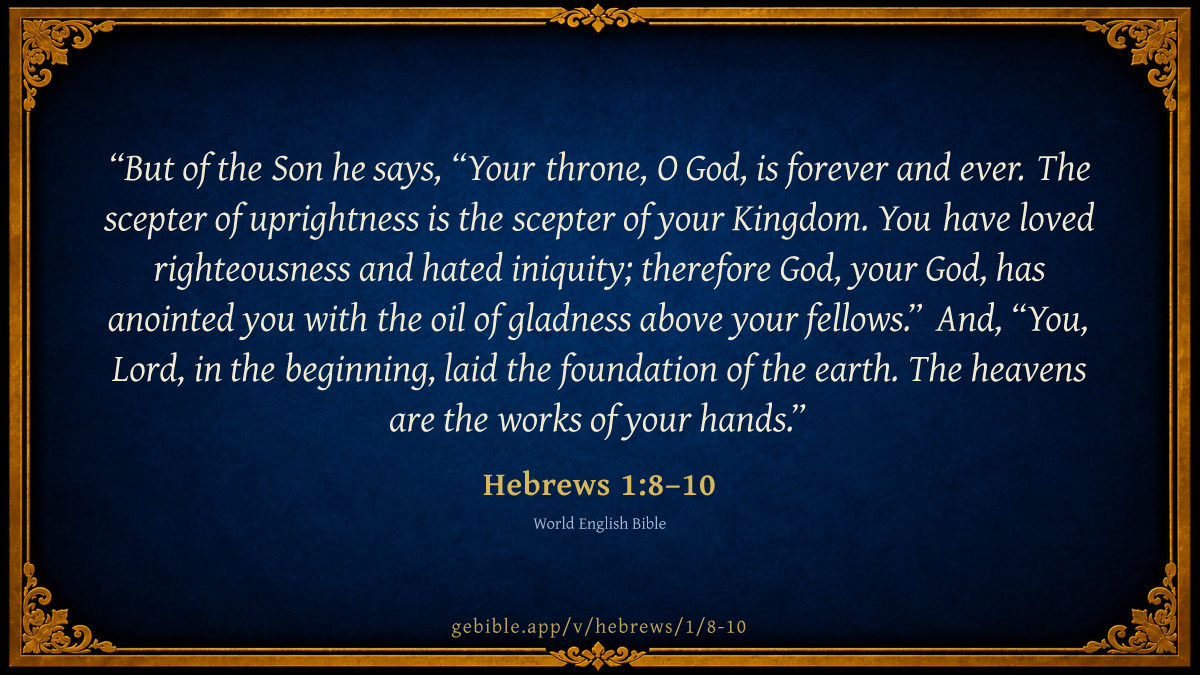
Psalms 45:6-7(v8)Your throne, God, is forever and ever. A scepter of equity is the scepter of your kingdom. You have loved righteousness, and hated…
Psalms 102:25-27(v10)Of old, you laid the foundation of the earth. The heavens are the work of your hands. They will perish, but you will endure. Yes, all of…
Psalms 45:7(v9)You have loved righteousness, and hated wickedness. Therefore God, your God, has anointed you with the oil of gladness above your fellows.
Genesis 1:1(v10)In the beginning, God created the heavens and the earth.
John 1:1-3(v10)In the beginning was the Word, and the Word was with God, and the Word was God. The same was in the beginning with God. All things were…
Show all 82 cross-references
Isaiah 9:6-7(v8)For a child is born to us. A son is given to us; and the government will be on his shoulders. His name will be called Wonderful Counselor,…
Jeremiah 32:17(v10)“Ah Lord Yahweh! Behold, you have made the heavens and the earth by your great power and by your outstretched arm. There is nothing too…
Psalms 23:5(v9)You prepare a table before me in the presence of my enemies. You anoint my head with oil. My cup runs over.
Jeremiah 23:5-6(v8)“Behold, the days come,” says Yahweh, “that I will raise to David a righteous Branch, and he will reign as king and deal wisely, and will…
Romans 9:5(v8)of whom are the fathers, and from whom is Christ as concerning the flesh, who is over all, God, blessed forever. Amen.
Isaiah 48:13(v10)Yes, my hand has laid the foundation of the earth, and my right hand has spread out the heavens. when I call to them, they stand up…
Isaiah 61:3(v9)to provide for those who mourn in Zion, to give to them a garland for ashes, the oil of joy for mourning, the garment of praise for the…
1 John 5:20(v8)We know that the Son of God has come, and has given us an understanding, that we know him who is true, and we are in him who is true, in…
Psalms 8:3-4(v10)When I consider your heavens, the work of your fingers, the moon and the stars, which you have ordained; what is man, that you think of…
Isaiah 7:14(v8)Therefore the Lord himself will give you a sign. Behold, the virgin will conceive, and bear a son, and shall call his name Immanuel.
Matthew 1:23(v8)“Behold, the virgin shall be with child, and shall give birth to a son. They shall call his name Immanuel;” which is, being interpreted,…
Isaiah 42:5(v10)God Yahweh, he who created the heavens and stretched them out, he who spread out the earth and that which comes out of it, he who gives…
Galatians 5:22(v9)But the fruit of the Spirit is love, joy, peace, patience, kindness, goodness, faith,
Hebrews 3:3-4(v8)For he has been counted worthy of more glory than Moses, because he who built the house has more honor than the house. For every house is…
Psalms 145:13(v8)Your kingdom is an everlasting kingdom. Your dominion endures throughout all generations. Yahweh is faithful in all his words, and loving…
Isaiah 61:1(v9)The Lord Yahweh’s Spirit is on me, because Yahweh has anointed me to preach good news to the humble. He has sent me to bind up the broken…
Zechariah 12:1(v10)A revelation, Yahweh’s word concerning Israel. Yahweh, who stretches out the heavens, and lays the foundation of the earth, and forms the…
Romans 15:13(v9)Now may the God of hope fill you with all joy and peace in believing, that you may abound in hope, in the power of the Holy Spirit.
Proverbs 8:29(v10)when he gave to the sea its boundary, that the waters should not violate his commandment, when he marked out the foundations of the earth,
Proverbs 8:13(v9)The fear of Yahweh is to hate evil. I hate pride, arrogance, the evil way, and the perverse mouth.
Isaiah 51:13(v10)Have you forgotten Yahweh your Maker, who stretched out the heavens, and laid the foundations of the earth? Do you live in fear continually…
Isaiah 64:8(v10)But now, Yahweh, you are our Father. We are the clay and you our potter. We all are the work of your hand.
Amos 5:15(v9)Hate evil, love good, and establish justice in the courts. It may be that Yahweh, the God of Armies, will be gracious to the remnant of…
Zechariah 9:9(v8)Rejoice greatly, daughter of Zion! Shout, daughter of Jerusalem! Behold, your King comes to you! He is righteous, and having salvation;…
Malachi 3:1(v8)“Behold, I send my messenger, and he will prepare the way before me; and the Lord, whom you seek, will suddenly come to his temple; and the…
Luke 4:18(v9)“The Spirit of the Lord is on me, because he has anointed me to preach good news to the poor. He has sent me to heal the broken hearted, to…
John 20:28(v8)Thomas answered him, “My Lord and my God!”
Titus 2:13-14(v8)looking for the blessed hope and appearing of the glory of our great God and Savior, Jesus Christ, who gave himself for us, that he might…
Revelation 3:14(v10)“To the angel of the assembly in Laodicea write: “The Amen, the Faithful and True Witness, the Beginning of God’s creation, says these…
Deuteronomy 4:19(v10)and lest you lift up your eyes to the sky, and when you see the sun and the moon and the stars, even all the army of the sky, you are drawn…
Psalms 19:1(v10)The heavens declare the glory of God. The expanse shows his handiwork.
Isaiah 61:8(v9)“For I, Yahweh, love justice. I hate robbery and iniquity. I will give them their reward in truth and I will make an everlasting covenant…
1 Corinthians 15:25(v8)For he must reign until he has put all his enemies under his feet.
1 John 1:3(v9)that which we have seen and heard we declare to you, that you also may have fellowship with us. Yes, and our fellowship is with the Father,…
2 Samuel 23:3(v8)The God of Israel said, the Rock of Israel spoke to me, ‘One who rules over men righteously, who rules in the fear of God,
Psalms 99:4(v8)The King’s strength also loves justice. You establish equity. You execute justice and righteousness in Jacob.
Psalms 119:104(v9)Through your precepts, I get understanding; therefore I hate every false way.
Psalms 119:128(v9)Therefore I consider all of your precepts to be right. I hate every false way.
Hosea 1:7(v8)But I will have mercy on the house of Judah, and will save them by Yahweh their God, and will not save them by bow, sword, battle, horses,…
1 Peter 1:3(v9)Blessed be the God and Father of our Lord Jesus Christ, who according to his great mercy caused us to be born again to a living hope…
Psalms 11:5(v9)Yahweh examines the righteous, but his soul hates the wicked and him who loves violence.
Psalms 33:5(v9)He loves righteousness and justice. The earth is full of the loving kindness of Yahweh.
Psalms 89:20(v9)I have found David, my servant. I have anointed him with my holy oil,
Isaiah 32:1-2(v8)Behold, a king shall reign in righteousness, and princes shall rule in justice. A man shall be as a hiding place from the wind, and a…
Zechariah 8:17(v9)and let none of you devise evil in your hearts against his neighbor, and love no false oath: for all these are things that I hate,” says…
John 1:41(v9)He first found his own brother, Simon, and said to him, “We have found the Messiah!” (which is, being interpreted, Christ).
John 20:17(v9)Jesus said to her, “Don’t hold me, for I haven’t yet ascended to my Father; but go to my brothers and tell them, ‘I am ascending to my…
1 Corinthians 1:9(v9)God is faithful, through whom you were called into the fellowship of his Son, Jesus Christ, our Lord.
Ephesians 1:3(v9)Blessed be the God and Father of our Lord Jesus Christ, who has blessed us with every spiritual blessing in the heavenly places in Christ,
Philippians 2:9(v9)Therefore God also highly exalted him, and gave to him the name which is above every name,
Hebrews 7:26(v9)For such a high priest was fitting for us: holy, guiltless, undefiled, separated from sinners, and made higher than the heavens;
Revelation 2:6-7(v9)But this you have, that you hate the works of the Nicolaitans, which I also hate. He who has an ear, let him hear what the Spirit says to…
Deuteronomy 2:37(v8)Only to the land of the children of Ammon you didn’t come near: all the banks of the river Jabbok, and the cities of the hill country, and…
Psalms 2:2(v9)The kings of the earth take a stand, and the rulers take counsel together, against Yahweh, and against his Anointed, saying,
Psalms 2:6(v9)“Yet I have set my King on my holy hill of Zion.”
Psalms 37:28(v9)For Yahweh loves justice, and doesn’t forsake his saints. They are preserved forever, but the children of the wicked shall be cut off.
Psalms 40:8(v9)I delight to do your will, my God. Yes, your law is within my heart.”
Psalms 72:1-4(v8)God, give the king your justice; your righteousness to the royal son. He will judge your people with righteousness, and your poor with…
Psalms 89:26(v9)He will call to me, ‘You are my Father, my God, and the rock of my salvation!’
John 3:34(v9)For he whom God has sent speaks the words of God; for God gives the Spirit without measure.
Acts 4:27(v9)“For truly, both Herod and Pontius Pilate, with the Gentiles and the people of Israel, were gathered together against your holy servant,…
Acts 10:38(v9)even Jesus of Nazareth, how God anointed him with the Holy Spirit and with power, who went about doing good and healing all who were…
Romans 12:9(v9)Let love be without hypocrisy. Abhor that which is evil. Cling to that which is good.
2 Corinthians 11:31(v9)The God and Father of the Lord Jesus Christ, he who is blessed forever more, knows that I don’t lie.
1 Timothy 3:16(v8)Without controversy, the mystery of godliness is great: God was revealed in the flesh, justified in the spirit, seen by angels, preached…
Revelation 2:15(v9)So you also have some who hold to the teaching of the Nicolaitans likewise.
Psalms 72:7(v8)In his days, the righteous shall flourish, and abundance of peace, until the moon is no more.
Psalms 72:11-14(v8)Yes, all kings shall fall down before him. All nations shall serve him. For he will deliver the needy when he cries; the poor, who has no…
Isaiah 45:21-22(v8)Declare and present it. Yes, let them take counsel together. Who has shown this from ancient time? Who has declared it of old? Haven’t I,…
Isaiah 45:25(v8)All the offspring of Israel will be justified in Yahweh, and will rejoice!
Jeremiah 38:15(v8)Then Jeremiah said to Zedekiah, “If I declare it to you, will you not surely put me to death? If I give you counsel, you will not listen to…
Zechariah 13:9(v8)I will bring the third part into the fire, and will refine them as silver is refined, and will test them like gold is tested. They will…
Luke 1:16-17(v8)He will turn many of the children of Israel to the Lord their God. He will go before him in the spirit and power of Elijah, ‘to turn the…
John 10:33(v8)The Jews answered him, “We don’t stone you for a good work, but for blasphemy: because you, being a man, make yourself God.”
Hebrews 2:11(v9)For both he who sanctifies and those who are sanctified are all from one, for which cause he is not ashamed to call them brothers,
2 Peter 1:11(v8)For thus you will be richly supplied with the entrance into the eternal Kingdom of our Lord and Savior, Jesus Christ.
Cross-references from openbible.info (CC BY 4.0)
Explain this passage (21 sources)
Historical commentary, presented as a primary source — not an endorsement.
John Calvin1540 · Public DomainOn vv8–108. But to the Son, etc. It must indeed…
8. But to the Son, etc. It must indeed be allowed, that this Psalm was composed as a marriage song for Solomon; for here is celebrated his marriage with the daughter of the king of Egypt; but it cannot yet be denied but that what is here related, is much too high to be applied to Solomon. The Jews, that they may not be forced to own Christ to be called God, make an evasion by saying, it at the throne of God is spoken of, or that the verb “established” is to be understood. So that, according to the first exposition, the word Elohim, God, is to be in construction with throne, “the throne of God;” and that according to the second, it is supposed to be a defective sentence. But these are mere evasions. Whosoever will read the verse, who is of a sound mind and free from the spirit of contention, cannot doubt but that the Messiah is called God. Nor is there any reason to object, that the word Elohim is sometimes given to angels and to judges; for it is never found to be given simply to one person, except to God alone.
Farther, that I may not contend about a word, whose throne can be said to be established forever, except that of God only? Hence the perpetuity of his kingdom is an evidence of his divinity.
Read full note →
The scepter of Christ’s kingdom is afterwards called the scepter of righteousness; of this there were some, though obscure, lineaments in Solomon; he exhibited them as far as he acted as a just king and zealous for what was right. But righteousness in the kingdom of Christ has a wider meaning; for he by his gospel, which is his spiritual scepter, renews us after the righteousness of God. The same thing must be also understood of his love of righteousness; for he causes it to reign in his own people, because he loves it.
John Calvin's Commentaries (1540-1563) — public domain. Text from the Calvin Translation Society English edition (1840s-50s) via the Christian Classics Ethereal Library (ccel.org). Calvin's coverage is partial (roughly two-thirds of the Bible); uncommented books and verses are honest gaps, never fabricated. The 19th-century editor's footnotes and remarks are omitted so the notes are faithfully Calvin's own voice.
Geneva Bible translators1599 · Public DomainOn vv8–10The government of thy kingdom is righteous.
The government of thy kingdom is righteous.
For everlasting, for this doubling of the word increaseth the signification of it beyond all measure.
Read full note →
The throne is proper to the Prince, and not to the servant.
Geneva Bible (1599) marginal notes — public domain.
John Trapp1656 · Public DomainOn vv8–108 But unto the Son he saith, Thy throne,…
8 But unto the Son he saith, Thy throne, O God, is for ever and ever: a sceptre of righteousness is the sceptre of thy kingdom.
Ver. 8. Thy throne, O God, is for ever] Christ is God, then, as is here set forth by many arguments. God hath laid "help on one that is mighty." "I and the Father am one."
John Trapp, A Commentary or Exposition upon All the Books of the Old and New Testament (1647–1656) — public domain. Text from a community e-Sword module.
Matthew Poole1685 · Public DomainOn vv8–10In the Father’s apostrophe to the Son, he giveth…
In the Father’s apostrophe to the Son, he giveth him the name of God, and thereby is he proved to have a better one than angels, made by, and servants to, him; and as the great gospel Minister hath a kingdom, in which they are his ministers and servants: this proof is quoted out of Psa 45:6,7. It was not to Solomon or David, but to the Son God-man, spoken by the Father. The whole Psalm is written of him, and incompatible to any other is the matter of it. It represents him and his mystical marriage to the church; compare Eph 5:23-33; Rev 19:7,8; 22:17.
Thy throne, O God: some heretics, to elude this proof of Christ’s Deity, would make God the genitive case in the proposition, as: Thy throne of God, expressly contrary to the grammar, both in Hebrew and Greek: others gloss it, that ο θεος is the nominative case, as, God is thy throne for ever, &c. i.e. He doth and will establish it: but this is cavilling, since it is the Father’s speech to and of his Son, describing his nature in opposition to the angels before. They were created spirits, but he was God; they were ministers and servants in his kingdom, where he was King; therefore his name and person is better than theirs.
Read full note →
God, in the singular, was a name never given to any creature, but is expressive of his Divine nature, and his relation in the Deity, being God the Son.
Is for ever and ever: his office as God-man, and great gospel Minister, is a royal one. He is a great King, angels are subjects of his kingdom as well as men, which royalty is set out by the ensigns of it; as here, by a throne, which is an emblem of royal authority, dominion, and power, whence he displayeth himself in his kingdom. It is a heavenly one, of a perfect constitution and administration, and of eternal continuance. His it was by natural inheritance, as God the Son; and as man united to the Godhead, he inheriteth the privileges of that person. This natural dominion over all things remaineth for ever, Col 1:16.
A sceptre of righteousness is a sceptre of thy kingdom: another ensign of his royal dominion and kingdom is his sceptre, which is his Spirit put out in his government of the world, and in his special work of grace, guiding and conforming, through his word and ordinances, the hearts of his chosen to the will of his Father. This sceptre is subjectively right in itself, and efficiently, making all under its power to be rectified according to the right and pure mind and will of God: compare Psa 110:1-3.
Matthew Poole's English Annotations on the Holy Bible (1683–1685) — public domain. Text from a community e-Sword/MySword module.
William Burkitt1703 · Public DomainOn v10What proof more can be desired of Christ’s Divinity,…
What proof more can be desired of Christ’s Divinity, than what is here given by our apostle? the name and attributes of God are given to him, as also an everlasting throne and kingdom; divine honour is required to be paid to him: and here such divine works are ascribed to him, wherein no creature can have any share of efficiency with him; such is the making of the world, Thou, Lord, laidest the foundations of the earth, and the heavens are the works of thy hands:
Here we have Christ’s omnipotency declared, Thou has laid the foundations of the earth, and the heavens are thy handy-works: and his eternity and immutability asserted, When the heavens perish, thou remainest: when thy wax old, and are changed thou art the same.
Read full note →
Learn hence, That the whole world, the heavens and the earth being made by our Lord Jesus Christ, is and evident proof that he is exalted above all creatures, and that he is and almighty and unchangeable God, Thou, Lord, hast laid, &c.
Learn, 2. That such is the frailty of man’s nature, and such the perishing condition of all created things, that nothing will or can yield stable consolation to us, but a firm belief of the omnipotency and immutability of our Lord Jesus Christ.
William Burkitt's Expository Notes on the New Testament (1700–1703) — public domain. Text from a community e-Sword module.
John Gill1763 · Public DomainOn vv8–10But unto the Son, he saith,.... What he does…
But unto the Son, he saith,.... What he does not to angels, and which sets him infinitely above them; which shows him to be a Prince and King, and not a servant, or minister; and which even ascribes deity to him:
thy throne, O God, is for ever and ever: this, with what follows in this verse, and the next, is taken out of Psa 45:6 which psalm is not spoken of Solomon, to whom many things in it will not agree; he was not fairer than other men; nor was he a warrior; nor was his throne for ever and ever; and much less a divine person, and the object of worship; but the Messiah, and so the ancient Jews understand it: the Targum applies it to him, and mentions him by name in Heb 1:2 and some of their modern writers (z) affirm it is said of the Messiah; though Aben Ezra seems doubtful about it, saying, it is spoken concerning David, or Messiah his Son, whose name is so, Eze 37:25. Deity is here ascribed to the Son of God; he is expressly called God; for the words will not bear to be rendered, "thy throne is the throne of God, or thy throne is God"; or be supplied thus, "God shall establish thy throne": nor are the words an apostrophe to the father, but are spoken to the king, the subject of the psalm, who is distinguished from God the Father, being blessed and anointed by him; and this is put out of all doubt by the apostle, who says they are addressed "to the Son", who is not a created God, nor God by office, but by nature; for though the word "Elohim" is sometimes used of those who are not gods by nature; yet being here used absolutely, and the attributes of eternity, and most perfect righteousness, being ascribed to the person so called, prove him to be the true God; and this is the reason why his throne is everlasting, and his sceptre righteous, and why he should be worshipped, served, and obeyed. Dominion and duration of it are given to him; his throne denotes his kingly power, and government; which is general, over angels, good and bad; over men, righteous and wicked, even the greatest among them, the kings and princes of the earth: and special, over his church and people; and which is administered by his Spirit and grace in the hearts of his saints; and by his word and ordinances in his churches; and by his powerful protection of them from their enemies; and will be in a glorious manner in the latter day, and in heaven to all eternity; for his throne is for ever, and on it he will sit for ever: his kingdom is an everlasting kingdom; he will have no successor in it, nor can his government be subverted; and though he will deliver up the kingdom to the Father, it will not cease.
Read full note →
A sceptre of righteousness is the sceptre of thy kingdom; the sceptre is an ensign of royalty; and a sceptre of righteousness, or rightness, is expressive of the justice of government; the Syriac version renders it, "a sceptre stretched out"; which is a sceptre of mercy, as the instance of Ahasuerus stretching out his sceptre to Esther shows; and such is the Gospel of Christ, which holds forth and declares the mercy, grace, and love of God to men through Christ; and which may be called a sceptre of righteousness, since it reveals and directs to the righteousness of Christ, and encourages to works of righteousness; but here it designs the righteous administration of Christ's kingly office; for just and true are, have been, and ever will be his ways, as King of saints.
(z) Kimchi & R. Sol. ben Melech in loc. & R. Abraham Seba, Tzeror Hammor, fol. 49. 2.
John Gill's Exposition of the Whole Bible (1746–1763) — public domain (CC PDM 1.0). Text via the HelloAO Bible API.
John Wesley1765 · Public DomainOn vv8–10O God - God, in the singular number, is…
O God - God, in the singular number, is never in scripture used absolutely of any but the supreme God. Thy reign, of which the scepter is the ensign, is full of justice and equity. Psalm xlv, 6, 7.
John Wesley, Explanatory Notes Upon the Whole Bible (1754–1765) — public domain. Text via the GEBible commentary corpus.
Adam Clarke1810 · Public DomainOn vv8–10Verse 8. Thy throne, O God, is for ever…
Verse 8. Thy throne, O God, is for ever and ever] If this be said of the Son of God, i.e. Jesus Christ, then Jesus Christ must be God; and indeed the design of the apostle is to prove this. The words here quoted are taken from Ps 45:6; Ps 45:7, which the ancient Chaldee paraphrast, and the most intelligent rabbins, refer to the Messiah. On the third verse of this Psalm, Thou art fairer than the children of men, the Targum says: "Thy beauty, מלכא משיחא malca Meshicha, O King Messiah, is greater than the children of men." Aben Ezra says: "This Psalm speaks of David, or rather of his son, the Messiah, for this is his name," Eze 34:24: And David my servant shall be a Prince over them for ever. Other rabbins confirm this opinion.
This verse is very properly considered a proof, and indeed a strong one, of the Divinity of Christ; but some late versions of the New Testament have endeavoured to avoid the evidence of this proof by translating the words thus: God is thy throne for ever and ever; and if this version be correct, it is certain the text can be no proof of the doctrine. Mr. Wakefield vindicates this translation at large in his History of Opinions; and ο θεος, being the nominative case, is supposed to be a sufficient justification of this version. In answer to this it may be stated that the nominative case is often used for the vocative, particularly by the Attics; and the whole scope of the place requires it should be so used here; and, with due deference to all of a contrary opinion, the original Hebrew cannot be consistently translated any other way, כסאך אלהים עולם ועד kisaca Elohim olam vaed, Thy throne, O God, is for ever, and to eternity. It is in both worlds; and extends over all time; and will exist through all endless duration. To this our Lord seems to refer, Mt 28:18: All power is given unto me, both in HEAVEN and EARTH. My throne, i.e. my dominion, extends from the creation to the consummation of all things. These I have made, and these I uphold; and from the end of the world, throughout eternity, I shall have the same glory-sovereign, unlimited power and authority, which I had with the Father before the world began; Joh 17:5. I may add that none of the ancient versions has understood it in the way contended for by those who deny the Godhead of Christ, either in the Psalm from which it is taken, or in this place where it is quoted. Aquila translates אלהים Elohim, by Θεε, O God, in the vocative case; and the Arabic adds the sign of the vocative [Arabic] ya, reading the place thus: [Arabic] korsee yallaho ila abadilabada, the same as in our version. And even allowing that οθεος here is to be used as the nominative case, it will not make the sense contended for, without adding εστι to it, a reading which is not countenanced by any version, nor by any MS. yet discovered. Wiclif, Coverdale, and others, understood it as the nominative, and translated it so; and yet it is evident that this nominative has the power of the vocative: forsothe to the sone God thi troone into the world of world: a gerde of equite the gerde of thi reume. I give this, pointing and all, as it stands in my old MS. Bible. Wiclif is nearly the same, but is evidently of a more modern cast: but to the sone he seith, God thy trone is into the world of world, a gherd of equyte is the gherd of thi rewme. Coverdale translates it thus: But unto the sonne he sayeth, God, thi seate endureth for ever and ever: the cepter of thi kyngdome is a right cepter. Tindal and others follow in the same way, all reading it in the nominative case, with the force of the vocative; for none of them has inserted the word εστι, is, because not authorized by the original: a word which the opposers of the Divinity of our Lord are obliged to beg, in order to support their interpretation. See some farther criticisms on this at the end of this chapter.
Read full note →
A sceptre of righteousness] The sceptre, which was a sort of staff or instrument of various forms, was the ensign of government, and is here used for government itself. This the ancient Jewish writers understand also of the Messiah.
Adam Clarke's Commentary on the Bible (1810–1826) — public domain. Text from a community e-Sword/MySword module.
Joseph Benson1811 · Public DomainOn v10Heb 1:10-12. And thou, Lord, in the beginning, &c.…
Heb 1:10-12. And thou, Lord, in the beginning, &c. — These words, with those contained in the two following verses, are quoted from Psa 102:25-27, where they are evidently spoken of the God of Israel, the living and true God. “Some have thought they are here addressed to the Father, and not to the Son. But, as the former passages are directed to the Son, it is reasonable to suppose this is so likewise: especially as it would not have been to the apostle’s purpose to quote it here, if it had been addressed to the Father. By affirming that these words were spoken to the Son, the apostle confuted the opinion of those Jews who held that the angels assisted in making this mundane system; an error which was afterward maintained by some heretics in the Christian Church. They — Permanent as they seem, and though firmly founded; shall at length perish — Of the perishing of the earth and aerial heavens, Peter speaks, 2Pe 3:10-13, where he also foretels that there shall be new heavens and a new earth, formed for the habitation of the righteous, after the old creation is destroyed. But thou remainest — Διαμενεις, continuest in undecaying glory; as a vesture — Περιβολαιον, a mantle, upper garment, or cloak; shalt thou fold them up — With infinite ease; and they shall be changed — Into new heavens and a new earth; or thou shalt remove them out of their place, and introduce a new scene of things with as much ease as a prince lays aside one robe and puts on another. But thou art eternally the same, and thy years shall not fail — Through everlasting ages, nor can thy perfections admit any possible diminution.
Joseph Benson's Commentary on the Old and New Testaments (1811–1818) — public domain. Text from a community e-Sword module.
Albert Barnes1834 · Public DomainOn vv8–10But unto the Son he saith - In Psa…
But unto the Son he saith - In Psa 45:6-7. The fact that the writer of this Epistle makes this application of the Psalm to the Messiah, proves that it was so applied in his time, or that it would be readily admitted to be applicable to him. It has been generally admitted, by both Jewish and Christian interpreters, to have such a reference. Even those who have doubted its primary applicability to the Messiah, have regarded it as referring to him in a secondary sense. Many have supposed that it referred to Solomon in the primary sense, and that it has a secondary reference to the Messiah. To me it seems most probable that it had an original and exclusive reference to the Messiah. It is to be remembered that the hope of the Messiah was the special hope of the Jewish people. The coming of the future king, so early promised, was the great event to which they all looked forward with the deepest interest.
That hope inspired their prophets and their bards, and cheered the hearts of the nation in the time of despondency. The Messiah, if I may so express it, was the “hero” of the Old Testament - more so than Achilles is of the Iliad, and Aeneas of the Aenead. The sacred poets were accustomed to employ all their most magnificent imagery in describing him, and to present him in every form that was beautiful in their conception, and that would be gratifying to the pride and hopes of the nation. Everything that is gorgeous and splendid in description is lavished on him, and they were never under any apprehension of attributing to him too great magnificence in his personal reign; too great beauty of moral character; or too great an extent of dominion. That which would be regarded by them as a magnificent description of a monarch, they freely applied to him; and this is evidently the case in this Psalm. That the description may have been in part derived from the view of Solomon in the magnificence of his court, is possible, but no more probable than that it was derived from the general view of the splendor of any Oriental monarch, or than that it might have been the description of a monarch which was the pure creation of inspired poetry.
Read full note →
Indeed, I do see not why this Psalm should ever have been supposed to be applicable to Solomon. His “name” is not mentioned. It has no special applicability to him. There is nothing that would apply to him which would not also apply to many an Oriental prince. There are some things in it which are much less applicable to him than to many others. The king here described is a conqueror. He girds his sword on his thigh, and his arrows are sharp in the hearts of his foes, and the people are subdued under him. This was not true of Solomon. His was a reign of peace and tranquillity, nor was he ever distinguished for war. On the whole, it seems clear to me, that this Psalm is designed to be a beautiful poetic description of the Messiah as king. The images are drawn from the usual characteristics of an Oriental prince, and there are many things in the poem - as there are in parables - for the sake of keeping, or verisimilitude, and which are not, in the interpretation, to be cut to the quick.
The writer imagined to himself a magnificent and beautiful prince; a prince riding prosperously in his conquests; swaying a permanent and wide dominion; clothed in rich and splendid vestments; eminently upright and pure; and scattering blessings everywhere - and that prince was the Messiah. The Psalm, therefore, I regard as relating originally and exclusively to Christ; and though in the interpretation, the circumstances should not be unduly pressed, nor an attempt be made to spiritualize them, yet the whole is a glowing and most beautiful description of Christ as a King. The same principles of interpretation should be applied to it which are applied to parables, and the same allowance be made for the introduction of circumstances for the sake of keeping, or for finishing the story. If this be the correct view, then Paul has quoted the Psalm in conformity exactly with its original intention, as he undoubtedly quoted it as it was understood in his time.
“Thy throne.” A throne is the seat on which a monarch sits, and is here the symbol of dominion, because kings when acting as rulers sit on thrones. Thus, a throne becomes the emblem of authority or empire. Here it means, that his “rule” or “dominion” would be perpetual - “forever and ever” - which assuredly could not be applied to Solomon. “O God.” This certainly could not be applied to Solomon; but applied to the Messiah it proves what the apostle is aiming to prove - that he is above the angels. The argument is, that a name is given to “him” which is never given to “them.” They are not called “God” in any strict and proper sense. The “argument” here requires us to understand this word, as used in a sense more exalted than any name which is ever given to angels, and though it may be maintained that the name אלהים 'elohiym, is given to magistrates or to angels, yet here the argument requires us to understand it as used in a sense superior to what it ever is when applied to an angel - or of course to any creature, since it was the express design of the argument to prove that the Messiah was superior to the angels.
The word “God” should be taken in its natural and obvious sense, unless there is some necessary reason for limiting it. If applied to magistrates Psa 82:6, it must be so limited. If applied to the Messiah, there is no such necessity, Joh 1:1; Isa 9:6; 1Jo 5:20; Phi 2:6, and it should be taken in its natural and proper sense. The “form” here - ὁ Θεὸς ho Theos - is in the vocative case and not the nominative. It is the usual form of the vocative in the Septuagint, and nearly the only form of it - Stuart. This then is a direct address to the Messiah, calling him God; and I see not why it is not to be used in the usual and proper sense of the word. Unitarians proposed to translate this, “God is thy throne;” but how can God be “a throne” of a creature? What is the meaning of such an expression? Where is there one parallel? And what must be the nature of that cause which renders such an argument necessary? - This refers, as it seems to me, to the Messiah “as king.”
It does not relate to his mode of existence before the incarnation, but to him as the magnificent monarch of his people. Still, the ground or reason why this name is given to him is that he is “divine.” It is language which properly expresses his nature. He must have a divine nature, or such language would be improper. I regard this passage, therefore, as full proof that the Lord Jesus is divine; nor is it possible to evade this conclusion by any fair interpretation of it. It cannot be wrong to address him as God; nor addressing him as such, not to regard him as divine. “Is forever and ever.” This could not in any proper sense apply to Solomon. As applied to the Messiah, it means that his essential kingdom will be perpetual, Luk 1:33. As Mediator his kingdom will be given up to the Father, or to God without reference to a mediatorial work, (1Co 15:24, 1Co 15:28 - see notes on these verses), but his reign over his people will be perpetual.
There never will come a time when they shall not obey and serve him, though the special form of his kingdom, as connected with the work of mediation, will be changed. The form of the organized church, for example, will be changed, for there shall be no necessity for it in heaven, but the essential dominion and power of the Son of God will not cease. He shall have the same dominion which he had before he entered on the work of mediation; and that will be eternal. It is also true that, compared with earthly monarchs, his kingdom shall be perpetual. They soon die. Dynasties pass away. But his empire extends from age to age, and is properly a perpetual dominion. The fair and obvious interpretation of this passage would satisfy me, were there nothing else, that this Psalm had no reference to Solomon, but was designed originally as a description of the Messiah as the expected King and Prince of his people. “A scepter of righteousness.”
That is, a right or just scepter. The phrase is a Hebraism. The former expression described the perpetuity of his kingdom; this describes its “equable nature.” It would be just and equal; see notes on Isa 11:5. A “scepter” is a staff or wand usually made of wood, five or six feet long, and commonly overlaid with gold, or ornamented with golden rings. Sometimes, however, the scepter was made of ivory, or wholly of gold. It was borne in the hands of kings as an emblem of authority and power. Probably it had its origin in the staff or crook of the shepherd - as kings were at first regarded as the “shepherds” of their people. Thus, Agamemnon is commonly called by Homer the “shepherd” of the people. The “scepter” thus becomes the emblem of kingly office and power - as when we speak of “swaying a scepter;” - and the idea here is, that the Messiah would be a “king,” and that the authority which he would wield would be equitable and just. He would not be governed, as monarchs often are, by mere caprice, or by the wishes of courtiers and flatterers; he would not be controlled by mere “will” and the love of arbitrary lower; but the execution of his laws would be in accordance with the principles of equity and justice. - How well this accords with the character of the Lord Jesus we need not pause to show; compare notes on Isa 11:2-5.
Albert Barnes' Notes on the Bible (1834–1885) — public domain. Text from a community e-Sword/MySword module.
Haydock's Catholic Bible Commentary1859 · Public DomainOn vv8, 10But the Son. That is, to his Son Jesus…
But the Son. That is, to his Son Jesus Christ, he saith, Thy throne, O God, is for ever and ever, and lasts for eternity. --- A sceptre, or rod of equity, is the sceptre of thy kingdom. That is, O Christ, God and man, head of thy Church, judge of all mankind, thou shalt reward and punish all under thee with justice and equity, as thou hast loved justice, and hated iniquity: therefore God, thy God, hath anointed thee. Many here understand God first named, to be in the vocative case, and that the sense is: therefore thee, O God, thy God, hath anointed: thus Christ is called God. Others take God in both places to be in the nominative case, and to be only a repetition of God the Father; and the sense to be, thee Christ, God, thy God, hath anointed thee with the oil of gladness above them that are partakers with thee: by which spiritual unction, some understand graces infused into Christ’s soul at his incarnation, by a greater plenitude of graces than was ever given to any saints whom he made partakers of his glory in heaven; others expound it of an unction of greater glory given to Christ in heaven as man, because by his sufferings and merits he had destroyed and triumphed over sin. See Estius, Cornelius a Lapide, &c. (Witham)
George Leo Haydock (1774–1849), Haydock's Catholic Family Bible and Commentary, 1859 edition — public domain. Excludes Psalms (Douay-Rheims chapter numbering differs from Protestant) and Deuterocanonical books (Catholic canon only).
Robert Jamieson, A. R. Fausset & David Brown1871 · Public DomainOn vv8–10O God--the Greek has the article to mark emphasis…
O God--the Greek has the article to mark emphasis (Psa 45:6-7).
for ever . . . righteousness--Everlasting duration and righteousness go together (Psa 45:2; Psa 89:14).
Read full note →
a sceptre of righteousness--literally, "a rod of rectitude," or "straightforwardness." The oldest manuscripts prefix "and" (compare Est 4:11).
Jamieson, Fausset & Brown — Commentary Critical and Explanatory on the Whole Bible (1871) — public domain (CC PDM 1.0). Text via the HelloAO Bible API.
Daniel D. Whedon1874 · Public DomainOn vv8–108. Saith—Quoted from Psa_45:6-7, generally held to be a…
8. Saith—Quoted from Psa_45:6-7, generally held to be a Messianic psalm. See in vol. v, O.T., of this series. It is addressed not so much to the pre-existent Word as to the incarnate Son, tracing the character of his rule in the earth, with his Messianic exaltation in consequence.
Thy throne, O God—That the vocative here agrees with both Greek and Hebrew, see notes.
Read full note →
Sceptre of righteousness—The rule of the Mediator is in itself right; it is the origin and securer of the moral quality in the progress of the world; and it is pledge that the right shall prevail in the final destinies of men. Physical nature in itself is necessitated, and destitute of justice and mercy. The normal processes of necessary causes, by the law of the Father as God of nature, are all relentless and regardless of the gracious. It is from the presence and sway of the blessed Mediator, under grace of the Father, that the power of mercy and peace is felt in earthly things.
Daniel D. Whedon (gen. ed.), Commentary on the Old and New Testaments (1874–1909) — public domain. Text from a community e-Sword module.
The Cambridge Bible for Schools and Colleges1878 · Public DomainOn vv8–108. But unto the Son he saith] Rather “But…
8. But unto the Son he saith] Rather “But of (lit., with reference to) the Son.” The Psalm (45) from which the quotation is taken, is called in the LXX. “A song for the beloved,” and has been Messianically interpreted by Jewish as well as Christian expositors. Hence it is chosen as one of the special Psalms for Christmas Day.
Thy throne, O God, is for ever and ever] The quotation is from Psa_45:6-7 (LXX.) which in its primary and historic sense is a splendid epithalamium to Solomon, or Joram, or some theocratic king of David’s house. But in the idealism and hyperbole of its expression it pointed forward to “the King in His beauty.” “Thy throne, O Elohim,” is the rendering which seems most natural, and this at once evidences the mystic and ideal character of the language; for though judges and rulers are sometimes collectively and indirectly called Elohim (Exo_21:6; Exo_22:8; Psalms 73; Joh_10:34-36) yet nothing which approaches a title so exalted is ever given to a human person, except in this typical sense (as in Isa_9:6). The original, however, has been understood by some to mean “Thy divine throne;” and this verse maybe rendered “God is Thy throne for ever and ever.” Philo had spoken of the Logos as “the eldest Angel,” “an Archangel of many names” (De Conf. Ling. 28), and it was most necessary for the writer to shew that the Mediator of the New Covenant was not merely an Angel like the ministers of the Old, or even an Archangel, but the Divine Præ-existent Son whose dispensation therefore supersedes that which had been administered by inferior beings. The Targum on this Psalm (45:3) renders it “Thy beauty, O King Messiah, is greater than the sons of men,” and Aben Ezra says it refers not so much to David as to his son Messiah.
Read full note →
a sceptre of righteousness] Rather, “the sceptre of rectitude.” The Greek word is euthutçtos not dikaiosunçs, which is the word used in the next verse. “Euthutçs” occurs here only in the N.T.
of thy kingdom] The two oldest MSS. (א, B) read “of His kingdom.”
The Cambridge Bible for Schools and Colleges (gen. ed. J. J. S. Perowne; Cambridge University Press, 1878–1918) — public domain. Text from a community e-Sword module.
Ellicott's Commentary for English Readers1878 · Public DomainOn vv8–10(8) Unto.—Rather, of. The connection with Heb_1:7 is so…
(8) Unto.—Rather, of. The connection with Heb_1:7 is so close (“Whereas of the angels He saith . . . of the Son He saith”), that we must not vary the rendering of the preposition. The passage which follows is taken from Psa_45:6-7. As the words stand in the ordinary Greek text, they agree exactly with the LXX.; but certain alterations of reading are required by the best evidence. After the words “for ever and ever” and must be restored, and in the following clause the and a must change places. The latter change is of moment only as it affects the former. Were the words in all other respects cited with perfect exactness, the introduction of and would probably indicate that the writer intended to split up the quotation into two parts, each significant for his purpose. (Comp. Heb_2:13.) As, however, we note other minor changes, the insertion of the connecting word is probably accidental. A third reading is of much greater importance. At the close of the verse the two oldest of our Greek MSS. agree in reading “His kingdom:” to this we will return afterwards.
We have every reason to believe that the application of Psalms 45 which is here made was fully received by the ancient Jews; thus in the Targum on the Psalm Heb_1:7 is taken as a direct address to the King Messiah. Hence the readers of this Epistle would at once recognise the argument which the words contain. It is strongly maintained by some that the Psalm (like Psalms 110, see below, on Heb_1:13) is altogether prophetic, the promised Messiah alone being in the Psalmist’s thought. There appear to be insuperable objections to this view, from particular expressions used (in the later verses especially), and from the general structure and colouring of the Psalm. It is in every way more probable that the second Psalm (see Note on Heb_1:5), rather than Psalms 110, represents the class to which Psalms 45 belongs. Originally writing in celebration of the marriage of a king of David’s line (we know not whom, but many of the arguments urged against the possible reference to Solomon have no great weight), the inspired Psalmist uses words which bear their full meaning only when applied to that Son of David of whose kingdom there shall be no end. The promises made to David (2 Samuel 7) are before the writer’s mind in the first verses of the Psalm. The king appointed by God is His representative to God’s people; his cause is that of truth and righteousness; his dominion will continually advance. It is at this moment that, with the promise of a divine sonship (Psalms 2) in his thought, he suddenly addresses the sing as Elohim (Heb_1:7), a divine king who receives from God the reward of righteousness (Heb_1:8). There are in the Old Testament examples of the use of Elohim which diminish the difficulty of its application to an earthly king (such as Psa_82:1; Psa_95:3; 1Sa_28:13; Exo_7:1); but it must still be acknowledged that the passage stands alone. This difficulty, however, relates only to the primary application. As the higher and true reference of the words became revealed, all earthly limitations disappeared; the Christian readers of the Psalm recognised in the Messiah of whom it speaks a King who is God.
Read full note →
The reading “His kingdom” has seemed to require a different rendering of the words in the first part of the verse: God is Thy throne for ever and ever. This rendering, however, will suit either reading of the Greek, and is equally admissible as a rendering of the Hebrew. Nor is it really inconsistent with the position in which the verse here stands: in contrast with the ministry of angels is set, on this view, not indeed a direct address to the Son as God, but the sovereign rule which the Son receives from God. The objections raised against it are: (1) such an expression as “God is Thy throne” is contrary to the analogy of Scripture language; (2) the ordinary rendering has the support of almost all ancient authority, Jewish writers and ancient versions being apparently united in its favour. The former argument is not very strong in face of Psa_90:1, and similar passages; but the latter is so weighty that we hesitate to accept the change, helpful as it would be in making clear the original and typical reference of Heb_1:7. It should be said that the reading “His kingdom” is not inconsistent with the ordinary translation of the preceding words; for a sudden transition from “Thy throne, O God” to “His kingdom” is in full accordance with the usage of Hebrew poetry. (See Psa_43:4; Psa_67:5-6; Psa_104:4-6, et al.) There are other renderings which would require discussion if we were concerned with the Hebrew text of the Psalm: the two given above are the only possible translations of the Greek.
A sceptre . . .—Rather, the sceptre of uprightness is a sceptre of Thy (or, His) kingdom. Righteousness itself (so to speak, the very ideal of righteous government) bears sway in Thy kingdom.
A Bible Commentary for English Readers, edited by Charles John Ellicott (1878–1897) — public domain. Text from a community e-Sword module.
The Pulpit Commentary1880 · Public DomainOn vv8, 10Vers. 8-13. Two more quotations from the psalms with…
Vers. 8-13. Two more quotations from the psalms with reference to the SON adduced in contrast.
Vers. 8, 9. But unto the Son he saith. The preposition here translated "unto" is prov , as in ver. 7, there translated "of." As is evident from its use in ver. 7, it does not imply of necessity that the persons spoken of are addressed in the quotations, though it is so in this second case. The force of the preposition itself need only be "in reference to." The first quotation is from Psa_45:6, Psa_45:7. The psalm was evidently written originally as an epithalamium on the occasion of the marriage of some king of Israel to some foreign princess. The general and probable opinion is that the king was Solomon. His marriage with Pharaoh"s daughter may have been the occasion. The view taken by some (as Hengstenberg), that the psalm had no original reference to an actual marriage, being purely a Messianic prophecy, is inconsistent both with its own contents and with the analogy of other Messianic psalms. (see what was said on this head with reference to Ps 2) Those who enter into the view of Messianic prophecy that has been given above, will have no difficulty in perceiving the justness of the application of this psalm to Christ, notwithstanding its primary import. Like Psalm 2, it presents (in parts at least) an ideal picture, suggested only and imperfectly realized by the temporary type; an ideal of which we find the germ in 2Sa 7, and the amplification in later prophecy. Further, the title, "For the precentor" ("To the chief musician," A.V), shows that the psalm was used in the temple services, and thus, whatever might be the occasion of its composition, was understood by the Jews of old as having an ulterior meaning. Further, there is possibly (as Delitzsch points out) a reference to the psalm as Messianic in Isa_61:1-3, where "the Servant of Jehovah," "the Anointed," gives the "oil of gladness" for mourning; and in Psa_9:5, where the words of the psalm," God" (ver. 6) and "mighty" (ver. 3) are compounded for a designation of the Messiah; also in Zec_12:8, where it is prophesied that in the latter days" the house of David" shall be "as God." The Messianic interpretation is undoubtedly ancient. The Chaldee paraphrast (on ver. 3) writes, "Thy beauty, O King Messiah, is greater than that of the sons of men." Thy throne, O God, is for ever and ever. Attempts have been made to evade the conclusion that the king is here addressed as "God,
Read full note →
(1) by taking the clause as a parenthetic address to God himself;
(2) by regarding" God" as appended to "throne," or as the predicate of the sentence; i.e. translating either "Thy throne of God is," etc. (according to the sense of 1Ch_29:23, "Solomon sat on the throne of the LORD as king"), or "Thy throne is God i.e. Divine for ever and ever." As to
(1), the context repudiates it. As to
(2), it is a question whether the Hebrew is patient of the supposed construction. At any rate, "God" is understood as a vocative in the LXX as well as in the Epistle, in which the LXX is quoted (for the use of the nominative form, o Yeov , in a vocative sense, cf. Luk_18:11, 13 Mat_27:29 Mar_9:25 Luk_8:54 Luk_12:32) and in the Chaldee paraphrase, and all ancient versions, it is understood so also. Probably no other interpretation would have been thought of but for the difficulty of supposing an earthly king to be thus addressed. It is to be observed, however, that the other rendering would express essentially the same idea, and be sufficient for the argument. In either case the throne of the SON is represented as God"s throne, and eternal. The only difference is that the vocative rendering makes more marked and manifest the ideal view of his subject taken by the psalmist. For it is most unlikely that a bard of the sanctuary, a worshipper of the jealous God of Israel, would have so apostrophized any earthly king except as prefiguring "a greater than Solomon" to come. It is true that kings are elsewhere called "gods" in the plural; (as in Psa_82:6, referred to by our Lord, Joh_10:35) but the solemn addressing of an individual king by this title is (if the vocative rendering be correct) peculiar to this psalm. The passage (1Sa_28:13) adduced in abatement of the significance of the title, where the apparition of Samuel is described by the witch of Endor as Elohim ascending out of the earth," is not a parallel case. The word "Elohim" has a comprehensive meaning, depending on context for its precise significance. If vocatively used in a solemn address to a king sitting upon an everlasting throne, it surely implies the assigning of Divine honors to the king so addressed. In this case still more is implied than in Psalm 2., where the King is spoken of as God"s Son, enthroned on Zion, the Son being here addressed as himself "Elohim." It may be that the inspiring Spirit suggested language to the psalmist beyond his own comprehension at the time of utterance. (see 1Pe_1:10, 1Pe_1:11) It may be added that the ultimate Messianic reference of the expression is confirmed by Isa_9:6, where the title El-Gibber (Mighty God," A.V) distinctly used of God himself in Isa_10:21, (cf. Deu_10:17 Jer_32:18 Neh_9:32 Psa_24:8) is applied to the Messiah. A scepter of righteousness is the scepter of thy kingdom. In this and the following clause is expressed the important idea that the ideal throne of the SON is founded on righteousness, whence comes also his peculiar unction with "the oil of gladness." Only so far as Solomon or other theocratic kings exemplified the Divine righteousness, did they approach the ideal position assigned to the Son. cf. the latter part of ver. 14 in the original promise, 2Sa 7, and especially 2Sa_23:3, etc., in the "last words of David." Observe also the prominence of the idea in Psalm 72 and in later prophecy. (cf. Isa_9:7 Isa_11:2, etc.) Therefore, God, even thy God. The first God" here may be again in the vocative, as in the preceding verse, or it may be as the A.V takes it. (el. Psa_43:4 Psa_1:6) Hath anointed thee with the oil of gladness above thy fellows. The primary reference is, not to the king"s coronation, (as in Psa_89:20) but to unction as symbolical of blessing and joy, connected with the custom of anointing the head at feasts. (Deu_28:40 Psa_23:5 Psa_92:10 Son_1:12 Mat_6:17) Thy fellows," in its original reference, seems most naturally to mean "thy associates in royalty," "other kings;" cf. Psa_79:2-7, "I will make him my Firstborn, higher than the kings of the earth." Or it might mean the companions of the bridegroom, the paranumfioi . The latter reference lends itself readily to the fulfillment in Christ, the Bridegroom of the Church, whose paranumfioi the redeemed are; themselves also being, after their measure, cristoi . (cf. 1Jn_2:20, 1Jn_2:27) But they are also made "kings and priests unto God" by Christ; (Rev_1:6 Rev_5:10) so that either of the supposed original references may be shown to be typical, if it be thought necessary to find a definite fulfillment of all the details of the address to the theocratic king. The view that in the fulfillment the angels are to be understood as Christ"s metocoi is inadmissible. There is nothing in the psalm to suggest the thought of them, nor does the way in which they are contrasted with the SON in this chapter admit of their being here spoken of as his metocoi . Men, in the next chapter, are so spoken of.
The Pulpit Commentary (1880–1919), ed. H.D.M. Spence-Jones & Joseph S. Exell — public domain. Text from a community e-Sword module.
B. W. Johnson1891 · Public DomainOn vv8–108. But to the son. The quotation is from…
8. But to the son. The quotation is from Ps. 45:6. Thy throne, O God. Then the Son has an eternal throne, and is divine. The sceptre, etc. He then has a kingdom, and rules it with a righteous scepter. The point is that he is a Divine King with an eternal throne.
B. W. Johnson's The People's New Testament with Notes (1889–1891) — public domain. Electronic text from the Christian Classics Ethereal Library (CCEL) ThML edition.
William B. Godbey1900 · Public DomainOn vv8–108. This verse certifies that our Lord’s everlasting kingdom…
8. This verse certifies that our Lord’s everlasting kingdom is an administration of righteousness. The kingdom of Christ is set up in the heart by the Holy Ghost in regeneration, confirmed and perpetuated in sanctification. Here, however, the more direct allusion is to our Lord’s millennial reign, which will follow the present age, and continue forever. Though the millennium will only last about a thousand years, our glorious King will encumber the throne of final judgment, and reign on forever over this world after its cremation, celestialization and readmission into the Heavenly Universe.
William B. Godbey, Commentary on the New Testament (1896–1900) — public domain. Text from a community e-Sword module.
C. I. Scofield1917 · Public DomainOn v9righteousness (See Scofield "1Jn 3:7").
righteousness (See Scofield "1Jn 3:7").
iniquity lawlessness. (See Scofield "Rom 3:23").
The Scofield Reference Bible (1917 edition), notes by C. I. Scofield — public domain. Text from a community e-Sword module.
unfoldingWord translationNotes2017 · CC BY-SA 4.0On vv8, 10General Information:
General Information:
This scriptual quotation comes from the Psalms.
Read full note →
But to the Son he says
"But God says this to the Son"
Son
This is an important title for Jesus, the Son of God. (See: Translating Son and Father)
Your throne, God, is forever and ever
The Son's throne represents his rule. AT: "You are God, and your reign will last forever and ever" (See: Metonymy)
The scepter of your kingdom is the scepter of justice
Here "scepter" refers to the Son's rule. AT: "And you will rule over the people of your kingdom with justice" (See: Metonymy)
has anointed you with the oil of joy more than your companions
Here "oil of joy" refers to the joy that the Son felt when God honored him. AT: "has honored you and made you more joyful than anyone else" (See: Metaphor)
Tyndale Open Study Notes2022 · CC BY-SA 4.0On vv8, 101:8-9 These verses, quoting Ps 45:6-7, proclaim the Son…
1:8-9 These verses, quoting Ps 45:6-7, proclaim the Son as the divine, just, eternal, anointed King of the universe. • to the Son he says: Jesus is addressed as God; in Heb 1:9, your God is a reference to God the Father. • pouring out the oil of joy: Olive oil was used to anoint kings of Israel at the inauguration of their rule (1 Sam 10:1; 1 Kgs 19:15-16). God has anointed his Son, Jesus Christ, as King.

John Calvin 1540 · Public Domain On vv8–10 8. But to the Son, etc. It must indeed…
8. But to the Son, etc. It must indeed be allowed, that this Psalm was composed as a marriage song for Solomon; for here is celebrated his marriage with the daughter of the king of Egypt; but it cannot yet be denied but that what is here related, is much too high to be applied to Solomon. The Jews, that they may not be forced to own Christ to be called God, make an evasion by saying, it at the throne of God is spoken of, or that the verb “established” is to be understood. So that, according to the first exposition, the word Elohim, God, is to be in construction with throne, “the throne of God;” and that according to the second, it is supposed to be a defective sentence. But these are mere evasions. Whosoever will read the verse, who is of a sound mind and free from the spirit of contention, cannot doubt but that the Messiah is called God. Nor is there any reason to object, that the word Elohim is sometimes given to angels and to judges; for it is never found to be given simply to one person, except to God alone.
Farther, that I may not contend about a word, whose throne can be said to be established forever, except that of God only? Hence the perpetuity of his kingdom is an evidence of his divinity.
Read full note →
The scepter of Christ’s kingdom is afterwards called the scepter of righteousness; of this there were some, though obscure, lineaments in Solomon; he exhibited them as far as he acted as a just king and zealous for what was right. But righteousness in the kingdom of Christ has a wider meaning; for he by his gospel, which is his spiritual scepter, renews us after the righteousness of God. The same thing must be also understood of his love of righteousness; for he causes it to reign in his own people, because he loves it.
John Calvin's Commentaries (1540-1563) — public domain. Text from the Calvin Translation Society English edition (1840s-50s) via the Christian Classics Ethereal Library (ccel.org). Calvin's coverage is partial (roughly two-thirds of the Bible); uncommented books and verses are honest gaps, never fabricated. The 19th-century editor's footnotes and remarks are omitted so the notes are faithfully Calvin's own voice.
Geneva Bible translators 1599 · Public Domain On vv8–10 The government of thy kingdom is righteous.
The government of thy kingdom is righteous.
For everlasting, for this doubling of the word increaseth the signification of it beyond all measure.
Read full note →
The throne is proper to the Prince, and not to the servant.
Geneva Bible (1599) marginal notes — public domain.
John Trapp 1656 · Public Domain On vv8–10 8 But unto the Son he saith, Thy throne,…
8 But unto the Son he saith, Thy throne, O God, is for ever and ever: a sceptre of righteousness is the sceptre of thy kingdom.
Ver. 8. Thy throne, O God, is for ever] Christ is God, then, as is here set forth by many arguments. God hath laid "help on one that is mighty." "I and the Father am one."
John Trapp, A Commentary or Exposition upon All the Books of the Old and New Testament (1647–1656) — public domain. Text from a community e-Sword module.
Matthew Poole 1685 · Public Domain On vv8–10 In the Father’s apostrophe to the Son, he giveth…
In the Father’s apostrophe to the Son, he giveth him the name of God, and thereby is he proved to have a better one than angels, made by, and servants to, him; and as the great gospel Minister hath a kingdom, in which they are his ministers and servants: this proof is quoted out of Psa 45:6,7. It was not to Solomon or David, but to the Son God-man, spoken by the Father. The whole Psalm is written of him, and incompatible to any other is the matter of it. It represents him and his mystical marriage to the church; compare Eph 5:23-33; Rev 19:7,8; 22:17.
Thy throne, O God: some heretics, to elude this proof of Christ’s Deity, would make God the genitive case in the proposition, as: Thy throne of God, expressly contrary to the grammar, both in Hebrew and Greek: others gloss it, that ο θεος is the nominative case, as, God is thy throne for ever, &c. i.e. He doth and will establish it: but this is cavilling, since it is the Father’s speech to and of his Son, describing his nature in opposition to the angels before. They were created spirits, but he was God; they were ministers and servants in his kingdom, where he was King; therefore his name and person is better than theirs.
Read full note →
God, in the singular, was a name never given to any creature, but is expressive of his Divine nature, and his relation in the Deity, being God the Son.
Is for ever and ever: his office as God-man, and great gospel Minister, is a royal one. He is a great King, angels are subjects of his kingdom as well as men, which royalty is set out by the ensigns of it; as here, by a throne, which is an emblem of royal authority, dominion, and power, whence he displayeth himself in his kingdom. It is a heavenly one, of a perfect constitution and administration, and of eternal continuance. His it was by natural inheritance, as God the Son; and as man united to the Godhead, he inheriteth the privileges of that person. This natural dominion over all things remaineth for ever, Col 1:16.
A sceptre of righteousness is a sceptre of thy kingdom: another ensign of his royal dominion and kingdom is his sceptre, which is his Spirit put out in his government of the world, and in his special work of grace, guiding and conforming, through his word and ordinances, the hearts of his chosen to the will of his Father. This sceptre is subjectively right in itself, and efficiently, making all under its power to be rectified according to the right and pure mind and will of God: compare Psa 110:1-3.
Matthew Poole's English Annotations on the Holy Bible (1683–1685) — public domain. Text from a community e-Sword/MySword module.
William Burkitt 1703 · Public Domain On v10 What proof more can be desired of Christ’s Divinity,…
What proof more can be desired of Christ’s Divinity, than what is here given by our apostle? the name and attributes of God are given to him, as also an everlasting throne and kingdom; divine honour is required to be paid to him: and here such divine works are ascribed to him, wherein no creature can have any share of efficiency with him; such is the making of the world, Thou, Lord, laidest the foundations of the earth, and the heavens are the works of thy hands:
Here we have Christ’s omnipotency declared, Thou has laid the foundations of the earth, and the heavens are thy handy-works: and his eternity and immutability asserted, When the heavens perish, thou remainest: when thy wax old, and are changed thou art the same.
Read full note →
Learn hence, That the whole world, the heavens and the earth being made by our Lord Jesus Christ, is and evident proof that he is exalted above all creatures, and that he is and almighty and unchangeable God, Thou, Lord, hast laid, &c.
Learn, 2. That such is the frailty of man’s nature, and such the perishing condition of all created things, that nothing will or can yield stable consolation to us, but a firm belief of the omnipotency and immutability of our Lord Jesus Christ.
William Burkitt's Expository Notes on the New Testament (1700–1703) — public domain. Text from a community e-Sword module.
John Gill 1763 · Public Domain On vv8–10 But unto the Son, he saith,.... What he does…
But unto the Son, he saith,.... What he does not to angels, and which sets him infinitely above them; which shows him to be a Prince and King, and not a servant, or minister; and which even ascribes deity to him:
thy throne, O God, is for ever and ever: this, with what follows in this verse, and the next, is taken out of Psa 45:6 which psalm is not spoken of Solomon, to whom many things in it will not agree; he was not fairer than other men; nor was he a warrior; nor was his throne for ever and ever; and much less a divine person, and the object of worship; but the Messiah, and so the ancient Jews understand it: the Targum applies it to him, and mentions him by name in Heb 1:2 and some of their modern writers (z) affirm it is said of the Messiah; though Aben Ezra seems doubtful about it, saying, it is spoken concerning David, or Messiah his Son, whose name is so, Eze 37:25. Deity is here ascribed to the Son of God; he is expressly called God; for the words will not bear to be rendered, "thy throne is the throne of God, or thy throne is God"; or be supplied thus, "God shall establish thy throne": nor are the words an apostrophe to the father, but are spoken to the king, the subject of the psalm, who is distinguished from God the Father, being blessed and anointed by him; and this is put out of all doubt by the apostle, who says they are addressed "to the Son", who is not a created God, nor God by office, but by nature; for though the word "Elohim" is sometimes used of those who are not gods by nature; yet being here used absolutely, and the attributes of eternity, and most perfect righteousness, being ascribed to the person so called, prove him to be the true God; and this is the reason why his throne is everlasting, and his sceptre righteous, and why he should be worshipped, served, and obeyed. Dominion and duration of it are given to him; his throne denotes his kingly power, and government; which is general, over angels, good and bad; over men, righteous and wicked, even the greatest among them, the kings and princes of the earth: and special, over his church and people; and which is administered by his Spirit and grace in the hearts of his saints; and by his word and ordinances in his churches; and by his powerful protection of them from their enemies; and will be in a glorious manner in the latter day, and in heaven to all eternity; for his throne is for ever, and on it he will sit for ever: his kingdom is an everlasting kingdom; he will have no successor in it, nor can his government be subverted; and though he will deliver up the kingdom to the Father, it will not cease.
Read full note →
A sceptre of righteousness is the sceptre of thy kingdom; the sceptre is an ensign of royalty; and a sceptre of righteousness, or rightness, is expressive of the justice of government; the Syriac version renders it, "a sceptre stretched out"; which is a sceptre of mercy, as the instance of Ahasuerus stretching out his sceptre to Esther shows; and such is the Gospel of Christ, which holds forth and declares the mercy, grace, and love of God to men through Christ; and which may be called a sceptre of righteousness, since it reveals and directs to the righteousness of Christ, and encourages to works of righteousness; but here it designs the righteous administration of Christ's kingly office; for just and true are, have been, and ever will be his ways, as King of saints.
(z) Kimchi & R. Sol. ben Melech in loc. & R. Abraham Seba, Tzeror Hammor, fol. 49. 2.
John Gill's Exposition of the Whole Bible (1746–1763) — public domain (CC PDM 1.0). Text via the HelloAO Bible API.
John Wesley 1765 · Public Domain On vv8–10 O God - God, in the singular number, is…
O God - God, in the singular number, is never in scripture used absolutely of any but the supreme God. Thy reign, of which the scepter is the ensign, is full of justice and equity. Psalm xlv, 6, 7.
John Wesley, Explanatory Notes Upon the Whole Bible (1754–1765) — public domain. Text via the GEBible commentary corpus.
Adam Clarke 1810 · Public Domain On vv8–10 Verse 8. Thy throne, O God, is for ever…
Verse 8. Thy throne, O God, is for ever and ever] If this be said of the Son of God, i.e. Jesus Christ, then Jesus Christ must be God; and indeed the design of the apostle is to prove this. The words here quoted are taken from Ps 45:6; Ps 45:7, which the ancient Chaldee paraphrast, and the most intelligent rabbins, refer to the Messiah. On the third verse of this Psalm, Thou art fairer than the children of men, the Targum says: "Thy beauty, מלכא משיחא malca Meshicha, O King Messiah, is greater than the children of men." Aben Ezra says: "This Psalm speaks of David, or rather of his son, the Messiah, for this is his name," Eze 34:24: And David my servant shall be a Prince over them for ever. Other rabbins confirm this opinion.
This verse is very properly considered a proof, and indeed a strong one, of the Divinity of Christ; but some late versions of the New Testament have endeavoured to avoid the evidence of this proof by translating the words thus: God is thy throne for ever and ever; and if this version be correct, it is certain the text can be no proof of the doctrine. Mr. Wakefield vindicates this translation at large in his History of Opinions; and ο θεος, being the nominative case, is supposed to be a sufficient justification of this version. In answer to this it may be stated that the nominative case is often used for the vocative, particularly by the Attics; and the whole scope of the place requires it should be so used here; and, with due deference to all of a contrary opinion, the original Hebrew cannot be consistently translated any other way, כסאך אלהים עולם ועד kisaca Elohim olam vaed, Thy throne, O God, is for ever, and to eternity. It is in both worlds; and extends over all time; and will exist through all endless duration. To this our Lord seems to refer, Mt 28:18: All power is given unto me, both in HEAVEN and EARTH. My throne, i.e. my dominion, extends from the creation to the consummation of all things. These I have made, and these I uphold; and from the end of the world, throughout eternity, I shall have the same glory-sovereign, unlimited power and authority, which I had with the Father before the world began; Joh 17:5. I may add that none of the ancient versions has understood it in the way contended for by those who deny the Godhead of Christ, either in the Psalm from which it is taken, or in this place where it is quoted. Aquila translates אלהים Elohim, by Θεε, O God, in the vocative case; and the Arabic adds the sign of the vocative [Arabic] ya, reading the place thus: [Arabic] korsee yallaho ila abadilabada, the same as in our version. And even allowing that οθεος here is to be used as the nominative case, it will not make the sense contended for, without adding εστι to it, a reading which is not countenanced by any version, nor by any MS. yet discovered. Wiclif, Coverdale, and others, understood it as the nominative, and translated it so; and yet it is evident that this nominative has the power of the vocative: forsothe to the sone God thi troone into the world of world: a gerde of equite the gerde of thi reume. I give this, pointing and all, as it stands in my old MS. Bible. Wiclif is nearly the same, but is evidently of a more modern cast: but to the sone he seith, God thy trone is into the world of world, a gherd of equyte is the gherd of thi rewme. Coverdale translates it thus: But unto the sonne he sayeth, God, thi seate endureth for ever and ever: the cepter of thi kyngdome is a right cepter. Tindal and others follow in the same way, all reading it in the nominative case, with the force of the vocative; for none of them has inserted the word εστι, is, because not authorized by the original: a word which the opposers of the Divinity of our Lord are obliged to beg, in order to support their interpretation. See some farther criticisms on this at the end of this chapter.
Read full note →
A sceptre of righteousness] The sceptre, which was a sort of staff or instrument of various forms, was the ensign of government, and is here used for government itself. This the ancient Jewish writers understand also of the Messiah.
Adam Clarke's Commentary on the Bible (1810–1826) — public domain. Text from a community e-Sword/MySword module.
Joseph Benson 1811 · Public Domain On v10 Heb 1:10-12. And thou, Lord, in the beginning, &c.…
Heb 1:10-12. And thou, Lord, in the beginning, &c. — These words, with those contained in the two following verses, are quoted from Psa 102:25-27, where they are evidently spoken of the God of Israel, the living and true God. “Some have thought they are here addressed to the Father, and not to the Son. But, as the former passages are directed to the Son, it is reasonable to suppose this is so likewise: especially as it would not have been to the apostle’s purpose to quote it here, if it had been addressed to the Father. By affirming that these words were spoken to the Son, the apostle confuted the opinion of those Jews who held that the angels assisted in making this mundane system; an error which was afterward maintained by some heretics in the Christian Church. They — Permanent as they seem, and though firmly founded; shall at length perish — Of the perishing of the earth and aerial heavens, Peter speaks, 2Pe 3:10-13, where he also foretels that there shall be new heavens and a new earth, formed for the habitation of the righteous, after the old creation is destroyed. But thou remainest — Διαμενεις, continuest in undecaying glory; as a vesture — Περιβολαιον, a mantle, upper garment, or cloak; shalt thou fold them up — With infinite ease; and they shall be changed — Into new heavens and a new earth; or thou shalt remove them out of their place, and introduce a new scene of things with as much ease as a prince lays aside one robe and puts on another. But thou art eternally the same, and thy years shall not fail — Through everlasting ages, nor can thy perfections admit any possible diminution.
Joseph Benson's Commentary on the Old and New Testaments (1811–1818) — public domain. Text from a community e-Sword module.
Albert Barnes 1834 · Public Domain On vv8–10 But unto the Son he saith - In Psa…
But unto the Son he saith - In Psa 45:6-7. The fact that the writer of this Epistle makes this application of the Psalm to the Messiah, proves that it was so applied in his time, or that it would be readily admitted to be applicable to him. It has been generally admitted, by both Jewish and Christian interpreters, to have such a reference. Even those who have doubted its primary applicability to the Messiah, have regarded it as referring to him in a secondary sense. Many have supposed that it referred to Solomon in the primary sense, and that it has a secondary reference to the Messiah. To me it seems most probable that it had an original and exclusive reference to the Messiah. It is to be remembered that the hope of the Messiah was the special hope of the Jewish people. The coming of the future king, so early promised, was the great event to which they all looked forward with the deepest interest.
That hope inspired their prophets and their bards, and cheered the hearts of the nation in the time of despondency. The Messiah, if I may so express it, was the “hero” of the Old Testament - more so than Achilles is of the Iliad, and Aeneas of the Aenead. The sacred poets were accustomed to employ all their most magnificent imagery in describing him, and to present him in every form that was beautiful in their conception, and that would be gratifying to the pride and hopes of the nation. Everything that is gorgeous and splendid in description is lavished on him, and they were never under any apprehension of attributing to him too great magnificence in his personal reign; too great beauty of moral character; or too great an extent of dominion. That which would be regarded by them as a magnificent description of a monarch, they freely applied to him; and this is evidently the case in this Psalm. That the description may have been in part derived from the view of Solomon in the magnificence of his court, is possible, but no more probable than that it was derived from the general view of the splendor of any Oriental monarch, or than that it might have been the description of a monarch which was the pure creation of inspired poetry.
Read full note →
Indeed, I do see not why this Psalm should ever have been supposed to be applicable to Solomon. His “name” is not mentioned. It has no special applicability to him. There is nothing that would apply to him which would not also apply to many an Oriental prince. There are some things in it which are much less applicable to him than to many others. The king here described is a conqueror. He girds his sword on his thigh, and his arrows are sharp in the hearts of his foes, and the people are subdued under him. This was not true of Solomon. His was a reign of peace and tranquillity, nor was he ever distinguished for war. On the whole, it seems clear to me, that this Psalm is designed to be a beautiful poetic description of the Messiah as king. The images are drawn from the usual characteristics of an Oriental prince, and there are many things in the poem - as there are in parables - for the sake of keeping, or verisimilitude, and which are not, in the interpretation, to be cut to the quick.
The writer imagined to himself a magnificent and beautiful prince; a prince riding prosperously in his conquests; swaying a permanent and wide dominion; clothed in rich and splendid vestments; eminently upright and pure; and scattering blessings everywhere - and that prince was the Messiah. The Psalm, therefore, I regard as relating originally and exclusively to Christ; and though in the interpretation, the circumstances should not be unduly pressed, nor an attempt be made to spiritualize them, yet the whole is a glowing and most beautiful description of Christ as a King. The same principles of interpretation should be applied to it which are applied to parables, and the same allowance be made for the introduction of circumstances for the sake of keeping, or for finishing the story. If this be the correct view, then Paul has quoted the Psalm in conformity exactly with its original intention, as he undoubtedly quoted it as it was understood in his time.
“Thy throne.” A throne is the seat on which a monarch sits, and is here the symbol of dominion, because kings when acting as rulers sit on thrones. Thus, a throne becomes the emblem of authority or empire. Here it means, that his “rule” or “dominion” would be perpetual - “forever and ever” - which assuredly could not be applied to Solomon. “O God.” This certainly could not be applied to Solomon; but applied to the Messiah it proves what the apostle is aiming to prove - that he is above the angels. The argument is, that a name is given to “him” which is never given to “them.” They are not called “God” in any strict and proper sense. The “argument” here requires us to understand this word, as used in a sense more exalted than any name which is ever given to angels, and though it may be maintained that the name אלהים 'elohiym, is given to magistrates or to angels, yet here the argument requires us to understand it as used in a sense superior to what it ever is when applied to an angel - or of course to any creature, since it was the express design of the argument to prove that the Messiah was superior to the angels.
The word “God” should be taken in its natural and obvious sense, unless there is some necessary reason for limiting it. If applied to magistrates Psa 82:6, it must be so limited. If applied to the Messiah, there is no such necessity, Joh 1:1; Isa 9:6; 1Jo 5:20; Phi 2:6, and it should be taken in its natural and proper sense. The “form” here - ὁ Θεὸς ho Theos - is in the vocative case and not the nominative. It is the usual form of the vocative in the Septuagint, and nearly the only form of it - Stuart. This then is a direct address to the Messiah, calling him God; and I see not why it is not to be used in the usual and proper sense of the word. Unitarians proposed to translate this, “God is thy throne;” but how can God be “a throne” of a creature? What is the meaning of such an expression? Where is there one parallel? And what must be the nature of that cause which renders such an argument necessary? - This refers, as it seems to me, to the Messiah “as king.”
It does not relate to his mode of existence before the incarnation, but to him as the magnificent monarch of his people. Still, the ground or reason why this name is given to him is that he is “divine.” It is language which properly expresses his nature. He must have a divine nature, or such language would be improper. I regard this passage, therefore, as full proof that the Lord Jesus is divine; nor is it possible to evade this conclusion by any fair interpretation of it. It cannot be wrong to address him as God; nor addressing him as such, not to regard him as divine. “Is forever and ever.” This could not in any proper sense apply to Solomon. As applied to the Messiah, it means that his essential kingdom will be perpetual, Luk 1:33. As Mediator his kingdom will be given up to the Father, or to God without reference to a mediatorial work, (1Co 15:24, 1Co 15:28 - see notes on these verses), but his reign over his people will be perpetual.
There never will come a time when they shall not obey and serve him, though the special form of his kingdom, as connected with the work of mediation, will be changed. The form of the organized church, for example, will be changed, for there shall be no necessity for it in heaven, but the essential dominion and power of the Son of God will not cease. He shall have the same dominion which he had before he entered on the work of mediation; and that will be eternal. It is also true that, compared with earthly monarchs, his kingdom shall be perpetual. They soon die. Dynasties pass away. But his empire extends from age to age, and is properly a perpetual dominion. The fair and obvious interpretation of this passage would satisfy me, were there nothing else, that this Psalm had no reference to Solomon, but was designed originally as a description of the Messiah as the expected King and Prince of his people. “A scepter of righteousness.”
That is, a right or just scepter. The phrase is a Hebraism. The former expression described the perpetuity of his kingdom; this describes its “equable nature.” It would be just and equal; see notes on Isa 11:5. A “scepter” is a staff or wand usually made of wood, five or six feet long, and commonly overlaid with gold, or ornamented with golden rings. Sometimes, however, the scepter was made of ivory, or wholly of gold. It was borne in the hands of kings as an emblem of authority and power. Probably it had its origin in the staff or crook of the shepherd - as kings were at first regarded as the “shepherds” of their people. Thus, Agamemnon is commonly called by Homer the “shepherd” of the people. The “scepter” thus becomes the emblem of kingly office and power - as when we speak of “swaying a scepter;” - and the idea here is, that the Messiah would be a “king,” and that the authority which he would wield would be equitable and just. He would not be governed, as monarchs often are, by mere caprice, or by the wishes of courtiers and flatterers; he would not be controlled by mere “will” and the love of arbitrary lower; but the execution of his laws would be in accordance with the principles of equity and justice. - How well this accords with the character of the Lord Jesus we need not pause to show; compare notes on Isa 11:2-5.
Albert Barnes' Notes on the Bible (1834–1885) — public domain. Text from a community e-Sword/MySword module.
Haydock's Catholic Bible Commentary 1859 · Public Domain On vv8, 10 But the Son. That is, to his Son Jesus…
But the Son. That is, to his Son Jesus Christ, he saith, Thy throne, O God, is for ever and ever, and lasts for eternity. --- A sceptre, or rod of equity, is the sceptre of thy kingdom. That is, O Christ, God and man, head of thy Church, judge of all mankind, thou shalt reward and punish all under thee with justice and equity, as thou hast loved justice, and hated iniquity: therefore God, thy God, hath anointed thee. Many here understand God first named, to be in the vocative case, and that the sense is: therefore thee, O God, thy God, hath anointed: thus Christ is called God. Others take God in both places to be in the nominative case, and to be only a repetition of God the Father; and the sense to be, thee Christ, God, thy God, hath anointed thee with the oil of gladness above them that are partakers with thee: by which spiritual unction, some understand graces infused into Christ’s soul at his incarnation, by a greater plenitude of graces than was ever given to any saints whom he made partakers of his glory in heaven; others expound it of an unction of greater glory given to Christ in heaven as man, because by his sufferings and merits he had destroyed and triumphed over sin. See Estius, Cornelius a Lapide, &c. (Witham)
George Leo Haydock (1774–1849), Haydock's Catholic Family Bible and Commentary, 1859 edition — public domain. Excludes Psalms (Douay-Rheims chapter numbering differs from Protestant) and Deuterocanonical books (Catholic canon only).
Robert Jamieson, A. R. Fausset & David Brown 1871 · Public Domain On vv8–10 O God--the Greek has the article to mark emphasis…
O God--the Greek has the article to mark emphasis (Psa 45:6-7).
for ever . . . righteousness--Everlasting duration and righteousness go together (Psa 45:2; Psa 89:14).
Read full note →
a sceptre of righteousness--literally, "a rod of rectitude," or "straightforwardness." The oldest manuscripts prefix "and" (compare Est 4:11).
Jamieson, Fausset & Brown — Commentary Critical and Explanatory on the Whole Bible (1871) — public domain (CC PDM 1.0). Text via the HelloAO Bible API.
Daniel D. Whedon 1874 · Public Domain On vv8–10 8. Saith—Quoted from Psa_45:6-7, generally held to be a…
8. Saith—Quoted from Psa_45:6-7, generally held to be a Messianic psalm. See in vol. v, O.T., of this series. It is addressed not so much to the pre-existent Word as to the incarnate Son, tracing the character of his rule in the earth, with his Messianic exaltation in consequence.
Thy throne, O God—That the vocative here agrees with both Greek and Hebrew, see notes.
Read full note →
Sceptre of righteousness—The rule of the Mediator is in itself right; it is the origin and securer of the moral quality in the progress of the world; and it is pledge that the right shall prevail in the final destinies of men. Physical nature in itself is necessitated, and destitute of justice and mercy. The normal processes of necessary causes, by the law of the Father as God of nature, are all relentless and regardless of the gracious. It is from the presence and sway of the blessed Mediator, under grace of the Father, that the power of mercy and peace is felt in earthly things.
Daniel D. Whedon (gen. ed.), Commentary on the Old and New Testaments (1874–1909) — public domain. Text from a community e-Sword module.
The Cambridge Bible for Schools and Colleges 1878 · Public Domain On vv8–10 8. But unto the Son he saith] Rather “But…
8. But unto the Son he saith] Rather “But of (lit., with reference to) the Son.” The Psalm (45) from which the quotation is taken, is called in the LXX. “A song for the beloved,” and has been Messianically interpreted by Jewish as well as Christian expositors. Hence it is chosen as one of the special Psalms for Christmas Day.
Thy throne, O God, is for ever and ever] The quotation is from Psa_45:6-7 (LXX.) which in its primary and historic sense is a splendid epithalamium to Solomon, or Joram, or some theocratic king of David’s house. But in the idealism and hyperbole of its expression it pointed forward to “the King in His beauty.” “Thy throne, O Elohim,” is the rendering which seems most natural, and this at once evidences the mystic and ideal character of the language; for though judges and rulers are sometimes collectively and indirectly called Elohim (Exo_21:6; Exo_22:8; Psalms 73; Joh_10:34-36) yet nothing which approaches a title so exalted is ever given to a human person, except in this typical sense (as in Isa_9:6). The original, however, has been understood by some to mean “Thy divine throne;” and this verse maybe rendered “God is Thy throne for ever and ever.” Philo had spoken of the Logos as “the eldest Angel,” “an Archangel of many names” (De Conf. Ling. 28), and it was most necessary for the writer to shew that the Mediator of the New Covenant was not merely an Angel like the ministers of the Old, or even an Archangel, but the Divine Præ-existent Son whose dispensation therefore supersedes that which had been administered by inferior beings. The Targum on this Psalm (45:3) renders it “Thy beauty, O King Messiah, is greater than the sons of men,” and Aben Ezra says it refers not so much to David as to his son Messiah.
Read full note →
a sceptre of righteousness] Rather, “the sceptre of rectitude.” The Greek word is euthutçtos not dikaiosunçs, which is the word used in the next verse. “Euthutçs” occurs here only in the N.T.
of thy kingdom] The two oldest MSS. (א, B) read “of His kingdom.”
The Cambridge Bible for Schools and Colleges (gen. ed. J. J. S. Perowne; Cambridge University Press, 1878–1918) — public domain. Text from a community e-Sword module.
Ellicott's Commentary for English Readers 1878 · Public Domain On vv8–10 (8) Unto.—Rather, of. The connection with Heb_1:7 is so…
(8) Unto.—Rather, of. The connection with Heb_1:7 is so close (“Whereas of the angels He saith . . . of the Son He saith”), that we must not vary the rendering of the preposition. The passage which follows is taken from Psa_45:6-7. As the words stand in the ordinary Greek text, they agree exactly with the LXX.; but certain alterations of reading are required by the best evidence. After the words “for ever and ever” and must be restored, and in the following clause the and a must change places. The latter change is of moment only as it affects the former. Were the words in all other respects cited with perfect exactness, the introduction of and would probably indicate that the writer intended to split up the quotation into two parts, each significant for his purpose. (Comp. Heb_2:13.) As, however, we note other minor changes, the insertion of the connecting word is probably accidental. A third reading is of much greater importance. At the close of the verse the two oldest of our Greek MSS. agree in reading “His kingdom:” to this we will return afterwards.
We have every reason to believe that the application of Psalms 45 which is here made was fully received by the ancient Jews; thus in the Targum on the Psalm Heb_1:7 is taken as a direct address to the King Messiah. Hence the readers of this Epistle would at once recognise the argument which the words contain. It is strongly maintained by some that the Psalm (like Psalms 110, see below, on Heb_1:13) is altogether prophetic, the promised Messiah alone being in the Psalmist’s thought. There appear to be insuperable objections to this view, from particular expressions used (in the later verses especially), and from the general structure and colouring of the Psalm. It is in every way more probable that the second Psalm (see Note on Heb_1:5), rather than Psalms 110, represents the class to which Psalms 45 belongs. Originally writing in celebration of the marriage of a king of David’s line (we know not whom, but many of the arguments urged against the possible reference to Solomon have no great weight), the inspired Psalmist uses words which bear their full meaning only when applied to that Son of David of whose kingdom there shall be no end. The promises made to David (2 Samuel 7) are before the writer’s mind in the first verses of the Psalm. The king appointed by God is His representative to God’s people; his cause is that of truth and righteousness; his dominion will continually advance. It is at this moment that, with the promise of a divine sonship (Psalms 2) in his thought, he suddenly addresses the sing as Elohim (Heb_1:7), a divine king who receives from God the reward of righteousness (Heb_1:8). There are in the Old Testament examples of the use of Elohim which diminish the difficulty of its application to an earthly king (such as Psa_82:1; Psa_95:3; 1Sa_28:13; Exo_7:1); but it must still be acknowledged that the passage stands alone. This difficulty, however, relates only to the primary application. As the higher and true reference of the words became revealed, all earthly limitations disappeared; the Christian readers of the Psalm recognised in the Messiah of whom it speaks a King who is God.
Read full note →
The reading “His kingdom” has seemed to require a different rendering of the words in the first part of the verse: God is Thy throne for ever and ever. This rendering, however, will suit either reading of the Greek, and is equally admissible as a rendering of the Hebrew. Nor is it really inconsistent with the position in which the verse here stands: in contrast with the ministry of angels is set, on this view, not indeed a direct address to the Son as God, but the sovereign rule which the Son receives from God. The objections raised against it are: (1) such an expression as “God is Thy throne” is contrary to the analogy of Scripture language; (2) the ordinary rendering has the support of almost all ancient authority, Jewish writers and ancient versions being apparently united in its favour. The former argument is not very strong in face of Psa_90:1, and similar passages; but the latter is so weighty that we hesitate to accept the change, helpful as it would be in making clear the original and typical reference of Heb_1:7. It should be said that the reading “His kingdom” is not inconsistent with the ordinary translation of the preceding words; for a sudden transition from “Thy throne, O God” to “His kingdom” is in full accordance with the usage of Hebrew poetry. (See Psa_43:4; Psa_67:5-6; Psa_104:4-6, et al.) There are other renderings which would require discussion if we were concerned with the Hebrew text of the Psalm: the two given above are the only possible translations of the Greek.
A sceptre . . .—Rather, the sceptre of uprightness is a sceptre of Thy (or, His) kingdom. Righteousness itself (so to speak, the very ideal of righteous government) bears sway in Thy kingdom.
A Bible Commentary for English Readers, edited by Charles John Ellicott (1878–1897) — public domain. Text from a community e-Sword module.
The Pulpit Commentary 1880 · Public Domain On vv8, 10 Vers. 8-13. Two more quotations from the psalms with…
Vers. 8-13. Two more quotations from the psalms with reference to the SON adduced in contrast.
Vers. 8, 9. But unto the Son he saith. The preposition here translated "unto" is prov , as in ver. 7, there translated "of." As is evident from its use in ver. 7, it does not imply of necessity that the persons spoken of are addressed in the quotations, though it is so in this second case. The force of the preposition itself need only be "in reference to." The first quotation is from Psa_45:6, Psa_45:7. The psalm was evidently written originally as an epithalamium on the occasion of the marriage of some king of Israel to some foreign princess. The general and probable opinion is that the king was Solomon. His marriage with Pharaoh"s daughter may have been the occasion. The view taken by some (as Hengstenberg), that the psalm had no original reference to an actual marriage, being purely a Messianic prophecy, is inconsistent both with its own contents and with the analogy of other Messianic psalms. (see what was said on this head with reference to Ps 2) Those who enter into the view of Messianic prophecy that has been given above, will have no difficulty in perceiving the justness of the application of this psalm to Christ, notwithstanding its primary import. Like Psalm 2, it presents (in parts at least) an ideal picture, suggested only and imperfectly realized by the temporary type; an ideal of which we find the germ in 2Sa 7, and the amplification in later prophecy. Further, the title, "For the precentor" ("To the chief musician," A.V), shows that the psalm was used in the temple services, and thus, whatever might be the occasion of its composition, was understood by the Jews of old as having an ulterior meaning. Further, there is possibly (as Delitzsch points out) a reference to the psalm as Messianic in Isa_61:1-3, where "the Servant of Jehovah," "the Anointed," gives the "oil of gladness" for mourning; and in Psa_9:5, where the words of the psalm," God" (ver. 6) and "mighty" (ver. 3) are compounded for a designation of the Messiah; also in Zec_12:8, where it is prophesied that in the latter days" the house of David" shall be "as God." The Messianic interpretation is undoubtedly ancient. The Chaldee paraphrast (on ver. 3) writes, "Thy beauty, O King Messiah, is greater than that of the sons of men." Thy throne, O God, is for ever and ever. Attempts have been made to evade the conclusion that the king is here addressed as "God,
Read full note →
(1) by taking the clause as a parenthetic address to God himself;
(2) by regarding" God" as appended to "throne," or as the predicate of the sentence; i.e. translating either "Thy throne of God is," etc. (according to the sense of 1Ch_29:23, "Solomon sat on the throne of the LORD as king"), or "Thy throne is God i.e. Divine for ever and ever." As to
(1), the context repudiates it. As to
(2), it is a question whether the Hebrew is patient of the supposed construction. At any rate, "God" is understood as a vocative in the LXX as well as in the Epistle, in which the LXX is quoted (for the use of the nominative form, o Yeov , in a vocative sense, cf. Luk_18:11, 13 Mat_27:29 Mar_9:25 Luk_8:54 Luk_12:32) and in the Chaldee paraphrase, and all ancient versions, it is understood so also. Probably no other interpretation would have been thought of but for the difficulty of supposing an earthly king to be thus addressed. It is to be observed, however, that the other rendering would express essentially the same idea, and be sufficient for the argument. In either case the throne of the SON is represented as God"s throne, and eternal. The only difference is that the vocative rendering makes more marked and manifest the ideal view of his subject taken by the psalmist. For it is most unlikely that a bard of the sanctuary, a worshipper of the jealous God of Israel, would have so apostrophized any earthly king except as prefiguring "a greater than Solomon" to come. It is true that kings are elsewhere called "gods" in the plural; (as in Psa_82:6, referred to by our Lord, Joh_10:35) but the solemn addressing of an individual king by this title is (if the vocative rendering be correct) peculiar to this psalm. The passage (1Sa_28:13) adduced in abatement of the significance of the title, where the apparition of Samuel is described by the witch of Endor as Elohim ascending out of the earth," is not a parallel case. The word "Elohim" has a comprehensive meaning, depending on context for its precise significance. If vocatively used in a solemn address to a king sitting upon an everlasting throne, it surely implies the assigning of Divine honors to the king so addressed. In this case still more is implied than in Psalm 2., where the King is spoken of as God"s Son, enthroned on Zion, the Son being here addressed as himself "Elohim." It may be that the inspiring Spirit suggested language to the psalmist beyond his own comprehension at the time of utterance. (see 1Pe_1:10, 1Pe_1:11) It may be added that the ultimate Messianic reference of the expression is confirmed by Isa_9:6, where the title El-Gibber (Mighty God," A.V) distinctly used of God himself in Isa_10:21, (cf. Deu_10:17 Jer_32:18 Neh_9:32 Psa_24:8) is applied to the Messiah. A scepter of righteousness is the scepter of thy kingdom. In this and the following clause is expressed the important idea that the ideal throne of the SON is founded on righteousness, whence comes also his peculiar unction with "the oil of gladness." Only so far as Solomon or other theocratic kings exemplified the Divine righteousness, did they approach the ideal position assigned to the Son. cf. the latter part of ver. 14 in the original promise, 2Sa 7, and especially 2Sa_23:3, etc., in the "last words of David." Observe also the prominence of the idea in Psalm 72 and in later prophecy. (cf. Isa_9:7 Isa_11:2, etc.) Therefore, God, even thy God. The first God" here may be again in the vocative, as in the preceding verse, or it may be as the A.V takes it. (el. Psa_43:4 Psa_1:6) Hath anointed thee with the oil of gladness above thy fellows. The primary reference is, not to the king"s coronation, (as in Psa_89:20) but to unction as symbolical of blessing and joy, connected with the custom of anointing the head at feasts. (Deu_28:40 Psa_23:5 Psa_92:10 Son_1:12 Mat_6:17) Thy fellows," in its original reference, seems most naturally to mean "thy associates in royalty," "other kings;" cf. Psa_79:2-7, "I will make him my Firstborn, higher than the kings of the earth." Or it might mean the companions of the bridegroom, the paranumfioi . The latter reference lends itself readily to the fulfillment in Christ, the Bridegroom of the Church, whose paranumfioi the redeemed are; themselves also being, after their measure, cristoi . (cf. 1Jn_2:20, 1Jn_2:27) But they are also made "kings and priests unto God" by Christ; (Rev_1:6 Rev_5:10) so that either of the supposed original references may be shown to be typical, if it be thought necessary to find a definite fulfillment of all the details of the address to the theocratic king. The view that in the fulfillment the angels are to be understood as Christ"s metocoi is inadmissible. There is nothing in the psalm to suggest the thought of them, nor does the way in which they are contrasted with the SON in this chapter admit of their being here spoken of as his metocoi . Men, in the next chapter, are so spoken of.
The Pulpit Commentary (1880–1919), ed. H.D.M. Spence-Jones & Joseph S. Exell — public domain. Text from a community e-Sword module.
B. W. Johnson 1891 · Public Domain On vv8–10 8. But to the son. The quotation is from…
8. But to the son. The quotation is from Ps. 45:6. Thy throne, O God. Then the Son has an eternal throne, and is divine. The sceptre, etc. He then has a kingdom, and rules it with a righteous scepter. The point is that he is a Divine King with an eternal throne.
B. W. Johnson's The People's New Testament with Notes (1889–1891) — public domain. Electronic text from the Christian Classics Ethereal Library (CCEL) ThML edition.
William B. Godbey 1900 · Public Domain On vv8–10 8. This verse certifies that our Lord’s everlasting kingdom…
8. This verse certifies that our Lord’s everlasting kingdom is an administration of righteousness. The kingdom of Christ is set up in the heart by the Holy Ghost in regeneration, confirmed and perpetuated in sanctification. Here, however, the more direct allusion is to our Lord’s millennial reign, which will follow the present age, and continue forever. Though the millennium will only last about a thousand years, our glorious King will encumber the throne of final judgment, and reign on forever over this world after its cremation, celestialization and readmission into the Heavenly Universe.
William B. Godbey, Commentary on the New Testament (1896–1900) — public domain. Text from a community e-Sword module.
C. I. Scofield 1917 · Public Domain On v9 righteousness (See Scofield "1Jn 3:7").
righteousness (See Scofield "1Jn 3:7").
iniquity lawlessness. (See Scofield "Rom 3:23").
The Scofield Reference Bible (1917 edition), notes by C. I. Scofield — public domain. Text from a community e-Sword module.
unfoldingWord translationNotes 2017 · CC BY-SA 4.0 On vv8, 10 General Information:
General Information:
This scriptual quotation comes from the Psalms.
Read full note →
But to the Son he says
"But God says this to the Son"
Son
This is an important title for Jesus, the Son of God. (See: Translating Son and Father)
Your throne, God, is forever and ever
The Son's throne represents his rule. AT: "You are God, and your reign will last forever and ever" (See: Metonymy)
The scepter of your kingdom is the scepter of justice
Here "scepter" refers to the Son's rule. AT: "And you will rule over the people of your kingdom with justice" (See: Metonymy)
has anointed you with the oil of joy more than your companions
Here "oil of joy" refers to the joy that the Son felt when God honored him. AT: "has honored you and made you more joyful than anyone else" (See: Metaphor)
translationWords
Son of God
throne
eternity
scepter
kingdom
just
righteous
lawful
anoint
oil
joy
companion
unfoldingWord translationNotes — © Distant Shores Media and the Door43 World Missions Community, licensed CC BY-SA 4.0. Source: git.door43.org/Door43/en_tn.
Tyndale Open Study Notes 2022 · CC BY-SA 4.0 On vv8, 10 1:8-9 These verses, quoting Ps 45:6-7, proclaim the Son…
1:8-9 These verses, quoting Ps 45:6-7, proclaim the Son as the divine, just, eternal, anointed King of the universe. • to the Son he says: Jesus is addressed as God; in Heb 1:9, your God is a reference to God the Father. • pouring out the oil of joy: Olive oil was used to anoint kings of Israel at the inauguration of their rule (1 Sam 10:1; 1 Kgs 19:15-16). God has anointed his Son, Jesus Christ, as King.
Tyndale Open Study Notes — © Tyndale Open Resources, licensed CC BY-SA 4.0. Text via the HelloAO Bible API.