
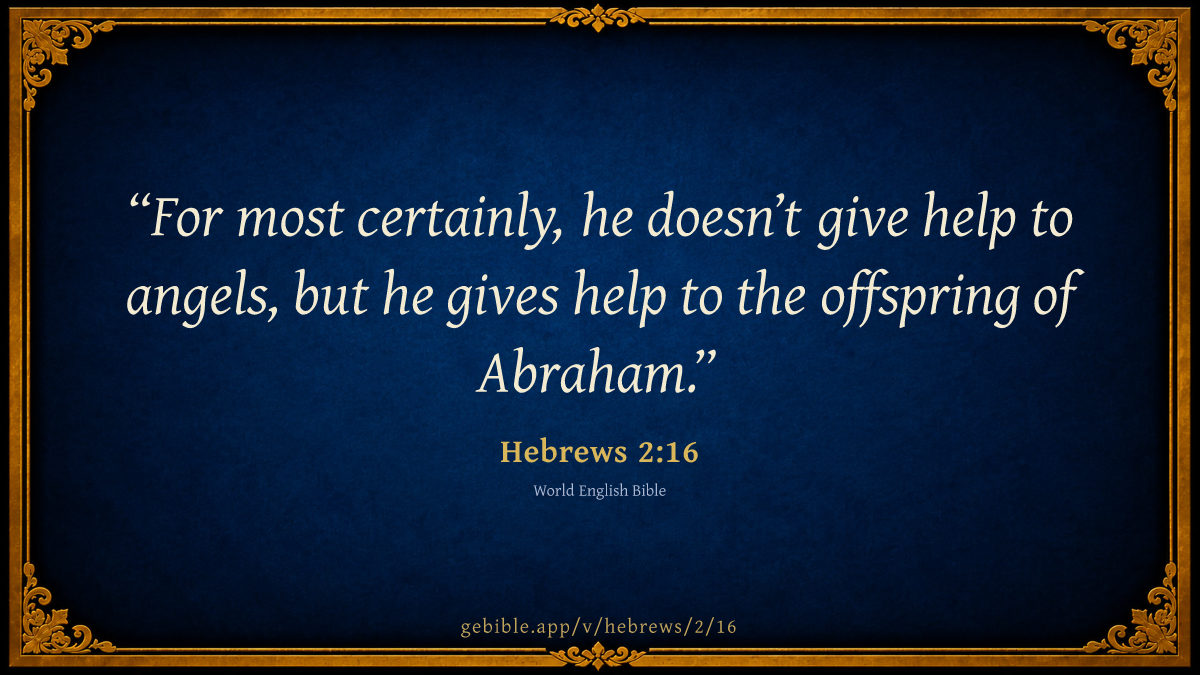
For most certainly, he doesn’t give help to angels, but he gives help to the offspring of Abraham.
Parallel Translations
-
For most certainly, he doesn’t give help to angels, but he gives help to the offspring of Abraham.
-
For he in no place taketh on him the angels: but the seede of Abraham taketh he on him.
-
For he in no sort tooke on him the Angels nature, but hee tooke on him the seede of Abraham.
Examined in Scripture Analysis
Contradictions (1)
Questions where the Bible appears to say two different things, with the passages on each side set together.
Cross-references (7)
Passages linked to Hebrews 2:16 in the Treasury of Scripture Knowledge, ordered by reader-vote popularity; verse text shown in World English Bible.
- Galatians 3:29 If you are Christ’s, then you are Abraham’s offspring and heirs according to promise.
- Romans 4:16-25 For this cause it is of faith, that it may be according to grace, to the end that the promise may be sure to all the offspring, not to that only which is of the law, but to that also which is of the faith of Abraham, who is the father of us all. As it is written, “I have made you a father of many nations.” This is in the presence of him whom he believed: God, who gives life to the dead, and calls the things that are not, as though they were. Besides hope, Abraham in hope believed, to the end that he might become a father of many nations, according to that which had been spoken, “So will your offspring be.” Without being weakened in faith, he didn’t consider his own body, already having been worn out, (he being about a hundred years old), and the deadness of Sarah’s womb. Yet, looking to the promise of God, he didn’t waver through unbelief, but grew strong through faith, giving glory to God, and being fully assured that what he had promised, he was also able to perform. Therefore it also was “credited to him for righteousness.” Now it was not written that it was accounted to him for his sake alone, but for our sake also, to whom it will be accounted, who believe in him who raised Jesus, our Lord, from the dead, who was delivered up for our trespasses, and was raised for our justification.
- Galatians 3:16 Now the promises were spoken to Abraham and to his offspring. He doesn’t say, “To descendants”, as of many, but as of one, “To your offspring”, which is Christ.
- Genesis 22:18 All the nations of the earth will be blessed by your offspring, because you have obeyed my voice.’ ”
- Romans 2:25 For circumcision indeed profits, if you are a doer of the law, but if you are a transgressor of the law, your circumcision has become uncircumcision.
- Hebrews 6:16 For men indeed swear by a greater one, and in every dispute of theirs the oath is final for confirmation.
- Hebrews 12:10 For they indeed, for a few days, punished us as seemed good to them; but he for our profit, that we may be partakers of his holiness.
Cross-references from openbible.info (CC BY 4.0)
Explain this verse (22 sources)
Historical commentary, presented as a primary source — not an endorsement.
Private notes
Saved on this device only — never synced or sent anywhere.
John Calvin 1540 · Public Domain 16. For verily, or, For nowhere, etc. By this…
16. For verily, or, For nowhere, etc. By this comparison he enhances the benefit and the honor with which Christ has favored us, by putting on our flesh; for he never did so much for angels. As then it was necessary that there should be a remarkable remedy for man’s dreadful ruin, it was the design of the Son of God that there should be some incomparable pledge of his love towards us which angels had not in common with us. That he preferred us to angels was not owing to our excellency, but to our misery. There is therefore no reason for us to glory as though we were superior to angels, except that our heavenly Father has manifested toward us that ampler mercy which we needed, so that the angels themselves might from on high behold so great a bounty poured on the earth. The present tense of the verb is to be understood with reference to the testimonies of Scripture, as though he set before us what had been before testified by the Prophets.
But this one passage is abundantly sufficient to lay prostrate such men as Marcion and Manicheus, and fanatical men of similar character, who denied Christ to have been a real man, begotten of human seed. For if he bore only the appearance of man, as he had before appeared in the form of an angel, there could have been no difference; but as it could not have been said that Christ became really an angel, clothed with angelic nature, it is hence said that he took upon him man’s nature and not that of angels.
Read full note →
And the Apostle speaks of nature, and intimates that Christ, clothed with flesh, was real man, so that there was unity of person in two natures. For this passage does not favor Nestorius, who imagined a twofold Christ, as though the Son of God was not a real man but only dwelt in man’s flesh. But we see that the Apostle’s meaning was very different, for his object was to teach us that we find in the Son of God a brother, being a partaker of our common nature. Being not therefore satisfied with calling him man, he says that he was begotten of human seed; and he names expressly the seed of Abraham, in order that what he said might have more credit, as being taken from Scripture.
John Calvin's Commentaries (1540-1563) — public domain. Text from the Calvin Translation Society English edition (1840s-50s) via the Christian Classics Ethereal Library (ccel.org). Calvin's coverage is partial (roughly two-thirds of the Bible); uncommented books and verses are honest gaps, never fabricated. The 19th-century editor's footnotes and remarks are omitted so the notes are faithfully Calvin's own voice.
Geneva Bible translators 1599 · Public Domain The nature of Angels.
The nature of Angels.
The very nature of man.
Read full note →
He expoundeth those words of flesh and blood, showing that Christ is true man, and not by turning his divine nature, but by taking on man’s nature. And he nameth Abraham, respecting the promises made to Abraham in this behalf.
Geneva Bible (1599) marginal notes — public domain.
John Trapp 1656 · Public Domain 16 For verily he took not on him the…
16 For verily he took not on him the nature of angels; but he took on him the seed of Abraham.
Ver. 16. For verily he took not] επιλαμβανεται. Or, for nowhere took he, q. d. We find not anywhere, either in the Scriptures or in any Church record.
Read full note →
But he took] He assumed, apprehended, caught, laid hold on, as the angel did on Lot, Gen 19:16, as Christ did on Peter, Mat 14:31, as men use to do upon a thing they are glad they have got and are loth to let go again. It is a main pillar of our comfort, that Christ took our flesh, for if he took not our flesh, we are not saved by him. But he not only took it, but overtook it by running after it, as the shepherd doth the sheep that is run away. A shepherd witha sheep upon his shoulder, engraved upon the communion cup, in the primitive times of the gospel, imported the same notion that here seems implied.
John Trapp, A Commentary or Exposition upon All the Books of the Old and New Testament (1647–1656) — public domain. Text from a community e-Sword module.
Matthew Poole 1685 · Public Domain For verily he took not on him the nature…
For verily he took not on him the nature of angels: the Spirit having asserted the deliverance of the children from their slavery to the devil, shows here the means by which it was effected, even by the gospel Prophet, being a man, and not an angel; he took their nature to himself, that by death he might deliver them: ου δηπου may signify no where, or in no wise; επιλαμβανεται is read by some, to take hold of, and so make this work denied of God the Son, that he did not take hold of the falling angels, to save or recover them: but the Spirit speaks not one word of lapsed angels in either this or the foregoing chapter, and so it cannot refer to them; and for good angels, they never departed or fell, that he should stretch out his hand to save them. And it cannot be understood otherwise than affirmatively here, which must needs have another sense, because the same act is denied and affirmed. The word therefore signifieth to assume, or to take to one, to assume or take into union. He united not to his person the angelical nature, the individual substance of an angel, so as to redeem those sinning lapsed spirits.
But he took on him the seed of Abraham; but he assumed into union with his person the seed of Abraham; which seed is not to be understood here collectively, for either his carnal or believing seed; but it is the one singular, eminent Seed of Abraham, in and by whom, himself, his seed, and all nations were to be blessed, Gen 22:18, compare Gal 3:16, the man Christ Jesus. This man, God the Son took of the virgin Mary, the offspring of Abraham, and united him to his person, and of God and this Seed united into one person, became our Lord Jesus Christ, so as he might bring the blessing of salvation to the chosen of God in all nations. The assumption of this eminent Seed into the unity of his own person, is here asserted by the Spirit, and denied concerning any angel, there being no promise ever made to them for it, Zec 13:7; Luk 1:31,35; Ga 4:4; 1Ti 2:5. If the verb signify no such assumption in human authors, as some cavil, it is because the matter to which it is here applied was never treated on among them; and it is common with the Spirit to make words which are ordinary with men, transcendent, when he applieth them to the great mysteries of God, as Trinity, Son, adoption, &c.
Matthew Poole's English Annotations on the Holy Bible (1683–1685) — public domain. Text from a community e-Sword/MySword module.
William Burkitt 1703 · Public Domain It may be rendered from the original thus: He…
It may be rendered from the original thus: He catched no hold on angels, but on man he catched hold. A metaphor taken from a person that catches hold of another who is falling down some deep and dangerous precipice, to his inevitable destruction: such a good and kind office did the Son of God for us, when he suffered angels to fall headlong from that state of happiness in which they were created, into that abyss and gulf of misery into which they had plunged themselves by their voluntary transgression: the like unto which man also has done, had he not been seasonably catched by the Son of God in the arms of preventing grace and mercy.
Learn, That it was not the angelical, but the human nature; it was the nature of fallen man, and not of lapsed angels, which the Son of God did vouchsafe to assume, and to take into a personal union with his Godhead.
Read full note →
Question. Why would not Christ take upon him the nature of angels?
1. Probably because they were the first transgressors, and God might judge it decent that the first breach of the divine law should be punished with death, to secure obedience for the future:
Or, 2. Because the angels sinned without a tempter, they had no superior rank of creatures already fallen, as man had, to seduce and draw them from their obedience to their Creator’s will;
Or, 3. Because the angels sinned against more clear and convictive light and knowledge: there was nothing of weakness, deceit, or ignorance, to lessen the malignity of their sin; they did not sin by mispersuasion, but of purposed malice. But, after all, the reason why Christ took not hold on the angels, but on man, the seed of Abraham, must be ultimately resolved into the sovereignty of God’s will, who will be merciful.
Lord!, why mercy, thy milder attribute, should be exercised towards man, and justice, thy severer attribute, be executed upon angels; why vessels of clay be chosen, and vessels of gold rejected, must be resolved into that love which passeth knowledge; and we shall never fully understand the riches of this discriminating grace, until thy dear Son shall appear at the great day, as their judge and our justifier. Then shall we feel the comfort of these words, That Christ took not upon him the nature of angels, but in the seed of Abraham.
William Burkitt's Expository Notes on the New Testament (1700–1703) — public domain. Text from a community e-Sword module.
John Gill 1763 · Public Domain Wherefore in all things it behoved him to be…
Wherefore in all things it behoved him to be made like unto his brethren,.... The adopted sons of God, who were brethren before Christ's incarnation, being from all eternity predestinated to the adoption of children: Christ's incarnation was in time, and after that many of the brethren existed; and it was only for their sakes that he assumed human nature; and therefore it was proper he should be like them in that nature, in all things: in all the essentials of it; it was not necessary that he should have it by natural generation; nor that it should have a subsistence in itself as theirs: and in all the properties and affections of it, that are, not sinful; for it did not behove him to be like them in sin, nor in sickness, and in diseases of the body: and in all temptations; though in some things his differ from theirs; none of his arose from within; and those from without could make no impression on him: and in sufferings, that there might be a conformity between the head and members; though there is in some things a difference; his sufferings were by way of punishment, and were attended with wrath, and were meritorious, which cannot be said of theirs; but that he should have an human nature, as to its essence and perfection, like to theirs, was necessary: it was proper he should be truly and really man, as well as truly God,
that he might be a merciful and faithful high priest; he could not be an high priest, offer sacrifice for sin, and make intercession, unless he was man; nor could he be a "merciful" and compassionate one, sympathize with his people in their sorrows, temptations, and sufferings, unless he was like them in these; nor would he be a "faithful", that is, a true and lawful one otherwise, because every high priest is taken from among men:
Read full note →
in things pertaining to God; in things in which God has to do with his people, as to preside in his name over them, to declare his will unto them, and bless them; and in things in which the people have to do with God, to offer to God a sacrifice for their sins, to present this sacrifice to him, to appear in his presence for them, to carry in their petitions, and plead their cause as their advocate:
to make reconciliation for the sins of the people; of God's covenant people, the people he has chosen for himself, and given to his Son; and whom Christ saves from their sins, by making satisfaction for them, to the law and justice of God, which is here meant by reconciliation: and in order to this, which could not be done without blood, without sufferings and death, it was proper he should be man, and like unto his brethren: the allusion seems to be to the two goats on the day of atonement, one of which was to be slain, and the other let go; which were to be, as the Jews say (p), "alike", in colour, in stature, and in price; and so were the birds to be alike in the same things, that were used at the cleansing of the leper (q): and the Jews tell us (r), that the high priest was to be greater than his brethren, in beauty, in strength, in wisdom, and in riches; all which is true of Christ.
(p) Misna Yoma, c. 6. sect. 1. (q) Misna Negaim, c. 14. sect. 5. (r) T. Bab. Horayot, fol. 9. 1. Maimon. Cele Hamikdash, c. 5. sect. 1.
John Gill's Exposition of the Whole Bible (1746–1763) — public domain (CC PDM 1.0). Text via the HelloAO Bible API.
John Wesley 1765 · Public Domain For verily he taketh not hold of angels -…
For verily he taketh not hold of angels - He does not take their nature upon him. But he taketh hold of the seed of Abraham - He takes human nature upon him. St. Paul says the seed of Abraham, rather than the seed of Adam, because to Abraham was the promise made.
John Wesley, Explanatory Notes Upon the Whole Bible (1754–1765) — public domain. Text via the GEBible commentary corpus.
Adam Clarke 1810 · Public Domain Verse 16. For verily he took not on him…
Verse 16. For verily he took not on him the nature of angels] Ου γαρ δηπου αγγελων επιλαμβανεται, αλλα σπερματος Αβρααμ επιλαμβανεται. Moreover, he doth not at all take hold of angels; but of the seed of Abraham he taketh hold. This is the marginal reading, and is greatly to be preferred to that in the text Jesus Christ, intending not to redeem angels, but to redeem man, did not assume the angelic nature, but was made man, coming directly by the seed or posterity of Abraham, with whom the original covenant was made, that in his seed all the nations of the earth should be blessed; and it is on this account that the apostle mentioned the seed of Abraham, and not the seed of Adam; and it is strange that to many commentators should have missed so obvious a sense. The word itself signifies not only to take hold of, but to help, succour, save from sinking, c. The rebel angels, who sinned and fell from God, were permitted to fall downe, alle downe, as one of our old writers expresses it, till they fell into perdition: man sinned and fell, and was falling downe, alle downe, but Jesus laid hold on him and prevented him from falling into endless perdition. Thus he seized on the falling human creature, and prevented him from falling into the bottomless pit but he did not seize on the falling angels, and they fell down into outer darkness. By assuming the nature of man, he prevented this final and irrecoverable fall of man; and by making an atonement in human nature, he made a provision for its restoration to its forfeited blessedness. This is a fine thought of the apostle, and is beautifully expressed. Man was falling from heaven, and Jesus caught hold of the falling creature, and prevented its endless ruin. In this respect he prefers men to angels, and probably for this simple reason, that the human nature was more excellent than the angelic; and it is suitable to the wisdom of the Divine Being to regard all the works of his hands in proportion to the dignity or excellence with which he has endowed them.
Adam Clarke's Commentary on the Bible (1810–1826) — public domain. Text from a community e-Sword/MySword module.
Joseph Benson 1811 · Public Domain Heb 2:16. For verily he took not on him…
Heb 2:16. For verily he took not on him — Greek, ου γαρ αγγελων επιλαμβανεται, he took, or taketh, not hold of angels, to save them from the abyss of misery into which they are fallen, as not taking their nature upon him; but he took, or taketh, hold of the seed of Abraham — And hath made a gracious provision for the salvation of all who shall by true faith approve themselves the genuine children of that holy patriarch. The apostle says, the seed of Abraham, rather than the seed of Adam, because to Abraham was the promise made. “If the sin of the angels, who, as Jude tells us, (Heb 2:6,) kept not their own office, consisted in their aspiring after higher stations and offices than those originally allotted to them by God, as Jude’s expression intimates, we can see a reason why the Son of God did not take hold of them to save them, but took hold of the seed of Abraham; that is, of believers of the human species. The first parents of mankind sinned through weakness of nature and inexperience, and by their lapse brought death on themselves and on their posterity, notwithstanding their posterity were not accessory to their offence. Whereas the angels, through discontentment with their own condition, and envy of their superiors, perhaps also animated by pride, rebelled presumptuously against God. Wherefore, since they could not plead weakness of nature and inexperience in excuse of their sin, nor complain that the sin for which they were doomed to punishment was the act of another, they were justly left by the Son of God to perish in their sin.” — Macknight.
Joseph Benson's Commentary on the Old and New Testaments (1811–1818) — public domain. Text from a community e-Sword module.
Albert Barnes 1834 · Public Domain For verily - Truly.
For verily - Truly.
He took not on him the nature of angels - Margin, “He taketh not hold of angels, but of the seed of Abraham he taketh hold.” The word used here - ἐπιλαμβάνεται epilambanetai - means, to take hold upon; to seize; to surprise; to take hold with a view to detain for oneself. Robinson. Then it means to take hold of one as by the hand - with a view to aid, conduct, or succour; Mar 8:23; Act 23:19. It is rendered “took,” Mar 8:23; Luk 9:47; Luk 14:4; Act 9:27; Act 17:19; Act 18:17; Act 21:30, Act 21:33; Act 23:19; Heb 8:9; “caught,” Mat 14:31; Act 16:19; “take hold,” Luk 20:20, Luk 20:26; “lay hold,” and “laid hold,” Luk 23:26; 1Ti 6:12. The general idea is that of seizing upon, or laying hold of anyone - no matter what the object is - whether to aid, or to drag to punishment, or simply to conduct. Here it means to lay hold with reference to “aid,” or “help;” and the meaning is, that he did not seize the nature of angels, or take it to himself with reference to rendering “them” aid, but he assumed the nature of man - in order to aid “him.” He undertook the work of human redemption, and consequently it was necessary for him to be man.
Read full note →
But he took on him the seed of Abraham - He came to help the descendants of Abraham, and consequently, since they were men, he became a man. Writing to Jews, it was not unnatural for the apostle to refer particularly to them as the descendants of Abraham, though this does not exclude the idea that he died for the whole human race. It was true that he came to render aid to the descendants of Abraham, but it was also true that he died for all. The fact that I love one of my children, and that I make provision for his education, and tell him so, does not exclude the idea that I love the others also - and that I may make to them a similar appeal when it shall be proper.
Albert Barnes' Notes on the Bible (1834–1885) — public domain. Text from a community e-Sword/MySword module.
Haydock's Catholic Bible Commentary 1859 · Public Domain For nowhere doth he take hold of the Angels.[4]…
For nowhere doth he take hold of the Angels.[4] Literally, that he apprehendeth, or layeth hold on the Angels; that is, according to the common interpretation, we nowhere find that he hath united their nature to his divine person to save them, though a great part of them had also sinned and fallen from heaven. But he taketh the seed of Abraham; i.e. he became man of the seed or race of Abraham, to redeem or save mankind. (Witham) --- Nowhere, &c. That is, he never took upon him the nature of Angels, but that of the seed of Abraham. (Challoner)
===============================
Read full note →
[BIBLIOGRAPHY]
Nusquam enim Angelos apprehendit, sed semen Abrahæ apprehendit, Greek: epilambanetai, assumit, vel assumpsit.
====================
George Leo Haydock (1774–1849), Haydock's Catholic Family Bible and Commentary, 1859 edition — public domain. Excludes Psalms (Douay-Rheims chapter numbering differs from Protestant) and Deuterocanonical books (Catholic canon only).
Robert Jamieson, A. R. Fausset & David Brown 1871 · Public Domain For verily--Greek, "For as we all know"; "For as…
For verily--Greek, "For as we all know"; "For as you will doubtless grant." Paul probably alludes to Isa 41:8; Jer 31:32, Septuagint, from which all Jews would know well that the fact here stated as to Messiah was what the prophets had led them to expect.
took not on him, &c.--rather, "It is not angels that He is helping (the present tense implies duration); but it is the seed of Abraham that He is helping." The verb is literally, to help by taking one by the hand, as in Heb 8:9, "When I took them by the hand," &c. Thus it answers to "succor," Heb 2:18, and "deliver," Heb 2:15. "Not angels," who have no flesh and blood, but "the children," who have "flesh and blood," He takes hold of to help by "Himself taking part of the same" (Heb 2:14). Whatever effect Christ's work may have on angels, He is not taking hold to help them by suffering in their nature to deliver them from death, as in our case.
Read full note →
the seed of Abraham--He views Christ's redemption (in compliment to the Hebrews whom he is addressing, and as enough for his present purpose) with reference to Abraham's seed, the Jewish nation, primarily; not that he excludes the Gentiles (Heb 2:9, "for every man"), who, when believers, are the seed of Abraham spiritually (compare Heb 2:12; Psa 22:22, Psa 22:25, Psa 22:27), but direct reference to them (such as is in Rom 4:11-12, Rom 4:16; Gal 3:7, Gal 3:14, Gal 3:28-29) would be out of place in his present argument. It is the same argument for Jesus being the Christ which Matthew, writing his Gospel for the Hebrews, uses, tracing the genealogy of Jesus from Abraham, the father of the Jews, and the one to whom the promises were given, on which the Jews especially prided themselves (compare Rom 9:4-5).
Jamieson, Fausset & Brown — Commentary Critical and Explanatory on the Whole Bible (1871) — public domain (CC PDM 1.0). Text via the HelloAO Bible API.
Daniel D. Whedon 1874 · Public Domain 16. Took not on him—This verb signifies primitively to…
16. Took not on him—This verb signifies primitively to grasp, to take hold of; generally with some degree of force or earnestness. This taking is for the purpose of aid, or to possess and appropriate. Hence a difference of opinion between commentators; some of whom render it as in our translation, and others (as Alford) translate it simply “helpeth.” The word truly includes both ideas, namely, to forcibly grasp, to seize, and a purpose thereby to aid, to rescue, to redeem. Our author did not mean simply to help, otherwise he would have used the ordinary Greek verb for to help; but he means to help by grasping forcibly the seed of Abraham. And the very word seed implies a lineage genetically assumed. The previous Heb_2:14-15, affirm Christ’s partaking our nature to deliver us from fear of death; this verse confirms that thought by specifying his omitting angels and redemptively assuming manhood; and Heb_2:17 urges the perfect fitness of that assumption.
Seed of Abraham—A touching fact for these Hebrews, sons of Abraham, whose special lineage Christ assumed. He was their Abrahamic brother, and they were of the Messianic family of man. Why shrink from that suffering cross, which was truly glorious to the Sufferer and honouring to a Hebrew?
Daniel D. Whedon (gen. ed.), Commentary on the Old and New Testaments (1874–1909) — public domain. Text from a community e-Sword module.
The Cambridge Bible for Schools and Colleges 1878 · Public Domain 16. For verily he took not on him the…
16. For verily he took not on him the nature of angels] Rather, “for assuredly it is not angels whom He takes by the hand.” The word δήπου, “certainly,” “I suppose,” occurs here only in the N. T. or LXX., though common in Philo. In classic Greek it often has a semi-ironic tinge, “you will doubtless admit that,” like opinor in Latin. All are now agreed that the verb does not mean “to take the nature of,” but “to take by the hand,” and so “to help” or “rescue.” Beza indeed called it “execrable rashness” (exsecranda audacia) to translate it so, when this rendering was first adopted by Castellio in 1551; but the usage of the word proves that this is the only possible rendering, although all the Fathers and Reformers take it in the other way. It is rightly corrected in the R. V. (comp. Isa_49:9-10; Jer_31:32; Heb_8:9; Mat_14:31; Wis_4:11, “Wisdom … takes by the hand those that seek her”). To refer “he taketh not hold” to Death or the Devil is most improbable.
the seed of Abraham] i.e. He was born a Hebrew. He does not at all mean to imply that our Lord came to the Jews more than to the Gentiles, though he is only thinking of the former.
The Cambridge Bible for Schools and Colleges (gen. ed. J. J. S. Perowne; Cambridge University Press, 1878–1918) — public domain. Text from a community e-Sword module.
Ellicott's Commentary for English Readers 1878 · Public Domain (16) He took not on him the nature of…
(16) He took not on him the nature of angels.—The rendering of the margin approaches very nearly the true meaning of the verse; whereas the text (in which the Authorised version differs from all our earlier translations) introduces confusion into the argument. Having spoken in Heb_2:14 of our Lord’s assumption of human nature, the writer in these words assigns the reason: “For surely it is not of angels that He taketh hold, but He taketh hold of the seed of Abraham.” Though the words “take hold,” which occur twice in the verse, probably cannot directly signify “help” (as is often maintained), they distinctly suggest laying hold for the sake of giving help; and a beautiful illustration may be found in some of the Gospel narratives of our Lord’s works of healing (Mar_8:23; Luk_14:4). It is probable that the language used here is derived from the Old Testament. In Heb_8:9, a quotation from Jeremiah 31, we read, “In the day when I took them by the hand to lead them out of the land of Egypt.” Isa_41:8-9, however, is perhaps a still closer parallel (for the word used in the Greek version is very similar, and no doubt expresses the same meaning): “Thou Israel, my servant, Jacob whom I have chosen, the seed of Abraham my friend; thou of whom I have taken hold from the ends of the earth.” If the writer had these verses in his thought, it is hardly necessary to inquire why he chooses the expression “seed of Abraham,” instead of one of (apparently) wider meaning, such as Heb_2:7-8, might seem to require. But even apart from this passage of Isaiah, and the natural fitness of such a phrase in words addressed to Jews, we may doubt if any other language would have been equally expressive. For as to the means, it was by becoming a child of Abraham that the Saviour “took hold of” our race to raise it up; and as to the purpose, St. Paul teaches us that “the seed of Abraham” includes all who inherit Abraham’s faith.
A Bible Commentary for English Readers, edited by Charles John Ellicott (1878–1897) — public domain. Text from a community e-Sword module.
The Pulpit Commentary 1880 · Public Domain Vers. 16, 17. For verily, etc. The A.V (following…
Vers. 16, 17. For verily, etc. The A.V (following the ancient interpreters) takes this verse as referring to the Incarnation. But
(1) epilambanesyai spermatov and, still more, epilambanesyai aggelwn , seems an awkward way of expressing "to assume the nature of." The usual sense of the verb, followed by a genitive, is "to take hold of," as epilambanesyai ceirov ; (Act_23:19 Mar_8:23) and especially in the sense of "succouring", (cf. Mat_14:31 Heb_8:9 Isa 31) En hmera epilambomenou mou thv ceiro ; and Ecc_4:11, H sofia epilambanetai twn zhtountwn authn .
Read full note →
(2) The present tense of the verb is inappropriate to the past act of the Incarnation, which has, moreover, been sufficiently declared in ver. 14.
(3) The sequence of though in the following verse is not easily intelligible if the Incarnation be the subject of this:" Whence it behooved him to be made like unto his brethren; this does not follow from his having become incarnate; we should rather say that his incarnation was the means of his being made like them. Translate, therefore, observing the position of the substantives before the verbs, For not, I ween, angels cloth he lay hold of (to succor them), but the seed of Abraham he doth lay hold of. The allusion is to its being the human "children of promise," and not angels, that are denoted in prophecy as being, and acknowledged to be, the object of the Messianic redemption. The expression, "the seed of Abraham," is, of course, not intended to exclude the Gentiles: it is appropriately used in reference to the Messianic promises of the Old Testament: (cf. Gen_23:18 Isa_41:8) and the extension of its meaning to "all them that believe" would be as familiar to the first readers of the Epistle as to us. (cf. Mat_3:9 Joh_8:39 Rom_4:11, Rom_4:16) The conclusion of ver. 17 (which repeats virtually what has been alleged before, after reason given) now naturally follows: Whence it behooved him in all things to be assimilated to his brethren; i.e. to the race which was the object of his redemptive succor. But, further, why the need of this entire assimilation, to the extent of participation in suffering unto death? That he might become a merciful (or, compassionate) high priest, in things pertaining to God, to make propitiation for the sins of the people . It was that he might be fully constituted as the High Priest of humanity. Here, according to the manner of the Epistle, the view of priesthood, to be afterwards set forth at length, is briefly hinted. It is taken up in Heb 5, after the conclusion that Christ is man"s High Priest has been reached by another line of argument (see preceding summary). In Heb 5 one of the essentials of a true high priest (whose office is to mediate for man in things pertaining to God) is set forth as being that he should be of the same race and nature with those for whom he mediates, and able in all respects to sympathize with them: and this view is here foreshadowed.
The reasons why Christ redeemed men rather than angels. "For verily he took not on him the nature of angels," etc. The rendering of the Revised Version gives the true meaning: "For verily not of angels doth he take hold, but he taketh hold of the seed of Abraham." The text starts a very grave inquiry. Why did Christ come to the help of lost men in preference to that of lost angels? Seeing that both were fallen, both were in a state of sin and misery, and neither were able to save themselves, nor had any claim upon his pity and power, why did the Divine Being determine to raise and restore lost men, while leaving lost angels in darkness and ruin? First we will endeavor to answer this inquiry negatively.
I NOT BECAUSE THAT, WHILE MEN NEEDED HELP, ANGELS DID NOT NEED IT. Man needed Divine redemption. A sinner, he needs forgiveness; lost, he needs restoration, etc. The sacred Scriptures, the history of our race, and our personal experience, unite in affirming our need of the saving help of Jesus Christ. The Word of God assures us that there are angels who also need help. It tells of a number of fallen, sinful, suffering angelic beings who are reserved in bondage and darkness until the day of final account. (see Joh_8:44 2Pe_2:4 Joh_3:8 Jud_1:6 Rev_20:10) Their need is as great as man"s.
II NOT BECAUSE ANGELS WERE IN ANY WAY INFERIOR TO MEN EITHER IN NATURE OR ABILITY. TO US it would have seemed probable that, if only one of the two races of sinners was to be saved, the preference would have been given to the greater of the two. Regarding the matter from our standpoint, the greater and more glorious a being is the more worthy is he of redemption, and the treasures of wisdom and love expended in his redemption will lead to richer results. It was not on this principle that God, in his Son, came to the help of men and not to that of angels. In being and capacity we believe that angels are greater than men. In our remarks on the preceding chapter we endeavored to show that angels are the highest orders of created beings. And the fall of angels did not strip them of their power. And since angels are greater than men, it follows that their fall must have been greater. Their immense powers being perverted render them mightier for mischief than beings el inferior powers could be. Hence how great was their need of help! And if restored to their original condition, would not their restoration bring greater glory to their Restorer than the restoration of beings who are lower in the scale of being?
III NOT BECAUSE ANGELS, IF LEFT WITHOUT HELP, WOULD SUFFER LESS THAN MEN WOULD HAVE DONE IF THEY HAD BEEN SO LEFT. The greatest sufferings are not those of the body, but those of the mind and heart. And the measure of suffering endured by any one is regulated by his mental and moral capacity. Therefore, if our estimate of angelic capacity be correct, being left without redemption the sufferings of angels will be greater than man"s would have been if he had been so left. Their vast powers must be terrible instruments of self-torture. Their remembrance of the irrevocable past must also augment their misery. Their recollection of their lost heritage must greatly increase the anguish which afflicts them. But we have no such memories. Only two of our race experienced the joys of that Eden from which sin has exiled us. We know not the peace and bliss of the human heart in its original state. Hence we conclude that the sufferings of angels are greater than those of men would have been if they had been left without the saving help of God.
IV NOT BECAUSE OF AN ARBITRARY SOVEREIGNTY ON THE PART OF GOD. The sovereignty of God is the sovereignty of infinite wisdom and love. To say that he chose to restore mankind and to leave angels to their dread doom because of his sovereignty is unsatisfactory. He made the choice in his sovereignty; but what was the reason for the exercise of his sovereignty in this particular way? He is absolutely independent; but he ever acts from wise and worthy reasons, and never from caprice or for the mere assertion of his sovereignty. We may not be able always to discover the reasons of his decisions and deeds; but there are reasons, and perfect ones, for them all, though we see them not. Thus far, then, we have met with no good ground why the Deity should have determined to save lost men rather than lost angels. Our examination would have led us to conclude rather, that if one race was to be helped and the other abandoned, the angelic sinners would have been elected to the blessing. Let us now answer the inquiry which is before us affirmatively.
I BECAUSE THE GUILT OF FALLEN ANGELS WAS GREATER THAN THAT OF MAN. We attach much greater guilt to one who commits a crime with little or no temptation, than we do to one who commits the same crime under the influence of powerful temptation. Now, Satan was not tempted to sin by any force without himself. We cannot trace the origin of sin beyond Satan. How inexpressibly guilty must he be who generated the first sinful thought, and that in a universe of light and holiness! But man, in the young days of his innocence, was tempted to sin by a subtle, powerful being. The temptation was presented in a pleasing and persuasive form; it appealed at once to the sense of taste, to the love of beauty, and to the desire for knowledge; and man yielded to it, and fell. But his guilt appears to us to be far less than that of the angels who sinned. Is it not a reasonable conclusion that God marks the degrees of guilt, notes every aggravating or extenuating circumstance, and treats the offender accordingly?
II BECAUSE EVERY FALLEN ANGEL CONSENTED TO THE TRANSGRESSION BY WHICH THEY FELL, WHILE MAN, THROUGH THE LAWS OF HIS BEING, SUFFERS FROM THE SIN OF THE FIRST TRANSGRESSORS TO WHICH THEY ALONE CONSENTED. The sin of the angels affected only those of their number who were guilty of actual participation therein. But the condition of every man is greatly affected through the sin of the first parents of our race. The way in which men are brought into being differs from that of angels. Generation obtains amongst men, but not amongst angels. We are born with an inclination, a bias, to that which is evil. Were it not for the grace of God, that inclination would be irresistible. If Christ had not come to our help, we must have been utterly ruined by reason of a transgression for which we could not possibly have been in any way responsible. Here, then, we have a very powerful reason why God should provide redemption for man rather than for angels.
III BECAUSE THE PREFERENCE SHOWN TO MAN FURNISHES A STRIKING ILLUSTRATION OF DIVINE JUSTICE, WHICH EXERCISES A SALUTARY INFLUENCE ON BOTH UNFALLEN ANGELS AND REDEEMED MEN. Had the preference been given to fallen angels it would not have set forth the justice of God. It could not have been just to have provided help for the guiltier race while leaving the less guilty race to perish; or to have redeemed those who individually consented to the rebellion, while resigning to ruin untold millions who took no part in the sin by which their race fell. But in the preference given to fallen man, we have a clear manifestation of the justice of God. The fact that he has left fallen angels to their righteous doom, being known to the unfallen universe, will bind the good more firmly in their allegiance to the Almighty. And a knowledge of the great price with which fallen men were redeemed will so impress the saved with the evil of sin, and the justice of God, and the benevolence of the Divine Law, and the love of the heavenly Father, as to secure their everlasting and ever-growing loyalty to God. Thus even we, with our dim perceptions and feeble reason, can discover wise and worthy reasons for the Divine choice of lost man for redemption rather than of lost angels. "Just and true are all thy ways, thou King of saints;" "O the depth of the riches both of the wisdom and the knowledge of God!" etc. (Rom_11:33-36) Two inferences of great importance are deducible from our subject.
1. That the guilt of those who reject the proffered help of Christ is greater than that of fallen angels. How great soever the guilt of demons may be, they have not incurred that of rejecting the gracious offers of pardon and restoration. But those men who neglect the great salvation must quench the Holy Spirit, harden their hearts against the drawings of the Savior"s love, and the Mace of the Divine Father, etc. Of such sin even demons are not guilty.
2. That the blessedness of those who accept the help of Christ will be greater, in some respects, than that of holy angels. Angels have many joys, but the joy of redemption they know not; man alone knows that joy; and it appears to us that of all joys it must be the deepest, tenderest, intensest. Let us personally avail ourselves of the redemption which is in Christ Jesus. W.J.
The Pulpit Commentary (1880–1919), ed. H.D.M. Spence-Jones & Joseph S. Exell — public domain. Text from a community e-Sword module.
The Biblical Illustrator 1887 · Public Domain The nature of angels
Heb_2:16
The nature of angels
Read full note →
Angels
It must be a spiritual one,--for He maketh His angels spirits.
It must be very pure,--for they are the holy ones. Very lofty,--for they stand before the throne, and always behold Gods face. Very powerful, too, they must be,--for they excel in strength. And very busy they must be, and very humble,--for each has six wings, and with twain he covers his face, with twain he covers his feet, and with twain he does fly. And very accurate they must be,--for they bear their messages so faithfully. And very unselfish,--for they always give all the glory to God alone. They are not entirely spotless,--for He chargeth His angels with folly; and some did once fall. And they never seem to originate anything-they go where they are sent, they say what they are instructed, they do whatever they are told. Neither does their love appear to be so much their own love, as a love with which they are commissioned. And their office is not, for the most part, so much with the souls of men, to convert, or to influence, Or to comfort them, as with the outer circumstances of men--to minister to them in their dangers, in their wants, in their difficulties. And how does the nature of angels stand related to our own? Is it higher or lower? Originally, in Eden, I do not know; but I should say the angelic nature was then the lower, because that is said of man which is never said of angels, that he was made in the likeness of God, and because to man was given what was never given to angels--supremacy and sovereignty over all the works of God. The fallen nature of man is, on the whole, lower. But only a little--a little lower than the angels. But how is it with mans redeemed and renewed nature? Beyond a doubt, it is above angels; for such as Christs present glorified nature is, such is that. The angels never sing our song--theirs is jubilant, but ours is triumphant, their theme is creation, ours is grace; they praise God in His works, we adore and love Him in His Son. And do not you know that we shall judge angels, and that we shall reign with Christ for ever and ever. We bless God for His holy angels! We bless Him that there is anything so pure and beautiful in His creation for us to think of and to love. We bless Him that we have such presences, so stilling, so assuring, so restful. We bless Him for that incentive to all propriety in our solitary hours--an angels ear, and an angels eye. We bless Him for the debts we owe to those ethereal beings, of which we are yet but dimly conscious. We bless Him that they take charge of our daily walk, and our midnight slumbers, live bless Him that He commits it to creatures so lovely to exercise His merciful providences. We bless Him that they ministered so tenderly to their and our dear Lord in the days of His sojourn here, and that now they do all they do for us for that Jesuss sake. We bless Him that they take such pious interest in our spiritual welfare, and rejoice in the tears of which they know that the sadness is joy. We bless Him that those who look on us so kindly do also behold His face. We bless Him that when we come to die, it is they, those heavenly watchers, who shall waft our spirits on their wings to heaven. We bless Him that we with them, and they with us, we shall mingle our songs and our services, and encircle the throne together with our common praise.
We bless Him that when Christ, and we with Christ, shall come back again to this earth, we shall be attended by The glory of the holy angels. (J. Vaughan, M. A.)
He took on Him the seed of Abraham
Christian sympathy
We are all of one nature, because we are sons of Adam; we are all of one nature, because we are brethren of Christ. All those common feelings, which we have by birth, are far more intimately common to us, now that we have obtained the second birth. Our hopes and fears, likes and dislikes, pleasures and pains, have been moulded upon one model, have been wrought into one image blended and combined unto the measure of the stature of the fulness of Christ. Yes, and one thing needful; one narrow way; one business on earth; one and the same enemy; the same dangers; the same temptations; the same afflictions; the same course of life; the same death; the same resurrection; the same judgment. All these things being the same, and the new nature being the same, and from the same, no wonder that Christians can sympathise with each other, even as by the power of Christs sympathising in and with each of them. Nay, and further, they sympathise together in those respects too, in which Christ has not, could not have, gone before them; I mean in their common sins. This is the difference between Christs temptation and ours: His temptations were without sin, but ours with sin. Temptation with us almost certainly involves sin. We have still earthly principles in our souls, though we have heavenly ones, and these so sympathise with temptation, that, as a mirror reflects promptly and of necessity what is presented to it, so the body of death which infects us, when the temptations of this world assail it--when honour, pomp, glory, the worlds praise, power, ease, indulgence,sensual pleasure, revenge are offered to it--involuntarily responds to them, and sins--sins because it is sin; sins before the better mind can control it, because it exists, because its life is sin; sins till it is utterly subdued and expelled from the soul by the gradual growth of holiness and the power of the Spirit. Of all this, Christ had nothing. He was born of a pure Virgin, the immaculate Lamb of God; and though He was tempted, yet it was by what was good in the worlds offers, though unseasonable and unsuitable, and not by what was evil in them. He overcame what it had been unbecoming to yield to, while He felt the temptation. He overcame also what was sinful, but He felt no temptation to it. And yet it stands to reason, that though His temptations differed from ours in this main respect, yet His presence in us makes us sympathise one with another, even in our sins and faults, in a way which is impossible without it; because, whereas the grace in us is common to us all, the sins against that grace are common to us all also. We have the same gifts to sin against, and therefore the same powers, the same responsibilities, the same fears, the same struggles, the same guilt, the same repentance, and such as none can have but we. I do not of course mean to say that we are one and all at the same point in our Christian course, or have one and all had the same religious history in times past; but that, even taking a man who has never fallen from grace, and one who has fallen most grievously and repented, even they will be found to be very much like each other in their view of themselves, in their temptations, and feelings upon those temptations, than they might fancy beforehand. This we see most strikingly instanced when holy men set about to describe their real state. Even bad men at once cry out, This is just our case, and argue from it that there is no difference between bad and good. They impute all their own sins to the holiest of men, as making their own lives a sort of comment upon the text which his words furnish, and appealing to the appositeness of their own interpretation in proof of its correctness. And I suppose it cannot be denied, concerning all of us, that we are generally surprised to hear the strong language which good men use of themselves, as if such confessions showed them to be more like ourselves, and much less holy than we had fancied them to be. And on the other hand, I suppose, any man of tolerably correct life, whatever his positive advancement m grace, will seldom read accounts of notoriously bad men, in which their ways and feelings are described, without being shocked to find that these more or less cast a meaning upon his own heart, and bring out into light and colour lines and shapes of thought within him, which, till then, were almost in visible. Now this does not show that bad and good men are on a level, but it shows this, that they are of the same nature. They have common ground; and as they have one faith and hope, and one Spirit, so also they have one and the same circle of temptations, and one and the same confession. (J. H. Newman, D. D.)
On the Incarnation of Christ
I. WHAT IS NATURALLY INFERRED from Christs taking on Him the seed of Abraham.
1. The Divine nature of Christ.
2. The reality of Christs human nature.
3. The truth of His office, and the divinity of His mission.
4. His voluntary choice and design, to assume a condition here upon earth low and contemptible.
II. WHY CHRIST TOOK UPON HIM THE NATURE OF MAN, AND NOT OF ANGELS.
1. The transcendent greatness and malignity of the sin of the angels above that of men.
(1) As being committed against a much greater light, which is to be the proper guide and ruler of the will in all its choices.
(2) The sin of the angels commenced upon a greater liberty of will and freedom of choice. There was no devil to tempt them to become devils; no seducer of a stronger reason to impose upon theirs; they moved entirely upon the motives of an intrinsic malice.
2. The next, and perhaps the grand cause, that induced Christ to take upon Him the nature and mediation of men, and not of angels, might be this; that without such a Redeemer, the whole race and species of mankind had perished, as being all involved in the sin of their representative; whereas, though many of the angels sinned, yet as many, if not more, persisted in their innocence; so that the whole kind was not cashiered by a universal ruin, nor made unserviceable to their Creator, in the nobler instances of active obedience. (R. South, D. D.)
The Incarnation
I. The general scope of this passage you will all apprehend to be this, that the children of Adam, being now all children of wrath, ALL NEEDED A SAVIOUR; and the Saviour they needed must not be in the form of God, or of an angel; He must be in the likeness of sinful flesh; whatever else He is, HE MUST BE MAN. Accordingly, Jesus Christ, the Mediator, who was God from eternity, became man, in the fulness of time. Concerning God, even the Father, we know something from other sources than Revelation. Nature and Providence declare His eternal power and Godhead; whereas our acquaintance with the Son of God is derived from Revelation alone. But the Bible assures us that Jesus Christ is God--and it assures us also that He is man; and the assertion of His Godhead is equally positive as that of His manhood. As we are told, the Word was made flesh--that the Divine, and not any angelic nature, was incarnate; so, we may confidently infer, that the assumption of manhood by any inferior, or created spirit, would not have answered the mighty purposes of Gods mercy in our redemption. For the Divine wisdom will never employ a mightier agency than the occasion demands. Having thus stated the necessity, as this is evidently asserted in the Word of God, that our Saviour should unite in His person the nature of God and the nurture of man, I would proceed
II. To inquire, WHEREIN THAT NECESSITY CONSISTED?
1. I do not propose to inquire into the propriety of this dispensation, as it regards the Divine nature or the Divine government. We are, indeed, assured of the fact, that the incarnation of the divinity, and the atonement made by the God-man, were requisite, in order that the expression of mercy to sinners might not be inconsistent with the glorious character, which unites perfect holiness and rectitude with boundless love and compassion. God reveals these things to us only as far as our present necessities require; and further, with certainty of truth, we cannot go.
2. But, as regards ourselves, and their bearing on our interests, our Father in heaven is as liberal in His communications, as He is reserved in the other case. And I propose to suggest a few of the reasons which make it apparent, that, in order to perform the part of a Saviour to us, it behoved Christ, the Son of God, to take on Him the nature of man. That are our wants, our miseries, as sinners? We have broken the Divine law; and of course we are condemned. We need therefore, pardon or justification. This can be obtained only by a sacrifice. Therefore, we need a priest who may offer the sacrifice and reconcile us. Then, we are very weak; we need support. We are very stubborn; and therefore we need to have our hard hearts broken. We cannot regulate our actions; therefore, we need a law and a lawgiver: and we are exposed to powerful enemies, from whom, unless protected, we perish; and for all these reasons, it is manifest we need One who has the authority and power of a King. And yet further, we are most ignorant of that which we are infinitely concerned to know, which we are most unwilling to learn, and most ready to forget; which needs to be demonstrated to us, and impressed upon us with the most striking evidence; and so Christ is our Prophet. What is necessary to be shown is, that our Redeemer must be both Divine and human, otherwise He could not discharge any one of these three offices.
(1) It was needful that, in order to be a Priest, our Redeemer should be both God and man. If the Word had not become man, He could not have died mile could not have offered up a sacrifice, nor made expiation. A priest implies a sacrifice, as a father implies a child, a master a servant, a governor subjects. Wherefore He took human nature, and made it part of Himself, that He might have something to offer up to God. We need to advert here to two distinct and important considerations: the essence of a sacrifice, a real sacrifice, is obedience, contrary to the natural inclination or will of that which is sacrificed. The Divine nature of the Son could not be a sacrifice to God, having the very will of God itself. But every man has that distinct will which is of the essence of freedom and responsibility. The man Jesus had that will. It is impossible those sufferings He needed to endure that He might make His soul an offering for sin, should have been inflicted on our Priest, had He appeared to the world in the form of God. But that He might suffer from man whatever was necessary for mans redemption, He hid Himself under their own form, so that nothing of God might be visible but His moral glory, His holiness, His power, His rectitude, His unspeakable love, His unfathomable mercy: and men dared to inflict upon the Son of God so disguised, whatever the Divine government and their eternal salvation required. Our Priest, then, must be man. That He must be God, is too plain to need proof. A Divine sufferer alone could be a worthy sacrifice for the sins of the world. And now, oh, sinners, this wonderful Person is your Priest. The God-man made atonement, the God-man maketh intercession for you. Cling to His sacrifice; accept His mediation; plead His obedience with the Father.
2. But, secondly, because we are weak and wayward, and exposed to many foes, and powerful, therefore, we need a King. And none can be such a King as we need, but One who is both God and man. Almighty is His power, infinite His knowledge and wisdom, immeasurable His love, unfailing His rectitude; and He is bone of our bone, and flesh of our flesh. In all your frailties and ignorances and temptations manifold, remember that He your Divine Sovereign is man, and has suffered being tempted, and is qualified to succour you when ye are tempted. Let the almightiness and infinite love of your most gracious King, Gods Son, your Brother, assure your hearts that following Him, ye shall be conquerors, yea, more than conquerors.
3. It was necessary that our Prophet, He who should effectually teach us, should be not simply God, or mere man, but both: and none could so teach us who was not both God and man. It is a gross mistake to suppose that what mankind needed most was knowledge of good and evil; or that the possession of this knowledge, in even the highest perfection, is sufficient of itself to subdue the heart to the obedience and love of God. The Jews possessed this knowledge as much as we do. Even regarding the heathens themselves, I will make bold to affirm, there is scarcely a duty or rule of morality, laid down in the New Testament, but may be found expressed, with more or less clearness, in the writings of some one or more of their poets or philosophers. It was not necessary, therefore, that another temple of God should be reared of stones, or that, from that dead temple, the same dead law, the mere letter of outward and verbal instruction, should be promulgated. But when righteousness had grown a stranger upon earth, then God sent that Teacher, His Son, who should found a new, a living temple, of which He was the Foundation; and should be Himself a Living Law, not only informing men, but showing them, in His own life, what they should be; and overturning the notion that what He enjoined was impossible, by the undeniable performance of it by Himself in their own nature. He is an effectual Teacher, for He has power not only Himself to work the works of God, but to communicate that to others whereby they also may work them. His instruction is quickening and saving: He is the true light, for it is light which is the life of men. A perfect teacher of righteousness could neither be mere man, nor in the form of God. A mere man could not, as is evident from two plain reasons. He could not exemplify His own precepts--He could not prove that obedience was possible, and He could not give the Spirit, for the Spirit is God, and how could a man, a creature, communicate God the Creator? And yet, without the Spirit of God, no man can be taught of God. And now, let us suppose that Christ, the Prophet of the Church, had delivered His teaching to us in the form of God, that He taught us without being incarnate: might not the human heart have raised these plausible objections? Thou commandest me to keep Thy law, but Thou art God, and I am dust and ashes. Thou dost promise me the aid of Thy Spirit; but I have not seen or heard of any one in whom, by that aid, this end was accomplished. To prevent this murmur, and the reasons on which it might have rested, God became man, and, as man spoke to men from the same level on which they stood. We saw Him in humiliation, in sorrow, in the struggles of temptation, in the fears and agonies of death, ever in the battle, but ever aloft; and then finally victorious, when He seemed for ever vanquished, for, by yielding to death He conquered him and his ruler, in the irresistible might of weakness quelling all the powers of hell. This is our Redeemer, this our Saviour. This is He announced from of old, the Lamb slain from the foundation of the world. How wonderful, how glorious His person; uniting the majesty of the eternal God with the meanness of mortal man; qualified to do whatever was necessary to be done, to suffer whatever needed to be endured for the honour of God and the salvation of man! How mysterious is His condescension, how sublime His humility--the pure streams of His mercy overflowing the world, while the flames of His zeal consumed Himself. (R. Lee, D. D.)
On passing by angels to redeem wen
If He who made all things took upon Him mans nature, we may feel sure that there is in that nature some intrinsic excellence and greatness, one proof of which is that it is capable of being united with the Person of the Word who was in the beginning with God, and was God. But so, unquestionably, was the angels nature; for man is a little lower than the angels. Here were two fallen races before the eye of the Redeemer, and we cannot doubt that it was optional with Him to redeem either of them, or both. Why He did not redeem both must be left to sovereign wisdom.
I. FALLEN ANGELS, IF REDEEMED, WOULD NO DOUBT BECOME AS GREAT AND GLORIOUS AS BEFORE. We see in this world enough of degradation made by sin to keep us from doubting the power or sin to degrade fallen angels into devils, and devils into alliance with swine. But the memory of innocence and of bliss in heaven no doubt remains in them. What a good work it would have been to redeem that memory and restore that angel. How sad, one might say, to think that Christ would not redeem him, but went after South Sea Islanders and the aborigines of the British Isles, than whom none was ever more lost to shame, or more distant from God. And what a wicked world this, which He redeemed, has proved. Thus far the few are saved; the many hate God.
II. But in reply it may be said, HIS SUCCESS MIGHT HAVE BEEN NO BETTER HAD CHRIST MADE REDEMPTION FOR ANGELS INSTEAD OF FOR MEN. Angels might have invented objections to Him as men did; some might go so far as to deny His Godhead and incarnation, and ask whether a good God would let His innocent Son visit such an abode, to suffer and die for devils; and what virtue there could be in the sufferings of one for the sins of others; and whether it is just to substitute an innocent being for the guilty? It is the great mystery of wisdom that while God does His pleasure, it is in such a way that every man exercises his free choice.
III. THOSE WHOM DO NOT ACCEPT REDEMPTION PROVIDED FOR THEM BY THE SON OF GOD ARE TO BE ASSOCIATED HEREAFTER WITH A RACE OF SINNERS WHOM CHRIST DID NOT REDEEM. Nothing surely is better adapted to make us accept the offers of the gospel; for if Christ passed them by and came to save us, no fancy can picture what it must be to receive from His lips a consignment to their abode and to their society.
IV. THE SUBJECT OPENS TO US A VIEW OF HUMAN HAPPINESS FOR ALL WHO ACCEPT OF SALVATION. If the Redeemer sought the greater amount of happiness in those for whom He decided to make atonement, He surely will find it in us who enter heaven, not as a recovered seat from which we were ignominiously expelled, but a world new, untried, awakening in us sensations of wonder and joy which now it doth not enter into the heart of man to conceive. There will be a quality in our joy which could never be known to those who fell from heaven. And shall we lose it? Are we looking diligently lest any man fail of the grace of God? (N. Adams, D. D.)
Fallen humanity elected to redemption in preference to fallen angels
I. THERE ARE STRONG REASONS WHICH BLIGHT NAVE LED US TO SUPPOSE THAT GOD WOULD HAVE GIVEN THE PREFERENCE TO FALLEN ANGELS.
1. The superiority of angelic natures.
2. The probability of their greater misery.
3. Their greater competency of appreciating the redemptive act.
II. ALTHOUGH THERE RIGHT APPEAR STRONG REASONS FOR THE CHOICE OF FALLEN ANGELS, WE CAN DISCOVER MOST SATISFACTORY REASONS FOR THE ELECTION OF FALLEN MEN.
1. The election of men in preference to fallen angels furnishes a more striking manifestation of Divine justice.
2. A more striking manifestation of Divine independence.
3. A more striking manifestation of Divine condescension.
Lessons:
1. How cautious should we be in pronouncing judgment upon the conduct of God.
2. How devoutly earnest should mans acceptance of this redemption be.
3. How zealously should those who have become participaters of this redemption seek to extend it to others. (Homilist.)
Men chosen--fallen angels rejected
I. In the first place, the translation of our authorised version runs thus: HE TOOK NOT ON HIM THE NATURE OF ANGELS. Our Lord and Saviour Jesus Christ did not take upon Himself the nature of angels, this condescension dictated to Him, that if He did stoop, He would descend to the very lowest degree; that if He did become a creature, He would become, not the noblest creature, but one of the most ignoble of rational beings, that is to say, man, therefore, He did not stoop to the intermediate step of angelship, but He stooped right down and became a man. Let us notice the wisdom and the love of this, and I think there will be something to cause us to glorify God for so doing.
1. If Christ had taken upon Himself the nature of angels, He could never have made an atonement for man.
2. Had our Saviour become an angel, He would never have been a fitting example for us. I cannot imitate an angelic example. If you would give me something to imitate, give me a man like myself, then I may attempt to follow him.
3. Sweetly, also, let us remember that if Christ had been an angel, He could not have sympathised with us. In order to sympathise with our fellow creatures we must be something like them. Suppose a man made of iron, or of brass, could he sympathise with our wearied lungs, or with our aching bones?
4. Once more, Christ became a man, and not an angel, because He desired to be one with His dear Church.
5. Again, if Christ had not taken upon Him the nature of man, then manhood would not have been so honourable or so comfortable as it is.
II. The literal translation, according to the marginal reading, is, HE TOOK NOT UP ANGELS, BUT HE TOOK UP THE SEED OF ABRAHAM, by which is meant, that Christ did not die to save angels, though many of them needed salvation, but He died to save fallen man.
1. I do not think it is because of any difference in the sin. When two criminals are brought before a judge, if one of them is to be saved, and the other punished, very likely the judge will say, Let the greatest offender die, and let the less offender be saved. Now, I do not know that Satan was a greater offender than man; I am not sure that the fallen angels sinned more than man did. Why, sir, you say, mans sin was a very little one; he only stole some of his Masters fruit. Aye, but if it was such a little thing to do, what a little thing it would have been not to do it! If it were so little a thing, how easily he might have avoided it I and, therefore, because he did it, it became all the greater sin.
2. But suppose there is not much difference in their sin, the next question is, which of those two beings is the most worth saving? Which would serve his Maker most, if his Maker should spare him? And I defy any of you to hold that a sinful man is a more valuable creature than an angel.
3. Sometimes the government will say, Well, here are two persons to be executed; we desire to save one; which of the two would be the most dangerous character to allow to continue an enemy? Now, which could hurt God the most, speaking as man would speak, a fallen angel, or a man? I answer, that fallen man can do but little injury to Divine government, compared to a fallen angel.
4. Perhaps it would be said, if one is to be saved, let that one be saved who would take the least trouble to save. Now, which could be saved with the greatest ease, should you suppose a fallen angel, or a fallen man? For my part, I can see no difference; but if there be any it strikes me that a restoration does not put things one-half so much out of order as a revolution; and to have restored the angels to the place from which they had fallen, speaking as a man must speak, would not have been so hard as to have taken fallen man out of the place from which he had fallen, and placed him where fallen angels bad once stood.
5. But, you may say, God saved man because He pitied him. But then why did not He pity the devils? I know two men living on three or four shillings a week. I pity one of them very much, indeed; but the other, who is no better off, I pity him the most, for he once knew better times. Man, it is true, fell out of Eden; but Satan fell out of heaven, and is the more to be pitied on account of the greatness of his fall; and, therefore, if pity had ruled the day, God would have decided for the fallen angels, and not for fallen men. (C. H. Spurgeon.)
Kindred aids rescue
There is no sympathy like that of those who are bone of our bone, and flesh of our flesh. Let some stranger see a child fall into yonder river, and his irresistible impulse is to plunge in and rescue that child. But his zeal to do so is mere indifference compared with the heartrending agony that tears the soul of the childs mother. Some years since, in a wild valley of Dauphine, in France, an eagle, we are told, swooped down from its lofty eyrie, clutched a helpless infant in its sharp talons, and soared aloft with it to the peak of an almost inaccessible mountain. The peasants, looking on with horror at the sight, in confusion and excitement, knew not what to do. But not so the mother. Hearing of the disaster, love gave wings to her feet, and so she leaped, nay, flew almost, from crag to crag, until, mounting higher and higher, she reached the summit and clasped the uninjured captive to her bosom. Kinship intensifies sympathy. It is just of that the apostle would have us to gather a clear and strong idea. Christ is bone of our bone, flesh of our flesh, one of ourselves; bound up with us in the bundle of life, bound to us by ten thousand close and tender ties, along which there thrill and throb the vibrations of a strength--a Divine, a supernatural strength, that flows down indeed to the heart of even the feeblest and lowliest of His sufferers upon earth. (Bp. of Algoma.)
Humiliation of Jesus
The founder of the Russian empire left his palace and capital, the seductive pleasures and all the pomp and royalty, to acquire the art of ship-building in the dockyard of a Dutch sea-port. He learned it that he might teach it to his subjects; he became a servant, that he might be the better master, and lay in Russia the foundations of a great naval power. Nor has his country been ungrateful; her capital, which bears his name, is adorned with a monument to his memory, massive as his mind; and she has embalmed his deathless name in her heart and in her victories. Yet, little as men think of Jesus, lightly as they esteem Him, a far greater sight is here. There, in a king becoming a subject that his subjects might find in him a king, there was much for men; but here there is much both for men and angels to wonder at, and praise through all eternity. The Son of God stoops to toil. What an amazing scene! (T. Guthrie. D. D.)
The secret of true philanthropy
Great philanthropic programmes must begin at Bethlehem, and comprehend the mysteries of Golgotha, if ever they would ascend from Bethany into the heavens. He who would make life redemptive mission must go to the very base of society, and begin his work there. Men invariably fail when they begin at the high twig rather than the buried root. To serve man, Christ became man. So in serving others we must identify ourselves with them. Christ was in the darkness, but the darkness was not in Him. This identification of Himself with the human race made Christ accessible to all classes. Man needed for a season--only for a season, as one summer in the year is enough--a visible manifestation of God. So by coming to us, and being like us, trod humbling Himself to the death of the Cross, He saved us. We, too, in our philanthropic work must go down. Kings are only the blossomings of the great communal tree. Down to the roots is the cry of the true philanthropy. (J. Parker, D. D.)
Christs close contact with humanity
You remember that happy story of the wild negro child who could never be won till the little lady sat down by her, and laid her hand upon her. Eva won poor Topsy by that tender touch. The tongue failed, but the hand achieved the victory. So was it with our adorable Lord. He showed us that He was bone of our bone, and flesh of our flesh; He brought Himself into contact with us, and made us perceive the reality of His love to us, and then He became more than a conqueror over us. (C. H. Spurgeon.)
He was one of its
On the centenary of the birth of Robert Stephenson there was a very large demonstration at Newcastle. The town was paraded by a vast precession who carried banners in honour of the distinguished engineer. ]n the procession there was a band of peasants, who carried a little banner of very ordinary appearance, but bearing the words, He was one of us. They were inhabitants of the small village in which Robert Stephenson had been born, and had come to do him honour. They had a right to a prominent position in that days proceedings, because he to whom so many thousands did honour was one of them. Even so, whatever praise the thrones, dominions, principalities, and powers can ascribe to Christ in that grand celebration when men shall be no more, we from earth can wave our banners with the words written upon it, He was one of us.
The Biblical Illustrator, edited by Joseph S. Exell (c. 1880s–1900s) — public domain. Text from a community e-Sword module.
B. W. Johnson 1891 · Public Domain 16–18. He took not the nature. He did not…
16–18. He took not the nature. He did not lay hold of an angel form in order to save angels, but the human form and nature, in order to be our Savior. He chose to be the seed of Abraham, being the Son of Mary, a descendant of Abraham.
B. W. Johnson's The People's New Testament with Notes (1889–1891) — public domain. Electronic text from the Christian Classics Ethereal Library (CCEL) ThML edition.
William B. Godbey 1900 · Public Domain 16. The tallest archangel commanding millions of the heavenly…
16. The tallest archangel commanding millions of the heavenly host could never have saved a solitary soul. He is doomed to fail on both of the essential fines of the mediatorship, i.e., the humanity and the divinity.
William B. Godbey, Commentary on the New Testament (1896–1900) — public domain. Text from a community e-Sword module.
C. I. Scofield 1917 · Public Domain he took
he took
not of angels doth he take hold, but he taketh hold of. Cf. Septuagint. Isa 41:9.
The Scofield Reference Bible (1917 edition), notes by C. I. Scofield — public domain. Text from a community e-Sword module.
unfoldingWord translationNotes 2017 · CC BY-SA 4.0 the seed of Abraham
the seed of Abraham
Descendants of Abraham are spoken of as if they were his seed. AT: "the descendants of Abraham" (See: Metaphor)
Read full note →
it was necessary for him
"it was necessary for Jesus"
like his brothers
Here "brothers" refers to people in general. AT: "like human beings"
he would bring about the pardon of the people's sins
Christ's death on the cross means that God can forgive sins. AT: "he would make it possible for God to forgive people's sins"
was tempted
This can be stated in active form. AT: "Satan tempted him" (See: Active or Passive)
who are tempted
This can be stated in active form. AT: "whom Satan is tempting" (See: Active or Passive)
translationWords
seed
Abraham
mercy
faithful
high priest
suffer
tempt
unfoldingWord translationNotes — © Distant Shores Media and the Door43 World Missions Community, licensed CC BY-SA 4.0. Source: git.door43.org/Door43/en_tn.
Tyndale Open Study Notes 2022 · CC BY-SA 4.0 2:16 descendants of Abraham: Jesus’ sacrifice on the cross…
2:16 descendants of Abraham: Jesus’ sacrifice on the cross was for the heirs of God’s promises to Abraham, rather than for the angels.
Tyndale Open Study Notes — © Tyndale Open Resources, licensed CC BY-SA 4.0. Text via the HelloAO Bible API.