
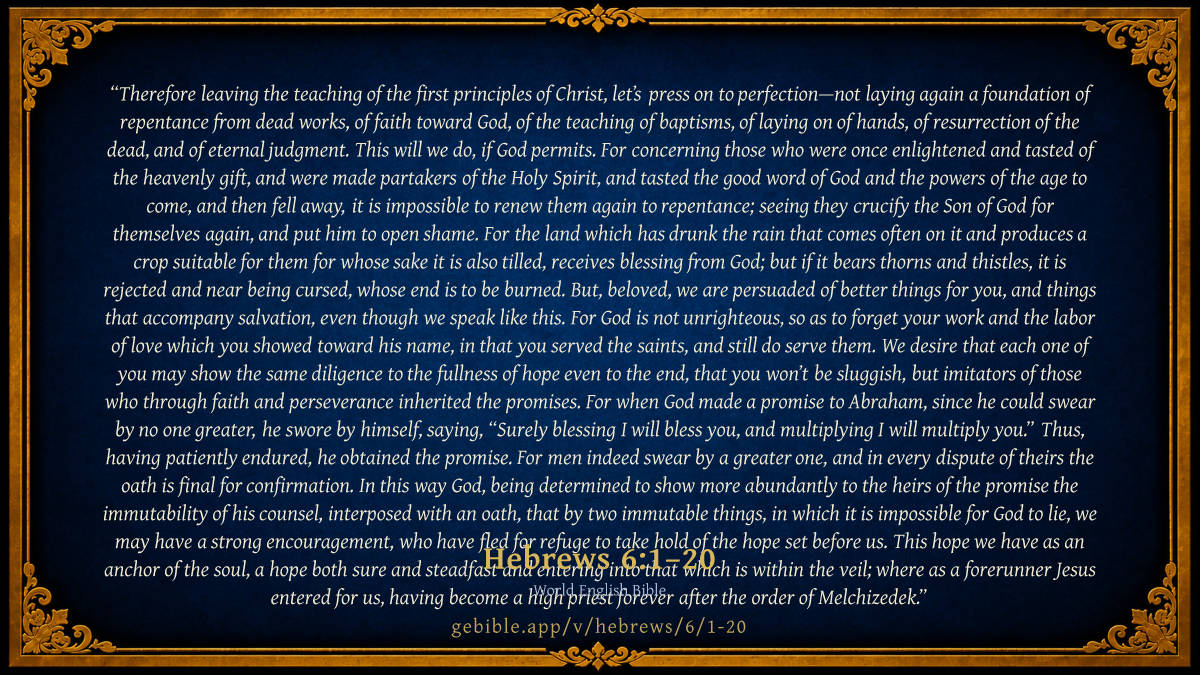
Therefore leaving the teaching of the first principles of Christ, let’s press on to perfection—not laying again a foundation of repentance from dead works, of faith toward God, of the teaching of baptisms, of laying on of hands, of resurrection of the dead, and of eternal judgment. This will we do, if God permits. For concerning those who were once enlightened and tasted of the heavenly gift, and were made partakers of the Holy Spirit, and tasted the good word of God and the powers of the age to come, and then fell away, it is impossible to renew them again to repentance; seeing they crucify the Son of God for themselves again, and put him to open shame. For the land which has drunk the rain that comes often on it and produces a crop suitable for them for whose sake it is also tilled, receives blessing from God; but if it bears thorns and thistles, it is rejected and near being cursed, whose end is to be burned.
But, beloved, we are persuaded of better things for you, and things that accompany salvation, even though we speak like this. For God is not unrighteous, so as to forget your work and the labor of love which you showed toward his name, in that you served the saints, and still do serve them. We desire that each one of you may show the same diligence to the fullness of hope even to the end, that you won’t be sluggish, but imitators of those who through faith and perseverance inherited the promises. For when God made a promise to Abraham, since he could swear by no one greater, he swore by himself, saying, “Surely blessing I will bless you, and multiplying I will multiply you.” Thus, having patiently endured, he obtained the promise. For men indeed swear by a greater one, and in every dispute of theirs the oath is final for confirmation. In this way God, being determined to show more abundantly to the heirs of the promise the immutability of his counsel, interposed with an oath, that by two immutable things, in which it is impossible for God to lie, we may have a strong encouragement, who have fled for refuge to take hold of the hope set before us. This hope we have as an anchor of the soul, a hope both sure and steadfast and entering into that which is within the veil; where as a forerunner Jesus entered for us, having become a high priest forever after the order of Melchizedek.
John Calvin 1540 · Public Domain On vv1, 2, 3, 4, 6, 7, 9, 10, 11, 12, 13, 16, 17, 18, 19 1. Therefore, leaving, etc. To his reproof he joins…
1. Therefore, leaving, etc. To his reproof he joins this exhortation, — that leaving first principles they were to proceed forward to the goal. For by the word of beginning he understands the first rudiments, taught to the ignorant when received into the Church. Now, he bids them to leave these rudiments, not that the faithful are ever to forget them, but that they are not to remain in them; and this idea appears more clear from what follows, the comparison of a foundation; for in building a house we must never leave the foundation; and yet to be always engaged in laying it, would be ridiculous. For as the foundation is laid for the sake of what is built on it, he who is occupied in laying it and proceeds not to the superstruction, wearies himself with foolish and useless labor. In short, as the builder must begin with the foundation, so must he go on with his work that the house may be built. Similar is the case as to Christianity; we have the first principles as the foundation, but the higher doctrine ought immediately to follow which is to complete the building. They then act most unreasonably who remain in the first elements, for they propose to themselves no end, as though a builder spent all his labor on the foundation, and neglected to build up the house. So then he would have our faith to be at first so founded as afterwards to rise upwards, until by daily progress it be at length completed.
Of repentance from dead works, etc. He here refers to a catechism commonly used. It is hence a probable conjecture that this Epistle was written, not immediately after the promulgation of the Gospel, but when they had some kind of polity established in the Churches; such as this, that the catechumen made a confession of his faith before he was admitted to baptism. And there were certain primary points on which the pastor questioned the catechumen, as it appears from the various testimonies of the fathers; there was an examination had especially on the creed called the Apostles’ Creed. This was the first entrance, as it were, into the church to those who were adults and enlisted under Christ, as they were before alienated from faith in him. This custom the Apostle mentions, because there was a short time fixed for catechumens, during which they were taught the doctrine of religion, as a master instructs his children in the alphabet, in order that he may afterwards advance them to higher things.
Read full note →
But let us examine what he says. He mentions repentance and faith, which include the fullness of the Gospel; for what else does Christ command his Apostles to preach, but repentance and faith? When, therefore, Paul wished to show that he had faithfully performed his duty, he alleged his care and assiduity in teaching these two things. It seems then (as it may be said) unreasonable that the Apostle should bid repentance and faith to be omitted, when we ought to make progress in both through the whole course of our life. But when he adds, from dead works, he intimates that he speaks of first repentance; for though every sin is a dead work, either as it leads to death, or as it proceeds from the spiritual death of the soul; yet the faithful, already born again of the Spirit of God, cannot be said properly to repent from dead works. Regeneration is not indeed made perfect in them; but because of the seed of new life which is in them, however small it may be, this at least may be said of them that they cannot be deemed dead before God. The Apostle then does not include in general the whole of repentance, the practice of which ought to continue to the end; but he refers only to the beginning of repentance, when they who were lately and for the first time consecrated to the faith, commenced a new life. So also the word, faith, means that brief summary of godly doctrine, commonly called the Articles of Faith.
To these are added, the resurrection of the dead and eternal judgment. These are some of the highest mysteries of celestial wisdom; nay, the very end of all religion, which we ought to bear in mind through the whole course of our life. But as the very same truth is taught in one way to the ignorant, and in another way to those who have made some proficiency, the Apostle seems here to refer to the common mode of questioning, “Dost thou believe the resurrection of the dead? Dost thou believe eternal life?” These things were suitable to children, and that only once; therefore to turn back to them again was nothing else but to retrograde.
John Calvin's Commentaries (1540-1563) — public domain. Text from the Calvin Translation Society English edition (1840s-50s) via the Christian Classics Ethereal Library (ccel.org). Calvin's coverage is partial (roughly two-thirds of the Bible); uncommented books and verses are honest gaps, never fabricated. The 19th-century editor's footnotes and remarks are omitted so the notes are faithfully Calvin's own voice.
Geneva Bible translators 1599 · Public Domain On vv1, 4, 6, 7, 9, 10, 12, 13, 14, 17, 19, 20 The first principles of Christian religion, which we call…
The first principles of Christian religion, which we call the Catechism.
Certain principles of a Catechism, which comprehend the sum of the doctrine of the Gospel, were given in few words and briefly to the rude and ignorant, to wit, the profession of repentance and faith in God: the articles of which doctrine, were demanded of them which were not as yet received members of the Church, at the days appointed for Baptism: and of the children of the faithful which were baptized in their infancy: when hands were laid upon them. And of those articles, two are by name recited: the resurrection of the flesh, and the eternal judgment.
Geneva Bible (1599) marginal notes — public domain.
John Trapp 1656 · Public Domain On vv1–20 1 Therefore leaving the principles of the doctrine of…
1 Therefore leaving the principles of the doctrine of Christ, let us go on unto perfection; not laying again the foundation of repentance from dead works, and of faith toward God,
Ver. 1. Let us go on unto perfection] Gr. φεοωμεθα, let us be carried on, as with a force, Act 2:2, breaking through all impediments, aiming at the highest pitch, and eyeing the best patterns. It is a low and unworthy strain in some to labour after no more grace than will keep life and soul together, that is, hell and soul asunder.
Read full note →
Repentance firm dead works] These are the six principles of Christian religion, that must be laid as a foundation. Certa semper sunt in paucis, saith Tertullian. Fundamentals are but few; few they are in number, but many in virtue; in sight small, but great in weight; like gold, which being solid is contracted into a narrow room, but may be drawn into so large an extent, that one angel may cover an acre of ground, as the naturalists have observed. The Apostles’ Creed (anciently called Symbolum, a sign or badge to distinguish Christians from infidels and wicked people) was heretofore briefer than now. The mention of the Father’s being maker of heaven and earth, the Son’s burial and descending into hell, and the communion of saints, being wholly omitted, haply are not necessary for all men to know, as Suarez saith, or sufficiently implied in other articles, or known by the light of reason; and so not making difference between Christians and heathens. (Dr Ussier.) The Papists have lately coined twelve new articles by the authority of Pope Plus IV, A. D. 1564, raised out of the Council of Trent, and added to the Nicene Creed, to be received with oath, as the true catholic faith, to be believed by as many as shall be saved. Those that list to see them, may read the epistle before Bishop Jewel’s works, and Sir Humphrey Land’s Via tuta. Whereunto if they will add the Jesuit’s new ten commandments, let them read the Spanish Pilgrim.
John Trapp, A Commentary or Exposition upon All the Books of the Old and New Testament (1647–1656) — public domain. Text from a community e-Sword module.
Matthew Poole 1685 · Public Domain On vv1–20 The Spirit having reproved these Hebrews for their fault,…
The Spirit having reproved these Hebrews for their fault, doth now counsel and direct them to amend it.
Therefore leaving the principles of the doctrine of Christ; seeing ye have lost so much time already, and made so little progress in learning Christ, let us not therefore stay any longer in the principles of it, but proceed to some higher degree: pursuant to which he layeth down the principles of Christian doctrine in which these Hebrews had been initiated, and the doctrine of perfection which they were to pursue.
Read full note →
Leaving is an omitting or letting go, as to any sticking or standing in, so as to make no further progress, but to gain higher degrees of knowledge in the doctrine of the gospel, which enters novices into Christ, having attained the beginning, the matter or work of entrance into the Christian religion, now not to stick at this first and imperfect inchoation in this doctrine.
Let us go on unto perfection; a regular motion must succeed, according to the great Mover, incessantly, for our attaining the perfection of the doctrine of Christ. This perfection notes height of knowledge, faith, utmost repentance and spiritual change, greatest strength of understanding, and the fullest operation, according to the doctrine of Christ, in doing and forbearing, the fullest perseverance of the mind in the knowledge of it, and of the will in cleaving to it.
Not laying again the foundation: that which would hinder this was reiterating foundation work, which the apostle laid with them by initiating of them into the first principles of Christianity, the knowledge and faith of which they professed to receive, 1Co 3:11; Eph 2:20, and were therefore obliged to proceed in the building both of persons and truths on it: and lest they had forgot, or other’s were ignorant, what those fundamental principles and doctrines of the gospel were, he layeth down six heads of them in this and Heb 6:2, which was the common method of teaching either the children of Christians or infidels, that they might be Christians, at least professedly, or upon their lapse to restore them.
Of repentance from dead works: the first Christian principle or doctrine to be learnt, was that of repentance, which is the fundamental change of a sinner’s mind, and, in that, of himself; it carrieth in it knowledge, conviction of sin by God’s law, bitter sorrow for it, and full conversion of the soul to God from it, as it is described, 2Co 7:9-11; as from all sinful works flowing from it while lapsed from God; dead in sins, which would have eaten out and destroyed their souls for ever, Rom 6:23; Eph 2:1,2. It supposeth the knowledge of other truths preceding it, as their creation in God’s image, their apostacy from it, the misery consequent. &c. These Hebrews were to proceed and advance daily in the exercise of this grace.
And of faith towards God: the second Christian principle or doctrine is of faith on God, comprehending the habit and acts of that Divine grace, of evidence, subsistence, assent, and affiance, Heb 11:1, all the effects of it; and this exercised on God in his essence, relations, especially in his gracious contrivance and execution of the work of redemption for sinners; as giving reconciliation, righteousness, holiness, adoption, and eternal salvation, through Christ, fulfilling all righteousness by his death, as a sacrifice satisfying his justice, and meriting, as purchasing, all these blessings for believers, and effectually from heaven is dispensing them to them.
Matthew Poole's English Annotations on the Holy Bible (1683–1685) — public domain. Text from a community e-Sword/MySword module.
William Burkitt 1703 · Public Domain On vv1, 2, 4, 7, 9, 11, 12, 13, 16, 17, 19, 20 In these words of the apostle, he seems to…
In these words of the apostle, he seems to allude to the building of an house: as in that we first lay a good and sure foundation, but do not rest there, but proceed in raising up the fabric; in like manner, it is neither satisfactory nor sufficient to advance no further in the Christian religion, than the knowledge of the first principles of it; but endeavours must be used to attain a more perfect degree and measure of knowledge in the mysteries of the gospel. Leaving the principles of the doctrine of Christ, he means not leaving them by going beyond them and advancing further and higher in the knowledge of Christianity.
Learn hence, 1. That in Christianity, and other sciences, there are certain rudiments and fundamental principles, which must and ought to be carefully taught.
Read full note →
2. That it is a necessary and useful practice, in the church of God, to teach the doctrine of Christianity, in the first principles of it, plainly and summarily to young beginners.
Learn, 3. That when the ministers of the gospel have laid a good foundation of Scripture knowledge in the understanding of their hearers, they must excite them by all pressing considerations to make a further progress in their knowledge, and leaving the doctrine of the beginning of Christ, go on unto perfection.
William Burkitt's Expository Notes on the New Testament (1700–1703) — public domain. Text from a community e-Sword module.
Matthew Henry 1710 · Public Domain On vv1, 9 We have here the apostle's advice to the Hebrews…
We have here the apostle's advice to the Hebrews - that they would grow up from a state of childhood to the fullness of the stature of the new man in Christ. He declares his readiness to assist them all he could in their spiritual progress; and, for their greater encouragement, he puts himself with them: Let us go on. Here observe, In order to their growth, Christians must leave the principles of the doctrine of Christ. How must they leave them? They must not lose them, they must not despise them, they must not forget them. They must lay them up in their hearts, and lay them as the foundation of all their profession and expectation; but they must not rest and stay in them, they must not be always laying the foundation, they must go on, and build upon it. There must be a superstructure; for the foundation is laid on purpose to support the building. Here it may be enquired, Why did the apostle resolve to set strong meat before the Hebrews, when he knew they were but babes? Answer. 1. Though some of them were but weak, yet others of them had gained more strength; and they must be provided for suitably. And, as those who are grown Christians must be willing to hear the plainest truths preached for the sake of the weak, so the weak must be willing to hear the more difficult and mysterious truths preached for the sake of those who are strong. 2. He hoped they would be growing in their spiritual strength and stature, and so be able to digest stronger meat.
I. The apostle mentions several foundation-principles, which must be well laid at first, and then built upon; neither his time nor theirs must be spent in laying these foundations over and over again. These foundations are six: -
Read full note →
1. Repentance from dead works, that is, conversion and regeneration, repentance from a spiritually dead state and course; as if he had said, "Beware of destroying the life of grace in your souls; your minds were changed by conversion, and so were your lives. Take care that you return not to sin again, for then you must have the foundation to lay again; there must be a second conversion a repenting not only of, but fRom. dead works." Observe here, (1.) The sins of persons unconverted are dead works; they proceed from persons spiritually dead, and they tend to death eternal. (2.) Repentance for dead works, if it be right, is repentance from dead works, a universal change of heart and life. (3.) Repentance for and from dead works is a foundation-principle, which must not be laid again, though we must renew our repentance daily.
2. Faith towards God, a firm belief of the existence of God, of his nature, attributes, and perfections, the trinity of persons in the unity of essence, the whole mind and will of God as revealed in his word, particularly what relates to the Lord Jesus Christ. We must by faith acquaint ourselves with these things; we must assent to them, we must approve of them, and apply all to ourselves with suitable affections and actions. Observe, (1.) Repentance from dead works, and faith towards God, are connected, and always go together; they are inseparable twins, the one cannot live without the other. (2.) Both of these are foundation-principles, which should be once well laid, but never pulled up, so as to need to be laid over again; we must not relapse into infidelity.
3. The doctrine of baptisms, that is, of being baptized by a minister of Christ with water, in the name of the Father, and of the Son, and of the Holy Ghost, as the initiating sign or seal of the covenant of grace, strongly engaging the person so baptized to get acquainted with the new covenant, to adhere to it, and prepare to renew it at the table of the Lord and sincerely to regulate himself according to it, relying upon the truth and faithfulness of God for the blessings contained in it. And the doctrine of an inward baptism, that of the Spirit sprinkling the blood of Christ upon the soul, for justification, and the graces of the Spirit for sanctification. This ordinance of baptism is a foundation to be rightly laid, and daily remembered, but not repeated.
4. Laying on of hands, on persons passing solemnly from their initiated state by baptism to the confirmed state, by returning the answer of a good conscience towards God, and sitting down at the Lord's table. This passing from incomplete to complete church membership was performed by laying on of hands, which was extraordinary conveyance of the gift of the Holy Ghost continued. This, once done, all are obliged to abide by, and not to need another solemn admission, as at first, but to go on, and grow up, in Christ. Or by this may be meant ordination of persons to the ministerial office, who are duly qualified for it and inclined to it; and this by fasting and prayer, with laying on of the hands of the presbytery: and this is to be done but once.
5. The resurrection of the dead, that is, of dead bodies; and their re-union with their souls, to be eternal companions together in weal or woe, according as their state was towards God when they died, and the course of life they led in this world.
6. Eternal judgment, determining the soul of every one, when it leaves the body at death, and both soul and body at the last day, to their eternal state, every one to his proper society and employment to which they were entitled and fitted here on earth; the wicked to everlasting punishment, the righteous to life eternal.
These are the great foundation-principles which ministers should clearly and convincingly unfold, and closely apply. In these the people should be well instructed and established, and from these they must never depart; without these, the other parts of religion have no foundation to support them.
II. The apostle declares his readiness and resolution to assist the Hebrews in building themselves up on these foundations till they arrive at perfection: And this we will do, if God permit, Heb 6:3. And thereby he teaches them, 1. That right resolution is very necessary in order to progress and proficiency in religion. 2. That that resolution is right which is not only made in the sincerity of our hearts, but in a humble dependence upon God for strength, for assistance and righteousness, for acceptance, and for time and opportunity. 3. That ministers should not only teach people what to do, but go before them, and along with them, in the way of duty.
III. He shows that this spiritual growth is the surest way to prevent that dreadful sin of apostasy from the faith. And here,
1. He shows how far persons may go in religion, and, after all, fall away, and perish for ever, Heb 6:4, Heb 6:5. (1.) They may be enlightened. Some of the ancients understand this of their being baptized; but it is rather to be understood of notional knowledge and common illumination, of which persons may have a great deal, and yet come short of heaven. Balaam was the man whose eyes were opened (Num 24:3), and yet with his eyes opened he went down to utter darkness. (2.) They may taste of the heavenly gift, feel something of the efficacy of the Holy Spirit in his operations upon their souls, causing them to taste something of religion, and yet be like persons in the market, who taste of what they will not come up to the price of, and so but take a taste, and leave it. Persons may taste religion, and seem to like it, if they could have it upon easier terms than denying themselves, and taking up their cross, and following Christ. (3.) They may be made partakers of the Holy Ghost, that is, of his extraordinary and miraculous gifts; they may have cast out devils in the name of Christ, and done many other mighty works. Such gifts in the apostolic age were sometimes bestowed upon those who had no true saving grace. (4.) They may taste of the good word of God; they may have some relish of gospel doctrines, may hear the word with pleasure, may remember much of it, and talk well of it, and yet never be cast into the form and mould of it, nor have it dwelling richly in them. (5.) They may have tasted of the powers of the world to come; they may have been under strong impressions concerning heaven, and dread of going to hell. These lengths hypocrites may go, and, after all, turn apostates. Now hence observe, [1.] These great things are spoken here of those who may fall away; yet it is not here said of them that they were truly converted, or that they were justified; there is more in true saving grace than in all that is here said of apostates. [2.] This therefore is no proof of the final apostasy of true saints. These indeed may fall frequently and foully, but yet they will not totally nor finally from God; the purpose and the power of God, the purchase and the prayer of Christ, the promise of the gospel, the everlasting covenant that God has made with them, ordered in all things and sure, the indwelling of the Spirit, and the immortal seed of the word, these are their security. But the tree that has not these roots will not stand.
2. The apostle describes the dreadful case of such as fall away after having gone so far in the profession of the religion. (1.) The greatness of the sin of apostasy. It is crucifying the Son of God afresh, and putting him to open shame. They declare that they approve of what the Jews did in crucifying Christ, and that they would be glad to do the same thing again if it were in their power. They pour the greatest contempt upon the Son of God, and therefore upon God himself, who expects all should reverence his Son, and honour him as they honour the Father. They do what in them lies to represent Christ and Christianity as a shameful thing, and would have him to be a public shame and reproach. This is the nature of apostasy. (2.) The great misery of apostates. [1.] It is impossible to renew them again unto repentance. It is extremely hazardous. Very few instances can be given of those who have gone so far and fallen away, and yet ever have been brought to true repentance, such a repentance as is indeed a renovation of the soul. Some have thought this is the sin against the Holy Ghost, but without ground. The sin here mentioned is plainly apostasy both from the truth and the ways of Christ. God can renew them to repentance, but he seldom does it; and with men themselves it is impossible. [2.] Their misery is exemplified by a proper similitude, taken from the ground that after much cultivation brings forth nothing but briers and thorns; and therefore is nigh unto cursing, and its end is to be burned, Heb 6:8. To give this the greater force here is observed the difference that there is between the good ground and the bad, that these contraries, being set one over against the other, illustrate each other. First Here is a description of the good ground: It drinketh in the rain that cometh often upon it. Believers do not only taste of the word of God, but they drink it in; and this good ground bringeth forth fruit answerable to the cost laid out, for the honour of Christ and the comfort of his faithful ministers, who are, under Christ, dressers of the ground. And this fruit-field or garden receives the blessing. God declares fruitful Christians blessed, and all wise and good men account them blessed: they are blessed with increase of grace, and with further establishment and glory at last. Secondly, Here is the different case of the bad ground: It bears briers and thorns; it is not only barren of good fruit, but fruitful in that which is bad, briers and thorns, fruitful in sin and wickedness, which are troublesome and hurtful to all about them, and will be most so to sinners themselves at last; and then such ground is rejected. God will concern himself no more about such wicked apostates; he will let them alone, and cast them out of his care; he will command the clouds that they rain no more upon them. Divine influences shall be restrained; and that is not all, but such ground is nigh unto cursing; so far is it from receiving the blessing, that a dreadful curse hangs over it, though as yet, through the patience of God, the curse is not fully executed. Lastly, Its end is to be burned. Apostasy will be punished with everlasting burnings, the fire that shall never be quenched. This is the sad end to which apostasy leads, and therefore Christians should go on and grow in grace, lest, if they do not go forward, they should go backward, till they bring matters to this woeful extremity of sin and misery.
Matthew Henry's Commentary on the Whole Bible (1708–1710) — public domain (CC PDM 1.0). Text via the HelloAO Bible API.
John Gill 1763 · Public Domain On vv1–19 Therefore leaving the principles of the doctrine of Christ,....…
Therefore leaving the principles of the doctrine of Christ,.... The Gospel is the doctrine of Christ, and is so called, because Christ, as God, is the author of it; as Mediator, he received it from his Father; as man, he was the preacher of it; and he is also the sum and substance of it: the principles of this doctrine are either the easier parts of the Gospel, called milk in the latter part of the preceding chapter; which are not to be left with dislike and contempt, nor so as to be forgotten, nor so as not to be recurred to at proper times; but so as not to abide in and stick here, without going further: or rather the ceremonies of the law, which were the elements of the Jews' religion, and the beginning, as the word may be here rendered, of the doctrine of Christ; which were shadowy and typical of Christ, and taught the Jews the truths of the Gospel concerning Christ: in these the believing Jews were very desirous of sticking, and of abiding by them, and of continuing them in the Gospel church; whereas they were to be left, since they had had their use, and had answered what they were designed for, and were now abolished by Christ.
Let us go on to perfection: in a comparative sense, to a more perfect knowledge of things, which the clear revelation and ministry of the Gospel lead unto; and which the rites and ceremonies, types and figures of the law, never could:
Read full note →
not laying again the foundation of repentance from dead works; the Syriac version reads this by way of interrogation, "do ye lay again, &c." and makes the third verse to be an answer to it: the phrase, "not laying again the foundation", is to be read in connection, not only with this article of repentance, but with each of the other five articles, the foundation of which is no more to be laid again than this: and not laying it again, either means not teaching it, and so refers to the apostle, and other ministers of the word, who should not insist upon the following things, at least not stick there, but go on to deliver things more sublime and grand; or not hearing it, and so refers to the Hebrews, who should seek after a more perfect knowledge of evangelic truths than the following articles exhibited to them: and the several parts of this foundation, which; are not to be laid again ministerially, by preachers, or attended to by hearers, design either the first things, with which the Gospel dispensation was ushered in; or rather, and which I take to be the true sense, the general principles and practices of the Jews under the former dispensation; for these are not the six principles of the Christian religion, as they are commonly called, but so many articles of the Jewish creed; some of which were peculiar to the Jews, and others common to them, with us Christians: thus,
repentance from dead works, does not intend evangelical repentance, the doctrine of which is to be ministerially laid, and the grace itself to be exercised over and over again; but a repentance which arose from, and was signified by the sacrifices of slain beasts; for by them the Jews were taught the doctrine of repentance, as well as remission of sin; and in and over them did they confess their iniquities; yea, every beast that was slain for sacrifice carried in it a conviction of sin, an acknowledgment of guilt; and it was tacitly owning, that they, for whom the creature was slain, deserved to be treated as that was, and die as that did. So the Jews (f) say,
"when a man sacrifices a beast, he thinks in his own heart, I am rather a beast than this; for I am he that hath sinned, and for the sin which I have committed I bring this; and it is more fitting that the man should be sacrificed rather than the beast; and so it appears that, , "by the means of his offering he repents".''
But now, under the Gospel dispensation, believing Jews, as these were to whom the apostle writes, were not to learn the doctrine of repentance from slain beasts, or to signify it in this way; since repentance and remission of sins were preached most clearly to them in the name of Christ: nor were they to lay again another part of this foundation, or a second article of the Jewish creed,
and of faith towards God; which article is expressed in language agreeable to the Jewish dispensation; whereas evangelical faith is usually called the faith of Christ, or faith in Christ, or towards our Lord Jesus Christ; but this respects faith in God, as the God of Israel: hence says our Lord to his disciples, who were all Jews, "ye believe in God": ye have been taught, and used to believe in God, as the God of Israel; "believe also in me", as his Son and the Messiah, and the Mediator between God and man, Joh 14:1, so that now they were not only to have faith towards God, as the God of Israel, and to teach and receive that doctrine; but to have faith in Christ as the Saviour of lost sinners, without the intermediate use of sacrifices.
(f) Nizzachon Vet. p. 11. Ed. Wagenseil.
John Gill's Exposition of the Whole Bible (1746–1763) — public domain (CC PDM 1.0). Text via the HelloAO Bible API.
John Wesley 1765 · Public Domain On vv1, 3, 4, 5, 6, 8, 9, 10, 11, 12, 13, 14, 15, 16, 17, 18, 19, 20 Therefore leaving the principles of the doctrine of Christ…
Therefore leaving the principles of the doctrine of Christ - That is, saying no more of them for the present. Let us go on to perfection; not laying again the foundation of repentance from dead works - From open sins, the very first thing to be insisted on. And faith in God - The very next point. So St. Paul in his very first sermon at Lystra, Acts xiv, 15, "Turn from those vanities unto the living God." And when they believed, they were to be baptized with the baptism, not of the Jews, or of John, but of Christ. The next thing was, to lay hands upon them, that they might receive the Holy Ghost: after which they were more fully instructed, touching the resurrection, and the general judgment; called eternal, because the sentence then pronounced is irreversible, and the effects of it remain forever.
John Wesley, Explanatory Notes Upon the Whole Bible (1754–1765) — public domain. Text via the GEBible commentary corpus.
Adam Clarke 1810 · Public Domain On vv1–20 We must proceed from the first principles of the…
CHAPTER VI.
We must proceed from the first principles of the doctrine of
Read full note →
Christ unto perfection, and not lay the foundation a second
time, 1-3.
Those who were once enlightened, and have been made partakers
of the Holy Ghost and the various blessings of the Gospel, if
they apostatize from Christ, and finally reject him as their
Saviour, cannot be renewed again to repentance, 4-6.
The double similitude of the ground blessed of God, and bearing
fruit; and of that ground which is cursed of God, and bears
briers and thorns, 7, 8.
The apostle's confidence in them, and his exhortation to
diligence and perseverance, 9-12.
God's promise and oath to Abraham, by which the immutability of
his counsel is shown, in order to excite our hope, 13-18.
Hope is the anchor of the soul, and enters within the veil,
19, 20.
NOTES ON CHAP. VI.
Verse 1. Therefore] Because ye have been so indolent, slow of heart, and have still so many advantages.
Leaving the principles of the doctrine of Christ] Ceasing to continue in the state of babes, who must be fed with milk-with the lowest doctrines of the Gospel, when ye should be capable of understanding the highest.
Let us go on unto perfection] Let us never rest till we are adult Christians-till we are saved from all sin, and are filled with the spirit and power of Christ.
The words τον της αρχης· του Χριστου λογον might be translated, The discourse of the beginning of Christ, as in the margin; that is, the account of his incarnation, and the different types and ceremonies in the law by which his advent, nature, office, and miracles were pointed out. The whole law of Moses pointed out Christ, as may be seen at large in my comment on the Pentateuch; and therefore the words of the apostle may be understood thus: Leave the law, and come to the Gospel. Cease from Moses, and come to the Messiah.
Let us go on unto perfection.-The original is very emphatic: επι την τελειοτητα φερωμεθα. Let us be carried on to this perfection. God is ever ready by the power of his Spirit, to carry us forward to every degree of light, life, and love, necessary to prepare us for an eternal weight of glory. There can be little difficulty in attaining the end of our faith, the salvation of our souls from all sin, if God carry us forward to it; and this he will do if we submit to be saved in his own way, and on his own terms. Many make a violent outcry against the doctrine of perfection, i.e. against the heart being cleansed from all sin in this life, and filled with love to God and man, because they judge it to be impossible! Is it too much to say of these that they know neither the Scripture nor the power of God? Surely the Scripture promises the thing; and the power of God can carry us on to the possession of it.
Laying again the foundation of repentance] The phrase νεκρα εργα, dead works, occurs but once more in the sacred writings, and that is in Heb 9:14 of this epistle; and in both places it seems to signify such works as deserve death-works of those who were dead in trespasses, and dead in sins; and dead by sentence of the law, because they had by these works broken the law. Repentance may be properly called the foundation of the work of God in the soul of man, because by it we forsake sin, and turn to God to find mercy.
Faith toward God] Is also a foundation, or fundamental principle, without which it is impossible to please God, and without which we cannot be saved. By repentance we feel the need of God's mercy, by faith we find that mercy.
But it is very likely that the apostle refers here to the Levitical law, which, in its painful observances, and awful denunciations of Divine wrath against every breach of that law, was well calculated to produce repentance, and make it a grievous and bitter thing to sin against God. And as to faith in God, that was essentially necessary, in order to see the end of the commandment; for without faith in him who was to come, all that repentance was unavailable, and all ritual observances without profit.
Adam Clarke's Commentary on the Bible (1810–1826) — public domain. Text from a community e-Sword/MySword module.
Joseph Benson 1811 · Public Domain On vv1, 3, 6, 7, 9, 12, 13, 16, 18, 20 Heb 6:1-2. Therefore — Seeing that most of you…
Heb 6:1-2. Therefore — Seeing that most of you have continued so ignorant, although you have been so long favoured with the light of the gospel, and various means of edification, it is high time for you to labour for more knowledge and grace, and for me to instruct you further; leaving the principles of the doctrine of Christ — That is, saying no more for the present, of those things in which those who embrace Christianity are wont to be first instructed. The original expression, τον της αρχης του Χριστου λογον, is, literally, the word of the beginning of Christ, as in the margin; and signifies those parts of the Christian doctrine which men were usually and properly first instructed in; and which the apostle immediately enumerates. They are the same with the first principles of the oracles of God, mentioned Heb 5:12. But it must be observed that the signification of the words must be limited to the present occasion; for if we consider the things here spoken of absolutely, they are never to be left, either by teachers or hearers. There is a necessity that teachers should often insist on the rudiments, or first principles, of religion; not only with respect to them who are continually to be trained up in knowledge from their infancy, but also those who have made a further progress in knowledge. And this course we find our apostle to have followed in all his epistles. Nor are any hearers so to leave these principles, as to forget them, or not duly to make use of them. Cast aside a constant regard to them, in their proper place, and no progress can be made in knowledge, no more than a building can be carried on when the foundation is taken away.
Let us go on unto perfection — Unto a perfect acquaintance with the more sublime and difficult truths, and the high privileges and duties of Christianity; not laying again — What has been laid already; the foundation of repentance from dead works — That is, from the works done by those who are dead in sin, or who, through sin, are under condemnation to the second death, are alienated from the life of God, and carnally minded, which is death, Rom 8:6. See note on Eph 2:1-2. Not only are known and wilful sins, which proceed from spiritual death, and if not pardoned and taken away, end in death eternal, here intended; but even all works, though apparently moral, charitable, and pious, are but dead works, before the living God, if they do not proceed from spiritual life in the soul, or from living faith, even the faith which worketh by love, (Gal 5:6; 1Co 13:3,) as their principle, and be not directed to the glory of God as their end.
Read full note →
And faith toward God — Looking to, and confiding in him for pardon, holiness, and eternal life, through Christ. Of the doctrine of baptisms — The apostle does not speak of the legal washings in use among the Jews, whether by immersion, ablution, or sprinkling; (for why should those who believed in Christ be instructed concerning these?) but John’s baptism and that of Christ, which were distinct from each other, and were subjects of disputation with many among the Jews, Mar 7:3-4; Joh 3:22-26. John admitted the penitent to the baptism of water; and, in obedience to the command of Christ, (Mat 28:19,) the apostles baptized all that professed to believe in him, in the name of the Father, and of the Son, and of the Holy Ghost. Or, as Whitby thinks, the apostle is here to be understood of the double baptism “of which John spake, when he said, I baptize you with water, but he that cometh after me shall baptize you with the Holy Ghost and with fire, Mat 3:11; and of which Christ spake to Nicodemus, (Joh 3:5,) saying, Except a man be born again of water and of the Spirit, he cannot enter into the kingdom of God. For this, in order, followed the doctrine of repentance, and of faith in God and our Lord Jesus Christ.”
And the laying on of hands — The imposition of hands was used by the apostles and first Christian ministers in the healing of diseases, and in setting persons apart for the work of the ministry; but neither of these were common to all Christians, nor joined with baptism; nor were they reckoned among the principles of the doctrine of Christ, or the initiatory doctrines of the Christian faith. We must therefore understand this of that imposition of the apostles’ hands which was wont to be used, after baptism, to confer upon the persons baptized the extraordinary gifts of the Holy Ghost. See Act 8:14-17; Act 19:6. And this was a matter wherein the glory of the gospel and its propagation were highly concerned; indeed, next to the preaching of the word, it was the great means used by God for bringing both Jews and Gentiles over to the faith of the gospel, or for establishing them therein.
And the resurrection of the dead — Namely, of the bodies of the dead; and of eternal judgment — The future and general judgment, called eternal, because the sentence then pronounced will be irreversible, and the effects of it remain for ever. In which two last-mentioned articles, the penitent and believing, that had been admitted to baptism, were more fully instructed, as being most powerful motives to engage them herein to exercise themselves to have always consciences void of offence toward God and toward all men. “Interpreters observe,” says Whitby, “that the doctrine of Origen, touching the period of the torments of the damned, is here condemned; and indeed the primitive father’s not Origen himself excepted, taught the contrary. ‘If we do not the will of Christ,’ says Clemens Romanus, ‘nothing will deliver us from eternal punishment.’ ‘The punishment of the damned,’ says Justin Martyr, ‘is endless punishment and torment in eternal fire.’ In Theophilus it is, ‘eternal punishment.’ Irenæus, in his symbol of faith, makes this one article, ‘that God would send the ungodly and unjust into everlasting fire.’ Tertullian declares, ‘that all men are appointed to torment or refreshment, both eternal.’ And ‘if any man,’ says he, ‘thinks the wicked are to be consumed and not punished, let him remember that hell-fire is styled eternal, because designed for eternal punishment; and their substance will remain for ever whose punishment doth so.’ St. Cyprian says, ‘The souls of the wicked are kept with their bodies to be grieved with endless torments.’ ‘There is no measure nor end of their torments,’ says Minutius. Lastly, Origen reckons this among the doctrines defined by the church; ‘That every soul, when it goes out of this world, shall either enjoy the inheritance of eternal life and bliss, if its deeds have rendered it fit for bliss; or be delivered up to eternal fire and punishment, if its sins have deserved that state.’”
Joseph Benson's Commentary on the Old and New Testaments (1811–1818) — public domain. Text from a community e-Sword module.
Albert Barnes 1834 · Public Domain On vv1–20 Therefore - “Since, as was stated in the previous…
Therefore - “Since, as was stated in the previous chapter, you ought to be capable of comprehending the higher doctrines of religion; since those doctrines are adapted to those who have been for a considerable time professors of Christianity, and have had opportunities of growing in knowledge and grace - as much as strong meat is for those of mature years - leave now the elements of Christian doctrine, and go on to understand its higher mysteries.” The idea is, that to those who had so long been acquainted with the way of salvation, the elements of Christianity were no more adapted than milk was for grown persons.
Leaving - Dismissing; intermitting; passing by the consideration of with a view to advance to something higher. The apostle refers to his discussion of the subject, and also to their condition. He wished to go on to the contemplation of higher doctrines, and he desired that they should no longer linger around the mere elements. “Let us advance to a higher state of knowledge than the mere elements of the subject.” On the sense of the word “leaving,” or quitting with a view to engage in something else, see Mat 4:20, Mat 4:22; Mat 5:24.
Read full note →
The principles - Margin: “The word of the beginning of Christ.” Tyndale renders it: “let us leave the doctrine pertaining to the beginning of a Christian man.” Coverdale, “let us leave the doctrine pertaining to the beginning of a Christian life.” On the word “principles” see the note on Heb 5:12. The Greek there, indeed, is not the same as in this place, but the idea is evidently the same. The reference is to what he regarded as the very elements of the Christian doctrine; and the meaning is, “let us no longer linger here. We should go on to higher attainments. We should wholly understand the system. We should discuss and receive its great principles. You have been long enough converted to have understood these; but you linger among the very elementary truths of religion. But you cannot remain here. You must either advance or recede; and if you do not go forward, you will go back into entire apostasy, when it will be impossible to be renewed.” The apostle here, therefore, does not refer to his discussion of the points under consideration as the main thing, but to their state as one of danger; and in writing to them he was not content to discuss the elements of religion as being alone suited to their condition, but would have them make higher attainments, and advance to the more elevated principles of the gospel.
Of the doctrine - Literally, “the word” - λόγον logon - “reason, or doctrine of the beginning of Christ.” That is, the word or reason that pertains to the elements of his system; the first principles of Christian doctrine.
Of Christ - Which pertain to the Messiah. Either what he taught, or what is taught of him and his religion. Most probably it is the latter - what pertains to the Messiah, or to the Christian revelation. The idea is, that there is a set of truths which may be regarded as lying at the foundation of Christian doctrine, and those truths they had embraced, but had not advanced beyond them.
Let us go on - Let us advance to a higher state of knowledge and holiness. The reference is alike to his discussion of the subject, and to their advancement in piety and in knowledge. He would not linger around these elements in the discussion, nor would he have them linger at the threshold of the Christian doctrines.
Unto perfection - compare the notes on Heb 2:10. The word here is used, evidently, to denote an advanced state of Christian knowledge and piety; or the more elevated Christian doctrines, and the holier living to which it was their duty to attain. It does not refer solely to the intention of the apostle to discuss the more elevated doctrines of Christianity, but to” such an advance as would secure them from the danger of apostasy.” If it should be said, however, that the word “perfection” is to be understood in the most absolute and unqualified sense, as denoting entire freedom from sin, it may be remarked:
(1)That this does not prove that they ever attained to it, nor should this be adduced as a text to show that such an attainment is ever made. To exhort a man to do a thing - however reasonable - is no proof in itself that it is ever done.
(2)It is proper to exhort Christians to aim at entire perfection. Even if none have ever reached that point on earth, that fact does not make it any the less desirable or proper to aim at it.
(3)There is much in making an honest attempt to be perfectly holy, even though we should not attain to it in this life. No man accomplishes much who does not aim high.
Not laying again the foundation - Not laying down - as one does a foundation for an edifice. The idea is, that they were not to begin and build all this over again. They were not to make it necessary to lay down again the very cornerstones, and the foundations of the edifice, but since these were laid already, they were to go on and build the superstructure and complete the edifice.
Of repentance from dead works - From works that cause death or condemnation; or that have no vitality or life. The reference may be either to those actions which were sinful in their nature, or to those which related to the forms of religion, where there was no spiritual life. This was the character of much of the religion of the Jews; and conversion to the true religion consisted greatly in repentance for having relied on those heartless and hollow forms. It is possible that the apostle referred mainly to these, as he was writing to those who had been Hebrews. When formalists are converted, one of the first and the main exercises of their minds in conversion, consists in deep and genuine sorrow for their dependence on those forms. Religion is life; and irreligion is a state of spiritual death, (compare the notes on Eph 2:1), whether it be in open transgression, or in false and hollow forms of religion. The apostle has here stated what is the first element of the Christian religion. It consists in genuine sorrow for sin, and a purpose to turn from it; see the note on Mat 3:2.
And of faith toward God - see the note on Mar 16:16. This is the second element in the Christian system. Faith is everywhere required in order to salvation, but it is usually faith “in the Lord Jesus” that is spoken of; see Act 20:21. Here, however, faith “in God” is particularly referred to. But there is no essential difference. It is faith in God in regard to his existence and perfections, and to his plan of saving people. It includes, therefore, faith in his message and messenger, and thus embraces the plan of salvation by the Redeemer. There is but one God - “the God and Father of our Lord Jesus Christ;” and he who believes in the true God believes in him as Father, Son, and Holy Spirit; the Author of the plan of redemption, and the Saviour of lost people. No one can believe “in the true God” who does not believe in the Saviour; compare Joh 5:23; Joh 17:3. He who supposes that he confides “in any other” God than the Author of the Christian religion, worships a being of the imagination as really as though he bowed down to a block of wood or stone. If Christianity is true, there is no such God as the infidel professes to believe in, any more than the God of the Brahmin has an existence. To believe “in God,” therefore, is to believe in him as he “actually exists” - as the true God - the Author of the great plan of salvation by the Redeemer. It is needless to attempt to show that faith in the true God is essential to salvation. How can he be saved who has no “confidence” in the God that made him?
Albert Barnes' Notes on the Bible (1834–1885) — public domain. Text from a community e-Sword/MySword module.
Haydock's Catholic Bible Commentary 1859 · Public Domain On vv1, 3, 4, 9, 11, 13 Wherefore leaving the word, &c. This is to be…
Wherefore leaving the word, &c. This is to be taken as connected with what he had said in the last chapter, (ver. 12.) of the elements, or rudiments of Christian faith, concerning which, though some seemed not sufficiently instructed, yet he thinks it here enough to name them, and pass them over: to wit, 1. Penance, or the dispositions of a sincere repentance. 2. Faith, when they are come to the years of being instructed. 3. The doctrine of baptisms, which he expresseth in the plural number, either because all the faithful must be baptized once, if we speak of Christian baptism; or he means that persons ought to know they cannot receive Christ’s baptism over again. Or, in fine, he means that the baptisms of the Jews, which they so frequently repeated, could not make them justified. 4. The doctrine of imposition of hands, by which is commonly expounded that which is given in the sacrament of confirmation. 5. Of the resurrection of the dead. 6. Of the judgment, by which God would judge all mankind. Of these things he supposeth them already instructed. (Witham) --- We see here the order in which the apostles taught the Christian doctrine to the catechumens: 1. They excited them to sorrow for their sins. 2. They required of them acts of faith in God and his Son Jesus Christ. 3. They explained the nature of Christ’s baptism, its virtue, and difference from the baptism of [John] the Baptist and others. 4. After baptism, they laid their hands on them, that they might receive the strengthening grace of the Holy Ghost in confirmation; and finally, they excited them to perseverance, by the hope of a glorious resurrection, and of eternal life, and by setting before their eyes eternal damnation as the consequence of apostacy.
George Leo Haydock (1774–1849), Haydock's Catholic Family Bible and Commentary, 1859 edition — public domain. Excludes Psalms (Douay-Rheims chapter numbering differs from Protestant) and Deuterocanonical books (Catholic canon only).
John Nelson Darby 1862 · Public Domain On v1 Hebrews Chapter 6
Hebrews Chapter 6
Now the Spirit will not stop at this point with Christians, but will go on to that full revelation of His glory which belongs to them that are of full age and indeed forms us for that state.
Read full note →
We easily perceive that the inspired writer tries to make the Hebrews feel that he was ;acing them on higher and more excellent ground, by connecting them with a heavenly and invisible Christ; and that Judaism kept them back in the position of children. This moreover characterises the whole epistle.
Nevertheless we shall find two things here: on the one hand, the elements and the character of doctrine that belonged to infancy, to “the beginning of the word of Christ,” in contrast with the strength and heavenly savour that accompanied the Christian revelation; and, on the other hand, what the revelation of Christ Himself is in connection with this last spiritual and Christian system.
But the epistle distinguishes between this system and the doctrine of the Person of Christ, even looked at as man [12], although the present position of Christ gives its character to the Christian system. The distinction is made-not that the condition of souls does not depend on the measure of the revelation of Christ and of the position He has taken, but-because the doctrine of His Person and glory goes much farther than the present state of our relationship with God.
The things spoken of in Heb 6:1-2 had their place, because the Messiah was then yet to come: all was in a state of infancy. The things spoken of in Heb 6:4-5 are the privileges that Christians enjoyed in virtue of the work and the glorification of the Messiah. But they are not in themselves the ‘perfection” mentioned in verse 1, and which relates rather to the knowledge of the Person of Christ Himself. The privileges in question were the effect of the glorious position of His Person in heaven.
It is important to attend to this, in order to understand these passages. In the infancy spoken of in 1, 2, the obscurity of the revelations of the Messiah, announced at most by promises and prophecies, left worshipers under the yoke of ceremonies and figures, although in possession of some fundamental truths. His exaltation made way for the power of the Holy Ghost here below: and on this the responsibility of souls which had tasted it depended.
The doctrine of the Person and the glory of Jesus forms the subject of revelation in the epistle, and was the means of deliverance for the Jews from the whole system which had been such a heavy burden on their hearts; it should prevent their forsaking the state described in Heb 6:4-5, in order to return into the weakness and (Christ having come) the carnal state of verse 1 and 2.
The epistle then does not desire to establish again the true but elementary doctrines which belonged to the times when Christ was not manifested, but to go forward to the full revelation of His glory and position according to the counsels of God revealed in the word.
The Holy Ghost would not go back again to these former things, because new things had been brought in in connection with the heavenly glory of the Messiah, namely, Christianity characterised by the power of the Holy Ghost.
But if any one who had been brought under that power, who had known it, should afterwards abandon it, he could not be renewed again to repentance. The former things of Judaism must be, and were, left behind by that into which he had entered. Christians could not deal with souls by them; and, as for the new things, he had given them up. All God’s means had been employed for him and had produced nothing.
Such a one-of his own will-crucified for himself the Son of God. Associated with the people who had done so, he had acknowledged the sin which his people had committed, and owned Jesus to be the Messiah. But now he committed the crime, [13] knowingly and of his own will. The judgment, the resurrection of the dead, repentance from dead works, had been taught. Under that order of things the nation had crucified their Messiah. Now power had come; which testified of the glorification of the crucified Messiah, the Son of God, in heaven; and which by miracles destroyed (at least in detail) the power of the enemy who was still reigning over the world. These miracles were a partial anticipation of the full and glorious deliverance which should take place in the world to come, when the triumphant Messiah, the Son of God, should entirely destroy all the power of the enemy. Hence they are called the “powers of the world to come.”
The power of the Holy Ghost, the miracles wrought in the bosom of Christianity, were testimonies that the power which was to accomplish that deliverance-although still hidden in heaven-existed nevertheless in the glorious Person of the Son of God. The power did not yet accomplish the deliverance of this world oppressed by Satan, because another thing was being done meanwhile. The light of God was shining, the good word of grace was being preached, the heavenly gift (a better thing than the deliverance of the world) was being tasted; and the sensible power of the Holy Ghost made itself known, while waiting for the return in glory of the Messiah to bind Satan, and thus accomplish the deliverance of the world under His dominion.
Speaking generally, the power of the Holy Ghost, the consequence of the Messiah’s being glorified above, was exercised on earth as a present manifestation and anticipation of the great deliverance to come. The revelation of grace, the good word of God, was preached; and the Christian lived in the sphere where these things displayed themselves, and was subjected to the influence exercised in it. This made itself to be felt by those who were brought in among Christians. Even where there was no spiritual life, these influences were felt.
But, after having been the subject of this influence of the presence of the Holy Ghost, after having tasted the revelation thus made of the goodness of God, and experienced the proofs of His power, if any one then forsook Christ, there remained no other means for restoring the soul, for leading it to repentance. The heavenly treasures were already expended: he had given them up as worthless; he had rejected the full revelation of grace and power, after having known it. What means could now be used? To return to Judaism, and the first principles of the doctrine of Christ in it, when the truth had been revealed, was impossible: and the new light had been known and rejected. In a case like this there was only the flesh; there was no new life. Thorns and briars were being produced as before. There was no real change in the man’s state.
When once we have understood that this passage is a comparison of the power of the spiritual system with Judaism, and that it speaks of giving up the former, after having known it, its difficulty disappears. The possession of life is not supposed, nor is that question touched. The passage speaks, not of life, but of the Holy Ghost as a power present in Christianity. To “taste the good word” is to have understood how precious that word is; and not the having been quickened by its means. [14] Hence in speaking to the Jewish Christians he hopes better things and things which accompany salvation, so that these things could be there and yet no salvation. Fruit there could not be. That supposes life.
The apostle does not however apply what he says to the Hebrew Christians: for, however low their state might be, there had been fruits, proofs of life, which in itself no mere power is; and he continues his discourse by giving them encouragement, and motives for perseverance.
It will be observed, then, that this passage is a comparison between that which was possessed before and after Christ was glorified-the state and privileges of professors, at these two periods, without any question as to personal conversion. When the power of the Holy Ghost was present, and there was the full revelation of grace, if any forsook the assembly, fell away from Christ, and turned back again, there was no means of renewing them to repentance. The inspired writer therefore would not again lay the foundation of former things with regard to Christ-things already grown old-but would go on, for the profit of those who remained steadfast in the faith.
We may also remark how the epistle, in speaking of Christian privileges, does not lose sight of the future earthly state, the glory and the privileges of the millennial world. The miracles are the miracles of the world to come; they belong to that period. The deliverance and the destruction of Satan’s power should then be complete; those miracles were deliverances, samples of that power. We saw this point brought into notice (chap. 2:5) at the beginning of the doctrine of the epistle; and in chapter 4 the rest of God left vague in its character, in order to embrace both the heavenly part and the earthly part of our Lord’s millennial reign. Here the present power of the Holy Ghost characterises the ways of God, Christianity; but the miracles are a foretaste of the coming age, in which the whole world will be blessed.
In the encouragements that it gives them, the epistle already calls to mind the principles by which the father of the faithful and of the Jewish nation had walked, and the way in which God had strengthened him in his faith. Abraham had to rest on promises, without possessing that which was promised; and this, with regard to rest and glory, was the state in which the Hebrew Christians then were. But at the same time, in order to give full assurance to the heart, God had confirmed His word by an oath, in order that they who build upon this hope of promised glory might have strong and satisfying consolation. And this assurance has received a still greater confirmation. It entered into that within the veil, it found its sanction in the sanctuary itself, whither a forerunner had entered, giving not only a word, and oath, but a personal guarantee for the fulfillment of these promises, and the sanctuary of God as a refuge for the heart; thus giving, for those who had spiritual understanding, a heavenly character to the hope which they cherished; while shewing, by the character of Him who had entered into heaven, the certain fulfillment of all the Old Testament promises, in connection with a heavenly Mediator, who, by His position, assured that fulfillment; establishing the earthly blessing upon the firm foundation of heaven itself, and giving at the same time a higher and more excellent character to that blessing by uniting it to heaven, and making it flow from thence.
We have thus the double character of blessing which this book again presents to our mind, in connection with the Person of the Messiah, and the whole linked by faith with Jesus.
Jesus has entered into heaven as a Forerunner. He is there. We belong to that heaven. He is there as High Priest. During the present time therefore His priesthood has a heavenly character; nevertheless He is priest, personally, after the order of Melchizedec. It sets aside then the whole Aaronic order, though the priesthood be exercised now after the analogy of Aaron’s but, by its nature points out in the future a royalty which is not yet manifested. Now the very fact that this future royalty was connected with the Person of Him who was seated at the right hand of the Majesty on high, according to Psa 110:1-7 fixed the attention of the Hebrew Christian, when tempted to turn back, on Him who was in the heavens, and made him understand the priesthood which the Lord is now exercising; it delivered him from Judaism, and strengthened him in the heavenly character of the Christianity which he had embraced.
Footnotes for Hebrews Chapter 6
12: The Sonship of Christ however, here below, cannot be separated from His eternal Sonship, for this lends its character to the relationship in which He stands as Son on earth in time. The passage in the text refers to Heb 6:5 and Heb 6:8, compared with 6 and 10 of chapter 5. Compare also the beginning of Joh 17:1-26.
13: I do not think “afresh” ought to be inserted: the emphasis is on doing it for himself.
14: So in Mat 13:1-58 some with joy receive it, but there was no root.
John Nelson Darby — Synopsis of the Books of the Bible: the New Testament (c. 1857–1862) — public domain. Text from a community e-Sword module.
Lange's Commentary on the Holy Scriptures 1864 · Public Domain On vv1, 4, 9, 13, 16 Hence the summons to the readers to strive after…
II
Hence the summons to the readers to strive after Christian maturity and perfection
Read full note →
Heb_6:1-3
1Therefore leaving the principles of the doctrine of Christ, let us go on [let us hasten on, φερώμεθα] unto perfection: not laying again the [a] foundation of repentance from dead works, and of faith toward God, 2Of the doctrine of baptisms and of laying on of hands, and of resurrection of the dead and of [om. of] eternal judgment. 3And this will we [or, let us] do,1 if [provided that, ἐάνπερ] God permit.
[Heb_6:1.—φερώμεθα, let us hasten onward, speed forward.
Heb_6:3.—ἐάνπερ, precisely if=provided that.—K.].
EXEGETICAL AND CRITICAL
Heb_6:1. Wherefore leaving the first principles, etc. (Lit. the doctrine of the beginning of Christ).—Taken grammatically, it is commonly considered that these words may with about equal propriety be regarded either as the declaration of the author respecting his purpose, leaving behind him the elementary doctrine of Christ, to advance to perfection in his teaching (Erasmus, Luth., Grot., De W., Thol., Bisp., etc.), or as a summons to the readers, himself included along with them, to strive after their subjective perfection (Chrys., Lün., etc.).2—The latter view, however, is decidedly favored by the form of the sentence, connected as it is by διό, as an immediate deduction from the preceding; by the fact that τελειότης retains thus the sense which has been just previously assigned to it; and finally the declaration in Heb_6:4 ff.—The contents, however, of the participial clauses (not laying again the foundation, etc.) might warrant the supposition that the plurals (καταβαλλόμενοι, etc.) have here mainly reference to the author, for which reason Del. and Riehm unite both ideas, regarding the plural of the principal verb as having unquestionably a common reference. The φέρεσθαι denotes a movement toward the goal under a rapid and impetuous guidance. The genitive τοῦ χριστοῦ depends not upon ἀρχῆς, but upon λόγον, which latter word is more exactly defined by τῆς ἀρχῆς.
Not laying again a foundation, etc.—Those portions of doctrine are here commonly supposed to be referred to, which seem to have constituted the catechetical instructions of the early Church. Some old expositors even understand the words ἐπὶ θεόν directly of Christ, in order to include the indispensable cardinal doctrine of faith in Christ, and appeal in support of their view to Rom_9:6; while others maintain that Christian faith, as such, is of course taken for granted, and needs, therefore, no special mention. There is even an American sect that regards precisely the six articles here named as the proper cardinal doctrines of Christianity. With a correct perception of the incongruity of the whole passage as thus interpreted, Ebrard proposes to go back to the original signification of καταβάλλειν, to cast down, overthrow, which is also adopted by the Itala, and to take πάλιν in a privative or reversing sense, as Gal_4:9; Act_18:21, explaining the absence of the article before θεμέλιον, partly from its frequent omission in our Epistle, partly from the fact that it is sufficiently explained by the accompanying Genitives. But this artificial resort to an unnatural interpretation is totally unnecessary. For here first, 1, the author is not speaking of specifically Christian doctrine, but of those which the Jews had in common with the Christians (Beng., Thol., etc.), and in which the distinctive Christian features might easily be lost sight of, if those purely elementary and fundamental principles of doctrine were held as if ultimate and final. In the second place, 2, the question is not of fundamental articles of Christian doctrine, but of such fundamental points as must be presupposed in the case of the readers. And finally, 3, the question is not exclusively of doctrine, but primarily of repentance and conversion from dead works, and of that turning to the living God which corresponds to this act. This is the basis on which the readers are so to advance that they shall not always be laying foundations anew; but on the foundation already laid be brought on their part to Christian perfection as well in character and in action (Chrys., Œc., etc.) as in intellectual ripeness and maturity. The works are called dead, not because, as sinful works, they produce death (Schlicht., Lün., Bisp., etc.), or defile like corpses (Michaelis), but because, as works of a man who stands in no right relation to the living God, they can neither express nor give life. [Perhaps, considering the character of the readers, these again may be the dead works of the Jewish law.—K.].
Heb_6:2. Of the doctrine of baptisms, etc.—Beng., Michael., Winer, De Wette make διδαχῆς dependent on βαπτισμῶν, and refer it to those “teaching baptisms,” which, by the instructions that were connected with them, were distinguished from the purely legal lustrations of the Jews. The mere order of the words does not decide the question; for, as Thol. has shown, there are not unfrequently found with the Greeks, for the sake, not merely of emphasis, but of euphony, precisely such inverted constructions as that here assumed by the majority of commentators, who make not merely βαπτισμῶν and ἐπιθέσεως χειρῶν, but also ἀναστάσεως and κρίματος dependent on διδαχῆς. And this is decidedly required by the connection. Instructions in regard to such rites and doctrines as are elementary to the Christian, and, while they are found also in Judaism, have received from Christianity a specific import and character, and these must have been clear to Hebrews converted to Christianity, must not be always needed afresh by the readers (comp. Heb_9:10). Thus also is explained the plural βαπτισμῶν; for βαπτισμὀς is a comprehensive term, which at Heb_9:10; Mar_7:8, denotes the Jewish washing, and in Joseph. Jud. Antt. xviii. 5, 2 denotes the baptism of John, while the specifically Christian baptism is in the New Testament always called βάπτισμα. The interpreters who suppose the author to refer specially to this latter baptism, explain the plural either of outward and inward baptism (Grot., Bald., Braun, Reuss) or of the different acts of baptism (Calov), or of triple immersion (De W.), or of the threefold baptism, fluminis, flaminis, sanguinis (Thomas Aquinas). Some (as Bald and Brochm.) refer the laying on of hands especially to ordination; the majority to the laying on of hands immediately connected with baptism, which, after the third century, was, in connection with the chrism, elevated to the independent act of confirmation. But why should we not refer the term to setting apart or dedication in general? Alike the import and the rythmical structure of this period are opposed to the view mentioned as early as Œc., that a comma is to be placed after βαπτισμῶν, διδαχῆς to be taken separately as coördinate with βαπτισμῶν, and, like this word, dependent on θεμέλιον; and that these we are to understand by the words catechetical instruction, which in the earliest times was frequently imparted only after baptism. And it is equally inadmissible, with Gennadius and Klee, to make even the Genitives μετανοίας and πίστεως dependent on διδαχῆς; or, with Calvin, to put in parenthesis the words βαπτισμῶν—χειρῶν. Finally, there is no reason for referring, with Est., Schlicht., and others, the ἀνάστασις exclusively to the pious, the κρίμα exclusively to the ungodly.
Heb_6:3. And this let us do, etc.—The demonstrative τοῦτο is referred by Grot., Limb., Seml., Storr, etc. (retaining the reading ποιήσομεν as Indicative future) to θεμέλιον καταβάλλειν, and they then take καί=also, as implying that the author will undertake this work of laying foundations so soon as God will allow him to come in person to the Hebrews. The majority, however, rightly refer it to φερώμεθα as the finite verb of the preceding sentence; yet with this difference, that according to some the author would seem to be expressing the purpose to proceed now, if permitted, to unfold the deeper meaning of the doctrine of righteousness (λόγον δικαιοσύνης), while, according to others, who take the ποιήσωμεν communicatively (i.e, as embracing the author with his readers), he is exhorting them to advance to the desired Christian perfection. This latter view accords with the connection. The conditional clause (provided that=ἐάνπερ, etc.) points to the possibility of a falling away, which would absolutely exclude the progress referred to. It is not made a matter of direct statement, whether in fact such persons are found in the Church. But it lays upon each individual the duty of self-examination. This intimation is in keeping with the rebuking and warning tone of the section which is lost sight of by Abresch and De Wette.
DOCTRINAL AND ETHICAL
1. The goal of Christian development is perfection. For the attainment of this goal a striving is required, which rests upon reliable foundations, and is rightly directed by the word of sound doctrine, and by the supervision and discipline of church fellowship.
2. That which lies at the basis is not the doctrine of Divine things, but a personal entrance on the way of salvation by turning away from dead works (that is, works which contain in themselves no life from God), and a turning in faith to the only true and living God of Revelation and Redemption. With this personal entrance on the path of salvation, commences not merely the preaching of John the Baptist and of Jesus Christ in the history of the Gospel (Mar_1:15; Mat_3:2; Mat_4:17; Act_20:21); but also the influence of the Word of God on the hearts of men.
3. The living power and reality of such a commencement is incompatible with a simple standing still amidst the very rudiments of Christian life and knowledge, and excludes the bare repetition of those fundamental acts which inaugurate the commencement as such; but at once urges us to, and fits us for, the confirming and unfolding of the new relation to God, which that foundation has secured for us, Php_3:14.
4. Repentance and faith must daily testify their existence in the life of the Christian, inasmuch as he has not yet reached the goal of perfection, but is tending toward it. They have, however, a different significance, according as they are fundamental acts preceding and conditioning regeneration, and according as they belong to daily Christian Renewal.
5. The very elementary doctrine of Christ has to do with sacramental rites and eschatological facts, and, consequently, even elementary instruction in Christianity must be complete in the articles of doctrine, and leave no gap to be filled up in the capital points. But he who would restrict himself to the rudiments, and allow himself to deal only with them, not only deprives himself of deeper insight and of richer knowledge, but also puts himself into antagonism with the legitimate and fully authorized demand of progressive Christian life.
HOMILETICAL AND PRACTICAL
Life and doctrine have in Christianity a very noteworthy reciprocal influence.—On the foundation which has been laid we must, so far as God allows it, proceed onward to perfection.—He who has not thoroughly turned himself to God will hardly get on well even with the elementary doctrine of Christ.—Confidence in the patience and goodness of God must not render us negligent in striving after perfection.—There is a neglect in the means of grace for the furtherance of the Christian life, which cannot be made good, but brings with it apostasy and Divine judgment.
Starke:—It is a sad sign of a great decline in Christianity, that there are so few who lay a right foundation in their knowledge, and are zealous to make further progress therein.—Where God does not aid us with His grace we can accomplish nothing rightly.—They are bad Christians, or rather they are no Christians, who know not the ground of the Christian religion.
Rieger:—The bold determination: We will go on to perfection! must still rejoice every one who has but a slight knowledge of what is entrusted to us in the Gospel.—We may often now still experience that we have not the same power over one portion of the treasures of the knowledge of God, as over another, and not the same power at one time as at another.
Hahn:—The realm of truth is very wide. We must not, therefore, stand still, but go on to perfection.
Heubner:—There is a distinction between Christian doctrines, not, however, in respect of importance, as essential and unessential—for no such doctrine have Jesus and the Apostles delivered to us—but as elementary or properly foundation doctrines, and doctrines built upon them, and of still profounder character. There is thus a distinction of order, of connection, and of comprehensibleness.
Hedinger:—It is well for many to advance slowly in the knowledge of doctrine, that they may be all the richer in sincere and simple-minded action.
Lange's Commentary on the Holy Scriptures (Critical, Doctrinal, and Homiletical), ed. John Peter Lange, English translation edited by Philip Schaff (1864–1880) — public domain. Text from a community e-Sword module.
Robert Jamieson, A. R. Fausset & David Brown 1871 · Public Domain On vv2–20 the doctrine of baptisms--paired with "laying on of hands,"…
the doctrine of baptisms--paired with "laying on of hands," as the latter followed on Christian baptism, and answers to the rite of confirmation in Episcopal churches. Jewish believers passed, by an easy transition, from Jewish baptismal purifications (Heb 9:10, "washings"), baptism of proselytes, and John's baptism, and legal imposition of hands, to their Christian analogues, baptism, and the subsequent laying on of hands, accompanied by the gift of the Holy Ghost (compare Heb 6:4). Greek, "baptismoi," plural, including Jewish and Christian baptisms, are to be distinguished from baptisma, singular, restricted to Christian baptism. The six particulars here specified had been, as it were, the Christian Catechism of the Old Testament; and such Jews who had begun to recognize Jesus as the Christ immediately on the new light being shed on these fundamental particulars, were accounted as having the elementary principles of the doctrine of Christ [BENGEL]. The first and most obvious elementary instruction of Jews would be the teaching them the typical significance of their own ceremonial law in its Christian fulfilment [ALFORD].
resurrection, &c.--held already by the Jews from the Old Testament: confirmed with clearer light in Christian teaching or "doctrine."
Read full note →
eternal judgment--judgment fraught with eternal consequences either of joy or of woe.
Jamieson, Fausset & Brown — Commentary Critical and Explanatory on the Whole Bible (1871) — public domain (CC PDM 1.0). Text via the HelloAO Bible API.
Daniel D. Whedon 1874 · Public Domain On vv1–20 1. Therefore—In view of their humble attainments portrayed in…
1. Therefore—In view of their humble attainments portrayed in Heb_5:11-14.
The principles—Literally, the beginning of Christ; equivalent to first principles in Heb_5:12.
Read full note →
Let us go on—In the word us St. Paul identifies himself with his Hebrews, and moves for a common advance. See note on Heb_2:1. But, does he mean go on in this his present discourse; or go on in acquiring new accessions of Christian knowledge in addition to these first principles; or go on in increase of Christian life and power? All three. The unfolding of his grand views of the high priesthood of Christ in the future chapters, is one with the acquisition of new volumes of spiritual knowledge, and new forces of Christian character and power. It is the want of their taking this fulness of the atoning Christ into their mind and heart and life that renders them babes, Heb_5:13. And when this text, let us go on to perfection, is adduced as an exhortation to advancing to a perfected Christian character, it is no misquotation. Perfection is here an antithesis to the babyhood of Heb_5:13. It is the noun form of the Greek adjective rendered of full age, in Heb_5:14, and signifies adulthood.
Not laying again the foundation—A non-advancement is merely re-laying the elementary foundation; it is erecting no superstructure. Our apostle now enumerates six elements of which the foundation is composed, really arranged as three couplets in order. These were, probably, the elemental points of Christian doctrine anciently taught to the catechumen at his baptism. As a foundation they are important, nay, necessary to the superstructure, but very likely to be of no value without the superstructure. The three couplets are, repentance and faith, baptism and imposition of hands, resurrection and judgment. The first two are conditions to being Christian; the second are institutes in Christianity; the third are Christian doctrines of eschatology. As the Hebrews to whom St. Paul now writes were once Jews, they were educated upon a Jewish platform of the entire six elements, which had been reconstructed into the Christian view. We are not certain (though no commentator has suggested it) but that this re-laying the foundation meant a re-establishing in their own belief of the old Jewish view, and so relapsing from Christianity to Judaism. Certainly the staying on the foundation without advance would not be a re-laying. Laying again would be laying it over again, substituting the past for the present, the old Jewish for the new Christian one.
Foundation of—That is, consisting of.
Repentance—A mental turning away from dead works, that is, works which have no saving life in them, whether positive sins or an unsaving ritual. The Jewish platform would acknowledge only the former sense of the words; the Christian would emphasize the latter as against Judaism. Faith toward (literally, upon)
God—The second element. Between the Jewish and Christian platform, the former would make faith upon God a blank monotheism; the latter would include faith in Christ as embraced in faith upon God.
Daniel D. Whedon (gen. ed.), Commentary on the Old and New Testaments (1874–1909) — public domain. Text from a community e-Sword module.
The Cambridge Bible for Schools and Colleges 1878 · Public Domain On vv1–20 1. leaving the principles of the doctrine of Christ]…
1. leaving the principles of the doctrine of Christ] Lit., “leaving the discourse of the beginning of Christ,” i.e. getting beyond the earliest principles of Christian teaching. He does not of course mean that these first principles are to be neglected, still less forgotten, but merely that his readers ought to be so familiar with them as to be able to advance to less obvious knowledge.
let us go on] Lit., “let us be borne along,” as by the current of a stream. The question has been discussed whether the Author in saying “let us,” is referring to himself or to his readers. It is surely clear that he means (as in Heb_4:14) to imply both, although in the words “laying a foundation” teachers may have been principally in his mind. He invites his readers to advance with him to doctrines which lie beyond the range of rudimentary Christian teaching. They must come with him out of the limits of this Jewish-Christian Catechism.
Read full note →
unto perfection] The “perfection” intended is the “full growth” of those who are mature in Christian knowledge (see Heb_5:14). They ought not to be lingering among the elementary subjects of catechetical instruction which in great measure belonged no less to Jews than to Christians.
not laying again] There is no need for a foundation to be laid a second time. He is not in the least degree disparaging the importance of the truths and doctrines which he tells them to “leave,” but only urging them to build on those deep foundations the necessary superstructure. Hence we need not understand the Greek participle in its other sense of “overthrowing.”
the foundation] Lit., “a foundation.” The subjects here alluded to probably formed the basis of instruction for Christian catechumens. They were not however exclusively Christian; they belonged equally to Jews, and therefore baptised Christian converts ought to have got beyond them.
repentance from dead works] Repentance is the first lesson of the Gospel (Mar_1:15). “Dead works” are such as cause defilement, and require purification (Heb_9:14) because they are sinful (Gal_5:19-21) and because their wages is death (Rom_6:23); but “the works of the Law,” as having no life in them (see our Article xiii.), may be included under the epithet.
faith towards God] This is also one of the initial steps in religious knowledge. How little the writer meant any disparagement of it may be seen from Heb_11:1-2; Heb_11:6.
The Cambridge Bible for Schools and Colleges (gen. ed. J. J. S. Perowne; Cambridge University Press, 1878–1918) — public domain. Text from a community e-Sword module.
Ellicott's Commentary for English Readers 1878 · Public Domain On vv1–20 (1) Therefore.—Since “for the time ye ought to be…
VI.
(1) Therefore.—Since “for the time ye ought to be teachers,” but have so perilously sunk down into the lower state of Christian knowledge and experience.
Read full note →
The principles of the doctrine.—Rather, the doctrine of the first principles. The margin gives the literal meaning of the Greek, the word of the beginning. Comp. Heb_5:12, “the rudiments of the first principles of the oracles of God.”
Let us go on.—Better, let us press onwards unto perfection. There is an urgency in the words which is missed by the ordinary rendering. The word “perfection” (teleiotes) answers to that rendered “full grown” (teleios) in the preceding verse, and expresses maturity, fulness of growth. There the contrast is with “babes,” and the whole context relates to Christian instruction—the elementary and the complete. The closeness of the connection would seem to show that the same meaning must be intended here also: “Let us—I, as your teacher, leading you on with me—press on to maturity of Christian knowledge.” But if what precedes makes this reference clear, the following verses show not less clearly that teaching and learning are not alone in the writer’s thoughts. The relation between Heb_6:3-4 proves that, as is natural, he assumes a necessary union between learning and practice: indeed, the connection between immaturity of apprehension of Christian truth and the danger of apostasy is a thought present throughout the Epistle. Hence, though the direct meaning of “leaving the doctrine of the beginning” is ceasing to speak of elementary truths, there is included the further thought of passing away from that region of spiritual life to which those must belong who choose the “milk” of the Christian word as their sole sustenance.
Not laying again the foundation.—Better, a foundation. There can be no doubt that the particulars which follow are intended to illustrate the nature of the elementary teaching which will not be taken up in this Epistle. It will be observed (1) that there is no disparagement of these subjects of teaching. They belong to the foundation; but neither teachers nor learners must occupy themselves with laying a foundation again and again. (2) That the subjects here specified are not in themselves distinctively Christian. One and all they belonged to the ancient faith, though each one became more or less completely transformed when Jesus was received as the Messiah. Hence these were literally first principles to the Hebrew Christian,—amongst the truths first taught and most readily received. We have many indications, both within and without the pages of the New Testament, that the tendency of Jewish converts was to rest satisfied with this class of truths.
Repentance from dead works.—Of “dead works” we read again in Heb_9:14, “shall purge our conscience from dead works to serve the living God” (see Note). The meaning cannot be “works that bring death,” as some have supposed; rather, works in which there is no principle of life, wrought by those who are “alienated from the life of God” (Eph_4:18), in whom there is not the spirit of “life in Christ Jesus.” The law, indeed, promised that the man who should do “its statutes and judgments” should find life in them (Lev_18:5, quoted in Gal_3:12); but even these works are “dead,” for no man can show more than partial obedience, and the law exacts the whole. The first step toward Christianity involved the acknowledgment of this truth, and the separation by repentance from all “dead works.” On the importance assigned to repentance in the Jewish creed little need be said. The teaching of the prophets (Ezekiel 18, et al.) is faithfully reflected in the sayings preserved in the Talmud: “The perfection of wisdom is repentance;” “Repentance obtains a respite until the Day of Atonement completes the atonement;” “Without repentance the world could not stand.”
Faith toward God.—Rather, faith upon God. (Comp. Act_16:31; Rom_4:5.) The Hebrew doctrine of faith connected itself closely with a cardinal passage of prophecy (Hab_2:4), “the just shall live by his faith; and there is a Jewish saying that on this one precept rest “all the six hundred and thirteen commandments of the Law.” (See the Note on Heb_10:38, and the Excursus on Rom_1:17, Vol. II., p. 274.) This faith became new and living when the Jew believed in God through Jesus the Christ (Joh_14:1; 1Pe_1:21). It is hardly necessary to say that it is of repentance and faith as a foundation, not as belonging to later Christian experience, that the writer speaks.
A Bible Commentary for English Readers, edited by Charles John Ellicott (1878–1897) — public domain. Text from a community e-Sword module.
The Pulpit Commentary 1880 · Public Domain On vv1, 3, 4, 7, 9, 10, 11, 12, 13, 16, 17, 19 Vers. 1, 2. Wherefore (since it is so incumbent…
Vers. 1, 2. Wherefore (since it is so incumbent on us to advance out of the state of milk-fed infants), leaving the principles of the doctrine of Christ, let us press on unto perfection (teleiothta , continuing the image of maturity). The proper translation of togon is doubtful, the question being whether thv archv is to be connected with logon as an adjective genitive (so taken, as above, in the A.V; cf. Heb_5:12, stoiceia thv archv), or with tou Cristou , the word of the beginning of Christ, meaning discourse concerning the first principles of Christianity. "Initium Christi, soil. Apud discentes Christum, saepe quippe Christus dicitur Paulo per metonymiam conereti pro Christianismo" (Bengel). A further question is whether the writer merely expresses his own intention of proceeding at once in this Epistle to the more advanced doctrine, or whether he is exhorting his readers to make spiritual progress, using the first person plural, (ferwmeya Heb_2:1 and Heb_4:1, fobhywmen) out of sympathetic courtesy. The correspondence of this delicate form of exhortation with that of the earlier passages, the very words ferwmeya , let us be borne on," "press forward" (implying more than mere passing to a new line of thought), and teleiothta (which expresses personal maturity, not advanced subject of discourse), as well as the earnest warnings that follow against falling back, seem to necessitate the second of the above views of the meaning of this verse. The writer has, indeed, in his mind his intention of proceeding at once to the perfect doctrine; for he hopes that what he thus exhorts them to do they will do, so as to be able to follow him; but exhortation, rather than his own intention, is surely what the verse expresses. Not laying again the foundation of repentance from dead works, and of faith towards God, of the doctrine of baptisms, and of laying on of hands, and of resurrection of the dead, and of eternal judgment. What was meant by ta stoiceia , etc., and to , etc., is here specified under the new image of a foundation on which a superstructure should be raised (of for the same figure, 1Co_3:11, a further instance of Pauline modes of thought). Of course no disparagement of the importance of this foundation is implied: it is necessary for the superstructure: it has in itself the elements of the superstructure, which rises from it in the way of growth. What is meant is, "With us this foundation has been already laid; I will not suppose any need for laying it anew: let us, then, go on to contemplate and understand the building that rests on and rises from it." The fundamentals enumerated are six two essential principles of the religious life, and four heads of doctrine; for the word didachv rules baptismwn and the three succeeding genitives, but not metanoiav and pistewv which precede. These are the fundamentals, or first principles, of Christianity; but (as has been intimated) so defined as to express no more, by the language used, than what even enlightened Jews might accept and understand. Fully understood, they carry the Christian superstructure; but they are such as a "babe" in Christ might rest content with; without seeing their ultimate bearing. The principles first mentioned are repentance and faith, the requisite qualifications for baptism, the essence of John the Baptist"s teaching, and announced by Christ at the commencement of his ministry as the first steps into his kingdom: "The kingdom of God is at hand: repent ye, and believe the gospel". (Mar_1:15; cf. also Act_20:21) By the dead works, from which repentance is to be, the Fathers generally understand simply sinful works, which may be so called because of sin being a state of spiritual death, and having death for its wages, (cf. "dead in trespasses and sins," Eph_2:1) or as being in themselves barren and fruitless. (cf. toiv ergoiv toiv ararrpoiv tou skotouv Eph_5:11) In an enumeration of elementary principles like this, the allusion, supposed by some commentators, to the deadness of "the works of the Law," as set forth by St. Paul, is not likely to have been intended. The faith spoken of is not faith in Christ, but simply "faith towards God," which is, of course, the foundation and necessary preliminary of Christian faith. The reason for the expression is to be found in the writer"s intention to specify only the first principles of the gospel, in which the Christian was still on common ground with the Jew (of. Joh_14:1, "Ye believe in God, believe also in me"). The four fundamental doctrines follow.
(1) Of baptisms. Observe, the word is not baptisma , invariably used elsewhere for Christian baptism, but baptismov , and that in the plural, baptismwn . In other passages baptismoi denotes the various lustrations practised by the Jewswashings of pots and cups"; (Mar_7:8) "divers wash-tags". (Heb_9:10) Hence we may suppose these to be included in the general idea, and also the Jewish baptism of proselytes. On the other hand, the elementary doctrines of the gospel being hero spoken of, there can be no doubt that the doctrine of Christian baptism is in the writer"s view, but only with regard to the first simple conception of its recanting, witch it had in common with other symbolical washings, the significance of which was understood by enlightened Jews. (cf. Joh_3:10, "Art thou a master of Israel, and knowest not these things?
Read full note →
(2) The doctrine of laying on of hands. This also was a Jewish rite, understood as signifying the bestowal of blessing and of power from above, (Gen_48:14 Deu_24:9 Mar_10:13) and was, as well as baptism, adopted into the Christian Church, acquiring there a new potency. The apostles practiced it for conferring the gifts of the Spirit after baptism, (Act_8:17 Act_19:6) for ordination, (Act_6:6 Act_13:3 1Ti_4:14 2Ti_1:6) and also for reconciling penitents, (1Ti_5:22) and for healing". (Mar_16:18 Act_28:8) Mentioned here immediately after "the doctrine of baptisms," and in an enumeration of elements in which all Christians were concerned, we can hardly fail to understand special refer-once to the imposition of hands after baptism, i.e. to confirmation. The two remaining doctrines of
(3) the resurrection of the dead, and
(4) eternal judgment, were also understood and generally accepted by enlightened Jews, and at the same time are necessary to be mentioned for a complete account of the foundations of the Christian faith. These foundations are, as has been seen repentance and faith (qualifying for admission into the Church), and then the doctrine of remission of sins (expressed and conveyed by baptism), of enabling grace (expressed and conveyed by confirmation), of the life hereafter, and of final judgment. Of these an elementary conception was level to even babes in Christ, fresh from Jewish training; fully understood, they form the basis of the whole structure of the highest Christian doctrine. It is obvious from the purport of the passage why neither the historical articles of the creed in which Christians were instructed, (see 1Co_15:1-8 1Ti_3:16) nor the doctrine of the Eucharist (which belonged to the more advanced teaching), are included in this enumeration of the stoiceia .
Vers. 1-8. No standing still in religion.
This thought underlies the whole passage. To pass into God"s kingdom means to move with it. It is impossible to maintain a halt in the Christian life; to stand still is to fall away.
I THE DUTY OF PRESSING ON UNTO PERFECTION. (Vers. 1-3) This perfection is twofold:
(1) Maturity in religious knowledge, as a means;
(2) Full development of spiritual life, as the end.
It is sinful to remain only a babe in Christ, and. to have no wish to grow. Note, that to "leave the first principles" does not mean to abandon them. Rather, we are to leave them as a tree leaves its root, and yet never lets it go; as a full-grown man leaves slops for solid food, and yet does not abjure the use of milk; as a building leaves its "foundation" (ver. 1), and yet rests its whole weight upon it. When the foundation-principles are once securely laid, that work should be regarded as settled and done with; what remains is, to proceed with the superstructure. The apostle instances, in vers. 1 and 2, a few of the elementary principles, connecting them together in couples.
1. Two inward experiences. (Ver. 1.) Repentance and faith, being indispensable to the very beginning of the life of piety, occupy a primary place among the foundation-doctrines of Christianity.
2. Two outward ceremonies. (Ver. 2) Rites and forms are merely the external framework of religion. Advanced piety uses them only as means and helps to spirituality.
3. Two future eyelets. (Ver. 2) The doctrines of the resurrection and of the judgment, with its eternal issues, are rudimentary doctrines; because the idea of responsibility to the Supreme is one of the simplest conceptions connected with religion. Of such elements as these six was "the simple gospel" composed in the apostolic age. If to our minds these clauses savor of "strong meat" rather than of "mill" is not that an indication that Christians in these times are troubled with weak digestion? We need grace to appreciate the apostle"s admonition (ver. 1) and to realize the hope which he expresses (ver. 3).
II THE DANGER OF SHRINKING BACK UNTO PERDITION. (Vers. 4-8.) These verses drop from the apostle"s pen like live thunderbolts. There is a solemnity in them which it is impossible to exaggerate. This passage is confessedly difficult to all, at least, who accept the doctrine of the perseverance of the saints. As we believe, however, that this doctrine is very clearly taught in Scripture, both by our Lord and his apostles, the declension here referred to must be that of professed believers who were never true believers. Notice, then:
1. The lofty privileges which apostates may enjoy. (Vers. 4, 5) An unrenewed man may be well instructed in the doctrines of grace, may enjoy the study of saving truth, may experience the operations of the Spirit, may be filled with the happiness which the gospel brings, (Mat_13:20) and may even obtain glimpses of the eternal glory. But these attainments will avail him nothing so long as he remains unrenewed. That faith is spurious and ephemeral which is based only upon the moral evidence of the truth, and which is not connected with genuine conversion to God.
2. The aggravated wickedness which apostates may commit. (Ver. 6) They may "fail away" finally and irretrievably. "By their fruits ye shall know them." Sooner or later the unfruitful field will be covered with a harvest of "thorns and thistles" (ver. 8). False professors may abandon the gospel to return to Judaism, or to plunge into atheism, or to sink into immorality, or to degenerate into worldliness. And in the bitterness of their malice against the cross in which they once professed to glory, such persons take rank with the long succession of those who in their lives repeat spiritually the dreadful crime of Calvary.
3. The fearful destruction into which apostates may fall. (Vers. 6, 8) Deliberate apostasy from Christ, on the part of one who has known him intimately, destroys by a natural law the very capacity for repentance and spiritual life. Confirmed impenitence extinguishes the eyes of the soul, and makes the heart "past feeling." High-handed, malicious resistance of the Holy Spirit, culminating in outspoken blasphemy of himself and his work, that is the unpardonable sin. Those who commit such wickedness are "rejected" even here; and their final doom shall resemble that of the barren land, "whose end is to be burned." Learn, in conclusion, that in spite of all appearances only he is a Christian who has undergone the new birth, and who is living the new life of likeness to Christ, which flows from it.
HOMILIES BY W. JONES. Vers. 1, 2. A summons to Christian progress.
Therefore leaving the principles of the doctrine of Christ, etc. Our subject has two main branches.
I THE BEGINNING ALREADY MADE IN CHRISTIANITY. Here are six first principles or elements of Christianity, with which those persons to whom this letter is addressed are supposed to be acquainted. These elementary principles may be classified in three groups of two in each group.
(1) Two initial experiences of the Christian life.
(2) Two Christian symbolic customs.
(3) Two Christian doctrines of future events. Let us briefly notice each of these first principles.
1. Repentance from dead works." Expositors differ as to whether these are the works of the Law, or the works of sin, which indicate spiritual death and lead on to eternal death. Probably the writer means the observances of the moral and ceremonial laws of the Jews, by which they sought to attain unto righteousness and to commend themselves unto God. And in our own times there are those who endeavor by the performance of righteous and praiseworthy actions to merit acceptance with God. Such works are dead unless they spring from a heart in vital sympathy with God. Repentance from these works is the renunciation of them as a ground of acceptance with God, and the withdrawal of our faith from them.
2. Faith toward God. " That this is the Christian faith in God is clear from the earlier clause the principles of the doctrine of Christ." Probably, as Alford suggests, the best exposition of this faith in God is found in the words of St. Paul: "To him that worketh not, but believeth on him that justifieth the ungodly, iris faith is reckoned for righteousness". (Rom_4:5) It is faith in God as revealed in Jesus Christ. And as by repentance the Christian abandons the dead works of the Law as a reason for his acceptance with God, so by this faith he enters into vital and saving relation to the living God.
3. The teaching of baptisms," or washings. There are three, or more, interpretations of this clause. That the baptisms are
(1) the baptism of John and the Christian baptism;
(2) the baptism of water and that of the Holy Spirit;
(3) the various washings of the ceremonial law of the Jews, and probably including the baptism of John and Christian baptism.
The nature and significance of these washings in their relation to Christianity would certainly be taught to Jewish converts to the Christian faith. The chief point for us is this, that all these washings and baptisms were symbols of spiritual cleansing. The one essential baptism, which is also the fulfillment of all other baptisms, is that of the Holy Spirit.
1. The teaching of the laying on of hands. " This may mean, as Alford says, "the reference and import of all that imposition of hands, which was practiced under the Law, and found in some cases its continuance under the gospel." To us, however, it seems more probable that it indicates the impartation of spiritual gifts, and especially the gift of the Holy Ghost, of which the laying on of hands was the outward symbol, as in Act_8:15-17 Act_19:6 1Ti_4:14 2Ti_1:6.
2. The teaching of resurrection of the dead. " This doctrine was brought into clear light by the great Teacher. "The hour is coming, in which all that are in the graves shall hear his voice," etc. . (Joh_5:28, Joh_5:29) The apostles also declared it: "There shall be a resurrection of the dead, both of the just and unjust." Our Lord"s resurrection forcibly confirmed the doctrine.
3. The teaching of eternal judgment. " A future and general judgment is certain. Jesus Christ pictorially described it. (Mat_25:31-46) St. Paul asserted it: "God hath appointed a day, in the which he will judge the world in righteousness," etc.; "We shall all stand before the judgment-seat of Christ Each one of us shall give account of himself to God." This judgment is characterized as "eternal," probably because it is "part of the proceedings of eternity, and thus bearing the character and stamp of eternal." Its awards, moreover, are eternal. (Mat_25:46) Now, these six things belong to the beginning of Christian teaching and life; they are "first principles of the oracles of God." And they are to be left. How? Not in the sense of discarding them, but of advancing beyond them. Or, as in the figure employed in the text, they constitute a foundation, and are to be left behind as the foundation of a building is left as the superstructure rises towards completeness. "When we have once become settled in the first principles of our religion," says John Howe, "we need not be always exposing them to a continual extortation; for when shall that building be finished, the foundations of which must be every day torn up anew, upon pretence of further caution and more diligent search? Or when will he reach his journey"s end, who is continually vexed with causeless anxieties about his way, and whether he began a right course, yea or no?
II THE GOAL YET TO BE ATTAINED IN CHRISTIANITY. "Let us go on unto perfection," or full growth, or maturity. This may be said to comprise:
1. Maturity of Christian knowledge. Advancement beyond the elementary principles unto the higher and deeper truths of the oracles of God. A clearer apprehension and a wider comprehension of religious truth.
2. Maturity of Christian experience. The truth apprehended by the intellect must be assimilated by the heart and soul. Mental perceptions must grow into spiritual convictions. From repentance and faith the Christian must press on into the enjoyment of "the fullness of the blessing of Christ". (cf. Eph_3:16-19)
3. Maturity of Christian conduct. The truth apprehended by the intellect and experienced in the heart, must be expressed in the life and practice. Growing religious faith and feeling should be manifested by words and actions of ever-increasing conformity to the holy will of God. In this respect let us imitate the example of St. Paul: Not as though I had already attained, either were already perfect," etc.. W.J. (Php_3:12-14)
HOMILIES BY J.S. BRIGHT Vers. 1-3. First principles.
I NOTICE THE FIRST PRINCIPLES OF THE TEACHING WHICH THESE BELIEVERS HAD ENJOYED. The foundations had been laid in those essential truths which embraced" faith toward God," whose constant presence, glorious character, and matchless love in Christ Jesus shone upon their souls, and displaced the chili and darkness of unbelief. This led to the rejection of "dead works," which were works that had no life of God in them. Then followed the doctrine of baptisms; and they were taught the difference between proselyte baptism, the baptism of John, and that which was administered in "the Name of the Father, the Son, and the Holy Ghost." The "laying on of hands" was the solemn consecration of the candidate to God; and in the apostolic times was the ceremony connected with the gift of the Holy Ghost and the communication of supernatural powers. (Act_8:17) "The resurrection of the dead" was declared with explicitness, and the solemn event of the final judgment enforced, in which our Lord would review the life and determine the future condition of mankind. These truths involved many others which were needful to complete the course, and doubtless embraced the atonement of our Lord, the work of the Holy Spirit, personal and social means of grace, which consist of prayer, worship, and the celebration of the Lord"s Supper. From such a foundation there should arise the stable fabric of a noble life.
II THE EXHORTATION TO ADVANCE DEPENDENT UPON THE DIVINE PERMISSION, The inspired writer places himself among other believers, and associates his purpose and hope to advance with them in the career of that spiritual improvement which shall be crowned with final success. He avows that opportunity and disposition depend upon God alone. It might be that some to whom he wrote had gone so far back and had relapsed into such conditions of neglect and apostasy that he could not positively affirm that they would be awakened to a nobler life and an ardent pursuit of salvation. The bodily life of himself and others was totally dependent upon the will of God, and even at the longest it was as a vapor, that appeareth for a little while and then vanisheth away. Since there are signs in the Epistle that Jewish Christians had "no continuing city," and the predicted overthrow and destruction of Jerusalem might come suddenly, and the opportunities of teaching and worship might be rudely and finally ended, it behooved him to refer to the permission of God that he and ethers might press on to completer knowledge, larger faith, and nobler service. B.
HOMILIES D. YOUNG Vers. 1-3. Pressing forward to the end.
It is obvious that the two leading words of this passage are those respectively rendered "principles" and "perfection." They indicate the beginning and the end. Every right arch looks forward, as a matter of course, to a teleiothv : and. every true teleiothv , when looked into, reveals a right arch . Hence we have
I THE RIGHT STARTING-POINT. Presuming that perfection is wanted, we must start rightly; and there is here indicated, somewhat in detail, what that right start is. True, there is to us some obscurity in the detail. We cannot be sure of the exact meaning of each of the expressions, but of the great general drift there can be no doubt. The Hebrew had been for centuries in expectation of the Christ. The beginning of the Christ was really an immemorial thing. The Anointed of God, bringing in his train all good things, had been proclaimed by Divine messengers and. accepted by the people. And here in these details, called a foundation, are set forth the acts showing the acceptance of the Christ. Note how these details can be classified. There is what we turn from, and what we turn toward. In the proclamation of the Christ a summons to repentance was always implied. Turn away from dead works. Works of the hand, and not of the heart, were superstitious externalities. But if a man is to turn away effectively from useless endeavors, he must have some definite point to which to turn. And so there is the mention of trust in God as well as repentance. These are the two really important points in considering the start of a man"s connection with Christ. Promptly, decidedly, and from the heart, he must forsake dead works; and in the same spirit he must trust in the living God.
II THE CONTINUAL AIM. Completeness as an actual thing must ever be before the mind. "Onward and upward" is the burden of the New Testament everywhere. Foundations are laid that buildings may be erected on them, story climbing above story, till at last, roofed and furnished, they are ready for habitation and use. Very hard work was it to get these Hebrews to see how the old dispensation was only the foundation of the new. They did not like to lose sight of familiar institutions and symbols. But in this they were very much like the man who should keep to childish things. Jesus himself had his time of initiation. He needed not to repent from any dead works, yet he came to John to be baptized along with the sinning, repentant crowd. And when he had entered on his work, with what steadiness he went on! There was no standing still. Every day not only brought him nearer in time to the accomplishment of his decease at Jerusalem, but fitted him for that accomplishment; and so he was able to say, "It is finished." The peril in our case is that we shall go on and on, and when the time comes that we also should say, "It is finished," there will be nothing to show but foundations. And if foundations are foundations and nothing more, then they are really not even foundations. They are but melancholy bits of waste, on which is written, "This man began to build, and was not able to finish. Y.
The Pulpit Commentary (1880–1919), ed. H.D.M. Spence-Jones & Joseph S. Exell — public domain. Text from a community e-Sword module.
The Biblical Illustrator 1887 · Public Domain On vv1, 4, 7, 9, 10, 11, 14, 15, 16, 17 Leaving the principles
Heb_6:1-3
Leaving the principles
Read full note →
Foundation-stones
I.
HERE IS A STATEMENT MADE WITH REGARD TO THE FIRST PRINCIPLES OF THE RELIGION WE PROFESS. He tells where they are revealed, and what they are. And, first, he would have his readers to understand that the principles of the doctrine of Christ are the first principles of the oracles of God; he uses the two expressions interchangeably, as if they both meant the same thing. His immediate object was to assert that the doctrine of Christ, at which the Hebrews stumbled, was in reality no fresh revelation, but that all its rudiments had been taught in their own Mosaic Scriptures. A deep truth was contained in the saying of the ancient Church, There were Christians on earth before there were Jews. Even from Paradise to Patmos, the principles of the doctrine of Christ have been taught with increasing gradations of development, as the first principles of the oracles of God--old, as well as new. This being established, Paul proceeds to enumerate these principles; and he appears to state them miscellaneously, without reference to their natural station or logical order.
1. And, first, Repentance from dead works. Dead works are works performed by one whose life is separated from the life of God. Thus separated, men may have the quality of manliness, but not of godliness; towards one another there may be melting love, heroic daring, unbending justice, most magnificent generosity; but whatever they may be with regard to men, with regard to God they are dead. Alienated from His life, even good works are dead works; dead while they live; dead as the dead leaves on the dead bough, parted from its parent stem. It is the doctrine of a merely human religion, that while we should repent of our evil works, we should trust in our righteous works for heaven. But it is the doctrine of Christ that we should repent of all the works wrought while our souls were dead in sin; and when we feel the quickening thrills of a new life, this repentance will take place.
2. But, secondly, turning from sin implies turning to God. We shall have no disposition to renounce our dead works until, united to the living God by faith, we are partakers of His life. Faith towards God, therefore, is another elementary principle of the oracles. To have faith towards God is to feel able to say, I think, I will, I speak, I act as I do, because I have faith towards God; it is to feel His Spirit touch us, to have the most affecting sense of His society, to act as under His inspection, to be alive to His presence as the most intense of all realities, giving the zest to every pleasure, the light to every beauty, the soul to every scene; to trust Him for the food, and raiment, and home, both of our mortal and immortal nature; to make Him the confidant of every weakness, and want, and woe; to revive beneath the sun-burst of His smile, and to mourn at the hiding of His face.
3. But we shall never bare faith towards God, or approach Him in the way that has been just described, until our infected spirits have applied to a fountain of cleansing. So another essential principle is the doctrine of baptisms. Those baptisms told not only of sin, but of a fountain opened for sin; and we know where that precious fountain flows. Rejoice to think that it is a fountain, and not a scanty supply.
4. But the doctrine, or the true meaning of the laying on of hands, was another principle of the doctrine of Christ. It conveyed a doctrine, and the doctrine was that he who would be saved must, by b is own personal act and deed appropriate the work of Him who is our Saviour by being our substitute,
5. The resurrection of the dead is another essential article of faith, and one, like the rest, peculiar to inspired revelation. Nature does not teach it. It never dawned on the proud thoughts of philosophy. Even those beautiful mysteries of the spring, which are sometimes thought to teach, inferentially, the doctrine of a resurrection, convey no teaching sufficiently defined to still the agonies of doubt or sorrow. The changes they witness and the charms they show are revivals, not resurrections. But in the oracles of God all the great problems that affect the destiny of man receive a full solution, and all the questions that come from his breaking heart meet with a distinct response. The resurrection of the dead is a doctrine of Christ. The Emperor Theodosius having, on a great occasion, opened all the prisons and released his prisoners, is reported to have said, And now, would to God I could open all the tombs and give life to the dead! But there is no limit to the mighty power and royal grace of Jesus. He opens the prisons of justice and the prisons of death with equal and infinite ease: He redeems not the soul only, but the body. From the hour of the laying on of hands, the entire man has been saved.
6. But, once more: the eternal judgment has ever been a primary article of revelation. Though analogy, intuition, and universal opinion rosy have furnished grounds to justify belief in it as a probable event, only the oracles of God could unfold its principles, or announce its absolute certainty. This they have ever done. He, through whose sacrifice our souls have received a baptism--He who has become our substitute by the laying on of bands, bearing all the pressure of our responsibility, and binding Himself to be answerable for us at the judgment-day--will be Himself our Judge. But there are some of you who have no right to these anticipations. You have not made provision for the great hereafter. By that tremendous phrase, eternal judgment, consider your ways and be wise!
II. And now, passing from the doctrinal statement, let us give attention, to THE PRACTICAL APPEAL.
1. Not laying again the foundation. The teacher, in this phrase, at once indicates the course he intends to adopt in his own instructions, and the conduct he would prescribe to those who study them. Not laying again the foundation. God will not lay it again in His purposes; you are not to be for ever laying it again your mind and memory; as it is settled in the heavens, so let it be settled here as new. This being established, Paul proceeds to enumerate these principles; and he appears to state them miscellaneously, without reference to their natural station or logical order.
1. And, first, Repentance from dead works. Dead works are works performed by one whose life is separated from the life of God. Thus separated, men may have the quality of manliness, but not of godliness; towards one another there may be melting love, heroic daring, unbending justice, most magnificent generosity; but whatever they may be with regard to men, with regard to God they are dead. Alienated from His life, even good works are dead works; dead while they live; dead as the dead leaves on the dead bough, parted from its parent stem. It is the doctrine of a merely human religion, that while we should repent of our evil works, we should trust in our righteous works for heaven. But it is the doctrine of Christ that we should repent of all the works wrought while our souls were dead in sin; and when we feel the quickening thrills of a new life, this repentance will take place.
2. But, secondly, turning from sin implies turning to God. We shall have no disposition to renounce our dead works until, united to the living God by faith, we are partakers of His life. Faith towards God, therefore, is another elementary principle of the oracles. To have faith towards God is to feel able to say, I think, I will, I speak, I act as I do, because I have faith towards God; it is to feel His Spirit touch us, to have the most affecting sense of His society, to act as under Hits inspection, to be alive to His presence as the most intense of all realities, giving the zest to every pleasure, the light to every beauty, the soul to every scene; to trust Him for the food, and raiment, and home, both of our mortal and immortal nature; to make Him the confidant of every weakness, and want, and woe; to revive beneath the sun-burst of His smile, and to mourn at the hiding of His face.
3. But we shall never have faith towards God, or approach Him in the way that has been just described, until our infected spirits have applied to a fountain of cleansing. So another essential principle is the doctrine of baptisms. Those baptisms told not only of sin, but of a fountain opened for sin; and we know where that precious fountain flows. Rejoice to think that it is a fountain, and not a scanty supply.
4. But the doctrine, or the true meaning of the laying on of hands, was another principle of the doctrine of Christ. It conveyed a doctrine, and the doctrine was that he who would be saved must, by his own personal act and deed appropriate the work of Him who is our Saviour by being our substitute.
5. The resurrection of the dead is another essential article of faith, and one, like the rest, peculiar to inspired revelation. Nature does not teach it. It never dawned on the proud thoughts of philosophy. Even those beautiful mysteries of the spring, which are sometimes thought to teach, inferentially, the doctrine of a resurrection, convey no teaching sufficiently defined to still the agonies of doubt or sorrow. The changes they witness and the charms they show are revivals, not resurrections. But in the oracles of God all the great problems that affect the destiny of man receive a full solution, and all the questions that come from his breaking heart meet with a distinct response. The resurrection of the dead is a doctrine of Christ. The Emperor Theodosius having, on a great occasion, opened all the prisons and released his prisoners, is reported to have said, And now, would to God I could open all the tombs and give life to the dead! But there is no limit to the mighty power and royal grace of Jesus. He opens the prisons of justice and the prisons of death with equal and infinite ease: He redeems not the soul only, but the body. From the hour of the laying on of hands, the entire man has been saved.
6. But, once more: the eternal judgment has ever been a primary article of revelation. Though analogy, intuition, and universal opinion rosy have furnished grounds to justify belief in it as a probable event, only the oracles of God could unfold its principles, or announce its absolute certainty. This they have ever done. He, through whose sacrifice our souls have received a baptism--He who has become our substitute by the laying on of hands, bearing all the pressure of our responsibility, and binding Himself to be answerable for us at the judgment-day--will be Himself our Judge. But there are some of you who have no right to these anticipations. You have not made provision for the great hereafter. By that tremendous phrase, eternal judgment, consider your ways and be wise!
II. And now, passing from the doctrinal statement, let us give attention, to THE PRACTICAL APPEAL,
1. Not laying again the foundation. The teacher, in this phrase, at once indicates the course he intends to adopt in his own instructions, and the conduct he would prescribe to those who study them. Not laying again the foundation. God will not lay it again in His purposes; you are not to be for ever laying it again in your mind and memory; as it is settled in the heavens, so let it be settled here. Not laying again the foundation. You are not to forget it, so as to have to learn it again; you ale not to doubt it, so as to need to be convinced of it again; you are not to forsake it, so as to have to return to it again. Not laying again the foundation. You are not to be like an insane or unskilful builder, who excavates the foundation of his work, tears it from its place, and takes it to pieces, being doubtful of its materials, or uncertain of its sufficiency to sustain the superincumbent weight; and who, always engaged in destroying the foundation, and laying it again, makes no progress with his building.
2. Leaving the principles of the doctrine of Christ. At first sight the meaning of this clause is not obvious, and it seems to clash with those connected with it. There are different ways of leaving an object his fathers house, never to return We may leave it as the spendthrift son leaves we may leave it as the deserter leaves the shield which he is vilely east away; we may leave it as education and refinement leave ignorance and rusticity; but not so ale we to leave these first principles of our faith. We are to leave them as the scholar leaves the letters of the alphabet--leaving them only to use them; leaving them that he may bring clot all their powers, and employ them in startling combinations, as the instrument for acquiring or diffusing thought. We are to leave them as the plant leaves its root, when it towers into a majestic tree, leaving it only that it may the more depend upon it; and, day by day, drawing from it those fresh supplies of vital sap which it pours into the fresh leaves, fresh boughs, ever fresh and ever beautiful formations of that life which refreshes the hungry with its clusters, or the weary with its shade. We are to leave them as the builder leaves his foundation, that he may carry up the building, stone above stone, story above story, tower above tower, from the dusky basement to the sun-lit pinnacle; always leaving the foundation, yet always on it, and on it with the most massive pressure, and the most complete dependence, when most he leaves it.
3. Let us go on unto perfection. It is obvious that there can be no reference, in this a word perfection, to the justifying work of Christ on our behalf. That is perfect from the first moment we believe. At once we receive perfect forgiveness, and a perfect title to the inheritance in light. But, although justification is complete, sanctification has yet to be carried on. To borrow the idea of a transatlantic writer: A perfect title to a piece of property puts a man in possession of it just as absolutely on the first day when it was given as twenty years after. When a man gives a flower, it is a perfect gift; but the gift of grace is rather the gift of a flower seed. It contains within it all the Divine germs necessary for growth. And we are asked to cherish it, that it may go on unto perfection, as the seed goes on to the perfection of a full-blown flower.
4. The word employed to indicate the manner of arriving at this end is richly significant. Let us go on to perfection, should rather be rendered, Let us be carried on. The word is emphatical, intimating such a kind of progress as a ship makes when it is under sail. Let us be carried on with the full bent of our minds and affections, with the utmost endeavours of our whole souls. We have abode long enough by the shore; let us now hoist our sails, and launch into the deep. Perhaps we feel discouraged by the labour, and alarmed by the very glory of our calling. The one may seem too much for us to exercise, and the other too great for us to hope for. Almost despairing of our ability to go forward, we may even now be thinking of going back. But if we are unable to go on, we are surely able to be carried on to perfection. And the Eternal Almightiness is even now at our side. (C. Stanford, D. D.)
Leaving first principles
We must leave these first principles as the pupil leaves the alphabet when he is brought to the process of combining letters into syllables, and syllables into words, and of words constructing sentences, and of sentences making a discourse. We must leave them as the architect leaves the foundation, and proceeds to erect upon it his superstructure. We must leave them as the mathematician leaves his axioms, and proceeds to the construction of his demonstration. To what purpose would the pupil have learned the elements of language if he should rest in them? Where the use of continuing to con them over without proceeding any further? What benefit would result from the labour and expense of laying the best foundation if it remain unappropriated--if no building be reared upon it? How long might the mathematician occupy himself in ascertaining the axioms of the science without coming at a single valuable result? And what advantage will accrue to us, or the world, from our acquiring the mere elements of Christianity without reducing them to practice, pushing them out to their ulterior results, and connecting them with the higher principles of a spiritual life? (Geo. Peck, D. D.)
Passing from elementary principles
How? Not casting it for ever behind our backs: suffering it quite to slip out of our memories. We must remember even the principles of religion to our dying day; but we must not insist in those, and set down our staff here, but as good travellers go on forward. As if one should say to a grammar scholar, Leave thy grammar, and go to logic, rhetoric, philosophy, to more profound points of learning, his meaning is not that he should leave his grammar quite, and never think of it any more, but that he should pass from that to greater matters. As if one should say to a traveller going to London, that sits eating and drinking at Colchester, Leave Colchester, and go on to London, so leave this doctrine of the beginning of Christianity, leave your A B C, be not always beginners, but proceed till ye come to some maturity. (W. Jones, D. D.)
Let us go on
Forward
I. THE NECESSITY FOR THIS EXHORTATION. Do not old habits, which Christian earnestness should have obliterated, begin to creep into the light again? Do not sins and temptations, which you thought you had mastered, rise up and gain power over you once more?
II. THE MEANING OF THIS EXHORTATION. Having taken Christ, we must not merely receive His pardon, but we must live upon Him.
III. THE CONSEQUENCES OF NEGLECTING THIS EXHORTATION. If we do not yield up all to Christ we shall easily drift away from Him. We must go forward, or we shall fall farther away, till we sink into irremediable ruin. The awful solemnity of this passage (Heb_6:4-6) we cannot possibly exaggerate (H Phillips, B. A.)
Progress in Divine knowledge
Progression marks all Gods works. In nature there is no perfect rest. There is change in everything--change which partakes of the character of progress; for even that which we regard as decay is but part of a new creative process. This universal law of progression holds good in the realm of truth; there is a going on, a climbing higher and yet higher in knowledge even of the divinest kind. Indeed we may say that, the more exalted the subject, the more absolute is the necessity that knowledge should ever be progressive--the more impossible it is that we can quickly and at once attain to the fulness of perfect wisdom.
I. THERE ARE MANY THINGS CONNECTED WITH CHRIST AND HIS TRUTH WHICH ARE NOT COMMUNICATED TO THE SOUL IN CONVERSION, BUT WHICH MUST BE ACQUIRED FROM TIME TO TIME THROUGHOUT OUR CHRISTIAN LIFE. Great truths always come one by one. They are not discovered but by those who diligently search for them, and they are often the product of laborious toil. The apostolic injunction bids us do something more than strike out blindly. It bids us intelligently and deliberately leave the elements of Wisdom, and strike out towards the perfection of knowledge. It bids us break away, as it were, from our state of pupilage, and go on to the fulness of the knowledge of Christ. It lifts a corner of the veil which hides from us the infinitude of Divine wisdom, and urges us to press onward until our whole soul is filled with His love and grace.
II. In this going on unto perfection it is desirable that we should clearly recognise the fact that GOD IS A TEACHER WHO USES MANY BOOKS. To the observing eye and to the teachable heart God is manifested everywhere. In complying, then, with this counsel to the Hebrews, let us seek for the fuller revelation of spiritual truths wherever God has written them. Let us regard the Bible, not merely as a fruitful field where we can quickly thrust in the sickle and reap upon the surface, but also as a rich mine, in whose deep recesses lie hidden many a costly gem, which our labour and our study, under the Divine blessing, may bring to the light. Let us look at the letter as the case which encloses the spirit--remembering that while the letter killeth, it is the Spirit that giveth life. Let us also look for and discover truths of deep spiritual meaning in the incidents of daily human experience.
III. It should also be duly borne in mind that ALL TRUTHS POSSESS A MUTUAL RELATIONSHIP, and that each has its influence in the work of perfecting the Christian character Truth is one, though it may possess many branches. Walking by a wide river, bearing on its bosom the mightiest navies of the earth, it would be interesting to speculate concerning the numerous rills and brooklets which, miles away, in different counties, contributed to that expanse of water. From mountain, moor, and glen those waters have been flowing day after day, meeting and mingling with others, ever growing and gathering strength, until the result is that which we see at our feet So are truths gathered from different sources, mingling their powers to influence the soul and bear it to the ocean of perfect wisdom and eternal love.
IV. THIS PROGRESS IN DIVINE KNOWLEDGE IS SOMETHING QUITE DISTINCT FROM CHANGEABLENESS IN DOCTRINE. To leave the principles, or first elements, of the doctrine of Christ is not to depart from the soundness of the faith. It is to leave the first few miles of the road behind as we press forward towards the end of our journey. It is to leave the foundation which has been laid firmly in the ground, in order that the building may rise higher and higher in beauty and majesty, until the topmost stone is laid in its place. It is to lay aside the alphabet of the language that we rosy devote ourselves to the riches of its literature, and add to our supply of knowledge from the ample stores of learning of which that alphabet is the key.
V. PROGRESS IN DIVINE KNOWLEDGE IS ESSENTIAL TO THE FULL ENJOYMENT OF THE PRIVILLEGES OF THE CHRISTS LIFE. In other words, spiritual knowledge is essential to spiritual health. Digging deep into the riches of spiritual truth, we discover that which not only stays the anxious throbbing of the heart, but which lifts the soul nearer and nearer to the Source of truth--to God Himself. As among men the possession of knowledge operates for the most part so as to elevate and refine the tastes, so to drink deeper at the stream of heavenly wisdom is to become in spirit more heavenly, and in character more Divine. It is said of Christ, that in Him dwelt all the fulness of the Godhead bodily, and that He was the express image of the Fathers person. What Jesus was in an infinite degree, the Christian who is full of Divine wisdom and rich in knowledge is also in his degree. Be, too, reflects the image of the heavenly. He, too, gives forth rays of reflected but Divine light. The life that is in the soul of him who is going on unto perfection is Divine in its influence as well as its nature. It is of that man the world takes knowledge that he has been with Jesus, and that he has sat at His feet and been taught in His school. (F. Wagstaff.)
The souls true progress
I. THE STARTING-PIECE.
1. Evangelical repentance.
2. Godward faith.
3. Spiritual chansing.
4. Reliance on Christ.
5. A future state.
6. Eternal retribution.
II. THE RESTING-PLACE. Perfection.
1. Accuracy of Divine knowledge.
2. Conformity to the Divine will, so far as known.
3. The prospects of an ever-brightening future. (Homilist.)
Ever onward
It is an interesting thing to watch an ocean ship get out from London docks. How helpless she is! She cannot use her machinery. Her sails are furled. She is pushed forward and backward. She is pulled along by puffing tugs. She stops to let other vessels pass. She waits through weary hours. She moves on again. But she is hindered and limited and retarded. But some progress is rewarding her perseverance. She is getting more room. She begins to ply her engines. But she must go slowly. She must be cautious. Then there is more liberty; there are fewer obstructions and fewer conditions. The liver is wider. The city is being left behind, with its din and its sin. The fresh air revives the sailor. He unfurls his canvas. He moves steadily on to the line where river fades into sea. He hears the music of the surf beating upon the sand. He sees the white-caps marching across the blue prairies of ocean. And at last the gallant ship, emancipated, seems to stretch herself and expand herself, and swell and sway and bow in ecstasy, as she speeds her way over the billowy fields of her native heath and boundless home. Thus it is with the soul that is escaping from the trammels of the flesh, and the limitations and the conditions imposed upon it by the world. How slow its progress is at first! How it is pushed forward and falls backward! How crippled is the souls splendid machinery! How awkward its movements! Its sails are furled. It must submit to be helped by things smaller than itself--by trivial rules and puerile helps. It stops; it waits. It stands to for obstructions. But it moves on. It makes a little progress. The channel is getting wider. The shores of earth are getting further away. There is more room, more freedom. The engines move. The sails are thrown out. The fresh air of grace gladdens the sailor, and tells him that the city of sin is fading in the distance. The ocean of liberty is reached at last. The Lord takes the helm. The Spirit of God fills the sails, and then, emancipated and free, unloosed from the devils imprisonment, unshackled from the habits and slavery of flesh, unlimited and unconditioned by the worlds conventionalities, the glad soul rejoices on the bosom of God, which is the souls ocean, which is the souls home. (R. S.Barrett.)
A Dissatisfaction Meeting
At Chicago Mr. Moody held a Dissatisfaction Meeting for pastors and their flocks who were not satisfied with their spiritual condition. It was said to be overshadowed with the presence of God as few assemblies have been since the day of Pentecost. (Kings Highway.)
Perfection
On apostolic perfection
Here we may see the germ of what afterwards became at Alexandria and elsewhere the catechetical system of the primitive Church. Wherever converts to Christianity were the rule, it was necessary to protect the sacrament of baptism against unworthy reception by a graduated system of preparation and teaching, each stage of which represented an advance in moral and intellectual truth. Hence the several classes of catechumens or hearers, who were allowed to listen to the Scriptures and to sermons in church; kneelers who might stay and join in certain parts of the divine service; and the elected or enlightened who were taught the Lords prayer, the language of the regenerate, and the creed, the sacred trust committed to the regenerate saints. They were now on the point of being admitted by baptism into the body of Christ. Then at last as the Τετέλεστει or the Perfect they entered on the full privileges of believers, they learned in all their bearings the great doctrines of the Trinity, the Incarnation, the Atonement, the Eucharist. They were thus placed in possession of the truths and motives which shaped must powerfully Christian thought and life. The Christians who are receiving elementary instruction are termed babes. They cannot understand, much less can they utter, the discourse of righteousness. The Christians who have received the higher instruction are perfect. They can digest the solid food of Christian doctrine. Their spiritual senses have been trained by habit to appreciate the distinction between the good and the evil, which in this connection are other names for the true and the false. Therefore leaving the principles or the first discourse about Christ, let us go or be borne on unto perfection. Perfection. What does he mean by it? Certainly not here moral perfection, the attainment in general character and conduct of conformity to the will of God, for this would be no such contrast to the first principles of the doctrine of Christ as the sentence of itself implies. The perfection itself must be in some sense doctrinal perfection; in other words, the attainment of the complete or perfect truth about Christ, as distinct from its first principles: of these first or foundation principles six are enumerated, and they are selected it would seem for the practical reason that they were especially nee, led by candidates for baptism: the two sides of the great inward change implied in conversion to Christ, repentance from dead works--dead, because destitute of religious motive--and faith resting upon God as revealed in His Son; the two roads whereby the converted soul enters upon the privilege of full communion with Christ, the doctrine about baptism, which distinguish-s the Christian sacrament from the mere symbols of purification insisted upon for proselytes by the Baptist and by the law, and the laying on of hands which we now call confirmation; and finally the two tremendous motives which from the first cast their shadow across the light of the believer--the coming resurrection, and the judgment, whose issues are eternal. These three pairs of truths are precisely what the writer of the Epistle to the Hebrews meant by the first principles of the doctrine of Christ, and therefore by perfection he must have meant something beyond these truths. He meant, no doubt, a great deal else, but specifically and in particular he meant the doctrine of Christs Melchisedekian priesthood, in its majestic contrast to the temporal and relatively inefficient priesthood of Aaron, and with its vast issues in the mediatorial work, whether of atonement or of sanctification as carried out, the latter to the very end of time, by the great High Priest of Christendom. Now the point on which the text insists is the going forward from the first principles to the truths beyond. The apostolic writer does not say, Let us go on unto perfection. He does say, Let us be borne on θερώμεθα. He does not say, Be courageous, be logical, push your premises well till you have reached their conclusions. He does say, Let us all--teachers and taught--let us all yield ourselves to the impulse of such truth as we already hold θερώμεθα. It will carry us on, as we try to make it really our own, it wilt lead us to fresh truths which extend, which expand, which support it. We cannot select one bit of this organic whole, baptize it by some such names as primary, or fundamental, and then say, This, and this only, shall be my creed. If the metaphor be permitted, the truck, all of whose limbs are cut off thus arbitrarily, will bleed to death. Where everything depends upon spiritual activity, non progredi est regredi. They who shrink from apostolic perfection will forfeit their hold sooner or later on apostolic first principles. Let us trace this somewhat more in detail. We have seen what were the first principles insisted upon among the first readers of the Epistle to the Hebrews. They belong to a disciplinary system of the Apostolical Church. They were selected on practical rather than on theological grounds. But what would probably be the first principles of an inquirer feeling his way upwards towards the light, under the circumstances of our own day? What would be the truths that would greet him on the threshold of faith, as the catechumen of our times, whom conscience and thought are training with hope for the full inheritance of the believer? They would be, in all probability, first, belief in a moral God. It is something, no doubt, to believe in a Cause who is the cause of all besides Himself it is more to believe in aa Intelligence who is the parent of all created intelligences. But religion, properly speaking, begins when man bows down in his secret heart before One who, being boundless in power and infinite in wisdom, is also justice, sanctity, love. And thus, perhaps, simultaneously, the modern catechumen would be arrested by the character of Jesus Christ as it lies on the surface of the Gospels. These, we will suppose, are the catechumens two first principles. They are now beyond controversy, at least for him. They seem to be all that he needs, and he says to himself that a simple faith like this is also a working faith. He can at least limit, or try to limit, and leave the spheres of abstract and metaphysical discussion to those who will explore them but alter all this, a time will come when he finds that he must go forward, if he is not to fall back. For he observes, first of all, that this world, the scene of so much wickedness and so much suffering, is hard indeed to reconcile with the idea of a God all-goodness and all-powerful, if, indeed, He has left, or is leaving, it to itself. If He is all-good, He surely will unveil Himself further to His reasonable creatures. Nay, He will do something more. His revelation will be, in some sort of sense, an efficacious cure. Exactly proportioned to the belief in the morality of God is the felt strength of this presumption in favour of a divine intervention of some kind, and the modern catechumen asks himself if the Epicurean deities themselves would not do almost as well as some moral God, who yet, in the plenitude of His power, should leave creatures trained by Himself to think and to struggle, without the light, without the aid, they so sorely need. This is the first observation, and the second is that the character of Jesus Christ, if attentively studied, implies that His life cannot be supposed to fall entirely within the limits, or under the laws, of what we call Nature. Fur if anything is certain about Him, this is certain, that He invited men to love Him, to trust Him, to obey Him, even to death; and in terms which would be intolerable if, after all, He were merely human. Had He been crucified and then had rotted in an undistinguished or in a celebrated grave, the human conscience would have known what to say of Him. It would have traced over His sepulchre the legend, Failure. It would have forthwith struck a significant balance between the attractive elements of His character, and the utterly unwarranted exaggeration of His pretensions. But, our modern catechumens reflections should not end here, for the character of God, and of Jesus Christ, in the Gospels is, in one respect, like the old Mosaic Law, which provokes a sense of guilt in man by its revelation of what righteousness really is. The more we really know about God and His Son, the less can we be satisfied with ourselves. It is not possible for a man whose moral sense is not dead, to admire Jesus Christ, as if He were some exquisite creation of human art--a painting in a gallery, or a statue in a museum of antiquities--and without the thought. What do His perfections say to me? For Jesus Christ shows us what human nature has been, what it might be, and in showing us this, He reveals us as none other, He reveals us individually to ourselves. Of His character, we may say what St. Paul says of the law, that it is the schoolmaster to bring us to Himself, for it makes us profoundly dissatisfied with self--if anything can possibly do so--it forces us to recognise the worthlessness and the poverty of our natural resources, it throws a true, though it may be an unwelcome, light upon the history of our past existence, and thus it disposes us to listen anxiously and attentively for any fresh disclosures of the Divine mind that may be still in store for us, or already within our reach. And thus it is that the first principles which we have been attributing to our catechumen prepare him for the truths beyond these, that Divine goodness, those perfections of the character of Christ, which bear the soul onwards and upwards, towards acceptance of Christs true Divinity, and, as a consequence, of the atoning virtue of His death upon the Cross. These momentous realities rest, indeed, on other bases, but they bring satisfaction, repose, and relief to souls who have attentively considered what is involved in the truths which were at first accepted. They proclaim that God has not left man to Himself, that God does not despise the work of His own hands, they unfold His heart of tenderness for man, they justify by the language which Jesus Christ used about Himself and about His claims, the faith and the obedience of mankind, and they enable us to bear the revelation of personal sin in which His character makes within each separate conscience that understands it, because we now know that He was made to be sin for us, who knew no sin, that we might be made the righteousness of God in Him. But does the advance towards perfection stop at this point? Surely not. Where so much has been done, there is a presumption in favour of something more, if more be needed. The Divine Christ has died upon the Cross, the victim for the sins of men. What is He doing now? The past has been forgiven, but has no provision been made for the future may not recovery itself be almost a dubious boon if it be followed by an almost inevitable relapse? And thus it is that the soul makes a further stage in its advance to perfection. The work of the Holy Spirit in conveying to men the gift of the now humanity exhibited by the perfect Christ, and this, mainly through the Christian sacraments, opens at this point before the believers eye. It is by a sequence as natural as that from Christs character to His divinity and atonement, that we pass on from His atonement to the sacramental aspect of His mediatorial work. The new life which He gives in baptism, As many as have been baptized into Christ, have put on Christ--the new life which He strengthens in the Eucharist, He that eateth Me, even he shall live by Me--these great gifts are but an expansion of what is already latent in the recognised perfection of His human character; awed the apostolic ministry, the channel and the guarantee of their reality, is not less a part of that perfection of truth to which intelligent faith conducts the soul. And the Christian creed has not said its last word to the soul of man until, besides assuring his reconciliation and peace with God, it has satisfied his desire for union with the Source of life. Who--let me say it once more--who does not see that our Lords human character can only be described as perfect, if His right to draw the attention of men in terms which befit only a superhuman person, be frankly conceded? Who does not know that the existence of a moral God, the Maker and Ruler of this universe, is more clearly and forcibly contested by a large class of influential writers than any subordinate or derived truths whatever--that whatever may have been the case in the last century, atheism is even more earnest in rejecting, in our own day, the specific doctrines and the creed which comes from Jesus Christ? Surely, then, it is our wisdom, as Christian believers, while the day of life lasts, to make the most, and not the least, of such religious truths as we know. What must not He, who is their object, think--and surely He is thinking on the subject now--what must He not think of those many magnificent intellects which He has endowed so richly, unto which He has granted such opportunities of exercise and development, who yet know almost as little about Him as the children in our national schools, and who make no effort to know more; but have studied, with eager enthusiasm, all forms of created life, all the resources of nature, all the intricacies of the laws of human thought, while He, the Author of all, He, who is the Infinite and the Everlasting, is, as it would seem, forgotten. It is not much to ask of a serious Christian to endeavour to make his own, each day, some little portion -f that knowledge which will one day seem incomparably more precious than any other. Half an hour a day costs something in a busy life; but it will not be held to have involved a very great sacrifice when hereafter we are face to face with the unchanging realities, and know in very deed what is meant by perfection. (Canon Liddon.)
Christian perfection
We have two things here alluded to--progress and attainment. The progress is a walk, a journey, a contest. The attainment is a complete state of Christian character. This is to be our ideal at which we are to aim.
I. THE NATURE OF THE PERFECTION HERE ALLUDED TO.
1. The elements of the Christian life are not to absorb our attention and interest. The alphabet of Christianity is all wry beautiful and necessary. If a professing Christian were to leave off at faith, he would be but a poor Christian indeed.
2. The high-r elements of Christian virtue are to be assiduously cultivated. We know that these are not natural to the human mind. Complete control over the evil passion of the heart, holiness of life, restrained temper, perfect forgiveness, perfect love to man and God, are not easy to be acquired.
II. SOME PARTICULARS OF THE STEPS TO BE TAKEN IN ATTAINING THIS CONDITION.
1. An increase of faith.
2. An accession of light. Without more light, there is no possibility of progress.
3. An increase of knowledge.
III. NOW, TO ARRIVE AT THIS STARE OF PROGRESSION, THERE MUST BE
1. An unwearied practice of the details of Divine truth.
2. A. constant dependence on the Holy Spirit.
3. An unceasing study of the character of Christ.
4. Continuous prayer. (Preachers Analyst.)
On progress to perfection
Man is endowed with a capacity of intellectual, religious, moral improvement; and to cultivate knowledge, piety, and virtue is the chief end of his being. In each stage of the awful mysterious career of human existence every Christian may conceive his Creator addressing him as He did an ancient patriarch, I am the Almighty God: walk before Me, and be thou perfect. Progress towards perfection, it is next to be noticed, will conduce much to our honour and our happiness. Reflect, Christians, how favourable your lot is to improvement, compared with that of those who lived in days of pagan darkness, or at a period less remote. On you the glorious light of revelation shines. &re you desirous to exalt your views, to elevate your affections, to ennoble your characters? Respect and attend the public institutions of religion, for they are powerful means of human improvement. Further, let us make progress in virtue. Flourishing like the palm-tree, human nature, in its career of intellectual, religious, and moral improvement, adorns the terrestrial globe. Sin is a reproach to any people, while righteousness exalteth a nation. Christians, let us go on to perfection; for it is highly conducive to our delight as well as to our dignity. Does not every one feel himself happier as he grows wiser and better? A passion for knowledge has added much indeed to the felicity of many a life spent in security, far from the bustle of the world, and with little solicitude about literary fame. The love of virtue is no less productive of happiness. Blessed are they who do His commandments. Again, to prompt you to rise by progressive steps to higher and higher degrees of virtue, think frequently of those venerable men who persevered in the paths of rectitude, and have now received a crown of life. When we recollect the graces of the faithful, let us study also to act a consistent part, and give the enemies of the gospel no cause to remark, that though our principles may be orthodox, our conduct is wrong; that we glow with benevolence when nothing is to be given, and are only captivated with virtue when at a distance from temptation. Further, to animate our progress towards perfection, let us think of them who are to succeed us in the scene of life. Will not posterity record with delight those characters which excellence adorned? Therefore let them never see guilt like a malignant demon, sitting in triumph over the ruins of their fathers virtues. As an additional motive to comply with the exhortation which the text contains, reflect that the spirits in glory will mark your progress with gladness and applause. Never did refined Athens exult more in diffusing learning and the liberal arts through a savage world, never did generous Rome please herself more with the view of order established by her victorious arms, than the hosts of heaven will rejoice at the improvement of men. Finally, I beseech, you to make progress, for behold the angel of death is approaching to strike the blow which shall terminate your days. (T. Laurie, D. D.)
Go on unto perfection
I. FORM A JUST NOTION OF THE TRUE CHRISTIAN CHARACTER. View it as delineated by the inspired writers, and learn from them what the Christian ought to be. They speak of him as the child of God; not only as born of God, but as bearing the image of his heavenly Father. But not confining themselves to these general representations, the inspired writers descend to enumerate the various excellences in temper and conduct, which combine to form the character of the Christian. He is one who has laid aside all malice, and all guile, and hypocrisies, and envies, and all evil speakings. He has put on bowels of mercies, kindness, humbleness of mind, meekness, long-suffering; he is filled with the fruits of the Spirit, which are love, joy, peace, longsuffering, gentleness, goodness, faith, meekness, temperance.
II. GUARD AGAINST LOSING ANY ATTAINMENTS YOU MAY HAVE ALREADY MADE. Sinful habits once laid aside, and again resumed, adhere more closely than ever, and will baffle all ordinary efforts to throw them off. If you now exercise any grace, or practise any duty in which you were formerly deficient, let no consideration tempt you to relinquish it.
III. TAKE EVERY OPPORTUNITY TO EXERCISE THE GRACES AND VIRTUES WHICH YOU DO IN ANY DEGREE POSSESS. Are yon conscious of devout and reverential feelings towards God? Cherish and strengthen these feelings by habituating yourselves to these exercises of devotion. In your dealings with mankind are you just and honest? Do men fail in what is their duty towards you? Let that be your opportunity of cultivating the meek and quiet spirit, and of practising patience and gentleness towards them.
IV. FREQUENTLY REVIEW YOUR CHARACTER, AND EXAMINE WHAT PROGRESS YOU ARE MAKING IN THE GRACES OF THE CHRISTIAN LIFE.
1. For our aid and direction in acquiring these graces we have set before us the character of God, the conduct of Jesus Christ, the laws and precepts of the gospel.
2. It will be of great use to compare your character as it now is with what you recollect it formerly to have been.
V. Let all your efforts after moral improvement be made in HUMBLE DEPENDENCE UPON GOD, ACCOMPANIED WITH PRAYER TO HIM, AND A CONSCIENTIOUS ATTENDANCE ON THE ORDINANCES OF RELIGION. These exercises tend in the most direct manner to cherish the pious and Divine affections of love, of gratitude, of faith, of hope. (R. Boog, D. D.)
Perfection
We count those things perfect which want nothing requisite for the end whereunto they were instituted. (J. Hooker.)
The instinct of perfection
We see this in everything. We see it in the little pastimes of children playing in the market-place--practising their baby games, and never resting till they can catch upon their battledore their fifty or their hundred. We see it in the cricket-field and on the rifle-ground--we see it in the hunt and at the billiard table: what time, what toil, whatpatience, what disappointment, is grudged, if at last there may be perfection? We see it in the young scholars devotion to his reading, to his composition. Some may study, some may compete, for the sake of the prize or the emolument, for the fame or the advancement. But we do a great injustice if we doubt that hundreds of the nobler youth of England would toil equally, and struggle equally, for the mere sake of knowing and of being. What is it which makes the great advocate, the eloquent orator, always tremble before speaking, and oftentimes lash himself afterwards? This, too, is not all of vanity and greed of praise; this is not all of eagerness to display self and mortification if the display be unsuccessful; much more is it, in real men, because there lives and glows in them, like a consuming fire, the ambition of perfection--a perfection which they never feel themselves to attain, just because nothing short of perfection will satisfy them. So it is with every painter, sculptor, writer, poet, who has in him that spark of genius by which art works and thought breathes. (C. J.Vaughan, D. D.)
The impulse of perfection
What else is it which gives its impulse to trade, and makes all the difference in that occupation of the million, between success and failure, between eminence and stagnation? The bad tradesman--you may know him by it--sees nothing insufferable in imperfection, and thinks his customer unreasonable if he looks for the absolute. It will do, is his motto: it will do if the colour almost matches, if the dress nearly fits, if the dropped stitch, if the accidental flaw, can scarcely be noticed. You know that that workman cannot rise, will always be outstripped, must come to want--why? because he has no instinct of perfection, and therefore he lacks the first requisite of attainment. On the other hand, so strong is this motive in the body of human life, that you will find men engaged in large transactions willing to pay almost any price for a scarcely appreciable improvement in the screw of an engine or the catch of a machine, just because it is an approach, next to imperceptible, towards a perfection which real men of business never despise, and which therefore the ingenious never find unremunerative. (C. J. Vaughan, D. D.)
Low aims
It is a low and unworthy strain in some to labour after no more grace than will keep life and soul together, that is, hell and soul asunder. (Jr. Trapp.)
Spiritual dwarfs
There was once in London a club of small men, whose qualification for membership lay in their not exceeding five feet in height; these dwarfs held, or pretended to hold, the opinion that they were nearer perfection of manhood than others, for they argued that primeval men had been far more gigantic than the present race, and consequently that the way of progress was to grow less and less, and that the human race as it perfected itself would become as diminutive as themselves. Such a club of Christians might be established in most cities, and without any difficulty might attain to an enormously numerous membership; for the notion is common that our dwarfish Christianity is, after all, the standard, and may even imagine that nobler Christians are enthusiasts, fanatical and hot-blooded, while they themselves are cool because they are wise, and indifferent because they are intelligent. (C. H. Spurgeon.)
Is perfection attainable?
When God tells us that we are to he holy, perfect, without blemish, we are bound to believe that His command can be obeyed, and we ought not to be satisfied until we make the command an actuality. Could there be a sadder hindrance than that teachers of Divine things should lead men to suppose that Gods purpose cannot be accomplished--that these words are mere figures of speech? Does God enjoin on us what is impossible? Convince a man that anything is impossible and he will not attempt it. A strong swimmer may plunge into the English Channel to cross to France, but where is the bravest swimmer who would plunge into the Atlantic to swim to America? Brave explorers do track the Greenland snows to explore the North Pole, but do we attempt to explore the North Star? Convince a man that the thing is possible, and sacrifice will be as meat to the noble soul, but impossibility dashes all effort to the ground. (R. F. Horton, M. A.)
Forward
Brave soldiers die with their face to the foe. Looking back never conquered a city, nor achieved a work of art, nor wrote a book, nor amassed a fortune. The silent inward cry of the worlds great men has ever been: On, my soul, right on.
Perfection gradual
The acorn does not become an oak in a day. The ripened scholar was not made such by a single lesson. The well-trained soldier was not a raw recruit yesterday. It is not one touch of the artists pencil that produces a finished painting. There are always months between seed-time and harvest. Even so the path of the just is like the shining light, which shineth more and more unto the perfect day. (R. B. Nichol.)
Perfection aids perfection
We may not only say, in general terms, that there may be a growth in perfection, but may assert further, that the thing which is most perfect, if it be susceptible of growth at all, will have the most sure and rapid growth. Which grows most and in the best manner--the flower which is whole and perfect in its incipient state, or that which has a canker in it, or is otherwise injured or defective in some of its parts? Which will grow the most rapidly and symmetrically--the child which is perfect in its infancy, or one which is afflicted with some malformation? illustrations and facts of this kind seem to make it clear that the spiritually renovated state of mind, which is variously called holiness, assurance of faith, perfect love, and sanctification, may be susceptible of growth or increase. It is not only evident that there is no natural or physical impossibility in it, but, as has been intimated, we may go farther, and lay it down as a general truth that perfection in the nature of a thing is requisite to perfection in degree. And accordingly, although it is possible for a person who is partially holy to grow m holiness, a person who is entirely holy, although he may be assailed by unfavourable influences outwardly, will grow much more. (J. Upham.)
Not laying again the foundation of repentance from dead works
Of the fundamentals of Christianity
1. The first, in order of nature, is faith towards God. For this must evidently be the first principle of all religion, the beginning and corner-stone even of the foundation itself (Heb_11:6). This is the first principle, not of the doctrine of Christ only, but also of the law of Moses, of the institution of the patriarchs, of the precepts of Noah of the relic, ion of nature itself, even among those who never had the benefit of Divine revelation. This truth is found written in the most legible characters, not in the inspired Scriptures only, but in the writings of the philosophers, in the discourses of the learned, in the consciences of the unlearned, in the hearts of all reasonable men, in the instincts of animals, in the motions and proportions even of the inanimate world itself. And is it not a shame that men, that men endued with reason and understanding, who enjoy moreover the light of the gospel revelation, should need to have this foundation laid for them any more? Which is the same folly as if a man should deny there was any light in the world, while he himself walked in the brightness of the sun shining in his strength; or like the foolish philosopher of old, who pretended to dispute against the being of motion, while he himself was on all sides surrounded with its visible and perpetual effects.
2. The next principle in order of nature, though first mentioned by the apostle in the text, is repentance from dead works. And this is a natural consequence of having faith towards God. For he who believes in God must consequently believe that obedience is necessary to be paid to His commands. And then they who perform not that obedience must be confessed to deserve the severest punishment. Which punishment there is no possible means for the offender to avoid, but by a timely repentance; and the only satisfactory evidence of the truth of that repentance is a departure from dead works to serve the living God. This, therefore, is the second principle of religion, or of the doctrine of Christ: a principle absolutely necessary to be laid as the foundation of all virtue, the lowest degree whereof is the forsaking of vice; and yet it is such a foundation as, if it always be laying, it is evident men can never go on to any perfection. It is equally necessary, therefore, that Christians should repent, and yet that they should not stand in need of being always repenting. Always repenting; not of daily infirmities, which are unavoidable, but of new and great crimes continually repeated. Of repentance from these, I say, the Scripture never supposes a Christian to stand frequently in need.
3. The next fundamental principle of Christian religion here mentioned by the apostle is the doctrine of baptisms and of laying on of hands. Repentance is the indispensable duty of all sinners, and the original mercy of God affords ground of hope, even to natural reason, that such repentance will be accepted. Yet since hope, in the nature of the thing itself, differs necessarily from the certainty of knowledge, therefore it has pleased God to confirm this natural hope by the certainty of an express revelation in Christ that He will accept the repentance of sinners. And this assurance He has commanded to be sensibly conveyed to us by a very significant rite in the sacrament of baptism, which sacrament is for that read-on styled in Scripture the baptism of repentance for the remission of sins. To this the apostle adds as a constant appendage the laying on of hands, because by that rite newly baptized persons were in the apostles times endued with the Holy Ghost.
4. The last principle of the doctrine of Christ mentioned here by the apostle as the foundation of all religion is the resurrection of the dead and eternal judgment. I mention these two together as but one, because in the nature of things they are necessarily connected with each other. For the resurrection of the dead is only in order to judgment, and eternal judgment is a certain and necessary consequence of the resurrection from the dead. (S. Clarke, D. D.)
Repentance
The grace of evangelical repentance does not break the heart and leave every bit of the broken parts still stone, but it melts the heart and changes every principle of it. If you break a flint stone every portion of the stone is still flint, but if you melt it in the fire every particle of it becomes changed. So it is with the heart of man: the Lord does not break it, but by the fire of Divine love He gloriously changes the heart, and it becomes entirely new. (Rowland Hall.)
Repentance
Repentance is neither base nor bitter. It is good rising up out of evil. It is the resurrection of your thoughts out of graves of lust. Repentance is the turning of the soul from the way of midnight to the point of the coming sun. Darkness drops from the face, and silver light dawns upon it. Do not live, day by day, trying to repent, but fearing the struggle and the suffering. Manly regret for wrong never weakens, but always strengthens the heart. As some plants of the bitterest root have the whitest and sweetest blossoms, so the bitterest wrong has the sweetest repentance, which, indeed, is only the soul blossoming back to its better nature. (H. W.Beecher.)
Dead works
When anything is separated from its source there must be death. Separate the stream from its fountain and there is death. Separate the branch from the tree and there is death. Separate the body from the soul and there is death. Separate the soul from God and there is death. There may be natural life but there is spiritual death. The intellect lives, the will lives, the heart lives, the conscience lives, the instrumental faculties of action are all alive, but all the works to the production of which they combine, not being instinct with the love of God, are dead works. (C. Stanford, D. D.)
The doctrine of baptisms
The doctrine of baptisms
If the sons of Aaron, before they were invested with the priestly garments, or entered upon the functions of their sacred office, plunged in ceremonial waters; if the proselyte from heathenism, before he took his station amongst the Temple worshippers, or was naturalised amongst the holy tribes, always did the same; if the Israelite who had contracted legal impurity from the stroke of leprosy, the touch of death, or from contact with any other unhallowed thing, always did the same; if on the occasion for the performance of those ceremonies which sealed the recovered lepers right to be received into society again, the priest dipped the mystic dove in water, then flung it up into the air to soar away on glistening wing to the rocky covert or the shady grove, symbol of the ransomed spirit in its flight to heaven; if these and other baptisms were administered under the Mosaic economy, all these baptisms held a doctrine, and the first part of the doctrine they taught was, that our nature, and the whole of our nature, needs cleansing to fit it for the presence of God. (C. Stanford, D. D.)
Mercy in cleansing
The doctrine of baptisms, however, was not merely that man is vile, but that God is merciful. Those baptisms told not only of sin, but of a fountain opened for sin, and we know where that precious fountain flows. It was opened on Calvary, and from that hour to the present, baptism there--the baptism of the soul--has been the only essential baptism, the only act by which, through the eternal Spirit, the penalties of sin are all remitted, and all its pollutions finally cleansed away. (C. Stanford, D. D.)
Laying on of hands
Confirmation
Here you see we have some truth or other--some first principle or other--respecting the laying on of hands, following close upon some doctrine of baptisms. Now the only laying on of hands that we read of in the rest of the New Testament is that which took place in the instances of the Samaritans and of the twelve upon whom St. Paul laid his hands, except the laying on of hands when ministers are ordained to their office. Now I do not think that this latter is only alluded to here, and for this reason: the writer of my text is evidently speaking of six matters or principles, or foundations, as he calls them, which concern all men equally, so that all men who profess Christs doctrines should realise their importance, and be grounded in all needful truth respecting them. All men are to repent--all to believe in God--all to be baptized--all will rise again--all will be judged. Now, associated with these five other first principles, which all men undeniably have to realise, we have this laying on of hands. It seems to me, then, that it must allude primarily to (or at least that it cannot exclude) that laying on of hands by the chief ministers of the Church, of which, in those early times, all the baptized partook. We now come to consider the question, Was it discontinued after the apostles time? So far from this, we have the testimony of two very early writers of the Christian Church--one living about 200 years after Christ, the other about 250--that each baptized person living in their time was confirmed. The first of these, Tertullian, after describing the ceremonies in use at baptism, goes on to say, Next to this the hand is laid upon us, calling upon and inviting the Holy Spirit through the blessing. Cyprian, about fifty years after a martyr for the truth of Christs gospel, bears similar testimony to the practice throughout the Church in his day. These are his words: Which custom has also descended to us, that they who are baptized may be brought by the rulers of the Church, and by our prayer, and by the laying on of hands, may obtain the Holy Ghost, and be consummated with the Lords signature. It is quite clear, from the testimony of these writers, that in their days every baptized Christian had the hands of the chief pastor laid upon him, as a sort of supplement to his baptism, and as a means whereby he might receive a further gift of Gods Spirit. It has, however, been sometimes said that we cannot argue from the example of the apostles in favour of confirmation at the hands of our present bishops, because, when the apostles laid their hands on the early converts, the miraculous gifts of the Holy Ghost were given; and we now lead those who come in prayer and faith to expect only those ordinary gifts of Gods grace whereby they may be strengthened to maintain the conflict common to all sincere followers of Christ. This reasoning appears to me both shallow and faithless. The Spirit which God gives is one, though the manifestations of His power are various. In order that the heathen might know assuredly that the doctrine of the despised and persecuted sect of the Christians was from God, the early followers of Jesus were empowered to work miracles, and to speak with other tongues; but when the need for the exercise of such gifts was over, the gifts were withdrawn. God intended His Church to walk by faith, not by sight; and if He had kept up the miraculous gifts as they were in the first ages, it would have walked by sight. But, though God withdrew certain manifestations of the Spirits presence, He did not withdraw the Spirit Himself. And the rite of laying on of hands was to give the Spirit, who would manifest Himself, according to His own will and wisdom, in the person who received Him. Here, then, was a rite ordained for the communication of the Spirit, who would manifest His presence according to the needs of the individual who received Him, and of the Church of which that individual was a member. Because, then, we do not expect in confirmation all His gifts, are we not, therefore, to expect gifts or manifestations suitable for us and our times? If we really, and without reserve or equivocation, accept the Bible as our guide; and if we believe, as we must, that the greatest gift that God can now bestow upon us is that of His Spirit; then we must necessarily seek that Spirit in every way in which God gives us reason to think that He is communicated. The needs of our nature--our fallen, and weak, and corrupt nature-should make us eagerly embrace the use of any means, however inadequate they may outwardly appear. And then, too, we may be morally certain, that if the Holy Spirit had intended that after the apostles were removed by death this rite should be discontinued, He would have strictly enjoined upon the Church its discontinuance. You honour God in this ordinance when you believe that He has ordained it as a means in which to bless you; and when you believe that He has not deserted His Church, but that He is as effectually present with the Church now as He was with the Church in the apostles time; so that such a rite as this is as profitable to the prayerful and believing soul now as in the times of St. Peter and St. John. If Gods Word is true, then you have a life-long fight before you--a fight with the world and its allurements, and the flesh and its craving lusts, and the devil with his spiritual temptations to unbelief in Gods mercy upon the one hand, or else to presumption upon Gods mercy, that Christ will save you in your sins, on the other. To maintain your conflict with such adversaries you will require all Gods grace and strength. Add to your other daily prayers, then, some hearty and distinct petition that in the approaching solemn rite you may receive a particular strength suited to your need. (M. F. Sadler, M. A.)
Laying on of hands
It was prescribed in the old Hebrew service-book that when a person brought his sacrifice to the altar, he should lay his hand upon its head, and lean upon it with all his weight. While thus standing, with his hand laid upon the victim, and his face directed to the Temple, he repeated this formula: O Lord, I have sinned, I have done perversely; I have done thus and thus (here naming, either mentally or audibly, the specific sins of which he had recently been guilty, and for which he now sought pardon), I have done thus, and thus, but I return by repentance to Thee, and let this be my expiation. If several persons united in one presentation, each one in succession placed his hand upon the victim, and in turn offered this prayer. On the great day of atonement the high priest did the same thing in the name of all the people whom he officially represented. He placed troth his hands upon the various victims that were to be offered in sacrifice, and more especially upon the Azazel, the mystical goat, which, as if bearing the sins which had been confessed over it, was then led away from the crowd of watchers, past the last dwelling, past the last tree, until both goat and leader disappeared in the glow of the great white wilderness, that lay like the land of the curse beyond. This laying on of hands was not a mere ceremony, but a sermon. It conveyed a doctrine, and the doctrine was that he who would be saved must, by his own personal act and deed, appropriate the work of Him who is our Saviour by being our Substitute. (C. Stanford, D. D.)
The Biblical Illustrator, edited by Joseph S. Exell (c. 1880s–1900s) — public domain. Text from a community e-Sword module.
B. W. Johnson 1891 · Public Domain On vv1, 2, 3, 4, 5, 6, 7, 9, 10, 11, 12, 13, 14, 15, 16, 17, 18, 19, 20 1, 2. Leaving the principles. The rudiments, the milk…
1, 2. Leaving the principles. The rudiments, the milk fitted only for babes. Let us go on unto perfection. Go on to the higher lessons which belong to full grown men. The exhortation is to go on from the lessons of Christian childhood to those of manhood in Christ. See verses 13, 14 of chapter 5. Not laying again the foundation, etc. To lay the foundation once is enough, if it is laid right. These first principles are the foundation of Christian life, but we must build higher and higher upon them. Repentance. This was essential in laying the foundation. All men are commanded to repent. Repentance is essentially a change of the will, the rebellious will becoming a will to serve the Lord. Dead works. Some try to save themselves by trusting in their works but they are as vain to save as though they were dead. Faith towards God. Faith as well as repentance enter into the foundation. The sinner must believe upon the Lord, and repent. See Acts 16:31 and 2:38.
B. W. Johnson's The People's New Testament with Notes (1889–1891) — public domain. Electronic text from the Christian Classics Ethereal Library (CCEL) ThML edition.
The Preacher's Complete Homiletical Commentary 1892 · Public Domain On vv1, 9, 13 Heb_6:1. Therefore.—διό, since only the τέλειοι, advanced ones, are…
THE PERIL OF FAILING TO ADVANCE IN CHRISTIAN LIFE
CRITICAL AND EXEGETICAL NOTES
Read full note →
Heb_6:1. Therefore.—διό, since only the τέλειοι, advanced ones, are capable of receiving advanced instruction, you may well seek to become such. Stuart reads, “Quitting the mere initial state of pupilage, advance forward to a maturer state of instruction and knowledge”; or, “make such advances that it shall be unnecessary to repeat elementary instruction in the principles of Christianity.” The writer generously assumes that they are ready for, and would gladly receive, higher teachings. Principles.—Rudiments; first elements. Such simple verities as we can teach children. Unto perfection.—That completeness of Christian manhood which implies power to deal with abstruse and difficult subjects, such as that one which was at the time in the mind of the writer, viz. the Priesthood of Christ as belonging to the order of Melchizedek. “Let us—I, as your teacher, leading you on with me—press on to maturity of Christian knowledge.” Laying again.—Foundations ought to require laying only once; first principles ought to require teaching only in the first stages of the religious life. In failure to grow, mentally and spiritually, is always found the great peril of apostasy. Life of every kind, if it is to be kept in health, must grow. Repentance.—The first lesson of the gospel (Mar_1:15). Dead works.—See Heb_9:14. Works in which there is no principle of life. Such as cause defilement, and require purification, because they are sinful (Gal_5:19-21), and because their wages is death.
Heb_6:2. Baptisms.—A plural form; therefore Alford thinks the Jewish washings must be meant. But the writer is clearly referring to the first principles of the distinctive Christian teachings. The Syriac Version has the singular here; and it is evident that no stress is to be laid on the plural form. If importance be attached to the plural, it may be regarded as including John’s baptism and Christian baptism; and we know that some disciples underwent both baptisms. βάπτισμα is the proper word for Christian baptism, but the word here used is βαπτισμῶν. Farrar suggests that the word may imply the teaching which enabled Christian catechumens to discriminate between Jewish washings and Christian baptism. The order of first Christian principles given here may be illustrated from the Acts of the Apostles.
1. The doctrine of repentance, or sense of need; dead works being helpless in saving.
2. The doctrine of faith, or out looking for help.
3. The doctrine of baptisms, or public profession of faith.
4. The doctrine of laying on of hands, or sealing of the Holy Ghost.
5. The doctrines of resurrection and judgment, the inspiration of godly living. These are the two prominent truths taught by the apostle Paul, to whose school the writer belonged. All these doctrines are classed as rudimentary first principles.
Heb_6:3. This will we do.—Not, “attend again to these first principles”; but “go on to deal with the higher things.” The word “we” is here used theoretically. “Assuming your anxiety to grow, realising our dependence on Divine help; and remembering to what peril of falling the ignorant are exposed.” Then the writer deals with a case “excepted by God Himself from all efforts of the Christian teacher; in this case, though nothing can avail except the laying of a new foundation of repentance, God has appointed no agencies by which such foundation can be laid” (Moulton).
Heb_6:4. Impossible.—Either a strong word for “exceedingly difficult,” or, more probably, “impossible under existing provisions and conditions.” But this must not be thought of as involving “impossible under any provisions and conditions.” What God does must not be thought of as limiting what God may do. Observe the use of the term in Mar_10:23-27. It is a favourite term with this writer: see chap. Mar_5:18, Mar_10:4, Mar_11:6. “The purport of the whole clause is to this effect—that the persons apostatising from the Christian profession, after they have had experience, so far as man can judge, of the power of Christianity, it is impossible by the ordinary means of grace to renew them to repentance, for they renounce the very considerations by which Divine power works on the minds of men” (Barker). Enlightened.—Simply instructed; the word does not imply having illumination. A man can never be the same man again after hearing of Christ the Saviour. He must come under new responsibility, and this may either save or crush him. Tasted.—Begun experimental acquaintance with. Heavenly gift.—The privileges and blessings of the gospel. Some think Christ Himself—the “unspeakable gift”—is meant. Partakers of the Holy Ghost.—See Act_19:1-6. Perhaps allusion may be to the “gifts” of the early Church, regarded as signs and sealings of the Spirit.
Heb_6:5. Good word of God.—Enjoyed the consolations administered and the hopes excited by the Divine promises which the gospel proffers. World to come.—R.V. “age to come”: the Christian, spiritual dispensation. Reference appears to be to the miraculous powers in the early Church. Stuart summarises the points of the paragraph (Heb_6:1-5) thus: “There is a regular gradation.
1. They had been taught the principles or doctrines of Christianity.
2. They had enjoyed the privileges, or means of grace, which the new religion afforded.
3. They had experienced, in general, various gifts and graces bestowed by the Spirit.
4. They had cherished the hopes which the promises of the gospel inspire.
5. They had witnessed, some of them may even have experienced, those special miraculous powers by which the gospel was fully shown to be a religion from God. They had the fullest evidence, internal and external, of the Divine origin and nature of the Christian religion. Consequently, if they apostatised from it, there remained no hope of their recovery.”
Heb_6:6. Fall away.—R.V. “and then fell away.” The defection meant is a practical renunciation of Christianity, and return to Judaism. Many did thus fall back to formal Judaism, in that time of persecution and danger. Crucify to themselves.—Acting as those did who actually crucified the Lord. His crucifixion was but the seal of their rejection of Him as Messiah. The case used is the “dative of disadvantage,” to their own destruction. Open shame.—Expose Him to scorn, as one proved to be unworthy of trust or service. “By renouncing their adherence to Christianity, they would openly declare their belief that Christ was only an impostor, and, of course, that He suffered justly as a malefactor. By returning again to Judaism, they would approve of what the Jews had done, and thus they would, as it were, crucify Christ, and expose Him to be treated by unbelievers with scorn and contumely” (Stuart).
Heb_6:7. Herbs.—βοτάνην. Hebraistic use, “any kind of vegetation”; classic use, “herbage,” or “vegetation,” not including bread-corn.
Heb_6:8. Burned.—Not the land, but the worthless and mischievous produce. But see Isa_44:15, and recall the fate of the Vale of Siddim. Point of illustration is: the earth is recipient of Divine favours; much depends on its response. What can be done more for that which yields a response of barrenness, or only bad growths, to the rains of God? It is a rhetorical illustration. In case of land it is a matter of inability; in case of man it is a matter of will.
MAIN HOMILETICS OF THE PARAGRAPH.—Heb_6:1-8
The Peril and Prevention of Apostasy.—The teaching of this passage is enforced, and in part explained, by an illustration taken from nature. Fixing attention on that illustration, we may be able to present the point of the teaching. The writer’s mind is evidently full of the cases of apostasy from the faith in Christ which had occurred, and of the temptations to apostasy which seriously imperilled many who had professed the faith in Christ. What could be done? It seemed hopeless to try and recover the apostates. The case of such a man as Julian was beyond the reach of all human influences. But how could the wavering ones be steadied? and how could all the members of the Church be guarded?
1. The writer urges that safety lies in vigorous growing—growing in spiritual life, one chief agency of such growth being advance in knowledge of Christian truth. Full occupation of mind and heart with heavenly and Divine things is the best and healthiest defence against any—even the most subtle—attractions of error. This our Lord taught in His illustration of the evil spirit which went out of a man, and left him “empty, swept, and garnished.” The man did not fill the empty spaces with good, so the evil spirit returned to the vacancy, and filled it full with others worse than himself.
2. And the writer warns, with extreme severity, of the hopeless condition into which wilful apostasy brings a man. It is the highest moral force that can act upon a man which persuades a man to be a Christian. If a man has felt that influence, and after experience of it resolutely and wilfully puts it away from him, what can be done for such a man? You cannot expect any lower influences to act upon the man who has rejected the highest; and there is no other and superior influence that can act upon him. The apostate makes his own condition an altogether hopeless one. While a man is undecided, the Christian persuasions are working on him. When a man resists the Christian persuasions, there is yet hope that they may gain convincing power upon him. But when a man has yielded to the Christian persuasions, and made professions of faith in Christ, and come into a share of the Christian experiences, and then deliberately thrown it all up, and taken a stand of opposition to Christ, the persuasions have become wholly ineffective, and there are no other that can possibly influence him. The man must be left to himself. It is impossible to “renew him again to repentance.” Take Julian, the apostate emperor of later days, as an example. To illustrate this the writer shows that there are conditions which make the husbandry of the earth hopeless and useless. His illustration is especially effective for Eastern lands, where, in ancient times, the natural characteristics of the surface soil were not changed by deep ploughing or chemically adapted manures. The ploughing was but surface scratching; and the land was left untilled that failed to reward the tiller, or that only brought forth “caltrops,” thorns, and briars. The earth, or the land, or the fields are represented as receiving all needful blessing from God and from man. From God, in the frost that breaks up the clods, the snow that keeps the soil warm and supplies it with chemical elements, the rains that make all life in it to break forth; from man, in the work of the plough, the spade, and the harrow, and in the scattering of various seed. What could have been done to the fields more than God and man have done for them? Now what may be the response of the fields? And what will be a fitting estimate and treatment of the fields in view of their varying response? The Christian professor is as a field.
I. The field may nourish a growth of plant life unto satisfactory fruitage.—Compare the “good soil” of our Lord’s parable of the “sower.” It brings forth fruit, some thirty, some sixty, and some a hundred-fold. In the passage before us attention is fixed upon the fact that what comes forth out of good soil keeps on growing, until it has reached its perfection. Its health and its safety depend on and are declared by its continuous growth. That is the immediate point of the writer. Christians must grow, or they will not be safe. Nothing resists evil influences like healthy and vigorous growing. St. Peter is as clear on this point, for he gives this pressing advice to Christian disciples: “Beware lest, being carried away with the error of the wicked, ye fall from your own stedfastness. But grow in the grace and knowledge of our Lord and Saviour Jesus Christ” (2Pe_3:17-18).
II. The field may fail to nourish anything worth harvesting.—It may be able to put no energy into anything that comes out of it. It can only grow leaves, or poor flowers that are not worth picking: only green stalks, on which stand small shrivelled ears, which even the insects have not cared to fructify. It is such poor, weak growth as this that is exposed to all kinds of peril. Frosts nip such blades. Fungus gets on such branches. Rains beat down such stalks. Rust gathers in such ears. And the like peril comes to men, when their response to the grace of God in Christ Jesus is of the same kind. They do not thrive; they do not grow; there is no vigour in their growing. The soil of their souls evidently needs nourishing, lest they should find their poor fruitage only fit for burning in the Day of God.
III. The field may grow nothing but weeds.—The farmer’s labour is expended upon it, the gracious agencies of nature act upon it, and yet the farmer is wholly disappointed. It seems as if both God’s work and his, which had been so freely received by the field, had all been rejected. He walks over the field, watching for signs of plant life from his seeding; and there is nothing save thistle, and ragwort, and dock, and nettle, and tare. It bears nothing but thorns and briars. The farmer turns away in despair. The field is rejected; it is nigh unto cursing. Nothing can be done for it. By-and-by the thorns and briars must be cut down and burned. There is a point in God’s husbandry of souls when it seems useless to do anything more. The utmost has been done, and resisted, and rejected, or turned to wrong uses, and made to nourish thorns and briars, not good plants. What can be done to the well-tended vineyard that only yields sour grapes? Thus righteously saith our God: “I will lay it waste: it shall not be pruned nor digged. I will also command the clouds that they rain no rain upon it.” What can be done for a wilful apostate? He “is nigh unto cursing.” In the realm of motives there are none left which can persuade that man to repentance.
SUGGESTIVE NOTES AND SERMON SKETCHES
Heb_6:1. The Peril of Keeping to Religious Simplicities.—The peril lies in this—we cannot help growing
(1) in body,
(2) in mind,
(3) in experience,
(4) in moral power; and if we do not also grow in religion, we get our nature out of its harmonies; manliness and childishness vainly strive to dwell amicably together; and the result, sooner or later, is that the manliness cannot do with the childishness, but suggests all manner of doubts and difficulties, which are only too likely to upset the religious faith altogether. Picture-books are best for children, and picture-teaching for child-souls. But it is a pitiable thing to see a man clinging passionately to the picture-books of his infancy. Yet that is done by the men who, having reached Christian manhood, will hear of nothing, and think they can profit by nothing, save the first principles, the child-simplicities, of the Christian faith. We need to see that the simplicities are fully preserved in the advanced teachings. The flower and the seed contain those cotyledon lobes that first burst the soil; but how foolish the man would be who persisted in caring nothing for the flower or the seed, but everything for the cotyledon lobe. The peril is threefold.
1. The man puts his own nature out of harmony.
2. The simple things will not stand the application to them of his enlarged and cultivated power and experience. He is a man trying to get himself into a boy’s jacket.
3. The lack of harmony between the man’s mind and religion makes his example to others not only ineffective, but injurious; for he suggests that a man must degrade his mental manhood if he is to be religious. Only the man who grows on, body and mind and soul, towards perfection, can realise the Divine idea for him, or worthily bear the name of disciple of the “Man Christ Jesus.”
The Christian First Principles.—For convenience and symmetry these may be arranged in three great pairs of truths.
I. Revelation of God through the written word; incarnation of God in the living Word.
II. Expiation of sin by blood of Christ; justification of the sinner by faith in Christ.
III. Regeneration of heart by the Holy Spirit; resurrection of body by the same Spirit.
Now observe the first pair concern God the Father; the second pair, God the Son; the third pair, God the Holy Ghost. Observe also that there is a threefold mediation:
1. The mediation of the word of God between God and human ignorance.
2. The mediation of the Christ between God and human guilt.
3. The mediation of the Spirit between God and human inability.—Homiletic Review.
Leaving First Principles.—We are to leave them as the scholar leaves the letters of the alphabet,—leaving them only to use them; leaving them that he may bring out all their powers, and employ them in startling combinations, as the instrument for acquiring or diffusing thought. We are to leave them as the plant leaves the root, when it towers into a majestic tree, leaving it only that it may the more depend upon it; and day by day drawing from it those fresh supplies of vital sap which it pours into the fresh leaves, fresh boughs, ever fresh and ever beautiful formations of that life which refreshes the hungry with its clusters, or the weary with its shade. We are to leave them as the builder leaves his foundation, that he may carry up the building, stone above stone, story above story, tower above tower, from the dusky basement to the sunlit pinnacle; always leaving the foundation, yet always on it, and on it with the most massive pressure and the most complete dependence when most he leaves it.—Charles Stanford.
The Double Meaning of “Repentance.”—The word μετάνοια, which occurs in this verse, has here and in other places a wider meaning than “repentance,” as we now understand it. In its full significance it serves equally to denote the turning away from what is opposed to God (Act_8:22), and also the turning to God (Act_20:20). In either instance the process is identical in result, though contemplated from different points of view. Its beginning is in the conscious individual spirit life, and the result is a distinct and powerful effect produced upon the will by means of Divine grace.
Heb_6:1-2. The Jewish Christian Catechism.—A catechism is supposed to confine itself to the primary truths and principles of the subject it treats, and to set them forth clearly and succinctly. What then, according to this writer, are the first principles of the doctrine of Christ? At first we are surprised at the list that he gives—as much surprised by what he includes as by what he omits. But the list must be examined as prepared for the Jewish Christian Churches of that particular time; and they were likely to have practices and ideas which have long since passed away. Some of their “simplicities” then have no application to us, and it is a mistake to force meanings, suitable to us, into “first principles,” which had special meaning for them. The list contains six items. Repentance, faith, resurrection, and final judgment we can recognise as still “first principles” of the Christian faith. But what were the teachings in the Jewish Church concerning “laying on of hands,” and “baptisms,” or “washings,” we can only guess. There was some particular Jewish feature about these, some retention of Jewish custom, which has quite faded out of our knowledge. The Christian associations of baptism and laying on of hands cannot with any certainty be identified with those of the early Jewish Christian Church. The “first principles” may therefore be thus divided:
1. Two spiritual qualities, absolutely essential to the entrance into and maintenance of Christian life at all—repentance and faith. Observe the sphere of the repentance—“from dead works”; and the sphere of the faith—“toward God.” There is no specific mention made of faith in Christ.
2. Two eschatological truths—the Resurrection and the Judgment. These are, singularly enough, the only truths stated as being first principles; and these we reckon to be advanced truths, not simplicities. Probably they were prominent in the Jewish faith, and so became prominent, and took too exclusive attention, in the Jewish Christian Churches.
3. Two symbolical acts—washings and laying on of hands. These seem to have taught two things:
(1) the absolute necessity for putting away all evil;
(2) the certainty of the communications of Divine grace to those thus cleansed.
Heb_6:4. The Morally Impossible.—There is the physically impossible and the mentally impossible, and these help us to understand the morally impossible. The word “impossible” is constantly used as if it were some definite and absolute thing. We say, “It is an impossibility.” But the impossible is always strictly relative to the being of whom it is spoken. Our Lord corrected the mistake when He spoke of two impossibilities, the impossible to man being possible with God; but God having his own impossibilities, relative to Himself. The physically impossible is simply that which is out of the range of powers that belong to a physical being. It is impossible for a hen to swin, or for an arm to do the work of an eye. It is possible for a duck to swim, and for an eye to do the work of an eye. In the same way the mentally impossible is simply that which is out of the range of the mental conditions, faculties, and laws. Given this as the condition of human thinking, two straight lines cannot enclose a space, and it is impossible for two lines ever to enclose a space—impossible so long as the mind attaches a particular meaning to the terms “straight line” and “space.” Or let the condition of human thinking be that what it names “two” added to “two” shall make “four”; then it is impossible for two and two ever to make five. And the morally impossible is as relative to the moral being of whom it is spoken. A moral being is a limited being, he cannot act beyond his range. There is that which is consistent with its own nature, and it is impossible for it to be something other than it is. St. John helps us to understand this when he says that the man who is “born of God” cannot sin. It is morally impossible because it is contrary to his renewed nature. Apply this to God. Through His revelations to us, and relations with us, we have distinct conceptions of God. He is “righteous in all His works, and holy in all His ways.” He is light and He is love; He is true; He is faithful. The morally impossible to God is anything and everything inconsistent with Himself. He cannot do the absurd; He cannot do the untrue; He cannot do the unkind, and so on. The impossible, to the infinitely good Being, is simply anything and everything that is inconsistent with Himself, with what He is, with what we know Him to be.
Heb_6:4-5. First Tastings of Divine Things.—“Tasted of the heavenly gift.” “Tasted the good word of God.” The word “taste” seems to have been carefully chosen, and with a view to a precise persuasion. The writer was anxious about those whom he addressed because they were satisfying themselves with the rudiments of Christian truth and the beginnings of Christian experience. They kept, as it were, just tasting; they did not eat, so as to get really nourished in the Christian truth and life. He points out the peril of that merely casual and partial relation. Those who only “taste” have no soul-strength to resist temptation and trial. Here another point is in his mind. That mere tasting brings with it solemn and awful responsibilities. If a man only begins the Christian life, if a man only accepts the rudiments of the Christian faith, if a man has only felt the first movings of the Divine Spirit, he has passed over a line, and can never go back to what he was. He has become a new man; he can never be the same man again. If he does not advance to the full possession and enjoyment of the new life, he will find himself one of the most miserable of men. He has broken away from the old relations, which did satisfy him, and he can never get really satisfied with them again. And his mere rudimentary relations to Christianity cannot satisfy him either.
Heb_6:6. Exhaustion of the Power of Renewal.—To “taste the good word of God and the powers of the world to come” is to be renewed; and the man must have been susceptible to influences of renewal, if he has that experience. Those influences of renewal are the very highest that can act on a man. But if the man who has felt the power and persuasion of them falls back into the world, and the low life unto self and sin, those powers of renewal have become powerless on him. He has turned against them; he is no longer susceptible to their influence; there is nothing in him now on which they can work. He cannot be renewed again unto repentance, for there is nothing in him to respond to persuasion. It is a most solemn consideration that unless the early religious experiences are followed up by a healthy growth, there is the gravest peril of the exhaustion of the religious sensibility; and this is more especially the peril when the first tastings and the early experiences are connected with seasons and scenes of religious excitement and emotion. The over-strain of religious feeling is followed by the exhaustion of religious capacity.
Crucifying the Son of God afresh.—Various as have been God’s dealings with the world, there is a terrible impartiality in His dispensations to His rational creatures. He can hear us all in the same court, and judge us out of the same books. He can see through the intricacies of His own diversified government. The whole world is under a moral government, though we alone are in a written covenant; all live to God, though we alone have professed “the law of the Spirit of life in Christ Jesus.” As a sort of equity is preserved in God’s arrangements of the relation between His Church and the world, so doubtless there is something not unlike it in His arrangements of the ages and provinces of the Church itself. While the human nature of the Church is uniform, its trials must be nearly so. The probation God enforces is distributed pretty evenly through all ages and classes. If we are not asked to perish at the stake in one terrific trial of faith and fortitude, we are summoned to a life of hourly self-denial. Temptations may vary outwardly; but while the human nature on which they operate remains unchanged, they must be found in substance much the same. Of all the repetitions of trial from generation to generation, that expressed in this text is the most startling and fearful. The crucifixion of Christ, in its literal reality, stands alone in the history of man. It was the last and darkest depth of human criminality. Never surely is man, in all the possibilities of futurity, destined again to consummate a wickedness like this! But heaven has not spared us this trial. There is in man a continued capacity of “crucifying afresh the Son of God”—a power to act over again all the scene of His torture, to league with the malignant priests and the scoffing soldiers, to buffet the unresisting cheek, to bind on the crown of thorns. No doubt the crime is a peculiar one, not ordinarily exemplified. The writer speaks of deliberate apostasy from the faith of Jesus. But there is no one characteristic of direct and utter apostasy which does not, in its own degree, belong to those daily desertions of the cause of Jesus which ally the miserable votaries of the god of this world with the avowed enemies of Christ in every age. There are the apostasies of the social table, of the fireside and the market-place, the refined apostasies of our own modern and daily life, as real as the imperial treachery of a Julian, or the cold-blooded abandonment of a Demas. There is a test we can apply. Pass from what you might do if you but were as you never can be, to what you are doing in the position where God has placed you. Reflect on the frame and temper of mind, on the weakness and the wickedness, that made the chosen people of God the murderers of His Son, and try if you cannot catch some faint image of that treachery in your own hearts. Doubtless the accuracy of the image will vary in degree: here, through progressive sanctification, all but obliterated; here, through remaining worldliness, vivid and undeniable; here, through total rejection of Christ, all but complete. Christ was a favourite with the mass of the people; and yet His people were the fierce invokers of His blood on them and their children. Is no parallel to this found in the Christian world around us? How many flock round Christ with enthusiasm, so long as He is made the standard-bearer of a party, professing boundless admiration, devotion, and love, who, when the true hour of trial comes, relinquish their short-lived discipleship, turn with the tide, and swell the torrent of the persecutors of the body of Christ! Or look at the wretched, wavering, timorous Pilate—willing to save, but afraid to resist, anxious to do right as long as virtue costs no trouble: has this crucifier of Christ no image among us? Are there no compounders between earth and heaven, who would have the best of this life and the life to come? Not far removed from this is the case of those rulers who struggled against their very faith, lest it should hazard their popularity. These poor dependants on human fame stand not alone in the world. Among the higher orders of society, especially, the verdict of society becomes of such tremendous consideration; it is vague and vast enough to hide God and His judgment altogether from our view. And what is peculiarly dangerous about this influence is the insidiousness of its advances. Religion is not proved to be absurd, but assumed to be so. There is deeper guilt than this. There is a Judas-like selling of the Master for paltry gain; there is the blasphemy that denies to Christ His Divine rights; there is the shame of preferring some Barabbas to Him; there is the hypocrisy of acknowledging Him only with the lip. When we are told that wilful rejection of Christ can still, in some sense, perpetuate His shame, who shall dare to set accurate limits to these awful revelations? Were it possible to renew in all its literal horrors the degradation and insult of Calvary, were each deliberate sin to disgrace Him as He was disgraced before, who among us could endure to risk such atrocious guilt? Yet, if there be truth in Scripture, such guilt, or guilt like this, is in effect yours, when, taught to approach a covenanted God in Christ, you turn with contempt from Him who loved and bought you.—W. Archer Butler, M.A.
Crucifying Christ Nowadays.—More people crucified Christ in the old days than the soldiers who fastened Him to the cross. Indeed, they were not His real crucifiers. They must bear the guilt of our Lord’s death who planned to secure it. And they were the recognised religious people of the day. Their inspiration to their wicked deed was the self-seeking character of their so-called religion. Our Lord, with His spiritual teachings, opposed their self-interests, and disturbed their self-satisfactions, and therefore they resolved to be rid of Him, and with shameless schemes they accomplished their end. That conduct, with that inspiration, has been repeated in every age. The crucifiers of Christ to-day are not His open enemies, but His professed friends, whose self-interest and self-satisfaction are affected by His claims as a spiritual Saviour, who is to be served by submission, self-surrender, righteousness, and charity.
Putting Christ to Shame.—The shame of being rejected after being accepted and tried. Only a certain measure of shame can be regarded as attaching to a thing which has been carefully examined and then rejected. This measure of shame; the man who examines it decides that, in his judgment, it is not what it professes to be, and it cannot do what it professes to do. Submit the claims of Christ as Saviour from sin to the judgment of any man, and only a certain measure of shame attaches to Him, if the man rejects the claim. So far as the man is concerned Christ is not what He professes to be. But if a man, after consideration, accepts a thing, gives it fair trial, and has full experience and knowledge of it, and then rejects it, the thing is utterly disgraced. It is put to shame before others; the man makes public declaration of its worthlessness. And when Christ’s claims are accepted, and His service tried, and then He is rejected, and His service abandoned, He is put before all men to an open shame, He is declared to be one who has been “weighed in the balances” of actual experience and “found wanting.”
A Moral State beyond Persuasion.—“It is impossible to renew them again to repentance.” But the impossibility is not here treated from God’s side, but from the apostate man’s side. It is not a question what God can do, but what the man will allow to be done. The man has, by his own action, put himself into such a moral state that the Christian influences can no longer affect him. He has hardened his heart by wilful resistance until it has become like a trodden field-path, and the seeds will not sink in. So long as that wilful apostasy continues, there is no visible hope for the man. There is no getting through self-inflicted hardness. It may be shown that there is—
1. A moral state which turns all old persuasions aside. It is the state of the man who, after having felt the persuasions of Christ, finally decides to resist them. It is of no use whatever to try those persuasions on the man any more.
2. It is the moral state which is unprepared to consider any new persuasions. Perfectly satisfied with his decision against, the man will not open the question again under any consideration.
3. It is the moral state of the man for whom there can really be no other persuasion, because he has come under and has felt the power of, the very highest that can move the heart and will of man.
Sin beyond Remedy.—The possibility of sinning beyond remedy is illustrated in the cases of nations and cities, and it is shown in cases of individuals.
I. Nations that have sinned beyond hope of remedy.—A group of small nations, of which Sodom and Gomorrah were the chief, was settled in the luxurious district of the Lower Jordan. But riches and idleness corrupted them quickly, the characteristic sins of the Canaanites flourished among them triumphantly, and the awful moral degradation into which they sunk is indicated in the story of wild night-rioting that is preserved for us in the book of Genesis, and in the fact that the most demoralising of human sins is permanently called after the name of Sodom. The cry of the cruelly wronged ones, the victims of lust and violence, rose up again and again into the ears of the Lord of Sabaoth; yet He bore with these sinners, inquired concerning them, and held back the judgments which their sins demanded. But it was at last made quite plain that they were sinners beyond remedy. “The men of Sodom were wicked, and sinners before the Lord exceedingly.” “The guilt of Sodom stands confessed—guilt which fire only can purge. Her own mouth has proclaimed it. The awful sentence—the justice of which no one can question now—is forthwith written upon the dust of her city, announcing that she has been ‘weighed in the balances, and found wanting,’ and that her hours have been numbered and finished.” For such sin there could be no remedy, and the fire of God fell. The Canaanite nations inhabiting Canaan at the time of the Israelite invasion are made the illustrations for the world of this fact, that sin may grow to be beyond remedy. Four hundred years later than the destruction of Sodom, those nations had become, in daring and utterly abominable iniquity, what Sodom had been. The utter destruction of them, as nations, was the inevitable judgment of God. Jericho, the first city utterly destroyed, was the local seat of the worship of Ashtoreth, the consort of Baal; and it represented all that was foulest and most revolting in the heathenism of the Canaanites. “The heathenism of Palestine and Syria was so foul and degrading in every sense, that there is no state, even at this time, which would not put it down, if necessary, by the severest penalties.” Here again the Divine forbearance tarried long, even until the sin had grown to be beyond remedy. The prophets of Israel and of Judah are called to present the examples of the Divine dealings with the neighbouring nations for the warning of Israel. Again and again they show the Divine judgments hanging over a people, restrained in the Divine long-suffering until the sin has plainly grown beyond remedy, and then descending and overwhelming them. But Israel failed to receive the warning or to learn the lesson, and so it must pass through similar experiences. Despising God’s messengers, resisting God’s prophets, going on in sin, at last it comes to this—there is no more hope of remedy, and ruin is at their gates.
II. Cities that have sinned beyond hope of remedy.—We are reminded at once of Nineveh, that great city to which the warning of coming doom was spoken by the prophet Jonah. Its “cup of iniquity” was full. But the doom was averted by a great act of national repentance. In Jonah’s time the sin of Nineveh had not gone quite beyond remedy. But its goodness proved to be evanescent as the morning cloud. They fell back upon their sins, and at last sin grew beyond remedy, and Nineveh fell, and great was the fall of it. Capernaum, that city by the Lake of Galilee, was exalted unto heaven in privilege, for it was the abode of the Son of man, and the sphere of the great Teacher. But unbelief and indifference were its sins. They grew until they reached beyond remedy, and then even favoured Capernaum must be cast down to hell. There are city sins, in which we may share, which call down the righteous judgments of God. Let us most seriously concern ourselves with them, for they also may grow to be beyond remedy.
III. Individuals that have sinned beyond remedy.—Two figures rise at once into view—Pharaoh, king of Egypt, and Saul, king of Israel. Pharaoh resisted persuasion and appeal. He would not be humbled, so the pride of Egypt must be broken by the death of the first-born, and by the disaster in the Red Sea. Saul would put his will against God’s will. He was reproved, but he kept on in his self-willed ways, until there was no remedy, and the calamity of Gilboa must sweep away both him and his dynasty. The truth may come with some direct applications to ourselves. We have sins that easily beset us: sensual indulgences, self-pleasing luxuries—it may even be that some of us are knowingly and determinedly living in sin, and resisting all the gracious pleadings and warnings and persuadings of God’s servants. Then let us look fairly at this most searching fact to-day. Our sin—yes, our sin—may get to be beyond remedy, beyond the reach of Divine correction, and then the judgments of God that overwhelm must fall—even upon us.
Heb_6:7. The Reward of Responsiveness.—The case before the mind of the writer is that of the man who has made profession of Christian faith, and has come into the Church, and been subject to those gracious influences which should nourish Christly character, Christly service, and the Christly life. A man may respond to those influences, and thrive and grow into Christian perfection; and the perfection into which he grows will be the blessed reward of his responsiveness. Or a man may fail to respond to those influences. They may waste themselves upon him. He may remain in the rudimentary conditions, and fail to grow. He may grow nothing but the weeds and thorns that are characteristic of barren and worthless soils. And this will be the curse of his lack of responsiveness. The illustration is taken from the land. Some land is hungry; it will eat up everything that is put into it, but it will yield back nothing of value, only thorns and weeds, thistles and ragwort, and docks and sorrel, that can give pleasure or food to nobody. It is unresponsive land; it is “nigh unto cursing”; its “end is to be burned.” There is other land that is both receptive and responsive. It drinks in the rain and keeps it; it turns all good influences to living uses; it makes a fructifying seed-bed for the seeds and plants; it brings forth herbs to the abundant satisfaction of those who own it and toil in it; and that responsive land abundantly receives the blessing of God. Receptiveness to Christian influences is valuable and important. It may well be earnestly urged; it may well be wisely cultivated. But it is not enough; it is even perilous if it remain alone. There are some learned men who are simply receptive of knowledge. It goes in, any quantity goes in, and stays; it is there—that is all you can say about it. And so there are persons greedily receptive of Christian influences, who simply receive them, and make no response to them either in more gracious living, or in nobler and more devoted service. Responsiveness to Christian influences is the desirable thing, and upon it alone the reward and acceptance of God rests,—response in growth, in activity, in fruitage, in seeding; and in these responses the soul finds its ever-enlarging joy and satisfaction.
ILLUSTRATIONS TO CHAPTER 6
Heb_6:8. Burning over the Ground.—This lad who is setting fire to these briars and thorns is doing the very act which typified the awful state of those apostates whom it was impossible to renew again unto repentance. He finds it difficult to set the thorns on fire, for it is too late in the season. Before the rains came this whole mountainside was in a blaze. Thorns and briars grow so luxuriantly that they must be burned off always before the plough can operate. The peasants watch for a high wind, and then the fire catches easily, and spreads with great rapidity. It is really a beautiful sort of fireworks, especially seen at night.—Thomson.
Virgil on burning the Ground.—This practice of burning over the ground is very ancient in other lands besides this, and as there are neither fences nor habitations in the open country to be injured by fire, there is no danger in it. Virgil says,—
“Long practice has a sure improvement found,
With kindled fires to burn the barren ground,
When the light stubble, to the flames resigned,
Is driven along, and crackles in the wind.”
1 Georgic
The Uses of burning the Ground—The poet speculates about the possible ways in which the burning is beneficial; as, whether “the hollow womb of the earth is warmed by it,” or some “latent vice is cured,” or redundant humours “driven off, or that new breathings” are opened in the chapped earth, or the very reverse. But the Arab peasant would say that two very good reasons not mentioned by the poet were all-sufficient: that it destroyed and removed out of the way of the plough weeds, grass, stubble, and thorn-bushes; and that the ashes of this consumed rubbish was a valuable manure to the land.—Thomson, “Land and Book.”
The Preacher's Complete Homiletical Commentary (gen. ed. Joseph S. Exell; Funk & Wagnalls, c. 1892) — public domain (pre-1929). A full-Bible homiletical/sermon-outline anthology covering 65 of 66 books (2 John is absent from the source module). Text from a community e-Sword module.
The Sermon Bible 1900 · Public Domain On v1 Hebrews 6:l
Hebrews 6:l
These words are a guiding and inspiring principle, alike in the life of the whole Church and in our individual souls.
Read full note →
I. The unlimited going on to perfection is the law only of a life that is spiritual, "hid with Christ in God." In all that is material, the law is of alternate growth and decay; life springs out of death, and death out of life; nor less over all the institutions of humanity, so far as they belong only to the outward world, the same law reigns. They have their day, short or long, of growth, maturity, and decay, and then they cease to be. Only what is spiritual in them—the truth which they have taught, the beauty which they have created, the right which they have embodied in their institutions, the undying influences of their example and teachings—remains to be treasured up in the greater wealth of the future.
II. If there is life, there must be growth. The cessation of progress is necessarily the beginning of decay. There should be progress (1) in our knowledge of God and Christ; (2) in our moral nature; (3) in the inner life of devotion; (4) in the struggle against sin.
III. Is there not something of weariness and bewilderment in the realisation of this ceaseless duty of advance? Not for a moment can we yield to it without degrading the higher instincts of humanity, without being untrue to the faith of Christ. There is a goal of perfection, but not here. For the individual soul there is the bliss of that perfect communion with God which we call Heaven. For the Church of Christ there is the second coming of the Lord, which is the consummation of all good, and the presentation to Him of the glorious Church—the Church triumphant. Far away the light of this perfection shines, like some bright star, on the troubled waters of life. Far away, but sure and certain, it is infinite in glory, and for it we can be content to wait.
A. Barry, First Words in Australia, p. 179.
References: Heb 6:1.—H. P. Liddon, Church of England Pulpit, vol. viii., p. 7; Homilist, 2nd series, vol. ii., p. 601; S. A. Brooke, Christian World Pulpit, vol. i., p. 280; F. Wagstaff, Ibid., vol. vi., p. 136; H. Phillips, Ibid., vol. x., p. 155; Ibid., vol. xvi., p. 363; H. W. Beecher, Ibid., vol. xxx., p. 65; Homiletic Quarterly, vol. ii., p. 354. Heb 6:1-3.—Archbishop Benson, Boy Life, pp. 302, 320; C. Stanford, Central Truths, p. 1.
Heb 6:4-6
The Renewal of Those Who Fall Away.
The words of the Apostle in the text are very strong and very startling, and I can easily believe that they have often caused pain and misgiving to Christian minds.
I. I conceive that in the text the Apostle is speaking of no less a sin than that of utter apostasy from the Christian faith. The whole tenor of the epistle indicated an anxiety in the writer’s mind lest those to whom he was writing should be deceived as to the greatness of their privileges as Christians, and should be led to despise them. And if he had this fear, is it any wonder that he should speak very plainly and boldly concerning the spiritual danger which those persons incurred who had been baptised, and who fell away?
II. Allowing this, however, we are perhaps still inclined to think a passage harsh which declares it impossible for a person who has fallen, no matter into what sin it may be, to be renewed unto repentance. There is no such thing in the world, which Christ redeemed with His own most precious blood, as a human soul who may not be saved from the wrath of God if only he be willing to be saved; and if in any case there is an impossibility, it is an impossibility of man’s own making, and not one arising from the decree of Him who wills not the death of a sinner. The Apostle did not mean to imply that God would mark with unavoidable damnation those who had apostatised from the faith of Christ once professed; but he did mean to warn his disciples that apostasy involved such an awful fall, resulting as it did, and casting shame upon the sacred sufferings of Christ, holding up with ridicule to the scoffing enemies of our Lord that cross whereby they professed to have been saved, that any one who did so turn his back upon Christ would find, to his cost, that to return to the place from which he had fallen would require little short of a miracle. Impossible it would not and could not be to God, but practically so improbable was it that any one who so fell would ever rise again, that it was only charitable to speak in the strongest terms imaginable of the danger incurred, and the consequent necessity of steadfastness in the faith.
Harvey Goodwin, Parish Sermons, vol. iii., p. 368.
Falling Away from Christ.
There is no passage in the whole Bible of which the cruel enemy of souls has taken so much advantage as this. Tertullian tells us, that because of these verses the Church at one time rejected the whole Epistle to the Hebrews, and denied its inspiration so fearful and so contrary to the general spirit of God’s words did they consider them. And at this moment it would be affecting to count up all the real children of God who are being made absolutely miserable, and who are in danger of letting go all their confidence and all their hope, simply because of these terrifying words.
I. Let us endeavour to distinguish between what it is to "fall" and what it is "to fall away." To fall is to pass into a state of sin after we have once known the grace of God. And it is of two kinds. Sometimes it is a gradual declension, an almost imperceptible shading off into a cold, prayerless frame of mind. When Christ is not in the heart, and the heart is not in Christ—that is a fall, a deep, dangerous fall. That was the fall of Laodicea. Sometimes a fall is a rapid rush down a precipice into an act, or even into a habit, of positive sin. That was David’s fall. Now God forbid that we should hide or extenuate the amazing peril of either of these two states; for both lie in the road which leads on ultimately to reprobation. But still in neither of these states has the soul yet fallen away.
II. To fall away is to go on in sin till you let Christ go altogether. It is to cease to acknowledge Him to be a Saviour at all. It is to be in the state of deadly hatred to Jesus Christ that we would rather He did not exist; and if we had the opportunity, we could do exactly what the Jews did, so hateful is He to us. To fall is to offend God; to fall away is to abandon God. To fall is to sin, and be unhappy; to fall away is to sin and be happy. To fall is to leave Christ; to fall away is to forsake Him for ever. To fall is accompanied with a secret hope and wish and intention to come back again; to fall away is to be resolute that you will never return. To fall is the act of a deceived heart; to fall away is the perversion of the whole man. To fall is guilt; to fall away is apostasy.
J. Vaughan, Fifty Sermons, 5th series, p. 125.
References: Heb 6:4-6.—Spurgeon, Sermons, vol. ii., No. 75; T. B. Dover, A Lent Manual, p. 149.
Heb 6:4-20
Exhortation.
I. The danger of apostasy. The Hebrews had become lukewarm, negligent and inert; the Gospel, once clearly seen and dearly loved by them, had become to them dim and vague; the persecution and contempt of their countrymen, a grievous burden under which they groaned, and with which they did not enjoy their fellowship with the Lord Jesus. Darkness, doubt, gloom, indecision, and consequently a walk in which the power of Christ’s love was not manifest, characterised them. What could be the result but apostasy? Forgetfulness must end in rejection, apathy in antipathy, unfaithfulness in infidelity. The whole Church of God, as an, actual, outward and visible community, even the innermost circle of Apostles, and still more the innermost sanctuary—the heart of the chosen believers—must be constantly kept in the attitude of humble watchfulness, and we must continually remember that faith is in life.
II. The children of God are born again of incorruptible seed, and they can never die. They that believe in Jesus, who really, and not in word only, trust in the Saviour, are born of God, and they cannot sin, because the seed of God abideth in them. The severe rebuke of the Apostle ends in words of strong encouragement. Fulness of hope is to characterise the believer. To look unto Jesus only, to see Him as our light and life, our righteousness and strength, is the fulness of faith; and to wait for the fulfilment of the promises at the coming of our Lord Jesus is the fulness of hope.
A. Saphir, Lectures on Hebrews, vol. i., p. 308.
References: Heb 6:5.—H. Batchelor, The Incarnation of God, p. 297; A. K. H. B., Graver Thoughts of a Country Parson, 3rd series, p. 261; C. Sheldon, Christian World Pulpit, vol. ii., p. 87; F. W. Brown, Ibid., vol. xvi., p. 236; J. Morgan, Ibid., vol. xx., p. 166.
Heb 6:6
I, Various as have been God’s dealings with the world, there is, after all, a terrible impartiality in His dispensations to His rational creatures. He can hear us all in the same court, and judge us out of the same books. He can see through the intricacies of His own diversified government. He can estimate every district and age of the world by the standards appropriate to each. And while the human nature of the Church is uniform, its trials must be nearly so. If we are not nailed to a cross with one apostle, we are, with every disciple of Christ, bound to carry a cross daily. When Christ was about to die He instituted a memorial sacrament of His passion, to show forth His death until He come. It would seem that there is, as it were, a fearful and satanic sacrament too of that same dread hour, by which it is still in man’s power to reiterate and prolong His death until He comes to judge the long succession of His crucifiers. St. Paul delivers unto us the tremendous truth that there is in man a continued capacity of crucifying afresh the Son of God; a power to act over again all the scene of His torture, to league with the malignant priests and the scoffing soldiers to buffet the unresisting cheek, to bind the crown of thorns.
II. It must indeed be conceded that the crime to which St. Paul specially ascribes this fearful character is a peculiar one, and, in its full extent, not ordinarily exemplified. He speaks of deliberate apostasy from the faith of Jesus. But there is no one characteristic of direct and utter apostasy which does not, in its own degree, belong to those daily desertions of the cause of Jesus which ally the miserable votaries of the God of this world with the avowed enemies of Christ in every age. There are the apostasies of the social table, of the fireside and the market place, the refined apostasies of our own modern and daily life, as real as the imperial treachery of a Julian, or the cold-blooded abandonment of a Demas. To every one of these the same impress belongs: it may be branded more or less deeply, but it is branded on all; they are all alike rife with the spirit of Caiaphas’ council-chamber; they are all echoes of the voice that cried aloud, "Crucify Him, Crucify Him!" The tragedy of Golgotha has many actors: every generation, every land reiterates these multiplied crucifixions. Be assured that the man who rejects Christ now, when He is formally recognised by high and noble, would have been much more certain to have joined in crucifying Him in Judea.
W. Archer Butler, Sermons Doctrinal and Practical, 1st series, p. 49.
References: Heb 6:6.—J. Irons, Thursday Penny Pulpit, vol. ix., p. 163; C. J. Vaughan, Lessons of the Cross and Passion, p. 283. Heb 6:9.—Spurgeon, Sermons, vol. iii., No. 152. Heb 6:9, Heb 6:10.—A. Rowland, Christian World Pulpit, vol. xxxii., p. 219. Heb 6:9-20.—Homiletic Quarterly, vol. ii., p. 555; R. W. Dale, The Jewish Temple and the Christian Church, p. 124. Heb 6:10.—R. S. Candlish, Sermons, p. 307; Christian World Pulpit, vol. xxxi., p. 392. Heb 6:11.—Clergyman’s Magazine, vol. iii., p. 282.
Heb 6:12
Indolence.
I. It can never be unnecessary to dwell upon the warfare of sloth in the body. Better any diligence than any sloth. Better the strenuous idleness of bodily exercise than the sluggish, purposeless lounging which is the alternative for many. Not even that absorption of the faculties in bodily energy, not even that devotion of precious hours to interests which perish with the using, is so fatal to faith as the stagnation of all the powers in a dull, monotonous idling. Do you ask why this meanest of all sloths—the sloth of the body—should be called a foe particularly of faith? I answer, without hesitation, First, because it is expectant of nothing; and, secondly, because this kind of sloth is peculiarly friendly to vices which are murderers of faith. These men are the plague-spots of society; in low life they fill its gaols, in higher life they secretly stain our very feasts of charity.
II. The charge, "That ye be not slothful," applies to minds also. There is in almost all of us a proneness to inattention. The eye passes over the line, reaches the foot of the page, arrives in due course at the end of chapter and volume, and nothing remains of it. There is also a general dreaminess and listlessness and vagueness. Often excess in study will account for this. Many a man is slothful in business just from over-business; just because he has not been (in the Christian sense) fervent also in spirit, serving the Lord.
III. Let us turn, then, to that kind of indolence of which the Apostle actually wrote this warning: "That ye be not slothful." We observe sloth (1) in dealing with Divine truth; (2) in the exercise of Divine communion; (3) in the region of Christian action. "God is not unrighteous," so runs the passage, "to forget your work and labour of love. And we desire that every one of you do show the same diligence unto the end. That ye be not slothful." It is thus, by a diligent, earnest continuance in well-doing—in other words, in a life of active charity—that the departed saints are to be imitated.
C. J. Vaughan, University Sermons, p. 126.
I. What is inherited? The promises. What promises? These must be the final promises, the promises which are embodied in the one word heaven. Many promises are fulfilled to us on our way there; but these are promises whose fruition is postponed till after death. What promises are fulfilled then in heaven? What is it that the Christian may, without fear or doubt, expect to find when he opens his eyes amid the scenes of the future world? (1) Freedom from sin. This at least. This, if there be nothing more; and this will be a great and glorious heaven in itself, for it will be a soul brought into harmony with itself and with its God and Saviour. (2) Another promise assures us of the end of sorrow. (3) Knowledge.
II. The conditions upon which the inheritance is secured. "Faith and patience." By faith. This is the key which opens the door of salvation to every one of us. "Without faith it is impossible to please God." We begin to live when we begin to believe. The first act of faith is like the first throb of the heart, or the first heaving of the lungs—it shows that there is life. But if faith unlock the door of salvation, it is not to be thrown away when once the door is opened. It is not merely a key, it is a principle which must abide with us for ever. The promises seem so manifold, so vast, so comprehensive, so royal, so infinitely surpassing our deserts, that they seem far too great and too good to be true. And we require faith in order to make our way to the perfect enjoyment of the promises. For it is only by bringing into view Christ and His love, the cross and its sufferings, heaven and its joys; in short, by bringing into view the powers of the world to come, and holding them in view, that we can overcome the present world. (2) But faith must have as her companion patience. This we must have, for as yet the blessing tarries. But if we have faith, we can well afford to have patience; for the end on which our heart is set is sure. It is hard to be patient when you know not whether you will ever reach your aim. There is something distressing about all labour and suffering when the result is dubious. How patient the mariner can be amid storm and calm if he knows that he will reach the haven at last. How patient the sufferer on his sick-bed if he knows that recovery will come at the end of all his pangs. And the Christian has a certainty before him, and if he hopes for it, then doth he with patience wait for it.
E. Mellor, In the Footsteps of Heroes, p. 248.
The tone of this verse, the graces which are chosen, faith and patience, the reference to those who are now in full possession of the promises, all show that it is addressed to those who are, or have been, passing through sorrow.
I. And these bereaved or afflicted ones are, above all others, enjoined not to be slothful. The word, which is a very strong one in the original, answers accurately to another word in our language, "dull." It implies a great difficulty of being moved, an inertness. Sorrow is, in its first stage, a thing which has very often much of the nature of excitement. The mind is high wrought. It resolves everything; it intends everything; it feels an extraordinary acuteness from that impassioned state; there is sure to be, some time or other, a reaction. Nature takes vengeance, and repays herself, for the inordinate demand which has been made upon her by a corresponding heaviness. The spirit, which was so ecstatic, can now scarcely lift itself. The whole world is tame and flat. There are many passages of mind through which persons go who are under affliction, one after another, and one stage is sure to be a stage of indolence. It is the most dangerous of the stages. Therefore God is so urgent with the afflicted ones—with afflicted churches, with afflicted believers—to be active—strenuously active. Of all the remedies for sorrow, next to the highest, the greatest is work.
II. Two points are held up for imitation in the blessed dead. The one is that by which they first obtained an interest in the promises, and the other is that by which they carried it on, "faith and patience." Do you ask me how these glorified ones have travelled so well, and arrived so safe in their quiet resting-places? I answer, They accepted, in all its simplicity, the pardon of their sins through the blood of Christ. They had their losses, but they took them gladly. They had their long hill to climb, but they treated it manfully. And so with them every word of God came true. Let us live as those that have a responsibility laid upon us—them to study, them to copy, them to meet.
J. Vaughan, Sermons, 1865.
References: Heb 6:12.—R. Tuck, Christian World Pulpit, vol. xi., p. 312; G. Calthrop, Ibid., vol. xxix., p. 361. Heb 6:15-20.—Preacher’s Monthly, vol. iii., p. 367. Heb 6:17, Heb 6:18.—Spurgeon, Sermons, vol. xv., No. 893. Heb 6:18.—Spurgeon, Sermons, vol. xxiii., No. 1352; R. S. Candlish, Sermons, p. 170; Clergyman’s Magazine, vol. ii., p. 27. Heb 6:18-20.—Ibid., vol. iii., p. 93.
Heb 6:19
The Anchor of the Soul.
Note a series of practical lessons.
I. The ship that is kept by an anchor, although safe, is not at ease. It does not, on the one hand, dread destruction; but neither, on the other hand, does it enjoy rest. "Beloved, think it not strange concerning the fiery trial which is to try you." Those who have entered the harbour do not need an anchor; and those who are drifting with the stream do not cast one out. The hope which holds is neither for the world without, nor the glorified within, but for Christ’s people as they pass through life—rejoicing with trembling, faint yet pursuing. "In the world ye shall have tribulation; but be of good cheer, I have overcome the world."
II. But further: the ship that is held by an anchor is not only tossed in the tempest like other ships, it is tossed more than other ships. The ship that rides at anchor experiences rackings and heavings that ships which drift with the tide do not know. So souls who have no hold of Christ seem to lie softer on the surface of a heaving world than souls that are anchored in His power and love. The drifting ship, before she strikes, is more smooth and more comfortable than the anchored one; but when she strikes the smoothness is all over. The pleasures of sin are sweet to those who taste them; but the sweetness is only for a season.
III. When the anchor has been cast into a good ground, the heavier the strain that comes on it, the deeper and firmer grows its hold. As winds and currents increase in volume, the anchor bites more deeply into the soil, and so increases its preserving power. It is thus with a trusting soul; temptations, instead of driving him away from his Saviour, only fix his affections firmer on the Rock of Ages.
IV. The ship that is anchored is sensitive to every change of wind or tide, and ever turns sharply round to meet and resist the stream, from what direction soever it may flow. A ship is safest with her head to the sea and the tempest. In great storms the safety of all often depends on the skill with which the sailors can keep her head to the rolling breakers.
V. When the ship is anchored, and the sea is running high, there is great commotion at her bows. The waves in rapid succession come on and strike. Cast in the anchor when the sea is calm; you will need it to lean on when the last strain comes on.
W. Arnot, The Anchor of the Soul, p. 9.
References: Heb 6:19.—Homiletic Quarterly, vol. iv.,p. 129; J. Thain Davidson, The City Youth, p. 281. Heb 6:19-20.—J. Burton, Christian Life and Truth, p. 249; A. G. Brown, Christian World Pulpit, vol. xxix., p. 349; C. Stanford, Central Truths, p. 102.
Heb 6:20
The lessons of comfort and instruction which we are to derive from the appearance of Melchisedec to Abraham are as clear as they are important.
I. The word "Melchisedec" leads our thoughts at once to that remarkable passage in Jeremiah xxiii., where it is declared of Christ that this is His name whereby He shall be called, "Jehovah Tsidkenu," the Lord our Righteousness. For Zedek and Tsidkenu being the same in their root, the only difference between the passages is that in the prophet; He is the Lord of Righteousness, while here He is its King. Whether we look, therefore, into the pictures of Genesis, or the shadows of prophecy, or the originals of the Gospel, righteousness and royalty meet together to make the Lord Jesus Christ.
II. Let us endeavour to catch the meaning of the word "righteousness." Before God it means justification. Take this in one of its comfortable applications. St. James says: "The effectual fervent prayer of a righteous man availeth much." But you are afraid to take it. You say, "But I am not righteous." Read "justified," for that is what it means. "The effectual fervent prayer of a justified man availeth much."
III. But don’t for a moment suppose a justified man can live unrighteously. A man who has had his sins pardoned through Christ has been too conversant with the strictest and highest principles of equity, as carried out in the great scheme of his redemption, ever to be able to take afterwards a low standard of moral duties, or to think lightly of any of his obligations. The motive of his whole life lies in that righteousness of Christ in which he stands; and it is a rule of our being that the conduct always grows up to the motive. Therefore, that man cannot be justified who is not endeavouring to live justly.
J. Vaughan, Fifty Sermons, 2nd series, p. 1.
I. The whole history of Israel is a golden history; if we may so say, a Holy Ghost history. It differs from every other history. This nation God formed for Himself; and in the events, institutions, and great men of this people God, in a special manner, revealed Himself and the truths of His kingdom. And this because the eternal Word, the Saviour of sinners, the King of the Jews, the Head of the Church, the Heir of all things, who is the upholder and end of all ages, Jesus Himself, is organically and inseparably connected with the chosen nation. He is of the seed of David, of the seed of Abraham. Hence the names of persons and places, the omissions of circumstances, the use of the singular or the plural number, the application of a title—all things are under the control of the all-wise and gracious Spirit of God.
II. While we stand in awe, beholding the grandeur and infinite depth of the Scripture as one organic Spirit-built temple, and the beauty, perfection, and exquisite skill which characterise the most minute portion of this structure, we feel at home, and as in a peaceful and fragrant garden. For our admonition was the Scripture written—for us upon whom the ends of the world are come. I possess the whole in every little fragment; though weak, ignorant, and limited, I have perfect peace in the light of life, and often I find the truth of that saying of Luther, "In Scripture every little daisy is a meadow." Everywhere in Scripture we behold Jesus, the Lord, our great High Priest, enthroned in heaven; King of righteousness and Prince of Peace, who brings unto us the blessing of God, who sustains our inner life, and who gladdens and strengthens our hearts by giving us continually bread to eat and wine to drink.
A. Saphir, Lectures on Hebrews, vol. i., p. 338.
Reference: Heb 6:20.—H. W. Beecher, Christian World Pulpit, vol. xxix., p. 210.
The Sermon Bible, ed. William Robertson Nicoll (1888–1900) — public domain. Text from a community e-Sword module.
Alexander MacLaren 1905 · Public Domain On vv9, 19
Hebrews
THE QUEEN AND THE VIRGINS THAT FOLLOW HER
Read full note →
Heb 6:9.
THE writer has been describing, in very stern and solemn words, the fate of apostates, and illustrating it by the awful metaphor of’ the earth which…’beareth thorns and briars,’ and which is, therefore, ‘rejected, and is nigh unto cursing, whose end is to be burned.’ Then he softens, and knowing that rebukes are never so pointed as when the arrow is feathered by love, he changes his voice. ‘But, beloved’ - they needed to be assured that all the thundering and lightning did not mean anger, but affection - ‘we are persuaded better things of you, and those things that accompany salvation, though we thus speak.’ Wherever, then, salvation is, certain other things will also be.
Now, of course, it is clear that the word salvation is not here used to mean the ultimate, complete deliverance from all evil of sorrow or sin, and the ultimate, complete endowment with all good of joy and holiness, but for that earlier stage of itself - which unfortunately, too often is supposed to be all that is needed, and to be sure to last, if once possessed, whether diligently tended or left neglected - the initial gifts which are received by a convert in the very beginning of his Christian career, viz., the assurance of divine forgiveness, and the establishment of a new relation between him and God. It is that initial and incomplete salvation of which the writer is here thinking. And, he says, it does not come alone. Like a planet set in the heavens, with moons that circle round it; like a diamond set in a cluster of precious stones; like some queen with her train of attendants, when that incipient salvation comes into a soul, it comes companioned by other blessings that are its natural and necessary attendants and accompaniments. And what are these? The whole context is full of instruction as to what they are. We can gather them all up into the one metaphor fruitfulness; or to put away the metaphor, we can gather them all up into the one phrase, ‘a holy life.’ That, or these - for the one phrase, ‘a holy life,’ will break up and effloresce into all manner of beautifulnesses and goodnesses - are ‘the things that accompany salvation.’
It is plain that the possession of ‘salvation’ is sure to lead to that result. For it is something more than a judge’s pardon; it is a Father’s forgiveness, and even if it were nothing more than forgiveness, it would, as such, set in operation new emotions and aims in the child’s heart and will. God’s forgiveness does not only take away guilt, but breaks the power of sin. But surely the faintest dawn of salvation brings a new life which has affinities for all righteousness and every form of goodness, and brings the forgiven man under the influence of new motives, drawn from his blessed new experience of the ‘mercies of God,’ and strongly impelling him to that grateful, happy yielding of himself as a living sacrifice, from which whatsoever things are lovely and of good report are sure to spring, as naturally as rare exotics will, even in our northern cold, when the right temperature is maintained in the conservatory. The initial salvation sets us in new relations with God; it puts into us a new life, infantile and needing much care in its feebleness, no doubt, but still capable of growth to power and maturity, and even in infancy like the new-born Hercules, able to strangle the serpents. The initial salvation turns us in a new direction, changes our estimate of things to be pursued and avoided, gives new standards, new aims, new desires, new power to reach these aims, to satisfy these desires. ‘If any man be in Christ’ - even if he has but this moment entered, and has gone but a step or two in - ‘he is a new creature; old things are passed away, all things have become new.’ Simultaneous with the rapturous new assurance that God loves and forgives, come the inclination towards, and possibility of, a new life of holiness. It is for the most part an undeveloped possibility, and will need much careful tending, and much fencing off of infantile diseases, and much discipline, before it comes to a ‘perfect man’ after the pattern of Jesus; but the life is there, and, with fair play, will come to the measure of the stature of the fulness of Christ. ‘Salvation’ never enters alone, but ever is attended by a train of fair virgins.
Now, from this thought of the primacy of salvation and the subordinate place of its certain accompaniments, important practical results follow. One of these is what we Christians need to have perpetually recalled to our minds, namely, that the way to increase our possession of the accompaniments is to increase our possession of the central blessing which they accompany, and therefore that the true course for us to pursue, if we would live that. holy life which accompanies salvation, is to seek to increase, first, our possession of those primary experiences that constitute salvation the sense of the divine favour, the consciousness of the forgiving and reconciling love of God, and to strive to increase that faith, by which a fuller tide of salvation will flow into our more widely opened hearts. Begin with that with which God begins; seek to have more of the divine salvation; that is the best way to get more of the graces that accompany it. Welcome the entrance of the queen, and her train of attendants, in all the variety of their sweet loveliness and feminine graces, will follow her. ‘The things that accompany salvation’ are best secured by making sure, and increasing our conscious possession of, the salvation which they accompany. To aim at possessing the graces of character which are the results of conscious enjoyment of salvation, without that enjoyment, is like the folly that would begin building a house at the rooftree. Such graces may be partially produced without ‘salvation,’ but they are but like artificial flowers in comparison with the sweet children of the dew and sun, and have no fragrance and no life.
But another needful lesson is that the best test and evidence of our being saved, men and women, is our manifesting in our lives these certain attendants on salvation. We should be very sceptical of the genuineness of any profession of being ‘saved,’ whether made by ourselves or by others, which is not manifestly accompanied by these, its inevitable consequences and attendants. The pure heart, the clean hands, the truth-speaking tongue, the loving disposition, the integrity in business, the control of one’s own dispositions and tempers and tastes and appetites, and all these other fair traits of character which are the constituents of a holy life, the manifold rays which melt into the one white light of holiness - these things are the only tokens for the world, and the principal tests for myself, of the reality of my salvation. They are not the only tests for us. Thank God, Christian men do not need to take only the indirect method of determining the genuineness of their faith and love by examining their outward lives. They can say, ‘I have felt, I know and Thou knowest, that I love Thee.’ As to others, our only way of knowing whether the watch is going, is to note whether the hands are travelling round the dial, but for ourselves, we may have direct consciousness of our emotions, being, as it were, inside the watch ease and aware of its working. Yet, since we can hoodwink ourselves about our inward state, and inspection of ourselves is always difficult, and its results apt to be biased by what we wish to find within, we have all much need to check our judgments of ourselves, especially in regard to our faith and love, which are the conditions of our possessing salvation, by the test of our actions, which we are less liable to misconstrue, and which will often tell us unwelcome, but wholesome truth.
We shall be wise if we habitually test our Christian emotion by our conduct in the rough road of daily life, and if we gravely suspect the depth and genuineness of all feeling, however sweet and lofty it seems, which does not come out into action. If our Christian experience is worth anything, it will drive the wheels of self-sacrificing duty. It takes tons of pitchblende to make a drachm of radium, and it needs much experience of the possession of salvation, and many precious and secret inward emotions in order to produce the life of self-sacrifice which is the ultimate test of the worth of our religion. If these certain accompaniments are wanting, or are sparse and lacking in radiance in our lives, it is high time that we asked ourselves very seriously what the worth to us is of a salvation that does not produce in us ‘the things that accompany salvation.’
But the text suggests another thought to which we may now turn. It is that where these accompaniments of initial salvation are present, further salvation will follow. The whole of the context, including my text itself, goes upon the principle that whilst a holy life, or, to put it into other words, ‘good works,’ is, or are, the accompaniments of the initial salvation, they are the causes of a fuller salvation. For look what follows, and look what preceded our text. ‘The earth which drinketh in the rain’ - that is step number one and that drinking in of the rain is the initial act of faith which opens thirstily for the entrance of the initial salvation. Then follows - ‘and bringeth forth herbs’ - that is the second step, and corresponds to the holy life of which I have been speaking; and finally comes ‘receiveth a blessing from God,’ which corresponds to a fuller salvation. After the text we read: ‘God is not unrighteous to forget your work of faith and labour of love’ which implies a promise of rich reward. That is to say, if we have these accompaniments, and do our very best to make them conspicuous and continuous and more thoroughly the mainsprings of our actions, then we shall receive a fuller salvation, just because we have thus sought to appropriate and re develop the consequences in our conduct of the partial salvation with which we were started at first. Salvation is a great word which in Scripture is presented in many aspects. Sometimes it is spoken of as a thing in the past experience of the Christian; sometimes it is spoken of as a thing which he is progressively realising throughout his life: ‘The Lord added to the Church daily such as were being saved’; sometimes it is spoken of as an experience which is reserved for the future, ‘receiving the end of your faith, even the salvation of your souls,’ in that life beyond.
Now, this experience or possession, call it which you like, or state of spirit and heart, which has its roots in the past, and is being developed all through the Christian life, and is to be perfected in the future world, has for one chief cause of its progressive increase in our own consciousness, a holy life. And if we, as good ground, are trying ‘to bring forth herbs meet for Him by whom it is dressed,’ we shall be like the earth softened by the rain, and smiling with harvest, on which God smiles down in the sunshine of His approval, and which He visits with His benediction. We shall possess a fuller salvation. A firmer grasp of the great truths which bring salvation when received, and of all their consequences of peace and joy, and spiritual elevation and calm, a closer union with Jesus, a larger endowment of the Spirit, will ‘follow our faithful attempts to ‘perfect holiness in the fear of the Lord,’ and so to possess, and to present, more of ‘the things that accompany salvation.’ Good works are a cause of a fuller salvation.
The most fruitful Christians need to be warned against possible barrenness and apostasy.
‘We are persuaded better things of you, beloved’ - but yet, though persuaded, the writer felt that he must ‘thus speak.’ For we never get beyond the risk of fruitlessness. We never get beyond the need of effort to resist the tendencies that draw us away. We never get beyond the need of warnings. It is always safe for us to look at the field that is bristling ‘with briars and thorns, and is nigh unto cursing.’ Therefore the warning note is sounded, and it is sounded, thank God! in order that what it points to as possible, may never be actual for any of us.
We all need warning, but those of us who, like myself, are set to give it sometimes, have to remember that it loses all its force unless it is manifestly the warning of love. ‘Beloved I persuaded,’ as we are, ‘of better things of you,’ it yet is our solemn duty thus to speak, that thus it may never be with any of you. And it is the less likely to be the case with any of us that we shall bear but ‘thorns and briars,’ the more we remember that it is possible for us all, and will be possible until the very end.
Alexander MacLaren, Expositions of Holy Scripture (1904–1910) — public domain. Text from a community e-Sword module.
J. R. Dummelow 1909 · Public Domain On v1 Warning and Encouragement
Warning and Encouragement
1. Leaving.. let us go on] RV 'let us cease to speak of.. and press on.' The words are either an exhortation to the readers to advance beyond the elementary stage of Christian doctrine, or a resolution on the part of the writer to omit the discussion of rudimentary truths and to proceed to more advanced subjects. The latter is probably correct, in which case the 'us' is that of authorship. But though he determines to omit the treatment of elementary doctrines, he mentions what they are under six headings arranged in three pairs. The first are 'repentance from dead works and faith toward God,' the first steps to be taken in the Christian life: cp. Mar_1:15; Act_20:21; Act_17:30 see on Heb_9:14. Dead works] i.e. sinful works, the wages of which is death (Rom_6:23).
Read full note →
2. The second pair comprises the 'teaching of baptisms and of laying on of hands,' which constitute the next step in the Christian life. Baptism is for the remission of sins, and laying on of hands for the reception of the Holy Ghost: see Act_2:38; Act_8:16, Act_8:17. The plural ('baptisms') is employed probably because instruction with regard to Christian baptism would necessitate a comparison with Jewish baptism and other ceremonial washings. The third pair is 'resurrection and eternal judgment,' also fundamental doctrines of the Christian faith, and dealt with in apostolic preaching: see Act_4:2, Act_4:33; Act_10:42; Act_17:31; Act_24:25.
4-8. Any attempt to lay the foundations of Christian doctrine afresh for those who, after accepting them, have rejected them and are in a hopeless condition, is (to the author and his readers at any rate) in vain: see on Heb_12:17.
4. Tasted] i.e. had full experience of: cp. Heb_2:9. The heavenly gift, if it is not a general expression denoting the whole contents of the grace of God, wil mean either the forgiveness of sin or the gift of the Holy Ghost. Of these two the former is the most probable, seeing the latter is expressly mentioned in the next clause.
5. Powers of the age to come] so RV. Either the miraculous gifts referred to in Heb_2:4, or more probably the fortifying influences of God's sure promises concerning the future.
6. Crucify.. afresh] They take the part of those unbelieving Jews who rejected Christ and openly reviled Him: cp. Heb_10:29.
7. The earth] rather, 'the land' or 'the field'. that makes a good use of God's gift of rain is blessed by Him; but 'the field' that responds to His goodness with a crop of thorns and thistles is destroyed. The parable is a warning against the wilful misuse of those gifts of God referred to in Heb_6:4-5 : cp. Rom_2:4-9.
9. Beloved] only used here in this Epistle. The word expresses the writer's solicitude for his readers in view of even the remote possibility in their case of such an awful fate as has been described. Accompany salvation] are intimately connected with it, leading to it.
11. The same diligence] i.e. be as zealous in maintaining the fulness of their own hope as they have been in ministering to their brethren.
12. Inherit] i.e. enter into possession of what is promised. The verb is in the participial mood, and refers equally to the past and present. The writer is thinking of the class of persons who may be described as 'inheritors of the promises.' Patience] means patient waiting.
13-20. The example of Abraham is an encouragement in this respect. God's promise to him was confirmed by an oath, and the Christian hope is no less sure, because not only has God given promise of the heavenly inheritance, but Christ has entered within the veil as High Priest and Forerunner.
13. See Gen_22:16, Gen_22:17.
15. He obtained the promise] i.e had the promise made to him: cp. Gen_22:16. “What Abraham actually saw in his lifetime was only the beginning of the fulfilment: cp. Heb_11:39-40,
16. RV 'and in every dispute of theirs the oath is final for confirmation.'
17. Wherein] i.e. this being the case among men. Confirmed it by an oath] RV 'interposed' (RM 'mediated') 'with an oath.' The idea is that as there was no greater who could be called in as a third party or surety for the fulfilment of the promise, God made Himself the surety by means of the oath by Himself.
18. Two immutable things] viz. the promise, which, because it was God's promise, was immutable, and the oath, which, though not necessary in this case, was added for confirmation of men's faith. Consolation] RV 'encouragement.'
19. Sure and stedfast, and which entereth] RV inserts 'a hope' before these adjectival terms, thus confining the metaphor of the anchor to the one clause, 'as an anchor of the soul,' and taking the three expressions as descriptive not of the anchor, but of the hope. This simplifies matters in so far as it gets rid of the somewhat incongruous idea of an anchor entering within the veil. There may be, however, a mingling of fact and figure. The first two epithets are certainly suggested by the anchor, if they do not directly apply to it. The general idea is sufficiently clear. The Christian hope is infallible, because it is fixed on Christ, who, as High Priest and Forerunner, is now within the veil. The veil] The entry of the High Priest through the veil into the Holy of Holies was the climax of his ministry on the Day of Atonement: see Lev_16:2, Lev_16:12.
20. The discussion is brought round to the point where it was interrupted (Heb_5:10) by the warning against the danger of spiritual dulness and apostasy.
J. R. Dummelow, A Commentary on the Holy Bible (Macmillan, 1909) — public domain. Text from a community e-Sword module.
C. I. Scofield 1917 · Public Domain On vv1, 4, 9 (See Scofield "Mat 5:48").
perfection
(See Scofield "Mat 5:48").
The Scofield Reference Bible (1917 edition), notes by C. I. Scofield — public domain. Text from a community e-Sword module.
Arno C. Gaebelein 1922 · Public Domain On v1 1. Return to Judaism the crucifixion of the Son…
CHAPTER 6
1. Return to Judaism the crucifixion of the Son of God afresh (Heb 6:1-8)
Read full note →
2. Persuaded of better things: Comfort and hope (Heb 6:9-20)
Heb 6:1-8
A solemn warning follows, addressed to these Hebrews who were halting and in danger of turning back to Judaism, and doing so would crucify the Son of God afresh. “Therefore leaving the word of the beginning of Christ, let us go on to full growth; not laying again a foundation of repentance from dead works and faith in God, of a teaching of baptisms, and of laying on of hands and of resurrection of the dead, and of eternal judgment.” It is of much importance to see that these things are not “the principles of the doctrine of Christ” (as the authorized version erroneously states). These things mentioned are the elementary things which the Jews had before Christ came and as they were still occupied with them, He exhorts to leave the word of the beginning of Christ, the Messiah, and to go on to full growth. The full growth is Christianity as revealed in the finished work of Christ, the glory of His Person, His priesthood and the fact that the believer is in Christ and complete in Him.
While these Hebrews had believed in Christ, that He had come, they had not gone on to this maturity and lacked the spiritual knowledge of what Christ had done and the blessed results of His work and priesthood. They were therefore to leave the elementary things which they had and believed in as Jews, and abandoning them, reach the true Christian maturity. And these elementary things consisted in repentance from dead works and of faith in God. This was known and taught in Judaism. But it is faith in God, but nothing is said of faith in the Lord Jesus Christ. When baptism is mentioned and laying on of hands it has nothing whatever to do with Christian baptism, and much less does the laying on of hands mean “confirmation.” (Confirmation as practiced in the Roman Catholic, Lutheran, Episcopal, and several other Protestant denominations is a merely ecclesiastical invention without the slightest scriptural foundation.) The word “baptism” is in the plural--”baptisms”--the different washings the Jews practice in connection with the ceremonial law, and so also the Jewish imposition of hands. These Jewish washings and purifications were only shadows of what was to come. It had come; and yet these Jews, though believing that Christ had come, still lingered in these things. Resurrection of the dead and eternal judgment, the things concerning the future were likewise the teachings they had in Judaism. But Christianity gives a higher truth, namely, “the resurrection from among the dead” and that the believer is passed from death unto life and shall not come into judgment.--”And this will he do if God permit”-- that is in the coming unfolding of true Christianity, the full growth, as given in chapters 7-10.
Before the author of the Epistle does this he shows what it would mean if these Hebrews turn back to Judaism altogether, and instead of going on to full growth would abandon the Christian ground they occupied as professing believers in Christ. Such a course would make it impossible to renew them again to repentance, for they, by falling away, crucified afresh for themselves the Son of God, putting Him to open shame. They committed the crime, which was done by them through ignorance (Luk 23:34; Act 3:17), now knowingly of their own will and choice. For such a wilful falling away there was no remedy. The things mentioned in Heb 6:4-5 show the possibility that a person may be enlightened, and have tested, and even participated, by listening to the testimony of the Spirit concerning Christ, and seen miracles, the powers of the age to come--without having fully accepted the offered salvation.
“The warning here has been a sore perplexity to many who are far as possible from the condition which is here contemplated. The description of these apostates, solemn as it is, does not speak of them as children of God, as justified by faith, or in any way which would imply such things as these; and the apostle, after describing them, immediately adds, as to those whom he is addressing; ‘But, beloved, we are persuaded better things of you, even things that accompany salvation, though we thus speak.’ This is the most distinct assurance that he had no thought of one who had known salvation incurring the doom of an apostate” Numerical Bible.
All the blessings offered upon Christian ground are to such outward professors like rain, which instead of bringing forth from the ground useful herbs, brings thorns and briers, worthless, nigh unto cursing, and then the end, to be burned. Of a true child of God this can never be said.
(“When once we have understood that this passage is a comparison of the power of the spiritual system with Judaism, and that it speaks of giving up the former, after having known it, its difficulty disappears. The possession of life is not supposed, nor is that question touched. The passage speaks, not of life, but of the Holy Ghost as a power present in Christianity. To “taste the good word” is to have understood how precious that word is; and not the having been quickened by its means. Hence in speaking to the Jewish Christians he hopes better things and things which accompany salvation, so that all these things could be there and yet no salvation. Fruit there could not be. That supports life” Synopsis of the Bible.)
Heb 6:9-20,
Words of comfort and hope conclude this chapter. He addresses them now as “beloved,” of whom he is persuaded of better things, the things which accompany salvation. Their true faith had been manifested by works. And God is not unrighteous “to forget your work and labour of love, which ye have showed towards His name in that ye have ministered unto the saints and do minister.” These are things which accompany salvation. He encourages them to be followers of them who through patience and faith inherit the promises. He calls their attention to Abraham, the father of the faithful. He endured patiently and obtained the promise. And He gave not only the promise of His Word, but also His oath. “For when God made promise to Abraham, because He could swear by no greater, He swore by Himself.” What assurance therefore--God’s Word and God’s oath. And this makes manifest to the heirs of promise (believers) the immutability of His counsel, so that we might have strong consolation. Therefore those who trust and hope for future glory have a strong and satisfying consolation. But there is more than that. There is a personal guarantee, for the Lord Jesus as a forerunner has entered into heaven, where He now is as high priest after the order of Melchisedec. He, who is our hope, is there as a forerunner and this is the anchor of the soul; it anchors in Him who hath entered within the vail. He who is seated in glory is the promised One, the object, bearer and dispenser of all the promises of God. In Him and His work all is made secure. His presence there speaks of the ultimate realization of all the promises of glory for His people.
Arno C. Gaebelein, The Annotated Bible (1913–1922) — public domain. Text from a community e-Sword module.
Paul E. Kretzmann 1924 · Public Domain On vv1, 4, 9, 13 An Exhortation to Progress and Steadfastness in the Faith.
An Exhortation to Progress and Steadfastness in the Faith.
Christians should make progress in knowledge:
Read full note →
v. 1. Therefore, leaving the principles of the doctrine of Christ, let us go on unto perfection, not laying again the foundation of repentance from dead works and of faith toward God,
v. 2. of the doctrine of baptisms and of laying on of hands, and of resurrection of the dead and of eternal judgment.
v. 3. And this will we do if God permit.
The inspired writer continues the digression which began chap. 5:11, in which he administers a sharp rebuke on account of spiritual sluggishness, warns against apostasy from the faith, and exhorts his readers to strive with great earnestness for the further growth and secure retention of the full certainty of their Christian hope. The first words of this chapter substantiate the last remark of the preceding chapter: Wherefore, leaving the doctrine of the beginning of Christ behind, let us be carried on to perfection, not laying the foundation over again of repentance from dead works and faith in God, of the doctrine of baptisms, of the laying on of hands, of the resurrection of the dead, and of eternal judgment. Because the Jewish Christians of Palestine, in spite of the many advantages they had enjoyed, were yet so sluggish in spiritual matters, and because, on the other hand, it could well be expected of them that they should leave behind them the state of spiritual childhood and immaturity, therefore the writer includes this exhortation. They were to leave the elements, the fundamentals of the Christian doctrine behind them and pass on to perfection. To this state they should permit themselves to be carried forward, they should surrender to the influence of the Word in its action upon their heart and mind, their will and their intellect. It should not be necessary again and again to lay the foundation of repentance and faith, and of all the simple instruction with which they might be expected to be familiar by this time.
This point is now analyzed. Repentance from dead works, as produced in men that are themselves spiritually dead, faith in Jesus Christ as the only way to salvation, the doctrine of baptisms, of Christian Baptism in its relation to Jewish washings, 1Pe 3:21, of the laying on of hands in the case of the newly baptized, in order to transmit to them the gift of the Holy Ghost, Act 8:17-19; Act 19:6, of the resurrection of the dead, and of the eternal judgment: all these are the material of which the foundation of Christian knowledge is composed and upon which Christian perfection is based. This material is divided into three groups, joined as pairs, the first two designating the fundamental demand of the Christian life, the next the beginning, the last its object or goal. Repentance and faith are the prerequisites for the Christian life; they mark a person’s turning from spiritual darkness to the light of God’s grace in Christ Jesus. Through Baptism the convert became a member of the Church, receiving also, through the laying on of hands, such endowments as fitted him for service in the house of God. He looks forward, finally, to the resurrection of the dead and the last judgment; for this signifies to every believer the consummation of the glory which shall never end. With encouraging frankness the writer adds: And this we shall do if the Lord permits. He wants to press on toward perfection, to the maturity which was fitting for Christians that had had the advantages which his readers had enjoyed. At the same time he knows, not only that his success in this venture depends entirely upon God’s will, but also that it is by no means self-evident that God will permit this plan to be carried out. There may be difficulties of a very peculiar nature in the way, which might hinder the project altogether, as becomes evident in the next paragraph
Paul E. Kretzmann, Popular Commentary of the Bible (1921–1924) — public domain. Text from a community e-Sword module.
unfoldingWord translationNotes 2017 · CC BY-SA 4.0 On vv1, 4, 7, 9, 11, 13, 16, 19 Connecting Statement:
Connecting Statement:
The writer continues with what immature Hebrew believers need to do to become mature Christians. He reminds them of the foundational teachings.
Read full note →
let us leave the beginning of the message of Christ and move forward to maturity
This speaks about the basic teachings as if they were the beginning of a journey and the mature teachings as if they were the end of a journey. AT: "let us stop only discussing what we first learned and start understanding more mature teachings as well" (See: Metaphor)
Let us not lay again the foundation ... of faith in God
Basic teachings are spoken of as if they were a building whose construction begins by laying a foundation. AT: "Let us not repeat the basic teachings ... of faith in God" (See: Metaphor)
dead works
Sinful deeds are spoken of as if they belonged to the world of the dead. (See: Metaphor)
nor the foundation of teaching ... eternal judgment
Basic teachings are spoken of as if they were a building whose construction begins by laying a foundation. AT: "nor the basic teachings ... eternal judgment" (See: Metaphor)
laying on of hands
This practice was done to set someone apart for special service or position.
translationWords
Christ
found
repent
die
works
faith
baptize
hand
resurrection
eternity
judge
unfoldingWord translationNotes — © Distant Shores Media and the Door43 World Missions Community, licensed CC BY-SA 4.0. Source: git.door43.org/Door43/en_tn.
Tyndale Open Study Notes 2022 · CC BY-SA 4.0 On vv1, 2, 3, 4, 5, 6, 7, 9, 10, 11, 12, 13, 15, 16, 17, 19 6:1-3 In light of the hearers’ immaturity (5:11-14), the…
6:1-3 In light of the hearers’ immaturity (5:11-14), the author urges them to move beyond basic teachings. The six basic teachings here were all foundational elements of Jewish instruction. The author might be challenging them to move beyond these basic teachings to further understanding about the person of Christ, which he elaborates in 7:1–10:25.
6:1 Let us go on: Or Let us be carried on, suggesting that God initiates growth to maturity (Phil 2:12-13) and that it is an ongoing process. • Repenting and faith are the basic commitments that initiate a person to the new covenant and constitute the basic posture of a Christian’s life (see Acts 20:21).
Tyndale Open Study Notes — © Tyndale Open Resources, licensed CC BY-SA 4.0. Text via the HelloAO Bible API.