5 I will be like the dew to Israel. He will blossom like the lily, and send down his roots like Lebanon.
6 His branches will spread, and his beauty will be like the olive tree, and his fragrance like Lebanon.
7 Men will dwell in his shade. They will revive like the grain, and blossom like the vine. Their fragrance will be like the wine of Lebanon.
8 Ephraim, what have I to do any more with idols? I answer, and will take care of him. I am like a green cypress tree; from me your fruit is found.”
KJVKing James Version
5 I will be as the dew unto Israel: he shall grow as the lily, and cast forth his roots as Lebanon.
6 His branches shall spread, and his beauty shall be as the olive tree, and his smell as Lebanon.
7 They that dwell under his shadow shall return; they shall revive as the corn, and grow as the vine: the scent thereof shall be as the wine of Lebanon.
8 Ephraim shall say, What have I to do any more with idols? I have heard him, and observed him: I am like a green fir tree. From me is thy fruit found.
Show all 3 translations
JPSJPS Tanakh (1917)
5 (14-6) I will be as the dew unto Israel; he shall blossom as the lily, and cast forth his roots as Lebanon.
6 (14-7) His branches shall spread, and his beauty shall be as the olive-tree, and his fragrance as Lebanon.
7 (14-8) They that dwell under his shadow shall again make corn to grow, and shall blossom as the vine; the scent thereof shall be as the wine of Lebanon.
8 (14-9) Ephraim shall say: 'What have I to do any more with idols?' As for Me, I respond and look on him; I am like a leafy cypress-tree; from Me is thy fruit found.
Isaiah 35:2(v5)It will blossom abundantly, and rejoice even with joy and singing. Lebanon’s glory will be given to it, the excellence of Carmel and…
Isaiah 27:6(v5)In days to come, Jacob will take root. Israel will blossom and bud. They will fill the surface of the world with fruit.
Ephesians 3:17(v5)that Christ may dwell in your hearts through faith, to the end that you, being rooted and grounded in love,
Job 34:32(v8)Teach me that which I don’t see. If I have done iniquity, I will do it no more’?
Job 29:19(v5)My root is spread out to the waters. The dew lies all night on my branch.
Show all 69 cross-references
Psalms 52:8(v6)But as for me, I am like a green olive tree in God’s house. I trust in God’s loving kindness forever and ever.
Isaiah 26:19(v5)Your dead shall live. My dead bodies shall arise. Awake and sing, you who dwell in the dust; for your dew is like the dew of herbs, and the…
Isaiah 44:3(v5)For I will pour water on him who is thirsty, and streams on the dry ground. I will pour my Spirit on your descendants, and my blessing on…
Matthew 6:28(v5)Why are you anxious about clothing? Consider the lilies of the field, how they grow. They don’t toil, neither do they spin,
James 1:17(v8)Every good gift and every perfect gift is from above, coming down from the Father of lights, with whom can be no variation, nor turning…
Psalms 91:1(v7)He who dwells in the secret place of the Most High will rest in the shadow of the Almighty.
Isaiah 41:19(v8)I will put cedar, acacia, myrtle, and oil trees in the wilderness. I will set cypress trees, pine, and box trees together in the desert;
Isaiah 55:13(v8)Instead of the thorn the cypress tree will come up; and instead of the brier the myrtle tree will come up. It will make a name for Yahweh,…
Micah 5:7(v5)The remnant of Jacob will be among many peoples, like dew from Yahweh, like showers on the grass, that don’t wait for man, nor wait for the…
Luke 15:20(v8)“He arose, and came to his father. But while he was still far off, his father saw him, and was moved with compassion, and ran, and fell on…
Philippians 2:13(v8)For it is God who works in you both to will and to work, for his good pleasure.
1 Peter 4:3-4(v8)For we have spent enough of our past time doing the desire of the Gentiles, and having walked in lewdness, lusts, drunken binges, orgies,…
Deuteronomy 32:2(v5)My doctrine will drop as the rain. My speech will condense as the dew, as the misty rain on the tender grass, as the showers on the herb.
2 Samuel 23:4(v5)shall be as the light of the morning, when the sun rises, a morning without clouds, when the tender grass springs out of the earth, through…
2 Kings 19:30(v5)The remnant that has escaped of the house of Judah will again take root downward, and bear fruit upward.
Job 33:27(v8)He sings before men, and says, ‘I have sinned, and perverted that which was right, and it didn’t profit me.
Psalms 72:6(v5)He will come down like rain on the mown grass, as showers that water the earth.
Psalms 128:3(v6)Your wife will be as a fruitful vine in the innermost parts of your house, your children like olive plants around your table.
Isaiah 60:13(v8)“The glory of Lebanon shall come to you, the cypress tree, the pine, and the box tree together, to beautify the place of my sanctuary; and…
Ezekiel 17:22-24(v5)“The Lord Yahweh says: ‘I will also take some of the lofty top of the cedar, and will plant it. I will crop off from the topmost of its…
John 1:16(v8)From his fullness we all received grace upon grace.
John 1:47-48(v8)Jesus saw Nathanael coming to him, and said about him, “Behold, an Israelite indeed, in whom is no deceit!” Nathanael said to him, “How do…
John 11:25(v7)Jesus said to her, “I am the resurrection and the life. He who believes in me will still live, even if he dies.
John 15:1-8(v8)“I am the true vine, and my Father is the farmer. Every branch in me that doesn’t bear fruit, he takes away. Every branch that bears fruit,…
Acts 19:18-20(v8)Many also of those who had believed came, confessing, and declaring their deeds. Many of those who practiced magical arts brought their…
Galatians 5:22-23(v8)But the fruit of the Spirit is love, joy, peace, patience, kindness, goodness, faith, gentleness, and self-control. Against such things…
Ephesians 5:9(v8)for the fruit of the Spirit is in all goodness and righteousness and truth,
Philippians 1:11(v8)being filled with the fruits of righteousness, which are through Jesus Christ, to the glory and praise of God.
Philippians 4:18(v6)But I have all things and abound. I am filled, having received from Epaphroditus the things that came from you, a sweet-smelling fragrance,…
1 Thessalonians 1:9(v8)For they themselves report concerning us what kind of a reception we had from you, and how you turned to God from idols, to serve a living…
1 Peter 1:14-16(v8)as children of obedience, not conforming yourselves according to your former lusts as in your ignorance, but just as he who called you is…
Genesis 27:27(v6)He came near, and kissed him. He smelled the smell of his clothing, and blessed him, and said, “Behold, the smell of my son is as the smell…
Psalms 72:16(v5)Abundance of grain shall be throughout the land. Its fruit sways like Lebanon. Let it flourish, thriving like the grass of the field.
Psalms 80:9-11(v6)You cleared the ground for it. It took deep root, and filled the land. The mountains were covered with its shadow. Its boughs were like…
Psalms 85:6(v7)Won’t you revive us again, that your people may rejoice in you?
Psalms 138:7(v7)Though I walk in the middle of trouble, you will revive me. You will stretch out your hand against the wrath of my enemies. Your right hand…
Proverbs 19:12(v5)The king’s wrath is like the roaring of a lion, but his favor is like dew on the grass.
Song of Solomon 2:1-2(v5)I am a rose of Sharon, a lily of the valleys. As a lily among thorns, so is my love among the daughters.
Song of Solomon 2:3(v7)As the apple tree among the trees of the wood, so is my beloved among the sons. I sat down under his shadow with great delight, his fruit…
Song of Solomon 4:5(v5)Your two breasts are like two fawns that are twins of a roe, which feed among the lilies.
Song of Solomon 4:11-15(v6)Your lips, my bride, drip like the honeycomb. Honey and milk are under your tongue. The smell of your garments is like the smell of…
Song of Solomon 6:11(v7)I went down into the nut tree grove, to see the green plants of the valley, to see whether the vine budded, and the pomegranates were in…
Isaiah 18:4(v5)For Yahweh said to me, “I will be still, and I will see in my dwelling place, like clear heat in sunshine, like a cloud of dew in the heat…
Isaiah 32:1-2(v7)Behold, a king shall reign in righteousness, and princes shall rule in justice. A man shall be as a hiding place from the wind, and a…
Isaiah 61:11(v7)For as the earth produces its bud, and as the garden causes the things that are sown in it to spring up, so the Lord Yahweh will cause…
Jeremiah 11:16(v6)Yahweh called your name, “A green olive tree, beautiful with goodly fruit.” With the noise of a great roar he has kindled fire on it, and…
Jeremiah 31:18-20(v8)“I have surely heard Ephraim grieving thus, ‘You have chastised me, and I was chastised, as an untrained calf. Turn me, and I will be…
Ezekiel 17:5-8(v6)“ ‘ “He also took some of the seed of the land, and planted it in fruitful soil. He placed it beside many waters. He set it as a willow…
Ezekiel 17:23(v7)I will plant it in the mountain of the height of Israel; and it will produce boughs, and bear fruit, and be a good cedar. Birds of every…
Ezekiel 31:3-10(v6)Behold, the Assyrian was a cedar in Lebanon with beautiful branches, and with a forest-like shade, of high stature; and its top was among…
Daniel 4:10-15(v6)Thus were the visions of my head on my bed: I saw, and behold, a tree in the middle of the earth; and its height was great. The tree grew,…
Hosea 2:22(v7)and the earth will respond to the grain, and the new wine, and the oil; and they will respond to Jezreel.
Hosea 6:2(v7)After two days he will revive us. On the third day he will raise us up, and we will live before him.
Hosea 14:2-3(v8)Take words with you, and return to Yahweh. Tell him, “Forgive all our sins, and accept that which is good: so we offer our lips like bulls.…
Hosea 14:5(v7)I will be like the dew to Israel. He will blossom like the lily, and send down his roots like Lebanon.
Zechariah 8:12(v7)“For the seed of peace and the vine will yield its fruit, and the ground will give its increase, and the heavens will give their dew; and I…
Matthew 13:31(v6)He set another parable before them, saying, “The Kingdom of Heaven is like a grain of mustard seed, which a man took, and sowed in his…
Luke 12:27(v5)Consider the lilies, how they grow. They don’t toil, neither do they spin; yet I tell you, even Solomon in all his glory was not arrayed…
John 15:1(v6)“I am the true vine, and my Father is the farmer.
Romans 11:16-24(v6)If the first fruit is holy, so is the lump. If the root is holy, so are the branches. But if some of the branches were broken off, and you,…
1 Corinthians 15:36-38(v7)You foolish one, that which you yourself sow is not made alive unless it dies. That which you sow, you don’t sow the body that will be, but…
2 Corinthians 2:14-15(v6)Now thanks be to God, who always leads us in triumph in Christ, and reveals through us the sweet aroma of his knowledge in every place. For…
Philippians 4:13(v8)I can do all things through Christ, who strengthens me.
John 12:24(v7)Most certainly I tell you, unless a grain of wheat falls into the earth and dies, it remains by itself alone. But if it dies, it bears much…
Cross-references from openbible.info (CC BY 4.0)
Explain this passage (21 sources)
Historical commentary, presented as a primary source — not an endorsement.
John Calvin1540 · Public DomainOn vv5–8The Prophet now again repeats what he had said,…
The Prophet now again repeats what he had said, that God, after restoring the people to favour, would be so beneficent, as to render apparent the fruit of reconciliation. Seeing that the Israelites had been afflicted, they ought to have imputed this to their own sins, they ought to have perceived by such proofs, the wrath of God. They had been so stupid as to have on the contrary imagined, that their adversities happened to them by chance. The Prophet had been much engaged in teaching this truth, that the Israelites would be ever miserable until they turned to God, and also, that all their affairs would be unhappy until they obtained pardon. He now speaks of a change, that God would not only by words show himself propitious to them, but would also give a proof by which the Israelites might know that they were now blessed, because they had been reconciled to God; for his blessing would be the fruit of his gratuitous love. Thus then ought this sentence, I will be to Israel as the dew, to be connected: He intimates that they were before dry, because they had been deprived of God’s favour. He compares them to a rose or lily: for when the fields or meadows are burnt up by the heat of the sun, and there is no dew distilling from heaven, all things wither. How then can lilies and roses flourish, except they derive moisture from heaven, and the dew refreshes the grounds that they may put forth their strength? The reason then for the similitude is this, because men become dry and destitute of all vigour, when God withdraws his favour. Why? Because God must, as it were, distil dew, otherwise, as it has been said, we become wholly barren and dry. I will be then as dew to Israel
And further, He shall Flourish as the lily, and his roots he shall send forth Some render ויך, vaic, “and he will strike;” and נכה, nuke, means to strike. Others render the words, “His branches will extend:” but the verb is in the singular number, and the noun, “roots,” is in the plural. The Prophet then speaks of Israel, that he strikes his roots; but he means to fix in a metaphorical sense: he will then fix his roots. As when we strike, we fetch a blow, and extend our arms; so he will spread forth his roots as Libanus. This is the second effect of God’s favour and blessing; which means, that the happiness of the people would be perpetual. With regard to the rose or lily, the meaning of the metaphor is, that God would suddenly, and as in a moment, vivify the Israelites, though they were like the dead. as in one night the lily rises, and unexpectedly also the rose; so sudden would be the change signified by this metaphor. But as the lilies and the roses soon wither, it was not enough to promise to Israel that their salvation would come suddenly; but it was needful to add this second clause, — that though they would be like lilies and roses, they yet would be also like tall trees, which have deep roots in the ground, by which they remain firm and for a long time flourish.
Read full note →
We now then perceive the meaning of the Prophet. He mentions here the twofold effect of God’s blessing as to the Israelites, — that their restoration would be sudden, as soon as God would distil like the dew his favour upon them, and also that this happiness would not be fading, but enduring and permanent. And the words may be rendered, as Libanus, or as those of Libanus: as Libanus he shall cast forth his roots, as the trees which grow there; or, he shall cast forth his roots as the trees which are in Libanus. But as to the sense there is no difference. It follows —
John Calvin's Commentaries (1540-1563) — public domain. Text from the Calvin Translation Society English edition (1840s-50s) via the Christian Classics Ethereal Library (ccel.org). Calvin's coverage is partial (roughly two-thirds of the Bible); uncommented books and verses are honest gaps, never fabricated. The 19th-century editor's footnotes and remarks are omitted so the notes are faithfully Calvin's own voice.
Geneva Bible translators1599 · Public DomainOn vv5, 8He declareth how ready God is to receive them…
He declareth how ready God is to receive them that do repent.
Geneva Bible (1599) marginal notes — public domain.
John Trapp1656 · Public DomainOn vv5–8Hos 14:5 I will be as the dew unto…
Hos 14:5 I will be as the dew unto Israel: he shall grow as the lily, and cast forth his roots as Lebanon.
Ver. 5. I will be as the dew unto Israel] I will give good in abundance; and this is sweetly set forth in a sevenfold metaphor, all answering to the name of Ephraim (which signifieth fruitful) and to the ancient promises made unto him; and all again opposite to the many contrary curses, threatened in the former parts of the prophecy, under metaphors of a contrary importance, as Pareus and (out of him) Tarnovius have well observed. As first of solid and fruit causing dew, in opposition to that vanishing and barren dew, Hos 6:4; Hos 13:3; secondly, of the flourishing lily, contrary to those nettles, thorns, and thistles, Hos 9:16; Hos 10:8; thirdly, of the well-rooted and durable trees of Libanus, contrary to dry roots, Hos 9:16; fourthly, of spreading and growing branches, instead of branches consumed, Hos 11:6; Hos 9:16; Hos 10:8; fifthly, of trees yielding pleasant shade and repose, contrary to Hos 9:3; Hos 9:6; sixthly, of corn to satisfy hunger, contrary to Hos 8:7; lastly, of a vine bringing forth excellent wine, contrary to Hos 9:16; Hos 10:1. And all these fruits the fruits of Lebanon, a most fertile mountain, the valleys whereof were most rich grounds for pasture, grain, and vineyards.
Read full note →
As the dew unto Israel, he shall blossom as the lily] Quot verba, tot lumina, imo flumina orationis. This prophet aboundeth with similitudes, as is before noted. {see Hos 12:10} {See Trapp on "Hos 12:10"} He beginneth here with a simile drawn from the dew of heaven; a mercy very much set by, in those hotter countries especially, where from May to October they had no rain. The Chaldee paraphrase and Hebrew doctors understand this text concerning Christ and his benefit. Truly he is good to Israel, to the pure in heart, Psa 73:1. Peace and mercy, sanctity and safety, all spiritual benedictions in heavenly things in Christ, shall be upon the Israel of God, Gal 6:16 Eph 1:3. What the dew is to the herbs, fields, fruits, that is Christ to his Israel. 1. The dew comes when the air is clear; so doth Christ by his blessing, when the light of his countenance is lifted up upon us, 2. As the dew refresheth and cherisheth the dry and fady fields (hence it is called the dew of herbs, Isa 26:19, which thereby recover life and beauty), so doth Christ our hearts, scorched with the sense of sin; and fear of wrath. 3. As the dew allayeth great heats, and moisteneth and mollifieth the earth, that it may fructify; so Christ cooleth the devil’s fiery darts, and filleth his people with the fruits of righteousness (Aristot. lib. 1, Meteor. cap. 10; Plin. lib. 2, cap. 60, et lib. 18, cap. 29). "He is unto them as a cloud of dew in the heat of harvest," Isa 18:4, and maketh their souls as so many watered gardens, Jer 31:12 4. As the dew falls in a narrow compass, without noise, and is felt only by those (in the force of it) on whom it descends; so the grace of Christ watereth his faithful only; secretly and sweetly insinuating into their hearts: the stranger meddleth not with their comforts. See Joh 14:17. The cock on the dunghill knows them not.
He shall grow as the lily] Which hath its name in the Hebrew from its six leaves, and serves here and elsewhere to set forth the great comeliness, sweet odours, and true humility of the Church: for the lily grows in valleys, Son 2:1; as Theophylact upon this text notes, sweet it is but not great, εχει την ευωδιαν μεγεθος ουκ εχει, and the more it blossometh the more it shooteth upwards, to teach us heavenly mindedness. It is also of a perfect whiteness, to remind us of innocence. "Her Nazarites were purer than snow, whiter than milk," Lam 4:7. Lastly, Lilio nihil est foecundius, saith Pliny, nothing is more fruitful than the lily; et lachryma sua seritur, saith the same author, it is sown in its own tears. Weeping Christians grow exceedingly.
And cast forth his roots as Lebanon] i.e. as the cedars of Lebanon, as the Chaldee Paraphrast interpreteth it; or as the frankincense tree, which taketh very deep rooting, so Cyril senseth it. The lily (with its six white leaves, and seven golden coloured grains within it) soon fadeth, and loseth both beauty and sweetness; but so doth not Christ and his people. He can as well die at the right hand of his Father as in the hearts of his elect, where he dwells by faith, Rom 6:10, whereby they are "rooted and grounded in love, strengthened with might by his Spirit in the inner man," Eph 3:16-17, so that the gates of hell cannot prevail against them. Immota manet, is the Church’s motto; Nec fluctu, nec flatu movetur, It is not moved by wind or waves, which is the Venetian motto. "They that trust in the Lord shall be as mount Zion, which cannot be removed, but abideth for ever," Psa 125:1. Winds and storms move neither Libanus nor the well-rooted cedars thereof: which the more they are assaulted the better they are rooted. So fareth it with the saints. Plato compareth man to a tree inverted. The Scripture often compareth a good man to a tree planted by the rivers of waters, that taketh root downward, and beareth fruit upward, 2Ki 19:30.
- “ quae quantum vertice ad auras,
Aethereas, tantum radice ad tartara tendit. ”
Let us cast forth our roots as Lebanon; stand fast rooted in the truth, being "stedfast and unmoveable, always abounding in the work of the Lord," and with full purpose of heart cleaving close unto him, 1Co 15:58, being established by his grace, Col 1:11 Heb 12:28; Heb 13:9. In the civil law, till a tree hath taken root it doth not belong to the soil whereon it is planted. It is not enough to be in the Church, except, like the cedars of Lebanon, we cast forth our roots, and are so planted, that we flourish in the courts of our God, and bring forth fruit in our old age, Psa 92:12-14.
John Trapp, A Commentary or Exposition upon All the Books of the Old and New Testament (1647–1656) — public domain. Text from a community e-Sword module.
Matthew Poole1685 · Public DomainOn vv5–8I, the Lord, who have pardoned, and am appeased,
I, the Lord, who have pardoned, and am appeased,
will be as the dew, refresh and water, that they may grow, and that they may be fruitful and flourish, as the dew in those countries, where it was more abundant than with us, and for some months together supplied the want of rain; God will refresh and comfort, and make fruitful in good works, through his grace, such as return to him.
Read full note →
Israel; those that do unfeignedly, not hypocritically, confess, pray, and repent.
As the lily; which grows apace, is fragrant, beautiful, and delights in valleys, often grows among thorns; so the Israel of God among troubles in low state, yet comely, and fragrant to the Lord, and grows up in him speedily.
Lebanon, put for the trees of Lebanon; as those trees spread forth their roots, grow up to strength, are most beautiful, odoriferous, and durable, cedars in Lebanon are these trees; so shall the true Israel, converted backsliders, be blessed of God. So flourishing and happy shall the church be under Christ.
Matthew Poole's English Annotations on the Holy Bible (1683–1685) — public domain. Text from a community e-Sword/MySword module.
Matthew Henry1710 · Public DomainOn v8Let us now hear the conclusion of the whole…
Let us now hear the conclusion of the whole matter.
I. Concerning Ephraim; he is spoken of and spoken to, Hos 14:8. Here we have,
Read full note →
1. His repentance and reformation: Ephraim shall say, What have I to do any more with idols? As some read it, God here reasons and argues with him, why he should renounce idolatry: "O Ephraim! what to me and idols? What concord or agreement can there be between me and idols? What communion between light and darkness, between Christ and Belial? Co2 6:14, Co2 6:15. Therefore thou must break off thy league with them if thou wilt come into covenant with me." As we read it, God promises to bring Ephraim and keep him to this: Ephraim shall say, God will put it into his heart to say it, What have I to do any more with idols? He has promised (Hos 14:3) not to say any more to the works of his hands, You are my gods. But God's promises to us are much more our security and our strength for the mortifying of sin than our promises to God; and therefore God himself is here surety for his servant to good, will put in into his heart and into his mouth. And, whatever good we say or do at any time, it is he that works it in us. Ephraim had solemnly engaged not to call his idols his gods; but God here engages further for him that he shall resolve to have no more to do with them. He shall abolish them, he shall abandon them, and that with the utmost detestation; for it is necessary not only that in our lives we be turned from sin, but that in our hearts we be turned against sin. See here, (1.) The power of divine grace. Ephraim had been joined to his idols (Hos 4:17), was so fond of them that one would have thought he could never fall out with them; and yet God will work such a change in him that he shall loathe them as much as ever he loved them. (2.) See the benefit of sanctified afflictions. Ephraim had smarted for his idolatry; it had brought one judgment after another upon him, and this at length is the fruit, even the taking away of his sin, Isa 27:9. (3.) See the nature of repentance; it is a firm and fixed resolution to have no more to do with sin. This is the language of the penitent: "I am ashamed that ever I had to do with sin; but I have had enough of it; I hate it, and by the grace of God I will never have any thing to do with it again, no, not with the occasions of it." Thou shalt say to thy idol, Get thee hence (Isa 30:22), shalt say to the tempter, Get thee behind me, Satan.
2. The gracious notice God is pleased to take of it: I have heard him, and observed him. I have heard, and will look upon him; so some read it. Note, The God of heaven takes cognizance of the penitent reflections and resolutions of returning sinners. He expects and desires the repentance of sinners, because he has no pleasure in their ruin. He looks upon men (Job 33:27), hearkens and hears, Jer 8:6. And, if there be any disposition to repent, he is well pleased with it. When Ephraim bemoans himself before God, he is a dear son, he is a pleasant child, Jer 31:20. He meets penitents with mercy, as the father of the prodigal met his returning son. God observed Ephraim, to see whether he would bring forth fruits meet for this profession of repentance that he made, and whether he would continue in this good mind. He observed him to do him good, and comfort him, according to the exigencies of his case.
3. The mercy of God designed for him, in order to his comfort and perseverance in his resolutions; still God will be all in all to him. Before, Israel was compared to a tree, now God compares himself to one. He will be to his people, (1.) As the branches of a tree: "I am like a green fir-tree, and will be so to thee." The fir-trees, in those countries, were exceedingly large and thick, and a shelter against sun and rain. God will be to all true converts both a delight and a defence; under his protection and influence they shall both dwell in safety and dwell in ease. He with be either a sun and a shield or a shade and a shield, according as their case requires. They shall sit down under his shadow with delight, Sol 2:3. He will be so all weathers, Isa 4:6. (2.) As the root of a tree: From me is thy fruit found, which may be understood either of the fruit brought forth to us (to him we owe all our comforts) or of the fruit brought forth by us - from him we receive grace and strength to enable us to do our duty. Whatever fruits of righteousness we brought forth, all the praise of them is due to God; for he works in us both to will and to do that which is good.
II. Concerning every one that hears and reads the words of the prophecy of this book (Hos 14:9): Who is wise? and he shall understand these things. Perhaps the prophet was wont to conclude that sermons he preached with these words, and now he closes with them the whole book, in which he has committed to writing some fragments of the many sermons he had preached. Observe, 1. The character of those that do profit by the truths he delivered: Who is wise and prudent? He shall understand these things, he shall know them. Those that set themselves to understand and know these things thereby make it to appear that they are truly wise and prudent, and will thereby be made more so; and, if any do not understand and know them, it is because they are foolish and unwise. Those that are wise in the doing of their duty, that are prudent in practical religion, are most likely to know and understand both the truths and providences of God, which are a mystery to others, Joh 7:17. The secret of the Lord is with those that fear him, Psa 25:14. Who is wise? This intimates a desire that those who read and hear these things would understand them (O that they were wise!) and a complaint that few were so - Who has believed our report? 2. The excellency of these things concerning which we are here instructed: The ways of the Lord are right; and therefore it is our wisdom and duty to know and understand them. The way of God's precepts, in which he requires us to walk, is right, agreeing with the rules of eternal reason and equity and having a direct tendency to our eternal felicity. The ways of God's providence, in which he walks toward us, are all right; no fault is to be found with any thing that God does, for it is all well done. His judgments upon the impenitent, his favours to the penitent, are all right; however they may be perverted and misinterpreted, God will at last be justified and glorified in them all. His ways are equal. 3. The different use which men make of them. (1.) The right ways of God to those that are good are, and will be, a savour of life unto life: The just shall walk in them; they shall conform to the will of God both in his precepts and in his providences, and shall have the comfort of so doing. They shall well understand the mind of God both in his word and in his works; they shall be well reconciled to both, and shall accommodate themselves to God's intention in both. The just shall walk in those ways towards their great end, and shall not come short of it. (2.) The right ways of God will be to those that are wicked a savour of death unto death: The transgressors shall fall not only in their own wrong ways, but even in the right ways of the Lord. Christ, who is a foundation stone to some, is to others a stone of stumbling and a rock of offence. That which was ordained to life becomes through their abuse of it, death to them. God's providences, being not duly improved by them, harden them in sin and contribute to their ruin. God's discovery of himself both in the judgments of his mouth and in the judgments of his hand is to us according as we are affected under it. Recipitur ad modum recipientis - What is received influences according to the qualities of the receiver. The same sun softens wax and hardens clay. But of all transgressors those certainly have the most dangerous fatal falls that fall in the ways of God, that split on the rock of ages, and suck poison out of the balm of Gilead. Let the sinners in Zion be afraid of this.
Matthew Henry's Commentary on the Whole Bible (1708–1710) — public domain (CC PDM 1.0). Text via the HelloAO Bible API.
John Gill1763 · Public DomainOn vv5–8I will be as the dew unto Israel,.... To…
I will be as the dew unto Israel,.... To spiritual Israel, to those that return to the Lord, take with them words, and pray unto him, whose backslidings are healed, and they are freely loved; otherwise it is said of apostate Israel or Ephraim, that they were "smitten, and their root dried up, and bore no fruit", Hos 9:16. These words, and the whole, context, respect future times, as Kimchi observes; even the conversion of Israel in the latter day, when they shall partake of all the blessings of grace, signified by the metaphors used in this and the following verses. These words are a continuation of the answer to the petitions put into the mouths of converted ones, promising them many favours, expressed in figurative terms; and first by "the dew", which comes from heaven, is a great blessing of God, and is quickening, very refreshing and fruitful to the earth: and the Lord is that unto his people as the dew is to herbs, plants, and trees of the earth; he is like unto it in his free love and layout, and the discoveries of it to them; which, like the dew, is of and from himself alone; is an invaluable blessing; better than life itself; and is not only the cause of quickening dead sinners, but of reviving, cheering, and refreshing the drooping spirits of his people; and is abundance, never fails, but always continues, Pro 19:12; and so he is in the blessings of his grace, and the application of them; which are in heavenly places, in Christ, and come down from thence, and in great abundance, like the drops of dew; and fall silently, insensibly, and unawares, particularly regenerating grace; and are very cheering and exhilarating, as forgiveness of sin, a justifying righteousness, adoption, &c. Deu 33:13; and also in the Gospel, and the doctrines of it, which distil as dew; these are of God, and come down from heaven; seem little in themselves, but of great importance to the conversion of sinners, and comfort of saints; bring many blessings in them, and cause great joy and fruitfulness wherever they come with power, Deu 32:2. The Targum is,
"my Word shall be as dew to Israel;''
Read full note →
the essential Word of God, the Messiah; of whose incarnation of a virgin some interpret this; having, like the dew, no father but God, either in his divine or human nature; but rather it is to be understood of the blessings of grace he is to his people as Mediator; being to them wisdom, righteousness, sanctification, and redemption, and every other, even their all it, all:
he shall grow as the lily; to which the church and people of God are sometimes compared, especially for their beauty and comeliness in Christ, Solomon in all his glory not being arrayed like one of these; particularly for their unspotted purity, being clothed with fine linen, clean and white, the white raiment of Christ's righteousness, and having their garments washed and made white in his blood; see Sol 2:1; and here for its growth. The root of the lily lies buried in the earth a long time, when it seems as if it was dead; but on a sudden it springs out of the earth, and runs up to a great height, and becomes very flourishing; which is not owing to itself, it "toils not"; but to the dew of heaven: so God's elect in a state of nature are dead, but, being quickened by the grace of God, spring up on a sudden, and grow very fast; which is not owing to themselves, but to the dews of divine grace, the bright shining of the sun of righteousness upon them, and to the influences of the blessed Spirit; and so they grow up on high, into their Head Christ Jesus, and rise up in their affections, desires, faith and hope to heavenly things, to the high calling of God in Christ, and become fruitful in grace, and in good works. The Targum is,
"they shall shine as the lily;''
see Mat 6:29;
and cast forth his roots as Lebanon; as the tree, or trees, of Lebanon, as the Targum; and so Kimchi, who adds, which are large, and their roots many; or as the roots of the trees of Lebanon, so Jarchi; like the cedars there, which, as the word here used signifies, "struck" (c) their roots firm in that mountain, and stood strong and stable, let what winds and tempests soever blow: thus, as in the following, what one metaphor is deficient in, another makes up. The lily has but a weak root, and is easily up; but the cedars in Lebanon had roots firm and strong, to which the saints are sometimes compared, as here; see Psa 92:12; and this denotes their permanency and final perseverance; who are rooted in the love of God, which is like a root underground from all eternity, and sprouts forth in regeneration, and is the source of all grace; is itself immovable, and in it the people of God are secured, and can never be rooted out; and they may be said to "strike" their roots in it, as the phrase here, when they exercise: a strong faith in it, and are firmly persuaded of their interest in it; see Eph 3:17; they are also rooted in Christ, who is the root of Jesse, of David, and of all the saints; from whom they have their life, their nourishment and fruitfulness, and where they remain unmoved, and strike their roots in him, by renewed acts of faith on him, claiming their interest in him; and are herein so strongly rooted and grounded, that all the winds and storms of sin, Satan, and the world, cannot eradicate them; nay, as trees are more firmly rooted by being shaken, so are they; see Col 2:7. The Targum is,
"they shall dwell in the strength of their land, as a tree of Lebanon, which sends forth its branch.''
John Gill's Exposition of the Whole Bible (1746–1763) — public domain (CC PDM 1.0). Text via the HelloAO Bible API.
John Wesley1765 · Public DomainOn vv5–8As the dew - I will refresh and comfort,…
As the dew - I will refresh and comfort, and make fruitful in good works, such as return to me. As Lebanon - As the cedars in Lebanon, so shall the true Israel, converted backsliders, be blessed of God: so flourishing and happy shall the church be under Christ.
John Wesley, Explanatory Notes Upon the Whole Bible (1754–1765) — public domain. Text via the GEBible commentary corpus.
Adam Clarke1810 · Public DomainOn vv5, 7, 8Verse 5. I will be as the dew unto…
Verse 5. I will be as the dew unto Israel] On these metaphors I gladly avail myself of the elegant and just observations of Bp. Lowth. "These verses (Ho 14:5-7) contain gracious promises of God's favour and blessings upon Israel's conversion. In the fifth verse, it is described by that refreshment which copious dews give to the grass in summer. If we consider the nature of the climate, and the necessity of dews in so hot a country, not only to refresh, but likewise to preserve life; if we consider also the beauty of the oriental lilies, the fragrance of the cedars which grow upon Lebanon, the beauteous appearance which the spreading olive trees afforded, the exhilarating coolness caused by the shade of such trees, and the aromatic smell exhaled by the cedars; we shall then partly understand the force of the metaphors here employed by the prophet; but their full energy no one can conceive, till he feels both the want, and enjoys the advantage, of the particulars referred to in that climate where the prophet wrote." - Lowth's twelfth and nineteenth prelection; and Dodd on the place.
What a glorious prophecy! What a wonderful prophet! How sublime, how energetic, how just! The great master prophet, Isaiah, alone could have done this better. And these promises are not for Israel merely after the flesh; they are for all the people of God. We have a lot and portion in the matter; God also places his love upon us. Here the reader must feel some such sentiment as the shepherd in Virgil, when enraptured with the elegy which his associate had composed on their departed friend. The phraseology and metaphors are strikingly similar; and therefore I shall produce it.
Read full note →
Tale tuum carmen nobis, divine poeta,
Quale sopor fessis in gramine, quale per aestum
Dulcis aquae saliente sitim restinguere rivo.
Nec calamis solum aequiparas, sed voce magistrum.
Fortunate puer! tu nunc eris alter ab illo.
Nos tamen haec quocunque modo tibi nostra vicissim
Dicemus, Daphninque tuum tollemus ad astra:
Daphnin ad astra feremus: amavit nos quoque Daphnis.
VIRGIL. Ecl. v., ver. 45.
"O heavenly poet, such thy verse appears,
So sweet, so charming to my ravish'd ears,
As to the weary swain with cares oppress'd,
Beneath the sylvan shade, refreshing rest;
As to the feverish traveller, when first
He finds a crystal stream to quench his thirst.
In singing, as in piping, you excel;
And scarce your master could perform so well.
O fortunate young man! at least your lays
Are next to his, and claim the second praise.
Such as they are, my rural songs I join
To raise your Daphnis to the powers divine;
For Daphnis was my friend, as well as thine."
Adam Clarke's Commentary on the Bible (1810–1826) — public domain. Text from a community e-Sword/MySword module.
Joseph Benson1811 · Public DomainOn vv5, 7, 8Hos 14:5-6. I will be as the dew unto…
Hos 14:5-6. I will be as the dew unto Israel — These verses contain gracious promises of God’s favour, and of blessings upon Israel’s conversion, represented by different metaphors. These are first described by that refreshment which copious dews give to the grass in the heat of summer. And if we consider the nature of the climate, and the necessity of dews in so hot a country, not only to refresh, but likewise to preserve life; if we consider also the beauty of the oriental lilies, the fragrance of the cedars which grow upon Lebanon, the beauteous appearance which the spreading olive-trees afforded, the exhilarating coolness caused by the shade of such trees, and the aromatic smell exhaled by the cedars; we shall then partly understand the force of the metaphors here employed by the prophet; but their full energy no one can conceive, till he feels both the want, and enjoys the advantage of the particulars referred to, in that climate where the prophet wrote. See Bishop Lowth’s xiith and xixth Prelection. Mr. Harmer’s illustration of this passage will be acceptable to the reader. “The image in general,” says he, “made use of here by Hosea, is the change that takes place upon the descent of the dew of autumn on the before parched earth, where every thing appeared dead or dying; upon which they immediately become lively and delightful. Israel, by their sins, reduced themselves into a wretched, disgraceful state, like that of the earth, when no rain or dew has descended for a long time; but God promised he would heal their backslidings, and restore them to a flourishing state. The gentleman that visited the holy land in autumn 1774, found the dews very copious then, as well as the rain, and particularly observed, in journeying from Jerusalem, a very grateful scent arising from the aromatic herbs growing there, such as rosemary, wild thyme, balm, &c. If the fragrant herbs between Jerusalem and Joppa afforded such a grateful smell, as to engage this ingenious traveller to remark it in his journal, the scent of Lebanon must have been exquisite; for Mr. Maundrell found the great rupture in that mountain, in which Canobin is situated, had ‘both sides exceeding steep and high, clothed with fragrant green from top to bottom, and everywhere refreshed with fountains, falling down from the rocks, in pleasant cascades; the ingenious work of nature.’“ This sufficiently illustrates the clause, His smell, that is, his fragrance, shall be like that of Lebanon. To illustrate the clause, He shall grow as the lily, and cast forth his roots as Lebanon, Mr. Harmer quotes a passage from Dr. Russell’s account of the natural history of Aleppo, vol. 1. c. 3: “After the first rains in the autumn, the fields everywhere throw out the autumnal lily daffodil; and the few plants which had stood the summer now grow with fresh vigour.” The other trees of Lebanon, as well as the cedars, are admired by travellers on account of their enormous size. So de la Roque, describing his ascending this mountain, says, the farther they advanced, the loftier were the trees, which, for the most part, were plane-trees, cypresses, and evergreen oaks. And Rauwolff, after mentioning several kinds of trees and herbs which he found there, goes on; But chiefly, and in the greatest number, were the maple-trees, which are large, high, and expand themselves very much with their branches: but, above all, the size of the cedar attracts admiration. “I measured,” says Maundrell, “one of the largest, and found it twelve yards six inches in girt, and yet sound; and thirty-seven yards in the spread of its boughs. At about five or six yards from the ground it was divided into five limbs, each of which was equal to a great tree.” The beauty of the olive-tree is frequently mentioned in Scripture, and has come under our observation before: see note on Psa 128:3.
Joseph Benson's Commentary on the Old and New Testaments (1811–1818) — public domain. Text from a community e-Sword module.
Albert Barnes1834 · Public DomainOn vv5, 7, 8I will be as the dew unto Israel -…
I will be as the dew unto Israel - Before, He had said, “his spring shall become dry and his fountain shall be dried up” Hos 13:15. Now again He enlarges the blessing; their supply shall be unfailing, for it shall be from God; yea, God Himself shall be that blessing; “I will be the dew; descending on the mown grass” Psa 72:6, to quicken and refresh it; descending, Himself, into the dried and parched and sere hearts of men, as He saith, “We will come unto him and make Our abode in him” Joh 14:23. The grace of God, like the dew, is not given once for all, but is, day by day, waited for, and, day by day, renewed. Yet doth it not pass away, like the fitful goodness Joh 6:4 of God’s former people, but turns into the growth and spiritual substance of those on whom it descends.
He shall grow as the lily - No one image can exhibit the manifold grace of God in those who are His own, or the fruits of that grace. So the prophet adds one image to another, each supplying a distinct likeness of a distinct grace or excellence. The “lily” is the emblem of the beauty and purity of the soul in grace; the “cedar” of Lebanon, of its strength and deep-rootedness, its immovableness and uprightness; the evergreen “olive tree” which “remaineth in its beauty both winter and summer,” of the unvarying presence of Divine Grace, continually, supplying an eversustained freshness, and issuing in fruit; and the fragrance of the aromatic plants with which the lower parts of Mount Lebanon are decked, of its loveliness and sweetness; as a native explains this , “he takes a second comparison from Mount Lebanon for the abundance of aromatic things and odoriferous flowers.”
Read full note →
Such are the myrtles and lavender and the odoriferous reed; from which “as you enter the valley” (between Lebanon and Anti-lebanon) “straightway the scent meets you.” All these natural things are established and well-known symbols of things spiritual. The lily, so called in Hebrew from its dazzling whiteness, is, in the Canticles Son 2:1-2, the emblem of souls in which Christ takes delight. The lily multiplies exceedingly : yet hath it a weak root and soon fadeth. The prophet, then, uniteth with these, plants of unfading green, and deep root. The seed which “had no root,” our Lord says, “withered away” Mat 13:6, as contrariwise, Paul speaks of these, who are “rooted and grounded in love” Eph 3:17, and of being “rooted and built up in Christ” Col 2:7. The widespreading branches are an emblem of the gradual growth and enlargement of the Church, as our Lord says, “It becometh a tree, so that the birds of the air come and lodge in the branches thereof” Mat 13:32.
The symmetry of the tree and its outstretched arms express, at once, grace and protection. Of the “olive” the Psalmist says, “I am like a green olive tree in the house Of God” Psa 52:8; and Jeremiah says, “The Lord called thy name a green olive tree, fair and of goodly fruit” Jer 11:16; and of “fragrance” the spouse says in the Canticles, “because of the savor of Thy good ointments, Thy name is as ointment poured forth” Son 1:3; and the Apostle says, “thanks be to God, which maketh manifest the savor of His knowledge by us in every place” 2Co 2:14. Deeds of charity also are “an odor of good smell” Phi 4:18; the prayers of the saints also are “sweet odors” Rev 5:8. All these are the fruits of the Spirit of God who says, “I will be as the dew unto Israel.” Such reunion of qualities, being beyond nature, suggests the more, that, that, wherein they are all combined, the future Israel, the Church, shall flourish with graces beyond nature, in their manifoldness, completeness, unfadingness.
Albert Barnes' Notes on the Bible (1834–1885) — public domain. Text from a community e-Sword/MySword module.
Haydock's Catholic Bible Commentary1859 · Public DomainOn vv5–8Breaches, when Israel shall be converted, as some were…
Breaches, when Israel shall be converted, as some were to Christ, and many will be at the end of the world. (Worthington) --- Hebrew, "their return." Septuagint, "dwellings." They shall be purified. --- Freely. I have been forced to chastise, My heart dilates. (Calmet) --- Septuagint, "I will love them manifestly." Syriac, "accept their free offerings." (Haydock)
George Leo Haydock (1774–1849), Haydock's Catholic Family Bible and Commentary, 1859 edition — public domain. Excludes Psalms (Douay-Rheims chapter numbering differs from Protestant) and Deuterocanonical books (Catholic canon only).
Robert Jamieson, A. R. Fausset & David Brown1871 · Public DomainOn vv5–8as the dew--which falls copiously in the East, taking…
as the dew--which falls copiously in the East, taking the place of the more frequent rains in other regions. God will not be "as the early dew that goeth away," but constant (Hos 6:3-4; Job 29:19; Pro 19:12).
the lily--No plant is more productive than the lily, one root often producing fifty bulbs [PLINY, Natural History, 21.5]. The common lily is white, consisting of six leaves opening like bells. The royal lily grows to the height of three or four feet; Mat 6:29 alludes to the beauty of its flowers.
Read full note →
roots as Lebanon--that is, as the trees of Lebanon (especially the cedars), which cast down their roots as deeply as is their height upwards; so that they are immovable [JEROME], (Isa 10:34). Spiritual growth consists most in the growth of the root which is out of sight.
Jamieson, Fausset & Brown — Commentary Critical and Explanatory on the Whole Bible (1871) — public domain (CC PDM 1.0). Text via the HelloAO Bible API.
Daniel D. Whedon1874 · Public DomainOn v88. Ephraim shall say, What have I to do…
8. Ephraim shall say, What have I to do — So Targum and Peshitto. R.V. margin reproduces the Hebrew more accurately, “O Ephraim, what have I to do.” The question is spoken by Jehovah, not by Ephraim (Israel). Jehovah knows that he can supply every need of his people; why, he inquires, should idols be joined with him in worship? The rest of the verse presents a justification of Jehovah’s claim to their whole-hearted service, he will supply all their needs. LXX. represents a slightly different text: “Ephraim, what hath he to do?” The answer implied is that he has nothing more to do with idols; he has entirely discarded them (Hos_14:3). In view of Israel’s conversion Jehovah will supply all their needs. LXX. may have preserved the original text.
I have heard — R.V., “answered” — The pronoun is emphatic, I on my part, or It is I who. The tense is a prophetic perfect, though the perfect; may be used to indicate that in the divine mind the change of attitude has already been determined upon. Jehovah will respond to Israel in the same spirit in which Israel approaches him (Hos_2:15; Hos_2:21; Hos_2:23; compare Isa_65:24).
Read full note →
Observed — R.V., “will regard,” that is, with loving care and tenderness (Isa_8:17; Deu_31:7).
I am like a green fir tree — The precise kind of tree in the mind of the prophet may be uncertain, but there can be no doubt that he is thinking of the splendid forests of Mount Lebanon. The pronoun is again emphatic. Who is the speaker? The preceding clauses are evidently placed in the mouth of Jehovah; so is the last clause of Hos_14:8. It seems natural, therefore, to ascribe these words also to him. Under the figure of an evergreen tree he seeks to teach the people that his interest in their welfare is unchangeable; that the protection and shelter he offers them will continue forever. Against this interpretation it is urged that Jehovah is nowhere else likened to a tree, and that such comparison is alien to the spirit of prophecy (Hos_4:13; compare Isa_1:29). Consequently the words are placed in the mouth of Israel as a “naive self-congratulation on the part of Israel.” The last clause is interpreted as a reply by Jehovah, warning them not to boast in their prosperity, but to remember that Jehovah is the giver of every good and perfect gift. In favor of this view is the comparison of Israel with the forests of Lebanon (Hos_14:5). The abrupt change in speakers, without indication of such a change, cannot be urged against this interpretation, for similar changes are found in other parts of the Old Testament (compare Psalms 132). Some have gone so far as to make Jehovah speak twice and Israel twice, assigning lines 1 and 3 to Israel, lines 2 and 4 to Jehovah. But if line 3 is spoken by Israel, of itself, and line 4 by Jehovah, of Israel, it is strange that the nation should be likened to two different kinds of trees in two successive clauses — to a fir tree and to a fruit tree. For this reason it may be better to assign the whole of Hos_14:8 to Jehovah, and regard it as a continuation of the divine promises to Israel.
From me is thy fruit found — All the fruitfulness and prosperity of Israel comes from Jehovah. There may be in the original a play upon the name Ephraim, as in Hos_13:15.
With Hos_14:8 closes the direct prophetic message. Hos_14:9 is the epilogue, summoning the people to lay to heart the lessons of the Book of Hosea. This epilogue is similar in import to the words of Jesus, “He that hath ears to hear, let him hear” (Mat_11:15; Mat_13:9, etc.). Because of its similarity in tone and language with the Wisdom Literature, the fact that the appeal seems to presuppose the fulfillment of Hosea’s oracles, and the lack of similarity with Hosea’s style, scholars are agreed almost universally in declaring the verse a later addition by some prophetic spirit who lived at a time and in surroundings which called for a message similar to that of Hosea. Whether Hosea is the author or not the meaning remains the same, but neither A.V. nor R.V. makes this meaning very clear. Both translations emphasize the difficulties presented by the divine providence as set forth by Hosea; few, if any, can comprehend them. Nevertheless, the author insists, they are straight, leading the faithful to life, the transgressor to destruction. While this interpretation brings out an important truth, it does not seem to touch the real thought of Hos_14:9. This thought becomes plain if 9a is rendered as follows: “Whosoever is wise, let him understand these things; (whosoever is) prudent, let him know them.”
Wise — A very common word in the Wisdom Literature; a wise person is one who knows and does what is right and proper or is anxious to do the same; such a one is exhorted to understand and lay to heart.
These things — The warnings, exhortations, promises, etc., contained in the Book of Hosea. The advice is enforced by a parallel appeal. Why?
For the ways of Jehovah are right — There is no injustice in the acts of his providence (Psa_19:9; Deu_32:4).
Just — He who is obedient to the divine will.
Transgressors — The opposite of just; the man who is not obedient. The word just occurs nowhere else in Hosea.
Shall walk in them — In the divine ways. To walk in God’s ways is ordinarily to “conduct one’s self in accordance with the divine will.” If this is the meaning here the statement of the author becomes equivalent to “the obedient to the divine will are obedient.” This is meaningless.
To walk is in this verse equivalent to “to walk without encountering any obstacles.” He who learns the divine will as taught in the Book of Hosea, and is obedient to the same, shall live continually a happy and prosperous life; but the man who does not profit by these lessons, the transgressor who is disobedient to the divine will, shall meet his fate.
Shall fall therein — Shall come to utter ruin. Whatever the outcome, the ways of Divine Providence are right. To one they mean life, to another death. Which it will be is determined by the individual’s attitude toward the will of God (1Co_1:18; compare Pro_11:5).
Daniel D. Whedon (gen. ed.), Commentary on the Old and New Testaments (1874–1909) — public domain. Text from a community e-Sword module.
The Cambridge Bible for Schools and Colleges1878 · Public DomainOn vv5–85. their backsliding] i.e. the damage which their ‘backsliding’…
5. their backsliding] i.e. the damage which their ‘backsliding’ has brought upon them.
love them freely] Or, ‘spontaneously’, i.e. without receiving any gifts but those mentioned in Hos_14:2.
Read full note →
5–9. Jehovah, in answer, describes the blessings which He will give. The imagery reminds us of the Song of Songs; notice especially the references to the lily and to Lebanon.
The Cambridge Bible for Schools and Colleges (gen. ed. J. J. S. Perowne; Cambridge University Press, 1878–1918) — public domain. Text from a community e-Sword module.
Ellicott's Commentary for English Readers1878 · Public DomainOn vv5, 7, 8(5, 6) As the Dew.—For this imagery see Psa_130:3.…
(5, 6) As the Dew.—For this imagery see Psa_130:3. Properly it is “a copious mist, shedding small invisible rain, that comes in rich abundance every night in the hot weather, when west or north-west winds blow, and which brings intense refreshment to all organised life” (Neil’s Palestine Explored, p. 136). The lily, which carpets the fields of Palestine (Mat_6:29), has slender roots, which might easily be uptorn, but under God’s protection, even these are to strike downward like the roots of the cedars.[13] Branches are to grow like the banyan-tree, until one tree becomes a forest, and the beauty of the olive in its dancing radiance is to cover all, while the fragrance shall go abroad like the breezes from the forest of Lebanon.
[13] The lily of the Bible is identified by some with the Lilium chalcedonicum, or Scarlet Martagon, which grows profusely in the Levant, and is said to abound in Galilee in the months of April and May. Wetzstein, on the other hand, identifies it with a beautiful dark violet lily which grows in the large plain south-east of the Hauran range of mountains, and is called susân. The opinion of the Chaldee paraphrast and of Rabbinical writers, that the rose was really meant by the Hebrew, may safely be rejected.
A Bible Commentary for English Readers, edited by Charles John Ellicott (1878–1897) — public domain. Text from a community e-Sword module.
The Pulpit Commentary1880 · Public DomainOn vv5, 8Vers. 5-8. Return to God: its ultimate results.
Vers. 5-8. Return to God: its ultimate results.
These are like the effects of the dew of heaven upon garden and landscape. They are, in fact, the results of the Divine influence which God the Holy Spirit bestows upon returning penitents. The imagery of the passage is borrowed from the vegetable kingdom, and reminds us of that of the Song of Solomon. The prophet employs a combination of emblems the lily, the cedar, the olive, the corn-field, the vineyard, because it requires them all to furnish an adequate picture of the blessed outcome of religious revival. This representation shall yet be realized in the spiritual future of the Hebrew nation. "Ephraim," now so sadly blighted, shall be dowered with "double fruitfulness," and thus verify the presage of his ancient name. (Gen_41:52) The promise is fulfilled also, even now, in the case of every Christian Church, and of every gracious heart, which "returns unto Jehovah," and receives a fresh baptism of his Spirit. The rich and blessed results of revival are
Read full note →
I GROWTH. "He shall grow as the lily" (ver. 5). There are various plants of the lily species found in Palestine which are remarkable, not only for their beauty, but for their rapid and luxuriant growth. The tall lilies, to whose brilliant colors the Lord Jesus pointed his disciples, (Mat_6:28, Mat_6:29) possess also much vitality and productiveness. So is it with the Church that has been watered with the copious dews of God"s good Spirit. How rapidly the infant Church grew after the outpouring on the day of Pentecost! What multitudes turned to the Lord in the times of the Reformation! What numbers do still in every season of revival! And so also is it with the individual soul when the garden of its graces is daily wetted with the heavy heavenly dew. It makes rapid progress in its upward growth. Each of us may profitably ask himself, "Am I growing in grace? Are my Christian faith, and love, and patience, and diligence, and holy zeal larger than they were ten or twenty years ago?
II STRENGTH. He shall "strike his roots as Lebanon: his branches shall spread" (vers. 5, 6). The lily both grows and multiplies rapidly; but it is not an emblem of stability, for its stalk is frail and its root slender. To find an image of fixedness and forceful reserve, the prophet goes to the cedar of Lebanon. This tree is far-famed for its strength and stateliness. It is very deeply rooted; and from its main trunk numerous branches spread out horizontally, tier upon tier, until the diameter of the compass of ground which the tree covers is even greater than its height. In like manner, spiritual solidity and expansiveness are secured by striking our roots well down into the hidden life of faith, and prayer, and communion with God, and fidelity to conscience. The moral robustness which is proof against whatever "tribulation or persecution ariseth because of the Word" (Mat_13:21) is always the result of a deep sense of sin, a thorough apprehension of the gospel, and a profound love to the Savior.
III BEAUTY AND FRAGRANCE. "His beauty shall be as the olive tree" (ver. 6). There is doubtless a natural glory of its own in the slender grey-green foliage of the olive; but to the Oriental the attractiveness of this tree consists largely in its capacity of yielding that oily matter ("fatness," Jud_1:9:9) which is so essential to health in the dry and hot climate of the East. "His smell as Lebanon" (ver. 6); the reference being to the fresh breezes of the mountain, laden in early summer with the fragrance of the vines and the balsamic odor of the cedars and aromatic plants. "The scent thereof shall be as the wine of Lebanon" (ver. 7), which was celebrated for its fine flavor and its rich aroma. These emblems are suggestive of the beauty of holiness, and the fragrance which proceeds from the renewed heart and life. The Divine dew is sent to make one nature bloom as the lily, and to clothe another with verdure like the ever-green olive. It should impart to every child of God some healthful fragrance or sweetness of disposition which shall lead others to take knowledge of him, that he has been with Jesus". (Psa_45:8) How many Christians, unhappily, lack this blessed aroma! How many are morose and moody, rather than sunny and joyful; thereby giving countenance to the impression that religion is a melancholy thing, instead of being "cheerful as the day"!
IV FRUITFULNESS. This is the most important of the results, and Hosea"s mind dwells on it in vers. 7 and 8 as the prevailing thought of the passage. Fruitfulness is the ultimate test and the final end of every revival In ver. 7 the restored Israelitish nation is spoken of as a wide spreading tree, under whose grateful shadow its people also shall be individually restored from their backslidings. The corn "falls into the ground and dies," and may seem to be killed a second time by the storms of winter; but when spring comes it revives, and at length yields an abundant harvest. The vine, when its fruit-bearing branches have been carefully pruned, sprouts again with new vigor and bears choicer fruit. So is it with a Church or with an individual believer at the close of a long winter of declension, and after experience of the pruning-knife of affliction. With the blessed consciousness of sin forgiven, and of the restored favor of God, and under the fertilizing influence of the dew of the Holy Spirit, the revived Church ripens like a waving harvest-field, and hangs with luscious clusters like a fragrant vineyard. The purpose of the gift of Divine grace is fruit-bearing. The dew of the Spirit is sent with a view to "the fruit of the Spirit". (Gal_5:22, Gal_5:23) The scheme of redemption is God"s plan for the promotion of morality. The Savior says to his disciples, I have chosen you, that ye should go and bring forth fruit, and that your fruit should remain." "Herein is my Father glorified, that ye bear much fruit". (Joh_15:8, Joh_15:16) It is true, of course, that in different lives spiritual fruitfulness varies in character. One believer has the beauty of the lily; another, the stability of the cedar; a third, the fatness of the olive. But in the communion of the saints, and even within each separate Christian congregation, all the forms of strength, beauty, and usefulness should meet. A revived Church, watered with the Divine dew, should be garden, orchard, vineyard, fruitful field, and forest, all in one.
CONCLUSION. In ver. 8, Jehovah joyfully anticipates the permanence of Ephraim"s reformation. He "hears" him resolving to put away idols forever, and "observes" him bringing forth fruit meet for repentance. The backsliders have returned, and have repented from sin as well as for it. Those who were joined to idols" are now joined to the Lord. And the Lord reminds them, in a closing word, that all their "springs " are in himself. Jehovah is "like a green cypress tree; " he is "the Tree of life," and the Giver of "fruit" to all who dwell under his shadow. May the good Lord incline our hearts also to abjure every idolatry, and to seek our "fruit" in himself only, that he may with joy address us as "Ephraim," because he finds in us "double fruitfulness"! C.J.
The heavenly dewfall.
The former part of the chapter describes the experience through which a Church or a soul must pass before the fulfillment of this promise. The repentance, the vows, the hopes of the penitent are here crowned by Divine goodness. With a startling and sudden transition, in the fourth verse, Jehovah is represented as interposing amidst the prayers of those returning to him. So our Lord describes the father as unable to listen to the close of the prodigal"s confession, before he breaks forth in a gush of generous pardon and blessing. How encouraging the truth this suggests for all who turn to God! We accept our text as a figurative description of the revivifying and beautifying influence of the Holy Spirit upon the human heart. Let us notice, therefore, some of the characteristics of the dew.
I DEW IS UNSEEN IN ITS COMING. We see its effects when every leaf and flower glitters in the early sunshine; but the dew came unperceived, when darkness was over the earth.
1. Probably the most powerful forces are those which are unseen. The noblest part of man is hidden from human gaze, and of him who is the directing Power of the universe it is said, No man hath seen God at any time." If it be argued that because God is, and always has been invisible, he must be non-existent; it may also be argued that the conscious ego does not exist, because it has never been seen. It is true that no research or analysis in the natural world has discovered God; it is equally true that no investigation of the human body, living or dead, has ever revealed the subtle consciousness of whose existence each man is, however, certain. Both are beyond the range of experimental science. We do not know how the Spirit of God affects us; we cannot discover the nexus by means of which holy thoughts and impulses from above becomes ours, yet we are confident that they are of God and not of us. In our holiest and best hours the Holy Spirit comes to us, but secretly, "as the dew lighteth upon the grass.
2. The evidence of the work of the Spirit is to be found in its effects; e.g. the conversion of Saul of Tarsus; the profound teaching of the unscholarly writers of Holy Scripture; the triumph of Christianity through the influence of such men as were its first representatives; the moral transformation of some we ourselves have seen. One example of genuine conversion will do more to prove the work of the Spirit than all the tomes of theology ever written.
II DEW IS SILENT IN ITS FALL. We can hear the pattering of rain or the rippling of streams, but the dewfall does not disturb an insect"s sleep.
1. The Church, as well as the world, depends too often on noise and bustle, as the signs or the causes of success. The preacher whose eloquence attracts the multitude, around whom are clustered societies and organizations to do all manner of work, is not always the man most richly blessed of God. Be that as it may, the signs that the work is of God are to be found, not in the outward, but in the inward in truer thoughts of sin and holiness, in a loftier standard of Christian integrity, in the generosity and self-sacrifice of Christ"s disciples, in the purity and love which are being silently inwrought by the power of the Holy Ghost. Hence we should be slow to measure success in our own efforts or those of others.
2. As a rule, spiritual blessing is richest when outward joy is least. The dew falls not during sunshine, but in the night. Note the spiritual richness and power of the Church in times of persecution. Refer to the development of Christian faith, peace, hope, devoutness, in the dark seasons of affliction. The world must be hushed that we may hear God"s voice. Earth must be darkened before the dew of heavenly blessing falls.
III DEW IS REVIVING IN ITS INFLUENCE. We see nothing comparable to that with which Hoses was familiar, living as he did in a land where no rain fell for months together, and where the withholding of dew meant the death of vegetation. Without it corn would not reach maturity, and olives and vines and fig trees would yield no fruit. A more terrible curse than that pronounced by Elijah in Ahab"s reign could not have been inflicted. Christ Jesus foresaw the dearth of comfort arid hope and energy which would prevail in his Church if his disciples were left to themselves. Hence he gave the promise of the Comforter, whom he would send from the Father, to lead his disciples into all truth, and to convince the world of sin, of righteousness, and of judgment. The garden, glittering and beautiful after its dewy baptism, may illustrate such spiritual refreshment as we see in Peter coming from the upper room at Pentecost, or in John rejoicing even in the exile of Patmos. What are the graces and gifts the fruits of the Spirit in us, which need the heavenly benediction? Whence their impoverishment? Where their source of revival? "Ask, and ye shall receive, that your joy may be full.
IV DEW IS REPEATED AND ABUNDANT IN ITS FALL. Its departure, as well as its coming, is rapid and secret. Hence Hosea elsewhere uses it as an illustration of transient religious feeling. To give a dewfall once in a season would be of little use.
1. It comes night after night, and tags is in accordance with the Divine method. Thus God gave the manna, which could not be hoarded or stored up for future use. By this means the people learnt their constant dependence on God. Still we are taught to pray, Give us this day our daily bread a prayer which includes spiritual as well as temporal sustenance. Israel could not live on yesterday"s manna. You cannot live on the relics of your old faith. Your character will break down if it rests on the memory of your past experience. The feeling aroused when you first thought of God was enough to bring you to him, but not enough to keep you near him. The prayer which brought pardon must be daily repeated for purification from sin. And in our weakness this is necessary, lest we should lapse into a prayerless life, and go on our way in a spirit of presumptuous self-dependence.
2. It is not that God cannot give grace abundantly, or that he willingly withholds from the feeblest and most worthless what they want and can receive. He does not stint the world of dew. The humblest flower has its drop; unsightly things are baptized with that blessing; the rough bracken shares it equally with the rose, and the tiny flower on the window-sill of the pauper is as much blessed as the garden of the peer. Free to all, it is a fit emblem of the fullness of the Holy Spirit which God will in nowise withhold from him who seeks. "I will be as the dew unto Israel.
CONCLUSION. If God is prepared to give, are we prepared to receive? Let us not make a mistake about the Holy Spirit similar to that which men formerly made about the dew, which represents him. They supposed that the moon and planets poured it down upon the earth, regardless of its condition. But at the beginning of this century, Dr. Wells, by three years" experiments, established the theory which, as Dr. Tyndall says, "has stood the test of all subsequent criticism, and is now universally accepted." It was demonstrated, in short, that dew was not dependent on the condition of the heavens only, but on the condition of the earth; ay, and of the various things upon the earth. It was shown that the aqueous vapor condenses on things which are cooled by the radiation of their own heat, and on those only; so that if anything, a cloud, for example, comes between them and heaven, which prevents the giving off of their heat, the dew does not come; or, if they do not themselves freely give off their heat, though all around are blessed, they are not. Carry the thought into the higher sphere of which we have spoken. If there be no outgoing of warm earnest desire on your part, if there be not an honest putting away of any cloud, be it of doubt or of sin, which lies between your soul and heaven, though others may be blessed, you will fail to receive the fulfillment of the promise, "I will be as the dew unto Israel. A.R.
Vers. 5, 6. The bedewed Church.
This is a description of the condition of a Church which has received the fulfillment of the promise, "I will be as the dew unto Israel." Its blessedness is so full and so varied in its manifestations that no one emblem would suffice to represent it. Hence the text is crowded with imagery. The bedewed Church has these characteristics.
I GROWTH. "He shall grow as the lily.
1. This presupposes life. A lifeless log would not grow, however rich the soil, favorable the season, abundant the sunshine and dew; but if these conditions be given to a lily bulb, though it be unsightly in appearance and deeply buried in the earth, it must grow, because it lives. No Church can expect the blessedness described in the text unless it is living, consisting of those who have more than a name to live, whose consciousness of God"s presence and devotion to his service prove that they have passed from death unto life.
2. This indicates multiplication. A lily multiplies itself, and so foot by foot conquers the soil about it. Similar extension is a sign of vitality in a Church; for if the life of Christ be in it, it will never be self-absorbed, content with enjoyment, or even with self-culture, but will propagate itself in the waste places around.
3. It implies variety. The lily genus contains an unusual variety of species. Sometimes a single scale will produce a new plant. Some lilies are stately, others lowly; some grow in heat, others spread their broad leaves over the surface of a quiet pool. Far greater varieties are seen in the forms in which Divine life displays itself to the world. Some Churches are ornate in their acts of worship, others stern in their simplicity; some lay stress on accurate definitions of theology, others on the human side of their mission, etc. Yet all these but imperfectly represent the fullness of Divine life which was in Christ. These are not antagonistic forms of life, but imperfect developments of the one life.
4. It suggests purity. All Churches are agreed in seeking this which the lily so often represents. "The pure in heart shall see God," and "Without holiness no man shall see the Lord." Happy is it for men that "the blood of Jesus Christ his Son cleanseth from all sin.
II STABILITY. "He shall...cast forth his roots as Lebanon." The lily grows fast, but is fragile; indeed, stability is seldom reached rapidly in nature. The succulent plant, which swiftly reaches maturity, is killed by the first frost; but the oak, which wrestles with the wind and laughs at the storm, is the growth of years or centuries. In the spiritual sphere, however, God can create a Church swiftly, whose beauty is not transient: "It grows as the lily, but cast forth its roots as Lebanon." The allusion is, not to the cedars of Lebanon, but to Lebanon itself. Standing on the summit of that mountain range, you see below you blooming flowers, solemn cedars, here a patch of waving corn and there a terraced vineyard, here a quiet dell and there a busy village. These change, but Lebanon abides; for it sends out its rocky ridges, like giant roots, down deep beneath the distant sea. That is Hosea"s emblem of the stability of the Church, of which Christ said, "The gates of hell shall not prevail against it." The outward forms of Christian life may change, but Christ the Son of God, the one Hope of humanity, the one true King of the world, is rooted deep in the hearts of men, and the purpose of God and "his kingdom is that which shall never be destroyed.
III EXTENSION. "His branches shall spread." No man can be good without doing good. If he has high moral tone, intense spiritual earnestness, strong, deep-rooted convictions, an attractive Christ-like character, his influence will spread in spite of himself over his home and business relationships. This power is quite distinct from social or intellectual influence, and may exist without it. Hence it is that the rough-handed fishermen of a despised country are swaying the destinies of the world. "I appoint unto you a kingdom, as my Father hath appointed unto me." Show how far-reaching is the quiet influence of a Christian mother, whose only sphere of activity is her own home. Note: Influence is not less because it is morally bad. Not only do the branches of the cedar spread, but also the branches of the upas tree, whose shadow is deadly. God forbid that the extension of our influence should prove the extension of our evildoing, and therefore of our retribution.
IV BEAUTY. "His beauty shall be as the olive tree." No tree in Palestine was more valuable than the olive. Its oil was used as food, was poured on sacrifices, was employed in the coronation of the king, and afforded sustenance for light. No wonder it is so often used in Scripture as an emblem of prosperity. Here, probably, the reference is to the abiding beauty of the character created by God"s Spirit the olive being evergreen, as beautiful in winter as in summer. In natural disposition we often see gaiety and pleasantness supplanted by moroseness and irritability, when the experience of life has been bitter. But we have seen Christians whose luxurious home has been exchanged for straitened circumstances, whose vigorous health has failed, whose family circle has been broken up; and yet, in thankfulness for what is left, in serenity of spirit, in trustfulness for the future, we see the unfading beauty of the olive. "He shall be like a tree planted by the rivers of water, that bringeth forth his fruit in his season: his leaf also shall not wither.
V ATTRACTIVENESS. "His smell as Lebanon." In the valley between the two ranges of Lebanon, aromatic plants abound; myrtle and lavender and sweet-smelling reeds send forth delicious fragrance, and every passing breeze is perfumed and carries over the world a message concerning the tender mercy of God. It was with some thought of this that the Church is represented as praying, "Awake, O north wind; and come, thou south; and blow upon my garden, that the spices thereof may flow out." Doubtless the graces of the Spirit are signified in that verse and in this, but the reference is chiefly to the diffusive influence of love, the greatest yet the quietest moral power we know. There is, unhappily, in the spiritual world, as in the physical, a beauty that is cold and almost repellant. There are Churches and Christians whose intellectual culture and social respectability none would dispute, but they are the last in the world to whom the troubled, the sinful, the skeptical, would turn for sympathy. They are deep-rooted as Lebanon, pure as the lily, but they have none of the smell of Lebanon, and do not betray themselves and attract others by their sweetness. We cannot do Christ"s work without his Spirit, without revealing sympathy and love like his. If we are to have any power for him, it must be spiritual power. If we are to lay hold of men and save them, it must be by the arms of brotherly love. "Let the beauty of the Lord our God be upon us: and establish thou the work of our hands upon us; yea, the work of our hands establish thou it! A.R.
Vers. 5-7. National prosperity.
The prospect of Israel"s repentance and reformation fills the mind of the prophet with a happy exultation, and suggests imagery of the most beautiful and vivacious description. The poetical allusions crowd in upon his mind and flow from his pen with a harmonious prodigality. Reading this passage, we are transported in imagination into the scenes of verdure, fragrance, and fruitfulness, which furnished Hosea with the lively emblems of that national prosperity which he was inspired to anticipate with patriotic confidence and hope. There rise before our vision the cedar-glades of Lebanon, the flowery slopes of Carmel, the yellow corn-fields of Bethlehem, the gray and unchanging olive-yards of Judaea. All are too faint to depict the glorious vision a vision which surely no material prosperity can realize, upon which no earthly day shall ever dawn.
I THE SOURCE OF LIFE AND PROSPERITY. "I will be as the dew unto Israel." As the sweetly tempered elements are the source of life and growth, of beauty and fertility, in field and garden and forest; so only Heaven"s favor, "the continual dew of God"s blessing," can give rise to true national greatness, to the growth of a noble patriotism, a disinterested virtue, a general prevalence of piety. A blessed promise is this of showers of blessing, of heavenly nurture, of abundant grace.
II THE SIGNS OF VITALITY AND PROSPERITY. We notice here figurative descriptions of:
1. Life. The several productions of the vegetable kingdom are laid, so to speak, under tribute, and are constrained to set forth the true and higher life of the individual man, and especially of society, of nations. The olive and the vine, the cedar tree and the luxuriant corn are all the signs of the vitality and prodigality of nature. Many and varied are the forms in which life manifests its presence and its activity. When nations rise from calamity and chastisement, when public spirit springs into being, when the arts and industries of society are vigorous and prosperous, when justice and mutual consideration prevail, when the poor are cared for, when piety assumes practical and beneficent forms, there is life.
2. Growth. Steady and vigorous growth is the result of genial influences acting upon life. Declension is the precursor of death. As surely as the tree lives and thrives, it spreads; as surely as the seed is sown in a fruitful soil, the crop, by its abundance, rewards the laborer"s toil. Emblematic of the extension of the people who are filled with a true national life, in whom the Spirit of God lives and moves, and in whose midst the Church is not a dead organism, but an organism which is the vesture and embodiment of a spiritual and imperishable life.
3. Beauty and attractiveness. The Author of nature, the Giver of life, has ordered that beauty and fragrance shall accompany the vital growth that the cedar shall be stately and the olive evergreen, that the vine shall cling with grace around the elm, that the fragrance of the lily shall delight the sense, that the corn shall wave in beauty and rustle with music in the passing breeze. And the same Being appoints that, in the moral realm, true excellence and true attractiveness shall be conjoined. The beauty of holiness, the harmonies of praise, the fragrance of piety, are signs and ornaments of spiritual life. Where these graces abound, the world will feel the spiritual magnetism of the Church. "They shall come again who dwell under his shadow. T.
The Pulpit Commentary (1880–1919), ed. H.D.M. Spence-Jones & Joseph S. Exell — public domain. Text from a community e-Sword module.
The Biblical Illustrator1887 · Public DomainOn vv5, 8I will be as the dew unto Israel.
Hos_14:5-7
I will be as the dew unto Israel.
Read full note →
Divine relationship and human responsiveness
Through the picturesque forms and utterances of Hebrew prophecy there breaks a very deep and generous sympathy with the world of nature. For Israel itself, fallen and debased by grievous backslidings, smitten as with a plague of shameless apostasy and spiritual corruption, yet sorrowful, repentant, and growingly responsive to the exhortations of Jehovahs servant, no simile could more vividly illustrate the effect of Divine influence on the degenerate nation, or the restoring impulses it would give to its better life, than that to which Hosea turned. I will be as the dew unto Israel.
I. I will be as the dew unto israel. A more tender and beautiful comparison for Gods association and fellowship with His people is not to be imagined. The points of correspondence are very obvious, and can scarcely be invested now with any sense of novelty. The silent stealth of the dew to its resting-place, its reviving and invigorating effect on fields and gardens, its plenteous supply of moisture for the bosom of the earth, and its most beneficent adaptation to needy physical conditions, are all so many well-worn and widely accepted lines of interpretation. What a sense of impenetrable mystery there is about the dew! Who shall make plain to us the process of its generation? And yet how mild and familiar this mysterious economy of nature has become, inspiring no dread, arousing no suspicion, creating no fear, but simply accepted as a gracious providential arrangement that, despite the fact that it is so incomprehensible, may be safely left to its close and constant contact with our earthly life! What marvellous combination of force and gentleness there is in the dew! It does not strive nor cry, nor lift up any contending voice among the powers of nature. See again the service of the dew in replenishing natures waste of fertilising power. The very existence of the dew indicates a loss sustained by nature, and a pro vision in nature for repairing that loss.
II. Fertility is begotten of the dew. Where it was given it was natural to expect growth. The response of fields and vineyards to its productive presence was fruitfulness and plenty: and so, in a figure, the result is applied to Israel in this splendid picture of human responsiveness to Gods gracious influence. He shall grow as the lily. There will be growth, stability, breadth, usefulness, and fragrance--the pervading sweetness of the holy life, a characteristic of our growth before God, which must ever be most pleasing to Him. (W. H. Tetley.)
The dew of the Holy Spirit
I. To whom the blessing is promised. To Israel. Not Israel only after the flesh. The name Israel brings before us Jacob, concerning whom there are two remarkable circumstances recorded.
1. Gods special choice of him.
2. His power with God in prayer.
II. The nature of the blessing set forth. As the dew.
1. Dew is refreshing and fertilising.
2. Dew is, in many Eastern lands, the only means for producing these effects.
3. Dew is mild and grateful in the manner of its influence.
4. Dew is generally imperceptible in its approaches.
5. Dew comes only in the night. (Joseph Jowett, M. A.)
Dew to Israel
Before, He had said, his spring shall become dry, and his fountain shall be dried up. Now again He enlarges the blessing; their supply shall be unfailing, for it shall be from God; yea, God Himself shall be that blessing. I will be the dew; descending on the mown grass, to quicken and refresh it, descending, Himself, into the dried and parched and sore hearts of men, as He saith, We will come unto him, and make our abode with him. The grace of God, like the dew, is not given once for all, but is day by day waited for, and day by day renewed. Yet doth it not pass away, like the fitful goodness of Gods former people, but turns into the growth and spiritual substance of those on whom it descends. (E. B. Pusey, D. D.)
The Lord as the dew
(a talk with children):--When there are clouds to lessen the heat of the sun, there is less need of the dew at night, and so God ordains that if clouds cover the heavens, there is little dew to be found. The clouds prevent the escape of heat from the earth, and therefore it does not get cold so rapidly, and thus the evaporated moisture that is in the air does not so readily condense into dewdrops and settle on the grass. When there has been a burning sky all day, and it continues clear even at night, the heat escapes rapidly from the earth, and the moisture that is in the warm air when it touches the colder earth condenses rapidly, and so the dews are generally profuse. Thus there is a very wise provision made by God. According to the burden and heat of the day, as a rule, is the amount of dew at night. The dew does not descend upon all things equally. The moisture does not condense to rapidly upon the gravel paths as upon the grass. The grass needs it most. The dew in descending makes no noise. It is a gracious blessing that comes silently without trumpeting of any kind. It visits every bud and blade of grass. It does not visit the big trees and forget the tender little plant. God provides for the little ones as well as the great ones. The dew comes so gently that the feeblest blade can bear it. It takes hours to develop a dewdrop. No blade can be injured by the dew. Even the most beautiful bloom on the fruit would not be damaged by it. I want you to feel that as God is so gentle and loving and kind, your sin against Him is all the greater for that. But even when you sin, He comes gently still, so patient and long-suffering is He. He comes to refresh your strength when you get tired and sad and impatient. God is constantly coming like the dew: not once, but time after time. It is according to the need that the dew comes. So the Saviour comes to us even in the darkening hour when no one seems to expect the blessing; comes and refreshes our strength so that we may be the better able to bear the heat and burden of another day. As you grow up to be men and women you will have special need of strength: you will have new cares, new duties, new sorrows. But if God refreshes your strength and fits you for every duty as it shall come, all is well. Your duty and privilege is just to wait upon God, and trust in Him for every needful blessing. (D. Davies.)
Divine influence
The dew is the emblem of Divine grace.
I. Divine influence, like the dew, is unseen. The greatest things we know of are unseen.
II. IT IS SILENT. The most delicate ear cannot hear the descent of the dew. So is it with the coming of Divine grace.
III. It is gentle. It falls upon the weakest flower without hurting it. Gentleness is a property of Divine grace. Every true believer is ready to say, Thy gentleness hath made me great.
IV. It is reviving. The source of many and great blessings. So Divine grace, upon a soul withered up by sin, imparts a freshness and a beauty to its faded life.
V. It is abundant. It bespangles all the fields, forests, and gardens of our beautiful world. The humblest flower has its own drop of dew. In Christ there is grace to enlighten, to pardon, to strengthen, to comfort, to glorify every human spirit.
VI. It is free. It falls as freely on the barren rock as on the fertile soil; as sweetly upon the rough fern as upon the delicate rose. The most precious temporal blessings we possess are free to all. Even so Divine grace is universally free. The jewel of Divine grace is as free to all as the light, the air, the water, or the dew. (John Dunlop.)
The measure of blessing in spiritual influence determined by human disposition
Dew is but very sparingly deposited on hard metals, while on glass, straw, grass, cloth, and similar substances it forms abundantly. The nature of the substance determines the amount of moisture that rests upon it. And the nature of our feelings towards God, and the disposition of our spirits towards holy things, determine the amount of God we are privileged to enjoy. Too often men blame their surroundings and accuse others of being responsible for their spiritual poverty. But our environments are not so responsible as are our own dispositions. The callous, unbending, resisting spirit is but little blessed, while the soul that is submissive to the Divine will, lovingly disposed towards God and His ways, and possessing a sympathetic affinity to the Divine, is saturated with rich and satisfying blessings. (E. Aubrey.)
Gods silent blessings
I. The dew is a type of the silent blessings of God. He descends with spiritual graces, coming silently even as the dew falls upon the tender grass. God works no less mightily because He works in silence. This mode of Divine working is profoundly effective. There is something strangely impressive in perfect silence. Mans heart is a tough and stubborn piece of mechanism. Nevertheless it is susceptible to the influences of gentleness, persistingly and lovingly laid upon him, and by these influences God is constantly working.
II. The dew teaches the timeliness of the Divine blessing. The dew comes in just where and when it is most needed, adding greatly to its benefits by the timeliness of its coming. And this is in accordance with the modes of Divine working among the children of men. The souls who most need the Masters tender care are those whom He most seeks to bless. God does not seek us because we are saints, but to make us saints. Human sorrow is small attraction to men, but is the lodestone that draws to us the Spirit of God.
III. The dew teaches the transient character of much human goodness. As the early dew it goeth away. Of how many persons may this sad complaint be spoken? How many resolves made since this year was born have already been dispelled as dew by the morning sun! The dew vanished and left a blessing. These broken resolves, do they leave the heart any better? Nay, the heart is harder and the mind more perverted because of these failures to fulfil vows. (H. C. MCook, D. D.)
Christ is as the dew
This comparison of the dew is made use of for illustration in sundry places of Scripture (Hos_6:4; Psa_110:3; Mic_5:7; Psa_133:1; Psa_133:3).
I. What likeness is there between Jesus Christ and the dew? The dew has six properties, all fitly applicable, without straining, to the Lord Jesus Christ.
1. The dew is Divine and heaven-born.
2. The dew descends, comes down.
3. The manner of the descending of the dew is not observable. It descends silently, makes no noise.
4. It is the nature of the dew to soften as far as it goes.
5. The dew moistens.
6. The dew makes fruitful.
II. Who is the Israel to whom he will be as the dew? There is a twofold Israel spoken of. Israel the person, Israel the people: this includes Israel according to the flesh, and Israel according to the spirit. Understand this latter.
1. Of the Gospel Church in general, and
2. Of particular believing souls.
III. When especially have we need of this dew?
1. We have all need of it while we are in an unconverted state and condition.
2. When the conscience is parched at any time with the sense of guilt, through some wilful omission or commission.
3. Under the withdrawings of the light of Gods countenance.
4. When a fit of barrenness prevails, through the stirrings of some corruption, the success of some temptation, or through the want of quickening means and ordinances, the Word, sacraments, Sabbaths, solemn assemblies.
5. In a time of outward trouble and calamity.
6. When we come to die.
7. When we go to an ordinance. The dew is necessary to prepare the ground for the plough.
8. When we have been to an ordinance.
IV. What is our duty in reference to this?
1. Mix faith with it, as a Divine truth; that there is certainly such a thing as this dew, and that the Lord Jesus Christ is in it.
2. Be more sensible of your need of it every day in everything.
3. Ask it of God; and having asked it, expect and wait for it, in the use of appointed means.
4. Observe whence all your spiritual refreshments come, and all your fruit. It is from Christ as your dew; and let Him have the glory of it. (Philip Henry.)
Improvement in religion the fruit of a Divine influence
God has so framed mankind, and so disposed the affairs of human life as that, on the one hand, our dependence on Him should not at all lessen our obligations to diligence; and that our diligence should not preclude our regards to the influence of Divine providence. No inference is to be drawn from the belief of a providence that is the least unfavourable to industry. But he acts a part equally foolish and sinful who builds his future prospects wholly upon his own prudence and labour. It is an undoubted truth that the concurrence of an external influence, which is not under our control, is absolutely necessary to secure success. Let a man be as industrious as he will, if he pays no regard to the providence of God, his conduct is as unreasonable and criminal, as if through a pretended reliance on that providence, he were to abandon himself to sloth and indolence! In vain do we profess faith in the influence and operations of the blessed Spirit, while we live in the slothful neglect of appointed duties. The text is the gracious assurance of God to penitent and returning Israel. By the blessing here promised we are to understand the influence of Divine grace.
I. Why are the Divine influences compared to the dew? The dew is a mist, or thin small kind of rain, which falls upon the earth morning and evening in a very gentle, gradual, imperceptible manner, and so refreshes the ground and makes it fruitful. It has always been esteemed a great blessing. It is a natural emblem of the Spirit.
1. As to its origin. The dew comes down from above. It is called the dew of heaven, and the heavens are said to drop down dew. It is no effect of human art or power. So the influences of the Spirit come down from God They are absolutely at Gods disposal, and under His direction and control. Who shall question this? To deny that there is a secret invisible mighty influence, which at some seasons especially quickens the heart of a good man and animates him to his duty, is in effect to deny all religion. The means of religion are manifestly adapted to produce the effects which have been mentioned, just as the sowing and cultivating the ground to make it fruitful. But these means are not alike successful with all who enjoy them. The benefits which some reap from the means of religion must be owing to the kind and seasonable influences of Divine grace which accompany them.
2. As to the manner in which it falls upon the earth. It descends gradually, imperceptibly, seasonably, and some times very plentifully. So do the influences of the Holy Spirit descend upon the Christian. They were given richly to early Christians who had to establish Christianity and to endure persecutions. These early disciples were filled with the Spirit.
3. As to its use. These are the effects of the Divine influences.
(1) Divine comfort and refreshment.
(2) Establishment and confirmation.
(3) Fruitfulness.
(4) Beauty and glory put upon the real Christian.
What ornament so fair and beautiful as that of a meek and quiet spirit--a mind endued with patience and contentment, with benevolence and love?
II. To make some suitable improvement of the whole.
1. Does this dew come down from God; of Him then let us earnestly seek it, and to Him let us offer our humble thanks for it.
2. Though we receive this dew from above, let us not expect it but in the way of duty. If we do, it is not to be wondered at that we are disappointed.
3. How vain are all their pretences to a large experience of these dews of Divine grace who bring forth no suitable fruit in their lives!
4. Let the humble, serious, and timorous Christian be comforted--the Christian whose concern it is to bring forth the fruits of the Spirit, though through many discourage ments he is sometimes ready to question whether he is the happy subject of Divine influence.
5. How unspeakable will be the bliss and glory of the heavenly world, where the effects of these Divine influences shall be enjoyed in their utmost perfection. (S. Stenner, D. D.)
As the dew
These sweet promises in their order follow immediately upon this, that God would freely love them, and cease to be angry with them: then He adds the fruits of His love to their souls, and the effects of those fruits in many particulars.
1. Gods love is a fruitful love. Wheresoever He loves, He makes the things lovely. Our hearts, in regard to themselves are barren and dry, wherefore Gods grace is compared to the dew. The dew falls insensibly and invisibly. It falls very sweetly and mildly. Grace is compared with dew in regard to its operations. It cools the air when it falls, and then with coolness it hath a fructifying virtue, for falling especially on tender herbs and plants, it soaks into the root of them and makes them fruitful. So it is with the graces of Gods Spirit.
2. Notice the unresistibleness of the dew and of Gods grace.
Christians grow like lilies--
1. For beauty and glory.
2. In regard of purity and whiteness.
Let us then labour that the dew of God may prove the dew of grace, and that God would make us lilies. Remember that there is a growing upward; a growing in the root; and a spreading and growing in the fruit or sweetness. (R. Sibbes, D. D.)
The metaphor of the dew
I. Open and explain the declaration and promise here given. The fountain and spring of these words originates from the former. Some interpret as a promise of the Holy Ghost. The expression, I will be as the dew unto Israel, is indicative of Divine sovereignty. Here is the will of God expressed in a promise. In Scripture, things very delightful and refreshing are compared to dew. Unity amongst brethren is compared to the dew of Hermon. Afflictions and sufferings are like dew and drops of the night. The metaphor as now before us is designed to show how the Church of God and the saints of the Most High are refreshed by the love of the Father, the salvation of the Son, and the gracious influences of the Holy Ghost. He falling gradually and insensibly on the souls of the elect, they are most blessedly revived and refreshed; so as to be strong in the grace that is in Christ Jesus, and made fruitful in every good word and work.
II. The sudden change produced by the fulfilment of the promise. He shall grow as the lily. The expression is used of spiritual growth. This can only be by the grace and Divine influences of the Holy Spirit.
III. The establishment of the Church of Christ in this flourishing condition. He shall cast forth his roots as Lebanon. The strength of Christs Church, and the fixation and firmness of the same, will be such as cannot be moved. The whole of these words are an absolute promise. Gods I will runs throughout them. (Samuel Eyles Pierce.)
The dew
This is a gracious promise to a penitent and returning people. Dew is of the greatest value to all who are engaged in agricultural pursuits. It assuages the fierce drought of the season. With its nightly baptism it invigorates the languid vegetation, and renews greenness and growth over the whole landscape. Give some analogies between the descent of the dew upon the ground and the gracious comings and manifestations of God to His people.
I. The dew falls very quietly and gently. On the tempestuous night there is none. It is distilled beneath serene heavens. Its crystal drops are formed under the wing of silence and in the bosom of the night. So God does not usually come to bless and revive His people amid agitations and excitements, in the stress of life, in the hurry of affairs, in the crash of startling events. Times of recruiting and replenishment will probably be times of silence. Elijah heard the still small voice. There are times in the Churchs history when God comes graciously near amid agitations and alarms. But such comings of God have hitherto been exceptional. Gods gracious work has gone on in sublime quietness. Many a true religious revival has been accomplished in much quietness, without any tremendous agonies or sublime raptures, without swift alternations of hope and fear--just by a growing sense of the nearness and importance of Divine things. God is waiting for the opening of your heart in the hour of quietness, that He may distil over all its affections the sweet baptism of His grace.
II. The dew falls very copiously. In the land of Israel much more abundantly than it ever does in this country. Travellers tell us that after a still night, when the dew has been falling, they find their baggage and their tents dripping as though it had been heavy rain during the night. Gods grace to a Church in a time of spiritual quickening is very copious and full. Gods dealings are with the whole soul of a man. A man can find this engagement of his whole nature only in religion. The copiousness of Divine influence is seen not only in this wholeness of effect upon the individual, but also in its diffusion over the whole Christian community. Gods dew does not come in streams; it is distilled from all the air. It lies clear and cool on every growing thing. And Gods grace in like manner comes to many hearts. It runs from heart to heart by the chain of sympathy.
III. The dew is very refreshing. It makes dying nature live. The husbandman looks despondingly over his fields, and fears for the safety of his growing corn. But then begins the silent, copious baptism of the dew. And the farmer can think with hope of the coming harvest day. When God comes in fulfilment of the promise of the text, there is a recovery of sinking strength, a rekindling of dying graces, a returning to first love, a doing of first Works. To those who are so visited there is a newness of religion every day.
IV. The dew is fertilising. This silent, copious, refreshing agent works fruitfulness nut of all growing things. They are thus aided in the accomplishment of the very end of their existence. And Gods final end with His people is that the plants of His right hands planting may become fruitful. Our Divine Master speaks much and very solemnly on this subject of fruitfulness. And Christian fruitfulness is a manifold and various thing. It is not all of one kind. Let each planted soul rejoice to feel rooted in Him! And then let each grow freely according to His will--not fearing, but gladly daring to branch and blossom and fructify according to the law of individual life. Lily, olive, corn, vine, cedar, all are growing in Gods garden; and there is room and dew for them all.
V. There is yet another analogy in the nearness to us in both cases of the reviving influence. God does not fetch the dew from stars or from fountains in the skies. He condenses and distils it out of the atmosphere. A little change in temperature does it all. This reminds us how we are surrounded by a very atmosphere of grace, which holds all precious things in readiness to be dropt upon us when God shall command it so. May God give us His Holy Spirit to work so on our hearts that we shall become quickly and largely receptive of the unsearchable riches of Christ. (A. Raleigh, D. D.)
God promises to restore fruitfulness to Ephraim
Here is a continuation of Jehovahs answer to Ephraims prayer, especially to the second part of it. Receive us graciously, or, Receive good gifts, both temporal and spiritual. Ephraim shall once more realise what his name signifies, even fruitfulness, not only in earthly things, but in every good word and work. The outpourings of all these blessings spring from the dew of Gods mercy, and from no other source. How infinitely more abundant is Gods grant than Israels request. God answers our petitions more than we think or ask. The reasons are two.
1. God knows our wants far better than we do. We, in spiritual things, resemble children in temporal things.
2. God answers prayer consistently with His majesty. Man answers his fellow-man, like the treacherous echo, only by halves. As the dew. Ephraim, on account of backsliding, was cursed with barrenness and bleakness; but the gift of dew shall restore his blessings. Dew embraces several significations, comfort, refreshment, encouragement, fecundity, and suchlike. Dew, in a spiritual point of view, means Christ. What dew is to the earth, that is Gods grace to the soul. We are naturally heart-hardened, and therefore barren, as regards the fruit of righteousness; but the dew of Gods grace disposes our hearts, by softening them, in the first place, for the purpose of receiving the seed of the Word; and, in the second place, to make that seed fruitful. Many are the reasons why the grace of God should be likened to dew.
1. Because none can give it but Jehovah-Jesus.
2. Because it is the fruit of a serene, clear, and tranquil heaven. The grace of God is not given to a soul which is scorched or frozen, but it is granted to such an one as looks peacefully and steadily towards heaven for it.
3. Because it is abundant and immeasurable.
4. Because it is silent, and falls imperceptibly.
5. Because it is of a gentle and benign nature, and therefore sinks--though slow yet sure--deeply into the earth. So is the Spirit of God.
6. Because it is of a quickening nature. It causes the earth to bring forth her increase. When the Sun of Righteousness melts the moral frost from mans heart, and the Spirit breathes upon the parched soul, it is then that both heart and soul open to the reception of Christ. (Moses Margoliouth, B. A.)
Dew upon Israel
The prophecy of Hosea may be likened to a tempestuous summers day. Here we have peace after storm. Consider the comparison Jehovah here employs.
1. Dew is refreshing. A godless soul is like a rainless, dewless, desert land--everything is dead or dying. There are noble faculties and Divine capacities but they have no life. Seek, I beseech you, the benign presence of your God and Saviour.
2. Dew is beautifying. What more delightful than to go forth into the fields with the sunrise and see them lit up with millions of sparkling diamonds, and sown with myriad pearls! And how beautiful have been the characters of those in whose hearts God has dwelt. And the presence of God is the true beauty of a Church.
3. Dew is fertilising. Regions where the dew falls copiously are remarkable for their fertility. Fertility implies two things--luxuriant growth, and abundant fruit.
4. Dew is gentle. In its descent it does not break the tenderest filaments; it does not wound the most fragile blossom. And so God deals tenderly with His children.
5. Dew is impartial in its distribution. It descends upon the evil and the good, upon the just and unjust. It falls alike on the poor mans plot and on the broad acres of the rich. So impartial is the love of God, so impartial are the benefits of the Gospel. (Joseph Halsey.)
Gods mission and expectation
The symbolism of the Bible is unrivalled for beauty and suggestiveness. The text suggests--
I. The ministry of the Divine to the human. Gods influence comes as close to men as the dew to the flower. It is inspiring to know that ours is not a God who lives only in the light of His own majesty, but dwells with the humble everywhere. He not only rides in the rolling chariot of the stormy skies, or sits in silence above the crested billows of the heaving ocean; but He stoops to earth, and kisses the face of the flowers with His presence, and touches the weak and the weary with a tenderness that surpasses that of the dewdrop as it rolls into the heart of the lily, and becomes there a hidden fountain of strength and refreshment. What is God to the soul that trusts in Him? Is He not, as the dew to the flower, its unseen source of strength? Men need to realise, above everything else, the readiness of God to help them. Why does the dew come to the flower? To bless it, of course. When the dew is on its petals, it breathes its whole sweet fragrance in response. It is for this that the Lord approaches humanity, that we may become better men, or, to put it in the words of the text--He shall grow as the lily.
II. The Divine expectation. It is only natural for the Lord to expect us to grow, when He has nourished us. We know how the lily grows. Its first endeavour is to growl.
1. Strong. We are to grow like sturdy Christians. It is the stunted growths, the dwarfs of Christianity, that bring it most discredit. But it also grows--
2. Beautiful. We are to grow in the beauty of holiness. The Lord wants all His servants to be giants, but He does not want them to be clumsy. We are to develop symmetry as well as strength. Next, the lily grows--
3. Useful. It has medicinal as well as floral uses. Our characters can never be complete until we grow after this order--strength, beauty, service. Application. The Lord is waiting to fill every life, as the dew fills every flower. And when He enters, and not till then, will our lives burst into blossom, and fragrance, and fruit. (J. W. Bray.)
The grace of God like the dew
In the text, the Lord is introduced as promising the copious and refreshing influences of the Holy Spirit, in the most unrestrained and engaging manner.
I. The propriety and force of the comparison between the dew and the grace of God. As natural philosophers are not agreed as to the source whence dew is formed, so neither can, we discover what is the cause of the grace of God. The love of God in Christ Jesus procures it for us; but how that is effected we know not; nor why, in the Gospel, it is offered so universally, and yet received so indifferently. As the dew is diffused during the night, in a silent and imperceptible manner, after the sun has withdrawn its shining; so the grace of God has been extensively diffused since Jesus, the Sun of Righteousness, left this lower world, and the sweet operations of the Holy Spirit are, in a silent but powerful manner, carried on, without our notice or our help. As the dew is regular in its returns, at the seasons when the earth is most in need of it, so the grace of God is regularly granted to His chosen people in every time of need, and is, in general, accompanied with the use of appointed means. As the dew is the free gift of a bountiful providence, so grace is the free gift of our most merciful Father. The dew nourishes and refreshes the whole vegetable creation, and when the grace of God descends upon men by the saving influences of the Holy Spirit, they are refreshed and revived, quickened and made alive to God and holiness. As the dew causes all things which grow out of the earth to advance to maturity, so the Spirit of God works upon the hearts of His people, making them fruitful in good works, obedient in every duty, and wise unto eternal life. It Is said, he shall grow as the lily. The lily is by nature delicate and weakly, but by the repeated visitations and refreshings of the dew, it puts forth its tender buds, and by degrees assumes strength and increases in size. The grace of God, by the agency of the Holy Spirit, enables the soul to go on towards perfection. Observe concerning the growth promised, that God will not only supply the believers wants, but will Himself be to him all that he needs. I will be as the dew upon Israel. The grace of God in the soul is an active principle.
II. The effects of the grace of God upon his peoples hearts and lives. Various similitudes are employed in Scripture. It is likened to seed fallen in good ground, to being made willing, to being raised from the dead, to being transformed into another likeness, etc. Then remember that when we profess faith in the Divine promise, we should give evidence of it by our sincere repentance, and our obedience to the holy law of God. Application. Through faith and patience the believer shall at last inherit the promises in their fullest acceptation. What shall we then say to these things. If God be for us, who can be against us? (James Kidd, D. D.)
Spiritual blessings for the true Israel of God
The text is part of a description of the flourishing condition of the chosen people when returned to God. It may be accommodated to the Church of Christ among the Gentiles.
I. The promise. I will be as the dew unto Israel. We know the value of dew, but in Eastern lands much more vivid ideas are called up by it. In Palestine little or no rain is known during the summer. Were it not for the cool nights and the heavy dew all vegetation must perish. The bestowal of the dew has been accounted one of God s especial blessings--and the withdrawal of it a curse. What the dew is in the natural world, causing the earth to soften, to bring forth, to fructify, that is the Holy Spirit of God to the soul of man. It softens the heart, implants the principles of grace, sows the seed of eternal life, and puts forth all the evident tokens of a new creation within. As the dew is essential to the production and preservation of herbs and plants, so is it every way necessary to the reviving of the heart of man, that the Spirit of God work in it, because left to himself man could never change one feature of his original corrupt and unfruitful nature. As the dew descends on every plant, leaving not one leaf unwatered, in silence refreshing even the smallest blade of grass, so does the Holy Spirit work silently, warning, teaching, convincing, in the hearts of all. When in the text it is stated that Israel shall grow as a lily and cast forth his roots as Lebanon, of course it is implied that an earnest and faithful reception of the good Spirit has been given.
II. The effects which are to follow Gods Spirit being as the dew unto Israel. Whatever effects may be expected from any future outpouring of the Spirit, the same in their measure and kind are to be looked for in our immediate dispensation. Grow as the lily. This is a beautiful emblem of the loveliness and purity of a truly Christian character. The chief attributes of the lily of the East are beauty, fragrance, and certain medicinal qualities. These qualities, morally considered, should be found in every Christian. We read of the beauty of holiness. St. Peter speaks of the ornament of a meek and quiet spirit. The Christian should be noted among his brethren for the excellence of his principles, for conscientious behaviour, and for a display of love and sympathy in all his actions. Like the fragrance of a beautiful flower, the name of the Christian ought to be acceptable to all men. There should be a loveliness, a seriousness in his manner, an habitual holiness evincing everywhere that he is a disciple of Christ. Such graces can only flow from constant communion with his God. As the lily is endued with medicinal properties, so is the Christian to be as the salt of the world. He must be jealous of Gods honour. Sin must never be unreproved in his presence. He, by his principles and practice, placed as he is in a wicked world, must preserve it from corruption. The margin says, He shall blossom as the lily. This is precisely what God expects from us. Too many forget the truth that a Christian should be a marked man. If any of you feel your shortcomings, flee to the Saviour for grace and pardon. Copy the example of your Master; learn of Him; emulate His innocence, His purity, His fragrance, His faithfulness. He compares Himself to a lily, and thus condescends to show us His humility, His love, His oneness with His Church and people. He shall cast forth his roots as Lebanon. This figure shows the stability which true religious principles impart. It is a forcible image of the security of him whose heart has yielded to the strivings of Divine grace. Here is found an argument for the necessity of progress in religion. Seasons of trouble, sorrow, inquiry; the hour of death, the day of judgment, are before us. It is needful, therefore, to have some settled principles, some well-ascertained and surely laid foundation upon which we may then rest. It is a good thing that the heart be established by grace. (R. H. Whitworth.)
The progressive Christian
I. The spiritual influence which God promises to his people. It is like the dew--
1. In its source.
2. In its silence.
3. In its seasonableness.
4. In its abundance.
II. Its beneficial results.
1. Growth.
2. Stability.
3. Beauty.
4. Fragrance.
5. Fertility. (G Brooks.)
The dew of Israel and the lily of God
I. Christ, as set forth by the dew unto Israel. Jehovah Himself is the dew. This promise implies that there is a dry and withered field somewhere. This field we are, in so far as we are not yet partakers of His life. As the dew falls in the sultry nights of summer, when the fields thirst and languish, so does the dew of God descend only upon thirsting and fainting souls. As the dew fans from heaven in the stillness of the night, so is the way of Christ. The manner and way of His coming to the soul is a mystery hidden in night; and who can unveil it? The dew of the field has a bright lustre within it, for it has communion with the light of heaven. When once Christ has come in unto us, all is bright and pellucid in the depths of our disordered nature. But Christ covers all our misery with His own self, with His own righteousness. How fructifying is the dew I And what a life does Christ impart to the soul!
II. Christ compares his bride the Church, and herein every believing soul, to the beautiful lily. The people of Palestine knew of no flower more truly sweet and lovely than the noble lily. The lily is often found growing among thorns. Thorns represent the many spiritual and temporal troubles with which the chosen of God are encompassed. Observe by what means the lily thrives and flourishes. It toils not, neither does it spin. It passively waves in the sunshine, and opens its cup to the morning dew. May, then, the Spirit of the Lord Jesus come upon each of us as dew! (F. W. Krummacher.)
The dew of Gods grace, and its results
I. The influences of the spirit, as the dew.
1. Dew is never far off (humidity of atmosphere); waits around; makes itself felt at proper season by whatsoever thirsts for it. So the Giver of life is ever present with His own; ready to refresh, cleanse, strengthen. He is round about us (Psa_139:1-24.) the atmosphere of His promises, His providences, His presence.
2. Falls in quiet of evening, and believers specially realise Gods presence in quietness. Commune . . . and be still. Eventide experiences; cool of the day. Do you serve with quiet mind? Too much excitement, worldly or religious; bustling, mechanical? Troubled souls, be comforted.
3. Falls in due measure; never in excess: grasses, flowers, olives, cedars; each receives in proportion to need. Similarly, the workings of the Spirit, infinitely wise, gracious. Dew of youth, babes, elders. Class, condition, character; our responsibilities,. . . the grace that is given to us,--given abundantly, tenderly.
4. Falls silently; not see or hear. So with the ordinary operations of the Spirit. Stillness, secrecy of reception; gradual formation of habits; transformation (2Co_3:18); growth, grace for (upon) grace; renewing of the hidden life with energy invisible; loving influences, mighty, mysterious, silent, but sure (Mar_4:27).
5. Regularly: to-days dryness, to-days dew. Even so we pray for the continual dew of Gods blessing; fresh joy and vigour from the healthful Spirit of His grace (Job_29:19). Daily hallowing. Not spasmodic.
II. The results of the spirits influences. He shall grow . . . They that dwell . . .
1. Believers blessed. Notice first the position: lilly, cedar, olives, herbs; and grasses; mountain crest, slope, clefts, and rich soil; exposed, admired, hidden. Each plant its own place. So each member of the Church his own vocation: what we are, where we are--of God. The poor and unlearned may as truly, though not as widely, glorify God, as the high-placed and greatly gifted. Notice second, perfection; in all bedewed vegetation, luxuriance and beauty of vigorous life. Special services and pleasantnesses; purity and loveliness--the lily; strength and expansion--the cedar; fruitfulness--the olive; fragrance (smell) of herbs, and scented tufty Lebanon. Diversities of gifts and of operations (1Co_12:4). A Conway, a Living stone, a Monod, a Lyre, a Selwyn, a Hedley Vicars; stewards of the manifold grace of God. What variety! Humility, sweetness, purity, fervour, fruitful ness, self-sacrificing patience, courage, steadfastness, etc. But be not contented with some special grace: pray to worthily magnify His name in full orbed holiness.
2. Believers a blessing. They that dwell under His shadow shall return. The influence of consistent Christian living; it wins, helps, warms, comforts. Try thus to be, more and more, a means of grace. (Clergymans Magazine.)
A fertilized Church
God promised to be as dew to His chosen people. He was so. Their entire history proves it. He was the beauty of their character, their strength in battle, the wisdom of their counsels, the giver of food--as the dew. God is as dew to His people now by the operations of the. Holy Spirit. Dew is a type Of spiritual influence because it is essential. Nature pro vides no substitute. Its operations are mysterious, unlike rain. Its workings are silent. It is one of Gods many quiet workers. Its influence is beautify ing. It feeds flowers. It is fertilising. No drink of vegetation is more grateful.
I. The growth of a God-watered Church. In nature, stability is never reached rapidly. Strength is always crowned with hoary years. This law affects also the works of man. A new kingdom is feeble; an old one strong. In the growth of a God-watered Church we have a beautiful exception to this law of nature. In it the peculiarities of the lily and the cedar are blended. It has beauty that is not fragile. It has strength that is not of tedious growth.
II. The power of a God-watered Church. Preachers often say that but two classes of persons inhabit earth--the saved and the unsaved. But the unsaved divide into those who have never known God, and those who have apostatised from Him. A God-watered Church has power with both classes.
1. It has power with the world at large.
(1) This power is the power of law.
(2) Of loveliness.
(3) Of love.
2. It has power with relapsed Christians.
(1) They revive as the corn from apparent death.
(2) They grow as the vine rapidly.
(3) Their growth is towards the fragrance of mature Christian life, holiness, and love. (I. K. Jackson.)
God as the dew
The comfortable, fruitful, sanctifying grace of God is compared to dew.
1. The dew doth come from above. It cannot be commanded by the creature.
2. The dew doth fall insensibly and invisibly. So the grace of God. We feel the comfort, sweetness, and operation of it, but it falls insensibly, without observation.
3. It falls sweetly and mildly, not violating the nature or course of anything, but rather helping and cherishing the same.
4. Grace is compared to dew, in regard of the operations of dew. What effects hath dew upon the earth?
(1) It cools the air when it falls, and with coolness it hath a fructifying virtue.
(2) The soul is not only cooled and refreshed, but it is also sweetened and made fruitful with comfort to the soul.
5. Dew is irresistible. Nothing can hinder the dew from falling. Use. Let none be discouraged with the deadness, dryness, and barrenness of their own hearts, but let them know that God doth graciously promise, if they will take the Course formerly set down, to be as the dew unto them. Therefore let them come to the ordinances of God, with wondrous hope, confidence, and faith that He will bless the means of His own ordaining and appointing, for His own ends. (R. Sibbes.)
The Holy Spirit as the dew
The Holy Ghost came down on the day of Pentecost. He comes down now also, though not in any extraordinary manner, or with any remarkable manifestation. Quietly, calmly, but mightily, now as then He comes, the Lord, the Giver of Life, to quicken the dead soul and to revive the drooping, The manner of His ordinary coming is likened to the falling of the dew, and the various effects of His coming are likened to the luxuriance of the most beautiful plants of an Eastern climate.
I. The coming of the Spirit is as the dew.
1. As the dew all day long hangs suspended in the atmosphere waiting only for the fitting moment to form itself into sensible drops upon every blade of grass which is thirsting for its fall, so is the blessed Spirit of God ever moving on all sides around us, unseen indeed, but not altogether unfelt, waiting for the hour when the glare of this world shall have gone down, and mans heart, as in the coolness of the evening hour, be prepared-to receive Him. The Spirit is ever in contact with our hearts, gently yet strongly, inclining them to receive Jesus as their Lord, and to live for Him. Above, beneath, around, within you is God the Spirit, and every moment He is striving with your conscience to lead you on to God.
2. There is a likeness in the seasons when the dew falls, and when the Holy Spirit most sensibly comes. The dew settles in drops upon the herbs at evening. The Spirits seasons come when the gathering night-clouds of sickness or of sorrow, or the calm still hours of Sabbath meditation, have shut out the glare of earthly things and cooled down the heart. You were still and calm in your own spirit, and so inclined to receive the impressions of the blessed Spirit of God.
3. The manner in which the dew falls. Gently, and again and again. So while the Spirit humbles the heart of the stoutest sinner, He does not overwhelm the spirit of the most timorous and feeble disciple. He settles on our hearts, and shows us the things of Jesus.
4. The dew falls much more fully on the grass which thirsts for it than on the stones which have no longing for it. The Spirit is about us all, but His fulness of grace comes to those who really need.
II. The effect of the Holy Spirit as pictured by the growth of plants when watered by the dew. The prophet illustrates by the beauty of the lily, the fruitfulness of the olive, and the deep-rooted strength and far-spreading sweetness of the cedar of Lebanon. Each one has its own peculiar properties, but each of these properties is nourished and brought to perfection by the dew. To Jesus the Spirit was given without measure; and therefore in Jesus all graces and all gifts are combined; each is in perfection, and no one clashes with another. In meekness alike and in firmness, in depth of thought and in activity of work, He stood alone, the perfect man, and in Him alone the words of the prophet are completely fulfilled. (Canon Morse.)
The Divine dew and its result
s:--We think of God as being the dew in connection with the influences of His Spirit. These influences of the Spirit descend in consequence of the work of Christ.
I. The connection between the Divine dew and its results.
1. It is a gentle influence, but has great results. The dew is never anything but gentle. It does not seem a force at all. And yet it is an arrangement by which some of the greatest effects in nature are produced. To those whose backslidings have been healed, and from whom Gods anger has been turned away, there is no storm influence, there is only the influence of the dew. God is gentleness itself, and His Spirit falls on our life with no violent action, yet accompanied with the greatest results.
2. It is a silent influence, but has visible results. If plants were always in the glare of the sun they would soon wither and die. But at nightfall, after the heat of the day, the dews noiselessly descend. Every blade of grass has its own drop of dew. There has been no sound of anything going on, and yet when morning comes the effects are plainly visible. Drooping plants have revived; nature comes forth refreshed. The Divine workings cannot be traced, but the fruits of the Spirit are manifest.
3. It is a Divine influence, and yet its results are entirely human. The dew is a pure ethereal influence. It is not like the fogs or pestilential vapours from swamps, which rise only a little from earth. It is the dew of heaven. And yet it has an affinity to all forms of vegetable life on the earth. So the influences of the Spirit come from above, from a source high above us; and yet they have an affinity to us. There is that which is foreign to us, namely, sin. To that the Spirit has no affinity. As dew, He mingles with and brings out all that is truly human.
II. The results by themselves and in their mutual connection. It requires three things to set forth the excellence of the Christian life. The lily, the cedar, and the olive-tree are brought together to give us, in their combination, a conception of what our life should be under the clews of the Spirit.
1. The results of rapid growth, and yet solidity. He shall grow as the lily, and cast forth His roots as Lebanon. There must be solidity as well as rapidity of growth. The cedar is especially deep rooted in the soil. We strike our roots down when we wrestle with God in prayer, when we read Gods Word so as to take firm hold of it, and when, in temptation, we steadfastly adhere to principle.
2. The results are breadth of growth and fertility. His branches shall spread, etc. It belongs to the idea of a perfect tree that while it grows upward it grows all round, and at the same time. The cedar especially is widespreading. And so while we have heavenly aspiration we are always to be broadening in our human views and sympathies. But trees that grow to breadth do not grow so much to fatness. So one tree does not suffice to complete the idea. The olive is superior to the cedar in one respect--in fruitfulness. It spends its strength, not on spreading but on fruit-bearing. So we are to combine the cedar and the olive, and, while keeping up our breadth, we are to increase in the rich elements of our life.
3. There results a variety of beauty. There is the beauty of the lily, and also of the olive-tree. There is always a dignity and stateliness about the lily. Whatever belongs to us, whether it be more of the lily or of the olive, will be brought out under the dews of the Spirit. The results are healthfulness, and pleasantness of influence. (R. Finlayson, B. A.)
Grace reviving Israel
I. The promise of grace made to Israel, notwithstanding Israels sin. I will be as the dew unto Israel. The Christian is here compared to a plant which cannot be watered by any water that is to be found on earth, a plant which needs heavenly watering, even the dew from above. The Eastern figure of the dew has in it several beauties.
1. Grace, like the dew, often comes down imperceptibly into mans heart. Who ever heard the foot steps of the dew coming down upon the meadow-grass? And Christianity is very often imperceptible in its operations. Do not despise spiritual things, because thou hearest not a sound thereof.
2. The dew is always sufficient. If God waters the earth with dew, foolish would be the man who should go after wards to water after his Maker. Gods grace, when it comes upon a mans heart, is all sufficient.
3. The dew, when it is required, is constant. As thou wantest the dew of grace, so shalt thou find it.
II. The influences of Divine Grace in the soul are here set forth in metaphor.
1. It makes us grow upward. Grow as the lily. This refers to the daffodil lily, which on a sudden, in a night, will spring up. That is what grace does in a mans soul. Its first operation is to make us grow up.
2. After they have been growing upward they have to grow downward. Cast forth his roots as Lebanon. God will not have His people all flower and foliage; He wants them also to take deep root, and throw out strong fibres. Growing down is quite as good as growing up. We should be rooted in humility, and growing in zeal; but usually the two do not come together. Growing downward is a very excellent thing to promote stability. Perhaps that is the exact meaning of the passage.
3. The Christian must next make a profession. His branches shall spread.
4. The next effect of grace is, the Christian must be beautiful, as the olive-tree. Its beauty lies in its fruitfulness. And the olive-tree is an evergreen.
5. A good report must go forth about the Christian. His smell as Lebanon. Wherever the Christian goes he will cast a perfume about him.
II. The benefits of grace to others. They that dwell under His shadow shall return. You will not wish yours to be a selfish religion. I like an expansive religion. By a godly conversation the Christian man shall spread the sweetness of perfume wherever he goes. (Anon.)
What God will be to His people, and what He will make His people to be
I. What God will be to His people. It is not what God does For His people, but what He is. What does the dew do?
1. It nourishes the growing plants; All along the course of life God comes Himself to our hearts, to keep alive and nourish the good which He has planted there.
2. The dew refreshes the drooping plant. How often have we been drooping and withering, but then God in His love draws near to us, and whispers kind thoughts of His love and pardon and help. Or perhaps we have been treated unkindly, or have been much tempted to sin. Then God comes like the gentle dew from heaven. The dew comes softly; and without being seen; and day by day.
II. What Gods people shall be through Him. The character of the true Christian shall be likened--
1. To the lily. This plant is used to signify the beauty and purity of Gods sanctified ones. God will make us pure in heart and life, afraid of what is wrong, with a tender conscience, disturbed at little sins, and that we shall be continually striving after greater holiness.
2. To the cedar of Lebanon. Which has deep roots, a strong trunk, great height, and spreading branches. God will make us to be so firmly fixed on Gods truth and love that we cannot be turned away from it by false teaching or temptation to evil.
3. To the olive-tree. Which is always fresh in appearance and abundant in fruitfulness. God will add to His other gifts, continued joy from continual intercourse with Himself. As God leads us on, nearer to Himself, dropping His grace and Holy Spirit more unceasingly into our hearts, He makes to spring up within us an overflowing well of joy and peace in believing. And He will make us abound in all good works. He will make us do good things abundantly, acts of kindness, and forgiveness, and helpfulness to others.
4. To the smell of Lebanon. The country immediately around this mountain smells sweetly of the many fragrant flowers which bloom at its foot. God by His grace makes us to do what is right in His own sight, and He condescends to be pleased with it; and other Christians are pleased with the good they see in us--so that to God and man we are pleasing, like the delicious scent which rises up in our faces from fragrant flowers. How does God do His work of grace? As the dew He comes--not like the noisy, violent thunderstorm. The dew comes very gently, stealing softly and unobserved. Its work is very gradual, but it is continuous, day by day. It is in secret unobserved ways that God works His great work in our hearts. Then use all your opportunities diligently. Do not seek for excitement. Seek to draw near to God in all the ordinary and even little ways. He will surely come to you to do you good. (W. H. Ridley, M. A.)
On Divine influence
The figure here is borrowed from one of the finest and most efficient operations of nature. The promise was made to Israel, not at a time when God had reason to commend, but to reprove them. We would not lessen in your estimation, the evil of sin; but it must not be concealed that the spirit, burdened and oppressed width guilt, may derive from this fact abundant consolation.
I. The origin of the Divine influence. As the dew.
1. This influence cometh from God. Hence we call it Divine influence. Of all the operations of nature, there is nothing more independent of human agency than the dew.
2. This influence cometh from God as reconciled in Christ. The dew is the offspring of an unclouded sky, the benediction of a placid atmosphere. Is not God a consuming fire? How then can He be as the dew? Inspiration answers the question: God was in Christ reconciling the world unto Himself. Brought into a state of unity, and having peace with God through our Lord Jesus Christ, there descends upon our souls that influence of His Spirit which is here beautifully compared to the dew.
3. This influence comes from God, as a sovereign and distinguished blessing to His chosen people. It is not a common, but a peculiar blessing. It belongs not to the world, but to the Church.
II. The properties of this Divine influence. It is like the dew, which is silent, copious, penetrating, irresistible, and fertilising.
III. The results of divine influence.
1. Growth; as the lily: spiritual increase,--rapid progress in knowledge, in faith, in zeal, in love, in hope, in confidence, in whatever adorns the Christian character.
2. Stability. Lebanon is, by a figure of speech, put for the cedars which grow there. The stability of the Christian refers to three things--the security of his state, the firmness of his principles, and the perpetuity of his character. His faith, the root of his profession, takes firm hold of the holy covenant. Holy principles, like so many fibres of that root, by adherence to the truth, give a stability to His Christian profession, like that of the majestic cedar. This stability distinguishes the real Christian.
3. Expansion. His branches shall spread. Spreading branches may denote the extended and extending influence of the Church. There is a celebrated oak which casts its shadow and sheds its acorns upon four counties of England.
4. Corresponding beauty. The beauty of the olive was as proverbial as the strength of the cedar. The proportion of its branches, the perfection of its symmetry, the perpetual freshness of its verdure, and the beauty of its colours constitute that which in nature we call beauty. It may indicate the glory which is put upon the Christian, by imputation of the Saviours righteousness. It sometimes refers to that moral and spiritual beauty which consists in conformity to the image of Christ. It is the concentration and exhibition of all the graces of the Holy Spirit.
5. Moral fragrance. This expresses the happy effect, the delightful influence, of Christian feeling and Christian character. Two things are intended by this fragrance.
(1) That which is acceptable to God.
(2) That which is agreeable to men.
6. Universal excellence. The enjoyment of sacred repose. A gracious revival. The earnest of abundant fruitfulness. Blossom as the vine. Grateful commemoration.
Learn--
1. The absolute necessity of Divine influence. Be solicitous to obtain a copious effusion of the Holy Spirit.
2. The end for which Divine influence is given, and for which it should be desired.
3. The ground on which Divine influence is hoped for, and the exercises with which its attainment stands inseparably connected. (John Hunt.)
The dew and the plants
Hosea is eminently the prophet of repentance and pardoning love. He has also a poets eye with which he looks on nature. The text comes from a fervent and tender appeal to Israel to come back to its God. We have here, with lovely symbolism, the various aspects of the Christian ideal of character, and the productive energy which makes them all possible.
I. The source of fruitfulness. The dew in Palestine is peculiar. The strong summer sun carries on evaporation with great activity over the surface of the Mediterranean, and the prevailing summer winds bring masses of vapour, which are condensed by the cold when evening falls, and wrap the land in a moist veil which refreshes the drooping vegetation, and saves many a little floweret. It is that moistening mist, not properly dew as we know it, which the prophet picks out as being a fitting emblem of tile secret, silent, refreshing, quickening, life-giving influences which God will bestow upon the spirit that comes back to Him in lowly penitence. Is there no fierce sunshine blazing down on us, which needs in like manner that our inward life should be moistened and refreshed by the visitations of that silent guest that will come and bring the moisture we need? The deceitful ray of prosperity is full of danger to the spiritual life, and no less cruel are the fervid beams of fiery temptation with which we have all to be tried. And where is our strength? I know but of one source of it,--that we shall receive the communications of that spiritual life, the gift of which is the central blessing of the Gospel; the impartation of the life of God to our hearts and spirits, mediated by the indwelling in us of the Spirit of God which is the Spirit of Christ.
II. The profuse beauty which will follow the fall of the dew. The lily is most probably identified as the scarlet anemone. The idea conveyed in the figure He shall grow as the lily is twofold profusion, or what gardeners call freedom of growth and beauty. A profusion of grace ought to match the profusion with which the dew comes from God. The real beauty is goodness. That beauty of goodness will come wherever a man keeps himself in touch with God and Christ. We are all bound to try and make our Christianity attractive. A great many very good people are repellent and not attractive. There ought to be the beauty of holiness where there is the dew from the Lord.
III. The strength which should go with the beauty. He shall cast forth his roots as Lebanon; his branches shall spread. To the beauty of the fragile lily we must add the strength of the stable cedar. There must be strength conjoined with beauty in a world like ours, full of conflict and strife.
IV. The fruitfulness which should crown beauty and strength. The olive is not a beautiful tree. It has a gnarled, often twisted and distorted, sometimes a monstrous stem and mean branches, and insignificant, pointed, pale leaves, with a silvery grey underside. Its beauty lies in its fruit, and in nothing else, and that fruit produces the oil which sustains and soothes, and smoothes and gives light. Our deeds, which are our fruit, are important, not in themselves so much as because they are the outcome and manifestation of what we are. Our fruit is the test of our Christianity. (A. Maclaren, D. D.)
Sacred similitudes
I. God has here a similitude for himself. I will be as the dew unto Israel. The dew steals down softly, unheard and unobserved by men. So silent and so secret are the operations of the blessed Spirit on the soul. It is an inward work He carries on which the world seeth not and knoweth not. The very men He condescends to visit are, for a while at least, unconscious of His presence, and are often praying for His visitations when He is actually dwelling in their hearts and helping them in their petitions. Though the dew comes softly, it comes not in vain. It brings a blessing on the fields. It is with an especial view to these kindly influences of the dew upon the ground that the Lord makes it an emblem of His own blessed influences on the soul. It is as if God said, I will refresh the heart of a penitent and humble sinner as the dew refreshes and revives the thirsty land. It is said of the natural dew, that it tarrieth not for man, nor waiteth for the sons of men. It does not depend on mans making places ready for it. So is the grace of the Divine Spirit free and sovereign in its operations. It falleth where it listeth.
II. More than one similitude for the people on whom Gods Grace is bestowed. When the natural dew has fallen plentifully on the ground we expect to see a growth there--a growth among the herbs and flowers. He shall grow as a lily. This is a quickly growing flower: and so the man on whom the dew of the Spirit is plenteously diffused is a quickly growing Christian. He is no idle, sluggish, dull professor, but is constantly gaining ground in the blessed life which is begun in him. His faith groweth exceedingly. But the lily has only a feeble footing in the soil. Nothing more easy than to take and pluck it up. Not so with the Lords Israel, with those who have the Spirits dew upon their souls. This emblem, therefore, does not altogether suit them. The text resorts to another emblem in order to express the firmness and stability of the child of grace. Send forth his roots as Lebanon. The cedar trees are vast in height, and they are as vast in depth. So is it with those spiritual trees who have the dew of grace upon their branches. They are rooted and grounded in the love of Christ, as those mighty trees of Lebanon are rooted in the soil. The cedars of Lebanon are spreading trees; and so it is said of him who is watered with the dew of grace--His branches shall spread. This refers to the useful ness and profitableness of the Christian. The man who hath the dew of heaven in his heart is a blessing to the neighbourhood in which he lives. As far as his power or influence extends it is exerted on behalf of all around him. It is also said, His beauty shall be as the olive-tree; a tree fair and fruitful to a proverb, and employed to set forth the spiritual beauty and fruitfulness of true believers. He who has the dew of the Spirit in his heart has the beauty of holiness in his life and conversation. There is a comeliness and consistency in his behaviour which even the enemies of godliness must needs admire. The last similitude alludes to some sweet-smelling shrubs with which Lebanon abounded. His smell shall be as Lebanon. There is a fragrancy, as it were, in the character of him who hath the dew of grace within him. He is acceptable to his brethren. His graces, like a sweet perfume, endear to them his company, and make his communications precious to them. I am afraid that to find a suitable emblem for many of ourselves we must look not to the garden, but the wilderness. It would not be the lily, or the cedar, or the olive, but the heath of the desert, or the prickly bramble. By the grace of Gods Spirit you may become trees of righteousness, lilies, cedars, and olives, in the garden of the Lord. Learn, as Christians, what trees and flowers we should resemble in the garden where our God hath planted us. We should be as lilies in growth, as cedars in establishment, as olives in beauty, and as the sweet smelling shrubs in the odour of our lives. (A. Roberts, M. A.)
The dew unto Israel
These words follow immediately the healing of the backsliding and the proclamation of Gods free love. With us the dew is little noticed. We look to the clouds to supply all that grows upon the earth with sufficient moisture. In Judaea the great heat and little rain make the dew as important as it is beautiful. Three circumstances render the dew a peculiarly appropriate symbol of Gods sustaining care for His people.
1. The dew falls regularly, in summer as in winter, in autumn as in spring.
2. It comes quietly in the night, when no one perceives its advent.
3. There is a mystery connected with it,--at least in popular thought. Thus watered from on high, Israel shall grow as the lily (or blossom). With the lily is associated the idea of purity. The tall lily, elegant in shape, gorgeous in colouring, prolific in growth, sending forth leaves and flowers freely, forms a choice emblem of Christian beauty and fertility. But the lily is extremely fragile and short-lived. Another comparison must exhibit Israel s strength and stability. What type can better set forth firmness than the cedar of Lebanon! It retains its vigour for centuries. The roots clasp themselves around the rock, and therefore the tree stands unshaken. So the Christian is strong in the Lord, and in the power of His might. His branches shall spread. The flourishing tree sends out new suckers continually, which take root, and themselves grow into trees, to repeat the process again and again. Israel multiplies as well as grows. His beauty shall be as the olive-tree. To an Oriental eye the olive-tree is actually beautiful. To us it is an emblem of usefulness. The very character of a true Christian renders him useful. He is ever ready to render to all men kindly service and help. His smell as Lebanon. Travellers say that the smell of Lebanon extends to a considerable distance from its mountains and valleys, owing partly to its cedars and partly to various sweet-smelling plants which are produced profusely. The metaphor may illustrate the influence exerted by the Christian ceaselessly and often unconsciously. They that dwell under his shadow shall return. The figure represents Israel as a widespreading umbrageous tree. It may refer to the protection the Church affords. Or it may allude to the teaching and instructing power of the Church. They shall revive as the corn. Even prosperous Israel may have his seasons of depression and apparent feebleness. The green stalk of corn may lie seemingly lifeless upon the parched earth, stricken by the sun. But the night mists and morning dew enwrap it, so that it drinks in the blessed moisture, and once more it erects its head and recovers its greenness. Thus tribulation, or persecution, or the assaults of insidious sin may render the Christian feeble, and may cause him to fall; but the dew of Divine grace descends upon him. He who restoreth the soul vouchsafes His Holy Spirit to him, and again he rises strong in humility and trust. Through the merciful communications of God to him he may revive when his disease seems desperate and recovery hopeless. And grow as the vine. The preceding metaphors imply power to stand alone. The vine must lean on something else. And the Christian must ever rely on a strength beyond his own. The scent (memorial) thereof shall be as the wine of Lebanon. Travellers speak enthusiastically of the manifold virtues of the wine of Lebanon, of its invigorating qualities, etc. Can a more appropriate illustration be conceived of the abiding influence of a Christians life, example, work after he has left this world? His memory is an inspiration. His good deeds live after him. (J. Robinson Gregory.)
The dew and its energies
God is no less with us day by day, in the calmer moods of our soul, than in the experiences in which we seem with more or less of terror to apprehend His awful presence. We speak of the thundercloud as His dark chariot; let us none the less think of the floweret and the dewdrop as telling of Him.
I. This image of gods character--the dew.
1. You see the herbage languishing under the heat of the scorching sun. What hope is there for the languishing, thirsty flowers? Penetrating copious dews will bathe the dying vegetation with liquid life; and in the morning, when the sun looks forth, from myriad leaves shall flash the reflection of Gods own light and glory, and upon every petal shall rest the spangled dewdrop to tell how the most blessed offices of nature are wrought in silence and secrecy. Observe that God does not always come as the dew. It is to bruised and moaning penitents God appears as the dew. God comes often, like the dew, without observation. A restoration of religious life may be unaccompanied by great startling signs. We may scarcely know by what means our spiritual pulses are quickened from their languor, so silently and stealthily comes the grace of God into our hearts. And the dew represents to us the penetrativeness of Gods grace. Gods Spirit works beyond escape. A shower might miss the tender life overgrown by widespreading leaves; but the dew carries its blessing to the tiny flowerets that lie concealed beneath the broad cover of the more regal growths. To lowly, humble spirits Gods blessing comes, diffuse and copious, refreshing and life-giving; as well to them as to the more observed and outstanding. Many millions, in ways we know not, shall be reached by Gods gracious penetrative Spirit.
II. The threefold picture of the results of Gods gracious activity.
1. The beauty of vitality. Growth with rapidity and beauty. Some of the earlier stages of the Divine life have about them an apparent rapidity which finds its image in this growth of the lily. This lily is fitly chosen to represent the idea of beautiful, vital growth; no plant more redundant. This picture tells how, by a mighty force, our life should begin to be a prosperous life; we should grow as the lily, and become plants of the Lord, beyond all doubts, by the very rapidity of our growth and enlargement of our activity.
2. Forceful reserve. There is a hidden life, as we call it, a life away from general observation. With the change of figure, rapidity of development gives place to steadfastness, and the more tedious processes of the spiritual life--steadfastness of will and purpose--all that goes to make character. Some of the processes of Divine life, some of the most needful processes too, are out of sight, and not for observation. I pity the man who has no reserve force in him. He will endure but for a season, and then wither away.
3. Varieties of usefulness. There will be fruit and fragrance, and shelter and refreshment. Its branches will spread, and leaf and fruit in all their manifoldness will abound. Some trees are so beautiful that they utter no apology for their existence. So of the Divine life; it ought never to need an apology. It should be self-assertive; it should command admiration, not pity, never contempt. Fruitfulness and usefulness may command admiration, where even beauty and sublimity may fail. By all our systems we may fail to measure the effects of a truly productive spiritual life. The indirect blessedness flowing from a true life, who can calculate it? The odour of sanctity is a phrase which has come to mean some thing not pleasant, but the odour of real goodness and worth--think of this. And let your smell be that of Lebanon. (G. J. Proctor.)
Divine refreshings
I. Gods refreshing communications to His people. The communications of God to His people are fitly compared to the influence of dew, which--
1. Distils silently and almost imperceptibly.
2. Yet insinuates itself into plants.
3. And thus maintains vegetative powers.
II. Gods refreshing communications are attested by gracious fruits and effects.
1. Growth. The quickness of the growth of the lily often excites admiration. Its stability defies the assaults of earth and hell. While it spreads its branches and displays its vigor in every good word and work.
2. Beauty. Peculiar grace and beauty in the olive-tree. And such there is in the soul that communes much with God. How is the lively Christian beautified with salvation!
(1) His outward conduct is rendered amiable in every part.
(2) His inward dispositions of humility and love are ornaments which even God Himself admires (1Pe_3:4). He is transformed into the very image of his God (Eph_4:23-24).
(3) Nor shall his beauty be ever suffered to decay (Psa_1:3). The olive an evergreen.
3. Fragrancy (twice mentioned in text). Lebanon was no less famous for its odoriferous vines than for its lofty cedars.
(1) And does not the Christian diffuse a sweet savour of Christ all around him? See him fresh from the presence of God before the sun has exhaled the dew, or the world abated the fervour of his affections. How refreshing and delightful his conversation (Pro_16:24).
(2) How pleasing are his character and life also to his God and Saviour! The Lord hearkened, etc. (Mal_3:16). Awake, O north wind, etc. (Son_4:16). Let your speech, etc. (Col_4:6). The nearer you live to God the better will you fulfil that duty.
4. Fruitfulness. The corn and the vine are just emblems of a Christians fruitfulness.
(1) They often wear s most unpromising appearance.
(2) Yet they are revived by the genial influences of sun and rain. Thus the Christian may be reduced to a drooping or desponding state. But the renewed influences of the Holy Spirit will revive him.
(3) They make him fruitful in every good word and work, he yields the fruits of righteousness. Note especially the beneficent influences a Christian exerts. They who dwell under his shadow are most nearly connected with him, and feel the influences of his character, will participate his blessings e.g., Master: he is considerate, gentle, wise, in relation to his dependants. Parent: Christianity sweetens family life, and blesses the children. Minister: he sheds a sacred and elevating influence--strengthening, solacing, saving. Infer--
1. How honourable and blessed is the Christian state! Often is he favoured with visits from above. Glorious are the effects produced by God upon him. The whole creation scarcely affords images whereby his blessedness may be adequately represented. Who, then, is so honourable? Who so happy? Let all endeavour to maintain a sense of their high privileges; and to walk worthily of the calling wherewith they are called.
2. How hopeful is the state of those who wait on God! The promises in the text were given as an answer to prayer. And they are made to all who, like Israel, plead with God.
(1) If the dew be withheld from others, it shall descend on them e.g., Gideon (Jdg_6:37-38).
(2) The Spirits descent shall accomplish the utmost, wishes of their souls.
(3) They shall soon experience the fulfilment of that word: They that wait upon the Lord shall renew their strength (Isa_40:31). (Preachers Assistant.)
Five good marks
I. The lily mark. A good life is like a lily; it is a fruitful life, it does more good than anybody knows but God. Everything carries seeds about--birds and bees, roaring storms and whispering breezes. Well, so it is with a good life; it is very fruitful. Anything that touches it is the better for it.
II. The mountain mark. Cast forth his roots like Lebanon. The lily is fruitful, but very soon uprooted. It is a very weak thing. Well, a good life is not only like the lily, it is also like Mount Lebanon--that is, strong, firm, and steadfast. Now, there are some people who are good by fits and starts; they are very good in the morning, but before dinner-time their goodness has gone away. They have little bits of goodness that look very nice at the time, out when a strong wind arises--that is, when they are tempted in any way, crossed or provoked--the nice little bits get blown clean away. But a really good life is like Lebanon. It has roots. Winds, come and go. It remains unmoved.
III. The shadow mark. His branches shall spread. Just think of a hot day in a tropical country. A weary traveller comes trudging along, and he says to himself, Oh, for a bit of shade! I feel so tired, the sun will kill me. And then he sees in the distance a great tree that seems to say to him, Come here to me; I will shade you, and stand between you and the heat, and you shall rest and sleep and be refreshed. Well, now, a good life is like that, it does good to others, and it spreads its branches so that others may be benefited. The shadow mark means usefulness.
IV. The beauty mark. And his beauty shall be as the olive tree. What is the beauty of the olive tree? Why, it is ever green, it is beautiful all the year round. Some trees are beautiful for a few months, but the olive tree is ever green; it is beautiful all through the seasons of the year. That is another mark of a good life. You boys will grow up to be men--old men, perhaps--and you will lose a great deal of the outward beauty you have to-day, and so will you girls, for the body will decay; but if you believe in Jesus Christ, and are like Jesus Christ, every year will be like a painters brush adding to your beauty, every day will make you more and more beautiful to the very end.
V. The wildflower mark. And his smell shall be like Lebanon,--that is, a good life gives joy and pleasure to others. Lebanon was a mountain; it had great trees growing on it, and a great many beautiful flowers too, and these had a beautiful smell; and when the wind blew over Lebanon, and people were coming up the valley towards it, and came round a certain corner, there came a beautiful spicy breeze from Lebanon, and they drew it in and said, What a sweet smell! the smell of Lebanon on the breeze! Well, now, a good life is like that. It gives other people pleasure, it makes the earth a better place to live in, and makes people happier. (J. M. Gibbon.)
Dew unto Israel
This is one of the exceeding great and precious promises which God has given to His Church, in which every true believer has a special interest, and for the fulfilment of which to himself and to others he is to look, and long, and pray.
I. As to the analogies.
1. As natural dew in ordinary language is spoken of as descending from heaven or from above, so is the spiritual. In the blessing of Moses to Israel before his death, His heavens, it is promised, shall drop down dew; and Solomon speaks of the clouds as dropping down dew (Pro_3:20); and the Spirit, in His gracious influences, comes down from the highest heaven. In waiting for the promise of the Spirit, Jesus commanded His disciples to tarry in the city of Jerusalem till they should be endued with power from on high; and the prophet Isaiah declares, that on the land Of Gods people will come up thorns and briars until the Spirit be poured upon us from on high (Isa_32:13-15).
2. As the natural dew comes down freely, so does the spiritual. The husbandman has generally to pay a large rent for his land; he has also to expend much in manuring and preparing the ground, and replenishing it with appropriate seed; but the dew, which contributes so largely to the return which he reaps in harvest, costs him nothing. It is also distributed over his field in the best possible way, without any labour on his part. And this is still more emphatically true of the gracious influences of the Holy spirit. I, says Jesus, will pray the Father, and He shall give you another Comforter, that He may abide with you for ever; and again--If ye, being evil, know how to give good gifts unto your children, how much more shall your heavenly Father give the Holy Spirit to them that ask Him? This is an unspeakably precious gift, which no money could purchase, and without which men would labour in vain in trying to cultivate the field of their own fallen nature and the heritage of God.
3. As the natural dew comes down seasonably, and sometimes very copiously, so does the spiritual. It is after the heat and drought of the day that the dew descends during the night, to refresh and invigorate the herbs and plants of the field; and in warm, eastern countries it often descends so plentifully as not only to water the herbs and plants, but also to moisten the soil, and drench the raiment of those exposed to it. And it is in this world, in which His people are exposed to the scorching and withering influences of manifold temptations, that God sends the refreshing dew and rain of the Spirits benign influences. As thy days, so shall thy strength be. When the poor and needy seek water, and there is none, and their tongue faileth for thirst, I the Lord will hear them, I the God of Israel will not forsake them. I will open rivers in high places, and fountains in the midst of the valleys: I will make the wilderness a pool of water, and dry land springs of water. God is pleased to give His people the most abundant enjoyment of the gracious influences of the Spirit in tile season of deep adversity.
4. As the natural dew descends very extensively, so does the spiritual. It is thus diffused not merely over all the hills and valleys, mountains and plains of one country, but of many countries in the four quarters of the globe. And the spiritual dew is also widely diffused. On how many living souls is this falling from day to day and night to night? On every living soul over the habitable globe. In respect of constancy, the analogy between the natural and the spiritual dew fails--the natural dew falls only during the night, but the spiritual descends day and night. The natural dew does not fall amidst storm and tempest; but it is when the storms and tempests of life rage most fiercely in the experience of the believer that the dews of the Spirits influence fall most plentifully on his soul. The natural dew only falls from a serene and cloudless sky, but the spiritual comes down when the sky of the people of God is most deeply overcast.
5. The natural dew comes down very gently, and almost imperceptibly,--and so does the spiritual.
II. The varied effects of the fulfilment of this promise as held forth in the figurative language here employed. The effect of this is--
1. Revival and growth,--He shall grow as the lily. They shall revive as the corn, and grow as the vine. There are few more pleasing sights than a field of young corn, every blade of which stands erect with its drop of dew, as if it rejoiced in drinking in the cold moisture by which it is rendered healthful and vigorous. And such are the delightful effects of the gracious influences of the Holy Spirit on the Church and people of God. This produces health of the most precious kind--soul health. This renders the plants of grace in the believer healthful and vigorous, constituting a leading part of the beauties of true holiness.
2. The effect of this is stability and strength,--He shall cast forth his roots as Lebanon. It is generally known that the taller a tree grows the deeper do its roots sink into the soil. The cedars of Lebanon were distinguished for the loftiness of their stature and the extent of their boughs, and consequently for the depth to which their roots were struck into the soil, and the breadth to which they extended under the ground. This figurative language intimates very impressively the strength and stability which the influences of the Holy Spirit give to the people of God, preventing them from being driven to and fro as the chaff, and carried about with every wind of doctrine, or laid prostrate by assaults of temptation like uprooted trees of the forest after the hurricane.
3. Another effect of this is, an increase of the Churchs genuine members. He shall not only grow as the lily, but as the vine, which, when in a prosperous state, abounds with branches; and his branches shall spread. Such was the effect of an abundant effusion of the Spirit in the apostolic age, when thousands of true converts were added to the Church in one place in one day, and when there was a fulfilment of the prediction of such rapid increase to the Church as is indicated in the question, Who are these that fly as a cloud, and as doves to their windows?
4. Another effect of this is, beauty: moral and spiritual beauty. His beauty shall be as the olive tree. Any tree richly clothed with leaves is a beautiful sight. But the olive tree, with its verdant leaves, either when adorned with its gorgeous blossoms or loaded with fruit, excels in beauty. And to this the beauties of holiness with which the saints of God are adorned, when richly replenished with the Spirit, are likened. However delightful the beauties of the landscape are to the natural, such spiritual beauty spread over the heritage of God is unspeakably more precious and delightful in the sight of God, and in the esteem of His people, in proportion as they have been made like Him.
5. The effect of this is, the diffusion of a delightful spiritual fragrance. His smell shall be as Lebanon; and again, tire scent thereof shall be as the wine of Lebanon. God, in His amazing beneficence, as displayed even in nature, is pleased to furnish men with what gives pleasure to every sense--to the eye, to the ear, to the taste, and to the sense of smelling. Lebanon, doubtless, in the days of its glory, excelled in such richly garnished spots; and to this the savour of the holy, consistent lives of the people of God to the spiritual sense are compared; and such, we are assured, shall be the lives of Christians and their heavenly conversation, when God fulfils the promise largely in their experience. This last word, here rendered scent, has reference to memory. And of the righteous it is testified, that they shall be had in everlasting remembrance. The examples of the saints in ancient times, which have been embalmed in the inspired record, and the fragrant reminiscences of the excellent of the earth in subsequent ages, which have been preserved in authentic uninspired history, are special means by which, through the Divine blessing, the power of godliness has been perpetuated in our fallen world. Let us, then, seek to be enabled, by the Holy Spirit, so to bye from day to day, and from Sabbath to Sabbath in particular, that our example and our counsels shall exert a benign influence on children and childrens children, and on posterity generally. Let us try to unite in praying earnestly for an abundant fulfilment of this promise to ourselves, as individuals, as families, as congregations, and to the Church in all her branches. With what beauty of the best kind would this adorn her! What stability would this impart to her! What a blessing would this make her among the nations, yea, to the whole world! (Original Secession Magazine.)
He shall grow as the lily.--
Spiritual beauty
We have here--
I. The secret of spiritual beauty. I will be as the dew unto Israel, therefore he shall grow as the lily. Not the mere outward, but the outward as it grows from the inward. The dew may wash the dust off the fine petals of the lily, but it is not this that makes it grow beautiful and causes it to unfold its grandeur, but by going down its capillaries and saturating its roots. It is, in the language of modern science, first an involution, and then an evolution. First it takes in and then gives out. Not the amount of Gods blessings that rest upon us promote our spiritual beauty, but the amount of God that we absorb into our souls. If the former will, as it were, wash our faces, and it does this, as it makes national customs more pure and humane and beautiful, as it promotes a clean morality, as it gives sweetness to our habits and modes of living, yet it is the blessings that we take into our very being that make beauty a growth, a living product of the Divine within. There is a beauty of art, the result of the magic pencil or chisel of the artist, but it is not a growth; it is still, cold, and lifeless. It is a decoration and external addition, but not a production. It is the difference between the decorated Christmas-tree and the living, fruit-laden tree of the orchard. Spiritual beauty is the result of Divine blessings appropriated and converted by the Divine life within into outgrowing grandeur. The addition of external decorations is sometimes mistaken for this. Spiritual beauty is a living product, the natural outgrowth of the life within. A life dependent upon the nourishment that the Fountain of Life supplies. Be beautiful without God! Yes, when nature can wear her gorgeous apparel without the blessings and the light of heaven.
II. Then the figure suggests the pronounced character of true spiritual beauty. Blossom as the lily. Blossom like this. Changed into the plain prose of the New Testament it means Christians growing like Christ; beautiful with His beauty, grand with His grandeur. For as He is the unchanging standard of spiritual beauty. Making no pretensions, it frequently hides half-buried among more obtrusive and gaudy blooms, yet is known when seen. To grow as the lily is to have a beauty inseparable from real quality. The disciples in the council and Stephen before the court were too real and beautiful to be ignored, and we read that men took note of them. Such men are the living yet unconscious preachers of the nature and grandeur of the Divine character. It is unnecessary to be anxious about our appearance, about being demonstrative, about showing our character and piety; we need be anxious only about being real and the character will show itself. See that the inner life is Christ in us, filling our spirits, and the outer life will be a natural, agreeable product requiring no effort on our part to produce it.
III. Again we learn that our spiritual beauty is Gods concern rather than ours. Be not concerned about your beauty, but be concerned about your goodness; not about what you are to become, but about what you are, about doing your duty to God, and He will see to your beauty. He does not bid us chisel our own beauty; it would certainly be very inferior work. The fashioning of the spiritual beauty of the Christian character is in the hands of the Master Artist of the universe, and we can profitably leave it to Him. (E. Aubrey.)
Spiritual growth
Coleridge defined genius as the faculty of growth; goodness belongs to the same order, and may be similarly defined. It is ever becoming, changing into a more complete and Diviner thing.
1. There is growth in purity. Wesley said, I believe this perfection is always wrought in the soul by faith, by a simple act of faith; consequently in an instant. But I believe a gradual work, both preceding and following that instant. The gift received in faith was preceded by a gracious preparation, the gift received in faith is slowly realised in its fulness of meaning in after years. We must look for growth in clearness of insight, for increasing freedom from pride and self, for new blossomings in purity of thought and motive and life.
2. There is growth in depth. How little many of us read, or meditate, or pray. And this is the reason that our branches are bare, that we wither at the top. We want more pondering in our heart, more of that secret assimilation which takes fast, hold of the eternal grounds of reason and righteousness. The plants which grow in the Alps are, as a rule, firmly and largely rooted. It is much the same with the Christian character. Whenever we find strength or beauty of character, we may be sure that it springs from depth of soul, that the fibres have struck deep in the everlasting truth and love. And when we gain this depth we enjoy a blessed stability and peace. The Christian life is strong and stable, hidden with Christ in God.
3. There is growth in breadth. Spreading of roots, and spreading of boughs. Not unusually we commence the spiritual life with narrow and ignorant views of the Divine character and government; but justly cultured, the soul expands in the knowledge and love of God. We sorely need to grow out of all narrow and unworthy misconceptions. There is also a growth in charity--a growth in heart. The growth in kindness, sympathy, catholicity, is the Divinest growth of all.
4. There is growth in beauty. Mount Lebanon is decked with loveliness, and it has an abundance of aromatic things and odoriferous flowers. The olive is a tree with a charm of its own. The olive is by no means a picturesque tree, it even sometimes looks stunted and shabby. But the soft, delicate beauty of the olive grows upon you, until, stirred by the wind, the shimmering silver of its leaves makes a picture. So Christian character is often not in the least brilliant, not heroic or striking. The noblest men and women living are modest, homely, simple souls; but they are marked by a mild and serious grace which is in truth the perfection of beauty. In this unconscious winsomeness we ought to grow unto our lives end.
5. There is a growth in useful ness. What corn and wine are to men, the children of God are to the world they diffuse life and gladness. Usefulness is the very glory of the Christian. The glory of the Christian is that he lives to bless. And we are reminded that every thing is possible in the power of grace, as all beauty and fruitfulness are possible in the dewdrop. God says, I will be as the dew unto Israel. (Wesleyan Magazine.)
The believers growth in grace
These words contain the gracious promise of Gods favour and blessing upon Israel converted. The Lord gives refreshment to His people, which produces in them the firmness of the tree that is deeply rooted, the beauty and spotless purity of the lily, the fragrance of an odoriferous plant, the smell of Lebanon. The dew which is promised is grace, grace which justifies, as well as grace which sanctifies. This grace is given in order to produce certain fruits. The beauty of holiness may be fitly represented by the purity and comeliness of this flower. Then spiritual growth is not all outwards, it consists mostly in growth of the root, which is out of sight. The more we depend upon Christ, and draw our virtue from Him, the more we act from principle, the more steadfast we are in faith. Another blessing, following the operation of grace, is the increase of Gods Church. There is one metaphor more. The Christian plant is pleasing to the sight; it is pleasant also to the smell. The olive-tree has the advantage of being always green. And the spiritual sacrifices, like the smell of Lebanon, are as a sweet savour unto God. The Church of Christ is compared to a garden of spices. The fragrance of true piety is felt where it is not acknowledged. (Richard Burgess, D. D.)
Spiritual prosperity
The cause of all which follows is this, God by His gracious Spirit will be as the dew unto Israel. Upon that note of the prosperous success this dew of Gods Spirit hath in them. They shall grow as the lily. Objection--
1. The lily grows but hath no stability. Then they shall cast out their roots as Lebanon. With growth they shall have stability; not only grow in height speedily, but also grow fast in the root with firmness. Objection--
2. As everything that grows in root and firmness doth not spread itself, he says his branches shall spread, making him more fruitful and comfortable to others. Objection--
3. Everything is not fruitful, therefore he shall be as the olive-tree for fruitfulness. Objection-
4. The olive hath no pleasant smell or good taste. Therefore he adds another blessing. They shall, in regard to their pleasantness to God and man, be as the smell of Lebanon, which was a wondrous, pleasant, and delightful place. (R. Sibbes.)
And cast forth his roots as Lebanon.--
Spiritual strength
The lesson here directs attention to spiritual strength, not in its manifestations so much as in its invisible secret growth and power, agreeing with the New Testament expression, Strengthened with might in the inner man.
I. That spiritual strength is primarily an invisible growth. We see the stem of the tree coming to view, its branches spreading, its foliage budding and opening; but this is secondary. Previous to this the roots have spread themselves and absorbed nourishment, and fastened themselves to the hidden rocks. And our life in its visible beauty, in its vigour, in its fruitfulness, will be just in proportion to the extent that our desires and affections and motives grow towards God, and cling to Him and draw their nourishment from Him. A man is really outwardly what he is really inwardly. Root principles are not conveniences but necessities. Faith is first a conviction and then an effort. Trees without deep roots have been seen sprouting and bearing leaves, but they have soon withered. Virtues without principle, tim result of training or environment, or even imitation, may in their bearings upon mankind prove beneficial. The man may act or give to satisfy another, or to obtain applause, or from some other selfish motives; but the virtues of the truly religious spring from a deep invisible principle that is rooted in and gathers its strength from God. And one of the results of absorbing abundantly Gods blessings is that it develops righteous principles and convictions in the soul, bringing the invisible in us into living and growing contact with the invisible Eternal.
II. That spiritual strength is ours in proportion to the growth of our internal principles. We may have a laudable ambition to be strong, vigorous Christians, having resisting power to fight manfully and successfully all alluring temptations, persisting power to pursue with firm step our godly course, maintaining a large measure of devoutness whatever may be the hindrances and difficulties in our way, and possessing conquering power whereby we may overcome self as well as Satan. Then our desires and anxieties and ambitions must move towards God, to settle themselves in Him, and derive their strength from Him, and become strong in the strength which God supplies through His eternal Son.
III. A strength that shall be seen in unwavering steadfastness. Storms sweep over the Lebanon forests in mad fury, but they only help to consolidate the roots of the cedar, and help them to strike themselves deeper among the rocks, to have a still firmer hold, and then to stand in stately grandeur. The powers of our soul are capable of expansion, and dont try and tie them down to any circumscribed rule of your own, and sinfully stunt their growth! Give them scope, being careful that they ever move in the direction of God and eternal realities. Why the wavering and vacillating on the part of so many? Why the painful unrest so generally apparent? The answer is not far to find. The roots are not deep. Conviction is at a discount, and principle is not the sacred and important concern that it rightly should be in the estimate of large numbers of professing Christians. How different they who are rooted and grounded in God, with convictions firm, and principles a guiding rule! Compromise and expediency find no countenance with them, Such men were Moses, Job, Daniel, and others in Old Testament times, and Peter, Paul, John, and others in apostolic times, and the martyrs and others in later years. (E. Aubrey.)
Spiritual restoration
I. THIS EXPRESSION IMPLIES A SAD AND PAINFUL TRUTH. A truth, alas! only too evidently confirmed by our own experiences, namely, that there lies in us a possibility to err from the ways of God. Among the many causes that contribute to this is--
1. Too large a measure of self-confidence. There is a confidence that is legitimate and necessary, the confidence that has God for its foundation. But if in exalting self our trust rests upon our own powers, and we reason confidently from an exaggerated conception of the ability of those powers, then do we sin both against God and ourselves. Self-confidence is false confidence, and like all things false, it must wither and decay. The chequered career of Israel as a nation is a striking object-lesson that illustrates this truth. Its several declensions are preceded by unmistakable evidences of a growing self-confidence, that leads to ignoring God, and eventually makes them the captive slaves of their victorious enemies. And history in its recital of the careers of individuals bears testimony to the operation of the same law here. Self-confidence has proved the sure harbinger of declension. It was so with Peter.
2. Another cause of spiritual declension is the neglect of the means Divinely appointed to ensure our stability and progress. This naturally follows the other. An exalted self means a belittled God. Self-satisfaction means despised Divine provision. We cannot live and grow and prosper without God. And so are His appointed means.
3. Again, too close a tie to the world in its enervating influences conduces to declension. We cannot live in the miasma and fever swamps of sin without being spiritually affected for ill. Indications of such declension are also present in our own spirits.
(1) There is a low tone to our spirituality. And matters are looked at not in the light of revelation under the illumination of Gods Spirit, but with eyes dimmed and vision darkened by too close a contact with the world.
(2) Relish for the spiritual is lost.
(3) To which may be added as a further indication the harassing sense of unrest that rains us.
II. Voices a consolatory truth. They shall return. Recover the ground lost by their declension, on condition that in quiet, trustful receptiveness they dwell under Gods shelter. It is our comfort to know that God works our restoration. Have we asked, What shall I do to win back the joys of former days? We may have vowed and planned and promised and striven in our own strength away from God, but all in vain. How shall we compass again the experiences of a brighter day? Here is the answer, They that abide under His shadow shall return. (E. Aubrey.)
Soul revival
The figure implies--
I. The possession of a living energy.
II. The figure again suggests that soul revival is promoted by coming under the influence of the necessary and adapted means. The grain to germinate and grow and produce must be placed in congenial soil, be watered by the clouds of heaven, and warmed by the abounding rays of the sun Israels revival is ensured by being in Gods presence, with His fertilising blessings resting upon them and His gracious favours awakening their sleeping powers. Prayer, the Word of God, and the influences of the Holy Spirit are a necessity.
III. Soul revival shall mean the increase and multiplication of life. Revive as the corn. How? To grow? Yes, and to multiply. When God is ours, He multiplies life through us. We live to-day, when God is ours, to live to-morrow, not only in ourselves, but in others, and become immortal both in heaven and on earth. Immortality is inseparable from the life lived in God and nourished by Him. Its very nature, for it is Divine, ensures its perpetuation. The saints that have gone before never lived as they do to-day. They fill a larger circle, and sway a greater influence than when in the flesh. When filled with God we produce what becomes seed for greater harvests. What magnificent possibilities belong to us! (E. Aubrey.)
And grow as the vine.--
Spiritual growth by dependence and pruning
I. It is growth by dependence upon superior strength. While all the trees and plants of forest, field, and garden in many ways evince their dependence, in none, perhaps, except the ivy and its class, is it manifested more openly than in the vine. Growth by clinging to superior strength seems to be the primary lesson that it teaches. The Lord was my stay, says David. Who is among you that feareth the Lord let him trust in the name of the Lord, and stay upon his God. It is no dishonour to our devout character, no disgrace to our virtues, no disparagement of our powers to acknowledge our utter dependence upon God, and to exhibit it. Hold Thou me up, and I shall be safe. It was no empty platitude, or mere figure of speech, that exhortation of Barnabass to the brethren in the Church at Antioch: That with full purpose of heart they should cleave unto the Lord. Clinging to the Lord is not only weakness laying hold of strength, but life gathering force and finding support to expand and grow and be fruitful. This is not merely a wise policy, but an absolute necessity.
II. Growing in an elevated situation. We are told that the elevation of the hills and tablelands of Judah is the true climate of the vine. This natural fact suggests a parallel in Christian history and experience. The souls that have dwelt in the heights of God, above the world in their desires, affections, and aims, standing on an elevated platform in the principles that they have ever acted upon, and the methods which they have adopted, have ever proved the most fruitful, and the product of their life most wholesome and rich. As the vine is indigenous to an elevated position, and grows best there, so our souls are indigenous to a higher mode of life than the worldly, and meant in that higher position to breathe a holier and purer atmosphere, and grow best in our native soil, which is God and the Divine.
III. That our spiritual growth is promoted by necessary purging and pruning. To grow is one thing; to grow pure, strong, healthy, and fruitful is another thing. And the latter is ensured by the wise arrangement that ordains a measure of trial and sorrow and suffering. To grow as the vine is to grow to the sharp, necessary touch of the pruning knife as it lops off the superfluous, and as it bleeds by skilful incisions to draw off the infected sap, which being allowed to remain would work destruction. Conscious as we are of the presence in our spirits of much that is injuriously superfluous, it is a loving hand that in affliction comes to purge, since it makes the zeal stronger and the soul holier. It was good for me that I was afflicted, is a confession that has often been endorsed. Is it not a privilege to be helped to grow strong and healthy? Is it not a favour to be assisted to greater purity and more abundant fruitfulness?
IV. In which fruitfulness is its purposed end. The vine that grows to a purpose, being advantageously situated, carefully and skilfully tended and trimmed is the one that repays the attention bestowed upon it with rich clusters of luscious fruit. And it is this that explains the attention. That ye may abound in every good work is the key that unlocks the mysteries of our life, and explains the trying dispensations through which the believing soul is made to pass. (E. Aubrey.)
His branches shall spread.--
Spiritual progress
First the growth of our inner virtues, then the growth of our outer graces. First deep-rooted convictions, pure desires, holy affections, honest motives; then manifest activities, wide sympathies, and powerful influences, the natural and irresistible outcome.
I. To the manifest and visible in spiritual growth. Grace, which is the New Testament term for the Divine blessings, cannot be concealed. Besides, we cannot absorb more unless we produce with what we have. We must give God out in our life, if we would take in more of God into our spirit. God has not meant that we should be reservoirs to store, but channels to communicate. It is as false as it is selfish to suppose that, God being ours, He is ours to conserve for ourselves, as if the ideal of religion consisted in getting as much from Him for our own aggrandisement aa we can contain. Then verily would our portion be small. Not how much of enjoyment can we derive in the sanctuary makes us religious, but how much of God can we exhibit in our homes and its duties, in the workshop, in the office, and in the street. Religion is not personal enjoyment so much as a relative blessing. The ideal is not our own enriching as being blessed in being means of enriching others.
II. A truth not less applicable to our influence than to our acts. Society has mistakenly joined the epithet influential to mere worldly position and material wealth, and calls him the influential man who possesses these. But the standard is a low one, and neither true to history or experience. True influence, an influence that lives and elevates the race, is that which emanates from goodness and is joined to disinterested piety. Caesar, Charlemagne, Napoleon, and others are but mere names in history as compared with the living influence of the disciples. Their branches spread and are spreading still.
III. Then, again, progress is characteristic of our visible graces when God is ours. This sentence in its literal form presents to us a complex figure, seemingly contradictory--His branches or sucking offshoots shall go on. And having God as ours even now progress is characteristic of our life as we go from strength to strength, adding virtue to virtue. Our lifes history is a going on. From grace to grace; from effort to effort; from experience to experience; from achievement to achievement. The branches are going on. Desires are becoming more holy, devotions fires burn brighter and stronger, zeal becomes increasingly fervent, and religion is more transparent. (E. Aubrey.)
His beauty shall be as the olive-tree, and his smell as Lebanon.--
Like the olive and Lebanon
His beauty shall be as the olive-tree, which though fruitful and excellent, yet hath no sweet smell; therefore it is added, His smell shall be as Lebanon. The olive is a very fruitful tree, and the oil which comes and distils from it hath many excellent properties, agreeing to graces. It is a royal kind of liquor, that will be above the rest: so grace commands all other things, it gives a sanctified use of the creature, and subdues all corruption. And then it is unmixed, it will mingle with nothing: light and darkness will not mingle, no more will grace and corruption. And it is sweet, strengthening, and feeding the life. It is the excellence and glory of a Christian to be fruitful in his place and in his particular calling. Every one that is fruitful, God hath a special care of. A Christian by his fruitfulness doth delight others. Note the figure, dwell under His shadow. What is the use of a shadow? It is for a retiring place to rest in. It is for defence against the extremity of heat. It is for delight, if the shades be good and wholesome. What solace and rest do men find under the shadow of the Church? There is rest and peace. God is about His Church as a wall to protect it. (R. Sibbes, D. D.)
Abiding beauty of the godly life
So the, beauty of the pious life is by this figure set forth.
I. As being unintermittent. A striking contrast to the ever-changing and short-lived so-called beauty of the world. Dressed in the charm of novelty and breaking upon the world at certain seasons, the beauty of much that society boasts of, or even nature presents to our view, is thereby deemed especially attractive. But true spiritual beauty is an ever present quality. Not the cold beauty of a statue or of a finely painted picture, the result of human skill and artistic manipulation, but the living production of a healthy, God-filled soul. The strength within counteracting the destroying forces without, and triumphing over them. The winter of life no less than summer witnesses its continuance. As sure as it is the result of the God-life in us, so sure will it abide and live unintermittently. The unbelieving observer will occasionally complain that it is not sufficiently apparent, and some, because they cannot see it, deny its existence, forgetting that spiritual things are spiritually discerned. Besides, the pious mans surroundings occasionally prevent the world from seeing his real character.
II. That it is beauty combined with utility. The olive-tree, while symbolical of beauty, stands none the less noted for its wealth, with its proverbial fatness, combining with its abiding vigour and beauty the virtue of being pre-eminently serviceable--its stock, branches, sap, leaves, and fruit being all of the highest value. And that is the truly beautiful which is preeminently useful. The beauty of an object to the pious mind is that it awakens gratifying spiritual sensations, and so far is subjective; and, moreover, is ever fresh with unfading glory, serves a useful purpose, harmonises with the grandeur of the Divine creation, and stands in due order and rightful proportion to the universe in its symmetry and forces. The spiritual theory, as one puts it, is that it is the expression of the invisible and spiritual under sensible material forms, or, in theological phraseology, it is the inner life manifesting itself in holy fruitfulness and blessing, glorious with the attraction of felt benefits. Such is the really beautiful life--a life of positive activity and blessing. Speak we of spiritual beauty? We ever associate it with self-sacrificing labours. We view the representatives of the truly beautiful in the gallery of Scripture; and inquire wherein does their beauty lie? And we find it consists in the manifestation of this self-sacrificing spirit and effort. They found their beauty by distributing their powers and blessings, regardless of self.
III. It is beauty of an ever-enduring character. (E. Aubrey.)
Spiritual fragrance
I. Such fragrance is the product of internal grace and divine favour. Vain is the hope to be able to diffuse a sweetening and hallowing influence unless God is in us in His sweetening and sanctifying life. The botanist tells us that the perfume of flowers depends upon the volatilisation of an essential oil which they secrete in their most hidden recesses, whether a sweet oil diffusing rich fragrance or a nauseous oil that exhales itself in repulsive smell. Still the possession of this oil is one thing, its volatile character another. Turning from the figure to the lesson it embodies, it manifestly suggests two things: first, the necessity of possessing internal graces, being filled with the fulness of God, and then, that these graces should become external influences, as they dispose themselves in pleasing and effective forms. Such influences are the holy fragrance of the devout life, arresting attention, awakening inquiry, and inspiring fondness, being neither heard nor seen but powerfully felt. Appearance and sweetness do not always go together. To the eye the richly-hued dahlia is more fascinating than the spray of mignonette, which can scarcely lay claim to be regarded as a flower. But which is it that gives the greatest sense of sweetness? True spiritual influence is more a felt than a seen power. There are parallels in human life to the dahlia and the mignonette: the beauty that expends itself in colour--not to be despised--and that still greater beauty that touches us with pleasing and arresting force, though still unseen--the subtle, penetrating, and captivating influence whose presence is a felt reality. It is so in the life of many a humble, modest, retiring disciple of Jesus Christs, who dread nothing more than conspicuous publicity, who would blush to find themselves famous, and yet whose presence gives a healthy, fragrant character to the workshop, warehouse, office, or in whatever circle they are found. Their life is a diffusion of Divine sweetness. To scatter a Divine aroma in the community, to diffuse a holy fragrance in our life, grace must be obtained from God, and our virtues must be of a diffusive nature.
II. Spiritual fragrance means again the harmonious blending of Christian virtues. As the fragrance of Lebanon was the blended odours diffused by the various fragrant plants that grew on that mountain range, so the spiritual fragrance of the Christian Church is the harmonious unity and co-operation of its members, and in the case of the individual believer it is the union of the several virtues that go to make up Christian character. There is a spiritual deformity that hinders the diffusion of spiritual influence, where only one grace, or set of graces, is cultivated to the neglect of all the test, and symmetry is lost and beauty and sweetness consequently absent. Christian character, to prove an influence, must be symmetrical and complete. Add to your faith virtue; and to virtue knowledge, etc. Men may admire boldness, revere meekness, take pleasurable notice of sturdy faith, applaud charity, speak of kindness, and trust honesty when beheld singly; but it is when they are joined together in one character that men are afraid of committing evil in its presence, and are inspired by it to holy effort.
III. The emblem suggests again unconfined expansion. Lebanon loads the passing breezes with a rich profusion of flagrance to be carried anywhere and everywhere--a fragrance that defies the artificial limitations of mens erecting. A high wall may shut in the colour, but the fragrance will overleap it and scatter itself in ever-widening directions. (E. Aubrey.)
Lily, cedar, olive
Look at the picture of what the dew does, that we may claim the promise and drink in the blessing.
I. The dew makes bloom. When God heals the backsliding of Israel, he shall blossom as the lily. God comes as the dew to dower us with eternal bloom. His secret influences are meant to urge us to an open and increasing beauty. God promises in this figure, to give us, not merely the lily lines, but also the lily glow. He shall lead us not only to do the right, but to do it from a noble motive, and in a noble manner. He aims at colour as well as form.
II. The dew makes root. Shall cast forth his roots as Lebanon. The famous rid is known the world over for its groves of cedar, and the cedar-tree is remarkable for its deep, strong grip of the soil. It takes its name indeed from the way in which it coils its roots about the rocks. It is the very figure of immovability. Our faith roots itself in truths as sure as the changeless, tremulous rock. We lay hold of the eternal love, and we know that we must shake the universe and wreck all existence before we can move that. Therefore our hope rears itself ever nearer heaven, and fears not the blasts of temptation nor the tooth of time.
III. The dew makes fruit. God promises the luxuriant growth of the olive. Here is the symbol of a life that is visible in open majesty and usefulness. It bears an ever fuller harvest of fruit. It shows a constant freshness. The spiritual olive-tree, weighted with its berries, is Gods secret benediction to the soul given forth again as an open blessing to the world.
IV. The dew makes scent. The lily, when it has much colour, has little fragrance. The cedar and the olive are sweet-smelling trees. Thus the three foregoing figures not only represent gracefulness, steadfastness, and usefulness, but also imply the virtue which is typified by scent. God would have His Church fling far beyond its borders a pleasant savour. As we send our own special sweetness into the air we make a fragrance which woes the world to think well of Gods work. Popular opinion as to godliness is not formed from the aroma of one saintly life, but from the general experience of men in their dealings with saintly people. How necessary then that every plant of the Lord, however lowly, should be richly fragrant. The dew, which is God, nourishes the continual incense that ascends to God. Sweeter than our songs, truer than our prayers, our godly spirit is a delight to God, and a worship ever waited for. (Anon.)
Fragrant influence
(for children):--Lebanon is the name of two great ranges of mountains on the northern border of Palestine. Travellers who have visited the place tell us that when you enter the valley between these mountains there meets you at once a perfect gust of fragrant odours. It tomes from the flowers, from the aromatic shrubs, from the fig-trees, mulberry-trees, vines and cedars which abound in the valley. The perfume is delightful, and cannot easily be described. Hosea must have passed that way and caught some of the exquisite fragrance, else he could not have written about it so forcibly. But what can the prophet mean when he speaks of Israel--Gods people, men, women, Children--having a smell as Lebanon? Was the smell in their clothes, or in their bodies? No. Clothes may smell of grease, of smoke, of scent; and vulgar persons are sometimes vain enough to make themselves known in a company by means of their favourite perfume. He was a silly little boy who, after nurse had washed his face, removed his pinafore, put some sweet pomatum on his hair and a drop of scent on his handkerchief, came strutting into the drawing-room among his mothers guests, and, looking all around, proudly said, Now, if anybody smells a smell, that is me. We shall do well to shun that kind of folly and vanity. If good people have a smell as Lebanon, it is not in their clothes, or in their bodies, but in their character--their influence is what the prophet refers to as fragrance. Influence is not an easy word to define, yet we all know what it is. Influence is like the scent Of shrubs and flowers; you cannot see it, touch it, hear it, but it never fails to make its presence known. The fragrance of a plant is part of itself--that part which it gives forth in minute particles, in atoms so small the eye cannot see them, yet they float in the air, and reach the organs of smell. And influence is something going forth from us in little, almost imperceptible ways; in looks, tones, gestures, tempers, actions. It is the outcome of our inner self. It may be good, or bad, sweet or foul, wholesome or noxious; and like the magnet, it has power to draw or repel. Every one of us has influence. No hair is so small that it is without a shadow. No violet is so hidden that it yields no scent. No child is too young, too lowly, to sweeten daily life in home and school. If boys and girls live for Jesus, in the sunshine of His love, and under the dew of His Spirit, theirs will be a fragrant life. They will bring joy into the family, love into the playground, good temper into every quarrel, happiness and gladness into many hearts. The missionary who settles among strange people in a foreign land may not be able, at first, to speak their language, or say a word to change their bad habits. Yet there is something he can do. He may live a life of kindness, goodness, compassion, truthfulness, purity; and, so living, the influence of his character will be sure to impress the heathen favourably, and do them good. Of King Jesus it Is said, All Thy garments smell of myrrh. Keep company with Jesus, and He will give you of His sweetness, wherewith to influence others. The Chinese have a wood which, however deeply buried underground, fills the air with fragrance; and in the higher peak of Teneriffe, far above the clouds, in a dry, burning waste, grows a plant which in summer emits a delicious odour far and wide. Let me so live, that, whether my lot be in the vale or on the hill-top, others may find some good and gracious influence proceeding from me, like that in Israel of which the prophet testified, His smell as Lebanon. (A. A Ramsey.)
God does everything beautifully
Everything that God does is beautifully done. His stars are jewels set in velvet; His flowers are sapphires set in emerald. Everything of His creation, in shape and colour, as it lies bathed in the sunlight, has upon it the touch of the beautiful. And this teaches us to do beautifully everything that we do. Especially in our conduct towards each other ought there to gleam the beauty of star and breathe the fragrance of flower.
The uses of the olive
Anybody that has ever seen a grove of olives knows that their beauty is not such as strikes the eye. If it were not for the blue sky overhead, that rays down glorifying light, they would not be much to look at or talk about: The tree has a gnarled, grotesque trunk, which divides into insignificant branches, bearing leaves mean in shape, harsh in texture, with a silvery under side. It gives but a quivering shade and has no massiveness nor sympathy. Ay! but there are olives on the branches. And so the beauty of the humble tree is in what it grows for mans good. The olive is crushed into oil, and the oil is used for smoothing and suppling joints and flesh, for nourishing and sustaining the body as food, for illuminating darkness as oil in the lamp. And these three things are the three things for which we Christian people have received all our dew, and all our beauty, and all our strength--that we may give other people light, that we may be the means of conveying to other people nourishment, that we may move gently in the world as lubricating, sweetening, soothing influences. The question, after all, is, Does anybody gather fruit of us, and would anybody call us trees of righteousness the planting of the Lord, that He may be glorified? (A. Maclaren, D. D.)
They that dwell under his shadow shall return; they shall revive as the corn.--
The blessings of the Church of Christ to others
1. Who are those that are under his shadow, and what is their return? What is the shadow? Is it Christ, or is it the visible Church? A shadow is literally the representation which any solid body, interposing between the sun, or light, and another body makes of itself. Christ, and God in Him, are the shadow and protection of the Church. But the Church of God seems to be the shadow meant in the text, to which those who dwell under the shade of the same return.
2. Their revival on their having returned, and being under his shadow. This is described as the growth of corn. Corn, in this metaphor, includes wheat, barley, oats, rye, etc.
3. Set forth the growth of these converts, thus returned to the Church, Who, being received into it, and protected by it, and being hereby under the shadow of the same, are revived as the corn, and grow as the vine.
4. The spiritual fragrancy of those who thus return to the Lord. The scent, or memorial (see margin), shall be as the wine of Lebanon. Thus we have the Church of Christ in the open, visible state in which she will shine forth in all her gifts and graces. (Samuel Eyles Pierce.)
The Biblical Illustrator, edited by Joseph S. Exell (c. 1880s–1900s) — public domain. Text from a community e-Sword module.
The Preacher's Complete Homiletical Commentary1892 · Public DomainOn vv5, 8Hos_14:5.] This love will be manifest in great blessings.…
CRITICAL NOTES.]
Hos_14:5.] This love will be manifest in great blessings. Dew] Not the early, but constant, refreshing, and enlivening dew (ch. Hos_6:3-4; Pro_19:12; Job_29:19; Isa_26:19); thro which Israel will grow splendidly, deeply root itself, and spread abundantly. Lily] A beautiful and most productive plant.
Read full note →
Hos_14:6. Smell] like Leb. rendered fragrant by its cedars and spices (Son_4:11). “The rooting indicates stability, the spreading of the branches, propagation and the multitude of inhabitants; the splendour of the olive, beauty and glory, and that constant and lasting; the fragrance, hilarity and loveliness” [Rosenmüller].
Hos_14:7.]. Hence Israel compared to a tree. Return] Those forced to leave shall return and dwell in safety. Others take His shadow, the shadow of the Almighty (Psa_17:8; Psa_91:1). Revive as the corn] Enjoy a second life and great increase. Others, will revive, i.e. cause the corn to grow, culture it for support. Scent] The fame of Israel (Son_1:3), like wine of Leb., celebrated for aroma and flavour.
REVIVING GRACE.—Hos_14:5-7
The promise of good is continued. The supply is unfailing, and many images are given to exhibit the manifold grace of God and the results of that grace. We have refreshing influence, luxuriant growth, and social usefulness, in a sevenfold metaphor.
I. Refreshing influence. “I will be as the dew unto Israel.” This is a great contrast to the desolation of sin (ch. Hos_13:15). Spots most barren revive and flourish by God’s blessing. The “liquid diamonds of the morn” descend on the mown grass to quicken and refresh it (Psa_72:6). Drops of dew are “fruitful nourishers of herbs and flowers.” Gardens and vineyards parched with heat shall flourish again. This heavenly baptism of dew shall invigorate dying plants, renew vegetation, and beautify the garden of the Lord. “Times of refreshing from the presence of the Lord” shall come, and the Church shall grow in beauty, strength, and fruitfulness. This influence will be—
1. A constant,
2. An efficient,
3. An abundant blessing. “Thy people shall be willing in the day of thy power, in the beauties of holiness from the womb of the morning: thou hast the dew of thy youth.”
II. Luxuriant growth. The prophet dwells with delight and at some length on the idea of fruitfulness. This Divine influence is given to promote the growth of the Church. We are chosen to “bring forth fruit, and that our fruit should remain.” God is “glorified” when we “bear much fruit.” What God promises to give we should earnestly desire to have.
1. Beauty in growth. “He shall grow as the lily.” The lily is the fairest of flowers. Solomon in all his glory was not clothed like one of these plants. God seeks to make his people morally beautiful and pure in their lives. The beauty of holiness is comely to God and useful to man. But this beauty is permanent. The beauty of the lily soon decays; but that of “the olive tree” lasts for ever. What a lustre from the life of one “beautified with salvation”! His outward conduct is attractive in every part, and his inward dispositions of love and humility are well-pleasing to God himself. Man transformed into God’s image is more attractive and more durable than natural beauty. “God in the redemption of the soul,” says Emerson, “has solved the problem of restoring to the most original internal beauty.”
Beauty is truth, truth beauty,—that is all
Ye know on earth, and all ye need to know.
2. Rooted in growth. “Cast forth his roots as Lebanon.” There must be downward as well as upward growth. God’s people must not be all foliage and profession. All spiritual growth is growth at the root. The root of the matter must be within, to “spread its branches,” and manifest its vigour in every good word and work. This alone can give stability to principle and character. The seed without root withered away (Mat_13:6). We must be rooted and grounded in love (Eph_3:17). If only like a lily, we may be wafted by the wind, and in danger of being carried away. But if firm at the root, we shall be immovable as cedars of Lebanon, which storms of centuries could not uproot. “They that trust in the Lord shall be as mount Zion, which cannot be removed, but abideth for ever.”
3. Expansive in growth. “His branches shall spread.” True religion will manifest itself in open profession. It leads its possessors to come forth from obscurity, and openly confess Christ before men. “His branches,” his acts and example, are seen in the family, the prayer-meeting, and the house of God. But like the trees of Lebanon, his branches widely spread, to offer shade and shelter from the burning heat and terrible storm. His religion is luxuriant and his heart expansive. He outgrows the narrowness of a creed and the boundaries of a sect. His sympathies and efforts are world-wide: his outstretched arms afford grace and protection to all. “It becometh a tree, so that the birds of the air come and lodge in the branches thereof.”
4. Fragrant in growth. “And his smell as Lebanon.” This is twice mentioned, and is worthy of notice. “The scent of Lebanon’s wine has a remarkable aroma.” Christian influence, like the name of Christ, “is as ointment poured forth.” His conversation is refreshing and delightful; his prayers are sweet odours (Rev_5:8); and his deeds of charity are an odour of good smell (Php_4:18). In proportion as a Christian lives near to God, does the smell of life reveal itself to man. “Thanks be to God which maketh manifest the savour of his knowledge by us in every place.” The Church shall yet revive, and be like “the smell of a field which the Lord hath blessed.” “How much better is thy love than wine! and the smell of thine ointments than all spices!” (Son_4:10).
III. Social usefulness. The corn and the vine are emblems of Christian usefulness. They are often unpromising in appearance, but revived by the genial influence of the sun and the rain, and bless others with their fruitfulness. In others restored to God there will be a revival of religion. They shall be for protection and progress.
1. The Church blessed shall protect others. “They that dwell under his shadow shall return.” Religion is not selfishness. It is intended for others. Ministers, parents, and Sunday-school teachers have men dwelling under their shadow requiring sympathy and instruction. Where can we flee for help, in exposure and penitence, but to the people of God? If you want to do good to others, and be eminently useful in bringing them to Christ, live to him yourself, and be rich and fragrant in the odour of his grace. Live under his shadow, and others “shall return” to dwell with you. Lord Peterborough said of the home of Fenelon, “If I stay here any longer I shall become a Christian in spite of myself.”
2. The Church blessed shall contribute to the progress of others. “They shall revive the corn.” In whatever sense we take these words, the thought is this—quickened themselves, they shall quicken and advance others. They revive and cultivate everything good and useful. God’s people help on, and never hinder, the progress of the world. They are greater blessings to it than corn and wine. Delivered from sin and misery, they grow to maturity, as “corn” ripens for harvest; bear fruit as “the vine,” and are delightful to all around them, through example, converse, and prayer. Thus the cause of God revives in one place after another; believers ripen for heaven, and grow more useful on earth; God is glorified, and sinners are saved.
HOMILETIC HINTS AND OUTLINES
Dew.
1. The dew falls very quietly and gently.
2. The dew falls very copiously.
3. The dew is very refreshing.
4. The dew is very fertilizing.
5. The dew is very near [Dr. Raleigh].
Beautiful as the dew; sheddingaglory over every common thing. Invisible as dew; not in thunder and power. Penetrating as the dew; insinuating itself into every plant on which it falls, and maintaining its vegetative powers.
1. As dew is the purest water in nature, so the presence of God is the greatest blessing.
2. As dew is necessary to the growth and beauty of herbs and plants, so the blessing of God is necessary for the beauty of the heart and life.
3. As dew falls most copiously in the night, so God’s presence is most felt in darkness and trouble.
Hos_14:5. As the lily.
1. In silence as a lily.
2. In beauty as a lily.
3. In purity as a lily.
4. In fruitfulness as a lily.
Happy are the pure, whose heart
Freely blooms in every part;
Godly acts are living gems,
Fit for crowns and diadems.
Learn—
1. That God can make his Church beautiful and pleasant.
2. That beauty and apparent excellency are worth little without root and stability.
3. That no pretence of root and stability should hinder visible fruits of grace.
4. That visible fruits of grace must not consist in profession or ostentation, but in living, green, and permanent deeds.
5. That a Church thus fruitful will be acceptable to God, and useful to others. 6 That it is our duty to seek these things, for God has promised to bestow them.
Christian fruitfulness is a manifold and various thing. It is not all of one kind. One life is not meant exactly to be like another life. Each is cast in its own type, and when the life is cast, the type or mould is broken. Of course it is broken, because it was composed in part of circumstances which never were before, nor ever can be again. Let each “planted” soul rejoice to feel rooted in him! and then let each grow freely according to his will—not fearing, but gladly daring to branch, and blossom, and fructify, according to the law of individual life. The lily! the olive tree! the corn! the vine! the cedar! all these are growing in God’s garden; and there is room and dew for them all [Raleigh].
Types of Christian character found in the vegetable kingdom. The lily in its beauty; the olive in its greenness; the cedar in its firmness; the vine with its clusters; and the corn with its bounty; all set forth the variety and completeness of Christian character.
ILLUSTRATIONS TO CHAPTER 14
Hos_14:5-7. “How full of beauty and poetry is this passage! There is no book so poetic in its character as the Book of inspiration. Apart from the sublimity of the matters treated and the glory of the doctrines, the style itself is enough to make the book precious to every reader. It is a wondrous book; it is the book of God: yea, as Herbert says, ‘the god of books.’ It is a book full of stars: every page blazes with light; from almost every sentence there beams forth some beautiful metaphor, some glorious figure” [Spurgeon].
Smell. Whitfield speaks of one young man who said, “I will not leave my old father’s house, for there is not a chair or a table there but smells of his piety.”
The Preacher's Complete Homiletical Commentary (gen. ed. Joseph S. Exell; Funk & Wagnalls, c. 1892) — public domain (pre-1929). A full-Bible homiletical/sermon-outline anthology covering 65 of 66 books (2 John is absent from the source module). Text from a community e-Sword module.
Alexander MacLaren1905 · Public DomainOn vv5, 7
Hosea
ISRAEL RETURNING
Read full note →
THE DEW AND THE PLANTS
Hos 14:5 - Hos 14:6.
Like his brethren, Hosea was a poet as well as a prophet. His little prophecy is full of similes and illustrations drawn from natural objects; scarcely any of them from cities or from the ways of men; almost all of them from Nature, as seen in the open country, which he evidently loved, and where he had looked upon things with a clear and meditative eye. This whole chapter is full of emblems drawn from the vegetable world. The lily, the cedar, the olive, are in my text. And there follow, in the subsequent verses, the corn, and the vine, and the green fir-tree.
The words which I have read, no doubt originally had simply a reference to the numerical increase of the people and their restoration to their land, but they may be taken by us quite fairly as having a very much deeper and more blessed reference than that. For they describe the uniform condition of all spiritual life and growth,’ I will be as the dew unto Israel’; and then they set forth some of the manifold aspects of that growth, and the consequences of receiving that heavenly dew, under the various metaphors to which I have referred. It is in that higher signification that I wish to look at them now.
I. The first thought that comes out of the words is that for all life and growth of the spirit there must be a bedewing from God.
‘I will be as the dew unto Israel.’ Now, scholars tell us that the kind of moisture that is meant in these words is not what we call dew, of which, as a matter of fact, there falls, in Palestine, little or none at the season of the year referred to in my text, but that the word really means the heavy night-clouds that come upon the wings of the south-west wind, to diffuse moisture and freshness over the parched plains, in the very height and fierceness of summer. The metaphor of my text becomes more beautiful and striking, if we note that, in the previous chapter, where the Prophet was in his threatening mood, he predicts that ‘an east wind shall come, the wind of the Lord shall come up from the wilderness’-the burning sirocco, with death upon its wings-’and his spring shall become dry, and his fountain shall be dried up.’ We have then to imagine the land gaping and parched, the hot air having, as with invisible tongue of flame, licked streams and pools dry, and having shrunken fountains and springs. Then, all at once there comes down upon the baking ground and on the faded, drooping flowers that lie languid and prostrate on the ground in the darkness, borne on the wings of the wind, from the depths of the great unfathomed sea, an unseen moisture. You cannot call it rain, so gently does it diffuse itself; it is liker a mist, but it brings life and freshness, and everything is changed. The dew, or the night mist, as it might more properly be rendered, was evidently a good deal in Hosea’s mind; you may remember that he uses the image again in a remarkably different aspect, where he speaks of men’s goodness as being like ‘a morning cloud, and the early dew that passes away.’
The natural object which yields the emblem was all inadequate to set forth the divine gift which is compared to it, because as soon as the sun has risen, with burning heat, it scatters the beneficent clouds, and the ‘sunbeams like swords’ threaten to slay the tender green shoots. But this mist from God that comes down to water the earth is never dried up. It is not transient. It may be ours, and live in our hearts. Dear brethren, the prose of this sweet old promise is ‘If I depart, I will send Him unto you.’ If we are Christian people, we have the perpetual dew of that divine Spirit, which falls on our leaves and penetrates to our roots, and communicates life, freshness, and power, and makes growth possible-more than possible, certain-for us. ‘I’-Myself through My Son, and in My Spirit-’I will be’-an unconditional assurance-’as the dew unto Israel.’
Yes! That promise is in its depth and fulness applicable only to the Christian Israel, and it remains true to-day and for ever. Do we see it fulfilled? One looks round upon our congregations, and into one’s own heart, and we behold the parable of Gideon’s fleece acted over again-some places soaked with the refreshing moisture, and some as hard as a rock and as dry as tinder and ready to catch fire from any spark from the devil’s forge and be consumed in the everlasting burnings some day. It will do us good to ask ourselves why it is that, with a promise like this for every Christian soul to build upon, there are so few Christian souls that have anything like realised its fulness and its depth. Let us be quite sure of this-God has nothing to do with the failure of His promise, and let us take all the blame to ourselves.
‘I will be as the dew unto Israel.’ Who was Israel? The man that wrestled all night in prayer with God, and took hold of the angel and prevailed and wept and made supplication to Him. So Hosea tells us; and as he says in the passage where he describes the Angel’s wrestling with Jacob at Peniel, ‘there He spake with us’-when He spake, He spake with him who first bore the name. Be you Israel, and God will surely be your dew; and life and growth will be possible. That is the first lesson of this great promise.
II. The second is, that a soul thus bedewed by God will spring into purity and beauty.
We go back to Hosea’s vegetable metaphors. ‘He shall grow as the lily’ is his first promise. If I were addressing a congregation of botanists, I should have something to say about what kind of a plant is meant, but that is quite beside the mark for my present purpose. It is sufficient to notice that in this metaphor the emphasis is laid upon the two attributes which I have named-beauty and purity. The figure teaches us that ugly Christianity is not Christ’s Christianity. Some of us older people remember that it used to be a favourite phrase to describe unattractive saints that they had ‘grace grafted on a crab stick.’ There are a great many Christian people whom one would compare to any other plant rather than a lily. Thorns and thistles and briers are a good deal more like what some of them appear to the world. But we are bound, if we are Christian people, by our obligations to God, and by our obligations to men, to try to make Christianity look as beautiful in people’s eyes as we can. That is what Paul said, ‘Adorn the teaching’; make it look well, inasmuch as it has made you look attractive to men’s eyes. Men have a fairly accurate notion of beauty and goodness, whether they have any goodness or any beauty in their own characters or not. Do you remember the words: ‘Whatsoever things are lovely, whatsoever things are of good report, whatsoever things are venerable . . . if there be any praise’-from men-’think on these things’? If we do not keep that as the guiding star of our lives, then we have failed in one very distinct duty of Christian people-namely, to grow more like a lily, and to be graceful in the lowest sense of that word, as well as grace full in the highest sense of it. We shall not be so in the lower, unless we are so in the higher. It may be a very modest kind of beauty, very humble, and not at all like the flaring reds and yellows of the gorgeous flowers that the world admires. These are often like a great sunflower, with a disc as big as a cheese. But the Christian beauty will be modest and unobtrusive and shy, like the violet half buried in the hedge-bank, and unnoticed by careless eyes, accustomed to see beauty only in gaudy, flaring blooms. But unless you, as a Christian, are in your character arrayed in the “beauty of holiness,’ and the holiness of beauty, you are not quite the Christian that Jesus Christ wants you to be; setting forth all the gracious and sweet and refining influences of the Gospel in your daily life and conduct. That is the second lesson of our text.
III. The third is, that a God-bedewed soul that has been made fair and pure by communion with God, ought also to be strong.
He “shall cast forth his roots like Lebanon.” Now I take it that simile does not refer to the roots of that giant range that slope away down under the depths of the Mediterranean. That is a beautiful emblem, but it is not in line with the other images in the context. As these are all dependent on the promise of the dew, and represent different phases of the results of its fulfilment, it is natural to expect thus much uniformity in their variety, that they shall all be drawn from plant-life. If so, we must suppose a condensed metaphor here, and take “Lebanon” to mean the forest which another prophet calls “the glory of Lebanon.” The characteristic tree in these, as we all know, was the cedar.
It is named in Hebrew by a word which is connected with that for “strength.” It stands as the very type and emblem of stability and vigour. Think of its firm roots by which it is anchored deep in the soil. Think of the shelves of massive dark foliage. Think of its unchanged steadfastness in storm. Think of its towering height; and thus arriving at the meaning of the emblem, let us translate it into practice in our own lives. “He shall cast forth his roots as Lebanon.” Beauty? Yes! Purity? Yes! And braided in with them, if I may so say, the strength which can say “No!” which can resist, which can persist, which can overcome; power drawn from communion with God. “Strength and beauty” should blend in the worshippers, as they do in the “sanctuary” in God Himself. There is nothing admirable in mere force; there is often something sickly and feeble, and therefore contemptible in mere beauty. Many of us will cultivate the complacent and the amiable sides of the Christian life, and be wanting in the manly “thews that throw the world,” and can fight to the death. But we have to try and bring these two excellences of character together, and it needs an immense deal of grace and wisdom and imitation of Jesus Christ, and a close clasp of His hand, to enable us to do that. Speak we of strength? He is the type of strength. Of beauty? He is the perfection of beauty. And it is only as we keep close to Him that our lives will be all fair with the reflected loveliness of His, and strong with the communicated power of His grace-“strong in the Lord, and in the power of His might.” Brethren, if we are to set forth anything, in our daily lives, of this strength, remember that our lives must be rooted in, as well as bedewed by, God. Hosea’s emblems, beautiful and instructive as they are, do not reach to the deep truth set forth in still holier and sweeter words; “I am the Vine, ye are the branches.” The union of Christ and His people is closer than that between dew and plant. Our growth results from the communication of His own life to us. Therefore is the command stringent and obedience to it blessed, “Abide in Me, for apart from Me ye can do”-and are-“nothing.” Let us remember that the loftier the top of the tree and the wider the spread of its shelves of dark foliage, if it is steadfastly to stand, unmoved by the loud winds when they call, the deeper must its roots strike into the firm earth. If your life is to be a fair temple-palace worthy of God’s dwelling in, if it is to be impregnable to assault, there must be quite as much masonry underground as above, as is the case in great old buildings and palaces. And such a life must be a life “hid with Christ in God,” then it will be strong. When we strike our roots deep into Him, our branch also shall not wither, and our leaf shall be green, and all that we do shall prosper. The wicked are not so. They are like chaff-rootless, fruitless, lifeless, which the wind driveth away.
IV. Lastly, the God-bedewed soul, beautiful, pure, strong, will bear fruit.
That is the last lesson from these metaphors. “His beauty shall be as the olive-tree.” Anybody that has ever seen a grove of olives knows that their beauty is not such as strikes the eye. If it was not for the blue sky overhead, that rays down glorifying light, they would not be much to look at or talk about. The tree has a gnarled, grotesque trunk which divides into insignificant branches, bearing leaves mean in shape, harsh in texture, with a silvery underside. It gives but a quivering shade and has no massiveness, nor symmetry. Ay! but there are olives on the branches. And so the beauty of the humble tree is in what it grows for man’s good. After all, it is the outcome in fruitfulness which is the main thing about us. God’s meaning, in all His gifts of dew, and beauty, and purity, and strength, is that we should be of some use in the world.
The olive is crushed into oil, and the oil is used for smoothing and suppling joints and flesh, for nourishing and sustaining the body as food, for illuminating darkness as oil in the lamp. And these three things are the three things for which we Christian people have received all our dew, and all our beauty, and all our strength-that we may give other people light, that we may be the means of conveying to other people nourishment, that we may move gently in the world as lubricating, sweetening, soothing influences, and not irritating and provoking, and leading to strife and alienation. The question after all is, Does anybody gather fruit off us, and would anybody call us ‘trees of righteousness, the planting of the Lord, that He may be glorified’? That is lesson four from this text. May we all open our hearts for the dew from heaven, and then use it to produce in ourselves beauty, purity, strength, and fruitfulness!
Alexander MacLaren, Expositions of Holy Scripture (1904–1910) — public domain. Text from a community e-Sword module.
unfoldingWord translationNotes2017 · CC BY-SA 4.0On v7General Information:
General Information:
Yahweh is speaking.
Read full note →
The people who live in his shade will return
The people of Israel will once again live protected by God. Israel is spoken of as living in his shade. (See: Metaphor)
they will revive like grain and blossom like vines
Israel's new prosperity is spoken of in agricultural terms. (See: Simile)
His fame will be like the wine of Lebanon
Just as Lebanon's wine was famous, so Israel will be famous. AT: "People everywhere will know about the nation of Israel" (See: Simile)
what more have I to do with idols?
This passage signifies that God will stop the people of Israel from worshiping idols any longer. (See: Rhetorical Question)
a cypress whose leaves are always green
A cypress is a tree whose leaves stay green all year. This represents Yahweh and his blessings on Israel. (See: Simile)
from me comes your fruit
Here "fruit" represents every good thing that comes from Yahweh. (See: Metaphor)
Tyndale Open Study Notes2022 · CC BY-SA 4.0On vv5, 7, 814:5-7 Hosea describes the effect of God’s healing love…
14:5-7 Hosea describes the effect of God’s healing love on repentant Israel. God promises to provide the fertility that Israel had sought from the baals.
14:5 like a refreshing dew: In the semi-desert climate of Israel, dew was an important source of life-giving moisture (Gen 27:28; Deut 33:28). • it will send roots deep: When Israel lived in faithfulness to their covenant with the Lord, they would be solid and stable like the majestic cedars in Lebanon (Ps 92:12).

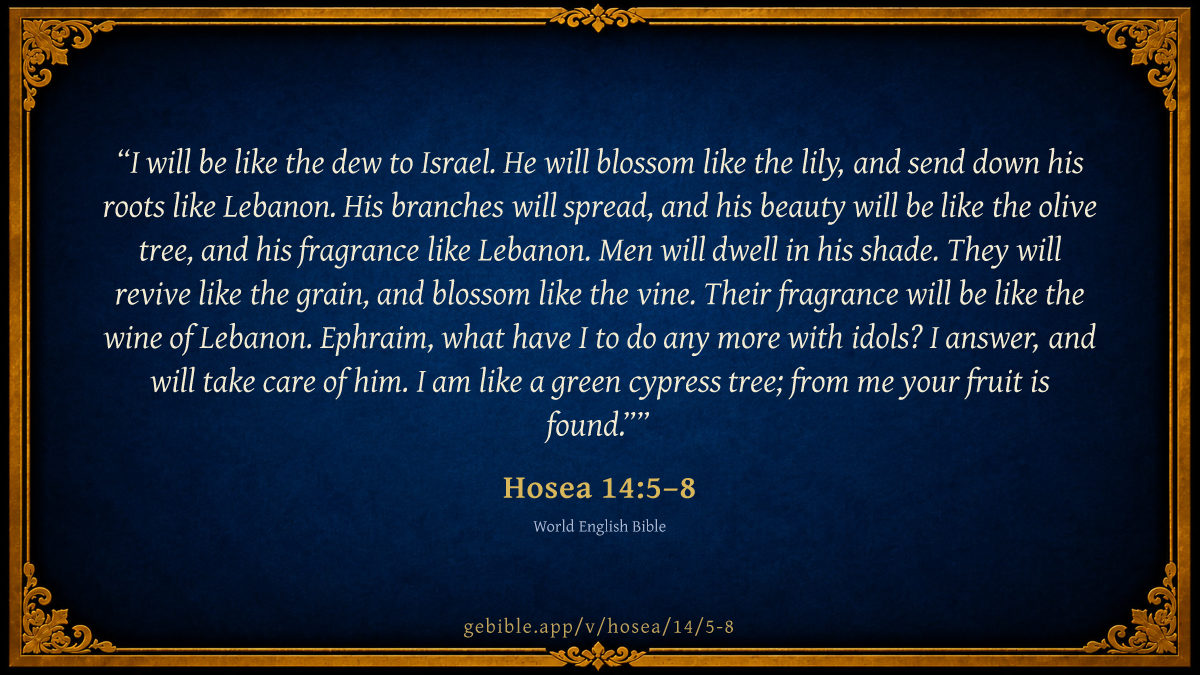
John Calvin 1540 · Public Domain On vv5–8 The Prophet now again repeats what he had said,…
The Prophet now again repeats what he had said, that God, after restoring the people to favour, would be so beneficent, as to render apparent the fruit of reconciliation. Seeing that the Israelites had been afflicted, they ought to have imputed this to their own sins, they ought to have perceived by such proofs, the wrath of God. They had been so stupid as to have on the contrary imagined, that their adversities happened to them by chance. The Prophet had been much engaged in teaching this truth, that the Israelites would be ever miserable until they turned to God, and also, that all their affairs would be unhappy until they obtained pardon. He now speaks of a change, that God would not only by words show himself propitious to them, but would also give a proof by which the Israelites might know that they were now blessed, because they had been reconciled to God; for his blessing would be the fruit of his gratuitous love. Thus then ought this sentence, I will be to Israel as the dew, to be connected: He intimates that they were before dry, because they had been deprived of God’s favour. He compares them to a rose or lily: for when the fields or meadows are burnt up by the heat of the sun, and there is no dew distilling from heaven, all things wither. How then can lilies and roses flourish, except they derive moisture from heaven, and the dew refreshes the grounds that they may put forth their strength? The reason then for the similitude is this, because men become dry and destitute of all vigour, when God withdraws his favour. Why? Because God must, as it were, distil dew, otherwise, as it has been said, we become wholly barren and dry. I will be then as dew to Israel
And further, He shall Flourish as the lily, and his roots he shall send forth Some render ויך, vaic, “and he will strike;” and נכה, nuke, means to strike. Others render the words, “His branches will extend:” but the verb is in the singular number, and the noun, “roots,” is in the plural. The Prophet then speaks of Israel, that he strikes his roots; but he means to fix in a metaphorical sense: he will then fix his roots. As when we strike, we fetch a blow, and extend our arms; so he will spread forth his roots as Libanus. This is the second effect of God’s favour and blessing; which means, that the happiness of the people would be perpetual. With regard to the rose or lily, the meaning of the metaphor is, that God would suddenly, and as in a moment, vivify the Israelites, though they were like the dead. as in one night the lily rises, and unexpectedly also the rose; so sudden would be the change signified by this metaphor. But as the lilies and the roses soon wither, it was not enough to promise to Israel that their salvation would come suddenly; but it was needful to add this second clause, — that though they would be like lilies and roses, they yet would be also like tall trees, which have deep roots in the ground, by which they remain firm and for a long time flourish.
Read full note →
We now then perceive the meaning of the Prophet. He mentions here the twofold effect of God’s blessing as to the Israelites, — that their restoration would be sudden, as soon as God would distil like the dew his favour upon them, and also that this happiness would not be fading, but enduring and permanent. And the words may be rendered, as Libanus, or as those of Libanus: as Libanus he shall cast forth his roots, as the trees which grow there; or, he shall cast forth his roots as the trees which are in Libanus. But as to the sense there is no difference. It follows —
John Calvin's Commentaries (1540-1563) — public domain. Text from the Calvin Translation Society English edition (1840s-50s) via the Christian Classics Ethereal Library (ccel.org). Calvin's coverage is partial (roughly two-thirds of the Bible); uncommented books and verses are honest gaps, never fabricated. The 19th-century editor's footnotes and remarks are omitted so the notes are faithfully Calvin's own voice.
Geneva Bible translators 1599 · Public Domain On vv5, 8 He declareth how ready God is to receive them…
He declareth how ready God is to receive them that do repent.
Geneva Bible (1599) marginal notes — public domain.
John Trapp 1656 · Public Domain On vv5–8 Hos 14:5 I will be as the dew unto…
Hos 14:5 I will be as the dew unto Israel: he shall grow as the lily, and cast forth his roots as Lebanon.
Ver. 5. I will be as the dew unto Israel] I will give good in abundance; and this is sweetly set forth in a sevenfold metaphor, all answering to the name of Ephraim (which signifieth fruitful) and to the ancient promises made unto him; and all again opposite to the many contrary curses, threatened in the former parts of the prophecy, under metaphors of a contrary importance, as Pareus and (out of him) Tarnovius have well observed. As first of solid and fruit causing dew, in opposition to that vanishing and barren dew, Hos 6:4; Hos 13:3; secondly, of the flourishing lily, contrary to those nettles, thorns, and thistles, Hos 9:16; Hos 10:8; thirdly, of the well-rooted and durable trees of Libanus, contrary to dry roots, Hos 9:16; fourthly, of spreading and growing branches, instead of branches consumed, Hos 11:6; Hos 9:16; Hos 10:8; fifthly, of trees yielding pleasant shade and repose, contrary to Hos 9:3; Hos 9:6; sixthly, of corn to satisfy hunger, contrary to Hos 8:7; lastly, of a vine bringing forth excellent wine, contrary to Hos 9:16; Hos 10:1. And all these fruits the fruits of Lebanon, a most fertile mountain, the valleys whereof were most rich grounds for pasture, grain, and vineyards.
Read full note →
As the dew unto Israel, he shall blossom as the lily] Quot verba, tot lumina, imo flumina orationis. This prophet aboundeth with similitudes, as is before noted. {see Hos 12:10} {See Trapp on "Hos 12:10"} He beginneth here with a simile drawn from the dew of heaven; a mercy very much set by, in those hotter countries especially, where from May to October they had no rain. The Chaldee paraphrase and Hebrew doctors understand this text concerning Christ and his benefit. Truly he is good to Israel, to the pure in heart, Psa 73:1. Peace and mercy, sanctity and safety, all spiritual benedictions in heavenly things in Christ, shall be upon the Israel of God, Gal 6:16 Eph 1:3. What the dew is to the herbs, fields, fruits, that is Christ to his Israel. 1. The dew comes when the air is clear; so doth Christ by his blessing, when the light of his countenance is lifted up upon us, 2. As the dew refresheth and cherisheth the dry and fady fields (hence it is called the dew of herbs, Isa 26:19, which thereby recover life and beauty), so doth Christ our hearts, scorched with the sense of sin; and fear of wrath. 3. As the dew allayeth great heats, and moisteneth and mollifieth the earth, that it may fructify; so Christ cooleth the devil’s fiery darts, and filleth his people with the fruits of righteousness (Aristot. lib. 1, Meteor. cap. 10; Plin. lib. 2, cap. 60, et lib. 18, cap. 29). "He is unto them as a cloud of dew in the heat of harvest," Isa 18:4, and maketh their souls as so many watered gardens, Jer 31:12 4. As the dew falls in a narrow compass, without noise, and is felt only by those (in the force of it) on whom it descends; so the grace of Christ watereth his faithful only; secretly and sweetly insinuating into their hearts: the stranger meddleth not with their comforts. See Joh 14:17. The cock on the dunghill knows them not.
He shall grow as the lily] Which hath its name in the Hebrew from its six leaves, and serves here and elsewhere to set forth the great comeliness, sweet odours, and true humility of the Church: for the lily grows in valleys, Son 2:1; as Theophylact upon this text notes, sweet it is but not great, εχει την ευωδιαν μεγεθος ουκ εχει, and the more it blossometh the more it shooteth upwards, to teach us heavenly mindedness. It is also of a perfect whiteness, to remind us of innocence. "Her Nazarites were purer than snow, whiter than milk," Lam 4:7. Lastly, Lilio nihil est foecundius, saith Pliny, nothing is more fruitful than the lily; et lachryma sua seritur, saith the same author, it is sown in its own tears. Weeping Christians grow exceedingly.
And cast forth his roots as Lebanon] i.e. as the cedars of Lebanon, as the Chaldee Paraphrast interpreteth it; or as the frankincense tree, which taketh very deep rooting, so Cyril senseth it. The lily (with its six white leaves, and seven golden coloured grains within it) soon fadeth, and loseth both beauty and sweetness; but so doth not Christ and his people. He can as well die at the right hand of his Father as in the hearts of his elect, where he dwells by faith, Rom 6:10, whereby they are "rooted and grounded in love, strengthened with might by his Spirit in the inner man," Eph 3:16-17, so that the gates of hell cannot prevail against them. Immota manet, is the Church’s motto; Nec fluctu, nec flatu movetur, It is not moved by wind or waves, which is the Venetian motto. "They that trust in the Lord shall be as mount Zion, which cannot be removed, but abideth for ever," Psa 125:1. Winds and storms move neither Libanus nor the well-rooted cedars thereof: which the more they are assaulted the better they are rooted. So fareth it with the saints. Plato compareth man to a tree inverted. The Scripture often compareth a good man to a tree planted by the rivers of waters, that taketh root downward, and beareth fruit upward, 2Ki 19:30.
- “ quae quantum vertice ad auras,
Aethereas, tantum radice ad tartara tendit. ”
Let us cast forth our roots as Lebanon; stand fast rooted in the truth, being "stedfast and unmoveable, always abounding in the work of the Lord," and with full purpose of heart cleaving close unto him, 1Co 15:58, being established by his grace, Col 1:11 Heb 12:28; Heb 13:9. In the civil law, till a tree hath taken root it doth not belong to the soil whereon it is planted. It is not enough to be in the Church, except, like the cedars of Lebanon, we cast forth our roots, and are so planted, that we flourish in the courts of our God, and bring forth fruit in our old age, Psa 92:12-14.
John Trapp, A Commentary or Exposition upon All the Books of the Old and New Testament (1647–1656) — public domain. Text from a community e-Sword module.
Matthew Poole 1685 · Public Domain On vv5–8 I, the Lord, who have pardoned, and am appeased,
I, the Lord, who have pardoned, and am appeased,
will be as the dew, refresh and water, that they may grow, and that they may be fruitful and flourish, as the dew in those countries, where it was more abundant than with us, and for some months together supplied the want of rain; God will refresh and comfort, and make fruitful in good works, through his grace, such as return to him.
Read full note →
Israel; those that do unfeignedly, not hypocritically, confess, pray, and repent.
As the lily; which grows apace, is fragrant, beautiful, and delights in valleys, often grows among thorns; so the Israel of God among troubles in low state, yet comely, and fragrant to the Lord, and grows up in him speedily.
Lebanon, put for the trees of Lebanon; as those trees spread forth their roots, grow up to strength, are most beautiful, odoriferous, and durable, cedars in Lebanon are these trees; so shall the true Israel, converted backsliders, be blessed of God. So flourishing and happy shall the church be under Christ.
Matthew Poole's English Annotations on the Holy Bible (1683–1685) — public domain. Text from a community e-Sword/MySword module.
Matthew Henry 1710 · Public Domain On v8 Let us now hear the conclusion of the whole…
Let us now hear the conclusion of the whole matter.
I. Concerning Ephraim; he is spoken of and spoken to, Hos 14:8. Here we have,
Read full note →
1. His repentance and reformation: Ephraim shall say, What have I to do any more with idols? As some read it, God here reasons and argues with him, why he should renounce idolatry: "O Ephraim! what to me and idols? What concord or agreement can there be between me and idols? What communion between light and darkness, between Christ and Belial? Co2 6:14, Co2 6:15. Therefore thou must break off thy league with them if thou wilt come into covenant with me." As we read it, God promises to bring Ephraim and keep him to this: Ephraim shall say, God will put it into his heart to say it, What have I to do any more with idols? He has promised (Hos 14:3) not to say any more to the works of his hands, You are my gods. But God's promises to us are much more our security and our strength for the mortifying of sin than our promises to God; and therefore God himself is here surety for his servant to good, will put in into his heart and into his mouth. And, whatever good we say or do at any time, it is he that works it in us. Ephraim had solemnly engaged not to call his idols his gods; but God here engages further for him that he shall resolve to have no more to do with them. He shall abolish them, he shall abandon them, and that with the utmost detestation; for it is necessary not only that in our lives we be turned from sin, but that in our hearts we be turned against sin. See here, (1.) The power of divine grace. Ephraim had been joined to his idols (Hos 4:17), was so fond of them that one would have thought he could never fall out with them; and yet God will work such a change in him that he shall loathe them as much as ever he loved them. (2.) See the benefit of sanctified afflictions. Ephraim had smarted for his idolatry; it had brought one judgment after another upon him, and this at length is the fruit, even the taking away of his sin, Isa 27:9. (3.) See the nature of repentance; it is a firm and fixed resolution to have no more to do with sin. This is the language of the penitent: "I am ashamed that ever I had to do with sin; but I have had enough of it; I hate it, and by the grace of God I will never have any thing to do with it again, no, not with the occasions of it." Thou shalt say to thy idol, Get thee hence (Isa 30:22), shalt say to the tempter, Get thee behind me, Satan.
2. The gracious notice God is pleased to take of it: I have heard him, and observed him. I have heard, and will look upon him; so some read it. Note, The God of heaven takes cognizance of the penitent reflections and resolutions of returning sinners. He expects and desires the repentance of sinners, because he has no pleasure in their ruin. He looks upon men (Job 33:27), hearkens and hears, Jer 8:6. And, if there be any disposition to repent, he is well pleased with it. When Ephraim bemoans himself before God, he is a dear son, he is a pleasant child, Jer 31:20. He meets penitents with mercy, as the father of the prodigal met his returning son. God observed Ephraim, to see whether he would bring forth fruits meet for this profession of repentance that he made, and whether he would continue in this good mind. He observed him to do him good, and comfort him, according to the exigencies of his case.
3. The mercy of God designed for him, in order to his comfort and perseverance in his resolutions; still God will be all in all to him. Before, Israel was compared to a tree, now God compares himself to one. He will be to his people, (1.) As the branches of a tree: "I am like a green fir-tree, and will be so to thee." The fir-trees, in those countries, were exceedingly large and thick, and a shelter against sun and rain. God will be to all true converts both a delight and a defence; under his protection and influence they shall both dwell in safety and dwell in ease. He with be either a sun and a shield or a shade and a shield, according as their case requires. They shall sit down under his shadow with delight, Sol 2:3. He will be so all weathers, Isa 4:6. (2.) As the root of a tree: From me is thy fruit found, which may be understood either of the fruit brought forth to us (to him we owe all our comforts) or of the fruit brought forth by us - from him we receive grace and strength to enable us to do our duty. Whatever fruits of righteousness we brought forth, all the praise of them is due to God; for he works in us both to will and to do that which is good.
II. Concerning every one that hears and reads the words of the prophecy of this book (Hos 14:9): Who is wise? and he shall understand these things. Perhaps the prophet was wont to conclude that sermons he preached with these words, and now he closes with them the whole book, in which he has committed to writing some fragments of the many sermons he had preached. Observe, 1. The character of those that do profit by the truths he delivered: Who is wise and prudent? He shall understand these things, he shall know them. Those that set themselves to understand and know these things thereby make it to appear that they are truly wise and prudent, and will thereby be made more so; and, if any do not understand and know them, it is because they are foolish and unwise. Those that are wise in the doing of their duty, that are prudent in practical religion, are most likely to know and understand both the truths and providences of God, which are a mystery to others, Joh 7:17. The secret of the Lord is with those that fear him, Psa 25:14. Who is wise? This intimates a desire that those who read and hear these things would understand them (O that they were wise!) and a complaint that few were so - Who has believed our report? 2. The excellency of these things concerning which we are here instructed: The ways of the Lord are right; and therefore it is our wisdom and duty to know and understand them. The way of God's precepts, in which he requires us to walk, is right, agreeing with the rules of eternal reason and equity and having a direct tendency to our eternal felicity. The ways of God's providence, in which he walks toward us, are all right; no fault is to be found with any thing that God does, for it is all well done. His judgments upon the impenitent, his favours to the penitent, are all right; however they may be perverted and misinterpreted, God will at last be justified and glorified in them all. His ways are equal. 3. The different use which men make of them. (1.) The right ways of God to those that are good are, and will be, a savour of life unto life: The just shall walk in them; they shall conform to the will of God both in his precepts and in his providences, and shall have the comfort of so doing. They shall well understand the mind of God both in his word and in his works; they shall be well reconciled to both, and shall accommodate themselves to God's intention in both. The just shall walk in those ways towards their great end, and shall not come short of it. (2.) The right ways of God will be to those that are wicked a savour of death unto death: The transgressors shall fall not only in their own wrong ways, but even in the right ways of the Lord. Christ, who is a foundation stone to some, is to others a stone of stumbling and a rock of offence. That which was ordained to life becomes through their abuse of it, death to them. God's providences, being not duly improved by them, harden them in sin and contribute to their ruin. God's discovery of himself both in the judgments of his mouth and in the judgments of his hand is to us according as we are affected under it. Recipitur ad modum recipientis - What is received influences according to the qualities of the receiver. The same sun softens wax and hardens clay. But of all transgressors those certainly have the most dangerous fatal falls that fall in the ways of God, that split on the rock of ages, and suck poison out of the balm of Gilead. Let the sinners in Zion be afraid of this.
Matthew Henry's Commentary on the Whole Bible (1708–1710) — public domain (CC PDM 1.0). Text via the HelloAO Bible API.
John Gill 1763 · Public Domain On vv5–8 I will be as the dew unto Israel,.... To…
I will be as the dew unto Israel,.... To spiritual Israel, to those that return to the Lord, take with them words, and pray unto him, whose backslidings are healed, and they are freely loved; otherwise it is said of apostate Israel or Ephraim, that they were "smitten, and their root dried up, and bore no fruit", Hos 9:16. These words, and the whole, context, respect future times, as Kimchi observes; even the conversion of Israel in the latter day, when they shall partake of all the blessings of grace, signified by the metaphors used in this and the following verses. These words are a continuation of the answer to the petitions put into the mouths of converted ones, promising them many favours, expressed in figurative terms; and first by "the dew", which comes from heaven, is a great blessing of God, and is quickening, very refreshing and fruitful to the earth: and the Lord is that unto his people as the dew is to herbs, plants, and trees of the earth; he is like unto it in his free love and layout, and the discoveries of it to them; which, like the dew, is of and from himself alone; is an invaluable blessing; better than life itself; and is not only the cause of quickening dead sinners, but of reviving, cheering, and refreshing the drooping spirits of his people; and is abundance, never fails, but always continues, Pro 19:12; and so he is in the blessings of his grace, and the application of them; which are in heavenly places, in Christ, and come down from thence, and in great abundance, like the drops of dew; and fall silently, insensibly, and unawares, particularly regenerating grace; and are very cheering and exhilarating, as forgiveness of sin, a justifying righteousness, adoption, &c. Deu 33:13; and also in the Gospel, and the doctrines of it, which distil as dew; these are of God, and come down from heaven; seem little in themselves, but of great importance to the conversion of sinners, and comfort of saints; bring many blessings in them, and cause great joy and fruitfulness wherever they come with power, Deu 32:2. The Targum is,
"my Word shall be as dew to Israel;''
Read full note →
the essential Word of God, the Messiah; of whose incarnation of a virgin some interpret this; having, like the dew, no father but God, either in his divine or human nature; but rather it is to be understood of the blessings of grace he is to his people as Mediator; being to them wisdom, righteousness, sanctification, and redemption, and every other, even their all it, all:
he shall grow as the lily; to which the church and people of God are sometimes compared, especially for their beauty and comeliness in Christ, Solomon in all his glory not being arrayed like one of these; particularly for their unspotted purity, being clothed with fine linen, clean and white, the white raiment of Christ's righteousness, and having their garments washed and made white in his blood; see Sol 2:1; and here for its growth. The root of the lily lies buried in the earth a long time, when it seems as if it was dead; but on a sudden it springs out of the earth, and runs up to a great height, and becomes very flourishing; which is not owing to itself, it "toils not"; but to the dew of heaven: so God's elect in a state of nature are dead, but, being quickened by the grace of God, spring up on a sudden, and grow very fast; which is not owing to themselves, but to the dews of divine grace, the bright shining of the sun of righteousness upon them, and to the influences of the blessed Spirit; and so they grow up on high, into their Head Christ Jesus, and rise up in their affections, desires, faith and hope to heavenly things, to the high calling of God in Christ, and become fruitful in grace, and in good works. The Targum is,
"they shall shine as the lily;''
see Mat 6:29;
and cast forth his roots as Lebanon; as the tree, or trees, of Lebanon, as the Targum; and so Kimchi, who adds, which are large, and their roots many; or as the roots of the trees of Lebanon, so Jarchi; like the cedars there, which, as the word here used signifies, "struck" (c) their roots firm in that mountain, and stood strong and stable, let what winds and tempests soever blow: thus, as in the following, what one metaphor is deficient in, another makes up. The lily has but a weak root, and is easily up; but the cedars in Lebanon had roots firm and strong, to which the saints are sometimes compared, as here; see Psa 92:12; and this denotes their permanency and final perseverance; who are rooted in the love of God, which is like a root underground from all eternity, and sprouts forth in regeneration, and is the source of all grace; is itself immovable, and in it the people of God are secured, and can never be rooted out; and they may be said to "strike" their roots in it, as the phrase here, when they exercise: a strong faith in it, and are firmly persuaded of their interest in it; see Eph 3:17; they are also rooted in Christ, who is the root of Jesse, of David, and of all the saints; from whom they have their life, their nourishment and fruitfulness, and where they remain unmoved, and strike their roots in him, by renewed acts of faith on him, claiming their interest in him; and are herein so strongly rooted and grounded, that all the winds and storms of sin, Satan, and the world, cannot eradicate them; nay, as trees are more firmly rooted by being shaken, so are they; see Col 2:7. The Targum is,
"they shall dwell in the strength of their land, as a tree of Lebanon, which sends forth its branch.''
(c) "percutiet", Montanus, Tarnovius, Rivet, Cocceius; "figet", Calvin, Pareus; "defiget"; Zanchius; "et infiget", Schmidt; "incutiet", Drusius.
John Gill's Exposition of the Whole Bible (1746–1763) — public domain (CC PDM 1.0). Text via the HelloAO Bible API.
John Wesley 1765 · Public Domain On vv5–8 As the dew - I will refresh and comfort,…
As the dew - I will refresh and comfort, and make fruitful in good works, such as return to me. As Lebanon - As the cedars in Lebanon, so shall the true Israel, converted backsliders, be blessed of God: so flourishing and happy shall the church be under Christ.
John Wesley, Explanatory Notes Upon the Whole Bible (1754–1765) — public domain. Text via the GEBible commentary corpus.
Adam Clarke 1810 · Public Domain On vv5, 7, 8 Verse 5. I will be as the dew unto…
Verse 5. I will be as the dew unto Israel] On these metaphors I gladly avail myself of the elegant and just observations of Bp. Lowth. "These verses (Ho 14:5-7) contain gracious promises of God's favour and blessings upon Israel's conversion. In the fifth verse, it is described by that refreshment which copious dews give to the grass in summer. If we consider the nature of the climate, and the necessity of dews in so hot a country, not only to refresh, but likewise to preserve life; if we consider also the beauty of the oriental lilies, the fragrance of the cedars which grow upon Lebanon, the beauteous appearance which the spreading olive trees afforded, the exhilarating coolness caused by the shade of such trees, and the aromatic smell exhaled by the cedars; we shall then partly understand the force of the metaphors here employed by the prophet; but their full energy no one can conceive, till he feels both the want, and enjoys the advantage, of the particulars referred to in that climate where the prophet wrote." - Lowth's twelfth and nineteenth prelection; and Dodd on the place.
What a glorious prophecy! What a wonderful prophet! How sublime, how energetic, how just! The great master prophet, Isaiah, alone could have done this better. And these promises are not for Israel merely after the flesh; they are for all the people of God. We have a lot and portion in the matter; God also places his love upon us. Here the reader must feel some such sentiment as the shepherd in Virgil, when enraptured with the elegy which his associate had composed on their departed friend. The phraseology and metaphors are strikingly similar; and therefore I shall produce it.
Read full note →
Tale tuum carmen nobis, divine poeta,
Quale sopor fessis in gramine, quale per aestum
Dulcis aquae saliente sitim restinguere rivo.
Nec calamis solum aequiparas, sed voce magistrum.
Fortunate puer! tu nunc eris alter ab illo.
Nos tamen haec quocunque modo tibi nostra vicissim
Dicemus, Daphninque tuum tollemus ad astra:
Daphnin ad astra feremus: amavit nos quoque Daphnis.
VIRGIL. Ecl. v., ver. 45.
"O heavenly poet, such thy verse appears,
So sweet, so charming to my ravish'd ears,
As to the weary swain with cares oppress'd,
Beneath the sylvan shade, refreshing rest;
As to the feverish traveller, when first
He finds a crystal stream to quench his thirst.
In singing, as in piping, you excel;
And scarce your master could perform so well.
O fortunate young man! at least your lays
Are next to his, and claim the second praise.
Such as they are, my rural songs I join
To raise your Daphnis to the powers divine;
For Daphnis was my friend, as well as thine."
Adam Clarke's Commentary on the Bible (1810–1826) — public domain. Text from a community e-Sword/MySword module.
Joseph Benson 1811 · Public Domain On vv5, 7, 8 Hos 14:5-6. I will be as the dew unto…
Hos 14:5-6. I will be as the dew unto Israel — These verses contain gracious promises of God’s favour, and of blessings upon Israel’s conversion, represented by different metaphors. These are first described by that refreshment which copious dews give to the grass in the heat of summer. And if we consider the nature of the climate, and the necessity of dews in so hot a country, not only to refresh, but likewise to preserve life; if we consider also the beauty of the oriental lilies, the fragrance of the cedars which grow upon Lebanon, the beauteous appearance which the spreading olive-trees afforded, the exhilarating coolness caused by the shade of such trees, and the aromatic smell exhaled by the cedars; we shall then partly understand the force of the metaphors here employed by the prophet; but their full energy no one can conceive, till he feels both the want, and enjoys the advantage of the particulars referred to, in that climate where the prophet wrote. See Bishop Lowth’s xiith and xixth Prelection. Mr. Harmer’s illustration of this passage will be acceptable to the reader. “The image in general,” says he, “made use of here by Hosea, is the change that takes place upon the descent of the dew of autumn on the before parched earth, where every thing appeared dead or dying; upon which they immediately become lively and delightful. Israel, by their sins, reduced themselves into a wretched, disgraceful state, like that of the earth, when no rain or dew has descended for a long time; but God promised he would heal their backslidings, and restore them to a flourishing state. The gentleman that visited the holy land in autumn 1774, found the dews very copious then, as well as the rain, and particularly observed, in journeying from Jerusalem, a very grateful scent arising from the aromatic herbs growing there, such as rosemary, wild thyme, balm, &c. If the fragrant herbs between Jerusalem and Joppa afforded such a grateful smell, as to engage this ingenious traveller to remark it in his journal, the scent of Lebanon must have been exquisite; for Mr. Maundrell found the great rupture in that mountain, in which Canobin is situated, had ‘both sides exceeding steep and high, clothed with fragrant green from top to bottom, and everywhere refreshed with fountains, falling down from the rocks, in pleasant cascades; the ingenious work of nature.’“ This sufficiently illustrates the clause, His smell, that is, his fragrance, shall be like that of Lebanon. To illustrate the clause, He shall grow as the lily, and cast forth his roots as Lebanon, Mr. Harmer quotes a passage from Dr. Russell’s account of the natural history of Aleppo, vol. 1. c. 3: “After the first rains in the autumn, the fields everywhere throw out the autumnal lily daffodil; and the few plants which had stood the summer now grow with fresh vigour.” The other trees of Lebanon, as well as the cedars, are admired by travellers on account of their enormous size. So de la Roque, describing his ascending this mountain, says, the farther they advanced, the loftier were the trees, which, for the most part, were plane-trees, cypresses, and evergreen oaks. And Rauwolff, after mentioning several kinds of trees and herbs which he found there, goes on; But chiefly, and in the greatest number, were the maple-trees, which are large, high, and expand themselves very much with their branches: but, above all, the size of the cedar attracts admiration. “I measured,” says Maundrell, “one of the largest, and found it twelve yards six inches in girt, and yet sound; and thirty-seven yards in the spread of its boughs. At about five or six yards from the ground it was divided into five limbs, each of which was equal to a great tree.” The beauty of the olive-tree is frequently mentioned in Scripture, and has come under our observation before: see note on Psa 128:3.
Joseph Benson's Commentary on the Old and New Testaments (1811–1818) — public domain. Text from a community e-Sword module.
Albert Barnes 1834 · Public Domain On vv5, 7, 8 I will be as the dew unto Israel -…
I will be as the dew unto Israel - Before, He had said, “his spring shall become dry and his fountain shall be dried up” Hos 13:15. Now again He enlarges the blessing; their supply shall be unfailing, for it shall be from God; yea, God Himself shall be that blessing; “I will be the dew; descending on the mown grass” Psa 72:6, to quicken and refresh it; descending, Himself, into the dried and parched and sere hearts of men, as He saith, “We will come unto him and make Our abode in him” Joh 14:23. The grace of God, like the dew, is not given once for all, but is, day by day, waited for, and, day by day, renewed. Yet doth it not pass away, like the fitful goodness Joh 6:4 of God’s former people, but turns into the growth and spiritual substance of those on whom it descends.
He shall grow as the lily - No one image can exhibit the manifold grace of God in those who are His own, or the fruits of that grace. So the prophet adds one image to another, each supplying a distinct likeness of a distinct grace or excellence. The “lily” is the emblem of the beauty and purity of the soul in grace; the “cedar” of Lebanon, of its strength and deep-rootedness, its immovableness and uprightness; the evergreen “olive tree” which “remaineth in its beauty both winter and summer,” of the unvarying presence of Divine Grace, continually, supplying an eversustained freshness, and issuing in fruit; and the fragrance of the aromatic plants with which the lower parts of Mount Lebanon are decked, of its loveliness and sweetness; as a native explains this , “he takes a second comparison from Mount Lebanon for the abundance of aromatic things and odoriferous flowers.”
Read full note →
Such are the myrtles and lavender and the odoriferous reed; from which “as you enter the valley” (between Lebanon and Anti-lebanon) “straightway the scent meets you.” All these natural things are established and well-known symbols of things spiritual. The lily, so called in Hebrew from its dazzling whiteness, is, in the Canticles Son 2:1-2, the emblem of souls in which Christ takes delight. The lily multiplies exceedingly : yet hath it a weak root and soon fadeth. The prophet, then, uniteth with these, plants of unfading green, and deep root. The seed which “had no root,” our Lord says, “withered away” Mat 13:6, as contrariwise, Paul speaks of these, who are “rooted and grounded in love” Eph 3:17, and of being “rooted and built up in Christ” Col 2:7. The widespreading branches are an emblem of the gradual growth and enlargement of the Church, as our Lord says, “It becometh a tree, so that the birds of the air come and lodge in the branches thereof” Mat 13:32.
The symmetry of the tree and its outstretched arms express, at once, grace and protection. Of the “olive” the Psalmist says, “I am like a green olive tree in the house Of God” Psa 52:8; and Jeremiah says, “The Lord called thy name a green olive tree, fair and of goodly fruit” Jer 11:16; and of “fragrance” the spouse says in the Canticles, “because of the savor of Thy good ointments, Thy name is as ointment poured forth” Son 1:3; and the Apostle says, “thanks be to God, which maketh manifest the savor of His knowledge by us in every place” 2Co 2:14. Deeds of charity also are “an odor of good smell” Phi 4:18; the prayers of the saints also are “sweet odors” Rev 5:8. All these are the fruits of the Spirit of God who says, “I will be as the dew unto Israel.” Such reunion of qualities, being beyond nature, suggests the more, that, that, wherein they are all combined, the future Israel, the Church, shall flourish with graces beyond nature, in their manifoldness, completeness, unfadingness.
Albert Barnes' Notes on the Bible (1834–1885) — public domain. Text from a community e-Sword/MySword module.
Haydock's Catholic Bible Commentary 1859 · Public Domain On vv5–8 Breaches, when Israel shall be converted, as some were…
Breaches, when Israel shall be converted, as some were to Christ, and many will be at the end of the world. (Worthington) --- Hebrew, "their return." Septuagint, "dwellings." They shall be purified. --- Freely. I have been forced to chastise, My heart dilates. (Calmet) --- Septuagint, "I will love them manifestly." Syriac, "accept their free offerings." (Haydock)
George Leo Haydock (1774–1849), Haydock's Catholic Family Bible and Commentary, 1859 edition — public domain. Excludes Psalms (Douay-Rheims chapter numbering differs from Protestant) and Deuterocanonical books (Catholic canon only).
Robert Jamieson, A. R. Fausset & David Brown 1871 · Public Domain On vv5–8 as the dew--which falls copiously in the East, taking…
as the dew--which falls copiously in the East, taking the place of the more frequent rains in other regions. God will not be "as the early dew that goeth away," but constant (Hos 6:3-4; Job 29:19; Pro 19:12).
the lily--No plant is more productive than the lily, one root often producing fifty bulbs [PLINY, Natural History, 21.5]. The common lily is white, consisting of six leaves opening like bells. The royal lily grows to the height of three or four feet; Mat 6:29 alludes to the beauty of its flowers.
Read full note →
roots as Lebanon--that is, as the trees of Lebanon (especially the cedars), which cast down their roots as deeply as is their height upwards; so that they are immovable [JEROME], (Isa 10:34). Spiritual growth consists most in the growth of the root which is out of sight.
Jamieson, Fausset & Brown — Commentary Critical and Explanatory on the Whole Bible (1871) — public domain (CC PDM 1.0). Text via the HelloAO Bible API.
Daniel D. Whedon 1874 · Public Domain On v8 8. Ephraim shall say, What have I to do…
8. Ephraim shall say, What have I to do — So Targum and Peshitto. R.V. margin reproduces the Hebrew more accurately, “O Ephraim, what have I to do.” The question is spoken by Jehovah, not by Ephraim (Israel). Jehovah knows that he can supply every need of his people; why, he inquires, should idols be joined with him in worship? The rest of the verse presents a justification of Jehovah’s claim to their whole-hearted service, he will supply all their needs. LXX. represents a slightly different text: “Ephraim, what hath he to do?” The answer implied is that he has nothing more to do with idols; he has entirely discarded them (Hos_14:3). In view of Israel’s conversion Jehovah will supply all their needs. LXX. may have preserved the original text.
I have heard — R.V., “answered” — The pronoun is emphatic, I on my part, or It is I who. The tense is a prophetic perfect, though the perfect; may be used to indicate that in the divine mind the change of attitude has already been determined upon. Jehovah will respond to Israel in the same spirit in which Israel approaches him (Hos_2:15; Hos_2:21; Hos_2:23; compare Isa_65:24).
Read full note →
Observed — R.V., “will regard,” that is, with loving care and tenderness (Isa_8:17; Deu_31:7).
I am like a green fir tree — The precise kind of tree in the mind of the prophet may be uncertain, but there can be no doubt that he is thinking of the splendid forests of Mount Lebanon. The pronoun is again emphatic. Who is the speaker? The preceding clauses are evidently placed in the mouth of Jehovah; so is the last clause of Hos_14:8. It seems natural, therefore, to ascribe these words also to him. Under the figure of an evergreen tree he seeks to teach the people that his interest in their welfare is unchangeable; that the protection and shelter he offers them will continue forever. Against this interpretation it is urged that Jehovah is nowhere else likened to a tree, and that such comparison is alien to the spirit of prophecy (Hos_4:13; compare Isa_1:29). Consequently the words are placed in the mouth of Israel as a “naive self-congratulation on the part of Israel.” The last clause is interpreted as a reply by Jehovah, warning them not to boast in their prosperity, but to remember that Jehovah is the giver of every good and perfect gift. In favor of this view is the comparison of Israel with the forests of Lebanon (Hos_14:5). The abrupt change in speakers, without indication of such a change, cannot be urged against this interpretation, for similar changes are found in other parts of the Old Testament (compare Psalms 132). Some have gone so far as to make Jehovah speak twice and Israel twice, assigning lines 1 and 3 to Israel, lines 2 and 4 to Jehovah. But if line 3 is spoken by Israel, of itself, and line 4 by Jehovah, of Israel, it is strange that the nation should be likened to two different kinds of trees in two successive clauses — to a fir tree and to a fruit tree. For this reason it may be better to assign the whole of Hos_14:8 to Jehovah, and regard it as a continuation of the divine promises to Israel.
From me is thy fruit found — All the fruitfulness and prosperity of Israel comes from Jehovah. There may be in the original a play upon the name Ephraim, as in Hos_13:15.
With Hos_14:8 closes the direct prophetic message. Hos_14:9 is the epilogue, summoning the people to lay to heart the lessons of the Book of Hosea. This epilogue is similar in import to the words of Jesus, “He that hath ears to hear, let him hear” (Mat_11:15; Mat_13:9, etc.). Because of its similarity in tone and language with the Wisdom Literature, the fact that the appeal seems to presuppose the fulfillment of Hosea’s oracles, and the lack of similarity with Hosea’s style, scholars are agreed almost universally in declaring the verse a later addition by some prophetic spirit who lived at a time and in surroundings which called for a message similar to that of Hosea. Whether Hosea is the author or not the meaning remains the same, but neither A.V. nor R.V. makes this meaning very clear. Both translations emphasize the difficulties presented by the divine providence as set forth by Hosea; few, if any, can comprehend them. Nevertheless, the author insists, they are straight, leading the faithful to life, the transgressor to destruction. While this interpretation brings out an important truth, it does not seem to touch the real thought of Hos_14:9. This thought becomes plain if 9a is rendered as follows: “Whosoever is wise, let him understand these things; (whosoever is) prudent, let him know them.”
Wise — A very common word in the Wisdom Literature; a wise person is one who knows and does what is right and proper or is anxious to do the same; such a one is exhorted to understand and lay to heart.
These things — The warnings, exhortations, promises, etc., contained in the Book of Hosea. The advice is enforced by a parallel appeal. Why?
For the ways of Jehovah are right — There is no injustice in the acts of his providence (Psa_19:9; Deu_32:4).
Just — He who is obedient to the divine will.
Transgressors — The opposite of just; the man who is not obedient. The word just occurs nowhere else in Hosea.
Shall walk in them — In the divine ways. To walk in God’s ways is ordinarily to “conduct one’s self in accordance with the divine will.” If this is the meaning here the statement of the author becomes equivalent to “the obedient to the divine will are obedient.” This is meaningless.
To walk is in this verse equivalent to “to walk without encountering any obstacles.” He who learns the divine will as taught in the Book of Hosea, and is obedient to the same, shall live continually a happy and prosperous life; but the man who does not profit by these lessons, the transgressor who is disobedient to the divine will, shall meet his fate.
Shall fall therein — Shall come to utter ruin. Whatever the outcome, the ways of Divine Providence are right. To one they mean life, to another death. Which it will be is determined by the individual’s attitude toward the will of God (1Co_1:18; compare Pro_11:5).
Daniel D. Whedon (gen. ed.), Commentary on the Old and New Testaments (1874–1909) — public domain. Text from a community e-Sword module.
The Cambridge Bible for Schools and Colleges 1878 · Public Domain On vv5–8 5. their backsliding] i.e. the damage which their ‘backsliding’…
5. their backsliding] i.e. the damage which their ‘backsliding’ has brought upon them.
love them freely] Or, ‘spontaneously’, i.e. without receiving any gifts but those mentioned in Hos_14:2.
Read full note →
5–9. Jehovah, in answer, describes the blessings which He will give. The imagery reminds us of the Song of Songs; notice especially the references to the lily and to Lebanon.
The Cambridge Bible for Schools and Colleges (gen. ed. J. J. S. Perowne; Cambridge University Press, 1878–1918) — public domain. Text from a community e-Sword module.
Ellicott's Commentary for English Readers 1878 · Public Domain On vv5, 7, 8 (5, 6) As the Dew.—For this imagery see Psa_130:3.…
(5, 6) As the Dew.—For this imagery see Psa_130:3. Properly it is “a copious mist, shedding small invisible rain, that comes in rich abundance every night in the hot weather, when west or north-west winds blow, and which brings intense refreshment to all organised life” (Neil’s Palestine Explored, p. 136). The lily, which carpets the fields of Palestine (Mat_6:29), has slender roots, which might easily be uptorn, but under God’s protection, even these are to strike downward like the roots of the cedars.[13] Branches are to grow like the banyan-tree, until one tree becomes a forest, and the beauty of the olive in its dancing radiance is to cover all, while the fragrance shall go abroad like the breezes from the forest of Lebanon.
[13] The lily of the Bible is identified by some with the Lilium chalcedonicum, or Scarlet Martagon, which grows profusely in the Levant, and is said to abound in Galilee in the months of April and May. Wetzstein, on the other hand, identifies it with a beautiful dark violet lily which grows in the large plain south-east of the Hauran range of mountains, and is called susân. The opinion of the Chaldee paraphrast and of Rabbinical writers, that the rose was really meant by the Hebrew, may safely be rejected.
A Bible Commentary for English Readers, edited by Charles John Ellicott (1878–1897) — public domain. Text from a community e-Sword module.
The Pulpit Commentary 1880 · Public Domain On vv5, 8 Vers. 5-8. Return to God: its ultimate results.
Vers. 5-8. Return to God: its ultimate results.
These are like the effects of the dew of heaven upon garden and landscape. They are, in fact, the results of the Divine influence which God the Holy Spirit bestows upon returning penitents. The imagery of the passage is borrowed from the vegetable kingdom, and reminds us of that of the Song of Solomon. The prophet employs a combination of emblems the lily, the cedar, the olive, the corn-field, the vineyard, because it requires them all to furnish an adequate picture of the blessed outcome of religious revival. This representation shall yet be realized in the spiritual future of the Hebrew nation. "Ephraim," now so sadly blighted, shall be dowered with "double fruitfulness," and thus verify the presage of his ancient name. (Gen_41:52) The promise is fulfilled also, even now, in the case of every Christian Church, and of every gracious heart, which "returns unto Jehovah," and receives a fresh baptism of his Spirit. The rich and blessed results of revival are
Read full note →
I GROWTH. "He shall grow as the lily" (ver. 5). There are various plants of the lily species found in Palestine which are remarkable, not only for their beauty, but for their rapid and luxuriant growth. The tall lilies, to whose brilliant colors the Lord Jesus pointed his disciples, (Mat_6:28, Mat_6:29) possess also much vitality and productiveness. So is it with the Church that has been watered with the copious dews of God"s good Spirit. How rapidly the infant Church grew after the outpouring on the day of Pentecost! What multitudes turned to the Lord in the times of the Reformation! What numbers do still in every season of revival! And so also is it with the individual soul when the garden of its graces is daily wetted with the heavy heavenly dew. It makes rapid progress in its upward growth. Each of us may profitably ask himself, "Am I growing in grace? Are my Christian faith, and love, and patience, and diligence, and holy zeal larger than they were ten or twenty years ago?
II STRENGTH. He shall "strike his roots as Lebanon: his branches shall spread" (vers. 5, 6). The lily both grows and multiplies rapidly; but it is not an emblem of stability, for its stalk is frail and its root slender. To find an image of fixedness and forceful reserve, the prophet goes to the cedar of Lebanon. This tree is far-famed for its strength and stateliness. It is very deeply rooted; and from its main trunk numerous branches spread out horizontally, tier upon tier, until the diameter of the compass of ground which the tree covers is even greater than its height. In like manner, spiritual solidity and expansiveness are secured by striking our roots well down into the hidden life of faith, and prayer, and communion with God, and fidelity to conscience. The moral robustness which is proof against whatever "tribulation or persecution ariseth because of the Word" (Mat_13:21) is always the result of a deep sense of sin, a thorough apprehension of the gospel, and a profound love to the Savior.
III BEAUTY AND FRAGRANCE. "His beauty shall be as the olive tree" (ver. 6). There is doubtless a natural glory of its own in the slender grey-green foliage of the olive; but to the Oriental the attractiveness of this tree consists largely in its capacity of yielding that oily matter ("fatness," Jud_1:9:9) which is so essential to health in the dry and hot climate of the East. "His smell as Lebanon" (ver. 6); the reference being to the fresh breezes of the mountain, laden in early summer with the fragrance of the vines and the balsamic odor of the cedars and aromatic plants. "The scent thereof shall be as the wine of Lebanon" (ver. 7), which was celebrated for its fine flavor and its rich aroma. These emblems are suggestive of the beauty of holiness, and the fragrance which proceeds from the renewed heart and life. The Divine dew is sent to make one nature bloom as the lily, and to clothe another with verdure like the ever-green olive. It should impart to every child of God some healthful fragrance or sweetness of disposition which shall lead others to take knowledge of him, that he has been with Jesus". (Psa_45:8) How many Christians, unhappily, lack this blessed aroma! How many are morose and moody, rather than sunny and joyful; thereby giving countenance to the impression that religion is a melancholy thing, instead of being "cheerful as the day"!
IV FRUITFULNESS. This is the most important of the results, and Hosea"s mind dwells on it in vers. 7 and 8 as the prevailing thought of the passage. Fruitfulness is the ultimate test and the final end of every revival In ver. 7 the restored Israelitish nation is spoken of as a wide spreading tree, under whose grateful shadow its people also shall be individually restored from their backslidings. The corn "falls into the ground and dies," and may seem to be killed a second time by the storms of winter; but when spring comes it revives, and at length yields an abundant harvest. The vine, when its fruit-bearing branches have been carefully pruned, sprouts again with new vigor and bears choicer fruit. So is it with a Church or with an individual believer at the close of a long winter of declension, and after experience of the pruning-knife of affliction. With the blessed consciousness of sin forgiven, and of the restored favor of God, and under the fertilizing influence of the dew of the Holy Spirit, the revived Church ripens like a waving harvest-field, and hangs with luscious clusters like a fragrant vineyard. The purpose of the gift of Divine grace is fruit-bearing. The dew of the Spirit is sent with a view to "the fruit of the Spirit". (Gal_5:22, Gal_5:23) The scheme of redemption is God"s plan for the promotion of morality. The Savior says to his disciples, I have chosen you, that ye should go and bring forth fruit, and that your fruit should remain." "Herein is my Father glorified, that ye bear much fruit". (Joh_15:8, Joh_15:16) It is true, of course, that in different lives spiritual fruitfulness varies in character. One believer has the beauty of the lily; another, the stability of the cedar; a third, the fatness of the olive. But in the communion of the saints, and even within each separate Christian congregation, all the forms of strength, beauty, and usefulness should meet. A revived Church, watered with the Divine dew, should be garden, orchard, vineyard, fruitful field, and forest, all in one.
CONCLUSION. In ver. 8, Jehovah joyfully anticipates the permanence of Ephraim"s reformation. He "hears" him resolving to put away idols forever, and "observes" him bringing forth fruit meet for repentance. The backsliders have returned, and have repented from sin as well as for it. Those who were joined to idols" are now joined to the Lord. And the Lord reminds them, in a closing word, that all their "springs " are in himself. Jehovah is "like a green cypress tree; " he is "the Tree of life," and the Giver of "fruit" to all who dwell under his shadow. May the good Lord incline our hearts also to abjure every idolatry, and to seek our "fruit" in himself only, that he may with joy address us as "Ephraim," because he finds in us "double fruitfulness"! C.J.
The heavenly dewfall.
The former part of the chapter describes the experience through which a Church or a soul must pass before the fulfillment of this promise. The repentance, the vows, the hopes of the penitent are here crowned by Divine goodness. With a startling and sudden transition, in the fourth verse, Jehovah is represented as interposing amidst the prayers of those returning to him. So our Lord describes the father as unable to listen to the close of the prodigal"s confession, before he breaks forth in a gush of generous pardon and blessing. How encouraging the truth this suggests for all who turn to God! We accept our text as a figurative description of the revivifying and beautifying influence of the Holy Spirit upon the human heart. Let us notice, therefore, some of the characteristics of the dew.
I DEW IS UNSEEN IN ITS COMING. We see its effects when every leaf and flower glitters in the early sunshine; but the dew came unperceived, when darkness was over the earth.
1. Probably the most powerful forces are those which are unseen. The noblest part of man is hidden from human gaze, and of him who is the directing Power of the universe it is said, No man hath seen God at any time." If it be argued that because God is, and always has been invisible, he must be non-existent; it may also be argued that the conscious ego does not exist, because it has never been seen. It is true that no research or analysis in the natural world has discovered God; it is equally true that no investigation of the human body, living or dead, has ever revealed the subtle consciousness of whose existence each man is, however, certain. Both are beyond the range of experimental science. We do not know how the Spirit of God affects us; we cannot discover the nexus by means of which holy thoughts and impulses from above becomes ours, yet we are confident that they are of God and not of us. In our holiest and best hours the Holy Spirit comes to us, but secretly, "as the dew lighteth upon the grass.
2. The evidence of the work of the Spirit is to be found in its effects; e.g. the conversion of Saul of Tarsus; the profound teaching of the unscholarly writers of Holy Scripture; the triumph of Christianity through the influence of such men as were its first representatives; the moral transformation of some we ourselves have seen. One example of genuine conversion will do more to prove the work of the Spirit than all the tomes of theology ever written.
II DEW IS SILENT IN ITS FALL. We can hear the pattering of rain or the rippling of streams, but the dewfall does not disturb an insect"s sleep.
1. The Church, as well as the world, depends too often on noise and bustle, as the signs or the causes of success. The preacher whose eloquence attracts the multitude, around whom are clustered societies and organizations to do all manner of work, is not always the man most richly blessed of God. Be that as it may, the signs that the work is of God are to be found, not in the outward, but in the inward in truer thoughts of sin and holiness, in a loftier standard of Christian integrity, in the generosity and self-sacrifice of Christ"s disciples, in the purity and love which are being silently inwrought by the power of the Holy Ghost. Hence we should be slow to measure success in our own efforts or those of others.
2. As a rule, spiritual blessing is richest when outward joy is least. The dew falls not during sunshine, but in the night. Note the spiritual richness and power of the Church in times of persecution. Refer to the development of Christian faith, peace, hope, devoutness, in the dark seasons of affliction. The world must be hushed that we may hear God"s voice. Earth must be darkened before the dew of heavenly blessing falls.
III DEW IS REVIVING IN ITS INFLUENCE. We see nothing comparable to that with which Hoses was familiar, living as he did in a land where no rain fell for months together, and where the withholding of dew meant the death of vegetation. Without it corn would not reach maturity, and olives and vines and fig trees would yield no fruit. A more terrible curse than that pronounced by Elijah in Ahab"s reign could not have been inflicted. Christ Jesus foresaw the dearth of comfort arid hope and energy which would prevail in his Church if his disciples were left to themselves. Hence he gave the promise of the Comforter, whom he would send from the Father, to lead his disciples into all truth, and to convince the world of sin, of righteousness, and of judgment. The garden, glittering and beautiful after its dewy baptism, may illustrate such spiritual refreshment as we see in Peter coming from the upper room at Pentecost, or in John rejoicing even in the exile of Patmos. What are the graces and gifts the fruits of the Spirit in us, which need the heavenly benediction? Whence their impoverishment? Where their source of revival? "Ask, and ye shall receive, that your joy may be full.
IV DEW IS REPEATED AND ABUNDANT IN ITS FALL. Its departure, as well as its coming, is rapid and secret. Hence Hosea elsewhere uses it as an illustration of transient religious feeling. To give a dewfall once in a season would be of little use.
1. It comes night after night, and tags is in accordance with the Divine method. Thus God gave the manna, which could not be hoarded or stored up for future use. By this means the people learnt their constant dependence on God. Still we are taught to pray, Give us this day our daily bread a prayer which includes spiritual as well as temporal sustenance. Israel could not live on yesterday"s manna. You cannot live on the relics of your old faith. Your character will break down if it rests on the memory of your past experience. The feeling aroused when you first thought of God was enough to bring you to him, but not enough to keep you near him. The prayer which brought pardon must be daily repeated for purification from sin. And in our weakness this is necessary, lest we should lapse into a prayerless life, and go on our way in a spirit of presumptuous self-dependence.
2. It is not that God cannot give grace abundantly, or that he willingly withholds from the feeblest and most worthless what they want and can receive. He does not stint the world of dew. The humblest flower has its drop; unsightly things are baptized with that blessing; the rough bracken shares it equally with the rose, and the tiny flower on the window-sill of the pauper is as much blessed as the garden of the peer. Free to all, it is a fit emblem of the fullness of the Holy Spirit which God will in nowise withhold from him who seeks. "I will be as the dew unto Israel.
CONCLUSION. If God is prepared to give, are we prepared to receive? Let us not make a mistake about the Holy Spirit similar to that which men formerly made about the dew, which represents him. They supposed that the moon and planets poured it down upon the earth, regardless of its condition. But at the beginning of this century, Dr. Wells, by three years" experiments, established the theory which, as Dr. Tyndall says, "has stood the test of all subsequent criticism, and is now universally accepted." It was demonstrated, in short, that dew was not dependent on the condition of the heavens only, but on the condition of the earth; ay, and of the various things upon the earth. It was shown that the aqueous vapor condenses on things which are cooled by the radiation of their own heat, and on those only; so that if anything, a cloud, for example, comes between them and heaven, which prevents the giving off of their heat, the dew does not come; or, if they do not themselves freely give off their heat, though all around are blessed, they are not. Carry the thought into the higher sphere of which we have spoken. If there be no outgoing of warm earnest desire on your part, if there be not an honest putting away of any cloud, be it of doubt or of sin, which lies between your soul and heaven, though others may be blessed, you will fail to receive the fulfillment of the promise, "I will be as the dew unto Israel. A.R.
Vers. 5, 6. The bedewed Church.
This is a description of the condition of a Church which has received the fulfillment of the promise, "I will be as the dew unto Israel." Its blessedness is so full and so varied in its manifestations that no one emblem would suffice to represent it. Hence the text is crowded with imagery. The bedewed Church has these characteristics.
I GROWTH. "He shall grow as the lily.
1. This presupposes life. A lifeless log would not grow, however rich the soil, favorable the season, abundant the sunshine and dew; but if these conditions be given to a lily bulb, though it be unsightly in appearance and deeply buried in the earth, it must grow, because it lives. No Church can expect the blessedness described in the text unless it is living, consisting of those who have more than a name to live, whose consciousness of God"s presence and devotion to his service prove that they have passed from death unto life.
2. This indicates multiplication. A lily multiplies itself, and so foot by foot conquers the soil about it. Similar extension is a sign of vitality in a Church; for if the life of Christ be in it, it will never be self-absorbed, content with enjoyment, or even with self-culture, but will propagate itself in the waste places around.
3. It implies variety. The lily genus contains an unusual variety of species. Sometimes a single scale will produce a new plant. Some lilies are stately, others lowly; some grow in heat, others spread their broad leaves over the surface of a quiet pool. Far greater varieties are seen in the forms in which Divine life displays itself to the world. Some Churches are ornate in their acts of worship, others stern in their simplicity; some lay stress on accurate definitions of theology, others on the human side of their mission, etc. Yet all these but imperfectly represent the fullness of Divine life which was in Christ. These are not antagonistic forms of life, but imperfect developments of the one life.
4. It suggests purity. All Churches are agreed in seeking this which the lily so often represents. "The pure in heart shall see God," and "Without holiness no man shall see the Lord." Happy is it for men that "the blood of Jesus Christ his Son cleanseth from all sin.
II STABILITY. "He shall...cast forth his roots as Lebanon." The lily grows fast, but is fragile; indeed, stability is seldom reached rapidly in nature. The succulent plant, which swiftly reaches maturity, is killed by the first frost; but the oak, which wrestles with the wind and laughs at the storm, is the growth of years or centuries. In the spiritual sphere, however, God can create a Church swiftly, whose beauty is not transient: "It grows as the lily, but cast forth its roots as Lebanon." The allusion is, not to the cedars of Lebanon, but to Lebanon itself. Standing on the summit of that mountain range, you see below you blooming flowers, solemn cedars, here a patch of waving corn and there a terraced vineyard, here a quiet dell and there a busy village. These change, but Lebanon abides; for it sends out its rocky ridges, like giant roots, down deep beneath the distant sea. That is Hosea"s emblem of the stability of the Church, of which Christ said, "The gates of hell shall not prevail against it." The outward forms of Christian life may change, but Christ the Son of God, the one Hope of humanity, the one true King of the world, is rooted deep in the hearts of men, and the purpose of God and "his kingdom is that which shall never be destroyed.
III EXTENSION. "His branches shall spread." No man can be good without doing good. If he has high moral tone, intense spiritual earnestness, strong, deep-rooted convictions, an attractive Christ-like character, his influence will spread in spite of himself over his home and business relationships. This power is quite distinct from social or intellectual influence, and may exist without it. Hence it is that the rough-handed fishermen of a despised country are swaying the destinies of the world. "I appoint unto you a kingdom, as my Father hath appointed unto me." Show how far-reaching is the quiet influence of a Christian mother, whose only sphere of activity is her own home. Note: Influence is not less because it is morally bad. Not only do the branches of the cedar spread, but also the branches of the upas tree, whose shadow is deadly. God forbid that the extension of our influence should prove the extension of our evildoing, and therefore of our retribution.
IV BEAUTY. "His beauty shall be as the olive tree." No tree in Palestine was more valuable than the olive. Its oil was used as food, was poured on sacrifices, was employed in the coronation of the king, and afforded sustenance for light. No wonder it is so often used in Scripture as an emblem of prosperity. Here, probably, the reference is to the abiding beauty of the character created by God"s Spirit the olive being evergreen, as beautiful in winter as in summer. In natural disposition we often see gaiety and pleasantness supplanted by moroseness and irritability, when the experience of life has been bitter. But we have seen Christians whose luxurious home has been exchanged for straitened circumstances, whose vigorous health has failed, whose family circle has been broken up; and yet, in thankfulness for what is left, in serenity of spirit, in trustfulness for the future, we see the unfading beauty of the olive. "He shall be like a tree planted by the rivers of water, that bringeth forth his fruit in his season: his leaf also shall not wither.
V ATTRACTIVENESS. "His smell as Lebanon." In the valley between the two ranges of Lebanon, aromatic plants abound; myrtle and lavender and sweet-smelling reeds send forth delicious fragrance, and every passing breeze is perfumed and carries over the world a message concerning the tender mercy of God. It was with some thought of this that the Church is represented as praying, "Awake, O north wind; and come, thou south; and blow upon my garden, that the spices thereof may flow out." Doubtless the graces of the Spirit are signified in that verse and in this, but the reference is chiefly to the diffusive influence of love, the greatest yet the quietest moral power we know. There is, unhappily, in the spiritual world, as in the physical, a beauty that is cold and almost repellant. There are Churches and Christians whose intellectual culture and social respectability none would dispute, but they are the last in the world to whom the troubled, the sinful, the skeptical, would turn for sympathy. They are deep-rooted as Lebanon, pure as the lily, but they have none of the smell of Lebanon, and do not betray themselves and attract others by their sweetness. We cannot do Christ"s work without his Spirit, without revealing sympathy and love like his. If we are to have any power for him, it must be spiritual power. If we are to lay hold of men and save them, it must be by the arms of brotherly love. "Let the beauty of the Lord our God be upon us: and establish thou the work of our hands upon us; yea, the work of our hands establish thou it! A.R.
Vers. 5-7. National prosperity.
The prospect of Israel"s repentance and reformation fills the mind of the prophet with a happy exultation, and suggests imagery of the most beautiful and vivacious description. The poetical allusions crowd in upon his mind and flow from his pen with a harmonious prodigality. Reading this passage, we are transported in imagination into the scenes of verdure, fragrance, and fruitfulness, which furnished Hosea with the lively emblems of that national prosperity which he was inspired to anticipate with patriotic confidence and hope. There rise before our vision the cedar-glades of Lebanon, the flowery slopes of Carmel, the yellow corn-fields of Bethlehem, the gray and unchanging olive-yards of Judaea. All are too faint to depict the glorious vision a vision which surely no material prosperity can realize, upon which no earthly day shall ever dawn.
I THE SOURCE OF LIFE AND PROSPERITY. "I will be as the dew unto Israel." As the sweetly tempered elements are the source of life and growth, of beauty and fertility, in field and garden and forest; so only Heaven"s favor, "the continual dew of God"s blessing," can give rise to true national greatness, to the growth of a noble patriotism, a disinterested virtue, a general prevalence of piety. A blessed promise is this of showers of blessing, of heavenly nurture, of abundant grace.
II THE SIGNS OF VITALITY AND PROSPERITY. We notice here figurative descriptions of:
1. Life. The several productions of the vegetable kingdom are laid, so to speak, under tribute, and are constrained to set forth the true and higher life of the individual man, and especially of society, of nations. The olive and the vine, the cedar tree and the luxuriant corn are all the signs of the vitality and prodigality of nature. Many and varied are the forms in which life manifests its presence and its activity. When nations rise from calamity and chastisement, when public spirit springs into being, when the arts and industries of society are vigorous and prosperous, when justice and mutual consideration prevail, when the poor are cared for, when piety assumes practical and beneficent forms, there is life.
2. Growth. Steady and vigorous growth is the result of genial influences acting upon life. Declension is the precursor of death. As surely as the tree lives and thrives, it spreads; as surely as the seed is sown in a fruitful soil, the crop, by its abundance, rewards the laborer"s toil. Emblematic of the extension of the people who are filled with a true national life, in whom the Spirit of God lives and moves, and in whose midst the Church is not a dead organism, but an organism which is the vesture and embodiment of a spiritual and imperishable life.
3. Beauty and attractiveness. The Author of nature, the Giver of life, has ordered that beauty and fragrance shall accompany the vital growth that the cedar shall be stately and the olive evergreen, that the vine shall cling with grace around the elm, that the fragrance of the lily shall delight the sense, that the corn shall wave in beauty and rustle with music in the passing breeze. And the same Being appoints that, in the moral realm, true excellence and true attractiveness shall be conjoined. The beauty of holiness, the harmonies of praise, the fragrance of piety, are signs and ornaments of spiritual life. Where these graces abound, the world will feel the spiritual magnetism of the Church. "They shall come again who dwell under his shadow. T.
The Pulpit Commentary (1880–1919), ed. H.D.M. Spence-Jones & Joseph S. Exell — public domain. Text from a community e-Sword module.
The Biblical Illustrator 1887 · Public Domain On vv5, 8 I will be as the dew unto Israel.
Hos_14:5-7
I will be as the dew unto Israel.
Read full note →
Divine relationship and human responsiveness
Through the picturesque forms and utterances of Hebrew prophecy there breaks a very deep and generous sympathy with the world of nature. For Israel itself, fallen and debased by grievous backslidings, smitten as with a plague of shameless apostasy and spiritual corruption, yet sorrowful, repentant, and growingly responsive to the exhortations of Jehovahs servant, no simile could more vividly illustrate the effect of Divine influence on the degenerate nation, or the restoring impulses it would give to its better life, than that to which Hosea turned. I will be as the dew unto Israel.
I. I will be as the dew unto israel. A more tender and beautiful comparison for Gods association and fellowship with His people is not to be imagined. The points of correspondence are very obvious, and can scarcely be invested now with any sense of novelty. The silent stealth of the dew to its resting-place, its reviving and invigorating effect on fields and gardens, its plenteous supply of moisture for the bosom of the earth, and its most beneficent adaptation to needy physical conditions, are all so many well-worn and widely accepted lines of interpretation. What a sense of impenetrable mystery there is about the dew! Who shall make plain to us the process of its generation? And yet how mild and familiar this mysterious economy of nature has become, inspiring no dread, arousing no suspicion, creating no fear, but simply accepted as a gracious providential arrangement that, despite the fact that it is so incomprehensible, may be safely left to its close and constant contact with our earthly life! What marvellous combination of force and gentleness there is in the dew! It does not strive nor cry, nor lift up any contending voice among the powers of nature. See again the service of the dew in replenishing natures waste of fertilising power. The very existence of the dew indicates a loss sustained by nature, and a pro vision in nature for repairing that loss.
II. Fertility is begotten of the dew. Where it was given it was natural to expect growth. The response of fields and vineyards to its productive presence was fruitfulness and plenty: and so, in a figure, the result is applied to Israel in this splendid picture of human responsiveness to Gods gracious influence. He shall grow as the lily. There will be growth, stability, breadth, usefulness, and fragrance--the pervading sweetness of the holy life, a characteristic of our growth before God, which must ever be most pleasing to Him. (W. H. Tetley.)
The dew of the Holy Spirit
I. To whom the blessing is promised. To Israel. Not Israel only after the flesh. The name Israel brings before us Jacob, concerning whom there are two remarkable circumstances recorded.
1. Gods special choice of him.
2. His power with God in prayer.
II. The nature of the blessing set forth. As the dew.
1. Dew is refreshing and fertilising.
2. Dew is, in many Eastern lands, the only means for producing these effects.
3. Dew is mild and grateful in the manner of its influence.
4. Dew is generally imperceptible in its approaches.
5. Dew comes only in the night. (Joseph Jowett, M. A.)
Dew to Israel
Before, He had said, his spring shall become dry, and his fountain shall be dried up. Now again He enlarges the blessing; their supply shall be unfailing, for it shall be from God; yea, God Himself shall be that blessing. I will be the dew; descending on the mown grass, to quicken and refresh it, descending, Himself, into the dried and parched and sore hearts of men, as He saith, We will come unto him, and make our abode with him. The grace of God, like the dew, is not given once for all, but is day by day waited for, and day by day renewed. Yet doth it not pass away, like the fitful goodness of Gods former people, but turns into the growth and spiritual substance of those on whom it descends. (E. B. Pusey, D. D.)
The Lord as the dew
(a talk with children):--When there are clouds to lessen the heat of the sun, there is less need of the dew at night, and so God ordains that if clouds cover the heavens, there is little dew to be found. The clouds prevent the escape of heat from the earth, and therefore it does not get cold so rapidly, and thus the evaporated moisture that is in the air does not so readily condense into dewdrops and settle on the grass. When there has been a burning sky all day, and it continues clear even at night, the heat escapes rapidly from the earth, and the moisture that is in the warm air when it touches the colder earth condenses rapidly, and so the dews are generally profuse. Thus there is a very wise provision made by God. According to the burden and heat of the day, as a rule, is the amount of dew at night. The dew does not descend upon all things equally. The moisture does not condense to rapidly upon the gravel paths as upon the grass. The grass needs it most. The dew in descending makes no noise. It is a gracious blessing that comes silently without trumpeting of any kind. It visits every bud and blade of grass. It does not visit the big trees and forget the tender little plant. God provides for the little ones as well as the great ones. The dew comes so gently that the feeblest blade can bear it. It takes hours to develop a dewdrop. No blade can be injured by the dew. Even the most beautiful bloom on the fruit would not be damaged by it. I want you to feel that as God is so gentle and loving and kind, your sin against Him is all the greater for that. But even when you sin, He comes gently still, so patient and long-suffering is He. He comes to refresh your strength when you get tired and sad and impatient. God is constantly coming like the dew: not once, but time after time. It is according to the need that the dew comes. So the Saviour comes to us even in the darkening hour when no one seems to expect the blessing; comes and refreshes our strength so that we may be the better able to bear the heat and burden of another day. As you grow up to be men and women you will have special need of strength: you will have new cares, new duties, new sorrows. But if God refreshes your strength and fits you for every duty as it shall come, all is well. Your duty and privilege is just to wait upon God, and trust in Him for every needful blessing. (D. Davies.)
Divine influence
The dew is the emblem of Divine grace.
I. Divine influence, like the dew, is unseen. The greatest things we know of are unseen.
II. IT IS SILENT. The most delicate ear cannot hear the descent of the dew. So is it with the coming of Divine grace.
III. It is gentle. It falls upon the weakest flower without hurting it. Gentleness is a property of Divine grace. Every true believer is ready to say, Thy gentleness hath made me great.
IV. It is reviving. The source of many and great blessings. So Divine grace, upon a soul withered up by sin, imparts a freshness and a beauty to its faded life.
V. It is abundant. It bespangles all the fields, forests, and gardens of our beautiful world. The humblest flower has its own drop of dew. In Christ there is grace to enlighten, to pardon, to strengthen, to comfort, to glorify every human spirit.
VI. It is free. It falls as freely on the barren rock as on the fertile soil; as sweetly upon the rough fern as upon the delicate rose. The most precious temporal blessings we possess are free to all. Even so Divine grace is universally free. The jewel of Divine grace is as free to all as the light, the air, the water, or the dew. (John Dunlop.)
The measure of blessing in spiritual influence determined by human disposition
Dew is but very sparingly deposited on hard metals, while on glass, straw, grass, cloth, and similar substances it forms abundantly. The nature of the substance determines the amount of moisture that rests upon it. And the nature of our feelings towards God, and the disposition of our spirits towards holy things, determine the amount of God we are privileged to enjoy. Too often men blame their surroundings and accuse others of being responsible for their spiritual poverty. But our environments are not so responsible as are our own dispositions. The callous, unbending, resisting spirit is but little blessed, while the soul that is submissive to the Divine will, lovingly disposed towards God and His ways, and possessing a sympathetic affinity to the Divine, is saturated with rich and satisfying blessings. (E. Aubrey.)
Gods silent blessings
I. The dew is a type of the silent blessings of God. He descends with spiritual graces, coming silently even as the dew falls upon the tender grass. God works no less mightily because He works in silence. This mode of Divine working is profoundly effective. There is something strangely impressive in perfect silence. Mans heart is a tough and stubborn piece of mechanism. Nevertheless it is susceptible to the influences of gentleness, persistingly and lovingly laid upon him, and by these influences God is constantly working.
II. The dew teaches the timeliness of the Divine blessing. The dew comes in just where and when it is most needed, adding greatly to its benefits by the timeliness of its coming. And this is in accordance with the modes of Divine working among the children of men. The souls who most need the Masters tender care are those whom He most seeks to bless. God does not seek us because we are saints, but to make us saints. Human sorrow is small attraction to men, but is the lodestone that draws to us the Spirit of God.
III. The dew teaches the transient character of much human goodness. As the early dew it goeth away. Of how many persons may this sad complaint be spoken? How many resolves made since this year was born have already been dispelled as dew by the morning sun! The dew vanished and left a blessing. These broken resolves, do they leave the heart any better? Nay, the heart is harder and the mind more perverted because of these failures to fulfil vows. (H. C. MCook, D. D.)
Christ is as the dew
This comparison of the dew is made use of for illustration in sundry places of Scripture (Hos_6:4; Psa_110:3; Mic_5:7; Psa_133:1; Psa_133:3).
I. What likeness is there between Jesus Christ and the dew? The dew has six properties, all fitly applicable, without straining, to the Lord Jesus Christ.
1. The dew is Divine and heaven-born.
2. The dew descends, comes down.
3. The manner of the descending of the dew is not observable. It descends silently, makes no noise.
4. It is the nature of the dew to soften as far as it goes.
5. The dew moistens.
6. The dew makes fruitful.
II. Who is the Israel to whom he will be as the dew? There is a twofold Israel spoken of. Israel the person, Israel the people: this includes Israel according to the flesh, and Israel according to the spirit. Understand this latter.
1. Of the Gospel Church in general, and
2. Of particular believing souls.
III. When especially have we need of this dew?
1. We have all need of it while we are in an unconverted state and condition.
2. When the conscience is parched at any time with the sense of guilt, through some wilful omission or commission.
3. Under the withdrawings of the light of Gods countenance.
4. When a fit of barrenness prevails, through the stirrings of some corruption, the success of some temptation, or through the want of quickening means and ordinances, the Word, sacraments, Sabbaths, solemn assemblies.
5. In a time of outward trouble and calamity.
6. When we come to die.
7. When we go to an ordinance. The dew is necessary to prepare the ground for the plough.
8. When we have been to an ordinance.
IV. What is our duty in reference to this?
1. Mix faith with it, as a Divine truth; that there is certainly such a thing as this dew, and that the Lord Jesus Christ is in it.
2. Be more sensible of your need of it every day in everything.
3. Ask it of God; and having asked it, expect and wait for it, in the use of appointed means.
4. Observe whence all your spiritual refreshments come, and all your fruit. It is from Christ as your dew; and let Him have the glory of it. (Philip Henry.)
Improvement in religion the fruit of a Divine influence
God has so framed mankind, and so disposed the affairs of human life as that, on the one hand, our dependence on Him should not at all lessen our obligations to diligence; and that our diligence should not preclude our regards to the influence of Divine providence. No inference is to be drawn from the belief of a providence that is the least unfavourable to industry. But he acts a part equally foolish and sinful who builds his future prospects wholly upon his own prudence and labour. It is an undoubted truth that the concurrence of an external influence, which is not under our control, is absolutely necessary to secure success. Let a man be as industrious as he will, if he pays no regard to the providence of God, his conduct is as unreasonable and criminal, as if through a pretended reliance on that providence, he were to abandon himself to sloth and indolence! In vain do we profess faith in the influence and operations of the blessed Spirit, while we live in the slothful neglect of appointed duties. The text is the gracious assurance of God to penitent and returning Israel. By the blessing here promised we are to understand the influence of Divine grace.
I. Why are the Divine influences compared to the dew? The dew is a mist, or thin small kind of rain, which falls upon the earth morning and evening in a very gentle, gradual, imperceptible manner, and so refreshes the ground and makes it fruitful. It has always been esteemed a great blessing. It is a natural emblem of the Spirit.
1. As to its origin. The dew comes down from above. It is called the dew of heaven, and the heavens are said to drop down dew. It is no effect of human art or power. So the influences of the Spirit come down from God They are absolutely at Gods disposal, and under His direction and control. Who shall question this? To deny that there is a secret invisible mighty influence, which at some seasons especially quickens the heart of a good man and animates him to his duty, is in effect to deny all religion. The means of religion are manifestly adapted to produce the effects which have been mentioned, just as the sowing and cultivating the ground to make it fruitful. But these means are not alike successful with all who enjoy them. The benefits which some reap from the means of religion must be owing to the kind and seasonable influences of Divine grace which accompany them.
2. As to the manner in which it falls upon the earth. It descends gradually, imperceptibly, seasonably, and some times very plentifully. So do the influences of the Holy Spirit descend upon the Christian. They were given richly to early Christians who had to establish Christianity and to endure persecutions. These early disciples were filled with the Spirit.
3. As to its use. These are the effects of the Divine influences.
(1) Divine comfort and refreshment.
(2) Establishment and confirmation.
(3) Fruitfulness.
(4) Beauty and glory put upon the real Christian.
What ornament so fair and beautiful as that of a meek and quiet spirit--a mind endued with patience and contentment, with benevolence and love?
II. To make some suitable improvement of the whole.
1. Does this dew come down from God; of Him then let us earnestly seek it, and to Him let us offer our humble thanks for it.
2. Though we receive this dew from above, let us not expect it but in the way of duty. If we do, it is not to be wondered at that we are disappointed.
3. How vain are all their pretences to a large experience of these dews of Divine grace who bring forth no suitable fruit in their lives!
4. Let the humble, serious, and timorous Christian be comforted--the Christian whose concern it is to bring forth the fruits of the Spirit, though through many discourage ments he is sometimes ready to question whether he is the happy subject of Divine influence.
5. How unspeakable will be the bliss and glory of the heavenly world, where the effects of these Divine influences shall be enjoyed in their utmost perfection. (S. Stenner, D. D.)
As the dew
These sweet promises in their order follow immediately upon this, that God would freely love them, and cease to be angry with them: then He adds the fruits of His love to their souls, and the effects of those fruits in many particulars.
1. Gods love is a fruitful love. Wheresoever He loves, He makes the things lovely. Our hearts, in regard to themselves are barren and dry, wherefore Gods grace is compared to the dew. The dew falls insensibly and invisibly. It falls very sweetly and mildly. Grace is compared with dew in regard to its operations. It cools the air when it falls, and then with coolness it hath a fructifying virtue, for falling especially on tender herbs and plants, it soaks into the root of them and makes them fruitful. So it is with the graces of Gods Spirit.
2. Notice the unresistibleness of the dew and of Gods grace.
Christians grow like lilies--
1. For beauty and glory.
2. In regard of purity and whiteness.
Let us then labour that the dew of God may prove the dew of grace, and that God would make us lilies. Remember that there is a growing upward; a growing in the root; and a spreading and growing in the fruit or sweetness. (R. Sibbes, D. D.)
The metaphor of the dew
I. Open and explain the declaration and promise here given. The fountain and spring of these words originates from the former. Some interpret as a promise of the Holy Ghost. The expression, I will be as the dew unto Israel, is indicative of Divine sovereignty. Here is the will of God expressed in a promise. In Scripture, things very delightful and refreshing are compared to dew. Unity amongst brethren is compared to the dew of Hermon. Afflictions and sufferings are like dew and drops of the night. The metaphor as now before us is designed to show how the Church of God and the saints of the Most High are refreshed by the love of the Father, the salvation of the Son, and the gracious influences of the Holy Ghost. He falling gradually and insensibly on the souls of the elect, they are most blessedly revived and refreshed; so as to be strong in the grace that is in Christ Jesus, and made fruitful in every good word and work.
II. The sudden change produced by the fulfilment of the promise. He shall grow as the lily. The expression is used of spiritual growth. This can only be by the grace and Divine influences of the Holy Spirit.
III. The establishment of the Church of Christ in this flourishing condition. He shall cast forth his roots as Lebanon. The strength of Christs Church, and the fixation and firmness of the same, will be such as cannot be moved. The whole of these words are an absolute promise. Gods I will runs throughout them. (Samuel Eyles Pierce.)
The dew
This is a gracious promise to a penitent and returning people. Dew is of the greatest value to all who are engaged in agricultural pursuits. It assuages the fierce drought of the season. With its nightly baptism it invigorates the languid vegetation, and renews greenness and growth over the whole landscape. Give some analogies between the descent of the dew upon the ground and the gracious comings and manifestations of God to His people.
I. The dew falls very quietly and gently. On the tempestuous night there is none. It is distilled beneath serene heavens. Its crystal drops are formed under the wing of silence and in the bosom of the night. So God does not usually come to bless and revive His people amid agitations and excitements, in the stress of life, in the hurry of affairs, in the crash of startling events. Times of recruiting and replenishment will probably be times of silence. Elijah heard the still small voice. There are times in the Churchs history when God comes graciously near amid agitations and alarms. But such comings of God have hitherto been exceptional. Gods gracious work has gone on in sublime quietness. Many a true religious revival has been accomplished in much quietness, without any tremendous agonies or sublime raptures, without swift alternations of hope and fear--just by a growing sense of the nearness and importance of Divine things. God is waiting for the opening of your heart in the hour of quietness, that He may distil over all its affections the sweet baptism of His grace.
II. The dew falls very copiously. In the land of Israel much more abundantly than it ever does in this country. Travellers tell us that after a still night, when the dew has been falling, they find their baggage and their tents dripping as though it had been heavy rain during the night. Gods grace to a Church in a time of spiritual quickening is very copious and full. Gods dealings are with the whole soul of a man. A man can find this engagement of his whole nature only in religion. The copiousness of Divine influence is seen not only in this wholeness of effect upon the individual, but also in its diffusion over the whole Christian community. Gods dew does not come in streams; it is distilled from all the air. It lies clear and cool on every growing thing. And Gods grace in like manner comes to many hearts. It runs from heart to heart by the chain of sympathy.
III. The dew is very refreshing. It makes dying nature live. The husbandman looks despondingly over his fields, and fears for the safety of his growing corn. But then begins the silent, copious baptism of the dew. And the farmer can think with hope of the coming harvest day. When God comes in fulfilment of the promise of the text, there is a recovery of sinking strength, a rekindling of dying graces, a returning to first love, a doing of first Works. To those who are so visited there is a newness of religion every day.
IV. The dew is fertilising. This silent, copious, refreshing agent works fruitfulness nut of all growing things. They are thus aided in the accomplishment of the very end of their existence. And Gods final end with His people is that the plants of His right hands planting may become fruitful. Our Divine Master speaks much and very solemnly on this subject of fruitfulness. And Christian fruitfulness is a manifold and various thing. It is not all of one kind. Let each planted soul rejoice to feel rooted in Him! And then let each grow freely according to His will--not fearing, but gladly daring to branch and blossom and fructify according to the law of individual life. Lily, olive, corn, vine, cedar, all are growing in Gods garden; and there is room and dew for them all.
V. There is yet another analogy in the nearness to us in both cases of the reviving influence. God does not fetch the dew from stars or from fountains in the skies. He condenses and distils it out of the atmosphere. A little change in temperature does it all. This reminds us how we are surrounded by a very atmosphere of grace, which holds all precious things in readiness to be dropt upon us when God shall command it so. May God give us His Holy Spirit to work so on our hearts that we shall become quickly and largely receptive of the unsearchable riches of Christ. (A. Raleigh, D. D.)
God promises to restore fruitfulness to Ephraim
Here is a continuation of Jehovahs answer to Ephraims prayer, especially to the second part of it. Receive us graciously, or, Receive good gifts, both temporal and spiritual. Ephraim shall once more realise what his name signifies, even fruitfulness, not only in earthly things, but in every good word and work. The outpourings of all these blessings spring from the dew of Gods mercy, and from no other source. How infinitely more abundant is Gods grant than Israels request. God answers our petitions more than we think or ask. The reasons are two.
1. God knows our wants far better than we do. We, in spiritual things, resemble children in temporal things.
2. God answers prayer consistently with His majesty. Man answers his fellow-man, like the treacherous echo, only by halves. As the dew. Ephraim, on account of backsliding, was cursed with barrenness and bleakness; but the gift of dew shall restore his blessings. Dew embraces several significations, comfort, refreshment, encouragement, fecundity, and suchlike. Dew, in a spiritual point of view, means Christ. What dew is to the earth, that is Gods grace to the soul. We are naturally heart-hardened, and therefore barren, as regards the fruit of righteousness; but the dew of Gods grace disposes our hearts, by softening them, in the first place, for the purpose of receiving the seed of the Word; and, in the second place, to make that seed fruitful. Many are the reasons why the grace of God should be likened to dew.
1. Because none can give it but Jehovah-Jesus.
2. Because it is the fruit of a serene, clear, and tranquil heaven. The grace of God is not given to a soul which is scorched or frozen, but it is granted to such an one as looks peacefully and steadily towards heaven for it.
3. Because it is abundant and immeasurable.
4. Because it is silent, and falls imperceptibly.
5. Because it is of a gentle and benign nature, and therefore sinks--though slow yet sure--deeply into the earth. So is the Spirit of God.
6. Because it is of a quickening nature. It causes the earth to bring forth her increase. When the Sun of Righteousness melts the moral frost from mans heart, and the Spirit breathes upon the parched soul, it is then that both heart and soul open to the reception of Christ. (Moses Margoliouth, B. A.)
Dew upon Israel
The prophecy of Hosea may be likened to a tempestuous summers day. Here we have peace after storm. Consider the comparison Jehovah here employs.
1. Dew is refreshing. A godless soul is like a rainless, dewless, desert land--everything is dead or dying. There are noble faculties and Divine capacities but they have no life. Seek, I beseech you, the benign presence of your God and Saviour.
2. Dew is beautifying. What more delightful than to go forth into the fields with the sunrise and see them lit up with millions of sparkling diamonds, and sown with myriad pearls! And how beautiful have been the characters of those in whose hearts God has dwelt. And the presence of God is the true beauty of a Church.
3. Dew is fertilising. Regions where the dew falls copiously are remarkable for their fertility. Fertility implies two things--luxuriant growth, and abundant fruit.
4. Dew is gentle. In its descent it does not break the tenderest filaments; it does not wound the most fragile blossom. And so God deals tenderly with His children.
5. Dew is impartial in its distribution. It descends upon the evil and the good, upon the just and unjust. It falls alike on the poor mans plot and on the broad acres of the rich. So impartial is the love of God, so impartial are the benefits of the Gospel. (Joseph Halsey.)
Gods mission and expectation
The symbolism of the Bible is unrivalled for beauty and suggestiveness. The text suggests--
I. The ministry of the Divine to the human. Gods influence comes as close to men as the dew to the flower. It is inspiring to know that ours is not a God who lives only in the light of His own majesty, but dwells with the humble everywhere. He not only rides in the rolling chariot of the stormy skies, or sits in silence above the crested billows of the heaving ocean; but He stoops to earth, and kisses the face of the flowers with His presence, and touches the weak and the weary with a tenderness that surpasses that of the dewdrop as it rolls into the heart of the lily, and becomes there a hidden fountain of strength and refreshment. What is God to the soul that trusts in Him? Is He not, as the dew to the flower, its unseen source of strength? Men need to realise, above everything else, the readiness of God to help them. Why does the dew come to the flower? To bless it, of course. When the dew is on its petals, it breathes its whole sweet fragrance in response. It is for this that the Lord approaches humanity, that we may become better men, or, to put it in the words of the text--He shall grow as the lily.
II. The Divine expectation. It is only natural for the Lord to expect us to grow, when He has nourished us. We know how the lily grows. Its first endeavour is to growl.
1. Strong. We are to grow like sturdy Christians. It is the stunted growths, the dwarfs of Christianity, that bring it most discredit. But it also grows--
2. Beautiful. We are to grow in the beauty of holiness. The Lord wants all His servants to be giants, but He does not want them to be clumsy. We are to develop symmetry as well as strength. Next, the lily grows--
3. Useful. It has medicinal as well as floral uses. Our characters can never be complete until we grow after this order--strength, beauty, service. Application. The Lord is waiting to fill every life, as the dew fills every flower. And when He enters, and not till then, will our lives burst into blossom, and fragrance, and fruit. (J. W. Bray.)
The grace of God like the dew
In the text, the Lord is introduced as promising the copious and refreshing influences of the Holy Spirit, in the most unrestrained and engaging manner.
I. The propriety and force of the comparison between the dew and the grace of God. As natural philosophers are not agreed as to the source whence dew is formed, so neither can, we discover what is the cause of the grace of God. The love of God in Christ Jesus procures it for us; but how that is effected we know not; nor why, in the Gospel, it is offered so universally, and yet received so indifferently. As the dew is diffused during the night, in a silent and imperceptible manner, after the sun has withdrawn its shining; so the grace of God has been extensively diffused since Jesus, the Sun of Righteousness, left this lower world, and the sweet operations of the Holy Spirit are, in a silent but powerful manner, carried on, without our notice or our help. As the dew is regular in its returns, at the seasons when the earth is most in need of it, so the grace of God is regularly granted to His chosen people in every time of need, and is, in general, accompanied with the use of appointed means. As the dew is the free gift of a bountiful providence, so grace is the free gift of our most merciful Father. The dew nourishes and refreshes the whole vegetable creation, and when the grace of God descends upon men by the saving influences of the Holy Spirit, they are refreshed and revived, quickened and made alive to God and holiness. As the dew causes all things which grow out of the earth to advance to maturity, so the Spirit of God works upon the hearts of His people, making them fruitful in good works, obedient in every duty, and wise unto eternal life. It Is said, he shall grow as the lily. The lily is by nature delicate and weakly, but by the repeated visitations and refreshings of the dew, it puts forth its tender buds, and by degrees assumes strength and increases in size. The grace of God, by the agency of the Holy Spirit, enables the soul to go on towards perfection. Observe concerning the growth promised, that God will not only supply the believers wants, but will Himself be to him all that he needs. I will be as the dew upon Israel. The grace of God in the soul is an active principle.
II. The effects of the grace of God upon his peoples hearts and lives. Various similitudes are employed in Scripture. It is likened to seed fallen in good ground, to being made willing, to being raised from the dead, to being transformed into another likeness, etc. Then remember that when we profess faith in the Divine promise, we should give evidence of it by our sincere repentance, and our obedience to the holy law of God. Application. Through faith and patience the believer shall at last inherit the promises in their fullest acceptation. What shall we then say to these things. If God be for us, who can be against us? (James Kidd, D. D.)
Spiritual blessings for the true Israel of God
The text is part of a description of the flourishing condition of the chosen people when returned to God. It may be accommodated to the Church of Christ among the Gentiles.
I. The promise. I will be as the dew unto Israel. We know the value of dew, but in Eastern lands much more vivid ideas are called up by it. In Palestine little or no rain is known during the summer. Were it not for the cool nights and the heavy dew all vegetation must perish. The bestowal of the dew has been accounted one of God s especial blessings--and the withdrawal of it a curse. What the dew is in the natural world, causing the earth to soften, to bring forth, to fructify, that is the Holy Spirit of God to the soul of man. It softens the heart, implants the principles of grace, sows the seed of eternal life, and puts forth all the evident tokens of a new creation within. As the dew is essential to the production and preservation of herbs and plants, so is it every way necessary to the reviving of the heart of man, that the Spirit of God work in it, because left to himself man could never change one feature of his original corrupt and unfruitful nature. As the dew descends on every plant, leaving not one leaf unwatered, in silence refreshing even the smallest blade of grass, so does the Holy Spirit work silently, warning, teaching, convincing, in the hearts of all. When in the text it is stated that Israel shall grow as a lily and cast forth his roots as Lebanon, of course it is implied that an earnest and faithful reception of the good Spirit has been given.
II. The effects which are to follow Gods Spirit being as the dew unto Israel. Whatever effects may be expected from any future outpouring of the Spirit, the same in their measure and kind are to be looked for in our immediate dispensation. Grow as the lily. This is a beautiful emblem of the loveliness and purity of a truly Christian character. The chief attributes of the lily of the East are beauty, fragrance, and certain medicinal qualities. These qualities, morally considered, should be found in every Christian. We read of the beauty of holiness. St. Peter speaks of the ornament of a meek and quiet spirit. The Christian should be noted among his brethren for the excellence of his principles, for conscientious behaviour, and for a display of love and sympathy in all his actions. Like the fragrance of a beautiful flower, the name of the Christian ought to be acceptable to all men. There should be a loveliness, a seriousness in his manner, an habitual holiness evincing everywhere that he is a disciple of Christ. Such graces can only flow from constant communion with his God. As the lily is endued with medicinal properties, so is the Christian to be as the salt of the world. He must be jealous of Gods honour. Sin must never be unreproved in his presence. He, by his principles and practice, placed as he is in a wicked world, must preserve it from corruption. The margin says, He shall blossom as the lily. This is precisely what God expects from us. Too many forget the truth that a Christian should be a marked man. If any of you feel your shortcomings, flee to the Saviour for grace and pardon. Copy the example of your Master; learn of Him; emulate His innocence, His purity, His fragrance, His faithfulness. He compares Himself to a lily, and thus condescends to show us His humility, His love, His oneness with His Church and people. He shall cast forth his roots as Lebanon. This figure shows the stability which true religious principles impart. It is a forcible image of the security of him whose heart has yielded to the strivings of Divine grace. Here is found an argument for the necessity of progress in religion. Seasons of trouble, sorrow, inquiry; the hour of death, the day of judgment, are before us. It is needful, therefore, to have some settled principles, some well-ascertained and surely laid foundation upon which we may then rest. It is a good thing that the heart be established by grace. (R. H. Whitworth.)
The progressive Christian
I. The spiritual influence which God promises to his people. It is like the dew--
1. In its source.
2. In its silence.
3. In its seasonableness.
4. In its abundance.
II. Its beneficial results.
1. Growth.
2. Stability.
3. Beauty.
4. Fragrance.
5. Fertility. (G Brooks.)
The dew of Israel and the lily of God
I. Christ, as set forth by the dew unto Israel. Jehovah Himself is the dew. This promise implies that there is a dry and withered field somewhere. This field we are, in so far as we are not yet partakers of His life. As the dew falls in the sultry nights of summer, when the fields thirst and languish, so does the dew of God descend only upon thirsting and fainting souls. As the dew fans from heaven in the stillness of the night, so is the way of Christ. The manner and way of His coming to the soul is a mystery hidden in night; and who can unveil it? The dew of the field has a bright lustre within it, for it has communion with the light of heaven. When once Christ has come in unto us, all is bright and pellucid in the depths of our disordered nature. But Christ covers all our misery with His own self, with His own righteousness. How fructifying is the dew I And what a life does Christ impart to the soul!
II. Christ compares his bride the Church, and herein every believing soul, to the beautiful lily. The people of Palestine knew of no flower more truly sweet and lovely than the noble lily. The lily is often found growing among thorns. Thorns represent the many spiritual and temporal troubles with which the chosen of God are encompassed. Observe by what means the lily thrives and flourishes. It toils not, neither does it spin. It passively waves in the sunshine, and opens its cup to the morning dew. May, then, the Spirit of the Lord Jesus come upon each of us as dew! (F. W. Krummacher.)
The dew of Gods grace, and its results
I. The influences of the spirit, as the dew.
1. Dew is never far off (humidity of atmosphere); waits around; makes itself felt at proper season by whatsoever thirsts for it. So the Giver of life is ever present with His own; ready to refresh, cleanse, strengthen. He is round about us (Psa_139:1-24.) the atmosphere of His promises, His providences, His presence.
2. Falls in quiet of evening, and believers specially realise Gods presence in quietness. Commune . . . and be still. Eventide experiences; cool of the day. Do you serve with quiet mind? Too much excitement, worldly or religious; bustling, mechanical? Troubled souls, be comforted.
3. Falls in due measure; never in excess: grasses, flowers, olives, cedars; each receives in proportion to need. Similarly, the workings of the Spirit, infinitely wise, gracious. Dew of youth, babes, elders. Class, condition, character; our responsibilities,. . . the grace that is given to us,--given abundantly, tenderly.
4. Falls silently; not see or hear. So with the ordinary operations of the Spirit. Stillness, secrecy of reception; gradual formation of habits; transformation (2Co_3:18); growth, grace for (upon) grace; renewing of the hidden life with energy invisible; loving influences, mighty, mysterious, silent, but sure (Mar_4:27).
5. Regularly: to-days dryness, to-days dew. Even so we pray for the continual dew of Gods blessing; fresh joy and vigour from the healthful Spirit of His grace (Job_29:19). Daily hallowing. Not spasmodic.
II. The results of the spirits influences. He shall grow . . . They that dwell . . .
1. Believers blessed. Notice first the position: lilly, cedar, olives, herbs; and grasses; mountain crest, slope, clefts, and rich soil; exposed, admired, hidden. Each plant its own place. So each member of the Church his own vocation: what we are, where we are--of God. The poor and unlearned may as truly, though not as widely, glorify God, as the high-placed and greatly gifted. Notice second, perfection; in all bedewed vegetation, luxuriance and beauty of vigorous life. Special services and pleasantnesses; purity and loveliness--the lily; strength and expansion--the cedar; fruitfulness--the olive; fragrance (smell) of herbs, and scented tufty Lebanon. Diversities of gifts and of operations (1Co_12:4). A Conway, a Living stone, a Monod, a Lyre, a Selwyn, a Hedley Vicars; stewards of the manifold grace of God. What variety! Humility, sweetness, purity, fervour, fruitful ness, self-sacrificing patience, courage, steadfastness, etc. But be not contented with some special grace: pray to worthily magnify His name in full orbed holiness.
2. Believers a blessing. They that dwell under His shadow shall return. The influence of consistent Christian living; it wins, helps, warms, comforts. Try thus to be, more and more, a means of grace. (Clergymans Magazine.)
A fertilized Church
God promised to be as dew to His chosen people. He was so. Their entire history proves it. He was the beauty of their character, their strength in battle, the wisdom of their counsels, the giver of food--as the dew. God is as dew to His people now by the operations of the. Holy Spirit. Dew is a type Of spiritual influence because it is essential. Nature pro vides no substitute. Its operations are mysterious, unlike rain. Its workings are silent. It is one of Gods many quiet workers. Its influence is beautify ing. It feeds flowers. It is fertilising. No drink of vegetation is more grateful.
I. The growth of a God-watered Church. In nature, stability is never reached rapidly. Strength is always crowned with hoary years. This law affects also the works of man. A new kingdom is feeble; an old one strong. In the growth of a God-watered Church we have a beautiful exception to this law of nature. In it the peculiarities of the lily and the cedar are blended. It has beauty that is not fragile. It has strength that is not of tedious growth.
II. The power of a God-watered Church. Preachers often say that but two classes of persons inhabit earth--the saved and the unsaved. But the unsaved divide into those who have never known God, and those who have apostatised from Him. A God-watered Church has power with both classes.
1. It has power with the world at large.
(1) This power is the power of law.
(2) Of loveliness.
(3) Of love.
2. It has power with relapsed Christians.
(1) They revive as the corn from apparent death.
(2) They grow as the vine rapidly.
(3) Their growth is towards the fragrance of mature Christian life, holiness, and love. (I. K. Jackson.)
God as the dew
The comfortable, fruitful, sanctifying grace of God is compared to dew.
1. The dew doth come from above. It cannot be commanded by the creature.
2. The dew doth fall insensibly and invisibly. So the grace of God. We feel the comfort, sweetness, and operation of it, but it falls insensibly, without observation.
3. It falls sweetly and mildly, not violating the nature or course of anything, but rather helping and cherishing the same.
4. Grace is compared to dew, in regard of the operations of dew. What effects hath dew upon the earth?
(1) It cools the air when it falls, and with coolness it hath a fructifying virtue.
(2) The soul is not only cooled and refreshed, but it is also sweetened and made fruitful with comfort to the soul.
5. Dew is irresistible. Nothing can hinder the dew from falling. Use. Let none be discouraged with the deadness, dryness, and barrenness of their own hearts, but let them know that God doth graciously promise, if they will take the Course formerly set down, to be as the dew unto them. Therefore let them come to the ordinances of God, with wondrous hope, confidence, and faith that He will bless the means of His own ordaining and appointing, for His own ends. (R. Sibbes.)
The Holy Spirit as the dew
The Holy Ghost came down on the day of Pentecost. He comes down now also, though not in any extraordinary manner, or with any remarkable manifestation. Quietly, calmly, but mightily, now as then He comes, the Lord, the Giver of Life, to quicken the dead soul and to revive the drooping, The manner of His ordinary coming is likened to the falling of the dew, and the various effects of His coming are likened to the luxuriance of the most beautiful plants of an Eastern climate.
I. The coming of the Spirit is as the dew.
1. As the dew all day long hangs suspended in the atmosphere waiting only for the fitting moment to form itself into sensible drops upon every blade of grass which is thirsting for its fall, so is the blessed Spirit of God ever moving on all sides around us, unseen indeed, but not altogether unfelt, waiting for the hour when the glare of this world shall have gone down, and mans heart, as in the coolness of the evening hour, be prepared-to receive Him. The Spirit is ever in contact with our hearts, gently yet strongly, inclining them to receive Jesus as their Lord, and to live for Him. Above, beneath, around, within you is God the Spirit, and every moment He is striving with your conscience to lead you on to God.
2. There is a likeness in the seasons when the dew falls, and when the Holy Spirit most sensibly comes. The dew settles in drops upon the herbs at evening. The Spirits seasons come when the gathering night-clouds of sickness or of sorrow, or the calm still hours of Sabbath meditation, have shut out the glare of earthly things and cooled down the heart. You were still and calm in your own spirit, and so inclined to receive the impressions of the blessed Spirit of God.
3. The manner in which the dew falls. Gently, and again and again. So while the Spirit humbles the heart of the stoutest sinner, He does not overwhelm the spirit of the most timorous and feeble disciple. He settles on our hearts, and shows us the things of Jesus.
4. The dew falls much more fully on the grass which thirsts for it than on the stones which have no longing for it. The Spirit is about us all, but His fulness of grace comes to those who really need.
II. The effect of the Holy Spirit as pictured by the growth of plants when watered by the dew. The prophet illustrates by the beauty of the lily, the fruitfulness of the olive, and the deep-rooted strength and far-spreading sweetness of the cedar of Lebanon. Each one has its own peculiar properties, but each of these properties is nourished and brought to perfection by the dew. To Jesus the Spirit was given without measure; and therefore in Jesus all graces and all gifts are combined; each is in perfection, and no one clashes with another. In meekness alike and in firmness, in depth of thought and in activity of work, He stood alone, the perfect man, and in Him alone the words of the prophet are completely fulfilled. (Canon Morse.)
The Divine dew and its result
s:--We think of God as being the dew in connection with the influences of His Spirit. These influences of the Spirit descend in consequence of the work of Christ.
I. The connection between the Divine dew and its results.
1. It is a gentle influence, but has great results. The dew is never anything but gentle. It does not seem a force at all. And yet it is an arrangement by which some of the greatest effects in nature are produced. To those whose backslidings have been healed, and from whom Gods anger has been turned away, there is no storm influence, there is only the influence of the dew. God is gentleness itself, and His Spirit falls on our life with no violent action, yet accompanied with the greatest results.
2. It is a silent influence, but has visible results. If plants were always in the glare of the sun they would soon wither and die. But at nightfall, after the heat of the day, the dews noiselessly descend. Every blade of grass has its own drop of dew. There has been no sound of anything going on, and yet when morning comes the effects are plainly visible. Drooping plants have revived; nature comes forth refreshed. The Divine workings cannot be traced, but the fruits of the Spirit are manifest.
3. It is a Divine influence, and yet its results are entirely human. The dew is a pure ethereal influence. It is not like the fogs or pestilential vapours from swamps, which rise only a little from earth. It is the dew of heaven. And yet it has an affinity to all forms of vegetable life on the earth. So the influences of the Spirit come from above, from a source high above us; and yet they have an affinity to us. There is that which is foreign to us, namely, sin. To that the Spirit has no affinity. As dew, He mingles with and brings out all that is truly human.
II. The results by themselves and in their mutual connection. It requires three things to set forth the excellence of the Christian life. The lily, the cedar, and the olive-tree are brought together to give us, in their combination, a conception of what our life should be under the clews of the Spirit.
1. The results of rapid growth, and yet solidity. He shall grow as the lily, and cast forth His roots as Lebanon. There must be solidity as well as rapidity of growth. The cedar is especially deep rooted in the soil. We strike our roots down when we wrestle with God in prayer, when we read Gods Word so as to take firm hold of it, and when, in temptation, we steadfastly adhere to principle.
2. The results are breadth of growth and fertility. His branches shall spread, etc. It belongs to the idea of a perfect tree that while it grows upward it grows all round, and at the same time. The cedar especially is widespreading. And so while we have heavenly aspiration we are always to be broadening in our human views and sympathies. But trees that grow to breadth do not grow so much to fatness. So one tree does not suffice to complete the idea. The olive is superior to the cedar in one respect--in fruitfulness. It spends its strength, not on spreading but on fruit-bearing. So we are to combine the cedar and the olive, and, while keeping up our breadth, we are to increase in the rich elements of our life.
3. There results a variety of beauty. There is the beauty of the lily, and also of the olive-tree. There is always a dignity and stateliness about the lily. Whatever belongs to us, whether it be more of the lily or of the olive, will be brought out under the dews of the Spirit. The results are healthfulness, and pleasantness of influence. (R. Finlayson, B. A.)
Grace reviving Israel
I. The promise of grace made to Israel, notwithstanding Israels sin. I will be as the dew unto Israel. The Christian is here compared to a plant which cannot be watered by any water that is to be found on earth, a plant which needs heavenly watering, even the dew from above. The Eastern figure of the dew has in it several beauties.
1. Grace, like the dew, often comes down imperceptibly into mans heart. Who ever heard the foot steps of the dew coming down upon the meadow-grass? And Christianity is very often imperceptible in its operations. Do not despise spiritual things, because thou hearest not a sound thereof.
2. The dew is always sufficient. If God waters the earth with dew, foolish would be the man who should go after wards to water after his Maker. Gods grace, when it comes upon a mans heart, is all sufficient.
3. The dew, when it is required, is constant. As thou wantest the dew of grace, so shalt thou find it.
II. The influences of Divine Grace in the soul are here set forth in metaphor.
1. It makes us grow upward. Grow as the lily. This refers to the daffodil lily, which on a sudden, in a night, will spring up. That is what grace does in a mans soul. Its first operation is to make us grow up.
2. After they have been growing upward they have to grow downward. Cast forth his roots as Lebanon. God will not have His people all flower and foliage; He wants them also to take deep root, and throw out strong fibres. Growing down is quite as good as growing up. We should be rooted in humility, and growing in zeal; but usually the two do not come together. Growing downward is a very excellent thing to promote stability. Perhaps that is the exact meaning of the passage.
3. The Christian must next make a profession. His branches shall spread.
4. The next effect of grace is, the Christian must be beautiful, as the olive-tree. Its beauty lies in its fruitfulness. And the olive-tree is an evergreen.
5. A good report must go forth about the Christian. His smell as Lebanon. Wherever the Christian goes he will cast a perfume about him.
II. The benefits of grace to others. They that dwell under His shadow shall return. You will not wish yours to be a selfish religion. I like an expansive religion. By a godly conversation the Christian man shall spread the sweetness of perfume wherever he goes. (Anon.)
What God will be to His people, and what He will make His people to be
I. What God will be to His people. It is not what God does For His people, but what He is. What does the dew do?
1. It nourishes the growing plants; All along the course of life God comes Himself to our hearts, to keep alive and nourish the good which He has planted there.
2. The dew refreshes the drooping plant. How often have we been drooping and withering, but then God in His love draws near to us, and whispers kind thoughts of His love and pardon and help. Or perhaps we have been treated unkindly, or have been much tempted to sin. Then God comes like the gentle dew from heaven. The dew comes softly; and without being seen; and day by day.
II. What Gods people shall be through Him. The character of the true Christian shall be likened--
1. To the lily. This plant is used to signify the beauty and purity of Gods sanctified ones. God will make us pure in heart and life, afraid of what is wrong, with a tender conscience, disturbed at little sins, and that we shall be continually striving after greater holiness.
2. To the cedar of Lebanon. Which has deep roots, a strong trunk, great height, and spreading branches. God will make us to be so firmly fixed on Gods truth and love that we cannot be turned away from it by false teaching or temptation to evil.
3. To the olive-tree. Which is always fresh in appearance and abundant in fruitfulness. God will add to His other gifts, continued joy from continual intercourse with Himself. As God leads us on, nearer to Himself, dropping His grace and Holy Spirit more unceasingly into our hearts, He makes to spring up within us an overflowing well of joy and peace in believing. And He will make us abound in all good works. He will make us do good things abundantly, acts of kindness, and forgiveness, and helpfulness to others.
4. To the smell of Lebanon. The country immediately around this mountain smells sweetly of the many fragrant flowers which bloom at its foot. God by His grace makes us to do what is right in His own sight, and He condescends to be pleased with it; and other Christians are pleased with the good they see in us--so that to God and man we are pleasing, like the delicious scent which rises up in our faces from fragrant flowers. How does God do His work of grace? As the dew He comes--not like the noisy, violent thunderstorm. The dew comes very gently, stealing softly and unobserved. Its work is very gradual, but it is continuous, day by day. It is in secret unobserved ways that God works His great work in our hearts. Then use all your opportunities diligently. Do not seek for excitement. Seek to draw near to God in all the ordinary and even little ways. He will surely come to you to do you good. (W. H. Ridley, M. A.)
On Divine influence
The figure here is borrowed from one of the finest and most efficient operations of nature. The promise was made to Israel, not at a time when God had reason to commend, but to reprove them. We would not lessen in your estimation, the evil of sin; but it must not be concealed that the spirit, burdened and oppressed width guilt, may derive from this fact abundant consolation.
I. The origin of the Divine influence. As the dew.
1. This influence cometh from God. Hence we call it Divine influence. Of all the operations of nature, there is nothing more independent of human agency than the dew.
2. This influence cometh from God as reconciled in Christ. The dew is the offspring of an unclouded sky, the benediction of a placid atmosphere. Is not God a consuming fire? How then can He be as the dew? Inspiration answers the question: God was in Christ reconciling the world unto Himself. Brought into a state of unity, and having peace with God through our Lord Jesus Christ, there descends upon our souls that influence of His Spirit which is here beautifully compared to the dew.
3. This influence comes from God, as a sovereign and distinguished blessing to His chosen people. It is not a common, but a peculiar blessing. It belongs not to the world, but to the Church.
II. The properties of this Divine influence. It is like the dew, which is silent, copious, penetrating, irresistible, and fertilising.
III. The results of divine influence.
1. Growth; as the lily: spiritual increase,--rapid progress in knowledge, in faith, in zeal, in love, in hope, in confidence, in whatever adorns the Christian character.
2. Stability. Lebanon is, by a figure of speech, put for the cedars which grow there. The stability of the Christian refers to three things--the security of his state, the firmness of his principles, and the perpetuity of his character. His faith, the root of his profession, takes firm hold of the holy covenant. Holy principles, like so many fibres of that root, by adherence to the truth, give a stability to His Christian profession, like that of the majestic cedar. This stability distinguishes the real Christian.
3. Expansion. His branches shall spread. Spreading branches may denote the extended and extending influence of the Church. There is a celebrated oak which casts its shadow and sheds its acorns upon four counties of England.
4. Corresponding beauty. The beauty of the olive was as proverbial as the strength of the cedar. The proportion of its branches, the perfection of its symmetry, the perpetual freshness of its verdure, and the beauty of its colours constitute that which in nature we call beauty. It may indicate the glory which is put upon the Christian, by imputation of the Saviours righteousness. It sometimes refers to that moral and spiritual beauty which consists in conformity to the image of Christ. It is the concentration and exhibition of all the graces of the Holy Spirit.
5. Moral fragrance. This expresses the happy effect, the delightful influence, of Christian feeling and Christian character. Two things are intended by this fragrance.
(1) That which is acceptable to God.
(2) That which is agreeable to men.
6. Universal excellence. The enjoyment of sacred repose. A gracious revival. The earnest of abundant fruitfulness. Blossom as the vine. Grateful commemoration.
Learn--
1. The absolute necessity of Divine influence. Be solicitous to obtain a copious effusion of the Holy Spirit.
2. The end for which Divine influence is given, and for which it should be desired.
3. The ground on which Divine influence is hoped for, and the exercises with which its attainment stands inseparably connected. (John Hunt.)
The dew and the plants
Hosea is eminently the prophet of repentance and pardoning love. He has also a poets eye with which he looks on nature. The text comes from a fervent and tender appeal to Israel to come back to its God. We have here, with lovely symbolism, the various aspects of the Christian ideal of character, and the productive energy which makes them all possible.
I. The source of fruitfulness. The dew in Palestine is peculiar. The strong summer sun carries on evaporation with great activity over the surface of the Mediterranean, and the prevailing summer winds bring masses of vapour, which are condensed by the cold when evening falls, and wrap the land in a moist veil which refreshes the drooping vegetation, and saves many a little floweret. It is that moistening mist, not properly dew as we know it, which the prophet picks out as being a fitting emblem of tile secret, silent, refreshing, quickening, life-giving influences which God will bestow upon the spirit that comes back to Him in lowly penitence. Is there no fierce sunshine blazing down on us, which needs in like manner that our inward life should be moistened and refreshed by the visitations of that silent guest that will come and bring the moisture we need? The deceitful ray of prosperity is full of danger to the spiritual life, and no less cruel are the fervid beams of fiery temptation with which we have all to be tried. And where is our strength? I know but of one source of it,--that we shall receive the communications of that spiritual life, the gift of which is the central blessing of the Gospel; the impartation of the life of God to our hearts and spirits, mediated by the indwelling in us of the Spirit of God which is the Spirit of Christ.
II. The profuse beauty which will follow the fall of the dew. The lily is most probably identified as the scarlet anemone. The idea conveyed in the figure He shall grow as the lily is twofold profusion, or what gardeners call freedom of growth and beauty. A profusion of grace ought to match the profusion with which the dew comes from God. The real beauty is goodness. That beauty of goodness will come wherever a man keeps himself in touch with God and Christ. We are all bound to try and make our Christianity attractive. A great many very good people are repellent and not attractive. There ought to be the beauty of holiness where there is the dew from the Lord.
III. The strength which should go with the beauty. He shall cast forth his roots as Lebanon; his branches shall spread. To the beauty of the fragile lily we must add the strength of the stable cedar. There must be strength conjoined with beauty in a world like ours, full of conflict and strife.
IV. The fruitfulness which should crown beauty and strength. The olive is not a beautiful tree. It has a gnarled, often twisted and distorted, sometimes a monstrous stem and mean branches, and insignificant, pointed, pale leaves, with a silvery grey underside. Its beauty lies in its fruit, and in nothing else, and that fruit produces the oil which sustains and soothes, and smoothes and gives light. Our deeds, which are our fruit, are important, not in themselves so much as because they are the outcome and manifestation of what we are. Our fruit is the test of our Christianity. (A. Maclaren, D. D.)
Sacred similitudes
I. God has here a similitude for himself. I will be as the dew unto Israel. The dew steals down softly, unheard and unobserved by men. So silent and so secret are the operations of the blessed Spirit on the soul. It is an inward work He carries on which the world seeth not and knoweth not. The very men He condescends to visit are, for a while at least, unconscious of His presence, and are often praying for His visitations when He is actually dwelling in their hearts and helping them in their petitions. Though the dew comes softly, it comes not in vain. It brings a blessing on the fields. It is with an especial view to these kindly influences of the dew upon the ground that the Lord makes it an emblem of His own blessed influences on the soul. It is as if God said, I will refresh the heart of a penitent and humble sinner as the dew refreshes and revives the thirsty land. It is said of the natural dew, that it tarrieth not for man, nor waiteth for the sons of men. It does not depend on mans making places ready for it. So is the grace of the Divine Spirit free and sovereign in its operations. It falleth where it listeth.
II. More than one similitude for the people on whom Gods Grace is bestowed. When the natural dew has fallen plentifully on the ground we expect to see a growth there--a growth among the herbs and flowers. He shall grow as a lily. This is a quickly growing flower: and so the man on whom the dew of the Spirit is plenteously diffused is a quickly growing Christian. He is no idle, sluggish, dull professor, but is constantly gaining ground in the blessed life which is begun in him. His faith groweth exceedingly. But the lily has only a feeble footing in the soil. Nothing more easy than to take and pluck it up. Not so with the Lords Israel, with those who have the Spirits dew upon their souls. This emblem, therefore, does not altogether suit them. The text resorts to another emblem in order to express the firmness and stability of the child of grace. Send forth his roots as Lebanon. The cedar trees are vast in height, and they are as vast in depth. So is it with those spiritual trees who have the dew of grace upon their branches. They are rooted and grounded in the love of Christ, as those mighty trees of Lebanon are rooted in the soil. The cedars of Lebanon are spreading trees; and so it is said of him who is watered with the dew of grace--His branches shall spread. This refers to the useful ness and profitableness of the Christian. The man who hath the dew of heaven in his heart is a blessing to the neighbourhood in which he lives. As far as his power or influence extends it is exerted on behalf of all around him. It is also said, His beauty shall be as the olive-tree; a tree fair and fruitful to a proverb, and employed to set forth the spiritual beauty and fruitfulness of true believers. He who has the dew of the Spirit in his heart has the beauty of holiness in his life and conversation. There is a comeliness and consistency in his behaviour which even the enemies of godliness must needs admire. The last similitude alludes to some sweet-smelling shrubs with which Lebanon abounded. His smell shall be as Lebanon. There is a fragrancy, as it were, in the character of him who hath the dew of grace within him. He is acceptable to his brethren. His graces, like a sweet perfume, endear to them his company, and make his communications precious to them. I am afraid that to find a suitable emblem for many of ourselves we must look not to the garden, but the wilderness. It would not be the lily, or the cedar, or the olive, but the heath of the desert, or the prickly bramble. By the grace of Gods Spirit you may become trees of righteousness, lilies, cedars, and olives, in the garden of the Lord. Learn, as Christians, what trees and flowers we should resemble in the garden where our God hath planted us. We should be as lilies in growth, as cedars in establishment, as olives in beauty, and as the sweet smelling shrubs in the odour of our lives. (A. Roberts, M. A.)
The dew unto Israel
These words follow immediately the healing of the backsliding and the proclamation of Gods free love. With us the dew is little noticed. We look to the clouds to supply all that grows upon the earth with sufficient moisture. In Judaea the great heat and little rain make the dew as important as it is beautiful. Three circumstances render the dew a peculiarly appropriate symbol of Gods sustaining care for His people.
1. The dew falls regularly, in summer as in winter, in autumn as in spring.
2. It comes quietly in the night, when no one perceives its advent.
3. There is a mystery connected with it,--at least in popular thought. Thus watered from on high, Israel shall grow as the lily (or blossom). With the lily is associated the idea of purity. The tall lily, elegant in shape, gorgeous in colouring, prolific in growth, sending forth leaves and flowers freely, forms a choice emblem of Christian beauty and fertility. But the lily is extremely fragile and short-lived. Another comparison must exhibit Israel s strength and stability. What type can better set forth firmness than the cedar of Lebanon! It retains its vigour for centuries. The roots clasp themselves around the rock, and therefore the tree stands unshaken. So the Christian is strong in the Lord, and in the power of His might. His branches shall spread. The flourishing tree sends out new suckers continually, which take root, and themselves grow into trees, to repeat the process again and again. Israel multiplies as well as grows. His beauty shall be as the olive-tree. To an Oriental eye the olive-tree is actually beautiful. To us it is an emblem of usefulness. The very character of a true Christian renders him useful. He is ever ready to render to all men kindly service and help. His smell as Lebanon. Travellers say that the smell of Lebanon extends to a considerable distance from its mountains and valleys, owing partly to its cedars and partly to various sweet-smelling plants which are produced profusely. The metaphor may illustrate the influence exerted by the Christian ceaselessly and often unconsciously. They that dwell under his shadow shall return. The figure represents Israel as a widespreading umbrageous tree. It may refer to the protection the Church affords. Or it may allude to the teaching and instructing power of the Church. They shall revive as the corn. Even prosperous Israel may have his seasons of depression and apparent feebleness. The green stalk of corn may lie seemingly lifeless upon the parched earth, stricken by the sun. But the night mists and morning dew enwrap it, so that it drinks in the blessed moisture, and once more it erects its head and recovers its greenness. Thus tribulation, or persecution, or the assaults of insidious sin may render the Christian feeble, and may cause him to fall; but the dew of Divine grace descends upon him. He who restoreth the soul vouchsafes His Holy Spirit to him, and again he rises strong in humility and trust. Through the merciful communications of God to him he may revive when his disease seems desperate and recovery hopeless. And grow as the vine. The preceding metaphors imply power to stand alone. The vine must lean on something else. And the Christian must ever rely on a strength beyond his own. The scent (memorial) thereof shall be as the wine of Lebanon. Travellers speak enthusiastically of the manifold virtues of the wine of Lebanon, of its invigorating qualities, etc. Can a more appropriate illustration be conceived of the abiding influence of a Christians life, example, work after he has left this world? His memory is an inspiration. His good deeds live after him. (J. Robinson Gregory.)
The dew and its energies
God is no less with us day by day, in the calmer moods of our soul, than in the experiences in which we seem with more or less of terror to apprehend His awful presence. We speak of the thundercloud as His dark chariot; let us none the less think of the floweret and the dewdrop as telling of Him.
I. This image of gods character--the dew.
1. You see the herbage languishing under the heat of the scorching sun. What hope is there for the languishing, thirsty flowers? Penetrating copious dews will bathe the dying vegetation with liquid life; and in the morning, when the sun looks forth, from myriad leaves shall flash the reflection of Gods own light and glory, and upon every petal shall rest the spangled dewdrop to tell how the most blessed offices of nature are wrought in silence and secrecy. Observe that God does not always come as the dew. It is to bruised and moaning penitents God appears as the dew. God comes often, like the dew, without observation. A restoration of religious life may be unaccompanied by great startling signs. We may scarcely know by what means our spiritual pulses are quickened from their languor, so silently and stealthily comes the grace of God into our hearts. And the dew represents to us the penetrativeness of Gods grace. Gods Spirit works beyond escape. A shower might miss the tender life overgrown by widespreading leaves; but the dew carries its blessing to the tiny flowerets that lie concealed beneath the broad cover of the more regal growths. To lowly, humble spirits Gods blessing comes, diffuse and copious, refreshing and life-giving; as well to them as to the more observed and outstanding. Many millions, in ways we know not, shall be reached by Gods gracious penetrative Spirit.
II. The threefold picture of the results of Gods gracious activity.
1. The beauty of vitality. Growth with rapidity and beauty. Some of the earlier stages of the Divine life have about them an apparent rapidity which finds its image in this growth of the lily. This lily is fitly chosen to represent the idea of beautiful, vital growth; no plant more redundant. This picture tells how, by a mighty force, our life should begin to be a prosperous life; we should grow as the lily, and become plants of the Lord, beyond all doubts, by the very rapidity of our growth and enlargement of our activity.
2. Forceful reserve. There is a hidden life, as we call it, a life away from general observation. With the change of figure, rapidity of development gives place to steadfastness, and the more tedious processes of the spiritual life--steadfastness of will and purpose--all that goes to make character. Some of the processes of Divine life, some of the most needful processes too, are out of sight, and not for observation. I pity the man who has no reserve force in him. He will endure but for a season, and then wither away.
3. Varieties of usefulness. There will be fruit and fragrance, and shelter and refreshment. Its branches will spread, and leaf and fruit in all their manifoldness will abound. Some trees are so beautiful that they utter no apology for their existence. So of the Divine life; it ought never to need an apology. It should be self-assertive; it should command admiration, not pity, never contempt. Fruitfulness and usefulness may command admiration, where even beauty and sublimity may fail. By all our systems we may fail to measure the effects of a truly productive spiritual life. The indirect blessedness flowing from a true life, who can calculate it? The odour of sanctity is a phrase which has come to mean some thing not pleasant, but the odour of real goodness and worth--think of this. And let your smell be that of Lebanon. (G. J. Proctor.)
Divine refreshings
I. Gods refreshing communications to His people. The communications of God to His people are fitly compared to the influence of dew, which--
1. Distils silently and almost imperceptibly.
2. Yet insinuates itself into plants.
3. And thus maintains vegetative powers.
II. Gods refreshing communications are attested by gracious fruits and effects.
1. Growth. The quickness of the growth of the lily often excites admiration. Its stability defies the assaults of earth and hell. While it spreads its branches and displays its vigor in every good word and work.
2. Beauty. Peculiar grace and beauty in the olive-tree. And such there is in the soul that communes much with God. How is the lively Christian beautified with salvation!
(1) His outward conduct is rendered amiable in every part.
(2) His inward dispositions of humility and love are ornaments which even God Himself admires (1Pe_3:4). He is transformed into the very image of his God (Eph_4:23-24).
(3) Nor shall his beauty be ever suffered to decay (Psa_1:3). The olive an evergreen.
3. Fragrancy (twice mentioned in text). Lebanon was no less famous for its odoriferous vines than for its lofty cedars.
(1) And does not the Christian diffuse a sweet savour of Christ all around him? See him fresh from the presence of God before the sun has exhaled the dew, or the world abated the fervour of his affections. How refreshing and delightful his conversation (Pro_16:24).
(2) How pleasing are his character and life also to his God and Saviour! The Lord hearkened, etc. (Mal_3:16). Awake, O north wind, etc. (Son_4:16). Let your speech, etc. (Col_4:6). The nearer you live to God the better will you fulfil that duty.
4. Fruitfulness. The corn and the vine are just emblems of a Christians fruitfulness.
(1) They often wear s most unpromising appearance.
(2) Yet they are revived by the genial influences of sun and rain. Thus the Christian may be reduced to a drooping or desponding state. But the renewed influences of the Holy Spirit will revive him.
(3) They make him fruitful in every good word and work, he yields the fruits of righteousness. Note especially the beneficent influences a Christian exerts. They who dwell under his shadow are most nearly connected with him, and feel the influences of his character, will participate his blessings e.g., Master: he is considerate, gentle, wise, in relation to his dependants. Parent: Christianity sweetens family life, and blesses the children. Minister: he sheds a sacred and elevating influence--strengthening, solacing, saving. Infer--
1. How honourable and blessed is the Christian state! Often is he favoured with visits from above. Glorious are the effects produced by God upon him. The whole creation scarcely affords images whereby his blessedness may be adequately represented. Who, then, is so honourable? Who so happy? Let all endeavour to maintain a sense of their high privileges; and to walk worthily of the calling wherewith they are called.
2. How hopeful is the state of those who wait on God! The promises in the text were given as an answer to prayer. And they are made to all who, like Israel, plead with God.
(1) If the dew be withheld from others, it shall descend on them e.g., Gideon (Jdg_6:37-38).
(2) The Spirits descent shall accomplish the utmost, wishes of their souls.
(3) They shall soon experience the fulfilment of that word: They that wait upon the Lord shall renew their strength (Isa_40:31). (Preachers Assistant.)
Five good marks
I. The lily mark. A good life is like a lily; it is a fruitful life, it does more good than anybody knows but God. Everything carries seeds about--birds and bees, roaring storms and whispering breezes. Well, so it is with a good life; it is very fruitful. Anything that touches it is the better for it.
II. The mountain mark. Cast forth his roots like Lebanon. The lily is fruitful, but very soon uprooted. It is a very weak thing. Well, a good life is not only like the lily, it is also like Mount Lebanon--that is, strong, firm, and steadfast. Now, there are some people who are good by fits and starts; they are very good in the morning, but before dinner-time their goodness has gone away. They have little bits of goodness that look very nice at the time, out when a strong wind arises--that is, when they are tempted in any way, crossed or provoked--the nice little bits get blown clean away. But a really good life is like Lebanon. It has roots. Winds, come and go. It remains unmoved.
III. The shadow mark. His branches shall spread. Just think of a hot day in a tropical country. A weary traveller comes trudging along, and he says to himself, Oh, for a bit of shade! I feel so tired, the sun will kill me. And then he sees in the distance a great tree that seems to say to him, Come here to me; I will shade you, and stand between you and the heat, and you shall rest and sleep and be refreshed. Well, now, a good life is like that, it does good to others, and it spreads its branches so that others may be benefited. The shadow mark means usefulness.
IV. The beauty mark. And his beauty shall be as the olive tree. What is the beauty of the olive tree? Why, it is ever green, it is beautiful all the year round. Some trees are beautiful for a few months, but the olive tree is ever green; it is beautiful all through the seasons of the year. That is another mark of a good life. You boys will grow up to be men--old men, perhaps--and you will lose a great deal of the outward beauty you have to-day, and so will you girls, for the body will decay; but if you believe in Jesus Christ, and are like Jesus Christ, every year will be like a painters brush adding to your beauty, every day will make you more and more beautiful to the very end.
V. The wildflower mark. And his smell shall be like Lebanon,--that is, a good life gives joy and pleasure to others. Lebanon was a mountain; it had great trees growing on it, and a great many beautiful flowers too, and these had a beautiful smell; and when the wind blew over Lebanon, and people were coming up the valley towards it, and came round a certain corner, there came a beautiful spicy breeze from Lebanon, and they drew it in and said, What a sweet smell! the smell of Lebanon on the breeze! Well, now, a good life is like that. It gives other people pleasure, it makes the earth a better place to live in, and makes people happier. (J. M. Gibbon.)
Dew unto Israel
This is one of the exceeding great and precious promises which God has given to His Church, in which every true believer has a special interest, and for the fulfilment of which to himself and to others he is to look, and long, and pray.
I. As to the analogies.
1. As natural dew in ordinary language is spoken of as descending from heaven or from above, so is the spiritual. In the blessing of Moses to Israel before his death, His heavens, it is promised, shall drop down dew; and Solomon speaks of the clouds as dropping down dew (Pro_3:20); and the Spirit, in His gracious influences, comes down from the highest heaven. In waiting for the promise of the Spirit, Jesus commanded His disciples to tarry in the city of Jerusalem till they should be endued with power from on high; and the prophet Isaiah declares, that on the land Of Gods people will come up thorns and briars until the Spirit be poured upon us from on high (Isa_32:13-15).
2. As the natural dew comes down freely, so does the spiritual. The husbandman has generally to pay a large rent for his land; he has also to expend much in manuring and preparing the ground, and replenishing it with appropriate seed; but the dew, which contributes so largely to the return which he reaps in harvest, costs him nothing. It is also distributed over his field in the best possible way, without any labour on his part. And this is still more emphatically true of the gracious influences of the Holy spirit. I, says Jesus, will pray the Father, and He shall give you another Comforter, that He may abide with you for ever; and again--If ye, being evil, know how to give good gifts unto your children, how much more shall your heavenly Father give the Holy Spirit to them that ask Him? This is an unspeakably precious gift, which no money could purchase, and without which men would labour in vain in trying to cultivate the field of their own fallen nature and the heritage of God.
3. As the natural dew comes down seasonably, and sometimes very copiously, so does the spiritual. It is after the heat and drought of the day that the dew descends during the night, to refresh and invigorate the herbs and plants of the field; and in warm, eastern countries it often descends so plentifully as not only to water the herbs and plants, but also to moisten the soil, and drench the raiment of those exposed to it. And it is in this world, in which His people are exposed to the scorching and withering influences of manifold temptations, that God sends the refreshing dew and rain of the Spirits benign influences. As thy days, so shall thy strength be. When the poor and needy seek water, and there is none, and their tongue faileth for thirst, I the Lord will hear them, I the God of Israel will not forsake them. I will open rivers in high places, and fountains in the midst of the valleys: I will make the wilderness a pool of water, and dry land springs of water. God is pleased to give His people the most abundant enjoyment of the gracious influences of the Spirit in tile season of deep adversity.
4. As the natural dew descends very extensively, so does the spiritual. It is thus diffused not merely over all the hills and valleys, mountains and plains of one country, but of many countries in the four quarters of the globe. And the spiritual dew is also widely diffused. On how many living souls is this falling from day to day and night to night? On every living soul over the habitable globe. In respect of constancy, the analogy between the natural and the spiritual dew fails--the natural dew falls only during the night, but the spiritual descends day and night. The natural dew does not fall amidst storm and tempest; but it is when the storms and tempests of life rage most fiercely in the experience of the believer that the dews of the Spirits influence fall most plentifully on his soul. The natural dew only falls from a serene and cloudless sky, but the spiritual comes down when the sky of the people of God is most deeply overcast.
5. The natural dew comes down very gently, and almost imperceptibly,--and so does the spiritual.
II. The varied effects of the fulfilment of this promise as held forth in the figurative language here employed. The effect of this is--
1. Revival and growth,--He shall grow as the lily. They shall revive as the corn, and grow as the vine. There are few more pleasing sights than a field of young corn, every blade of which stands erect with its drop of dew, as if it rejoiced in drinking in the cold moisture by which it is rendered healthful and vigorous. And such are the delightful effects of the gracious influences of the Holy Spirit on the Church and people of God. This produces health of the most precious kind--soul health. This renders the plants of grace in the believer healthful and vigorous, constituting a leading part of the beauties of true holiness.
2. The effect of this is stability and strength,--He shall cast forth his roots as Lebanon. It is generally known that the taller a tree grows the deeper do its roots sink into the soil. The cedars of Lebanon were distinguished for the loftiness of their stature and the extent of their boughs, and consequently for the depth to which their roots were struck into the soil, and the breadth to which they extended under the ground. This figurative language intimates very impressively the strength and stability which the influences of the Holy Spirit give to the people of God, preventing them from being driven to and fro as the chaff, and carried about with every wind of doctrine, or laid prostrate by assaults of temptation like uprooted trees of the forest after the hurricane.
3. Another effect of this is, an increase of the Churchs genuine members. He shall not only grow as the lily, but as the vine, which, when in a prosperous state, abounds with branches; and his branches shall spread. Such was the effect of an abundant effusion of the Spirit in the apostolic age, when thousands of true converts were added to the Church in one place in one day, and when there was a fulfilment of the prediction of such rapid increase to the Church as is indicated in the question, Who are these that fly as a cloud, and as doves to their windows?
4. Another effect of this is, beauty: moral and spiritual beauty. His beauty shall be as the olive tree. Any tree richly clothed with leaves is a beautiful sight. But the olive tree, with its verdant leaves, either when adorned with its gorgeous blossoms or loaded with fruit, excels in beauty. And to this the beauties of holiness with which the saints of God are adorned, when richly replenished with the Spirit, are likened. However delightful the beauties of the landscape are to the natural, such spiritual beauty spread over the heritage of God is unspeakably more precious and delightful in the sight of God, and in the esteem of His people, in proportion as they have been made like Him.
5. The effect of this is, the diffusion of a delightful spiritual fragrance. His smell shall be as Lebanon; and again, tire scent thereof shall be as the wine of Lebanon. God, in His amazing beneficence, as displayed even in nature, is pleased to furnish men with what gives pleasure to every sense--to the eye, to the ear, to the taste, and to the sense of smelling. Lebanon, doubtless, in the days of its glory, excelled in such richly garnished spots; and to this the savour of the holy, consistent lives of the people of God to the spiritual sense are compared; and such, we are assured, shall be the lives of Christians and their heavenly conversation, when God fulfils the promise largely in their experience. This last word, here rendered scent, has reference to memory. And of the righteous it is testified, that they shall be had in everlasting remembrance. The examples of the saints in ancient times, which have been embalmed in the inspired record, and the fragrant reminiscences of the excellent of the earth in subsequent ages, which have been preserved in authentic uninspired history, are special means by which, through the Divine blessing, the power of godliness has been perpetuated in our fallen world. Let us, then, seek to be enabled, by the Holy Spirit, so to bye from day to day, and from Sabbath to Sabbath in particular, that our example and our counsels shall exert a benign influence on children and childrens children, and on posterity generally. Let us try to unite in praying earnestly for an abundant fulfilment of this promise to ourselves, as individuals, as families, as congregations, and to the Church in all her branches. With what beauty of the best kind would this adorn her! What stability would this impart to her! What a blessing would this make her among the nations, yea, to the whole world! (Original Secession Magazine.)
He shall grow as the lily.--
Spiritual beauty
We have here--
I. The secret of spiritual beauty. I will be as the dew unto Israel, therefore he shall grow as the lily. Not the mere outward, but the outward as it grows from the inward. The dew may wash the dust off the fine petals of the lily, but it is not this that makes it grow beautiful and causes it to unfold its grandeur, but by going down its capillaries and saturating its roots. It is, in the language of modern science, first an involution, and then an evolution. First it takes in and then gives out. Not the amount of Gods blessings that rest upon us promote our spiritual beauty, but the amount of God that we absorb into our souls. If the former will, as it were, wash our faces, and it does this, as it makes national customs more pure and humane and beautiful, as it promotes a clean morality, as it gives sweetness to our habits and modes of living, yet it is the blessings that we take into our very being that make beauty a growth, a living product of the Divine within. There is a beauty of art, the result of the magic pencil or chisel of the artist, but it is not a growth; it is still, cold, and lifeless. It is a decoration and external addition, but not a production. It is the difference between the decorated Christmas-tree and the living, fruit-laden tree of the orchard. Spiritual beauty is the result of Divine blessings appropriated and converted by the Divine life within into outgrowing grandeur. The addition of external decorations is sometimes mistaken for this. Spiritual beauty is a living product, the natural outgrowth of the life within. A life dependent upon the nourishment that the Fountain of Life supplies. Be beautiful without God! Yes, when nature can wear her gorgeous apparel without the blessings and the light of heaven.
II. Then the figure suggests the pronounced character of true spiritual beauty. Blossom as the lily. Blossom like this. Changed into the plain prose of the New Testament it means Christians growing like Christ; beautiful with His beauty, grand with His grandeur. For as He is the unchanging standard of spiritual beauty. Making no pretensions, it frequently hides half-buried among more obtrusive and gaudy blooms, yet is known when seen. To grow as the lily is to have a beauty inseparable from real quality. The disciples in the council and Stephen before the court were too real and beautiful to be ignored, and we read that men took note of them. Such men are the living yet unconscious preachers of the nature and grandeur of the Divine character. It is unnecessary to be anxious about our appearance, about being demonstrative, about showing our character and piety; we need be anxious only about being real and the character will show itself. See that the inner life is Christ in us, filling our spirits, and the outer life will be a natural, agreeable product requiring no effort on our part to produce it.
III. Again we learn that our spiritual beauty is Gods concern rather than ours. Be not concerned about your beauty, but be concerned about your goodness; not about what you are to become, but about what you are, about doing your duty to God, and He will see to your beauty. He does not bid us chisel our own beauty; it would certainly be very inferior work. The fashioning of the spiritual beauty of the Christian character is in the hands of the Master Artist of the universe, and we can profitably leave it to Him. (E. Aubrey.)
Spiritual growth
Coleridge defined genius as the faculty of growth; goodness belongs to the same order, and may be similarly defined. It is ever becoming, changing into a more complete and Diviner thing.
1. There is growth in purity. Wesley said, I believe this perfection is always wrought in the soul by faith, by a simple act of faith; consequently in an instant. But I believe a gradual work, both preceding and following that instant. The gift received in faith was preceded by a gracious preparation, the gift received in faith is slowly realised in its fulness of meaning in after years. We must look for growth in clearness of insight, for increasing freedom from pride and self, for new blossomings in purity of thought and motive and life.
2. There is growth in depth. How little many of us read, or meditate, or pray. And this is the reason that our branches are bare, that we wither at the top. We want more pondering in our heart, more of that secret assimilation which takes fast, hold of the eternal grounds of reason and righteousness. The plants which grow in the Alps are, as a rule, firmly and largely rooted. It is much the same with the Christian character. Whenever we find strength or beauty of character, we may be sure that it springs from depth of soul, that the fibres have struck deep in the everlasting truth and love. And when we gain this depth we enjoy a blessed stability and peace. The Christian life is strong and stable, hidden with Christ in God.
3. There is growth in breadth. Spreading of roots, and spreading of boughs. Not unusually we commence the spiritual life with narrow and ignorant views of the Divine character and government; but justly cultured, the soul expands in the knowledge and love of God. We sorely need to grow out of all narrow and unworthy misconceptions. There is also a growth in charity--a growth in heart. The growth in kindness, sympathy, catholicity, is the Divinest growth of all.
4. There is growth in beauty. Mount Lebanon is decked with loveliness, and it has an abundance of aromatic things and odoriferous flowers. The olive is a tree with a charm of its own. The olive is by no means a picturesque tree, it even sometimes looks stunted and shabby. But the soft, delicate beauty of the olive grows upon you, until, stirred by the wind, the shimmering silver of its leaves makes a picture. So Christian character is often not in the least brilliant, not heroic or striking. The noblest men and women living are modest, homely, simple souls; but they are marked by a mild and serious grace which is in truth the perfection of beauty. In this unconscious winsomeness we ought to grow unto our lives end.
5. There is a growth in useful ness. What corn and wine are to men, the children of God are to the world they diffuse life and gladness. Usefulness is the very glory of the Christian. The glory of the Christian is that he lives to bless. And we are reminded that every thing is possible in the power of grace, as all beauty and fruitfulness are possible in the dewdrop. God says, I will be as the dew unto Israel. (Wesleyan Magazine.)
The believers growth in grace
These words contain the gracious promise of Gods favour and blessing upon Israel converted. The Lord gives refreshment to His people, which produces in them the firmness of the tree that is deeply rooted, the beauty and spotless purity of the lily, the fragrance of an odoriferous plant, the smell of Lebanon. The dew which is promised is grace, grace which justifies, as well as grace which sanctifies. This grace is given in order to produce certain fruits. The beauty of holiness may be fitly represented by the purity and comeliness of this flower. Then spiritual growth is not all outwards, it consists mostly in growth of the root, which is out of sight. The more we depend upon Christ, and draw our virtue from Him, the more we act from principle, the more steadfast we are in faith. Another blessing, following the operation of grace, is the increase of Gods Church. There is one metaphor more. The Christian plant is pleasing to the sight; it is pleasant also to the smell. The olive-tree has the advantage of being always green. And the spiritual sacrifices, like the smell of Lebanon, are as a sweet savour unto God. The Church of Christ is compared to a garden of spices. The fragrance of true piety is felt where it is not acknowledged. (Richard Burgess, D. D.)
Spiritual prosperity
The cause of all which follows is this, God by His gracious Spirit will be as the dew unto Israel. Upon that note of the prosperous success this dew of Gods Spirit hath in them. They shall grow as the lily. Objection--
1. The lily grows but hath no stability. Then they shall cast out their roots as Lebanon. With growth they shall have stability; not only grow in height speedily, but also grow fast in the root with firmness. Objection--
2. As everything that grows in root and firmness doth not spread itself, he says his branches shall spread, making him more fruitful and comfortable to others. Objection--
3. Everything is not fruitful, therefore he shall be as the olive-tree for fruitfulness. Objection-
4. The olive hath no pleasant smell or good taste. Therefore he adds another blessing. They shall, in regard to their pleasantness to God and man, be as the smell of Lebanon, which was a wondrous, pleasant, and delightful place. (R. Sibbes.)
And cast forth his roots as Lebanon.--
Spiritual strength
The lesson here directs attention to spiritual strength, not in its manifestations so much as in its invisible secret growth and power, agreeing with the New Testament expression, Strengthened with might in the inner man.
I. That spiritual strength is primarily an invisible growth. We see the stem of the tree coming to view, its branches spreading, its foliage budding and opening; but this is secondary. Previous to this the roots have spread themselves and absorbed nourishment, and fastened themselves to the hidden rocks. And our life in its visible beauty, in its vigour, in its fruitfulness, will be just in proportion to the extent that our desires and affections and motives grow towards God, and cling to Him and draw their nourishment from Him. A man is really outwardly what he is really inwardly. Root principles are not conveniences but necessities. Faith is first a conviction and then an effort. Trees without deep roots have been seen sprouting and bearing leaves, but they have soon withered. Virtues without principle, tim result of training or environment, or even imitation, may in their bearings upon mankind prove beneficial. The man may act or give to satisfy another, or to obtain applause, or from some other selfish motives; but the virtues of the truly religious spring from a deep invisible principle that is rooted in and gathers its strength from God. And one of the results of absorbing abundantly Gods blessings is that it develops righteous principles and convictions in the soul, bringing the invisible in us into living and growing contact with the invisible Eternal.
II. That spiritual strength is ours in proportion to the growth of our internal principles. We may have a laudable ambition to be strong, vigorous Christians, having resisting power to fight manfully and successfully all alluring temptations, persisting power to pursue with firm step our godly course, maintaining a large measure of devoutness whatever may be the hindrances and difficulties in our way, and possessing conquering power whereby we may overcome self as well as Satan. Then our desires and anxieties and ambitions must move towards God, to settle themselves in Him, and derive their strength from Him, and become strong in the strength which God supplies through His eternal Son.
III. A strength that shall be seen in unwavering steadfastness. Storms sweep over the Lebanon forests in mad fury, but they only help to consolidate the roots of the cedar, and help them to strike themselves deeper among the rocks, to have a still firmer hold, and then to stand in stately grandeur. The powers of our soul are capable of expansion, and dont try and tie them down to any circumscribed rule of your own, and sinfully stunt their growth! Give them scope, being careful that they ever move in the direction of God and eternal realities. Why the wavering and vacillating on the part of so many? Why the painful unrest so generally apparent? The answer is not far to find. The roots are not deep. Conviction is at a discount, and principle is not the sacred and important concern that it rightly should be in the estimate of large numbers of professing Christians. How different they who are rooted and grounded in God, with convictions firm, and principles a guiding rule! Compromise and expediency find no countenance with them, Such men were Moses, Job, Daniel, and others in Old Testament times, and Peter, Paul, John, and others in apostolic times, and the martyrs and others in later years. (E. Aubrey.)
Spiritual restoration
I. THIS EXPRESSION IMPLIES A SAD AND PAINFUL TRUTH. A truth, alas! only too evidently confirmed by our own experiences, namely, that there lies in us a possibility to err from the ways of God. Among the many causes that contribute to this is--
1. Too large a measure of self-confidence. There is a confidence that is legitimate and necessary, the confidence that has God for its foundation. But if in exalting self our trust rests upon our own powers, and we reason confidently from an exaggerated conception of the ability of those powers, then do we sin both against God and ourselves. Self-confidence is false confidence, and like all things false, it must wither and decay. The chequered career of Israel as a nation is a striking object-lesson that illustrates this truth. Its several declensions are preceded by unmistakable evidences of a growing self-confidence, that leads to ignoring God, and eventually makes them the captive slaves of their victorious enemies. And history in its recital of the careers of individuals bears testimony to the operation of the same law here. Self-confidence has proved the sure harbinger of declension. It was so with Peter.
2. Another cause of spiritual declension is the neglect of the means Divinely appointed to ensure our stability and progress. This naturally follows the other. An exalted self means a belittled God. Self-satisfaction means despised Divine provision. We cannot live and grow and prosper without God. And so are His appointed means.
3. Again, too close a tie to the world in its enervating influences conduces to declension. We cannot live in the miasma and fever swamps of sin without being spiritually affected for ill. Indications of such declension are also present in our own spirits.
(1) There is a low tone to our spirituality. And matters are looked at not in the light of revelation under the illumination of Gods Spirit, but with eyes dimmed and vision darkened by too close a contact with the world.
(2) Relish for the spiritual is lost.
(3) To which may be added as a further indication the harassing sense of unrest that rains us.
II. Voices a consolatory truth. They shall return. Recover the ground lost by their declension, on condition that in quiet, trustful receptiveness they dwell under Gods shelter. It is our comfort to know that God works our restoration. Have we asked, What shall I do to win back the joys of former days? We may have vowed and planned and promised and striven in our own strength away from God, but all in vain. How shall we compass again the experiences of a brighter day? Here is the answer, They that abide under His shadow shall return. (E. Aubrey.)
Soul revival
The figure implies--
I. The possession of a living energy.
II. The figure again suggests that soul revival is promoted by coming under the influence of the necessary and adapted means. The grain to germinate and grow and produce must be placed in congenial soil, be watered by the clouds of heaven, and warmed by the abounding rays of the sun Israels revival is ensured by being in Gods presence, with His fertilising blessings resting upon them and His gracious favours awakening their sleeping powers. Prayer, the Word of God, and the influences of the Holy Spirit are a necessity.
III. Soul revival shall mean the increase and multiplication of life. Revive as the corn. How? To grow? Yes, and to multiply. When God is ours, He multiplies life through us. We live to-day, when God is ours, to live to-morrow, not only in ourselves, but in others, and become immortal both in heaven and on earth. Immortality is inseparable from the life lived in God and nourished by Him. Its very nature, for it is Divine, ensures its perpetuation. The saints that have gone before never lived as they do to-day. They fill a larger circle, and sway a greater influence than when in the flesh. When filled with God we produce what becomes seed for greater harvests. What magnificent possibilities belong to us! (E. Aubrey.)
And grow as the vine.--
Spiritual growth by dependence and pruning
I. It is growth by dependence upon superior strength. While all the trees and plants of forest, field, and garden in many ways evince their dependence, in none, perhaps, except the ivy and its class, is it manifested more openly than in the vine. Growth by clinging to superior strength seems to be the primary lesson that it teaches. The Lord was my stay, says David. Who is among you that feareth the Lord let him trust in the name of the Lord, and stay upon his God. It is no dishonour to our devout character, no disgrace to our virtues, no disparagement of our powers to acknowledge our utter dependence upon God, and to exhibit it. Hold Thou me up, and I shall be safe. It was no empty platitude, or mere figure of speech, that exhortation of Barnabass to the brethren in the Church at Antioch: That with full purpose of heart they should cleave unto the Lord. Clinging to the Lord is not only weakness laying hold of strength, but life gathering force and finding support to expand and grow and be fruitful. This is not merely a wise policy, but an absolute necessity.
II. Growing in an elevated situation. We are told that the elevation of the hills and tablelands of Judah is the true climate of the vine. This natural fact suggests a parallel in Christian history and experience. The souls that have dwelt in the heights of God, above the world in their desires, affections, and aims, standing on an elevated platform in the principles that they have ever acted upon, and the methods which they have adopted, have ever proved the most fruitful, and the product of their life most wholesome and rich. As the vine is indigenous to an elevated position, and grows best there, so our souls are indigenous to a higher mode of life than the worldly, and meant in that higher position to breathe a holier and purer atmosphere, and grow best in our native soil, which is God and the Divine.
III. That our spiritual growth is promoted by necessary purging and pruning. To grow is one thing; to grow pure, strong, healthy, and fruitful is another thing. And the latter is ensured by the wise arrangement that ordains a measure of trial and sorrow and suffering. To grow as the vine is to grow to the sharp, necessary touch of the pruning knife as it lops off the superfluous, and as it bleeds by skilful incisions to draw off the infected sap, which being allowed to remain would work destruction. Conscious as we are of the presence in our spirits of much that is injuriously superfluous, it is a loving hand that in affliction comes to purge, since it makes the zeal stronger and the soul holier. It was good for me that I was afflicted, is a confession that has often been endorsed. Is it not a privilege to be helped to grow strong and healthy? Is it not a favour to be assisted to greater purity and more abundant fruitfulness?
IV. In which fruitfulness is its purposed end. The vine that grows to a purpose, being advantageously situated, carefully and skilfully tended and trimmed is the one that repays the attention bestowed upon it with rich clusters of luscious fruit. And it is this that explains the attention. That ye may abound in every good work is the key that unlocks the mysteries of our life, and explains the trying dispensations through which the believing soul is made to pass. (E. Aubrey.)
His branches shall spread.--
Spiritual progress
First the growth of our inner virtues, then the growth of our outer graces. First deep-rooted convictions, pure desires, holy affections, honest motives; then manifest activities, wide sympathies, and powerful influences, the natural and irresistible outcome.
I. To the manifest and visible in spiritual growth. Grace, which is the New Testament term for the Divine blessings, cannot be concealed. Besides, we cannot absorb more unless we produce with what we have. We must give God out in our life, if we would take in more of God into our spirit. God has not meant that we should be reservoirs to store, but channels to communicate. It is as false as it is selfish to suppose that, God being ours, He is ours to conserve for ourselves, as if the ideal of religion consisted in getting as much from Him for our own aggrandisement aa we can contain. Then verily would our portion be small. Not how much of enjoyment can we derive in the sanctuary makes us religious, but how much of God can we exhibit in our homes and its duties, in the workshop, in the office, and in the street. Religion is not personal enjoyment so much as a relative blessing. The ideal is not our own enriching as being blessed in being means of enriching others.
II. A truth not less applicable to our influence than to our acts. Society has mistakenly joined the epithet influential to mere worldly position and material wealth, and calls him the influential man who possesses these. But the standard is a low one, and neither true to history or experience. True influence, an influence that lives and elevates the race, is that which emanates from goodness and is joined to disinterested piety. Caesar, Charlemagne, Napoleon, and others are but mere names in history as compared with the living influence of the disciples. Their branches spread and are spreading still.
III. Then, again, progress is characteristic of our visible graces when God is ours. This sentence in its literal form presents to us a complex figure, seemingly contradictory--His branches or sucking offshoots shall go on. And having God as ours even now progress is characteristic of our life as we go from strength to strength, adding virtue to virtue. Our lifes history is a going on. From grace to grace; from effort to effort; from experience to experience; from achievement to achievement. The branches are going on. Desires are becoming more holy, devotions fires burn brighter and stronger, zeal becomes increasingly fervent, and religion is more transparent. (E. Aubrey.)
His beauty shall be as the olive-tree, and his smell as Lebanon.--
Like the olive and Lebanon
His beauty shall be as the olive-tree, which though fruitful and excellent, yet hath no sweet smell; therefore it is added, His smell shall be as Lebanon. The olive is a very fruitful tree, and the oil which comes and distils from it hath many excellent properties, agreeing to graces. It is a royal kind of liquor, that will be above the rest: so grace commands all other things, it gives a sanctified use of the creature, and subdues all corruption. And then it is unmixed, it will mingle with nothing: light and darkness will not mingle, no more will grace and corruption. And it is sweet, strengthening, and feeding the life. It is the excellence and glory of a Christian to be fruitful in his place and in his particular calling. Every one that is fruitful, God hath a special care of. A Christian by his fruitfulness doth delight others. Note the figure, dwell under His shadow. What is the use of a shadow? It is for a retiring place to rest in. It is for defence against the extremity of heat. It is for delight, if the shades be good and wholesome. What solace and rest do men find under the shadow of the Church? There is rest and peace. God is about His Church as a wall to protect it. (R. Sibbes, D. D.)
Abiding beauty of the godly life
So the, beauty of the pious life is by this figure set forth.
I. As being unintermittent. A striking contrast to the ever-changing and short-lived so-called beauty of the world. Dressed in the charm of novelty and breaking upon the world at certain seasons, the beauty of much that society boasts of, or even nature presents to our view, is thereby deemed especially attractive. But true spiritual beauty is an ever present quality. Not the cold beauty of a statue or of a finely painted picture, the result of human skill and artistic manipulation, but the living production of a healthy, God-filled soul. The strength within counteracting the destroying forces without, and triumphing over them. The winter of life no less than summer witnesses its continuance. As sure as it is the result of the God-life in us, so sure will it abide and live unintermittently. The unbelieving observer will occasionally complain that it is not sufficiently apparent, and some, because they cannot see it, deny its existence, forgetting that spiritual things are spiritually discerned. Besides, the pious mans surroundings occasionally prevent the world from seeing his real character.
II. That it is beauty combined with utility. The olive-tree, while symbolical of beauty, stands none the less noted for its wealth, with its proverbial fatness, combining with its abiding vigour and beauty the virtue of being pre-eminently serviceable--its stock, branches, sap, leaves, and fruit being all of the highest value. And that is the truly beautiful which is preeminently useful. The beauty of an object to the pious mind is that it awakens gratifying spiritual sensations, and so far is subjective; and, moreover, is ever fresh with unfading glory, serves a useful purpose, harmonises with the grandeur of the Divine creation, and stands in due order and rightful proportion to the universe in its symmetry and forces. The spiritual theory, as one puts it, is that it is the expression of the invisible and spiritual under sensible material forms, or, in theological phraseology, it is the inner life manifesting itself in holy fruitfulness and blessing, glorious with the attraction of felt benefits. Such is the really beautiful life--a life of positive activity and blessing. Speak we of spiritual beauty? We ever associate it with self-sacrificing labours. We view the representatives of the truly beautiful in the gallery of Scripture; and inquire wherein does their beauty lie? And we find it consists in the manifestation of this self-sacrificing spirit and effort. They found their beauty by distributing their powers and blessings, regardless of self.
III. It is beauty of an ever-enduring character. (E. Aubrey.)
Spiritual fragrance
I. Such fragrance is the product of internal grace and divine favour. Vain is the hope to be able to diffuse a sweetening and hallowing influence unless God is in us in His sweetening and sanctifying life. The botanist tells us that the perfume of flowers depends upon the volatilisation of an essential oil which they secrete in their most hidden recesses, whether a sweet oil diffusing rich fragrance or a nauseous oil that exhales itself in repulsive smell. Still the possession of this oil is one thing, its volatile character another. Turning from the figure to the lesson it embodies, it manifestly suggests two things: first, the necessity of possessing internal graces, being filled with the fulness of God, and then, that these graces should become external influences, as they dispose themselves in pleasing and effective forms. Such influences are the holy fragrance of the devout life, arresting attention, awakening inquiry, and inspiring fondness, being neither heard nor seen but powerfully felt. Appearance and sweetness do not always go together. To the eye the richly-hued dahlia is more fascinating than the spray of mignonette, which can scarcely lay claim to be regarded as a flower. But which is it that gives the greatest sense of sweetness? True spiritual influence is more a felt than a seen power. There are parallels in human life to the dahlia and the mignonette: the beauty that expends itself in colour--not to be despised--and that still greater beauty that touches us with pleasing and arresting force, though still unseen--the subtle, penetrating, and captivating influence whose presence is a felt reality. It is so in the life of many a humble, modest, retiring disciple of Jesus Christs, who dread nothing more than conspicuous publicity, who would blush to find themselves famous, and yet whose presence gives a healthy, fragrant character to the workshop, warehouse, office, or in whatever circle they are found. Their life is a diffusion of Divine sweetness. To scatter a Divine aroma in the community, to diffuse a holy fragrance in our life, grace must be obtained from God, and our virtues must be of a diffusive nature.
II. Spiritual fragrance means again the harmonious blending of Christian virtues. As the fragrance of Lebanon was the blended odours diffused by the various fragrant plants that grew on that mountain range, so the spiritual fragrance of the Christian Church is the harmonious unity and co-operation of its members, and in the case of the individual believer it is the union of the several virtues that go to make up Christian character. There is a spiritual deformity that hinders the diffusion of spiritual influence, where only one grace, or set of graces, is cultivated to the neglect of all the test, and symmetry is lost and beauty and sweetness consequently absent. Christian character, to prove an influence, must be symmetrical and complete. Add to your faith virtue; and to virtue knowledge, etc. Men may admire boldness, revere meekness, take pleasurable notice of sturdy faith, applaud charity, speak of kindness, and trust honesty when beheld singly; but it is when they are joined together in one character that men are afraid of committing evil in its presence, and are inspired by it to holy effort.
III. The emblem suggests again unconfined expansion. Lebanon loads the passing breezes with a rich profusion of flagrance to be carried anywhere and everywhere--a fragrance that defies the artificial limitations of mens erecting. A high wall may shut in the colour, but the fragrance will overleap it and scatter itself in ever-widening directions. (E. Aubrey.)
Lily, cedar, olive
Look at the picture of what the dew does, that we may claim the promise and drink in the blessing.
I. The dew makes bloom. When God heals the backsliding of Israel, he shall blossom as the lily. God comes as the dew to dower us with eternal bloom. His secret influences are meant to urge us to an open and increasing beauty. God promises in this figure, to give us, not merely the lily lines, but also the lily glow. He shall lead us not only to do the right, but to do it from a noble motive, and in a noble manner. He aims at colour as well as form.
II. The dew makes root. Shall cast forth his roots as Lebanon. The famous rid is known the world over for its groves of cedar, and the cedar-tree is remarkable for its deep, strong grip of the soil. It takes its name indeed from the way in which it coils its roots about the rocks. It is the very figure of immovability. Our faith roots itself in truths as sure as the changeless, tremulous rock. We lay hold of the eternal love, and we know that we must shake the universe and wreck all existence before we can move that. Therefore our hope rears itself ever nearer heaven, and fears not the blasts of temptation nor the tooth of time.
III. The dew makes fruit. God promises the luxuriant growth of the olive. Here is the symbol of a life that is visible in open majesty and usefulness. It bears an ever fuller harvest of fruit. It shows a constant freshness. The spiritual olive-tree, weighted with its berries, is Gods secret benediction to the soul given forth again as an open blessing to the world.
IV. The dew makes scent. The lily, when it has much colour, has little fragrance. The cedar and the olive are sweet-smelling trees. Thus the three foregoing figures not only represent gracefulness, steadfastness, and usefulness, but also imply the virtue which is typified by scent. God would have His Church fling far beyond its borders a pleasant savour. As we send our own special sweetness into the air we make a fragrance which woes the world to think well of Gods work. Popular opinion as to godliness is not formed from the aroma of one saintly life, but from the general experience of men in their dealings with saintly people. How necessary then that every plant of the Lord, however lowly, should be richly fragrant. The dew, which is God, nourishes the continual incense that ascends to God. Sweeter than our songs, truer than our prayers, our godly spirit is a delight to God, and a worship ever waited for. (Anon.)
Fragrant influence
(for children):--Lebanon is the name of two great ranges of mountains on the northern border of Palestine. Travellers who have visited the place tell us that when you enter the valley between these mountains there meets you at once a perfect gust of fragrant odours. It tomes from the flowers, from the aromatic shrubs, from the fig-trees, mulberry-trees, vines and cedars which abound in the valley. The perfume is delightful, and cannot easily be described. Hosea must have passed that way and caught some of the exquisite fragrance, else he could not have written about it so forcibly. But what can the prophet mean when he speaks of Israel--Gods people, men, women, Children--having a smell as Lebanon? Was the smell in their clothes, or in their bodies? No. Clothes may smell of grease, of smoke, of scent; and vulgar persons are sometimes vain enough to make themselves known in a company by means of their favourite perfume. He was a silly little boy who, after nurse had washed his face, removed his pinafore, put some sweet pomatum on his hair and a drop of scent on his handkerchief, came strutting into the drawing-room among his mothers guests, and, looking all around, proudly said, Now, if anybody smells a smell, that is me. We shall do well to shun that kind of folly and vanity. If good people have a smell as Lebanon, it is not in their clothes, or in their bodies, but in their character--their influence is what the prophet refers to as fragrance. Influence is not an easy word to define, yet we all know what it is. Influence is like the scent Of shrubs and flowers; you cannot see it, touch it, hear it, but it never fails to make its presence known. The fragrance of a plant is part of itself--that part which it gives forth in minute particles, in atoms so small the eye cannot see them, yet they float in the air, and reach the organs of smell. And influence is something going forth from us in little, almost imperceptible ways; in looks, tones, gestures, tempers, actions. It is the outcome of our inner self. It may be good, or bad, sweet or foul, wholesome or noxious; and like the magnet, it has power to draw or repel. Every one of us has influence. No hair is so small that it is without a shadow. No violet is so hidden that it yields no scent. No child is too young, too lowly, to sweeten daily life in home and school. If boys and girls live for Jesus, in the sunshine of His love, and under the dew of His Spirit, theirs will be a fragrant life. They will bring joy into the family, love into the playground, good temper into every quarrel, happiness and gladness into many hearts. The missionary who settles among strange people in a foreign land may not be able, at first, to speak their language, or say a word to change their bad habits. Yet there is something he can do. He may live a life of kindness, goodness, compassion, truthfulness, purity; and, so living, the influence of his character will be sure to impress the heathen favourably, and do them good. Of King Jesus it Is said, All Thy garments smell of myrrh. Keep company with Jesus, and He will give you of His sweetness, wherewith to influence others. The Chinese have a wood which, however deeply buried underground, fills the air with fragrance; and in the higher peak of Teneriffe, far above the clouds, in a dry, burning waste, grows a plant which in summer emits a delicious odour far and wide. Let me so live, that, whether my lot be in the vale or on the hill-top, others may find some good and gracious influence proceeding from me, like that in Israel of which the prophet testified, His smell as Lebanon. (A. A Ramsey.)
God does everything beautifully
Everything that God does is beautifully done. His stars are jewels set in velvet; His flowers are sapphires set in emerald. Everything of His creation, in shape and colour, as it lies bathed in the sunlight, has upon it the touch of the beautiful. And this teaches us to do beautifully everything that we do. Especially in our conduct towards each other ought there to gleam the beauty of star and breathe the fragrance of flower.
The uses of the olive
Anybody that has ever seen a grove of olives knows that their beauty is not such as strikes the eye. If it were not for the blue sky overhead, that rays down glorifying light, they would not be much to look at or talk about: The tree has a gnarled, grotesque trunk, which divides into insignificant branches, bearing leaves mean in shape, harsh in texture, with a silvery under side. It gives but a quivering shade and has no massiveness nor sympathy. Ay! but there are olives on the branches. And so the beauty of the humble tree is in what it grows for mans good. The olive is crushed into oil, and the oil is used for smoothing and suppling joints and flesh, for nourishing and sustaining the body as food, for illuminating darkness as oil in the lamp. And these three things are the three things for which we Christian people have received all our dew, and all our beauty, and all our strength--that we may give other people light, that we may be the means of conveying to other people nourishment, that we may move gently in the world as lubricating, sweetening, soothing influences. The question, after all, is, Does anybody gather fruit of us, and would anybody call us trees of righteousness the planting of the Lord, that He may be glorified? (A. Maclaren, D. D.)
They that dwell under his shadow shall return; they shall revive as the corn.--
The blessings of the Church of Christ to others
1. Who are those that are under his shadow, and what is their return? What is the shadow? Is it Christ, or is it the visible Church? A shadow is literally the representation which any solid body, interposing between the sun, or light, and another body makes of itself. Christ, and God in Him, are the shadow and protection of the Church. But the Church of God seems to be the shadow meant in the text, to which those who dwell under the shade of the same return.
2. Their revival on their having returned, and being under his shadow. This is described as the growth of corn. Corn, in this metaphor, includes wheat, barley, oats, rye, etc.
3. Set forth the growth of these converts, thus returned to the Church, Who, being received into it, and protected by it, and being hereby under the shadow of the same, are revived as the corn, and grow as the vine.
4. The spiritual fragrancy of those who thus return to the Lord. The scent, or memorial (see margin), shall be as the wine of Lebanon. Thus we have the Church of Christ in the open, visible state in which she will shine forth in all her gifts and graces. (Samuel Eyles Pierce.)
The Biblical Illustrator, edited by Joseph S. Exell (c. 1880s–1900s) — public domain. Text from a community e-Sword module.
The Preacher's Complete Homiletical Commentary 1892 · Public Domain On vv5, 8 Hos_14:5.] This love will be manifest in great blessings.…
CRITICAL NOTES.]
Hos_14:5.] This love will be manifest in great blessings. Dew] Not the early, but constant, refreshing, and enlivening dew (ch. Hos_6:3-4; Pro_19:12; Job_29:19; Isa_26:19); thro which Israel will grow splendidly, deeply root itself, and spread abundantly. Lily] A beautiful and most productive plant.
Read full note →
Hos_14:6. Smell] like Leb. rendered fragrant by its cedars and spices (Son_4:11). “The rooting indicates stability, the spreading of the branches, propagation and the multitude of inhabitants; the splendour of the olive, beauty and glory, and that constant and lasting; the fragrance, hilarity and loveliness” [Rosenmüller].
Hos_14:7.]. Hence Israel compared to a tree. Return] Those forced to leave shall return and dwell in safety. Others take His shadow, the shadow of the Almighty (Psa_17:8; Psa_91:1). Revive as the corn] Enjoy a second life and great increase. Others, will revive, i.e. cause the corn to grow, culture it for support. Scent] The fame of Israel (Son_1:3), like wine of Leb., celebrated for aroma and flavour.
REVIVING GRACE.—Hos_14:5-7
The promise of good is continued. The supply is unfailing, and many images are given to exhibit the manifold grace of God and the results of that grace. We have refreshing influence, luxuriant growth, and social usefulness, in a sevenfold metaphor.
I. Refreshing influence. “I will be as the dew unto Israel.” This is a great contrast to the desolation of sin (ch. Hos_13:15). Spots most barren revive and flourish by God’s blessing. The “liquid diamonds of the morn” descend on the mown grass to quicken and refresh it (Psa_72:6). Drops of dew are “fruitful nourishers of herbs and flowers.” Gardens and vineyards parched with heat shall flourish again. This heavenly baptism of dew shall invigorate dying plants, renew vegetation, and beautify the garden of the Lord. “Times of refreshing from the presence of the Lord” shall come, and the Church shall grow in beauty, strength, and fruitfulness. This influence will be—
1. A constant,
2. An efficient,
3. An abundant blessing. “Thy people shall be willing in the day of thy power, in the beauties of holiness from the womb of the morning: thou hast the dew of thy youth.”
II. Luxuriant growth. The prophet dwells with delight and at some length on the idea of fruitfulness. This Divine influence is given to promote the growth of the Church. We are chosen to “bring forth fruit, and that our fruit should remain.” God is “glorified” when we “bear much fruit.” What God promises to give we should earnestly desire to have.
1. Beauty in growth. “He shall grow as the lily.” The lily is the fairest of flowers. Solomon in all his glory was not clothed like one of these plants. God seeks to make his people morally beautiful and pure in their lives. The beauty of holiness is comely to God and useful to man. But this beauty is permanent. The beauty of the lily soon decays; but that of “the olive tree” lasts for ever. What a lustre from the life of one “beautified with salvation”! His outward conduct is attractive in every part, and his inward dispositions of love and humility are well-pleasing to God himself. Man transformed into God’s image is more attractive and more durable than natural beauty. “God in the redemption of the soul,” says Emerson, “has solved the problem of restoring to the most original internal beauty.”
Beauty is truth, truth beauty,—that is all
Ye know on earth, and all ye need to know.
2. Rooted in growth. “Cast forth his roots as Lebanon.” There must be downward as well as upward growth. God’s people must not be all foliage and profession. All spiritual growth is growth at the root. The root of the matter must be within, to “spread its branches,” and manifest its vigour in every good word and work. This alone can give stability to principle and character. The seed without root withered away (Mat_13:6). We must be rooted and grounded in love (Eph_3:17). If only like a lily, we may be wafted by the wind, and in danger of being carried away. But if firm at the root, we shall be immovable as cedars of Lebanon, which storms of centuries could not uproot. “They that trust in the Lord shall be as mount Zion, which cannot be removed, but abideth for ever.”
3. Expansive in growth. “His branches shall spread.” True religion will manifest itself in open profession. It leads its possessors to come forth from obscurity, and openly confess Christ before men. “His branches,” his acts and example, are seen in the family, the prayer-meeting, and the house of God. But like the trees of Lebanon, his branches widely spread, to offer shade and shelter from the burning heat and terrible storm. His religion is luxuriant and his heart expansive. He outgrows the narrowness of a creed and the boundaries of a sect. His sympathies and efforts are world-wide: his outstretched arms afford grace and protection to all. “It becometh a tree, so that the birds of the air come and lodge in the branches thereof.”
4. Fragrant in growth. “And his smell as Lebanon.” This is twice mentioned, and is worthy of notice. “The scent of Lebanon’s wine has a remarkable aroma.” Christian influence, like the name of Christ, “is as ointment poured forth.” His conversation is refreshing and delightful; his prayers are sweet odours (Rev_5:8); and his deeds of charity are an odour of good smell (Php_4:18). In proportion as a Christian lives near to God, does the smell of life reveal itself to man. “Thanks be to God which maketh manifest the savour of his knowledge by us in every place.” The Church shall yet revive, and be like “the smell of a field which the Lord hath blessed.” “How much better is thy love than wine! and the smell of thine ointments than all spices!” (Son_4:10).
III. Social usefulness. The corn and the vine are emblems of Christian usefulness. They are often unpromising in appearance, but revived by the genial influence of the sun and the rain, and bless others with their fruitfulness. In others restored to God there will be a revival of religion. They shall be for protection and progress.
1. The Church blessed shall protect others. “They that dwell under his shadow shall return.” Religion is not selfishness. It is intended for others. Ministers, parents, and Sunday-school teachers have men dwelling under their shadow requiring sympathy and instruction. Where can we flee for help, in exposure and penitence, but to the people of God? If you want to do good to others, and be eminently useful in bringing them to Christ, live to him yourself, and be rich and fragrant in the odour of his grace. Live under his shadow, and others “shall return” to dwell with you. Lord Peterborough said of the home of Fenelon, “If I stay here any longer I shall become a Christian in spite of myself.”
2. The Church blessed shall contribute to the progress of others. “They shall revive the corn.” In whatever sense we take these words, the thought is this—quickened themselves, they shall quicken and advance others. They revive and cultivate everything good and useful. God’s people help on, and never hinder, the progress of the world. They are greater blessings to it than corn and wine. Delivered from sin and misery, they grow to maturity, as “corn” ripens for harvest; bear fruit as “the vine,” and are delightful to all around them, through example, converse, and prayer. Thus the cause of God revives in one place after another; believers ripen for heaven, and grow more useful on earth; God is glorified, and sinners are saved.
HOMILETIC HINTS AND OUTLINES
Dew.
1. The dew falls very quietly and gently.
2. The dew falls very copiously.
3. The dew is very refreshing.
4. The dew is very fertilizing.
5. The dew is very near [Dr. Raleigh].
Beautiful as the dew; sheddingaglory over every common thing. Invisible as dew; not in thunder and power. Penetrating as the dew; insinuating itself into every plant on which it falls, and maintaining its vegetative powers.
1. As dew is the purest water in nature, so the presence of God is the greatest blessing.
2. As dew is necessary to the growth and beauty of herbs and plants, so the blessing of God is necessary for the beauty of the heart and life.
3. As dew falls most copiously in the night, so God’s presence is most felt in darkness and trouble.
Hos_14:5. As the lily.
1. In silence as a lily.
2. In beauty as a lily.
3. In purity as a lily.
4. In fruitfulness as a lily.
Happy are the pure, whose heart
Freely blooms in every part;
Godly acts are living gems,
Fit for crowns and diadems.
Learn—
1. That God can make his Church beautiful and pleasant.
2. That beauty and apparent excellency are worth little without root and stability.
3. That no pretence of root and stability should hinder visible fruits of grace.
4. That visible fruits of grace must not consist in profession or ostentation, but in living, green, and permanent deeds.
5. That a Church thus fruitful will be acceptable to God, and useful to others. 6 That it is our duty to seek these things, for God has promised to bestow them.
Christian fruitfulness is a manifold and various thing. It is not all of one kind. One life is not meant exactly to be like another life. Each is cast in its own type, and when the life is cast, the type or mould is broken. Of course it is broken, because it was composed in part of circumstances which never were before, nor ever can be again. Let each “planted” soul rejoice to feel rooted in him! and then let each grow freely according to his will—not fearing, but gladly daring to branch, and blossom, and fructify, according to the law of individual life. The lily! the olive tree! the corn! the vine! the cedar! all these are growing in God’s garden; and there is room and dew for them all [Raleigh].
Types of Christian character found in the vegetable kingdom. The lily in its beauty; the olive in its greenness; the cedar in its firmness; the vine with its clusters; and the corn with its bounty; all set forth the variety and completeness of Christian character.
ILLUSTRATIONS TO CHAPTER 14
Hos_14:5-7. “How full of beauty and poetry is this passage! There is no book so poetic in its character as the Book of inspiration. Apart from the sublimity of the matters treated and the glory of the doctrines, the style itself is enough to make the book precious to every reader. It is a wondrous book; it is the book of God: yea, as Herbert says, ‘the god of books.’ It is a book full of stars: every page blazes with light; from almost every sentence there beams forth some beautiful metaphor, some glorious figure” [Spurgeon].
Smell. Whitfield speaks of one young man who said, “I will not leave my old father’s house, for there is not a chair or a table there but smells of his piety.”
The Preacher's Complete Homiletical Commentary (gen. ed. Joseph S. Exell; Funk & Wagnalls, c. 1892) — public domain (pre-1929). A full-Bible homiletical/sermon-outline anthology covering 65 of 66 books (2 John is absent from the source module). Text from a community e-Sword module.
Alexander MacLaren 1905 · Public Domain On vv5, 7
Hosea
ISRAEL RETURNING
Read full note →
THE DEW AND THE PLANTS
Hos 14:5 - Hos 14:6.
Like his brethren, Hosea was a poet as well as a prophet. His little prophecy is full of similes and illustrations drawn from natural objects; scarcely any of them from cities or from the ways of men; almost all of them from Nature, as seen in the open country, which he evidently loved, and where he had looked upon things with a clear and meditative eye. This whole chapter is full of emblems drawn from the vegetable world. The lily, the cedar, the olive, are in my text. And there follow, in the subsequent verses, the corn, and the vine, and the green fir-tree.
The words which I have read, no doubt originally had simply a reference to the numerical increase of the people and their restoration to their land, but they may be taken by us quite fairly as having a very much deeper and more blessed reference than that. For they describe the uniform condition of all spiritual life and growth,’ I will be as the dew unto Israel’; and then they set forth some of the manifold aspects of that growth, and the consequences of receiving that heavenly dew, under the various metaphors to which I have referred. It is in that higher signification that I wish to look at them now.
I. The first thought that comes out of the words is that for all life and growth of the spirit there must be a bedewing from God.
‘I will be as the dew unto Israel.’ Now, scholars tell us that the kind of moisture that is meant in these words is not what we call dew, of which, as a matter of fact, there falls, in Palestine, little or none at the season of the year referred to in my text, but that the word really means the heavy night-clouds that come upon the wings of the south-west wind, to diffuse moisture and freshness over the parched plains, in the very height and fierceness of summer. The metaphor of my text becomes more beautiful and striking, if we note that, in the previous chapter, where the Prophet was in his threatening mood, he predicts that ‘an east wind shall come, the wind of the Lord shall come up from the wilderness’-the burning sirocco, with death upon its wings-’and his spring shall become dry, and his fountain shall be dried up.’ We have then to imagine the land gaping and parched, the hot air having, as with invisible tongue of flame, licked streams and pools dry, and having shrunken fountains and springs. Then, all at once there comes down upon the baking ground and on the faded, drooping flowers that lie languid and prostrate on the ground in the darkness, borne on the wings of the wind, from the depths of the great unfathomed sea, an unseen moisture. You cannot call it rain, so gently does it diffuse itself; it is liker a mist, but it brings life and freshness, and everything is changed. The dew, or the night mist, as it might more properly be rendered, was evidently a good deal in Hosea’s mind; you may remember that he uses the image again in a remarkably different aspect, where he speaks of men’s goodness as being like ‘a morning cloud, and the early dew that passes away.’
The natural object which yields the emblem was all inadequate to set forth the divine gift which is compared to it, because as soon as the sun has risen, with burning heat, it scatters the beneficent clouds, and the ‘sunbeams like swords’ threaten to slay the tender green shoots. But this mist from God that comes down to water the earth is never dried up. It is not transient. It may be ours, and live in our hearts. Dear brethren, the prose of this sweet old promise is ‘If I depart, I will send Him unto you.’ If we are Christian people, we have the perpetual dew of that divine Spirit, which falls on our leaves and penetrates to our roots, and communicates life, freshness, and power, and makes growth possible-more than possible, certain-for us. ‘I’-Myself through My Son, and in My Spirit-’I will be’-an unconditional assurance-’as the dew unto Israel.’
Yes! That promise is in its depth and fulness applicable only to the Christian Israel, and it remains true to-day and for ever. Do we see it fulfilled? One looks round upon our congregations, and into one’s own heart, and we behold the parable of Gideon’s fleece acted over again-some places soaked with the refreshing moisture, and some as hard as a rock and as dry as tinder and ready to catch fire from any spark from the devil’s forge and be consumed in the everlasting burnings some day. It will do us good to ask ourselves why it is that, with a promise like this for every Christian soul to build upon, there are so few Christian souls that have anything like realised its fulness and its depth. Let us be quite sure of this-God has nothing to do with the failure of His promise, and let us take all the blame to ourselves.
‘I will be as the dew unto Israel.’ Who was Israel? The man that wrestled all night in prayer with God, and took hold of the angel and prevailed and wept and made supplication to Him. So Hosea tells us; and as he says in the passage where he describes the Angel’s wrestling with Jacob at Peniel, ‘there He spake with us’-when He spake, He spake with him who first bore the name. Be you Israel, and God will surely be your dew; and life and growth will be possible. That is the first lesson of this great promise.
II. The second is, that a soul thus bedewed by God will spring into purity and beauty.
We go back to Hosea’s vegetable metaphors. ‘He shall grow as the lily’ is his first promise. If I were addressing a congregation of botanists, I should have something to say about what kind of a plant is meant, but that is quite beside the mark for my present purpose. It is sufficient to notice that in this metaphor the emphasis is laid upon the two attributes which I have named-beauty and purity. The figure teaches us that ugly Christianity is not Christ’s Christianity. Some of us older people remember that it used to be a favourite phrase to describe unattractive saints that they had ‘grace grafted on a crab stick.’ There are a great many Christian people whom one would compare to any other plant rather than a lily. Thorns and thistles and briers are a good deal more like what some of them appear to the world. But we are bound, if we are Christian people, by our obligations to God, and by our obligations to men, to try to make Christianity look as beautiful in people’s eyes as we can. That is what Paul said, ‘Adorn the teaching’; make it look well, inasmuch as it has made you look attractive to men’s eyes. Men have a fairly accurate notion of beauty and goodness, whether they have any goodness or any beauty in their own characters or not. Do you remember the words: ‘Whatsoever things are lovely, whatsoever things are of good report, whatsoever things are venerable . . . if there be any praise’-from men-’think on these things’? If we do not keep that as the guiding star of our lives, then we have failed in one very distinct duty of Christian people-namely, to grow more like a lily, and to be graceful in the lowest sense of that word, as well as grace full in the highest sense of it. We shall not be so in the lower, unless we are so in the higher. It may be a very modest kind of beauty, very humble, and not at all like the flaring reds and yellows of the gorgeous flowers that the world admires. These are often like a great sunflower, with a disc as big as a cheese. But the Christian beauty will be modest and unobtrusive and shy, like the violet half buried in the hedge-bank, and unnoticed by careless eyes, accustomed to see beauty only in gaudy, flaring blooms. But unless you, as a Christian, are in your character arrayed in the “beauty of holiness,’ and the holiness of beauty, you are not quite the Christian that Jesus Christ wants you to be; setting forth all the gracious and sweet and refining influences of the Gospel in your daily life and conduct. That is the second lesson of our text.
III. The third is, that a God-bedewed soul that has been made fair and pure by communion with God, ought also to be strong.
He “shall cast forth his roots like Lebanon.” Now I take it that simile does not refer to the roots of that giant range that slope away down under the depths of the Mediterranean. That is a beautiful emblem, but it is not in line with the other images in the context. As these are all dependent on the promise of the dew, and represent different phases of the results of its fulfilment, it is natural to expect thus much uniformity in their variety, that they shall all be drawn from plant-life. If so, we must suppose a condensed metaphor here, and take “Lebanon” to mean the forest which another prophet calls “the glory of Lebanon.” The characteristic tree in these, as we all know, was the cedar.
It is named in Hebrew by a word which is connected with that for “strength.” It stands as the very type and emblem of stability and vigour. Think of its firm roots by which it is anchored deep in the soil. Think of the shelves of massive dark foliage. Think of its unchanged steadfastness in storm. Think of its towering height; and thus arriving at the meaning of the emblem, let us translate it into practice in our own lives. “He shall cast forth his roots as Lebanon.” Beauty? Yes! Purity? Yes! And braided in with them, if I may so say, the strength which can say “No!” which can resist, which can persist, which can overcome; power drawn from communion with God. “Strength and beauty” should blend in the worshippers, as they do in the “sanctuary” in God Himself. There is nothing admirable in mere force; there is often something sickly and feeble, and therefore contemptible in mere beauty. Many of us will cultivate the complacent and the amiable sides of the Christian life, and be wanting in the manly “thews that throw the world,” and can fight to the death. But we have to try and bring these two excellences of character together, and it needs an immense deal of grace and wisdom and imitation of Jesus Christ, and a close clasp of His hand, to enable us to do that. Speak we of strength? He is the type of strength. Of beauty? He is the perfection of beauty. And it is only as we keep close to Him that our lives will be all fair with the reflected loveliness of His, and strong with the communicated power of His grace-“strong in the Lord, and in the power of His might.” Brethren, if we are to set forth anything, in our daily lives, of this strength, remember that our lives must be rooted in, as well as bedewed by, God. Hosea’s emblems, beautiful and instructive as they are, do not reach to the deep truth set forth in still holier and sweeter words; “I am the Vine, ye are the branches.” The union of Christ and His people is closer than that between dew and plant. Our growth results from the communication of His own life to us. Therefore is the command stringent and obedience to it blessed, “Abide in Me, for apart from Me ye can do”-and are-“nothing.” Let us remember that the loftier the top of the tree and the wider the spread of its shelves of dark foliage, if it is steadfastly to stand, unmoved by the loud winds when they call, the deeper must its roots strike into the firm earth. If your life is to be a fair temple-palace worthy of God’s dwelling in, if it is to be impregnable to assault, there must be quite as much masonry underground as above, as is the case in great old buildings and palaces. And such a life must be a life “hid with Christ in God,” then it will be strong. When we strike our roots deep into Him, our branch also shall not wither, and our leaf shall be green, and all that we do shall prosper. The wicked are not so. They are like chaff-rootless, fruitless, lifeless, which the wind driveth away.
IV. Lastly, the God-bedewed soul, beautiful, pure, strong, will bear fruit.
That is the last lesson from these metaphors. “His beauty shall be as the olive-tree.” Anybody that has ever seen a grove of olives knows that their beauty is not such as strikes the eye. If it was not for the blue sky overhead, that rays down glorifying light, they would not be much to look at or talk about. The tree has a gnarled, grotesque trunk which divides into insignificant branches, bearing leaves mean in shape, harsh in texture, with a silvery underside. It gives but a quivering shade and has no massiveness, nor symmetry. Ay! but there are olives on the branches. And so the beauty of the humble tree is in what it grows for man’s good. After all, it is the outcome in fruitfulness which is the main thing about us. God’s meaning, in all His gifts of dew, and beauty, and purity, and strength, is that we should be of some use in the world.
The olive is crushed into oil, and the oil is used for smoothing and suppling joints and flesh, for nourishing and sustaining the body as food, for illuminating darkness as oil in the lamp. And these three things are the three things for which we Christian people have received all our dew, and all our beauty, and all our strength-that we may give other people light, that we may be the means of conveying to other people nourishment, that we may move gently in the world as lubricating, sweetening, soothing influences, and not irritating and provoking, and leading to strife and alienation. The question after all is, Does anybody gather fruit off us, and would anybody call us ‘trees of righteousness, the planting of the Lord, that He may be glorified’? That is lesson four from this text. May we all open our hearts for the dew from heaven, and then use it to produce in ourselves beauty, purity, strength, and fruitfulness!
Alexander MacLaren, Expositions of Holy Scripture (1904–1910) — public domain. Text from a community e-Sword module.
unfoldingWord translationNotes 2017 · CC BY-SA 4.0 On v7 General Information:
General Information:
Yahweh is speaking.
Read full note →
The people who live in his shade will return
The people of Israel will once again live protected by God. Israel is spoken of as living in his shade. (See: Metaphor)
they will revive like grain and blossom like vines
Israel's new prosperity is spoken of in agricultural terms. (See: Simile)
His fame will be like the wine of Lebanon
Just as Lebanon's wine was famous, so Israel will be famous. AT: "People everywhere will know about the nation of Israel" (See: Simile)
what more have I to do with idols?
This passage signifies that God will stop the people of Israel from worshiping idols any longer. (See: Rhetorical Question)
a cypress whose leaves are always green
A cypress is a tree whose leaves stay green all year. This represents Yahweh and his blessings on Israel. (See: Simile)
from me comes your fruit
Here "fruit" represents every good thing that comes from Yahweh. (See: Metaphor)
translationWords
people group
grain
vine
wine
Lebanon
Ephraim
false god
cypress
fruit
unfoldingWord translationNotes — © Distant Shores Media and the Door43 World Missions Community, licensed CC BY-SA 4.0. Source: git.door43.org/Door43/en_tn.
Tyndale Open Study Notes 2022 · CC BY-SA 4.0 On vv5, 7, 8 14:5-7 Hosea describes the effect of God’s healing love…
14:5-7 Hosea describes the effect of God’s healing love on repentant Israel. God promises to provide the fertility that Israel had sought from the baals.
14:5 like a refreshing dew: In the semi-desert climate of Israel, dew was an important source of life-giving moisture (Gen 27:28; Deut 33:28). • it will send roots deep: When Israel lived in faithfulness to their covenant with the Lord, they would be solid and stable like the majestic cedars in Lebanon (Ps 92:12).
Tyndale Open Study Notes — © Tyndale Open Resources, licensed CC BY-SA 4.0. Text via the HelloAO Bible API.