
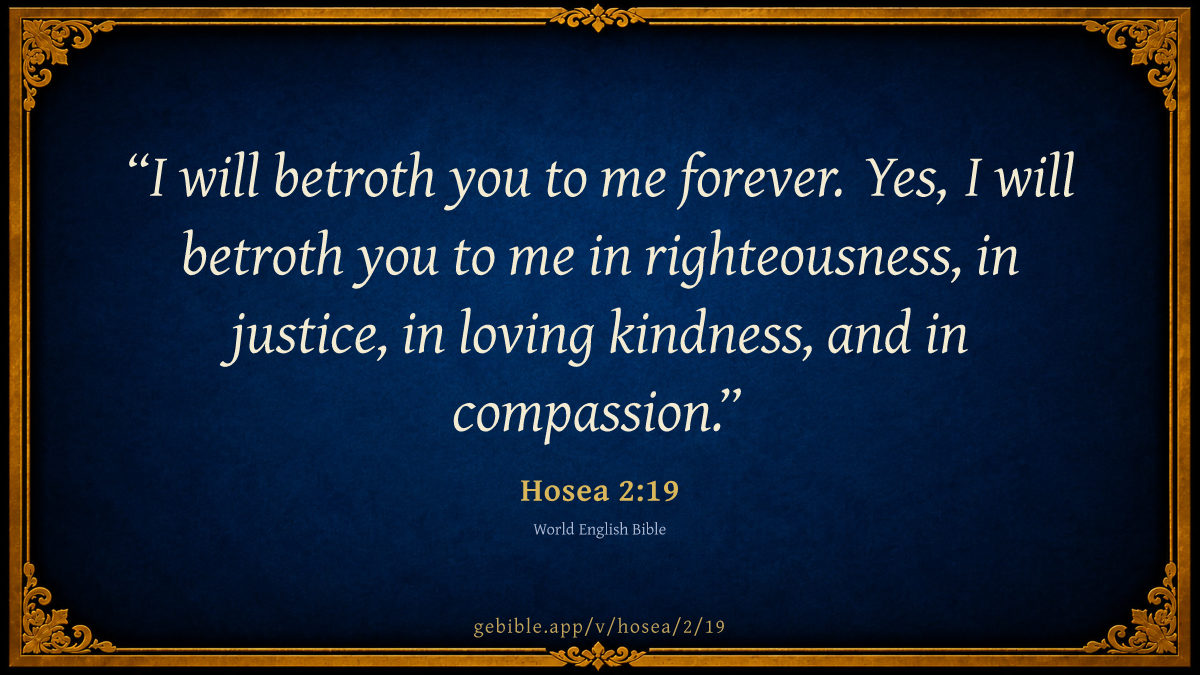
I will betroth you to me forever. Yes, I will betroth you to me in righteousness, in justice, in loving kindness, and in compassion.
Parallel Translations
-
I will betroth you to me forever. Yes, I will betroth you to me in righteousness, in justice, in loving kindness, and in compassion.
-
And I will betroth thee unto me for ever; yea, I will betroth thee unto me in righteousness, and in judgment, and in lovingkindness, and in mercies.
-
(2-21) And I will betroth thee unto Me for ever; yea, I will betroth thee unto Me in righteousness, and in justice, and in lovingkindness, and in compassion.
Cross-references (23)
Passages linked to Hosea 2:19 in the Treasury of Scripture Knowledge, ordered by reader-vote popularity; verse text shown in World English Bible.
- 2 Corinthians 11:2 For I am jealous over you with a godly jealousy. For I married you to one husband, that I might present you as a pure virgin to Christ.
- Revelation 21:2 I saw the holy city, New Jerusalem, coming down out of heaven from God, prepared like a bride adorned for her husband.
- Isaiah 54:8-10 In overflowing wrath I hid my face from you for a moment, but with everlasting loving kindness I will have mercy on you,” says Yahweh your Redeemer. “For this is like the waters of Noah to me; for as I have sworn that the waters of Noah will no more go over the earth, so I have sworn that I will not be angry with you, nor rebuke you. For the mountains may depart, and the hills be removed; but my loving kindness will not depart from you, and my covenant of peace will not be removed,” says Yahweh who has mercy on you.
- Isaiah 54:14 You will be established in righteousness. You will be far from oppression, for you will not be afraid, and far from terror, for it shall not come near you.
- Psalms 85:10 Mercy and truth meet together. Righteousness and peace have kissed each other.
- Ezekiel 37:25-28 They will dwell in the land that I have given to Jacob my servant, in which your fathers lived. They will dwell therein, they, and their children, and their children’s children, forever. David my servant will be their prince forever. Moreover I will make a covenant of peace with them. It will be an everlasting covenant with them. I will place them, multiply them, and will set my sanctuary among them forever more. My tent also will be with them. I will be their God, and they will be my people. The nations will know that I am Yahweh who sanctifies Israel, when my sanctuary is among them forever more.” ’ ”
- John 3:29 He who has the bride is the bridegroom; but the friend of the bridegroom, who stands and hears him, rejoices greatly because of the bridegroom’s voice. This, my joy, therefore is made full.
- Romans 7:4 Therefore, my brothers, you also were made dead to the law through the body of Christ, that you would be joined to another, to him who was raised from the dead, that we might produce fruit to God.
- Revelation 19:7-9 Let’s rejoice and be exceedingly glad, and let’s give the glory to him. For the wedding of the Lamb has come, and his wife has made herself ready.” It was given to her that she would array herself in bright, pure, fine linen: for the fine linen is the righteous acts of the saints. He said to me, “Write, ‘Blessed are those who are invited to the wedding supper of the Lamb.’ ” He said to me, “These are true words of God.”
- Jeremiah 3:14-15 “Return, backsliding children,” says Yahweh; “for I am a husband to you. I will take one of you from a city, and two from a family, and I will bring you to Zion. I will give you shepherds according to my heart, who will feed you with knowledge and understanding.
- Ephesians 5:23-27 For the husband is the head of the wife, as Christ also is the head of the assembly, being himself the savior of the body. But as the assembly is subject to Christ, so let the wives also be to their own husbands in everything. Husbands, love your wives, even as Christ also loved the assembly, and gave himself up for it; that he might sanctify it, having cleansed it by the washing of water with the word, that he might present the assembly to himself gloriously, not having spot or wrinkle or any such thing; but that it should be holy and without defect.
- Isaiah 1:27 Zion shall be redeemed with justice, and her converts with righteousness.
- Isaiah 62:3-5 You will also be a crown of beauty in Yahweh‘s hand, and a royal diadem in your God’s hand. You will not be called Forsaken any more, nor will your land be called Desolate any more; but you will be called Hephzibah, and your land Beulah; for Yahweh delights in you, and your land will be married. For as a young man marries a virgin, so your sons will marry you. As a bridegroom rejoices over his bride, so your God will rejoice over you.
- Ezekiel 39:29 I won’t hide my face from them any more; for I have poured out my Spirit on the house of Israel,’ says the Lord Yahweh.”
- Isaiah 45:23-25 I have sworn by myself. The word has gone out of my mouth in righteousness, and will not be revoked, that to me every knee shall bow, every tongue shall take an oath. They will say of me, ‘There is righteousness and strength only in Yahweh.’ ” Even to him will men come. All those who raged against him will be disappointed. All the offspring of Israel will be justified in Yahweh, and will rejoice!
- Isaiah 54:5 For your Maker is your husband; Yahweh of Armies is his name. The Holy One of Israel is your Redeemer. He will be called the God of the whole earth.
- Joel 3:20 But Judah will be inhabited forever, and Jerusalem from generation to generation.
- Revelation 21:9-10 One of the seven angels who had the seven bowls, who were loaded with the seven last plagues came, and he spoke with me, saying, “Come here. I will show you the wife, the Lamb’s bride.” He carried me away in the Spirit to a great and high mountain, and showed me the holy city, Jerusalem, coming down out of heaven from God,
- Jeremiah 4:2 and you will swear, ‘As Yahweh lives,’ in truth, in justice, and in righteousness. The nations will bless themselves in him, and they will glory in him.”
- Jeremiah 31:31-36 “Behold, the days come,” says Yahweh, “that I will make a new covenant with the house of Israel, and with the house of Judah: not according to the covenant that I made with their fathers in the day that I took them by the hand to bring them out of the land of Egypt; which covenant of mine they broke, although I was a husband to them,” says Yahweh. “But this is the covenant that I will make with the house of Israel after those days,” says Yahweh: “I will put my law in their inward parts, and I will write it in their heart. I will be their God, and they shall be my people. They will no longer each teach his neighbor, and every man teach his brother, saying, ‘Know Yahweh;’ for they will all know me, from their least to their greatest,” says Yahweh: “for I will forgive their iniquity, and I will remember their sin no more.” Yahweh, who gives the sun for a light by day, and the ordinances of the moon and of the stars for a light by night, who stirs up the sea, so that its waves roar; Yahweh of Armies is his name, says: “If these ordinances depart from before me,” says Yahweh, “then the offspring of Israel also will cease from being a nation before me forever.”
- Jeremiah 32:38-41 Then they will be my people, and I will be their God. I will give them one heart and one way, that they may fear me forever, for their good, and the good of their children after them. I will make an everlasting covenant with them, that I will not turn away from following them, to do them good. I will put my fear in their hearts, that they may not depart from me. Yes, I will rejoice over them to do them good, and I will plant them in this land assuredly with my whole heart and with my whole soul.”
- Ephesians 1:7-8 in whom we have our redemption through his blood, the forgiveness of our trespasses, according to the riches of his grace, which he made to abound toward us in all wisdom and prudence,
- Romans 3:25-26 whom God sent to be an atoning sacrifice, through faith in his blood, for a demonstration of his righteousness through the passing over of prior sins, in God’s forbearance; to demonstrate his righteousness at this present time; that he might himself be just, and the justifier of him who has faith in Jesus.
Cross-references from openbible.info (CC BY 4.0)
Explain this verse (14 sources)
Historical commentary, presented as a primary source — not an endorsement.
Private notes
Saved on this device only — never synced or sent anywhere.
John Calvin 1540 · Public Domain The Prophet here again makes known the manner in…
The Prophet here again makes known the manner in which God would receive into favor his people. As though the people had not violated the marriage vow, God promises to be to them like a bridegroom, who marries a virgin, young and pure. We have before spoken of the people’s defection; but as God had repudiated them, it was no common favor for the people to be received again by God, and received with pardon. When a woman returns to her husband, it is a great thing in the husband to forgive her, and not to upbraid her with her former base conduct: but God goes farther than this; for he espouses to himself a people infamous through many disgraceful acts; and having abolished their sins, he contracts, as it were, a new marriage, and joins them again to himself. Hence he says, I will espouse thee to me. We now perceive the import of the word, espouse: for God thereby means, that he would not remember the unfaithfulness for which he had before cast away his people, but would blot out all their infamy. It was indeed an honorable reception into favor, when God offered a new marriage, as though the people had not been like an adulterous woman.
And he says, I will espouse thee to me for ever. There is here an implied contrast between the marriage of which the Prophet had hitherto spoken, and this which God now contracts. For God, having redeemed the people, had before entered, as we have said, into marriage with them: but the people had departed from their vow; hence followed alienation and divorce. That marriage was then not only temporary, but also weak and soon broken; for the people did not continue long in obedience: but of this new marriage the Prophet declares, that it will continue fast and for ever; and thus he sets its durable state in contrast with the falling away which had soon alienated the people from God. Hence he says, I will espouse thee to me for ever.
Read full note →
He then declares by what means he would do this, even in righteousness and judgment, and then in kindness and mercies, and thirdly, in faithfulness. God had indeed from the beginning covenanted with the Israelites in righteousness and judgment; there was nothing disguised or false in his covenant: as then God had in sincerity adopted the people, to what vices does he oppose righteousness and judgment? I answer, These words must be applied to both the contracting parties: then, by righteousness God means not only his own, but that also which is, as they say, mutual and reciprocal; and by righteousness and judgment is meant rectitude, in which nothing is wanting. We now then perceive what the Prophet had in view.
But he adds, secondly, In kindness and mercies: by which words he intimates, that though the people were unworthy, yet, this would be no impediment in their way, to prevent them to return into favor with God; for in this reconciliation God would regard his own goodness, rather than the merits of his people.
John Calvin's Commentaries (1540-1563) — public domain. Text from the Calvin Translation Society English edition (1840s-50s) via the Christian Classics Ethereal Library (ccel.org). Calvin's coverage is partial (roughly two-thirds of the Bible); uncommented books and verses are honest gaps, never fabricated. The 19th-century editor's footnotes and remarks are omitted so the notes are faithfully Calvin's own voice.
John Trapp 1656 · Public Domain Hos 2:19 And I will betroth thee unto me…
Hos 2:19 And I will betroth thee unto me for ever; yea, I will betroth thee unto me in righteousness, and in judgment, and in lovingkindness, and in mercies.
Ver. 19. And I will betroth thee unto me for ever] This, because it could not be easily believed, is thrice repeated. We believe not (whatever men may dream to the contrary) without much ado and many conflicts. When faith goes about to lay hold on Christ, the devil raps her on the fingers, and would beat her off. Hence she is fain to take great pains for it, to work hard for her living. The apostle speaks more than once of the work of faith, το εργον της πιστεως, 1Th 1:3 2Th 1:11. And it is no less difficult (say divines) to believe the gospel than to fulfil the law. No man can come unto the Son except the Father draw him, Joh 6:44. The soul naturally hangs back, and had as lief put off its immortality as put on Christ: the devil also doth his utmost to hinder. The contest was not so great between Michael and him concerning Moses’ dead body as it is here between the believer and him concerning Christ’s living body. And should not God mightily assist, the business would never be done. Hence faith is called the faith of God’s power, Col 2:12, the faith of his operation; and what an Almighty power God doth therein put forth is elegantly described by the apostle in that sixfold gradation, Eph 1:19, which shows it to be more than a moral persuasion. Betroth thee, I will, I will, I will, saith God here; and some think the sacred Trinity is hero (though darkly, according to the manner of those times) brought in betrothing the Church in this trina repetitio. threefold repition. And mark, that he doth not say, I will be reconciled unto thee, and receive thee again after thy foul plays with me (for Reconciliationes fere sunt vulpinae amicitiae inter homines, Men are seldom reconciled heartily), but I will espouse thee, marry thee unto me, and that for ever. I will null the bill of divorce, love you no less than if you had continued true to me, or were now a pure virgin. Quis hanc Dei bonitatern digne collaudet? saith Drusius. Who can sufficiently set forth this goodness of God? When God once pardoneth sin, he will remember it no more; he will not come with back reckonings. Discharges in justification are never repealed or called in again. Peccata non redeunt sins are not returned, is a true axiom; and it is no less true that peccata non minuunt iustificationem. God can pardon sins of all sizes, and as soon disperse the thick cloud as the cloud, Isa 44:22. See the matchlessness of his mercy to a repenting adulteress, Jer 3:5. What greater love can he show to her than to marry her again, and rejoice over her as a bridegroom rejoiceth over his bride, Isa 62:5. Yea, to rest in his love, and to joy over her with singing, Zep 3:17, and to do this for ever (as it is here promised), so that there shall be no more breach of conjugal love and communion for ever between them. Area amorem illius, Oh love this love of his, saith Bernard, and reciprocate. And as the wife will keep her bed only for her husband (saith Mr Bradford, martyr), although in other things she is content to have fellowship with others, as to speak, sit, eat, drink, go, &c.; so our consciences (which are Christ’s wives) must needs keep the bed, that is, God’s sweet promises, alone for ourselves and our husband; there to meet together, to embrace and laugh together, and to be joyful together. If sin, the law, the devil, or anything would creep into the bed, and lie there, then complain to thine husband Christ, and forthwith thou shalt see him play Phineas’ part; and again, if Satan should summon us, saith he, to answer for our sins, or debts, in that the wife is no suitable person, but the husband, we may well bid him enter his action against our husband Christ, and he will make him a sufficient answer. Thus Mr Bradford in a certain letter of his unto a friend.
Read full note →
In righteousness and in judgment, in lovingkindness, &c.] These are the gems of that ring that Christ bestoweth upon his spouse, saith Mercer. These are those κειμηλια, or love tokens, that Christ the bridegroom giveth to his bride the Church, saith Tarnovius. Here he promiseth to perform to her, and to work in her, all those offices and requisites due from married couples in that estate the one to the other. God will both justify her by the imputation of Christ’s righteousness; and sanctify her by the Spirit of judgment, that is, of sanctification. {See Joh 16:10-11 Mat 12:20} {See Trapp on "Mat 12:20"} And because the best have their frailties, and although they be vessels of honour, yet are they but earthen vessels, and have their flaws, their cracks; therefore it is added, "I have betrothed thee unto me in lovingkindness and in mercies," q.d. My heart and ways towards you shall be full of gentleness and sweetness, without morosity or hardness. My lovingkindness shall be great, Neh 9:17, marvellous great, Psa 31:21, excellent, Psa 36:7, everlasting, Isa 54:8, merciful, Psa 117:2, multitudes of lovingkindnesses, Isa 63:7; as for my mercies, or bowels of compassion towards you, they are incomprehensible, as having all the dimensions, Eph 3:18. "Thy mercy, O God, reacheth unto the heavens," there is the height of it, Psa 36:5. "Great is thy mercy towards me, and thou hast delivered my soul from the lowermost hell," there is the depth of his mercy, Psa 86:13. "The earth is full of thy goodness," there is the breadth of it. "All the ends of the earth have seen thy salvation," there is the length of it. O pray to see that blessed sight, Eph 1:18; Eph 3:18, that beholding, as in a glass, this glory of the Lord, shining bright in his attributes, you may be "transformed into the same image, from glory to glory," 2Co 3:18; and as in water face answereth face, as lead answereth the mould, as tallow answereth tallow, indenture, indenture, so may we resemble and express the Lord, our husband, in righteousness, holiness, lovingkindness, tender mercies, and faithfulness, that as the woman is the image and glory of the man, so may we be of Christ. For our encouragement it must be remembered that the covenant that Christ maketh with us is a double covenant, to perform his part as well as ours, to make us such as he requireth us to be in all holy conversation and godliness; for which end, also, we have a duplicate of his law written in our hearts, Jer 31:33, a law in our mind, answerable to the law of his mouth, Rom 7:23. In a word, he graciously undertaketh for both parts; therefore is the covenant everlasting, and the fruits of it are sure mercies, compassions that fail not. In foedere nero nihil potest incidere quo minus sit aeternum, quum non sit ei adiecta conditio, saith Mercer upon this text; that is, in the new covenant there can nothing happen whereby it should not be everlasting, since there is no condition required on our part. That faith or faithfulness mentioned in the next verse God requireth not as a mutual restipulation of our part (as works were in the old covenant); but here it is rather a declaration of his pleasure what he would have us to do, and whereto he will enable us. It is not a condition, to endanger the covenant; but an assurance, that he will give us strength to keep it.
John Trapp, A Commentary or Exposition upon All the Books of the Old and New Testament (1647–1656) — public domain. Text from a community e-Sword module.
Matthew Poole 1685 · Public Domain And I, thy God, who was offended, but now…
And I, thy God, who was offended, but now am reconciled, though I was divorcing thee, will now
betroth, on new terms enter marriage covenant with
Read full note →
thee, O Israel, who art my people, and leavest thine idolatries and rebellions.
Unto me, God of mercy and truth, who hath forgiven and changed thee, and made thee suitable to myself, and who will be as kind and gracious as thou canst desire or need.
For ever: the former covenant was broken, and the marriage nulled, but now it shall be an everlasting contract and marriage between my Israel and their God.
I will betroth thee unto me: this promise is repeated to confirm it, and to remove scruples and jealousies.
In righteousness; on equal terms on both sides.
In judgment; with mature advice, or well-informed and settled judgment and resolution; this covenant shall be, as a well-taken oath, finished with integrity of heart and judgment. In loving-kindness; without desert in her that is betrothed, of mere love, and freest kindness.
And in mercies: this, though the same with the former, is added to insure all to this new-espoused wife; or
loving-kindness is the never-exhausted fountain, mercies are the never-failing streams, the abundant fruits of that love toward the poor and undeserving objects of it.
Matthew Poole's English Annotations on the Holy Bible (1683–1685) — public domain. Text from a community e-Sword/MySword module.
John Gill 1763 · Public Domain And it shall come to pass in that day,....…
And it shall come to pass in that day,.... When these espousals shall be made, when the marriage of the Lamb will be come, and his bride will be betrothed to him; then the whole creation, the heavens and the earth, shall contribute of their riches and plenty to make a marriage feast for them; or then shall the spouse of Christ, in a very visible and plentiful manner, by virtue of the marriage union between them, partake of all his good things, both temporal and spiritual; and especially the latter, as signified by the former; but yet in the use of means, and as the effect of prayer, as follows:
I will hear, saith the Lord; the petitions of his new married bride, which he cannot deny her :or, "I will answer" (a); men oftentimes hear, and answer not; but when the Lord hears his people, he answers them, and grants them their requests; he is a God hearing and answering prayer. So the Targum,
Read full note →
"I will receive your prayer, saith the Lord.''
I will hear the heavens, and they shall hear the earth; in these and the following words is an elegant personification, a figure by which inanimate creatures are represented as persons speaking, praying, asking, and being heard and answered; and a beautiful climax, or a chain of second causes linked together, and as depending upon the first cause, the Lord himself; the heavens are represented as desiring the Lord of nature, the Maker and Supporter of them, having been like brass, and shut up, that they might have leave to let down their refreshing dews, and gentle showers of rain, upon the earth; and the earth as being dry and thirsty, as gaping, opening its mouth, and imploring these benign influences of the heavens; and both as answered: for so it may be rendered, "I will answer the heavens, and they shall answer the earth" (b); the Lord promises to answer the desires of the heavens, and allow them to drop their dew, and distil their rain; and so they shall answer the cravings of the earth. The spiritual sense may be, according to Schmidt, Christ is he on whom all blessings depend; "heaven" may signify the Holy Spirit Christ gives, who intercedes with him for the saints; the "earth" the ministration of the word and ordinances, by which the Spirit is given, invoked by the ministers of them. Or, as Cocceius, the "heavens" may design the ministers of the church, who govern in it, and who pray and plead for help, assistance, and success; and the "earth" the audience, the common people, who also pray, and are heard and answered, when ministers let down the dew and rain of evangelical doctrine upon them, and water them, and refresh them with it; and such precious seasons as these, as the fruit of prayer, will the saints have in the latter day.
(a) "respondebo", Calvin, Drusius, Tarnovius, Cocceius. (b) "respondebo coelo, et illud respondebit terrae", Cocceius, Drusius.
John Gill's Exposition of the Whole Bible (1746–1763) — public domain (CC PDM 1.0). Text via the HelloAO Bible API.
Adam Clarke 1810 · Public Domain Verse 19. I will betroth thee unto me] The…
Verse 19. I will betroth thee unto me] The people are always considered under the emblem of a wife unfaithful to her husband.
In righteousness] According to law, reason, and equity.
Read full note →
In judgment] According to what is fit and becoming.
In lovingkindness] Having the utmost affection and love for thee.
In mercies.] Forgiving and blotting out all past miscarriages. Or there may be an allusion here to the dowry given by the husband to his wife: "I will give righteousness," &c., as a dowry.
Adam Clarke's Commentary on the Bible (1810–1826) — public domain. Text from a community e-Sword/MySword module.
Joseph Benson 1811 · Public Domain Hos 2:19-20. I will betroth thee unto me for…
Hos 2:19-20. I will betroth thee unto me for ever — I will treat thee, who hast been a harlot, like a wife, if hereafter thou become faithful to me. Yea, I will betroth thee unto me in righteousness, &c. — Bishop Horsley translates these verses thus: To myself I say, I will betroth thee with justice, and with righteousness, and with exuberant kindness and with tender love. With faithfulness to myself, I say, I will betroth thee, and thou shalt know the Jehovah. The passage, it seems, maybe paraphrased as follows: I will betroth, or take, thee unto me in a way that shall display, or make manifest, my righteousness, or the regard I have to justice and holiness, my beneficence, or inclination to make my creatures happy, my mercy in forgiving offences committed against me, and my faithfulness in fulfilling my promises, and verifying my declarations. And thou shalt know the Lord — Experience the exuberant goodness of Jehovah; shalt find that he is and wilt be a gracious Lord to thee. One especial part of the new covenant consists in imparting to the faithful a more perfect knowledge of God as a sin-pardoning God, and of his will and their own duty: see Jer 31:31-34.
Joseph Benson's Commentary on the Old and New Testaments (1811–1818) — public domain. Text from a community e-Sword module.
Albert Barnes 1834 · Public Domain And I will betroth her unto Me forever -…
And I will betroth her unto Me forever - God does not say here, “I will forgive her;” “I will restore her;” “I will receive her back again;” “I will again shew her love and tenderness.” Much as these would have been, He says here much more. He so blots out, forgets, abolishes all memory of the past, that He speaks only of the future, of the new betrothal, as if it were the first espousal of a virgin. Hereafter God would make her wholly His, and become wholly her’s, by an union nearer and closer than the closest bond of parent and child, that, whereby they are “no more twain, but one flesh;” and through this oneness, formed by His own indwelling in her, giving her Himself, and taking her into Himself, and so bestowing on her a title to all which is His. And this, forever. The betrothal and union of grace in this life passeth over into the union of glory, of which it is said, “Blessed are they who are called to the marriage supper of the Lamb” Rev 19:9.
He, by His Spirit, shall be with His Church “unto the end of the world,” and so bind her unto Himself that “the gates of hell shall not prevail against her.” The whole Church shall never fail. This “betrothal” implies and involves a new covenant, as God says, “Behold the days come, that I will make a new covenant with the hoarse of Israel and the house of Judah, not according to My covenant which I made with their fathers, which My covenant they brake” Jer 31:31-32, and which vanisheth away. To those who had broken His covenant and been unfaithful to Him, it was great tenderness, that He reproached them not with the past; as neither doth He penitents now. But beyond this, in that He speaks of “espousing” her who was already espoused to Him, God shows that He means something new, and beyond that former espousal. What God here promised He fulfilled, not as God the Father, but in Christ. What God promised of Himself, He only could perform. God said to the Church, “I will betroth thee unto Me.” He who became the “Bridegroom” Joh 3:29 of the Church was Christ Jesus; she became “the wife of the Lamb” Rev 21:9; to Him the Church was “espoused, as a chaste Virgin” 2Co 11:2. He then who fulfilled what God promised that He would Himself fulfill, was Almighty God.
Read full note →
I will betroth thee unto Me in righteousness - Or rather, (which is more tender yet and more merciful,) by, with, righteousness, etc. These are the marriage-dowry, the bridal gifts, “with” which He purchaseth and espouseth the bride unto Himself. Righteousness then and Judgment, loving-kindness and mercies, and faithfulness or truth, are attributes of God, wherewith, as by gifts of espousal, He maketh her His own. “Righteousness” is that in God, whereby He is Himself righteous and just; “Judgment,” that whereby He puts in act what is right against these who do wrong, and so judges Satan; as when the hour of His Passion was at hand, He said, “when the Comforter is come, He will reprove the world of sin, and of righteousness, and of judgment; of judgment, because the prince of this world is judged” Joh 16:8, Joh 16:11. “Loving-kindness” is that tender affection, wherewith He cherisheth His children, the works of His hands; Mercies, His tender yearnings over us (see the note above at Hos 1:6), wherewith He hath compassion on our weakness; “Faithfulness,” that whereby He “keepeth covenant forever” Psa 111:9, and “loveth His own unto the end” Joh 13:1.
And these qualities, as they are His, whereby He saved us, so doth He impart them to the Church in her measure, and to faithful souls. These are her dowry, her jewels, her treasure, her inheritance. He giveth to her and to each soul, as it can receive it, and in a secondary way, His Righteousness, Judgment, Loving-kindness, Mercies, Faithfulness. His “Righteousness,” contrary to her former unholiness, He poureth into her, and giveth her, with it, grace and love and all the fruits of the Spirit. By His Judgment, He giveth her a right judgment in all things, as contrary to her former blindness. “Know ye not, says the Apostle 1Co 6:3, that we shall judge angels? how much more, things that pertain to this life?” “Loving-kindness” is tender love, wherewith we “love one another, as Christ loved us” Joh 15:12. “Mercies” are that same love to those who need mercy, whereby we are “merciful, as our Father is merciful” Luk 6:36. “Faithfulness” is that constancy, whereby the elect shall “persevere unto the end, as He saith, Be thou faithful unto death, and I will give thee a crown of life” Rev 2:10.
The threefold repetition of the word betroth is also, doubtless mysterious, alluding chiefly to the Mystery of the All-Holy Trinity, so often and so manifoldly, in Holy Srcipture, foreshadowed by this sacred number. To them is the Church betrothed, by the pronouncing of whose names each of her members is, in Holy Baptism, “espoused as a chaste virgin unto Christ.” At three times especially did our Lord espouse the Church unto Himself. : “First in His Incarnation, when He willed to unite His own Deity with our humanity,” and “in the Virgin’s womb, the nature of the woman, our nature, human nature, was joined to the nature of God,” and that “forever.” “He will be forever the Word and Flesh, i. e., God and Man.” Secondly, in His Passion, when he washed her with His Blood, and bought her for His own by His Death. Thirdly, in the Day of Pentecost, when He poured out the Holy Spirit upon her, whereby He dwelleth in her and she in Him. And He who thus espoused the Church is God; she whom He espoused, an adulteress, and He united her to Himself, making her a pure virgin without spot or blemish. : “Human marriage makes those who were virgins to cease to be so; the divine espousal makes her who was defiled, a pure virgin.” “I have espoused you,” says Paul to those whom he had won back from all manner of pagan sins, “to one Husband, that I may present you a chaste virgin unto Christ” (2Co 11:2; see Jer 3:1-2). O the boundless clemency of God! : “How can it be possible, that so mighty a King should become a Bridegroom, that the Church should be advanced into a Bride? That alone hath power for this, which is All-powerful; ‘love, strong as death’ Son 8:6. How should it not easily lift her up, which hath already made Him stoop? If He hath not acted as a Spouse, if He hath not loved as a Spouse, been jealous as a Spouse, then hesitate thou to think thyself espoused.”
Albert Barnes' Notes on the Bible (1834–1885) — public domain. Text from a community e-Sword/MySword module.
Haydock's Catholic Bible Commentary 1859 · Public Domain I will espouse thee, &c. This relates to the…
I will espouse thee, &c. This relates to the happy espousals of Christ with his Church, which shall never be dissolved. (Challoner) --- God gives the dowry, justice, &c.
George Leo Haydock (1774–1849), Haydock's Catholic Family Bible and Commentary, 1859 edition — public domain. Excludes Psalms (Douay-Rheims chapter numbering differs from Protestant) and Deuterocanonical books (Catholic canon only).
Robert Jamieson, A. R. Fausset & David Brown 1871 · Public Domain "Betroth" is thrice repeated, implying the intense love of…
"Betroth" is thrice repeated, implying the intense love of God to His people; and perhaps, also, the three Persons of the Triune God, severally engaging to make good the betrothal. The marriage covenant will be as it were renewed from the beginning, on a different footing; not for a time only, as before, through the apostasy of the people, but "forever" through the grace of God writing the law on their hearts by the Spirit of Messiah (Jer 31:31-37).
righteousness . . . judgment--in rectitude and truth.
Read full note →
loving-kindness, &c.--Hereby God assures Israel, who might doubt the possibility of their restoration to His favor; low, sunk, and unworthy as thou art. I will restore thee from a regard to My own "loving-kindness," not thy merits.
Jamieson, Fausset & Brown — Commentary Critical and Explanatory on the Whole Bible (1871) — public domain (CC PDM 1.0). Text via the HelloAO Bible API.
The Cambridge Bible for Schools and Colleges 1878 · Public Domain 19. I will betroth thee unto me] A second…
19. I will betroth thee unto me] A second marriage-ceremony among the Israelites had to be preceded by a second betrothal. Jehovah promises here that this betrothal shall be ‘for ever’, i.e., that no differences shall destroy the mutual harmony between Jehovah and His people, (comp. Jer_31:35-37; Isa_54:8-10). Righteousness and justice, &c. shall be as it were the bond which unites the pair. The triple mention of the betrothal indicates the solemnity of the act.
The Cambridge Bible for Schools and Colleges (gen. ed. J. J. S. Perowne; Cambridge University Press, 1878–1918) — public domain. Text from a community e-Sword module.
Ellicott's Commentary for English Readers 1878 · Public Domain (19, 20) Then Jehovah, turning again to the wife…
(19, 20) Then Jehovah, turning again to the wife of His youth, says to her, “I will betroth thee” (as at the first, when maiden undefiled). Three times is this phrase repeated. “Righteousness” and “judgment” indicate the equitable terms on which God would accept the penitent; and lest this thought should crush her with fear, “lovingkindness” and “tender mercies” follow; and lest this should seem too good, He adds “with faithfulness” (to myself).
I will betroth thee.—It is in the betrothal of humanity to God in Christ’s incarnation that the human race, which had so deeply revolted, returns to Him, and knows the Lord.
A Bible Commentary for English Readers, edited by Charles John Ellicott (1878–1897) — public domain. Text from a community e-Sword module.
The Pulpit Commentary 1880 · Public Domain Vers. 19, 20. Much as was included in these…
Vers. 19, 20. Much as was included in these promises, more and better was to follow. The divorced wife was to be taken back; the marriage contract, which her shameful adultery had vitiated, was to be renewed, and past offences condoned. This certainly evidenced extraordinary forbearance and affection. But it was not all. A new and higher relationship was to be entered on; so entirely had God forgiven and forgotten, if we may so say, all the multiplied and aggravated transgressions of Israel against him, that that people is not to be received back as a repudiated wife, but to be henceforth regarded and treated as a chaste virgin, and in that capacity betrothed unto the Lord. And I will betroth thee unto me is the gracious promise thrice repeated, and each time with an additional element of mercy; nor is this betrothal of a temporary character and of short continuance, like the previous marriage compact which the wife"s guilt a short time had rendered null and void. It is a durable betrothal, lasting forever. Next to the time during which this betrothal shall continue is the manner in which it is effected, or rather, the basis on which it is established. Justice and judgment present righteousness under two aspects subjective and objective. Tsedeq, equivalent to tseda-qah, being right, is subjective righteousness and an attribute of God. Mishpat, equivalent to objective right, either as executing judgment or as existing in fact Some attribute these characteristics to God and some to Israel, while others to both. Rashi and Kimchi understand both words tsedeq and mishpat, subjectively and in relation to the Israelites. The former: "In righteousness and judgment wherein ye shall walk;" the latter: "In righteousness which the Israelites shall practice." Wunsche and Hengstenberg understand the righteousness and judgment of God"s doing justice and faithfully fulfilling his covenant obligations to Israel. The latter has well remarked in relation to mishpat when distinguishing it from tsedeq, that a man may render what is right to persons and yet not be righteous; that is, there may be objective apart from subjective righteousness. Keil attributes the attributes in question, not only to God fulfilling his covenant engagements to his people, but purifying them through just judgment, and thus providing for their righteousness. That God possesses these is undeniable, but it is equally obvious that he bestows righteousness on his people both by imputation and impartation; he also executes righteousness in their case, purifying them by salutary chastisement, his object being, not only to cleanse, but to keep clean. And yet such is the frailty of man"s fallen nature, and so many are the faults and the failings to which he is liable, that loving-kindness (God"s condescending love, chesed, equivalent to agaph ) and mercies (inmost compassion on man"s weakness, rachamim, spacgna ) on God"s part must be added to righteousness and judgment in order to secure the stability of those whom he takes into covenant, and the continuance of the contract. Nay; for the attainment of the desired end still more is requisite, for, after all his bestowments and all his discipline, and in addition to all his favor and forbearance, his faithfulness (unwavering steadfastness, emunah, corresponding as the reverse side to and securing the leolam) is indispensable to Israel"s perseverance; and thus, notwithstanding Israel"s failures, Jehovah"s faithfulness guarantees ultimate and lasting success. The special quality on Israel"s side is true knowledge of God.
Vers. 19, 20. Divine betrothal.
Read full note →
The unfaithfulness of the past is forgotten. The love of the Divine Husband is renewed. A joyous betrothal is the prelude to a hallowed, prolonged, and happy union.
I THE BRIDEGROOM. Jehovah condescends to represent himself as sustaining this relationship. It implies on his part love and attachment, purposes of everlasting kindness, for the marriage cannot be broken, and a provision for all the wants of her whom he takes to himself.
II THE BRIDE. Israel is here the type of the Church whom the Lord Jesus has purchased unto himself the bride of the Lamb. She is indeed happy and honored in the choice of her Divine spouse. She is called to purity, to fidelity, to holy service.
III THE COVENANT AND CONTRACT. On the side of the Lord all is of grace; and the undertakings of the Bridegroom are "for ever." On the side of his spouse, the Church, there is implied the spiritual marriage vow, with all which that involves.
IV THE SPIRIT IN WHICH THE UNION IS CONTRACTED. This is faithfulness, or the certainty of the fulfillment of the pledge voluntarily given. All God"s promises are sure, for he is faithful.
V THE CONDESCENDING PROMISE OF THE BRIDEGROOM TO THE BRIDE. "Thou shalt know the Lord." This knowledge shall be of all Jehovah"s gracious attributes, and in itself it is eternal life. T.
The Pulpit Commentary (1880–1919), ed. H.D.M. Spence-Jones & Joseph S. Exell — public domain. Text from a community e-Sword module.
unfoldingWord translationNotes 2017 · CC BY-SA 4.0 General Information:
General Information:
Yahweh is speaking to Hosea about what he will do for Israel.
Read full note →
I will promise to be your husband forever
Yahweh will be like the husband, and Israel will be like Yahweh's wife. (See: Metaphor)
in righteousness, justice, covenant faithfulness, and mercy
This can be restated to remove the abstract nouns. AT: "and do what is right, just, faithful, and merciful" (See: Abstract Nouns)
you will know Yahweh
Here "know" means to acknowledge Yahweh as their God and to be faithful to him.
translationWords
promise
eternity
righteous
just
covenant faithfulness
mercy
faithful
Yahweh
unfoldingWord translationNotes — © Distant Shores Media and the Door43 World Missions Community, licensed CC BY-SA 4.0. Source: git.door43.org/Door43/en_tn.
Tyndale Open Study Notes 2022 · CC BY-SA 4.0 2:19-20 I will make you my wife: This Hebrew…
2:19-20 I will make you my wife: This Hebrew verb, used three times in these verses, can be translated with our seldom-used word betroth. In the ancient world, betrothal entailed all the legal steps of a marriage, including the payment of a bride price by the groom. The only thing missing was the marriage ceremony and sexual consummation. The Lord vowed to betroth Israel to himself forever. To ensure the eternal nature of this new marriage, God provided a bride price that included five priceless qualities: righteousness and justice, unfailing love and compassion, and faithfulness. As a result, the Lord said, Israel will finally know me (cp. 2:13).
Tyndale Open Study Notes — © Tyndale Open Resources, licensed CC BY-SA 4.0. Text via the HelloAO Bible API.