Luke 12:2(v2)But there is nothing covered up that will not be revealed, nor hidden that will not be known.
Jeremiah 9:2(vv3–4)Oh that I had in the wilderness a lodging place of wayfaring men; that I might leave my people, and go from them! For they are all…
Romans 1:32(v3)who, knowing the ordinance of God, that those who practice such things are worthy of death, not only do the same, but also approve of those…
Psalms 90:8(v2)You have set our iniquities before you, our secret sins in the light of your presence.
Jeremiah 2:19(v2)“Your own wickedness will correct you, and your backsliding will rebuke you. Know therefore and see that it is an evil and bitter thing,…
Show all 42 cross-references
Jeremiah 14:10(v2)Yahweh says to this people, “Even so they have loved to wander. They have not restrained their feet. Therefore Yahweh does not accept them.…
Amos 8:7(v2)Yahweh has sworn by the pride of Jacob, “Surely I will never forget any of their works.
Micah 7:3(v3)Their hands are on that which is evil to do it diligently. The ruler and judge ask for a bribe; and the powerful man dictates the evil…
Psalms 9:16(v2)Yahweh has made himself known. He has executed judgment. The wicked is snared by the work of his own hands.
Psalms 25:7(v2)Don’t remember the sins of my youth, nor my transgressions. Remember me according to your loving kindness, for your goodness’ sake, Yahweh.
Isaiah 5:12(v2)The harp, lyre, tambourine, and flute, with wine, are at their feasts; but they don’t respect the work of Yahweh, neither have they…
Jeremiah 4:18(v2)“Your way and your doings have brought these things to you. This is your wickedness; for it is bitter, for it reaches to your heart.”
Jeremiah 5:7-8(v4)“How can I pardon you? Your children have forsaken me, and sworn by what are no gods. When I had fed them to the full, they committed…
Jeremiah 16:17(v2)For my eyes are on all their ways. They are not hidden from my face. Their iniquity isn’t concealed from my eyes.
Jeremiah 28:1-4(v3)That same year, in the beginning of the reign of Zedekiah king of Judah, in the fourth year, in the fifth month, Hananiah the son of Azzur,…
Jeremiah 32:19(v2)great in counsel, and mighty in work; whose eyes are open to all the ways of the children of men, to give everyone according to his ways,…
Hosea 9:9(v2)They have deeply corrupted themselves, as in the days of Gibeah. He will remember their iniquity. He will punish them for their sins.
1 Corinthians 4:5(v2)Therefore judge nothing before the time, until the Lord comes, who will both bring to light the hidden things of darkness, and reveal the…
Hebrews 4:13(v2)There is no creature that is hidden from his sight, but all things are naked and laid open before the eyes of him to whom we must give an…
James 4:4(v4)You adulterers and adulteresses, don’t you know that friendship with the world is hostility toward God? Whoever therefore wants to be a…
Hosea 4:2(vv3–4)There is cursing, lying, murder, stealing, and committing adultery; they break boundaries, and bloodshed causes bloodshed.
Numbers 32:23(v2)“But if you will not do so, behold, you have sinned against Yahweh; and be sure your sin will find you out.
Deuteronomy 32:29(v2)Oh that they were wise, that they understood this, that they would consider their latter end!
1 Kings 22:6(v3)Then the king of Israel gathered the prophets together, about four hundred men, and said to them, “Should I go against Ramoth Gilead to…
1 Kings 22:13(v3)The messenger who went to call Micaiah spoke to him, saying, “See now, the prophets declare good to the king with one mouth. Please let…
Job 20:11-29(v2)His bones are full of his youth, but youth will lie down with him in the dust. “Though wickedness is sweet in his mouth, though he hide it…
Job 34:21(v2)“For his eyes are on the ways of a man. He sees all his goings.
Psalms 50:22(v2)“Now consider this, you who forget God, lest I tear you into pieces, and there be no one to deliver.
Proverbs 5:21-22(v2)For the ways of man are before Yahweh’s eyes. He examines all his paths. The evil deeds of the wicked ensnare him. The cords of his sin…
Isaiah 1:3(v2)The ox knows his owner, and the donkey his master’s crib; but Israel doesn’t know. My people don’t consider.”
Jeremiah 5:31(v3)The prophets prophesy falsely, and the priests rule by their own authority; and my people love to have it so. What will you do in the end…
Jeremiah 37:19(v3)Now where are your prophets who prophesied to you, saying, ‘The king of Babylon will not come against you, nor against this land?’
Hosea 4:12(v4)My people consult with their wooden idol, and answer to a stick of wood. Indeed the spirit of prostitution has led them astray, and they…
Hosea 5:11(v3)Ephraim is oppressed, he is crushed in judgment; Because he is intent in his pursuit of idols.
Hosea 7:5(v3)On the day of our king, the princes made themselves sick with the heat of wine. He joined his hand with mockers.
Hosea 7:6-7(v4)For they have prepared their heart like an oven, while they lie in wait. Their baker sleeps all the night. In the morning it burns as a…
Hosea 8:13(v2)As for the sacrifices of my offerings, they sacrifice meat and eat it; But Yahweh doesn’t accept them. Now he will remember their iniquity,…
Amos 7:10-13(v3)Then Amaziah the priest of Bethel sent to Jeroboam king of Israel, saying, “Amos has conspired against you in the middle of the house of…
Micah 6:16(v3)For the statutes of Omri are kept, and all the works of Ahab’s house. You walk in their counsels, that I may make you a ruin, and her…
1 John 4:5(v3)They are of the world. Therefore they speak of the world, and the world hears them.
Isaiah 26:16(v2)Yahweh, in trouble they have visited you. They poured out a prayer when your chastening was on them.
Isaiah 44:19(v2)No one thinks, neither is there knowledge nor understanding to say, “I have burned part of it in the fire. Yes, I have also baked bread on…
42 distinct cross-references across this passage (44 total citations).
Cross-references from openbible.info (CC BY 4.0)
Explain this passage (19 sources)
Historical commentary, presented as a primary source — not an endorsement.
John Calvin1540 · Public DomainOn vv2–4The Prophet shows here that the Israelites had advanced…
The Prophet shows here that the Israelites had advanced to the highest summit of all wickedness; for they thought that no account was ever to be given by them to God. Hence arises the contempt of God; that is, when men imagine that he is, as it were, sleeping in heaven, and that he rests from every work. They dare not indeed to deny God, and yet they take from him what especially belongs to his divinity, for they exclude him from the office of being a judge. Hence then it is that men allow themselves so much liberty, because they imagine that they have made a truce with God; yea, they think that they can do any thing with impurity, as if they had made a covenant with death and hell, as Isaiah says, (Isaiah 28:15.) Of this sottishness then does the Prophet here arraign the Israelites, They have not said, he says, in their heart, that I remember all their wickedness; that is, “They so audaciously mock me, as though I were not the judge of the world; they consider not that all things are in my sight, and that nothing is hid from me. Since then they suppose me to be like a dead idol, they have no fear, nay, they abandon themselves to every wickedness.”
He then adds, Now their wicked deeds have surrounded them, for they are in my sight; that is, “Though they promise impunity to themselves, and flatter themselves in their hypocrisy, all their works are yet before me; and thus they surround them;” that is, “They shall at last perceive that they are infolded in their own sins, and that no escape will be open to them.” We now understand the object of the Prophet; for after having complained of the stupidity of the people, he now says that they thus flattered themselves with no advantage, because God is not in the meantime blind. Though then they think that a veil is drawn over their sins, they are yet mistaken; for all their sins are in my sight, and this they themselves shall at last find out by experience, because their sins will surround or besiege them.
Read full note →
Let us learn from this place, that nothing ought to be more feared than that Satan should so fascinate us as to make us to think that God rests idly in heaven. There is nothing that can stir us up more to repentance, than when we adorn God with his own power, and be persuaded that he is the judge of the world, and also when we walk as in his sight, and know that our sins cannot come to oblivion, except when he buries them by pardon. This then is what the Prophet teaches in the first part of the verse. Now when we imagine that we have peace with God, and with death and hell, as Isaiah says in the place we have quoted, the prophet teaches that God is yet awake, and that his office cannot be taken from him, for he knows whatever is carried on in this world; and that this will at length be made openly known, when our sins shall surround us, as it is also said in Genesis chapter 4, ‘Sin will lie down at thy door.’ For we may for a time imagine that we have many escapes or at least hiding-places; but God will at length show that all this is in vain, for he will come upon us, and has no need of forces, procured from this or that quarter; we shall have enemies enough in our own vices, for we shall be besieged by them no otherwise than if God were to arm the whole world against us. Let us go on —
John Calvin's Commentaries (1540-1563) — public domain. Text from the Calvin Translation Society English edition (1840s-50s) via the Christian Classics Ethereal Library (ccel.org). Calvin's coverage is partial (roughly two-thirds of the Bible); uncommented books and verses are honest gaps, never fabricated. The 19th-century editor's footnotes and remarks are omitted so the notes are faithfully Calvin's own voice.
Geneva Bible translators1599 · Public DomainOn vv3–4They esteem their wicked king Jeroboam above God, and…
They esteem their wicked king Jeroboam above God, and seek but how to flatter and please him.
Geneva Bible (1599) marginal notes — public domain.
John Trapp1656 · Public DomainOn vv2–4Hos 7:2 And they consider not in their hearts…
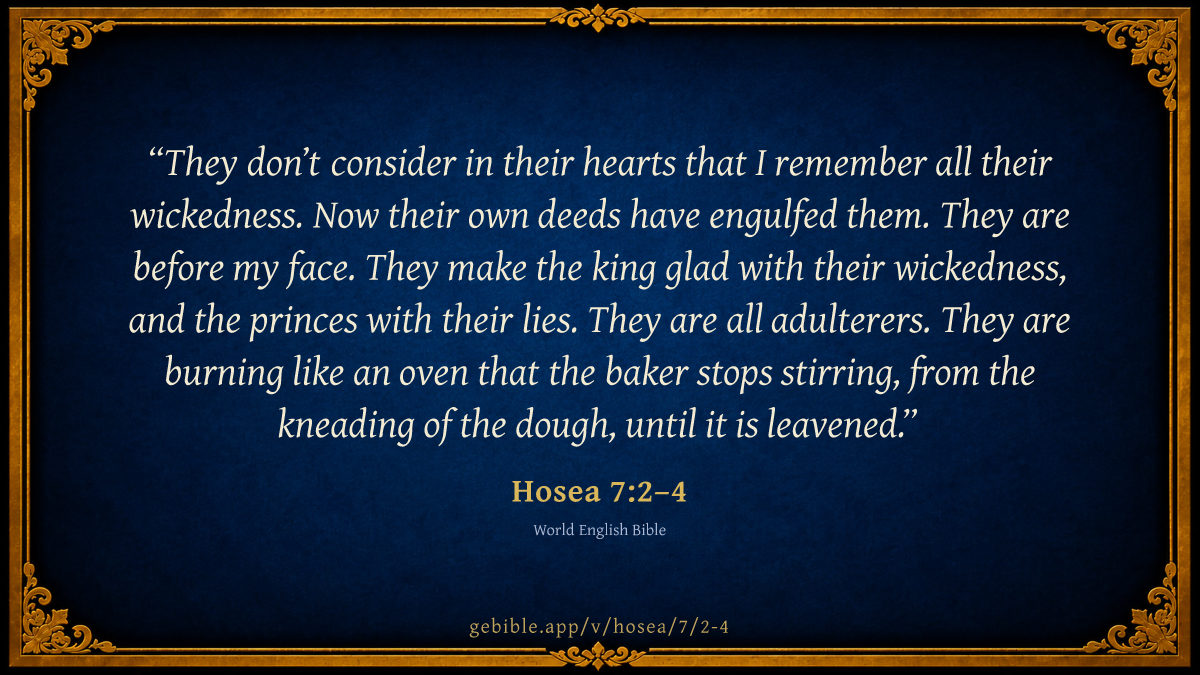
Hos 7:2 And they consider not in their hearts [that] I remember all their wickedness: now their own doings have beset them about; they are before my face.
Ver. 2. And they consider not in their hearts] Heb. They say not in their hearts; that is, they set not down themselves with this consideration, they commune not with their consciences upon this most needful, but much neglected matter. A good man’s work lieth much within doors; he loves to be dealing with himself, and working good and wholesome considerations upon his own affections. He is never less alone than when he is alone; for still he hath God and himself to talk to.
Read full note →
That I remember all their wickedness] i.e. Record and register them, as in a book, with a pen of iron and point of a diamond, Jer 17:1; that I seal them up in a bag, Job 14:17, as the clerk of assizes seals up indictments, and at the assizes brings his bag, and produceth them. "Is not this laid up in store with me, and sealed up among my treasures?" Deu 32:34. So little reason is there that wicked men should please themselves in hope of impunity. And yet they do, Psa 94:7, they strive to persuade themselves that the Lord doth not see, neither doth the God of Jacob remember: they hide God from themselves, and then think they have hid themselves from him. Herein they are alike foolish as the ostrich, a bird as big as a camel, and taller than a man (Plin. lib. x., cap. 1). When this bustard {a} would hide herself she thrusts her head into a thicket, as conceiving that nobody seeth her because she seeth nobody, and so becomes a prey to the hunter. Caveatur carnalis securitas. Let us walk evermore in the sense of God’s presence, unless we had rather be carnally secured than soundly comforted.
Now their own doings have beset them about] Their studied wickedness, studia eorum (Tigurin), their contrived iniquities, so Luther expounds the word doings; for wicked men are great students, and break many a night’s sleep in pernicious ploddings, Pro 4:16. But as the blackbird is taken by birdlime made of his own excrements, so is the wicked beset by his own devices; as by so many sergents set on by God. Some think (and not without probable reason) that the prophet in this phrase of besetting them about alludeth to the future siege of Samaria; wherein these sinners against their own souls were so straitly beset by the enemy, that they could not flee or stir without danger. And this he saith shall befall them. Now, that is, shortly, and sooner than they think for. Indeed, how should it be otherwise, whereas their doings
are before my face] E regione et velut adversa ac detestata, Together and in full view, as a continual eye sore to me, Psa 59:5; Psa 90:8; so that though I could or would forget them, yet they will not suffer me to do so; such is their impudence, and importunace for vengeance. Lyra makes it a metaphor, from a thief taken in the act, with his back burden of stolen goods, and, as it were, beset with them, and so brought before the judge. "His own iniquities shall take the wicked," saith Solomon, Pro 5:22. For how can he escape the multitude of his sins within him, and the variety of God’s heavy judgments without him?
{a} A genus of birds ( Otis) presenting affinities both to the Cursores and the Grallatores or waders; remarkable for their great size and running powers. The great bustard ( Otis tarda) is the largest European bird, and was formerly common in England, though now extinct, or found only as a rare visitant. ŒD
John Trapp, A Commentary or Exposition upon All the Books of the Old and New Testament (1647–1656) — public domain. Text from a community e-Sword module.
Matthew Poole1685 · Public DomainOn vv2–4They who are thus greatly wicked, notorious sinners,
They who are thus greatly wicked, notorious sinners,
consider not in their hearts, do not remember, nor will they once seriously ponder this, that I remember all their wickedness; that I see all they do, and remember all I see; and that with more than an idle, unactive looking on, or retaining in memory; I look on, and remember to call them to account, and to punish for their sins. They would flatter themselves into an opinion that I take no notice of their wickedness, and that I will never require it.
Read full note →
Their own doings; the guilt and punishment, the iniquity and mischief, of the works they have done; their own doings, not their fathers’, as hypocrites and the incorrigible are ready to complain.
Have beset them about: as cords wrap one taken in them, or as an enemy invests and besiegeth a town on every side, so these profligate people, courtiers, priests, prophets, and citizens, are all held enclosed with their own sins.
They are before my face; what they have done I do see, and what they suffer I do see, and it is but just they should suffer what their sins deserve: they hoped for impunity, because they thought I did not regard, but now by a just punishment, by full measures of sorrows heaped upon them, they shall find all their ways were under my eye, and that I weighed their doings.
Matthew Poole's English Annotations on the Holy Bible (1683–1685) — public domain. Text from a community e-Sword/MySword module.
John Gill1763 · Public DomainOn vv2–4And they consider not in their hearts that I…
And they consider not in their hearts that I remember all their wickedness,.... That is, the people of the ten tribes, and the inhabitants of Samaria, whose iniquity and wickedness are said to be discovered, and to be very notorious: and yet "they said not to their hearts" (m), as in the original text; they did not think within themselves; they did not commune with their own hearts; they did not put themselves in mind, or put this to their consciences, that the Lord saw all their wicked actions, their idolatry, falsehood, thefts, and robberies, and whatsoever they were guilty of; that the Lord took notice of them, and put them down in the book of his remembrance, in order to call them to an account, and punish them for them:
now their own doings have beset them about; or, "that now their own doings", &c. (n); they do not consider in their hearts that their sins are all around them, on every side, committed by them openly, and in abundance, and are notorious to all their neighbours, and much more to the omniscient God: and that
Read full note →
they are before my face; so the Targum,
"which are revealed before me;''
were manifest in his sight, before whom all things are; but this they did not consider, and therefore went on in that bold and daring manner they did. Some understand these clauses of the punishment of their sins, which should surround them on every side, that they should not be able to escape, like persons closely besieged in a city, that they cannot get out; alluding to the future siege of Samaria, when it would be a plain case, though they did not now think of it, that all their sins were before the Lord, and were observed by him.
(m) "et non dicebant ad cor suum", Cocceius; "et non dicunt cordi suo", Schmidt. (n) "quod circumdent ipsos opera eorum", Schmidt.
John Gill's Exposition of the Whole Bible (1746–1763) — public domain (CC PDM 1.0). Text via the HelloAO Bible API.
John Wesley1765 · Public DomainOn vv2–4Own doings - The guilt and punishment of the…
Own doings - The guilt and punishment of the works they have done; their own doings, not their fathers, as the incorrigible are ready to complain. Beset them - As an enemy invests a town on every side. Before my face - All their ways were under mine eye.
John Wesley, Explanatory Notes Upon the Whole Bible (1754–1765) — public domain. Text via the GEBible commentary corpus.
Adam Clarke1810 · Public DomainOn vv2–4Verse 2. They consider not in their hearts] They…
Verse 2. They consider not in their hearts] They do not consider that my eye is upon all their ways; they do not think that I record all their wickedness; and they know not their own evil doings are as a host of enemies encompassing them about.
Adam Clarke's Commentary on the Bible (1810–1826) — public domain. Text from a community e-Sword/MySword module.
Joseph Benson1811 · Public DomainOn vv2–4Hos 7:2. And they consider not in their hearts…
Hos 7:2. And they consider not in their hearts — They do not seriously reflect; that I remember all their wickedness — To call them to an account, and to punish them for it. Now their own doings — Their studied wickedness, their contrived iniquities: their own, not those of their fathers, as the incorrigible are ready to complain; have beset them about —
Namely, as an enemy invests a town on every side. The meaning is, the guilt and punishment of their sins shall surround them on all sides, and seize upon them that they shall not escape. Some think that by this expression of besetting them about, the prophet alludes to the future siege of Samaria, wherein these sinners against their own souls were so straitly beset by the enemy, that they could not flee, nor escape the being either taken or destroyed.
Joseph Benson's Commentary on the Old and New Testaments (1811–1818) — public domain. Text from a community e-Sword module.
Albert Barnes1834 · Public DomainOn vv2–4And they consider not in their hearts - Literally,…
And they consider not in their hearts - Literally, (as in the E. M) “they say not to their hearts.” The conscience is God’s voice to the heart from within; man’s knowledge of the law of God, and his memory of it, is man’s voice, reminding his heart and rebellious affections to abide in their obedience to God. God speaks through the heart, when by His secret inspirations he recalls it to its duty. Man speaks to his own heart, when he checks its sinful or passionate impulses by the rule of God’s law, “Thou shalt not.” “At first, people feel the deformity of certain sorts of wickedness. When accustomed to them, people think that God is indifferent to what no longer shocks themselves.” “They say not to their heart” anymore, that “God remembers them.”
I remember all their wickedness - This was the root of “all their wickedness,” want of thought. They would not stop to say to themselves, that God not only saw, but “remembered their wickedness,” and not only this, but that He remembered it all. Many will acknowledge that God sees them. He sees all things, and so them also. This is a part of His natural attribute of omniscience. It costs them nothing to own it. But what God “remembers, that” He will repay. This belongs to God’s attributes, as the moral Governor of the world; and this, man would gladly forget. But in vain. God does “remember,” and remembers in order to punish. “Now,” at the very moment when man would not recall this to his own heart, “their own doings have beset them about; they are before my face.” Unless or until man repent, God sees man continually, encompassed by all his past evil deeds; they surround him, accompany him, whithersoever he goeth; they attend him, like a band of followers; they lie down with him, they await him at his awakening; they live with him, but they do not die with him; they encircle him, that he should in no wise escape them, until he come attended by them, as witnesses against him, at the judgmentseat of God. “His own iniquities shall take the wicked himself, and he shall be holden with the cords of his sins. God remembers all their wickedness” Pro 5:22.
Read full note →
Then He will requite “all;” not the last sins only, but all. So when Moses interceded for his people after the sin of the calf, God says to him, “go lead the people unto the place, of which I have spoken unto thee; behold My Angel shall go before thee; nevertheless, in the day when I visit, I will visit their sin upon them” Exo 32:34; and of the sins of Israel and their enemies; “Is not this laid up in store with Me, and sealed up among My treasures? to Me belongeth “vengeance and recompense; their foot shall slide in due time” Deu 32:34-35. The sins, forgotten by man, are remembered by God, and are requited all together in the end. A slight image of the Day of Judgment, “the Day of wrath and revelation of the righteous judgment of God, against” which the hard and impenitent heart “treasures up unto itself wrath!”
They are before My face - All things, past, present, and to come, are present before God. He sees all things which have been, or which are, or which shall be, or which could be, although He shall never will that they should be, in one eternal, unvarying, present. To what end then for man to cherish an idle hope, that God will not remember, what He is ever seeing? In vain wouldest thou think, that the manifold ways of man are too small, too intricate, too countless, to be remembered by God. God says, “They are before My Face.”
Albert Barnes' Notes on the Bible (1834–1885) — public domain. Text from a community e-Sword/MySword module.
Haydock's Catholic Bible Commentary1859 · Public DomainOn vv2–4Face. I do not search (Calmet) into their past…
Face. I do not search (Calmet) into their past lives; they sin publicly, and without ceasing. I have been too indulgent. (Haydock)
George Leo Haydock (1774–1849), Haydock's Catholic Family Bible and Commentary, 1859 edition — public domain. Excludes Psalms (Douay-Rheims chapter numbering differs from Protestant) and Deuterocanonical books (Catholic canon only).
Robert Jamieson, A. R. Fausset & David Brown1871 · Public DomainOn vv2–4consider not in their hearts--literally "say not to," &c.…
consider not in their hearts--literally "say not to," &c. (Psa 14:1).
that I remember--and will punish.
Read full note →
their own doings have beset them about--as so many witnesses against them (Psa 9:16; Pro 5:22).
before my face-- (Psa 90:8).
Jamieson, Fausset & Brown — Commentary Critical and Explanatory on the Whole Bible (1871) — public domain (CC PDM 1.0). Text via the HelloAO Bible API.
The Cambridge Bible for Schools and Colleges1878 · Public DomainOn vv2–42. they consider not in their hearts] Rather, as…
2. they consider not in their hearts] Rather, as margin, they say not to their heart. ‘Heart’ here = self; the meaning is therefore they have no pricks of conscience.
now their own doings have beset them about] They are so entangled in sin (to use a more familiar figure) that they cannot even try to repent.
Read full note →
they are before my face] Comp. Psa_90:8.
The Cambridge Bible for Schools and Colleges (gen. ed. J. J. S. Perowne; Cambridge University Press, 1878–1918) — public domain. Text from a community e-Sword module.
Ellicott's Commentary for English Readers1878 · Public DomainOn vv2–4(2) Have beset them about.—The wicked deeds of the…
(2) Have beset them about.—The wicked deeds of the nation crowded around them as witnesses to reveal their treason against Jehovah.
A Bible Commentary for English Readers, edited by Charles John Ellicott (1878–1897) — public domain. Text from a community e-Sword module.
The Pulpit Commentary1880 · Public DomainOn vv2–4And they consider not in their hearts (margin, say…
And they consider not in their hearts (margin, say not to their heart) that I remember all their wickedness. Between the common reading libravken and bilravken found in several manuscripts by Kennicott and De Rossi, there is a not unimportant difference. The latter, equivalent to saying "in their heart," which is the usual expression, denotes one"s inward thoughts or reasonings with himself; the former, equivalent to saying "to their heart," is an address to, or remonstrance with, the heart with the view of restraining its evil purposes. God"s remembrance of wickedness imports its punishment. Now their own doings have beset them about. Their doings
(1) have become evident or conspicuous as a robe or garment with which a man is surrounded, or a troop of body-guards placed about him. Or
Read full note →
(2) the terrors and penal consequences of their sins have surrounded them like a garment, as we elsewhere read, "He clothed himself with cursing like as with his garment." In this latter sense the figure is rather taken from enemies besieging a town or city, and beleaguering it closely all around, or from lictors, i.e. officers of the law surrounding them, or even witnesses confronting them on every side. Kimchi explains the sense as follows: "Now their evil deeds surround them, which were before my face and were not hidden from me; and, while they receive the punishment, they will remember that 1 know all the whole, and that it is I who return their reward upon their head." They are before my face, in the last clause, has a striking and awe-inspiring parallel in the ninetieth psalm: "Thou hast set our iniquities before thee, our secret sins in the light of thy countenance." Aben Ezra"s exposition is somewhat obscure; it is as follows: "They think that I do not see them, and they do not observe that their actions encircle them, as they are before my face.
HOMILIES BY A. ROWLAND Ver. 2. An unconsidered truth.
Two facts are suggested here.
I THAT GOD REMEMBERS THE WICKEDNESS OF MAN. "Wickedness" may exist in thought or intention, (Psa_139:23, Psa_139:24) in, (Mat_12:36) in act. (Psa_51:4)
1. This fact is proclaimed in God"s Word.
(1) Statements. Jer_14:10 proves God"s watchfulness, Jer_17:1 his recollection, Isa_44:22 his record, etc.
(2) Examples seen in the sin of Adam, the antediluvians, Joseph"s brethren, Abraham in Egypt, David, etc.
1. This fact is necessitated by the Divine nature. God"s omnipresence, omniscience, and immutability imply it. His absolute perfection makes impossible either defect of knowledge or decay of faculty.
2. This fact is exemplified in the life of the Lord Jesus. "He knew what was in man;" "He knew their thoughts," etc. Show how completely he detected the plots of his foes, knew the doubts of his disciples, (Joh_20:27) overheard the discussions of distant followers, (Mar_9:34) perceived the unexpressed longings of the unpardoned, (Mat_9:2-7) and read the secrets of a sinful life. (Luk_7:37-50)
3. This fact is a requisite to a just judgment. See references to the coming judgment. (Ecc_12:14 Jer_32:18, etc.) No fair decision could be given except by One who knew all our sins and struggles, and had forgotten none of their circumstances.
II THAT MAN FORGETS THE SUPERVISION OF GOD. "They consider not," etc. It is not said man has no knowledge of the fact, but that he does not reflect upon it. To "consider in the heart" is to think over the truth seriously, closely, with sincere application to ourselves. If the charge were not true, we should no longer continue in sin; we should not attempt to extenuate it; we should mourn over it as an offence against God rather than as a cause of dishonor or loss to ourselves. Show the sinfulness of this.
1. It is disobedience to the exhortation of God. "Now therefore consider your ways;" "Oh that they were wise, that they would consider," etc.!
2. It is rebellion against the rule of conscience. Show what conscience is to the child at his first offence, and what it becomes through continued heedlessness.
3. It is encouragement to secret s/n. "They say, Doth God know?" etc. Many sins are disguised from the world, unsuspected by our friends, from which, therefore, no regard for reputation will save us. The secret sin undermines the character. Open sin follows. Even if it does not, the judgment of God is against those that do such things.
4. It is a hindrance to true repentance. Men do not come to Christ until they feel their need of him, who "saves his people from their sins. A.R.
HOMILIES BY J.R. THOMSON Ver. 2. God"s memory of man"s wickedness.
There is something to all unreconciled and unpardoned sinners very terrible in this assertion, I remember all their wickedness.
I GOD REMEMBERS MAN"S WICKEDNESS IN THE EXERCISE OF HIS OMNISCIENCE. "All" here comprehends every kind of wickedness, in thought, word, and deed; every instance of wickedness, whether noted or not by fellow-men; the aggravations of wickedness which has been more serious because of the light and privileges notwithstanding which the sinner has transgressed.
II GOD REMEMBERS MAN"S WICKEDNESS IN HIS CHARACTER OF A PERFECTLY HOLY BEING. It is not simply a matter of knowledge; the evil he knows God hates. Every such recollection is accompanied with displeasure. He is angry with the wicked every day;" and whilst men, through familiarity with human sins, often become either indifferent or cynical, the Most Holy retains his disapproval and his loathing undiminished.
III GOD REMEMBERS MAN"S WICKEDNESS IN HIS CHARACTER OF A RIGHTEOUS JUDGE. The upright and pure man may view the prevalence of wickedness with revulsion and distress; but "vengeance belongeth unto God." As the sovereign Ruler of the universe, bound by his own nature to maintain his authority, and to do righteously as the Judge, the Lord exercises his judicial attributes and functions. And what he remembers he will one day bring forward, for the confusion of the impenitent.
IV GOD HAS PROMISED THAT, IF THE SINNER WILL REPENT, HE WILL REMEMBER HIS SINS NO MORE. We need not trouble ourselves with the attempt to reconcile what may seem to us conflicting statements, which, however, are both necessary to set forth all the truth. Let the impenitent bear in mind the fact that the righteous God remembers all their iniquities; and let the penitent and believing hearers of the gospel rest assured that a merciful God will cast their sins behind his back, and sink them in the depths of the unfathomable sea of oblivion. T.
HOMILIES BY D. THOMAS Vers. 2, 3. God"s remembrance of sin.
"And they consider not in their hearts that I remember all their wickedness: now their own doings have beset them about; they are before my face. They make the king glad with their wickedness, and the princes with their lies." These words contain three facts.
I That God REMEMBERS men"s sins. "I remember all their wickedness." This is a wonderful fact. When we think of the infinite greatness of him to whom the universe is as nothing, we are struck at first with amazement that God remembers the sins of a creature so frail, so insignificant as man. Still, as we reflect, we soon get the conviction that there is nothing absurd, nothing unreasonable, in the fact. To the Infinite there is nothing great or small; to the Omniscient there is nothing unobserved; to the Holy there is nothing so distressing, so oppressive, as sin. Sin is no trifle in the eye of him whose glory is his holiness. This is not only a wonderful, but a solemn fact. God not only observes and knows my sins, but he remembers them does not lose sight of one. They are in his memory. What a book is the memory of God! The whole history of the universe is there! Every sin that has ever been committed by any moral intelligence in the creation, however insignificant, has record there. "Thou art acquainted with all my ways; for there is not a word in my tongue, but thou, Lord, art acquainted with it altogether." "Doth not he see all my ways, and count all my steps?" "All things are naked and opened unto the eyes of him with whom we have to do." "Hell is naked before him, and destruction hath no covering. How much more then the hearts of the children of men!" How useless the attempt to dissemble our sins from him! How awful the revelations of the last day!
II MEN DISREGARD God"s remembrance of their sins. "They consider not in their hearts that I remember all their wickedness." "They say, The Lord shall not see, neither shall the God of Jacob regard it." Sinners, the world over, are indifferent to this fact. So far from considering that all their sins are in the memory of the holy and just One, they practically ignore his very existence. In their plans, engagements, and avocations they take no account of him. Why do they not consider? Is it because the thought strikes them as so manifestly improbable as not worthy of their attention? Assuredly not. They have only to reflect on this subject to see that it must be so. Why, then?
1. Because other thoughts engross their minds thoughts of worldly wealth and power, thoughts of selfish gains and sensual pleasures. They are too full of vain and worldly thoughts to admit an idea so grand and solemn as this.
2. Because this thought, if it occurs to them for a moment, is too painful to be entertained. The corrupt nature revolts from it, expels it the moment it gains admission, and bolts every door against it, environs itself with associations that keep it far away in the distance. "It desires not a knowledge of it.
III That men"s disregard of God"s remembrance of their sins LEADS THEM TO REVEL IN INIQUITY. "Now their own doings have beset them about; they are before my face." Here we have their sins:
1. In general. They are abundant and daring. Their sins encompass them on all sides, and they perpetrate them without shame under the very face of God himself; they give full play to all their passions, an unbridled license to all their sinful impulses and lusts.
2. In particular. Some of their sins are specified here. "They make the king glad with their wickedness, and the princes with their lies." "It pleases them," says an old writer, "to see the people conform to their wicked laws and examples in their worship of their idols, and other instances of impiety and immorality, and to hear them flatter and applaud them in their wicked ways. When Herod saw that his wickedness pleased the people he proceeded further in it. Much more will the people do so when they see that it pleases the prince". (Act_13:3) Particularly, they made them glad with their lies, with the lying praises with which they crowned the favorites of the prince, and the lying calumnies and censures with which they blackened those whom they knew the princes had a dislike to. Those who show themselves pleased with slanders and ill-natured stories shall never want those about them who fill their ears with stories. Pro_29:12, "If a ruler hearken to lies, all his servants are wicked," and will make him glad with their lies. D.T.
The Pulpit Commentary (1880–1919), ed. H.D.M. Spence-Jones & Joseph S. Exell — public domain. Text from a community e-Sword module.
The Biblical Illustrator1887 · Public DomainOn v2And they consider not in their hearts that I…
Hos_7:2
And they consider not in their hearts that I do remember all their wickedness.
Read full note →
The evil of inconsideration
What the prophet affirms of Gods ancient people is gravely distressing.
I. The fact asserted. God remembers the wickedness of men. Wickedness denotes what is hateful and destructive. Men may excuse it, deny it, forget it; but God remembers it.
1. This fact is clear from the declarations of His Word.
2. From the perfections of His nature. The Lord is a God of knowledge, and by Him actions are weighed.
3. From the equity of His government and a future judgment. You that forget God, and forget your sins, know that God remembers.
II. The evil stated. That men forget this fact. The evil lamented is inconsideration. The want of consideration appears--
1. In mens continued commission of sin.
2. In their doing this without regret.
3. In their readiness to extenuate sin.
4. In their disregard of future consequences.
Wherein then consists the evil of this want of consideration?
(1) They who are thus chargeable neglect the plainest admonitions of Scripture.
(2) They oppose the frequent dictates of conscience.
(3) They allow themselves in the-practice of secret sins.
(4) They may even proceed to the commission of open vice.
(5) Thus proceeding they eventually ruin the soul.
As to the duty of consideration, the authority of God commands it. The grace of God recommends it. The reason of man approves it. The aversion of man to this duty implies its importance. (T. Kidd.)
Mans sins in Gods mind
God alone knows us perfectly.
I. A fact in the Divine providence or government. I remember all their wickedness. Remember, as applied to God in Scripture, does not represent a faculty of the Divine mind, but a state of Gods nature, or the conduct of God in some particular instance. The text means, Your sins are ever before Me.
1. God remembers all kinds and degrees of sin.
2. All the sins of all men.
3. He remembers accurately and completely.
4. Continually and for ever. And--
5. With a practical result, that He may act upon His recollection.
Then how wonderful is Gods patience and forbearance! How entire must Gods pardon be when He forgives a sinner! How complete will be the transactions of the judgment day! How full will future and final punishment be!
II. This fact is forgotten by those who ought to remember it. They do not think or reflect, at least, so as to feel.
III. Gods complaint of this forgetfulness. God complains of forgetfulness, because it sears the conscience, leads to false views of a mans position, is personally offensive to God, and is frequently the occasion of final ruin. God does not hate you as a being, but lie does hate your character. And this offensiveness to God is continually increasing. You can consider this matter, and at once. Enter then the path of serious thought and pursue it. (Samuel Martin.)
Gods remembrance of sin
I. God remembers mens sins. I remember all their wickedness.
1. This is a wonderful fact. When we think of the infinite greatness of Him to whom the universe is as nothing. Sin is no trifle in the eye of Him whose glory is His holiness.
2. This is not only a wonderful, bat a solemn fact. God not only observes and knows my sins, but He remembers them.
II. Men disregard Gods remembrance of their sins. Why, then?
1. Because other thoughts engross their minds--thoughts of worldly wealth and power.
2. Because this thought, if it occurs to them for a moment, is too painful to be entertained.
III. That mens disregard of Gods remembrance of their sins leads them to revel in iniquity. How their own doings have beset them about; they are before My face. Here we have--
1. Their sins in general. They are abundant and daring. Their sins encompass them on all sides, and they perpetrate them without shame under the very face of God.
2. Some of their sins are specified here. They made them glad with their lies, with the lying praises with which they crowned the favourites of the prince, and the lying calumnies and censures with which they blackened those whom they knew the princes disliked. (Homilist.)
Gods record of our sins
The great stone-book of nature reveals many strange records of the past. In the red sandstone there are found in some places marks which are clearly the impressions of showers of rain, and these so perfect that it can even be determined in what direction the shower inclined, and from what quarter it proceeded; and this ages ago! So sin leaves its track behind it, and God keeps a faithful record of all our sins.
Now their own doings have beset them about.
Man beset by his own doings
Down from the dark ages comes the story--if memory is true to its charge--of an expert blacksmith, who was such a master of his trade, and withal so proud of his skill, that he often boasted no man could break a chain made by him. In time the blacksmith himself was imprisoned and manacled. With the hope that he might make his escape, he examined the chain to see if it was possible to break it, when, to his horror, he discovered that the chain was one made by his own hands, which no living man could break, himself included. The chain forged by his own hands made the blacksmith a helpless, hopeless prisoner in that vile dungeon. Is it not the same with us? Each of us is forging a chain we cannot break. Every bad habit becomes a link in the chain, which will bind, in hopeless slavery, the soul that makes it. Acts form habits. Let your acts be beautiful and Christlike, and your habits will be likewise, (Paul S. Biggs Shipley.)
The sin of the people
The prophet now arraigns all the citizens of Samaria, and in their persons the whole people, because they rendered obedience to the king by flattery, and to the princes in wicked things, respecting which their own consciences convicted them. He shows that the defection which then reigned through all Israel ought not to be ascribed to the king or to few men, but that it was a common evil, which involved all in one and the same guilt, without exception. If they wish to east the blame on their governors, it will be done in vain. As soon as Jeroboam formed the calves, as soon as he built temples, religion instantly collapsed, and whatever was before pure, degenerated. How was the change so sudden? Even because the people had inwardly concocted their wickedness, which, when an occasion was offered, showed itself; for hypocrisy did lie hid in all, and was then discovered. It often happens that some vice creeps in, which proceeds from one man, or from a few; but when all readily embrace what a few introduce, it is quite evident that they have no living root of piety, or of the fear of God. They then who are so prone to adopt vices were before hypocrites; and we daily find this to be the case. When men become corrupt in their whole life, and degenerate from the pure worship of God, they are justly deemed adulterers. The prophet compares them to an oven, because they were not corrupted by some outward impulse, but by their own inclination and propensity of mind. They had been set on fire by an inward sinful instinct, and were like a hot oven. The blame rested wholly on themselves. (John Calvin.)
In the day of our king the princes have made him sick with bottles of wine.--
Court intemperance
On the kings birthday, or some other solemnity yearly observed, the princes induced the king to drink until he became sick, and forgot and prostituted his place and authority by joining with scorners, or men eminently dissolute. Doctrine.
I. Days which men will have observed as days of festivity and solemnity do ordinarily prove days of great miscarriage and provocation against God.
2. Drunkenness and sensuality are heinous and crying sins, especially in rulers. It is a sad challenge that they should be given to bottles of wine.
3. Nobles and princes and great courtiers are ordinarily great plagues and snares to kings, who, having their ear and countenance, do make use of it for no other end but to draw them to sin against God.
4. It is the height of sensuality, when men not only become brutish themselves, but dare invite and tempt others to the same excess of riot, and by all means draw them to drunkenness.
5. Men by their intemperance do not only draw on the guilt of misspending time, and abusing the good creatures of God, but of self-murder and abusing their own bodies also.
6. Days of feasting and intemperance do also ordinarily prove days of great insolence and boldness in other sins.
7. It is also the great sin of drunkenness, that by their sensuality they deprive themselves of the use of reason, and render themselves contemptible, and like beasts, that they can neither know their place nor duty. The king debased himself to keep company with lewd persons and look like them. (George Hutcheson.)
The Biblical Illustrator, edited by Joseph S. Exell (c. 1880s–1900s) — public domain. Text from a community e-Sword module.
The Expositor's Bible1887 · Public DomainOn v3There follows now a very difficult passage. The text…
4. WICKEDNESS IN HIGH PLACES
Hos_7:3-7
Read full note →
There follows now a very difficult passage. The text is corrupt, and we have no means of determining what precise events are intended. The drift of meaning, however, is evident. The disorder and licentiousness of the people are favored in high places; the throne itself is guilty.
"With their evil they make a king glad, and princes with their falsehoods: all of them are adulterers, like an oven heated by the baker"
"On the day of our king"-some coronation or kings birthday-"the princes were sick with fever from wine. He stretched forth his hand with loose fellows," presumably made them his associates. "Like an oven have they made their hearts with their intriguing. All night their anger sleepeth in the morning it blazes like a flame of fire. All of them glow like an oven, and devour their rulers: all their kings have fallen, without one of them calling on Me."
An obscure passage upon obscure events; yet so lurid with the passion of that fevered people in the flagrant years 743-735 that we can make out the kind of crimes described. A king surrounded by loose and unscrupulous nobles: adultery, drunkenness, conspiracies, assassination: every man striking for himself; none appealing to God.
From the court, then, downwards, by princes, priests, and prophets, to the common fathers of Israel and their households, immorality prevails. There is no redeeming feature, and no hope of better things. For repentance itself the capacity is gone.
In making so thorough an indictment of the moral condition of Israel, it would have been impossible for Hosea not to speak also of the political stupidity and restlessness which resulted from it. But he has largely reserved these for that part of his discourse which now follows, and which we will take in the next chapter.
William Robertson Nicoll, ed., The Expositor's Bible (London: Hodder & Stoughton, 1887–1910) — public domain. 65 of 66 books (1 Corinthians is not separately keyed, as that volume carries no machine-parseable verse references); section-level commentary keyed to the opening verse. Introductory and overview sections not keyed to a specific passage are excluded.
The Preacher's Complete Homiletical Commentary1892 · Public DomainOn v4Hos_7:4. Oven] “In this passionate career the nation resembled…
CRITICAL NOTES.—
Hos_7:4. Oven] “In this passionate career the nation resembled a furnace which a baker heats in the evening and leaves burning all night while the dough is leavening, and then causes to burn with a still brighter flame in the morning when the dough is ready for baking” [Keil].
Read full note →
Hos_7:5. Day] Birth or coronation day, probably a feast day. Bottles] Lit. with heat through wine; bottles, not glasses, drunkenness, excess, and debauchery. Hand] In token of fellowship, health-drinking. Scorners] Ridicule of sacred things, derision of God, natural at intoxicating feasts (Dan_5:3-4).
Hos_7:6. Ready] Lit. applied (marg. brought near) their heart to sin. For] The reason for the open sin; their heart is ready, and only waiting for the spark to kindle it.
Hos_7:7. Devoured] Results of their conduct stated. Judges and kings, inflamed by the passion, here consumed and fell into the abyss, the six last kings in succession (2Ki_15:10; 2Ki_15:14; 2Ki_15:25), B. C. 772. None sought help from God in national calamity.
SIN A FURNACE OF FIRE—Hos_7:4-7
The passion of Israel for idolatry is likened to a furnace, heated by the baker, and left burning during the process of fermentation. There is little or no cessation to their indulgence. All are guilty, and fan the flames which consume them without reflection and return to God. Keeping up the figure, sin is like a furnace,
I. In the method by which it is kindled. Man is capable of warmth and enthusiasm. We are made for fervour. We feel the glow of friendship and the power of principles fondly cherished and firmly defended. We have properties not simply attributed to matter, but possessed by the Seraphim of heaven and attributed to God himself. “The zeal of the Lord of Hosts.” We are more influenced by evil than good. The heart, with its affections, is kindled into a passion; the temperament warmed, and men are “set on fire” with lust, and “set on fire of hell.” Like “an oven heated by the baker,” they burn with hatred, envy, and adultery; “burned in their lusts one toward another.” In whatever light we look at sin “it is a fire that consumeth to destruction, and would root out all mine increase” (Job_31:12).
II. In the fuel by which it is fed. The same material that kindles must keep alive the fire. It is heated and fed by lust; by constant and unnatural excitement. Respites only ferment; the flames slumber to break out into greater fury. Anger, ambition, and filthy lusts fill the soul, and the fire burns upon the altar and never goes out. Certain sins are mentioned in the text.
1. Prevalent adultery. They are all adulterers. “Given up to vile affections, and punished with impurities of heart and life.” “It is better to marry than burn” (1Co_7:9).
2. Excessive drink. The princes made the king “sick,” heated him “with bottles of wine.” Intemperance in any is degrading, but especially in men of place and power. Priest and prophet “err through strong drink” (Isa_28:7; Isa_56:11-12). The glory of Benhadad (1Ki_20:16), of Belshazzar, and of “the princes of Israel,” was covered with shame. Philip of Macedon, when drunk, unjustly condemned a woman. She boldly said, “I appeal to Philip; but it shall be when he is sober.” Roused by the appeal, the king examined the case, and reversed his judgment. “It is not for kings, O Lemuel, it is not for kings to drink wine; nor for princes strong drink: lest they drink, and forget the law, and pervert the judgment of any of the afflicted” (Pro_31:4-5).
3. Impious scorning. “He stretched out his hand” in friendship, and associated “with scorners.” The king jested with drunkards, praised idols, and scoffed at God. Atheists and scoffers, wine and mirth, are often found together. “Hypocritical mockers at feasts” give license to their tongue, and lose control over their conduct. “Wine is a mocker, strong drink is raging; and whosoever is deceived thereby is not wise.”
III. In the results which it produces. These are innumerable. The temptations to criminality are fearful. Every kind of “wickedness burneth as the fire” (Isa_9:18). “Can a man take fire in his bosom and his clothes not be burned? Can one go upon hot coals and his feet not be burned?”
1. It influences the heart. “For they have made ready their heart.” It hardens and encrusts it; disposes it to prepare, practise, and perfect evil. The heart is brought nigh, stirred up to sin, though the occasion for it be taken away. This oven, once heated, gives no breathing time, no real rest. Corrupt passions burn with intense heat, until extinguished and overcome by the grace of God.
2. It consumes its abettors. The fire “devoured their judges; all their kings are fallen.” Jeroboam and other kings corrupted the people to establish their own authority; were flattered and slain by those who flattered them. Their sins returned to their own bosom. The flames, like the furnace of Nebuchadnezzar, devoured those who were thrown into them and those who kindled them. It is ever thus with sin. The heathens taught that “the artificers of death perished by their own art.” “Kindle not the coals of a sinner, lest thou be burnt with the flame of his fire” (Sir_8:10).
HOMILETIC HINTS AND OUTLINES
Hos_7:5. The day of our king. Birthdays and coronation-days of rulers; national fasts and feasts spent in drunkenness and rioting—scenes of revelry, scenes of debauchery, scoffing, and murder. Drinking healths and taking lives! Kings falling in feasting and mirth! What a portrait history gives of human folly and God’s providence! “Their holy days, like those of so many English now, were days of excess. Their festival they turned into an irreligious and anti-religious carousal; making themselves like the brutes that perish, and tempting their king first to forget his royal dignity, and then to blaspheme the majesty of God” [Pusey].
Drink, debauchery, and scoffing a triple association in feasting without God. “Fools make a mock at sin.”
Hos_7:6. Their heart like an oven. Men who are wicked and vile may seem to be lying by and doing nothing, yet—
1. Their hearts are bent on their course; their oven is heating while they sleep.
2. Their designs are still going on; the heat is tending to burning as a flaming fire while the baker sleeps.
3. Iniquity that is hatched, through abundance of lust, is most violently executed, when opportunity offers; and the more violently that it hath been long delayed [Hutcheson].
Hos_7:7. Kings are fallen. Those who murdered others are murdered themselves. Plots of sin recoil on those who originate them.
None that calleth on me. God can correct the evils and subdue the sedition of a nation. But mark the stupidity and perversity of sin which make people insensible in danger and neglect God in trouble. Not even distress, in which generally men betake themselves to God, awakened any sense of sin in them. “Those are not only heated with sin, but hardened in sin, that continued to live without prayers, even when they are in trouble and distress.”
ILLUSTRATIONS TO CHAPTER 7
Hos_7:4-7. Fire. Some few years ago a noble steamer moored in one of the harbours of the United States was discovered to be on fire. The engines were instantly started, and the prow of the vessel directed to the shore. But the flames soon rendered the helm useless, and such of the crew as were on board were obliged to jump into the small boat, and leave the steamer to her fate. Soon the engines worked more fiercely; the wheels revolved with fearful speed and hurried the vessel through the water. The sight was terrible. At last came one tremendous shock, and all was darkness and ruin. Such is man, when seized and heated by an evil passion, whether the spirit of pride or of envy. He grows worse and worse, and is consumed in eternal ruin, unless God interpose.
Hos_7:5. Feasting. Times of festivity require a double guard. “Blasphemy is wit, and ribaldry eloquence, to a man that is turned into a brute” [Lawson].
The Preacher's Complete Homiletical Commentary (gen. ed. Joseph S. Exell; Funk & Wagnalls, c. 1892) — public domain (pre-1929). A full-Bible homiletical/sermon-outline anthology covering 65 of 66 books (2 John is absent from the source module). Text from a community e-Sword module.
unfoldingWord translationNotes2017 · CC BY-SA 4.0On v3General Information:
General Information:
Yahweh is speaking. The Hebrew text is not clear in various places. However, many people interpret it as describing the royal officials as being unfaithful to God, and also as planning to assassinate the king, and then carrying out their plans. This seems to have happened more than once. These crimes are mentioned as illustrations of the wickedness into which the nation has sunk.
Read full note →
They are all adulterers
The people committed spiritual adultery by worshiping idols and being unfaithful to Yahweh. They were probably also being unfaithful to their husbands or wives by sleeping with other people. (See: Metaphor)
like an oven heated by the baker
This can be stated in active form. This means the people had strong desires to do evil. AT: "like an oven which the baker heats" (See: Simile and Active or Passive)
kneading of the dough
This is a part of the process of making bread.
On the day of our king
This is perhaps a festival held by the king.
He reached out with his hand
This probably means to unite or join with someone. It may mean that the king joins with his officials to mock things or people that should not be mocked, even God himself. (See: Idiom)
Tyndale Open Study Notes2022 · CC BY-SA 4.0On vv3–47:3-7 The northern kingdom of Israel saw a succession…
7:3-7 The northern kingdom of Israel saw a succession of seven different kings during the final twenty-five years of its existence, four of whom were assassinated by usurpers. This passage refers to the vicious and bloody political intrigue that characterized these years.
7:3 The prophet did not record the name of this king, but many believe he was Hoshea, the northern kingdom’s last monarch.

John Calvin 1540 · Public Domain On vv2–4 The Prophet shows here that the Israelites had advanced…
The Prophet shows here that the Israelites had advanced to the highest summit of all wickedness; for they thought that no account was ever to be given by them to God. Hence arises the contempt of God; that is, when men imagine that he is, as it were, sleeping in heaven, and that he rests from every work. They dare not indeed to deny God, and yet they take from him what especially belongs to his divinity, for they exclude him from the office of being a judge. Hence then it is that men allow themselves so much liberty, because they imagine that they have made a truce with God; yea, they think that they can do any thing with impurity, as if they had made a covenant with death and hell, as Isaiah says, (Isaiah 28:15.) Of this sottishness then does the Prophet here arraign the Israelites, They have not said, he says, in their heart, that I remember all their wickedness; that is, “They so audaciously mock me, as though I were not the judge of the world; they consider not that all things are in my sight, and that nothing is hid from me. Since then they suppose me to be like a dead idol, they have no fear, nay, they abandon themselves to every wickedness.”
He then adds, Now their wicked deeds have surrounded them, for they are in my sight; that is, “Though they promise impunity to themselves, and flatter themselves in their hypocrisy, all their works are yet before me; and thus they surround them;” that is, “They shall at last perceive that they are infolded in their own sins, and that no escape will be open to them.” We now understand the object of the Prophet; for after having complained of the stupidity of the people, he now says that they thus flattered themselves with no advantage, because God is not in the meantime blind. Though then they think that a veil is drawn over their sins, they are yet mistaken; for all their sins are in my sight, and this they themselves shall at last find out by experience, because their sins will surround or besiege them.
Read full note →
Let us learn from this place, that nothing ought to be more feared than that Satan should so fascinate us as to make us to think that God rests idly in heaven. There is nothing that can stir us up more to repentance, than when we adorn God with his own power, and be persuaded that he is the judge of the world, and also when we walk as in his sight, and know that our sins cannot come to oblivion, except when he buries them by pardon. This then is what the Prophet teaches in the first part of the verse. Now when we imagine that we have peace with God, and with death and hell, as Isaiah says in the place we have quoted, the prophet teaches that God is yet awake, and that his office cannot be taken from him, for he knows whatever is carried on in this world; and that this will at length be made openly known, when our sins shall surround us, as it is also said in Genesis chapter 4, ‘Sin will lie down at thy door.’ For we may for a time imagine that we have many escapes or at least hiding-places; but God will at length show that all this is in vain, for he will come upon us, and has no need of forces, procured from this or that quarter; we shall have enemies enough in our own vices, for we shall be besieged by them no otherwise than if God were to arm the whole world against us. Let us go on —
John Calvin's Commentaries (1540-1563) — public domain. Text from the Calvin Translation Society English edition (1840s-50s) via the Christian Classics Ethereal Library (ccel.org). Calvin's coverage is partial (roughly two-thirds of the Bible); uncommented books and verses are honest gaps, never fabricated. The 19th-century editor's footnotes and remarks are omitted so the notes are faithfully Calvin's own voice.
Geneva Bible translators 1599 · Public Domain On vv3–4 They esteem their wicked king Jeroboam above God, and…
They esteem their wicked king Jeroboam above God, and seek but how to flatter and please him.
Geneva Bible (1599) marginal notes — public domain.
John Trapp 1656 · Public Domain On vv2–4 Hos 7:2 And they consider not in their hearts…
Hos 7:2 And they consider not in their hearts [that] I remember all their wickedness: now their own doings have beset them about; they are before my face.
Ver. 2. And they consider not in their hearts] Heb. They say not in their hearts; that is, they set not down themselves with this consideration, they commune not with their consciences upon this most needful, but much neglected matter. A good man’s work lieth much within doors; he loves to be dealing with himself, and working good and wholesome considerations upon his own affections. He is never less alone than when he is alone; for still he hath God and himself to talk to.
Read full note →
That I remember all their wickedness] i.e. Record and register them, as in a book, with a pen of iron and point of a diamond, Jer 17:1; that I seal them up in a bag, Job 14:17, as the clerk of assizes seals up indictments, and at the assizes brings his bag, and produceth them. "Is not this laid up in store with me, and sealed up among my treasures?" Deu 32:34. So little reason is there that wicked men should please themselves in hope of impunity. And yet they do, Psa 94:7, they strive to persuade themselves that the Lord doth not see, neither doth the God of Jacob remember: they hide God from themselves, and then think they have hid themselves from him. Herein they are alike foolish as the ostrich, a bird as big as a camel, and taller than a man (Plin. lib. x., cap. 1). When this bustard {a} would hide herself she thrusts her head into a thicket, as conceiving that nobody seeth her because she seeth nobody, and so becomes a prey to the hunter. Caveatur carnalis securitas. Let us walk evermore in the sense of God’s presence, unless we had rather be carnally secured than soundly comforted.
Now their own doings have beset them about] Their studied wickedness, studia eorum (Tigurin), their contrived iniquities, so Luther expounds the word doings; for wicked men are great students, and break many a night’s sleep in pernicious ploddings, Pro 4:16. But as the blackbird is taken by birdlime made of his own excrements, so is the wicked beset by his own devices; as by so many sergents set on by God. Some think (and not without probable reason) that the prophet in this phrase of besetting them about alludeth to the future siege of Samaria; wherein these sinners against their own souls were so straitly beset by the enemy, that they could not flee or stir without danger. And this he saith shall befall them. Now, that is, shortly, and sooner than they think for. Indeed, how should it be otherwise, whereas their doings
are before my face] E regione et velut adversa ac detestata, Together and in full view, as a continual eye sore to me, Psa 59:5; Psa 90:8; so that though I could or would forget them, yet they will not suffer me to do so; such is their impudence, and importunace for vengeance. Lyra makes it a metaphor, from a thief taken in the act, with his back burden of stolen goods, and, as it were, beset with them, and so brought before the judge. "His own iniquities shall take the wicked," saith Solomon, Pro 5:22. For how can he escape the multitude of his sins within him, and the variety of God’s heavy judgments without him?
{a} A genus of birds ( Otis) presenting affinities both to the Cursores and the Grallatores or waders; remarkable for their great size and running powers. The great bustard ( Otis tarda) is the largest European bird, and was formerly common in England, though now extinct, or found only as a rare visitant. ŒD
John Trapp, A Commentary or Exposition upon All the Books of the Old and New Testament (1647–1656) — public domain. Text from a community e-Sword module.
Matthew Poole 1685 · Public Domain On vv2–4 They who are thus greatly wicked, notorious sinners,
They who are thus greatly wicked, notorious sinners,
consider not in their hearts, do not remember, nor will they once seriously ponder this, that I remember all their wickedness; that I see all they do, and remember all I see; and that with more than an idle, unactive looking on, or retaining in memory; I look on, and remember to call them to account, and to punish for their sins. They would flatter themselves into an opinion that I take no notice of their wickedness, and that I will never require it.
Read full note →
Their own doings; the guilt and punishment, the iniquity and mischief, of the works they have done; their own doings, not their fathers’, as hypocrites and the incorrigible are ready to complain.
Have beset them about: as cords wrap one taken in them, or as an enemy invests and besiegeth a town on every side, so these profligate people, courtiers, priests, prophets, and citizens, are all held enclosed with their own sins.
They are before my face; what they have done I do see, and what they suffer I do see, and it is but just they should suffer what their sins deserve: they hoped for impunity, because they thought I did not regard, but now by a just punishment, by full measures of sorrows heaped upon them, they shall find all their ways were under my eye, and that I weighed their doings.
Matthew Poole's English Annotations on the Holy Bible (1683–1685) — public domain. Text from a community e-Sword/MySword module.
John Gill 1763 · Public Domain On vv2–4 And they consider not in their hearts that I…
And they consider not in their hearts that I remember all their wickedness,.... That is, the people of the ten tribes, and the inhabitants of Samaria, whose iniquity and wickedness are said to be discovered, and to be very notorious: and yet "they said not to their hearts" (m), as in the original text; they did not think within themselves; they did not commune with their own hearts; they did not put themselves in mind, or put this to their consciences, that the Lord saw all their wicked actions, their idolatry, falsehood, thefts, and robberies, and whatsoever they were guilty of; that the Lord took notice of them, and put them down in the book of his remembrance, in order to call them to an account, and punish them for them:
now their own doings have beset them about; or, "that now their own doings", &c. (n); they do not consider in their hearts that their sins are all around them, on every side, committed by them openly, and in abundance, and are notorious to all their neighbours, and much more to the omniscient God: and that
Read full note →
they are before my face; so the Targum,
"which are revealed before me;''
were manifest in his sight, before whom all things are; but this they did not consider, and therefore went on in that bold and daring manner they did. Some understand these clauses of the punishment of their sins, which should surround them on every side, that they should not be able to escape, like persons closely besieged in a city, that they cannot get out; alluding to the future siege of Samaria, when it would be a plain case, though they did not now think of it, that all their sins were before the Lord, and were observed by him.
(m) "et non dicebant ad cor suum", Cocceius; "et non dicunt cordi suo", Schmidt. (n) "quod circumdent ipsos opera eorum", Schmidt.
John Gill's Exposition of the Whole Bible (1746–1763) — public domain (CC PDM 1.0). Text via the HelloAO Bible API.
John Wesley 1765 · Public Domain On vv2–4 Own doings - The guilt and punishment of the…
Own doings - The guilt and punishment of the works they have done; their own doings, not their fathers, as the incorrigible are ready to complain. Beset them - As an enemy invests a town on every side. Before my face - All their ways were under mine eye.
John Wesley, Explanatory Notes Upon the Whole Bible (1754–1765) — public domain. Text via the GEBible commentary corpus.
Adam Clarke 1810 · Public Domain On vv2–4 Verse 2. They consider not in their hearts] They…
Verse 2. They consider not in their hearts] They do not consider that my eye is upon all their ways; they do not think that I record all their wickedness; and they know not their own evil doings are as a host of enemies encompassing them about.
Adam Clarke's Commentary on the Bible (1810–1826) — public domain. Text from a community e-Sword/MySword module.
Joseph Benson 1811 · Public Domain On vv2–4 Hos 7:2. And they consider not in their hearts…
Hos 7:2. And they consider not in their hearts — They do not seriously reflect; that I remember all their wickedness — To call them to an account, and to punish them for it. Now their own doings — Their studied wickedness, their contrived iniquities: their own, not those of their fathers, as the incorrigible are ready to complain; have beset them about —
Namely, as an enemy invests a town on every side. The meaning is, the guilt and punishment of their sins shall surround them on all sides, and seize upon them that they shall not escape. Some think that by this expression of besetting them about, the prophet alludes to the future siege of Samaria, wherein these sinners against their own souls were so straitly beset by the enemy, that they could not flee, nor escape the being either taken or destroyed.
Joseph Benson's Commentary on the Old and New Testaments (1811–1818) — public domain. Text from a community e-Sword module.
Albert Barnes 1834 · Public Domain On vv2–4 And they consider not in their hearts - Literally,…
And they consider not in their hearts - Literally, (as in the E. M) “they say not to their hearts.” The conscience is God’s voice to the heart from within; man’s knowledge of the law of God, and his memory of it, is man’s voice, reminding his heart and rebellious affections to abide in their obedience to God. God speaks through the heart, when by His secret inspirations he recalls it to its duty. Man speaks to his own heart, when he checks its sinful or passionate impulses by the rule of God’s law, “Thou shalt not.” “At first, people feel the deformity of certain sorts of wickedness. When accustomed to them, people think that God is indifferent to what no longer shocks themselves.” “They say not to their heart” anymore, that “God remembers them.”
I remember all their wickedness - This was the root of “all their wickedness,” want of thought. They would not stop to say to themselves, that God not only saw, but “remembered their wickedness,” and not only this, but that He remembered it all. Many will acknowledge that God sees them. He sees all things, and so them also. This is a part of His natural attribute of omniscience. It costs them nothing to own it. But what God “remembers, that” He will repay. This belongs to God’s attributes, as the moral Governor of the world; and this, man would gladly forget. But in vain. God does “remember,” and remembers in order to punish. “Now,” at the very moment when man would not recall this to his own heart, “their own doings have beset them about; they are before my face.” Unless or until man repent, God sees man continually, encompassed by all his past evil deeds; they surround him, accompany him, whithersoever he goeth; they attend him, like a band of followers; they lie down with him, they await him at his awakening; they live with him, but they do not die with him; they encircle him, that he should in no wise escape them, until he come attended by them, as witnesses against him, at the judgmentseat of God. “His own iniquities shall take the wicked himself, and he shall be holden with the cords of his sins. God remembers all their wickedness” Pro 5:22.
Read full note →
Then He will requite “all;” not the last sins only, but all. So when Moses interceded for his people after the sin of the calf, God says to him, “go lead the people unto the place, of which I have spoken unto thee; behold My Angel shall go before thee; nevertheless, in the day when I visit, I will visit their sin upon them” Exo 32:34; and of the sins of Israel and their enemies; “Is not this laid up in store with Me, and sealed up among My treasures? to Me belongeth “vengeance and recompense; their foot shall slide in due time” Deu 32:34-35. The sins, forgotten by man, are remembered by God, and are requited all together in the end. A slight image of the Day of Judgment, “the Day of wrath and revelation of the righteous judgment of God, against” which the hard and impenitent heart “treasures up unto itself wrath!”
They are before My face - All things, past, present, and to come, are present before God. He sees all things which have been, or which are, or which shall be, or which could be, although He shall never will that they should be, in one eternal, unvarying, present. To what end then for man to cherish an idle hope, that God will not remember, what He is ever seeing? In vain wouldest thou think, that the manifold ways of man are too small, too intricate, too countless, to be remembered by God. God says, “They are before My Face.”
Albert Barnes' Notes on the Bible (1834–1885) — public domain. Text from a community e-Sword/MySword module.
Haydock's Catholic Bible Commentary 1859 · Public Domain On vv2–4 Face. I do not search (Calmet) into their past…
Face. I do not search (Calmet) into their past lives; they sin publicly, and without ceasing. I have been too indulgent. (Haydock)
George Leo Haydock (1774–1849), Haydock's Catholic Family Bible and Commentary, 1859 edition — public domain. Excludes Psalms (Douay-Rheims chapter numbering differs from Protestant) and Deuterocanonical books (Catholic canon only).
Robert Jamieson, A. R. Fausset & David Brown 1871 · Public Domain On vv2–4 consider not in their hearts--literally "say not to," &c.…
consider not in their hearts--literally "say not to," &c. (Psa 14:1).
that I remember--and will punish.
Read full note →
their own doings have beset them about--as so many witnesses against them (Psa 9:16; Pro 5:22).
before my face-- (Psa 90:8).
Jamieson, Fausset & Brown — Commentary Critical and Explanatory on the Whole Bible (1871) — public domain (CC PDM 1.0). Text via the HelloAO Bible API.
The Cambridge Bible for Schools and Colleges 1878 · Public Domain On vv2–4 2. they consider not in their hearts] Rather, as…
2. they consider not in their hearts] Rather, as margin, they say not to their heart. ‘Heart’ here = self; the meaning is therefore they have no pricks of conscience.
now their own doings have beset them about] They are so entangled in sin (to use a more familiar figure) that they cannot even try to repent.
Read full note →
they are before my face] Comp. Psa_90:8.
The Cambridge Bible for Schools and Colleges (gen. ed. J. J. S. Perowne; Cambridge University Press, 1878–1918) — public domain. Text from a community e-Sword module.
Ellicott's Commentary for English Readers 1878 · Public Domain On vv2–4 (2) Have beset them about.—The wicked deeds of the…
(2) Have beset them about.—The wicked deeds of the nation crowded around them as witnesses to reveal their treason against Jehovah.
A Bible Commentary for English Readers, edited by Charles John Ellicott (1878–1897) — public domain. Text from a community e-Sword module.
The Pulpit Commentary 1880 · Public Domain On vv2–4 And they consider not in their hearts (margin, say…
And they consider not in their hearts (margin, say not to their heart) that I remember all their wickedness. Between the common reading libravken and bilravken found in several manuscripts by Kennicott and De Rossi, there is a not unimportant difference. The latter, equivalent to saying "in their heart," which is the usual expression, denotes one"s inward thoughts or reasonings with himself; the former, equivalent to saying "to their heart," is an address to, or remonstrance with, the heart with the view of restraining its evil purposes. God"s remembrance of wickedness imports its punishment. Now their own doings have beset them about. Their doings
(1) have become evident or conspicuous as a robe or garment with which a man is surrounded, or a troop of body-guards placed about him. Or
Read full note →
(2) the terrors and penal consequences of their sins have surrounded them like a garment, as we elsewhere read, "He clothed himself with cursing like as with his garment." In this latter sense the figure is rather taken from enemies besieging a town or city, and beleaguering it closely all around, or from lictors, i.e. officers of the law surrounding them, or even witnesses confronting them on every side. Kimchi explains the sense as follows: "Now their evil deeds surround them, which were before my face and were not hidden from me; and, while they receive the punishment, they will remember that 1 know all the whole, and that it is I who return their reward upon their head." They are before my face, in the last clause, has a striking and awe-inspiring parallel in the ninetieth psalm: "Thou hast set our iniquities before thee, our secret sins in the light of thy countenance." Aben Ezra"s exposition is somewhat obscure; it is as follows: "They think that I do not see them, and they do not observe that their actions encircle them, as they are before my face.
HOMILIES BY A. ROWLAND Ver. 2. An unconsidered truth.
Two facts are suggested here.
I THAT GOD REMEMBERS THE WICKEDNESS OF MAN. "Wickedness" may exist in thought or intention, (Psa_139:23, Psa_139:24) in, (Mat_12:36) in act. (Psa_51:4)
1. This fact is proclaimed in God"s Word.
(1) Statements. Jer_14:10 proves God"s watchfulness, Jer_17:1 his recollection, Isa_44:22 his record, etc.
(2) Examples seen in the sin of Adam, the antediluvians, Joseph"s brethren, Abraham in Egypt, David, etc.
1. This fact is necessitated by the Divine nature. God"s omnipresence, omniscience, and immutability imply it. His absolute perfection makes impossible either defect of knowledge or decay of faculty.
2. This fact is exemplified in the life of the Lord Jesus. "He knew what was in man;" "He knew their thoughts," etc. Show how completely he detected the plots of his foes, knew the doubts of his disciples, (Joh_20:27) overheard the discussions of distant followers, (Mar_9:34) perceived the unexpressed longings of the unpardoned, (Mat_9:2-7) and read the secrets of a sinful life. (Luk_7:37-50)
3. This fact is a requisite to a just judgment. See references to the coming judgment. (Ecc_12:14 Jer_32:18, etc.) No fair decision could be given except by One who knew all our sins and struggles, and had forgotten none of their circumstances.
II THAT MAN FORGETS THE SUPERVISION OF GOD. "They consider not," etc. It is not said man has no knowledge of the fact, but that he does not reflect upon it. To "consider in the heart" is to think over the truth seriously, closely, with sincere application to ourselves. If the charge were not true, we should no longer continue in sin; we should not attempt to extenuate it; we should mourn over it as an offence against God rather than as a cause of dishonor or loss to ourselves. Show the sinfulness of this.
1. It is disobedience to the exhortation of God. "Now therefore consider your ways;" "Oh that they were wise, that they would consider," etc.!
2. It is rebellion against the rule of conscience. Show what conscience is to the child at his first offence, and what it becomes through continued heedlessness.
3. It is encouragement to secret s/n. "They say, Doth God know?" etc. Many sins are disguised from the world, unsuspected by our friends, from which, therefore, no regard for reputation will save us. The secret sin undermines the character. Open sin follows. Even if it does not, the judgment of God is against those that do such things.
4. It is a hindrance to true repentance. Men do not come to Christ until they feel their need of him, who "saves his people from their sins. A.R.
HOMILIES BY J.R. THOMSON Ver. 2. God"s memory of man"s wickedness.
There is something to all unreconciled and unpardoned sinners very terrible in this assertion, I remember all their wickedness.
I GOD REMEMBERS MAN"S WICKEDNESS IN THE EXERCISE OF HIS OMNISCIENCE. "All" here comprehends every kind of wickedness, in thought, word, and deed; every instance of wickedness, whether noted or not by fellow-men; the aggravations of wickedness which has been more serious because of the light and privileges notwithstanding which the sinner has transgressed.
II GOD REMEMBERS MAN"S WICKEDNESS IN HIS CHARACTER OF A PERFECTLY HOLY BEING. It is not simply a matter of knowledge; the evil he knows God hates. Every such recollection is accompanied with displeasure. He is angry with the wicked every day;" and whilst men, through familiarity with human sins, often become either indifferent or cynical, the Most Holy retains his disapproval and his loathing undiminished.
III GOD REMEMBERS MAN"S WICKEDNESS IN HIS CHARACTER OF A RIGHTEOUS JUDGE. The upright and pure man may view the prevalence of wickedness with revulsion and distress; but "vengeance belongeth unto God." As the sovereign Ruler of the universe, bound by his own nature to maintain his authority, and to do righteously as the Judge, the Lord exercises his judicial attributes and functions. And what he remembers he will one day bring forward, for the confusion of the impenitent.
IV GOD HAS PROMISED THAT, IF THE SINNER WILL REPENT, HE WILL REMEMBER HIS SINS NO MORE. We need not trouble ourselves with the attempt to reconcile what may seem to us conflicting statements, which, however, are both necessary to set forth all the truth. Let the impenitent bear in mind the fact that the righteous God remembers all their iniquities; and let the penitent and believing hearers of the gospel rest assured that a merciful God will cast their sins behind his back, and sink them in the depths of the unfathomable sea of oblivion. T.
HOMILIES BY D. THOMAS Vers. 2, 3. God"s remembrance of sin.
"And they consider not in their hearts that I remember all their wickedness: now their own doings have beset them about; they are before my face. They make the king glad with their wickedness, and the princes with their lies." These words contain three facts.
I That God REMEMBERS men"s sins. "I remember all their wickedness." This is a wonderful fact. When we think of the infinite greatness of him to whom the universe is as nothing, we are struck at first with amazement that God remembers the sins of a creature so frail, so insignificant as man. Still, as we reflect, we soon get the conviction that there is nothing absurd, nothing unreasonable, in the fact. To the Infinite there is nothing great or small; to the Omniscient there is nothing unobserved; to the Holy there is nothing so distressing, so oppressive, as sin. Sin is no trifle in the eye of him whose glory is his holiness. This is not only a wonderful, but a solemn fact. God not only observes and knows my sins, but he remembers them does not lose sight of one. They are in his memory. What a book is the memory of God! The whole history of the universe is there! Every sin that has ever been committed by any moral intelligence in the creation, however insignificant, has record there. "Thou art acquainted with all my ways; for there is not a word in my tongue, but thou, Lord, art acquainted with it altogether." "Doth not he see all my ways, and count all my steps?" "All things are naked and opened unto the eyes of him with whom we have to do." "Hell is naked before him, and destruction hath no covering. How much more then the hearts of the children of men!" How useless the attempt to dissemble our sins from him! How awful the revelations of the last day!
II MEN DISREGARD God"s remembrance of their sins. "They consider not in their hearts that I remember all their wickedness." "They say, The Lord shall not see, neither shall the God of Jacob regard it." Sinners, the world over, are indifferent to this fact. So far from considering that all their sins are in the memory of the holy and just One, they practically ignore his very existence. In their plans, engagements, and avocations they take no account of him. Why do they not consider? Is it because the thought strikes them as so manifestly improbable as not worthy of their attention? Assuredly not. They have only to reflect on this subject to see that it must be so. Why, then?
1. Because other thoughts engross their minds thoughts of worldly wealth and power, thoughts of selfish gains and sensual pleasures. They are too full of vain and worldly thoughts to admit an idea so grand and solemn as this.
2. Because this thought, if it occurs to them for a moment, is too painful to be entertained. The corrupt nature revolts from it, expels it the moment it gains admission, and bolts every door against it, environs itself with associations that keep it far away in the distance. "It desires not a knowledge of it.
III That men"s disregard of God"s remembrance of their sins LEADS THEM TO REVEL IN INIQUITY. "Now their own doings have beset them about; they are before my face." Here we have their sins:
1. In general. They are abundant and daring. Their sins encompass them on all sides, and they perpetrate them without shame under the very face of God himself; they give full play to all their passions, an unbridled license to all their sinful impulses and lusts.
2. In particular. Some of their sins are specified here. "They make the king glad with their wickedness, and the princes with their lies." "It pleases them," says an old writer, "to see the people conform to their wicked laws and examples in their worship of their idols, and other instances of impiety and immorality, and to hear them flatter and applaud them in their wicked ways. When Herod saw that his wickedness pleased the people he proceeded further in it. Much more will the people do so when they see that it pleases the prince". (Act_13:3) Particularly, they made them glad with their lies, with the lying praises with which they crowned the favorites of the prince, and the lying calumnies and censures with which they blackened those whom they knew the princes had a dislike to. Those who show themselves pleased with slanders and ill-natured stories shall never want those about them who fill their ears with stories. Pro_29:12, "If a ruler hearken to lies, all his servants are wicked," and will make him glad with their lies. D.T.
The Pulpit Commentary (1880–1919), ed. H.D.M. Spence-Jones & Joseph S. Exell — public domain. Text from a community e-Sword module.
The Biblical Illustrator 1887 · Public Domain On v2 And they consider not in their hearts that I…
Hos_7:2
And they consider not in their hearts that I do remember all their wickedness.
Read full note →
The evil of inconsideration
What the prophet affirms of Gods ancient people is gravely distressing.
I. The fact asserted. God remembers the wickedness of men. Wickedness denotes what is hateful and destructive. Men may excuse it, deny it, forget it; but God remembers it.
1. This fact is clear from the declarations of His Word.
2. From the perfections of His nature. The Lord is a God of knowledge, and by Him actions are weighed.
3. From the equity of His government and a future judgment. You that forget God, and forget your sins, know that God remembers.
II. The evil stated. That men forget this fact. The evil lamented is inconsideration. The want of consideration appears--
1. In mens continued commission of sin.
2. In their doing this without regret.
3. In their readiness to extenuate sin.
4. In their disregard of future consequences.
Wherein then consists the evil of this want of consideration?
(1) They who are thus chargeable neglect the plainest admonitions of Scripture.
(2) They oppose the frequent dictates of conscience.
(3) They allow themselves in the-practice of secret sins.
(4) They may even proceed to the commission of open vice.
(5) Thus proceeding they eventually ruin the soul.
As to the duty of consideration, the authority of God commands it. The grace of God recommends it. The reason of man approves it. The aversion of man to this duty implies its importance. (T. Kidd.)
Mans sins in Gods mind
God alone knows us perfectly.
I. A fact in the Divine providence or government. I remember all their wickedness. Remember, as applied to God in Scripture, does not represent a faculty of the Divine mind, but a state of Gods nature, or the conduct of God in some particular instance. The text means, Your sins are ever before Me.
1. God remembers all kinds and degrees of sin.
2. All the sins of all men.
3. He remembers accurately and completely.
4. Continually and for ever. And--
5. With a practical result, that He may act upon His recollection.
Then how wonderful is Gods patience and forbearance! How entire must Gods pardon be when He forgives a sinner! How complete will be the transactions of the judgment day! How full will future and final punishment be!
II. This fact is forgotten by those who ought to remember it. They do not think or reflect, at least, so as to feel.
III. Gods complaint of this forgetfulness. God complains of forgetfulness, because it sears the conscience, leads to false views of a mans position, is personally offensive to God, and is frequently the occasion of final ruin. God does not hate you as a being, but lie does hate your character. And this offensiveness to God is continually increasing. You can consider this matter, and at once. Enter then the path of serious thought and pursue it. (Samuel Martin.)
Gods remembrance of sin
I. God remembers mens sins. I remember all their wickedness.
1. This is a wonderful fact. When we think of the infinite greatness of Him to whom the universe is as nothing. Sin is no trifle in the eye of Him whose glory is His holiness.
2. This is not only a wonderful, bat a solemn fact. God not only observes and knows my sins, but He remembers them.
II. Men disregard Gods remembrance of their sins. Why, then?
1. Because other thoughts engross their minds--thoughts of worldly wealth and power.
2. Because this thought, if it occurs to them for a moment, is too painful to be entertained.
III. That mens disregard of Gods remembrance of their sins leads them to revel in iniquity. How their own doings have beset them about; they are before My face. Here we have--
1. Their sins in general. They are abundant and daring. Their sins encompass them on all sides, and they perpetrate them without shame under the very face of God.
2. Some of their sins are specified here. They made them glad with their lies, with the lying praises with which they crowned the favourites of the prince, and the lying calumnies and censures with which they blackened those whom they knew the princes disliked. (Homilist.)
Gods record of our sins
The great stone-book of nature reveals many strange records of the past. In the red sandstone there are found in some places marks which are clearly the impressions of showers of rain, and these so perfect that it can even be determined in what direction the shower inclined, and from what quarter it proceeded; and this ages ago! So sin leaves its track behind it, and God keeps a faithful record of all our sins.
Now their own doings have beset them about.
Man beset by his own doings
Down from the dark ages comes the story--if memory is true to its charge--of an expert blacksmith, who was such a master of his trade, and withal so proud of his skill, that he often boasted no man could break a chain made by him. In time the blacksmith himself was imprisoned and manacled. With the hope that he might make his escape, he examined the chain to see if it was possible to break it, when, to his horror, he discovered that the chain was one made by his own hands, which no living man could break, himself included. The chain forged by his own hands made the blacksmith a helpless, hopeless prisoner in that vile dungeon. Is it not the same with us? Each of us is forging a chain we cannot break. Every bad habit becomes a link in the chain, which will bind, in hopeless slavery, the soul that makes it. Acts form habits. Let your acts be beautiful and Christlike, and your habits will be likewise, (Paul S. Biggs Shipley.)
The sin of the people
The prophet now arraigns all the citizens of Samaria, and in their persons the whole people, because they rendered obedience to the king by flattery, and to the princes in wicked things, respecting which their own consciences convicted them. He shows that the defection which then reigned through all Israel ought not to be ascribed to the king or to few men, but that it was a common evil, which involved all in one and the same guilt, without exception. If they wish to east the blame on their governors, it will be done in vain. As soon as Jeroboam formed the calves, as soon as he built temples, religion instantly collapsed, and whatever was before pure, degenerated. How was the change so sudden? Even because the people had inwardly concocted their wickedness, which, when an occasion was offered, showed itself; for hypocrisy did lie hid in all, and was then discovered. It often happens that some vice creeps in, which proceeds from one man, or from a few; but when all readily embrace what a few introduce, it is quite evident that they have no living root of piety, or of the fear of God. They then who are so prone to adopt vices were before hypocrites; and we daily find this to be the case. When men become corrupt in their whole life, and degenerate from the pure worship of God, they are justly deemed adulterers. The prophet compares them to an oven, because they were not corrupted by some outward impulse, but by their own inclination and propensity of mind. They had been set on fire by an inward sinful instinct, and were like a hot oven. The blame rested wholly on themselves. (John Calvin.)
In the day of our king the princes have made him sick with bottles of wine.--
Court intemperance
On the kings birthday, or some other solemnity yearly observed, the princes induced the king to drink until he became sick, and forgot and prostituted his place and authority by joining with scorners, or men eminently dissolute. Doctrine.
I. Days which men will have observed as days of festivity and solemnity do ordinarily prove days of great miscarriage and provocation against God.
2. Drunkenness and sensuality are heinous and crying sins, especially in rulers. It is a sad challenge that they should be given to bottles of wine.
3. Nobles and princes and great courtiers are ordinarily great plagues and snares to kings, who, having their ear and countenance, do make use of it for no other end but to draw them to sin against God.
4. It is the height of sensuality, when men not only become brutish themselves, but dare invite and tempt others to the same excess of riot, and by all means draw them to drunkenness.
5. Men by their intemperance do not only draw on the guilt of misspending time, and abusing the good creatures of God, but of self-murder and abusing their own bodies also.
6. Days of feasting and intemperance do also ordinarily prove days of great insolence and boldness in other sins.
7. It is also the great sin of drunkenness, that by their sensuality they deprive themselves of the use of reason, and render themselves contemptible, and like beasts, that they can neither know their place nor duty. The king debased himself to keep company with lewd persons and look like them. (George Hutcheson.)
The Biblical Illustrator, edited by Joseph S. Exell (c. 1880s–1900s) — public domain. Text from a community e-Sword module.
The Expositor's Bible 1887 · Public Domain On v3 There follows now a very difficult passage. The text…
4. WICKEDNESS IN HIGH PLACES
Hos_7:3-7
Read full note →
There follows now a very difficult passage. The text is corrupt, and we have no means of determining what precise events are intended. The drift of meaning, however, is evident. The disorder and licentiousness of the people are favored in high places; the throne itself is guilty.
"With their evil they make a king glad, and princes with their falsehoods: all of them are adulterers, like an oven heated by the baker"
"On the day of our king"-some coronation or kings birthday-"the princes were sick with fever from wine. He stretched forth his hand with loose fellows," presumably made them his associates. "Like an oven have they made their hearts with their intriguing. All night their anger sleepeth in the morning it blazes like a flame of fire. All of them glow like an oven, and devour their rulers: all their kings have fallen, without one of them calling on Me."
An obscure passage upon obscure events; yet so lurid with the passion of that fevered people in the flagrant years 743-735 that we can make out the kind of crimes described. A king surrounded by loose and unscrupulous nobles: adultery, drunkenness, conspiracies, assassination: every man striking for himself; none appealing to God.
From the court, then, downwards, by princes, priests, and prophets, to the common fathers of Israel and their households, immorality prevails. There is no redeeming feature, and no hope of better things. For repentance itself the capacity is gone.
In making so thorough an indictment of the moral condition of Israel, it would have been impossible for Hosea not to speak also of the political stupidity and restlessness which resulted from it. But he has largely reserved these for that part of his discourse which now follows, and which we will take in the next chapter.
William Robertson Nicoll, ed., The Expositor's Bible (London: Hodder & Stoughton, 1887–1910) — public domain. 65 of 66 books (1 Corinthians is not separately keyed, as that volume carries no machine-parseable verse references); section-level commentary keyed to the opening verse. Introductory and overview sections not keyed to a specific passage are excluded.
The Preacher's Complete Homiletical Commentary 1892 · Public Domain On v4 Hos_7:4. Oven] “In this passionate career the nation resembled…
CRITICAL NOTES.—
Hos_7:4. Oven] “In this passionate career the nation resembled a furnace which a baker heats in the evening and leaves burning all night while the dough is leavening, and then causes to burn with a still brighter flame in the morning when the dough is ready for baking” [Keil].
Read full note →
Hos_7:5. Day] Birth or coronation day, probably a feast day. Bottles] Lit. with heat through wine; bottles, not glasses, drunkenness, excess, and debauchery. Hand] In token of fellowship, health-drinking. Scorners] Ridicule of sacred things, derision of God, natural at intoxicating feasts (Dan_5:3-4).
Hos_7:6. Ready] Lit. applied (marg. brought near) their heart to sin. For] The reason for the open sin; their heart is ready, and only waiting for the spark to kindle it.
Hos_7:7. Devoured] Results of their conduct stated. Judges and kings, inflamed by the passion, here consumed and fell into the abyss, the six last kings in succession (2Ki_15:10; 2Ki_15:14; 2Ki_15:25), B. C. 772. None sought help from God in national calamity.
SIN A FURNACE OF FIRE—Hos_7:4-7
The passion of Israel for idolatry is likened to a furnace, heated by the baker, and left burning during the process of fermentation. There is little or no cessation to their indulgence. All are guilty, and fan the flames which consume them without reflection and return to God. Keeping up the figure, sin is like a furnace,
I. In the method by which it is kindled. Man is capable of warmth and enthusiasm. We are made for fervour. We feel the glow of friendship and the power of principles fondly cherished and firmly defended. We have properties not simply attributed to matter, but possessed by the Seraphim of heaven and attributed to God himself. “The zeal of the Lord of Hosts.” We are more influenced by evil than good. The heart, with its affections, is kindled into a passion; the temperament warmed, and men are “set on fire” with lust, and “set on fire of hell.” Like “an oven heated by the baker,” they burn with hatred, envy, and adultery; “burned in their lusts one toward another.” In whatever light we look at sin “it is a fire that consumeth to destruction, and would root out all mine increase” (Job_31:12).
II. In the fuel by which it is fed. The same material that kindles must keep alive the fire. It is heated and fed by lust; by constant and unnatural excitement. Respites only ferment; the flames slumber to break out into greater fury. Anger, ambition, and filthy lusts fill the soul, and the fire burns upon the altar and never goes out. Certain sins are mentioned in the text.
1. Prevalent adultery. They are all adulterers. “Given up to vile affections, and punished with impurities of heart and life.” “It is better to marry than burn” (1Co_7:9).
2. Excessive drink. The princes made the king “sick,” heated him “with bottles of wine.” Intemperance in any is degrading, but especially in men of place and power. Priest and prophet “err through strong drink” (Isa_28:7; Isa_56:11-12). The glory of Benhadad (1Ki_20:16), of Belshazzar, and of “the princes of Israel,” was covered with shame. Philip of Macedon, when drunk, unjustly condemned a woman. She boldly said, “I appeal to Philip; but it shall be when he is sober.” Roused by the appeal, the king examined the case, and reversed his judgment. “It is not for kings, O Lemuel, it is not for kings to drink wine; nor for princes strong drink: lest they drink, and forget the law, and pervert the judgment of any of the afflicted” (Pro_31:4-5).
3. Impious scorning. “He stretched out his hand” in friendship, and associated “with scorners.” The king jested with drunkards, praised idols, and scoffed at God. Atheists and scoffers, wine and mirth, are often found together. “Hypocritical mockers at feasts” give license to their tongue, and lose control over their conduct. “Wine is a mocker, strong drink is raging; and whosoever is deceived thereby is not wise.”
III. In the results which it produces. These are innumerable. The temptations to criminality are fearful. Every kind of “wickedness burneth as the fire” (Isa_9:18). “Can a man take fire in his bosom and his clothes not be burned? Can one go upon hot coals and his feet not be burned?”
1. It influences the heart. “For they have made ready their heart.” It hardens and encrusts it; disposes it to prepare, practise, and perfect evil. The heart is brought nigh, stirred up to sin, though the occasion for it be taken away. This oven, once heated, gives no breathing time, no real rest. Corrupt passions burn with intense heat, until extinguished and overcome by the grace of God.
2. It consumes its abettors. The fire “devoured their judges; all their kings are fallen.” Jeroboam and other kings corrupted the people to establish their own authority; were flattered and slain by those who flattered them. Their sins returned to their own bosom. The flames, like the furnace of Nebuchadnezzar, devoured those who were thrown into them and those who kindled them. It is ever thus with sin. The heathens taught that “the artificers of death perished by their own art.” “Kindle not the coals of a sinner, lest thou be burnt with the flame of his fire” (Sir_8:10).
HOMILETIC HINTS AND OUTLINES
Hos_7:5. The day of our king. Birthdays and coronation-days of rulers; national fasts and feasts spent in drunkenness and rioting—scenes of revelry, scenes of debauchery, scoffing, and murder. Drinking healths and taking lives! Kings falling in feasting and mirth! What a portrait history gives of human folly and God’s providence! “Their holy days, like those of so many English now, were days of excess. Their festival they turned into an irreligious and anti-religious carousal; making themselves like the brutes that perish, and tempting their king first to forget his royal dignity, and then to blaspheme the majesty of God” [Pusey].
Drink, debauchery, and scoffing a triple association in feasting without God. “Fools make a mock at sin.”
Hos_7:6. Their heart like an oven. Men who are wicked and vile may seem to be lying by and doing nothing, yet—
1. Their hearts are bent on their course; their oven is heating while they sleep.
2. Their designs are still going on; the heat is tending to burning as a flaming fire while the baker sleeps.
3. Iniquity that is hatched, through abundance of lust, is most violently executed, when opportunity offers; and the more violently that it hath been long delayed [Hutcheson].
Hos_7:7. Kings are fallen. Those who murdered others are murdered themselves. Plots of sin recoil on those who originate them.
None that calleth on me. God can correct the evils and subdue the sedition of a nation. But mark the stupidity and perversity of sin which make people insensible in danger and neglect God in trouble. Not even distress, in which generally men betake themselves to God, awakened any sense of sin in them. “Those are not only heated with sin, but hardened in sin, that continued to live without prayers, even when they are in trouble and distress.”
ILLUSTRATIONS TO CHAPTER 7
Hos_7:4-7. Fire. Some few years ago a noble steamer moored in one of the harbours of the United States was discovered to be on fire. The engines were instantly started, and the prow of the vessel directed to the shore. But the flames soon rendered the helm useless, and such of the crew as were on board were obliged to jump into the small boat, and leave the steamer to her fate. Soon the engines worked more fiercely; the wheels revolved with fearful speed and hurried the vessel through the water. The sight was terrible. At last came one tremendous shock, and all was darkness and ruin. Such is man, when seized and heated by an evil passion, whether the spirit of pride or of envy. He grows worse and worse, and is consumed in eternal ruin, unless God interpose.
Hos_7:5. Feasting. Times of festivity require a double guard. “Blasphemy is wit, and ribaldry eloquence, to a man that is turned into a brute” [Lawson].
The Preacher's Complete Homiletical Commentary (gen. ed. Joseph S. Exell; Funk & Wagnalls, c. 1892) — public domain (pre-1929). A full-Bible homiletical/sermon-outline anthology covering 65 of 66 books (2 John is absent from the source module). Text from a community e-Sword module.
unfoldingWord translationNotes 2017 · CC BY-SA 4.0 On v3 General Information:
General Information:
Yahweh is speaking. The Hebrew text is not clear in various places. However, many people interpret it as describing the royal officials as being unfaithful to God, and also as planning to assassinate the king, and then carrying out their plans. This seems to have happened more than once. These crimes are mentioned as illustrations of the wickedness into which the nation has sunk.
Read full note →
They are all adulterers
The people committed spiritual adultery by worshiping idols and being unfaithful to Yahweh. They were probably also being unfaithful to their husbands or wives by sleeping with other people. (See: Metaphor)
like an oven heated by the baker
This can be stated in active form. This means the people had strong desires to do evil. AT: "like an oven which the baker heats" (See: Simile and Active or Passive)
kneading of the dough
This is a part of the process of making bread.
On the day of our king
This is perhaps a festival held by the king.
He reached out with his hand
This probably means to unite or join with someone. It may mean that the king joins with his officials to mock things or people that should not be mocked, even God himself. (See: Idiom)
translationWords
evil
king
adultery
wine
mock
unfoldingWord translationNotes — © Distant Shores Media and the Door43 World Missions Community, licensed CC BY-SA 4.0. Source: git.door43.org/Door43/en_tn.
Tyndale Open Study Notes 2022 · CC BY-SA 4.0 On vv3–4 7:3-7 The northern kingdom of Israel saw a succession…
7:3-7 The northern kingdom of Israel saw a succession of seven different kings during the final twenty-five years of its existence, four of whom were assassinated by usurpers. This passage refers to the vicious and bloody political intrigue that characterized these years.
7:3 The prophet did not record the name of this king, but many believe he was Hoshea, the northern kingdom’s last monarch.
Tyndale Open Study Notes — © Tyndale Open Resources, licensed CC BY-SA 4.0. Text via the HelloAO Bible API.