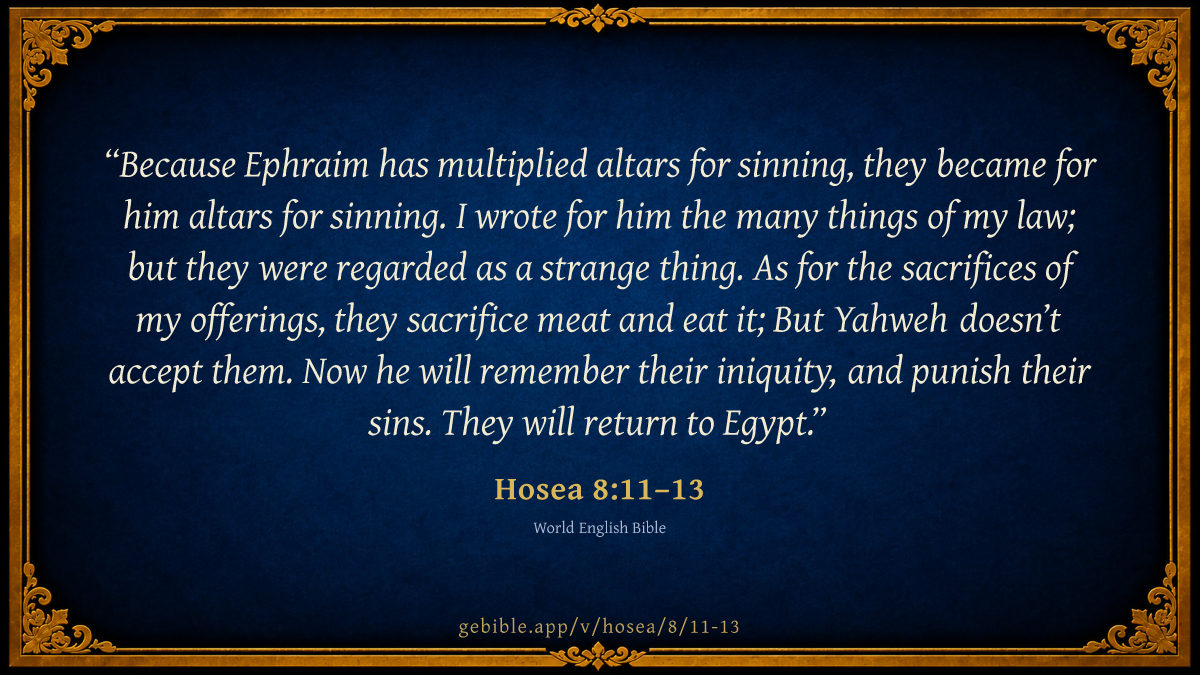
11Because Ephraim has multiplied altars for sinning, they became for him altars for sinning.
12I wrote for him the many things of my law; but they were regarded as a strange thing.
13As for the sacrifices of my offerings, they sacrifice meat and eat it; But Yahweh doesn’t accept them. Now he will remember their iniquity, and punish their sins. They will return to Egypt.
11 Because Ephraim has multiplied altars for sinning, they became for him altars for sinning.
12 I wrote for him the many things of my law; but they were regarded as a strange thing.
13 As for the sacrifices of my offerings, they sacrifice meat and eat it; But Yahweh doesn’t accept them. Now he will remember their iniquity, and punish their sins. They will return to Egypt.
KJVKing James Version
11 Because Ephraim hath made many altars to sin, altars shall be unto him to sin.
12 I have written to him the great things of my law, but they were counted as a strange thing.
13 They sacrifice flesh for the sacrifices of mine offerings, and eat it; but the LORD accepteth them not; now will he remember their iniquity, and visit their sins: they shall return to Egypt.
Show all 3 translations
JPSJPS Tanakh (1917)
11 For Ephraim hath multiplied altars to sin, yea, altars have been unto him to sin.
12 Though I write for him never so many things of My Law, they are accounted as a stranger's.
13 As for the sacrifices that are made by fire unto Me, let them sacrifice flesh and eat it, for the LORD accepteth them not. Now will He remember their iniquity, and punish their sins; they shall return to Egypt.
Hosea 12:11(vv11, 13)If Gilead is wicked, surely they are worthless. In Gilgal they sacrifice bulls. Indeed, their altars are like heaps in the furrows of the…
Hosea 9:6(v13)For, behold, they have gone away from destruction. Egypt will gather them up. Memphis will bury them. Nettles will possess their pleasant…
Hosea 9:9(v13)They have deeply corrupted themselves, as in the days of Gibeah. He will remember their iniquity. He will punish them for their sins.
Amos 5:22(v13)Yes, though you offer me your burnt offerings and meal offerings, I will not accept them; neither will I regard the peace offerings of your…
Amos 8:7(v13)Yahweh has sworn by the pride of Jacob, “Surely I will never forget any of their works.
Show all 41 cross-references
Exodus 20:3(v13)“You shall have no other gods before me.
Deuteronomy 4:6-8(v12)Keep therefore and do them; for this is your wisdom and your understanding in the sight of the peoples who shall hear all these statutes…
Deuteronomy 4:28(v11)There you shall serve gods, the work of men’s hands, wood and stone, which neither see, nor hear, nor eat, nor smell.
Deuteronomy 28:68(v13)Yahweh will bring you into Egypt again with ships, by the way of which I told to you that you would never see it again. There you will…
Isaiah 1:11(v13)“What are the multitude of your sacrifices to me?”, says Yahweh. “I have had enough of the burnt offerings of rams and the fat of fed…
Jeremiah 14:10(v13)Yahweh says to this people, “Even so they have loved to wander. They have not restrained their feet. Therefore Yahweh does not accept them.…
Hosea 5:6(v13)They will go with their flocks and with their herds to seek Yahweh; but they won’t find him. He has withdrawn himself from them.
Hosea 9:3-4(v13)They won’t dwell in Yahweh’s land; but Ephraim will return to Egypt, and they will eat unclean food in Assyria. They won’t pour out wine…
Hosea 11:5(v13)“They won’t return into the land of Egypt; but the Assyrian will be their king, because they refused to repent.
Romans 7:12(v12)Therefore the law indeed is holy, and the commandment holy, and righteous, and good.
Exodus 32:34(v13)Now go, lead the people to the place of which I have spoken to you. Behold, my angel shall go before you. Nevertheless, in the day when I…
1 Samuel 15:22(v13)Samuel said, “Has Yahweh as great delight in burnt offerings and sacrifices, as in obeying Yahweh’s voice? Behold, to obey is better than…
2 Kings 17:15-16(v12)They rejected his statutes, and his covenant that he made with their fathers, and his testimonies which he testified to them; and they…
Nehemiah 9:13-14(v12)“You also came down on Mount Sinai, and spoke with them from heaven, and gave them right ordinances and true laws, good statutes and…
Nehemiah 9:26(v12)“Nevertheless they were disobedient, and rebelled against you, cast your law behind their back, killed your prophets that testified against…
Psalms 50:17(v12)since you hate instruction, and throw my words behind you?
Psalms 119:18(v12)Open my eyes, that I may see wondrous things out of your law.
Psalms 147:19-20(v12)He shows his word to Jacob, his statutes and his ordinances to Israel. He has not done this for just any nation. They don’t know his…
Proverbs 21:27(v13)The sacrifice of the wicked is an abomination— how much more, when he brings it with a wicked mind!
Proverbs 22:20(v12)Haven’t I written to you thirty excellent things of counsel and knowledge,
Isaiah 10:10-11(v11)As my hand has found the kingdoms of the idols, whose engraved images exceeded those of Jerusalem and of Samaria; shall I not, as I have…
Isaiah 30:9(v12)For it is a rebellious people, lying children, children who will not hear Yahweh’s law;
Jeremiah 6:16-17(v12)Yahweh says, “Stand in the ways and see, and ask for the old paths, ‘Where is the good way?’ and walk in it, and you will find rest for…
Jeremiah 7:21-23(v13)Yahweh of Armies, the God of Israel says: “Add your burnt offerings to your sacrifices and eat meat. For I didn’t speak to your fathers or…
Jeremiah 16:13(v11)Therefore I will cast you out of this land into the land that you have not known, neither you nor your fathers. There you will serve other…
Ezekiel 20:11(v12)I gave them my statutes, and showed them my ordinances, which if a man does, he will live in them.
Hosea 4:6(v12)My people are destroyed for lack of knowledge. Because you have rejected knowledge, I will also reject you, that you may be no priest to…
Hosea 4:9(v13)It will be, like people, like priest; and I will punish them for their ways, and will repay them for their deeds.
Hosea 7:2(v13)They don’t consider in their hearts that I remember all their wickedness. Now their own deeds have engulfed them. They are before my face.
Hosea 7:16(v13)They return, but not to the Most High. They are like a faulty bow. Their princes will fall by the sword for the rage of their tongue. This…
Hosea 10:1-2(v11)Israel is a luxuriant vine that produces his fruit. According to the abundance of his fruit he has multiplied his altars. As their land has…
Hosea 10:8(v11)The high places also of Aven, the sin of Israel, will be destroyed. The thorn and the thistle will come up on their altars. They will tell…
Romans 3:1(v12)Then what advantage does the Jew have? Or what is the profit of circumcision?
1 Corinthians 11:20(v13)When therefore you assemble yourselves together, it is not the Lord’s supper that you eat.
1 Corinthians 11:29(v13)For he who eats and drinks in an unworthy way eats and drinks judgment to himself if he doesn’t discern the Lord’s body.
Revelation 16:19(v13)The great city was divided into three parts, and the cities of the nations fell. Babylon the great was remembered in the sight of God, to…
41 distinct cross-references across this passage (42 total citations).
Cross-references from openbible.info (CC BY 4.0)
Explain this passage (18 sources)
Historical commentary, presented as a primary source — not an endorsement.
John Calvin1540 · Public DomainOn vv11–13The Prophet here again inveighs against the idolatry of…
The Prophet here again inveighs against the idolatry of the people, which was, however, counted then the best religion; for the Israelites, as it has been said were become hardened in their superstitions, and had long before fallen away from the pure and lawful worship of God. And we know, that where error has once prevailed, it attains firmness by length of time: hence the Israelites had become hardened in their perverted and fictitious worship. They thought that they did the most meritorious deed whenever they sacrificed, while at the same time, they provoked in this way the wrath of God more and more against themselves. And as they had become thus hardened, the Prophet says, that they multiplied for themselves altars for the purpose of sinning, and that there would be altars for them to sin It was (as I have already said) most difficult to persuade theme that their altars were for the purpose of sinnings and that the more attentive they were in worshipping God, the more grievously they sinned.
We see how Papists of this day glory in their abominations. It is certain that they do nothing but what is accursed before God; for there reigns among them every kind of filthiness, and there is no purity whatever: they therefore continue to offend God as it were designedly. Put at the same time it is their highest holiness to multiply altars: the same also was the prevailing error in the Prophet’s time. This was the reason why he said, that altars were multiplied in order to sin Who at this day can persuade the Papists, that many chapels as they build, are so many sins by which they provoke the wrath of God? But the faithful ought to be content, not with one altar, (for there is now no need of an altar,) but they ought to be content with a common table. The Papists, on the contrary, build altars to themselves without end, where they sacrifice; and they think that God is thus bound to them as by so many chains: as many chapels as are under the papacy are, they think, so many holds for God, (dei carceres,) and that God is there held inclosed. But if any one should say, that so many fiends (Diabolos) dwell in such places, we know how furiously angry they would be.
Read full note →
It is then no superfluous repetition, when the Prophet says, that altars were multiplied in order to sin; and then, that altars would be for sin: for in the second clause, he speaks of the punishment which God would inflict on superstitious men. In the first clause, he shows that their good intentions were frivolous, and that they were greatly deceived, when at their pleasure they devised for themselves various forms of worship. This is one thing. Then it follows, There shall then be to them altars to sin; as they would not willingly repent, nor embrace salutary admonitions, God would at last really show how much he valued what they called their good intentions; for now a dreadful vengeance was at hand, which would prove to them, that in increasing altars, they did nothing else but increase sins. It then follows —
John Calvin's Commentaries (1540-1563) — public domain. Text from the Calvin Translation Society English edition (1840s-50s) via the Christian Classics Ethereal Library (ccel.org). Calvin's coverage is partial (roughly two-thirds of the Bible); uncommented books and verses are honest gaps, never fabricated. The 19th-century editor's footnotes and remarks are omitted so the notes are faithfully Calvin's own voice.
Geneva Bible translators1599 · Public DomainOn vv12–13Thus the idolaters count the word of God as…
Thus the idolaters count the word of God as strange in respect of their own inventions.
Geneva Bible (1599) marginal notes — public domain.
John Trapp1656 · Public DomainOn vv11–13Hos 8:11 Because Ephraim hath made many altars to…
Hos 8:11 Because Ephraim hath made many altars to sin, altars shall be unto him to sin.
Ver. 11. Because Ephraim hath made many altars to sin] Because he hath multiplied altars against God’s express command, Lev 17:3-9 Deu 12:5-7 Jos 22:22-23 Jer 11:13; and that, to sin; as if it were on purpose to cross and provoke the Lord to anger by their superstitions and will worship, and to despite him with seeming honours (for displeasing service is double dishonour), therefore he shall have enough of it ere I have done with it. He shall be given up to a reprobate sense; that going on from one sin to another, he may fill up his measure, till wrath come upon him to the utmost.
Read full note →
“ Per quod quis peccat, per idem punitur et ipse. ”
Idolatry is sin with an accent, wickedness with a witness, 1Ki 15:30; 1Ki 15:34; 1Ki 16:2; 1Ki 12:30; 1Ki 13:34, and shall be punished accordingly; for so the Chaldee paraphraseth here; Because they have multiplied their altars for sin, the altars of their idols shall be their ruin. There is one Hebrew word for sin and punishment: sin hails hell at the very heels of it, as one saith wittily. Polanus upon this text hath these three profitable observations. First, that as in the Old Testament one only altar was set up by God’s command in the tabernacle and temple, so also in the New Testament we have no other altar but Christ, Heb 13:10. (Iren. lib. 4, contra Haeres, cap. 34.) Secondly, as the Israelites sinned in multiplying altars, so do the Papists most grievously, in that, not content with Christ and his satisfactory sacrifice alone, they set up other altars, and bring in other expiatory sacrifices. Thirdly, as the Israelites made many altars to sin, though they pretended good intention and devotion, so the Papists at this day multiply altars (even hundreds in some one church in Rome). to sin, though they falsely pretend their good retention therein, and the preservation and augmentation of God’s service.
John Trapp, A Commentary or Exposition upon All the Books of the Old and New Testament (1647–1656) — public domain. Text from a community e-Sword module.
Matthew Poole1685 · Public DomainOn vv11–13Because: this refers to what follows.
Because: this refers to what follows.
Ephraim hath made many altars; multiplied either to many idols, every one having his altar, or multiplied altars in several places to the same idol. They had many high places, and altars in all of them.
Read full note →
To sin; both as acting against the law of God, which required but one altar, and also these altars were to sin, in that they were for sacrifices to be offered on them to idols. These persons did not intend them for sin, but their good intention did not, could not change the thing, it was sin, however they intended.
Altars, either those here erected, or those they shall find in Assyria when they come captives thither,
shall be unto him to sin; either because forced in captivity to worship Assyrian idols, and to attend their altars and sacrifices, or else by a just and dreadful judgment from God delivering them over to their wilful blindness and idolatrous heart: since they would never be reclaimed, nor taken off from sinful multiplying altars, let them follow their own hearts, and set up what they will; much like that Rev 22:11. Or else thus, Altars shall be the occasion of his greater guilt and punishment, his altars, i.e. his idolatrous worship, shall be that sin that ruins him.
Matthew Poole's English Annotations on the Holy Bible (1683–1685) — public domain. Text from a community e-Sword/MySword module.
John Gill1763 · Public DomainOn vv11–13Because Ephraim hath, made many altars to sin,.... Not…
Because Ephraim hath, made many altars to sin,.... Not with an intention to commit sin, but to offer sacrifice for sin, and make atonement for it, as they thought; but these altars being erected for the sake of idols, and sacrifices offered on them to them, they sinned in so doing, and were the cause of sin in others, who were drawn into it by their example; as they were made to sin, or drawn into it, by Jeroboam their king, These altars were those set up at Dan and Bethel, and in all high places, and tops of mountains, where they sacrificed to idols; and which was contrary to the express command of God, who required sacrifice only at one place, and on one altar, Deu 12:5; typical of the one altar Christ, and his alone sacrifice, who is the only Mediator between God and man; and they are guilty of the same crime as Ephraim here, who make use of more, or neglect him;
altars shall be unto him for sin; either these same altars, and the sacrifices offered on them, shall be reckoned and imputed to him as sins, trod shall be the cause of his condemnation and punishment: or, "let the altars be unto him for sin", so some (n); since he will have them, let him have them, and go on in sinning, till he has filled up the measure of his sins, and brought on him just condemnation; or else other altars are meant, even in the land of Assyria, where, since they were so fond of multiplying altars, they should have altars enough to sin at, whereby their sins would be increased, and their punishment for them aggravated. The Targum is,
Read full note →
"seeing the house of Ephraim hath multiplied altars to sin, the altars of their idols shall he to them for a stumbling block,''
or ruin; so sin is taken in a different sense, both for guilt, and the punishment of it.
(n) "santo ergo illi altaria ad peccandum", Rivet.
John Gill's Exposition of the Whole Bible (1746–1763) — public domain (CC PDM 1.0). Text via the HelloAO Bible API.
John Wesley1765 · Public DomainOn vv11–13Altars - Those which they shall find in Assyria.…
Altars - Those which they shall find in Assyria. To sin - Shall be the occasion of his greater guilt and punishment.
John Wesley, Explanatory Notes Upon the Whole Bible (1754–1765) — public domain. Text via the GEBible commentary corpus.
Adam Clarke1810 · Public DomainOn vv11–13Verse 11. Many altars to sin] Though it does…
Verse 11. Many altars to sin] Though it does not appear that the Jews in Babylon were obliged to worship the idols of the country, except in the case mentioned by Daniel, yet it was far otherwise with the Israelites in Assyria, and the other countries of their dispersion. Because they had made many altars to sin while they were in their own land, they were obliged to continue in the land of their captivity a similar system of idolatry against their will. Thus they felt and saw the evil of their idolatry, without power to help themselves.
Adam Clarke's Commentary on the Bible (1810–1826) — public domain. Text from a community e-Sword/MySword module.
Joseph Benson1811 · Public DomainOn vv11, 13Hos 8:11-12. Because Ephraim hath made many altars to…
Hos 8:11-12. Because Ephraim hath made many altars to sin — “Since the Israelites, forsaking that one altar at which alone God required them to serve him, idolatrously multiplied altars to themselves, — altars against God’s command; (to do which was manifestly a sin in them;) therefore shall those, their beloved altars, be accordingly occasions of great sin, and as such imputed to them to their condemnation.” The meaning is, that
“God would give them up, to run on in their evil courses, till their iniquity was full, and they were ripe for destruction; and then that God would deliver them into the hands of their enemies, who should compel them to do that service at, and to, their idolatrous altars, which should appear a manifest punishment to them for those of their own. So should they be punished by that wherein they had offended.” — Pocock. I have written to him the great things of my law — Or, many things, as רביmay be translated. The Vulgate renders it, multiplices leges meas, my manifold laws. That law which I gave them by Moses, containing rules excellent in themselves, and such as would have made them great in the eyes of their neighbours, they have disregarded, as if it had neither reason nor authority, and did not concern them: see Deu 4:6; Deu 4:8.
Joseph Benson's Commentary on the Old and New Testaments (1811–1818) — public domain. Text from a community e-Sword module.
Albert Barnes1834 · Public DomainOn vv11–13Because Ephraim hath made many altars to sin, altars…
Because Ephraim hath made many altars to sin, altars shall indeed be unto him to sin - that is, they shall be proved to him to be so, by the punishment which they shall draw upon him. The prophet had first shown them their folly in forsaking God for the help of man; now he shows them the folly of attempting to “secure themselves by their great shew and pretences of religion and devotion in a false way.” God had appointed “one” altar at Jerusalem. There He willed the sacrifices to be offered, which He would accept. To multiply altars, much more to set up altars against the one altar, was to multiply sin. Hosea charges Israel elsewhere with this multiplying of altars, as a grievous sin. “According to the multitude of his fruit, he hath increased altars. Their altars are as heaps in the furrows of the field” Hos 10:1; Hos 12:11. They pretended doubtless, that they did it for a religious end, that they might thereon offer sacrifices for the expiation of their sins and appeasing of God. They endeavored to unite their own selfwill and the outward service of God. Therein they might deceive themselves; but they could not deceive God. He calls their act by its true name. To make altars at their own pleasure and to offer sacrifices upon them, under any pretence whatever, was to sin. So then, as many altars as they reared, so often did they repeat their sin; and this sin should be their only fruit. They should be, but only for sin. So God says of the two calves, “This thing became a sin” 1Ki 12:30, and of the indiscriminate consecration of priests (not of the family of Aaron), “This thing became sin unto the house of Jeroboam, even to cut it off and to destroy it from the face of the earth” 1Ki 13:33-34.
Albert Barnes' Notes on the Bible (1834–1885) — public domain. Text from a community e-Sword/MySword module.
Haydock's Catholic Bible Commentary1859 · Public DomainOn vv12–13Foreign. Shall I give them laws again to despise?…
Foreign. Shall I give them laws again to despise? Septuagint, "I shall write down their number." It will be an easy task, they shall be so diminished. "His laws," &c., (Calmet) or, "I will describe to him a multitude, and his regulations: The beloved altars have been deemed foreign. (St. Jerome’s and Grabe’s editions.) (Haydock)
George Leo Haydock (1774–1849), Haydock's Catholic Family Bible and Commentary, 1859 edition — public domain. Excludes Psalms (Douay-Rheims chapter numbering differs from Protestant) and Deuterocanonical books (Catholic canon only).
Robert Jamieson, A. R. Fausset & David Brown1871 · Public DomainOn vv11–13God in righteous retribution gives them up to their…
God in righteous retribution gives them up to their own way; the sin becomes its own punishment (Pro 1:31).
many altars--in opposition to God's law (Deu 12:5-6, Deu 12:13-14).
Read full note →
to sin . . . to sin--Their altars which were "sin" (whatever religious intentions they might plead) should be treated as such, and be the source of their punishment (Kg1 12:30; Kg1 13:34).
Jamieson, Fausset & Brown — Commentary Critical and Explanatory on the Whole Bible (1871) — public domain (CC PDM 1.0). Text via the HelloAO Bible API.
The Cambridge Bible for Schools and Colleges1878 · Public DomainOn vv11–1311. Because] Rather, For. It is a justification of…
11. Because] Rather, For. It is a justification of the foregoing threat.
hath made many altars to sin] In times of national trouble, sacrifices were multiplied, to propitiate the national God (comp. Isa_1:11). But as no corresponding effort was made to purify the conduct and the character, such sacrifices did but increase the load of the national guilt. Instead of ‘many sacrifices’, Hosea says ‘many altars’ because there was even less attempt in the times of Hosea and Isaiah to centralize worship in the northern kingdom than in the southern. The strict rule of Deuteronomy (one temple and one altar) seems at present far removed from the general consciousness. See Introduction, part v.
Read full note →
altars shall be unto him to sin] Rather, (yea,) altars are to him for sinning (thereby). There is no unfairness on Jehovah’s part; Israel cannot pretend ignorance of His will.
The Cambridge Bible for Schools and Colleges (gen. ed. J. J. S. Perowne; Cambridge University Press, 1878–1918) — public domain. Text from a community e-Sword module.
Ellicott's Commentary for English Readers1878 · Public DomainOn vv11–13(11) Many altars.—Multiplication of altars was condemned in the…
(11) Many altars.—Multiplication of altars was condemned in the law (Deu_12:5 seq.). The narrative in Joshua 22 shows that unity of altar and sanctuary was essential to the unity of the nation. The last clause should be rendered, he had altars for sinning. The worship of God was degraded into the sensuous approaching Baal-worship. In the first clause sin equals transgression, in the last transgression plus guilt and peril.
A Bible Commentary for English Readers, edited by Charles John Ellicott (1878–1897) — public domain. Text from a community e-Sword module.
The Pulpit Commentary1880 · Public DomainOn vv11–13Vers. 11, 12. These two verses are closely connected…
Vers. 11, 12. These two verses are closely connected with the preceding verse and with each other. Ver. 11 not only accounts for, but justifies, the threat of punishment announced in ver. 10 by reference to Ephraim"s sin; and ver. 12 shows the inexcusableness of Ephraim in thus sinning. Because Ephraim hath made many altars to sin, altars shall be unto him to sin. Instead of the one sanctuary with its altar in the place which the Lord their God would choose out of all their tribes to put his Name there and to accept the offerings of his people, they multiplied altars contrary to the express command of God; while those altars which they erected in any places that pleased them were not for the service of the true God, but for the worship of idols, the calves, Baal, and ether vanities of the heathen. Thus they multiplied their sin by every altar they reared and every idol they worshipped. Their altars, instead of proving their piety, plunged them in greater sin and deeper guilt. I have written to him the great things of my Law, but they were counted as a strange thing. For the Athenians, whose city Paul found full of idols, and which in addition to its many other altars had one to an unknown god, there was some excuse, for they were not privileged with a revelation of the Divine will in a written Law; but for Israel no such apology was possible. This verse proves plainly that, in their sinning by multiplying idols and altars, they were entirely without excuse. The kethie or textual reading has ribbo for ribboth by the omission of tar and equivalent to hbbr, that is, ten thousand, or myriads; the Qeri or Maasoretie correction, yBeru, plural of bd, multitudes. The idea conveyed is the numerous directions, preceptive and prohibitive, of the Pentateuch; the commandments, so full and explicit, comprehending alike the great things and the little; the details, so minute as well as manifold, that there was no possibility of mistake, provided there was any mind to be informed. Still more, these commandments, directions, and details were not only communicated verbally and orally to Israel; they were committed to writing, and thus placed permanently on record. And yet, notwithstanding all this, the great things of God"s Law were regarded by many or most of those to whom they were addressed as instructions foreign to their interest, with which they had no concern, and which consequently had no claim on their attention and deserved no place in their recollection. The variety of names for the Divine commands is very noteworthy. There are commandments equivalent to all precepts of which the motives are assigned, as of circumstance to distinguish Israel from ether people; statutes, for which no motives are assigned, as in the case of the red heifer, prohibition against wearing garments of mixed material, and ceremonial prescripts in general; testimonies, precepts intended to keep up the memory of any event of fact as the Passover to remind of the departure from Egypt; precepts, rational injunctions, left, so to say, to our intelligence, as the unity of the Deity and the fact of his being the Creator; and judgments, judicial directions relating to buying and selling, inheritances, and such like.
Vers. 11, 12. Perversion of worship.
Read full note →
"Because Ephraim hath made many altars to sin." Israel was to have only one altar, and that in the place where the Lord would reveal his Name. (Deu_12:5) But, instead of that, Ephraim had built a number of altars in different places to multiply the sin of idolatry, and thereby heap more and more guilt upon itself (Delitzsch). The passage leads us to notice the perversion of worship. This is one of the oldest, the most prevalent, and most baneful sins amongst mankind. Men have perverted worship, not only by making false gods, but by making false altars for the true God. There is only one altar in true worship, and that altar is Christ. (Heb_13:10) The text leads us to make two remarks in relation to false worship.
I IT IS A GREAT SIN.
1. It is a very propagative sin. "Ephraim hath made many altars." "It men leave the rule," says an old author, "they know not where to stay; hence the multiplying of things thus amongst the Papists five hundred altars in some one temple." How sublimely antagonistic the Jews were to the introduction of any altar but one! (Jos_22:11) But now they had "many." Once admit a wrong thing in worship, and that one thing will multiply itself; superstition will give it fertility. The Romish Church is a sad illustration of this, and the Anglican Church in some sections is multiplying examples.
2. It is a self-punishing sin. "Altars shall be unto him to sin." The idea probably is, "As you have gone on persisting to multiply altars contrary to my will, I will let you alone; you shall go on. Your altars shall be a sin to you." That is, thus seeing they will have them, they shall have them; they shall have enough of them. Let them go on in their ways; let them multiply their sin. They make a great deal of stir for it, and have it they must; they refuse to see the light; they are prejudiced against the way of God"s worship. Let them have their desires; let them have, saith God, governors to establish by their authority, and teachers to defend by their subtle arguments, what they wish for. They multiply altars to sin, and they shall be to sin, even to harden them; their hearts are set upon them, and they will have them and love them, and they shall be hardened in their heart"s desire in what is evil. And as it shall be to them for sin, so it shall be to them for misery, the fruit of sin; for so sin is taken very frequently in Scripture for the fruit of sin. They will have them to sin, and they shall find in them the fruit of sin misery. The text leads us to remark that
II IT IS A SIN AGAINST GREAT LIGHT. "I have written to him the great things of my Law, but they were counted as a strange thing." They could not say they sinned in ignorance. God gave them directions most concise and abundant concerning the nature and object of true worship. Some translate the words," I may prescribe my laws to them by myriads; they will treat it as a strange thing.
1. God has given us laws concerning worship.
2. Those laws are oft repeated. By myriads or by thousands. We have "line upon line, precept upon precept.
3. These oft-repeated laws leave false worshippers without excuse. D.T.
Vers. 11-14. Religion become sin.
Israel"s holiest things became sin to them through their disregard of God"s commandments.
I THE ALTAR BECOME SIN. (Ver. 11) The law required that there should be but one altar, and that in the place where God had put his Name (Deuteronomy 12). Ephraim disregarding this command, multiplied altars, and so committed sin. The worship at local altars was at most but tolerated in the days of the judges, of Samuel, and the early kings, in consideration of the unsettled state of the nation. (1Ki_3:2) It became sin once a house had been built for God"s worship. Had it been necessary, after the division of the nation, to appoint a district center for Israel, God would have directed the people in the choice of one. They, however, neither desired nor sought for guidance, but organized their worship in their own way, blending with it idolatrous rites, and, beside Jehovah"s altars, reared altars to idols. (Hos_10:1) They thus sinned, both in the number of their altars and in the use they put them to. Accordingly, God declares that these very altars, the things whereby they professed to worship him, would be imputed to them for sin. We are taught:
1. That God claims to regulate his own worship.
2. That wanton departures from the rule he has given is imputed as transgression.
3. That will-worship is not acceptable to God. (Col_2:23)
4. That we cannot condone for disobedience in the matter of worship by either the number or magnificence of our services.
II THE LAW BECOME SIN. (Ver. 12) God had given Israel a Law, the myriad precepts of which would have guided them aright in every situation of life; but this Law Israel had "counted as a strange thing." The Law, which was "holy, and just, and good," became sin to the people through their neglect of it. Consider:
1. The dignity of the Law. It is God"s Law ("my Law"); one, yet many. Single in its principle Thou shalt love the Lord thy God," etc. (cf. Deu_6:5) yet manifold in its applications, branching out into an infinite multiplicity of precepts, and extending to every detail of life.
2. The accessibility of the Law. God had, to secure its being kept it: remembrance, put it in written form. The turn sometimes given to these words, I would have written to him," etc., is meaningless in the connection. The prophet is dealing with what Ephraim has done, not with what he might have done under certain conceivable circumstances in which he was never placed. The passage is a testimony to the existence of a written Law. We should remember our own privileges in the possession of a written revelation.
3. The neglect of the Law. Ephraim permitted this Law, great, wonderful, and holy as it was, fitted to instruct and guide him m the way of life, to be as "a strange thing" unto him. He forbore to study it. He neglected to practice it. The very Law thus redounded to his condemnation. How many act in a similar way with the Bible! They possess it, but leave it unopened, unstudied. The unread Book becomes sin to them. It will rise against then, in the judgment.
III SACRIFICES BECOME SIN. (Ver. 13) As seen before, sacrifices will not be accepted by God as a substitute for obedience. (Hos_6:6 1Sa_15:22) Without the right spirit in the offerer, they become as mere "flesh," in which God takes no pleasure. The sacred thing becomes a thing common. Instead of atoning for iniquity, the sacrifices became themselves iniquity. They were imputed for sin. Neither the number nor magnitude of them could avert the wrath that was decreed. "They shall return to Egypt," i.e. to a new Egypt, to Assyria.
IV TEMPLES BECOME SIN. (Ver. 14) As sacrifices cannot be taken instead of obedience, so temples cannot be accepted as a substitute for godliness. Israel "built temples," but had "forgotten his Maker." The very temples thus became as sin. The building of temples and the lavishing of outward adornment upon them often proceeds the more rapidity that God himself has been forgotten. Worship becomes externalism. The outward is made the most of, as if to condone for the want of the inward. It is not, however, outward temples that God primarily desires, but the temples of humble and contrite spirits. (Isa_57:15) The former without the latterare sin.
V FENCED CITIES BECOME SIN. (Ver. 14) It is added that Judah had multiplied fenced cities. As sacrifices were substituted for obedience, and temples were substituted for godliness, so fenced cities got to be put instead of God himself. The sin lay in looking away from the pledged Divine help to mere earthly defenses. Those who do this are left at last to prove the worthlessness of their defenses. God would send a fire upon the cities, and it would devour the palaces. Human strength is no protection in the absence of God"s help; it is equally powerless to protect against God"s judgments. J.O.
The Pulpit Commentary (1880–1919), ed. H.D.M. Spence-Jones & Joseph S. Exell — public domain. Text from a community e-Sword module.
The Biblical Illustrator1887 · Public DomainOn vv11–12Ephraim hath made many altars to sin.
Hos_8:11
Ephraim hath made many altars to sin.
Read full note →
Perversion of worship
Israel was to have only one altar. Ephraim had built a number of altars in different places. Men have perverted worship, not only by making false gods, but by making false altars for the true God.
I. False worship is a great sin.
1. It is a very propagative sin. Once admit a wrong thing in worship, and that one thing will multiply itself; superstition will give it fertility.
2. It is a self-punishing sin. This is the heavy judgment of God, to give men their hearts desire in what is evil.
II. It is a sin against great light. Israel could not say it sinned in ignorance.
1. God has given us laws concerning worship.
2. These laws are oft repeated.
3. These oft-repeated laws leave false worshippers Without excuse. (Homilist.)
The Biblical Illustrator, edited by Joseph S. Exell (c. 1880s–1900s) — public domain. Text from a community e-Sword module.
The Preacher's Complete Homiletical Commentary1892 · Public DomainOn v11Hos_8:11. Many] Israel should only have one altar (Deu_12:3;…
CRITICAL NOTES.—
Hos_8:11. Many] Israel should only have one altar (Deu_12:3; Deu_12:5). To sin] Altars made by them should be the source of their punishment; they shall go where there is nothing but altars.
Read full note →
Hos_8:12. Written] Lit. I write. Israel could not plead ignorance; no excuse for men now, with the written word. Great] Deu_4:6; Deu_4:8. Wondrous things (Psa_119:18; Psa_147:19-20), a great many things, expressing the care and condescension of God and the comprehensiveness of his word. All the greater is that guilt which regards these commands as strange, no concern of theirs, though specially for them.
Hos_8:13. Sacrifices] multiplied with the altars. Slain-offerings were presented for gifts. Offerings which should be burnt for me they slay and devour. They profaned the sacrifice, and were concerned only about the flesh. Rem-] Sins for which sacrifices were thought to atone. To Eg-] A type of renewed bondage, like that from which they were delivered; abandonment to abject condition (Deu_28:68).
HOMILETICS
AGGRAVATED GUILT.—Hos_8:11-13
“The prophet had first shown them their folly in forsaking God for the help of man; now he shows them the folly of attempting to secure themselves by their great show, pretences of religion, and devotion in a false way. God had appointed one altar at Jerusalem. There he willed the sacrifice to be offered, which he would accept. To multiply altars, much more to set up altars against the one altar, was to multiply sin. Hosea charges Israel elsewhere with this multiplying of altars as a grievous sin (Hos_10:1; Hos_12:11).”
I. In multiplying altars. “Ephraim hath made many altars.” Opposing the commandment of God (Deu_12:5), strengthening the habit of sin (1Ki_12:30), repeating their own folly, and increasing their own punishment. “Altars shall be unto him to sin.”
II. In despising the law. God had given the law, written and expounded it by Moses and the prophets, and continually renewed the knowledge of it, so that they had no excuse for their sin. God has written the law for us by his providence and gospel. His agency is ever fulfilling it; yet men deny it, count it a strange thing, a word with which they have nothing to do. The excuses which men make for rejecting it are not pleas, but sins in the sight of God.
III. In offering lifeless sacrifices. “They sacrifice flesh for the sacrifices of mine offerings.”
1. It was mere external worship. It was mere flesh, not a true sacrifice. External worship without internal ceremony, without sanctity, is like a dead carcase, not a living sacrifice. The Lord accepts it not.
2. It was mere selfish worship,—“and eat it.” Sacrifices which should have been burnt for God they slaughtered and devoured. They were concerned only about temporal affairs. We cannot atone for contempt of God by forms of our own. “Dissembled holiness is double iniquity.” There is only one sacrifice for sin; if that be rejected, sins will be remembered and punished. The devices of selfishness and will-worship can never avert, will only hasten, the penal consequences of sin. “The sacrifice of the wicked is abomination, how much more when he bringeth it with a wicked mind?”
PERVERSION OF WORSHIP.—Hos_8:11-12
The passage leads us to notice the perversion of worship. This is one of the oldest, the most prevalent and the most hateful sins amongst mankind. Men have perverted worship, not only by making false gods, but by making false altars for the true God. There is only one altar in true worship, and that altar is Christ (Heb_13:10). Two remarks in relation to false worship. I. It is a great sin. First, It is a very propagative sin. “Ephraim hath made many altars.” “If men leave the rule,” says an old author, “they know not where to stay, hence the multiplying of things thus amongst the Papists, five hundred altars in some one temple.” How sublimely antagonistic the Jews were to the introduction of any altar but one (Jos_22:11), but now they had “many.” Once admit a wrong thing in worship, and that one thing will multiply itself; superstition will give it fertility. The Romish Church is a sad illustration of this, and the Anglican Church in some sections is multiplying examples. Secondly, It is a self-punishing sin. “Altars shall be unto him to sin.” The idea probably is, “As you have gone on persisting to multiply altars against my will, I will let you alone, you shall go on, your altars shall be a sin unto you.” “That is, thus seeing they will have them, they shall have them; they shall have enough of them. They refuse to see the light, they are prejudiced against the way of God’s worship; let them have their desires; let them have governors to establish by their authority, and teachers to defend by subtle arguments what they wish for; they multiply altars to sin, and they shall be to sin, even to harden them. This is the judgment of God, to give men their heart’s desire in what is evil. And as it shall be to them for sin, so it shall be to them for misery, the fruit of sin.” II. It is a sin against great light. “I have written to him the great things of my law,” &c. They could not say they sinned in ignorance; God gave them directions most concise and abundant concerning the nature and object of true worship. Some translate the words—“I may prescribe my laws to them by myriads, they will treat it as a strange thing.” First, God has given us laws concerning worship. Secondly, Those laws are oft-repeated. By myriads or by thousands. We have “line upon line,” and “precept upon precept.” Thirdly, These oft-repeated laws leave false worshippers without excuse [The Homilist].
HOMILETIC HINTS AND OUTLINES
Hos_8:13. Many altars. Altars to God, altars to man, altars to pleasure, &c. Sin its own punishment. It has fruit, and the fruit shall not only be gathered, but eaten. Men constantly live in the fruit of their own doings (Pro_1:31). Many altars, many sins, and many punishments. “As men are most fearfully plagued when they go on in sin and perish, so when they do not stand in awe of the sin of their course, it is righteous of God to make them feel how ill sin is and how displeased he is with it; for the words import that they shall be given up to that sin; and as they sinned and cared not, so the Lord would make it to be seen to be sin indeed, and make them feel how sad that is” [Hutcheson].
Hos_8:12. Scripture slighted. I. Divine in their origin. God the author—“I have written.” “Given by inspiration of God”—the grandest and sublimest origin from whence anything can come Then regard its authority, love its truthfulness, and obey its precepts. II. Excellent in its nature—“the great things of my law.” The word gives the idea of things heaped together, then greatness and increase from the overflow. Hence the contents of Scripture—
1. Are great, containing the great things of God (Act_2:11).
2. Wonderful (Psa_119:18; Deu_4:6; Deu_4:8).
3. Varied, or manifold (Eph_3:10). III. Specific in its form. “I have written.” Nature and philosophy teach us to record our laws and hand them down to future generations in a permanent form. A written revelation is necessary for all ages, and has manifold advantages above an oral one. God uttered his word at first, writes it afresh in the wonders of his providence, the work of his Spirit, and the preaching of the gospel. The Bible is a revelation of God’s will, full and free, adapted to our wants and circumstances, and worthy of all acceptation. IV. Despised in its mission. Accounted, reckoned as or like a strange thing; as if an alien, or something with which men have no concern.
1. Some reject it as a revelation from God.
2. Others disregard it as a standard of duty.
3. By all it is neglected and unread. It is a book unknown, misunderstood, and despised. Men excuse themselves; consider the Scripture unreasonable in its demands, an enemy to liberty, progress, and science. But given by inspiration of God, profitable for doctrine and correction (2Ti_3:16), the Bible can never be set aside as useless and effete. God writes to warn us of this danger and deprive us of excuse.
Hos_8:13. Many engage only in the external duties of religion. Disregarding God’s rule, they fix up their own, and obey that no further than personal ends uphold them. All is not given to God; they must eat part and share with him. God will have all or none. The sacrifice must be burnt, and self devoted entirely to him.
God does not connive at sin—will remember and visit it with judgments here and punishment hereafter. “God seems to man to forget his sins, when he forbears to punish them; to remember them, when he punishes.”
ILLUSTRATIONS TO CHAPTER 8
Hos_8:10-11. Sin increased. Sin is like a stone which is cast into water, and multiplies itself by infinite circles [Basil]. All sin and wickedness in man’s spirit hath the central force and energy of hell in it, and is perpetually pressing down towards it as towards its own place. The devilish nature is always within the central attractions of hell, and its own weight instigates and accelerates its motion thither [John Smith].
Hos_8:12. Scripture. I am of opinion that the Holy Scriptures contain more sublimity and beauty, more pure morality, more important history, and finer strains of poetry and eloquence, than can be collected from all other books in any age or language [Sir W. Jones]. There are many books which are good and sound, but, like half-pence, there goes a great quantity to a little amount. There are a few silver books, and a very few golden books; but I have one book worth more than all, called the Bible, and that is a book of bank-notes [J. Newton].
There is not a more evident testimony of a corrupt and depraved disposition than an irreverent treatment of sacred things, a contempt of anything that carries on it a Divine impression, or an obstinate neglect of any of those ordinances which the wisdom of God has appointed to support and preserve his religion in the world [Bp Gibson].
Hos_8:13. Sacrifice. He was a man who stole the livery of heaven to serve the devil in [Pollock].
Where the fear of God is, there is the keeping of his commands; and where the keeping of the commandments, there is the cleansing of the flesh; which flesh is a cloud before the soul’s eye, and suffers it not purely to see the beam of heavenly light, and worship God upon such sacrifices.
The gods themselves throw incense. [Shakespeare.]
The Preacher's Complete Homiletical Commentary (gen. ed. Joseph S. Exell; Funk & Wagnalls, c. 1892) — public domain (pre-1929). A full-Bible homiletical/sermon-outline anthology covering 65 of 66 books (2 John is absent from the source module). Text from a community e-Sword module.
unfoldingWord translationNotes2017 · CC BY-SA 4.0On vv11, 13General Information:
General Information:
Yahweh is speaking.
Read full note →
I could write down my law for them ten thousand times, but they would
Yahweh is describing a hypothetical situation. Here "ten thousand times" is an exaggeration that means no matter how many times he gave the people the law, they would still refuse to obey him. AT: "Even if I wrote down my law for them very many times, they would" (See: Hypothetical Situations and Hyperbole and Generalization)
Tyndale Open Study Notes2022 · CC BY-SA 4.0On vv11, 138:11 Israel has built many altars: As Israel’s idolatry…
8:11 Israel has built many altars: As Israel’s idolatry increased, her religious activities increased in an attempt to take away sin; instead, these rites only increased her sin.

John Calvin 1540 · Public Domain On vv11–13 The Prophet here again inveighs against the idolatry of…
The Prophet here again inveighs against the idolatry of the people, which was, however, counted then the best religion; for the Israelites, as it has been said were become hardened in their superstitions, and had long before fallen away from the pure and lawful worship of God. And we know, that where error has once prevailed, it attains firmness by length of time: hence the Israelites had become hardened in their perverted and fictitious worship. They thought that they did the most meritorious deed whenever they sacrificed, while at the same time, they provoked in this way the wrath of God more and more against themselves. And as they had become thus hardened, the Prophet says, that they multiplied for themselves altars for the purpose of sinning, and that there would be altars for them to sin It was (as I have already said) most difficult to persuade theme that their altars were for the purpose of sinnings and that the more attentive they were in worshipping God, the more grievously they sinned.
We see how Papists of this day glory in their abominations. It is certain that they do nothing but what is accursed before God; for there reigns among them every kind of filthiness, and there is no purity whatever: they therefore continue to offend God as it were designedly. Put at the same time it is their highest holiness to multiply altars: the same also was the prevailing error in the Prophet’s time. This was the reason why he said, that altars were multiplied in order to sin Who at this day can persuade the Papists, that many chapels as they build, are so many sins by which they provoke the wrath of God? But the faithful ought to be content, not with one altar, (for there is now no need of an altar,) but they ought to be content with a common table. The Papists, on the contrary, build altars to themselves without end, where they sacrifice; and they think that God is thus bound to them as by so many chains: as many chapels as are under the papacy are, they think, so many holds for God, (dei carceres,) and that God is there held inclosed. But if any one should say, that so many fiends (Diabolos) dwell in such places, we know how furiously angry they would be.
Read full note →
It is then no superfluous repetition, when the Prophet says, that altars were multiplied in order to sin; and then, that altars would be for sin: for in the second clause, he speaks of the punishment which God would inflict on superstitious men. In the first clause, he shows that their good intentions were frivolous, and that they were greatly deceived, when at their pleasure they devised for themselves various forms of worship. This is one thing. Then it follows, There shall then be to them altars to sin; as they would not willingly repent, nor embrace salutary admonitions, God would at last really show how much he valued what they called their good intentions; for now a dreadful vengeance was at hand, which would prove to them, that in increasing altars, they did nothing else but increase sins. It then follows —
John Calvin's Commentaries (1540-1563) — public domain. Text from the Calvin Translation Society English edition (1840s-50s) via the Christian Classics Ethereal Library (ccel.org). Calvin's coverage is partial (roughly two-thirds of the Bible); uncommented books and verses are honest gaps, never fabricated. The 19th-century editor's footnotes and remarks are omitted so the notes are faithfully Calvin's own voice.
Geneva Bible translators 1599 · Public Domain On vv12–13 Thus the idolaters count the word of God as…
Thus the idolaters count the word of God as strange in respect of their own inventions.
Geneva Bible (1599) marginal notes — public domain.
John Trapp 1656 · Public Domain On vv11–13 Hos 8:11 Because Ephraim hath made many altars to…
Hos 8:11 Because Ephraim hath made many altars to sin, altars shall be unto him to sin.
Ver. 11. Because Ephraim hath made many altars to sin] Because he hath multiplied altars against God’s express command, Lev 17:3-9 Deu 12:5-7 Jos 22:22-23 Jer 11:13; and that, to sin; as if it were on purpose to cross and provoke the Lord to anger by their superstitions and will worship, and to despite him with seeming honours (for displeasing service is double dishonour), therefore he shall have enough of it ere I have done with it. He shall be given up to a reprobate sense; that going on from one sin to another, he may fill up his measure, till wrath come upon him to the utmost.
Read full note →
“ Per quod quis peccat, per idem punitur et ipse. ”
Idolatry is sin with an accent, wickedness with a witness, 1Ki 15:30; 1Ki 15:34; 1Ki 16:2; 1Ki 12:30; 1Ki 13:34, and shall be punished accordingly; for so the Chaldee paraphraseth here; Because they have multiplied their altars for sin, the altars of their idols shall be their ruin. There is one Hebrew word for sin and punishment: sin hails hell at the very heels of it, as one saith wittily. Polanus upon this text hath these three profitable observations. First, that as in the Old Testament one only altar was set up by God’s command in the tabernacle and temple, so also in the New Testament we have no other altar but Christ, Heb 13:10. (Iren. lib. 4, contra Haeres, cap. 34.) Secondly, as the Israelites sinned in multiplying altars, so do the Papists most grievously, in that, not content with Christ and his satisfactory sacrifice alone, they set up other altars, and bring in other expiatory sacrifices. Thirdly, as the Israelites made many altars to sin, though they pretended good intention and devotion, so the Papists at this day multiply altars (even hundreds in some one church in Rome). to sin, though they falsely pretend their good retention therein, and the preservation and augmentation of God’s service.
John Trapp, A Commentary or Exposition upon All the Books of the Old and New Testament (1647–1656) — public domain. Text from a community e-Sword module.
Matthew Poole 1685 · Public Domain On vv11–13 Because: this refers to what follows.
Because: this refers to what follows.
Ephraim hath made many altars; multiplied either to many idols, every one having his altar, or multiplied altars in several places to the same idol. They had many high places, and altars in all of them.
Read full note →
To sin; both as acting against the law of God, which required but one altar, and also these altars were to sin, in that they were for sacrifices to be offered on them to idols. These persons did not intend them for sin, but their good intention did not, could not change the thing, it was sin, however they intended.
Altars, either those here erected, or those they shall find in Assyria when they come captives thither,
shall be unto him to sin; either because forced in captivity to worship Assyrian idols, and to attend their altars and sacrifices, or else by a just and dreadful judgment from God delivering them over to their wilful blindness and idolatrous heart: since they would never be reclaimed, nor taken off from sinful multiplying altars, let them follow their own hearts, and set up what they will; much like that Rev 22:11. Or else thus, Altars shall be the occasion of his greater guilt and punishment, his altars, i.e. his idolatrous worship, shall be that sin that ruins him.
Matthew Poole's English Annotations on the Holy Bible (1683–1685) — public domain. Text from a community e-Sword/MySword module.
John Gill 1763 · Public Domain On vv11–13 Because Ephraim hath, made many altars to sin,.... Not…
Because Ephraim hath, made many altars to sin,.... Not with an intention to commit sin, but to offer sacrifice for sin, and make atonement for it, as they thought; but these altars being erected for the sake of idols, and sacrifices offered on them to them, they sinned in so doing, and were the cause of sin in others, who were drawn into it by their example; as they were made to sin, or drawn into it, by Jeroboam their king, These altars were those set up at Dan and Bethel, and in all high places, and tops of mountains, where they sacrificed to idols; and which was contrary to the express command of God, who required sacrifice only at one place, and on one altar, Deu 12:5; typical of the one altar Christ, and his alone sacrifice, who is the only Mediator between God and man; and they are guilty of the same crime as Ephraim here, who make use of more, or neglect him;
altars shall be unto him for sin; either these same altars, and the sacrifices offered on them, shall be reckoned and imputed to him as sins, trod shall be the cause of his condemnation and punishment: or, "let the altars be unto him for sin", so some (n); since he will have them, let him have them, and go on in sinning, till he has filled up the measure of his sins, and brought on him just condemnation; or else other altars are meant, even in the land of Assyria, where, since they were so fond of multiplying altars, they should have altars enough to sin at, whereby their sins would be increased, and their punishment for them aggravated. The Targum is,
Read full note →
"seeing the house of Ephraim hath multiplied altars to sin, the altars of their idols shall he to them for a stumbling block,''
or ruin; so sin is taken in a different sense, both for guilt, and the punishment of it.
(n) "santo ergo illi altaria ad peccandum", Rivet.
John Gill's Exposition of the Whole Bible (1746–1763) — public domain (CC PDM 1.0). Text via the HelloAO Bible API.
John Wesley 1765 · Public Domain On vv11–13 Altars - Those which they shall find in Assyria.…
Altars - Those which they shall find in Assyria. To sin - Shall be the occasion of his greater guilt and punishment.
John Wesley, Explanatory Notes Upon the Whole Bible (1754–1765) — public domain. Text via the GEBible commentary corpus.
Adam Clarke 1810 · Public Domain On vv11–13 Verse 11. Many altars to sin] Though it does…
Verse 11. Many altars to sin] Though it does not appear that the Jews in Babylon were obliged to worship the idols of the country, except in the case mentioned by Daniel, yet it was far otherwise with the Israelites in Assyria, and the other countries of their dispersion. Because they had made many altars to sin while they were in their own land, they were obliged to continue in the land of their captivity a similar system of idolatry against their will. Thus they felt and saw the evil of their idolatry, without power to help themselves.
Adam Clarke's Commentary on the Bible (1810–1826) — public domain. Text from a community e-Sword/MySword module.
Joseph Benson 1811 · Public Domain On vv11, 13 Hos 8:11-12. Because Ephraim hath made many altars to…
Hos 8:11-12. Because Ephraim hath made many altars to sin — “Since the Israelites, forsaking that one altar at which alone God required them to serve him, idolatrously multiplied altars to themselves, — altars against God’s command; (to do which was manifestly a sin in them;) therefore shall those, their beloved altars, be accordingly occasions of great sin, and as such imputed to them to their condemnation.” The meaning is, that
“God would give them up, to run on in their evil courses, till their iniquity was full, and they were ripe for destruction; and then that God would deliver them into the hands of their enemies, who should compel them to do that service at, and to, their idolatrous altars, which should appear a manifest punishment to them for those of their own. So should they be punished by that wherein they had offended.” — Pocock. I have written to him the great things of my law — Or, many things, as רביmay be translated. The Vulgate renders it, multiplices leges meas, my manifold laws. That law which I gave them by Moses, containing rules excellent in themselves, and such as would have made them great in the eyes of their neighbours, they have disregarded, as if it had neither reason nor authority, and did not concern them: see Deu 4:6; Deu 4:8.
Joseph Benson's Commentary on the Old and New Testaments (1811–1818) — public domain. Text from a community e-Sword module.
Albert Barnes 1834 · Public Domain On vv11–13 Because Ephraim hath made many altars to sin, altars…
Because Ephraim hath made many altars to sin, altars shall indeed be unto him to sin - that is, they shall be proved to him to be so, by the punishment which they shall draw upon him. The prophet had first shown them their folly in forsaking God for the help of man; now he shows them the folly of attempting to “secure themselves by their great shew and pretences of religion and devotion in a false way.” God had appointed “one” altar at Jerusalem. There He willed the sacrifices to be offered, which He would accept. To multiply altars, much more to set up altars against the one altar, was to multiply sin. Hosea charges Israel elsewhere with this multiplying of altars, as a grievous sin. “According to the multitude of his fruit, he hath increased altars. Their altars are as heaps in the furrows of the field” Hos 10:1; Hos 12:11. They pretended doubtless, that they did it for a religious end, that they might thereon offer sacrifices for the expiation of their sins and appeasing of God. They endeavored to unite their own selfwill and the outward service of God. Therein they might deceive themselves; but they could not deceive God. He calls their act by its true name. To make altars at their own pleasure and to offer sacrifices upon them, under any pretence whatever, was to sin. So then, as many altars as they reared, so often did they repeat their sin; and this sin should be their only fruit. They should be, but only for sin. So God says of the two calves, “This thing became a sin” 1Ki 12:30, and of the indiscriminate consecration of priests (not of the family of Aaron), “This thing became sin unto the house of Jeroboam, even to cut it off and to destroy it from the face of the earth” 1Ki 13:33-34.
Albert Barnes' Notes on the Bible (1834–1885) — public domain. Text from a community e-Sword/MySword module.
Haydock's Catholic Bible Commentary 1859 · Public Domain On vv12–13 Foreign. Shall I give them laws again to despise?…
Foreign. Shall I give them laws again to despise? Septuagint, "I shall write down their number." It will be an easy task, they shall be so diminished. "His laws," &c., (Calmet) or, "I will describe to him a multitude, and his regulations: The beloved altars have been deemed foreign. (St. Jerome’s and Grabe’s editions.) (Haydock)
George Leo Haydock (1774–1849), Haydock's Catholic Family Bible and Commentary, 1859 edition — public domain. Excludes Psalms (Douay-Rheims chapter numbering differs from Protestant) and Deuterocanonical books (Catholic canon only).
Robert Jamieson, A. R. Fausset & David Brown 1871 · Public Domain On vv11–13 God in righteous retribution gives them up to their…
God in righteous retribution gives them up to their own way; the sin becomes its own punishment (Pro 1:31).
many altars--in opposition to God's law (Deu 12:5-6, Deu 12:13-14).
Read full note →
to sin . . . to sin--Their altars which were "sin" (whatever religious intentions they might plead) should be treated as such, and be the source of their punishment (Kg1 12:30; Kg1 13:34).
Jamieson, Fausset & Brown — Commentary Critical and Explanatory on the Whole Bible (1871) — public domain (CC PDM 1.0). Text via the HelloAO Bible API.
The Cambridge Bible for Schools and Colleges 1878 · Public Domain On vv11–13 11. Because] Rather, For. It is a justification of…
11. Because] Rather, For. It is a justification of the foregoing threat.
hath made many altars to sin] In times of national trouble, sacrifices were multiplied, to propitiate the national God (comp. Isa_1:11). But as no corresponding effort was made to purify the conduct and the character, such sacrifices did but increase the load of the national guilt. Instead of ‘many sacrifices’, Hosea says ‘many altars’ because there was even less attempt in the times of Hosea and Isaiah to centralize worship in the northern kingdom than in the southern. The strict rule of Deuteronomy (one temple and one altar) seems at present far removed from the general consciousness. See Introduction, part v.
Read full note →
altars shall be unto him to sin] Rather, (yea,) altars are to him for sinning (thereby). There is no unfairness on Jehovah’s part; Israel cannot pretend ignorance of His will.
The Cambridge Bible for Schools and Colleges (gen. ed. J. J. S. Perowne; Cambridge University Press, 1878–1918) — public domain. Text from a community e-Sword module.
Ellicott's Commentary for English Readers 1878 · Public Domain On vv11–13 (11) Many altars.—Multiplication of altars was condemned in the…
(11) Many altars.—Multiplication of altars was condemned in the law (Deu_12:5 seq.). The narrative in Joshua 22 shows that unity of altar and sanctuary was essential to the unity of the nation. The last clause should be rendered, he had altars for sinning. The worship of God was degraded into the sensuous approaching Baal-worship. In the first clause sin equals transgression, in the last transgression plus guilt and peril.
A Bible Commentary for English Readers, edited by Charles John Ellicott (1878–1897) — public domain. Text from a community e-Sword module.
The Pulpit Commentary 1880 · Public Domain On vv11–13 Vers. 11, 12. These two verses are closely connected…
Vers. 11, 12. These two verses are closely connected with the preceding verse and with each other. Ver. 11 not only accounts for, but justifies, the threat of punishment announced in ver. 10 by reference to Ephraim"s sin; and ver. 12 shows the inexcusableness of Ephraim in thus sinning. Because Ephraim hath made many altars to sin, altars shall be unto him to sin. Instead of the one sanctuary with its altar in the place which the Lord their God would choose out of all their tribes to put his Name there and to accept the offerings of his people, they multiplied altars contrary to the express command of God; while those altars which they erected in any places that pleased them were not for the service of the true God, but for the worship of idols, the calves, Baal, and ether vanities of the heathen. Thus they multiplied their sin by every altar they reared and every idol they worshipped. Their altars, instead of proving their piety, plunged them in greater sin and deeper guilt. I have written to him the great things of my Law, but they were counted as a strange thing. For the Athenians, whose city Paul found full of idols, and which in addition to its many other altars had one to an unknown god, there was some excuse, for they were not privileged with a revelation of the Divine will in a written Law; but for Israel no such apology was possible. This verse proves plainly that, in their sinning by multiplying idols and altars, they were entirely without excuse. The kethie or textual reading has ribbo for ribboth by the omission of tar and equivalent to hbbr, that is, ten thousand, or myriads; the Qeri or Maasoretie correction, yBeru, plural of bd, multitudes. The idea conveyed is the numerous directions, preceptive and prohibitive, of the Pentateuch; the commandments, so full and explicit, comprehending alike the great things and the little; the details, so minute as well as manifold, that there was no possibility of mistake, provided there was any mind to be informed. Still more, these commandments, directions, and details were not only communicated verbally and orally to Israel; they were committed to writing, and thus placed permanently on record. And yet, notwithstanding all this, the great things of God"s Law were regarded by many or most of those to whom they were addressed as instructions foreign to their interest, with which they had no concern, and which consequently had no claim on their attention and deserved no place in their recollection. The variety of names for the Divine commands is very noteworthy. There are commandments equivalent to all precepts of which the motives are assigned, as of circumstance to distinguish Israel from ether people; statutes, for which no motives are assigned, as in the case of the red heifer, prohibition against wearing garments of mixed material, and ceremonial prescripts in general; testimonies, precepts intended to keep up the memory of any event of fact as the Passover to remind of the departure from Egypt; precepts, rational injunctions, left, so to say, to our intelligence, as the unity of the Deity and the fact of his being the Creator; and judgments, judicial directions relating to buying and selling, inheritances, and such like.
Vers. 11, 12. Perversion of worship.
Read full note →
"Because Ephraim hath made many altars to sin." Israel was to have only one altar, and that in the place where the Lord would reveal his Name. (Deu_12:5) But, instead of that, Ephraim had built a number of altars in different places to multiply the sin of idolatry, and thereby heap more and more guilt upon itself (Delitzsch). The passage leads us to notice the perversion of worship. This is one of the oldest, the most prevalent, and most baneful sins amongst mankind. Men have perverted worship, not only by making false gods, but by making false altars for the true God. There is only one altar in true worship, and that altar is Christ. (Heb_13:10) The text leads us to make two remarks in relation to false worship.
I IT IS A GREAT SIN.
1. It is a very propagative sin. "Ephraim hath made many altars." "It men leave the rule," says an old author, "they know not where to stay; hence the multiplying of things thus amongst the Papists five hundred altars in some one temple." How sublimely antagonistic the Jews were to the introduction of any altar but one! (Jos_22:11) But now they had "many." Once admit a wrong thing in worship, and that one thing will multiply itself; superstition will give it fertility. The Romish Church is a sad illustration of this, and the Anglican Church in some sections is multiplying examples.
2. It is a self-punishing sin. "Altars shall be unto him to sin." The idea probably is, "As you have gone on persisting to multiply altars contrary to my will, I will let you alone; you shall go on. Your altars shall be a sin to you." That is, thus seeing they will have them, they shall have them; they shall have enough of them. Let them go on in their ways; let them multiply their sin. They make a great deal of stir for it, and have it they must; they refuse to see the light; they are prejudiced against the way of God"s worship. Let them have their desires; let them have, saith God, governors to establish by their authority, and teachers to defend by their subtle arguments, what they wish for. They multiply altars to sin, and they shall be to sin, even to harden them; their hearts are set upon them, and they will have them and love them, and they shall be hardened in their heart"s desire in what is evil. And as it shall be to them for sin, so it shall be to them for misery, the fruit of sin; for so sin is taken very frequently in Scripture for the fruit of sin. They will have them to sin, and they shall find in them the fruit of sin misery. The text leads us to remark that
II IT IS A SIN AGAINST GREAT LIGHT. "I have written to him the great things of my Law, but they were counted as a strange thing." They could not say they sinned in ignorance. God gave them directions most concise and abundant concerning the nature and object of true worship. Some translate the words," I may prescribe my laws to them by myriads; they will treat it as a strange thing.
1. God has given us laws concerning worship.
2. Those laws are oft repeated. By myriads or by thousands. We have "line upon line, precept upon precept.
3. These oft-repeated laws leave false worshippers without excuse. D.T.
Vers. 11-14. Religion become sin.
Israel"s holiest things became sin to them through their disregard of God"s commandments.
I THE ALTAR BECOME SIN. (Ver. 11) The law required that there should be but one altar, and that in the place where God had put his Name (Deuteronomy 12). Ephraim disregarding this command, multiplied altars, and so committed sin. The worship at local altars was at most but tolerated in the days of the judges, of Samuel, and the early kings, in consideration of the unsettled state of the nation. (1Ki_3:2) It became sin once a house had been built for God"s worship. Had it been necessary, after the division of the nation, to appoint a district center for Israel, God would have directed the people in the choice of one. They, however, neither desired nor sought for guidance, but organized their worship in their own way, blending with it idolatrous rites, and, beside Jehovah"s altars, reared altars to idols. (Hos_10:1) They thus sinned, both in the number of their altars and in the use they put them to. Accordingly, God declares that these very altars, the things whereby they professed to worship him, would be imputed to them for sin. We are taught:
1. That God claims to regulate his own worship.
2. That wanton departures from the rule he has given is imputed as transgression.
3. That will-worship is not acceptable to God. (Col_2:23)
4. That we cannot condone for disobedience in the matter of worship by either the number or magnificence of our services.
II THE LAW BECOME SIN. (Ver. 12) God had given Israel a Law, the myriad precepts of which would have guided them aright in every situation of life; but this Law Israel had "counted as a strange thing." The Law, which was "holy, and just, and good," became sin to the people through their neglect of it. Consider:
1. The dignity of the Law. It is God"s Law ("my Law"); one, yet many. Single in its principle Thou shalt love the Lord thy God," etc. (cf. Deu_6:5) yet manifold in its applications, branching out into an infinite multiplicity of precepts, and extending to every detail of life.
2. The accessibility of the Law. God had, to secure its being kept it: remembrance, put it in written form. The turn sometimes given to these words, I would have written to him," etc., is meaningless in the connection. The prophet is dealing with what Ephraim has done, not with what he might have done under certain conceivable circumstances in which he was never placed. The passage is a testimony to the existence of a written Law. We should remember our own privileges in the possession of a written revelation.
3. The neglect of the Law. Ephraim permitted this Law, great, wonderful, and holy as it was, fitted to instruct and guide him m the way of life, to be as "a strange thing" unto him. He forbore to study it. He neglected to practice it. The very Law thus redounded to his condemnation. How many act in a similar way with the Bible! They possess it, but leave it unopened, unstudied. The unread Book becomes sin to them. It will rise against then, in the judgment.
III SACRIFICES BECOME SIN. (Ver. 13) As seen before, sacrifices will not be accepted by God as a substitute for obedience. (Hos_6:6 1Sa_15:22) Without the right spirit in the offerer, they become as mere "flesh," in which God takes no pleasure. The sacred thing becomes a thing common. Instead of atoning for iniquity, the sacrifices became themselves iniquity. They were imputed for sin. Neither the number nor magnitude of them could avert the wrath that was decreed. "They shall return to Egypt," i.e. to a new Egypt, to Assyria.
IV TEMPLES BECOME SIN. (Ver. 14) As sacrifices cannot be taken instead of obedience, so temples cannot be accepted as a substitute for godliness. Israel "built temples," but had "forgotten his Maker." The very temples thus became as sin. The building of temples and the lavishing of outward adornment upon them often proceeds the more rapidity that God himself has been forgotten. Worship becomes externalism. The outward is made the most of, as if to condone for the want of the inward. It is not, however, outward temples that God primarily desires, but the temples of humble and contrite spirits. (Isa_57:15) The former without the latterare sin.
V FENCED CITIES BECOME SIN. (Ver. 14) It is added that Judah had multiplied fenced cities. As sacrifices were substituted for obedience, and temples were substituted for godliness, so fenced cities got to be put instead of God himself. The sin lay in looking away from the pledged Divine help to mere earthly defenses. Those who do this are left at last to prove the worthlessness of their defenses. God would send a fire upon the cities, and it would devour the palaces. Human strength is no protection in the absence of God"s help; it is equally powerless to protect against God"s judgments. J.O.
The Pulpit Commentary (1880–1919), ed. H.D.M. Spence-Jones & Joseph S. Exell — public domain. Text from a community e-Sword module.
The Biblical Illustrator 1887 · Public Domain On vv11–12 Ephraim hath made many altars to sin.
Hos_8:11
Ephraim hath made many altars to sin.
Read full note →
Perversion of worship
Israel was to have only one altar. Ephraim had built a number of altars in different places. Men have perverted worship, not only by making false gods, but by making false altars for the true God.
I. False worship is a great sin.
1. It is a very propagative sin. Once admit a wrong thing in worship, and that one thing will multiply itself; superstition will give it fertility.
2. It is a self-punishing sin. This is the heavy judgment of God, to give men their hearts desire in what is evil.
II. It is a sin against great light. Israel could not say it sinned in ignorance.
1. God has given us laws concerning worship.
2. These laws are oft repeated.
3. These oft-repeated laws leave false worshippers Without excuse. (Homilist.)
The Biblical Illustrator, edited by Joseph S. Exell (c. 1880s–1900s) — public domain. Text from a community e-Sword module.
The Preacher's Complete Homiletical Commentary 1892 · Public Domain On v11 Hos_8:11. Many] Israel should only have one altar (Deu_12:3;…
CRITICAL NOTES.—
Hos_8:11. Many] Israel should only have one altar (Deu_12:3; Deu_12:5). To sin] Altars made by them should be the source of their punishment; they shall go where there is nothing but altars.
Read full note →
Hos_8:12. Written] Lit. I write. Israel could not plead ignorance; no excuse for men now, with the written word. Great] Deu_4:6; Deu_4:8. Wondrous things (Psa_119:18; Psa_147:19-20), a great many things, expressing the care and condescension of God and the comprehensiveness of his word. All the greater is that guilt which regards these commands as strange, no concern of theirs, though specially for them.
Hos_8:13. Sacrifices] multiplied with the altars. Slain-offerings were presented for gifts. Offerings which should be burnt for me they slay and devour. They profaned the sacrifice, and were concerned only about the flesh. Rem-] Sins for which sacrifices were thought to atone. To Eg-] A type of renewed bondage, like that from which they were delivered; abandonment to abject condition (Deu_28:68).
HOMILETICS
AGGRAVATED GUILT.—Hos_8:11-13
“The prophet had first shown them their folly in forsaking God for the help of man; now he shows them the folly of attempting to secure themselves by their great show, pretences of religion, and devotion in a false way. God had appointed one altar at Jerusalem. There he willed the sacrifice to be offered, which he would accept. To multiply altars, much more to set up altars against the one altar, was to multiply sin. Hosea charges Israel elsewhere with this multiplying of altars as a grievous sin (Hos_10:1; Hos_12:11).”
I. In multiplying altars. “Ephraim hath made many altars.” Opposing the commandment of God (Deu_12:5), strengthening the habit of sin (1Ki_12:30), repeating their own folly, and increasing their own punishment. “Altars shall be unto him to sin.”
II. In despising the law. God had given the law, written and expounded it by Moses and the prophets, and continually renewed the knowledge of it, so that they had no excuse for their sin. God has written the law for us by his providence and gospel. His agency is ever fulfilling it; yet men deny it, count it a strange thing, a word with which they have nothing to do. The excuses which men make for rejecting it are not pleas, but sins in the sight of God.
III. In offering lifeless sacrifices. “They sacrifice flesh for the sacrifices of mine offerings.”
1. It was mere external worship. It was mere flesh, not a true sacrifice. External worship without internal ceremony, without sanctity, is like a dead carcase, not a living sacrifice. The Lord accepts it not.
2. It was mere selfish worship,—“and eat it.” Sacrifices which should have been burnt for God they slaughtered and devoured. They were concerned only about temporal affairs. We cannot atone for contempt of God by forms of our own. “Dissembled holiness is double iniquity.” There is only one sacrifice for sin; if that be rejected, sins will be remembered and punished. The devices of selfishness and will-worship can never avert, will only hasten, the penal consequences of sin. “The sacrifice of the wicked is abomination, how much more when he bringeth it with a wicked mind?”
PERVERSION OF WORSHIP.—Hos_8:11-12
The passage leads us to notice the perversion of worship. This is one of the oldest, the most prevalent and the most hateful sins amongst mankind. Men have perverted worship, not only by making false gods, but by making false altars for the true God. There is only one altar in true worship, and that altar is Christ (Heb_13:10). Two remarks in relation to false worship. I. It is a great sin. First, It is a very propagative sin. “Ephraim hath made many altars.” “If men leave the rule,” says an old author, “they know not where to stay, hence the multiplying of things thus amongst the Papists, five hundred altars in some one temple.” How sublimely antagonistic the Jews were to the introduction of any altar but one (Jos_22:11), but now they had “many.” Once admit a wrong thing in worship, and that one thing will multiply itself; superstition will give it fertility. The Romish Church is a sad illustration of this, and the Anglican Church in some sections is multiplying examples. Secondly, It is a self-punishing sin. “Altars shall be unto him to sin.” The idea probably is, “As you have gone on persisting to multiply altars against my will, I will let you alone, you shall go on, your altars shall be a sin unto you.” “That is, thus seeing they will have them, they shall have them; they shall have enough of them. They refuse to see the light, they are prejudiced against the way of God’s worship; let them have their desires; let them have governors to establish by their authority, and teachers to defend by subtle arguments what they wish for; they multiply altars to sin, and they shall be to sin, even to harden them. This is the judgment of God, to give men their heart’s desire in what is evil. And as it shall be to them for sin, so it shall be to them for misery, the fruit of sin.” II. It is a sin against great light. “I have written to him the great things of my law,” &c. They could not say they sinned in ignorance; God gave them directions most concise and abundant concerning the nature and object of true worship. Some translate the words—“I may prescribe my laws to them by myriads, they will treat it as a strange thing.” First, God has given us laws concerning worship. Secondly, Those laws are oft-repeated. By myriads or by thousands. We have “line upon line,” and “precept upon precept.” Thirdly, These oft-repeated laws leave false worshippers without excuse [The Homilist].
HOMILETIC HINTS AND OUTLINES
Hos_8:13. Many altars. Altars to God, altars to man, altars to pleasure, &c. Sin its own punishment. It has fruit, and the fruit shall not only be gathered, but eaten. Men constantly live in the fruit of their own doings (Pro_1:31). Many altars, many sins, and many punishments. “As men are most fearfully plagued when they go on in sin and perish, so when they do not stand in awe of the sin of their course, it is righteous of God to make them feel how ill sin is and how displeased he is with it; for the words import that they shall be given up to that sin; and as they sinned and cared not, so the Lord would make it to be seen to be sin indeed, and make them feel how sad that is” [Hutcheson].
Hos_8:12. Scripture slighted. I. Divine in their origin. God the author—“I have written.” “Given by inspiration of God”—the grandest and sublimest origin from whence anything can come Then regard its authority, love its truthfulness, and obey its precepts. II. Excellent in its nature—“the great things of my law.” The word gives the idea of things heaped together, then greatness and increase from the overflow. Hence the contents of Scripture—
1. Are great, containing the great things of God (Act_2:11).
2. Wonderful (Psa_119:18; Deu_4:6; Deu_4:8).
3. Varied, or manifold (Eph_3:10). III. Specific in its form. “I have written.” Nature and philosophy teach us to record our laws and hand them down to future generations in a permanent form. A written revelation is necessary for all ages, and has manifold advantages above an oral one. God uttered his word at first, writes it afresh in the wonders of his providence, the work of his Spirit, and the preaching of the gospel. The Bible is a revelation of God’s will, full and free, adapted to our wants and circumstances, and worthy of all acceptation. IV. Despised in its mission. Accounted, reckoned as or like a strange thing; as if an alien, or something with which men have no concern.
1. Some reject it as a revelation from God.
2. Others disregard it as a standard of duty.
3. By all it is neglected and unread. It is a book unknown, misunderstood, and despised. Men excuse themselves; consider the Scripture unreasonable in its demands, an enemy to liberty, progress, and science. But given by inspiration of God, profitable for doctrine and correction (2Ti_3:16), the Bible can never be set aside as useless and effete. God writes to warn us of this danger and deprive us of excuse.
Hos_8:13. Many engage only in the external duties of religion. Disregarding God’s rule, they fix up their own, and obey that no further than personal ends uphold them. All is not given to God; they must eat part and share with him. God will have all or none. The sacrifice must be burnt, and self devoted entirely to him.
God does not connive at sin—will remember and visit it with judgments here and punishment hereafter. “God seems to man to forget his sins, when he forbears to punish them; to remember them, when he punishes.”
ILLUSTRATIONS TO CHAPTER 8
Hos_8:10-11. Sin increased. Sin is like a stone which is cast into water, and multiplies itself by infinite circles [Basil]. All sin and wickedness in man’s spirit hath the central force and energy of hell in it, and is perpetually pressing down towards it as towards its own place. The devilish nature is always within the central attractions of hell, and its own weight instigates and accelerates its motion thither [John Smith].
Hos_8:12. Scripture. I am of opinion that the Holy Scriptures contain more sublimity and beauty, more pure morality, more important history, and finer strains of poetry and eloquence, than can be collected from all other books in any age or language [Sir W. Jones]. There are many books which are good and sound, but, like half-pence, there goes a great quantity to a little amount. There are a few silver books, and a very few golden books; but I have one book worth more than all, called the Bible, and that is a book of bank-notes [J. Newton].
There is not a more evident testimony of a corrupt and depraved disposition than an irreverent treatment of sacred things, a contempt of anything that carries on it a Divine impression, or an obstinate neglect of any of those ordinances which the wisdom of God has appointed to support and preserve his religion in the world [Bp Gibson].
Hos_8:13. Sacrifice. He was a man who stole the livery of heaven to serve the devil in [Pollock].
Where the fear of God is, there is the keeping of his commands; and where the keeping of the commandments, there is the cleansing of the flesh; which flesh is a cloud before the soul’s eye, and suffers it not purely to see the beam of heavenly light, and worship God upon such sacrifices.
The gods themselves throw incense. [Shakespeare.]
The Preacher's Complete Homiletical Commentary (gen. ed. Joseph S. Exell; Funk & Wagnalls, c. 1892) — public domain (pre-1929). A full-Bible homiletical/sermon-outline anthology covering 65 of 66 books (2 John is absent from the source module). Text from a community e-Sword module.
unfoldingWord translationNotes 2017 · CC BY-SA 4.0 On vv11, 13 General Information:
General Information:
Yahweh is speaking.
Read full note →
I could write down my law for them ten thousand times, but they would
Yahweh is describing a hypothetical situation. Here "ten thousand times" is an exaggeration that means no matter how many times he gave the people the law, they would still refuse to obey him. AT: "Even if I wrote down my law for them very many times, they would" (See: Hypothetical Situations and Hyperbole and Generalization)
ten thousand
"10,000" (See: Numbers)
translationWords
Ephraim
altar
sin
law, laws
unfoldingWord translationNotes — © Distant Shores Media and the Door43 World Missions Community, licensed CC BY-SA 4.0. Source: git.door43.org/Door43/en_tn.
Tyndale Open Study Notes 2022 · CC BY-SA 4.0 On vv11, 13 8:11 Israel has built many altars: As Israel’s idolatry…
8:11 Israel has built many altars: As Israel’s idolatry increased, her religious activities increased in an attempt to take away sin; instead, these rites only increased her sin.
Tyndale Open Study Notes — © Tyndale Open Resources, licensed CC BY-SA 4.0. Text via the HelloAO Bible API.