16Wash yourselves. Make yourself clean. Put away the evil of your doings from before my eyes. Cease to do evil.
17Learn to do well. Seek justice. Relieve the oppressed. Defend the fatherless. Plead for the widow.”
18“Come now, and let’s reason together,” says Yahweh: “Though your sins are as scarlet, they shall be as white as snow. Though they are red like crimson, they shall be as wool.
19If you are willing and obedient, you will eat the good of the land;
20but if you refuse and rebel, you will be devoured with the sword; for the mouth of Yahweh has spoken it.”
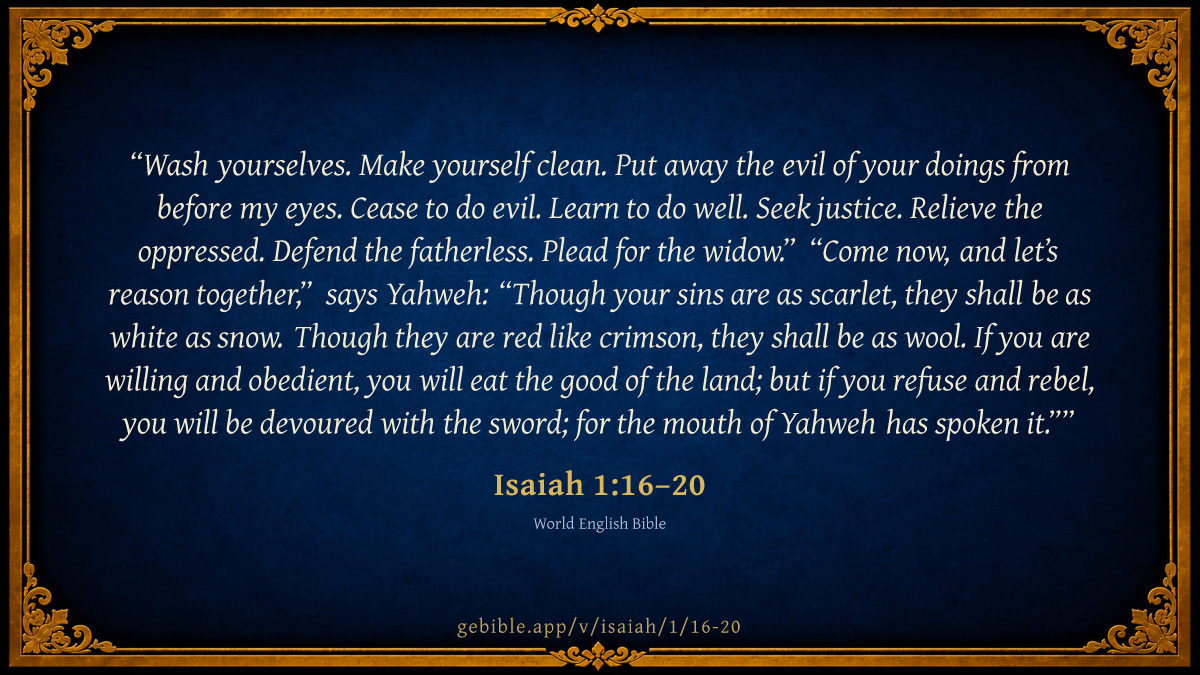
16 Wash yourselves. Make yourself clean. Put away the evil of your doings from before my eyes. Cease to do evil.
17 Learn to do well. Seek justice. Relieve the oppressed. Defend the fatherless. Plead for the widow.”
18 “Come now, and let’s reason together,” says Yahweh: “Though your sins are as scarlet, they shall be as white as snow. Though they are red like crimson, they shall be as wool.
19 If you are willing and obedient, you will eat the good of the land;
20 but if you refuse and rebel, you will be devoured with the sword; for the mouth of Yahweh has spoken it.”
KJVKing James Version
16 Wash you, make you clean; put away the evil of your doings from before mine eyes; cease to do evil;
17 Learn to do well; seek judgment, relieve the oppressed, judge the fatherless, plead for the widow.
18 Come now, and let us reason together, saith the LORD: though your sins be as scarlet, they shall be as white as snow; though they be red like crimson, they shall be as wool.
19 If ye be willing and obedient, ye shall eat the good of the land:
20 But if ye refuse and rebel, ye shall be devoured with the sword: for the mouth of the LORD hath spoken it.
Show all 3 translations
JPSJPS Tanakh (1917)
16 Wash you, make you clean, put away the evil of your doings from before Mine eyes, cease to do evil;
17 Learn to do well; seek justice, relieve the oppressed, judge the fatherless, plead for the widow.
18 Come now, and let us reason together, saith the LORD; though your sins be as scarlet, they shall be as white as snow; though they be red like crimson, they shall be as wool.
19 If ye be willing and obedient, ye shall eat the good of the land;
20 But if ye refuse and rebel, ye shall be devoured with the sword; for the mouth of the LORD hath spoken.
Questions where the Bible appears to say two different things, with the passages on each side set together.
What was Sodom's sin?The Bible names at least six different sins as the reason Sodom was destroyed: same-sex intercourse (Leviticus 18:22 read into Ezekiel 16:50), inhospitality (M…
Isaiah 44:22(v18)I have blotted out, as a thick cloud, your transgressions, and, as a cloud, your sins. Return to me, for I have redeemed you.
Revelation 7:14(vv16, 18)I told him, “My lord, you know.” He said to me, “These are those who came out of the great suffering.They washed their robes, and made them…
Deuteronomy 30:15-16(v19)Behold, I have set before you today life and prosperity, and death and evil. For I command you today to love Yahweh your God, to walk in…
Psalms 51:7(v18)Purify me with hyssop, and I will be clean. Wash me, and I will be whiter than snow.
Micah 7:18-19(v18)Who is a God like you, who pardons iniquity, and passes over the disobedience of the remnant of his heritage? He doesn’t retain his anger…
Show all 67 cross-references
Isaiah 43:24-26(v18)You have bought me no sweet cane with money, nor have you filled me with the fat of your sacrifices, but you have burdened me with your…
Isaiah 3:10(v19)Tell the righteous “Good!” For they shall eat the fruit of their deeds.
Ephesians 1:6-8(v18)to the praise of the glory of his grace, by which he freely gave us favor in the Beloved, in whom we have our redemption through his blood,…
Joel 2:26(v19)You will have plenty to eat, and be satisfied, and will praise the name of Yahweh, your God, who has dealt wondrously with you; and my…
Micah 6:8(v17)He has shown you, O man, what is good. What does Yahweh require of you, but to act justly, to love mercy, and to walk humbly with your God?
Jeremiah 22:3(v17)Yahweh says: “Execute justice and righteousness, and deliver him who is robbed out of the hand of the oppressor. Do no wrong. Do no…
Isaiah 41:21(v18)Produce your cause,” says Yahweh. “Bring out your strong reasons!” says the King of Jacob.
Psalms 82:3-4(v17)“Defend the weak, the poor, and the fatherless. Maintain the rights of the poor and oppressed. Rescue the weak and needy. Deliver them out…
Isaiah 41:1(v18)“Keep silent before me, islands, and let the peoples renew their strength. Let them come near, then let them speak. Let’s meet together for…
Hebrews 5:9(v19)Having been made perfect, he became to all of those who obey him the author of eternal salvation,
Proverbs 31:9(v17)Open your mouth, judge righteously, and serve justice to the poor and needy.”
Isaiah 1:23(v17)Your princes are rebellious and companions of thieves. Everyone loves bribes and follows after rewards. They don’t defend the fatherless,…
Isaiah 55:6-7(vv16, 19)Seek Yahweh while he may be found. Call on him while he is near. Let the wicked forsake his way, and the unrighteous man his thoughts. Let…
Zechariah 7:9-10(v17)“Thus has Yahweh of Armies spoken, saying, ‘Execute true judgment, and show kindness and compassion every man to his brother. Don’t oppress…
Romans 5:20(v18)The law came in that the trespass might abound; but where sin abounded, grace abounded more exceedingly;
1 Peter 3:11(v16)Let him turn away from evil and do good. Let him seek peace and pursue it.
1 Samuel 12:7(v18)Now therefore stand still, that I may plead with you before Yahweh concerning all the righteous acts of Yahweh, which he did to you and to…
Isaiah 55:1-3(v19)“Hey! Come, everyone who thirsts, to the waters! Come, he who has no money, buy, and eat! Yes, come, buy wine and milk without money and…
Jeremiah 22:15-16(v17)“Should you reign, because you strive to excel in cedar? Didn’t your father eat and drink, and do justice and righteousness? Then it was…
Matthew 21:28-32(v19)But what do you think? A man had two sons, and he came to the first, and said, ‘Son, go work today in my vineyard.’ He answered, ‘I will…
1 Peter 2:1(v16)Putting away therefore all wickedness, all deceit, hypocrisies, envies, and all evil speaking,
Daniel 4:27(v17)Therefore, O king, let my counsel be acceptable to you, and break off your sins by righteousness, and your iniquities by showing mercy to…
Zechariah 8:16(v17)These are the things that you shall do: speak every man the truth with his neighbor. Execute the judgment of truth and peace in your gates,
2 Corinthians 7:1(v16)Having therefore these promises, beloved, let’s cleanse ourselves from all defilement of flesh and spirit, perfecting holiness in the fear…
Zephaniah 2:3(v17)Seek Yahweh, all you humble of the land, who have kept his ordinances. Seek righteousness. Seek humility. It may be that you will be hidden…
Jeremiah 31:18-20(v19)“I have surely heard Ephraim grieving thus, ‘You have chastised me, and I was chastised, as an untrained calf. Turn me, and I will be…
Acts 17:2(v18)Paul, as was his custom, went in to them, and for three Sabbath days reasoned with them from the Scriptures,
Acts 18:4(v18)He reasoned in the synagogue every Sabbath and persuaded Jews and Greeks.
James 4:8(v16)Draw near to God, and he will draw near to you. Cleanse your hands, you sinners. Purify your hearts, you double-minded.
Jeremiah 3:12-14(v19)Go, and proclaim these words toward the north, and say, ‘Return, you backsliding Israel,’ says Yahweh; ‘I will not look in anger on you;…
Ezekiel 18:30-31(v16)“Therefore I will judge you, house of Israel, everyone according to his ways,” says the Lord Yahweh. “Return, and turn yourselves from all…
Jeremiah 2:5(v18)Yahweh says, “What unrighteousness have your fathers found in me, that they have gone far from me, and have walked after worthless vanity,…
Hosea 14:1-4(v19)Israel, return to Yahweh your God; for you have fallen because of your sin. Take words with you, and return to Yahweh. Tell him, “Forgive…
Titus 2:11-14(v16)For the grace of God has appeared, bringing salvation to all men, instructing us to the intent that, denying ungodliness and worldly lusts,…
Matthew 3:8(v16)Therefore produce fruit worthy of repentance!
Acts 24:25(v18)As he reasoned about righteousness, self-control, and the judgment to come, Felix was terrified, and answered, “Go your way for this time,…
Isaiah 65:12(v20)I will destine you to the sword, and you will all bow down to the slaughter; because when I called, you didn’t answer. When I spoke, you…
Jeremiah 4:14(v16)Jerusalem, wash your heart from wickedness, that you may be saved. How long will your evil thoughts lodge within you?
Zechariah 1:3-4(v16)Therefore tell them: Yahweh of Armies says: ‘Return to me,’ says Yahweh of Armies, ‘and I will return to you,’ says Yahweh of Armies. Don’t…
Isaiah 52:11(v16)Depart! Depart! Go out from there! Touch no unclean thing! Go out from among her! Cleanse yourselves, you who carry Yahweh’s vessels.
Psalms 26:6(v16)I will wash my hands in innocence, so I will go about your altar, Yahweh,
Isaiah 58:14(v20)then you will delight yourself in Yahweh, and I will make you to ride on the high places of the earth, and I will feed you with the…
Jeremiah 25:5(v16)saying, “Return now everyone from his evil way, and from the evil of your doings, and dwell in the land that Yahweh has given to you and to…
Amos 5:15(v16)Hate evil, love good, and establish justice in the courts. It may be that Yahweh, the God of Armies, will be gracious to the remnant of…
Acts 22:16(v16)Now why do you wait? Arise, be baptized, and wash away your sins, calling on the name of the Lord.’
Romans 12:9(v16)Let love be without hypocrisy. Abhor that which is evil. Cling to that which is good.
Ephesians 4:22-29(v16)that you put away, as concerning your former way of life, the old man that grows corrupt after the lusts of deceit, and that you be renewed…
Job 11:13-14(v16)“If you set your heart aright, stretch out your hands toward him. If iniquity is in your hand, put it far away. Don’t let unrighteousness…
Psalms 37:27(v16)Depart from evil, and do good. Live securely forever.
Numbers 23:19(v20)God is not a man, that he should lie, nor a son of man, that he should repent. Has he said, and will he not do it? Or has he spoken, and…
Psalms 34:14(v16)Depart from evil, and do good. Seek peace, and pursue it.
Isaiah 40:5(v20)Yahweh’s glory shall be revealed, and all flesh shall see it together; for the mouth of Yahweh has spoken it.”
Micah 6:2(v18)Hear, you mountains, Yahweh’s controversy, and you enduring foundations of the earth; for Yahweh has a controversy with his people, and he…
Isaiah 3:11(v20)Woe to the wicked! Disaster is upon them; for the deeds of his hands will be paid back to him.
Isaiah 3:25(v20)Your men shall fall by the sword, and your mighty in the war.
Leviticus 26:33(v20)I will scatter you among the nations, and I will draw out the sword after you. Your land will be a desolation, and your cities shall be a…
1 Samuel 12:25(v20)But if you keep doing evil, you will be consumed, both you and your king.”
2 Chronicles 36:14-16(v20)Moreover all the chiefs of the priests, and the people, trespassed very greatly after all the abominations of the nations; and they…
Micah 4:4(v20)But they will sit every man under his vine and under his fig tree; and no one will make them afraid: For the mouth of Yahweh of Armies has…
Titus 1:2(v20)in hope of eternal life, which God, who can’t lie, promised before time began;
1 Samuel 15:29(v20)Also the Strength of Israel will not lie nor repent; for he is not a man, that he should repent.”
Hebrews 2:1-3(v20)Therefore we ought to pay greater attention to the things that were heard, lest perhaps we drift away. For if the word spoken through…
67 distinct cross-references across this passage (69 total citations).
Cross-references from openbible.info (CC BY 4.0)
Explain this passage (21 sources)
Historical commentary, presented as a primary source — not an endorsement.
Geneva Bible translators1599 · Public DomainOn vv16–19By this outward washing, he meaneth the spiritual: exhorting…
By this outward washing, he meaneth the spiritual: exhorting the Jews to repent and amend their lives.
Geneva Bible (1599) marginal notes — public domain.
John Trapp1656 · Public DomainOn vv16–20Isa 1:16 Wash you, make you clean; put away…
Isa 1:16 Wash you, make you clean; put away the evil of your doings from before mine eyes; cease to do evil;
Ver. 16. Wash ye, make ye clean.] "Wash your hearts from wickedness, that ye may be saved"; {Jer 4:14} "yea, cleanse your hands, ye sinners, and purify your hearts, ye double minded." {Jas 4:8} But how is that done? "Be afflicted, and mourn, and weep," &c. {Jas 4:9} Ye cannot wash your bloody hands in innocence; wash them therefore in tears, which are a second baptism of the soul where it is rinsed anew. And surely, as the sins of the old world, so of this little world, need a deluge. Set to work, therefore, and God will soon set in with you. Wash yourselves with the tears of true repentance, and God will wash you with the blood of his Son; only be sure to do your work thoroughly - wash hard, rub, rinse; we have inveterate stains, which will hardly be got out till the cloth be almost rubbed to pieces; and as an error in the first concoction is not mended in the second, nor of the second in the third, so if a man’s humiliation hath not been sound, his reformation cannot be right. "Wash," therefore, and then
Read full note →
Put away the evil of your doings from before mine eyes.] Away with that abominable thing that is so grievous to all my five senses, yea, to my very soul, as is above said. Sin is in Scripture called pollution, leprosy, contagion, vomit of a dog, wallowing of a swine in the mire, &c., and must therefore be rid and removed out of the heart and life, or we cannot find favour.
Cease to do evil.] This is first to be done: depart from evil, and do good; break off your sins by repentance, and be abrupt in the work; sow not among the thorns, cast away all your transgressions, &c. The prophets, pressing moral duties in this sort, do it as explainers of the law: they did but unfold and draw out that arras which was folded together before.
John Trapp, A Commentary or Exposition upon All the Books of the Old and New Testament (1647–1656) — public domain. Text from a community e-Sword module.
Matthew Poole1685 · Public DomainOn vv16–20Make you clean; cleanse your hearts and hands from…
Make you clean; cleanse your hearts and hands from all filthiness of flesh and spirit, and do not content yourselves with your ceremonial washings.
Put away the evil of your doings from before mine eyes; reform yourselves so thoroughly, that you may not only approve yourselves to men, but to me, who search your hearts, and try all your actions.
Matthew Poole's English Annotations on the Holy Bible (1683–1685) — public domain. Text from a community e-Sword/MySword module.
Matthew Henry1710 · Public DomainOn v16Though God had rejected their services as insufficient to…
Though God had rejected their services as insufficient to atone for their sins while they persisted in them, yet he does not reject them as in a hopeless condition, but here calls upon them to forsake their sins, which hindered the acceptance of their services, and then all would be well. Let them not say that God picked quarrels with them; no, he proposes a method of reconciliation. Observe here,
I. A call to repentance and reformation: "If you would have your sacrifices accepted, and your prayers answered, you must begin your work at the right end: Be converted to my law" (so the Chaldee begins this exhortation), "make conscience of second-table duties, else expect not to be accepted in the acts of your devotion." As justice and charity will never atone for atheism and profaneness, so prayers and sacrifices will never atone for fraud and oppression; for righteousness towards men is as much a branch of pure religion as religion towards God is a branch of universal righteousness.
Read full note →
1. They must cease to do evil, must do no more wrong, shed no more innocent blood. This is the meaning of washing themselves and making themselves clean, Isa 1:16. It is not only sorrowing for the sin they had committed, but breaking off the practice of it for the future, and mortifying all those vicious affections and dispositions which inclined them to it. Sin is defiling to the soul. Our business is to wash ourselves from it by repenting of it and turning from it to God. We must put away not only that evil of our doings which is before the eye of the world, by refraining from the gross acts of sin, but that which is before God's eyes, the roots and habits of sin, that are in our hearts; these must be crushed and mortified.
2. They must learn to do well. This was necessary to the completing of their repentance. Note, It is not enough that we cease to do evil, but we must learn to do well. (1.) We must be doing, not cease to do evil and then stand idle. (2.) We must be doing good, the good which the Lord our God requires and which will turn to a good account. (3.) We must do it well, in a right manner and for a right end; and, (4.) We must learn to do well; we must take pains to get the knowledge of our duty, be inquisitive concerning it, in care about it, and accustom ourselves to it, that we may readily turn our hands to our work and become masters of this holy art of doing well. He urges them particularly to those instances of well-doing wherein they had been defective, to second-table duties: "Seek judgment; enquire what is right, that you may do it; be solicitous to be found in the way of your duty, and do not walk carelessly. Seek opportunities of doing good: Relieve the oppressed, those whom you yourselves have oppressed; ease them of their burdens, Isa 58:6. You, that have power in your hands, use it for the relief of those whom others do oppress, for that is your business. Avenge those that suffer wrong, in a special manner concerning yourselves for the fatherless and the widow, whom, because they are weak and helpless, proud men trample upon and abuse; do you appear for them at the bar, on the bench, as there is occasion. Speak for those that know not how to speak for themselves and that have not wherewithal to gratify you for your kindness." Note, We are truly honouring God when we are doing good in the world; and acts of justice and charity are more pleasing to him than all burnt-offerings and sacrifices.
II. A demonstration, at the bar of right reason, of the equity of God's proceedings with them: "Come now, and let us reason together (Isa 1:18); while your hands are full of blood I will have nothing to do with you, though you bring me a multitude of sacrifices; but if you wash, and make yourselves clean, you are welcome to draw nigh to me; come now, and let us talk the matter over." Note, Those, and those only, that break off their league with sin, shall be welcome into covenant and communion with God; he says, Come now, who before forbade them his courts. See Jam 4:8. Or rather thus: There were those among them who looked upon themselves as affronted by the slights God put upon the multitude of their sacrifices, as ch. 58:3, Wherefore have we fasted (say they) and thou seest not? They represented God as a hard Master, whom it was impossible to please. "Come," says God, "let us debate the matter fairly, and I doubt not but to make it out that my ways are equal, but yours are unequal," Eze 18:25. Note, Religion has reason on its side; there is all the reason in the world why we should do as God would have us do. The God of heaven condescends to reason the case with those that contradict him and find fault with his proceedings; for he will be justified when he speaks, Psa 51:4. The case needs only to be stated (as it is here very fairly) and it will determine itself. God shows here upon what terms they stood (as he does, Eze 18:21-24; Eze 33:18, Eze 33:19) and then leaves it to them to judge whether these terms are not fair and reasonable.
1. They could not in reason expect any more then, if they repented and reformed. they should be restored to God's favour, notwithstanding their former provocations. "This you may expect," says God, and it is very kind; who could have the face to desire it upon any other terms? (1.) It is very little that is required, "only that you be willing and obedient, that you consent to obey" (so some read it), "that you subject your wills to the will of God, acquiesce in that, and give up yourselves in all things to be ruled by him who is infinitely wise and good" Here is no penance imposed for their former stubbornness, nor the yoke made heavier or bound harder on their necks; only, "Whereas hitherto you have been perverse and refractory, and would not comply with that which was for your own good, now be tractable, be governable" He does not say, "If you be perfectly obedient," but, "If you be willingly so;" for, if there be a willing mind, it is accepted. (2.) That is very great which is promised hereupon. [1.] That all their sins should be pardoned to them, and should not be mentioned against them. "Though they be as red as scarlet and crimson, though you lie under the guilt of blood, yet, upon your repentance, even that shall be forgiven you, and you shall appear in the sight of God as white as snow." Note, The greatest sinners, if they truly repent, shall have their sins forgiven them, and so have their consciences pacified and purified. Though our sins have been as scarlet and crimson, as deep dye, a double dye, first in the wool of original corruption and afterwards in the many threads of actual transgression - though we have been often dipped, by our many backslidings, into sin, and though we have lain long soaking in it, as the cloth does in the scarlet dye, yet pardoning mercy will thoroughly discharge the stain, and, being by it purged as with hyssop, we shall be clean, Psa 51:7. If we make ourselves clean by repentance and reformation (Isa 1:16), God will make us white by a full remission. [2.] That they should have all the happiness and comfort they could desire. "Be but willing and obedient, and you shall eat the good of the land, the land of promise; you shall have all the blessings of the new covenant, of the heavenly Canaan, all the good of the land." Those that go on in sin, though they may dwell in a good land, cannot with any comfort eat the good of it; guilt embitters all; but, if sin be pardoned, creature-comforts become comforts indeed.
2. They could not in reason expect any other than that, if they continued obstinate in their disobedience, they should be abandoned to ruin, and the sentence of the law should be executed upon them; what can be more just? (Isa 1:20); "If you refuse and rebel, if you continue to rebel against the divine government and refuse the offers of the divine grace, you shall be devoured with the sword, with the sword of your enemies, which shall be commissioned to destroy you - with the sword of God's justice, his wrath, and vengeance, which shall be drawn against you; for this is that which the mouth of the Lord has spoken, and which he will make good, for the maintaining of his own honour." Note, Those that will not be governed by God's sceptre will certainly and justly be devoured by his sword.
"And now life and death, good and evil, are thus set before you. Come, and let us reason together. What have you to object against the equity of this, or against complying with God's terms?"
Matthew Henry's Commentary on the Whole Bible (1708–1710) — public domain (CC PDM 1.0). Text via the HelloAO Bible API.
John Gill1763 · Public DomainOn vv16–20Wash ye, make you clean, &c. These two words…
Wash ye, make you clean, &c. These two words are to be regarded as one, since they intend the same thing, and suppose the persons spoken to to be unclean, as they were, notwithstanding their legal sacrifices and ceremonial ablutions; and are designed to convince them of it, to bring them to a sense of their inability to cleanse themselves, to lead them to inquire after the proper means of it, and so to the fountain of Christ's blood to wash in, which only cleanses from it:
put away the evil of your doings from before mine eyes; the exhortation is not barely to put away their doings, but the evil of them, and that not from themselves, but from before the eyes of God, from the eyes of his vindictive justice, which is only done by the sacrifice of Christ; and the use of this exhortation is to show the necessity of putting away sin to salvation, and the insufficiency of the blood of bulls and goats to do it, since, notwithstanding these, it remains untaken away; and to direct to the sacrifice of Christ, which effectually does it.
Read full note →
Cease to do evil; either from ceremonial works done with a wicked mind, or from outward immoralities, such as shedding innocent blood, oppressing the fatherless and widow, things mentioned in the context; it denotes a cessation from a series and course of sinning, otherwise there is no ceasing from sin in this life.
John Gill's Exposition of the Whole Bible (1746–1763) — public domain (CC PDM 1.0). Text via the HelloAO Bible API.
John Wesley1765 · Public DomainOn vv16, 17, 19Wash - Cleanse your hearts and hands.
Wash - Cleanse your hearts and hands.
John Wesley, Explanatory Notes Upon the Whole Bible (1754–1765) — public domain. Text via the GEBible commentary corpus.
Adam Clarke1810 · Public DomainOn vv16–20Verse 16. Wash you] Referring to the preceding verse,…
Verse 16. Wash you] Referring to the preceding verse, "your hands are full of blood;" and alluding to the legal washing commanded on several occasions. See Le 14:8-9; Le 14:47.
Adam Clarke's Commentary on the Bible (1810–1826) — public domain. Text from a community e-Sword/MySword module.
Joseph Benson1811 · Public DomainOn vv16, 18Isa 1:16-17. Wash ye, make you clean — Repent,…
Isa 1:16-17. Wash ye, make you clean — Repent, and do works meet for repentance: cleanse your hearts and hands from all filthiness of flesh and spirit, and do not content yourselves with your ceremonial washings. He refers to the charge preferred in the preceding clause, and alludes to the legal purifications commanded on several occasions: see Lev 14:8-9; Lev 14:47. Put away the evil, &c., from before mine eyes — Reform yourselves thoroughly, that you may not only approve yourselves to men, but to me, who search your hearts and try all your actions. Learn to do well — Begin, and inure yourselves, to live soberly, righteously, and godly. Seek judgment, &c. — Show your religion to God, by practising justice and mercy to men. Judge the fatherless, &c. — Deliver and defend those that are poor and helpless, and liable to be oppressed by unjust and potent adversaries.
Joseph Benson's Commentary on the Old and New Testaments (1811–1818) — public domain. Text from a community e-Sword module.
Albert Barnes1834 · Public DomainOn vv16–20Wash you - This is, of course, to be…
Wash you - This is, of course, to be understood in a moral sense; meaning that they should put away their sins. Sin is represented in the Scriptures as defiling or polluting the soul Eze 20:31; Eze 23:30; Hos 5:8; Hos 9:4; and the removal of it is represented by the act of washing; Psa 51:2 : ‘Wash me thoroughly from mine iniquity, and cleanse me from my sin;’ Jer 4:14 : ‘O Jerusalem, wash thine heart from wickedness, that thou mayest be saved;’ Job 9:30; 1Co 6:11; Heb 10:22; 2Pe 2:22; Rev 1:5; Rev 7:14. It is used here in close connection with the previous verse, where the prophet says that their hands were flied with blood. He now admonishes them to wash away that blood, with the implied understanding, that then their prayers would be heard. It is worthy of remark, also, that the prophet directs them to do this themselves. He addresses them as moral agents, and as having ability to do it. This is the uniform manner in which God addresses sinners in the Bible, requiring them to put away their sins, and to make themselves a new heart. Compare Eze 18:31-32.
The evil of your doings - This is a Hebraism, to denote your evil doings.
Read full note →
From before mine eyes - As God is omniscient, to put them away from before his eyes, is to put them away altogether. To pardon or forgive sin, is often expressed by hiding it; Psa 51:9 :
Hide thy face from my sins.
Cease to do evil - Compare 1Pe 3:10-11. The prophet is specifying what was necessary in order that their prayers might be heard, and that they might find acceptance with God. What he states here is a universal truth. If sinners wish to find acceptance with God, they must come renouncing all sin; resolving to put away everything that God hates, however dear it may be to the heart. Compare Mar 9:43-47.
Albert Barnes' Notes on the Bible (1834–1885) — public domain. Text from a community e-Sword/MySword module.
Haydock's Catholic Bible Commentary1859 · Public DomainOn vv16, 18Wash. Interiorly. (Calmet) --- He seems to allude to…
Wash. Interiorly. (Calmet) --- He seems to allude to baptism. (Eusebius) (Theodoret)
George Leo Haydock (1774–1849), Haydock's Catholic Family Bible and Commentary, 1859 edition — public domain. Excludes Psalms (Douay-Rheims chapter numbering differs from Protestant) and Deuterocanonical books (Catholic canon only).
Robert Jamieson, A. R. Fausset & David Brown1871 · Public DomainOn vv16–20God saith to the sinner, "Wash you," &c., that…
God saith to the sinner, "Wash you," &c., that he, finding his inability to "make" himself "clean," may cry to God, Wash me, cleanse me (Psa 51:2, Psa 51:7, Psa 51:10).
before mine eyes--not mere outward reformation before man's eyes, who cannot, as God, see into the heart (Jer 32:19).
Jamieson, Fausset & Brown — Commentary Critical and Explanatory on the Whole Bible (1871) — public domain (CC PDM 1.0). Text via the HelloAO Bible API.
Daniel D. Whedon1874 · Public DomainOn vv16–1816. Wash you — The allusion here is doubtless…
16. Wash you — The allusion here is doubtless to the injunction on priests, who, on pain of death, (Exo_30:19-21,) had to wash hands and feet before they ministered at the altar. The symbol, no doubt, was at once understood by these worldly men now before the prophet: the expression did not seem to them an abrupt transition to another subject. Before they could offer “the earnest, effectual prayer of the righteous man,” they must pray not in alarm merely, but with deep repentance. They must cease to do evil.
Daniel D. Whedon (gen. ed.), Commentary on the Old and New Testaments (1874–1909) — public domain. Text from a community e-Sword module.
The Cambridge Bible for Schools and Colleges1878 · Public DomainOn vv16, 17, 18, 2016, 17. In opposition to this false service of…
16, 17. In opposition to this false service of God, Jehovah calls for moral reformation and enunciates the true conditions on which the restoration of His favour depends.
The Cambridge Bible for Schools and Colleges (gen. ed. J. J. S. Perowne; Cambridge University Press, 1878–1918) — public domain. Text from a community e-Sword module.
Ellicott's Commentary for English Readers1878 · Public DomainOn vv16–19(16) Wash you, make you clean . . .—The…
(16) Wash you, make you clean . . .—The words were probably as an echo of Psa_51:7. Both psalmist and prophet had entered into the inner meaning of the outward ablutions of ritual.
Cease to do evil; (17) learn to do well.—Such words the prophet might have heard in his youth from Amos (Amo_5:14-15). What had then been spoken to the princes of the northern kingdom was now repeated to those of Judah.
A Bible Commentary for English Readers, edited by Charles John Ellicott (1878–1897) — public domain. Text from a community e-Sword module.
The Pulpit Commentary1880 · Public DomainOn vv16–20THE REQUIREMENT OF GOD AMENDMENT OF LIFE. God, having…
THE REQUIREMENT OF GOD AMENDMENT OF LIFE. God, having put aside the worthless plea of outward religiousness made by his people, goes on to declare, by the mouth of his prophet, what he requires. First, in general terms (ver. 16), and then with distinct specification (ver. 17), he calls on them to amend their ways, both negatively ("cease to do evil") and positively ("learn to do well"). If they will really amend, then he assures them of forgiveness and favor; if they refuse and continue their rebellion, the sword will devour them.
Wash you, make you clean. The analogy of sin to defilement, and of washing to cleansing from sin, has been felt among men universally wherever there has been any sense of sin. Outward purification by water has been constantly made use of as typical of the recovery of inward purity. Hence the numerous washings of the Levitical Law; (Exo_29:4 Lev_1:9, 13 Num_19:7, Num_19:8, 19 Deu_21:6 Deu_23:11; etc.) hence the ablutions of the priests in Egypt (Herod., 2:37); hence the appropriateness of the rite of baptism; hence the symbolical washing of hands to free from complicity in blood-guiltiness. (Mat_27:24) "Wash you, make you clean, "could not be misunderstood by the Israelites; they would know that it was a requirement to "wash their hands in innocency", (Psa_26:6 Psa_73:13) even apart from what follows. Put away the evil of your doings from before mine eyes. Not "hide it, "for that was impossible; but remove it altogether-in other words, "cease from it." "Cast off all the works of darkness;" get rid of evil, to begin with. So much is negative.
Read full note →
Vers. 16-20. No return to God"s favor without amendment of life.
The outward show of religion, which the Israelites maintained, vain and futile as it was, seemed to indicate that they were not wholly irreclaimable they did not desire to break altogether with God. The prophet, therefore, assumes that they would wish to know the way by which they may remove God"s anger, and enter once more into favor with him; and he proceeds to point out that the one and only road open to them is to amend their ways to reverse their course of life. This amendment consists in two things: one negative, the other positive.
I NEGATIVELY: AMENDMENT CONSISTS IN CEASING TO DO EVIL. This is the first thing needed. Men must break off their sins, put away the iniquity of their doings, resolutely determine that the works of darkness shall be done by them no more. The works will be different in different cases. To one man they will be impure acts and words; to another, falsehood, deception, equivocation; to another, profanity of speech; to another, drunkenness; to another, intemperate anger, and so on. To the Israelites at this time, or at any rate to their chief men, who are here specially addressed (ver. 10), the evil-doing most common, and to which they were most prone, was cruelty and oppression. The chief men acted as judges, held courts, heard complaints, determined causes; but, instead of seeking to do justice between man and man, they sought merely to advance their own interests by means of the office entrusted to them. They accepted bribes from rich suitors to determine law-suits in their favor; they leaned in their judgments against the weak and the defenseless. They were probably a clique, who enriched themselves by playing into each others" hands, and ousting weak persons from their properties and estates by legal artifices. All this whole system of evil-doing they were required, first of all, to put aside, before they could hope that God would look upon them with anything but anger and reprobation.
II POSITIVELY: AMENDMENT CONSISTS IN LEARNING TO DO WELL. Negative goodness is not enough. God expects each man to glorify him by good actions. Those who have gone astray must not only retrace their steps, but must enter resolutely on the path of virtue. They must "set themselves in some good way." And this must be especially done in the matters wherein they have failed. The Jewish judges had failed in their task of administering justice they had given unjust sentences, favored oppressors, dealt hardly with the widow and the orphan. Hence the prophet"s exhortations to them are "Seek out justice; correct the oppressor; right the orphan; plead the cause of the widow" (ver. 17). And so it must be with all the varieties of evil-doers. Each must be exhorted to the virtue which is the opposite of the vice that he has indulged in. Each must labor, if he really seeks restoration to God"s favor, to do deeds the very opposite of those which he did formerly. If he was a drunkard, he does well to become a total abstainer; if a glutton, to chasten his flesh by fasting; if impure, to give him-serf to the reclaiming of outcasts; if niggardly, "to sell all that he has and give to the poor;" if violent, to suffer wrong, and turn his cheek to the smiter.
From the nature of amendment, the prophet proceeds to its consequences, which are likewise twofold, consisting in
I THE CLEANSING OF THE INDIVIDUAL SOUL. Here much is kept back which is revealed later, as
(1) the mode whereby the soul is cleansed, or in other words, the doctrine of the atonement, which appears in Isa_53:5, Isa_53:6;
(2) the necessity of laying hold of the atonement by faith; (Rom_3:25 Rom_4:5, etc.) and
(3) the immediate removal of the guilt of sin, when God justifies us, and the gradual removal of its taint, as he sanctifies us. But the declaration of the fact of our cleansing is directly made, and made with the utmost plainness: "Though your sins be as scarlet, they shall be as white as snow," etc. The cleansing will be entire, complete, thorough. Snow will not be purer than the redeemed soul, which "the blood of Jesus Christ has cleansed from all sin". (1Jn_1:7)
II A REWARD, EXTERNAL TO THE SOUL ITSELF, WHICH GOD"S FREE GRACE WILL BESTOW. Here still more is kept back. The reward held out is merely temporal: "Ye shall eat the good of the land." Ye shall live in peace and prosperity, under your own vines and fig trees, and enjoy the fruits of the earth, which God in his bounty gives you. Not a whisper of the eternal reward the blessedness reserved for man in heaven, the bliss which "eye hath not seen, nor ear heard, neither hath it entered into the heart of man to conceive." Probably the Israelites of Isaiah"s day were too gross and sensual, too much wrapt up in material things, to have been stirred to action by anything so distant and intangible as the heavenly life, even if they could have formed the faintest conception of it. Here, again, "God has provided better things for us", (Heb_10:4) and given us a motive for exertion far beyond any that was presented to his ancient people.
Vers. 16, 17. Conditions of Divine acceptance.
The prophet has been dealing with the insufficiency of mere ceremonial as a ground of acceptance before God. He is equally severe on mere professions of penitence, that find no adequate expression in changed moral conduct and hearty return to the rules of duty and charity.
I IT WOULD BE MISCHIEVOUS TO ACCEPT THE HARDENED. Mischievous for the hardened themselves, who would be made yet harder by a goodness they could not fail to misunderstand. Mischievous for all others, in whose minds moral distinctions would be confused, and the Divine righteousness sullied. Under no pretence, by no equivocations, through no disguises, can God possibly accept the guilty and impenitent. In this, as in all else, the Judge of all the earth will do right.
II IT IS HOPELESS TO ACCEPT MERE PROFESSORS. For they are self-deluded, and would be kept from awakening to their true state, if God accepted them as they are. The man who is satisfied with profession, and fails to aim at godly living, can never appreciate Divine acceptance or rightly respond to it. Divine acceptance is one great help to righteousness, and this the professor neither admires nor seeks. What good is it to accept professors? God cannot get beyond their fine outer shell. They are apples of Sodom, acceptable neither to God nor man. "He that doeth righteousness is righteous, even as he is righteous.
III GOD ACCEPTS ONLY THOSE WHOSE PENITENCE FINDS EXPRESSION IN EFFORTS TO DO RIGHT. They only show that they are sincerely desirous of help; and they only are in a moral condition to receive, and to use well, Divine forgiveness and favor. Show how intensely practical the plea is in the text: "Put away just those very sins that you have been so freely indulging in. But do not be satisfied with any mere negation of evil; seek opportunities of doing justice; take care to blend justice with charity; do the right, and do the kind to all those who cannot right themselves." Goodness as a sentiment is of little value. Goodness as a life Gad looks for, and man asks from his fellows. "I will show thee my faith by my works. R.T.
The Pulpit Commentary (1880–1919), ed. H.D.M. Spence-Jones & Joseph S. Exell — public domain. Text from a community e-Sword module.
The Biblical Illustrator1887 · Public DomainOn vv16, 18, 19Wash you, make you clean
Isa_1:16
Wash you, make you clean
Read full note →
Repentance necessary and possible
Two things are necessarily to be acknowledged to encourage endeavours after piety.
1. To be assured that God will not be wanting to afford the assistance of His grace and Spirit.
2. That by this assistance we are enabled to do our duty. There are two things which no wise man doth submit to his care or thought, namely, necessaries and impossibles. For things necessary, he needs not to charge himself with them, for they will be done of course; and for things impossible, it is a vain thing for him to undertake. We are not to consider ourselves to be in a state of impossibility, therefore we must suppose that God is with us by His grace and assistance; and while God is with us that we are able to do those things that He requires of us--to wash and make us clean, etc., which words are to be considered according to their form and according to their matter.
1. According to their form, they are an exhortation, and so it is not in vain that we are exhorted to duty.
2. In respect of their matter, they afford these two observations--
(1) That sin is in itself a thing of defilement and pollution.
(2) That religion is a motion of restoration.
Ill habits do strangely bias our faculties; but though they do this, yet they do not absolutely determine our faculties or sink them, for these faculties are of the essence of the soul. It is with much difficulty they are overcome Jer_13:23); but the faculty is free notwithstanding any habit acquired; otherwise it were impossible ever to recover any habitual sinner.
I. GOD DOTH PRIMARILY DESIRE THE GOOD OF ALL HIS CREATURES (1Ti_2:4; Isa_5:4).
II. GOD DOTH NOT DESIRE MANS SALVATION WITHOUT HIS RETURN. For it is impossible that any man should be happy in a way of obstinacy and rebellion against God,
III. GOD DOTH NOT DESIRE MANS RETURN WITHOUT HIS OWN CONSENT. For if He should desire this, He should desire that which cannot be: for being intelligent and voluntary agents, we cannot truly be said to do that which we do against our minds. For to a human act two things are necessary; that there be the judgment of reason in the understanding, and the choice of the will If the mind do not consent, it is not a free act; and if not done freely, and of choice, it cannot be an act of virtue; and if not an act of virtue, it cannot be of any moral consideration. It is no less an act of the will, though a man be at the first attempt unwilling and averse; yea, though he suffer great difficulty to bring himself to it. For this man hath brought himself to it by reason, consideration, and argument, and so his consent is the better grounded. Application--
1. We ought to be thankful to God, and to acknowledge Him for the gracious assistance that He doth afford unto us.
2. We ought to make use of and employ this Divine assistance, which is in the apostles language, not to receive the grace of God in vain (2Co_6:1). (B. Whichcote D. D.)
Moral ablution
I. THAT SIN CAN BE SEPARATED FROM MANS NATURE. Sin is no more a part of human nature than a stain is of a garment.
1. Human nature has existed without ever having been touched by sin. Christ through all His life could say, The prince of this world cometh, and hath nothing in Me.
2. Human nature does exist after having been cleansed from sin. It does so in heaven.
II. THAT SIN SHOULD BE SEPARATED FROM MANS NATURE. There are three obvious reasons for this command--
1. Because your pollution conceals the moral image of Himself which your Maker has impressed upon your nature. Sin is such a besmearment of the moral mirror of mans being, that scarcely a Divine ray is seen reflected.
2. Because your pollution enfeebles your moral health. Physical pollution is inimical to physical health. Sin renders a man powerless for good.
3. Because your pollution injures society. (Homilist.)
Practical regeneration
The call is made to the class that are usually given up. Two questions come up in connection with this subject.
1. When a man is wrong in his life, is wicked on account of the strength of constitutional peculiarities, and is organised with such passion, such will, such temper, such pride and avarice, that that organisation compels as well as controls him, is it possible for him to change that organisation and its fruits?
2. Whatever may have been the proportions in which a mans faculties are given to him, if he has been cast in the midst of temptations, is it in his power, if he be an average man, to break away, to assert his own sovereignty, and recover himself? Can a man control, first, himself inwardly, and second, himself outwardly? Did not Peter wrestle success fully with his constitutional organisation? There is an example which is still more remarkable in some respects. The account which Paul gives of himself is most striking. Here we have a precisionist, a narrow and intense bigot, a man whose conscience was logical, and who therefore followed his conscience without scruple and without the restraint of any meliorating principle. Not only was he man of the most malign feeling in the service of religion, but he was a man of the utmost firmness of purpose. Nothing could stop him on sea or on land. He was a man of the most sensitive pride. Now, turn to the thirteenth chapter of First Corinthians, and see what the fruit of Pauls change was. It may be said to be a record of his experience. Then, as to the other question, Can men control their circumstances? If a man can overrule a constitutional peculiarity, how much easier can he control that which is not of himself, but is exterior to himself! The experiences of the Gospel for thousands of years show that men can be reclaimed from all forms of vice. Men can break through and rescue themselves from the power of wickedness when it takes on an external and social form. That is the voice of the Old Testament. Is it a false proclamation, based upon a false view of life and possibility? Preeminently it is the voice of the New Testament. The invisible things of God are more and mightier than the visible. If a man treats himself simply as a physical organisation, and believes in nothing but what he can see and handle, it may seem to him as though this world were simply a gigantic crushing machine, irresistible in its impulses, and as though the best way for him were to submit himself to it, and let it take him whither it will; but we are taught, and we believe that the whole heaven is full of powers which are mightier than any which are seen. (H. W. Beecher.)
Renewing forces are silent and gentle
Nature itself gives us an illustration of it. When the spring draws the sap out of the ground into the trees the actual force which is exerted is greater than that of all human machines put together. Never was there an engine built that could for one mingle moment compare with the development of actual physical power in an oak tree standing in a field, acre broad, every spring. Yet you see nothing and hear nothing. But it has been measured and estimated. There is in the silent influence of the seasons more power than in all the storms that ever swept over the earth since creation. The invisible forces of nature are mightier than the visible. Look into a household. The bustling husband who drives the children here and there, and will have order, has nothing but disorder; while the mother sits still, and loves, rules over every child in the family, and secures perfect obedience. The silence of love is mightier than all the physical or moral force of boisterous strength. Now, this truth, which we discern even in the lowest forms of matter, and which grows more and more striking as you ascend along the line of human society, meets the great declaration of the Divine Word, that God has given the Holy Spirit, and that this invisible and silent force in the universe is such that more are they that are for a man who wants to turn than are they that are against him. The whole heaven is Gods apparatus for helping men to unharness their faults, to lay aside their habits, to change mightily their whole internal economy, yea, to so revolutionise themselves that, whereas before the animal, the physical, was in the ascendency, now the angel, the spiritual, is. Is there, then, such an influence existing in every community? Yes, in every community. (H. W. Beecher.)
In regeneration man must cooperate with Gods Spirit
If men would have the help of the sun they must not sulk in caves; if men would set the sun to bringing forth vines and corn and other grains they must employ it according to the suns laws and methods. If they do this they shall have the benefit of its might. All the power that is in nature is mine if I but study natural law and obey it. Now, the invisible influences in the Divine nature, we are taught very abundantly in the Word of God, are to be sought as men seek the seasons. If the power that is in God is to come to the help of a man there should be at least as much seeking as men give to the laws of nature when they seek them. How do men attempt to renovate their spiritual nature? With what dalliance, what carelessness, what facile discouragement, what intermissions, what associations that neutralise or blur that which is bright in us do men seek to bring the Divine influence to bear upon their constitutional peculiarities! Are you proud? You know how to extract the roots of the mightiest tree that ever grew; you know how to attack it and draw it forth; and yet the influences by which a man may extract by the roots all the evil influences within him are a hundred times greater, if men had some conception of the necessity. A man can overmaster his pride. Paul did it. Can a man change his basilar passions so that they shall be held in abeyance? Certainly he can. Something can be done for every man by physiological methods. A man of violent temper, easily excited, an excessively meat-eating man, or a man addicted to the use of stimulating drinks, can hardly expect to overcome the animal in himself while he is gorging him, and is building fires under the very caldrons which he would cool off. If a man choose to go through the necessary practice, he certainly can change; but if a man say to himself, I do not believe in religion; I will change by and by; it is not convenient now; I do not under stand this great change, and I do not like to go into anything which my reason does not comprehend, I say to him, Do you insist, when you are sick, and you send for your physician, upon entering into an argument with him? Do you say to him, What is the matter with me? and when he prescribes for you do you say, Sit down and tell me the whole history of this medicine, who invented it, what its use is, who has employed it, and what right the man had to compose it or mix it? You do not act so. A man under such circumstances instantly makes a practical matter of it, and takes certain practical steps. On the other side, no man can tear himself away from surrounding temptations and evil influences without an adaptation of his life and will to the peculiar work which is required. Shall a man attempt to change himself from evil to good, and do it easily and thoughtlessly and carelessly? Such a change never comes by accident nor by a little striving. Here is the simple fact of this whole subject: both philosophy and example teach that in our strife for virtue the passions and appetites, the infelicities of our organisation, can be overmastered; that we can take ourselves out of our constitutional faults, and that if we have fallen under temptations, it is possible for us to break the net and escape from them. When Jesus came, one of the most matchless and eloquent of all His utterances was that He had come to open the prison doors, to break the shackles, to give the prisoners liberty, and to let those that were bound go free. (H. W. Beecher.)
Isa_1:16-17
Cease to do evil; learn to do well
An inoffensive life
The order in which these words are placed, was evidently designed to teach us, that the foundation of acting right is avoiding everything wrong.
Several other parts of Scripture lay down the same rule in almost the same terms (Psa_34:14; Psa_37:27; Am Rom_12:9; 1Pe_3:11); and many express or imply the same doctrine, putting repentance before faith and obedience (Mt Mar_1:15; Act_20:21; Tit_2:12-13). Even heathen authors, in very distant ages and countries, have given the like direction. And indeed everyone must own the justness of it: but still very few appear to perceive or attend sufficiently to its importance: which, therefore, I shall endeavour to shew you--
I. IN RESPECT OF OUR CONDUCT IN GENERAL. It is plainly the natural and rational method to begin with removing what else will obstruct our progress, and to make unity within our own breasts our earnest care. He who hath only consistent pursuits may follow them with a prospect of success: but a mind, distracted between contrary principles of action, can hope for nothing but to be drawn backward and forward by them continually, as they chance to prevail in their turns. Things, indeed, that do but accidentally give some little hindrance to each other now and then, may be prosecuted together, and the due preference, when they interfere, be adjusted well enough. But sin and duty are so essentially opposite, that their interests can never be reconciled, They flow from different motives, proceed by different means, aim at different ends, and thwart one another perpetually. And it is to mens overlooking this obvious truth, that the miscarriage of their good intentions, the irresolution of their lives, the incoherence of their characters, in a great measure, owes its rise. Every one of us knows, in the main, what he ought to do: everyone feels an approbation of it; and so far, at least, a disposition to it. But then he feels also dispositions quite adverse: and though he sees them to be unwarrantable, yet it is painful to root them out, and not pleasing even to take notice of them. So, to avoid trouble, both sorts are allowed to grow up together as they can; and, which will thrive faster, soon appears. Perhaps but one or two sorts of wickedness were intended to be indulged: but these have unforeseen connections with others, and those with more. Or, had they none, when men have once yielded to do but a single thing amiss, they have no firm ground to stand upon in refusing to do a second, and a third: so gradually they lose their strength, God withdraws His help, and they fall from bad to worse.
II. IN RESPECT OF OUR BEHAVIOUR TO EACH OTHER. It is a remarkable thing in the constitution of this world, that we have much more power of producing misery in it than happiness. Everyone, down to the most insignificant, is capable of giving disquiet, nay, grievous pain and affliction to others, and often to great numbers, without the least difficulty; while even those of superior abilities in every way, can hardly discover the means, unless it be within a very narrow compass now and then, of doing any great good, or communicating any considerable pleasure. Besides, the effects of kindnesses may always be entirely lost: but those of injuries too frequently can never be remedied. And therefore we ought to watch over ourselves with perpetual care, examine the tendency of all our words and actions, and, not contented with meaning no harm, be solicitous to do none. The harm that we do through heedlessness is certainly not so criminal, as if it were purposely contrived: but may be almost, if not quite, as severely felt notwithstanding: or though it were but slightly, why should we be so inadvertent, as unnecessarily to cause but an hours, nay, a moments vexation or grief to one of our brethren; or deprive him of the smallest of those innocent gratifications, that help to alleviate the sorrows of life, and make the passage through it comfortable? (T. Secker, LL. D.)
The Bible art of reforming men
I. Its primary principle is, that REFORMATION SHOULD BEGIN AT THE SOURCE OF HUMAN CONDUCT. Change the springs of all action and you change every element of conduct. Ye must be born again. Out of the heart proceed all evils.
1. It does not set aside all forms of outward help--society, industry, family, church, but these are auxiliaries to the central endeavour of the human will.
2. It recognises, too, that the complete work is by stages, gradual--though the purpose may be immediate.
II. Not only is the central element of reformation clearly established, but what may be called THE WORKING PLAN OF REFORMATION FROM EVIL IS LAID DOWN. (Dan_3:27. Compare that with Mat_3:8-10.)
1. Right-doing is the way to cease wrong-doing. Eph_4:28 --not enough to stop getting by stealing, but must do that by learning how to get by working! The way to cure evil, is to set a current of contrary action.
2. The illustration of the inward government of mind--how feelings of one class rise or fall in answer to the excitement or somnolency of another.
3. The two faulty forms.
(1) Forming a purpose, without taking practical steps--empty resolves--by repentance--leaves only; no fruit.
(2) Reformation by external regulation--mechanical.
III. THE DIFFICULTIES OF VICE, OF HABIT, WHEN THEY ARE SIMPLY WATCHED AGAINST.
1. They leave men lonesome--unhappy.
2. The soul develops power to overturn evil only by inspiration of opposite virtues.
IV. THE REASON SO MANY PEOPLE BECOME NEGATIVE, FEEBLE, AND UNINTERESTING WHEN THEY BECOME RELIGIOUS.
V. THE REASON SO MANY ARE STRONG, NOBLE, AS WORLDLY MEN IN BUSINESS, BUT WITHOUT FORCE IN SPIRITUALS. They let loose their whole selves in the one case. They tie up the strong elements in the other, for fear of mischief--and do not let out any other. (Pro_3:13-18; also 8:11, etc.)
VI. WHEN MEN TURN FROM EVIL LET THEM GO CLEAR OVER TO RELIGION! (H. W.Beecher.)
The men for the times
Men are wanted who are prepared to march in the van of the army of national, civic, and personal reformers,--men with the one thought dominating them that God the Father lives, and loves with an everlasting love every member of the human race,--men who, influenced by this irresistible intuition, seek to purge and purify politics and trade, society and the Church, law and custom, speech and practice, of all things that oppress and injure, and which in any way retard the triumph of the kingdom of God. The watchword still is, Cease to do evil, etc. (F. Sessions.)
The prophetic temper in James Russell Lowell
The temper that was in James Russell Lowell is the temper we seek for in all our public men--in all leaders of thought in Church or State, of local or general following. He sang of the wrongs of the poor and the slave; the emptiness of life without conviction; of the nullity of poetry without purpose; the vapidness of preaching without piety; the shame of law without justice; the blank horror of a world without God. (F. Sessions.)
Holding on to a sin
A little child was one day playing with a very valuable vase, when he put his hand into it and could not withdraw it. His father, too, tried his best to get it out, but all in vain. They were talking of breaking the vase, when the father said, Now, my son, make one more try; open your hand and hold your fingers out straight, as you see me doing, and then pull. To their astonishment the little fellow said, Oh, no, pa. I couldnt put out my fingers like that, for if I did I would drop my penny. He had been holding on to a penny all the time! No wonder he could not withdraw his hand. (J. McNeill.)
The first principle
There is no religion--or if there is, I do not know it--which does not say, Do good; avoid evil. There is none which does not contain what Rabbi Hillel called the quintessence of all religions, the simple warning, Be good, my boy. Be good, my boy, may seem a very short catechism; but let us add to it, Be good, my boy, for Gods sake, and we have in it very nearly the whole of the Law and the Prophets. (Max Muller.)
What repentance is
Suppose I am to go down to Boston tonight, and I go down to the Union station, and say to a man I sere there, Can you tell me, is this train going to Boston? and the man says Yes. I go and get on board the train, and the superintendent comes along and says, Where are you going? I say, I am going to Boston, and he says, Well, you are in the wrong train, that train is going to Albany. But I am quite sure I am right; I asked a railroad man here, and he told me this was the train. And the superintendent says, Moody, I know all about these trains; I have lived here forty years, and see these trains go up and down here every day. And at last he convinces me that I am on the wrong train. That is conviction, not conversion. But if I dont remain on that train, but just get into the other train, that is repentance. Just to change trains--that is repentance. (D. L. Moody.)
Evil to be supplanted by good
Sin is to be overcome, not so much by maintaining a direct opposition to it, as by cultivating opposite principles. Would you kill the weeds in your garden, plant it with good seed: if the ground be well occupied there will be less need of the labour of the hoe. If a man wished to quench fire, he might fight it with his hands till he was burnt to death; the only way is to apply an opposite element. (Andrew Fuller.)
Learn to do well
The highest education
We hear much about various grades of education--primary, secondary, and higher education; by the text we are reminded of that highest education which concerns all, and which it is the main end of life to secure. Moral culture is even more imperative than intellectual development.
I. THE NECESSITY FOR MORAL LEARNING. Numerous definitions have been given of man, but he might justly be defined as the being who learns. Other creatures can scarcely he said to learn; whatever pertains to their species they do instinctively, immediately, perfectly. A lark builds its first nest as skilfully as its last, a spiders first embroidery is as exquisite as anything it spins in adult life, a bee constructs its first cell and compounds its first honey with an efficiency that leaves nothing to be desired. We know that naturalists are not altogether agreed on this point, but we may conclude that substantially instinct dispenses with that laborious process which we know as learning. It is altogether different with the human creature. If we are to do well, taking that phrase in its noblest sense, we must learn to do it, acquiring the splendid power through attention, repeated endeavour, and manifold sacrifice. Take, e.g., the virtue of contentment. We, are persuaded of the reasonableness of contentment with the dispensations of Divine Providence; yet the folly of the soul is subdued only through much failure and discipline. Or, take the virtue of sincerity. This virtue, if it be not rather of the essence of all virtues, we all, to some extent, require to learn, some, however, finding in the learning of it the chief task of life. It seems paradoxical to say so, but some men are naturally theatrical; the temptation is always to act a part. Through repeated and hitter castigations of the soul do we master this passion for masquerading, and attain sincerity, simplicity, and thoroughness of life. Take the virtue of veracity. We have much to learn here--to speak the truth, to act the truth, to live the truth. Take the virtue of temper. There is a faculty of wrath in nature, and a faculty of wrath becomes noble men but to harmonise this faculty with reason, and to be at once high-spirited and gentle, is a problem that may demand years for its solution. Or, take the virtue of kindness. We pass through much self-reproach, scourging, and shame in striving to reach the beauteous ideal. St. Paul bears witness of himself, I have learned in whatsoever state I am, therewith to be content. Let us remember in the training of our children that virtue is acquired much as intellectual life is.
II. CONSIDER THE METHOD OF THIS MORAL CULTURE. Three things are essential to the liberal education of the soul.
1. A pattern. Looking unto Jesus. He is the supreme Pattern. Said an American artist, I would give everything I have to see Velasquez paint for one week, one day. But the splendid privilege is given to us to behold the Lord Jesus live through years! Learn of Me, says the Master, and a loving, thoughtful glance into the New Testament every day is a lifelong vision of perfection. Let us learn of Him in joy and sorrow, in work and leisure, in strength and weariness, in popularity and neglect, in success and failure, in life and death. He best teaches the art of life.
2. Power. We can never become holy except as we have a genius for holiness, and this genius in an adequate degree only the Spirit of God can impart. Let us in prayer seek for more inward vision, receptivity, and energy, more of the Spirit that worketh mightily in fully surrendered souls, and all things will become possible.
3. Practice. We learn to do well through doing well. (W. L. Watkinson.)
Lifes great lesson
I. THERE IS NO ROYAL ROAD TO RENOWN. You envy me, do you? said a marshal (Lefevre) of France, to a friend complimenting him on his possessions and good fortune. Well, you shall have these things at a better bargain than I had. Come into the courtyard: Ill fire at you with a gun twenty times at thirty paces, and if I dont kill you, all shall be your own. What, you will not come! Very well; recollect, then, that I have been shot at more than a thousand times, and much nearer than thirty paces, before I arrived at the state in which you now find me! The marshals friend saw only the success attained; he forgot the toil, the suffering and peril through which it had been achieved. The traveller with ardent love of beauty climbs the rugged hill whence his view, he fancies, will be unobstructed and complete; but the first ascent made, behold, another hill overshadowing him; and that surmounted, behold, still another frowns upon him higher yet. So with the hill of life. One arduous ascent made, one difficulty overcome, another presents itself, another, and still another. It is ever Excelsior! We would not have it otherwise. Without difficulty, there were no display of energy. Without temptation, there were no self-discipline. Without trial and suffering, there were no fortitude and resignation.
II. OBSERVE THE ENFORCEMENT OF THIS LESSON OF THE PART OF NATURE THE VERY BEGINNINGS OF LIFE. We begin life as strangers in a strange land. We bring nothing with us into the world, either of wealth, knowledge, or experience. What we possess, we receive, acquire, or learn. We find the conditions of life already existing We must accept the situation; meet it as best we may, and each go on to act his part. Beginning to learn, we find nature and her laws fixed, inexorable, demanding recognition sad obedience. Observe these laws, heed natures warnings, and she is a gentle mistress, a kind benefactress; but disregard them, disobey them, and she becomes a terrible avenger. The penalty she never fails to inflict. If not in youth, then in manhood; if not in manhood, then in old age. Though her voice be silent, still nature speaks. And this is her word: Whatever and wherever your place in lifes arena act well your part,--learn to do well. For the sake of your physical well-being; for the sake of your temporal happiness; for the sake of those to come after you--observe my commandments to do them!
III. CONSIDER THE UTILITY OF THIS LESSON AS TAUGHT BY SOCIETY AND EMPHASISED IN EVERY SPHERE OF LIFE. The household, the school, the college, the counting room tuitions, the business apprenticeships, civil and political laws and institutions--whatever factors enter in to develop and improve society--are but the outgrowth and exemplification of the precept of learning to do well. They are natures assistants, teaching us how to do well in life. What is self-denial? It is but another word for learning to do well; that is, learning to forego the lesser for the sake of the higher good; denying the present moment for the sake of the moment that is to come--all which involves difficulty, cost, pain, persistent effort. Persistent effort in the mastering of difficulties lies at the basis of true advancement and success. Wisdom, skill, mastery in hall of trade or science, in field of politics or war, come not by wishing.
IV. BUT, ALONG WITH SELF-DENIAL LEARNING TO DO WELL INVOLVES SUBMISSION TO HIGHER AUTHORITY. Who could expect to become an able soldier without first submitting to a tacticians guidance? There must be days, weeks, months of weary taxation of eye and ear, nerve and muscle; there must be continued restraint of body and mind; there must be submission to anothers will--obedience to a masters command. But--there it comes again--obedience, self-restraint, is difficult. And what is all this struggle with difficulty for? Why, simply for the sake of learning to do well--to drill well; for the sake of becoming a good soldier!
V. But the Bible declares that this life is a period of trial, on the issue of which turns the destiny of our future being. If, then, whatever is worth the having in this present life comes not without conflict with difficulties, IS IT REASONABLE TO SUPPOSE THAT THE ADVANTAGES OF THE FUTURE LIFE WILL ACCRUE TO US WITHOUT LIKE CONFLICT WITH DIFFICULTIES? Do nothing, and still inherit eternal life? It is not so cheap a thing as that.
VI. Beyond this, THE BIBLE NOT ONLY POINTS OUT THE DIFFICULTIES THAT OPPOSE US--IT SHOWS HOW THE DIFFICULTIES ARE TO BE MET. In the lives of its heroes the Bible individualises every virtue, but in no one of them does every virtue appear till we come to the perfect man, Christ Jesus. He is the Master of goodness. And He says, If any man will come after Me, let him deny himself, and take up his cross daily, and follow Me. If the way seem too full of obstructions, and old sins hedge us in, and our weakness is very great, He yet kindly says to us as to the apostle Paul, My grace is sufficient for thee, etc. (C. P. H. Nason, M. A.)
The struggle between good and evil in the human soul
We see what the author has produced, but we do not see what he has destroyed. The book comes out in fair copy, and we, looking upon the surface only, say, How well done! Who can tell what that fair copy cost? We see the picture hung upon the wall for exhibition, but we do not see how much canvas was thrown away, or how many outlines were discarded, or how many efforts were pronounced unworthy. We only see the last or best. So much is to be done in private with regard to learning to do well. We do not live our whole life in public. We make an effort in solitude: it is a failure; we throw it away; we acknowledge its existence tone one: still, we are acquiring skill--practice makes perfect--and when we do our first act of virtue in the public sight people may suppose that we are all but prodigies and miracles, so well was the deed done. Only Gods eye saw the process which led up to it. This is a characteristic of Divine grace, that it sets down every attempt as a success, it marks every failure honestly done as a victory already crowned. So we are losing nothing even on the road. The very learning is itself an education; the very attempt to do, though we fail of doing, itself gives strength, and encouragement, and confidence. In learning to do well we assist the negative work of ceasing to do evil. (J. Parker, D. D.)
Learn to do well
1. We must be doing; not cease to do evil, and then stand idle.
2. We must be doing good; the good which the Lord our God requires, and which will turn to a good account.
3. We must do it well, in a right manner, and for a right end.
4. We must learn to do well, we must take pains to get the knowledge of our duty, be inquisitive concerning it, in care about it; and accustom ourselves to it, that we may readily turn our hands to our work, and become masters of this holy art of doing well (M. Henry.)
The Biblical Illustrator, edited by Joseph S. Exell (c. 1880s–1900s) — public domain. Text from a community e-Sword module.
The Preacher's Complete Homiletical Commentary1892 · Public DomainOn vv16–19Isa_1:16. Wash you, make you clean.
MORAL ABLUTION
Isa_1:16. Wash you, make you clean.
Read full note →
This is one of a very numerous class of passages which summon sinners to the duty of moral purification, of thorough and complete reformation of character (Jer_4:14; Jas_4:8; Jer_18:11; Eze_18:30-32, &c.) These passages are very clear and emphatic, but they seem to be in opposition to others which assert man’s natural inability to do anything that is good (Mat_7:18; Rom_7:18-23; Joh_15:5), with others which teach that repentance is a Divine gift (Act_5:31; 2Ti_2:25), and with those which teach that sanctification is the work of the Holy Spirit (1Co_6:11, &c.) The opposition is only apparent [297] Every Divine command really involves a promise of the grace necessary for its accomplishment, and God is ever ready to work with and in us “to will and to do of His good pleasure” [300] Fallen as we are, we yet retain the power of responding to or of rejecting His admonitions; if we respond to them, there instantly begins to flow into our souls that which will enable us to accomplish everything that God has required (Php_4:13). Three great questions—
[297] There is no contradiction between these statements and the command to repent. Whoever considers what repentance is,—that it is a change of mind toward sin, so that what once was loved is viewed with disgust, and what was pursued with eagerness is shunned with abhorrence,—will perceive at once that it can only be wrought in us by a Divine power. Man’s natural tendencies are toward evil; and a river could as easily arrest itself on its way to the ocean, and climb to the sources whence it sprang, as can man without the help of the Holy Spirit learn to hate sin because of what it is. “Can the Ethiopian change his skin, or the leopard his spots? then may ye also do good that are accustomed to do evil.” The polluted fountain of our heart will never cleanse itself. Repentance, like every other gift, must come from the Father of lights.
[300] The gospel supposeth a power going along with it, and that the Holy Spirit works upon the minds of men, to quicken, excite, and assist them in their duty. If it were not so, the exhortations of preachers would be nothing else but a cruel and bitter mocking of sinners, and an ironical insulting over the misery and weakness of poor creatures, and for ministers to preach, or people to hear sermons, upon any other terms, would be the vainest expense of time and the idlest thing we do all the week; and all our dissuasives from sin, and exhortations to holiness and a good life, and vehement persuasions of men to strive to get to heaven, and to escape hell, would be just as if one should urge a blind man, by many reasons and arguments, taken from the advantages and comfort of that sense, and the beauty of external objects, by all means to open his eyes, and to behold the delights of nature, to see his way, and to look to his steps, and should upbraid him, and be very angry with him, for not doing so.—Tillotson, 1630–1694.
But “God works in us to will and to do of His good pleasure.” By His Holy Spirit He strives in every human soul, awakening desires after a better and purer life. By His long-suffering, by messages from His Word, by the monitions of His providence, He strives to lead us to repentance. But we must repent. As while the earth cannot bear fruit unless the sun shine upon it, it is still the part of the earth to he fertile; so while we cannot repent unless God aid us, it is our part to turn from evil. Repentance cannot he exercised for us; it must be exercised by us.
God commands you to repent, just as to the apostles, when five thousand hungry men, besides women and children, surrounded them, and their whole store was five loaves and two fishes, Christ said, “Give ye them to eat.” The task is as much beyond your unaided power as that was above theirs; but address yourself to it as they did, in obedience to the Divine behest, and you will receive power from on high to accomplish not only it, but other tasks higher yet.
I. Why must we cleanse ourselves from evil?
1. Because sin renders us offensive to God. It is in itself repulsive to Him, just as immodesty in all its forms and in every degree is repulsive to a virtuous woman (Hab_1:13).
2. Because it is destructive to ourselves. In physical matters dirt and disease are inseparable, and so they are in spiritual. Moral pollution leads to moral decay. Sin is a leprosy that eats away all the finer faculties of the soul.
3. Because it renders us dangerous to our fellow-men. In the measure that we are corrupt, we shall corrupt others. There is a terrible contagiousness in iniquity (Pro_22:24-25; Rev_18:4). A sinner is a walking pestilence. And
4. The special lesson of our text in its connection—Because otherwise access to the throne of grace will be closed against us. If it be not so with us now, yet there will come a season when it will be supremely important to us that God should hear our prayers (a time of great trouble, or the hour of death), and how awful will be our condition if God should then turn a deaf ear to us! But this is the doom of obdurate sinners (Isa_1:15; Jer_11:14, &c.)
II. How may we cleanse ourselves from evil?
1. By resolutely putting off our old evil habits. This is what Isaiah exhorted the Jews to do (Isa_1:16-17). Similar exhortations occur in the New Testament (Eph_4:25-29; Heb_12:1). Begin with the faults of which you are most conscious [303] Begin and continue the great task of moral reformation in humble dependence upon God.
2. By prayer. In earnest communion with God our views of duty and purity receive a marvellous elevation, and we catch the inspiration of the Divine character, so that iniquity, instead of being attractive, becomes hateful to us also [306]
3. By humble but resolute endeavours to copy the example of our Lord Jesus Christ.
4. By intercourse with the people of God [309]
5. By making the Word of God the only and absolute rule of our life (Psa_119:1). These are the means by which we may attain to moral purity in the future. Cleansing from the guilt of sin in the past is bestowed freely on all who believe in Jesus (1Jn_1:7-9). Yea, the guilt of a man whose hands are literally “full of blood” may thus be washed away; e.g., Saul, the persecutor and murderer of the saints (Act_22:4; Act_22:16; 1Ti_1:16).
[303] Rooting up the large weeds of a garden loosens the earth, and renders the extraction of the lesser ones comparatively easy.—Eliza Cook.
[306] There is an antipathy between sinning and praying. The child that hath misspent the whole day in playing abroad, steals to bed at night for fear of a chiding from his father. Sin and prayer are such contraries, that it is impossible at a stride to step from one to another. Prayer will either make you leave off sinning, or sinning will make you leave off prayer.—Gurnall, 1617–1679.
[309] Get some Christian friend (whom thou mayest trust above others) to be thy faithful monitor. Oh, that man hath a great help for the maintaining the power of godliness that has an open-hearted friend that dare speak his heart to him. A stander-by sees more sometimes by a man than the actor can do by himself, and is more fit to judge of his actions than he of his own; sometimes self-love blinds us in our own cause, that we see not our own cause, that we see not ourselves so bad as we are; and sometimes we are oversuspicious of the worst by ourselves, which makes us appear to ourselves worse than we are. Now, that thou mayest not deprive thyself of so great help from thy friend, be sure to keep thy heart ready with meekness to receive, yea, with thankfulness embrace a reproof from his mouth. Those that cannot bear plain-dealing hurt themselves most; for by this they seldom hear the truth.—Gurnall, 1617–1679.
The first true sign of spiritual life, prayer is also the means of maintaining it. Man can as well live physically without breathing, as spiritually without praying. There is a class of animals—the cetaceous, neither fish nor seafowl, that inhabit the deep. It is their home; they never leave it for the shore; yet, though swimming beneath its waves and sounding its darkest depths, they have ever and anon to rise to the surface that they may breathe the air. Without that these monarchs of the deep could not exist in the dense element in which they live, and move, and have their being. And something like what is imposed on them by a physical necessity, the Christian has to do by a spiritual one. It is by ever and anon ascending up to God, by rising through prayer into a loftier, purer region for supplies of Divine grace, that he maintains his spiritual life. Prevent these animals from rising to the surface, and they die for want of breath; prevent him from rising to God, and he dies for want of prayer. “Give me children,” cried Rachel, “or else I die.” Let me breathe, says a man gasping, or else I die. Let me pray, says the Christian, or else I die.—Guthrie.
III. When may we cleanse ourselves from evil? NOW! this very hour the task ought to be begun.
1. Difficult as the task is, delay will only increase its difficulty [312]
2. Now, because God’s commands brook no delay. (Psa_95:7-8).
3. Now! because now though God may be willing to-day to grant you “repentance unto life,” by your delay you may so provoke Him to anger that to-morrow repentance may be denied you.
[312] The more we defer, the more difficult and painful our work must needs prove; every day will both enlarge our task and diminish our ability to perform it. Sin is never at a stay; if we do not retreat from it, we shall advance in it, and the farther on we go, the more we have to come back; every step we take forward (even before we can return hither, into the state wherein we are at present) must be repeated; all the web we spin must be unravelled.
Vice, as it groweth in age, so it improveth in stature and strength; from a puny child it soon waxeth a lusty stripling, then riseth to be a sturdy man, and after awhile becometh a massy giant, whom we shall scarce dare to encounter, whom we shall be very hardly able to vanquish; especially seeing that as it groweth taller and stouter, so we shall dwindle and prove more impotent, for it feedeth upon our vitals, and thriveth by our decay; it waxeth mighty by stripping us of our best forces, by enfeebling our reason, by perverting our will, by corrupting our temper, by debasing our courage, by seducing all our appetites and passions to a treacherous compliance with itself: every day our mind groweth more blind, our will more resty, our spirit more faint, our passions more headstrong and untamable; the power and empire of sin do strangely by degrees encroach, and continually get ground upon us, till it hath quite subdued and enthralled us. First we learn to bear it; then we come to like it; by and by we contract a friendship with it; then we dote upon it; at last we become enslaved to it in a bondage, which we shall hardly be able, or willing, to shake off; when not only our necks are fitted to the yoke, our hands are manacled, and our feet shackled thereby, but our heads and hearts do conspire in a base submission thereto, when vice hath made such impression on us, when this pernicious weed hath taken so deep root in our mind, will, and affection, it will demand an extremely toilsome labour to extirpate it.—Barrow, 1630–1677.
Repentance is entirely in God’s disposal. This grace is in the soul from God, as light is in the air from the sun, by continual emanation; so that God may shut or open His hands, contract or diffuse, set forth or suspend the influence of it as He pleases. And if God gives not repenting grace, there will be a hard heart and a dry eye, maugre all the poor frustraneous endeavours of nature. A piece of brass may as easily melt, or a flint bewater itself, as the heart of man, by any innate power of its own, resolve itself into a penitential humiliation. If God does not, by an immediate blow of His omnipotence, strike the rock, these waters will never gush out. The Spirit blows where it listeth, and if that blows not, these showers can never fall.
And now, if the matter stands so, how does the impenitent sinner know but that God, being provoked by his present impenitence, may irreversibly propose within Himself to seal up these fountains, and shut him up under hardness of heart and reprobation of sense? And then farewell all thoughts of repentance for ever.—South, 1633–1716.
A PLAIN COMMAND
Isa_1:16. Cease to do evil.
One of the pretexts by which wicked men endeavour to excuse their neglect of religion is, that many of the doctrines of the Bible are mysterious. They are so necessarily, and that they are so is one proof that the Bible is from God. But however mysterious the doctrines of Scripture may be, its precepts are plain enough. How plain is the command of our text! No man can even pretend that he does not understand it. If he does not obey it, he will not be able to plead that it is beyond his comprehension. We have—
I. A universal requirement. Certain of the precepts of Scripture concern only certain classes of individuals (sovereigns, subjects, husbands, wives, &c.), but this command concerns us all. Your name is written above it, and it is a message for you.
II. A most reasonable requirement. It is wrong that needs justification, not right. The worst man in the community will admit that he ought to “cease to do evil.” And he can, if he will, not in his own strength, but in that which God is ever ready to impart to every man who desires to turn from sin. And not only ought and can men “cease to do evil,” it will be to their advantage to do so. Sin has its “pleasures,” but they are but “for a season,” and they are succeeded by pains and penalties so intense that the pleasures will be altogether forgotten. To exhort men to “cease to do evil” is to exhort them to cease laying the foundation for future misery [315] On every ground, therefore, this is a most reasonable requirement.
[315] As where punishment is there was sin; so where sin is there will be, there must be, punishment. “If thou dost ill,” saith God to Cain, “sin lies at thy door” (Gen_4:7). Sin, that is, punishment for sin: they are so inseparable, that one word implies both; for the doing ill is the sin, that is within doors; but the suffering ill is the punishment, and that lies like a fierce mastiff at the door, and is ready to fly in our throat when we look forth, and, if it do not then seize upon us, yet it dogs us at the heels; and will be sure to fasten upon us at our greatest disadvantage: Tum gravior cùm tarda venit, &c. Joseph’s brethren had done heinously ill: what becomes of their sin? it makes no noise, but follows them slily and silently in the wilderness: it follows them home to their father’s house; it follows them into Egypt. All this while there is no news of it; but when it found them cooped up three days in Pharaoh’s ward, now it bays at them, and flies in their faces. “We are verily guilty concerning our brother, in that we saw the anguish of his soul,” &c. (Gen_42:21).
What should I instance in that, whereof not Scripture, not books, but the whole world, is full—the inevitable sequences of sin and punishment? Neither can it be otherwise. “Shall not the Judge of all the earth do right?” saith Abraham. Right, is to give every one his due: wages is due to work; now “the wages of sin is death:” So then, it stands upon no less ground than very necessary and essential justice to God, that where wickedness hath led the way, there punishment must follow.—Hall, 1574–1656.
III. A comprehensive requirement. It is not from certain forms of evil, merely, but from evil in all its forms, that we are required to abstain. “Cease to do evil!” [318] Sin must be utterly forsaken! not great and flagrant sins only, but also what are called “little sins” [321] These destroy more than great sins [324] One sin is enough to keep us enslaved to Satan [327]
[318] There may be a forsaking of a particular sin that has been delightful and predominant without sincerity towards God, for another lust may have got possession of the heart, and take the throne. There is an alternate succession of appetites in the corrupt nature, according to the change of men’s temper or interests in the world. As seeds sown in that order in a garden, that ’tis always full of a succession of fruits and herbs in season; so original sin that is sown in our nature is productive of divers lusts, some in the spring, others in the summer of our age, some in the autumn, others in the winter. Sensual lusts flourish in youth, but when mature age has cooled these desires, worldly lusts succeed; in old age there is no relish for sensuality, but covetousness reigns imperiously. Now he that expels one sin and entertains another continues in a state of sin; ’tis but exchanging one familiar for another; or, to borrow the prophet’s expression, “’Tis as one should fly from a lion, and meet with a bear that will as certainly devour him.”—Salter.
[321] Thou dost not hate sin if thou only hatest some one sin. All iniquity will be distasteful in thy sight if God the Holy Spirit has really made thee to loathe iniquity. If I say to a person, “I will not receive you into my house when you come dressed in such a coat;” but if I open the door to him when he has on another suit which is more respectable, it is evident that my objection was not to the person, but to his clothes. If a man will not cheat when the transaction is open to the world, but will do so in a more secret way, or in a kind of adulteration which is winked at in the trade, the man does not hate cheating, he only hates that kind of it which is sure to be found out; he likes the thing itself very well. Some sinners, they say they hate sin. Not at all; sin in its essence is pleasing enough; it is only a glaring shape of it which they dislike.—Spurgeon.
[324] The worst sin is not some outburst of gross transgression, forming an exception to the ordinary tenor of a life, bad and dismal as such a sin is; but the worst and most fatal are the small continuous vices which root underground and honeycomb the soul. Many a man who thinks himself a Christian is in more danger from the daily commission, for example, of small pieces of sharp practice in his business, than ever was David at his worst. White ants pick a carcase clean sooner than a lion will.—Maclaren.
[327] As an eagle, though she enjoy her wings and beak, is wholly prisoner if she be held but by one talon; so are we, though we could be delivered of all habit of sin, in bondage still, if vanity hold us but by a silken thread.—Donne, 1573–1631.
Ships, when the tide rises and sets strongly in any direction, sometimes turn and seem as if they would go out upon it. But they only head that way, and move from side to side, swaying and swinging without moving on at all. There seems to be nothing to hinder them from sailing and floating out to sea; but there is something. Down under the water a great anchor lies buried in the mud. The ship cannot escape. The anchor holds her. And thus are men holden by the cords of their own sins. They go about trying to discover some way to be forgiven, and yet keep good friends with the devil that is in them.—Beecher.
If we would realise the full force of the term “hatred of evil,” as it ought to exist in all, as it would exist in a perfectly righteous man, we shall do well to consider how sensitive we are to natural evil in its every form to pain and suffering and misfortune. How delicately is the physical frame of man constructed, and how keenly is the slightest derangement in any part of it felt! A little mote in the eye, hardly discernible by the eye of another, the swelling of a small gland, the deposit of a small grain of sand, what agonies may these slight causes inflict! That fine filament of nerves of feeling spread like a wonderful network of gossamer over the whole surface of the body, how exquisitely susceptible is it! A trifling burn, or scald, or incision, how does it cause the member affected to be drawn back suddenly, and the patient to cry out! Now there can be no question that if man were in a perfectly moral state, moral evil would affect his mind as sensibly and in as lively a manner—would, in short, be as much of an affliction to him, as pain is to his physical frame. He would shrink and snatch himself away, as sin came near to his consciousness; the first entrance of it into his imagination would wound and arouse his moral sensibilities, and make him positively unhappy.—Goulburn.
IV. An imperative requirement. This is not a counsel, which we are at liberty to accept or reject; it is a command, which we disobey at our peril; a command of One who has full power to make His authority respected.
V. A very elementary requirement. Men who have laid aside certain evil habits, such as drunkenness, swearing, &c., are apt to plume themselves on what they have done, and to regard themselves as paragons of virtue. But this is a mistake. Ceasing to do evil is but the beginning of a better life; it is but the pulling up of the weeds in a garden, and much more than this is needed before “a garden” can be worthy of the name. Those who have ceased to do evil must “learn to do well” [330]
[330] Thou hast laid down the commission of an evil, but hast thou taken up thy known duty? He is a bad husbandman that drains his ground, and then neither sows nor plants it. It’s all one if it had been under water as drained and not improved. What if thou cease to do evil (if it were possible) and thou learn’st not to do well? ’Tis not thy fields being clear of weeds, but fruitful in corn, pays thy rent, and brings thee in thy profit; nor thy not being drunk, unclean, or any other sin, but thy being holy, gracious, thy having faith unfeigned, pure love, and the other graces which will prove thee sound, and bring in evidence for thy interest in Christ, and through Him of heaven.—Gurnall, 1617–1679.
TRUE AND FALSE RELIGION
Isa_1:11; Isa_1:16-17. To what purpose is the multitude of your sacrifices unto me? saith the Lord. I am full of the burnt-offerings of rams, and the fat of fed beasts; and I delight not in the blood of bullocks, or of lambs, or of he-goats.… Wash you, make you clear; put away the evil of your doings from before mine eyes; cease to do evil; learn to do well; seek judgment, relieve the oppressed, judge the fatherless, plead for the widow.
What was the business of the ancient prophet? Not merely to predict events. His chief work was to make men realise vividly the presence of God. Religions, in order to their permanence, require system. But religious systems, with their creeds, forms, and ceremonies, have an inevitable tendency to coldness and deadness. The prophet was sent to counteract this tendency. It was his mission to restore to great words their great meanings, to cause moral principles to reassert themselves as the lords of conscience and of will—in a word, to prophesy on the dry bones of a decaying religion until there came upon them flesh and sinew, and there passed into them the breath of spiritual life. Such a mission was that of Isaiah. In his time religion was in a state of petrifaction, nay, rather of putrefaction. From this fact his prophetic message takes its keynote. It begins with an invective that reminds us of John the Baptist.
What was the condition of things that provoked his indignation? Not a lack of religious observances; there was a redundancy of them. That which caused a righteous anger to burn within him vehemently was their perversion of the sacrificial system in which they gloried, their dissociation of it from the moral law, to which God intended it to be only a supplement. It was given to teach men the hatefulness and the terrible consequences of sin, and the duty of consecration to God; but they separated it from the moral law, and allowed all its spiritual meaning to drop out of it. Instead of using it as a help to morality, they were making it the substitute for morality. Coming up red-handed from their murders, and reeking with their foul vices, they stood up before God, claiming His favour; for were they not sacrificing to Him, yea, in accordance with the regulations Himself had given? No wonder that a man with veracity in him and a love of righteousness should pour out upon such men and such offerings the whole wrath of his nature.
From this exposition take the following practical lessons—
1. All forms of religion have a tendency to lose their original purity and freshness. As a stream, clear at its fountain-head, but turbid before it reaches the sea; as our planet, which physicists say was flung off at first from the sun a glowing mass of light and heat, has been cooling down ever since; so is it with religions and churches. As a rule, their history has been one of gathering accretions and of diminishing purity and power in proportion to their distance from their fountain-head. So was it with Judaism. So has it been with Christianity. Contrast Christianity as we have it in St. Paul’s epistles, all aglow with fervour and love, and that of the time of Leo X., with its professed head and most of his court professed infidels, and the officials of the Church selling indulgences to sin for money! Luther lit the fire again; but Protestantism has had its illustrations of the same law. Witness the state of things in this country in the last century. In view of this fact let the Church pray for prophetic spirits who shall in each generation rekindle the dying fires; and, apart from the influence of specially-gifted men, let each Church betake itself continually to the Fountain-head of spiritual life.
2. False religiousness is worse than none at all. Isaiah says, not simply that such observances are of no avail with God, but that they are abominations to Him. We can see the reason. Such a religion as that which Isaiah denounced works harm to the individual and to the cause of godliness generally; to the individual, by inspiring him with a vain confidence; to the cause of godliness, by furnishing points for the shafts of ridicule, by which faith is killed in many hearts. It would be difficult to say who are the greatest promoters of infidelity—professed atheists or hypocritical religionists.
3. It is a perilous thing to overlook the connection between impression and practice in religion. In Isa_1:16-17, the prophet shows us what the true nexus between them is. “Your ceremonies and observances will do you no good unless you practise the morality, the judgment, mercy, and love to which they point.” Our power of receiving impressions is under a directly opposite law from our power of practice. The former steadily decreases by exercise, the latter as steadily increases. This is so in religion, as well as in other things. The impression produced upon the Jews by the sacrifices would decrease as they were repeated, unless by them they were led to practical righteousness, and their whole system would in time become utterly powerless as a moral incentive; just as, if a man is for a few mornings wilfully deaf to an alarum in his bedroom, it presently loses its power even to waken him. The same law will operate with us. The preaching of the gospel is intended to produce impression, and that again to lead to practice. If the latter does not follow at once, the chances are all against its ever following, because the impressions will become feebler with each repetition. A fact this for all hearers to ponder.
4. Religious observances and machinery of all kinds have their end in the development of character. This was so in Isaiah’s time. It is so now. If their religious observances were not leading them to “cease to do evil,” and to “learn to do well,” but were hindering them from doing so, it were better for them to give them up. So our creeds, organisations, ministers, &c., are of use only as related to character. They are the scaffolding, character is the building; they are the tools, that the work. If no building is going on, this parade of scaffolding is an imposture, and had better be swept away.—J. Brierley, B.A.
The Preacher's Complete Homiletical Commentary (gen. ed. Joseph S. Exell; Funk & Wagnalls, c. 1892) — public domain (pre-1929). A full-Bible homiletical/sermon-outline anthology covering 65 of 66 books (2 John is absent from the source module). Text from a community e-Sword module.
Alexander MacLaren1905 · Public DomainOn v16Isa 1:1 - Isa 1:9; Isa 1:16 - Isa…
Isaiah
THE GREAT SUIT: JEHOVAH VERSUS JUDAH
Read full note →
Isa 1:1 - Isa 1:9; Isa 1:16 - Isa 1:20.
The first bars of the great overture to Isaiah’s great oratorio are here sounded. These first chapters give out the themes which run through all the rest of his prophecies. Like most introductions, they were probably written last, when the prophet collected and arranged his life’s labours. The text deals with the three great thoughts, the leit-motifs that are sounded over and over again in the prophet’s message.
First comes the great indictment {Isa 1:2 - Isa 1:4}. A true prophet’s words are of universal application, even when they are most specially addressed to a particular audience. Just because this indictment was so true of Judah, is it true of all men, for it is not concerned with details peculiar to a long-past period and state of society, but with the broad generalities common to us all. As another great teacher in Old Testament times said, ‘I will not reprove thee for thy sacrifices or thy burnt-offerings, to have been continually before me.’ Isaiah has nothing to say about ritual or ceremonial omissions, which to him were but surface matters after all, but he sets in blazing light the foundation facts of Judah’s {and every man’s} distorted relation to God. And how lovingly, as well as sternly, God speaks through him! That divine lament which heralds the searching indictment is not unworthy to be the very words of the Almighty Lover of all men, sorrowing over His prodigal and fugitive sons. Nor is its deep truth less than its tenderness. For is not man’s sin blackest when seen against the bright background of God’s fatherly love? True, the fatherhood that Isaiah knew referred to God’s relation to the nation rather than to the individual, but the great truth which is perfectly revealed by the Perfect Son was in part shown to the prophet. The east was bright with the unrisen sun, and the tinted clouds that hovered above the place of its rising seemed as if yearning to open and let him through. Man’s neglect of God’s benefits puts him below the animals that ‘know’ the hand that feeds and governs them. Some men think it a token of superior ‘culture’ and advanced views to throw off allegiance to God. It is a token that they have less intelligence than their dog.
There is something very beautiful and pathetic in the fact that Judah is not directly addressed, but that Isa 1:2 - Isa 1:4 are a divine soliloquy. They might rather be called a father’s lament than an indictment. The forsaken father is, as it were, sadly brooding over his erring child’s sins, which are his father’s sorrows and his own miseries. In Isa 1:4 the black catalogue of the prodigal’s doings begins on the surface with what we call ‘moral’ delinquencies, and then digs deeper to disclose the root of these in what we call ‘religious’ relations perverted. The two are inseparably united, for no man who is wrong with God can be right with duty or with men. Notice, too, how one word flashes into clearness the sad truth of universal experience-that ‘iniquity,’ however it may delude us into fancying that by it we throw off the burden of conscience and duty, piles heavier weights on our backs. The doer of iniquity is ‘laden with iniquity.’ Notice, too, how the awful entail of evil from parents to children is adduced-shall we say as aggravating, or as lessening, the guilt of each generation? Isaiah’s contemporaries are ‘a seed of evil-doers,’ spring from such, and in their turn are ‘children that are corrupters.’ The fatal bias becomes stronger as it passes down. Heredity is a fact, whether you call it original sin or not.
But the bitter fountain of all evil lies in distorted relations to God. ‘They have forsaken the Lord’; that is why they ‘do corruptly.’ They have ‘despised the Holy One of Israel’; that is why they are ‘laden with iniquity.’ Alienated hearts separate from Him. To forsake Him is to despise Him. To go from Him is to go ‘away backward.’ Whatever may have been our inheritance of evil, we each go further from Him. And this fatherly lament over Judah is indeed a wail over every child of man. Does it not echo in the ‘pearl of parables,’ and may we not suppose that it suggested that supreme revelation of man’s misery and God’s love?
After the indictment comes the sentence {Isa 1:5 - Isa 1:8}. Perhaps ‘sentence’ is not altogether accurate, for these verses do not so much decree a future as describe a present, and the deep tone of pitying wonder sounds through them as they tell of the bitter harvest sown by sin. The penetrating question, ‘Why will ye be still stricken, that ye revolt more and more?’ brings out the solemn truth that all which men gain by rebellion against God is chastisement. The ox that ‘kicks against the pricks’ only makes its own hocks bleed. We aim at some imagined good, and we get-blows. No rational answer to that stern ‘Why?’ is possible. Every sin is an act of unreason, essentially an absurdity. The consequences of Judah’s sin are first darkly drawn under the metaphor of a man desperately wounded in some fight, and far away from physicians or nurses, and then the metaphor is interpreted by the plain facts of hostile invasion, flaming cities, devastated fields. It destroys the coherence of the verses to take the gruesome picture of the wounded man as a description of men’s sins; it is plainly a description of the consequences of their sins. In accordance with the Old Testament point of view, Isaiah deals with national calamities as the punishment of national sins. He does not touch on the far worse results of individual sins on individual character. But while we are not to ignore his doctrine that nations are individual entities, and that ‘righteousness exalteth a nation’ in our days as well as in his, the Christian form of his teaching is that men lay waste their own lives and wound their own souls by every sin. The fugitive son comes down to be a swine-herd, and cannot get enough even of the swine’s food to stay his hunger.
The note of pity sounds very clearly in the pathetic description of the deserted ‘daughter of Zion.’ Jerusalem stands forlorn and defenceless, like a frail booth in a vineyard, hastily run up with boughs, and open to fierce sunshine or howling winds. Once ‘beautiful for situation, the joy of the whole earth, . . . the city of the great King’-and now!
Isa 1:9 breaks the solemn flow of the divine Voice, but breaks it as it desires to be broken. For in it hearts made soft and penitent by the Voice, breathe out lowly acknowledgment of widespread sin, and see God’s mercy in the continuance of ‘a very small remnant’ of still faithful ones. There is a little island not yet submerged by the sea of iniquity, and it is to Him, not to themselves, that the ‘holy seed’ owe their being kept from following the multitude to do evil. What a smiting comparison for the national pride that is-’as Sodom,’ ‘like unto Gomorrah’!
After the sentence comes pardon. Isa 1:16 - Isa 1:17 properly belong to the paragraph omitted from the text, and close the stern special word to the ‘rulers’ which, in its severe tone, contrasts so strongly with the wounded love and grieved pity of the preceding verses. Moral amendment is demanded of these high-placed sinners and false guides. It is John the Baptist’s message in an earlier form, and it clears the way for the evangelical message. Repentance and cleansing of life come first.
But these stern requirements, if taken alone, kindle despair. ‘Wash you, make you clean’-easy to say, plainly necessary, and as plainly hopelessly above my reach. If that is all that a prophet has to say to me, he may as well say nothing. For what is the use of saying ‘Arise and walk’ to the man who has been lame from his mother’s womb? How can a foul body be washed clean by filthy hands? Ancient or modern preachers of a self-wrought-out morality exhort to impossibilities, and unless they follow their preaching of an unattainable ideal as Isaiah followed his, they are doomed to waste their words. He cried, ‘Make you clean,’ but he immediately went on to point to One who could make clean, could turn scarlet into snowy white, crimson into the lustrous purity of the unstained fleeces of sheep in green pastures. The assurance of God’s forgiveness which deals with guilt, and of God’s cleansing which deals with inclination and habit, must be the foundation of our cleansing ourselves from filthiness of flesh and spirit. The call to repentance needs the promise of pardon and divine help to purifying in order to become a gospel. And the call to ‘repentance toward God, and faith toward our Lord Jesus Christ,’ is what we all, who are ‘laden with iniquity,’ and have forsaken the Lord, need, if ever we are to cease to do evil and learn to do well.
As with one thunder-clap the prophecy closes, pealing forth the eternal alternative set before every soul of man. Willing obedience to our Father God secures all good, the full satisfaction of our else hungry and ravenous desires. To refuse and rebel is to condemn ourselves to destruction. And no man can avert that consequence, or break the necessary connection between goodness and blessedness, ‘for the mouth of the Lord hath spoken it,’ and what He speaks stands fast for ever and ever.
Alexander MacLaren, Expositions of Holy Scripture (1904–1910) — public domain. Text from a community e-Sword module.
Paul E. Kretzmann1924 · Public DomainOn v16Suggesting the only Way of Relief
Suggesting the only Way of Relief
v. 16. Wash you, in a true and thorough cleansing of the heart, make you clean, namely, from the polluting effect of their wicked behavior; put away the evil of your doings from before Mine eyes, so that it will no longer be within the range of His vision, these three admonitions being the negative demands made by the Lord; cease to do evil, withdrawing from its influence, overcoming it by a steady wrestling against its influence;
Read full note →
v. 17. learn to do well, not the mere knowing, but the doing being emphasized; seek judgment, doing that which is right in the eyes of God, relieve the oppressed, aiding them in obtaining justice, judge the fatherless, plead for the widow; for orphans and widows, those deprived of their natural protectors, are in the ward of God, tinder His protection, in a special sense. Thus the Lord demands repentance, a change of life. From this it does not follow that man, by his own reason and strength, is able to change his heart and mind in the sight of God, but the Lord’s admonitions are a powerful factor in bringing about such a change. The Lord now pictures the situation as it obtains.
v. 18. Come now and let us reason together, saith the Lord, the case being brought to trial before His tribunal, the children of Israel standing before Him as condemned culprits. Though your sins be as scarlet, blood-red with guilt, they shall be white as snow; though they be red like crimson, the color apparently fast and fixed beyond the possibility of fading, they shall be as wool. Such is the remarkable sentence of the Lord. His people, though laden with guilt, are not condemned to everlasting damnation, but God gives and imputes to them perfect righteousness. Here the meaning of justification becomes clear, for God declares the ungodly, the guilty, to be innocent, clean, holy, and righteous in His sight. Cf Rom 4:5. And this righteousness is obtained and transmitted through the redemption gained by the blood of Christ. The sentence of God is passed regardless of the attitude of man; it is spoken for His own sake, by virtue of the perfect righteousness and the complete atonement of Jesus Christ. But the sentence of God is now proclaimed to sinners in order that they may accept and believe His offer of grace and salvation.
v. 19. If ye be willing and obedient, hearing and believing His joyous verdict concerning the forgiveness of sins, ye shall eat the good of the land, become partakers of salvation, of eternal life;
v. 20. but if ye refuse and rebel, despising and rejecting the grace of God obtained by the vicarious suffering of Christ, ye shall be devoured with the sword, become victims of eternal destruction; for the mouth of the Lord hath spoken it. "He that believeth not shall be damned. " Mar 16:16.
Paul E. Kretzmann, Popular Commentary of the Bible (1921–1924) — public domain. Text from a community e-Sword module.
unfoldingWord translationNotes2017 · CC BY-SA 4.0On vv16, 18, 19General Information:
General Information:
Isaiah speaks Yahweh's words to the people of Judah in the form of a poem. (See: Parallelism)
Read full note →
Wash, cleanse yourselves
Here God compares a person who stops sinning with one who washes his body. AT: "Repent and wash the sin from your heart like you wash the dirt from your body" (See: Metaphor)
remove the evil of your deeds from my sight
God was not telling them to do their evil deeds somewhere else, but to stop doing them. AT: "stop doing the evil deeds that I see you doing" (See: Metaphor)
make straight the oppression
God speaks of people who oppress others as if they had made crooked something that should be straight, and he calls on them to make that object straight again. The abstract noun "oppression" can be translated as a verb. AT: "make sure that those helpless people you have harmed no longer suffer from the bad things you have done to them" (See: Metaphor and Abstract Nouns)
Tyndale Open Study Notes2022 · CC BY-SA 4.0On vv16–201:16 Wash . . . and be clean! The…
1:16 Wash . . . and be clean! The people were defiled by their sin and the uncleanness of their sacrifices. To be clean in God’s eyes, they needed to change their behavior, get rid of their sins, and give up their evil ways (see also 1:18).
Geneva Bible translators 1599 · Public Domain On vv16–19 By this outward washing, he meaneth the spiritual: exhorting…
By this outward washing, he meaneth the spiritual: exhorting the Jews to repent and amend their lives.
Geneva Bible (1599) marginal notes — public domain.
John Trapp 1656 · Public Domain On vv16–20 Isa 1:16 Wash you, make you clean; put away…
Isa 1:16 Wash you, make you clean; put away the evil of your doings from before mine eyes; cease to do evil;
Ver. 16. Wash ye, make ye clean.] "Wash your hearts from wickedness, that ye may be saved"; {Jer 4:14} "yea, cleanse your hands, ye sinners, and purify your hearts, ye double minded." {Jas 4:8} But how is that done? "Be afflicted, and mourn, and weep," &c. {Jas 4:9} Ye cannot wash your bloody hands in innocence; wash them therefore in tears, which are a second baptism of the soul where it is rinsed anew. And surely, as the sins of the old world, so of this little world, need a deluge. Set to work, therefore, and God will soon set in with you. Wash yourselves with the tears of true repentance, and God will wash you with the blood of his Son; only be sure to do your work thoroughly - wash hard, rub, rinse; we have inveterate stains, which will hardly be got out till the cloth be almost rubbed to pieces; and as an error in the first concoction is not mended in the second, nor of the second in the third, so if a man’s humiliation hath not been sound, his reformation cannot be right. "Wash," therefore, and then
Read full note →
Put away the evil of your doings from before mine eyes.] Away with that abominable thing that is so grievous to all my five senses, yea, to my very soul, as is above said. Sin is in Scripture called pollution, leprosy, contagion, vomit of a dog, wallowing of a swine in the mire, &c., and must therefore be rid and removed out of the heart and life, or we cannot find favour.
Cease to do evil.] This is first to be done: depart from evil, and do good; break off your sins by repentance, and be abrupt in the work; sow not among the thorns, cast away all your transgressions, &c. The prophets, pressing moral duties in this sort, do it as explainers of the law: they did but unfold and draw out that arras which was folded together before.
John Trapp, A Commentary or Exposition upon All the Books of the Old and New Testament (1647–1656) — public domain. Text from a community e-Sword module.
Matthew Poole 1685 · Public Domain On vv16–20 Make you clean; cleanse your hearts and hands from…
Make you clean; cleanse your hearts and hands from all filthiness of flesh and spirit, and do not content yourselves with your ceremonial washings.
Put away the evil of your doings from before mine eyes; reform yourselves so thoroughly, that you may not only approve yourselves to men, but to me, who search your hearts, and try all your actions.
Matthew Poole's English Annotations on the Holy Bible (1683–1685) — public domain. Text from a community e-Sword/MySword module.
Matthew Henry 1710 · Public Domain On v16 Though God had rejected their services as insufficient to…
Though God had rejected their services as insufficient to atone for their sins while they persisted in them, yet he does not reject them as in a hopeless condition, but here calls upon them to forsake their sins, which hindered the acceptance of their services, and then all would be well. Let them not say that God picked quarrels with them; no, he proposes a method of reconciliation. Observe here,
I. A call to repentance and reformation: "If you would have your sacrifices accepted, and your prayers answered, you must begin your work at the right end: Be converted to my law" (so the Chaldee begins this exhortation), "make conscience of second-table duties, else expect not to be accepted in the acts of your devotion." As justice and charity will never atone for atheism and profaneness, so prayers and sacrifices will never atone for fraud and oppression; for righteousness towards men is as much a branch of pure religion as religion towards God is a branch of universal righteousness.
Read full note →
1. They must cease to do evil, must do no more wrong, shed no more innocent blood. This is the meaning of washing themselves and making themselves clean, Isa 1:16. It is not only sorrowing for the sin they had committed, but breaking off the practice of it for the future, and mortifying all those vicious affections and dispositions which inclined them to it. Sin is defiling to the soul. Our business is to wash ourselves from it by repenting of it and turning from it to God. We must put away not only that evil of our doings which is before the eye of the world, by refraining from the gross acts of sin, but that which is before God's eyes, the roots and habits of sin, that are in our hearts; these must be crushed and mortified.
2. They must learn to do well. This was necessary to the completing of their repentance. Note, It is not enough that we cease to do evil, but we must learn to do well. (1.) We must be doing, not cease to do evil and then stand idle. (2.) We must be doing good, the good which the Lord our God requires and which will turn to a good account. (3.) We must do it well, in a right manner and for a right end; and, (4.) We must learn to do well; we must take pains to get the knowledge of our duty, be inquisitive concerning it, in care about it, and accustom ourselves to it, that we may readily turn our hands to our work and become masters of this holy art of doing well. He urges them particularly to those instances of well-doing wherein they had been defective, to second-table duties: "Seek judgment; enquire what is right, that you may do it; be solicitous to be found in the way of your duty, and do not walk carelessly. Seek opportunities of doing good: Relieve the oppressed, those whom you yourselves have oppressed; ease them of their burdens, Isa 58:6. You, that have power in your hands, use it for the relief of those whom others do oppress, for that is your business. Avenge those that suffer wrong, in a special manner concerning yourselves for the fatherless and the widow, whom, because they are weak and helpless, proud men trample upon and abuse; do you appear for them at the bar, on the bench, as there is occasion. Speak for those that know not how to speak for themselves and that have not wherewithal to gratify you for your kindness." Note, We are truly honouring God when we are doing good in the world; and acts of justice and charity are more pleasing to him than all burnt-offerings and sacrifices.
II. A demonstration, at the bar of right reason, of the equity of God's proceedings with them: "Come now, and let us reason together (Isa 1:18); while your hands are full of blood I will have nothing to do with you, though you bring me a multitude of sacrifices; but if you wash, and make yourselves clean, you are welcome to draw nigh to me; come now, and let us talk the matter over." Note, Those, and those only, that break off their league with sin, shall be welcome into covenant and communion with God; he says, Come now, who before forbade them his courts. See Jam 4:8. Or rather thus: There were those among them who looked upon themselves as affronted by the slights God put upon the multitude of their sacrifices, as ch. 58:3, Wherefore have we fasted (say they) and thou seest not? They represented God as a hard Master, whom it was impossible to please. "Come," says God, "let us debate the matter fairly, and I doubt not but to make it out that my ways are equal, but yours are unequal," Eze 18:25. Note, Religion has reason on its side; there is all the reason in the world why we should do as God would have us do. The God of heaven condescends to reason the case with those that contradict him and find fault with his proceedings; for he will be justified when he speaks, Psa 51:4. The case needs only to be stated (as it is here very fairly) and it will determine itself. God shows here upon what terms they stood (as he does, Eze 18:21-24; Eze 33:18, Eze 33:19) and then leaves it to them to judge whether these terms are not fair and reasonable.
1. They could not in reason expect any more then, if they repented and reformed. they should be restored to God's favour, notwithstanding their former provocations. "This you may expect," says God, and it is very kind; who could have the face to desire it upon any other terms? (1.) It is very little that is required, "only that you be willing and obedient, that you consent to obey" (so some read it), "that you subject your wills to the will of God, acquiesce in that, and give up yourselves in all things to be ruled by him who is infinitely wise and good" Here is no penance imposed for their former stubbornness, nor the yoke made heavier or bound harder on their necks; only, "Whereas hitherto you have been perverse and refractory, and would not comply with that which was for your own good, now be tractable, be governable" He does not say, "If you be perfectly obedient," but, "If you be willingly so;" for, if there be a willing mind, it is accepted. (2.) That is very great which is promised hereupon. [1.] That all their sins should be pardoned to them, and should not be mentioned against them. "Though they be as red as scarlet and crimson, though you lie under the guilt of blood, yet, upon your repentance, even that shall be forgiven you, and you shall appear in the sight of God as white as snow." Note, The greatest sinners, if they truly repent, shall have their sins forgiven them, and so have their consciences pacified and purified. Though our sins have been as scarlet and crimson, as deep dye, a double dye, first in the wool of original corruption and afterwards in the many threads of actual transgression - though we have been often dipped, by our many backslidings, into sin, and though we have lain long soaking in it, as the cloth does in the scarlet dye, yet pardoning mercy will thoroughly discharge the stain, and, being by it purged as with hyssop, we shall be clean, Psa 51:7. If we make ourselves clean by repentance and reformation (Isa 1:16), God will make us white by a full remission. [2.] That they should have all the happiness and comfort they could desire. "Be but willing and obedient, and you shall eat the good of the land, the land of promise; you shall have all the blessings of the new covenant, of the heavenly Canaan, all the good of the land." Those that go on in sin, though they may dwell in a good land, cannot with any comfort eat the good of it; guilt embitters all; but, if sin be pardoned, creature-comforts become comforts indeed.
2. They could not in reason expect any other than that, if they continued obstinate in their disobedience, they should be abandoned to ruin, and the sentence of the law should be executed upon them; what can be more just? (Isa 1:20); "If you refuse and rebel, if you continue to rebel against the divine government and refuse the offers of the divine grace, you shall be devoured with the sword, with the sword of your enemies, which shall be commissioned to destroy you - with the sword of God's justice, his wrath, and vengeance, which shall be drawn against you; for this is that which the mouth of the Lord has spoken, and which he will make good, for the maintaining of his own honour." Note, Those that will not be governed by God's sceptre will certainly and justly be devoured by his sword.
"And now life and death, good and evil, are thus set before you. Come, and let us reason together. What have you to object against the equity of this, or against complying with God's terms?"
Matthew Henry's Commentary on the Whole Bible (1708–1710) — public domain (CC PDM 1.0). Text via the HelloAO Bible API.
John Gill 1763 · Public Domain On vv16–20 Wash ye, make you clean, &c. These two words…
Wash ye, make you clean, &c. These two words are to be regarded as one, since they intend the same thing, and suppose the persons spoken to to be unclean, as they were, notwithstanding their legal sacrifices and ceremonial ablutions; and are designed to convince them of it, to bring them to a sense of their inability to cleanse themselves, to lead them to inquire after the proper means of it, and so to the fountain of Christ's blood to wash in, which only cleanses from it:
put away the evil of your doings from before mine eyes; the exhortation is not barely to put away their doings, but the evil of them, and that not from themselves, but from before the eyes of God, from the eyes of his vindictive justice, which is only done by the sacrifice of Christ; and the use of this exhortation is to show the necessity of putting away sin to salvation, and the insufficiency of the blood of bulls and goats to do it, since, notwithstanding these, it remains untaken away; and to direct to the sacrifice of Christ, which effectually does it.
Read full note →
Cease to do evil; either from ceremonial works done with a wicked mind, or from outward immoralities, such as shedding innocent blood, oppressing the fatherless and widow, things mentioned in the context; it denotes a cessation from a series and course of sinning, otherwise there is no ceasing from sin in this life.
John Gill's Exposition of the Whole Bible (1746–1763) — public domain (CC PDM 1.0). Text via the HelloAO Bible API.
John Wesley 1765 · Public Domain On vv16, 17, 19 Wash - Cleanse your hearts and hands.
Wash - Cleanse your hearts and hands.
John Wesley, Explanatory Notes Upon the Whole Bible (1754–1765) — public domain. Text via the GEBible commentary corpus.
Adam Clarke 1810 · Public Domain On vv16–20 Verse 16. Wash you] Referring to the preceding verse,…
Verse 16. Wash you] Referring to the preceding verse, "your hands are full of blood;" and alluding to the legal washing commanded on several occasions. See Le 14:8-9; Le 14:47.
Adam Clarke's Commentary on the Bible (1810–1826) — public domain. Text from a community e-Sword/MySword module.
Joseph Benson 1811 · Public Domain On vv16, 18 Isa 1:16-17. Wash ye, make you clean — Repent,…
Isa 1:16-17. Wash ye, make you clean — Repent, and do works meet for repentance: cleanse your hearts and hands from all filthiness of flesh and spirit, and do not content yourselves with your ceremonial washings. He refers to the charge preferred in the preceding clause, and alludes to the legal purifications commanded on several occasions: see Lev 14:8-9; Lev 14:47. Put away the evil, &c., from before mine eyes — Reform yourselves thoroughly, that you may not only approve yourselves to men, but to me, who search your hearts and try all your actions. Learn to do well — Begin, and inure yourselves, to live soberly, righteously, and godly. Seek judgment, &c. — Show your religion to God, by practising justice and mercy to men. Judge the fatherless, &c. — Deliver and defend those that are poor and helpless, and liable to be oppressed by unjust and potent adversaries.
Joseph Benson's Commentary on the Old and New Testaments (1811–1818) — public domain. Text from a community e-Sword module.
Albert Barnes 1834 · Public Domain On vv16–20 Wash you - This is, of course, to be…
Wash you - This is, of course, to be understood in a moral sense; meaning that they should put away their sins. Sin is represented in the Scriptures as defiling or polluting the soul Eze 20:31; Eze 23:30; Hos 5:8; Hos 9:4; and the removal of it is represented by the act of washing; Psa 51:2 : ‘Wash me thoroughly from mine iniquity, and cleanse me from my sin;’ Jer 4:14 : ‘O Jerusalem, wash thine heart from wickedness, that thou mayest be saved;’ Job 9:30; 1Co 6:11; Heb 10:22; 2Pe 2:22; Rev 1:5; Rev 7:14. It is used here in close connection with the previous verse, where the prophet says that their hands were flied with blood. He now admonishes them to wash away that blood, with the implied understanding, that then their prayers would be heard. It is worthy of remark, also, that the prophet directs them to do this themselves. He addresses them as moral agents, and as having ability to do it. This is the uniform manner in which God addresses sinners in the Bible, requiring them to put away their sins, and to make themselves a new heart. Compare Eze 18:31-32.
The evil of your doings - This is a Hebraism, to denote your evil doings.
Read full note →
From before mine eyes - As God is omniscient, to put them away from before his eyes, is to put them away altogether. To pardon or forgive sin, is often expressed by hiding it; Psa 51:9 :
Hide thy face from my sins.
Cease to do evil - Compare 1Pe 3:10-11. The prophet is specifying what was necessary in order that their prayers might be heard, and that they might find acceptance with God. What he states here is a universal truth. If sinners wish to find acceptance with God, they must come renouncing all sin; resolving to put away everything that God hates, however dear it may be to the heart. Compare Mar 9:43-47.
Albert Barnes' Notes on the Bible (1834–1885) — public domain. Text from a community e-Sword/MySword module.
Haydock's Catholic Bible Commentary 1859 · Public Domain On vv16, 18 Wash. Interiorly. (Calmet) --- He seems to allude to…
Wash. Interiorly. (Calmet) --- He seems to allude to baptism. (Eusebius) (Theodoret)
George Leo Haydock (1774–1849), Haydock's Catholic Family Bible and Commentary, 1859 edition — public domain. Excludes Psalms (Douay-Rheims chapter numbering differs from Protestant) and Deuterocanonical books (Catholic canon only).
Robert Jamieson, A. R. Fausset & David Brown 1871 · Public Domain On vv16–20 God saith to the sinner, "Wash you," &c., that…
God saith to the sinner, "Wash you," &c., that he, finding his inability to "make" himself "clean," may cry to God, Wash me, cleanse me (Psa 51:2, Psa 51:7, Psa 51:10).
before mine eyes--not mere outward reformation before man's eyes, who cannot, as God, see into the heart (Jer 32:19).
Jamieson, Fausset & Brown — Commentary Critical and Explanatory on the Whole Bible (1871) — public domain (CC PDM 1.0). Text via the HelloAO Bible API.
Daniel D. Whedon 1874 · Public Domain On vv16–18 16. Wash you — The allusion here is doubtless…
16. Wash you — The allusion here is doubtless to the injunction on priests, who, on pain of death, (Exo_30:19-21,) had to wash hands and feet before they ministered at the altar. The symbol, no doubt, was at once understood by these worldly men now before the prophet: the expression did not seem to them an abrupt transition to another subject. Before they could offer “the earnest, effectual prayer of the righteous man,” they must pray not in alarm merely, but with deep repentance. They must cease to do evil.
Daniel D. Whedon (gen. ed.), Commentary on the Old and New Testaments (1874–1909) — public domain. Text from a community e-Sword module.
The Cambridge Bible for Schools and Colleges 1878 · Public Domain On vv16, 17, 18, 20 16, 17. In opposition to this false service of…
16, 17. In opposition to this false service of God, Jehovah calls for moral reformation and enunciates the true conditions on which the restoration of His favour depends.
The Cambridge Bible for Schools and Colleges (gen. ed. J. J. S. Perowne; Cambridge University Press, 1878–1918) — public domain. Text from a community e-Sword module.
Ellicott's Commentary for English Readers 1878 · Public Domain On vv16–19 (16) Wash you, make you clean . . .—The…
(16) Wash you, make you clean . . .—The words were probably as an echo of Psa_51:7. Both psalmist and prophet had entered into the inner meaning of the outward ablutions of ritual.
Cease to do evil; (17) learn to do well.—Such words the prophet might have heard in his youth from Amos (Amo_5:14-15). What had then been spoken to the princes of the northern kingdom was now repeated to those of Judah.
A Bible Commentary for English Readers, edited by Charles John Ellicott (1878–1897) — public domain. Text from a community e-Sword module.
The Pulpit Commentary 1880 · Public Domain On vv16–20 THE REQUIREMENT OF GOD AMENDMENT OF LIFE. God, having…
THE REQUIREMENT OF GOD AMENDMENT OF LIFE. God, having put aside the worthless plea of outward religiousness made by his people, goes on to declare, by the mouth of his prophet, what he requires. First, in general terms (ver. 16), and then with distinct specification (ver. 17), he calls on them to amend their ways, both negatively ("cease to do evil") and positively ("learn to do well"). If they will really amend, then he assures them of forgiveness and favor; if they refuse and continue their rebellion, the sword will devour them.
Wash you, make you clean. The analogy of sin to defilement, and of washing to cleansing from sin, has been felt among men universally wherever there has been any sense of sin. Outward purification by water has been constantly made use of as typical of the recovery of inward purity. Hence the numerous washings of the Levitical Law; (Exo_29:4 Lev_1:9, 13 Num_19:7, Num_19:8, 19 Deu_21:6 Deu_23:11; etc.) hence the ablutions of the priests in Egypt (Herod., 2:37); hence the appropriateness of the rite of baptism; hence the symbolical washing of hands to free from complicity in blood-guiltiness. (Mat_27:24) "Wash you, make you clean, "could not be misunderstood by the Israelites; they would know that it was a requirement to "wash their hands in innocency", (Psa_26:6 Psa_73:13) even apart from what follows. Put away the evil of your doings from before mine eyes. Not "hide it, "for that was impossible; but remove it altogether-in other words, "cease from it." "Cast off all the works of darkness;" get rid of evil, to begin with. So much is negative.
Read full note →
Vers. 16-20. No return to God"s favor without amendment of life.
The outward show of religion, which the Israelites maintained, vain and futile as it was, seemed to indicate that they were not wholly irreclaimable they did not desire to break altogether with God. The prophet, therefore, assumes that they would wish to know the way by which they may remove God"s anger, and enter once more into favor with him; and he proceeds to point out that the one and only road open to them is to amend their ways to reverse their course of life. This amendment consists in two things: one negative, the other positive.
I NEGATIVELY: AMENDMENT CONSISTS IN CEASING TO DO EVIL. This is the first thing needed. Men must break off their sins, put away the iniquity of their doings, resolutely determine that the works of darkness shall be done by them no more. The works will be different in different cases. To one man they will be impure acts and words; to another, falsehood, deception, equivocation; to another, profanity of speech; to another, drunkenness; to another, intemperate anger, and so on. To the Israelites at this time, or at any rate to their chief men, who are here specially addressed (ver. 10), the evil-doing most common, and to which they were most prone, was cruelty and oppression. The chief men acted as judges, held courts, heard complaints, determined causes; but, instead of seeking to do justice between man and man, they sought merely to advance their own interests by means of the office entrusted to them. They accepted bribes from rich suitors to determine law-suits in their favor; they leaned in their judgments against the weak and the defenseless. They were probably a clique, who enriched themselves by playing into each others" hands, and ousting weak persons from their properties and estates by legal artifices. All this whole system of evil-doing they were required, first of all, to put aside, before they could hope that God would look upon them with anything but anger and reprobation.
II POSITIVELY: AMENDMENT CONSISTS IN LEARNING TO DO WELL. Negative goodness is not enough. God expects each man to glorify him by good actions. Those who have gone astray must not only retrace their steps, but must enter resolutely on the path of virtue. They must "set themselves in some good way." And this must be especially done in the matters wherein they have failed. The Jewish judges had failed in their task of administering justice they had given unjust sentences, favored oppressors, dealt hardly with the widow and the orphan. Hence the prophet"s exhortations to them are "Seek out justice; correct the oppressor; right the orphan; plead the cause of the widow" (ver. 17). And so it must be with all the varieties of evil-doers. Each must be exhorted to the virtue which is the opposite of the vice that he has indulged in. Each must labor, if he really seeks restoration to God"s favor, to do deeds the very opposite of those which he did formerly. If he was a drunkard, he does well to become a total abstainer; if a glutton, to chasten his flesh by fasting; if impure, to give him-serf to the reclaiming of outcasts; if niggardly, "to sell all that he has and give to the poor;" if violent, to suffer wrong, and turn his cheek to the smiter.
From the nature of amendment, the prophet proceeds to its consequences, which are likewise twofold, consisting in
I THE CLEANSING OF THE INDIVIDUAL SOUL. Here much is kept back which is revealed later, as
(1) the mode whereby the soul is cleansed, or in other words, the doctrine of the atonement, which appears in Isa_53:5, Isa_53:6;
(2) the necessity of laying hold of the atonement by faith; (Rom_3:25 Rom_4:5, etc.) and
(3) the immediate removal of the guilt of sin, when God justifies us, and the gradual removal of its taint, as he sanctifies us. But the declaration of the fact of our cleansing is directly made, and made with the utmost plainness: "Though your sins be as scarlet, they shall be as white as snow," etc. The cleansing will be entire, complete, thorough. Snow will not be purer than the redeemed soul, which "the blood of Jesus Christ has cleansed from all sin". (1Jn_1:7)
II A REWARD, EXTERNAL TO THE SOUL ITSELF, WHICH GOD"S FREE GRACE WILL BESTOW. Here still more is kept back. The reward held out is merely temporal: "Ye shall eat the good of the land." Ye shall live in peace and prosperity, under your own vines and fig trees, and enjoy the fruits of the earth, which God in his bounty gives you. Not a whisper of the eternal reward the blessedness reserved for man in heaven, the bliss which "eye hath not seen, nor ear heard, neither hath it entered into the heart of man to conceive." Probably the Israelites of Isaiah"s day were too gross and sensual, too much wrapt up in material things, to have been stirred to action by anything so distant and intangible as the heavenly life, even if they could have formed the faintest conception of it. Here, again, "God has provided better things for us", (Heb_10:4) and given us a motive for exertion far beyond any that was presented to his ancient people.
Vers. 16, 17. Conditions of Divine acceptance.
The prophet has been dealing with the insufficiency of mere ceremonial as a ground of acceptance before God. He is equally severe on mere professions of penitence, that find no adequate expression in changed moral conduct and hearty return to the rules of duty and charity.
I IT WOULD BE MISCHIEVOUS TO ACCEPT THE HARDENED. Mischievous for the hardened themselves, who would be made yet harder by a goodness they could not fail to misunderstand. Mischievous for all others, in whose minds moral distinctions would be confused, and the Divine righteousness sullied. Under no pretence, by no equivocations, through no disguises, can God possibly accept the guilty and impenitent. In this, as in all else, the Judge of all the earth will do right.
II IT IS HOPELESS TO ACCEPT MERE PROFESSORS. For they are self-deluded, and would be kept from awakening to their true state, if God accepted them as they are. The man who is satisfied with profession, and fails to aim at godly living, can never appreciate Divine acceptance or rightly respond to it. Divine acceptance is one great help to righteousness, and this the professor neither admires nor seeks. What good is it to accept professors? God cannot get beyond their fine outer shell. They are apples of Sodom, acceptable neither to God nor man. "He that doeth righteousness is righteous, even as he is righteous.
III GOD ACCEPTS ONLY THOSE WHOSE PENITENCE FINDS EXPRESSION IN EFFORTS TO DO RIGHT. They only show that they are sincerely desirous of help; and they only are in a moral condition to receive, and to use well, Divine forgiveness and favor. Show how intensely practical the plea is in the text: "Put away just those very sins that you have been so freely indulging in. But do not be satisfied with any mere negation of evil; seek opportunities of doing justice; take care to blend justice with charity; do the right, and do the kind to all those who cannot right themselves." Goodness as a sentiment is of little value. Goodness as a life Gad looks for, and man asks from his fellows. "I will show thee my faith by my works. R.T.
The Pulpit Commentary (1880–1919), ed. H.D.M. Spence-Jones & Joseph S. Exell — public domain. Text from a community e-Sword module.
The Biblical Illustrator 1887 · Public Domain On vv16, 18, 19 Wash you, make you clean
Isa_1:16
Wash you, make you clean
Read full note →
Repentance necessary and possible
Two things are necessarily to be acknowledged to encourage endeavours after piety.
1. To be assured that God will not be wanting to afford the assistance of His grace and Spirit.
2. That by this assistance we are enabled to do our duty. There are two things which no wise man doth submit to his care or thought, namely, necessaries and impossibles. For things necessary, he needs not to charge himself with them, for they will be done of course; and for things impossible, it is a vain thing for him to undertake. We are not to consider ourselves to be in a state of impossibility, therefore we must suppose that God is with us by His grace and assistance; and while God is with us that we are able to do those things that He requires of us--to wash and make us clean, etc., which words are to be considered according to their form and according to their matter.
1. According to their form, they are an exhortation, and so it is not in vain that we are exhorted to duty.
2. In respect of their matter, they afford these two observations--
(1) That sin is in itself a thing of defilement and pollution.
(2) That religion is a motion of restoration.
Ill habits do strangely bias our faculties; but though they do this, yet they do not absolutely determine our faculties or sink them, for these faculties are of the essence of the soul. It is with much difficulty they are overcome Jer_13:23); but the faculty is free notwithstanding any habit acquired; otherwise it were impossible ever to recover any habitual sinner.
I. GOD DOTH PRIMARILY DESIRE THE GOOD OF ALL HIS CREATURES (1Ti_2:4; Isa_5:4).
II. GOD DOTH NOT DESIRE MANS SALVATION WITHOUT HIS RETURN. For it is impossible that any man should be happy in a way of obstinacy and rebellion against God,
III. GOD DOTH NOT DESIRE MANS RETURN WITHOUT HIS OWN CONSENT. For if He should desire this, He should desire that which cannot be: for being intelligent and voluntary agents, we cannot truly be said to do that which we do against our minds. For to a human act two things are necessary; that there be the judgment of reason in the understanding, and the choice of the will If the mind do not consent, it is not a free act; and if not done freely, and of choice, it cannot be an act of virtue; and if not an act of virtue, it cannot be of any moral consideration. It is no less an act of the will, though a man be at the first attempt unwilling and averse; yea, though he suffer great difficulty to bring himself to it. For this man hath brought himself to it by reason, consideration, and argument, and so his consent is the better grounded. Application--
1. We ought to be thankful to God, and to acknowledge Him for the gracious assistance that He doth afford unto us.
2. We ought to make use of and employ this Divine assistance, which is in the apostles language, not to receive the grace of God in vain (2Co_6:1). (B. Whichcote D. D.)
Moral ablution
I. THAT SIN CAN BE SEPARATED FROM MANS NATURE. Sin is no more a part of human nature than a stain is of a garment.
1. Human nature has existed without ever having been touched by sin. Christ through all His life could say, The prince of this world cometh, and hath nothing in Me.
2. Human nature does exist after having been cleansed from sin. It does so in heaven.
II. THAT SIN SHOULD BE SEPARATED FROM MANS NATURE. There are three obvious reasons for this command--
1. Because your pollution conceals the moral image of Himself which your Maker has impressed upon your nature. Sin is such a besmearment of the moral mirror of mans being, that scarcely a Divine ray is seen reflected.
2. Because your pollution enfeebles your moral health. Physical pollution is inimical to physical health. Sin renders a man powerless for good.
3. Because your pollution injures society. (Homilist.)
Practical regeneration
The call is made to the class that are usually given up. Two questions come up in connection with this subject.
1. When a man is wrong in his life, is wicked on account of the strength of constitutional peculiarities, and is organised with such passion, such will, such temper, such pride and avarice, that that organisation compels as well as controls him, is it possible for him to change that organisation and its fruits?
2. Whatever may have been the proportions in which a mans faculties are given to him, if he has been cast in the midst of temptations, is it in his power, if he be an average man, to break away, to assert his own sovereignty, and recover himself? Can a man control, first, himself inwardly, and second, himself outwardly? Did not Peter wrestle success fully with his constitutional organisation? There is an example which is still more remarkable in some respects. The account which Paul gives of himself is most striking. Here we have a precisionist, a narrow and intense bigot, a man whose conscience was logical, and who therefore followed his conscience without scruple and without the restraint of any meliorating principle. Not only was he man of the most malign feeling in the service of religion, but he was a man of the utmost firmness of purpose. Nothing could stop him on sea or on land. He was a man of the most sensitive pride. Now, turn to the thirteenth chapter of First Corinthians, and see what the fruit of Pauls change was. It may be said to be a record of his experience. Then, as to the other question, Can men control their circumstances? If a man can overrule a constitutional peculiarity, how much easier can he control that which is not of himself, but is exterior to himself! The experiences of the Gospel for thousands of years show that men can be reclaimed from all forms of vice. Men can break through and rescue themselves from the power of wickedness when it takes on an external and social form. That is the voice of the Old Testament. Is it a false proclamation, based upon a false view of life and possibility? Preeminently it is the voice of the New Testament. The invisible things of God are more and mightier than the visible. If a man treats himself simply as a physical organisation, and believes in nothing but what he can see and handle, it may seem to him as though this world were simply a gigantic crushing machine, irresistible in its impulses, and as though the best way for him were to submit himself to it, and let it take him whither it will; but we are taught, and we believe that the whole heaven is full of powers which are mightier than any which are seen. (H. W. Beecher.)
Renewing forces are silent and gentle
Nature itself gives us an illustration of it. When the spring draws the sap out of the ground into the trees the actual force which is exerted is greater than that of all human machines put together. Never was there an engine built that could for one mingle moment compare with the development of actual physical power in an oak tree standing in a field, acre broad, every spring. Yet you see nothing and hear nothing. But it has been measured and estimated. There is in the silent influence of the seasons more power than in all the storms that ever swept over the earth since creation. The invisible forces of nature are mightier than the visible. Look into a household. The bustling husband who drives the children here and there, and will have order, has nothing but disorder; while the mother sits still, and loves, rules over every child in the family, and secures perfect obedience. The silence of love is mightier than all the physical or moral force of boisterous strength. Now, this truth, which we discern even in the lowest forms of matter, and which grows more and more striking as you ascend along the line of human society, meets the great declaration of the Divine Word, that God has given the Holy Spirit, and that this invisible and silent force in the universe is such that more are they that are for a man who wants to turn than are they that are against him. The whole heaven is Gods apparatus for helping men to unharness their faults, to lay aside their habits, to change mightily their whole internal economy, yea, to so revolutionise themselves that, whereas before the animal, the physical, was in the ascendency, now the angel, the spiritual, is. Is there, then, such an influence existing in every community? Yes, in every community. (H. W. Beecher.)
In regeneration man must cooperate with Gods Spirit
If men would have the help of the sun they must not sulk in caves; if men would set the sun to bringing forth vines and corn and other grains they must employ it according to the suns laws and methods. If they do this they shall have the benefit of its might. All the power that is in nature is mine if I but study natural law and obey it. Now, the invisible influences in the Divine nature, we are taught very abundantly in the Word of God, are to be sought as men seek the seasons. If the power that is in God is to come to the help of a man there should be at least as much seeking as men give to the laws of nature when they seek them. How do men attempt to renovate their spiritual nature? With what dalliance, what carelessness, what facile discouragement, what intermissions, what associations that neutralise or blur that which is bright in us do men seek to bring the Divine influence to bear upon their constitutional peculiarities! Are you proud? You know how to extract the roots of the mightiest tree that ever grew; you know how to attack it and draw it forth; and yet the influences by which a man may extract by the roots all the evil influences within him are a hundred times greater, if men had some conception of the necessity. A man can overmaster his pride. Paul did it. Can a man change his basilar passions so that they shall be held in abeyance? Certainly he can. Something can be done for every man by physiological methods. A man of violent temper, easily excited, an excessively meat-eating man, or a man addicted to the use of stimulating drinks, can hardly expect to overcome the animal in himself while he is gorging him, and is building fires under the very caldrons which he would cool off. If a man choose to go through the necessary practice, he certainly can change; but if a man say to himself, I do not believe in religion; I will change by and by; it is not convenient now; I do not under stand this great change, and I do not like to go into anything which my reason does not comprehend, I say to him, Do you insist, when you are sick, and you send for your physician, upon entering into an argument with him? Do you say to him, What is the matter with me? and when he prescribes for you do you say, Sit down and tell me the whole history of this medicine, who invented it, what its use is, who has employed it, and what right the man had to compose it or mix it? You do not act so. A man under such circumstances instantly makes a practical matter of it, and takes certain practical steps. On the other side, no man can tear himself away from surrounding temptations and evil influences without an adaptation of his life and will to the peculiar work which is required. Shall a man attempt to change himself from evil to good, and do it easily and thoughtlessly and carelessly? Such a change never comes by accident nor by a little striving. Here is the simple fact of this whole subject: both philosophy and example teach that in our strife for virtue the passions and appetites, the infelicities of our organisation, can be overmastered; that we can take ourselves out of our constitutional faults, and that if we have fallen under temptations, it is possible for us to break the net and escape from them. When Jesus came, one of the most matchless and eloquent of all His utterances was that He had come to open the prison doors, to break the shackles, to give the prisoners liberty, and to let those that were bound go free. (H. W. Beecher.)
Isa_1:16-17
Cease to do evil; learn to do well
An inoffensive life
The order in which these words are placed, was evidently designed to teach us, that the foundation of acting right is avoiding everything wrong.
Several other parts of Scripture lay down the same rule in almost the same terms (Psa_34:14; Psa_37:27; Am Rom_12:9; 1Pe_3:11); and many express or imply the same doctrine, putting repentance before faith and obedience (Mt Mar_1:15; Act_20:21; Tit_2:12-13). Even heathen authors, in very distant ages and countries, have given the like direction. And indeed everyone must own the justness of it: but still very few appear to perceive or attend sufficiently to its importance: which, therefore, I shall endeavour to shew you--
I. IN RESPECT OF OUR CONDUCT IN GENERAL. It is plainly the natural and rational method to begin with removing what else will obstruct our progress, and to make unity within our own breasts our earnest care. He who hath only consistent pursuits may follow them with a prospect of success: but a mind, distracted between contrary principles of action, can hope for nothing but to be drawn backward and forward by them continually, as they chance to prevail in their turns. Things, indeed, that do but accidentally give some little hindrance to each other now and then, may be prosecuted together, and the due preference, when they interfere, be adjusted well enough. But sin and duty are so essentially opposite, that their interests can never be reconciled, They flow from different motives, proceed by different means, aim at different ends, and thwart one another perpetually. And it is to mens overlooking this obvious truth, that the miscarriage of their good intentions, the irresolution of their lives, the incoherence of their characters, in a great measure, owes its rise. Every one of us knows, in the main, what he ought to do: everyone feels an approbation of it; and so far, at least, a disposition to it. But then he feels also dispositions quite adverse: and though he sees them to be unwarrantable, yet it is painful to root them out, and not pleasing even to take notice of them. So, to avoid trouble, both sorts are allowed to grow up together as they can; and, which will thrive faster, soon appears. Perhaps but one or two sorts of wickedness were intended to be indulged: but these have unforeseen connections with others, and those with more. Or, had they none, when men have once yielded to do but a single thing amiss, they have no firm ground to stand upon in refusing to do a second, and a third: so gradually they lose their strength, God withdraws His help, and they fall from bad to worse.
II. IN RESPECT OF OUR BEHAVIOUR TO EACH OTHER. It is a remarkable thing in the constitution of this world, that we have much more power of producing misery in it than happiness. Everyone, down to the most insignificant, is capable of giving disquiet, nay, grievous pain and affliction to others, and often to great numbers, without the least difficulty; while even those of superior abilities in every way, can hardly discover the means, unless it be within a very narrow compass now and then, of doing any great good, or communicating any considerable pleasure. Besides, the effects of kindnesses may always be entirely lost: but those of injuries too frequently can never be remedied. And therefore we ought to watch over ourselves with perpetual care, examine the tendency of all our words and actions, and, not contented with meaning no harm, be solicitous to do none. The harm that we do through heedlessness is certainly not so criminal, as if it were purposely contrived: but may be almost, if not quite, as severely felt notwithstanding: or though it were but slightly, why should we be so inadvertent, as unnecessarily to cause but an hours, nay, a moments vexation or grief to one of our brethren; or deprive him of the smallest of those innocent gratifications, that help to alleviate the sorrows of life, and make the passage through it comfortable? (T. Secker, LL. D.)
The Bible art of reforming men
I. Its primary principle is, that REFORMATION SHOULD BEGIN AT THE SOURCE OF HUMAN CONDUCT. Change the springs of all action and you change every element of conduct. Ye must be born again. Out of the heart proceed all evils.
1. It does not set aside all forms of outward help--society, industry, family, church, but these are auxiliaries to the central endeavour of the human will.
2. It recognises, too, that the complete work is by stages, gradual--though the purpose may be immediate.
II. Not only is the central element of reformation clearly established, but what may be called THE WORKING PLAN OF REFORMATION FROM EVIL IS LAID DOWN. (Dan_3:27. Compare that with Mat_3:8-10.)
1. Right-doing is the way to cease wrong-doing. Eph_4:28 --not enough to stop getting by stealing, but must do that by learning how to get by working! The way to cure evil, is to set a current of contrary action.
2. The illustration of the inward government of mind--how feelings of one class rise or fall in answer to the excitement or somnolency of another.
3. The two faulty forms.
(1) Forming a purpose, without taking practical steps--empty resolves--by repentance--leaves only; no fruit.
(2) Reformation by external regulation--mechanical.
III. THE DIFFICULTIES OF VICE, OF HABIT, WHEN THEY ARE SIMPLY WATCHED AGAINST.
1. They leave men lonesome--unhappy.
2. The soul develops power to overturn evil only by inspiration of opposite virtues.
IV. THE REASON SO MANY PEOPLE BECOME NEGATIVE, FEEBLE, AND UNINTERESTING WHEN THEY BECOME RELIGIOUS.
V. THE REASON SO MANY ARE STRONG, NOBLE, AS WORLDLY MEN IN BUSINESS, BUT WITHOUT FORCE IN SPIRITUALS. They let loose their whole selves in the one case. They tie up the strong elements in the other, for fear of mischief--and do not let out any other. (Pro_3:13-18; also 8:11, etc.)
VI. WHEN MEN TURN FROM EVIL LET THEM GO CLEAR OVER TO RELIGION! (H. W.Beecher.)
The men for the times
Men are wanted who are prepared to march in the van of the army of national, civic, and personal reformers,--men with the one thought dominating them that God the Father lives, and loves with an everlasting love every member of the human race,--men who, influenced by this irresistible intuition, seek to purge and purify politics and trade, society and the Church, law and custom, speech and practice, of all things that oppress and injure, and which in any way retard the triumph of the kingdom of God. The watchword still is, Cease to do evil, etc. (F. Sessions.)
The prophetic temper in James Russell Lowell
The temper that was in James Russell Lowell is the temper we seek for in all our public men--in all leaders of thought in Church or State, of local or general following. He sang of the wrongs of the poor and the slave; the emptiness of life without conviction; of the nullity of poetry without purpose; the vapidness of preaching without piety; the shame of law without justice; the blank horror of a world without God. (F. Sessions.)
Holding on to a sin
A little child was one day playing with a very valuable vase, when he put his hand into it and could not withdraw it. His father, too, tried his best to get it out, but all in vain. They were talking of breaking the vase, when the father said, Now, my son, make one more try; open your hand and hold your fingers out straight, as you see me doing, and then pull. To their astonishment the little fellow said, Oh, no, pa. I couldnt put out my fingers like that, for if I did I would drop my penny. He had been holding on to a penny all the time! No wonder he could not withdraw his hand. (J. McNeill.)
The first principle
There is no religion--or if there is, I do not know it--which does not say, Do good; avoid evil. There is none which does not contain what Rabbi Hillel called the quintessence of all religions, the simple warning, Be good, my boy. Be good, my boy, may seem a very short catechism; but let us add to it, Be good, my boy, for Gods sake, and we have in it very nearly the whole of the Law and the Prophets. (Max Muller.)
What repentance is
Suppose I am to go down to Boston tonight, and I go down to the Union station, and say to a man I sere there, Can you tell me, is this train going to Boston? and the man says Yes. I go and get on board the train, and the superintendent comes along and says, Where are you going? I say, I am going to Boston, and he says, Well, you are in the wrong train, that train is going to Albany. But I am quite sure I am right; I asked a railroad man here, and he told me this was the train. And the superintendent says, Moody, I know all about these trains; I have lived here forty years, and see these trains go up and down here every day. And at last he convinces me that I am on the wrong train. That is conviction, not conversion. But if I dont remain on that train, but just get into the other train, that is repentance. Just to change trains--that is repentance. (D. L. Moody.)
Evil to be supplanted by good
Sin is to be overcome, not so much by maintaining a direct opposition to it, as by cultivating opposite principles. Would you kill the weeds in your garden, plant it with good seed: if the ground be well occupied there will be less need of the labour of the hoe. If a man wished to quench fire, he might fight it with his hands till he was burnt to death; the only way is to apply an opposite element. (Andrew Fuller.)
Learn to do well
The highest education
We hear much about various grades of education--primary, secondary, and higher education; by the text we are reminded of that highest education which concerns all, and which it is the main end of life to secure. Moral culture is even more imperative than intellectual development.
I. THE NECESSITY FOR MORAL LEARNING. Numerous definitions have been given of man, but he might justly be defined as the being who learns. Other creatures can scarcely he said to learn; whatever pertains to their species they do instinctively, immediately, perfectly. A lark builds its first nest as skilfully as its last, a spiders first embroidery is as exquisite as anything it spins in adult life, a bee constructs its first cell and compounds its first honey with an efficiency that leaves nothing to be desired. We know that naturalists are not altogether agreed on this point, but we may conclude that substantially instinct dispenses with that laborious process which we know as learning. It is altogether different with the human creature. If we are to do well, taking that phrase in its noblest sense, we must learn to do it, acquiring the splendid power through attention, repeated endeavour, and manifold sacrifice. Take, e.g., the virtue of contentment. We, are persuaded of the reasonableness of contentment with the dispensations of Divine Providence; yet the folly of the soul is subdued only through much failure and discipline. Or, take the virtue of sincerity. This virtue, if it be not rather of the essence of all virtues, we all, to some extent, require to learn, some, however, finding in the learning of it the chief task of life. It seems paradoxical to say so, but some men are naturally theatrical; the temptation is always to act a part. Through repeated and hitter castigations of the soul do we master this passion for masquerading, and attain sincerity, simplicity, and thoroughness of life. Take the virtue of veracity. We have much to learn here--to speak the truth, to act the truth, to live the truth. Take the virtue of temper. There is a faculty of wrath in nature, and a faculty of wrath becomes noble men but to harmonise this faculty with reason, and to be at once high-spirited and gentle, is a problem that may demand years for its solution. Or, take the virtue of kindness. We pass through much self-reproach, scourging, and shame in striving to reach the beauteous ideal. St. Paul bears witness of himself, I have learned in whatsoever state I am, therewith to be content. Let us remember in the training of our children that virtue is acquired much as intellectual life is.
II. CONSIDER THE METHOD OF THIS MORAL CULTURE. Three things are essential to the liberal education of the soul.
1. A pattern. Looking unto Jesus. He is the supreme Pattern. Said an American artist, I would give everything I have to see Velasquez paint for one week, one day. But the splendid privilege is given to us to behold the Lord Jesus live through years! Learn of Me, says the Master, and a loving, thoughtful glance into the New Testament every day is a lifelong vision of perfection. Let us learn of Him in joy and sorrow, in work and leisure, in strength and weariness, in popularity and neglect, in success and failure, in life and death. He best teaches the art of life.
2. Power. We can never become holy except as we have a genius for holiness, and this genius in an adequate degree only the Spirit of God can impart. Let us in prayer seek for more inward vision, receptivity, and energy, more of the Spirit that worketh mightily in fully surrendered souls, and all things will become possible.
3. Practice. We learn to do well through doing well. (W. L. Watkinson.)
Lifes great lesson
I. THERE IS NO ROYAL ROAD TO RENOWN. You envy me, do you? said a marshal (Lefevre) of France, to a friend complimenting him on his possessions and good fortune. Well, you shall have these things at a better bargain than I had. Come into the courtyard: Ill fire at you with a gun twenty times at thirty paces, and if I dont kill you, all shall be your own. What, you will not come! Very well; recollect, then, that I have been shot at more than a thousand times, and much nearer than thirty paces, before I arrived at the state in which you now find me! The marshals friend saw only the success attained; he forgot the toil, the suffering and peril through which it had been achieved. The traveller with ardent love of beauty climbs the rugged hill whence his view, he fancies, will be unobstructed and complete; but the first ascent made, behold, another hill overshadowing him; and that surmounted, behold, still another frowns upon him higher yet. So with the hill of life. One arduous ascent made, one difficulty overcome, another presents itself, another, and still another. It is ever Excelsior! We would not have it otherwise. Without difficulty, there were no display of energy. Without temptation, there were no self-discipline. Without trial and suffering, there were no fortitude and resignation.
II. OBSERVE THE ENFORCEMENT OF THIS LESSON OF THE PART OF NATURE THE VERY BEGINNINGS OF LIFE. We begin life as strangers in a strange land. We bring nothing with us into the world, either of wealth, knowledge, or experience. What we possess, we receive, acquire, or learn. We find the conditions of life already existing We must accept the situation; meet it as best we may, and each go on to act his part. Beginning to learn, we find nature and her laws fixed, inexorable, demanding recognition sad obedience. Observe these laws, heed natures warnings, and she is a gentle mistress, a kind benefactress; but disregard them, disobey them, and she becomes a terrible avenger. The penalty she never fails to inflict. If not in youth, then in manhood; if not in manhood, then in old age. Though her voice be silent, still nature speaks. And this is her word: Whatever and wherever your place in lifes arena act well your part,--learn to do well. For the sake of your physical well-being; for the sake of your temporal happiness; for the sake of those to come after you--observe my commandments to do them!
III. CONSIDER THE UTILITY OF THIS LESSON AS TAUGHT BY SOCIETY AND EMPHASISED IN EVERY SPHERE OF LIFE. The household, the school, the college, the counting room tuitions, the business apprenticeships, civil and political laws and institutions--whatever factors enter in to develop and improve society--are but the outgrowth and exemplification of the precept of learning to do well. They are natures assistants, teaching us how to do well in life. What is self-denial? It is but another word for learning to do well; that is, learning to forego the lesser for the sake of the higher good; denying the present moment for the sake of the moment that is to come--all which involves difficulty, cost, pain, persistent effort. Persistent effort in the mastering of difficulties lies at the basis of true advancement and success. Wisdom, skill, mastery in hall of trade or science, in field of politics or war, come not by wishing.
IV. BUT, ALONG WITH SELF-DENIAL LEARNING TO DO WELL INVOLVES SUBMISSION TO HIGHER AUTHORITY. Who could expect to become an able soldier without first submitting to a tacticians guidance? There must be days, weeks, months of weary taxation of eye and ear, nerve and muscle; there must be continued restraint of body and mind; there must be submission to anothers will--obedience to a masters command. But--there it comes again--obedience, self-restraint, is difficult. And what is all this struggle with difficulty for? Why, simply for the sake of learning to do well--to drill well; for the sake of becoming a good soldier!
V. But the Bible declares that this life is a period of trial, on the issue of which turns the destiny of our future being. If, then, whatever is worth the having in this present life comes not without conflict with difficulties, IS IT REASONABLE TO SUPPOSE THAT THE ADVANTAGES OF THE FUTURE LIFE WILL ACCRUE TO US WITHOUT LIKE CONFLICT WITH DIFFICULTIES? Do nothing, and still inherit eternal life? It is not so cheap a thing as that.
VI. Beyond this, THE BIBLE NOT ONLY POINTS OUT THE DIFFICULTIES THAT OPPOSE US--IT SHOWS HOW THE DIFFICULTIES ARE TO BE MET. In the lives of its heroes the Bible individualises every virtue, but in no one of them does every virtue appear till we come to the perfect man, Christ Jesus. He is the Master of goodness. And He says, If any man will come after Me, let him deny himself, and take up his cross daily, and follow Me. If the way seem too full of obstructions, and old sins hedge us in, and our weakness is very great, He yet kindly says to us as to the apostle Paul, My grace is sufficient for thee, etc. (C. P. H. Nason, M. A.)
The struggle between good and evil in the human soul
We see what the author has produced, but we do not see what he has destroyed. The book comes out in fair copy, and we, looking upon the surface only, say, How well done! Who can tell what that fair copy cost? We see the picture hung upon the wall for exhibition, but we do not see how much canvas was thrown away, or how many outlines were discarded, or how many efforts were pronounced unworthy. We only see the last or best. So much is to be done in private with regard to learning to do well. We do not live our whole life in public. We make an effort in solitude: it is a failure; we throw it away; we acknowledge its existence tone one: still, we are acquiring skill--practice makes perfect--and when we do our first act of virtue in the public sight people may suppose that we are all but prodigies and miracles, so well was the deed done. Only Gods eye saw the process which led up to it. This is a characteristic of Divine grace, that it sets down every attempt as a success, it marks every failure honestly done as a victory already crowned. So we are losing nothing even on the road. The very learning is itself an education; the very attempt to do, though we fail of doing, itself gives strength, and encouragement, and confidence. In learning to do well we assist the negative work of ceasing to do evil. (J. Parker, D. D.)
Learn to do well
1. We must be doing; not cease to do evil, and then stand idle.
2. We must be doing good; the good which the Lord our God requires, and which will turn to a good account.
3. We must do it well, in a right manner, and for a right end.
4. We must learn to do well, we must take pains to get the knowledge of our duty, be inquisitive concerning it, in care about it; and accustom ourselves to it, that we may readily turn our hands to our work, and become masters of this holy art of doing well (M. Henry.)
The Biblical Illustrator, edited by Joseph S. Exell (c. 1880s–1900s) — public domain. Text from a community e-Sword module.
The Preacher's Complete Homiletical Commentary 1892 · Public Domain On vv16–19 Isa_1:16. Wash you, make you clean.
MORAL ABLUTION
Isa_1:16. Wash you, make you clean.
Read full note →
This is one of a very numerous class of passages which summon sinners to the duty of moral purification, of thorough and complete reformation of character (Jer_4:14; Jas_4:8; Jer_18:11; Eze_18:30-32, &c.) These passages are very clear and emphatic, but they seem to be in opposition to others which assert man’s natural inability to do anything that is good (Mat_7:18; Rom_7:18-23; Joh_15:5), with others which teach that repentance is a Divine gift (Act_5:31; 2Ti_2:25), and with those which teach that sanctification is the work of the Holy Spirit (1Co_6:11, &c.) The opposition is only apparent [297] Every Divine command really involves a promise of the grace necessary for its accomplishment, and God is ever ready to work with and in us “to will and to do of His good pleasure” [300] Fallen as we are, we yet retain the power of responding to or of rejecting His admonitions; if we respond to them, there instantly begins to flow into our souls that which will enable us to accomplish everything that God has required (Php_4:13). Three great questions—
[297] There is no contradiction between these statements and the command to repent. Whoever considers what repentance is,—that it is a change of mind toward sin, so that what once was loved is viewed with disgust, and what was pursued with eagerness is shunned with abhorrence,—will perceive at once that it can only be wrought in us by a Divine power. Man’s natural tendencies are toward evil; and a river could as easily arrest itself on its way to the ocean, and climb to the sources whence it sprang, as can man without the help of the Holy Spirit learn to hate sin because of what it is. “Can the Ethiopian change his skin, or the leopard his spots? then may ye also do good that are accustomed to do evil.” The polluted fountain of our heart will never cleanse itself. Repentance, like every other gift, must come from the Father of lights.
[300] The gospel supposeth a power going along with it, and that the Holy Spirit works upon the minds of men, to quicken, excite, and assist them in their duty. If it were not so, the exhortations of preachers would be nothing else but a cruel and bitter mocking of sinners, and an ironical insulting over the misery and weakness of poor creatures, and for ministers to preach, or people to hear sermons, upon any other terms, would be the vainest expense of time and the idlest thing we do all the week; and all our dissuasives from sin, and exhortations to holiness and a good life, and vehement persuasions of men to strive to get to heaven, and to escape hell, would be just as if one should urge a blind man, by many reasons and arguments, taken from the advantages and comfort of that sense, and the beauty of external objects, by all means to open his eyes, and to behold the delights of nature, to see his way, and to look to his steps, and should upbraid him, and be very angry with him, for not doing so.—Tillotson, 1630–1694.
But “God works in us to will and to do of His good pleasure.” By His Holy Spirit He strives in every human soul, awakening desires after a better and purer life. By His long-suffering, by messages from His Word, by the monitions of His providence, He strives to lead us to repentance. But we must repent. As while the earth cannot bear fruit unless the sun shine upon it, it is still the part of the earth to he fertile; so while we cannot repent unless God aid us, it is our part to turn from evil. Repentance cannot he exercised for us; it must be exercised by us.
God commands you to repent, just as to the apostles, when five thousand hungry men, besides women and children, surrounded them, and their whole store was five loaves and two fishes, Christ said, “Give ye them to eat.” The task is as much beyond your unaided power as that was above theirs; but address yourself to it as they did, in obedience to the Divine behest, and you will receive power from on high to accomplish not only it, but other tasks higher yet.
I. Why must we cleanse ourselves from evil?
1. Because sin renders us offensive to God. It is in itself repulsive to Him, just as immodesty in all its forms and in every degree is repulsive to a virtuous woman (Hab_1:13).
2. Because it is destructive to ourselves. In physical matters dirt and disease are inseparable, and so they are in spiritual. Moral pollution leads to moral decay. Sin is a leprosy that eats away all the finer faculties of the soul.
3. Because it renders us dangerous to our fellow-men. In the measure that we are corrupt, we shall corrupt others. There is a terrible contagiousness in iniquity (Pro_22:24-25; Rev_18:4). A sinner is a walking pestilence. And
4. The special lesson of our text in its connection—Because otherwise access to the throne of grace will be closed against us. If it be not so with us now, yet there will come a season when it will be supremely important to us that God should hear our prayers (a time of great trouble, or the hour of death), and how awful will be our condition if God should then turn a deaf ear to us! But this is the doom of obdurate sinners (Isa_1:15; Jer_11:14, &c.)
II. How may we cleanse ourselves from evil?
1. By resolutely putting off our old evil habits. This is what Isaiah exhorted the Jews to do (Isa_1:16-17). Similar exhortations occur in the New Testament (Eph_4:25-29; Heb_12:1). Begin with the faults of which you are most conscious [303] Begin and continue the great task of moral reformation in humble dependence upon God.
2. By prayer. In earnest communion with God our views of duty and purity receive a marvellous elevation, and we catch the inspiration of the Divine character, so that iniquity, instead of being attractive, becomes hateful to us also [306]
3. By humble but resolute endeavours to copy the example of our Lord Jesus Christ.
4. By intercourse with the people of God [309]
5. By making the Word of God the only and absolute rule of our life (Psa_119:1). These are the means by which we may attain to moral purity in the future. Cleansing from the guilt of sin in the past is bestowed freely on all who believe in Jesus (1Jn_1:7-9). Yea, the guilt of a man whose hands are literally “full of blood” may thus be washed away; e.g., Saul, the persecutor and murderer of the saints (Act_22:4; Act_22:16; 1Ti_1:16).
[303] Rooting up the large weeds of a garden loosens the earth, and renders the extraction of the lesser ones comparatively easy.—Eliza Cook.
[306] There is an antipathy between sinning and praying. The child that hath misspent the whole day in playing abroad, steals to bed at night for fear of a chiding from his father. Sin and prayer are such contraries, that it is impossible at a stride to step from one to another. Prayer will either make you leave off sinning, or sinning will make you leave off prayer.—Gurnall, 1617–1679.
[309] Get some Christian friend (whom thou mayest trust above others) to be thy faithful monitor. Oh, that man hath a great help for the maintaining the power of godliness that has an open-hearted friend that dare speak his heart to him. A stander-by sees more sometimes by a man than the actor can do by himself, and is more fit to judge of his actions than he of his own; sometimes self-love blinds us in our own cause, that we see not our own cause, that we see not ourselves so bad as we are; and sometimes we are oversuspicious of the worst by ourselves, which makes us appear to ourselves worse than we are. Now, that thou mayest not deprive thyself of so great help from thy friend, be sure to keep thy heart ready with meekness to receive, yea, with thankfulness embrace a reproof from his mouth. Those that cannot bear plain-dealing hurt themselves most; for by this they seldom hear the truth.—Gurnall, 1617–1679.
The first true sign of spiritual life, prayer is also the means of maintaining it. Man can as well live physically without breathing, as spiritually without praying. There is a class of animals—the cetaceous, neither fish nor seafowl, that inhabit the deep. It is their home; they never leave it for the shore; yet, though swimming beneath its waves and sounding its darkest depths, they have ever and anon to rise to the surface that they may breathe the air. Without that these monarchs of the deep could not exist in the dense element in which they live, and move, and have their being. And something like what is imposed on them by a physical necessity, the Christian has to do by a spiritual one. It is by ever and anon ascending up to God, by rising through prayer into a loftier, purer region for supplies of Divine grace, that he maintains his spiritual life. Prevent these animals from rising to the surface, and they die for want of breath; prevent him from rising to God, and he dies for want of prayer. “Give me children,” cried Rachel, “or else I die.” Let me breathe, says a man gasping, or else I die. Let me pray, says the Christian, or else I die.—Guthrie.
III. When may we cleanse ourselves from evil? NOW! this very hour the task ought to be begun.
1. Difficult as the task is, delay will only increase its difficulty [312]
2. Now, because God’s commands brook no delay. (Psa_95:7-8).
3. Now! because now though God may be willing to-day to grant you “repentance unto life,” by your delay you may so provoke Him to anger that to-morrow repentance may be denied you.
[312] The more we defer, the more difficult and painful our work must needs prove; every day will both enlarge our task and diminish our ability to perform it. Sin is never at a stay; if we do not retreat from it, we shall advance in it, and the farther on we go, the more we have to come back; every step we take forward (even before we can return hither, into the state wherein we are at present) must be repeated; all the web we spin must be unravelled.
Vice, as it groweth in age, so it improveth in stature and strength; from a puny child it soon waxeth a lusty stripling, then riseth to be a sturdy man, and after awhile becometh a massy giant, whom we shall scarce dare to encounter, whom we shall be very hardly able to vanquish; especially seeing that as it groweth taller and stouter, so we shall dwindle and prove more impotent, for it feedeth upon our vitals, and thriveth by our decay; it waxeth mighty by stripping us of our best forces, by enfeebling our reason, by perverting our will, by corrupting our temper, by debasing our courage, by seducing all our appetites and passions to a treacherous compliance with itself: every day our mind groweth more blind, our will more resty, our spirit more faint, our passions more headstrong and untamable; the power and empire of sin do strangely by degrees encroach, and continually get ground upon us, till it hath quite subdued and enthralled us. First we learn to bear it; then we come to like it; by and by we contract a friendship with it; then we dote upon it; at last we become enslaved to it in a bondage, which we shall hardly be able, or willing, to shake off; when not only our necks are fitted to the yoke, our hands are manacled, and our feet shackled thereby, but our heads and hearts do conspire in a base submission thereto, when vice hath made such impression on us, when this pernicious weed hath taken so deep root in our mind, will, and affection, it will demand an extremely toilsome labour to extirpate it.—Barrow, 1630–1677.
Repentance is entirely in God’s disposal. This grace is in the soul from God, as light is in the air from the sun, by continual emanation; so that God may shut or open His hands, contract or diffuse, set forth or suspend the influence of it as He pleases. And if God gives not repenting grace, there will be a hard heart and a dry eye, maugre all the poor frustraneous endeavours of nature. A piece of brass may as easily melt, or a flint bewater itself, as the heart of man, by any innate power of its own, resolve itself into a penitential humiliation. If God does not, by an immediate blow of His omnipotence, strike the rock, these waters will never gush out. The Spirit blows where it listeth, and if that blows not, these showers can never fall.
And now, if the matter stands so, how does the impenitent sinner know but that God, being provoked by his present impenitence, may irreversibly propose within Himself to seal up these fountains, and shut him up under hardness of heart and reprobation of sense? And then farewell all thoughts of repentance for ever.—South, 1633–1716.
A PLAIN COMMAND
Isa_1:16. Cease to do evil.
One of the pretexts by which wicked men endeavour to excuse their neglect of religion is, that many of the doctrines of the Bible are mysterious. They are so necessarily, and that they are so is one proof that the Bible is from God. But however mysterious the doctrines of Scripture may be, its precepts are plain enough. How plain is the command of our text! No man can even pretend that he does not understand it. If he does not obey it, he will not be able to plead that it is beyond his comprehension. We have—
I. A universal requirement. Certain of the precepts of Scripture concern only certain classes of individuals (sovereigns, subjects, husbands, wives, &c.), but this command concerns us all. Your name is written above it, and it is a message for you.
II. A most reasonable requirement. It is wrong that needs justification, not right. The worst man in the community will admit that he ought to “cease to do evil.” And he can, if he will, not in his own strength, but in that which God is ever ready to impart to every man who desires to turn from sin. And not only ought and can men “cease to do evil,” it will be to their advantage to do so. Sin has its “pleasures,” but they are but “for a season,” and they are succeeded by pains and penalties so intense that the pleasures will be altogether forgotten. To exhort men to “cease to do evil” is to exhort them to cease laying the foundation for future misery [315] On every ground, therefore, this is a most reasonable requirement.
[315] As where punishment is there was sin; so where sin is there will be, there must be, punishment. “If thou dost ill,” saith God to Cain, “sin lies at thy door” (Gen_4:7). Sin, that is, punishment for sin: they are so inseparable, that one word implies both; for the doing ill is the sin, that is within doors; but the suffering ill is the punishment, and that lies like a fierce mastiff at the door, and is ready to fly in our throat when we look forth, and, if it do not then seize upon us, yet it dogs us at the heels; and will be sure to fasten upon us at our greatest disadvantage: Tum gravior cùm tarda venit, &c. Joseph’s brethren had done heinously ill: what becomes of their sin? it makes no noise, but follows them slily and silently in the wilderness: it follows them home to their father’s house; it follows them into Egypt. All this while there is no news of it; but when it found them cooped up three days in Pharaoh’s ward, now it bays at them, and flies in their faces. “We are verily guilty concerning our brother, in that we saw the anguish of his soul,” &c. (Gen_42:21).
What should I instance in that, whereof not Scripture, not books, but the whole world, is full—the inevitable sequences of sin and punishment? Neither can it be otherwise. “Shall not the Judge of all the earth do right?” saith Abraham. Right, is to give every one his due: wages is due to work; now “the wages of sin is death:” So then, it stands upon no less ground than very necessary and essential justice to God, that where wickedness hath led the way, there punishment must follow.—Hall, 1574–1656.
III. A comprehensive requirement. It is not from certain forms of evil, merely, but from evil in all its forms, that we are required to abstain. “Cease to do evil!” [318] Sin must be utterly forsaken! not great and flagrant sins only, but also what are called “little sins” [321] These destroy more than great sins [324] One sin is enough to keep us enslaved to Satan [327]
[318] There may be a forsaking of a particular sin that has been delightful and predominant without sincerity towards God, for another lust may have got possession of the heart, and take the throne. There is an alternate succession of appetites in the corrupt nature, according to the change of men’s temper or interests in the world. As seeds sown in that order in a garden, that ’tis always full of a succession of fruits and herbs in season; so original sin that is sown in our nature is productive of divers lusts, some in the spring, others in the summer of our age, some in the autumn, others in the winter. Sensual lusts flourish in youth, but when mature age has cooled these desires, worldly lusts succeed; in old age there is no relish for sensuality, but covetousness reigns imperiously. Now he that expels one sin and entertains another continues in a state of sin; ’tis but exchanging one familiar for another; or, to borrow the prophet’s expression, “’Tis as one should fly from a lion, and meet with a bear that will as certainly devour him.”—Salter.
[321] Thou dost not hate sin if thou only hatest some one sin. All iniquity will be distasteful in thy sight if God the Holy Spirit has really made thee to loathe iniquity. If I say to a person, “I will not receive you into my house when you come dressed in such a coat;” but if I open the door to him when he has on another suit which is more respectable, it is evident that my objection was not to the person, but to his clothes. If a man will not cheat when the transaction is open to the world, but will do so in a more secret way, or in a kind of adulteration which is winked at in the trade, the man does not hate cheating, he only hates that kind of it which is sure to be found out; he likes the thing itself very well. Some sinners, they say they hate sin. Not at all; sin in its essence is pleasing enough; it is only a glaring shape of it which they dislike.—Spurgeon.
[324] The worst sin is not some outburst of gross transgression, forming an exception to the ordinary tenor of a life, bad and dismal as such a sin is; but the worst and most fatal are the small continuous vices which root underground and honeycomb the soul. Many a man who thinks himself a Christian is in more danger from the daily commission, for example, of small pieces of sharp practice in his business, than ever was David at his worst. White ants pick a carcase clean sooner than a lion will.—Maclaren.
[327] As an eagle, though she enjoy her wings and beak, is wholly prisoner if she be held but by one talon; so are we, though we could be delivered of all habit of sin, in bondage still, if vanity hold us but by a silken thread.—Donne, 1573–1631.
Ships, when the tide rises and sets strongly in any direction, sometimes turn and seem as if they would go out upon it. But they only head that way, and move from side to side, swaying and swinging without moving on at all. There seems to be nothing to hinder them from sailing and floating out to sea; but there is something. Down under the water a great anchor lies buried in the mud. The ship cannot escape. The anchor holds her. And thus are men holden by the cords of their own sins. They go about trying to discover some way to be forgiven, and yet keep good friends with the devil that is in them.—Beecher.
If we would realise the full force of the term “hatred of evil,” as it ought to exist in all, as it would exist in a perfectly righteous man, we shall do well to consider how sensitive we are to natural evil in its every form to pain and suffering and misfortune. How delicately is the physical frame of man constructed, and how keenly is the slightest derangement in any part of it felt! A little mote in the eye, hardly discernible by the eye of another, the swelling of a small gland, the deposit of a small grain of sand, what agonies may these slight causes inflict! That fine filament of nerves of feeling spread like a wonderful network of gossamer over the whole surface of the body, how exquisitely susceptible is it! A trifling burn, or scald, or incision, how does it cause the member affected to be drawn back suddenly, and the patient to cry out! Now there can be no question that if man were in a perfectly moral state, moral evil would affect his mind as sensibly and in as lively a manner—would, in short, be as much of an affliction to him, as pain is to his physical frame. He would shrink and snatch himself away, as sin came near to his consciousness; the first entrance of it into his imagination would wound and arouse his moral sensibilities, and make him positively unhappy.—Goulburn.
IV. An imperative requirement. This is not a counsel, which we are at liberty to accept or reject; it is a command, which we disobey at our peril; a command of One who has full power to make His authority respected.
V. A very elementary requirement. Men who have laid aside certain evil habits, such as drunkenness, swearing, &c., are apt to plume themselves on what they have done, and to regard themselves as paragons of virtue. But this is a mistake. Ceasing to do evil is but the beginning of a better life; it is but the pulling up of the weeds in a garden, and much more than this is needed before “a garden” can be worthy of the name. Those who have ceased to do evil must “learn to do well” [330]
[330] Thou hast laid down the commission of an evil, but hast thou taken up thy known duty? He is a bad husbandman that drains his ground, and then neither sows nor plants it. It’s all one if it had been under water as drained and not improved. What if thou cease to do evil (if it were possible) and thou learn’st not to do well? ’Tis not thy fields being clear of weeds, but fruitful in corn, pays thy rent, and brings thee in thy profit; nor thy not being drunk, unclean, or any other sin, but thy being holy, gracious, thy having faith unfeigned, pure love, and the other graces which will prove thee sound, and bring in evidence for thy interest in Christ, and through Him of heaven.—Gurnall, 1617–1679.
TRUE AND FALSE RELIGION
Isa_1:11; Isa_1:16-17. To what purpose is the multitude of your sacrifices unto me? saith the Lord. I am full of the burnt-offerings of rams, and the fat of fed beasts; and I delight not in the blood of bullocks, or of lambs, or of he-goats.… Wash you, make you clear; put away the evil of your doings from before mine eyes; cease to do evil; learn to do well; seek judgment, relieve the oppressed, judge the fatherless, plead for the widow.
What was the business of the ancient prophet? Not merely to predict events. His chief work was to make men realise vividly the presence of God. Religions, in order to their permanence, require system. But religious systems, with their creeds, forms, and ceremonies, have an inevitable tendency to coldness and deadness. The prophet was sent to counteract this tendency. It was his mission to restore to great words their great meanings, to cause moral principles to reassert themselves as the lords of conscience and of will—in a word, to prophesy on the dry bones of a decaying religion until there came upon them flesh and sinew, and there passed into them the breath of spiritual life. Such a mission was that of Isaiah. In his time religion was in a state of petrifaction, nay, rather of putrefaction. From this fact his prophetic message takes its keynote. It begins with an invective that reminds us of John the Baptist.
What was the condition of things that provoked his indignation? Not a lack of religious observances; there was a redundancy of them. That which caused a righteous anger to burn within him vehemently was their perversion of the sacrificial system in which they gloried, their dissociation of it from the moral law, to which God intended it to be only a supplement. It was given to teach men the hatefulness and the terrible consequences of sin, and the duty of consecration to God; but they separated it from the moral law, and allowed all its spiritual meaning to drop out of it. Instead of using it as a help to morality, they were making it the substitute for morality. Coming up red-handed from their murders, and reeking with their foul vices, they stood up before God, claiming His favour; for were they not sacrificing to Him, yea, in accordance with the regulations Himself had given? No wonder that a man with veracity in him and a love of righteousness should pour out upon such men and such offerings the whole wrath of his nature.
From this exposition take the following practical lessons—
1. All forms of religion have a tendency to lose their original purity and freshness. As a stream, clear at its fountain-head, but turbid before it reaches the sea; as our planet, which physicists say was flung off at first from the sun a glowing mass of light and heat, has been cooling down ever since; so is it with religions and churches. As a rule, their history has been one of gathering accretions and of diminishing purity and power in proportion to their distance from their fountain-head. So was it with Judaism. So has it been with Christianity. Contrast Christianity as we have it in St. Paul’s epistles, all aglow with fervour and love, and that of the time of Leo X., with its professed head and most of his court professed infidels, and the officials of the Church selling indulgences to sin for money! Luther lit the fire again; but Protestantism has had its illustrations of the same law. Witness the state of things in this country in the last century. In view of this fact let the Church pray for prophetic spirits who shall in each generation rekindle the dying fires; and, apart from the influence of specially-gifted men, let each Church betake itself continually to the Fountain-head of spiritual life.
2. False religiousness is worse than none at all. Isaiah says, not simply that such observances are of no avail with God, but that they are abominations to Him. We can see the reason. Such a religion as that which Isaiah denounced works harm to the individual and to the cause of godliness generally; to the individual, by inspiring him with a vain confidence; to the cause of godliness, by furnishing points for the shafts of ridicule, by which faith is killed in many hearts. It would be difficult to say who are the greatest promoters of infidelity—professed atheists or hypocritical religionists.
3. It is a perilous thing to overlook the connection between impression and practice in religion. In Isa_1:16-17, the prophet shows us what the true nexus between them is. “Your ceremonies and observances will do you no good unless you practise the morality, the judgment, mercy, and love to which they point.” Our power of receiving impressions is under a directly opposite law from our power of practice. The former steadily decreases by exercise, the latter as steadily increases. This is so in religion, as well as in other things. The impression produced upon the Jews by the sacrifices would decrease as they were repeated, unless by them they were led to practical righteousness, and their whole system would in time become utterly powerless as a moral incentive; just as, if a man is for a few mornings wilfully deaf to an alarum in his bedroom, it presently loses its power even to waken him. The same law will operate with us. The preaching of the gospel is intended to produce impression, and that again to lead to practice. If the latter does not follow at once, the chances are all against its ever following, because the impressions will become feebler with each repetition. A fact this for all hearers to ponder.
4. Religious observances and machinery of all kinds have their end in the development of character. This was so in Isaiah’s time. It is so now. If their religious observances were not leading them to “cease to do evil,” and to “learn to do well,” but were hindering them from doing so, it were better for them to give them up. So our creeds, organisations, ministers, &c., are of use only as related to character. They are the scaffolding, character is the building; they are the tools, that the work. If no building is going on, this parade of scaffolding is an imposture, and had better be swept away.—J. Brierley, B.A.
The Preacher's Complete Homiletical Commentary (gen. ed. Joseph S. Exell; Funk & Wagnalls, c. 1892) — public domain (pre-1929). A full-Bible homiletical/sermon-outline anthology covering 65 of 66 books (2 John is absent from the source module). Text from a community e-Sword module.
Alexander MacLaren 1905 · Public Domain On v16 Isa 1:1 - Isa 1:9; Isa 1:16 - Isa…
Isaiah
THE GREAT SUIT: JEHOVAH VERSUS JUDAH
Read full note →
Isa 1:1 - Isa 1:9; Isa 1:16 - Isa 1:20.
The first bars of the great overture to Isaiah’s great oratorio are here sounded. These first chapters give out the themes which run through all the rest of his prophecies. Like most introductions, they were probably written last, when the prophet collected and arranged his life’s labours. The text deals with the three great thoughts, the leit-motifs that are sounded over and over again in the prophet’s message.
First comes the great indictment {Isa 1:2 - Isa 1:4}. A true prophet’s words are of universal application, even when they are most specially addressed to a particular audience. Just because this indictment was so true of Judah, is it true of all men, for it is not concerned with details peculiar to a long-past period and state of society, but with the broad generalities common to us all. As another great teacher in Old Testament times said, ‘I will not reprove thee for thy sacrifices or thy burnt-offerings, to have been continually before me.’ Isaiah has nothing to say about ritual or ceremonial omissions, which to him were but surface matters after all, but he sets in blazing light the foundation facts of Judah’s {and every man’s} distorted relation to God. And how lovingly, as well as sternly, God speaks through him! That divine lament which heralds the searching indictment is not unworthy to be the very words of the Almighty Lover of all men, sorrowing over His prodigal and fugitive sons. Nor is its deep truth less than its tenderness. For is not man’s sin blackest when seen against the bright background of God’s fatherly love? True, the fatherhood that Isaiah knew referred to God’s relation to the nation rather than to the individual, but the great truth which is perfectly revealed by the Perfect Son was in part shown to the prophet. The east was bright with the unrisen sun, and the tinted clouds that hovered above the place of its rising seemed as if yearning to open and let him through. Man’s neglect of God’s benefits puts him below the animals that ‘know’ the hand that feeds and governs them. Some men think it a token of superior ‘culture’ and advanced views to throw off allegiance to God. It is a token that they have less intelligence than their dog.
There is something very beautiful and pathetic in the fact that Judah is not directly addressed, but that Isa 1:2 - Isa 1:4 are a divine soliloquy. They might rather be called a father’s lament than an indictment. The forsaken father is, as it were, sadly brooding over his erring child’s sins, which are his father’s sorrows and his own miseries. In Isa 1:4 the black catalogue of the prodigal’s doings begins on the surface with what we call ‘moral’ delinquencies, and then digs deeper to disclose the root of these in what we call ‘religious’ relations perverted. The two are inseparably united, for no man who is wrong with God can be right with duty or with men. Notice, too, how one word flashes into clearness the sad truth of universal experience-that ‘iniquity,’ however it may delude us into fancying that by it we throw off the burden of conscience and duty, piles heavier weights on our backs. The doer of iniquity is ‘laden with iniquity.’ Notice, too, how the awful entail of evil from parents to children is adduced-shall we say as aggravating, or as lessening, the guilt of each generation? Isaiah’s contemporaries are ‘a seed of evil-doers,’ spring from such, and in their turn are ‘children that are corrupters.’ The fatal bias becomes stronger as it passes down. Heredity is a fact, whether you call it original sin or not.
But the bitter fountain of all evil lies in distorted relations to God. ‘They have forsaken the Lord’; that is why they ‘do corruptly.’ They have ‘despised the Holy One of Israel’; that is why they are ‘laden with iniquity.’ Alienated hearts separate from Him. To forsake Him is to despise Him. To go from Him is to go ‘away backward.’ Whatever may have been our inheritance of evil, we each go further from Him. And this fatherly lament over Judah is indeed a wail over every child of man. Does it not echo in the ‘pearl of parables,’ and may we not suppose that it suggested that supreme revelation of man’s misery and God’s love?
After the indictment comes the sentence {Isa 1:5 - Isa 1:8}. Perhaps ‘sentence’ is not altogether accurate, for these verses do not so much decree a future as describe a present, and the deep tone of pitying wonder sounds through them as they tell of the bitter harvest sown by sin. The penetrating question, ‘Why will ye be still stricken, that ye revolt more and more?’ brings out the solemn truth that all which men gain by rebellion against God is chastisement. The ox that ‘kicks against the pricks’ only makes its own hocks bleed. We aim at some imagined good, and we get-blows. No rational answer to that stern ‘Why?’ is possible. Every sin is an act of unreason, essentially an absurdity. The consequences of Judah’s sin are first darkly drawn under the metaphor of a man desperately wounded in some fight, and far away from physicians or nurses, and then the metaphor is interpreted by the plain facts of hostile invasion, flaming cities, devastated fields. It destroys the coherence of the verses to take the gruesome picture of the wounded man as a description of men’s sins; it is plainly a description of the consequences of their sins. In accordance with the Old Testament point of view, Isaiah deals with national calamities as the punishment of national sins. He does not touch on the far worse results of individual sins on individual character. But while we are not to ignore his doctrine that nations are individual entities, and that ‘righteousness exalteth a nation’ in our days as well as in his, the Christian form of his teaching is that men lay waste their own lives and wound their own souls by every sin. The fugitive son comes down to be a swine-herd, and cannot get enough even of the swine’s food to stay his hunger.
The note of pity sounds very clearly in the pathetic description of the deserted ‘daughter of Zion.’ Jerusalem stands forlorn and defenceless, like a frail booth in a vineyard, hastily run up with boughs, and open to fierce sunshine or howling winds. Once ‘beautiful for situation, the joy of the whole earth, . . . the city of the great King’-and now!
Isa 1:9 breaks the solemn flow of the divine Voice, but breaks it as it desires to be broken. For in it hearts made soft and penitent by the Voice, breathe out lowly acknowledgment of widespread sin, and see God’s mercy in the continuance of ‘a very small remnant’ of still faithful ones. There is a little island not yet submerged by the sea of iniquity, and it is to Him, not to themselves, that the ‘holy seed’ owe their being kept from following the multitude to do evil. What a smiting comparison for the national pride that is-’as Sodom,’ ‘like unto Gomorrah’!
After the sentence comes pardon. Isa 1:16 - Isa 1:17 properly belong to the paragraph omitted from the text, and close the stern special word to the ‘rulers’ which, in its severe tone, contrasts so strongly with the wounded love and grieved pity of the preceding verses. Moral amendment is demanded of these high-placed sinners and false guides. It is John the Baptist’s message in an earlier form, and it clears the way for the evangelical message. Repentance and cleansing of life come first.
But these stern requirements, if taken alone, kindle despair. ‘Wash you, make you clean’-easy to say, plainly necessary, and as plainly hopelessly above my reach. If that is all that a prophet has to say to me, he may as well say nothing. For what is the use of saying ‘Arise and walk’ to the man who has been lame from his mother’s womb? How can a foul body be washed clean by filthy hands? Ancient or modern preachers of a self-wrought-out morality exhort to impossibilities, and unless they follow their preaching of an unattainable ideal as Isaiah followed his, they are doomed to waste their words. He cried, ‘Make you clean,’ but he immediately went on to point to One who could make clean, could turn scarlet into snowy white, crimson into the lustrous purity of the unstained fleeces of sheep in green pastures. The assurance of God’s forgiveness which deals with guilt, and of God’s cleansing which deals with inclination and habit, must be the foundation of our cleansing ourselves from filthiness of flesh and spirit. The call to repentance needs the promise of pardon and divine help to purifying in order to become a gospel. And the call to ‘repentance toward God, and faith toward our Lord Jesus Christ,’ is what we all, who are ‘laden with iniquity,’ and have forsaken the Lord, need, if ever we are to cease to do evil and learn to do well.
As with one thunder-clap the prophecy closes, pealing forth the eternal alternative set before every soul of man. Willing obedience to our Father God secures all good, the full satisfaction of our else hungry and ravenous desires. To refuse and rebel is to condemn ourselves to destruction. And no man can avert that consequence, or break the necessary connection between goodness and blessedness, ‘for the mouth of the Lord hath spoken it,’ and what He speaks stands fast for ever and ever.
Alexander MacLaren, Expositions of Holy Scripture (1904–1910) — public domain. Text from a community e-Sword module.
Paul E. Kretzmann 1924 · Public Domain On v16 Suggesting the only Way of Relief
Suggesting the only Way of Relief
v. 16. Wash you, in a true and thorough cleansing of the heart, make you clean, namely, from the polluting effect of their wicked behavior; put away the evil of your doings from before Mine eyes, so that it will no longer be within the range of His vision, these three admonitions being the negative demands made by the Lord; cease to do evil, withdrawing from its influence, overcoming it by a steady wrestling against its influence;
Read full note →
v. 17. learn to do well, not the mere knowing, but the doing being emphasized; seek judgment, doing that which is right in the eyes of God, relieve the oppressed, aiding them in obtaining justice, judge the fatherless, plead for the widow; for orphans and widows, those deprived of their natural protectors, are in the ward of God, tinder His protection, in a special sense. Thus the Lord demands repentance, a change of life. From this it does not follow that man, by his own reason and strength, is able to change his heart and mind in the sight of God, but the Lord’s admonitions are a powerful factor in bringing about such a change. The Lord now pictures the situation as it obtains.
v. 18. Come now and let us reason together, saith the Lord, the case being brought to trial before His tribunal, the children of Israel standing before Him as condemned culprits. Though your sins be as scarlet, blood-red with guilt, they shall be white as snow; though they be red like crimson, the color apparently fast and fixed beyond the possibility of fading, they shall be as wool. Such is the remarkable sentence of the Lord. His people, though laden with guilt, are not condemned to everlasting damnation, but God gives and imputes to them perfect righteousness. Here the meaning of justification becomes clear, for God declares the ungodly, the guilty, to be innocent, clean, holy, and righteous in His sight. Cf Rom 4:5. And this righteousness is obtained and transmitted through the redemption gained by the blood of Christ. The sentence of God is passed regardless of the attitude of man; it is spoken for His own sake, by virtue of the perfect righteousness and the complete atonement of Jesus Christ. But the sentence of God is now proclaimed to sinners in order that they may accept and believe His offer of grace and salvation.
v. 19. If ye be willing and obedient, hearing and believing His joyous verdict concerning the forgiveness of sins, ye shall eat the good of the land, become partakers of salvation, of eternal life;
v. 20. but if ye refuse and rebel, despising and rejecting the grace of God obtained by the vicarious suffering of Christ, ye shall be devoured with the sword, become victims of eternal destruction; for the mouth of the Lord hath spoken it. "He that believeth not shall be damned. " Mar 16:16.
Paul E. Kretzmann, Popular Commentary of the Bible (1921–1924) — public domain. Text from a community e-Sword module.
unfoldingWord translationNotes 2017 · CC BY-SA 4.0 On vv16, 18, 19 General Information:
General Information:
Isaiah speaks Yahweh's words to the people of Judah in the form of a poem. (See: Parallelism)
Read full note →
Wash, cleanse yourselves
Here God compares a person who stops sinning with one who washes his body. AT: "Repent and wash the sin from your heart like you wash the dirt from your body" (See: Metaphor)
remove the evil of your deeds from my sight
God was not telling them to do their evil deeds somewhere else, but to stop doing them. AT: "stop doing the evil deeds that I see you doing" (See: Metaphor)
make straight the oppression
God speaks of people who oppress others as if they had made crooked something that should be straight, and he calls on them to make that object straight again. The abstract noun "oppression" can be translated as a verb. AT: "make sure that those helpless people you have harmed no longer suffer from the bad things you have done to them" (See: Metaphor and Abstract Nouns)
give justice to the fatherless
"be fair to the children who do not have fathers"
defend the widow
"protect the women whose husbands have died"
translationWords
clean
evil
good
just
oppress
unfoldingWord translationNotes — © Distant Shores Media and the Door43 World Missions Community, licensed CC BY-SA 4.0. Source: git.door43.org/Door43/en_tn.
Tyndale Open Study Notes 2022 · CC BY-SA 4.0 On vv16–20 1:16 Wash . . . and be clean! The…
1:16 Wash . . . and be clean! The people were defiled by their sin and the uncleanness of their sacrifices. To be clean in God’s eyes, they needed to change their behavior, get rid of their sins, and give up their evil ways (see also 1:18).
Tyndale Open Study Notes — © Tyndale Open Resources, licensed CC BY-SA 4.0. Text via the HelloAO Bible API.