
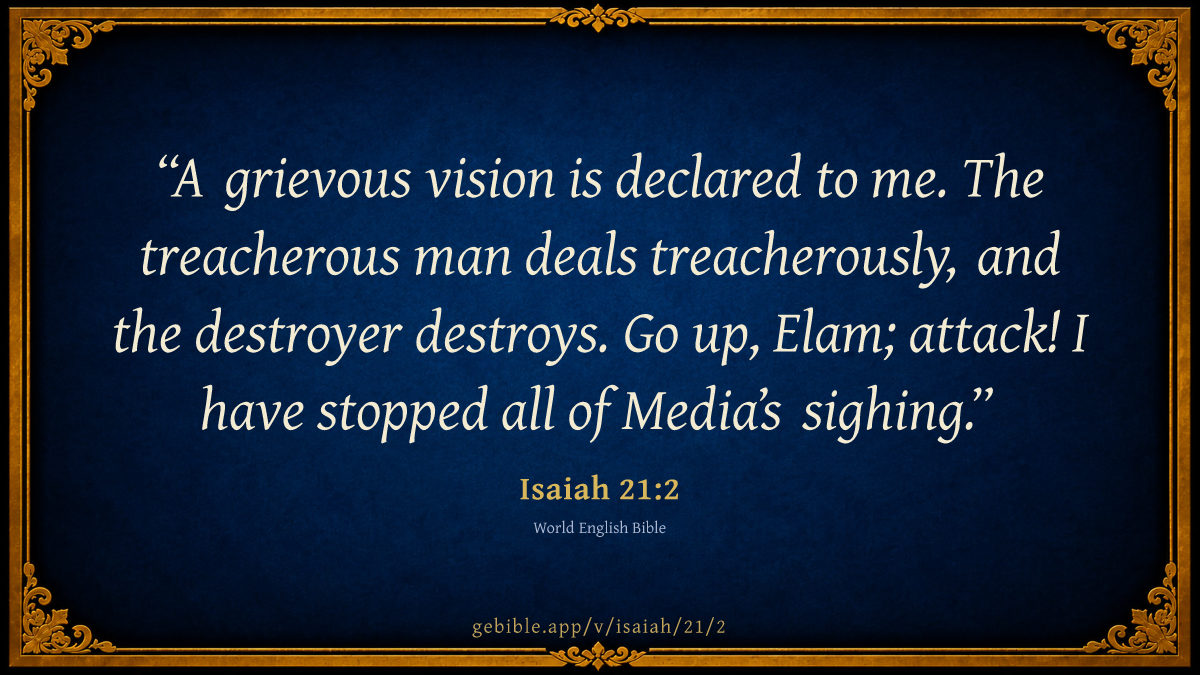
A grievous vision is declared to me. The treacherous man deals treacherously, and the destroyer destroys. Go up, Elam; attack! I have stopped all of Media’s sighing.
Parallel Translations
-
A grievous vision is declared to me. The treacherous man deals treacherously, and the destroyer destroys. Go up, Elam; attack! I have stopped all of Media’s sighing.
-
A grievous vision is declared unto me; the treacherous dealer dealeth treacherously, and the spoiler spoileth. Go up, O Elam: besiege, O Media; all the sighing thereof have I made to cease.
-
A grievous vision is declared unto me: 'The treacherous dealer dealeth treacherously, and the spoiler spoileth. Go up, O Elam! besiege, O Media! All the sighing thereof have I made to cease.'
Cross-references (33)
Passages linked to Isaiah 21:2 in the Treasury of Scripture Knowledge, ordered by reader-vote popularity; verse text shown in World English Bible.
- Isaiah 33:1 Woe to you who destroy, but you weren’t destroyed, and who betray, but nobody betrayed you! When you have finished destroying, you will be destroyed; and when you have finished betrayal, you will be betrayed.
- Jeremiah 49:34 Yahweh’s word that came to Jeremiah the prophet concerning Elam, in the beginning of the reign of Zedekiah king of Judah, saying,
- Psalms 60:3 You have shown your people hard things. You have made us drink the wine that makes us stagger.
- Isaiah 24:16 From the uttermost part of the earth have we heard songs. Glory to the righteous! But I said, “I pine away! I pine away! woe is me!” The treacherous have dealt treacherously. Yes, the treacherous have dealt very treacherously.
- Daniel 5:28 PERES: your kingdom is divided, and given to the Medes and Persians.”
- Revelation 13:10 If anyone is to go into captivity, he will go into captivity. If anyone is to be killed with the sword, he must be killed. Here is the endurance and the faith of the saints.
- 1 Samuel 24:13 As the proverb of the ancients says, ‘Out of the wicked comes wickedness;’ but my hand will not be on you.
- Psalms 12:5 “Because of the oppression of the weak and because of the groaning of the needy, I will now arise,” says Yahweh; “I will set him in safety from those who malign him.”
- Psalms 79:11 Let the sighing of the prisoner come before you. According to the greatness of your power, preserve those who are sentenced to death.
- Psalms 137:1-3 By the rivers of Babylon, there we sat down. Yes, we wept, when we remembered Zion. On the willows in that land, we hung up our harps. For there, those who led us captive asked us for songs. Those who tormented us demanded songs of joy: “Sing us one of the songs of Zion!”
- Proverbs 13:15 Good understanding wins favor, but the way of the unfaithful is hard.
- Isaiah 13:2-4 Set up a banner on the bare mountain! Lift up your voice to them! Wave your hand, that they may go into the gates of the nobles. I have commanded my consecrated ones; yes, I have called my mighty men for my anger, even my proudly exulting ones. The noise of a multitude is in the mountains, as of a great people; the noise of an uproar of the kingdoms of the nations gathered together! Yahweh of Armies is mustering the army for the battle.
- Isaiah 13:17-18 Behold, I will stir up the Medes against them, who will not value silver, and as for gold, they will not delight in it. Their bows will dash the young men in pieces; and they shall have no pity on the fruit of the womb. Their eyes will not spare children.
- Isaiah 14:1-3 For Yahweh will have compassion on Jacob, and will yet choose Israel, and set them in their own land. The foreigner will join himself with them, and they will unite with the house of Jacob. The peoples will take them, and bring them to their place. The house of Israel will possess them in Yahweh’s land for servants and for handmaids. They will take as captives those whose captives they were; and they shall rule over their oppressors. It will happen in the day that Yahweh will give you rest from your sorrow, from your trouble, and from the hard service in which you were made to serve,
- Isaiah 22:6 Elam carried his quiver, with chariots of men and horsemen; and Kir uncovered the shield.
- Isaiah 35:10 Then Yahweh’s ransomed ones will return, and come with singing to Zion; and everlasting joy will be on their heads. They will obtain gladness and joy, and sorrow and sighing will flee away.”
- Isaiah 47:6 I was angry with my people. I profaned my inheritance and gave them into your hand. You showed them no mercy. You laid a very heavy yoke on the aged.
- Jeremiah 31:11-12 For Yahweh has ransomed Jacob, and redeemed him from the hand of him who was stronger than he. They will come and sing in the height of Zion, and will flow to the goodness of Yahweh, to the grain, to the new wine, to the oil, and to the young of the flock and of the herd. Their soul will be as a watered garden. They will not sorrow any more at all.
- Jeremiah 31:20 Is Ephraim my dear son? Is he a darling child? For as often as I speak against him, I still earnestly remember him. therefore my heart yearns for him. I will surely have mercy on him,” says Yahweh.
- Jeremiah 31:25 For I have satiated the weary soul, and I have replenished every sorrowful soul.”
- Jeremiah 45:3 ‘You said, “Woe is me now! For Yahweh has added sorrow to my pain! I am weary with my groaning, and I find no rest.” ’
- Jeremiah 50:14 Set yourselves in array against Babylon all around, all you who bend the bow; shoot at her. Spare no arrows; for she has sinned against Yahweh.
- Jeremiah 50:34 Their Redeemer is strong: Yahweh of Armies is his name. He will thoroughly plead their cause, that he may give rest to the earth, and disquiet the inhabitants of Babylon.
- Jeremiah 51:3-4 Against him who bends, let the archer bend his bow, also against him who lifts himself up in his coat of mail. Don’t spare her young men! Utterly destroy all her army! They will fall down slain in the land of the Chaldeans, and thrust through in her streets.
- Jeremiah 51:11 “Make the arrows sharp! Hold the shields firmly! Yahweh has stirred up the spirit of the kings of the Medes, because his purpose is against Babylon, to destroy it; for it is the vengeance of Yahweh, the vengeance of his temple.
- Jeremiah 51:27-28 “Set up a standard in the land! Blow the trumpet among the nations! Prepare the nations against her! Call together against her the kingdoms of Ararat, Minni, and Ashkenaz! Appoint a marshal against her! Cause the horses to come up as the rough canker worm! Prepare against her the nations, the kings of the Medes, its governors, and all its deputies, and all the land of their dominion!
- Jeremiah 51:44 I will execute judgment on Bel in Babylon, and I will bring out of his mouth that which he has swallowed up. The nations will not flow any more to him. Yes, the wall of Babylon will fall.
- Jeremiah 51:48-49 Then the heavens and the earth, and all that is therein, will sing for joy over Babylon; for the destroyers will come to her from the north,” says Yahweh. “As Babylon has caused the slain of Israel to fall, so the slain of all the land will fall at Babylon.
- Jeremiah 51:53 Though Babylon should mount up to the sky, and though she should fortify the height of her strength, yet destroyers will come to her from me,” says Yahweh.
- Lamentations 1:22 “Let all their wickedness come before you. Do to them as you have done to me for all my transgressions. For my sighs are many, and my heart is faint.
- Daniel 8:20 The ram which you saw, that had the two horns, they are the kings of Media and Persia.
- Micah 7:8-10 Don’t rejoice against me, my enemy. When I fall, I will arise. When I sit in darkness, Yahweh will be a light to me. I will bear the indignation of Yahweh, because I have sinned against him, until he pleads my case, and executes judgment for me. He will bring me out to the light. I will see his righteousness. Then my enemy will see it, and shame will cover her who said to me, where is Yahweh your God? Then my enemy will see me and will cover her shame. Now she will be trodden down like the mire of the streets.
- Zechariah 1:15-16 I am very angry with the nations that are at ease; for I was but a little displeased, but they added to the calamity.” Therefore Yahweh says: “I have returned to Jerusalem with mercy. My house shall be built in it,” says Yahweh of Armies, “and a line shall be stretched out over Jerusalem.” ’
Cross-references from openbible.info (CC BY 4.0)
Explain this verse (15 sources)
Historical commentary, presented as a primary source — not an endorsement.
Private notes
Saved on this device only — never synced or sent anywhere.
Geneva Bible translators 1599 · Public Domain Because they shall find no succor, they shall mourn…
Because they shall find no succor, they shall mourn no more, or, I have caused them to cease mourning, whom Babylon had afflicted.
The Assyrians and Chaldeans, which had destroyed other nations, shall be overcome of the Medes and Persians: and this he prophesied an hundred years before it came to pass.
Read full note →
By Elam he meaneth the Persians.
Geneva Bible (1599) marginal notes — public domain.
John Trapp 1656 · Public Domain Isa 21:2 A grievous vision is declared unto me;…
Isa 21:2 A grievous vision is declared unto me; the treacherous dealer dealeth treacherously, and the spoiler spoileth. Go up, O Elam: besiege, O Media; all the sighing thereof have I made to cease.
Ver. 2. A grievous vision.] Heb., Hard, harsh, tyrannorum speculum: here is hard for hard; God loveth to retaliate. Babylon had been the "maul of the earth"; {Jer 51:20} now a hard messenger is sent, a harsh vision is declared against her. They who do what they should not, shall hear what they would not; a burdenous prophecy, a grievous vision. This "treacherous dealer dealeth treacherously, and this spoiler spoileth," for so some read the next words.
Read full note →
The treacherous dealer dealeth treacherously.] Or, O thou treacherous dealer and notable spoiler: thou Elam, I mean; go up, thou Media, besiege. God oft maketh use of one tyrant to punish another; as here he stirreth up the Persians to plunder and waste the Babylonians. So the Persians were afterwards in like sort punished by the Macedonians, the Macedonians by the Romans, those Romans by the Huns, Vandals, Lombards, Saracens, Turks; all whom Christ shall destroy at his last coming.
Go up, O Elam,] i.e., Thou Persian. Elymais is properly that part of Persia that lieth towards Media. Here they are appointed their work 170 years before it was done; and Cyrus afterwards named as the chief doer.
All the sighing thereof have I made to cease.] Thereof, or of her, that is, of Babylon, not of Judea, which the prophet ever had in his heart, as some sense it; the sighing, quo ipsa, sua tyrannide et oppressione, cogebat alios flere et gemere, {a} that she forced from others, specially from God’s oppressed people. Or, they shall not have long to sigh, for I will soon put an end to their lives.
{a} Vatab.
John Trapp, A Commentary or Exposition upon All the Books of the Old and New Testament (1647–1656) — public domain. Text from a community e-Sword module.
Matthew Poole 1685 · Public Domain A grievous vision; a vision or prophecy, containing dreadful…
A grievous vision; a vision or prophecy, containing dreadful calamities which were to fall upon Babylon.
The treacherous dealer dealeth treacherously, and the spoiler spoileth: this is spoken either,
Read full note →
1. Of the Chaldeans, as their sin, for which God sends the following judgment. So the sense is, The Chaldeans still persist in the practice of treachery and rapine, to which they have been so long accustomed. Or,
2. Of the Medes and Persians, who are here noted to pay the Babylonians in their own coin, and to use the same treachery and violence towards them which they had done to others. To which purpose the words are and may well be rendered otherwise; either thus, the treacherous dealer hath found a treacherous dealer, and the spoiler hath found a spoiler; or thus, O thou that dealest treacherously with the treacherous dealer, and that spoilest the spoiler, go up, O Elam, &c., as it followeth. These words will be much illustrated by compared them with Isa 33:1. There is no doubt to be made but the Medes and Persians used treachery as well as force against Babylon. And besides brias, and following their counsel and conduct in taking the city, which made them partakers of their treason.
Go up, to fight against her. These are God’s words, either giving them command and commission to do so, or rather foretelling what they would do; which is oft done in this form of speech.
Elam; Persia, called Elam synecdochically, because Elam was an eminent province of Persia, bordering upon the Medes.
Besiege, to wit, Babylon, Isa 21:9. All the sighing thereof; either,
1. Babylon’s sighing, which shall cease, because they shall have no time to sigh, or lament their miseries, being suddenly surprised, and cut off in a moment, as they were. As God is said to seek out the wickedness of wicked men till he find none, Psa 10:15, when he utterly destroyeth them in or with their sins. Or,
2. The sighing and groanings of God’s people and other nations under the heavy oppressions of that potent and cruel empire; the pronoun her, or thereof, being taken here not passively, as commonly it is; but actively, or efficiently, as sometimes it is, as Deu 11:25, your fear, i.e. the fear of you; and Job 33:7, my terror, i.e. the terror or dread of me upon thee.
Matthew Poole's English Annotations on the Holy Bible (1683–1685) — public domain. Text from a community e-Sword/MySword module.
John Gill 1763 · Public Domain A grievous vision is declared unto me,.... The prophet;…
A grievous vision is declared unto me,.... The prophet; meaning the vision of Babylon's destruction, which was "hard", as the word signifies, and might seem harsh and cruel; not to him, nor to the Jews, but to the Chaldeans:
the treacherous dealer dealeth treacherously, and the spoiler spoileth; that is, according to Jarchi, one treacherous dealer deals treacherously with another, and one spoiler spoils another; the Medes and Persians deal treacherously with and spoil the Babylonians, who had dealt treacherously with and spoiled other nations: and to this sense some read the words, "the treacherous dealer hath found a treacherous dealer, and the spoiler one that spoileth" (n): some take it to be a compellation of the Medes and Persians, calling upon them, under these characters, to go up and besiege Babylon, as, "O treacherous dealer, O spoiler" (o); though the words may be understood of the perfidy and treachery of the Babylonians, of which they had been frequently guilty, and which is given as a reason of their fall and ruin; or rather they suggest the treacherous means by which they should be ruined, even by some from among themselves; particularly, history (p) informs us, that Gobrias and Gadates, two noblemen of the king of Babylon, being used ill by him, revolted from him, and joined with Cyrus; and when the river Euphrates was drained, went at the head of his army in two parties, and guided them into the city, and took it; or rather Belshazzar king of Babylon himself is meant, who acted, and continued to act, most impiously and wickedly: and therefore,
Read full note →
go up, O Elam; or Elamites, as the Targum and Septuagint; see Act 2:9 these were Persians, so called from Elam, a province in Persia; who are here called upon by the Lord of armies, through the mouth of the prophet, to go up to war against Babylon; and these are mentioned first, because Cyrus, who commanded the whole army, was a Persian: or if Elam is taken for a province, which was indeed subject to Babylon, of which Shushan was the capital city, Dan 8:2 the governor of it, Abradates, revolted from the Babylonians, and joined Cyrus, and fought with him (q):
besiege, O Media; or, O ye Medes, join with the Persians in the siege of Babylon; as they did:
all the sighing thereof have I made to cease; either of the army of the Medes and Persians, who, by reason of long and tedious marches, frequent battles, and hard sieges, groaned and sighed; but now it would be over with them, when Babylon was taken; or of the Babylonians themselves, who would have no mercy shown them, nor have any time for sighing, being cut off suddenly, and in a moment; or rather of other people oppressed by them, and particularly the Lord's people the Jews, who had been in captivity for the space of seventy years, during which they had sighed and groaned, because of the hardships they endured; but now sighing would be at an end, and they should have deliverance, as they had, by Cyrus the Persian. The sighing is not that with which they sighed, but which they caused in others.
(n) "praevaricator prevaricatorem et vastator, vastatorem sub. inveniet"; so some in Vatablus; also Gataker. (o) "O perfide, perfidus; O vastator, vastator", De Dieu. (p) Xenophon. Cyropaedia, l. 4. c. 24. l. 5. c. 11. & l. 7. c. 23. (q) Ib. l. 6. sect. 7, 8, 9, 26. & l. 7. sect. 4, 8.
John Gill's Exposition of the Whole Bible (1746–1763) — public domain (CC PDM 1.0). Text via the HelloAO Bible API.
John Wesley 1765 · Public Domain A vision - A vision or prophecy, containing dreadful…
A vision - A vision or prophecy, containing dreadful calamities which were to fall upon Babylon. The spoiler - The Medes and Persians used treachery as well as force against Babylon. Elam - Persia, so called, because Elam was an eminent province of Persia, bordering upon the Medes. Besiege - Namely, Babylon, ver. 9. The sighing - The sighing and groaning of God's people, and other nations under the oppressions of that cruel empire.
John Wesley, Explanatory Notes Upon the Whole Bible (1754–1765) — public domain. Text via the GEBible commentary corpus.
Adam Clarke 1810 · Public Domain Verse 2. The treacherous dealer dealeth treacherously, and the…
Verse 2. The treacherous dealer dealeth treacherously, and the spoiler spoileth - "The plunderer is plundered, and the destroyer is destroyed."] הבוגד בוגד והשודד שודד habboged boged vehashshoded shoded. The MSS. vary in expressing or omitting the ו vau, in these four words. Ten MSS. of Kennicott are without the ו vau in the second word, and eight MSS. are without the ו vau in the fourth word; which justifies Symmachus, who has rendered them passively: ὁ αθετων αθετειται και ὁ ταλαιπωριζων ταλαιπωρει. He read בגוד שדוד bagud shadud. Cocceius (Lexicon in voce) observes that the Chaldee very often renders the verb בגד bagad, by בזז bazaz, he spoiled; and in this place, and in Isa 33:1, by the equivalent word אנס anas, to press, give trouble; and in Isa 24:16 both by אנס anas and בזז bazaz; and the Syriac in this place renders it by טלם talam, he oppressed.
All the sighing thereof have I made to cease - "I have put an end to all her vexations"] Heb. "Her sighing; that is, the sighing caused by her." So Kimchi on the place: "It means those who groaned through fear of him: for the suffixes of the nouns refer both to the agent and the patient. All those who groaned before the face of the king of Babylon he caused to rest;" Chald. And so likewise Ephrem Syr. in loc., edit. Assemani: "His groans, viz., the grief and tears which the Chaldeans occasioned through the rest of the nations."
Adam Clarke's Commentary on the Bible (1810–1826) — public domain. Text from a community e-Sword/MySword module.
Joseph Benson 1811 · Public Domain Isa 21:2. A grievous vision is declared unto me…
Isa 21:2. A grievous vision is declared unto me — A vision or prophecy, predicting dreadful calamities about to fall upon Babylon. The treacherous dealer, &c. — In these words the prophet either describes the sin of the Chaldeans, for which God would send the following judgment upon them, namely, they persisted in the practice of treachery and rapine, to which they had been so long accustomed; or he speaks of the Medes and Persians, and represents them as paying the Babylonians in their own coin, and using the same treachery and violence toward them which they had used toward others. The words may be properly rendered, Thou, O Elam, that dealest treacherously with the treacherous dealer, or, that oppressest the oppressor, and spoilest the spoiler, go up, besiege, &c. Babylon had long oppressed and ravaged other countries: and it was now her turn to be oppressed and ravaged. Elam was an eminent province of Persia, bordering upon Media, and is here put for Persia in general. God here gives the Medes and Persians their commission to go up and take Babylon, and thereby to put an end to the sighs and groans of the captive Jews, and of other nations held in bondage, and oppressed by that tyrannical and cruel empire.
Joseph Benson's Commentary on the Old and New Testaments (1811–1818) — public domain. Text from a community e-Sword module.
Albert Barnes 1834 · Public Domain A grievous vision - Margin, as in Hebrew ‘Hard.’…
A grievous vision - Margin, as in Hebrew ‘Hard.’ On the word ‘vision,’ see the note at Isa 1:1. The sense here is, that the vision which the prophet saw was one that indicated great calamity Isa 21:3-4.
Is declared unto me - That is, is caused to pass before me, and its meaning is made known to me.
Read full note →
The treacherous dealer - (חבוגד chabôgēd). The perfidious, unfaithful people. This is the usual signification of the word; but the connection here does not seem to require the signification of treachery or perfidy, but of “violence.” The word has this meaning in Hab 2:5, and in Pro 11:3, Pro 11:6. It refers here to the Medes; and to the fact that oppression and violence were now to be exercised toward Babylon. Lowth renders this:
‘The plunderer is plundered, and the destroyer is destroyed;’
But the authority for so rendering it is doubtful. He seems to suppose that it refers to Babylon. The Hebrew evidently means, that there is to be plundering and devastation, and that this is to be accomplished by a nation accustomed to it, and which is immediately specified; that is, the united kingdom of Media and Persia. The Chaldee renders it, ‘They who bring violence, suffer violence; and the plunderers are plundered.’ Jarchi says, that the sense of the Hebrew text according to the Chaldee is, ‘Ah! thou who art violent! there comes another who will use thee with violence; and thou plunderer, another comes who will plunder thee, even the Medes and Persians, who will destroy and lay waste Babylon.’ But the Hebrew text will not bear this interpretation. The sense is, that desolation was about to be produced by a nation “accustomed” to it, and who would act toward Babylon in their true character.
Go up - This is an address of God to Media and Persia (see the note at Isa 13:17).
O Elam - This was the name of the country originally possessed by the Persians, and was so called from Elam a son of Shem Gen 10:22. It was east of the Euphrates, and comprehended properly the mountainous countries of Khusistan and Louristan, called by the Greek writers “Elymais.” In this country was Susa or Shushan, mentioned in Dan 8:2. It is here put for Persia in general, and the call on Elam and Media to go up, was a call on the united kingdom of the Medes and Persians.
Besiege - That is, besiege Babylon.
O Media - (see the note at Isa 13:17).
All the sighing thereof have I made to cease - This has been very differently interpreted by expositors. Some understand it (as Rosenmuller, Jerome, and Lowth,) as designed to be taken in an “active” sense; that is, all the groaning “caused” by Babylon in her oppressions of others, and particularly of God’s people, would cease. Others refer it to the army of the Medes and Persians, as if “their” sighing should be over; that is, their fatigues and labors in the conquest of Babylon. Calvin supposes that it means that the Lord would be deaf to the sighs of Babylon; that is, he would disregard them and would bring upon them the threatened certain destruction. The probable meaning is that suggested by Jerome, that God would bring to an end all the sighs and groans which Babylon had caused in a world suffering under her oppressions (compare Isa 14:7-8).
Albert Barnes' Notes on the Bible (1834–1885) — public domain. Text from a community e-Sword/MySword module.
Haydock's Catholic Bible Commentary 1859 · Public Domain Spoileth. Baltassar is incorrigible, or his opponents must proceed.…
Spoileth. Baltassar is incorrigible, or his opponents must proceed. (Calmet) --- Elam; that is, O Persia: (Challoner) Cyrus, and Darius, the Mede. (Calmet) --- The former nation was weak, and the latter strong. (Worthington) --- Cease. The enemy will shew no pity; nor shall I; as Babylon did not heretofore. (Haydock)
George Leo Haydock (1774–1849), Haydock's Catholic Family Bible and Commentary, 1859 edition — public domain. Excludes Psalms (Douay-Rheims chapter numbering differs from Protestant) and Deuterocanonical books (Catholic canon only).
Robert Jamieson, A. R. Fausset & David Brown 1871 · Public Domain dealeth treacherously--referring to the military stratagem employed by Cyrus…
dealeth treacherously--referring to the military stratagem employed by Cyrus in taking Babylon. It may be translated, "is repaid with treachery"; then the subject of the verb is Babylon. She is repaid in her own coin; Isa 33:1; Hab 2:8, favor this.
Go up--Isaiah abruptly recites the order which he hears God giving to the Persians, the instruments of His vengeance (Isa 13:3, Isa 13:17).
Read full note →
Elam--a province of Persia, the original place of their settlement (Gen 10:22), east of the Euphrates. The name "Persia" was not in use until the captivity; it means a "horseman"; Cyrus first trained the Persians in horsemanship. It is a mark of authenticity that the name is not found before Daniel and Ezekiel [BOCHART].
thereof--the "sighing" caused by Babylon (Isa 14:7-8).
Jamieson, Fausset & Brown — Commentary Critical and Explanatory on the Whole Bible (1871) — public domain (CC PDM 1.0). Text via the HelloAO Bible API.
Daniel D. Whedon 1874 · Public Domain 2. A grievous vision — A sad and most…
2. A grievous vision — A sad and most afflictive prophetic view is shown.
The treacherous dealer — Babylonian tyranny overreaches itself in its cruelties.
Read full note →
Go up, O Elam: besiege, O Media — Persia and Media are summoned to execute terrible judgment upon the insolent empire. God ordains that the sighs of the oppressed shall cease. This prophecy is uttered probably two centuries before its fulfilment.
Daniel D. Whedon (gen. ed.), Commentary on the Old and New Testaments (1874–1909) — public domain. Text from a community e-Sword module.
The Cambridge Bible for Schools and Colleges 1878 · Public Domain 2. A grievous (lit. “hard”) vision is declared unto…
2. A grievous (lit. “hard”) vision is declared unto me]—by the “watchman,” Isa_21:6. “Hard” may mean either “calamitous” (1Ki_14:6) or “difficult,” “hard of interpretation” (Joh_6:60).
the treacherous dealer … spoileth] Cf. ch. Isa_24:16. It is difficult to decide whether this is a description of the besieging foe or of the conduct of the Babylonians towards their captives. The former view might be defended by Isa_33:1 (assuming that the Assyrians are there alluded to) but it requires us to substitute for “treacherous dealer,” “robber,” which is not the exact sense of the word. The other alternative is supported by the last clause of this verse (see below).
Read full note →
Elam … Media] The dominions of Cyrus. The former lay east of the Tigris and north of the Persian Gulf; Media was the mountainous district adjoining it on the north. Cyrus, according to the Babylonian records, was originally king of Anzan, in the north of Elam; in 549 he conquered Media, uniting the two in one kingdom. The name “Persia” never occurs in pre-exilic books.
all the sighing thereof] The misery produced by her (Babylon’s) ruthless oppressions. The verb shews that Jehovah is the speaker.
The Cambridge Bible for Schools and Colleges (gen. ed. J. J. S. Perowne; Cambridge University Press, 1878–1918) — public domain. Text from a community e-Sword module.
Ellicott's Commentary for English Readers 1878 · Public Domain (2) A grievous vision . . .—The verse contains,…
(2) A grievous vision . . .—The verse contains, as it were, the three tableaux that came in succession before the prophet’s gaze: (1) The treacherous dealer, the Assyro-Chaldæan power, spoiling and oppressing, breaking treaties, and, as its kings boasted (Hab_2:5; Records of the Past, vii. 42, 44), “removing landmarks.” (2) The summons to Elam and Media to put an end to this tyranny. (3) The oppressed peoples ceasing to sigh, and rejoicing in their liberation.
Elam appears here as combined with Media, which is named in Isa_13:17 as the only destroyer of Babylon, and this has been urged as evidence of a later date. As a matter of fact, however, Sargon at this very time was carrying on a fierce war against Elam (Records of the Past, cvii. 41-49) as well as against Media (ibid, p. 37). In Eze_32:24, Elam is numbered among the extinct nations, but the name, at all events, re-appears as applied to the Persians, though they were of a distinct race. It was, even as a mere forecast, perfectly natural that the two should be associated together as the future destroyers of the Nineveh and Babel empires, which to the prophet’s eye were identical in character and policy. The advance described as “from the wilderness” implies a march of part at least of the Medo-Persian army down the Choaspes and into the lowland of Chuzistan, bordering on the great Arabian desert.
A Bible Commentary for English Readers, edited by Charles John Ellicott (1878–1897) — public domain. Text from a community e-Sword module.
The Pulpit Commentary 1880 · Public Domain A grievous vision; literally, a hard vision; not, however,…
A grievous vision; literally, a hard vision; not, however, "hard of interpretation" (Kay), but rather "hard to be borne," "grievous," "calamitous." The treacherous dealer dealeth treacherously; rather, perhaps, the robber robs (Knobel); or, the violent man uses violence (Rosenm The idea of faithlessness passes out of the Hebrew boged occasionally, and is unsuitable here, more especially if it is the army of Cyrus that is intended. Go up, O Elam. The discovery that Cyrus, at the time of his conquest of Babylon, Bore the title of "King of Ansan," not "King of Persia," coupled with the probability that "Ansan" was a part of Elam, lends a peculiar interest to these words. Isaiah could not describe Cyrus as "King of Persia," and at the same time be intelligible to his contemporaries, since Persia was a country utterly unknown to them. In using the term "Elam" instead, he uses that of a country known to the Hebrews, (Gen_14:1) adjoining Persia, and, at the time of his expedition against Babylon, subject to Cyrus. Besiege, O Media. Having given "Elam" the first place, the prophet assigns to Media the second. Eleven years before he attacked Babylon, Cyrus had made war upon Astyages (Istuvegu), King of the Medes, had captured him, and become king of the nation, with scarcely any opposition (see the "Cylinder of Nabonidus"). Hence the Medes would naturally form an important portion of the force which he led against Babylon. All the sighing thereof have I made to cease. The "sighing" caused by Babylon to the nations, to the captives, and to the kings whose prison-doors were kept closed, (Isa_14:17) God has in his counsels determined to bring to an end.
HOMILIES BY R. TUCK Ver. 2. Nations working out God"s providences.
Read full note →
The reference of this burden" is to Babylon, which was the successor to Assyria in executing the Divine judgments on the Jews. Babylonia is called "the desert of the sea," as a poetical figure, suggested by the fact that its surging masses of people were like a sea-desert; or because it was a flat country, and full of lakes, like little seas. It was abundantly watered by the many streams of the river Euphrates. The prophet, writing when Babylon was the rising and triumphing nation, sees in vision her terrible fall and humiliation. Which siege of Babylon he refers to cannot be assured, but much can be said for Cheyne"s suggestion, that the depression under which Isaiah writes is best explained by referring the vision to the first siege of Babylon, when Merodach-Baladan was king (B.C. 709), whose interests were in harmony with those of Hezekiah, and whose humiliation Isaiah would regard as injurious to Judah. Watching the movements of these several nations, Assyria, Babylonia, Elam, Media, Judah, we meditate on
I RIGHT IDEAS OF GOD"S PROVIDENCE. We do not speak of providence so freely as our fathers did, because we have less impressive views of the Divine rule and control. As Dr. Bushnell expresses it, "our age is at the point of apogee from all the robuster notions of the Divine Being." We are more interested in the ordinary workings of Law, than in the continuous adjustments and qualifications of Law by the ever-pre-siding Lawgiver. Yet, if our eyes were opened, we might see manifest signs of what our fathers called "providence" in the personal, the family, and the national spheres of today. The proper idea of providence may be thus expressed it is God using for moral purposes commonplace events, and therefore adjusting, arranging, and fitting together those events. Providence ordering or controlling the nations is "God in history." And the illustrations of Divine overruling which we see in the large spheres of the world-kingdoms, are designed to convince us of the reality of that overruling in the small details of our personal life.
II THE PROVIDENTIAL DISTINGUISHED FROM THE MIRACULOUS. The distinction is in our apprehension; we cannot conceive of the distinction as recognized by God. As by the "providential" we mean God intervening to readjust the usual order of material events, it is plain that sometimes he may use forces with which we are familiar, and then we call his working "providential;" but at other times he may use forces with which we are unfamiliar, and then we call his working "miraculous." There need be no difficulty in recognizing resources in God beyond what he has been pleased to explain to man. God has not exhausted himself in making revelations to man. If we could see clearly we should see that "providential" and "miraculous" are convertible terms.
III THE RELATION OF PROVIDENCE TO MORAL LAW. This may be put into a sentence. It is the executor of its sanctions. The rewards of obedience and the penalties of disobedience are not things deferred until some yet far-distant day. They are continually operating in all spheres, private and public. Ann what we call "providence" is the agency in their distribution. But our "providence" differs from "fate," or the pagan conception of the "furies," because it is the working of an infinitely wise and good Being, who acts upon comprehensive knowledge and sound judgment.
IV THE RELATION OF PROVIDENCE TO NATIONS. Here we take one single point. Nations have a corporate life, so they are, as it were, individuals, with a distinct individual character and action. Just as God uses the individual man for his purposes, so he uses the individual nation. For the characteristics of nations, see Greece, Rome, Germany, France, etc. The natural expression of a nation"s character or genius becomes the providential agency for carrying out God"s purposes. Illustrate the conquering genius of Babylon under Nebuchadnezzar doing God"s work in the destruction of the kingdom of Judah. The fact that a nation employed as an executor is still in God"s control, is shown in God"s judging that nation for evils that become manifest in its doing of that executive work. Efficient illustrations may be found in the movements and enterprises of the European nations during the last century. R.T.
The Pulpit Commentary (1880–1919), ed. H.D.M. Spence-Jones & Joseph S. Exell — public domain. Text from a community e-Sword module.
Tyndale Open Study Notes 2022 · CC BY-SA 4.0 21:2 I see: The prophet personalized Babylon’s experience, which…
21:2 I see: The prophet personalized Babylon’s experience, which intensifies his poetry, as does the terse language and the repetition of similar sounds, such as the betrayer betraying (Hebrew habboged boged) and the destroyer destroying (Hebrew hashoded shoded; also in 33:1). • The Elamites lived to the northeast of Babylon. Along with the Medes, they were archrivals of the Babylonians. • I will make an end to all the groaning Babylon caused: Babylon had caused groaning by attacking and enslaving many nations. It is likely that the Elamites and Medes played a part in the overthrow of Babylon in 539 BC (21:9).
Tyndale Open Study Notes — © Tyndale Open Resources, licensed CC BY-SA 4.0. Text via the HelloAO Bible API.