
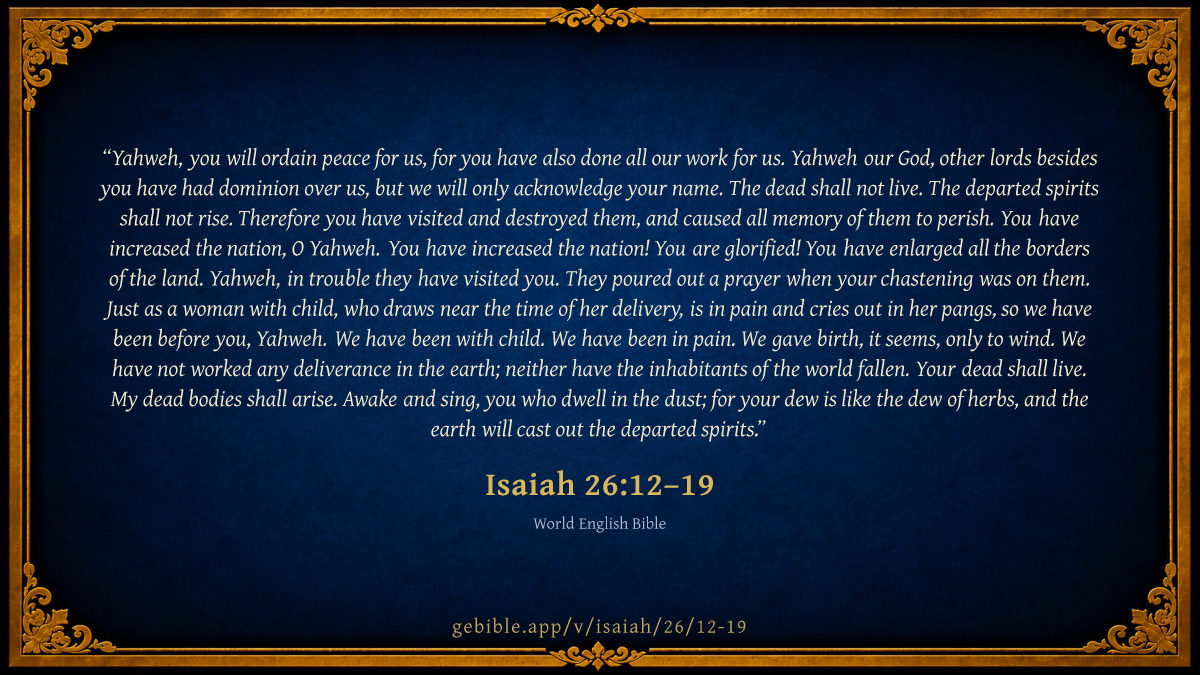
Yahweh, you will ordain peace for us, for you have also done all our work for us.
Yahweh our God, other lords besides you have had dominion over us, but we will only acknowledge your name.
The dead shall not live. The departed spirits shall not rise. Therefore you have visited and destroyed them, and caused all memory of them to perish.
You have increased the nation, O Yahweh. You have increased the nation! You are glorified! You have enlarged all the borders of the land.
Yahweh, in trouble they have visited you. They poured out a prayer when your chastening was on them.
Just as a woman with child, who draws near the time of her delivery, is in pain and cries out in her pangs, so we have been before you, Yahweh.
We have been with child. We have been in pain. We gave birth, it seems, only to wind. We have not worked any deliverance in the earth; neither have the inhabitants of the world fallen.
Your dead shall live. My dead bodies shall arise. Awake and sing, you who dwell in the dust; for your dew is like the dew of herbs, and the earth will cast out the departed spirits.
Geneva Bible translators 1599 · Public Domain On vv13–19 The Babylonians, which have not governed according to thy…
The Babylonians, which have not governed according to thy word.
Geneva Bible (1599) marginal notes — public domain.
John Trapp 1656 · Public Domain On vv12–19 Isa 26:12 LORD, thou wilt ordain peace for us:…
Isa 26:12 LORD, thou wilt ordain peace for us: for thou also hast wrought all our works in us.
Ver. 12. Lord, thou wilt ordain peace for us.] Or, Lord, dispose peace for us.
Read full note →
For thou also hast wrought all our works in us.] Or, For us. Certum est nos facere quod facimus, sed Deus facit ut faciamus: without Christ we can do nothing. {Joh 15:5} In him alone is our fruit found. {Hos 14:8} It is well observed by a grave interpreter, that the Church in the Canticles is nowhere described by the beauty of her hands or fingers, because God alone worketh all her works for her, and had rather that she should abound in good works in silence than to boast of them at all.
John Trapp, A Commentary or Exposition upon All the Books of the Old and New Testament (1647–1656) — public domain. Text from a community e-Sword module.
Matthew Poole 1685 · Public Domain On vv12–19 Thou wilt ordain peace for us; as thou wilt…
Thou wilt ordain peace for us; as thou wilt destroy thine and our enemies, so thou wilt bless us thy people with peace and prosperity.
All our works; either,
Read full note →
1. All the good works done by us, which are the effects of thy grace; or rather,
2. All the good and great works which have been wrought for us, all our wonderful deliverances and singular blessings, come from thee. And so the argument is this, God hath delivered us formerly upon all occasions, and therefore he will still deliver us, and give us peace; which inference is frequently made by holy men in Scripture. In us, Heb. to or for us.
Matthew Poole's English Annotations on the Holy Bible (1683–1685) — public domain. Text from a community e-Sword/MySword module.
Matthew Henry 1710 · Public Domain On v12 The prophet in these verses looks back upon what…
The prophet in these verses looks back upon what God had done with them, both in mercy and judgment, and sings unto God of both, and then looks forward upon what he hoped God would do for them. Observe,
I. His reviews and reflections are mixed. When he looks back upon the state of the church he finds,
Read full note →
1. That God had in many instances been very gracious to them and had done great things for them. (1.) In general (Isa 26:12): Thou hast wrought all our works in us, or for us. Whatever good work is done by us, it is owing to a good work wrought by the grace of God in us; it is he that puts good thoughts and affections into our hearts if at any time they be there, and that works in us both to will and to do of his good pleasure. Acti, agimus - Being acted upon, we act. And if any kindness be shown us, or any of our affairs be prosperous and successful, it is God that works it for us. Every creature, every business, that is in any way serviceable to our comfort, is made by him to be so; and sometimes he makes that to work for us which seemed to make against us. (2.) In particular (Isa 26:15): "Thou hast increased the nation, O Lord! so that a little one has become a thousand (in Egypt they multiplied exceedingly, and afterwards in Canaan, so that they filled the land); and in this thou art glorified," for the multitude of the people is the honour of the prince, and therein God was glorified as faithful to his covenant with Abraham, that he would make him a father of many nations. Note, God's nation is a growing nation, and it is the glory of God that it is so. The increase of the church, that holy nation, is therefore to be rejoiced in because it is the increase of those that make it their business to glorify God in this world.
2. That yet he had laid them under his rebukes.
(1.) The neighbouring nations had sometimes oppressed them and tyrannised over them (Isa 26:13): "O Lord our God! thou who hast the sole right to rule us, whose subjects and servants we are, to thee we complain (for whither else should we go with our complaints?) that other lords besides thee have had dominion over us." Not only in the days of the Judges, but afterwards, God frequently sold them into the hand of their enemies, or rather, by their iniquities, they sold themselves, Isa 52:3-5. When they had been careless in the service of God, God suffered their enemies to have dominion over them, that they might know the difference between his service and the service of the kingdoms of the countries. It may be understood as a confession of sin, their serving other gods, and subjecting themselves to the superstitious laws and customs of their neighbours, by which other lords (for they called their idols baals, lords) had dominion over them, besides God. But now they promise that it shall be so no more: "Henceforth by thee only will we make mention of thy name; we will worship thee only, and in that way only which thou hast instituted and appointed." The same may be our penitent reflection: Other lords, besides God, have had dominion over us; every lust has been our lord, and we have been led captive by it; and it is has been long enough, and too long, that we have thus wronged both God and ourselves. The same therefore must be our pious resolution, that henceforth we will make mention of God's name only and by him only, that we will keep close to God and to our duty and never desert it.
(2.) They had sometimes been carried into captivity before their enemies (Isa 26:15): "The nation which at first thou didst increase, and make to take root, thou hast now diminished, and plucked up, and removed to all the ends of the earth, driven out to the utmost parts of heaven," as is threatened, Deu 30:4; Deu 28:64. But observe, Between the mention of the increasing of them and that of the removing of them it is said, Thou art glorified; for the judgments God inflicts upon his people for their sins are for his honour, as well as the mercies he bestows upon them in performance of his promise.
(3.) The prophet remembers that when they were thus oppressed and carried captive they cried unto God, which was a good evidence that they neither had quite forsaken him nor were quite forsaken of him, and that there were merciful intentions in the judgments they were under (Isa 26:16): Lord, in trouble have they visited thee. This was usual with the people of Israel, as we find frequently in the story of the Judges. When other lords had dominion over them they humbled themselves, and said, The Lord is righteous, Ch2 12:6. See here, [1.] The need we have of afflictions. They are necessary to stir up prayer; when it is said, In trouble have they visited thee, it is implied that in their peace and prosperity they were strangers to God, kept at a distance from him, and seldom came near him, as if, when the world smiled upon them, they had no occasion for his favours. [2.] The benefit we often have by afflictions. They bring us to God, quicken us to our duty, and show us our dependence upon him. Those that before seldom looked at God now visit him; they come frequently, they become friendly, and make their court to him. Before, prayer came drop by drop, but now they pour out a prayer; it comes now like water from a fountain, not like water from a still. They poured out a secret speech; so the margin. Praying is speaking to God, but it is a secret speech; for it is the language of the heart, otherwise it is not praying. Afflictions bring us to secret prayer, in which we may be more free and particular in our addresses to him than we can be in public. In affliction those will seek God early who before sought him slowly, Hos 5:15. It will make men fervent and fluent in prayer. "They poured out a prayer, as the drink-offerings were poured out, when thy chastening was upon them." But it is to be feared, when the chastening is off them, they will by degrees return to their former carelessness, as they had often done.
(4.) He complains that their struggles for their own liberty had been very painful and perilous, but that they had not been successful, Isa 26:17, Isa 26:18. [1.] They had the throes and pangs they dreaded: "We have been like a woman in labour, that cries out in her pangs; we have with a great deal of anxiety and toil endeavoured to help ourselves, and our troubles have been increased by those attempts;" as when Moses came to deliver Israel the tale of bricks was doubled. Their prayers were quickened by the acuteness of their pains, and became as strong and vehement as the cries of a woman in sore travail. So have we been in thy sight, O Lord! It was a comfort and satisfaction to them, in their distress, that God had his eye upon them, that all their miseries were in his sight; he was no stranger to their pangs or their prayers. Lord, all my desire is before thee, and my groaning is not hidden from thee, Psa 38:9. Whenever they came to present themselves before the Lord with their complaints and petitions they were in agonies like those of a woman in travail. [2.] They came short of the issue and success they desired and hoped for: "We have been with child; we have had great expectation of a speedy and happy deliverance, have been big with hopes, and, when we have been in pain, have comforted ourselves with this, that the joyful birth would make us forget our misery, Joh 16:21. But, alas! we have as it were brought forth wind; it has proved a false conception; our expectations have been frustrated, and our pains have been rather dying pains than travailing ones; we have had a miscarrying womb and dry breasts. All our efforts have proved abortive: We have not wrought any deliverance in the earth, for ourselves or for our friends and allies, but rather have made our own case and theirs worse; neither have the inhabitants of the world, whom we have been contesting with, fallen before us, either in their power or in their hopes; but they are still as high and arrogant as ever." Note, A righteous cause may be strenuously pleaded both by prayer and endeavour, both with God and man, and yet for a great while may be left under a cloud, and the point may not be gained.
II. His prospects and hopes are very pleasant. In general, "Thou wilt ordain peace for us (Isa 26:12), that is, all that good which the necessity of our case calls for." What peace the church has, or hopes for, it is of God's ordaining; and we may comfort ourselves with this, that, what trouble soever may for a time be appointed to the people of God, peace will at length be ordained for them; for the end of those men is peace. And, if God by his Spirit work all our works in us, he will ordain peace for us (for the work of righteousness shall be peace), and that is true and lasting peace, such as the world can neither give nor take away, which God ordains; for, to those that have it, it shall be unchangeable as the ordinances of the day and of the night. Moreover, from what God has done for us, we may encourage ourselves to hope that he will yet further do us good. "Thou hast heard the desire of the humble, and therefore wilt (Psa 10:17); and, when this peace is ordained for us, then by thee only will we make mention of thy name (Isa 26:13); we will give the glory of it to thee only, and not to any other, and we will depend upon thy grace only to enable us to do so." We cannot praise God's name but by his strength. Two things in particular the prophet here comforts the church with the prospect of: - 1. The amazing ruin of her enemies (Isa 26:14): They are dead, those other lords that have had dominion over us; their power is irrecoverably broken; they are quite cut off and extinguished: and they shall not live, shall never be able to hold up the head any more. Being deceased, they shall not rise, but, like Haman, when they have begun to fall before the seed of the Jews they shall sink like a stone. Because they are sentenced to this final ruin, therefore, in pursuance of that sentence, God himself has visited them in wrath, as a righteous Judge, and has cut off both the men themselves (he has destroyed them) and the remembrance of them: they and their names are buried together in the dust. He has made all their memory to perish; they are either forgotten or made mention of with detestation. Note, The cause that is maintained in opposition to God and his kingdom among men, though it may prosper awhile, will certainly sink at last, and all that adhere to it will perish with it. The Jewish doctors, comparing this with Isa 26:19, infer that the resurrection of the dead belong to the Jews only, and that those of other nations shall not rise. But we know better; we know that all who are in their graves shall hear the voice of the Son of God, and that this speaks of the final destruction of Christ's enemies, which is the second death. 2. The surprising resurrection of her friends, Isa 26:19. Though the church rejoices not in the birth of the man-child, of which she travailed in pain, but has as it were brought forth wind (Isa 26:18), yet the disappointment shall be balanced in a way equivalent: Thy dead men shall live; those who were thought to be dead, who had received a sentence of death within themselves, who were cast out as if they had been naturally dead, shall appear again in their former vigour. A spirit of life from God shall enter into the slain witnesses, and they shall prophesy again, Rev 11:11. The dry bones shall live, and become an exceedingly great army, Eze 37:10. Together with my dead body shall they arise. If we believe the resurrection of the dead, of our dead bodies at the last day, as Job did, and the prophet here, that will facilitate our belief of the promised restoration of the church's lustre and strength in this world. When God's time shall have come, how low soever she may be brought, they shall arise, even Jerusalem, the city of God, but now lying like a dead body, a carcase to which the eagles are gathered together. God owns it still for his, so does the prophet; but it shall arise, shall be rebuilt, and flourish again. And therefore let the poor, desolate, melancholy remains of its inhabitants, that dwell as in dust, awake and sing; for they shall see Jerusalem, the city of their solemnities, a quiet habitation again, Isa 33:20. The dew of God's favour shall be to it as the evening dew to the herbs that were parched with the heat of the sun all day, shall revive and refresh them. And as the spring-dews, that water the earth, and make the herbs that lay buried in it to put forth and bud, so shall they flourish again, and the earth shall cast out the dead, as it casts the herbs out of their roots. The earth, in which they seemed to be lost, shall contribute to their revival. When the church and her interests are to be restored neither the dew of heaven nor the fatness of the earth shall be wanting to do their part towards the restoration. Now this (as Ezekiel's vision, which is a comment upon it) may be fitly accommodated, (1.) To the spiritual resurrection of those that were dead in sin, by the power of Christ's gospel and grace. So Dr. Lightfoot applies it, Hor. Hebr. in John 12.24. "The Gentiles shall live; with my body shall they arise; that is, they shall be called in after Christ's resurrection, shall rise with him, and sit with him in heavenly places; nay, they shall arise my body (says he); they shall become the mystical body of Christ, and shall arise as part of him." (2.) To the last resurrection, when dead saints shall live, and rise together with Christ's dead body; for he arose as the first-fruits, and believers shall arise by virtue of their union with him and their communion in his resurrection.
Matthew Henry's Commentary on the Whole Bible (1708–1710) — public domain (CC PDM 1.0). Text via the HelloAO Bible API.
John Gill 1763 · Public Domain On vv12–19 Lord, thou wilt ordain peace for us,.... Dispose, order,…
Lord, thou wilt ordain peace for us,.... Dispose, order, give it to us, outward and inward, spiritual and eternal: chiefly respect is had to that peace and prosperity the church will have in the latter day, which the zeal of the Lord of hosts, before mentioned, will perform for her, Psa 72:8 and which she expresses her faith in, when it goes ill with the wicked, and that for the following reason:
for thou also hast wrought all our works in us; or "to us", or "for us" (b); all that had been done for them before were done by the Lord, came of his hands, were owing to his goodness, grace, and power and not to be ascribed unto themselves; all their mercies and deliverances, all that had been done for them in nature, providence, and grace; all that had been done for the church and people of God in all ages and periods of time, the glory of all was due to him; and since he had done so many and such great things for them, they had reason to believe he would grant them that peace and prosperity promised and expected in the latter day. The work of grace upon the heart is peculiarly the work which God works in his people, and is thought by some to be here meant; this is God's work, and not man's; and it is an internal one, something wrought in the heart, and which, being begun, will be performed; and may be expressed in the plural number, because of the excellency of it, it is the work of works; it includes others, and from whence all good works done by good men spring; and, besides, it consists of various parts, each of which is a work; as the work of faith, the labour of love, and perfect work of patience; and the fruit of this is peace here, and men on account of it may expect eternal peace hereafter; for this is the saints' meetness for glory, and which is inseparably connected with it. Abarbinel (c) interprets this "peace" of the times of the Messiah, and of the redemption wrought out by him; and "our works", of the troubles that came upon the Jews in captivity, which were all from the Lord, as well as their mercies and deliverance.
Read full note →
(b) "in nobis", Munster; "nobis", Pagninus, Montanus, Junius & Tremellius, Piscator. (c) Mashmia, Jeshua, fol. 16. 1.
John Gill's Exposition of the Whole Bible (1746–1763) — public domain (CC PDM 1.0). Text via the HelloAO Bible API.
John Wesley 1765 · Public Domain On vv12–19 Our works - All the good works done by…
Our works - All the good works done by us, are the effects of thy grace.
John Wesley, Explanatory Notes Upon the Whole Bible (1754–1765) — public domain. Text via the GEBible commentary corpus.
Adam Clarke 1810 · Public Domain On vv16, 18, 19 Verse 16. Lord, in trouble have they visited thee…
Verse 16. Lord, in trouble have they visited thee - "O JEHOVAH, in affliction we have sought thee"] So the Septuagint and two MSS. have פקדנוך pekadnucha, in the first person plural. And so perhaps it should be צקנו tsaknu, in the first person; but how the Septuagint read this word is not clear; and this last member of the verse is extremely obscure.
For למו lamo, "on them," the Septuagint read לנו lanu, "on us," in the first person likewise; a frequent mistake; See Clarke on Isa 10:29.
Adam Clarke's Commentary on the Bible (1810–1826) — public domain. Text from a community e-Sword/MySword module.
Joseph Benson 1811 · Public Domain On vv12, 13, 15, 16, 19 Isa 26:12. Lord, thou wilt ordain peace for us…
Isa 26:12. Lord, thou wilt ordain peace for us — That is, for thy true and genuine church and people. Though thou hast afflicted us, (Isa 26:8.) yet the time will come when we shall be in a very different, yea, in a happy condition. Or, referring to what he had last said, he means, as thou wilt destroy thine and our enemies, so thou wilt bless us; thy people, with peace and prosperity. For thou hast wrought all our works in us — Hebrew, לנו, to, or for us. All the good works done by us are the effects of thy grace. And all the good and great works which have been wrought for us, all the wonderful deliverances and singular blessings vouchsafed us, came from thee. The argument is this: God hath done great things for us, and delivered us formerly upon many occasions, and therefore he will still deliver us, and give us peace.
Joseph Benson's Commentary on the Old and New Testaments (1811–1818) — public domain. Text from a community e-Sword module.
Albert Barnes 1834 · Public Domain On vv12–19 Thou wilt ordain peace - The word ‘peace’ here…
Thou wilt ordain peace - The word ‘peace’ here seems to stand opposed to the evils of various kinds which they had experienced in the captivity at Babylon; and to refer net only to peace, but also to prosperity, and to the continued divine favor.
For thou hast wrought all our works in us - Or rather, ‘for us’ (לנוּ lânû). It is owing to thy hand that we are saved.
Albert Barnes' Notes on the Bible (1834–1885) — public domain. Text from a community e-Sword/MySword module.
Haydock's Catholic Bible Commentary 1859 · Public Domain On vv12, 13, 14, 15, 16, 18, 19 Works, both in punishing and rewarding. (Calmet) --- God…
Works, both in punishing and rewarding. (Calmet) --- God crowns his own gifts. (Estius)
George Leo Haydock (1774–1849), Haydock's Catholic Family Bible and Commentary, 1859 edition — public domain. Excludes Psalms (Douay-Rheims chapter numbering differs from Protestant) and Deuterocanonical books (Catholic canon only).
Robert Jamieson, A. R. Fausset & David Brown 1871 · Public Domain On vv12–19 peace--God's favor, including all blessings, temporal and spiritual, opposed…
peace--God's favor, including all blessings, temporal and spiritual, opposed to their previous trials (Psa 138:8).
Jamieson, Fausset & Brown — Commentary Critical and Explanatory on the Whole Bible (1871) — public domain (CC PDM 1.0). Text via the HelloAO Bible API.
Daniel D. Whedon 1874 · Public Domain On vv12, 13, 14, 15, 16, 19 12. Peace for us — “Peace,” here, is comprehensive.…
12. Peace for us — “Peace,” here, is comprehensive. It is future safety from all the evils suffered under Jehovah’s enemies.
Wrought all our works — Ground for trusting that God will secure to them future peace, inasmuch as his high hand has wrought complete rescue from the evils of captivity, etc.
Daniel D. Whedon (gen. ed.), Commentary on the Old and New Testaments (1874–1909) — public domain. Text from a community e-Sword module.
The Cambridge Bible for Schools and Colleges 1878 · Public Domain On vv12–19 12. thou wilt ordain] or “mayest thou ordain.” peace…
12. thou wilt ordain] or “mayest thou ordain.” peace for us] cf. Isa_26:3.
for thou also hast wrought …] Better: for even our whole work thou hast wrought for us; all that we have achieved—inadequate though it be (see Isa_26:17)—has been due to thy working for us. A similar thought underlies the prayer of Psa_90:16-17, where the manifestation of Jehovah’s work is equivalent to His establishing the work of Israel’s hands.
The Cambridge Bible for Schools and Colleges (gen. ed. J. J. S. Perowne; Cambridge University Press, 1878–1918) — public domain. Text from a community e-Sword module.
Ellicott's Commentary for English Readers 1878 · Public Domain On vv12–19 (12) Thou also hast wrought all our work in…
(12) Thou also hast wrought all our work in us . . .—Better, for us. The “work” is the great work of salvation and deliverance.
A Bible Commentary for English Readers, edited by Charles John Ellicott (1878–1897) — public domain. Text from a community e-Sword module.
The Pulpit Commentary 1880 · Public Domain On vv12–19 Lord, thou wilt ordain peace for us; i.e. henceforth…
Lord, thou wilt ordain peace for us; i.e. henceforth thou wilt give us an existence of perfect peace (see ver. 3), untroubled by adversaries. For thou also hast wrought all our works in us; rather, all our work for us. The "work" intended seems to be, as Mr. Cheyne observes, "the work of their deliverance.
Vers. 12-18. The argument from the past.
Read full note →
Great things are represented, by the prophetic voice, to have been done, and these furnish the strongest reason to expect great things in the future.
I THE GREAT THINGS GOD HAS DONE FOR US.
1. He has heard our cry in the day of distress (vers. 16, 17). Few things go home to our hearts more readily than the words of the psalmist, "I cried unto the Lord, and he heard me." It is a great thing to have been heard of God, to have gained his pitiful ear, and to have enjoyed his merciful consideration; that amid the millions of his children he has distinguished us and bent on us his benign regard.
2. He has granted full deliverance. "Other lords... have had dominion... but now thee only will we celebrate; they are dead;" their very memory is perishing (vers. 13, 14). We may have been under the dominion of some cruel vice (lust, or avarice, or intemperance), or of "the world" (1 John); but in the mercy of God these spiritual adversaries have been defeated, have been slain, they are no more to be dreaded, and now a Divine Redeemer is the Object of our adoration; for him we live, his honor we seek, his Name we strive to glorify (ver. 15), in his holy and ennobling service we spend our days and our powers.
3. He has granted spiritual enlargement. (Ver. 15.) "Thou hast increased the nation, O Lord." To some, especially to those whom he redeems from the bondage of vice or crime, God grants material enlargement, the improvement of their estate, the brightening of their life, the broadening of their sphere. To all who, at the touch of his liberating hand, come out of spiritual captivity into the freedom of his children, he gives spiritual advancement, increase of knowledge, of joy, of love, of influence, of hope. As we love and serve Christ, we are enlarged on every hand the horizon of our souls is removed beyond its former bounds.
II THE ARGUMENT THEREFROM. The fact, that God has done such great things for us and all that has been done for us has been wrought by him (ver. 12; and see Psa_87:7) is a strong reason to expect other gracious things in the future. "Thou wilt ordain peace for us" (ver. 12). It is a scriptural argument that the conferring of greater blessings is a security to us for the possession of smaller ones. (see Mat_6:25 Rom_8:32 Psa_56:13) The gifts of God in the gospel of Jesus Christ,
(1) his most costly gifts,
(2) his most valuable gifts, may be to us a strong assurance that God will not only "ordain peace" in life and at death, but also lead us along all the path of life, and receive us to his presence and glory when our earthly course is run. C.
The Pulpit Commentary (1880–1919), ed. H.D.M. Spence-Jones & Joseph S. Exell — public domain. Text from a community e-Sword module.
The Biblical Illustrator 1887 · Public Domain On vv12, 13, 15, 16, 19 Lord, Thou wilt ordain peace for us
Isa_26:12
Lord, Thou wilt ordain peace for us
Read full note →
God ordaining peace
The expression seems to allude to the action of a commander-in-chief in the army, who marshals his soldiers according to the plan he had formed, and assigns to each the proper station which he is to occupy in carrying into execution his projected enterprises.
It plainly intimates the lively hope which they felt that the supreme Disposer of all persons and events would be graciously pleased to assign for them both outward and inward tranquillity. (R. Macculloch.)
National peace the gift of God
(1814):--
I. WHAT THERE IS IN THE RESTORATION OF PEACE, GENERALLY CONSIDERED, TO EXCITE OUR GRATITUDE.
1. The first consequence of peace which naturally presents itself to our attention is, that the effusion of human blood is stayed.
2. The injurious effects produced by war upon the human character afford another reason for thanksgiving on the return of peace. It is impossible that a state of warfare should be long continued without greatly deteriorating, in some important respects, both individual and national character. War is unfriendly to humanity. Tender as the heart may naturally be, the frequent recurrence of scenes of suffering tends to harden it. During the state of warfare, too, communities are usually distracted by intestine dissensions; and political strife gives birth to no virtues. Another effect of war is, that, when long-continued, it embitters the animosities of nations, and tends to confirm those national antipathies which, if unchecked by peace, would settle into a confirmed and malignant hatred.
3. A third reason for gratitude with reference to the peace is, that it has been produced by the signal triumph of a righteous cause. Peace is not always a blessing. In some cases it is only a term for the stillness, the quiet of desolation and death. Peace is often the result of the superiority acquired by the aggressor. The cause of right does not always at once prevail.
4. We rejoice in peace as the completion of a course of providential dispensations highly conducive to the instruction of the world.
II. WHAT THERE IS IN THE PARTICULAR CIRCUMSTANCES OF THIS COUNTRY TO WARRANT US IN CONSIDERING THE BLESSING AS OF SPECIAL AND PARTICULAR VALUE.
1. We have preserved our national honour.
2. The peace was seasonable.
3. The peace may be considered indicative of the Divine favour and approbation.
4. We see a particular reason to be thankful for peace, as it will increase our means of promoting the kingdom of Christ in the world, and thus establish our national prosperity by continuing to us the blessing of God.
III. THE REASON OF OUR THANKFUL ACKNOWLEDGMENT OF GOD. He is the giver of the blessing of peace. Thou hast ordained peace for us. This is a most important principle; and if our hearts be not firmly grounded in it, our thanksgivings are mockery; for why do we thank Him, if we ascribe the work to second causes? (R. Watson.)
Peace from God
A tourist writes of a spring as sweet as any that ever gushed from sunny hillside, which one day he found by the sea when the tides had ebbed away. Taking his cup he tasted the water and it was sweet. Soon the sea came again and poured its bitter surf over the little spring, hiding it out of sight. When the tide ebbed away again, the tourist stood once more by the spring to see if the brackish waves had left their bitterness in its waters; but they were sweet as ever. This is a picture of the peace in the heart of the Christian when floods of bitter sorrow and trial sweep over his life. From secret wells the sweet waters flow, crystal and fresh as ever. They have their source in the heart of God. (J. R. Miller, D. D.)
The Biblical Illustrator, edited by Joseph S. Exell (c. 1880s–1900s) — public domain. Text from a community e-Sword module.
The Expositor's Bible 1887 · Public Domain On v14 Isa_26:14-19; Isa_25:6-9
CHAPTER XXX
THE RESURRECTION
Read full note →
Isa_26:14-19; Isa_25:6-9
GRANTED the pardon, the justice, the Temple and the God, which the returning exiles now enjoyed, the possession of these only makes more painful the shortness of life itself. This life is too shallow and too frail a vessel to hold peace and righteousness and worship and the love of God. St. Paul has said, "If in this life only we have hope in Christ, we are of all men most miserable." What avails it to have been pardoned, to have regained the Holy Land and the face of God, if the dear dead are left behind in graves of exile, and all the living must soon pass into that captivity, from which there is no return?
It must have been thoughts like these, which led to the expression of one of the most abrupt and powerful of the few hopes of the resurrection which the Old Testament contains. This hope, which lightens Isa_25:7-8, bursts through again-without logical connection with the context-in Isa_26:14-19.
The English version makes Isa_26:14 to continue the reference to the "lords," whom in Isa_26:13 Israel confesses to have served instead of Jehovah. "They are dead; they shall not live: they are deceased; they shall not rise." Our translators have thus intruded into their version the verb "they are," of which the original is without a trace. In the original, "dead" and "deceased" (literally "shades") are themselves the subject of the sentence-a new subject and without logical connection with what has gone before. The literal translation of Isa_26:14 therefore runs: "Dead men do not live; shades do not rise: wherefore Thou visitest them and destroyest them, and perisheth all memory of them." The prophet states a fact and draws an inference. The fact is, that no one has ever returned from the dead; the inference, that it is Gods own visitation or sentence which has gone forth upon them, and they have really ceased to exist. But how intolerable a thought is this in presence of the other fact that God has here on earth above gloriously enlarged and established His people (Isa_26:15). "Thou hast increased the nation, Jehovah; Thou hast increased the nation. Thou hast covered Thyself with glory; Thou hast expanded all the boundaries of the land." To this follows a verse (Isa_26:16), the sense of which is obscure, but palpable. It "feels" to mean that the contrast which the prophet has just painted between the absolute perishing of the dead and the glory of the Church above ground is the cause of great despair and groaning: "O Jehovah, in The Trouble they supplicate Thee; they pour out incantations when Thy discipline is upon them." In face of The Trouble and The Discipline par excellence of God, what else can man do but betake himself to God? God sent death; in death He is the only resource. Israels feelings in presence of The Trouble are now expressed in Isa_26:17: "Like as a woman with child that draweth near the time of her delivery writheth and crieth out in her pangs, so have we been before Thee, O Jehovah." Thy Church on earth is pregnant with a life, which death does not allow to come to the birth. "We have been with child; we have been in the pangs, as it were; we have brought forth wind; we make not the earth," in spite of all we have really accomplished upon it in our return, our restoration and our enjoyment of Thy presence-"we make not the earth salvation, neither are the inhabitants of the world born."
The figures are bold. Israel achieves, through Gods grace, everything but the recovery of her dead; this, which alone is worth calling salvation, remains wanting to her great record of deliverances. The living Israel is restored, but how meagre a proportion of the people it is! The graves of home and of exile do not give up their dead. These are not born again to be inhabitants of the upper world.
The figures are bold, but bolder is the hope that breaks from them. Like as when the Trumpet shall sound, Isa_26:19 peals forth the promise of the resurrection-peals the promise forth, in spite of all experience, unsupported by any argument, and upon the strength of its own inherent music. "Thy dead shall live! my dead bodies shall arise!" The change of the personal pronoun is singularly dramatic. Returned Israel is the speaker, first speaking to herself: "thy dead," as if upon the depopulated land, in face of all its homes in ruin, and only the sepulchres of ages standing grim and steadfast, she addressed some despairing double of herself; and secondly speaking of herself: "my dead bodies," as if all the inhabitants of these tombs, though dead, were still her own, still part of her, the living Israel, and able to arise and bless with their numbers their bereaved mother. These she now addresses: "Awake and sing, ye dwellers in the dust, for a dew of lights is Thy dew, and the land bringeth forth the dead."
If one has seen a place of graves in the East, he will appreciate the elements of this figure, which takes "dust" for death and "dew" for life. With our damp graveyards "mould" has become the traditional trappings of death; but where under the hot Eastern sun things do not rot into lower forms of life, but crumble into sapless powder, that will not keep a worm in life, "dust" is the natural symbol of death. When they die, men go not to feed fat the mould, but "down into the dust"; and there the foot of the living falls silent, and his voice is choked, and the light is thickened and in retreat, as if it were creeping away to die. The only creatures the visitor starts are timid, unclean bats, that flutter and whisper about him like the ghosts of the dead. There are no flowers in an Eastern cemetery; and the withered branches and other ornaments are thickly powdered with the same dust that chokes, and silences, and darkens all.
Hence the Semitic conception of the underworld was dominated by dust. It was not water nor fire nor frost nor altogether darkness, which made the infernal prison horrible, but that upon its floor and rafters, hewn from the roots and ribs of the primeval mountains, dust lay deep and choking. Amid all the horrors he imagined for the dead, Dante did not include one more awful than the horror of dust. The picture which the northern Semites had before them when they turned their faces to the wall was of this kind.
The house of darkness
The house men enter, but cannot depart from,
The road men go, but cannot return.
The house from whose dwellers the light is withdrawn,
The place where dust is their food, their nourishment clay.
The light they behold not; in darkness they dwell.
They are clothed like birds, all fluttering wings.
On the door and the gateposts, the dust lieth deep.
Either, then, an Eastern sepulchre, or this its infernal double, was gaping before the prophets eyes. What more final and hopeless than the dust and the dark of it?
But for dust there is dew, and even to graveyards the morning comes that brings dew and light together. The wonder of dew is that it is given from a clear heaven, and that it comes to sight with the dawn. If the Oriental looks up when dew is falling, he sees nothing to thank for it between him and the stars. If he sees dew in the morning, it is equal liquid and lustre; it seems to distil from the beams of the sun-"the sun, which riseth with healing under his wings." The dew is thus doubly "dew of light." But our prophet ascribes the dew of God, that is to raise the dead, neither to stars nor dawn, but, because of its Divine power, to that higher supernal glory which the Hebrews conceived to have existed before the sun, and which they styled, as they styled their God, by the plural of majesty: "A dew of lights is Thy dew." {Cf. Jam_1:17} As, when the dawn comes, the drooping flowers of yesterday are seen erect and lustrous with the dew, every spike a crown of glory, so also shall be the resurrection of the dead. There is no shadow of a reason for limiting this promise to that to which some other passages of resurrection in the Old Testament have been limited: a corporate restoration of the holy State or Church. This is the resurrection of its individual members to a community which is already restored, the recovery by Israel of her dead men and women from their separate graves, each with his own freshness and beauty, in that glorious morning when the Sun of righteousness shall arise, with healing under His wings-"Thy dew, O Jehovah!"
Attempts are so often made to trace the hopes of resurrection, which break the prevailing silence of the Old Testament on a future life, to foreign influences experienced in the Exile, that it is well to emphasise the origin and occasion of the hopes that utter themselves so abruptly in this passage. Surely nothing could be more inextricably woven with the national fortunes of Israel, as nothing could be more native and original to Israels temper, than the verses just expounded. We need not deny that their residence among a people, accustomed as the Babylonians were to belief in the resurrection, may have thawed in the Jews that reserve which the Old Testament clearly shows that they exhibited towards a future life. The Babylonians themselves had received most of their suggestions of the next world from a non-Semitic race; and therefore it would not be to imagine anything alien to the ascertained methods of Providence if we were to suppose that the Hebrews, who showed what we have already called the Semitic want of interest in a future life, were intellectually tempered by their foreign associations to a readiness to receive any suggestions of immortality, which the Spirit of God might offer them through their own religious experience. That it was this last, which was the effective cause of Israels hopes for the resurrection of her dead, our passage puts beyond doubt. Chapter 26 shows us that the occasion of these hopes was what is not often noticed: the returned exiles disappointment with the meagre repopulation of the holy territory. A restoration of the State or community was not enough: the heart of Israel wanted back in their numbers her dead sons and daughters.
If the occasion of these hopes was thus an event in Israels own national history, and if the impulse to them was given by so natural an instinct of her own heart, Israel was equally indebted to herself for the convictions that the instinct was not in vain. Nothing is more clear in our passage than that Israels first ground of hope in a future life was her simple, untaught reflection upon the power of her God. Death was His chastening. Death came from Him, and remained in His power. Surely He would deliver from it. This was a very old belief in Israel. "The Lord killeth and maketh alive; He bringeth down to Sheol and bringeth up." Such words, of course, might be only an extreme figure for recovery from disease, and the silence of so great a saint as Hezekiah about any other issue into life than by convalescence from mortal sickness staggers us into doubt whether an Israelite ever did think of a resurrection. But still there was Jehovahs almightiness; a man could rest his future on that, even if he had not light to think out what sort of a future it would be. So mark in our passage, how confidence is chiefly derived from the simple utterance of the name of Jehovah, and how He is hailed as "our God." It seems enough to the prophet to connect life with Him and to say merely, "Thy dew." As death is Gods own discipline, so life, "Thy dew," is with Him also.
Thus in its foundation the Old Testament doctrine of the resurrection is but the conviction of the sufficiency of God Himself, a conviction which Christ turned upon Himself when He said, "I am the Resurrection and the Life. Because I live, ye shall live also."
If any object that in this picture of a resurrection we have no real persuasion of immortality, but simply the natural, though impossible, wish of a bereaved people that their dead should today rise from their graves to share todays return and glory-a revival as special and extraordinary as that appearing of the dead in the streets of Jerusalem when the Atonement was accomplished, but by no means that general resurrection at the last day which is an article of the Christian faith-if any one should bring this objection, then let him be referred to the previous promise of immortality in chapter 25. The universal and final character of the promise made there is as evident as of that for which Paul borrowed its terms in order to utter the absolute consequences of the resurrection of the Son of God: "Death is swallowed up in victory." For the prophet, having in Isa_25:6 described the restoration of the people, whom exile had starved with a famine of ordinances, to "a feast in Zion of fat things and wines on the lees well refined," intimates that as certainly as exile has been abolished, with its dearth of spiritual intercourse, so certainly shall God Himself destroy death: "And He shall swallow up in this mountain" (perhaps it is imagined, as the sun devours the morning mist on the hills) "the mask of the veil, the veil that is upon all the peoples, and the film spun upon all the nations. He hath swallowed up death for ever, and the Lord Jehovah shall wipe away tears from off all faces, and the reproach of His people shall He remove from off all the earth, for Jehovah hath spoken it. And they shall say in that day, Behold, this is our God: we have waited for Him, and He shall save us; this is Jehovah: we have waited for Him; we will rejoice and be glad in His salvation." Thus over all doubts, and in spite of universal human experience, the prophet depends for immortality on God Himself. In Isa_26:3 our version beautifully renders, "Thou wilt keep him inperfect peace whose mind is stayed on Thee, because he trusteth in Thee." This is a confidence valid for the next life as well as for this. "Therefore trust ye in the Lord forever." Amen.
Almighty God, we praise Thee that, in the weakness of all our love and the darkness of all our knowledge before death, Thou hast placed assurance of eternal life in simple faith upon Thyself. Let this faith be richly ours. By Thine omnipotence, by Thy righteousness, by the love Thou hast vouchsafed, we lift ourselves and rest upon Thy word, "Because I live, ye shall live also." Oh, keep us steadfast in union with Thyself, through Jesus Christ our Lord. Amen.
William Robertson Nicoll, ed., The Expositor's Bible (London: Hodder & Stoughton, 1887–1910) — public domain. 65 of 66 books (1 Corinthians is not separately keyed, as that volume carries no machine-parseable verse references); section-level commentary keyed to the opening verse. Introductory and overview sections not keyed to a specific passage are excluded.
The Preacher's Complete Homiletical Commentary 1892 · Public Domain On vv12, 13, 16, 19 (A Thanksgiving Sermon.)
NATIONAL PEACE THE GIFT OF GOD
(A Thanksgiving Sermon.)
Read full note →
Isa_26:12. Lord, Thou wilt ordain peace for us: for Thou hast wrought all our work in us.
The joyfulness of the occasion. Peace a greater blessing than mere victory; for he that celebrates victory celebrates an event which has been produced by an incalculable measure of human suffering. Let us consider—
I. What there is in the restoration of peace, generally considered, to excite our gratitude.
1. The effusion of human blood is stayed, and all the suffering inseparable from war.
2. The injurious effects of war on human character afford another reason for thanksgiving on the return of peace. War renders men callous to human misery. The sacredness of human life is forgotten. Wars lead to intestine dissensions, and embitter and perpetuate national animosities.
II. What there is in the particular circumstances of this country to warrant us in considering the blessing as of special and particular value.
1. The triumph of which this peace is the result is the triumph of a righteous cause. Peace is often the result of the superiority acquired by the aggressor. The cause of right does not always at once prevail. Unoffending natives are conquered, or obliged to submissions contrary to their rights and interests, and then peace follows; peace dictated, not argued. There is peace, but not the spirit of peace.
2. We have preserved our national honour. Our victory has not been purchased by any alliance of which we have cause to be ashamed.
3. Peace does not find us, as it finds many nations, with our houses desolated and our cities destroyed by fire.
4. It was seasonable. We had put forth our utmost strength. Had we not succeeded at the moment we should have fallen to rise no more as a nation of the first order.
5. It may be considered an indication of the Divine approbation. On this subject we would not be presumptuous, but it may at least be affirmed that the happy change in our affairs, which has ultimately led to peace, followed, and, in some instances, immediately followed, certain acts of national reformation (e.g., the emancipation of the slaves) and acknowledgment of God which, from the condescending assurance of His Word, we know must have been acceptable to Him.
6. It will increase our means of promoting the kingdom of Christ in the world, and thus establish our national prosperity by continuing to us the blessing of God.
III. The reasons of our thankful acknowledgment of God on this occasion. He is the giver of the blessing of peace. Text. This is a most important principle, and if our hearts be not firmly grounded in it, our thanksgiving is a mockery; for why do we thank Him if we ascribe the work to second causes? He that excludes God from the world of providence might as well exclude Him from the world of nature. He who can attribute the events which are daily taking place in society, and especially such events as are connected with the celebration of this day, to mere human agency, is not less an Atheist than the man who ascribes the birth and being of the fair system of the universe to chance or the dance of atoms.
CONCLUSION.—The proper expression of our thankfulness for this great blessing will be to do our utmost in the diffusion of the Gospel, that the final reign of the Prince of Peace may commence, and “quietness and assurance for ever” become the lot of man.—Richard Watson: Works, vol. ii. pp. 20–40.
HOLINESS ACCOMPLISHED, PEACE ORDAINED
Isa_26:12. Lord, Thou wilt ordain peace for us: for Thou also hast wrought all our works in us.
Rather, “for us.” The Church acknowledges that all her deliverances and successes have been accomplished for her; and on what God has done for her in the past, she rightly bases her expectation as to what God will do for her in the future. He who was able to deliver His people from their bondage in Babylon, would secure peace for them when He had restored them to their own land. But, then, of all the works that God accomplishes for His people, some of the most important are precisely those which He accomplishes in them. So we may profitably meditate on our text as it stands.
I. THE CHRISTIAN’S CONDITION.
1. A divine work has been accomplished for him. “Thou,” &c. Throughout, the New Testament teaches us that the Christian is a man, not who has delivered himself, but who has been delivered; not a hero who broke the chains by which he was bound, but a poor slave of sin who was set free and uplifted to true manhood (Php_2:13; Eph_2:10); everything is ascribed to the Spirit—the life, the good works, the comforts of the Christian (Joh_3:5; Gal_5:16; Gal_5:22; Act_9:31).
2. As the operation is divine, so is it internal in its effects. We should never overlook what God has done for us in His kind and tender providence (Psa_23:6). But the greatest of all God’s works for us is redemption by the blood of the cross. This was accomplished long ago (Joh_19:30). Nothing can now be added to it, but you are mistaken if you suppose that His work for you is to supersede His work in you. If your sins are not subdued as well as pardoned, you will never be able to serve and enjoy God. Unless you have a meetness for heaven, as well as a title to it, you will never be at home there. The salvation that is promised and accomplished is internal (Joh_4:14; Eze_11:19-20; Psa_51:10).
3. The operation is manifold in its influence. “All our works.” How much needs to be done in man! Conscience is to be awakened, purified, pacified; the understanding is to be enlightened; the judgment is to be informed; the will is to be subdued; the affections to be spiritualised; the world is to be dethroned in the heart, and holy principles implanted there. There needs the continuing act of a performing God from the hour of the first conviction of sin to the resurrection of the body unto eternal life (Php_1:6).
4. His divine work is acknowledged. “Thou hast wrought,” &c. Much remains to be done in us, but much has been accomplished in every believer, and it should be acknowledged. Humility well becomes us, but gratitude becomes us equally (Psa_66:16).
II. HIS FUTURE EXPECTATION.
“Lord, Thou wilt ordain peace for us.”
1. There is an appointment or ordination. To ordain is an act of authority and power. You may wish and promise a thing, but the monarch ordains, and what he ordains is supported by all the resources of the realm, and will be accomplished. Much more shall God’s counsel stand and His pleasure be done.
2. What is the blessing He will ordain? “Peace!” Peace temporal (Pro_16:7). Peace spiritual [1075]
[1075] See outlines on Isa_26:3.—This peace of the Christian often fluctuates. It has various degrees. Some have comparatively little of it, arising from constitutional malady, from ignorance, or as a correction for sin, but it commonly increases in death. It is therefore compared to a river which meanders and fertilises as it goes, but becomes wider and deeper as it approximates to the sea; so the peace of God’s people generally increases as they get nearer eternity.—Jay.
III. THE DEPENDENCE OF THE EXPECTATION ON THE CONDITION.
“Thou wilt … for Thou hast.” The expectations of God’s people are based—
1. On the experience of God’s people in all generations (Psa_22:4).
2. On their own experience of His faithfulness and mercy (Psa_116:1-2) [1078]William Jay: Sunday Evening Sermons, &c., pp. 306–312.
[1078] When a friend has always been kind, we think it base and unworthy not to suppose that he is ready to succour and help. But here we have the advantage: Men may be weak and unable to help, but God is almighty; men may change their mind, but with Him is “no shadow of turning.” Remember what God has done, view it as a pledge, a beginning, an earnest foretaste of what He will do. Has He not shown you the evil of sin, the beauty of holiness, and the preciousness of a Saviour? If He had a mind to destroy you, would He have shown you such things as these? Nay, He will ordain everything for your welfare.—Jay
H. E. I. 2363–2377, 2791.
MAN’S HOLINESS, GOD’S WORKMANSHIP
Isa_26:12. Thou also hast wrought all our works in us.
It is not all men who could speak these words to God; the wicked and the worldly-minded could not use such language without blasphemy. It is the godly, and they only, who can dare to use the language of our text, and even they must do so with a certain limitation. Nothing that is evil in any of God’s people is in any way His work. It is only their good works of which it can be truly said, “God wrought them;” and of these it may be said, God wrought not some only, but all of them.
I. THE DOCTRINE WHICH OUR TEXT CONTAINS. Man is by nature a creature so depraved that he is “unto every good work reprobate.” God looks into his heart, and seeing evil motives even in his best performances, pronounces “all his righteousnesses ‘filthy rags.’ ” Where things are not done to please God, He is displeased. No matter what show the unregenerate make before their fellow-sinners, God turns away His face from them, and counts them even “dead in trespasses and sins,” whilst men, perhaps, are holding them in admiration (Article xiii.; Luk_16:15; Rom_8:7-8). When, therefore, a man does begin to please God, it is because God hath “wrought him for this self-same thing” by the mighty working of His power (Eph_2:4-5; Php_2:13). In these passages, the earliest beginning of any good work in us is ascribed wholly to the Lord (Article x.) The Holy Spirit is the author of all good in man from first to last. “From Him all holy desires, all good counsels, and all just works do proceed.” Repentance is His Work. “Godly sorrow” is no natural emotion (Act_5:31; Act_11:18; 2Ti_2:25). So also is faith (1Co_12:3). So, again, is all holiness of heart and life (Eph_2:10; Pro_16:1; Gal_5:22-23). All excellences in man are “fruits of the Spirit.” Such is the doctrine of our text. Consider,—
II. THE FEELINGS WHICH GOD’S PEOPLE OUGHT TO ENTERTAIN WHEN THEY REFLECT UPON IT. Is it true that God hath wrought all our works in us? What a ground there is here, then,—1, for humility. Surely “boasting is excluded.” Pride is an absurdity (1Co_4:7; 1Co_15:10.) 2, for thankfulness. Solomon was full of wonder and amazement that God should condescend to come and dwell within his costly temple. Should not the Lord’s people be still more gratefully amazed that He should make a temple of their hearts! 3, for encouragement (Php_1:6). Let the believer look at the very construction of our text, let him read it in connection with the words which go before, and he will see what a comfortable argument is drawn from it: “Lord, Thou wilt ordain peace for us, for Thou also hast wrought all our works in us.” The presence of His grace within our bosoms is a token of the favour which He means to show us. He who put oil into our lamp and set it burning, and then said, “Let your light shine before men, that they may see your good works, and glorify your Father which is in heaven,” will never omit to feed the celestial flame.—A. Roberts, M.A.: Plain Sermons, Second Series, vol. i. 21–30.
The Preacher's Complete Homiletical Commentary (gen. ed. Joseph S. Exell; Funk & Wagnalls, c. 1892) — public domain (pre-1929). A full-Bible homiletical/sermon-outline anthology covering 65 of 66 books (2 John is absent from the source module). Text from a community e-Sword module.
C. I. Scofield 1917 · Public Domain On v19 thy dead men
thy dead men
Eliminate the supplied words, men, and, together with. "Body" is in the plural, "bodies." Isa 26:19-21 with Isaiah 27, constitute Jehovah’s answer to the plaint of Israel, Isa 26:11-18. Isa 28:19 should read: "Thy dead shall live: my dead bodies shall rise" (i.e. the dead bodies of Jehovah’s people). The restoration and re-establishment of Israel as a nation is also spoken of as a resurrection Eze 37:1-11 and many hold that no more than this is meant in Isa 26:19. But since the first resurrection is unto participation in the kingdom Rev 20:4-6 it seems the better view that both meanings are here.
The Scofield Reference Bible (1917 edition), notes by C. I. Scofield — public domain. Text from a community e-Sword module.
unfoldingWord translationNotes 2017 · CC BY-SA 4.0 On vv13, 15, 16, 18, 19 but we praise your name alone
but we praise your name alone
Here "name" represents the person of God. AT: "but we praise you alone" (See: Metonymy)
Read full note →
they will not arise
"they will not come back to life"
made every memory of them to perish
Yahweh causing people to no longer remember those he destroyed is spoken of as if Yahweh made their memory perish or die. (See: Metaphor)
translationWords
Yahweh
lord
praise
name
judge
perish
unfoldingWord translationNotes — © Distant Shores Media and the Door43 World Missions Community, licensed CC BY-SA 4.0. Source: git.door43.org/Door43/en_tn.
Tyndale Open Study Notes 2022 · CC BY-SA 4.0 On vv15–19 26:15 This verse is a confident expression of thanks…
26:15 This verse is a confident expression of thanks for God’s blessings. In Isaiah’s time, during King Hezekiah’s prosperous reign, the borders of the nation of Israel were extended, and people gave glory to God for his great deeds.
Tyndale Open Study Notes — © Tyndale Open Resources, licensed CC BY-SA 4.0. Text via the HelloAO Bible API.