
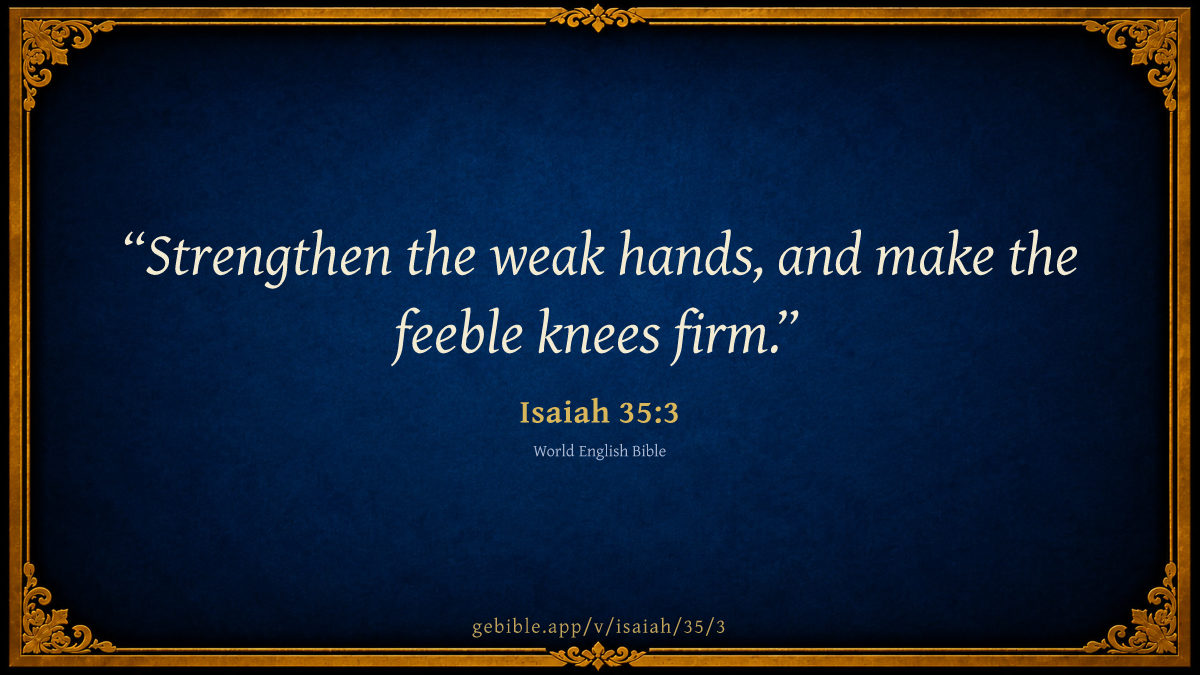
Strengthen the weak hands, and make the feeble knees firm.
Parallel Translations
-
Strengthen the weak hands, and make the feeble knees firm.
-
Strengthen ye the weak hands, and confirm the feeble knees.
-
Strengthen ye the weak hands, and make firm the tottering knees.
Cross-references (10)
Passages linked to Isaiah 35:3 in the Treasury of Scripture Knowledge, ordered by reader-vote popularity; verse text shown in World English Bible.
- Hebrews 12:12 Therefore lift up the hands that hang down and the feeble knees,
- Job 4:3-4 Behold, you have instructed many, you have strengthened the weak hands. Your words have supported him who was falling, You have made firm the feeble knees.
- Luke 22:32 but I prayed for you, that your faith wouldn’t fail. You, when once you have turned again, establish your brothers.”
- Isaiah 57:14-16 He will say, “Build up, build up, prepare the way! Remove the stumbling-block out of the way of my people.” For the high and lofty One who inhabits eternity, whose name is Holy, says: “I dwell in the high and holy place, with him also who is of a contrite and humble spirit, to revive the spirit of the humble, and to revive the heart of the contrite. For I will not contend forever, neither will I always be angry; for the spirit would faint before me, and the souls whom I have made.
- Job 16:5 but I would strengthen you with my mouth. The solace of my lips would relieve you.
- Luke 22:43 An angel from heaven appeared to him, strengthening him.
- Acts 18:23 Having spent some time there, he departed, and went through the region of Galatia, and Phrygia, in order, establishing all the disciples.
- Judges 7:11 You will hear what they say; and afterward your hands will be strengthened to go down into the camp.” Then went he down with Purah his servant to the outermost part of the armed men who were in the camp.
- Isaiah 52:1-2 Awake, awake! Put on your strength, Zion. Put on your beautiful garments, Jerusalem, the holy city: for from now on the uncircumcised and the unclean will no more come into you. Shake yourself from the dust! Arise, sit up, Jerusalem! Release yourself from the bonds of your neck, captive daughter of Zion!
- Isaiah 40:1-2 “Comfort, comfort my people,” says your God. “Speak comfortably to Jerusalem; and call out to her that her warfare is accomplished, that her iniquity is pardoned, that she has received of Yahweh’s hand double for all her sins.”
Cross-references from openbible.info (CC BY 4.0)
Explain this verse (16 sources)
Historical commentary, presented as a primary source — not an endorsement.
Private notes
Saved on this device only — never synced or sent anywhere.
Geneva Bible translators 1599 · Public Domain He willeth all to encourage one another, and specially…
He willeth all to encourage one another, and specially the ministers to exhort and strengthen the weak, that they may patiently abide the coming of God, which is at hand.
Geneva Bible (1599) marginal notes — public domain.
John Trapp 1656 · Public Domain Isa 35:3 Strengthen ye the weak hands, and confirm…
Isa 35:3 Strengthen ye the weak hands, and confirm the feeble knees.
Ver. 3. Strengthen ye the weak hands,] q.d., Cheer up, my hearts; be of good courage, and God shall strengthen your hearts, all ye that hope in the Lord. Comfort ye also one another with these words, and build up each other in your most holy faith; and I will show you how, and in what terms, you shall do it.
John Trapp, A Commentary or Exposition upon All the Books of the Old and New Testament (1647–1656) — public domain. Text from a community e-Sword module.
Matthew Poole 1685 · Public Domain Ye prophets and ministers of God, comfort and encourage…
Ye prophets and ministers of God, comfort and encourage God’s people, who are now ready to faint, with hopes and assurance of that salvation which, in due time, I will work for them. He mentions
hands and
Read full note →
knees, because the strength and weakness of any man eminently appears in those parts.
Matthew Poole's English Annotations on the Holy Bible (1683–1685) — public domain. Text from a community e-Sword/MySword module.
John Gill 1763 · Public Domain Strengthen ye the weak hands,.... These are the words…
Strengthen ye the weak hands,.... These are the words of the prophet, as the Targum,
"the prophet said, strengthen the weak hands;''
Read full note →
or rather of God, by the prophet, to the converted Gentiles, to those who saw the glory of the Lord; particularly to the ministers of the Gospel, who have to do with weak and feeble persons, who can scarcely lift up their hands, or stand upon their legs, under a sense of sin, in a view of wrath, and immediate ruin and destruction, ready to sink and faint, because of their enemies, or through want of food; and their business is to comfort and strengthen them, by preaching the Gospel, and pointing out the promises of it to them:
and confirm the feeble knees; that so they may keep their ground against their enemies; shake off their fears and trembling; go on their way courageously and rejoicing; run, and not be weary; walk, and not faint: "hands" and "knees" are mentioned particularly, because a man's strength lies greatly in them; and his weakness is seen by the languor and trembling of them.
John Gill's Exposition of the Whole Bible (1746–1763) — public domain (CC PDM 1.0). Text via the HelloAO Bible API.
John Wesley 1765 · Public Domain Strengthen - Ye ministers of God, comfort and encourage…
Strengthen - Ye ministers of God, comfort and encourage God's people, who are now ready to faint.
John Wesley, Explanatory Notes Upon the Whole Bible (1754–1765) — public domain. Text via the GEBible commentary corpus.
Joseph Benson 1811 · Public Domain Isa 35:3-4. Strengthen ye the weak hands — Ye…
Isa 35:3-4. Strengthen ye the weak hands — Ye prophets and ministers of God, comfort and encourage his people, who are now ready to faint, with hopes of that salvation which, in due time, he will work for them. The prophet mentions hands and knees, because the strength or weakness of any man eminently appears in those parts. Say to them that are of a fearful heart — Who, because of their own weakness and the strength of their enemies, are discouraged and cast down: Hebrew, לנמהרי לב, that are hasty of heart, that are for betaking themselves to flight, upon the first alarm, and for giving up the cause. Be strong, fear not — Resist your fears, confide in the power, love, and faithfulness of God, who has promised to deliver those that trust in him, and has engaged, that as your day is your strength shall be, and you shall become strong. Behold, your God will come — Though he seem to be absent, and to have departed from you, he will come and abide with you. He will come with vengeance — Namely, upon your enemies; and save you — The destruction he brings upon your enemies will be the means of your deliverance and salvation. If we suppose this to be spoken with any reference to the state of the Jews in Babylon, God avenged them when he overthrew the Babylonish empire, and brought them back to their own land. But, undoubtedly, the words are primarily intended of the coming of the Messiah in the flesh, and of the redemption and deliverance of God’s people through him; that is, of such as embraced Christianity, whom God signally avenged for all the malice and cruelty which the Jews had exercised upon them, when, by the Romans, he laid Jerusalem even with the ground, and cut off many hundreds of thousands of them by the sword, by famine, and other ways, for their obstinate rejection of the gospel, and crucifying of their Messiah. Thus Christ is said to have been set for the fall, as well as rising again, of many in Israel.
Joseph Benson's Commentary on the Old and New Testaments (1811–1818) — public domain. Text from a community e-Sword module.
Albert Barnes 1834 · Public Domain Strengthen ye - That is, you who are the…
Strengthen ye - That is, you who are the religious teachers and guides of the people. This is an address made by the prophet in view of what he had said and was about to say of the proraised blessings. The sense is, strengthen and sustain the feeble and the desponding by the promised blessings; by the assurances Isa. 34 that all the enemies of God and his people will be destroyed; and that he will manifest himself as their Protector, and send upon them the promised blessings. Or it may be regarded as addressed to the officers and ministers of religion when these blessings should have come; and as being an exhortation to them to make use of the influences, the promises, and the consolations which would attend the coming of the Messiah, to strengthen the feeble, and confirm those who were faint-hearted.
The weak hands, and confirm the feeble knees - Strength resides mainly in the arms, and in the lower limbs, or the knees. If these are feeble, the whole frame is feeble. Fear relaxes the strength of the arms, and the firmness of the knees; and the expressions ‘weak hands,’ and ‘feeble knees,’ become synonymous with saying, of a timid, fearful, and desponding frame of mind. Such were to be strengthened by the assurance of the favor of God, and by the consolations which would flow from the reign of the Messiah. The Jews, who looked abroad upon the desolations of their country, were to be comforted by the hope of future blessings; those who lived in those future times were to be consoled by the assurances of the favor of God through the Messiah (compare the notes at Isa 40:1).
Albert Barnes' Notes on the Bible (1834–1885) — public domain. Text from a community e-Sword/MySword module.
Haydock's Catholic Bible Commentary 1859 · Public Domain Knees. Ye prophets, comfort the people with these promises.…
Knees. Ye prophets, comfort the people with these promises. (Calmet) --- The apostles taught the Gentiles to do good. (Menochius)
George Leo Haydock (1774–1849), Haydock's Catholic Family Bible and Commentary, 1859 edition — public domain. Excludes Psalms (Douay-Rheims chapter numbering differs from Protestant) and Deuterocanonical books (Catholic canon only).
Robert Jamieson, A. R. Fausset & David Brown 1871 · Public Domain Strengthen . . . hands . . . confirm…
Strengthen . . . hands . . . confirm . . . knees--The Hebrew for "strengthen" refers to the strength residing in the hand for grasping and holding a thing manfully; "confirm," to the firmness with which one keeps his ground, so as not to be dislodged by any other [MAURER]. Encourage the Jews, now desponding, by the assurance of the blessings promised.
Jamieson, Fausset & Brown — Commentary Critical and Explanatory on the Whole Bible (1871) — public domain (CC PDM 1.0). Text via the HelloAO Bible API.
Daniel D. Whedon 1874 · Public Domain 3, 4. Strengthen… hands… confirm… knees — The officials…
3, 4. Strengthen… hands… confirm… knees — The officials of the nation are here addressed. They are to infuse new life into the desponding, and to “strengthen” and “confirm” them by holding up to them the promised hastening blessings. With such prospects, it is no time now for discouragement. It is none other than Jehovah of hosts who is interposing. Vengeance for foes, and recompense for his hitherto suffering ones, are both lodged with him, and he is now coming to exercise both. To the prophet these things seemed not far in the future. The validity of these promises was by him undoubted, though his vision did overleap centuries. His was a present faith.
Daniel D. Whedon (gen. ed.), Commentary on the Old and New Testaments (1874–1909) — public domain. Text from a community e-Sword module.
The Cambridge Bible for Schools and Colleges 1878 · Public Domain 3, 4. An exhortation to the despondent. For the…
3, 4. An exhortation to the despondent. For the figures of Isa_35:3 see Job_4:3-4.
The Cambridge Bible for Schools and Colleges (gen. ed. J. J. S. Perowne; Cambridge University Press, 1878–1918) — public domain. Text from a community e-Sword module.
Ellicott's Commentary for English Readers 1878 · Public Domain (3) Strengthen ye the weak hands . . .—Here…
(3) Strengthen ye the weak hands . . .—Here the words are obviously, as they are quoted in Heb_12:12, figurative and not literal, and so far suggest a like interpretation for what follows.
A Bible Commentary for English Readers, edited by Charles John Ellicott (1878–1897) — public domain. Text from a community e-Sword module.
The Pulpit Commentary 1880 · Public Domain Strengthen ye the weak hands. In the Church of…
Strengthen ye the weak hands. In the Church of the redeemed there will be "weak" brethren as well as strong, "feeble" as well as healthful. (see 1Co_3:1 Gal_6:1 Heb_5:12-14) God, by the mouth of his prophet, calls on the strong to impart of their strength to their weaker brethren, uplifting their "weak hands," as Aaron and Hur did those of Moses, (Exo_17:12) and "confirming" or sustaining their "feeble knees." So St. Paul: "We that are strong ought to bear the infirmities of the weak, and not to please ourselves". (Rom_15:1)
HOMILIES BY W.M. STATHAM Ver. 3. Inspirations to energy.
Read full note →
"Strengthen ye the weak hands, and confirm the feeble knees." It is not enough to be sorry for the woes of others. Sympathy may be a sort of mental "minor," wherewith we simply soothe ourselves. We must be earnest and inspirational. Pity must be practical. "Jesus, moved with compassion, put forth his hand!" We have plenty of critics and satirists; we want men who will help to save.
I WE MAY STRENGTHEN BY OUR WORDS. "Say to them that are of a fearful heart, be strong, fear not." Tell a sorrow to some persons, and they draw a picture of still darker possibilities, and so feed the already gloomy fancies of the mind. But it is possible to give cheer," instead to record God"s great deliverances to ourselves, and tell of all his wondrous works. Thus we may put the brightness of hope into the sky, and help to chase the dark clouds away. Say." We have all the faculty of quickly telling bad news; let us tell the "good news" of God"s gracious kingdom.
II WE CAN CHEER THE HEART. That is the center of life. We may not be able to lift the burden, but we may strengthen our brother"s hands by energizing his heart. It is wonderful what a few depressing influences will accomplish. Some are more sensitive than others, and are easily cast down. Do not my words do good?" says God; for they reach at once to the inner man. Blessed angels of help are words that go to the heart. No man is so great but sympathy can cheer him; no man is so weak but he may be made heroic by holy inspirations!
III WE CAN HELP THE PILGRIMAGE. The knees are feeble; for it is a "tiring" journey to many. They are very weary. Disappointments have multiplied; fountains have dried up in the desert; friends have died, and, like Naomi, they went out full, and are returning home empty. We are all pilgrims; and the statesman"s steps often tire as well as the poor student seeking after his first ideal. In the spiritual pilgrimage, too, we often faint and fail. The way is hard. We are disappointed with ourselves. It may be that some soul was just turning back when we strengthened the feeble knees by our own eager pressing forward, even when tired and faint. How much thus depends on our own Christ-like disposition! We cannot do all this if we are insolent, quarrelsome, or hard. The very duties the gospel enjoins manifest what a lofty ideal of character the gospel requires. W.M.S.
Vers. 3, 4. The privilege of the strong.
In this strenuous and vigorous appeal we have
I THE COMPREHENSIVE CHARACTER OF THE CHURCH OF CHRIST. In it are the weak as well as the strong. There is nothing whatever that is narrow about the Christian faith. It is not adapted to any particular class or character. In Jesus Christ there is neither male nor female, Greek nor Jew, cultivated nor uncultivated, bond nor free. And in him there is no favor reserved for any special disposition. It is not a gospel for those in particular who are most admired of men for the strong, for the brave, for the wise, for the winning; it is a refuge for the weak, for the timid, for the unknown and the unbeloved. Those who are of no account at all amongst men, those whom human leaders would gladly leave out of their army as weakening rather than strengthening their forces, these are all welcome to flock to the standard and to fight under the banner of the heavenly Prince.
II THE PRIVILEGE OF THE STRONG. Untaught by the truth of Christ, unchanged by his Spirit, it has been considered the privilege of the strong
(1) to despise the weak;
(2) to displace them and to enjoy their portion;
(3) to delight in playing the part of despot over them.
These have been the uses which the strong have made of their strength. But we have not so learned Christ. So far as we possess his Spirit and have any right to bear his Name, we shall count it our privilege:
1. To show them a genuine sympathy; remembering that often, if not always, their weakness reflects no discredit on them, and our strength no credit on ourselves.
2. To render them effectual succor; to grant them needful protection and guidance, to instill courage into their minds, to impart vigor to their souls, to make them partakers of our own strength. We shall say to them, speaking in more ways than one, "Be strong.
III THE MAIN SOURCE OF THEIR SUCCOR. The strong will help the weak:
1. By offering them the honor which is their due, instead of the disdain to which they have been accustomed. The former elevates, the latter crushes.
2. By their inspiriting example. Walking with them, working or struggling by their side, the fellowship which they afford imparts a constant access of strength to their soul.
3. By words of wise encouragement. And of these the best and the most effective will be those which bring out the nearness and the salvation of God. "Behold, your God will come... and save you." If we would do our very best to strengthen the weak, we must bring them into conscious relation to the Divine Source of all power. Let men realize that God is with them and for them, and they will be strong to do the bravest deeds and to endure the sharpest sufferings. C.
Cheer for the faint-hearted.
This term may well be applied either to the small remnant left in Judaea, or to the small company that represented the exiled nation on the return to Jerusalem. The cheer comes through the assurance of God"s direct and gracious relations with them. Faint-hearted ones can only be steadied by leaning on the Strong One for strength. The prayer of all such should be this, "O Lord, I am oppressed, undertake thou for me." Introduction may include the reasons for faint-heartedness which these people had who are here addressed; and the corresponding reasons for faint-heartedness which now may press upon us. We have times, like those which Job knew, when everybody and everything seems to be against us; we have to suffer much through the wrong-doing of others; and the frailty of our bodies often makes us write bitter things against ourselves. Our hope is in God. He sends cheering assurances.
I WE HAVE THIS GOOD CHEER GOD LIVES. Even if we are as nearly shipwrecked as the Apostle Paul, and for days and nights together neither sun nor stars appear, the fact cannot be altered, the sun is there behind those clouds; they cannot blot him out. In our troublous and weary times men may bruise us sorely with their taunts, "Where is now thy God?" But taunts cannot push him from his place, and blot him from our sky. He is there, behind the cloud, if his time is not yet. We shall praise him.
II WE HAVE THIS GOOD CHEER GOD IS FOR US. He is on our side. "Who shall harm you, if ye be followers of that which is good?" "If God be for us, who can be against us?" We have a champion, a "Great Heart" pilgrim"s guide. "Greater is he who is with us than all that can be against us." And if we are still placed under disabilities and burdens, we keep this confidence seeing God is for us, he must know that it is better for us to let the burdens stay than to remove them. He could remove them; it is enough for us that he does not.
III WE HAVE THIS GOOD CHEER GOD IS WITH US. His is not a grace and help which we may have on appeal merely; it is a grace and strength which are our constant possession. "The Lord of hosts is with us." We are safely defended; we are wisely inspired; we possess all things are ours for we have God.
IV WE HAVE THIS GOOD CHEER GOD IS IN US. This is the deeper Christian view, and opens up the Pauline teaching, "I live, yet not I, Christ liveth in me;" and, we may even say, the teaching of our Lord himself. Cheer for the faint-hearted follows our response to this appeal, "Abide in me, and I in you. R.T.
The Pulpit Commentary (1880–1919), ed. H.D.M. Spence-Jones & Joseph S. Exell — public domain. Text from a community e-Sword module.
The Biblical Illustrator 1887 · Public Domain Strengthen ye the weak hands, and confirm the feeble…
Isa_35:3
Strengthen ye the weak hands, and confirm the feeble knees.
Read full note →
Weak hands and feeble knees
I. I shall attempt to show THE IMPORTANCE OF HANDS AND KNEES IN GOING TO HEAVEN. The hands and knees are those parts of the body in which the effects of fear are the most easily seen. Of course, the root of despondency and fear must lie in the heart; it is that which is first moved with terror. But afterwards these extremities, these limbs of action begin to feel the weakness also. Just so the prophet means that wherever the Christian displays most his timidity and his dismay there we must be careful to apply the remedy of comfort.
1. The hands and knees are of the first importance because they represent active duty and supplication. Hence, if the knees be weak and the hands be weak, it is little that we can do.
2. We may readily see what the prophet means by hands and knees if we observe that a Christian, although his hopes are in heaven, stands upon the earth. It is with the hand of faith that the Christian lays hold upon that which is not seen, and endeavours to climb upwards to the skies; it is with his foot that he spurns the earth and all that it calls good or great. Let the Christians foot be weak, and he cannot then despise the things that are seen: but he will be fixing his affection on things on earth and not on things above. Let his hand of faith grow weak, and he cannot lay hold of the things that are in heaven.
3. But you will remember also that there are certain parts of the spiritual pilgrimage where hands and knees are absolutely required. John Bunyan represents Christian as coming to the foot of the hill Difficulty, and he says. I looked then after Christian, to see him go up the hill, where I perceived he fell from running to going, and from going to clambering upon his hands and knees, because of the steepness of the place. Every Christian who knows much about Divine experience will understand what this means.
II. THE ILL EFFECT OF WEAK HANDS AND KNEES.
1. We have already hinted that one ill fruit of a Christian having weak hands and knees is this, that he will not himself be able to make much progress in the Divine life. When I sit down and read the biographies of saints who have gone to heaven, I am astonished at myself, and I can only weep to think how far I am behind these men, and then how much further I must be behind my Divine Master. Surely the examples of eminent saints should spur us onward. But weak hands and feeble knees are the reasons why so few Christians attain to any eminence in the ways and works of God.
2. Weak hands and feeble knees have another ill effect. They prevent our doing any great wonder for the good of the world
3. Again, weak hands and feeble knees very much dishonour Christ. Suppose you have a friend, and you say to him, My friend, I have such confidence in you, that I will trust you with the title-deeds of my estate, and with all I have. Nay, more; I will trust you with my health, with my life. Do what you will with me; I have such faith in your goodness and your wisdom that I am sure you will not be unkind, and will not err. I trust you There is something honourable in faith to the object in whom it is reposed. Now, if you are able, with the strong hand of faith, to bring all you have and give it entire unto God, then He is glorified; but if your hand is weak, and you are hiding away some choice thing that you cannot give up to Him, if you do not stand fully to the surrender, but keep back something from Him, then that weak hand brings dishonour upon God. So also does the feeble knee. When the believer goes to his closet and bows there with his feeble knee, and asks God to bless him, and does not half believe that He will, he dishonours God. But, when a man falls on his knees, and cries, Lord, Thou knowest all things: Thou knowest that such a thing is necessary to me; there is Thy promise; do as Thou hast said, Lord; I know Thou wilt give it me: and when he rises from his knees, goes down and says to his friends, The blessing will come; I have asked for it, and God will hear me; why, such a man honours God.
III. THE CAUSES OF WEAK HANDS AND FEEBLE KNEES.
1. Some Christians have weak hands and feeble knees because they are only infants. Gods family is like every other family; we do not expect the new-born convert to run alone at first. God will not overdrive His lambs. He does not expect long marches from feeble feet. As you are but weak, you shall have lighter duties.
2. A more frequent cause of weak hands and feeble knees is starvation.
3. But, again, fear is the great weakness of mens knees; doubt and distrust are the great relaxers of the strength of mens hands.
4. Sloth may make a man weak in his hands and in his feet. Arms become strong by using them. The blacksmith gets a brawny hand by constantly using his hammer. He who climbs the mountain or walks many a mile a day, becomes strong in his feet. (C. H. Spurgeon.)
Weak knees
Earthly life should be a spiritual race or pilgrimage to Mount Zion. We need strong knees to climb with ease steep and rugged hills; and as our spiritual journey may be likened to climbing hills, we need spiritual strength to enable us to do it with comfort to ourselves. If we have weak knees, our journey will be a series of groans, and, perhaps, a succession of grumbles; but when our weak knees are strengthened and our lungs expanded by the delicious atmosphere of the hills, the journey can be done comfortably with sacred songs and continual joy.
I. Weak knees are often caused by MENTAL DEPRESSION. In these mental depressions, human aid is not of much account; we need the presence and comfort of God. Prayer is the best medicine; and if, at the same time, we can get away from the town to the sweet, pure air of the country, and climb a hill, we shall return home with a buoyant heart and an elastic tread.
1. God may allow depression to visit us to subdue our pride. It acts like a scotch on a wheel, or a brake, which prevents the horses dragging the carriage so swiftly downhill as to overbalance themselves. At such times, we are taught that, after all, we must keep pace with our weak brethren.
2. Such times of spiritual depression give us a nature to sympathise with the troubled. As the proverb says, They are of a tender nature who have been skinned themselves.
3. Heaviness of spirit is also needed to give us time for meditation and review of mercies. When you are climbing, you see nothing more than the hill before you; but when you are weary and resting, you can see the glorious landscape for miles. Ah, when weak knees are caused by toiling upwards to get nearer to God, it is a sacred token, which shall result in everlasting strength. When compelled to slacken speed, we see the goodness of God and learn to trust His direction.
II. Our knees are sometimes weakened by MANY AFFLICTIONS. But though we have afflictions which make our knees bend in weakness, yet God has undertaken to give us strength according to our day. If we bear our afflictions with patience, our knees shall be strengthened to do great things for God.
III. Weakness of spiritual knees may be caused by THE WEIGHT OF UNBELIEF. (W. Birch.)
Solicitude for the sorrowful
It as the duty of all men to be careful of the sons of sorrow. There be some who from their very birth are marked by melancholy as her own. The silent shades of sorrow are their congenial haunts; the glades of the forest of grief are the only places where their leaf can flourish. Others there are who through some crushing misfortune are brought so low that they never hold up their heads again, but go from that time forth mourning to their graves. Some there be, again, who, disappointed in their early youth, either in some fond object of their affections, or else in some project of their young ambition, never can dare to face the world, but shrink from contact with their fellows, even as the sensitive plant curls up its tendrils at the touch. In all flocks there must be lambs, and weak and wounded sheep; and among the flock of men, it seems that there must necessarily be some who should more than others prove the truth of Jobs declaration, man is born to trouble even as the sparks fly upwards. (C. H. Spurgeon.)
The Biblical Illustrator, edited by Joseph S. Exell (c. 1880s–1900s) — public domain. Text from a community e-Sword module.
unfoldingWord translationNotes 2017 · CC BY-SA 4.0 General Information:
General Information:
Isaiah is speaking to the people of Judah.
Read full note →
Strengthen the weak hands, and steady the knees that shake.
The words "weak hands" and "knees that shake" represent a person who is fearful. AT: "Strengthen those whose hands are weak and whose knees shake from fear" (See: Synecdoche)
those with a fearful heart
Here people are referred to by their hearts, which emphasize their inner feelings. AT: "to those who are fearful" (See: Synecdoche)
Look
This is used here to draw the listeners' attention to what is said next. AT: "Listen"
your God will come with vengeance, with the recompense of God
This can be reworded so that the abstract nouns "vengeance" and "recompense" are expressed as the verb "punish." The words "vengeance" and "recompense" mean the same thing and emphasize that God will punish Judah's enemies. AT: "your God will punish your enemies for what they have done" (See: Abstract Nouns and Doublet)
translationWords
hand
fear
heart
God
avenge
save
unfoldingWord translationNotes — © Distant Shores Media and the Door43 World Missions Community, licensed CC BY-SA 4.0. Source: git.door43.org/Door43/en_tn.
Tyndale Open Study Notes 2022 · CC BY-SA 4.0 35:3 Tired hands and weak knees express discouragement and…
35:3 Tired hands and weak knees express discouragement and anxiety (see Heb 12:12).
Tyndale Open Study Notes — © Tyndale Open Resources, licensed CC BY-SA 4.0. Text via the HelloAO Bible API.