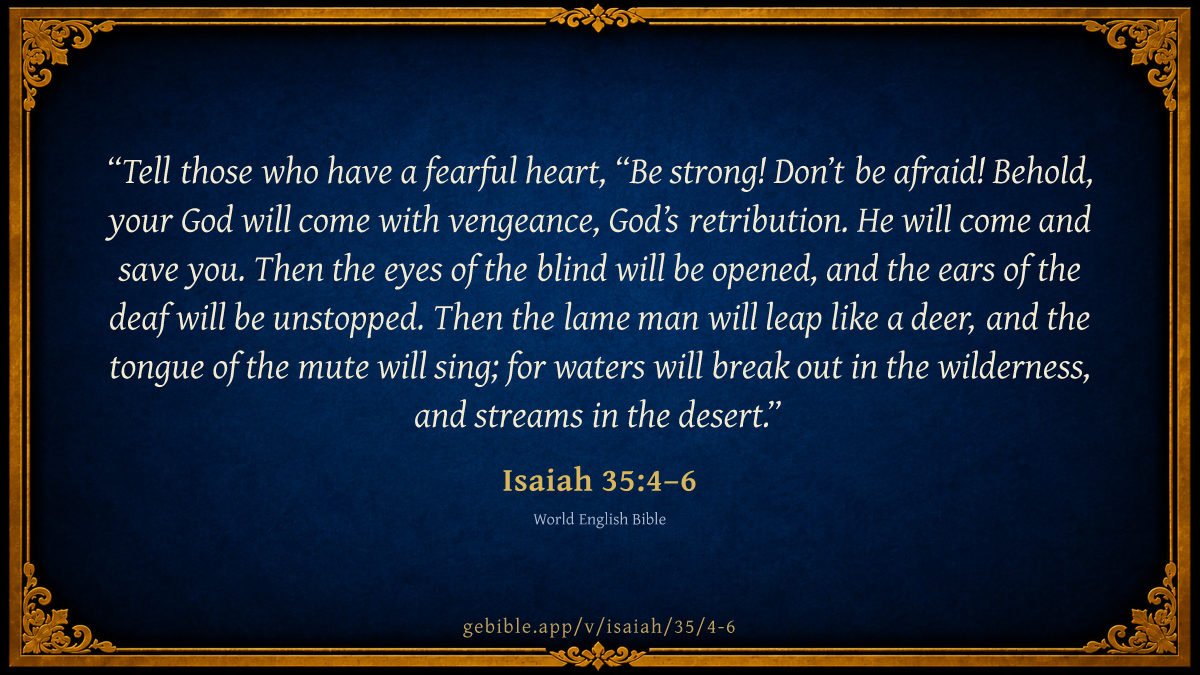
4Tell those who have a fearful heart, “Be strong! Don’t be afraid! Behold, your God will come with vengeance, God’s retribution. He will come and save you.
5Then the eyes of the blind will be opened, and the ears of the deaf will be unstopped.
6Then the lame man will leap like a deer, and the tongue of the mute will sing; for waters will break out in the wilderness, and streams in the desert.
4 Tell those who have a fearful heart, “Be strong! Don’t be afraid! Behold, your God will come with vengeance, God’s retribution. He will come and save you.
5 Then the eyes of the blind will be opened, and the ears of the deaf will be unstopped.
6 Then the lame man will leap like a deer, and the tongue of the mute will sing; for waters will break out in the wilderness, and streams in the desert.
KJVKing James Version
4 Say to them that are of a fearful heart, Be strong, fear not: behold, your God will come with vengeance, even God with a recompence; he will come and save you.
5 Then the eyes of the blind shall be opened, and the ears of the deaf shall be unstopped.
6 Then shall the lame man leap as an hart, and the tongue of the dumb sing: for in the wilderness shall waters break out, and streams in the desert.
Show all 3 translations
JPSJPS Tanakh (1917)
4 Say to them that are of a fearful heart: 'Be strong, fear not'; behold, your God will come with vengeance, with the recompense of God He will come and save you.
5 Then the eyes of the blind shall be opened, and the ears of the deaf shall be unstopped.
6 Then shall the lame man leap as a hart, and the tongue of the dumb shall sing; for in the wilderness shall waters break out, and streams in the desert.
Isaiah 42:6-7(v5)“I, Yahweh, have called you in righteousness. I will hold your hand. I will keep you, and make you a covenant for the people, as a light…
Luke 7:20-23(v5)When the men had come to him, they said, “John the Baptizer has sent us to you, saying, ‘Are you he who comes, or should we look for…
Isaiah 29:18(v5)In that day, the deaf will hear the words of the book, and the eyes of the blind will see out of obscurity and out of darkness.
Matthew 11:3-5(v5)and said to him, “Are you he who comes, or should we look for another?” Jesus answered them, “Go and tell John the things which you hear…
Isaiah 32:3-4(v5)The eyes of those who see will not be dim, and the ears of those who hear will listen. The heart of the rash will understand knowledge, and…
Show all 94 cross-references
Psalms 146:8(v5)Yahweh opens the eyes of the blind. Yahweh raises up those who are bowed down. Yahweh loves the righteous.
John 9:39(v5)Jesus said, “I came into this world for judgment, that those who don’t see may see; and that those who see may become blind.”
Isaiah 50:4(v5)The Lord Yahweh has given me the tongue of those who are taught, that I may know how to sustain with words him who is weary. He awakens…
Matthew 9:27-30(v5)As Jesus passed by from there, two blind men followed him, calling out and saying, “Have mercy on us, son of David!” When he had come into…
Ephesians 1:17-18(v5)that the God of our Lord Jesus Christ, the Father of glory, may give to you a spirit of wisdom and revelation in the knowledge of him,…
Matthew 12:22(vv5–6)Then one possessed by a demon, blind and mute, was brought to him and he healed him, so that the blind and mute man both spoke and saw.
Matthew 21:14(vv5–6)The blind and the lame came to him in the temple, and he healed them.
Matthew 20:30-34(v5)Behold, two blind men sitting by the road, when they heard that Jesus was passing by, cried out, “Lord, have mercy on us, you son of…
Luke 4:18(v5)“The Spirit of the Lord is on me, because he has anointed me to preach good news to the poor. He has sent me to heal the broken hearted, to…
John 9:1-7(v5)As he passed by, he saw a man blind from birth. His disciples asked him, “Rabbi, who sinned, this man or his parents, that he was born…
Isaiah 42:16(v5)I will bring the blind by a way that they don’t know. I will lead them in paths that they don’t know. I will make darkness light before…
Mark 7:32-37(vv5–6)They brought to him one who was deaf and had an impediment in his speech. They begged him to lay his hand on him. He took him aside from…
Isaiah 43:8(v5)Bring out the blind people who have eyes, and the deaf who have ears.
Ephesians 5:14(v5)Therefore he says, “Awake, you who sleep, and arise from the dead, and Christ will shine on you.”
James 5:7-9(v4)Be patient therefore, brothers, until the coming of the Lord. Behold, the farmer waits for the precious fruit of the earth, being patient…
Proverbs 20:12(v5)The hearing ear, and the seeing eye, Yahweh has made even both of them.
Exodus 4:11(v5)Yahweh said to him, “Who made man’s mouth? Or who makes one mute, or deaf, or seeing, or blind? Isn’t it I, Yahweh?
Mark 9:25-26(v5)When Jesus saw that a multitude came running together, he rebuked the unclean spirit, saying to him, “You mute and deaf spirit, I command…
Acts 9:17-18(v5)Ananias departed and entered into the house. Laying his hands on him, he said, “Brother Saul, the Lord, who appeared to you on the road by…
Mark 8:22-25(v5)He came to Bethsaida. They brought a blind man to him, and begged him to touch him. He took hold of the blind man by the hand, and brought…
Isaiah 41:10-14(v4)Don’t you be afraid, for I am with you. Don’t be dismayed, for I am your God. I will strengthen you. Yes, I will help you. Yes, I will…
Acts 26:18(v5)to open their eyes, that they may turn from darkness to light and from the power of Satan to God, that they may receive remission of sins…
Isaiah 48:8(v5)Yes, you didn’t hear. Yes, you didn’t know. Yes, from of old your ear was not opened, for I knew that you dealt very treacherously, and…
Zephaniah 3:16-17(v4)In that day, it will be said to Jerusalem, “Don’t be afraid, Zion. Don’t let your hands be weak.” Yahweh, your God, is among you, a mighty…
John 11:37(v5)Some of them said, “Couldn’t this man, who opened the eyes of him who was blind, have also kept this man from dying?”
Job 33:16(v5)Then he opens the ears of men, and seals their instruction,
Isaiah 34:8(v4)For Yahweh has a day of vengeance, a year of recompense for the cause of Zion.
Haggai 2:4(v4)Yet now be strong, Zerubbabel,’ says Yahweh. ‘Be strong, Joshua, son of Jehozadak, the high priest. Be strong, all you people of the land,’…
Ephesians 6:10(v4)Finally, be strong in the Lord, and in the strength of his might.
1 Chronicles 28:20(v4)David said to Solomon his son, “Be strong and courageous, and do it. Don’t be afraid, nor be dismayed; for Yahweh God, even my God, is with…
Isaiah 33:22(v4)For Yahweh is our judge. Yahweh is our lawgiver. Yahweh is our king. He will save us.
Jeremiah 6:10(v5)To whom should I speak and testify, that they may hear? Behold, their ear is uncircumcised, and they can’t listen. Behold, Yahweh’s word…
Isaiah 61:2(v4)to proclaim the year of Yahweh’s favor and the day of vengeance of our God, to comfort all who mourn,
Isaiah 25:9(v4)It shall be said in that day, “Behold, this is our God! We have waited for him, and he will save us! This is Yahweh! We have waited for…
Isaiah 52:7-10(v4)How beautiful on the mountains are the feet of him who brings good news, who publishes peace, who brings good news, who proclaims…
Luke 21:28(v4)But when these things begin to happen, look up and lift up your heads, because your redemption is near.”
John 5:8-9(v6)Jesus said to him, “Arise, take up your mat, and walk.” Immediately, the man was made well, and took up his mat and walked. Now it was the…
Isaiah 44:2(v4)This is what Yahweh who made you, and formed you from the womb, who will help you says: “Don’t be afraid, Jacob my servant; and you,…
Daniel 10:19(v4)He said, “Greatly beloved man, don’t be afraid. Peace be to you. Be strong. Yes, be strong.” When he spoke to me, I was strengthened, and…
Zechariah 2:8-10(v4)For Yahweh of Armies says: ‘For honor he has sent me to the nations which plundered you; for he who touches you touches the apple of his…
Luke 11:14(v6)He was casting out a demon, and it was mute. When the demon had gone out, the mute man spoke; and the multitudes marveled.
John 7:37-39(v6)Now on the last and greatest day of the feast, Jesus stood and cried out, “If anyone is thirsty, let him come to me and drink! He who…
Isaiah 32:4(vv4, 6)The heart of the rash will understand knowledge, and the tongue of the stammerers will be ready to speak plainly.
Deuteronomy 32:35-43(v4)Vengeance is mine, and recompense, at the time when their foot slides; for the day of their calamity is at hand. Their doom rushes at…
Isaiah 40:9-11(v4)You who tell good news to Zion, go up on a high mountain. You who tell good news to Jerusalem, lift up your voice with strength! Lift it…
Hebrews 10:37-38(v4)“In a very little while, he who comes will come, and will not wait. But the righteous will live by faith. If he shrinks back, my soul has…
Revelation 2:10(v4)Don’t be afraid of the things which you are about to suffer. Behold, the devil is about to throw some of you into prison, that you may be…
Revelation 22:20(v4)He who testifies these things says, “Yes, I come quickly.” Amen! Yes, come, Lord Jesus.
Joshua 1:6-7(v4)“Be strong and courageous; for you shall cause this people to inherit the land which I swore to their fathers to give them. Only be strong…
Psalms 51:15(v6)Lord, open my lips. My mouth will declare your praise.
Isaiah 28:16(v4)Therefore the Lord Yahweh says, “Behold, I lay in Zion for a foundation a stone, a tried stone, a precious cornerstone of a sure…
Isaiah 54:4-5(v4)“Don’t be afraid, for you will not be ashamed. Don’t be confounded, for you will not be disappointed. For you will forget the shame of your…
Isaiah 66:15(v4)For, behold, Yahweh will come with fire, and his chariots will be like the whirlwind; to render his anger with fierceness, and his rebuke…
Hosea 1:7(v4)But I will have mercy on the house of Judah, and will save them by Yahweh their God, and will not save them by bow, sword, battle, horses,…
Matthew 1:21-23(v4)She shall give birth to a son. You shall name him Jesus, for it is he who shall save his people from their sins.” Now all this has happened…
Matthew 9:32-33(v6)As they went out, behold, a mute man who was demon possessed was brought to him. When the demon was cast out, the mute man spoke. The…
2 Timothy 2:1(v4)You therefore, my child, be strengthened in the grace that is in Christ Jesus.
Hebrews 9:28(v4)so Christ also, having been offered once to bear the sins of many, will appear a second time, without sin, to those who are eagerly waiting…
Revelation 1:7(v4)Behold, he is coming with the clouds, and every eye will see him, including those who pierced him. All the tribes of the earth will mourn…
Psalms 50:3(v4)Our God comes, and does not keep silent. A fire devours before him. It is very stormy around him.
Psalms 116:11(v4)I said in my haste, “All people are liars.”
Isaiah 26:20-21(v4)Come, my people, enter into your rooms, and shut your doors behind you. Hide yourself for a little moment, until the indignation is past.…
Habakkuk 2:3(v4)For the vision is yet for the appointed time, and it hurries toward the end, and won’t prove false. Though it takes time, wait for it;…
Malachi 3:1(v4)“Behold, I send my messenger, and he will prepare the way before me; and the Lord, whom you seek, will suddenly come to his temple; and the…
Luke 1:64(v6)His mouth was opened immediately and his tongue freed, and he spoke, blessing God.
Exodus 17:6(v6)Behold, I will stand before you there on the rock in Horeb. You shall strike the rock, and water will come out of it, that the people may…
Numbers 20:11(v6)Moses lifted up his hand, and struck the rock with his rod twice, and water came out abundantly. The congregation and their livestock drank.
Nehemiah 9:15(v6)and gave them bread from the sky for their hunger, and brought water out of the rock for them for their thirst, and commanded them that…
Psalms 46:4(v6)There is a river, the streams of which make the city of God glad, the holy place of the tents of the Most High.
Psalms 78:15-16(v6)He split rocks in the wilderness, and gave them drink abundantly as out of the depths. He brought streams also out of the rock, and caused…
Isaiah 1:24(v4)Therefore the Lord, Yahweh of Armies, the Mighty One of Israel, says: “Ah, I will get relief from my adversaries, and avenge myself on my…
Isaiah 35:1(v6)The wilderness and the dry land will be glad. The desert will rejoice and blossom like a rose.
Isaiah 41:17-18(v6)The poor and needy seek water, and there is none. Their tongue fails for thirst. I, Yahweh, will answer them. I, the God of Israel, will…
Isaiah 43:1-6(v4)But now Yahweh who created you, Jacob, and he who formed you, Israel, says: “Don’t be afraid, for I have redeemed you. I have called you by…
Isaiah 43:19-20(v6)Behold, I will do a new thing. It springs out now. Don’t you know it? I will even make a way in the wilderness, and rivers in the desert.…
Isaiah 48:21(v6)They didn’t thirst when he led them through the deserts. He caused the waters to flow out of the rock for them. He also split the rock and…
Isaiah 49:10-11(v6)They shall not hunger nor thirst; neither shall the heat nor sun strike them: for he who has mercy on them will lead them. He will guide…
Ezekiel 47:1-11(v6)He brought me back to the door of the house; and behold, waters flowed out from under the threshold of the house eastward, for the front of…
Zechariah 14:8(v6)It will happen in that day, that living waters will go out from Jerusalem: half of them toward the eastern sea, and half of them toward the…
Matthew 11:5(v6)the blind receive their sight, the lame walk, the lepers are cleansed, the deaf hear, the dead are raised up, and the poor have good news…
Matthew 15:30-31(v6)Great multitudes came to him, having with them the lame, blind, mute, maimed, and many others, and they put them down at his feet. He…
Mark 9:17-25(v6)One of the multitude answered, “Teacher, I brought to you my son, who has a mute spirit; and wherever it seizes him, it throws him down,…
Acts 3:2(v6)A certain man who was lame from his mother’s womb was being carried, whom they laid daily at the door of the temple which is called…
Acts 3:6-8(v6)But Peter said, “I have no silver or gold, but what I have, that I give you. In the name of Jesus Christ of Nazareth, get up and walk!” He…
Acts 8:7(v6)For unclean spirits came out of many of those who had them. They came out, crying with a loud voice. Many who had been paralyzed and lame…
Acts 14:8-10(v6)At Lystra a certain man sat, impotent in his feet, a cripple from his mother’s womb, who never had walked. He was listening to Paul…
Colossians 3:16(v6)Let the word of Christ dwell in you richly; in all wisdom teaching and admonishing one another with psalms, hymns, and spiritual songs,…
Revelation 22:1(v6)He showed me a river of water of life, clear as crystal, proceeding out of the throne of God and of the Lamb,
Revelation 22:17(v6)The Spirit and the bride say, “Come!” He who hears, let him say, “Come!” He who is thirsty, let him come. He who desires, let him take the…
94 distinct cross-references across this passage (98 total citations).
Cross-references from openbible.info (CC BY 4.0)
Explain this passage (18 sources)
Historical commentary, presented as a primary source — not an endorsement.
Geneva Bible translators1599 · Public DomainOn vv4–6To destroy your enemies.
To destroy your enemies.
Geneva Bible (1599) marginal notes — public domain.
John Trapp1656 · Public DomainOn vv4–6Isa 35:4 Say to them [that are] of a…
Isa 35:4 Say to them [that are] of a fearful heart, Be strong, fear not: behold, your God will come [with] vengeance, [even] God [with] a recompence; he will come and save you.
Ver. 4. Say to them that are of a fearful heart,] Inconsideratis; to them that consider not the promises, but "forget the consolations," {παρακλησις, Heb 12:5} so poring upon their sins, that they see not their Saviour.
Read full note →
Behold, your God will come with vengeance.] He will tread Satan under your feet shortly. {Rom 16:20}
Even your God with a recompense.] Diabolo par pari retribuet Christus, saith Jerome: Christ will be even with the devil. He had got one of Christ’s disciples - Judas; and, to cry quittance, Christ got one of his - Paul. Cyprian was wont thus to comfort his hearers, Veniet Antichristus, sed superveniet Christus, Antichrist will come, but Christ will not be long behind him.
John Trapp, A Commentary or Exposition upon All the Books of the Old and New Testament (1647–1656) — public domain. Text from a community e-Sword module.
Matthew Poole1685 · Public DomainOn vv4–6Your God will come; though he seem to be…
Your God will come; though he seem to be absent, and departed from you, he will come to you, and abide with you. He will shortly come in the flesh. For although this and the following promises may be metaphorically taken, concerning the temporal deliverance of his people from Babylonian and other oppressors; yet they are much more emphatically and literally understood concerning the redemption of God’s people by Jesus Christ, as is sufficiently manifest, both from the words and phrases themselves, and from divers places of the New Testament, where they are so expounded by Christ and the apostles.
With vengeance; to execute vengeance upon the enemies of God, and of his people; which also was verified in Christ, who was set for the fall as well as for the rising of many in Israel, Luk 2:34, and who did accordingly inflict most dreadful judgments, both temporal and spiritual, upon the unbelieving and apostate Jews, who were the great persecutors of Christ and, of his people.
Matthew Poole's English Annotations on the Holy Bible (1683–1685) — public domain. Text from a community e-Sword/MySword module.
Matthew Henry1710 · Public DomainOn v5"Then, when your God shall come, even Christ, to…
"Then, when your God shall come, even Christ, to set up his kingdom in the world, to which all the prophets bore witness, especially towards the conclusion of their prophecies of the temporal deliverances of the church, and this evangelical prophet especially - then look for great things."
I. Wonders shall be wrought in the kingdoms both of nature and grace, wonders of mercy wrought upon the children of men, sufficient to evince that it is no less than a God that comes to us. 1. Wonders shall be wrought on men's bodies (Isa 35:5, Isa 35:6): The eyes of the blind shall be opened; this was often done by our Lord Jesus when he was here upon earth, with a word's speaking, and one he gave sight to that was born blind, Mat 9:27; Mat 12:22; Mat 20:30; Joh 9:6. By his power the ears of the deaf also were unstopped, with one word. Ephphatha - Be opened, Mar 7:34. Many that were lame had the use of their limbs restored so perfectly that they could not only go, but leap, and with so much joy to them that they could not forbear leaping for joy, as that impotent man, Act 3:8. The dumb also were enabled to speak, and then no marvel that they were disposed to sing for joy, Mat 9:32, Mat 9:33. These miracles Christ wrought to prove that he was sent of God (Joh 3:2), nay, working them by his own power and in his own name, he proved that he was God, the same who at first made man's mouth, the hearing ear, and the seeing eye. When he would prove to John's disciples his divine mission he did it by miracles of this kind, in which this scripture was fulfilled. 2. Wonders, greater wonders, shall be wrought on men's souls. By the word and Spirit of Christ those that were spiritually blind were enlightened (Act 26:18), those that were deaf to the calls of God were made to hear them readily, so Lydia, whose heart the Lord opened, so that she attended, Act 16:14. Those that were impotent to every thing that is good by divine grace are made, not only able for it, but active in it, and run the way of God's commandments. Those also that were dumb, and knew not how to speak of God or to God, having their understandings opened to know him, shall thereby have their lips opened to show forth his praise. The tongue of the dumb shall sing for joy, the joy of God's salvation. Praise shall be perfected out of the mouth of babes and sucklings.
Read full note →
II. The Spirit shall be poured out from on high. There shall be waters and streams, rivers of living water; when our Saviour spoke of these as the fulfilling of the scripture, and most probably of this scripture, the evangelist tells us, He spoke of the Spirit (Joh 7:38, Joh 7:39), as does also this prophet (ch. 32:15); so here (Isa 35:6), in the wilderness, where one would least expect it, shall waters break out. This was fulfilled when the Holy Ghost fell upon the Gentiles that heard the word (Act 10:44); then were the fountains of life opened, whence streams flowed, that watered the earth abundantly. These waters are said to break out, which denotes a pleasing surprise to the Gentile world, such as brought them, as it were, into a new world. The blessed effect of this shall be that the parched ground shall become a pool, Isa 35:7. Those that laboured and were heavily laden, under the burden of guilt, and were scorched with the sense of divine wrath, found rest, and refreshment, and abundant comforts in the gospel. In the thirsty land, where no water was, nor ordinances (Psa 63:1), there shall be springs of water, a gospel ministry, and by that the administration of all gospel ordinances in their purity and plenty, which are the river that makes glad the city of our God, Psa 46:4. In the habitation of dragons, who chose to dwell in the parched scorched ground (Isa 34:9, Isa 34:13), these waters shall flow, and dispossess them, so that, where each lay shall be grass with reeds and rushes, great plenty of useful productions. Thus it was when Christian churches were planted, and flourished greatly, in the cities of the Gentiles, which, for many ages, had been habitations of dragons, or devils rather, as Babylon (Rev 18:2); when the property of the idols' temples was altered, and they were converted to the service of Christianity, then the habitations of dragons became fruitful fields.
III. The way of religion and godliness shall be laid open: it is here called the way of holiness (Isa 35:8) the way both of holy worship and a holy conversation. Holiness is the rectitude of the human nature and will, in conformity to the divine nature and will. The way of holiness is that course of religious duties in which men ought to walk and press forward, with an eye to the glory of God and their own felicity in the enjoyment of him. "When our God shall come to save us he shall chalk out to us this way by his gospel, so as it had never been before described." 1. It shall be an appointed way; not a way of sufferance, but a highway, a way into which we are directed by a divine authority and in which we are protected by a divine warrant. It is the King's highway, the King of Kings' highway, in which, though we may be waylaid, we cannot be stopped. The way of holiness is the way of God's commandments; it is (as highways usually are) the good old way, Jer 6:16. 2. It shall be an appropriated way, the way in which God will bring his own chosen to himself, but the unclean shall not pass over it, either to defile it or to disturb those that walk in it. It is a way by itself, distinguished from the way of the world, for it is a way of separation from, and nonconformity to, this world. It shall be for those whom the Lord has set apart for himself (Psa 4:3), shall be reserved for them: The redeemed shall walk there, and the satisfaction they take in these ways of pleasantness shall be out of the reach of molestation from an evil world. The unclean shall not pass over it, for it shall be a fair way; those that walk in it are the undefiled in the way, who escape the pollution that is in the world. 3. It shall be a straight way: The wayfaring men, who choose to travel in it, though fools, of weak capacity in other things, shall have such plain directions from the word and Spirit of God in this way that they shall not err therein; not that they shall be infallible even in their own conduct, or that they shall in nothing mistake, but they shall not be guilty of any fatal misconduct, shall not so miss their way but that they shall recover it again, and get well to their journey's end. Those that are in the narrow way, though some may fall into one path and others into another, not all equally right, but all meeting at last in the same end, shall yet never fall into the broad way again; the Spirit of truth shall lead them into all truth that is necessary for them. Note, The way to heaven is a plain way, and easy to hit. God has chosen the foolish things of the world, and made them wise to salvation. Knowledge is easy to him that understands. 4. It shall be a safe way: No lion shall be there, nor any ravenous beast (Isa 35:9), none to hurt or destroy. Those that keep close to this way keep out of the reach of Satan the roaring lion, that wicked one touches them not. Those that walk in the way of holiness may proceed with a holy security and serenity of mind, knowing that nothing can do them any real hurt; they shall be quiet from the fear of evil. It was in Hezekiah's days, some time after the captivity of the ten tribes, that God, being displeased with the colonies settled there, sent lions among them, Kg2 17:25. But Judah keeps her integrity, and therefore no lions shall be there. Those that walk in the way of holiness must separate themselves from the unclean and the ravenous, must save themselves from an untoward generation; hoping that they themselves are of the redeemed, let them walk with the redeemed who shall walk there.
IV. The end of this way shall be everlasting joy, Isa 35:10. This precious promise of peace now will end shortly in endless joys and rest for the soul. Here is good news for the citizens of Zion, rest to the weary: The ransomed of the Lord, who therefore ought to follow him wherever he goes (Rev 14:4), shall return and come to Zion, 1. To serve and worship God in the church militant: they shall deliver themselves out of Babylon (Zac 2:7), shall ask the way to Zion (Jer 50:5), and shall find the way Isa 52:12. God will open to them a door of escape out of their captivity, and it shall be an effectual door, though there be many adversaries. They shall join themselves to the gospel church, that Mount Zion, that city of the living God, Heb 12:22. They shall come with songs of joy and praise for their deliverance out of Babylon, where they wept upon every remembrance of Zion, Psa 137:1. Those that by faith are made citizens of the gospel Zion may go on their way rejoicing (Act 8:39); they shall sing in the ways of the Lord, and be still praising him. They rejoice in Christ Jesus, and the sorrows and signs of their convictions are made to flee away by the power of divine consolations. Those that mourn are blessed, for they shall be comforted. 2. To see and enjoy God in the church triumphant; those that walk in the way of holiness, under guidance of their Redeemer, shall come to Zion at last, to the heavenly Zion, shall come in a body, shall all be presented together, faultless, at the coming of Christ's glory with exceeding joy (Jde 1:24; Rev 7:17); they shall come with songs. When God's people returned out of Babylon to Zion they came weeping (Jer 50:4); but they shall come to heaven singing a new song, which no man can learn, Rev 14:3. When they shall enter into the joy of their Lord it shall be what the joys of this world never could be everlasting joy, without mixture, interruption, or period. It shall not only fill their hearts, to their own perfect and perpetual satisfaction, but it shall be upon their heads, as an ornament of grace and a crown of glory, as a garland worn in token of victory. Their joy shall be visible, and no longer a secret thing, as it is here in this world; it shall be proclaimed, to the glory of God and their mutual encouragement. They shall then obtain the joy and gladness which they could never expect on this side heaven; and sorrow and sighing shall flee away for ever, as the shadows of the night before the rising sun. Thus these prophecies, which relate to the Assyrian invasion, conclude, for the support of the people of God under that calamity, and to direct their joy, in their deliverance from it, to something higher. Our joyful hopes and prospects of eternal life should swallow up both all the sorrows and all the joys of this present time.
Matthew Henry's Commentary on the Whole Bible (1708–1710) — public domain (CC PDM 1.0). Text via the HelloAO Bible API.
John Gill1763 · Public DomainOn vv4–6Say to them that are of a fearful heart,....…
Say to them that are of a fearful heart,.... Or, "hasty of heart" (w); are at once for flying from the enemy; "hasty" in drawing black conclusions upon themselves and their state; "inconsiderate" of the promises made unto them; ready to doubt of, and call in question, the performance of the above things, respecting the fruitful and flourishing estate of the church: wherefore it must be said to them,
Be strong, fear not; be strong in faith, fear not the enemy, nor doubt of the fulfilment of divine promises, relating to their ruin and your safety:
Read full note →
behold, your God will come with vengeance; Christ, who is God in our nature, God manifest in the flesh, and who came by the assumption of human nature; and when he first came, he came with vengeance, and took vengeance on Satan and his works; on him, and his principalities, and powers, whom he spoiled and destroyed, as well as made an end of sin and abolished death; see Isa 61:2 so likewise he came in his kingdom and power, and took vengeance on the Jewish nation, for their disbelief and rejection of him; and which time is expressly called the days of vengeance, Luk 21:22 and at the time of his spiritual coming he will destroy antichrist with the brightness of it, and avenge the blood of his servants, Rev 18:20 and at his personal coming he will take vengeance on them that know not God, and obey not his Gospel, Th2 1:8 and the words are so expressed as to take in the several times of his coming: and since he has already come, and taken vengeance in some instances, this may serve to encourage, and perhaps the design of it is to encourage, the faith of God's people, with respect to his future coming, and the end and issue of it:
even God with a recompence: or, "the God of recompence" (x); and so the Targum,
"the Lord of recompences;''
both to the wicked a just recompence of reward or punishment for their sins, it being just with him to recompense tribulation to them that trouble his people; and to the saints, the time of his spiritual reign being the time, as to destroy them that destroy the earth, so to give a reward to his servants the prophets, and to the saints, and to them that fear his name, Rev 11:18,
he will come and save you; the end of his first coming was to save his people from sin, the curse and condemnation of the law, from hell, wrath, ruin, and destruction; and the end of his spiritual coming, at the latter day, will be to save his people from their antichristian enemies, from idolatry, superstition, and slavery.
(w) "festinis corde", Vatablus; "praecipitantibus corde", Cocceius; "inconsideratis", Junius & Tremellius, Piscator. (x) "praemiator Deus ipse veniet", Castalio.
John Gill's Exposition of the Whole Bible (1746–1763) — public domain (CC PDM 1.0). Text via the HelloAO Bible API.
John Wesley1765 · Public DomainOn vv4–5Your God - Tho' he seems to be departed,…
Your God - Tho' he seems to be departed, he will come to you, and abide with you. He will shortly come in the flesh, to execute vengeance upon the enemies of God.
John Wesley, Explanatory Notes Upon the Whole Bible (1754–1765) — public domain. Text via the GEBible commentary corpus.
Joseph Benson1811 · Public DomainOn v5Isa 35:5-7. Then the eyes of the blind shall…
Isa 35:5-7. Then the eyes of the blind shall be opened — The poor Gentiles, who before were blind and deaf, shall now have the eyes and ears of their minds opened to see God’s works, and to hear and receive his word. And, in token hereof, many persons who are literally and corporally blind and deaf, shall have sight and hearing miraculously conferred upon them; all which things being so fully accomplished in Christ, and, as has been just observed, applied by him to himself, it is plain that this prophecy belongs primarily to the times of the gospel. Then shall the lame leap as a hart — For joy, or shall proceed readily and nimbly in the way of duty. And the tongue of the dumb shall sing — The praises of his Redeemer and Saviour. For in the wilderness shall waters break out — The most dry and barren places shall be made moist and fruitful: which is principally meant of the plentiful effusion of God’s grace upon such persons and nations as had been wholly destitute of it. In the habitation of dragons shall be grass, &c. — Those dry and parched deserts, in which dragons have their abode, shall yield abundance of grass, and reeds, and rushes, which grow only in moist ground. Thus it was when Christian churches were planted and flourished in the cities of the Gentiles, which for many ages had been habitations of dragons, or rather of devils, Rev 18:2. When the property of the idols’ temples was altered, and they were converted to the service of Christianity, then the habitations of dragons became fruitful fields.
Joseph Benson's Commentary on the Old and New Testaments (1811–1818) — public domain. Text from a community e-Sword module.
Albert Barnes1834 · Public DomainOn vv4–6Say to them - This is still an address…
Say to them - This is still an address to the ministers of religion, to make use of all the consolations which these truths and predictions furnish to confirm and strengthen the people of God.
Of a fearful heart - Of a timid, pusillanimous heart; those who tremble before their enemies. The Hebrew is, as in the Margin, ‘Of a hasty heart;’ that is, of those who are disposed to flee before their enemies (see the note at Isa 30:16).
Read full note →
Behold, your God will come with vengeance - That is, in the manner described in the previous chapter; and, generally, he will take vengeance on all the enemies of his people, and they shall be punished. The language in this chapter is, in part, derived from the captivity at Babylon Isa 35:10, and the general idea is, that God would take vengeance on all their enemies, and would bring them complete and final deliverance. This does not mean that when the Messiah should come he would be disposed to take vengeance; nor do the words ‘your God’ here refer to the Messiah; but it is meant that their God, Yahweh, would certainly come and destroy all their enemies, and prepare the way thus for the coming of the Prince of peace. The general promise is, that however many enemies might attack them, or however much they might fear them, yet that Yahweh would be their protector, and would completely humble and prostrate all their foes. The Hebrew will admit of a somewhat different translation, which I give in accordance with that proposed by Lowth. The sense is not materially varied.
Say ye to the faint-hearted, Be ye strong; fear ye not; behold your God!
Vengeance will come; the retribution of God:
He himself will come, and will deliver you.
Albert Barnes' Notes on the Bible (1834–1885) — public domain. Text from a community e-Sword/MySword module.
Haydock's Catholic Bible Commentary1859 · Public DomainOn vv4, 6Recompense. Christ will satisfy the justice of his Father.…
Recompense. Christ will satisfy the justice of his Father. (Haydock) --- He will redeem the world, and refute the false interpretations of the Bible. (Calmet) --- He will bring the devil into subjection. (Menochius)
George Leo Haydock (1774–1849), Haydock's Catholic Family Bible and Commentary, 1859 edition — public domain. Excludes Psalms (Douay-Rheims chapter numbering differs from Protestant) and Deuterocanonical books (Catholic canon only).
Robert Jamieson, A. R. Fausset & David Brown1871 · Public DomainOn vv4–6fearful--"hasty," Margin; that is, with a heart fluttered with…
fearful--"hasty," Margin; that is, with a heart fluttered with agitation.
with--the Hebrew is more forcible than the English Version: "God will come, vengeance! even God, a recompense!" The sense is the same.
Jamieson, Fausset & Brown — Commentary Critical and Explanatory on the Whole Bible (1871) — public domain (CC PDM 1.0). Text via the HelloAO Bible API.
Daniel D. Whedon1874 · Public DomainOn v55, 6. Then — In that glorious future time.
5, 6. Then — In that glorious future time.
Lame… dumb — The physical imperfections in these verses are also images of moral disease and infirmity, which in the coming Messianic days are to be removed, as indeed they were removed in Christ’s earthly mission, and as they have been and ever will be in these ends of the world. All nature around us, animate and inanimate, yearns for the deliverance of the sons of God. Rom_8:19-23.
Daniel D. Whedon (gen. ed.), Commentary on the Old and New Testaments (1874–1909) — public domain. Text from a community e-Sword module.
The Cambridge Bible for Schools and Colleges1878 · Public DomainOn v44. Cf. Isa_40:9-10. them that are of a fearful…
4. Cf. Isa_40:9-10. them that are of a fearful heart] Lit. “the hasty of heart.” The phrase occurs with a different sense in ch. Isa_32:4.
behold, your God … recompence] Better (as R.V. marg.): behold your God! vengeance cometh, the recompence of God; He Himself, &c.
Read full note →
5, 6 a. The removal of bodily infirmities. How far the language is to be taken figuratively it may be difficult to say. Comp. ch. Isa_29:18, Isa_32:3-4.
6 b, 7. The transformation of the desert. Cf. ch. Isa_43:19-20, Isa_48:21, Isa_49:10.
The Cambridge Bible for Schools and Colleges (gen. ed. J. J. S. Perowne; Cambridge University Press, 1878–1918) — public domain. Text from a community e-Sword module.
Ellicott's Commentary for English Readers1878 · Public DomainOn vv4–5(4) Be strong, fear not: . . .—The words…
(4) Be strong, fear not: . . .—The words are, of course, wide and general enough, but looking to the probable date of this section, we may perhaps connect them with the tone of Hezekiah’s speech in 2Ch_32:7. Both king and prophet had the same words of comfort for the feeble and faint-hearted, and the ground of comfort is that the government of God is essentially a righteous government, punishing the oppressor, and saving the oppressed. (Comp. Jos_1:6-7.)
A Bible Commentary for English Readers, edited by Charles John Ellicott (1878–1897) — public domain. Text from a community e-Sword module.
The Pulpit Commentary1880 · Public DomainOn vv4–6Say to them that are of a fearful heart.…
Say to them that are of a fearful heart. There will be fearful and trembling hearts always, even among the saints of God. These are to be encouraged and assured that God Will come to their aid, will avenge them of their spiritual enemies, reward their efforts to serve him, and in the end "save" them. He will come and save you; rather, he will come himself to save yon. There is One alone who can save, and he must do it himself, and, to do it, he must "come" to us. The words were at once an announcement of the Incarnation, and a promise to every trembling, doubting heart a promise of direct Divine assistance, of the presence of God within us, of help potent to save. The predominant thought of the prophet appears to have been Messianic, and hence the burst of glorious prophecy which follows a burst of prophecy most inadequately expounded of the time of the return from the Captivity.
Tremor of spirit.
Read full note →
"Say to them that are of a fearful heart." This implies that fear will be a necessary element in our life. All depends on the heart. Fear increases with experience.
I THY GOD REIGNETH TO SALVATION. His power is in this direction. He is God. He is thy God the God of thy salvation.
1. It is an empire over sin. All its agencies and influences.
2. It is an empire over hearts. Because it is connected with the cross!
3. It is an empire over enemies. There is no Manichean universe of equally divided forces. The Lord is King.
II THY GOD REIGNETH TO CONSOLATION. He is human as well as Divine.
1. He is Lord of circumstance.
2. He is Lord of condition. He can and does extend his pity to the weak and the poor.
3. He is Lord of dissolution. For death is in his hands.
III THY GOD REIGNETH TO GLORIFICATION. All things make manifest:
1. His praise.
2. His perfections.
3. His permanence. "Thy kingdom is an everlasting kingdom.
IV THY GOD REIGNETH TO SUBJUGATION. All enemies under his feet.
1. Power to control.
2. Power to educe good out of evil.
3. Power to raise and to cast down.
V THY GOD REIGNETH TO ADORATION. His kingship will evoke the worshipping homage of all creation.
1. Angels adore him.
2. Saints adore him.
Heaven shall ring with the glad acclaim of a great multitude that no man can number. Blessing, and honor, and glory, and power, be unto him that sitteth upon the throne, and unto the Lamb forever. W.M.S.
The Pulpit Commentary (1880–1919), ed. H.D.M. Spence-Jones & Joseph S. Exell — public domain. Text from a community e-Sword module.
The Biblical Illustrator1887 · Public DomainOn vv4–6Say to them that are of a fearful heart,…
Isa_35:4
Say to them that are of a fearful heart, Be strong, fear not
Read full note →
Comfort for the fearful
Presumption and fear are the Scylla and Charybdis of the Christian life, and it requires Divine guidance, together with all our own watchfulness, to steer safely between them.
My object is, to suit the case of those who are well entitled to hope for the Divine mercy through Christ Jesus, but are disquieting themselves, or are disquieted by the enemy with needless fears.
1. I cannot indulge the hope that I am a Christian, one will say, because I have never passed through the same religious exercises and experiences that others profess to have felt and enjoyed; have known no such deep convictions; have no such clear assurance of my acceptance with God. God has brought many sons to glory, but I do not suppose that any two of them have been led thither in precisely the same way, or have been exercised with precisely the same feelings. If in the main, our experiences correspond with the Word of God, in the great points of faith and love, it need not disquiet us though we never heard of another case exactly like our own.
2. But another desponding one says, If I were truly a child of God, sin would not prevail against me as I find it does. So long as there is determined war against sin, there is ground for hope.
3. Still one may be ready to reply, I find that sin not only prevails against me, but I seem to be worse than when I first strove against it; my heart appears to grow more wicked; my corruptions, stronger, and my strength to resist to be less. To perceive more of our sin than usual, does not always prove that we are more sinful, but often the reverse; just as when one cleanses a room, though the air is filled with dust floating in the sunbeams, there is no more of it actually there than before, and there will soon be less of it as the operation goes on. We do not know the strength of our evil passions until we begin to oppose them. When one is making a special effort to lead a Christian life, then he is especially tempted and hindered.
4. Another class of disquieted ones affirm that they cannot hope they are true Christians, because they seem to love everything else more than God; If this were really true, we should have no encouragement to offer, for if God be not loved supremely we cannot be His children. But, in estimating our love to God, compared with our love to earthly things, we are not to conclude that we love that most which most excites our affections. It has well been remarked, that a man may be more moved when he sees a friend that has long been absent, and seem to regard him more for the moment than he does his own wife and children, and yet none would think that the friend was loved the most; so neither must we conclude, because when we are abroad in the world we find our affections vehemently stirred towards its various objects, that therefore they are supreme in our hearts. We should judge of our comparative affection by asking ourselves soberly, which of the two objects we should prefer to part withy
5. Again, it is urged by some that there is great danger of self-deception; that a person may, in appearance, be like a Christian, and yet be really destitute of any true piety, and they fear lest they should fall into the same error. The fear is usually the best remedy against the thing feared, and none are farther from the danger of making a false profession than those who are most afraid of it.
6. Some, again, have fears that they are not true Christians, because they come so far short of the attainments of some eminent Christians of their acquaintance. We reply, that the worst part of the character of those exalted saints may not be known to us, or they may not have our hindrances, or they may have been long in growing up to that state, while we are only babes in Christ.
7. Another class may say, that they cannot think any real Christian ever was so tempted and distressed with evil thoughts as they are. We reply, Job was tempted to curse God, and Christ Himself to worship Satan. We may have very wicked thoughts entering our minds, but if we do not delight in them, if we strive against them, and they are painful to us, they are no evidence against us. The very fact that they grieve us and we resist them, is in our favour.
8. Another class of the discouraged and fearful say, that they have doctrinal difficulties, that certain things in the Bible do not appear clear to them, and they fear to make any public confession of Christ till these are made plain. The best way to solve doctrinal difficulties is to engage in practical duties. But it would be endless to recount all the ways in which doubts and fears assail us. Their name is Legion, and our prayer should be that Christ would command them to come out of the man who is troubled with them, and to enter no more into him. Many seem to think that they show a commendable spirit by cherishing such fears. But there is no humility in doubting Gods promises. (W. H. Lewis, D. D.)
The ministry of consolation
Let us consider the text--
I. AS A DISSUASIVE AGAINST OUR SECRET FEARS. Say to them that are of a fearful heart, Fear not. The language is not uncommon as addressed to Gods children. Fear not, Abram, I am thy shield and thine exceeding great reward. Thus saith the Lord that created thee, O Jacob, and He that formed thee, O Israel, fear not. Fear not, for I am with thee; be not dismayed, for I am thy God. The language seems to intimate that those who are truly seeking Christ are yet liable to be oppressed by many fears. But the Lord says, you are not to be thus afraid.
1. Fear not on account of the greatness of your sins. Fathomless as are the depths of your iniquity, there is one depth,, which is deeper still. Where sin abounded, grace did much more abound.
2. Fear not on account of remaining infirmities and indwelling tendencies to evil. How many are deterred from taking any decisive step in religion because they have not attained to a certain point of spiritual advancement; forgetting that the act of taking the step is to be one of the means for attaining to this point.
3. Be not of a fearful heart through anything adverse or disquieting in your spiritual experience. Many form rash conclusions on this subject from unsound and unworthy premises, and from only partial views of Scripture.
II. AS AN ENCOURAGEMENT TO LAY HOLD UPON THE STRENGTH OF GOD. Be strong. The advice is of frequent occurrence in Scripture. But what are we to be strong in?. Why., strong in the Lord, strong in His strength, safe through His holding up. Again, by the exhortation, Be strong, we must understand an injunction to seek and pray for the strengthening aids of God the Holy Spirit.
1. There is the strength of preventing grace in the hour of temptation, when not permitted to come upon us; when some power we know not of keeps us out of harms way; when the dominion of our besetting sin appears for the time to be got under, and without a struggle or a blow we conquer in the might of God.
2. Then, there is the strength of supporting grace when the struggle does come, when we have to do battle with hard thoughts in adversity, or rebellious thoughts in disappointment, with sinful thoughts in solitude, with proud and envious thoughts in the world, with unbelief and impatience, and a little willingness for prayer, and we cannot shake off these things.
3. And then there is the strength of enlightening and sanctifying grace. We grow in grace and in the knowledge of our Lord and Saviour Jesus Christ at the same time; and all this is through the imparted strength of the Comforter.
4. But I must not omit to notice the chief thing we are to be strong in, that which gave the prayer of Jacob power to prevail with God, namely, that we be as Jacob was, strong in faith, giving glory to God. Guard against all confused and imperfect notions of the offering of the Gospel plan, or of the power and willingness of Christ to save. Remember there is virtue enough in His blood, power enough in His arm, and grace enough at His disposal to sanctify and save a whole world of sinners. Apply to Him by faith and prayer. Place no limits where God has placed none. The blood of Jesus Christ cleanseth from all sin, and if from all, why not yours? (D. Moore, M. A.)
An old malady and an old remedy
I. A COMMON TROUBLE. A fearful heart. Think of some of the causes.
1. Life itself is a cause. A little child does not fear. But the little child has not yet reached into the consciousness of its own personality--has not been awed by the mystery of its own existence. Wrapped in such consciousness there is always a certain fear.
2. Sin is another source of a fearful heart. The ideal relation between God and the soul is that of utmost intimacy, but sin breaks this relation.
3. The sad things emerging in life are causes of a fearful heart.
4. The difficulties of duty.
5. The monotony of duty. Sometimes when dreary stretches of duty, the same thing day in, day out, fill the vision, a real fear comes lest one fail in duty because of its uninteresting routine.
6. The revelation of mans own nature under some great surprise or disappointment is a cause of a fearful heart. The strength one fancied himself to have, turns out under some great strain to be but weakness after all. The heart in Scripture stands for the whole man--intellect, affection, will. The thing needed is that a man see clearly, love wisely, will strongly; but when fear wraps one about with mists, this is the outcome; a weak heart--no strength for doing; feeble knees--no power of purpose.
II. THE OLD AND YET NEW REMEDY for this common trouble.
1. A personal God. Behold your God.
2. A God appropriated--your God.
3. A God active. He will come. God is not an inert passiveness, having no hand in things. Our Scripture is prophecy; God has come in the Incarnation.
4. A God for your help. He will come and save you.
5. A rewarding God. He will come with recompense. Think more of God than of the causes of your fearfulness, and also appropriate God. (Homiletic Review.)
Fears
1. These words brings before us very delightful thoughts concerning Gods nature and purposes. We gather from them His compassion He graciously sends the message unsolicited. His mercy. He does not desire His people to suffer needless trouble or anxiety. His power and care, for He is able to save them from danger and so guarantee the needlessness of their fear.
2. But they remind us of a very painful condition of man, which is his tendency to fear amid the discouragements of life. These consist in many things.
I. FEARS WITH RELATION TO EXTERNAL CIRCUMSTANCES.
1. Men dread that which is greater or more powerful than themselves. Hence they fear the material forces of nature, the mighty convulsions of creation, the strength of their fellow-man, and the power of God.
2. Men dread that which to them is mysterious and unknown. Thus there is an innate fear of darkness, of death, of the future.
3. Men dread that which is more evil than themselves. Evil men, evil combinations of men, evil spirits, and the machinations of Satan.
4. Men dread those circumstances which can adversely affect their interests. That which can bring them material loss, that which checks their external advancement, that which spoils their amusement or gratification.
II. FEARS WITH REGARD TO INTERNAL CIRCUMSTANCES.
1. There is our relationship to God. As an all seeing observer, as a just Judge, as an avenging King. We stand before Him as an Almighty Jehovah, who knows our thoughts, sins, and desires.
2. There is our future state of existence. Guilt makes cowards of us all.
3. There are our domestic relationships. The broken cord of affection, the ruptured friendship, and the lost treasures.
4. There is the mental, moral, and bodily anguish and suffering. Great and terrible do they appear as they enshroud our existence and threaten our future.
Now, as these things brood over the soul, and darken the horizon of life, there is heard speaking to the soul of the faithful, earnest believer in Christ the trumpet word of our text--Fear not. There are many reasons why we should not fear.
1. There is the fact of our Fathers love. He does not willingly afflict the children of men.
2. There is the fact of our Fathers power. He is able to support and to overrule all adverse circumstances.
3. There is the fact of our Fathers presence. He is always near. The true antidote to fear is faith. (Homilist.)
He will come and save you
It is no abstract salvation that we hope and wait for, but a Saviour--a Saviour before whom no enemy can stand. His coming will be the deliverance. Danger, bondage, weakness, and sorrow shall be done away, and in the consciousness of the grand release, The eyes of the blind shall be opened, &c. (W. Hubbard.)
The Biblical Illustrator, edited by Joseph S. Exell (c. 1880s–1900s) — public domain. Text from a community e-Sword module.
Alexander MacLaren1905 · Public DomainOn vv5–6Isa 35:5 - Isa 35:6.
Isaiah
MIRACLES OF HEALING
Read full note →
Isa 35:5 - Isa 35:6.
‘Then’-when? The previous verse answers, ‘Behold, your God will come, He will come and save you.’ And what or when is that ‘coming’? A glance at the place which this grand hymn occupies in the series of Isaiah’s prophecies answers that question. It stands at the close of the first part of these, and is the limit of the prophet’s vision. He has been setting forth the Lord’s judgments upon all heathen, and His deliverance of Israel from its oppressors; and the ‘coming’ is His manifestation for that double purpose. Before its flashing brightness, barrenness is changed into verdure, diseases that lame men’s powers vanish, the dry and thirsty land gleams with the shining light of sudden streams. Across the wilderness stretches a broad path, raised high above the bewildering monotony of pathless sand, too plain to be missed, too lofty for wild beasts’ suppleness to spring upon it: along it troop with song and gladness the returning exiles, with hope in their hearts as they journey to Zion, where they find a joyful home undimmed by sorrow, and in which sighing and sorrow are heard and felt no more.
Now this is poetry, no doubt; the golden light of imagination suffuses it all, but it is poetry with a solid meaning in it. It is not a mere play of fancy exalting the ‘coming of the Lord’ by heaping together all images that suggest the vanishing of evil and the coming of good. If there is a basis of facts in it, what are they? What is the period of that emphatic ‘then’ at the beginning of our text? The return of the Jews from exile? Yes, certainly; but some greater event shines through the words. Some future restoration of that undying race to their own land? Yes, possibly, again we answer, but that does not exhaust the prophecy. The great coming of God to save in the gift of His Son? Yes, that in an eminent degree. The second coming of Christ? Yes, that too. All the events in which God has come for men’s deliverance are shadowed here; for in them all, the same principles are at work, and in all, similar effects have followed. But mainly the mission and work of Jesus Christ is pointed at here-whether in its first stage of Incarnation and Passion, or in its second stage of Coming in glory, ‘the second time without sin, unto salvation.’
And the bodily diseases here enumerated are symbols, just as Christ’s miracles were symbolical, just as every language has used the body as a parable of the soul, and has felt that there is such a harmony between them that the outward and visible does correspond to and shadow the inward and spiritual.
I think, then, that we may fairly take these four promises as bringing out very distinctly the main characteristics of the blessed effects of Christ’s work in the world. The great subject of these words is the power of Christ in restoring to men the spiritual capacities which are all but destroyed. We have here three classes of bodily infirmities represented as cured at the date of that blessed ‘Then.’ Blindness and deafness are defects in perception, and stand for incapacities affecting the powers of knowledge. Lameness affects powers of motion, and stands for incapacity of activity. Dumbness prevents speech, and stands for incapacity of utterance.
I. Christ as the restorer of the powers of knowing.
Bodily diseases are taken to symbolise spiritual infirmities.
Mark the peculiarities of Scripture anthropology as brought out in this view of humanity:-
Its gloomy views of man’s actual condition.
Its emphatic declaration that that condition is abnormal.
Its confidence of effecting a cure.
Its transcendentally glorious conception of what man may become.
Men are blind and deaf; that is to say, their powers of perception are destroyed by reason of disease. What a picture! The great spiritual realities are all unseen, as Elisha’s young servant was blind to the fiery chariots that girdled the prophet. Men are blind to the starry truths that shine as silver in the firmament. They are deaf to the Voice which is gone out to the ends of the earth, and yet they have eyes and ears, conscience, intuitions. They possess organs, but these are powerless.
And while the blindness is primarily in regard to spiritual and religious truths, it is not confined to these, but wherever spiritual blindness has fallen, the whole of a man’s knowledge will suffer. There will be blindness to the highest philosophy, to the true basis and motive of morals, to true psychology, to the noblest poetry. All will be of the earth, earthy. You cannot strike religion out of men’s thoughts, as you might take a stone out of a wall and leave the wall standing; you take out foundation and mortar, and make a ruinous heap.
I know, of course, that there may be much mental activity without any perception of spiritual realities, but all knowledge which is not purely mathematical or physical suffers by the absence of such perception. All this blindness is caused by sin.
Christ is the giver of spiritual sight. He restores the faculty by taking away the hindrance to its exercise. Further, He gives sight because He gives light.
But turn to facts of experience, and consider the mental apathy of heathenism as contrasted with the energy of mind within the limits of Christendom. Greece, of course, is a brilliant exception, but even there {1} what of the conceptions of God? {2} what of the effect of the wise on the mass of the nation? Think of the languid intellectual life of the East. Think of the energy of thought which has been working within the limits of Christianity. Think of Christian theology compared with the mythologies of idolatry. And the contrast holds not only in the religious field but all over the field of thought.
There is no such sure way of diffusing a culture which will refine and strengthen all the powers of mind as to diffuse the knowledge of Jesus, and to make men love Him. In His light they will see light.
To know Him and to keep company with Him is ‘a liberal education,’ as is seen in many a lowly life, all uninfluenced by what is called learning, but enriched with the finest flowers of ‘culture,’ and having gathered them all in Christ’s garden.
Christ is the true light; in Him do we see. Without Him, what is all other knowledge? He is central to all, like genial heat about the roots of a plant. There is other knowledge than that of sense; and for the highest of all our knowledge we depend on Him who is the Word. In that region we can neither observe nor experiment. In that region facts must be brought by some other means than we can command, and we can but draw more or less accurate deductions from them. Logic without revelation is like a spinning-machine without any cotton, busy drawing out nothing. Here we have to listen. ‘The entrance of Thy words giveth light.’ Your God shall come and save you; then, by that divine coming and saving, ‘the eyes of the blind shall be opened, and the ears of the deaf shall be unstopped.’
II. Christ as the Restorer of the Powers of Action.
Again turn to heathenism, see the apathetic indolence, the unprogressive torpor, ‘Better fifty years of Europe than a cycle of Cathay.’ Sin lames for service of God; it leaves the lower nature free to act, and that freedom paralyses all noble activity.
Christianity brings the Energising of the Soul-
{a} By its reference of everything to God-our powers and our circumstances and our activities.
{b} By its prominence given to Retribution. It speaks not merely of vita brevis-but of vita brevis and an Eternity which grows out of it.
{c} By its great motive for work-love.
{d} By the freedom It brings from the weight that paralysed.
It takes away sin. Lifting that dreary load from our backs, it makes us joyful, strong, and agile.
The true view of Christianity is not, as some of its friends, and some of its foes, mistakenly concur in supposing, that it weakens interest in, and energy on, the Present, but that it heightens the power of action. A life plunged in that jar of oxygen will glow with redoubled brilliance.
III. Christ as the Restorer of Powers of Utterance.
The silence that broods over the world. It is dumb for all holy, thankful words; with no voice to sing, no utterance of joyful praise.
Think of the effect of Christianity on human speech, giving it new themes, refining words and crowding them with new meanings. Translate the Bible into any language, and that language is elevated and enriched.
Think of the effect on human praise. That great treasure of Christian poetry.
Think of the effect on human gladness. Christ fills the heart with such reasons for praise, and makes life one song of joy.
Thus Christ is the Healer.
To men seeking for knowledge, He offers a higher gift-healing. And as for true knowledge and culture, in Christ, and in Christ alone, will you find it.
Let your culture be rooted in Him. Let your Religion influence all your nature.
The effects of Christianity are its best evidence. What else does the like of that which it does? Let Jannes and Jambres ‘do the same with their enchantments.’ We may answer the question, ‘Art Thou He that should come?’ as Christ did, ‘The blind receive their sight, and the lame walk; the lepers are cleansed, and the deaf hear.’
The perfect Restoration will be in heaven. Then, indeed, when our souls are freed from mortal grossness, and the thin veils of sense are rent and we behold Him as He is, then when they rest not day nor night, but with ever renewed strength run to His commandments, then when He has put into their lips a new song-’then shall the eyes of the blind be opened, and the ears of the deaf be unstopped; then shall the lame man leap as an hart, and the tongue of the dumb sing.’
Alexander MacLaren, Expositions of Holy Scripture (1904–1910) — public domain. Text from a community e-Sword module.
unfoldingWord translationNotes2017 · CC BY-SA 4.0On v5General Information:
General Information:
These verses begin a description of the glorious future for God's people.
Read full note →
the eyes of the blind will see
"The blind" refers to people who are blind. They are referred to by their "eyes" to emphasize their healing. AT: "blind people will see" (See: Nominal Adjectives and Synecdoche)
the ears of the deaf will hear
"The deaf" refers to people who cannot hear. They are referred to by their "ears" to emphasize their healing. AT: "deaf people will hear" (See: Nominal Adjectives and Synecdoche)
the lame man will leap like a deer
Deer can jump far and high. Jumping like a deer is an exaggeration for being able to move about quickly and easily. AT: "the lame man will jump high" (See: Simile and Hyperbole and Generalization)
the mute tongue will sing
This refers to people who cannot speak. They are referred to by their "tongues" to emphasize their healing. AT: "mute people will sing" (See: Synecdoche)
streams in the wilderness
The understood verb may be supplied. AT: "streams will flow in the wilderness" (See: Ellipsis)
The burning sand will become a pool
This means that a pool of water will appear in the hot sand. The full meaning of this statement can be made clear. AT: "A pool will appear in the burning sand" (See: Assumed Knowledge and Implicit Information)
the thirsty ground
Here the dry ground is described as being thirsty. AT: "the dry ground" (See: Personification)
the thirsty ground springs of water
This means that springs will appear in the dry ground. The full meaning of this statement can be made clear. AT: "springs of water will appear in the thirsty ground" (See: Assumed Knowledge and Implicit Information)
Tyndale Open Study Notes2022 · CC BY-SA 4.0On vv4–635:4 do not fear: The Lord here assures his…
35:4 do not fear: The Lord here assures his people of his presence and purpose (see also 7:4; 10:24; 40:9; 43:1; 44:2; 54:4). • The essence of the good news is that God is coming to save his people (see also 40:9; 52:7; 62:11). God’s coming brings spiritual transformation as well as rescue from enemies.

Geneva Bible translators 1599 · Public Domain On vv4–6 To destroy your enemies.
To destroy your enemies.
Geneva Bible (1599) marginal notes — public domain.
John Trapp 1656 · Public Domain On vv4–6 Isa 35:4 Say to them [that are] of a…
Isa 35:4 Say to them [that are] of a fearful heart, Be strong, fear not: behold, your God will come [with] vengeance, [even] God [with] a recompence; he will come and save you.
Ver. 4. Say to them that are of a fearful heart,] Inconsideratis; to them that consider not the promises, but "forget the consolations," {παρακλησις, Heb 12:5} so poring upon their sins, that they see not their Saviour.
Read full note →
Behold, your God will come with vengeance.] He will tread Satan under your feet shortly. {Rom 16:20}
Even your God with a recompense.] Diabolo par pari retribuet Christus, saith Jerome: Christ will be even with the devil. He had got one of Christ’s disciples - Judas; and, to cry quittance, Christ got one of his - Paul. Cyprian was wont thus to comfort his hearers, Veniet Antichristus, sed superveniet Christus, Antichrist will come, but Christ will not be long behind him.
John Trapp, A Commentary or Exposition upon All the Books of the Old and New Testament (1647–1656) — public domain. Text from a community e-Sword module.
Matthew Poole 1685 · Public Domain On vv4–6 Your God will come; though he seem to be…
Your God will come; though he seem to be absent, and departed from you, he will come to you, and abide with you. He will shortly come in the flesh. For although this and the following promises may be metaphorically taken, concerning the temporal deliverance of his people from Babylonian and other oppressors; yet they are much more emphatically and literally understood concerning the redemption of God’s people by Jesus Christ, as is sufficiently manifest, both from the words and phrases themselves, and from divers places of the New Testament, where they are so expounded by Christ and the apostles.
With vengeance; to execute vengeance upon the enemies of God, and of his people; which also was verified in Christ, who was set for the fall as well as for the rising of many in Israel, Luk 2:34, and who did accordingly inflict most dreadful judgments, both temporal and spiritual, upon the unbelieving and apostate Jews, who were the great persecutors of Christ and, of his people.
Matthew Poole's English Annotations on the Holy Bible (1683–1685) — public domain. Text from a community e-Sword/MySword module.
Matthew Henry 1710 · Public Domain On v5 "Then, when your God shall come, even Christ, to…
"Then, when your God shall come, even Christ, to set up his kingdom in the world, to which all the prophets bore witness, especially towards the conclusion of their prophecies of the temporal deliverances of the church, and this evangelical prophet especially - then look for great things."
I. Wonders shall be wrought in the kingdoms both of nature and grace, wonders of mercy wrought upon the children of men, sufficient to evince that it is no less than a God that comes to us. 1. Wonders shall be wrought on men's bodies (Isa 35:5, Isa 35:6): The eyes of the blind shall be opened; this was often done by our Lord Jesus when he was here upon earth, with a word's speaking, and one he gave sight to that was born blind, Mat 9:27; Mat 12:22; Mat 20:30; Joh 9:6. By his power the ears of the deaf also were unstopped, with one word. Ephphatha - Be opened, Mar 7:34. Many that were lame had the use of their limbs restored so perfectly that they could not only go, but leap, and with so much joy to them that they could not forbear leaping for joy, as that impotent man, Act 3:8. The dumb also were enabled to speak, and then no marvel that they were disposed to sing for joy, Mat 9:32, Mat 9:33. These miracles Christ wrought to prove that he was sent of God (Joh 3:2), nay, working them by his own power and in his own name, he proved that he was God, the same who at first made man's mouth, the hearing ear, and the seeing eye. When he would prove to John's disciples his divine mission he did it by miracles of this kind, in which this scripture was fulfilled. 2. Wonders, greater wonders, shall be wrought on men's souls. By the word and Spirit of Christ those that were spiritually blind were enlightened (Act 26:18), those that were deaf to the calls of God were made to hear them readily, so Lydia, whose heart the Lord opened, so that she attended, Act 16:14. Those that were impotent to every thing that is good by divine grace are made, not only able for it, but active in it, and run the way of God's commandments. Those also that were dumb, and knew not how to speak of God or to God, having their understandings opened to know him, shall thereby have their lips opened to show forth his praise. The tongue of the dumb shall sing for joy, the joy of God's salvation. Praise shall be perfected out of the mouth of babes and sucklings.
Read full note →
II. The Spirit shall be poured out from on high. There shall be waters and streams, rivers of living water; when our Saviour spoke of these as the fulfilling of the scripture, and most probably of this scripture, the evangelist tells us, He spoke of the Spirit (Joh 7:38, Joh 7:39), as does also this prophet (ch. 32:15); so here (Isa 35:6), in the wilderness, where one would least expect it, shall waters break out. This was fulfilled when the Holy Ghost fell upon the Gentiles that heard the word (Act 10:44); then were the fountains of life opened, whence streams flowed, that watered the earth abundantly. These waters are said to break out, which denotes a pleasing surprise to the Gentile world, such as brought them, as it were, into a new world. The blessed effect of this shall be that the parched ground shall become a pool, Isa 35:7. Those that laboured and were heavily laden, under the burden of guilt, and were scorched with the sense of divine wrath, found rest, and refreshment, and abundant comforts in the gospel. In the thirsty land, where no water was, nor ordinances (Psa 63:1), there shall be springs of water, a gospel ministry, and by that the administration of all gospel ordinances in their purity and plenty, which are the river that makes glad the city of our God, Psa 46:4. In the habitation of dragons, who chose to dwell in the parched scorched ground (Isa 34:9, Isa 34:13), these waters shall flow, and dispossess them, so that, where each lay shall be grass with reeds and rushes, great plenty of useful productions. Thus it was when Christian churches were planted, and flourished greatly, in the cities of the Gentiles, which, for many ages, had been habitations of dragons, or devils rather, as Babylon (Rev 18:2); when the property of the idols' temples was altered, and they were converted to the service of Christianity, then the habitations of dragons became fruitful fields.
III. The way of religion and godliness shall be laid open: it is here called the way of holiness (Isa 35:8) the way both of holy worship and a holy conversation. Holiness is the rectitude of the human nature and will, in conformity to the divine nature and will. The way of holiness is that course of religious duties in which men ought to walk and press forward, with an eye to the glory of God and their own felicity in the enjoyment of him. "When our God shall come to save us he shall chalk out to us this way by his gospel, so as it had never been before described." 1. It shall be an appointed way; not a way of sufferance, but a highway, a way into which we are directed by a divine authority and in which we are protected by a divine warrant. It is the King's highway, the King of Kings' highway, in which, though we may be waylaid, we cannot be stopped. The way of holiness is the way of God's commandments; it is (as highways usually are) the good old way, Jer 6:16. 2. It shall be an appropriated way, the way in which God will bring his own chosen to himself, but the unclean shall not pass over it, either to defile it or to disturb those that walk in it. It is a way by itself, distinguished from the way of the world, for it is a way of separation from, and nonconformity to, this world. It shall be for those whom the Lord has set apart for himself (Psa 4:3), shall be reserved for them: The redeemed shall walk there, and the satisfaction they take in these ways of pleasantness shall be out of the reach of molestation from an evil world. The unclean shall not pass over it, for it shall be a fair way; those that walk in it are the undefiled in the way, who escape the pollution that is in the world. 3. It shall be a straight way: The wayfaring men, who choose to travel in it, though fools, of weak capacity in other things, shall have such plain directions from the word and Spirit of God in this way that they shall not err therein; not that they shall be infallible even in their own conduct, or that they shall in nothing mistake, but they shall not be guilty of any fatal misconduct, shall not so miss their way but that they shall recover it again, and get well to their journey's end. Those that are in the narrow way, though some may fall into one path and others into another, not all equally right, but all meeting at last in the same end, shall yet never fall into the broad way again; the Spirit of truth shall lead them into all truth that is necessary for them. Note, The way to heaven is a plain way, and easy to hit. God has chosen the foolish things of the world, and made them wise to salvation. Knowledge is easy to him that understands. 4. It shall be a safe way: No lion shall be there, nor any ravenous beast (Isa 35:9), none to hurt or destroy. Those that keep close to this way keep out of the reach of Satan the roaring lion, that wicked one touches them not. Those that walk in the way of holiness may proceed with a holy security and serenity of mind, knowing that nothing can do them any real hurt; they shall be quiet from the fear of evil. It was in Hezekiah's days, some time after the captivity of the ten tribes, that God, being displeased with the colonies settled there, sent lions among them, Kg2 17:25. But Judah keeps her integrity, and therefore no lions shall be there. Those that walk in the way of holiness must separate themselves from the unclean and the ravenous, must save themselves from an untoward generation; hoping that they themselves are of the redeemed, let them walk with the redeemed who shall walk there.
IV. The end of this way shall be everlasting joy, Isa 35:10. This precious promise of peace now will end shortly in endless joys and rest for the soul. Here is good news for the citizens of Zion, rest to the weary: The ransomed of the Lord, who therefore ought to follow him wherever he goes (Rev 14:4), shall return and come to Zion, 1. To serve and worship God in the church militant: they shall deliver themselves out of Babylon (Zac 2:7), shall ask the way to Zion (Jer 50:5), and shall find the way Isa 52:12. God will open to them a door of escape out of their captivity, and it shall be an effectual door, though there be many adversaries. They shall join themselves to the gospel church, that Mount Zion, that city of the living God, Heb 12:22. They shall come with songs of joy and praise for their deliverance out of Babylon, where they wept upon every remembrance of Zion, Psa 137:1. Those that by faith are made citizens of the gospel Zion may go on their way rejoicing (Act 8:39); they shall sing in the ways of the Lord, and be still praising him. They rejoice in Christ Jesus, and the sorrows and signs of their convictions are made to flee away by the power of divine consolations. Those that mourn are blessed, for they shall be comforted. 2. To see and enjoy God in the church triumphant; those that walk in the way of holiness, under guidance of their Redeemer, shall come to Zion at last, to the heavenly Zion, shall come in a body, shall all be presented together, faultless, at the coming of Christ's glory with exceeding joy (Jde 1:24; Rev 7:17); they shall come with songs. When God's people returned out of Babylon to Zion they came weeping (Jer 50:4); but they shall come to heaven singing a new song, which no man can learn, Rev 14:3. When they shall enter into the joy of their Lord it shall be what the joys of this world never could be everlasting joy, without mixture, interruption, or period. It shall not only fill their hearts, to their own perfect and perpetual satisfaction, but it shall be upon their heads, as an ornament of grace and a crown of glory, as a garland worn in token of victory. Their joy shall be visible, and no longer a secret thing, as it is here in this world; it shall be proclaimed, to the glory of God and their mutual encouragement. They shall then obtain the joy and gladness which they could never expect on this side heaven; and sorrow and sighing shall flee away for ever, as the shadows of the night before the rising sun. Thus these prophecies, which relate to the Assyrian invasion, conclude, for the support of the people of God under that calamity, and to direct their joy, in their deliverance from it, to something higher. Our joyful hopes and prospects of eternal life should swallow up both all the sorrows and all the joys of this present time.
Matthew Henry's Commentary on the Whole Bible (1708–1710) — public domain (CC PDM 1.0). Text via the HelloAO Bible API.
John Gill 1763 · Public Domain On vv4–6 Say to them that are of a fearful heart,....…
Say to them that are of a fearful heart,.... Or, "hasty of heart" (w); are at once for flying from the enemy; "hasty" in drawing black conclusions upon themselves and their state; "inconsiderate" of the promises made unto them; ready to doubt of, and call in question, the performance of the above things, respecting the fruitful and flourishing estate of the church: wherefore it must be said to them,
Be strong, fear not; be strong in faith, fear not the enemy, nor doubt of the fulfilment of divine promises, relating to their ruin and your safety:
Read full note →
behold, your God will come with vengeance; Christ, who is God in our nature, God manifest in the flesh, and who came by the assumption of human nature; and when he first came, he came with vengeance, and took vengeance on Satan and his works; on him, and his principalities, and powers, whom he spoiled and destroyed, as well as made an end of sin and abolished death; see Isa 61:2 so likewise he came in his kingdom and power, and took vengeance on the Jewish nation, for their disbelief and rejection of him; and which time is expressly called the days of vengeance, Luk 21:22 and at the time of his spiritual coming he will destroy antichrist with the brightness of it, and avenge the blood of his servants, Rev 18:20 and at his personal coming he will take vengeance on them that know not God, and obey not his Gospel, Th2 1:8 and the words are so expressed as to take in the several times of his coming: and since he has already come, and taken vengeance in some instances, this may serve to encourage, and perhaps the design of it is to encourage, the faith of God's people, with respect to his future coming, and the end and issue of it:
even God with a recompence: or, "the God of recompence" (x); and so the Targum,
"the Lord of recompences;''
both to the wicked a just recompence of reward or punishment for their sins, it being just with him to recompense tribulation to them that trouble his people; and to the saints, the time of his spiritual reign being the time, as to destroy them that destroy the earth, so to give a reward to his servants the prophets, and to the saints, and to them that fear his name, Rev 11:18,
he will come and save you; the end of his first coming was to save his people from sin, the curse and condemnation of the law, from hell, wrath, ruin, and destruction; and the end of his spiritual coming, at the latter day, will be to save his people from their antichristian enemies, from idolatry, superstition, and slavery.
(w) "festinis corde", Vatablus; "praecipitantibus corde", Cocceius; "inconsideratis", Junius & Tremellius, Piscator. (x) "praemiator Deus ipse veniet", Castalio.
John Gill's Exposition of the Whole Bible (1746–1763) — public domain (CC PDM 1.0). Text via the HelloAO Bible API.
John Wesley 1765 · Public Domain On vv4–5 Your God - Tho' he seems to be departed,…
Your God - Tho' he seems to be departed, he will come to you, and abide with you. He will shortly come in the flesh, to execute vengeance upon the enemies of God.
John Wesley, Explanatory Notes Upon the Whole Bible (1754–1765) — public domain. Text via the GEBible commentary corpus.
Joseph Benson 1811 · Public Domain On v5 Isa 35:5-7. Then the eyes of the blind shall…
Isa 35:5-7. Then the eyes of the blind shall be opened — The poor Gentiles, who before were blind and deaf, shall now have the eyes and ears of their minds opened to see God’s works, and to hear and receive his word. And, in token hereof, many persons who are literally and corporally blind and deaf, shall have sight and hearing miraculously conferred upon them; all which things being so fully accomplished in Christ, and, as has been just observed, applied by him to himself, it is plain that this prophecy belongs primarily to the times of the gospel. Then shall the lame leap as a hart — For joy, or shall proceed readily and nimbly in the way of duty. And the tongue of the dumb shall sing — The praises of his Redeemer and Saviour. For in the wilderness shall waters break out — The most dry and barren places shall be made moist and fruitful: which is principally meant of the plentiful effusion of God’s grace upon such persons and nations as had been wholly destitute of it. In the habitation of dragons shall be grass, &c. — Those dry and parched deserts, in which dragons have their abode, shall yield abundance of grass, and reeds, and rushes, which grow only in moist ground. Thus it was when Christian churches were planted and flourished in the cities of the Gentiles, which for many ages had been habitations of dragons, or rather of devils, Rev 18:2. When the property of the idols’ temples was altered, and they were converted to the service of Christianity, then the habitations of dragons became fruitful fields.
Joseph Benson's Commentary on the Old and New Testaments (1811–1818) — public domain. Text from a community e-Sword module.
Albert Barnes 1834 · Public Domain On vv4–6 Say to them - This is still an address…
Say to them - This is still an address to the ministers of religion, to make use of all the consolations which these truths and predictions furnish to confirm and strengthen the people of God.
Of a fearful heart - Of a timid, pusillanimous heart; those who tremble before their enemies. The Hebrew is, as in the Margin, ‘Of a hasty heart;’ that is, of those who are disposed to flee before their enemies (see the note at Isa 30:16).
Read full note →
Behold, your God will come with vengeance - That is, in the manner described in the previous chapter; and, generally, he will take vengeance on all the enemies of his people, and they shall be punished. The language in this chapter is, in part, derived from the captivity at Babylon Isa 35:10, and the general idea is, that God would take vengeance on all their enemies, and would bring them complete and final deliverance. This does not mean that when the Messiah should come he would be disposed to take vengeance; nor do the words ‘your God’ here refer to the Messiah; but it is meant that their God, Yahweh, would certainly come and destroy all their enemies, and prepare the way thus for the coming of the Prince of peace. The general promise is, that however many enemies might attack them, or however much they might fear them, yet that Yahweh would be their protector, and would completely humble and prostrate all their foes. The Hebrew will admit of a somewhat different translation, which I give in accordance with that proposed by Lowth. The sense is not materially varied.
Say ye to the faint-hearted, Be ye strong; fear ye not; behold your God!
Vengeance will come; the retribution of God:
He himself will come, and will deliver you.
Albert Barnes' Notes on the Bible (1834–1885) — public domain. Text from a community e-Sword/MySword module.
Haydock's Catholic Bible Commentary 1859 · Public Domain On vv4, 6 Recompense. Christ will satisfy the justice of his Father.…
Recompense. Christ will satisfy the justice of his Father. (Haydock) --- He will redeem the world, and refute the false interpretations of the Bible. (Calmet) --- He will bring the devil into subjection. (Menochius)
George Leo Haydock (1774–1849), Haydock's Catholic Family Bible and Commentary, 1859 edition — public domain. Excludes Psalms (Douay-Rheims chapter numbering differs from Protestant) and Deuterocanonical books (Catholic canon only).
Robert Jamieson, A. R. Fausset & David Brown 1871 · Public Domain On vv4–6 fearful--"hasty," Margin; that is, with a heart fluttered with…
fearful--"hasty," Margin; that is, with a heart fluttered with agitation.
with--the Hebrew is more forcible than the English Version: "God will come, vengeance! even God, a recompense!" The sense is the same.
Jamieson, Fausset & Brown — Commentary Critical and Explanatory on the Whole Bible (1871) — public domain (CC PDM 1.0). Text via the HelloAO Bible API.
Daniel D. Whedon 1874 · Public Domain On v5 5, 6. Then — In that glorious future time.
5, 6. Then — In that glorious future time.
Lame… dumb — The physical imperfections in these verses are also images of moral disease and infirmity, which in the coming Messianic days are to be removed, as indeed they were removed in Christ’s earthly mission, and as they have been and ever will be in these ends of the world. All nature around us, animate and inanimate, yearns for the deliverance of the sons of God. Rom_8:19-23.
Daniel D. Whedon (gen. ed.), Commentary on the Old and New Testaments (1874–1909) — public domain. Text from a community e-Sword module.
The Cambridge Bible for Schools and Colleges 1878 · Public Domain On v4 4. Cf. Isa_40:9-10. them that are of a fearful…
4. Cf. Isa_40:9-10. them that are of a fearful heart] Lit. “the hasty of heart.” The phrase occurs with a different sense in ch. Isa_32:4.
behold, your God … recompence] Better (as R.V. marg.): behold your God! vengeance cometh, the recompence of God; He Himself, &c.
Read full note →
5, 6 a. The removal of bodily infirmities. How far the language is to be taken figuratively it may be difficult to say. Comp. ch. Isa_29:18, Isa_32:3-4.
6 b, 7. The transformation of the desert. Cf. ch. Isa_43:19-20, Isa_48:21, Isa_49:10.
The Cambridge Bible for Schools and Colleges (gen. ed. J. J. S. Perowne; Cambridge University Press, 1878–1918) — public domain. Text from a community e-Sword module.
Ellicott's Commentary for English Readers 1878 · Public Domain On vv4–5 (4) Be strong, fear not: . . .—The words…
(4) Be strong, fear not: . . .—The words are, of course, wide and general enough, but looking to the probable date of this section, we may perhaps connect them with the tone of Hezekiah’s speech in 2Ch_32:7. Both king and prophet had the same words of comfort for the feeble and faint-hearted, and the ground of comfort is that the government of God is essentially a righteous government, punishing the oppressor, and saving the oppressed. (Comp. Jos_1:6-7.)
A Bible Commentary for English Readers, edited by Charles John Ellicott (1878–1897) — public domain. Text from a community e-Sword module.
The Pulpit Commentary 1880 · Public Domain On vv4–6 Say to them that are of a fearful heart.…
Say to them that are of a fearful heart. There will be fearful and trembling hearts always, even among the saints of God. These are to be encouraged and assured that God Will come to their aid, will avenge them of their spiritual enemies, reward their efforts to serve him, and in the end "save" them. He will come and save you; rather, he will come himself to save yon. There is One alone who can save, and he must do it himself, and, to do it, he must "come" to us. The words were at once an announcement of the Incarnation, and a promise to every trembling, doubting heart a promise of direct Divine assistance, of the presence of God within us, of help potent to save. The predominant thought of the prophet appears to have been Messianic, and hence the burst of glorious prophecy which follows a burst of prophecy most inadequately expounded of the time of the return from the Captivity.
Tremor of spirit.
Read full note →
"Say to them that are of a fearful heart." This implies that fear will be a necessary element in our life. All depends on the heart. Fear increases with experience.
I THY GOD REIGNETH TO SALVATION. His power is in this direction. He is God. He is thy God the God of thy salvation.
1. It is an empire over sin. All its agencies and influences.
2. It is an empire over hearts. Because it is connected with the cross!
3. It is an empire over enemies. There is no Manichean universe of equally divided forces. The Lord is King.
II THY GOD REIGNETH TO CONSOLATION. He is human as well as Divine.
1. He is Lord of circumstance.
2. He is Lord of condition. He can and does extend his pity to the weak and the poor.
3. He is Lord of dissolution. For death is in his hands.
III THY GOD REIGNETH TO GLORIFICATION. All things make manifest:
1. His praise.
2. His perfections.
3. His permanence. "Thy kingdom is an everlasting kingdom.
IV THY GOD REIGNETH TO SUBJUGATION. All enemies under his feet.
1. Power to control.
2. Power to educe good out of evil.
3. Power to raise and to cast down.
V THY GOD REIGNETH TO ADORATION. His kingship will evoke the worshipping homage of all creation.
1. Angels adore him.
2. Saints adore him.
Heaven shall ring with the glad acclaim of a great multitude that no man can number. Blessing, and honor, and glory, and power, be unto him that sitteth upon the throne, and unto the Lamb forever. W.M.S.
The Pulpit Commentary (1880–1919), ed. H.D.M. Spence-Jones & Joseph S. Exell — public domain. Text from a community e-Sword module.
The Biblical Illustrator 1887 · Public Domain On vv4–6 Say to them that are of a fearful heart,…
Isa_35:4
Say to them that are of a fearful heart, Be strong, fear not
Read full note →
Comfort for the fearful
Presumption and fear are the Scylla and Charybdis of the Christian life, and it requires Divine guidance, together with all our own watchfulness, to steer safely between them.
My object is, to suit the case of those who are well entitled to hope for the Divine mercy through Christ Jesus, but are disquieting themselves, or are disquieted by the enemy with needless fears.
1. I cannot indulge the hope that I am a Christian, one will say, because I have never passed through the same religious exercises and experiences that others profess to have felt and enjoyed; have known no such deep convictions; have no such clear assurance of my acceptance with God. God has brought many sons to glory, but I do not suppose that any two of them have been led thither in precisely the same way, or have been exercised with precisely the same feelings. If in the main, our experiences correspond with the Word of God, in the great points of faith and love, it need not disquiet us though we never heard of another case exactly like our own.
2. But another desponding one says, If I were truly a child of God, sin would not prevail against me as I find it does. So long as there is determined war against sin, there is ground for hope.
3. Still one may be ready to reply, I find that sin not only prevails against me, but I seem to be worse than when I first strove against it; my heart appears to grow more wicked; my corruptions, stronger, and my strength to resist to be less. To perceive more of our sin than usual, does not always prove that we are more sinful, but often the reverse; just as when one cleanses a room, though the air is filled with dust floating in the sunbeams, there is no more of it actually there than before, and there will soon be less of it as the operation goes on. We do not know the strength of our evil passions until we begin to oppose them. When one is making a special effort to lead a Christian life, then he is especially tempted and hindered.
4. Another class of disquieted ones affirm that they cannot hope they are true Christians, because they seem to love everything else more than God; If this were really true, we should have no encouragement to offer, for if God be not loved supremely we cannot be His children. But, in estimating our love to God, compared with our love to earthly things, we are not to conclude that we love that most which most excites our affections. It has well been remarked, that a man may be more moved when he sees a friend that has long been absent, and seem to regard him more for the moment than he does his own wife and children, and yet none would think that the friend was loved the most; so neither must we conclude, because when we are abroad in the world we find our affections vehemently stirred towards its various objects, that therefore they are supreme in our hearts. We should judge of our comparative affection by asking ourselves soberly, which of the two objects we should prefer to part withy
5. Again, it is urged by some that there is great danger of self-deception; that a person may, in appearance, be like a Christian, and yet be really destitute of any true piety, and they fear lest they should fall into the same error. The fear is usually the best remedy against the thing feared, and none are farther from the danger of making a false profession than those who are most afraid of it.
6. Some, again, have fears that they are not true Christians, because they come so far short of the attainments of some eminent Christians of their acquaintance. We reply, that the worst part of the character of those exalted saints may not be known to us, or they may not have our hindrances, or they may have been long in growing up to that state, while we are only babes in Christ.
7. Another class may say, that they cannot think any real Christian ever was so tempted and distressed with evil thoughts as they are. We reply, Job was tempted to curse God, and Christ Himself to worship Satan. We may have very wicked thoughts entering our minds, but if we do not delight in them, if we strive against them, and they are painful to us, they are no evidence against us. The very fact that they grieve us and we resist them, is in our favour.
8. Another class of the discouraged and fearful say, that they have doctrinal difficulties, that certain things in the Bible do not appear clear to them, and they fear to make any public confession of Christ till these are made plain. The best way to solve doctrinal difficulties is to engage in practical duties. But it would be endless to recount all the ways in which doubts and fears assail us. Their name is Legion, and our prayer should be that Christ would command them to come out of the man who is troubled with them, and to enter no more into him. Many seem to think that they show a commendable spirit by cherishing such fears. But there is no humility in doubting Gods promises. (W. H. Lewis, D. D.)
The ministry of consolation
Let us consider the text--
I. AS A DISSUASIVE AGAINST OUR SECRET FEARS. Say to them that are of a fearful heart, Fear not. The language is not uncommon as addressed to Gods children. Fear not, Abram, I am thy shield and thine exceeding great reward. Thus saith the Lord that created thee, O Jacob, and He that formed thee, O Israel, fear not. Fear not, for I am with thee; be not dismayed, for I am thy God. The language seems to intimate that those who are truly seeking Christ are yet liable to be oppressed by many fears. But the Lord says, you are not to be thus afraid.
1. Fear not on account of the greatness of your sins. Fathomless as are the depths of your iniquity, there is one depth,, which is deeper still. Where sin abounded, grace did much more abound.
2. Fear not on account of remaining infirmities and indwelling tendencies to evil. How many are deterred from taking any decisive step in religion because they have not attained to a certain point of spiritual advancement; forgetting that the act of taking the step is to be one of the means for attaining to this point.
3. Be not of a fearful heart through anything adverse or disquieting in your spiritual experience. Many form rash conclusions on this subject from unsound and unworthy premises, and from only partial views of Scripture.
II. AS AN ENCOURAGEMENT TO LAY HOLD UPON THE STRENGTH OF GOD. Be strong. The advice is of frequent occurrence in Scripture. But what are we to be strong in?. Why., strong in the Lord, strong in His strength, safe through His holding up. Again, by the exhortation, Be strong, we must understand an injunction to seek and pray for the strengthening aids of God the Holy Spirit.
1. There is the strength of preventing grace in the hour of temptation, when not permitted to come upon us; when some power we know not of keeps us out of harms way; when the dominion of our besetting sin appears for the time to be got under, and without a struggle or a blow we conquer in the might of God.
2. Then, there is the strength of supporting grace when the struggle does come, when we have to do battle with hard thoughts in adversity, or rebellious thoughts in disappointment, with sinful thoughts in solitude, with proud and envious thoughts in the world, with unbelief and impatience, and a little willingness for prayer, and we cannot shake off these things.
3. And then there is the strength of enlightening and sanctifying grace. We grow in grace and in the knowledge of our Lord and Saviour Jesus Christ at the same time; and all this is through the imparted strength of the Comforter.
4. But I must not omit to notice the chief thing we are to be strong in, that which gave the prayer of Jacob power to prevail with God, namely, that we be as Jacob was, strong in faith, giving glory to God. Guard against all confused and imperfect notions of the offering of the Gospel plan, or of the power and willingness of Christ to save. Remember there is virtue enough in His blood, power enough in His arm, and grace enough at His disposal to sanctify and save a whole world of sinners. Apply to Him by faith and prayer. Place no limits where God has placed none. The blood of Jesus Christ cleanseth from all sin, and if from all, why not yours? (D. Moore, M. A.)
An old malady and an old remedy
I. A COMMON TROUBLE. A fearful heart. Think of some of the causes.
1. Life itself is a cause. A little child does not fear. But the little child has not yet reached into the consciousness of its own personality--has not been awed by the mystery of its own existence. Wrapped in such consciousness there is always a certain fear.
2. Sin is another source of a fearful heart. The ideal relation between God and the soul is that of utmost intimacy, but sin breaks this relation.
3. The sad things emerging in life are causes of a fearful heart.
4. The difficulties of duty.
5. The monotony of duty. Sometimes when dreary stretches of duty, the same thing day in, day out, fill the vision, a real fear comes lest one fail in duty because of its uninteresting routine.
6. The revelation of mans own nature under some great surprise or disappointment is a cause of a fearful heart. The strength one fancied himself to have, turns out under some great strain to be but weakness after all. The heart in Scripture stands for the whole man--intellect, affection, will. The thing needed is that a man see clearly, love wisely, will strongly; but when fear wraps one about with mists, this is the outcome; a weak heart--no strength for doing; feeble knees--no power of purpose.
II. THE OLD AND YET NEW REMEDY for this common trouble.
1. A personal God. Behold your God.
2. A God appropriated--your God.
3. A God active. He will come. God is not an inert passiveness, having no hand in things. Our Scripture is prophecy; God has come in the Incarnation.
4. A God for your help. He will come and save you.
5. A rewarding God. He will come with recompense. Think more of God than of the causes of your fearfulness, and also appropriate God. (Homiletic Review.)
Fears
1. These words brings before us very delightful thoughts concerning Gods nature and purposes. We gather from them His compassion He graciously sends the message unsolicited. His mercy. He does not desire His people to suffer needless trouble or anxiety. His power and care, for He is able to save them from danger and so guarantee the needlessness of their fear.
2. But they remind us of a very painful condition of man, which is his tendency to fear amid the discouragements of life. These consist in many things.
I. FEARS WITH RELATION TO EXTERNAL CIRCUMSTANCES.
1. Men dread that which is greater or more powerful than themselves. Hence they fear the material forces of nature, the mighty convulsions of creation, the strength of their fellow-man, and the power of God.
2. Men dread that which to them is mysterious and unknown. Thus there is an innate fear of darkness, of death, of the future.
3. Men dread that which is more evil than themselves. Evil men, evil combinations of men, evil spirits, and the machinations of Satan.
4. Men dread those circumstances which can adversely affect their interests. That which can bring them material loss, that which checks their external advancement, that which spoils their amusement or gratification.
II. FEARS WITH REGARD TO INTERNAL CIRCUMSTANCES.
1. There is our relationship to God. As an all seeing observer, as a just Judge, as an avenging King. We stand before Him as an Almighty Jehovah, who knows our thoughts, sins, and desires.
2. There is our future state of existence. Guilt makes cowards of us all.
3. There are our domestic relationships. The broken cord of affection, the ruptured friendship, and the lost treasures.
4. There is the mental, moral, and bodily anguish and suffering. Great and terrible do they appear as they enshroud our existence and threaten our future.
Now, as these things brood over the soul, and darken the horizon of life, there is heard speaking to the soul of the faithful, earnest believer in Christ the trumpet word of our text--Fear not. There are many reasons why we should not fear.
1. There is the fact of our Fathers love. He does not willingly afflict the children of men.
2. There is the fact of our Fathers power. He is able to support and to overrule all adverse circumstances.
3. There is the fact of our Fathers presence. He is always near. The true antidote to fear is faith. (Homilist.)
He will come and save you
It is no abstract salvation that we hope and wait for, but a Saviour--a Saviour before whom no enemy can stand. His coming will be the deliverance. Danger, bondage, weakness, and sorrow shall be done away, and in the consciousness of the grand release, The eyes of the blind shall be opened, &c. (W. Hubbard.)
The Biblical Illustrator, edited by Joseph S. Exell (c. 1880s–1900s) — public domain. Text from a community e-Sword module.
Alexander MacLaren 1905 · Public Domain On vv5–6 Isa 35:5 - Isa 35:6.
Isaiah
MIRACLES OF HEALING
Read full note →
Isa 35:5 - Isa 35:6.
‘Then’-when? The previous verse answers, ‘Behold, your God will come, He will come and save you.’ And what or when is that ‘coming’? A glance at the place which this grand hymn occupies in the series of Isaiah’s prophecies answers that question. It stands at the close of the first part of these, and is the limit of the prophet’s vision. He has been setting forth the Lord’s judgments upon all heathen, and His deliverance of Israel from its oppressors; and the ‘coming’ is His manifestation for that double purpose. Before its flashing brightness, barrenness is changed into verdure, diseases that lame men’s powers vanish, the dry and thirsty land gleams with the shining light of sudden streams. Across the wilderness stretches a broad path, raised high above the bewildering monotony of pathless sand, too plain to be missed, too lofty for wild beasts’ suppleness to spring upon it: along it troop with song and gladness the returning exiles, with hope in their hearts as they journey to Zion, where they find a joyful home undimmed by sorrow, and in which sighing and sorrow are heard and felt no more.
Now this is poetry, no doubt; the golden light of imagination suffuses it all, but it is poetry with a solid meaning in it. It is not a mere play of fancy exalting the ‘coming of the Lord’ by heaping together all images that suggest the vanishing of evil and the coming of good. If there is a basis of facts in it, what are they? What is the period of that emphatic ‘then’ at the beginning of our text? The return of the Jews from exile? Yes, certainly; but some greater event shines through the words. Some future restoration of that undying race to their own land? Yes, possibly, again we answer, but that does not exhaust the prophecy. The great coming of God to save in the gift of His Son? Yes, that in an eminent degree. The second coming of Christ? Yes, that too. All the events in which God has come for men’s deliverance are shadowed here; for in them all, the same principles are at work, and in all, similar effects have followed. But mainly the mission and work of Jesus Christ is pointed at here-whether in its first stage of Incarnation and Passion, or in its second stage of Coming in glory, ‘the second time without sin, unto salvation.’
And the bodily diseases here enumerated are symbols, just as Christ’s miracles were symbolical, just as every language has used the body as a parable of the soul, and has felt that there is such a harmony between them that the outward and visible does correspond to and shadow the inward and spiritual.
I think, then, that we may fairly take these four promises as bringing out very distinctly the main characteristics of the blessed effects of Christ’s work in the world. The great subject of these words is the power of Christ in restoring to men the spiritual capacities which are all but destroyed. We have here three classes of bodily infirmities represented as cured at the date of that blessed ‘Then.’ Blindness and deafness are defects in perception, and stand for incapacities affecting the powers of knowledge. Lameness affects powers of motion, and stands for incapacity of activity. Dumbness prevents speech, and stands for incapacity of utterance.
I. Christ as the restorer of the powers of knowing.
Bodily diseases are taken to symbolise spiritual infirmities.
Mark the peculiarities of Scripture anthropology as brought out in this view of humanity:-
Its gloomy views of man’s actual condition.
Its emphatic declaration that that condition is abnormal.
Its confidence of effecting a cure.
Its transcendentally glorious conception of what man may become.
Men are blind and deaf; that is to say, their powers of perception are destroyed by reason of disease. What a picture! The great spiritual realities are all unseen, as Elisha’s young servant was blind to the fiery chariots that girdled the prophet. Men are blind to the starry truths that shine as silver in the firmament. They are deaf to the Voice which is gone out to the ends of the earth, and yet they have eyes and ears, conscience, intuitions. They possess organs, but these are powerless.
And while the blindness is primarily in regard to spiritual and religious truths, it is not confined to these, but wherever spiritual blindness has fallen, the whole of a man’s knowledge will suffer. There will be blindness to the highest philosophy, to the true basis and motive of morals, to true psychology, to the noblest poetry. All will be of the earth, earthy. You cannot strike religion out of men’s thoughts, as you might take a stone out of a wall and leave the wall standing; you take out foundation and mortar, and make a ruinous heap.
I know, of course, that there may be much mental activity without any perception of spiritual realities, but all knowledge which is not purely mathematical or physical suffers by the absence of such perception. All this blindness is caused by sin.
Christ is the giver of spiritual sight. He restores the faculty by taking away the hindrance to its exercise. Further, He gives sight because He gives light.
But turn to facts of experience, and consider the mental apathy of heathenism as contrasted with the energy of mind within the limits of Christendom. Greece, of course, is a brilliant exception, but even there {1} what of the conceptions of God? {2} what of the effect of the wise on the mass of the nation? Think of the languid intellectual life of the East. Think of the energy of thought which has been working within the limits of Christianity. Think of Christian theology compared with the mythologies of idolatry. And the contrast holds not only in the religious field but all over the field of thought.
There is no such sure way of diffusing a culture which will refine and strengthen all the powers of mind as to diffuse the knowledge of Jesus, and to make men love Him. In His light they will see light.
To know Him and to keep company with Him is ‘a liberal education,’ as is seen in many a lowly life, all uninfluenced by what is called learning, but enriched with the finest flowers of ‘culture,’ and having gathered them all in Christ’s garden.
Christ is the true light; in Him do we see. Without Him, what is all other knowledge? He is central to all, like genial heat about the roots of a plant. There is other knowledge than that of sense; and for the highest of all our knowledge we depend on Him who is the Word. In that region we can neither observe nor experiment. In that region facts must be brought by some other means than we can command, and we can but draw more or less accurate deductions from them. Logic without revelation is like a spinning-machine without any cotton, busy drawing out nothing. Here we have to listen. ‘The entrance of Thy words giveth light.’ Your God shall come and save you; then, by that divine coming and saving, ‘the eyes of the blind shall be opened, and the ears of the deaf shall be unstopped.’
II. Christ as the Restorer of the Powers of Action.
Again turn to heathenism, see the apathetic indolence, the unprogressive torpor, ‘Better fifty years of Europe than a cycle of Cathay.’ Sin lames for service of God; it leaves the lower nature free to act, and that freedom paralyses all noble activity.
Christianity brings the Energising of the Soul-
{a} By its reference of everything to God-our powers and our circumstances and our activities.
{b} By its prominence given to Retribution. It speaks not merely of vita brevis-but of vita brevis and an Eternity which grows out of it.
{c} By its great motive for work-love.
{d} By the freedom It brings from the weight that paralysed.
It takes away sin. Lifting that dreary load from our backs, it makes us joyful, strong, and agile.
The true view of Christianity is not, as some of its friends, and some of its foes, mistakenly concur in supposing, that it weakens interest in, and energy on, the Present, but that it heightens the power of action. A life plunged in that jar of oxygen will glow with redoubled brilliance.
III. Christ as the Restorer of Powers of Utterance.
The silence that broods over the world. It is dumb for all holy, thankful words; with no voice to sing, no utterance of joyful praise.
Think of the effect of Christianity on human speech, giving it new themes, refining words and crowding them with new meanings. Translate the Bible into any language, and that language is elevated and enriched.
Think of the effect on human praise. That great treasure of Christian poetry.
Think of the effect on human gladness. Christ fills the heart with such reasons for praise, and makes life one song of joy.
Thus Christ is the Healer.
To men seeking for knowledge, He offers a higher gift-healing. And as for true knowledge and culture, in Christ, and in Christ alone, will you find it.
Let your culture be rooted in Him. Let your Religion influence all your nature.
The effects of Christianity are its best evidence. What else does the like of that which it does? Let Jannes and Jambres ‘do the same with their enchantments.’ We may answer the question, ‘Art Thou He that should come?’ as Christ did, ‘The blind receive their sight, and the lame walk; the lepers are cleansed, and the deaf hear.’
The perfect Restoration will be in heaven. Then, indeed, when our souls are freed from mortal grossness, and the thin veils of sense are rent and we behold Him as He is, then when they rest not day nor night, but with ever renewed strength run to His commandments, then when He has put into their lips a new song-’then shall the eyes of the blind be opened, and the ears of the deaf be unstopped; then shall the lame man leap as an hart, and the tongue of the dumb sing.’
Alexander MacLaren, Expositions of Holy Scripture (1904–1910) — public domain. Text from a community e-Sword module.
unfoldingWord translationNotes 2017 · CC BY-SA 4.0 On v5 General Information:
General Information:
These verses begin a description of the glorious future for God's people.
Read full note →
the eyes of the blind will see
"The blind" refers to people who are blind. They are referred to by their "eyes" to emphasize their healing. AT: "blind people will see" (See: Nominal Adjectives and Synecdoche)
the ears of the deaf will hear
"The deaf" refers to people who cannot hear. They are referred to by their "ears" to emphasize their healing. AT: "deaf people will hear" (See: Nominal Adjectives and Synecdoche)
the lame man will leap like a deer
Deer can jump far and high. Jumping like a deer is an exaggeration for being able to move about quickly and easily. AT: "the lame man will jump high" (See: Simile and Hyperbole and Generalization)
the mute tongue will sing
This refers to people who cannot speak. They are referred to by their "tongues" to emphasize their healing. AT: "mute people will sing" (See: Synecdoche)
streams in the wilderness
The understood verb may be supplied. AT: "streams will flow in the wilderness" (See: Ellipsis)
The burning sand will become a pool
This means that a pool of water will appear in the hot sand. The full meaning of this statement can be made clear. AT: "A pool will appear in the burning sand" (See: Assumed Knowledge and Implicit Information)
the thirsty ground
Here the dry ground is described as being thirsty. AT: "the dry ground" (See: Personification)
the thirsty ground springs of water
This means that springs will appear in the dry ground. The full meaning of this statement can be made clear. AT: "springs of water will appear in the thirsty ground" (See: Assumed Knowledge and Implicit Information)
jackals
See how you translated this in Isaiah 13:22.
reeds and rushes
These are plants that grow in wet areas.
translationWords
tongue
fountain
unfoldingWord translationNotes — © Distant Shores Media and the Door43 World Missions Community, licensed CC BY-SA 4.0. Source: git.door43.org/Door43/en_tn.
Tyndale Open Study Notes 2022 · CC BY-SA 4.0 On vv4–6 35:4 do not fear: The Lord here assures his…
35:4 do not fear: The Lord here assures his people of his presence and purpose (see also 7:4; 10:24; 40:9; 43:1; 44:2; 54:4). • The essence of the good news is that God is coming to save his people (see also 40:9; 52:7; 62:11). God’s coming brings spiritual transformation as well as rescue from enemies.
Tyndale Open Study Notes — © Tyndale Open Resources, licensed CC BY-SA 4.0. Text via the HelloAO Bible API.