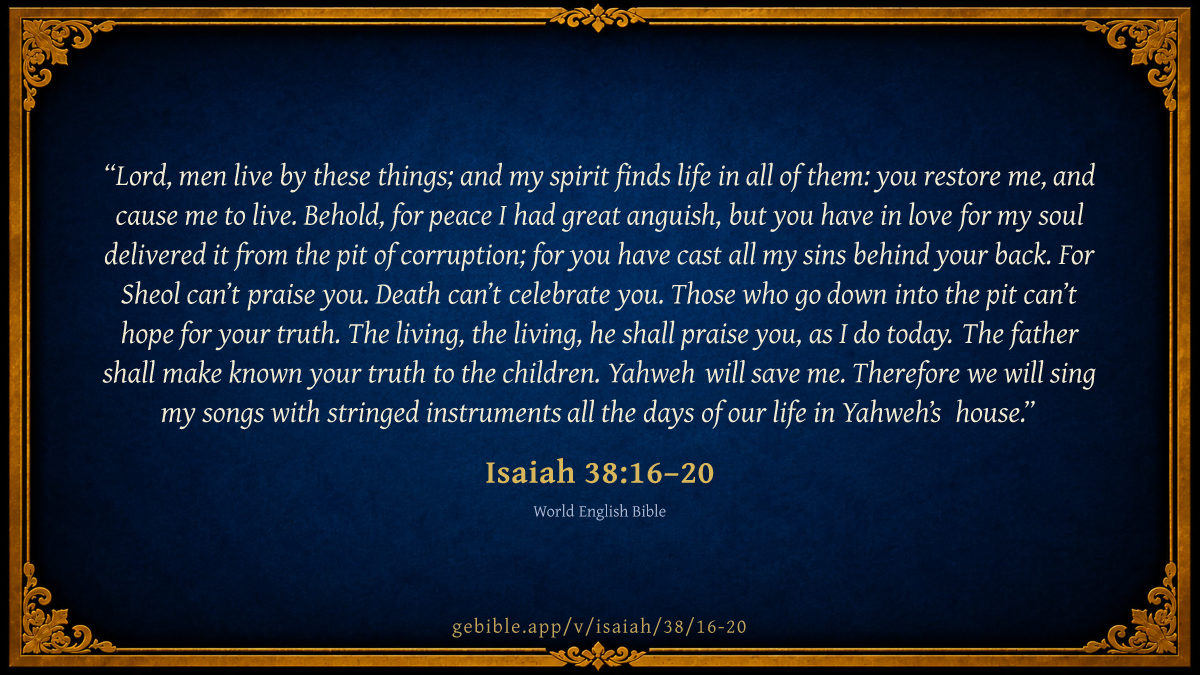
16Lord, men live by these things; and my spirit finds life in all of them: you restore me, and cause me to live.
17Behold, for peace I had great anguish, but you have in love for my soul delivered it from the pit of corruption; for you have cast all my sins behind your back.
18For Sheol can’t praise you. Death can’t celebrate you. Those who go down into the pit can’t hope for your truth.
19The living, the living, he shall praise you, as I do today. The father shall make known your truth to the children.
20Yahweh will save me. Therefore we will sing my songs with stringed instruments all the days of our life in Yahweh’s house.
16 Lord, men live by these things; and my spirit finds life in all of them: you restore me, and cause me to live.
17 Behold, for peace I had great anguish, but you have in love for my soul delivered it from the pit of corruption; for you have cast all my sins behind your back.
18 For Sheol can’t praise you. Death can’t celebrate you. Those who go down into the pit can’t hope for your truth.
19 The living, the living, he shall praise you, as I do today. The father shall make known your truth to the children.
20 Yahweh will save me. Therefore we will sing my songs with stringed instruments all the days of our life in Yahweh’s house.
KJVKing James Version
16 O Lord, by these things men live, and in all these things is the life of my spirit: so wilt thou recover me, and make me to live.
17 Behold, for peace I had great bitterness: but thou hast in love to my soul delivered it from the pit of corruption: for thou hast cast all my sins behind thy back.
18 For the grave cannot praise thee, death can not celebrate thee: they that go down into the pit cannot hope for thy truth.
19 The living, the living, he shall praise thee, as I do this day: the father to the children shall make known thy truth.
20 The LORD was ready to save me: therefore we will sing my songs to the stringed instruments all the days of our life in the house of the LORD.
Show all 3 translations
JPSJPS Tanakh (1917)
16 O Lord, by these things men live, and altogether therein is the life of my spirit; wherefore recover Thou me, and make me to live.
17 Behold, for my peace I had great bitterness; but Thou hast in love to my soul delivered it from the pit of corruption; for Thou hast cast all my sins behind Thy back.
18 For the nether-world cannot praise Thee, death cannot celebrate Thee; they that go down into the pit cannot hope for Thy truth.
19 The living, the living, he shall praise Thee, as I do this day; the father to the children shall make known Thy truth.
20 The LORD is ready to save me; therefore we will sing songs to the stringed instruments all the days of our life in the house of the LORD.
Questions where the Bible appears to say two different things, with the passages on each side set together.
Is death final?The Hebrew Bible's wisdom literature and older narrative strata treat death as terminal — the dead go to Sheol, lose consciousness, and do not return.
Does hell exist?The Bible offers four mutually incompatible afterlife schemes.
Isaiah 43:25(v17)I, even I, am he who blots out your transgressions for my own sake; and I will not remember your sins.
Deuteronomy 6:7(v19)and you shall teach them diligently to your children, and shall talk of them when you sit in your house, and when you walk by the way, and…
Ecclesiastes 9:10(vv18–19)Whatever your hand finds to do, do it with your might; for there is no work, nor plan, nor knowledge, nor wisdom, in Sheol, where you are…
Jonah 2:6(v17)I went down to the bottoms of the mountains. The earth barred me in forever: yet have you brought up my life from the pit, Yahweh my God.
Micah 7:18-19(v17)Who is a God like you, who pardons iniquity, and passes over the disobedience of the remnant of his heritage? He doesn’t retain his anger…
Show all 58 cross-references
Psalms 6:5(v18)For in death there is no memory of you. In Sheol, who shall give you thanks?
Psalms 30:9(v18)“What profit is there in my destruction, if I go down to the pit? Shall the dust praise you? Shall it declare your truth?
Psalms 30:3(v17)Yahweh, you have brought up my soul from Sheol. You have kept me alive, that I should not go down to the pit.
Jeremiah 31:34(v17)They will no longer each teach his neighbor, and every man teach his brother, saying, ‘Know Yahweh;’ for they will all know me, from their…
Psalms 86:13(v17)For your loving kindness is great toward me. You have delivered my soul from the lowest Sheol.
Psalms 119:175(v19)Let my soul live, that I may praise you. Let your ordinances help me.
Deuteronomy 4:9(v19)Only be careful, and keep your soul diligently, lest you forget the things which your eyes saw, and lest they depart from your heart all…
Job 3:25-26(v17)For the thing which I fear comes on me, That which I am afraid of comes to me. I am not at ease, neither am I quiet, neither have I rest;…
Psalms 30:6-7(v17)As for me, I said in my prosperity, “I shall never be moved.” You, Yahweh, when you favored me, made my mountain stand strong; but when you…
Psalms 40:2(v17)He brought me up also out of a horrible pit, out of the miry clay. He set my feet on a rock, and gave me a firm place to stand.
Psalms 78:3-6(v19)Which we have heard and known, and our fathers have told us. We will not hide them from their children, telling to the generation to come…
Psalms 85:2(v17)You have forgiven the iniquity of your people. You have covered all their sin.
Psalms 88:10-11(v18)Do you show wonders to the dead? Do the departed spirits rise up and praise you? Is your loving kindness declared in the grave? Or your…
Psalms 115:17-18(v18)The dead don’t praise Yah, neither any who go down into silence; but we will bless Yah, from this time forward and forever more. Praise Yah!
Genesis 18:19(v19)For I have known him, to the end that he may command his children and his household after him, that they may keep the way of Yahweh, to do…
Exodus 12:26-27(v19)It will happen, when your children ask you, ‘What do you mean by this service?’ that you shall say, ‘It is the sacrifice of Yahweh’s…
Exodus 13:14-15(v19)It shall be, when your son asks you in time to come, saying, ‘What is this?’ that you shall tell him, ‘By strength of hand Yahweh brought…
Deuteronomy 11:19(v19)You shall teach them to your children, talking of them when you sit in your house, when you walk by the way, when you lie down, and when…
Joshua 4:21-22(v19)He spoke to the children of Israel, saying, “When your children ask their fathers in time to come, saying, ‘What do these stones mean?’…
Job 29:18(v17)Then I said, ‘I will die in my own house, I will count my days as the sand.
Psalms 10:2(v17)In arrogance, the wicked hunt down the weak. They are caught in the schemes that they devise.
Psalms 88:4-6(v17)I am counted among those who go down into the pit. I am like a man who has no help, set apart among the dead, like the slain who lie in the…
Psalms 116:2(v20)Because he has turned his ear to me, therefore I will call on him as long as I live.
Psalms 118:17(v19)I will not die, but live, and declare Yah’s works.
Psalms 145:4(v19)One generation will commend your works to another, and will declare your mighty acts.
Psalms 146:2(v19)While I live, I will praise Yahweh. I will sing praises to my God as long as I exist.
Joel 1:3(v19)Tell your children about it, and have your children tell their children, and their children, another generation.
Numbers 16:33(v18)So they, and all that belonged to them went down alive into Sheol. The earth closed on them, and they perished from among the assembly.
Psalms 119:25(v16)My soul is laid low in the dust. Revive me according to your word!
Psalms 145:2(v20)Every day I will praise you. I will extol your name forever and ever.
Psalms 150:4(v20)Praise him with tambourine and dancing! Praise him with stringed instruments and flute!
Matthew 4:4(v16)But he answered, “It is written, ‘Man shall not live by bread alone, but by every word that proceeds out of God’s mouth.’ ”
1 Corinthians 11:32(v16)But when we are judged, we are punished by the Lord, that we may not be condemned with the world.
Hebrews 12:10-11(v16)For they indeed, for a few days, punished us as seemed good to them; but he for our profit, that we may be partakers of his holiness. All…
Deuteronomy 8:3(v16)He humbled you, allowed you to be hungry, and fed you with manna, which you didn’t know, neither did your fathers know, that he might teach…
Job 33:19-28(v16)He is chastened also with pain on his bed, with continual strife in his bones, so that his life abhors bread, and his soul dainty food. His…
Psalms 9:13-14(v20)Have mercy on me, Yahweh. See my affliction by those who hate me, and lift me up from the gates of death, that I may show all of your…
Psalms 27:5-6(v20)For in the day of trouble, he will keep me secretly in his pavilion. In the secret place of his tabernacle, he will hide me. He will lift…
Psalms 30:11-12(v20)You have turned my mourning into dancing for me. You have removed my sackcloth, and clothed me with gladness, to the end that my heart may…
Psalms 33:2(v20)Give thanks to Yahweh with the lyre. Sing praises to him with the harp of ten strings.
Psalms 51:15(v20)Lord, open my lips. My mouth will declare your praise.
Psalms 66:13-15(v20)I will come into your temple with burnt offerings. I will pay my vows to you, which my lips promised, and my mouth spoke, when I was in…
Psalms 68:25(v20)The singers went before, the minstrels followed after, among the ladies playing with tambourines,
Psalms 116:17-19(v20)I will offer to you the sacrifice of thanksgiving, and will call on Yahweh’s name. I will pay my vows to Yahweh, yes, in the presence of…
Proverbs 14:32(v18)The wicked is brought down in his calamity, but in death, the righteous has a refuge.
Isaiah 64:5(v16)You meet him who rejoices and does righteousness, those who remember you in your ways. Behold, you were angry, and we sinned. We have been…
Habakkuk 3:19(v20)Yahweh, the Lord, is my strength. He makes my feet like deer’s feet, and enables me to go in high places. For the music director, on my…
Matthew 8:12(v18)but the children of the Kingdom will be thrown out into the outer darkness. There will be weeping and gnashing of teeth.”
Matthew 25:46(v18)These will go away into eternal punishment, but the righteous into eternal life.”
Luke 16:26-31(v18)Besides all this, between us and you there is a great gulf fixed, that those who want to pass from here to you are not able, and that no…
John 9:4(v19)I must work the works of him who sent me while it is day. The night is coming, when no one can work.
Psalms 71:20(v16)You, who have shown us many and bitter troubles, you will let me live. You will bring us up again from the depths of the earth.
2 Corinthians 4:17(v16)For our light affliction, which is for the moment, works for us more and more exceedingly an eternal weight of glory,
58 distinct cross-references across this passage (59 total citations).
Cross-references from openbible.info (CC BY 4.0)
Explain this passage (18 sources)
Historical commentary, presented as a primary source — not an endorsement.
Geneva Bible translators1599 · Public DomainOn vv16–20They that shall overlive the men that are now…
They that shall overlive the men that are now alive, and all they that are in these years shall acknowledge this benefit.
That after that thou hadst condemned me to death thou restoredst me to life.
Geneva Bible (1599) marginal notes — public domain.
John Trapp1656 · Public DomainOn vv16–20Isa 38:16 O Lord, by these [things men] live,…
Isa 38:16 O Lord, by these [things men] live, and in all these [things is] the life of my spirit: so wilt thou recover me, and make me to live.
Ver. 16. O Lord, by these things men live.] By thy promises so performed "the just do live by faith," and live long in a little while; for life consisteth in action, and some live more in a day than others do in a year. An elephant liveth two hundred years, saith Aristotle; three hundred and fifty, saith Philostratus; and yet man, though of much shorter a continuance, is not inferior to an elephant. For this is not the best thing in nature, saith Scaliger, to live longest, but to live to best purpose. Now, man’s life is a way to life eternal. Other creatures have what they live for: not so man, while here.
Read full note →
And in all these things is the life of my spirit.] The godly esteem of life by that stirring they find in their souls; else they lament as over a dead soul.
So wilt thou recover me.] Or, Hast thou recovered me?
John Trapp, A Commentary or Exposition upon All the Books of the Old and New Testament (1647–1656) — public domain. Text from a community e-Sword module.
Matthew Poole1685 · Public DomainOn vv16–20By these things; by virtue of thy gracious word…
By these things; by virtue of thy gracious word or promise, and powerful work; by thy promises, and thy performances of them, mentioned in the foregoing verse. This place may be explained by comparing it with Deu 8:3, Man doth not live by bread, but by every word that proceedeth out of the mouth of the Lord. The sense is, Not I only, but all men, do receive and recover, and hold their lives by thy favour, and the word of thy power; and therefore it is not strange that one word of God hath brought me back from the very jaws of death.
In all these things is the life of my spirit; and as it is with other men, so hath it been with me in a special manner; for in these above all other things is the life of my spirit or soul, i.e. either the comfort (which is sometimes called life) of my spirit; or rather, that life which is in my body, from my spirit or soul united to it.
Read full note →
So wilt thou recover me, and make me to live; or, and or for thou hast recovered me, &c., to wit, by these things.
Matthew Poole's English Annotations on the Holy Bible (1683–1685) — public domain. Text from a community e-Sword/MySword module.
John Gill1763 · Public DomainOn vv16–20Behold, for peace I had great bitterness,.... Meaning not…
Behold, for peace I had great bitterness,.... Meaning not that instead of peace and prosperity, which he expected would ensue upon the destruction of Sennacherib's army, came a bitter affliction upon him; for he is not now dwelling on that melancholy subject; but rather the sense is, that he now enjoyed great peace and happiness, though he had been in great bitterness; for the words may be rendered, "behold, I am in peace, I had great bitterness"; or thus, "behold my great bitterness is unto peace": or, "he has turned it into peace" (u); it has issued in it, and this is my present comfortable situation: "but", or rather,
and thou hast in love to my soul delivered it from the pit of corruption: the grave, where bodies rot and corrupt, and are quite abolished, as the word signifies; see Psa 30:3 or "thou hast embraced my soul from the pit of corruption (w)"; it seems to be an allusion to a tender parent, seeing his child sinking in a pit, runs with open arms to him, and embraces him, and takes him out. This may be applied to a state of nature, out of which the Lord in love delivers his people; which is signified by a pit, or dark dungeon, a lonely place, a filthy one, very uncomfortable, where they are starving and famishing; a pit, wherein is no water, Zac 9:11 and may fitly be called a pit of corruption, because of their corrupt nature, estate, and actions; out of this the Lord brings his people at conversion, and that because of his great love to their souls, and his delight in them; or it may be applied to their deliverance from the bottomless pit of destruction, which is owing to the Lord's being gracious to them, and having found a ransom for them, his own Son, Job 33:24, and to this sense the Septuagint, Vulgate Latin, and Arabic versions seem to incline; "for thou hast delivered my soul that it might not perish": in love to their souls, and that they may not perish, he binds them up in the bundle of life, with the Lord their God; he redeems their souls from sin, Satan, and the law; he regenerates, renews, and converts them, and preserves them safe to his everlasting kingdom and glory; in order to which, and to prevent their going down to the pit, they are put into the hands of Christ, redeemed by his precious blood, and are turned out of the broad road that leads to destruction:
Read full note →
for thou hast cast all my sins behind thy back; as loathsome and abominable, and so as not to be seen by him; for though God sees all the sins of his people with his eye of omniscience, and in his providence takes notice of them, and chastises for them, yet not with his eye of avenging justice; because Christ has took them on himself, and made satisfaction for them, and an end of them; they are removed from them as far as the east is from the west, and no more to be seen upon them; nor will they be any more set before his face, or in the light of his countenance; but as they are out of sight they will be out of mind, never more remembered, but forgotten; as what is cast behind the back is seen and remembered no more. The phrase is expressive of the full forgiveness of sins, even of all sins; see Psa 85:2, the object of God's love is the souls of his people; the instance of it is the delivery of them from the pit of corruption; the evidence of it is the pardon of their sins.
(u) Abendana, after Joseph Kimchi, interprets it of changing bitterness into peace; he observes in the phrase that the first signifies change or permutation as in Jer. xlvlii. 11. and the second bitterness: and that the sense is this, behold, unto peace he hath changed my bitterness, that is the bitterness and distress which I had, he hath changed into peace. (w) "et tu amplexus es amore animam meam a fovea abolitionis"; Montanus; "tu vero propenso amore complexus es animam meam", Piscator; "tu tenero amore complexus animam meam", Vitringa.
John Gill's Exposition of the Whole Bible (1746–1763) — public domain (CC PDM 1.0). Text via the HelloAO Bible API.
John Wesley1765 · Public DomainOn vv16, 18, 20By these - By thy promises, and thy performance…
By these - By thy promises, and thy performance of them; therefore it is not strange, that one word of God hath brought me back from the jaws of death.
John Wesley, Explanatory Notes Upon the Whole Bible (1754–1765) — public domain. Text via the GEBible commentary corpus.
Adam Clarke1810 · Public DomainOn vv16, 17, 19Verse 16. By these things men live - "For…
Verse 16. By these things men live - "For this cause shall it be declared"] Περι αυτης γαρ ανηγγελη σοι, και εξηγειρας μου την πνοην, Sept. They read in their copies עליה יחוו לך ותחיי רוחי not very different from the present text, from which all the ancient Versions vary. They entirely omit two words, ולכל בהן ulecol bahen; as to which there is some variation in the MSS. One MS. has ובכל ubechol, and in all; two others וכל vechol, and all, and ten MSS. have בהם bahem, in them, in the masculine gender.
Taking this as in the common Version, we may observe, it is not an unfrequent case, that afflictions, and especially such as tend to a speedy death, become the means, not only of saving the soul, but also of lengthening the life.
Read full note →
Make me to live - "Hast prolonged my life."] A MSS. and the Babylonish Talmud read ותחיני vetachayeni, and so the ancient Versions. It must necessarily be in the second person.
Adam Clarke's Commentary on the Bible (1810–1826) — public domain. Text from a community e-Sword/MySword module.
Joseph Benson1811 · Public DomainOn vv16–18Isa 38:16. By these things men live — By…
Isa 38:16. By these things men live — By virtue of thy gracious word, or promise, and powerful work; or, by thy promises, and thy performance of them: and therefore it is not strange that one word of God hath brought me back from the jaws of death. And in all these things is the life of my spirit — As all men’s lives are thy gift, so I shall always acknowledge the preservation of mine to be owing to thy goodness in promising, and thy faithfulness in fulfilling thy promise. So wilt thou recover me, &c. — Or, for thou hast recovered me. Thou hast restored my health and prolonged my life. — Bishop Lowth.
Joseph Benson's Commentary on the Old and New Testaments (1811–1818) — public domain. Text from a community e-Sword module.
Albert Barnes1834 · Public DomainOn vv16–20O Lord, by these things men live - The…
O Lord, by these things men live - The design of this and the following verses is evidently to set forth the goodness of God, and to celebrate his praise for what he had done. The phrase ‘these things,’ refers evidently to the promises of God and their fulfillment; and the idea is, that people are sustained in the land of the living only by such gracious interpositions as he had experienced. It was not because people had any power of preserving their own lives, but because God interposed in time of trouble, and restored to health when there was no human prospect that they could recover.
And in all these things - In these promises, and in the divine interposition.
Read full note →
Is the life of my spirit - I am alive in virtue only of these things.
So wilt thou recover me - Or so hast thou recovered me; that is, thou hast restored me to health.
Albert Barnes' Notes on the Bible (1834–1885) — public domain. Text from a community e-Sword/MySword module.
Haydock's Catholic Bible Commentary1859 · Public DomainOn v18Truth. He speaks only of the body.
Truth. He speaks only of the body.
George Leo Haydock (1774–1849), Haydock's Catholic Family Bible and Commentary, 1859 edition — public domain. Excludes Psalms (Douay-Rheims chapter numbering differs from Protestant) and Deuterocanonical books (Catholic canon only).
Robert Jamieson, A. R. Fausset & David Brown1871 · Public DomainOn vv16–20by these--namely, by God's benefits, which are implied in…
by these--namely, by God's benefits, which are implied in the context (Isa 38:15, "He hath Himself done it" "unto me"). All "men live by these" benefits (Psa 104:27-30), "and in all these is the life of my spirit," that is, I also live by them (Deu 8:3).
and (wilt) make me to live--The Hebrew is imperative, "make me to live." In this view he adds a prayer to the confident hope founded on his comparative convalescence, which he expressed, "Thou wilt recover me" [MAURER].
Jamieson, Fausset & Brown — Commentary Critical and Explanatory on the Whole Bible (1871) — public domain (CC PDM 1.0). Text via the HelloAO Bible API.
Daniel D. Whedon1874 · Public DomainOn vv16–2016. By these… men live — God’s virtual promise…
16. By these… men live — God’s virtual promise in the preceding verse is referred to. In consequence of this, “men live,” and in them shall my life be. Thou hast ordained to recover me, and cause me still to live.
Daniel D. Whedon (gen. ed.), Commentary on the Old and New Testaments (1874–1909) — public domain. Text from a community e-Sword module.
The Cambridge Bible for Schools and Colleges1878 · Public DomainOn vv16–2016. The thought expressed by E.V. is somewhat as…
16. The thought expressed by E.V. is somewhat as follows: “By such Divine words and deeds (Isa_38:15) men are preserved in life; and by such things my spirit is revived.” No one will say that this is either good Hebrew or a natural sense; and the text is almost certainly corrupt. The verb “live” closely resembles an Aramaic verb (ḥivvâh occurring several times in the O.T.) meaning “to declare”; and this was evidently read by LXX.: περὶ αὐτῆς γὰρ ἀνηγγέλη σοι. Starting with this, Duhm makes the verse read:
“Lord, of this doth my heart make mention to Thee,
Read full note →
Give rest to my spirit and recover me, &c.”
His emendations however are somewhat sweeping.
so wilt thou … live] The first verb is impf. (fut.), the second imperat. recover me is literally “give me health.”
The Cambridge Bible for Schools and Colleges (gen. ed. J. J. S. Perowne; Cambridge University Press, 1878–1918) — public domain. Text from a community e-Sword module.
Ellicott's Commentary for English Readers1878 · Public DomainOn vv16–20(16) By these things . . .—i.e., by the…
(16) By these things . . .—i.e., by the word of God and the performance which fulfils it. For “in all these things,” read wholly through them. The words remind us of Deu_8:3, “Man doth not live by bread alone . . .”
A Bible Commentary for English Readers, edited by Charles John Ellicott (1878–1897) — public domain. Text from a community e-Sword module.
The Pulpit Commentary1880 · Public DomainOn vv16–20By these things; i.e. "the things which thou speakest…
By these things; i.e. "the things which thou speakest and doest" (ver. 15). Man does not "live by bread alone, but by every word that proceedeth out of the mouth of the Lord". (Deu_8:3) And in all these things. This rendering is against the laws of grammar. Translate, and wholly in them.
The life of our life.
Read full note →
This verse is pregnant with suggestive truth, and finds fulfilment in Christian as well as in Jewish experience.
I THAT THE LIFE OF OUR SPIRIT IS THE VERY LIFE OF OURSELVES. It is no uncommon thing for ungodly men, when they are pressed to give attention to the claims of their spirit, to excuse their negligence by contending that "they must live." By this they mean that the necessities of the body will excuse their want of concern for the state of their spirit. On what a hollow and vain assumption do these thus build! "As if to breathe were life!" As if to eat, and drink, and sleep, and clothe the body and minister to its cravings constituted the life of man! No; "man does not live by bread alone," and, when he has supplied himself with abundance of such things, he has not begun to live. The life of man is in the life of his spirit; it is that life in which he
(1) apprehends and appreciates Divine truth;
(2) approaches unto and communes wish the Divine Father;
(3) engages voluntarily and happily in his holy service;
(4) grows into his likeness as he manifests his spirit and illustrates his principles;
(5) serves the creatures he has made and the children he has fashioned in his own image. By these things, and in such things as these, does the life of his life consist.
II THAT DIVINE ACTS AND WORDS ARE THE SUSTENANCE OF OUR SPIRIT"S LIFE. "These things" refer primarily to the promise and the providential agency of God (see ver. 15); the Divine word and deed. For us, we find this in:
1. The truth spoken by Jesus Christ. All that he has told us concerning God, ourselves, human life, the way back to the heavenly Father and the heavenly home.
2. The life and death of the Saviour. His life devout, courageous, generous, sympathetic; his sorrows borne in patience and resignation; his death undergone for us. "In all these things," in their apprehension, in their study, in their appropriation, is the life of our spirit. C.
The Pulpit Commentary (1880–1919), ed. H.D.M. Spence-Jones & Joseph S. Exell — public domain. Text from a community e-Sword module.
The Biblical Illustrator1887 · Public DomainOn vv16–19O Lord, by these things men live
Isa_38:16
O Lord, by these things men live
Read full note →
Affliction as related to life
The conception and quality of life as affected by the discipline of any form of trial--that is the topic.
I. Take THE CONCEPTION OF LIFE AS A WHOLE, and see how that is modified or altered by experiences like those through which Hezekiah passed. They who have had no such critical experience in any form have never fully awakened to the difference which there is between mere existence and life. In sleep there is as real existence as when we are awake; but what a paltry thing life would be if it were to be a constant sleep! Yet there are those among us in whom, though their time may be busily occupied, and though their intellects may be keen and vigilant, the spirit slumbers. They are like the landowner on whose estate there is an undiscovered silver mine, who is no richer for his hidden wealth, and who cannot be said even to possess it. Nothing has come to reveal them to themselves, or to give them any vivid sense of the existence of God and their relationship to Him. Nothing has opened their eyes to the possibilities of life that are yet undeveloped in them. One day has been to them like another; and the unbroken monotony of their experience has fostered in them the expectation that things will always continue with them as they have always been. Thus they verify the psalmists words, Because they have no changes, therefore they fear not God. But when something like that which came to Hezekiah comes to them, then there is a thorough, if also a rude, awakening, and they discover that they have yet to begin to live. One may easily see this exemplified in the votary of pleasure. Or take the case of him whose object in existence has been the accumulation of wealth.
II. Passing to THE QUALITY OF THE LIFE, we may see how that also is affected by such experiences of affliction. Here many features of character are evoked or developed by trial.
1. There is the element of strength, whether in its passive exercise as patient endurance, or in its active manifestation as persevering energy. The poet has caught the truth when he bids his readers learn to suffer and be strong. He who has known no affliction is easily worn out. The old sailor, who has been all but shipwrecked, is not dismayed by a summer squall. It is the same with life as a whole. You will find the strongest characters always among those who have been most sorely afflicted. We ought, then, to be reconciled to the afflictions by which alone it can be developed.
2. We can see that experiences like this of Hezekiah have a great influence in producing unselfishness in a man. When a man has been in the grip of the last enemy, and has recovered; or has been within a little of losing all he had, and has escaped, you can understand how such an experience sends him out of himself. It intensifies for him the idea of life as a stewardship for God, and he sees the folly of making all the streams of his effort run into himself. Howards life of benevolence was the outcome of a critical illness; and of multitudes more than of him it can be said that they sloughed off their selfishness in the crucible of trial.
3. But it is only a broadening out of this remark when I affirm that sympathy is born out of such experiences as those of Hezekiah. He who would be a helper must first be a sufferer. He who would be a saviour must somewhere and somehow have been upon a cross.
4. Experiences like Hezekiahs have much to do with the usefulness of a mans life. Usefulness is not a thing which one can command at will. It is, in most cases, the result of a discipline; and is possessed by those who, in a large degree, are unconscious that they are exercising it. It depends fully more on what a man is than on what he does, or, if it is due to what he does or says, that again is owing very much to what he is, and what he is now has been determined by the history through which he has been brought. You see that in the case of a physician. His experience goes far more to the making of him than his college training has done. It is so, also, in spiritual things. The helpfulness of another to us in the prosecution of the Christian life is determined more by his personal experience than by his intellectual pre-eminence. Here is the secret of the difference between one man and another in the matter of pulpit power. I must add one word of caution. It is not every affliction that works out such results; and whether any trial will do so or not depends entirely on the spirit in which it is borne. (W. M. Taylor, D. D.)
Luthers life enriched by trial
Luther was wont to say that his three great teachers were prayer, study, and trial; and any reader of his life can perceive that if he had been required in the early part of his career to face some of the dangers which menaced him at a later date he would have faltered in his course. But through the minor experience he gained strength for the severer ordeal; and so it came about that what would have appalled him at the outset made almost as little impression on him at the last as the whistling of the idle wind that he regarded not. (W. M. Taylor, D. D.)
Sympathy engendered by trouble
Those of us who have lost little children feel a prompting within us to speak a word of comfort to every parent who is passing through a similar experience. Indeed, it was in connection with an affliction of that sort that my attention was first drawn to this text. I had just a few weeks before buried a beloved daughter, the light of the household, and had gone to attend a meeting of Synod where an honoured minister, who had been through the same trial oftener than once before, came up to me and took me by the hand, and said to me, with a reference to my sorrow, By these things men live. That was all, but each successive year since then has given a new verification of his words, for oh! how often in the interval have I been enabled to comfort others with the comfort with which I have been comforted of God, and the efficacy of the consolation lay largely in the fact that it was offered by one who had proved its value for himself. (W. M. Taylor, D. D.)
The life of the spirit
Whosoever is really alive, that is, has life in his spirit, the life of man and not a beast, the only life which is worthy to be called life, then that life is kept up in him in the same way that it was kept up in Hezekiah. Let us see, then, what things they were which gave Hezekiahs spirit life.
1. Great joy, great honour, great success, wealth, health, prosperity, and pleasure? Not so!
2. Trouble upon trouble came on Hezekiah.
3. Death looked to him an ugly and an evil thing--as it is; the Lords last enemy. He conquered death by rising from the dead: but nevertheless we die. Hezekiah lived before the Lord Jesus came to bring life and immortality to light by rising from the dead; and, therefore, he dreaded it, because he knew not what would come after death. He prayed hard not to die.
4. What was the use of his sickness and his terror if, after all, his prayer was heard, and after the Lord had told him, Thou shalt die, and not live--that did not come to pass; but the very contrary happened? Of this use,at least; it taught him that the Lord God would hear the prayers of mortal men. Is not that worth going through any misery to learn? Hezekiah did not pray rightly. He thought himself a better man than he was. But he did pray. And then he found that the Lord was ready to save him; that what the Lord wished was not to kill him but to make him live more really and fully and wisely and manfully.
5. What Hezekiah saw but dimly we ought to see clearly. For the Gospel tells us that the same Lord who chastened and taught and then saved Hezekiah, was made flesh, that He might in His own person bear all our sickness and carry our infirmities; that He might understand all our temptations and be touched with the feeling of our infirmities. He who made, He who lightens every man who comes into the world, He who gave you every right thought and wholesome feeling that you ever had in your lives--He counts your tears; He knows your sorrows; He is able and willing to save you to the uttermost. Therefore do not be afraid of your own afflictions. (C. Kingsley, M. A.)
Spoil from the fight with death
Hope and joy returned with restored health, and we see (Isa_38:16-20) what Hezekiah brought back with him from his fight with death
1. A new peace.
2. Forgiveness.
3. A new sense of the dignity of life, and of the encompassing eternal realities.
4. A joyful sense of Gods personal love for him. (E. W.Shalders, B. A.)
Physical benefit may accrue from sickness
Strange as it may appear, it is no less true that life is often lengthened and health invigorated by a sharp illness. Like a ship put in dock for repairs, an illness or an accident lays a man aside for a time out of the reach of work and worry, and the rest of mind and body restores the balance of his exhausted energies. Typhus fever successfully treated often clarifies the whole system, just as a chimney is cleansed by setting it on fire; and a severe illness often acts as a solemn warning, leading men to consider their ways and their work, and to diminish the strain which is overtaxing the system, or to give up some vicious habit of self-indulgence which is laying the axe to the root of the tree. (W. Johnston, D. D.)
The uses of affliction
The allusion of our text is not to the life of the body, but to that which is far more important, the life of the soul. In what manner does severe sickness or affliction of any kind conduce, by the blessing of God, to the creation and development of our spiritual life?
I. AFFLICTION TEACHES US OUR ENTIRE DEPENDENCE UPON GOD.
II. AFFLICTION DISROBES US OF SELF-RIGHTEOUSNESS. Hezekiah yielded to the insidious promptings of self-righteousness and self-glorification. Affliction was the disrobing process through which he was called upon to pass, the school in which he must learn his unworthiness as well as his weakness. And in this disrobing of all self-righteousness there was the life of his spirit.
III. AFFLICTION BRINGS US TO REALISE AND ENJOY THE FULNESS OF CHRIST. When Hezekiah was awakened to a sense of his want of righteousness before God, he expected to go softly in the bitterness of his soul all the years of his life. But the self-righteous idea of innocence and excellence is no longer the broken spear on which to lean and pierce his hand. The Sun of Righteousness has arisen with healing in His wings; bitterness and disquietude pass away together, and Hezekiah is made to see what he had never seen so clearly before--that in love to his soul, the Lord, his God in covenant, had afflicted his body, had thus delivered his soul from the pit of corruption, and had cast all his sins behind His back.
IV. SANCTIFIED AFFLICTION STIMULATES US IN CHRISTIAN WORK. Hezekiah learned on the bed of sickness that there are but twelve hours in the day, that the night cometh when no man can work, and that the brief period of life must be diligently and devoutly improved. And it is when laid upon the bed of severe sickness, with time in the past and eternity in the near future, that we shall realise in all its solemnity the importance and responsibility of life, and resolve, if spared like Hezekiah yet a little longer to recover strength before we go hence to be no more, that our chief end shall be to glorify God and enjoy Him for ever. (W. Johnston, D. D.)
The life of the spirit
Hezekiah was a rich and prosperous king. Surrounded by the dignities of rank, the refinements of elegance, and the gratifications of voluptuousness, he, doubtless, viewed these as the very end and delight of his being, and wished for nothing, knew of nothing better or beyond them. No; very different was his character; very different were the things of which he spake. These words were not uttered in the house of his armour, but in the chamber of his sickness; not at the festive table of his royal banquets, but upon the couch of lassitude and pain. Let us endeavour, by a few examples, to verify his pensive contemplation; and this, that we may learn so to number our days, that we may apply our hearts unto wisdom.
1. Take the case of a professed scoffer at religion. He is arrested, we will suppose, by the arm of Omnipotence, in his profligate course; he is thrown by a stronger hand than his own upon the couch of pain and dejection; he learns for the first time to tremble; we will suppose him humbled, converted. Sanctified affliction was the first step. This softened the stony ground: this prepared the heart for holy impressions. Will not such a one be ready to exclaim with Hezekiah, By these things men live, and by these is the life of the spirit?
2. Imagine a man careless and indifferent to religion, though not a hardened scoffer. He is too busy with the world to spend a thought upon his eternal safety. But God brings him low. In the silence and solitude of affliction he is forced to think. What cause will such a one have for ever to bless Him who wounds that He may heal, who kills that He may make alive!
3. Let us imagine an inconsistent backsliding Christian brought into deep affliction. He returns to Him whom he had forsaken.
4. Look at the Pharisee. God brings him within sight of death and eternity. He is unmasked to himself, and begins to exclaim, What must I do to be saved? What a blessing has affliction been to such a character!
5. The dejected Christian. How often has such a one had reason to exclaim of afflictions, that by these things men live! The season of weakness and distress is often that which God selects for the brightest manifestations of His love and tenderness. (Family Sermons.)
The restoration of belief
In the especial ease of Hezekiah, belief was restored by a great shock, which brought him into contact with reality. God appeared to him--not as to Adam, in the cool of the day, but as He came to Job, in the whirlwind and the eclipse--and Hezekiah knew that he had been living in a vain show. The answer of his soul was quick and sad: By these things men live, O Lord.
I. THE BLOW WHICH SOBERED HEZEKIAH WAS A COMMON ONE. It did nothing more than bring him face to face with death. The process whereby his dependence on God was restored was uncomplicated. But there are far worse shocks than this, and recovery from them into a Godlike life is long and dreadful. There are things which at first seem to annihilate belief, and change an indifferent or a happy nature into earnest, even savage bitterness. One of these is the advent of irrecoverable disease, protracted weakness, or protracted pain. God forgives our human anger then, but we speak roughly to Him at first. It is a dark anger, and may grow in intensity till faith and love are lost for this life; but it will not reach that point if we have some greatness of soul, if we are open to the touch of human love. One day the Gospel story in all its sweet simplicity attracts and softens the sufferers heart. He reads that Christs suffering in self-sacrifice brought redemption unto man. Surely, he seems to dream this is no isolated fact. I too, in my apparent uselessness, am at one with the Great Labourer: I bear with Christ my cross for men. This is not only the restoration of belief, it is the victory of life.
II. BUT THERE ARE MORE DREADFUL THINGS THAN LONG DISEASE. There is that shipwreck which comes of dishonoured love. Many things are terrible, but none is worse than this. In some there is no remedy but death, and far beyond the immanent tenderness of God. But there are many who recover, whom God leads oat of the desert into the still garden of an evening life of peace and usefulness and even joy. Lapse of time does part of the work. In the quietude of middle life we look back upon our early misery, and only remember the love we felt. Faith is restored, hope is renewed, when, like Christ, you can turn and say, Father, forgive him, forgive her, for they knew not what they did.
III. There have been and are many of us who are conscious that, as we have passed into the later period of life and mingled with the world, OUR EARLY FAITH HAS ALSO PASSED AWAY. We have lost belief because our past religion was borrowed too much from others. If we wish for perfection, and are not content to die and love no more, the restoration of belief may be attained by the personal labour of the soul. It is worth trying what one personal effort to bring ourselves into the relation of a child to a father, in all the naturalness and simplicity of that relation, will do towards restoring faith and renewing life with tenderness. (S. A. Brooke, D. D.)
The Biblical Illustrator, edited by Joseph S. Exell (c. 1880s–1900s) — public domain. Text from a community e-Sword module.
C. I. Scofield1917 · Public DomainOn v18grave Heb. "Sheol," (See Scofield "Hab 2:5")
grave Heb. "Sheol," (See Scofield "Hab 2:5")
death (See Scofield "Ecc 9:10")
The Scofield Reference Bible (1917 edition), notes by C. I. Scofield — public domain. Text from a community e-Sword module.
unfoldingWord translationNotes2017 · CC BY-SA 4.0On vv16, 18, 20General Information:
General Information:
Hezekiah continues his written prayer.
Read full note →
may my life be given back to me
This can be stated in active form. AT: "may you give my life back to me" (See: Active or Passive)
from the pit of destruction
Hezekiah did not die but he was close to dying. This refers Yahweh saving him from dying. The full meaning of this statement can be made clear. AT: "from dying and going to the pit of destruction" or "so that I did not die" (See: Assumed Knowledge and Implicit Information)
for you have thrown all my sins behind your back
Hezekiah speaks of Yahweh forgiving his sins as if they were objects that Yahweh threw behind himself and forgot about. AT: "for you have forgiven all my sins and no longer think about them" (See: Metaphor)

Geneva Bible translators 1599 · Public Domain On vv16–20 They that shall overlive the men that are now…
They that shall overlive the men that are now alive, and all they that are in these years shall acknowledge this benefit.
That after that thou hadst condemned me to death thou restoredst me to life.
Geneva Bible (1599) marginal notes — public domain.
John Trapp 1656 · Public Domain On vv16–20 Isa 38:16 O Lord, by these [things men] live,…
Isa 38:16 O Lord, by these [things men] live, and in all these [things is] the life of my spirit: so wilt thou recover me, and make me to live.
Ver. 16. O Lord, by these things men live.] By thy promises so performed "the just do live by faith," and live long in a little while; for life consisteth in action, and some live more in a day than others do in a year. An elephant liveth two hundred years, saith Aristotle; three hundred and fifty, saith Philostratus; and yet man, though of much shorter a continuance, is not inferior to an elephant. For this is not the best thing in nature, saith Scaliger, to live longest, but to live to best purpose. Now, man’s life is a way to life eternal. Other creatures have what they live for: not so man, while here.
Read full note →
And in all these things is the life of my spirit.] The godly esteem of life by that stirring they find in their souls; else they lament as over a dead soul.
So wilt thou recover me.] Or, Hast thou recovered me?
John Trapp, A Commentary or Exposition upon All the Books of the Old and New Testament (1647–1656) — public domain. Text from a community e-Sword module.
Matthew Poole 1685 · Public Domain On vv16–20 By these things; by virtue of thy gracious word…
By these things; by virtue of thy gracious word or promise, and powerful work; by thy promises, and thy performances of them, mentioned in the foregoing verse. This place may be explained by comparing it with Deu 8:3, Man doth not live by bread, but by every word that proceedeth out of the mouth of the Lord. The sense is, Not I only, but all men, do receive and recover, and hold their lives by thy favour, and the word of thy power; and therefore it is not strange that one word of God hath brought me back from the very jaws of death.
In all these things is the life of my spirit; and as it is with other men, so hath it been with me in a special manner; for in these above all other things is the life of my spirit or soul, i.e. either the comfort (which is sometimes called life) of my spirit; or rather, that life which is in my body, from my spirit or soul united to it.
Read full note →
So wilt thou recover me, and make me to live; or, and or for thou hast recovered me, &c., to wit, by these things.
Matthew Poole's English Annotations on the Holy Bible (1683–1685) — public domain. Text from a community e-Sword/MySword module.
John Gill 1763 · Public Domain On vv16–20 Behold, for peace I had great bitterness,.... Meaning not…
Behold, for peace I had great bitterness,.... Meaning not that instead of peace and prosperity, which he expected would ensue upon the destruction of Sennacherib's army, came a bitter affliction upon him; for he is not now dwelling on that melancholy subject; but rather the sense is, that he now enjoyed great peace and happiness, though he had been in great bitterness; for the words may be rendered, "behold, I am in peace, I had great bitterness"; or thus, "behold my great bitterness is unto peace": or, "he has turned it into peace" (u); it has issued in it, and this is my present comfortable situation: "but", or rather,
and thou hast in love to my soul delivered it from the pit of corruption: the grave, where bodies rot and corrupt, and are quite abolished, as the word signifies; see Psa 30:3 or "thou hast embraced my soul from the pit of corruption (w)"; it seems to be an allusion to a tender parent, seeing his child sinking in a pit, runs with open arms to him, and embraces him, and takes him out. This may be applied to a state of nature, out of which the Lord in love delivers his people; which is signified by a pit, or dark dungeon, a lonely place, a filthy one, very uncomfortable, where they are starving and famishing; a pit, wherein is no water, Zac 9:11 and may fitly be called a pit of corruption, because of their corrupt nature, estate, and actions; out of this the Lord brings his people at conversion, and that because of his great love to their souls, and his delight in them; or it may be applied to their deliverance from the bottomless pit of destruction, which is owing to the Lord's being gracious to them, and having found a ransom for them, his own Son, Job 33:24, and to this sense the Septuagint, Vulgate Latin, and Arabic versions seem to incline; "for thou hast delivered my soul that it might not perish": in love to their souls, and that they may not perish, he binds them up in the bundle of life, with the Lord their God; he redeems their souls from sin, Satan, and the law; he regenerates, renews, and converts them, and preserves them safe to his everlasting kingdom and glory; in order to which, and to prevent their going down to the pit, they are put into the hands of Christ, redeemed by his precious blood, and are turned out of the broad road that leads to destruction:
Read full note →
for thou hast cast all my sins behind thy back; as loathsome and abominable, and so as not to be seen by him; for though God sees all the sins of his people with his eye of omniscience, and in his providence takes notice of them, and chastises for them, yet not with his eye of avenging justice; because Christ has took them on himself, and made satisfaction for them, and an end of them; they are removed from them as far as the east is from the west, and no more to be seen upon them; nor will they be any more set before his face, or in the light of his countenance; but as they are out of sight they will be out of mind, never more remembered, but forgotten; as what is cast behind the back is seen and remembered no more. The phrase is expressive of the full forgiveness of sins, even of all sins; see Psa 85:2, the object of God's love is the souls of his people; the instance of it is the delivery of them from the pit of corruption; the evidence of it is the pardon of their sins.
(u) Abendana, after Joseph Kimchi, interprets it of changing bitterness into peace; he observes in the phrase that the first signifies change or permutation as in Jer. xlvlii. 11. and the second bitterness: and that the sense is this, behold, unto peace he hath changed my bitterness, that is the bitterness and distress which I had, he hath changed into peace. (w) "et tu amplexus es amore animam meam a fovea abolitionis"; Montanus; "tu vero propenso amore complexus es animam meam", Piscator; "tu tenero amore complexus animam meam", Vitringa.
John Gill's Exposition of the Whole Bible (1746–1763) — public domain (CC PDM 1.0). Text via the HelloAO Bible API.
John Wesley 1765 · Public Domain On vv16, 18, 20 By these - By thy promises, and thy performance…
By these - By thy promises, and thy performance of them; therefore it is not strange, that one word of God hath brought me back from the jaws of death.
John Wesley, Explanatory Notes Upon the Whole Bible (1754–1765) — public domain. Text via the GEBible commentary corpus.
Adam Clarke 1810 · Public Domain On vv16, 17, 19 Verse 16. By these things men live - "For…
Verse 16. By these things men live - "For this cause shall it be declared"] Περι αυτης γαρ ανηγγελη σοι, και εξηγειρας μου την πνοην, Sept. They read in their copies עליה יחוו לך ותחיי רוחי not very different from the present text, from which all the ancient Versions vary. They entirely omit two words, ולכל בהן ulecol bahen; as to which there is some variation in the MSS. One MS. has ובכל ubechol, and in all; two others וכל vechol, and all, and ten MSS. have בהם bahem, in them, in the masculine gender.
Taking this as in the common Version, we may observe, it is not an unfrequent case, that afflictions, and especially such as tend to a speedy death, become the means, not only of saving the soul, but also of lengthening the life.
Read full note →
Make me to live - "Hast prolonged my life."] A MSS. and the Babylonish Talmud read ותחיני vetachayeni, and so the ancient Versions. It must necessarily be in the second person.
Adam Clarke's Commentary on the Bible (1810–1826) — public domain. Text from a community e-Sword/MySword module.
Joseph Benson 1811 · Public Domain On vv16–18 Isa 38:16. By these things men live — By…
Isa 38:16. By these things men live — By virtue of thy gracious word, or promise, and powerful work; or, by thy promises, and thy performance of them: and therefore it is not strange that one word of God hath brought me back from the jaws of death. And in all these things is the life of my spirit — As all men’s lives are thy gift, so I shall always acknowledge the preservation of mine to be owing to thy goodness in promising, and thy faithfulness in fulfilling thy promise. So wilt thou recover me, &c. — Or, for thou hast recovered me. Thou hast restored my health and prolonged my life. — Bishop Lowth.
Joseph Benson's Commentary on the Old and New Testaments (1811–1818) — public domain. Text from a community e-Sword module.
Albert Barnes 1834 · Public Domain On vv16–20 O Lord, by these things men live - The…
O Lord, by these things men live - The design of this and the following verses is evidently to set forth the goodness of God, and to celebrate his praise for what he had done. The phrase ‘these things,’ refers evidently to the promises of God and their fulfillment; and the idea is, that people are sustained in the land of the living only by such gracious interpositions as he had experienced. It was not because people had any power of preserving their own lives, but because God interposed in time of trouble, and restored to health when there was no human prospect that they could recover.
And in all these things - In these promises, and in the divine interposition.
Read full note →
Is the life of my spirit - I am alive in virtue only of these things.
So wilt thou recover me - Or so hast thou recovered me; that is, thou hast restored me to health.
Albert Barnes' Notes on the Bible (1834–1885) — public domain. Text from a community e-Sword/MySword module.
Haydock's Catholic Bible Commentary 1859 · Public Domain On v18 Truth. He speaks only of the body.
Truth. He speaks only of the body.
George Leo Haydock (1774–1849), Haydock's Catholic Family Bible and Commentary, 1859 edition — public domain. Excludes Psalms (Douay-Rheims chapter numbering differs from Protestant) and Deuterocanonical books (Catholic canon only).
Robert Jamieson, A. R. Fausset & David Brown 1871 · Public Domain On vv16–20 by these--namely, by God's benefits, which are implied in…
by these--namely, by God's benefits, which are implied in the context (Isa 38:15, "He hath Himself done it" "unto me"). All "men live by these" benefits (Psa 104:27-30), "and in all these is the life of my spirit," that is, I also live by them (Deu 8:3).
and (wilt) make me to live--The Hebrew is imperative, "make me to live." In this view he adds a prayer to the confident hope founded on his comparative convalescence, which he expressed, "Thou wilt recover me" [MAURER].
Jamieson, Fausset & Brown — Commentary Critical and Explanatory on the Whole Bible (1871) — public domain (CC PDM 1.0). Text via the HelloAO Bible API.
Daniel D. Whedon 1874 · Public Domain On vv16–20 16. By these… men live — God’s virtual promise…
16. By these… men live — God’s virtual promise in the preceding verse is referred to. In consequence of this, “men live,” and in them shall my life be. Thou hast ordained to recover me, and cause me still to live.
Daniel D. Whedon (gen. ed.), Commentary on the Old and New Testaments (1874–1909) — public domain. Text from a community e-Sword module.
The Cambridge Bible for Schools and Colleges 1878 · Public Domain On vv16–20 16. The thought expressed by E.V. is somewhat as…
16. The thought expressed by E.V. is somewhat as follows: “By such Divine words and deeds (Isa_38:15) men are preserved in life; and by such things my spirit is revived.” No one will say that this is either good Hebrew or a natural sense; and the text is almost certainly corrupt. The verb “live” closely resembles an Aramaic verb (ḥivvâh occurring several times in the O.T.) meaning “to declare”; and this was evidently read by LXX.: περὶ αὐτῆς γὰρ ἀνηγγέλη σοι. Starting with this, Duhm makes the verse read:
“Lord, of this doth my heart make mention to Thee,
Read full note →
Give rest to my spirit and recover me, &c.”
His emendations however are somewhat sweeping.
so wilt thou … live] The first verb is impf. (fut.), the second imperat. recover me is literally “give me health.”
The Cambridge Bible for Schools and Colleges (gen. ed. J. J. S. Perowne; Cambridge University Press, 1878–1918) — public domain. Text from a community e-Sword module.
Ellicott's Commentary for English Readers 1878 · Public Domain On vv16–20 (16) By these things . . .—i.e., by the…
(16) By these things . . .—i.e., by the word of God and the performance which fulfils it. For “in all these things,” read wholly through them. The words remind us of Deu_8:3, “Man doth not live by bread alone . . .”
A Bible Commentary for English Readers, edited by Charles John Ellicott (1878–1897) — public domain. Text from a community e-Sword module.
The Pulpit Commentary 1880 · Public Domain On vv16–20 By these things; i.e. "the things which thou speakest…
By these things; i.e. "the things which thou speakest and doest" (ver. 15). Man does not "live by bread alone, but by every word that proceedeth out of the mouth of the Lord". (Deu_8:3) And in all these things. This rendering is against the laws of grammar. Translate, and wholly in them.
The life of our life.
Read full note →
This verse is pregnant with suggestive truth, and finds fulfilment in Christian as well as in Jewish experience.
I THAT THE LIFE OF OUR SPIRIT IS THE VERY LIFE OF OURSELVES. It is no uncommon thing for ungodly men, when they are pressed to give attention to the claims of their spirit, to excuse their negligence by contending that "they must live." By this they mean that the necessities of the body will excuse their want of concern for the state of their spirit. On what a hollow and vain assumption do these thus build! "As if to breathe were life!" As if to eat, and drink, and sleep, and clothe the body and minister to its cravings constituted the life of man! No; "man does not live by bread alone," and, when he has supplied himself with abundance of such things, he has not begun to live. The life of man is in the life of his spirit; it is that life in which he
(1) apprehends and appreciates Divine truth;
(2) approaches unto and communes wish the Divine Father;
(3) engages voluntarily and happily in his holy service;
(4) grows into his likeness as he manifests his spirit and illustrates his principles;
(5) serves the creatures he has made and the children he has fashioned in his own image. By these things, and in such things as these, does the life of his life consist.
II THAT DIVINE ACTS AND WORDS ARE THE SUSTENANCE OF OUR SPIRIT"S LIFE. "These things" refer primarily to the promise and the providential agency of God (see ver. 15); the Divine word and deed. For us, we find this in:
1. The truth spoken by Jesus Christ. All that he has told us concerning God, ourselves, human life, the way back to the heavenly Father and the heavenly home.
2. The life and death of the Saviour. His life devout, courageous, generous, sympathetic; his sorrows borne in patience and resignation; his death undergone for us. "In all these things," in their apprehension, in their study, in their appropriation, is the life of our spirit. C.
The Pulpit Commentary (1880–1919), ed. H.D.M. Spence-Jones & Joseph S. Exell — public domain. Text from a community e-Sword module.
The Biblical Illustrator 1887 · Public Domain On vv16–19 O Lord, by these things men live
Isa_38:16
O Lord, by these things men live
Read full note →
Affliction as related to life
The conception and quality of life as affected by the discipline of any form of trial--that is the topic.
I. Take THE CONCEPTION OF LIFE AS A WHOLE, and see how that is modified or altered by experiences like those through which Hezekiah passed. They who have had no such critical experience in any form have never fully awakened to the difference which there is between mere existence and life. In sleep there is as real existence as when we are awake; but what a paltry thing life would be if it were to be a constant sleep! Yet there are those among us in whom, though their time may be busily occupied, and though their intellects may be keen and vigilant, the spirit slumbers. They are like the landowner on whose estate there is an undiscovered silver mine, who is no richer for his hidden wealth, and who cannot be said even to possess it. Nothing has come to reveal them to themselves, or to give them any vivid sense of the existence of God and their relationship to Him. Nothing has opened their eyes to the possibilities of life that are yet undeveloped in them. One day has been to them like another; and the unbroken monotony of their experience has fostered in them the expectation that things will always continue with them as they have always been. Thus they verify the psalmists words, Because they have no changes, therefore they fear not God. But when something like that which came to Hezekiah comes to them, then there is a thorough, if also a rude, awakening, and they discover that they have yet to begin to live. One may easily see this exemplified in the votary of pleasure. Or take the case of him whose object in existence has been the accumulation of wealth.
II. Passing to THE QUALITY OF THE LIFE, we may see how that also is affected by such experiences of affliction. Here many features of character are evoked or developed by trial.
1. There is the element of strength, whether in its passive exercise as patient endurance, or in its active manifestation as persevering energy. The poet has caught the truth when he bids his readers learn to suffer and be strong. He who has known no affliction is easily worn out. The old sailor, who has been all but shipwrecked, is not dismayed by a summer squall. It is the same with life as a whole. You will find the strongest characters always among those who have been most sorely afflicted. We ought, then, to be reconciled to the afflictions by which alone it can be developed.
2. We can see that experiences like this of Hezekiah have a great influence in producing unselfishness in a man. When a man has been in the grip of the last enemy, and has recovered; or has been within a little of losing all he had, and has escaped, you can understand how such an experience sends him out of himself. It intensifies for him the idea of life as a stewardship for God, and he sees the folly of making all the streams of his effort run into himself. Howards life of benevolence was the outcome of a critical illness; and of multitudes more than of him it can be said that they sloughed off their selfishness in the crucible of trial.
3. But it is only a broadening out of this remark when I affirm that sympathy is born out of such experiences as those of Hezekiah. He who would be a helper must first be a sufferer. He who would be a saviour must somewhere and somehow have been upon a cross.
4. Experiences like Hezekiahs have much to do with the usefulness of a mans life. Usefulness is not a thing which one can command at will. It is, in most cases, the result of a discipline; and is possessed by those who, in a large degree, are unconscious that they are exercising it. It depends fully more on what a man is than on what he does, or, if it is due to what he does or says, that again is owing very much to what he is, and what he is now has been determined by the history through which he has been brought. You see that in the case of a physician. His experience goes far more to the making of him than his college training has done. It is so, also, in spiritual things. The helpfulness of another to us in the prosecution of the Christian life is determined more by his personal experience than by his intellectual pre-eminence. Here is the secret of the difference between one man and another in the matter of pulpit power. I must add one word of caution. It is not every affliction that works out such results; and whether any trial will do so or not depends entirely on the spirit in which it is borne. (W. M. Taylor, D. D.)
Luthers life enriched by trial
Luther was wont to say that his three great teachers were prayer, study, and trial; and any reader of his life can perceive that if he had been required in the early part of his career to face some of the dangers which menaced him at a later date he would have faltered in his course. But through the minor experience he gained strength for the severer ordeal; and so it came about that what would have appalled him at the outset made almost as little impression on him at the last as the whistling of the idle wind that he regarded not. (W. M. Taylor, D. D.)
Sympathy engendered by trouble
Those of us who have lost little children feel a prompting within us to speak a word of comfort to every parent who is passing through a similar experience. Indeed, it was in connection with an affliction of that sort that my attention was first drawn to this text. I had just a few weeks before buried a beloved daughter, the light of the household, and had gone to attend a meeting of Synod where an honoured minister, who had been through the same trial oftener than once before, came up to me and took me by the hand, and said to me, with a reference to my sorrow, By these things men live. That was all, but each successive year since then has given a new verification of his words, for oh! how often in the interval have I been enabled to comfort others with the comfort with which I have been comforted of God, and the efficacy of the consolation lay largely in the fact that it was offered by one who had proved its value for himself. (W. M. Taylor, D. D.)
The life of the spirit
Whosoever is really alive, that is, has life in his spirit, the life of man and not a beast, the only life which is worthy to be called life, then that life is kept up in him in the same way that it was kept up in Hezekiah. Let us see, then, what things they were which gave Hezekiahs spirit life.
1. Great joy, great honour, great success, wealth, health, prosperity, and pleasure? Not so!
2. Trouble upon trouble came on Hezekiah.
3. Death looked to him an ugly and an evil thing--as it is; the Lords last enemy. He conquered death by rising from the dead: but nevertheless we die. Hezekiah lived before the Lord Jesus came to bring life and immortality to light by rising from the dead; and, therefore, he dreaded it, because he knew not what would come after death. He prayed hard not to die.
4. What was the use of his sickness and his terror if, after all, his prayer was heard, and after the Lord had told him, Thou shalt die, and not live--that did not come to pass; but the very contrary happened? Of this use,at least; it taught him that the Lord God would hear the prayers of mortal men. Is not that worth going through any misery to learn? Hezekiah did not pray rightly. He thought himself a better man than he was. But he did pray. And then he found that the Lord was ready to save him; that what the Lord wished was not to kill him but to make him live more really and fully and wisely and manfully.
5. What Hezekiah saw but dimly we ought to see clearly. For the Gospel tells us that the same Lord who chastened and taught and then saved Hezekiah, was made flesh, that He might in His own person bear all our sickness and carry our infirmities; that He might understand all our temptations and be touched with the feeling of our infirmities. He who made, He who lightens every man who comes into the world, He who gave you every right thought and wholesome feeling that you ever had in your lives--He counts your tears; He knows your sorrows; He is able and willing to save you to the uttermost. Therefore do not be afraid of your own afflictions. (C. Kingsley, M. A.)
Spoil from the fight with death
Hope and joy returned with restored health, and we see (Isa_38:16-20) what Hezekiah brought back with him from his fight with death
1. A new peace.
2. Forgiveness.
3. A new sense of the dignity of life, and of the encompassing eternal realities.
4. A joyful sense of Gods personal love for him. (E. W.Shalders, B. A.)
Physical benefit may accrue from sickness
Strange as it may appear, it is no less true that life is often lengthened and health invigorated by a sharp illness. Like a ship put in dock for repairs, an illness or an accident lays a man aside for a time out of the reach of work and worry, and the rest of mind and body restores the balance of his exhausted energies. Typhus fever successfully treated often clarifies the whole system, just as a chimney is cleansed by setting it on fire; and a severe illness often acts as a solemn warning, leading men to consider their ways and their work, and to diminish the strain which is overtaxing the system, or to give up some vicious habit of self-indulgence which is laying the axe to the root of the tree. (W. Johnston, D. D.)
The uses of affliction
The allusion of our text is not to the life of the body, but to that which is far more important, the life of the soul. In what manner does severe sickness or affliction of any kind conduce, by the blessing of God, to the creation and development of our spiritual life?
I. AFFLICTION TEACHES US OUR ENTIRE DEPENDENCE UPON GOD.
II. AFFLICTION DISROBES US OF SELF-RIGHTEOUSNESS. Hezekiah yielded to the insidious promptings of self-righteousness and self-glorification. Affliction was the disrobing process through which he was called upon to pass, the school in which he must learn his unworthiness as well as his weakness. And in this disrobing of all self-righteousness there was the life of his spirit.
III. AFFLICTION BRINGS US TO REALISE AND ENJOY THE FULNESS OF CHRIST. When Hezekiah was awakened to a sense of his want of righteousness before God, he expected to go softly in the bitterness of his soul all the years of his life. But the self-righteous idea of innocence and excellence is no longer the broken spear on which to lean and pierce his hand. The Sun of Righteousness has arisen with healing in His wings; bitterness and disquietude pass away together, and Hezekiah is made to see what he had never seen so clearly before--that in love to his soul, the Lord, his God in covenant, had afflicted his body, had thus delivered his soul from the pit of corruption, and had cast all his sins behind His back.
IV. SANCTIFIED AFFLICTION STIMULATES US IN CHRISTIAN WORK. Hezekiah learned on the bed of sickness that there are but twelve hours in the day, that the night cometh when no man can work, and that the brief period of life must be diligently and devoutly improved. And it is when laid upon the bed of severe sickness, with time in the past and eternity in the near future, that we shall realise in all its solemnity the importance and responsibility of life, and resolve, if spared like Hezekiah yet a little longer to recover strength before we go hence to be no more, that our chief end shall be to glorify God and enjoy Him for ever. (W. Johnston, D. D.)
The life of the spirit
Hezekiah was a rich and prosperous king. Surrounded by the dignities of rank, the refinements of elegance, and the gratifications of voluptuousness, he, doubtless, viewed these as the very end and delight of his being, and wished for nothing, knew of nothing better or beyond them. No; very different was his character; very different were the things of which he spake. These words were not uttered in the house of his armour, but in the chamber of his sickness; not at the festive table of his royal banquets, but upon the couch of lassitude and pain. Let us endeavour, by a few examples, to verify his pensive contemplation; and this, that we may learn so to number our days, that we may apply our hearts unto wisdom.
1. Take the case of a professed scoffer at religion. He is arrested, we will suppose, by the arm of Omnipotence, in his profligate course; he is thrown by a stronger hand than his own upon the couch of pain and dejection; he learns for the first time to tremble; we will suppose him humbled, converted. Sanctified affliction was the first step. This softened the stony ground: this prepared the heart for holy impressions. Will not such a one be ready to exclaim with Hezekiah, By these things men live, and by these is the life of the spirit?
2. Imagine a man careless and indifferent to religion, though not a hardened scoffer. He is too busy with the world to spend a thought upon his eternal safety. But God brings him low. In the silence and solitude of affliction he is forced to think. What cause will such a one have for ever to bless Him who wounds that He may heal, who kills that He may make alive!
3. Let us imagine an inconsistent backsliding Christian brought into deep affliction. He returns to Him whom he had forsaken.
4. Look at the Pharisee. God brings him within sight of death and eternity. He is unmasked to himself, and begins to exclaim, What must I do to be saved? What a blessing has affliction been to such a character!
5. The dejected Christian. How often has such a one had reason to exclaim of afflictions, that by these things men live! The season of weakness and distress is often that which God selects for the brightest manifestations of His love and tenderness. (Family Sermons.)
The restoration of belief
In the especial ease of Hezekiah, belief was restored by a great shock, which brought him into contact with reality. God appeared to him--not as to Adam, in the cool of the day, but as He came to Job, in the whirlwind and the eclipse--and Hezekiah knew that he had been living in a vain show. The answer of his soul was quick and sad: By these things men live, O Lord.
I. THE BLOW WHICH SOBERED HEZEKIAH WAS A COMMON ONE. It did nothing more than bring him face to face with death. The process whereby his dependence on God was restored was uncomplicated. But there are far worse shocks than this, and recovery from them into a Godlike life is long and dreadful. There are things which at first seem to annihilate belief, and change an indifferent or a happy nature into earnest, even savage bitterness. One of these is the advent of irrecoverable disease, protracted weakness, or protracted pain. God forgives our human anger then, but we speak roughly to Him at first. It is a dark anger, and may grow in intensity till faith and love are lost for this life; but it will not reach that point if we have some greatness of soul, if we are open to the touch of human love. One day the Gospel story in all its sweet simplicity attracts and softens the sufferers heart. He reads that Christs suffering in self-sacrifice brought redemption unto man. Surely, he seems to dream this is no isolated fact. I too, in my apparent uselessness, am at one with the Great Labourer: I bear with Christ my cross for men. This is not only the restoration of belief, it is the victory of life.
II. BUT THERE ARE MORE DREADFUL THINGS THAN LONG DISEASE. There is that shipwreck which comes of dishonoured love. Many things are terrible, but none is worse than this. In some there is no remedy but death, and far beyond the immanent tenderness of God. But there are many who recover, whom God leads oat of the desert into the still garden of an evening life of peace and usefulness and even joy. Lapse of time does part of the work. In the quietude of middle life we look back upon our early misery, and only remember the love we felt. Faith is restored, hope is renewed, when, like Christ, you can turn and say, Father, forgive him, forgive her, for they knew not what they did.
III. There have been and are many of us who are conscious that, as we have passed into the later period of life and mingled with the world, OUR EARLY FAITH HAS ALSO PASSED AWAY. We have lost belief because our past religion was borrowed too much from others. If we wish for perfection, and are not content to die and love no more, the restoration of belief may be attained by the personal labour of the soul. It is worth trying what one personal effort to bring ourselves into the relation of a child to a father, in all the naturalness and simplicity of that relation, will do towards restoring faith and renewing life with tenderness. (S. A. Brooke, D. D.)
The Biblical Illustrator, edited by Joseph S. Exell (c. 1880s–1900s) — public domain. Text from a community e-Sword module.
C. I. Scofield 1917 · Public Domain On v18 grave Heb. "Sheol," (See Scofield "Hab 2:5")
grave Heb. "Sheol," (See Scofield "Hab 2:5")
death (See Scofield "Ecc 9:10")
The Scofield Reference Bible (1917 edition), notes by C. I. Scofield — public domain. Text from a community e-Sword module.
unfoldingWord translationNotes 2017 · CC BY-SA 4.0 On vv16, 18, 20 General Information:
General Information:
Hezekiah continues his written prayer.
Read full note →
may my life be given back to me
This can be stated in active form. AT: "may you give my life back to me" (See: Active or Passive)
from the pit of destruction
Hezekiah did not die but he was close to dying. This refers Yahweh saving him from dying. The full meaning of this statement can be made clear. AT: "from dying and going to the pit of destruction" or "so that I did not die" (See: Assumed Knowledge and Implicit Information)
for you have thrown all my sins behind your back
Hezekiah speaks of Yahweh forgiving his sins as if they were objects that Yahweh threw behind himself and forgot about. AT: "for you have forgiven all my sins and no longer think about them" (See: Metaphor)
translationWords
lord
suffer
good
life
sin
unfoldingWord translationNotes — © Distant Shores Media and the Door43 World Missions Community, licensed CC BY-SA 4.0. Source: git.door43.org/Door43/en_tn.
Tyndale Open Study Notes 2022 · CC BY-SA 4.0 On v16 38:16 God’s restoration of Hezekiah’s health also symbolized the…
38:16 God’s restoration of Hezekiah’s health also symbolized the restoration from exile that Judah would experience in the future.
Tyndale Open Study Notes — © Tyndale Open Resources, licensed CC BY-SA 4.0. Text via the HelloAO Bible API.