21Produce your cause,” says Yahweh. “Bring out your strong reasons!” says the King of Jacob.
22“Let them announce and declare to us what will happen! Declare the former things, what they are, that we may consider them, and know the latter end of them; or show us things to come.
23Declare the things that are to come hereafter, that we may know that you are gods. Yes, do good, or do evil, that we may be dismayed, and see it together.
24Behold, you are nothing, and your work is nothing. He who chooses you is an abomination.
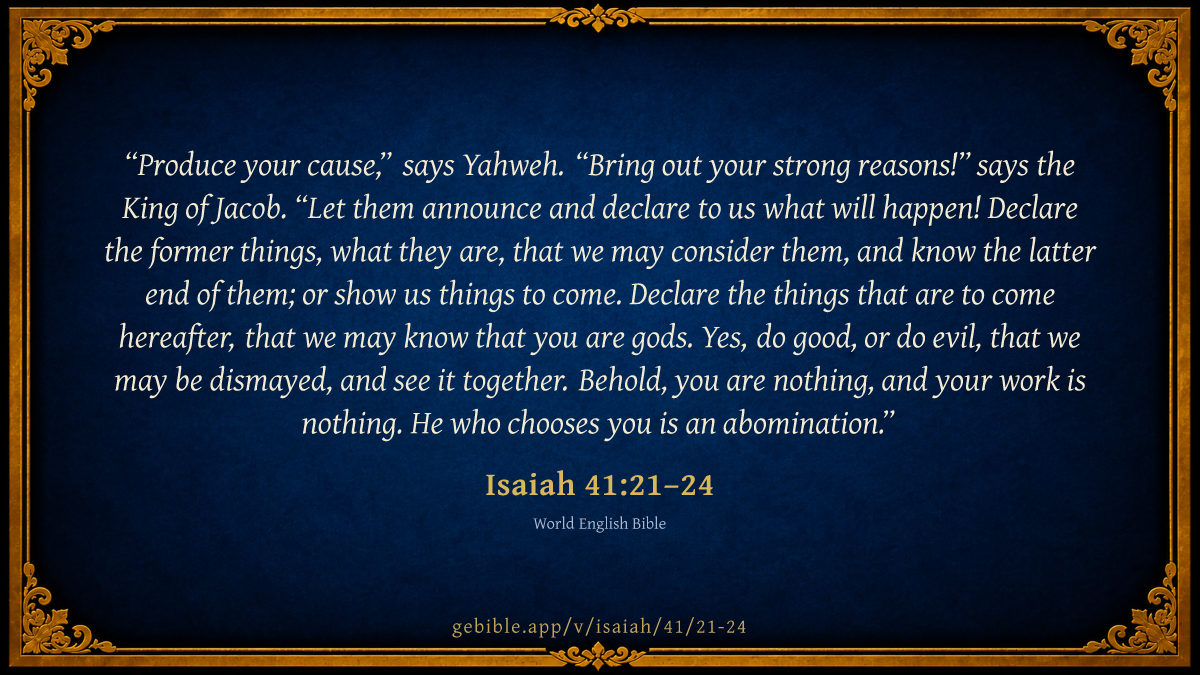
21 Produce your cause,” says Yahweh. “Bring out your strong reasons!” says the King of Jacob.
22 “Let them announce and declare to us what will happen! Declare the former things, what they are, that we may consider them, and know the latter end of them; or show us things to come.
23 Declare the things that are to come hereafter, that we may know that you are gods. Yes, do good, or do evil, that we may be dismayed, and see it together.
24 Behold, you are nothing, and your work is nothing. He who chooses you is an abomination.
KJVKing James Version
21 Produce your cause, saith the LORD; bring forth your strong reasons, saith the King of Jacob.
22 Let them bring them forth, and shew us what shall happen: let them shew the former things, what they be, that we may consider them, and know the latter end of them; or declare us things for to come.
23 Shew the things that are to come hereafter, that we may know that ye are gods: yea, do good, or do evil, that we may be dismayed, and behold it together.
24 Behold, ye are of nothing, and your work of nought: an abomination is he that chooseth you.
Show all 3 translations
JPSJPS Tanakh (1917)
21 Produce your cause, saith the LORD; bring forth your reasons, saith the King of Jacob.
22 Let them bring them forth, and declare unto us the things that shall happen; the former things, what are they? Declare ye, that we may consider, and know the end of them; or announce to us things to come.
23 Declare the things that are to come hereafter, that we may know that ye are gods; yea, do good, or do evil, that we may be dismayed, and behold it together.
24 Behold, ye are nothing, and your work a thing of nought; an abomination is he that chooseth you.
Job 23:3-4(v21)Oh that I knew where I might find him! That I might come even to his seat! I would set my cause in order before him, and fill my mouth with…
Psalms 115:8(v24)Those who make them will be like them; yes, everyone who trusts in them.
1 Corinthians 8:4(v24)Therefore concerning the eating of things sacrificed to idols, we know that no idol is anything in the world, and that there is no other…
Isaiah 42:9(vv22–23)Behold, the former things have happened and I declare new things. I tell you about them before they come up.”
John 13:19(vv22–23)From now on, I tell you before it happens, that when it happens, you may believe that I am he.
Show all 29 cross-references
Isaiah 45:21(v22)Declare and present it. Yes, let them take counsel together. Who has shown this from ancient time? Who has declared it of old? Haven’t I,…
Isaiah 41:29(v24)Behold, all of their deeds are vanity and nothing. Their molten images are wind and confusion.
Jeremiah 10:5(v23)They are like a palm tree, of turned work, and don’t speak. They must be carried, because they can’t move. Don’t be afraid of them; for…
Isaiah 44:7(v22)Who is like me? Who will call, and will declare it, and set it in order for me, since I established the ancient people? Let them declare…
Isaiah 44:7-8(v23)Who is like me? Who will call, and will declare it, and set it in order for me, since I established the ancient people? Let them declare…
Isaiah 46:10(v22)I declare the end from the beginning, and from ancient times things that are not yet done. I say: My counsel will stand, and I will do all…
Isaiah 48:14(v22)“Assemble yourselves, all of you, and hear! Who among them has declared these things? He whom Yahweh loves will do what he likes to…
Jeremiah 10:8(v24)But they are together brutish and foolish, instructed by idols! It is just wood.
Jeremiah 10:14(v24)Every man has become brutish and without knowledge. Every goldsmith is disappointed by his engraved image; for his molten image is…
Deuteronomy 7:26(v24)You shall not bring an abomination into your house and become a devoted thing like it. You shall utterly detest it. You shall utterly abhor…
Deuteronomy 27:15(v24)‘Cursed is the man who makes an engraved or molten image, an abomination to Yahweh, the work of the hands of the craftsman, and sets it up…
Job 38:3(v21)Brace yourself like a man, for I will question you, then you answer me!
Isaiah 37:19(v24)and have cast their gods into the fire; for they were no gods, but the work of men’s hands, wood and stone; therefore they have destroyed…
Isaiah 43:9-12(v22)Let all the nations be gathered together, and let the peoples be assembled. Who among them can declare this, and show us former things? Let…
Isaiah 44:9-10(v24)Everyone who makes a carved image is vain. The things that they delight in will not profit. Their own witnesses don’t see, nor know, that…
Isaiah 45:3(v23)I will give you the treasures of darkness and hidden riches of secret places, that you may know that it is I, Yahweh, who call you by your…
Isaiah 45:7-8(v23)I form the light and create darkness. I make peace and create calamity. I am Yahweh, who does all these things. Rain, you heavens, from…
Isaiah 46:7(v23)They bear it on their shoulder. They carry it, and set it in its place, and it stands there. It cannot move from its place. Yes, one may…
Isaiah 46:9-10(v23)Remember the former things of old: for I am God, and there is no other. I am God, and there is none like me. I declare the end from the…
Isaiah 66:24(v24)“They will go out, and look at the dead bodies of the men who have transgressed against me; for their worm will not die, nor will their…
Jeremiah 51:17-18(v24)“Every man has become brutish without knowledge. Every goldsmith is disappointed by his image; for his molten image is falsehood, and there…
Micah 6:1-2(v21)Listen now to what Yahweh says: “Arise, plead your case before the mountains, and let the hills hear what you have to say. Hear, you…
John 16:14(v22)He will glorify me, for he will take from what is mine, and will declare it to you.
Revelation 17:5(v24)And on her forehead a name was written, “MYSTERY, BABYLON THE GREAT, THE MOTHER OF THE PROSTITUTES AND OF THE ABOMINATIONS OF THE EARTH.”
29 distinct cross-references across this passage (31 total citations).
Cross-references from openbible.info (CC BY 4.0)
Explain this passage (20 sources)
Historical commentary, presented as a primary source — not an endorsement.
Geneva Bible translators1599 · Public DomainOn vv21, 24He biddeth the idolaters to prove their religion, and…
He biddeth the idolaters to prove their religion, and to bring forth their idols, that they may be tried whether they know all things, and can do all things: which if they cannot do, he concludeth that they are no gods, but vile idols.
Geneva Bible (1599) marginal notes — public domain.
John Trapp1656 · Public DomainOn vv21–24Isa 41:21 Produce your cause, saith the LORD; bring…
Isa 41:21 Produce your cause, saith the LORD; bring forth your strong [reasons], saith the King of Jacob.
Ver. 21. Produce your cause, saith the Lord.] He had dealt with the heathens, and convinced them; now have at their gods: and their best proofs are called for.
Read full note →
Bring forth your strong reasons.] Heb., Your bony arguments, argumenta trabalia; but, alas! they had none such.
Saith the king of Jacob.] Not the God of Jacob; for that was now the matter in question, whether he were God, or the heathen deities. And because they were silent, and to seek {a} of such arguments, he helpeth them to a couple.
{a} το ζητουμενον.
John Trapp, A Commentary or Exposition upon All the Books of the Old and New Testament (1647–1656) — public domain. Text from a community e-Sword module.
Matthew Poole1685 · Public DomainOn vv21–24Produce your cause: the prophet having pleaded God’s cause…
Produce your cause: the prophet having pleaded God’s cause against the idolatrous Gentiles, whom he challenged to a dispute, Isa 41:1, he now reneweth the challenge, and gives them liberty and invitation to speak whatsoever they can on the behalf of their idols.
Bring forth your strong reasons, to prove the divinity of your idols.
Matthew Poole's English Annotations on the Holy Bible (1683–1685) — public domain. Text from a community e-Sword/MySword module.
Matthew Henry1710 · Public DomainOn v21The Lord, by the prophet, here repeats the challenge…
The Lord, by the prophet, here repeats the challenge to idolaters to make out the pretentions of their idols: "Produce your cause (Isa 41:21) and make your best of it; bring forth the strongest reasons you have to prove that your idols are gods, and worthy of your adoration." Note, There needs no more to show the absurdity of sin than to produce the reasons that are given in defence of it, for they carry with them their own confutation.
I. The idols are here challenged to bring proofs of their knowledge and power. Let us see what they can inform us of, and what they can do. Understanding and active power are the accomplishments of a man. Whoever pretends to be a god must have these in perfection; and have the idols made it to appear that they have? No;
Read full note →
1. "They can tell us nothing that we did not know before, so ignorant are they. We challenge them to inform us," (1.) "What has been formerly: Let them show the former things, and raise them out of the oblivion in which they were buried" (God inspired Moses to write such a history of the creation as the gods of the heathen could never have dictated to any of their enthusiasts); or "let the defenders of idols tell us what mighty achievements they can boast of as performed by their gods in former times. What did they ever do that was worth taking notice of? Let them specify any thing, and it shall be considered, its due weight shall be given it, and it shall be compared with the latter end of it; and if, in the issue, it prove to be as great as it pretended to be, they shall have the credit of it." (2.) "We challenge them to tell us what shall happen, to declare to us things to come (Isa 41:22), and again (Isa 41:23), show the things that are to come hereafter. Give this evidence of your omniscience, that nothing can be hidden from you, and of your sovereignty and dominion. Make it to appear that you have the doing of all, by letting us know beforehand what you deign to do. Do this kindness to the world; let them know what is to come, that they may provide accordingly. Do this, and we will own that you are gods above us, and gods to us, and worthy of our adoration." No creature can foretel things to come, otherwise than by divine information, with any certainty.
2. "They can do nothing that we cannot do ourselves, so impotent are they." He challenges them to do either good or evil, good to their friends or evil to their enemies: "Let them do, if they can, any thing extraordinary, that people will admire and be affected with. Let them either bless or curse, with power. Let us see them either inflict such plagues such as God brought on Egypt or bestow such blessings as God bestowed on Israel. Let them do some great thing, and we shall be amazed when we see it, and frightened into a veneration of them, as many have been into a veneration of the true God." That which is charged upon these idols, and let them disprove it if they can, is that they are of nothing, Isa 41:24. Their claims have no foundation at all, nor is there any ground or reason in the least for men's paying them the respect they do; there is nothing in them worthy our regard. "They are less than nothing, worse than nothing;" so some read it. "The work they do is of nought, and so is the ado that is made about them. There is no pretence or colour for it; it is all a jest; it is all a sham put upon the world; and therefore he that chooses you, and so give you your deity, and" (as some read it) "that delights in you, is an abomination;" so some take it. A servant is at liberty to choose his master, but a man is not at liberty to choose his God. He that chooses any other than the true God chooses an abomination; his choosing it makes it so.
II. God here produces proofs that he is the true God, and that there is none besides him. Let him produce his strong reasons.
1. He has an irresistible power. This he will shortly make to appear in the raising up of Cyrus and making him a type of Christ (Isa 41:25): He will raise him up from the north and from the rising of the sun. Cyrus by his father was a Mede, by his mother a Persian; and his army consisted of Medes, whose country lay north, and Persians, whose country lay east, from Babylon. God will raise him up to great power, and he shall come against Babylon with ends of his own to serve. But, (1.) He shall proclaim God's name; so it may be read. He shall publish the honour of the God of Israel; so he did remarkably when, in his proclamation for the release of the Jews out of their captivity, he acknowledged that the Lord God of Israel was the Lord God of heaven, and the God: and he might be said to call on his name when he encouraged the building of his temple, and very probably did himself call upon him and pray to him, Ezr 1:2, Ezr 1:3. (2.) All opposition shall fall before him: He shall come upon the princes of Babylon, and all others that stood in his way, as mortar, and trample upon them as the potter treads clay, to serve his own purposes with it. Christ, as man, was raised up from the north, for Nazareth lay in the northern parts of Canaan; as the angel of the covenant, he ascends from the east. He maintained the honour of heaven (he shall call upon my name), and broke the powers of hell, came upon the prince of darkness as mortar and trod him down.
2. He has an infallible foresight. He would not only do this, but he did now, by his prophet, foretel it. Now the false gods not only could not do it, but they could not foresee it. (1.) He challenges them to produce any of their pretended deities, or their diviners, that had given notice of this, or could (Isa 41:26): "Who has declared from the beginning any thing of this kind, or has told it before-time? Tell us if there be any that you know of, for we know not any; if there be any, we will say, He is righteous, he is true, his cause is just, his claims are proved, and he is in the right in demanding to be worshipped." This agrees with Isa 41:22, Isa 41:23. (2.) He challenges to himself the sole honour of doing it and foretelling it (Isa 41:27): I am the first (so it may be read) that will say to Zion, Behold, behold them, that will let the people of Israel know their deliverers are at hand (for there were those who understood by books, God's books, the approach of the time, Dan 9:2), and I am he that will give to Jerusalem one that brings good tidings, these good tidings of their enlargement. This is applicable to the work of redemption, in which the Lord showed himself much more than in the release of the Jews out of Babylon: he it was that contrived our salvation, and he brought it about, and he has given to us the glad tidings of reconciliation.
III. Judgment is here given upon this trial. 1. None of all the idols had foretold, or could foresee, this work of wonder. Other nations besides the Jews were released out of captivity in Babylon by Cyrus, or at least were greatly concerned in the revolution of the monarchy and there transferring of it to the Persians; and yet none of them had any intelligence given them of it beforehand, by any of their gods or prophets: "There is none that shows (Isa 41:26), none that declares, none that gives the least intimation of it; there is none of the nations that hears your words, that can pretend to have heard from their gods such words as you, O Israelites! have heard from your God, by your prophets," Psa 147:20. None of all the gods of the nations have shown their worshippers the way of salvation, which God will show by the Messiah. The good tidings which the Lord will send in the gospel is a mystery hidden from ages and generations, Rom 16:25, Rom 16:26. 2. None of those who pleaded for them could produce any instance of their knowledge or power that had in it any colour of proof that they were gods. All their advocates were struck dumb with this challenge (Isa 41:28): "I beheld, and there was no man that could give evidence for them, even among those that were their most zealous admirers; and there was no counsellor, none that could offer any thing for the support of their cause. Even among the idols themselves there was none fit to give counsel in the most trivial matters, and yet there were those that asked counsel of them in the most important and difficult affairs. When I asked them what they had to say for themselves they stood mute; the case was so plain against them that there was none who could answer a word." Judgment must therefore be given against the defendant upon Nihil dicit - He is mute. He has nothing to say for himself. He was speechless, Mat 22:12. 3. Sentence is therefore given according to the charge exhibited against them (Isa 41:24): "Behold, they are all vanity (Isa 41:29); they are a lie and a cheat; they are not in themselves what they pretend to be, nor will their worshippers find that in them which they promise themselves. Their works are nothing, of no force, of no worth; their enemies need fear no hurt from them; their worshippers can hope for no good from them. Their molten images, and indeed all their images, are wind and confusion, vanity and vexation; those that worship them will be deceived in them, and will reflect upon their own folly with the greatest bitterness. Therefore, dearly beloved, flee from idolatry," Co1 10:14.
Matthew Henry's Commentary on the Whole Bible (1708–1710) — public domain (CC PDM 1.0). Text via the HelloAO Bible API.
John Gill1763 · Public DomainOn vv21–24Produce your cause, saith the Lord,.... The Lord having…
Produce your cause, saith the Lord,.... The Lord having comforted his people under their afflictions and persecutions from their enemies in the first times of Christianity, returns to the controversy between him and the idolatrous Heathens, and challenges them to bring their cause into open court, and let it be publicly tried, that it may be seen on what side truth lies:
bring forth your strong reasons, saith the King of Jacob; or King of saints, the true Israel of God, who acknowledge the Lord as their King and their God, and whom he rules over, protects and defends; and this title is assumed for the comfort of them, that though he is King over all the nations of the world, yet in an eminent and peculiar sense their King; and he does not style himself the God of Jacob, though he was, because this was the thing in controversy, and the cause to be decided, whether he was the true God, or the gods of the Gentiles; and therefore their votaries are challenged to bring forth the strongest reasons and arguments they could muster together, in proof of the divinity of their idols; their "bony" arguments, as the word (x) signifies; for what bones are to the body, that strong arguments are to a cause, the support and stability of it.
Read full note →
(x) os.
John Gill's Exposition of the Whole Bible (1746–1763) — public domain (CC PDM 1.0). Text via the HelloAO Bible API.
John Wesley1765 · Public DomainOn vv22–24Them - The idols. Former things - Such things…
Them - The idols. Former things - Such things as should shortly come to pass. The latter end - Whether the events answer to their predictions.
John Wesley, Explanatory Notes Upon the Whole Bible (1754–1765) — public domain. Text via the GEBible commentary corpus.
Adam Clarke1810 · Public DomainOn vv21, 23, 24Verse 21. Bring forth your strong reasons - "Produce…
Verse 21. Bring forth your strong reasons - "Produce these your mighty powers"] "Let your idols come forward which you consider to be so very strong." Hieron. in loc. I prefer this to all other interpretations of this place; and to Jerome's own translation of it, which he adds immediately after, Afferte, si quid forte habetis. "Bring it forward, if haply ye have any thing." The false gods are called upon to come forth and appear in person; and to give evident demonstration of their foreknowledge and power by foretelling future events, and exerting their power in doing good or evil.
Adam Clarke's Commentary on the Bible (1810–1826) — public domain. Text from a community e-Sword/MySword module.
Joseph Benson1811 · Public DomainOn v21Isa 41:21-24. Produce your cause — He renews his…
Isa 41:21-24. Produce your cause — He renews his challenge to the idolaters to plead the cause of their idols, and give convincing proof of their divinity: see on Isa 41:1. Bring forth your strong reasons — Hebrew, הגישׁו עצמותיכם, which Bishop Lowth renders, “Produce these your mighty powers;” and Jerome, “Accedant idola vestra, quæ putatis esse fortissima,” let those of your idols, whom you think most powerful, approach. “I prefer this,” says the bishop, “to all other interpretations of this place. The false gods are called upon to come forth and appear in person, and to give evident demonstration of their foreknowledge and power, by foretelling future events, and exerting their power in doing good or evil.” Let them — Either the idols, or the idolaters in the name and by the help of their idols; show us what shall happen — All future events, which he divides into two sorts in the following clause, the former and the latter. Let them show the former things — Let the idols, or you their worshippers, prove that they ever uttered any true oracles or prophecies relating to former times, and, that the event hath exactly answered the prediction, and this will give credit to any predictions they shall deliver relating to things yet future. Or, by the former things, may be meant such things as should shortly come to pass, which might be better discerned than those things which were yet at a greater distance. So understood, he proposes the easiest part first. Let us try whether they can foretel those things which are even at the door, and, if so, we will try them further. Let them tell us what things shall happen, and in what order; which first and which last. That we may consider them — Hebrew, ונשׁימה לבנו, and we will set our heart to it. We will allow the argument its due weight, and either fairly answer it, or give up our cause against idols; and know — That we may know; the latter end of them — The consequence of them, as אחריתןmay be rendered, whether the events answer to their predictions. Or declare us things for to come — Namely, after a long time. That we may know that ye are gods — That we may have, if not a certain proof, yet a probable argument of your deity. Yea, do good or do evil — Protect your worshippers, whom I intend to destroy, or destroy my people, whom I intend to save; that we may be dismayed, &c. — That I and my people may be astonished, and forced to acknowledge your godhead. Behold, ye are of nothing — You lately were nothing, without any being at all; and your work of naught — Your operations are like your beings; there is no reality in your beings, nor efficacy in your actions. An abomination is he that chooseth you — He that chooseth you for his gods is most abominable for his folly, as well as his wickedness.
Joseph Benson's Commentary on the Old and New Testaments (1811–1818) — public domain. Text from a community e-Sword module.
Albert Barnes1834 · Public DomainOn vv21–24Produce your cause - This address is made to…
Produce your cause - This address is made to the same persons who are referred to in Isa 41:1 - the worshippers of idols; and the prophet here returns to the subject with reference to a further argument on the comparative power of Yahweh and idols. In the former part of the chapter, God had urged his claims to confidence from the fact that he had raised up Cyrus; that the idols were weak and feeble compared with him; and from the fact that it was his fixed purpose to defend his people, and to meet and refresh them when faint and weary. In the verses which follow Isa 41:21, he urges his claims to confidence from the fact that he alone was able to predict future events, and calls on the worshippers of idols to show their claims in the same manner. This is the ‘cause’ which is now to be tried.
Bring forth your strong reasons - Adduce the arguments which you deem to be of the greatest strength and power (compare the notes at Isa 41:1). The object is, to call on them to bring forward the most convincing demonstration on which they relied, of their power and their ability to save. The argument to which God appeals is, that he had foretold future events. He calls on them to show that they had given, or could give, equal demonstration of their divinity. Lowth regards this as a call on the idol-gods to come forth in person and show their strength. But the interpretation which supposes that it refers to their reasons, or arguments, accords better with the parallelism, and with the connection.
Albert Barnes' Notes on the Bible (1834–1885) — public domain. Text from a community e-Sword/MySword module.
Haydock's Catholic Bible Commentary1859 · Public DomainOn vv21, 23, 24Thing. Add "strong," forte, (Haydock) any good proof of…
Thing. Add "strong," forte, (Haydock) any good proof of idolatry.
George Leo Haydock (1774–1849), Haydock's Catholic Family Bible and Commentary, 1859 edition — public domain. Excludes Psalms (Douay-Rheims chapter numbering differs from Protestant) and Deuterocanonical books (Catholic canon only).
Lange's Commentary on the Holy Scriptures1864 · Public DomainOn v2121 37Produce your cause, saith the Lord;
4. THE SECOND CONVERSION OF PROPHECY INTO A TEST OF DIVINITY
Isa_41:21-29
Read full note →
21 37Produce your cause, saith the Lord;
Bring forth your 38strong reasons, saith the King of Jacob.
22 Let them bring them forth, and show us what shall happen:
Let them show the former things, what they be,
That we may 39Consider them, and know the latter end of them;
Or 40declare us things for to come.
23 Show the things that are to come hereafter,
That we may know that ye are gods:
Yea, do good, or do evil,
41That we may be dismayed, and behold it together.
24 Behold, ye are 42of nothing,
And your work 43of 44nought:
An abomination is he that chooseth you.
25 I have raised up one from the north, and he 45shall come:
Prom the rising of the sun shall he call upon my name:
And he shall come upon 46princes as upon mortar,
And as the potter treadeth clay.
26 Who hath declared from the beginning, that we may know?
And beforetime, that we may say, 47He is righteous?
Yea, there is none that 48showeth, yea, there is none hthat declareth,
Yea, there is none that hheareth your words.
27 49The first shall say to Zion, Behold, behold them:
And I will give to Jerusalem one that bringeth good tidings.
28 50For I beheld, and there was no man;
Even among them, and there was no counsellor,
That, when I asked of them, could 51answer a word.
29 Behold they are all vanity;
Their works are nothing:
Their molten images are wind and confusion.
TEXTUAL AND GRAMMATICAL
See List for the recurring of the words: Isa_41:21. רִיב–קָרְבוּ. Isa_41:22. הבאות—אחרית. ver.23. אתיות אָחוֹר––. Isa_41:25. טִיט––רָמַם––יוֹצֵר––חֹמֶר. Ver 26. מֵרֹאשׁ Isa_41:28. יוֹעֵץ Isa_41:29. תֹהוּ––רוּחַ––אֶפֶם––אָוֶן נֶמֶךְ––
Isa_41:21. עַצֻּמָה is ἅπ. λεγ. The root meaning is robora, comp. עָצוּם “strong,” עֲצוּמִים “strength, might,” Psa_10:10, תַּֽעֲצוּמם “fires,” Ps. 68:36.
Isa_41:23. אַף with וְ in the second clause appears not merely to have the meaning sive—sive, but there lies in אף something intensive in relation to what precedes, that we may best express by “yea.”—That וְ acquires the meaning “or,” appears from alternative questions “whether—or,” “num—an” being regularly expressed in Hebrew by אִם–וְאִם, and also that, exceptionally, simply וְ connects the two clauses (Jer_44:28; Ewald § 352 b).—The Kal נִרְאֶה (so K’thibh is to be read, whereas K’ri is to be pronounced וְנֵרֶא) occasions surprise. Perhaps we should read נֵרָא (first pers. plur. imperf. Niph., comp. יֵרָא Exo_34:3; וַיֵרָא Gen_12:7; Gen_17:1, etc.). As this first pers. plur. imp. Niph. happens not to occur again in the Old Testament, perhaps the Masorets preferred to point the consonants like the first pers. plur. imperf. Kal., which often occurs in the full form, but which also fails to occur in the apocopated form.
Isa_41:24. I translate מֵאֶֽפַע ,מֵאַיִן here “out of the nothing,” whereas Isa_40:17 I maintained the comparative meaning of מִן 1 think that we are justified in this by the difference of the verbs used in the two places. There נֶחְשַׁב was predicate, here it is the notion of being. There the rhetorical, exaggerated “more than nothing” was more suitable; here it suits better to take מן as indicative of origin.—There is no need of treating אפע as a copyist’s error for מֵאֶפֶם as many recent commentators do. The serpent name אֶפְעֶה (Isa_30:6; Isa_59:5) i.e., “ sibilans, the whistler,” is proof enough that there is a verb פעה, kindred in sense to הֶבֶל, “breath, wind” (see on אפעה Isa_42:14). From this may be derived אֶפְעַי, from which אֶפַע, like אֶמֶשׁ from אַמְשַׁי אֶשֶׁךְ, from אַשְׁכַּי.
Isa_41:25. וַיַּאת contracted from וַיַּאַת, occurs only here, whereas the form וַיִּתֵא (from יֶֽאֱתֶה Pro_1:27; Job_37:22) occurs Deu_33:21.—קרא בשׁם is undoubtedly used in the sense of calling on God in worship. In itself the expression means “to call with the name,” not in the name; for בְּ is used here as instrumental. This appears from the fact that the expression elsewhere means a) “to call, name (one) with their name:” Exo_35:30; Num_32:42; Isa_45:4 (I called to thee by means of thy name), or, with omission of the personal object, Isa_43:1; Isa_45:3, etc.—b) “to shout, proclamare, proclamationem facere, κηρύσσειν, to give an announcing, instructing call by means of the name.” Thus, as I think, in those obscure passages, Exo_33:19; Exo_34:5, with which also Isa_45:5 connects. Here God sends forth a call in Moses’ ears, which is done by naming the Jehovah-name and giving its meaning, ibid Isa_41:6.––––I do not think that סְגָבִים is a specific Persian word. The word schihne, to which appeal is made, is modern Persian. The word is used Jer_51:23; Jer_51:28; Jer_51:57; Eze_23:6; Eze_23:12; Eze_23:23, and occurs in these passages as designation for Babylonian, Assyrian and Persian dignitaries. Thus the word appears to have been, I may say, international. Ezra uses it once Ezr_9:2; Nehemiah oftener: Neh_2:16; Neh_4:8; Neh_5:7, etc. Later it even passed over into the vocabulary of recent Hebrew. Since Ezekiel speaks of Assyrian סגנים, we may assume that there were such, and as Babylon and Persia obtained dominion after Assyria, we may conjecture that the name came to them from Assyria. Then it cannot seem strange that Isaiah uses the word. מָנָן is, however, really an Assyrian word. “The root sakan (שָׁבַן), connected with בוּן, is in Assyrian the usual word for ‘to place, appoint,.” Sakan, accordingly, denotes properly the one appointed, commissioned, then the. representative, vicegerent. Thus Schrader l. c. p.270. Moreover, the word corresponds to the מצפון and ממזרח–שׁמשׁ. For one sees also from מגנים, that the raised-up ruler will be one who issues from the region of the Iranian tongue.
Isa_41:26. מִלְּפָנִים only here.
Isa_41:28. מֵאֵלֶּה is constr. Prœgnans: for the preposition מִן depends on a verb that is only ideally present. We must derive the notion “seeking out” from וְאֵרֶא.
EXEGETICAL AND CRITICAL
1. We showed above that with our Prophet the promise of deliverance out of exile, and the turning of this promise to account as proof of divinity, go hand in hand. Having now described in Isa_41:1-20 the redeemer (Isa_41:2-3) and the redeemed (Isa_41:8-16) and the destined salvation (Isa_41:17-20), the Prophet goes on here to turn them to account in the way referred to. He had made a beginning of this in Isa_41:4-7 after the first mention of the saviour from the East, but did not carry out the thought there. It appears as if he would there content himself with a passing reference in contrast with the fright of the heathen at the alarming demands made on their faith in idols. But now, having presented all that related to the deliverance from exile, he proceeds in earnest. He pays no more regard to that reluctance proceeding from a bad conscience. He sets forth with all seriousness that the Lord regards His prediction of the deliverance as a proof of His divinity, and the inability of idols to predict anything, or in fact to do anything, as a proof of their nothingness. The more exact development consists in this, that here Jehovah challenges the idols themselves directly to a contest, and that, more plainly than in Isa_41:2 sq., He proffers His prediction as a proof of His divinity. Although the idols do not at all relish the contest, still they must come on and take up the gauntlet (Isa_41:21-23). On their failure to tell anything they are pronounced to be nothing (Isa_41:24). Then Jehovah repeats the prediction of a deliverer from the East (Isa_41:25), and again shows that not the idols have foretold this (Isa_41:26), but that He, Jehovah, would give this deliverer to His people for a saviour, and at the same time as a pledge of the fulfilment of further promises that reach into a still more remote future (Isa_41:27). Finally the Prophet himself resumes the discourse, in order to establish the nothingness of his idolatrous quasi colleagues. For if the idols are nothing, so, too, must their interpreters show that they are know-nothings.
2. Produce your cause——chooseth you.
Isa_41:21-24. The Lord challenges the idols to come on and bring to a practical decision this cause, long pending in thesi, and produce the proofs that they have for their cause. One thinks involuntarily of Elijah’s challenge to the priests of Baal, 1Ki_18:21 sqq. Jehovah is often called King of the chosen people (comp. on Isa_43:15); but the expression King of Jacob occurs only here (comp אֲבִיר יעקכGen_49:24; Isa_49:26; Isa_60:16; Psa_132:2; Psa_132:5, and משֵׁל ביעקבPsa_59:14). In Isa_41:22 the Lord addresses Israel, claiming them for His side, and identifying His and their cause. יַגִּישׁוּ connects as repetition with הגישו Isa_41:21. What they shall produce is their עצמות “bulwarks.” In what this producing proof shall consist is further explained by the words תקרינה־ויגידו (see Isa_45:21). By הרְשׁנות commentators understand either prius praedicta (Gesenius: “say what ye have formerly prophesied”), or the immediate future in contrast with the more remote, which they say is expressed by הבאות and אתיות לאחור. But in my opinion the former conflicts with the article, and the latter with usus loq. which forbids the distinction between ראשׁנות and באות as near and remote future. I think that ראשׁנת in contrast with הבאות can mean nothing but the past contrasted with the future. The immediate and proper meaning of the word is undoubtedly “first, beginning, original things.” Thus Gen_41:20הַפָּרוֹת הר׳ are “the cows that first appeared.” Thus everywhere ראשׁגות are the first or beginning things or facts; whether prophecies or other things must be determined in each case by the context. Comp. Isa_42:9; Isa_43:9; Isa_43:18; Isa_46:9; Isa_48:3. Here the Lord demands of the idols, that they shall either give correct information of the past, thus, as it were, of the roots or foundations of the course of the world, so that one may thereby infer what the future will be, or they shall foretell the future directly. The Prophet, as appears to me, assumes here that we may foretell the future directly and indirectly, as e.g., it is the same whether I say: the fruit of this tree will be apples; or the roots are those of an apple tree. For if the latter be true, then the fruit must be apples. The correct knowledge of the future depends on a correct knowledge of the past. Both have riddles revealed only to the omniscience of God, and hence both are tests of divinity. Such, I think, is the Lord’s meaning when He calls on the idols to produce the fundamental things of the past, and that according to their inmost being (מָה הֵבָּה). If they do this correctly, then it will be possible for attentive reflection (נָשִׂימָה לבֵּנוּ only here in Isaiah; comp. Exo_9:21; Job_1:8; Job_2:3; Eze_44:5) to know correctly the issue, thus the conclusion that falls in the future. Comp. especially Isa_46:10 sq., where the Lord names as a prerogative of His divinity the power to foretell from the beginning he final issue, from ancient time what has not yet come to pass. By אוֹ, “or else,” the alternatives offered to the idols to foretell the future directly, if they will.
Isa_41:23, the Prophet proceeds, summing up the idea of ראשׁנות and באות, both which relate to he future; Shew the things that are to be hereafter, i.e., whose realization is fixed for a more remote period. The concluding clause and we will know, etc., states ironically what must result if the idols meet the demand: they will then be recognized as gods. But the Lord proceeds, moderating His demand to the utmost, in order to strike his opponents only the harder: yea, do good or do evil (a proverbial expression, comp. Jer_10:5; Zep_1:12). Let them anyway do something. It is not meant; let them prophesy good or bad. The idea of their prophesying at all is dismissed with נרעה—“that we may know,” etc. The clause ונשׁתעה ו׳ (“to look eye in eye in conflict,” like התראה2Ki_14:8; 2Ki_14:11) presents the conclusion from what precedes. If the idols accept the challenge, then there may be a contest. If not, then eo ipso they are defeated. The idols neither accept nor decline; hence the Lord concludes with the contemptuous words of Isa_41:24. Are the idols nothings, then of course, those that choose them (comp. on Isa_41:8) are an abomination to the Lord. The expression תּועֵבָה, especially combined with יהוה, is very frequent in Deut. (Deu_12:31; Deu_17:1; Deu_18:12; Deu_22:5, etc.) especially in reference to idolatry.
3. I have raised up——confusion.
Isa_41:25-29. Having proved the inability of idols to prophesy, the Lord produces a prophecy, that is a pledge of His divinity. Thus He risks all on this prophecy. His honor perishes if it is not fulfilled. As He does not fear the latter, but utters it with absolute confidence, He gives for the present, not indeed a judicial proof of His divinity, but still He raises a legal presumption in favor of it (prœsumtio juris, which, as is known, is something very different from a presumption (conjecture) in the common sense). And that even is something great, for it suffices for those that are honestly willing to know the truth. In Isaiah’s time still the people wavered between Jehovah and idols. Isaiah’s endeavor was to bring them to a decision for the Lord. These prophecies (40–66), meant for future consolation, were intended to affect also the present, i.e., to move the nation to believe in the Lord. If, then, Isaiah in Hezekiah’s time stood up so confidently for Jehovah, as he does here, every one at all susceptible of the truth must have said to himself: the Prophet would not dare so to speak were he not conscious of being warranted to do so. For he risks the utter ruin of his and his God’s cause, if this prophecy turn out to be an imposture. The prophecy, Isa_41:25, is somewhat oracular in form. In contents it has that obscurity peculiar to all images of the future, which rise so distant from the beholder that one is unable to detect their connection with the present, and thus the successive, organic genesis of their forms. It is further worthy of notice that the prophecy, Isa_41:25, connects with Isa_41:2-3. I have raised up, Isa_41:25, is like an answer to “who raised up,” Isa_41:2; from the north and from the rising define more particularly the simple “from the rising,” Isa_41:2; he shall call on my name corresponds to “called him to his foot,” Isa_41:2; and the following words that begin with יבוא, as Isa_41:3 closes, describe the irresistibleness of him that is called essentially in the same way as Isa_41:2 b, 3, with only this difference, that Isa_41:2 speaks of nations and kings in general, whereas Isa_41:25 the word סגנים (“satraps”) points even more plainly to the theatre where the one called performs. That העירותי, Isa_41:25, is without an object, corresponds to the terseness proper to the oracular style. The object is easily supplied, partly from Isa_41:2, partly from the following, ויאת וגו׳. That the one promised is called from the North, but comes from the East, is not to be pressed. The Prophet would only intimate that his point of departure is not merely the East, as might appear from Isa_41:2, but also from the North. We know how this occurred in the case of Cyrus. He arose as ruler of the (by him) united kingdoms of Media and Persia, the former of which lay north, the latter east of Babylon. יקרא בשׁמי, He shall call on my name (see Text. and Gram.) mentions another characteristic of the one called. That Cyrus actually did this appears from 2Ch_36:23; Ezr_1:2 sqq. He must have received vivid impressions of the reality of the God of Israel. Comp. on this Pressel in Herz., R.-Enc. III, p. 232. We will not inquire whether Cyrus, in calling Jehovah “the God of heaven,” identified Him with Ahuramazda or not (comp. Zoeckler on 2Ch_36:23). But it is historically attested in the most credible manner, and is in itself perfectly comprehensible, that God, who in general let the heathen go their own way (Act_14:16), should in an exceptional way give them extraordinary revelations of His being. In the period preceding the Christian era He did this in two significant epochs through Israel, in consequence of its missionary vocation, viz., in the two exiles, the Egyptian and the Babylonian. In both instances the revelation came to the dominant world-power at the moment of its highest prosperity. In regard to Egypt comp., e.g., Lepsius (Chronol. d. Egypter, I., p. 359), who calls the period of Moses and of the departure of the Israelites “the most illustrious time of all Egyptian history.” In regard to Babylon the same thing appears from the fact that Nebuchadnezzar is designated as the golden head (Dan_2:38). The Lord would not let Himself be without witness to those who knew no limits to their power, for their own sakes partly, partly for His own name’s sake, partly for the sake of mankind in general, partly for the sake of Israel. The Lord would show His power to Pharaoh, that His name might be declared throughout all the earth, and to accomplish His judgments on all the gods of Egypt (Exo_9:16; comp. Isa_8:10; Isa_8:19; Isa_14:4; Isa_14:17-18; Isa_14:25). And that this purpose was achieved appears from the confessions of Pharaoh himself, of his servants, and of his army (Exo_9:20; Exo_9:27; Exo_10:7; Exo_10:16; Exo_14:25). As regards the Babylonian Exile, the entire first half of the book of Daniel is meant to show how Jehovah so marvellously glorified Himself on those nations and their kings, that they cannot escape acknowledging Him as the true God (comp. my work: Jeremiah and Babylon, p. 2 sqq.), at least for the moment (for we know nothing of any outward, observable abiding effect—at most the adoration of the Magi, Matthew 2, might be appealed to here. What (according to Dan_2:47; Dan_3:28 sq.; Dan_4:34; Dan_5:17 sqq.; Dan_6:25 sqq.), Nebuchadnezzar, Belshazzar and Darius the Mede knew, was any way preliminary to the knowledge on the basis of which Cyrus issued his edict, Ezr_1:2 sqq. Certainly we cannot impute to Cyrus less knowledge than that ascribed to his predecessors in the passages cited. If we were right in saying that “he shall call on my name” corresponds to “has called him to his foot,” Isa_41:2, then this is to be defined, that according to Isa_41:2 the Lord called Cyrus, and according to Isa_41:25 Cyrus called on the Lord. It is further said of Cyrus that he will come on satraps as on mortar, etc. בֹּוא, in the sense of hostile coming like Isa_28:15; Psa_35:8; Job_15:21; Job_20:22; Pro_28:22. In all these passages בּוֹא stands with the accusative (localis).
The Prophet, Isa_41:26, assumes the standpoint of the fulfilment. He represents to himself that then the inquiry will naturally arise: who hath declared this from the beginning, that we may know, i.e., that we might know beforehand the coming of these things (Isa_41:22-23)? And who announced it from early time, so that now we might say: right? צדיק is what corresponds to a norm: not only a moral, or some special juridical norm, but also the norm of truth. Hence אֱמֶת, Isa_43:9, stands in a precisely similar connection. Yet the last-named meaning is supported by no other example. Hence it seems to me likely that the Prophet joins with it the sense of moral Rightness. A god whose prophecy fails is morally condemned. But if it comes to pass, he is morally justified; he is no liar, but truly what he gives himself out to be (comp. Isa_14:21). But again there has never been any announcement and bringing to the ears on the part of the idols, nor hearing on the part of men (Isa_41:22-23). אף (comp. Isa_40:24), recurring thrice, paints with a certain breadth the absence on every hand of what was requisite.
Isa_41:27, the Prophet defines more particularly the salvation that the one called of God shall bring to the people of God. It was said, Isa_41:25, in general, that he would call on the name of the Lord, and destroy the hostile powers. Now he is defined to be the first-fruit of the salvation destined for Zion. The LXX. translate ἀρχὴν Σιὼν δώσω. Peschito: primordia Sionis haec sunt. As far as I can see, all expositors construe רִאשׁוִן as nominative and relating to Jehovah; and either supply אָמַרְתִּי, or connect רְשׁון with אֶתֵּן. The words הנה הבם are by some put in the mouth of Jehovah, by others in Zion’s mouth, by others in that of the מְבַשֵׂר, and the suffixes (pronouns) are referred now to the exiles, now to the deliverer, now to facts of redemption, now to the idols. I refer ראשׁון to Cyrus. In an eminent sense he was the beginner of the redemption. Israel’s decline lasted till the close of the Exile. With difficulty (Dan_9:25), slowly, and with great alternations, it mounts up; but still it mounts up. The believers that looked for the restitution of Israel in all its promised glory directly after the seventy years, under the anointed son of David, struggle with many assaults of doubt, as they observe only very meagre beginnings of a redemption (comp. Dan_10:1-3, and Auberlen, D. Proph. Daniel, p. 132 sq.) But the laws of prophetic perspective were hid from them, which sees the end already in the beginning, though long periods of vicissitude separate one from the other. Cyrus is called מְשִׁיחַ יהוה, Isa_45:1. He was not the proper and true Messiah, but he was the first after the great period of judgment. He was the first-fruit—messiah, the beginner of the restoration of Israel. His edict, Ezr_1:2 sqq., was the first step toward realizing for Israel that שׁוּב (“return”), that Isaiah, Jeremiah, and all their successors represent as the sum total of bodily and spiritual redemption for Israel. I construe הִנֵּה הִנָּם as an exclamation of the Prophet, by which he points to the consequences of that first-fruit—redemption. For the notion “first” includes that of “following” or “consequences.” In spirit the Prophet sees these before him, and points to them with a brief הנה הנם. He calls Cyrus a מְבַשֵּׂר: what more joyful news could the Lord propose for His people than that they may return home to rebuild Jerusalem? בִּשַּׂר, comp. on Isa_40:9.
As Isa_41:26 is related to Isa_41:25, so Isa_41:28-29 are related to Isa_41:27. Each of these prophetic lamps shines in strong contrast with the picture of the nothingness of idols that acts as a foil. Only it seems to me that so far there is a difference, in that Isa_41:26 the Prophet has in mind the idols themselves, whereas in Isa_41:28-29 he has in mind their worshippers, especially their priests (see below). Isa_41:28 has three gradations. The first clause is obscure; it speaks only of the looking around and the non-existence of something, but one knows not what one has looked about for. The second clause makes known those among whom the Prophet has looked, and what he was looking for. He seeks a יוֹעֵץ “counsellor, one, however, that can prophetically resolve the riddles of the future. This is made plain in the third clause: but there was no counsellor of whom I could inquire and who could give me answer. The reason of this is given Isa_41:29 : the gods that should inspire the answer in their worshippers are no gods but the manufacture of those who worship them. Thus Isa_41:29 speaks of those that make the idols, and not of the idols themselves. And because “they all” (בֻּלָּם) are identical with the אֵלֶּה (“them) of Isa_41:28, among whom no counsellor is found, therefore Isa_41:28 speaks not of the idols, but of their servants, and especially of those who, on account of their office, should be qualified to give counsel and render a decision, thus the priests and prophets. And because it is not to be supposed that the Lord looks for a counsellor and giver of decrees, therefore the subject of וְאֵרָא (“I looked about”) Isa_41:28, is not Jehovah, but the Prophet. Thus the chapter concludes with an apostrophe of the true Prophet to the false ones, and אֵלֶה is said δεικτικῶς. With this reference to the manufacture of idols, the Prophet returns to the thought with which he also closed the first strophe (Isa_41:6-7).
DOCTRINAL AND ETHICAL
1. The second part of Isaiah lays unusual stress on the inability of idols to prophesy. As this, on the one hand, is a proof of the nothingness of idols, so on the other, Jehovah’s ability to foretell the future is made a proof of His divinity. Hence, when the Lord challenges the idols to a contest in prophesying, and then on His part stands forth with an imposing prophetic performance, that has for its subject the deliverance of Israel from the Exile, one sees that two objects are combined, viz.: He comforts His people, and He proves His divinity. Thus we see that the Prophet’s view-point is partly at the end of the Exile and partly before the Exile. The former because he sees the deliverer quite clearly and distinctly before him; the latter because it is all important for him to display his Lord as knowing the remote future, and thus as true God. Thus he would win Israel by representing on the one hand the omniscence of their God, and on the other His faithful love and power. And this object was attained. Israel would assuredly not have buried their gross idolatry in the Exile, had they not verified both the threatenings and the promises of Jehovah’s Prophet in the most signal manner. But this grand effect could only be produced by the promises being recognized on all sides as genuine, old prophecies. Prophecies that gave themselves out for old, but hitherto hidden must have raised doubts, and contradicted themselves. For it is expressly said Isa_45:19; Isa_48:16 that these things were not spoken in secret.
2. [On Isa_41:1. “The same reasons will apply to all approaches which are made to God. When we are about to come before Him in prayer or praise; to confess our sins and to plead for pardon; when we engage in argument respecting His being, plans, or perfections; or when we draw near to Him in the closet, the family, or the sanctuary, the mind should be filled with awe and reverence. It is well, it is proper, to pause and think of what our emotions should be, and of what we should say before God. Comp. Gen_28:16-17.”—Barnes.
3. On Isa_41:6-7. “Do sinners thus animate and quicken one another in the ways of sin? And shall not the servants of the living God both stir up one another to, and strengthen one another in, His service?”—M. Henry.]
4. On Isa_41:8 sqq. The Lord here founds His comforting promise on the election in Abraham. Compare with this the saying of John Baptist: “Begin not to say within yourselves, we have Abraham to our father; for I say unto you that God is able of these stones to raise up children unto Abraham,” etc., Luk_3:8-9. This sounds contradictory. But one must distinguish between the individual and the whole. Not every individual generation, in general no individual part, great or small, of the totality of Israel can insist on the election of Abraham, and regard itself as exempt and unimpeachable on that account. For history teaches that great judgments have come on individuals and on the nation almost to their annihilation. But, of course, a remnant will always remain, if only just large enough to afford seed for a new generation. The Lord says this expressly in the great inaugural vision, Isa_6:11-13, and such, too, is the meaning of that significant Shear-Jashub (Isa_10:20 sqq.). The Apostle Paul has this meaning when he says: “The gifts and calling of God are without repentance.” Rom_11:29.
5. On Isa_41:9-10. “A rich treasure of manifold comfort: 1) that God strengthens us; 2) that God calls us; 3) that He accepts us as servants; 4) that He chooses us; 5) that He does not reject us; 6) that He is with us; 7) that He is our God; 8) that He helps and preserves us. This ought to be turned to good account by everyone whatever may chance to be His need.”—Cramer.
6. On Isa_41:14 sqq. What a contrast! A poor little worm, and a new threshing instrument with double-edged points that rends mountains to pieces! When was the church of either the Old or New Testament ever such a threshing instrument? First of all, the Babylonian Empire was threshed to pieces that Israel might be free. Afterwards many kingdoms and nations were threshed in pieces and made subject to the Roman Empire that the church of the New Testament might grow and spread abroad. Afterwards the Roman Empire itself was threshed in pieces to gain for the church a new, fresh, healthy soil in the Germanic nations. But finally the Germanic nations will in turn be threshed in pieces that the church may become the free, pure kingdom of Christ ruling over all. So the church, the poor little worm Jacob, rends in pieces one form of the world-power after another, until it issues from the last as the glorious bride of the Lord.
7. On Isa_41:21 sqq. “It was customary to expect of seers and prophets such a deep look into the obscurity of the past and present, as Saul imputed to his Seer (1 Samuel 9), as well as prevision into the future; which, in the Hellenic world, is illustrated in the Homeric Kalchas, as a knower of what exists, of what was, as well as of what will be (Hom. Ilias. I. 70)” Ed. Mueller. Parallelen zu den Weiss. u. Typen des A. T. aus dem hell. Alterth. in Jahrbücher d. Klass. Philol. VIII. Suppl. Band. I. Heft. p. 108.
HOMILETICAL HINTS
1. On Isa_41:8-13. God chose Abraham, and in Abraham the Israel of the Old Testament, and in Israel of the Old Testament the Israel of the New Testament. This fact of the election certifies to the church the sure pledge of its final conquest, for 1) the Lord cannot forsake the congregation of the elect; 2) He must make an end of those that contend against them.
2. On Isa_41:14-16. The church as it seems, and as it Isaiah 1) It seems to be a worm, a poor crowd; 2) It is really a. strong in the Lord (Isa_41:14 b—16 a); b, joyful in the Lord (Isa_41:16 b).
3. On Isa_41:17-20. He that is exposed to trials, who trusts in God, is not to be bewailed, since for Him; 1) life is indeed a desert; 2) but the desert becomes a paradise by the miraculous hand of God; 3) the miraculous hand of God summons him to grateful recognition.
4. On Isa_41:21-29. Against the modern heathenism, that in the place of the living, personal God would set abstractions that operate mechanically and unconsciously, one may prove the existence of the personal God by reference to the prophecies that were undoubtedly given and have been fulfilled. Only the living God can prophesy and fulfil. For 1) Divine omniscience is needed to foreknow the future; 2) Divine omnipotence and wisdom are needed to fulfil what has been foretold.
5. On the entire 41 chapter see Johann Christian Holzhen, Pastor in Mortitz, “Pastor divinitus electus et legitime vocatus, the divinely elected and legitimately called preacher.” A sermon, or rather tract in twelve chapters. Lübeck, 1695, 8vo.
Footnotes:
[37]Heb. Cause to come, near.
[38]bulwarks.
[39]Heb. set our heart upon them.
[40]make us hear.
[41]And we will confront one another, and inspect with one another.
[42]Or, worse than nothing.
[43]Or, worse than a viper.
[44]wind.
[45]has
[46]satraps.
[47]Right.
[48]showed: declared: heard.
[49]A first-fruit to Zion—see, see it comes—a messenger of joy I will give to Jerusalem.
[50]But.
[51]Heb. return.
Lange's Commentary on the Holy Scriptures (Critical, Doctrinal, and Homiletical), ed. John Peter Lange, English translation edited by Philip Schaff (1864–1880) — public domain. Text from a community e-Sword module.
Robert Jamieson, A. R. Fausset & David Brown1871 · Public DomainOn vv21–24A new challenge to the idolaters (see Isa 41:1,…
A new challenge to the idolaters (see Isa 41:1, Isa 41:7) to say, can their idols predict future events as Jehovah can (Isa 41:22-25, &c.)?
your strong reasons--the reasons for idol-worship which you think especially strong.
Jamieson, Fausset & Brown — Commentary Critical and Explanatory on the Whole Bible (1871) — public domain (CC PDM 1.0). Text via the HelloAO Bible API.
Daniel D. Whedon1874 · Public DomainOn vv21, 22, 2421. Produce your cause — Jehovah’s address is here…
21. Produce your cause — Jehovah’s address is here again to the idolaters. He demands that they do their best in bringing proofs of the power of their so-called gods.
Daniel D. Whedon (gen. ed.), Commentary on the Old and New Testaments (1874–1909) — public domain. Text from a community e-Sword module.
The Cambridge Bible for Schools and Colleges1878 · Public DomainOn vv21–2421. your strong reasons] Lit. “your strengths,” a military…
21. your strong reasons] Lit. “your strengths,” a military metaphor transferred to controversy; cf. Job_13:12. The related word ‘iṣma is used in the same way in Arabic.
the King of Jacob] (Cf. ch. Isa_43:15, Isa_44:6), referring back, perhaps, to Isa_41:8 f.,—the King whose “servant” Jacob is.
Read full note →
21–24. The argument of Isa_41:1-4 is resumed, but now the idols (Isa_41:23), not their worshippers, are addressed. Foreknowledge is the test of divinity. Can the idols produce any instance whatever of their power to predict, or indeed any proof of life and activity at all?
The Cambridge Bible for Schools and Colleges (gen. ed. J. J. S. Perowne; Cambridge University Press, 1878–1918) — public domain. Text from a community e-Sword module.
Ellicott's Commentary for English Readers1878 · Public DomainOn vv21–24(21) Produce your cause.—The scene of Isa_41:1 is reproduced.…
(21) Produce your cause.—The scene of Isa_41:1 is reproduced. The worshippers of idols, as the prophet sees them in his vision hurrying hither and thither to consult their oracles, are challenged, on the ground not only of the great things God hath done, but of His knowledge of those things. The history of Herodotus supplies some striking illustrations. Crœus and the Cumœans, and the Phocæans, and the Athenians are all sending to Delphi, or consulting their seers, as to this startling apparition of a new conqueror.
Your strong reasons.—Literally, bulwarks, or strongholds. So we speak of impregnable proofs.
A Bible Commentary for English Readers, edited by Charles John Ellicott (1878–1897) — public domain. Text from a community e-Sword module.
The Pulpit Commentary1880 · Public DomainOn vv21–24Vers. 21-29. JEHOVAH"S CONTROVERSY WITH THE NATIONS AND THEIR…
Vers. 21-29. JEHOVAH"S CONTROVERSY WITH THE NATIONS AND THEIR IDOL-GODS. The argument is now taken up from vers. 1-4. Jehovah and his worshippers are on the one side; the idol-gods and their votaries on the other. The direct challenge, however, is given by Jehovah himself to the idols:
1. What predictions of their own can they bring forward as proofs of supernatural knowledge?
Read full note →
2. What indications can they give of power either to do good or to do evil (vers. 22, 23)? If they can do neither, they are vanity (ver. 24). Jehovah has both reared up Cyrus he and he only and has announced the good tidings to his people (vers. 25-27). No such announcement has been made by the idol-gods; they are therefore mere "wind and confusion" (vers. 28, 29).
Produce your cause. The nations had been told to "draw near to "keep silence" while God spoke and "then to speak" (ver. 1). Now the time for them to speak is come, and they are challenged to produce" and plead "their cause." Your strong reasons; literally, your bulwarks, or defences. Saith the King of Jacob. The king and tutelary god of the nation, Israel, really holding the position that the idol-gods were regarded as holding towards the peoples that worshipped them. The "kingly" character of the idol-gods was indicated in such names as Moloch (equivalent to "king"), Melkarth (equivalent to "king of the city"), Adrammelech (equivalent to "glorious king"), Baal (equivalent to "lord"), Adonis (equivalent to "my lord"), etc.
Vers. 21-29. The futility and absurdity of false systems do not prevent them from keeping their hold on men.
At the present day, men are apt to find it strange that the prophets should spend so much time, employ so many words, in confuting idolatry and showing it to be utter and absolute folly. To us of the present age the absurdity seems palpable and gross therefore not worth arguing against. But systems of religion or of irreligion, whenever they have become established and have got possession of men"s minds, are very hard to root out. Those who have been brought up in them, who have been accustomed all their lives to bear them spoken of as undoubtedly true, who have found all those about them of one mind respecting them, can with difficulty be persuaded that there is any absurdity in notions with which they have been from infancy familiar. The force of prejudice is in most minds stronger than the force of reason, and often renders men impervious to all argument which runs counter to their long-cherished opinions. Still, as nothing but argument can shake such opinions, it has to be used, nay, to be insisted on, to be reiterated, to be dinned into people"s ears, whether they will hear or whether they will forbear. Many systems quite as absurd as idolatry have been accepted by men, and have stood them in the stead of true religion for centuries: some such are accepted even at the present day. An instance of the former kind may be found in the system of Democritus and Epicurus; instances of the latter in the pantheism of India and the more fashionable theory of evolution.
I THE SYSTEM OF EPICURUS AND DEMOCRITUS. TO suppose the universe nothing but a congeries of minute atoms, existing from all eternity, and moving as chance directs, combining accidentally into forms more or less permanent and after a while falling apart, ungoverned by any mind, without object, intention, or cause; and to suppose life, intelligence, thought, the accidental results of certain positions or combinations of the atoms; is a theory so intrinsically absurd and ridiculous, that it might have seemed impossible for the wildest fancy to have conceived it, much more of any man of sane mind to have persuaded himself of its truth. Yet this theory, elaborated by Democritus and Leucippus about B.C. 430-400, embraced by Epicurus about B.C. 300-270, and recommended by the genius of Lucretius about B.C. 75, became the favourite creed of educated Greeks and Romans in the century before and the century after our era. St. Paul found two sects predominant at Athens Stoics and Epicureans. Epicureans preponderated in Italy, where their treatises are found to have been the favorite reading of the rich men who built their villas on the soft shores of the bay of Naples, at the fashionable watering-place of Herculaneum. Among the adversaries which Christianity had to meet and subdue, this Epicurean philosophy was one of the most formidable.
II THE PANTHEISM OF INDIA. That God exists and nothing else; that he is "the One without a second;" that individual men are God, duplications of him, imagining themselves separate; that the material world is absolutely non-existent; and that all sights and sounds and actions are "illusions," cheats, nonentities with a semblance of being; this, which is the creed of the educated Hindoo, is another belief so contradictory to common sense, that it might have been supposed impossible of acceptance by any considerable number el men. It is held, however, by thousands, who see no absurdity in it, and arc convinced that it is the only rational theory of existence; and, so far as present appearances go, there seems to be no probability that either Christianity or modern science will succeed in shaking the belief, however absurd it may be and however mischievous.
III THE MODERN THEORY OF EVOLUTION. The spontaneous origin of life from inorganic matter, the development of protoplasm from molecules, of vegetable life from protoplasm, of animal life from vegetable life, and of humanity from advanced animals, which, though a pure hypothesis, has been accepted almost universally by physicists in the present day, is intrinsically as absurd and unthinkable a theory as either Epicureanism or Hindoo pantheism. But its absurdity is not seen by those who have been taught it from the time that they first turned their attention to physical science, who find it accepted by all their teachers, and assumed as a basis by every book that is put into their hands, who live as it were in an atmosphere saturated with evolutionism, and absorb it with every breath that they inhale. The time will probably come, perhaps after no great delay, when a reaction will set in, and the ability of unintelligent matter to improve itself and advance to perfection will be seen to be as absurd and as self-contradictory as the ability of images carved out of wood and stone to affect the course of events to "do good or to do evil." Meanwhile, however, the existing false system is almost as impervious to argument and criticism as was the system of heathen idolatry. It has possession of the field (the so-called scientific field), as that had of the general field of human society; it supports itself by a number of interconnected propositions, no one of which rests upon any sure basis; and it does not even perceive the force of the arguments which are brought against it. Thus it may keep its hold upon men for some considerable time, before it takes its final place as "a chapter in the history of human error.
Vers. 21-29. A true test of Divinity.
When these words were written the question to be solved was Which god, of all the rival deities, is worthy of human trust and worship? The question now is What is the authority to which we shall submit our judgment and in which we shall rest? is it human nature, or is it the forces of the material world, or is it the Lord God? The verses before us suggest to us that one criterion in this state of inquiry is to be found in the consideration that we cannot find rest in anything which does not tell us what we most want to know as dependent, struggling, sorrowing, sinning, dying men. The idols of the heathen were valueless; they could not tell "things to come hereafter;" they were utterly ignorant; they had no voice to answer the most urgent and pressing questions which men were asking. Those great and profound inquiries which we are now putting are beyond the reach of nature and of man. Nature, at the demand of science, can shed no light at all on the most sacred problems, the solution of which is everything to us. It makes no sign, it leaves us as we were. Its teaching is as consistent with one conclusion as with the opposite. Man, unaided by special illumination, can reach no certainty, can attain to nothing like assurance; he can guess, can argue, can hope, but he cannot know. God alone, the Author of our being, the Lord of our life, the Arbiter of our destiny, can tell us whence we came and whose we are and whither we go. He can tell us "things to come hereafter," and much else which it is as urgent that we should know. He makes plain and sure to us the truth concerning
I THE ORIGIN, SUSTENANCE, AND GOVERNMENT OF THE WORLD.
II OUR HUMAN NATURE. That it is not what it was when it came forth from his creative hand; that it has fallen through sin; that there is a way back which is a way up, toward himself and his favour.
III HIMSELF HIS NATURE, CHARACTER, AND WILL.
IV THE FUTURE.
1. Future things here.
2. The great future the fact of another life, of a day of account eternal life through faith in Jesus Christ. C.
The Pulpit Commentary (1880–1919), ed. H.D.M. Spence-Jones & Joseph S. Exell — public domain. Text from a community e-Sword module.
The Biblical Illustrator1887 · Public DomainOn v21Produce your cause
Isa_41:21
Produce your cause
Read full note →
Heavens appeal to the reason of the sinner
The text implies--
I.
THAT THE SINNER HAS SOME REASONS FOR THE EVIL COURSE HE PURSUES.
II. THAT THESE REASONS HE IS BOUND TO STATE BEFORE HIS MAKER. Bring forth your reasons. Why bring them forth?
1. The question of a sinful course of conduct is a public question. The sinner has no right to say that his conduct concerns no one but himself.
2. Because it is the only way of exposing their moral absurdity. They will scarcely bear to be stated. Bring them out and they will frighten you.
III. THAT HIS MAKER WILL GIVE THE STATEMENT OF THEM HIS ATTENTION.
1. His readiness to attend to them shows that your conduct towards Him will not bear investigation.
2. His readiness to attend to them shows the existence of mediation. He does not attend to the reasons of the lost.
3. His readiness to attend to them shows His infinite condescension. (Homilist.)
Gods challenge to the sinner
These words are a challenge to such as serve not God. The study of this question may be a wise anticipation of the judgment day. Now we may search for our reasons; and if they be found to be unsound, we may put our conduct right; but when we stand before the judgment-seat of Christ it will be too late for repentance. To form a court now in which to hear this cause, it is only needful that we should remember that the great God can judge the very secrets of our hearts. The Judge of all the earth is upon His holy seat. Before Him we now stand. While the doom of each is not yet fixed, the voice of the Almighty is heard, Produce your cause, etc.
1. The great Searcher of hearts may come into the midst of such as are given to the love of present things, and say, Produce your cause. What such will bring forward is this: they are not persons addicted to any particular vice; they are amiable, kind, sincere; they live without strife with men; they live without hostility towards God. But they have great love for things as they are: they are powerfully influenced by things seen and temporal; they are contented with their earthly portion; and they seldom have any strong concern or desire about the things not seen and eternal. Their cause is that of listlessness about the things of the soul, of an unwillingness to admit what seem to be melancholy thoughts, as they cast a shadow over a fair scene of earthly comfort, with which they feel that they can remain content. It is that of the orderly members of society, towards whom our respect and our affection are so soon drawn. It seems almost unkind to wake up such out of their soft sleep. But God says, Bring forth your strong reasons to justify such a life. And reasons are given. It is so pleasant to be a peace, that we care not to be disturbed. Yes, if there were to be no sudden shock of death: if this loved world were to continue unchanged: if there were no cunning enemy plotting while the careless sleep: if there were no holy service to be done for God, no brotherly counsel to be given to man! But love of ease is no strong reason to justify a careless career, which is to end in unrest for ever. You may say, we are of the quieter sort; and may we not float in the eddies of life, without being hurried on by the current of evil? Why cannot our religion be of the passive order? But the answer comes at once, Are you so safe as you endeavour to think? Is there really the calm which your spirits in their drowsiness think there may be? There are, no doubt, beautiful Christian graces which bloom best in the shade. But do not such daily open their petals, and breathe out fragrance towards heaven? The cause of the careless, or the worldly-minded, of such as sit still in sloth as to spiritual concerns, will not stand in the judgment.
2. How much less will that other man prosper, whose cause may be thus produced. He is a man willing to admit that much may be said in favour of a religious life. Up to a certain point he is prepared to accept and to carry into effect the duties which rise because of a mans relation to God who made him. But religion has been made to ask too much: is pressed too indiscriminately upon every period and transaction of life. The law of God cannot be observed, and therefore it ought to be powered, or adapted to the condition of modern thought and feeling. The man will not pretend to justify all he does. But his strong reasons are that it cannot be otherwise. He lives in a world where perfect obedience is not to be expected. Other men sin, and their sinning involves sin in him. He is made with passions which do and will take fire, when temptation finds its convenient seasons. He is ready to listen to advice how he may avoid the grossest sins; but he is not prepared to care about opinions concerning a holiness which he never hopes to reach. Behind these strong reasons men entrench themselves, and seem to keep the conscience untouched by the arrow from the Lords bow. The cause so produced wants one great feature; there is no real sorrow for sin. The blame of sin is skilfully shifted from the sinner to his God. Why hast Thou made me thus? is the complaint which such a man makes. It is considered a misfortune rather than a fault, that he has not obeyed the commandment of the Lord. How can God justify a man who thus blames his Maker! How can a man justify himself, when it shall be brought out against him that if he had hated sin it might have been forgiven, if he had resisted sin it might have been overcome in the strength and according to the grace which God gives. Such reasons to support a cause will be weak in the day of the Lord.
3. A man will say, My life is not right, my conscience is not quiet, my position is not safe; but what am I to do? The religion of many so disgusts me that I have no faith to follow them. The opinions vary so much among those who call themselves Christs servants that I am at a loss what to believe. My cause is bad: but which shall I accept as a better? And my reasons for remaining as I am are strong, from the difficulty as to whether I may not move and only sink lower. And such arguments satisfy a man for a time: they excuse, if they do not justify. But are they really sound? Is it true that there are no sincere followers of Jesus? Is it true that there are no saving truths which stand out as a rock, notwithstanding all that party spirit has done to hide it by party walls? Is Christ so covered that He cannot be found? I boldly assert that no such difficulties exist. There are, it may be, hypocrites everywhere. Sincere Christians are inconsistent and weak in many things; but salvation, Gods grace, Divine life in the soul, is a real thing. The sinner who searches for a perfect Church or a perfect Christian, and stands aloof from Christ because such things are not to be found, may have grounds for finding fault with his neighbour, but he has no strong reason by which to defend himself. Such a cause, so supported, must fall to the ground, when the truthful test of Gods own touch shall show what manner of cause it was.
4. But it is time to produce another cause: that of a man who holds the truth in unrighteousness; who is orthodox in creed and incorrect in life; who has the form of godliness, but denies the power thereof. It is the case of many to be found in the house of God on each Sabbath day: professors of Christ, but followers of the world, its vanities, or its sins. Such men bring no objections against the truth or service of God; but they do not savingly believe, they do not honestly serve. Religion with them is a thing without life. They have a horror of over-zeal. The reasonable man is earnest. He is calm and self-contained; but he has been strongly moved at the sight of sin, he has been deeply moved by the power of grace, and he cannot but give himself, body, soul, and spirit, to do his Lords will. He, too, can produce his cause and bring forth his strong reasons. Is it not reasonable that, when God works by the Holy Ghost upon a sinners soul, the effect should be felt and seen t Conclusion--The believer has his strong reasons. He says the time is short, and the work is great. He says sin is too terrible to be trifled with: salvation is too great a thing to be dealt with carelessly. The devil is in earnest--Jesus is in earnest--the wicked are in earnest; why should the Lords people hang back, as from a cause they doubt or a conflict about which they feel afraid? And these reasons have the solidity of truth and the power of truth. They commend themselves to a mans judgment the more he weighs them well and the nearer he comes to the day of death. Let us all be warned. It is not a question about one man taking another mans advice. It is a far higher matter than a triumph of believer over unbeliever. As those who would not part when the Lord comes,--as those who cannot envy each other a place in heaven, inlet us give diligence to make our calling and election sure. (J. Richardson, M. A.)
The Biblical Illustrator, edited by Joseph S. Exell (c. 1880s–1900s) — public domain. Text from a community e-Sword module.
Paul E. Kretzmann1924 · Public DomainOn v21The Coming of the Deliverer
The Coming of the Deliverer
v. 21. Produce your cause, saith the Lord, presenting their case for the court’s consideration; bring forth your strong reasons, saith the King of Jacob, their arguments for the correctness of their position that they had a right to continue in their idolatry, in their enmity against God.
Read full note →
v. 22. Let them bring them forth and show us what shall happen; let them show the former things, the events of the very nearest future, what they be, that we may consider them, laying their argument to heart, turning to it as a strong support of their cause, and know the latter end of them, or declare us things for to come, understand the consequences of events and acts which would take place in the future. The enemies are urged from every angle to bring proof in support of their position as idolaters, but such clear proof as would demand acknowledgment.
v. 23. Show the things that. are to come hereafter, at any time in the future, for prophecy is one of the strongest proofs of divinity, that we may know that ye are gods, duly accept them as such; yea, do good or do evil, anything at all that will at least show life, that we may be dismayed and behold it together, concede that they had done wrong in opposing the claims of the idols, and be filled with fear. The entire section is built up in an ironical manner of speaking which greatly heightens the effect of the prophet’s argument: the living God over against the helpless, the dead idols!
v. 24. Behold, ye are of nothing, and your work of naught; an abomination is he that chooseth you, such is the conclusion which one is bound to reach from the premises presented: the idolater like his idol under the condemnation of the Lord. All the more prominently and emphatically, therefore, Jehovah stands out as the God of history and of prophecy, who directs the affairs of the whole world according to His divine will.
v. 25. I have raised up one from the North, and he shall come, serving as the instrument of the Lord; from the rising of the sun shall he call upon My name, proclaiming the true God, as Cyrus did when he issued his decree permitting the Jews to return to their country, 2Ch 36:23; Ezr 1:1-2; and he shall come upon princes as upon mortar, treading them under foot as the clay of the streets, and as the potter treadeth clay, the feature of contempt entering very strongly at this point.
v. 26. Who hath declared from the beginning that we may know, proved His divinity by foretelling the future, and before-time, that we may say, He is righteous, he is in the right? Yea, there is none, namely, among the enemies, the idolaters, and their idols, that showeth; yea, there is none that declareth; yea, there is none that heareth your words; there was not one real prophet among them.
v. 27. The first shall say to Zion, Behold, behold them, or, "I let Zion have the first one who says, Behold, there it is"; and I will give to Jerusalem one that bringeth good tidings; that is, the idols were unable to foretell the future, but Jehovah, the true God, predicted the happening just as it came to pass, His messengers telling what He would surely perform in the future. Thus the godhead of Jehovah was fully proved.
v. 28. For I beheld, and there was no man; even among them, the enemies, and there was no counselor, not one true prophet, that, when I asked of them, could answer a word, or in the form of a question: "And if I ask them, do they so much as answer?" It is a most emphatic way of saying that all the claims of the idolaters are fraudulent and empty.
v. 29. Behold, they are all vanity, emptiness, nothingness; their works are nothing; their molten images are wind and confusion, utter desolation. They that make them are like unto them; so is every one that trusteth in them. Psa 115:8.
Paul E. Kretzmann, Popular Commentary of the Bible (1921–1924) — public domain. Text from a community e-Sword module.
unfoldingWord translationNotes2017 · CC BY-SA 4.0On vv21, 23General Information:
General Information:
In these verses, Yahweh is mocking the people and their idols. He is challenging the idols to tell what will happen in the future, but he knows they cannot. (See: Irony)
Tyndale Open Study Notes2022 · CC BY-SA 4.0On v2141:21-29 This trial scene develops the Lord’s case against…
41:21-29 This trial scene develops the Lord’s case against idolatry. Idols are nothing but a human creation, whereas God is the Creator of all things. Idols cannot speak, act, accomplish anything, or save their worshipers.
Geneva Bible translators 1599 · Public Domain On vv21, 24 He biddeth the idolaters to prove their religion, and…
He biddeth the idolaters to prove their religion, and to bring forth their idols, that they may be tried whether they know all things, and can do all things: which if they cannot do, he concludeth that they are no gods, but vile idols.
Geneva Bible (1599) marginal notes — public domain.
John Trapp 1656 · Public Domain On vv21–24 Isa 41:21 Produce your cause, saith the LORD; bring…
Isa 41:21 Produce your cause, saith the LORD; bring forth your strong [reasons], saith the King of Jacob.
Ver. 21. Produce your cause, saith the Lord.] He had dealt with the heathens, and convinced them; now have at their gods: and their best proofs are called for.
Read full note →
Bring forth your strong reasons.] Heb., Your bony arguments, argumenta trabalia; but, alas! they had none such.
Saith the king of Jacob.] Not the God of Jacob; for that was now the matter in question, whether he were God, or the heathen deities. And because they were silent, and to seek {a} of such arguments, he helpeth them to a couple.
{a} το ζητουμενον.
John Trapp, A Commentary or Exposition upon All the Books of the Old and New Testament (1647–1656) — public domain. Text from a community e-Sword module.
Matthew Poole 1685 · Public Domain On vv21–24 Produce your cause: the prophet having pleaded God’s cause…
Produce your cause: the prophet having pleaded God’s cause against the idolatrous Gentiles, whom he challenged to a dispute, Isa 41:1, he now reneweth the challenge, and gives them liberty and invitation to speak whatsoever they can on the behalf of their idols.
Bring forth your strong reasons, to prove the divinity of your idols.
Matthew Poole's English Annotations on the Holy Bible (1683–1685) — public domain. Text from a community e-Sword/MySword module.
Matthew Henry 1710 · Public Domain On v21 The Lord, by the prophet, here repeats the challenge…
The Lord, by the prophet, here repeats the challenge to idolaters to make out the pretentions of their idols: "Produce your cause (Isa 41:21) and make your best of it; bring forth the strongest reasons you have to prove that your idols are gods, and worthy of your adoration." Note, There needs no more to show the absurdity of sin than to produce the reasons that are given in defence of it, for they carry with them their own confutation.
I. The idols are here challenged to bring proofs of their knowledge and power. Let us see what they can inform us of, and what they can do. Understanding and active power are the accomplishments of a man. Whoever pretends to be a god must have these in perfection; and have the idols made it to appear that they have? No;
Read full note →
1. "They can tell us nothing that we did not know before, so ignorant are they. We challenge them to inform us," (1.) "What has been formerly: Let them show the former things, and raise them out of the oblivion in which they were buried" (God inspired Moses to write such a history of the creation as the gods of the heathen could never have dictated to any of their enthusiasts); or "let the defenders of idols tell us what mighty achievements they can boast of as performed by their gods in former times. What did they ever do that was worth taking notice of? Let them specify any thing, and it shall be considered, its due weight shall be given it, and it shall be compared with the latter end of it; and if, in the issue, it prove to be as great as it pretended to be, they shall have the credit of it." (2.) "We challenge them to tell us what shall happen, to declare to us things to come (Isa 41:22), and again (Isa 41:23), show the things that are to come hereafter. Give this evidence of your omniscience, that nothing can be hidden from you, and of your sovereignty and dominion. Make it to appear that you have the doing of all, by letting us know beforehand what you deign to do. Do this kindness to the world; let them know what is to come, that they may provide accordingly. Do this, and we will own that you are gods above us, and gods to us, and worthy of our adoration." No creature can foretel things to come, otherwise than by divine information, with any certainty.
2. "They can do nothing that we cannot do ourselves, so impotent are they." He challenges them to do either good or evil, good to their friends or evil to their enemies: "Let them do, if they can, any thing extraordinary, that people will admire and be affected with. Let them either bless or curse, with power. Let us see them either inflict such plagues such as God brought on Egypt or bestow such blessings as God bestowed on Israel. Let them do some great thing, and we shall be amazed when we see it, and frightened into a veneration of them, as many have been into a veneration of the true God." That which is charged upon these idols, and let them disprove it if they can, is that they are of nothing, Isa 41:24. Their claims have no foundation at all, nor is there any ground or reason in the least for men's paying them the respect they do; there is nothing in them worthy our regard. "They are less than nothing, worse than nothing;" so some read it. "The work they do is of nought, and so is the ado that is made about them. There is no pretence or colour for it; it is all a jest; it is all a sham put upon the world; and therefore he that chooses you, and so give you your deity, and" (as some read it) "that delights in you, is an abomination;" so some take it. A servant is at liberty to choose his master, but a man is not at liberty to choose his God. He that chooses any other than the true God chooses an abomination; his choosing it makes it so.
II. God here produces proofs that he is the true God, and that there is none besides him. Let him produce his strong reasons.
1. He has an irresistible power. This he will shortly make to appear in the raising up of Cyrus and making him a type of Christ (Isa 41:25): He will raise him up from the north and from the rising of the sun. Cyrus by his father was a Mede, by his mother a Persian; and his army consisted of Medes, whose country lay north, and Persians, whose country lay east, from Babylon. God will raise him up to great power, and he shall come against Babylon with ends of his own to serve. But, (1.) He shall proclaim God's name; so it may be read. He shall publish the honour of the God of Israel; so he did remarkably when, in his proclamation for the release of the Jews out of their captivity, he acknowledged that the Lord God of Israel was the Lord God of heaven, and the God: and he might be said to call on his name when he encouraged the building of his temple, and very probably did himself call upon him and pray to him, Ezr 1:2, Ezr 1:3. (2.) All opposition shall fall before him: He shall come upon the princes of Babylon, and all others that stood in his way, as mortar, and trample upon them as the potter treads clay, to serve his own purposes with it. Christ, as man, was raised up from the north, for Nazareth lay in the northern parts of Canaan; as the angel of the covenant, he ascends from the east. He maintained the honour of heaven (he shall call upon my name), and broke the powers of hell, came upon the prince of darkness as mortar and trod him down.
2. He has an infallible foresight. He would not only do this, but he did now, by his prophet, foretel it. Now the false gods not only could not do it, but they could not foresee it. (1.) He challenges them to produce any of their pretended deities, or their diviners, that had given notice of this, or could (Isa 41:26): "Who has declared from the beginning any thing of this kind, or has told it before-time? Tell us if there be any that you know of, for we know not any; if there be any, we will say, He is righteous, he is true, his cause is just, his claims are proved, and he is in the right in demanding to be worshipped." This agrees with Isa 41:22, Isa 41:23. (2.) He challenges to himself the sole honour of doing it and foretelling it (Isa 41:27): I am the first (so it may be read) that will say to Zion, Behold, behold them, that will let the people of Israel know their deliverers are at hand (for there were those who understood by books, God's books, the approach of the time, Dan 9:2), and I am he that will give to Jerusalem one that brings good tidings, these good tidings of their enlargement. This is applicable to the work of redemption, in which the Lord showed himself much more than in the release of the Jews out of Babylon: he it was that contrived our salvation, and he brought it about, and he has given to us the glad tidings of reconciliation.
III. Judgment is here given upon this trial. 1. None of all the idols had foretold, or could foresee, this work of wonder. Other nations besides the Jews were released out of captivity in Babylon by Cyrus, or at least were greatly concerned in the revolution of the monarchy and there transferring of it to the Persians; and yet none of them had any intelligence given them of it beforehand, by any of their gods or prophets: "There is none that shows (Isa 41:26), none that declares, none that gives the least intimation of it; there is none of the nations that hears your words, that can pretend to have heard from their gods such words as you, O Israelites! have heard from your God, by your prophets," Psa 147:20. None of all the gods of the nations have shown their worshippers the way of salvation, which God will show by the Messiah. The good tidings which the Lord will send in the gospel is a mystery hidden from ages and generations, Rom 16:25, Rom 16:26. 2. None of those who pleaded for them could produce any instance of their knowledge or power that had in it any colour of proof that they were gods. All their advocates were struck dumb with this challenge (Isa 41:28): "I beheld, and there was no man that could give evidence for them, even among those that were their most zealous admirers; and there was no counsellor, none that could offer any thing for the support of their cause. Even among the idols themselves there was none fit to give counsel in the most trivial matters, and yet there were those that asked counsel of them in the most important and difficult affairs. When I asked them what they had to say for themselves they stood mute; the case was so plain against them that there was none who could answer a word." Judgment must therefore be given against the defendant upon Nihil dicit - He is mute. He has nothing to say for himself. He was speechless, Mat 22:12. 3. Sentence is therefore given according to the charge exhibited against them (Isa 41:24): "Behold, they are all vanity (Isa 41:29); they are a lie and a cheat; they are not in themselves what they pretend to be, nor will their worshippers find that in them which they promise themselves. Their works are nothing, of no force, of no worth; their enemies need fear no hurt from them; their worshippers can hope for no good from them. Their molten images, and indeed all their images, are wind and confusion, vanity and vexation; those that worship them will be deceived in them, and will reflect upon their own folly with the greatest bitterness. Therefore, dearly beloved, flee from idolatry," Co1 10:14.
Matthew Henry's Commentary on the Whole Bible (1708–1710) — public domain (CC PDM 1.0). Text via the HelloAO Bible API.
John Gill 1763 · Public Domain On vv21–24 Produce your cause, saith the Lord,.... The Lord having…
Produce your cause, saith the Lord,.... The Lord having comforted his people under their afflictions and persecutions from their enemies in the first times of Christianity, returns to the controversy between him and the idolatrous Heathens, and challenges them to bring their cause into open court, and let it be publicly tried, that it may be seen on what side truth lies:
bring forth your strong reasons, saith the King of Jacob; or King of saints, the true Israel of God, who acknowledge the Lord as their King and their God, and whom he rules over, protects and defends; and this title is assumed for the comfort of them, that though he is King over all the nations of the world, yet in an eminent and peculiar sense their King; and he does not style himself the God of Jacob, though he was, because this was the thing in controversy, and the cause to be decided, whether he was the true God, or the gods of the Gentiles; and therefore their votaries are challenged to bring forth the strongest reasons and arguments they could muster together, in proof of the divinity of their idols; their "bony" arguments, as the word (x) signifies; for what bones are to the body, that strong arguments are to a cause, the support and stability of it.
Read full note →
(x) os.
John Gill's Exposition of the Whole Bible (1746–1763) — public domain (CC PDM 1.0). Text via the HelloAO Bible API.
John Wesley 1765 · Public Domain On vv22–24 Them - The idols. Former things - Such things…
Them - The idols. Former things - Such things as should shortly come to pass. The latter end - Whether the events answer to their predictions.
John Wesley, Explanatory Notes Upon the Whole Bible (1754–1765) — public domain. Text via the GEBible commentary corpus.
Adam Clarke 1810 · Public Domain On vv21, 23, 24 Verse 21. Bring forth your strong reasons - "Produce…
Verse 21. Bring forth your strong reasons - "Produce these your mighty powers"] "Let your idols come forward which you consider to be so very strong." Hieron. in loc. I prefer this to all other interpretations of this place; and to Jerome's own translation of it, which he adds immediately after, Afferte, si quid forte habetis. "Bring it forward, if haply ye have any thing." The false gods are called upon to come forth and appear in person; and to give evident demonstration of their foreknowledge and power by foretelling future events, and exerting their power in doing good or evil.
Adam Clarke's Commentary on the Bible (1810–1826) — public domain. Text from a community e-Sword/MySword module.
Joseph Benson 1811 · Public Domain On v21 Isa 41:21-24. Produce your cause — He renews his…
Isa 41:21-24. Produce your cause — He renews his challenge to the idolaters to plead the cause of their idols, and give convincing proof of their divinity: see on Isa 41:1. Bring forth your strong reasons — Hebrew, הגישׁו עצמותיכם, which Bishop Lowth renders, “Produce these your mighty powers;” and Jerome, “Accedant idola vestra, quæ putatis esse fortissima,” let those of your idols, whom you think most powerful, approach. “I prefer this,” says the bishop, “to all other interpretations of this place. The false gods are called upon to come forth and appear in person, and to give evident demonstration of their foreknowledge and power, by foretelling future events, and exerting their power in doing good or evil.” Let them — Either the idols, or the idolaters in the name and by the help of their idols; show us what shall happen — All future events, which he divides into two sorts in the following clause, the former and the latter. Let them show the former things — Let the idols, or you their worshippers, prove that they ever uttered any true oracles or prophecies relating to former times, and, that the event hath exactly answered the prediction, and this will give credit to any predictions they shall deliver relating to things yet future. Or, by the former things, may be meant such things as should shortly come to pass, which might be better discerned than those things which were yet at a greater distance. So understood, he proposes the easiest part first. Let us try whether they can foretel those things which are even at the door, and, if so, we will try them further. Let them tell us what things shall happen, and in what order; which first and which last. That we may consider them — Hebrew, ונשׁימה לבנו, and we will set our heart to it. We will allow the argument its due weight, and either fairly answer it, or give up our cause against idols; and know — That we may know; the latter end of them — The consequence of them, as אחריתןmay be rendered, whether the events answer to their predictions. Or declare us things for to come — Namely, after a long time. That we may know that ye are gods — That we may have, if not a certain proof, yet a probable argument of your deity. Yea, do good or do evil — Protect your worshippers, whom I intend to destroy, or destroy my people, whom I intend to save; that we may be dismayed, &c. — That I and my people may be astonished, and forced to acknowledge your godhead. Behold, ye are of nothing — You lately were nothing, without any being at all; and your work of naught — Your operations are like your beings; there is no reality in your beings, nor efficacy in your actions. An abomination is he that chooseth you — He that chooseth you for his gods is most abominable for his folly, as well as his wickedness.
Joseph Benson's Commentary on the Old and New Testaments (1811–1818) — public domain. Text from a community e-Sword module.
Albert Barnes 1834 · Public Domain On vv21–24 Produce your cause - This address is made to…
Produce your cause - This address is made to the same persons who are referred to in Isa 41:1 - the worshippers of idols; and the prophet here returns to the subject with reference to a further argument on the comparative power of Yahweh and idols. In the former part of the chapter, God had urged his claims to confidence from the fact that he had raised up Cyrus; that the idols were weak and feeble compared with him; and from the fact that it was his fixed purpose to defend his people, and to meet and refresh them when faint and weary. In the verses which follow Isa 41:21, he urges his claims to confidence from the fact that he alone was able to predict future events, and calls on the worshippers of idols to show their claims in the same manner. This is the ‘cause’ which is now to be tried.
Bring forth your strong reasons - Adduce the arguments which you deem to be of the greatest strength and power (compare the notes at Isa 41:1). The object is, to call on them to bring forward the most convincing demonstration on which they relied, of their power and their ability to save. The argument to which God appeals is, that he had foretold future events. He calls on them to show that they had given, or could give, equal demonstration of their divinity. Lowth regards this as a call on the idol-gods to come forth in person and show their strength. But the interpretation which supposes that it refers to their reasons, or arguments, accords better with the parallelism, and with the connection.
Albert Barnes' Notes on the Bible (1834–1885) — public domain. Text from a community e-Sword/MySword module.
Haydock's Catholic Bible Commentary 1859 · Public Domain On vv21, 23, 24 Thing. Add "strong," forte, (Haydock) any good proof of…
Thing. Add "strong," forte, (Haydock) any good proof of idolatry.
George Leo Haydock (1774–1849), Haydock's Catholic Family Bible and Commentary, 1859 edition — public domain. Excludes Psalms (Douay-Rheims chapter numbering differs from Protestant) and Deuterocanonical books (Catholic canon only).
Lange's Commentary on the Holy Scriptures 1864 · Public Domain On v21 21 37Produce your cause, saith the Lord;
4. THE SECOND CONVERSION OF PROPHECY INTO A TEST OF DIVINITY
Isa_41:21-29
Read full note →
21 37Produce your cause, saith the Lord;
Bring forth your 38strong reasons, saith the King of Jacob.
22 Let them bring them forth, and show us what shall happen:
Let them show the former things, what they be,
That we may 39Consider them, and know the latter end of them;
Or 40declare us things for to come.
23 Show the things that are to come hereafter,
That we may know that ye are gods:
Yea, do good, or do evil,
41That we may be dismayed, and behold it together.
24 Behold, ye are 42of nothing,
And your work 43of 44nought:
An abomination is he that chooseth you.
25 I have raised up one from the north, and he 45shall come:
Prom the rising of the sun shall he call upon my name:
And he shall come upon 46princes as upon mortar,
And as the potter treadeth clay.
26 Who hath declared from the beginning, that we may know?
And beforetime, that we may say, 47He is righteous?
Yea, there is none that 48showeth, yea, there is none hthat declareth,
Yea, there is none that hheareth your words.
27 49The first shall say to Zion, Behold, behold them:
And I will give to Jerusalem one that bringeth good tidings.
28 50For I beheld, and there was no man;
Even among them, and there was no counsellor,
That, when I asked of them, could 51answer a word.
29 Behold they are all vanity;
Their works are nothing:
Their molten images are wind and confusion.
TEXTUAL AND GRAMMATICAL
See List for the recurring of the words: Isa_41:21. רִיב–קָרְבוּ. Isa_41:22. הבאות—אחרית. ver.23. אתיות אָחוֹר––. Isa_41:25. טִיט––רָמַם––יוֹצֵר––חֹמֶר. Ver 26. מֵרֹאשׁ Isa_41:28. יוֹעֵץ Isa_41:29. תֹהוּ––רוּחַ––אֶפֶם––אָוֶן נֶמֶךְ––
Isa_41:21. עַצֻּמָה is ἅπ. λεγ. The root meaning is robora, comp. עָצוּם “strong,” עֲצוּמִים “strength, might,” Psa_10:10, תַּֽעֲצוּמם “fires,” Ps. 68:36.
Isa_41:23. אַף with וְ in the second clause appears not merely to have the meaning sive—sive, but there lies in אף something intensive in relation to what precedes, that we may best express by “yea.”—That וְ acquires the meaning “or,” appears from alternative questions “whether—or,” “num—an” being regularly expressed in Hebrew by אִם–וְאִם, and also that, exceptionally, simply וְ connects the two clauses (Jer_44:28; Ewald § 352 b).—The Kal נִרְאֶה (so K’thibh is to be read, whereas K’ri is to be pronounced וְנֵרֶא) occasions surprise. Perhaps we should read נֵרָא (first pers. plur. imperf. Niph., comp. יֵרָא Exo_34:3; וַיֵרָא Gen_12:7; Gen_17:1, etc.). As this first pers. plur. imp. Niph. happens not to occur again in the Old Testament, perhaps the Masorets preferred to point the consonants like the first pers. plur. imperf. Kal., which often occurs in the full form, but which also fails to occur in the apocopated form.
Isa_41:24. I translate מֵאֶֽפַע ,מֵאַיִן here “out of the nothing,” whereas Isa_40:17 I maintained the comparative meaning of מִן 1 think that we are justified in this by the difference of the verbs used in the two places. There נֶחְשַׁב was predicate, here it is the notion of being. There the rhetorical, exaggerated “more than nothing” was more suitable; here it suits better to take מן as indicative of origin.—There is no need of treating אפע as a copyist’s error for מֵאֶפֶם as many recent commentators do. The serpent name אֶפְעֶה (Isa_30:6; Isa_59:5) i.e., “ sibilans, the whistler,” is proof enough that there is a verb פעה, kindred in sense to הֶבֶל, “breath, wind” (see on אפעה Isa_42:14). From this may be derived אֶפְעַי, from which אֶפַע, like אֶמֶשׁ from אַמְשַׁי אֶשֶׁךְ, from אַשְׁכַּי.
Isa_41:25. וַיַּאת contracted from וַיַּאַת, occurs only here, whereas the form וַיִּתֵא (from יֶֽאֱתֶה Pro_1:27; Job_37:22) occurs Deu_33:21.—קרא בשׁם is undoubtedly used in the sense of calling on God in worship. In itself the expression means “to call with the name,” not in the name; for בְּ is used here as instrumental. This appears from the fact that the expression elsewhere means a) “to call, name (one) with their name:” Exo_35:30; Num_32:42; Isa_45:4 (I called to thee by means of thy name), or, with omission of the personal object, Isa_43:1; Isa_45:3, etc.—b) “to shout, proclamare, proclamationem facere, κηρύσσειν, to give an announcing, instructing call by means of the name.” Thus, as I think, in those obscure passages, Exo_33:19; Exo_34:5, with which also Isa_45:5 connects. Here God sends forth a call in Moses’ ears, which is done by naming the Jehovah-name and giving its meaning, ibid Isa_41:6.––––I do not think that סְגָבִים is a specific Persian word. The word schihne, to which appeal is made, is modern Persian. The word is used Jer_51:23; Jer_51:28; Jer_51:57; Eze_23:6; Eze_23:12; Eze_23:23, and occurs in these passages as designation for Babylonian, Assyrian and Persian dignitaries. Thus the word appears to have been, I may say, international. Ezra uses it once Ezr_9:2; Nehemiah oftener: Neh_2:16; Neh_4:8; Neh_5:7, etc. Later it even passed over into the vocabulary of recent Hebrew. Since Ezekiel speaks of Assyrian סגנים, we may assume that there were such, and as Babylon and Persia obtained dominion after Assyria, we may conjecture that the name came to them from Assyria. Then it cannot seem strange that Isaiah uses the word. מָנָן is, however, really an Assyrian word. “The root sakan (שָׁבַן), connected with בוּן, is in Assyrian the usual word for ‘to place, appoint,.” Sakan, accordingly, denotes properly the one appointed, commissioned, then the. representative, vicegerent. Thus Schrader l. c. p.270. Moreover, the word corresponds to the מצפון and ממזרח–שׁמשׁ. For one sees also from מגנים, that the raised-up ruler will be one who issues from the region of the Iranian tongue.
Isa_41:26. מִלְּפָנִים only here.
Isa_41:28. מֵאֵלֶּה is constr. Prœgnans: for the preposition מִן depends on a verb that is only ideally present. We must derive the notion “seeking out” from וְאֵרֶא.
EXEGETICAL AND CRITICAL
1. We showed above that with our Prophet the promise of deliverance out of exile, and the turning of this promise to account as proof of divinity, go hand in hand. Having now described in Isa_41:1-20 the redeemer (Isa_41:2-3) and the redeemed (Isa_41:8-16) and the destined salvation (Isa_41:17-20), the Prophet goes on here to turn them to account in the way referred to. He had made a beginning of this in Isa_41:4-7 after the first mention of the saviour from the East, but did not carry out the thought there. It appears as if he would there content himself with a passing reference in contrast with the fright of the heathen at the alarming demands made on their faith in idols. But now, having presented all that related to the deliverance from exile, he proceeds in earnest. He pays no more regard to that reluctance proceeding from a bad conscience. He sets forth with all seriousness that the Lord regards His prediction of the deliverance as a proof of His divinity, and the inability of idols to predict anything, or in fact to do anything, as a proof of their nothingness. The more exact development consists in this, that here Jehovah challenges the idols themselves directly to a contest, and that, more plainly than in Isa_41:2 sq., He proffers His prediction as a proof of His divinity. Although the idols do not at all relish the contest, still they must come on and take up the gauntlet (Isa_41:21-23). On their failure to tell anything they are pronounced to be nothing (Isa_41:24). Then Jehovah repeats the prediction of a deliverer from the East (Isa_41:25), and again shows that not the idols have foretold this (Isa_41:26), but that He, Jehovah, would give this deliverer to His people for a saviour, and at the same time as a pledge of the fulfilment of further promises that reach into a still more remote future (Isa_41:27). Finally the Prophet himself resumes the discourse, in order to establish the nothingness of his idolatrous quasi colleagues. For if the idols are nothing, so, too, must their interpreters show that they are know-nothings.
2. Produce your cause——chooseth you.
Isa_41:21-24. The Lord challenges the idols to come on and bring to a practical decision this cause, long pending in thesi, and produce the proofs that they have for their cause. One thinks involuntarily of Elijah’s challenge to the priests of Baal, 1Ki_18:21 sqq. Jehovah is often called King of the chosen people (comp. on Isa_43:15); but the expression King of Jacob occurs only here (comp אֲבִיר יעקכGen_49:24; Isa_49:26; Isa_60:16; Psa_132:2; Psa_132:5, and משֵׁל ביעקבPsa_59:14). In Isa_41:22 the Lord addresses Israel, claiming them for His side, and identifying His and their cause. יַגִּישׁוּ connects as repetition with הגישו Isa_41:21. What they shall produce is their עצמות “bulwarks.” In what this producing proof shall consist is further explained by the words תקרינה־ויגידו (see Isa_45:21). By הרְשׁנות commentators understand either prius praedicta (Gesenius: “say what ye have formerly prophesied”), or the immediate future in contrast with the more remote, which they say is expressed by הבאות and אתיות לאחור. But in my opinion the former conflicts with the article, and the latter with usus loq. which forbids the distinction between ראשׁנות and באות as near and remote future. I think that ראשׁנת in contrast with הבאות can mean nothing but the past contrasted with the future. The immediate and proper meaning of the word is undoubtedly “first, beginning, original things.” Thus Gen_41:20הַפָּרוֹת הר׳ are “the cows that first appeared.” Thus everywhere ראשׁגות are the first or beginning things or facts; whether prophecies or other things must be determined in each case by the context. Comp. Isa_42:9; Isa_43:9; Isa_43:18; Isa_46:9; Isa_48:3. Here the Lord demands of the idols, that they shall either give correct information of the past, thus, as it were, of the roots or foundations of the course of the world, so that one may thereby infer what the future will be, or they shall foretell the future directly. The Prophet, as appears to me, assumes here that we may foretell the future directly and indirectly, as e.g., it is the same whether I say: the fruit of this tree will be apples; or the roots are those of an apple tree. For if the latter be true, then the fruit must be apples. The correct knowledge of the future depends on a correct knowledge of the past. Both have riddles revealed only to the omniscience of God, and hence both are tests of divinity. Such, I think, is the Lord’s meaning when He calls on the idols to produce the fundamental things of the past, and that according to their inmost being (מָה הֵבָּה). If they do this correctly, then it will be possible for attentive reflection (נָשִׂימָה לבֵּנוּ only here in Isaiah; comp. Exo_9:21; Job_1:8; Job_2:3; Eze_44:5) to know correctly the issue, thus the conclusion that falls in the future. Comp. especially Isa_46:10 sq., where the Lord names as a prerogative of His divinity the power to foretell from the beginning he final issue, from ancient time what has not yet come to pass. By אוֹ, “or else,” the alternatives offered to the idols to foretell the future directly, if they will.
Isa_41:23, the Prophet proceeds, summing up the idea of ראשׁנות and באות, both which relate to he future; Shew the things that are to be hereafter, i.e., whose realization is fixed for a more remote period. The concluding clause and we will know, etc., states ironically what must result if the idols meet the demand: they will then be recognized as gods. But the Lord proceeds, moderating His demand to the utmost, in order to strike his opponents only the harder: yea, do good or do evil (a proverbial expression, comp. Jer_10:5; Zep_1:12). Let them anyway do something. It is not meant; let them prophesy good or bad. The idea of their prophesying at all is dismissed with נרעה—“that we may know,” etc. The clause ונשׁתעה ו׳ (“to look eye in eye in conflict,” like התראה2Ki_14:8; 2Ki_14:11) presents the conclusion from what precedes. If the idols accept the challenge, then there may be a contest. If not, then eo ipso they are defeated. The idols neither accept nor decline; hence the Lord concludes with the contemptuous words of Isa_41:24. Are the idols nothings, then of course, those that choose them (comp. on Isa_41:8) are an abomination to the Lord. The expression תּועֵבָה, especially combined with יהוה, is very frequent in Deut. (Deu_12:31; Deu_17:1; Deu_18:12; Deu_22:5, etc.) especially in reference to idolatry.
3. I have raised up——confusion.
Isa_41:25-29. Having proved the inability of idols to prophesy, the Lord produces a prophecy, that is a pledge of His divinity. Thus He risks all on this prophecy. His honor perishes if it is not fulfilled. As He does not fear the latter, but utters it with absolute confidence, He gives for the present, not indeed a judicial proof of His divinity, but still He raises a legal presumption in favor of it (prœsumtio juris, which, as is known, is something very different from a presumption (conjecture) in the common sense). And that even is something great, for it suffices for those that are honestly willing to know the truth. In Isaiah’s time still the people wavered between Jehovah and idols. Isaiah’s endeavor was to bring them to a decision for the Lord. These prophecies (40–66), meant for future consolation, were intended to affect also the present, i.e., to move the nation to believe in the Lord. If, then, Isaiah in Hezekiah’s time stood up so confidently for Jehovah, as he does here, every one at all susceptible of the truth must have said to himself: the Prophet would not dare so to speak were he not conscious of being warranted to do so. For he risks the utter ruin of his and his God’s cause, if this prophecy turn out to be an imposture. The prophecy, Isa_41:25, is somewhat oracular in form. In contents it has that obscurity peculiar to all images of the future, which rise so distant from the beholder that one is unable to detect their connection with the present, and thus the successive, organic genesis of their forms. It is further worthy of notice that the prophecy, Isa_41:25, connects with Isa_41:2-3. I have raised up, Isa_41:25, is like an answer to “who raised up,” Isa_41:2; from the north and from the rising define more particularly the simple “from the rising,” Isa_41:2; he shall call on my name corresponds to “called him to his foot,” Isa_41:2; and the following words that begin with יבוא, as Isa_41:3 closes, describe the irresistibleness of him that is called essentially in the same way as Isa_41:2 b, 3, with only this difference, that Isa_41:2 speaks of nations and kings in general, whereas Isa_41:25 the word סגנים (“satraps”) points even more plainly to the theatre where the one called performs. That העירותי, Isa_41:25, is without an object, corresponds to the terseness proper to the oracular style. The object is easily supplied, partly from Isa_41:2, partly from the following, ויאת וגו׳. That the one promised is called from the North, but comes from the East, is not to be pressed. The Prophet would only intimate that his point of departure is not merely the East, as might appear from Isa_41:2, but also from the North. We know how this occurred in the case of Cyrus. He arose as ruler of the (by him) united kingdoms of Media and Persia, the former of which lay north, the latter east of Babylon. יקרא בשׁמי, He shall call on my name (see Text. and Gram.) mentions another characteristic of the one called. That Cyrus actually did this appears from 2Ch_36:23; Ezr_1:2 sqq. He must have received vivid impressions of the reality of the God of Israel. Comp. on this Pressel in Herz., R.-Enc. III, p. 232. We will not inquire whether Cyrus, in calling Jehovah “the God of heaven,” identified Him with Ahuramazda or not (comp. Zoeckler on 2Ch_36:23). But it is historically attested in the most credible manner, and is in itself perfectly comprehensible, that God, who in general let the heathen go their own way (Act_14:16), should in an exceptional way give them extraordinary revelations of His being. In the period preceding the Christian era He did this in two significant epochs through Israel, in consequence of its missionary vocation, viz., in the two exiles, the Egyptian and the Babylonian. In both instances the revelation came to the dominant world-power at the moment of its highest prosperity. In regard to Egypt comp., e.g., Lepsius (Chronol. d. Egypter, I., p. 359), who calls the period of Moses and of the departure of the Israelites “the most illustrious time of all Egyptian history.” In regard to Babylon the same thing appears from the fact that Nebuchadnezzar is designated as the golden head (Dan_2:38). The Lord would not let Himself be without witness to those who knew no limits to their power, for their own sakes partly, partly for His own name’s sake, partly for the sake of mankind in general, partly for the sake of Israel. The Lord would show His power to Pharaoh, that His name might be declared throughout all the earth, and to accomplish His judgments on all the gods of Egypt (Exo_9:16; comp. Isa_8:10; Isa_8:19; Isa_14:4; Isa_14:17-18; Isa_14:25). And that this purpose was achieved appears from the confessions of Pharaoh himself, of his servants, and of his army (Exo_9:20; Exo_9:27; Exo_10:7; Exo_10:16; Exo_14:25). As regards the Babylonian Exile, the entire first half of the book of Daniel is meant to show how Jehovah so marvellously glorified Himself on those nations and their kings, that they cannot escape acknowledging Him as the true God (comp. my work: Jeremiah and Babylon, p. 2 sqq.), at least for the moment (for we know nothing of any outward, observable abiding effect—at most the adoration of the Magi, Matthew 2, might be appealed to here. What (according to Dan_2:47; Dan_3:28 sq.; Dan_4:34; Dan_5:17 sqq.; Dan_6:25 sqq.), Nebuchadnezzar, Belshazzar and Darius the Mede knew, was any way preliminary to the knowledge on the basis of which Cyrus issued his edict, Ezr_1:2 sqq. Certainly we cannot impute to Cyrus less knowledge than that ascribed to his predecessors in the passages cited. If we were right in saying that “he shall call on my name” corresponds to “has called him to his foot,” Isa_41:2, then this is to be defined, that according to Isa_41:2 the Lord called Cyrus, and according to Isa_41:25 Cyrus called on the Lord. It is further said of Cyrus that he will come on satraps as on mortar, etc. בֹּוא, in the sense of hostile coming like Isa_28:15; Psa_35:8; Job_15:21; Job_20:22; Pro_28:22. In all these passages בּוֹא stands with the accusative (localis).
The Prophet, Isa_41:26, assumes the standpoint of the fulfilment. He represents to himself that then the inquiry will naturally arise: who hath declared this from the beginning, that we may know, i.e., that we might know beforehand the coming of these things (Isa_41:22-23)? And who announced it from early time, so that now we might say: right? צדיק is what corresponds to a norm: not only a moral, or some special juridical norm, but also the norm of truth. Hence אֱמֶת, Isa_43:9, stands in a precisely similar connection. Yet the last-named meaning is supported by no other example. Hence it seems to me likely that the Prophet joins with it the sense of moral Rightness. A god whose prophecy fails is morally condemned. But if it comes to pass, he is morally justified; he is no liar, but truly what he gives himself out to be (comp. Isa_14:21). But again there has never been any announcement and bringing to the ears on the part of the idols, nor hearing on the part of men (Isa_41:22-23). אף (comp. Isa_40:24), recurring thrice, paints with a certain breadth the absence on every hand of what was requisite.
Isa_41:27, the Prophet defines more particularly the salvation that the one called of God shall bring to the people of God. It was said, Isa_41:25, in general, that he would call on the name of the Lord, and destroy the hostile powers. Now he is defined to be the first-fruit of the salvation destined for Zion. The LXX. translate ἀρχὴν Σιὼν δώσω. Peschito: primordia Sionis haec sunt. As far as I can see, all expositors construe רִאשׁוִן as nominative and relating to Jehovah; and either supply אָמַרְתִּי, or connect רְשׁון with אֶתֵּן. The words הנה הבם are by some put in the mouth of Jehovah, by others in Zion’s mouth, by others in that of the מְבַשֵׂר, and the suffixes (pronouns) are referred now to the exiles, now to the deliverer, now to facts of redemption, now to the idols. I refer ראשׁון to Cyrus. In an eminent sense he was the beginner of the redemption. Israel’s decline lasted till the close of the Exile. With difficulty (Dan_9:25), slowly, and with great alternations, it mounts up; but still it mounts up. The believers that looked for the restitution of Israel in all its promised glory directly after the seventy years, under the anointed son of David, struggle with many assaults of doubt, as they observe only very meagre beginnings of a redemption (comp. Dan_10:1-3, and Auberlen, D. Proph. Daniel, p. 132 sq.) But the laws of prophetic perspective were hid from them, which sees the end already in the beginning, though long periods of vicissitude separate one from the other. Cyrus is called מְשִׁיחַ יהוה, Isa_45:1. He was not the proper and true Messiah, but he was the first after the great period of judgment. He was the first-fruit—messiah, the beginner of the restoration of Israel. His edict, Ezr_1:2 sqq., was the first step toward realizing for Israel that שׁוּב (“return”), that Isaiah, Jeremiah, and all their successors represent as the sum total of bodily and spiritual redemption for Israel. I construe הִנֵּה הִנָּם as an exclamation of the Prophet, by which he points to the consequences of that first-fruit—redemption. For the notion “first” includes that of “following” or “consequences.” In spirit the Prophet sees these before him, and points to them with a brief הנה הנם. He calls Cyrus a מְבַשֵּׂר: what more joyful news could the Lord propose for His people than that they may return home to rebuild Jerusalem? בִּשַּׂר, comp. on Isa_40:9.
As Isa_41:26 is related to Isa_41:25, so Isa_41:28-29 are related to Isa_41:27. Each of these prophetic lamps shines in strong contrast with the picture of the nothingness of idols that acts as a foil. Only it seems to me that so far there is a difference, in that Isa_41:26 the Prophet has in mind the idols themselves, whereas in Isa_41:28-29 he has in mind their worshippers, especially their priests (see below). Isa_41:28 has three gradations. The first clause is obscure; it speaks only of the looking around and the non-existence of something, but one knows not what one has looked about for. The second clause makes known those among whom the Prophet has looked, and what he was looking for. He seeks a יוֹעֵץ “counsellor, one, however, that can prophetically resolve the riddles of the future. This is made plain in the third clause: but there was no counsellor of whom I could inquire and who could give me answer. The reason of this is given Isa_41:29 : the gods that should inspire the answer in their worshippers are no gods but the manufacture of those who worship them. Thus Isa_41:29 speaks of those that make the idols, and not of the idols themselves. And because “they all” (בֻּלָּם) are identical with the אֵלֶּה (“them) of Isa_41:28, among whom no counsellor is found, therefore Isa_41:28 speaks not of the idols, but of their servants, and especially of those who, on account of their office, should be qualified to give counsel and render a decision, thus the priests and prophets. And because it is not to be supposed that the Lord looks for a counsellor and giver of decrees, therefore the subject of וְאֵרָא (“I looked about”) Isa_41:28, is not Jehovah, but the Prophet. Thus the chapter concludes with an apostrophe of the true Prophet to the false ones, and אֵלֶה is said δεικτικῶς. With this reference to the manufacture of idols, the Prophet returns to the thought with which he also closed the first strophe (Isa_41:6-7).
DOCTRINAL AND ETHICAL
1. The second part of Isaiah lays unusual stress on the inability of idols to prophesy. As this, on the one hand, is a proof of the nothingness of idols, so on the other, Jehovah’s ability to foretell the future is made a proof of His divinity. Hence, when the Lord challenges the idols to a contest in prophesying, and then on His part stands forth with an imposing prophetic performance, that has for its subject the deliverance of Israel from the Exile, one sees that two objects are combined, viz.: He comforts His people, and He proves His divinity. Thus we see that the Prophet’s view-point is partly at the end of the Exile and partly before the Exile. The former because he sees the deliverer quite clearly and distinctly before him; the latter because it is all important for him to display his Lord as knowing the remote future, and thus as true God. Thus he would win Israel by representing on the one hand the omniscence of their God, and on the other His faithful love and power. And this object was attained. Israel would assuredly not have buried their gross idolatry in the Exile, had they not verified both the threatenings and the promises of Jehovah’s Prophet in the most signal manner. But this grand effect could only be produced by the promises being recognized on all sides as genuine, old prophecies. Prophecies that gave themselves out for old, but hitherto hidden must have raised doubts, and contradicted themselves. For it is expressly said Isa_45:19; Isa_48:16 that these things were not spoken in secret.
2. [On Isa_41:1. “The same reasons will apply to all approaches which are made to God. When we are about to come before Him in prayer or praise; to confess our sins and to plead for pardon; when we engage in argument respecting His being, plans, or perfections; or when we draw near to Him in the closet, the family, or the sanctuary, the mind should be filled with awe and reverence. It is well, it is proper, to pause and think of what our emotions should be, and of what we should say before God. Comp. Gen_28:16-17.”—Barnes.
3. On Isa_41:6-7. “Do sinners thus animate and quicken one another in the ways of sin? And shall not the servants of the living God both stir up one another to, and strengthen one another in, His service?”—M. Henry.]
4. On Isa_41:8 sqq. The Lord here founds His comforting promise on the election in Abraham. Compare with this the saying of John Baptist: “Begin not to say within yourselves, we have Abraham to our father; for I say unto you that God is able of these stones to raise up children unto Abraham,” etc., Luk_3:8-9. This sounds contradictory. But one must distinguish between the individual and the whole. Not every individual generation, in general no individual part, great or small, of the totality of Israel can insist on the election of Abraham, and regard itself as exempt and unimpeachable on that account. For history teaches that great judgments have come on individuals and on the nation almost to their annihilation. But, of course, a remnant will always remain, if only just large enough to afford seed for a new generation. The Lord says this expressly in the great inaugural vision, Isa_6:11-13, and such, too, is the meaning of that significant Shear-Jashub (Isa_10:20 sqq.). The Apostle Paul has this meaning when he says: “The gifts and calling of God are without repentance.” Rom_11:29.
5. On Isa_41:9-10. “A rich treasure of manifold comfort: 1) that God strengthens us; 2) that God calls us; 3) that He accepts us as servants; 4) that He chooses us; 5) that He does not reject us; 6) that He is with us; 7) that He is our God; 8) that He helps and preserves us. This ought to be turned to good account by everyone whatever may chance to be His need.”—Cramer.
6. On Isa_41:14 sqq. What a contrast! A poor little worm, and a new threshing instrument with double-edged points that rends mountains to pieces! When was the church of either the Old or New Testament ever such a threshing instrument? First of all, the Babylonian Empire was threshed to pieces that Israel might be free. Afterwards many kingdoms and nations were threshed in pieces and made subject to the Roman Empire that the church of the New Testament might grow and spread abroad. Afterwards the Roman Empire itself was threshed in pieces to gain for the church a new, fresh, healthy soil in the Germanic nations. But finally the Germanic nations will in turn be threshed in pieces that the church may become the free, pure kingdom of Christ ruling over all. So the church, the poor little worm Jacob, rends in pieces one form of the world-power after another, until it issues from the last as the glorious bride of the Lord.
7. On Isa_41:21 sqq. “It was customary to expect of seers and prophets such a deep look into the obscurity of the past and present, as Saul imputed to his Seer (1 Samuel 9), as well as prevision into the future; which, in the Hellenic world, is illustrated in the Homeric Kalchas, as a knower of what exists, of what was, as well as of what will be (Hom. Ilias. I. 70)” Ed. Mueller. Parallelen zu den Weiss. u. Typen des A. T. aus dem hell. Alterth. in Jahrbücher d. Klass. Philol. VIII. Suppl. Band. I. Heft. p. 108.
HOMILETICAL HINTS
1. On Isa_41:8-13. God chose Abraham, and in Abraham the Israel of the Old Testament, and in Israel of the Old Testament the Israel of the New Testament. This fact of the election certifies to the church the sure pledge of its final conquest, for 1) the Lord cannot forsake the congregation of the elect; 2) He must make an end of those that contend against them.
2. On Isa_41:14-16. The church as it seems, and as it Isaiah 1) It seems to be a worm, a poor crowd; 2) It is really a. strong in the Lord (Isa_41:14 b—16 a); b, joyful in the Lord (Isa_41:16 b).
3. On Isa_41:17-20. He that is exposed to trials, who trusts in God, is not to be bewailed, since for Him; 1) life is indeed a desert; 2) but the desert becomes a paradise by the miraculous hand of God; 3) the miraculous hand of God summons him to grateful recognition.
4. On Isa_41:21-29. Against the modern heathenism, that in the place of the living, personal God would set abstractions that operate mechanically and unconsciously, one may prove the existence of the personal God by reference to the prophecies that were undoubtedly given and have been fulfilled. Only the living God can prophesy and fulfil. For 1) Divine omniscience is needed to foreknow the future; 2) Divine omnipotence and wisdom are needed to fulfil what has been foretold.
5. On the entire 41 chapter see Johann Christian Holzhen, Pastor in Mortitz, “Pastor divinitus electus et legitime vocatus, the divinely elected and legitimately called preacher.” A sermon, or rather tract in twelve chapters. Lübeck, 1695, 8vo.
Footnotes:
[37]Heb. Cause to come, near.
[38]bulwarks.
[39]Heb. set our heart upon them.
[40]make us hear.
[41]And we will confront one another, and inspect with one another.
[42]Or, worse than nothing.
[43]Or, worse than a viper.
[44]wind.
[45]has
[46]satraps.
[47]Right.
[48]showed: declared: heard.
[49]A first-fruit to Zion—see, see it comes—a messenger of joy I will give to Jerusalem.
[50]But.
[51]Heb. return.
Lange's Commentary on the Holy Scriptures (Critical, Doctrinal, and Homiletical), ed. John Peter Lange, English translation edited by Philip Schaff (1864–1880) — public domain. Text from a community e-Sword module.
Robert Jamieson, A. R. Fausset & David Brown 1871 · Public Domain On vv21–24 A new challenge to the idolaters (see Isa 41:1,…
A new challenge to the idolaters (see Isa 41:1, Isa 41:7) to say, can their idols predict future events as Jehovah can (Isa 41:22-25, &c.)?
your strong reasons--the reasons for idol-worship which you think especially strong.
Jamieson, Fausset & Brown — Commentary Critical and Explanatory on the Whole Bible (1871) — public domain (CC PDM 1.0). Text via the HelloAO Bible API.
Daniel D. Whedon 1874 · Public Domain On vv21, 22, 24 21. Produce your cause — Jehovah’s address is here…
21. Produce your cause — Jehovah’s address is here again to the idolaters. He demands that they do their best in bringing proofs of the power of their so-called gods.
Daniel D. Whedon (gen. ed.), Commentary on the Old and New Testaments (1874–1909) — public domain. Text from a community e-Sword module.
The Cambridge Bible for Schools and Colleges 1878 · Public Domain On vv21–24 21. your strong reasons] Lit. “your strengths,” a military…
21. your strong reasons] Lit. “your strengths,” a military metaphor transferred to controversy; cf. Job_13:12. The related word ‘iṣma is used in the same way in Arabic.
the King of Jacob] (Cf. ch. Isa_43:15, Isa_44:6), referring back, perhaps, to Isa_41:8 f.,—the King whose “servant” Jacob is.
Read full note →
21–24. The argument of Isa_41:1-4 is resumed, but now the idols (Isa_41:23), not their worshippers, are addressed. Foreknowledge is the test of divinity. Can the idols produce any instance whatever of their power to predict, or indeed any proof of life and activity at all?
The Cambridge Bible for Schools and Colleges (gen. ed. J. J. S. Perowne; Cambridge University Press, 1878–1918) — public domain. Text from a community e-Sword module.
Ellicott's Commentary for English Readers 1878 · Public Domain On vv21–24 (21) Produce your cause.—The scene of Isa_41:1 is reproduced.…
(21) Produce your cause.—The scene of Isa_41:1 is reproduced. The worshippers of idols, as the prophet sees them in his vision hurrying hither and thither to consult their oracles, are challenged, on the ground not only of the great things God hath done, but of His knowledge of those things. The history of Herodotus supplies some striking illustrations. Crœus and the Cumœans, and the Phocæans, and the Athenians are all sending to Delphi, or consulting their seers, as to this startling apparition of a new conqueror.
Your strong reasons.—Literally, bulwarks, or strongholds. So we speak of impregnable proofs.
A Bible Commentary for English Readers, edited by Charles John Ellicott (1878–1897) — public domain. Text from a community e-Sword module.
The Pulpit Commentary 1880 · Public Domain On vv21–24 Vers. 21-29. JEHOVAH"S CONTROVERSY WITH THE NATIONS AND THEIR…
Vers. 21-29. JEHOVAH"S CONTROVERSY WITH THE NATIONS AND THEIR IDOL-GODS. The argument is now taken up from vers. 1-4. Jehovah and his worshippers are on the one side; the idol-gods and their votaries on the other. The direct challenge, however, is given by Jehovah himself to the idols:
1. What predictions of their own can they bring forward as proofs of supernatural knowledge?
Read full note →
2. What indications can they give of power either to do good or to do evil (vers. 22, 23)? If they can do neither, they are vanity (ver. 24). Jehovah has both reared up Cyrus he and he only and has announced the good tidings to his people (vers. 25-27). No such announcement has been made by the idol-gods; they are therefore mere "wind and confusion" (vers. 28, 29).
Produce your cause. The nations had been told to "draw near to "keep silence" while God spoke and "then to speak" (ver. 1). Now the time for them to speak is come, and they are challenged to produce" and plead "their cause." Your strong reasons; literally, your bulwarks, or defences. Saith the King of Jacob. The king and tutelary god of the nation, Israel, really holding the position that the idol-gods were regarded as holding towards the peoples that worshipped them. The "kingly" character of the idol-gods was indicated in such names as Moloch (equivalent to "king"), Melkarth (equivalent to "king of the city"), Adrammelech (equivalent to "glorious king"), Baal (equivalent to "lord"), Adonis (equivalent to "my lord"), etc.
Vers. 21-29. The futility and absurdity of false systems do not prevent them from keeping their hold on men.
At the present day, men are apt to find it strange that the prophets should spend so much time, employ so many words, in confuting idolatry and showing it to be utter and absolute folly. To us of the present age the absurdity seems palpable and gross therefore not worth arguing against. But systems of religion or of irreligion, whenever they have become established and have got possession of men"s minds, are very hard to root out. Those who have been brought up in them, who have been accustomed all their lives to bear them spoken of as undoubtedly true, who have found all those about them of one mind respecting them, can with difficulty be persuaded that there is any absurdity in notions with which they have been from infancy familiar. The force of prejudice is in most minds stronger than the force of reason, and often renders men impervious to all argument which runs counter to their long-cherished opinions. Still, as nothing but argument can shake such opinions, it has to be used, nay, to be insisted on, to be reiterated, to be dinned into people"s ears, whether they will hear or whether they will forbear. Many systems quite as absurd as idolatry have been accepted by men, and have stood them in the stead of true religion for centuries: some such are accepted even at the present day. An instance of the former kind may be found in the system of Democritus and Epicurus; instances of the latter in the pantheism of India and the more fashionable theory of evolution.
I THE SYSTEM OF EPICURUS AND DEMOCRITUS. TO suppose the universe nothing but a congeries of minute atoms, existing from all eternity, and moving as chance directs, combining accidentally into forms more or less permanent and after a while falling apart, ungoverned by any mind, without object, intention, or cause; and to suppose life, intelligence, thought, the accidental results of certain positions or combinations of the atoms; is a theory so intrinsically absurd and ridiculous, that it might have seemed impossible for the wildest fancy to have conceived it, much more of any man of sane mind to have persuaded himself of its truth. Yet this theory, elaborated by Democritus and Leucippus about B.C. 430-400, embraced by Epicurus about B.C. 300-270, and recommended by the genius of Lucretius about B.C. 75, became the favourite creed of educated Greeks and Romans in the century before and the century after our era. St. Paul found two sects predominant at Athens Stoics and Epicureans. Epicureans preponderated in Italy, where their treatises are found to have been the favorite reading of the rich men who built their villas on the soft shores of the bay of Naples, at the fashionable watering-place of Herculaneum. Among the adversaries which Christianity had to meet and subdue, this Epicurean philosophy was one of the most formidable.
II THE PANTHEISM OF INDIA. That God exists and nothing else; that he is "the One without a second;" that individual men are God, duplications of him, imagining themselves separate; that the material world is absolutely non-existent; and that all sights and sounds and actions are "illusions," cheats, nonentities with a semblance of being; this, which is the creed of the educated Hindoo, is another belief so contradictory to common sense, that it might have been supposed impossible of acceptance by any considerable number el men. It is held, however, by thousands, who see no absurdity in it, and arc convinced that it is the only rational theory of existence; and, so far as present appearances go, there seems to be no probability that either Christianity or modern science will succeed in shaking the belief, however absurd it may be and however mischievous.
III THE MODERN THEORY OF EVOLUTION. The spontaneous origin of life from inorganic matter, the development of protoplasm from molecules, of vegetable life from protoplasm, of animal life from vegetable life, and of humanity from advanced animals, which, though a pure hypothesis, has been accepted almost universally by physicists in the present day, is intrinsically as absurd and unthinkable a theory as either Epicureanism or Hindoo pantheism. But its absurdity is not seen by those who have been taught it from the time that they first turned their attention to physical science, who find it accepted by all their teachers, and assumed as a basis by every book that is put into their hands, who live as it were in an atmosphere saturated with evolutionism, and absorb it with every breath that they inhale. The time will probably come, perhaps after no great delay, when a reaction will set in, and the ability of unintelligent matter to improve itself and advance to perfection will be seen to be as absurd and as self-contradictory as the ability of images carved out of wood and stone to affect the course of events to "do good or to do evil." Meanwhile, however, the existing false system is almost as impervious to argument and criticism as was the system of heathen idolatry. It has possession of the field (the so-called scientific field), as that had of the general field of human society; it supports itself by a number of interconnected propositions, no one of which rests upon any sure basis; and it does not even perceive the force of the arguments which are brought against it. Thus it may keep its hold upon men for some considerable time, before it takes its final place as "a chapter in the history of human error.
Vers. 21-29. A true test of Divinity.
When these words were written the question to be solved was Which god, of all the rival deities, is worthy of human trust and worship? The question now is What is the authority to which we shall submit our judgment and in which we shall rest? is it human nature, or is it the forces of the material world, or is it the Lord God? The verses before us suggest to us that one criterion in this state of inquiry is to be found in the consideration that we cannot find rest in anything which does not tell us what we most want to know as dependent, struggling, sorrowing, sinning, dying men. The idols of the heathen were valueless; they could not tell "things to come hereafter;" they were utterly ignorant; they had no voice to answer the most urgent and pressing questions which men were asking. Those great and profound inquiries which we are now putting are beyond the reach of nature and of man. Nature, at the demand of science, can shed no light at all on the most sacred problems, the solution of which is everything to us. It makes no sign, it leaves us as we were. Its teaching is as consistent with one conclusion as with the opposite. Man, unaided by special illumination, can reach no certainty, can attain to nothing like assurance; he can guess, can argue, can hope, but he cannot know. God alone, the Author of our being, the Lord of our life, the Arbiter of our destiny, can tell us whence we came and whose we are and whither we go. He can tell us "things to come hereafter," and much else which it is as urgent that we should know. He makes plain and sure to us the truth concerning
I THE ORIGIN, SUSTENANCE, AND GOVERNMENT OF THE WORLD.
II OUR HUMAN NATURE. That it is not what it was when it came forth from his creative hand; that it has fallen through sin; that there is a way back which is a way up, toward himself and his favour.
III HIMSELF HIS NATURE, CHARACTER, AND WILL.
IV THE FUTURE.
1. Future things here.
2. The great future the fact of another life, of a day of account eternal life through faith in Jesus Christ. C.
The Pulpit Commentary (1880–1919), ed. H.D.M. Spence-Jones & Joseph S. Exell — public domain. Text from a community e-Sword module.
The Biblical Illustrator 1887 · Public Domain On v21 Produce your cause
Isa_41:21
Produce your cause
Read full note →
Heavens appeal to the reason of the sinner
The text implies--
I.
THAT THE SINNER HAS SOME REASONS FOR THE EVIL COURSE HE PURSUES.
II. THAT THESE REASONS HE IS BOUND TO STATE BEFORE HIS MAKER. Bring forth your reasons. Why bring them forth?
1. The question of a sinful course of conduct is a public question. The sinner has no right to say that his conduct concerns no one but himself.
2. Because it is the only way of exposing their moral absurdity. They will scarcely bear to be stated. Bring them out and they will frighten you.
III. THAT HIS MAKER WILL GIVE THE STATEMENT OF THEM HIS ATTENTION.
1. His readiness to attend to them shows that your conduct towards Him will not bear investigation.
2. His readiness to attend to them shows the existence of mediation. He does not attend to the reasons of the lost.
3. His readiness to attend to them shows His infinite condescension. (Homilist.)
Gods challenge to the sinner
These words are a challenge to such as serve not God. The study of this question may be a wise anticipation of the judgment day. Now we may search for our reasons; and if they be found to be unsound, we may put our conduct right; but when we stand before the judgment-seat of Christ it will be too late for repentance. To form a court now in which to hear this cause, it is only needful that we should remember that the great God can judge the very secrets of our hearts. The Judge of all the earth is upon His holy seat. Before Him we now stand. While the doom of each is not yet fixed, the voice of the Almighty is heard, Produce your cause, etc.
1. The great Searcher of hearts may come into the midst of such as are given to the love of present things, and say, Produce your cause. What such will bring forward is this: they are not persons addicted to any particular vice; they are amiable, kind, sincere; they live without strife with men; they live without hostility towards God. But they have great love for things as they are: they are powerfully influenced by things seen and temporal; they are contented with their earthly portion; and they seldom have any strong concern or desire about the things not seen and eternal. Their cause is that of listlessness about the things of the soul, of an unwillingness to admit what seem to be melancholy thoughts, as they cast a shadow over a fair scene of earthly comfort, with which they feel that they can remain content. It is that of the orderly members of society, towards whom our respect and our affection are so soon drawn. It seems almost unkind to wake up such out of their soft sleep. But God says, Bring forth your strong reasons to justify such a life. And reasons are given. It is so pleasant to be a peace, that we care not to be disturbed. Yes, if there were to be no sudden shock of death: if this loved world were to continue unchanged: if there were no cunning enemy plotting while the careless sleep: if there were no holy service to be done for God, no brotherly counsel to be given to man! But love of ease is no strong reason to justify a careless career, which is to end in unrest for ever. You may say, we are of the quieter sort; and may we not float in the eddies of life, without being hurried on by the current of evil? Why cannot our religion be of the passive order? But the answer comes at once, Are you so safe as you endeavour to think? Is there really the calm which your spirits in their drowsiness think there may be? There are, no doubt, beautiful Christian graces which bloom best in the shade. But do not such daily open their petals, and breathe out fragrance towards heaven? The cause of the careless, or the worldly-minded, of such as sit still in sloth as to spiritual concerns, will not stand in the judgment.
2. How much less will that other man prosper, whose cause may be thus produced. He is a man willing to admit that much may be said in favour of a religious life. Up to a certain point he is prepared to accept and to carry into effect the duties which rise because of a mans relation to God who made him. But religion has been made to ask too much: is pressed too indiscriminately upon every period and transaction of life. The law of God cannot be observed, and therefore it ought to be powered, or adapted to the condition of modern thought and feeling. The man will not pretend to justify all he does. But his strong reasons are that it cannot be otherwise. He lives in a world where perfect obedience is not to be expected. Other men sin, and their sinning involves sin in him. He is made with passions which do and will take fire, when temptation finds its convenient seasons. He is ready to listen to advice how he may avoid the grossest sins; but he is not prepared to care about opinions concerning a holiness which he never hopes to reach. Behind these strong reasons men entrench themselves, and seem to keep the conscience untouched by the arrow from the Lords bow. The cause so produced wants one great feature; there is no real sorrow for sin. The blame of sin is skilfully shifted from the sinner to his God. Why hast Thou made me thus? is the complaint which such a man makes. It is considered a misfortune rather than a fault, that he has not obeyed the commandment of the Lord. How can God justify a man who thus blames his Maker! How can a man justify himself, when it shall be brought out against him that if he had hated sin it might have been forgiven, if he had resisted sin it might have been overcome in the strength and according to the grace which God gives. Such reasons to support a cause will be weak in the day of the Lord.
3. A man will say, My life is not right, my conscience is not quiet, my position is not safe; but what am I to do? The religion of many so disgusts me that I have no faith to follow them. The opinions vary so much among those who call themselves Christs servants that I am at a loss what to believe. My cause is bad: but which shall I accept as a better? And my reasons for remaining as I am are strong, from the difficulty as to whether I may not move and only sink lower. And such arguments satisfy a man for a time: they excuse, if they do not justify. But are they really sound? Is it true that there are no sincere followers of Jesus? Is it true that there are no saving truths which stand out as a rock, notwithstanding all that party spirit has done to hide it by party walls? Is Christ so covered that He cannot be found? I boldly assert that no such difficulties exist. There are, it may be, hypocrites everywhere. Sincere Christians are inconsistent and weak in many things; but salvation, Gods grace, Divine life in the soul, is a real thing. The sinner who searches for a perfect Church or a perfect Christian, and stands aloof from Christ because such things are not to be found, may have grounds for finding fault with his neighbour, but he has no strong reason by which to defend himself. Such a cause, so supported, must fall to the ground, when the truthful test of Gods own touch shall show what manner of cause it was.
4. But it is time to produce another cause: that of a man who holds the truth in unrighteousness; who is orthodox in creed and incorrect in life; who has the form of godliness, but denies the power thereof. It is the case of many to be found in the house of God on each Sabbath day: professors of Christ, but followers of the world, its vanities, or its sins. Such men bring no objections against the truth or service of God; but they do not savingly believe, they do not honestly serve. Religion with them is a thing without life. They have a horror of over-zeal. The reasonable man is earnest. He is calm and self-contained; but he has been strongly moved at the sight of sin, he has been deeply moved by the power of grace, and he cannot but give himself, body, soul, and spirit, to do his Lords will. He, too, can produce his cause and bring forth his strong reasons. Is it not reasonable that, when God works by the Holy Ghost upon a sinners soul, the effect should be felt and seen t Conclusion--The believer has his strong reasons. He says the time is short, and the work is great. He says sin is too terrible to be trifled with: salvation is too great a thing to be dealt with carelessly. The devil is in earnest--Jesus is in earnest--the wicked are in earnest; why should the Lords people hang back, as from a cause they doubt or a conflict about which they feel afraid? And these reasons have the solidity of truth and the power of truth. They commend themselves to a mans judgment the more he weighs them well and the nearer he comes to the day of death. Let us all be warned. It is not a question about one man taking another mans advice. It is a far higher matter than a triumph of believer over unbeliever. As those who would not part when the Lord comes,--as those who cannot envy each other a place in heaven, inlet us give diligence to make our calling and election sure. (J. Richardson, M. A.)
The Biblical Illustrator, edited by Joseph S. Exell (c. 1880s–1900s) — public domain. Text from a community e-Sword module.
Paul E. Kretzmann 1924 · Public Domain On v21 The Coming of the Deliverer
The Coming of the Deliverer
v. 21. Produce your cause, saith the Lord, presenting their case for the court’s consideration; bring forth your strong reasons, saith the King of Jacob, their arguments for the correctness of their position that they had a right to continue in their idolatry, in their enmity against God.
Read full note →
v. 22. Let them bring them forth and show us what shall happen; let them show the former things, the events of the very nearest future, what they be, that we may consider them, laying their argument to heart, turning to it as a strong support of their cause, and know the latter end of them, or declare us things for to come, understand the consequences of events and acts which would take place in the future. The enemies are urged from every angle to bring proof in support of their position as idolaters, but such clear proof as would demand acknowledgment.
v. 23. Show the things that. are to come hereafter, at any time in the future, for prophecy is one of the strongest proofs of divinity, that we may know that ye are gods, duly accept them as such; yea, do good or do evil, anything at all that will at least show life, that we may be dismayed and behold it together, concede that they had done wrong in opposing the claims of the idols, and be filled with fear. The entire section is built up in an ironical manner of speaking which greatly heightens the effect of the prophet’s argument: the living God over against the helpless, the dead idols!
v. 24. Behold, ye are of nothing, and your work of naught; an abomination is he that chooseth you, such is the conclusion which one is bound to reach from the premises presented: the idolater like his idol under the condemnation of the Lord. All the more prominently and emphatically, therefore, Jehovah stands out as the God of history and of prophecy, who directs the affairs of the whole world according to His divine will.
v. 25. I have raised up one from the North, and he shall come, serving as the instrument of the Lord; from the rising of the sun shall he call upon My name, proclaiming the true God, as Cyrus did when he issued his decree permitting the Jews to return to their country, 2Ch 36:23; Ezr 1:1-2; and he shall come upon princes as upon mortar, treading them under foot as the clay of the streets, and as the potter treadeth clay, the feature of contempt entering very strongly at this point.
v. 26. Who hath declared from the beginning that we may know, proved His divinity by foretelling the future, and before-time, that we may say, He is righteous, he is in the right? Yea, there is none, namely, among the enemies, the idolaters, and their idols, that showeth; yea, there is none that declareth; yea, there is none that heareth your words; there was not one real prophet among them.
v. 27. The first shall say to Zion, Behold, behold them, or, "I let Zion have the first one who says, Behold, there it is"; and I will give to Jerusalem one that bringeth good tidings; that is, the idols were unable to foretell the future, but Jehovah, the true God, predicted the happening just as it came to pass, His messengers telling what He would surely perform in the future. Thus the godhead of Jehovah was fully proved.
v. 28. For I beheld, and there was no man; even among them, the enemies, and there was no counselor, not one true prophet, that, when I asked of them, could answer a word, or in the form of a question: "And if I ask them, do they so much as answer?" It is a most emphatic way of saying that all the claims of the idolaters are fraudulent and empty.
v. 29. Behold, they are all vanity, emptiness, nothingness; their works are nothing; their molten images are wind and confusion, utter desolation. They that make them are like unto them; so is every one that trusteth in them. Psa 115:8.
Paul E. Kretzmann, Popular Commentary of the Bible (1921–1924) — public domain. Text from a community e-Sword module.
unfoldingWord translationNotes 2017 · CC BY-SA 4.0 On vv21, 23 General Information:
General Information:
In these verses, Yahweh is mocking the people and their idols. He is challenging the idols to tell what will happen in the future, but he knows they cannot. (See: Irony)
Read full note →
translationWords
Yahweh
false god
king
Jacob
declare
fulfill
unfoldingWord translationNotes — © Distant Shores Media and the Door43 World Missions Community, licensed CC BY-SA 4.0. Source: git.door43.org/Door43/en_tn.
Tyndale Open Study Notes 2022 · CC BY-SA 4.0 On v21 41:21-29 This trial scene develops the Lord’s case against…
41:21-29 This trial scene develops the Lord’s case against idolatry. Idols are nothing but a human creation, whereas God is the Creator of all things. Idols cannot speak, act, accomplish anything, or save their worshipers.
41:21 the King of Israel: See 6:5; 43:15; 44:6.
Tyndale Open Study Notes — © Tyndale Open Resources, licensed CC BY-SA 4.0. Text via the HelloAO Bible API.