
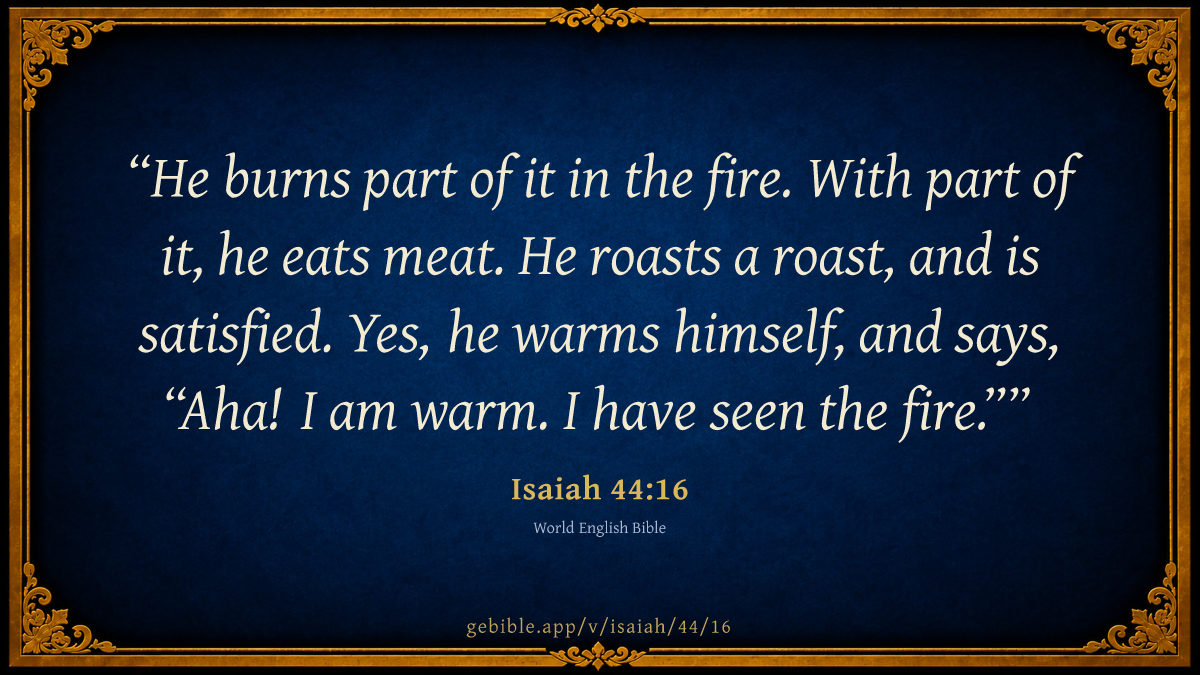
He burns part of it in the fire. With part of it, he eats meat. He roasts a roast, and is satisfied. Yes, he warms himself, and says, “Aha! I am warm. I have seen the fire.”
Parallel Translations
-
He burns part of it in the fire. With part of it, he eats meat. He roasts a roast, and is satisfied. Yes, he warms himself, and says, “Aha! I am warm. I have seen the fire.”
-
He burneth part thereof in the fire; with part thereof he eateth flesh; he roasteth roast, and is satisfied: yea, he warmeth himself, and saith, Aha, I am warm, I have seen the fire:
-
He burneth the half thereof in the fire; with the half thereof he eateth flesh; he roasteth roast, and is satisfied; yea, he warmeth himself, and saith: 'Aha, I am warm, I have seen the fire';
Cross-references
No cross-references for this verse.
Explain this verse (10 sources)
Historical commentary, presented as a primary source — not an endorsement.
Private notes
Saved on this device only — never synced or sent anywhere.
Geneva Bible translators 1599 · Public Domain That is, he either maketh a table or trenchers.
That is, he either maketh a table or trenchers.
Geneva Bible (1599) marginal notes — public domain.
John Trapp 1656 · Public Domain Isa 44:16 He burneth part thereof in the fire;…
Isa 44:16 He burneth part thereof in the fire; with part thereof he eateth flesh; he roasteth roast, and is satisfied: yea, he warmeth [himself], and saith, Aha, I am warm, I have seen the fire:
Ver. 16. He burneth part thereof in the fire.] Which is to far better purpose than the other part made into an idol.
Read full note →
I have seen the fire,] i.e., I have felt it. One sense puts forth another.
John Trapp, A Commentary or Exposition upon All the Books of the Old and New Testament (1647–1656) — public domain. Text from a community e-Sword module.
Matthew Poole 1685 · Public Domain He eateth flesh; he dresseth flesh for his eating.
He eateth flesh; he dresseth flesh for his eating.
I have seen the fire; I have felt the warmth of it. Seeing is oft put for other senses, as feeling, hearing, &c., as hath been oft observed before.
Matthew Poole's English Annotations on the Holy Bible (1683–1685) — public domain. Text from a community e-Sword/MySword module.
John Gill 1763 · Public Domain He burneth part thereof in the fire,.... To warm…
He burneth part thereof in the fire,.... To warm himself with, as before:
with part thereof he eateth flesh; that is, with part of it he dresses flesh, and makes it fit to eat; unless the meaning is, with part of it he makes tables and trenchers to eat meat off of; but the former sense seems most likely, and agrees with what follows:
Read full note →
he roasteth roast, and is satisfied; he roasts his meat with it, and eats it when roasted, and is highly pleased and delighted with it, and he eats of it to his satisfaction:
yea, he warmeth him, and saith, Aha; an expression of joy and delight, being before a good fire in winter time:
I am warm, I have seen the fire; have felt it, and enjoyed the comfort of it, which has given a sensible pleasure.
John Gill's Exposition of the Whole Bible (1746–1763) — public domain (CC PDM 1.0). Text via the HelloAO Bible API.
Adam Clarke 1810 · Public Domain Verse 16. With part - "AND with part"] Twenty-three…
Verse 16. With part - "AND with part"] Twenty-three MSS., the Septuagint, and Vulgate add the conjunction ו vau, and ועל veal.
Adam Clarke's Commentary on the Bible (1810–1826) — public domain. Text from a community e-Sword/MySword module.
Albert Barnes 1834 · Public Domain With part thereof he eateth flesh - That is,…
With part thereof he eateth flesh - That is, he prepares flesh to eat, or prepares his food.
He roasteth roast - He roasts meat.
Albert Barnes' Notes on the Bible (1834–1885) — public domain. Text from a community e-Sword/MySword module.
Robert Jamieson, A. R. Fausset & David Brown 1871 · Public Domain part . . . part--not distinct parts, but the…
part . . . part--not distinct parts, but the same part of the wood (compare Isa 44:17).
eateth--that is, cooks so as to eat (Isa 44:19).
Read full note →
I have seen--I feel its power.
Jamieson, Fausset & Brown — Commentary Critical and Explanatory on the Whole Bible (1871) — public domain (CC PDM 1.0). Text via the HelloAO Bible API.
The Cambridge Bible for Schools and Colleges 1878 · Public Domain 16. part thereof] lit. “half thereof,” as opposed to…
16. part thereof] lit. “half thereof,” as opposed to “the residue thereof” in Isa_44:17. Cf. Isa_44:19, “upon the coals thereof.”
The Cambridge Bible for Schools and Colleges (gen. ed. J. J. S. Perowne; Cambridge University Press, 1878–1918) — public domain. Text from a community e-Sword module.
The Pulpit Commentary 1880 · Public Domain He burneth part thereof; rather, half thereof; "With half…
He burneth part thereof; rather, half thereof; "With half thereof not the other half, but the same eateth flesh." One fire serves for the two purposes of warming him and cooking his victuals.
The Pulpit Commentary (1880–1919), ed. H.D.M. Spence-Jones & Joseph S. Exell — public domain. Text from a community e-Sword module.
The Biblical Illustrator 1887 · Public Domain He burneth part thereof in the fire.
Isa_44:16
He burneth part thereof in the fire.
Read full note →
Which is to far better purpose than the other part made into an idol, (J. Trapp.)
Aha, I am warm
Cold
This is an expression of that natural joy which will escape from one in some way or other, when from a comfortless apartment, or from a frosty street, or from some wintry office of obligation, he sees the shining of his own hearth. If it could be introduced thus with an exclamation in the land of Judea, that mild land, it should certainly be repeated in this stern climate with a deep feeling of relief and thankfulness. The household gods of ancient Italy were set up about the fireplace of each dwelling, as about a sacred spot, deserving to be surrounded with the images of a divine protection; and even now, all over the world, altar and hearth are but another phrase for home. Who, asks the psalmist, can stand before His cold? God sends it; and He has filled the earth with materials, and the mind of man with resources, to repel and overcome it. He is the same Sovereign Wisdom and Goodness in this as in every other part of His works. And yet we must confess that it is one of His unwelcome ministers; but, like all the rest of what we account so in the natural world, subservient to high purposes in the holy providence of the Lord. Let us turn to the various instrumentality by which its vigour is mitigated and its power for mischief broken. I am warm, says the speaker in the text. So would the ground say if it had a tongue, while it lies sheltered under the fleecy garments of dazzling whiteness, which the very cold has woven for it out of the dark mists. I am warm, say the beast and the bird of the frozen zone, as the one lies close in his furry coat or the locks of his long hair, and the other is not afraid to cleave the inexorable sky with his breast of down. I am warm, repeat the animals who are natives of our own temperate circle, as they take shelter in the hollow retreats which their industry has contrived, or make their way towards the more genial countries whither their instincts direct them. I am warm, say the lake and the stream, while they are armed with the polished breast-plate which has been forged for them, not among furnaces of glowing heat, but in the magazines of the haft. I am warm, says man; he who commands the inferior creatures, he who makes a path for himself even over the deep, he who compels into his bond-service the substances and the elements of the world. He cuts clown the trees, and makes them do him a kinder office by their blaze than they had done before by their shadow. And better than this; he opens the dark treasures with which a gracious providence has stored the lower parts of the earth, and he finds them more precious than the vein for the silver, than the place of sapphires and dust of gold. What are the feelings which the consideration of the cold and all its alleviating circumstances should impress upon the mind?
1. Thankfulness towards God. There is no small danger of losing sight of the Almighty Benefactor in partaking of His benefits. There is no small danger of even turning those very benefits into a sort of idols that we substitute in His place. This was precisely and literally the case with the person whom the prophet describes as speaking in the text. You are like him, who transform your interest into your religion; making a show of worship, when you are thinking only how to be warmed and fed. You, too, are like him who shape your faith and your convenience out of the same material; making the concerns of the soul but part and parcel with common necessities. We are all like him, so far as we turn our comforts into our divinities.
2. Sympathy with His suffering creatures. (N. L. Frothingham.)
The wisdom of God in the freezing of water:
I cannot omit calling your attention to a remarkable fact in the freezing of water, which has nothing to surpass it in the surprising wisdom of its ordination, even if it has any perfect parallel in the whole economy of nature. We know it to be a general law of material substances, that they expand with the heat and contract with the cold. The particles of water are subjected to this rule, like all other particles of matter. But if this were allowed to hold on throughout, giving way to no exception, do but reflect what would be the consequences. The drops at the surface, as they were successively congealed, would sink. The process of freezing would begin at the bottom. Layer after layer would thus be deposited, which no returning suns could penetrate to dissolve; and the most that the summer could do would be to wet the face of the flinty mass. The water-courses would be for ever stopped in their glad and wholesome flow; and many a broad river would scarcely float a boat upon its plashy shallows. And now what has been done to avert such a calamity? A new law has been instituted, in direct contravention of the old, to meet the exigency of the case. The water, precisely at the moment of congelation, breaks away into the line of an opposite decree. It expands and grows lighter. It refuses to descend. It rests fixed upon the top, an ornament and a defence. I know not how others may be affected by a view like this; but it seems to me to call for an adoring acknowledgment of that all-pervading design which thus supplies the wants of its creation by a special departure from its own method, as invariable in its action as the method itself. (N. L. Frothingham.)
The Biblical Illustrator, edited by Joseph S. Exell (c. 1880s–1900s) — public domain. Text from a community e-Sword module.