
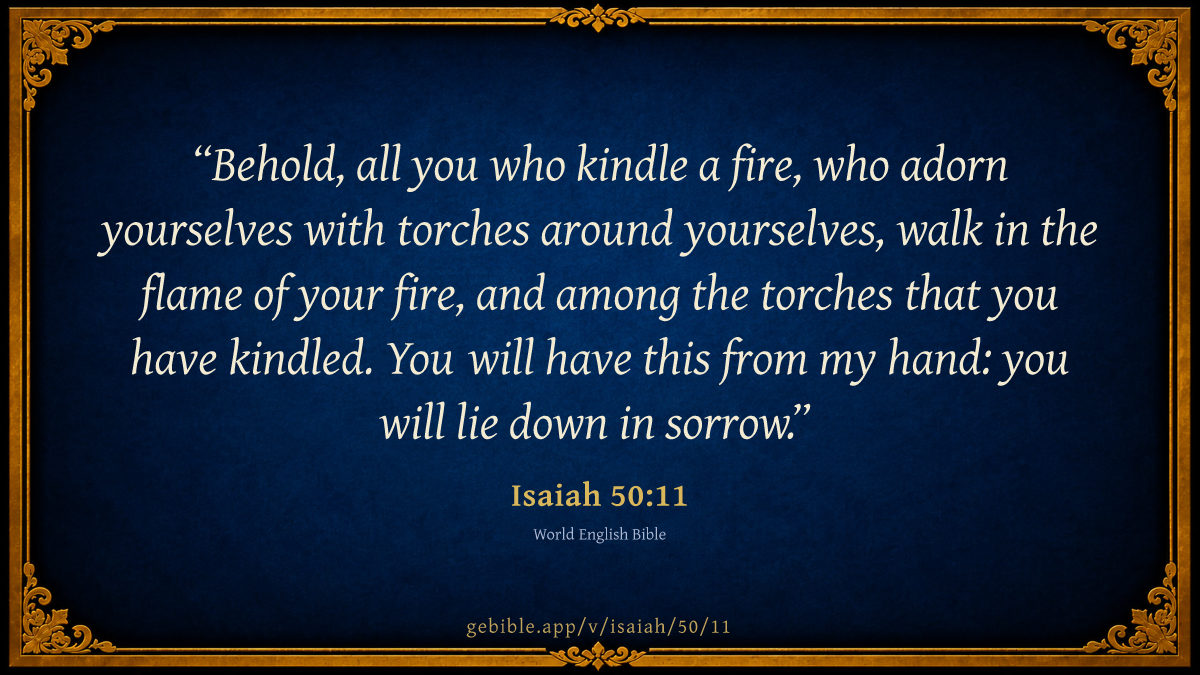
Behold, all you who kindle a fire, who adorn yourselves with torches around yourselves, walk in the flame of your fire, and among the torches that you have kindled. You will have this from my hand: you will lie down in sorrow.
Parallel Translations
-
Behold, all you who kindle a fire, who adorn yourselves with torches around yourselves, walk in the flame of your fire, and among the torches that you have kindled. You will have this from my hand: you will lie down in sorrow.
-
Behold, all ye that kindle a fire, that compass yourselves about with sparks: walk in the light of your fire, and in the sparks that ye have kindled. This shall ye have of mine hand; ye shall lie down in sorrow.
-
Behold, all ye that kindle a fire, that gird yourselves with firebrands, begone in the flame of your fire, and among the brands that ye have kindled. This shall ye have of My hand; ye shall lie down in sorrow.
Cross-references (25)
Passages linked to Isaiah 50:11 in the Treasury of Scripture Knowledge, ordered by reader-vote popularity; verse text shown in World English Bible.
- Jeremiah 17:5-7 Yahweh says: “Cursed is the man who trusts in man, relies on strength of flesh, and whose heart departs from Yahweh. For he will be like a bush in the desert, and will not see when good comes, but will inhabit the parched places in the wilderness, an uninhabited salt land. “Blessed is the man who trusts in Yahweh, and whose confidence is in Yahweh.
- Romans 1:21-22 Because knowing God, they didn’t glorify him as God, and didn’t give thanks, but became vain in their reasoning, and their senseless heart was darkened. Professing themselves to be wise, they became fools,
- Romans 10:3 For being ignorant of God’s righteousness, and seeking to establish their own righteousness, they didn’t subject themselves to the righteousness of God.
- Matthew 15:6-8 he shall not honor his father or mother.’ You have made the commandment of God void because of your tradition. You hypocrites! Well did Isaiah prophesy of you, saying, ‘These people draw near to me with their mouth, and honor me with their lips; but their heart is far from me.
- John 8:24 I said therefore to you that you will die in your sins; for unless you believe that I am he, you will die in your sins.”
- Psalms 20:7-8 Some trust in chariots, and some in horses, but we trust in the name of Yahweh our God. They are bowed down and fallen, but we rise up, and stand upright.
- Isaiah 28:15-20 “Because you have said, ‘We have made a covenant with death, and we are in agreement with Sheol. When the overflowing scourge passes through, it won’t come to us; for we have made lies our refuge, and we have hidden ourselves under falsehood.’ ” Therefore the Lord Yahweh says, “Behold, I lay in Zion for a foundation a stone, a tried stone, a precious cornerstone of a sure foundation. He who believes shall not act hastily. I will make justice the measuring line, and righteousness the plumb line. The hail will sweep away the refuge of lies, and the waters will overflow the hiding place. Your covenant with death shall be annulled, and your agreement with Sheol shall not stand. When the overflowing scourge passes through, then you will be trampled down by it. As often as it passes through, it will seize you; for morning by morning it will pass through, by day and by night; and it will be nothing but terror to understand the message.” For the bed is too short to stretch out on, and the blanket is too narrow to wrap oneself in.
- Jonah 2:8 Those who regard lying vanities forsake their own mercy.
- Revelation 19:20 The beast was taken, and with him the false prophet who worked the signs in his sight, with which he deceived those who had received the mark of the beast and those who worshiped his image. These two were thrown alive into the lake of fire that burns with sulfur.
- Exodus 11:9-10 Yahweh said to Moses, “Pharaoh won’t listen to you, that my wonders may be multiplied in the land of Egypt.” Moses and Aaron did all these wonders before Pharaoh, but Yahweh hardened Pharaoh’s heart, and he didn’t let the children of Israel go out of his land.
- Psalms 32:10 Many sorrows come to the wicked, but loving kindness shall surround him who trusts in Yahweh.
- Isaiah 8:22 and look to the earth, and see distress, darkness, and the gloom of anguish. They will be driven into thick darkness.
- Isaiah 30:15-16 For thus said the Lord Yahweh, the Holy One of Israel, “You will be saved in returning and rest. Your strength will be in quietness and in confidence.” You refused, but you said, “No, for we will flee on horses;” therefore you will flee; and, “We will ride on the swift;” therefore those who pursue you will be swift.
- Isaiah 65:13-16 Therefore the Lord Yahweh says, “Behold, my servants will eat, but you will be hungry; behold, my servants will drink, but you will be thirsty. Behold, my servants will rejoice, but you will be disappointed; Behold, my servants will sing for joy of heart, but you will cry for sorrow of heart, and will wail for anguish of spirit. You will leave your name for a curse to my chosen; and the Lord Yahweh will kill you. He will call his servants by another name, so that he who blesses himself in the earth will bless himself in the God of truth; and he who swears in the earth will swear by the God of truth; because the former troubles are forgotten, and because they are hidden from my eyes.
- Ezekiel 20:39 “ ‘As for you, house of Israel, the Lord Yahweh says: “Go, everyone serve his idols, and hereafter also, if you will not listen to me; but you shall no more profane my holy name with your gifts and with your idols.
- John 9:39 Jesus said, “I came into this world for judgment, that those who don’t see may see; and that those who see may become blind.”
- Psalms 16:4 Their sorrows shall be multiplied who give gifts to another god. Their drink offerings of blood I will not offer, nor take their names on my lips.
- Proverbs 26:18 Like a madman who shoots torches, arrows, and death,
- Isaiah 55:2 Why do you spend money for that which is not bread, and your labor for that which doesn’t satisfy? Listen diligently to me, and eat that which is good, and let your soul delight itself in richness.
- Amos 4:4-5 “Go to Bethel, and sin; to Gilgal, and sin more. Bring your sacrifices every morning, your tithes every three days, offer a sacrifice of thanksgiving of that which is leavened, and proclaim free will offerings and brag about them: for this pleases you, you children of Israel,” says the Lord Yahweh.
- Matthew 8:12 but the children of the Kingdom will be thrown out into the outer darkness. There will be weeping and gnashing of teeth.”
- Matthew 22:13 Then the king said to the servants, ‘Bind him hand and foot, take him away, and throw him into the outer darkness. That is where the weeping and grinding of teeth will be.’
- 2 Thessalonians 1:8-9 punishing those who don’t know God, and to those who don’t obey the Good News of our Lord Jesus, who will pay the penalty: eternal destruction from the face of the Lord and from the glory of his might,
- James 3:6 And the tongue is a fire. The world of iniquity among our members is the tongue, which defiles the whole body, and sets on fire the course of nature, and is set on fire by Gehenna.
- Revelation 20:15 If anyone was not found written in the book of life, he was cast into the lake of fire.
Cross-references from openbible.info (CC BY 4.0)
Explain this verse (16 sources)
Historical commentary, presented as a primary source — not an endorsement.
Private notes
Saved on this device only — never synced or sent anywhere.
Geneva Bible translators 1599 · Public Domain You have sought consolation by your own devices, and…
You have sought consolation by your own devices, and have refused the light, and consolation which God hath offered: therefore ye shall remain in sorrow, and not be comforted.
Geneva Bible (1599) marginal notes — public domain.
John Trapp 1656 · Public Domain Isa 50:11 Behold, all ye that kindle a fire,…
Isa 50:11 Behold, all ye that kindle a fire, that compass [yourselves] about with sparks: walk in the light of your fire, and in the sparks [that] ye have kindled. This shall ye have of mine hand; ye shall lie down in sorrow.
Ver. 11. Behold, all ye that kindle a fire.] That instead of relying upon God, would relieve yourselves by carnal shifts and fetches, a fire of your own kindling, or rather sparks of your own tinderboxes, strange fire, and not that of God’s sanctuary. Or say they be your own good works you trust to. Like as the phoenix gathereth sweet odoriferous sticks in Arabia together, aud then blows them with her wings, and burns herself with them.
Read full note →
That compass yourselves about with sparks.] Away with those tinder boxes of yours. What are your sparkles but such as are smitten out of a flint, which (1.) Yields no warmth or good light; (2). Are soon extinct; (3.) Nevertheless, you are sure to "lie down in sorrow," to be "cast into utter darkness," where you shall never see the light again till you see the whole world all on a light fire at the last day.
Walk in the light of your fire.] Do so if ye think it good; but your light shall be put out into darkness and worse; like as lightning is followed by rending and roaring thunder.
This shall ye have of my hand.] This I will assure of; and having spoken it with my mouth, I will fulfil it with my hand.
Ye shall lie down in sorrow.] As sick folk, who being in grievous pain, would fain die, but cannot. Cubatum ibitis, ad ignes, ad dolores et cruciatus. You shall make your beds in the bottom of hell, as it is said of the king of Babylon, {Isa 14:11} and as of Pope Clement V it was reported, that upon the death of a nephew of his, whom he had sensually abused, he sent to a certain magician to know how it went with his soul in the other world? {a} The magician showed him to the messenger as lying in hell in a bed of fire. Whereupon the Pope was so struck with horror, that he never held up his head more, but soon after died also.
{a} Jacob. Revius, Hist. Pontif., p. 199.
John Trapp, A Commentary or Exposition upon All the Books of the Old and New Testament (1647–1656) — public domain. Text from a community e-Sword module.
Matthew Poole 1685 · Public Domain All ye that kindle a fire, that you may…
All ye that kindle a fire, that you may enjoy the light and comfort of it, as it is explained in the following words. You that reject the light which God hath set up, and refuse the counsel of his servant, and seek for comfort, and safety, and the knowledge of God’s mind, and the enjoyment of his favour, by your own inventions; which was the common error of the Jews in all ages, and especially in the days of the Messiah, when they refused him, and that way of righteousness and salvation which he appointed, and rested upon their own traditions and devices, going about to establish their own righteousness, and not submitting unto the righteousness of God, as is expressed, Rom 10:3.
That compass yourselves about; endeavouring to warm and refresh yourselves on all sides.
Read full note →
With sparks; or rather, with firebrands, as this very word is fitly rendered, Pro 26:18, which is better than sparks or flames, which is there put in the margin, because firebrands only, and not sparks or flames, are capable of being thrown by one man at another. And this word is no where else used in Scripture. He mentions firebrands, either to imply that these fires yielded more smoke than heat or light, of because these were the usual materials of a fire.
Walk in the light of your fire, and in the sparks that ye have kindled; use your utmost endeavours to get comfort and satisfaction from these devices.
This shall ye have of mine hand, ye shall lie down in sorrow; this shall be the fruit of all, through my just judgment, that instead of that comfort and security which you expect by these means, you shall receive nothing but vexation and misery, which shall pursue you both living and dying; for this word, which is here rendered lie down, is frequently used for dying, as Gen 47:30; Job 21:26, and elsewhere. Or it is a metaphor from a man that lying down on his bed for rest and ease, meets with nothing but trouble and pain, as Job complained, Job 7:13,14.
Matthew Poole's English Annotations on the Holy Bible (1683–1685) — public domain. Text from a community e-Sword/MySword module.
John Gill 1763 · Public Domain Behold, all ye that kindle a fire,.... To enlighten…
Behold, all ye that kindle a fire,.... To enlighten and warm yourselves; who, rejecting Christ the Light of the world, and despising the glorious light of his Gospel, and loving darkness rather than light, set up the light of nature and reason as the rule of faith and practice; or the traditions and doctrines of men to be guided by; or their own righteousness for their justification before God, and acceptance with him:
that compass yourselves about with sparks, that fly out of the fire kindled, or are struck out of a flint, which have little light and no heat, and are soon out; which may denote the short lived pleasures and comforts which are had from the creature, or from anything of a man's own:
Read full note →
walk in the light of your fire, and in the sparks that ye have kindled; an ironical expression, bidding them take all the comfort and satisfaction they could in their own works and doings, and get all the light and heat they could from thence:
this shall ye have of mine hand; which you may depend upon receiving from me, for rejecting me and my righteousness, and trusting in your own:
ye shall lie down in sorrow; instead of being justified hereby, and having peace with God, and entering into heaven, ye shall be pressed down with sore distress, die in your sins, and enter into an everlasting state of condemnation and death; see Mar 16:16. This was the case and state of the Jews, Rom 9:31. This is one of the passages the Jews (g) say is repeated by the company of angels, which meet a wicked man at death.
(g) T. Bab. Cetubot, fol. 104. 1.
Next: Isaiah Chapter 51
John Gill's Exposition of the Whole Bible (1746–1763) — public domain (CC PDM 1.0). Text via the HelloAO Bible API.
John Wesley 1765 · Public Domain All ye - You that reject the light which…
All ye - You that reject the light which God hath set up, and seek for comfort and safety, by your own inventions. Walk - Use your utmost endeavours to get comfort from these devices. This - This shall be the fruit of all, you shall receive nothing but vexation and misery.
John Wesley, Explanatory Notes Upon the Whole Bible (1754–1765) — public domain. Text via the GEBible commentary corpus.
Adam Clarke 1810 · Public Domain Verse 11. Ye that kindle a fire] The fire…
Verse 11. Ye that kindle a fire] The fire of their own kindling, by the light of which they walk with security and satisfaction, is an image designed to express, in general, human devices and mere worldly policy, exclusive of faith, and trust in God; which, though they flatter themselves for a while with pleasing expectations and some appearance of success, shall in the end turn to the confusion of the authors. Or more particularly, as Vitringa explains it, it may mean the designs of the turbulent and factious Jews in the times succeeding those of Christ, who, in pursuit of their own desperate schemes, stirred up the war against the Romans, and kindled a fire which consumed their city and nation.
That compass yourselves about with sparks - "Who heap the fuel round about"] "מגוזלי megozeley, accendentes, Syr.; forte legerunt pro מאזרי meazzerey מאירי meirey; nam sequitur אור ur." - Secker. Lud. Capellus, in his criticism on this place, thinks it should be מאזרי meazzerey, from the Septuagint, κατισχυοντες.
Read full note →
There are others who are widely different from those already described. Without faith, repentance, or a holy life, they are bold in their professed confidence in God - presumptuous in their trust in the mercy of God; and, while destitute of all preparation for and right to the kingdom of heaven, would think it criminal to doubt their final salvation! Living in this way, what can they have at the hand of God but an endless bed of sorrow! Ye shall lie down in sorrow.
But there is a general sense, and accordant to the design of the prophecy, in which these words may be understood and paraphrased: Behold, all ye that kindle a fire - provoke war and contention; compass yourselves about with sparks - stirring up seditions and rebellions: walk in the light of your fire - go on in your lust of power and restless ambition. Ye shall lie down in sorrow - it will turn to your own perdition. See the Targum. This seems to refer to the restless spirit of the Jews, always stirring up confusion and strife; rebelling against and provoking the Romans, till at last their city was taken, their temple burnt to the ground, and upwards of a million of themselves destroyed, and the rest led into captivity!
Adam Clarke's Commentary on the Bible (1810–1826) — public domain. Text from a community e-Sword/MySword module.
Albert Barnes 1834 · Public Domain Behold, all ye that kindle a fire - This…
Behold, all ye that kindle a fire - This verse refers to the wicked. In the previous verse, the Messiah had called upon all the pious to put their trust in God, and it is there implied that they would do so. But it would not be so with the wicked. In times of darkness and calamity, instead of trusting in God they would confide in their own resources, and endeavor to kindle a light for themselves in which they might walk. But the result would be, that they would find no comfort, and would ultimately under his hand lie down in sorrow. The figure is continued from the previous verse. The pious who are in darkness wait patiently for the light which Yahweh shall kindle for them But not so with the wicked. They attempt to kindle a light for themselves, and to walk in that. The phrase, ‘that kindle a fire,’ refers to all the plans which people form with reference to their own salvation; all which they rely upon to guide them through the darkness of this world. It may include, therefore, all the schemes of human philosophy, of false religion, of paganism, of infidelity, deism, and self-righteousness; all dependence on our good works, our charities ties, and our prayers. All these are false lights which people enkindle, in order to guide themselves when they resolve to cast off God, to renounce his revelation, and to resist his spirit. It may have had a primary reference to the Jews, who so often rejected the divine guidance, and who relied so much on themselves; but it also includes all the plans which people devise to conduct themselves to heaven. The confidence of the pious Isa 50:10 is in the light of God; that of the wicked is in the light of people.
That compass yourselves about with sparks - There has been considerable variety in the interpretation of the word rendered here sparks (זיקות ziyqôth). It occurs nowhere else in the Bible, though the word זקים ziqqiym occurs in Pro 26:18, where it is rendered in the text ‘firebrands,’ and in the margin ‘flames,’ or ‘sparks.’ Gesenius supposes that these are different forms at the same word, and renders the word here, ‘burning arrows, fiery darts.’ The Vulgate renders it ‘flames.’ The Septuagint, φλογὶ phlogi - ‘flame.’ In the Syriac the word has the sense of lightning. Vitringa supposes it means ‘faggots,’ and that the sense is, that they encompass themselves with faggots, in order to make a great conflagration. Lowth renders it, very loosely, ‘Who heap the fuel round about.’ But it is probable that the common version has given the true sense, and that the reference is to human devices, which give no steady and clear light, but which may be compared with a spark struck from a flint. The idea probably is, that all human devices for salvation bear the same resemblance to the true plan proposed by God, which a momentary spark in the dark does to the clear shining of a bright light like that of the sun. If this is the sense, it is a most graphic and striking description of the nature of all the schemes by which the sinner hopes to save himself.
Read full note →
Walk in the light of your fire - That is, you will walk in that light. It is not a command as if he wished them to do it, but it is a declaration which is intended to direct their attention to the fact that if they did this they would lie down in sorrow. It is language such as we often use, as when we say to a young man, ‘go on a little further in a career of dissipation, and you will bring yourself to poverty and shame and death.’ Or as if we should say to a man near a precipice, ‘go on a little further, and you wilt fall down and be dashed in pieces.’ The essential idea is, that this course would lead to ruin. It is implied that they would walk on in this way, and be destroyed.
This shall ye have - As the result of this, you shall lie down in sorrow. Herder renders this:
One movement of my hand upon you,
And ye shall lie down in sorrow.
How simple and yet how sublime an expression is this! The Messiah but lifts his hand and the lights are quenched. His foes lie down sad and dejected, in darkness and sorrow. The idea is, that they would receive their doom from his hand, and that it would he as easy for him as is the uplifting or waving of the hand, to quench all their lights, and consign them to grief (compare Matt. 25)
Albert Barnes' Notes on the Bible (1834–1885) — public domain. Text from a community e-Sword/MySword module.
Robert Jamieson, A. R. Fausset & David Brown 1871 · Public Domain In contrast to the godly (Isa 50:10), the wicked,…
In contrast to the godly (Isa 50:10), the wicked, in times of darkness, instead of trusting in God, trust in themselves (kindle a light for themselves to walk by) (Ecc 11:9). The image is continued from Isa 50:10, "darkness"; human devices for salvation (Pro 19:21; Pro 16:9, Pro 16:25) are like the spark that goes out in an instant in darkness (compare Job 18:6; Job 21:17, with Psa 18:28).
sparks--not a steady light, but blazing sparks extinguished in a moment.
Read full note →
walk--not a command, but implying that as surely as they would do so, they should lie down in sorrow (Jer 3:25). In exact proportion to mystic Babylon's previous "glorifying" of herself shall be her sorrow (Mat 25:30; Mat 8:12; Rev 18:7).
Next: Isaiah Chapter 51
Jamieson, Fausset & Brown — Commentary Critical and Explanatory on the Whole Bible (1871) — public domain (CC PDM 1.0). Text via the HelloAO Bible API.
Daniel D. Whedon 1874 · Public Domain 11. Ye… that compass yourselves about with sparks —…
11. Ye… that compass yourselves about with sparks — If any son of Israel is neglecting Jehovah his God, is self-sufficient, is kindling his own fire and walking by the light of it, even daring the perils of stumbling on account of the darkness which his own soon-to-be-quenched light shall occasion, then, be sure, God’s own right hand shall send a doom heavier than can be imagined.
Ye shall lie down in sorrow — Or in a place of torment, where there shall be no remedy. Vitringa, and those who follow him, suppose allusion here is direct to the Pharisaical party who at first listened to Christ’s teachings, then rejected them, then murdered him. For all which their doom as a nation was precipitated in forty years.
Daniel D. Whedon (gen. ed.), Commentary on the Old and New Testaments (1874–1909) — public domain. Text from a community e-Sword module.
The Cambridge Bible for Schools and Colleges 1878 · Public Domain 11. that compass yourselves about with sparks] Lit. as…
11. that compass yourselves about with sparks] Lit. as R.V., that gird yourselves about with firebrands (cf. Pro_26:18). The verb “gird” hardly suits the metaphor; hence it is better with many authorities to change מאזרי into מאירי (“that kindle”). “Fire” and “firebrands” are both images for the machinations of the ungodly party against the true servants of Jehovah (cf. Psa_7:13; Eph_6:16).
walk in the light &c.] Rather: walk into the flame of your fire &c. Their mischievous designs shall recoil on themselves (Psa_7:15 f.).
Read full note →
this shall ye have of mine hand] Better: from my hand is this (appointed) for you.
ye shall lie down in sorrow] perhaps: in the place of torment; see on ch. Isa_66:24.
The Cambridge Bible for Schools and Colleges (gen. ed. J. J. S. Perowne; Cambridge University Press, 1878–1918) — public domain. Text from a community e-Sword module.
Ellicott's Commentary for English Readers 1878 · Public Domain (11) All ye that kindle a fire.—The words obviously…
(11) All ye that kindle a fire.—The words obviously point to any human substitute for the Divine light, and thus include the two meanings which commentators have given them: (1) Man’s fiery wrath, that worketh not the righteousness of God; and (2) man’s attempt to rest in earthly comforts or enjoyments instead of in the light and joy that comes from God.
That compass yourselves about with sparks.—The words are rendered by many commentators, gird yourselves with burning darts, or firebrands, i.e., with calumnies and execrations as your weapons of warfare (Comp. Eph_6:16.)
Read full note →
Ye shall lie down in sorrow.—The words point to a death of anguish, perhaps to the torment that follows death (comp. Luk_16:24), as the outcome of the substitution of the earthly for the heavenly light.
A Bible Commentary for English Readers, edited by Charles John Ellicott (1878–1897) — public domain. Text from a community e-Sword module.
The Pulpit Commentary 1880 · Public Domain All ye that kindle a fire, that compass yourselves…
All ye that kindle a fire, that compass yourselves about with sparks; or, with firebrands. The persons intended seem to be those whose "tongue is a fire, a world of iniquity", (Jam_3:6) and who by means of it are employed in "stirring up strife all the day long." They are condemned to be scorched by the fire which they have themselves kindled, to be made wretched by the strife which they have themselves caused to spring up. Their end, moreover, will be to lie down in sorrow; or, in torture (Cheyne). God will punish them in the next world for the misery which they have brought about in this, and will thus exercise retributive justice upon the wicked ones, whose main object in life has been to embitter the lives of their fellow-men.
Ineffectual light and guilty darkness.
Read full note →
These words are not applicable to those who have had no special privileges, and to whom there has been no alternative but that of groping their way in such light as they could gain from their own reason and from the conclusions of other men. They apply to those only who will not walk in the light which is offered them. There are
I THOSE WHO SEEK NO DIRECT ILLUMINATION IN THEIR CHRISTIAN COURSE. If we would order our Christian life according to the will of our Divine Master, we must not content ourselves with regulating our daily conduct by the rules and maxims which are current in the circles in which we move, or by the notions of propriety we happen to have formed from our elders and associates. We are bound to ask and to consider what the will of Christ is, as revealed in his Word and as illustrated in his life; and we are bound to seek the illumination of his Divine Spirit. Otherwise, we shall walk along a very much lower level than our Lord intended us to take. And though we be not finally condemned, yet will the time come when we shall awake to our grievous error, and be afflicted with a profound regret.
II THOSE WHO PERSIST IN CONSTRUCTING THEIR OWN THEOLOGY. God has revealed himself to us in Jesus Christ; in him and through him we know his nature, his disposition, his will concerning us; we know the way by which we can regain his favour, return to his likeness, ascend to his home in heaven. But there are those who will not learn and live; who proudly turn away from the Teacher that came from God to tell us of the holy Father of man. They prefer to construct their own theology; it is an utterly unsatisfying one; it is not the Bread of life, but the ashes of disappointment. And they pay, in a great and awful privation, the penalty of their folly and their sin.
III THOSE WHO WILL NOT LEARN FROM GOD THE MEANING AND THE WORTH OF HUMAN LIFE. What are we here for? Can anything be made of the mortal life we are living? Is everything vanity? May we treat our life as a game to be played out; or as a mart where all things can be turned into money; or as a selfish scramble in which the strongest and swiftest secure the best prizes? There are many that say, "Who will show us any good? Life is not worth living." They walk in the light of the poor sparks their own wit has kindled. They will "lie down in sorrow;" they will come to mourn their great mistake, to reproach themselves for the greatness of their folly, the seriousness of their sin. For all the while that they were cynically dismissing their opportunities, there was shining on their life the light that comes from heaven. Christ was inviting them to make of their earthly life a holy sacrifice unto the living God, a noble and valuable service to their fellow-men, a time of pure and sacred joy, a discipline that would train the docile and obedient spirit for a broader sphere and a brighter life in a higher kingdom. C.
Disappointed self-trust.
Various interpretations of the fire here referred to have been given. Probably the allusion is to the ordinary domestic fire, taken as a figure for the various comforts and supports which men can find for themselves. A self-kindled fire contrasts with divinely given light. Matthew Henry says, "They place their happiness in their worldly possessions and enjoyments, and not in the favour of God. Creature-comforts are as sparks, short-lived and soon gone; yet the children of this world, while they last, warm themselves by them, and walk with pride and pleasure in the light of them. Those that make the world their comfort, and their own righteousness their confidence, will certainly meet with a fatal disappointment, which will be bitterness in the end." The figures of the verse may receive explanation from the Eastern fires made with grass, which, while burning, emits many a dancing spark, that, after a vain promise to enliven the surrounding gloom for a moment, suddenly sink into darkness. The wet and shivering inmates of the hovel seek for light and heat by crowding close to the blazing hearth, but after many fruitless attempts, and the consumption of their stock, they are compelled to retire to their ill-covered pallets lie down in sorrow." Let the subject be self-confidence.
I THE SHOW IT MAKES. A man in the power of it starts out bravely; defies the darkness; and easily overcomes first difficulties. The early efforts of self-reliant people attract attention and excite hope. We like to see the working of energy and strong will.
II THE PLEASURE IT BRINGS. To feel power; to find that men yield to our resoluteness, and that circumstances are mastered by our energy.
III THE BREVITY OF ITS SUCCESSES. For our strength does not endure. The strain of life steadily increases. Circumstances at last prove greater than we are. We cannot do the things that we would. Peters, who for a while can gird themselves, by-and-by find that another must gird them. Do what we may, we cannot keep the fire of self-trust steadily burning.
IV THE MISERY WHEN SUCCESS CHANGES TO FAILURE. As it surely does when God puts his hand upon us, damps the fire, puts out the light we have made, keeps away his light, and leaves us alone, cold, smitten: to feel with such a one as Byron"The worm, the canker, and the grief are mine alone.
Impress the folly and the danger of self-trust by the figures given in Jer_17:5-8. R.T.
The Pulpit Commentary (1880–1919), ed. H.D.M. Spence-Jones & Joseph S. Exell — public domain. Text from a community e-Sword module.
The Biblical Illustrator 1887 · Public Domain Behold, all ye that kindle a fire
Isa_50:11
Behold, all ye that kindle a fire
Read full note →
A child of darkness walking in light
By the fire and the light of their fire which wicked men are said to walk in, two things must be meant.
I. THEIR OWN NATURAL RIGHTEOUSNESS and the sparks and acts thereof.
II. THE LIGHT OF OUTWARD COMFORTS from the creatures, which in this world they enjoy, and the sparkling pleasures thereof which they walk in, and content themselves with, neglecting communion with God, being estranged from the life of God, and living without Him in the world. (T. Goodwin, D.D.)
Sparks of our own kindling
Our mistake is, not that we seek happiness (for to do so is inherent in the constitution of our nature), but that we seek it from fictitious and artificial sources, which are not naturally calculated to yield it. The many fictitious sources, from which men seek to derive happiness, are compared to a fire kindled, and sparks struck out, by way of relieving the darkness of the night. It is, of course, implied in the metaphor, that true happiness, the real and adequate complement of mans nature, resembles the Divinely-created and golden sunlight.
I. THIS COMPARISON DOES NOT LEAD US TO DENY THAT PLEASURE AND GRATIFICATION OF A CERTAIN KIND ARE DERIVABLE FROM WORLDLY SOURCES. Just as man can relieve himself in great measure from the discomfort and inconvenience of natural darkness, by kindling a fire and surrounding himself with sparks, so can he alleviate, to a certain extent, the instinctive sense of disquietude and dissatisfaction, so irksome to him at intervals of leisure, by the various enjoyments which life has to offer.
II. THE DRAWBACKS OF WORLDLY ENJOYMENTS.
1. Unsatisfactoriness inheres in their very nature, inasmuch as they are all more or less artificial. They are miserable substitutes, which man has set up to stand him in stead of that true happiness, which is congenial to his nature, and adapted to his wants. The light of the sun is natures provision for man. That light answers all the purposes for which light is required, far more beautifully, as well as far more simply, than the most splendid artificial illumination. But the shedding abroad of the golden sunlight is not dependent on mans will, or within the compass of his ability. Effectually to remove the pall of darkness from the face of nature, and to spread the morning upon the mountains, is the prerogative of the Divine Being. Whereas in the alleviation of the darkness, man has a share. He can kindle a fire, and compass himself about with sparks. During the period of the suns absence, he can replace his light, by the sorry substitute of torch and taper. The glare, however, which these shed around, is not like the genial, cheering, cherishing light, which proceeds from the great luminary which rules the day. It exercises no quickening influence on vegetable life,--its clear shining brings not out the bloom and perfume of the flower, nor the verdure of the tender grass, nor sends a thrill of joy through the whole realm of nature. Now, every fact which has here been stated, in regard to things natural, finds its counterpart in things spiritual.
2. The fitful character of the enjoyment derived from worldly sources renders it comparable to a fire and sparks struck out. The glow of a kindled fire is not equable. It casts a flickering and uncertain light, now smouldering beneath the fuel which feeds it, now bursting forth into bright and vivid flashes. Thus it presents us with a lively emblem of worldly joy, which is subject to repeated alternations of revival and decay, and whose high pitch can be sustained, only for a very short period of time. Not so the peace and pleasantness derived from walking with God. If it be not a light so dazzling as that which is sometimes shed abroad by the kindled firebrands of worldly joys, it is at least subject to no such variations of lustre.
3. A fire requires continually to be fed with fresh fuel, if its brilliancy and warmth are to be maintained. Hence it becomes an apt emblem of the delusive joy of this world, falsely called happiness, which is only kept alive in the worldlings heart by the fuel of excitement.
4. But perhaps the chief drawback of the worldlings so-called happiness is that it is consistent with so much anxiety--that it is subject to frequent intrusions from alarm, whenever a glimpse of the future untowardly breaks in upon the mind. And possibly this feature of it too is symbolized in the prophetic imagery, which is here employed to denote it. It is in the night-time, when the kindled fire glows upon the hearth, and man pursues his employments by the light of torch and taper, that apprehensions visit his mind, and phantom forms are conjured up which scare the ignorant and the superstitious. Would that the forebodings of the worldling were equally groundless with the fears of the superstitious! What makes the Christians joy so intrinsically preferable to his, is that it can endure the survey of the hour of death, and of the day of judgment. (E. M. Goulburn, D.C.L.)
False religions
I. MAN CREATES THEM. Ye have kindled the fires. What are they? There are at least five false religions that prevail in Christendom, and under the name of Christianity.
1. The religion of creed. A sound creed is essential to a sound religion, but is not itself a sound religion.
2. The religion of moods. Desires for heaven, dread of hell, sensuous sympathy with Christs sufferings, these are the religious sparks.
3. The religion of ordinance.
4. The religion of proxyism. Many are depending upon services.
5. The religion of merit. All these are false religions prevalent amongst us, as man is the creator of them.
II. HEAVEN ALLOWS THEM. Walk in the light, etc.
1. The permission is strange.
2. The permission is significant.
(1) It shows Gods respect for that freedom with which He has endowed human nature.
(2) It suggests that in giving the Gospel, He has given all that is necessary for man to get the right religion.
III. MISERY FOLLOWS THEM. This shall ye have at My hands, etc Death will put out all false light from the soul. Who shall imagine the sorrow that follows the extinction of all the religious lights of the soul!
1. There is the sorrow of bitter disappointment;
2. of poignant remorse;
3. of black despair. All hopes of improvement gone. No religion will beam on with increased radiance up to and beyond the grave for ever, but the religion of Christ. (Homilist.)
.
The Biblical Illustrator, edited by Joseph S. Exell (c. 1880s–1900s) — public domain. Text from a community e-Sword module.
Alexander MacLaren 1905 · Public Domain
Isaiah
DYING FIRES
Read full note →
Isa 50:11.
The scene brought before us in these words is that of a company of belated travellers in some desert, lighting a little fire that glimmers ineffectual in the darkness of the eerie waste. They huddle round its dying embers for a little warmth and company, and they hope it will scare wolf and jackal, but their fuel is all burned, and they have to go to sleep without its solace and security. The prophet’s imaginative picture is painted from life, and is a sad reality in the cases of all who seek to warm themselves at any fire that they kindle for themselves, apart from God.
I. A sad, true picture of human life.
It does not cover, nor is presented by the prophet as covering, all the facts of experience. Every man has his share of sunshine, but still it is true of all who are not living in dependence on and communion with God, that they are but travellers in the dark.
Scripture uses the image of darkness as symbolic of three sad facts of our experience: ignorance, sin, sorrow. Are not all these the characteristics of godless lives?
As for ignorance-a godless man has no key to the awful problems that front him. He knows not God, who is to him a dread, a name, a mystery. He knows not himself, the depths of his nature, its possibilities for good or evil, whence it cometh nor whither it goeth. He has no solution for the riddle of the universe. It is to him a chaos, and darkness is upon the face of the deep.
As to sin, the darkness of ignorance is largely due to the darkness of sin. In every heart comes sometimes the consciousness that it is thus darkened by sin. The sense of sin is with all men more or less-much perverted, often wrong in its judgments, feeble, easily silenced, but for all that it is there-and it is great part of the cold obstruction that shuts out the light. Sin weaves the pall that shrouds the world.
As for darkness of sorrow-we must beware that we do not exaggerate. God makes His sun to rise on the evil and the good, and there is gladness in every life, much that arises from fulfilled desires, from accomplished purposes, from gratified affections. But when all this has been freely admitted, still sadness crouches somewhere in all hearts, and over every life the storm sometimes stoops.
We need nothing beyond our own experience and the slightest knowledge of other hearts to know how shallow and one-sided a view of life that is which sees only the joy and forgets the sorrow, which ignores the night and thinks only of the day; which, looking out on nature, is blind to the pain and agony, the horror and the death, which are as real parts of it as brightness and beauty, love and life. Every little valley that lies in lovely loneliness has its scenes of desolation, and tempest has broken over the fairest scenes. Every river has drowned its man. Over every inch of blue sky the thunder cloud has rolled. Every summer has its winter, every day its night, every life its death. All stars set, all moons wane. ‘Bare ruined choirs where late the sweet birds sang’ come after every leafy June.
Sorrow is as deeply embedded in the necessity and constitution of things as joy. ‘God hath set one over against another, and hath made all things double.’
II. The vain attempts at light.
There is bitter irony in the prophet’s description of the poor flickering spot of light in the black waste and of its swift dying out. The travellers without a watch-fire are defenceless from midnight prowlers. How full of solemn truth about godless lives the vivid outline picture is!
Men try to free themselves from the miseries of ignorance, sin, and sorrow.
Think of the insufficiency of all such attempts, the feeble flicker which glimmers for an hour, and then fuel fails and it goes out. Then the travellers can journey no further, but ‘lie down in sorrow,’ and without a watchfire they become a prey to all the beasts of the field. It is a little picture taken from the life.
It vividly paints how men will try to free themselves from the miseries of their condition, how insufficient all their attempts are, how transient the relief, and how bitter and black the end.
We may apply these thoughts to-
1. Men-made grounds of hope before God.
2. Men-made attempts to read the mysteries.
We do not say this of all human learning, but of that which, apart from God’s revelation, deals with the subjects of that revelation.
3. Men-made efforts at self-reformation.
4. Men-made attempts at alleviating sorrow.
Scripture abounds in other metaphors for the same solemn spiritual facts as are set before us in this picture of the dying watchfire and the sad men watching its decline. Godless lives draw from broken cisterns out of which the water runs. They build with untempered mortar. They lean on broken reeds that wound the hand pressed on them. They spend money for that which is not bread. But all these metaphors put together do not tell all the vanity, disappointments, and final failure and ruin of such a life. That last glimpse given in the text of the sorrowful sleeper stretched by the black ashes, with darkness round and hopeless heaviness within, points to an issue too awful to be dwelt on by a preacher, and too awful not to be gravely considered by each of us for himself.
III. The light from God.
What would the dead fire and the ring of ashes on the sand matter when morning dawned? Jesus is our Sun. He rises, and the spectres of the night melt into thin air, and ‘joy cometh in the morning.’ He floods our ignorance with knowledge of the Father whose name He declares, with knowledge of ourselves, of the world, of our destiny and our duty, our hopes and our home. He takes away the sin of the world. He gives the oil of joy for mourning. For every human necessity He is enough. Follow Him and your life’s pilgrimage shall not be a midnight one, but accomplished in sunshine. ‘I am the light of the world; he that followeth Me shall not walk in darkness, but shall have the light of life.’
Alexander MacLaren, Expositions of Holy Scripture (1904–1910) — public domain. Text from a community e-Sword module.
unfoldingWord translationNotes 2017 · CC BY-SA 4.0 all you who light fires ... flames that you…
all you who light fires ... flames that you have ignited
This continues the metaphor from the previous verse of people who walk in darkness. Here people who try to live according to their own wisdom instead of trusting in Yahweh are spoken of as if they lit their own fires and carried about torches in order to see in the dark. (See: Metaphor)
Read full note →
You will lie down in a place of pain
Here to "lie down" refers to dying. Dying painfully is spoken of as if it were lying down in a place where they will experience pain. AT: "You will die with great suffering" (See: Euphemism and Metaphor)
translationWords
fire
walk
unfoldingWord translationNotes — © Distant Shores Media and the Door43 World Missions Community, licensed CC BY-SA 4.0. Source: git.door43.org/Door43/en_tn.
Tyndale Open Study Notes 2022 · CC BY-SA 4.0 50:11 warm yourselves by your own fires: Spiritually complacent…
50:11 warm yourselves by your own fires: Spiritually complacent people are unresponsive toward God. Though they have comfort and security now, they will soon fall down in great torment (see 66:24).
Tyndale Open Study Notes — © Tyndale Open Resources, licensed CC BY-SA 4.0. Text via the HelloAO Bible API.